


Abstract
Background: Cardiovascular risk factors may emerge early in life and track into adulthood. Local data from inland and socioeconomically vulnerable regions remain limited. This study aimed to describe cardiovascular risk indicators in school-aged children from inland Portugal, focusing on body mass index (BMI), blood pressure (BP), and physical activity patterns. Methods: A cross-sectional school-based screening study was conducted in 101 children and adolescents aged 10–15 years. Anthropometric measurements and BP were obtained using standardized procedures. BMI categories were classified according to age- and sex-specific WHO references. BP was classified using European pediatric percentiles. Because measurements were obtained during a single visit, results were interpreted as elevated BP at screening. Associations between variables were explored using chi-square or Fisher’s exact tests and Spearman’s correlation. Results: The prevalence of underweight, normal weight, and overweight/obesity was 25.7%, 67.3%, and 6.9%, respectively. Overall, 24.8% of participants presented elevated BP at screening. The BMI category was significantly associated with BP classification (p = 0.003), and BMI correlated positively with systolic BP (ρ = 0.32; p = 0.001). Most children reported only school-based physical education. Conclusions: This school-based screening suggests a high proportion of elevated BP measurements and an unexpectedly high prevalence of underweight children, indicating the coexistence of different nutritional vulnerabilities. Findings should be interpreted cautiously due to the small, single-school sample and single-occasion BP assessment but support the importance of early cardiovascular risk monitoring in vulnerable settings.
1. Introduction
Childhood and adolescent obesity remains one of the most pressing public health challenges worldwide, contributing substantially to the global burden of non-communicable diseases [1,2]. Although cardiovascular disease has long been considered an adult condition, it is now well established that several cardiometabolic risk factors—such as elevated blood pressure, excess body weight, and unhealthy lifestyle behaviors—emerge early in life, tend to track into adulthood, and may contribute to the development of diseases later in life [3,4].
Body mass index (BMI) is widely used as a practical indicator of nutritional status and cardiometabolic risk in pediatric populations when interpreted according to age- and sex-specific reference values [5,6]. Both extremes of the BMI distribution deserve clinical attention: while overweight and obesity are strongly associated with hypertension, insulin resistance, and early vascular changes, underweight in children may reflect nutritional vulnerability, socioeconomic constraints, or disordered eating behaviors, potentially compromising healthy growth and long-term cardiovascular health [7,8]. Several large-scale epidemiological studies have consistently demonstrated a positive association between body mass index and blood pressure in pediatric populations. For example, a recent large school-based study by Jiang et al. confirmed that increases in BMI are strongly associated with higher blood pressure levels during childhood and adolescence [9].
Recent epidemiological data indicate a concerning increase in pediatric hypertension worldwide [10]. In Europe, the prevalence of elevated blood pressure in children and adolescents ranges between 5% and 15%, depending on age, methodology, and population characteristics [11,12]. In Portugal, previous studies have reported significant rates of both excess weight and elevated blood pressure among school-aged children, reinforcing the need for early screening and preventive strategies [13,14].
Lifestyle behaviors, particularly physical activity, play a central role in the development of cardiometabolic risk. Although regular physical activity is known to exert a protective effect on body composition and blood pressure regulation, many children fail to meet the World Health Organization recommendations, with girls consistently exhibiting lower levels of extracurricular physical activity than boys [15,16,17]. In parallel, suboptimal dietary patterns remain prevalent among European children and adolescents [18].
Importantly, most Portuguese epidemiological data originate from large urban or coastal regions, while less is known about the cardiometabolic health profiles of children living in inland or socioeconomically more vulnerable areas, where distinct environmental and socioeconomic constraints may influence growth patterns and lifestyle behaviors [19,20]. Furthermore, previous epidemiological studies conducted in the same region have addressed other relevant health conditions, highlighting the importance of local surveillance approaches to inform public health planning across different clinical domains [21,22].
Despite the availability of national surveillance initiatives, most epidemiological data on pediatric cardiometabolic risk in Portugal originate from urban or coastal regions. Consequently, local screening data describing cardiovascular risk indicators among children living in inland and potentially socioeconomically vulnerable areas remain limited. In addition, few studies have explored the simultaneous distribution of blood pressure levels and nutritional status within school-based screening contexts in these regions.
Therefore, the present study aimed to describe early cardiovascular risk indicators in a sample of school-aged children from inland Portugal, focusing on BMI categories, blood pressure levels, and physical activity patterns. Specifically, we sought to estimate the distribution of BMI and blood pressure classifications and to explore simple associations between these variables within a descriptive school-based screening framework.
2. Materials and Methods
2.1. Study Design and Setting
This was an observational, analytical, cross-sectional school-based screening study conducted in a public school located in inland Portugal. The objective was to describe cardiovascular risk indicators in children and adolescents using simple clinical and anthropometric measurements. The school is located in an inland region of Portugal characterized by lower population density and demographic aging when compared with coastal regions. Such areas may present distinct social and environmental determinants of health, which reinforces the importance of local health surveillance initiatives.
Because blood pressure was measured during a single assessment visit, the study was not intended to diagnose hypertension but rather to identify elevated blood pressure measurements at screening.
2.2. Participants
Children aged 10–15 years enrolled at the school were invited to participate. Participation was voluntary and required written informed consent from parents or legal guardians. Data collection was conducted during a school-based health screening initiative. A total of 101 students participated in the study and were included in the analyses. Because participation depended on parental consent and student availability on the day of the screening, a precise participation rate could not be calculated.
2.3. Sociodemographic and Physical Activity Variables
Age and sex were recorded. Physical activity patterns were assessed using a previously validated questionnaire and categorized as:
- (i)
- school-based physical education only or
- (ii)
- school-based plus extracurricular activity.
No information regarding frequency, duration, or intensity was collected.
2.4. Anthropometric Assessment
Body weight and height were measured using standardized procedures. BMI was calculated as kg/m2.
BMI categories were defined according to the World Health Organization 2007 BMI-for-age growth reference, which provides age- and sex-specific cut-offs for pediatric populations. Participants were classified as underweight, normal weight, or overweight/obese according to these standards.
2.5. Blood Pressure Assessment
Blood pressure was measured using an automatic digital sphygmomanometer validated for pediatric use, with appropriately sized pediatric cuffs.
Three measurements were taken at 1–2 min intervals, and the mean of the last two readings was used for analysis.
Blood pressure values were classified according to European Society of Hypertension pediatric guidelines using age, sex, and height-specific percentiles.
Given the single-visit design, values were interpreted as elevated blood pressure at screening rather than confirmed hypertension.
Given the single-visit design, the measurements were interpreted as elevated blood pressure at screening rather than confirmed hypertension, in accordance with pediatric hypertension guidelines recommending repeated measurements for diagnosis.
2.6. Statistical Analysis
Data were analyzed using IBM SPSS Statistics® version 27.
Continuous variables are presented as mean ± standard deviation and categorical variables as frequencies and percentages.
Associations between categorical variables were evaluated using the chi-square test or Fisher’s exact test when expected cell counts were small. Correlations between continuous variables were assessed using Spearman’s correlation coefficient.
Given the small sample size and exploratory nature of the study, analyses were primarily descriptive.
Statistical significance was set at p ≤ 0.05. No multivariable analyses were performed due to the relatively small sample size and the exploratory nature of the study.
2.7. Ethical Considerations
The study was approved by the Ethics Committee of the Polytechnic Institute of Castelo Branco (Ref. 76/CE-IPCB/2022) and conducted in accordance with the Declaration of Helsinki. Written informed consent was obtained from parents or legal guardians of all participants.
3. Results
3.1. Sample Characteristics
A total of 101 school-aged children and adolescents aged 10–15 years participated in the study. Of these, 57.4% (n = 58) were female, and 42.6% (n = 43) were male. The mean age was 11.74 ± 1.47 years.
The mean body weight was 44.21 ± 12.53 kg, the mean height was 1.55 ± 0.10 m, and the mean BMI was 18.06 ± 3.58 kg/m2. Mean systolic blood pressure (SBP) was 116.63 ± 10.70 mmHg, and mean diastolic blood pressure (DBP) was 78.81 ± 9.06 mmHg.
These characteristics are summarized in Table 1.
Table 1.
Sample characteristics (n = 101).
3.2. Distribution of BMI and Blood Pressure
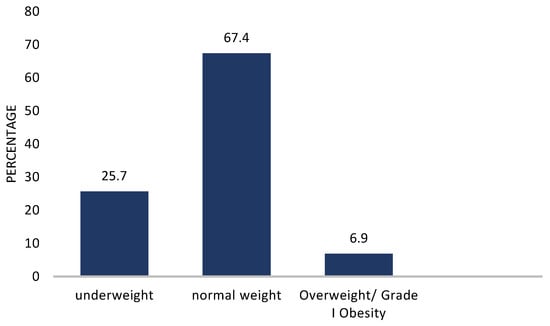
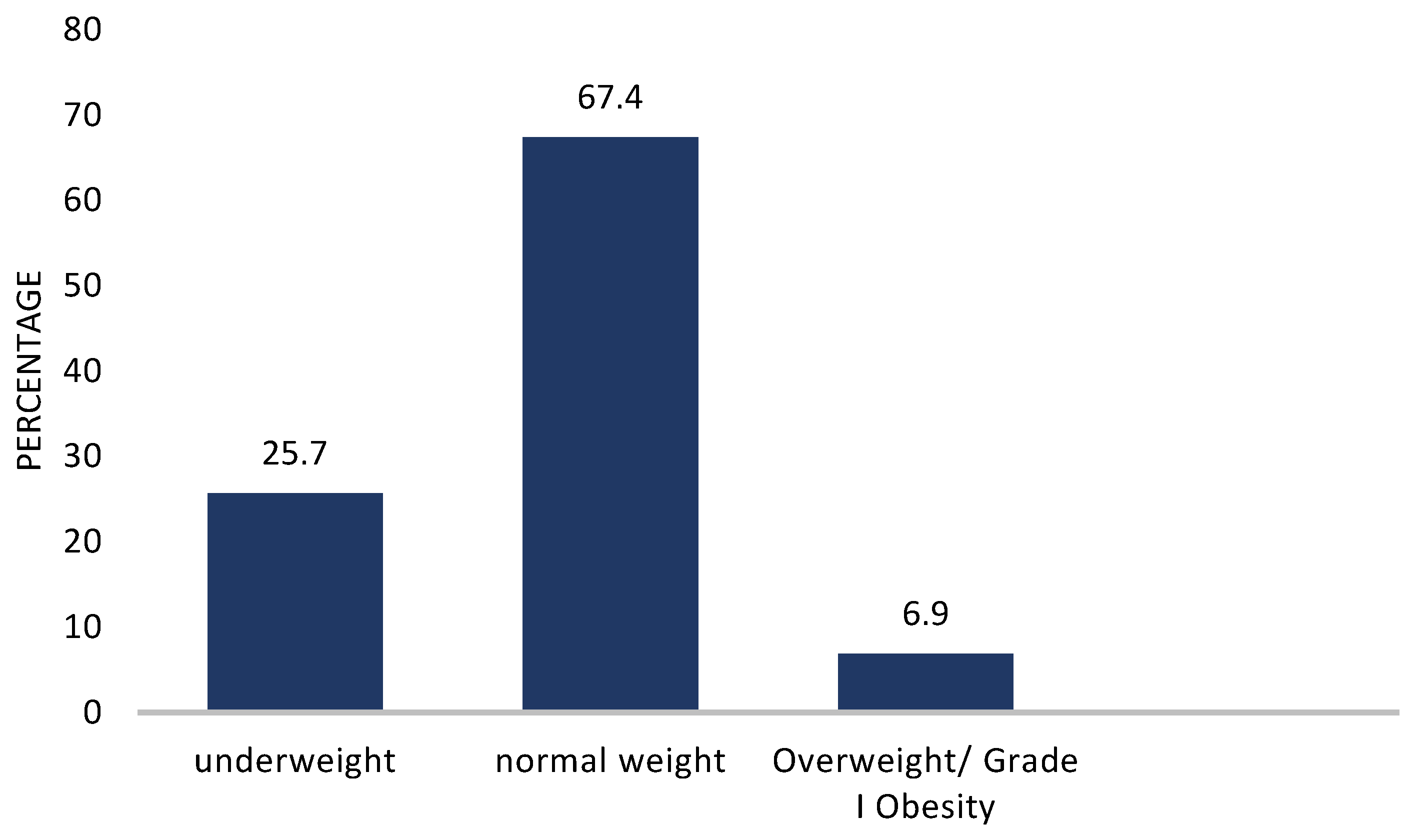
According to BMI categories, 25.7% (n = 26; 95% CI: 17.5–34.9) of participants were classified as underweight, 67.4% (n = 68; 95% CI: 57.5–76.2) as normal weight, and 6.9% (n = 7; 95% CI: 2.8–13.6) as overweight or obese. The distribution of BMI categories is shown in Figure 1.
Figure 1.
Distribution of Participants by BMI category (n = 101).
With regard to blood pressure classification, 59.4% (n = 60) had optimal blood pressure values, 14.9% (n = 15) were classified as having normal-high blood pressure, 23.8% (n = 24) as stage I elevated BP, and 1.0% (n = 1) as stage II elevated BP. Overall, 24.8% of the sample (95% CI: 16.9–34.1) presented blood pressure values above the normal range during screening.
3.3. Association Between BMI and Blood Pressure
A statistically significant association was observed between BMI categories and blood pressure classification (Chi-square test, p = 0.003) (Table 2).
Table 2.
Relationship between Blood Pressure Levels and Body Mass Index (n = 101).
Children with excess weight presented a markedly less favorable blood pressure profile compared to their normal-weight and underweight peers. Although not all children classified as overweight or obese had elevated blood pressure values, the proportion of high-normal and hypertensive measurements was substantially higher in this group.
Additionally, Spearman’s correlation analysis demonstrated a modest positive association between BMI and systolic blood pressure (ρ = 0.32; p = 0.001), indicating that higher BMI values tended to be associated with higher systolic blood pressure levels.
3.4. Physical Activity Patterns
Regarding physical activity patterns, 61.4% (n = 62) of participants reported engaging exclusively in school-based physical education classes, whereas 38.6% (n = 39) also participated in extracurricular physical activity. A statistically significant association was observed between sex and physical activity patterns, with girls being more likely to engage exclusively in school-based physical activity, while boys predominated among those participating in extracurricular sports (Chi-square test, p = 0.001). No statistically significant association was observed between physical activity patterns and blood pressure categories in the overall sample. Prevalence estimates should be interpreted cautiously due to wide confidence intervals resulting from the small sample size.
4. Discussion
This study provides an epidemiological characterization of early cardiovascular risk indicators in a sample of school-aged children from inland Portugal, suggesting three main observations within this school-based sample: (i) a high prevalence of elevated blood pressure, (ii) a strong association between BMI and blood pressure, and (iii) an unexpectedly high proportion of underweight individuals, indicating the coexistence of undernutrition and cardiometabolic risk within the same population.
The proportion of elevated blood pressure measurements observed in our screening (24.8%) appears higher than estimates reported in several pediatric studies. However, this value should be interpreted cautiously, since blood pressure was measured during a single visit and transient elevations are common in pediatric screening contexts. Current pediatric hypertension guidelines recommend repeated measurements across multiple visits or ambulatory monitoring before establishing a diagnosis of hypertension. Moraes et al. [23] observed elevated blood pressure in 7.3% of Brazilian schoolchildren, while Maldonado et al. [24] reported a prevalence of 12.8% among Portuguese children and adolescents. Fraporti et al. [25], however, described values closer to ours, with 26.5% of children presenting hypertension, suggesting that elevated pediatric blood pressure may be more frequent in certain contexts. This variability likely reflects differences in age distribution, measurement protocols, and regional socioeconomic and environmental factors.
A significant association between BMI and blood pressure was observed in the present study, confirming the well-established link between excess adiposity and elevated blood pressure from early life onwards. Children with excess weight showed a clearly less favorable blood pressure profile, with a substantially higher proportion of high-normal and hypertensive values compared to their normal-weight peers. However, not all children with excess weight presented abnormal blood pressure values, which is consistent with the multifactorial nature of pediatric hypertension. Similar associations have been consistently reported in previous studies, showing that increases in BMI during childhood are strongly associated with parallel increases in blood pressure and future cardiovascular risk [26,27].
One of the most striking findings of this study is the very high prevalence of underweight (25.7%), which contrasts sharply with national surveillance data. The Portuguese COSI study reported an underweight prevalence of only 1.3% in 2019 [28], while Marques et al. [14] found values between 10% and 15% in northern Portugal. The relatively high proportion of underweight observed in this sample contrasts with national surveillance data and may reflect local contextual factors or sampling characteristics, although the small sample size prevents firm conclusions. The predominance of underweight among girls further raises concern about gender-specific pressures and behaviors during early adolescence, as previously suggested in Portuguese populations [14].
Taken together, these findings may suggest the coexistence of different nutritional vulnerabilities within this specific school population. This phenomenon, traditionally described in low- and middle-income countries, is increasingly recognized in vulnerable groups within high-income countries and represents a major challenge for public health systems [29,30].
With regard to physical activity, most participants reported engaging exclusively in school-based physical education, with limited participation in extracurricular sports, particularly among girls. Although no statistically significant association was observed between physical activity patterns and blood pressure categories in the present study, this low level of extracurricular physical activity is concerning and may contribute, together with other behavioral and environmental factors, to the unfavorable cardiovascular risk profile observed in this population [31,32,33,34]. It is also important to note that physical activity was assessed using a simplified binary classification (school-based physical education vs. school-based plus extracurricular activity). The absence of information regarding frequency, duration, and intensity of physical activity likely limited the ability to detect meaningful associations with blood pressure.
Several limitations should be acknowledged. First, the cross-sectional design precludes causal inference. Second, blood pressure was assessed during a single visit, which may overestimate the proportion of elevated values due to measurement variability or white-coat effects. Third, the relatively small sample and inclusion of a single school limit generalizability. Fourth, physical activity assessment was based on a simplified questionnaire without information on frequency or intensity. Finally, only descriptive and bivariate analyses were performed, which limits the evaluation of independent associations between variables. Additional limitations should be acknowledged. BMI-based classification may misclassify body composition in pediatric populations. Furthermore, blood pressure measurements obtained during a single visit are subject to regression to the mean and white-coat effects, potentially leading to overestimation of elevated blood pressure prevalence. Finally, the absence of socioeconomic, dietary, and pubertal status data limits the interpretation of potential determinants of the observed findings.
5. Conclusions
This school-based screening study suggests the presence of elevated blood pressure measurements and heterogeneous nutritional status among children from an inland Portuguese setting. Although findings should be interpreted cautiously due to the small sample size and single-occasion blood pressure assessment, they highlight the potential value of school-based cardiovascular risk screening initiatives in underrepresented regions. Larger and longitudinal studies are needed to confirm these observations and better understand the determinants of early cardiometabolic risk in these populations.
Author Contributions
Conceptualization, P.C. and S.M.; methodology, S.M.; software, P.C.; validation, P.C. and S.M.; formal analysis, P.C.; investigation, A.F.; resources, A.F.; data curation, P.C.; writing—original draft preparation, P.C., S.M. and A.F.; writing—review and editing, F.J.B.R.; visualization, F.J.B.R.; supervision, S.M.; project administration, S.M.; investigation, G.E.F.; All authors have read and agreed to the published version of the manuscript.
Funding
SPRINT: Sport Physical Activity and Health Research & Innovation Center; Centro de Investigação & Inovação em Desporto Atividade Física e Saúde; Portugal; FCT: Fundação para a Ciência e a Tecnologia; Portuguese Foundation for Science and Technology; UID/06185/2025 (https://doi.org/10.54499/UID/06185/2025); UID/PRR/06185/2025 (https://doi.org/10.54499/UID/PRR/06185/2025); UID/PRR2/06185/2025. The author, Guilherme Furtado, acknowledges the national funding from FCT: Foundation for Science and Technology, through the institutional scientific employment program (CEECINST/00077/2021).
Institutional Review Board Statement
The study was approved by the Ethics Committee of the Polytechnic Institute of Castelo Branco, under reference number 76/CE-IPCB/2022.
Informed Consent Statement
Informed consent was obtained from all subjects involved in the study.
Data Availability Statement
Data is not available due to ethical or privacy restrictions.
Conflicts of Interest
The authors declare no conflicts of interest.
References
- Oyarce, M.K.; Valladares, V.M.; Elizondo-Vega, R.; Obregón, A.M. Conducta alimentaria en niños. Nutr. Hosp. 2016, 33, 1461–1469. [Google Scholar] [CrossRef] [Scilit]
- NCD Risk Factor Collaboration (NCD-RisC). Worldwide trends in body-mass index, underweight, overweight, and obesity from 1975 to 2016: A pooled analysis of 2416 population-based measurement studies in 128·9 million children, adolescents, and adults. Lancet 2017, 390, 2627–2642. [Google Scholar] [CrossRef] [Scilit]
- Wang, M.; Chu, C.; Mu, J. Relationship between body mass index changes and blood pressure changes from childhood to adulthood in a general Chinese population: A 26 year cohort follow-up study. Blood Press. 2016, 25, 319–326. [Google Scholar] [CrossRef] [Scilit] [PubMed]
- Song, P.; Zhang, Y.; Yu, J.; Zha, M.; Zhu, Y.; Rahimi, K.; Rudan, I. Global Prevalence of Hypertension in Children: A Systematic Review and Meta-analysis. JAMA Pediatr. 2019, 173, 1154–1163. [Google Scholar] [CrossRef] [Scilit] [PubMed]
- Almuwaqqat, Z.; Hui, Q.; Liu, C.; Zhou, J.J.; Voight, B.F.; Ho, Y.L.; Posner, D.C.; Vassy, J.L.; Gaziano, J.M.; Cho, K.; et al. Long-Term Body Mass Index Variability and Adverse Cardiovascular Outcomes. JAMA Netw. Open 2024, 7, e243062. [Google Scholar] [CrossRef] [Scilit] [PubMed] [PubMed Central]
- Samson, R.; Ennezat, P.V.; Le Jemtel, T.H.; Oparil, S. Cardiovascular Disease Risk Reduction and Body Mass Index. Curr. Hypertens. Rep. 2022, 24, 535–546. [Google Scholar] [CrossRef] [Scilit] [PubMed]
- Khanna, D.; Welch, B.S.; Rehman, A. Pathophysiology of Obesity. In StatPearls [Internet]; StatPearls Publishing: Treasure Island, FL, USA, 2025. [Google Scholar]
- Garrido-Miguel, M.; Martínez-Vizcaíno, V.; Oliveira, A.; Martínez-Andrés, M.; Sequí-Domínguez, I.; Hernández-Castillejo, L.E.; Cavero-Redondo, I. Prevalence and trends of underweight in European children and adolescents: A systematic review and meta-analysis. Eur. J. Nutr. 2021, 60, 3611–3624. [Google Scholar] [CrossRef] [Scilit] [PubMed]
- Jiang, X.; Jiang, W.; Zhu, Y.; Zhang, H.; Wang, Z.; Tang, M.; Zhao, W.; Zhang, Z.; Feng, X.; Li, J.; et al. Influence of body mass index on blood pressure in children and adolescents: A cross-sectional school-based study. BMC Public Health 2025, 25, 4286. [Google Scholar] [CrossRef] [Scilit]
- Barati, L.; Radgoodarzi, M.; Vakili, M.; Tabatabaizadeh, M. Overweight and obesity: Worldwide risk factors for pediatric hypertension. ARYA Atheroscler. 2022, 18, 1–6. [Google Scholar] [CrossRef] [Scilit] [PubMed] [PubMed Central]
- Hardy, S.T.; Urbina, E.M. Blood Pressure in Childhood and Adolescence. Am. J. Hypertens. 2021, 34, 242–249. [Google Scholar] [CrossRef] [Scilit] [PubMed] [PubMed Central]
- Haseler, E.; Sinha, M.D. Hypertension in Children and Young Adults. Pediatr. Clin. N. Am. 2022, 69, 1165–1180. [Google Scholar] [CrossRef] [Scilit] [PubMed]
- Coelho, P.; Duarte, M.; Cabral, E.T.; Mateus, S.; Rodrigues, F. Childhood and Adolescent Obesity in a School in Interior Portugal—A Teen without Risk Study. Obesities 2024, 4, 281–291. [Google Scholar] [CrossRef] [Scilit]
- Marques, G.; Festas, C.; Fernandes, C.S.; Simões, D.; Ferreira, F.; Pinto, S.; Jorge, Á.; Ferreira, G. Child’s food consumption and physical exercise: Results from a Portuguese descriptive study. Porto Biomed. J. 2019, 4, e46. [Google Scholar] [CrossRef] [Scilit]
- Masotti, S.; Piva, T.; Zerbini, V.; Raisi, A.; Menegatti, E.; Pagani, A.; Bigoni, C.; Ballarin, E.; De Luca, F.; Zaccagni, L.; et al. Assessing the Relationship between Body Image Satisfaction and Physical Activity in Italian Adolescents: A Cross-Sectional Investigation. Children 2024, 11, 818. [Google Scholar] [CrossRef] [Scilit] [PubMed] [PubMed Central]
- Gualdi-Russo, E.; Rinaldo, N.; Masotti, S.; Bramanti, B.; Zaccagni, L. Sex Differences in Body Image Perception and Ideals: Analysis of Possible Determinants. Int. J. Environ. Res. Public Health 2022, 19, 2745. [Google Scholar] [CrossRef] [Scilit] [PubMed] [PubMed Central]
- Xie, F.; Jiang, L.; Liu, Y.; Wang, M.; Liu, H.; Jiang, F.; Wu, Y.; Tang, Y.-L. Gender differences in the associations between body mass index, depression, anxiety, and stress among endocrinologists in China. BMC Psychol. 2023, 11, 116. [Google Scholar] [CrossRef] [Scilit] [PubMed] [PubMed Central]
- Ravi, S.; Kankaanpää, A.; Bogl, L.H.; Heikkinen, A.; Pietiläinen, K.H.; Kaprio, J.; Ollikainen, M.; Sillanpää, E. Suboptimal dietary patterns are associated with accelerated biological aging in young adulthood: A study with twins. Clin. Nutr. 2025, 45, 10–21. [Google Scholar] [CrossRef] [Scilit] [PubMed]
- Mateus, S.; Amaral, A.M.; Coelho, P.; Rodrigues, F. Adherence to the Mediterranean Diet and Carotid Intima-Media Thickness in University Students: A Cross-Sectional Study. Obesities 2025, 5, 62. [Google Scholar] [CrossRef] [Scilit]
- Pereira, R.; Araújo, J.; Severo, M.; Ramos, E.; Oliveira, A. Disordered Eating Profiles in Adolescence to Early Adulthood and Future Cardiometabolic Health. Pediatrics 2024, 154, e2024066076. [Google Scholar] [CrossRef] [Scilit] [PubMed]
- Branco, M.C.; Coelho, P.; Rodrigues, F. Urinary Tract Infections in a Single Hospital in Central Portugal, a 5-Year Analysis. Microbiol. Res. 2024, 15, 850–863. [Google Scholar] [CrossRef] [Scilit]
- Rodrigues, F.; Coelho, P.; Mateus, S.; Caseiro, A.; Eideh, H.; Gonçalves, T.; Branco, M.C. Decoding Urinary Tract Infection Trends: A 5-Year Snapshot from Central Portugal. Clin. Pract. 2025, 15, 14. [Google Scholar] [CrossRef] [Scilit]
- Moraes, L.I.; Nicola, T.C.; de Jesus, J.S.A.; Alves, E.R.B.; Giovaninni, N.P.B.; Marcato, D.G.; Sampaio, J.D.; Fuly, J.T.B.; Costalonga, E.F. Pressão arterial elevada em crianças e sua correlação com três definições de obesidade infantil. Arq. Bras. Cardiol. 2014, 102, 175–180. [Google Scholar] [CrossRef] [Scilit]
- Maldonado, J.; Pereira, T.; Fernandes, R.; Santos, R.; Carvalho, M. An approach of hypertension prevalence in a sample of 5381 Portuguese children and adolescents. The AVELEIRA registry. “Hypertension in children”. Blood Press. 2011, 20, 153–157. [Google Scholar] [CrossRef] [Scilit]
- Fraporti, M.I.; Scherer Adami, F.; Dutra Rosolen, M. Cardiovascular risk factors in children. Rev. Port. Cardiol. 2017, 36, 699–705. [Google Scholar] [CrossRef] [Scilit]
- Xu, T.; Tao, Y.; Lei, Y. Childhood-to-adolescence weight trajectories and adult hypertension: A systematic review and meta-analysis. Nutr. Metab. Cardiovasc. Dis. 2025, 35, 104160. [Google Scholar] [CrossRef] [Scilit] [PubMed]
- Sayon-Orea, C.; Bes-Rastrollo, M.; Song, M.; Hang, D.; Hu, F.; Ruiz-Estigarribia, L.; Martinez-Gonzalez, M.A. Body shape trajectories and the incidence of hypertension in a Mediterranean cohort: The sun study. Nutr. Metab. Cardiovasc. Dis. 2019, 29, 244–253. [Google Scholar] [CrossRef] [Scilit] [PubMed]
- Rito, A.; Mendes, S.; Baleia, J.; Gregório, M. Childhood Obesity_Surveillance Initiative|COSI Portugal; INSA: Lisbon, Portugal, 2021; Available online: https://nutrimento.pt/wp-content/uploads/2021/10/COSI_Portugal_2019_out2021.pdf (accessed on 13 January 2026).
- de Juras, A.R.; Hsu, W.C.; Hu, S.C. The Double Burden of Malnutrition at the Individual Level Among Adults: A Nationwide Survey in the Philippines. Front. Nutr. 2021, 8, 760437. [Google Scholar] [CrossRef] [Scilit] [PubMed] [PubMed Central]
- Moore Heslin, A.; McNulty, B. Adolescent nutrition and health: Characteristics, risk factors and opportunities of an overlooked life stage. Proc. Nutr. Soc. 2023, 82, 142–156. [Google Scholar] [CrossRef] [Scilit] [PubMed]
- Boraita, R.J.; Ibort, E.G.; Torres, J.M.D.; Alsina, D.A. Factors associated with a low level of physical activity in adolescents from La Rioja (Spain). An. Pediatría (Engl. Ed.) 2022, 96, 326–333. [Google Scholar] [CrossRef] [Scilit] [PubMed]
- Arufe-Giráldez, V.; Pereira Loureiro, J.; Groba González, M.B.; Nieto Riveiro, L.; Canosa Domínguez, N.M.; Miranda-Duro, M.D.C.; Concheiro Moscoso, P.; Rodríguez-Padín, R.; Roibal Pravio, J.; Lagos Rodríguez, M.; et al. Multi-Context Strategies and Opportunities for Increasing Levels of Physical Activity in Children and Young People: A Literature Review. Children 2024, 11, 1475. [Google Scholar] [CrossRef] [Scilit] [PubMed] [PubMed Central]
- Salazar, G.; Vasquez, F.; Andrade, M.; Rodriguez, M.D.P.; Berlanga, R.; Rojas, J.; Giadalah, A.; Muñoz, A. Effect of a Community-Based Program on Preschoolers’ Physical Activity and Nutrition in Chile. J. Funct. Morphol. Kinesiol. 2025, 10, 93. [Google Scholar] [CrossRef] [Scilit]
- Vega-Ramírez, L.; Pascual-Galiano, M.T.; Chinchilla, J.J.; Ávalos-Ramos, M.A. Relationship Between Out-of-School Physical Activity, Physical Growth and the Development of Motor Skills. Children 2025, 12, 1582. [Google Scholar] [CrossRef] [Scilit] [PubMed] [PubMed Central]

Disclaimer/Publisher’s Note: The statements, opinions and data contained in all publications are solely those of the individual author(s) and contributor(s) and not of MDPI and/or the editor(s). MDPI and/or the editor(s) disclaim responsibility for any injury to people or property resulting from any ideas, methods, instructions or products referred to in the content. |
© 2026 by the authors. Licensee MDPI, Basel, Switzerland. This article is an open access article distributed under the terms and conditions of the Creative Commons Attribution (CC BY) license.