


Abstract
Hydrogen supply chains require coordinated planning from upstream production to downstream distribution and end-user delivery; however, significant logistical challenges remain under emerging hydrogen infrastructure constraints. In particular, the transportation sector faces difficulties in achieving efficient distribution while accounting for limited hydrogen refueling availability and vehicle range restrictions. This study evaluates key network design decisions involving distribution center location and fuel cell electric vehicle (FCEV) routing while incorporating hydrogen refueling stations within the transportation system. An integrated framework is proposed by combining K-means clustering for DC location planning with a hydrogen-powered FCEV routing model. Hydrogen refueling stations are incorporated as routing constraints to ensure feasible distribution operations. Next, a case study in Thailand is conducted to validate the proposed model under realistic logistical conditions. The results illustrate how clustering-based allocation improves network coordination, while the integrated FCEV routing approach ensures feasible and efficient delivery under refueling constraints. Comparative analysis further highlights improvements in system performance and provides practical insights for designing coordinated hydrogen logistics systems across integrated supply chain networks.
1. Introduction
Hydrogen is increasingly recognized as a critical energy carrier for achieving low-carbon transportation systems. When produced from renewable energy sources such as solar, wind, or biomass, hydrogen can substantially reduce greenhouse gas emissions, supporting both sustainable mobility and industrial applications. In the transportation sector, hydrogen Fuel Cell Electric Vehicles (FCEVs) offer distinct advantages over battery electric vehicles, including faster refueling times and longer driving ranges [1]. According to the International Energy Agency (IEA)’s Sustainable Development Scenario, global hydrogen demand is projected to reach 90 million metric tons by 2030 and exceed 500 million metric tons by 2070, with the transportation sector expected to become a major end-use sector by 2050 [2]. These projections highlight hydrogen’s growing role in decarbonizing mobility and emphasize the need for well-designed supporting infrastructure.
The development of a robust Hydrogen Supply Chain (HSC) is therefore essential to enable widespread FCEV adoption. The HSC includes hydrogen production, storage, transportation, and distribution, where Hydrogen Refueling Stations (HRSs) serve as critical downstream infrastructure for hydrogen-powered FCEV fleets. Effective deployment of HRSs is one of the key challenges in the HSC due to high investment costs, uncertain demand, and their complex integration with existing transportation systems. Determining HRS locations is critical, as poor placement can lead to underutilized assets and inefficient infrastructure investment [3,4]. Moreover, linking HRS location decisions with distribution planning for FCEV fleets introduces additional complexity, as routing feasibility depends on refueling accessibility and vehicle range constraints [5,6]. Therefore, systematic and data-driven approaches are required to support infrastructure and transportation planning in the HSC.
Global hydrogen deployment and infrastructure targets have also progressed more slowly than expected due to structural barriers such as high capital costs, technological uncertainty, and regional disparities in infrastructure development, as reported by recent studies [7,8]. These challenges further emphasize the importance of integrated modeling approaches for HSC design, particularly in network configuration and facility location planning. In this context, determining an efficient network structure is necessary to capture spatial demand patterns and support the allocation of distribution centers at the strategic level. At the tactical level, fleet planning must consider FCEV requirements, including vehicle range limitations and refueling needs. At the operational level, routing decisions for daily or weekly distribution must account for hydrogen-specific constraints, such as refueling availability and potential detours to HRSs within the HSC [9,10]. Consequently, decisions across strategic, tactical, and operational levels must be jointly coordinated to ensure a feasible and efficient HSC.
To address these issues, this study proposes an integrated optimization and spatial decision-support framework for HSC network design. First, K-means clustering is applied to determine distribution center locations and to evaluate alternative network configurations, including centralized versus clustered structures. Next, the Hydrogen-Fuel Cell Electric Vehicle Routing Problem (H-FCEVRP) model is developed, explicitly incorporating HRSs as operational constraints within the routing process. Then, a GIS-based visualization and validation framework is employed to assess spatial feasibility, accessibility, and network coverage, ensuring the practical relevance of the proposed models. Finally, the proposed framework is applied to a case study in Thailand to demonstrate its applicability, comparing different network configurations and evaluating their performance under realistic spatial and operational conditions. The results provide insights into optimal distribution center placement, routing efficiency, and infrastructure utilization, supporting effective hydrogen logistics system design in the future.
The key contributions of this study are highlighted as follows.
- Development of an integrated decision-support framework that combines K-means clustering with hydrogen-powered FCEV routing under hydrogen refueling constraints, supporting coordinated strategic and operational planning for emerging hydrogen logistics systems.
- Comparative assessment of centralized and clustering-based distribution network structures to evaluate transportation efficiency, routing feasibility, and infrastructure accessibility under limited hydrogen refueling availability.
- Formulation of a practical FCEV routing model that explicitly incorporates HRS accessibility and vehicle range limitations, enabling realistic analysis of distribution feasibility in infrastructure-scarce environments.
- Integration of GIS-based spatial analysis to assess network coverage, accessibility, and regional feasibility, improving the applicability of the framework for real-world hydrogen infrastructure planning and deployment.
- Application of the framework to a Thailand case study involving existing, planned, and hypothetical hydrogen refueling stations, demonstrating how the proposed approach can support early-stage hydrogen infrastructure planning and scenario evaluation in emerging energy-transition economies.
The organization of this study is as follows: Section 2 presents a review of the relevant literature. Section 3 describes the methodological framework, highlighting the integrated framework. Section 4 details the case study and analysis procedures, while Section 5 discusses key managerial insights arising from the study. Finally, Section 6 concludes with a summary of the findings and proposes directions for future research.
2. Literature Review
2.1. Hydrogen Supply Network Planning
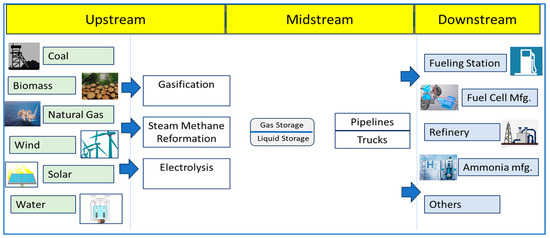
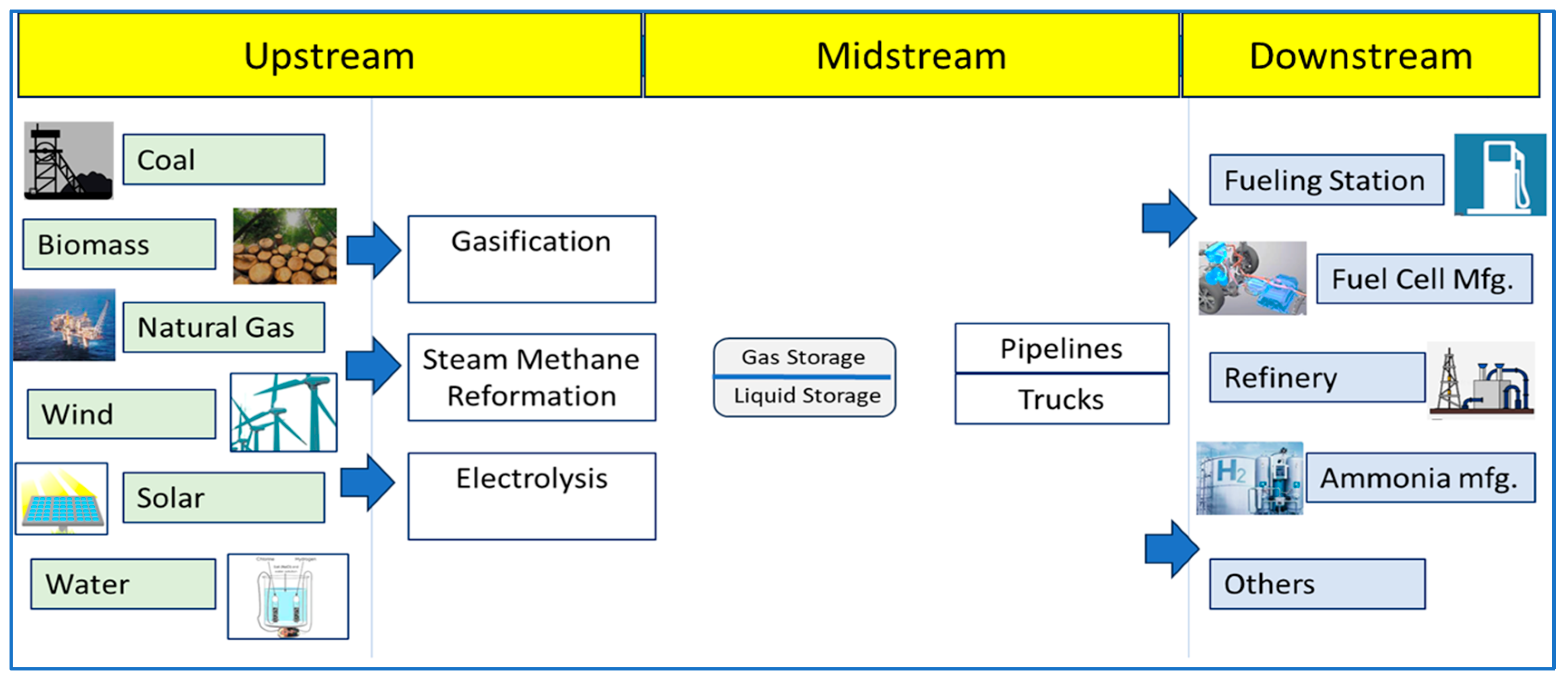
The HSC comprises a sequence of interconnected activities ranging from upstream production to midstream storage and transportation, and finally to downstream last-mile distribution and end-use applications, as presented in Figure 1. This multi-stage structure forms a complex network that requires coordinated planning to ensure efficiency, cost-effectiveness, and system reliability [11]. As hydrogen deployment expands, particularly in transportation applications, the alignment of infrastructure, demand distribution, and logistics operations becomes increasingly critical. However, the integration of these components remains a major challenge, as decisions across different stages of the HSC are often treated independently rather than within a unified framework.
Figure 1.
Hydrogen supply chain flow.
At the upstream level, hydrogen production pathways vary in terms of technology maturity, environmental impact, and geographic feasibility. Conventional grey hydrogen production via steam methane reforming remains dominant but is associated with high carbon emissions [12]. Blue hydrogen offers a transitional solution through carbon capture and storage, while green hydrogen produced from renewable energy represents the most sustainable alternative [13]. The selection of production sources is highly dependent on regional resource availability and policy conditions, highlighting the importance of aligning production decisions with spatial and technological factors [14,15]. Despite extensive research at this stage, upstream planning is often decoupled from downstream logistics considerations, limiting overall network design.
In the midstream stage, hydrogen is stored and transported in either compressed or liquefied forms, each with distinct technical and economic implications for downstream demand nodes, including HRSs for transportation and industrial users such as ammonia production plants and other large-scale hydrogen applications. While compressed hydrogen is suitable for short- to medium-distance transport, liquefied hydrogen enables higher energy density for long-distance distribution from midstream production facilities to downstream users [16,17]. The choice of storage and transport technologies also significantly influences infrastructure costs, energy efficiency, and supply chain design. Existing studies primarily focus on techno-economic assessments of these options [18,19], yet limited attention has been given to how these decisions interact with downstream facility location and distribution planning.
At the downstream level, hydrogen is delivered to end users through applications such as industrial processes and mobility systems supported by HRSs. In transportation, HRSs serve as critical interface nodes linking hydrogen supply with demand and enabling fleet operations. While prior research in conventional supply chain networks has examined centralized and decentralized configurations, highlighting trade-offs between economies of scale and distribution flexibility [20,21,22], such analyses remain limited in the context of the HSC. In addition, existing studies often focus on infrastructure deployment for HRS placement, with less attention given to the strategic placement of distribution centers and their interaction with downstream transportation systems. Moreover, distribution planning for FCEV fleets introduces additional complexity, as routing decisions must account for hydrogen-specific constraints. This highlights the need for integrated approaches that link strategic distribution facility location with FCEV routing to ensure efficient and feasible hydrogen logistics operations.
To bridge this gap, there is a need for integrated modeling approaches that simultaneously consider facility location, network configuration, and transportation planning within a unified framework. This study contributes to this direction by focusing on the downstream segment of the HSC while explicitly linking strategic location decisions with tactical and operational distribution planning through clustering-based network design and FCEV routing models.
2.2. Location and Routing Planning in Downstream HSC
At the downstream level, facility location decisions play a critical role in ensuring efficient hydrogen distribution in the HSC. Existing studies have primarily focused on the placement of off-site and on-site hydrogen production facilities to distribute hydrogen to demand areas [23,24,25]. For example, Derse et al. [23] develop an integrated mathematical programming model for HSC design that optimizes production, storage, and transportation decisions to minimize total cost while ensuring regional coverage using a generic regional network. Lee et al. [26] propose a two-stage optimization framework to design HSC infrastructure by determining HRS locations with on-site production deployment to meet mobility demand using a case study in the Republic of Korea. Ransikarbum et al. [25] determine optimal locations for off-site hydrogen production facilities by clustering HRSs using K-means and applying a minisum location model based on spatial and population data in a German case study. These studies highlight the importance of regional spatial planning in hydrogen systems but predominantly focus on infrastructure siting rather than distribution and operational network planning.
In contrast, relatively limited attention has been given to the strategic placement of distribution centers within the HSC context, particularly in relation to downstream transportation operations. While centralized and decentralized configurations have been widely examined in general supply chain network design (e.g., [27]), their application to hydrogen logistics remains underdeveloped. Existing studies in hydrogen systems primarily focus on production–distribution linkages with limited consideration of how distribution center location decisions affect last-mile distribution efficiency and overall system performance in the HSC. Furthermore, the interaction between location decisions and spatial demand clustering, which is essential for capturing geographic heterogeneity and complex demand patterns, has not been sufficiently explored [28]. This gap highlights the need for clustering-based approaches to support strategic planning through comparative evaluation of network configurations and their implications for FCEV-based routing in last-mile distribution.
Transportation planning in HSCs has increasingly been addressed through extensions of the VRP, which is a core optimization framework in first-mile and last-mile logistics for determining efficient routes between depots and multiple customers under constraints such as vehicle capacity, travel distance, service time, and fleet size [29,30]. Since its introduction, the VRP has been widely extended to better reflect real-world logistics complexities (e.g., [31,32,33]), with solution approaches ranging from exact methods to heuristic and metaheuristic algorithms for complex systems. In hydrogen logistics, these extensions are particularly relevant due to the integration of FCEVs, which introduce additional operational constraints compared with conventional fleets, as highlighted by recent studies. For example, Baqqal et al. [34] review hydrogen VRP formulations incorporating refueling constraints and infrastructure limitations, while Abibou et al. [35] propose a Branch-and-Bound approach for hydrogen VRP with time windows, and Liu et al. [36] model hybrid energy dynamics in hydrogen FCEVs integrating fuel cell and battery interactions. That is, existing hydrogen VRP studies predominantly emphasize deterministic routing and energy feasibility modeling, reflecting the early-stage development of hydrogen logistics systems and the limited availability of operational real-world data.
However, despite these advances, existing studies remain largely fragmented in scope, with most models addressing routing efficiency under deterministic settings and focusing on either refueling feasibility or vehicle energy constraints in isolation. Furthermore, limited attention has been given to integrating spatial decision layers such as facility location or demand clustering with hydrogen-specific routing structures. This separation between strategic and operational planning limits the ability of existing models to capture end-to-end hydrogen logistics system behavior. In particular, although variability in demand, supply, and infrastructure availability is relevant in real-world logistics systems, such aspects are rarely incorporated in hydrogen VRP studies, likely due to the early-stage nature of hydrogen infrastructure deployment.
3. Methodology
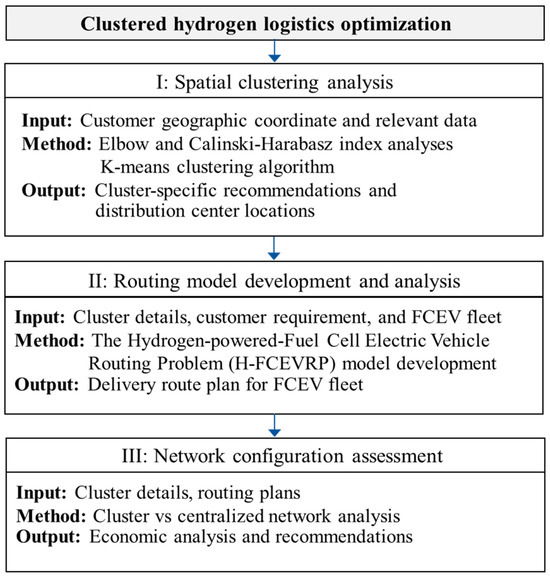
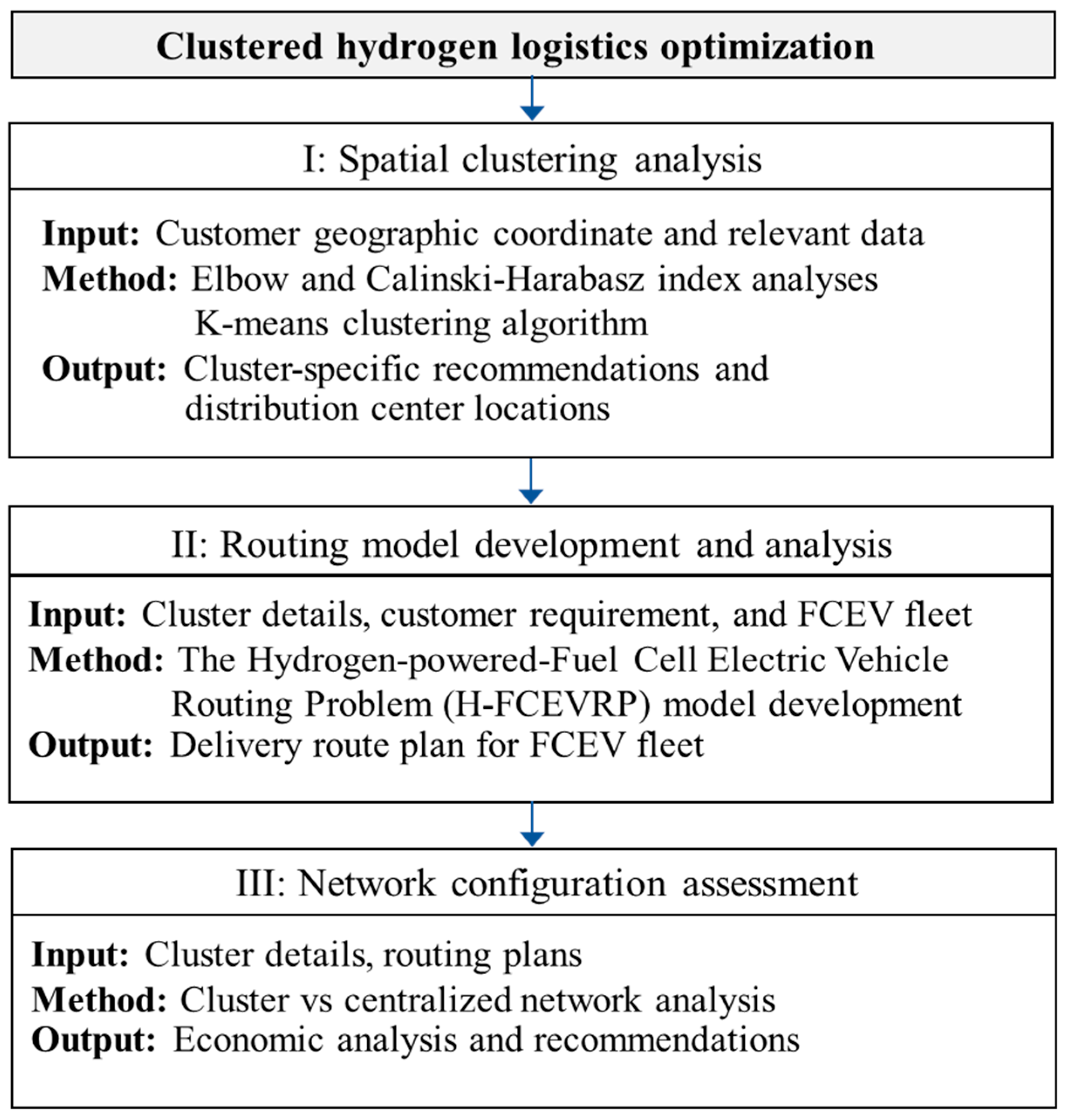
The proposed methodology, comprising an integrated framework for designing downstream HSC planning, is presented in Figure 2, which combines clustering-based customer demand aggregation, distribution center placement, and vehicle routing with hydrogen refueling considerations. First, spatial customer demand points are processed using clustering techniques to identify geographically coherent groups. Next, candidate distribution center locations are determined based on cluster centroids and further refined through optimization to balance cost, coverage, and accessibility. Finally, the H-FCEVRP is developed, explicitly incorporating HRS-related constraints, customer requirements, and FCEV operating conditions. Each method is discussed further as follows.
Figure 2.
A schematic diagram of the methodology flow.
3.1. K-Means Clustering Analysis
The K-means clustering method is applied to partition customer locations into a predefined number of clusters based on the minimum Within-Cluster Sum of Squares (WCSS). Initially, each node is assigned to the nearest cluster centroid, and centroids are iteratively updated until convergence is achieved. This process groups spatially proximate customer nodes, enabling the identification of representative locations that can serve as candidates for distribution centers. The method has been successfully applied in a number of renewable energy-related supply chain designs in the literature [37,38]. Equation (1) expresses the distance between an individual node and a centroid, while Equation (2) formulates the K-means objective function, which seeks to minimize the total WCSS across all clusters.
where:
is the distance between data point i and centroid of cluster j.
is the value of node point i in the k dimension (variable).
is the value of centroid j in the k dimension (variable).
where:
is the set of data points assigned to cluster j.
is the value of node point i in an assigned cluster.
is the centroid of cluster j.
is the squared Euclidean distance.
Next, the optimal number of clusters (k) is analyzed using the Elbow method, supported by the Calinski–Harabasz (CH) index to strengthen the selection [39,40,41]. The Elbow method is initially applied by computing the WCSS for different k values and identifying the point where the rate of decrease in WCSS begins to level off, indicating diminishing returns from adding additional clusters. To complement this visual heuristic, the CH index is also calculated for each candidate k, providing a quantitative measure of clustering quality based on the ratio of between-cluster dispersion to within-cluster dispersion, as presented in Equation (3). This joint criterion ensures that the selected clustering solution achieves an optimal balance between cluster compactness and cluster separation. This clustering approach is particularly appropriate for the downstream HSC, where demand is spatially dispersed. By aggregating nearby customer points into clusters, redundancy in facility placement is reduced and distribution efficiency is improved. It also aligns well with the deployment of HRSs for the FCEV fleet, where station nodes are typically planned to serve concentrated demand regions rather than isolated points, thereby enhancing scalability and cost-effectiveness.
where:
is the Calinski–Harabasz index.
is the between-cluster dispersion.
is the within-cluster dispersion.
3.2. The Mathematical H-FCEVRP Model
The proposed H-FCEVRP model is presented in this subsection, which determines how a fleet of FCEVs is tactically assigned to serve each identified cluster and visit a set of customers from and back to a distribution center under a daily or weekly operational plan. The mathematical sets, parameters, decision variables, and associated planning constraints and requirements are also introduced.
3.2.1. Model Assumptions
- Customer demands, travel distances, and travel times are assumed to be deterministic and known in advance throughout the planning horizon.
- All vehicles depart from and return to their assigned distribution center within the planning horizon, and each customer is visited exactly once without split deliveries.
- Vehicle loading capacity and hydrogen tank capacity are fixed and cannot be exceeded during routing operations.
- Hydrogen consumption is assumed to be proportional to travel distance, with each vehicle maintaining a minimum hydrogen reserve level to ensure operational feasibility.
- Hydrogen refueling activities are permitted only at designated HRSs, and refueling times are assumed to be constant across all stations.
- All HRSs are assumed to remain operational and available during the planning period, without disruptions such as station failures, hydrogen shortages, or queuing delays.
- The locations of existing, planned, and hypothetical HRSs are assumed to represent feasible infrastructure deployment scenarios suitable for evaluating early-stage hydrogen logistics and distribution planning.
3.2.2. Set
: Set of all nodes, where 0 is departure depot.
: Set of customer nodes.
: Set of directed arcs between nodes.
: Set of available FCEV fleet.
: Set of hydrogen refueling stations (HRSs).
3.2.3. Parameters
Logistics-related parameters.
: Number of customers.
: Number of vehicles.
: Vehicle capacity.
: Distance between nodes (km).
: Demand at customer node.
: Travel time between nodes (minutes).
: Service/loading/unloading time at a node (minutes).
: Beginning of planning horizon.
: End of planning horizon.
: A big M for time constraints.
Hydrogen-related parameters.
: Hydrogen consumption rate (kg H2/km).
: Tank capacity (kg H2).
: Initial hydrogen of each vehicle at the beginning (kg H2).
: Minimum reserve hydrogen (kg H2).
: A big M for hydrogen constraints.
: Hydrogen refueling time (minutes).
: Number of hydrogen pumps.
Performance-related parameters.
: Fixed cost per vehicle (THB).
: Transport operating cost (THB/km).
: Hydrogen purchase price at HRS i (THB/kg H2).
: Carbon dioxide emission factor from refuels at HRS i (kg CO2/kg H2).
3.2.4. Decision Variables
Routing and time-tracking variables.
: Indication if vehicle travels between nodes (binary).
: Quantity transported by a vehicle between nodes (units).
: Arrival time of a vehicle at a node.
: Total working time of a vehicle (minute).
: Indication if a vehicle is used (binary).
Hydrogen-related variables.
: Hydrogen level of each vehicle at a node (kg H2).
: Refueling amount of a vehicle at a node (kg H2).
: Refuel decision variable (binary).
Auxiliary Decision Variables.
: Fixed cost from using FCEV fleet.
: Variable cost from using hydrogen fuel and driving cost.
: Variable representing the total carbon dioxide (CO2) emissions.
3.2.5. Objective Functions
The overall objective shown in Equations (4)–(6) is to minimize the total system cost of operating the FCEV fleet. This cost includes fixed costs associated with activating vehicles, variable transportation costs incurred from traveling between nodes, and hydrogen refueling costs required to sustain vehicle operations along the routes. In addition to cost minimization, the model also accounts for environmental performance by tracking total CO2 emissions from refuels at HRS, as formulated in Equation (7), which serves as a secondary performance indicator reflecting the environmental impact of hydrogen refueling activity.
3.2.6. Constraints
The overall constraint sets in the model are systematically structured around four core components that collectively define the operational logic of the hydrogen routing plan. In particular, the routing logic ensures that each customer is visited exactly once and that vehicle routes are continuous and properly linked between depot departure and return (Equations (8)–(11)). Next, the commodity flow modeling governs the distribution and conservation of goods throughout the network while enforcing vehicle capacity limits and guaranteeing that delivered quantities satisfy customer demand (Equations (12)–(16)). Then, the time scheduling and feasibility constraints regulate the temporal consistency of routes by enforcing service times, travel times, and planning horizon boundaries, while also ensuring that all sequencing decisions remain feasible over time (Equations (17)–(25)). Next, the hydrogen energy system integrates vehicle-specific fuel dynamics by tracking hydrogen consumption during travel, enabling refueling only at designated HRSs, and maintaining tank capacity and safety constraints, thereby ensuring energy feasibility throughout each route (Equations (26)–(38)). Finally, variable domains are defined in Equations (39)–(49), respectively.
The hydrogen-related constraints, specifically, are modelled to ensure that vehicle energy remains physically feasible and tightly integrated with routing decisions. That is, the model first establishes initial hydrogen levels at the distribution center, providing a consistent starting energy state for each vehicle (Equation (26)). It then enforces infrastructure constraints by restricting all refueling activities exclusively to designated HRSs and eliminating any possibility of refueling at non-station nodes (Equations (27) and (28)). To ensure consistency between routing and fueling behavior, refueling decisions and quantities are explicitly linked to station visits, so that a vehicle can only refuel if it physically traverses a station node (Equations (29) and (30)). This is further reinforced by Equation (31), which couples the binary refueling decision with the continuous refueling quantity variable, ensuring that hydrogen intake occurs only when the refueling action is activated. Consequently, the model optimizes not only whether a vehicle should refuel, but also the amount of hydrogen refueled at each station subject to tank capacity and route energy requirements, rather than assuming fixed or full-tank refueling behavior. Equation (32) further prevents inactive vehicles from engaging in any refueling activity. In addition, Equation (33) ensures that hydrogen additions never exceed the available tank capacity. The dynamic evolution of hydrogen is captured through Equations (34) and (35), which ensure that fuel decreases with distance traveled according to consumption rates and increases appropriately when refueling occurs. A minimum activation threshold and capacity bounds governing hydrogen refueling, along with restrictions on the number of vehicles that can refuel simultaneously at each station, are presented in Equations (36)–(38). Collectively, these constraints ensure a hydrogen management system that integrates routing feasibility, energy conservation, refueling logic, and infrastructure limitations.
Routing constraints
Commodity flow and capacity constraints
Time and schedule constraints
Hydrogen requirement constraints
Variable domain
The proposed H-FCEVRP formulation extends the classical VRP structure through the integration of hydrogen-specific operational constraints. In particular, the routing constraints (Equations (8)–(11)), commodity flow and vehicle capacity constraints (Equations (12)–(16)), and time scheduling constraints (Equations (17)–(25)) collectively represent the core structure of a capacitated VRP with scheduling considerations. If the hydrogen-related constraints (Equations (26)–(38)) are excluded, the resulting formulation reduces to a routing model without explicit hydrogen feasibility and refueling infrastructure restrictions. The inclusion of Equations (26)–(38) therefore constitutes the key extension of the proposed model by explicitly incorporating hydrogen consumption dynamics, refueling station accessibility, tank capacity limitations, reserve hydrogen requirements, and refueling operational constraints within the routing framework.
4. Case Study and Results
4.1. Case Study
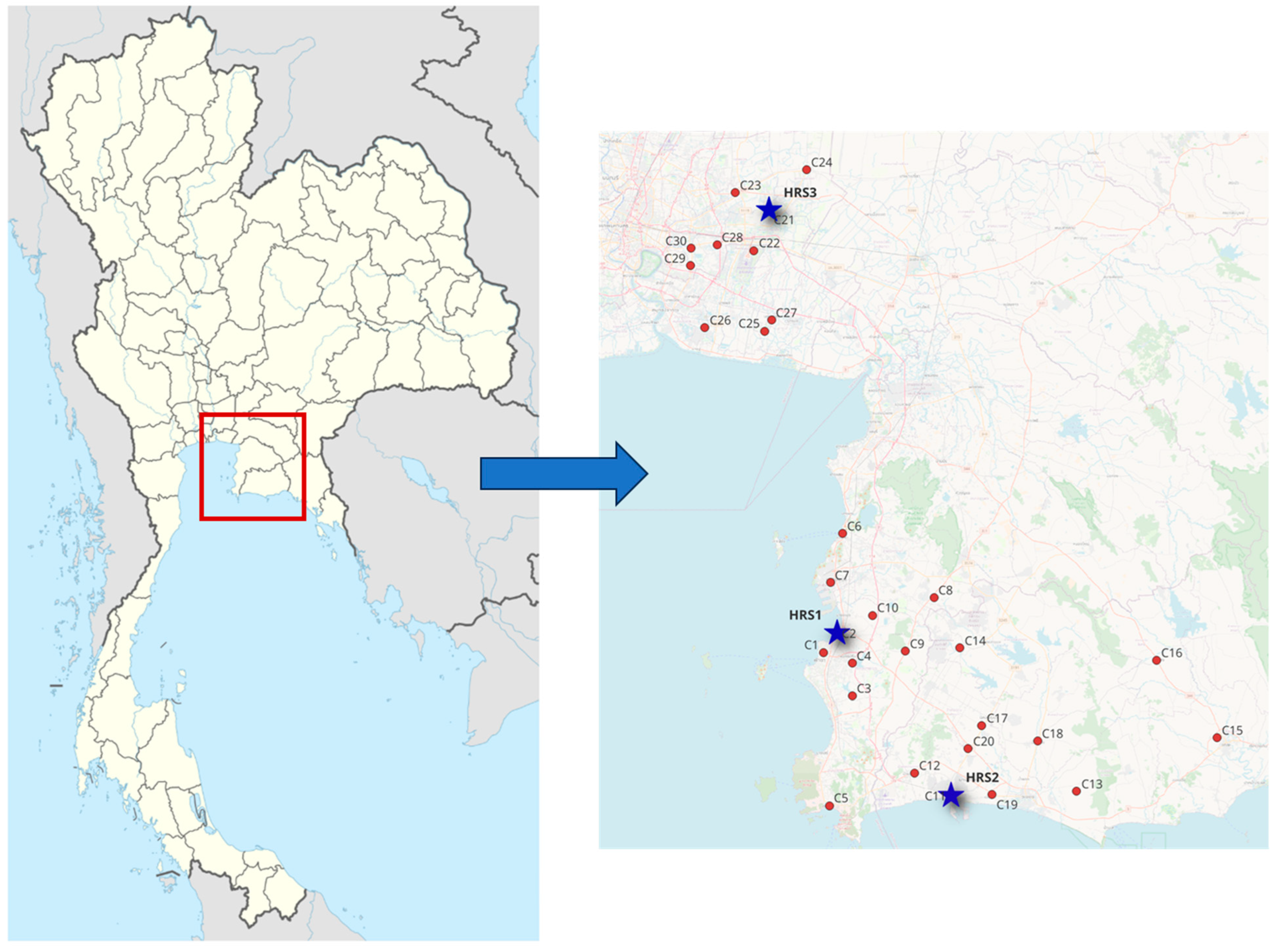
The proposed framework is illustrated through a case study in Thailand, focusing on the central and eastern economic corridor, one of the country’s most active industrial and logistics regions. The study incorporates both existing and planned hydrogen infrastructure to demonstrate the applicability of the model under evolving future conditions. Specifically, one existing prototype hydrogen refueling station (HRS1) located in Bang Lamung (Chonburi province) is currently the only operational HRS in Thailand, reflecting a grey hydrogen-based pilot project [42]. In addition, a recently announced HRS project (HRS2) in the Map Ta Phut Industrial Estate (Rayong province) is included to capture anticipated infrastructure development. This station is associated with Thailand’s transition toward green hydrogen production, given its location within a major energy and petrochemical hub with strong potential for large-scale electrolyzer deployment [43]. Additionally, a hypothetical HRS3 is introduced in the Lat Krabang Industrial Estate, a key logistics hub in the Bangkok metropolitan area with strong multimodal connectivity (Table 1). This station is assumed to follow the same planned green hydrogen development pathway as HRS2, reflecting a consistent scenario of future hydrogen infrastructure expansion in major industrial and logistics corridors. Given that FCEV routing operations typically involve multi-stop deliveries that significantly increase total travel distance, the inclusion of this station ensures network feasibility and coverage under FCEV operational constraints. That is, the spatial distribution of demand nodes across the study area further necessitates adequate refueling accessibility to avoid infeasible routes.
Table 1.
Case study details for HRS locations.
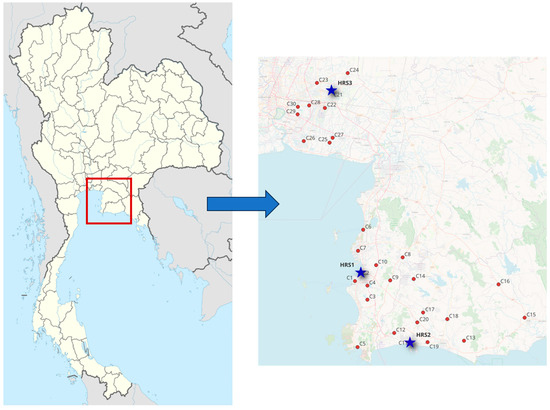
In this study, customer demand nodes are approximated from real geographic locations across key areas and logistics hubs within the study area, as shown in Figure 3 and Table 2. A total of 30 nodes are distributed across provinces such as Chonburi, Rayong, and Bangkok, covering major economic zones, ports, and industrial estates to represent spatial demand patterns. The spatial distribution of customers supports the application of K-means clustering to identify candidate distribution center (DC) locations, enabling efficient allocation and coordination within the HSC network. This setup allows for the evaluation of integrated decisions on distribution center placement and FCEV routing while explicitly accounting for HRS availability and realistic geographic constraints.
Figure 3.
Case study map (1 cm represents 7.74 km).
Table 2.
Case study details for demand locations.
4.2. Clustering Analysis Using K-Means Algorithm
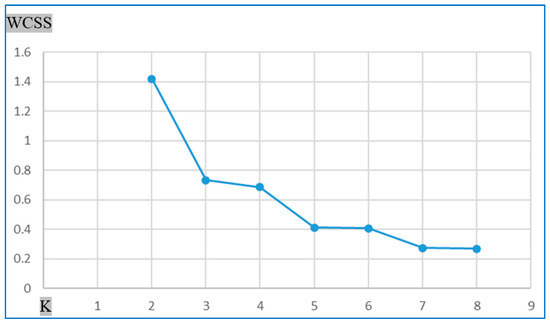
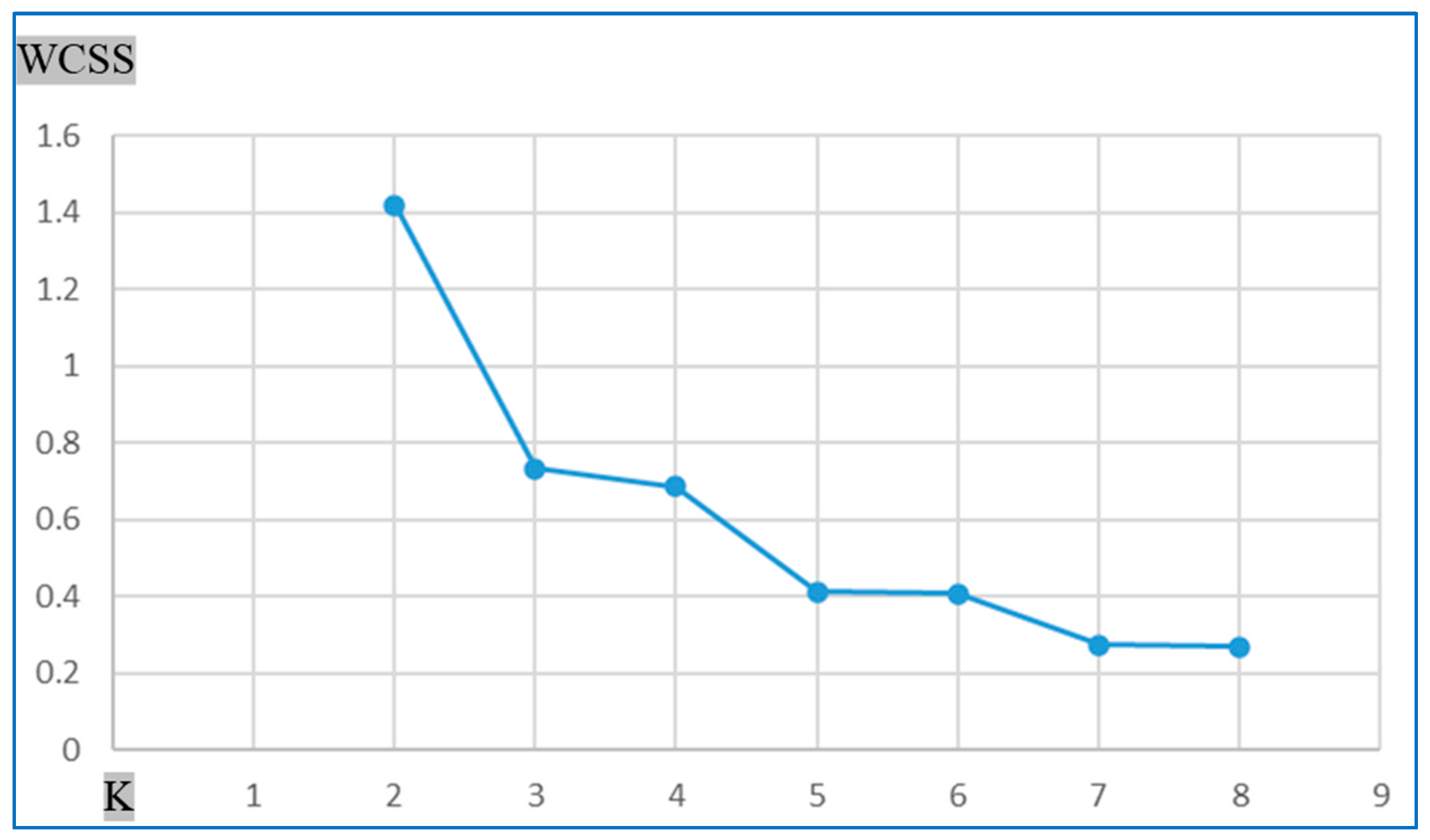
The K-means clustering method is first explored using the elbow technique to provide an initial visual assessment of the appropriate number of clusters (K). As shown in Figure 4, a sharp reduction in WCSS is observed when increasing K from 2 to 3, indicating a significant improvement in cluster compactness. Beyond this point, the rate of decrease becomes more gradual for higher values of K, suggesting diminishing marginal gains in clustering performance. While a further reduction is observed when increasing K from 4 to 5, the magnitude of improvement is noticeably smaller. This pattern implies that adding more clusters beyond K = 3 yields limited additional benefit in terms of clustering efficiency. To support a more rigorous decision on the optimal number of clusters, quantitative metric analysis is conducted using the Calinski–Harabasz (CH) index, as presented in Table 3. The results indicate that K = 3 achieves the highest CH index value (112.8151), reflecting the best balance between inter-cluster separation and intra-cluster compactness. Although increasing K further reduces within-cluster dispersion, it does not improve the overall clustering quality, as evidenced by the decline in CH index values. Therefore, based on the combined insights from the elbow visualization and quantitative evaluation, three clusters are selected and used as the basis for subsequent distribution center location and routing analysis.
Figure 4.
Elbow method analysis.
Table 3.
Analysis of cluster number (K) using Calinski–Harabasz index.
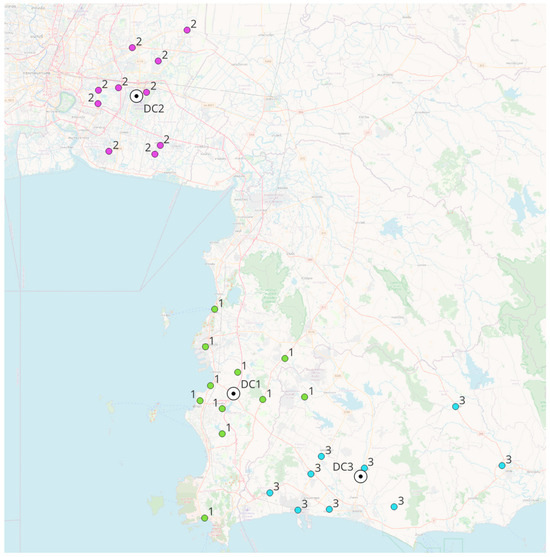
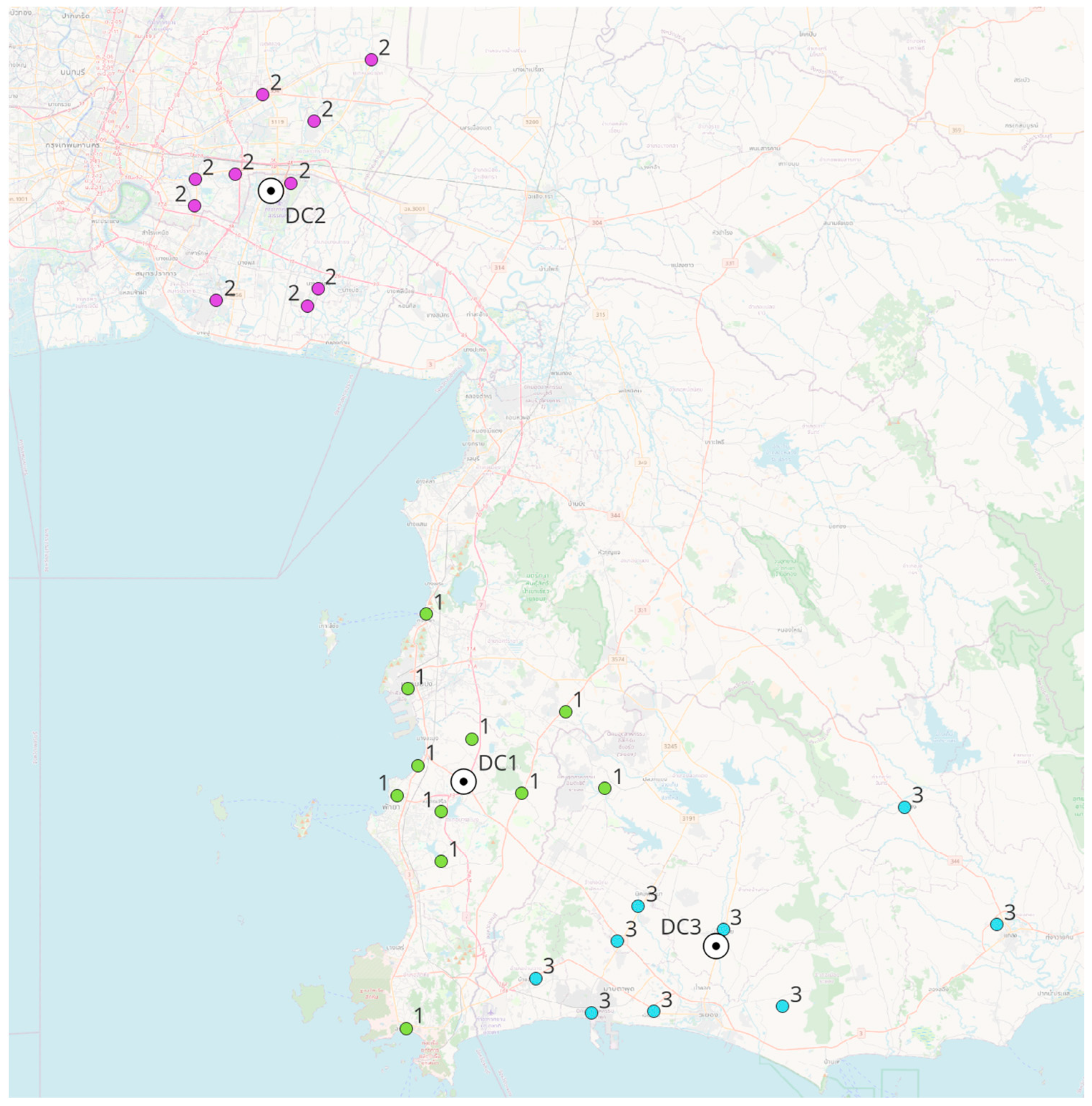
The resulting clustering structure is presented in Table 4, where three clusters are identified and interpreted as candidate distribution center service regions. Specifically, DC1 (11 nodes) is centered at latitude 12.967412 and longitude 100.976964, covering demand nodes primarily located in Chonburi and surrounding areas. DC2 (10 nodes), with centroid coordinates (13.696963, 100.738513), corresponds to the Bangkok metropolitan cluster, encompassing key urban and logistics nodes. DC3 (9 nodes), centered at (12.764156, 101.288427), represents the Rayong cluster, including major industrial zones such as Map Ta Phut and adjacent areas. This clustering outcome demonstrates spatial segmentation of demand across the central and eastern regions, supporting the strategic placement of distribution centers for efficient hydrogen supply chain operations. Moreover, the Geographic Information System (GIS)-based spatial visualization in Figure 5 further maps each cluster using geographic context, allowing for an interpretation of spatial relationships, demand concentration, and service coverage areas. This visual representation highlights how each distribution center aligns with regional logistical patterns and demonstrates a clear spatial segmentation of demand across the central and eastern regions.
Table 4.
K-means results for distribution center locations.
Figure 5.
GIS-based spatial visualization for the three clusters (1 cm represents 7.74 km).
4.3. H-FCEVRP Routing Analysis and Result
This subsection presents the analysis of the proposed H-FCEVRP routing plan. Initially, data are collected as summarized in Table 5, which include network, vehicle, and hydrogen-related parameters. In particular, network-related parameters, including distance and travel time, are derived from GIS-based origin–destination matrices, with travel time computed using the average speed of FCEVs to approximate operating conditions. Customer demand is generated using a uniform distribution to capture variability across service locations, while service time is modeled as a linear function of demand, ensuring consistency between delivery quantity and handling effort.
Table 5.
Parameter data for the proposed H-FCEVRP model.
Additionally, vehicle and hydrogen-related data are collected to reflect the characteristics of FCEVs. In particular, hydrogen consumption, tank capacity, and refueling time are aligned with values reported in the literature for FCEV trucks, while the initial hydrogen level assumes that vehicles depart with half-filled tanks. Economic and environmental parameters are also structured to capture the trade-off between cost and sustainability, as hydrogen price and associated emissions vary by production pathway. While grey hydrogen is characterized by lower cost but higher CO2 emissions, green hydrogen has significantly lower emissions but higher cost. Importantly, CO2 emissions in this study are defined within a well-to-tank framework, where lifecycle emissions are attributed to hydrogen supply at refueling stations (HRSs) rather than vehicle operation. Accordingly, emissions are calculated based on hydrogen consumption at HRSs using station-specific emission factors that reflect hydrogen production pathways. Direct tailpipe emissions from vehicle operation (i.e., transportation over distance) are assumed negligible due to the zero-emission nature of FCEVs; therefore, transportation distance influences system performance through travel cost and hydrogen consumption but does not directly contribute to CO2 emissions. Overall, the parameter set provides a practical foundation for analyzing routing decisions and energy usage within the H-FCEVRP framework.
The analysis of the distribution plan is next evaluated using the proposed H-FCEVRP model, based on the clustering results obtained earlier. The model is implemented and solved in AMPL [50] on a computer with a 13th Gen Intel Core i5-13500H processor (2.60 GHz) and 16 GB of RAM, operating on a 64-bit system. For consistency across all test instances, the maximum computational time is limited to 3600 s. The performance results presented in Table 6 compare the outcomes of the H-FCEVRP model under two different hydrogen safety thresholds, namely 2 kg and 5 kg, across the three clusters. This comparison also serves as a sensitivity analysis to evaluate how different minimum hydrogen reserve requirements influence routing feasibility, refueling behavior, operational cost, and environmental performance within the downstream hydrogen logistics system.
Table 6.
Performance results using the model based on K-means clusters.
When the minimum hydrogen reserve is set at 2 kg, all clusters are able to complete their routes without requiring any refueling, as the initial hydrogen level is sufficient to satisfy both routing and energy constraints. As a result, total costs remain lower, consisting only of fixed vehicle costs and distance-based fuel costs. This scenario can therefore be interpreted as a relaxed hydrogen feasibility condition, where the operational dependence on hydrogen refueling infrastructure becomes minimal and the routing structure behaves similarly to a vehicle routing configuration with limited hydrogen-related restrictions. In contrast, increasing the minimum reserve threshold to 5 kg activates greater dependency on HRS accessibility and refueling operations, thereby illustrating the operational impact of stricter hydrogen safety requirements on routing decisions, total cost, and environmental performance. However, when the hydrogen safety threshold is increased to 5 kg, refueling behavior emerges in Cluster 1 and Cluster 3. This leads to a noticeable increase in total cost due to hydrogen purchases at refueling stations. For example, in Cluster 1, approximately 2.42 kg of hydrogen is refueled at HRS1 (grey hydrogen). Given a hydrogen price of 275 THB/kg, the refueling cost is calculated as approximately 664.27 THB after rounding, which increases the total cost from 3551.95 THB to 4216.22 THB. Similarly, in Cluster 3, around 1.73 kg of hydrogen is refueled at HRS3 (green hydrogen). With a hydrogen price of 550 THB/kg, the refueling cost is approximately 953.04 THB, leading to an increase in total cost from 3466.60 THB to 4419.64 THB.
From an environmental perspective, the introduction of refueling under the 5 kg threshold also results in higher CO2 emissions, particularly when hydrogen is sourced from emission-intensive production pathways. For example, in Cluster 1, approximately 2.42 kg of hydrogen is refueled at HRS1, which uses grey hydrogen. Given an emission factor of 10 kg CO2/kg H2, the resulting emissions are calculated as approximately 24.2 kg CO2, corresponding to 24.15 kg CO2. In contrast, in Cluster 3, approximately 1.73 kg of hydrogen is refueled at HRS3, which uses green hydrogen. With a lower emission factor of 0.5 kg CO2/kg H2, the resulting emissions are approximately 0.865 kg CO2. This clearly highlights the trade-off between operational cost and environmental impact: grey hydrogen leads to lower cost but higher emissions, whereas green hydrogen results in higher cost but significantly lower emissions. In addition, the total working time also increases in Clusters 1 and 3 due to the added refueling activities, which introduce additional service time within the route. Despite these changes, the total travel distance and hydrogen consumption from driving remain unchanged across scenarios, indicating that the routing plan is stable. Additionally, all scenarios consistently utilize a single FCEV per cluster.
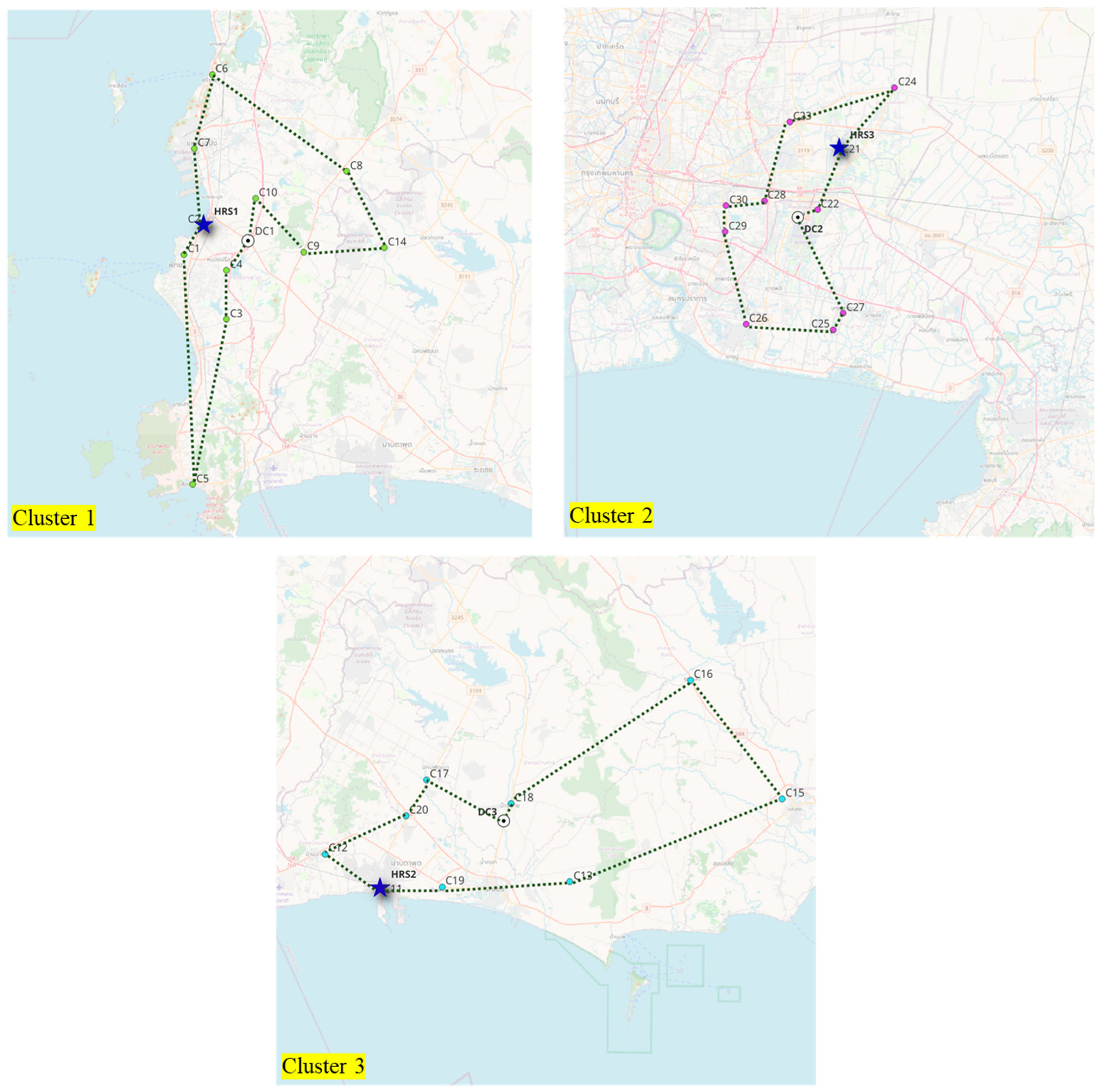
Next, Table 7 illustrates the routing plans under the 5 kg minimum hydrogen safety constraint, showing the sequence of customer visits along with arrival times, remaining hydrogen levels, and refueling decisions. The results show that FCEV trucks strategically schedule refueling when the hydrogen level approaches the minimum threshold. For example, the results for Cluster 1 reveal how the model integrates routing and hydrogen management. The vehicle departs from the depot with 15 kg of hydrogen and serves customers C4, C3, and C5 in sequence, with hydrogen levels gradually decreasing to 14.58 kg, 14.04 kg, and 12.17 kg, respectively, indicating efficient early-stage routing above the safety threshold. As the route progresses to C1, the hydrogen level drops further to 9.62 kg. Upon reaching C2 at time 171.21, the model schedules a refueling action of 2.41 kg, raising the hydrogen level to 11.64 kg; this proactive decision ensures sufficient fuel for the remaining route. Following refueling, the vehicle continues through C7, C6, C8, C14, C9, and C10, with hydrogen levels steadily declining but remaining feasible, ultimately reaching 5.47 kg at C10. The vehicle then returns to the depot at time 390.43 with 5.00 kg remaining.
Table 7.
Routing plan results using the model based on K-means clusters.
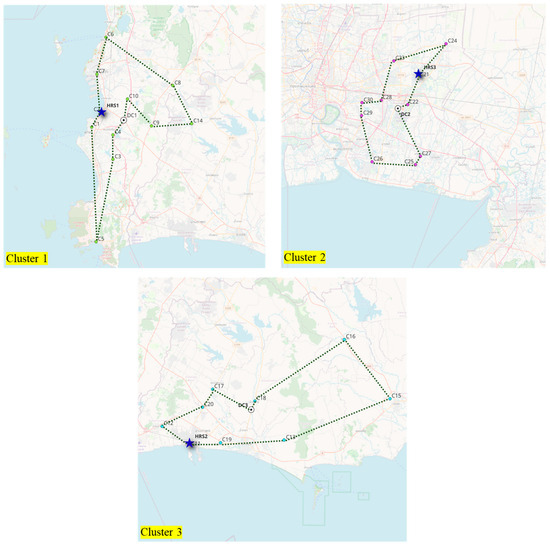
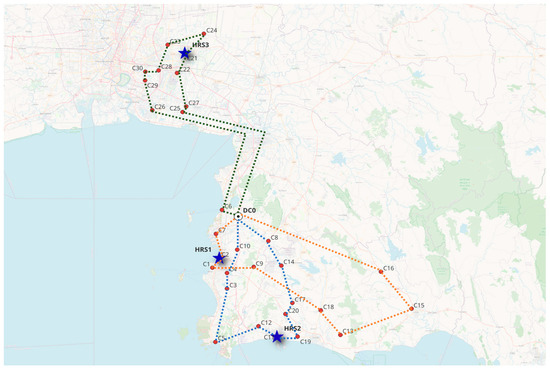
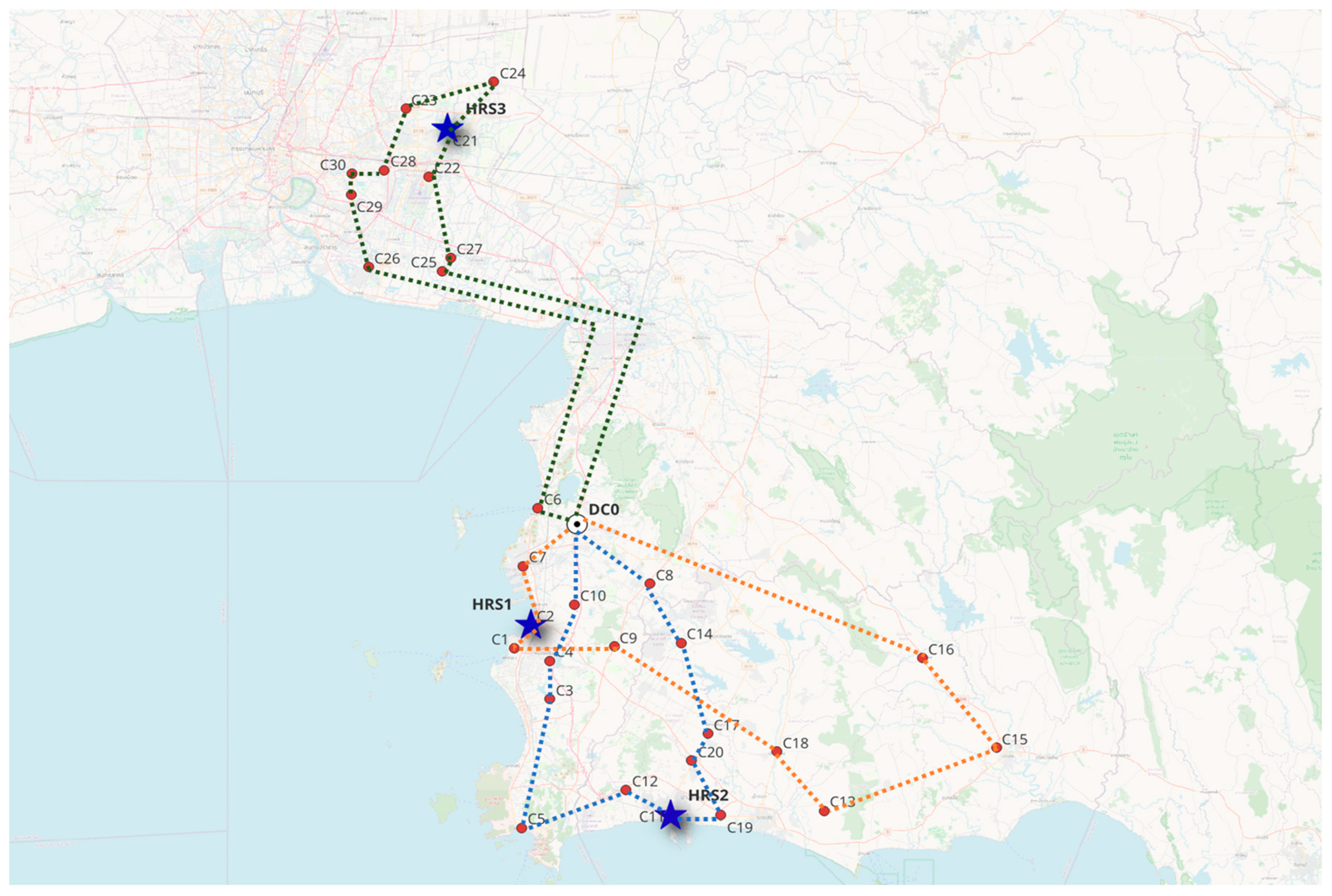
Similarly, in Cluster 3, refueling occurs mid-route to ensure that the FCEV truck can return to the depot while respecting the safety constraint, and the pattern can be interpreted in a similar manner. In contrast, no refueling is observed in Cluster 2, suggesting that its route remains within the feasible hydrogen range under the minimum hydrogen safety requirement. Thus, these routing plans demonstrate how the model dynamically integrates routing and energy decisions, balancing travel efficiency with hydrogen fuel constraints and safety requirements. The GIS-based routing plans for all clusters are also presented in Figure 6.
Figure 6.
GIS-based routing plans based on K-means clusters (1 cm represents 7.74 km).
4.4. Network Configuration Analysis
Next, the network configuration analysis is conducted under a minimum hydrogen safety constraint of 2 kg to evaluate the cost trade-off between transportation efficiency and distribution facility costs. Table 8 presents a comparative analysis between the K-means clustering configuration (three decentralized distribution centers) and a centralized network (single distribution center). The centralized network represents a logistics configuration in which all customer demand is served from one depot, enabling routing and resource allocation across the entire service area.
Table 8.
Parameter comparison between K-means and centralized network configurations.
The results clearly indicate that the K-means approach outperforms the centralized configuration in terms of transportation-related metrics. Specifically, total cost is reduced by 3851.51 THB, primarily driven by a significant decrease in fuel cost. In addition, the clustered system achieves lower hydrogen consumption (32.35 vs. 44.12 kg H2), eliminates the need for refueling, and reduces CO2 emissions (0 vs. 33.79 kg CO2). Operational efficiency is also improved, with a shorter total distance (404.33 vs. 551.50 km) and reduced maximum working time (376 vs. 429 min). From an operational reliability perspective, the clustered network also exhibits a lower fleet utilization ratio (78.3% vs. 89.4%), defined as the ratio between the maximum vehicle working time and the total available planning horizon (i.e., maximum route duration divided by total available working time window), thereby reflecting reduced temporal congestion and improved scheduling flexibility. Moreover, the refueling dependency ratio is reduced from 13.5% in the centralized system to 0% in the clustered configuration, computed as the proportion of hydrogen replenished at refueling stations relative to total hydrogen consumption (i.e., total refueled hydrogen divided by total hydrogen usage), highlighting a complete elimination of reliance on intermediate hydrogen refueling operations under the clustered structure.
These results confirm that dividing the service area into smaller clusters leads to more efficient routing and energy utilization. Nevertheless, these transportation savings come with a trade-off in infrastructure. The clustered approach requires three distribution centers, compared with only one in the centralized network, implying additional facility-related costs. While the centralized system incurs higher fuel, refueling, and emission costs, it benefits from lower facility complexity and reduced fixed infrastructure investment.
Next, Table 9 further illustrates how the centralized model operates, where the model assigns three vehicle routes originating from a single depot to serve all customers. The results show that each vehicle follows an extended route and strategically schedules refueling (e.g., Vehicle 1 at C21 and Vehicle 3 at C2) to maintain the minimum hydrogen safety constraint. This structure reflects the increased operational burden and planning complexity associated with a single-depot system coordinating multiple long-haul routes. Moreover, the computational effort is significantly higher in the centralized case, with solution time increasing from 84.47 s (K-means clusters) to 3600 s, due to the enlarged problem size and routing complexity when all customer nodes are solved simultaneously within a single network. Figure 7 presents the GIS-based location and routing plans under the centralized network configuration.
Table 9.
Routing plan results using the model based on centralized network.
Figure 7.
GIS-based location and routing plans based on centralized network. (1 cm represents 7.74 km).
To evaluate whether the clustered configuration is economically viable, a break-even analysis is further conducted based on the observed daily transportation saving of 3851.51 THB, equivalent to 115,545 THB per month assuming a 30-day planning period. This value represents the maximum additional facility cost that can be justified when shifting from a centralized to a decentralized system. Given that the clustered configuration introduces two additional distribution centers, the allowable cost per facility is approximately 38,515 THB per month. Thus, the K-means configuration will be more cost-effective when the monthly operating or rental cost of each distribution center does not exceed this threshold. This analysis demonstrates the critical balance between transportation efficiency and facility infrastructure costs, providing practical insight for decision-makers in designing hydrogen logistics networks.
5. Managerial and Practical Implications
5.1. Managerial and Policy Insights
The results demonstrate that integrating K-means clustering with the developed hydrogen-based routing model (H-FCEVRP) provides an effective approach for solving downstream distribution problems under hydrogen constraints in the HSC. By partitioning customers into geographically compact clusters and optimizing routes within each cluster, the model reduces routing complexity, travel distance, and energy consumption. Compared with the centralized configuration, the integrated approach improves operational efficiency while maintaining routing feasibility under hydrogen safety constraints. This highlights the value of combining data-driven clustering with optimization-based routing when managing alternative fuel vehicle operations. The results also demonstrate that hydrogen refueling infrastructure availability strongly influences routing feasibility and operational flexibility, particularly under stricter hydrogen safety reserve requirements. This indicates that early-stage hydrogen logistics systems may benefit substantially from strategically distributed HRS networks designed using multiple planning criteria, such as freight demand concentration, logistics connectivity, and industrial hub proximity. Such an approach can help improve energy accessibility and enhance overall network feasibility for FCEV operations.
From a supply chain design perspective, the proposed framework enables decision-makers to evaluate facility location and routing performance simultaneously under realistic operational constraints. The findings reveal a trade-off in which decentralized systems improve transportation efficiency but require additional facility investment, whereas centralized systems reduce infrastructure cost at the expense of higher routing and energy costs. A number of studies have also confirmed that hybrid clustering–routing approaches can significantly improve computational efficiency and solution quality in logistics planning [51,52]. The break-even analysis further provides a practical decision rule for assessing whether transportation savings can justify additional distribution centers in the downstream HSC. In addition, the results reveal that hydrogen production pathways can significantly influence the trade-off between economic and environmental performance. While grey hydrogen stations provide lower operational cost, they also generate substantially higher lifecycle CO2 emissions compared with green hydrogen stations. This suggests that future hydrogen logistics planning should jointly evaluate infrastructure deployment and hydrogen sourcing strategies.
From a policy and planning perspective, the results suggest that infrastructure development and routing efficiency should be considered jointly when promoting hydrogen-based transportation systems in HSC. The findings underscore the importance of supporting distributed refueling infrastructure and data-driven logistics optimization to improve system-wide efficiency. These insights are in line with broader hydrogen economy discussions emphasizing coordinated infrastructure planning and demand aggregation (e.g., [53,54]). The framework can also support preliminary policy sensitivity assessments by evaluating how hydrogen price subsidies [55] or differentiated emission regulations [56] may affect routing cost, refueling behavior, and infrastructure utilization. Such insights are particularly relevant for policymakers seeking to accelerate the transition toward low-carbon freight transportation systems. Furthermore, the findings highlight the importance of aligning hydrogen infrastructure expansion with freight demand concentration and logistics connectivity. In emerging hydrogen economies such as Thailand, where hydrogen infrastructure remains limited and partially experimental, strategic placement of green hydrogen stations near industrial and logistics hubs may help improve both operational feasibility and environmental performance during the early transition phase. Incentives for establishing regional hydrogen hubs, together with policies encouraging FCEV adoption and smart routing technologies, can help accelerate the transition toward sustainable HSCs.
5.2. Limitations and Practical Considerations
Several limitations should be acknowledged when interpreting the results of this study. First, the proposed H-FCEVRP framework is developed under deterministic assumptions, where parameters such as customer demand, travel speed, hydrogen price, and HRS availability are assumed fixed during the planning horizon. In practice, downstream hydrogen logistics operations may experience uncertainty due to fluctuating demand patterns, traffic congestion, hydrogen supply variability, and temporary station unavailability. Second, the current study assumes uninterrupted access to refueling infrastructure and does not model capacity congestion or hydrogen source switching behavior, in which FCEVs may dynamically shift between alternative refueling stations or hydrogen supply options with different operational characteristics (e.g., grey versus green hydrogen, or 350 bar versus 700 bar refueling stations) depending on availability, cost, or congestion conditions. Third, customer demand is synthetically generated within a bounded interval to capture variability in delivery requirements, due to the limited availability of real-world hydrogen freight demand data in Thailand, reflecting the early-stage development of hydrogen logistics systems in the region. Finally, although the proposed framework demonstrates practical applicability for medium-scale case studies, scalability to large-scale networks may require more advanced solution techniques to maintain computational efficiency. These limitations highlight the need for more advanced modeling frameworks that can better capture real-world variability in hydrogen logistics operations.
6. Conclusions
This study addresses the critical challenge of designing efficient HSCs by integrating downstream distribution decisions with vehicle routing under hydrogen-based FCEV requirements and infrastructure constraints. The proposed integrated methodology combines K-means clustering for distribution center location planning with a hydrogen-powered fuel cell electric vehicle routing problem. By explicitly incorporating hydrogen refueling stations as operational constraints, the model ensures feasibility while capturing infrastructure limitations. The case study in Thailand demonstrates that clustering-based network design improves routing efficiency, reduces travel distance, and minimizes hydrogen consumption compared with a centralized configuration. Moreover, the results highlight the importance of balancing transportation savings with facility investment, offering a practical decision-support tool for downstream hydrogen logistics. The study thus provides practical insights, suggesting that integrating data-driven clustering with energy-aware routing optimization can enhance system feasibility in HSCs.
Future research can extend this work by broadening the scope beyond downstream logistics to include upstream production and midstream storage, enabling a fully integrated hydrogen supply chain optimization framework. This would support coordinated decision-making across production, storage, and distribution layers, improving overall system efficiency and strategic planning. In addition, future studies may explore multi-objective and policy-oriented extensions to better capture trade-offs among cost, emissions, and infrastructure development under different hydrogen economy scenarios and policies. This includes evaluating the effects of hydrogen subsidies, carbon pricing mechanisms, and hydrogen production pathways on routing decisions and hydrogen refueling station utilization. Future extensions may also relax the deterministic assumptions adopted in this study by incorporating uncertainty in customer demand, hydrogen supply availability, travel conditions, hydrogen prices, and HRS accessibility through stochastic or robust optimization approaches. Furthermore, real-world large-scale implementations could further validate the robustness and practical applicability of the proposed framework in emerging hydrogen logistics systems.
Author Contributions
Conceptualization, K.R. and J.J.; formal analysis, K.R.; investigation, K.R. and J.J.; writing—original draft preparation, K.R.; writing—review and editing, H.Z.; visualization, H.Z. All authors have read and agreed to the published version of the manuscript.
Funding
This research received no external funding.
Data Availability Statement
The original contributions presented in this study are included in the article. Further inquiries can be directed to the corresponding author.
Conflicts of Interest
The authors declare no conflict of interest.
References
- Parikh, A.; Shah, M.; Prajapati, M. Fuelling the sustainable future: A comparative analysis between battery electric vehicles (BEV) and fuel cell electric vehicles (FCEV). Environ. Sci. Pollut. Res. 2023, 30, 57236–57252. [Google Scholar] [CrossRef] [Scilit]
- International Energy Agency (IEA). Global Hydrogen Demand by Sector in the Sustainable Development Scenario, 2019–2070; IEA: Paris, Italy, 2023; Available online: https://www.iea.org/ (accessed on 19 March 2025).
- Samsun, R.C.; Rex, M.; Antoni, L.; Stolten, D. Deployment of fuel cell vehicles and hydrogen refueling station infrastructure: A global overview and perspectives. Energies 2022, 15, 4975. [Google Scholar] [CrossRef] [Scilit]
- Stein, A.; Nolte, B.; Kizgin, U.V.; Grünewald, O.; Yurtseven, G.; Vietor, T. Relationship between area and capacity of hydrogen refueling stations and derivation of design recommendations. Hydrogen 2025, 6, 16. [Google Scholar] [CrossRef] [Scilit]
- Isaac, N.; Saha, A.K. A review of the optimization strategies and methods used to locate hydrogen fuel refueling stations. Energies 2023, 16, 2171. [Google Scholar] [CrossRef] [Scilit]
- Zhou, K.; Zhang, L.; Liu, Y. Urban hydrogen refueling station location and capacity planning for fuel cell vehicles: Status, progress and challenges. Int. J. Hydrogen Energy 2025, 177, 151590. [Google Scholar] [CrossRef] [Scilit]
- Bolz, S.; Thiele, J.; Wendler, T. Regional capabilities and hydrogen adoption barriers. Energy Policy 2024, 185, 113934. [Google Scholar] [CrossRef] [Scilit]
- Niemsakul, J.; Hiranmahapol, S.; Janmontree, J.; Zadek, H.; Ransikarbum, K. Analysis of barriers for hydrogen-fueled logistics under integrated sustainability: A DEMATEL–TOWS framework. J. Clean. Prod. 2025, 513, 145720. [Google Scholar] [CrossRef] [Scilit]
- Kopacak, N.; Güldorum, H.C.; Erdinc, O. Implementation of a decision-making approach for a hydrogen-based multi-energy system considering EVs and FCEVs availability. IEEE Access 2024, 12, 114705–114721. [Google Scholar] [CrossRef] [Scilit]
- Pitsiavas, V.; Polymeni, S.; Spanos, G.; Lalas, A.; Votis, K.; Tzovaras, D. Energy-based FCEV optimization services: Toward greener transportation. Transp. Res. Procedia 2025, 86, 250–257. [Google Scholar] [CrossRef] [Scilit]
- Ma, H.; Sun, Z.; Xue, Z.; Zhang, C.; Chen, Z. A systemic review of hydrogen supply chain in energy transition. Front. Energy 2023, 17, 102–122. [Google Scholar] [CrossRef] [Scilit]
- Saha, P.; Akash, F.A.; Shovon, S.M.; Monir, M.U.; Ahmed, M.T.; Khan, M.F.H.; Sarkar, S.M.; Islam, M.K.; Hasan, M.M.; Vo, D.-V.N.; et al. Grey, blue, and green hydrogen: A comprehensive review of production methods and prospects for zero-emission energy. Int. J. Green Energy 2024, 21, 1383–1397. [Google Scholar] [CrossRef] [Scilit]
- Lagioia, G.; Spinelli, M.P.; Amicarelli, V. Blue and green hydrogen energy to meet European Union decarbonisation objectives. Int. J. Hydrogen Energy 2023, 48, 1304–1322. [Google Scholar] [CrossRef] [Scilit]
- Ransikarbum, K.; Chanthakhot, W.; Glimm, T.; Janmontree, J. Evaluation of sourcing decision for hydrogen supply chain using an integrated multi-criteria decision analysis tool. Resources 2023, 12, 48. [Google Scholar] [CrossRef] [Scilit]
- Janmontree, J.; Zadek, H.; Ransikarbum, K. Analyzing solar location for green hydrogen using multi-criteria decision analysis. Renew. Sustain. Energy Rev. 2025, 209, 115102. [Google Scholar] [CrossRef] [Scilit]
- Yang, M.; Hunger, R.; Berrettoni, S.; Sprecher, B.; Wang, B. A review of hydrogen storage and transport technologies. Clean Energy 2023, 7, 190–216. [Google Scholar] [CrossRef] [Scilit]
- Fang, L.; Dong, X.; Wang, H.; Gong, M. Economic analysis of compressed gaseous hydrogen, liquid hydrogen, and cryo-compressed hydrogen storage methods for large-scale storage and transportation. Int. J. Hydrogen Energy 2025, 162, 150725. [Google Scholar] [CrossRef] [Scilit]
- Xie, Z.; Jin, Q.; Su, G.; Lu, W. A review of hydrogen storage and transportation: Progress and challenges. Energies 2024, 17, 4070. [Google Scholar] [CrossRef] [Scilit]
- Mehmood, M.; Maka, A.O. Hydrogen: Safety, storage, and transportation perspectives and measures. Adv. Energy Convers. Mater. 2025, 6, 137–148. [Google Scholar] [CrossRef] [Scilit]
- Jarosch, C.; Jahnke, P.; Giehl, J.; Himmel, J. Modelling decentralized hydrogen systems: Lessons learned and challenges from German regions. Energies 2022, 15, 1322. [Google Scholar] [CrossRef] [Scilit]
- Bartolucci, L.; Cordiner, S.; Mulone, V.; Tatangelo, C.; Antonelli, M.; Romagnuolo, S. Multi-hub hydrogen refueling station with on-site and centralized production. Int. J. Hydrogen Energy 2023, 48, 20861–20874. [Google Scholar] [CrossRef] [Scilit]
- Cortez, L.D.; Tapia-Bastidas, C.V.; Helguero, C.G.; Maldonado, F.A.; Alava, E.; Hidalgo-Crespo, J.; Amaya-Rivas, J.L. Environmental assessment of centralized and decentralized scenarios of green hydrogen implementation in the transportation sector. In ASME Power Conference Proceedings; American Society of Mechanical Engineers: New York, NY, USA, 2024; p. V001T01A004. [Google Scholar]
- Derse, O.; Göçmen, E.; Yılmaz, E.; Erol, R. A mathematical programming model for facility location optimization of hydrogen production from renewable energy sources. Energy Sources Part A 2022, 44, 6648–6659. [Google Scholar] [CrossRef] [Scilit]
- Cardona, P.; Costa-Castelló, R.; Roda, V.; Carroquino, J.; Valiño, L.; Ocampo-Martínez, C.; Serra, M. Modelling and operation strategy approaches for on-site hydrogen refuelling stations. Int. J. Hydrogen Energy 2024, 52, 49–64. [Google Scholar] [CrossRef] [Scilit]
- Ransikarbum, K.; Sankaranarayanan, B.; Zadek, H.; Janmontree, J. Locational analysis of off-site hydrogen production facilities considering hydrogen refueling station clusters. E3S Web Conf. 2025, 679, 01001. [Google Scholar] [CrossRef] [Scilit]
- Lee, S.; Kim, H.; Kim, B.-I.; Song, M.; Lee, D.; Ryu, H. Site and capacity selection for on-site production facilities in a nationwide hydrogen supply chain deployment plan. Int. J. Hydrogen Energy 2024, 50, 968–987. [Google Scholar] [CrossRef] [Scilit]
- Han, J.R.; Park, S.J.; Kim, H.; Lee, S.; Lee, J.M. Centralized and distributed hydrogen production using steam reforming: Challenges and perspectives. Sustain. Energy Fuels 2022, 6, 1923–1939. [Google Scholar] [CrossRef] [Scilit]
- Ransikarbum, K.; Zadek, H.; Janmontree, J. Evaluating renewable energy sites in the green hydrogen supply chain with integrated MCDA. Energies 2024, 17, 4073. [Google Scholar] [CrossRef] [Scilit]
- Ochoa Bique, A.; Maia, L.K.; Grossmann, I.E.; Zondervan, E. Design of hydrogen supply chains under demand uncertainty: A case study. Phys. Sci. Rev. 2023, 8, 741–762. [Google Scholar]
- Wang, X.; Wu, Y.; Wen, Z.; Cui, Z.; Wang, Y. A new transportation route planning method for wind-based hydrogen supply chains. ACS Sustain. Chem. Eng. 2024, 12, 8436–8452. [Google Scholar] [CrossRef] [Scilit]
- Gu, W.; Archetti, C.; Cattaruzza, D.; Ogier, M.; Semet, F.; Speranza, M.G. Vehicle routing problems with multiple commodities: A survey. Eur. J. Oper. Res. 2024, 317, 1–15. [Google Scholar] [CrossRef] [Scilit]
- Yernar, A.; Turan, C. Recent developments in vehicle routing problem under time uncertainty: A comprehensive review. Bull. Electr. Eng. Inform. 2025, 14, 1263–1275. [Google Scholar] [CrossRef] [Scilit]
- Indrianti, N.; Leuveano, R.A.C.; Abdul-Rashid, S.H.; Ridho, M.I. Green vehicle routing problem optimization for LPG distribution: Genetic algorithms for complex constraints and emission reduction. Sustainability 2025, 17, 1144. [Google Scholar] [CrossRef] [Scilit]
- Baqqal, I.; El Idrissi, A.E.B.; Belghiti, A.A. Review of challenges and opportunities in vehicle routing for hydrogen transportation logistics. In 11th International Conference on Optimization and Applications (ICOA); IEEE: Piscataway, NJ, USA, 2025; pp. 1–6. [Google Scholar]
- Abibou, S.; El Bourakadi, D.; Hachache, R.; Yahyaouy, A.; Gualous, H. A Novel Branch-and-Bound Framework for Solving the Hydrogen Vehicle Routing Problem with Time Windows and Capacity Constraints. In 1st International Conference on Computational Intelligence Approaches and Applications (ICCIAA 2025); IEEE: Piscataway, NJ, USA, 2025; pp. 1–6. [Google Scholar]
- Liu, B.; Musleh, A.S.; Zhang, D.; Chen, G.; Dong, Z.Y. Vehicle Routing Problem with Optimal Fuel Cell and Battery Energy Management. In 2025 IEEE PowerTech Conference (IEEE Kiel PowerTech); IEEE: Piscataway, NJ, USA, 2025; pp. 1–6. [Google Scholar]
- Gbadega, P.A.; Sun, Y.; Balogun, O.A. Optimized energy management in grid-connected microgrids leveraging K-means clustering algorithm and artificial neural network models. Energy Convers. Manag. 2025, 336, 119868. [Google Scholar] [CrossRef] [Scilit]
- Uti, M.N.; Din, A.H.M.; Yusof, N.; Yaakob, O. A spatial-temporal clustering for low ocean renewable energy resources using K-means clustering. Renew. Energy 2023, 219, 119549. [Google Scholar] [CrossRef] [Scilit]
- Rachwał, A.; Popławska, E.; Gorgol, I.; Cieplak, T.; Pliszczuk, D.; Skowron, Ł.; Rymarczyk, T. Determining the quality of a dataset in clustering terms. Appl. Sci. 2023, 13, 2942. [Google Scholar] [CrossRef] [Scilit]
- Ashari, I.F.; Nugroho, E.D.; Baraku, R.; Yanda, I.N.; Liwardana, R. Analysis of elbow, silhouette, Davies–Bouldin, Calinski–Harabasz, and Rand index evaluation on K-means algorithm for classifying flood-affected areas in Jakarta. J. Appl. Inform. Comput. 2023, 7, 95–103. [Google Scholar] [CrossRef] [Scilit]
- El Khattabi, M.Z.; El Jai, M.; Lahmadi, Y.; Oughdir, L.; Rahhali, M. Understanding the interplay between metrics, normalization forms, and data distribution in K-means clustering: A comparative simulation study. Arab. J. Sci. Eng. 2024, 49, 2987–3007. [Google Scholar] [CrossRef] [Scilit]
- Bangkok Industrial Gas. Launching Thailand’s First Hydrogen Fueling Prototype Station. Available online: https://bigth.com/en/thailand-first-hydrogen-fueling-prototype-station-opening-ceremony/ (accessed on 24 March 2026).
- Thansettakij. PTT Plans a Green Hydrogen Station to Support Heavy-Duty Vehicles in the Eastern Economic Corridor. Available online: https://www.thansettakij.com/sustainable/zero-carbon/593356 (accessed on 15 March 2026).
- Basma, H.; Rodríguez, F. Can Fuel Cell Hydrogen Trucks Ever Be Cost-Effective? The European Case. International Council on Clean Transportation. 2022. Available online: https://theicct.org/wp-content/uploads/2022/09/Webinar_FCET_TCO.pdf (accessed on 15 March 2026).
- Hyundai Motor Company. World’s First Fuel Cell Heavy-Duty Truck, Hyundai XCIENT Fuel Cell. Available online: https://www.hyundai.com/au/en/news/electrified/worlds-first-fuel-cell-heavy-duty-truck-xcient-fuel-cell (accessed on 15 March 2026).
- Hyundai Motor Company. Hyundai Motor Unveils the New XCIENT Heavy-Duty Fuel Cell Truck at ACT Expo. Available online: https://hyundaitrucks.com.au/news/hyundai-motor-unveils-the-new-xcient-heavy-duty-fuel-cell-truck-at-act-expo-2025 (accessed on 15 May 2026).
- Genovese, M.; Fragiacomo, P. Hydrogen refueling station: Overview of the technological status and research enhancement. J. Energy Storage 2023, 61, 106758. [Google Scholar] [CrossRef] [Scilit]
- International Renewable Energy Agency. Green Hydrogen for Industry: A Guide to Policy Making. Available online: https://www.irena.org/-/media/Files/IRENA/Agency/Publication/2022/Mar/IRENA_Green_Hydrogen_Industry_2022.pdf (accessed on 15 March 2026).
- Eslamipoor, R. Direct and indirect emissions: A bi-objective model for hybrid vehicle routing problem. J. Bus. Econ. 2024, 94, 413–436. [Google Scholar] [CrossRef] [Scilit]
- AMPL Optimization, Inc. AMPL: Advanced Modeling for Optimization. Available online: https://ampl.com/ (accessed on 15 August 2025).
- Prajapati, D.; Harish, A.R.; Daultani, Y.; Singh, H.; Pratap, S. A clustering-based routing heuristic for last-mile logistics in fresh food e-commerce. Glob. Bus. Rev. 2023, 24, 7–20. [Google Scholar] [CrossRef] [Scilit]
- Sutrisno, H.; Yang, C.L. A two-echelon location routing problem with mobile satellites for last-mile delivery: Mathematical formulation and clustering-based heuristic method. Ann. Oper. Res. 2023, 323, 203–228. [Google Scholar] [CrossRef] [Scilit]
- Bampaou, M.; Panopoulos, K.D. An overview of hydrogen valleys: Current status, challenges and their role in increased renewable energy penetration. Renew. Sustain. Energy Rev. 2025, 207, 114923. [Google Scholar] [CrossRef] [Scilit]
- International Energy Agency. Global Hydrogen Review 2025. Available online: https://www.iea.org/reports/global-hydrogen-review-2025 (accessed on 15 March 2026).
- Mastropietro, P.; Rodilla, P. A taxonomy of support mechanisms for the low-carbon hydrogen supply chain. Int. J. Hydrogen Energy 2025, 105, 169–178. [Google Scholar] [CrossRef] [Scilit]
- Jesus, B.; Ferreira, I.A.; Carreira, A.; Erikstad, S.O.; Godina, R. Economic framework for green shipping corridors: Evaluating cost-effective transition from fossil fuels towards hydrogen. Int. J. Hydrogen Energy 2024, 83, 1429–1447. [Google Scholar] [CrossRef] [Scilit]

Disclaimer/Publisher’s Note: The statements, opinions and data contained in all publications are solely those of the individual author(s) and contributor(s) and not of MDPI and/or the editor(s). MDPI and/or the editor(s) disclaim responsibility for any injury to people or property resulting from any ideas, methods, instructions or products referred to in the content. |
© 2026 by the authors. Licensee MDPI, Basel, Switzerland. This article is an open access article distributed under the terms and conditions of the Creative Commons Attribution (CC BY) license.