


Abstract
Trace elements are essential for plant growth, yet their dose-dependent effects on root system development still remain poorly characterized across diverse plant functional types. We investigated the effects of manganese (Mn), cobalt (Co), and molybdenum (Mo) across 10 concentration gradients (0–500% of standard Hoagland nutrient solution) on root length, tip number, biomass, and activity in four species: Triticum aestivum L., Zea mays L., Ipomoea aquatica Forssk. in Forssk. & Niebuhr, and Canna glauca L. After 30 days of hydroponic culture, our results showed that Mn and Mo elicited significant, concentration-dependent responses across all species. Root traits improved progressively with increasing concentrations from deficiency to optimal levels, but declined when concentrations exceeded the optimal range. The optimal ranges were 25–100% for Mn and 50–150% for Mo, while concentrations above 150% generally proved toxic. By contrast, Co effects were comparatively limited, with significant inhibition only at concentrations exceeding 100%. Species-specific responses were also evident: T. aestivum and Z. mays were more sensitive to Mn and Mo excess, whereas I. aquatica and C. glauca displayed broader tolerance, with C. glauca showing notably high Mo utilization efficiency. Notably, all four root traits exhibited strong positive correlations (r > 0.90, p < 0.001), indicating coordinated morphological and physiological plasticity. Collectively, our findings provide quantitative evidence for species-specific trace element management and contribute to a more nuanced understanding of trace element regulation of root system architecture.
1. Introduction
Trace elements are required in minute quantities but exert disproportionately large influences on core plant physiological and biochemical processes, including enzyme activation, electron transport, redox homeostasis, and signal transduction [1,2]. The bioavailability and spatial distribution of these elements in soil are highly heterogeneous, governed primarily by parent material, pH, organic matter content, and varying anthropogenic activities [3,4]. In recent decades, intensive agricultural practices characterized by high-input fertilization, urbanization, and industrialization have led to both trace element deficiencies in some regions and excessive accumulation in others, creating a “trace element paradox” that profoundly affects crop productivity and ecosystem health [5,6]. Roots, as the primary interface between plants and the soil environment, are the first organs to sense and respond to fluctuations in trace element availability. Understanding how different trace elements regulate plant root system development is therefore crucial for optimizing fertilization strategies, breeding stress-tolerant cultivars, and predicting plant community responses to environmental changes.
Mn is an established essential trace element that serves as a structural component of the oxygen-evolving complex in photosystem II (PSII) and as a cofactor for Mn superoxide dismutase (Mn-SOD) and various kinases [7,8]. Beyond its well-known roles in plant photosynthesis and antioxidant defense, recent evidence even indicates that Mn also modulates root system architecture through the regulation of auxin biosynthesis and polar transport [9]. Zhang et al. (2025) demonstrated that Mn toxicity in Arabidopsis inhibited primary root elongation by repressing auxin biosynthesis genes (YUC) and efflux carriers (PIN4/PIN7), while cation transporters such as CAX4 and MTP11 facilitated Mn detoxification [10]. A combined metabolomic and transcriptomic study on rice further revealed that Mn toxicity reduced soluble protein content in plant roots, altered gene expression profiles, and impaired biomass accumulation and root growth [11]. Conversely, Mn deficiency limits plant root development by compromising the activity of Mn-dependent enzymes essential for cell division and elongation [7].
Co is unequivocally essential for leguminous plants as a component of vitamin B12 required for symbiotic nitrogen fixation; however, its role in non-leguminous plants still remains controversial and poorly understood [12,13]. Some evidence suggests that Co may participate in ethylene biosynthesis or act as a non-specific activator of certain enzymes [14]. Nevertheless, many non-legume crops can grow without intentional Co supplementation, and its essentiality for these species has not been conclusively demonstrated [12]. At elevated concentrations, Co becomes toxic, competing with Fe2+ and Mn2+ for uptake and inducing oxidative stress [15].
Mo functions as a critical component of the Mo cofactor (Moco), essential for nitrate reductase, sulfite oxidase, aldehyde oxidase, and xanthine dehydrogenase [16,17]. Through its role in nitrate assimilation and hormone biosynthesis (particularly auxin and abscisic acid), Mo exerts profound effects on nitrogen metabolism and root development [18]. Zhang et al. (2025) found that Mo application significantly improved root length, surface area, and physiological activities in rice [19]. In citrus rootstocks, Mo was identified as one of the trace elements contributing most significantly to root morphological variation [20]. Deficiencies in Mo severely hinder seedling growth, causing notable reductions in plant height, fresh weight, and branch number [21]. The physiological window for Mo appears relatively broad, with beneficial effects observed across a range of concentrations before toxicity ensues.
Despite substantial progress, several critical knowledge gaps still persist. First, most studies have only focused on single elements and single crop species, particularly cereals, leaving the comparative effects of multiple elements across diverse plant functional types largely unexplored [8,9,12,13]. This study systematically compared all three elements under the identical experimental conditions across four phylogenetically and ecologically diverse species, including a monocot C3 cereal, a monocot C4 cereal, a dicot leafy vegetable, and a monocot wetland ornamental plant. This design allowed us to assess both element-specific and species-specific response patterns. Second, the majority of investigations have examined either morphological or physiological responses in isolation, without integrating both dimensions to reveal the coordinated plasticity of plant root systems [1,22,23,24]. We simultaneously measured all four traits and analyzed their correlations. Our results revealed that these traits were strongly and positively correlated (r > 0.90), demonstrating coordinated morphological–physiological plasticity, a finding that had not been previously reported for trace element stress. Third, dose–response relationships across complete concentration gradients from deficiency to severe toxicity still remain inadequately characterized for many plant species, largely limiting our ability to define precise optimal and threshold concentrations for practical applications [25]. We established a complete dose–response series with ten concentration levels (from 0% to 500% of the standard Hoagland nutrient solution) for each element. This gradient enabled us to quantitatively determine the ranges for deficiency, optimum, and toxicity across species. Fourth, the extent to which responses are conserved or species-specific across monocots versus dicots, and across crops versus wild or ornamental species, has not been systematically evaluated. We discovered that the two cereals (T. aestivum and Z. mays) were more sensitive to Mn and Mo excess, whereas the dicot (I. aquatica) showed broader tolerance. Notably, C. glauca exhibited exceptionally high Mo utilization efficiency, maintaining strong root growth even at elevated Mo concentrations. This species-specific difference, particularly the wetland plant’s adaptive response, has not been documented before and offers new insights into ecological differentiation in trace element management. Simultaneously, our data provided clear, concentration-based reference values (e.g., optimal Mn: 25–100% of Hoagland; optimal Mo: 50–150%; toxicity above 150% for both) that could directly inform fertilization strategies for diverse crop and ornamental species.
We hypothesized that Mn and Mo would show consistent dose–response patterns across species because their roles as enzyme cofactors and nitrate reductase components are well established, whereas Co would show limited and species-specific effects because its essentiality for non-leguminous plants remains unclear. To test our hypothesis, we systematically designed a hydroponic experiment with the following objectives: (1) to establish complete dose–response curves for Mn, Co, and Mo across 10 concentration levels; (2) to simultaneously assess four functionally integrated root traits; (3) to determine whether root morphological and physiological responses are coordinated; and (4) to provide quantitative reference points for species-specific micronutrient management. By addressing these questions, we aim to provide a comprehensive, quantitative framework for understanding trace element regulation of plant root system development and to inform species-specific trace element management strategies.
2. Materials and Methods
2.1. Experimental Materials
Four plant species were selected to represent diverse life forms and ecological strategies: T. aestivum (cv. Jimai 22), a monocot C3 cereal; Z. mays (cv. Zhengdan 958), a monocot C4 cereal; I. aquatica (cv. Bobai small-leaf), a dicot fast-growing leafy vegetable; and C. glauca, a monocot ornamental wetland plant (Table 1). Seeds were germinated in Petri dishes, and seedlings at the two-leaf stage were transferred to hydroponic culture.
Table 1.
Biological information of the four tested experimental materials.
2.2. Experimental Design
A hydroponic system was employed to enable precise control of trace element concentrations. The basal nutrient solution was a modified standard Hoagland nutrient solution, ensuring consistent supply of macro- and other micronutrients across all treatments [26]. We conducted three separate single-factor experiments, one for each trace element (Mn, Co, and Mo). The specific salts used were manganese sulfate (MnSO4·H2O), cobalt chloride (CoCl2·6H2O), and sodium molybdate (Na2MoO4·2H2O). The accompanying anions (SO42−, Cl−, and Na+) were present at concentrations far below the background levels of the standard Hoagland solution, and thus their potential effects were negligible. In each experiment, we varied only the concentration of the target element across ten levels (0% to 500% of the standard Hoagland concentration), while all other nutrients were maintained at the standard 100% level (Table 2). We chose this design because our primary interest was to establish individual dose–response curves for each element, and a full factorial design would have been logistically impractical. These relative percentages corresponded to specific molar concentrations, which are listed in Table 2. For example, 100% Mn corresponded to 1.0 μmol/L, 100% Co corresponded to 50.0 nmol/L, and 100% Mo corresponded to 50.0 nmol/L, based on the standard Hoagland nutrient solution formulation. To achieve the 0% (complete deficiency) treatment for each trace element, we purified all macronutrient salts using Chelex 100 chelating resin columns to remove trace metal contaminants. Ultrapure water (18.2 MΩ·cm) was used throughout. The effectiveness of purification was verified by ICP-MS analysis, which confirmed that Mn and Mo concentrations in the respective 0% treatments were below detection limits (Mn < 0.01 μg/L, Mo < 0.005 μg/L). The experiment followed a completely randomized design with five independent biological replicates per treatment combination.
Table 2.
Concentration settings of trace elements Mn, Co, and Mo.
For each treatment combination, five independent biological replicates were employed. Each replicate consisted of a single plant grown in a separate 5 L glass beaker. The beakers were arranged in a completely randomized design, and their positions were rotated weekly to minimize environmental gradients within the growth chamber. Each 5 L glass beaker was wrapped with black plastic to exclude light from the root zone. Nutrient solutions were renewed every five days to maintain element stability and prevent depletion or metabolite accumulation, with ultrapure water added as needed to maintain volume. The pH was adjusted daily to 5.5–6.0 using 1 mol/L NaOH or HCl. Growth conditions in the artificial climate chamber (MGC-450HP, Shanghai Yiheng, Shanghai, China) were 12 h/12 h light/dark photoperiod, 28/20 °C day/night temperature, 65–75% relative humidity, and 300 µmol/(m2·s) light intensity. The hydroponic experiment lasted 30 days.
2.3. Sample Collection and Data Determination
After 30 days, plants were harvested, and roots were rinsed thoroughly with distilled water. Root systems were scanned using an Epson Expression 12000XL scanner (Epson America, Inc., Los Alamitos, CA, USA), and images were analyzed with WinRHIZO Pro 2019 software (Regent Instruments Inc., Québec City, QC, Canada) to determine maximum root length and root tip number (defined as terminal structures ≤ 5 mm with visible apical meristems) [27]. Root samples were then divided: one portion was oven-dried at 40–45 °C to constant weight for biomass determination; the other portion was used immediately for root activity measurement via the triphenyl tetrazolium chloride (TTC) reduction method, with activity expressed as triphenyl formazan (TTF) production per unit root dry weight per hour (µg/(g·h)) [28].
2.4. Experimental Data Analysis and Processing
For each trace element treatment and each plant species, one-way analysis of variance (ANOVA) was performed to test the effect of trace element concentration on each root trait. When a significant concentration effect was detected, Duncan’s new multiple range test was used for post hoc comparisons. Prior to each one-way ANOVA, we tested the assumptions of normality using the Shapiro–Wilk test and homogeneity of variances using Levene’s test. In cases where assumptions were violated, we used Welch’s ANOVA with Games–Howell post hoc tests as a conservative alternative. For the majority of cases where assumptions were satisfied, we used standard ANOVA followed by Duncan’s multiple range test. Pearson correlation analysis was conducted to examine relationships among the four root traits. Pearson correlation coefficients were calculated separately for each species and each trace element using pooled data from all ten concentration levels. We chose this approach because our interest was to assess whether root traits exhibit coordinated responses across the entire gradient of trace element availability. Correlations within individual treatments were not computed due to the limited sample size (n = 5 per treatment). All statistical analyses were performed using SPSS 26.0 (IBM Corp., Armonk, NY, USA), with significance levels set at α = 0.05, 0.01, and 0.001.
3. Results
3.1. Root Length
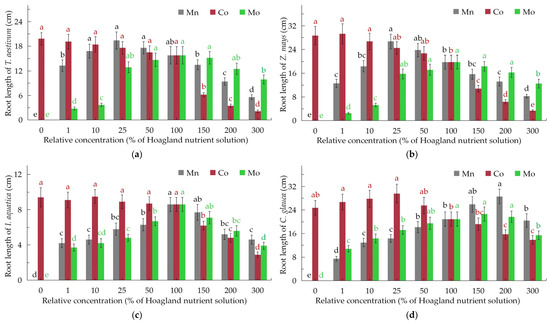
Root length responded to Mn and Mo in a dose-dependent manner across all four species, generally following the “optimal-promotion, low- and high-inhibition” pattern (Figure 1). For Mn, T. aestivum and Z. mays reached maximum root length at 25–50% relative concentration (19.4 ± 2.1 cm and 26.7 ± 2.5 cm, respectively), values that tended to exceed those at the 100% control. This suggests that Mn concentrations slightly below the standard Hoagland level may be optimal for root elongation in cereals. However, when Mn exceeded 150%, root length declined sharply in both species, dropping to 5.6 ± 0.6 cm and 8.3 ± 0.6 cm at 300%, respectively. This inhibition likely reflects Mn-induced oxidative stress or interference with Ca2+ signaling. I. aquatica achieved maximum root length at the 100% control (8.6 ± 0.8 cm), whereas C. glauca reached its maximum (28.6 ± 2.5 cm) at 200% Mn, indicating substantially higher Mn tolerance in this wetland species.
Figure 1.
Effects of trace elements Mn, Co, and Mo on plant root length (cm; ±SE): (a) T. aestivum, (b) Z. mays, (c) I. aquatica, and (d) C. glauca. The lowercase letters (a, b, c, d and e) with different colors (dark gray, brownish red, and green) indicate significant differences in root length among varying concentrations of trace elements in four experimental materials at α = 0.05.
Co effects were comparatively weak and species-dependent. Low-to-moderate Co concentrations had little effect on T. aestivum and Z. mays root length, while I. aquatica and C. glauca showed slight increases at 1–25% Co. However, Co concentrations above 100% consistently suppressed root elongation in all four species, confirming its toxicity at elevated levels.
Mo showed a similar overall trend with Mn, with optimal root length occurring at 50–150% for most species. T. aestivum and Z. mays attained approximately 16 cm and 20 cm, respectively, at 50–100% Mo; I. aquatica peaked at 100%; and C. glauca reached approximately 22 cm at 100–200% Mo. Concentrations above 200% inhibited root elongation across all species.
3.2. Root Tips
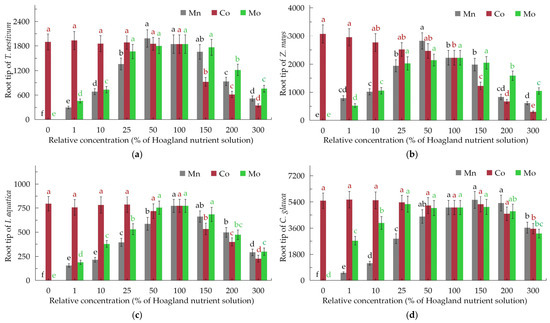
Root tip number, a proxy for branching intensity and absorption site density, showed response patterns largely consistent with root length (Figure 2). Mn significantly affected root tip number in all species. T. aestivum and Z. mays peaked at 50% Mn (1983 ± 213 and 2824 ± 293, respectively), with no significant difference from the 100% control. I. aquatica reached maximum tips at 100% (773 ± 68), while C. glauca maintained high tip numbers (~5300) across 100–200% Mn. However, Mn exceeding 200% reduced tip numbers in all species.
Figure 2.
Effects of trace elements Mn, Co, and Mo on plant root tips (±SE): (a) T. aestivum, (b) Z. mays, (c) I. aquatica, and (d) C. glauca. The lowercase letters (a, b, c, d, e and f) with different colors (dark gray, brownish red, and green) indicate significant differences in root tip numbers among varying concentrations of trace elements in four experimental materials at α = 0.05.
Co effects on root tip number were relatively limited. T. aestivum, Z. mays, and I. aquatica showed no significant changes across low-to-moderate Co concentrations. C. glauca maintained 4756 ± 493 tips even at 200% Co, suggesting some tolerance. The weak Co effects further support the view that Co is not a primary regulator of root branching in non-leguminous species.
Mo effects similarly followed the “optimal-promotion, low- and high-inhibition” pattern. T. aestivum and Z. mays peaked at 25–150%, I. aquatica at 50–150%, and C. glauca at 50–150%, with maximum values around 1800, 2100, 750, and 5000 tips, respectively. As a cofactor for nitrate reductase and aldehyde oxidase, adequate Mo supply facilitates nitrogen assimilation and auxin synthesis, which may promote lateral root initiation. Concentrations above 150% reduced tip numbers markedly.
3.3. Root Biomass
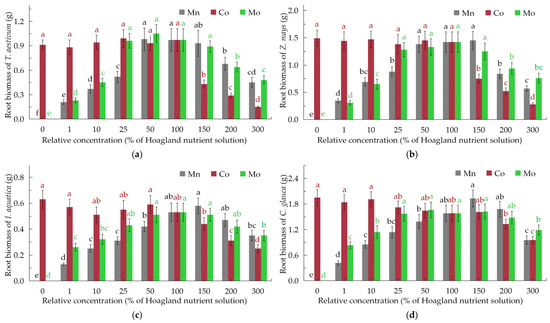
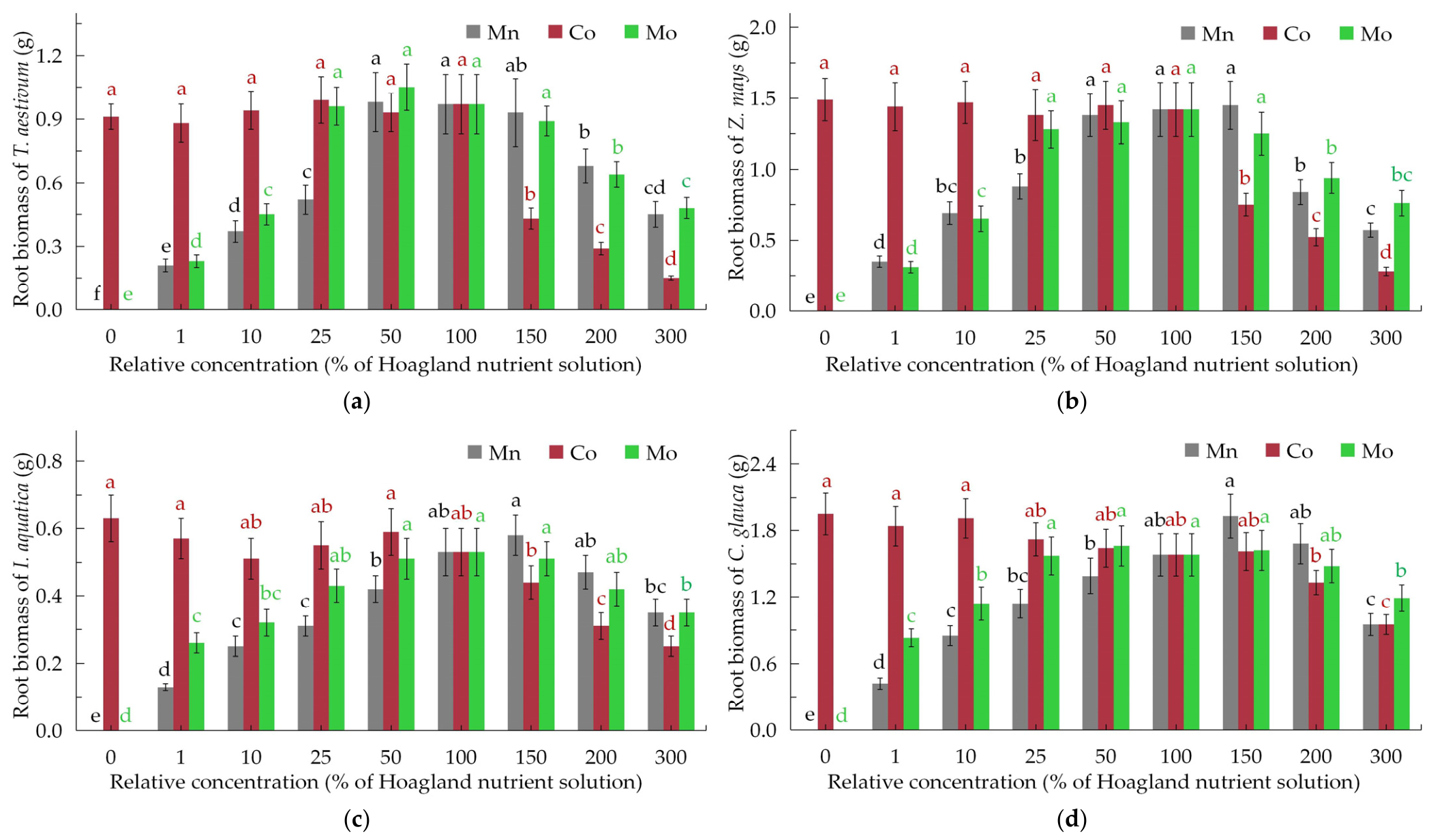
Root biomass, reflecting carbon allocation to belowground organs, exhibited dose-dependent patterns similar to those observed for root length and tip number (Figure 3). For Mn, T. aestivum and Z. mays peaked at 50–150% (~0.95 and 1.42 g), I. aquatica at 150% (0.58 ± 0.06 g), and C. glauca at 100–200% (~1.75 g). However, Mn exceeding 150% reduced biomass in all species, with values at 300% dropping to 0.45 ± 0.06 g (T. aestivum), 0.57 ± 0.05 g (Z. mays), 0.35 ± 0.04 g (I. aquatica), and 0.95 ± 0.10 g (C. glauca).
Figure 3.
Effects of trace elements Mn, Co, and Mo on plant root biomass (g; ±SE): (a) T. aestivum, (b) Z. mays, (c) I. aquatica, and (d) C. glauca. The lowercase letters (a, b, c, d, e and f) with different colors (dark gray, brownish red, and green) indicate significant differences in root biomass among varying concentrations of trace elements in four experimental materials at α = 0.05.
Co effects on root biomass were again modest. T. aestivum, Z. mays, and I. aquatica showed no significant biomass changes across low-to-moderate Co concentrations. C. glauca maintained relatively high biomass even at 150% Co, consistent with its greater Co tolerance. At 500% concentration, all three trace elements caused complete plant mortality in all species by mid-experiment, underscoring the severe toxicity of extreme trace element excess.
Mo showed broadly similar trends, with optimal ranges of 25–150% for T. aestivum, Z. mays, and C. glauca (~1.00, 1.40, and 1.60 g, respectively) and 50–150% for I. aquatica (~0.50 g). As a nitrate reductase cofactor, adequate Mo promotes nitrogen assimilation and protein synthesis, indirectly enhancing photosynthetic rates and assimilate partitioning to roots. Concentrations above 150% reduced biomass across all species.
3.4. Root Activity
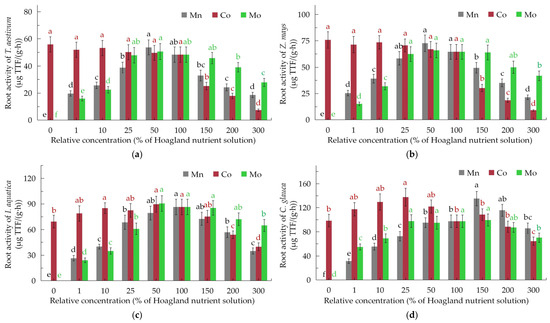
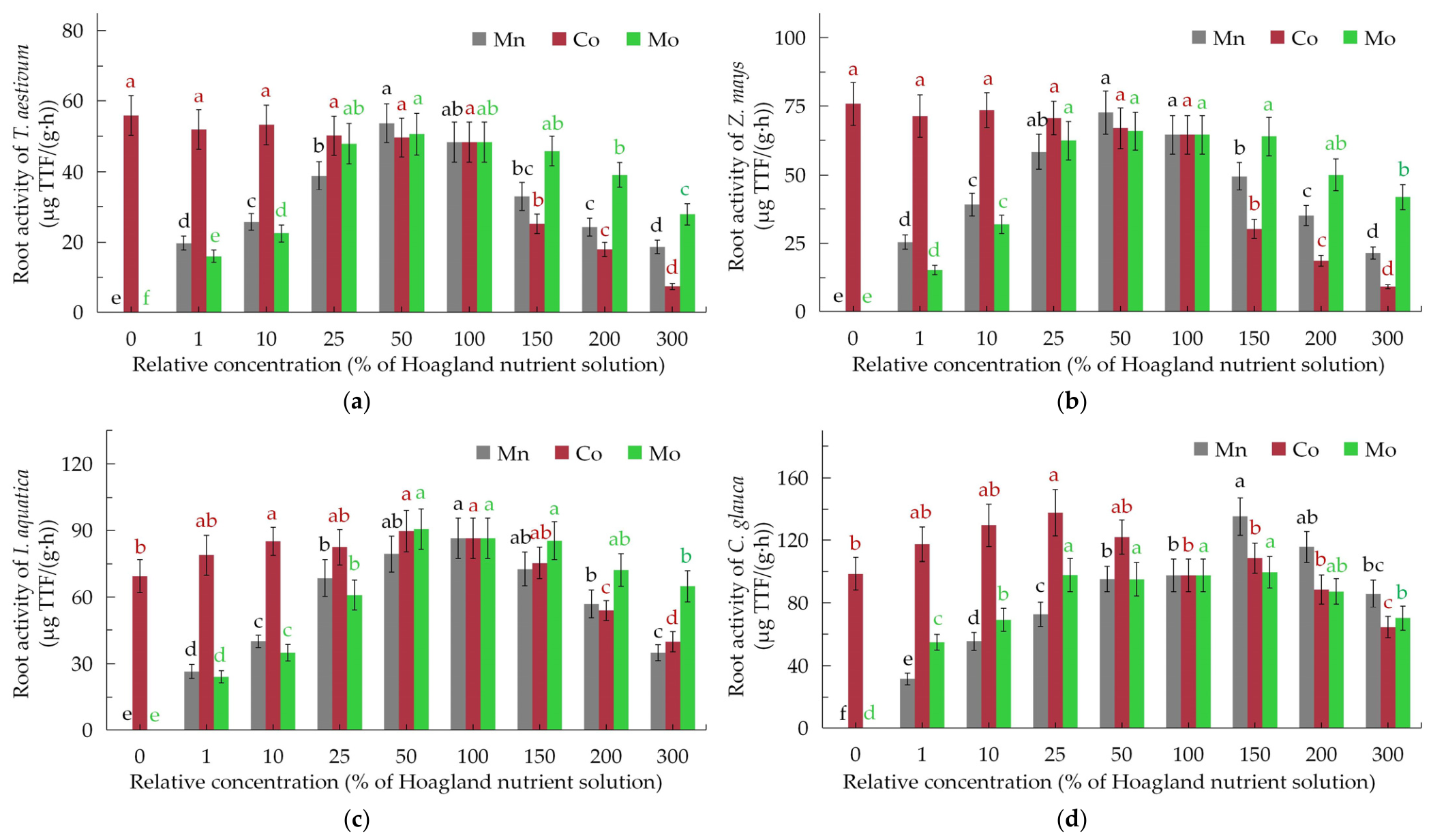
Root activity, measured as TTC reduction capacity and reflecting metabolic intensity, showed coordinated changes with morphological traits (Figure 4). Mn significantly influenced root activity with clear species-specific patterns. T. aestivum peaked at 50% (53.66 ± 5.46 µg/(g·h)), Z. mays at 50–100% (~70 µg/(g·h)), I. aquatica at 100% (86.48 ± 9.14 µg/(g·h)), and C. glauca at 150% (135.27 ± 12.12 µg/(g·h)). However, Mn above 150% reduced activity in all species.
Figure 4.
Effects of trace elements Mn, Co, and Mo on plant root activity (µg/(g·h); ±SE): (a) T. aestivum, (b) Z. mays, (c) I. aquatica, and (d) C. glauca. The lowercase letters (a, b, c, d, e and f) with different colors (dark gray, brownish red, and green) indicate significant differences in root activity among varying concentrations of trace elements in four experimental materials at α = 0.05.
Co showed a distinct effect pattern. Low-to-moderate Co had little effect on T. aestivum and Z. mays root activity, while I. aquatica and C. glauca exhibited slight stimulation at 1–25% Co. C. glauca reached 137.58 ± 14.92 µg/(g·h) at 5% Co. This suggests that Co may participate in metabolic reactions or modulate cellular redox status in certain species. Nevertheless, Co was not a primary driver of root activity for any species. At concentrations of 200% and above, all three elements caused substantial reductions in root activity.
Mo effects on root activity paralleled those of Mn, with optimal ranges varying by species: T. aestivum at 50% (50.63 ± 5.81 µg/(g·h)), Z. mays and C. glauca at 25–150% (~64 and ~97 µg/(g·h)), and I. aquatica at 50–150% (~87 µg/(g·h)). Concentrations above 150% suppressed activity across all species.
3.5. Statistical Analysis Results
One-way ANOVA revealed that concentration significantly affected all four root traits for Mn and Mo treatments in every species (p < 0.001), with F-values and exact p-values presented in Table 3. For Co, significant effects were also detected for most traits, although the magnitude of effects (as indicated by F-values) was generally smaller than those of Mn and Mo. Post hoc comparisons (Duncan’s test) further confirmed that the optimal concentrations (e.g., 25–100% for Mn, 50–150% for Mo) were significantly different from both deficiency and excess levels.
Table 3.
Results of one-way ANOVA (p-values) for the effects of trace elements Mn, Co, and Mo on plant root variables.
Pearson correlation analysis revealed extremely strong positive correlations among all four root traits (r > 0.90, p < 0.001) across all species and element treatments (Table 4). Root length, root tip number, root biomass, and root activity were tightly coupled, indicating that morphological plasticity (elongation and branching) and physiological plasticity (metabolic activity) are highly coordinated in response to trace element stress. This coordinated response likely represents an adaptive strategy: plants synchronously adjust spatial exploration capacity and metabolic intensity to optimize resource acquisition efficiency and cost–benefit balance in heterogeneous trace element environments.
Table 4.
Correlation coefficients of plant root variables in four tested experimental materials under the gradient of trace elements.
4. Discussion
4.1. Mn and Mo as Key Regulators of Root Development
The fundamental principle underlying trace element action in plants is the “essentiality-to-toxicity continuum”: elements are required at optimal concentrations for physiological function but become toxic when accumulated beyond cellular homeostatic capacity [29]. Our results demonstrate that Mn and Mo operate squarely within this framework, exhibiting clear “optimal-promotion, low- and high-inhibition” patterns across all four species. This finding is consistent with the well-established roles of Mn in PSII oxygen evolution and Mn-SOD-mediated ROS scavenging [7,30], and of Mo in nitrate assimilation and hormone biosynthesis via the Moco-dependent enzyme system [31,32].
Recent studies have further elucidated the molecular mechanisms underlying Mn effects on plant root development [10,33]. Mn toxicity has been shown to inhibit primary root elongation by repressing auxin biosynthesis genes (YUC) and efflux carriers (PIN4/PIN7), while cation transporters such as CAX4 and MTP11 facilitate Mn detoxification [10,11,33]. A combined metabolomic and transcriptomic study on rice revealed that Mn toxicity stress reduced soluble protein content in roots, altered gene expression profiles, and impaired root growth and biomass accumulation [11]. Our findings extend these mechanistic insights by quantifying the concentration thresholds at which these effects manifest across multiple species. We found that the optimal Mn range was 25–100% of standard Hoagland nutrient solution (0.25–1 µmol/L), with toxicity consistently emerging above 150% (1.5 µmol/L). These quantitative thresholds provide a practical reference for diagnosing Mn status in diverse crop and ornamental species.
For Mo, our results support the view that its physiological window is relatively broad [34]. The optimal range of 50–150% (25–75 nmol/L) across most species aligns with Mo’s role as a cofactor with relatively low cellular requirement. Mo application has been shown to significantly improve root length, surface area, and physiological activities in rice [19], and Mo was identified as one of the trace elements contributing most significantly to root morphological variation in citrus rootstocks [20]. Our finding that C. glauca showed exceptionally high Mo utilization efficiency, maintaining strong root growth and activity even at elevated Mo concentrations, suggests that wetland-adapted species may have evolved specialized Mo uptake and assimilation systems, possibly related to the high Mo availability in waterlogged, organic-rich soils [35]. This observation opens new avenues for understanding the ecophysiological adaptations of wetland plants to their unique nutrient environments.
The strong positive correlations we observed among root length, tip number, biomass, and activity (r > 0.90) indicate that Mn and Mo exert coordinated effects on root morphology and physiology. This coordination makes ecological sense: enhanced metabolic activity (root activity) provides the energy and biosynthetic precursors needed for cell division and elongation (root length and tip number), while the expanded root system, in turn, supports higher overall metabolic capacity [36,37]. Such integrated responses likely represent an optimal carbon allocation strategy, where plants invest in both structural expansion and functional capacity to maximize resource acquisition under varying trace element availability [38].
4.2. Species-Specific Responses Reflect Phylogenetic and Ecological Differentiation
A striking finding of this study is the marked species-specificity in responses to Mn and Mo, which appears to reflect both phylogenetic lineage and ecological adaptation. The monocot cereals (T. aestivum and Z. mays) were consistently more sensitive to Mn and Mo excess, with narrower optimal ranges and more precipitous declines at supra-optimal concentrations, compared to I. aquatica and C. glauca. This pattern may stem from fundamental differences in root anatomy and physiology. Monocot roots typically have more developed symplastic pathways and higher ion influx rates, leading to faster accumulation of trace elements to optimal levels but also more rapid progression into toxic ranges [39]. In addition, the cortical cell arrangement and aerenchyma formation in monocot roots may provide less buffering capacity against ion stress [40].
In contrast, dicot roots often possess more developed Casparian strips and stronger vacuolar sequestration capacity, enabling more effective compartmentalization of excess ions (e.g., Mn2+) in the apoplast to mitigate toxicity [41]. Dicots may also have more efficient antioxidant enzyme systems (peroxidases, catalases) to cope with trace-element-induced oxidative stress [42]. The broader tolerance of I. aquatica to Mn and Mo excess is consistent with this interpretation.
C. glauca’s exceptional performance under Mo treatments deserves special attention. As a typical wetland plant, C. glauca’s native habitat (flooded or high-organic-matter soils) is characterized by high Mo availability, often co-occurring with high Fe and Mn conditions [43]. Long-term adaptation may have selected for individuals with high-affinity molybdate transporters or more efficient Moco biosynthesis pathways [44]. Moreover, wetland plants frequently face root hypoxia, which may alter energy metabolism and nitrogen cycling pathways in ways that make Mo-dependent enzyme systems more critical [45]. The ability of C. glauca to maintain high root activity even at elevated Mo concentrations suggests unique Mo tolerance or detoxification mechanisms, such as enhanced vacuolar storage or organic ligand chelation. These species-specific differences underscore the importance of considering plant functional type and evolutionary history when developing trace element management recommendations.
4.3. Co: A Limited and Conditional Role in Non-Leguminous Plants
Our results provide strong empirical support for the prevailing view that Co is not an essential element for non-leguminous plants [13,46]. Across all four species, Co effects were modest compared to those of Mn and Mo, as reflected by lower F-values in the one-way ANOVA of Table 3. Even where concentration effects were significant, the magnitude of response was small. This finding aligns with the understanding that Co’s primary essential function in plants is as a component of vitamin B12 required for symbiotic nitrogen fixation in legumes [12]. For non-legumes, Co may play incidental roles, perhaps as a non-specific activator of certain enzymes or as a modulator of ethylene biosynthesis, but these roles are neither universal nor critical for normal growth and development [14,47].
The slight stimulation of root traits observed in I. aquatica and C. glauca at low Co concentrations (1–25%) is intriguing but should be interpreted cautiously. It may reflect Co substitution for other divalent cations in enzyme active sites or subtle effects on cellular redox status. However, the magnitude of these effects was small, and the lack of consistent responses across species suggests that any beneficial Co effects are conditional and species-specific rather than indicative of essentiality [15].
At concentrations above 100%, Co consistently inhibited root growth and activity across all species. This toxicity likely arises from competitive inhibition of Fe2+ and Mn2+ uptake, as Co2+ shares similar ionic radii and charge with these essential cations [15]. Co-induced oxidative stress may also contribute to the observed inhibition [48]. The fact that all four species showed similar toxicity thresholds despite their different sensitivities to Mn and Mo suggests that Co toxicity operates through relatively conserved mechanisms, possibly involving disruption of iron–sulfur cluster assembly or heme biosynthesis [49].
4.4. Coordinated Morphological-Physiological Plasticity as an Adaptive Strategy
The exceptionally strong correlations we observed among root length, tip number, biomass, and activity (r > 0.90) across all species and element treatments reveal a fundamental principle of root system integration: morphological and physiological adjustments are not independent but rather tightly coupled in response to environmental cues [36,37]. This coordination is ecologically meaningful. Root elongation and branching (increasing tip number) represent the structural dimension of resource acquisition, enabling plants to explore larger soil volumes and access more nutrients [50]. However, structural expansion is costly in terms of carbon and energy. To be effective, it must be supported by adequate metabolic capacity (root activity) to drive cell division, elongation, and maintenance processes [51]. Conversely, high metabolic activity without corresponding structural investment would be inefficient, as the capacity for nutrient uptake would outstrip the surface area available for absorption [52].
This integrated response pattern has been observed in other contexts. Huang et al. (2021) found that root morphological and physiological characteristics of Gymnocarpos przewalskii Maxim. seedlings changed coordinately in response to water stress [53]. Similarly, studies on nutrient foraging have shown that plants simultaneously adjust root proliferation and uptake kinetics to optimize resource acquisition [54,55,56]. Our results extend this understanding to trace element stress, demonstrating that the same principles of coordinated plasticity apply when plants face trace element limitation or excess.
From an evolutionary perspective, this coordination likely represents an optimal cost–benefit strategy [36,38]. Plants do not invest unlimitedly in any single trait (e.g., increasing length without metabolic support or raising activity without expanding absorptive surface). Instead, they coordinately regulate morphological and physiological plasticity to maximize root function with the most economical carbon and nitrogen investment [37]. This integrated response is particularly important under trace element stress, where both deficiency and toxicity impose metabolic costs that must be managed through coordinated adjustments across multiple trait dimensions [42].
4.5. Limitations and Future Directions
While our hydroponic system enabled precise control of trace element concentrations, it also simplified the complex soil environment in which roots naturally function. In soil, trace element bioavailability is modulated by pH, organic matter, microbial activity, and interactions with other elements (e.g., Fe, P, Ca) through antagonistic or synergistic effects [57,58]. These factors may substantially alter plant responses compared to our controlled conditions [59]. Future studies should validate our findings under soil conditions with more realistic trace element gradients and consider the roles of mycorrhizal associations and rhizosphere microorganisms in modulating root responses [60].
In addition, while our four root traits provide a comprehensive functional assessment, they remain at the phenotypic and physiological levels. The molecular mechanisms underlying the species-specific responses we observed still remain to be elucidated, particularly for C. glauca’s high Mo efficiency and the differential Mn tolerance between monocots and dicots. Future research should employ transcriptomic, metabolomic, and ionomic approaches to identify the key transporters, signaling pathways, and metabolic networks that determine species-specific trace element responses. Such molecular-level understanding would enable marker-assisted breeding for improved trace element use efficiency and stress tolerance.
Finally, the inclusion of leguminous species in future studies would allow direct comparison of Co effects between N-fixing and non-N-fixing plants, further clarifying Co’s role in plant nutrition. Similarly, expanding the species pool to include wild ecotypes with extreme trace element tolerance or sensitivity would enhance our understanding of the evolutionary genetics underlying plant adaptation to trace element environments.
5. Conclusions
This study systematically investigated the effects of Mn, Co, and Mo on root traits in four phylogenetically and ecologically diverse species across a complete concentration gradient from deficiency to toxicity. Our key findings are as follows: (1) Mn and Mo are key regulatory trace elements for root system development; they exhibited a clear dose–response pattern in which root traits increased from deficiency to optimal concentrations, then decreased under excess conditions; the optimal ranges were 25–100% of standard Hoagland nutrient solution for Mn and 50–150% for Mo, with toxicity emerging above 150% for both elements; (2) Co plays a limited role in non-leguminous plant root development; no consistent beneficial effects were observed across species, while concentrations above 100% uniformly caused inhibition; (3) T. aestivum and Z. mays were more sensitive to Mn and Mo excess, while I. aquatica showed broader tolerance; C. glauca exhibited exceptionally high Mo utilization efficiency, likely reflecting adaptation to its wetland habitat; and (4) root morphological traits (length, tip number) and physiological traits (biomass, activity) were strongly positively correlated (r > 0.90), indicating coordinated plasticity as an adaptive strategy for optimizing resource acquisition under trace element stress.
These findings provide quantitative, species-specific reference points for trace element management in agriculture and horticulture, and advance our fundamental understanding of how trace elements regulate root system development across diverse plant functional types. However, we caution that the quantitative concentration thresholds reported here were derived under controlled hydroponic conditions. Translating these values to soil-based agricultural or horticultural systems requires careful consideration of soil properties including pH, organic matter content, and cation exchange capacity that strongly influence trace element bioavailability and may alter effective concentrations.
Author Contributions
Conceptualization, methodology, software, validation, formal analysis, investigation, resources, data curation, writing—original draft preparation, writing—review and editing, visualization, supervision, project administration, funding acquisition, J.D. and X.L.; methodology, formal analysis, investigation, J.D., X.L., S.W., X.W., L.W. and R.T.; software, resources, writing—original draft preparation, J.D., X.L. and S.W.; data curation, J.D., X.L., S.W. and X.W.; All authors have read and agreed to the published version of the manuscript.
Funding
This study was co-funded by the College Students Innovation and Entrepreneurship Training Program Projects from Yunnan Provincial Department of Education (grant number: 202511390004, S202511390001), the Science and Technology Plan Self-Funded “Registration System” Project from Yuxi City (grant number: YF2026080), the Xingyun Lake Ecosystem Observation and Research Station of Yunnan Province (grant number: 202505AM340008), and the Special Basic Cooperative Research Programs of the Yunnan Provincial Undergraduate Universities’ Association (grant number: 202301BA070001-087).
Data Availability Statement
The data presented in this study are available on request from the first author and corresponding author.
Conflicts of Interest
The authors declare no conflicts of interest.
References
- Kaur, H.; Kaur, H.; Kaur, H.; Srivastava, S. The beneficial roles of trace and ultratrace elements in plants. Plant Growth Regul. 2023, 100, 219–236. [Google Scholar] [CrossRef] [Scilit]
- Awasthi, S.; Chauhan, R.; Srivastava, S. The importance of beneficial and essential trace and ultratrace elements in plant nutrition, growth, and stress tolerance. In Plant Nutrition and Food Security in the Era of Climate Change; Kumar, V., Srivastava, A.K., Suprasanna, P., Eds.; Academic Press: London, UK, 2022; Chapter 2; pp. 27–46. [Google Scholar] [CrossRef] [Scilit]
- Galić, L.; Vukadinović, V.; Nikolin, I.; Lončarić, Z. Soil properties and microelement availability in crops for human health: An overview. Crops 2025, 5, 40. [Google Scholar] [CrossRef] [Scilit]
- Ait Mansour, L.; Boularbah, A.; Kebede, F. Soil heterogeneity and geogenic-anthropogenic influences on the distribution and ecological risks of potentially toxic elements in semi-arid agricultural soils of north-central Morocco. Front. Soil Sci. 2025, 5, 1672832. [Google Scholar] [CrossRef] [Scilit]
- Fontaine, S.; Abbadie, L.; Aubert, M.; Barot, S.; Bloor, J.M.G.; Derrien, D.; Duchene, O.; Gross, N.; Henneron, L.; Le Roux, X.; et al. Plant–soil synchrony in nutrient cycles: Learning from ecosystems to design sustainable agrosystems. Glob. Change Biol. 2024, 30, e17034. [Google Scholar] [CrossRef] [Scilit] [PubMed]
- Kihara, J.; Bolo, P.; Kinyua, M.; Rurinda, J.; Piikki, K. Micronutrient deficiencies in African soils and the human nutritional nexus: Opportunities with staple crops. Environ. Geochem. Health 2020, 42, 3015–3033. [Google Scholar] [CrossRef] [Scilit] [PubMed]
- Ivanov, Y.V.; Ivanova, A.I.; Kartashov, A.V.; Glushko, G.V.; Loginova, P.P.; Kuznetsov, V.V. Enzymatic antioxidant defense system of Scots pine seedlings under conditions of progressive manganese deficiency. Biology 2026, 15, 101. [Google Scholar] [CrossRef] [Scilit] [PubMed]
- Perfileva, A.I.; Krutovsky, K.V. Manganese nanoparticles: Synthesis, mechanisms of influence on plant resistance to stress, and prospects for application in agricultural chemistry. J. Agric. Food Chem. 2024, 72, 7564–7585. [Google Scholar] [CrossRef] [Scilit] [PubMed]
- Yue, L.; Xie, B.D.; Cao, X.S.; Chen, F.R.; Wang, C.X.; Xiao, Z.G.; Jiao, L.Y.; Wang, Z.Y. The mechanism of manganese ferrite nanomaterials promoting drought resistance in rice. Nanomaterials 2023, 13, 1484. [Google Scholar] [CrossRef] [Scilit] [PubMed]
- Zhang, L.; Li, Y.; Wang, Y.Q.; Liu, Z.H.; Kronzucker, H.J.; Wang, Z.Y.; Shi, W.M.; Li, G.J. Ion toxicity in waterlogged soils: Mechanisms of root response and adaptive strategies. Front. Plant Sci. 2025, 16, 1653008. [Google Scholar] [CrossRef] [Scilit] [PubMed]
- Li, F.; Yao, Y.S.; Ma, J.P.; Wu, Z.W.; Zheng, D.F.; Xue, Y.B.; Liu, Y. Combined metabolomic and transcriptomic analysis to reveal the response of rice to Mn toxicity stress. Ecotoxicol. Environ. Saf. 2025, 289, 117454. [Google Scholar] [CrossRef] [Scilit] [PubMed]
- Hu, X.; Wei, X.Y.; Ling, J.; Chen, J.J. Cobalt: An essential micronutrient for plant growth? Front. Plant Sci. 2021, 12, 768523. [Google Scholar] [CrossRef] [Scilit] [PubMed]
- Khalid, S.; Shahid, M.; Wang, J.X.; Naz, R.; Al-Kahtani, A.A.; Alothman, Z.A.; Murtaza, B.; Tariq, T.Z.; Bibi, I.; Fatima, I.; et al. Cobalt in the soil-plant system across deficient, beneficial and toxic levels: Data analysis and mechanistic interpretations. Environ. Sci. Processes Impacts 2026, 28, 356–383. [Google Scholar] [CrossRef] [Scilit] [PubMed]
- Batool, R.; Shaheen, S.; Fatima, B.; Hussain, D.; Jawad, U.; Alam, A.; Najam-ul-Haq, M. Ultra-sensitive immunosensing of snake venom by functionalized Sm-Co doped antimony-tungstate. Appl. Microbiol. Biotechnol. 2025, 109, 55. [Google Scholar] [CrossRef] [Scilit] [PubMed]
- Prusty, S.; Sahoo, R.K.; Nayak, S.; Poosapati, S.; Swain, D.M. Proteomic and genomic studies of micronutrient deficiency and toxicity in plants. Plants 2022, 11, 2424. [Google Scholar] [CrossRef] [Scilit] [PubMed]
- Roychoudhury, A.; Chakraborty, S. Cobalt and molybdenum: Deficiency, toxicity, and nutritional role in plant growth and development. In Plant Nutrition and Food Security in the Era of Climate Change; Kumar, V., Srivastava, A.K., Suprasanna, P., Eds.; Academic Press: London, UK, 2022; Chapter 10; pp. 255–270. [Google Scholar] [CrossRef] [Scilit]
- Zhao, Y.; Zhang, Y.; Zhang, K.; Tian, J.S.; Teng, H.Y.; Xu, Z.C.; Xu, J.Y.; Shao, H.F.; Jia, W. Molybdenum can regulate the expression of molybdase genes, affect molybdase activity and metabolites, and promote the cell wall bio-synthesis of tobacco leaves. Biology 2025, 14, 66. [Google Scholar] [CrossRef] [Scilit] [PubMed]
- Qin, X.M.; Hao, S.L.; Hu, C.X.; Yu, M.; Shabala, S.; Tan, Q.L.; Wu, S.W.; Xu, S.J.; Sun, J.G.; Sun, X.C. Revealing the mechanistic basis of regulation of phosphorus uptake in soybean (Glycine max) roots by molybdenum: An integrated omics approach. J. Agric. Food Chem. 2023, 71, 13729–13744. [Google Scholar] [CrossRef] [Scilit] [PubMed]
- Zhang, H.P.; Li, W.Y.; Liao, F.X.; Ma, M.Z.; Zhang, H.C.; Yang, Y.J. Effects of nano-molybdenum on root morpho-physiological traits and nitrate uptake in rice. Chin. J. Rice Sci. 2025, 39, 650. [Google Scholar] [CrossRef]
- Zhou, G.F.; Fu, Y.P.; Yang, M.; Li, Y.H.; Zhang, J. Spatial distribution characteristics of micronutrients and their deficiency effect on the root morphology and architecture in citrus rootstock. Plants 2025, 14, 158. [Google Scholar] [CrossRef] [Scilit] [PubMed]
- Toledo, R.L.; Melo, W.J.D.; Prado, R.D.M.; Viciedo, D.O.; De Melo, G.M.P.; De Araújo, A.S.F.; Hurtado, A.C. Morpho-physiological response to micronutrient deficiencies and nickel addition of passion fruit plants. J. Plant Nutr. 2025, 48, 670–689. [Google Scholar] [CrossRef] [Scilit]
- Natasha, N.; Shahid, M.; Khalid, S.; Bibi, I.; Naeem, M.A.; Niazi, N.K.; Tack, F.M.G.; Ippolito, J.A.; Rinklebe, J. Influence of biochar on trace element uptake, toxicity and detoxification in plants and associated health risks: A critical review. Crit. Rev. Environ. Sci. Technol. 2022, 52, 2803–2843. [Google Scholar] [CrossRef] [Scilit]
- Khalofah, A.; Migdadi, H.; El-Harty, E. Antioxidant enzymatic activities and growth response of quinoa (Chenopodium quinoa willd) to exogenous selenium application. Plants 2021, 10, 719. [Google Scholar] [CrossRef] [Scilit] [PubMed]
- Krzyżak, J.; Rusinowski, S.; Sitko, K.; Szada-Borzyszkowska, A.; Stec, R.; Janota, P.; Jensen, E.; Kiesel, A.; Pogrzeba, M. The effect of combined drought and trace metal elements stress on the physiological response of three Miscanthus hybrids. Sci. Rep. 2023, 13, 10452. [Google Scholar] [CrossRef] [Scilit] [PubMed]
- Aggett, P.; Nordberg, G.F.; Nordberg, M. Essential metals: Assessing risks from deficiency and toxicity. In Handbook on the Toxicology of Metals, 5th ed.; Nordberg, G.F., Costa, M., Eds.; Academic Press: London, UK, 2022; Chapter 17; pp. 385–406. [Google Scholar] [CrossRef] [Scilit]
- Akyüz, A.; Ersus, S. Optimization of Hoagland solution macro-elements as a culture media, for increasing protein content of duckweeds (Lemna minor). Food Chem. 2024, 453, 139647. [Google Scholar] [CrossRef] [Scilit] [PubMed]
- Chung, Y.S.; Kim, S.H.; Park, C.W.; Na, C.I.; Kim, Y. Treatment with silicon fertilizer induces changes in root morphological traits in soybean (Glycine max L.) during early growth. J. Crop Sci. Biotechnol. 2020, 23, 445–451. [Google Scholar] [CrossRef] [Scilit]
- Guo, Z.Y.; Wei, Y.J.; Yin, W.J.; Yang, Z.C.; Zhang, Y.W.; Lou, Y.H.; Pan, H.; Yang, Q.G.; Hu, G.Q.; Zhuge, Y.P.; et al. Dose-dependent effects of Paecilomyces variotii extract on drought resistance in pear trees: Plant growth, soil enzyme activities, and root exudates. Agronomy 2025, 15, 2061. [Google Scholar] [CrossRef] [Scilit]
- Van Der Ent, A.; Kopittke, P.M.; Schat, H.; Chaney, R.L. Hydroponics in physiological studies of trace element tolerance and accumulation in plants focussing on metallophytes and hyperaccumulator plants. Plant Soil 2024, 501, 573–594. [Google Scholar] [CrossRef] [Scilit]
- Shams, M.; Pokora, W.; Khadivi, A.; Aksmann, A. Superoxide dismutase in Arabidopsis and Chlamydomonas: Diversity, localization, regulation, and role. Plant Soil 2024, 503, 751–771. [Google Scholar] [CrossRef] [Scilit]
- Zhou, X.T.; Yu, S.J.; Tang, L.; Liu, X.R.; Lei, Q.Y.; Yu, L.; Xiong, Y.R.; Ye, D.Y.; Wang, W.J.; Cao, K.; et al. Transcriptomic analysis reveals the role of the molybdate transporter2 in mediating nitrate stress tolerance in tomato seedlings. BMC Plant Biol. 2025, 25, 1394. [Google Scholar] [CrossRef] [Scilit] [PubMed]
- Bursakov, S.A.; Kroupin, P.Y.; Karlov, G.I.; Divashuk, M.G. Tracing the element: The molecular bases of molybdenum homeostasis in legumes. Agronomy 2023, 13, 2300. [Google Scholar] [CrossRef] [Scilit]
- Liu, Y.; Chen, J.Y.; Li, X.H.; Yang, S.X.; Wu, Z.W.; Xue, Y.B.; Chen, J.P. Physiological mechanisms in which manganese toxicity inhibits root growth in soybean. J. Soil Sci. Plant Nutr. 2023, 23, 4141–4156. [Google Scholar] [CrossRef] [Scilit]
- Moussa, M.G.; Sun, X.C.; Ismael, M.A.; Elyamine, A.M.; Rana, M.S.; Syaifudin, M.; Hu, C.X. Molybdenum-induced effects on grain yield, macro–micro-nutrient uptake, and allocation in Mo-inefficient winter wheat. J. Plant Growth Regul. 2022, 41, 1516–1531. [Google Scholar] [CrossRef] [Scilit]
- Ou, C.C.; Dong, H.P.; Sui, X.; Fu, T.T.; Liu, Y.N.; Zhong, H.X.; Zhang, Y.; Liang, J.W.; Hou, X.W.; Ni, H.W.; et al. The effects of Deyeuxia purpurea wetland degradation on plant communities and key soil factors in the Sanjiang plain. Plants 2026, 15, 918. [Google Scholar] [CrossRef] [Scilit] [PubMed]
- Siegel, K.J.; Cavanaugh, K.C.; Dee, L.E. Balancing multiple management objectives as climate change transforms ecosystems. Trends Ecol. Evol. 2024, 39, 381–395. [Google Scholar] [CrossRef] [Scilit] [PubMed]
- Yang, J.; Zhou, Z.X.; Qi, W.Y.; Gao, X.L.; Wang, Y.; Wang, X.T.; Yi, X.M.; Ma, M.H.; Wu, S.J. Phenotypic plasticity and integration synergistically enhance plant adaptability to flooding and nitrogen stresses. Plant Soil 2025, 513, 1009–1030. [Google Scholar] [CrossRef] [Scilit]
- Hu, M.M.; Tang, H.J.; Yu, Q.Y.; Wu, W.B. A new approach for spatial optimization of crop planting structure to balance economic and environmental benefits. Sustain. Prod. Consum. 2025, 53, 109–124. [Google Scholar] [CrossRef] [Scilit]
- Ahmed, S.R.; Anwar, Z.; Shahbaz, U.; Skalicky, M.; Ijaz, A.; Tariq, M.S.; Zulfiqar, U.; Brestic, M.; Alabdallah, N.M.; Alsubeie, M.S.; et al. Potential role of silicon in plants against biotic and abiotic stresses. Silicon 2023, 15, 3283–3303. [Google Scholar] [CrossRef] [Scilit]
- Farooq, M.; Rafique, S.; Zahra, N.; Rehman, A.; Siddique, K.H. Root system architecture and salt stress responses in cereal crops. J. Agron. Crop Sci. 2024, 210, e12776. [Google Scholar] [CrossRef] [Scilit]
- Chao, Z.F.; Chao, D.Y. Barriers and carriers for transition metal homeostasis in plants. Plant Commun. 2025, 6, 101235. [Google Scholar] [CrossRef] [Scilit] [PubMed]
- Mishra, A.K.; Tiwari, S. Topic: Boron toxicity in semi-arid crops: The overlooked metalloid in abiotic stress. Physiol. Mol. Biol. Plants 2026, 32, 1325–1349. [Google Scholar] [CrossRef] [Scilit] [PubMed]
- Neenu, S.; Ramesh, K. Weather-micronutrient interactions in soil and plants—A critical review. Chem. Sci. Rev. Lett. 2020, 9, 205–219. [Google Scholar] [CrossRef]
- Preiner, J.; Steccari, I.; Oburger, E.; Wienkoop, S. Excess molybdenum impairs growth, nitrogen metabolism and nutrient translocation of soybean in Bradyrhizobium symbiosis, with parallels to tungsten stress. Front. Plant Sci. 2026, 17, 1905971. [Google Scholar] [CrossRef] [Scilit] [PubMed]
- Greening, C.; Grinter, R. Microbial oxidation of atmospheric trace gases. Nat. Rev. Microbiol. 2022, 20, 513–528. [Google Scholar] [CrossRef] [Scilit] [PubMed]
- Hu, X.; Wei, X.Y.; Ling, J.; Chen, J.J. Cobalt in plant life: Responses and deficiency symptoms. In Beneficial Chemical Elements of Plants: Recent Developments and Future Prospects; Pandey, S., Tripathi, D.K., Singh, V.P., Sharma, S., Chauhan, D.K., Eds.; Wiley Press: Hoboken, NJ, USA, 2023; Chapter 8; pp. 182–204. [Google Scholar] [CrossRef] [Scilit]
- Neves, M.; Correia, S.; Cavaleiro, C.; Canhoto, J. Modulation of organogenesis and somatic embryogenesis by ethylene: An overview. Plants 2021, 10, 1208. [Google Scholar] [CrossRef] [Scilit] [PubMed]
- Ahmadi, F.; Sarghin, S.H.; Siosemardeh, A.; Weisany, W. Mitigating exogenous cobalt-induced stress in maize plants with biochar and arbuscular mycorrhizal fungi (Rhizophagus intraradices). Acta Physiol. Plant. 2025, 47, 85. [Google Scholar] [CrossRef] [Scilit]
- Song, Q.; Yang, Y.; Yang, L. Navigating transition metal-dependent cell death: Mechanisms, crosstalk, and future directions. Adv. Sci. 2025, 12, e01974. [Google Scholar] [CrossRef] [Scilit] [PubMed]
- Lynch, J.P. Root phenotypes for improved nutrient capture: An underexploited opportunity for global agriculture. New Phytol. 2019, 223, 548–564. [Google Scholar] [CrossRef] [Scilit] [PubMed]
- Hunt, H.; Leape, S.; Sidhu, J.S.; Ajmera, I.; Lynch, J.P.; Ratcliffe, R.G.; Sweetlove, L.J. A role for fermentation in aerobic conditions as revealed by computational analysis of maize root metabolism during growth by cell elongation. Plant J. 2023, 116, 1553–1570. [Google Scholar] [CrossRef] [Scilit] [PubMed]
- Vatansever, R.; Ozyigit, I.I.; Filiz, E. Essential and beneficial trace elements in plants, and their transport in roots: A review. Appl. Biochem. Biotechnol. 2017, 181, 464–482. [Google Scholar] [CrossRef] [Scilit] [PubMed]
- Huang, H.X.; Yang, Q.Q.; Cui, P.; Lu, G.; Han, G.J. Changes in morphological and physiological characteristics of Gymnocarpos przewalskii roots in response to water stress. Acta Pratacult. Sin. 2021, 30, 197–207. [Google Scholar] [CrossRef]
- Arsova, B.; Foster, K.J.; Shelden, M.C.; Bramley, H.; Watt, M. Dynamics in plant roots and shoots minimize stress, save energy and maintain water and nutrient uptake. New Phytol. 2020, 225, 1111–1119. [Google Scholar] [CrossRef] [Scilit] [PubMed]
- Rangarajan, H.; Hadka, D.; Reed, P.; Lynch, J.P. Multi-objective optimization of root phenotypes for nutrient capture using evolutionary algorithms. Plant J. 2022, 111, 38–53. [Google Scholar] [CrossRef] [Scilit] [PubMed]
- York, L.M.; Griffiths, M.; Maaz, T.M. Whole-plant phenotypic engineering: Moving beyond ratios for multi-objective optimization of nutrient use efficiency. Curr. Opin. Biotechnol. 2022, 75, 102682. [Google Scholar] [CrossRef] [Scilit] [PubMed]
- Pradhan, N.; Singh, S.; Saxena, G.; Pradhan, N.; Koul, M.; Kharkwal, A.C.; Sayyed, R. A review on microbe–mineral transformations and their impact on plant growth. Front. Microbiol. 2025, 16, 1549022. [Google Scholar] [CrossRef] [Scilit] [PubMed]
- Rashid, A.; Schutte, B.J.; Ulery, A.; Deyholos, M.K.; Sanogo, S.; Lehnhoff, E.A.; Beck, L. Heavy metal contamination in agricultural soil: Environmental pollutants affecting crop health. Agronomy 2023, 13, 1521. [Google Scholar] [CrossRef] [Scilit]
- Jiang, X.X.; Wang, T.Y.; Li, F.Q.; Zhu, L.D.; Ye, W.; Guo, Z.X. Distribution characteristics of reticular red clay micro-areas and the formation process of the reticulated mechanism. Acta Sedimentol. Sin. 2025, 43, 1049–1058. [Google Scholar] [CrossRef]
- Rana, M.S.; Alshehri, D.; Wang, R.L.; Imran, M.; Abdellah, Y.A.Y.; Rahman, F.U.; Alatawy, M.; Ghabban, H.; Abeed, A.H.A.; Hu, C.X. Effect of molybdenum supply on crop performance through rhizosphere soil microbial diversity and metabolite variation. Front. Plant Sci. 2025, 15, 1519540. [Google Scholar] [CrossRef] [Scilit] [PubMed]

Disclaimer/Publisher’s Note: The statements, opinions and data contained in all publications are solely those of the individual author(s) and contributor(s) and not of MDPI and/or the editor(s). MDPI and/or the editor(s) disclaim responsibility for any injury to people or property resulting from any ideas, methods, instructions or products referred to in the content. |
© 2026 by the authors. Licensee MDPI, Basel, Switzerland. This article is an open access article distributed under the terms and conditions of the Creative Commons Attribution (CC BY) license.