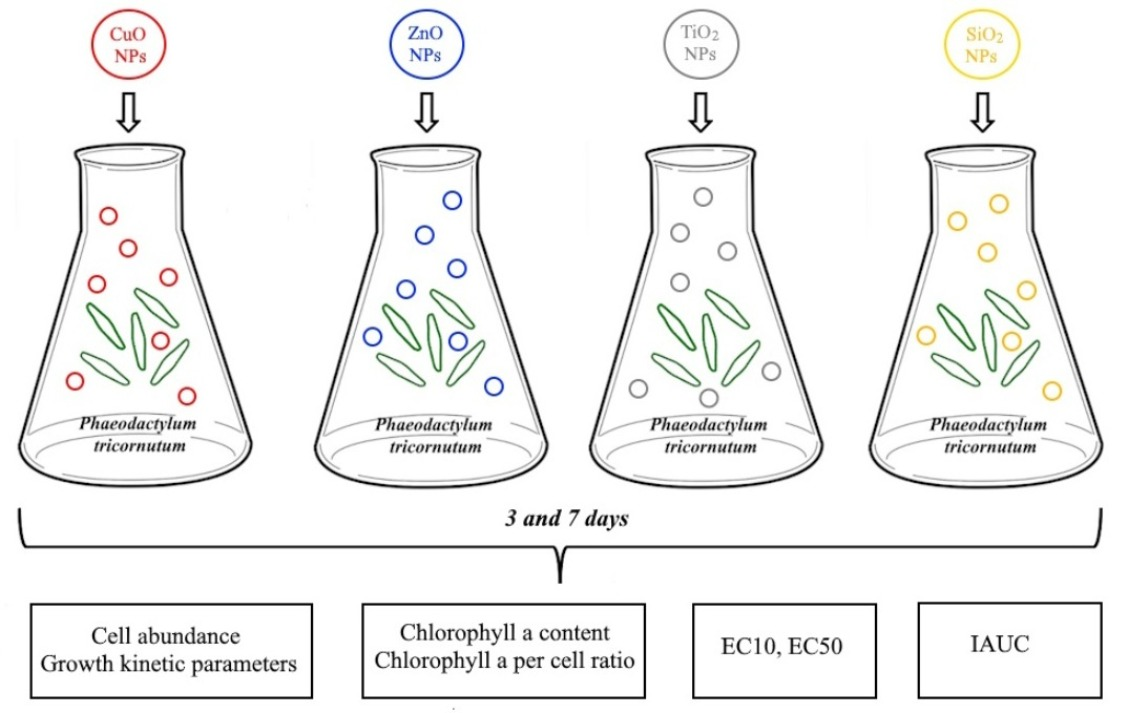

Comparative Toxicity of Four Industrially Important Nanoparticles to the Marine Diatom Phaeodactylum tricornutum: Temporal Dynamics, Hazard Classification, and Phenotypic Response Patterns


Abstract
Share and Cite
Mazur, M.A.; Zhuravel, E.V.; Mazur, A.A. Comparative Toxicity of Four Industrially Important Nanoparticles to the Marine Diatom Phaeodactylum tricornutum: Temporal Dynamics, Hazard Classification, and Phenotypic Response Patterns. Ecologies 2026, 7, 99. https://doi.org/10.3390/ecologies7030099
Mazur MA, Zhuravel EV, Mazur AA. Comparative Toxicity of Four Industrially Important Nanoparticles to the Marine Diatom Phaeodactylum tricornutum: Temporal Dynamics, Hazard Classification, and Phenotypic Response Patterns. Ecologies. 2026; 7(3):99. https://doi.org/10.3390/ecologies7030099
Chicago/Turabian StyleMazur, Marina Alexandrovna, Elena Vladimirovna Zhuravel, and Andrey Alexandrovich Mazur. 2026. "Comparative Toxicity of Four Industrially Important Nanoparticles to the Marine Diatom Phaeodactylum tricornutum: Temporal Dynamics, Hazard Classification, and Phenotypic Response Patterns" Ecologies 7, no. 3: 99. https://doi.org/10.3390/ecologies7030099
APA StyleMazur, M. A., Zhuravel, E. V., & Mazur, A. A. (2026). Comparative Toxicity of Four Industrially Important Nanoparticles to the Marine Diatom Phaeodactylum tricornutum: Temporal Dynamics, Hazard Classification, and Phenotypic Response Patterns. Ecologies, 7(3), 99. https://doi.org/10.3390/ecologies7030099