


Abstract
Early establishment is a critical filter in restoration plantings, especially when seedlings must face seasonal water limitation after outplanting. This study evaluated whether nursery-derived functional trait profiles are associated with early field performance of Pinus devoniana Lindl. seedlings in restoration plantings. Six profile codes were built from contrasting combinations of rooting space, nutrient supply, and water regime. Seedling traits were grouped into structural development, belowground investment, allocation quality, nutritional status, stress expression, and field establishment. Functional scores were calculated from standardized variables, and profile responses were examined through conservative comparisons, descriptive principal component analysis, and trait–performance associations. The large-rooting-space, fertilized, continuously irrigated profile (LFI) showed the most balanced pattern, combining positive structural development, high belowground investment, favorable allocation quality, low stress expression, and the highest survival. The large-rooting-space, fertilized, reduced-irrigation profile (LFR) reached the highest field establishment score, but this response was accompanied by stronger stress expression. The large-rooting-space, non-fertilized, reduced-irrigation profile (LNR) had the highest nutritional status, although this did not translate into superior establishment. Under the evaluated conditions, larger rooting space and coordinated belowground investment, allocation quality, and low stress expression were most consistently associated with better early field performance.
1. Introduction
Restoration plantings are commonly evaluated by the number of seedlings established in the field, but their ecological value depends on whether those seedlings survive, grow, and express traits that allow them to overcome early field stress. The first year after outplanting is a critical filter because seedlings must recover from transplant shock, maintain water uptake, adjust biomass allocation, and continue growing under conditions that differ from the nursery environment. For this reason, early field performance is better understood through plant attributes linked to survival and growth, such as root development, biomass allocation, stem robustness, nutritional status, and physiological condition, rather than through seedling size alone [1,2,3].
The target plant concept provides a useful framework for linking nursery production with field performance because it defines seedling quality in relation to the specific limitations of the planting site. Under this approach, a high-quality seedling is not simply the largest individual in the nursery but the plant whose morphological and physiological attributes match the environmental conditions it will face after outplanting [1,4]. This view is especially relevant in restoration plantings exposed to seasonal drought, poor soils, high radiation, or strong post-planting stress, where nursery-derived traits may either favor or limit establishment depending on how they interact with site conditions.
Seedling size has often been associated with higher survival and growth after planting, but this relationship is not universal. A global analysis of forest restoration plantings showed that larger seedlings frequently have higher survival, although this advantage depends on climate, species stress resistance, and functional attributes [5]. Similar evidence from Amazonian forest species indicates that seedling quality and short-term field performance vary with site conditions, which reinforces the need to interpret nursery traits in relation to the planting environment [6]. In Mexican pine species, fertilization affected plant quality and field survival, confirming that nursery practices can influence establishment but that their effects are species- and context-dependent [7]. These findings show that seedling height or diameter should not be interpreted as isolated indicators of field success.
Belowground traits are especially important during early establishment because roots determine access to soil water and nutrients, plant anchorage, and the capacity to recover after outplanting. In tropical dry forest restoration, seedling survival was strongly linked to belowground traits and their interaction with growth, showing that root attributes can shape establishment under stressful field conditions [8]. Root traits have also been proposed as key indicators for improving restoration outcomes under drought and competition, particularly where soil water availability limits seedling persistence [9,10]. For nursery-grown seedlings, root–shoot balance and root-related indices may therefore provide useful information on whether plants can support water demand after transplanting [11].
Functional trait approaches offer a broader ecological basis for interpreting seedling establishment because they connect plant form and function with performance under environmental filters. In this context, seedling size, belowground traits, biomass allocation, nutritional status, and stress-related responses can all be interpreted as functional traits because they describe how seedlings acquire resources, allocate biomass, tolerate stress, and persist after outplanting. Therefore, these attributes should not be evaluated only as independent indicators of seedling quality. Their combined expression may provide a more useful interpretation of early establishment, particularly when seedlings face seasonal water limitation in restoration sites. In restoration ecology, functional traits have been used to guide plant-material selection, define restoration targets, evaluate ecosystem recovery, and improve the match between plant attributes and site conditions [12,13,14,15].
Seedling functional ecology is especially important because early life stages are highly vulnerable and may show trait–performance relationships that differ from those observed in adult plants [16,17]. Recent studies in tropical restoration also show that functional traits can help predict establishment success, although their effects depend on the trait group evaluated, the species, and the restoration method used [18,19]. However, many restoration studies still evaluate nursery quality through individual traits, while fewer studies integrate structural development, belowground investment, allocation quality, nutritional condition, stress expression, and early field performance into coordinated functional profiles.
Michoacan pine (Pinus devoniana Lindl.), known in Mexico as pino lacio, is a native pine distributed from Mexico to Guatemala and associated with pine–oak and mixed pine forests [20]. The species can occur in relatively warm and seasonally dry environments, which makes it relevant for restoration plantings in mountain and transitional landscapes. Previous nursery research with P. devoniana showed that container volume and fertilization can influence morphological quality and nutrient status, and that root-related indices may be useful for predicting field survival. In a comparative study of Mexican pines, P. devoniana delayed shoot elongation until the end of the dry season, a response interpreted as a possible drought-avoidance strategy during early growth [21]. These characteristics suggest that the species may be suitable for restoration under seasonal water limitation, but successful establishment still depends on the quality and functional balance of the seedlings used for planting.
Despite the restoration relevance of P. devoniana, information remains limited on how nursery-derived trait combinations are associated with early survival, growth, and stress expression after outplanting. Most available studies on forest seedling quality focus on individual morphological or physiological indicators, while integrated functional profiles remain less common in restoration planting studies. This gap is important because seedlings can reach similar field outcomes through different trait combinations. For example, one profile may perform well through strong root investment and balanced allocation, while another may persist through stronger stress-response mechanisms. Distinguishing these contrasting trait combinations may improve the interpretation of early establishment and support more informed planting-stock selection.
We hypothesized that functional trait profiles characterized by greater belowground investment, balanced biomass allocation, adequate nutritional status, and lower stress expression would be associated with better early field performance in P. devoniana restoration plantings. This study aimed to evaluate how nursery-derived functional trait profiles are related to early survival, growth, and stress-related responses after outplanting. By focusing on coordinated trait combinations rather than nursery treatments alone, this work provides an ecological interpretation of early establishment in a native pine species with restoration relevance in seasonally dry mountain landscapes.
2. Materials and Methods
2.1. Study Area and Restoration Planting Site
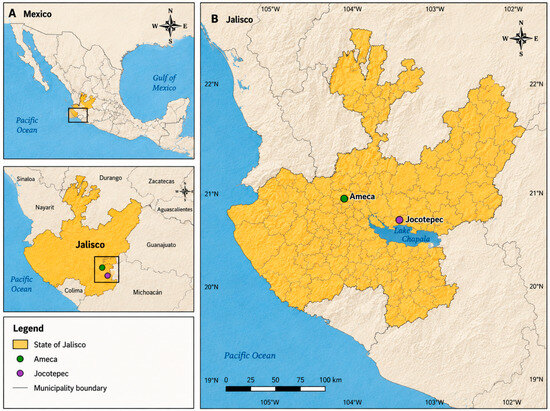
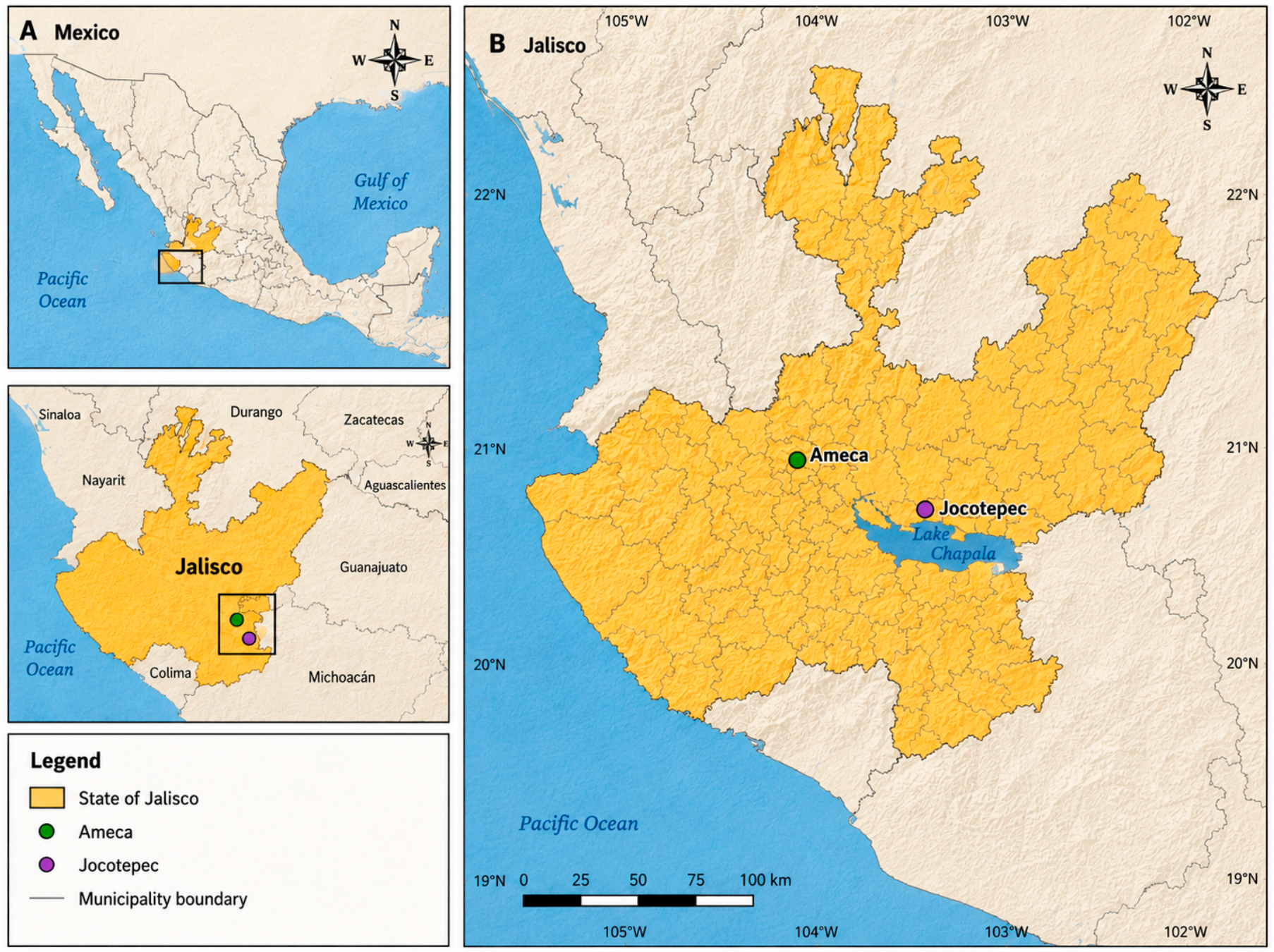
The study was conducted in Jalisco, western Mexico, through a nursery–field sequence designed to evaluate early establishment of P. devoniana seedlings. The nursery stage took place at Valle de Ameca Forest Nursery S.P.R. de R.L., in Ameca, Jalisco, located at 20°33′ N and 104°03′ W, at 1235 m a.s.l. This area has a warm subhumid climate with summer rainfall, temperatures ranging from 8.5 to 32.9 °C, and mean annual precipitation close to 924 mm [22].
The field planting was established at Las Trojes, Jocotepec, Jalisco, located at 20°19.632′ N and 103°19.190′ W, at 1840 m a.s.l. (Figure 1). The site has climatic conditions from semiarid to warm subhumid, a mean annual temperature of 18.5 °C, and annual precipitation near 844 mm [23]. Soils at the planting site are Vertisols, which are relevant for seedling establishment because their physical and hydrological behavior can affect water availability, aeration, infiltration, and root development during the first year after outplanting.
Figure 1.
Location of the nursery conditioning site in Ameca and the restoration planting site at Las Trojes, Jocotepec, Jalisco, Mexico.
2.2. Study Species
P. devoniana is native to Mexico and Central America and belongs to the group of pines described for the Neotropics by [20]. In Mexico, P. devoniana is commonly associated with pine–oak and mixed pine forests across mountain landscapes, where environmental variation can shape early growth responses and drought-avoidance strategies [21]. The species was selected because it has ecological value for restoration plantings exposed to seasonal water limitation. Reference [21] reported that P. devoniana may reduce drought stress during early development by delaying shoot elongation, which makes it suitable for evaluating how functional traits are linked to early field performance after outplanting.
2.3. Functional Profile Framework
This study used a trait-based framework to evaluate early field performance of P. devoniana seedlings in restoration plantings. The analysis was centered on nursery-derived profiles generated from contrasting combinations of rooting space, nutrient supply, and water regime. These profiles were later evaluated using plant attributes measured before and after outplanting, including seedling structure, biomass allocation, leaf nutrient status, biochemical stress expression, survival, and early growth. Trait-based approaches are useful in restoration ecology because they connect plant attributes with field performance and help identify which responses are most relevant during establishment [8,12,15].
Profile codes were based only on the nursery condition represented by each group. The letters indicate rooting space, nutrient supply, and water regime: S = small rooting space, L = large rooting space, F = fertilized, N = non-fertilized, I = continuous irrigation, and R = reduced irrigation. These groups were used to evaluate measured trait responses and were not interpreted as confirmed functional outcomes before analysis. Therefore, any functional interpretation of the profiles was based on the measured trait patterns and should be read cautiously within the scope of the study.
2.4. Functional Profile Description
Six nursery-derived profiles were defined from contrasting combinations of container volume, nutrient supply, and water regime (Table 1). These profiles represented the plant-production conditions from which the seedlings originated before outplanting. They were used as grouping categories to compare measured traits and field responses, not as functional interpretations established a priori. Functional meaning was assigned only after evaluating the structural, allocation, nutritional, stress-related, and field-establishment variables.
Table 1.
Nursery-derived profile codes used to evaluate early field performance of Pinus devoniana seedlings in restoration plantings.
The 1 L and 5 L container volumes were selected to represent contrasting rooting-space conditions within the nursery production system. The 1 L container represented a reduced rooting-space condition, while the 5 L container represented a larger rooting-space condition intended to favor root development before outplanting. Fertilized profiles received the fertilization regime described in Section 2.5, whereas non-fertilized profiles did not receive additional fertilizer beyond the baseline substrate amendment. Continuous irrigation represented regular water supply during nursery conditioning, while reduced irrigation represented a moderate water-limitation condition before outplanting.
The profiles could generate different trait combinations because rooting space, nutrient availability, and water supply can affect seedling morphology, biomass partitioning, root development, physiological stress, and field performance [1,2,5]. However, these expected responses were not assumed as results. They were evaluated through the measured variables described below.
2.5. Experimental Setup and Sample Size
The experiment included six nursery-derived profiles generated from contrasting combinations of rooting space, nutrient supply, and water regime. Seedlings were grown in 1 L or 5 L containers filled with a common substrate composed of peat moss and composted pine bark in a 30:70 ratio. The substrate was amended with controlled-release fertilizer Multicote™ 24-12-6-(4) at 6 kg m−3. The same substrate mixture was used across all nursery-derived profiles to avoid confounding profile responses with substrate differences.
For each nursery-derived profile, 60 seedlings were selected from the available production batch at the end of the nursery conditioning phase. Seedlings were selected to be healthy, free of visible mechanical damage or disease symptoms, and representative of the average size range of each profile. Extremely small, malformed, or damaged seedlings were excluded before grouping and field transfer.
These seedlings were organized into five groups of 12 plants, and each group was used as a replicate unit for morphological and biomass measurements. Nursery values were therefore based on five replicate group means per profile, with each replicate representing the mean response of 12 seedlings.
The nursery variables included root collar diameter, seedling height, shoot dry biomass, root dry biomass, total dry biomass, root–shoot ratio, and Dickson Quality Index. Leaf nutrient status and biochemical stress expression were evaluated using three analytical replicates per profile. These variables included nitrogen, phosphorus, iron, sulfur, and proline concentration. Analytical replicates were used to describe profile-level nutrient and biochemical patterns and were not interpreted as independent biological replicates equivalent to the nursery groups or field replicates.
After the nursery phase, seedlings from each profile were outplanted under field conditions. Early field performance was evaluated using two field replicates per profile. Field variables included survival, field diameter, field height, ectomycorrhizal colonization, stomatal density, and lignified stem area. Survival was calculated as the percentage of surviving seedlings relative to the total number of planted seedlings in each field replicate.
The experimental unit was defined as the level at which each response variable was obtained. For nursery morphological and biomass traits, the experimental unit was the group mean of 12 seedlings, with five independent group means per profile. Individual seedlings within each group were treated as sampling units and were not used as independent replicates in the statistical tests. For nutrient and proline analyses, three analytical replicates were used per profile to describe profile-level biochemical patterns, but they were not treated as independent biological replicates equivalent to nursery or field replicates. For field variables, the field replicate was the experimental unit, with two replicates per profile. Therefore, statistical comparisons were based on replicate-level means rather than on individual seedlings, in order to avoid pseudoreplication.
2.6. Nursery Morphological and Biomass Traits
Nursery morphological and biomass traits were measured at the end of the conditioning stage, before outplanting. These traits were used to describe seedling structure, biomass production, belowground investment, and biomass allocation. Root collar diameter was measured at the stem base using a digital caliper, and seedling height was recorded from the root collar to the terminal bud using a graduated ruler.
Seedlings were destructively sampled to estimate dry biomass. Each plant was separated into shoot and root fractions. Shoot biomass included the stem and needles, while root biomass included the complete root system recovered from the container. Plant fractions were oven-dried at 70 °C until constant weight and then weighed using an analytical balance. Dry biomass partitioning was used because the distribution of plant mass between aerial and belowground organs is a direct indicator of plant growth strategy and resource allocation [24,25]. Total dry biomass was calculated as (1):
where TB is total dry biomass, SB is shoot dry biomass, and RB is root dry biomass.
The root–shoot ratio was used to evaluate biomass allocation between belowground and aboveground organs and was calculated as (2):
where RSR is the root–shoot ratio, RB is root dry biomass, and SB is shoot dry biomass.
The Dickson Quality Index was calculated as an integrated seedling-quality indicator because it combines plant size, sturdiness, and biomass distribution into a single value [26]. It was calculated as (3):
where DQI is the Dickson Quality Index, TB is total dry biomass, H is seedling height, D is root collar diameter, SB is shoot dry biomass, and RB is root dry biomass. For the functional profile analysis, root collar diameter and seedling height were used to represent structural development. Root dry biomass was used to represent belowground investment. Root–shoot ratio and Dickson Quality Index were used to represent allocation quality.
2.7. Leaf Nutrient Status and Biochemical Stress Indicator
Leaf nutrient status was evaluated at the end of the conditioning stage using needle samples collected from seedlings within each nursery-derived profile. Samples were cleaned, oven-dried, ground, and homogenized before chemical analysis. Nitrogen, phosphorus, iron, and sulfur were selected because they represent key nutritional components related to plant metabolism, tissue development, and physiological condition.
Total nitrogen was determined using the semi-micro Kjeldahl method after acid digestion, distillation, and titration. This method is widely used for estimating total nitrogen in plant tissues [27]. Phosphorus, iron, and sulfur were quantified after wet digestion using inductively coupled plasma atomic emission spectroscopy, following standard procedures for plant tissue mineral analysis [28]. Nutrient concentrations were expressed on a dry-mass basis and were used to describe the nutritional status of each nursery-derived profile.
Proline concentration was measured in needles as a biochemical indicator of stress expression. Free proline was determined using the colorimetric ninhydrin method, in which proline reacts with acid ninhydrin and the resulting chromophore is quantified by spectrophotometry [29]. Proline was not interpreted as a direct measure of drought tolerance. It was used as a stress-related trait to identify whether some profiles expressed stronger biochemical stress before field establishment.
Nitrogen, phosphorus, iron, and sulfur were later standardized and incorporated into the nutritional status dimension. Proline was standardized and incorporated into the stress expression dimension.
2.8. Field Performance and Establishment Traits
Field performance was evaluated 12 months after outplanting to determine how functional profiles were associated with early establishment. Survival was used as the main establishment response because seedling persistence during the first year is one of the clearest indicators of restoration success under field conditions [5]. Survival was calculated as (4):
where Ns is the number of surviving seedlings and Nt is the total number of planted seedlings.
Field growth was evaluated through root collar diameter and seedling height. Root collar diameter was measured at the stem base, and height was recorded from the root collar to the terminal bud. These variables were used to describe early structural development after planting and were later included in the field establishment score.
Ectomycorrhizal colonization was evaluated in fine-root samples. Roots were carefully washed to remove adhering soil, and fine-root tips were observed under a stereomicroscope. Root tips were classified as ectomycorrhizal or non-ectomycorrhizal based on visible morphological features, including mantle development, branching pattern, color, and root-tip structure, following standard descriptions for ectomycorrhizal assessment [30,31]. Ectomycorrhizal colonization was calculated as (5):
where EC is ectomycorrhizal colonization, Nm is the number of ectomycorrhizal root tips, and Nt is the total number of evaluated root tips.
Stomatal density was evaluated in needle samples using epidermal impressions or prepared epidermal sections. Stomata were counted under a microscope within a known observation area, and density was expressed as the number of stomata per unit leaf area. This type of microscopic count is commonly used to quantify stomatal traits linked to leaf gas exchange and water regulation [32,33]. It was calculated as (6):
where SD is stomatal density, Nstom is the number of stomata, and A is the evaluated leaf area.
Stem lignification was evaluated from transverse stem sections. Sections were observed under a microscope, and the lignified area and total evaluated stem area were estimated from digital images. Lignified stem area was used as a structural stress-related trait because lignification reflects tissue differentiation and mechanical reinforcement during seedling development. Standard plant anatomical procedures were used to guide section preparation and tissue observation [34]. The lignified stem area was calculated as (7):
where LA is the lignified stem area, Al is the lignified area, and At is the total evaluated stem area.
Survival, field diameter, and field height were standardized and incorporated into the field establishment dimension. Ectomycorrhizal colonization, stomatal density, and lignified stem area were analyzed as complementary establishment and stress-related traits.
2.9. Functional Score Construction and Conservative Data Analysis
Data analysis followed a profile-based approach. Each seedling group was assigned to one of the six nursery-derived profile codes described in Table 1. Variables were organized into six establishment dimensions: structural development, belowground investment, allocation quality, nutritional status, stress expression, and field establishment. This structure was used to examine whether coordinated trait dimensions were associated with early field performance.
The analysis was not treated as a full factorial test of container volume, fertilization, and irrigation. Although the profile codes were derived from combinations of these nursery factors, the six profiles did not represent a complete 2 × 2 × 2 factorial structure because not all possible factor combinations were included in the present profile-based dataset. Therefore, independent main effects and interactions of container volume, fertilization, and irrigation could not be estimated without imbalance or confounding. For this reason, the analysis focused on nursery-derived profiles as integrated groups, and the results were interpreted as profile-level differences rather than as independent effects of single nursery factors. Functional scores were calculated from standardized variables. Each variable was transformed into a z-score before integration (8):
where z is the standardized value, x is the observed value, mean is the grand mean of the variable, and SD is its standard deviation. Standardization allowed variables measured in different units to be combined within the same functional dimension.
Each functional score was calculated as the mean of the standardized variables included in that dimension. The structural development score was obtained from the standardized values of root collar diameter and seedling height. The belowground investment score was based on standardized root dry biomass. The allocation quality score was obtained from the standardized values of root–shoot ratio and Dickson Quality Index. The nutritional status score was obtained from standardized nitrogen, phosphorus, iron, and sulfur concentrations. The stress expression score was obtained from standardized proline concentration and lignified stem area. In this dimension, higher positive values indicated stronger stress expression, not better seedling performance. The field establishment score was obtained from standardized survival, field diameter, and field height.
The score construction can be summarized as follows (9)–(14):
where D is root collar diameter, H is seedling height, RB is root dry biomass, RSR is root–shoot ratio, DQI is Dickson Quality Index, LA is lignified stem area, Field D is field root collar diameter, and Field H is field height. Equal weighting was used because the objective was to build simple and transparent profile-level dimensions rather than to assign predictive weights to individual traits. No variable was given greater weight because the available sample size did not support robust data-driven weighting or model-based trait selection. Therefore, the scores were interpreted as descriptive composite indicators of coordinated trait expression, not as optimized predictive indices.
Profile means, standard errors, and confidence intervals were calculated from the available replicate structure described in Section 2.5. For nursery morphological and biomass traits, the replicate unit was the group mean of 12 seedlings. For nutrient and proline variables, analytical replicates were used to describe profile-level biochemical patterns, but they were not treated as independent biological replicates equivalent to nursery or field replicates. For field variables, the field replicate was used as the replicate unit. The scope of inference was restricted to the six nursery-derived profiles, the evaluated planting site, and the first year after outplanting.
Individual traits and functional scores were compared among profiles using one-way ANOVA when residual normality and variance homogeneity were met. When assumptions were not satisfied, Kruskal–Wallis tests were used as non-parametric alternatives [35]. Tukey’s honestly significant difference test was applied for mean separation after significant parametric tests. For non-parametric comparisons, interpretation was based on rank evidence, response direction, and descriptive patterns.
Degrees of freedom were reported according to the replicate structure used for each variable. For nursery morphological and biomass traits, one-way ANOVA comparisons among profiles used df = 5, 24. For field variables based on two field replicates per profile, non-parametric profile comparisons used Kruskal–Wallis tests with df = 5. Nutrient and proline variables were interpreted conservatively as profile-level biochemical descriptions supported by analytical replication, and not as independent biological responses equivalent to nursery or field replicates. Exploratory correlations among profile-level scores were based on six profile means and were reported with n = 6.
Principal component analysis was used only as a descriptive ordination to visualize how the six nursery-derived profiles were positioned according to their functional scores. Because the PCA was based on six profile-level means, it was not used for formal inference or hypothesis testing. Its purpose was only to summarize multivariate patterns among profiles [36].
Relationships between selected functional dimensions and field responses were evaluated as descriptive associations using the six profile-level means. These correlations were not interpreted as evidence of causality or as proof of underlying biological mechanisms. They were used only to support a cautious visual interpretation of possible trait–performance patterns.
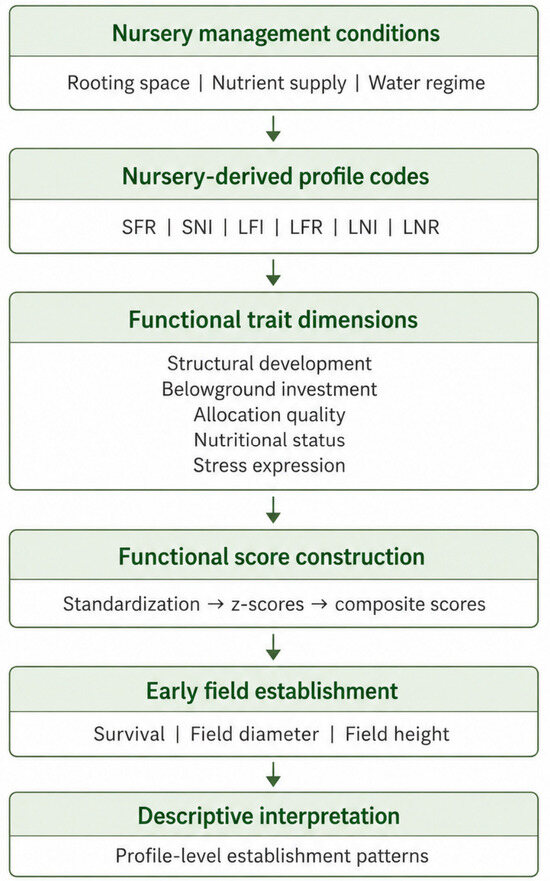
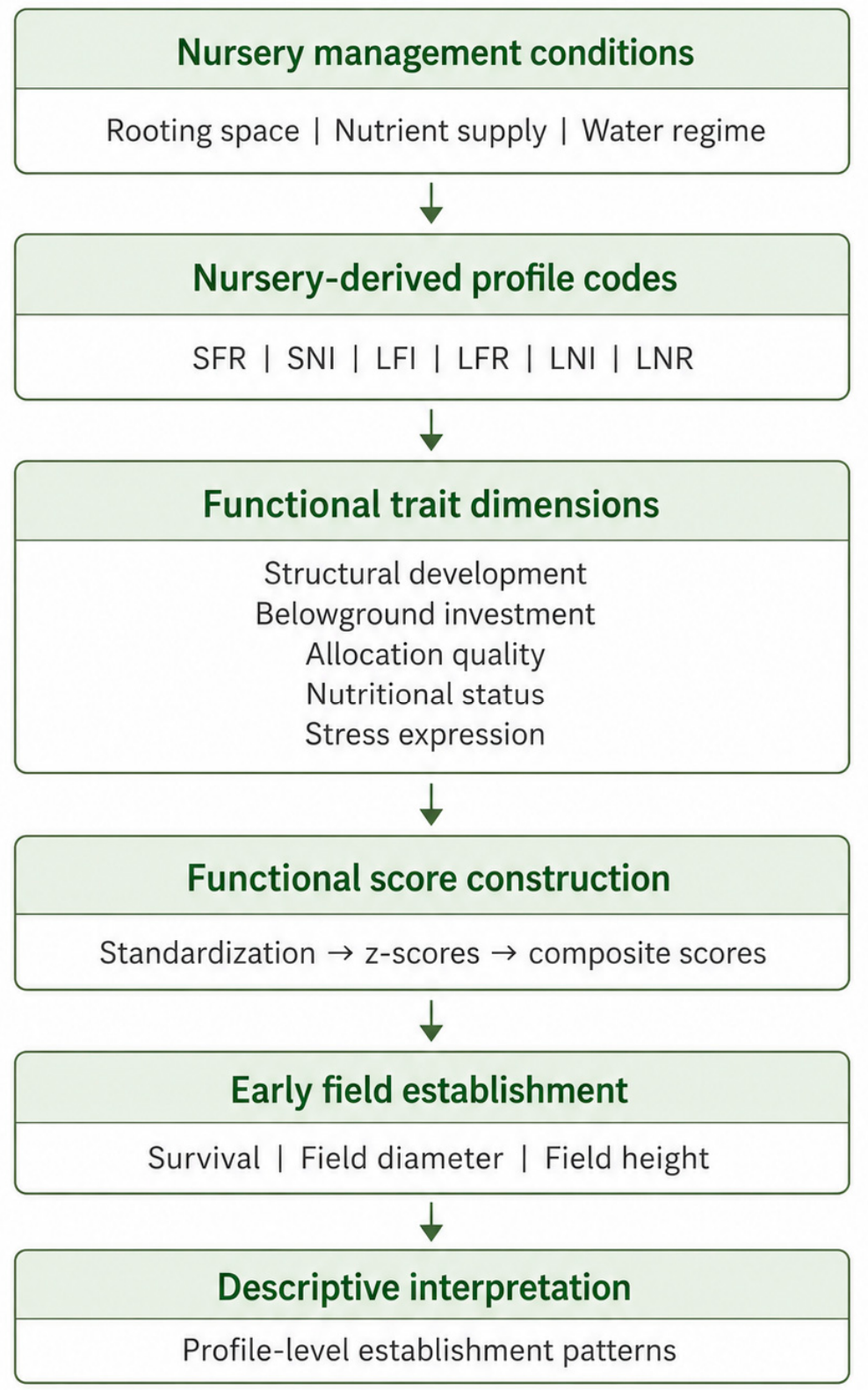
To clarify the analytical logic of the study, a conceptual workflow was added to summarize the link between nursery management conditions, nursery-derived functional profiles, functional score construction, and early field establishment (Figure 2). This diagram was intended to guide interpretation of the profile-based approach and to make clear that field performance was evaluated in relation to coordinated trait patterns rather than isolated nursery factors.
Figure 2.
Conceptual workflow linking nursery management conditions, nursery-derived functional profiles, functional trait dimensions, and early field establishment of Pinus devoniana seedlings. Rooting space, nutrient supply, and water regime were used to define six nursery-derived profile codes. These profiles were evaluated through functional trait dimensions, standardized into composite scores, and related descriptively to first-year field establishment.
All statistical analyses were conducted in SAS 9.4 [37]. Statistical significance was evaluated at p < 0.05. Because some analyses were based on profile-level summaries, interpretation emphasized response direction, effect magnitude, confidence intervals, and ecological coherence among traits rather than statistical significance alone.
3. Results
3.1. Functional Scores Separated Contrasting Establishment Patterns
The functional scores revealed contrasting establishment patterns among P. devoniana seedlings (Table 2). LFI showed the most balanced response, with positive values for structural development, belowground investment, allocation quality, nutritional status, and field establishment, while stress expression remained below the reference mean. LFI combined positive structural development, greater root investment, favorable allocation quality, and low stress expression during the nursery-to-field transition.
Table 2.
Functional scores across establishment dimensions of Pinus devoniana seedlings by nursery-derived profile code.
LNI also showed a favorable pattern, mainly because it combined strong structural development, positive belowground investment, and above-mean field establishment. Unlike LFI, its stress expression was slightly positive while maintaining above-mean field establishment. LFR followed a different pattern: it had the highest field establishment value, supported by positive belowground investment, but this response was also associated with the strongest stress expression among profiles.
LNR had the highest nutritional status, while its field establishment score remained close to the reference mean. SFR and SNI showed the lowest values across most functional dimensions. SNI had a slightly positive allocation quality value, but its field establishment score remained negative. LFI combined positive belowground investment and allocation quality with low stress expression and the highest survival, whereas LFR showed the highest field establishment score together with higher stress expression.
3.2. Nutrient Status and Biochemical Stress Followed Different Patterns
Nitrogen concentration differed strongly among nursery-derived profiles (F5,12 = 96.69, p < 0.001; Table 3). LNR had the highest value, while LFI, LFR, and LNI formed an intermediate group. SFR and SNI showed the lowest nitrogen concentrations. Phosphorus, iron, and sulfur did not differ among profiles according to Kruskal–Wallis tests (phosphorus: H = 6.10, p = 0.297; iron: H = 9.19, p = 0.102; sulfur: H = 3.11, p = 0.684), although LNR had the highest mean phosphorus and sulfur values, and LNI had the highest mean iron concentration.
Table 3.
Leaf nutrient status and biochemical stress indicator of Pinus devoniana seedlings across nursery-derived profile codes.
Proline concentration showed a strong profile effect (F = 954.21, p < 0.001). LNR reached the highest value, followed by LFR and SFR. SNI, LFI, and LNI remained at the lowest levels. Stronger biochemical stress expression was recorded in profiles exposed to reduced irrigation, although the intensity of this response changed according to rooting space and nutrient supply.
The contrast between nitrogen and proline was important for interpreting the functional profiles. LNR had the highest nitrogen concentration, but also the highest proline value, showing that nutrient accumulation did not necessarily reduce stress expression. LFI and LNI showed a more favorable balance because both maintained intermediate nitrogen values with low proline accumulation. These results support the distinction between nutritional status and biochemical stress as separate dimensions of early seedling function.
3.3. Field Establishment Showed Contrasting Response Patterns
Field establishment showed contrasting patterns among nursery-derived profile codes, but the pattern was not the same for survival, growth, symbiotic response, and structural stress expression (Table 4). Survival showed a near-significant profile effect under the conservative Kruskal–Wallis test (H5 = 10.58, p = 0.060). LFI reached the highest survival, with 76.92%, followed by LFR with 64.29%. SFR had the lowest value, with 44.00%. LFI followed a survival-oriented pattern, while LFR and LNI reached positive field establishment mainly through stronger field growth and greater structural adjustment.
Table 4.
Integrated field establishment dimensions of Pinus devoniana seedlings across nursery-derived profile codes.
The field growth score was highest in LNI and LFR. Field diameter showed a near-significant profile effect (H5 = 10.54, p = 0.061), whereas field height showed a weaker profile pattern (H5 = 9.46, p = 0.092). LNI had the highest field growth score, while its survival value was lower than that of LFI and LFR. LFR showed both a high field growth score and a positive field establishment score.
Symbiotic response did not differ significantly among profiles (H = 9.15, p = 0.103). SFR and SNI had the highest ectomycorrhizal colonization, but both had negative field establishment scores. Structural stress expression showed a near-significant pattern (H = 9.77, p = 0.082), with higher values in LNI and LFR and lower values in LNR and LFI; stronger lignification did not coincide consistently with higher survival. The field establishment score helped separate profiles with different establishment patterns. LFR had the highest integrated value, mainly because of its strong growth and moderate survival, although it also had high structural stress expression. LFI showed a more balanced pattern, combining the highest survival with low lignification. LNI grew strongly but had low survival, while SFR and SNI remained below the mean field establishment score. The profiles differed in the combination of persistence, growth, symbiotic response, and stress-related adjustment.
3.4. Descriptive Multivariate Patterns Among Nursery-Derived Profiles
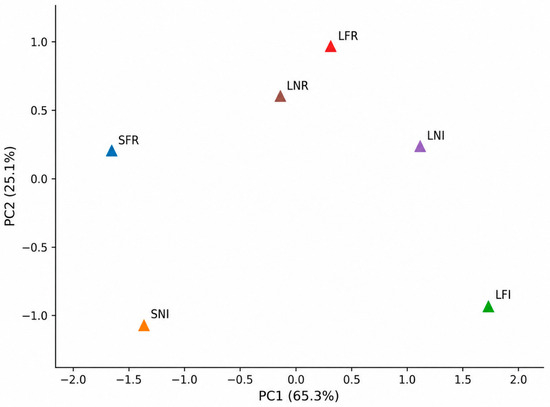
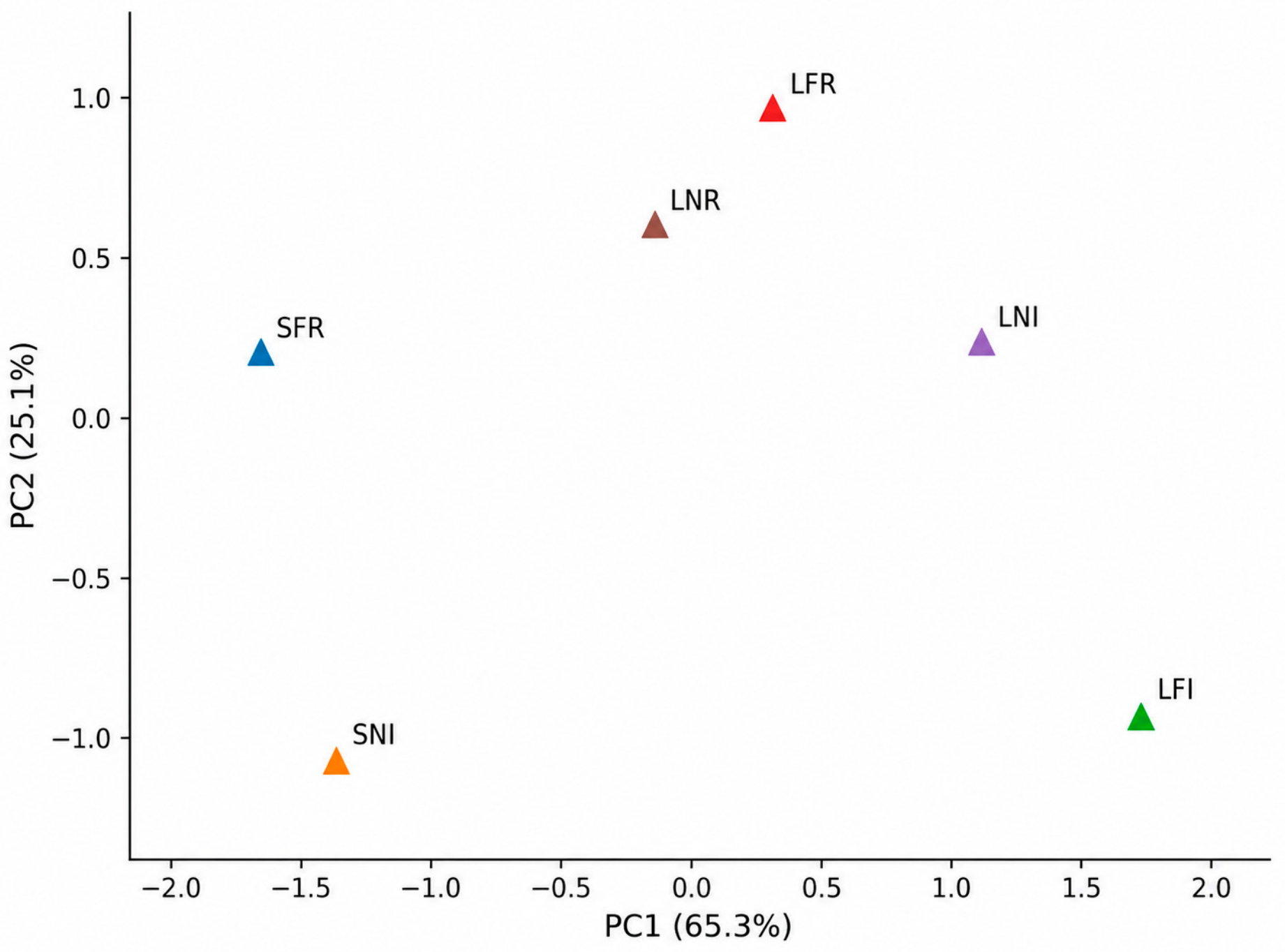
The PCA was used as an exploratory ordination to visualize how the six nursery-derived profile codes were separated by their functional scores (Figure 3). The first two axes explained 90.4% of the total variation. PC1 explained 65.3% and represented the main gradient of functional performance. LFI and LNI were positioned on the positive side of this axis, reflecting stronger structural development, greater belowground investment, better allocation quality, and positive field establishment. SFR and SNI were placed on the negative side, showing weaker functional expression across most dimensions.
Figure 3.
Descriptive principal component analysis of functional scores in Pinus devoniana seedlings across nursery-derived profile codes. PC1 explained 65.3% of the variation and arranged profiles mainly along a gradient associated with structural development, belowground investment, allocation quality, and field establishment. PC2 explained 25.1% of the variation and was mainly associated with stress-related responses. The PCA was based on six profile-level means and was used only as a descriptive ordination. Profile codes indicate rooting space, nutrient supply, and water regime: S = small rooting space, L = large rooting space, F = fertilized, N = non-fertilized, I = continuous irrigation, and R = reduced irrigation.
PC2 explained 25.1% of the variation and helped distinguish profiles with stronger stress expression from those with lower stress signals. LFR and LNR had positive PC2 values, while LFI had a negative value, consistent with its low stress expression and balanced establishment pattern. Because the PCA was based on profile-level scores, it was interpreted only as a visual summary of multivariate patterns, not as a formal inferential test. The ordination separated profiles according to combinations of root investment, allocation quality, nutrient status, stress expression, and field response.
3.5. Descriptive Trait–Performance Associations
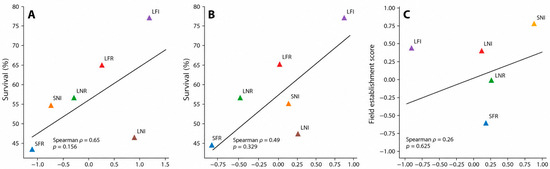
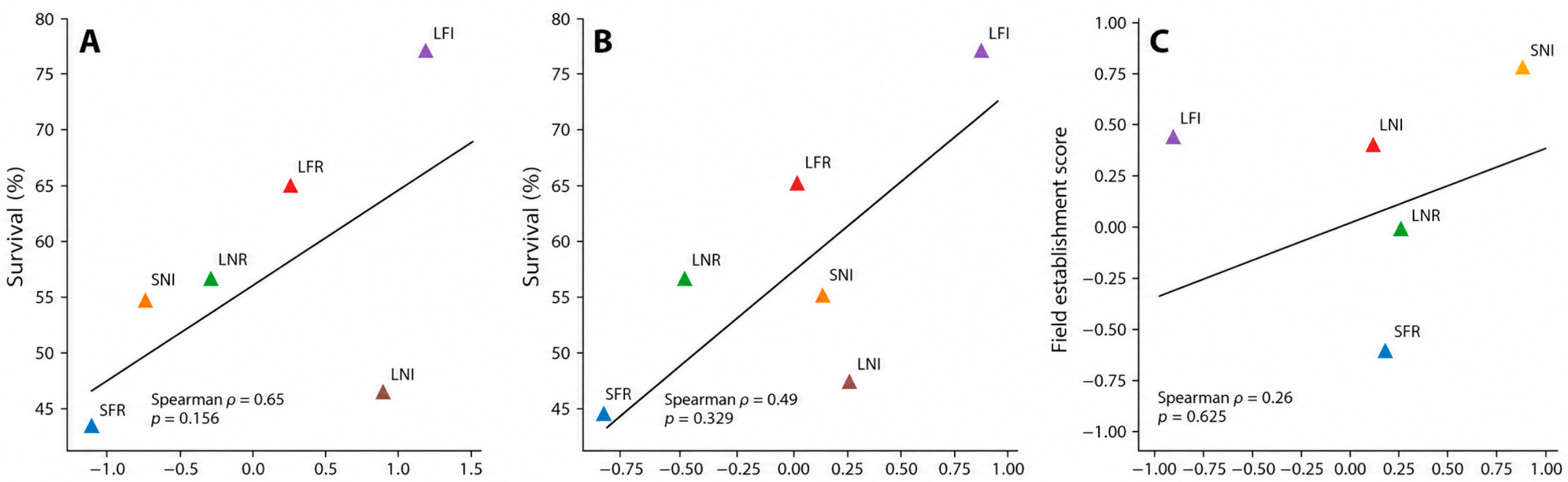
Trait–performance relationships were evaluated as descriptive associations to visualize how selected functional dimensions were related to early field responses (Figure 4). These relationships were based on six profile-level means, and not all associations were statistically significant. Therefore, they were interpreted descriptively, with emphasis on the direction and magnitude of the association rather than on statistical significance alone. Survival showed a positive but non-significant association with belowground investment (Spearman ρ = 0.66, p = 0.156). LFI had the strongest combination, with high belowground investment and the highest survival. LFR also followed this tendency, while LNI departed from the pattern because it had positive belowground investment but low survival.
Figure 4.
Exploratory trait–performance relationships during early establishment of Pinus devoniana seedlings. (A) Belowground investment score and survival. (B) Allocation quality score and survival. (C) Stress expression score and field establishment score. Points represent nursery-derived profile codes. Lines indicate fitted linear trends for visualization only. Spearman correlations are reported within each panel.
Allocation quality also showed a positive, non-significant association with survival (Spearman ρ = 0.49, p = 0.329). LFI occupied the most favorable position, combining high allocation quality and high survival. SNI showed moderate allocation quality, but this was not reflected in stronger persistence after planting. This contrast was consistent with the descriptive interpretation that allocation quality should be read together with other traits, especially root investment and stress expression.
Stress expression had a weak positive association with field establishment (Spearman ρ = 0.26, p = 0.623). This relationship was mainly influenced by LFR, which had the highest stress expression and the highest field establishment score. LFI showed a different pattern, with low stress expression and high survival. The descriptive patterns showed more than one trait combination associated with early establishment. Profiles with stronger root investment and balanced allocation tended to show higher survival, whereas other profiles showed positive field establishment scores together with stronger growth and structural stress expression.
4. Discussion
4.1. Functional Profiles Suggested Different Establishment Patterns
The functional scores showed that early establishment of P. devoniana was not associated with a single favorable trait. Each nursery-derived profile combined structure, root investment, allocation, nutrition, stress expression, and field response in a different way. This pattern agrees with the idea that seedling performance after planting depends on coordinated plant attributes rather than on isolated size or growth variables. Previous work has shown that initial root and shoot morphology can contribute differently to field performance, which supports the need to evaluate seedling quality through integrated trait combinations [38]. In the present study, this was clear in the contrast between LFI and LFR: LFI achieved the highest survival and showed the most balanced functional profile, whereas LFR reached the highest integrated field establishment score but also showed stronger stress expression.
LFI represented the most balanced profile. It combined high belowground investment, favorable allocation quality, positive field establishment, and low stress expression. This pattern is consistent with the hypothesis that seedlings with stronger root development and lower stress signals may show better early field performance. Root traits are central during establishment because they influence water uptake, soil exploration, anchorage, and the capacity to tolerate dry periods after outplanting. Evidence from tropical tree seedlings has shown that drought tolerance can be strongly related to seedling traits, especially those linked to water acquisition and allocation [39]. More recent work also indicates that seedling drought responses can be governed by root traits, local soil moisture, and the surrounding competitive or facilitative environment [40].
The position of LFI in the exploratory PCA was consistent with this interpretation, but it should not be read as a formal inferential result. Rather, it helped visualize that LFI combined several favorable dimensions in the same profile. This matters because field persistence is rarely determined by one attribute alone. A seedling may have acceptable height or nutrient status, but poor root investment or high stress expression can still limit establishment. In this study, LFI performed well because several dimensions pointed in the same direction: root investment, allocation quality, survival, and low stress expression.
LFR followed another pattern. It had the highest field establishment score, but this response was accompanied by the strongest stress expression. This does not mean that stress improved establishment. A more cautious interpretation is that LFR maintained field growth and establishment while expressing stronger structural or biochemical adjustment. Seedlings can face stressful field conditions through different functional pathways, including greater allocation to stress resistance, changes in tissue reinforcement, or shifts in growth–survival balance. Recent evidence from tropical seedlings under drought also supports the use of functional traits to distinguish species or plant groups that maintain performance under water limitation [41]. In this context, LFR may indicate an establishment pattern based on adjustment under stress rather than a low-stress profile.
LNI also showed positive field establishment, mainly through field growth, but its lower survival indicates that growth alone was not enough to define a favorable establishment pattern. This distinction is important because survival and growth can respond differently during the first year after planting. A profile may grow strongly among surviving plants but still lose a large proportion of seedlings. For this reason, the functional-score approach helped separate persistence, growth, root investment, allocation quality, and stress expression. If only survival had been considered, LFI would appear as the strongest profile. If only growth had been considered, LFR or LNI would seem more favorable. The integrated interpretation showed that early establishment may indicate the balance among these dimensions.
4.2. Root Investment and Allocation Quality Supported Early Persistence
The positive association between belowground investment and survival may indicate that root development was one of the traits linked to early persistence in P. devoniana. This response is ecologically consistent because seedlings with greater root biomass may explore a larger soil volume, maintain water uptake more effectively, and support shoot demand during the transition from nursery conditions to the field. Initial root and shoot morphology have been shown to contribute to early field performance in planted tree seedlings, with root volume and combined morphological models improving the prediction of post-planting growth and establishment [42]. In this study, the same principle was observed at the profile level: profiles with stronger belowground investment tended to occupy more favorable positions in survival and establishment patterns.
Allocation quality also helped interpret early persistence, although its association with survival was weaker than belowground investment. This distinction is important because root biomass and biomass balance are not equivalent signals. A seedling can show a favorable root–shoot ratio without having enough total root mass to sustain field performance. Biomass allocation is shaped by plant size, environmental conditions, and resource availability, which means that its ecological meaning must be interpreted within the full plant context rather than as an isolated index [43]. In the present study, SNI illustrates this point: it had a slightly positive allocation quality score, but this did not translate into stronger field establishment.
The response of LFI supports the idea that root investment is most useful when it occurs with balanced allocation and low stress expression. LFI did not have the highest field growth score, but it had the highest survival and a favorable position in the exploratory trait–performance relationships. This distinction matters because restoration plantings do not only require seedlings that grow fast; they require seedlings that remain alive long enough to pass the early establishment filter. Evidence from planted seedlings shows that field performance can be influenced by the interaction between initial morphology, site conditions, and post-planting stress, which explains why survival and growth may not respond in the same direction.
These results also caution against interpreting allocation quality as a universal predictor. Root–shoot partitioning can reflect plant adjustment to nursery conditions, but its field meaning depends on whether the belowground system is large enough to sustain water uptake and whether the shoot demand remains within the plant’s hydraulic capacity. Root growth potential has been considered a useful seedling-quality attribute, but its effect on field performance depends on the planting site and the environmental conditions faced after outplanting [44]. For P. devoniana, the clearest descriptive pattern came from the combined response: profiles with greater belowground investment and better allocation tended to perform better, but survival still may indicate the full functional context. This supports the profile-based interpretation used here, where root investment, allocation quality, stress expression, and field response were read together rather than as isolated indicators.
4.3. Nutritional Status Did Not Guarantee Lower Stress or Better Establishment
The nutritional dimension helped separate the profiles, but it did not explain field establishment by itself. LNR had the highest nutritional status and the highest nitrogen concentration, yet its field establishment remained close to the reference mean. This response may indicate that nutrient accumulation alone did not explain field establishment, but its effect depends on water availability, root function, and the capacity of the plant to use those resources under field stress. Similar interactions have been reported in forest seedlings, where nitrogen supply may improve growth and physiological performance under drought, but the final response depends on the balance between nutrient availability and water limitation [45].
The contrast between nitrogen and proline was especially important. LNR combined the highest nitrogen concentration with the strongest proline accumulation, which shows that better nutrient status did not necessarily mean lower biochemical stress. Nitrogen can support photosynthesis, osmotic adjustment, and recovery capacity under drought, but it can also increase physiological demand when water becomes limiting [46]. Recent work with pine seedlings also showed that drought intensity can modify nutrient concentrations and increase proline accumulation, confirming that nutritional status and biochemical stress may respond together but not always in a favorable direction [47]. This helps explain why LNR did not behave as the strongest field profile, despite its favorable nutritional score.
LFI and LNI showed a more favorable nutritional–stress balance. Both profiles maintained intermediate to high nitrogen values with low proline accumulation, especially LFI. This pattern suggests that nutrient status was more useful when it was not accompanied by strong biochemical stress. Studies on nursery nutrition and post-planting water availability have shown that fertilization effects on survival are not always direct, since seedlings may perform similarly under different nutrient regimes when water becomes the dominant field constraint [48]. In this sense, the results from P. devoniana support a cautious interpretation: nutrients matter, but they do not replace the role of root development and stress regulation.
The lack of significant differences in phosphorus, iron, and sulfur also suggests that the strongest nutritional signal came from nitrogen. This does not mean that the other elements were unimportant; rather, their variation was not enough to separate nursery-derived profiles under the evaluated conditions. Drought can alter mineral nutrient uptake and internal nutrient balance, often changing nutrient concentration without producing a simple performance response [49]. For restoration planting, this means that leaf nutrient status should be read as one part of the seedling functional profile, not as a stand-alone indicator of field success.
4.4. Stress Expression Was Associated with Contrasting Field Responses
Stress expression helped explain why some profiles reached positive field establishment without following the same pattern as LFI. LFR had the highest field establishment score, but it also showed the strongest stress expression. This response should not be read as evidence that stress improved performance. A more careful interpretation is that LFR maintained growth and survival while expressing stronger adjustment signals. In plants exposed to water limitation, proline accumulation and lignin deposition can be part of a broader response that includes osmotic regulation, water-loss control, and tissue reinforcement [50].
The contrast between LFI and LFR is important. LFI reached the highest survival with low stress expression, whereas LFR reached the highest integrated field establishment score with stronger stress signals. These two patterns may indicate different establishment responses. LFI appears closer to a low-stress pattern, where root investment and balanced allocation may have reduced the need for stronger biochemical or structural adjustment. LFR, in contrast, may reflect a compensation pattern, where seedlings sustained field growth while showing greater stress-related response. Similar drought-related mechanisms have been linked to lignin accumulation in roots and shoots, where stronger lignification can reinforce tissues and improve water-stress tolerance, although this may involve trade-offs in growth and resource allocation [51].
The high stress expression in LFR and LNI also helps explain why growth and survival did not always move in the same direction. LNI had strong field growth, but its survival remained low compared with LFI and LFR. This pattern may indicate that rapid growth after planting can occur under stress, but it does not always translate into persistence. In drought-prone settings, plants may maintain growth for a period while activating protective responses, yet that response depends on how roots, water uptake, stomatal regulation, and tissue structure operate at the same time [52].
For restoration, these findings are useful because stress traits should not be treated as simple indicators of poor or good quality. Proline and lignification are better read as signals of adjustment. Low stress expression with high survival, as observed in LFI, suggests a favorable balance. High field performance with stronger stress expression, as observed in LFR, points to a more demanding establishment pattern. This distinction matters because profile selection should not favor seedlings only because they grow more after planting; it should favor combinations that can sustain survival, growth, and stress regulation under field conditions.
4.5. Implications for Restoration Planting and Profile-Based Seedling Selection
The results have practical value for restoration planting because they suggest that seedling selection may benefit from considering more than size, nutrient concentration, or a single quality index. LFI showed one of the most balanced responses, not because it had the highest value in every trait, but because it combined root investment, allocation quality, low stress expression, and high survival in a more balanced way. This supports the potential use of nursery-derived functional profiles as a complementary tool for restoration programs, especially when planted seedlings must face seasonal water limitation during the first establishment year. Trait-based restoration has been proposed as a way to connect plant attributes with ecosystem recovery targets, since functional traits can help explain both establishment success and later ecosystem services [53].
This profile-based reading can help refine planting-stock decisions. Instead of asking only whether seedlings are large enough to plant, restoration programs can ask whether seedlings express a suitable combination of traits for the planting site. For P. devoniana, the most useful combination was not maximum nutrition or maximum growth alone, but a balance between belowground development, allocation quality, moderate nutritional status, and limited stress expression. This agrees with current recommendations for reforestation, where seedling choice should consider site conditions, native species performance, mutualistic interactions, and long-term resilience rather than short-term planting numbers alone [54].
The approach may also help reduce the risk of selecting seedlings based only on traits that are easy to observe. Height and rapid early growth can be attractive in the nursery or shortly after planting, but they may not reflect establishment capacity when water availability becomes limiting. A functional profile gives a broader picture because it brings root traits, stress signals, and field persistence into the same interpretation. This is relevant for seedling ecology because early life stages are highly sensitive to environmental filters, and comparable trait-based evaluations can improve how seedling performance is interpreted across species and restoration contexts [55].
For applied restoration, these findings suggest that profile-based selection could reduce uncertainty before field planting. Seedlings similar to LFI may be more suitable when the main goal is to maximize first-year survival through a balanced functional profile, while profiles similar to LFR may be useful when stronger early field growth is desired, although their higher stress expression should be monitored carefully. However, the operational advantages of LFI should be interpreted together with its nursery and field costs; this profile required larger containers, fertilization, continuous irrigation, more substrate, greater nursery space, and higher transport and handling effort than profiles produced in smaller containers or under reduced-input conditions. Therefore, LFI should not be prescribed universally. Planting stock should be matched with site constraints, management capacity, restoration goals, available budget, field accessibility, and expected replanting costs. Investing in better planting material and more suitable stock selection may improve long-term restoration outcomes, even when initial production costs are higher [56].
The scope of this study should be read as a focused contribution. The results apply to P. devoniana, six nursery-derived profiles, one restoration planting site, and the first year after outplanting. This scale allowed a detailed reading of early establishment, but longer monitoring would help determine whether the advantages observed in balanced profiles persist during later growth stages. Testing this approach across additional sites, soil conditions, and rainfall regimes would also strengthen its use in restoration planning, since plant functional traits can help match species or planting material with specific site constraints [57]. A methodological limitation should also be considered. All variables within each functional dimension were standardized and averaged using equal weights. This decision improved transparency and avoided overfitting, but it also assumes that each component contributes similarly to the corresponding dimension. Future studies with larger datasets could test weighted scores, structural equation models, or other multivariate approaches to evaluate the relative contribution of each trait to field performance. Therefore, the limited number of independent profile-level observations restricts statistical power, and the functional-profile framework should be viewed as an exploratory approach that requires validation across additional restoration sites, species, and environmental conditions.
The functional-profile approach should also be replicated with other native tree species of ecological and productive importance. Species differ in root architecture, drought response, nutrient demand, growth rhythm, and stress tolerance, so the most favorable trait combination for P. devoniana may not be the same for other restoration species. Applying this framework to additional pines, broadleaf trees, and mixed-species plantings would help evaluate whether balanced root investment, allocation quality, and low stress expression are consistently associated with establishment, or whether each species requires its own functional profile for restoration planning. This is especially relevant because trait-based restoration is increasingly used to guide species selection and improve the fit between plant traits, restoration goals, and field conditions [58].
5. Conclusions
Nursery-derived functional profiles helped describe early establishment patterns of Pinus devoniana under the evaluated planting conditions. The results partially supported the hypothesis that profiles with greater belowground investment, balanced allocation, and lower stress expression were associated with better first-year field performance. LFI showed the most balanced response because it combined root investment, allocation quality, low stress expression, and high survival during the first year after outplanting.
The study also showed that LFI and LFR should not be interpreted as equivalent responses: LFI achieved the highest survival and showed the most balanced functional profile, whereas LFR reached the highest integrated field establishment score but also expressed stronger stress signals. In contrast, LNR had the highest nutritional status, but this advantage did not lead to superior field establishment. This may indicate that nutrient condition alone was not sufficient to describe early field performance under the evaluated conditions.
For restoration programs, these findings should be considered as site- and species-specific evidence rather than as broad management prescriptions. The clearest quantitative direction was observed in LFI, which reached the highest first-year survival (76.92%) and combined positive belowground investment, allocation quality, and low stress expression. LFR reached the highest integrated field establishment score, but this response was accompanied by stronger stress expression and should be interpreted cautiously. In contrast, LNR had the highest nutritional status, but this did not translate into superior field establishment. Therefore, under the evaluated conditions, larger rooting space combined with fertilization and continuous irrigation appeared to be the most favorable nursery condition for improving first-year survival of P. devoniana. However, broader ecological or operational recommendations require further validation across additional sites, longer monitoring periods, and other native tree species.
Author Contributions
Conceptualization, B.A.R.-B. and R.M.B.-P.; methodology, R.M.B.-P.; software, B.A.R.-B.; validation, C.E.N.R., V.Z.-G. and L.A.N.R.; formal analysis, B.A.R.-B.; investigation, R.M.B.-P.; resources, R.M.B.-P.; data curation, N.R.C.; writing—original draft preparation, B.A.R.-B., R.J.M.Y. and A.M.Z.-G.; writing—review and editing, B.A.R.-B., R.M.B.-P., C.E.N.R., V.Z.-G., L.A.N.R., N.R.C., R.J.M.Y. and A.M.Z.-G.; visualization, B.A.R.-B.; supervision, R.M.B.-P.; project administration, R.M.B.-P.; funding acquisition, R.M.B.-P. All authors have read and agreed to the published version of the manuscript.
Funding
This research received no external funding.
Institutional Review Board Statement
Not applicable.
Informed Consent Statement
Not applicable.
Data Availability Statement
The data supporting the findings of this study are available from the corresponding author upon reasonable request.
Acknowledgments
B.A.R.-B. dedicates this work to the memory of Lovren Aleksander Ruiz Guzman, Dellanira Blandon Renteria, and Ramón López Bueno.
Conflicts of Interest
The authors declare no conflicts of interest.
Abbreviations
The following abbreviations are used in this manuscript:
| DQI | Dickson Quality Index |
| EC | Ectomycorrhizal colonization |
| LA | Lignified stem area |
| PCA | Principal component analysis |
| RSR | Root–shoot ratio |
References
- Davis, A.S.; Pinto, J.R. The Scientific Basis of the Target Plant Concept: An Overview. Forests 2021, 12, 1293. [Google Scholar] [CrossRef] [Scilit]
- Grossnickle, S.C.; MacDonald, J.E. Seedling Quality: History, Application, and Plant Attributes. Forests 2018, 9, 283. [Google Scholar] [CrossRef] [Scilit]
- Grossnickle, S.C.; MacDonald, J.E. Why Seedlings Grow: Influence of Plant Attributes. New For. 2018, 49, 1–34. [Google Scholar] [CrossRef] [Scilit]
- Dumroese, R.K.; Landis, T.D.; Pinto, J.R.; Haase, D.L.; Wilkinson, K.W.; Davis, A.S. Meeting Forest Restoration Challenges: Using the Target Plant Concept. Reforesta 2016, 37–52. [Google Scholar] [CrossRef] [Scilit]
- Andivia, E.; Villar-Salvador, P.; Oliet, J.A.; Puértolas, J.; Dumroese, R.K.; Ivetić, V.; Molina-Venegas, R.; Arellano, E.C.; Li, G.; Ovalle, J.F. Climate and Species Stress Resistance Modulate the Higher Survival of Large Seedlings in Forest Restorations Worldwide. Ecol. Appl. 2021, 31, e02394. [Google Scholar] [CrossRef] [Scilit] [PubMed]
- Guimarães, Z.T.M.; Da Silva, D.C.; Ferreira, M.J. Seedling Quality and Short-Term Field Performance of Three Amazonian Forest Species as Affected by Site Conditions. iForest 2024, 17, 80–89. [Google Scholar] [CrossRef] [Scilit]
- Paz, M.P.; Trejo, D.A.R.; Morales, A.V.; la Rosa, M.A.M.B. Fertilización, calidad de planta y supervivencia en campo de Pinus spp. en Ixtlán de Juárez, Oaxaca. Rev. Mex. Cienc. For. 2023, 14, 71–92. [Google Scholar] [CrossRef] [Scilit]
- Werden, L.K.; Averill, C.; Crowther, T.W.; Calderón-Morales, E.; Toro, L.; Alvarado, J.P.; Gutiérrez, L.M.; Mallory, D.E.; Powers, J.S. Below-Ground Traits Mediate Tree Survival in a Tropical Dry Forest Restoration. Philos. Trans. R. Soc. Lond. B Biol. Sci. 2022, 378, 20210067. [Google Scholar] [CrossRef] [Scilit] [PubMed]
- Garbowski, M.; Avera, B.; Bertram, J.H.; Courkamp, J.S.; Gray, J.; Hein, K.M.; Lawrence, R.; McIntosh, M.; McClelland, S.; Post, A.K.; et al. Getting to the Root of Restoration: Considering Root Traits for Improved Restoration Outcomes under Drought and Competition. Restor. Ecol. 2020, 28, 1384–1395. [Google Scholar] [CrossRef] [Scilit]
- Kalra, A.; Goel, S.; Elias, A.A. Understanding Role of Roots in Plant Response to Drought: Way Forward to Climate-Resilient Crops. Plant Genome 2024, 17, e20395. [Google Scholar] [CrossRef] [Scilit] [PubMed]
- Sheridan, R.A.; Davis, A.S. Characterizing the Utility of the Root-to-Shoot Ratio in Douglas-Fir Seedling Production. Forests 2021, 12, 1745. [Google Scholar] [CrossRef] [Scilit]
- Carlucci, M.B.; Brancalion, P.H.S.; Rodrigues, R.R.; Loyola, R.; Cianciaruso, M.V. Functional Traits and Ecosystem Services in Ecological Restoration. Restor. Ecol. 2020, 28, 1372–1383. [Google Scholar] [CrossRef] [Scilit]
- Charles, L.S. Plant Functional Traits and Species Selection in Tropical Forest Restoration. Trop. Conserv. Sci. 2018, 11, 1940082918784157. [Google Scholar] [CrossRef] [Scilit]
- Gornish, E.S.; Campbell, C.; Svejcar, L.; Munson, S.M.; Vaughn, K.; Spaeth, M.K.; Yelenik, S.G.; Wolf, A.; Mitchell, R. Functional Traits Are Used in Restoration Practice: A Response to Merchant et al. (2022). Restor. Ecol. 2023, 31, e13880. [Google Scholar] [CrossRef] [Scilit]
- Laughlin, D.C. Applying Trait-Based Models to Achieve Functional Targets for Theory-Driven Ecological Restoration. Ecol. Lett. 2014, 17, 771–784. [Google Scholar] [CrossRef] [Scilit] [PubMed]
- Winkler, D.E.; Garbowski, M.; Kožić, K.; Ladouceur, E.; Larson, J.; Martin, S.; Rosche, C.; Roscher, C.; Slate, M.L.; Korell, L. Facilitating Comparable Research in Seedling Functional Ecology. Methods Ecol. Evol. 2024, 15, 464–476. [Google Scholar] [CrossRef] [Scilit]
- Xu, Z.; Muscarella, R.; Zhu, M.; Fang, S.; Ye, J.; Lin, F.; Mao, Z.; Hao, Z.; Wang, X. Functional Traits Mediate Seedling Survival Response to Climate in a Temperate Forest. Fundam. Res. 2025, 5, 2649–2656. [Google Scholar] [CrossRef] [Scilit] [PubMed]
- de Souza, D.C.; Engel, V.L. Seed Functional Traits as Predictors of Seedling Establishment Success in Brazilian Tropical Forest Restoration. Biotropica 2024, 56, e13355. [Google Scholar] [CrossRef] [Scilit]
- Matlaga, D.; Lammerant, R.; Hogan, J.A.; Uriarte, M.; Rodriguez-Valle, C.; Zimmerman, J.K.; Muscarella, R. Survival, Growth, and Functional Traits of Tropical Wet Forest Tree Seedlings across an Experimental Soil Moisture Gradient in Puerto Rico. Ecol. Evol. 2024, 14, e11095. [Google Scholar] [CrossRef] [Scilit] [PubMed]
- Farjon, A.; Styles, B.T. Flora Neotropica. Pinus (Pinaceae); New York Botanical Garden: New York, NY, USA, 1997; ISBN 978-0-89327-411-5. [Google Scholar]
- Castellanos-Acuña, D.; Mota-Narváez, L.A.; López-Mondragón, T.; Lindig-Cisneros, R.A.; Sáenz-Romero, C.; Castella-nos-Acuña, D.; Mota-Narváez, L.A.; López-Mondragón, T.; Lindig-Cisneros, R.A.; Sáenz-Romero, C. Pinus devoniana Likely Avoids Drought Stress by Delaying Shoot Elongation. Rev. Fitotec. Mex. 2022, 45, 135–143. [Google Scholar] [CrossRef] [Scilit]
- IIEG. Diagnóstico Municipal de Ameca; Instituto de Información Estadística y Geográfica de Jalisco: Zapopan, Mexico, 2022. [Google Scholar]
- IIEG. Diagnóstico del Municipio Jocotepec; Instituto de Información Estadística y Geográfica de Jalisco: Zapopan, Mexico, 2022. [Google Scholar]
- Hunt, R. Basic Growth Analysis; Springer: Dordrecht, The Netherlands, 1990; ISBN 978-0-04-445373-4. [Google Scholar]
- Poorter, H.; Niklas, K.J.; Reich, P.B.; Oleksyn, J.; Poot, P.; Mommer, L. Biomass Allocation to Leaves, Stems and Roots: Meta-Analyses of Interspecific Variation and Environmental Control. New Phytol. 2012, 193, 30–50. [Google Scholar] [CrossRef] [Scilit] [PubMed]
- Dickson, A.; Leaf, A.L.; Hosner, J.F. Quality appraisal of white spruce and white pine seedling stock in nurseries. For. Chron. 1960, 36, 10–13. [Google Scholar] [CrossRef] [Scilit]
- Bremner, J.M.; Mulvaney, C.S. Nitrogen—Total. In Methods of Soil Analysis; John Wiley & Sons, Ltd.: Hoboken, NJ, USA, 1982; pp. 595–624. ISBN 978-0-89118-977-0. [Google Scholar]
- Kalra, Y.P. (Ed.) Handbook of Reference Methods for Plant Analysis; CRC Press: Boca Raton, FL, USA, 1998; ISBN 978-1-57444-124-6. [Google Scholar]
- Bates, L.S.; Waldren, R.P.; Teare, I.D. Rapid Determination of Free Proline for Water-Stress Studies. Plant Soil 1973, 39, 205–207. [Google Scholar] [CrossRef] [Scilit]
- Agerer, R. Exploration Types of Ectomycorrhizae. Mycorrhiza 2001, 11, 107–114. [Google Scholar] [CrossRef] [Scilit]
- Becquer, A.; Guerrero-Galán, C.; Eibensteiner, J.L.; Houdinet, G.; Bücking, H.; Zimmermann, S.D.; Garcia, K. The Ectomycorrhizal Contribution to Tree Nutrition. In Advances in Botanical Research; Elsevier: Amsterdam, The Netherlands, 2019; Volume 89, pp. 77–126. ISBN 978-0-12-815465-6. [Google Scholar]
- Chen, Z.; Li, S.; Wan, X.; Liu, S. Strategies of Tree Species to Adapt to Drought from Leaf Stomatal Regulation and Stem Embolism Resistance to Root Properties. Front. Plant Sci. 2022, 13, 926535. [Google Scholar] [CrossRef] [Scilit] [PubMed]
- Gitz, D.C.; Baker, J.T. Methods for Creating Stomatal Impressions Directly onto Archivable Slides. Agron. J. 2009, 101, 232–236. [Google Scholar] [CrossRef] [Scilit]
- Choi, S.J.; Lee, Z.; Kim, S.; Jeong, E.; Shim, J.S. Modulation of Lignin Biosynthesis for Drought Tolerance in Plants. Front. Plant Sci. 2023, 14, 1116426. [Google Scholar] [CrossRef] [Scilit] [PubMed]
- Kruskal, W.H.; Wallis, W.A. Use of Ranks in One-Criterion Variance Analysis. J. Am. Stat. Assoc. 1952, 47, 583–621. [Google Scholar] [CrossRef]
- Borcard, D.; Gillet, F.; Legendre, P. Numerical Ecology with R; Springer: New York, NY, USA, 2011; ISBN 978-1-4419-7975-9. [Google Scholar]
- SAS Institute Inc. SAS/STAT User’s Guide, version 9.4; SAS Institute Inc.: Cary, NC, USA, 2016. [Google Scholar]
- Jacobs, D.F.; Salifu, K.F.; Seifert, J.R. Relative Contribution of Initial Root and Shoot Morphology in Predicting Field Performance of Hardwood Seedlings. New For. 2005, 30, 235–251. [Google Scholar] [CrossRef] [Scilit]
- Poorter, L.; Markesteijn, L. Seedling Traits Determine Drought Tolerance of Tropical Tree Species. Biotropica 2008, 40, 321–331. [Google Scholar] [CrossRef] [Scilit]
- Walters, M.B.; Kunkle, J.M.; Kobe, R.K.; Farinosi, E.J. Seedling Drought Responses Governed by Root Traits, Site-Soil Moisture Regimes and Overstory Competition-Facilitation. For. Ecol. Manag. 2023, 544, 121159. [Google Scholar] [CrossRef] [Scilit]
- Zuhri, M.; Setiawan, N.N.; Dewi, S.P.; Sulistyawati, E. Tropical Seedling Performance under Drought: A Functional Trait Approach for Species Selection in Restoration. iForest 2026, 19, 9–17. [Google Scholar] [CrossRef] [Scilit]
- Villar-Salvador, P.; Planelles, R.; Enríquez, E.; Rubira, J.P. Nursery Cultivation Regimes, Plant Functional Attributes, and Field Performance Relationships in the Mediterranean Oak Quercus ilex L. For. Ecol. Manag. 2004, 196, 257–266. [Google Scholar] [CrossRef] [Scilit]
- Qi, Y.; Wei, W.; Chen, C.; Chen, L. Plant Root-Shoot Biomass Allocation over Diverse Biomes: A Global Synthesis. Glob. Ecol. Conserv. 2019, 18, e00606. [Google Scholar] [CrossRef] [Scilit]
- Chen, C.; Reely, J.A.; Nelson, A.S. Early Field Performance of Three Planted Inland Northwest Conifer Species: Effects of Root Growth Potential, Morphology, and Environmental Conditions. For. Ecosyst. 2025, 12, 100280. [Google Scholar] [CrossRef] [Scilit]
- Aliarab, A.; Vazifekhah, E.O.; Sadati, S.-E. Effect of Soil Moisture Content and Nitrogen Fertilizer on Survival, Growth and Some Physiological Characteristics of Platycladus orientalis Seedlings. J. For. Sci. 2020, 66, 511–523. [Google Scholar] [CrossRef] [Scilit]
- Liu, F.; Zhou, Y.; Zhang, S.; Liu, N. Inorganic Nitrogen Enhances the Drought Tolerance of Evergreen Broad-Leaved Tree Species in the Short-Term, but May Aggravate Their Water Shortage in the Mid-Term. Front. Plant Sci. 2022, 13, 875293. [Google Scholar] [CrossRef] [Scilit] [PubMed]
- Nouri, K.; Nikbakht, A.; Haghighi, M.; Etemadi, N.; Rahimmalek, M.; Szumny, A. Screening Some Pine Species from North America and Dried Zones of Western Asia for Drought Stress Tolerance in Terms of Nutrients Status, Biochemical and Physiological Characteristics. Front. Plant Sci. 2023, 14, 1281688. [Google Scholar] [CrossRef] [Scilit] [PubMed]
- Ovalle, J.F.; Arellano, E.C.; Oliet, J.A.; Becerra, P.; Ginocchio, R. Linking Nursery Nutritional Status and Water Availability Post-Planting under Intense Summer Drought: The Case of a South American Mediterranean Tree Species. iForest 2016, 9, 758–765. [Google Scholar] [CrossRef] [Scilit]
- Chandrasekaran, U.; Byeon, S.; Kim, K.; Huh, W.; Han, A.R.; Lee, Y.-S.; Kim, H.S. Influence of Severe Drought on Mineral Nutrient Status in Eastern White Pine (Pinus strobus L.). For. Sci. Technol. 2023, 19, 190–196. [Google Scholar] [CrossRef] [Scilit]
- Yan, J.; Ninkuu, V.; Fu, Z.; Yang, T.; Ren, J.; Li, G.; Yang, X.; Zeng, H. OsOLP1 Contributes to Drought Tolerance in Rice by Regulating ABA Biosynthesis and Lignin Accumulation. Front. Plant Sci. 2023, 14, 1163939. [Google Scholar] [CrossRef] [Scilit] [PubMed]
- Zhang, Q.; Ahmad, N.; Li, Z.; He, J.; Wang, N.; Naeem, M.; Jin, L.; Yao, N.; Liu, X. CtCYP71A1 Promotes Drought Stress Tolerance and Lignin Accumulation in Safflower and Arabidopsis. Environ. Exp. Bot. 2023, 213, 105430. [Google Scholar] [CrossRef] [Scilit]
- Blanco-Sánchez, M.; Franks, S.J.; Ramos-Muñoz, M.; Pías, B.; Ramírez-Valiente, J.A.; Escudero, A.; Matesanz, S. Contrasting Adaptive Trait Variation in Response to Drought in Two Mediterranean Shrubs. Environ. Exp. Bot. 2023, 208, 105253. [Google Scholar] [CrossRef] [Scilit]
- Aubin, I.; Deschênes, É.; Santala, K.R.; Emilson, E.J.S.; Schoonmaker, A.L.; McIntosh, A.C.S.; Bourgeois, B.; Cardou, F.; Dupuch, A.; Handa, I.T.; et al. Restoring Forest Ecosystem Services through Trait-Based Ecology. Environ. Rev. 2024, 32, 498–524. [Google Scholar] [CrossRef] [Scilit]
- Di Sacco, A.; Hardwick, K.A.; Blakesley, D.; Brancalion, P.H.S.; Breman, E.; Cecilio Rebola, L.; Chomba, S.; Dixon, K.; Elliott, S.; Ruyonga, G.; et al. Ten Golden Rules for Reforestation to Optimize Carbon Sequestration, Biodiversity Recovery and Livelihood Benefits. Glob. Change Biol. 2021, 27, 1328–1348. [Google Scholar] [CrossRef] [Scilit] [PubMed]
- Chaturvedi, R.K.; Tripathi, A.; Raghubanshi, A.S.; Singh, J.S. Functional Traits Indicate a Continuum of Tree Drought Strategies across a Soil Water Availability Gradient in a Tropical Dry Forest. For. Ecol. Manag. 2021, 482, 118740. [Google Scholar] [CrossRef] [Scilit]
- Nef, D.P.; Gotor, E.; Wiederkehr Guerra, G.; Zumwald, M.; Kettle, C.J. Initial Investment in Diversity Is the Efficient Thing to Do for Resilient Forest Landscape Restoration. Front. For. Glob. Change 2021, 3, 615682. [Google Scholar] [CrossRef] [Scilit]
- Freschet, G.T.; Roumet, C.; Comas, L.H.; Weemstra, M.; Bengough, A.G.; Rewald, B.; Bardgett, R.D.; De Deyn, G.B.; Johnson, D.; Klimešová, J.; et al. Root Traits as Drivers of Plant and Ecosystem Functioning: Current Understanding, Pitfalls and Future Research Needs. New Phytol. 2021, 232, 1123–1158. [Google Scholar] [CrossRef] [Scilit] [PubMed]
- Xu, C.; Zhang, H.; Yang, H.; Chen, C.; Wang, C. A Quick and Effective Trait-Based Protocol for Selecting Appropriate Native Plant Species for the Reforestation of Degraded Tropical Mines. Front. Plant Sci. 2024, 15, 1456740. [Google Scholar] [CrossRef] [Scilit] [PubMed]

Disclaimer/Publisher’s Note: The statements, opinions and data contained in all publications are solely those of the individual author(s) and contributor(s) and not of MDPI and/or the editor(s). MDPI and/or the editor(s) disclaim responsibility for any injury to people or property resulting from any ideas, methods, instructions or products referred to in the content. |
© 2026 by the authors. Licensee MDPI, Basel, Switzerland. This article is an open access article distributed under the terms and conditions of the Creative Commons Attribution (CC BY) license.