


Abstract
The daily activity patterns of wild animal species are driven by environmental conditions and plant productivity although the degree of dependence varies according to their ecological niche. Bear ecology is intrinsically linked to seasonal vegetative availability. As omnivores with high metabolic demands, these species rely heavily on botanical resources including fruits, seeds, and roots. Consequently, differences in primary productivity across the landscape influence how individuals distribute their circadian activity patterns. The Enhanced Vegetation Index (EVI) is a tool that quantifies the quality and vigor of vegetation. Relating the EVI to activity patterns allows us to understand how vegetation dynamics and conditions influence the use of time at different times of the day. This study analyzes the daily activity pattern of the American black bear (Ursus americanus) in the El Cielo Biosphere Reserve (ECBR) using camera traps and its association with spatial variations in the Enhanced Vegetation Index (EVI). The results show that the daily activity pattern of the American black bear in the ECBR exhibits a diurnal–crepuscular tendency. In areas with high primary productivity and higher temperatures, activity occurs before sunrise and at sunset, with low activity during the rest of the day. In contrast, in areas with less vegetation and lower temperatures, activity occurs throughout the day. This suggests that, in the ECBR, the activity pattern of black bears could be modulated by temperature variations related to changes in vegetation productivity.
1. Introduction
Analyzing the daily activity patterns of an animal species is essential for understanding its behavior, habitat use, and ecological needs, providing useful information for designing appropriate conservation and management strategies for the species and its ecosystem [1,2,3,4]. Activity patterns reflect how and when a species uses its environment and can be used to identify times of greatest vulnerability or interaction with human activities [1,3,4,5]. Species activity patterns can vary depending on environmental conditions and the environment in which they are located [3,6]. Specific environments enhance species persistence by providing optimal habitat suitability; conversely, unfavorable conditions impose environmental stressors that constrain active periods, forcing organisms to synchronize their biological effort within narrow temporal windows. The daily activity of each organism is regulated by its biological clock, with cycles close to 24 h, and by adjustments to external factors [3,6,7,8].
The black bear (Ursus americanus) exhibits a predominantly diurnal and crepuscular activity pattern, with a bimodal tendency, peaking at dawn and dusk, presumably to avoid high temperatures [9,10,11]. However, in addition to human presence, variations in this pattern are associated with the season and food availability, also influencing the activity [1,11,12]. Studies conducted in northern Mexico show that variations in black bear activity also depend on the type of vegetation. However, a primary limitation of using static vegetation types is their reliance on a single temporal snapshot. In contrast, the Enhanced Vegetation Index (EVI) enables the evaluation of high-resolution time series, allowing for the assessment of seasonal dynamics and phenological shifts that are absent in discrete land-cover classifications [13,14,15,16,17,18]. Given these findings and considering that the black bear is an omnivorous species, its activity pattern could be closely related to seasonal primary productivity. Plants are the basis of the food chain, so the levels of primary productivity in a given area can influence the distribution of a species’ daily activity periods [16,19].
The Enhanced Vegetation Index (EVI) is a tool that estimates the level of primary productivity of an ecosystem, indicating the quality and vigor of vegetation in an area [20,21,22]. The association between the EVI and the daily activity patterns of a species allows us to understand how vegetation and conditions influence their behavior and use of space. EVI levels could be associated with variations in resource availability, suggesting a possible relationship with the species’ activity rhythms according to seasonal temporality [17,18,19,20,21,22,23,24,25]. Therefore, this research aims to compare the daily activity pattern of black bears in the El Cielo Biosphere Reserve (ECBR) in areas with different greenness indices. It is expected that the comparison of activity patterns across an EVI gradient allows us to understand how habitat productivity and associated environmental conditions influence their behavior in the ECBR. We hypothesize that bears will concentrate their activity during the cooler periods of the day (dawn and dusk) in highly productive areas, while in less productive areas, activity will be more evenly distributed throughout the day as a strategy to optimize resource acquisition. Since black bears are opportunistic omnivores whose feeding behavior is strongly influenced by the availability of plant resources, spatial variation in vegetation productivity may determine how individuals distribute their activity throughout the day. According to optimal foraging and thermal constraint theories, animals adjust their activity schedules to balance resource acquisition with physiological costs. This could reveal environmental preferences linked to resource availability, vegetation cover or shelter conditions, as well as possible seasonal changes in their behavior. The expected results would contribute to understanding how vegetation productivity influences black bear activity, providing useful information to guide conservation strategies and habitat management.
2. Materials and Methods
The ECBR is in the state of Tamaulipas, northeastern Mexico, and has an area of 1445 km2 and an altitude of 100 to 2300 m a.s.l. [26]. Annual precipitation ranges from 1000 to 2000 mm, and average annual temperatures range from 14 to 25 °C, with July and August being the hottest months [27,28]. The ECBR is in a transition zone between the Nearctic and Neotropical biogeographic regions, making it an area with a high diversity of flora and fauna species. Vegetation types include pine forest (30.37%), oak forest (38.19%), pine–oak forest (6.90%), oak–pine forest (7.40%), cloud forest (17.64%), semi-deciduous forest (10.21%), and submontane scrub (5.21%) [27,28]. The ECBR is home to a diverse assemblage of mammals, including carnivores such as the American black bear (Ursus americanus), canids such as the gray fox (Urocyon cinereoargenteus), procyonids such We agree on the correctionas the raccoon (Procyon lotor), and felines such as the jaguar (Panthera onca) and the puma (Puma concolor) [29].
The joint analysis of activity data obtained through camera traps and EVI enables the identification of periods and areas of greatest use in conservation and management strategies for protected natural areas [24,25]. The ECBR was grouped into areas with similar values and temporal variations in the EVI. The EVI greenness index layers were generated from MODIS satellite images with a spatial resolution of 250 m, obtained fortnightly from the LAADS DAAC portal [30]. The EVI is used in areas with quantitative EVI values in the environment and is sensitive in mountainous areas [31]. The EVI layers analyzed corresponded to the 2015–2021 period. Each year, 23 layers were obtained and averaged on a biweekly basis, one for the month of November and two for each of the months from January to October and December. The EVI takes values from 0 to 1, where values close to 0 indicate areas with sparse vegetation or bare soil, while values close to 1 reflect vegetation cover with high photosynthetic activity [31]. The study area was classified based on the EVI layers using the ISODATA algorithm in the Libera TerrSet program, which is a clustering method that segments data into clusters by merging and dividing them according to the proximity of the centroids and internal variability [32]. The ISODATA algorithm grouped the pixels of the images that show a similar temporal variation in the EVI.
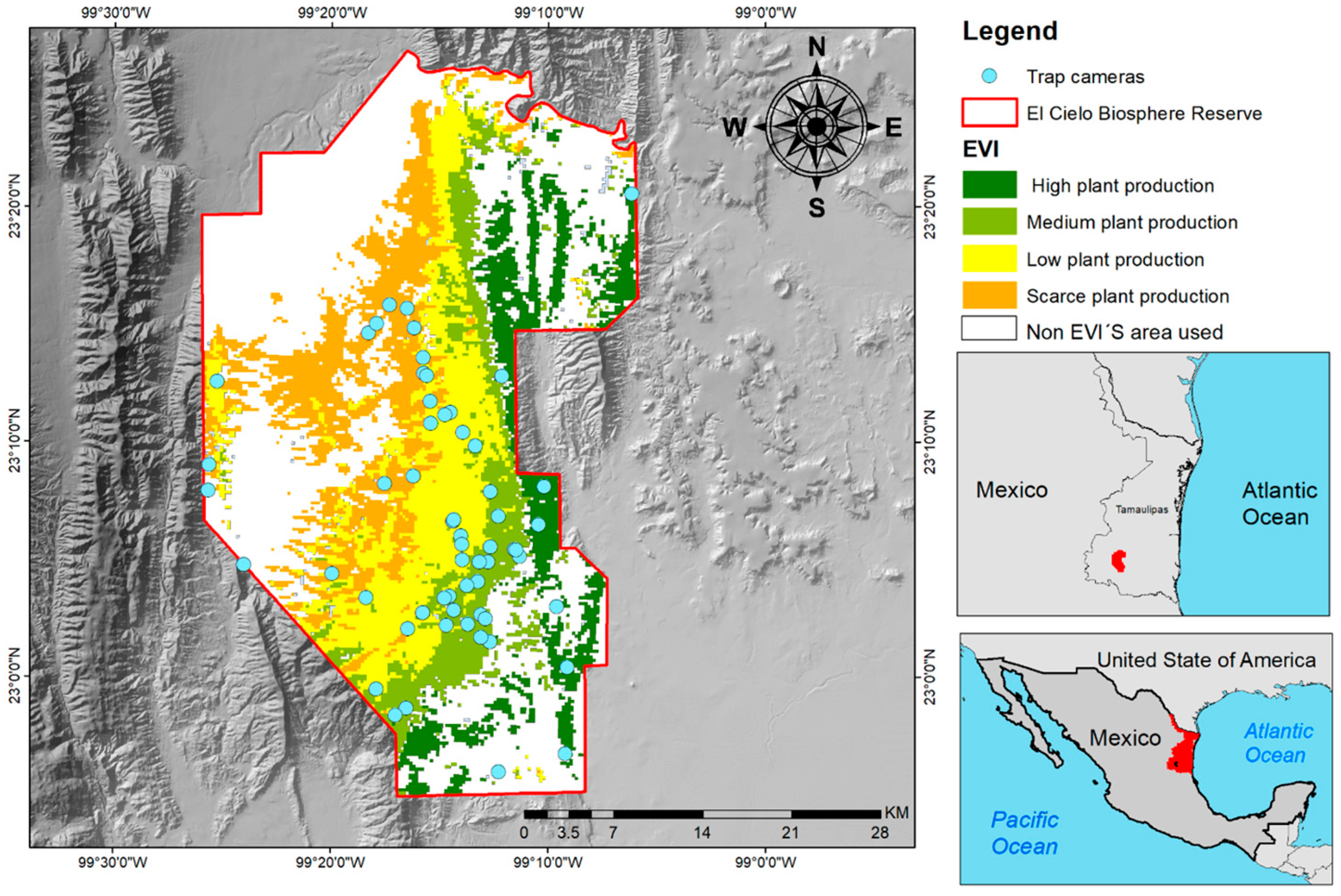
Through a cluster analysis, the number of groups of areas with different values and variability in primary productivity generated based on the EVI in the ECBR was ten, which were listed from the highest to lowest EVI value. The camera trap stations were located in four of these ten groups of areas of varying productivity. These groups of areas were categorized into high plant production (HPP, Group 1), medium plant production (MPP, Group 3), low plant production (LPP, Group 5), and scarce plant production (SPP, Group 7). The average temperature between 2015 and 2021 was 23.1 °C; the average relative humidity in the ECBR was 72%, obtained from the monthly temperatures for the entire period; and the average annual precipitation was 1152 mm [23,24]. Table 1 shows the average elevation, temperature, and precipitation values at the sampling points in areas with similar EVI values. The study did not relate the greenness to the time of day the black bear was present. The EVI was used as a static spatial stratification representing long-term productivity trends, rather than a time-varying predictor of hourly activity.
Table 1.
Elevation, temperature, and average precipitation values for primary production areas.
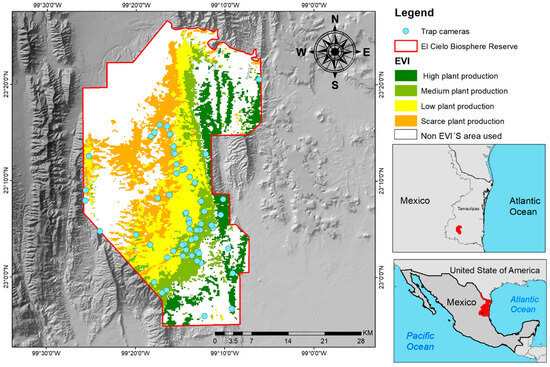
The daily activity of black bears was monitored from 2015 to 2021 using camera traps (Scout-guard HCO SG565) (Figure 1). The number of sites where camera traps were placed was 62. Camera trap placement sites in this study were selected opportunistically, based on prior evidence of the presence of U. americanus. Areas with direct and indirect signs of the species were considered, including feeding sites, feces, claw marks on trees, hair remains, and dens. Consequently, sampling points were established in locations with confirmed recent activity of the species. The average sampling effort of active days per chamber was 547.5, 1441.7, 4946.6 and 1658.2 in the HPP, MPP, LPP and SPP groups, respectively. The devices were equipped with protection (due to the bears’ known curious behavior) and were placed on tree trunks at a height of 30 to 50 cm above ground level. The cameras were active 24 h a day and were programmed to take pictures every 60 s. The camera traps were checked monthly to ensure proper functioning, replace batteries, and retrieve images from memory cards [33,34].
Figure 1.
Geographic location of the El Cielo Biosphere Reserve (ECBR) in the state of Tamaulipas, northeastern Mexico, distribution of camera traps (blue circles), and group scale of the Enhanced Vegetation Index (EVI).
Photographic records were classified into separate capture events to avoid autocorrelation. The criteria for a photographic record to be considered an independent event were as follows: (1) photographs of bears identified at the individual level through particular markings and visible sexual organs; (2) all individuals in a group photograph; and (3) a 24 h interval was established after each photographic record, so as not to overestimate the number of bears encountered [35,36]. Photographic records of independent events were grouped into one-hour intervals starting at 00:00. The activity pattern of the species was classified as diurnal, nocturnal, crepuscular (sunrise and sunset), and cathemeral (with flexible and sporadic activity throughout the day) [37]. SunTimes v 7.2 software [38,39,40,41] was used to define the intervals, considering the latitude and time zone of the ECBR. In this way, the average sampling period was obtained and, considering a buffer of one hour before and after the average, the sunrise period was established from 6:06 to 8:06 h and the sunset period from 18:16 to 20:16 h.
The daily activity of black bears was compared in the following ways: (1) between areas of high, medium, low, and scarce primary production; (2) between the seasons of spring, summer, fall, and winter; and (3) between each of the areas in summer. The directionality, or in this case the cathemeral tendency, of black bears’ activity pattern was determined using Rao’s spatial test, which determines whether the distribution of photographic records is random; if activity records do not cluster within a specific temporal window (such as midday or midnight), but are instead distributed irregularly throughout the 24 h cycle, the species is classified as cathemeral [42,43]. Activity is considered directional when independent events are concentrated in specific periods of the day (nocturnal, diurnal, or crepuscular). It is classified as cathemeral when the distribution of events is irregular throughout the day [38].
The comparison of black bears’ temporal activity in areas belonging to different EVI groups and across seasons was performed using Watson’s test, a nonparametric statistical test for two samples [40,41,42,43,44,45]. Comparisons that were statistically significant were plotted using kernel density curves, and the overlap coefficient (Δ) was used to estimate the overlap between activity profiles [38,42]. The overlap coefficient, also known as the Szymkiewicz–Simpson coefficient, is used to estimate the similarity between two data sets. The coefficient is useful when quantifying the overlap between groups or categories [43,46]. The overlap coefficient takes values from zero to one, where zero indicates no overlap and one indicates identical density curves [46,47]. The degree of overlap was estimated using coefficients Δ1 and Δ4, which are applied to data sets with <50 and >75 records, respectively [47,48]. Overlap analyses as a function of time were conducted using the R program, version v.0.3.3, using the overlap library [42,48,49,50,51]. Comparisons among areas were prioritized during the summer season, as this period yielded the highest number of records, ensuring greater statistical robustness for the activity pattern analysis.
The Szymkiewicz–Simpson coefficient and overlap coefficient analyze the significance of overlap in bear activity across different areas and seasons, but do not identify the specific hours when this overlap differed. Therefore, the association between time of the day and areas belonging to different EVI groups in which black bears were recorded was analyzed using correspondence analysis (CA). CA is a type of ordination analysis that summarizes the total variation (inertia) of the matrix in axes representing association gradients, where chi-square distances between rows and columns are projected in multivariate space [39]. The results presented include the percentage of variance explained by each dimension, the canonical position of the hour categories (24 intervals), and the categories (SPP, LPP, MPP, and HPP) in the first two dimensions. In addition, to group the areas according to the times at which black bears were recorded, an agglomerative cluster analysis was performed, using Euclidean distance measures and Ward’s amalgamation algorithm, as this maximizes variations between groups and minimizes variations within groups [40].
3. Results
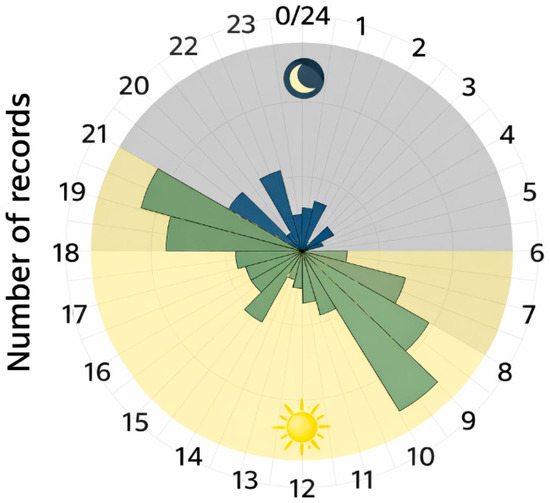
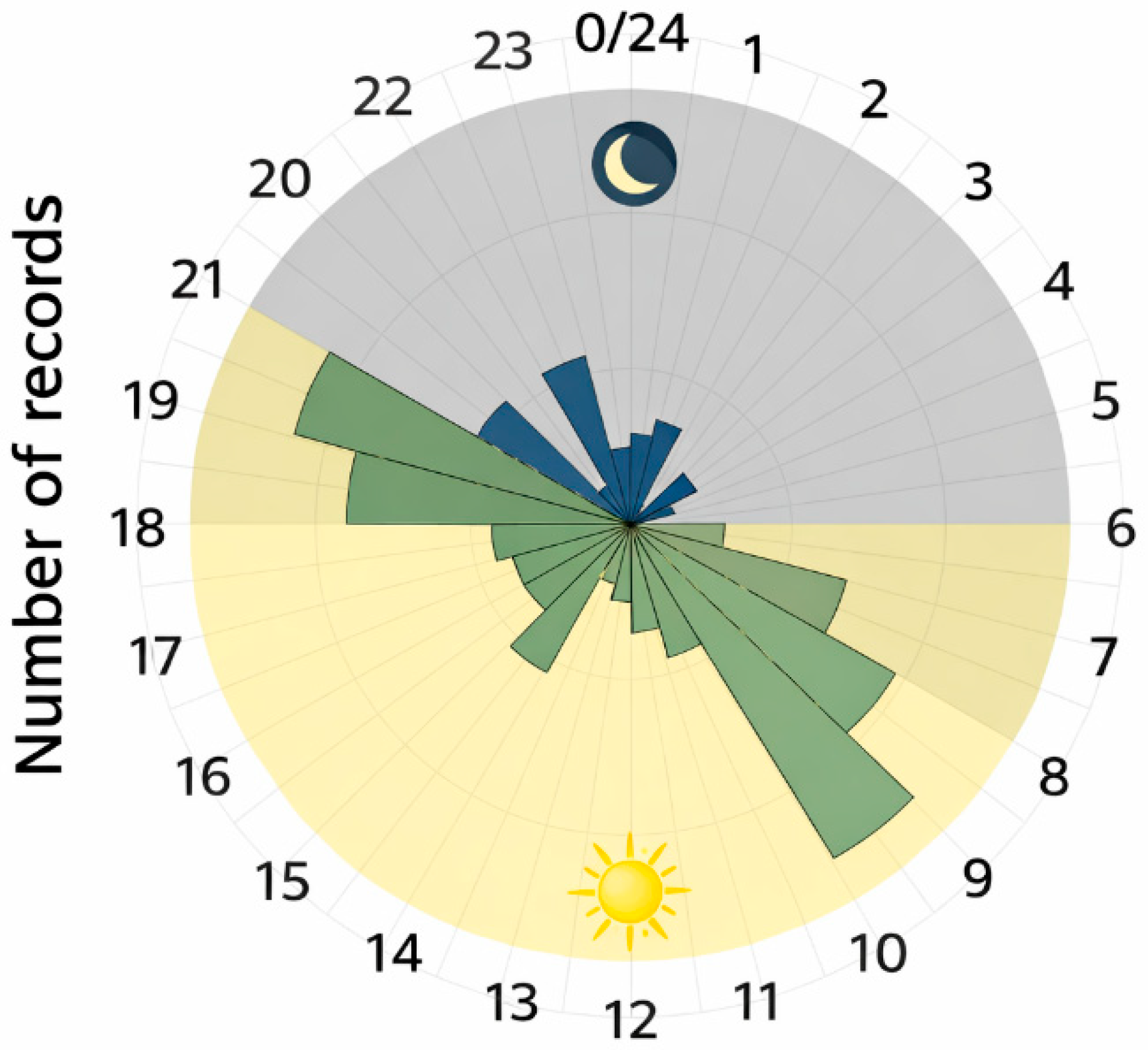
The number of independent photographic records was 522, obtained from 39 of the 62 cameras, for a sampling effort of 52,134 trap days throughout the study period. The photo capture rate was one bear per 100 days. There were 251 daytime records (48%), with 117 at sunset (22%), 81 at night (15%), and 73 at sunrise (14%). However, when divided by the number of hours in each period of the hourly day, recorded frequencies were 25.1, 58.5, 8.1, and 36.5, respectively. In the low-productivity zones (LPP), activity was also predominantly diurnal (n = 90), with a relatively even distribution among the nocturnal (n = 18), sunset (n = 16), and sunrise (n = 13) periods. Finally, in the scarce-productivity areas (SPP), although high diurnal activity was maintained (n = 51), a proportional increase in nocturnal records was observed (n = 39) compared to the LPP and MPP groups, in addition to detections during sunset (n = 13) and sunrise (n = 12). Considering the total number of records, the general daily activity pattern of black bears in the ECBR showed a bimodal trend, with greater activity in the early morning from 8:00 to 10:00 h and during sunset from 18:00 to 20:00 h. The lowest period of activity occurred between 23:00 and 5:00 h. The distribution of records suggests that the American black bear in the study area exhibits a diurnal–crepuscular activity pattern (Figure 2).
Figure 2.
Number of independent records per hour of the day of black bears within the El Cielo Biosphere Reserve (ECBR) Tamaulipas, Mexico, between 2015 and 2021.
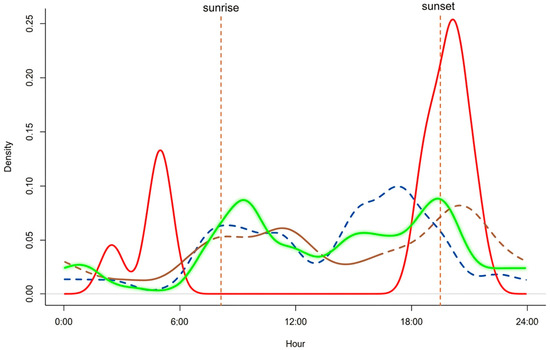
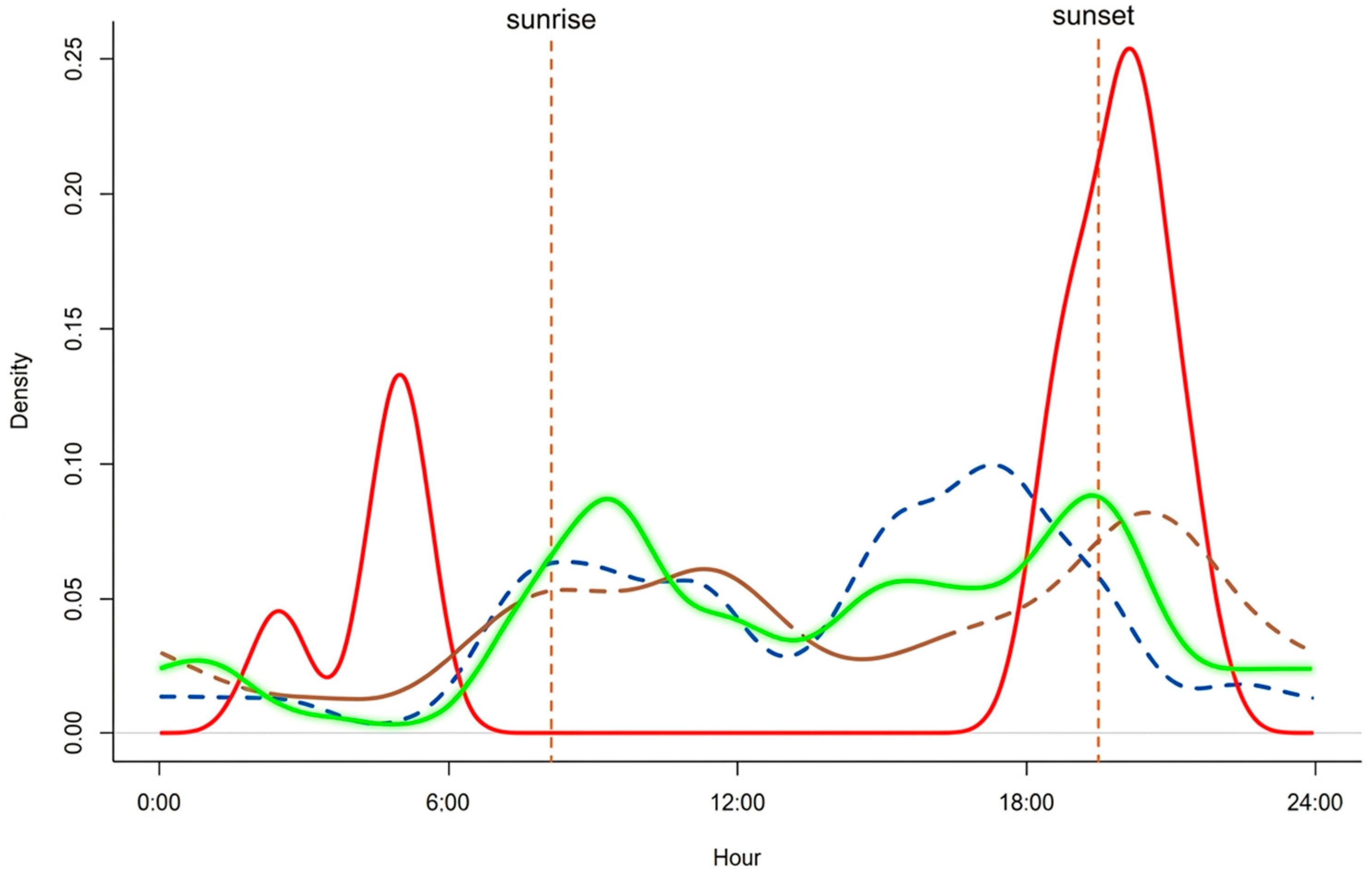
Activity of black bears differed across areas belonging to different EVI groups (Figure 3). The highest frequency of independent sightings was concentrated in the MPP group (n = 256), followed by LPP (n = 137) and SPP (n = 115), whereas the HPP group showed the lowest representation with only 14 observations. In areas of high plant production, there were two periods of high activity, one just before sunrise (between 4:00 and 6:00 h) and the second in the late afternoon, shortly before sunset (between 18:00 and 20:00 h). In areas of medium plant production, two periods of increased activity were also observed, although to a lesser extent than in HPP areas. One peak of activity occurred after sunrise, between 7:00 and 10:00 h, whereas the second occurred later in the afternoon, between 15:00 and 18:00 h. In low plant production areas, activity was concentrated in the middle of the day, between 13:00 and 18:00 h. Finally, in scarce plant production areas, activity extended throughout the day, with little nocturnal activity and a slight increase in activity between 11:00 and 12:00 h and between 19:00 and 20:00 h (Figure 3).
Figure 3.
Activity pattern of the black bear (Ursus americanus) in the different EVI groups: high plant production (red), medium production (green), low plant production (blue) and scarce plant production (brown).
Rao’s uniformity test was statistically significant, with an observed value higher than the expected theoretical value, corresponding to a p-value < 0.001 in all groups (Table 2). This indicated that the daily activity pattern of black bears in all EVI areas showed directionality of greater activity in specific time categories. On the other hand, there were statistical differences when comparing activity patterns across all EVI categories (Table 3), although there was a distinct level of overlap in daily activity profiles between EVI areas (Table 4).
Table 2.
Results of Rao’s statistical test of uniformity.
Table 3.
Values and probability of Watson’s paired test comparing the activity pattern of black bears among different groups with different greenness indices.
Table 4.
Values of Dhat coefficients (upper diagonal, Δ) and probability (lower diagonal) of the degree of overlap in black bear activity between EVI areas.
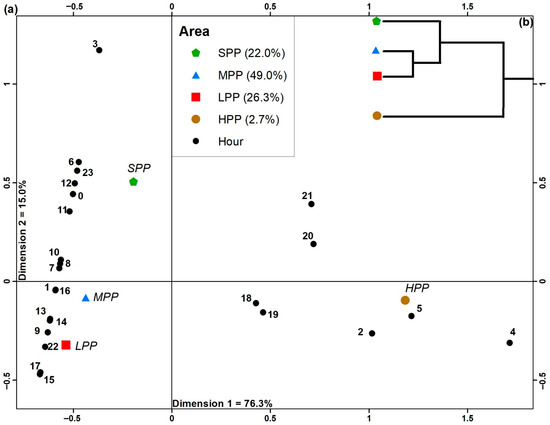
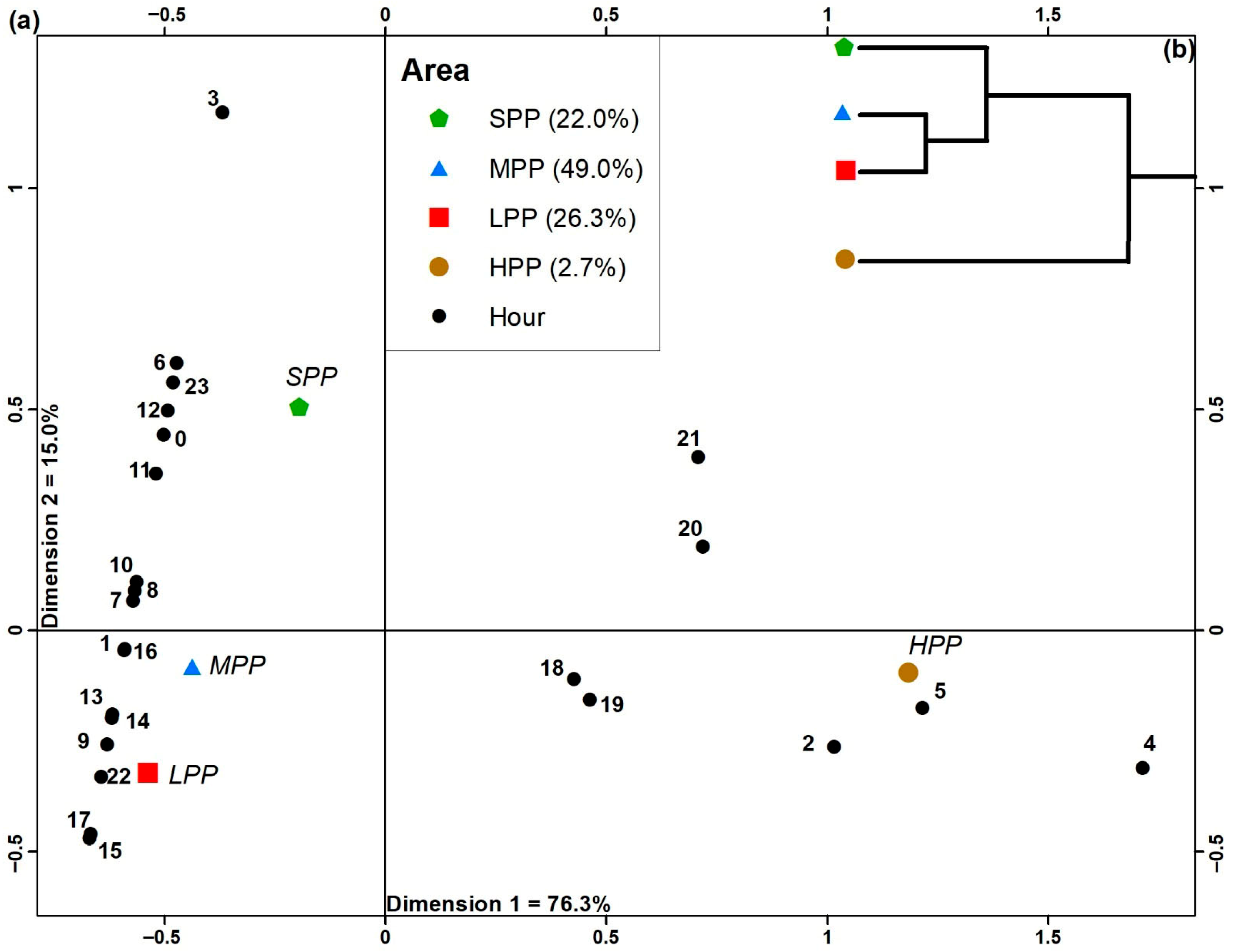
The association between the time of day of activity and areas of different primary productivity was statistically significant (X2 d.f. = 69 = 247.3, p < 0.01, Figure 4a). The first two axes together explained 91.3% of the variation in the recorded frequencies of bear activity, depending on the time of day and EVI area. Activity of black bears in the HPP areas was most frequent between 18:00 and 21:00 h and between 4:00 and 8:00 h (Figure 4a), and these were also areas that showed the greatest difference with respect to the other three EVI categories (Table 3 and Figure 4b). Black bears were most frequently recorded in the SPP areas at 3:00 h, 6:00 h, from 10:00 to 12:00 h, and from 23:00 to 12:00 h (Figure 4a), which differed from the MPP and LPP areas (Table 3 and Figure 4b). The highest number of independent photographic records was in the MPP and LPP areas. In the LPP areas, black bears were most frequently recorded from 13:00 to 15:00 h and at 9:00 and 22:00 h (Figure 4a), whereas in the MPP areas, they were most frequently recorded from 7:00 to 8:00 h and at 10:00 h and 1:00 h (Figure 4a).
Figure 4.
Canonical position of time categories and productivity areas obtained from simple correspondence analysis (a) and agglomerative clustering of productivity areas based on the frequency of unique records in the time categories (b) of the black bear.
Activity of black bears among climatic seasons had no statistical differences (Table 5 and Table 6). However, when comparing black bears’ activity in summer among areas of different primary productivity, statistically significant differences were found. The pattern of activity during summer in HPP areas differed from the activity in the other EVI groups in high-productivity zones (HPP); the abundance of resources and vegetation cover allows for an efficient bimodal pattern. Conversely, the difference between high-productivity zones (SPP) and intermediate groups (MPP/LPP) suggests that bears must adjust their activity periods. The Watson test results (Table 7) show that primary productivity (EVI) exerts a distinct influence on bear activity during the summer. The HPP group exhibited hourly distributions that were significantly different from all other productivity levels, recording the highest statistical discrepancies. Likewise, the SPP group showed a statistical break relative to the intermediate levels. In contrast, the comparison between LPP and MPP yielded no significant differences, indicating homogeneity in time use within this productivity range. The values of the Dhat coefficient (Δ) were consistent with the Watson test data (Table 8).
Table 5.
Watson test values (upper diagonal) and probability (lower diagonal) obtained from paired comparisons between seasons.
Table 6.
Dhat coefficients (Δ) for the degree of overlap in black bear activity between seasons. High values, close to 1, are consistent with the absence of significant differences between seasons.
Table 7.
Watson test values (upper diagonal) and probability (lower diagonal) obtained from paired comparisons between groups in the summer season.
Table 8.
Dhat coefficients (Δ) for the degree of overlap in black bear activity patterns between groups.
4. Discussion
These results suggest an association between bear activity patterns and areas with different levels of vegetation productivity, showing that daily activity patterns differ according to the greenness gradient measured using the EVI. Black bears in the ECBR were found to exhibit a bimodal activity pattern in EVI groups with higher photosynthetic activity and activity throughout the day in the remaining EVI groups. The American black bear is a species that has been reported to reduce its activity when the ambient temperature exceeds 25 °C [13], which was also observed in the group of HPP areas where its activity was restricted to sunset and before sunrise, unlike the other areas where its activity occurred throughout the day. Integrating activity patterns with the EVI helps us to better understand how black bears use the landscape and respond to environmental conditions, reinforcing the importance of conserving these ecosystems to ensure the coexistence and persistence of the species. This study is the first to analyze the association between the daily activity patterns of Ursus americanus and the primary productivity of their habitat using the EVI.
Black bears in the ECBR were found to exhibit a diurnal–crepuscular pattern, consistent with preserved mountain environments and low direct human pressure. This coincides with the results of Salinas-Camarena [9] in a study in Cumbres Park in Nuevo León, and Ayres et al. [1], as well as Lewis and Rachlow [46], also showed that bears are crepuscular, with some variations between classes and seasons, in Parcell Mountain in northeastern Idaho. Garshelis [13] mentioned that, according to another study in the same park [48], the species in Great Smoky Mountains National Park between Tennessee and North Carolina is strictly crepuscular in spring but tends to be more nocturnal in autumn. Variations in the daily activity of black bears throughout their range depend on climate, food sources, reproductive status, sex, age, human activity, and the presence of other carnivorous mammals [1,2,13,48,49,50,52,53,54,55]. Daytime movements have been shown to be preferred in different populations of black bears throughout their range. For example, east of Council, Idaho, the activity pattern was predominantly between 8:00 and 21:00 h [56]. Méndez [52] showed that bear activity in the La Catana coniferous forest in Coahuila, Mexico, occurred between 14:00 and 22:00 h, with 81% of records occurring in the afternoon. Predominantly diurnal activity also occurred in the Sierra Zapalinamé in the same state in northeastern Mexico, which has various types of vegetation, including coniferous forest [57]. Diurnal activity was also described in black bears in La Mauricie National Park, Quebec [58]. Extensive work in 29 locations in Sonora and Chihuahua, Mexico, showed a proportion of diurnal activity of 0.43 between 6:36 and 17:23 h; nocturnal activity of 0.34 between 19:23 and 4:36 h; and crepuscular activity of 0.23 [14].
The activity pattern of black bears in the ECBR did not show significant seasonal differences, an observation that differs from studies at other latitudes that describe variations in activity between seasons. For example, in the mountains of western Virginia, USA, activity was found to be generally diurnal in summer and nocturnal in autumn [2], whereas in Great Smoky Mountains National Park, bears were more active and diurnal during summer, when berries were abundant, with intense nocturnal activity only during autumn, probably associated with increased foraging to prepare for hibernation [13]. In the Purcell Mountains, Idaho, USA, during spring and early summer, bears moved significantly more during twilight periods compared with late summer and autumn [48]. Bears in eastern Council, Idaho, USA, were mainly diurnal and crepuscular, but they were less active and more nocturnal in early spring and late autumn than in summer [13]. The daily activity of the American black bear in the ECBR shows flexibility, whereby the level of primary productivity (EVI group) appears to influence the timing of resource exploitation, as reflected in the fact that daily activity differed across the four groups of areas categorized based on the EVI. Unlike in areas of lower photosynthetic productivity, daytime activity in areas of high photosynthetic productivity follows an almost strictly bimodal pattern, with one peak before dawn and another very close to sunset, and almost no activity during the rest of the day. By contrast, activity in the other three areas of lower productivity was predominantly diurnal, but the distribution of activity throughout the day differed significantly between these areas. In areas of lower photosynthetic productivity, the dispersed pattern of activity throughout the day possibly represents temporal activity patterns on the part of the black bear to conserve energy and optimize scarce foraging [3]. The sampling effort was not evenly distributed across all EVIs; the observed differences should be interpreted as patterns associated with the sampled conditions rather than as strictly controlled comparisons across productivity levels.
This study used the EVI to compare the daily activity of the American black bear, but during the project, it was identified that temperature could be a factor limiting this species’ activity, because in warmer areas with higher EVIs, activity was found to be primarily crepuscular, and the highest average number of individuals was recorded in these areas. Therefore, future studies could measure climatic variables and the elevational movement of bears to demonstrate the temporal activity patterns that the species performs in response to environmental variations in both time and space. The daily activity of black bears in the ECBR seems to respond to a balance between resource availability and thermal cost. The area of highest primary productivity allows for an efficient distribution of effort in the search for resources. This is also known as optimization theory, which suggests that animals maximize their effort by making decisions that balance resource access against physiological cost and predation risk [17,18,59]; that is, under optimal conditions, each animal structures the use of space and time efficiently for the better utilization of biological effort [60]. According to an annual study of black bears in Michigan, Missouri, and Mississippi, USA, using the Normalized Difference Vegetation Index (NDVI), black bears consistently selected areas with higher plant productivity; this is likely in an effort to reduce travel, but such a selection weakened and became more variable seasonally, demonstrating that our results align with findings where black bears consistently select areas with higher plant productivity to reduce travel and improve foraging efficiency [16,17,18,61]. In ecosystems at other latitudes with other species of the genus Ursus, the association between ecosystem functioning and habitat quality is also evident and could be widely applied to animal species living in seasonal environments [61].
In areas with high EVIs, where vegetation is denser and more productive, but where the ambient temperature is also higher, a species is likely to restrict its activity to the cooler periods of the day to reduce the risk of hyperthermia and dehydration [62,63,64]. On the other hand, in areas with lower EVIs, mammals may expand their activity when temperatures are lower [56,62,63,64,65]. Human pressure and hunting can also modify these behaviors, leading to increased nocturnal activity as a strategy to avoid predation [12,13,14]. The activity pattern of black bears in the ECBR did not vary between seasons, suggesting that climatic changes throughout the year do not have enough impact for black bears to significantly modify the distribution of time spent on different activities during the day. Lara-Díaz [14] also found no seasonal differences in resource selection in the forests of Sonora and Chihuahua. In the northeast of Cumbres Natural Park, seasonal variations in bear activity were observed, but daily profiles between seasons were not studied [9]. At other northern latitudes, seasonal climatic variations are more extreme; therefore, changes in activity patterns are observed that are negatively associated with temperatures above 25 °C and below 0 °C, as well as rain and snow, and positively associated with the accumulation of reserves for hibernation [2,13,48,54]. In tropical–subtropical mountainous environments, productivity and daily temperature appear to be more relevant than seasonality.
The results of this study suggest that the American black bear could be at risk from rising ambient temperatures. The Representative Concentration Pathway 8.5 predicts an extreme climate scenario with high emissions that will lead to significant global warming of 3 °C to 5.1 °C [64]. In the case of the ECBR, the difference in temperature between the EVI SPP and HPP areas is close to 6 °C, which could restrict the species’ area and activity time. In this regard, Bonebrake et al. [65] report that thermal conditions may force changes in activity patterns (diurnal/nocturnal) and reduce habitable space as temperatures rise globally.
The study of the activity pattern of the American black bear (Ursus americanus) and its relationship with primary productivity can be strengthened by sampling all types of vegetation where the species may be present, such as scrub forest [56,65,66,67,68]. This would also add more areas with different primary productivity values. In addition, temperature and humidity recorders located at image capture stations could be used to improve monitoring of the American black bear’s activity and to better correlate its activity with environmental conditions. This information could improve the temporal characterization of how this large carnivore occupies each period of the day to satisfy its requirements and functions across its life cycle in environments with varying food source potential.
5. Conclusions
The daily activity pattern of the American black bear in the ECBR is classified as diurnal in the morning and crepuscular at sunset. Activity strongly depends on the vegetation productivity gradient; in areas with high primary productivity, activity occurs in two short periods of high activity before dawn and at sunset, with almost no activity during the rest of the day. In the analysis of summer alone, no specific moments of high activity were observed, but there were significant differences in the daily activity profile in areas of different levels of photosynthetic productivity, except between areas of low vs. medium photosynthetic productivity. Given that no significant differences were found between seasons, we can conclude that the American black bear in the ECBR exhibits different daily activity profiles that correspond to the level of primary productivity of the area it inhabits.
Author Contributions
Conceptualization, L.S.-D., J.V.H.-V., C.S.V.-B. and Y.G.-O.; Methodology, J.R.W.-S., L.S.-D., R.C.-T., C.S.V.-B. and Y.G.-O.; Software, J.R.W.-S. and L.S.-D.; Formal Analysis, L.S.-D. and J.R.W.-S.; Investigation, J.R.W.-S., L.S.-D., J.V.H.-V., C.S.V.-B. and Y.G.-O.; Resources, L.S.-D., J.V.H.-V. and R.C.-T.; Data Curation, J.R.W.-S. and L.S.-D. Writing—Preparation of the Original Draft, J.R.W.-S., L.S.-D. and J.V.H.-V.; Writing—Revision and Editing, J.R.W.-S., L.S.-D. and J.V.H.-V.; Visualization, L.S.-D.; Supervision, L.S.-D. and J.V.H.-V.; Project Management, L.S.-D. and R.C.-T.; Fund Acquisition, L.S.-D. and R.C.-T. All authors have read and agreed to the published version of the manuscript.
Funding
This research was funded by grant number UAT/PFI2015-15 from the Universidad Autónoma de Tamaulipas (UAT) and by grant number UAT-PTC-221/511-6/17-8212 from the Programa para el Desarrollo Profesional Docente (PRODEP).
Data Availability Statement
Data are available upon request.
Acknowledgments
We would like to thank “Consejo Nacional de Humanidades, Ciencia y Tecnología” (CONHACYT) for the financial support provided in the form of a maintenance grant for J.R.W.-S. in carrying out this research project, as well as “Universidad Autónoma de Tamaulipas” for their field support. We would also like to thank Esteban Berrones Benítez, Luis Martínez García, and Mario Álvarez, who were our field guides in this research work.
Conflicts of Interest
The authors declare that they have no conflicts of interest.
Abbreviations
The following abbreviations are used in this manuscript:
| ECBR | El Cielo Biosphere Reserve |
| EVI | Enhanced Vegetation Index |
| MODIS | Moderate Resolution Imaging Spectroradiometer |
| h | Hours |
| LAADS DAAC | Level-1 and Atmosphere Archive and Distribution System Distributed Active Archive Center |
| ISODATA | Iterative Self-Organizing Data Analysis Technique |
| SPP | Scarce Plant Production |
| LPP | Low Plant Production |
| MPP | Medium Plant Production |
| HPP | High Plant Production |
| CA | Correspondence Analysis |
| NDVI | Normalized Difference Vegetation Index |
References
- Ayres, L.A.; Chow, L.S.; Graber, D.M. Black bear activity patterns and human induced modifications in Sequoia National Park. Bears Their Biol. Manag. 1986, 6, 151–154. [Google Scholar] [CrossRef] [Scilit]
- Bridges, A.S.; Vaughan, M.R.; Klenzendorf, S. Seasonal variation in American black bear Ursus americanus activity patterns: Quantification via remote photography. Wildl. Biol. 2004, 10, 277–284. [Google Scholar] [CrossRef] [Scilit]
- Escalante, T.; Morrone, J.J.; Rodríguez, G.; Sánchez-Rojas, G.; Rojas-Martínez, A.E. La distribución de los mamíferos terrestres y la regionalización biogeográfica natural de México. In En Tópicos en Sistemática, Biogeografía, Ecología y Conservación de Mamíferos; Sánchez-Rojas, G., Rojas-Martínez, A.E., Eds.; Universidad Autónoma del Estado de Hidalgo: Pachuca, México, 2007; pp. 9–17. [Google Scholar]
- Ranglack, D.; Signor, K.; Bunnell, K.; Shivik, J. Black bear activity and visitation patterns at human food sources in Utah. In Proceedings of the Wildlife Damage Management Conferences—Proceedings, Saratoga Springs, NY, USA, 4–7 May 2009; p. 144. Available online: https://digitalcommons.unl.edu/icwdm_wdmconfproc/144 (accessed on 28 March 2026).
- Ridout, M.S.; Linkie, M. Estimating overlap of daily activity patterns from camera trap data. J. Agric. Biol. Environ. Stat. 2009, 14, 322–337. [Google Scholar] [CrossRef] [Scilit]
- Lee, H.J.; Ha, J.W.; Park, S.J.; Kim, W.Y.; Cha, J.Y.; Park, J.Y.; Oh, H.S. A study on the analysis of mammals’ activity patterns and the effect of human hiker interference using camera trapping. J. Asia-Pac. Biodivers. 2019, 12, 57–62. [Google Scholar] [CrossRef] [Scilit]
- Kuhdair, A.D.; Mohammed, W.A. The biological clock genes in farm animals: A Scoping. Gene 2008, 5, 25–27. [Google Scholar]
- Bartness, T.J.; Albers, H.E. Activity patterns and the biological clock in mammals. In En Activity Patterns in Small Mammals: An Ecological Approach; Springer: Berlin/Heidelberg, Germany, 2000; pp. 23–47. [Google Scholar]
- Salinas Camarena, M.A. Ecología del oso Negro (Ursus americanus) en el Noroeste del Parque Nacional Cumbres de Monterrey, Nuevo León, México. Doctoral Dissertation, Universidad Autónoma de Nuevo León, San Nicolas de los Garza, México, 2015. [Google Scholar]
- Tøien, Ø.; Blake, J.; Edgar, D.M.; Grahn, D.A.; Heller, H.C.; Barnes, B.M. Hibernation in black bears: Independence of metabolic suppression from body temperature. Science 2011, 331, 906–909. [Google Scholar] [CrossRef] [Scilit] [PubMed]
- Tøien, Ø.; Blake, J.; Barnes, B.M. Thermoregulation and energetics in hibernating black bears: Metabolic rate and the mystery of multi-day body temperature cycles. J. Comp. Physiol. B 2015, 185, 447–461. [Google Scholar] [CrossRef] [Scilit]
- Hubbard, T.; Cove, M.V.; Lafferty, D.J. Human recreation impacts seasonal activity and occupancy of American black bears (Ursus americanus) across the anthropogenic-wildland interface. Sci. Rep. 2022, 12, 12201. [Google Scholar] [CrossRef] [Scilit]
- Garshelis, D.L.; Pelton, M.R. Activity of black bears in the Great Smoky Mountains National Park. J. Mammal. 1980, 61, 8–19. [Google Scholar] [CrossRef] [Scilit]
- Lara-Díaz, N.E.; Coronel-Arellano, H.; López-González, C.A.; Sánchez-Rojas, G.; Martínez-Gómez, J.E. Activity and resource selection of a threatened carnivore: The case of black bears in northwestern Mexico. Ecosphere 2018, 9, e01923. [Google Scholar] [CrossRef] [Scilit]
- Bowersock, N.R.; Litt, A.R.; Merkle, J.A.; Gunther, K.A.; van Manen, F.T. Responses of American black bears to spring resources. Ecosphere 2021, 12, e03773. [Google Scholar]
- Bastille-Rousseau, G.; Fortin, D.; Dussault, C.; Courtois, R.; Ouellet, J.P. Foraging strategies by omnivores: Are black bears actively searching for ungulate neonates or are they simply opportunistic predators? Ecography 2011, 34, 588–596. [Google Scholar] [CrossRef] [Scilit]
- Wiegand, T.; Naves, J.; Garbulsky, M.F.; Fernández, N. Animal habitat quality and ecosystem functioning: Exploring seasonal patterns using NDVI. Ecol. Monogr. 2008, 78, 87–103. [Google Scholar] [CrossRef] [Scilit]
- Gantchoff, M.; Wang, G.; Beyer, D.; Belant, J. Scale-dependent home range optimality for a solitary omnivore. Ecol. Evol. 2018, 8, 12271–12282. [Google Scholar] [CrossRef] [Scilit]
- McLaren, A.A.D.; Jamieson, S.E.; Bond, M.; Rodgers, A.R.; Patterson, B.R. Spring diet of American black bears (Ursus americanus) in a moose (Alces alces)–woodland caribou (Rangifer tarandus caribou) system in northern Ontario, Canada. Can. J. Zool. 2021, 99, 721–728. [Google Scholar] [CrossRef] [Scilit]
- Shammi, S.A.; Meng, Q. Use time series NDVI and EVI to develop dynamic crop growth metrics for yield modeling. Ecol. Indic. 2021, 121, 107124. [Google Scholar] [CrossRef] [Scilit]
- Marston, C.G.; Armitage, R.P.; Danson, F.M.; Giraudoux, P.; Ramirez, A.; Craig, P.S. Spatio-temporal modelling of small mammal distributions using MODIS NDVI time-series data. In Proceedings of the 10th International Symposium on Physical Measurements and Spectral Signatures in Remote Sensing (ISPMSRS), Davos, Switzerland, 12–14 March 2007; Schaepman, M.E., Liang, S., Groot, N.E., Kneubühler, M., Eds.; International Archives of the Photogrammetry, Remote Sensing and Spatial Information Sciences; ISPRS: Davos, Switzerland, 2007; Volume 36, Part 7/P9; pp. 564–569. [Google Scholar]
- Chidodo, D.J.; Kimaro, D.N.; Hieronimo, P.; Makundi, R.H.; Isabirye, M.; Leirs, H.; Mulungu, L.S. Application of normalized difference vegetation index (NDVI) to forecast rodent population abundance in smallholder agro-ecosystems in semi-arid areas in Tanzania. Mammalia 2020, 84, 136–143. [Google Scholar] [CrossRef] [Scilit]
- Back, H.M.; Pérez-Postigo, I.; Geitner, C.; Arneth, A. Analysing the impact of large mammal herbivores on vegetation structure in Eastern African savannas combining high spatial resolution multispectral remote sensing data and field observations. Ecol. Inform. 2025, 87, 103113. [Google Scholar] [CrossRef] [Scilit]
- White, J.G.; Sparrius, J.; Robinson, T.; Hale, S.; Lupone, L.; Healey, T.; Rendall, A.R. Can NDVI identify drought refugia for mammals and birds in mesic landscapes? Sci. Total Environ. 2022, 851, 158318. [Google Scholar] [CrossRef] [Scilit]
- Carella, E.; Orusa, T.; Viani, A.; Meloni, D.; Borgogno-Mondino, E.; Orusa, R. An integrated, tentative remote-sensing approach based on NDVI entropy to model canine distemper virus in wildlife and to prompt science-based management policies. Animals 2022, 12, 1049. [Google Scholar] [CrossRef] [Scilit]
- Halffter, G. Historia natural de la reserva de la biosfera El Cielo, Tamaulipas, México. Acta Zool. Mex. 2006, 22, 155–157. [Google Scholar]
- Sánchez-Ramos, G.; Reyes-Castillo, P.; Dirzo, R. Historia Natural de la Reserva de la Biosfera El Cielo, Tamaulipas, México; Universidad Autónoma de Tamaulipas: Ciudad Victoria, México, 2005. [Google Scholar]
- INEGI. Carta de Uso de Suelo y Vegetación; Instituto Nacional de Estadística y Geografía, Serie V.: Aguascalientes, Mexico, 2020; Available online: https://www.inegi.org.mx/temas/usosuelo (accessed on 20 December 2020).
- Vargas-Contreras, J.A.; Hernández-Huerta, A. Distribución altitudinal de la mastofauna en la Reserva de la Biosfera “El Cielo”, Tamaulipas, México. Acta Zool. Mex. 2001, 82, 83–109. [Google Scholar] [CrossRef] [Scilit]
- Wearn, O.R.; Glover-Kapfer, P. Snap happy: Camera traps are an effective sampling tool when compared with alternative methods. R. Soc. Open Sci. 2019, 6, 181748. [Google Scholar] [CrossRef] [Scilit]
- Palencia, P.; Vicente, J.; Soriguer, R.C.; Acevedo, P. Towards a best-practices guide for camera trapping: Assessing differences among camera trap models and settings under field conditions. J. Zool. 2022, 316, 197–208. [Google Scholar] [CrossRef] [Scilit]
- Clapham, M.; Miller, E.; Nguyen, M.; Darimont, C.T. Automated facial recognition for wildlife that lack unique markings: A deep learning approach for brown bears. Ecol. Evol. 2020, 10, 12883–12892. [Google Scholar] [CrossRef] [Scilit] [PubMed]
- Wilton, C.M.; Beringer, J.; Puckett, E.E.; Eggert, L.S.; Belant, J.L. Spatiotemporal factors affecting detection of black bears during noninvasive capture–recapture surveys. J. Mammal. 2016, 97, 266–273. [Google Scholar] [CrossRef] [Scilit]
- Pettigrew, P.; Sigouin, D.; St-Laurent, M.H. Testing the precision and sensitivity of density estimates obtained with a camera-trap method revealed limitations and opportunities. Ecol. Evol. 2021, 11, 7879–7889. [Google Scholar] [CrossRef] [Scilit] [PubMed]
- Kay, S.; Du Croz, T. Sun Times; Version 7.1; 2008; Available online: https://www.softpedia.com/get/Science-CAD/Sun-Times.shtml (accessed on 19 January 2020).
- Hernández Hernández, J.C.; Chávez, C.; List, R. Diversidad y patrones de actividad de mamíferos medianos y grandes en la Reserva de la Biosfera La Encrucijada, Chiapas, México. Rev. Biol. Trop. 2018, 66, 634–646. [Google Scholar] [CrossRef] [Scilit]
- Contreras-Díaz, C.A.; Soria-Díaz, L.; Gómez-Ortiz, Y.; Carrera-Treviño, R.; Astudillo-Sánchez, C.C.; Chacón-Hernández, J.C.; Martínez-García, L. Temporal and Spatial Segregation of Top Predators (Felidae) in a Mexican Tropical Biosphere Reserve. Zoologia 2021, 38, e63231. [Google Scholar] [CrossRef] [Scilit]
- Mandujano, S.; Pérez-Solano, L.A. Fototrampeo en R: Organización y análisis de datos. Volumen I; Instituto de Ecología A.C.: Xalapa, Ver, México, 2019; p. 248. [Google Scholar]
- Legendre, P.; Legendre, L. Numerical Ecology, 3rd ed.; Elsevier: Amsterdam, The Netherlands, 2012; p. 419. [Google Scholar]
- De la Torre, J.A.; Núñez, J.M.; Medellín, R.A. Spatial requirements of jaguars and pumas in Southern Mexico. Mamm. Biol. 2017, 84, 52–60. [Google Scholar] [CrossRef] [Scilit]
- Monterroso, P.; Brito, J.C.; Ferreras, P.; Alves, P.C. Spatial ecology of the European wildcat in a Mediterranean ecosystem: Dealing with small radio-tracking datasets in species conservation. J. Zool. 2009, 279, 27–35. [Google Scholar] [CrossRef] [Scilit]
- Polo, M.E.; Felicísimo, A.M. Propuesta de metodología para el análisis del error de posición en bases de datos espaciales mediante estadística circular y mapas de densidad. GeoFocus Int. Rev. Geogr. Inf. Sci. Technol. 2008, 8, 281–296. [Google Scholar]
- Frey, S.; Fisher, J.T.; Burton, A.C.; Volpe, J.P. Investigating animal activity patterns and temporal niche partitioning using camera-trap data: Challenges and opportunities. Remote Sens. Ecol. Conserv. 2017, 3, 123–132. [Google Scholar] [CrossRef] [Scilit]
- Zar, J.H. Análisis bioestadístico; Pearson Prentice-Hall: Hoboken, NJ, USA, 2010; p. 960. [Google Scholar]
- Linkie, M.; Ridout, M.S. Assessing tiger–prey interactions in Sumatran rainforests. J. Zool. 2011, 284, 224–229. [Google Scholar] [CrossRef] [Scilit]
- Lewis, J.S.; Rachlow, J.L. Activity patterns of black bears in relation to sex, season, and daily movement rates. West. N. Am. Nat. 2011, 71, 388–395. [Google Scholar] [CrossRef] [Scilit]
- Amstrup, S.C.; Beecham, J. Activity patterns of radio-collared black bears in Idaho. J. Wildl. Manag. 1976, 40, 340–348. [Google Scholar] [CrossRef] [Scilit]
- Cavaller-Riva, D.G.; Sottile-Bordallo, A.; Dueñas, E.A.; Ortega-Yubro, C.D. Análisis de anomalías en los días de la semana, en precios del Bitcoin, con R Studio® y RapidMiner Studio®. In Proceedings of the XIII Simposio de Informática en el Estado (SIE 2019)-JAIIO 48, Salta, Argentina, 16–20 September 2019; pp. 34–48. [Google Scholar]
- Clark, J.D.; Clapp, D.L.; Smith, K.G.; Ederington, B. Black bear habitat use in relation to food availability in the interior highlands of Arkansas. Bears Their Biol. Manag. 1994, 9, 309–318. [Google Scholar] [CrossRef] [Scilit]
- Karelus, D.L.; McCown, J.W.; Scheick, B.K.; van de Kerk, M.; Bolker, B.M.; Oli, M.K. Effects of environmental factors and landscape features on movement patterns of Florida black bears. J. Mammal. 2017, 98, 1463–1478. [Google Scholar] [CrossRef]
- Quigley, H.B. Activity Patterns, Movement Ecology, and Habitat Utilization of Black Bears in the Great Smoky Mountains National Park, Tennessee. Master’s Thesis, University of Tennessee, Knoxville, TN, USA, 1982. [Google Scholar]
- Méndez Márquez, M.d.S. Population Estimation of the Black Bear Ursus americanus eremicus Pallas, through the Camera Trapping Method in Sierra "La Catana", Saltillo, Coahuila, Mexico. Bachelor’s Thesis, Universidad Autónoma Agraria Antonio Narro, Saltillo, Mexico, 2017. Available online: http://repositorio.uaaan.mx:8080/xmlui/handle/123456789/42130 (accessed on 19 January 2025).
- Monroy-Vilchis, O.; Zarco-González, M.M.; Rodríguez-Soto, C.; Soria-Díaz, L.; Urios, V. Fototrampeo de mamíferos en la Sierra Nanchititla, México: Abundancia relativa y patrón de actividad. Rev. Biol. Trop. 2010, 59, 373–383. [Google Scholar] [CrossRef] [Scilit]
- Lyons, A.J. Activity patterns of urban American black bears in the San Gabriel Mountains of southern California. Ursus 2005, 16, 255–262. [Google Scholar] [CrossRef] [Scilit]
- Matthews, S.M.; Beecham, J.J.; Quigley, H.; Greenleaf, S.S.; Leithead, H.M. Activity patterns of American black bears in Yosemite National Park. Ursus 2006, 17, 30–40. [Google Scholar] [CrossRef] [Scilit]
- Ortiz Ortiz, A.; Asesor, R.D.J.A. Distribución y abundancia de oso negro (Ursus americanus eremicus) en la Sierra de Zapaliname. Bachelor’s Thesis, Universidad Autónoma Agraria Antonio Narro, Saltillo, México, 2012. Available online: http://repositorio.uaaan.mx:8080/xmlui/handle/123456789/1040 (accessed on 15 January 2025).
- Larivière, S.; Huot, J.; Samson, C. Daily activity patterns of female black bears in a northern mixed-forest environment. J. Mammal. 1994, 75, 613–620. [Google Scholar] [CrossRef] [Scilit]
- Lindzey, F.G.; Meslow, E.C. Home range and habitat use by black bears in southwestern Washington. J. Wildl. Manag. 1977, 41, 413–425. [Google Scholar] [CrossRef] [Scilit]
- MacArthur, R.H.; Pianka, E.R. On optimal use of a patchy environment. Am. Nat. 1966, 100, 603–609. [Google Scholar] [CrossRef] [Scilit]
- Schoener, T.W. Theory of feeding strategies. Annu. Rev. Ecol. Syst. 1971, 2, 369–404. [Google Scholar] [CrossRef] [Scilit]
- Gaynor, K.M.; Hojnowski, C.E.; Carter, N.H.; Brashares, J.S. The influence of human disturbance on wildlife nocturnality. Science 2018, 360, 1232–1235. [Google Scholar] [CrossRef] [Scilit]
- Saldo, E.A.; Jensen, A.J.; Muthersbaugh, M.S.; Butfiloski, J.W.; Cantrell, J.; Kilgo, J.C.; Jachowski, D.S. Spatiotemporal overlap with invasive wild pigs (Sus scrofa) varies by species and season in a temperate ecosystem. Ecosphere 2023, 14, e4500. [Google Scholar] [CrossRef] [Scilit]
- Laux, A.; Waltert, M.; Gottschalk, E. Camera trap data suggest uneven predation risk across vegetation types in a mixed farmland landscape. Ecol. Evol. 2022, 12, e9027. [Google Scholar] [CrossRef] [Scilit]
- Weyer, N.M.; Fuller, A.; Haw, A.J.; Meyer, L.C.R.; Mitchell, D.; Picker, M.; Hetem, R.S. Increased diurnal activity is indicative of energy deficit in a nocturnal mammal, the aardvark. Front. Physiol. 2020, 11, 637. [Google Scholar] [CrossRef] [Scilit]
- Donatelli, A.; Ćirović, D.; Haroldson, M.A.; Huber, Đ.; Kindberg, J.; Kojola, I.; Ciucci, P. The diel niche of brown bears: Constraints on adaptive capacity in human-modified landscapes. Ecography 2025, e07979. [Google Scholar] [CrossRef] [Scilit]
- Monaghan, A.J.; Sampson, K.M.; Steinhoff, D.F.; Ernst, K.C.; Ebi, K.L.; Jones, B.; Hayden, M.H. The potential impacts of 21st century climatic and population changes on human exposure to the virus vector mosquito Aedes aegypti. Clim. Change 2018, 146, 487–500. [Google Scholar] [CrossRef] [Scilit] [PubMed] [PubMed Central]
- Bonebrake, T.C.; Rezende, E.L.; Bozinovic, F. Climate Change and Thermoregulatory Consequences of Activity Time in Mammals. Am. Nat. 2020, 196, 45–56. [Google Scholar] [CrossRef] [Scilit] [PubMed]
- Rodríguez-Martínez, A.; Moreno-Arzate, C.; González-Sierra, R.; López-González, C.A. Uso de hábitat, hábitos alimentarios y estructura poblacional del oso negro (Ursus americanus) en la Sierra Madre Occidental de México. In Avances en el Estudio de los Mamíferos de México, Publicaciones Especiales; Lorenzo, C., Espinoza, E., Ortega, J., Eds.; Asociación Mexicana de Mastozoología, A.C.: Ciudad de México, México, 2008; Volume II, pp. 279–294. [Google Scholar]

Disclaimer/Publisher’s Note: The statements, opinions and data contained in all publications are solely those of the individual author(s) and contributor(s) and not of MDPI and/or the editor(s). MDPI and/or the editor(s) disclaim responsibility for any injury to people or property resulting from any ideas, methods, instructions or products referred to in the content. |
© 2026 by the authors. Licensee MDPI, Basel, Switzerland. This article is an open access article distributed under the terms and conditions of the Creative Commons Attribution (CC BY) license.