


Abstract
Water scarcity, intensified by climate change, limits the growth and survival of threatened tree species, such as Paubrasilia echinata (Lam.) Gagnon, H.C.Lima & G.P.Lewis. This study analyzed the effects of water availability in the soil on the morphophysiology and enzymatic activity of P. echinata seedlings under different irrigation intervals. The experiment consisted of five treatments (irrigation intervals: 0, 3, 6, 9, and 12 days) distributed in four randomized blocks, totaling 20 plots of five plants each. Variables analyzed included stem diameter, number of leaves and leaflets, leaf area, shoot and root length, root volume, dry matter mass, Dickson quality index, relative water content, leaf indices of chlorophyll, peroxidase, polyphenol oxidase, and phenylalanine ammonia-lyase. Water deficit reduced root dry matter mass by up to 27.78% and chlorophyll b by up to 29.56%, and increased peroxidase by up to 244.44%. Principal component analysis revealed correlated changes among biomass, chlorophyll, and Dickson index, with root volume and enzymatic activities varying oppositely, indicating an integrated regulatory response. P. echinata exhibits phenotypic plasticity under water deficit, reflected in stem diameter, root volume, leaf area, physiological traits, and enzymatic regulation, tolerating an irrigation interval of 12 days. P. echinata has establishment potential in areas subjected to water deficit.
1. Introduction
The species Paubrasilia echinata (Lam.) Gagnon, H.C.Lima & G.P.Lewis, locally known as Brazilwood, endemic to the Brazilian Atlantic Forest and recognized for its ecological and socioeconomic relevance [1,2], has a history of exploitation reaching back to the early days of colonization [3], motivated by its high quality wood, optimal for the manufacture of violin bows, and the valuable red chromatic compound extracted from its heartwood [4].
Overexploitation has significantly reduced the natural distribution of P. echinata, restricting it to small remnants of the Atlantic Forest [5]. Due to human pressure [3,6], this species is currently on the official list of the Brazilian flora threatened with extinction [7]. In addition to these pressures, water deficit is a critical stress factor that directly threatens the survival of P. echinata, particularly under the current context of climate change. Climate change has contributed to an increasing proportion of global extinctions of forest species [8], with water scarcity emerging as one of the main limiting factors for the growth, survival [9,10,11,12], and productivity of trees in tropical and subtropical ecosystems [13,14,15], especially in the northeast region of Brazil [16], which is characterized by prolonged droughts and high rainfall irregularity [17].
According to reliable projections, the frequency and intensity of droughts in the northeast region of Brazil will intensify until the end of the 21st century [18]. Climate change affects the maintenance of hydric homeostasis and the acclimation capacity of plants [9,10], especially of the physiologically vulnerable species that have an inherent and greater risk of population decline and, in extreme conditions, extinction. Although water deficit is known to impair critical physiological processes in plants, the specific mechanisms by which water deficit regulates the morphophysiology and enzymatic activities of P. echinata seedlings remain poorly understood. This gap in knowledge limits the development of effective conservation strategies for the species, particularly due to the lack of understanding of the critical responses during the seedling stage [8].
Water deficit impairs essential morphophysiological processes in plants [19,20], such as CO2 assimilation, stomatal conductance, and photosynthetic efficiency [21], reduces biomass accumulation by plants [1], and increases lignin content in cell walls [22]. At the biochemical level, water deficit is associated with increased production of reactive oxygen species (ROS), which can cause oxidative damage to cells [23]. To minimize these effects, plants activate enzymatic antioxidant mechanisms, whose efficiency depends on the plant species and duration and intensity of water deficit, directly reflecting their acclimation capacity [24].
Phenotypic plasticity constitutes an important strategy of plants regarding environmental variations [25]. This process corresponds to the ability of plants to adjust their morphophysiological and biochemical characteristics in response to factors such as water deficit. However, in some plant species, plasticity is not enough to avoid biomass loss or population decline [26]. For this reason, understanding the effects of water deficit and the responses of plants to this condition is essential for the management and conservation of ecosystems under climate change scenarios [27,28].
The exposure of plants to environmental factors, such as water deficit, determines morphological, physiological, and biochemical variations that contribute to the acclimation of each species to different environments [23,25,26]. However, the mechanisms involved in these processes remain poorly understood for P. echinata, limiting conservation strategies for the species, considered a symbol of the Brazilian flora [1]. The combination of morphophysiological and enzymatic analyses considered in this research offers a comprehensive view of the mechanisms that allow the survival of P. echinata under different water deficit levels, compared to its behavior with little or no water stress. Therefore, we hypothesize that water limitation induces measurable morphophysiological and enzymatic adjustments in P. echinata seedlings, reflecting their acclimation response to reduced soil water availability. Thus, this study analyzed the effects of water availability in the soil on the morphophysiology and enzymatic activity of Paubrasilia echinata (Lam.) Gagnon, H.C.Lima & G.P.Lewis seedlings under different irrigation intervals.
2. Materials and Methods
2.1. Study Location
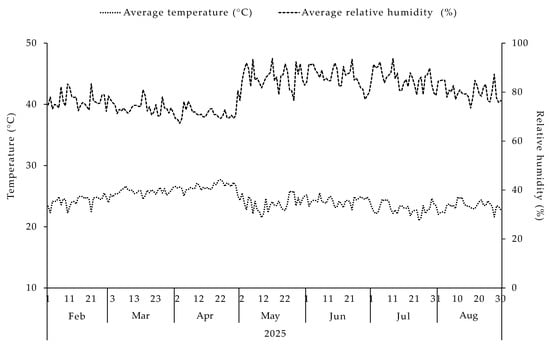
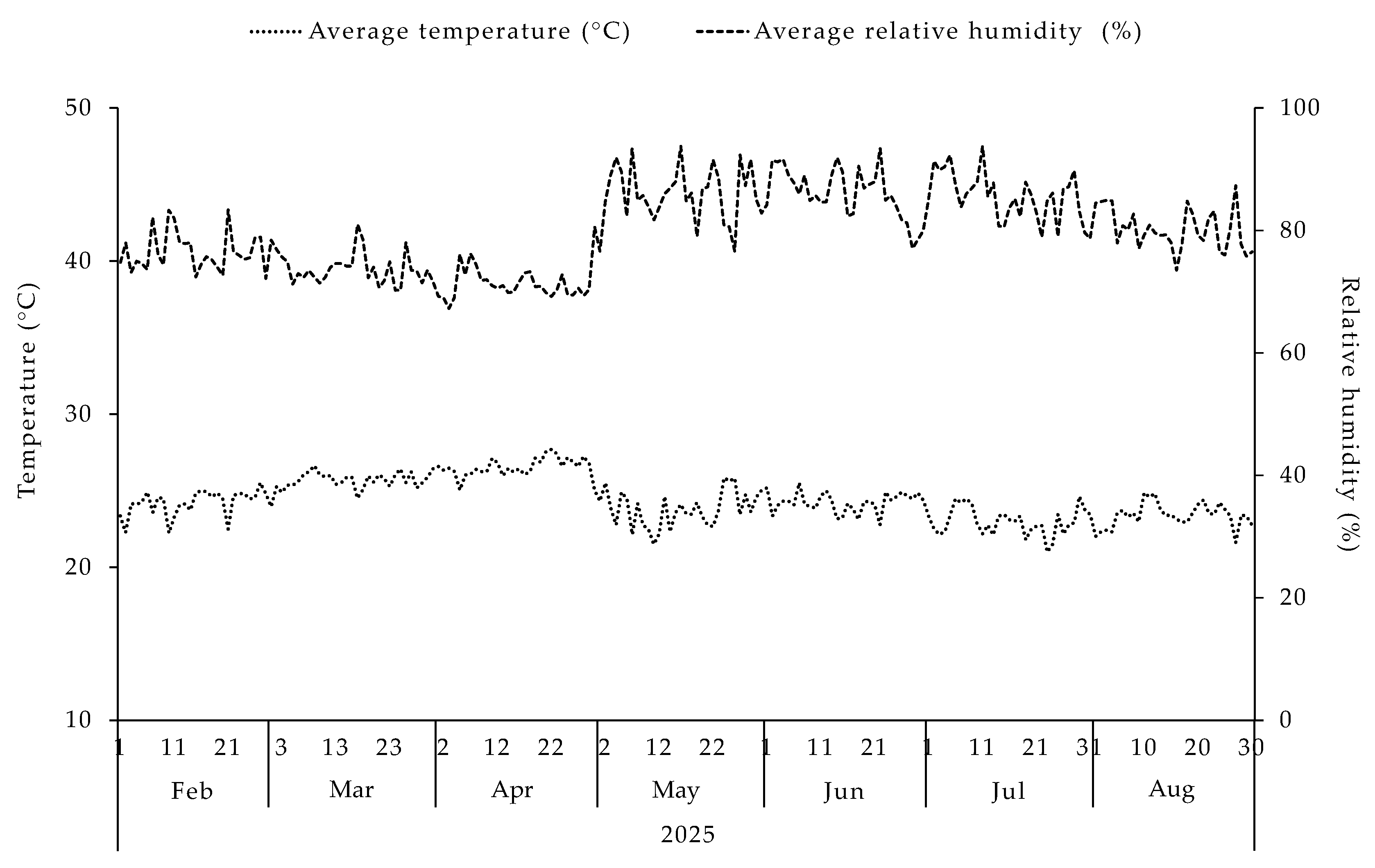
The experiment was carried out in a protected environment (6°57′59″ south, 35°42′57″ west, and 506 m a.s.l.) from February to August 2025, at the Center for Agricultural Sciences (CCA) of the Federal University of Paraíba (UFPB), municipality of Areia, state of Paraíba, Brazil. During the experimental period, air temperature and relative humidity were monitored and recorded automatically every 10 min using a digital thermo-hygrometer (Datalogger LI-1400, Instruterm®, São Paulo, Brazil) (Figure 1).
Figure 1.
Mean daily values of air temperature and relative humidity recorded during the experimental period.
2.2. Treatments and Statistical Design
The five experimental treatments consisted of irrigation intervals, which represent different degrees of water deficit, including daily irrigation and irrigation every three, six, nine, and twelve days (for regression purpose x = 0, 3, 6, 9 and 12 days between irrigation events, respectively), distributed in four randomized blocks, totaling 20 experimental plots of five plants each. Water deficit was induced by reducing irrigation frequency, which resulted in progressive decreases in substrate water availability as the interval between irrigation events increased, resulting in a gradient of water deficit. Irrigation intervals were determined based on a preliminary trial of water replacement intervals and observation of seedling responses.
2.3. Experimental Procedures
Seeds of P. echinata trees of the small variant morphotype [2,29], used in seedling production, were collected from adult trees established in forest fragments of natural occurrence of the species, in the UFPB/CCA Forest Reserve (6°57′59″ South, 35°42′57″ West and 506 m a.s.l.), maintained for research, teaching, and conservation purposes.
Seeds were collected and sown on 1 February 2025. Prior to sowing, the seeds were superficially disinfected by immersion in a 1% sodium hypochlorite solution for 1 min and then rinsed thoroughly with distilled water. The seedlings originated from the direct sowing of two seeds in 180 cm3 conical tubes filled with commercial substrate (MecPlant®, Telêmaco Borba, PR, Brazil), arranged in trays kept on 1.0 m high metallic benches.
According to the manufacturer, the pine bark-based commercial substrate (MecPlant®) has a slightly acidic pH (5.0) and moderate concentrations of macronutrients, with a base saturation (V%) of 46.76% and an aluminum saturation of 0.00%, which characterizes a substrate without aluminum toxicity. Furthermore, it has an organic matter content of 55.60 g kg−1, which contributes to the physical structure of the substrate (Table 1).
Table 1.
Chemical attributes of the pine bark-based MecPlant® substrate used to produce P. echinata seedlings.
Plantlet emergence began four days after sowing, and at day seven, the first two true leaves appeared. Fifteen days after sowing, when the shoot length and stem diameter at substrate level averaged 6.72 ± 1.16 cm and 1.33 ± 0.20 mm, respectively, and had two fully expanded leaves, they were transplanted to plastic bags (one seedling/plastic bag—350 micron-thick black plastic material, 20 cm high × 9 cm wide, with a volume of 1.1 dm3) filled with the above-mentioned MecPlant® commercial substrate.
In the fertilization management of the seedlings, monoammonium phosphate (MAP, 60.8% P2O5 and 10.8% N) was used to raise the nitrogen and phosphorus content in the substrate to 100 mg N kg−1 and 300 mg P kg−1, respectively. Fertilization with potassium sulfate (K2SO4, 50% K2O and 18% S) was used to raise K content to 150 mg kg−1, according to the methodology proposed by [30].
The water used for seedling irrigation consisted of regular treated tap water supplied by the local municipal water and sewage company, Areia-PB, and showed, among other attributes, an electrical conductivity (ECwi) of 0.39 dS m−1 and a sodium adsorption ratio (SAR) of 1.60 (mmol L−1)0.5 (Table 2).
Table 2.
Chemical attributes of the water used to irrigate the P. echinata seedlings.
2.4. Irrigation Management
Seedling emergence occurred four days after sowing, and transplanting was carried out 15 days after sowing and 11 days after emergence. For the first 30 days after transplanting, all plants were irrigated daily, maintaining the substrate close to field capacity (100% of the substrate’s water retention capacity, determined on a gravimetric basis, corresponding to 30% moisture content on a dry weight basis). Subsequently, 41 days after emergence, irrigation was carried out at the established experimental irrigation intervals: daily irrigation and irrigation every three, six, nine, and twelve days. Thus, this management strategy promoted gradual differences in substrate water availability, as longer irrigation intervals certainly resulted in lower water content in the substrate over time, thereby intensifying water deficit conditions. At the time of irrigation, water addition stopped as soon as the water began to drain from the containers.
2.5. Variables Evaluated in the Study
Growth, physiological, and enzymatic variables were evaluated to assess the morphophysiological and biochemical responses of P. echinata seedlings under different levels of water deficit.
Data collection occurred 154 days after the start of the irrigation interval treatments, a period considered sufficient for the cumulative effects of the different levels of water deficit to be expressed in the morphophysiological and biochemical responses of P. echinata seedlings. Evaluations were conducted on each of the five plants in each experimental plot.
The evaluated growth variables were stem diameter at ground level, in mm, using a digital caliper; number of leaves and leaflets, obtained by visual counting; leaf area, in cm2, estimated from leaf images processed using the software ImageJ® (version 1.54, National Institutes of Health, Bethesda, MD, United States of America); shoot and root length, in cm, using a millimeter ruler; root volume, in cm3, according to Archimedes’ principle [31] (the roots were washed to remove the substrate, dried on paper towels, and then immersed in a graduated cylinder with 50 mL of distilled water, with root volume considered equivalent to the displacement of the water column); and the above ground, root, and total dry matter mass of seedlings, in g, after separation and drying in a forced-air oven at 65 °C until constant weight [32]. In addition to these variables, the Dickson quality index [33] was used as a morphological indicator of seedling quality and vigor, and was calculated according to the following equation:
DQI (%) = TDMM/(SL/SDS) + (SDMM/RDMM)
In Equation (1), DQI is the Dickson quality index, TDMM is the total dry matter mass of the seedling (g), SL is the shoot length of the seedling (cm), SDS is the stem diameter of the seedling at substrate level (mm), SDMM is the shoot dry matter mass of the seedling (g), and RDMM is the root dry matter mass of the seedling (g).
Physiological analyses evaluated relative water content, leaf index of chlorophyll a (LICa) and b (LICb), chlorophyll a/chlorophyll b ratio (LICa.b), and leaf index of chlorophyll total (LICt), measured at the third pair of leaves from plant apex under a natural photoperiod, between 7:00 AM and 9:00 AM, using a portable meter (chlorofiLOG, CFL 1030, Falker®, Porto Alegre, RS, Brazil).
Calculation of the relative water content followed the methodology proposed by [34]. Ten collected leaf disks of 10 mm diameter had their fresh matter mass (FMM) determined on a semi-analytical balance, and then the disks were submerged in distilled water for 24 h to obtain the turgid matter mass (TMM). Subsequently, the leaf disks were dried in a forced-air oven at 65 °C for 24 h to determine their dry matter mass (DMM). The estimated values of relative water content (RWC) resulted from the following equation:
RWC (%) = (FMM − DMM)/(TMM − DMM) × 100
For the quantification of enzymatic activity, two leaves collected from the median region of each plant in the plot remained in a plastic bag stored in an insulated box with ice to minimize enzymatic degradation until lab processing, at approximately 4 °C, with a maximum interval of 30 min between sample collection and processing in the laboratory.
In the laboratory, 1.0 g of leaf tissue was weighed per sample and kept frozen until maceration in liquid nitrogen to obtain protein extracts. Subsequently, 10 mL of sodium acetate buffer (100 mM, pH 5.0) was added, resulting in a homogeneous mass that was deposited in micro-tubes and centrifuged at 12,000 g for 15 min at 4 °C. The clarified supernatant, containing the soluble proteins, was used to determine enzymatic activity.
Total protein concentration was determined according to [35]. Peroxidase (POD) activity was determined according to standardized procedures [36], based on the oxidation of guaiacol in the presence of hydrogen peroxide (H2O2), monitored spectrophotometrically at 470 nm, with absorbance readings taken every 15 s over a 2 min period. Polyphenol oxidase activity was determined following the protocol described in [37], based on the oxidation of catechol as substrate, monitored by the increase in absorbance at 395 nm, and phenylalanine ammonia-lyase activity was determined according to the methodology proposed by [38], based on the conversion of L-phenylalanine to trans-cinnamic acid, with absorbance measured at 290 nm.
Enzymatic activity measurements considered the extracts obtained from leaf maceration and centrifugation. Spectrophotometric readings were carried out in three replicates per treatment, and enzymatic activity values corresponded to the mean of these readings. Enzymatic activity was calculated from the rate of change in absorbance per minute (ΔAbs min−1), obtained from spectrophotometric measurements, and subsequently normalized by the total protein concentration of the respective sample. Enzymatic activity values were expressed in UA min−1 mg−1 of protein, defined as the amount of enzyme required to produce a 0.01 change in absorbance per minute per milligram of protein.
2.6. Statistical Analysis
The data were analyzed for the normality of residuals and homogeneity of variances using the Shapiro–Wilk and Levene’s tests, respectively (p ≤ 0.05), in order to verify whether the assumptions required for parametric analyses were met, before being submitted to an analysis of variance (ANOVA) and linear regression techniques, adopting the significance level of p ≤ 0.05. ANOVA was applied to test the effects of different irrigation intervals on the evaluated morphophysiological and enzymatic variables, and linear regression analysis was applied to assess trends and relationships between water availability and plant responses. Multivariate analysis using Principal Component Analysis (PCA) was conducted to identify patterns of variation and interrelationships between the evaluated variables. Correlation analyses considered Pearson’s coefficient to quantify the strength and identify the direction of the linear associations between variables. All statistical analyses were performed using R software, version 4.5.2 [39].
3. Results
Water availability affected seedling performance, with contrasting responses among growth, physiological, and biochemical variables. Growth and biomass allocation variables decreased as irrigation intervals increased, including stem diameter at the substrate level, leaf area, root length, shoot, root, and total dry matter mass, and the Dickson quality index of the seedlings, while root volume increased. Physiological responses were characterized by reductions in relative water content and leaf chlorophyll a, b, and total indices with increasing irrigation intervals, while the leaf index of chlorophyll a/leaf index of chlorophyll b ratio increased. Biochemical responses differed from growth and physiological patterns, with peroxidase, polyphenol oxidase, and phenylalanine ammonia lyase activities progressively increasing with the extension of irrigation intervals.
Irrigation intervals affected stem diameter at the substrate level and affected leaf area; root length; root volume; shoot, root, and total dry matter mass; Dickson quality index; relative water content; LICa, LICb, LICa.b, and LICt; peroxidase; polyphenol oxidase; and phenylalanine ammonia-lyase. However, the variables stem length (F = 0.09; p = 0.78), number of leaves (F = 4.61; p = 0.12), and leaflets (F = 1.73; p = 0.28), with respective means of 10.1 ± 0.62 cm, 9 ± 2 leaves, and 76 ± 15 leaflets, did not fit any of the evaluated polynomial regression models.
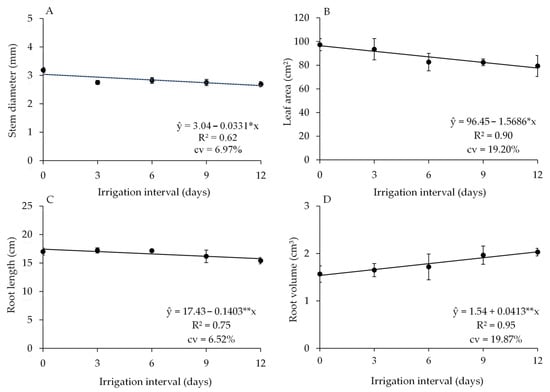
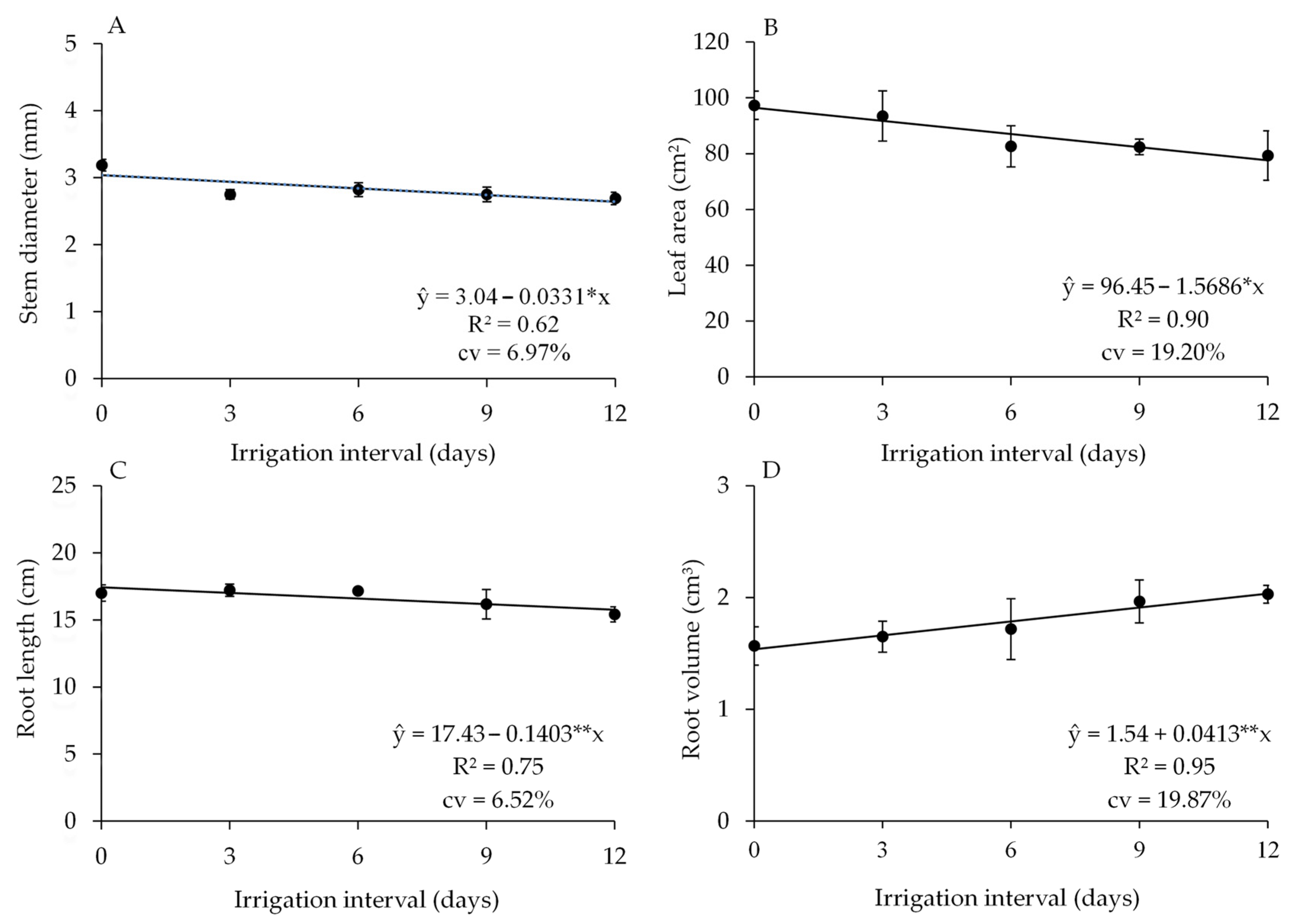
The stem diameter at the substrate level (Figure 2A), leaf area (Figure 2B), and root length (Figure 2C) decreased with increasing irrigation intervals, with the highest mean values estimated at the daily irrigation level (x = 0 in the estimated regression models) (3.04 mm, 96.45 cm2, and 17.43 cm, respectively). A 12-day irrigation interval resulted in a decrease in stem diameter averages at the substrate level to 2.64 mm (−13.15%), leaf area to 77.63 cm2 (−19.51%), and root length to 15.75 cm (−9.64%) compared to the average values estimated for the daily irrigation level. In contrast, the root volume (Figure 2D) was related linearly and positively with the irrigation interval, reaching the maximum value (2.04 cm3) at the 12-day irrigation interval level, which represents an increase of 32.47% compared to the value (1.54 cm3) estimated at the daily irrigation level.
Figure 2.
Mean values ± standard error of stem diameter at substrate level (A), leaf area (B), root length (C), and root volume (D) of P. echinata seedlings according to irrigation intervals. ** p ≤ 0.01 and * p ≤ 0.05 (ANOVA F test); R2 = coefficient of determination; cv (%) = coefficient of variation.
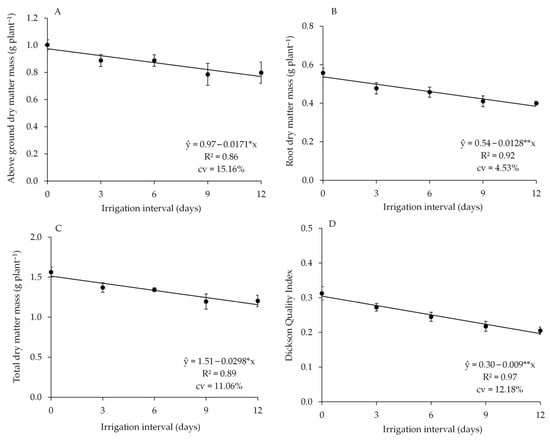
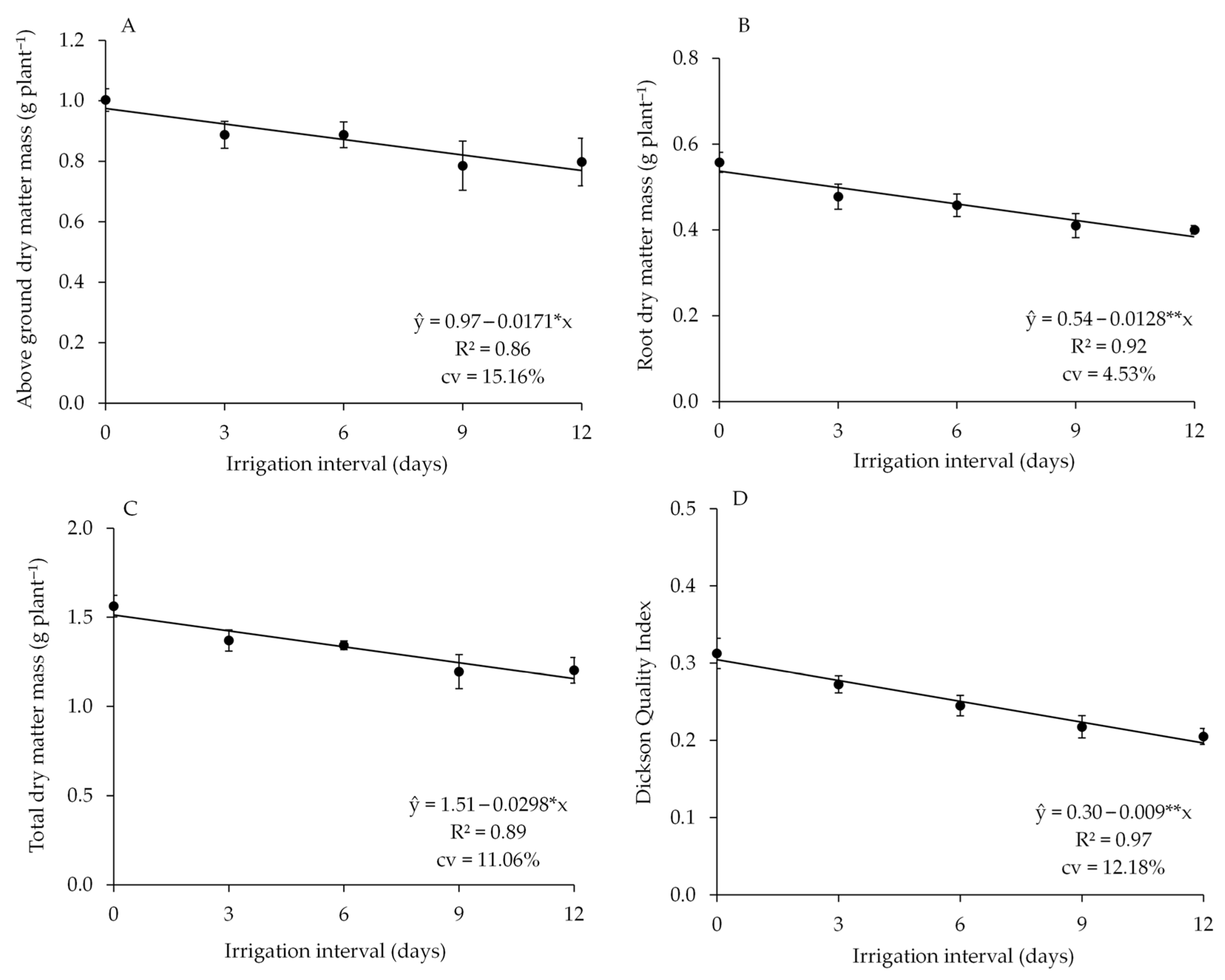
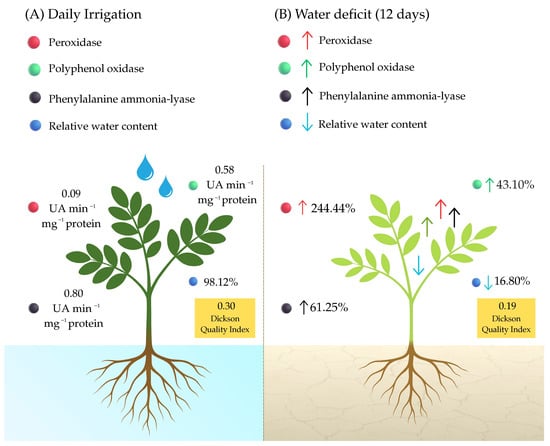
Above-ground (Figure 3A), root (Figure 3B), and total (Figure 3C) dry matter mass (g plant−1) decreased with increasing irrigation intervals, with the highest average values (0.97, 0.54, and 1.51 g plant−1, respectively) estimated at the daily irrigation level (0-day irrigation interval). At the 12-day irrigation interval level, the average estimated values reduced linearly to 0.76, 0.39, and 1.15 g plant−1, respectively, a percentage reduction of 21.65%, 27.78%, and 23.84% compared to the respective values obtained under the daily irrigation level. The Dickson quality index average (Figure 3D) decreased 36.67%, from 0.30 at the daily irrigation level (0-day irrigation interval) to 0.19 at the 12-day irrigation interval level.
Figure 3.
Mean values ± standard error of above-ground dry matter mass (A), root dry matter mass (B), total dry matter mass (C), and Dickson quality index (D) of P. echinata seedlings according to irrigation intervals. ** p ≤ 0.01 and * p ≤ 0.05 (ANOVA F test); R2 = coefficient of determination; cv (%) = coefficient of variation.
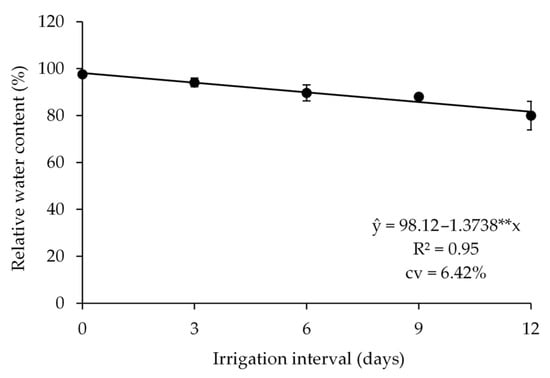
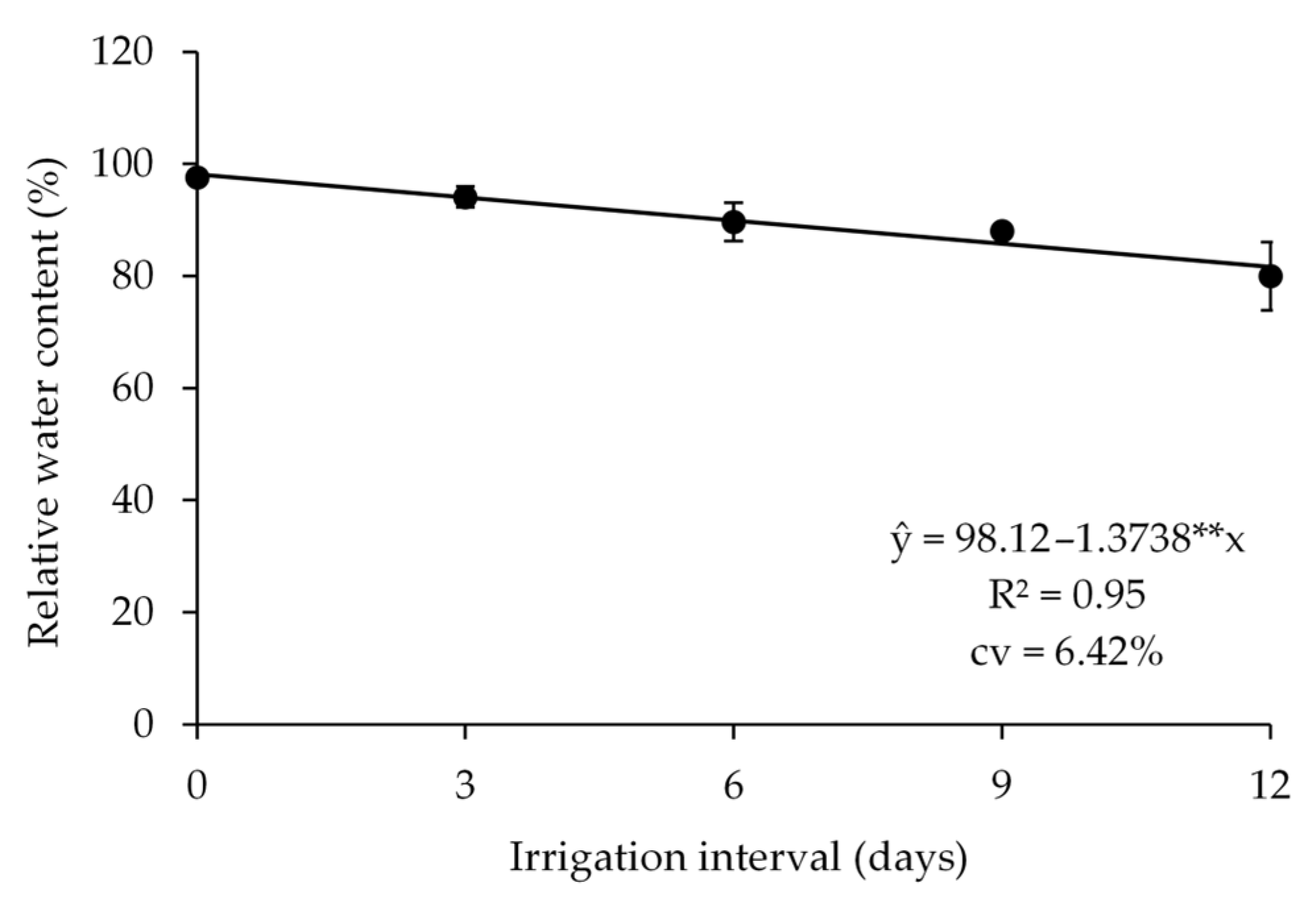
Extending the interval between irrigations reduced the relative water content, with the highest (98.12%) and lowest (81.63%) values estimated at the daily and 12-day irrigation interval levels, respectively (Figure 4).
Figure 4.
Relative water content of P. echinata seedlings according to irrigation intervals. ** p ≤ 0.01 (ANOVA F test); R2 = coefficient of determination; cv (%) = coefficient of variation.
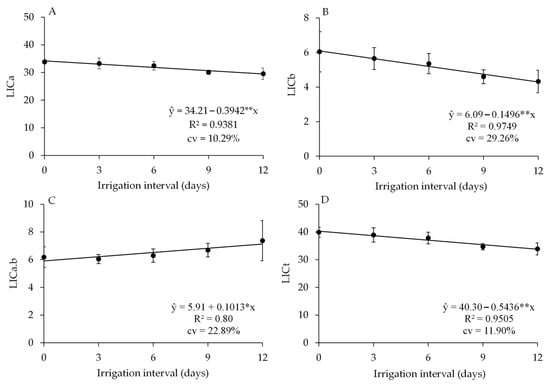
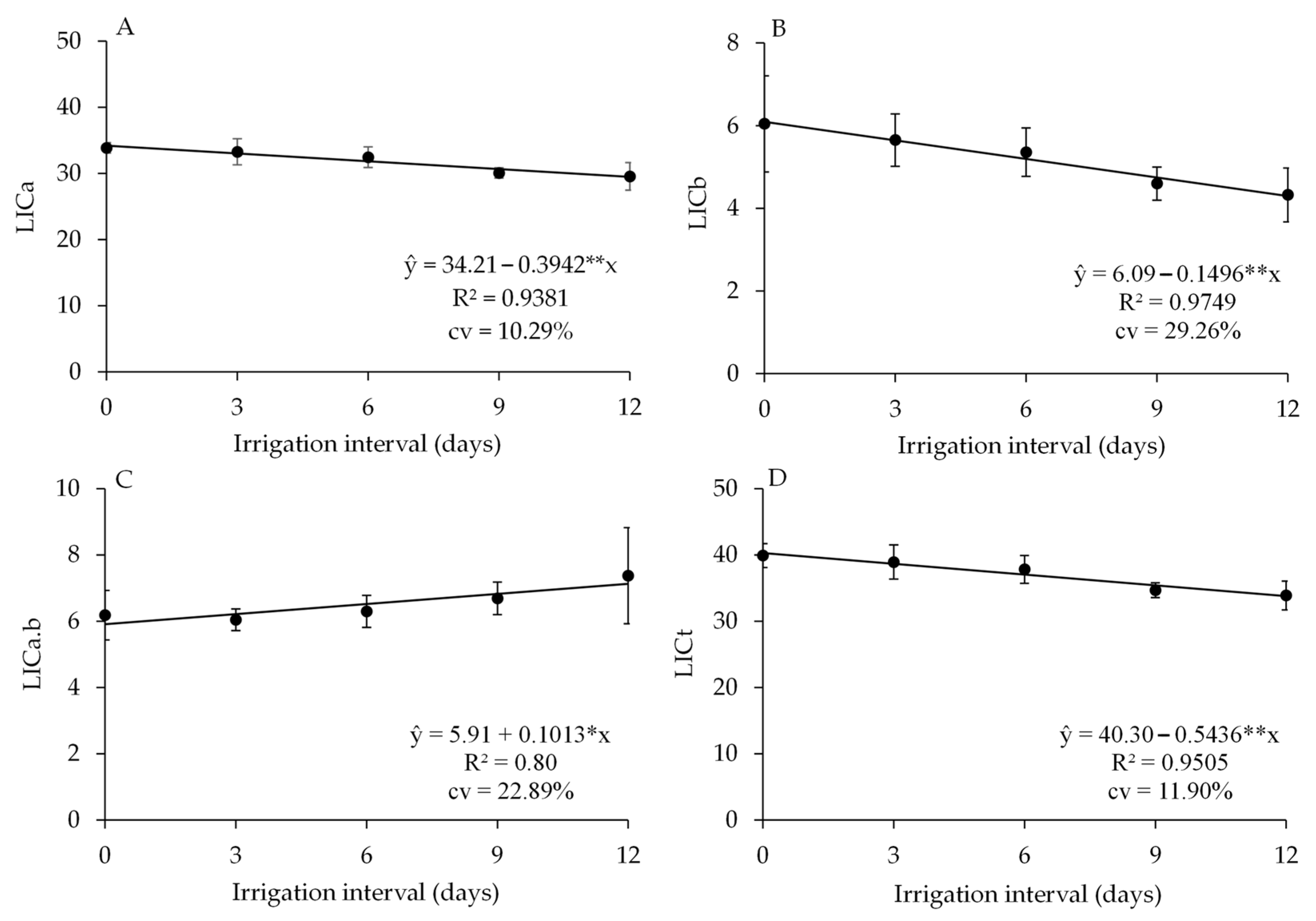
The values of the LICa (Figure 5A), LICb (Figure 5B), and LICt (Figure 5D) decreased linearly with increasing irrigation intervals. The highest values were estimated at the daily irrigation level (34.21, 6.09, and 40.30, respectively), while irrigation every 12 days resulted in the lowest estimated values (29.48, 4.29, and 33.78, respectively), corresponding to reductions of 13.83%, 29.56%, and 16.18%, respectively. In contrast, the LICa.b increased linearly with increasing irrigation intervals, from 5.91 at daily irrigation to 7.13 at the 12-day irrigation interval, equivalent to a 20.64% increase (Figure 5C).
Figure 5.
Mean values ± standard error of leaf index of chlorophyll a (LICa) (A) and b (LICb) (B), chlorophyll a/chlorophyll b ratio (LICa.b) (C), and leaf index of chlorophyll total (LICt) (D) for P. echinata seedlings according to irrigation intervals. ** p ≤ 0.01 and * p ≤ 0.05 (ANOVA F test); R2 = coefficient of determination; cv (%) = coefficient of variation.
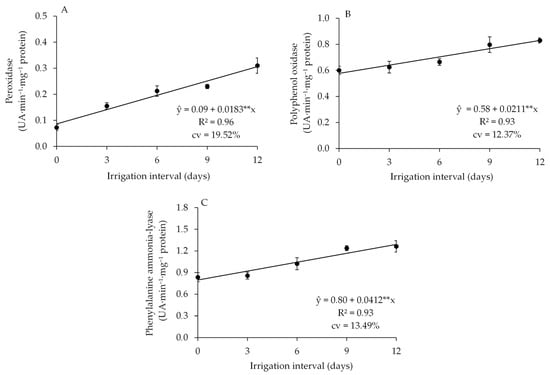
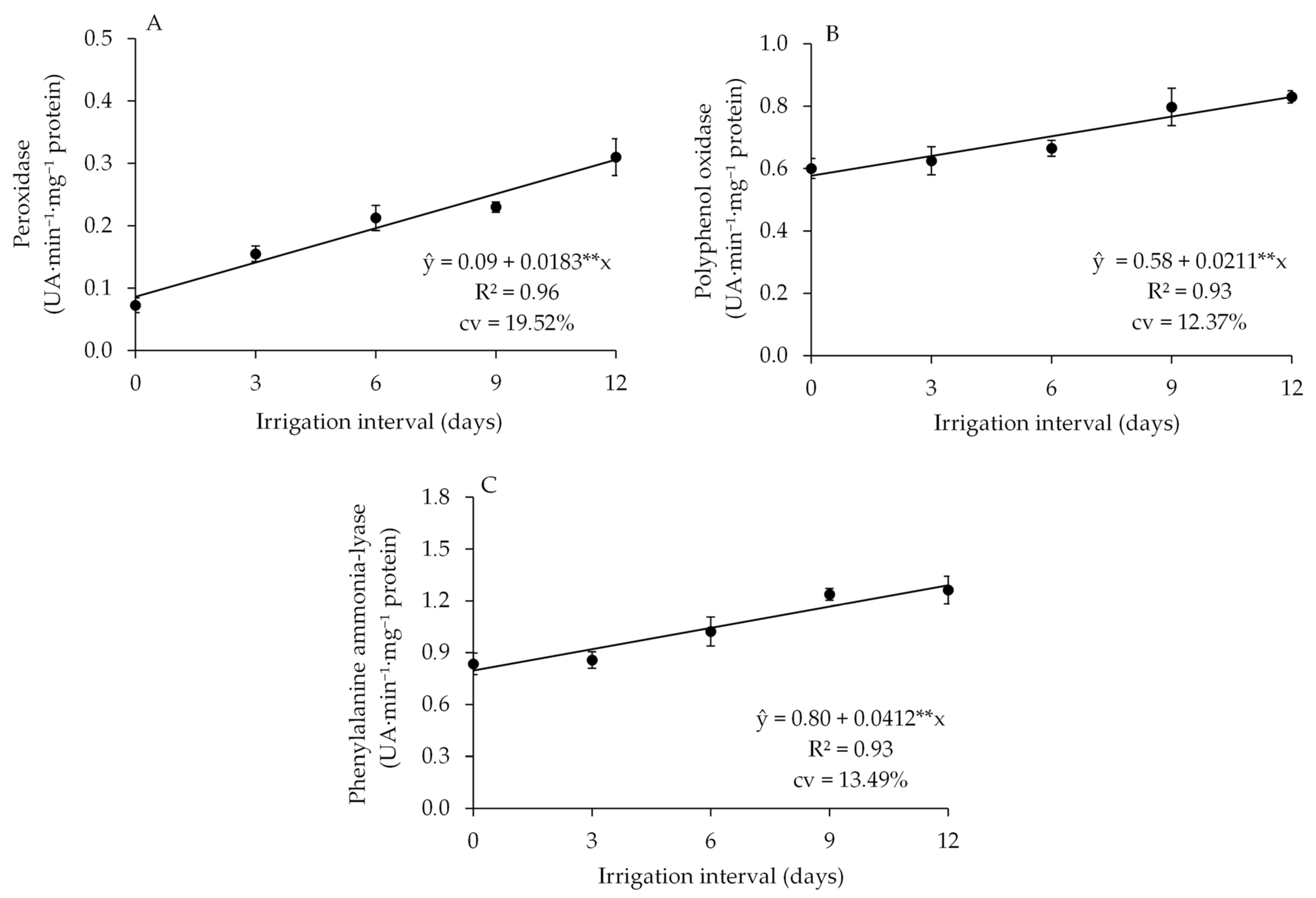
Increases in irrigation interval positively affected the enzymatic activities of peroxidase (Figure 6A), polyphenol oxidase (Figure 6B), and phenylalanine ammonia-lyase (Figure 6C). Daily irrigation resulted in estimated average values of 0.09, 0.58, and 0.80 UA min−1 mg−1 protein, respectively, and at the 12-day irrigation interval, the estimated average values increased to 0.31, 0.83, and 1.29 UA min−1 mg−1 protein, respectively. These increments corresponded to a 244.44%, 43.10%, and 61.25% increase in the activities of those enzymes.
Figure 6.
Mean values ± standard error of enzymatic activities of peroxidase (A), polyphenol oxidase (B) and phenylalanine ammonia-lyase (C) in P. echinata seedlings according to irrigation interval. ** p ≤ 0.01 (ANOVA F test); R2 = coefficient of determination; cv (%) = coefficient of variation.
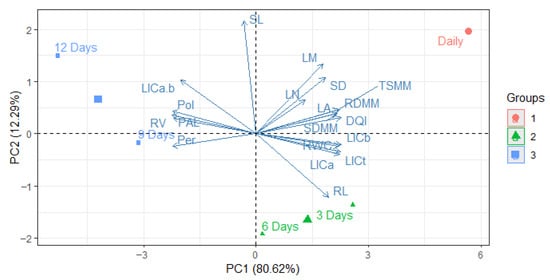
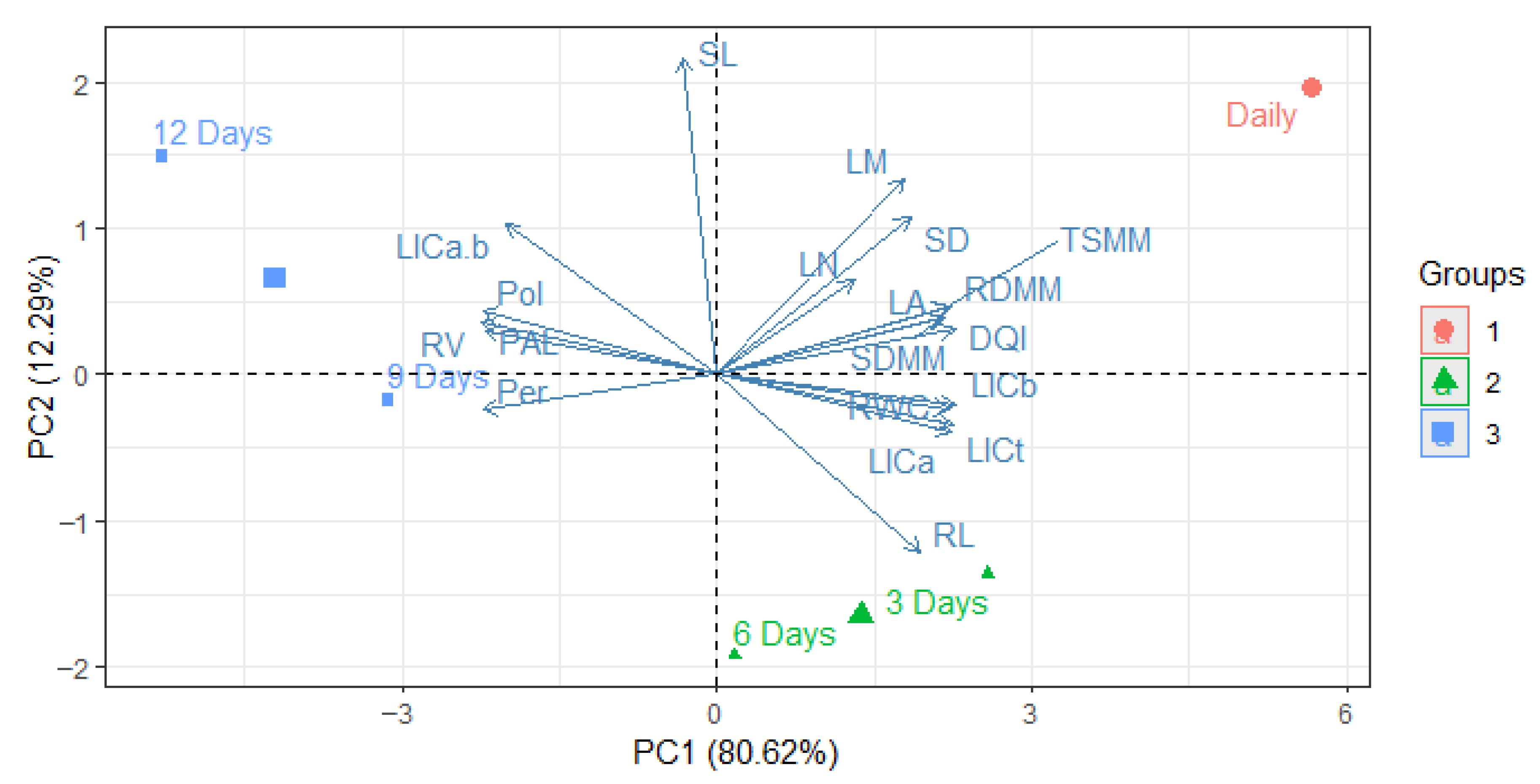
The first two principal components of the PCA explained 92.91% of the total variation in the morphophysiological and biochemical traits of P. echinata seedlings under water deficit (Table 3).
Table 3.
Eigenvalue and eigenvector matrix of the first two components (PC1 and PC2) in the PCA analysis of the morphophysiological and biochemical variables of P. echinata seedlings subjected to different irrigation intervals.
The first principal component (PC1) accounts for 80.62% of the total variability and is related to almost all the seedling variables (growth, physiology, and enzymatic activity) (Table 3). The variables stem diameter at substrate level, leaf area, number of leaflets, root length, shoot dry matter mass, root dry matter mass, total dry matter mass, Dickson quality index, relative water content, and leaf indices of chlorophyll a, b, and total are correlated, obtaining vectors in the same direction in PC1. In contrast, the vectors for root volume, the ratio between leaf indices of chlorophyll a and b, peroxidase activity, polyphenol oxidase activity, and phenylalanine ammonia-lyase activity are correlated, but in the opposite direction to the other variables in PC1. The variables that contributed the most to this component were the leaf indices of chlorophyll a (6.19%), b (6.42%), and total (6.27%); Dickson quality index (6.39%); activity of peroxidase enzymes (6.20%); polyphenol oxidase (6.16%) and phenylalanine ammonia-lyase (6.08%); root volume (6.24%); root (6.17%) and total (6.05%) dry matter mass; and relative water content (6.05%). The second component (PC2) accounts for 12.29% of the total variability, and is related to both shoot length and number of leaves, with the same direction of the vectors and with the opposite direction of the root length vector, with the respective contributions of 38.25%, 14.60%, and 11.99%.
These patterns indicate that the first principal component is a core regulatory axis that separates traits related to growth and physiological performance from those associated with stress response and defense along the water deficit gradient. Under higher water availability, seedlings exhibited greater growth, whereas under water deficit, growth was reduced and accompanied by enhanced adaptive responses, such as increased root volume, a higher leaf index of chlorophyll a/leaf index of chlorophyll b ratio, and increased activity of antioxidant and defense-related enzymes. The second principal component reflects secondary adjustments in biomass allocation, contrasting shoot development with root volume in response to changes in water availability.
The cluster analysis, based on the treatment scores, formed three groups (Figure 7).
Figure 7.
Dispersion of the morphological and biochemical variables of P. echinata seedlings and arguments of the treatments based on the scores of the first (PC1) and second (PC2) components of the PCA.
The first group, corresponding to daily irrigation, represents a growth mode and was associated with variables related to seedling growth, such as stem diameter at substrate level; leaf area; number of leaves and leaflets; shoot, root, and total dry biomass; as well as the Dickson quality index and leaf chlorophyll indices. This first group indicates that daily irrigation favored plant growth. The second group, composed of plants irrigated every 3 and 6 days, represents a resource-balancing strategy, in which root growth was favored while shoot growth and leaf production were reduced. The third group, composed of the treatments with irrigation intervals of 9 and 12 days, corresponds to a defensive survival mode, characterized by increased enzymatic activity and root volume at the expense of growth and leaf chlorophyll indices.
4. Discussion
The intensification of drought resulting from global climate change affects the morphophysiological and biochemical processes in forest tree species, particularly under scenarios of reduced water availability. Water deficit compromises photosynthesis, water balance, and cellular integrity [21]. In this context, understanding how threatened species, such as P. echinata, respond to water limitation becomes important to understand the mechanisms that modulate their survival and functional maintenance under environmental stress conditions. The results demonstrate that P. echinata seedlings exhibit a coordinated set of morphophysiological and enzymatic adjustments to water restriction. The main findings include reduced growth associated with the intensification of antioxidant metabolism and morphological adjustments, such as the modulation of leaf area and root volume, which minimize oxidative damage and water loss, highlighting their phenotypic plasticity.
These responses were mainly associated with the frequency of water restriction, since longer irrigation intervals imposed a more severe and prolonged water deficit. Therefore, the results corroborate the hypothesis proposed in the Introduction section that this threatened species possesses phenotypic plasticity under water deficit conditions, through integrated morphophysiological and enzymatic adjustments.
Coordinated morphophysiological adjustments under water deficit have also been reported in forest trees such as Eucalyptus obliqua, in which drought induces changes in plant water relations and leaf traits consistent with phenotypic plasticity along water availability gradients. These convergent responses reinforce the notion that the integrated adjustments observed in P. echinata reflect a broader drought acclimation strategy shared among woody species adapted to environments with variable water availability [41].
Water deficit slows down the processes of cellular division and expansion, which directly reduces stem diameter at the substrate level and root length. Under water deficit conditions, plants prioritize the maintenance of cellular integrity over the expansion of new tissues [13]. However, the increase in root volume observed in P. echinata seedlings under longer irrigation intervals suggests a strategic shift in biomass allocation, with greater investment in root development and branching to enhance water and nutrient acquisition [42], resulting from the production of fine roots with a larger surface area per unit mass and relatively less investment in biomass due to a high surface/mass ratio and low tissue density [43].
Despite the decrease in growth, the seedlings showed high quality under water deficit conditions. Dickson quality index values above 0.20 indicate high-quality seedlings [32]. According to the regression models, estimated values of Dickson quality index remained greater than 0.20 at irrigation intervals of up to 11 days, and the estimated index value was 0.19 at the 12-day irrigation interval level, which demonstrates the ability of P. echinata seedlings to adjust quite well to water deficit. Similarly, Pityrocarpa moniliformis seedlings subjected to water deficit maintained vegetative growth and morphophysiological integrity for up to eight-day irrigation intervals by the activation of metabolic mechanisms, such as osmolyte accumulation and physiological adjustments [44].
Water deficit was a major limiting factor for the growth of P. echinata seedlings, as evidenced by reductions in stem diameter at the substrate level, leaf area, and root length under longer irrigation intervals. These responses are likely associated with decreased plant water potential and a reduction in cell turgor, which precedes stomatal closure [45]. Thus, drought stress negatively affects plant growth by reducing water potential and cell turgor and limiting the uptake of essential nutrients by roots. This condition negatively affects essential physiological and metabolic processes in plants, such as photosynthesis, respiration, and the synthesis of sugars and proteins [46]. Similar effects occur in forest Fabaceae trees, such as Mimosa caesalpiniifolia Benth. [47], P. moniliformis Benth. [44], and Poincianella pluviosa (DC.) L.P.Queiroz [48].
On the other hand, the reduction in leaf area observed in the condition of irrigation every 12 days indicates the acclimation process of the plants to water deficit, since the reduction in leaf number and growth may be a defense mechanism of P. echinata seedlings. This reduction under the 12-day irrigation interval likely represents an acclimatory response aimed at minimizing transpirational water loss while maintaining basic metabolic activity, a strategy also observed in other native forest species under drought conditions, such as Erythroxylum pauferrense Plowman [42].
Reduction in water availability limited the biomass production of P. echinata seedlings. Plants subjected to water deficit accumulate abscisic acid (ABA), causing the closure of stomata, reduction in gas exchange, and inhibition of photosynthesis [49,50]. Under these conditions, the plant prioritizes water maintenance over growth [51], consequently affecting the production and translocation of assimilated compounds, resulting in less biomass accumulation [52].
Phenotypic plasticity represents a determining capacity of plants for acclimation to water deficit, mediated by genotype × environment interaction [53]. This plasticity influences morphophysiological and biochemical mechanisms in response to variations in water availability, promoting acclimation and survival under drought conditions [54].
Corymbia calophylla is a forest species that maintains its performance under severe water deficit conditions through phenotypic plasticity [55]. A study comparing Pinus pinaster and P. pinea revealed functional responses to water restriction and showed that P. pinea has greater plasticity in the xylem, which confers acclimation capacity to this species [56]. Thus, phenotypic plasticity is important for the acclimation of species in future scenarios of warmer and drier climates [57].
The reduction in relative water content with increasing irrigation intervals corresponds to lower cellular hydration and water potential. In Aspidosperma pyrifolium Mart. seedlings subjected to water deficit, the relative water content decreased from 83% to 72% after six days without irrigation and reached 32% at day 21, and hydration levels recovered to 46% at day 24, three days after the resumption of irrigation [58].
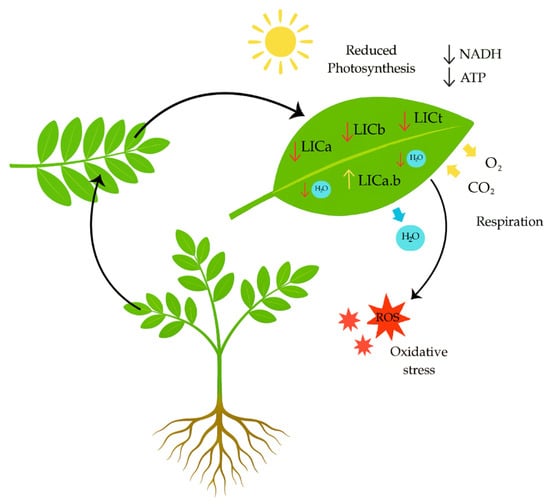
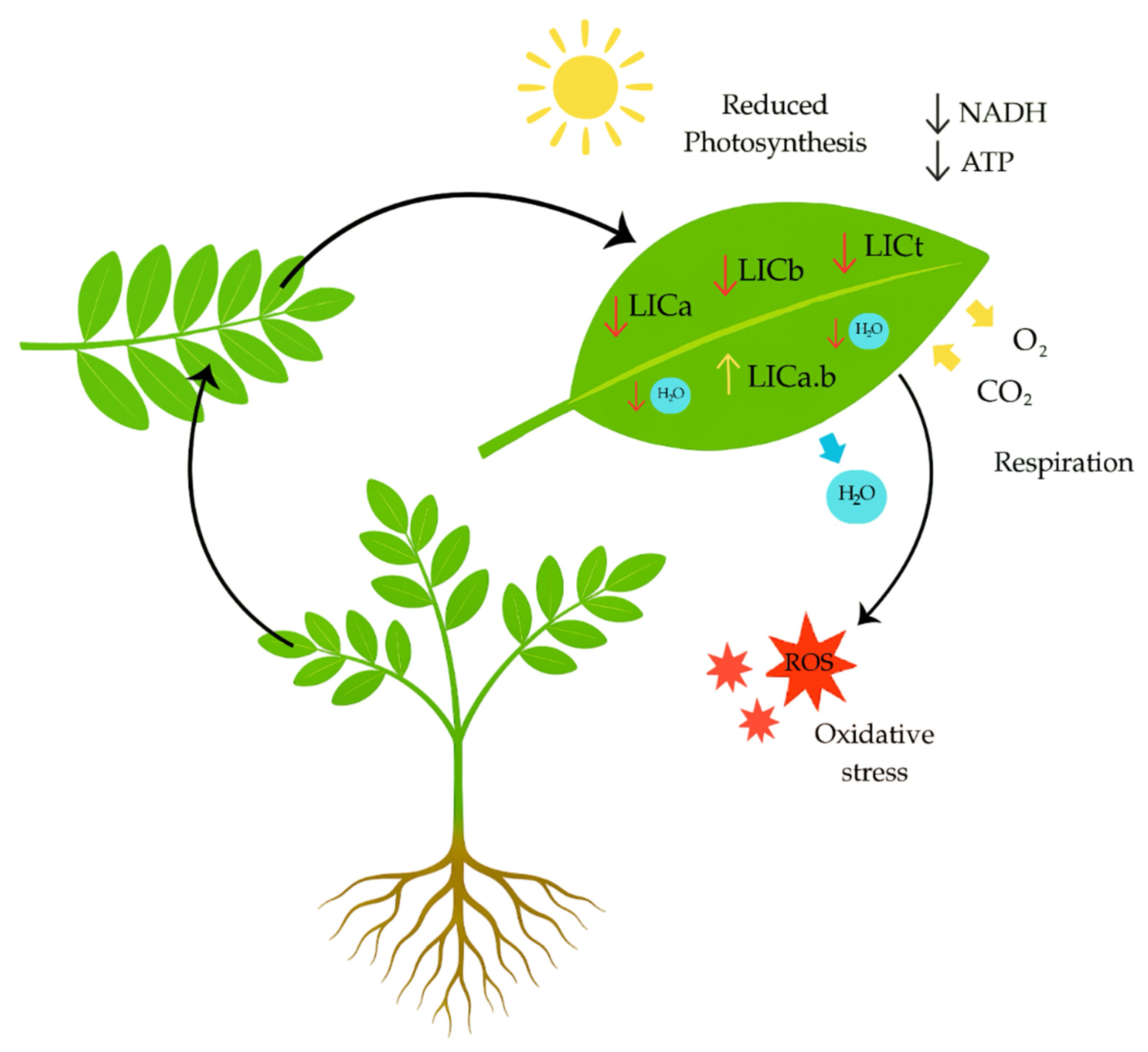
The decrease in leaf chlorophyll index values, especially chlorophyll b, reflects the high sensitivity of these pigments to water deficit and may be associated with the lower efficiency of the photosynthetic apparatus and important cellular processes, such as cell expansion and division [48]. However, the ratio between the leaf chlorophyll a index and the leaf chlorophyll b index increased with increasing levels of water deficit. This change in the ratio value corresponds to a physiological mechanism of plants to minimize oxidative damage and preserve photosynthetic integrity to survive under water stress conditions, now reported for P. echinata [1] (Figure 8).
Figure 8.
Reduction in the leaf index of chlorophyll and production of reactive oxygen species (ROS) in P. echinata seedlings submitted to water deficit. The arrows indicate an increase (↑) or decrease (↓) in the activity or relative value compared to the respective figures estimated for the daily irrigation level. Leaf index of chlorophyll a (LICa), leaf index of chlorophyll b (LICb), leaf index of chlorophyll a/leaf index of chlorophyll b ratio (LICa.b), and leaf index of chlorophyll total.
The adjustment in pigment composition reduces the excessive uptake of light energy, decreasing the excitation pressure on the photosystems and the consequent formation of reactive oxygen species [59]. This adaptive strategy favors the maintenance of basic metabolic functioning and increases the tolerance of seedlings to water deficit.
The observed increase in peroxidase, polyphenol oxidase, and phenylalanine ammonia-lyase activities in P. echinata seedlings likely reflects a species-specific enhancement of the antioxidant system in response to elevated ROS production under water deficit. This indicates that P. echinata actively regulates enzymatic defenses to mitigate oxidative damage and maintain cellular redox balance during drought stress [60,61,62,63].
Peroxidase is an important enzyme in the metabolism of hydrogen peroxide (H2O2) in plants, as it catalyzes the oxidation of phenolic compounds using H2O2. It removes this oxidizing agent from the apoplast and protects the cells against oxidative damage. Under stress conditions, such as drought, both H2O2 production and peroxidase activity increase to maintain redox balance and prevent cell damage [64,65]. Water deficit induces polyphenol oxidase activity in P. echinata, contributing to the reinforcement of antioxidant defense mechanisms against oxidative stress [66]. Similarly, the activation of phenylalanine ammonia-lyase plays an important role in drought tolerance by promoting the biosynthesis and accumulation of salicylic acid and lignin, enhancing the species’ resistance to water deficit [59].
The activation of antioxidant enzymes observed in P. echinata seedlings under water deficit is consistent with drought-response patterns reported for forest species [67], such as Quercus cerris L., Q. robur L. [68], Morus alba L, and Conocarpus erectus L. [69], in which increased enzymatic activities play a central role in maintaining cellular redox balance and protecting structural components under limited water availability. Accordingly, the biochemical adjustments observed in P. echinata align with strategies described for other forest species under water limitation, suggesting that enzymatic activation plays a functionally relevant role in coping with water stress during early developmental stages.
The PCA provides core evidence that water availability modulates the phenotype of P. echinata seedlings in a multidimensional and integrated manner. Seedlings under daily irrigation are associated with growth- and performance-related traits, including biomass accumulation, stem diameter, Dickson quality index, and chlorophyll traits, whereas seedlings subjected to longer irrigation intervals, particularly 9 and 12 days, are associated with increased root volume and antioxidant enzyme activity. Seedlings exposed to intermediate irrigation intervals occupy intermediate positions in the multivariate space, indicating a gradual and coordinated phenotypic shift along the water availability gradient. This pattern demonstrates phenotypic plasticity through the reorganization of morphological, physiological, and biochemical traits in response to water deficit.
The responses of P. echinata seedlings to water deficit show mechanisms of a morphophysiological and biochemical nature, expressed by the increase in antioxidant enzymatic activities, and the reduction in the relative water content and the Dickson quality index to moderate levels (Figure 9).
Figure 9.
Mechanisms of acclimation to water deficit of P. echinata seedlings. Biochemical and physiological responses at daily irrigation (A) and at irrigation intervals of 12 days (B). The arrows indicate an increase (↑) or decrease (↓) in the activity or relative value compared to the respective figures estimated for the daily irrigation level.
5. Conclusions
Seedlings of Paubrasilia echinata (Lam.) Gagnon, H.C. Lima & G.P. Lewis exhibit high phenotypic plasticity in response to water deficit and tolerate irrigation intervals of up to 12 days, maintaining coordinated morphological, physiological, and biochemical adjustments. This plasticity is evidenced by reductions in root, stem, and shoot biomass; decreases in stem diameter, leaf area, and root length; an increase in root volume; and integrated physiological and biochemical adjustments, including the modulation of leaf chlorophyll indices and increased activity of antioxidant enzymes. The hypothesis was confirmed, as P. echinata employs morphophysiological and enzymatic regulation mechanisms such as changes in stem diameter, root volume, leaf area, antioxidant enzyme activity, and chlorophyll indices to acclimate to water restriction. These findings provide practical guidance for the management of P. echinata seedlings, suggesting irrigation intervals of up to 12 days. Moreover, the high phenotypic plasticity observed indicates that P. echinata has strong potential for establishment in areas subjected to periodic water deficit and should be considered a suitable species for forest restoration programs.
Author Contributions
Conceptualization, T.K.F.d.M., G.L.F.d.S., F.T.C.B., J.S.N., D.R.d.M., I.A.B., and R.d.L.A.B.; data curation, T.K.F.d.M., F.E.d.S., I.A.B., and R.d.L.A.B.; formal analysis, T.K.F.d.M., G.L.F.d.S., F.T.C.B., J.S.N., I.E.C., F.E.d.S., D.G.d.S., D.R.d.M., A.S.d.M., A.P.d.A., O.A.B., I.A.B., and R.d.L.A.B.; funding acquisition, T.K.F.d.M., M.V.d.S., I.A.B., and R.d.L.A.B.; investigation, T.K.F.d.M., F.T.C.B., I.E.C., D.R.d.M., I.A.B., and R.d.L.A.B.; methodology, T.K.F.d.M., G.L.F.d.S., F.T.C.B., J.S.N., I.E.C., F.E.d.S., D.G.d.S., M.V.d.S., M.B.F., A.S.d.M., A.P.d.A., O.A.B., I.A.B., and R.d.L.A.B.; project administration, T.K.F.d.M., I.A.B., and R.d.L.A.B.; resources, T.K.F.d.M., F.T.C.B., M.V.d.S., M.B.F., A.S.d.M., I.A.B., and R.d.L.A.B.; software, T.K.F.d.M., G.L.F.d.S., F.E.d.S., D.G.d.S., D.R.d.M., M.V.d.S., A.S.d.M., I.A.B., and R.d.L.A.B.; supervision, T.K.F.d.M., J.S.N., I.A.B., and R.d.L.A.B.; validation, T.K.F.d.M., I.E.C., D.G.d.S., M.B.F., I.A.B., and R.d.L.A.B.; visualization, T.K.F.d.M., G.L.F.d.S., F.T.C.B., J.S.N., I.E.C., F.E.d.S., D.R.d.M., M.V.d.S., M.B.F., A.S.d.M., A.P.d.A., O.A.B., I.A.B., and R.d.L.A.B.; writing—original draft, T.K.F.d.M., G.L.F.d.S., F.T.C.B., J.S.N., O.A.B., I.A.B., and R.d.L.A.B.; writing—review and editing, T.K.F.d.M., G.L.F.d.S., F.T.C.B., J.S.N., I.E.C., F.E.d.S., D.G.d.S., M.V.d.S., M.B.F., A.S.d.M., A.P.d.A., O.A.B., I.A.B., and R.d.L.A.B. All authors have read and agreed to the published version of the manuscript.
Funding
This research received no external funding.
Data Availability Statement
All data generated and/or analyzed during the present study are available in the manuscript, and the corresponding authors have no objection to making the data and materials available upon reasonable request.
Acknowledgments
The authors would like to thank the Coordination for the Improvement of Higher Education Personnel (CAPES, Brasília, Brazil) for the doctoral scholarship of the first author and the Graduate Program in Agronomy at the Federal University of Paraiba.
Conflicts of Interest
The authors declare no conflicts of interest.
References
- Fonseca, C.L.S.; Silva, D.M.; Gasparini, T.A.S.; Cuzzuol, G.R.F. Photosynthesis of plants of shade-tolerant ecotype of Paubrasilia echinata are more tolerant to drought than the sun-tolerant ecotype. Plant Stress 2023, 8, 100157. [Google Scholar] [CrossRef] [Scilit]
- Rees, M.; Neaves, L.E.; Lewis, G.P.; Lima, H.C.; Gagnon, E. Phylogenomic and morphological data reveal hidden patterns of diversity in the national tree of Brazil, Paubrasilia echinata. Am. J. Bot. 2023, 110, 16241. [Google Scholar] [CrossRef] [Scilit]
- Macedo, T.M.; Barros, C.F.; Lima, H.C.; Brandes, A.F.D.N.; Costa, W.S.; Costa, C.G.; Roig, F. Climate signals in tree rings of Paubrasilia echinata (Leguminosae–Caesalpinioidea) from the Atlantic Forest of Brazil. Trees 2020, 34, 337–347. [Google Scholar] [CrossRef] [Scilit]
- Bueno, E. Brazilwood, 1st ed.; Axis Mundi: Rio de Janeiro, Brazil, 2002; pp. 1–279. [Google Scholar]
- Venâncio, F.C.D.; Amaral, G.C.; Cuzzuol, G.R.F.; Pezzopane, J.E.M.; Toledo, J.V.; Fonseca, C.L.S.; Carvalho, M.A. Paubrasilia echinata growth in climate change scenarios of Atlantic Forest, Brazil: Ecophysiological strategies of tolerance. Ecophysiol. Strateg. Toler. 2022, 17. [Google Scholar] [CrossRef] [Scilit]
- Bastos, J.G.; Kury, L.; Hanazaki, N.; Capozzi, R.; Fonseca-Kruel, V.S.D.A. A biodiversity hotspot losing its biocultural heritage: The challenge to biocultural conservation of brazilwood (Paubrasilia echinata). Front. For. Glob. Change 2022, 5, 696757. [Google Scholar] [CrossRef] [Scilit]
- Brazil. Ordinance No. 443, of 17 December 2014. Lista Nacional de Espécies Ameaçadas de Extinção. Diário Oficial da União 2014, 245, 110–121. Available online: https://idaf.es.gov.br (accessed on 1 October 2025).
- Urban, M.C. Climate change extinctions. Science 2024, 386, 1123–1128. [Google Scholar] [CrossRef] [Scilit] [PubMed]
- Amaral, G.C.; Pezzopane, J.E.M.; Noia Junior, R.S.; Fonseca, M.D.S.; Martínez, M.F.; Gomes, V.O.; Toledo, J.V.; Pezzopane, J.R.M.; Martín, R.T. Climate change and the growth of Amazonian species seedlings: An ecophysiological approach to Euterpe oleracea. New For. 2023, 54, 269–287. [Google Scholar] [CrossRef] [Scilit]
- Kolyva, F.; Adamakis, I.D.S.; Gkikas, D.; Meletiou-Christou, M.S.; Rhizopoulou, S. Effects of elevated temperature and water deficiency on functional traits of Vitis vinifera L. cv. Assyrtiko leaves. Plants 2025, 14, 2463. [Google Scholar] [CrossRef] [Scilit]
- Niu, Y.; Xu, X.; Huang, W.; Li, J.; Li, S.; Zhao, N.; Li, B.; Xu, C.; Lu, S. RGB imaging and irrigation management reveal water stress thresholds in three urban shrubs in Northern China. Plants 2025, 14, 2253. [Google Scholar] [CrossRef] [Scilit]
- Zhang, Z.; Chen, Y.; Yang, F.; Yang, K.; Li, W.; Zhang, X.; Liu, W.; Deng, H. Ethylene-mediated drought tolerance in the critically endangered Artocarpus nanchuanensis: Insights from physiological and transcriptomic analyses. Plants 2025, 14, 2636. [Google Scholar] [CrossRef] [Scilit]
- Ouyang, L.; Gao, J.; Zhao, P.; Rao, X. Species-specific transpiration and water use patterns of two pioneer dominant tree species under manipulated rainfall in a low-subtropical secondary evergreen forest. Ecohydrology 2020, 13, 2234. [Google Scholar] [CrossRef] [Scilit]
- Chaturvedi, R.K.; Tripathi, A.; Raghubanshi, A.S.; Singh, J.S. Functional traits indicate a continuum of tree drought strategies across a soil water availability gradient in a tropical dry forest. For. Ecol. Manage. 2021, 482, 118740. [Google Scholar] [CrossRef] [Scilit]
- Zhang, Z.; Zhou, L.; Lu, C.; Fu, Y.; Gu, Z.; Chen, Y.; Zhang, G.; Zhou, X. Drought-induced decrease in tree productivity mainly mediated by the maximum growth rate and growing-season length in a subtropical forest. For. Ecol. Manag. 2024, 563, 121985. [Google Scholar] [CrossRef] [Scilit]
- Rottler, E.; Schüttig, M.; Bronstert, A.; Estácio, A.B.S.; Rocha, R.V.; Carvalho Junior, V.N.; Guimarães, C.C.B.; Martins, E.D.P.R.; Lorenz, C.; Vormoor, K. Regional-scale seasonal forecast of surface water availability in a semi-arid environment: The case of Ceará state in northeast of Brazil. J. Hydrol. Reg. Stud. 2024, 56, 102058. [Google Scholar] [CrossRef] [Scilit]
- Falcão, H.M.; Medeiros, C.D.; Fonsêca, M.B.; Espírito-Santo, M.M.; Santos, M.G.; Almeida, J.S. Variation in the water use and gas exchange of two Brazilian tropical dry forest phytophysiognomies in response to successional stage. J. Arid Environ. 2022, 206, 104831. [Google Scholar] [CrossRef] [Scilit]
- Marengo, J.A.; Cunha, A.P.M.; Nobre, C.A.; Ribeiro Neto, G.G.; Magalhães, A.R.; Torres, R.R.; Sampaio, G.; Alexandre, F.; Alves, L.M.; Cuartas, L.A.; et al. Assessing drought in the drylands of Northeast Brazil under regional warming exceeding 4 °C. Nat. Hazards 2020, 103, 2589–2611. [Google Scholar] [CrossRef] [Scilit]
- Porras-Jorge, R.; Aguilar, J.M.; Baixauli, C.; Bartual, J.; Pascual, B.; Pascual-Seva, N. Effect of deficit irrigation on agronomic and physiological performance of pomegranate (Punica granatum L.). Plants 2025, 14, 164. [Google Scholar] [CrossRef] [Scilit] [PubMed]
- Zuo, G.; Feng, N.; Zheng, D. Enhancing Early Drought Detection in Plants: The Consideration of Organ Sensitivity, Parameter Selection, and Measurement Timing. Plants 2025, 14, 1571. [Google Scholar] [CrossRef] [Scilit]
- Rodríguez-Páez, L.A.; Seleiman, M.F.; Alhammad, B.A.; Pineda-Rodríguez, Y.Y.; Pompelli, M.F.; Martins, A.O.; Dias-Pereira, J.; Araújo, W.L. Photosynthesis, anatomy, and metabolism as a tool for assessing physiological modulation in five native species of the Brazilian Atlantic Forest. Plants 2024, 13, 1906. [Google Scholar] [CrossRef] [Scilit]
- Cuzzuol, G.R.F.; Venâncio, F.C.D.; Pezzopane, J.E.M.; Toledo, J.V. Climate change compromises leaf units and lignin content in sun-tolerant Paubrasilia echinata plants. New For. 2025, 56, 23. [Google Scholar] [CrossRef] [Scilit]
- Schneider, J.R.; Caverzan, A.; Chavarria, G. Water deficit stress, ROS involvement, and plant performance. Arch. Agron. Soil Sci. 2019, 65, 1160–1181. [Google Scholar] [CrossRef] [Scilit]
- Rajput, V.D.; Harish; Singh, R.K.; Verma, K.K.; Sharma, L.; Quiroz-Figueroa, F.R.; Meena, M.; Gour, V.S.; Minkina, T.; Sushkova, S.; et al. Recent Developments in Enzymatic Antioxidant Defence Mechanism in Plants with Special Reference to Abiotic Stress. Biology 2021, 10, 267. [Google Scholar] [CrossRef] [Scilit]
- Li, P.; An, Z.; Xu, N.; Li, J.; Li, Q.; He, C. Phenotypic plasticity and stability in plants: Genetic mechanisms, environmental adaptation, evolutionary implications, and future directions. Plant Cell Environ. 2025, 48, 5847–5860. [Google Scholar] [CrossRef] [Scilit]
- Costa, G.B.; Oliveira, G.J.S.; Souza, J.P. Phenotypic plasticity does not prevent impairment of aboveground biomass production due to increased light and water deficit in Dimorphandra exaltata, an endangered species. J. Plant Res. 2025, 138, 51–64. [Google Scholar] [CrossRef] [Scilit]
- Haghpanah, M.; Hashemipetroudi, S.; Arzani, A.; Araniti, F. Drought tolerance in plants: Physiological and molecular responses. Plants 2024, 13, 2962. [Google Scholar] [CrossRef] [Scilit] [PubMed]
- Hossain, M.S.; Khan, M.A.R.; Mahmud, A.; Ghosh, U.K.; Anik, T.R.; Mayer, D.; Das, A.K.; Mostofa, M.G. Differential drought responses of soybean genotypes in relation to photosynthesis and growth-yield attributes. Plants 2024, 13, 2765. [Google Scholar] [CrossRef] [Scilit] [PubMed]
- Gama, V.N.; Macieira, B.P.B.; Zanetti, L.V.; Fantinato, D.E.; Xavier, T.M.T.; Pezzopane, J.E.M.; Cuzzuol, G.R.F. Ecophysiological responses of medium morphotype of Paubrasilia echinata raised under full sunlight and natural shade. Rev. Árvore 2019, 43, 430407. [Google Scholar] [CrossRef] [Scilit]
- Novais, R.F.; Neves, J.C.L.; Barros, N.F. Controlled Environment Experiment. In Soil Fertility Research Methods, 1st ed.; Oliveira, A.J., Garrido, W.E., Araújo, J.D., Lourenço, S., Eds.; EMBRAPA-SEA: Brasília, Brazil, 1991; Volume 2, pp. 189–198. [Google Scholar]
- Hughes, S.W. Archimedes revisited: A faster, better, cheaper method of accurately measuring the volume of small objects. Phys. Educ. 2005, 40, 468. [Google Scholar] [CrossRef] [Scilit]
- Hunt, R. Basic Growth Analysis: Plant Growth Analysis for Beginners, 1st ed.; Unwin Hyman: London, UK, 1990; pp. 1–112. [Google Scholar]
- Dickson, A.; Leaf, A.L.; Hosner, J.F. Quality appraisal of white spruce and white pine seedling stock in nurseries. For. Chron. 1960, 36, 10–13. [Google Scholar] [CrossRef] [Scilit]
- Irigoyen, J.J.; Einerich, D.W.; Sánchez-Díaz, M. Water stress induced changes in concentrations of proline and total soluble sugars in nodulated alfalfa (Medicago sativa) plants. Physiol. Plant. 1992, 84, 55–60. [Google Scholar] [CrossRef] [Scilit]
- Bradford, M.M. A rapid and sensitive method for the quantitation of microgram quantities of protein utilizing the principle of protein–dye binding. Anal. Biochem. 1976, 72, 248–254. [Google Scholar] [CrossRef]
- Lusso, M.F.G.; Pascholati, S.F. Activity and isoenzymatic pattern of soluble peroxidases in maize tissues after mechanical injury or fungal inoculation. Summa Phytopathol. 1999, 25, 244–249. [Google Scholar]
- Kavrayan, D.; Aydemir, T. Partial purification and characterization of polyphenol oxidase from peppermint (Mentha piperita). Food Chem. 2001, 74, 147–154. [Google Scholar] [CrossRef] [Scilit]
- Hariprasad, P.; Umesha, S. Induction of systemic resistance in field grown tomato by PGPR against Xanthomonas vesicatoria-incitant of bacterial spot. J. Mycol. Plant Pathol. 2007, 37, 460–463. [Google Scholar]
- R Core Team. R: A Language and Environment for Statistical Computing; R Foundation for Statistical Computing: Vienna, Austria, 2025; Available online: https://www.R-project.org/ (accessed on 4 August 2025).
- Ovalles, F.A.; Collins, M.E. Variability of northwest Florida soils by principal component analysis. Soil Sci. Soc. Am. J. 1988, 5, 1430–1435. [Google Scholar] [CrossRef] [Scilit]
- Pritzkow, C.; Szota, C.; Williamson, V.G.; Arndt, S.K. Phenotypic Plasticity of Drought Tolerance Traits in a Widespread Eucalypt (Eucalyptus obliqua). Forests 2020, 11, 1371. [Google Scholar] [CrossRef] [Scilit]
- Ribeiro, J.E.D.S.; Coêlho, E.D.S.; Figueiredo, F.R.A.; Bezerra, F.T.C.; Dias, T.J.; Cavalcanti, M.L.F.; Albuquerque, M.B.D. Morphophysiological characteristics in Erythroxylum pauferrense Plowman plants under water stress. Ciênc. Florest. 2023, 33, 65886. [Google Scholar] [CrossRef] [Scilit]
- McCormack, M.L.; Iversen, C.M. Physical and functional constraints on viable belowground acquisition strategies. Front. Plant Sci. 2019, 10, 1215. [Google Scholar] [CrossRef] [Scilit] [PubMed]
- Guirra, B.S.; Silva, J.A.; Leal, C.C.P.; Torres, S.B.; Silva, J.E.S.B.D.; Guirra, K.S.; Pereira, K.T.O. Growth and metabolism of Pityrocarpa moniliformis Benth. seedlings under water deficit. Ciênc. Florest. 2022, 32, 923–938. [Google Scholar] [CrossRef] [Scilit]
- Peters, R.L.; Steppe, K.; Pappas, C.; Zweifel, R.; Babst, F.; Dietrich, L.; Arx, G.V.; Poyatos, R.; Fonti, M.; Fonti, P.; et al. Daytime stomatal regulation in mature temperate trees prioritizes stem rehydration at night. New Phytol. 2023, 239, 533–546. [Google Scholar] [CrossRef] [Scilit]
- Moreno, M.; Simioni, G.; Cailleret, M.; Ruffault, J.; Badel, E.; Carrière, S.; Daví, H.; Gavinet, J.; Huc, R.; Limousin, J.M.; et al. Consistently lower sap velocity and growth over nine years of rainfall exclusion in a Mediterranean mixed pine–oak forest. Agric. For. Meteorol. 2021, 308, 108472. [Google Scholar] [CrossRef] [Scilit]
- Antas, R.N.; Mendonça, L.F.D.M.; Silva, J.D.N.; Guimarães, A.G.; Araújo, L.D.M.; Freire, A.L.D.O.; Medeiros, J.C.G.; Lucena, J.V.D. Production of Mimosa caesalpiniifolia Benth seedlings using a water-absorbing polymer and different water regimes. Rev. Caatinga 2024, 37, 12314. [Google Scholar] [CrossRef] [Scilit]
- Pinto, V.V.F.; Bueno, M.M.; Antunes, L.F.D.S.; Alonso, J.M.; Abaurre, G.W. Growth seedlings of Poincianella pluviosa (DC.) L.P.Queiroz in different substrates and irrigation blades. Madera Bosques 2021, 27, 2712173. [Google Scholar] [CrossRef] [Scilit]
- Taiz, L.; Zeiger, E.; Moller, I.M.; Murphy, A. Plant Physiology and Development, 6th ed.; Artmed: Porto Alegre, Brazil, 2017; pp. 1–858. [Google Scholar]
- Kerbauy, G.B. Plant Physiology, 3rd ed.; Guanabara Koogan: Rio de Janeiro, Brazil, 2019; pp. 1–413. [Google Scholar]
- Li, F.; Guo, D.; Gao, X.; Zhao, X. Water deficit modulates the CO2 fertilization effect on plant gas exchange and leaf-level water use efficiency: A meta-analysis. Front. Plant Sci. 2021, 12, 775477. [Google Scholar] [CrossRef] [Scilit] [PubMed]
- Castro, H.; Dias, M.C.; Sousa, J.P.; Freitas, H. Functional groups response to water deficit in Mediterranean ecosystems. Plants 2023, 12, 1471. [Google Scholar] [CrossRef] [Scilit] [PubMed]
- Elazab, A.; Castillo, D.; Matus, I.; Romero-Bravo, S.; Espinoza-Meza, S.; Sadras, V.; Pozo, A.D. The role of phenotypic plasticity of physiological and agronomic traits on the adaptation of spring wheat genotypes to Mediterranean environments. Field Crops Res. 2025, 322, 109740. [Google Scholar] [CrossRef] [Scilit]
- Ravn, J.; D’Orangeville, L.; Lavigne, M.B.; Taylor, A.R. Phenotypic plasticity enables considerable acclimation to heat and drought in a cold-adapted boreal forest tree species. Front. For. Glob. Change 2022, 5, 1075787. [Google Scholar] [CrossRef] [Scilit]
- Challis, A.; Rymer, P.D.; Ahrens, C.W.; Hardy, G.E.S.J.; Byrne, M.; Ruthrof, K.X.; Tissue, D.T. Environmental and genetic drivers of physiological and functional traits in a key canopy species. Environ. Exp. Bot. 2024, 226, 105904. [Google Scholar] [CrossRef] [Scilit]
- Férriz, M.; Aranda, I.; Gea-Izquierdo, G.; Martin-Benito, D. CO2 enrichment does not alter the relative physiological performance of seedlings of two close pine species under water stress. Eur. J. For. Res. 2025, 144, 591–606. [Google Scholar] [CrossRef] [Scilit]
- Wang, S.; Hoch, G.; Hopf, S.; Kahmen, A. Genetic variation and phenotypic plasticity of leaf minimum water conductance in temperate tree species. Plant Cell Environ. 2025, 48, 4312–4326. [Google Scholar] [CrossRef] [Scilit]
- Alves, E.S.; Freire, A.L.O.; França, D.R.D.S.F.; França, G.M.; Ferreira, C.D. Gas exchange of Aspidosperma pyrifolium Mart. seedlings under progressive water deficit and recovery. Agrop. Cienc. Semiárido 2023, 19, 46–54. [Google Scholar] [CrossRef] [Scilit]
- Bassi, R.; Dall’Osto, L. Dissipation of light energy absorbed in excess: The molecular mechanisms. Annu. Rev. Plant Biol. 2021, 72, 47–76. [Google Scholar] [CrossRef] [Scilit]
- Huchzermeyer, B.; Menghani, E.; Khardia, P.; Shilu, A. Metabolic pathway of natural antioxidants, antioxidant enzymes and ROS providence. Antioxidants 2022, 11, 761. [Google Scholar] [CrossRef] [Scilit]
- Qin, Y.; Li, Q.; An, Q.; Li, D.; Huang, S.; Zhao, Y.; Chen, W.; Zhou, J.; Liao, H. A phenylalanine ammonia lyase from Fritillaria unibracteata promotes drought tolerance by regulating lignin biosynthesis and SA signaling pathway. Int. J. Biol. Macromol. 2022, 213, 574–588. [Google Scholar] [CrossRef] [Scilit]
- New, J.; Barsky, D.; Uhde-Stone, C. ROS consumers or producers? Interpreting transcriptomic data by AlphaFold modeling provides insights into class III peroxidase functions in response to biotic and abiotic stresses. Int. J. Mol. Sci. 2023, 24, 8297. [Google Scholar] [CrossRef] [Scilit] [PubMed]
- Li, S.; Zheng, H.; Sui, N.; Zhang, F. Class III peroxidase: An essential enzyme for enhancing plant physiological and developmental process by maintaining the ROS level: A review. Int. J. Biol. Macromol. 2024, 283, 137331. [Google Scholar] [CrossRef] [Scilit]
- Masoud, H.M.; Abdel-Monsef, M.M.; Helmy, M.S.; Esa, S.S.; Darwish, D.A. Isolation and characterization of peroxidase from potato leaves (Solanum tuberosum): Application in glucose diagnostic kit. J. Genet. Eng. Biotechnol. 2025, 23, 100584. [Google Scholar] [CrossRef] [Scilit] [PubMed]
- Trenz, T.S.; Margis-Pinheiro, M. Decoding Redox Pathways in Plants: Structural and Functional Comparison of Peroxiredoxins and Glutathione Peroxidases. Plant Physiol. Biochem. 2025, 229, 110580. [Google Scholar] [CrossRef] [Scilit]
- Zhang, J.; Sun, X. Recent advances in polyphenol oxidase-mediated plant stress responses. Phytochemistry 2021, 181, 112588. [Google Scholar] [CrossRef] [Scilit] [PubMed]
- Santos, M.C.; Soares, J.M.S.; Rocha, A.J.; Oliveira, W.D.S.; Ramos, A.P.S.; Amorim, E.P.; Santos-Serejo, J.A.; Ferreira, C.F. Correlation between gene expression and antioxidant enzyme activity in plants tolerant to water stress: A systematic review. Plant Mol. Biol. Rep. 2023, 41, 512–525. [Google Scholar] [CrossRef] [Scilit]
- Kebert, M.; Vuksanović, V.; Stefels, J.; Bojović, M.; Horák, R.; Kostić, S.; Kovačević, B.; Orlović, S.; Neri, L.; Magli, M.; et al. Species-level differences in osmoprotectants and antioxidants contribute to stress tolerance of Quercus robur L. and Quercus cerris L. seedlings under water deficit and high temperatures. Plants 2022, 11, 1744. [Google Scholar] [CrossRef] [Scilit] [PubMed]
- Zafar, Z.; Rasheed, F.; Haq, A.U.; Ibrahim, F.H.; Afzal, S.; Nazre, M.; Akram, S.; Hussain, Z.; Kudus, K.A.; Mohsin, M.; et al. Interspecific differences in physiological and biochemical traits drive the water stress tolerance in young Morus alba L. and Conocarpus erectus L. saplings. Plants 2021, 10, 1615. [Google Scholar] [CrossRef] [Scilit] [PubMed]

Disclaimer/Publisher’s Note: The statements, opinions and data contained in all publications are solely those of the individual author(s) and contributor(s) and not of MDPI and/or the editor(s). MDPI and/or the editor(s) disclaim responsibility for any injury to people or property resulting from any ideas, methods, instructions or products referred to in the content. |
© 2026 by the authors. Licensee MDPI, Basel, Switzerland. This article is an open access article distributed under the terms and conditions of the Creative Commons Attribution (CC BY) license.