Article

Divergent Functional Responses of Reptiles and Amphibians in a Mediterranean Mountain System

by
Vassilis Kypraios-Skrekas
1,*,
Alexis Lazaris
1,
Lydia K. Koutrouditsou
1,
Konstantinos Sotiropoulos
2 and
Sinos Giokas
1
1
Department of Biology, University of Patras, GR26504 Patras, Greece
2
Department of Biological Applications and Technology, University of Ioannina, GR45110 Ioannina, Greece
*
Author to whom correspondence should be addressed.
Ecologies 2026, 7(1), 17; https://doi.org/10.3390/ecologies7010017
Submission received: 19 December 2025 / Revised: 9 January 2026 / Accepted: 30 January 2026 / Published: 4 February 2026

Abstract

Understanding how environmental conditions shape the functional composition of ecological communities is a central goal in community ecology. In this study, we apply this framework to the reptile and amphibian assemblages within Greece’s Mount Chelmos protected area. Based on comprehensive field surveys (2018–2021) across 168 sampling stations, we compiled species trait databases and quantified functional diversity using a corrected Rao’s Q index. We modeled the response of functional diversity to climate, land cover, topography (altitude, slope, aspect), geographic location, and taxonomic diversity, using Generalized Additive Models (GAMs). Additionally, we examined traitspace structure via PCA and evaluated environmental drivers of trait composition with multivariate GAMs. For reptiles, functional diversity was significantly affected by altitude, climate, and aspect, with higher values predicted in water-associated marginal zones surrounding the mountain massif. Traitspace analysis revealed clear ecological structuring along axes related to locomotion, body size, reproductive mode, foraging strategy, and substrate use, shaped by distinct combinations of environmental filters. In amphibians, environmental effects on functional diversity were not statistically significant; however, traitspace showed discernible responses to land cover, climate, and aspect, suggesting weaker—though detectable—filtering processes. Collectively, our findings indicate that Mount Chelmos functions as a system that modulates diversity, with environmental filters operating at fine-to-medium spatial scales to shape the functional composition and diversity of its herpetofauna.

1. Introduction

Functional diversity—defined as the value, range, and distribution of functional traits in an ecological community—is a critical determinant of ecosystem processes, stability, and resilience [1,2]. A functional trait is any measurable morphological, physiological, phenological, or behavioral attribute at the individual level that influences fitness through its effects on growth, reproduction, and survival [3]. By quantifying these traits, ecologists can move beyond taxonomic lists to understand the mechanisms that structure biological communities.
A central question in community ecology is identifying the forces that determine which species from a regional pool assemble into local communities. Trait-based theory posits three primary, non-exclusive assembly processes: dispersal limitation, environmental filtering, and biotic interactions such as competition [4,5]. While dispersal shapes the regional species pool, local assemblages are structured by the interplay of abiotic filters and biotic forces. Environmental filtering constrains community composition to species possessing traits suited to local conditions, often leading to trait convergence among coexisting species [2]. In contrast, competition can promote limiting similarity and trait divergence, as species partition niches to reduce antagonistic interactions [6]. Modern coexistence theory further refines this view, positing that coexistence depends on a balance between niche differences and fitness inequalities, allowing for scenarios where competition may even drive trait convergence in certain contexts [2,7].
Disentangling the relative contributions of these processes from observational data remains a significant challenge, as similar trait patterns can arise from different mechanisms [8,9]. Consequently, contemporary perspectives emphasize that abiotic filtering, biotic interactions, and stochastic (neutral) processes operate simultaneously across scales, influencing the probability of specific trait combinations rather than dictating deterministic outcomes [2,10].
A critical step in understanding assembly is to examine how environmental gradients shape functional diversity. For terrestrial ectotherms like reptiles and amphibians, key drivers include climate, land cover, topography (altitude, slope, aspect), and geographic location. Climate is a dominant driver; for instance, warmer temperatures and moderate precipitation are generally associated with higher functional diversity in European herpetofauna [11]. Precipitation is positively linked to amphibian functional diversity [12], whereas cooler mean temperatures may also enhance it in some amphibian assemblages [13]. Land cover transformations, particularly intensive human use, often reduce functional diversity [14], though shifts in composition without diversity loss are also reported [15]. Proximity to water bodies consistently supports higher amphibian functional diversity [16].
Topography introduces complex, fine-scale variation. Altitude acts as a strong environmental filter, often producing trait convergence in reptiles [17] and amphibians [18], though some studies report increased reptile functional diversity at higher altitudes [19]. Slope heterogeneity can enhance vertebrate functional diversity [20], but its effects on reptiles are inconsistent [21]. While aspect is a well-documented filter in plant ecology [22,23], its role in herpetofaunal assembly remains virtually unexplored. Finally, geographic location and latitude shape broad-scale patterns, with functional diversity in amphibians often decreasing at higher latitudes [12].
Against this theoretical and empirical background, this study investigates the functional diversity of reptile and amphibian communities in the protected area of Mount Chelmos, Greece. Using a trait-based approach well-suited for fine-to medium-scale analysis, we aim to: (1) quantify functional diversity and map the traitspace of these assemblages, (2) analyze how environmental variables—climate, land cover, altitude, slope, aspect, and geographic location—shape these functional patterns, (3) infer the dominant community assembly processes (e.g., environmental filtering, biotic interactions) structuring the local communities, (4) identify areas of high functional diversity and specific trait combinations within the landscape, and (5) compare these functional patterns with previously documented taxonomic diversity in the same area [24] to provide a more integrative understanding of biodiversity dynamics in this mountainous ecosystem.
By addressing these objectives, we seek to elucidate the rules governing community assembly in a Mediterranean mountain refuge and contribute to the broader understanding of how environmental gradients modulate biodiversity at functional and taxonomic levels.

2. Materials and Methods

2.1. Study Area

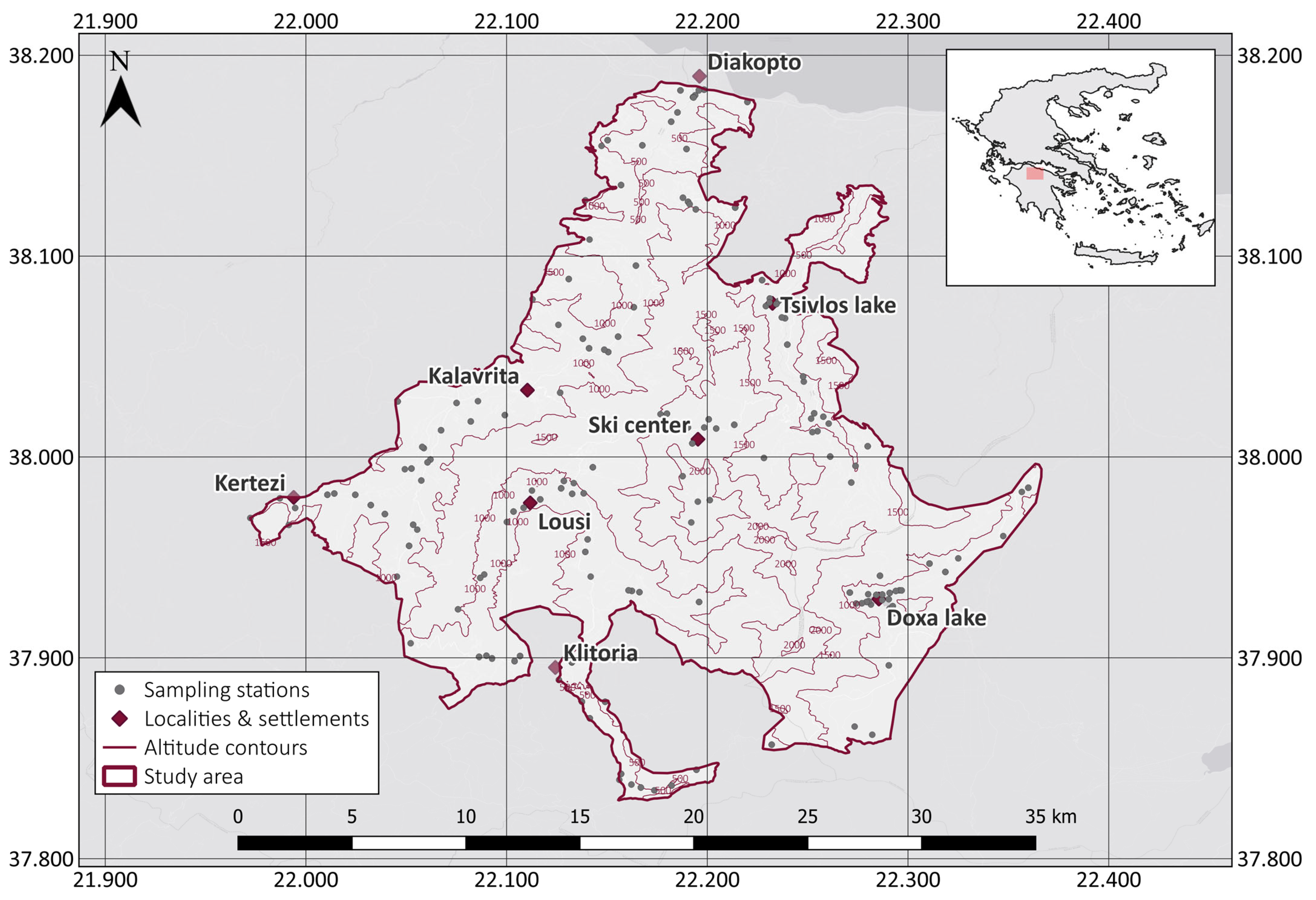
The study was conducted on Mount Chelmos (maximum altitude: 2338 m) within the Chelmos-Vouraikos National Park in the Peloponnese, Greece. The region experiences a typical Mediterranean climate, characterized by hot, dry summers and pronounced summer drought [25]. The study area covered 568 km2 (Figure 1).

2.2. Sampling Design

We employed a stratified random sampling design. The study area was first divided into four 400-m altitude zones. The number of sampling stations per zone was allocated proportionally to the area of each zone. Within each zone, stations were further stratified across four main habitat types: shrubland, grassland/meadow, forest, and heterogeneous agricultural areas. An equal number of stations was targeted for each habitat type, with their distribution within an altitude zone proportional to the local coverage of that habitat.
To ensure comprehensive sampling of amphibians, which depend on aquatic habitats, additional stations were added during fieldwork in areas with unmapped water bodies. These sites were also valuable for assessing reptile diversity. In total, 168 sampling stations were established across the altitude zones: 0–400 m (n = 11), 401–800 m (n = 67), 801–1200 m (n = 76), and 1201–2200 m (n = 14). By habitat, stations were distributed as follows: shrubland (n = 40), grassland/meadow (n = 41), forest (n = 45), and heterogeneous agricultural areas (n = 42).

2.3. Field Surveys and Data Collection

Fieldwork was conducted from March 2018 to April 2021. Of the 168 stations, 88 were visited six times across seasons (twice each in spring-early summer, late summer-early autumn, and late autumn-winter). The remaining 80 stations were visited 2–3 times. Surveys employed time-constrained searches combined with visual encounter surveys and active microhabitat searches [27]. Sampling effort was standardized as human-hours (survey duration × number of observers).
All encountered reptile and amphibian species were identified. For captured individuals, standard morphometric measurements (e.g., Snout to Vent Length) were taken in the field using calipers (lizards, amphibians) or a measuring tape (snakes, legless lizards, chelonians) to the nearest mm, and body mass was measured using a portable digital scale to the nearest gram (see Table S1 of Supplementary Materials for full list). These data contributed to the trait database. Geographic coordinates and altitude were recorded for each sampling station, whereas date and time were recorded for each sampling event. Observations from the same station, date, and time were treated as a single sampling event (session), resulting in a final dataset of 740 unique sessions across the 168 stations.

2.4. Environmental Variables

Land Cover: Land cover data were primarily sourced from the Corine Land Cover 2018 database [28] and refined using field observations in QGIS v3.28.2 [29] to correct mismatches. Linear hydrographic and road network features from the Hellenic Institute of Transport (HIT) [30] were incorporated. For each station, a composite polygon layer was created by manually digitizing and applying variable-width buffers to water bodies and roads (Table S2, Figure S1 of Supplementary Materials). The proportional area of each land cover type within each station’s buffer was calculated. A Principal Component Analysis (PCA) on these proportions reduced the data to two axes (LandCover PC1 and LandCover PC2), which together explained 20% of the variance and captured the primary land cover gradients (Figures S2 and S4 of Supplementary Materials).
Climate: Nineteen bioclimatic variables were obtained from WorldClim v2.1 (1970–2000 period, ~1 km2 resolution) [31]. A PCA was performed on these variables, and the first principal component (Climate PC1), explaining 81% of the variance, was retained. This axis primarily represented a gradient from warm/dry (positive scores) to cool/rainy (negative scores) conditions (Figures S3 and S4 of Supplementary Materials).
Topography: Slope and aspect data were extracted from a global 1-km2 resolution dataset [32] using bilinear interpolation. Altitude was recorded in situ.

2.5. Trait Data Compilation

Trait databases were compiled for all recorded reptile (18 traits) and amphibian (19 traits) species (species list: Table S3 of Supplementary Materials; trait lists: Tables S4 and S5 of Supplementary Materials). Selected traits aimed to cover key ecological functions: resource acquisition, life history, and habitat use. Data were synthesized from published databases [33,34,35,36], the literature, museum specimens (Zoological Museum, University of Patras; Natural History Museum of Crete), and our field measurements.
For continuous traits (e.g., Snout to Vent Length), we calculated a grand mean across sources so that field measurements would not bias values for species with extensive prior documentation. Binary and categorical traits were treated as presence-absence variables (1/0). When species-level information was missing, values were inferred from closely related or congeneric taxa.
Following the definition of functional traits provided earlier in the Introduction, we deliberately chose not to include the term “functional” when referring to the traits used in this study. This is because these traits represented mean values, which does not allow for confirmation of their true functional role. Nevertheless, trait-level analyses provide an additional framework for studying community assembly and contribute functionally relevant insights when compared to analyses conducted solely at the taxonomic level.

2.6. Statistical Analysis

All analyses were carried out separately for reptiles and amphibians in R version 4.5.2 [37] using RStudio version 2026.1.0.392 [38]. The workflow involved quantification of functional diversity, construction of a multidimensional traitspace, and modeling their responses to environmental gradients. Species abundances were defined as total observations per species within each sampling session, and all analyses were performed at the session level.

2.6.1. Functional Diversity Index

Functional diversity was quantified using Rao’s Quadratic Entropy [39], corrected for comparability with taxonomic diversity [40]. Computations were implemented using the FD package [41] and required a species-by-traits matrix and a species-by-session abundance matrix. Binary traits were treated as continuous (0–1 values), allowing community-weighted means (CWMs), defined as the abundance-weighted average trait value of species present in each sampling session [42], to reflect intermediate trait expression across species assemblages.
Sessions containing no detections were excluded. Such cases arose because reptiles and amphibians were analyzed separately, and several sessions contained only one of the two groups.
Functional diversity was interpreted within the framework of a multidimensional traitspace [43], in which each trait defines one axis of a T-dimensional ecological space. Species positions within this space represent their functional dissimilarities. This conceptual structure underlies both the computation of Rao’s index and the derivation of CWMs used to describe community-level functional composition.

2.6.2. Modeling Functional Diversity (Rao’s Q)

The response of Rao’s Q to environmental gradients was modeled using Generalized Additive Models (GAMs) [44] fitted with the mgcv package [45]. Because Rao’s Q is bounded between 0 and 1, a quasibinomial family with a logit link was used to accommodate potential overdispersion. The full model structure was:
Functional diversity (Rao’s Q)s,t = month of sessiont + altitudes + geographic locations + land covers + climates,t + slopes + aspects + taxonomic diversity (Simpson’s)s,t
where s is the space (in coordinates), and t is the time (day of year and hour of day) of a sampling session. Smooth terms were included for month of visit, altitude, climate, slope, aspect, geographic location, and land cover. Month was modeled using a cyclic cubic spline to account for periodicity, whereas all other univariate predictors used thin-plate regression splines. Geographic location and land cover were included as bivariate smooths using PCA axes. Although geographic location typically operates at broader spatial scales than those examined here, it was retained to remove potential large-scale spatial trends that could influence trait-based patterns.
To prevent overfitting while allowing for sufficient flexibility, knots were restricted. Taxonomic diversity (Simpson’s index) [46] was included as a fixed linear term to account for the expected positive association between taxonomic and functional diversity.
A double-penalty approach [47] was applied, enabling the model to shrink non-informative smooths toward zero. Model adequacy was evaluated using residual diagnostics. Further details on pre-model correlation checks, knot selection and predictor diagnostic outputs are provided in Supplementary Materials Text S1.

2.6.3. Traitspace Analysis

Traitspace was constructed by performing a Principal Component Analysis (PCA) on the trait covariance matrix. The first four principal components were retained, as they captured the major axes of functional differentiation for both reptile (together explained 58.4% of the variance) and amphibian (together explained 80.7% of the variance) assemblages.
Community functional composition was expressed through CWMs and projected onto the retained PCs to generate a sessions-by-PC-scores matrix. Traitspace responses were then modeled using multivariate GAMs (mGAMs) with a Gaussian distribution. The predictor structure, smoothing techniques, basis functions, penalization strategy, and diagnostic procedures followed those described for the Rao model. The full model structure was:
Traitspace (CWM)s,t = month of sessiont + altitudes + geographic locations + land covers + climates,t + slopes + aspects + taxonomic diversity (Simpson’s)s,t

2.6.4. Visualization

Marginal effects of predictors were visualized using ggplot2 version 4.0.1 [48]. For spatial synthesis in the Results, the effects of spatiotemporal predictors were displayed jointly to map the predicted functional diversity and traitspace patterns across the landscape, in alignment with recent studies pursuing similar objectives, albeit through different methodological frameworks [49].

3. Results

3.1. Functional Diversity in Reptiles: Environmental Drivers and Spatiotemporal Patterns

For model clarity, the effects of the control variables (month of visit and geographic location) are not depicted in the plots; complete statistical outputs for all predictors are provided in Tables S6 and S7 (Supplementary Materials).
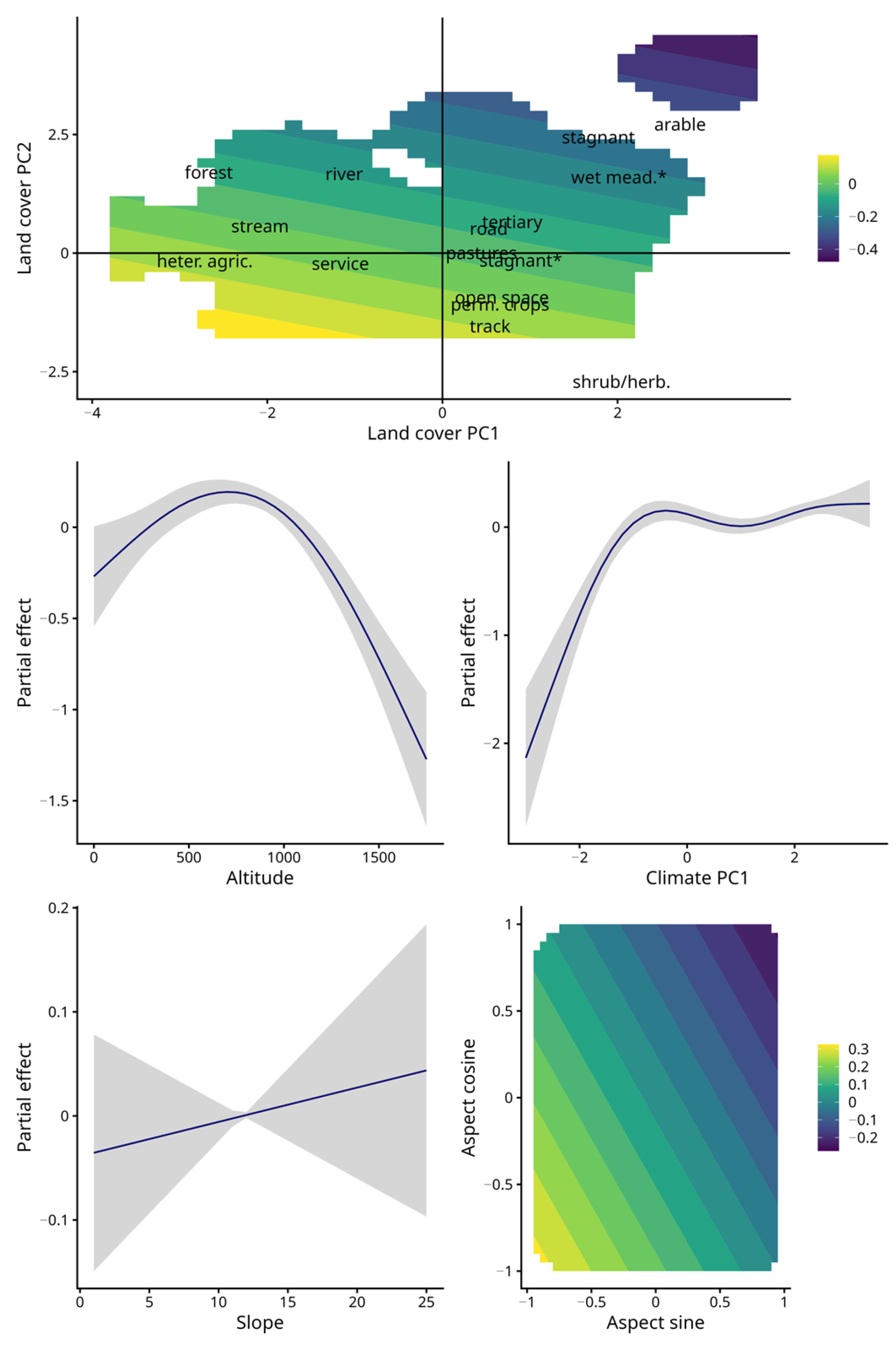
Environmental predictors had varied effects on reptile functional diversity (Rao’s Q). Land cover showed a non-significant tendency, with diversity increasing from arable land toward heterogeneous agricultural areas and shrublands (Figure 2). Altitude had a significant, non-linear effect (Table S6): functional diversity increased slightly, plateaued between 600–800 m, and then declined at higher altitudes (Figure 2). Climate (represented by PC1: a gradient from cool/rainy to warm/dry) also had a significant effect, with diversity increasing linearly with warmer, drier conditions before stabilizing (Figure 2). Slope was non-significant, whereas aspect was significant, showing a trend of higher diversity on southwestern slopes (Figure 2). Taxonomic diversity (Simpson’s index) was a significant positive predictor, whereas geographic location and month were not (Table S6).
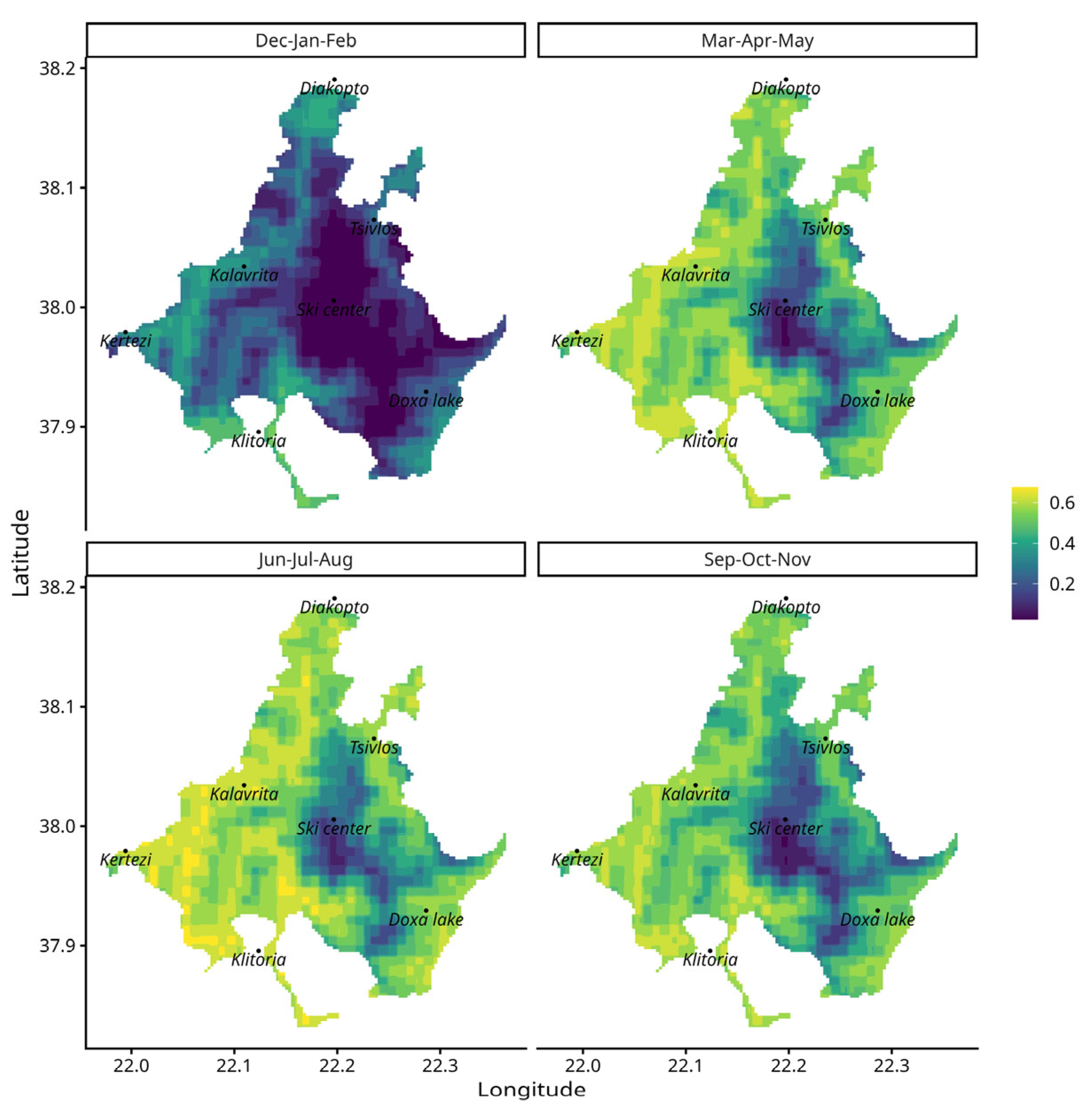
The spatial distribution of predicted functional diversity revealed distinct patterns. Higher values were consistently predicted along the western periphery of the study area, from Diakopto (Vouraikos Gorge beginning) south to Klitoria and west toward Kertezi. On the eastern side, high-diversity areas were associated with Lake Tsivlos and Lake Doxa. In contrast, the central Chelmos massif exhibited lower functional diversity overall (Figure 3). Temporally, predicted diversity was lowest during the winter months compared to other seasons (Figure 3).

3.2. Functional Diversity in Amphibians: Environmental Drivers and Spatiotemporal Patterns

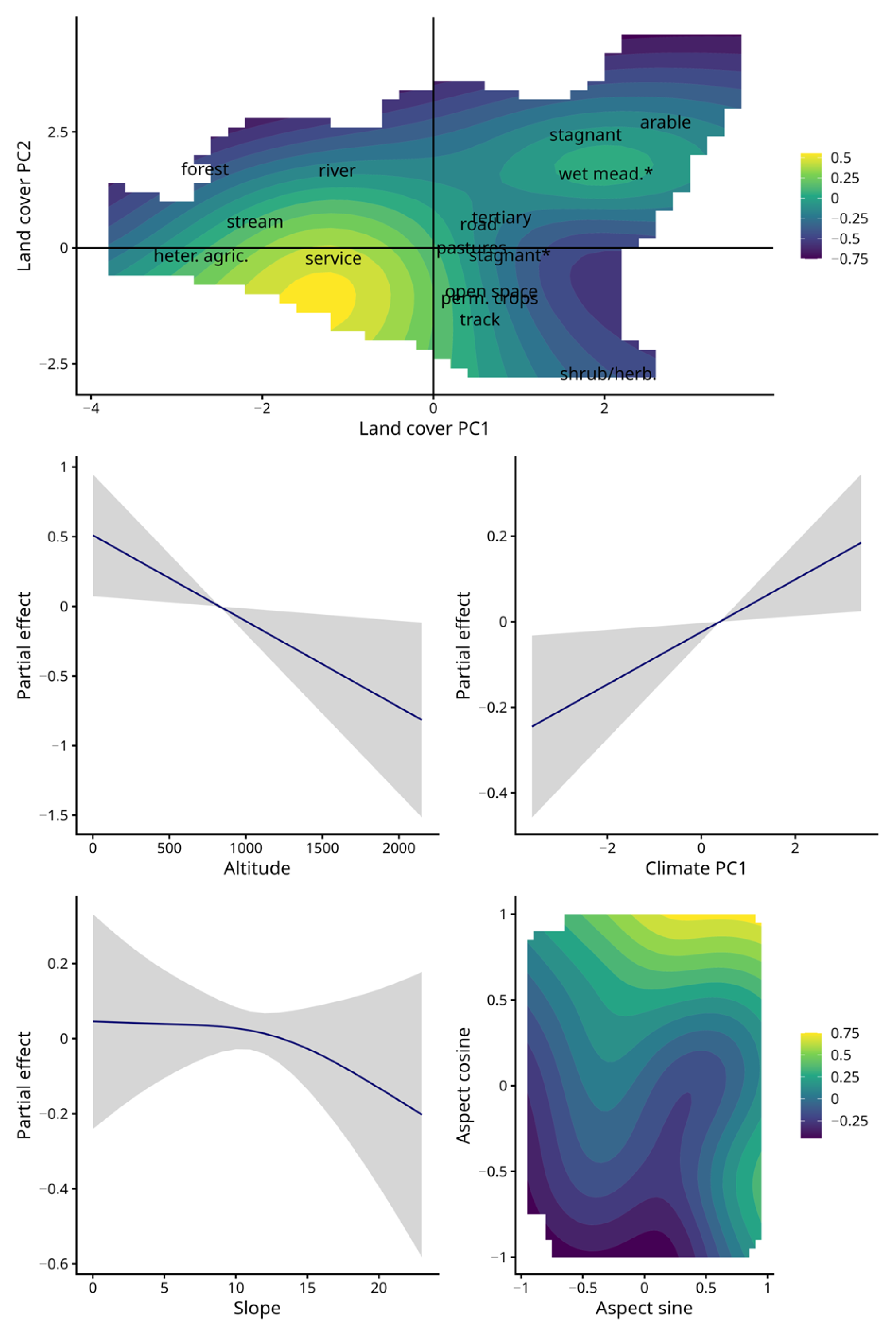
For amphibians, none of the environmental predictors had a statistically significant effect on functional diversity (Table S7 of Supplementary Materials). However, notable tendencies were observed, largely mirroring the patterns seen in reptiles. Land cover trends indicated higher functional diversity in wet meadows, permanent stagnant-water collections, dirt roads (service), heterogeneous agricultural areas, and streams (Figure 4). Diversity showed a linear decline with increasing altitude and a general increase with warmer, drier climatic conditions (Figure 4). Slope showed no clear pattern, whereas northern and eastern aspects were associated with higher predicted diversity (Figure 4). As with reptiles, taxonomic diversity was a significant positive predictor for all indices (Table S7).
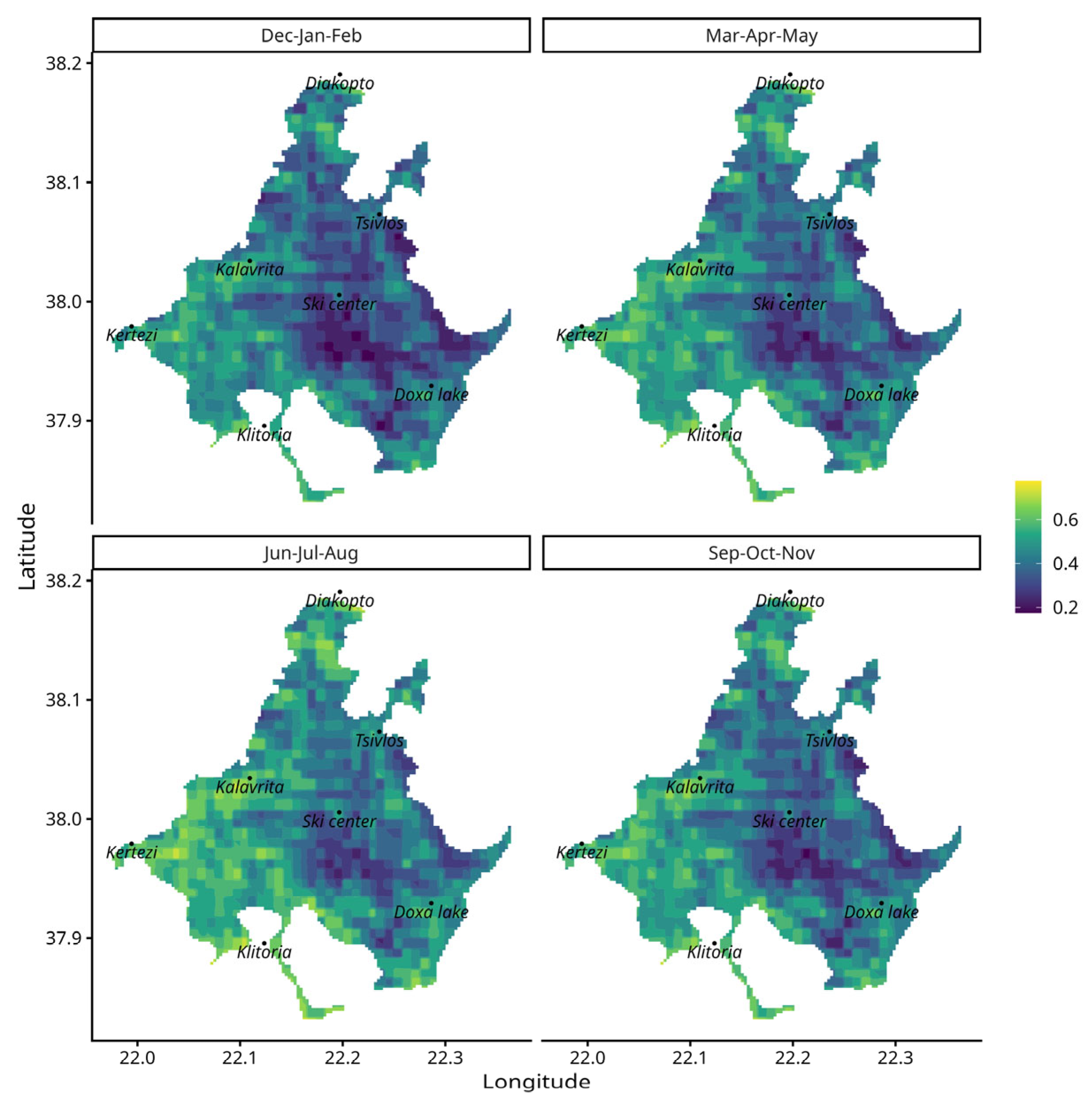
Spatiotemporal predictions for amphibians broadly aligned with reptile patterns but were more spatially restricted, with pockets of very high diversity. No substantial seasonal differences were detected (Figure 5).

3.3. Traitspace Composition for Reptiles and Amphibians

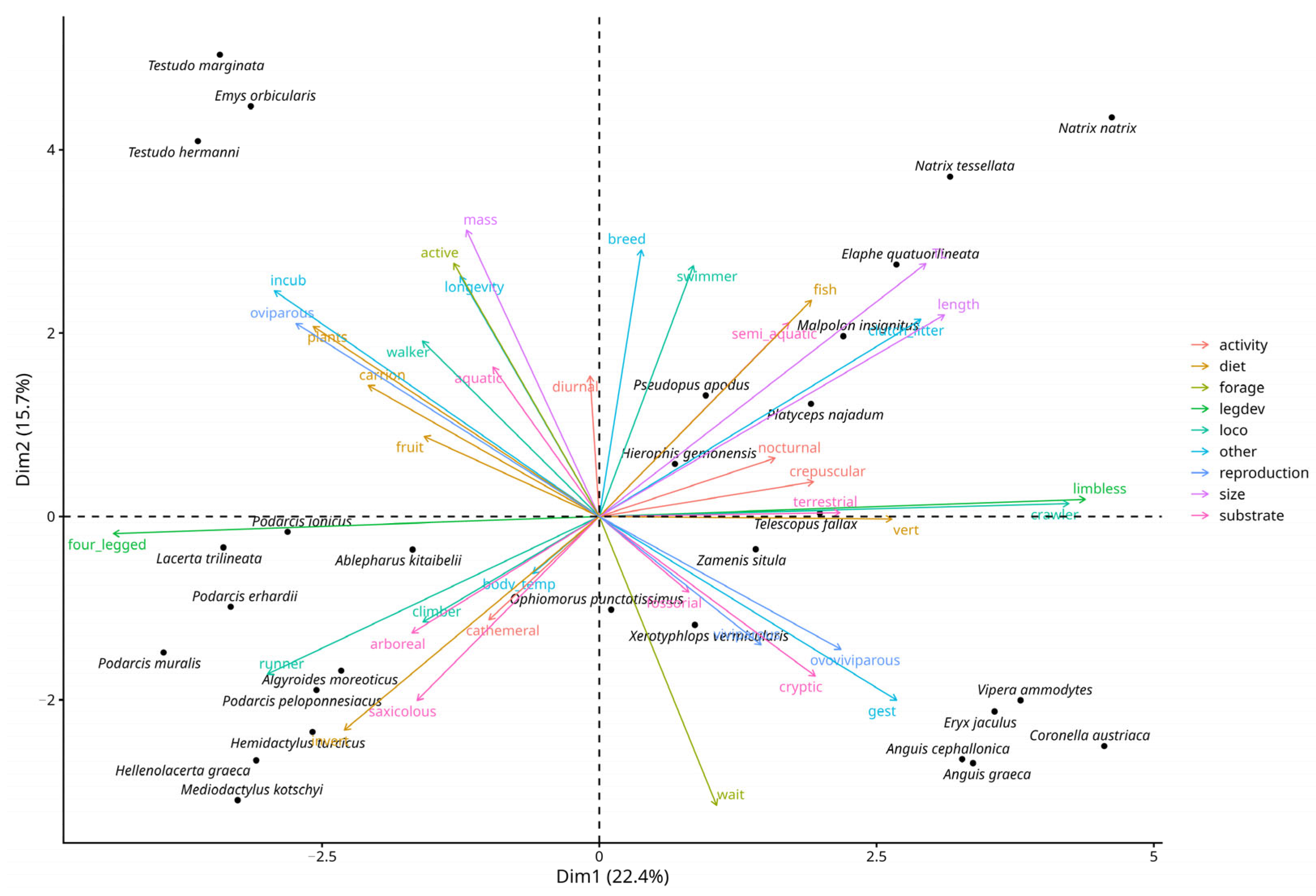
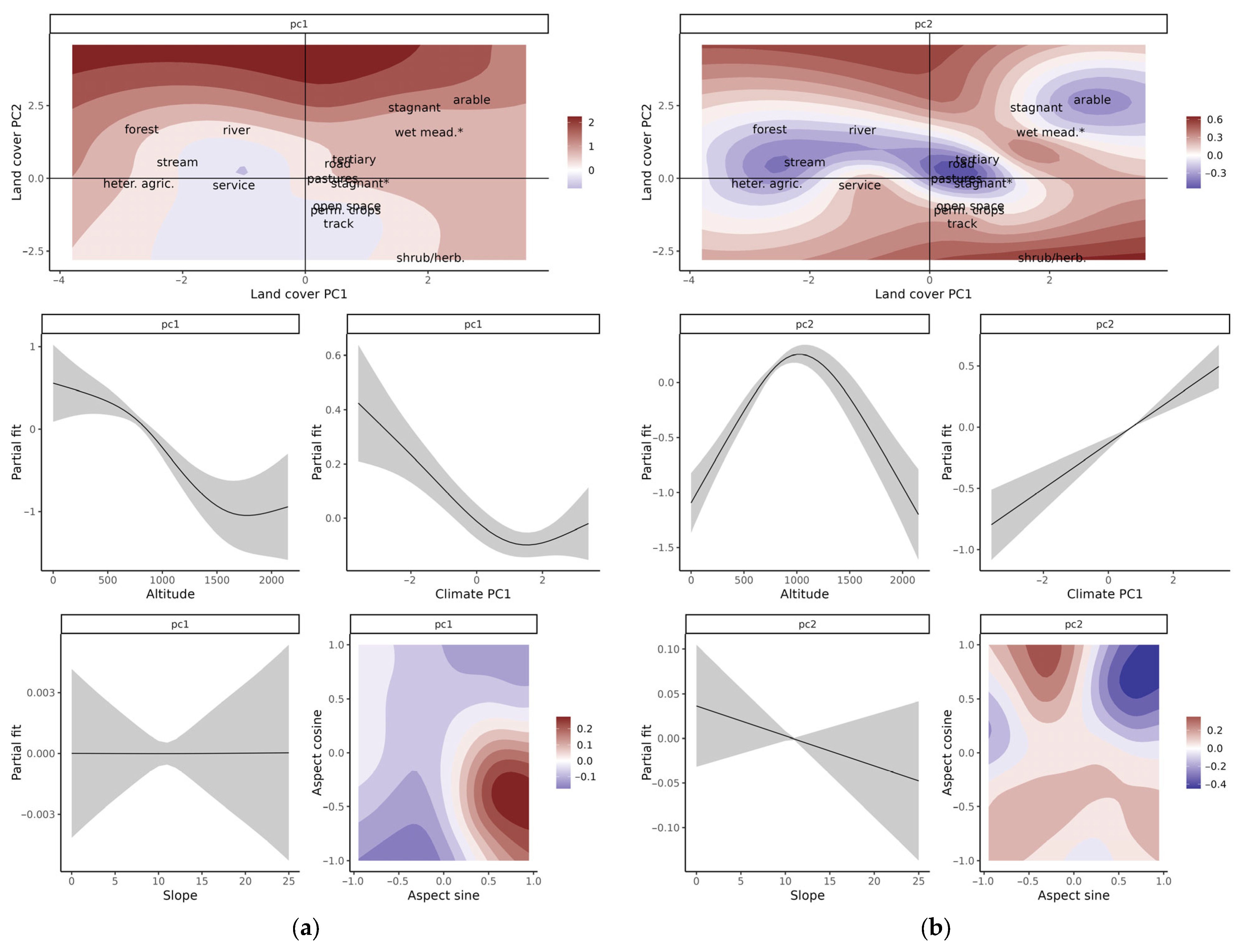
Reptiles: The first two principal components (PCs) of the reptile traitspace are shown in Figure 6, with significant trait loadings detailed in Table S8 and Figure S6 (Supplementary Materials). PC1 (Figure 6) represented a primary axis contrasting two major ecological syndromes. High positive loadings were associated with a “secretive, live-bearing predator” strategy (E1): limbless morphology, crawling locomotion, large body size (length [SVL—Snout to Vent Length, CCL—Carapace Curved Length], total length; see Table S4 of Supplementary Materials), large clutch/litter size, long gestation, a diet including small vertebrates and fish, ovoviviparity, terrestrial/cryptic substrate use, and crepuscular activity. High negative loadings described a “mobile, egg-laying generalist” strategy (E2): four-legged morphology, running locomotion, oviparity with protracted incubation, and a diet including plants, invertebrates, and carrion.
PC2 (Figure 6) contrasted traits related to “high-investment, active foraging, aquatic generalist” strategies (positive loadings: large body mass and total length, late maturity, active foraging, swimming/walking locomotion, high longevity, fish/plant diet, large clutch size, semi-aquatic substrate use, oviparity—E3) against “energy-conserving, ambush, terrestrial invertebrate specialist” strategies (negative loadings: ambush-sit and wait-predation, invertebrate diet, saxicolous/cryptic substrate use, long gestation—E4).
PC3 (Table S8, Figures S6 and S7 of Supplementary Materials) further separated “arboreal/climbing” strategies (positive: climbing, oviparity, arboreal/saxicolous, fish diet—E5) from “K-selected, ground-dwelling” strategies (negative: high longevity, late reproduction, long gestation, cryptic habitat, viviparity, walking, large mass—E6).
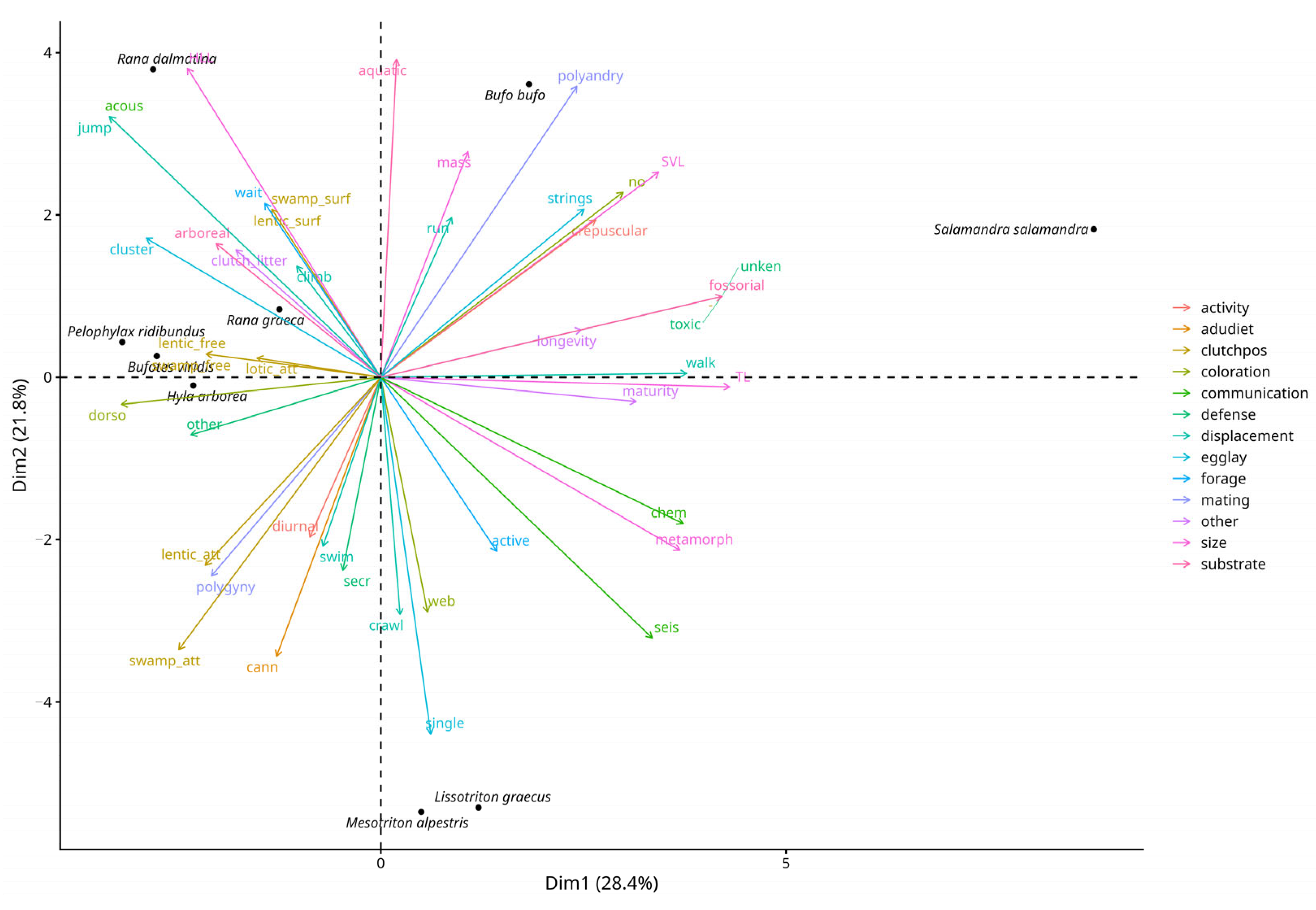
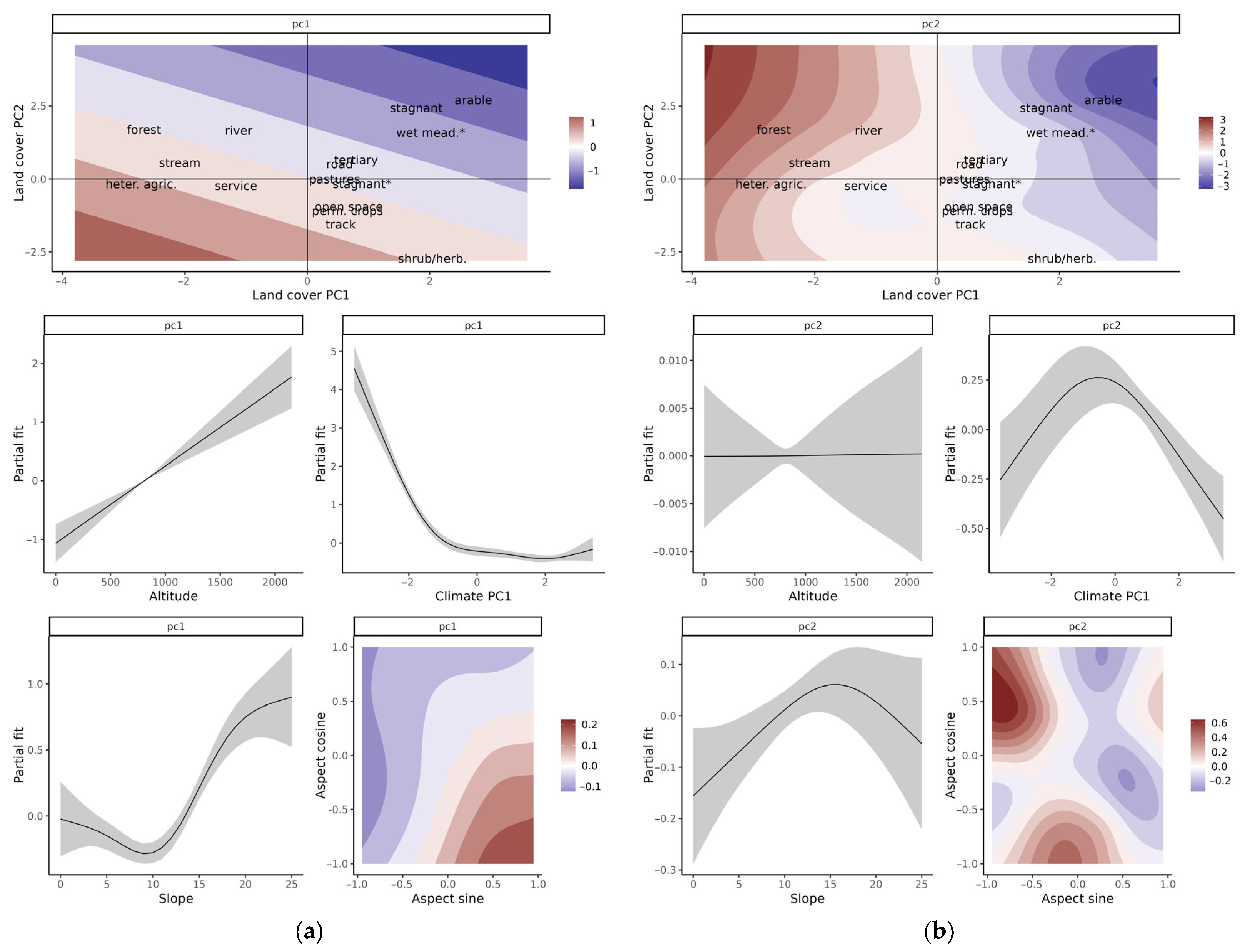
Amphibians: For amphibians (Figure 7; Table S9, Figures S8 and S9 of Supplementary Materials), PC1 (Figure 7) contrasted a “large-bodied, defensive terrestrial” strategy (positive: large body size [TL—Total Length, SVL], sit-and-wait foraging, chemical/seismic communication, defensive traits [unken reflex, toxicity], ovoviviparity, walking—A1) against a “vocal, saltatory” strategy (negative: acoustic communication, jumping locomotion—A2).
PC2 with a “lentic-breeding, cannibalistic” strategy (negative: single-egg deposition in swamps, cannibalism—A3).

3.4. Environmental Filtering of Reptile Traitspace

For traitspace interpretation, we focus primarily—though not exclusively—on (i) statistically significant trait effects, (ii) traits with at least two contrasting categories at opposite ends of an axis, as these contrasts are ecologically informative and (iii) we focus mainly on results with ecological relevance. For continuous traits, positive and negative loadings inherently occupy opposite ends of an axis. Complete statistical outputs for all predictors and each PC are provided in Table S10 of the Supplementary Materials. PC1 and PC2 are presented below (Figure 8 and Figure 9), whereas PC3 and PC4 are shown in Figures S10 and S11 (Supplementary Materials).
The first syndrome (E1: secretive, live-bearing predator) was favored in arable land and permanent stagnant-water collections and persisted up to ~1000 m. It was associated with higher precipitation, lower temperatures, and east-facing aspects. All environmental filters except slope significantly affected E1 (Figure 8a).
The second syndrome (E2: mobile, egg-laying generalist) increased in open spaces, permanent crops, and dirt roads (track and service). It dominated above ~1000 m but co-occurred with E1 below this threshold. E2 decreased with increasing precipitation and did not characterize east-facing aspects. Environmental filtering, although statistically significant, was weaker for E2 compared with E1, except for land cover. E2 occurred across most altitude and climate conditions and frequently balanced E1 (Figure 8a).
The third syndrome (E3: high-investment, active foraging, aquatic generalist) prevailed in shrublands, occurred at intermediate altitudes (~1000 m), and dominated under higher temperatures and most aspects except northeast. Its opposite, E4 (energy-conserving, ambush, terrestrial invertebrate specialist), prevailed under complementary environmental conditions (Figure 8b). All environmental filters except slope significantly affected E3 and E4 (Figure 8b).
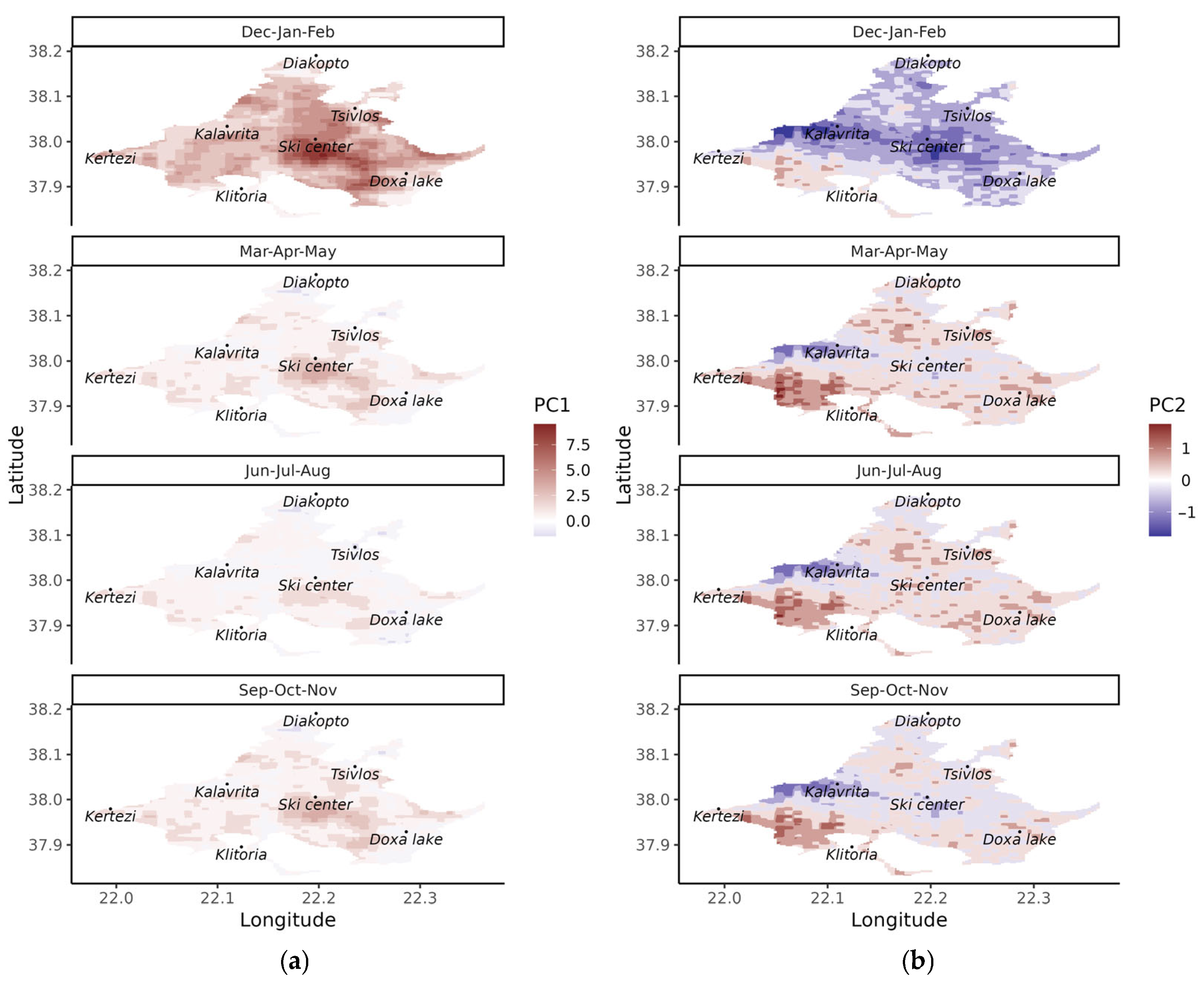
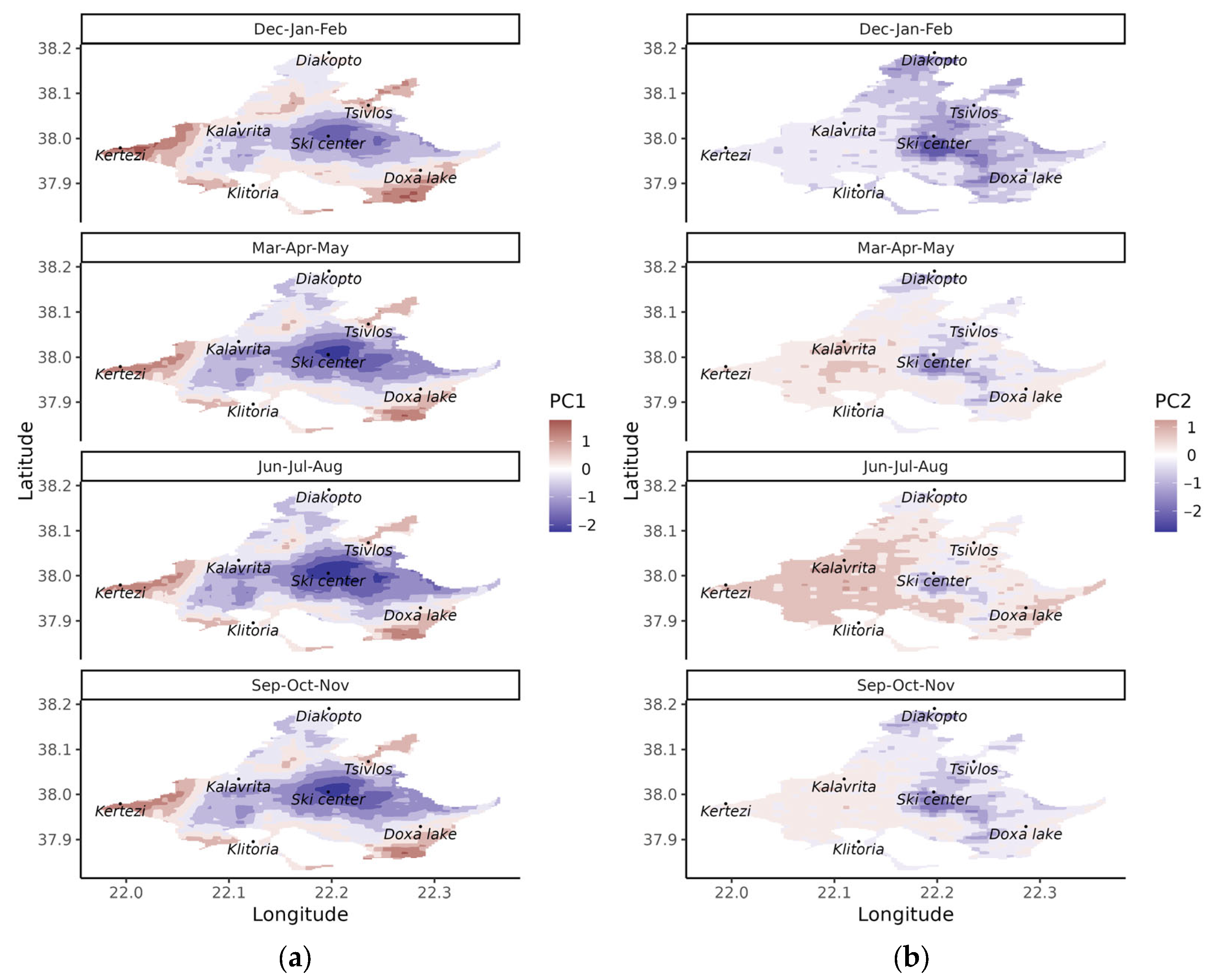
Spatially, E1 occurred around the periphery of the massif and near Lakes Doxa and Tsivlos. E2 dominated the massif and eastern mountainous areas. Locations with water and mid-altitudes exhibited near-zero PC1 values, indicating overlap between E1 and E2 (Figure 9a). Foraging strategies varied seasonally: E3 dominated in spring-summer in western areas, whereas E4 dominated in autumn-winter on and east of the massif (Figure 9b). E5 dominated the massif and eastern mountainous areas especially in summer-autumn versus E6 which dominated central-western areas in winter-spring (Figure S11a of Supplementary Materials).

3.5. Environmental Filtering of Amphibian Traitspace

Statistical outputs for all predictors and each PC appear in Table S11 (Supplementary Materials). PC1 and PC2 are presented below (Figure 10 and Figure 11), whereas PC3 and PC4 are shown in Figures S12 and S13 (Supplementary Materials). The first syndrome (A1: large-bodied, defensive terrestrial) predominated in heterogeneous agricultural areas and showed significant trend to increase with altitude. A1 was favored under higher precipitation, steeper slopes, and southeast aspects. All environmental predictors acted as primary filters for this syndrome (Figure 10a).
The second syndrome (A2: saltatory, acoustic) was favored in arable land and permanent stagnant-water collections. Its trends opposed those of A1 for altitude, climate, slope, and aspect. A2 remained stable under warmer and intermediate conditions and low-moderate slopes (Figure 10a).
The third syndrome (A3: lentic-breeding, cannibalistic—negative values) was strongly associated with arable land, permanent stagnant-water collections and wet meadows, non-intermediate climatic conditions, northern and eastern aspects (Figure 10b).
Seasonally, A1 dominated in winter, whereas A1–A2 balances were observed in other seasons (Figure 11a). A3 was favored year-round in the western region near Kalavrita and across winter in the entire region except the south-western part (Figure 11b).

4. Discussion

This study integrates functional diversity metrics and multidimensional trait analysis to elucidate how environmental filters shape reptile and amphibian communities on Mount Chelmos, Greece. Our findings reveal that abiotic filtering is the dominant assembly process, but its strength and manifestation differ fundamentally between the two taxonomic groups. Below, we analyze the drivers of functional diversity, decode the ecological syndromes emerging from the traitspace, integrate our functional results with previous taxonomic findings, and synthesize the implications for biodiversity in mountainous ecosystems.
Our analyses isolate the effect of individual environmental predictors while statistically controlling for others (e.g., removing the direct temperature signal when assessing altitude). Nevertheless, we acknowledge the inherent indirect relationships and synergistic effects among variables, a common challenge in ecological modeling [50]. Therefore, interpretations are considered in a holistic context.

4.1. Environmental Drivers of Functional Diversity

The analysis of Rao’s Quadratic Entropy revealed a clear contrast: environmental filters were strong and significant for reptiles, but non-significant for amphibians.
For reptiles, altitude, climate, and aspect were key drivers. As ectotherms, reptile diversity is intrinsically linked to thermal physiology [51]. Altitude creates a composite gradient of decreasing temperature and microhabitat complexity [52], explaining the non-linear response where functional diversity peaked at mid-altitudes (600–800 m). Aspect further refined this thermal landscape. The higher diversity predicted on southwestern aspects aligns with warmer, heterogeneous conditions that provide diverse thermoregulatory opportunities and refuges [53,54], a pattern accentuated by local wind regimes [55]. This resulted in spatially predictable hotspots of functional diversity in mid-altitude plateaus and basins with aquatic influence, such as the Kalavrita-Kertezi-Klitoria region, the peripheries of Lakes Doxa and Tsivlos and in the Vouraikos Gorge, extending from Diakopto to Kalavrita (Figure 1 and Figure 3).
In stark contrast, no environmental predictors had a statistically significant effect on amphibian functional diversity. This likely stems from the limited regional species pool (n = 9). The non-significant tendencies observed—such as increased diversity near water bodies [16]—mirror reptile patterns but lack statistical power. Amphibians’ broader physiological tolerance to lower temperatures [56] may also render them less sensitive to the fine-scale environmental filters that strongly structure reptile communities.

4.2. Trait Syndromes, Traitspace Composition and Environmental Filtering

Reptile patterns: The traitspace analysis for reptiles in Mount Chelmos reveals two main ecological syndromes along PC1, expressed through the contrast between E1 (secretive, live-bearing predator) and E2 (mobile, egg-laying generalist). These two syndromes reflect well-established alternative strategies in reptile evolutionary ecology. E1 follows a slower and more buffered life-history route, which is consistent with the advantages viviparity or ovoviviparity offers when developmental conditions are unpredictable or thermally unstable [57]. E2 sits on the opposite side of this continuum: its reliance on oviparity and faster life histories allows for flexibility and quicker population responses when conditions favor rapid turnover. The fact that both syndromes appear strongly in the traitspace suggests that the reptile assemblage in Mt. Chelmos supports more than one viable functional strategy. Such coexistence fits with what has been shown for other reptile communities, where differences in movement, habitat use, and foraging strategies help reduce direct competition and allow species to “spread out” in the traitspace by occupying different niches [58,59,60].
These differences along PC1 also extend to the ways species handle prey and the types of microhabitats they use. E1 generally follows a more specialized predatory route and often relies on cryptic or fossorial-associated behaviors. In contrast, E2 tends to cope with a wider range of food resources and shows greater flexibility in how they move through and exploit their surroundings. Such contrasts are very much in line with the expectation that niche overlap decreases when species rely on a variety of conditions [61]. Reproductive strategies can be placed within this same framework. Shifts between producing numerous offspring (E2—more flexible) and investing more heavily in fewer young (E1—with filters such as altitude) are well documented across reptiles and reflect long-standing ideas about how organisms balance development, stability, and energetic cost [54,62].
A second major gradient appears along PC2, which separates E3 (high-investment, active foraging, aquatic generalist) from E4 (energy-conserving, ambush, terrestrial invertebrate specialist). These two approaches are familiar from classical foraging theory. Active foraging requires sustained metabolic effort and behavioral flexibility, whereas ambush strategies minimize energy costs and rely heavily on opportunity [63,64]. The presence of both ends of this spectrum in Mt. Chelmos indicates that the reptile assemblage spans a considerable range of energetic and behavioral modes, something that usually signals long-term functional stability in communities with diverse thermal and metabolic demands.
Further differentiation in the traitspace is revealed through substrate-related syndromes (PC3—E5 arboreal/climbing and E6 K-selected, ground-dwelling). Climbing, using rocks or exploiting vertical surfaces, differs markedly from specializing in cryptic or fossorial substrate use. Adaptation to rocky terrain often involves specific limb elongation [65], whereas cryptic or burrowing lifestyles rely on entirely different sets of behavioral strategies to avoid predators, heat, or desiccation. This can be achieved by inhabiting loose substrates such as sand, soil, litter or by hiding under rocks/logs [66]. The aforementioned distinctions underscore the importance of microhabitat specialization as a dimension of functional differentiation beyond pure climatic or life-history attributes.
Altogether, the reptile traitspace in Mt. Chelmos illustrates a system where no single strategy dominates. Instead, the presence of E1–E2, E3–E4 and E5–E6 along the three axes shows how different combinations of life-history pace, metabolic strategy, trophic roles, and microhabitat specialization can all be successful within the same regional pool. This mosaic of ecological approaches provides a compelling explanation for the functional breadth observed in the area and aligns with broader ecological theory regarding how reptile assemblages maintain diversity in complex Mediterranean landscapes [67].
Amphibian Patterns: The A1 (large-bodied, defensive terrestrial—PC1) syndrome aligns with established links between slow, energetically conservative movement and strategies such as crypsis or toxicity [68]. Also, the association between increased body size and productive aquatic habitats [18] and the larger metamorphosis size under slow or cold-dependent development [69] reinforce long-established life-history predictions. Species in A1 (mainly Salamandra salamandra in our occasion) tend to withstand colder or more variable conditions and make substantial use of terrestrial refuges. Their life histories reflect a combination of low mobility and strong reliance on terrestrial refuges, suggesting an ecological strategy in which limited movement is offset by tolerance to environmental stress and effective use of structurally complex microhabitats.
The A2 syndrome in contrast (saltatory, acoustic—PC1), reflects the typical anuran strategy. It includes smaller-bodied species that depend on jumping and acoustic signaling, that support rapid escape, effective mating communication, and flexible interactions with both aquatic and terrestrial environments. Acoustic signals travel efficiently under low visibility [70]. A2 often occupies a wider niche than A1, as saltatory locomotion and acoustic communication facilitate movement among patches and exploitation of seasonally available resources.
The A3 syndrome (lentic-breeding, cannibalistic—PC2) captures traits characteristic of newts with high-investment reproductive modes, including cannibalism and single-egg deposition. These strategies are closely tied to niche partitioning among co-occurring newt species (Lissotriton graecus and Mesotriton alpestris—former Ichthyosaura—in our case) and reflect the fine-scale ecological separation that has been documented in newt assemblages [71].
Altogether, these three syndromes further support how amphibians in Mt. Chelmos distribute across distinct ecological strategies, which are determined by locomotion, communication and reproduction modes. Overall, amphibians’ functional spectrum is more constrained than reptiles’, reflecting narrower physiological tolerances and fewer available evolutionary pathways. The separation among A1, A2, A3 reveals a clear partitioning of ecological strategies. At the same time, the structure of the traitspace suggests that several species are characterized by similar combinations of traits, pointing to a degree of functional overlap.

4.3. Concordance and Divergence Between Taxonomic and Functional Diversity

Comparing our functional results with prior taxonomic diversity findings [24] reveals important insights. Reptiles show strong agreement between taxonomic and functional diversity in response to land cover, altitude, climate, and aspect. Both diversity measures decrease along the mountain massif and increase towards the foothills and outer margins, with key hotspots in the Kalavrita-Kertezi and Klitoria basins, as well as Lake Doxa (see Figure 1 for the locations). The concordance of these patterns supports the complementarity hypothesis, where added species introduce unique functional roles, enhancing ecosystem processes through niche differentiation [2,72]. Amphibians show a fundamental discrepancy: taxonomic diversity responds significantly to environment, whereas functional diversity does not. This suggests functional redundancy, where different species perform similar ecological roles, decoupling functional from taxonomic response [73,74]. However, the small species pool cautions against overinterpretation, as limited sample size can reduce statistical power to detect significant functional patterns.

4.4. Mount Chelmos as a Diversity-Modulating System

Our study consolidates the view of Mount Chelmos as a complex, fine-to-medium-scale regulator of biodiversity. The massif itself acts as an abiotic filter selecting for a restricted set of traits (e.g., E2 in reptiles), supporting lower diversity, whereas its heterogeneous periphery (foothills, plateaus, and riparian corridors) function as diversity accumulation zones—characterized by intermediate climates, hydrological networks, and varied topography—and acts as a biodiversity hotspot. This pattern is consistent with the role of mountains in generating and maintaining diversity through processes like vicariance, adaptive divergence, and by serving as refugia [75,76]. The significant environmental effects detected at our study scale confirm that mountainous systems are ideal natural laboratories for disentangling the effects of ecological filters.

4.5. Conservation Implications and Future Directions

In summary, based on our findings, mountainous systems function as regulators of ecological diversity. The spatial mismatch between areas of high value (the foothills and basins) and the mountain core underscores a key conservation insight: effective management must adopt an ecosystem-scale perspective. Protection of the mountain massif alone is insufficient; the surrounding landscapes—characterized by the highest functional and taxonomic diversity—are equally critical. Future research should integrate finer-scale habitat composition data to better quantify microhabitat availability and directly assess biotic interactions like competition, which our models could only infer indirectly. Furthermore, longitudinal studies could clarify how the trait-based assembly rules identified here respond to climatic shifts.
In conclusion, our trait-based approach confirms that Mount Chelmos functions as a finely tuned environmental filter, particularly for reptile communities, with altitude, climate, and aspect interacting to produce a mosaic of functional strategies. The decoupled response in amphibians highlights how taxonomic diversity alone can be a misleading indicator of ecosystem function. This work reinforces the value of functional trait analysis in uncovering the mechanistic basis of community assembly in complex mountain landscapes.

Supplementary Materials

The following supporting information can be downloaded at: https://www.mdpi.com/article/10.3390/ecologies7010017/s1.

Author Contributions

Conceptualization, V.K.-S. and S.G.; methodology, V.K.-S., A.L., L.K.K., K.S. and S.G.; software, A.L.; validation, S.G.; formal analysis, V.K.-S., A.L. and L.K.K.; investigation, V.K.-S. and L.K.K.; resources, S.G.; data curation, V.K.-S. and A.L.; writing—original draft preparation, V.K.-S.; writing—review and editing, A.L., K.S. and S.G.; visualization, V.K.-S., A.L. and L.K.K.; supervision, S.G.; project administration, S.G.; funding acquisition, S.G. All authors have read and agreed to the published version of the manuscript.

Funding

This research was funded by the State Scholarships Foundation (IKY), 2022-050-0502-52257.

Institutional Review Board Statement

This research did not require an Institutional Review Board Statement. All animal procedures were followed in strict compliance with relevant country’s laws and applicable ethical policies of the institutions involved. During the sampling sessions, no procedures were carried out that would cause harm and distress to the animals. All individuals were handled briefly and released at their capture location immediately after measurements.

Data Availability Statement

The raw data can be provided by the authors in case of interest.

Acknowledgments

Evangelos Tzanatos is acknowledged for his very constructive comments on the research. Many thanks to Giannis Daoultzis for his valuable contribution to the fieldwork.

Conflicts of Interest

The authors declare no conflicts of interest.

References

  1. Tilman, D. Functional Diversity. In Encyclopedia of Biodiversity; Elsevier: Amsterdam, The Netherlands, 2001; pp. 109–120. ISBN 978-0-12-226865-6. [Google Scholar]
  2. De Bello, F.; Carmona, C.P.; Dias, A.T.C.; Götzenberger, L.; Moretti, M.; Berg, M.P. Handbook of Trait-Based Ecology: From Theory to R Tools, 1st ed.; Cambridge University Press: Cambridge, UK, 2021; ISBN 978-1-108-62842-6. [Google Scholar]
  3. Violle, C.; Navas, M.; Vile, D.; Kazakou, E.; Fortunel, C.; Hummel, I.; Garnier, E. Let the Concept of Trait Be Functional! Oikos 2007, 116, 882–892. [Google Scholar] [CrossRef]
  4. Pearson, D.E.; Ortega, Y.K.; Eren, Ö.; Hierro, J.L. Community Assembly Theory as a Framework for Biological Invasions. Trends Ecol. Evol. 2018, 33, 313–325. [Google Scholar] [CrossRef]
  5. Sutton, L.; Mueter, F.J.; Bluhm, B.A.; Iken, K. Environmental Filtering Influences Functional Community Assembly of Epibenthic Communities. Front. Mar. Sci. 2021, 8, 736917. [Google Scholar] [CrossRef]
  6. Götzenberger, L.; De Bello, F.; Bråthen, K.A.; Davison, J.; Dubuis, A.; Guisan, A.; Lepš, J.; Lindborg, R.; Moora, M.; Pärtel, M.; et al. Ecological Assembly Rules in Plant Communities—Approaches, Patterns and Prospects. Biol. Rev. 2012, 87, 111–127. [Google Scholar] [CrossRef]
  7. Chesson, P. Mechanisms of Maintenance of Species Diversity. Annu. Rev. Ecol. Syst. 2000, 31, 343–366. [Google Scholar] [CrossRef]
  8. Cadotte, M.W.; Tucker, C.M. Should Environmental Filtering Be Abandoned? Trends Ecol. Evol. 2017, 32, 429–437. [Google Scholar] [CrossRef] [PubMed]
  9. Germain, R.M.; Mayfield, M.M.; Gilbert, B. The ‘Filtering’ Metaphor Revisited: Competition and Environment Jointly Structure Invasibility and Coexistence. Biol. Lett. 2018, 14, 20180460. [Google Scholar] [CrossRef]
  10. Weiher, E.; Freund, D.; Bunton, T.; Stefanski, A.; Lee, T.; Bentivenga, S. Advances, Challenges and a Developing Synthesis of Ecological Community Assembly Theory. Philos. Trans. R. Soc. B Biol. Sci. 2011, 366, 2403–2413. [Google Scholar] [CrossRef]
  11. Tsianou, M.A.; Lazarina, M.; Michailidou, D.-E.; Andrikou-Charitidou, A.; Sgardelis, S.P.; Kallimanis, A.S. The Effect of Climate and Human Pressures on Functional Diversity and Species Richness Patterns of Amphibians, Reptiles and Mammals in Europe. Diversity 2021, 13, 275. [Google Scholar] [CrossRef]
  12. Ochoa-Ochoa, L.M.; Mejía-Domínguez, N.R.; Velasco, J.A.; Marske, K.A.; Rahbek, C. Amphibian Functional Diversity Is Related to High Annual Precipitation and Low Precipitation Seasonality in the New World. Glob. Ecol. Biogeogr. 2019, 28, 1219–1229. [Google Scholar] [CrossRef]
  13. Tsianou, M.A.; Kallimanis, A.S. Geographical Patterns and Environmental Drivers of Functional Diversity and Trait Space of Amphibians of Europe. Ecol. Res. 2020, 35, 123–138. [Google Scholar] [CrossRef]
  14. Trimble, M.J.; Van Aarde, R.J. Amphibian and Reptile Communities and Functional Groups over a Land-use Gradient in a Coastal Tropical Forest Landscape of High Richness and Endemicity. Anim. Conserv. 2014, 17, 441–453. [Google Scholar] [CrossRef]
  15. Riemann, J.C.; Ndriantsoa, S.H.; Rödel, M.-O.; Glos, J. Functional Diversity in a Fragmented Landscape—Habitat Alterations Affect Functional Trait Composition of Frog Assemblages in Madagascar. Glob. Ecol. Conserv. 2017, 10, 173–183. [Google Scholar] [CrossRef]
  16. Rosas-Espinoza, V.C.; Peña-Joya, K.E.; Álvarez-Grzybowska, E.; Godoy-González, A.A.; Santiago-Pérez, A.L.; Rodríguez-Zaragoza, F.A. Amphibian Taxonomic and Functional Diversity in a Heterogeneous Landscape of West-Central Mexico. Diversity 2022, 14, 738. [Google Scholar] [CrossRef]
  17. Slavenko, A.; Allison, A.; Meiri, S. Elevation Is a Stronger Predictor of Morphological Trait Divergence than Competition in a Radiation of Tropical Lizards. J. Anim. Ecol. 2021, 90, 917–930. [Google Scholar] [CrossRef] [PubMed]
  18. Pitogo, K.M.E.; Saavedra, A.J.L.; Aurellado, M.E.B.; De Guia, A.P.O.; Afuang, L.E. Functional Traits and Environment Drive Montane Amphibian Distribution in the Southern Philippines. Biodivers. Conserv. 2021, 30, 4177–4197. [Google Scholar] [CrossRef]
  19. Barnagaud, J.; Geniez, P.; Cheylan, M.; Crochet, P. Climate Overrides the Effects of Land Use on the Functional Composition and Diversity of Mediterranean Reptile Assemblages. Divers. Distrib. 2021, 27, 50–64. [Google Scholar] [CrossRef]
  20. García-Llamas, P.; Rangel, T.F.; Calvo, L.; Suárez-Seoane, S. Linking Species Functional Traits of Terrestrial Vertebrates and Environmental Filters: A Case Study in Temperate Mountain Systems. PLoS ONE 2019, 14, e0211760. [Google Scholar] [CrossRef]
  21. Jeon, J.Y.; Lee, D.K.; Kim, J.H. Functional Group Analyses of Herpetofauna in South Korea Using a Large Dataset. Sci. Data 2023, 10, 15. [Google Scholar] [CrossRef]
  22. Singh, S. Understanding the Role of Slope Aspect in Shaping the Vegetation Attributes and Soil Properties in Montane Ecosystems. Trop. Ecol. 2018, 59, 417–430. [Google Scholar]
  23. Zhang, Q.; Fang, R.; Deng, C.; Zhao, H.; Shen, M.-H.; Wang, Q. Slope Aspect Effects on Plant Community Characteristics and Soil Properties of Alpine Meadows on Eastern Qinghai-Tibetan Plateau. Ecol. Indic. 2022, 143, 109400. [Google Scholar] [CrossRef]
  24. Kypraios-Skrekas, V.; Lazaris, A.; Koutrouditsou, L.K.; Sotiropoulos, K.; Giokas, S. Patterns and Drivers of Abundance and Diversity of Reptiles and Amphibians in the Protected Area of Mount Chelmos. Amphib.-Reptil. 2024, 45, 383–397. [Google Scholar] [CrossRef]
  25. Koutsopoulos, P.; Sarlis, G. Contribution to the Study of the Flora of Vouraikos Gorge (Peloponnesos, Greece). Flora Mediterr. 2002, 12, 299–314. [Google Scholar]
  26. Esri. World Light Gray Base—ArcGIS Data Appliance|Documentation. Available online: https://doc.arcgis.com/en/data-appliance/2022/maps/world-light-gray-base.htm (accessed on 9 January 2026).
  27. Crump, M.L.; Scott, N.J., Jr. Visual encounter surveys. In Measuring and Monitoring Biological Diversity: Standard Methods for Amphibians; Heyer, W.R., Ed.; Biological Diversity Handbook Series; Smithsonian Institution Press: Washington, DC, USA; London, UK, 1994; pp. 84–92. ISBN 978-1-56098-284-5. [Google Scholar]
  28. CORINE Land Cover 2018 (Raster 100 m), Europe, 6-Yearly—Version 2020_20u1, May 2020. Available online: https://sdi.eea.europa.eu/catalogue/copernicus/api/records/960998c1-1870-4e82-8051-6485205ebbac (accessed on 15 December 2025).
  29. QGIS Web Site. Available online: https://qgis.org/ (accessed on 15 December 2025).
  30. Hellenic Institute of Transport—Latest Open Street Map Objects for Greece—National Access Point. Available online: https://data.nap.gov.gr/dataset/latest-open-street-map-objects-for-greece (accessed on 15 December 2025).
  31. Fick, S.E.; Hijmans, R.J. WorldClim 2: New 1-km Spatial Resolution Climate Surfaces for Global Land Areas. Int. J. Climatol. 2017, 37, 4302–4315. [Google Scholar] [CrossRef]
  32. Amatulli, G.; Domisch, S.; Tuanmu, M.-N.; Parmentier, B.; Ranipeta, A.; Malczyk, J.; Jetz, W. A Suite of Global, Cross-Scale Topographic Variables for Environmental and Biodiversity Modeling. Sci. Data 2018, 5, 180040. [Google Scholar] [CrossRef] [PubMed]
  33. Trochet, A.; Moulherat, S.; Calvez, O.; Stevens, V.; Clobert, J.; Schmeller, D. A Database of Life-History Traits of European Amphibians. Biodivers. Data J. 2014, 2, e4123. [Google Scholar] [CrossRef]
  34. Myhrvold, N.P.; Baldridge, E.; Chan, B.; Sivam, D.; Freeman, D.L.; Ernest, S.K.M. An Amniote Life-history Database to Perform Comparative Analyses with Birds, Mammals, and Reptiles: Ecological Archives E096-269. Ecology 2015, 96, 3109. [Google Scholar] [CrossRef]
  35. Oliveira, B.F.; São-Pedro, V.A.; Santos-Barrera, G.; Penone, C.; Costa, G.C. AmphiBIO, a Global Database for Amphibian Ecological Traits. Sci. Data 2017, 4, 170123. [Google Scholar] [CrossRef]
  36. Meiri, S. Traits of Lizards of the World: Variation around a Successful Evolutionary Design. Glob. Ecol. Biogeogr. 2018, 27, 1168–1172. [Google Scholar] [CrossRef]
  37. R: The R Project for Statistical Computing. Available online: https://www.r-project.org/ (accessed on 15 December 2025).
  38. RStudio Desktop. Posit. Available online: https://posit.co/download/rstudio-desktop/ (accessed on 15 December 2025).
  39. Botta-Dukát, Z. Rao’s Quadratic Entropy as a Measure of Functional Diversity Based on Multiple Traits. J. Veg. Sci. 2005, 16, 533–540. [Google Scholar] [CrossRef]
  40. De Bello, F.; Lavergne, S.; Meynard, C.N.; Lepš, J.; Thuiller, W. The Partitioning of Diversity: Showing Theseus a Way out of the Labyrinth: Theseus and the Partitioning of Diversity. J. Veg. Sci. 2010, 21, 992–1000. [Google Scholar] [CrossRef]
  41. Laliberté, E.; Legendre, P.; Shipley, B. FD: Measuring Functional Diversity (FD) from Multiple Traits, and Other Tools for Functional Ecology 2014, R Package 1.0–12.3. Available online: https://cran.r-project.org/web/packages/FD/FD.pdf (accessed on 29 January 2026).
  42. Gaüzère, P.; Doulcier, G.; Devictor, V.; Kéfi, S. A Framework for Estimating Species-Specific Contributions to Community Indicators. Ecol. Indic. 2019, 99, 74–82. [Google Scholar] [CrossRef]
  43. Villéger, S.; Mason, N.W.H.; Mouillot, D. New Multidimensional Functional Diversity Indices for a Multifaceted Framework in Functional Ecology. Ecology 2008, 89, 2290–2301. [Google Scholar] [CrossRef] [PubMed]
  44. Hastie, T.; Tibshirani, R. Generalized Additive Models; Chapman & Hall/CRC: Boca Raton, FL, USA, 1999; ISBN 978-0-412-34390-2. [Google Scholar]
  45. Wood, S.N. Generalized Additive Models: An Introduction with R, 2nd ed.; Chapman and Hall/CRC: Boca Raton, FL, USA, 2017; ISBN 978-1-315-37027-9. [Google Scholar]
  46. Simpson, E.H. Measurement of Diversity. Nature 1949, 163, 688. [Google Scholar] [CrossRef]
  47. Marra, G.; Wood, S.N. Practical Variable Selection for Generalized Additive Models. Comput. Stat. Data Anal. 2011, 55, 2372–2387. [Google Scholar] [CrossRef]
  48. Wickham, H. Ggplot2; Use R; Springer International Publishing: Cham, Switzerland, 2016; ISBN 978-3-319-24275-0. [Google Scholar]
  49. Kovalenko, K.E.; Johnson, L.B.; Brady, V.J.; Ciborowski, J.J.H.; Cooper, M.J.; Gathman, J.P.; Lamberti, G.A.; Moerke, A.H.; Ruetz, C.R.; Uzarski, D.G. Hotspots and Bright Spots in Functional and Taxonomic Fish Diversity. Freshw. Sci. 2019, 38, 480–490. [Google Scholar] [CrossRef]
  50. Zhang, W.; Huang, D.; Wang, R.; Liu, J.; Du, N. Altitudinal Patterns of Species Diversity and Phylogenetic Diversity across Temperate Mountain Forests of Northern China. PLoS ONE 2016, 11, e0159995. [Google Scholar] [CrossRef]
  51. Buckley, L.B.; Hurlbert, A.H.; Jetz, W. Broad-Scale Ecological Implications of Ectothermy and Endothermy in Changing Environments: Ectothermy and Endothermy. Glob. Ecol. Biogeogr. 2012, 21, 873–885. [Google Scholar] [CrossRef]
  52. Richard, U.; Byamungu, R.M.; Magige, F.; Makonda, F.B.S. Microhabitat, Altitude and Seasonal Influence on the Abundance of Non-Volant Small Mammals in Mount Rungwe Forest Nature Reserve. Glob. Ecol. Conserv. 2022, 35, e02069. [Google Scholar] [CrossRef]
  53. Pringle, R.M.; Webb, J.K.; Shine, R. Canopy Structure, Microclimate, and Habitat Selection by a Nocturnal Snake, Hoplocephalus bungaroides. Ecology 2003, 84, 2668–2679. [Google Scholar] [CrossRef]
  54. Yin, G.; Xie, J.; Ma, D.; Xie, Q.; Verger, A.; Descals, A.; Filella, I.; Peñuelas, J. Aspect Matters: Unraveling Microclimate Impacts on Mountain Greenness and Greening. Geophys. Res. Lett. 2023, 50, e2023GL105879. [Google Scholar] [CrossRef]
  55. Romanic, D. Local Winds of Balkan Peninsula. Int. J. Climatol. 2019, 39, 1–17. [Google Scholar] [CrossRef]
  56. Sunday, J.M.; Bates, A.E.; Kearney, M.R.; Colwell, R.K.; Dulvy, N.K.; Longino, J.T.; Huey, R.B. Thermal-Safety Margins and the Necessity of Thermoregulatory Behavior across Latitude and Elevation. Proc. Natl. Acad. Sci. USA 2014, 111, 5610–5615. [Google Scholar] [CrossRef] [PubMed]
  57. Shine, R. Evolution of an Evolutionary Hypothesis: A History of Changing Ideas about the Adaptive Significance of Viviparity in Reptiles. J. Herpetol. 2014, 48, 147–161. [Google Scholar] [CrossRef] [PubMed]
  58. Shine, R.; Wall, M. Why Is Intraspecific Niche Partitioning More Common in Snakes than in Lizards? In Lizard Ecology; Reilly, S.M., McBrayer, L.B., Miles, D.B., Eds.; Cambridge University Press: Cambridge, UK, 2007; pp. 173–208. ISBN 978-0-521-83358-5. [Google Scholar]
  59. Morinaga, G.; Bergmann, P.J. Evolution of Fossorial Locomotion in the Transition from Tetrapod to Snake-like in Lizards. Proc. R. Soc. B Biol. Sci. 2020, 287, 20200192. [Google Scholar] [CrossRef]
  60. Camacho, A.; Navas, C.A.; Yamanouchi, A.T.; Rodrigues, M.T. Consequences of Evolving Limbless, Burrowing Forms for the Behavior and Population Density of Tropical Lizards. Diversity 2022, 14, 482. [Google Scholar] [CrossRef]
  61. Ocampo, M.; Pincheira-Donoso, D.; Sayol, F.; Rios, R.S. Evolutionary Transitions in Diet Influence the Exceptional Diversification of a Lizard Adaptive Radiation. BMC Ecol. Evol. 2022, 22, 74. [Google Scholar] [CrossRef]
  62. Yu, W.; Zhu, Z.; Zhao, X.; Cui, S.; Liu, Z.; Zeng, Z. Altitudinal Variation in Life-History Features of a Qinghai-Tibetan Plateau Lizard. Curr. Zool. 2023, 69, 284–293. [Google Scholar] [CrossRef]
  63. Brown, T.K.; Nagy, K.A. Lizard Energetics and the Sit-and-Wait vs. Wide-Foraging Paradigm. In Lizard Ecology; Reilly, S.M., McBrayer, L.B., Miles, D.B., Eds.; Cambridge University Press: Cambridge, UK, 2007; pp. 120–140. ISBN 978-0-521-83358-5. [Google Scholar]
  64. Vitt, L.J.; Caldwell, J.P. Herpetology: An Introductory Biology of Amphibians and Reptiles, 4th ed.; Elsevier: Amsterdam Heidelberg, The Netherlands, 2014; ISBN 978-0-12-386919-7. [Google Scholar]
  65. Goodman, B.A.; Miles, D.B.; Schwarzkopf, L. Life on the Rocks: Habitat Use Drives Morphological and Performance Evolution in Lizards. Ecology 2008, 89, 3462–3471. [Google Scholar] [CrossRef]
  66. Benesch, A.R.; Withers, P.C. Burrowing Performance and the Role of Limb Reduction in Lerista (Scincidae, Lacertilia). Senckenberg. Lethaea 2002, 82, 107–114. [Google Scholar] [CrossRef]
  67. Escoriza, D.; Amat, F. Habitat Partitioning and Overlap by Large Lacertid Lizards in Southern Europe. Diversity 2021, 13, 155. [Google Scholar] [CrossRef]
  68. Reilly, S.M.; Montuelle, S.J.; Schmidt, A.; Naylor, E.; Jorgensen, M.E.; Halsey, L.G.; Essner, R.L. Conquering the World in Leaps and Bounds: Hopping Locomotion in Toads Is Actually Bounding. Funct. Ecol. 2015, 29, 1308–1316. [Google Scholar] [CrossRef]
  69. Morrison, C.; Hero, J. Geographic Variation in Life-history Characteristics of Amphibians: A Review. J. Anim. Ecol. 2003, 72, 270–279. [Google Scholar] [CrossRef]
  70. Zelick, R.; Mann, D.A.; Popper, A.N. Acoustic Communication in Fishes and Frogs. In Comparative Hearing: Fish and Amphibians; Fay, R.R., Popper, A.N., Eds.; Springer Handbook of Auditory Research; Springer New York: New York, NY, USA, 1999; Volume 11, pp. 363–411. ISBN 978-1-4612-6806-2. [Google Scholar]
  71. Balogová, M.; Gvoždík, L. Can Newts Cope with the Heat? Disparate Thermoregulatory Strategies of Two Sympatric Species in Water. PLoS ONE 2015, 10, e0128155. [Google Scholar] [CrossRef]
  72. Tilman, D.; Wedin, D.; Knops, J. Productivity and Sustainability Influenced by Biodiversity in Grassland Ecosystems. Nature 1996, 379, 718–720. [Google Scholar] [CrossRef]
  73. Lawton, J.H.; Brown, V.K. Redundancy in Ecosystems. In Biodiversity and Ecosystem Function; Schulze, E.-D., Mooney, H.A., Eds.; Springer Berlin Heidelberg: Berlin, The Netherlands, 1994; pp. 255–270. ISBN 978-3-540-58103-1. [Google Scholar]
  74. Loreau, M. Does Functional Redundancy Exist? Oikos 2004, 104, 606–611. [Google Scholar] [CrossRef]
  75. Hoorn, C.; Wesselingh, F.P.; Ter Steege, H.; Bermudez, M.A.; Mora, A.; Sevink, J.; Sanmartín, I.; Sanchez-Meseguer, A.; Anderson, C.L.; Figueiredo, J.P.; et al. Amazonia Through Time: Andean Uplift, Climate Change, Landscape Evolution, and Biodiversity. Science 2010, 330, 927–931. [Google Scholar] [CrossRef]
  76. Rahbek, C.; Borregaard, M.K.; Antonelli, A.; Colwell, R.K.; Holt, B.G.; Nogues-Bravo, D.; Rasmussen, C.M.Ø.; Richardson, K.; Rosing, M.T.; Whittaker, R.J.; et al. Building Mountain Biodiversity: Geological and Evolutionary Processes. Science 2019, 365, 1114–1119. [Google Scholar] [CrossRef]
Figure 1. The study area. Topographic map of Mount Chelmos within the Chelmos-Vouraikos National Park, showing the 568 km2 study boundary and the distribution of the 168 sampling stations across altitude. Inset map situating the study area within Greece (red polygon). Basemap provided by Esri [26].
Ecologies 07 00017 g001
Figure 2. Environmental drivers of reptile functional diversity (Rao’s Q). Heatmaps and partial response plots illustrate the effects of Land Cover (PC1, PC2), Altitude, Climate (PC1), Slope, and Aspect (sine, cosine). Colors represent predicted functional diversity values, ranging from low (dark blue) to high (yellow). Confidence intervals at the 95% level are presented as shaded grey areas surrounding the plotted effects. Land cover types are positioned according to their scores on the first two land-cover PCA axes. Detailed PCA results are provided in Figures S2 and S3 (Supplementary Materials). Detailed Land cover type descriptions are provided in Table S2 (Supplementary Materials). Asterisks (*) indicate seasonal Land cover types.
Ecologies 07 00017 g002
Figure 3. Spatiotemporal predictions of reptile functional diversity. Seasonal heatmaps show the combined, landscape-scale effect of geographic location, altitude, slope, aspect, and month of the year on predicted functional diversity (Rao’s Q). Colors indicate predicted values from high (yellow) to low (dark blue).
Ecologies 07 00017 g003
Figure 4. Environmental drivers of amphibian functional diversity (Rao’s Q). Heatmaps and partial response plots illustrate the effects of Land Cover (PC1, PC2), Altitude, Climate (PC1), Slope, and Aspect (sine, cosine). Colors represent predicted functional diversity values, ranging from low (dark blue) to high (yellow). Confidence intervals at the 95% level are presented as shaded grey areas surrounding the plotted effects. Land cover types are positioned according to their scores on the first two land-cover PCA axes. Detailed PCA results are provided in Figures S2 and S3 (Supplementary Materials). Detailed Land cover type descriptions are provided in Table S2 (Supplementary Materials). Asterisks (*) indicate seasonal Land cover types.
Ecologies 07 00017 g004
Figure 5. Spatiotemporal predictions of amphibian functional diversity. Seasonal heatmaps show the combined, landscape-scale effect of geographic location, altitude, slope, aspect, and month of the year on predicted functional diversity (Rao’s Q). Colors indicate predicted values from high (yellow) to low (dark blue).
Ecologies 07 00017 g005
Figure 6. Traitspace of reptiles. Principal Component Analysis (PCA) biplot of the first two axes showing species positions (points) and trait loadings (arrows). Trait abbreviations and group colors are defined in Tables S4 and S8 (Supplementary Materials).
Ecologies 07 00017 g006
Figure 7. Traitspace of amphibians. Principal Component Analysis (PCA) biplot of the first two axes showing species positions (points) and trait loadings (arrows). Trait abbreviations and corresponding group colors are defined in Tables S5 and S9 (Supplementary Materials).
Ecologies 07 00017 g007
Figure 8. Environmental filtering of reptile traitspace. (a) Partial effects of Land Cover (PC1–PC2), Altitude, Climate (PC1), Slope, and Aspect (sine, cosine) on the first axis (PC1) of reptile traitspace. Land cover types are positioned along the land cover PCA axis. (b) Partial effects of the same predictors on the second axis (PC2) of reptile traitspace. Colors represent community-weighted mean (CWM) scores, with high values in dark red and low values in dark blue. Confidence intervals at the 95% level are presented as shaded grey areas surrounding the plotted effects. See Figures S2 and S3 (Supplementary Materials) for PCA details. Detailed Land cover type descriptions are provided in Table S2 (Supplementary Materials). Asterisks (*) indicate seasonal Land cover types.
Ecologies 07 00017 g008
Figure 9. Spatiotemporal patterns in reptile traitspace. Seasonal heatmaps show the integrated effect of geographic location, altitude, slope, aspect, and month on community-weighted mean (CWM) scores for (a) PC1 and (b) PC2 of the reptile traitspace. Colors represent CWM values from high (dark red) to low (dark blue).
Ecologies 07 00017 g009
Figure 10. Environmental filtering of amphibian traitspace. (a) Partial effects of Land Cover (PC1-PC2), Altitude, Climate (PC1), Slope, and Aspect (sine, cosine) on the first axis (PC1) of amphibian traitspace. Land cover types are positioned along the land cover PCA axis. (b) Partial effects of the same predictors on the second axis (PC2) of amphibian traitspace. Colors represent community-weighted mean (CWM) scores, with high values in dark red and low values in dark blue. Confidence intervals at the 95% level are presented as shaded grey areas surrounding the plotted effects. See Figures S2 and S3 (Supplementary Materials) for PCA details. Detailed Land cover type descriptions are provided in Table S2 (Supplementary Materials). Asterisks (*) indicate seasonal Land cover types.
Ecologies 07 00017 g010
Figure 11. Spatiotemporal patterns in amphibian traitspace. Seasonal heatmaps illustrate the integrated effect of geographic location, altitude, slope, aspect, and month on community-weighted mean (CWM) scores for (a) PC1 and (b) PC2 of the amphibian traitspace. Colors represent CWM values from high (dark red) to low (dark blue).
Ecologies 07 00017 g011
Disclaimer/Publisher’s Note: The statements, opinions and data contained in all publications are solely those of the individual author(s) and contributor(s) and not of MDPI and/or the editor(s). MDPI and/or the editor(s) disclaim responsibility for any injury to people or property resulting from any ideas, methods, instructions or products referred to in the content.