


Abstract
Perovskite materials have emerged as promising candidates for gas sensing owing to their tunable structures, adjustable compositions, rich defect chemistry, and efficient charge transport properties. These characteristics enable the effective regulation of active sites, oxygen vacancies, heterointerfaces, and band alignment, thereby enhancing gas adsorption and sensing performance. This review summarizes recent advances in perovskite-based gas sensors, focusing on synthesis and fabrication strategies, structural engineering, sensing mechanisms, theoretical simulations, and intelligent sensing applications. The effects of doping, defect engineering, morphology control, and heterojunction construction on sensitivity, selectivity, response and recovery behavior, humidity tolerance, and stability are discussed. In addition, the roles of first-principles calculations and artificial intelligence in elucidating sensing mechanisms, identifying gases, predicting concentrations, and suppressing interference are highlighted. Finally, the remaining challenges and future perspectives are discussed to guide the development of stable, low-power, selective, and intelligent perovskite-based sensing systems.
1. Introduction
Sensors are essential components for information acquisition and signal transduction in modern automation systems and play a critical role in intelligent monitoring [1]. Gas sensors detect target analytes by converting chemical signals into electrical signals through physicochemical interactions, charge transfer, and surface redox reactions. Based on their sensing mechanisms, gas sensors are commonly classified as electrochemical, thermal-conductivity, infrared, and chemiresistive sensors [2,3,4]. Representative gas-sensing materials include metal oxide semiconductors, low-dimensional nanomaterials, perovskite materials, and organic semiconductors [5,6,7]. In particular, low-dimensional materials can address some intrinsic limitations of conventional metal oxides for low-temperature, high-efficiency gas detection because of their large specific surface areas, abundant active sites, and highly tunable structures.
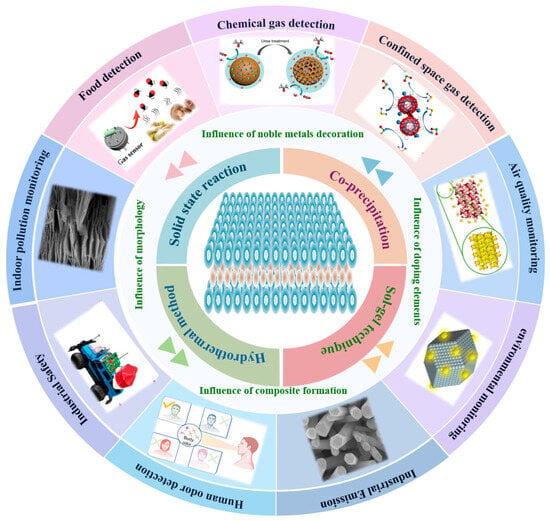
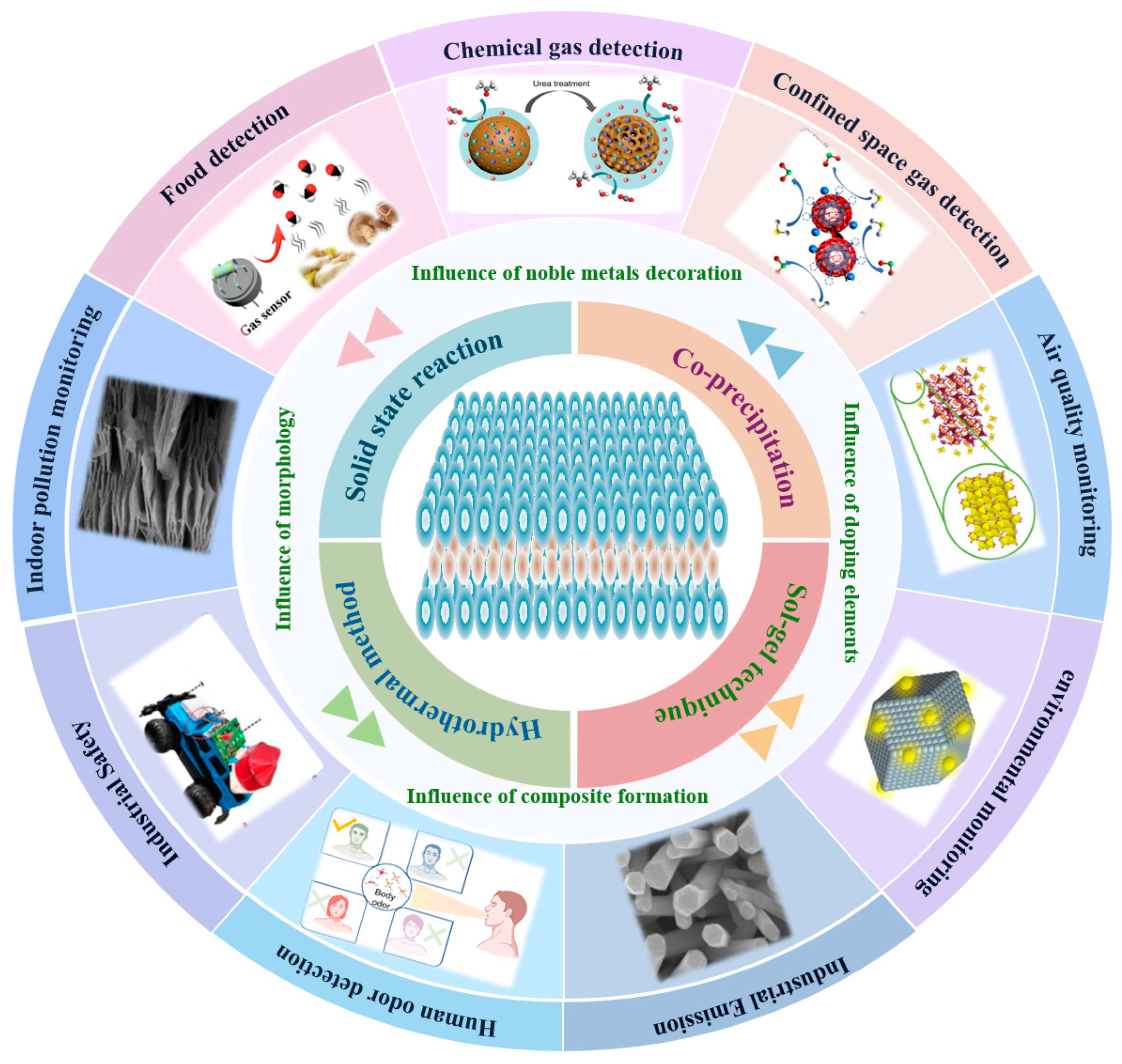
Perovskite materials were first discovered in 1839 as naturally occurring calcium titanate and were named after Lev Perovski. Early studies mainly focused on their mineralogical and crystallographic characteristics. However, research interest in perovskites increased dramatically after Miyasaka and co-workers reported their photovoltaic application in 2009 [8,9]. Since then, their tunable crystal structures, versatile electronic properties, and rich defect chemistry have promoted their widespread application in gas sensors. Recent research on perovskite-based gas sensors has primarily focused on two material systems: oxide perovskites and halide perovskites. Figure 1 provides a graphical overview of representative synthesis methods, performance modulation strategies, and application scenarios for perovskite-based sensing materials, offering a visual summary for subsequent discussions.
Figure 1.
Overview of synthesis strategies, performance modulation, and application scenarios of perovskite-based gas sensors.
Perovskite oxides, such as LaFeO3 and SmFeO3, possess high thermal stability and abundant oxygen vacancies, allowing them to maintain stable sensing performance at elevated temperatures. In contrast, perovskite halides and their derivatives, such as CsPbBr3 and Cs3Cu2I5, can respond at room temperature, reducing or even eliminating external heating. This advantage lowers energy consumption and facilitates the development of portable and low-power gas-sensing devices.
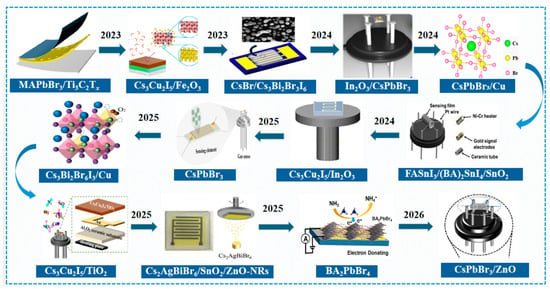
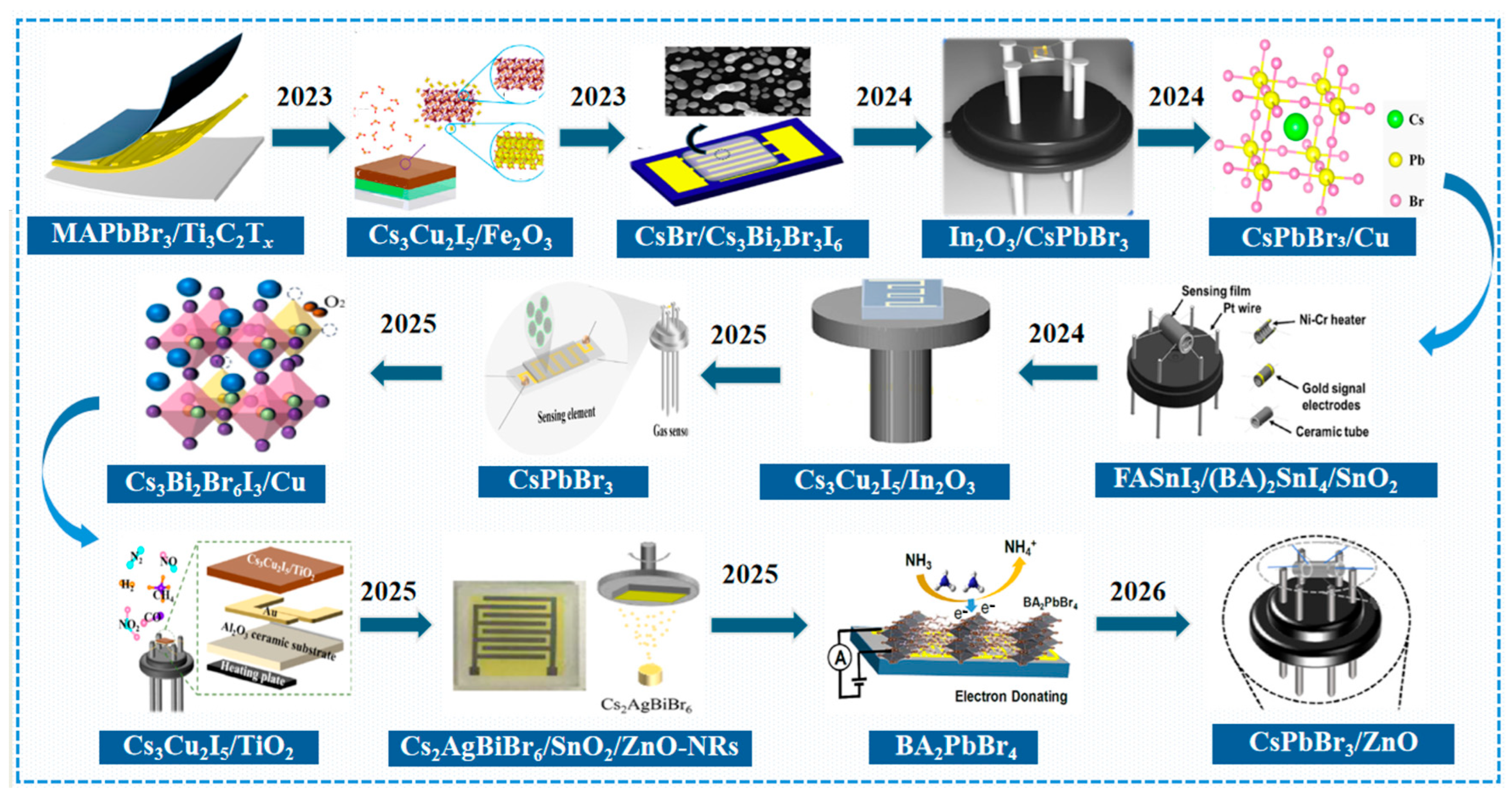
Despite their advantages, perovskite materials still suffer from moisture sensitivity, limited long-term stability, and the toxicity of lead-containing components. Strategies such as elemental doping, heterojunction construction, morphology regulation, and defect engineering have been developed to improve their gas-sensing performance. These approaches regulate oxygen vacancies, surface-active sites, and band alignment, thereby promoting gas adsorption and charge transfer. As illustrated in Figure 2, halide perovskite-based gas sensors have attracted increasing attention due to their room-temperature sensing capability, tunable band structure, and compatibility with low-power gas-sensing devices. In recent years, research has shown that they have great potential for low-temperature gas detection through compositional tuning, interface engineering, and equipment integration.
Figure 2.
Timeline of metal-halide perovskites and perovskite-related materials for gas-sensing applications.
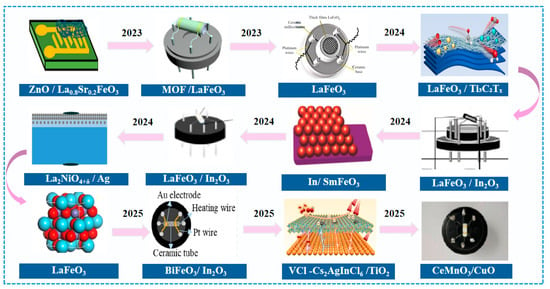
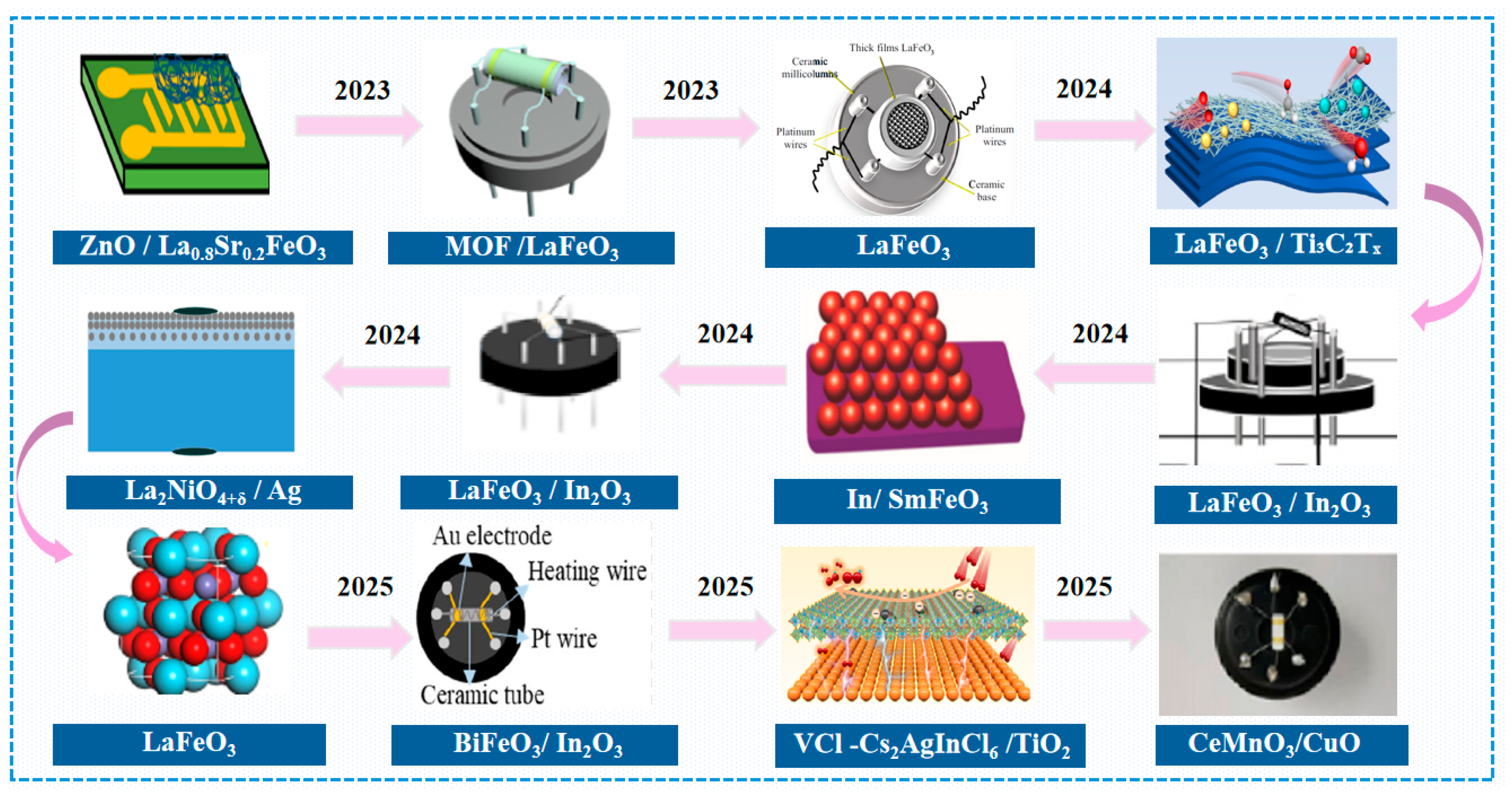
In comparison, perovskite-type oxides exhibit high thermal stability, rich oxygen-vacancy chemistry, and strong structural tolerance, making them suitable for robust gas sensing under relatively harsh operating conditions. As shown in Figure 3, the latest developments in gas sensors based on perovskite-type oxides mainly focus on material design, defect tuning, morphology control, and heterojunction engineering. These strategies play an important role in improving sensitivity, selectivity, response/recovery behavior, and moisture resistance.
Figure 3.
Recent development of gas sensors based on perovskite-type oxides.
Moreover, density functional theory calculations provide microscopic insights into adsorption behavior and sensing mechanisms. With the rapid development of artificial intelligence, perovskite-based gas sensors are increasingly evolving toward intelligent gas-recognition systems. By integrating sensor arrays with machine-learning algorithms, characteristic features can be extracted from dynamic response signals to identify gas species and predict gas concentrations. Overall, this review systematically summarizes recent advances in perovskite-based gas sensors, covering material synthesis, device fabrication, sensing mechanisms, first-principles calculations, and AI-assisted applications. Finally, current challenges and future perspectives are discussed.
2. Fabrication of Gas Sensors
Gas sensors convert gas composition and concentration information into electrical signals through surface physicochemical interactions. With increasing demand for environmental monitoring, fuel leakage detection, battery safety, fire warning, and industrial safety, reliable gas-sensing devices have become increasingly important. However, conventional sensors based on single-component materials often show limited adaptability in complex room-temperature environments, and their fabrication processes may involve high cost, low efficiency, and poor scalability. Therefore, appropriate fabrication strategies are crucial for enhancing sensing performance, simplifying device preparation, and promoting practical applications. As summarized in Table 1, representative sensor fabrication methods include thin-film deposition, printing, transfer techniques, and fiber-forming methods, each with distinct advantages, limitations, and material requirements. For example, spin coating enables uniform and controllable film formation but may cause material waste, whereas printing methods are suitable for patterned and scalable device fabrication but require strict control of ink formulation and particle size. Overall, these fabrication strategies provide important routes for improving sensor performance and promoting the commercialization of perovskite-based gas sensors [10,11,12,13].
Table 1.
Classification and summary of sensor fabrication methods.
Coating techniques are commonly used to fabricate gas-sensing films from nanopowders, colloids, or slurries via solution-based processes. Film thickness, uniformity, coverage, and crystallinity play key roles in gas adsorption–desorption and signal transduction. Drop-casting is the simplest method and is widely used for rapid screening of sensing materials [14]. Spin-coating produces dense and uniform films with controllable thickness, while spin speed and annealing conditions affect grain size and defect density [15]. Spray-coating enables low-temperature, large-area deposition and is suitable for flexible substrates and straightforward patterning [16]. Dip-coating forms uniform layers on porous or fibrous substrates through a dipping–withdrawal process, facilitating the construction of core–shell structures [17]. Overall, coating methods are simple, flexible, and compatible with different substrates, making them important basic techniques for fabricating perovskite-based gas sensors.
Printing techniques enable controllable deposition of sensing materials in selected areas, making them attractive for sensor arrays and multichannel detection. Compared with conventional thin-film methods, printing provides a direct route for fabricating patterned and integrated gas-sensing devices. Inkjet printing is a non-contact technique with high material utilization and broad substrate compatibility, which is suitable for patterning perovskite nanomaterials [18,19]. Screen printing is advantageous for batch fabrication of thick films and allows the integration of sensing layers, heating electrodes, and signal electrodes in one device. Nanoimprint lithography creates periodic micro/nanostructures using a rigid mold, increasing the film surface area and improving gas-sensing sensitivity [20]. Overall, printing techniques offer flexible and scalable routes for fabricating functional perovskite-based gas sensors.
Electrospinning is a versatile fiber-forming technique for constructing one-dimensional perovskite-based sensing structures [21,22,23,24,25,26]. These electrospun fibers can be further modified through post-treatment or coating with precursor gels to construct core–shell heterostructures. The resulting one-dimensional architecture provides a high aspect ratio, efficient charge-transport pathways, and abundant surface-active sites, which are beneficial for gas adsorption and sensing response. Owing to these advantages, electrospinning has been widely explored for flexible and wearable gas-sensing devices.
Transfer techniques [20,27], such as ex situ fabrication, involve crystallizing the gas-sensing layer on a separate substrate and then transferring it onto the target substrate. This approach is mainly applied to thick films because it requires sufficient mechanical strength of the film and good interfacial flatness. Although transfer techniques provide reliable film formation, their complex procedures and stringent processing conditions limit their broad application in perovskite-based gas sensors.
Although coating, printing, and electrospinning provide effective routes for fabricating perovskite-based gas sensors, most of these techniques rely on solution-based processing. This requirement limits the selection of sensing materials, as they must be soluble or form stable dispersions. Consequently, some materials with excellent intrinsic sensing properties but poor solubility are difficult to process using these methods. In addition, solution-based techniques still face challenges in fabrication efficiency and reproducibility. For example, spin-coating may lead to precursor waste, whereas printing and electrospinning can suffer from nozzle clogging, affecting film uniformity and production yield. Transfer techniques can process solid films, but their multistep procedures are time-consuming and less suitable for large-scale manufacturing. Therefore, future efforts should focus on solvent-free processing, continuous fabrication, and low-temperature environmentally friendly methods to reduce costs and promote practical applications.
Commonly used synthesis approaches for perovskite gas-sensing materials can be categorized into wet chemical methods, solid-state methods, template-assisted methods, and fiber-forming methods. As summarized in Table 2, these methods differ significantly in processing complexity, morphology control, scalability, and material requirements. For example, wet chemical methods, including sol-gel, hydrothermal, and co-precipitation methods, are advantageous for controlling composition and morphology, whereas solid-state reactions are simple, low-cost, and suitable for large-scale production. Template-assisted methods are effective for constructing ordered porous structures, while fiber-forming methods such as electrospinning can produce high-aspect-ratio nanofibers with large specific surface areas. Different synthesis routes strongly affect the morphology, porosity, defect concentration, and phase purity of perovskite materials. These structural characteristics determine the specific surface area, particle size, and oxygen-vacancy concentration, thereby influencing gas adsorption, charge transfer, and overall sensing performance.
Table 2.
Representative synthesis methods for perovskite gas-sensing materials: classification, advantages, and limitations.
The solid-state reaction method is a traditional and widely used route for synthesizing perovskite materials [28,29]. In this process, raw powders are mixed in stoichiometric ratios and subjected to high-temperature calcination, during which solid-state diffusion promotes the formation of the perovskite phase. This method is simple, low-cost, and suitable for large-scale production [30]. However, it typically requires high calcination temperatures and long reaction times. Insufficient temperature control may result in impurity phases or incomplete reactions. Therefore, although this method is mature, careful regulation of the calcination temperature and reaction time is still necessary to obtain phase-pure perovskites with appropriate particle size and morphology.
Liquid-phase synthesis methods are widely used to prepare perovskite-based materials because they enable effective control over composition and morphology. Hydrothermal synthesis is typically carried out in a sealed autoclave, where metal salts react under high-temperature and high-pressure aqueous conditions to form crystalline products [31,32,33]. This method can produce well-crystallized materials at relatively low temperatures and is useful for morphology control, but it often requires long reaction times and is sensitive to processing conditions. The sol-gel method converts liquid precursors into a gel network, followed by heat treatment [34]. It offers good compositional homogeneity, precise stoichiometric control, and tunable nanostructures. However, gel formation is usually time-consuming, and the choice of suitable precursors can be limited. The co-precipitation method involves adding a precipitating agent to a metal salt solution, allowing different components to precipitate simultaneously before calcination [35,36]. This method is low-cost, suitable for preparing homogeneous multicomponent materials, and can reduce calcination temperature and reaction time. However, strict control of pH, concentration, and reaction conditions is required.
Template-assisted methods use preformed structures as guides to synthesize perovskite materials with specific morphologies. For example, MOF-derived methods employ metal–organic frameworks as sacrificial templates, which can be converted into porous perovskite-derived materials through thermal decomposition [37,38,39]. The resulting materials usually exhibit controllable morphologies, high porosity, and abundant active sites. However, MOF synthesis is relatively complex, thermal decomposition requires precise temperature control, and the product yield is often low, which limits large-scale application. Three-dimensionally ordered macroporous template-assisted methods involve filling templates with precursors, followed by calcination to remove the templates and form ordered porous structures. These materials provide large specific surface areas, regular pore channels, and efficient charge-transport pathways. Nevertheless, complicated template preparation, weak mechanical stability, and high cost still restrict their practical application.
Taking LaFeO3 as a representative case, the gas-sensing behavior of this p-type perovskite depends on surface oxygen adsorption, Fe redox chemistry, defects, and hole transport. Synthesis methods, by modulating nucleation and growth, alter the grain size, porosity, exposed crystal facets, oxygen non-stoichiometry, and the proportion of adsorbed oxygen. In the high-temperature solid-state method, high crystallinity and large grains are obtained, but the availability of surface active sites may be constrained; the sol-gel method yields homogeneous mixing and small particles, with defects and adsorbed oxygen tunable through complexation–calcination; the hydrothermal method, with relatively weak agglomeration, allows the adjustment of surface hydroxyl groups, crystal facets, and the oxygen coordination environment; the microwave-assisted method, through rapid nucleation and small particle formation, tends to retain non-equilibrium defects and active surfaces; electrospinning constructs a continuous, porous one-dimensional fibrous network, enriching grain boundaries and surface exposure, thereby enhancing gas reactions; and the template-derived method produces three-dimensionally ordered macroporous or hierarchically porous structures that increase accessible surface sites and improve oxygen species exchange.
Considering these synthesis methods, higher processing complexity generally leads to increased cost, making it difficult to balance high sensing performance with economic feasibility. In addition, low yield and limited production efficiency still hinder the translation of laboratory-scale results into industrial production. Solid-state methods often rely on empirically optimized parameters, resulting in less precise control over product composition, particle size, and morphology. Liquid-phase methods are sensitive to processing conditions, such as humidity, temperature, pH, concentration, and stirring rate, which may lead to batch-to-batch variations. Therefore, future efforts should focus on developing solid-state or solvent-free processing routes, improving the continuity and scalability of liquid-phase synthesis, and reducing the cost of template-assisted methods.
3. Structure and Properties of Perovskites
Perovskites are a class of semiconductor materials commonly described by the general formula ABX3, where the A site is occupied by an inorganic or organic cation, the B site by a metal cation, and the X site by an oxide or halide ion [40,41]. Their crystal structure is composed of corner-sharing BX6 octahedra, with B-site cations located at the octahedral centers and A-site cations occupying the surrounding interstitial cavities. The A- and B-site cations can be partially substituted by ions with similar radii while maintaining the main perovskite framework. This structural flexibility enables the tuning of composition, defects, and electronic properties, making perovskites important materials for catalytic and gas-sensing applications [42,43].
At the microscopic level, perovskites are mainly constructed from corner-sharing BX6 octahedral frameworks, in which X-site anions bridge neighboring B-site cations and A-site cations occupy the framework cavities [44,45]. For perovskite oxides, the variable valence states of B-site cations and the formation of oxygen vacancies contribute to mixed ionic–electronic conductivity [46]. The A-site cation plays an important role in structural stability, while synthesis temperature can induce phase distortions, such as orthorhombic or tetragonal phases. These structural variations further influence their piezoelectric, pyroelectric, and nonlinear optical properties.
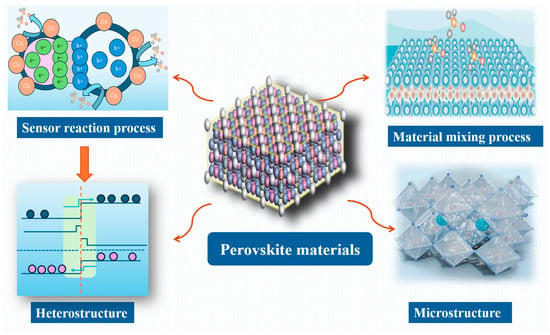
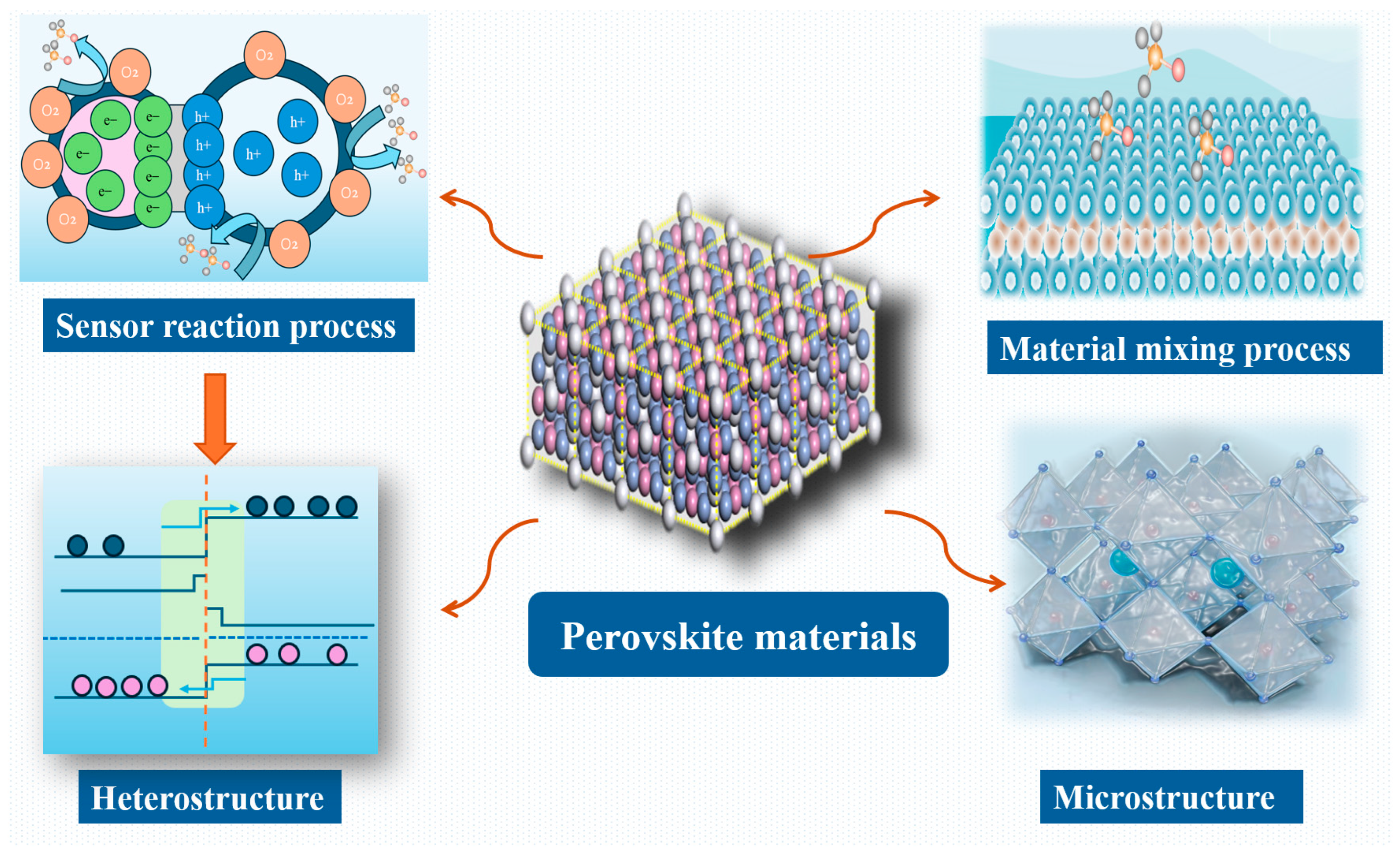
During synthesis and post-treatment, intrinsic defects, such as oxygen vacancies and A-site cation vacancies, are often formed at the surfaces and grain boundaries of perovskite materials [47,48,49,50,51]. These defects can serve as active sites for gas adsorption. As shown in Figure 4, the gas-sensing performance of perovskite materials can be adjusted through several representative strategies, including microstructure optimization, material mixing or composite material formation, heterostructure construction, and regulation of surface reaction processes. Since the sensing response is closely associated with charge transfer between adsorbed gas molecules and the sensing material, defect engineering plays a critical role in regulating carrier concentration, charge transport, and interfacial charge-transfer efficiency.
Figure 4.
Typical strategies for modulating perovskite materials.
3.1. Gas-Sensing Mechanism of Perovskite Materials
The gas-sensing properties of oxide perovskites (ABO3) originate from surface-adsorbed oxygen, the variable valence states of B-site cations, oxygen vacancies, lattice oxygen, and carrier transport across grain boundaries. This process can be represented in a simplified form as:
The relative proportions of different adsorbed oxygen species depend on the operating temperature. At the operating temperature, adsorbed oxygen progressively captures electrons to form species such as O2− and O−, thereby leading to the formation of an electron depletion layer on n-type surfaces and to hole accumulation on p-type surfaces. Reducing gases consume the adsorbed oxygen and release electrons back to the material, thereby decreasing the resistance of n-type perovskites and increasing that of p-type ones; in contrast, oxidizing gases extract electrons from the material, resulting in an increase in resistance for n-type and a decrease for p-type. Valence-state transitions of B-site ions, e.g., Fe3+/Fe2+, participate in redox reactions and charge compensation, influencing small-polaron hopping and conductivity, and B-site doping can, through these mechanisms, modulate the gas-sensing response.
Owing to their low defect formation energies, pronounced ion migration, and optoelectronic coupling, halide perovskites exhibit diverse gas-sensing mechanisms, involving halogen vacancy adsorption, charge/ion migration, lattice distortion, photogenerated carrier modulation, and chemical transformation. Halogen vacancies serve as the primary sites for adsorption and charge trapping, with their occupancy states directly modulating the carrier concentration and mobility. By modulating the surface charge/potential, gases induce a redistribution of ionic vacancies, leading to the formation of space charge regions at interfaces; although this results in slow response and drift, it can amplify signals at low concentrations.
3.2. Influence of Nanostructures on the Gas-Sensing Performance of Perovskites
Nanostructure engineering can influence the gas-sensing performance of perovskite materials at multiple interrelated levels. Nanostructures can be categorized into nanoparticles and quantum dots, one-dimensional nanofibers and nanowires, two-dimensional nanosheets, porous and three-dimensionally ordered mesoporous structures, as well as core–shell and heterostructures. Reducing the characteristic dimensions of a material typically increases the proportion of surface atoms and enhances the exposure of coordinatively unsaturated metal sites, oxygen vacancies, halogen vacancies, grain boundaries, and edge sites, thereby promoting the adsorption probability of gas molecules. Hence, the porosity, dimensionality, and assembly mode of nanostructures can influence the mass transport pathways of gases from the external environment into the interior of the sensitive layer, and can alter the carrier transport distance, the grain-boundary barrier, and the proportion of the space-charge layer within the entire grain. However, excessive nanosizing may also lead to agglomeration, defect trapping, unstable interfacial contacts, and enhanced environmental sensitivity, resulting in poor material performance.
Perovskite materials possess tunable semiconducting properties, and their conduction behavior can be regulated by elemental substitution at the A or B sites. This enables modulation between p-type and n-type semiconducting behavior, making them suitable for detecting different target gases. In perovskite oxides, the concentration of oxygen vacancies can also be controlled through annealing atmospheres or doping strategies [52]. As active defects, oxygen vacancies provide ion-migration pathways and redox-active sites, thereby enhancing the sensing response toward both oxidizing and reducing gases [53].
A-site doping can regulate lattice strain, enhance structural stability, and promote charge transport in perovskites. For perovskite oxides, B-site doping can modulate transition-metal valence states and improve electronic conductivity. Coupling perovskites with conductive carbon-based materials or two-dimensional materials further enhances electrical transport, structural stability, and charge-transfer pathways. In addition, defect engineering, elemental doping, and core–shell design can be employed to improve cycling stability and long-term reliability [54,55].
4. Applications of Perovskite Composite Materials in Gas Sensors
In recent years, perovskite composites have attracted increasing attention in gas sensing. Common strategies include morphology control, metal oxide modification, and coupling with metal–organic frameworks [32,56]. As summarized in Table 3, representative perovskite materials exhibit different bandgap values, which affect charge transfer, gas adsorption, and sensing response [57,58,59,60,61].
Table 3.
Bandgap values of the perovskite materials reported in references [57,58,59,60,61].
The fundamental distinction between direct and indirect band gaps lies in whether the valence band maximum and conduction band minimum align in momentum space. In direct-bandgap materials, these extrema occur at the same momentum, enabling electrons to undergo transitions without phonon participation; in indirect-bandgap materials, phonons are required to compensate for the momentum mismatch. Although these two bandgap types differ in optical absorption and carrier dynamics, the bandgap type itself does not inherently dictate the gas-sensing sensitivity.
Direct-bandgap materials, with their high absorption coefficients, can efficiently generate electron–hole pairs within a thin layer, rendering them particularly suited to photo-assisted room-temperature gas sensing. Photogenerated carriers promote the adsorption and activation of surface oxygen, increasing the population of reactive oxygen species and accelerating charge exchange; as a consequence, such materials are more applicable to photoconductive, photoluminescent, and photo-assisted chemiresistive sensors.
In contrast, because interband transitions in indirect-bandgap materials require phonon involvement, their near-band-edge absorption is relatively weak, often necessitating a thicker sensing layer or stronger illumination. Nevertheless, direct radiative recombination in these materials is constrained by the momentum-conservation requirement, which may, under appropriate defect and interface conditions, lead to prolonged carrier lifetimes. This behavior, however, is not an intrinsic property; the actual lifetime is governed jointly by trap states, grain boundaries, and defect-mediated recombination.
Therefore, bandgap tuning, morphology control, and interface engineering provide an effective strategy for improving the gas-sensing performance of perovskite-based materials.
In various studies, the response may be expressed in terms of the resistance ratio, the rate of change in conductance, the rate of change in current, the voltage shift, or the variation in photoluminescence intensity. For n-type semiconductors under exposure to reducing gases, the response is typically defined as:
for oxidizing gases, the response is defined as:
For responses expressed as a percentage:
Here, denotes the baseline resistance of the sensor in air or a background atmosphere, and denotes the resistance upon introduction of the target gas. For p-type materials, the reciprocal definition is adopted.
4.1. Metal Oxide Perovskites
Given the compositional tunability of perovskites, coupling them with metal oxides can effectively overcome the limited selectivity and high operating temperatures commonly associated with pristine metal oxide sensors.
These strategies introduce more active sites, promote interfacial charge transfer, and optimize gas adsorption–desorption pathways, thereby leading to stronger responses, better selectivity, lower operating temperatures, and improved humidity tolerance. As summarized in Table 4 [62,63,64,65,66,67,68,69,70,71,72], representative oxide perovskite-based sensors, including pristine perovskites and their metal oxide composites, have been widely investigated for detecting various target gases. Their sensing performance varies significantly depending on material composition, operating temperature, response/recovery behavior, and long-term stability, indicating that composition regulation and heterostructure construction are effective strategies for optimizing gas-sensing properties.
Table 4.
Gas-sensing performance of representative oxide perovskite-based sensors [62,63,64,65,66,67,68,69,70,71,72].
Xu et al. [62] mixed hydrothermally synthesized LaFeO3 with different urea mass ratios and then performed secondary thermal treatment. The urea-treated sample showed nearly a tenfold enhancement in sensing performance compared with pristine LaFeO3. Guo et al. [63] developed a rapid, low-cost, and scalable MOF self-templating strategy to prepare an MOF-gel precursor, achieving a chemiresistive response to HCHO with a detection limit of 1 ppm and measurable performance under high humidity. Meng et al. [64] fabricated LaFeO3/In2O3 heterojunctions, which showed excellent response to C4H8O and reduced the optimal operating temperature by 20 °C. Yuan et al. [65] prepared porous LaFeO3/In2O3 microsphere composites, with the optimized sample exhibiting a response of 147 mV to C2H5OH, good repeatability, and 30-day stability. Sun et al. [66] constructed one-dimensional LaFeO3–Ti3C2Tx heterojunctions, achieving enhanced HCHO response at 60 °C and good humidity tolerance over 30–80% RH.
Tang et al. [67] prepared SmFeO3 perovskite oxide via a freeze-drying-assisted sol-gel method, achieving a response of 1.9 mV to C2H2 with excellent repeatability and stability. Souri et al. [68] synthesized In-doped SmFeO3 with a highly ordered inverse opal structure using PMMA microspheres as templates. The sensor exhibited excellent CH3OH selectivity and good humidity tolerance, with only an 11% response decrease as RH increased from 40% to 80%. Cheng et al. [69] constructed a BiFeO3/In2O3 heterojunction composite, achieving an 8.8-fold higher response to C4H9OH than pure BiFeO3 and stable performance over 50 days. Gao et al. [70] synthesized La-doped CdSnO3 by co-precipitation followed by annealing, and the optimized sample showed better gas-sensing performance than pristine CdSnO3. Meng et al. [71] further developed CeMnO3-CuO heterojunctions, providing more active sites and achieving a 2.6-fold higher response to C6H15N than pure CuO. Syue et al. [72] prepared ZnO/La0.8Sr0.2FeO3 heterojunction fibers, which showed high H2S selectivity and a linear response with gas concentration. Gildo-Ortiz et al. [73] systematically examined the effect of ethylenediamine content on the microstructure and gas-sensing performance of LaFeO3, and evaluated its static CO response.
Dai et al. [74] synthesized La2AgxNiO4+δ by a sol–gel method using an A-site Ag-doping strategy. The obtained sensor showed a response of 61.2 mV to 200 ppm NH3, along with excellent anti-interference ability against CO2, CH4, and H2 and good long-term stability. Qin et al. [75] prepared phosphorus-doped porous LaFeO3 nanosheets via a sol-gel method. The sensor delivered response values of 2.67 and 30 mV toward 5 and 100 ppm C3H6O, respectively, and maintained stable performance for 30 days.
Despite its effectiveness, metal doping, especially noble metal doping or surface decoration, is constrained by high cost and limited scalability, hindering its commercial application. Moreover, it does not completely overcome cross-sensitivity in mixed-gas environments, which remains a persistent issue for metal oxide-based gas sensors.
4.2. Halide Perovskite-Based Sensors
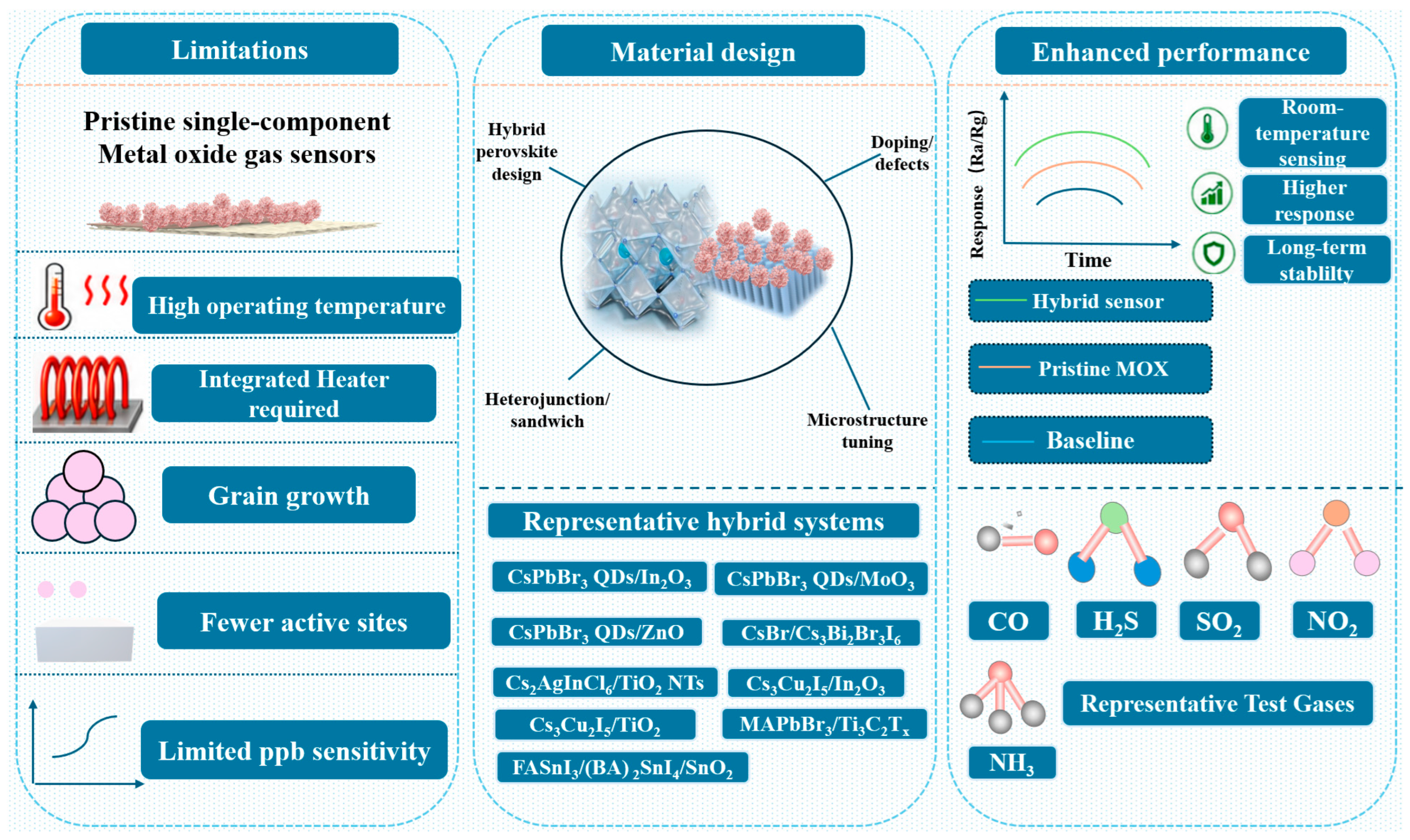
Single-component metal oxide gas sensors usually require elevated operating temperatures [76,77], necessitating integrated heaters and limiting their application in wearable or battery-powered portable systems. High-temperature operation may also induce grain growth, decrease the specific surface area, and reduce the number of active sites [78,79], while unmodified metal oxides often show limited sensitivity toward ppb-level gases. As illustrated in Figure 5, the integration of halide perovskite hybrid material sensors provides an effective strategy to overcome these limitations through hybrid perovskite design, defect tuning, microstructure tuning, and heterojunction or sandwich structure construction. These strategies promote interfacial charge transfer, increase the number of active sites, and improve gas adsorption, thereby enabling room-temperature sensing, enhanced response and selectivity, and improved long-term stability. In this context, halide perovskites have attracted increasing attention because of their excellent room-temperature sensing capability [80]. As summarized in Table 5, representative halide perovskite-based sensors have been developed for various target gases [57,58,59,60,81,82,83,84,85,86,87,88,89,90]. Their sensing performance varies depending on the material composition, including operating temperature, response/recovery time, and stability. This highlights the importance of composition tuning and interface engineering in high-performance gas sensing.
Figure 5.
Design strategies for halide perovskite-based hybrid gas sensors toward room-temperature detection.
Table 5.
Gas-sensing performance of representative halide perovskite-based sensors [57,58,59,60,81,82,83,84,85,86,87,88,89,90].
Tian et al. [81] further constructed ZnO2/CsPbBr3 heterostructures using MOF-derived ZnO2 dodecahedra and CsPbBr3 quantum dots, providing abundant active sites and improving C2H7NO sensing response, repeatability, and linearity. Tian et al. [82] decorated MoO3 microspheres with CsPbBr3 quantum dots to form a MoO3–CsPbBr3 p–n heterojunction, achieving much higher C6H15N response than pure MoO3 and improved performance under UV irradiation/with UV assistance. Zhuang et al. [83] constructed a Cs3Cu2I5–Fe2O3 core–shell heterostructure through in situ Fe2O3 coating, which enhanced SO2 adsorption and enabled room-temperature SO2 sensing. He et al. [84] further fabricated Cs3Cu2I5/TiO2 nanocrystal-based carbon monoxide gas sensors and employed convolutional neural networks to extract sensing features, improving CO detection response, accuracy, repeatability, and reliability.
Wang et al. [85] introduced a SnO2 hole-blocking layer between lead-free double perovskite halide Cs2AgBiBr6 and ZnO nanorods, constructing a CABB–SnO2–ZnO NRs sandwich structure. The sensor showed a room-temperature NO2 response nine times higher than that of pristine ZnO NRs. Li et al. [86] developed a resistive NH3 gas sensor based on 2D halide perovskite BA2PbBr4, demonstrating reversible ammonia detection and enhanced sensing response, repeatability, and operational stability.
Zhang et al. [87] prepared a CsBr–Cs3Bi2Br3I6 heterostructured lead-free perovskite halide film by two-step evaporation–spray-coating, achieving a room-temperature H2S response of 1.29. Chen et al. [88] developed a room-temperature H2S sensor based on Cu+-doped lead-free perovskite halide Cs3Bi2Br6I3. The optimized Cs3Bi2Br6I3–Cu+-2 sensor showed a wide detection range of 0.5–50 ppm, stable operation at 63% RH, and excellent H2S selectivity.
Hu et al. [89] constructed Ti3C2Tx–MAPbBr3 composites, enabling room-temperature detection of NH3, C3H6O, C2H5OH, and C4H10O with 95.6% response retention after 10 days. Wang et al. [90] introduced 2D long-chain perovskite halide (BA)2SnI4 into a 3D FASnI3–SnO2 system, achieving enhanced low-temperature HCHO sensing, faster response/recovery, superior selectivity, high-humidity stability, and 30-day durability.
Moisture can participate in surface adsorption at low humidity levels and thereby modulate the carrier concentration; at higher humidity levels, however, it may lead to the dissolution of organic cations, lattice hydration, halide loss, and phase decomposition. Oxygen can form reactive oxygen species and promote the decomposition of organic components. Target gases and their reaction products may cause surface poisoning; for instance, in Sn-based halide perovskites, the oxidation of Sn2+ to Sn4+ is particularly prone to inducing a high background carrier concentration, baseline drift, and performance degradation, and Cu+-containing systems may also undergo Cu+/Cu2+ valence changes. Even when the initial response is high, residual reaction products can result in incomplete recovery, baseline drift, and deterioration of cycling performance. Among the common improvement strategies are all-inorganic compositions, lead-free systems, and hydrophobic ligands.
Current performance studies largely remain at the level of phenomenological descriptions, mainly reporting performance enhancement after doping, while lacking in situ characterization of the microscopic coordination environment of dopant atoms and their dynamic evolution. The gas-sensing performance of a sensor is strongly dependent on the structure, morphology, and particle size of its sensing materials. However, researchers have proposed various strategies for regulating the microstructure of perovskites. Although these approaches have improved key parameters such as oxygen-vacancy concentration and specific surface area, comprehensive optimization of gas-sensing performance remains challenging. Moreover, studies on interference effects in complex gas atmospheres are still insufficient.
4.3. Summary and Comparative Evaluation of Performance Enhancement Strategies for Perovskite-Based Gas Sensors
Material design strategies can improve the gas-sensing performance of perovskites through multiple aspects, including carrier transport, surface adsorption, interfacial barriers, and reaction kinetics. Their effects, however, are not unidirectional, and evaluation should take into account not only the response value but also selectivity, stability, repeatability, humidity tolerance, and scalability.
Elemental doping and defect engineering modulate carrier concentration, metal valence states, and oxygen vacancies via charge compensation, thereby altering gas adsorption energies, activation energies, and reaction pathways. A moderate amount of defects provides low-coordination adsorption sites and enhances charge exchange, yet excessive defects can lead to reduced selectivity, baseline drift, and degraded repeatability, while excessively high doping levels may cause lattice distortion or secondary phases. Optimization must rely on composition gradients, valence-state analysis, and long-term cycling tests, rather than solely on the response enhancement at a single concentration.
Nanostructure engineering enhances the response by increasing the specific surface area, shortening diffusion distances, and improving the utilization of active sites. Ordered structures facilitate rapid gas ingress and promote full reaction. However, small dimensions and high porosity tend to induce agglomeration, grain growth, and pore collapse, and the performance is highly sensitive to particle size, pore distribution, and film uniformity. Advantages demonstrated at the laboratory scale are difficult to reproduce reliably in batch-fabricated devices, necessitating a balance among surface utilization, mass-transfer efficiency, structural stability, and manufacturing consistency.
Heterostructure construction exploits Fermi-level differences to induce band bending and interfacial barriers, converting surface adsorption into pronounced electrical signal changes. Amplification effects can arise from p–n, n–n, and p–p junctions, as well as from composite interfaces formed with two-dimensional materials or metal oxides. However, an enhanced response does not by itself confirm an interfacial charge-transfer mechanism; attribution to interfacial electronic effects requires the exclusion of morphological and compositional contributions through work-function measurements, band-alignment analysis, and first-principles calculations.
Noble-metal decoration can improve low-temperature response and selectivity. Metals such as Pt, Pd, Au, and Ag promote gas dissociation and spillover effects, thereby lowering the activation energy; the work-function difference and Schottky-barrier modulation further amplify the resistance response, aiding in reducing the operating temperature and accelerating response/recovery. Nevertheless, this approach incurs high cost, the nanoparticles are prone to sintering at elevated temperatures, and excessive loading may create continuous conductive pathways that shield the sensing response, thereby necessitating systematic optimization of the metal type, particle size, dispersion state, and loading amount.
Halide perovskites and their low-dimensional derivatives allow modulation of the bandgap, exciton behavior, ion migration, and adsorption characteristics through compositional, dimensional, and interfacial engineering, enabling room-temperature optoelectronic detection. These materials, however, are sensitive to water and oxygen, and humidity can intermix the gas response with degradation effects. Electric fields and light readily induce ion migration, leading to hysteresis, drift, and long-term instability; lead-containing systems further raise issues of toxicity and waste disposal. Consequently, evaluation cannot be based solely on a high room-temperature response but must also address humid-heat stability, dark-state recovery, suppression of ion migration, encapsulation effectiveness, and environmental safety.
Sensor arrays combined with artificial intelligence exploit differential response patterns and machine-learning-based feature extraction for gas identification and concentration prediction. Model performance, however, is affected by dataset size, class distribution, humidity, device aging, and drift. High recognition accuracy obtained with small samples or under uniform conditions does not guarantee generalization to real environments. Validation should employ independent test sets, cross-batch devices, and varying environmental conditions, and should report the confusion matrix, false positive rate, drift robustness, and interpretability, rather than relying solely on the overall classification accuracy as the evaluation metric.
Overall, all of these strategies entail a coexistence of performance gains and additional trade-offs. Future research should shift toward the multi-objective optimization of response magnitude, detection limit, selectivity, operating temperature, humidity tolerance, long-term stability, device repeatability, and fabrication cost, rather than the mere pursuit of the highest response value. The sensing mechanism must be jointly verified by electronic structure, surface chemistry, and in situ characterization. Only by integrating performance enhancement, mechanistic evidence, and device reliability can perovskite gas sensors advance from the laboratory toward practical application.
5. First-Principles Insights and AI-Assisted Development of Perovskite-Based Gas Sensors
Theoretical calculations can elucidate the mechanisms underlying enhanced gas-sensing performance and explain the different response magnitudes toward various interfering gases. Xu et al. [91] employed density functional theory calculations to elucidate the ethanolamine-sensing mechanism of Ag-functionalized SnO2/CsPbBr3 nanocomposites, revealing that the heterointerfaces promote selective molecular adsorption and interfacial electron transfer. Liu et al. [92] reported CsPbBr3 quantum dot-modified In2O3 nanofibers for room-temperature formaldehyde detection under illumination. Density functional theory calculations were used to investigate the adsorption behavior and electronic properties of formaldehyde on the In2O3/CsPbBr3 surface. They enable the establishment of intrinsic correlations between microscopic electronic structures and macroscopic gas-sensing performance, particularly in heterostructures with complex compositions.
The integration of perovskite-based sensors with artificial intelligence algorithms mainly focuses on gas identification, concentration prediction, humidity-interference elimination, and human odor recognition. This strategy enables high-precision identification, environmental-interference suppression, complex gas-mixture analysis, and reliable low-concentration gas detection. As summarized in Table 6, combining sensors with artificial intelligence algorithms has significant advantages in multidimensional feature extraction, pattern recognition, anti-interference ability, gas mixture analysis, and material screening. Wang et al. [93] reported zinc-complex-capped CsPbBr3 resistive sensors for ethanol identification in humid air. The integration of theoretical calculations and machine-learning algorithms enabled accurate ethanol recognition under high-humidity conditions, highlighting the potential of AI-assisted strategies for perovskite-based gas sensing.
Table 6.
Advantages and limitations of AI-assisted gas-sensing systems.
The intrinsic selectivity of a material is governed by adsorption energy, reaction activation energy, surface sites, defects, and charge transfer, and can be modulated through noble-metal or transition-metal decoration, doping, defect engineering, and heterojunction construction. Artificial intelligence does not alter these physicochemical processes and cannot confer high intrinsic selectivity upon a material that inherently lacks it. Its role lies, rather, in identifying subtle differences from multidimensional data: by utilizing response magnitude, slope, time constants, integrated area, frequency-domain features, and dynamic variations under varying temperature, humidity, and illumination, gas fingerprints can be constructed, which, in combination with sensor arrays, enhance the capability for classification, concentration prediction, and mixed-gas identification. The rational development pathway is therefore one of “differentiated material design—multidimensional signal acquisition—robust feature extraction-independent validation—drift compensation and model interpretation.” Materials engineering provides differentiated responses, the sensor array supplies multidimensional information, and machine learning is responsible for extraction and discrimination; only through synergistic optimization of the three can reliable identification be achieved under complex atmospheres and prolonged operation.
However, several challenges remain, including overfitting caused by limited sample sizes, strong dependence on comprehensive training datasets, long-term drift of sensor arrays, limited model interpretability, and difficulties in real-time edge deployment. Therefore, future AI-assisted perovskite gas-sensing systems should focus not only on improving recognition accuracy but also on enhancing dataset reliability, model robustness, interpretability, and practical deployment.
Although artificial intelligence algorithms have shown great potential in improving recognition accuracy, suppressing interference, and accelerating materials screening, their practical application still requires further advances in data accumulation, lightweight model design, interpretability, and standardization.
6. Conclusions and Outlook
This review summarizes recent advances in perovskite materials for gas-sensing applications. It briefly introduces the synthesis and fabrication strategies of gas-sensing materials and devices, as well as the structural features and gas-sensing-related properties of perovskites. Current strategies for improving perovskite-based gas-sensing materials, including morphology regulation, elemental doping, heterostructure construction, and defect engineering, are discussed together with their sensing mechanisms. Perovskite-based gas sensors are evolving from single-material performance optimization toward multimodal intelligent sensing systems, making intelligent integration a key direction for future development. However, practical perovskite-based gas sensors still face several challenges. To reduce preparation costs, future efforts should focus on four aspects: In terms of material selection, priority should be given to earth-abundant, low-toxicity, and low-cost metal elements, while the use of noble metals, high-purity organic ligands, and disposable sacrificial templates should be minimized. Concerning powder preparation, methods featuring simple procedures, high precursor utilization, and strong potential for mass production ought to be employed. Regarding energy consumption, reusable templates can be utilized to shorten high-temperature holding times and reduce template consumption. As for device fabrication, direct growth of the sensing layer on electrodes, as well as screen printing, inkjet printing, and spray coating, can reduce the number of steps involved in powder recovery, transfer, and secondary sintering.
For large-scale oxide perovskite sensing materials, co-precipitation or spray pyrolysis combined with printed device fabrication may represent a more economically viable route in the near term; in contrast, complex templating methods and multistep heterostructures are more suitable for high-performance verification and require further simplification before they can be scaled up.
Current challenges include the stability of perovskite materials under moisture, oxygen, and illumination, as well as the potential health and environmental risks associated with lead-containing systems. The synthesis of perovskite materials still relies heavily on liquid-phase methods, which suffer from poor batch-to-batch reproducibility and relatively low yields. At the device level, most studies remain focused on single sensing layers, while intelligent and miniaturized sensor arrays are not yet mature. Single-component perovskites also show cross-sensitivity toward multiple gases, and selectivity improvement still largely depends on empirical doping or composite strategies.
Although density functional theory calculations are useful for revealing gas adsorption behavior, most models are based on idealized surfaces and neglect realistic factors such as lattice defects, humidity, and temperature fields. This creates a gap between theoretical predictions and experimental observations. Moreover, defects such as nitrogen vacancies and cation vacancies remain insufficiently studied, and the effect of anion ordering on migration energy has not been fully considered. Therefore, more realistic and comprehensive theoretical models are still needed.
Compared with other gas-sensing materials, research on perovskite-based gas-sensing materials is still at an early stage and holds great potential. Innovations in device integration and fabrication processes are required to achieve high-throughput and controllable preparation of perovskite materials. Further efforts are also needed to develop multiscale theoretical models and new lead-free material systems with high stability. In the foreseeable future, the development of multichannel, multi-material perovskite-based intelligent sensor arrays capable of accurately identifying multicomponent gases in complex environments will remain a significant challenge.
Author Contributions
Conceptualization, H.S., Q.S. and J.S.; methodology, H.S., J.Z. and C.Y.; investigation, H.S., J.Z. and Y.S.; resources, Q.S., J.S. and C.Y.; data curation, H.S., C.Y. and Y.S.; writing—original draft preparation, H.S.; writing—review and editing, Q.S., J.S. and S.L.; visualization, H.S., J.Z. and Y.S.; supervision, Q.S., J.S. and S.L.; project administration, Q.S. and J.S. All authors have read and agreed to the published version of the manuscript.
Funding
This work, primarily driven by research interests, is not supported by any funding.
Institutional Review Board Statement
Not applicable.
Informed Consent Statement
Not applicable.
Data Availability Statement
No new data were created or analyzed in this study. Data sharing is not applicable to this article.
Conflicts of Interest
The authors declare no conflicts of interest.
Abbreviations
The following abbreviations are used in this manuscript:
| AI | Artificial intelligence |
| DFT | Density functional theory |
| MOF | Metal–organic framework |
| MOX | Metal oxide |
| QDs | Quantum dots |
| RT | Room temperature |
| VOC | Volatile organic compound |
| 3DOM | Three-dimensionally ordered macroporous |
| ppm | Parts per million |
| RH | Relative humidity |
| SEM | Scanning electron microscopy |
| TEM | Transmission electron microscopy |
| XRD | X-ray diffraction |
| XPS | X-ray photoelectron spectroscopy |
| BET | Brunauer–Emmett–Teller |
| NO2 | Nitrogen dioxide |
| NH3 | Ammonia |
| H2S | Hydrogen sulfide |
| CO | Carbon monoxide |
| CO2 | Carbon dioxide |
| CH2O | Formaldehyde |
| C2H6O | Ethanol |
| C3H6O | Acetone |
References
- Al Atem, M.; Makableh, Y. Towards Sustainable Perovskite Solar Cells: Lead-Free High Efficiency Designs with Tin and Germanium. Eng 2025, 6, 38. [Google Scholar] [CrossRef] [Scilit]
- Mulmi, S.; Thangadurai, V. Editors’ Choice-Review-Solid-State Electrochemical Carbon Dioxide Sensors: Fundamentals, Materials and Applications. J. Electrochem. Soc. 2020, 167, 037567. [Google Scholar] [CrossRef] [Scilit]
- Yao, Y.; Wallner, M.; Klawonn, F. Optimal Sensor and Sampling Placement for Contaminant Detection: A Comprehensive Review Across Water Distribution and Wastewater Collection Systems. Eng 2026, 7, 121. [Google Scholar] [CrossRef] [Scilit]
- Bochu, L.; Potu, S.; Navaneeth, M.; Khanapuram, U.K.; Rajaboina, R.K.; Kodali, P. Innovative Integration of Triboelectric Nanogenerators into Signature Stamps for Energy Harvesting, Self-Powered Electronic Devices, and Smart Applications. Eng 2024, 5, 958–966. [Google Scholar] [CrossRef] [Scilit]
- Ansari, H.R.; Mirzaei, A.; Shokrollahi, H.; Kumar, R.; Kim, J.Y.; Kim, H.W.; Kumar, M.; Kim, S.S. Flexible/wearable resistive gas sensors based on 2D materials. J. Mater. Chem. C 2023, 11, 6528–6549. [Google Scholar] [CrossRef] [Scilit]
- Hashtroudi, H.; Mackinnon, I.D.R.; Shafiei, M. Emerging 2D hybrid nanomaterials: Towards enhanced sensitive and selective conductometric gas sensors at room temperature. J. Mater. Chem. C 2020, 8, 13108–13126. [Google Scholar] [CrossRef] [Scilit]
- Zhang, D.Z.; Pan, W.J.; Tang, M.C.; Wang, D.Y.; Yu, S.J.; Mi, Q.; Pan, Q.N.; Hu, Y.Q. Diversiform gas sensors based on two-dimensional nanomaterials. Nano Res. 2023, 16, 11959–11991. [Google Scholar] [CrossRef] [Scilit]
- Katz, E. Perovskite: Name Puzzle and German-Russian Odyssey of Discovery. Helv. Chim. Acta 2020, 103, e2000061. [Google Scholar] [CrossRef] [Scilit]
- Liu, X.Y.; Zhao, W.; Cui, H.L.; Xie, Y.A.; Wang, Y.M.; Xu, T.; Huang, F.Q. Organic-inorganic halide perovskite based solar cells—Revolutionary progress in photovoltaics. Inorg. Chem. Front. 2015, 2, 315–335. [Google Scholar] [CrossRef] [Scilit]
- Benamor, M.; Gannouni, J.; Akkari, F. Elaboration and characterization of Cu2O thin films via Glancing Angle Deposition for high-performance gas sensing of ethanol and methanol at room temperature. Mater. Chem. Phys. 2026, 349, 131776. [Google Scholar] [CrossRef] [Scilit]
- Sanketh, H.S.; Vijayan, A.; Poornesh, P.; Rao, A.S. Scalable, sensitive, smart: The role of inkjet printing in next-generation chemiresistive gas sensors. Mater. Res. Express 2025, 12, 092001. [Google Scholar] [CrossRef] [Scilit]
- Korotcenkov, G. Electrospun Metal Oxide Nanofibers and Their Conductometric Gas Sensor Application. Part 2: Gas Sensors and Their Advantages and Limitations. Nanomaterials 2021, 11, 1555. [Google Scholar] [PubMed]
- Tian, Y.; Wang, J.; Chen, H.; Lin, H.; Wu, S.; Zhang, Y.; Tian, M.; Meng, J.; Saeed, W.; Liu, W.; et al. Electrospun multifunctional nanofibers for advanced wearable sensors. Talanta 2025, 283, 127085. [Google Scholar] [CrossRef] [Scilit] [PubMed]
- Smiy, S.; Bejar, M.; Dhahri, E.; Fiorido, T.; Bendahan, M.; Aguir, K. Ozone detection based on nanostructured La0.8Pb0.1Ca0.1Fe0.8Co0.2O3 thin films. J. Alloys Compd. 2020, 829, 154596. [Google Scholar]
- Ahmad, N.; Kanjariya, P.; Priya, G.P.; Kumar, A.; Thakur, R.; Sharma, R.S.K.; Kumari, M.; Kaur, S.; Mishra, M.K. Recent Advances on the Gas-Sensing Properties and Mechanism of Perovskite Oxide Materials—A Review. Acs Omega 2025, 10, 13780–13796. [Google Scholar] [CrossRef] [Scilit] [PubMed]
- Kim, S.; Heo, J.; Im, S. Wetting-induced formation of void-free metal halide perovskite films by green ultrasonic spray coating for large-area mesoscopic perovskite solar cells. Rsc Adv. 2020, 10, 33651–33661. [Google Scholar] [CrossRef] [Scilit] [PubMed]
- Kailasa, S.K.; Vajubhai, G.N.; Koduru, J.R.; Park, T.J.; Hussain, C.M. Recent progress on the modifications of ultra-small perovskite nanomaterials for sensing applications. Trac-Trends Anal. Chem. 2021, 144, 116432. [Google Scholar] [CrossRef] [Scilit]
- Vescio, G.; Dirin, D.N.; González-Torres, S.; Sánchez-Díaz, J.; Vidal, R.; Franco, I.P.; Adhikari, S.D.; Chirvony, V.S.; Martínez-Pastor, J.P.; Vinocour Pacheco, F.A.; et al. Inkjet-Printed Red-Emitting Flexible LEDs Based on Sustainable Inks of Layered Tin Iodide Perovskite. Adv. Sustain. Syst. 2024, 8, 2400123. [Google Scholar] [CrossRef] [Scilit]
- Duan, Y.; Zhang, G.; Yu, R.; Zhang, H.; Niu, G.; Huang, Y.; Yin, Z. Inkjet printing for scalable and patterned fabrication of halide perovskite-based optoelectronic devices. J. Mater. Chem. C 2022, 10, 14379–14398. [Google Scholar] [CrossRef] [Scilit]
- Ye, X.; Ma, C.; Lou, H.; Dai, J. Optimized Perovskite Photodetector via Room Temperature Nanostructured Stamp Imprinting. IEEE Photonics Technol. Lett. 2024, 36, 613–616. [Google Scholar] [CrossRef] [Scilit]
- Vadim, P.; Nikolai, M.; Darya, F.; Ivan, S.; Marina, R. Electrospun (La,Ba)FeO3 Nanofibers as Materials for Highly Sensitive VOC Gas Sensors. Sensors 2025, 25, 2790. [Google Scholar] [CrossRef] [Scilit] [PubMed]
- Sun, B.; Chen, R.; Liu, M.; Song, P. Highly sensitive formaldehyde gas sensor based on Au nanoparticle functionalized 1D LaFeO3 nanofibers. Microchem. J. 2025, 211, 113140. [Google Scholar] [CrossRef] [Scilit]
- Cheng, R.; Liang, Z.-B.; Shen, H.; Guo, J.; Wang, C.-F.; Chen, S. In-situ synthesis of stable perovskite quantum dots in core-shell nanofibers via microfluidic electrospinning. Chin. Chem. Lett. 2023, 34, 107384. [Google Scholar] [CrossRef] [Scilit]
- Kim, H.-J.; Oh, H.; Kim, T.; Kim, D.; Park, M. Stretchable Photodetectors Based on Electrospun Polymer/Perovskite Composite Nanofibers. Acs Appl. Nano Mater. 2022, 5, 1308–1316. [Google Scholar] [CrossRef] [Scilit]
- Bkkar, M.; Olekhnovich, R.; Kremleva, A.; Sitnikova, V.; Kovach, Y.; Zverkov, N.; Uspenskaya, M. Influence of Electrospinning Setup Parameters on Properties of Polymer-Perovskite Nanofibers. Polymers 2023, 15, 731. [Google Scholar] [CrossRef] [Scilit] [PubMed]
- Cao, F.; Tian, W.; Gu, B.; Ma, Y.; Lu, H.; Li, L. High-performance UV-vis photodetectors based on electrospun ZnO nanofiber-solution processed perovskite hybrid structures. Nano Res. 2017, 10, 2244–2256. [Google Scholar] [CrossRef] [Scilit]
- Wells, M.P.; Bakhit, B.; Fairclough, S.M.; Weingard, J.J.H.; Ducati, C.; MacManus-Driscoll, J.L. Novel electrostatic dry lift-off and transfer route for vertically aligned nanocomposite oxide thin films. Nano Converg. 2025, 12, 37. [Google Scholar] [CrossRef] [Scilit] [PubMed]
- Thongtha, A.; Angsukased, K.; Bongkarn, T. Effects of Calcination Temperatures on Phase and Morphology Evolution of (Ba0.25Sr0.75)(Zr0.75Ti0.25)O3 Powders Synthesized via Solid-State Reaction and Combustion Technique. In Proceedings of the International Conference on Smart Materials-Smart/Intelligent Materials and Nanotechnology/2nd Int Workshop on Functional Materials and Nanomaterials, Chiang Mai, Thailand, 22–25 April 2008. [Google Scholar]
- Bongkarn, T.; Khiawwangthong, W. The Preparation of Barium Stannate Titanate Ceramics via Solid State Reaction Method. In Proceedings of the International Conference on Smart Materials-Smart/Intelligent Materials and Nanotechnology/2nd Int Workshop on Functional Materials and Nanomaterials, Chiang Mai, Thailand, 22–25 April 2008. [Google Scholar]
- Klinbanmor, M.; Vittayakorn, N.; Rittidech, A.; Bongkarn, T. Firing Temperatures Effect on Phase Formation, Microstructure and Electrical Properties of BNBKL Ceramics Fabricated via the Solid-State Combustion Technique. Integr. Ferroelectr. 2023, 239, 315–327. [Google Scholar] [CrossRef] [Scilit]
- More, M.A.; More, S.A.; Femi, M.D.; Jain, G.H.; Shinde, S.D.; Patil, D.Y.; Kajale, D.D.; Patil, G.E. Hydrothermally synthesized nanostructured NiTiO3 thick films for H2S and room temperature CO2 gas sensing. J. Mater. Sci.-Mater. Electron. 2024, 35, 1789. [Google Scholar] [CrossRef] [Scilit]
- Bhardwaj, R.; Jena, S.S.; Srikar, V.S.; Ghosh, S.; Hazra, A. Nanostructural evolution of hydrothermally grown SrTiO3 perovskite and its implementation in gaseous phase detection of ethanol. Nanotechnology 2023, 34, 405501. [Google Scholar] [CrossRef] [Scilit] [PubMed]
- Pan, Z.; Huang, H.; Wang, Y.; Wang, T.; Yu, H.; Ma, Q.; Dong, X.; Yang, Y. Novel metal oxides partially derived perovskite-structured hydroxides for room temperature trace NO2 gas sensors under UV irradiation. Talanta 2025, 286, 127449. [Google Scholar] [PubMed]
- Addabbo, T.; Bertocci, F.; Fort, A.; Gregorkiewitz, M.; Mugnaini, M.; Spinicci, R.; Vignoli, V. Gas sensing properties and modeling of YCoO3 based perovskite materials. Sens. Actuators B-Chem. 2015, 221, 1137–1155. [Google Scholar] [CrossRef] [Scilit]
- Jia, X.; Fan, H.; Lou, X.; Xu, J. Synthesis and gas sensing properties of perovskite CdSnO3 nanoparticles. Appl. Phys. A-Mater. Sci. Process. 2009, 94, 837–841. [Google Scholar]
- Haron, W.; Wisitsoraat, A.; Wongnawa, S. Nanostructured perovskite oxides—LaMO3 (M=Al, Co, Fe) prepared by co-precipitation method and their ethanol-sensing characteristics. Ceram. Int. 2017, 43, 5032–5040. [Google Scholar] [CrossRef] [Scilit]
- Kim, M.; Park, S.; Ahn, J.; Baek, J.W.; Kim, D.-H.; Shin, H.; Ko, J.; Song, L.; Park, C.; Shin, E.; et al. Vitalizing Perovskite Oxide-Based Acetone Sensors with Metal-Organic Framework-Derived Heterogeneous Oxide Catalysts. Acs Sens. 2024, 9, 6492–6501. [Google Scholar] [CrossRef] [Scilit] [PubMed]
- Xu, D.; Zhang, Y.; Deng, Z.; Zi, B.; Zeng, J.; Song, Z.; Lu, Q.; Zhang, J.; Zhao, J.; Liu, Q. Metal-Organic Framework-Derived LaFeO3@SnO2/Ag p-n Heterojunction Nanostructures for Formaldehyde Detection. Acs Appl. Nano Mater. 2022, 5, 14367–14376. [Google Scholar] [CrossRef] [Scilit]
- Qin, J.; Cui, Z.; Yang, X.; Zhu, S.; Li, Z.; Liang, Y. Synthesis of three-dimensionally ordered macroporous LaFeO3 with enhanced methanol gas sensing properties. Sens. Actuators B-Chem. 2015, 209, 706–713. [Google Scholar] [CrossRef] [Scilit]
- Howard, C.; Carpenter, M. Octahedral tilting in cation-ordered Jahn-Teller distorted perovskites—A group-theoretical analysis. Acta Crystallogr. Sect. B-Struct. Sci. Cryst. Eng. Mater. 2010, 66, 40–50. [Google Scholar]
- Howard, C.; Stokes, H. Octahedral tilting in cation-ordered perovskites—A group-theoretical analysis. Acta Crystallogr. Sect. B-Struct. Sci. Cryst. Eng. Mater. 2004, 60, 674–684. [Google Scholar] [CrossRef] [Scilit] [PubMed]
- Gao, F.; Li, X.; Zhang, Y.; Qin, Y.; Song, H.-P.; Wu, M.; Zhang, S.; Wang, X.; Li, W.; Wu, X.; et al. Pressure-driven interconversion between Ruddlesden-Popper and Dion-Jacobson phases in two-dimensional hybrid perovskites via supramolecular interactions. Mater. Horiz. 2026, 13, 800–809. [Google Scholar] [CrossRef] [Scilit] [PubMed]
- Young, J.; Lalkiya, P.; Rondinelli, J. Design of noncentrosymmetric perovskites from centric and acentric basic building units. J. Mater. Chem. C 2016, 4, 5864. [Google Scholar] [CrossRef] [Scilit]
- Tschauner, O.; Bermanec, M. Crystal Structure Complexity and Approximate Limits of Possible Crystal Structures Based on Symmetry-Normalized Volumes. Materials 2024, 17, 2618. [Google Scholar] [CrossRef] [Scilit] [PubMed]
- Yan, J.; Zhang, W.; Geng, S.; Qiu, C.; Chu, Y.; Meng, R.; Zeng, P.; Liu, M.; Xiao, Z.; Hu, Y. Electronic State Modulation by Large A-Site Cations in Quasi-Two-Dimensional Organic-Inorganic Lead Halide Perovskites. Chem. Mater. 2023, 35, 289–294. [Google Scholar]
- Liu, L.-B.; Tang, Y.-F.; Liu, S.; Yu, M.; Sun, Y.; Fu, X.-Z.; Luo, J.-L.; Liu, S. Unraveling the Trade-Off Between Oxygen Vacancy Concentration and Ordering of Perovskite Oxides for Efficient Lattice Oxygen Evolution. Adv. Energy Mater. 2025, 15, 2403897. [Google Scholar]
- Bai, A.; Zhang, F.; Zhang, B.; Wang, H.-H.; Li, M.; Zhao, Y.; Zeng, Z.; Tu, W.; House, S.D.; Liu, W.; et al. Structural chemistry of oxides: Oxygen vacancy dynamics. J. Energy Chem. 2026, 114, 32–51. [Google Scholar] [CrossRef] [Scilit]
- Zhu, L.; Zhang, J.; Wang, J.; Liu, J.; Zhao, W.; Yan, W. Efficient Formaldehyde Gas Sensing Performance via Promotion of Oxygen Vacancy on In-Doped LaFeO3 Nanofibers. Nanomaterials 2024, 14, 1595. [Google Scholar] [CrossRef] [Scilit] [PubMed]
- Hussain, A.; Zhang, X.; Shi, Y.; Bushira, F.A.; Barkae, T.H.; Ji, K.; Guan, Y.; Chen, W.; Xu, G. Generation of Oxygen Vacancies in Metal-Organic Framework- Derived One-Dimensional Ni0.4Fe2.6O4 Nanorice Heterojunctions for ppb-Level Diethylamine Gas Sensing. Anal. Chem. 2023, 95, 12345–12356. [Google Scholar] [CrossRef] [Scilit] [PubMed]
- Yuan, H.; Aljneibi, S.A.A.A.; Yuan, J.; Wang, Y.; Liu, H.; Fang, J.; Tang, C.; Yan, X.; Cai, H.; Gu, Y.; et al. ZnO Nanosheets Abundant in Oxygen Vacancies Derived from Metal-Organic Frameworks for ppb-Level Gas Sensing. Adv. Mater. 2019, 31, 1807161. [Google Scholar] [CrossRef] [Scilit] [PubMed]
- Xu, D.; Zhang, Y.; Zhu, Q.; Song, Z.; Deng, Z.; Zi, B.; Zhang, J.; Zhao, J.; Liu, Q. A-site non-stoichiometric defects engineering in xPt-La0.9Fe0.75Sn0.25O3−δ hollow nanofiber for high-performance formaldehyde sensor. J. Mater. Chem. C 2022, 10, 17907–17916. [Google Scholar] [CrossRef] [Scilit]
- Cheng, Z.; Zhu, H.; Ji, H.; Yuan, Z. Perovskite-Structured BiFeO3 Nanoparticles with Abundant Oxygen Vacancies for Selective n-Butanol Gas Sensing. Acs Appl. Nano Mater. 2023, 6, 23370–23380. [Google Scholar] [CrossRef] [Scilit]
- He, J.; Wang, T.; Bi, X.; Tian, Y.; Huang, C.; Xu, W.; Hu, Y.; Wang, Z.; Jiang, B.; Gao, Y.; et al. Subsurface A-site vacancy activates lattice oxygen in perovskite ferrites for methane anaerobic oxidation to syngas. Nat. Commun. 2024, 15, 8045. [Google Scholar] [CrossRef] [Scilit] [PubMed]
- Ren, G.; Li, Z.; Yang, W.; Faheem, M.; Xing, J.; Zou, X.; Pan, Q.; Zhu, G.; Du, Y. ZnO@ZIF-8 core-shell microspheres for improved ethanol gas sensing. Sens. Actuators B-Chem. 2019, 284, 421–427. [Google Scholar] [CrossRef] [Scilit]
- Ding, Y.; Zhao, Y.; Deng, Z.; Lian, K.; Wang, Z.; Liu, X.; Sun, C. CsPbBr3/TiO2 Z-type heterojunction for rhodamine B catalysis and efficient photodetectors. Chem. Phys. Lett. 2024, 850, 141452. [Google Scholar] [CrossRef] [Scilit]
- Yin, Y.; Shen, Y.; Zhou, P.; Lu, R.; Li, A.; Zhao, S.; Liu, W.; Wei, D.; Wei, K. Fabrication, characterization and n-propanol sensing properties of perovskite-type ZnSnO3 nanospheres based gas sensor. Appl. Surf. Sci. 2020, 509, 145335. [Google Scholar] [CrossRef] [Scilit]
- Shi, X.; Tian, R.; Wang, Q.; Song, P. Perovskite CsPbBr3 quantum dots enhanced In2O3 nanospheres for triethylamine detection at low temperature. Ceram. Int. 2024, 50, 53941–53950. [Google Scholar] [CrossRef] [Scilit]
- Yang, W.; Gao, S.; Gao, D.; Xu, X.; Mu, Z.; He, X.; Huang, S. Surface electronic state regulation of Cs3Cu2I5 via In2O3 heterojunction for room-temperature H2S detection. Chem. Eng. J. 2025, 519, 164856. [Google Scholar] [CrossRef] [Scilit]
- Li, K.; Wang, H.; He, Z.-K.; Song, Y.-Y.; Gao, Z.; Zhao, C. Engineering Cl vacancies in lead-free halide double perovskites decorated on TiO2 nanotubes for highly sensitive NO2 sensing at room temperature. Chin. Chem. Lett. 2025, 36, 110610. [Google Scholar] [CrossRef] [Scilit]
- Ye, W.; Lin, H.-Z.; Li, M.; Jiang, L.; Chen, D.; Lu, J.-M. Dimensional reduction in Cs2AgBiBr6 enables long-term stable Perovskite-based gas sensing. Nat. Commun. 2025, 16, 4820. [Google Scholar] [CrossRef] [Scilit] [PubMed]
- Kousika, A.; Thomas, T. Defect and migration energies of oxygen vacancies in ABO2N (A—Ba, Ca, Sr and B—Ta, Nb) perovskite oxynitrides. Solid State Ion. 2023, 399, 116300. [Google Scholar] [CrossRef] [Scilit]
- Xu, X.; Qin, W.; Zhang, Z.; Xiao, Y.; Meng, F. Enhancement of acetone sensitivity performance of LaFeO3 perovskite based on defect engineering technology via urea treatment. Ceram. Int. 2025, 51, 14705–14715. [Google Scholar] [CrossRef] [Scilit]
- Guo, L.; Zhao, S.; Yang, G.; Gao, L.; Wu, Y.; Zhang, X. Oxygen vacancies assisted LaFeO3 derived from metal organic frameworks endows a practical HCHO sensor with excellent sensing characteristics. J. Ind. Eng. Chem. 2023, 126, 501–509. [Google Scholar] [CrossRef] [Scilit]
- Meng, F.; Qin, L.; Gao, H.; Zhu, H.; Yuan, Z. Perovskite-structured LaFeO3 modified In2O3 gas sensor with high selectivity and ultra-low detection limit for 2-butanone. J. Alloys Compd. 2024, 970, 172464. [Google Scholar] [CrossRef] [Scilit]
- Yuan, Z.; Chu, N.; Meng, F. Improvement in the performance of In2O3 ethanol sensor by perovskite-type LaFeO3 modification and sensitivity mechanism analysis. Sens. Actuators B Chem. 2024, 406, 135523. [Google Scholar] [CrossRef] [Scilit]
- Sun, B.; Liu, M.; Liu, L.; Wang, Q.; Song, P. Synthesis of 1D LaFeO3 nanofibers/2D MXene heterostructures for formaldehyde detection at low temperature. Sens. Actuators B Chem. 2024, 415, 136011. [Google Scholar] [CrossRef] [Scilit]
- Tang, F.; Cai, Y.; Tang, X.; Zhang, M. Rich surface oxygen vacancies SmFeO3 for acetylene gas sensor with ppb-level detection. Sens. Actuators B Chem. 2025, 422, 136708. [Google Scholar] [CrossRef] [Scilit]
- Souri, M.; Salar Amoli, H.; Yamini, Y. Three-dimensionally ordered porous In-doped SmFeO3 perovskite gas sensor for highly sensitive and selective detection of formaldehyde. Sens. Actuators B Chem. 2024, 404, 135213. [Google Scholar] [CrossRef] [Scilit]
- Cheng, Z.; Zhu, H.; Ji, H.; Zhang, R.; Yuan, Z.; Meng, F. Ferroelectric Perovskite BiFeO3-Modified Cubic In2O3 with Improved Gas-Sensing Properties for n-Butanol. IEEE Trans. Instrum. Meas. 2025, 74, 1–8. [Google Scholar] [CrossRef] [Scilit]
- Gao, Y.; Wang, X.; Zhang, Q.; Wang, H.; Xu, G.; Wang, X. Influence of La doping on the ethanol gas sensing properties of CdSnO3 micro-cubes. Sens. Actuators B Chem. 2023, 394, 134447. [Google Scholar] [CrossRef] [Scilit]
- Meng, F.; Lan, F.; Zhu, H.; Shen, Y.; Yuan, Z. Perovskite structure CeMnO3 modified CuO gas sensor for triethylamine detection. Ceram. Int. 2025, 51, 7280–7292. [Google Scholar] [CrossRef] [Scilit]
- Syue, Y.-K.; Hsu, K.-C.; Fang, T.-H.; Lee, C.-I.; Shih, C.-J. Characteristics and gas sensor applications of ZnO-Perovskite heterostructure. Ceram. Int. 2022, 48, 12585–12591. [Google Scholar] [CrossRef] [Scilit]
- Gildo-Ortiz, L.; Ramírez-Ortega, J.A.; Guillén Bonilla, H.; Rodríguez-Betancourtt, V.M. Gas response enhancement of nanocrystalline LaFeO3 perovskite prepared using the microwave-assisted solution method. J. Mater. Sci. Mater. Electron. 2023, 34, 959. [Google Scholar] [CrossRef] [Scilit]
- Dai, L.; Gao, Y.; Meng, W.; Li, Y.; He, Z.; Wang, L. Mixed potential NH3 sensor based on Ag-Doped La2NiO4+δ sensing electrode. Sens. Actuators B Chem. 2024, 401, 134970. [Google Scholar] [CrossRef] [Scilit]
- Qin, W.; Yuan, Z.; Shen, Y.; Zhang, R.; Meng, F. Phosphorus-doped porous perovskite LaFe1−xPxO3−δ nanosheets with rich surface oxygen vacancies for ppb level acetone sensing at low temperature. Chem. Eng. J. 2022, 431, 134280. [Google Scholar] [CrossRef] [Scilit]
- Bhojak, V.; Jain, P.K. Theoretical Analysis of Power Conversion Efficiency of Lead-Free Double-Perovskite Cs2TiBr6 Solar Cells with Different Hole Transport Layers. Eng 2025, 6, 28. [Google Scholar] [CrossRef] [Scilit]
- Alahmadi, A.N.M. Numerical Analysis and Design of Hole and Electron Transport Layers in Lead-Free MASnIBr2 Perovskite Solar Cells. Eng 2025, 6, 222. [Google Scholar] [CrossRef] [Scilit]
- Chen, Y.; Yuan, T.; Shen, B.; Zhang, W.; Xu, J.; Wu, M. Atom-thin SnO2 sheets composed with g-C3N4 matrix as HCHO sensor with high thermal stability. Ceram. Int. 2024, 50, 42518–42527. [Google Scholar] [CrossRef] [Scilit]
- Mahanti, M.; Mukherjee, S.; Shirahata, N.; Ghosh, B. Design and Simulation of Thermally Stable Lead-Free BaHfSe3 Perovskite Solar Cells: Role of Interface Barrier Height and Temperature. Eng 2025, 6, 345. [Google Scholar] [CrossRef] [Scilit]
- Ou, K.; Wang, Y.; Zhang, W.; Tang, Y.; Ni, Y.; Xia, Y.; Wang, H. Highly Sensitive H2S Gas Sensor Based on a Lead-Free CsCu2I3 Perovskite Film at Room Temperature. Acs Omega 2023, 8, 48326–48335. [Google Scholar] [CrossRef] [Scilit] [PubMed]
- Tian, R.; Shi, X.; Song, P. MOFs-derived ZnO dodecahedrons decorated with perovskite CsPbBr3 quantum dots for efficient detection of ethanolamine. Sens. Actuators B Chem. 2026, 447, 138856. [Google Scholar] [CrossRef] [Scilit]
- Tian, R.; Shi, X.; Liu, M.; Song, P. Perovskite CsPbBr3 quantum dots functionalized MoO3 microspheres for superior triethylamine sensing performance: Mechanism insights and theoretical analysis. J. Environ. Chem. Eng. 2025, 13, 119660. [Google Scholar] [CrossRef] [Scilit]
- Zhuang, Y.; Zhu, J.; Gao, D.; Gao, S.; Yang, Z.; Huang, S.; He, X. Smart SO2 Sensor Based on Cs3Cu2I5@Fe2O3 Nanocrystals for Eliminating Humidity Interference. IEEE Sens. J. 2023, 23, 30504–30515. [Google Scholar] [CrossRef] [Scilit]
- He, X.; Zhuang, Y.; Gao, D.; Liu, H.; Zhu, J.; Huang, S. Leveraging convolutional neural networks for enhancing performance of CsCuI/TiO nanocrystal-based carbon monoxide gas sensor. Sens. Actuators B Chem. 2025, 429, 137311. [Google Scholar] [CrossRef] [Scilit]
- Wang, S.; Hu, H.; Tan, T.; Li, X.; Zhou, W.; Tian, Z.; Bao, Y.; Homewood, K.P.; Sohail, M.; Xia, X.; et al. Enhancing NO2 sensing performance through interface engineering in Cs2AgBiBr6/SnO2/ZnO-NRs sensor. Sens. Actuators B Chem. 2025, 422, 136654. [Google Scholar] [CrossRef] [Scilit]
- Li, G.; Wu, D.; Wu, X.; Ge, C. 2D halide perovskite BA2PbBr4 as a resistive gas sensor for reversible NH3 detection. Mater. Lett. 2025, 389, 138345. [Google Scholar] [CrossRef] [Scilit]
- Zhang, H.; Zhang, L.; Zhao, Z.; Xin, W.; Niu, J.; He, J.; Jiao, W. A sensitive CsBr/Cs3Bi2Br3I6 heterostructure perovskite gas sensor for H2S detection at room temperature with high stability. Sens. Actuators B Chem. 2024, 403, 135238. [Google Scholar] [CrossRef] [Scilit]
- Chen, J.; Zhang, H.; Zhang, L.; He, J.; Jiao, W. Effect of Cu+-doped Cs3Bi2Br6I3 perovskite sensor on defect regulation and gas sensing performance towards H2S. Microchem. J. 2025, 218, 115367. [Google Scholar] [CrossRef] [Scilit]
- Hu, J.; Liu, D.; Xia, X.; Wang, B.; Pan, D.; Cheng, Y.; Lu, Y. MXene/perovskite-based bionic human odor sensor array with machine learning. Chem. Eng. J. 2023, 468, 143752. [Google Scholar] [CrossRef] [Scilit]
- Wang, O.; Zhang, X.; Kong, J.; Liu, H.; Zhao, Y.; An, B.; Xu, J.; Wang, X. Fabrication of 2D/3D organic-inorganic hybrid perovskite derived materials and its low temperature response to formaldehyde at high humidity. Sens. Actuators B Chem. 2024, 403, 135789. [Google Scholar] [CrossRef] [Scilit]
- Xu, X.; Jiang, H.; Liu, W.; Wang, S.; Wang, X.; Wang, M.; Ma, W.; Ma, S.; Wei, J. Ag@SnO2/CsPbBr3 nanocomposite gas sensor for well-behaved low-concentration ethanolamine sensing at room temperature. J. Appl. Phys. 2024, 135, 084501. [Google Scholar] [CrossRef] [Scilit]
- Liu, M.; Song, P.; Wang, Q.; Yan, M. CsPbBr3 Quantum Dot Modified In2O3 Nanofibers for Effective Detection of ppb-Level HCHO at Room Temperature under UV Illumination. Acs Sens. 2024, 9, 6040–6050. [Google Scholar] [CrossRef] [Scilit] [PubMed]
- Wang, Y.; Wang, X.; Zhang, H.; Gao, S.; Xu, W.; Zhao, Y.; Jiao, M.; Huang, S.; Gu, X. Machine-learning-aided identification of ethanol in humid air using zinc complex capped CsPbBr3 resistive sensors. N. J. Chem. 2023, 47, 19077–19086. [Google Scholar] [CrossRef] [Scilit]

Disclaimer/Publisher’s Note: The statements, opinions and data contained in all publications are solely those of the individual author(s) and contributor(s) and not of MDPI and/or the editor(s). MDPI and/or the editor(s) disclaim responsibility for any injury to people or property resulting from any ideas, methods, instructions or products referred to in the content. |
© 2026 by the authors. Licensee MDPI, Basel, Switzerland. This article is an open access article distributed under the terms and conditions of the Creative Commons Attribution (CC BY) license.