


Abstract
Background/Objectives: Enhanced Recovery After Surgery (ERAS) has substantially advanced perioperative care across multiple surgical disciplines. Research in colorectal surgery has clearly demonstrated the effectiveness of ERAS programs; however, evidence regarding the application of these protocols in elderly patients undergoing upper gastrointestinal (GI) surgery remains limited. This population has a high prevalence of multimorbidity, frailty, and diminished physiological reserve, factors that collectively increase vulnerability to postoperative complications and may influence adherence to ERAS pathways. Methods: This narrative review is based on a structured literature search of PubMed, Scopus, and Web of Science for studies published between 2000 and 2025. The search identified randomized controlled trials (RCTs), observational studies, meta-analyses, and clinical guidelines evaluating ERAS protocols in elderly patients undergoing upper GI surgery. Results: Available evidence indicates that ERAS protocols are feasible and safe in elderly patients undergoing upper GI surgery, including gastrectomy and esophagectomy. Studies consistently associate their implementation with shorter hospital stays, faster gastrointestinal recovery, and no significant increase in postoperative complications or readmission rates. However, heterogeneity in study designs, ERAS components, and definitions of ‘elderly’ limits comparability across studies. Conclusions: ERAS protocols represent a promising perioperative strategy for elderly patients undergoing upper GI surgery. When implemented within a multidisciplinary framework and tailored to patients’ frailty and comorbidities, these protocols may improve postoperative recovery while maintaining safety. Future research should prioritize multicenter RCTs to identify the most effective ERAS components and evaluate long-term clinical and functional outcomes in this population.
1. Introduction
Over the past two decades, advances in minimally invasive surgical techniques, including laparoscopic and robotic approaches, have reshaped perioperative management. In parallel, Enhanced Recovery After Surgery (ERAS) programs have emerged as structured perioperative care pathways designed to reduce surgical stress, optimize recovery, and improve clinical outcomes [1,2,3].
ERAS protocols incorporate multiple evidence-based interventions throughout the perioperative period, including preoperative optimization, standardized intraoperative management, and early postoperative rehabilitation. Research in colorectal surgery consistently demonstrates that ERAS programs reduce length of hospital stay (LOS), lower complication rates, and reduce healthcare costs [4,5].
However, research on ERAS pathways in upper gastrointestinal (GI) surgery remains limited, particularly among elderly patients [6,7]. This population often presents with complex medical conditions—including cardiovascular disease, metabolic disorders, malnutrition, and reduced functional reserve—which substantially increase perioperative risk and complicate postoperative recovery [8].
The incidence of gastric and esophageal cancers increases with age, with peak incidence occurring in the seventh and eighth decades of life, making these malignancies predominantly diseases of older adults. With an aging population and a growing number of older patients undergoing major upper GI surgery, there is an increasing need for optimized perioperative management to address the elevated risk of complications and provide personalized multidisciplinary care [9].
To date, no comprehensive synthesis has examined the relationship between ERAS protocols and geriatric-specific factors in upper GI surgery. This narrative review provides a detailed overview of the available evidence on ERAS implementation in elderly patients undergoing upper GI procedures, including gastric and esophageal surgery for both benign and malignant conditions [10].
2. Materials and Methods
This narrative review summarizes the current evidence regarding the application of ERAS protocols in elderly patients undergoing upper GI surgery.
A literature search was conducted in PubMed, Scopus, and Web of Science to identify relevant studies published between 2000 and 2025. Search terms included combinations of the following keywords: “ERAS,” “enhanced recovery,” “gastrectomy,” “esophagectomy,” “elderly,” “geriatric,” and “upper gastrointestinal surgery.”
Randomized controlled trials (RCTs), observational studies, meta-analyses, and relevant clinical guidelines were considered. Additional articles were identified by manually screening the reference lists of selected publications.
Studies focusing on ERAS protocols in upper GI surgery, particularly in elderly populations, were prioritized. Publications not written in English, case reports, and studies with insufficient methodological detail were excluded.
This review critically evaluates and synthesizes the selected literature to summarize the current evidence and clinical practice regarding ERAS implementation in elderly patients undergoing upper GI surgery. Because this review adopts a narrative approach, it does not follow a formal systematic study-selection process or include a structured risk-of-bias assessment. Instead, the review provides a qualitative synthesis of the studies identified through the literature search.
3. Results
3.1. ERAS in Upper GI Oncological Surgery
Gastric and esophageal cancers are among the leading causes of cancer-related mortality [9]. Their incidence increases significantly with age, and their clinical management must take into account comorbidities, frailty, malnutrition, and reduced functional reserve [11,12].
The application of ERAS protocols in upper GI oncological surgery has received increasing attention in recent years [6,13].
Key components of ERAS pathways include early mobilization, avoidance of routine nasogastric tube placement, and early initiation of oral feeding [3,14]. Evidence from both younger and elderly cohorts indicates that these strategies accelerate gastrointestinal recovery and shorten LOS.
Bu et al. reported postoperative complications such as nausea, vomiting, and ileus in elderly patients with gastric cancer (age ≥75 years) undergoing fast-track programs [15]. Most studies demonstrated that ERAS protocols in elderly patients undergoing gastrectomy are feasible and safe, reducing costs, attenuating the postoperative stress response, accelerating bowel recovery and shortening LOS without increasing mortality [16,17,18,19,20,21,22]. In their observational study of gastric cancer patients over 70 years of age, You et al. reported that the ERAS model reduced stress responses, decreased inflammatory markers (CRP and WBCs), improved nutritional parameters, and accelerated postoperative intestinal recovery without increasing complication rates [23]. In their retrospective study, Tankel et al. showed that ERAS protocols for gastrectomy in gastric cancer patients over 80 years of age were safe and associated with shorter LOS [24]. Table 1 summarizes selected studies evaluating ERAS protocols in elderly patients undergoing gastric oncological surgery.
Table 1.
Selected studies evaluating ERAS protocols in elderly patients undergoing oncological gastric surgery. LOS: length of stay. RCT: Randomized Controlled Trial.
Recent meta-analyses further support the benefits of ERAS protocols in gastric surgery; however, these findings should be interpreted with caution, as many available studies rely on retrospective designs and include heterogeneous, mixed-age cohorts [25,26,27,28,29].
Evidence on ERAS protocols in elderly patients undergoing esophagectomy remains limited because most studies include mixed-age populations without dedicated subgroup analyses [6,30]. In their review of the management of esophageal cancer in elderly patients, Aparicio et al. concluded that preoperative rehabilitation enhances functional reserve and reduces the risk of postoperative complications [31]. The main limitation of this review is the heterogeneity in the definitions of the elderly population across studies [31]. Nevertheless, evidence from esophagectomy cohorts indicates that ERAS pathways are associated with improved postoperative recovery, lower complication rates, and shorter LOS in the general population [7,30,32].
Overall, current evidence suggests that ERAS protocols may provide benefits for elderly patients undergoing upper GI surgery, particularly when combined with minimally invasive surgery. However, the literature still contains a limited number of studies specifically focused on elderly cohorts, which limits the strength and generalizability of the available evidence.
3.2. ERAS in Benign Upper Gastrointestinal Surgery
Minimally invasive techniques represent the preferred surgical approach for several benign upper GI conditions, including gastroesophageal reflux disease, hiatal hernia, achalasia, and esophageal diverticula. The integration of ERAS principles into these procedures has further improved postoperative recovery and functional outcomes [33]. Evidence on the application of ERAS protocols in benign upper GI surgery remains limited, particularly among elderly patients. Most available studies are substantially heterogeneous, focus primarily on minimally invasive techniques or fast-track perioperative strategies, and include mixed surgical populations, resulting in limited data specifically addressing older cohorts [30,34,35,36,37]. In our experience, ERAS protocols remain safe and feasible for elderly patients undergoing this type of surgery, with outcomes comparable to those observed in younger cohorts [35].
Despite the limited availability of evidence specific to elderly patients, ERAS protocols in these settings appear feasible and may confer meaningful benefits, including reduced surgical stress and accelerated functional recovery [33]. However, further studies specifically targeting elderly populations are needed to clarify the role of ERAS in benign upper GI surgery.
3.3. Multidisciplinary Management and Protocol Compliance
Successful implementation of ERAS protocols requires a coordinated multidisciplinary approach [14]. The perioperative care team typically includes surgeons, anesthesiologists, nurses, physiotherapists, nutrition specialists, and rehabilitation professionals.
Consistent adherence to ERAS components remains essential for achieving optimal outcomes. Although some clinicians have expressed concerns about potential challenges in protocol adherence among elderly patients, several studies have documented high adherence rates in this population [38].
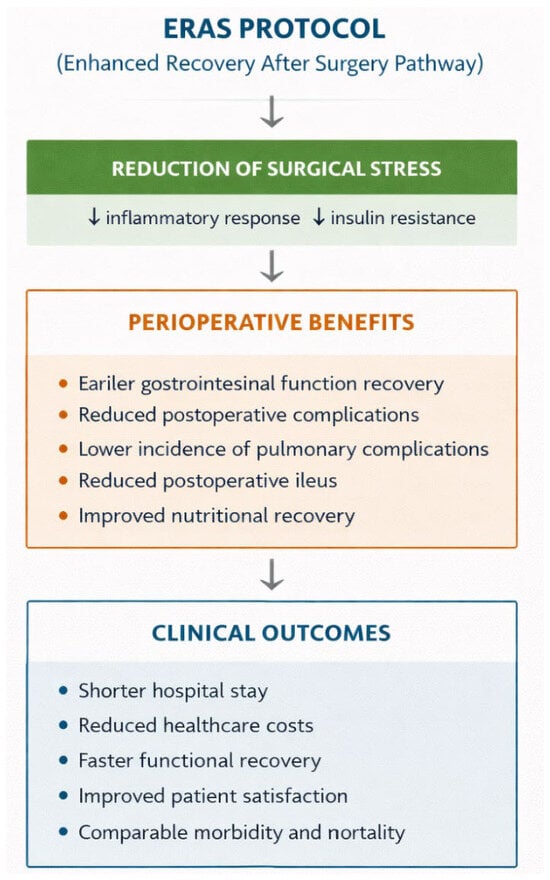
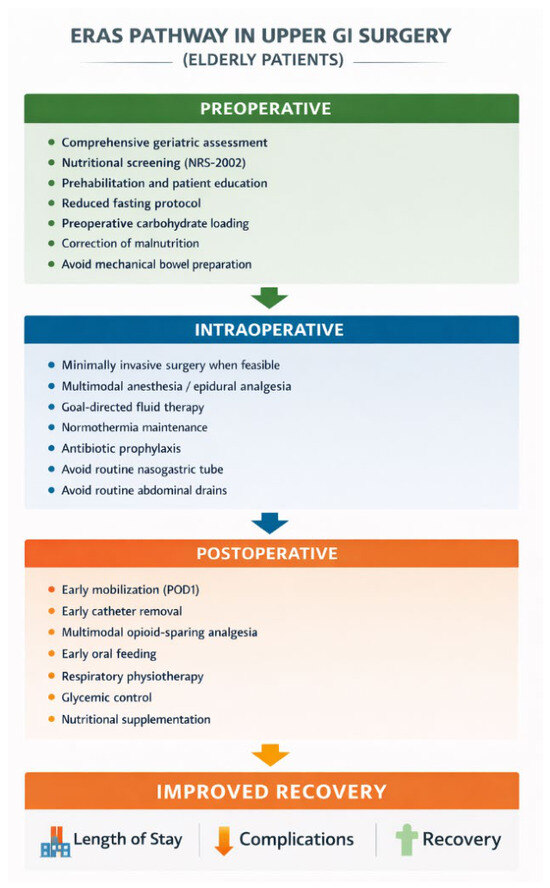
Effective ERAS implementation relies on thorough patient education, meticulous preoperative assessment, and individualized perioperative planning. Figure 1 summarizes the principal clinical benefits associated with ERAS pathways in elderly patients undergoing upper GI surgery. Figure 2 outlines the core components of the ERAS pathway specifically adapted for elderly patients undergoing upper GI procedures.
Figure 1.
Clinical benefits associated with Enhanced Recovery After Surgery (ERAS) protocols in elderly patients undergoing upper gastrointestinal surgery. By reducing surgical stress and promoting early postoperative recovery, ERAS pathways may contribute to improved clinical outcomes, including shorter length stays, faster gastrointestinal recovery, and fewer postoperative complications.
Figure 2.
Flow diagram illustrating the perioperative Enhanced Recovery After Surgery (ERAS) pathway for elderly patients undergoing upper gastrointestinal surgery. The protocol integrates evidence-based interventions across the preoperative, intraoperative, and postoperative phases to reduce surgical stress and promote postoperative recovery.
3.4. Frailty-Based ERAS Tailoring and Geriatric Assessment Integration
A major limitation of conventional ERAS pathways is their ‘one-size-fits-all’ approach, which fails to capture the substantial heterogeneity among elderly patients. Integrating frailty assessment and comprehensive geriatric evaluation into ERAS pathways represents a pivotal step toward personalized perioperative care, enabling more refined risk stratification and management strategies tailored beyond chronological age [39,40].
Frailty, defined as a state of decreased physiological reserve and increased vulnerability to stressors, has emerged as a strong predictor of postoperative complications, prolonged hospitalization, and mortality and remains conceptually distinct from chronological age [41,42]. Instruments such as the Clinical Frailty Scale (CFS), Comprehensive Geriatric Assessment (CGA), Modified Frailty Index (mFI), and Edmonton Frail Scale (EFS) enable clinicians to stratify elderly patients according to factors beyond chronological age alone [43,44,45].
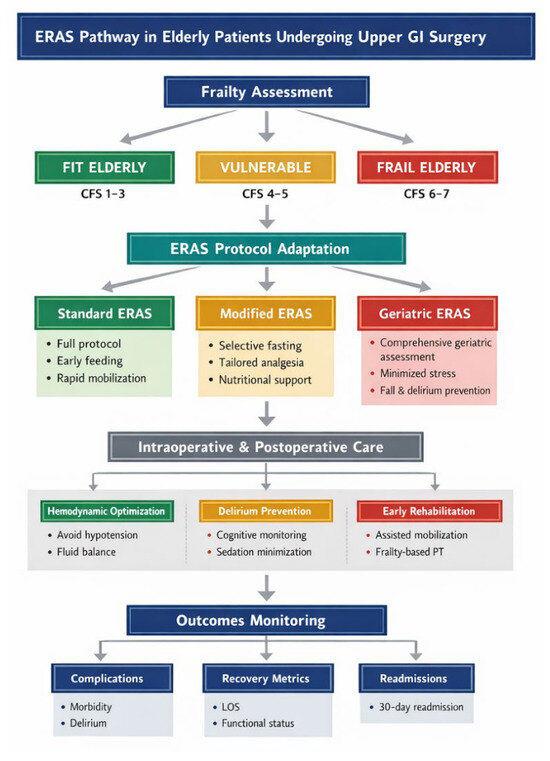
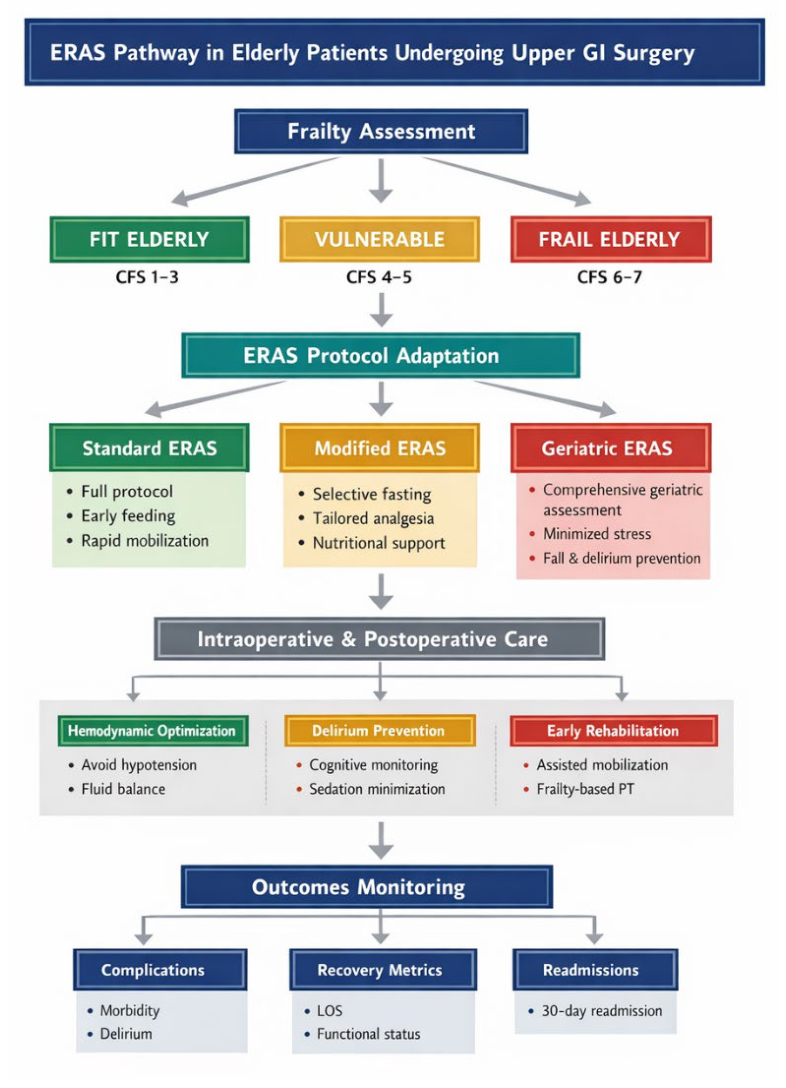
Frailty assessment allows clinicians to adapt ERAS pathways to each patient’s physiological reserve. Current evidence indicates that the CFS may be the most feasible tool for widespread integration into ERAS pathways for upper GI surgery, whereas the mFI and EFS provide more granular risk stratification when detailed clinical or functional data are available [46,47,48]. Fit older adults (CFS 1–3) generally tolerate full ERAS implementation, whereas vulnerable individuals (CFS 4–5) may benefit from intensified monitoring and individualized nutritional and analgesic strategies. In frail patients (CFS ≥ 6), clinicians should consider integrating CGA, prehabilitation, optimization of comorbidities, and selective application of ERAS components to maximize safety and promote functional recovery [49,50,51].
Integration of CGA may further refine perioperative planning by identifying potentially reversible risk factors such as malnutrition, polypharmacy, cognitive impairment, and functional dependency [45,51]. Early involvement of geriatricians has been associated with improved postoperative outcomes and fewer complications [52].
Integrating frailty assessment into perioperative planning enables clinicians to tailor ERAS components beyond chronological age, thereby supporting individualized decision-making and optimizing postoperative outcomes in elderly and physiologically vulnerable patients [45,52,53]. Figure 3 presents a clinical algorithm proposed by the authors for adapting ERAS pathways according to frailty status in elderly patients.
Figure 3.
Clinical algorithm proposed by the authors for implementing Enhanced Recovery After Surgery (ERAS) protocols in elderly patients undergoing upper gastrointestinal surgery.
3.5. Preoperative Optimization
The preoperative phase of ERAS protocols focuses on optimizing each patient’s physiological and nutritional status through structured frailty screening, targeted comorbidity management, and cardiorespiratory prehabilitation programs [10,54,55].
Prehabilitation typically consists of three components: exercise, nutritional support, and psychological support, with exercise representing the primary component [54]. Although these components can be implemented individually, a meta-analysis of patients with esophagogastric cancer showed that multimodal prehabilitation significantly reduced overall complication rates compared with standard care and was more effective than unimodal approaches [55].
Comprehensive preoperative counseling and patient education play a crucial role in reducing perioperative anxiety and promoting patient engagement in postoperative recovery.
Current ERAS guidelines endorse a modified fasting regimen that permits solid food intake up to six hours and clear carbohydrate-rich beverages up to two hours before anesthesia induction. This approach may reduce postoperative insulin resistance and enhance patient comfort [14].
Nutritional assessment is particularly important in elderly patients, and screening for malnutrition should be performed using validated tools such as the Nutritional Risk Score (NRS-2002) [56,57]. According to clinical nutrition guidelines, patients aged 70 years or older automatically receive an additional risk point in the NRS scoring system [56].
Patients with severe malnutrition or high metabolic risk require preoperative nutritional support—preferably through enteral nutrition—for at least two weeks before surgery to stabilize their metabolic status and improve postoperative resilience [56].
ERAS protocols for upper GI surgery generally discourage mechanical bowel preparation because it may increase the risk of dehydration and electrolyte imbalance without providing meaningful clinical benefits [6,13].
3.6. Intraoperative Management
Intraoperative ERAS strategies aim to minimize surgical stress and maintain physiological stability.
Effective pain management can be achieved using mid-thoracic epidural analgesia or multimodal analgesic strategies. Additional intraoperative measures include maintaining normothermia, administering antibiotic prophylaxis before surgical incision, and implementing goal-directed fluid therapy to maintain hemodynamic stability [14].
Routine nasogastric tube placement has traditionally been used after gastric surgery to prevent gastric distension and postoperative vomiting. Growing evidence indicates that routine nasogastric decompression provides no meaningful benefit and may delay postoperative recovery [7,58].
Similarly, several studies have questioned the routine use of abdominal drains. Although many centers still use prophylactic drainage, evidence increasingly indicates that this practice may increase postoperative complication rates and prolong LOS [13].
3.7. Postoperative Management
Facilitating early postoperative recovery is a central component of ERAS protocols. This strategy relies on a multimodal and multidisciplinary approach that manages the surgical stress response and mitigates its consequences, thereby accelerating postoperative recovery and reducing the need for subsequent healthcare utilization [15,59].
Urinary catheters are typically removed on the first postoperative day, and patients are encouraged to mobilize as early as possible [1,2,4,8]. Early ambulation may reduce the risk of thromboembolic events and pulmonary complications.
Effective pain control is essential to facilitate early mobilization and recovery. Epidural analgesia may be continued during the initial postoperative days, although careful monitoring is necessary to avoid hypotension and ensure adequate tissue perfusion [1,2,6,8].
Respiratory physiotherapy, including breathing exercises and incentive spirometry, may help prevent pulmonary complications such as pneumonia and pleural effusion by improving lung expansion and promoting effective airway clearance [6,7,60].
ERAS pathways encourage early oral feeding. A liquid diet usually begins on the first postoperative day, with gradual progression to a soft diet over the subsequent few days [3,6]. When oral intake is insufficient to meet at least 60% of daily energy requirements, oral nutritional supplementation should be initiated.
Enteral nutrition is generally preferred to parenteral nutrition, particularly in patients undergoing esophageal cancer surgery, who frequently present with severe dysphagia and preoperative malnutrition [60]. In selected high-risk patients, the placement of a feeding jejunostomy during surgery may provide a safe and effective strategy for ensuring adequate postoperative nutritional support [56,57].
4. Discussion
The present review indicates that ERAS protocols appear feasible and potentially safe, although the available evidence remains limited by substantial heterogeneity, predominantly retrospective study designs, and the absence of RCTs specifically enrolling elderly patients. Overall, the current evidence suggests that implementation of ERAS pathways in this population may improve short-term outcomes, including shorter LOS, faster recovery of gastrointestinal function, and no significant increase in postoperative complications or readmission rates [15,16,17,18,19,20,21,22,23,24,25,26,27,28,61]. These findings are consistent with results reported in younger populations, supporting the broader applicability of ERAS principles across age groups.
A key explanation for the potential effectiveness of ERAS in elderly patients lies in its multimodal and synergistic approach. By targeting multiple aspects of the perioperative stress response—including metabolic imbalance, inflammation, immobility, and delayed nutrition—ERAS protocols may mitigate the physiological burden of surgery. This approach is particularly relevant to older individuals, who typically exhibit reduced physiological reserve and increased vulnerability to surgical stress. Early mobilization, optimized pain control, and prompt nutritional support may collectively help preserve functional capacity and promote recovery, even in patients with a higher baseline risk [15,16,17,18,19,20,21,22,23,24,25,26,27,28,62].
One of the most important emerging concepts in this field is the central role of frailty as a determinant of surgical outcomes. Evidence consistently suggests that frailty, rather than chronological age alone, is a stronger predictor of postoperative complications, prolonged hospitalization, and mortality [42,43]. This observation supports a shift from age-based management to physiology-based perioperative management. In this context, integrating frailty assessment tools such as the CFS or CGA into ERAS pathways represents a critical step toward personalized care [43,44,63].
A frailty-informed ERAS approach stratifies patients according to functional reserve and vulnerability, thereby enabling tailored perioperative strategies. Fit older adults may benefit from full ERAS implementation similarly to younger patients, whereas vulnerable or frail individuals may require modified pathways incorporating intensified monitoring, targeted nutritional interventions, and prehabilitation programs [64]. This frailty-based ERAS model provides a conceptual framework for adapting perioperative care to individual patient profiles and optimizing the balance between efficacy and safety [8].
From a clinical perspective, these findings support the adoption of ERAS protocols in elderly patients undergoing upper GI surgery, with appropriate individualized adjustments. Particular attention should be paid to preoperative optimization—including nutritional assessment and prehabilitation—as well as to early postoperative mobilization and feeding [14,54,55]. These components are particularly relevant in older individuals, who more frequently present with malnutrition, sarcopenia, and functional impairment [54,55].
Comparison with colorectal surgery, where ERAS protocols are well established and widely standardized, highlights the less consistent adoption of ERAS in upper GI surgery [65]. This variability may reflect the greater technical complexity of upper GI procedures, higher rates of postoperative complications, and the frequent occurrence of preoperative malnutrition [28]. Nevertheless, current evidence suggests that ERAS pathways can be safely implemented in this context and may provide meaningful improvements in postoperative recovery and overall clinical outcomes [66].
Overall, ERAS protocols represent a promising approach to improving perioperative outcomes in elderly patients undergoing upper GI surgery. Current evidence supports the feasibility and potential benefits of ERAS in this population, although prospective studies specifically enrolling elderly patients are still needed.
Limitations and Future Directions
Interpretation of the current evidence requires careful consideration of several important limitations. Most available studies show substantial heterogeneity in study design, patient selection, and ERAS protocol composition [64]. In particular, studies define “elderly” in markedly different ways, with age thresholds ranging from 60 to 80 years or older, complicating comparisons and limiting generalizability [15,16,18,19,21,22,23,24]. Many analyses also rely on mixed-age cohorts in which elderly patients constitute only a subgroup, limiting the strength of age-specific conclusions. In addition, the absence of standardized ERAS protocols in upper GI surgery contributes to variability in reported outcomes [17].
Implementation barriers remain substantial and include variability in institutional resources, limited multidisciplinary coordination, and reduced patient engagement related to frailty, cognitive impairment, or social vulnerability [64]. Previous studies have shown that high compliance with ERAS components is strongly associated with improved outcomes, whereas reduced adherence may diminish these benefits [38,67]. Although concerns have been raised regarding the feasibility of maintaining high compliance among elderly patients, current evidence indicates that structured multidisciplinary coordination, comprehensive patient education, and meticulous perioperative planning can support satisfactory adherence in this population [8]. Despite encouraging short-term results, long-term outcomes remain insufficiently studied. Data on functional recovery, quality of life, and oncological outcomes among elderly patients managed within ERAS pathways remain limited. As the number of elderly individuals undergoing major oncological surgery continues to rise, these endpoints are becoming increasingly relevant and should be prioritized in future research [30].
Most available meta-analyses examine heterogeneous populations and do not specifically target elderly patients, highlighting a substantial gap in the current literature [17,25,26,27,28]. Reduced adherence in elderly cohorts may attenuate the expected benefits, reinforcing the importance of structured multidisciplinary coordination and individualized perioperative planning [37]. Furthermore, patient-reported outcomes (PROs) remain underrepresented in ERAS research on upper GI surgery. Measures such as quality of life, functional recovery, symptom burden, and return to baseline independence are particularly relevant in elderly patients, yet they are rarely designated as primary endpoints [10]. Incorporating standardized PRO instruments into future trials may provide a more comprehensive understanding of the impact of ERAS pathways on patient-centered outcomes [10].
Future studies should aim to standardize ERAS protocols for upper GI surgery while incorporating specific adaptations for elderly and frail patients. Large-scale prospective trials specifically enrolling geriatric populations are needed to strengthen the evidence base. Integrating geriatric assessment, structured prehabilitation programs, and digital health tools—including wearable sensors, mobile applications for symptom tracking, and telemedicine follow-up—may further enhance perioperative care and improve outcomes in this vulnerable population [9].
5. Conclusions
ERAS protocols represent an important advancement in perioperative care and have the potential to improve recovery after upper GI surgery. Current evidence suggests that ERAS protocols can be implemented safely in elderly patients and may promote faster recovery, shorten LOS, and support more stable postoperative outcomes.
However, stronger evidence is needed, particularly from randomized trials specifically designed to enroll elderly and frail populations.
Author Contributions
Conceptualization, G.P. and G.A.; methodology, G.P.; software, G.P.; validation, M.C. and E.A.C.; formal analysis, G.P.; investigation, A.L.S. and E.A.C.; data curation, G.P., M.C. and E.A.C.; writing—original draft preparation, G.P.; writing—review and editing, G.P., A.L.S. and G.A.; visualization, M.C.; supervision, G.A. All authors have read and agreed to the published version of the manuscript.
Funding
This research received no external funding.
Institutional Review Board Statement
Not applicable. This study is a review and not involving humans or animal.
Informed Consent Statement
Not applicable. This study is a review and not involving humans or animal.
Data Availability Statement
No new data were created or analyzed in this study. Data sharing is not applicable to this article.
Conflicts of Interest
The authors declare no conflicts of interest.
Abbreviations
The following abbreviations are used in this manuscript:
| ERAS | Enhanced Recovery After Surgery |
| GI | Gastrointestinal |
| LOS | Length of Stay |
| CFS | Clinical Frailty Scale |
| CGA | Comprehensive Geriatric Assessment |
| mFI | Modified Frailty Index |
| EFS | Edmonton Frail Scale |
| CRP | C-reactive protein |
| WBCs | White Blood Cells |
| NRS | Nutritional Risk Score |
| RCT(s) | Randomized Controlled Trial(s) |
References
- Ljungqvist, O.; Scott, M.; Fearon, K.C. Enhanced Recovery After Surgery: A review. JAMA Surg. 2017, 152, 292–298. [Google Scholar]
- Kehlet, H.; Wilmore, D.W. Evidence-based surgical care and the evolution of fast-track surgery. Ann. Surg. 2008, 248, 189–198. [Google Scholar] [CrossRef] [Scilit]
- Fearon, K.; Ljungqvist, O.; Von Meyenfeldt, M.; Revhaug, A.; Dejong, C.; Lassen, K.; Nygren, J.; Hausel, J.; Soop, M.; Andersen, J.; et al. Enhanced recovery after surgery: A consensus review. Clin. Nutr. 2005, 24, 466–477. [Google Scholar] [CrossRef] [Scilit]
- Gustafsson, U.O.; Scott, M.J.; Hubner, M.; Nygren, J.; Demartines, N.; Francis, N.; Rockall, T.A.; Young-Fadok, T.M.; Hill, A.G.; Soop, M.; et al. Guidelines for perioperative care in elective colorectal surgery: ERAS Society recommendations. World J. Surg. 2019, 43, 659–695. [Google Scholar] [CrossRef] [Scilit]
- Spanjersberg, W.R.; Reurings, J.; Keus, F.; van Laarhoven, C.J. Fast track surgery versus conventional recovery strategies for colorectal surgery. Cochrane Database Syst. Rev. 2011, 2011, CD007635. [Google Scholar] [CrossRef] [Scilit] [PubMed] [PubMed Central]
- Low, D.E.; Allum, W.; De Manzoni, G.; Ferri, L.; Immanuel, A.; Kuppusamy, M.; Law, S.; Lindblad, M.; Maynard, N.; Neal, J.; et al. Guidelines for perioperative care in esophagectomy: ERAS Society recommendations. World J. Surg. 2019, 43, 299–330. [Google Scholar] [CrossRef] [Scilit]
- Findlay, J.M.; Gillies, R.S.; Millo, J.; Sgromo, B.; Marshall, R.E. Enhanced recovery for esophagectomy: Systematic review. Dis. Esophagus 2014, 27, 788–801. [Google Scholar] [CrossRef] [Scilit]
- Ljungqvist, O.; Hubner, M. Enhanced recovery after surgery—ERAS—Principles, practice and feasibility in the elderly. Aging Clin. Exp. Res. 2018, 30, 249–252. [Google Scholar] [CrossRef] [Scilit]
- Partridge, J.S.L.; Ramani Moonesinghe, S.; Lees, N.; Dhesi, J.K. Perioperative care for older people. Age Ageing 2022, 51, afac194. [Google Scholar] [CrossRef] [Scilit]
- Keller, D.S.; Curtis, N.; Burt, H.A.; Ammirati, C.A.; Collings, A.T.; Polk, H.C.; Carrano, F.M.; Antoniou, S.A.; Hanna, N.; Piotet, L.-M.; et al. EAES/SAGES evidence-based recommendations and expert consensus on optimization of perioperative care in older adults. Surg. Endosc. 2024, 38, 4104–4126. [Google Scholar] [CrossRef] [Scilit] [PubMed] [PubMed Central]
- Bray, F.; Ferlay, J.; Soerjomataram, I.; Siegel, R.L.; Torre, L.A.; Jemal, A. Global cancer statistics 2018: GLOBOCAN estimates of incidence and mortality worldwide for 36 cancers in 185 countries. CA Cancer J. Clin. 2018, 68, 394–424, Erratum in CA Cancer J. Clin. 2020, 70, 313. https://doi.org/10.3322/caac.21609. [Google Scholar] [CrossRef] [Scilit] [PubMed]
- Yazici, H.; Esmer, A.C.; Eren Kayaci, A.; Yegen, S.C. Gastrıc cancer surgery in elderly patients: Promising results from a mid-western population. BMC Geriatr. 2023, 23, 529. [Google Scholar] [CrossRef] [Scilit] [PubMed] [PubMed Central]
- Mortensen, K.; Nilsson, M.; Slim, K.; Schäfer, M.; Mariette, C.; Braga, M.; Carli, F.; Demartines, N.; Griffin, S.M.; Lassen, K.; et al. Consensus guidelines for enhanced recovery after gastrectomy. Br. J. Surg. 2014, 101, 1209–1229. [Google Scholar] [CrossRef] [Scilit]
- Scott, M.J.; Baldini, G.; Fearon, K.C.; Feldheiser, A.; Feldman, L.S.; Gan, T.J.; Ljungqvist, O.; Lobo, D.N.; Rockall, T.A.; Schricker, T.; et al. Enhanced Recovery After Surgery (ERAS) for gastrointestinal surgery, part 1: Pathophysiological considerations. Acta Anaesthesiol. Scand. 2015, 59, 1212–1231. [Google Scholar] [CrossRef] [Scilit] [PubMed] [PubMed Central]
- Bu, J.; Li, N.; Huang, X.; He, S.; Wen, J.; Wu, X. Feasibility of fast-track surgery in elderly patients with gastric cancer. J. Gastrointest. Surg. 2015, 19, 1391–1398. [Google Scholar] [CrossRef] [Scilit]
- Liu, G.; Jian, F.; Wang, X.; Chen, L. Fast-track surgery protocol in elderly patients undergoing laparoscopic radical gastrectomy. Onco Targets Ther. 2016, 9, 3345–3351. [Google Scholar] [CrossRef] [Scilit][Green Version]
- Wang, L.H.; Zhu, R.F.; Gao, C.; Wang, S.L.; Shen, L.Z. Application of enhanced recovery after gastric cancer surgery: An updated meta-analysis. World J. Gastroenterol. 2018, 24, 1562–1578. [Google Scholar] [CrossRef] [Scilit]
- Cao, S.; Zheng, T.; Wang, H.; Niu, Z.; Chen, D.; Zhang, J.; Lv, L.; Zhou, Y. Enhanced recovery after surgery in elderly gastric cancer patients undergoing laparoscopic total gastrectomy. J. Surg. Res. 2021, 257, 579–586. [Google Scholar] [CrossRef] [Scilit]
- Xiao, S.M.; Ma, H.L.; Xu, R.; Yang, C.; Ding, Z. Enhanced Recovery After Surgery protocol for elderly gastric cancer patients: A prospective study for safety and efficacy. Asian J. Surg. 2022, 45, 2168–2171. [Google Scholar] [CrossRef] [Scilit] [PubMed]
- Yu, Z.; Zhuang, C.-L.; Ye, X.-Z.; Zhang, C.-J.; Dong, Q.-T.; Chen, B.-C. Fast-track surgery in gastrectomy for gastric cancer: A systematic review and meta-analysis. Langenbeck’s Arch. Surg. Ger. 2014, 399, 85–92. [Google Scholar] [CrossRef] [Scilit]
- Li, J.Y.; Ge, M.M.; Pan, H.F.; Wang, G.; Jiang, Z.W. Feasibility and safety of enhanced recovery after surgery in elderly patients with gastric cancer. World J. Gastroenterol. 2025, 31, 113331. [Google Scholar] [CrossRef] [Scilit] [PubMed] [PubMed Central]
- Pisarska, M.; Pędziwiatr, M.; Major, P.; Kisielewski, M.; Migaczewski, M.; Rubinkiewicz, M.; Budzyński, P.; Przęczek, K.; Zub-Pokrowiecka, A.; Budzyński, A. Laparoscopic Gastrectomy with Enhanced Recovery After Surgery Protocol: Single-Center Experience. Med. Sci. Monit. 2017, 23, 1421–1427. [Google Scholar] [CrossRef] [Scilit] [PubMed] [PubMed Central]
- You, K.; Han, H. Application of ERAS in older patients with gastric cancer. Medicine 2024, 103, e38409. [Google Scholar] [CrossRef] [Scilit] [PubMed] [PubMed Central]
- Tankel, J.; Sticca, G.; Kammili, A.; Dehghani, M.; Sakalla, R.; Ahmed, N.; Meng, A.; Najmeh, S.; Spicer, J.; Cools-Lartigue, J.; et al. ERAS following Gastrectomy for Octo- and Nonagenarians: A Single-Center Retrospective Analysis. J. Laparoendosc. Adv. Surg. Tech. A 2024, 34, 484–489. [Google Scholar] [CrossRef] [Scilit] [PubMed]
- Wang, Y.; Luo, S.; Wang, S. Evaluation of enhanced recovery after surgery for gastric cancer patients undergoing gastrectomy: A systematic review and meta-analysis. Wideochirurgia Inne Tech. Maloinwazyjne 2023, 18, 551–564. [Google Scholar] [CrossRef] [Scilit] [PubMed] [PubMed Central]
- Jin, H.; Song, S.; Lu, T.; Ma, S.; Wang, Y.; Fu, L.; Zhang, G.; Han, X.; Zhang, L.; Yang, K.; et al. The application of enhanced recovery after surgery in minimally invasive gastrectomy for gastric cancer: A meta-analysis of randomized controlled trials. Expert. Rev. Gastroenterol. Hepatol. 2022, 16, 1089–1100. [Google Scholar] [CrossRef] [Scilit] [PubMed]
- Tian, Q.; Wang, H.; Guo, T.; Yao, B.; Liu, Y.; Zhu, B. The efficacy and safety of enhanced recovery after surgery (ERAS) Program in laparoscopic distal gastrectomy: A systematic review and meta-analysis of randomized controlled trials. Ann. Med. 2024, 56, 2306194. [Google Scholar] [CrossRef] [Scilit] [PubMed] [PubMed Central]
- Liu, W.; He, L.; Yin, C.; Gong, G. Enhanced recovery after gastrectomy: Updated Meta-analysis of 27 randomized trials (2018-2025). BMC Surg. 2025, 26, 26. [Google Scholar] [CrossRef] [Scilit] [PubMed] [PubMed Central]
- Hu, H.M.; Zhou, H.Y.; Guo, L.L.; Chen, L.L.; Shen, Z. Enhanced recovery after surgery in laparoscopic radical gastrectomy for gastric cancer: Efficacy, safety, meta-analysis. BioMed Eng. Online 2026, 25, 21. [Google Scholar] [CrossRef] [Scilit] [PubMed] [PubMed Central]
- Markar, S.R.; Schmidt, H.; Kunz, S.; Bodnar, A.; Hubka, M.; Low, D.E. Evolution of standardized clinical pathways: Refining multidisciplinary care and process to improve outcomes of the surgical treatment of esophageal cancer. J. Gastrointest. Surg. 2014, 18, 1238–1246. [Google Scholar] [CrossRef] [Scilit] [PubMed]
- Aparicio, T.; Carteaux-Taieb, A.; Arégui, A.; Estrada, J.; Beraud-Chaulet, G.; Fossey-Diaz, V.; Hammel, P.; Cattan, P. Management of esogastric cancer in older patients. Ther. Adv. Med. Oncol. 2024, 16, 17588359241272941. [Google Scholar] [CrossRef] [Scilit] [PubMed] [PubMed Central]
- Geroin, C.; Weindelmayer, J.; Camozzi, S.; Leone, B.; Turolo, C.; Bencivenga, M.; Sacco, M.; De Pasqual, C.A.; Vedovi, E.; Priolo, S.; et al. Association between ERAS protocol and major postoperative complications and reasons for non-compliance in patients with esophageal cancer. Eur. J. Surg. Oncol. 2025, 51, 109707. [Google Scholar] [CrossRef] [Scilit] [PubMed]
- Parakonthun, T.; Gonggetyai, G.; Nampoolsuksan, C.; Suwatthanarak, T.; Tawantanakorn, T.; Swangsri, J.; Methasate, A. Higher compliance with the enhanced recovery after surgery protocol improves postoperative recovery and 6-month mortality in upper gastrointestinal surgery. Surg. Pract. Sci. 2024, 19, 100265. [Google Scholar] [CrossRef] [Scilit] [PubMed] [PubMed Central]
- Huang, Z.D.; Gu, H.Y.; Zhu, J.; Luo, J.; Shen, X.F.; Deng, Q.F.; Zhang, C.; Li, Y.B. The application of enhanced recovery after surgery for upper gastrointestinal surgery: Meta-analysis. BMC Surg. 2020, 20, 3. [Google Scholar] [CrossRef] [Scilit] [PubMed] [PubMed Central]
- Palomba, G.; Capuano, M.; Pegoraro, F.; Basile, R.; Pesce, M.; Rurgo, S.; Effice, E.; Sarnelli, G.; De Palma, G.D.; Aprea, G. Laparoscopic Heller-Dor myotomy in elderly achalasia patients: A single center experience with PSM analysis. Minim. Invasive Ther. Allied Technol. 2024, 33, 13–20. [Google Scholar] [CrossRef] [Scilit] [PubMed]
- Oor, J.E.; Koetje, J.H.; Roks, D.J.; Nieuwenhuijs, V.B.; Hazebroek, E.J. Laparoscopic Hiatal Hernia Repair in the Elderly Patient. World J. Surg. 2016, 40, 1404–1411. [Google Scholar] [CrossRef] [Scilit]
- Siotos, C.; Stergios, K.; Naska, A.; Frountzas, M.; Pergialiotis, V.; Perrea, D.N.; Nikiteas, N. The impact of fast track protocols in upper gastrointestinal surgery: A meta-analysis of observational studies. Surgeon 2018, 16, 183–192. [Google Scholar] [CrossRef] [Scilit] [PubMed]
- Hübner, M.; Addor, V.; Slieker, J.; Griesser, A.-C.; Lécureux, E.; Blanc, C.; Demartines, N. The impact of compliance with ERAS protocol. Ann. Surg. 2015, 261, 1153–1159. [Google Scholar] [CrossRef] [Scilit]
- Boreskie, K.F.; Hay, J.L.; Boreskie, P.E.; Arora, R.C.; Duhamel, T.A. Frailty-aware care: Giving value to frailty assessment across different healthcare settings. BMC Geriatr. 2022, 22, 13. [Google Scholar] [CrossRef] [Scilit]
- Dhesi, J.K.; Lees, N.P.; Partridge, J.S. Frailty in the perioperative setting. Clin. Med. 2019, 19, 485–489. [Google Scholar] [CrossRef] [Scilit] [PubMed] [PubMed Central]
- Dent, E.; Hanlon, P.; Kowal, P.; Hoogendijk, E.O. Frailty measurement in research and clinical practice: An updated review. Eur. J. Intern. Med. 2026, 144, 106595. [Google Scholar] [CrossRef] [Scilit] [PubMed]
- Makary, M.A.; Segev, D.L.; Pronovost, P.J.; Syin, D.; Bandeen-Roche, K.; Patel, P.; Takenaga, R.; Devgan, L.; Holzmueller, C.G.; Tian, J.; et al. Frailty as a predictor of surgical outcomes in older patients. J. Am. Coll. Surg. 2010, 210, 901–908. [Google Scholar] [CrossRef] [Scilit] [PubMed]
- Rockwood, K.; Theou, O. Using the Clinical Frailty Scale in Allocating Scarce Health Care Resources. Can. Geriatr. J. 2020, 23, 210–215. [Google Scholar] [CrossRef] [Scilit] [PubMed] [PubMed Central]
- Ellis, G.; Gardner, M.; Tsiachristas, A.; Langhorne, P.; Burke, O.; Harwood, R.H.; Conroy, S.P.; Kircher, T.; Somme, D.; Saltvedt, I.; et al. Comprehensive geriatric assessment for older adults admitted to hospital. Cochrane Database Syst. Rev. 2017, 9, CD006211. [Google Scholar] [CrossRef] [Scilit] [PubMed] [PubMed Central]
- Partridge, J.S.; Harari, D.; Martin, F.C.; Dhesi, J.K. The impact of pre-operative comprehensive geriatric assessment on postoperative outcomes in older patients undergoing scheduled surgery: A systematic review. Anaesthesia 2014, 69, 8–16. [Google Scholar] [CrossRef] [Scilit] [PubMed]
- Xing, Y.; He, Z.; Wang, L.; Zhang, H.; Gao, Y.; Gu, E.; Zhang, L.; Chen, L. Preoperative prediction of adverse outcome after elective gastrointestinal surgery in older patients: Three leading frailty instruments and the American Society of Anesthesiologists physical status. Am. J. Transl. Res. 2023, 15, 3476–3488. [Google Scholar] [PubMed] [PubMed Central]
- Chen, Y.; Song, S.; Wang, Z.; Guo, Y.; Fu, Z.; Xu, T.; Chen, Y.; Jiang, Z.; Ding, L.; Xu, Q. The predictive value of multidimensional frailty instruments for postoperative adverse outcomes in cancer patients: A systematic review and meta-analysis. World J. Surg. Onc 2026, 24, 259. [Google Scholar] [CrossRef] [Scilit]
- You, J.; Chen, X.; Rong, Y.; Pan, S.; Liu, T.; Xie, Y. Application value of different frailty assessment tools in older patients undergoing major abdominal surgery. Exp. Gerontol. 2025, 209, 112852. [Google Scholar] [CrossRef] [Scilit] [PubMed]
- Sharon, C.E.; Strohl, C.; Saur, N.M. Frailty Assessment and Prehabilitation as Part of a PeRioperative Evaluation and Planning (PREP) Program for Patients Undergoing Colorectal Surgery. Clin. Colon. Rectal Surg. 2023, 36, 184–191. [Google Scholar] [CrossRef] [Scilit] [PubMed] [PubMed Central]
- Coluzzi, F.; Mandatori, I.; Giordan, E.; Rossi, M. Pain management in frail patients according to ERAS philosophy, key concepts and pitfalls. Minerva Anestesiol. 2026, 92, 91–101. [Google Scholar] [CrossRef] [Scilit] [PubMed]
- Dent, E.; Morley, J.E.; Cruz-Jentoft, A.J.; Woodhouse, L.; Rodríguez-Mañas, L.; Fried, L.P.; Woo, J.; Aprahamian, I.; Sanford, A.; Lundy, J.; et al. Physical Frailty: ICFSR International Clinical Practice Guidelines for Identification and Management. J. Nutr. Health Aging 2019, 23, 771–787. [Google Scholar] [CrossRef] [Scilit]
- Theodorakis, N.; Nikolaou, M.; Hitas, C.; Anagnostou, D.; Kreouzi, M.; Kalantzi, S.; Spyridaki, A.; Triantafylli, G.; Metheniti, P.; Papaconstantinou, I. Comprehensive Peri-Operative Risk Assessment and Management of Geriatric Patients. Diagnostics 2024, 14, 2153. [Google Scholar] [CrossRef] [Scilit] [PubMed] [PubMed Central]
- Zietlow, K.E.; Wong, S.; Heflin, M.T.; McDonald, S.R.; Sickeler, R.; Devinney, M.; Blitz, J.; Lagoo-Deenadayalan, S.; Berger, M. Geriatric Preoperative Optimization: A Review. Am. J. Med. 2022, 135, 39–48. [Google Scholar] [CrossRef] [Scilit] [PubMed] [PubMed Central]
- Gillis, C.; Ljungqvist, O.; Carli, F. Prehabilitation, enhanced recovery after surgery, or both? A narrative review. Br. J. Anaesth. 2022, 128, 434–448, Erratum in Br. J. Anaesth. 2022, 128, 1061. https://doi.org/10.1016/j.bja.2022.03.001. [Google Scholar] [CrossRef] [Scilit]
- Daniels, S.L.; Lee, M.J.; George, J.; Kerr, K.; Moug, S.; Wilson, T.R.; Brown, S.R.; Wyld, L. Prehabilitation in elective abdominal cancer surgery in older patients: Systematic review and meta-analysis. BJS Open 2020, 4, 1022–1041. [Google Scholar] [CrossRef] [Scilit] [PubMed] [PubMed Central]
- Weimann, A.; Braga, M.; Carli, F.; Higashiguchi, T.; Hübner, M.; Klek, S.; Laviano, A.; Ljungqvist, O.; Lobo, D.N.; Martindale, R.G.; et al. ESPEN practical guideline: Clinical nutrition in surgery. Clin. Nutr. 2021, 40, 4745–4761. [Google Scholar] [CrossRef] [Scilit] [PubMed]
- Kondrup, J.; Allison, S.P.; Elia, M.; Vellas, B.; Plauth, M. ESPEN guidelines for nutrition screening 2002. Clin. Nutr. 2003, 22, 415–421. [Google Scholar] [CrossRef] [Scilit]
- Palomba, G.; Basile, R.; Capuano, M.; Pesce, M.; Rurgo, S.; Sarnelli, G.; De Palma, G.D.; Aprea, G. Nasogastric tube after laparoscopic Heller-Dor surgery: Do you really need it? Curr. Probl. Surg. 2024, 61, 101457. [Google Scholar] [CrossRef] [Scilit] [PubMed]
- Kehlet, H. Multimodal approach to control postoperative pathophysiology and rehabilitation. Br. J. Anaesth. 1997, 78, 606–617. [Google Scholar] [CrossRef] [Scilit] [PubMed]
- Boden, I.; Skinner, E.H.; Browning, L.; Reeve, J.; Anderson, L.; Hill, C.; Robertson, I.K.; Story, D.; Denehy, L. Preoperative physiotherapy for the prevention of respiratory complications after upper abdominal surgery: Pragmatic, double blinded, multicentre randomised controlled trial. BMJ 2018, 360, j5916, Erratum in BMJ 2019, 365, l1862. https://doi.org/10.1136/bmj.l1862. [Google Scholar] [CrossRef] [Scilit] [PubMed] [PubMed Central]
- Huddy, J.R.; Huddy, F.M.S.; Markar, S.R.; Tucker, O. Nutritional optimization during neoadjuvant therapy prior to surgical resection of esophageal cancer-a narrative review. Dis. Esophagus 2018, 31, dox110, Erratum in Dis. Esophagus 2018, 31, doy032. https://doi.org/10.1093/dote/doy032. [Google Scholar] [CrossRef] [Scilit] [PubMed]
- Kennelly, P.; Davey, M.G.; Griniouk, D.; Calpin, G.; Donlon, N.E. Evaluating the impact of enhanced recovery after surgery protocols following oesophagectomy: A systematic review and meta-analysis of randomised clinical trials. Dis. Esophagus 2025, 38, doae118. [Google Scholar] [CrossRef] [Scilit] [PubMed] [PubMed Central]
- Saetang, M.; Kunapaisal, T.; Chatmongkolchart, S.; Yongsata, D.; Sukitpaneenit, K. Assessing frailty to predict surgical risk: A comparative study of three tools in older non-cardiac surgery patients. BMC Geriatr. 2025, 25, 941. [Google Scholar] [CrossRef] [Scilit]
- Lobo, D.; Joshi, G.; Kehlet, H. Challenges in Enhanced Recovery After Surgery (ERAS) research. Br. J. Anaesth. 2024, 133, 717–721. [Google Scholar] [CrossRef] [Scilit]
- Ayinde, B.O.; Chokshi, P.; Adhikari, S.; Jaimalani, A.; Yeritsyan, A.; Surve, A.V.; Khan, S. Challenges and Elements Hindering the Adoption of Enhanced Recovery After Surgery (ERAS) Protocols in Colorectal Surgery and Their Resolutions: A Systematic Review. Cureus 2024, 16, e63222. [Google Scholar] [CrossRef] [Scilit] [PubMed] [PubMed Central]
- Pisarska, M.; Gajewska, N.; Małczak, P.; Wysocki, M.; Major, P.; Milian-Ciesielska, K.; Budzyński, A.; Pędziwiatr, M. Is It Possible to Maintain High Compliance with the Enhanced Recovery after Surgery (ERAS) Protocol?-A Cohort Study of 400 Consecutive Colorectal Cancer Patients. J. Clin. Med. 2018, 7, 412. [Google Scholar] [CrossRef] [Scilit] [PubMed] [PubMed Central]
- Sims, C.; Abou Chaar, M.; Kerfeld, M. Esophagectomy Enhanced Recovery After Surgery Initiative Results in Improved Outcomes. Ann. Thorac. Surg. 2023, 117, 847–857. [Google Scholar] [CrossRef] [Scilit]

Disclaimer/Publisher’s Note: The statements, opinions and data contained in all publications are solely those of the individual author(s) and contributor(s) and not of MDPI and/or the editor(s). MDPI and/or the editor(s) disclaim responsibility for any injury to people or property resulting from any ideas, methods, instructions or products referred to in the content. |
© 2026 by the authors. Licensee MDPI, Basel, Switzerland. This article is an open access article distributed under the terms and conditions of the Creative Commons Attribution (CC BY) license.