


Abstract
The isoxazole-5-one ring system is a central structure in many synthetic bioactive molecules, showing a wide range of biological activities, including antibacterial, antitumor, anticorrosion, antifungal, antituberculosis, and antioxidant. They are also applied as agrochemicals with potential fungicidal effects. Given various applications, these pharmaceutically and biologically significant heterocyclic compounds have attracted the attention of chemistry researchers. This study aimed to investigate the application of glycerol as a reaction medium for the three-component synthesis of arylidenisoxazol-5(4H)-one derivatives. The results of the optimized investigations revealed that 3.0 mL of glycerol is the best reaction medium. Evaluation of the effect of reaction temperature showed that the best temperature for this strategy is 60 °C. In the present environmentally friendly study, the desired heterocyclic compounds were quickly synthesized via a one-pot three-component reaction of two keto-esters with hydroxylamine hydrochloride and a number of aryl/heteroaryl aldehydes. This synthetic approach has significant merits, such as cost-effectiveness of the reaction medium, rapid green synthesis, operational simplicity, easy workup, avoiding chromatographic purification, sustainability, acceptable yields, and relatively inexpensive as well as commercially available starting materials.
1. Introduction
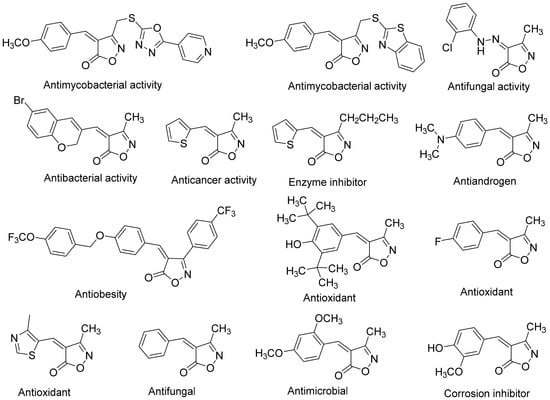
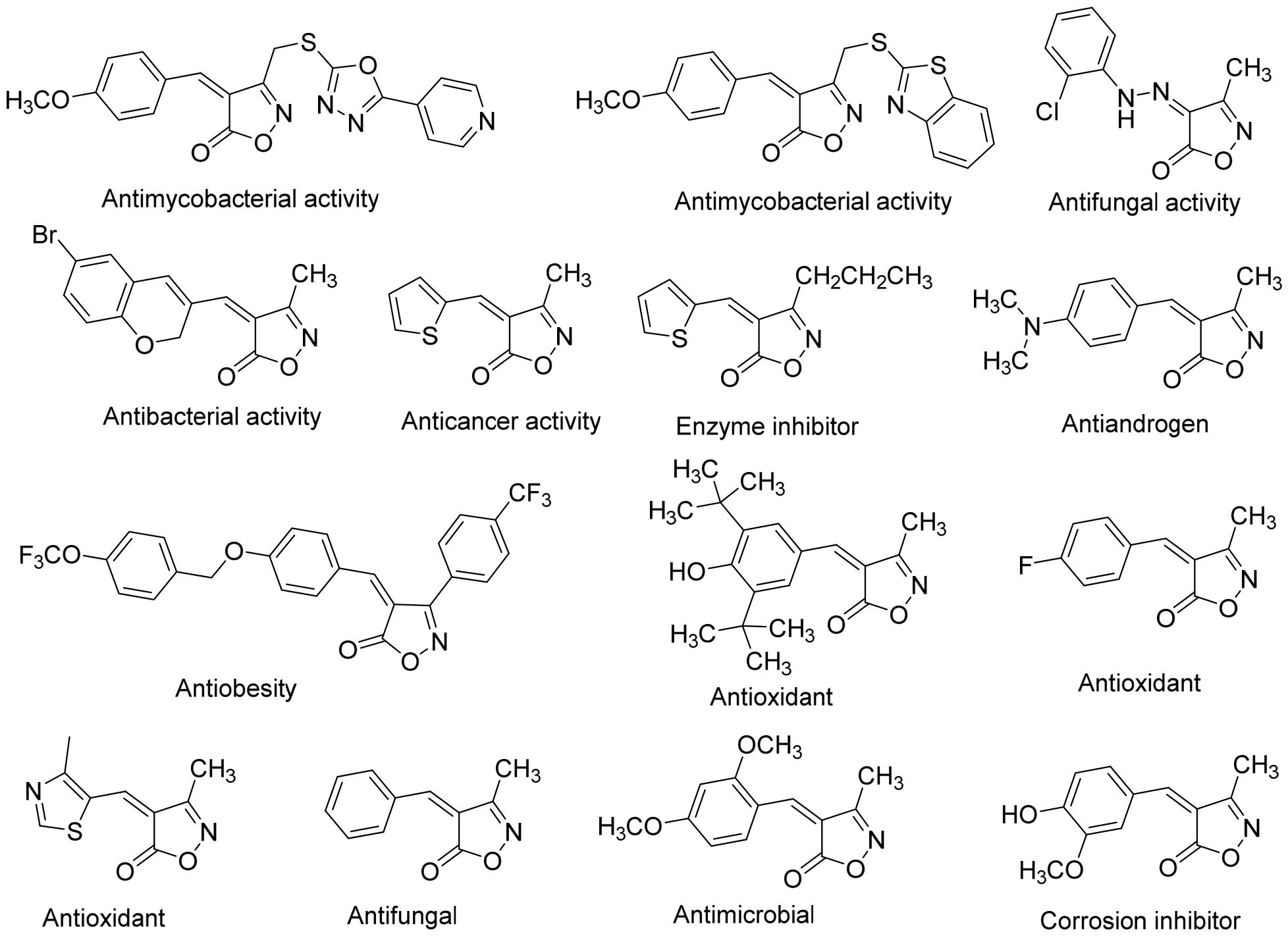
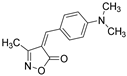
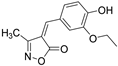
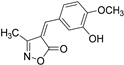
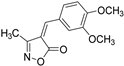
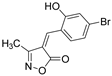
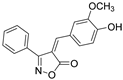
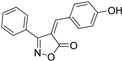
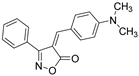
Among N,O-heterocyclic compounds, five-membered rings such as isoxazoles have received special attention due to their potential applications in synthetic chemistry, the pharmaceutical industry, and biological sciences [1]. Among the isoxazole family, arylideneisoxazol-5(4H)-ones and their derivatives have garnered considerable attention owing to their potential as antimycobacterial [2], antifungal [3], anticancer [4], antibacterial [5], enzyme inhibitor carbonic anhydrase [6], antiandrogen [7], antidiabetic [8], and antioxidant [9] agents. In addition to the aforementioned characteristics, arylideneisoxazole-5(4H)-one derivatives are used as anti-corrosion reagents [10]. The structures of some important arylidene isoxazol-5(4H)-ones are depicted in Figure 1. The five-membered heterocyclic scaffold is an important intermediate for the construction of other heterocyclic products and organic molecules, including polysubstituted pyridines [11], spirocyclic azepino[4,3,2-cd]indole derivatives [12], cyclopentenyl spiroisoxazolones [13], fully substituted pyrrole-2-carboxylic acids [14], imidazoles [15], 4-aryl-3-[(E)-(hydroxyimino)(aryl)methyl]-4,6,7,8-tetrahydroquinoline-2,5(1H,3H)-diones [16], spiro[isoxazole-pyrazoloquinoline]s [17], spirocarbocycles [18], and others [19]. Consequently, in the research community of chemistry and pharmaceuticals, synthesizing arylideneisoxazol-5(4H)-ones has garnered considerable attention. A feasible and widely accepted strategy involves a three-component process that has been catalyzed under various conditions with a variety of catalysts, including water extract of orange fruit peel ash (WEOFPA) in glycerol [4], glutamic acid catalyst in glycerol [5], Cu@Ag-CeO2/chitosan nanocomposite [20], yttrium (III)-MMZ [21], Na2S2O3 [22], Na2SO3 [23], g-C3N4·OH nanocomposite [24], sulfamic acid [25], 1-methyl-3-carboxymethylimidazolium chloride [26], lemon juice [27], FeS1−x-Fe3O4/C nanocatalyst [28], sodium benzoate [29], NaOAc [30], MMWCNT-PEG-PIP [31], sodium lauryl sulfate [32], amine-functionalized cellulose [33], SiO2 NPs [34], urea [35], triphenylphosphine [36], DMAP [37], ruthenium-hydride complex [38], ferrite nanoparticles [39], CeO2 nanoparticles [40], aqueous extract of Areca nut [41], theophylline hydrogen sulfate [42], CuNPs@N-GQDs@APTES) [43], guanidine hydrochloride [44], and malic acid [45]. Other catalysts for synthesizing arylideneisoxazolones can be found in a recently published review [46].
Figure 1.
Examples of bioactive arylideneisoxazol-5(4H)-ones.
Glycerol was used as a vital chemical with numerous applications in modern energy, environmental technologies, and the synthesis of value-added products [47]. Glycerol, also termed “organic water,” is readily available, cheap, polar, non-toxic, biodegradable, and easily forms strong networks of hydrogen bonds [48]. Glycerol is found in the “generally recognized as safe” list made by the U.S. Food and Drug Administration [49]. Glycerin is employed in cakes, beverages, pharmaceuticals, skin and hair products, the production of shampoos, soaps, toothpastes, esters, polyethers, detergents, cellophane, and some alkyd resins [50,51]. As compared with conventional organic solvents, propane-1,2,3-triol reveals many advantages, including low toxicity, non-volatility, non-flammability, and low production cost. This polyhydroxy alcohol, as a classic example of a “green solvent,” improves reaction selectivity and increases reaction rate [49]. Glycerol not only acts as a phase transfer catalyst but also as a recyclable solvent [52]. This biocompatible polyalcohol was used as an eco-friendliness reaction medium or additive to synthesizing different heterocyclic compounds such as 4-(1H-pyrazol-4-yl)-polyhydroquinolines [49], pyrido[2,3-d]pyrimidines [53], 1,4-dihydropyridines [54,55], functionalized thioamides and 4H-thiopyrans [56], imidazo[2,1-b]thiazoles [57], thiazole Betti bases [58], 2-amino-3-phenylsulfonyl-4H-benzochromens [59], 3-benzoxazol-2-yl-chromen-2-ones [60], 2-amino-4,8-dihydropyrano[3,2-b]pyran-3-carbonitriles [61], 2,3-dihydroquinazolin-4(1H)-ones [62], 6-amino-1,4-dihydropyrano[2,3-c]pyrazole-5-carbonitriles [63,64], 1,4-disubstituted 1,2,3-triazoles [65], 5′-thioxospiro[indoline-3,3′-[1,2,4]triazolidin]-2-ones [66], α-aminophosphonates [67], nitrones [68], 2-arylimidazo[1,2-a]pyrimidine-3-carbaldehydes [69], and others [70].
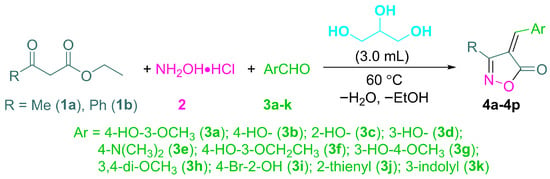
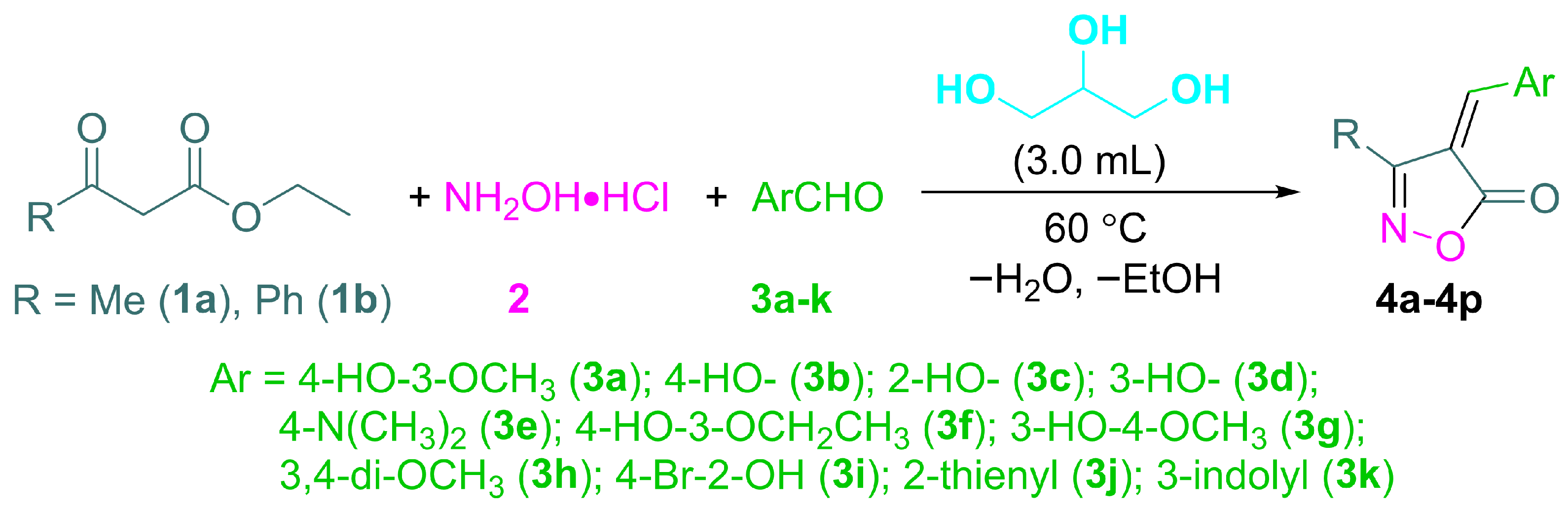
Given the synthetic significance of isoxazolone-containing compounds, the development of a green, efficient, less energy-consuming, faster, more economical, and more sustainable method is of interest to many researchers in synthetic organic chemistry. Therefore, it was decided to investigate the synthesis of several isoxazol-5(4H)-one derivatives (Scheme 1) based on our laboratory resources.
Scheme 1.
Green synthesis of arylideneisoxazol-5(4H)-ones (4a-4p).
2. Materials and Methods
2.1. General
All the essential chemicals and solvents were obtained from commercial sources and used as received. All solvents were distilled before use. The reactions were monitored by thin-layer chromatography (TLC) analysis using pre-coated aluminum sheets (silica gel G 60 F254, Merck, Darmstadt, Germany). TLC was visualized by ultraviolet (UV) irradiation, exposure to iodine vapor, and spraying with a reagent. The melting points were recorded using an electrothermal 9100 melting point apparatus and were uncorrected. 1H- and 13C NMR spectra were recorded on a Bruker Avance II 400 MHz spectrometer (Rheinstetten, Germany) using CDCl3 or DMSO-d6 as solvent. Splitting patterns are designated as follows: s, singlet; d, doublet; dd, doublet of doublets; and m, multiplet. Chemical shift values are specified in parts per million (ppm). Coupling constant values are reported in hertz (Hz).
2.2. General Procedure for the Synthesis of Target Heterocyclic Compounds (4a-4p)
Ethyl acetoacetate (1a, 1 mmol) or ethyl 3-oxo-3-phenylpropanoate (1b, 1 mmol), hydroxylamine hydrochloride (2, 1 mmol), and aryl/heteroaryl aldehydes (3a-3k, 1 mmol) were poured into a round-bottom flask equipped with a magnetic stirring bar, and glycerol (41.0 mmol, 3.0 mL) was added. The reaction was stirred at 60 °C for appropriate times. After the reaction was complete (monitored by TLC), the reaction mixture was cooled to room temperature, and the solvent was removed by filtration. The precipitate of the desired compounds remained on the filter paper. After recrystallization of the precipitates in ethanol, pure heterocyclic products (4a-4p) were obtained.
2.2.1. 4-(4-Hydroxy-3-methoxybenzylidene)-3-methylisoxazol-5(4H)-one (4a)
1H NMR (DMSO-d6, 400 MHz) (Figure S1): δ 2.25 (s, 3H, CH3), 3.85 (s, 3H, OCH3), 6.96 (d, J = 8.4 Hz, 1H, Ar-H), 7.78 (s, 1H, H-vinyl), 7.91 (dd, J = 2.0, 8.8 Hz, 1H, Ar-H), 8.52 (d, J = 2.0, Hz, 1H, Ar-H), 10.77 (s, 1H, OH); 13C NMR (DMSO-d6, 100 MHz) (Figures S2): δ 11.8 (CH3), 56.0 (3H, OCH3), 114.2 (CAr ortho to OCH3), 116.3 (CAr ortho to OH), 117.2 (CAr meta to OH), 125.5 (C-4 isoxazolone), 132.1 (CAr para to OH), 147.9 (C-vinyl), 152.3 (CAr-OH), 154.3 (CAr-OCH3), 172.7 (C=N), 169.5 (C=O).
2.2.2. 4-(4-Hydroxybenzylidene)-3-phenylisoxazol-5(4H)-one (4m)
1H NMR (DMSO-d6, 400 MHz) (Figure S3): δ 6.95 (d, J = 9.2 Hz, 2H, Ar-H), 7.59–7.69 (m, 6H, Ar-H, H-vinyl), 8.45 (d, J = 8.8 Hz, 2H, Ar-H), 11.16 (s, 1H, OH); 13C NMR (DMSO-d6, 100 MHz) (Figure S4): δ 113.2 (CAr), 116.6 (CAr), 124.9 (CAr), 127.9 (CAr), 129.3 (CAr), 129.4 (CAr), 129.7 (CAr), 131.3 (CAr), 138.5 (C-vinyl), 153.8 (CAr-OH), 164.8 (C=N), 169.4 (C=O).
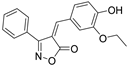
2.2.3. 4-(3-Ethoxy-4-hydroxybenzylidene)-3-phenylisoxazol-5(4H)-one (4o)
1H NMR (DMSO-d6, 400 MHz) (Figure S5): δ 1.39 (t, J = 6.8 Hz, 3H, CH3), 4.35 (q, J = 6.8 Hz, 2H, OCH2), 6.96 (d, J = 8.4 Hz, 1H, Ar-H), 7.62–7.68 (m, 6H, Ar-H, H-vinyl), 7.89 (dd, J = 1.6, 7.6 Hz, 1H, Ar-H), 8.50 (d, J = 1.6 Hz, 1H, Ar-H), 10.85 (s, 1H, OH); 13C NMR (DMSO-d6, 100 MHz) (Figure S6): δ 15.0 (CH3), 64.4 (OCH2), 113.0 (CAr), 116.3 (CAr), 118.5 (CAr), 125.4 (CAr), 127.9 (CAr), 129.3 (CAr), 129.7 (CAr), 131.2 (CAr), 132.6 (CAr), 147.1 9 (C-vinyl), 154.1 (CAr-OH), 155.0 (CAr-OCH3), 164.9 (C=N), 169.6 (C=O).
3. Results and Discussion
The synthesis of the desired heterocyclic compounds was accomplished by the synthetic route illustrated in Scheme 1. For this purpose, the reaction conditions should be optimized using a model reaction. The reaction of ethyl acetoacetate (1a), hydroxylamine hydrochloride (2), and vanillin (3a) was selected as a model reaction (Scheme 2).
Scheme 2.
The model reaction.
The results of the optimization of the reaction conditions under solvent-free and various solvents can be seen in Table 1. At first, the reaction was studied in a solvent-free environment without any additives or catalysts. At room temperature (RT), the yield of the isoxazolone product (4a) was moderate after 60 min (Table 1, Entry 1). Running the model reaction in water (H2O) as a green solvent led to a 55% isolated yield after 60 min (Table 1, Entry 2). Performing the same reaction at different temperature conditions, including refluxing H2O, did not lead to satisfactory results (one result is shown in row 3 of Table 1). Changing the solvent from water to ethanol (EtOH) under reflux conditions did not significantly improve the reaction yield (Table 1, Entry 4). After the previous unattractive results, it was decided to check the reaction in other organic solvents such as ethyl acetate (EtOAc), chloroform (CHCl3), n-hexane, dichloromethane (CH2Cl2), and dioxane in the hope that better results might be obtained (Table 1, Entries 5–9). Performing the reactions at different temperatures and boiling points of solvents resulted in disappointing results. That is why we decided to use a beautiful organic water, namely glycerol, to implement the model reaction. Therefore, the model reaction was explored in the presence of glycerol with different mol%, and an increase in the reaction yields and a decrease in the reaction times were seen in different volumes of glycerol (Table 2, Entries 1–6). The cyclocondensation reaction using 0.6 mL (8.2 mmol) of glycerol leads to the formation of the product 4a in 75% yield after 32 min (Table 2, Entry 1). At RT, when the amounts of glycerol were increased from 0.6 mL (8.2 mmol) to 1.2 (16.4), 1.8 (24.6), 2.4 (32.8), and 3.0 mL (41.0 mmol), the heterocyclic product 4a was formed in good to excellent yield (Table 2, Entries 2–5). The reaction was also tested using 3.6 mL (49.2 mmol) glycerol, but found that the target product was formed in 90% yield (Table 2, Entry 6). So, 3.0 mL (41.0 mmol) glycerol is the ideal medium for the model reaction. To study the impact of temperature on the reaction yields and reaction times, more experiments were carried out in 3.0 mL (41.0 mmol) glycerol at different temperatures (30–80 °C) (Table 2, Entries 7–17). An improvement in yields and reaction times was observed. Raising the reaction temperature from 25 °C to 60 °C significantly decreased the reaction time and also increased the yield of the reaction. Based on the results of the optimization, performing the cyclocondensation reaction in glycerol at 60 °C resulted in a rapid synthesis of the heterocyclic product 4a in a higher isolated reaction yield (Table 2, Entry 13). Increasing the reaction temperature above 60 °C did not lead to notable improvements in the reaction times and the yields (Table 2, Entries 14–17). Accordingly, the best reaction results were obtained at 60 °C in glycerol (Table 2, Entry 13; the optimized conditions).
Table 1.
Optimization of the cyclocondensation reaction via Scheme 2 in solvent-free and various solvents 1.
Table 2.
Optimization of the cyclocondensation reaction using glycerol 1.
After optimization of the reaction conditions, to evaluate the generality of the process, the reaction between 1a, 2, and substituted benzaldehydes (3a-3k) and heteroaryl aldehydes was studied in glycerol at 60 °C (Table 3, Entries 2–11). Aryl aldehydes containing electron-donating functional groups like OH, OCH3, and OC2H5, the process was completed, and the target products (4a-4i) were formed in excellent isolated yield after 3–10 min. Under the optimized conditions, the process using substituted benzaldehydes carrying electron-withdrawing substituents, including NO2 or Cl, did not obtain satisfactory results. Interestingly, the condensation of thiophene-2-carbaldehyde and 1H-indole-3-carbaldehyde with 1a and 2 led to the construction of the heterocyclic molecules (4j and 4k) in excellent isolated yields (Table 3, Entries 10 and 11). The utility of this sustainable cyclocndensation was explored using the ethyl 3-oxo-3-phenylpropanoate substrate (1b) instead of 1a. The yields remained high (78–92%), and the reactions remained fast (7–12 min), confirming that our method works well for both types of starting materials. Under the optimized conditions, the reactions yielded the heterocyclic compounds (4l-4p) in high isolated yields and shorter reaction times (Table 3, Entries 12–16).
Table 3.
Green synthesis of arylideneisoxazol-4-ones (4a-4p) in glycerol medium at 60 °C 1.
The structure of the target compounds was confirmed using spectral data. For example, the 1H NMR spectrum of 4o in DMSO-d6 solvent showed the signals at δ 1.39 (t, 3H, CH3 of ethoxy), 4.35 (q, 2H, CH2 of ethoxy), 10.85 (s, 1H, proton of hydroxy group), 6.96 (d, 1H, proton ortho to OH), 7.89 (dd, 1H, proton meta to OH), 8.50 (d, 1H, proton ortho to ethoxy group), and 7.62–7.68 (m, 6H, phenyl group and proton vinyl group between two isoxazolone and aryl ring). Moreover, the 13C NMR spectrum of this compound in CDCl3 displayed four distinct signals belonging to CH3, OCH2, C=O, and C=N, at δ 15.0, 64.4, 169.6, and 164.9 ppm, respectively. The signals of the other carbons resonated at δ 155.0–113.0 ppm (12 distinct signals). To highlight the merits of the present glycerol-promoted protocol, we compared our optimized conditions with previously reported catalytic systems for the synthesis of 4-arylideneisoxazol-5(4H)-ones. Table 4 summarizes the key features of several representative methods from recent literature. As can be seen from Table 4, the present method offers several distinct advantages over previously reported protocols:
Table 4.
Comparison of different catalytic systems for the synthesis of 4a.
- (a)
- Reaction Time: The reaction is completed within 3 min, which is significantly faster than all other methods listed (ranging from 40 to 180 min).
- (b)
- Reaction Temperature: The optimized temperature of 60 °C is milder than most reported methods (typically 70–85 °C). Lower energy consumption is an important aspect of green chemistry.
- (c)
- Yield: The isolated yield of 96% is among the highest reported for this model substrate, demonstrating the excellent efficiency of this protocol.
- (d)
- Operational Simplicity: The one-pot, three-component reaction requires no special apparatus, no inert atmosphere, and no chromatographic separation. The workup involves only cooling, filtration, and recrystallization from ethanol.
- (e)
- Green Chemistry Aspects: Glycerol is a non-toxic, biodegradable, renewable, and non-volatile solvent. The method uses glycerol as both the solvent and promoter without any additional catalyst synthesis.
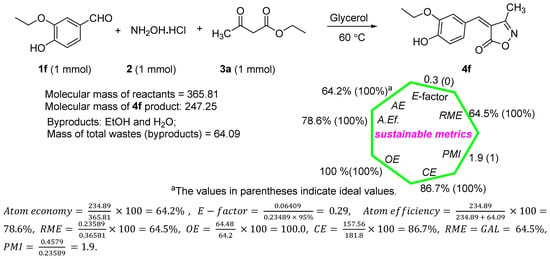
Some sustainable chemistry metrics were evaluated for the formation of compound 4f (Scheme 3). In this case, some parameters such as the environmental factor (E-factor), atom economy (AE), atom efficiency (A. Ef.), the reaction mass efficiency (RME, Curzons definition), optimum efficiency (OE), carbon efficiency (CE), greener atomic level (GAL), and the process mass intensity (PMI) were calculated as follows (Equations (1)–(7)) [36].
Scheme 3.
Some green metrics for the synthesis of 4f.
In view of sustainable chemistry, this reaction has green aspects. Therefore, from the perspective of sustainable chemistry and considering the green metric results, implementing this green reaction for the synthesis of isoxazoles is of great importance (Scheme 3).
4. Conclusions
In summary, glycerol was introduced as a green and effective reaction medium for synthesizing arylideneisoxazol-5-ones via a three-component process. The results have demonstrated that this process enables easy, rapid access to isoxazolone-containing heterocycles in relatively high yields. This method highlights the simplicity and sustainability of the preparation of isoxazole-5-one derivatives. This protocol accommodates many different aldehydes (especially those with electron-donating groups) and two β-ketoesters, delivering desired compounds in short reaction times.
Supplementary Materials
The following supporting information can be downloaded at https://www.mdpi.com/article/10.3390/suschem7030039/s1, and contains the Figures S1–S6: 1H and 13C NMR spectra for compounds 4a, 4m, and 4o.
Author Contributions
Conceptualization, H.K.; methodology, J.M.M.; investigation, J.M.M.; writing—original draft preparation, J.M.M., H.K. and J.A.; writing—review and editing, H.K.; supervision, H.K.; project administration, H.K. All authors have read and agreed to the published version of the manuscript.
Funding
This research received no external funding.
Institutional Review Board Statement
Not applicable.
Informed Consent Statement
Not applicable.
Data Availability Statement
The original contributions presented in this study are included in the article/Supplementary Material. Further inquiries can be directed to the corresponding author.
Acknowledgments
We would like to express our gratitude to Shahrekord University.
Conflicts of Interest
The authors declare no conflicts of interest.
Abbreviations
The following abbreviations are used in this manuscript:
| APTES | (3-Aminopropyl)triethoxysilane |
| AE | Atom economy |
| A. Ef. | Atom efficiency |
| CE | carbon efficiency |
| d | Doublet |
| dd | Doublet of doublets |
| DMSO | Dimethyl sulfoxide |
| DMAP | 4-Dimethylaminopyridine |
| E-factor | Environmental factor |
| GAL | Greener atomic level |
| Hz | hertz |
| m | Multiplet |
| MW | Molecular weight |
| NMR | Nuclear magnetic resonance |
| MMWCNT | Multi-walled carbon nanotube |
| NPs | Nanoparticles |
| OE | Optimum efficiency |
| PEG | Polyethylene glycol |
| PIP | Piperazin |
| ppm | parts per million |
| PMI | Process mass intensity |
| QDs | Quantum dots |
| RT | Room temperature |
| RME | Reaction mass efficiency |
| s | Singlet |
| TLC | Thin-layer chromatography |
| UV | Ultraviolet |
| WEOFPA | Water extract of orange fruit peel ash |
References
- Altug, C.; Günes, H.; Nocentini, A.; Monti, S.M.; Buonanno, M.; Supuran, C.T. Synthesis of isoxazole-containing sulfonamides with potent carbonic anhydrase II and VII inhibitory properties. Bioorg. Med. Chem. 2017, 25, 1456–1464. [Google Scholar] [CrossRef] [Scilit]
- Chavan, A.P.; Deshpande, R.R.; Borade, N.A.; Shinde, A.; Mhaske, P.C.; Sarkar, D.; Bobade, V.D. Synthesis of new 1,3,4-oxadiazole and benzothiazolylthioether derivatives of 4-arylmethylidene-3-substituted-isoxazol-5(4H)-one as potential antimycobacterial agents. Med. Chem. Res. 2019, 28, 1873–1884. [Google Scholar] [CrossRef] [Scilit]
- Gulati, S.; Singh, R.; Sangwan, S. Fruit juice mediated multicomponent reaction for the synthesis of substituted isoxazoles and their in vitro bio-evaluation. Sci. Rep. 2021, 11, 23563. [Google Scholar] [CrossRef] [Scilit] [PubMed]
- Badiger, K.B.; Khatavi, S.Y.; Kamann, K. Green synthesis of 3-methyl-4-(hetero)aryl methylene isoxazole-5(4H)-ones using WEOFPA/glycerol: Evaluation of anticancer and electrochemical behaviour properties. RSC Med. Chem. 2022, 13, 1367–1377. [Google Scholar] [CrossRef] [Scilit] [PubMed]
- Mishra, D.R.; Panda, B.S.; Nayak, S.; Rauta, N.K.; Mohapatra, S.; Sahoo, C.R.; Padhy, R.N. One-pot multicomponent synthesis of 4-((2H-chromen-3-yl)/(2-phenyl-2H-chromen-3-yl)methylene)-3-methylisoxazol-5(4H)-ones and evaluation of their antibacterial activity. Tetrahedron 2022, 124, 133015. [Google Scholar] [CrossRef] [Scilit]
- Saleem, A.; Farooq, U.; Bukhari, S.M.; Khan, S.; Zaidi, A.; Wani, T.A.; Shaikh, A.J.; Sarwar, R.; Mahmud, S.; Israr, M.; et al. Isoxazole derivatives against carbonic anhydrase: Synthesis, molecular docking, MD simulations, and free energy calculations coupled with in vitro studies. ACS Omega 2022, 7, 30359–30368. [Google Scholar] [CrossRef] [Scilit] [PubMed]
- Ishioka, T.; Kubo, A.; Koiso, Y.; Nagasawa, K.; Itai, A.; Hashimoto, Y. Novel non-steroidal/non-anilide type androgen antagonists with an isoxazolone moiety. Bioorg. Med. Chem. 2002, 10, 1555–1566. [Google Scholar] [CrossRef] [Scilit] [PubMed]
- Kafle, B.; Aher, N.G.; Khadka, D.; Park, H.; Cho, H. Isoxazol-5(4H)-one derivatives as PTP1B inhibitors showing an anti-obesity effect. Chem. Asian J. 2011, 6, 2073–2079. [Google Scholar] [CrossRef] [Scilit] [PubMed]
- Kuchana, M.; Bethapudi, D.R.; Ediga, R.K.; Sisapuram, Y. Synthesis, in-vitro antioxidant activity and in-silico prediction of drug-likeness properties of a novel compound: 4-(3,5-di-tert-butyl- 4-hydroxybenzylidene)-3-methylisoxazol-5(4H)-one. J. Appl. Pharm. Sci. 2019, 9, 105–110. [Google Scholar] [CrossRef] [Scilit]
- Aslam, J.; Aslam, R.; Alrefaee, S.H.; Mobin, M.; Aslam, A.; Parveen, M.; Hussain, C.M. Gravimetric, electrochemical, and morphological studies of an isoxazole derivative as corrosion inhibitor for mild steel in 1M HCl. Arab. J. Chem. 2020, 13, 7744–7758. [Google Scholar] [CrossRef] [Scilit]
- Wang, L.; Li, M.J.; Li, Q.H.; Xu, P.; Chen, S.Q.; Xu, H.; Zhang, Z. Mechanosynthesis of polysubstituted pyridines via FeBr3-catalyzed cascade reaction of arylidene isoxazolones with β-carbonyl esters. Tetrahedron Lett. 2025, 161, 155569. [Google Scholar] [CrossRef] [Scilit]
- Shen, Y.B.; Zhuang, Q.H.; Wang, X.L.; An, X.D.; Qiu, B.; Shi, T.; Xiao, J. EtOH-mediated cascade C(sp3)–H alkylation via aromatization-driven [1,6]-hydride transfer: Green and divergent synthesis of spirocyclic azepino[4,3,2-cd]indoles. Green Chem. 2024, 26, 11899–11907. [Google Scholar] [CrossRef] [Scilit]
- Peng, X.; Li, M.J.; Diao, H.; Shao, N.; He, Z.Y.; Fan, S.Z.; Zhang, Z.; Xu, H. Chemodivergent and diastereoselective synthesis of syn- and anti-cyclopentenyl spiroisoxazolones under ball-milling conditions. RSC Mechanochem. 2025, 2, 317–321. [Google Scholar] [CrossRef] [Scilit]
- Li, M.J.; Xiao, H.J.; Xu, P.; Wu, L.T.; Chen, S.Q.; Zhang, Z.; Xu, H. Mechanosynthesis of Pyrrole-2-carboxylic Acids via Copper-Catalyzed Spiroannulation/Ring-Opening Aromatization of 4-Arylidene Isoxazol-5-ones with Enamino Esters. Org. Lett. 2024, 26, 4189–4193. [Google Scholar] [CrossRef] [Scilit] [PubMed]
- Chen, S.Q.; Li, M.J.; Wu, Y.; Xu, P.; Wu, L.Y.; Wang, L.; Zhou, L.; Li, Q.H.; Li, P.H.; Xu, H.; et al. Solvent-Regulated Cyclization of Arylidene Isoxazolones with Amidines for Regiodivergent Synthesis of 4- and 5-Acylimidazoles. J. Org. Chem. 2025, 90, 2093–2099. [Google Scholar] [CrossRef] [Scilit] [PubMed]
- Vereshchagin, A.N.; Elinson, M.N.; Anisina, Y.E.; Karpenko, K.A.; Goloveshkin, A.S.; Zlotin, S.G.; Egorov, M.P. High diastereoselective amine-catalyzed Knoevenagel–Michael-cyclization–ring-opening cascade between aldehydes, 3-arylisoxazol-5(4H)-ones and 3-aminocyclohex-2-en-1-ones. Mol. Divers. 2018, 22, 627–636. [Google Scholar] [CrossRef] [Scilit] [PubMed]
- Feng, B.; Xu, J.; Zhang, M.M.; Wang, X.S. A Convenient Synthesis of Spiro[isoxazole-pyrazoloquinoline] Derivatives under Catalyst-Free Conditions. Synthesis 2016, 48, 65–72. [Google Scholar] [CrossRef] [Scilit]
- Kruthika, S.E.; Permula, P.T.; Balacharandran, C.; Ignacimuthu, S. An easy protocol for the domino synthesis of diversely functionalized spirocarbocycles and their biological evaluation. J. Chem. Sci. 2014, 126, 177–185. [Google Scholar] [CrossRef] [Scilit]
- Abdel Reheim, M.A.M.; Abdou, M.M.; El-Gaby, M.S.A.; Al-Omari, M.H.; Abu-Rayyan, A.; Al-Assy, W.H.; Refat, H.M.; Sarhan, A.A.M.; Abdel Hafiz, I.S. Bioactivity of novel isoxazole-fused heterocycles: Comprehensive antimicrobial, antioxidant activities, Swiss ADME predictions, molecular docking, and DFT analysis. Mol. Divers. 2025, 30, 595–612. [Google Scholar] [CrossRef] [Scilit] [PubMed]
- Mahajan, A.; Mahajan, A.; Kuznetsov, A.; Gupta, M. Cu@Ag–CeO2/Chitosan Nanocomposite: Green Catalyst for Synthesis of 4-Arylidene-isoxazolidinones and Amidoalkyl Naphthols with Density Functional Theory and Antimicrobial Studies. ACS Sustain. Chem. Eng. 2024, 12, 3419–3438. [Google Scholar] [CrossRef] [Scilit]
- Ilaamirthamani, S.; Kumarraja, M. A New Recyclable Yttrium-Catalyzed Domino Three-Component Approach to the Synthesis of 3-Methyl-4 arylmethylene Isoxazol-5(4H)-ones. Lett. Org. Chem. 2025, 22, 501–509. [Google Scholar] [CrossRef] [Scilit]
- Bi, Y.; Wang, J.; Bian, X.; Chen, M.; Zhu, G.; Zhang, Y.; Gu, Q. Na2S2O3 Catalyzed Three-Component Synthesis and Anti-Bacterial Activity of 3-Methyl-4-(hetero)arylmethylene isoxazole-5(4H)-ones. Chem. Biodivers. 2024, 21, e202400073. [Google Scholar] [CrossRef] [Scilit] [PubMed]
- Zine, Y.; Zine, D.; Boulcina, R.; Debache, A. A New One-Pot Synthesis of 4-Arylideneisoxazolones Catalyzed by Na2SO3 in an Aqueous Medium. Org. Prep. Proced. Int. 2024, 56, 429–438. [Google Scholar] [CrossRef] [Scilit]
- Soni, S.; Teli, S.; Teli, P.; Manhas, A.; Jha, P.C.; Agarwal, S. Highly efficient synthesis of isoxazolones and pyrazolones using g-C3N4·OH nanocomposite with their in silico molecular docking, pharmacokinetics, and simulation studies. Sci. Rep. 2024, 14, 19123. [Google Scholar] [CrossRef] [Scilit] [PubMed]
- Boureghda, C.; Krid, A.; Dems, M.A.; Boutebdja, M.; Boulcina, R.; Debache, A. Facile synthesis, crystal structure, Hirshfeld surface analysis, DFT calculations, IR and UV–visible spectra analyses, ADMET and molecular docking studies of arylideneisoxazolone derivatives. J. Mol. Struct. 2024, 1317, 139005. [Google Scholar] [CrossRef] [Scilit]
- Queiroz, Y.B.; de Freitas, Y.A.; Lima, J.G.M.; Ribeiro, L.; Ramos, L.M. Ionic liquid-catalyzed multicomponent synthesis of isoxazole-5(4H)-ones: In vitro activities and principal component analysis. J. Braz. Chem. Soc. 2024, 35, e-20230188. [Google Scholar] [CrossRef] [Scilit]
- Vane, V.; Mokal, R.; Shirole, G.; Jadhavar, S. Environmentally benign synthesis of isoxazolone derivatives using lemon juice under ultrasonic conditions. Arkivoc 2024, 8, 202412330. [Google Scholar] [CrossRef] [Scilit]
- Dhirbassi, A.V.; Tangade, A.D.; Kauthale, S.S.; Kotai, L.; Pasinszki, T.; Pawar, R.P.; Tekale, S.U. Environmentally Benign and Expeditious Access to 4-ArylMethylene-isoxazole-5(4H)-Ones Using Magnetically Separable Nanoparticles. ChemistrySelect 2024, 9, e202403387. [Google Scholar] [CrossRef] [Scilit]
- Wazalwar, S.S.; Perdih, F. Synthesis, single crystal study, molecular docking, and in vitro anticancer screening of a series of isoxazolone derivatives of chlorovinyl benzaldehyde. J. Mol. Struct. 2025, 1322, 140282. [Google Scholar] [CrossRef] [Scilit]
- Savickienė, V.; Bieliauskas, A.; Belyakov, S.; Sackus, A.; Arbaciauskienė, E. Synthesis and characterization of novel biheterocyclic compounds from 3-alkoxy-1H-pyrazole-4-carbaldehydes via multicomponent reactions. J. Heterocycl. Chem. 2024, 61, 927–947. [Google Scholar] [CrossRef] [Scilit]
- Behboudi Laeen, M.; Pourali, A.R. Efficient synthesis of isoxazole-5(4H)-ones and polyhydroquinolines using MMWCNTs-PIP and MMWCNTs-MOR. Res. Chem. Intermed. 2025, 51, 2799–2827. [Google Scholar] [CrossRef] [Scilit]
- Bhowmik, D.; Kamandar, P.; Gupta, J.; Mete, S.; Hatvate, N. An efficient, green and micellar catalyzed preparative-scale synthesis of 3,4-Disubstituted isoxazole-5(4H)-ones in water. Sustain. Chem. Environ. 2024, 5, 100070. [Google Scholar] [CrossRef] [Scilit]
- Gharehassanlou, S.; Kiyani, H. Synthesis of Isoxazol-5-One Derivatives Catalyzed by Amine-Functionalized Cellulose. Organics 2024, 5, 378–394. [Google Scholar] [CrossRef] [Scilit]
- Mosallanezhad, A.; Kiyani, H. Green synthesis of arylideneisoxazol-5-ones catalyzed by silicon dioxide nanoparticles. Polycycl. Aromat. Compd. 2024, 44, 5022–5037. [Google Scholar] [CrossRef] [Scilit]
- Haydari, F.; Kiyani, H. Urea-catalyzed multicomponent synthesis of 4-arylideneisoxazol-5(4H)-one derivatives under green conditions. Res. Chem. Intermed. 2023, 49, 837–858. [Google Scholar] [CrossRef] [Scilit]
- Daroughezadeh, Z.; Kiyani, H. Arylideneisoxazole-5(4H)-one synthesis by organocatalytic three-component hetero-cyclization. Polycycl. Aromat. Compd. 2024, 44, 3200–3221. [Google Scholar] [CrossRef] [Scilit]
- Faramarzi, Z.; Kiyani, H. Steglich’s base-catalyzed three-component synthesis of isoxazol-5-ones. Polycycl. Aromat. Compd. 2023, 43, 3099–3121. [Google Scholar] [CrossRef] [Scilit]
- Selvan, C.S.; Veerappan, T.; Rengan, R. Ruthenium–Hydride Complexes Facilitated Sustainable Synthesis of Isoxazolones via Acceptorless Dehydrogenative Annulation of Alcohols. J. Org. Chem. 2025, 90, 86–97. [Google Scholar] [CrossRef] [Scilit] [PubMed]
- Ghevade, S.S.; Kamble, S.B.; Patil, K.N.; Ingale, V.S.; Kumbhar, D.A. Ultrasound-Promoted Ferrite Catalyzed One-Pot Multicomponent Synthesis of 3,4-Disubstituted Isoxazole-5(4H)-one Derivatives in Water as a Green Solvent with Evaluation of Antimicrobial Activity. Russ. J. Gen. Chem. 2025, 95, 671–678. [Google Scholar] [CrossRef] [Scilit]
- Hadole, P.; Mondal, S.; Shingda, S.; Ahmed, M.Z.; Mule, A.; Rai, A.R.; Ayub, A.; Alone, H.; Mondal, A. Green and Biogenic Synthesis of Cerium Oxide (CeO2) Nanoparticles: Heterogeneous Catalytic Synthesis of Isoxazol-5(4H)-one Derivatives and Assessment of Their Antibacterial Activity. ChemistrySelect 2025, 10, e202406123. [Google Scholar] [CrossRef] [Scilit]
- Kharde, A.K.; Kadu, V.R.; Gholap, S.S. Aqueous extract of Areca nut as a sustainable and highly efficient green catalyst for the synthesis of pyrazole and isoxazolone derivatives. Res. Chem. Intermed. 2025, 52, 2997–3017. [Google Scholar] [CrossRef] [Scilit]
- Dhane, N.S.; Patil, R.G.; Pandit, N.T.; Jadhav, S.N.; Pawar, S.P.; Piste, P.B.; Kamble, S.B.; Gaikwad, K.V. Green synthesis of Isoxazole-5(4H)-one derivatives using Theophylline Hydrogen Sulfate as a catalyst. Discov. Chem. 2025, 2, 345. [Google Scholar] [CrossRef] [Scilit]
- Bagade, K.; Kumbhar, A. APTES immobilized copper-doped nitrogen quantum dots (CuNPs@N-GQDs@APTES) nanocatalyst for synthesis of isoxazol-5(4H)-one, dihydropyrano[3,2-c]chromene and dihydropyrano[2,3-c]pyrazoles in aqueous medium. Res. Chem. Intermed. 2025, 51, 4625–4645. [Google Scholar] [CrossRef] [Scilit]
- Hadimani, P.; Bhosale, D.; Raut, D.; Kulkarni, M.; Choudhari, P.; Chaudhari, S.; Patil, V.; Mali, M.; Raut, T.; Waghmode, D.; et al. Water-mediated one-pot synthesis of novel trifluoromethyl isoxazolones: Anticancer activity and redox behavior. J. Mol. Struct. 2026, 1350, 144051. [Google Scholar] [CrossRef] [Scilit]
- Tahmasabi, S.Z.; Kiyani, H.; Samimi, H.A. Efficient Synthesis of 4-Arylmethylene-3-methylisoxazol-5(4H)-one Derivatives Catalyzed by Malic Acid. Lett. Org. Chem. 2023, 20, 167–174. [Google Scholar] [CrossRef] [Scilit]
- Aher, A.D.; Kuthe, D.; Ghodechor, D.; Jopale, M.K.; Lokhande, D.D.; Kategaonkar, A.H. Recent updates in the one-pot multicomponent synthesis of 3,4-disubstituted-isoxazole-5(4H)-ones and its activity: A review. Iran. J. Catal. 2024, 14, 142421. [Google Scholar] [CrossRef]
- Sandid, A.; Spallina, V.; Esteban, J. Glycerol to value-added chemicals: State of the art and advances in reaction engineering and kinetic modelling. Fuel Process. Technol. 2024, 253, 108008. [Google Scholar] [CrossRef] [Scilit]
- Wagare, D.S.; Shirsath, S.E.; Shaikh, M.; Netankar, P. Sustainable solvents in chemical synthesis: A review. Environ. Chem. Lett. 2021, 19, 3263–3282. [Google Scholar] [CrossRef] [Scilit]
- Jamale, D.K.; Undare, S.S.; Valekar, N.J.; Sarkate, A.P.; Kolekar, G.B.; Anbhule, P.V. Glycerol Mediated Synthesis, Biological Evaluation, and Molecular Docking Study of 4-(1H-pyrazol-4-yl)-polyhydroquinolines as Potent Antitubercular Agents. J. Heterocycl. Chem. 2019, 56, 608–618. [Google Scholar] [CrossRef] [Scilit]
- Pagliaro, M.; Ciriminna, R.; Kimura, H.; Rossi, M.; Pina, C.D. From Glycerol to Value-Added Products. Angew. Chem. Int. Ed. 2007, 46, 4434–4440. [Google Scholar] [CrossRef] [Scilit] [PubMed]
- Pezzini, A.; Júnior, R.S. Conventional and Biological Direct Glycerol Fuel Cells: Review on Main Experimental and Model-Based Achievements. J. Braz. Chem. Soc. 2025, 36, e-20240223. [Google Scholar] [CrossRef] [Scilit]
- Wang, X.M.; Wang, X.C.; Wang, C.F.; Yang, L. One-pot synthesis of 4-aryl-7,7-dimethyl-5-oxo-3,4,5,6,7,8-hexahydrocoumarin derivatives in glycerol. Green Chem. Lett. Rev. 2017, 10, 134–137. [Google Scholar] [CrossRef] [Scilit]
- Martinho, L.A.; Andrade, C.K.Z. A greener approach for the synthesis of pyrido[2,3-d]pyrimidine derivatives in glycerol under microwave heating. J. Heterocycl. Chem. 2022, 59, 1417–1429. [Google Scholar] [CrossRef] [Scilit]
- Tiwari, S.K.; Shivhare, K.N.; Patel, M.K.; Yadav, V.; Nazeef, M.; Siddiqui, I.R. A Metal Free, Hantzsch Synthesis for Privileged Scaffold 1,4-Dihydropyridines: A Glycerol Promoted Sustainable Protocol. Polycycl. Aromat. Comp. 2022, 42, 1035–1047. [Google Scholar] [CrossRef] [Scilit]
- Karimirad, F.; Behbahani, F.K. Glycerol-Mediated and Simple Synthesis of 1,8-Dioxo-Decahydroacridines Under Transition Metal-Free Conditions. Polycycl. Aromat. Comp. 2021, 41, 2238–2246. [Google Scholar] [CrossRef] [Scilit]
- Mitra, B.; Pariyar, G.C.; Ghosh, P. Glycerol: A Benign Solvent-Assisted Metal-Free One-Pot Multi-Component Synthesis of 4H-Thiopyran and Thioamides from Easily Accessible Precursors. ChemistrySelect 2019, 4, 5476–5483. [Google Scholar] [CrossRef] [Scilit]
- Baranwal, J.; Kushwaha, S.; Singh, S.A. Glycerol promoted, regioselective synthesis of 6-aryl substituted Imidazo[2,1-b]thiazole and imidazo[2,1-b]-1,3,4-thiadiazole through a one-step domino process under green conditions. ChemistrySelect 2024, 9, e202304043. [Google Scholar] [CrossRef] [Scilit]
- Shaikh, S.; Ramana, M.M.V. Lipase-catalysed one-pot synthesis of thiazole-based Betti bases and their evaluation as potential cholinesterase inhibitors. Res. Chem. Intermed. 2021, 47, 2731–2750. [Google Scholar] [CrossRef] [Scilit]
- Morshedi, A.; Shaterian, H.R. Green approach to synthesis of novel and broad-range diversity of 4-(aryl)-3-(phenylsulfonyl)-4H-benzo[h]chromen-2-amine derivatives. Res. Chem. Intermed. 2018, 44, 7219–7230. [Google Scholar] [CrossRef] [Scilit]
- Gao, J.; Liu, A.; Li, M.; Wang, Y.; Xiao, Y.; Lü, C.; An, Y. Glycerol and acetic acid assisted mild strategy for facile synthesis of 3-heteroarylcoumarins via three-component reaction. Res. Chem. Intermed. 2021, 47, 3179–3187. [Google Scholar] [CrossRef] [Scilit]
- Kale, A.D.; Pawara, R.H.; Patel, H.M.; Dalal, D.S. A facile and efficient one-pot procedure for the synthesis of 2-amino-4,8-dihydropyrano[3,2-b]pyran-3-carbonitriles in PEG-400 and glycerol. Res. Chem. Intermed. 2024, 50, 853–880. [Google Scholar] [CrossRef] [Scilit]
- Ramesh, R.R.; Nagasundaram, N.; Meignanasundar, D.; Vadivel, P.; Lalitha, A. Glycerol-assisted eco-friendly strategy for the facile synthesis of 4,4′-(arylmethylene)bis(3-methyl-1H-pyrazol-5-ols) and 2-aryl-2,3-dihydroquinazolin-4(1H)-ones under catalyst-free conditions. Res. Chem. Intermed. 2017, 43, 1767–1782. [Google Scholar] [CrossRef] [Scilit]
- Vekariya, R.H.; Patel, H.D. Glycerol mediated green and one-pot synthesis of 6-amino-1,4-dihydropyrano[2,3-c]pyrazole-5-carbonitriles under catalyst free conditions. Indian J. Chem. 2016, 55B, 999–1006. [Google Scholar]
- Mohamadpour, F. Four-Component Synthesis of Dihydropyrano[2,3-c]pyrazole Scaffolds Using Glycerol as Green Reaction Media under Catalyst-Free Conditions. Polycycl. Aromat. Comp. 2021, 41, 2018–2028. [Google Scholar] [CrossRef] [Scilit]
- Guo, S.; Zhou, Y.; Dai, B.; Huo, C.; Liu, C.; Zhao, Y. CuI/Et2NH-Catalyzed One-Pot Highly Efficient Synthesis of1,4-Disubstituted 1,2,3-Triazoles in Green Solvent Glycerol. Synthesis 2018, 50, 2191–2199. [Google Scholar] [CrossRef] [Scilit]
- Tiwari, J.; Saquib, M.; Singh, S.; Tufail, F.; Singh, J.; Singh, J. Catalyst-free glycerol-mediated green synthesis of 5′- thioxospiro[indoline-3,3′-[1,2,4]triazolidin]-2-ones/spiro[indoline-3,3′-[1,2,4]triazolidine]-2,5′-diones. Synth. Commun. 2017, 47, 1999–2006. [Google Scholar] [CrossRef] [Scilit]
- Azizi, K.; Karimi, M.; Heydari, A. A catalyst-free synthesis of α-aminophosphonates in glycerol. Tetrahedron Lett. 2014, 55, 7236–7239. [Google Scholar] [CrossRef] [Scilit]
- Shariatipour, M.; Jadidinejad, M.; Heydari, A. Green synthesis of nitrones in glycerol. J. Chem. Sci. 2019, 131, 102. [Google Scholar] [CrossRef] [Scilit]
- Saeed, H.Y.; Farooqui, M.; Durrani, A.N. Convenient and highly efficient microwave-assisted synthesis of 2-Arylimidazo[1,2-a]pyrimidine-3-carbaldehydes in glycerol. Synth. Commun. 2023, 53, 160–168. [Google Scholar] [CrossRef] [Scilit]
- Abd-Elmonem, M.; Mekheimer, R.A.; Hayallah, A.M.; Abo Elsoud, F.A.; Sadek, K.U. Recent Advances in the Utility of Glycerol as a Benign and Biodegradable Medium in Heterocyclic Synthesis. Curr. Org. Chem. 2019, 23, 3228–3248. [Google Scholar] [CrossRef] [Scilit]








Disclaimer/Publisher’s Note: The statements, opinions and data contained in all publications are solely those of the individual author(s) and contributor(s) and not of MDPI and/or the editor(s). MDPI and/or the editor(s) disclaim responsibility for any injury to people or property resulting from any ideas, methods, instructions or products referred to in the content. |
© 2026 by the authors. Licensee MDPI, Basel, Switzerland. This article is an open access article distributed under the terms and conditions of the Creative Commons Attribution (CC BY) license.