Article

A System-Based Model for Assessing Greenhouse Gas Emissions in Artillery Training Operations: Bridging Climate Security and Military Sustainability


Department of Fire Support, Faculty of Military Leadership, University of Defence, Kounicova 156/65, 662 10 Brno, Czech Republic
*
Author to whom correspondence should be addressed.
World 2026, 7(8), 136; https://doi.org/10.3390/world7080136
Submission received: 14 May 2026 / Revised: 25 July 2026 / Accepted: 28 July 2026 / Published: 1 August 2026

Abstract

Military activities remain insufficiently represented in greenhouse gas (GHG) accounting and debates on climate security. This article develops a system-based model for assessing direct operational GHG emissions from artillery training. The model adapts established inventory logic to the structure of an artillery battery and separates emissions from mobility, stationary operation, support and logistics, and a supplementary firing-process module. It is demonstrated using a single hypothetical standardized training scenario for a battery of self-propelled howitzers, based on assumed and estimated parameters rather than field measurements. Under the stated assumptions, the training day generated an estimated 4353.74 kg carbon dioxide equivalent (CO2e). Operational fuel combustion accounted for 93.94% of the total, and the supplementary firing-process proxy accounted for 6.06%; stationary engine operation of the howitzers in firing positions was the dominant source (73.87%). Within the defined gate-to-activity boundary, the scenario’s direct operational carbon footprint was therefore driven primarily by energy demand rather than projectile discharge. The article’s contribution is an artillery-specific, transparent decomposition of established GHG accounting principles, not a new emission-factor method. The model provides a transferable structure for tactical-level assessment, while the numerical results are scenario-specific and require validation against measured data and additional operational scenarios.

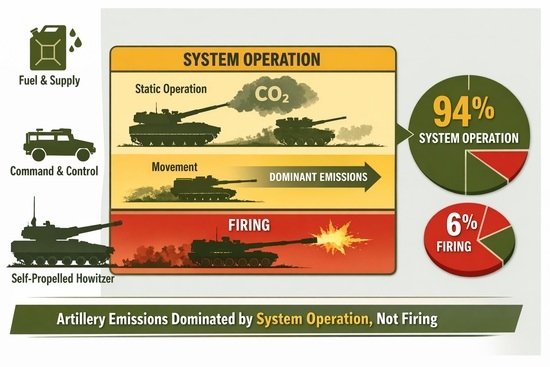
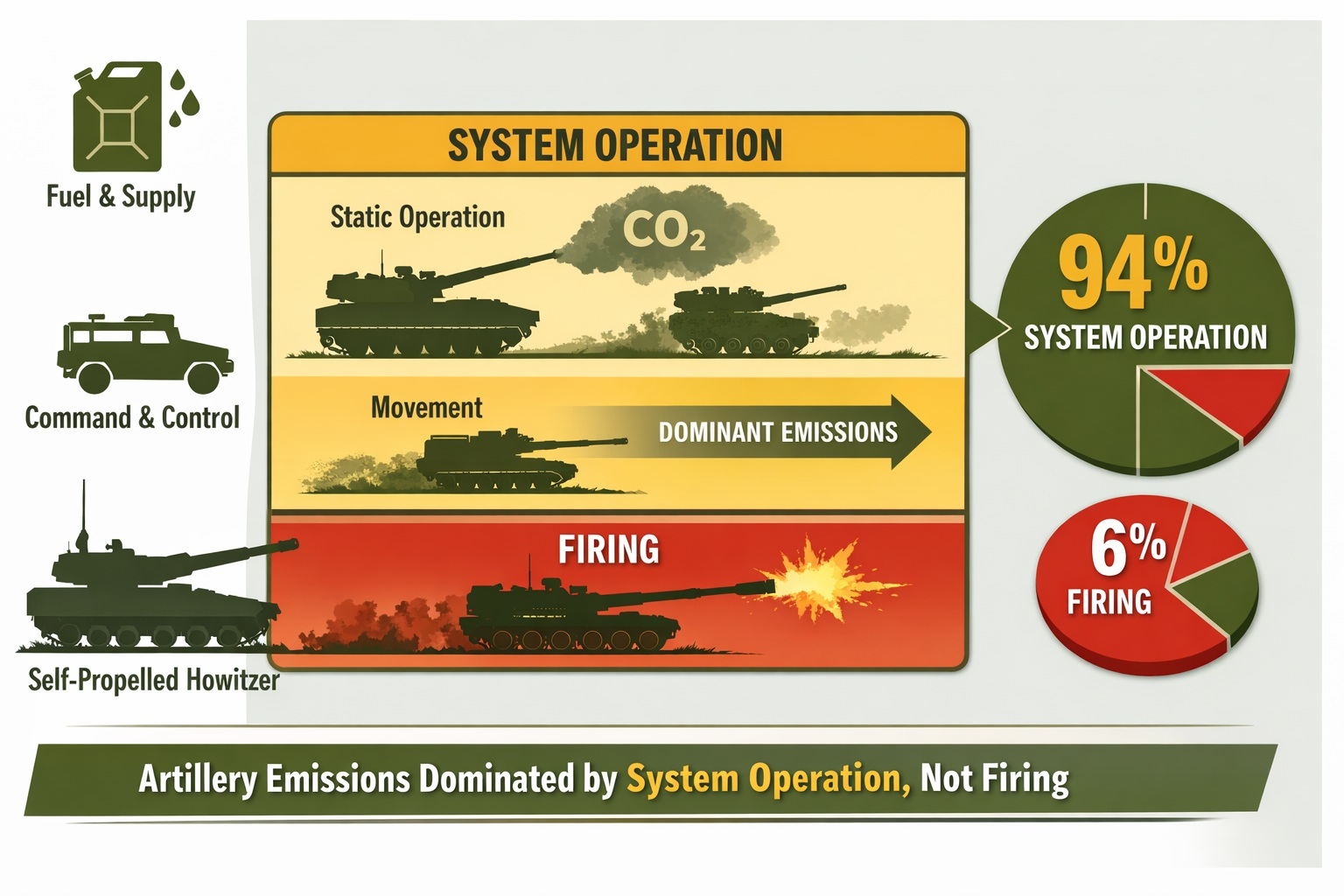
Graphical Abstract

1. Introduction

Climate change has become a major security issue rather than a purely environmental one. Its effects increasingly shape strategic competition, resource pressure, societal instability, disaster frequency, and the operating conditions of armed forces [1,2,3,4]. As a result, the concept of climate security has moved from the margins of academic and policy debate toward the center of contemporary security thinking [2,3,4]. Yet this shift has exposed a persistent contradiction. Armed forces are now widely recognized as institutions that must adapt to climate change, but they are systematically assessed far less as institutions that also materially contribute to it through their own greenhouse gas (GHG) emissions [5,6,7,8].
This contradiction is especially important in the defense sector, where political commitments to sustainability and emissions reduction increasingly coexist with growing force requirements, rising military expenditure, and the return of high-intensity warfare [8,9,10,11]. In practice, these trends intensify fuel consumption, material throughput, logistics demand, and operational energy use. However, the environmental accounting of military systems remains underdeveloped, fragmented, and frequently limited by restricted access to data, inconsistent reporting practices, and the institutional exclusion of key military activities from standard emissions frameworks [5,6,7,8,12]. This creates an analytical, as well as practical, gap between what defense institutions declare at the strategic level and what they can measure at the operational level.
That gap becomes particularly visible in the case of artillery. High-intensity conflicts have reaffirmed the importance of sustained fire support, tactical mobility, ammunition expenditure, and continuous resupply [10,11]. These activities combine fuel-intensive self-propelled platforms, stationary engine operation, support vehicles, ammunition logistics, command-and-control assets, and firing-related processes. Artillery is therefore an analytically demanding but operationally observable case: platform composition, movement distances, operating times, fuel-consumption assumptions, firing tasks, and rounds fired can be parameterized at battery level. It is also representative of military subsystems whose emissions arise from interactions among mobility, readiness, logistics, and mission execution rather than from a single platform. Nevertheless, the literature rarely treats artillery as a coherent emissions-generating system; existing studies mainly address isolated environmental effects rather than an operational GHG assessment framework.
This absence is not merely a niche methodological problem. It has broader consequences for climate-security analysis, military sustainability policy, and defense planning. If artillery emissions cannot be analytically structured and estimated at the tactical and operational level, then military emissions remain systematically underestimated in precisely those domains where real combat power is generated and sustained. The result is a distorted picture in which military organizations may report infrastructure-related emissions while leaving aside large parts of actual operational activity. This limitation is also visible in NATO’s own GHG methodology, which is an important institutional step forward but is focused primarily on the NATO enterprise as an organizational system and does not provide full methodological coverage for operations, missions, training, and exercises [12]. For the purposes of military environmental analysis, that is a major limitation rather than a minor technical detail.
Military emissions research also remains methodologically mismatched to the structure of military practice. Civilian GHG accounting is typically organized around relatively stable organizational boundaries, energy flows, and supply chains. Artillery operations, by contrast, are dynamic, mission-dependent, and composed of interdependent sub-processes whose emissions arise across mobility, firing, support, logistics, and infrastructure domains. A model capable of assessing such activity must therefore be system-based rather than platform-based. It must also distinguish among operational source categories while maintaining a transparent and consistently applied system boundary. Without such a structure, any estimate risks being either too narrow to be meaningful or too broad to be decision-useful.
This article addresses that methodological and conceptual gap by developing a system-based framework for estimating direct operational GHG emissions from artillery training operations. The study treats artillery not as a single weapon platform, but as an operational subsystem whose emissions emerge from the interaction of combat activity, support processes, fuel use, logistics, energy provision, and ammunition-related processes. The article does not claim exhaustiveness across military contexts but provides a transparent analytical structure that may support operational emissions assessment in the defense domain.
Contemporary artillery research increasingly uses digital technologies and simulation-based learning environments to analyze operational activities [13,14,15]. Although these studies do not address carbon accounting, they demonstrate that artillery processes can be represented through operationally relevant analytical and modeling approaches, supporting the extension of this logic to emissions assessment.
The article makes three specific contributions. First, it adapts established activity-based greenhouse gas accounting logic to the operational structure of an artillery battery. Second, it proposes an artillery-specific decomposition that separates mobility, stationary operation, support and logistics, and a supplementary firing-process module. Third, it demonstrates the application of this structure in a single standardized artillery-training scenario and shows that the resulting footprint can be decomposed into interpretable operational drivers. The novelty therefore lies not in inventing a new emission-factor calculation method, but in operationalizing established GHG accounting principles for a tactical military subsystem that is not adequately captured by existing reporting approaches.
The structure of the article reflects this objective. The next section reviews the state of the art on military environmental impacts, military emissions, and the current limits of artillery-related environmental research. The subsequent section presents the proposed assessment model and explains its methodological logic. This is followed by its application to a selected artillery case, which demonstrates the model’s calculation logic and identifies the dominant emissions drivers within the scenario. The final section discusses implications for climate-security research, military reporting frameworks, and sustainable defense planning.
For terminological clarity, this article uses “military operations” to denote the broader defense activity context, “artillery operations” to denote field activity conducted by artillery units, and “artillery training operations” to denote the single hypothetical standardized battery-level training scenario used to demonstrate the model’s application. The numerical results reported in this study refer only to the standardized artillery-training scenario. Throughout the article, “operational fuel-combustion emissions” refers to direct emissions from platform mobility, stationary operation, and fuel-consuming support and logistics activities, whereas “supplementary firing-process proxy” refers only to the round-based firing module.

2. Literature Review

Recent scholarship shows that the environmental impacts of military activity can no longer be interpreted as secondary externalities of war, but rather as a structural dimension of contemporary security systems. Research has progressively shifted from viewing conflict primarily through political, strategic, and humanitarian lenses toward a broader understanding that includes degradation of land, water, air, biodiversity, and climate as integral features of military activity and armed violence [2,3,4,16,17,18,19]. This shift is especially relevant for artillery because artillery systems combine intensive energy use, high ammunition consumption, sustained logistical support requirements, and frequent direct interaction with the environment, making artillery activities a potentially significant source of greenhouse gas emissions and other environmental impacts. Yet despite this relevance, the literature still treats artillery predominantly in a fragmented way: as a source of contamination, as a driver of terrain degradation, or as a tactical combat function, but only rarely as a coherent environmental and emissions-generating subsystem.

2.1. Toxicological and Pedological Impacts: The Strongest and Most Mature Research Stream

The most methodologically developed body of literature concerns the toxicological and pedological consequences of weapons use, firing ranges, and military training areas. Across this field, the evidence is consistent: military activities can generate persistent environmental contamination through heavy metals and explosive residues, while contaminant mobility depends on local soil and hydrological conditions [17,18,19,20,21]. Rodríguez-Seijo et al. synthesize the ecotoxicological effects of ammunition debris on soil organisms [17]. Mendes et al. review the behavior, risk assessment, and remediation of lead in shooting-range soils [18], while Hathaway et al. demonstrate the complex surface dispersion of explosive residues following detonation of military munitions [19].
This line of research is particularly important for artillery because artillery munitions are material-intensive and mechanically disruptive. Unlike small-arms contamination, artillery effects are characterized by a combination of large metal masses, violent fragmentation, shock-related redistribution of particles, and repeated deposition over wide impact zones. Recent work from the Czech artillery-research context confirms that artillery-impacted soils can be meaningfully differentiated, sampled, and evaluated using environmental risk indices and structured field methodologies [22,23]. These studies are methodologically significant not only because they add empirical evidence from artillery environments, but also because they show that artillery-related environmental impacts are already analytically tractable at a level suitable for structured assessment [22,23].
Recent analyses show that training-range contamination may involve combined inputs of energetic compounds and heavy metals, broadening the environmental profile beyond a single contaminant category [20]. Plastic pollution in shooting ranges and warfare zones represents another overlooked but environmentally relevant dimension [21]. Taken together, these studies demonstrate that the local environmental burden of artillery-related activities can be persistent and multidimensional. They do not, however, provide a directly comparable framework for operational GHG accounting.

2.2. Physical Degradation of Terrain and Landscape Transformation

A second major line of the literature focuses on physical changes in terrain, land cover, and geomorphological structure induced by military activity. Here too the evidence is strong and increasingly sophisticated, particularly due to the use of remote sensing, spatial analysis, and conflict-zone monitoring [24,25]. Almohamad demonstrates that armed conflict can substantially alter erosion dynamics and intensify land degradation processes [24], while Mobaied and Rudant show that remote-sensing methods can capture rapid landscape transformation in conflict-affected areas [25]. These findings are highly relevant to artillery because repeated shell impacts, crater formation, and the movement of heavy support assets do not simply damage land locally; they can alter terrain properties in ways that affect broader ecological and operational systems.
This terrain dimension has direct relevance to artillery studies themselves. Sedláček et al. show that artillery effects can change terrain mobility characteristics, which is operationally important but also environmentally revealing: the same munition effects that degrade maneuver conditions also transform surface structure, erosion susceptibility, and post-impact land functionality [16]. In other words, artillery modifies terrain not only as a tactical battlespace variable but as an ecological substrate. This link between mobility degradation and environmental transformation is particularly valuable because it suggests that operational military analytics and environmental analytics are not separate domains; they are partly observing the same physical processes through different evaluative lenses.
The literature on war-related land degradation in forest and rural systems reinforces the conclusion that military environmental impacts extend beyond individual point sources. Butsic et al. show that armed conflict affects forest loss, land-use pressure, and ecological governance even beyond the immediate blast zone [26]. Although these studies are not artillery-specific, they support the broader proposition that military activity produces environmental change through cascading spatial effects, not merely through point-source destruction. For artillery, this matters because firing is usually embedded in a larger system of maneuver, resupply, road use, staging areas, and repeated occupation of training or combat spaces. The environmental significance of artillery therefore extends beyond impact points and into spatial reconfiguration of the broader operational landscape.

2.3. Biodiversity, Ecosystem Stress, and the Ecological Disturbance Logic of Artillery

A third major research stream examines the effects of military activity on ecosystems and biodiversity. The literature here shows that military environmental harm is not reducible to chemical contamination alone. Habitat fragmentation, craterization, noise, pressure waves, altered hydrology, fire, and unexploded ordnance all act as ecological stressors with cumulative and often long-lasting effects [27,28,29,30,31,32,33]. Lawrence et al. provided one of the foundational syntheses of this field by showing that modern war and military activities affect biodiversity and ecosystem functioning through multiple interacting pathways [27]. Since then, work on the war in Ukraine has made these mechanisms more visible and more empirically urgent. Leal Filho et al. and Hryhorczuk et al. describe broad environmental and human-health effects resulting from the war, including direct landscape injury, contamination, and ecosystem disruption [28,29], while the Joint Research Center report provides further evidence of habitat fragmentation, disrupted environmental monitoring, and longer-term climate and ecological implications [30].
Within this body of research, artillery stands out as a disturbance generator operating simultaneously through several mechanisms. It fragments habitats mechanically, damages vegetation and soil structure, redistributes pollutants, and creates sustained acoustic and blast environments that affect both wildlife and human health [27,28,29,30,31,32,33]. Krampe et al. similarly demonstrate that environmental harm caused by armed conflict can persist long after the immediate military activity has ended [31]. Choi’s work on blast-induced hearing loss, although developed in a biomedical context, is analytically useful because it helps explain the intensity and character of artillery-generated acoustic pressure and why such effects should also be understood as ecological stressors [32]. Klypa’s synthesis of ecosystem rehabilitation under military pressure further underscores that contamination, unexploded ordnance (UXO), and physical disturbance often combine into long-duration barriers to ecological recovery [33].
For the present article, the importance of this literature lies in what it proves and what it does not. It proves convincingly that artillery is environmentally destructive in visible and ecologically measurable ways. What it still does not do sufficiently is convert that systemic understanding into a climate-accounting logic. The literature is rich in evidence of ecological damage, but relatively poor in methods for estimating emissions from the artillery system as an operational whole.

2.4. Logistics, Energy Demand, and the Environmental Management of Defense Systems

The fourth major stream of scholarship shifts from battlefield damage to the organizational metabolism of the military system itself. Here the focus is on logistics, energy demand, infrastructure, procurement, public-sector management, and the environmental governance of defense institutions [5,6,34,35,36,37,38,39,40]. This literature provides essential information that reframes armed forces not merely as users of force but as large-scale material systems whose environmental burden emerges across fuel use, supply chains, facility operations, procurement practices, and institutional routines.
The U.S. Department of Defense frames operational energy as a strategic and logistical requirement directly linked to force effectiveness [34], while the National Academies document the growing power requirements of soldiers, vehicles, and forward operating bases [35]. Recent RAND analysis similarly evaluates energy and water technologies in terms of their deployability and logistical implications for expeditionary resilience [36]. In parallel, scholarship on sustainable public management and defense-sector governance highlights institutional barriers to environmental performance [37,38,39,40]. Reis et al. examine green-transition pressures in the defense-industrial context [37]; Waxin et al. synthesize the drivers and challenges of environmental management systems in public organizations [38]; Hill and Collins identify defense procurement as a disproportionate source of toxic pollution [39]; and Rahmawati et al. emphasize the role of environmental accounting in public-sector decision-making [40].
This literature is highly relevant for artillery because artillery is deeply embedded in logistics and energy systems. It is not merely a weapon that fires projectiles; it is a subsystem sustained by ammunition transport, fuel supply, power support, command-and-control networks, maintenance, and movement routines. That insight aligns with recent Czech defense-policy analysis stressing that environmental management in armed forces requires institutionalization rather than ad hoc compliance [41]. It also aligns with the broader methodological implication of recent artillery-related research outputs, which increasingly decompose artillery operations into measurable support functions such as meteorological preparation, simulation-supported decision environments, fire correction, and observer support [13,14,15]. These are not emissions studies, but they indicate that artillery already exists in the literature as a structured operational system rather than a purely kinetic event. That is precisely the conceptual opening required for a system-based emissions framework.

2.5. Military Carbon Emissions: Strong Macro-Level Diagnosis and Weak Subsystem-Level Resolution

Once the literature shifts from local environmental damage to GHG emissions, a pronounced asymmetry becomes visible. At the macro level, several important studies have already established that military institutions are materially relevant contributors to climate change [5,6,8,42,43]. Belcher et al. identify hidden carbon costs embedded in military activity and logistics [5]. Crawford demonstrates the scale and policy significance of military fuel use [6]. Jorgenson et al. demonstrate a broader relationship between militarization, carbon emissions, and national ecological footprints [42]. Depledge places military decarbonization and low-carbon warfare within the emerging debate on operational effectiveness under net-zero constraints [43]. Together, these works establish that military emissions are real, politically consequential, and analytically underdeveloped.
However, the problem is that these studies remain largely institutional, national, or strategic in scale. They diagnose the existence of the problem, but they do not resolve it at the level of specific combat subsystems. They do not explain, in operationally meaningful terms, how emissions should be structured for artillery batteries, how firing-related processes should be treated relative to fuel consumption, how support vehicles should be integrated, or how tactical military activity can be translated into a defensible emissions estimate. In short, they illuminate the military carbon problem, but they do not yet provide the methodological bridge from macro-level recognition to tactical-operational quantification.
Within the sources reviewed for this study, no approach was identified that simultaneously provides battery-level activity data, separates mobility from stationary operation, integrates support assets, and includes a supplementary firing-process proxy component. Existing approaches instead operate primarily at organizational, national, life cycle, or general operational-energy levels [5,6,7,8,12,34,35,36,42,43,44,45,46,47,48,49]. Table 1 therefore compares these approaches using explicit criteria of boundary coverage, tactical resolution, required inputs, uncertainty treatment, validation status, and applicability to artillery training.
The qualitative comparison in Table 1 and Table 2 provides a semi-quantitative matrix using explicit criteria of boundary coverage, tactical resolution, required input burden, uncertainty treatment, validation status, and applicability to artillery training. Scores were assigned by the authors using the ordinal definitions reported below the Table. They represent a structured interpretive comparison rather than an independently validated performance ranking.

2.6. Methodological Barriers: Life Cycle Gaps, Process-Emission Uncertainty, and Reporting Blind Spots

The literature suggests three interrelated methodological barriers behind this gap.
First, there is a lack of life cycle assessment (LCA) specifically adapted to artillery munitions and artillery systems. Passon et al. demonstrate the feasibility of applying LCA principles to ammunition demilitarization, while also illustrating the data intensity and scenario dependence of ammunition-specific assessment [48]. This problem is amplified in artillery because the relevant system extends from metals and energetic materials to transport, storage, firing, post-impact residues, and eventual remediation. Without sufficient data on these chains, full cradle-to-grave assessment remains difficult. At the same time, recent work on global supply-chain carbon footprints reminds us that the omission of upstream and embedded emissions can seriously underestimate total environmental burden [50]. For artillery, this means that an operational carbon footprint can support unit-level planning, but it must not be interpreted as a total life cycle footprint.
Second, process emissions from firing and detonation remain underdeveloped in military emissions research. Existing assessments remain predominantly fuel-centered, which is understandable given current data availability. Artillery firing nevertheless involves propellant combustion, energetic release, gaseous outputs, particulate emissions, and post-firing residues. Upreti et al.’s review demonstrates the continuing environmental relevance of explosive residues and the complexity of their assessment and remediation [51], but it does not provide standardized GHG factors for artillery firing. The literature therefore supports including a firing-process component only as a clearly identified supplementary proxy until validated, munition-specific parameters become available.
Third, the institutional conditions of reporting remain weak. Rajaeifar et al. highlight the need for mandatory military-emissions reporting, reflecting the broader problem that military emissions often remain politically marginal and methodologically opaque even where their existence is acknowledged [8]. This is reinforced by the defense-specific reality that transparency is constrained by security, procurement complexity, and exceptional governance regimes [39,41,43,44]. Consequently, the absence of artillery-specific emissions models is not simply a technical gap; it is partly an institutional product of how military systems are governed and reported.

2.7. Emerging Applied Context: Why Artillery Is Now Model-Ready

An important feature of the current research landscape is that, while artillery carbon accounting remains underdeveloped, the operational analysis of artillery itself has become increasingly sophisticated. Work on fire correction, simulation-based military training, environmental assessment of artillery impact zones, operational planning, and military mobility shows that military and artillery research is increasingly moving toward structured, model-based, and data-supported analysis [13,14,15,16,22,23,52,53,54]. This matters for the present article because it reduces the methodological distance between operational military science and environmental accounting. A system that can be decomposed for training, meteorology, terrain, fire control, and simulation can also be decomposed for emissions estimation.

2.8. Synthesis of the Literature and Research Gap

The reviewed literature establishes the environmental relevance of military and artillery activity but does not provide a battery-level framework that jointly represents mobility, stationary operation, support assets, and a supplementary firing-process component. The proposed model addresses this tactical-resolution gap while remaining complementary to organizational inventories and life cycle assessment.

3. Materials and Methods

This study develops and demonstrates a system-based greenhouse gas (GHG) assessment model for artillery training operations at the tactical level. Methodologically, the study is positioned between military operational analysis and environmental accounting. Its purpose is not to produce a full life cycle assessment of artillery capability, but to construct a transparent, reproducible, and operationally meaningful framework capable of translating artillery activity into a defensible GHG estimate.
The main methodological choice is deliberate: the model privileges operational observability and analytical transparency over maximal environmental completeness. This is the correct trade-off for the present article. A full cradle-to-grave model of artillery capability would require highly uncertain data on manufacturing, upstream logistics, ammunition production, and infrastructure burdens. By contrast, a system-based operational model allows the researcher to estimate emissions from the part of the military system that can be parameterized consistently and remains decision-relevant at the unit level.
Accordingly, the proposed framework is designed as a layered model. Its full conceptual architecture includes:
  • Direct operational emissions from battery activity;
  • Mission-support and energy emissions associated with enabling functions;
  • Indirect upstream emissions related to ammunition, logistics, and supply chains.
In the present article, only direct operational emissions from mobility, stationary operation, and support and logistics are quantified, together with a separately reported supplementary firing-process CO2 proxy. The indirect upstream layer is not quantified and remains outside the reported footprint; it is retained only as a potential extension of the framework.

3.1. System Boundary and Analytical Unit

The analytical unit is a model artillery battery conducting one standardized training cycle. The system boundary is defined as a gate-to-activity boundary. It includes emissions arising from:
  • Movement to the training area;
  • Maneuver within the operational space;
  • Stationary engine or auxiliary-power unit (APU) operation during mission execution;
  • Where data permit, supplementary firing-process proxy.
The model excludes upstream emissions from fuel production, vehicle manufacture, ammunition manufacture, infrastructure construction, long-term maintenance, post-use remediation, and disposal. This means that the calculated value is a partial scenario-based direct operational carbon-footprint estimate, not a full life cycle footprint. Accordingly, the calculated metric is referred to throughout this study as a direct operational carbon footprint. Upstream emissions may be substantial from a life cycle perspective, but their exclusion does not prevent the model from supporting its intended application: comparison of controllable unit-level activities within a consistently defined operational boundary.
This boundary design has three advantages. First, it ensures causal proximity between the assessed activity and the resulting emissions. Second, it improves reproducibility, because all principal inputs can be expressed as observable operational variables. Third, it produces a result that is directly usable for training design, emissions comparison, and mitigation prioritization at the unit level.
From the perspective of organizational accounting, the model adopts the principle of operational control. Emissions are assigned to assets and activities that are directly controlled within the assessed artillery-training subsystem. This is particularly important in military settings, where infrastructure, support elements, and training-space burdens are often shared and cannot always be unambiguously disaggregated.

3.2. Model Architecture

The strength of the proposed methodology lies in its explicit analytical architecture. Rather than treating artillery as a single platform, the model conceptualizes it as a multi-source operational subsystem. Total emissions are generated by the interaction of several distinct but connected domains:
  • Platform movement;
  • Stationary operational energy use;
  • Support and logistic activity;
  • Firing-related process emissions;
  • Extendable indirect layers for purchased energy and upstream supply-chain burdens.
Formally, the full conceptual model can be expressed as:
E t o t a l = E m o b i l i t y + E s t a t i c + E s u p p o r t + E f i r e + E i n d i r e c t ,
where
  • E m o b i l i t y → emissions from vehicle movement;
  • E s t a t i c → emissions from idling engine use or auxiliary-power operation;
  • E s u p p o r t → emissions from command, control, and logistic support assets;
  • E f i r e → supplementary direct CO2 estimate associated with the firing process;
  • E i n d i r e c t → extendable layer for upstream and purchased-energy burdens.
For the scenario application presented in this article, the reported result is based on the core operational layer:
E o p e r a t i o n a l = E m o b i l i t y + E s t a t i c + E s u p p o r t + E f i r e * ,
where E f i r e * is used as a supplementary module only when a sufficiently robust round-based emission proxy is available. This distinction is important. It demonstrates that the model is broader than the immediate case-study calculation, while keeping the reported numerical estimate grounded in the most transparent and reproducible parameters. Equations (1) and (2) use established emission-accounting relationships. The methodological contribution lies in the gate-to-activity boundary and in the artillery-specific decomposition of operational activity into mobility, stationary operation, support and logistics, and firing-related processes, rather than in a new mathematical emission equation.

3.3. Scenario Construction and Standardization

The model is demonstrated using a single hypothetical standardized operational scenario. The standardized scenario represents a battery of eight 152 mm ShKH vz. 77 DANA self-propelled howitzers and comprises nine firing tasks with ten 152 mm HE rounds per task (90 rounds in total). Real artillery activity varies according to terrain, weather, command decisions, safety restrictions, ammunition availability, and tactical tempo. If such variability were left unconstrained, the calculated footprint would primarily reflect local contingencies rather than the structural emissions logic of artillery activity.
The model therefore uses a standardized scenario composed of three principal phases:
  • Movement to the training area;
  • Battery activity within the operational space, including maneuver and target engagement;
  • Return movement to the home base.
Within the central operational phase, the model further distinguishes between:
  • Short maneuver segments;
  • Stationary operational segments.
This distinction is methodologically essential. In artillery systems, emissions are not generated only by kilometers driven. Self-propelled artillery platforms may consume substantial fuel while stationary due to hydraulic, electrical, communications, fire-control, and readiness requirements. A model that includes only movement would therefore systematically underestimate the true direct carbon burden of battery-level activity.
The use of a single standardized scenario is a deliberate methodological choice, but it also limits statistical generalizability. The objective of the study is not to describe all possible artillery operations, but to isolate and analyze the structural emission logic of the system under controlled conditions. By reducing variability, the model makes it possible to identify dominant emission drivers that would otherwise be obscured by scenario-specific noise. The results should therefore be interpreted as scenario-specific and illustrative of the model’s application rather than statistically generalizable.
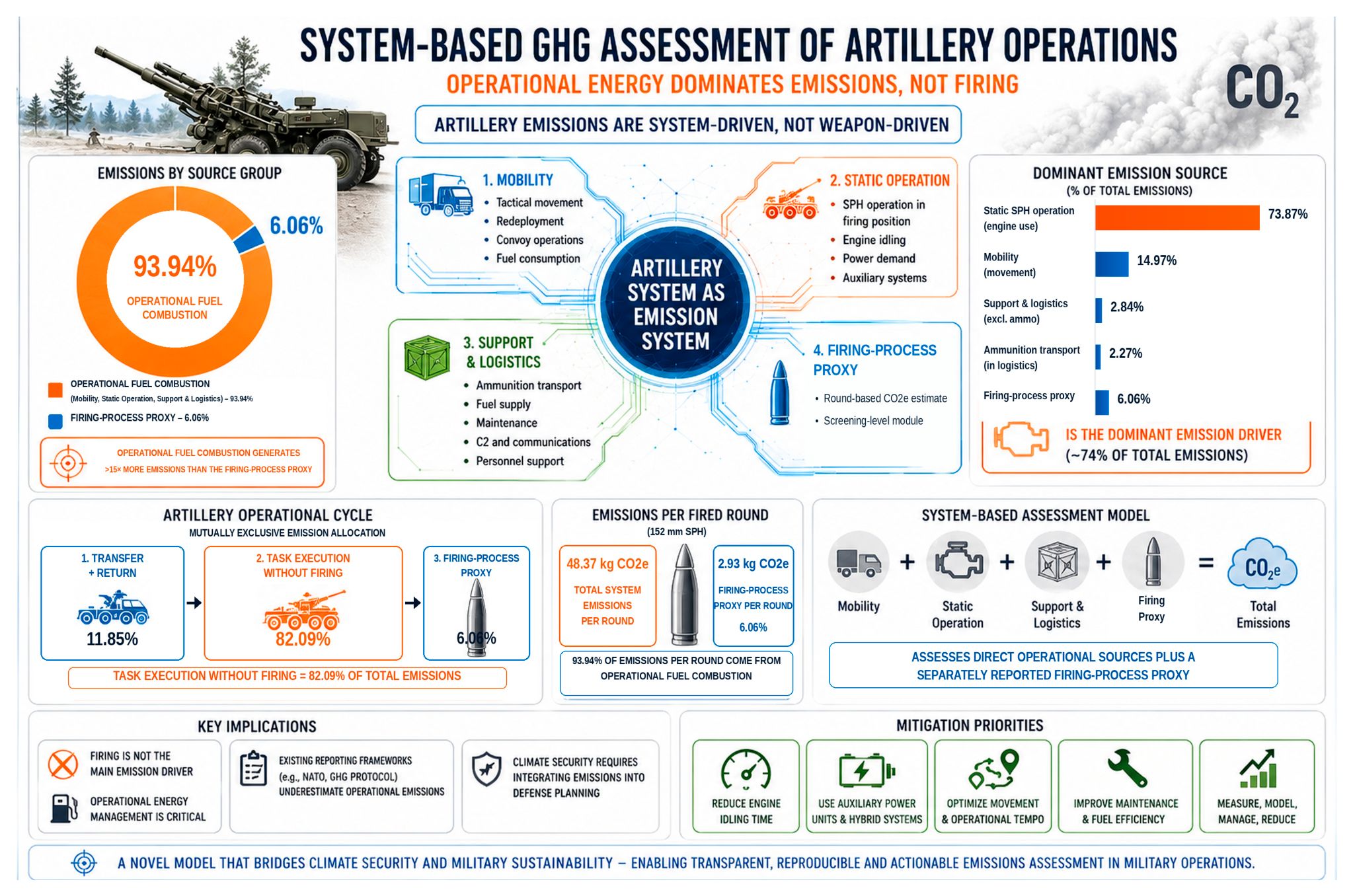
Figure 1 summarizes the system-based assessment logic used in the study. It presents artillery training as an emissions-generating operational system composed of mobility, stationary operation, support and logistics, and firing-related processes. The Figure is intended as a conceptual map of the model rather than as a substitute for the numerical results.
During the preparation of Figure 1, the authors used ChatGPT powered by GPT-5.6 (OpenAI) solely to assist with the graphical layout. The authors independently defined and verified all scientific content, numerical values, and labels, reviewed and edited the output, and take full responsibility for the final Figure.

3.4. Activity-Based Bottom-Up Modeling Approach

The core analytical method is an activity-based bottom-up model. In this approach, emissions are not inferred from aggregate institutional fuel totals; instead, they are derived from the operational behavior of each relevant asset class. This aligns the method with established emissions-inventory practice for mobile combustion, while adapting it to the distinct structure of artillery training.
Each vehicle or asset class is assigned:
  • An activity profile;
  • A driving consumption characteristic;
  • Where relevant, a static operational consumption characteristic.
Operational activity is then expressed in measurable variables, primarily:
  • Distance traveled (D, km);
  • Duration of stationary operation (H, h);
  • Number of fire missions or rounds (N).
This yields the following transformation chain:
activity data → fuel consumption → CO2e conversion → aggregate battery footprint.
The fuel-consumption parameters used in the model combine technical characteristics, operational estimates, and calculated values. Because the scenario inputs were not obtained from direct field measurements, they are treated as representative assumptions rather than empirically validated platform-specific values. Table 3 explicitly distinguishes scenario assumptions, operational estimates, calculated values, and externally sourced emission factors. This distinction is important because the results are particularly sensitive to stationary operating time and stationary fuel consumption. Table 3 reports the aggregate calculation basis for the principal scenario components used in the model.

3.5. Fuel-Consumption Model

For each asset i, total fuel use is derived from the sum of movement-related and stationary-related consumption:
F i = D i × F C i d 100 + H i F C i s ,
where
  • F i → total fuel consumed by asset i (L);
  • D i → distance traveled by asset i (km);
  • F C i d → average fuel consumption in driving regime (L·100 km−1);
  • H i → duration of stationary operation (h);
  • F C i s → hourly fuel consumption in stationary regime (L·h−1).

3.6. Emission Calculation

Direct emissions from fuel combustion are calculated as:
E i = F i × E F f u e l ,
where
  • E i → direct fuel-combustion CO2 emissions of asset i (kg CO2);
  • F i → total fuel consumed by asset i (L);
  • E F f u e l → gas/diesel-oil combustion factor (kg CO2·L−1).
The standardized scenario assumes gas/diesel-oil rather than NATO F-34. The factor of 2.68 kg CO2·L−1 was derived from the reference emission factor of 74.1 t CO2·TJ−1 and net calorific value of 43.0 TJ·Gg−1 for gas/diesel-oil [55], together with a scenario density assumption of 0.84 kg·L−1. The factor represents direct fuel-combustion CO2 within the defined operational boundary and excludes upstream fuel-production emissions. For aggregation, this CO2 mass is expressed as an equivalent CO2e contribution using a CO2 global-warming potential of one. The fuel type and factor should be replaced with platform- and fuel-specific values when the model is applied to F-34 or another military fuel.
The total assessed battery footprint is then calculated as:
E t o t a l = i = 1 n E i + E f i r e * ,
where n is the number of assessed assets in the artillery battery and E f i r e * is the supplementary firing-process proxy defined in Section 3.7.
This formulation prioritizes fuel-based activity data, which are more transparent, auditable, and operationally attributable than the provisional firing-process proxy.

3.7. Supplementary Firing-Process Proxy Module

Because firing involves propellant combustion, the framework includes a supplementary screening-level module for a supplementary firing-process proxy:
E f i r e * = N × E F r o u n d ,
where
  • E f i r e * → supplementary firing-process CO2 estimate (kg CO2);
  • N → number of rounds fired;
  • E F r o u n d → provisional firing-process proxy per round (kg CO2·round−1).
For the standardized scenario, a provisional value of 2.93 kg CO2 per round was retained as a screening-level input for 152 mm HE rounds. This value is not a munition-specific emission factor derived from the combined net explosive weight of the propelling charge and projectile filler. AP-42 is used only to indicate the approximate order of magnitude of firing-point emissions from propelling charges and is based on specific 155 mm ammunition configurations rather than the assessed 152 mm round [56]. Projectile-filler detonation is not quantified separately. Because the proxy has not been validated for the assessed ammunition configuration, it should not be interpreted as a standardized artillery-emission factor or a complete multi-gas firing-related GHG inventory.
The firing-process module is therefore reported as a supplementary component of the assessed footprint rather than as a validated direct-emissions factor. The fuel-based operational layer remains the more robust component of the model because its inputs and conversion factors are more standardized and auditable.

3.8. Source-Contribution Analysis

To identify the operational concentration of the footprint, emissions are disaggregated by source and expressed as shares of the total assessed emissions. This enables comparison of the dominant operational drivers with smaller supporting sources.
The relative contribution of source i is calculated as:
P i = E i E t o t a l × 100 ,
where
  • P i → percentage contribution of source i ;
  • E i → emissions of source i ;
  • E t o t a l → total assessed footprint, including operational fuel-combustion emissions and the separately reported firing-process proxy.

3.9. Model Consistency, Reproducibility, and Uncertainty Management

Because an independent field-measured dataset was not available, the model was not empirically validated in this study. Instead, its consistency was assessed in three complementary steps. First, conceptual consistency was examined by aligning the model structure with established greenhouse gas accounting principles, particularly operational control, activity-based accounting, and direct mobile-combustion estimation. Second, structural consistency was assessed by separating mobility, stationary operation, support activity, and the separately reported firing-process proxy into non-overlapping categories. Third, output plausibility was examined by comparing the calculated emissions structure with the fuel-consumption logic embedded in the standardized scenario. These checks support the internal coherence and reproducibility of the model but do not replace validation against measured operational data.
The principal uncertainty sources are:
  • Variability of real fuel consumption due to terrain and weather;
  • Differences between nominal and actual vehicle load;
  • Command-driven variation in maneuver patterns;
  • Uncertainty in stationary fuel use during mission execution;
  • Uncertainty and limited transferability of the provisional firing-process proxy.
These uncertainties are managed by structuring the model around observable, interpretable, and adjustable parameters. This structure also supports the deterministic sensitivity analysis reported in Section 3.11.
The model therefore produces a scenario-based estimate rather than a statistically inferred population value. Particular attention is given to the stationary fuel-consumption rate and stationary operating time because they determine the largest source component in the baseline scenario. Section 3.11 evaluates the effects of varying these and other operational inputs; the resulting ranges should be interpreted as deterministic sensitivity results rather than confidence intervals.

3.10. Replicability and Transferability

The final methodological strength of the model is its replicability–transferability balance. It is simple enough to be used in practical defense analysis yet structured enough to remain scientifically defensible. The same analytical workflow can be transferred to other artillery configurations by modifying the following inputs:
  • Force composition;
  • Platform types;
  • Movement distances;
  • Stationary operating time;
  • Number of tasks and rounds;
  • Fuel-consumption parameters;
  • Applicable emission factors.
This means the model is not tied to one vehicle or one doctrine. What is transferable is not the numeric result itself, but the analytical structure. That is the real methodological contribution of the article. In this study, the proposed framework was applied to a standardized artillery battery training scenario to demonstrate whether it can produce a transparent, reproducible, and structurally interpretable estimate. This application demonstrates the calculation workflow and the decomposition of emissions into operational source categories. It should not be interpreted as empirical validation of the model across artillery systems or operating conditions.

3.11. Sensitivity Analysis

To test the robustness of the model against variation in its dominant inputs, a simple one-factor sensitivity analysis was applied to the two parameters with the strongest expected influence on total emissions:
  • The duration of stationary operation of the self-propelled howitzers in firing position;
  • The fuel-consumption rate assigned to that stationary operating mode.
Because stationary operating time and stationary fuel-consumption rate enter Equation (3) multiplicatively, equal proportional changes in either parameter produce identical totals; the results therefore report them jointly as stationary fuel use. Each parameter was varied by ±20% relative to the baseline scenario while all other inputs were held constant. This range was selected as a pragmatic uncertainty band reflecting plausible operational variation caused by terrain, weather, mission tempo, crew behavior, and differences between nominal and effective fuel use. The purpose of the sensitivity analysis was not to simulate all battlefield variability, but to test whether the principal conclusion of the study—namely the dominance of operational fuel-combustion emissions over supplementary firing-process proxy—remains stable under moderate parameter deviation.
To broaden the deterministic sensitivity assessment, the same ±20% one-factor-at-a-time variation was also applied to total self-propelled howitzer movement distance, all support-vehicle activity inputs, the number of rounds fired, and the supplementary firing-process proxy per round. In each test, only one input was varied while all other inputs were held at their baseline values. This enables direct comparison of the influence of individual inputs on the total assessed footprint. The gas/diesel-oil factor was not subjected to the generic ±20% variation because it is an externally specified conversion factor rather than an operational scenario variable.
A combined operational-tempo analysis was also conducted. In the low- and high-tempo variants, self-propelled howitzer maneuver distance, stationary operating time, all support-vehicle activity inputs, and the number of rounds fired were varied simultaneously by −20% and +20%, respectively. Transfer distance to and from the training area and the applied emission factors were held constant because they were not considered functions of training tempo within the standardized scenario.
Generative AI (ChatGPT, OpenAI; accessed on 25 July 2026) was used solely to assist with the graphical layout of the Graphical Abstract and selected graphical elements in the manuscript. All numerical and scientific content was independently verified by the authors against the calculation Tables reported in the manuscript.

4. Results

Under the stated scenario assumptions, the model yielded a total assessed footprint of 4353.74 kg CO2e for one training day. Operational fuel combustion accounted for 4090.04 kg CO2e (93.94%), while the supplementary firing-process proxy contributed 263.70 kg CO2e (6.06%). Operational fuel combustion therefore represented the dominant component within the assessed artillery-training configuration. The normalized indicators were 4.35 t CO2e per training day, 483.75 kg CO2e per firing task, 544.22 kg CO2e per modeled self-propelled howitzer, and 48.37 kg CO2e per round for the complete assessed system. The value normalized per self-propelled howitzer represents the battery-system total divided by eight modeled platforms and not the emissions of an individual platform alone. The reported decimal precision supports calculation reproducibility and should not be interpreted as field-measurement precision or an uncertainty estimate.

4.1. Headline Structure of Emissions

To interpret the total footprint analytically, the results were decomposed into three complementary levels:
  • The overall split between operational fuel combustion and the supplementary firing-process proxy;
  • The source-level structure of operational fuel-combustion emissions;
  • The activity-phase structure of the training cycle.
This decomposition distinguishes operational fuel-combustion emissions from the supplementary firing-process proxy and then separates source-level and activity-phase contributions. Table 4 and Table 5 present the overall distribution and the normalized indicators.
To improve interpretability beyond the battery-level aggregate, Table 5 normalizes the total assessed footprint by training day, firing task, modeled self-propelled howitzer, and round fired. The comparison between 48.37 kg CO2e per round for the complete assessed system and 2.93 kg CO2 per round for the provisional firing-process proxy shows that the normalized system-level value is dominated by the operational activity required to enable firing. These indicators are scenario-specific and should not be interpreted as platform- or ammunition-specific emission factors.

4.2. Source-Level Decomposition of Operational Fuel-Combustion Emissions

The operational fuel-combustion emissions block was further decomposed into individual operational sources. This reveals a highly concentrated structure, as presented in Table 6.
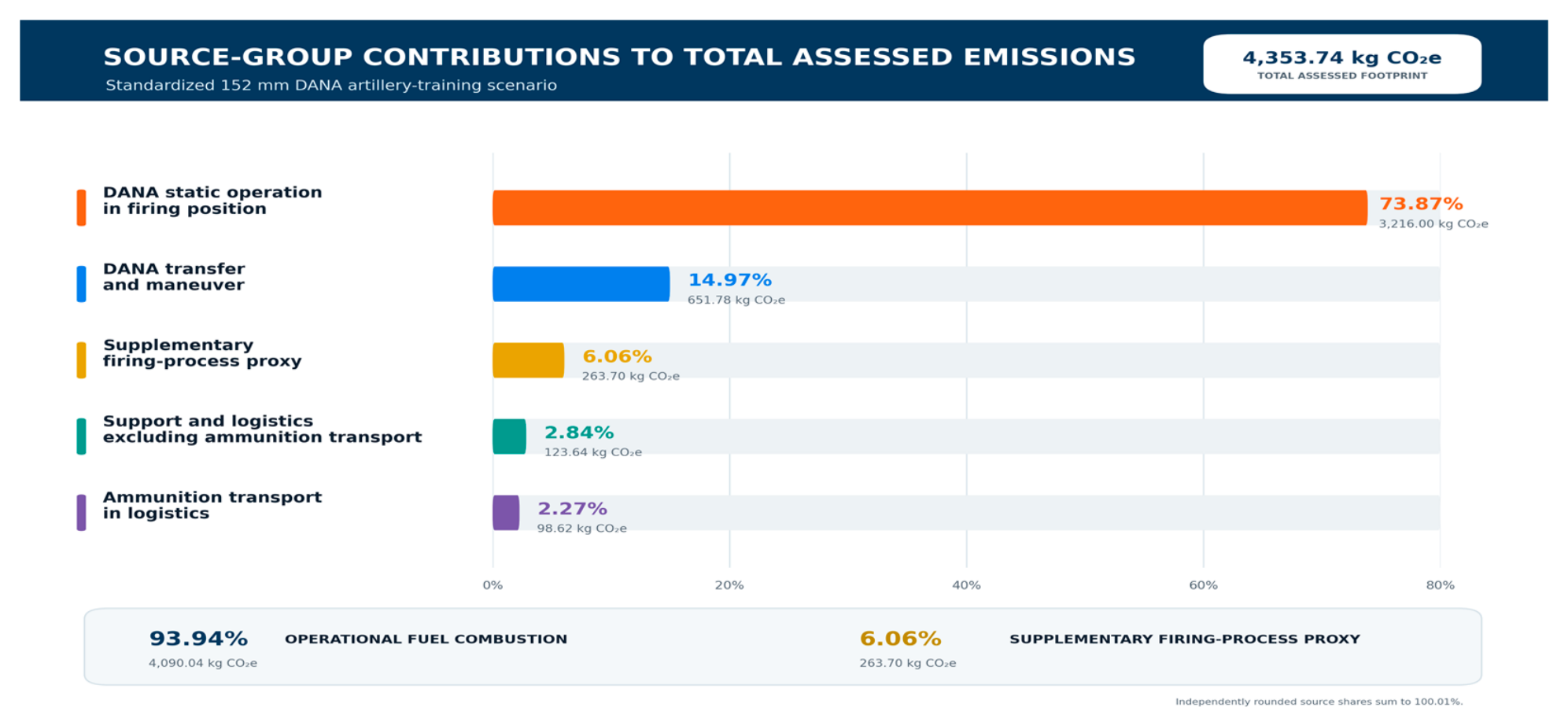
Figure 2 visualizes the source level contribution to the total assessed footprint. Because the emission structure is highly concentrated, the Figure is presented as a contribution chart rather than as a detailed multi-axis comparison.
The graphical layout was prepared with AI assistance using ChatGPT powered by GPT-5.6 based on the authors’ instructions; all numerical and scientific content was independently verified by the authors.
The result is extremely concentrated. The single dominant source was static operation of 152 mm DANA SPH in firing position, which alone generated 3216.00 kg CO2e, i.e., 73.87% of total battery emissions and 78.63% of all operational fuel-combustion emissions. Within the stated baseline assumptions, stationary operation is the largest modeled source. This result follows directly from the assigned stationary fuel use and should therefore be interpreted as a scenario output rather than as a platform-independent empirical constant.
If the three 152 mm DANA SPH subcomponents are combined, they account for 3867.78 kg CO2e, which equals 88.84% of the total assessed footprint and 94.57% of operational fuel-combustion emissions. Support assets therefore matter operationally, but not structurally, from the emissions perspective of the assessed scenario.
This concentration makes the result suitable for mitigation-oriented interpretation because the model identifies a narrow set of dominant emission sources rather than distributing the footprint across many minor contributors.

4.3. Internal Structure of 152 mm DANA SPH-Related Emissions

Because the 152 mm DANA SPH category clearly dominated the footprint, it is necessary to inspect its internal composition separately, as presented in Table 7.
Within the baseline configuration, stationary operation accounted for the largest share of modeled 152 mm DANA SPH emissions, contributing 83.15% of the platform total. Transfer and maneuver together were smaller than one-fifth of the 152 mm DANA SPH total.
Within the modeled scenario, the carbon profile of the artillery platform was driven primarily by time spent in an active firing-position regime rather than by distance traveled. This supports the methodological distinction between movement and stationary operating states; a simplified distance-based model would omit the largest modeled source.

4.4. Activity-Phase Decomposition of the Training Cycle

The Excel results also allow the footprint to be reorganized according to operational phase rather than by asset. This produces a second, conceptually important perspective, as presented in Table 8. Support-vehicle emissions were allocated according to the distance traveled and operating time assigned to each vehicle in the scenario calculation. Activities associated with movement to and from the training area were assigned to the transfer phase, while remaining support-vehicle movement and auxiliary-power use were assigned to task execution. The resulting aggregate phase allocation is reported in Table 8.
This decomposition shows that the decisive burden was concentrated in the task-execution phase without firing, which generated 3574.19 kg CO2e, or 82.09% of the total. This phase includes maneuver and static operational readiness required to conduct firing tasks but excludes the act of projectile discharge itself.
This decomposition complements the simple “operational fuel combustion versus supplementary firing-process proxy” split by showing where in the mission cycle the emissions are structurally embedded. It confirms that the dominant emissions burden is associated with mission execution rather than with the firing-process proxy alone.

4.5. Fuel-Consumption Interpretation

The total battery fuel consumption amounted to 1526.14 L. Of this, 1200 L were consumed by 152 mm DANA SPH static operation alone, which is 78.63% of all daily fuel use. The next largest categories were 152 mm DANA SPH transfer (128.00 L) and 152 mm DANA SPH maneuver (115.20 L). All remaining vehicles combined consumed only 82.94 L.
This means that the emissions result is mirrored almost exactly in the fuel structure. The emissions hierarchy therefore follows the fuel-consumption hierarchy. Static operation of the gun platforms is the dominant fuel sink, while movement and support vehicles play secondary roles. Because 1200 L of the total 1526.14 L fuel use were assigned to stationary DANA operation, the modeled emissions hierarchy follows the fuel-allocation structure of the standardized scenario and should not be interpreted as an independently validated property of all artillery systems.

4.6. Sensitivity and Uncertainty Analysis

Stationary operation dominates the baseline because the scenario assigns 1200 L of the total 1526.14 L fuel use to this operating state. The sensitivity test therefore evaluates the magnitude and stability of this scenario-dependent hierarchy within the selected bounds; it does not independently validate the baseline value. Because stationary operating time and hourly fuel-consumption rate enter the model multiplicatively, they are reported jointly as stationary fuel use (H × FCs). A ±20% variation in this term changes the total footprint by −14.77% and +14.77%, respectively, while preserving the source hierarchy within the tested range. A break-even check indicates that stationary fuel use would have to fall from 1200 L to approximately 425 L (a 64.6% reduction) before stationary operation ceased to exceed all other assessed sources combined. The sensitivity-analysis results are presented in Table 9.
Additional one-factor-at-a-time tests retained the same ±20% variation while holding all other inputs constant. Varying combined DANA transfer and maneuver activity changed the total by ±2.99%, support-vehicle activity by ±1.02%, and either the number of rounds fired or the supplementary firing-process proxy by ±1.21%. These results show that the total estimate is most sensitive to stationary fuel use and other operational-activity assumptions within the assessed scenario. A combined operational-tempo test was also performed by simultaneously varying self-propelled howitzer maneuver activity, stationary operating time, support-vehicle activity, and the number of rounds fired by −20% and +20%. Transfer distance and emission factors were held constant. The resulting totals were 3551.60 kg CO2e for the low-tempo variant and 5155.88 kg CO2e for the high-tempo variant, representing changes of −18.42% and +18.42%, respectively, from the baseline. The dominance of operational fuel consumption over the supplementary firing-process proxy remained unchanged across the tested deterministic variants.

4.7. Concentration and Pareto Effect

The structure of results demonstrates a strong Pareto-type concentration:
  • One source—152 mm DANA SPH static operation—generated 73.87% of total emissions;
  • Three source categories—the static-operation, transfer, and maneuver components of the 152 mm DANA SPH—generated 88.84% of total emissions;
  • All support and logistics vehicles together generated 222.26 kg CO2e, corresponding to 5.11% of the total, while the supplementary firing-process proxy contributed 263.70 kg CO2, corresponding to 6.06%.
Within the assessed scenario, the Pareto-type structure indicates that mitigation analysis can focus on a small number of operationally dominant sources.

4.8. Environmental Aspect and Risk Register

The environmental aspect and risk register is not an independent emission calculation module. It is a management-oriented interpretation layer derived from the model outputs. Its purpose is to translate the quantified emission source hierarchy into categories usable in defense environmental management, mitigation prioritization, and operational planning. The register therefore supports practical applicability, but the numerical carbon-footprint estimate itself is produced by the activity-based calculation model described in Section 3.4, Section 3.5, Section 3.6, Section 3.7 and Section 3.8.
To translate the analytical findings into a management-oriented structure, Table 10 presents an aggregated environmental-aspect interpretation of the dominant processes identified by the model. The Table is an illustrative decision-support layer rather than a separate quantitative emissions module. Significance ratings are qualitative and are based on (i) the modeled contribution to the assessed direct operational footprint and (ii) operational mitigation relevance. Ratings assigned to unquantified life cycle or local-pollution aspects are data-limited and are not directly comparable with quantified GHG source shares.
The inclusion of an environmental-aspect register provides an additional layer of interpretation beyond the numerical results. It demonstrates that the emissions structure identified by the model can be translated into operationally relevant management categories. The register highlights that a single dominant process—static engine operation—simultaneously represents the largest emission source, the highest-impact environmental aspect, and the most effective mitigation target. This reinforces one of the central conclusions of the study: mitigation strategies in artillery systems should not focus primarily on firing processes, but on operational energy management. In practical terms, this may include reducing idle engine time, introducing auxiliary power units, optimizing mission tempo, or redesigning operational procedures to limit prolonged high-consumption states. From a governance perspective, the register structure also improves compatibility with environmental management systems and reporting frameworks. It enables the integration of operational emissions into structured assessment tools that are already used in military and public-sector environmental management. This may support the future use of the model in defense sustainability planning, subject to scenario-specific parameterization and validation using operational data.

4.9. Result Synthesis

Section 4 shows a consistent pattern across all analytical views within the standardized scenario. At the aggregate level, operational fuel combustion dominates the supplementary firing-process proxy. At the source level, static operation of the self-propelled howitzers is the principal contributor. At the activity-phase level, the main burden is concentrated in firing task execution rather than in the firing process itself. Section 5 interprets this pattern in relation to the energy architecture and operational use of self-propelled artillery systems.

5. Discussion

The results should be interpreted primarily as evidence of a system-driven emissions profile. The assessed artillery battery does not generate its direct operational carbon footprint mainly through the firing event itself, but through the operational conditions required to make firing possible. This distinction is important because much of the existing literature on artillery-related environmental impacts focuses on visible effects such as contamination, terrain degradation, and ecosystem disturbance, whereas the present model captures the less visible energy demand embedded in the mission cycle. The contribution of the study is therefore to connect military environmental-impact analysis with greenhouse gas accounting at the tactical subsystem level.
This finding reframes artillery from a narrow “weapon-centric” perspective toward a system-centric emissions model. Within the assessed scenario, artillery is represented not primarily by the supplementary firing-process proxy, but as a fuel-dependent operational system whose emissions are driven by mobility, readiness, and the duration of firing-position occupation. The reported source distribution is specific to the assessed self-propelled artillery configuration and should not be assumed to represent all artillery systems or military operations. Platform architecture, doctrine, terrain, operating tempo, and auxiliary-power availability may produce materially different emission profiles.
Previous research has extensively documented contamination, terrain degradation, and ecological disturbance associated with artillery [17,18,19,20,21,22,23,24,25,26,27,28,29,30,31,32,33], but has rarely translated tactical activities into a structured greenhouse gas accounting framework. The present model addresses this narrower gap by representing mobility, stationary operation, support functions, and the supplementary firing-process proxy within one operational system.
The literature on military emissions has so far been strongest at the macro level. Studies have shown that military institutions contribute significantly to greenhouse gas emissions and that these contributions are often underestimated or underreported [5,6,8,42,43]. However, these works have not provided a clear methodological pathway for translating emissions into tactical or subsystem-level analysis. The broader defense context is also shaped by evidence that deteriorating security conditions can stimulate aggregate defense-industrial activity, although company-level development remains uneven and strongly influenced by structural constraints and procurement volatility [57].
The framework may be used at three complementary decision levels. Military planners can use it to compare alternative training designs, platform configurations, movement distances, firing-position occupation times, and support arrangements before an activity is conducted. Environmental managers can use the same activity categories to identify dominant sources, define mitigation priorities, and aggregate comparable unit-level estimates over longer reporting periods. NATO or national reporting systems could use the framework as a supplementary operational activity-data layer for exercises and training that are not resolved in detail by organization-level inventories [12,44]. The model is not intended to replace NATO methodology, organizational GHG inventories, or life cycle assessment, but to provide additional tactical resolution within a clearly bounded operational layer.
By quantifying emissions at the battery level, decomposing them into operational components, and linking them to specific mission phases, the framework provides an operational complement to strategic and organization-level greenhouse gas inventories. This is particularly relevant to NATO and similar reporting frameworks, which remain primarily oriented toward installations and organizational structures rather than detailed field activities [12,44]. The additional tactical resolution may help identify operational emission sources that would otherwise remain aggregated or unrepresented in organization-level inventories.
The dominance of static operation is explained by the energy architecture of self-propelled artillery systems. During firing position occupation, the platform may remain engine-active to sustain hydraulic systems, stabilization, fire control electronics, communications, onboard power demand, crew readiness, and rapid displacement capability. This creates a time-dependent emissions profile. The decisive variable is not only distance traveled, but the duration of active operational occupation. The finding is therefore plausible for self-propelled artillery systems with similar engine-dependent readiness requirements, but it should not be generalized automatically to towed artillery, rocket artillery, air-defense systems, armored maneuver units, or aviation assets without additional verification.
The numerical hierarchy observed in this study should therefore be treated as case-specific, while the decomposition logic is transferable. The model can be applied to other artillery configurations by modifying platform composition, movement distances, operating time, support-vehicle activity, firing output, and emission factors. However, whether static operation remains the dominant source must be tested empirically across additional systems and scenarios. For example, towed artillery may shift a larger share of emissions toward towing vehicles and support logistics, while rocket artillery, air-defense systems, or armored maneuver units may display different relationships between movement, standby operation, and mission execution.
The findings support a broader conceptual shift: artillery can be understood as an energy system embedded in military operations. This interpretation aligns with the literature emphasizing the systemic nature of military energy demand and logistics [34,35,36] and extends it to the tactical-subsystem level. In the assessed battery, emissions arise through the interaction of fuel-dependent mobility, mission-driven temporal patterns, readiness requirements, and support functions. The resulting environmental profile is therefore better understood as a system-level consequence of operational design than as a series of isolated firing events.
The tested parameter variation shows that the qualitative source hierarchy is preserved within the selected deterministic bounds. It does not demonstrate independence from the baseline assumptions because the baseline allocation of stationary fuel use remains the principal determinant of the result.
Methodologically, the model is useful because it remains transparent, modular, and interpretable. Emissions are derived from observable operational parameters, individual components can be adjusted independently, and the output identifies dominant sources rather than producing only an aggregate estimate.
At the same time, the results must be interpreted within the limits of the chosen system boundary. First, the model captures direct operational emissions only. It does not include upstream processes such as ammunition production, infrastructure, or supply-chain emissions, which may be significant [48,50]. Second, the scenario is standardized, which improves comparability but does not capture the full variability of real-world operations. In actual deployments, emissions may differ due to terrain, tempo, weather, and tactical conditions. Third, the supplementary firing-process proxy is methodologically less robust than the fuel-based estimates because it is not based on a validated, munition-specific emission factor. This justifies its treatment as a supplementary screening module rather than as an empirically validated component of the footprint. Within these limitations, the estimate is methodologically transparent and reproducible under the stated assumptions, but it has not yet been validated against measured operational data.
The results also have implications for military environmental governance. Current reporting frameworks, including NATO methodologies, tend to focus on infrastructure and organizational emissions while providing limited resolution of operational activity [12,44]. The findings therefore support three cautious implications:
  • Operational emissions may be underrepresented when field activities are not explicitly resolved;
  • Fuel- and activity-based data can strengthen military greenhouse gas accounting;
  • Training and deployment patterns should be treated as scenario-specific emission drivers.
However, the present single-scenario analysis cannot determine the overall share of operational emissions across the military sector. From a policy perspective, this creates a tension. Reducing emissions in artillery systems is not simply a technical problem; it is linked to operational effectiveness, readiness, and doctrine. Any mitigation strategy must therefore balance environmental objectives with military requirements.
The mitigation implications follow directly from the source hierarchy. Where static engine operation is identified as the dominant driver in a particular scenario, relevant measures are not limited to ammunition reduction, but include reducing unnecessary idling, improving engine-management procedures, using auxiliary power units where tactically feasible, introducing hybrid or external power options for stationary operating states, optimizing firing position occupation time, improving maintenance and fuel efficiency, and integrating emissions awareness into training design. These measures should not be interpreted as substitutes for combat effectiveness, but as options for reducing avoidable energy demand where operational conditions allow.
The study also defines several clear directions for further research. First, the framework should be extended toward a broader life cycle assessment encompassing relevant Scope 1–3 sources, including ammunition production, supply chains, and infrastructure. Second, firing-process emission factors require systematic development and validation, particularly across different calibers and munition types. Third, the approach should be applied to other military systems, such as armored units, air defense, or unmanned systems, to determine whether the dominance of operational energy observed here is a general feature of military systems. Fourth, future studies should validate the model against measured fuel-consumption and operating-time data collected across multiple training scenarios. The study is based on a single standardized training scenario, which limits statistical generalization but strengthens analytical clarity. The purpose of the case study is not to represent the full variability of artillery operations, but to demonstrate the structural behavior of emissions within a defined operational system. Future validation should compare contrasting operational configurations, particularly short-duration shoot-and-scoot activity, prolonged firing-position occupation, and main-engine versus auxiliary-power operation. These comparisons should be based on measured platform-specific fuel consumption and operating-time data rather than additional hypothetical parameter sets. A field-data protocol should report fuel consumption, stationary operating time, movement activity, support-vehicle use, firing output, and scenario-specific operational conditions.

6. Conclusions

This study proposed a system-based model for estimating direct operational greenhouse gas emissions from artillery training and demonstrated its application in one hypothetical standardized self-propelled artillery battery scenario. The model adapts established activity-based greenhouse gas accounting logic to the operational structure of artillery by decomposing emissions into mobility, stationary operation, support and logistics, and the supplementary firing-process proxy.
Within the modeled scenario, the results indicate that, within the selected system boundary, the assessed training day was dominated by operational fuel combustion rather than the supplementary firing-process proxy. This numerical result is specific to the modeled battery configuration, scenario assumptions, fuel-consumption parameters, and firing output. It should therefore not be interpreted as a universal emissions coefficient for artillery systems or military operations.
The transferable contribution of the study lies in the analytical structure of the model, not in the generalization of the numerical result. The framework can be adapted to other artillery configurations and potentially to other tactical military subsystems, but such applications require system-specific parameterization and validation using measured operational data.
The study also has limitations. The model captures a bounded set of direct operational emissions and does not include broader life cycle effects such as ammunition production, supply chains, or infrastructure. In addition, the standardized scenario relies partly on assumed and estimated inputs and does not reflect the full variability of real-world operations. Future research should therefore extend the framework toward a broader life cycle assessment encompassing relevant Scope 1–3 sources, develop validated munition-specific firing-process parameters, and test the model across additional military systems and operational scenarios using measured data.
Overall, the study demonstrates how a bounded, scenario-based estimate of artillery-training emissions can be produced more transparently when the battery is treated as an operational system rather than as a single firing event.

Author Contributions

Conceptualization, M.B. and M.Š.; methodology, M.B., M.Š., and J.I.; validation, J.I. and M.H.; formal analysis, M.B.; investigation, M.B., M.Š., J.I., and M.H.; resources, M.B. and J.I.; data curation, M.B.; writing—original draft preparation, M.B.; writing—review and editing, M.Š., J.I., and M.H.; visualization, M.B. and J.I.; supervision, M.Š.; project administration, M.B.; funding acquisition, M.B. and M.Š. All authors have read and agreed to the published version of the manuscript.

Funding

This research was funded by the Ministry of Defence of the Czech Republic, grant number DZRO-FVL22-LANDOPS, and by the Ministry of Education, Youth and Sports of the Czech Republic, grant number SV25-FVL-K107-KOR.

Institutional Review Board Statement

Not applicable.

Informed Consent Statement

Not applicable.

Data Availability Statement

The data supporting the findings of this study are available from the corresponding author upon reasonable request. All data reported in the article are based on the standardized hypothetical scenario described in Section 3.

Acknowledgments

This work was supported by the Ministry of Defence of the Czech Republic from project LANDOPS, grant number DZRO-FVL22-LANDOPS, and by the Ministry of Education, Youth and Sports of the Czech Republic from project Modernization of the Czech Armed Forces Artillery training using simulation technologies, grant number SV25-FVL-K107-KOR. During the preparation of this manuscript, the authors used ChatGPT (OpenAI; accessed on 25 July 2026) to assist with the graphical layout of the Graphical Abstract and Figure 1 and Figure 2. The authors have reviewed and edited the output and take full responsibility for the content of this publication.

Conflicts of Interest

The authors declare no conflicts of interest.

Abbreviations

The following abbreviations are used in this manuscript:
APUAuxiliary power unit
CO2eCarbon dioxide equivalent
FDCFire direction center
GHGGreenhouse gas
IPCCIntergovernmental Panel on Climate Change
LCALife cycle assessment
NATONorth Atlantic Treaty Organization
NEWNet explosive weight
SPHSelf-propelled howitzer
UXOUnexploded ordnance

References

  1. IPCC. Climate Change 2021: The Physical Science Basis; Cambridge University Press: Cambridge, UK, 2021. [Google Scholar] [CrossRef] [Scilit]
  2. Busby, J.W. Taking Stock: The Field of Climate and Security. Curr. Clim. Change Rep. 2018, 4, 338–346. [Google Scholar] [CrossRef] [Scilit]
  3. von Uexkull, N.; Buhaug, H. Security implications of climate change: A decade of scientific progress. J. Peace Res. 2021, 58, 3–17. [Google Scholar] [CrossRef] [Scilit]
  4. Mach, K.J.; Kraan, C.M.; Adger, W.N.; Buhaug, H.; Burke, M.; Fearon, J.D.; Field, C.B.; Hendrix, C.S.; Maystadt, J.-F.; O’Loughlin, J.; et al. Climate as a risk factor for armed conflict. Nature 2019, 571, 193–197. [Google Scholar] [CrossRef] [Scilit] [PubMed]
  5. Belcher, O.; Bigger, P.; Neimark, B.; Kennelly, C. Hidden carbon costs of the “everywhere war”. Trans. Inst. Br. Geogr. 2019, 45, 65–80. [Google Scholar] [CrossRef] [Scilit]
  6. Crawford, N.C. Pentagon Fuel Use, Climate Change, and the Costs of War; Watson Institute, Brown University: Providence, RI, USA, 2019. [Google Scholar]
  7. Parkinson, S.; Cottrell, L. Estimating the Military’s Global Greenhouse Gas Emissions; Scientists for Global Responsibility: Lancaster, UK, 2022. [Google Scholar]
  8. Rajaeifar, M.A.; Belcher, O.; Parkinson, S.; Neimark, B.; Weir, D.; Ashworth, K.; Larbi, R.; Heidrich, O. Decarbonize the military—Mandate emissions reporting. Nature 2022, 611, 29–32. [Google Scholar] [CrossRef] [Scilit] [PubMed]
  9. SIPRI. Trends in World Military Expenditure 2023; Stockholm International Peace Research Institute: Stockholm, Sweden, 2024. [Google Scholar] [CrossRef] [Scilit]
  10. Vershinin, A. The Return of Industrial Warfare; Royal United Services Institute: London, UK, 2022; Available online: https://www.rusi.org/explore-our-research/publications/commentary/return-industrial-warfare (accessed on 10 May 2026).
  11. Watling, J.; Reynolds, N. Meatgrinder: Russian Tactics in the Second Year of Its Invasion of Ukraine; Royal United Services Institute: London, UK, 2022. [Google Scholar]
  12. NATO. The NATO Greenhouse Gases Emission Mapping and Analytical Methodology; NATO Emerging Security Challenges Division: Brussels, Belgium, 2023. [Google Scholar]
  13. Krátký, M.; Pekař, O.; Ivan, J. Simulation Support of Teaching and Research Activities at the Departments of Combat Support Forces at the University of Defence. In Proceedings of the 2023 International Conference on Military Technologies (ICMT 2023), Brno, Czech Republic, 23–26 May 2023; IEEE: New York, NY, USA, 2023; pp. 1–8. [Google Scholar] [CrossRef] [Scilit]
  14. Ivan, J.; Šustr, M.; Sládek, D.; Varecha, J.; Gregor, J. Emergency Meteorological Data Preparation for Artillery Operations. In Proceedings of the 20th International Conference on Informatics in Control, Automation and Robotics, Rome, Italy, 13–15 November 2023; ScitePress: Setúbal, Portugal, 2023; Volume 1, pp. 250–257. [Google Scholar] [CrossRef] [Scilit]
  15. Ivan, J.; Vitoul, V.; Potužák, L.; Drábek, J.; Havlík, T. Evaluation Approaches for an Aggregated Meteorological Model for Artillery Operations. In Proceedings of the 22nd International Conference on Informatics in Control, Automation and Robotics, Marbella, Spain, 20–22 October 2025; Science and Technology Publications: Setúbal, Portugal, 2025; Volume 1, pp. 208–218. [Google Scholar] [CrossRef] [Scilit]
  16. Sedláček, M.; Dohnal, F.; Ivan, J.; Šustr, M. Possible approaches to assessing terrain mobility after the effects of artillery munition. Cogent Soc. Sci. 2024, 10, 2368096. [Google Scholar] [CrossRef] [Scilit]
  17. Rodríguez-Seijo, A.; Fernández-Calviño, D.; Arias-Estévez, M.; Arenas-Lago, D. Effects of military training, warfare and civilian ammunition debris on the soil organisms: An ecotoxicological review. Biol. Fertil. Soils 2024, 60, 813–844. [Google Scholar] [CrossRef] [Scilit]
  18. Mendes, G.P.; Soares, L.C.; Viegas, R.M.A.; Chiavone-Filho, O.; do Nascimento, C.A.O. Lead (Pb) in Shooting Range Soil: A Systematic Literature Review of Contaminant Behavior, Risk Assessment, and Remediation Options. Water Air Soil Pollut. 2024, 235, 1. [Google Scholar] [CrossRef] [Scilit]
  19. Hathaway, J.E.; Rishel, J.P.; Walsh, M.E.; Walsh, M.R.; Taylor, S. Explosive Particle Soil Surface Dispersion Model for Detonated Military Munitions. Environ. Monit. Assess. 2015, 187, 415. [Google Scholar] [CrossRef] [Scilit] [PubMed]
  20. Zhang, H.; Zhu, Y.; Nie, G.; Zhang, H.; Ji, C.; Liu, X.; Chen, W.; Zhao, S. Energetic Compounds and Heavy Metals in Surface Soil of Training Ranges on Southeast Coast of China: Pollution Characteristics and Source Analysis. Environ. Monit. Assess. 2025, 197, 693. [Google Scholar] [CrossRef] [Scilit] [PubMed]
  21. Rodríguez-Seijo, A.; Lalín-Pousa, V.; Pérez-Rodríguez, P.; Campillo-Cora, C.; Pereira, P. Plastic pollution in shooting ranges and warfare areas—An overlooked environmental issue. Environ. Res. 2025, 277, 121626. [Google Scholar] [CrossRef] [Scilit] [PubMed]
  22. Ivan, J.; Niesner, K.B.; Blaha, M.; Doležalová Weissmannová, H.; Adamec, V. Environmental risk assessment of artillery-impacted soils contaminated by heavy metals using pollution indices. Manag. Environ. Qual. 2026, 37, 1461–1479. [Google Scholar] [CrossRef] [Scilit]
  23. Ivan, J.; Šustr, M.; Gregor, J.; Potužák, L.; Varecha, J. Advancing Soil Sampling Techniques for Environmental Assessment of Artillery Impact Zones. J. Ecol. Eng. 2025, 26, 1–14. [Google Scholar] [CrossRef] [Scilit] [PubMed]
  24. Almohamad, H. Impact of land cover change due to armed conflicts on soil erosion in the basin of the Northern Al-Kabeer River in Syria using the RUSLE model. Water 2020, 12, 3323. [Google Scholar] [CrossRef] [Scilit]
  25. Mobaied, S.; Rudant, J.-P. New method for environmental monitoring in armed conflict zones: A case study of Syria. Environ. Monit. Assess. 2019, 191, 643. [Google Scholar] [CrossRef] [Scilit] [PubMed]
  26. Butsic, V.; Baumann, M.; Shortland, A.; Walker, S.; Kuemmerle, T. Conservation and conflict in the Democratic Republic of Congo: The impacts of warfare, mining, and protected areas on deforestation. Biol. Conserv. 2015, 191, 266–273. [Google Scholar] [CrossRef] [Scilit]
  27. Lawrence, M.J.; Stemberger, H.L.J.; Zolderdo, A.J.; Struthers, D.P.; Cooke, S.J. The effects of modern war and military activities on biodiversity and the environment. Environ. Rev. 2015, 23, 443–460. [Google Scholar] [CrossRef] [Scilit]
  28. Leal Filho, W.; Eustachio, J.H.P.P.; Fedoruk, M.; Lisovska, T. War in Ukraine: An overview of environmental impacts and consequences for human health. Front. Sustain. Resour. Manag. 2024, 3, 1423444. [Google Scholar] [CrossRef] [Scilit]
  29. Hryhorczuk, D.; Levy, B.S.; Prodanchuk, M.; Kravchuk, O.; Bubalo, N.; Hryhorczuk, A.; Erickson, T.B. The environmental health impacts of Russia’s war on Ukraine. J. Occup. Med. Toxicol. 2024, 19, 1. [Google Scholar] [CrossRef] [Scilit] [PubMed]
  30. European Commission, Joint Research Centre. Status of Environment and Climate in Ukraine; Publications Office of the European Union: Luxembourg, 2025. [CrossRef]
  31. Krampe, F.; Kreutz, J.; Ide, T. Armed Conflict Causes Long-Lasting Environmental Harms. Environ. Secur. 2026, 4, 3–17. [Google Scholar] [CrossRef] [Scilit]
  32. Choi, C. Mechanisms and Treatment of Blast Induced Hearing Loss. Korean J. Audiol. 2012, 16, 103–107. [Google Scholar] [CrossRef] [Scilit] [PubMed]
  33. Klypa, A. Impact of Military Actions on Natural Ecosystems: Consequences, Rehabilitation, and an Integrated Approach. Spat. Dev. 2024, 10, 471–481. [Google Scholar] [CrossRef] [Scilit]
  34. U.S. Department of Defense. Energy for the Warfighter: Operational Energy Strategy; U.S. Department of Defense: Washington, DC, USA, 2011. Available online: https://www.energy.gov/articles/energy-war-fighter-department-defense-operational-energy-strategy (accessed on 25 July 2026).
  35. National Academies of Sciences, Engineering, and Medicine. Powering the U.S. Army of the Future; National Academies Press: Washington, DC, USA, 2021. [CrossRef] [Scilit] [PubMed]
  36. Harry, R.; Goldfeld, D.A.; Van Abel, K.; Lynch, K.F. Sustaining Agile Operations: Volume 2, Energy and Water Technology Survey; RAND Corporation: Santa Monica, CA, USA, 2026. [Google Scholar] [CrossRef] [Scilit]
  37. Reis, J.; Silva, F.J.G.; Ferreira, L.P.; Sá, J.C.; Ávila, P. Green Defense Industries in the European Union: The Case of the Battle Dress Uniform for Circular Economy. Sustainability 2022, 14, 13018. [Google Scholar] [CrossRef] [Scilit]
  38. Waxin, M.-F.; Bartholomew, A.; Zhao, F.; Siddiqi, A. Drivers, Challenges and Outcomes of Environmental Management System Implementation in Public Sector Organizations: A Systematic Review of Empirical Evidence. Sustainability 2023, 15, 7391. [Google Scholar] [CrossRef] [Scilit]
  39. Hill, D.T.; Collins, M.B. Toxic waste and public procurement: The defense sector as a disproportionate contributor to pollution from public–private partnerships. Regul. Gov. 2023, 17, 389–410. [Google Scholar] [CrossRef] [Scilit]
  40. Rahmawati, E.; Nazaruddin, I.; Widiastuti, H.; Sofyani, H.; Kholid, A.W.N. Environmental Accounting in Public Sector: Systematic Literature Review. J. Account. Invest. 2024, 25, 75–90. [Google Scholar] [CrossRef] [Scilit]
  41. Horáková, N.; Maňas, P.; Rolenec, O.; Palasiewicz, T. National Defense and Environmental Protection: On the Czech Armed Forces’ Approach to the Development of Environmental Legislation in the Czech, EU and NATO Context. Vojen. Rozhl./Czech Mil. Rev. 2022, 31, 172–202. [Google Scholar] [CrossRef] [Scilit]
  42. Jorgenson, A.K.; Clark, B.; Kentor, J. Militarization and the Environment: A Panel Study of Carbon Dioxide Emissions and the Ecological Footprints of Nations, 1970–2000. Glob. Environ. Politics 2010, 10, 7–29. [Google Scholar] [CrossRef] [Scilit]
  43. Depledge, D. Low-Carbon Warfare: Climate Change, Net Zero and Military Operations. Int. Aff. 2023, 99, 667–685. [Google Scholar] [CrossRef] [Scilit]
  44. NATO. Climate Change and Security Action Plan; North Atlantic Treaty Organization: Brussels, Belgium, 2021. [Google Scholar]
  45. World Resources Institute; World Business Council for Sustainable Development. The Greenhouse Gas Protocol: A Corporate Accounting and Reporting Standard, Revised Edition; World Resources Institute: Washington, DC, USA; World Business Council for Sustainable Development: Geneva, Switzerland, 2004. [Google Scholar]
  46. ISO 14064-1:2018; Greenhouse Gases—Part 1: Specification with Guidance at the Organization Level for Quantification and Reporting of Greenhouse Gas Emissions and Removals. International Organization for Standardization: Geneva, Switzerland, 2018.
  47. Yaman, C. A Review on the Process of Greenhouse Gas Inventory Preparation and Proposed Mitigation Measures for Reducing Carbon Footprint. Gases 2024, 4, 18–40. [Google Scholar] [CrossRef] [Scilit]
  48. Passon, B.C.; Galante, E.B.F.; Ogliari, A. A Systematic Approach to Assist in Life-Cycle Assessment of Ammunition Demilitarization Process: A Case Study with the 105-mm HE M1 Ammunition. Int. J. Life Cycle Assess. 2023, 28, 398–428. [Google Scholar] [CrossRef] [Scilit]
  49. Ferreira, C.; Ribeiro, J. Life-Cycle Assessment Applied to Weapon Systems. In Life Cycle Analysis of Sustainable Technology for Military Platforms; STO-MP-AVT-409; NATO Science and Technology Organization: Brussels, Belgium, 2025; Available online: https://www.sto.nato.int/document/life-cycle-assessment-applied-to-weapon-systems/ (accessed on 10 May 2026).
  50. Hertwich, E.G.; Peters, G.P. Carbon Footprint of Nations: A Global, Trade-Linked Analysis. Environ. Sci. Technol. 2009, 43, 6414–6420. [Google Scholar] [CrossRef] [Scilit] [PubMed]
  51. Upreti, G.; Celin, S.M.; Yadav, K.; Haritash, A.K.; Bose, D.B.; Kumar, A. Remediation of Hazardous Explosive-Contaminated Soil at Field Scale: A Data-Oriented Review of Technologies, Challenges and Recommendations. Environ. Monit. Assess. 2026, 198, 166. [Google Scholar] [CrossRef] [Scilit] [PubMed]
  52. Rak, L.; Hrnčiar, M.; Hrdinka, J.; Hradský, Ľ. Effective simulation systems and simulation entities for training modern military tactics. J. Def. Model. Simul. 2025. [Google Scholar] [CrossRef] [Scilit]
  53. Hrnciar, M.; Turaj, M.; Nohel, J.; Stodola, P. UAS Flight Path Optimization Model for Effective Monitoring and Surveillance of the Buffer Zone in the UNFICYP Peacekeeping Mission. In Modelling and Simulation for Autonomous Systems, MESAS 2023; Bruzzone, A., Pickl, S., Mazal, J., Fagiolini, A., Vasik, P., Pacillo, F., Stodola, P., Eds.; Lecture Notes in Computer Science; Springer: Cham, Switzerland, 2025; Volume 14615, pp. 34–47. [Google Scholar] [CrossRef] [Scilit]
  54. Kompan, J.; Hrnciar, M. Challenges for Enhanced Military Mobility on the Eastern Flank of NATO. In Transbaltica XIV: Transportation Science and Technology, 2023; Prentkovskis, O., Yatskiv, I., Skackauskas, P., Karpenko, M., Stosiak, M., Eds.; Lecture Notes in Intelligent Transportation and Infrastructure; Springer: Cham, Switzerland, 2024; pp. 239–248. [Google Scholar] [CrossRef] [Scilit]
  55. European Commission. Commission Implementing Regulation (EU) 2018/2066 of 19 December 2018 on the monitoring and reporting of greenhouse gas emissions pursuant to Directive 2003/87/EC, Annex VI. Off. J. Eur. Union 2018, 334, 1–93. [Google Scholar]
  56. U.S. Environmental Protection Agency. AP-42, Fifth Edition, Volume I, Chapter 15.4: Projectiles, Canisters, and Charges; U.S. EPA: Durham, NC, USA, 2007.
  57. Šlouf, V.; Hampelová, L.; Varecha, J. Economic effects of global security deterioration on Czech defence industry revenues. Def. Peace Econ. 2026, 1–25. [Google Scholar] [CrossRef] [Scilit]
Figure 1. System-based greenhouse gas assessment logic and source hierarchy for the standardized artillery-training scenario. All values reproduce the calculation Tables reported in the manuscript. The graphical layout was generated with AI assistance using ChatGPT powered by GPT-5.6 (OpenAI, San Francisco, CA, USA; accessed in July 2026) based on the authors’ prompts; all numerical content was independently cross-checked against the underlying calculations.
World 07 00136 g001
Figure 2. Source contributions to the total assessed footprint of the standardized artillery-training scenario.
World 07 00136 g002
Table 1. Qualitative comparison of GHG assessment frameworks and military reporting approaches relevant to artillery training.
FrameworkTypical Boundary, Strengths and Limitations for Artillery Level Assessment
General GHG inventories/GHG protocol/ISO 14064These frameworks define emissions mainly through organizational, facility, purchased-energy, and value-chain boundaries; their strength lies in mature accounting principles, standardized inventory preparation, and emission-factor logic, but they are not designed to decompose dynamic tactical states such as firing-position occupation, battery maneuver, or mission-cycle phases [45,46,47].
NATO GHG methodologyThe NATO approach provides an important institutional framework for mapping emissions from NATO enterprise structures, installations, and assets; however, its reporting logic is primarily organizational rather than tactical, which limits its resolution for exercises, missions, training cycles, firing-position occupation, and subsystem-level artillery activity [12,44].
Macro military carbon-footprint studiesMacro-level military-emissions studies operate at the level of national armed forces, defense sectors, strategic fuel use, or militarization; they demonstrate the political and climatic relevance of military emissions, but they do not translate emissions into battery-, platform-, source-, or mission-phase-level drivers [5,6,7,8,42,43].
Ammunition LCAAmmunition life cycle assessment applies cradle-to-grave logic to production, use, disposal, and embedded environmental burdens; it is valuable for capturing upstream and material-related impacts, but it requires data that are often unavailable in defense contexts and does not by itself estimate daily operational energy demand during artillery training [48,49].
Operational energy and logistics modelsOperational energy and military-logistics approaches focus on fuel use, energy demand, and support requirements in deployed or institutional military activity; they are operationally relevant, but they are often not integrated with GHG inventory boundaries, direct/indirect source logic, and source-contribution analysis at the artillery battery level [34,35,36].
Proposed artillery modelThe proposed model uses an artillery battery and a standardized training scenario as its assessment boundary; its strength lies in converting observable mission activity into a transparent GHG estimate and source hierarchy, but application is currently limited to one standardized artillery-training scenario and therefore requires further testing before broader military application.
Table 2. Semi-quantitative comparison of GHG assessment approaches relevant to artillery training.
FrameworkBoundary Coverage
(0–3)
Tactical Resolution
(0–2)
Key Required InputsInput Burden
(1–3)
Uncertainty Treatment
(0–3)
Validation Status
(0–2)
Artillery-Training Applicability
(0–2)
General GHG inventories/GHG Protocol/ISO 14064 [45,46,47]30Organizational boundary; fuel and purchased-energy data; activity data; selected value-chain data2221
NATO GHG methodology [12,44]20Organizational units; installations; assets; fuel and purchased-energy data2111
Macro military carbon-footprint studies [5,6,7,8,42,43]20Aggregate fuel use; expenditure; institutional or national activity data2110
Ammunition life cycle assessment [48,49]31Materials; production; transport; use; disposal; supply-chain data3211
Operational energy and military-logistics models [34,35,36]12Platform fuel use; distance; operating time; load; logistic activity2111
Proposed artillery model12Platform composition; distance; stationary operating time; fuel-consumption rates; rounds fired; emission factors2202
Note: The matrix is a structured interpretive comparison, not a performance ranking. Boundary coverage: 0 = not specified; 1 = direct operational emissions; 2 = direct plus selected indirect or organizational emissions; 3 = broad life cycle or value-chain coverage. Tactical resolution: 0 = organizational or aggregate; 1 = platform or process; 2 = unit or mission-cycle. Input burden: 1 = low; 2 = moderate; 3 = high. Uncertainty treatment: 0 = not explicit; 1 = qualitative; 2 = deterministic sensitivity or scenario analysis; 3 = probabilistic analysis. Validation status: 0 = conceptual or hypothetical demonstration; 1 = case-based or secondary-data application; 2 = measured or independently verified application. Artillery-training applicability: 0 = low; 1 = adaptable; 2 = directly applicable. For the proposed model, boundary coverage was scored as 1 because only direct operational emissions are quantified; tactical resolution as 2 because battery and mission-cycle levels are represented; input burden as 2 because platform, distance, time, fuel-rate, firing-output, and factor data are required; uncertainty treatment as 2 because deterministic sensitivity analysis is included; validation status as 0 because the application remains hypothetical and has not been validated using field measurements; and artillery-training applicability as 2 because the framework was designed specifically for this activity.
Table 3. Input parameters, status, and basis of the standardized scenario.
ParameterBaseline ValueUnitData TypeUse in Model/Calculation Basis
Assessed unit1Artillery batteryScenario assumptionAnalytical unit
Modeled SPH platform8VehiclesScenario assumptionPlatform-specific scenario input
Total fuel consumption1526.14LCalculatedOperational fuel-combustion emissions
DANA static-operation fuel1200.00LCalculated from operational estimate8 DANA × 7.5 h × 20 L·h−1
DANA transfer fuel128.00LCalculated8 DANA × 20 km × 80 L·100 km−1
DANA maneuver fuel115.20LCalculated8 DANA × 18 km × 80 L·100 km−1
Support-vehicle fuel82.94LCalculated from operational estimatesSupport emissions
Firing tasks9TasksScenario assumptionStandardized training activity
Rounds fired90RoundsScenario assumption10 rounds per firing task
Gas/diesel-oil combustion factor2.68kg CO2·L−1Primary official factor [55]Direct fuel-combustion CO2 conversion
Provisional firing-process proxy2.93kg CO2·round−1Scenario proxy informed by [56]Supplementary firing point CO2 proxy
Note: None of the scenario activity or fuel-consumption inputs were obtained from direct field measurements. “Scenario assumptions” define the standardized battery configuration and training activity; “operational estimates” reflect technical characteristics and expert operational judgment; and “calculated” values are derived from these inputs using the equations presented in this section. The gas/diesel-oil combustion factor is obtained from a primary official source [55], whereas the firing-process proxy is a supplementary screening-level estimate informed by [56] and subject to greater uncertainty. Fuel-combustion and firing-process CO2 masses are reported as equivalent CO2e contributions using a CO2 global-warming potential of one. The firing module does not include potential CH4, N2O, or other climate-relevant species. Values are retained to two decimal places for arithmetic traceability and do not imply equivalent measurement accuracy. The influence of the principal uncertain parameters is examined in the sensitivity analysis.
Table 4. Overall carbon footprint of the standardized training day.
ComponentEmissions (kg CO2e)Share of Total (%)
Operational fuel combustion4090.0493.94
Supplementary firing-process proxy263.706.06
Total assessed footprint4353.74100.00
Table 5. Normalized emission indicators for the standardized scenario.
IndicatorValue
Total assessed footprint per training day4353.74 kg CO2e
Total assessed footprint per firing task 483.75 kg CO2e
Total assessed footprint per self-propelled howitzer per day544.22 kg CO2e
Total assessed footprint per round fired48.37 kg CO2e
Supplementary firing-process proxy per round2.93 kg CO2e
Table 6. Source contributions to operational fuel-combustion emissions in the standardized artillery-training scenario.
Source CategoryFuel Total (L)Emissions (kg CO2e)Share of Operational Fuel-Combustion Emissions (%)Share of Total Emissions (%)
152 mm DANA SPH transfer to/from training area128.00343.048.397.88
152 mm DANA SPH maneuver during firing tasks115.20308.747.557.09
152 mm DANA SPH static operation in firing position1200.003216.0078.6373.87
Hilux platoon commanders7.3019.550.480.45
Hilux battery commander and fire direction center (FDC)3.8410.290.250.24
TITUS driving mode20.0053.601.311.23
TITUS APU15.0040.200.980.92
Tatra ammunition vehicles36.8098.622.412.27
Total operational fuel combustion1526.144090.04100.0093.94
Table 7. Internal composition of 152 mm DANA SPH emissions.
152 mm DANA SPH Operating ModeEmissions (kg CO2e)Share of 152 mm DANA SPH Emissions (%)Share of Total Assessed Footprint (%)
Transfer to/from training area343.048.877.88
Maneuver during firing tasks308.747.987.09
Static operation in firing position3216.0083.1573.87
Total 152 mm DANA SPH3867.78100.0088.84
Table 8. Emissions by activity phase.
Activity PhaseEmissions (kg CO2e)Share of Total (%)
Transfer to training area and return515.8511.85
Task execution without firing3574.1982.09
Supplementary firing-process proxy263.706.06
Total4353.74100.00
Table 9. Sensitivity of total emissions to variation in the stationary fuel-use term.
ScenarioTotal Emissions (kg CO2e)Change from Baseline (%)Share of Operational Fuel Combustion (%)Share of Firing-Process Proxy (%)
Baseline4353.740.0093.946.06
Stationary fuel use (H × FCs) −20%3710.54−14.7792.887.12
Stationary fuel use (H × FCs) +20%4996.94+14.7794.735.27
Table 10. Aggregated environmental aspects for dominant emission-related artillery processes.
Activity/ProcessEnvironmental AspectImpact TypeSignificanceSource TypeMitigation Potential
Static operation of SPH in firing positionHigh fuel consumptionCO2e emissions (GHG)Very highDirect (Scope 1)High (engine management, APU use, hybridization)
SPH maneuver and transferFuel consumption during mobilityCO2e emissionsMediumDirect (Scope 1)Medium (route optimization, training design)
Ammunition transport (Tatra)Fuel consumption logisticsCO2e emissionsLow–mediumDirect (Scope 1)Low–medium
Command & control vehicles (Hilux, TITUS)Auxiliary energy useCO2e emissionsLowDirect (Scope 1)Low
Supplementary firing-process proxyScreening-level firing-point CO2CO2 only; other species not quantifiedLow (screening proxy); other impacts data-limitedProcess-emission proxyUncertain/data-limited
Ammunition life cycle (production, supply chain)Embedded emissionsCO2e (Scope 3)Potentially highIndirectHigh (but outside current boundary)
Training area occupationContinuous energy demandCO2e accumulationHigh (time-dependent)System-levelHigh (tempo optimization)
Disclaimer/Publisher’s Note: The statements, opinions and data contained in all publications are solely those of the individual author(s) and contributor(s) and not of MDPI and/or the editor(s). MDPI and/or the editor(s) disclaim responsibility for any injury to people or property resulting from any ideas, methods, instructions or products referred to in the content.