


Abstract
Active labor market policies (ALMPs) targeting self-employment have become a well-established and relevant instrument within employment promotion strategies across many European countries. However, despite their strategic and economic importance, there is limited evidence on their potential performance prior to implementation. This paper aims to address this gap by conducting an ex-ante cost–benefit simulation of different types of ALMPs designed to promote self-employment in Spain. The methodology is based on estimating public costs per beneficiary and quantifiable potential benefits, including avoided welfare payments, additional tax revenues, and the generation of economic activity. These benefits are adjusted using two key parameters: additionality (the proportion of the effect genuinely attributable to the policy) and persistence (the duration of the impact over time). In addition, three sensitivity scenarios (conservative, baseline, and favorable) are developed. The results suggest that financing and access to credit policies exhibit the most robust returns, while direct subsidies, general tax incentives, and emergency policies are more sensitive to intervention design features. Consequently, the effectiveness of ALMPs targeting self-employment depends fundamentally on their ability to align with the specific frictions faced by potential entrepreneurs and on the persistence of their effects.
1. Introduction
Active labor market policies (hereinafter ALMPs) constitute a set of government interventions aimed at improving the functioning of the labor market, promoting job creation, and facilitating the labor market integration of those who face difficulties in accessing or remaining in employment. In their implementation, ALMPs seek to address labor market imbalances by reducing structural unemployment, that is, unemployment caused by mismatches between labor supply and demand [1].
In Spain, ALMPs have played a crucial role in combating unemployment, especially following recent economic crises such as the Great Recession of 2008 and the crisis caused by the COVID-19 pandemic, both of which represented severe shocks to employment [2]. Over recent decades, Spain has faced significant structural challenges in its labor market, characterized by high levels of youth unemployment, a high degree of job temporariness, and a marked duality between temporary and permanent contracts [3,4], trends widely documented in the European comparative literature [5,6]. In this context, active labor market policies have been considered essential instruments for the labor market integration of the unemployed, as well as tools with a preventive function, by facilitating and encouraging access to continuous workforce training [7], in line with the recommendations of Gambin and Hogarth [8] and the European Commission on lifelong learning [9]. A review of national and international evidence has highlighted a recurring limitation: despite the budgetary and strategic relevance of many ALMPs aimed at self-employment, the practice of conducting ex-ante cost–benefit evaluations (prior to implementing or scaling a measure) remains comparatively scarce [10,11]. Moreover, in the few cases where quantifications are included, they tend to refer to ex post results (after implementation). This shortcoming is problematic for two reasons: it hinders the prioritization of instruments when budget constraints exist and public resources are contested, and it favors inertial or generalist policy designs, where measures are maintained due to visibility or administrative continuity rather than on the basis of quantified evidence of economic or social performance.
In order to partially address this gap, the objective of this study is to present a simulation of an ex-ante evaluation structured by families of active labor market policies. From a fiscal policy perspective, this gap is particularly relevant because structural labor market failures increase pressure on public expenditure and make it necessary to assess, before implementation or scaling, which instruments are more likely to generate attributable and sustained social returns. This is an illustrative exercise rather than an effective causal estimation. The numerical values used represent plausible orders of magnitude, aligned with observable ranges in public institutional documentation and based on consistent assumptions regarding administrative costs and fiscal and social returns [12,13]. By their nature, these magnitudes depend on assumptions regarding additionality (the extent to which the effect is genuinely attributable to the policy), persistence (the duration of the effect), and context (market conditions, sector, self-employed profile, and dominant frictions). Therefore, the results should be interpreted as a comparative–descriptive framework to guide future policy design and prioritization, rather than as demonstrable empirical estimates. The aim is to provide a tool for ranking or combining instruments according to their likely economic performance and associated risks, without replacing subsequent empirical evaluation and estimation (for example, through quasi-experimental designs). Furthermore, this study focuses on the specific case of ALMPs targeting self-employment, which operate directly on employment probabilities, mitigate insecurity and precariousness, and act as a catalyst for achieving better living conditions [14,15,16]. Unlike salaried employment, self-employment has a unique nature in terms of career trajectories, income levels, stability, and social protection [17,18]. As they depend exclusively on the economic outcomes of their business activity [19,20], self-employed workers are particularly exposed to market risks, highlighting significant protection gaps in the lower segments of the income distribution [21,22,23]. Self-employed individuals may be direct beneficiaries of active policies aimed at encouraging the creation or consolidation of self-employment activities [16], but when they act as potential employers and are responsible for paying wages, they assume obligations related to salaried employment without, in return, having any guarantee of minimum income for themselves [20,24,25].
This study thus represents a novel contribution to the literature on ALMP evaluation by proposing a comparative analytical framework that allows instruments and tools to be ranked according to their potential performance, thereby supporting public agents in the design of future interventions aimed at promoting self-employment. From this point onwards, the article begins with a review of the different typologies of ALMPs aimed at fostering self-employment, followed by the methodology applied in the ex-ante simulation of these instruments. Subsequently, the results obtained are presented, concluding with a discussion of these findings and the main conclusions derived from the cost–benefit evaluation.
1.1. Typologies of ALMPs Analyzed
The very nature of ALMPs gives rise to diverse typologies within them. Before examining the different types, it is worth noting that all the policies analyzed here are based on the principle of activation, that is, on the idea that unemployed individuals should be assisted and encouraged to move towards self-employment through active interventions, rather than relying exclusively on passive benefits. The different typologies are grouped following the classification proposed by Filges et al. [2].
1.1.1. Entrepreneurial Training and Skills Development
Active policies for entrepreneurial training and skills development are conceptualized as a set of public interventions aimed at equipping unemployed individuals, the self-employed, and entrepreneurs with competencies, knowledge, and skills directly related to the start-up, management, and consolidation of self-employment activities [3,4,5,6]. These include a wide range of programs such as business training, digitalization, entrepreneurial education, basic management, planning, regulatory compliance, decision-making, and similar areas. They are implemented either as stand-alone instruments or integrated into broader packages of active labor market measures. From an analytical perspective, they are conceived as capacity-enhancing mechanisms, whose potential effects depend primarily on policy design (intervention) and participant profiles, among other factors [4,5]. These policies constitute one of the central pillars of ALMPs, as they are oriented towards improving workers’ professional skills and, consequently, their current and future employability [7]. Broadly speaking, this group of policies encompasses two main types of interventions: on the one hand, vocational training programs, and on the other, continuous education or reskilling programs.
Although they differ in their target populations, both types share important conceptual elements, such as the distinction between general and specific training. General training aims to provide participants with broad and transferable skills (for example, the use of new technologies or the development of interpersonal skills), which are useful across a variety of occupations. By contrast, specific training is oriented towards particular sectors or professions, preparing individuals to perform tasks in areas with high labor demand, such as information technology or healthcare [3]. This distinction is relevant, as evidence shows that general training alone is rarely sufficient to guarantee labor market integration, whereas specific training becomes decisive when it responds to the needs of expanding sectors. In this regard, collaboration between public administrations, educational institutions, and firms plays a key role in ensuring the relevance and effectiveness of training provision [7], as programs designed in close connection with the business sector increase the likelihood that acquired skills will meet real demand.
1.1.2. Subsidies and Direct Financial Support
Subsidies or direct financial support for entry into self-employment are probably the most widely used instrument within the European repertoire of active policies aimed at facilitating the transition from unemployment to self-employment [2,8,9,10,11]. Their intervention logic is based on the assumption of a “double dividend”: the unemployed individual exits unemployment by becoming self-employed, thereby achieving their own reintegration into the labor market, and the new business established by the participant may potentially generate additional jobs by hiring employees, thus further reducing the overall unemployment rate [9,12,13,14,15]. For this reason, these programs are typically implemented as non-repayable grants or temporary monthly income support (6–18 months), which minimize risks during the start-up phase and act as activation mechanisms guiding beneficiaries towards alternative labor market trajectories outside salaried employment [9,10,16,17]. However, in practice, accumulated evidence also suggests that their effectiveness depends on their micro-institutional design and their integration with other instruments (training, advisory services, access to credit) [9,10,17].
1.1.3. Financing and Access to Credit
These policies may take the form of soft loans or tax incentives targeted at unemployed individuals starting a business activity. Their aim is to overcome entry barriers such as lack of liquidity, difficulties in accessing formal financing, and the erosion of business networks or trust following periods of unemployment, with beneficiaries being compensated for initial costs and risks [18,19].
The applied literature has shown that liquidity constraints matter both at the extensive margin (entry decision) and at the intensive margin (continuity and growth) [17,20,21,22]. Classical models and empirical estimates have found that the probability of entrepreneurship is associated with the availability of resources, in line with external financing constraints in self-employment [23]. At the same time, evidence on business survival suggests that easier access to financial resources mitigates exit risk and helps sustain the business when market learning has not yet translated into stable income streams [22,24,25]. However, this relationship should not be interpreted in a mechanical or unequivocal way. Fairlie and Krashinsky [25] showed that the link between resources and entry into entrepreneurship is not linear, clarifying that lack of liquidity is not a uniform barrier to self-employment entry. In policy evaluation, a key issue lies in understanding how financial frictions may be less decisive for initiating self-employment than for consolidating or scaling it, given that access to credit particularly affects the capacity to absorb initial losses, invest in minimum productive assets, and sustain working capital [17,20]. From a public policy perspective, interventions aimed at financing and credit are typically justified as instruments that (i) relax liquidity constraints during the most fragile phase, (ii) allow firms to operate closer to efficient scale, and (iii) reduce the likelihood of returning to welfare benefits due to business failure. This requires evaluation based on an explicit theory of change [26]; if the dominant bottleneck lies in labor market entry, the expected immediate outcome is greater continuity (survival) and fewer interruptions; by contrast, if the bottleneck lies in capabilities (management, commercial strategy, market access), isolated financial support may increase activity without translating into persistent net gains. Comparative empirical evidence is consistent with this distinction and suggests that the average effect of credit on final outcomes (profits, productivity, growth) is more fragile and heterogeneous than its effect on investment or activity generation (e.g., R&D) [17,27].
1.1.4. Tax Incentives and Contribution Rebates
Unlike the previously analyzed ALMPs, this family of instruments—aimed at reducing social security contributions—offers discounts and advantages for hiring, or grants tax benefits to self-employed workers with the objective of lowering the cost of operating formally in the market and easing activity constraints. Their primary aims (though not exclusively) are to (i) sustain the survival and consolidation of businesses (especially small ones), (ii) promote the transition from solo self-employment to employer status (i.e., hiring the first/second employee), and (iii) foster business growth and reduce informality [28,29,30]. Some instruments overlap with those reviewed in previous categories (e.g., monthly subsidies to cover contributions or start-up costs), which is why this typology is here limited to three families of measures based on incentive mechanisms.
Contribution rebates and reductions in social charges (which may also include certain types of self-employment subsidies [12]): these encompass temporary or phased reductions in social security contributions, reduced rates, or flat-rate schemes for new self-employed workers, as well as employment bonus programs (e.g., schemes providing income support at the start of a business, typically targeting unemployed individuals entering self-employment). These measures primarily operate by reducing fixed formalization costs, own labor costs (contributions), and/or by providing liquidity at start-up, thereby easing working capital constraints and minimizing early-stage risks [31,32].
Tax incentives (deductions/exemptions/simplified regimes with reduced rates/tax credits): these affect the expected net profitability of self-employment. The expected mechanisms combine (a) an increase in net returns from operating formally; (b) a reduction in administrative/tax burdens (where simplification is introduced); (c) changes in the optimal scale of business due to threshold effects, allowing avoidance of tax jumps; and (d) the formalization of previously informal activities [33,34,35].
Targeted hiring incentives for the self-employed/microenterprises, such as subsidies for hiring a first employee [29]. These operate by reducing marginal (or fixed) costs associated with transitioning from having no employees to becoming an employer, lowering hiring frictions and the risk of reversal, with the potential to increase salaried employment [28,29,36].
These policies are considered ALMPs insofar as they pursue typical activation outcomes: increasing labor market integration (via self-employment), stabilizing labor trajectories, and, at the margin, creating additional employment. Their economic rationale is generally grounded in market failures and institutional frictions that disproportionately affect micro-businesses (lack of initial liquidity, financing constraints, high uncertainty, fixed costs of formalization and compliance, tax and contribution burdens that penalize formal entry, and hiring frictions). Evaluation evidence suggests that, when properly implemented, these instruments have the potential to improve outcomes such as employment retention (self-employment and/or total employment), income, and satisfaction/well-being.
1.1.5. Emergency and Resilience Policies
In the recent empirical literature, emergency policies are operationally conceptualized as rapid-deployment, temporary instruments designed to cushion severe exogenous shocks affecting productive units (health-related, demand-side, or financial shocks). Resilience, by contrast, is understood as a broader outcome—a dynamic process with at least three observable components: (i) resistance (the capacity to avoid exit or immediate collapse), (ii) recovery (partial or full return to pre-shock levels of activity and income), and (iii) reorientation/transformation (changes in business models, markets, or technology that improve future adaptability) [37,38].
In practice, the expected outcomes of these measures for the self-employed and firms go beyond mere survival (preventing formal closure), encompassing their ability to ensure operational continuity (the capacity to continue producing/selling under constraints); enable the recovery of income and sales; contribute to improved solvency (reduction of debt stress); introduce adaptive changes (technological, organizational, digitalization); and prevent the destruction of salaried employment (e.g., layoffs during crises). Analytically, the distinction between emergency and resilience does not generally imply the existence of entirely new instruments, but rather a shift in the intensity, timing, and access rules of tools that already form part of the standard repertoire of public intervention in self-employment and small businesses.
Indeed, many policies activated during acute episodes (e.g., pandemics or disasters) can be interpreted as extensions, expansions, or reconfigurations of existing measures which, under normal conditions, are justified by persistent market frictions (credit constraints, incomplete insurance, fixed compliance costs, or coordination failures), as well as by less abrupt but still economically relevant disruptions (such as structural unemployment, prolonged demand declines in specific sectors, or the chronic vulnerability of undercapitalized businesses). What distinguishes these policies is, above all, the urgency of stabilization and the priority given to avoiding inefficient exits.
These policies primarily aim to temporarily close structural gaps linked to the lower coverage of self-employed workers in standard social insurance instruments (unemployment benefits, adjustment mechanisms), and their high exposure to sudden income shocks with limited recovery capacity. In terms of design, these schemes are typically based on simple and verifiable rules to enable rapid deployment, although this creates delicate trade-offs between speed, targeting, and incentive compatibility.
1.1.6. Integrated Policy Packages
Finally, the most consistent and policy-relevant evidence relates to integrated policy packages. Systematically, combinations of instruments outperform isolated policies, particularly when they articulate plausible sequences (capability development, followed by financing and then hiring or growth incentives) and ensure institutional coordination. The trade-off lies in greater administrative complexity and the risk of exclusion due to compliance capacity, which reintroduces a distributive dilemma: the most comprehensive designs are also those most likely to be biased towards entrepreneurs with higher human capital and administrative capacity, improving aggregate indicators while potentially widening gaps or leaving vulnerable self-employment trajectories unchanged.
2. Materials and Methods
2.1. Potential Costs and Benefits per Beneficiary
When conducting an ex-ante simulation across a broad set of active labor market policies, the first task is to transform families of measures into comparable cost–benefit parameters [39]. In Spain, support for self-employment is organized through a decentralized system (Law 3/2023, of 28 February, on Employment. Official State Gazette, No. 51, 1 March 2023, arts. 31 and 32), meaning that there is no homogeneous administrative database from which the analytical units required for the simulation can be directly extracted. These policies are distributed across different levels of government and take diverse forms depending on the territory, the beneficiary group, and the specific type of intervention. In this regard, the State Public Employment Service (SEPE) provides a general access point and groups the measures into categories, redirecting users to the programs implemented in their autonomous communities, which differ in terms of costs, eligibility requirements, and aid intensities [39]. To address this heterogeneity, a preliminary review was conducted of official sources available through SEPE for the last five years, identifying the ranges of their financial amounts. By way of example, in the case of subsidies and direct aid for self-employment, the calls currently in force show substantive differences. For instance, in Asturias, they range from EUR 3400 to EUR 4600. In Andalusia, the equivalent aid establishes a subsidy ranging from EUR 2000 to EUR 5500, depending on the beneficiary group and on the applicable increases when the activity is carried out in municipalities with fewer than 10,000 inhabitants. In Navarre, in addition to the ordinary measures promoting self-employment, which currently range between EUR 2000 and EUR 10,000 depending on the level of investment required and/or the personal circumstances of the self-employed person, specific instruments have been developed to support the succession or transfer of viable businesses, with grants of up to EUR 12,000 in certain cases involving women or persons with disabilities [40]. For this reason, the costs used in the simulation were constructed through a range-based calibration procedure. The methodological decision consisted of identifying an empirically verifiable interval of individual aid intensities per beneficiary and subsequently applying, in the execution of the simulation, cost assumptions located within that interval. Consequently, the parameters used do not represent a national arithmetic mean; rather, they are values located within a verifiable range of individual intensities per beneficiary, allowing the existing administrative heterogeneity to be reflected. The same logic was applied to the remaining instruments.
Regarding potential benefits, the evaluative literature on active labor market policies starts from a different premise: the effects of these interventions should be understood as outcomes conditioned by the type of instrument, the time horizon, the profile of beneficiaries, and the conditions of implementation [8,41,42,43]. From this perspective, the anticipated benefit per beneficiary represents a prior estimate of potential return, calculated in present value terms and subsequently to be adjusted for additionality and persistence, so that the simulation can distinguish between the economic value theoretically generated by the measure and the fraction of that value that can reasonably be considered attributable and sustainable. This distinction makes it possible to acknowledge that the public value of an active labor market policy may be expressed both in immediate budgetary savings and in fiscal, economic, and social returns that materialize gradually and depend on the persistence of effects [8,44,45]. In this way, the gross potential benefit is decomposed into at least four quantifiable channels. The first is savings in benefits, derived from reductions in subsidies, unemployment benefits, or other public transfers when the intervention facilitates exit from unemployment, shortens its duration, or reduces the probability of returning to a subsidized status. This channel is the most directly traceable from a budgetary perspective. The second is additional fiscal return, associated with the beneficiary’s greater permanence in the formal economy through social security contributions, direct and indirect taxation, fees, and other public revenues linked to the continuity or growth of the activity. The third is the economic and employment effect, which captures income generation, consolidation of productive activity, net hiring, or the transition from individual self-employment to employer self-employment. The fourth is the stability or survival effect, which is especially relevant in emergency, liquidity, or resilience-oriented policies, where the return lies in preventing closures, interruptions of productive activity, decapitalization, or the destruction of existing employment [32,44,46,47].
2.2. Calibration of Cost Associated with ALMPs
On this basis, the estimated cost per beneficiary captures the direct or implicit public cost associated with each family of policies. Formally, the total cost per beneficiary of a policy is defined as:
where represents the direct cost of the measure (transfer, subsidy, rebate, or explicit public expenditure); captures the administrative costs of processing, verification, monitoring, and control; and represents the implicit public cost of the intervention, such as foregone revenues, financial subsidies, guarantees, or expected losses. Table 1 reports the cost range per beneficiary, the reference value used in the simulation, and the criterion applied to each ALMP family. In training and skills development policies, the cost includes design, delivery, tutoring, advisory services, mentoring, and follow-up. In financing and credit-access instruments, the public cost is equivalent to the implicit subsidy borne by the administration, including interest-rate subsidies, guarantees, expected losses, selection costs, and follow-up costs. In tax and labor incentives, the cost is interpreted as foregone public revenue resulting from rebates, contribution reductions, or hiring incentives. In emergency policies, the cost incorporates extraordinary transfers, exemptions, temporary income support, or liquidity instruments deployed to prevent closures during exogenous shocks. Finally, in integrated policy packages, the cost results from aggregating several components (training, advisory services, financing, mentoring, follow-up, and administrative coordination), which explains why their cost is higher than that of other isolated interventions.
Table 1.
Calibration of estimated public cost per beneficiary by ALMP family for self-employment *.
2.3. Calibration of Benefits Associated with ALMPs
Based on the four channels previously defined, the calibration of benefits is carried out through a criterion of monetary equivalence designed to translate heterogeneous effects (income, welfare savings, fiscal returns, employment, and business stability) into comparable magnitudes per beneficiary. This criterion makes it possible to homogenize the initial valuation of potential gross benefit without substantively equating the return mechanisms of each instrument, so that the subsequent adjustments for additionality and persistence operate on a comparable monetary basis. On this basis, the potential gross benefit of each family of policies is constructed formally as:
where represents potential savings in benefits, subsidies, or public transfers; captures the additional fiscal return derived from social security contributions, taxes, and the formalization of economic activity; represents improvements in income, economic activity, or net employment; and captures the stability or business survival effect, including the prevention of closures, returns to unemployment, or employment destruction. The quantitative reference rule starts from the possibility of expressing part of the potential benefit as an improvement in income or economic activity over a given period. Formally:
where represents the monthly improvement in income or activity potentially attributable to the intervention, and tj the number of years during which that effect could be maintained before applying the adjustments for additionality and persistence. Thus, for example, a moderate improvement of €500 per month over two years is equivalent to €12,000 of potential gross benefit (). These calculations do not presuppose that all beneficiaries experience this increase or that the effect is fully attributable to the policy. They merely provide an operational basis for interpreting magnitudes of potential benefit compatible with moderate income improvements, partial welfare savings, additional fiscal returns, or a combination of these channels. Therefore, ranges were defined according to the logic of intensity and channel accumulation described in the previous literature [44,46,47]. The lower bounds represent scenarios of limited return, in which the policy activates a single mechanism with low intensity or short duration. The upper bounds represent scenarios in which the intervention activates several channels simultaneously or generates more persistent effects. Table 2 summarizes the benefit calibration used in the simulation.
Table 2.
Calibration of potential gross benefit per beneficiary by ALMP family for self-employment *.
Training and skills development policies were calibrated between €2000 and €12,000, given that their effects are usually indirect and depend on whether improved skills translate into greater continuity, employability, or income. Subsidies and direct support were placed between €5000 and €20,000 because they can facilitate exit from unemployment and the formal start of activity, although their expected return is conditioned by the risk of deadweight loss. Financing and credit-access instruments were calibrated between €4000 and €25,000, since a low-cost public intervention can mobilize investment, liquidity, and business continuity above the implicit subsidy borne by the administration. Tax and labor incentives were placed between €2000 and €18,000, reflecting their potential to induce formalization, continuity, or net hiring, but also their sensitivity to substitution effects and low persistence. Emergency policies were calibrated between €2000 and €15,000 because their main benefit lies in preventing closures, income losses, or returns to welfare benefits during temporary shocks. Finally, integrated packages were placed between €10,000 and €70,000, as they simultaneously combine capabilities, financing, support, survival, growth, and potential employment.
2.4. Methodological Operationalization of the Simulation
The ex-ante simulation carried out in this study is based on three pillars: (i) the conversion of costs and benefits into present value, (ii) the identification of the incremental component relative to the no-intervention scenario (counterfactual), and (iii) the adjustment of potential benefits by additionality and persistence. This approach is grounded in self-employment policies, where part of the observed performance may be due to participant selection or to temporary effects linked to the duration of the incentive, rather than to induced and sustained changes.
First, the public cost per beneficiary is defined as the sum of the direct cost of the measure and the costs of administration and monitoring. Formally, the total cost per beneficiary is expressed as:
where captures direct fiscal costs, including transfers, subsidies, and foregone revenue such as contribution rebates, while captures processing, verification, and monitoring costs. For instruments whose costs are distributed over time, such as annual contribution reductions, the relevant cost for comparison is expressed in present value terms, where r denotes the discount rate:
Second, the simulation distinguishes between the potential benefit “with policy” and the expected benefit without policy (. The annual incremental benefit is defined as the difference between both scenarios:
This distinction is necessary because the social return of the policy depends on how much the beneficiary’s trajectory changes relative to their likely evolution in the absence of intervention. In operational terms, the monetizable benefit from a public perspective is approximated through components that capture fiscal and social returns attributable to activation and formal economic activity, in aggregate terms:
where represents avoided benefits, additional tax revenues associated with formal activity, returns linked to net employment created and sustained (when applicable), and benefits derived from stability/avoided business failure (particularly relevant in emergency policies). In practice, the table reported in the results presents aggregated ranges per beneficiary consistent with these channels, without aiming for exhaustive disaggregation when available information does not allow it (as this is a simulation).
Third, the relevant benefit in evaluation is not the potential benefit, but the attributable benefit. To this end, two parameters are introduced. Additionality (α) captures the proportion of the incremental benefit that is genuinely induced by the policy, net of deadweight loss, adverse selection, and, where applicable, substitution or displacement effects.
By construction: .
Persistence captures the extent to which the effect is sustained over time. This adjustment is crucial when the impact is concentrated during the duration of the support (e.g., general bonuses), as opposed to policies that may generate more durable changes (e.g., integrated packages with sequencing and support). By construction: . With these elements, the attributable benefit in present value terms is defined as:
The logic of discounting is captured in the present value expression of any annual flow :
The simulation adopts a time horizon of t = 10 years and a central value for the social discount rate r, which can be varied in sensitivity analysis. The results of the simulation are summarized using two complementary metrics. Net present value is defined as:
and the benefit–cost ratio as:
These metrics allow for the comparison of policy families under homogeneous assumptions; however, their interpretation must be considered alongside the risks identified in the results table. In particular, the “adverse effects” column provides information on mechanisms that tend to reduce α (e.g., deadweight loss or substitution) or weaken (e.g., transitory impacts), so that policy design and alignment with the dominant friction directly condition the ex-ante balance.
Sensitivity Scenarios
The simulation presented in the results table relies on assumptions that are necessary but not precisely observable prior to implementation: the trajectory without intervention (counterfactual), the proportion of the effect induced by the policy (additionality), and the duration of the effect (persistence). This reliance on assumptions is not a weakness of the approach, but rather an inherent condition of ex-ante evaluation. For this reason, results are reported through sensitivity scenarios, allowing for a clear identification of which assumptions drive the cost–benefit balance and under what conditions a given family of policies tends to improve or worsen its performance.
Formally, for a given scenario s, the attributable benefit in present value terms is expressed as:
where is the assumed additionality in scenario s, the annual persistence of the effect, the incremental benefit relative to the counterfactual, and the social discount rate. When public costs exhibit a temporal profile (for example, annual contribution rebates or recurring administrative costs), the present value of costs must be defined consistently with the scenario:
and, therefore, the summary metrics are obtained as:
Accordingly, the logic underlying the scenarios is structured around three dimensions. First, additionality summarizes the proportion of the effect that cannot be explained by decisions that would have occurred anyway (deadweight) or by substitution/displacement effects. From a design perspective, additionality tends to be higher when the policy is well targeted, incorporates verifiable conditionality, and is aligned with the dominant friction, and it tends to decrease when eligibility is broad and the intervention is granted without selection or monitoring mechanisms.
Second, persistence captures whether the effect is transitory (limited to the support window) or sustained through induced organizational or capability changes. This is particularly relevant for incentives linked to costs or hiring: the impact during the period of support may be visible, but its social relevance depends on the retention of activity or employment once the support ends.
Third, the discount rate weighs different policies whose benefits are concentrated in the short term versus those that generate more delayed returns; therefore, sensitivity to r is particularly informative when comparing immediate stabilization instruments with integrated pathways aimed at structural transformation.
Operationally, the simulation uses three scenarios: conservative, baseline, and favorable. The conservative scenario represents less demanding design conditions (higher deadweight, more limited persistence, and lower capacity to induce change) and therefore assumes low values of α and rapidly declining persistence. The baseline scenario uses plausible central values, consistent with the reviewed evidence and with the risk structure of each policy family presented in Table 1. The favorable scenario approximates more aligned designs with higher implementation quality (targeting, support, verification), increasing both additionality and persistence in line with the logic of the intervention.
This scenario-based presentation does not produce a single figure but rather clarifies the underlying mechanisms. In policy families with a high risk of deadweight (for example, broad subsidies or generalized contribution rebates), additionality is typically the parameter that most strongly determines the sign and magnitude of net present value. In hiring incentives and integrated packages, persistence and post-support retention tend to be decisive. In emergency policies, the duration of the shock and the precision of targeting are the factors that most strongly influence the balance. Consequently, sensitivity analysis should be interpreted as a design guide. When small variations in additionality or persistence reverse the result, the priority should not be to maintain or eliminate the policy, but rather to identify which modifications would increase the induced component, reduce risks, and enhance the likelihood of durable effects.
3. Results
Table 3 is interpreted as a simulation input matrix. Each row summarizes a family of instruments and organizes, in a homogeneous manner, the minimum assumptions required to assess their cost–benefit balance under both a short-to-medium-term and a long-term horizon.
Table 3.
Ex-ante cost–benefit evaluation simulation by ALMP families for the self-employed.
In this table, the first two columns distinguish between expected outcomes in the first two years (0–24 months: activation, continuity, and stabilization) and effects over 3–10 years (consolidation, productivity, scaling, and, where applicable, transition to employer status). This distinction is made because some ALMPs for the self-employed generate visible impacts during the support window without necessarily implying lasting transformations. The column on estimated cost per beneficiary presents plausible orders of magnitude of direct public expenditure and associated management costs. In the case of contribution rebates or incentives of a recurring nature, costs are expressed on an annual basis, as their budgetary burden depends on the effective duration of the incentive and the beneficiary’s retention in the program. By contrast, for financial instruments, the relevant public cost is not the total volume of credit granted, but the implicit subsidy (e.g., guarantees, interest rate subsidies, and expected losses), to which administrative, selection, and monitoring costs must be added.
The estimated benefit per beneficiary column reports the gross potential benefits associated with each policy, organized into four channels: avoided benefit payments, resulting from lower social protection expenditure; additional public revenues generated by greater participation in formal economic activity, including taxes and social contributions; employment-related effects, particularly net job creation; and stability or survival effects, such as the prevention of bankruptcies or business closures in emergency-oriented policies. These figures should be interpreted with caution, as they should not be read as observed causal effects but as potential benefit ranges whose realization depends critically on the counterfactual trajectory and on the extent to which the policy induces additional and persistent change.
The column on adverse effects (risks) introduces a key evaluative dimension. These risks (deadweight loss, substitution, adverse selection, over-indebtedness, access bias, dependency, or persistence of low productivity) act as constraints that reduce the proportion of attributable benefits and/or their duration. Finally, the column on recommendations under the dominant friction links the table to the conceptual framework of the chapter. The expected performance of a policy largely depends on whether its design aligns with the main bottleneck constraining the trajectory of the self-employed (capabilities, liquidity/fixed costs, investment capital, transition to employer status, or exposure to shocks).
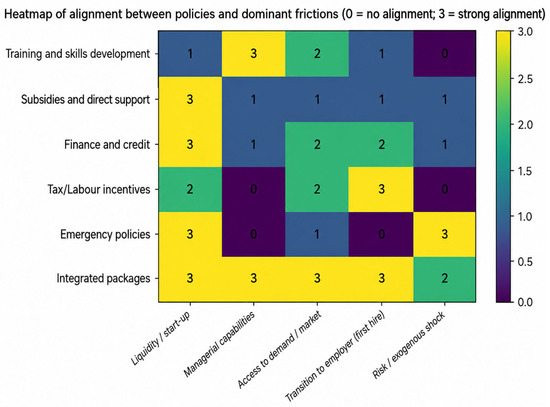
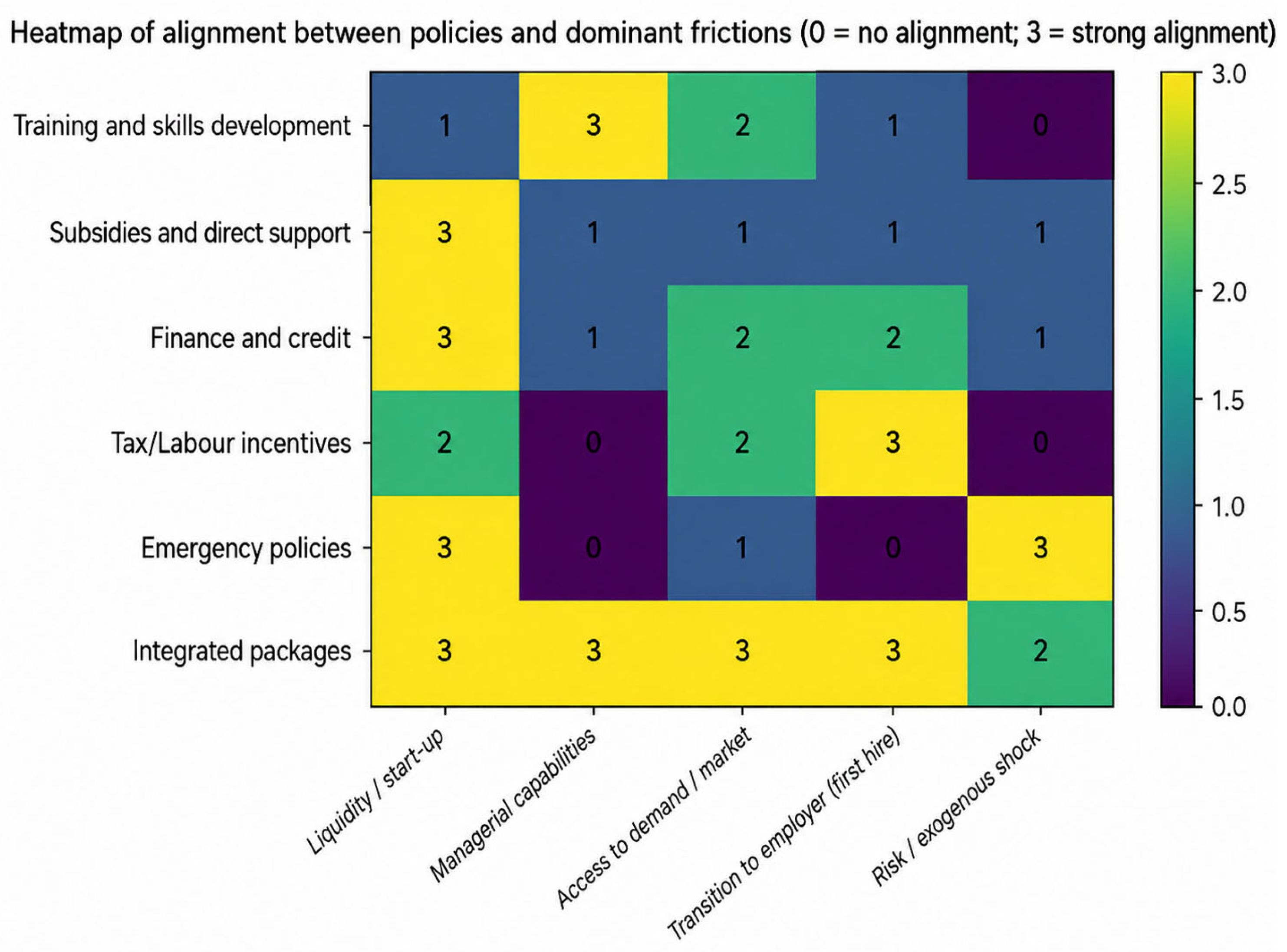
To facilitate comparative reading of the table and to make explicit the logic of alignment between instruments and bottlenecks, Figure 1 summarizes, on a 0–3 scale, the expected alignment between each policy family and the dominant friction it seeks to alleviate (0 = low alignment; 3 = high alignment). This representation provides a structured view of the central mechanism (without replacing the row-by-row analysis): the expected performance of a measure depends on whether its design effectively targets the constraint limiting the self-employed individual’s trajectory (capabilities, start-up liquidity, access to demand, transition to employer status, or exposure to shocks). With this reference, the following family-by-family discussion jointly interprets effects, costs, risks, and recommendations under dominant frictions.
Figure 1.
Heatmap of expected alignment between policies and dominant frictions. Results by scenarios. Source: Own elaboration.
The simulation is implemented using a parsimonious approach that allows for the comparison of policy families under homogeneous assumptions. For each policy j, a total cost per beneficiary is defined (including, where applicable, administrative costs), along with a potential benefit expressed as cumulative present value over a 10-year horizon. Based on these values, the attributable benefit under each sensitivity scenario is calculated by applying two adjustments: additionality and persistence . In this simplified version, is interpreted as the fraction of the potential benefit that, in aggregate terms, is sustained over the considered horizon. This framework allows us to show how results change as and vary, and which policy families are more robust or fragile under different assumptions.
The calculation is performed using the following expressions:
where is the attributable benefit per beneficiary (in present value terms), the net present value, and the benefit–cost ratio.
The following table presents plausible orders of magnitude per beneficiary for each policy family, consistent with the ranges summarized in Table 4, and incorporating administrative costs where they are expected to be relevant.
Table 4.
Benchmark parameters used in the simulation.
Table 5 defines the three scenarios. Additionality captures the proportion of the effect attributable to the policy (net of deadweight and substitution). Persistence approximates the fraction of the benefit that is sustained, in aggregate terms, over the considered horizon.
Table 5.
Sensitivity scenarios *.
As explained in the calibration procedure, the values assigned to additionality and persistence should be interpreted as sensitivity anchors rather than as point estimates for any specific program. These parameters provide a transparent and theoretically grounded basis for distinguishing gross potential benefits from those benefits that may reasonably be regarded as policy-induced and sustained over time, while avoiding any assumption that the simulation reproduces the observed impact of a specific intervention. This distinction is consistent with the ALMP evaluation literature, which shows that program effects vary substantially across instruments, target groups, implementation conditions, and evaluation horizons. Meta-analytical evidence indicates that short-run effects are often limited, whereas medium- and long-run impacts may become more favorable when interventions are well targeted and generate durable employment, income, or capability effects [8,42]. At the same time, the literature cautions that observed outcomes may reflect selection, deadweight, substitution, displacement, or uneven implementation rather than genuine policy-induced change, particularly when targeting or implementation quality is weak [41,43]. The values of α and π are set as sensitivity anchors (conservative–baseline–favorable) and do not represent causal estimates. α summarizes the share of the benefit attributable to the policy after accounting for deadweight, selection, and substitution; hence, low/medium/high values (0.30; 0.50; 0.80) are used to represent, respectively, generalist designs with weak verification, intermediate designs, and high-quality designs with conditionality and controls. approximates the aggregate durability of the benefit over the ten-year horizon (0.50; 0.70; 0.90), reflecting a spectrum from transitory effects to highly persistent outcomes when the intervention triggers organizational or market changes.
The following final table (Table 6) presents the results by policy and scenario. The attributable benefit is calculated as and compared with total cost C.
Table 6.
Results, net present value (NPV) and benefit–cost ratio (B/C).
As observed, under the baseline scenario the balance is positive for finance and credit (NPV = 3100; B/C = 2.72) and, to a lesser extent, for training and skills development (NPV = 500; B/C = 1.17). Integrated packages also yield a positive NPV in the baseline scenario (NPV = 2250; B/C = 1.12), which is consistent with the complementarity hypothesis: by combining mechanisms (capabilities, financing, and growth support), the probability of attributable and sustained effects increases, despite higher coordination costs.
In contrast, subsidies and direct support, tax and labor incentives, and emergency measures exhibit negative NPV in the baseline scenario (B/C < 1), indicating that, under intermediate assumptions of additionality and persistence, attributable benefits do not offset the public cost per beneficiary. However, these policy families show high sensitivity to assumptions: under the favorable scenario, they approach neutrality or become positive (e.g., emergency: NPV = 640; subsidies: NPV = 1140; incentives: NPV = 4240). This pattern indicates that their performance depends critically on design and implementation—particularly targeting (reducing deadweight), conditionality and verification (increasing additionality), and, above all, the capacity to sustain outcomes after the support ends (persistence), which is the key factor driving the reversal of results across scenarios. These results should be interpreted as a comparison under explicit assumptions with approximate data. A positive NPV indicates that attributable benefits exceed costs under the given scenario. A B/C ratio above 1 indicates that each euro of cost generates more than one euro of attributable benefit, while values below 1 indicate insufficient returns relative to cost.
In the simulation, finance and credit display a relatively robust profile: even under conservative assumptions, attributable returns may exceed costs if design limits exclusion and avoids over-indebtedness. Training and skills development approaches the threshold in the baseline scenario, reflecting that its effectiveness depends on implementation quality, support mechanisms, and alignment with market opportunities. Direct subsidies and emergency policies show balances highly sensitive to additionality: when deadweight is high or effects dissipate after support, NPV tends to be negative; the balance improves when the intervention effectively reduces benefit dependency and sustains viable businesses during critical periods. Tax and labor incentives lie close to the threshold in the baseline scenario, highlighting the need for rules that ensure net and persistent employment, as well as appropriate targeting. Integrated packages, by addressing multiple frictions, can exceed the threshold under realistic scenarios; however, their cost and complexity increase the risk of administrative exclusion, meaning that aggregate performance depends on institutional design and operational simplification.
4. Discussion
The results of the simulation are broadly consistent with the empirical literature on active labor market policies, which has repeatedly shown that program effectiveness is heterogeneous and depends on the type of instrument, the time horizon, the target population, and the quality of implementation. Meta-analytical evidence indicates that ALMPs rarely produce uniform short-term gains across all instruments, and that more favorable effects tend to emerge when interventions are sufficiently targeted, when they address binding constraints, and when they generate durable changes in employment, income, or capabilities [8,42]. This is also consistent with evidence stressing that observed outcomes may be weakened by deadweight loss, substitution, displacement, adverse selection, or weak implementation, especially when policies are broadly designed or insufficiently connected to the specific frictions affecting beneficiaries [41,43]. From this perspective, the simulation does not contradict the empirical evidence; rather, it reproduces its central message in an ex-ante cost–benefit framework. Policy families that directly address a binding constraint with relatively low public cost, such as financing and access to credit, show more robust results across scenarios. By contrast, instruments that may generate substantial deadweight or transitory effects, such as broad subsidies, general tax incentives, or emergency measures, become positive only under more favorable assumptions regarding additionality and persistence. This pattern is consistent with the broader ALMP literature: the relevant question is whether a policy category is universally effective, and under what design conditions, for which beneficiaries, and against which constraint it can generate attributable and sustained returns.
In the case of self-employment policies, the results also align with previous evidence showing that start-up support and entrepreneurship-oriented ALMPs may improve labor market integration, income trajectories, and business survival, but that their effects depend strongly on eligibility rules, screening, complementary support, and post-entry consolidation mechanisms [13,14,31]. The positive baseline result for integrated packages is therefore consistent with the view that isolated instruments are less likely to generate durable outcomes when beneficiaries face multiple simultaneous frictions. Conversely, the weaker baseline performance of direct subsidies and emergency measures does not imply that these policies are ineffective in all contexts; it indicates that their social return is highly conditional on targeting, conditionality, and the capacity to transform short-term support into sustained activity.
The simulation conducted yields a set of conclusions depending on the type of ALMP analyzed. In the case of entrepreneurial training and skills development, the evidence converges on early impacts on management and organizational practices and, when combined with support, greater continuity in self-employment. The results indicate that long-term stability emerges when the intervention is reinforced and connected to market opportunities and financing, suggesting that its main contribution operates through capacity and information frictions rather than as a substitute for liquidity. The identified risks (opportunity cost of productive time and human capital bias) suggest that, when the dominant friction is financial or demand-related, the policy may yield modest returns if implemented in isolation. For subsidies and direct support, the short-term pattern is clear: they facilitate business start-up and cushion initial costs, accelerating the transition out of unemployment. However, the table highlights that long-term effects are heterogeneous and improve when support is tied to verifiable milestones (formalization, investment, sales, or hiring). This condition is important because the identified risks (deadweight loss, adverse selection, and dependency) tend to reduce attributable benefits when transfers are generalized or weakly conditioned. Therefore, the recommendation is oriented towards initial liquidity constraints and fixed costs but requires design features such as conditionality and complementarity with training.
In access to finance and credit, the immediate effect takes the form of increased liquidity and investment, and greater continuity when demand exists. The long-term potential is high if investment translates into sales and scaling, positioning this instrument as a response to capital constraints in the presence of latent demand. The identified risks (exclusion of vulnerable groups, over-indebtedness, and misallocation in the absence of proper screening) indicate that performance depends on design features such as guarantees, selection criteria, and support mechanisms that reduce allocation failures and increase the likelihood of sustained returns. In tax incentives and labor-related policies, different mechanisms are distinguished: bonuses aimed at continuity and cost reduction, versus hiring incentives aimed at enabling the transition to employer status. Persistence depends on organizational and market changes; if the incentive does not unlock a real threshold of demand and managerial capacity, the risk of substitution, deadweight effects, or the consolidation of low-productivity business models increases. Therefore, recommendations are framed in terms of alignment: contribution rebates are appropriate when the dominant friction relates to fixed costs and continuity, whereas hiring incentives are more suitable when the key constraint is the transition to employer status, ideally with criteria that promote net and sustained employment.
In emergency policies, the objective is primarily stabilization: preventing business closures and sustaining income during shocks. The results show relatively clear short-term benefits but limited structural effects if the measure is not linked to transformation. The identified risks (targeting errors, dependency, and the maintenance of non-viable businesses) require these policies to be interpreted as containment instruments, whose long-term effectiveness depends on their articulation with capacity-building and investment measures.
Finally, integrated policy packages represent the family with the greatest potential for consistency, delivering stronger outcomes in terms of continuity, income, and employment, and a higher likelihood of structural improvements when coherent sequencing and coordination are present. However, costs are higher and increase further due to coordination requirements; moreover, the simulation highlights institutional risks (administrative complexity, access bias, territorial inequality) that may reduce their real effectiveness if not designed with simplification and support mechanisms. In terms of dominant frictions, these packages are particularly suitable when multiple constraints coexist (capabilities, capital, risk, and transition to employer status), provided that design minimizes entry barriers for vulnerable groups.
The main policy implication of this study is that the design and scaling of ALMPs aimed at promoting self-employment require an explicit ex-ante assessment. This assessment should go beyond administrative continuity, political visibility, or generic expectations of effectiveness by linking policy objectives to the dominant frictions affecting target groups and to alternative scenarios of additionality and persistence. The value of the proposed framework lies precisely in making these assumptions visible: it allows decision-makers to examine whether a given instrument is likely to generate attributable and sustained benefits under conservative, baseline, or favorable conditions, and to identify which design features would need to change for the policy to become socially profitable.
From this perspective, the framework supports a disciplined process of policy design and prioritization, while avoiding a mechanical ranking of instruments. Low nominal cost or administrative familiarity may make a policy appear attractive, although its expected return depends on its capacity to address the constraint shaping the beneficiary’s trajectory and to sustain effects beyond the support period. More costly interventions may be justified when they address several binding constraints simultaneously and increase the likelihood of durable changes in employment, income, business survival, or formal economic activity.
These findings therefore have several more specific implications for the design and prioritization of ALMPs aimed at promoting self-employment. Overall, the results suggest that expected policy performance depends on the degree of alignment between each instrument and the dominant friction faced by the target group. When the main constraint concerns entrepreneurial knowledge, managerial capacity, or market information, training and mentoring schemes may be relevant, particularly if they are embedded in advisory services and connected to market access mechanisms. When the binding constraint is liquidity or lack of initial capital, direct subsidies or financial instruments may be more appropriate, although their expected additionality depends on eligibility screening, conditional milestones, and safeguards against deadweight loss. For viable projects facing restricted access to investment capital, credit guarantees, subsidized loans, or blended financial instruments may offer more favorable cost–benefit profiles than non-repayable grants, since the relevant fiscal cost is closer to the implicit subsidy than to the full volume of credit mobilized.
A second implication concerns the transition from solo self-employment to employer status. The results suggest that generalized contribution rebates are unlikely to generate substantial attributable returns when weakly connected to net and sustained job creation. In this context, hiring incentives appear more defensible when they are targeted, conditional on formal employment creation, and linked to post-support continuity. The expected public value of these measures therefore depends on their capacity to induce additional hiring behavior and sustain it beyond the support period.
Emergency and stabilization measures require a different interpretation, as their value is mainly associated with avoided losses rather than expansionary effects. Their expected return may derive from preventing inefficient closures, preserving viable productive activity, limiting decapitalization, or avoiding transitions back into unemployment during adverse shocks. However, their long-term contribution is likely to remain limited when they operate in isolation. A stronger design would connect short-term liquidity support with subsequent capability-building, digitalization, financing, or restructuring instruments.
The framework also points to the relevance of integrated policy packages when beneficiaries face several simultaneous frictions, such as limited capabilities, weak access to finance, uncertainty, and difficulties in reaching demand. However, integration should be understood as sequencing and coordination rather than as the simple accumulation of instruments. A coherent design may begin with diagnostic assessment, followed by training or mentoring where capability constraints are present, financial support where capital constraints are binding, and hiring or growth incentives where demand conditions justify expansion. Without such sequencing, integrated programs may increase administrative complexity and exclude beneficiaries with lower capacity to navigate public procedures. Finally, the simulation offers a practical criterion for prioritization under budget constraints. Policy families that maintain a positive net present value and benefit–cost ratios above one under conservative or baseline assumptions can be interpreted as more robust candidates for scaling, subject to institutional feasibility and distributional considerations. Policies that become favorable only under optimistic assumptions require greater caution. Their expansion would be more defensible after redesign through stronger targeting, clearer conditionality, improved monitoring, and mechanisms aimed at increasing post-support persistence. Overall, the proposed framework can be used as a diagnostic and prioritization device, linking each instrument to a dominant friction, identifying design features that may reduce additionality or persistence, and clarifying the conditions under which expected social returns are more likely to materialize.
Regarding the limitations of the study, as with any simulation-based or exploratory work, results should be interpreted with caution, as they do not derive from causal estimation and cannot substitute for empirical evaluation based on real data. The uncertainty inherent in the additionality and persistence parameters also constitutes a limitation, as their values depend on multiple institutional and contextual factors, and even small variations can significantly alter the net present value of certain policy types. Therefore, a key avenue for future research would be the empirical validation of the simulation through quasi-experimental or experimental evaluations applied to specific programs or policies. Another important limitation is the absence of heterogeneity across beneficiary profiles, as the simulation expresses costs and benefits as average values per beneficiary, whereas in practice some ALMPs may be highly effective for certain profiles but less beneficial for others. Future research should therefore aim to analyze heterogeneity in effects according to beneficiary characteristics, sector of activity, or territorial context. Finally, it would be advisable to extend the analytical framework by incorporating additional dimensions such as distributive effects or the quality of the employment generated.
5. Conclusions
This study provides a structured ex-ante assessment of active labor market policies (ALMPs) targeting self-employment, offering a comparative analytical framework to evaluate their expected performance under different assumptions of additionality and persistence. Across policy families, the findings highlight a clear differentiation in mechanisms and outcomes. Training and skills development policies primarily address capability and information constraints, generating more robust effects when combined with complementary instruments. Subsidies and direct support are effective in facilitating entry into self-employment but show weaker and more uncertain long-term impacts unless conditionality mechanisms are introduced. Financial instruments display relatively strong and robust performance, particularly when they alleviate binding capital constraints and are supported by appropriate screening and risk mitigation mechanisms. Tax and labor incentives yield mixed results, with their effectiveness depending critically on whether they successfully enable transitions in business scale or employment. Emergency policies fulfill an essential stabilization role but require integration with structural measures to generate lasting effects. In contrast, integrated policy packages emerge as the most consistent approach, as they simultaneously address multiple constraints, although their effectiveness depends on institutional capacity and design simplicity.
A central contribution of the paper is to emphasize the role of additionality and persistence as key determinants of social returns. The sensitivity analysis shows that small variations in these parameters can significantly alter the cost–benefit balance, underscoring the importance of targeting, conditionality, and policy sequencing. In this regard, the results support a shift from isolated interventions towards coordinated policy mixes tailored to specific bottlenecks. From a policy perspective, the findings suggest that ALMPs should be grounded in a clear diagnostic of the constraints faced by different groups of self-employed individuals. One-size-fits-all approaches are unlikely to be efficient, while better alignment between instruments and frictions can substantially improve outcomes. Furthermore, the incorporation of systematic monitoring and evaluation mechanisms is essential to enhance additionality and ensure sustained impacts over time.
Overall, this study contributes to the literature by providing a transparent and adaptable framework for ex-ante policy comparison, helping to prioritize interventions under budget constraints and uncertainty. While the results are based on simulated assumptions and should be interpreted with caution, they offer valuable insights for both policy design and future empirical research aimed at understanding the microeconomic foundations of self-employment policies.
Author Contributions
Conceptualization, J.A.L.C. and M.M.C.; methodology, J.A.L.C. and M.M.C.; software, J.A.L.C. and M.M.C.; validation, J.A.L.C. and M.M.C.; formal analysis, J.A.L.C. and M.M.C.; investigation, J.A.L.C. and M.M.C.; resources, J.A.L.C. and M.M.C.; data curation, J.A.L.C. and M.M.C.; writing—original draft preparation, J.A.L.C. and M.M.C.; writing—review and editing, J.A.L.C. and M.M.C.; visualization, J.A.L.C. and M.M.C.; supervision, J.A.L.C. and M.M.C.; project administration, J.A.L.C. and M.M.C. All authors have read and agreed to the published version of the manuscript.
Funding
This research received no external funding.
Institutional Review Board Statement
Not applicable.
Informed Consent Statement
Not applicable.
Data Availability Statement
The datasets generated and/or analyzed during the current study are available from the corresponding author on reasonable request. Public access to the data is restricted due to their use within an ongoing research project.
Acknowledgments
The authors would like to acknowledge the support provided by their research group during the development of this study. During the preparation of this work, the authors used ChatGPT-4 to improve the clarity, readability, and linguistic quality of the manuscript. Following the use of this tool, the authors carefully reviewed and edited the content as necessary and assumed full responsibility for the final published version of the article.
Conflicts of Interest
The authors declare no conflicts of interest.
References
- Canton, H. Organisation for Economic Co-Operation and Development—OECD; Routledge: Abingdon, UK, 2021. [Google Scholar]
- Filges, T.; Hansen, A.T. The threat effect of active labor market programs: A systematic review. J. Econ. Surv. 2017, 31, 58–78. [Google Scholar] [CrossRef] [Scilit]
- Filges, T.; Smedslund, G.; Knudsen, A.D.; Jørgensen, A.K. Active Labour Market Programme Participation for Unemployment Insurance Recipients: A Systematic Review. Campbell Syst. Rev. 2015, 11, 1–342. [Google Scholar] [CrossRef] [Scilit]
- Hogendoorn, B.; Rud, I.; Groot, W.; Maassen Van Den Brink, H. The effects of human capital interventions on entrepreneurial performance in industrialized countries. J. Econ. Surv. 2019, 33, 798–826. [Google Scholar] [CrossRef] [Scilit]
- Kluve, J.; Schmidt, C.M. Can training and employment subsidies combat European unemployment? Econ. Policy 2002, 17, 409–448. [Google Scholar] [CrossRef] [Scilit]
- Oh, S.; DiNitto, D.M.; Kim, Y. Exiting poverty: A systematic review of U.S. postsecondary education and job skills training programs in the post-welfare reform era. Int. J. Sociol. Soc. Policy 2021, 41, 1210–1226. [Google Scholar] [CrossRef] [Scilit]
- Caliendo, M.; Schmidl, R. Youth unemployment and active labor market policies in Europe. IZA J. Labor Policy 2016, 5, 1. [Google Scholar] [CrossRef] [Scilit]
- Card, D.; Kluve, J.; Weber, A. What Works? A Meta Analysis of Recent Active Labor Market Program Evaluations. J. Eur. Econ. Assoc. 2018, 16, 894–931. [Google Scholar]
- Dvouletý, O.; Lukeš, M. Review of Empirical Studies on Self- Employment out of Unemployment: Do Self-Employment Policies Make a Positive Impact? Int. Rev. Entrep. 2016, 14, 123–145. [Google Scholar]
- Mascolo, F.; Bearth, N.; Muny, F.; Lechner, M.; Mareckova, J. From Average Effects to Targeted Assignment: A Causal Machine Learning Analysis of Swiss Active Labor Market Policies. arXiv 2025, arXiv:2410.23322. [Google Scholar] [CrossRef] [Scilit]
- Wolff, J.; Stephan, G. Subsidized work before and after the German Hartz reforms: Design of major schemes, evaluation results and lessons learnt. IZA J. Labor Policy 2013, 2, 16. [Google Scholar] [CrossRef] [Scilit]
- Bellmann, L.; Caliendo, M.; Tübbicke, S. The Post-Reform Effectiveness of the New German Start-Up Subsidy for the Unemployed. Labour 2018, 32, 293–319. [Google Scholar] [CrossRef] [Scilit]
- Caliendo, M.; Hogenacker, J.; Künn, S.; Wießner, F. Subsidized start-ups out of unemployment: A comparison to regular business start-ups. Small Bus. Econ. 2015, 45, 165–190. [Google Scholar] [CrossRef] [Scilit]
- Caliendo, M.; Tübbicke, S. Design and effectiveness of start-up subsidies: Evidence from a policy reform in Germany. Econ. Anal. Policy 2021, 70, 333–340. [Google Scholar] [CrossRef] [Scilit]
- Zoellner, M.; Fritsch, M.; Wyrwich, M. An evaluation of German active labour market policies: A review of the empirical evidence. J. Entrep. Public Policy 2018, 7, 377–410. [Google Scholar] [CrossRef] [Scilit]
- Cerulli, G. Modelling and Measuring the Effect of Public Subsidies on Business R&D: A Critical Review of the Econometric Literature. Econ. Rec. 2010, 86, 421–449. [Google Scholar] [CrossRef] [Scilit]
- Dimos, C.; Pugh, G.; Hisarciklilar, M.; Talam, E.; Jackson, I. The relative effectiveness of R&D tax credits and R&D subsidies: A comparative meta-regression analysis. Technovation 2022, 115, 102450. [Google Scholar] [CrossRef] [Scilit]
- Caliendo, M. Start-up subsidies for the unemployed: Opportunities and limitations. IZA World Labor 2016, 200. [Google Scholar] [CrossRef] [Scilit]
- Caliendo, M.; Kritikos, A.S. Start-ups by the unemployed: Characteristics, survival and direct employment effects. Small Bus. Econ. 2010, 35, 71–92. [Google Scholar] [CrossRef] [Scilit]
- Banerjee, A.; Karlan, D.; Zinman, J. Six Randomized Evaluations of Microcredit: Introduction and Further Steps. Am. Econ. J. Appl. Econ. 2015, 7, 1–21. [Google Scholar] [CrossRef] [Scilit]
- Cowling, M.; Dvouletý, O. UK government-backed start-up loans: Tackling disadvantage and credit rationing of new entrepreneurs. Int. Small Bus. J. 2023, 41, 714–733. [Google Scholar] [CrossRef] [Scilit]
- Nawaz, M.; Noel, M.D. The impact of credit constraints and risk tolerance on self-employment: Accounting for the hidden majority. Int. Rev. Financ. 2025, 25, e70038. [Google Scholar] [CrossRef] [Scilit]
- Evans, D.S.; Jovanovic, B. An Estimated Model of Entrepreneurial Choice under Liquidity Constraints. J. Political Econ. 1989, 97, 808–827. [Google Scholar] [CrossRef] [Scilit] [PubMed]
- Banerjee, A.V.; Breza, E.; Duflo, E.; Kinnan, C. Do Credit Constraints Limit Entrepreneurship? Heterogeneity in the Returns to Microfinance; Social Science Research Network: Rochester, NY, USA, 2017. [Google Scholar] [CrossRef] [Scilit]
- Fairlie, R.W.; Krashinsky, H.A. Liquidity Constraints, Household Wealth, and Entrepreneurship Revisited. Rev. Income Wealth 2012, 58, 279–306. [Google Scholar] [CrossRef] [Scilit]
- Grimm, M.; Paffhausen, A.L. Do interventions targeted at micro-entrepreneurs and small and medium-sized firms create jobs? A systematic review of the evidence for low and middle income countries. Labour Econ. 2015, 32, 67–85. [Google Scholar] [CrossRef] [Scilit]
- Vooren, M.; Haelermans, C.; Groot, W.; Maassen Van Den Brink, H. The effectiveness of active labor market policies: A meta-analysis. J. Econ. Surv. 2019, 33, 125–149. [Google Scholar] [CrossRef] [Scilit]
- Cahuc, P.; Carcillo, S.; Le Barbanchon, T. The Effectiveness of Hiring Credits. Rev. Econ. Stud. 2019, 86, 593–626. [Google Scholar] [CrossRef] [Scilit]
- Cockx, B.; Desiere, S. Labour costs and the decision to hire the first employee. Eur. Econ. Rev. 2024, 170, 104859. [Google Scholar] [CrossRef] [Scilit]
- Cueto, B.; Mayor, M.; Suárez, P. Evaluation of the Spanish flat rate for young self-employed workers. Small Bus. Econ. 2017, 49, 937–951. [Google Scholar] [CrossRef] [Scilit]
- Caliendo, M.; Künn, S. Start-up subsidies for the unemployed: Long-term evidence and effect heterogeneity. J. Public Econ. 2011, 95, 311–331. [Google Scholar] [CrossRef] [Scilit]
- Sánchez-Cañizares, S.M.; Cabeza-Ramírez, L.J.; Guerrero-Baena, M.D. Evaluation of self-employment support policies using survival analysis. The discounted flat rate in Andalusia (Spain). Pap. Reg. Sci. 2020, 99, 1389–1412. [Google Scholar] [CrossRef] [Scilit]
- de Mel, S.; McKenzie, D.; Woodruff, C. Labor Drops: Experimental Evidence on the Return to Additional Labor in Microenterprises. Am. Econ. J. Appl. Econ. 2019, 11, 202–235. [Google Scholar] [CrossRef] [Scilit]
- Egebark, J. Effects of Taxes on Youth Self-Employment and Income; IFAU—Institute for Evaluation of Labour Market and Education Policy: Uppsala, Sweden, 2016; Available online: https://www.ifau.se/en/Research/Publications/Working-papers/2016/effects-of-taxes-on-youth-self-employment-and-income/ (accessed on 3 January 2026).
- Rocha, R.; Ulyssea, G.; Rachter, L. Do lower taxes reduce informality? Evidence from Brazil. J. Dev. Econ. 2018, 134, 28–49. [Google Scholar] [CrossRef] [Scilit]
- Neumark, D.; Grijalva, D. The Employment Effects of State Hiring Credits. ILR Rev. 2017, 70, 1111–1145. [Google Scholar]
- Harasztosi, P.; Maurin, L.; Pál, R.; Revoltella, D.; van der Wielen, W. Firm-level policy support during the crisis: So far, so good? Int. Econ. 2022, 171, 30–48. [Google Scholar] [CrossRef] [Scilit]
- van Berkel, K.; Gercama, L.; Jongen, E.; Vogt, B. Targeting and potential adverse effects of income support for the self-employed during COVID-19. Int. Tax Public Financ. 2025, 33, 971–998. [Google Scholar] [CrossRef] [Scilit]
- Andersson, F.; Holzer, H.J.; Lane, J.I.; Rosenblum, D.; Smith, J. Does Federally Funded Job Training Work?: Nonexperimental Estimates of WIA Training Impacts Using Longitudinal Data on Workers and Firms. J. Hum. Resour. 2024, 59, 1244–1283. [Google Scholar]
- Financiación y Ayudas. Navarra Emprende. Available online: https://www.navarraemprende.com/quiero-emprender/financiacion-y-ayudas/ (accessed on 26 May 2026).
- OECD Commission. Counterfactual Impact Evaluations of Active Labour Market Policies: Lessons from Using Linked Administrative Data; OECD: Paris, France, 2025; Available online: https://www.oecd.org/en/publications/counterfactual-impact-evaluations-of-active-labour-market-policies_bea7860e-en.html (accessed on 26 May 2026).
- Lammers, M.; Kok, L. Are active labor market policies (cost-) effective in the long run? Evidence from the Netherlands. Empir. Econ. 2021, 60, 1719–1746. [Google Scholar]
- McKenzie, D. How effective are active labor market policies in developing countries? a critical review of recent evidence. World Bank Res. Obs. 2017, 32, 127–154. [Google Scholar] [CrossRef] [Scilit]
- Crépon, B.; van den Berg, G.J. Active labor market policies. Annu. Rev. Econ. 2016, 8, 521–546. [Google Scholar] [CrossRef] [Scilit]
- Boardman, A.E.; Greenberg, D.H.; Vining, A.R.; Weimer, D.L. Cost-Benefit Analysis: Concepts and Practice; Cambridge Aspire Website: Cambridge, UK, 2018; Available online: https://www.cambridge.org/highereducation/books/cost-benefit-analysis/484720E57798B7E7A29C7156407CD4A1 (accessed on 26 May 2026).
- Mercier, J.; Handouyahia, A.; Sayeed, J.; Wilane, M.; Aouli, E.; Heydarirad, A. Technical Report: Cost-Benefit Analysis-Incorporating Public Health Care Costs Savings in the Context of the Labour Market Programs Evaluation; Employment and Social Development Canada: Gatineau, QC, Canada, 2024.
- OECD. Cost-Benefit Analysis of ALMPs. How Cost-Effective Are Slovenia’s Main ALMPs from the Perspective of Participants, Taxpayers and Society? OECD: Paris, France, 2023. [Google Scholar]

Disclaimer/Publisher’s Note: The statements, opinions and data contained in all publications are solely those of the individual author(s) and contributor(s) and not of MDPI and/or the editor(s). MDPI and/or the editor(s) disclaim responsibility for any injury to people or property resulting from any ideas, methods, instructions or products referred to in the content. |
© 2026 by the authors. Licensee MDPI, Basel, Switzerland. This article is an open access article distributed under the terms and conditions of the Creative Commons Attribution (CC BY) license.