


Abstract
Purpose: This study investigates the multi-dimensional nature of corporate risk-taking by examining how governance mechanisms exert differing pressures on accounting-based stability versus market-perceived volatility in the Saudi context, as the biggest emerging market in the Middle East. Moreover, the research uses accounting conservatism as a critical moderating variable and the sample is partitioned into high-conservative and low-conservative groups. Design/methodology/approach: The research analyzed data from 69 non-financial listed firms from 2017 to 2024 using four statistical models. Corporate risk-taking values have been captured from both accounting-based and market-based perspectives. Moreover, managerial, institutional, and concentration ownership have been used to capture ownership structure. However, board size, independence, and CEO power have been used to capture board structure. Findings: The research findings reported three main results: (1) Ownership structures have an asymmetric impact on accounting-based corporate risk-taking, as managerial and institutional ownership take a U-shaped curve, but ownership concentration has a positive impact. Moreover, from market-based corporate risk-taking, managerial and institutional ownership have a negative impact, but ownership concentration has a positive impact. (2) Board structures have an asymmetric impact on accounting-based corporate risk-taking, as managerial and institutional ownership have a negative impact, but ownership concentration has an inverted U-shaped impact. Moreover, from market-based corporate risk-taking, managerial and institutional ownership have no significant impact, but ownership concentration has a negative impact. (3) Accounting conservatism can change the nexus between ownership structure, board structure, and corporate risk behavior. Research limitations/implications: The research has many implications. For policymakers, the results discovered the role of ownership and board structures in shaping corporate risk-taking behavior in the Saudi context. Moreover, we have provided evidence-based guidance for governance reforms and firm-level decision-making. Moreover, the results can be incorporated by investors and creditors into their risk assessment frameworks, improving portfolio allocation and credit evaluation. Originality/value: The research captured corporate risk-taking behavior in the Saudi context from two perspectives at the same time. Likewise, it provides new empirical evidence that accounting conservatism can have a role in risky behavior.
1. Introduction
Corporate risk-taking (CRT) is one of the most critical factors in operational, financing, and managerial decision-making, as it affects the firm’s financial stability and long-term sustainable performance [1,2]. Firms globally are facing uncertainty in their activities, especially related to investment, and the risk level that firms determine to take can significantly impact their profitability and resilience against any future events. While taking risks can generate significant growth, excessive risk-taking can threaten a firm’s very survival. This dual nature of CRT has motivated academics to examine its drivers [3,4,5].
Internal corporate governance mechanisms—especially ownership and board structures—have been widely recognized as central determinants of CRT behavior [3,6,7]. Ownership structures, including managerial, institutional, and ownership concentration structures, can explain how managerial decisions are monitored and how aligned managers’ incentives are with those of shareholders [3,8]. For instance, concentrated ownership can either increase the level of CRT by a dominant shareholder who seeks high returns, or it may restrain risk if the controlling shareholder is risk averse [9]. Moreover, concentrated ownership, prevalent in many emerging financial markets, can further complicate CRT decisions because of the long-term orientation. Similarly, institutional ownership may show mixed CRT preferences, often aligning firm decisions with country public policy rather than profit maximization [10,11,12].
In parallel, board structures such as size, independence, and CEO power play a critical role in overseeing managerial decisions and mitigating excessive risk exposure [5,13,14]. Boards with independent directors may reduce opportunistic risk-taking, while diverse boards may incorporate a wider range of perspectives, potentially encouraging innovation and controlled risk-taking [15]. CEO power enhances strategic decision-making and enables quick response to the stock market signals [14,16,17].
The relevance of understanding risk-taking determinants is particularly pronounced in emerging markets [9,18]. The Saudi market is characterized by unique corporate governance features, such as high levels of concentrated ownership and institutional investors, and significant governance influence in strategic sectors. Furthermore, Saudi Arabia is undergoing a major economic transformation under Vision 2030, which encourages economic diversification, private-sector development, investment promotion, and improved transparency in corporate governance. This transformation provides a unique opportunity to explore how governance structures influence CRT in a context that combines traditional ownership patterns with modern regulatory reforms.
Empirical research on CRT in Saudi Arabia is still limited [9,19,20], despite the growing interest in governance reforms. While international studies have established the link between internal governance mechanisms and CRT, their applicability to the Saudi environment is not straightforward due to differences in ownership concentration, regulatory enforcement, and cultural considerations. As such, there is a research and knowledge gap that this study aims to fill.
Despite extensive research in developed markets, the interplay between ownership structures, board characteristics, and CRT in emerging economies like Saudi is underexplored. This gap is especially critical given the country’s economic and regulatory transformation. The research problem can be articulated through three main challenges such as the prevalence of concentrated and family ownership, in Saudi, family-controlled firms constitute a significant portion of the market. Family ownership can influence managerial decisions through socio-emotional wealth preservation, intergenerational objectives, and long-term orientation. These factors may result in risk-averse behavior or selective risk-taking that differs from firms with dispersed ownership. Understanding these dynamics is essential for accurately capturing CRT behavior.
Beyond its contextual uniqueness, this research addresses a broader research knowledge gap in the corporate governance literature regarding the stability of the non-linear governance-risk nexus during periods of institutional transformation. While the entrenchment and convergence-of-interest assumptions are well-established in developed markets, there is limited evidence—until now—on how these dynamics shift when a market undergoes a regulatory overhaul. By examining the Saudi context as a model for rapid transformation of emerging markets, this analysis provides a framework for understanding how structural reforms and accounting prudence (conservatism) interact to discipline risk-taking in emerging environments.
Moreover, limited research on board composition effects, while boards are critical for monitoring and guiding firm strategies, empirical evidence from the Saudi firms on the impact of board size, independence, and CEO power on risk-taking is scarce [9,19,20]. Boards may play a dual role in emerging markets—encouraging innovation while simultaneously controlling managerial discretion to mitigate risk. Going further, the Saudi Vision 2030 initiative has introduced new governance codes, transparency requirements, and investment incentives that may influence risk-taking behavior. Firms are adapting to a rapidly changing institutional framework, and understanding the interaction between governance structures and risk decisions under these conditions is an important issue for both policy and practice. These challenges highlight the importance and significance of our study, which aims to explore how ownership and characteristics of the board of directors influence CRT in the unique institutional context of Saudi Arabia. By addressing this problem, the study contributes to filling a critical research gap, while also providing evidence that can inform corporate governance policies and investment strategies in emerging markets.
The main objective of this study is to examine the impact of ownership structures (managerial, institutional, and concentration) and board of directors’ characteristics (size, independence, and CEO power) on CRT among the Saudi business environment. This objective is designed to provide a comprehensive understanding of the corporate governance mechanisms shaping managerial risk decisions in Saudi Arabia, bridging gaps in both theory and practice. Thus, to achieve this objective, the research addresses the following research questions:
- ▪
- How do ownership structures impact CRT in the Saudi context?
- ▪
- How do board characteristics impact CRT in the Saudi context?
The research is organized as follows: Section 2 reviews current global literature regarding corporate risk-taking, ownership structures, and board characteristics, and develops the research hypotheses. Section 3 outlines the research methodology. Section 4 presents empirical findings. Section 5 discusses the findings in relation to existing literature. Section 6 concludes the research by highlighting the main contributions, implications, limitations, and future research.
2. Literature Review and Hypotheses Development
2.1. CRT and Scientific Theories
CRT reflects the strategic and financial decisions of firms under conditions of uncertainty. Accounting and governance theories provide robust frameworks for understanding why firms engage in varying levels of risk [3,17,21]. These theories explain CRT by examining the interplay between managerial incentives, monitoring mechanisms, board oversight, stakeholder pressures, and institutional norms [22,23]. Moreover, accounting systems are central to operationalizing CRT because they provide measurable indicators, such as earnings volatility, investment fluctuations, and leverage risk, which capture the outcomes of managerial decision-making [24].
Agency theory provides one of the most widely used frameworks for understanding CRT in corporate governance research but with two different perspectives. The theory posits that managers may pursue personal objectives that conflict with shareholder interests. Excessive risk-taking can occur if managers seek to maximize short-term gains, while risk-averse behavior may result when managers prioritize job security [8,25].
Furthermore, the stakeholder theory expands the lens of corporate governance by emphasizing that firms must balance the interests of all stakeholders, including shareholders, employees, customers, and regulators. Firms that actively consider stakeholder interests may adopt more conservative strategies to maintain trust and avoid negative outcomes, leading to lower CRT [2,7]. On the other hand, firms focused primarily on shareholder wealth maximization may pursue higher-risk investments, particularly if stakeholders perceive such actions as aligning with long-term growth objectives, which strongly appears with institutional ownership and a high percentage of board independence [4,26].
Resource dependence theory emphasizes that firms mainly rely on external resources to sustain their survival and growth. Boards of directors are crucial in this context, especially in terms of board experience, as they provide access to financial, informational, and social resources that enable firms to undertake calculated risks [27]. Moreover, independent directors or those with strong networks may help firms secure funding, strategic partnerships, or market intelligence, all of which facilitate informed risk-taking and decrease it [3,28].
Going further, stewardship theory presents a contrasting perspective to the agency theory. Rather than assuming managers act primarily out of self-interest, the stewardship theory posits that managers are intrinsically motivated to act in the best interests of the firm [8]. In this view, managers are stewards of the firm, prioritizing long-term value creation over personal gain. Stewardship-orientated managers are more likely to engage in moderate, calculated risk-taking that supports strategic objectives while safeguarding firm stability as well as board size [5,24].
Taken together, these theoretical perspectives offer a comprehensive understanding of CRT. Agency theory highlights the role of ownership and monitoring in risk decision-making. Stakeholder theory emphasizes the influence of multiple constituencies on managerial behavior. Resource dependence theory points to the board’s ability to facilitate informed risk-taking through access to financial resources. Stewardship theory emphasizes managers’ intrinsic motivation to act in the best interests of the firm. Across all these theories, accounting functions as the key mechanism that makes risk-taking observable, measurable, and manageable. Earnings volatility, investment patterns, leverage ratios, and other accounting-based measures provide researchers and practitioners with concrete evidence of CRT and the governance mechanisms that influence it.
In the Saudi Arabia as an emerging market, this integration is particularly relevant. Ownership-concentrated firms may combine stewardship and agency perspectives, balancing long-term goals with monitoring by other stakeholders. Institutional investors and independent directors may implement resource dependence and agency mechanisms simultaneously facilitating strategic yet controlled risk-taking. Meanwhile, the current Saudi economic reforms introduce institutional pressures that shape risk-taking decisions.
CRT reflects the extent to which firms commit resources to uncertain strategic initiatives, volatile investments, and performance outcomes that may generate either significant gains or losses. This research draws primarily on the agency theory, stewardship theory, resource dependence theory, and principal–agent conflict theory to explain how ownership and board structures influence corporate risk-taking behavior. These theoretical perspectives collectively suggest that governance mechanisms do not exert uniform effects; rather, their influence may be incentive-driven, monitoring-based, strategic, or nonlinear.
In sum, while various theoretical viewpoints explain the governance-risk nexus, they offer competing predictions that necessitate empirical investigation. Agency theory and stewardship theory present a fundamental tension: the former views governance as a ‘constraint’ to prevent managers from taking excessive or self-serving risks (the ‘risk-reduction’ view), while the latter suggests that empowered managers and aligned boards may take ‘calculated risks’ to maximize long-term firm value (the ‘risk-seeking’ view). In the Saudi context, this tension is further complicated by the resource dependence theory, which suggests that board structures are not just monitoring tools, but strategic assets used to secure external capital and legitimacy during institutional transitions. By synthesizing these perspectives, this study moves beyond the descriptive summary to test whether these theories act as complements or substitutes in shaping corporate risk-taking behavior.
Within accounting and finance literature, CRT is illustrated as a multi-dimensional concept. Consequently, previous studies used a mix of market-based and accounting-based measurements to determine a firm’s risk behavior. A primary accounting-based proxy widely adopted in the literature is earnings volatility—the rolling standard deviation of the return on assets (ROA) over a 3- or 5-year window. From a market perspective, scholars rely on stock-return volatility to reflect equity market uncertainty and investor risk perceptions. Going further, CRT manifests in the variance of firm fund allocation. Proxies such as investment volatility (INVV) and capital expenditure (CapEx) volatility measure the intensity and inconsistency with which a firm commits capital to high-uncertainty projects. High volatility in fund allocations indicates a high level of CRT.
2.2. The Nexus Between CRT and Ownership Structure
From an agency theory perspective, MO aligns the interests of managers with shareholders, thereby reducing agency conflicts and potentially constraining reckless risk-taking. Managers with significant equity stakes are likely to weigh the potential upside of high-risk projects against the personal financial consequences of failure, fostering more calculated and moderate CRT behavior [2,29]. However, the effect of managerial ownership on CRT is nuanced. Low to moderate managerial ownership can incentivize managers to pursue riskier strategies to enhance firm value and personal wealth, reflecting the classic “risk-shifting” problem. In contrast, very high managerial ownership may lead to conservative strategies, as managers’ personal wealth is heavily tied to firm outcomes, making them risk averse. Empirical studies in emerging markets suggest that managerial ownership exhibits a non-linear (inverted-U) relationship with CRT, where moderate ownership encourages calculated risk, but excessive ownership reduces risk-taking propensity [10,12].
Furthermore, institutional investors influence managerial behavior through monitoring and governance mechanisms. Their involvement tends to reduce excessive CRT because institutional investors priorities long-term value, transparency, and risk-adjusted returns. By actively engaging with management and exercising shareholder voting rights, institutional owners constrain opportunistic managerial behavior and align risk-taking with shareholder objectives. Nonetheless, institutional ownership can also facilitate strategic risk-taking. Well-informed and sophisticated institutional investors may support calculated, growth-oriented risk if it enhances long-term firm value. This dual effect suggests that the relationship between institutional ownership and CRT is context-dependent, influenced by the type, sophistication, and monitoring intensity of institutional shareholders [10,30,31].
Going further, high ownership concentration strengthens monitoring, reducing managerial discretion to pursue high-risk strategies solely for personal gain. Concentrated owners are likely to implement governance mechanisms to mitigate excessive CRT and ensure that risk-taking aligns with their strategic objectives. However, concentrated ownership may also create conditions for controlled, high-risk projects, particularly when dominant shareholders have a long-term strategic vision or seek to expand market dominance. Moreover, in dispersed ownership settings, weak monitoring may allow managers to engage in unrestricted risk-taking, sometimes misaligned with shareholder interests [2,7].
Empirical evidence was varied, and Chun & Lee [3] noted that managerial and concentrated ownership affect the CRT level in a convex manner and encourage the firm to engage in more risky activities. Moreover, institutional ownership does not affect the firm’s risk level. In another business environment, Nguyen [32] demonstrated that governmental ownership and institutional ownership affect CRT positively, while the nexus between ownership concentration and CRT is negative. Going further, Luigi Marchini et al. [11] based on a sample from Italy, found that a high level of ownership concentration is positively related to a firm’s low level of CRT. However, Tran & Le [12] using a sample from Vietnam found no relation between ownership concentration and firm profitability but noted that concentrated ownership increases the riskiness of firm performance.
More recently, Gega et al. [10] found that firms with ownership concentration demonstrated a low CRT, while managerial ownership was related to high levels of CRT. Umar Mai et al. [31] found that institutional ownership encourages excessive risk-taking, while governmental ownership reduces financial stability. Meanwhile, board ownership has nothing to do with risk-taking and financial stability. Cid-Aranda & López-Iturriaga [8] based on a sample from Brazil, Chile, Colombia, Mexico, and Peru between 2005 and 2020 found that ownership concentration increases CRT. Moreover, institutional ownership is related to lower CRT. Using Saudi data from 2016 to 2024, Aldoseri [19] examined the impact of management—especially the CEO—on CRT and found that management power has a positive impact on market-wise CRT. Still in Saudi Arabia, Metwalli [20] found a strong positive nexus between ownership structures and corporate risk behavior by using data from 2017 to 2024, especially managerial and institutional ownership.
In sum, understanding the nexus between CRT and ownership structures in Saudi firms is essential for several reasons. First, it highlights how ownership influences managerial incentives and risk preferences. Second, it informs policymakers and regulators on how different ownership forms interact with governance reforms to shape firm-level risk-taking. Finally, it provides a theoretical foundation for empirical testing using accounting-based measures of CRT, including earnings volatility, investment patterns, and leverage risk. Based on the mixed arguments and evidence regarding the nexus between CRT and ownership structure, the following hypothesis has been developed:
H1.
There is a positive impact of ownership structure on CRT in the Saudi context.
The specific institutional landscape of Saudi Arabia necessitates a contextualized application of agency theory. Unlike mature Western markets where dispersed ownership is the norm, the Saudi market is characterized by high levels of ownership concentration, alongside a rapid regulatory shift toward international transparency standards under Vision 2030. These context-specific features suggest that the ‘Entrenchment’ phase may be more prolonged and pronounced than in other settings.
2.3. The Nexus Between CRT and Board Characteristics
Established theoretical assumptions offer mixed expectations regarding the board size effect on CRT. On one hand, larger boards can provide a broader range of knowledge and expertise, facilitate more informed strategic decisions, and enable the firm to engage in calculated risks. Resource dependence theory emphasizes that boards serve as conduits to critical external resources; thus, larger boards may have more extensive connections that help identify and manage risk effectively [33,34]. On the other hand, large boards may face coordination challenges, resulting in slower decision-making, which can either reduce effective risk-taking or allow managerial discretion to go unchecked. Empirical evidence suggests a non-linear relationship, where moderate-sized boards optimize decision-making and risk assessment, whereas very small or very large boards may either underperform in monitoring or suffer from inefficiency in strategy implementation.
Moreover, independent directors are expected to provide objective oversight, reduce agency conflicts, and ensure that managerial risk-taking aligns with shareholder interests. Agency theory posits that independent boards constrain opportunistic managerial behavior and limit excessive CRT [35], while stewardship theory suggests that independent oversight complements managers’ intrinsic motivation to act in the firm’s best interests. Empirical studies indicate that boards with higher independence levels are associated with moderated CRT, particularly in firms with concentrated ownership.
Going further, the expected nexus between CEO power and CRT is primarily anchored in the agency theory, which suggests that combining the roles of the CEO and the chair reduces board independence and weakens internal monitoring [36]. Thus, this heightened managerial discretion allows the CEO to exert a more significant influence on the firm’s risk attribute, though the theoretical direction is often debated: while some research argues that dual CEOs may pursue aggressive, high-risk strategies due to overconfidence or personal incentives, others suggest they might exhibit risk aversion to protect their reputation.
Empirical evidence was varied, using German and the USA data from 2004 to 2015, Younas et al. [14] noted that an increase in the percentage of independent directors is associated with less corporate risk-taking, these effects are stronger among German firms, and the effects of board size and audit committee effectiveness on risk-taking have mixed results. Moreover, Ozdemir et al. [15] found that board independence and size lead to lower risk-taking based on the American environment between 2012 to 2020. They also reported a significant positive nexus with CEO power. However, Tran et al. [37] found that higher CRT is related to higher board size and lower board independence based on a sample from Vietnam between 2008 and 2020. Using a sample of 112 Russian firms, García-Gómez et al. [5] found that board size and CRT have a nonlinear relation, and the level of board experts has a significantly positive role in determining the levels of CRT. In addition, Tran et al. [34] reported a positive nexus between the CEO’s power and the firm’s involvement in risky activities based on Vietnam data from 2010 to 2020.
Going to China from 2006 to 2022, Rehman et al. [17] indicated that the board’s experts and independence are significantly associated with low CRT, while board size doesn’t have an effect. More recently, Zaiane [38] found that the impact of CEO and board size on CRT is nonlinear and moderated by CEO age and tenure based on a sample of French firms from 2008 to 2021. In the same line, Pham & Ngo [39] reported that the presence of powerful CEOs, with a high percentage of ownership, reduced risk-taking. based on the Vietnam environment from 2011 to 2021. In addition, board independence has the same impact; in contrast, board size is positively related to risk-taking.
Based on the mixed arguments and evidence regarding the nexus between CRT and board characteristics, the following hypothesis has been developed:
H2.
There is a negative impact of board Characteristics on CRT in the Saudi context.
While the underlying tenets of agency theory are universal, the specific impacts are expected to differ in other settings. In more mature markets with robust litigation and external auditing, the ‘Alignment’ threshold for managers and stockholders may occur much earlier. In contrast, the Saudi context—defined by a unique combination of religious ethical frameworks and an evolving corporate governance code—provides a ‘natural laboratory’ to test the limits of structural governance.
Building on the theoretical and empirical discussion, this study proposes hypotheses that examine how ownership structures and board characteristics impact CRT in Saudi firms. The hypotheses are grounded in agency, stakeholders, resource dependence, and stewardship theories, which reflect the unique governance and institutional context in Saudi.
3. Research Methodology
3.1. The Study Sample
The population consists of non-financial listed firms on the Saudi market (TADAWEL) during the period from 2017 to 2024. The sample is selected according to the availability of the required data and stock liquidity to meet the requirements of the market-based measure of corporate risk-taking. The final sample comprises 69 firms within 6 sectors according to the 2-digit GICS classification. Data is winsorized at 3% to reduce the influence of outliers. In addition, The firms’ financial data are extracted from the Bloomberg Lab at Majmaah University. The following Table 1 illustrates the distribution of the 435 firm-year observations.
Table 1.
The Distribution of the Sample.
3.2. Variables Measurement
Our study consists of three types of variables: dependent variable (CRT), independent variables (ownership structure and board structure), and control variables (firm attributes). In Table 2, we illustrate the measurement methods of each variable.
Table 2.
Variables type and measurement.
The research operationalizes CEOP using CEO ownership, while prior literature frequently employs CEO duality as the primary proxy for CEOP; such a measure is structurally unviable in Saudi Arabia. Under the recent reforms introduced in the Saudi governance code, CEO duality is strictly prohibited for listed firms. In addition, we used CRT_ROA and CRT_TRI as the primary dependent variables, which are theoretically and empirically justified to capture two distinct dimensions of CRT. By adopting CRT_ROA, the study captures internal operational risk and the volatility of accounting earnings. Conversely, CRT_TRI provides a market-based perspective, capturing the firm-specific risk and overall uncertainty. Utilising these dual-metrical proxies ensures a comprehensive evaluation of risk-taking from both an internal accounting and an external market standpoint. Nevertheless, we acknowledge that these proxies are not entirely insulated from exogenous factors. While internal governance mechanisms heavily influence CRT, both proxies may partially capture broader, time-varying firm-level dynamics or macroeconomic market conditions.
3.3. Research Models
To test the impact of ownership structure and board structure on corporate risk taking within the context of the Saudi market, the current research develops four regression models. The following equations present the proposed regression models:
3.3.1. Ownership Structure and Accounting-Based Corporate Risk Taking
The first regression model examines the effect of ownership structure on accounting-based corporate risk taking, as follows:
3.3.2. Board Structure and Accounting-Based Corporate Risk Taking
The second regression model examines the effect of board of directors’ structure on accounting-based corporate risk taking, as follows:
3.3.3. Ownership Structure and Market-Based Corporate Risk Taking
The third regression model examines the effect of ownership structure on market-based corporate risk taking, as follows:
3.3.4. Board Structure and Market-Based Corporate Risk Taking
The fourth regression model examines the effect of board of directors’ structure on market-based corporate risk taking, as follows:
4. Empirical Results
4.1. Descriptive Statistics
Table 3 presents a comprehensive overview of the summarized statistics for all variables incorporated into the research models. Table 3 shows descriptive statistics for the full sample. This includes the mean, median, standard deviation (SD), 25th percentile (P25), and 75th percentile (P75).
Table 3.
Descriptive Statistics for full sample.
Table 3 summarises the results of descriptive statistics: In terms of corporate risk-taking, accounting-based corporate risk-taking (CRT_ROA) shows an overall mean of 0.035, and market-based corporate risk-taking (CRT_TRi) shows an overall mean of 0.554, indicating the Saudi-listed firms have higher exposure to market-based corporate risk-taking compared to accounting and fundamental corporate risk-taking, with a high variation of the two measures of corporate risk-taking (sd = 0.029 and 0.474), respectively.
4.2. Correlation Analysis Results
The Pearson correlation matrix offers a preliminary explanation of the linear relationships among the variables [40]. Correlation coefficients are employed to determine both the direction and strength of the linear relationship between any two variables included in this research as shown in Table 4.
Table 4.
Correlation Matrix.
The Pearson correlation matrix reported in Table 4 reveals that there is a weak, positive, and significant correlation between CRT_TRI and CRT_ROA, indicating that the two measures of corporate risk-taking are complementary measures.
4.3. Testing Hypotheses
The investigation of the validity of the formulated research hypotheses regarding the ownership structure and board of directors’ structure on corporate risk taking commences with a preliminary pooled OLS regression. This is followed by the execution of goodness-of-fit tests to ascertain whether the model appropriately fits the sample data or if certain statistical issues must be addressed prior to confirming the model’s validity and reliability. Consequently, the outcomes of the preliminary model cannot be deemed credible until the model’s goodness of fit is validated. Several goodness-of-fit tests should be performed to verify that the proposed model in the current research accurately represents the sample data. The tests include multicollinearity, heteroskedasticity, omitted variables, and autocorrelation and any identified issues, such as multicollinearity, heteroskedasticity, omitted variables, and autocorrelation [41]. All these assumptions must be considered before estimating the final pooled OLS model.
Accounting conservatism (AC) reduces earnings persistence and predictability, facilitates earnings management, reduces analyst forecast accuracy, and may reduce the value relevance of earnings, which indicates that conservatism may be considered as a level of analysis to get more information about the asymmetric effect of research hypotheses based on the high and low accounting conservatism practices in the Saudi market.
In sum, accounting conservatism is measured using the Market-to-Book (MTB) ratio as a widely recognized proxy for conservatism. The MTB ratio captures the persistent under-recording of the book value of net assets relative to their market value. To analyze the moderating effect of this variable, the sample is partitioned into ‘High-Conservative’ and ‘Low-Conservative’ groups using the annual median MTB value. Firms with an MTB ratio exceeding the sample median are classified as high-conservative, while those below the median are categorized as low-conservative. This classification enables the researchers to test whether the internal governance-risk relationship differs depending on the firm’s level of reporting prudence.
Therefore, the research models will be tested based on three levels of analysis: full sample, firms with low levels of accounting conservatism, and firms with high levels of accounting conservatism.
4.3.1. Ownership Structure and Accounting Based Corporate Risk Taking
Table 5 shows that all regression models are significant since their Prob > F is less than 0.05. According to R-squared, ownership structure explains 24.8%, 36.9%, and 22.1% of the variation in accounting-based CRT for the full sample, low conservative firms, and high conservative firms, respectively, indicating that ownership structure has significant importance for firms practicing accounting conservatism in Saudi Arabia.
Table 5.
Ownership structure and accounting-based corporate risk taking.
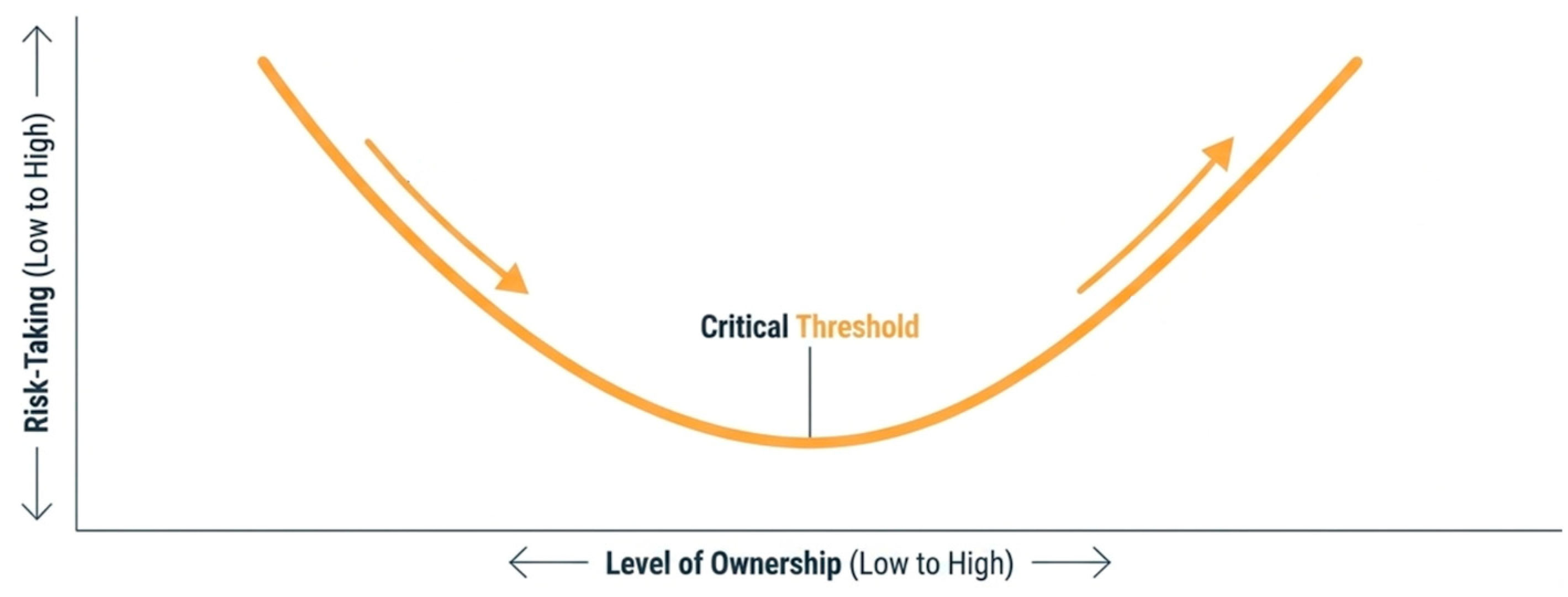
MO has an asymmetric effect on accounting-based CRT. Accordingly, the research reveals a significantly negative impact of MO on accounting-based CRT for low- and high-conservative firms. In contrast, MO has a curvilinear effect on accounting-based CRT. Accordingly, the pattern of the curvilinear effect of MO on CRT_ROA takes the form of a U-shaped curve which means that MO must reach a certain threshold (around 65%), which is considered a turning point beyond which MO begins to increase the CRT_ROA. The empirical evidence suggests an observed nonlinear relationship, where the estimated turning point for managerial ownership is approximately 65%. Beyond this threshold, further increases in managerial ownership are associated with a mitigation of accounting-based CRT.
Moreover, IO has an asymmetric effect on accounting-based CRT. Accordingly, the pattern of the curvilinear effect of IO on CRT_ROA takes the form of a U-shaped curve for the full sample and firms with high levels of accounting conservatism. Meaning that IO must reach a certain threshold (around 63% and 54%), respectively, which is considered a turning point beyond which IO begins to increase the CRT_ROA. The estimated turning point for IO is approximately 63% and 53% for firms with high levels of accounting conservatism to reduce accounting-based CRT. In contrast, there is no significant impact of IO on CRT_ROA for firms with low levels of accounting conservatism. In addition, OC has a symmetric effect on accounting-based CRT. Accordingly, the research reveals a significant and positive impact of OC on accounting-based CRT, indicating that firms are advised to limit the OC as much as possible.
These findings provide critical empirical evidence for the non-linear dynamics of agency theory within the Saudi Arabian financial market. The identified U-shaped curve for MO, with its turning point at 65%, highlights a prolonged managerial entrenchment phase unique to this institutional context. Below this threshold, managers appear to prioritize job security and risk-aversion; however, once ownership exceeds 65%, the interest-alignment effect takes over, encouraging value-enhancing CRT as managerial wealth becomes tied to firm performance. A similar dynamic is observed for IO, where the U-shaped inflection points (63% for the full sample and 54% for high-conservatism firms) suggest that institutional investors transition from a monitoring role to an advisory/alignment role as their stakes increase. Notably, the lower threshold in high-conservatism firms (54% vs. 63%) indicates that accounting prudence acts as a catalyst, accelerating the alignment process and allowing institutional oversight to support strategic CRT at lower equity levels. In contrast, the consistent positive impact of OC suggests that in Saudi Arabia, highly concentrated blocks tend to drive aggressive CRT regardless of thresholds, reinforcing the need for regulatory limits to ensure operational stability.
4.3.2. Board Structure and Accounting Based Corporate Risk Taking
Table 6 shows that all regression models are significant since their Prob > F is less than 0.05. According to R-squared, the board of directors’ structure explains 21.5%, 12.3%, and 19.8% of the variation in accounting-based CRT for the full sample, low conservative firms, and high conservative firms, respectively, in Saudi Arabia.
Table 6.
Board of Directors’ Structure and Accounting-Based Corporate Risk-Taking.
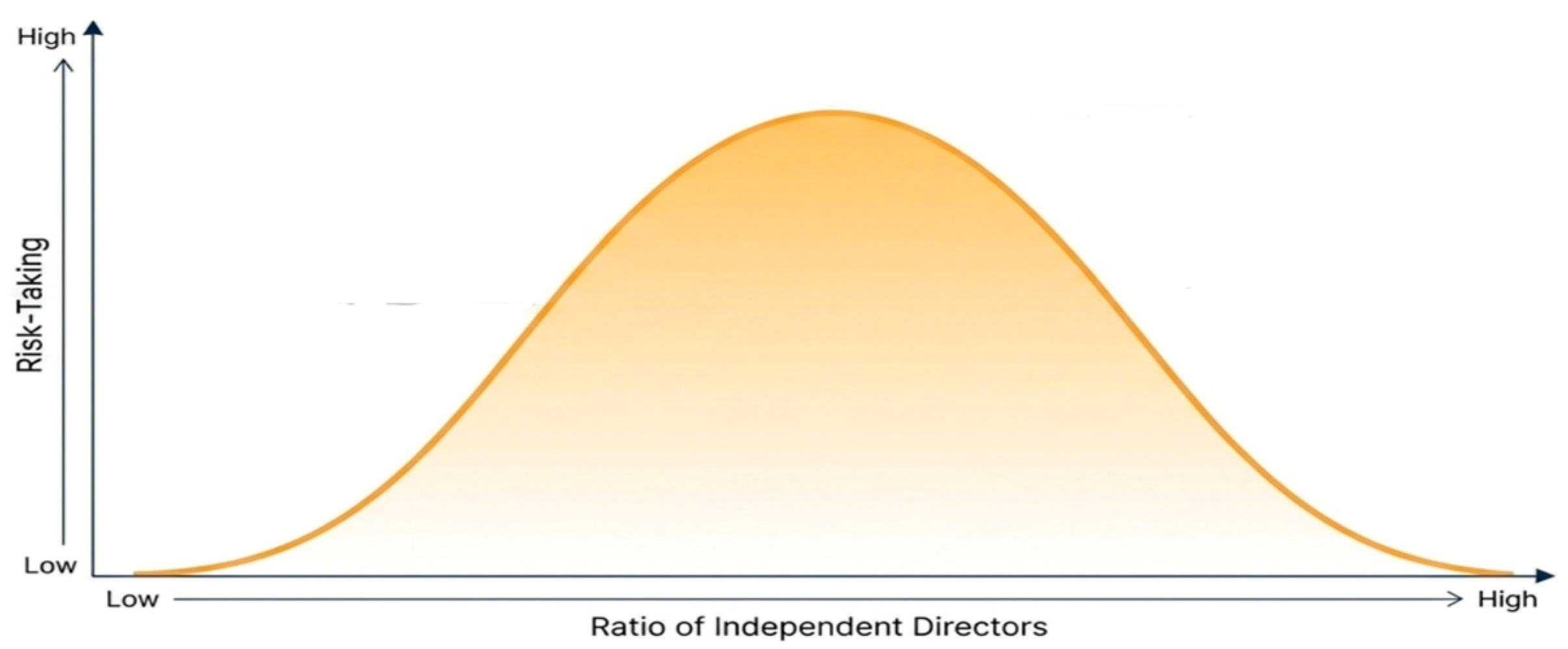
BS has an asymmetric effect on accounting-based CRT. Accordingly, the research reveals a significantly negative impact of BS on accounting-based CRT for the full sample and high conservative firms. In contrast, BS has no significant impact on accounting-based CRT. CEOP has an asymmetric effect on accounting-based CRT. Accordingly, the research reveals a significantly negative impact of CEOP on accounting-based CRT for the full sample and high conservative firms. In contrast, CEOP has no significant impact on accounting-based CRT. Moreover, BI has an asymmetric effect on accounting-based CRT. Accordingly, the pattern of the curvilinear effect of BI on CRT_ROA takes the form of an inverted U-shaped curve for the full sample and firms with high levels of accounting conservatism. The BI must reach a certain threshold (around 53% and 55%, respectively), which is considered a turning point beyond which BI begins to reduce the CRT_ROA. BI IS suggested to have a minimum percentage of 53% for Saudi-listed firms in general and 55% for firms with high levels of accounting conservatism to reduce accounting-based CRT. In contrast, there is a significantly negative impact of BI on CRT_ROA for firms with low levels of accounting conservatism.
These results highlight the distinct governance thresholds required to influence CRT within the Saudi Arabian institutional environment. The inverted U-shaped trajectory of board independence, with its identified turning points at 53% and 55%, reveals a critical transition between the resource dependence and agency monitoring functions. Initially, as BI approaches these thresholds, the board serves as a strategic asset, providing the external expertise and legitimacy necessary to support managerial risk-taking in line with Vision 2030 objectives. However, once BI exceeds this majority threshold, the board’s primary role pivots toward a risk-constraining monitoring function, prioritizing the protection of minority shareholders and operational stability. This transition is further reinforced by the significantly negative impact of BS and CEOP, which suggests that the structural complexity and concentrated executive influence in Saudi firms act as inherent constraints on risky behavior. Notably, the fact that the turning point is higher in high-conservatism firms (55%) suggests that accounting prudence allows the board more ‘strategic room’ to support risk before the monitoring mandate takes precedence. Collectively, these findings imply that for Saudi-listed firms, internal governance does not act linearly; rather, it functions through a series of inflection points where the balance between strategic encouragement and prudent oversight is constantly recalibrated.
4.3.3. Ownership Structure and Market Based Corporate Risk Taking
Table 7 shows that all regression models are significant since their Prob > F is less than 0.05. According to R-squared, ownership structure explains 21.4%, 16.6%, and 19.5% of the variation in market-based CRT for the full sample, low conservative firms, and high conservative firms, respectively, in Saudi Arabia.
Table 7.
Ownership Structure and Market-Based Corporate Risk-Taking.
MO has a symmetric effect on market-based CRT. Accordingly, research reveals a significantly negative impact of MO on market-based CRT, indicating firms should maximize MO as much as possible to reduce market-based CRT. Moreover, IO has an asymmetric effect on market-based CRT. Accordingly, the pattern of the curvilinear effect of IO on CRT_TRi takes the form of a U-shaped curve for firms with low levels of accounting conservatism. IO must reach a certain threshold (around 65%), which is considered a turning point beyond which IO begins to increase the CRT_TRi. Thus, IO must have a maximum percentage of 65% for firms with low levels of accounting conservatism to reduce market-based CRT. In contrast, there is a significantly negative impact of IO on CRT_TRi for the full sample and firms with high levels of accounting conservatism. Ownership concentration has an asymmetric effect on market-based CRT. Accordingly, the research reveals a significant and positive impact of OC on CRT_TRi for the full sample and high conservative firms. In contrast, OC has no significant impact on market-based CRT for firms with low levels of accounting conservatism.
4.3.4. Board Structure and Market Based Corporate Risk Taking
Table 8 shows that all regression models are significant since their Prob > F is less than 0.05. According to R-squared, the board of directors’ structure explains 21.4%, 32.2%, and 23.9% of the variation in market-based CRT for the full sample, low conservative firms, and high conservative firms in Saudi Arabia, respectively.
Table 8.
Board Structure and Market-Based Corporate Risk-Taking.
BS has no effect on market-based CRT for all levels of analysis. Moreover, CEOP has an asymmetric effect on market-based CRT. Accordingly, research reveals a significantly negative impact of CEOP on market-based CRT for firms with high accounting conservatism. In contrast, CEOP has no significant impact on market-based CRT for the full sample and firms with low levels of accounting conservatism. Furthermore, BI has an asymmetric effect on market-based CRT. Accordingly, research reveals a significantly negative impact of BI on market-based CRT for the full sample and firms with high accounting conservatism. In contrast, BI has no significant impact on market-based CRT for firms with low levels of accounting conservatism.
5. Discussion
The research investigates how ownership and board structures shape corporate risk-taking from two perspectives (accounting-based CRT and market-based CRT) in the Saudi context. For more accuracy and robustness, the research divided the statistical analysis into three main sets: full sample firms, high-conservative firms, and low-conservative firms. In this regard, the research aimed to find evidence for two main questions: how do ownership structures impact CRT in the Saudi context? And how do board characteristics impact CRT in the Saudi context? To answer these questions, the researchers conducted an empirical study on 69 firms listed on the Saudi stock exchange from 2017 to 2024. In general, the findings reveal that governance mechanisms play an important role in risk-taking behavior. The findings also ensure that governance effects are mixed between symmetric and asymmetric in the statistical analysis. In detail, the current research tested this area in the Saudi context and provided mixed evidence. The following points illustrate the link between the current research results (full sample) regarding ownership and board structure, previous literature, and accounting theories.
First, most of the previous literature that related to ownership structure in the Saudi context showed that MO has a positive impact on CRT [19,20] as the high level of MO relates mainly to engagement in risky activities, the reason behind this nexus depends on the managers’ need to meet stakeholders’ high expectations regarding profit, which can happen through risky and high-profitability activities, while the current research discovered that this impact depends on the type of CRT, as MO has a curvilinear effect on accounting-based CRT, but AC can change this effect to be negative in the Saudi context. On the other hand, MO has a significantly negative impact on market-based CRT, and AC increases this impact. This result supports the assumption of the stewardship theory. In brief, this result encourages regulators in Saudi Arabia to develop the future corporate governance code based on this significant nexus.
Second, the research found a curvilinear (U-shaped curve) effect of IO on accounting-based CRT. At the same time, this nexus is negative for market-based CRT, and accounting conservatism supports this impact in both accounting and market-based CRT, which is consistent with the stakeholder theory. So, the percentage of IO can be an indicator for expected investors that firms with high IO levels avoid risky activities in general. Moreover, this result was in line with [3,8,20,32].
Third, the research reached the same result as most of the global literature [11,12,31] that OC has a positive impact on both accounting and market-based CRT, and accounting conservatism supports this impact in both accounting and market-based CRT. Thus, regulators in Saudi Arabia should focus more on controlling the percentage of OC in any future reforms regarding the corporate governance code. However, the result was against [10,32]. The reason behind this positive impact is supported and grounded in the agency theory.
Fourth, the research empirically ensured that BS has a significantly negative impact on accounting-based CRT and becomes more significant with high conservative firms; this result was in line with [15] and consistent with the stewardship theory. Based on that, the Saudi financial market authority should encourage firms to have the maximum number of members allowed by the law, which is thirteen members on the board. However, this result was against [5,37]. BS does not affect market-based CRT, even with highly conservative firms.
Fifth, the research reveals a significantly negative impact of CEOP on accounting-based CRT. This result is consistent with the agency theory, which assumes that managers avoid risky behavior when they prioritize job security. In contrast, CEOP has no significant impact on market-based CRT, but this impact becomes negative with highly conservative firms. This result was against Aldoseri [19] which was conducted in the same context as in older time series.
Sixth, the effect of BI on accounting-based CRT takes the form of an inverted U-shaped curve, while BI reveals a significantly negative impact on market-based CRT, and accounting conservatism cannot change this impact in both accounting and market-based CRT. This result was in line with [14,17,37] and consistent with both stakeholder theory and resource dependence theory. In brief, this result ensures the importance of BI in limiting corporate engagement in risky activities.
Seventh, the main contribution of this study is not merely the adoption of dual risk metrics, but rather the exploration of how these metrics reveal distinct governance-risk dynamics in an emerging market undergoing rapid regulatory reform. While prior literature often treats risk-taking as a monolithic construct, our approach demonstrates that internal governance mechanisms in the Saudi context—driven by Vision 2030 objectives—impact accounting-based operational risk and market-based volatility in fundamentally different ways.
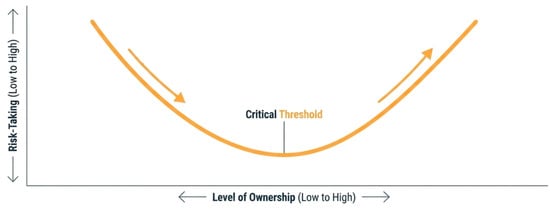
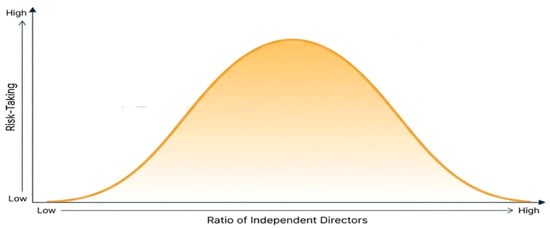
The following Table 9, Figure 1 and Figure 2 summarize the three sets of analysis in this study, the full sample, high conservative firms, and low conservative firms.
Table 9.
Summary of Ownership and Board Variables Impact on CRT.
Figure 1.
Mapping of the full sample accounting-based CRT for MO and IO.
Figure 2.
Mapping of the full sample accounting-based CRT for BI.
So, our research departs from existing studies in two fundamental ways. First, whereas prior research typically examines internal governance or accounting quality in isolation, this manuscript proposes an integrated governance-reporting model. We demonstrate that the impact of board and ownership structures is not static but contingent on the firm’s level of conservatism. Second, while existing literature often focuses on linear associations, our findings of U-shaped and inverted U-shaped relationships suggest that the traditional ‘one-size-fits-all’ governance model is insufficient for emerging markets. This provides a theoretical contribution by showing that the ‘optimal’ governance structure for risk-taking is a moving target that depends on the specific dimension of risk (accounting vs. market) being managed.
Going further, our evidence, obtained via sample partitioning, reveals distinct subgroup comparisons based on the level of AC. Specifically, the relationship between internal governance mechanisms and CRT appears conditional on whether a firm exhibits high or low AC. While this subgroup analysis highlights how governance dynamics vary across different firms, it should be clarified that these findings reflect differential subgroup associations rather than a direct moderation test with formal interaction effects.
6. Conclusions
Examining the nexus between ownership structure (managerial, institutional, and concentration) and board structure (size, power, and independence) with corporate risk-taking (CRT) is particularly critical, as these internal governance mechanisms influence managerial discretion, monitoring intensity, and strategic orientation. Moreover, ownership arrangements determine incentive alignment and potential entrenchment, while the board of directors’ attributes shape oversight quality and risk governance effectiveness. By integrating governance dimensions with CRT behavior (accounting-based and market-based), academic research advances theoretical debates on accounting theories such as agency and stakeholder. Moreover, it provides a better understanding of how governance architecture affects CRT behavior. Going further, the CRT level becomes the core of the firm’s strategic decisions, as it can influence its future financial performance and stability. From this point, the current study discovers the Ownership-CRT nexus and Board-CRT nexus from both accounting-based and market-based perspectives in measuring risk-taking. In brief, the current research provides updated evidence from an emerging stock market, Saudi Arabia, which enhances the grounded assumptions of accounting theories. The primary result is the significant role of both ownership and board structures on CRT behavior.
Focusing on the full sample’s results about the Ownership-CRT nexus: MO can limit the corporate tendency to be involved in risky activities (market-based) and must have a maximum percentage of 65% to have the same impact (accounting-based), while any increase in this percentage will have a positive impact on CRT level. Moreover, IO has the same impact as MO but with a percentage of 63%. In contrast, OC encourages CRT from market-based and accounting-based perspectives. Going further, focusing on the full sample’s results about the Board-CRT nexus, BS has no significant impact on CRT behavior (market-based), while it limits CRT from an accounting-based perspective. Moreover, CEOP has the same impact as BS on CRT from both perspectives. However, BI limits CRT (market-based) but has an inverted U-shaped nexus with CRT from an accounting-based perspective, meaning that BI must have a minimum percentage of 53% to reduce CRT. An interesting point in our results is that accounting conservatism supports and enhances the nexus between internal governance mechanisms (ownership/board) and CRT; moreover, it changes this nexus, especially regarding MO and CEOP.
The findings of our study offer important practical implications for regulators, corporate boards, and investors in Saudi Arabia. By clarifying how ownership structures (managerial, institutional, and concentrated ownership) and board structures (size, CEO power, and independence) influence corporate risk-taking, the study provides evidence-based guidance for governance reforms and firm-level decision-making. Regulators may use these insights to refine governance codes in ways that balance effective monitoring with strategic flexibility, avoiding excessive constraints on productive risk-taking. For boards and executive management, understanding the governance–risk nexus can support the design of optimal board configurations and ownership structures that promote disciplined, value-enhancing risk decisions. Investors and creditors may also incorporate governance characteristics into their risk assessment frameworks, improving portfolio allocation and credit evaluation in an environment characterized by ownership concentration and institutional transition.
From a social perspective, this study contributes to broader economic stability and sustainable development in emerging markets such as Saudi Arabia. CRT plays a central role in innovation, investment, and job creation; however, excessive or poorly governed risk can undermine financial stability and erode public trust in capital markets. By identifying governance mechanisms that shape firms’ risk behavior, the study supports the development of stronger accountability structures that protect minority shareholders and enhance market confidence. In doing so, it contributes to the fostering of a governance culture that promotes responsible, long-term value creation rather than short-term opportunism. Ultimately, strengthening the governance–risk relationship can enhance investor confidence, attract foreign investment, and support Saudi Arabia’s ongoing economic reform and capital market development efforts.
The findings offer broader implications for the global understanding of the governance-risk nexus. Our analysis reveals that, in the absence of mature external monitoring, internal mechanisms serve as primary yet asymmetric drivers of risk-taking behavior. The ‘lessons learned’ extend to other emerging jurisdictions (such as the GCC or BRICS nations) by highlighting that accounting conservatism serves as a vital ‘governance substitute’ that can mitigate the risks of managerial entrenchment. Thus, the study contributes to the global debate on whether ‘imported’ governance codes require local ‘informational anchors’ like conservatism to be truly effective in controlling corporate risk. The following Table 10 illustrated the strategic implementation roadmap for Saudi Vision 2030.
Table 10.
Strategic Implementation Roadmap for Saudi Vision 2030.
When interpreting our findings within the economic landscape of Saudi Arabia, it is important to contextualize CRT against macroeconomic influences. In a rapid structural transformation under Saudi Vision 2030, CRT is not determined in isolation. For instance, oil price volatility and national GDP growth rates heavily dictate a firm’s capacity for strategic risk-taking. Furthermore, inflation rates and shifting central bank interest rates alter the cost of capital, thereby influencing management’s willingness to invest in risky projects. In addition, market-wide volatility in the Saudi financial market shapes investor sentiment and managerial risk aversion. While these macroeconomic forces exert systemic pressure across all sectors, our findings demonstrate that governance mechanisms remain a critical determinant of CRT.
Finally, this research contributed to the accounting literature on CRT by providing new empirical evidence. At the same time, the use of the Saudi stock market as a sample of emerging markets, while acceptable and practical due to the number of observations and the empirical study period from 2017 to 2024, may limit the applicability of the study. One more limitation, while we provide new evidence on the relationship between internal governance mechanisms and corporate risk-taking behavior in Saudi Arabia, certain econometric limitations warrant caution. As the reliance on a pooled OLS framework—as we used—may not fully eliminate concerns related to endogeneity, including reverse causality and omitted-variable bias, we used a comprehensive set of control variables and sector fixed effects to minimize unobserved heterogeneity. Based on that, future research could employ dynamic panel data frameworks, such as the Generalized Method of Moments (GMM), on longer time-series data. So, this arguable research area regarding CRT still needs more investigation in other similar contexts to create a comprehensive framework and understanding of the ownership and board nexuses with CRT.
Author Contributions
Conceptualization, F.A. and M.M.A.; Methodology, F.A.; Validation, F.A.; Investigation, F.A.; Writing—original draft, F.A. and M.M.A.; Writing—review & editing, M.M.A.; Supervision, M.M.A. All authors have read and agreed to the published version of the manuscript.
Funding
The author extends the appreciation to the Deanship of Postgraduate Studies and Scientific Research at Majmaah University for funding this research work through the project number (R-2026-259).
Institutional Review Board Statement
Not applicable.
Informed Consent Statement
Not applicable.
Data Availability Statement
The data presented in this study are available on request from the corresponding author.
Conflicts of Interest
The authors declare no conflict of interest.
References
- Feng, M.; Wang, X.; Xu, X.; Zhou, M. Do CEOs Who Are Raising Daughters Reduce Company Risk-taking? Asia-Pac. J. Financ. Stud. 2024, 53, 6–34. [Google Scholar] [CrossRef] [Scilit]
- Subastian, L.U.; Setiawan, D. Does foreign ownership structure increase Indonesian firms’ risk-taking? J. Ekon. Dan Bisnis 2022, 25, 59–70. [Google Scholar] [CrossRef] [Scilit]
- Chun, S.E.; Lee, M.H. Corporate ownership structure and risk-taking: Evidence from Japan. J. Gov. Regul. 2017, 6, 39. [Google Scholar] [CrossRef] [Scilit]
- Bsoul, R.; Atwa, R.; Odat, M.; Haddad, L.; Shakhatreh, M. Do CEOs’ demographic characteristics affect firms’ risk-taking? Evidence from Jordan. Cogent Bus. Manag. 2022, 9, 2152646. [Google Scholar] [CrossRef] [Scilit]
- García-Gómez, C.D.; Zavertiaeva, M.A.; Kirpishchikov, D.; López-Iturriaga, F.J. Board social capital in an emerging market: Do directors’ connections affect corporate risk-taking? Borsa Istanb. Rev. 2023, 23, 1173–1190. [Google Scholar] [CrossRef] [Scilit]
- Bhuiyan, M.B.U.; Liu, J.; Alam, A. Problem Directors and Corporate Risk-Taking. Br. J. Manag. 2024, 35, 1530–1558. [Google Scholar] [CrossRef] [Scilit]
- Xiaodong, L.; Fan, Y.; Ruiwen, Z. Determinants of Corporate Risk Taking and Risk-Return Relationship. Can. Soc. Sci. 2014, 10, 24. [Google Scholar]
- Cid-Aranda, C.; López-Iturriaga, F. Control contestability, large shareholder identity, and corporate risk-taking: International evidence. Q. Rev. Econ. Financ. 2025, 99, 101957. [Google Scholar] [CrossRef] [Scilit]
- Al-Hamshary, F.S.A.A.; Mohamad Ariff, A.; Kamarudin, K.A.; Abd Majid, N. Corporate risk-taking, financial constraints and cash holdings: Evidence from Saudi Arabia. Int. J. Islam. Middle East. Financ. Manag. 2025, 18, 166–183. [Google Scholar] [CrossRef] [Scilit]
- Gega, M.; Höhler, J.; Bijman, J.; Oude Lansink, A. Firm ownership and ESG performance in European agri-food companies: The mediating effect of risk-taking and time horizon. Corp. Soc. Responsib. Environ. Manag. 2025, 32, 1161–1181. [Google Scholar] [CrossRef] [Scilit]
- Luigi Marchini, P.; Tibiletti, V.; Medioli, A.; Gabrielli, G. Corporate Ownership Structure as a Determinant of “Risk Taking”: Insights from Italian Listed Companies. Int. J. Bus. Manag. 2020, 15, 138. [Google Scholar] [CrossRef] [Scilit]
- Tran, N.H.; Le, C.D. Ownership concentration, corporate risk-taking and performance: Evidence from Vietnamese listed firms. Cogent Econ. Financ. 2020, 8, 1732640. [Google Scholar] [CrossRef] [Scilit]
- Lawal, B. Board rudiments and the executive attitude towards corporate risk-taking. Int. J. Financ. Res. 2018, 9, 13. [Google Scholar] [CrossRef] [Scilit]
- Younas, Z.I.; Klein, C.; Trabert, T.; Zwergel, B. Board composition and corporate risk-taking: A review of listed firms from Germany and the USA. J. Appl. Account. Res. 2019, 20, 526–542. [Google Scholar] [CrossRef] [Scilit]
- Ozdemir, O.; Erkmen, E.; Binesh, F. Board diversity and firm risk-taking in the tourism sector: Moderating effects of board independence, CEO duality, and free cash flows. Tour. Econ. 2022, 28, 1782–1804. [Google Scholar] [CrossRef] [Scilit]
- Javed, M.; Mehmood, K.; Ghafoor, A.; Parveen, A. Board structure and risk-taking behavior: Evidence from the financial sector of Pakistan. Corp. Gov. Int. J. Bus. Soc. 2024, 24, 1060–1082. [Google Scholar] [CrossRef] [Scilit]
- Rehman, A.U.; Kazmi, S.J.A.; Hussain, S.; Qarni, M.O. Board characteristics, corporate performance and the mediating role of corporate risk: Evidence from Chinese listed firms. Corp. Gov. Int. J. Bus. Soc. 2025, 25, 884–902. [Google Scholar] [CrossRef] [Scilit]
- Amri, H.; Hamza, T. The impact of risk-taking on performance of Islamic and conventional banks in Qatar, Saudi Arabia and UAE. Int. J. Account. Audit. Perform. Eval. 2025, 21, 42–64. [Google Scholar] [CrossRef] [Scilit]
- Aldoseri, M. CEO Characteristics and Risk-Taking Behavior: Statistical Evidence from Saudi Arabia. J. Risk Financ. Manag. 2025, 18, 600. [Google Scholar] [CrossRef] [Scilit]
- Metwalli, M.Z. Mathematical Analysis of Ownership and Board Structures on Corporate Risk-Taking Behaviour: Evidence from the Saudi Economy. J. Stat. Appl. Probab. 2026, 15, 159–169. [Google Scholar] [CrossRef] [Scilit]
- Frijns, B.; Hubers, F.; Kim, D.; Roh, T.Y.; Xu, Y. National culture and corporate risk-taking around the world. Glob. Financ. J. 2022, 52, 100710. [Google Scholar] [CrossRef] [Scilit]
- Wang, C.; Lok, C.L.; Phua, L.K. Government Attention, Politically Connected CEOs and Corporate Risk-Taking: Evidence From Bounded Rationality. SAGE Open 2026, 16, 21582440251413877. [Google Scholar] [CrossRef] [Scilit]
- Wei, D.; Luo, C.; Lu, J. CEOs With a Financial Background and Corporate Risk-Taking. J. Int. Financ. Manag. Account. 2025, 36, 266–291. [Google Scholar] [CrossRef] [Scilit]
- Khaw, K.L.H.; Liao, J.; Tripe, D.; Wongchoti, U. Gender diversity, state control, and corporate risk-taking: Evidence from China. Pac. Basin Financ. J. 2016, 39, 141–158. [Google Scholar] [CrossRef] [Scilit]
- Thi Lan Anh, P.; Thi Hai Yen, D. Unpacking the moderating role of corporate governance in the foreign ownership and corporate risk-taking relationship: Insights from fsQCA. Cogent Bus. Manag. 2025, 12, 2468370. [Google Scholar] [CrossRef] [Scilit]
- Jiang, J.; Chen, Y. How does labor protection influence corporate risk-taking? Evidence from China. Pac. Basin Financ. J. 2021, 68, 101572. [Google Scholar] [CrossRef] [Scilit]
- Korablev, D.; Podukhovich, D. CEO Power and Risk-taking: Intermediate Role of Personality Traits. J. Corp. Financ. Res. 2022, 16, 136–145. [Google Scholar] [CrossRef] [Scilit]
- Del Gaudio, B.L.; Megaravalli, A.V.; Sampagnaro, G.; Verdoliva, V. Mandatory disclosure tone and bank risk-taking: Evidence from Europe. Econ. Lett. 2020, 186, 108531. [Google Scholar] [CrossRef] [Scilit]
- Caselli, G.; Figueira, C. Monetary policy, ownership structure, and risk-taking at financial intermediaries. Financ. Rev. 2023, 58, 167–191. [Google Scholar] [CrossRef] [Scilit]
- Du, S.; Ma, L.; Li, Z. Non-family shareholder governance and corporate risk-taking: Evidence from Chinese family-controlled businesses. J. Bus. Res. 2022, 145, 156–170. [Google Scholar] [CrossRef] [Scilit]
- Umar Mai, M.; Sudradjat; Sembiring, E.E. Ownership structure, risk taking, and financial stability of conventional rural banks: Evidence from Indonesia. Cogent Bus. Manag. 2025, 12, 2458744. [Google Scholar] [CrossRef] [Scilit]
- Nguyen, Q.K. Ownership structure and bank risk-taking in ASEAN countries: A quantile regression approach. Cogent Econ. Financ. 2020, 8, 1809789. [Google Scholar] [CrossRef] [Scilit]
- Stetsyuk, I.; Altintig, A.; Arin, K.P.; Kim, M.S. CEO Characteristics and Risk-Taking under Economic Policy Uncertainty. J. Risk Financ. Manag. 2024, 17, 238. [Google Scholar] [CrossRef] [Scilit]
- Tran, N.T.; Pham, T.N.D.; Nguyen, D.D.; Tran, T.K.; Phan, G.Q.; Nguyen, T.T.H. The link between firm risk-taking and CEO power of listed firms on the Vietnamese stock market: The role of state ownership. Cogent Bus. Manag. 2024, 11, 2302193. [Google Scholar] [CrossRef] [Scilit]
- Menla Ali, F.; Wu, Y.; Zhang, X. ESG disclosure, CEO power and incentives and corporate risk-taking. Eur. Financ. Manag. 2024, 30, 961–1011. [Google Scholar] [CrossRef] [Scilit]
- Urquhart, A.; Zhang, H. CEO Social Class Origins and Risk Taking. Eur. Financ. Manag. 2026, 32, 156–179. [Google Scholar] [CrossRef] [Scilit]
- Tran, T.K.; Truong, M.T.; Bui, K.T.; Duong, P.D.; Huynh, M.V.; Nguyen, T.T.H. Firm Risk and Tax Avoidance in Vietnam: Do Good Board Characteristics Interfere Effectively? Risks 2023, 11, 39. [Google Scholar] [CrossRef] [Scilit]
- Zaiane, S. The nonlinear relationship between CEO stock options and strategic risk taking: The moderating role of CEO characteristics. Corp. Gov. Int. J. Bus. Soc. 2025, 25, 903–919. [Google Scholar] [CrossRef] [Scilit]
- Pham, N.A.; Ngo, T.Q. CEO power and bank risk-taking: A revisit in an emerging market context. Quant. Financ. Econ. 2026, 10, 1–26. [Google Scholar] [CrossRef] [Scilit]
- Stock, J.H.; Wright, J.H.; Yogo, M. A survey of weak instruments and weak identification in generalized method of moments. J. Bus. Econ. Stat. 2002, 20, 518–529. [Google Scholar] [CrossRef] [Scilit]
- Roodman, D. How to do xtabond2: An introduction to difference and system GMM in Stata. Stata J. 2009, 9, 86–136. [Google Scholar] [CrossRef] [Scilit]

Disclaimer/Publisher’s Note: The statements, opinions and data contained in all publications are solely those of the individual author(s) and contributor(s) and not of MDPI and/or the editor(s). MDPI and/or the editor(s) disclaim responsibility for any injury to people or property resulting from any ideas, methods, instructions or products referred to in the content. |
© 2026 by the authors. Licensee MDPI, Basel, Switzerland. This article is an open access article distributed under the terms and conditions of the Creative Commons Attribution (CC BY) license.