


Abstract
The study uses the emerging science of Mind Genomics to study the prevalence of extremist thought in random samples of online research panel participants, first with 212 respondents in August 2021, and then with another group of 200 respondents in August 2025. The two studies presented each respondent with a unique set of 24 vignettes, comprising 2–4 statements that could be construed as extremist (e.g., Vaccines are a way for the government to control people). Respondents rated the likelihood that either they, their family, or both agreed with the statements in the vignette or disagreed with the statements in the vignette. The respondents were deconstructed by regression modeling and clustering to show the prevalence of agreement with the statements across different types of people (age, gender, political leaning, year) and across mind-sets. The data suggest that respondents easily differentiated the statements and that the distribution of responses to extremist statements did not dramatically change when President Trump succeeded President Biden. The approach is presented as a new way to investigate sensitive topics by creating sets of test stimuli, answers to which cannot be “gamed”. Given all the news and near-news circulating in the fragmented media, this research offers a clear, if complex, view of attitudes and any changes which may have occurred between the Biden and second Trump administrations.
1. Introduction
Listening to contemporary political commentary in news media and digital platforms often creates the impression that political extremism is intensifying in public discourse. This concern is not limited to media narratives; scholars have increasingly warned about the erosion of democratic norms, rising polarization, and the weakening of institutional trust. Levitsky and Ziblatt (2018) [1] argue that democratic systems become vulnerable when mutual toleration and institutional forbearance decline, allowing extreme rhetoric and antagonistic political behavior to normalize. Research on radical-right mobilization and populist politics has likewise emphasized the growing influence of exclusionary narratives, perceived cultural threats, and anti-establishment sentiment in contemporary democratic societies [2,3].
Despite this growing body of research, most studies of extremism focus on ideological positioning, electoral behavior, or macro-level indicators of polarization. Comparatively little work has examined how individuals cognitively respond to specific message elements associated with extremist narratives. In particular, it remains unclear whether patterns of agreement with such narratives remain stable or change across shifts in political leadership and context. Understanding these cognitive responses is important because public reactions to political messages often reveal underlying interpretive structures that cannot be captured solely through traditional survey measures.
The present study addresses this gap by applying the Mind Genomics methodology to examine how individuals evaluate extremism-related narratives during two distinct political periods in the United States: August 2021 (eight months into the Biden administration) and August 2025 (eight months into Trump’s second term). Mind Genomics enables researchers to experimentally deconstruct complex narratives into structured message elements and estimate the independent contribution of each element to respondent evaluations. In the present study, respondents evaluated short vignettes constructed from elements representing four thematic domains—Trust, Invasion, Corruption, and Leadership—each reflecting different dimensions of contemporary extremist discourse.
By modeling respondent-level coefficients and applying clustering techniques, the analysis identifies patterns of agreement with extremism-related messages and reveals potential cognitive segments among respondents. This design enables the study to examine whether message-level reactions to extremist narratives remain stable across political contexts and whether individuals interpret such narratives in systematically different ways.
The study therefore examines whether agreement patterns with extremism-related narratives differ between the two political periods, whether the four thematic domains influence responses differently, and whether distinct cognitive segments emerge from respondent-level response patterns. Based on the theoretical background and the analytical design of the study, three expectations guide the analysis: first, that overall agreement patterns will show relative structural stability between August 2021 and August 2025; second, that the four thematic domains will produce differential impact patterns, indicating that extremist agreement is domain-specific rather than uniform; and third, that clustering of respondent-level coefficient patterns will reveal distinct cognitive mind-sets reflecting heterogeneous interpretations of extremism-related narratives.
2. Literature Review
2.1. Defining Political Extremism
To provide a rigorous framework for this investigation, we define political extremism following Mudde (2007) [2]. Rather than a mere deviation from the political center, extremism is conceptualized as a monist ideological position that rejects democratic pluralism and constitutional protections for minority groups. Consequently, the study focuses on four conceptual domains commonly associated with extremist political thinking: institutional trust, demographic anxiety, corruption beliefs, and leadership preferences. These domains reflect themes that appear consistently in research on political extremism across democratic societies [2,3].
2.2. Challenges in Measurement and Methodological Gaps
The measurement of extremist political attitudes presents a fundamental challenge in contemporary social science. Direct survey methods face well-documented limitations when investigating sensitive topics, particularly those involving potentially socially undesirable beliefs [4,5]. Respondents frequently provide socially acceptable responses rather than authentic attitudes, creating systematic bias [6,7].
Existing research relies predominantly on self-report measures that may systematically underestimate the true prevalence of such thinking [8]. This gap between private beliefs and public expression creates substantial challenges for empirical research. The present study addresses these methodological limitations through the application of Mind Genomics, an experimental approach that circumvents direct attitude questioning by utilizing principles from recognition memory research [9,10].
2.3. Theoretical Foundation of the Mind Genomics Approach
Mind Genomics offers several theoretical advantages. It aligns with dual-process models of political cognition that distinguish between automatic recognition processes and controlled evaluation processes [11]. By using an experimental design to present systematically varied combinations of attitude statements (vignettes), the system makes it virtually impossible for participants to “game” the process or strategically adjust their responses. This approach has demonstrated effectiveness in studying sensitive topics across various domains but has not been systematically applied to the measurement of political extremism until now [9].
3. Materials and Methods
3.1. Research Methodology: Running the Extremism Experiment
The Mind Genomics process follows a prescribed set of steps, each having been “battle-tested” over two decades of application. In this study, the workflow was implemented through the BimiLeap platform (www.bimileap.com, USA). It is important to note that BimiLeap is a dedicated platform specifically designed and optimized for Mind Genomics studies, providing a structured interface for constructing these unique cognitive experiments. The process ensures that at its culmination, the data provide statistically analyzable results that can be interpreted in substantive meaning. Rather than looking at the data to accept or falsify a hypothesis—the conventional approach—the Mind Genomics process identifies patterns that inform us about the underlying reality in the respondent’s mind.
The development of the “raw materials” for this study involved identifying four categories or questions, each with four elements or answers. The four domains selected—Trust, Invasion, Corruption, and Leadership—reflect core pillars of political extremism identified in scholarly literature [2,12,13,14]. A central feature of the BimiLeap platform is the ‘Idea Coach’ module—a specialized AI-driven engine used to bridge the gap between these broad conceptual domains and specific testable statements. This AI-driven curation process is critical to the study’s design as it ensures the sixteen elements (4 per category) are derived from a vast synthesis of contemporary discourse, capturing the authentic “language of friction” prevalent in real-world political rhetoric. By utilizing Idea Coach-generated elements, the study effectively minimizes researcher bias, ensuring that the stimuli reflect existing public sentiment rather than subjective academic framing. This systematic selection ensures that the sixteen elements maintain a consistent cognitive weight and linguistic tone, which is vital for the statistical integrity of the Mind Genomics model.
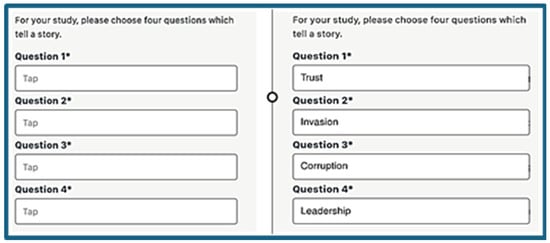
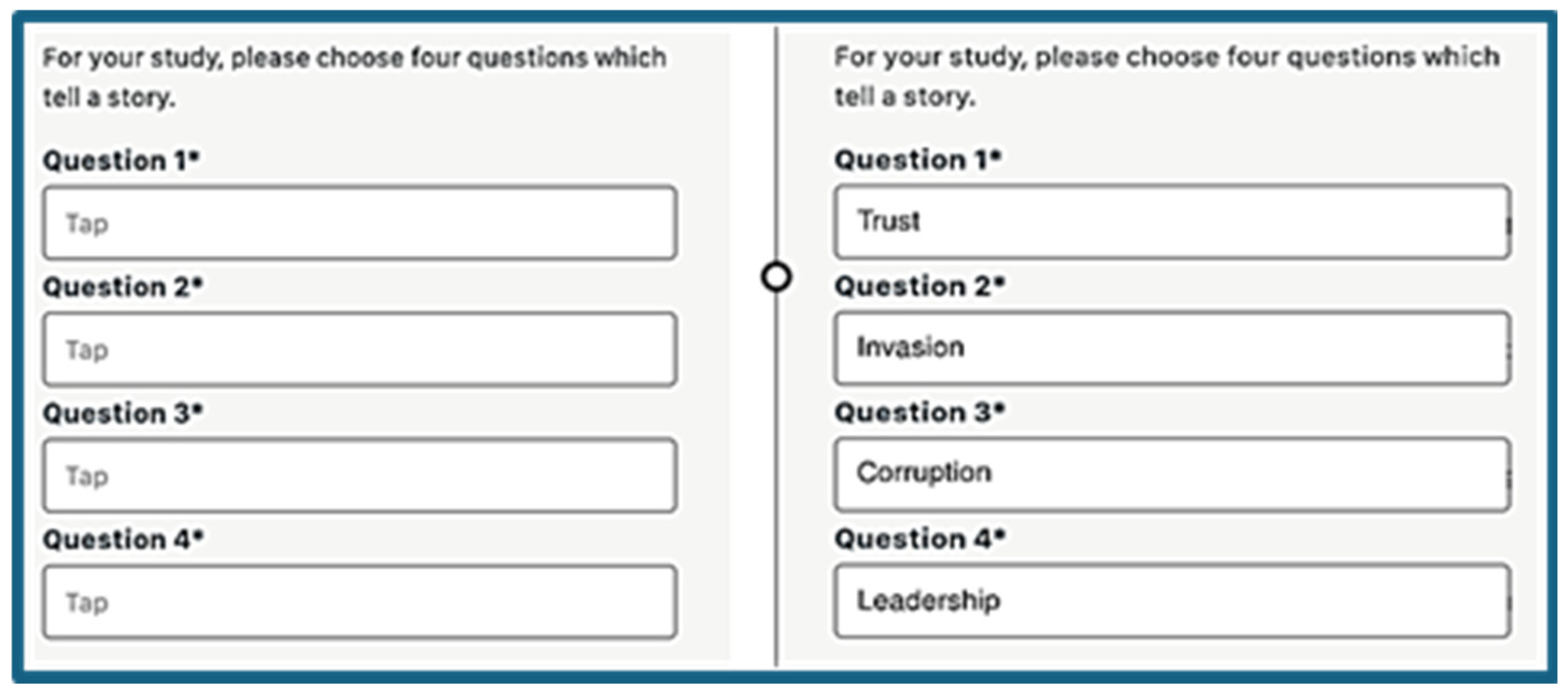
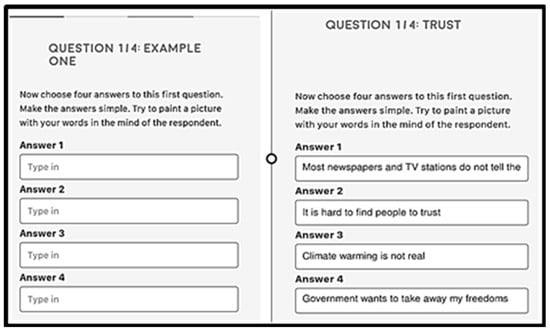
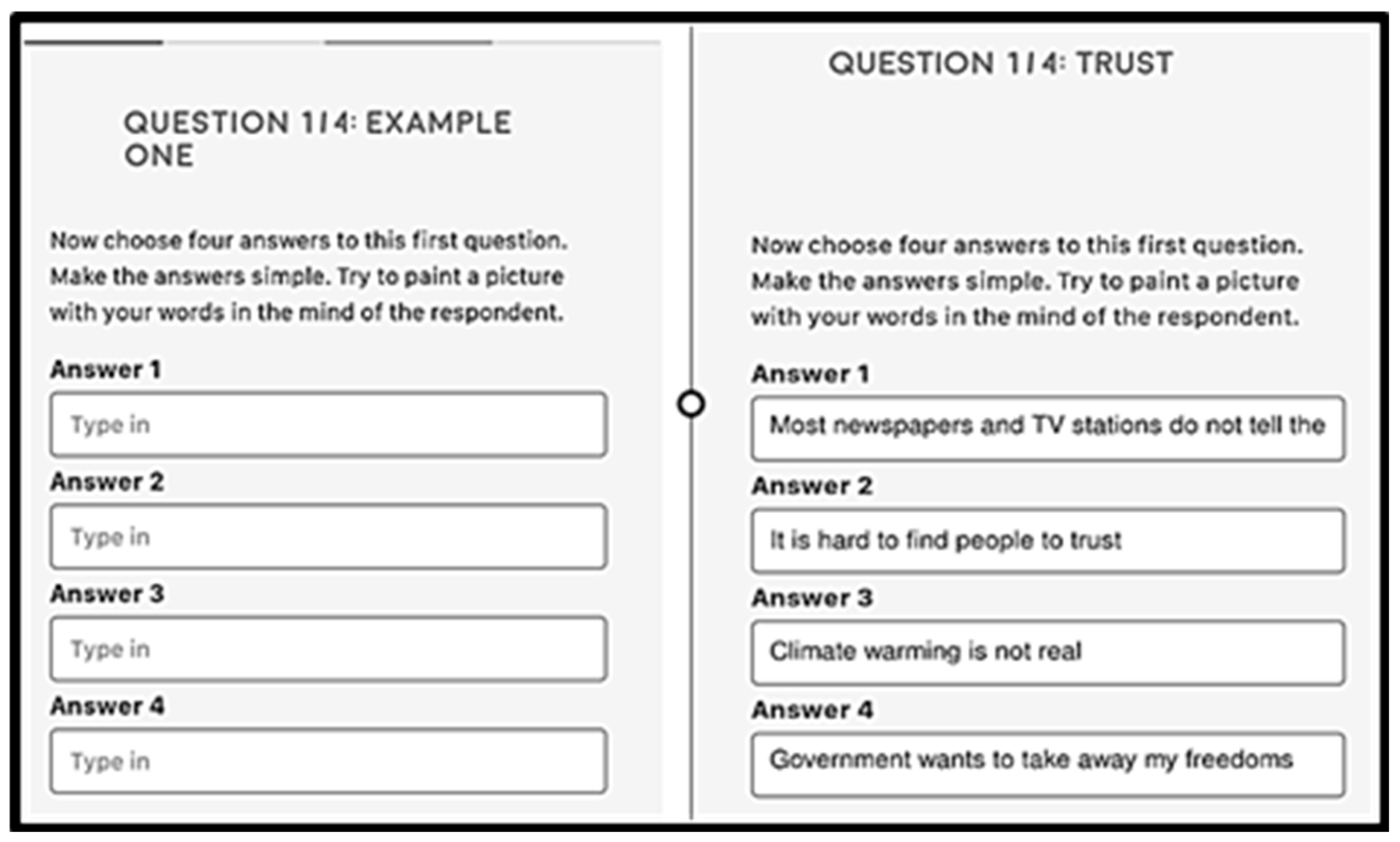
Figure 1 shows the setup slides for the categories (questions). Figure 2 shows the setup slide for the four answers or elements for Question 1 (Trust). In turn, Table 1 shows the four categories or questions, and then for each category, the four answers [15,16].
Figure 1.
The four categories, viz., questions for the study of extremism.
Figure 2.
The four elements, viz., answers for the first category, Trust.
Table 1.
The four questions and the four answers to each question.
We strategically utilized ‘bare-boned’ phrases rather than descriptive sentences to isolate the core conceptual triggers of extremist sentiment. While traditional Mind Genomics elements typically consist of 6–15 words, we deliberately streamlined them to minimize social desirability bias [17]. By using direct stimuli, this experimental design effectively bypasses the respondents’ conscious filters (System 2 cognitive processing) and captures more authentic, intuitive reactions (System 1) [18].
This approach strengthens the empirical robustness of the instrument by providing an ‘un-gameable’ measure of agreement, free from the noise of linguistic elaboration. Furthermore, regarding cognitive recognition under emotional stress, extensive research [19] suggests that individuals maintain consistent pattern recognition even when emotionally agitated, provided the stimuli are direct and uncluttered. Consequently, our use of simplified phrases ensures that the observed patterns reflect stable cognitive mind-sets rather than transient emotional agitation or filtered responses.
To ensure the scientific validity of this approach, it is important to note that no single element—such as a statement about a political leader—is used to define a respondent as an ‘extremist’ on its own. Instead, we focus on the overall pattern of agreement across the shuffled combinations of all sixteen elements. This reveals a ‘constellation’ of linked ideas—trust, corruption, and leadership—as they exist in the respondent’s mind. By doing so, the study identifies how mainstream sentiments may correlate with radical triggers within the American context, using the authentic language generated by the Idea Coach.
The specific conceptual framework, comprising the four categories and their respective sixteen elements as utilized in both the 2021 and 2025 waves of the study, is presented in Table 1.
The four conceptual domains presented in Table 1 are grounded in established literature on political extremism and democratic erosion. The Trust domain reflects research on declining institutional confidence and democratic deficit [1,12]. The Invasion domain captures demographic threat and nativist narratives commonly associated with radical-right mobilization [2,3]. The Corruption domain draws upon scholarship linking perceived elite manipulation and conspiratorial thinking to extremist cognitive patterns [13,14]. Finally, the Leadership domain reflects research on strong-leader preferences and authoritarian populism in contemporary democracies [7,14]. Together, these four domains operationalize core thematic dimensions repeatedly identified in extremism research.
Mind Genomics presents evaluation stimuli as combinations of messages. Each of the 16 elements appears five times in 24 vignettes, with each respondent evaluating a unique, mathematically permuted set of combinations. This complex experimental design makes it virtually impossible for respondents to “game the system” by providing socially desirable or biased answers. An example of such a vignette, as presented to the respondents, is shown in Figure 3.
Figure 3.
An example of the vignette.
This research prioritizes “recognition” memory over “production” memory [9,20]. Furthermore, research on political social media marketing underscores the growing influence of digital communication strategies on voter engagement and contemporary political decision-making [21]. In this context, the present study employs direct experimental stimuli to examine how such communication patterns resonate within the public mind in a digital age.
The data were analyzed using the automated statistical tools of the BimiLeap platform, which utilizes an Ordinary Least Squares (OLS) regression approach.
To ensure analytical rigor and comparability with established Mind Genomics research, Ordinary Least Squares (OLS) regression was employed as the primary estimation technique. In this experimental framework, the sixteen message elements are treated as independent dummy variables representing their presence or absence within each vignette. Because the experimental design follows an orthogonal structure, the regression model can estimate the independent contribution of each element to respondent agreement without multicollinearity among predictors. Although alternative econometric models such as logistic or probit regression can be used for binary outcomes, prior Mind Genomics studies have demonstrated that OLS produces stable and directly interpretable coefficient estimates within experimentally structured vignette designs. Consequently, OLS regression provides a robust analytical framework for identifying message-level impact patterns and emergent cognitive segments.
This procedure follows the established Mind Genomics methodology, where the elements are treated as independent dummy variables and the ratings as dependent variables. By using this standardized computational engine, the study ensures an objective and mathematically consistent estimation of the coefficients for each element.
The analytical structure of the experiment can be represented using a standard Mind Genomics regression framework. The model assumes that exposure to systematically structured political message elements influences the likelihood of positive agreement with extremism-related narratives. The independent variables consist of sixteen experimentally designed message elements organized into four theoretical domains: Trust, Invasion, Corruption, and Leadership. These elements were algorithmically combined into 24 unique vignettes per respondent using the platform’s orthogonal experimental design. The dependent variable represents binary-transformed positive agreement (ratings 4–5 coded as 100; ratings 1–3 coded as 0).
Analytically, the relationship between the vignette elements and respondent agreement is estimated using an Ordinary Least Squares (OLS) regression model, expressed as:
In this model:
Dependent Variable (R): Is the binary-coded rating (0 or 100), representing cognitive alignment.
Independent Variables (): Are the 16 elements, treated as dummy variables (1 if present in a vignette, 0 if absent).
The Estimation: The model is estimated without an additive constant. By forcing the regression through the origin, the platform ensures that all explained variability is directly apportioned to the elements themselves, providing a clear ‘coefficient’ (k) for each idea. A higher coefficient indicates a stronger positive relationship between that specific element and the respondent’s internal mind-set.
3.2. Sample Description and Significance
The study was implemented via the BimiLeap platform across two waves (2021 and 2025). The sample’s significance lies in its large-scale permuted design; with each respondent evaluating 24 unique vignettes, the data provides a granular map of cognitive “mind-sets” rather than just simple demographic averages.
To transform these subjective reactions into the numerical model described previously in Section 3.1, we used a specific coding system to define the dependent variables, as shown in Table 2.
Table 2.
Rating question and scale, newly created dependent variables, and their coding.
Demographic Structure and Segmentation:
To ensure scientific robustness, the sample was structured into distinct cohorts based on life stages and ideological identities relevant to political behavior:
Age Segmentation: Respondents were categorized into three developmental cohorts: Young Adults (17–29), Mid-life (30–54), and Seniors (55–80). This allows for a scientific comparison of how extremism resonates across generations entering or established within the political landscape.
Gender: Data was segmented by male and female to identify gender-specific shifts in triggers across the two eras.
Political Orientation: Respondents self-classified as left-wing vs. right-wing, enabling the study to track how national leadership changes impacted extremist sentiments within these ideological groups.
Regarding the methodological framework, the two waves (2021 and 2025) employed a repeated cross-sectional design using independent samples rather than a longitudinal panel. While the individual respondents differ across waves, the comparison is methodologically valid because the experimental design, stimulus set (16 elements), rating scale, and analytic framework (OLS regression and clustering) remained identical. The study does not aim to track individual change but rather compares aggregate-level cognitive patterns within the population at two distinct political moments. This approach is a standard procedure in political attitude research to detect shifts in population-level sentiment under changing national contexts.
The comparative performance and mean coefficients for each of the sixteen elements across key study variables for both waves of the study are summarized in Table 3.
Table 3.
Mean coefficients for the sixteen elements across key study variables for the 2021 (Biden) and 2025 (Trump) waves.
4. Result
The data obtained from the two study waves were analyzed to quantify the relationship between the 16 elements and respondent agreement. Following the Mind Genomics methodology, the ratings were transformed into regression coefficients using the OLS model described in Section 3. These coefficients represent the relative strength of each element in triggering cognitive alignment within specific groups.
To provide a structured overview of the findings, the results are presented through demographic and ideological segmentation. The following sections detail the shifts in extremist triggers across Gender (Table 4), Age (Table 5), and Political Orientation (Table 6), comparing the initial eight months of the Biden and Trump administrations.
Table 4.
Key dependent variables for gender after the first eight months of Biden and Trump 2.
Table 5.
Key dependent variables for age after the first eight months of Biden and Trump 2.
Table 6.
Key dependent variables for left-wing versus right-wing after the first eight months of Biden and Trump 2.
4.1. Impact of Gender and Leadership Eras
To understand how gender-specific triggers shifted between the two administrations, we analyzed the respondents’ reactions across the 2021 and 2025 waves. The focus was on identifying the core ideas that resonated most strongly with both men and women during these periods.
The coefficients for these key variables are presented in the table below, showcasing the shift in cognitive alignment following the initial months of each presidency.
4.2. Age Cohorts and Generational Sentiment
To analyze how extremist messaging impacts different life stages, we segmented the results based on three distinct age groups: Young Adults, Mid-life, and Seniors. This comparison provides a scientific lens into whether younger generations are more susceptible to certain triggers compared to older, more established cohorts.
The Table 5 details the shifts in cognitive alignment for these age groups after the initial eight months of the Biden and Trump administrations.
4.3. Ideological Orientation: Left-Wing vs. Right-Wing Comparison
Beyond demographics, the core of political polarization lies in ideological divides. This study specifically analyzes how extremist sentiments resonate differently with respondents who identify as Left-wing versus those who identify as Right-wing. By comparing these groups across two distinct political eras, we can map how national leadership influences the cognitive triggers of each ideological cohort.
The statistical relationship between these ideologies and their response to the 16 elements is summarized in Table 6.
4.4. Identification of Emergent Mind-Sets
A hallmark topic in Mind Genomics studies is the search for so-called “mind-sets”. A mind-set comprises a group of individuals with “similar” patterns of coefficients. The similarity isdefined by the statistical technique known as clustering [22], which isa method frequently applied in contemporary communication and sentiment research. In simpler terms, mind-sets are individuals who empirically think similarly about a specific topic.
Mind-sets emerge from the granular level of behavior, and similarity is defined in terms of the patterns of the coefficients. Although individuals in mind-sets can be radically different in many ways, they think similarly about a topic or, more correctly, react similarly to the elements.
Mind Genomics works from the bottom up, studying the aforementioned “granularity”. Thus, mind-sets have immediate application to issues relevant to the set of elements that the respondent tested. Mind-sets exist everywhere, whether on matters involving items that one purchases versus feelings about the appropriate punishment for a crime or issues about health and well-being [23,24,25].
The process used to develop the mind-sets followed these standardized steps:
- Select the binary dependent variable for the regression modeling. That variable is R54 (true for me, true, whether true for my family or not true for my family).
- For each respondent of the 412 respondents, estimate the equation coefficients relating the presence/absence of the 16 elements (A1–D4) to R54. The previously presented equation is written as R54 = k1A1 + k2A2 … k16D4.
- Individual-level modeling is feasible because each respondent evaluated a permuted set of combinations of vignettes created by the experimental design. The designs were tested beforehand to ensure that the regression would work.
- The set of 412 coefficients was subject to k-means clustering [26,27]. The measure of distance was the quantity (1-Pearson correlation between the corresponding 16 coefficients of a pair of respondents). The analysis looked at two, three, and then four clusters. For each analysis, we looked at two mind-sets.
- A separate analysis used the binary dependent variable R21 (“not true to me”). Fewer strong-performing elements appeared, and the pattern was not clear.
Table 7 shows the distribution of respondents by segment across the other classifications of gender, age, and political leaning.
Table 7.
Distribution of respondents in the mind-sets, by year, gender, age, and self-stated political orientation. Numbers in the body of the table are the actual numbers from the total of 412 respondents: 212 participants in 2021, and 200 participants in 2025.
Table 8 shows the coefficients. The striking result is the stability of the results for the mind-sets across the two time periods and presidents. Whereas the previous analysis revealed several changes, mainly decreases in R54, the division of respondents into mind-sets shows no substantial changes for Mind-Set 1 (possible name = Generalized Mistrust). There is one significant change for Mind-Set 2 (possible name—Citizen patriots, strong government, isolationist). The one surprise for this mind-set is the increase in the performance of one element, (B3) Immigrants spoil the purity of the United States, going from a coefficient of +9 under the Biden administration to +16 under the second Trump administration. This jump makes sense when we realize that a hallmark of the early days of the Trump 2 administration was closing off the southern border to stop illegal immigration.
Table 8.
Coefficients for two emergent mind-sets after the first eight months of Biden and Trump 2.
Taken together, the demographic segmentation and the mind-set analysis provide a comprehensive view of how extremism-related messages are interpreted across respondents and political periods.
The empirical findings align closely with the expectations outlined in the Introduction. Agreement patterns with extremism-related narratives show considerable structural stability between the two political periods examined—August 2021 and August 2025—suggesting that the underlying response architecture did not undergo a dramatic transformation despite the change in political leadership. The analysis also indicates that the thematic domains influence respondent evaluations differently, with certain domains producing stronger coefficients than others. This pattern suggests that agreement with extremism-related narratives is shaped by domain-specific dynamics rather than a uniform response across all themes. Finally, the clustering of respondent-level coefficients reveals clearly interpretable cognitive segments, confirming that individuals interpret extremism-related narratives in heterogeneous ways. Together, these findings provide empirical support for the expectations guiding the study and establish the basis for the interpretation presented in the following discussion.
5. Discussion
Building on the empirical patterns observed in the results, the Mind Genomics approach used in this study provides a way to understand several issues in social science, particularly those involving attitudes.
A common narrative in contemporary political discourse, often amplified by news reports and podcasts, suggests a sharp and generalized increase in political extremism during periods of high-stakes leadership transitions. This concern is not merely limited to popular media; it is shared by prominent scholars of democratic erosion, such as Levitsky and Ziblatt (2018) [1], who argue that the breakdown of mutual toleration and the rise in exclusionary rhetoric represent a systemic threat to democratic resilience. However, our findings offer a more nuanced perspective that challenges both popular media claims and some academic expectations. The most striking finding of this research contradicts widespread assumptions about political extremism in America. Despite intense media coverage suggesting that extremist attitudes were proliferating under Trump’s return to office, the data tells a different story. Rather than witnessing a surge in extremist thinking, the researchers observed remarkable stability across most measures and notable decreases in several key areas. This counterintuitive result challenges both popular narratives and academic assumptions about how political leadership shapes public attitudes.
The stability of extremist attitudes across presidential transitions suggests something profound about the psychological foundations of American democracy. The mind-sets that emerged from our analysis—Generalized Mistrust and Citizen Patriots—proved remarkably consistent between 2021 and 2025, indicating that these represent enduring cognitive patterns rather than temporary responses to political events. This stability implies that extremist attitudes may be more deeply rooted in personality and life experience than in immediate political circumstances.
Consider the implications of Mind-Set 1, which we characterized as “Generalized Mistrust”. These individuals consistently endorsed statements doubting media truthfulness, questioning others’ trustworthiness, and skepticism about climate science and government intentions. Their responses showed little variation between the Biden and Trump administrations, suggesting that their mistrust stems from fundamental skepticism about institutions rather than partisan reactions to specific leaders. This mind-set appears to represent a stable psychological orientation toward authority and information sources.
Mind-Set 2, “Citizen Patriots”, displayed a different but equally stable pattern. These respondents consistently endorsed statements about the need for strong leadership, the importance of religious faith in governance, and the legitimacy of defying government when it acts wrongly. Again, the transition from Biden to Trump produced minimal changes in their response patterns, with one notable exception: increased concern about immigration’s impact on American cultural purity. This single change aligns with the central focus of Trump’s early second-term policies on border security, suggesting that while core attitudes remain stable, specific policy emphasis can influence related concerns.
The demographic analysis reveals important nuances in how different groups process political change. Men showed more dramatic shifts than women, particularly increased agreement with extremist statements under Trump’s second term. This pattern suggests that men may be more responsive to changes in political leadership, though the direction of change—toward less extremist positions—runs counter to expectations about Trump’s polarizing effect.
Age-related patterns proved especially illuminating. Younger Americans (17–29) displayed the most volatility, with both increases and decreases in extremist attitudes. They showed increased agreement with statements supporting Trump specifically and strong leadership generally, while simultaneously showing decreased concern about vaccines, immigration, and racial change. This complex pattern suggests that younger Americans may compartmentalize their political thinking, supporting strong leadership while rejecting traditional extremist narratives about demographic and health threats.
Older Americans (55–80) showed the clearest movement away from extremist positions, with decreased skepticism about media, climate science, and conspiracy theories about Jewish influence. This finding challenges stereotypes about older Americans as more susceptible to extremist messaging and suggests that life experience may provide psychological resources for resisting extreme political appeals.
The political orientation analysis revealed perhaps the most surprising result: self-identified left-wing respondents showed increases in anti-Muslim and anti-immigrant sentiment under Trump’s second term, while right-wing respondents showed no substantial changes. This finding suggests that political polarization may create unexpected psychological dynamics, where opposition to a leader paradoxically increases agreement with positions associated with that leader’s base.
5.1. Methodological Implications
The Mind Genomics approach demonstrated its value for studying sensitive political attitudes through several key advantages. First, the recognition-based method successfully circumvented social desirability bias, as evidenced by respondents’ willingness to endorse statements they might reject in direct questioning. Second, the permuted experimental design made it impossible for participants to game the responses, ensuring more authentic data than traditional attitude surveys could provide.
The method’s ability to identify stable mind-sets across time periods offers researchers a powerful tool for understanding how political psychology operates beneath the surface of partisan politics. Rather than simply measuring agreement or disagreement with specific statements, Mind Genomics revealed the underlying cognitive patterns that organize political thinking.
This approach has immediate applications for studying extremist attitudes in other democratic societies facing similar pressures. European researchers investigating populist movements could adapt the framework to measure attitudes toward immigration, European Union integration, and national sovereignty. Scholars studying developing democracies could use similar methods to assess attitudes toward corruption, ethnic conflict, and authoritarian appeals.
5.2. Implications for Democratic Resilience
These findings offer cautiously optimistic news about American democratic resilience. The stability of mind-sets suggests that extremist attitudes are not easily manipulated by political leadership or media messaging. While approximately half the population falls into each of the two main mind-sets we identified, neither group showed dramatic susceptibility to increased extremism based on political changes.
The decrease in several extremist attitudes under Trump’s second term may reflect a maturation of American political psychology. Citizens may have developed greater resistance to extreme political appeals after experiencing intense polarization during the 2016–2020 period. Alternatively, the stability of core attitudes may indicate that American political culture possesses inherent antibodies against extremist thinking.
However, the persistence of the mind-sets themselves warrants concern. While extremist attitudes did not increase, they also did not disappear. Roughly half the population continues to hold attitudes characterized by either generalized mistrust of institutions or strong preferences for authoritarian-style leadership combined with isolationist policies. These attitudes may not fluctuate dramatically with political events, but they represent ongoing vulnerabilities in democratic culture.
5.3. Global Applications and Future Research
The Mind Genomics approach offers international researchers a valuable tool for monitoring democratic health across different political systems. The core insight—that people can recognize attitudes they cannot or will not directly report—applies universally across cultures and political contexts. Future research could establish baseline measurements of extremist attitudes in stable democracies, creating early warning systems for democratic breakdown.
Longitudinal studies using this methodology could track how extremist attitudes evolve over longer time periods, helping researchers distinguish between temporary political reactions and deeper cultural changes. Cross-national comparative studies could identify which factors promote or discourage extremist thinking across different democratic systems.
The method also holds promise for understanding how extremist attitudes develop in individuals over time. By tracking the same participants across multiple political transitions, researchers could identify life experiences or political events that shift people between mind-sets or alter their susceptibility to extremist appeals.
5.4. Limitations and Cautions
While these findings provide valuable insights into American political psychology, several limitations warrant consideration. The study captured attitudes at specific moments early in each administration, missing potential changes that might occur later in presidential terms. The online research panel methodology, while standard in contemporary social science, may not perfectly represent the broader population.
The mind-sets we identified, while statistically robust, represent simplified categories that may not capture the full complexity of political thinking. Real individuals likely display elements of both patterns depending on specific issues and contexts. The stability we observed might reflect the relatively short time period between studies rather than genuine psychological permanence.
Additionally, it is important to note that this research captures cognitive agreement with specific thematic elements rather than offering a complete assessment of an individual’s psychological profile. While the mind-sets we identified show remarkable consistency, they should be viewed as snapshots of how people process certain political ideas in a specific experimental setting. We do not claim that agreement with these phrases defines a person’s entire character; instead, we identify these responses as indicators of a particular cognitive leaning within the current political climate.
6. Conclusions
This research demonstrates that extremist attitudes in American democracy possess both concerning persistence and encouraging stability. While roughly half the population continues to hold attitudes that could support antidemocratic appeals, these attitudes proved resistant to manipulation by political leadership changes. The Mind Genomics methodology offers researchers and policymakers a valuable tool for monitoring the psychological health of democratic societies.
The counterintuitive finding that extremist attitudes remained stable or even decreased during Trump’s return to office suggests that American democracy may possess greater resilience than many observers assumed. However, the persistence of the underlying mind-sets indicates that democratic institutions must continue addressing the psychological foundations of political extremism rather than simply managing its political expressions.
Perhaps most importantly, this research opens new avenues for understanding how citizens in democratic societies process political information and form political attitudes. By revealing the cognitive patterns that organize extremist thinking, we move closer to understanding how democratic culture can be strengthened and extremist appeals can be countered.
The story of this research—from initial observations of political incivility to methodological breakthrough to surprising empirical findings—illustrates how scientific inquiry can challenge assumptions and reveal unexpected truths about human political behavior. As democracies worldwide face similar pressures, the tools and insights developed through this investigation offer hope for a better understanding and more effective response to the psychological challenges facing contemporary democratic governance.
At the same time, it is important to note that this research is based on two different groups of respondents collected at different time points (August 2021 and August 2025), rather than following the same individuals over time. Therefore, comparisons between these periods should be interpreted with some caution, as the observed patterns may reflect differences between the groups as well as real changes over time. Addressing this in future research by following the same participants would provide a clearer understanding of how extremist attitudes develop, persist, and change within democratic societies.
Author Contributions
Conceptualization, H.M.; methodology, H.M.; software, H.M. and S.W.; validation, H.M., S.W. and S.D.R.; formal analysis, H.M.,S.W. and D.P.; investigation, H.M. and S.W.; resources, H.M. and S.W.; data curation, H.M.; writing—original draft preparation, H.M.; writing—review and editing, S.D.R., A.K. and D.P.; visualization, H.M.; supervision, H.M.; project administration, H.M.; funding acquisition, S.W. All authors have read and agreed to the published version of the manuscript.
Funding
This research received no external funding.
Institutional Review Board Statement
Ethical review and approval were waived for this study by the Institution Committee as per the United States Federal Regulations for the Protection of Human Subjects (45 CFR 46.104(d)(2)). No personally identifiable information was collected, and participants’ responses posed no risk of criminal or civil liability or damage to their financial standing, employability, or reputation. Therefore, formal Institutional Review Board approval was not required.
Informed Consent Statement
Informed consent was obtained from all subjects involved in the study.
Data Availability Statement
The original contributions presented in this study are included in the article. Further inquiries can be directed to the corresponding author.
Acknowledgments
The authors are grateful to Vanessa Marie B. Arcenas and Angela Aton for their ongoing help in preparing this manuscript for publication.
Conflicts of Interest
Author Howard Moskowitz was employed by the company Tactical Data Group and Mind Genomics Associates, Inc.; Author Stephen D. Rappaport was employed by the company Stephen D. Rappaport Consulting, LLC.; Author Sharon Wingert was employed by the company Tactical Data Group; Author Dipak Paul was employed by the company Mind Genomics Associates, Inc. The remaining authors declare that the research was conducted in the absence of any commercial or financial relationships that could be construed as a potential conflict of interest.
Abbreviations
The following abbreviations are used in this manuscript:
| OLS | Ordinary Least Squares |
References
- Levitsky, S.; Ziblatt, D. How Democracies Die; Crown Publishers: New York, NY, USA, 2018. [Google Scholar]
- Mudde, C. Populist Radical Right Parties in Europe; Cambridge University Press: Cambridge, UK, 2007. [Google Scholar]
- Rydgren, J. The Sociology of the Radical Right. Annu. Rev. Sociol. 2007, 33, 241–262. [Google Scholar] [CrossRef] [Scilit]
- Krumpal, I. Determinants of Social Desirability Bias in Sensitive Surveys: A Literature Review. Qual. Quant. 2013, 47, 2025–2047. [Google Scholar] [CrossRef] [Scilit]
- Tourangeau, R.; Yan, T. Sensitive Questions in Surveys. Psychol. Bull. 2007, 133, 859–883. [Google Scholar] [CrossRef] [Scilit] [PubMed]
- McCoy, J.; Rahman, T.; Somer, M. Polarization and the Global Crisis of Democracy. Am. Behav. Sci. 2018, 62, 16–42. [Google Scholar] [CrossRef] [Scilit]
- Norris, P.; Inglehart, R. Cultural Backlash: Trump, Brexit, and Authoritarian Populism; Cambridge University Press: Cambridge, UK, 2019. [Google Scholar]
- Berinsky, A.J. Silent Voices: Public Opinion and Political Participation in America; Princeton University Press: Princeton, NJ, USA, 2004. [Google Scholar]
- Moskowitz, H.R. ‘Mind Genomics’: The Experimental, Inductive Science of the Ordinary. Physiol. Behav. 2012, 107, 606–613. [Google Scholar] [CrossRef] [Scilit] [PubMed]
- Mandler, G. Recognizing: The Judgment of Previous Occurrence. Psychol. Rev. 1980, 87, 252–271. [Google Scholar] [CrossRef]
- Lodge, M.; Taber, C.S. The Rationalizing Voter; Cambridge University Press: Cambridge, UK, 2013. [Google Scholar]
- Norris, P. Democratic Deficit: Critical Citizens Revisited; Cambridge University Press: Cambridge, UK, 2011. [Google Scholar]
- Johnston, M. Syndromes of Corruption: Wealth, Power, and Democracy; Cambridge University Press: Cambridge, UK, 2005. [Google Scholar]
- Eatwell, R.; Goodwin, M. National Populism: The Revolt Against Liberal Democracy; Penguin Books: London, UK, 2018. [Google Scholar]
- Kover, A.; Papajorgji, P.; Moskowitz, H. (Eds.) Applying Mind Genomics to Social Sciences; IGI Global: Hershey, PA, USA, 2022. [Google Scholar]
- Milutinovic, V.; Salom, J. Mind Genomics: A Guide to Data-Driven Marketing Strategy; Springer: Berlin, Germany, 2016. [Google Scholar]
- Nederhof, A.J. Methods of coping with social desirability bias: A review. Eur. J. Soc. Psychol. 1985, 15, 263–280. [Google Scholar] [CrossRef] [Scilit]
- Kahneman, D. Thinking, Fast and Slow; Farrar, Straus and Giroux: New York, NY, USA, 2011. [Google Scholar]
- Zajonc, R.B. Feeling and thinking: Preferences need no inferences. Am. Psychol. 1980, 35, 151–175. [Google Scholar] [CrossRef]
- Moskowitz, H.R.; Gofman, A.; Beckley, J.; Ashman, H. Founding a New Science: Mind Genomics. J. Sens. Stud. 2006, 21, 266–307. [Google Scholar] [CrossRef] [Scilit]
- Abid, A.; Roy, S.K.; Lees-Marshment, J.; Dey, B.L.; Muhammad, S.S.; Kumar, S. Political social media marketing: A systematic literature review and agenda for future research. Electron. Commer. Res. 2025, 25, 741–776. [Google Scholar] [CrossRef] [Scilit]
- Jain, A.K.; Murty, M.N.; Flynn, P.J. Data clustering: A review. ACM Comput. Surv. 1999, 31, 264–323. [Google Scholar] [CrossRef] [Scilit]
- Ilollari, O.; Papajorgji, P.; Gere, A.; Zemel, R.; Moskowitz, H. Using Mind Genomics to Understand the Specifics of a Customer’s Mind. Eur. Proc. Soc. Behav. Sci. 2019, 63, 112–121. [Google Scholar] [CrossRef] [Scilit]
- Papajorgji, P.; Moskowitz, H. Mind Genomics: Origins, Evolution, Inner-Workings. In The Mind of Everyday: Combining Individual and Artificial Intelligence; Springer: Cham, Switzerland, 2024; pp. 91–143. [Google Scholar]
- Radványi, D.; Gere, A.; Moskowitz, H. The Mind of Sustainability. Int. J. R&D Innov. Strategy 2020, 2, 22–43. [Google Scholar] [CrossRef] [Scilit]
- Hardy, M.A. Regression with Dummy Variables; Sage: Thousand Oaks, CA, USA, 1993. [Google Scholar]
- Likas, A.; Vlassis, N.; Verbeek, J.J. The Global K-Means Clustering Algorithm. Pattern Recognit. 2003, 36, 451–461. [Google Scholar] [CrossRef] [Scilit]



Disclaimer/Publisher’s Note: The statements, opinions and data contained in all publications are solely those of the individual author(s) and contributor(s) and not of MDPI and/or the editor(s). MDPI and/or the editor(s) disclaim responsibility for any injury to people or property resulting from any ideas, methods, instructions or products referred to in the content. |
© 2026 by the authors. Licensee MDPI, Basel, Switzerland. This article is an open access article distributed under the terms and conditions of the Creative Commons Attribution (CC BY) license.