


Abstract
Digital maturity (DM) has emerged as a popular concept for explaining how higher education institutions (HEIs) develop digitally supported academic teaching and learning, research, administration, and community outreach (third mission). However, DM is often framed as a technical problem of adopting information and communication technologies (ICTs), infrastructure, and tool deployment. In this paper, we conceptualize DM as an organizational capability that enables HEIs to align digital tools with strategy, governance, and teaching. Building on entrepreneurial orientation (EO) research, we argue that EO is an antecedent of digital maturity, but that this relationship cannot be realized without a change-supportive organizational culture. We develop a conceptual model in which EO is positively associated with DM, both directly and indirectly through the change-ready organizational culture, and present propositions for future empirical research. We provide a preliminary qualitative evaluation of the model through in-depth interviews with stakeholders in a single, digitally advanced university case from the Southeast Europe (SEE) region. Based on the thematic analysis, we identify patterns suggesting that CRC links EO and DM in this case. We use the findings to refine construct boundaries and show possible mechanisms; assessing generalizable effects is left to future quantitative studies on larger national and regional samples.
1. Introduction
Higher education institutions face pressures to modernize core activities, including teaching and learning, research, and third-mission work such as innovation and community outreach. Simultaneously, they need to address demographic challenges, intense international competition, and rising expectations for quality assurance and international accreditation. Digital transformation (DT) is often perceived as a strategic response to those challenges. However, many HEIs still restrict their digital transformation efforts to limited technical interventions, such as installing a Learning Management System (LMS), a video platform for digital lecture delivery, or other Information and Communication Technology (ICT)-based tools. It is much more important to consider whether a HEI continuously improves its educational delivery, research, and administrative systems through digital technologies [1].
The idea of digital maturity (DM) aligns with the capability approach, since it represents the degree to which digital tools, data, and practices are developed and embedded within a HEI strategy [2]. Recent analysis of regional SEE academic institutions shows that DM is associated with the perceived levels and quality of DT implementation, with both direct and indirect influences of the “digital culture” construct [3,4].
The existing research has so far focused on describing levels of digital development rather than explaining the mechanism of progression [5]. Therefore, the issue of HEI progression from basic digital systems to advanced digital maturity remains under-explored, particularly under conditions of professional autonomy, fragmented authority, and loose coupling [6]. This gap motivates the present study. We argue that DM in HEIs should be analyzed in terms of organizational change mechanisms rather than through narratives of technical adoption. We focus on the concept of Entrepreneurial Orientation (EO) as a key driver of HEI digital transformation, since it describes the institutional ability to innovate, accept reasonable levels of risk, and develop a proactive approach to competition [7,8].
This theoretical concept aligns well with the established theory of the entrepreneurial university, which encourages experimenting with new educational tools and models, reorganizing services, and engaging in innovative ways with external stakeholders [9,10,11]. Academic entrepreneurship leads to outcomes comparable to those of digital maturity and transformation. The extant literature widely recognizes them and examines regional development and industry effects, based on translation research and cooperation with corporate partners [12], thereby affirming theoretical attempts to link EO with DM. However, we do not assume that EO automatically produces DM; rather, we suggest that a change-ready culture (CRC) is a significant enabler of this process. Our claim is consistent with the extant literature on organizational change, which identifies organizational culture as a precondition of successful change initiatives [13,14].
This paper makes a specific contribution that differs from previous studies. In this study, we focus on the antecedents of digital maturity and the context of reaching high levels of digital maturity. We propose that entrepreneurial orientation and a change-ready culture are significant drivers of digitally enabled strategic routines, which matter in loosely coupled organizations. We propose a model and a qualitative illustration that might explain how digitally enabled comprehensive organizational change can be implemented in organizations with high professional autonomy and fragmented authority.
2. Theoretical Background
2.1. Entrepreneurial Orientation (EO) and Transformation of Academic Institutions
EO in HEIs cannot be theorized on the basis of the imperatives of market competition and growth, since academic organizations exhibit substantial decentralization and heterogeneous stakeholders [11]. Therefore, in academic environments, EO is implemented through specific pathways, but it also faces institutional constraints in stabilizing new organizational structures and processes. Namely, traditional practices at the faculty, department, and individual levels both inform and restrict strategic vision.
Behavior can be shaped and standardized through practices and change measures, rather than being treated simply as individual attributes of academic staff. Entrepreneurial orientation should be built on routines and grassroots initiatives that gradually become institutionalized. This should lead to a more active role in knowledge transfer and socioeconomic development, as the concept of an entrepreneurial university suggests. This transformation can be achieved only by changing staff behavior through support mechanisms and norms that promote entrepreneurial activity [11].
Although it is difficult to generalize the determinants of the EO concept in academic organizations, due to significant differences in strategy and mission, university governance, and external environments [15], a conceptual definition has been successfully developed by Todorovic, McNaughton, and Guild [16]. Their framework and the resulting ENTRE-U scale, aimed at measuring EO at the level of university departments (or schools/faculties), consists of four dimensions: mobilization of research, unconventionality, industry engagement, and perceptions of supporting university policies. These dimensions represent organizational mechanisms that structure employee behavior and stakeholder relationships. Specifically, departments (schools/faculties) with high EO levels tend to be receptive to industry cooperation (entrepreneurial orientation, EO) and are dedicated to the practical application of knowledge. They are willing to address the needs of external stakeholders and do not restrict themselves to the established modes of operation, while linking individual initiative to institutional policies and norms [16]. These factors help explain how EO affects organizational outcomes and why it may also generate specific institutional tensions [17].
Academic assessment that considers only journal articles can reduce industry collaboration, hinder knowledge transfer, and decrease motivation for entrepreneurial activity [18]. Without a strong entrepreneurial inclination, the technological spillover, based on increased technological innovation and research-based spin-offs [19], is not feasible, either. Therefore, the traditional HEI constraints of loose coupling, distributed authority, and academic autonomy [6] need to be addressed by changing human resource management practices and coupling those changes with a supportive culture.
2.2. Digital Maturity as a HEI Organizational Capability
We consider DM an organizational capability with the potential to stabilize and coordinate organizational routines [1,5]. This construct is socio-technical, since it has a bidirectional association with organizational management, governance, and change capacity. Therefore, theoretical conceptualizations of digital maturity involve multidimensional frameworks that include strategy and leadership, process integration, people and skills, data practices, and digital services [20], and higher DM levels are associated with strategic vision and organizational capabilities for continuous learning and change [21].
Existing research has discussed the notion of ‘digital culture’ as a form of organizational culture that supports experimentation, collaboration, and data-driven decision-making [4]. Such a culture has been described as mediating the association between digital maturity and digital transformation outcomes [4].
However, CRC cannot be completely equated with the digital culture construct, since CRC is more focused on making change implementation feel legitimate, feasible, and safe. Therefore, we use it to describe a transmission mechanism linking EO and DM.
2.3. Change-Ready Organizational Culture as a Transmission Mechanism
We view the change-ready organizational culture as a pattern of shared values and norms that support organizational experimentation and learning practices. This definition draws on organizational change research, which sees readiness as a shared commitment and confidence in the ability to change [14], and on theoretical perspectives that focus on building readiness for change [13]. A popular Competing Values Framework (CVF) model of organizational culture supports our logic, demonstrating that cultural patterns associated with flexibility and external adaptation tend to support innovation more than those that emphasize stability and control [22].
From a more practical perspective, CRC incorporates elements of psychological safety by reassuring staff that their experiments will be accepted and praised as part of the learning process. The change-ready cultural environment also implies trust in change leadership and in one’s colleagues, as demonstrated by high levels of cross-unit collaboration [14,23,24].
Two mechanisms may explain the association between EO and DM through a change-ready organizational culture. First, the direct mechanism relies on an entrepreneurial approach to routine operations for academic and administrative staff. Entrepreneurial HEIs encourage staff to try new digital tools, making it easier to integrate digital solutions in teaching, research, and administration. Thus, staff adopt work methods and test digital tools. A series of decentralized practices conducted at the department and school levels results in a cumulative transformation across an entire HEI.
A second, indirect factor is a change-ready organizational culture (CRC), motivating department- and school-level practices to add up to a transformation across the institution. Thus, culture allows individual digital initiatives to stabilize and expand beyond isolated projects and mediates how the impact of entrepreneurially oriented individual and group behavior translates to the institutional level. Culture also shapes the institutionalization of organizational changes, which helps explain variations in DM levels among HEIs with comparable strategic orientations [11,21]. Within this framework, EO is a potential driver of DM development in HEIs, guiding this process through both direct and indirect mechanisms.
It should be noted that CRC is a narrower construct that is more valuable from a practical perspective. It is related to employees’ perceptions of organizational change and their assessments of the change experience. CRC describes the legitimacy and feasibility of the organizational change effort, and a reasonable chance that the change initiative will “stick around” and be formalized as strategic routines.
3. Conceptual Model and Research Propositions
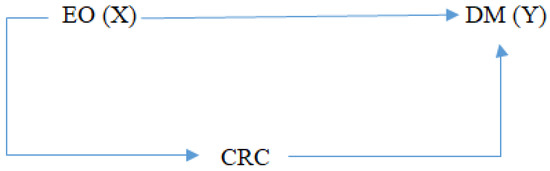
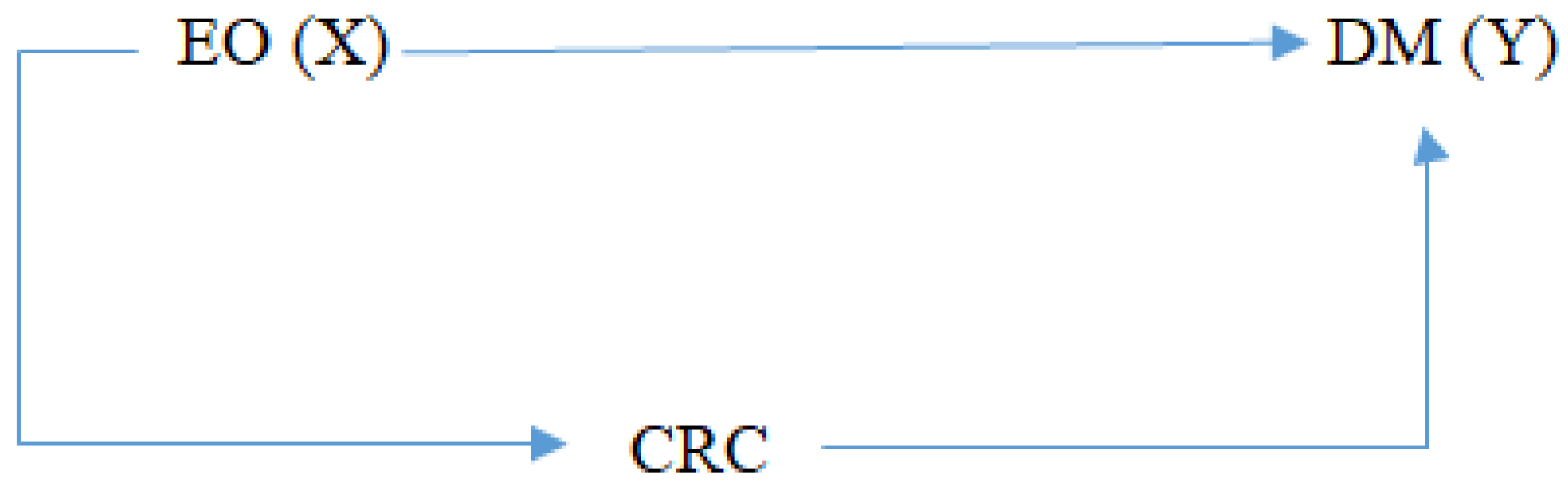
The already described mechanisms of both a direct association between entrepreneurial orientation (antecedent) and digital maturity (outcome), and an indirect association, based on the influence of EO on DM via change-ready culture, are presented by the following conceptual model (see Figure 1).
Figure 1.
Conceptual research model. Note: Arrows indicate the hypothesized direction of influence.
This early-stage scoping framework, developed by the first author, is intended to guide hypothesis development and future quantitative studies using national or regional samples.
Proposition 1 (P1):
Higher levels of HEI EO are positively associated with higher digital maturity.
Entrepreneurial orientation (EO) is an organization’s inclination to pursue opportunities and its capacity to shift from rigid bureaucracy to a dynamic, opportunity-focused culture [7,8]. In an HEI setting, EO increases the likelihood that leaders and their departments will seek new solutions to practical problems in their socioeconomic environment and actively transform their conventional practices. Since DM is an organizational capability that integrates digital practices into strategy, an entrepreneurial posture should be associated with sustained improvement in organizational DM levels. This logic is consistent with the theoretical perspective of entrepreneurial university theory, which emphasizes the need for institutional adaptation and external engagement in activities relevant to the wider socioeconomic development [9,10].
Proposition 2 (P2):
Higher levels of institutional EO are positively associated with a more change-ready organizational culture.
The increasing EO is expected to foster a change-ready, adaptive culture by defining appropriate behaviors and focusing on innovation and proactiveness. When leaders present change as sensible and realistic, staff develop a shared commitment and confidence [14]. Thus, EO is expected to contribute to the social and cultural conditions that make coordinated change implementation more likely.
Proposition 3 (P3):
A change-ready organizational culture is positively associated with HEI digital maturity.
DM requires new routines across departments and professions. In HEIs, which inherently have a decentralized organization, cultural readiness shapes whether digital initiatives remain localized, ad hoc efforts, or are developed into organizational capabilities. This process requires that norms of cooperation and learning already exist [6], along with a mutual commitment and recognized collective efficacy [14].
Proposition 4 (P4):
We expect HEI entrepreneurial orientation (EO) to positively affect digital maturity (DM) via change-ready organizational culture (CRC).
EO influences DM by establishing a strategic drive toward digital transformation and by transforming organizational culture. Namely, even if there is insufficient evidence of a direct association between EO and DM, the culture-based mechanism could still be significant. This is especially relevant for HEIs, which are inherently decentralized and require multiple reinforcing channels to manage change [25]. Thus, the most powerful role of EO could be to influence readiness for culture change, which indirectly improves DM. Since this study is a single-case, qualitative analysis of a digitally advanced regional HEI, our propositions are intended as a proposal for a culture-based mechanism rather than as solid, generalizable evidence. Future empirical research should estimate the generalizable effects, using contemporary mediation analysis [26,27,28]. It should also be noted that future research could treat culture as a moderator to test whether EO leads to DM more strongly when cultural readiness is high [29].
4. Materials and Methods
This paper takes a conceptual approach and uses a qualitative case to refine constructs and test mechanisms. The research design follows established guidance on adapting theory and articulating theoretical mechanisms [30]. For this purpose, we used a single information-rich case from the University of Mostar, where participants had direct experience with digital transformation initiatives [3,4]. The case helps observe and evaluate the proposed constructs rather than support broad generalization.
Purposive sampling was used to select eleven key internal stakeholders of the University of Mostar (Sveučilište u Mostaru, Mostar, Bosnia and Herzegovina), who were drawn from four categories: strategic management (senior administrators and rector office staff, school deans, and senior administrative staff—administrative unit managers); operational management (school vice-deans, department heads, and administrative units’ middle management); academic staff; and students.
All research participants were fully informed of the conditions of participation in this study and provided their consent. The sample included representatives from strategic management (university and faculty leadership, N = 4), operational management (N = 3), academic staff (N = 2), and students (N = 2). Interview topics covered the theoretically accepted dimensions of entrepreneurial orientation (innovation, proactiveness, and risk acceptance), as well as organizational culture characteristics and the perceived level of digital maturity.
We used qualitative analysis informed by theory, as presented in Section 2. A single coder developed initial codes, using the interpretative theoretical framework. The same thematic analysis procedure was used to develop sub-themes and final themes [31], which are reported in the Appendix A, Appendix B and Appendix C. Since this is a preliminary study, we did not seek inter-coder agreement or triangulate the qualitative results with other research methods or results. Therefore, this study and its qualitative results have limited transferability and should be interpreted as an illustration of the proposed relationships.
5. Results
Qualitative analysis identified the following themes and relationships with the conceptual model and the research propositions.
5.1. Theme 1: Entrepreneurial Orientation as Strategic Disruption
Research participants describe the organizational change as a deliberate, well-organized effort guided by strategic management. Although it involved considerable financial risks, management pursued its vision and used an entrepreneurial approach to implement it. This evidence is consistent with Proposition 1 and suggests that EO can function as an important antecedent in disrupting the organizational status quo. The risk was accepted to achieve the value of centralizing digital governance and pursue the digital transformation. Our qualitative evidence shows that management explicitly cited financial and operational risks related to the formation of an ICT department, which lacked funding: “The risk of liquidity was real… we took on new debt without secured funding sources. We did not wait—it was a long-term decision… We had to act before we were fully ready.” (Strategic Participant A1).
Digital systems entered operational use despite being non-essential. The approach used was rapid and intended, aligning with top management’s strategic vision. Its objective was to motivate faculty members and administrative employees to use their legacy habits: “We did not wait for the demand; we created the supply. When the crisis hit, we were ready, because we had already forced the system to adapt.” (Strategic Participant A2).
This theme suggests that entrepreneurial orientation is difficult to generalize as a form of promoting innovation, but rather as a potential driver of organizational unfreezing, which is especially significant for disrupting the status quo.
5.2. Theme 2: Culture as a Transmission Mechanism
This theme examines Propositions 2 and 4. Qualitative analysis suggests that while EO provides the initial push toward digital maturity, the organization’s culture determines how successfully implementation proceeds. Entrepreneurial actions actively shaped culture by supporting and empowering individuals. Participants indicated that resistance was addressed when leadership developed a culture of “psychological safety” concerning technical errors: “Change is best accepted when I feel my opinion is taken into account… If we are allowed to experiment without fear of breaking something, adoption is faster.” (Academic Participant C2).
Staff empowerment, communicating the digital transformation effort widely, appointing local coordinators, and organizing training sessions were used as enablers for the intended change in organizational culture. The local coordinators were the primary points of contact and provided a “human face” for the change to faculty and administrative staff. They were tasked with translating university strategy and encouraging local experimentation. The staff feedback was encouraged (“my opinion is taken into account”), and people were assured that early mistakes would be supported (“experiment without fear of breaking something”), which helped overcome fear and resistance. Thus, the entrepreneurial orientation was intertwined with and reinforced by culture (Proposition 2) and improved digital maturity (Proposition 4).
Another critical finding concerns the role of culture in the use of “Shadow ICT”, i.e., unofficial ICT solutions and shortcuts created ad hoc by faculty and administrations to address non-existent features or problems in the official ICT infrastructure. Staff used their personal knowledge of the student’s needs and an assessment of the current situation to bypass the system and ensure users do not experience issues with the required service levels. E.g., when the official LMS failed, some staff used WhatsApp to keep classes running: “If the official system ‘stalls’, I reach for other solutions… so that students do not suffer. I do not wait for permission. The goal is to teach.” (Academic Participant C1). This pattern is consistent with Proposition 4, as a proactive culture temporarily alleviates technical problems and shows the limits of accepting and routinizing the new organizational practices. However, these workarounds also demonstrated that the new routines were not fully institutionalized during the early phases of system development, because they depended on individual choices and knowledge.
Therefore, the change-ready culture can be theoretically described as an organizational driver of operationalizing the strategic intent. Since the process of strategic implementation varies across different HEI environments, the resulting patterns of digital maturity can vary significantly as well.
5.3. Theme 3: Digital Maturity as an Institutional Routine
The third theme corresponds to Proposition 3. The participants indicated that the sophistication of ICT tools does not reflect their understanding of digital maturity. They, rather, needed to be assured that the new practices will not revert to conventional ones and to feel that the institution finally drops the conventional technologies and procedures, reverting to the digital processes as the “default” routines: “Digital maturity is when technology is no longer seen as something special, but as a natural tool… there is no going back to paper.” (Strategic Participant A4).
Students highly valued how much the new practices enhanced their autonomy, e.g., by allowing them to fulfill administrative tasks without visiting physical offices or completing lengthy administrative procedures. However, reliability problems were decisive, e.g., students lost trust when the system failed during exam registration. This finding shows that the cultural factors must be matched by the stability of the technical systems to support DM development.
Thus, a digitally mature HEI is developed when technology-supported organizational practices are accepted as the default way of work and no longer considered exceptional effort or individual improvisation.
5.4. Synthesis of the Qualitative Analysis
Table 1 provides a synthesis of the empirical results by mapping each theme to its position in the conceptual model and to the specific research propositions (P1–P4).
Table 1.
Mapping qualitative themes to the conceptual model and research propositions (P1–P4).
6. Discussion
6.1. Theoretical Implications
This study is informed by existing research and focuses on preliminary conceptual modeling. However, it also features a qualitative illustration of a proposed mechanism, based on a single regional case.
Our results align with the existing literature, focusing on digital transformation as an organizational and management problem [1,21]. In organizations characterized by loose coupling, technology-enabled change primarily depends on the ability to create strategic routines, coordinate different initiatives, and align them with the strategic vision [6]. The perspective of building strategic capabilities is especially important, since institutional acceptance of technological pilot projects becomes the key driver of change, rather than “fixing” departmental issues with technology [14]. Therefore, we believe this study contributes to both the literature on change implementation and the existing research on digital transformation [2,3].
Future quantitative research should test the four empirical propositions using validated scales. It should also provide comparative context for the discussion of empirical results by including different regional HEIs in the research sample.
6.2. Practical Implications
Administrators should not restrict their view of achieving DM to a limited ICT intervention but rather frame it in terms of strategic (digital) transformation and meaningful process changes for HEI stakeholders, rather than focusing on efficiency, quality assurance requirements, or accreditation compliance. Leaders should address institutional weaknesses by focusing on helpful digital priorities and openly discussing potential trade-offs. This approach reduces resistance to change and helps staff see digital practices as part of institutional development rather than as another imposed requirement.
Experimentation and learning should be viewed as essential to the transformation effort, and HEI employees must feel safe to try new digital routines. There should be a no-blame incident review, and staff should feel free to escalate major platform issues to IT immediately. Teams that pilot changes and share lessons learned should be publicly acknowledged to ensure high employee motivation. However, the entire initiative is unlikely to succeed without systematic ICT capability-building at the university level. This can be achieved by appointing local coordinators in each faculty and service unit, who will further lead cooperation with end users. They can use a range of approaches to involve users, such as running co-design workshops before major process changes, and maintain shared process maps, service-level checklists, and role descriptions. The workload of the local coordination staff should be formally recognized and rewarded, rather than having work on implementing change and digital platforms just being added to their existing roles.
6.3. Limitations and Future Research
This study is informed by existing theory, but it offers a new theoretical proposal regarding the association between HEIs’ digital maturity and its potential antecedents. We also conducted preliminary, illustrative qualitative research at a single regional university. Although the results obtained serve as an excellent illustration of the proposed organizational mechanism, this study does not test any hypotheses and does not attempt to make generalizations. It rather sets four research propositions (P1–P4), to be tested using future qualitative research and validated scales.
7. Conclusions
Our qualitative material illustrates how institutional entrepreneurial orientation can disrupt existing practices and initiate organizational change, while culture enables learning, coordination, and the routinization of decentralized innovation. In this single case, digital maturity becomes visible once digitally enabled practices are experienced as the default way of working and are difficult to reverse.
Author Contributions
Conceptualization, A.M.A.; methodology, A.M.A.; validation, N.A.; formal analysis, A.M.A. and I.K.; investigation, I.K. and U.U.B.; resources, N.A.; data curation, A.M.A. and I.K.; writing—original draft preparation, A.M.A., I.K., U.U.B. and N.A.; writing—review and editing, A.M.A., I.K. and U.U.B.; supervision, N.A.; project administration, N.A.; funding acquisition, N.A. All authors have read and agreed to the published version of the manuscript.
Funding
This research received no external funding.
Institutional Review Board Statement
This study was approved by the Ethics Council of the University of Mostar, Reg. No. 01-2041/255, 1 April 2025.
Informed Consent Statement
Informed consent was obtained from all the subjects involved in this study.
Data Availability Statement
Anonymized interview transcripts are available upon request from the researchers.
Conflicts of Interest
The authors declare that they have no conflicts of interest.
Abbreviations
The following abbreviations are used in this manuscript:
| DM | Digital Maturity |
| DT | Digital Transformation |
| HEI | Higher Education Institution |
| ICT | Information and Communication Technology |
| EO | Entrepreneurial Orientation |
| CRC | Change-Ready Culture |
| LMS | Learning Management System |
Appendix A. Comprehensive Initial Coding Matrix (English Translation)
Table A1.
Initial coding structure derived from semi-structured interviews (N = 11).
Appendix B. Data Structure—Sub-Themes and Themes (English Translation)
Table A2.
Aggregation of codes into sub-themes and final themes.
Appendix C. Interview Topics (English Translation)
Group A: Strategic management
- A1: What were the key motivators for introducing digital change? Was it to respond to COVID, or did you do that proactively?
- A2: Describe a decision that involved significant risk. How did you handle the uncertainty?
- A3: What kind of a culture did you try to build? How do you support staff during transition?
Group B: Middle management
- B1: Describe a process that has fundamentally changed (e.g., student records).
- B2: Whose resistance was most significant? What was the likely cause?
Group C: Faculty
- C1: Which digital practices are now fixed in your teaching?
- C2: Do you use tools outside of the official system (some technological solutions you put together)? Why?
- C3: Do you feel safe to experiment with new tools?
Group D: Students
- D1: What issues can you solve without visiting a physical office?
- D2: Please describe a critical situation when the system failed. How did it affect your trust?
References
- Vial, G. Understanding digital transformation: A review and a research agenda. J. Strateg. Inf. Syst. 2019, 28, 145–174. [Google Scholar] [CrossRef] [Scilit]
- Teichert, R. Digital Transformation Maturity: A Systematic Review of Literature. Acta Univ. Agric. Silvic. Mendel. Brun. 2019, 67, 1673–1687. [Google Scholar] [CrossRef] [Scilit]
- Alfirević, A.M.; Vasilj, D.; Vasić, D.; Alfirević, N. Digital maturity of academic teaching and learning, digital culture and transformation: Empirical evidence and implications for higher education in Bosnia and Herzegovina and Croatia. Information 2025, 16, 1084. [Google Scholar] [CrossRef] [Scilit]
- Alfirević, A.M.; Mabić, M.; Alfirević, N. Evaluating digital maturity in higher education institutions: A preliminary empirical study in the Western Balkans. World 2025, 6, 130. [Google Scholar] [CrossRef] [Scilit]
- Wendler, R. The maturity of maturity model research: A systematic mapping study. Inf. Softw. Technol. 2012, 54, 1317–1339. [Google Scholar] [CrossRef] [Scilit]
- Weick, K.E. Educational organizations as loosely coupled systems. Adm. Sci. Q. 1976, 21, 1–19. [Google Scholar] [CrossRef] [Scilit]
- Miller, D. The correlates of entrepreneurship in three types of firms. Manag. Sci. 1983, 29, 770–791. [Google Scholar] [CrossRef] [Scilit]
- Covin, J.G.; Slevin, D.P. Strategic management of small firms in hostile and benign environments. Strateg. Manag. J. 1989, 10, 75–87. [Google Scholar] [CrossRef] [Scilit]
- Kirby, D.A. Creating entrepreneurial universities in the UK: Applying entrepreneurship theory to practice. J. Technol. Transf. 2006, 31, 599–603. [Google Scholar] [CrossRef] [Scilit]
- Etzkowitz, H. Innovation in innovation: The triple helix of university-industry-government relations. Soc. Sci. Inf. 2003, 42, 293–337. [Google Scholar] [CrossRef] [Scilit]
- Guerrero, M.; Urbano, D. The development of an entrepreneurial university. J. Technol. Transf. 2012, 37, 43–74. [Google Scholar] [CrossRef] [Scilit]
- Urbano, D.; Guerrero, M. Entrepreneurial Universities: Socioeconomic impacts of academic entrepreneurship in a European region. Econ. Dev. Q. 2013, 27, 40–55. [Google Scholar] [CrossRef] [Scilit]
- Armenakis, A.A.; Harris, S.G.; Mossholder, K.W. Creating readiness for organizational change. Hum. Relat. 1993, 46, 681–703. [Google Scholar] [CrossRef] [Scilit]
- Weiner, B.J. A theory of organizational readiness for change. Implement. Sci. 2009, 4, 67. [Google Scholar] [CrossRef] [Scilit]
- da Cruz, M.D.F.P.; Ferreira, J.J.; Kraus, S. Entrepreneurial orientation at higher education institutions: State-of-the-art and future directions. Int. J. Manag. Educ. 2021, 19, 100502. [Google Scholar] [CrossRef] [Scilit]
- Todorovic, Z.W.; McNaughton, R.B.; Guild, P. ENTRE-U: An entrepreneurial orientation scale for universities. Technovation 2011, 31, 128–137. [Google Scholar] [CrossRef] [Scilit]
- Riviezzo, A.; Santos, S.C.; Liñán, F.; Napolitano, M.R.; Fusco, F. European universities seeking entrepreneurial paths: The moderating effect of contextual variables on the entrepreneurial orientation-performance relationship. Technol. Forecast. Soc. Change 2019, 141, 232–248. [Google Scholar] [CrossRef] [Scilit]
- Dabic, M.; Daim, T.; Bayraktaroglu, E.; Novak, I.; Basic, M. Exploring gender differences in attitudes of university students towards entrepreneurial universities: The case of Croatia and Spain. Technol. Soc. 2015, 42, 135–143. [Google Scholar] [CrossRef] [Scilit]
- Scuotto, V.; Del Giudice, M.; Garcia-Perez, A.; Orlando, B.; Ciampi, F. A spillover effect of entrepreneurial orientation on technological innovativeness: An outlook of universities and research-based spin offs. J. Technol. Transf. 2020, 45, 1634–1654. [Google Scholar] [CrossRef] [Scilit]
- Đurek, V.; Begičević Ređep, N.; Divjak, B. Digital Maturity Framework for Higher Education Institutions. In Proceedings of the Central European Conference on Information and Intelligent Systems (CECIIS 2017), Varaždin, Croatia, 27–29 September 2017; Available online: https://archive.ceciis.foi.hr/app/public/conferences/2017/02/CECIIS-2017_paper_58_final.pdf (accessed on 4 February 2026).
- Kane, G.C.; Palmer, D.; Phillips, A.N.; Kiron, D.; Buckley, N. Strategy, not technology, drives digital transformation: Becoming a digitally mature enterprise. MIT Sloan Manag. Rev. 2015, 57181. Available online: https://sloanreview.mit.edu/projects/strategy-drives-digital-transformation/ (accessed on 18 February 2026).
- Cameron, K.S.; Quinn, R.E. Diagnosing and Changing Organizational Culture: Based on the Competing Values Framework, 3rd ed.; Jossey-Bass/Wiley: San Francisco, CA, USA, 2011. [Google Scholar]
- Edmondson, A.C.; Lei, Z. Psychological safety: The history, renaissance, and future of an interpersonal construct. Annu. Rev. Organ. Psychol. Organ. Behav. 2014, 1, 23–43. [Google Scholar] [CrossRef] [Scilit]
- Cross, K.J.; Mamaril, N.; Johnson-Glauch, N.; Herman, G. Building cultures of collaboration that promote instructional change. Stud. Eng. Educ. 2021, 2, 1–18. [Google Scholar] [CrossRef] [Scilit]
- Kezar, A.; Eckel, P. Examining the institutional transformation process: The importance of sensemaking, interrelated strategies, and balance. Res. High. Educ. 2002, 43, 295–328. [Google Scholar] [CrossRef] [Scilit]
- MacKinnon, D.P.; Fairchild, A.J.; Fritz, M.S. Mediation analysis. Annu. Rev. Psychol. 2007, 58, 593–614. [Google Scholar] [CrossRef] [Scilit]
- Preacher, K.J.; Hayes, A.F. Asymptotic and resampling strategies for assessing and comparing indirect effects in multiple mediator models. Behav. Res. Methods 2008, 40, 879–891. [Google Scholar] [CrossRef] [Scilit] [PubMed]
- Hayes, A.F. Beyond Baron and Kenny: Statistical mediation analysis in the new millennium. Commun. Monogr. 2009, 76, 408–420. [Google Scholar] [CrossRef] [Scilit]
- Hayes, A.F. Introduction to Mediation, Moderation, and Conditional Process Analysis, 3rd ed.; Guilford Press: New York, NY, USA, 2022. [Google Scholar]
- Jaakkola, E. Designing conceptual articles: Four approaches. AMS Rev. 2020, 10, 18–26. [Google Scholar] [CrossRef] [Scilit]
- Braun, V.; Clarke, V. Using thematic analysis in psychology. Qual. Res. Psychol. 2006, 3, 77–101. [Google Scholar] [CrossRef] [Scilit] [PubMed]

Disclaimer/Publisher’s Note: The statements, opinions and data contained in all publications are solely those of the individual author(s) and contributor(s) and not of MDPI and/or the editor(s). MDPI and/or the editor(s) disclaim responsibility for any injury to people or property resulting from any ideas, methods, instructions or products referred to in the content. |
© 2026 by the authors. Licensee MDPI, Basel, Switzerland. This article is an open access article distributed under the terms and conditions of the Creative Commons Attribution (CC BY) license.