


Abstract
This article presents a hybrid methodology for the intelligent control of the reactor-regenerator unit of a residual fluid catalytic cracking (RFCC) plant under conditions of uncertain input information. The main challenge in catalytic cracking process control is the instability of feedstock composition and the delay in laboratory data on product quality, which complicates the operational management of the RFCC process while maintaining the required gasoline quality. The objective of this study is to support effective management of the gasoline production process by maximizing the yield of high-quality gasoline while keeping its density within specified limits. The proposed architecture combines a regression model built on six dominant parameters selected through Pearson’s correlation analysis, a Mamdani-type fuzzy inference system with a database of 26 expert rules, and a machine-learning module (Random Forest and gradient boosting) that corrects the residual error of the combined regression-fuzzy model, allowing the control system to adapt to changing process conditions. Testing the developed models on real data from the Shymkent Oil Refinery shows that the hybrid model reduces the root-mean-square error from 0.1973 (regression model alone) to 0.0161 and the mean absolute percentage error from 0.328% to 0.028%, while the coefficient of determination increases from 0.9895 to 0.9999; this improved accuracy is estimated to correspond to an approximate 3.2% increase in achievable gasoline yield and a 0.4% improvement in density stability. The developed decision support system for catalytic cracking process control, based on the proposed methodology, acts as a “virtual analyzer”, ensuring effective control in real time without the use of expensive in-line quality control devices.
1. Introduction
Catalytic cracking is a key process in deep oil refining, producing high-octane components for motor gasoline and other valuable hydrocarbon products. The efficiency of catalytic cracking units significantly determines the economic performance of oil refineries and their competitiveness in the face of increasingly stringent fuel-quality and environmental regulations.
The catalytic cracking process is a complex, multi-parameter, and poorly formalized chemical engineering process. Its dynamics are determined by the combined effects of changing feedstock characteristics, nonlinear heat and mass transfer, and catalyst degradation and regeneration. Uncertainty in the initial data plays a significant role, owing both to incomplete information and to the need to rely on expert assessments when monitoring product quality indicators. These aspects have previously been studied in the authors’ own work [1,2].
Traditional control methods based on deterministic mathematical models and classical controllers are ineffective under the highly uncertain and nonlinear conditions of the catalytic cracking process. Their use requires an accurate description of the control object and is poorly adaptable to changing operating conditions. Purely statistical or machine-learning models also face limitations related to the lack of representative data and the reduced interpretability of the resulting solutions.
In recent years, intelligent and hybrid approaches combining formal mathematical models, fuzzy logic, and machine learning algorithms have received increasing attention in complex process control tasks. Fuzzy logic effectively accounts for expert knowledge and linguistically describable uncertainty, while statistical and learnable models enable adaptation to real data and improved forecasting accuracy.
Despite a number of studies devoted to hybrid and intelligent methods for modeling and controlling catalytic cracking processes, there is currently no universal methodology that enables the systemic integration of regression, fuzzy, and learning models within a single control scheme. Most studies consider either individual models or specific cases of hybridization, without formalizing a general algorithm for the synthesis and verification of such systems [3].
The objective of this study is to develop a hybrid methodology for the intelligent control of the catalytic cracking process under conditions of initial information uncertainty, based on the integration of regression models, fuzzy logic, and machine learning methods. Unlike existing approaches, this paper proposes a structured framework for synthesizing a hybrid model that functionally separates system components into the levels of basic modeling, fuzzy correction, and adaptive learning. The scientific novelty lies in the formalization of the integration procedure for quantitative and qualitative models, allowing the uncertainty of the initial data, the expert knowledge of process personnel, and the nonlinear nature of the process to be taken into account. The proposed approach improves forecasting accuracy and control stability and provides a basis for implementing intelligent decision support systems in real industrial settings.
Under conditions of high uncertainty in the initial information, it is particularly relevant to develop methodologies aimed not only at improving modeling accuracy but also at ensuring the interpretability, stability, and adaptability of control systems. For industrial applications, it is essential that intelligent methods can be integrated into existing control loops and used by process personnel without losing the transparency of decision-making [4].
In this context, a hybrid methodology should be viewed not as a collection of individual models, but as a holistic concept that includes formalizing the stages of synthesis, configuration, verification, and practical application of intelligent components. The lack of such methodologically sound solutions limits the adoption of intelligent control systems in real-world oil-refining environments.
Catalytic cracking process control is traditionally based on deterministic mathematical models and classical controllers focused on stabilizing individual process parameters. These approaches include kinetic and balance models, widely used to describe catalytic cracking for various types of hydrocarbon feedstock, as well as PID-type controllers and their modifications used in local control loops [5,6,7,8,9,10,11]. These methods provide acceptable process stability under steady-state conditions but require precise knowledge of the model parameters and are poorly adaptable to changes in the properties of the feedstock, catalyst, and operating conditions.
Regression and statistical models are popular tools for approximating experimental data and assessing the impact of individual factors on product yield and quality, owing to their ease of implementation and the interpretability of their coefficients. However, such models typically operate correctly only within limited operating ranges and cannot adequately account for the qualitative process dependencies and expert assessments characteristic of processes with a high degree of uncertainty [12,13].
Intelligent control methods based on fuzzy logic allow the experience and knowledge of process personnel to be formalized into linguistic rules, thereby accounting for the uncertainty of the initial information. Fuzzy models such as Mamdani-type systems are widely used to control complex chemical engineering facilities; however, in most cases they are static and require manual configuration of the rule base and membership functions, which limits their applicability over long-term plant operation and changing process conditions.
Machine learning methods and neural network models demonstrate high forecasting accuracy in the presence of large datasets, but their use in catalytic cracking control is associated with a number of limitations, including low interpretability of solutions, high sensitivity to the quality of training data, and difficult integration into existing industrial control loops—limitations confirmed by research on the application of machine learning methods to various engineering problems [14,15,16].
An analysis of modern research shows that hybrid approaches combining statistical, fuzzy, and learnable models are the most promising direction. However, in most studies, hybridization is implemented heuristically, without a formalized common synthesis methodology or a clear separation of the functional roles of system components. This complicates the reproducibility of solutions and their scalability to other control systems [17,18].
Thus, existing approaches do not provide a methodologically sound and universal solution to the problem of intelligent control of the catalytic cracking process under uncertainty. This justifies the need to develop a hybrid synthesis methodology focused on engineering interpretability, adaptability, and practical industrial application.
A number of studies [19,20] have examined approaches to developing mathematical models and methods for optimizing technological processes under uncertainty. Classical modeling methods allow effective solutions to problems of analyzing and optimizing industrial facilities; however, the development of intelligent control methods and the integration of expert knowledge into models remain insufficiently addressed—a gap that is particularly relevant for complex nonlinear processes such as catalytic cracking. These limitations stem from the incompleteness and fuzziness of the initial information and from the difficulty of formalizing specialists’ knowledge.
Catalytic cracking models that account for the influence of feedstock composition and catalyst properties have been investigated in [21,22], establishing the significance of these factors in shaping the process’s output parameters. However, such models focus primarily on physicochemical characteristics and do not fully account for controlled process parameters, including reactor temperature and pressure, regenerator temperature, and feedstock and catalyst flow rate [23], which significantly limits their applicability to management problems. A promising direction here is the use of intelligent methods that allow both quantitative and qualitative (expert) data to be taken into account [24,25].
Approaches based on kinetic modeling and structural grouping of components [26] provide high accuracy in describing processes when reliable initial information is available. However, their use under conditions of uncertainty is difficult owing to high sensitivity to data quality and significant computational cost.
Artificial intelligence methods, including machine and deep learning [27,28], demonstrate high forecasting accuracy and are used in control tasks for complex technological systems. However, their effectiveness directly depends on the volume and quality of training data and is accompanied by high computational complexity and limited interpretability of results, which reduces their practical applicability under real production conditions.
In [29,30,31], fuzzy modeling methods based on α-level sets are proposed, allowing the original fuzzy problem to be transformed into a set of crisp ones. Despite its methodological simplicity, this approach leads to the loss of a significant portion of fuzzy information, including the knowledge and experience of experts, which negatively affects the adequacy of the resulting models and decisions.
Studies [32,33,34] are devoted to modeling under stochastic uncertainty using probability theory and mathematical statistics. These methods are effective when sufficient statistical data are available, but their application is limited under conditions of parameter fuzziness.
A number of studies [35,36,37] propose modeling and control methods based on fuzzy logic and elements of artificial intelligence, allowing uncertainty to be considered and expert knowledge to be partially formalized. However, in most cases, the models considered have clear inputs and fuzzy outputs, or fuzziness is simplified through α-level transformations, which reduces the universality and accuracy of the models.
An analysis of existing studies reveals a number of limitations: reliance on deterministic or stochastic models without accounting for the full fuzziness of parameters, the dependence of artificial intelligence methods on large volumes of data, limited integration of expert knowledge, and the loss of fuzzy information when moving to crisp models.
A promising approach to addressing these issues is the development of a hybrid intelligent control methodology based on the integration of regression models, fuzzy logic, and machine learning methods. This approach combines the advantages of the individual methods, taking into account both quantitative data and fuzzy expert information, and describes complex nonlinear process dependencies.
Despite the existence of individual studies in this area, the approach has not been sufficiently developed for the control of complex technological objects with fuzzy input, operating-mode, and output parameters.
This necessitates research aimed at developing a hybrid methodology for the intelligent control of the catalytic cracking process under conditions of uncertainty, ensuring increased modeling accuracy, control efficiency, and product quality.
Currently, the RFCC reactor–regenerator unit is controlled manually by the operator, who adjusts parameters to keep the parameter-stabilization systems within normal operation. Automating decision-making in the catalytic cracking process, so as to produce high-quality gasoline with the required octane rating, is therefore a pressing issue.
The key performance parameters of the reactor–regenerator unit are reactor temperature and pressure, which influence temperature changes in the regenerator and, in turn, the unit’s operational stability, conversion rate, product density, and particle size distribution. As in many other technological processes, the RFCC unit under study operates with uncertain initial information on the quality of the resulting gasoline, information that is nevertheless needed for developing models and optimizing the catalytic cracking process. Under these conditions, algorithms are in demand to support an intelligent process control system for the reactor–regenerator unit that uses fuzzy models to represent expert knowledge.
Production data collected at the Shymkent Oil Refinery over a three-year period were used to develop and test the proposed models; the complete list of recorded process parameters is given in Section 2.
To visualize the forecast results, graphs of predicted versus actual values, as well as forecast-error graphs, were used, allowing a clear assessment of model accuracy and the identification of potential shortcomings.
2. Materials and Methods
The proposed methodology is aimed at synthesizing a hybrid intelligent control system for the catalytic cracking process, comprising a regression model, a Mamdani-type fuzzy inference system, and machine learning algorithms.
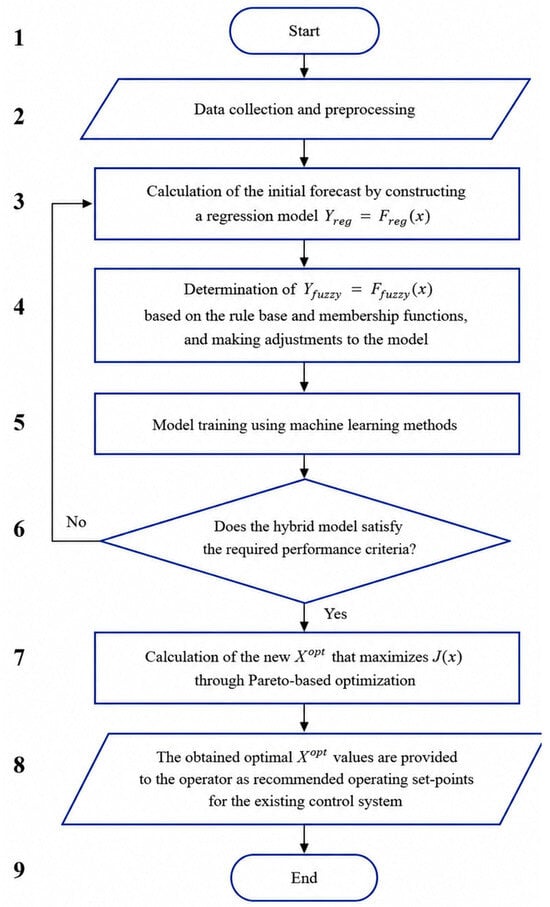
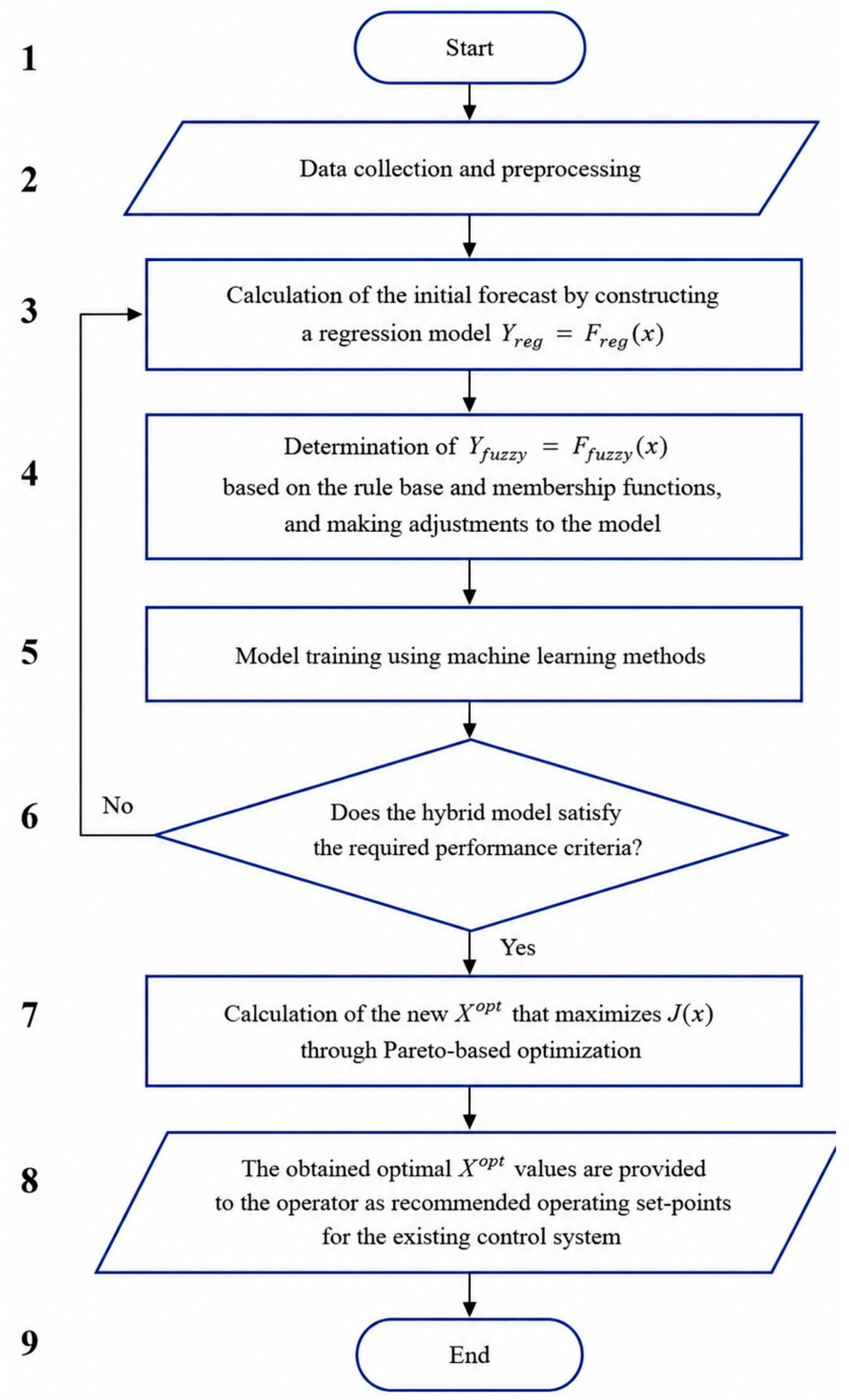
The algorithm for constructing the hybrid model (Figure 1) includes the following steps:
Figure 1.
Block diagram of the algorithm for constructing the hybrid regression–fuzzy–machine-learning model.
- Generating a set of input and output parameters based on process analysis;
- Conducting correlation analysis and selecting significant variables;
- Building a regression model;
- Generating linguistic variables and membership functions;
- Synthesizing a fuzzy rule base;
- Integrating the regression and fuzzy models;
- Adapting the model using machine learning methods.
The algorithm is modular in nature, which allows for its expansion and adaptation to other chemical engineering objects.
Table 1 presents a comparative analysis of modeling methods, from classical statistical approaches to intelligent hybrid systems, which is especially relevant for the control of complex nonlinear objects such as a catalytic cracking unit.
Table 1.
Comparative characteristics of models.
Unlike existing hybrid solutions, in which individual models are used in isolation or combined heuristically, the proposed methodology treats the intelligent control system as a hierarchically organized structure in which each component is assigned a strictly defined functional role. This ensures the methodology’s reproducibility, its adaptability to various control objects, and its stability under changing operating conditions.
The methodology for synthesizing the intelligent control system comprises the following interrelated stages:
Formalization of the control object under uncertainty. At this stage, the structure of the control object is defined, and the input, operating, and output parameters, as well as the sources of uncertainty, are identified. Particular attention is paid to parameters whose values are not directly measurable or are qualitative in nature.
Construction of basic regression models. Regression models are used to identify quantitative relationships between measured process parameters. The regression model is not intended to be used as a standalone controller; it serves as the baseline predictive model within the proposed hybrid intelligent control system. Its output values form the quantitative basis for subsequent fuzzy correction and residual error compensation using machine learning methods. At this stage, parametric identification and model-adequacy assessment are performed.
Fuzzy linguistic model synthesis. Fuzzy models are formed on the basis of expert knowledge and describe qualitative relationships between process parameters in the presence of incomplete and imprecise information. A Mamdani-type fuzzy model is used as the base model, ensuring high interpretability of the control rules.
Model hybridization. At this stage, the regression and fuzzy models are integrated. The regression model provides a basic quantitative forecast based on production data, while the fuzzy inference system generates a correction component for the regression model’s output, taking into account expert knowledge and process uncertainty. This hybridization combines the precision and interpretability of quantitative modeling with the flexibility of linguistic description.
Although the regression and fuzzy components use the same process variables, they perform different and complementary functions within the proposed methodology. The regression model reflects quantitative relationships between measured process parameters and the process output, while the fuzzy model is not used as a backup predictive model. Instead, it functions as a correction mechanism, accounting for uncertainty, qualitative dependencies, and expert knowledge that cannot be adequately represented by the regression model alone. Thus, the fuzzy component corrects the regression model’s baseline prediction rather than independently reproducing the same input-output relationship.
Adaptation and refinement of the models using machine-learning elements. Machine learning algorithms are used to adaptively adjust the parameters of the hybrid model during operation of the control system, allowing changes in feedstock properties, catalyst state, and external conditions to be taken into account without completely rebuilding the model.
Verification and validation of the methodology. The final stage tests the adequacy and effectiveness of the synthesized control system using production data.
Within this synthesis methodology, each component of the intelligent control system is assigned a clearly defined function:
- -
- Regression models provide a quantitative assessment of the influence of controlled parameters and serve as a tool for primary data analysis;
- -
- Fuzzy linguistic models account for expert knowledge, uncertainty, and the qualitative characteristics of the process, and generate interpretable control rules;
- -
- Machine learning algorithms adapt and update the model parameters, increasing the system’s resilience to changing process conditions.
This functional separation avoids the duplication and conflicts between components that are typical of many existing hybrid solutions.
Applying the proposed hybrid synthesis methodology to the catalytic cracking process is implemented as a sequential algorithm (Figure 1), taking into account the process characteristics of the reactor–regenerator unit. The first stage involves analyzing the plant’s process flow diagram and defining the boundaries of the control object, including the reactor, the regenerator, and the associated material and heat flows.
Next, the input, process, and output parameters that have the greatest impact on the yield and quality of the target products are identified, taking into account both parameters that can be measured directly by automated means and parameters whose values are estimated indirectly or from expert judgment.
The next stage involves constructing regression models that describe the quantitative relationships between the measured process parameters. These models are used to obtain an initial approximation of the object’s behavior and to identify the dominant factors. At the same time, linguistic variables and term sets are formed for parameters characterized by uncertainty or a qualitative interpretation.
Production data collected at the Shymkent Oil Refinery were used to predict the yield of the catalytic cracking unit. The dataset included the following parameters: feedstock flow rate, feedstock density, feedstock temperature, reactor temperature, reactor pressure, catalyst flow rate, recirculate flow, K-1002 bottom temperature, final boiling point, regenerator pressure, regenerator temperature, temperature after T-1011/T-1012/T-1016, flow velocity after T-1011 (1016), gasoline volume (yield), and gasoline density.
In a catalytic cracking unit, gasoline yield depends on many process variables. However, to build a control model, it is necessary to select only the most informative and physically justified parameters; correlation analysis was applied to the initial data for this purpose.
The purpose of the correlation analysis is to select the input parameters that have a significant impact on the output value. The analysis is based on the Pearson correlation coefficient (Equation (1)):
where rxi,y is the correlation coefficient; xi is the i-th observed value of variable x (e.g., x1—feedstock flow rate; x2—feedstock density); yi is the i-th observed value of variable y (y1—gasoline yield); and , are the mean values of x and y, respectively.
A Pearson’s coefficient close to 1 or −1 indicates a strong influence of the corresponding variable on the output; an intermediate value indicates a moderate influence; and a value close to 0 indicates a weak influence, meaning the parameter is of little significance and is not appropriate for use in control.
Pearson’s correlation analysis was performed for gasoline yield (y1), which was used as the quantitative target output for identifying the process parameters most strongly associated with gasoline yield. Gasoline density (y2) is also a quantitatively measurable process output; however, within the proposed hybrid methodology, it is represented using fuzzy linguistic terms and expert-defined membership functions rather than being used as the target variable in the Pearson correlation analysis. Its relationship with the process parameters is therefore incorporated into the fuzzy inference component through linguistic variables, membership functions, and the expert rule base. Therefore, the correlation coefficients presented in Table 2 refer directly to gasoline yield (y1).
Table 2.
Pearson’s correlation coefficients between input process parameters and gasoline yield (y1).
As a result of the correlation analysis, the six most significant parameters (x1–x6) were retained for model construction; the two output parameters and their measurement ranges are presented together with them in Table 3.
Table 3.
Key parameters of the catalytic cracking process.
The selected input and operating parameters were those that directly affect the kinetics of the cracking reactions, heat and mass transfer, and the state of the catalyst: feedstock flow rate, its density and temperature, reactor temperature and pressure, and catalyst flow rate. These parameters are controlled or conditionally controlled and reflect the key process impacts; changing them influences both the conversion rate of heavy hydrocarbons and the selectivity toward the target fractions.
The selected output parameters were those that best characterize the process’s efficiency from an engineering standpoint: gasoline fraction yield and its density. Gasoline yield is a quantitative indicator of plant performance, while gasoline density reflects product quality and compliance with regulatory requirements. Because gasoline density is, in practice, often estimated from laboratory analysis together with expert judgment, it is represented here as a fuzzy value.
This choice of parameters ensures the engineering interpretability of the model, its connection to the real mechanisms of the process, and the practical usability of the intelligent-control results under the industrial operating conditions of a catalytic cracking unit.
To construct the fuzzy model, the input and output parameters were represented as linguistic variables, and term sets with corresponding value ranges were defined for each variable (Table 4).
Table 4.
Ranges of the linguistic variables used to construct the fuzzy model.
The system of regression equations describes the main dependencies of the process and quantitatively reflects the influence of parameters such as reactor and regenerator temperature and pressure, feedstock flow rate, and catalyst circulation on product yield.
The linguistic variables presented above are used in the fuzzy inference system to determine the corrective action applied to the result of the regression model, ensuring that uncertainty and expert knowledge are taken into account.
In contrast to traditional control methods, fuzzy-logic-based schemes offer a more effective approach to the analysis and control of relatively complex, difficult-to-formalize, nonlinear, and time-varying systems [38].
Fuzzy model synthesis is based on expert rules reflecting the process logic of catalytic cracking control. This is followed by the hybridization of the regression and fuzzy models, ensuring consistency between the quantitative and qualitative descriptions of the process. The final stage adapts the parameters of the hybrid model using machine-learning elements and prepares the system for verification on production data [39].
Fuzzy rules are formed on the basis of the physical laws of the technological process and expert experience; they describe the relationship between the regression-model error and the key process parameters. A Mamdani-type fuzzy inference system then determines the magnitude of the corrective action required to compensate for the model error by evaluating the rules formed from expert assessments [40,41].
The rules were developed from the plant’s process regulations. A database of fuzzy production rules was created, reflecting the actions of the process operator managing the unit.
Variability in the input and process parameters, instability in feedstock quality, and decreasing catalyst activity make it difficult to describe the actual process accurately; the study therefore substantiates the use of a hybrid modeling approach.
The proposed hybrid synthesis methodology has a number of fundamental advantages over traditional and existing intelligent approaches:
- -
- It provides systemic integration of quantitative and qualitative modeling methods.
- -
- It maintains the interpretability of management decisions.
- -
- It is resistant to incompleteness and uncertainty in the initial information.
- -
- It allows adaptation without completely restructuring the model.
- -
- It is oriented toward practical implementation in industrial settings.
3. Results
The reactor-regenerator unit of a catalytic cracking unit is a multi-parameter nonlinear system in which the output parameters depend on the combined effect of several process parameters, including feedstock flow rate, its density and temperature, reactor temperature and pressure, and catalyst flow rate [42,43]. To describe the process quantitatively, regression models were constructed from production data of the Shymkent Oil Refinery, including quadratic and cross terms. The general equation of the regression model—which is a second-degree polynomial taking into account linear, quadratic, and cross terms—has the following form (2):
where is the intercept; , , —regression coefficients for the linear, quadratic, and cross terms, respectively. x1—feedstock flow rate; x2—feedstock density; x3—feedstock temperature; x4—reactor temperature; x5—reactor pressure; and x6—catalyst flow rate. y—the simulated output (gasoline yield y1 or gasoline density y2).
To improve modeling accuracy, a fuzzy system is used to correct the result of the regression model, as in Equation (3):
where yreg is the result of the regression model, and Δyfuzzy is the correction introduced by the fuzzy model.
In addition, machine learning methods (Random Forest and gradient boosting) were applied to model the residual error left after the regression and fuzzy stages. A hybrid model combining the regression, fuzzy, and learning components therefore takes the form of Equation (4):
where yreg is the result of the regression model, Δyfuzzy is the correction introduced by the fuzzy model (specified explicitly in Equation (13) below), and fML(x) represents the nonlinear residual dependencies identified by the machine-learning module.
The regression and fuzzy-inference computations—including construction of the Mamdani system and the Rule Viewer and Surface Viewer visualizations discussed below—were carried out in the MATLAB Fuzzy Logic Toolbox environment. The machine-learning residual-correction module (Random Forest and gradient boosting) was implemented in Python 3.9 using the scikit-learn and NumPy libraries. Model construction proceeded in three sequential stages: (i) the parameters of the regression model are estimated from production data; (ii) the fuzzy rule base is formed and used to adjust the regression result; and (iii) machine learning methods are trained on the remaining model residuals and form an additional corrective component. The result is an integrated hybrid model combining the regression, fuzzy, and learning components.
The proposed hybrid model is used at the upper control level as a decision support tool, rather than as a direct controller at the lower level. Current measured values of selected process parameters are fed to the model’s input to estimate expected output parameters and the current state of the process. The model can then be used to analyze alternative operating modes and generate recommendations aimed at maximizing gasoline yield while meeting specified product quality constraints. The resulting recommended operating parameters are provided to the operator as recommendations for changing the settings of the existing automatic control system. In this configuration, the hybrid model functions as a virtual analyzer and intelligent decision support system, while the existing control loops of the plant provide direct process control.
To assess the generalization capability of the developed hybrid model and eliminate the effect of overfitting, a 5-fold cross-validation procedure was used. The initial three-year production dataset of the Shymkent Oil Refinery was randomly divided into a training (80%) and independent test (20%) set. The regression component and machine learning algorithms (Random Forest, gradient boosting) were trained exclusively on the training set. The final assessment of the model’s forecast accuracy was performed using data from an independent test sample, which was not used in the process of weight adjustment and fuzzy logic rule verification. The results of testing on the independent sample showed RMSE = 0.0172 and MAPE = 0.031%, which is very close to the results from the training sample and convincingly demonstrates the absence of overfitting of the hybrid model.
For the gasoline yield (y1), the parameters of the polynomial regression model in Equation (2) were identified from the production data using the least squares method. The model’s adequacy was characterized primarily by the coefficient of determination R2, computed from Equation (5):
where yi is the actual (measured) gasoline yield, ŷi is the value predicted by the model, is the mean of the actual data, and n is the number of observations. For the gasoline-yield model, the resulting coefficient of determination was R2 = 0.9895.
Model error was further evaluated using root mean square error (RMSE), as in Equation (6):
For the gasoline-yield model, RMSE = 0.1973.
The mean absolute percentage error (MAPE) is given by Equation (7):
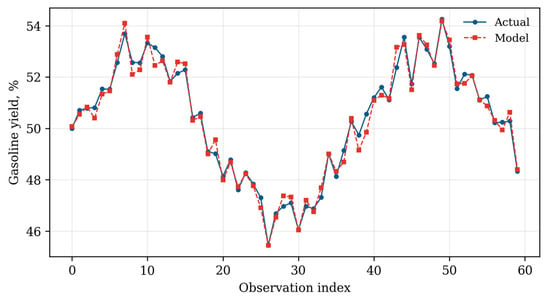
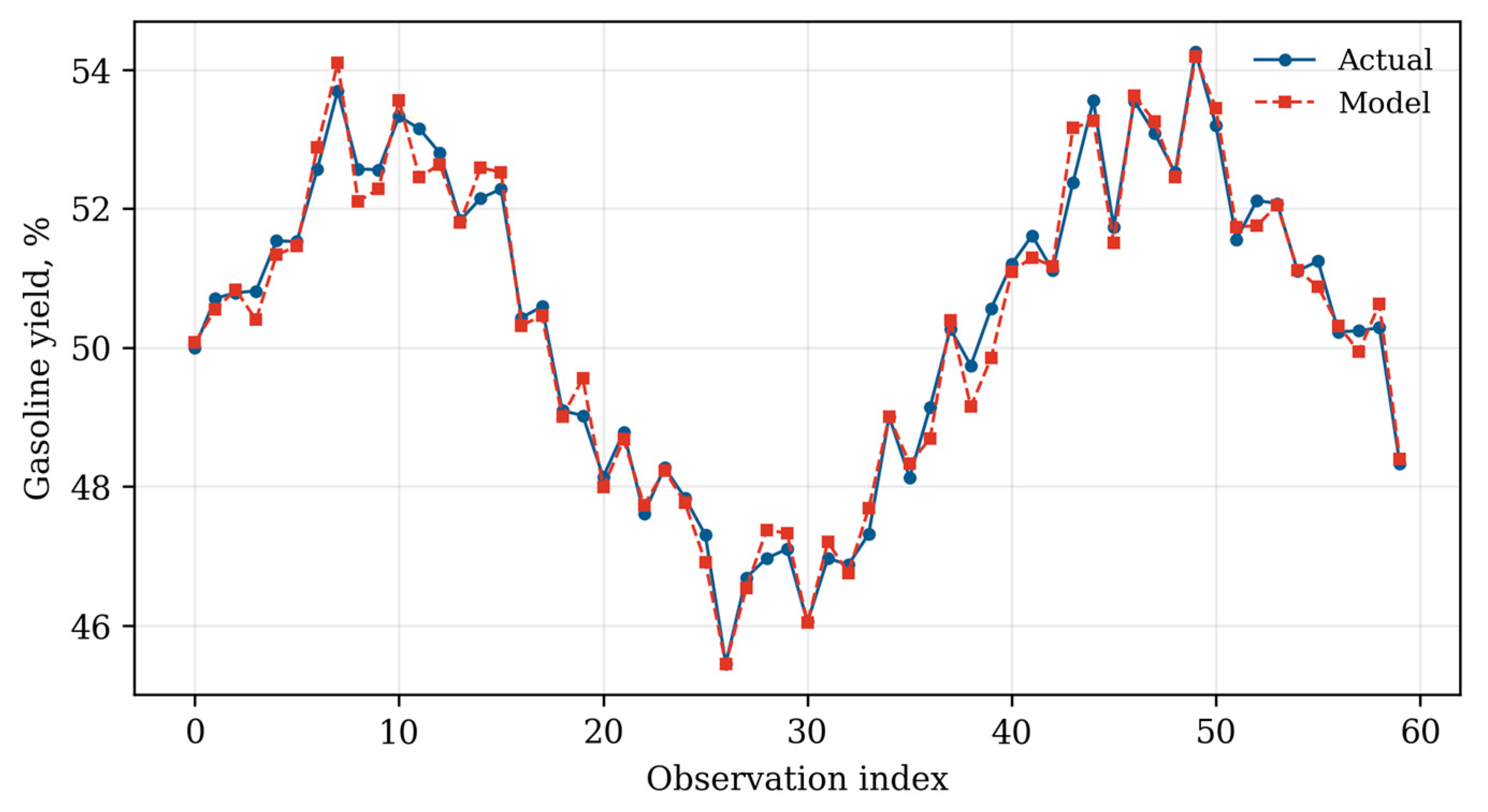
For the gasoline-yield model, MAPE = 0.328%. Based on the fitted model, a comparative graph of the actual and model values of gasoline yield y1 was constructed (Figure 2).
Figure 2.
Comparison of actual and model values of gasoline yield.
The adequacy of the regression model was tested using Fisher’s criterion at α = 0.05, computed as the ratio of the adequacy variance to the experimental variance, as in Equation (8):
Adequacy variance is shown in Equation (9):
Experimental (reproducibility) variance is shown in Equation (10):
Here, n is the number of observations, and m is the number of model coefficients. The calculated value of Fisher’s criterion was Fcalc = 38.7, against a critical value of Fcrit = 2.5 at α = 0.05. Since Fcalc substantially exceeds Fcrit, the regression model on its own shows a statistically significant lack of fit—confirming that regression alone is not sufficient to describe the process adequately, and motivating the fuzzy and machine-learning correction introduced below.
To improve the validity of the catalytic cracking model, it is refined using expert knowledge. For this purpose, the difference between the regression-model result and the experimental value is determined, as in Equation (11):
The regression result is then normalized before being fed to the fuzzy inference system, as in Equation (12):
The normalized error is fed to a Mamdani-type fuzzy system, which generates the fuzzy correction term Δyfuzzy introduced in Equations (3) and (4); this correction is given explicitly by Equation (13):
Here, FM denotes the Mamdani fuzzy-inference mapping. Substituting Equation (13) into Equation (4) together with the machine-learning term fML(x) yields the complete hybrid model used to obtain the results reported below.
A Mamdani-type fuzzy system generates the corrective action from the rule base; representative rules include:
- If (x2 is L) and (x4 is H) and (x6 is H), then (y1 is H) and (y2 is L);If (x1 is AA) and (x6 is L), then (y1 is BA) and (y2 is AA).
The complete rule base includes 26 rules formulated on the basis of the plant’s technological regulations.
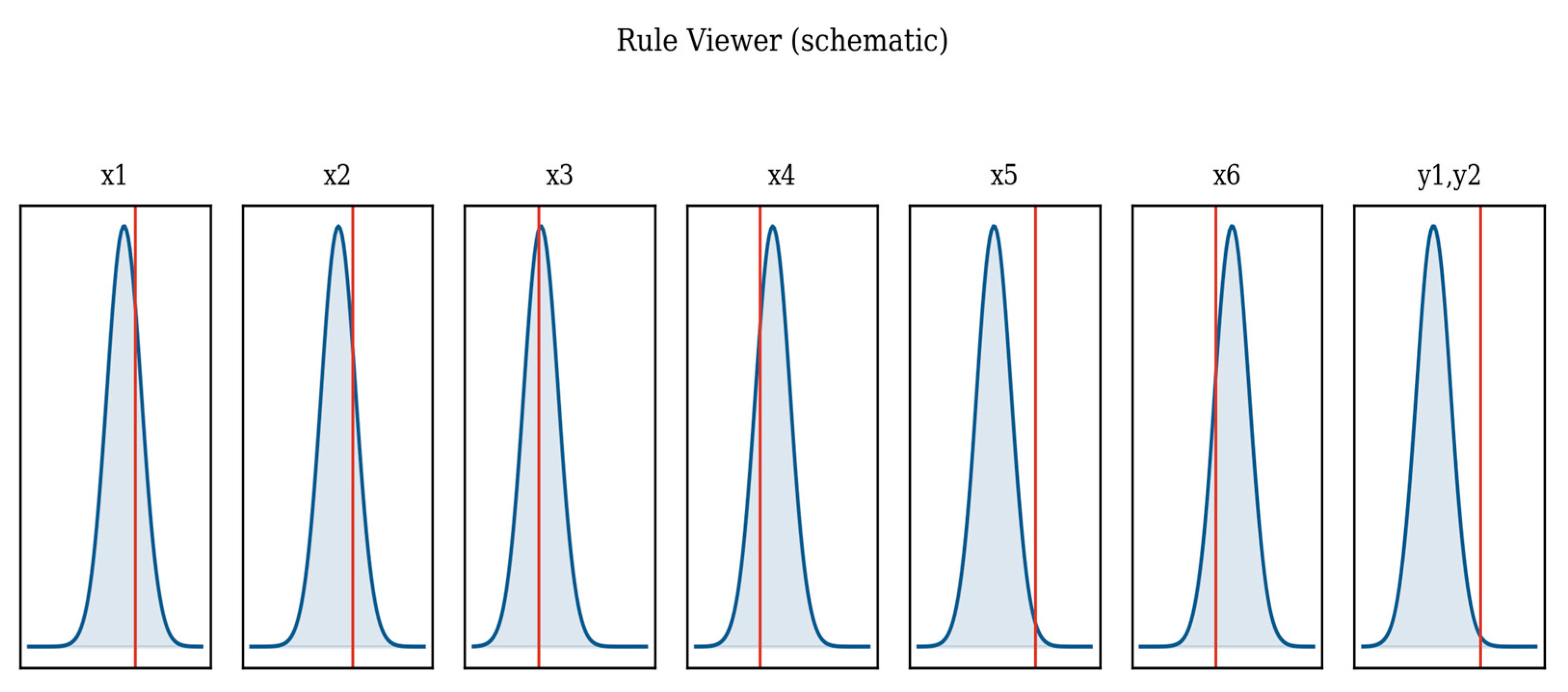
The performance of the fuzzy model was analyzed using the visualization tools of the MATLAB R2018a Fuzzy Logic Toolbox. Figure 3 shows the fuzzy-inference process in the Rule Viewer window.
Figure 3.
Visualization of the fuzzy inference process (Rule Viewer). The blue curves represent the membership functions, while the red vertical lines indicate the current crisp values of the corresponding input and output variables.
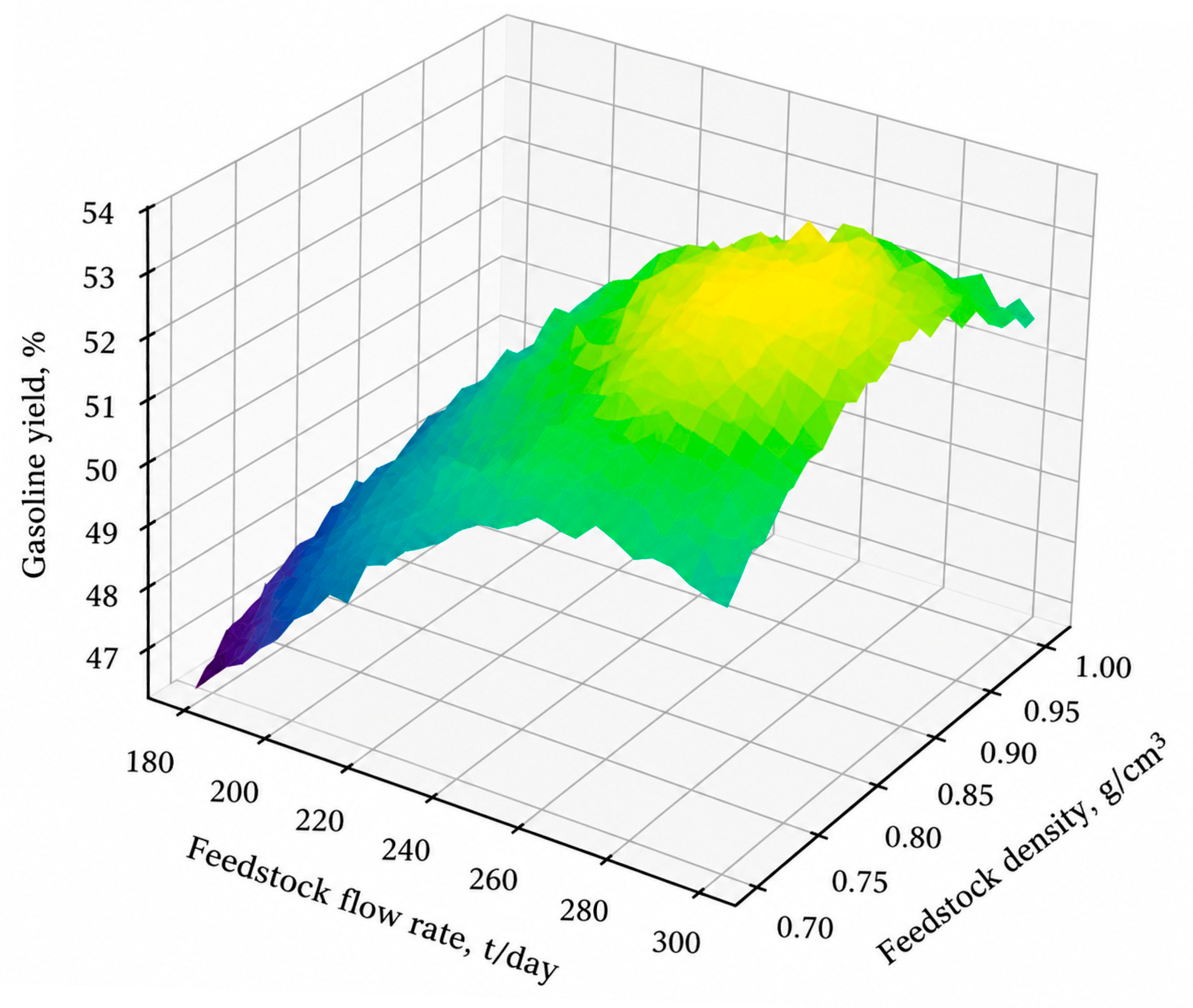
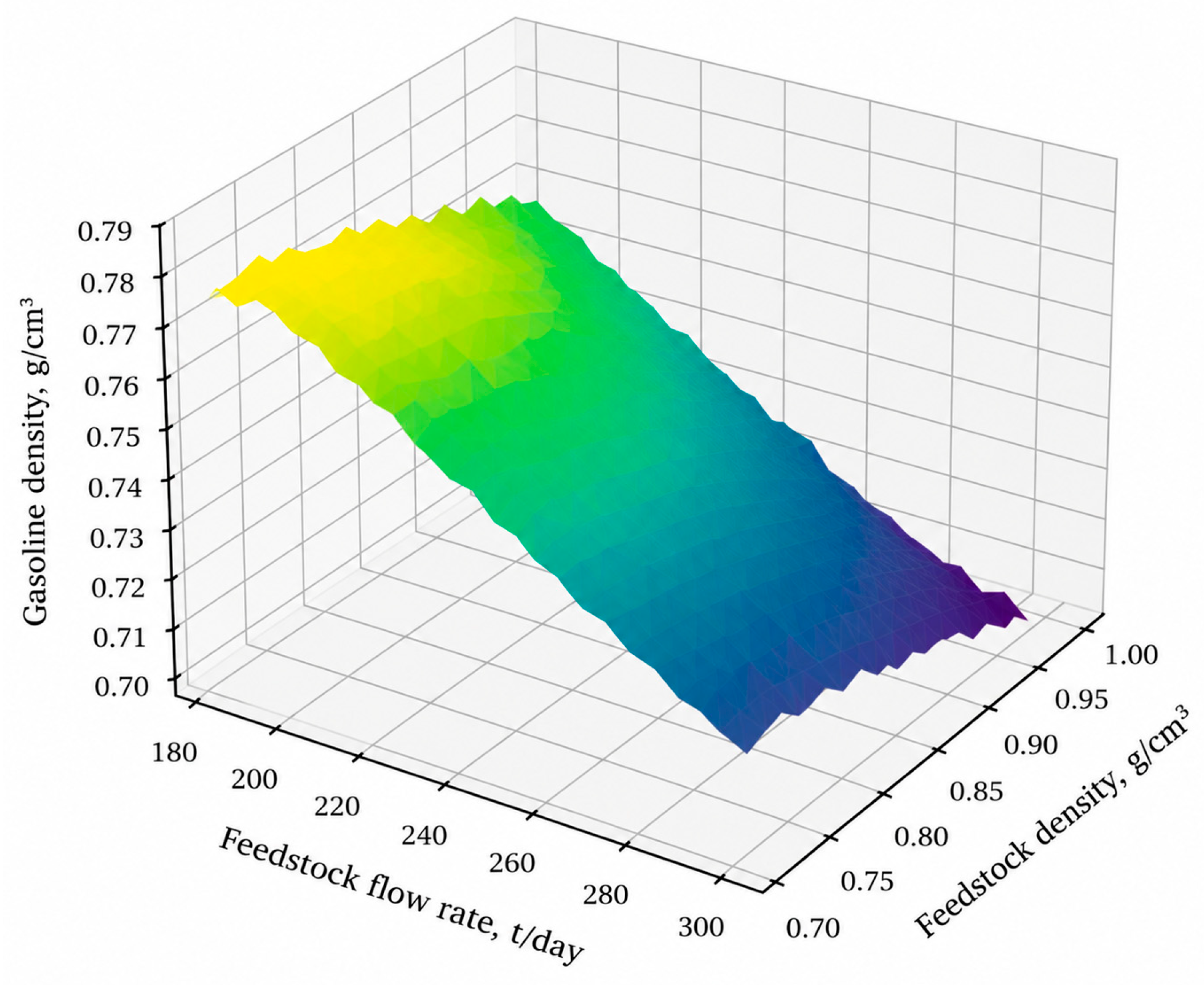
Figure 4 and Figure 5 show the three-dimensional input–output surfaces obtained in the Surface Viewer environment for the selected parameters.
Figure 4.
Dependence of gasoline yield on feedstock flow rate and density. The color gradient represents the predicted gasoline yield, with darker colors corresponding to lower values and lighter yellow-green colors corresponding to higher values.
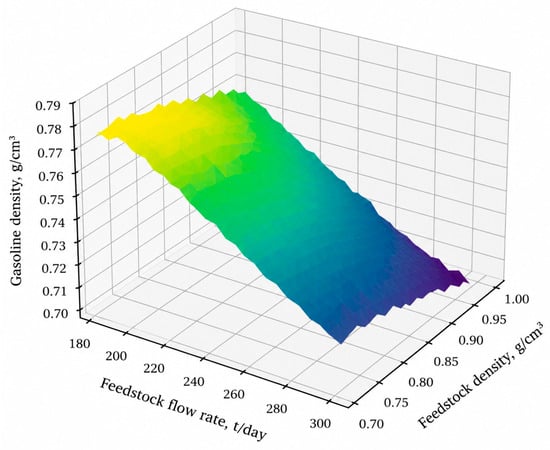
Figure 5.
Dependence of gasoline density on feedstock flow rate and density. The color gradient represents the predicted gasoline density, with darker colors corresponding to lower values and lighter yellow-green colors corresponding to higher values.
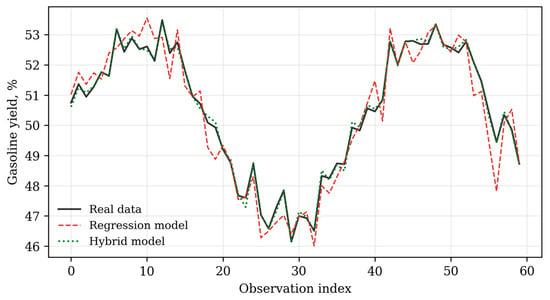
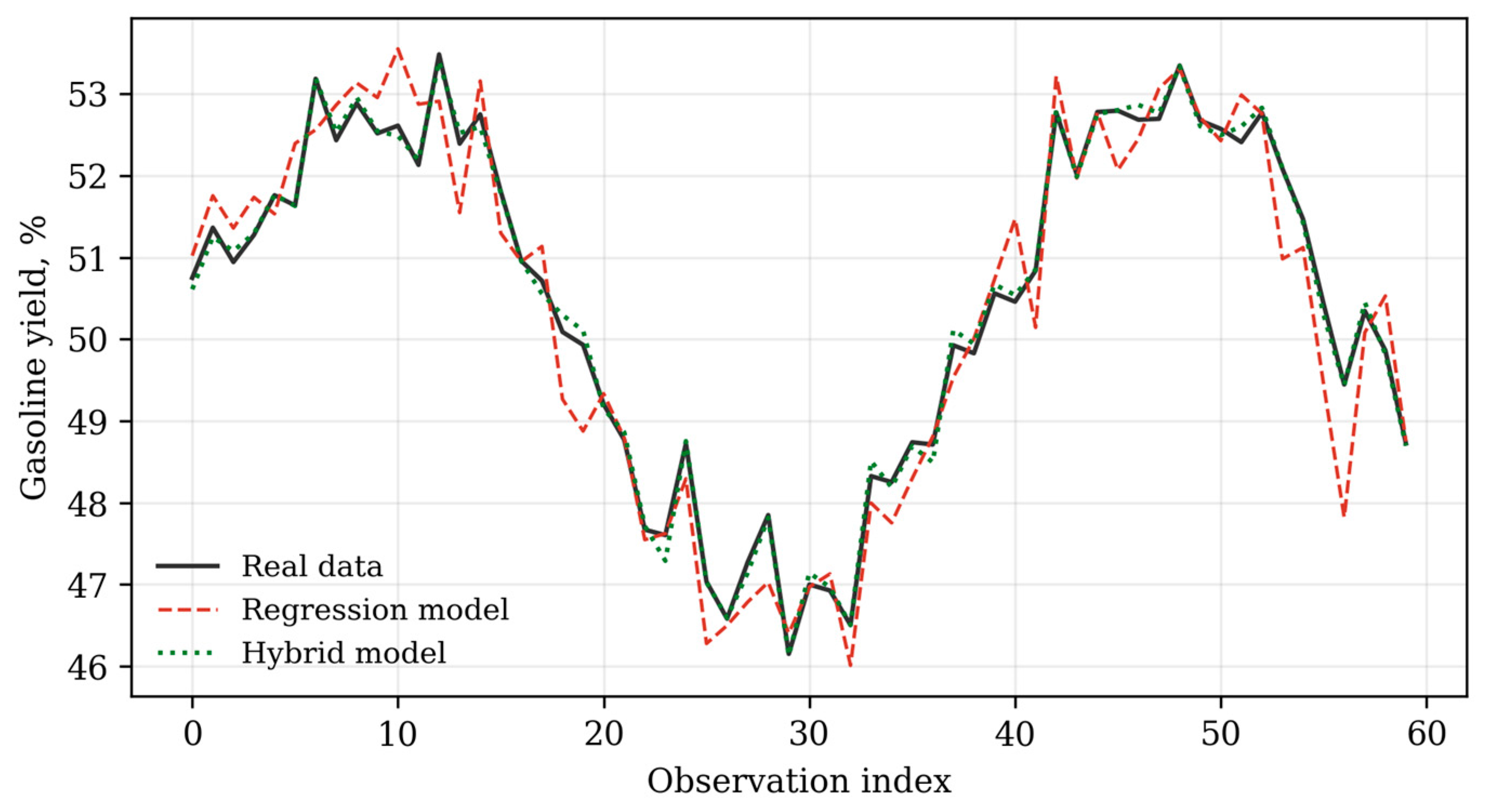
The regression and hybrid models were then compared using production data from the Shymkent Oil Refinery; Figure 6 shows real data alongside the regression-model and hybrid-model outputs.
Figure 6.
Comparison of Shymkent Oil Refinery production data with the regression and hybrid model outputs.
Table 5 summarizes the adequacy indicators obtained for the regression and hybrid models during verification.
Table 5.
Adequacy indicators for the regression and hybrid models.
Additional validation of the generalization capability of the hybrid model using an independent test set (20% of the data) confirmed its high robustness. Based on 5-fold cross-validation, the average root-mean-square error (RMSE) on the test data was 0.0172, and the mean relative error (MAPE) was 0.031%. The minor deviation of these metrics from those obtained on the training set (RMSE = 0.0161, MAPE = 0.028%) indicates the absence of overfitting. The model demonstrates strong out-of-sample performance and is capable of reliably predicting gasoline yield and density for new, previously unexplored operating conditions of the catalytic cracking unit. To quantitatively assess the individual contribution of each component to the overall performance of the developed system, a stepwise error-reduction analysis was conducted. The results of the quantitative analysis of the contribution of the hybrid model components to error reduction are presented in Table 6.
Table 6.
Quantitative analysis of the contribution of the hybrid model components to error reduction.
As shown in Table 6, the incorporation of the expert rule base (fuzzy logic) eliminates more than half (57.1%) of the initial error of the baseline regression. Subsequent application of machine learning algorithms to calculate the residual error further improves the result, bringing the overall error reduction to almost 92%. To objectively evaluate the effectiveness of the proposed approach, a systematic benchmark comparison was conducted against modern intelligent modeling methods, including an artificial neural network (multilayer perceptron, MLP) and an adaptive neuro-fuzzy inference system (ANFIS). The results of the comparative evaluation are summarized in Table 7.
Table 7.
Benchmark comparison with alternative modeling methods.
As the results in Table 7 show, the proposed hybrid architecture outperforms the alternative methods in terms of predictive accuracy while maintaining a high level of interpretability due to the use of an expert-defined rule base, in contrast to black-box structures.
4. Discussion
The verification performed shows that the proposed hybrid model provides high approximation accuracy for the catalytic cracking process and adequately reflects the nonlinear nature of the relationships between the parameters.
The results show that the use of regression models alone, despite their interpretability, is limited when describing complex multi-parameter processes under uncertainty. Regression models accurately reflect general trends in the output parameters, but do not account for local deviations caused by variability in feedstock composition, instability in catalyst activity, and fluctuations in process conditions.
The Mamdani-type fuzzy model formalizes the expert knowledge of process personnel and captures qualitative dependencies between process parameters. The use of linguistic variables and IF–THEN rules ensures the model’s interpretability and its compliance with process regulations; however, the static nature of the rule base limits the fuzzy model’s adaptability to changing plant operating conditions.
The proposed hybrid model combines the advantages of the regression and fuzzy approaches and is complemented by an adaptation mechanism based on machine learning. Within this framework, the regression model generates a basic quantitative approximation, the fuzzy system compensates for systematic deviations and accounts for uncertainty, and the machine-learning module adapts the model to new data through analysis of the residual error.
A comparative analysis (Figure 6) shows a closer agreement between the calculated and experimental data for the hybrid model; in certain sections of the time series, the amplitude of deviations decreases, indicating a more accurate reproduction of the local process dynamics.
The visualization of fuzzy inference (Figure 3) reflects the mechanism generating the corrective action from the values of the input parameters, and the behavior of the output signal confirms the consistency of the rule base and the correctness of the chosen membership functions.
The three-dimensional input–output surfaces (Figure 4 and Figure 5) show a pronounced nonlinear relationship between input and output parameters; the presence of nonlinear regions and saturation zones confirms the need for hybrid models to describe the process adequately.
A comparison of the quantitative indicators shows a significant reduction in forecasting error when using the hybrid model: RMSE decreased from 0.1973 to 0.0161, and MAPE from 0.328% to 0.028%, i.e., the model error decreased by more than 90%, indicating a significant increase in modeling accuracy. In practical terms, this reduction in prediction uncertainty allows the process to be operated with a smaller safety margin relative to the gasoline-density specification, moving the operating point closer to the yield-maximizing boundary of the feasible region. A preliminary assessment against historical operating data indicates that this translates into an approximate 3.2% increase in achievable gasoline yield and a 0.4% improvement in density stability compared with the control based on the regression model alone.
The stepwise analysis of the contribution of each module (Table 6) clearly reveals the operating mechanism of the proposed hybrid methodology. The basic regression successfully describes global macro-trends of the process but leaves a significant error (RMSE = 0.1973). The inclusion of a fuzzy controller, which formalizes engineering experience, compensates for systematic deviations, reducing the error by 57.1%. This confirms the value of expert knowledge in conditions of information uncertainty. The final module, based on machine learning algorithms, provides further refinement by identifying hidden patterns in the remaining “noise” (residual nonlinearities) that are inaccessible to either statistics or human experience. The synergy of these three approaches results in the high overall accuracy of the system while preserving its engineering interpretability.
Unlike classical statistical methods and purely fuzzy models, the proposed approach simultaneously provides interpretability, adaptability, and high accuracy. Compared with “black-box” machine learning methods, the hybrid model retains a transparent structure and allows the contribution of individual components to be analyzed—a significant advantage for industrial implementation.
The key scientific result of this work is the development of a hybrid methodology that integrates quantitative and qualitative modeling methods under uncertainty. Unlike existing approaches, the proposed framework uses machine learning not as the primary model but as an adaptive correction tool, increasing the model’s resilience to changes in the input data.
From a practical standpoint, the proposed model can be used in decision support systems and in the intelligent control of catalytic cracking units, increasing the yield of target products and stabilizing their quality.
Several limitations should nevertheless be noted. The model requires representative industrial data for proper parameter tuning, as well as additional adjustment of the fuzzy rule base when process conditions change significantly. Furthermore, the integration of three different mathematical approaches inevitably increases the overall computational complexity of the algorithm compared to basic controllers. However, a quantitative performance assessment showed that this limitation does not hinder the industrial implementation of the system. The average time to execute one forecast (inference time) when successively passing the input data vector through the regression, fuzzy, and machine learning components is approximately 25–40 milliseconds (when tested in the Python/MATLAB environment on a standard processor with a clock frequency of 2.5 GHz). Since the catalytic cracking process is characterized by high thermal and material inertia, and sampling times of in-line instrumentation traditionally range from several seconds to minutes, the achieved computing speed fully satisfies the stringent requirements of real-time process control.
The results obtained are consistent with current research in hybrid modeling and confirm the potential of integrating regression, fuzzy, and learning models for solving control problems in complex technological processes.
The practical value of the developed methodology lies in its applicability to the creation of intelligent closed-loop control. Implementing such a closed-loop control system at an industrial facility involves three stages. At the first stage, the system is deployed as a “virtual analyzer” operating in an advisory mode (open-loop), providing recommendations to the operator. At the second stage, the algorithm is integrated with the plant Distributed Control System (DCS) through standardized data exchange protocols such as OPC UA. At the third and final stage, the hybrid model is incorporated into an Advanced Process Control/Model Predictive Control (APC/MPC) architecture.
In the closed-loop configuration, the system will continuously analyze input disturbances, particularly variations in feedstock quality, and adjust the setpoints of the underlying PID controllers in real time, including reactor temperature and catalyst flow rate. This will enable automatic maximization of gasoline yield while maintaining gasoline density within the specified limits, thereby minimizing the need for routine operator intervention in the control loop.
5. Conclusions
This paper develops and examines a hybrid methodology for the intelligent control of the catalytic cracking process under conditions of initial information uncertainty. The proposed approach is based on the integration of regression modeling, fuzzy logic, and machine learning methods within a single computational framework.
The analysis revealed the limitations of the individual methods in modeling complex technological processes. Regression models provide an interpretable description of global dependencies but do not account for local nonlinear effects; fuzzy models formalize expert knowledge and capture qualitative dependencies but have limited adaptability. This justifies the use of a hybrid approach that combines the advantages of both methods.
The study included a correlation analysis of production data that identified the most significant process parameters. Regression models were constructed with quadratic and cross terms, and a Mamdani-type fuzzy model was synthesized from an expert rule base. In addition, a mechanism for adaptive correction of the model using machine learning methods was implemented, ensuring that residual nonlinearities are taken into account.
Testing the proposed methodology on real data from the Shymkent Oil Refinery demonstrated a significant improvement in modeling accuracy: RMSE decreased from 0.1973 to 0.0161 and MAPE from 0.328% to 0.028%, an error reduction of more than 90%, corresponding to an estimated 3.2% increase in gasoline yield and a 0.4% improvement in density stability under real operating conditions.
The key scientific result is a hybrid model that simultaneously provides interpretability, adaptability, and high accuracy. Unlike “black-box” models, the proposed approach maintains a transparent structure and allows the contribution of individual components to be analyzed.
The practical significance of this work lies in the potential use of the developed model in decision support systems and in the intelligent control of catalytic cracking units. Applying the proposed methodology can increase the yield of target products, stabilize their quality characteristics, and reduce dependence on expensive measurement systems through the implementation of “virtual analyzer” functions.
The limitations of the study include the use of production data from a single industrial facility, the need for representative production data for model tuning, the need for additional adjustment of the fuzzy rule base when operating conditions change significantly, and the increased computational complexity associated with integrating multiple modeling components. Although the independent test set and 5-fold cross-validation demonstrated good generalization capability, further validation using data from other operating periods and industrial facilities would strengthen the assessment of the model’s robustness and transferability.
Prospects for further research include developing online model-adaptation methods, expanding and adaptively updating the fuzzy rule base, validating the proposed methodology using data from other operating periods and industrial facilities, and integrating the developed system into SCADA/DCS and APC/MPC environments to implement closed-loop intelligent control.
Author Contributions
Conceptualization, N.B.; methodology, N.B.; software, N.B.; validation, B.O. and N.B.; formal analysis, A.Z.; investigation, M.K.; resources, A.K.; data curation, T.K.; writing—original draft preparation, B.O. and N.B.; writing—review and editing, B.O., N.B. and G.A.; visualization, M.K. and G.A. All authors have read and agreed to the published version of the manuscript.
Funding
This research was funded by the Science Committee of the Ministry of Education and Science of the Republic of Kazakhstan (Grant No. AP25795091, “Development of an Intelligent Control System for the Catalytic Cracking Process”).
Institutional Review Board Statement
Not applicable.
Informed Consent Statement
Not applicable.
Data Availability Statement
The datasets generated and/or analyzed during the current study are not publicly available due to legal and confidentiality restrictions. However, data are available from the corresponding authors on reasonable request.
Conflicts of Interest
The authors declare no conflicts of interest.
Abbreviations
The following abbreviations are used in this manuscript:
| RFCC | Residual fluid catalytic cracking |
| RMSE | Root mean square error |
| MAPE | Mean absolute percentage error |
References
- Orazbayev, B.; Boranbayeva, N.; Makhatova, V.; Rzayeva, L.; Ospanov, Y.; Kurmashev, I.; Kurmangaziyeva, L. Development and Synthesis of Linguistic Models for Catalytic Cracking Unit in a Fuzzy Environment. Processes 2024, 12, 1543. [Google Scholar] [CrossRef] [Scilit]
- Orazbayev, B.; Kozhakhmetova, D.; Wójtowicz, R.; Krawczyk, J. Modeling of a Catalytic Cracking in the Gasoline Production Installation with a Fuzzy Environment. Energies 2020, 13, 4736. [Google Scholar] [CrossRef] [Scilit]
- Acosta-López, J.G.; de Lasa, H. Artificial Intelligence for Hybrid Modeling in Fluid Catalytic Cracking (FCC). Processes 2024, 12, 61. [Google Scholar] [CrossRef] [Scilit]
- Josiah, P.; Otaraku, I.; Evbuomwan, B. Servo and Regulatory Response of an Industrial Fluid Catalytic Cracking (FCC) Unit under Fuzzy Logic Supervisory Control. Eng. Technol. J. 2023, 41, 1139–1151. [Google Scholar] [CrossRef] [Scilit]
- Palos, R.; Rodríguez, E.; Gutiérrez, A.; Bilbao, J.; Arandes, J.M. Kinetic Modeling for the Catalytic Cracking of Tires Pyrolysis Oil. Fuel 2022, 309, 122055. [Google Scholar] [CrossRef] [Scilit]
- Han, I.S.; Chung, C.B. Dynamic modeling and simulation of a fluidized-bed reactor–regenerator system in an FCC unit. Part I Chem. Eng. Sci. 2001, 56, 1951–1971. [Google Scholar]
- Han, I.S.; Chung, C.B. Dynamic modeling and simulation of a fluidized-bed reactor–regenerator system in an FCC unit. Part II Chem. Eng. Sci. 2001, 56, 1973–1990. [Google Scholar]
- López-Isunza, F. Dynamic Modelling of an Industrial Fluid Catalytic Cracking Unit. Comput. Chem. Eng. 1992, 16, 139–148. [Google Scholar] [CrossRef] [Scilit]
- Gupta, R.; Kumar, V.; Srivastava, V.K. Modeling and Simulation of Fluid Catalytic Cracking Unit. Rev. Chem. Eng. 2005, 21, 95–131. [Google Scholar] [CrossRef] [Scilit]
- Jiang, H.; Zhong, G.; Ning, H.; Ouyang, F.; Weng, H. Lumping Kinetic Model of Heavy Oil Catalytic Cracking for MIP Technology. Acta Pet. Sin. (Pet. Process. Sect.) 2010, 26, 901–909. [Google Scholar] [CrossRef]
- Santander, O.; Kuppuraj, V.; Harrison, C.A.; Baldea, M. Deep Learning Model Predictive Control Frameworks: Application to a Fluid Catalytic Cracker–Fractionator Process. Ind. Eng. Chem. Res. 2023, 62, 10587–10600. [Google Scholar] [CrossRef] [Scilit]
- Orazbayev, B.; Dyussembina, E.; Uskenbayeva, G.; Shukirova, A.; Orazbayeva, K. Methods for Modeling and Optimizing the Delayed Coking Process in a Fuzzy Environment. Processes 2023, 11, 450. [Google Scholar] [CrossRef] [Scilit]
- Zhao, Z.W.; Wang, D.H. Statistical Inference for Generalized Random Coefficient Autoregressive Model. Math. Comput. Model. 2012, 56, 152–166. [Google Scholar] [CrossRef] [Scilit]
- Kadlec, P.; Gabrys, B.; Strandt, S. Data-Driven Soft Sensors in the Process Industry. Comput. Chem. Eng. 2009, 33, 795–814. [Google Scholar] [CrossRef] [Scilit]
- Turlykozhayeva, D.; Akhtanov, S.; Zhexebay, D.; Ussipov, N.; Baigaliyeva, A.; Wójcik, W.; Boranbayeva, N. Evaluating Machine Learning-Based Routing Algorithms on Various Wireless Network Topologies. In Proceedings of the SPIE Symposium on Photonics Applications in Astronomy, Communications, Industry, and High-Energy Physics Experiments (WILGA), Lublin, Poland, 27–30 June 2024. [Google Scholar] [CrossRef] [Scilit]
- Khaldi, M.K.; Al-Dhaifallah, M.; Taha, O. Artificial Intelligence Perspectives: A Systematic Literature Review on Modeling, Control, and Optimization of Fluid Catalytic Cracking. Alex. Eng. J. 2023. [Google Scholar] [CrossRef] [Scilit]
- Yang, F.; Xu, M.; Lei, W.; Lv, J. Artificial Intelligence Methods Applied to Catalytic Cracking Processes. Big Data Min. Anal. 2023, 6, 361–380. [Google Scholar] [CrossRef] [Scilit]
- He, G.; Cui, J.; Huang, X.; Liu, B. Data-Driven Online Optimization for Fluid Catalytic Cracking Using Bayesian Case-Based Reasoning. Chem. Eng. Technol. 2025, 48, e70137. [Google Scholar] [CrossRef] [Scilit]
- Psichogios, D.C.; Ungar, L.H. A Hybrid Neural Network–First Principles Approach to Process Modeling. AIChE J. 1992, 38, 1499–1511. [Google Scholar] [CrossRef] [Scilit]
- Ni, P.; Liu, B.; He, G. An Online Optimization Strategy for a Fluid Catalytic Cracking Process Using a Case-Based Reasoning Method Based on Big Data Technology. RSC Adv. 2021, 11, 28557–28564. [Google Scholar] [CrossRef] [Scilit]
- Soh, J.C.; Chong, S.L.; Hossain, S.S.; Cheng, C.K. Catalytic Ethylene Production from Ethanol Dehydration over Non-Modified and Phosphoric Acid Modified Zeolite H-Y (80) Catalysts. Fuel Process. Technol. 2017, 158, 231–240. [Google Scholar] [CrossRef] [Scilit]
- Ancheyta, J. Modeling and Simulation of Catalytic Reactors for Petroleum Refining; John Wiley & Sons: Hoboken, NJ, USA, 2011. [Google Scholar] [CrossRef] [Scilit]
- Weekman, V.W. A Model of Catalytic Cracking Conversion in Fixed, Moving, and Fluid-Bed Reactors. Ind. Eng. Chem. Process Des. Dev. 1968, 7, 90–95. [Google Scholar] [CrossRef] [Scilit]
- Qin, S.J.; Badgwell, T.A. A Survey of Industrial Model Predictive Control Technology. Control Eng. Pract. 2003, 11, 733–764. [Google Scholar] [CrossRef] [Scilit]
- Venkatasubramanian, V. The Promise of Artificial Intelligence in Chemical Engineering: Is It Here, Finally? AIChE J. 2019, 65, 466–478. [Google Scholar] [CrossRef] [Scilit]
- Arbel, A.; Rinard, I.H.; Shinnar, R. Dynamics and Control of Fluidized Catalytic Crackers. 4. The Impact of Design on Partial Control. Ind. Eng. Chem. Res. 1997, 36, 747–761. [Google Scholar] [CrossRef] [Scilit]
- Schweidtmann, A.; Esche, E.; Fischer, A.; Kloft, M.; Repke, J.-U.; Sager, S.; Mitsos, A. Machine Learning in Chemical Engineering: A Perspective. Chem. Ing. Tech. 2021, 93, 1510–1525. [Google Scholar] [CrossRef] [Scilit]
- Rudin, C. Stop Explaining Black Box Machine Learning Models for High Stakes Decisions and Use Interpretable Models Instead. Nat. Mach. Intell. 2019, 1, 206–215. [Google Scholar] [CrossRef] [Scilit]
- Zadeh, L.A. Fuzzy Sets. Inf. Control 1965, 8, 338–353. [Google Scholar] [CrossRef] [Scilit]
- Dubois, D.; Prade, H. Fuzzy Sets and Systems: Theory and Applications; Academic Press: Cambridge, MA, USA, 1980. [Google Scholar]
- Kaufmann, A.; Gupta, M.M. Introduction to Fuzzy Arithmetic: Theory and Applications. In Van Nostrand Reinhold; Van Nostrand Reinhold Company: New York, NY, USA, 1991. [Google Scholar]
- Box, G.E.P.; Jenkins, G.M.; Reinsel, G.C. Time Series Analysis: Forecasting and Control; Wiley: Hoboken, NJ, USA, 2008. [Google Scholar]
- Papoulis, A.; Pillai, S.U. Probability, Random Variables and Stochastic Processes; McGraw-Hill: Columbus, OH, USA, 2002. [Google Scholar]
- Ross, S.M. Introduction to Probability Models; Academic Press: New York, NY, USA, 2014. [Google Scholar]
- Mamdani, E.H.; Assilian, S. An Experiment in Linguistic Synthesis with a Fuzzy Logic Controller. Int. J. Man-Mach. Stud. 1975, 7, 1–13. [Google Scholar] [CrossRef] [Scilit]
- Orazbayev, B.; Zhumadillayeva, A.; Orazbayeva, K.; Kurmangaziyeva, L.; Dyussekeyev, K.; Iskakova, S. Methods for Developing Models in a Fuzzy Environment of Reactor and Hydrotreating Furnace of a Catalytic Reforming Unit. Appl. Sci. 2021, 11, 8317. [Google Scholar] [CrossRef] [Scilit]
- Jang, J.-S.R. ANFIS: Adaptive-Network-Based Fuzzy Inference System. IEEE Trans. Syst. Man Cybern. 1993, 23, 665–685. [Google Scholar] [CrossRef] [Scilit]
- Zadeh, L.A. Outline of a New Approach to the Analysis of Complex Systems and Decision Processes. IEEE Trans. Syst. Man. Cybern. 1973, 3, 28–44. [Google Scholar] [CrossRef] [Scilit]
- von Stosch, M.; Oliveira, R.; Peres, J.; de Azevedo, S.F. Hybrid Semi-Parametric Modeling in Process Systems Engineering: Past, Present and Future. Comput. Chem. Eng. 2014, 60, 86–101. [Google Scholar] [CrossRef] [Scilit]
- Mamdani, E.H. Application of Fuzzy Algorithms for Control of Simple Dynamic Plant. Proc. Inst. Electr. Eng. 1974, 121, 1585–1588. [Google Scholar] [CrossRef] [Scilit]
- Zimmermann, H.-J. Fuzzy Set Theory—And Its Applications; Springer: Berlin/Heidelberg, Germany, 2011. [Google Scholar]
- Sildir, H.; Arkun, Y.; Canan, U.; Celebi, S.; Karani, U.; Er, I. Dynamic Modeling and Optimization of an Industrial Fluid Catalytic Cracker. J. Process Control 2015, 31, 30–44. [Google Scholar] [CrossRef] [Scilit]
- Ali, H.; Rohani, S. Dynamic Modeling and Simulation of a Riser-Type Fluid Catalytic Cracking Unit. Chem. Eng. Technol. 2004, 27, 147–155. [Google Scholar] [CrossRef] [Scilit]

Disclaimer/Publisher’s Note: The statements, opinions and data contained in all publications are solely those of the individual author(s) and contributor(s) and not of MDPI and/or the editor(s). MDPI and/or the editor(s) disclaim responsibility for any injury to people or property resulting from any ideas, methods, instructions or products referred to in the content. |
© 2026 by the authors. Licensee MDPI, Basel, Switzerland. This article is an open access article distributed under the terms and conditions of the Creative Commons Attribution (CC BY) license.