


Abstract
Our recent studies demonstrated that dialkylaminopyridine organocatalysts featuring an extensive secondary sphere preferentially phosphorylate the alcohol at the apolar domain of a model amphiphilic diol. In the present study, this site-selective behavior was corroborated across a broader range of amphiphilic diols. Furthermore, we found that the site selectivity can be inverted by applying certain saturated aliphatic amine bases in stoichiometric amounts. Screening identified cis-2,6-dimethylpiperidine as the most selective promoter, consistently inducing phosphorylation at the polar domain across all tested diols. Remarkably, despite being a secondary amine, this base did not produce any detectable phosphoramidate byproduct.
1. Introduction
Derivatives of phosphoric acid, particularly phosphoric acid esters of alcohols and phenols, are of crucial importance in living organisms [1,2]. Compounds bearing these moieties are essential for numerous structural, functional, and developmental roles in biological systems [3,4,5,6,7,8,9,10,11]. Accordingly, the synthesis of phosphate-ester-equipped molecules is of immense importance in the life sciences. In nature, the incorporation of this functional group into alcohol-including molecules is conducted by kinase enzymes [12]. Compared with the highly chemo-, stereo-, and site-selective biocatalytic phosphorylations of alcohols performed by enzymes [13,14,15,16,17,18,19], most chemical phosphorylation techniques employing P(V) reagents are considerably less selective. Nevertheless, some examples of chemoselective [20,21,22,23,24,25,26], site-selective [27,28,29,30], enantioselective [31,32,33,34] and diastereoselective [35,36,37] alcohol phosphorylation with such reagents have been demonstrated, predominantly using organocatalytic systems, such as imidazole derivatives [27,31,32,33,35,36,37], pyridine N-oxides [25,30], and boronic acid derivatives [24,29], while a few metal-incorporating catalytic systems for selective alcohol phosphorylation have also been communicated [23,26,28,34].
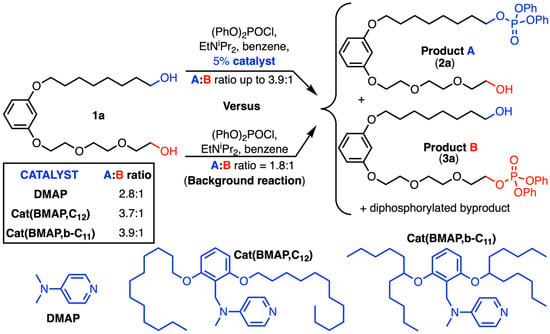
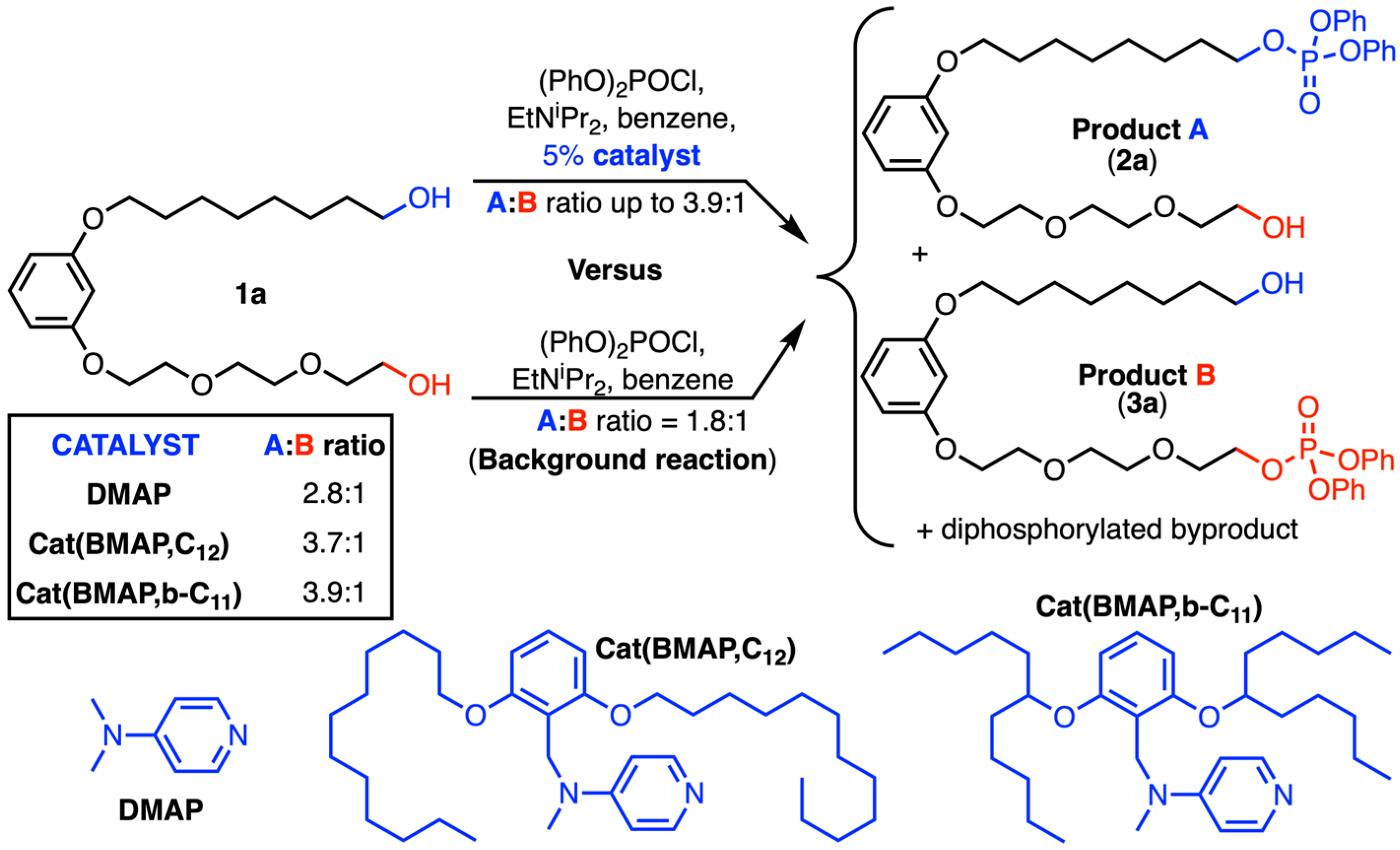
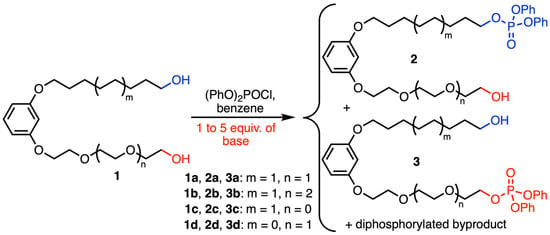
Recently, we reported that the use of 4-aminopyridine-based catalysts reinforces the innate preference of a model amphiphilic diol 1a to undergo phosphorylation at the apolar-site alcohol (Scheme 1) [38,39,40]. Herein, we demonstrate that this preference extends to similar diols and describe a strategy to overturn the innate selectivity, directing the phosphorylation preferentially to the polar-site alcohol.
Scheme 1.
Enhancement of site selectivity in the phosphorylation of a model amphiphilic diol by 4-aminopyridine-based catalysts, compared with the innate selectivity.
2. Materials and Methods
2.1. General Experimental Conditions
All reactions were conducted under nitrogen atmosphere in oven-dried glassware with magnetic stirring. Dry benzene and DMF were purchased at the highest available purity and used as received. Ethyl acetate, hexane, and methanol, as well as HPLC-grade water, methanol, and acetonitrile, were purchased and used as received. All reagents were purchased at the highest available purity and used as received. Column chromatography was performed using Merck silica gel 60 (particle size 0.04–0.063 mm). Thin-layer chromatography (TLC) was performed on silica gel plates (Merck 60 F254), and the compounds were visualized by irradiation with UV light or by staining with KMnO4. 1H NMR (400 MHz) and 13C NMR (100 MHz) spectra were recorded on a Bruker AVANCE-400 spectrometer, in CDCl3 with residual CHCl3 (1H, 7.26 ppm), or CDCl3 (13C, 77.0 ppm), as internal standards. MS analyses were conducted on a Waters SYNAPT instrument (ESI, APCI, or APPI methods) or Waters Autospec instrument (EI method). HPLC experiments were carried out using an Apollo C18 5 μm column on a Hitachi Elite LaChrome instrument, equipped with a diode array UV/Vis detector, with acetonitrile and water as the eluting solvents.
The synthesis of 1a and 3-((8-hydroxyoctyl)oxy)phenol, as well as the isolation and characterization of the products of phosphorylation of 1a (2a, 3a, and the corresponding diphosphate), were communicated previously [38,41]. All phosphorylation experiments were performed in duplicate or triplicate with good reproducibility of the observed conversion and selectivity values.
2.2. Synthesis of Substrates
8-(3-(2-(2-(2-(2-hydroxyethoxy)ethoxy)ethoxy)ethoxy)phenoxy)octan-1-ol (1b):
To a stirred suspension of 3-((8-hydroxyoctyl)oxy)phenol (0.75 g, 3.15 mmol, 1.0 equiv.) [41] and K2CO3 (1.30 g, 9.44 mmol, 3.0 equiv.) in dry DMF (35 mL), 2-(2-(2-(2-chloroethoxy)ethoxy)ethoxy)ethan-1-ol (0.84 mL, 4.74 mmol, 1.5 equiv.) was added. The reaction mixture was stirred at 90 °C for 21 h. The mixture was diluted with water (40 mL) and extracted with ethyl acetate (3 × 40 mL). The combined extracts were washed with water (6 × 60 mL), dried over MgSO4, and concentrated under reduced pressure. Purification by flash column chromatography (SiO2, EtOAc) afforded the pure product as a pink oil (0.83 g, 1.99 mmol, 63% yield).
1H NMR (400 MHz, CDCl3): δ 7.14 (t, J = 8.1 Hz, 1H); 6.50–6.48 (m, 3H); 4.11 (distorted t, J = 4.8 Hz, 2H); 3.92 (t, J = 6.5 Hz, 2H); 3.84 (distorted t, J = 4.8 Hz, 2H); 3.73–3.58 (m, 14H); 2.10 (broad s, 2H); 1.76 (quin, J = 7.0 Hz, 2H); 1.56 (distorted quin, J = 6.6 Hz, 2H); 1.46–1.35 (m, 8H). 13C NMR (100 MHz, CDCl3): δ 160.5, 160.0, 129.9, 107.3, 106.8, 101.7, 72.7, 70.9, 70.8, 70.7, 70.4, 69.8, 68.1, 67.5, 63.1, 61.8, 32.8, 29.4–29.3 (apparent m), 26.1, 25.8. HRMS (ESI) m/z calcd. for C22H38O7Na ([M + Na]+) 437.2515, found 437.2516.
8-(3-(2-(2-hydroxyethoxy)ethoxy)phenoxy)octan-1-ol (1c):
To a stirred suspension of 3-((8-hydroxyoctyl)oxy)phenol (0.34 g, 1.42 mmol, 1.0 equiv.) [41] and K2CO3 (0.59 g, 4.26 mmol, 3.0 equiv.) in dry DMF (38 mL), 2-(2-chloroethoxy)ethan-1-ol (0.22 mL, 2.13 mmol, 1.5 equiv.) was added. The reaction mixture was stirred at 90 °C for 18 h. The mixture was diluted with water (20 mL) and extracted with ethyl acetate (3 × 20 mL). The combined extracts were washed with water (6 × 30 mL), dried over MgSO4, and concentrated under reduced pressure. Purification by flash column chromatography (SiO2, EtOAc:hexane 80:20) afforded the pure product as a light pink solid (0.35 g, 1.07 mmol, 76% yield).
1H NMR (400 MHz, CDCl3): δ 7.16 (t, J = 8.1 Hz, 1H); 6.52–6.48 (m, 3H); 4.12 (distorted t, J = 4.8 Hz, 2H); 3.93 (t, J = 6.6 Hz, 2H); 3.86 (distorted t, J = 4.8 Hz, 2H); 3.76 (distorted t, J = 4.4 Hz, 2H); 3.68–3.62 (m, 4H); 1.76 (quin, J = 6.9 Hz, 2H); 1.57 (distorted quin, J = 6.6 Hz, 2H); 1.47–1.36 (m, 8H). 13C NMR (100 MHz, CDCl3): δ 160.4, 159.9, 129.9, 107.3, 106.7, 101.7, 72.7, 69.7, 68.0, 67.5, 63.0, 61.8, 32.8, 29.3–29.2 (apparent m), 26.0, 25.7. HRMS (ESI) m/z calcd. for C18H30O5Na ([M + Na]+) 349.1991, found 349.1988.
3-((6-hydroxyhexyl)oxy)phenol:
The 6-bromo-1-hexanol (1.48 mL, 11.35 mmol, 1.0 equiv.) was added dropwise to a stirred suspension of resorcinol (2.50 g, 22.71 mmol, 2.0 equiv.) and K2CO3 (3.14 g, 22.71 mmol, 2.0 equiv.) in dry DMF (90 mL) at room temperature. The reaction mixture was stirred under nitrogen at room temperature for 17 h. The mixture was diluted with water (160 mL) and extracted with ethyl acetate (3 × 160 mL). The combined extracts were washed with water (6 × 100 mL), dried over MgSO4, and concentrated under reduced pressure. Purification by flash column chromatography (SiO2, EtOAc:hexane 50:50) afforded the pure product as a light orange solid (0.94 g, 4.47 mmol, 39% yield).
1H NMR (400 MHz, CDCl3): δ 7.11 (distorted t, J = 8.4 Hz, 1H); 6.47 (m, 1H); 6.42–6.39 (m, 2H); 3.93 (t, J = 6.5 Hz, 2H); 3.67 (t, J = 6.5 Hz, 2H); 1.79 (quin, J = 6.9 Hz, 2H); 1.61 (quin, J = 6.9 Hz, 2H); 1.53–1.39 (m, 4H). 13C NMR (100 MHz, CDCl3): δ 160.5, 157.2, 130.2, 107.9, 106.9, 102.2, 68.0, 63.1, 32.6, 29.2, 25.9, 25.5.
6-(3-(2-(2-(2-hydroxyethoxy)ethoxy)ethoxy)phenoxy)hexan-1-ol (1d):
To a stirred suspension of 3-((6-hydroxyhexyl)oxy)phenol (0.75 g, 3.56 mmol, 1.0 equiv.) and K2CO3 (1.47 g, 10.67 mmol, 3.0 equiv.) in dry DMF (35 mL), 2-(2-(2-chloroethoxy)ethoxy)ethan-1-ol (0.78 mL, 5.33 mmol, 1.5 equiv.) was added. The reaction mixture was stirred at 90 °C for 21 h. The mixture was diluted with water (50 mL) and extracted with ethyl acetate (3 × 50 mL). The combined extracts were washed with water (6 × 80 mL), dried over MgSO4, and concentrated under reduced pressure. Purification by flash column chromatography (SiO2, EtOAc) afforded the pure product as a brown oil (0.47 g, 1.36 mmol, 39% yield).
1H NMR (400 MHz, CDCl3): δ 7.15 (t, J = 8.3 Hz, 1H); 6.50–6.46 (m, 3H); 4.10 (distorted t, J = 4.8 Hz, 2H); 3.92 (t, J = 6.5 Hz, 2H); 3.84 (distorted t, J = 4.8 Hz, 2H); 3.73–3.66 (m, 6H); 3.64–3.59 (m, 4H); 2.25 (broad s, 2H); 1.76 (quin, J = 6.9 Hz, 2H); 1.58 (quin, J = 6.9 Hz, 2H); 1.50–1.38 (m, 4H). 13C NMR (100 MHz, CDCl3): δ 160.4, 160.0, 130.0, 107.3, 106.8, 101.8, 72.7, 70.9, 70.4, 69.8, 68.0, 67.4, 62.9, 61.8, 32.7, 29.3, 26.0, 25.6. HRMS (ESI) m/z calcd. for C16H30O6Na ([M + Na]+) 365.1940, found 365.1935.
2.3. General Phosphorylation Procedures
The catalytic phosphorylation reaction of the primary diol substrates:
To the solution of the diol substrate (0.1 mmol, 1.0 equiv.) in anhydrous benzene (1.0 mL), the catalyst (0.005 mmol, 0.05 equiv.), DIPEA (43.5 μL, 0.25 mmol, 2.5 equiv.), and finally diphenyl chlorophosphate (51.8 μL, 0.25 mmol, 2.5 equiv.) were added. The solution was stirred at room temperature. During the reaction, aliquots were taken at constant intervals (30 μL per sample) and quenched with methanol (0.5 mL). Each sample was analyzed using HPLC to determine the ratio between the monophosphorylated products and the degree of consumption. Alternatively, for product characterization, the reaction was quenched with excess methanol at ca. 75% conversion, the solvents were evaporated, and the products were separated chromatographically.
The base-induced phosphorylation reaction of the primary diol substrates:
To the solution of the diol substrate (0.1 mmol, 1.0 equiv.) in anhydrous benzene (1.0 mL), the base (0.1–0.5 mmol, 1–5 equiv.) and diphenyl chlorophosphate (51.8 μL, 0.25 mmol, 2.5 equiv.) were added. The solution was stirred at room temperature. During the reaction, aliquots were taken at constant intervals (30 μL per sample) and quenched with methanol (0.5 mL). Each sample was analyzed using HPLC to determine the ratio of the monophosphorylated products and the degree of consumption.
2.4. Characterization of the Phosphorylation Products
The products derived from 1b were purified on preparative RP-HPLC (30–10% ACN in water) and obtained as colorless oils. Yields: 2b 23%, 3b 7%, and diphosphorylated product 9%.
2b: product of the monophosphorylation of 1b at the apolar site:
1H NMR (400 MHz, CDCl3): δ 7.33 (distorted t, J = 7.9 Hz, 4H); 7.23–7.13 (m, 7H); 6.50–6.48 (m, 3H); 4.24 (q, J = 6.9 Hz, 2H); 4.11 (distorted t, J = 4.8 Hz, 2H); 3.91 (t, J = 6.5 Hz, 2H); 3.84 (distorted t, J = 4.8 Hz, 2H); 3.74–3.67 (m, 10H); 3.60 (distorted t, J = 4.4 Hz, 2H); 2.23 (broad s, 1H); 1.78–1.67 (m, 4H); 1.43–1.31 (m, 8H). 13C NMR (100 MHz, CDCl3): δ 160.5, 160.1, 150.7 (d, JC-P = 7.0 Hz), 129.9 (2C), 125.4, 120.2 (d, JC-P = 4.7 Hz), 107.3, 106.8, 101.8, 72.6, 70.9, 70.7, 70.6, 70.4, 69.9, 69.5 (d, JC-P = 6.5 Hz), 68.0, 67.5, 61.8, 30.3 (d, JC-P = 6.6 Hz), 29.3 (2C), 29.1, 26.1, 25.4. 31P NMR (162 MHz, CDCl3): δ −11.9. HRMS (ESI) m/z calcd. for C34H47O10PNa ([M + Na]+) 669.2805, found 669.2808.
3b: product of the monophosphorylation of 1b at the polar site:
1H NMR (400 MHz, CDCl3): δ 7.33 (distorted t, J = 7.8 Hz, 4H); 7.24–7.12 (m, 7H); 6.50–6.47 (m, 3H); 4.37 (m, 2H); 4.09 (distorted t, J = 4.9 Hz, 2H); 3.91 (t, J = 6.5 Hz, 2H); 3.83 (distorted t, J = 4.9 Hz, 2H); 3.73–3.70 (m, 4H); 3.69–3.61 (m, 8H); 1.75 (quin, J = 7.0 Hz, 2H); 1.56 (distorted quin, J = 6.6 Hz, 2H); 1.44–1.35 (m, 8H). 13C NMR (100 MHz, CDCl3): δ 160.5, 160.1, 150.7 (d, JC-P = 7.2 Hz), 129.9 (2C), 125.5, 120.3 (d, JC-P = 4.7 Hz), 107.3, 106.8, 101.8, 70.9, 70.8 (2C), 70.7, 70.0 (d, JC-P = 6.5 Hz), 69.9, 68.3 (d, JC-P = 6.1 Hz), 68.1, 67.5, 63.2, 32.9, 29.4 (2C), 29.3, 26.1, 25.8. 31P NMR (162 MHz, CDCl3): δ −11.8. HRMS (ESI) m/z calcd. for C34H47O10PNa ([M + Na]+) 669.2805, found 669.2806.
Product of the diphosphorylation of 1b:
1H NMR (400 MHz, CDCl3): δ 7.35–7.31 (m, 8H); 7.24–7.12 (m, 13H); 6.50–6.46 (m, 3H); 4.37 (m, 2H); 4.25 (q, J = 6.9 Hz, 2H); 4.09 (distorted t, J = 4.9 Hz, 2H); 3.90 (t, J = 6.5 Hz, 2H); 3.82 (distorted t, J = 4.9 Hz, 2H); 3.73–3.70 (m, 4H); 3.69–3.61 (m, 6H); 1.77–1.64 (m, 4H); 1.43–1.31 (m, 8H). 13C NMR (100 MHz, CDCl3): δ 160.5, 160.1, 150.7 (d, JC-P = 7.5 Hz), 150.6 (d, JC-P = 8.1 Hz), 129.9 (3C), 125.5, 125.4, 120.3 (d, JC-P = 5.3 Hz), 120.2 (d, JC-P = 5.7 Hz), 107.2, 106.8, 101.7, 70.9, 70.8 (2C), 70.7, 70.0 (d, JC-P = 6.7 Hz), 69.9, 69.5 (d, JC-P = 6.4 Hz), 68.3 (d, JC-P = 6.1 Hz), 68.0, 67.5, 30.3 (d, JC-P = 6.6 Hz), 29.3 (2C), 29.1, 26.1, 25.4. 31P NMR (162 MHz, CDCl3): δ −11.8. HRMS (ESI) m/z calcd. for C46H56O13P2Na ([M + Na]+) 901.3094, found 901.3099.
The products derived from 1c were purified by column chromatography (silica gel, EtOAc:hexane) and obtained as colorless oils. Yields: 2c 37%, 3c 9%, and diphosphorylated product 13%.
2c: product of the monophosphorylation of 1c at the apolar site:
1H NMR (400 MHz, CDCl3): δ 7.34 (distorted t, J = 7.6 Hz, 4H); 7.26–7.14 (m, 7H); 6.52–6.48 (m, 3H); 4.25 (q, J = 6.6 Hz, 2H); 4.12 (distorted t, J = 4.7 Hz, 2H); 3.91 (t, J = 6.5 Hz, 2H); 3.86 (distorted t, J = 4.7 Hz, 2H); 3.76 (distorted t, J = 4.5 Hz, 2H); 3.67 (distorted t, J = 4.5 Hz, 2H); 1.78–1.67 (m, 4H); 1.43–1.32 (m, 8H). 13C NMR (100 MHz, CDCl3): δ 160.5, 160.0, 150.7 (d, JC-P = 7.0 Hz), 130.0, 129.9, 125.4, 120.2 (d, JC-P = 4.7 Hz), 107.4, 106.7, 101.8, 72.7, 69.8, 69.5 (d, JC-P = 6.5 Hz), 68.0, 67.5, 61.9, 30.3 (d, JC-P = 6.6 Hz), 29.3, 29.1, 26.1, 25.4. 31P NMR (162 MHz, CDCl3): δ −11.9. HRMS (ESI) m/z calcd. for C30H39O8PNa ([M + Na]+) 581.2280, found 581.2286.
3c: product of the monophosphorylation of 1c at the polar site:
1H NMR (400 MHz, CDCl3): δ 7.31 (distorted t, J = 7.9 Hz, 4H); 7.23 (m, 4H); 7.19–7.13 (m, 3H); 6.51–6.45 (m, 3H); 4.41 (m, 2H); 4.05 (distorted t, J = 4.8 Hz, 2H); 3.91 (t, J = 6.5 Hz, 2H); 3.80 (distorted t, J = 4.8 Hz, 4H); 3.64 (t, J = 6.6 Hz, 2H); 1.76 (quin, J = 7.0 Hz, 2H); 1.59–1.53 (presumably quin, overlaps with H2O peak, 2H); 1.46–1.35 (m, 8H). 13C NMR (100 MHz, CDCl3): δ 160.5, 160.0, 150.7 (d, JC-P = 7.2 Hz), 129.9 (2C), 125.5, 120.3 (d, JC-P = 4.6 Hz), 107.4, 106.7, 101.8, 70.1 (d, JC-P = 6.7 Hz), 69.9, 68.3 (d, JC-P = 6.1 Hz), 68.1, 67.5, 63.2, 32.9, 29.5–29.3 (apparent m), 26.1, 25.8. 31P NMR (162 MHz, CDCl3): δ −11.9. HRMS (ESI) m/z calcd. for C30H39O8PNa ([M + Na]+) 581.2280, found 581.2275.
Product of the diphosphorylation of 1c:
1H NMR (400 MHz, CDCl3): δ 7.33 (distorted t, J = 8.0 Hz, 8H); 7.25–7.13 (m, 13H); 6.52–6.47 (m, 3H); 4.41 (m, 2H); 4.25 (q, J = 7.3 Hz, 2H); 4.05 (distorted t, J = 4.7 Hz, 2H); 3.90 (t, J = 6.5 Hz, 2H); 3.79 (distorted t, J = 4.6 Hz, 4H); 1.78–1.69 (m, 4H); 1.42–1.32 (m, 8H). 13C NMR (100 MHz, CDCl3): δ 160.4, 160.0, 150.7 (d, JC-P = 7.4 Hz), 150.6 (d, JC-P = 7.2 Hz), 129.9 (apparent m), 125.4, 125.3, 120.2 (d, JC-P = 4.8 Hz), 120.1 (d, JC-P = 4.9 Hz), 107.3, 106.6, 101.7, 70.1 (d, JC-P = 6.2 Hz), 69.8, 69.5 (d, JC-P = 6.2 Hz), 68.2 (d, JC-P = 6.0 Hz), 68.0, 67.4, 30.2 (d, JC-P = 6.5 Hz), 29.3 (2C), 29.0, 26.0, 25.3. 31P NMR (162 MHz, CDCl3): δ −11.8. HRMS (ESI) m/z calcd. for C42H48O11P2Na ([M + Na]+) 813.2570, found 813.2578.
The products derived from 1d were purified by column chromatography (silica gel, EtOAc:hexane) and obtained as colorless oils. Yields: 2d 29%, 3d 10%, and diphosphorylated product 12%.
2d: product of the monophosphorylation of 1d at the apolar site:
1H NMR (400 MHz, CDCl3): δ 7.34 (distorted t, J = 7.8 Hz, 4H); 7.23–7.13 (m, 7H); 6.52–6.47 (m, 3H); 4.26 (q, J = 6.8 Hz, 2H); 4.12 (distorted t, J = 4.8 Hz, 2H); 3.90 (t, J = 6.4 Hz, 2H); 3.85 (distorted t, J = 4.8 Hz, 2H); 3.74–3.69 (m, 6H); 3.62 (distorted t, J = 4.5 Hz, 2H); 1.73 (quin, J = 6.7 Hz, 2H); 1.62 (presumably m, overlaps with H2O peak, 2H); 1.44–1.36 (m, 4H). 13C NMR (100 MHz, CDCl3): δ 160.4, 160.0, 150.7 (d, JC-P = 6.7 Hz), 130.0, 129.9, 125.4, 120.2 (d, JC-P = 4.4 Hz), 107.2, 106.8, 101.8, 72.7, 71.0, 70.5, 69.9, 69.2 (d, JC-P = 6.2 Hz), 67.8, 67.5, 61.9, 30.2 (d, JC-P = 6.5 Hz), 29.2, 25.7, 25.3. 31P NMR (162 MHz, CDCl3): δ −11.9. HRMS (ESI) m/z calcd. for C30H39O9PNa ([M + Na]+) 597.2229, found 597.2230.
3d: product of the monophosphorylation of 1d at the polar site:
1H NMR (400 MHz, CDCl3): δ 7.33 (distorted t, J = 7.8 Hz, 4H); 7.24–7.12 (m, 7H); 6.50–6.47 (m, 3H); 4.38 (m, 2H); 4.08 (distorted t, J = 4.8 Hz, 2H); 3.92 (t, J = 6.4 Hz, 2H); 3.82 (distorted t, J = 4.8 Hz, 2H); 3.74 (distorted t, J = 4.1 Hz, 2H); 3.66–3.63 (m, 6H); 1.78 (quin, J = 6.9 Hz, 2H); 1.63 (m, 2H); 1.52–1.42 (m, 4H). 13C NMR (100 MHz, CDCl3): δ 160.4, 160.1, 150.7 (d, JC-P = 7.0 Hz), 129.9 (2C), 125.5, 120.3 (d, JC-P = 4.6 Hz), 107.3, 106.8, 101.7, 70.9 (2C), 70.0 (d, JC-P = 7.1 Hz), 69.9, 68.3 (d, JC-P = 6.3 Hz), 68.0, 67.5, 63.0, 32.8, 29.3, 26.0, 25.7. 31P NMR (162 MHz, CDCl3): δ −11.9. HRMS (ESI) m/z calcd. for C30H39O9PNa ([M + Na]+) 597.2229, found 597.2237.
Product of the diphosphorylation of 1d:
1H NMR (400 MHz, CDCl3): δ 7.35–7.31 (m, 8H); 7.24–7.12 (m, 13H); 6.49–6.45 (m, 3H); 4.38 (m, 2H); 4.26 (q, J = 6.8 Hz, 2H); 4.08 (distorted t, J = 4.1 Hz, 2H); 3.88 (t, J = 6.4 Hz, 2H); 3.82 (distorted t, J = 4.8 Hz, 2H); 3.74 (m, 2H); 3.67–3.63 (m, 4H); 1.73 (quin, J = 6.7 Hz, 2H); 1.56 (presumably m, overlaps with H2O peak, 2H); 1.42–1.38 (m, 4H). 13C NMR (100 MHz, CDCl3): δ 160.4, 160.1, 150.7 (d, JC-P = 6.9 Hz), 129.9, 125.5, 125.4, 120.2 (d, JC-P = 5.2 Hz), 120.1 (d, JC-P = 5.7 Hz), 107.2, 106.8, 101.7, 70.9 (2C), 70.0 (d, JC-P = 7.2 Hz), 69.9, 69.4 (d, JC-P = 6.0 Hz), 68.3 (d, JC-P = 6.2 Hz), 67.8, 67.5, 32.0, 29.2, 25.7, 25.3. 31P NMR (162 MHz, CDCl3): δ −11.9. HRMS (ESI) m/z calcd. for C42H48O12P2Na ([M + Na]+) 829.2519, found 829.2521.
3. Results and Discussion
3.1. Examination of Catalytic Site-Selective Phosphorylation Across a Range of Amphiphilic Diol Substrates
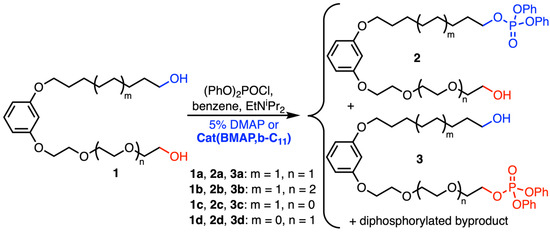
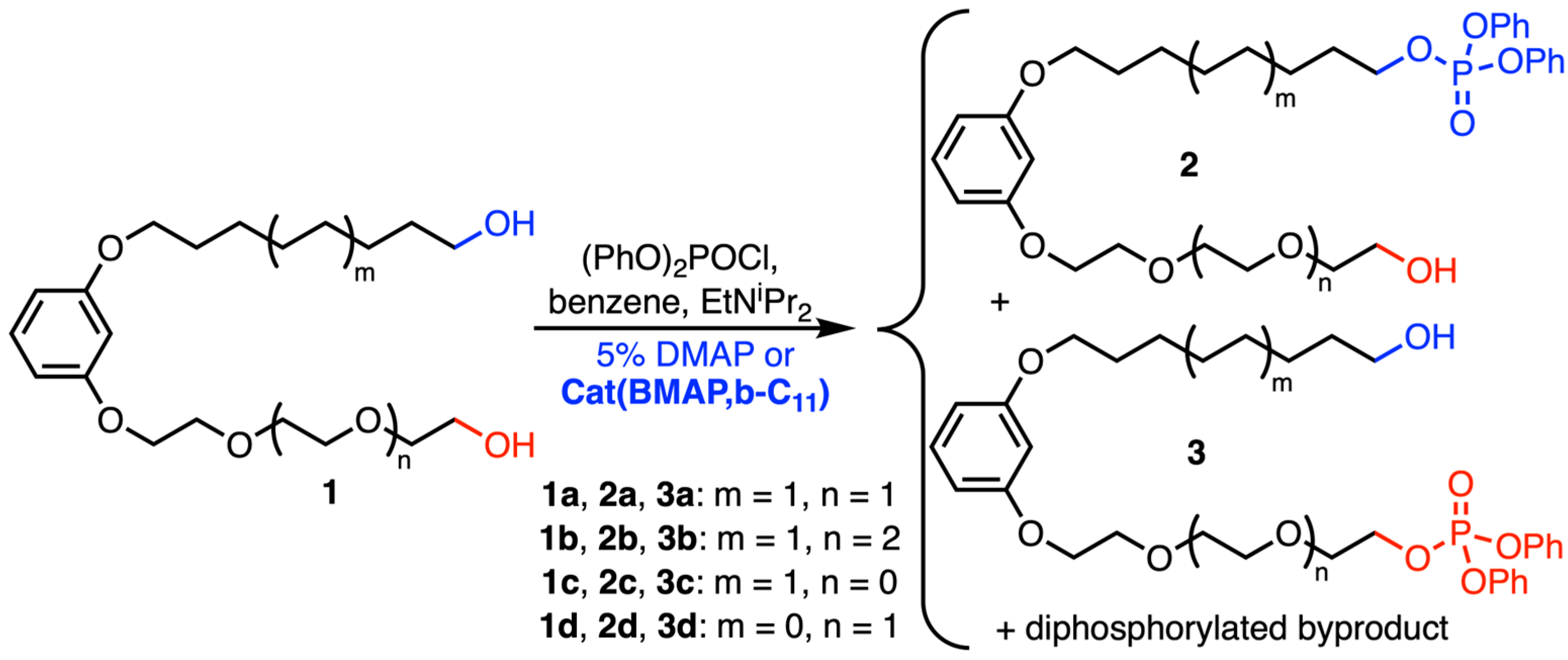
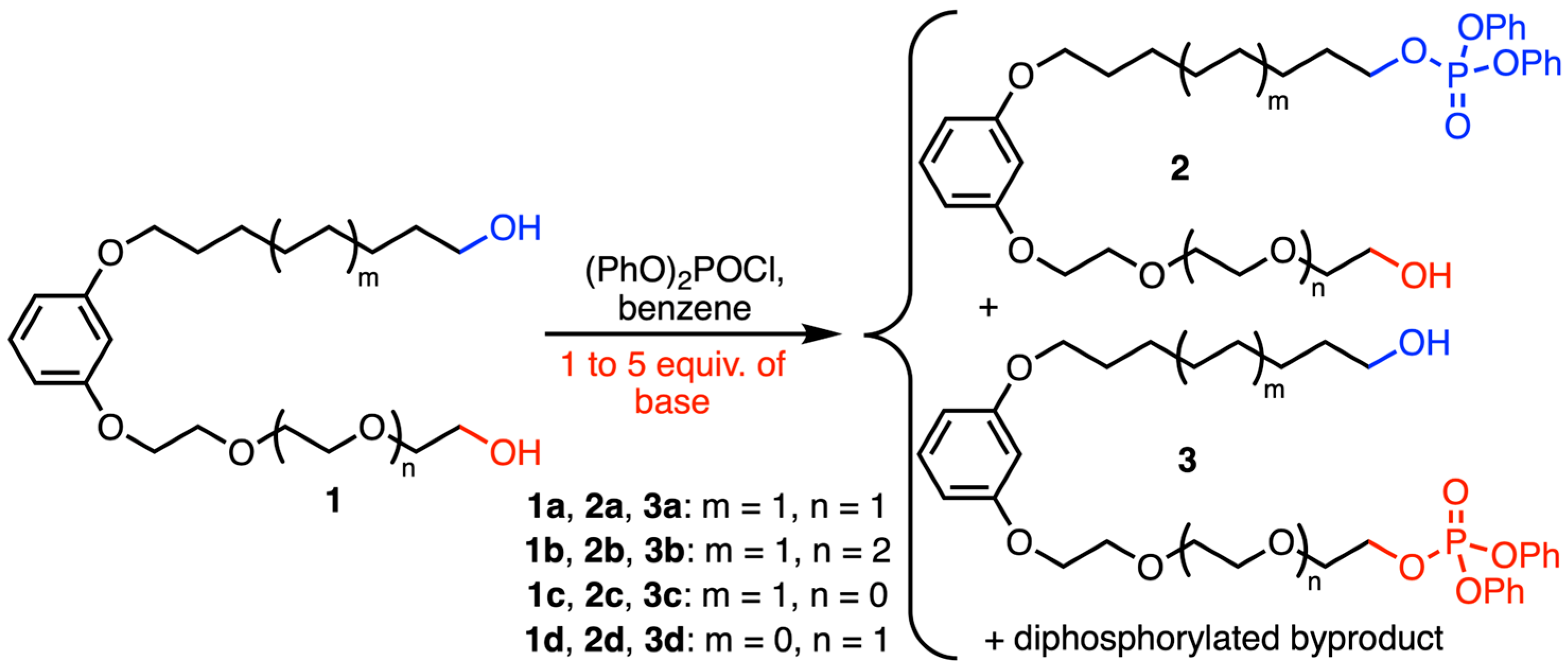
In addition to substrate 1a, three additional amphiphilic substrates 1b–1d were prepared (Scheme 2). Compared to 1a, substrates 1b and 1c incorporate a longer and a shorter polar arm, respectively, while the length of the apolar arm is preserved. Substrate 1d incorporates a shorter apolar arm, while the length of the polar arm is upheld as in 1a. Testing of the substrates in the model phosphorylation reaction (Scheme 2) revealed that both DMAP and the catalyst Cat(BMAP,b-C11), which was found to be the most apolar-site-favoring in the previous studies, produce similar results with all substrates (Table 1). Site selectivity was higher for the catalyst Cat(BMAP,b-C11) prepared in our lab (3.5:1 to 3.9:1) compared to DMAP (2.0:1 to 3.2:1), with the substrates possessing longer arms displaying, in general, slightly better selectivity toward the phosphorylation at the apolar site. Time to 50% consumption of the substrate was shorter for Cat(BMAP,b-C11) (34–40 s) compared to 47–62 s for DMAP, whereas with both catalysts, the shorter-arm substrates were functionalized faster. In other words, while the experiments with all substrates show similar trends, those with longer polar and apolar arms react somewhat slower but in a more selective manner. The catalysts prepared in our lab [38,39,40,42], particularly Cat(BMAP,b-C11), are more active and site-selective (favoring the apolar domain) than the benchtop DMAP.
Scheme 2.
Catalytic phosphorylation of additional amphiphilic diols.
Table 1.
Enhancement of site selectivity by 4-aminopyridine-based catalysts in the phosphorylation of amphiphilic diols 1.
3.2. Looking for Base-Induced Site-Selective Polar-Site-Favoring Phosphorylation of Amphiphilic Diols
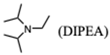
Being able to considerably shift the selectivity of the reaction toward the phosphorylation at the apolar site prompted the search for the opposite selectivity, i.e., directing the reaction toward the alcohol at the polar site of the diols. In a presumably mechanistically related acylation reaction, this task could be achieved by the addition of a stoichiometric amount of base to the solution of the diol amphiphile and the acylation agent (anhydride). The strongest effect on the site selectivity was exerted by medium-strength tertiary aliphatic amine bases, such as ethyldiisopropylamine (DIPEA) or triethylamine (TEA), likely due to the difference in the pKa values of the two alcohol sites and a shift in the reaction mechanism toward general-base catalysis [41,43]. Examination of the influence of various bases on the phosphorylation reaction of substrate 1a (Scheme 3), particularly its site selectivity, revealed a substantially different portrayal (Table 2). In this case, the use of 2.5 equivalents of DIPEA almost did not change the innate selectivity of the substrate and only slightly improved the rate of the reaction (estimated by measuring the time to 50% consumption of the diol and compared to the background reaction [38], Table 2, entry 1). TEA, however, had a remarkably stronger effect on both the time required for the reaction to reach 50% consumption, which was shortened from multiple hours to mere 44 min, and the site selectivity that was inverted, with the ratio of 1.1:1 between the monophosphorylated products in favor of 3a, the product phosphorylated at the polar site (Table 2, entry 2). While the basicity of both DIPEA and TEA is very close, their nucleophilicity is very different, with DIPEA considered as a non-nucleophilic base as a result of severe steric hindrance around the nitrogen [44]1.
Scheme 3.
Phosphorylation of amphiphilic diols in the presence of amine bases.
Table 2.
Screening the bases for the reversal of the innate site selectivity in phosphorylation of a model diol amphiphile 1.
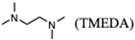
Seeing as the steric bulkiness of the base has a profound effect, we have chosen to test a number of saturated aliphatic tertiary amine bases with a substantially reduced steric size of the alkyl substituents (Table 2, entries 3–8). In the case of acyclic amines, the site selectivity was slightly improved in favor of the polar site (up to a 1.3:1 product ratio, entries 3–5). It was not influenced by the basicity of the base (with the electron-withdrawing influence of the β-heteroatom lowering this parameter for TMEDA and 2-methoxy-N,N-dimethylethanamine), leaving the steric size of the base as a major selectivity-influencing factor. The reaction rate showed, however, a stronger dependence on the base’s basicity/nucleophilicity2. Steric bulkiness around the amine site is further reduced in cyclic saturated tertiary amines. Three methyl-substituted cyclic amines were examined in the model reaction (entries 6–8), providing selectivity-wise a slight preference for the phosphorylation at the polar site (up to a 1.4:1 product ratio). While the activity of the bases (measured as the time required to reach 50% consumption) followed the nucleophilicity of the compounds [45]3, such a correlation was not observed for the site selectivity parameter of the reaction. Furthermore, no direct correlation between either the activity or selectivity displayed by the bases in the model reaction and their basicity was apparent [46]4. Surprised by the slightly better selectivity displayed by the less nucleophilic and basic of the three bases (entry 8), we examined an additional cyclic amine of even lower basicity/nucleophilicity (entry 9)5. However, this compound was significantly less active and preferentially promoted functionalization at the apolar site.
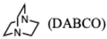
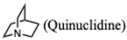
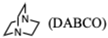
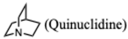
The reaction in the presence of even more sterically compact and nucleophilic bicyclic bases, DABCO and quinuclidine [47], was so fast that it was impractical to monitor it under similar reaction conditions with 2.5 equivalents of the base6. Instead, we conducted the reaction in the presence of just one equivalent of these bases (entries 10–11), even though with this amount of base, as observed also for all previously mentioned bases, the reaction proceeds beyond approximately 50–60% consumption only at a very slow rate and, therefore, appears impractical. Under these conditions, only DABCO induced a slight preference toward the phosphorylation at the polar site. Although diluting the reaction slows it and allows conducting and monitoring the experiments with 2.5 equiv. of DABCO or quinuclidine (entries 12–13), the dilution seems to favor the reaction at the apolar site. We learned this from comparing the two sets of conditions for N-methylpyrrolidine (entry 14 vs. entry 6). Thus, the desirable site selectivity could not be reached with the bicyclic bases.
Surprisingly, the use of stronger nitrogen bases (that are not tertiary aliphatic amines) did not provide any encouraging results, with the reaction being fast but erratic and forming a phosphorylated base byproduct in the case of DBU or being slow and poorly selective in the case of TBD or Proton-sponge® [48,49]7.
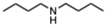
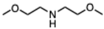
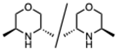
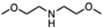
Noteworthy, phosphorylated bases were never observed in a detectable amount when tertiary aliphatic amine bases were used. We suspected that this would not be the situation if secondary amines were used as bases but were tempted to examine them due to their high basicity and nucleophilicity, and reduced steric bulk, both promising better selectivity in favor of the polar site. Indeed, when simple dialkyl amines, such as diethyl-, dibutyl-, or dioctyl-amine8, were applied in the model reaction, the selectivity was strongly shifted (entries 15–17). Up to a 5:1 ratio of monophosphorylated products in favor of 3a was observed at 50% consumption, and the reaction rate was notably faster than that displayed with tertiary amine bases. However, HPLC monitoring and proton NMR indicated the presence of a significant amount of the phosphoramidate byproduct during the reaction [50]9. To avoid this, we tried two approaches. First, we examined secondary amines that are less basic. While bis(2-methoxyethyl)amine (less basic/nucleophilic than simple dialkylamines due to the electron-withdrawing effect of oxygens) [51] promotes a slower and less selective reaction (entry 18), it forms a significantly lower amount of phosphoramidate byproduct and still induces the reaction at the polar site preferably (1.7:1 3a-to-2a ratio). Believing that steric hindrance of the base can reduce phosphoramidate formation, alone or in combination with reduced basicity, we examined two sterically hindered secondary amines, 2,2,6,6-tetramethylpiperidine and 3,3,5,5-tetramethyl morpholine. In both cases, we found that phosphoramidate byproducts were not observed, but the selectivity favored the apolar site. With the less basic morpholine derivative, a slower and more apolar-site-favoring phosphorylation was induced. Since the formation of the phosphoramidate byproduct dominated the reaction in the presence of sterically compact, unsubstituted morpholine, we decided to explore the influence of a gradual reduction of the steric bulk displayed by the tetramethylmorpholine derivative. Interestingly, in the case of 3,5-dimethylmorpholine, presenting a moderate steric hindrance around the amine nitrogen, there was a strong influence of the spatial arrangement of the two methyl groups on the outcome of the model substrate phosphorylation (entries 19–20). Thus, when the reaction was carried out in the presence of 2.5 equivalents of trans-3,5-dimethylmorpholine, it reached 50% consumption in ca. 33 min, and the phosphorylation product at the apolar site was preferred with a 3a:2a ratio of 0.7:1. However, when it was executed in the presence of cis-3,5-dimethylmorpholine, the consumption of 50% was achieved in a shorter time (24 min), and the 3a:2a ratio was 1.8:1, demonstrating an inversion of the site selectivity in favor of the polar site. Traces of the corresponding phosphoramidate byproduct could be detected in the reaction mixture in the case of the trans-isomer. Remarkably, in the case of the cis-isomer, the corresponding byproduct was not observed at all. Encouraged by this result, we examined cis-2,6-dimethylpiperidine, a stronger and more nucleophilic secondary base with a comparable steric bulk and spatial arrangement of the methyls (entry 21). Gratifyingly, the model reaction in the presence of this amine was fast and the most selective in favor of the polar site, reaching a 3.3:1 ratio of the monophosphorylated products at 50% consumption. Furthermore, also for this secondary base, the formation of the unwanted phosphoramidate byproduct was evaded.
All the experiments described above were conducted with 2.5 equivalents of the base, except DABCO and quinuclidine, which were examined with the loading of one equivalent as well. This screening revealed that, for the bases that do not form phosphoramidate byproducts, the highest 3a:2a ratio at 50% conversion could be reached using a secondary cis-2,6-dimethylpiperidine amine (3.3:1). Related cis-3,5-dimethylmorpholine provided a substantially lower ratio of 1.8:1, while a tertiary N-methylmorpholine base induced a 1.4:1 3a:2a product ratio (the highest among the examined tertiary amines). A ratio of 1.7:1 was attained using bis(2-methoxyethyl)amine, albeit with a certain amount of phosphoramidate byproduct accompanying the diol phosphorylation products. Simple dialkylamines induced even higher selectivity (up to a 5:1 3a:2a ratio), but these reactions were complicated by a very substantial formation of phosphoramidates. To pursue higher selectivity, we decided to examine the model reaction with 5 equivalents of cis-2,6-dimethylpiperidine, cis-3,5-dimethylmorpholine, N-methylmorpholine, and bis(2-methoxyethyl)amine (Table 3).
Table 3.
Phosphorylation of the amphiphilic diols with 5 equivalents of the most polar-site-favoring bases 1.
For all four bases, the increase in loading accelerated the reaction, shortening the times required for the 50% consumption. For bis(2-methoxyethyl)amine, the selectivity increased to 1.9:1 (entry 2), but this improvement was accompanied by a substantial rise in the amount of the phosphoramidate byproduct, thus eliminating this base as a possible promoter of the polar-site-favoring phosphorylation. The tertiary amine N-methylmorpholine induced only a disappointing 1.7:1 ratio of the monophosphorylated products (entry 1). Gratifyingly, the other two bases provided excellent results. For cis-2,6-dimethylpiperidine, an outstanding 3a:2a ratio of 3.8:1 was obtained at 50% consumption (entry 6), without a concurrent formation of phosphoramidate, while cis-3,5-dimethylmorpholine emerged as a runner-up, inducing a 3a:2a ratio of 3.2:1 and evading the formation of the phosphorylated amine byproduct as well (entry 3). From the increase in the 3a:2a ratio upon increase of the amount of the base used, we may presume that a higher loading of the base could push the ratio between the monophosphorylated products even higher, but this seems hardly practical.
Subsequently, we conducted catalytic experiments with diol substrates 1b–1d in the presence of the two bases that showed the optimal polar-site-directed selectivity (Table 3, entries 4–6 and 8–10). These experiments revealed that, also for these amphiphiles, the bases induced a substantial preference for phosphorylation of the polar site alcohol with a 3:2 ratio above 2.5:1 for 3,5-dimethylmorpholine and above 3:1 for 2,6-dimethylpiperidine.
While the stoichiometric use of saturated nitrogen bases emerges as a key approach for preferential modification at the polar site in both the phosphorylation and acylation of model amphiphilic diols, a major distinction between the two reactions lies in the influence of base steric size on the outcome. In phosphorylation, bases that favor polar-site modification must not only fall within a specific basicity range but also remain below a certain steric bulk. This additional constraint effectively narrows the “Goldilocks zone” of bases identified for acylations into a more restricted “Goldilocks island” for phosphorylations [43]. This behavior may reflect the greater steric demand of the electrophile (phosphoryl chloride vs. carboxylic anhydride), which is likely to interact with the diol-base complex in the transition state, assuming the reaction proceeds via a general-base-like mechanism.
3.3. Evaluation of the Optimal Timing for Maximizing the Yield of the Dominant Monofunctionalized Product
In all experiments, the site selectivity induced by the different catalysts and bases was compared at reaction times corresponding to 50% consumption of the diol substrate 1. This comparison point was selected in order to minimize the influence of diphosphorylation on the ratio between the monophosphorylated products, thereby providing a more direct reflection of the intrinsic selectivity under a given set of reaction conditions. The ratios were extracted from the HPLC-based monitoring of the reaction mixture composition over time.
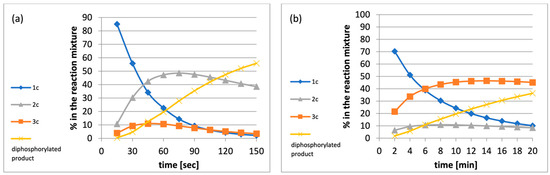
Beyond the evaluation of site selectivity, the monitoring data also provide practical information regarding the optimal timing for reaction quenching to maximize the isolated yield of the dominant monophosphorylated product (2 or 3, depending on the reaction conditions). Representative reaction profiles are shown in Figure 1 for apolar-site-selective and polar-site-selective phosphorylation conditions.
Figure 1.
Monitoring the phosphorylation reaction of 1c in the presence of 5 mol % of Cat(BMAP,b-C11) (a) or 5 equivalents of cis-2,6-dimethylpiperidine (b).
As illustrated in Figure 1, the proportion of the major monophosphorylated product (2c in Figure 1a and 3c in Figure 1b) continues to increase substantially beyond 50% substrate consumption and reaches a maximum at approximately 85% conversion. In contrast, the proportion of the minor monophosphorylated product in the reaction mixture reaches its maximum at an earlier stage of the reaction (approximately 65% conversion) and subsequently decreases. This behavior is consistent with the minor monofunctionalized product being formed more slowly, but consumed more rapidly in the subsequent phosphorylation step, likely due to the higher reactivity of the remaining hydroxyl group relative to that in the major monofunctionalized product. Consequently, the apparent selectivity between the monophosphorylated products increases considerably as the reaction progresses beyond 50% consumption (see Tables S3 and S4 in the Supplementary Material).
From a preparative perspective, the minor monophosphorylated product constitutes the principal challenge in the isolation of the major (desired) product, since both products possess similar polarity and identical molecular mass, whereas the starting material and diphosphorylated product are generally easier to separate chromatographically. Accordingly, quenching the reaction at 85–90% substrate consumption appears optimal for maximizing the isolated yield of the dominant monophosphorylated product, as this stage represents a practical balance between near-maximal accumulation of the desired product and substantial depletion of the competing monophosphorylated isomer.
To demonstrate this experimentally, we conducted the phosphorylation of 1a under the optimal apolar-site-favoring conditions (5 mol % of Cat(BMAP,b-C11)), as well as under the optimal polar-site-favoring conditions (5 equivalents of cis-2,6-dimethylpiperidine), identified in this study. Quenching both reactions at approximately 90% substrate conversion, followed by solvent evaporation and chromatographic separation, afforded the dominant monophosphorylated products 2a and 3a in isolated yields of 42% and 36%, respectively. These results demonstrate that the selectivity trends identified through reaction monitoring can be successfully translated into synthetically useful isolated yields of the desired monophosphorylated products.
4. Conclusions
In conclusion, we have demonstrated that, in the phosphorylation of a model amphiphilic diol, the site selectivity can be tuned across a broad range spanning from almost 4:1 in favor of the apolar site to almost 4:1 in favor of the polar site, where these values represent the ratio between the monophosphorylated products formed in the reaction mixtures at 50% consumption of the diol substrate. The highest selectivities favoring reaction at the apolar domain are induced by 4-dialkylaminopyridine-based nucleophilic catalysts with an expanded lipophilic secondary sphere10, whereas the highest selectivities favoring phosphorylation of the polar-domain alcohol are induced by super-stoichiometric amounts of moderately sterically hindered cyclic secondary amines. Under these conditions, the ratio between the two monophosphorylated products further increases at higher substrate conversion, making 85–90% consumption optimal for maximizing the amount of the major monophosphorylated product isolated from the reaction mixture. Furthermore, we demonstrated that these selectivity patterns are not limited to a single model substrate but extend to additional amphiphilic diols of related structural design. Together, these findings establish complementary catalyst- and base-controlled approaches for directing site selectivity in the phosphorylation of amphiphilic diols. Further studies aimed at expanding the substrate scope to include more structurally diverse diols, as well as achieving a deeper mechanistic understanding of the observed phenomena, are planned for the near future.
Supplementary Materials
The following supporting information can be downloaded at: https://www.mdpi.com/article/10.3390/org7020025/s1: NMR and MS spectra of substrates and phosphorylation products and byproducts, typical chromatograms, as well as tables summarizing parameters relevant to the basicity and nucleophilicity of various bases used in this study.
Author Contributions
Conceptualization, S.B.S. and M.P.; methodology, S.B.S., M.K. and M.P.; validation, S.B.S. and N.N.; formal analysis, S.B.S. and N.N.; investigation, S.B.S. and N.N.; resources, M.K. and I.A.; data curation, S.B.S. and N.N.; writing—original draft preparation, S.B.S. and M.P.; writing—review and editing, M.P.; supervision, I.A. and M.P.; project administration, M.P.; funding acquisition, M.P. All authors have read and agreed to the published version of the manuscript.
Funding
This research was funded by the United States-Israel Binational Science Foundation, grant number 2020345.
Data Availability Statement
The original contributions presented in this study are included in the article/Supplementary Material. Further inquiries can be directed to the corresponding author.
Conflicts of Interest
The authors declare no conflicts of interest.
Notes
| 1 | For parameters relevant to the basicity and nucleophilicity of various bases used in this study, see Tables S1 and S2 in the Supporting Information. The tables were compiled from available literature sources. Since these parameters were determined in solvents different from benzene (typically water or acetonitrile for basicity, and acetonitrile or dichloromethane for nucleophilicity), the reported values should be regarded only as qualitative descriptors of relative basicity and nucleophilicity. |
| 2 | The lower basicity of TMEDA was compensated for by the additional amine site in the molecule. |
| 3 | See the reference for the nucleophilicities of the cyclic tertiary amines as well as TEA in acetonitrile and DCM. |
| 4 | See the reference for the basicities of the cyclic tertiary amines in acetonitrile and water. |
| 5 | With the predicted pKa in water being lowered to 6.7, due to the additional β-oxygen electron-withdrawing influence. |
| 6 | The higher reactivity of the bicyclic bases DABCO and quinuclidine vs. the monocyclic N-methylpiperidine and N-methylpyrrolidine, despite their very similar nucleophilicities, was discussed in ref. [45]. |
| 7 | See the references for the nucleophilicity and basicity parameters of DBU and TBD. |
| 8 | The monitoring of the reaction in the presence of dibutylamine was obstructed above ca. 55% consumption due to gel formation, a phenomenon that was not observed for diethylamine nor dioctylamine. |
| 9 | For instance, in the diethylamine-promoted reaction, at 50% substrate consumption, a ratio of 0.63:1 was observed between the phosphoramidate byproduct and the combined amount of all phosphorylation products and the remaining substrate 1a. This byproduct was identified following independent preparation and characterization (see Supporting Information), as well as comparison with literature data in the reference. |
| 10 | In addition to the ratios reported in this manuscript, see also ref. [40]. |
References
- Westheimer, F.H. Why Nature chose phosphates. Science 1987, 235, 1173. [Google Scholar] [CrossRef] [Scilit]
- Bowler, M.W.; Cliff, M.J.; Waltho, J.P.; Blackburn, G.M. Why did Nature select phosphate for its dominant roles in biology? New J. Chem. 2010, 34, 784. [Google Scholar] [CrossRef] [Scilit]
- Marks, F. (Ed.) Protein Phosphorylation; Wiley-VCH: Weinheim, Germany, 1996. [Google Scholar]
- Hunter, T. Why nature chose phosphate to modify proteins. Phil. Trans. R. Soc. B 2012, 367, 2513. [Google Scholar] [CrossRef] [Scilit]
- Derouiche, A.; Cousin, C.; Mijakovic, I. Protein phosphorylation from the perspective of systems biology. Curr. Opin. Biotechnol. 2012, 23, 585. [Google Scholar] [CrossRef] [Scilit] [PubMed]
- Brognard, J.; Hunter, T. Protein kinase signaling networks in cancer. Curr. Opin. Genet. Dev. 2011, 21, 4. [Google Scholar] [CrossRef] [Scilit] [PubMed]
- Berridge, M.J.; Irvine, R.F. Inositol triphosphate, a novel 2nd messenger in cellular signal transduction. Nature 1984, 312, 315. [Google Scholar] [CrossRef] [Scilit]
- Berridge, M.J.; Irvine, R.F. Inositol phosphates and cell signaling. Nature 1989, 341, 197. [Google Scholar] [CrossRef] [Scilit]
- Potter, B.V.L.; Lampe, D. Chemistry of inositol lipid-mediated cellular signaling. Angew. Chem. Int. Ed. 1995, 34, 1933. [Google Scholar] [CrossRef] [Scilit]
- Balla, T. Phosphoinositides: Tiny lipids with giant impact on cell regulation. Physiol. Rev. 2013, 93, 1019. [Google Scholar] [CrossRef] [Scilit]
- Dowhan, W. Molecular basis for membrane phospholipid diversity: Why are there so many lipids? Annu. Rev. Biochem. 1997, 66, 199. [Google Scholar] [CrossRef] [Scilit]
- Hunter, T. Protein-kinases and phosphatases—The yin and yang of protein-phosphorylation and signaling. Cell 1995, 80, 225. [Google Scholar] [CrossRef] [Scilit]
- Crans, D.C.; Whitesides, G.M. Glycerol kinase: Synthesis of dihydroxyacetone phosphate, sn-glycerol-3-phosphate, and chiral analogs. J. Am. Chem. Soc. 1985, 107, 7019. [Google Scholar] [CrossRef] [Scilit]
- Chenault, H.K.; Chafin, L.F.; Liehr, S. Kinetic chiral resolutions of 1,2-diols and desymmetrization of glycerol catalyzed by glycerol kinase. J. Org. Chem. 1998, 63, 4039. [Google Scholar] [CrossRef] [Scilit]
- Wohlgemuth, R.; Liese, A.; Streit, W. Biocatalytic phosphorylations of metabolites: Past, present, and future. Trends Biotechnol. 2017, 35, 452. [Google Scholar] [CrossRef] [Scilit]
- Gauss, D.; Sánchez-Moreno, I.; Oroz-Guinea, I.; García-Junceda, E.; Wohlgemuth, R. Phosphorylation catalyzed by dihydroxyacetone kinase. Eur. J. Org. Chem. 2018, 2018, 2892. [Google Scholar] [CrossRef] [Scilit]
- Wohlgemuth, R. Key advances in biocatalytic phosphorylations in the last two decades: Biocatalytic syntheses in vitro and biotransformations in vivo (in humans). Biotechnol. J. 2021, 16, e2000090. [Google Scholar] [CrossRef] [Scilit]
- Matsumi, R.; Hellriegel, C.; Schoenenberger, B.; Milesi, T.; van der Oost, J.; Wohlgemuth, R. Biocatalytic asymmetric phosphorylation of mevalonate. RSC Adv. 2014, 4, 12989. [Google Scholar] [CrossRef] [Scilit]
- Hardt, N.; Kinfu, B.M.; Chow, J.; Schoenenberger, B.; Streit, W.R.; Obkircher, M.; Wohlgemuth, R. Biocatalytic asymmetric phosphorylation catalyzed by recombinant glycerate-2-kinase. Chembiochem 2017, 18, 1518. [Google Scholar] [CrossRef] [Scilit] [PubMed]
- Domon, K.; Puripat, M.; Fujiyoshi, K.; Hatanaka, M.; Kawashima, S.A.; Yamatsugu, K.; Kanai, M. Catalytic chemoselective O-phosphorylation of alcohols. ACS Cent. Sci. 2020, 6, 283. [Google Scholar] [CrossRef] [Scilit] [PubMed]
- Ociepa, M.; Knouse, K.W.; He, D.; Vantourout, J.C.; Flood, D.T.; Padial, N.M.; Chen, J.S.; Sanchez, B.B.; Sturgell, E.J.; Zheng, B.; et al. Mild and chemoselective phosphorylation of alcohols using a Psi-reagent. Org. Lett. 2021, 23, 9337. [Google Scholar] [CrossRef] [Scilit]
- Huang, Y.Z.; Knouse, K.W.; Qiu, S.J.; Hao, W.; Padial, N.M.; Vantourout, J.C.; Zheng, B.; Mercer, S.E.; Lopez-Ogalla, J.; Narayan, R.; et al. A P(V) platform for oligonucleotide synthesis. Science 2021, 373, 1265. [Google Scholar] [CrossRef] [Scilit] [PubMed]
- Eason, E.M.; Reller, W.J.; Fazekas, K.R.; Sculimbrene, B.R. Catalyst identification for chemoselective phosphorylation of phenols and aliphatic alcohols. Tetrahedron Lett. 2023, 129, 154680. [Google Scholar] [CrossRef] [Scilit]
- Rygus, J.P.G.; Hall, D.G. Direct nucleophilic and electrophilic activation of alcohols using a unified boron-based organocatalyst scaffold. Nat. Commun. 2023, 14, 2563. [Google Scholar] [CrossRef] [Scilit]
- Yoshida, K.; Hirano, W.; Ota, R.; Kitagaki, S. Organocatalyzed amine-free O-phosphorylation of alcohols with 4-methylpyridine N-oxide. Chem. Pharm. Bull. 2024, 72, 303. [Google Scholar] [CrossRef] [Scilit] [PubMed]
- Lv, J.; Liu, C.Y.; Zhang, X.; Gu, S.X.; Dong, H. SnCl2-catalyzed phosphorylation of alcohols and selective phosphorylation/phosphinoylation of carbohydrates. Eur. J. Org. Chem. 2025, 28, e202500209. [Google Scholar] [CrossRef] [Scilit]
- Han, S.; Miller, S.J. Asymmetric catalysis at a distance: Catalytic, site-selective phosphorylation of teicoplanin. J. Am. Chem. Soc. 2013, 135, 12414. [Google Scholar] [CrossRef] [Scilit]
- Coppola, K.A.; Testa, J.W.; Allen, E.E.; Sculimbrene, B.R. Selective phosphorylation of diols with a Lewis acid catalyst. Tetrahedron Lett. 2014, 55, 4203. [Google Scholar] [CrossRef] [Scilit]
- O’Keefe, G.F.; Konowalchuk, D.J.; Akl, D.L.; Hall, D.G. Selective monophosphorylation of cyclic diols and polyols via hemiboronic acid catalysis. Org. Biomol. Chem. 2025, 23, 6538. [Google Scholar] [CrossRef] [Scilit] [PubMed]
- Murray, J.I.; Woscholski, R.; Spivey, A.C. Highly efficient and selective phosphorylation of amino acid derivatives and polyols catalysed by 2-aryl-4-(dimethylamino)pyridine-N-oxides—Towards kinase-like reactivity. Chem. Commun. 2014, 50, 13608. [Google Scholar] [CrossRef] [Scilit]
- Sculimbrene, B.R.; Miller, S.J. Discovery of a catalytic asymmetric phosphorylation through selection of a minimal kinase mimic: A concise total synthesis of D-myo-inositol-1-phosphate. J. Am. Chem. Soc. 2001, 123, 10125. [Google Scholar] [CrossRef] [Scilit]
- Sculimbrene, B.R.; Morgan, A.J.; Miller, S.J. Enantiodivergence in small-molecule catalysis of asymmetric phosphorylation: Concise total syntheses of the enantiomeric D-myo-inositol-1-phosphate and D-myo-inositol-3-phosphate. J. Am. Chem. Soc. 2002, 124, 11653. [Google Scholar] [CrossRef] [Scilit] [PubMed]
- Liu, S.; Zhang, Z.; Xie, F.; Butt, N.A.; Sun, L.; Zhang, W. First catalytic enantioselective synthesis of P-stereogenic phosphoramides via kinetic resolution promoted by a chiral bicyclic imidazole nucleophilic catalyst. Tetrahedron Asymmetry 2012, 23, 329. [Google Scholar]
- Ouellette, E.T.; Lougee, M.G.; Bucknam, A.R.; Endres, P.J.; Kim, J.Y.; Lynch, E.J.; Sisko, E.J.; Sculimbrene, B.R. Desymmetrization of diols by phosphorylation with a titanium-BINOLate catalyst. J. Org. Chem. 2021, 86, 7450. [Google Scholar] [CrossRef] [Scilit]
- DiRocco, D.A.; Ji, Y.; Sherer, E.C.; Klapars, A.; Reibarkh, M.; Dropinski, J.; Mathew, R.; Maligres, P.; Hyde, A.M.; Limanto, J.; et al. A multifunctional catalyst that stereoselectively assembles prodrugs. Science 2017, 356, 426. [Google Scholar] [CrossRef] [Scilit]
- Wang, M.; Zhang, L.; Huo, X.; Zhang, Z.; Yuan, Q.; Li, P.; Chen, J.; Zou, Y.; Wu, Z.; Zhang, W. Catalytic asymmetric synthesis of the anti-COVID-19 drug Remdesivir. Angew. Chem. Int. Ed. 2020, 59, 20814. [Google Scholar] [CrossRef] [Scilit]
- Gannedi, V.; Villuri, B.K.; Reddy, S.N.; Ku, C.C.; Wong, C.H.; Hung, S.C. Practical Remdesivir synthesis through one-pot organocatalyzed asymmetric (s)-p-phosphoramidation. J. Org. Chem. 2021, 86, 4977. [Google Scholar] [CrossRef] [Scilit] [PubMed]
- Fallek, A.; Fleischer, O.; Saady, F.; Portnoy, M. Improving site selectivity in phosphorylation of amphiphilic diols through catalyst design. Eur. J. Org. Chem. 2022, 2022, e202201089. [Google Scholar] [CrossRef] [Scilit]
- Fleischer, O.; Targel, T.; Saady, F.; Portnoy, M. Similarities and differences between site-selective acylation and phosphorylation of amphiphilic diols, promoted by nucleophilic organocatalysts decorated with outer-sphere appendages. Catalysts 2023, 13, 361. [Google Scholar] [CrossRef] [Scilit]
- Saady, F.; Targel, T.; Fleischer, O.; Amer, I.; Portnoy, M. Tuning the Structure of 4-Aminopyridine Catalysts for Improved Activity and Selectivity in Functionalization of Alcohols. ChemistrySelect 2024, 9, e202304502. [Google Scholar] [CrossRef] [Scilit]
- Ashush, N.; Fallek, R.; Fallek, A.; Dobrovetsky, R.; Portnoy, M. Base- and catalyst-induced orthogonal site selectivities in acylation of amphiphilic diols. Org. Lett. 2020, 22, 3749. [Google Scholar] [CrossRef] [Scilit]
- Fallek, A.; Weiss-Shtofman, M.; Kramer, M.; Dobrovetsky, R.; Portnoy, M. Phosphorylation organocatalysts highly active by design. Org. Lett. 2020, 22, 3722. [Google Scholar] [CrossRef] [Scilit]
- Fallek, R.; Ashush, N.; Fallek, A.; Portnoy, M. Goldilocks effect of base strength on site selectivity in acylation of amphiphilic diols. Synlett 2021, 32, 1849. [Google Scholar] [CrossRef] [Scilit]
- Castells, J.; Lopez-Calahorra, F.; Geijo, F. The formoin reaction. Carbohydr. Res. 1983, 116, 197. [Google Scholar] [CrossRef] [Scilit]
- Ammer, J.; Baidya, M.; Kobayashi, S.; Mayr, H. Nucleophilic reactivities of tertiary alkylamines. J. Phys. Org. Chem. 2010, 23, 1029. [Google Scholar] [CrossRef] [Scilit]
- Leffek, K.T.; Pruszynski, P.; Thanapaalasingham, K. Basicity of substituted 2-phenyl-1,1,3,3-tetramethylguanidines and other bases in acetonitrile solvent. Can. J. Chem. 1989, 67, 590. [Google Scholar] [CrossRef] [Scilit]
- Baidya, M.; Kobayashi, S.; Brotzel, F.; Schmidhammer, U.; Riedle, E.; Mayr, H. DABCO and DMAP—Why are they different in organocatalysis. Angew. Chem. Int. Ed. 2007, 46, 6176. [Google Scholar] [CrossRef] [Scilit]
- Baidya, M.; Mayr, H. Nucleophilicities and carbon basicities of DBU and DBN. Chem. Commun. 2008, 15, 1729. [Google Scholar] [CrossRef] [Scilit]
- Maji, B.; Stephenson, D.S.; Mayr, H. Guanidines: Highly nucleophilic organocatalysts. ChemCatChem 2012, 4, 993. [Google Scholar] [CrossRef] [Scilit]
- Jones, C.S.; Bull, S.D.; Williams, J.M.J. DBN hexafluorophosphate salts as convenient sulfonylating and phosphonylating agents. Org. Biomol. Chem. 2016, 14, 8452. [Google Scholar] [CrossRef] [Scilit]
- Kanzian, T.; Nigst, T.; Maier, A.; Pichl, S.; Mayr, H. Nucleophilic reactivities of primary and secondary amines in acetonitrile. Eur. J. Org. Chem. 2009, 6379. [Google Scholar] [CrossRef] [Scilit]












Disclaimer/Publisher’s Note: The statements, opinions and data contained in all publications are solely those of the individual author(s) and contributor(s) and not of MDPI and/or the editor(s). MDPI and/or the editor(s) disclaim responsibility for any injury to people or property resulting from any ideas, methods, instructions or products referred to in the content. |
© 2026 by the authors. Licensee MDPI, Basel, Switzerland. This article is an open access article distributed under the terms and conditions of the Creative Commons Attribution (CC BY) license.