Article

Synthesis and In Silico Evaluation of the Ninhydrin Derivatives Interaction with Target Proteins Involved in Cancer Pathogenesis and Progression


by
Anastasia R. Kovrizhina
* and
Andrei I. Khlebnikov
Kizhner Research Center, Tomsk Polytechnic University, 634050 Tomsk, Russia
*
Author to whom correspondence should be addressed.
Organics 2026, 7(2), 26; https://doi.org/10.3390/org7020026
Submission received: 17 April 2026 / Revised: 29 May 2026 / Accepted: 9 June 2026 / Published: 18 June 2026

Abstract

Ninhydrins represent a promising chemical space for the search for new biologically active molecules with antimicrobial, antiprotease, and antitumor properties. In the present work, new ninhydrin derivatives were synthesized, and for the first time, a systematic in silico study of ninhydrins as multitarget ligands for five pharmacologically significant targets (HER1/HER4, HER2/HER3, Trk-B, PPAR-α, and LTβR) was conducted, whose amplification or overexpression plays a key role in the pathogenesis and progression of certain aggressive cancer types. Among the studied ninhydrin derivatives, compound 1 (2,2-dihydroxy-5,6-dimethoxy-1H-indene-1,3(2H)-dione) stands out as the most potentially active molecule. It exhibits high affinity for HER1/HER4, Trk-B, and PPAR-α, opening up potential applications in oncology (HER family and Trk-B inhibition during BDNF overexpression), neurodegenerative diseases (Trk-B modulation), and metabolic disorders (PPAR-α activation). Compound 4 (2,2-Dihydroxy-5-trifluoromethylindane-1,3-dione) is a leader in LTβR binding and also holds promise for immuno-oncology and anti-inflammatory strategies.

1. Introduction

Ninhydrin (2,2-dihydroxyindane-1,3-dione), the stable hydrated form of 1,2,3-indanetrione, represents one of the most versatile and enduring compounds in the annals of organic chemistry. First synthesized and characterized by the English chemist Siegfried Ruhemann in 1910, this remarkable molecule possesses two geminal hydroxyl groups at the C-2 position flanked by two carbonyl moieties, creating a unique electronic configuration that underpins its exceptional reactivity profile [1]. Upon thermal or photochemical dehydration, the central carbonyl of the resulting indanetrione becomes the most electrophilic center toward nucleophilic attack, while the molecule can also function as a nucleophile under appropriate conditions [2]. This ambident reactivity has established ninhydrin as an indispensable synthetic building block across multiple scientific disciplines for over a century, with its utility continuing to expand through contemporary methodological innovations.
The seminal discovery that established ninhydrin’s enduring significance was its chromogenic reaction with primary amines and α-amino acids, which produces an intensely blue-purple condensation product universally designated as Ruhemann’s purple [1,3,4,5]. Secondary amines yield distinct orange-yellow complexes, providing a straightforward and elegant visual detection system for amine-containing compounds. This reaction forms the foundation of countless analytical methodologies developed over subsequent decades.
Methodological enhancements have evolved continuously, including post-treatment with transition metal salts (particularly zinc(II) and cadmium(II)) to form luminescent coordination complexes with Ruhemann’s purple, thereby enabling visualization of weak or poorly contrasted marks through fluorescence detection at cryogenic temperatures. Recent advances in this specialized field encompass optimization of reagent formulations, development of novel application methodologies (including vacuum fumigation and spray techniques), and systematic investigation of rare earth-Ruhemann’s purple coordination compounds for enhanced visualization performance [6].
Beyond its well-documented chromogenic properties, ninhydrin belongs to the broader indanone class of compounds, a molecular family widely recognized for its diverse and potent biological activities. The indanone core structure appears abundantly in both natural products and synthetic pharmaceuticals, exhibiting a remarkable spectrum of pharmacological effects including antimicrobial, anti-inflammatory, antagonistic, anti-allergy, anti-tumor, anticancer, and free radical scavenging properties [1,2]. This pharmacological significance has driven sustained interest in ninhydrin as a synthetic precursor for biologically active molecules, with spirocyclic indanones and heterocycle-fused indanone scaffolds demonstrating particular promise in medicinal chemistry [2].
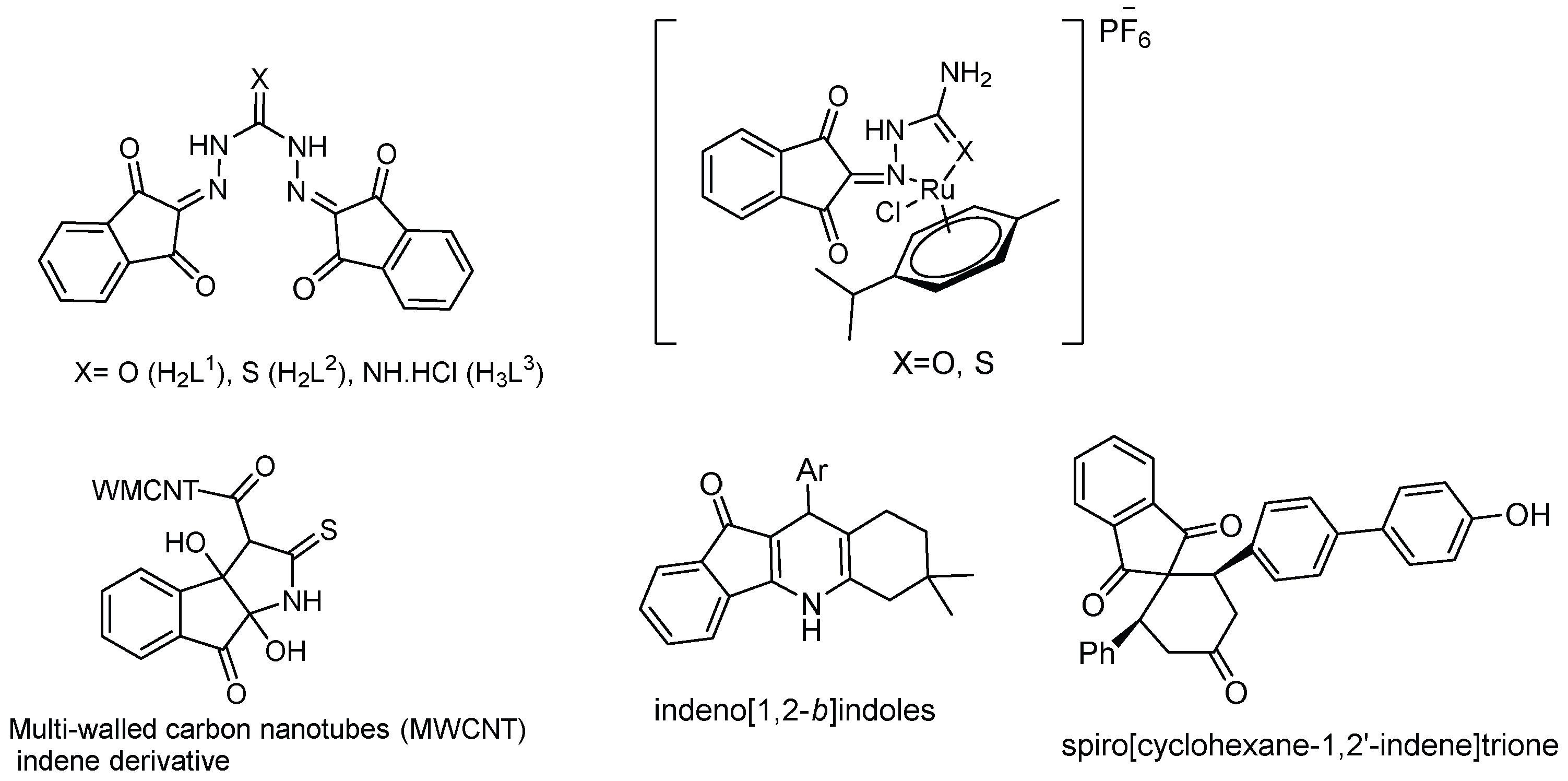
Ninhydrin (2,2-dihydroxyindane-1,3-dione), beyond its classical applications in forensic science and amino acid analysis, has emerged as a promising scaffold for the development of novel anticancer agents. The most recent contribution to this field comes from Menon and Manoj [7], who synthesized and characterized three novel Schiff bases derived from ninhydrin. The compounds investigated included H2L1 (ninhydrin-carbohydrazide), H2L2 (ninhydrin-thiocarbohydrazide), and H3L3 (ninhydrin-1,3-diaminoguanidine hydrochloride) (Figure 1). All three compounds demonstrated significant antiproliferative activity against the MCF7 human breast cancer cell line, with H3L3 showing the highest potency (IC50 = 159.58 μg/mL), followed by H2L1(IC50 = 164.32 μg/mL) and H2L2 (IC50 = 177.69 μg/mL). These compounds were also evaluated for antibacterial activity and subjected to molecular docking studies to elucidate their mechanisms of action.
A seminal study by Qureshi and colleagues [8] established that ninhydrin itself possesses significant antitumor properties. Using Ehrlich ascites carcinoma (EAC)-bearing Swiss albino mice as an experimental model, the researchers administered ninhydrin at doses of 5–20 mg/kg/day intraperitoneally. The study revealed dose-dependent inhibition of tumor growth, with effects comparable to the standard chemotherapeutic agent cyclophosphamide. Treated mice exhibited increased survival rates, and histological examination confirmed tumor necrosis. Mechanistic investigations demonstrated that ninhydrin inhibits DNA synthesis and disrupts mitochondrial function, providing a molecular basis for its antitumor activity.
The field of metal-based chemotherapy has also benefited from ninhydrin chemistry. De and Ashok Kumar [9] developed arene-ruthenium(II)-ninhydrin complexes (Figure 1) as highly potent inhibitors of cancer cell growth. These complexes leverage the coordination chemistry of ninhydrin with ruthenium, a metal known for its anticancer properties following the success of cisplatin and related compounds. The study demonstrated that these complexes exhibit enhanced anticancer activity compared to the parent ligands, suggesting synergistic effects between the ninhydrin moiety and the ruthenium center.
An innovative approach to cancer therapy involves the conjugation of ninhydrin with nanomaterials. A 2014 study reported the one-pot functionalization of short carboxyl multi-walled carbon nanotubes with ninhydrin and thiourea using microwave and thermal methods [10]. The resulting Sh-MWCNT-inden conjugates (Figure 1) were evaluated against MKN-45 gastric cancer cells and MCF7 breast cancer cells. After 72 h of exposure, the functionalized nanotubes exhibited higher toxicity against gastric cancer cells (77% inhibition) compared to breast cancer cells (65% inhibition). This study demonstrates the potential of ninhydrin-functionalized nanomaterials as targeted anticancer agents and highlights the versatility of ninhydrin in materials science applications.
The rational design and synthesis of ninhydrin analogs represent a particularly active and productive research frontier, driven fundamentally by the imperative to overcome inherent limitations of the parent compound while simultaneously expanding its application spectrum. Since ninhydrin’s formal adoption in forensic chemistry in 1954, numerous synthetic approaches have yielded analogs with substantially enhanced properties for latent fingerprint detection, including improved sensitivity, modified luminescence characteristics, and superior contrast on challenging or problematic surfaces [11]. These systematic efforts have produced compounds such as benzo[f]ninhydrin and various sulfur- and selenium-substituted derivatives, although practical considerations, including cost and commercial availability, often constrain routine implementation.
In contemporary organic synthesis, ninhydrin has emerged as an unparalleled substrate for multicomponent reactions (MCRs), enabling the rapid and efficient construction of complex molecular architectures from simple and readily available starting materials [2]. These one-pot processes align fundamentally with green chemistry principles by conserving reagents, minimizing solvent usage, reducing reaction time, and achieving high atom economy. Between 2014 and 2019 alone, numerous MCRs employing ninhydrin yielded diverse indeno-fused heterocyclic systems, including dihydroindeno [1,2-b]pyrroles, spiro[cyclohexane-1,2’-indene]trione derivatives, and indeno [1,2-b]indoles (Figure 1). Many of these synthetic products exhibit promising biological activities, particularly as potential anticancer agents, while others function effectively as fluorescent chemosensors for selective metal ion detection. The vicinal tricarbonyl system of ninhydrin provides an exceptionally rich source of heterocyclic scaffolds, with reactions proceeding under mild conditions utilizing readily available starting materials.
Modern oncopharmacology urgently needs new low-molecular compounds capable of simultaneously modulating several signaling pathways (e.g., HER family, Trk-B, PPAR-α, LTβR), which allows overcoming compensatory mechanisms of tumor cell resistance. The use of computer screening methods (molecular docking, binding free energy assessment) before labor-intensive experimental studies is a modern and effective approach to the targeted search for inhibitors of oncogenic targets. The most recent contributions from 2025 underscore the continued interest in this field and suggest that ninhydrin chemistry will remain a fruitful area for anticancer drug discovery in the foreseeable future. Further research should focus on elucidating detailed mechanisms of action, optimizing lead compounds through structure-activity relationship studies, and evaluating the most promising candidates in preclinical and clinical settings.

2. Materials and Methods

2.1. Chemistry

Starting materials for the synthesis of compounds 17 were obtained from Macklin (Shanghai Macklin Biochemical Technology Co., Ltd., Shanghai, China). Reaction progress was monitored by thin-layer chromatography (TLC) with UV detection using pre-coated silica gel 60, F254 plates (Merck, Rahway, NJ, USA). The melting points (mp) were determined using an SMP30 melting point apparatus, with a heating rate of 1.5 °C/min−1. MR spectra were recorded on Bruker spectrometers (operating frequencies: 400 MHz for 1H, 100 MHz for 13C, and 376 MHz for 19F). The elemental analysis was made using a Carlo Erba analyzer (Thermo Fisher Scientific, Waltham, MA, USA).

General Procedure for Synthesis

A solution of substituted indanone (1 eq.) and N-bromosuccinimide (NBS, 2 eq.) in DMSO was heated at 80 °C for 6 h. The cooled reaction mixture was poured into water (150 mL) and extracted with ethyl acetate, evaporated, and purified via recrystallization from hexane/ethyl acetate (2:1) to give the corresponding substituted ninhydrin.
The spectral characterization for the new compounds 2, 4, 7:
2,2-Dihydroxy-5-methoxyindane-1,3-dione (2). Yield 48%. mp 98 °C. 1H NMR (400 MHz, CDCl3) δ, ppm: 7.70 (dd, J = 5.6, 3.4 Hz, 1H), 7.56–7.50 (m, 1H), 7.37–7.28 (m, 1H), 4.21 (s, 2H), 3.87 (d, J = 2.7 Hz, 3H). 13C NMR (100 MHz, CDCl3) δ, ppm: 192.96, 160.54, 139.89, 126.95, 107.52, 57.34, 55.93, 52.04. Found, %: C 57.78, H 3.68. C10H8O5, Calculated, %: C 57.70, H 3.87.
2,2-Dihydroxy-5-trifluoromethylindane-1,3-dione (4). Yield 38%. mp 73–74 °C. 1H NMR (400 MHz, CDCl3) δ, ppm: 8.47–8.23 (m, 1H), 8.02 (s, 1H), 7.88–7.65 (m, 1H), 3.95 (d, J = 1.9 Hz, 2H). 13C NMR (100 MHz, CDCl3) δ, ppm: 192.77, 139.82, 133.53, 125.59, 122.06, 109.03, 108.14, 101.74, 89.62, 19F NMR (376 MHz, CDCl3) δ, ppm: −62.90. Found, %: C 48.92, H 1.96. C10H5F3O4, Calculated, %: C 48.80, H 2.05.
2,2-Dihydroxy-5,6-dichloroindane-1,3-dione (7). Yield 39%. mp 157–159 °C decomposition. 1H NMR (400 MHz, CDCl3) δ, ppm: 7.98–7.83 (m, 1H), 7.69 (d, J = 2.7 Hz, 1H), 3.00 (d, J = 1.4 Hz, 2H). 13C NMR (100 MHz, CDCl3) δ, ppm: 177.07, 143.90, 138.82, 135.85, 134.99, 133.50, 123.56, 123.21, 89.38. Found, %: C 43.97, H 1.54. C9H4Cl2O4, Calculated, %: C 43.76, H 1.63.

2.2. Molecular Docking Computations

The geometry of kinases was obtained by downloading their crystal structures from the Protein Data Bank (HER1 PDB:3W2P; HER2 PDB:8U8X; HER3 PDB:6OP9; HER4 PDB:3BBT; LTBR PDB:1RF3; Trk-B PDB:4AT4; BDNF/NT-3 PDB:1BND; PPAR-α PDB:6KB9) into Molegro 6.0 software (MVD) (Molegro ApS, Aarhus, Denmark). All of the solvent molecules were removed, and the search space was chosen to be a sphere centered on the co-crystallized ligand present in the corresponding PDB structure. The radius of the sphere was 12 Å, which completely encompassed the co-crystallized ligand and the kinase binding site. The flexible residues were treated with the default settings of the “Setup Sidechain Flexibility” tool in MVD, and a softening parameter of 0.7 was applied during flexible docking, according to the standard protocol used in MVD. Before docking, structures of the compounds were pre-optimized using ChemDraw software (Version 16, Revvity Signals Software Inc., Waltham, MA, USA) with the MM+ force field, and saved in the Tripos MOL2 format (Tripos, St. Louis, MO, USA). The ligand structures were imported into MVD. The options “Create explicit hydrogens”, “Assign charges (calculated by MVD)”, and “Detect flexible torsions in ligands” were enabled during importing. Appropriate protonation states of the ligands were also automatically generated at this step. Each ligand was subjected to 500 docking runs with respect to the kinase structure using MVD software. The docking pose with the lowest MolDock docking score was selected for each ligand and analyzed using the built-in tools of MVD.

3. Results and Discussion

3.1. Design and Synthesis of Ninhydrin Derivatives

To construct a library of ninhydrin derivatives for structure-activity studies (SAR), the introduction of various substituents into the benzene ring of the starting ninhydrin is critical. In the presented series of compounds 17 (Table 1), substituents were selected that allow modulation of key physicochemical properties and interactions with the active sites of biological targets. Methoxy (1) and methyl (3) groups are electron-donating and increase lipophilicity and slightly increase the electron density of the aromatic ring [12]. Dimethoxy substitution (2) allows studying the steric effect of the simultaneous presence of two groups in the ring. Halogens (especially F and Br) and the trifluoromethyl group are critical for metabolic stability [13,14]. The introduction of fluorine atoms (6) is often used for “metabolic blocking” of labile positions, as well as for modulating the pKa of geminal hydroxyl groups [15]. Dichloro substitution (7) at positions 4 and 6 allows us to evaluate the influence of symmetrical electron-withdrawing character and a sterically hindered environment on activity [16].
An effective method for the oxidation of indan-1-ones to ninhydrins using selenium dioxide (SeO2) in dioxane/water under microwave irradiation (MW, 180 °C, 5 min) has been described in the literature [17]. This method allows the preparation of substituted ninhydrins in high yields (66–87%). In the article [17], compounds 1 (67% yield), 3 (87% yield), 6 (86% yield), and 5 (80% yield) were previously prepared. However, in our study, we used an alternative approach [18], based on a two-step transformation (α-bromination followed by Kornblum oxidation) [19,20]. We demonstrate, for the first time, the possibility of obtaining previously unknown compounds 2, 4, and 7 using bromination followed by Kornblum oxidation. The general synthetic method involves the reaction of the corresponding 5-substituted indan-1-one with N-bromosuccinimide (NBS) in dimethyl sulfoxide (DMSO) by heating at 80 °C for 6 h. The key step involves the formation of an intermediate bromine in the α-position to the carbonyl group, which undergoes nucleophilic substitution of bromine by oxygen, followed by elimination (Kornblum oxidation) to a 1,2,3-trione, the hydration of which leads to the target ninhydrin [21,22,23]. Tatsugi and Izawa described the reaction mechanism in detail [23]. When considering SeO2 oxidation, the introduction of the strongly electron-withdrawing trifluoromethyl group often poses difficulties due to deactivation of the aromatic ring. The use of the DMSO/NBS method allowed the successful preparation of derivative 4, demonstrating the method’s robustness to deactivating electron-withdrawing substituents.
The yields of known compounds 1, 3, 5, 6 in this procedure (34–52%) were lower than those obtained with microwave oxidation by SeO2 (67–87%), which is likely due to the formation of polybromination byproducts or partial decomposition of the products under the harsh conditions in DMSO.
Nevertheless, for the synthesis of compounds 2, 4, and 7, this method proved effective and allowed the preparation of the target products in moderate yields (38–41%). In the case of the 4,6-dichloro derivative (7), achieving a yield of 39% is significant, given the steric hindrance created by ortho substituents, which typically slows the oxidation rate.
The microwave oxidation method of SeO2 is more efficient from a preparative chemistry perspective, allowing the preparation of target products in substantially higher yields in a significantly shorter time (minutes versus hours). However, it requires specialized equipment (a microwave synthesizer) and handling toxic selenium dioxide, which may be limiting at scale or in laboratories without access to closed microwave systems. The method described in the patent [18] (DMSO/NBS) is an alternative approach when scaling up synthesis, where the use of open reactors is preferable, and it is necessary to prepare ninhydrins with strongly electron-withdrawing substituents (e.g., CF3), where deactivation of the aromatic ring can retard direct oxidation of SeO2. Limitations of the NBS/DMSO method include the mandatory presence of an α-hydrogen atom in indan-1-one; 2-substituted substrates do not react, and it cannot be used for compounds sensitive to oxidation under harsh conditions.
Nevertheless, this method was the first to successfully prepare previously unknown ninhydrins 2, 4, and 7, confirming its preparative value. For compound 7 (4,6-dichloro derivative), the 39% yield is satisfactory, given the steric hindrance from the ortho-substituents, which also leads to a decrease in yield in the SeO2/MW method [17] (e.g., for 2-methoxy-substituted, the yield is 67%).

3.2. Molecular Docking

We conducted molecular docking of the synthesized compounds to predict their interactions with the biological targets and interpret the structure-activity relationships (SAR). This method allows us to predict the preferred orientations of the ligands in the protein’s active sites, estimate the binding energy, and identify key noncovalent interactions (hydrogen bonds, π-stacking, hydrophobic contacts) that underlie inhibitory activity. Using docking, we decided to test hypotheses about how different substituents influence target affinity and whether they can participate in additional interactions with amino acid residues. We also focused on several of the most promising structures for in-depth biological testing and selected the most promising avenues for further modification.
The following membrane proteins of the tyrosine protein kinase family were selected as biotargets: HER1, HER2, HER3 (ERBB3), HER4 (ERBB4), the amplification or increased expression of which plays an important role in the pathogenesis and progression of certain aggressive types of breast cancer [24,25,26]; lymphotoxin beta receptor (LTBR), which is involved in lymphoblastic leukemia [27,28]; tropomyosin tyrosine kinase receptor B (Trk-B) and BDNF/NT-3 growth factor receptor, which are involved in the regulation of prostate cancer [29]; peroxisome proliferator-activated receptors (PPAR-α), which are involved in the regulation of ovarian cancer [30,31]. In this study, we analyze docking scores (DS) obtained with the MolDock force field. Also, partial docking scores (DSp) were calculated to evaluate interactions with individual residues. In most cases, we report the DS values throughout the paper. Where DSp are considered, this is explicitly stated. Additional information on the results is presented in the Tables S1–S8 (see Supplementary Materials).

3.2.1. Tyrosine Protein Kinase Family

HER1
The enzyme amino acids for which the compounds exhibit the highest affinity are key to inhibiting HER1 (EGFR). Lys745 (Lysine 745) is located in the hinge region of the kinase. Interaction with this amino acid (usually via hydrogen bonds) is critical for ATP-competitive inhibition [32,33]. Met793 (Methionine 793) is a key residue for kinase inhibitors. The backbone NH and CO groups of Met793 often form hydrogen bonds with inhibitors [34,35,36]. Leu788 and Leu718 (Leucines) are responsible for van der Waals interactions with aromatic or hydrophobic moieties of the molecules and form a hydrophobic pocket [33,34,37,38]. Pro794 (Proline) is often involved in the formation of a hydrophobic cleft near Met793, which complements the polar bonds, increasing overall affinity [35,39].
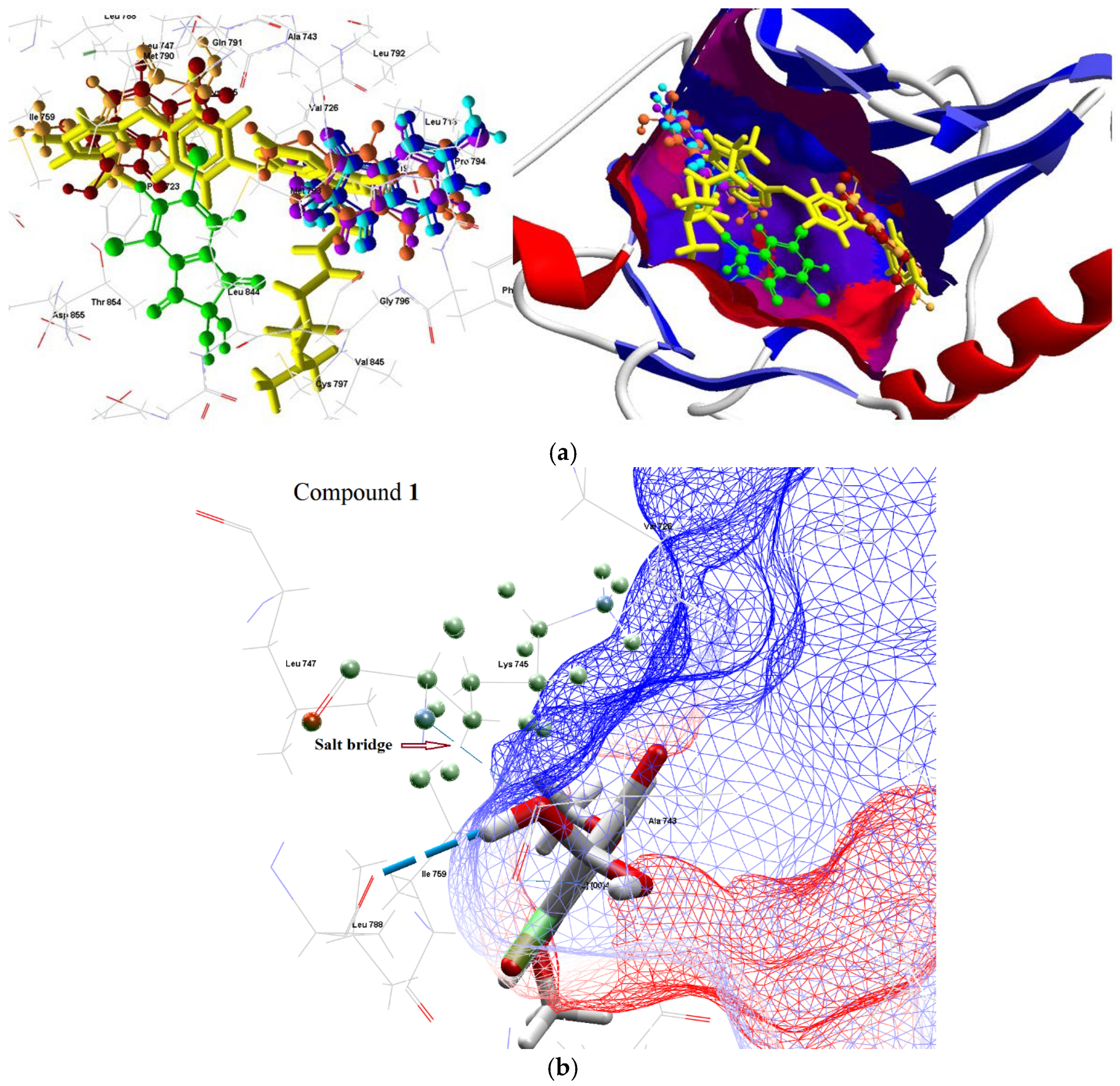
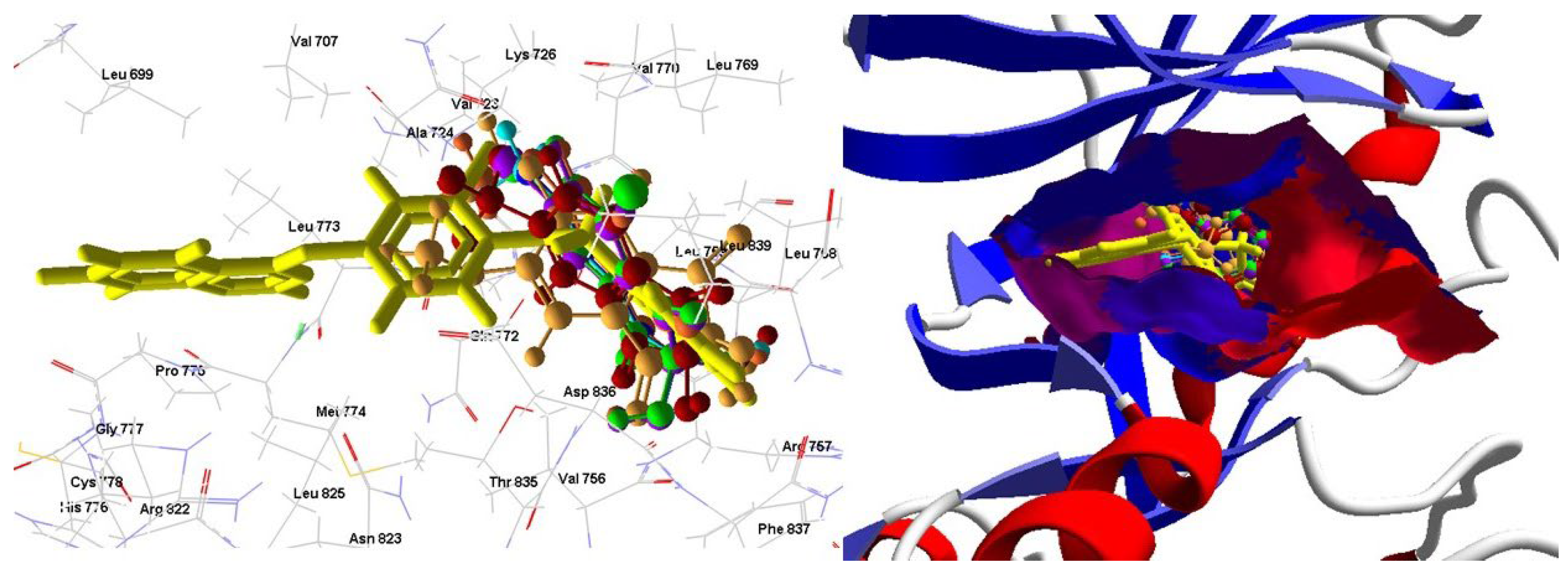
Compound 4 (5-trifluoromethyl derivative) shows the best affinity with a peak DSp value of −20.69 kcal/mol for Lys745. It also has very strong additional interactions. Compound 4 outperforms the native ligand in the strength of interaction with Lys745 (DSp = −20.69 vs. −17.03 kcal/mol) and contributes more to the binding to Leu788 and Met790. Compound 1 (dimethoxy derivative) also shows an outstanding result (DSp = −20.11 kcal/mol with Lys745), making it the second most effective. The additional group at the 6-position likely provides an additional van der Waals contact with the protein. However, replacing two methoxy groups with one (compound 2) changes the profile: the best (DSp) drops to −18.53 kcal/mol, and Met793 becomes the primary target, rather than Lys745. This suggests that the two methoxy groups position the molecule more favorably for reaching Lys745. The strong negative values of the partial docking score for compound 1 with respect to Lys745 indicate that these molecules are ideally oriented to form a strong hydrogen bond or salt bridge with the NH2 group of lysine (Figure 2b). For compounds 2, 3, 5, and 6, Met793 is the primary binding position. The high DSp values for Leu788 for compounds 1 and 4 indicate that their substituents (-OCH3, -CF3) effectively fill this pocket. The high DSp values for 2, 3, 5, and 6 indicate that these compounds are oriented slightly differently from 1 and 4 and sit deeper in the Pro794 portion of the pocket (Figure 2a). The 1,2,3-trioxo-indane scaffold of ninhydrin most likely acts as the “core” that fits deep into the pocket. The carbonyl and hydroxyl groups act as hydrogen donors/acceptors for interactions with the protein backbone (Met793) or conserved water molecules. The trifluoromethyl group (-CF3) is a strong electron acceptor. It not only participates in hydrophobic interactions but can also influence the distribution of electron density throughout the aromatic ring by enhancing the polarity of neighboring groups. This apparently allows compound 4 to perfectly “target” Lys745, giving the best result. Fluorine (6) performed very well (−19.01 kcal/mol), almost as well as 2. Fluorine is small and can participate in unique dipole–dipole interactions. Bromine (5) gave the worst result among the mono-substituted ones (DSp = −17.74 kcal/mol). Bromine is large and electronegative. It may cause steric hindrance or repulsion from the electron-rich protein’s carbonyl groups.
Dichloro derivative (7) was an outlier. Two chlorine atoms (especially at positions 4 and 6) radically alter the electron symmetry and likely cause significant steric hindrance. The appearance of Thr854 at the top interacting residues for compound 7 signals a change in binding mode. The two chloro substituents were likely too bulky or altered the electron density, forcing the molecule to rotate toward the C-tail of the kinase (DFG motif), where Thr854 is located (Figure 2a). This completely knocks the molecule out of its optimal position, forcing it to bind far from the ATP pocket (Thr854, Asp855 in the activation loop), making this compound the weakest inhibitor in the series.
HER2
In HER2, the main “hot spots” are aromatic and acidic residues, which differ from those in HER1. Phe868 (Phenylalanine 868) is the absolute leader in terms of binding contribution for most compounds. The aromatic ring of Phe868 likely forms a π–π stacking interaction with the indendione core [40]. The strength of this contact determines the overall affinity. The negatively charged carboxyl group of Asp867 (Aspartic acid 867) often acts as a partner for hydrogen bonds with the hydroxyl groups of ninhydrin. The hydrophobic residues Leu789 and Leu800 (Leucines) form a pocket. They interact with methyl, fluorine, or bromo substituents, as well as with the aromatic ring. Thr866/Thr802 (Threonines) contain polar residues capable of hydrogen bonding. Positively charged Lys753 (Lysine 753) can interact electrostatically with carbonyl groups.
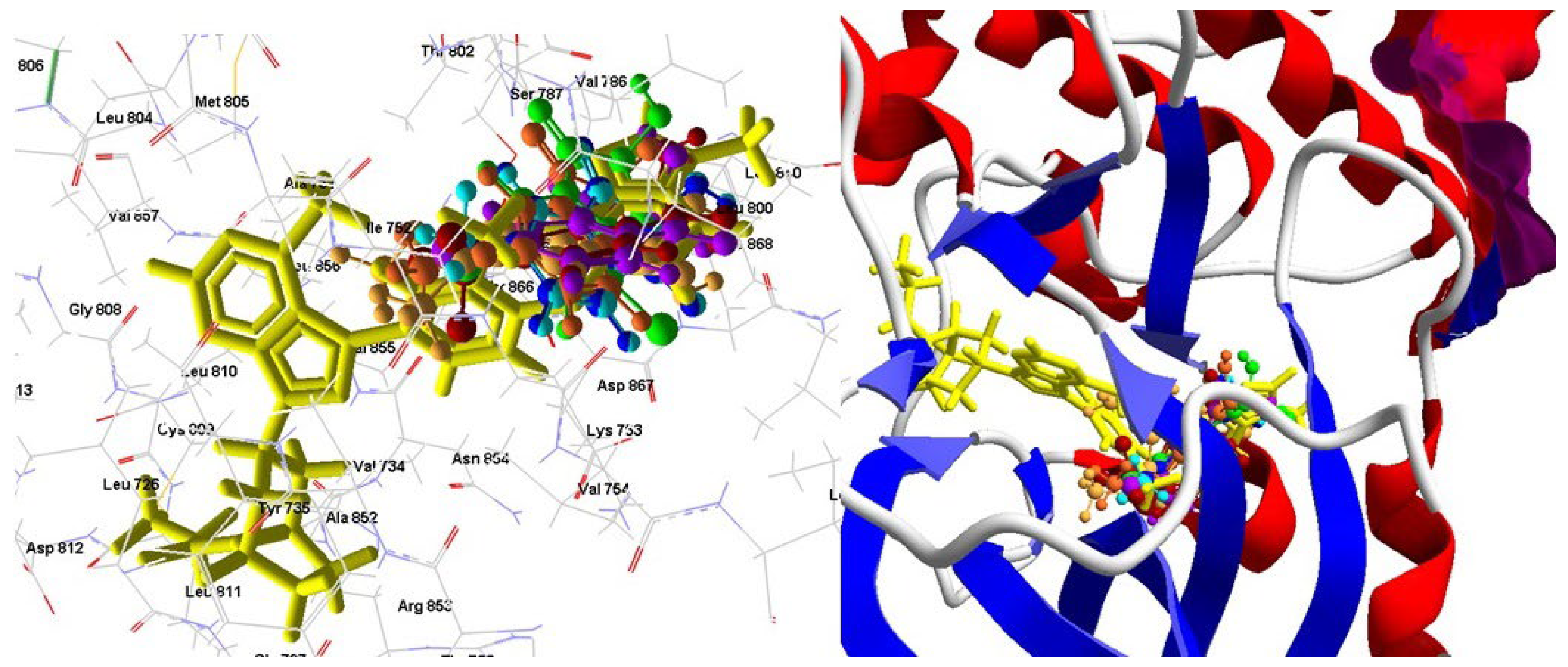
The best binding affinities for HER2 are compounds 6 (5-fluoro) and 3 (5-methyl), with DSp values of −20.73 and −20.52 kcal/mol, respectively. Both bind preferentially to Phe868 and Asp867. They are superior to the native ligand (DSp = −19.40 kcal/mol). However, the native ligand has a more diverse set of contacts (Val734, Leu856), which may provide additional advantages in selectivity or stability of the complex. Compounds 1, 4, and 5 also exhibit good affinity, close to the ligand, while 2 and 7 bind significantly weaker (Figure 3).
In HER2, the binding pocket appears to be more sensitive to the size and electronic properties of the substituents at position 5. Fluorine (6) and methyl (3) provide the highest affinity. Fluorine is small, and its high electronegativity may enhance the polarization of the aromatic ring, improving the π–π interaction with Phe868 (Figure 3). Methyl is a classic hydrophobic group that fills the pocket well. Neither substituent creates steric hindrance. Bromine (5) (DSp = −18.78 kcal/mol) is a fairly large atom, but in HER2 it apparently fits well into the hydrophobic pocket without causing repulsion (unlike HER1). The HER2 pocket is likely more spacious or flexible in this region. Trifluoromethyl (4) (DSp = −18.56 kcal/mol) is inferior to fluorine and methyl. The bulky -CF3 group may be slightly too large, or its strong electron-withdrawing effect may pull electron density too far from the ring, weakening π–π stacking with Phe868. As in HER1, 4,6-dichloro substitution completely disrupts binding. The two bulky chlorine atoms likely create a steric clash with the pocket, forcing the molecule to bind elsewhere (closer to the C-lobe) (Figure 3).
HER3
In HER3, polar and charged residues play a dominant role, which differs from HER1 (Lys/Met) and HER2 (Phe/Asp). The positively charged ε-amino group of lysine Lys723 likely forms a strong hydrogen bond or ion-dipole interaction with the carbonyl or hydroxyl groups of the ninhydrin core. The thiol group (-SH) of cysteine Cys721 can act as a weak hydrogen donor or participate in van der Waals contacts [41]. The negatively charged carboxyl group of aspartic acid Asp833 can be attracted to electron-deficient sites of the ligand (e.g., to the hydrogen atoms of hydroxyls) [41]. Residues Leu766, Leu771, and Thr768 form a hydrophobic pocket and additional polar contacts [41].
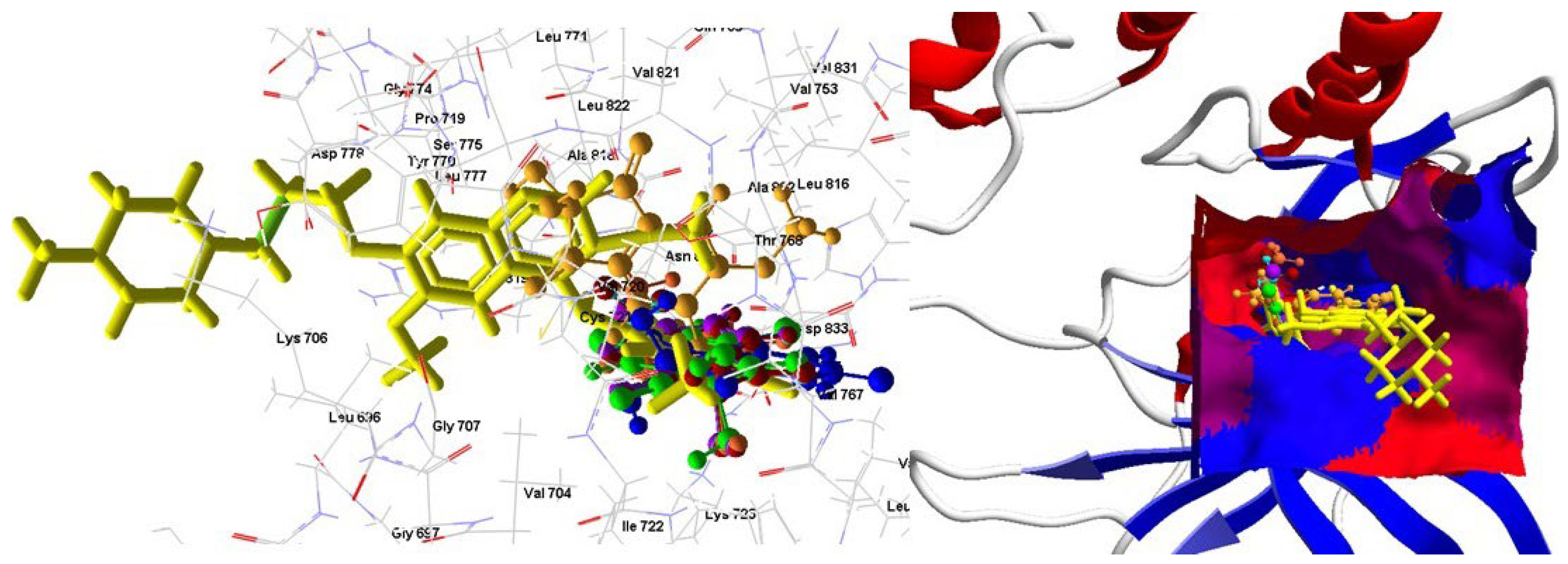
The absolute leader is compound 6 (a 5-fluoro derivative) with a DSp value of −19.30 kcal/mol at Lys723. It significantly exceeds the native ligand (DSp = −15.59 kcal/mol). Fluorine provides an energy advantage. This is likely due to its ability to participate in strong dipole–dipole interactions and/or act as a hydrogen bond acceptor (with Lys723 or Thr768). The small size of fluorine does not create steric hindrance, and its high electronegativity can polarize the entire molecule, enhancing the acidity of the hydroxyl groups and improving their H-bonding properties (Figure 4). 4,6-Dichloro substitution, which was the underperformer in HER1 and HER2, shows the second result here. This suggests that the HER3 pocket is more voluminous and/or hydrophobic, capable of accommodating two chlorine atoms. Chlorine increases the hydrophobicity and polarizability of the molecule, which appears to favor interactions with Lys723 and Cys721. However, the electronic effects of the two chlorines can redistribute the charge, resulting in a smaller advantage than that of fluorine. Trifluoromethyl (4) exhibits good affinity (DSp = −14.20 kcal/mol), but is inferior to fluorine. Perhaps the -CF3 group is too bulky, or its strong electron-withdrawing effect excessively compresses the electron density, weakening the π-interactions. The methyl (3) and bromine (5) substituents prevent the molecule from penetrating deep enough to Lys723, and binding occurs at the periphery of the pocket with the participation of cysteine and leucines.
HER4
HER4 exhibits unique patterns that differ from HER1, HER2, and HER3 [42]. The negatively charged carboxyl group of aspartic acid Asp836 likely forms strong hydrogen bonds [43] or ion-dipole interactions with hydroxyl groups (2,2-dihydroxy) and possibly with the carbonyl oxygen atoms of the indenedione core. The strength of this interaction determines the overall affinity. The aromatic ring of phenylalanine Phe837 participates in π–π stacking [44] with the indenedione core. The positively charged lysine residue Lys726 is capable of electrostatic and hydrogen bonding with carbonyl groups. The hydrophobic and polar residues Leu769, Leu758, Thr771, and Thr835 form a pocket [45].
The absolute leader is compound 4 (5-trifluoromethyl) with a DSp value of −18.87 kcal/mol, which is higher than the native ligand (−17.37 kcal/mol). The strong electron-withdrawing effect of the -CF3 group probably increases the acidity of the ninhydrin hydroxyl groups, enhancing their ability to form a hydrogen bond with Asp836. In addition, trifluoromethyl can participate in dipole interactions and hydrophobic contacts, and its volume is optimal for filling the pocket. Compounds 1 (DSp = −17.95 kcal/mol) and 7 (DSp =−17.48 kcal/mol) also demonstrate an affinity higher than the ligand. Two methoxy groups at positions 5 and 6 provide additional van der Waals contacts and can also act as weak hydrogen acceptors. Unlike with HER1 and HER2, the dichloro derivative shows an excellent result. This indicates that the HER4 pocket is more spacious and can accommodate two chlorine atoms without steric hindrance (Figure 5). Chlorine increases the hydrophobicity and polarizability of the molecule, which favors interactions with Asp836 and Phe837. Interestingly, fluorine, which is so effective in HER1, HER2, and HER3, shows no advantage here. Perhaps, in the environment of Asp836, fluorine cannot form additional strong interactions, and its effect is neutralized.
The HER receptors of the tyrosine kinase (EGFR/ERBB) family play a key role in cell proliferation, survival, and differentiation, and their overexpression or mutations are often associated with the development of various types of cancer. The development of selective inhibitors capable of distinguishing between the structurally similar active sites of these kinases is a pressing issue in medicinal chemistry. Molecular docking of a series of ninhydrin derivatives (substituted at positions 5 and 4, 6) revealed clear structure-activity relationships (SARs) and identified lead compounds for each of the four receptors. A clear dependence of selectivity on the size and electronic properties of the substituent is observed: small groups (-F, -CH3) are preferred for HER2/HER3, bulky ones (-CF3, dimethoxy, dichloro) are preferred for HER1/HER4, and HER3 and HER4 are even tolerant to dichloro substitution. To create a HER2/HER3 inhibitor, one can take a 5-fluoro derivative (6) as a basis, and for HER1/HER4-5-trifluoromethyl (4) or 5,6-dimethoxy (1).

3.2.2. Lymphotoxin Beta Receptor (LTβR)

The LTβR protein (lymphotoxin-β receptor) belongs to the tumor necrosis factor receptor (TNF-R) superfamily [46] and plays a key role in lymphoid tissue organization [47], inflammation [48], and the immune response [49]. Modulating its activity may have therapeutic value in autoimmune diseases and oncology. Molecular docking of a series of ninhydrin derivatives to the center of the protein (without the native ligand) revealed high-affinity compounds and identified key binding amino acids. The LTβR binding site contains several critical residues with which all the ligands interact. The phenolic ring of tyrosine Tyr377 likely participates in π–π stacking interactions with the indendione core, and its hydroxyl group can act as a hydrogen bond donor or acceptor with the carbonyl or hydroxyl groups of the ligand. The hydroxyl group of serine Ser378 is capable of forming hydrogen bonds with polar groups of the ligand. The aromatic tryptophan residue Trp356 is involved in hydrophobic and π-interactions. The hydrophobic leucine residue Leu376 mediates van der Waals contacts. The polar glutamine residue Gln379 is capable of hydrogen bonding.
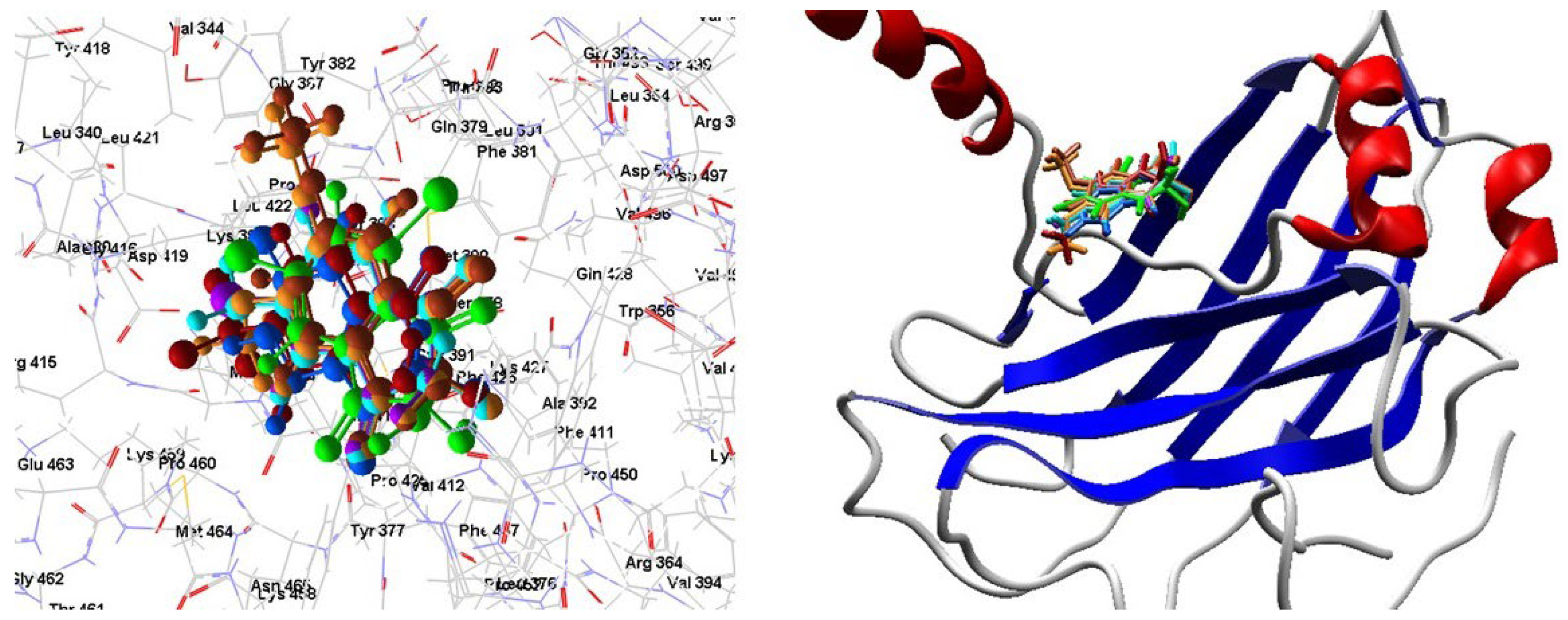
The absolute leader is compound 4 (5-trifluoromethyl) with an outstanding DSp value of −26.16 kcal/mol at the Tyr377 residue, which is more than 3 kcal/mol better than the next compound 6. The strong electron-withdrawing effect of -CF3 likely enhances the acidity of the ninhydrin hydroxyl groups, which improves hydrogen bonding with Tyr377 and Ser378. Furthermore, the group’s volume optimally fills the hydrophobic cavity, causing additional dispersion interactions and stipulating a very high affinity. Fluorine’s small size and high electronegativity favor polar contacts, but it is inferior to -CF3, likely due to its smaller contribution to dispersion interactions. Two methoxy (compound 1) groups at positions 5 and 6 provide additional van der Waals contacts and can act as weak hydrogen acceptors (Figure 6).
Modulation of LTβR signaling may be useful in autoimmune diseases (e.g., rheumatoid arthritis, multiple sclerosis) and for suppressing transplant rejection. Selective small-molecule LTβR inhibitors are not yet approved, so these compounds are of interest as potential leads. Interestingly, LTβR exhibits similarity to HER1 and HER4 in its preference for bulky electron-withdrawing substituents (-CF3, dimethoxy), while fluorine is particularly effective against HER2 and HER3. This knowledge may aid in the design of compounds with multiple or selective activity.

3.2.3. Tropomyosin Tyrosine Kinase Family

Trk-B
Trk-B is a critical molecular component for normal nervous system function. It promotes neuronal survival and differentiation, regulates synaptic plasticity, learning, and memory [50]. It is activated primarily by brain-derived neurotrophic factor (BDNF) and NT-4/5 [51]. Due to the potent neuroprotective effects of the BDNF/Trk-B signaling cascade, it is considered a potential target for the treatment of amyotrophic lateral sclerosis, Huntington’s disease, Parkinson’s disease, and Alzheimer’s disease. Trk-B exhibits a “two-faced Janus” effect. Overexpression of Trk-B and BDNF is observed in many malignant tumors (breast, lung, colon, and other cancers) [52], significantly enhancing tumor cell proliferation, invasion, migration, and metastasis, and promoting chemoresistance. Therefore, the Trk-B/BDNF axis is an important target for the development of anticancer drugs.
Based on docking, key amino acid residues were identified. Asp 710 is a negatively charged aspartic acid that forms ionic interactions or hydrogen bonds with the hydroxyl groups of the ligand (at C2 of indanedione) and, possibly, with carbonyl oxygens. Aromatic residues Phe 711 and Phe 633 provide π–π stacking with the aromatic ring of indanedione. Positively charged lysine Lys 588 can participate in ionic interactions with the carbonyl groups of the ligand or in hydrogen bonds through its amino group. Gly 709, Tyr 635, Met 636, Val 617, Val 568, Leu 608, Glu 604, and Ile 708 form a hydrophobic pocket and additional hydrogen bonds. Their contribution varies depending on the substituents in the ligand.
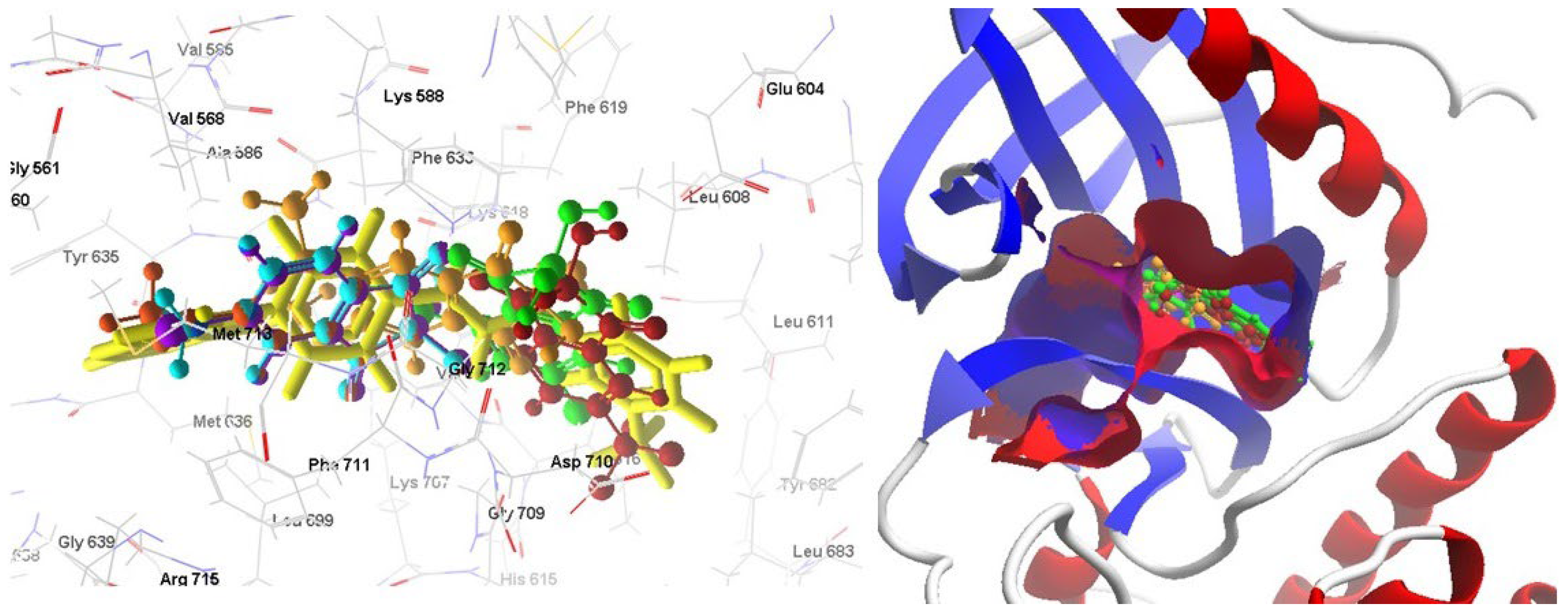
Compound 1 (2,2-dihydroxy-5,6-dimethoxy-1H-indene-1,3(2H)-dione) exhibits the highest affinity among the investigated derivatives. Its total DS is significantly lower than that of the others, although it is inferior to that of the native ligand. Double methoxy substitution optimally enhances π–π stacking and polar interactions, resulting in the best overall affinity (DSp = −30.43 kcal/mol with Phe633, DSp = −16.79 kcal/mol with Asp710). A single methoxy group in compound 2 provides very strong stacking with Phe711, but the overall affinity is lower than that of 1 due to weaker additional interactions. The effect of the methyl group in compound 3 is inferior to that of the methoxy substituent due to the lack of a polar contribution, but it maintains good stacking (Figure 7). The functional group -CF3 in compound 4 radically alters the ligand pose, shifting the emphasis from aromatic interactions to ionic/hydrogen bonds with Asp710 (DSp = −27.83 kcal/mol) and involving new residues. Fluorine-substituted compound 6 exhibits properties similar to the methoxy derivative, but without additional polar contacts (DSp = −30.96 kcal/mol with Phe711). 4,6-Dichloro substitution (compound 7) leads to ligand reorientation, reducing overall affinity but maintaining moderate affinity due to strong interaction with Asp710 (DSp = −23.38 kcal/mol) and partial stacking with Phe633 (DSp = −18.35 kcal/mol). The optimal configuration for Trk-B is a combination of electron-donating groups capable of additional polar interactions while maintaining compactness (compound 1). This allows for simultaneous maximization of π–π stacking and ionic/hydrogen bonding.
BDNF/NT-3
BDNF and NT-3 belong to the neurotrophin family [53]. Its main function is to activate Trk receptors (e.g., TrkB for BDNF) and the p75 receptor to regulate neuronal survival and growth [54]. According to the results of docking the compounds into a protein binding site (e.g., a pit between monomers or a receptor interaction site), specific residues play a key role in stabilizing the complex. Arg (Arginine) and Lys (Lysine) often form salt bridges or strong hydrogen bonds with negatively charged ligand groups (e.g., carboxyl groups). Arginine is critical for neurotrophin recognition by the receptors. Tyr (Tyrosine), Trp (Tryptophan), and Phe (Phenylalanine) participate in hydrophobic interactions and π-stacking. For example, if a compound contains an aromatic ring, it will tend to lie parallel to the Tyrosine ring. Asp (Aspartic Acid), Glu (Glutamic Acid) can accept hydrogen bonds from a ligand (if the ligand has -OH or -NH groups). Peptide scanning showed that amino acids Phe347, Asp354, and Tyr361 in the second immunoglobulin-like domain of Trk-B are directly and critically involved in BDNF binding [55]. The BDNF protein exists as a dimer. This means it is assembled from two identical (or nearly identical) polypeptide chains. In the crystal structure, they are designated chain A and chain B. They interact with each other. These two chains physically contact each other, forming the biologically active form of the protein. Their surfaces touch, forming the so-called contact region.
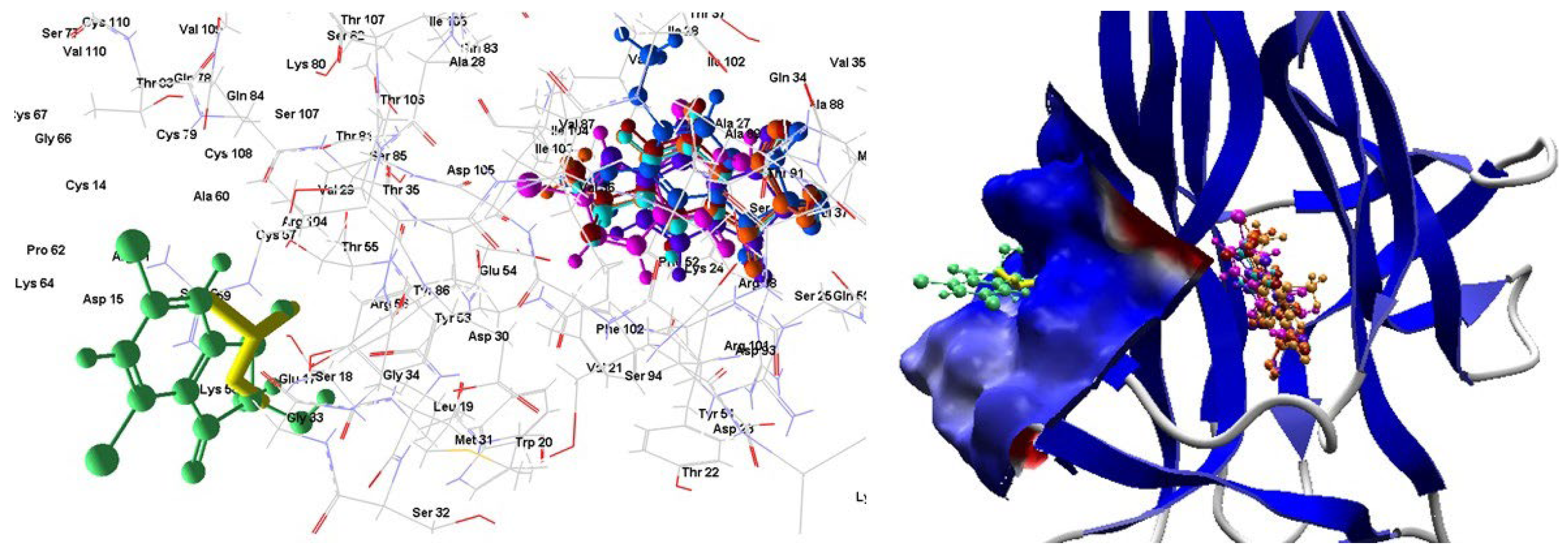
Site A (for compounds 16) is located in this region. Amino acids from both chains participate in the formation of this site. For example, Arg88 is located on chain A, and Phe52 is a residue of chain B. This means that compound 5 “joins” the two halves of the protein. It is rich in aromatic (Phe, Trp) and positively charged (Arg) residues (Figure 8). This site is likely not the native binding site of the crystallized ligand, but rather represents an alternative pocket that may be important for modulating protein activity. All compounds 16 have very strong interactions with Arg88 (DSp from −26 to −28 kcal/mol). This is explained by the fact that the indanedione core (especially the carbonyl and -OH groups) can form multiple hydrogen bonds with the guanidine group of Arg88. Furthermore, the aromatic ring of indan can participate in cation-π interactions with the positively charged arginine. Phe52 participates in π-stacking interactions. Compound 5, which has bromine at position 5, shows the strongest contact with Phe52 (DSp = −21.68 kcal/mol). Bromine is a heavy atom that increases the polarizability of the molecule and enhances dispersion interactions (van der Waals forces). Bromine may also participate in halogen bonds with carbonyl groups or the aromatic system. Compound 4 (5-trifluoromethyl) and 1 (5,6-dimethoxy) also show high results, but through a different mechanism—binding to Arg88 on the BDNF chain. Substituents that increase polarizability and are capable of additional non-covalent interactions (Br > CF3 ≈ F > OCH3 > CH3) yield the best affinities.
Bromine (compound 5) is the optimal size and polarizability for interactions with both Arg88 (via the indanedione core) and Phe52 (via enhanced π-stacking and possible halogen bonds).
Site B (for the ligand and compound 7) is located entirely within chain A (Figure 8). Located within a single chain of A, without affecting the contact region, it includes polar (Ser, Tyr), negatively charged (Asp), and positively charged (Arg) residues, as well as a small hydrophobic element (Val, Met). This appears to be the native binding site, corresponding to the position of the ligand in the crystal structure. The docking scores here are lower than at site A (DSp = −22.4 kcal/mol for the ligand, DSp = −54.3 kcal/mol for compound 7), which may be due to the lower hydrophobicity of the pocket or the nature of the tested compounds. The two chlorine atoms stipulate steric hindrance for site A but are complementary to site B (Gly33 provides space, and Asp30 and Arg104 provide polar contacts). These properties make it more similar to the polar ligand of site B than to the hydrophobic counterparts of site A.
Thus, structural differences in the substituents determine the preference for one or another binding site, and compound 5 stands out as the most affinity for site A due to the optimal combination of electronic and steric properties of the bromine atom.
Compound 1 (a 5,6-dimethoxy derivative of ninhydrin) holds the greatest promise for further study in the context of modulating the BDNF/Trk-B axis. It exhibits high affinity for both the Trk-B receptor and its native ligand, BDNF, opening up possibilities for both neuroprotective therapy (in cases of insufficient neurotrophic support) and antitumor therapy (in cases of Trk-B/BDNF overexpression). Functional studies determining its agonist or antagonist profile will be crucial.

3.2.4. Peroxisome Proliferator-Activated Receptors (PPAR-α)

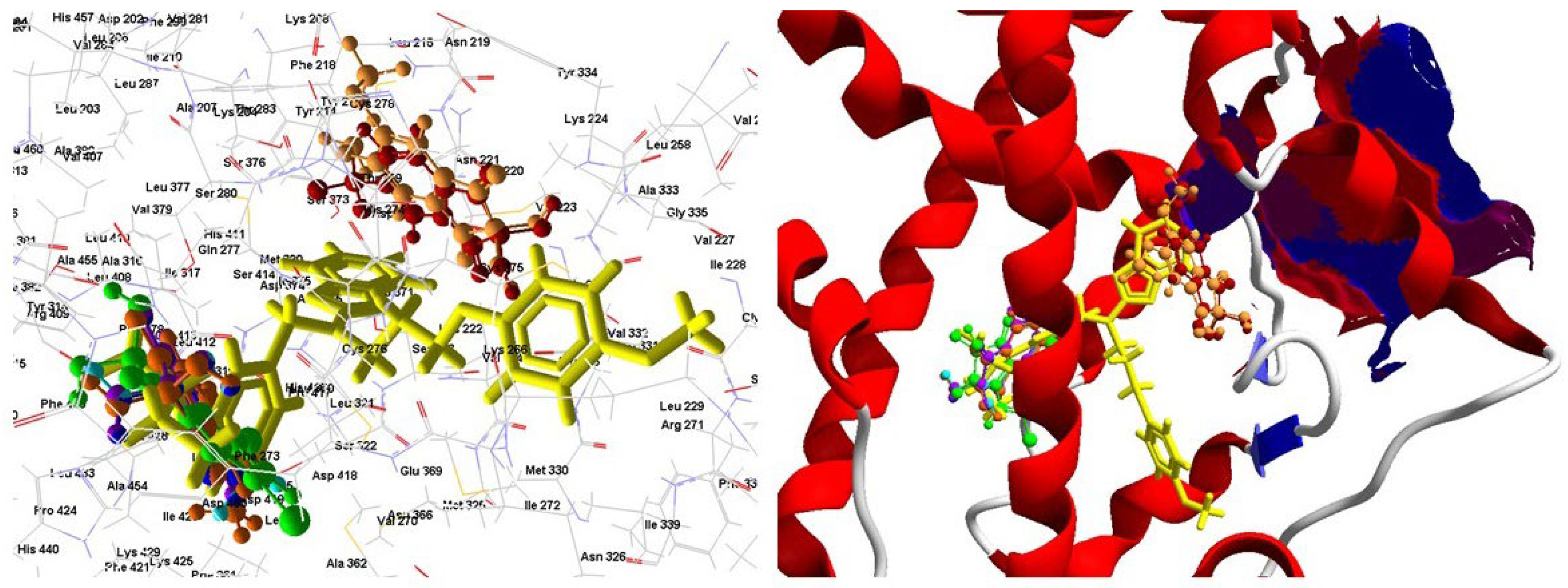
In the context of PPAR-α (peroxisome proliferator-activated receptor), the following residues play a key role in stabilizing ligands. PPAR-α has a unique feature—covalent binding to some ligands through the thiol group (-SH) of cysteine Cys276 [56]. Histidine His440 is a part of the “histidine brush” characteristic of nuclear receptors and stabilizes the carboxyl or carbonyl groups of the ligand [57]. Phenylalanine Phe273 provides hydrophobic and aromatic interactions with the indene ring. Without Phe273, the molecule would not be able to orient itself correctly in the pocket [58]. It is one of the “pillars” of the binding pocket. Tyrosine Tyr314 is involved in stabilizing substituents at position 5 of the indene ring due to hydrogen bonds and hydrophobicity [57]. Threonine (Thr) is a polar residue and often interacts with methoxy or hydroxy groups. All the investigated compounds share a common core with a gem-diol group (2,2-dihydroxy). This group is responsible for interactions with Cys276 and His440. This is the basis for binding. Without these diols, the molecule would be unable to compete with the co-crystallized ligand.
Compound 1 (with two methoxy groups) exhibits the highest affinity for PPAR-α among all the tested derivatives (DSp = −22.83 kcal/mol with Cys276 compared to the ligand DSp = −27.42 kcal/mol). It also exhibits the most stable and deepest binding pocket. The presence of two methoxy groups (at positions 5 and 6) leads to the formation of additional hydrogen bonds with Thr279 (DSp value −13.51 kcal/mol) and improves the hydrophobic packing with Met220 and Leu331. The second most active is -CF3 (compound 4), which creates a strong dipole moment and can interact with aromatic rings (Phe) via polarization. However, due to the lack of a second group at position 6 (as in compound 1), it cannot engage in additional H-bonds with Thr; therefore, ninhydrin derivative 4 is inferior to compound 1. The methoxy group (compound 2) is slightly better than the methyl group (compound 3), due to the ability of oxygen to participate in weak hydrogen bonds. Halogens (Br, F) give almost the same result, since their main role is hydrophobic filling the cavity. Compound 7 exhibits good activity (DSp = −17.63 kcal/mol), but is inferior to compound 1. The chlorines are bulky and electronegative. However, their positions (4 and 6) alter the molecular bend. Ser280, not present in the other top results, appears in the data, indicating a shift in the molecule within the pocket. Probably due to steric hindrance from Phe273, the molecule is forced to shift, losing some of its interactions with Cys276 (DSp = −13.5 kcal/mol versus −22.8 kcal/mol for compound 1).
A key factor for enhancing activity is the presence of a substituent at position 6 of the indene ring, which allows for additional hydrophobic and polar interactions deeply within the PPAR-α binding pocket (Figure 9).

4. Conclusions

We demonstrate for the first time the possibility of obtaining new compounds 2, 4, and 7, which expand the library of derivatives, and previously known compounds 1, 3, 5, and 6, using bromination followed by Kornblum oxidation. Molecular modeling of the interaction of a number of substituted ninhydrins with several pharmacologically significant targets has revealed clear structure-activity relationships and identified the most promising compounds for further biological research. Selectivity for HER kinases is determined by the nature of the substituents. Small electron-withdrawing groups (-F, -CH3) are preferred for inhibiting HER2/HER3, while bulky substituents (-CF3, dimethoxy, dichloro) are preferred for HER1/HER4. Compound 6 (5-fluoro derivative) is the optimal basis for the development of a selective HER2/HER3 inhibitor, while compounds 4 (5-trifluoromethyl) and 1 (5,6-dimethoxy) are preferred for HER1/HER4. Compound 4 (bearing a 5-trifluoromethyl group) demonstrates unequivocal superiority in binding to LTβR (DSp = −26.16 kcal/mol with Tyr377). The electron-withdrawing effect of -CF3 enhances the acidity of ninhydrin hydroxyl groups, promoting the formation of strong hydrogen bonds, while the bulkiness of the group ensures optimal dispersion contacts. Compound 1 (5,6-dimethoxyninhydrin) exhibited the highest affinity for Trk-B, with a DSp value of −30.43 kcal/mol (Phe633) and −16.79 kcal/mol (Asp710). Double methoxy substitution enhances π–π stacking and polar interactions, making this compound a promising modulator of the BDNF/Trk-B axis for both neuroprotective and antitumor therapy. For PPAR-α, compound 1 again exhibits the highest affinity among all the tested derivatives (DSp = −22.83 kcal/mol with Cys276) and is surpassed only by the native ligand. Two methoxy groups provide additional hydrogen bonds with Thr279 and improve hydrophobic packing with Met220 and Leu331. Compound 4 (-CF3) is also active but is inferior to 1 due to the lack of a second substituent for H-bonding with threonine. The obtained results provide a basis for subsequent experimental studies (molecular dynamics to confirm the stability of the highest-rated complexes, synthesis of optimized analogs, in vitro/in vivo biological tests) and the development of new targeted antitumor drugs.

Supplementary Materials

The following supporting information can be downloaded at: https://www.mdpi.com/article/10.3390/org7020026/s1, Table S1. General analysis of docking scores with HER1; Table S2. General analysis of docking scores with HER2; Table S3. General analysis of docking scores with HER3; Table S4. General analysis of docking scores with HER4; Table S5. General analysis of docking scores with LTBR; Table S6. General analysis of docking scores with Trk-B; Table S7. General analysis of docking scores with BDNF/NT-3; Table S8. General analysis of docking scores with PPAR-α.

Author Contributions

Conceptualization was conducted by A.R.K.; experiments were carried out by A.R.K.; data analysis and the writing of the initial manuscript were performed by A.R.K. and A.I.K.; editing of the final version of the manuscript was performed by A.R.K. and A.I.K.; project administration and supervision were conducted by A.I.K. All authors have read and agreed to the published version of the manuscript.

Funding

This research was supported by the Russian Science Foundation (project no. 24-73-00202).

Data Availability Statement

The original contributions presented in this study are included in the article/Supplementary Materials. Further inquiries can be directed to the corresponding author.

Conflicts of Interest

The authors declare no conflicts of interest.

Abbreviations

The following abbreviations are used in this manuscript:
HERHuman Epidermal Growth Factor Receptor
Trk-BTropomyosin receptor kinase B
BDNFBrain-Derived Neurotrophic Factor
NT-3Neurotrophin-3
LTβRLymphotoxin Beta Receptor
PPARPeroxisome Proliferator-Activated Receptor
MCF7Michigan Cancer Foundation—7
SARStructure-activity studies
DMSODimethyl sulfoxide
NBSN-bromosuccinimide
DSdocking scores

References

  1. Vavaiya, P.P.; Malviya, N.J.; Alshehri, A.A.; Alqarni, M.; Varu, H.L. The reaction of Ninhydrin Revisited: Applications in quantification of analytes, active pharmaceutical ingredients and amino acids. J. Mol. Struct. 2025, 1350, 144034. [Google Scholar] [CrossRef]
  2. Das, S. Recent applications of ninhydrin in multicomponent reactions. RSC Adv. 2020, 10, 18875–18906. [Google Scholar] [CrossRef] [PubMed]
  3. Das, A.; Banik, B.K. Chapter 6—Microwave-assisted oxidation and reduction reactions. In Advances in Green and Sustainable Chemistry; Microwaves in Chemistry Applications; Elsevier: Amsterdam, The Netherlands, 2021; pp. 199–244. [Google Scholar] [CrossRef]
  4. Lennard, C. Forensic sciences: Fingerprint techniques. In Module in Chemistry, Molecular Sciences and Chemical Engineering; Elsevier: Amsterdam, The Netherlands, 2013; pp. 1–10. [Google Scholar]
  5. Pierzynowski, S.G.; Wychowański, P.; Szczesny, W.; Galloto, R.; Zaworski, K.; Szkopek, D.; Woliński, J.; Donaldson, J.; Pierzynowska, K. Algorithm and ninhydrin method allow for measurement of the postprandial appearance of peptides in blood. Sci. Rep. 2025, 15, 19704. [Google Scholar] [CrossRef] [PubMed]
  6. Liu, J.; Liu, L.; Zhang, H. Research progress of fluorescent particle suspension technique for the visualization of latent handprints. New Chem. Mater. 2025, 53, 26–32. [Google Scholar]
  7. Menon, L.V.; Manoj, E. Three novel Schiff bases based on ninhydrin: Synthesis, characterization, DFT, anticancer, antibacterial and molecular docking studies. J. Mol. Struct. 2025, 1330, 141497. [Google Scholar] [CrossRef]
  8. Qureshi, S.; Al-Shabanah, O.A.; Al-Bekairi, A.M.; Al-Harbi, M.M.; Al-Gharably, N.M.; Raza, M. Studies on the cytotoxic, biochemical and anti-carcinogenic potentials of ninhydrin on Ehrlich ascites carcinoma cell-bearing Swiss albino mice. Investig. New Drugs 2000, 18, 221–230. [Google Scholar] [CrossRef] [PubMed]
  9. De, S.; Ashok Kumar, S.K. Development of highly potent Arene-Ru(II)-ninhydrin complexes for inhibition of cancer cell growth. Inorg. Chim. Acta 2020, 508, 119641. [Google Scholar] [CrossRef]
  10. Tahermansouri, H.; Abedi, E. One-pot Functionalization of Short Carboxyl Multi-walled Carbon Nanotubes with Ninhydrin and Thiourea via Microwave and Thermal Methods and Their Effect on MKN-45 and MCF7 Cancer Cells. Fuller. Nanotub. Carbon Nanostruct. 2014, 22, 834–844. [Google Scholar] [CrossRef]
  11. Hansen, D.B.; Joullié, M.M. The development of novel ninhydrin analogues. Chem. Soc. Rev. 2005, 34, 408–417. [Google Scholar] [CrossRef] [PubMed]
  12. Lipinski, C.A.; Lombardo, F.; Dominy, B.W.; Feeney, P.J. Experimental and computational approaches to estimate solubility and permeability in drug discovery and development settings. Adv. Drug Deliv. Rev. 1997, 23, 3–25. [Google Scholar] [CrossRef]
  13. Park, B.K.; Kitteringham, N.R.; O’Neill, P.M. Metabolism of fluorine-containing drugs. Annu. Rev. Pharmacol. Toxicol. 2001, 41, 443–470. [Google Scholar] [CrossRef] [PubMed]
  14. Müller, K.; Faeh, C.; Diederich, F. Fluorine in pharmaceuticals: Looking beyond intuition. Science 2007, 317, 1881–1886. [Google Scholar] [CrossRef] [PubMed]
  15. Hagmann, W.K. The many roles for fluorine in medicinal chemistry. J. Med. Chem. 2008, 51, 4359–4369. [Google Scholar] [CrossRef] [PubMed]
  16. Kalgutkar, A.S.; Soglia, J.R. Minimising the potential for metabolic activation in drug discovery. Expert Opin. Drug Metab. Toxicol. 2005, 1, 91–142. [Google Scholar] [CrossRef] [PubMed]
  17. Marminon, C.; Nacereddine, A.; Bouaziz, Z.; Nebois, P.; Jose, J.; Le Borgne, M. Microwave-assisted oxidation of indan-1-ones into ninhydrins. Tetrahedron Lett. 2015, 56, 1840–1842. [Google Scholar] [CrossRef]
  18. Guedat, P.; Boissy, G.; Borg-Capra, C.; Colland, F.; Daviet, L.; Formstecher, E.; Jack, X.; Rain, J.-C.; Delansorne, R.; Peretto, I.; et al. Inhibitors of Cysteine Proteases, the Pharmaceutical Compositions Thereof and Their Therapeutic Applications. Current Patent Assignee: HYBRIGENICS EP1798232, 20 June 2007, Location in patent: Page/Page Column 19. Available online: https://worldwide.espacenet.com/patent/search/family/036282596/publication/EP1798232A1?q=pn%3DEP1798232 (accessed on 8 June 2026).
  19. Kornblum, N.; Powers, J.W.; Anderson, G.J.; Jones, W.J.; Larson, H.O.; Levand, O.; Weaver, W.M. A new and selective method of oxidation. J. Am. Chem. Soc. 1957, 79, 6562. [Google Scholar] [CrossRef]
  20. Kornblum, N.; Jones, W.J.; Anderson, G.J. A new and selective method of oxidation. The conversion of alkyl halides and alkyl tosylates to aldehydes. J. Am. Chem. Soc. 1959, 81, 4113–4114. [Google Scholar] [CrossRef]
  21. Joullié, M.M.; Thompson, T.R.; Nemeroff, N.H. Ninhydrin and ninhydrin analogs. Syntheses and applications. Tetrahedron 1991, 47, 8791–8830. [Google Scholar] [CrossRef]
  22. Heffner, R.J.; Joullié, M.M. Synthetic routes to ninhydrins. Preparation of ninhydrin, 5-methoxyninhydrin, and 5-(methylthio)ninhydrin. Synth. Commun. 1991, 21, 2231–2256. [Google Scholar] [CrossRef]
  23. Tatsugi, J.; Izawa, Y. A convenient one-pot synthesis of indane-1,2,3-triones by oxidation of indan-1-ones with N-bromosuccinimide-dimethyl sulfoxide reagent. Chem. Lett. 1998, 28, 859–864. [Google Scholar] [CrossRef]
  24. Chen, M.; Sharma, A.; Lin, Y.; Wu, Y.; He, Q.; Gu, Y.; Xu, Z.P.; Monteiro, M.; Gu, W. Insulin and epithelial growth factor (EGF) promote programmed death ligand 1 (PD-L1) production and transport in colon cancer stem cells. BMC Cancer 2019, 19, 153. [Google Scholar] [CrossRef] [PubMed]
  25. Miricescu, D.; Totan, A.; Stanescu-Spinu, I.-I.; Badoiu, S.C.; Stefani, C.; Greabu, M. PI3K/AKT/mTOR signaling pathway in breast cancer: From molecular landscape to clinical aspects. Int. J. Mol. Sci. 2021, 22, 173. [Google Scholar] [CrossRef] [PubMed]
  26. Xia, P.; Xu, X.Y. PI3K/Akt/mTOR signaling pathway in cancer stem cells: From basic research to clinical application. Am. J. Cancer Res. 2015, 5, 1602–1609. [Google Scholar] [PubMed] [PubMed Central]
  27. Rivera, C.; Li, H.; Thomas-Crusells, J.; Lahtinen, H.; Viitanen, T. BDNF-induced TrkB activation down-regulates the K+-Cl cotransporter KCC2 and impairs neuronal Cl extrusion. J. Cell Biol. 2002, 159, 747–752. [Google Scholar] [CrossRef] [PubMed]
  28. Kue, C.S.; Kamkaew, A.; Voon, S.H.; Kiew, L.V.; Chung, L.Y.; Burgess, K.; Lee, H.B. Targeted delivery of a peptidomimetic ligand-photosensitizer kinase C tropomyosin receptor conjugate induces an antitumor immune response after photodynamic therapy. Sci. Rep. 2016, 6, 37209. [Google Scholar] [CrossRef] [PubMed]
  29. Jin, W. Role of JAK/STAT3 signaling in the regulation of metastasis, the transition of cancer stem cells, and chemoresistance of cancer by epithelial-mesenchymal transition. Cells 2020, 9, 217. [Google Scholar] [CrossRef] [PubMed]
  30. Kuramoto, K.; Yamamoto, M.; Suzuki, S.; Togashi, K.; Sanomachi, T.; Kitanaka, C.; Okada, M. Inhibition of the lipid droplet-peroxisome proliferator-activated receptor α axis suppresses cancer stem cell properties. Genes 2021, 12, 99. [Google Scholar] [CrossRef] [PubMed]
  31. Tyagi, S.; Gupta, P.; Saini, A.S.; Kaushal, C.; Sharma, S. The peroxisome proliferator-activated receptor: A family of nuclear receptors role in various diseases. J. Adv. Pharm. Technol. Res. 2011, 2, 236–240. [Google Scholar] [CrossRef] [PubMed]
  32. Laudadio, E.; Mobbili, G.; Sorci, L.; Galeazzi, R.; Minnelli, C. Mechanistic insight toward EGFR activation induced by ATP: Role of mutations and water in ATP binding patterns. J. Biomol. Struct. Dyn. 2023, 41, 6492–6501. [Google Scholar] [CrossRef] [PubMed]
  33. Venkateswaran, S.; Manivannan, H.P.; Francis, A.P.; Veeraraghavan, V.P.; Sankaran, K. Identification of potential phytochemical inhibitors from Conium maculatum targeting the epidermal growth factor receptor in metastatic colorectal cancer via molecular docking analysis. Cureus 2023, 15, e48000. [Google Scholar] [CrossRef] [PubMed]
  34. Maldonado, J.; Oliva, A.; Guzmán, L.; Molinari, A.; Acevedo, W. Synthesis, anticancer activity, and docking studies of novel hydroquinone-chalcone-pyrazoline hybrid derivatives. Int. J. Mol. Sci. 2024, 25, 7281. [Google Scholar] [CrossRef] [PubMed]
  35. Ibrahim, M.T.; Uzairu, A. Theoretical validation of some third-generation epidermal growth factor receptor (EGFR) inhibitors as non-small cell lung cancer (NSCLC) drugs. J. Taibah Univ. Med. Sci. 2023, 10, 329–341. [Google Scholar] [CrossRef]
  36. Ahsan, M.J.; Yadav, R.; Jadav, S.S. Synthesis, anticancer activity and molecular docking studies of newer quinoline analogues. In The Book of Abstract of 1st International Electronic Conference on Medicinal Chemistry; MDPI: Basel, Switzerland, 2015; Volume 2, pp. 1–17. [Google Scholar]
  37. Radwan, A.A.; Alanazi, F.; Al-Dhfyan, A. Bioinformatics-driven discovery of novel EGFR kinase inhibitors as anti-cancer therapeutics: In silico screening and in vitro evaluation. PLoS ONE 2024, 19, e0298326. [Google Scholar] [CrossRef] [PubMed]
  38. Abdullahi, S.H.; Uzairu, A.; Shallangwa, G.A.; Uba, S.; Umar, A.B. In-silico activity prediction, structure-based drug design, molecular docking and pharmacokinetic studies of selected quinazoline derivatives for their antiproliferative activity against triple negative breast cancer (MDA-MB231) cell line. Bull. Natl. Res. Cent. 2022, 46, 2. [Google Scholar] [CrossRef]
  39. Ibrahim, M.T.; Uzairu, A.; Uba, S.; Shallangwa, G.A. Design of more potent quinazoline derivatives as EGFRWT inhibitors for the treatment of NSCLC: A computational approach. Future J. Pharm. Sci. 2021, 7, 140. [Google Scholar] [CrossRef]
  40. Abdellattif, M.H.; Assy, M.G.; Elfarargy, A.; Ramadan, F.; Elgendy, M.S.; Emwas, A.-H.M.; Jaremko, M.; Shehab, W.S. Novel candidates synthesis of indenopyrazole, indenoazine and indenothiophene, with anticancer and in silico studies. Future Med. Chem. 2024, 16, 1429–1447. [Google Scholar] [CrossRef] [PubMed]
  41. Dera, A.A.; Zaib, S.; Areeba; Hussain, N.; Rana, N.; Javed, H.; Khan, I. Identification of Potent Inhibitors Targeting EGFR and HER3 for Effective Treatment of Chemoresistance in Non-Small Cell Lung Cancer. Molecules 2023, 28, 4850. [Google Scholar] [CrossRef] [PubMed]
  42. Wadi, J.; Sagheer, O. Mulberroside A could serve as a pan inhibitor for the tyrosine kinase domains of the HER family. F1000Research 2022, 11, 1201. [Google Scholar] [CrossRef]
  43. Sonar, P.; Shaikh, K.; Ballav, S.; Basu, S.; Harer, S. Comparative docking analysis of tyrosine kinase inhibitors with HER2 and HER4 receptors. Bioinformation 2022, 18, 974–981. [Google Scholar] [CrossRef] [PubMed]
  44. Sahu, A.; Patra, P.K.; Yadav, M.K.; Varma, M. Identification and characterization of ErbB4 kinase inhibitors for effective breast cancer therapy. J. Recept. Signal Transduct. 2017, 37, 470–480. [Google Scholar] [CrossRef] [PubMed]
  45. Zaraei, S.O.; Sbenati, R.M.; Alach, N.N.; Anbar, H.S.; El-Gamal, R.; Tarazi, H.; Shehata, M.K.; Abdel-Maksoud, M.S.; Oh, C.H.; El-Gamal, M.I. Discovery of first-in-class imidazothiazole-based potent and selective ErbB4 (HER4) kinase inhibitors. Eur. J. Med. Chem. 2021, 224, 113674. [Google Scholar] [CrossRef] [PubMed]
  46. Haybaeck, J.; Zeller, N.; Wolf, M.J.; Weber, A.; Wagner, U.; Kurrer, M.O.; Bremer, J.; Iezzi, G.; Graf, R.; Clavien, P.-A.; et al. A lymphotoxin-driven pathway to hepatocellular carcinoma. Cancer Cell 2009, 16, 295–308. [Google Scholar] [CrossRef] [PubMed]
  47. Hu, D.; Mohanta, S.K.; Yin, C.; Peng, L.; Ma, Z.; Srikakulapu, P.; Grassia, G.; MacRitchie, N.; Dever, G.; Gordon, P.; et al. Artery tertiary lymphoid organs control aorta immunity and protect against atherosclerosis via vascular smooth muscle cell lymphotoxin β receptors. Immunity 2015, 42, 1100–1115. [Google Scholar] [CrossRef] [PubMed]
  48. Dejardin, E.; Droin, N.M.; Delhase, M.; Haas, E.; Cao, Y.; Makris, C.; Li, Z.W.; Karin, M.; Ware, C.F.; Green, D.R. The lymphotoxin-β receptor induces different patterns of gene expression via two NF-κB pathways. Immunity 2002, 17, 525–535. [Google Scholar] [CrossRef] [PubMed]
  49. Boehm, T.; Scheu, S.; Pfeffer, K.; Bleul, C.C. Thymic medullary epithelial cell differentiation, thymocyte emigration, and the control of autoimmunity require lympho-epithelial cross talk via LTβR. J. Exp. Med. 2003, 198, 757–769. [Google Scholar] [CrossRef] [PubMed]
  50. Li, Y.; Li, F.; Qin, D.; Chen, H.; Wang, J.; Wang, J.; Song, S.; Wang, C.; Wang, Y.; Liu, S.; et al. The role of brain derived neurotrophic factor in central nervous system. Front. Aging Neurosci. 2022, 14, 986443. [Google Scholar] [CrossRef] [PubMed]
  51. Leopold, A.V.; Chernov, K.G.; Shemetov, A.A.; Verkhusha, V.V. Neurotrophin receptor tyrosine kinases regulated with near-infrared light. Nat. Commun. 2019, 10, 1129. [Google Scholar] [CrossRef] [PubMed]
  52. Junior, V.S.; Fernandes, G.M.d.M.; de Oliveira-Cucolo, J.G.; Pavarino, E.C.; Goloni-Bertollo, E.M. Role of tropomyosin-related kinase B receptor and brain-derived neurotrophic factor in cancer. Cytokine 2020, 136, 155270. [Google Scholar] [CrossRef] [PubMed]
  53. Ateaque, S.; Merkouris, S.; Barde, Y.A. Neurotrophin signalling in the human nervous system. Front. Mol. Neurosci. 2023, 16, 1225373. [Google Scholar] [CrossRef] [PubMed]
  54. Chaldakov, G.N.; Aloe, L.; Yanev, S.G.; Fiore, M.; Tonchev, A.B.; Vinciguerra, M.; Evtimov, N.T.; Ghenev, P.; Dikranian, K. Trackins (Trk-targeting drugs): A novel therapy for different diseases. Pharmaceuticals 2024, 17, 961. [Google Scholar] [CrossRef] [PubMed]
  55. Haniu, M.; Montestruque, S.; Bures, E.J.; Talvenheimo, J.; Toso, R.; Lewis-Sandy, S.; Welcher, A.A.; Rohde, M.F. Interactions between brain-derived neurotrophic factor and the TrkB receptor. J. Biol. Chem. 1997, 272, 25296–25303. [Google Scholar] [CrossRef] [PubMed]
  56. Kaupang, Å.; Hildonen, S.; Halvorsen, T.G.; Mortén, M.; Vik, A.; Hansen, T.V. Involvement of covalent interactions in the mode of action of PPARβ/δ antagonists. RSC Adv. 2015, 5, 76483–76490. [Google Scholar] [CrossRef]
  57. Wang, Y.J. Antcins, triterpenoids from Antrodia cinnamomea, as new agonists for peroxisome proliferator-activated receptor α. J. Food Drug Anal. 2019, 27, 295–304. Available online: https://www.ebi.ac.uk/biostudies/studies/S-EPMC9298643 (accessed on 8 June 2026). [CrossRef] [PubMed]
  58. Capelli, D.; Cerchia, C.; Montanari, R.; Loiodice, F.; Tortorella, P.; Laghezza, A.; Cervoni, L.; Pochetti, G.; Lavecchia, A. Structural basis for PPAR partial or full activation revealed by a novel ligand binding mode. Sci. Rep. 2016, 6, 34792. [Google Scholar] [CrossRef] [PubMed]
Figure 1. Some biologically active indandiones and ninhydrin derivatives.
Organics 07 00026 g001
Figure 2. (a) Superimposed docking poses of the ninhydrin derivatives 1 (orange), 2 (terracotta), 3 (bright blue), 4 (red), 5 (purple), 6 (blue), 7 (green) in the HER1 active site. The position of the co-crystallized ligand is shown in thin yellow sticks. Residues within 6 Å from the ligand are shown. (b) The salt bridge between the nitrogen atom of Lys745 and the oxygen atom of compound 1. The distance is 2.5 Å.
Organics 07 00026 g002
Figure 3. Superimposed docking poses of the ninhydrin derivatives 1 (orange), 2 (terracotta), 3 (bright blue), 4 (red), 5 (purple), 6 (blue), 7 (green) in the active site of HER2. The position of the co-crystallized ligand is shown in thin yellow sticks. Residues within 6 Å from the ligand are shown.
Organics 07 00026 g003
Figure 4. Superimposed docking poses of the ninhydrin derivatives 1 (orange), 2 (terracotta), 3 (bright blue), 4 (red), 5 (purple), 6 (blue), 7 (green) in the active site of HER3. The position of the co-crystallized ligand is shown in thin yellow sticks. Residues within 6 Å from the ligand are shown.
Organics 07 00026 g004
Figure 5. Superimposed docking poses of the ninhydrin derivatives 1 (orange), 2 (terracotta), 3 (bright blue), 4 (red), 5 (purple), 6 (blue), 7 (green) in the active site of HER4. The position of the co-crystallized ligand is shown in thin yellow sticks. Residues within 6 Å from the ligand are shown.
Organics 07 00026 g005
Figure 6. Superimposed docking poses of the ninhydrin derivatives 1 (orange), 2 (terracotta), 3 (bright blue), 4 (red), 5 (purple), 6 (blue), 7 (green) in the active site of LTβR. The position of the co-crystallized ligand is shown in thin yellow sticks. Residues within 6 Å from the ligand are shown.
Organics 07 00026 g006
Figure 7. Superimposed docking poses of the ninhydrin derivatives 1 (orange), 2 (terracotta), 3 (bright blue), 4 (red), 5 (purple), 6 (blue), 7 (green) in the active site of Trk-B. The position of the co-crystallized ligand is shown in thin yellow sticks. Residues within 6 Å from the ligand are shown.
Organics 07 00026 g007
Figure 8. Superimposed docking poses of the ninhydrin derivatives 1 (orange), 2 (terracotta), 3 (bright blue), 4 (red), 5 (purple), 6 (blue), 7 (green) in the BDNF/NT-3 active site. The position of the co-crystallized ligand is shown in thin yellow sticks. Residues within 6 Å from the ligand are shown.
Organics 07 00026 g008
Figure 9. Superimposed docking poses of the ninhydrin derivatives 1 (orange), 2 (terracotta), 3 (bright blue), 4 (red), 5 (purple), 6 (blue), 7 (green) in the active site of PPAR-α. The position of the co-crystallized ligand is shown in thin yellow sticks. Residues within 6 Å from the ligand are shown.
Organics 07 00026 g009
Table 1. Synthesis of ninhydrin derivatives.
Organics 07 00026 i001
CompoundR1R2R3R4Yield (%)Comments
1-H-OMe-H-OMe34Known (67% yield) [17]
2-H-OMe-H-H48First synthesized
3-H-Me-H-H52Known (87% yield) [17]
4-H-CF3-H-H38First synthesized
5-H-Br-H-H51Known (86% yield) [17]
6-H-F-H-H34Known (80% yield) [17]
7-Cl-H-Cl-H39First synthesized
Disclaimer/Publisher’s Note: The statements, opinions and data contained in all publications are solely those of the individual author(s) and contributor(s) and not of MDPI and/or the editor(s). MDPI and/or the editor(s) disclaim responsibility for any injury to people or property resulting from any ideas, methods, instructions or products referred to in the content.