Article

A Fault Diagnosis Method for Mobile Communication Networks Based on Improved Convolutional Neural Networks

Key Laboratory of Modern Power System Simulation and Control & Renewable Energy Technology, Ministry of Education, Northeast Electric Power University, Jilin 132012, China
*
Author to whom correspondence should be addressed.
Telecom 2026, 7(3), 60; https://doi.org/10.3390/telecom7030060

Submission received: 26 March 2026 / Revised: 27 April 2026 / Accepted: 8 May 2026 / Published: 28 May 2026
(This article belongs to the Special Issue Emerging Technologies in Communications and Machine Learning)

Abstract

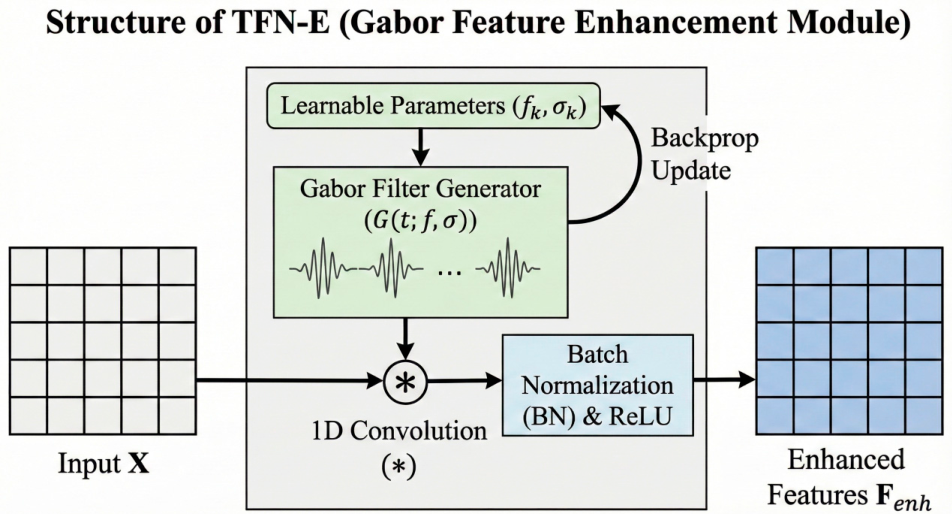
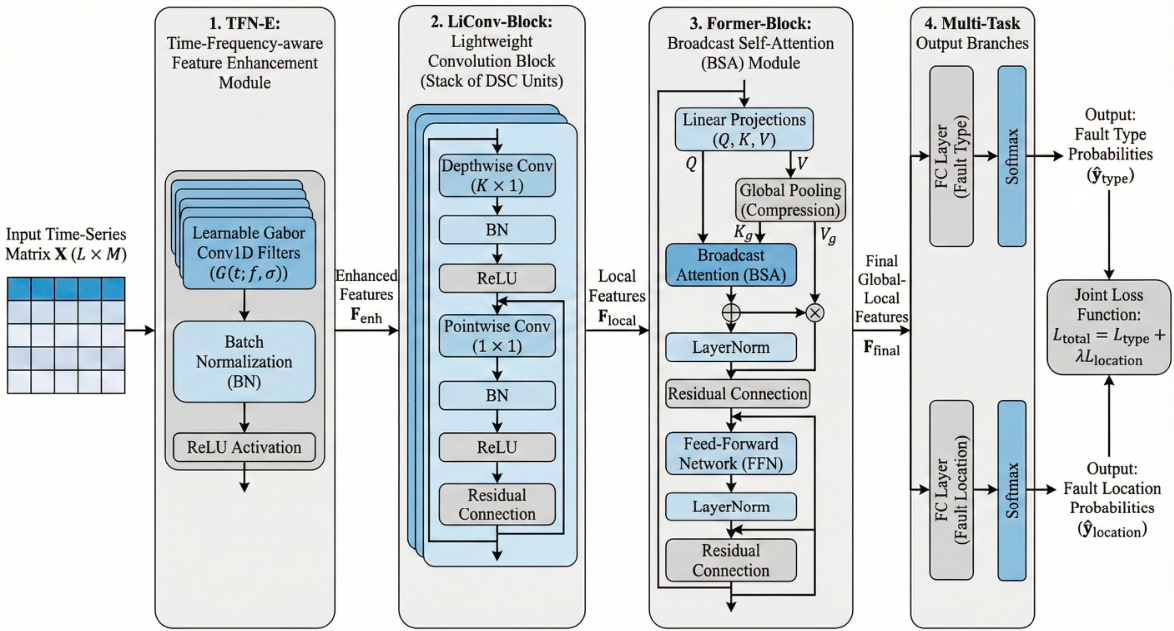
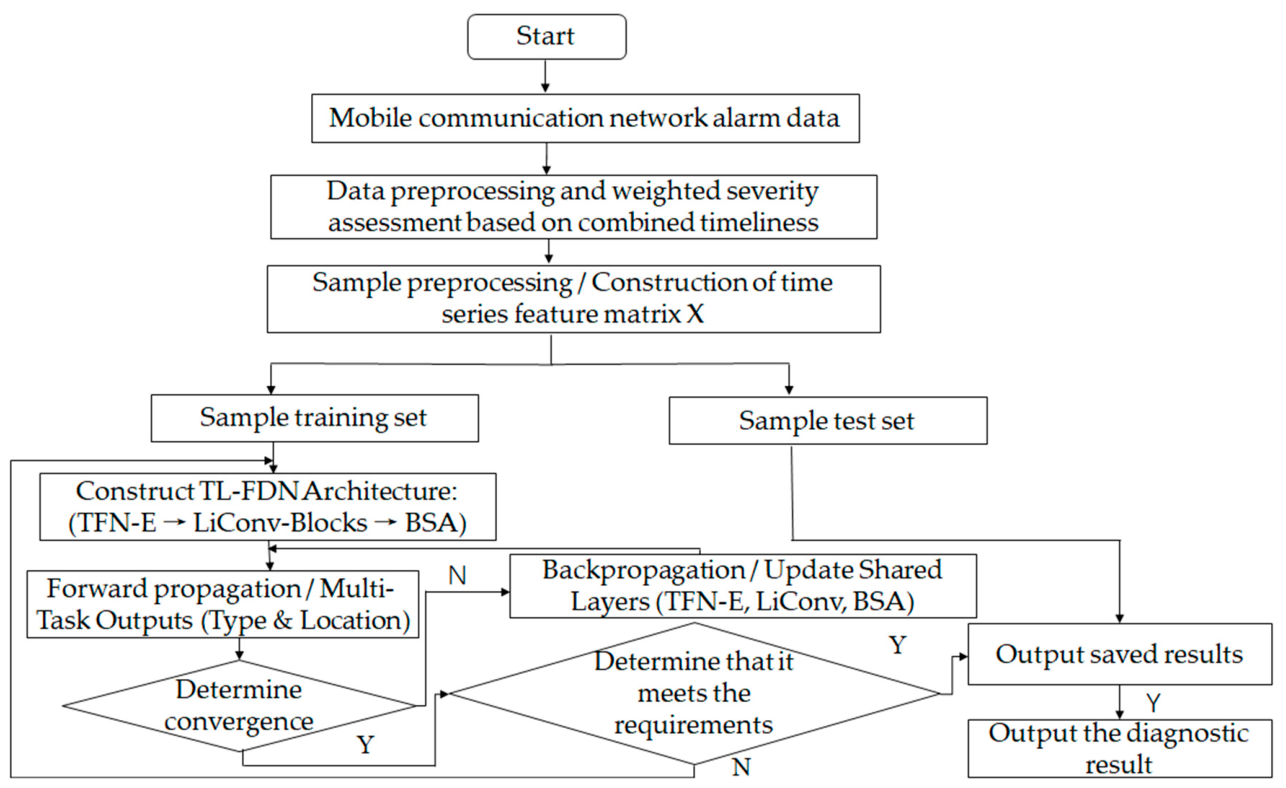
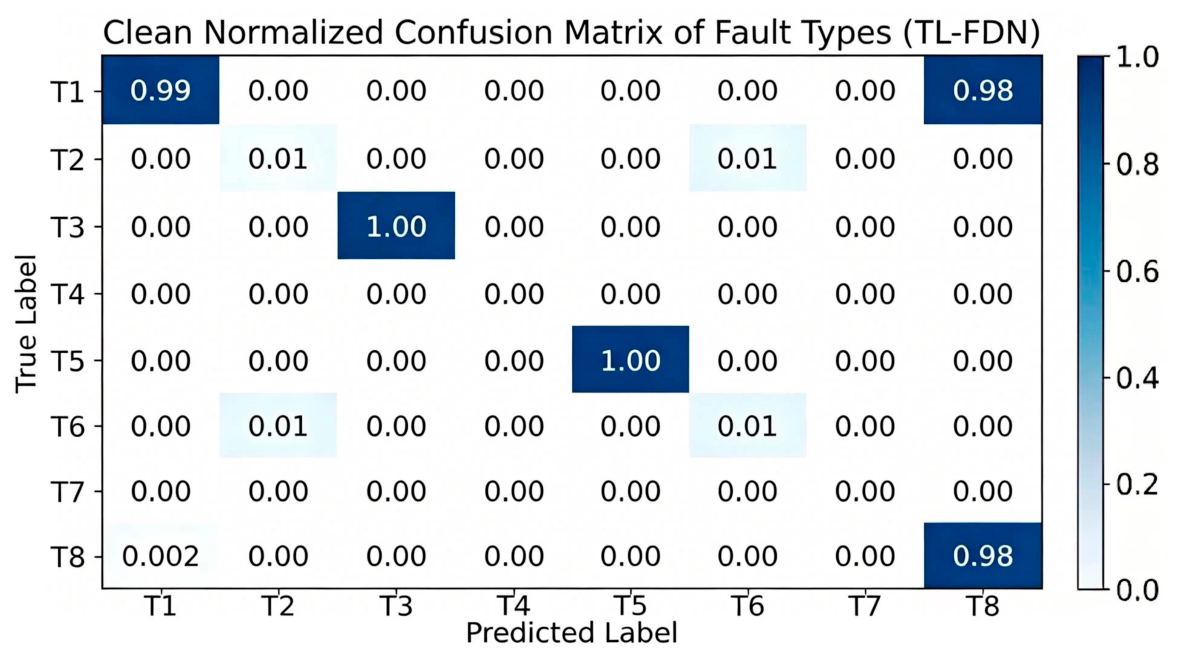
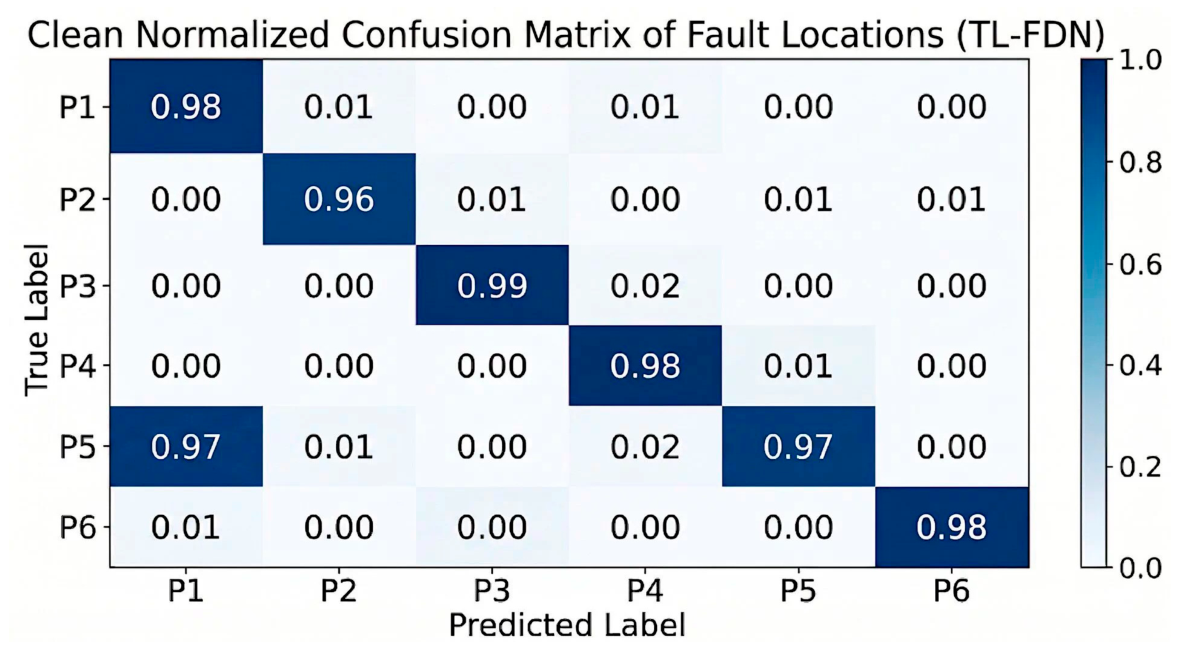
In response to the shortcomings of current mobile communication network (MCN) fault diagnosis methods, such as the insufficient robustness of time-series-spectrum features and the limited ability to capture long-distance dependencies, an improved convolutional neural network is proposed, along with a hybrid diagnosis method based on time-frequency perception and a lightweight deep network (TL-FDN). The TL-FDN introduces a time-series-spectrum feature enhancement module (TFN-E) at the input end, and enhances the robustness of features through a learnable Gabor filter bank. The main architecture employs a hybrid module that integrates a lightweight convolution (LiConv-Block) and a broadcast self-attention (BSA) mechanism (Former-Block), effectively balancing the efficiency of local feature extraction with the capture of global time-series dependencies. Additionally, the model uses a multi-task loss function to achieve joint diagnosis of fault type and fault location. The experimental results show that the average accuracy of the proposed TL-FDN method is 98.6%, which is 3.5% higher than that of the standard convolutional + standard attention baseline method. To strictly evaluate the performance improvement, this paper conducted a non-parametric Wilcoxon signed-rank test in 10 independent experiments. The p-values of the core model indicators were all strictly less than 0.05. These results statistically confirm the superiority of TL-FDN in the fault type identification and location tasks, while maintaining a lightweight parameter quantity suitable for edge-end deployment.
Keywords: mobile communication network; fault diagnosis; convolutional neural network; lightweighting mobile communication network; fault diagnosis; convolutional neural network; lightweighting