Protecting HWSNs from Super Adversaries with Robust Certificateless Signcryption

 , , , , and
Abstract
1. Introduction
2. Related Work
3. Certificateless Setting
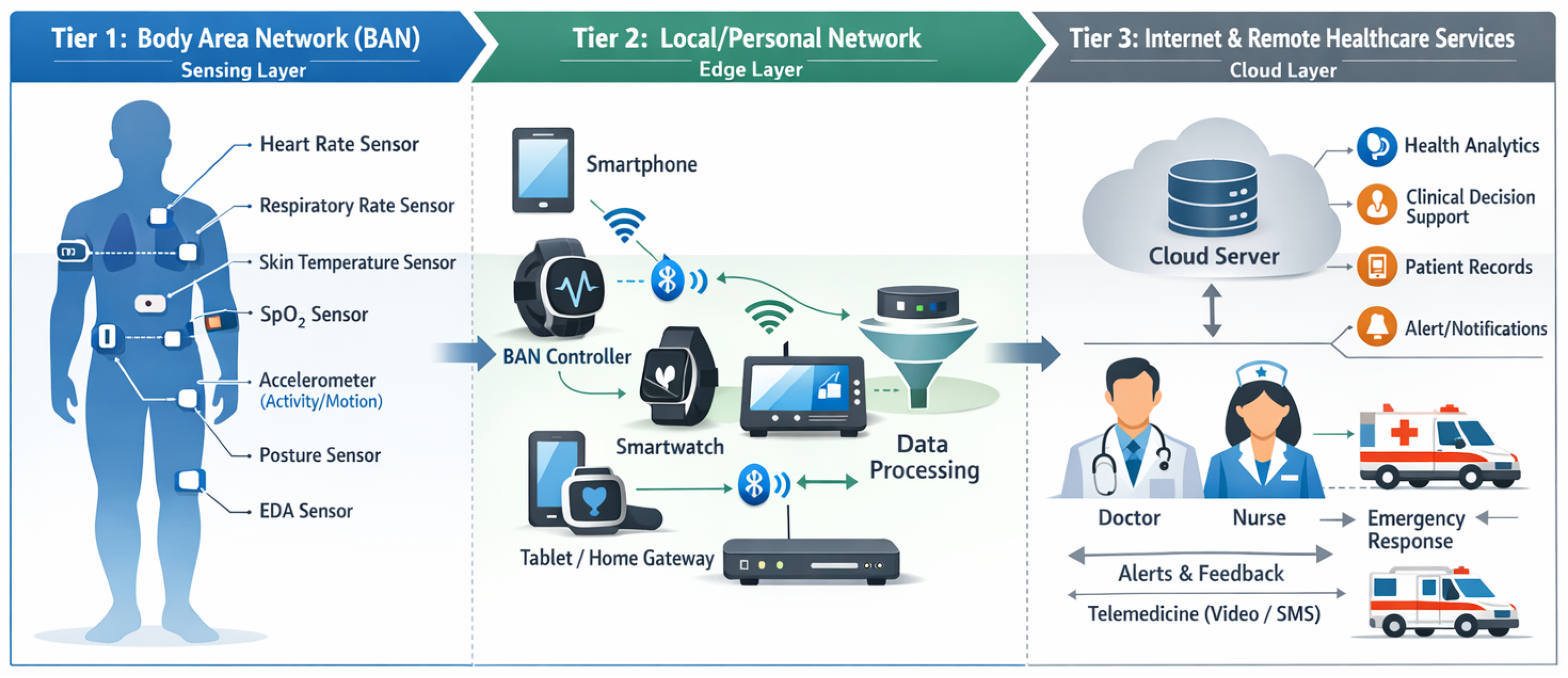
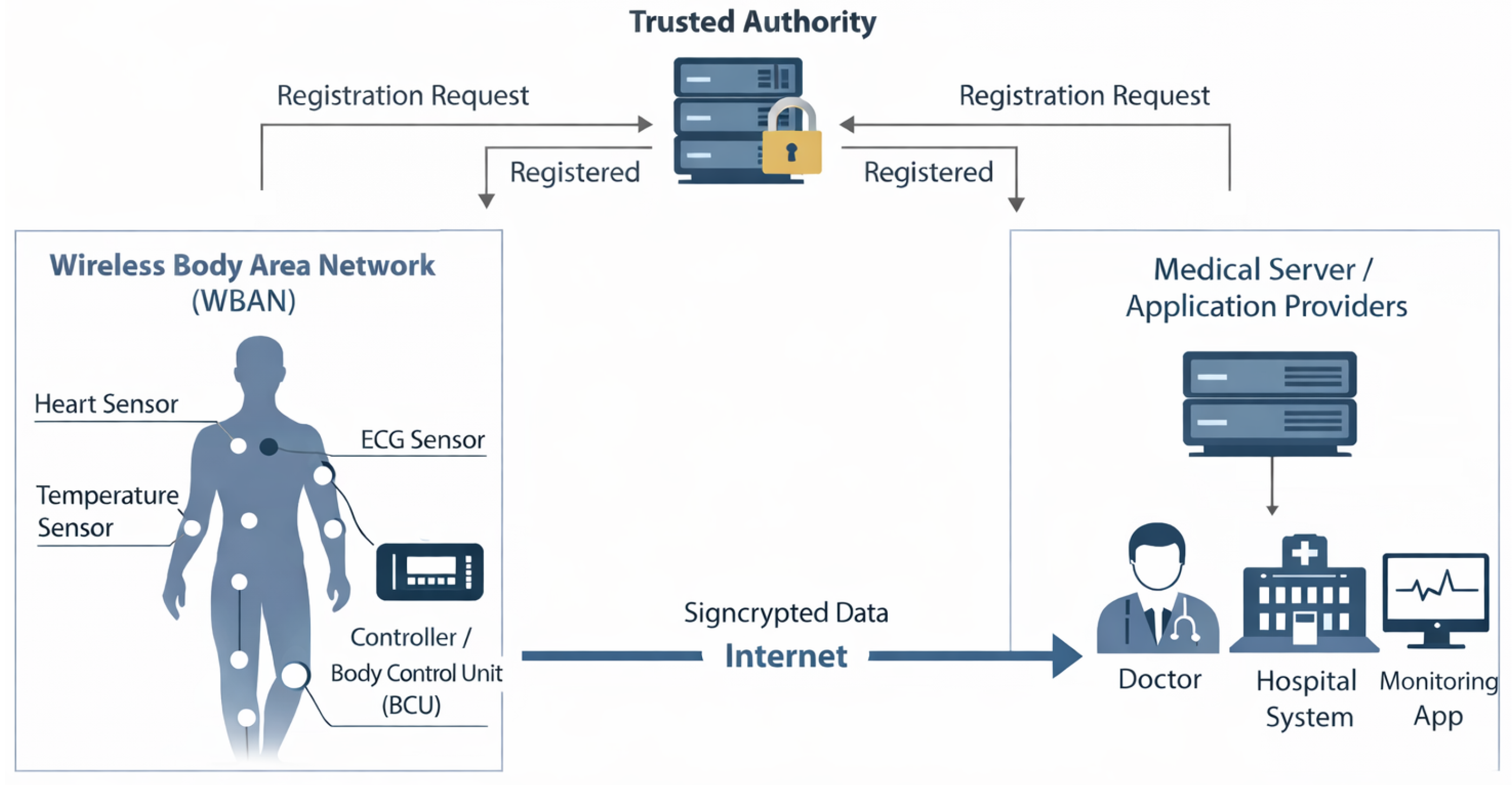
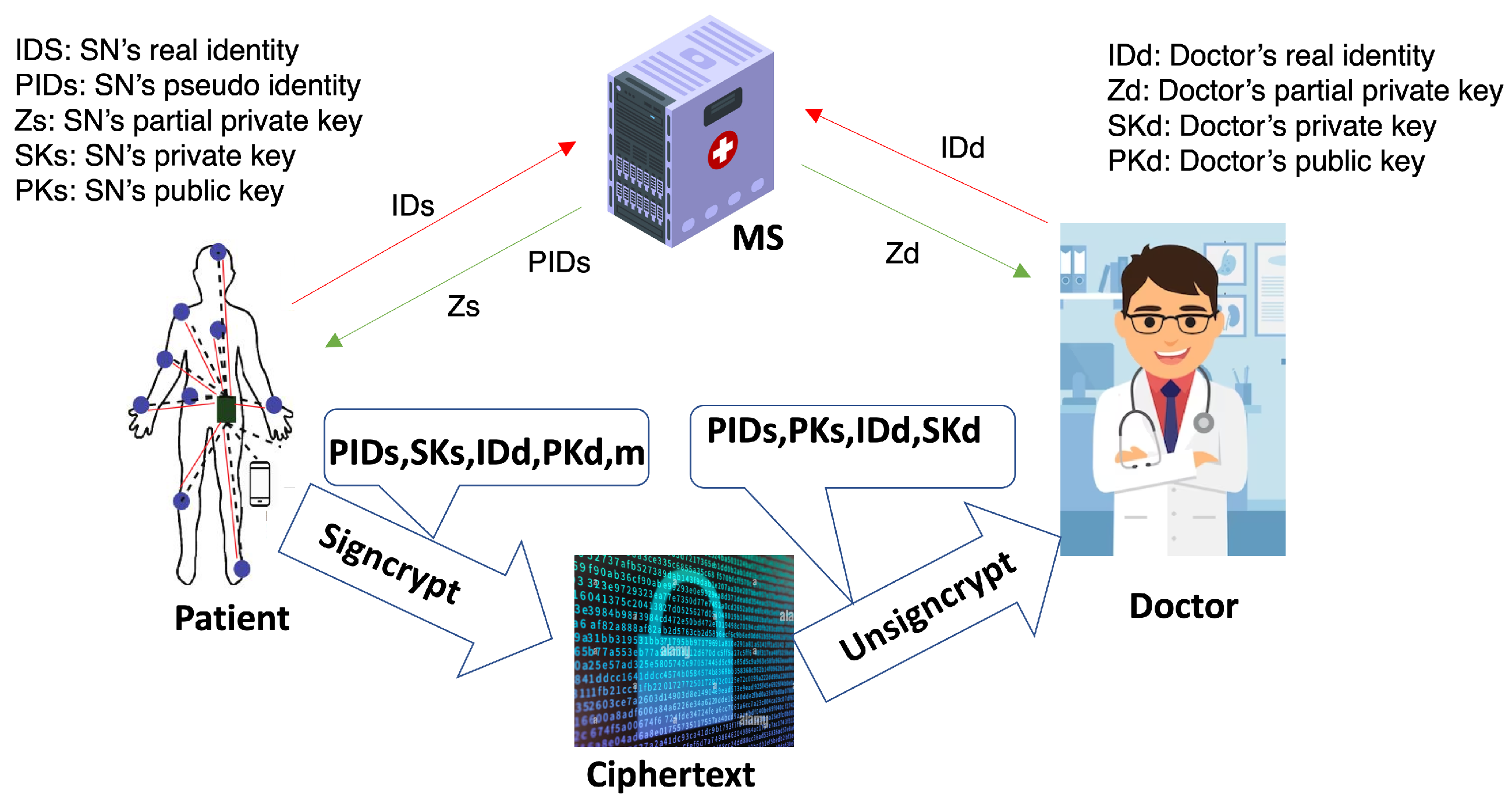
3.1. Certificateless Signcryption for HWSNs
- MS: This determines the system’s parameters and publishes them. Additionally, it is responsible for producing a partial private key and pseudo-identity for each PD and SN.
- SN: This is installed on a patient’s body to gather vital sign data, which is subsequently signcrypted and delivered to the PD.
- PD: After receiving a signcrypted message, the PD uses their own private key to unsigncrypt it and retrieve the data.
- Setup: The MS provides the system parameters on input and a security parameter .
- PID-Extract: After receiving the identity from the SN, the MS creates a pseudo-identity and transmits it to the SN.
- PPK-Extract: A partial private key (or is created by the MS after receiving (or ) of a sensor node SN (or a doctor PD) and is delivered to the SN (or PD) by using a secure channel.
- SV-Set: A secret value (or ) is selected by the SN (or PD).
- FSK-Set: The full private key (or is established by the SN (or PD).
- UPK-Generate: The user’s public key (or ) is produced by the SN (or PD).
- Signcrypt: On inputting and , SN produces a signcryption to transmit to the PD.
- Unsigncrypt: On inputting and , the PD either decides that the tuple is invalid or returns a message.
3.2. Preliminaries
3.2.1. Bilinear Pairing
- Bilinearity: For all , .
- Non-degeneracy: i.e., .
- Computability: We can design an efficient algorithm for computing .
3.2.2. Elliptic Curve Decisional Diffie-Hellman Problem (ECDDHP)
3.2.3. Computation Attack Algorithm (CAA)
3.3. Security Requirements
- Type I adversary : This type of attacker does not possess the master secret key but is permitted to modify or replace the public keys of users. In essence, behaves as a public key replacement attacker.
- Type II adversary : This adversary is assumed to have full knowledge of the master secret key but is not able to manipulate users’ public keys. Thus, models a malicious but honest KGC.
3.3.1. Confidentiality
- Initialization: When C receives a security parameter ν, it produces and . Next, C transmits to while keeping secret.
- Phase 1 Queries: C must respond to a polynomially bounded number of ’s inquiries throughout this phase.
- –
- PID-Query(): acquires a , or pseudo-identity.
- –
- UPK-Query(): obtains the value.
- –
- UPK-Query(): obtains the value.
- –
- Replace-Query(): C replaces with .
- –
- Replace-Query(): C replaces with .
- –
- PPK-Query(): acquires the value ; it is unable to accomplish that if is changed.
- –
- PPK-Query(): acquires the value ; it is unable to accomplish that if is changed.
- –
- SV-Query(): acquires the value ; it is unable to accomplish that if is changed.
- –
- SV-Query(): acquires the value ; it is unable to accomplish that if is changed.
- –
- SC-Query(): acquires the signcryption σ.
- –
- USC-Query(): obtains the symbol ⊥ or the message m.
Keep in mind that PID-Query() and UPK-Query() would be run before any other queries for each SN, and UPK-Query() should be run before any other queries for each PD. - Challenge: Two messages of identical length, and , as well as two identities, and , are chosen by and sent to C during this phase. C produces a signcryption, , on , from to , by flipping a coin to choose randomly. After that, obtains from C.
- Phase 2 Queries: Analogous to Phase 1 requests, transmits a polynomially constrained set of queries that C needs to reply to.
- Guess: outputs .
- 1.
- .
- 2.
- is not allowed to be obtained by .
- 3.
- If the related public key of user i has already been changed, cannot get .
- 4.
- The replacement of prior to the challenge phase will prevent from obtaining .
- 5.
- is not permitted to submit an unsigncryption query on of to in Phase 2 queries, until the or that were used to create are changed after the challenge is sent.
- Initialization: When C receives a security parameter ν, it generates and . Next, obtains and from C.
- Phase 1 Queries: C must respond to a polynomially finite number of ’s inquiries throughout this phase.
- Challenge: Two messages of identical length, and , as well as two identities, and , are chosen by and sent to C during this phase. C generates a signcryption, , on , from to , by flipping a coin to pick randomly. After that, obtains from C.
- Phase 2 Queries: Analogous to Phase 1 requests, transmits a polynomially constrained set of queries that C needs to reply to.
- Guess: outputs .
- 1.
- ,
- 2.
- cannot be obtained by .
- 3.
- is not permitted to submit an Unsigncryption query on of to , in Phase 2 queries.
3.3.2. Unforgeability
- Initialization: This is the same as that in Game 1.
- Queries: C is responsible for replying to a polynomially finite number of ’s inquiries throughout this phase.
- Forgery: On a message , generates a forged signcryption from to .
- 1.
- is a valid signcryption.
- 2.
- cannot be obtained by .
- 3.
- If the related public key of user i has already been changed, cannot get .
- 4.
- is unable to acquire .
- 5.
- is not permitted to submit a signcryption query on of to .
- Initialization: This is the same as that in Game 2.
- Queries: C must respond to a polynomially finite number of ’s inquiries throughout this phase.
- Forgery: On a message , creates a forged signcryption from to .
- 1.
- is a valid signcryption.
- 2.
- cannot be obtained by .
- 3.
- is not permitted to submit a signcryption query on of to .
4. An Overview of Deng et al.’s Scheme
4.1. The Algorithms
- Setup: When the security parameter is entered, the following actions are carried out by the MS:
- –
- The selection of a bilinear pairing , where and are two cyclic groups of a prime order ;
- –
- The selection of two generators of , P and Q, and setting ;
- –
- Establishing as the message space and the identity space;
- –
- Choosing five secure hash functions:: ;: ;: ;: ;: .where ;
- –
- The selection of a number from , and computing and setting ;
- –
- Keeping secret and releasing .
- PID-Extract: After obtaining the of the SN, the MS carries out the subsequent actions to produce the pseudo-identity :
- –
- Picking at random and calculating ;
- –
- Computing ;
- –
- Setting a list and forwarding to SN.
- PPK-Extract:
- –
- On input , the MS picks by random and sets and . Then, the MS uses a secure channel to forward to the SN.
- –
- After receiving the PD’s real identity , the MS picks by random and computes and . Then, the MS uses a secure channel to forward to the PD.
- SV-Set: The SN and PD pick random values and as their secret values, respectively.
- FSK-Set: The SN and PD set and , respectively.
- UPK-Generate: and are set by the SN and PD, respectively, where and .
- Signcrypt: The SN performs the following actions to create on m for a PD as a recipient:
- –
- Picking random values , and computing ;
- –
- Setting ;
- –
- Setting ;
- –
- Setting ;
- –
- Setting ;
- –
- Setting ;
- –
- Setting .
Finally, SN returns and forwards it to the PD. - Unsigncrypt: Upon receiving , the PD executes the following actions:
- –
- Setting ;
- –
- Setting ;
- –
- Setting ;
- –
- Setting ;
- –
- Setting .
Finally, the PD accepts the message m, ifOtherwise, the signcryption is rejected.
4.2. Cryptanalysis of Deng et al.’s Scheme
- Picks random values , and computes and .
- Sets .
- Sets .
- Sets .
- Sets .
- Selects by random and computes .
- Sets .
5. Our Improved CL-SC Scheme
- 1.
- Setup, PID-Extract, PPK-Extract, SV-Set, FPK-Set and UPK-Generate: These steps are similar to those of Deng et al.’s scheme described in Section 4.
- 2.
- Signcrypt: To generate on m for a recipient PD, the SN carries out the subsequent operations:
- Picks by random and computes .
- Sets .
- Sets .
- Sets .
- Sets .
- Sets .
- Sets .
Finally, the SN returns and forwards it to the PD. - 3.
- Unsigncrypt: Once is received by the PD, they perform the following operations:
- Sets .
- Sets .
- Sets .
- Sets .
- Sets .
- The message m is accepted if . Otherwise, the signcription is rejected.
6. Proof of Security
6.1. Confidentiality
- PID-Query(): execute the PID-Extract phase to retrieve .
- UPK-Query(): keeps a record of in . selects at random, establishes , and subsequently includes in .
- UPK-Query(): keeps a record of of tuple and performs the subsequent actions:
- 1.
- If , selects at random, assigns and , and subsequently includes in .
- 2.
- If not, selects , establishes , and subsequently includes in the table.
- Replace-Query(): A list of tuples and is maintained by . inserts and to and updates with .
- Replace-Query(): A list of tuples and is maintained by . inserts and to and updates with .
- PPK-Query(): A list of tuples and is maintained by . Upon finding and in , adds and to after running the PPK-Generate step to produce .
- PPK-Query(): A list of tuples is maintained by ; then, performs the subsequent actions:
- 1.
- If , the simulation aborts.
- 2.
- Otherwise, after finding and in , inserts and to after running the PPK-Generate phase to produce .
- SV-Query(): returns after locating and in the table .
- SV-Query(): returns after locating and in the table .
- SC-Query(): After obtaining using the PPK-Extract and SV-Set algorithms, runs the signcrypt algorithm to produce a signcryption .
- USC-Query(): performs the subsequent actions:
- 1.
- If , thus, has been revised to . If (or ), must provide the value (or ), after which runs the unsigncrypt phase to deliver m or reject the signcryption.
- 2.
- If and , runs the unsigncrypt phase to deliver m or reject the signcryption.
- 3.
- If and , the simulation aborts.
- if , selects by random and makes a SC-Query() to return a signcryption .
- If , selects by random and performs the following steps:
- 1.
- Searches for the tuple and in .
- 2.
- Defines the sender’s public key as .
- 3.
- Calculates and .
- 4.
- Retrieves from the table .
- 5.
- Sets the recipient’s public key as .
- 6.
- Sets .
- 7.
- Defines .
- 8.
- Calculates and .
- 9.
- Sets
- 10.
- Sets
- 11.
- Defines
- 12.
- Calculates
Finally, outputs and forwards it to .
- : does not end the game in queries from the PPK-Query() and does not replace the value .
- : does not fail in USC-Query().
- : In the challenge stage, selects .
- PID-Query(): This is the same as in Lemma 1.
- UPK-Query(): This is the same as in Lemma 1.
- UPK-Query(): keeps a record of and in and performs the subsequent actions:
- 1.
- On the query, chooses by random, assigns and , and subsequently includes and in .
- 2.
- Otherwise, chooses , establishes , and subsequently includes in .
- PPK-Query(): This is the same as in Lemma 1.
- PPK-Query(): A list of tuples is maintained by . After finding and in the table , inserts and to after running the PPK-Generate phase to produce .
- SV-Query(): This is the same as in Lemma 1.
- SV-Query(): keeps a record of and in and performs the subsequent actions:
- 1.
- If , aborts and gives up.
- 2.
- If not, looks for and in , produces , and inserts and to .
- SC-Query(): This is similar to that of Lemma 1.
- USC-Query(): This the the same as in Lemma 1.
- If , then selects by random and makes SC-Query () to return a signcryption .
- If , selects by random and undertakes the following:
- 1.
- Retrieves the tuple and from the table .
- 2.
- Defines the sender’s public key as .
- 3.
- Calculates and .
- 4.
- Locates in .
- 5.
- Assigns the recipient’s public key as .
- 6.
- Calculates .
- 7.
- Defines .
- 8.
- Evaluates .
- 9.
- Sets
- 10.
- Calculates
- 11.
- Defines
- 12.
- Sets
Finally, outputs and forwards it to .
- : does not abort in queries from the SV-Query() and does not replaced the value .
- : does not fail in USC-Query().
- : In the challenge phase, selects .
6.2. Unforgeability
- PID-Query(): This is the same as in Lemma 1.
- UPK-Query(): keeps a record of and in and performs the subsequent actions:
- 1.
- On the query, selects by random, assigns and , and subsequently includes in .
- 2.
- Otherwise, selects , establishes , and subsequently includes and in .
- UPK-Query(): keeps a record of and in . selects by random, establishes , and subsequently includes and in .
- Replace-Query(): This is similar to Lemma 1.
- Replace-Query(): This is the same as in Lemma 1.
- PPK-Query(): A table of tuples is maintained by . Then, performs the subsequent actions:
- 1.
- If , the simulation aborts.
- 2.
- Otherwise, after finding and in , adds and to after running the PPK-Extract phase to produce .
- PPK-Query(): A table of tuples is maintained by . After finding and in the table , inserts and to after running the PPK-Extract phase to produce .
- SV-Query(): returns after locating and in the table .
- SV-Query(): returns after locating and in the table .
- SC-Query(): performs the subsequent actions:
- 1.
- If , thus, has been revised to . If (or ), must provide the value (or ), after which executes the signcrypt algorithm to produce a signcryption .
- 2.
- If and , runs the signcrypt step to produce a signcryption .
- 3.
- If and , the simulation aborts.
- USC-Query(): Once has been obtained using the PPK-Extract and SV-Set algorithms, uses the unsigncrypt procedure to either reject the tuple or produce a message m.
- 1.
- Searches for tuple and in .
- 2.
- Establishes .
- 3.
- Calculates and .
- 4.
- Looks up in .
- 5.
- Establishes .
- 6.
- Calculates .
- 7.
- Calculates .
- 8.
- Establishes .
- 9.
- Calculates
- 10.
- Calculates .
- 11.
- Establishes (where ).
- 12.
- Produces , as follows:.Hence is a respondent of the CAA problem.
- : does not finish the game in queries from the PPK-Query() and does not replace the value .
- : does not fail in SC-Query().
- : In the challenge stage, selects .
- PID-Query(): This is the same as in Lemma 1.
- UPK-Query(): keeps a record of and in and performs the subsequent actions:
- 1.
- On the query, selects by random, assigns and , and subsequently includes in .
- 2.
- Otherwise, selects , establishes , and subsequently includes in .
- UPK-Query(): This is the same as in Lemma 3.
- PPK-Query(): This is the same as in Lemma 1.
- PPK-Query(): This is the same as in Lemma 3.
- SV-Query(): This is the same to Lemma 3.
- SV-Query(): This is the same as in Lemma 3.
- SC-Query(): This is similar to Lemma 3.
- USC-Query(): This is the same as that in Lemma 3.
- 1.
- Searches for the tuple and in the table .
- 2.
- Establishes .
- 3.
- Calculates .
- 4.
- Finds in the table .
- 5.
- Establishes .
- 6.
- Calculates .
- 7.
- Calculates .
- 8.
- Establishes .
- 9.
- Calculates
- 10.
- Calculates .
- 11.
- Establishes (where ).
- 12.
- Produces .Therefore, is the solution of the CAA problem.
- : does not finish the game in queries from the SV-Query() and does not replace the value .
- : does not fail in SC-Query().
- : In the challenge stage, selects .
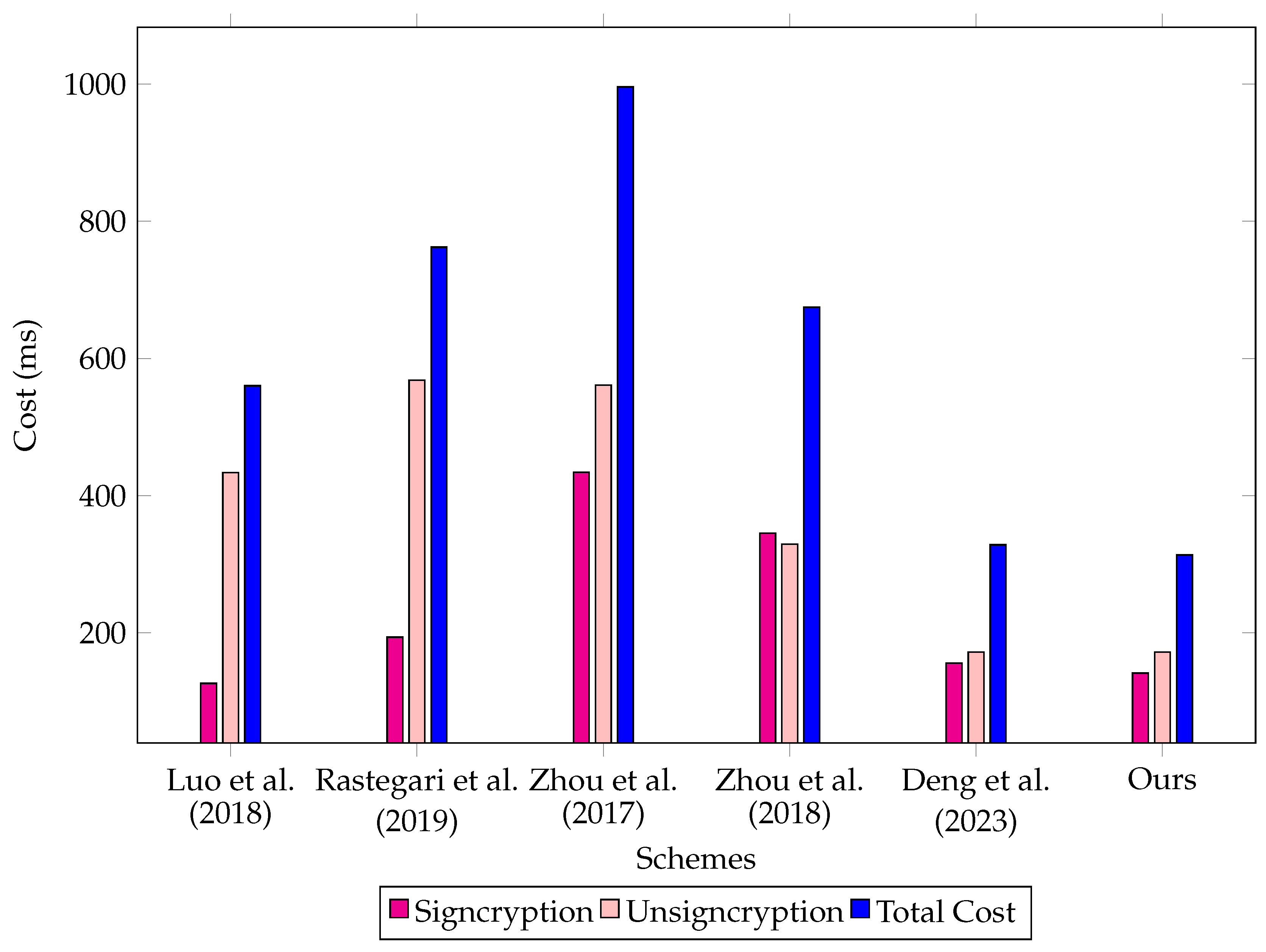
7. Efficiency and Comparison
8. Conclusions
Author Contributions
Funding
Data Availability Statement
Conflicts of Interest
References
- Noor, F.; Kordy, T.A.; Alkhodre, A.B.; Benrhouma, O.; Nadeem, A.; Alzahrani, A. Securing wireless body area network with efficient secure channel free and anonymous certificateless signcryption. Wirel. Commun. Mob. Comput. 2021, 2021, 5986469. [Google Scholar] [CrossRef] [Scilit]
- Shamir, A. Identity-based cryptosystems and signature schemes. In Advances in Cryptology: Proceedings of CRYPTO 1984; Springer: Berlin/Heidelberg, Germany, 1985; pp. 47–53. [Google Scholar]
- Al-Riyami, S.S.; Paterson, K.G. Certificateless public key cryptography. In International Conference on the Theory and Application of Cryptology and information Security; Springer: Berlin/Heidelberg, Germany, 2003; pp. 452–473. [Google Scholar]
- Huang, X.; Mu, Y.; Susilo, W.; Wong, D.S.; Wu, W. Certificateless signature revisited. In Australasian Conference on Information Security and Privacy; Springer: Berlin/Heidelberg, Germany, 2007; pp. 308–322. [Google Scholar]
- Barbosa, M.; Farshim, P. Certificateless signcryption. In Proceedings of the 2008 ACM Symposium on Information, Computer and Communications Security, Tokyo, Japan, 18–20 March 2008; pp. 369–372. [Google Scholar]
- Liu, Z.; Hu, Y.; Zhang, X.; Ma, H. Certificateless signcryption scheme in the standard model. Inf. Sci. 2010, 180, 452–464. [Google Scholar] [CrossRef] [Scilit]
- Zhang, A.; Wang, L.; Ye, X.; Lin, X. Light-weight and robust security-aware d2d-assist data transmission protocol for mobile-health systems. IEEE Trans. Inf. Forensics Secur. 2016, 12, 662–675. [Google Scholar] [CrossRef] [Scilit]
- Zhou, C. An improved lightweight certificateless generalized signcryption scheme for mobile-health system. Int. J. Distrib. Sens. Netw. 2019, 15, 1550147718824465. [Google Scholar] [CrossRef] [Scilit]
- Balasubramanian, V.; Mala, T. Improved certificateless signcryption for iot smart devices. Appl. Math. Inf. Sci. 2019, 13, 31–38. [Google Scholar] [CrossRef] [Scilit]
- Luo, M.; Wan, Y. An enhanced certificateless signcryption in the standard model. Wirel. Pers. Commun. 2018, 98, 2693–2709. [Google Scholar] [CrossRef] [Scilit]
- Rastegari, P.; Susilo, W.; Dakhlalian, M. Efficient certificateless signcryption in the standard model: Revisiting luo and wan’s scheme from wireless personal communications (2018). Comput. J. 2019, 62, 1178–1193. [Google Scholar] [CrossRef] [Scilit]
- Yuan, Y. Security analysis of an enhanced certificateless signcryption in the standard model. Wirel. Pers. Commun. 2020, 112, 387–394. [Google Scholar] [CrossRef] [Scilit]
- Luo, W.; Ma, W. Secure and efficient data sharing scheme based on certificateless hybrid signcryption for cloud storage. Electronics 2019, 8, 590. [Google Scholar] [CrossRef] [Scilit]
- Kasyoka, P.; Kimwele, M.; Angolo, S.M. Cryptanalysis of a pairing-free certificateless signcryption scheme. ICT Express 2021, 7, 200–204. [Google Scholar] [CrossRef] [Scilit]
- Ji, S.; Gui, Z.; Zhou, T.; Yan, H.; Shen, J. An efficient and certificateless conditional privacy-preserving authentication scheme for wireless body area networks big data services. IEEE Access 2018, 6, 69603–69611. [Google Scholar] [CrossRef] [Scilit]
- Guo, Z. Cryptanalysis of a certificateless conditional privacy-preserving authentication scheme for wireless body area networks. Int. J. Electron. Inf. Eng. 2019, 11, 1–8. [Google Scholar]
- Shan, S. An efficient certificateless signcryption scheme without random oracles. Int. J. Electron. Inf. Eng. 2019, 11, 9–15. [Google Scholar]
- Balde, L.; Zhang, J.; Elkhalil, A.; Khudayberdiev, O. A practical and secure certificateless signcryption for privacy-preserving scheme in healthcare management system. In Proceedings of the 2021 16th International Conference on Intelligent Systems and Knowledge Engineering (ISKE), Chengdu, China, 26–28 November 2021; pp. 572–578. [Google Scholar]
- Karati, A.; Fan, C.-I.; Huang, J.-J. An efficient pairing-free certificateless signcryption without secure channel communication during secret key issuance. Procedia Comput. Sci. 2020, 171, 110–119. [Google Scholar] [CrossRef] [Scilit]
- Deng, L.; Wang, B.; Gao, Y.; Chen, Z.; Li, S. Certificateless anonymous signcryption scheme with provable security in the standard model suitable for healthcare wireless sensor networks. IEEE Internet Things J. 2023, 10, 15953–15965. [Google Scholar] [CrossRef] [Scilit]
- Liu, X.; Zhou, Y.; Yang, B.; Zhu, T.; Zhang, M. An efficient pairing-free certificateless signcryption scheme under the standard model for vanet. IEEE Internet Things J. 2025, 12, 22142–22154. [Google Scholar] [CrossRef] [Scilit]
- Ali, Z.; Hassan, J.; Aftab, M.U.; Hundera, N.W.; Xu, H.; Zhu, X. Securing wireless body area network with lightweight certificateless signcryption scheme using equality test. Comput. Stand. Interfaces 2025, 96, 104070. [Google Scholar] [CrossRef] [Scilit]
- Liu, X.; Zhou, Y.; Zhu, Y.; Xia, Z. A novel construction of certificateless aggregate signcryption scheme for smart healthcare. Expert Syst. Appl. 2025, 285, 127963. [Google Scholar] [CrossRef] [Scilit]
- Dadkhah, P.; Rastegari, P.; Dakhilalian, M. Iot-friendly certificateless signcryption schemes: Introducing a provably secure scheme in rom. J. Inf. Secur. Appl. 2025, 89, 103979. [Google Scholar] [CrossRef] [Scilit]
- Jaganthan, P.; Balusamy, S. Energy-efficient certificateless signcryption for secure data transfer in wireless sensor networks. TELKOMNIKA Telecommun. Comput. Electron. Control 2025, 23, 1084–1096. [Google Scholar] [CrossRef] [Scilit]
- Xu, S.; Chen, X.; Guo, Y.; Yiu, S.-M.; Gao, S.; Xiao, B. Efficient and secure post-quantum certificateless signcryption with linkability for iomt. IEEE Trans. Inf. Forensics Secur. 2024, 20, 1119–1134. [Google Scholar] [CrossRef] [Scilit]
- Long, W.; Deng, L.; Zeng, J.; Gao, Y.; Lu, T. An efficient certificateless anonymous signcryption scheme for wban. Sensors 2024, 24, 4899. [Google Scholar] [CrossRef] [Scilit] [PubMed]
- Zhang, J.; Dong, C.; Liu, Y. Efficient pairing-free certificateless signcryption scheme for secure data transmission in iomt. IEEE Internet Things J. 2023, 11, 4348–4361. [Google Scholar] [CrossRef] [Scilit]
- Ren, R.; Su, J. A security-enhanced and privacy-preserving certificateless aggregate signcryption scheme-based artificial neural network in wireless medical sensor network. IEEE Sens. J. 2023, 23, 7440–7450. [Google Scholar] [CrossRef] [Scilit]
- Vo, S.C. A Survey of Elliptic Curve Cryptosystems, Part I: Introductory; NAS Technical Report—NAS-03-012; NASA Advanced Supercomputing Division: Moffett Field, CA, USA, 2003.
- Deng, L.; Yang, Y.; Gao, R.; Chen, Y. Certificateless short signature scheme from pairing in the standard model. Int. J. Commun. Syst. 2018, 31, e3796. [Google Scholar] [CrossRef] [Scilit]
- Tso, R.; Yi, X.; Huang, X. Efficient and short certificateless signatures secure against realistic adversaries. J. Supercomput. 2011, 55, 173–191. [Google Scholar] [CrossRef] [Scilit]
- Tso, R.; Huang, X.; Susilo, W. Strongly secure certificateless short signatures. J. Syst. Softw. 2012, 85, 1409–1417. [Google Scholar] [CrossRef] [Scilit]
- Tsai, J.-L. A new efficient certificateless short signature scheme using bilinear pairings. IEEE Syst. J. 2015, 11, 2395–2402. [Google Scholar] [CrossRef] [Scilit]
- Kasyoka, P.; Kimwele, M.; Angolo, S.M. Towards an efficient certificateless access control scheme for wireless body area networks. Wirel. Pers. Commun. 2020, 115, 1257–1275. [Google Scholar] [CrossRef] [Scilit]
- Rastegari, P.; Khalili, M. Cryptanalysis and improvement of an access control protocol for wireless body area networks. In Proceedings of the 2021 18th International ISC Conference on Information Security and Cryptology (ISCISC), Isfahan, Iran, 1–2 September 2021; pp. 57–62. [Google Scholar]
- Xiang, D.; Li, X.; Gao, J.; Zhang, X. A secure and efficient certificateless signature scheme for internet of things. Ad Hoc Netw. 2022, 124, 102702. [Google Scholar] [CrossRef] [Scilit]
- Verma, G.K.; Gope, P.; Kumar, N. Pf-da: Pairing free and secure data aggregation for energy internet-based smart meter-to-grid communication. IEEE Trans. Smart Grid 2021, 13, 2294–2304. [Google Scholar] [CrossRef] [Scilit]
- Zhou, C.; Gao, G.; Cui, Z. Certificateless signcryption in the standard model. Wirel. Pers. Commun. 2017, 92, 495–513. [Google Scholar] [CrossRef] [Scilit]
- Zhou, C. Certificateless signcryption scheme without random oracles. Chin. J. Electron. 2018, 27, 1002–1008. [Google Scholar] [CrossRef] [Scilit]



| q | A large prime number. |
| A prime order field. | |
| A set of positive integers less than q. | |
| A bilinear map, . | |
| Two generators of . | |
| ⊕ | Bitwise XOR (exclusive OR). |
| The master secret key. | |
| The public key of the system. | |
| Collision resistant hash functions | |
| Collision resistant hash functions | |
| Collision resistant hash functions . | |
| Collision resistant hash functions . | |
| Collision resistant hash functions . | |
| The identity space, . | |
| M | The message space, . |
| The identity of the sensor node, . | |
| The pseudo-identity of the sensor node. | |
| The partial private key of the sensor node. | |
| The secret value of the sensor node. | |
| The private key of the sensor node. | |
| The public key of the sensor node. | |
| The identity of the professional doctor, . | |
| The partial private key of the professional doctor. | |
| The secret value of the professional doctor. | |
| The private key of the professional doctor. | |
| The public key of the professional doctor. | |
| A message and its signcryption. | |
| The master secret key. | |
| UPK | The user’s public key. |
| PID | A pseudo-identity. |
| PPK | A partial private key. |
| FSK | The full secret key. |
| SV | A secret value. |
| SC | Signcryption. |
| Bilinear Pairing | 67.32 ms | |
| Scalar Multiplication in | 14.83 ms | |
| Exponentiation in | 7.87 ms |
Disclaimer/Publisher’s Note: The statements, opinions and data contained in all publications are solely those of the individual author(s) and contributor(s) and not of MDPI and/or the editor(s). MDPI and/or the editor(s) disclaim responsibility for any injury to people or property resulting from any ideas, methods, instructions or products referred to in the content. |
© 2026 by the authors. Licensee MDPI, Basel, Switzerland. This article is an open access article distributed under the terms and conditions of the Creative Commons Attribution (CC BY) license.
Share and Cite
Dadkhah, P.; Rastegari, P.; Dakhilalian, M.; Yeoh, P.; Wang, M.; Saremi, S.; Shibl, R.; Himeur, Y.; Mansoor, W. Protecting HWSNs from Super Adversaries with Robust Certificateless Signcryption. Telecom 2026, 7, 37. https://doi.org/10.3390/telecom7020037
Dadkhah P, Rastegari P, Dakhilalian M, Yeoh P, Wang M, Saremi S, Shibl R, Himeur Y, Mansoor W. Protecting HWSNs from Super Adversaries with Robust Certificateless Signcryption. Telecom. 2026; 7(2):37. https://doi.org/10.3390/telecom7020037
Chicago/Turabian StyleDadkhah, Parichehr, Parvin Rastegari, Mohammad Dakhilalian, Phil Yeoh, Mingzhong Wang, Shahrzad Saremi, Rania Shibl, Yassine Himeur, and Wathiq Mansoor. 2026. "Protecting HWSNs from Super Adversaries with Robust Certificateless Signcryption" Telecom 7, no. 2: 37. https://doi.org/10.3390/telecom7020037
APA StyleDadkhah, P., Rastegari, P., Dakhilalian, M., Yeoh, P., Wang, M., Saremi, S., Shibl, R., Himeur, Y., & Mansoor, W. (2026). Protecting HWSNs from Super Adversaries with Robust Certificateless Signcryption. Telecom, 7(2), 37. https://doi.org/10.3390/telecom7020037