
A Comparative Benchmark of Scale-Up and Scale-Out MIMO Architectures for 5G and Prospective 6G Networks



Abstract
1. Introduction
Scope and Contributions
- A fair and reproducible benchmarking framework that enables a systematic comparison of scale-up and scale-out MIMO architectures under identical channel, power, bandwidth, and traffic assumptions, including centralized Massive MIMO, centralized XL-Massive MIMO, and distributed Cell-Free MIMO, conducted under identical channel, power, bandwidth, and traffic assumptions.
- A quantitative evaluation of the fundamental trade-offs between centralized and distributed MIMO design strategies for 5G and prospective 6G networks, clarifying the impact of architectural scaling on system performance.
- A multi-metric performance assessment jointly analyzing throughput, spectral efficiency, coverage, interference, and energy efficiency over a wide range of user densities and service radii.
- Practical design insights identifying the deployment scenarios in which scale-up or scale-out MIMO architectures provide the most favorable performance trade-offs, offering guidance for future dense wireless network planning.
2. Related Work
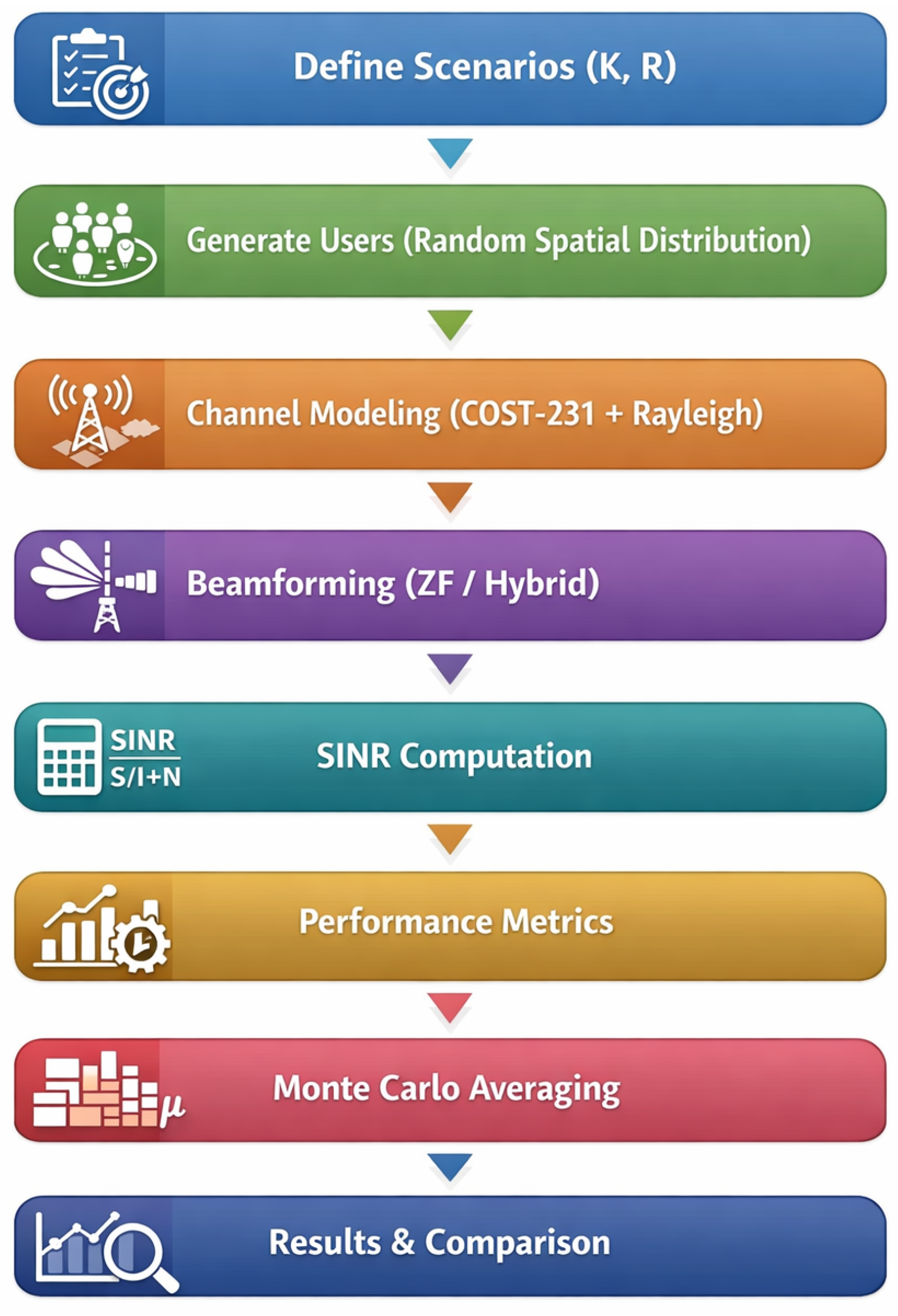
3. Methodology and Research Objective
4. System Model and Simulation Framework
4.1. Evaluated MIMO Architectures
4.1.1. Massive MIMO (Centralized)
4.1.2. XL-Massive MIMO (Centralized)
4.1.3. Cell-Free MIMO (Distributed)
4.2. Channel Model and Propagation Assumptions
4.3. Simulation Parameters and Scenarios
4.4. Performance Metrics
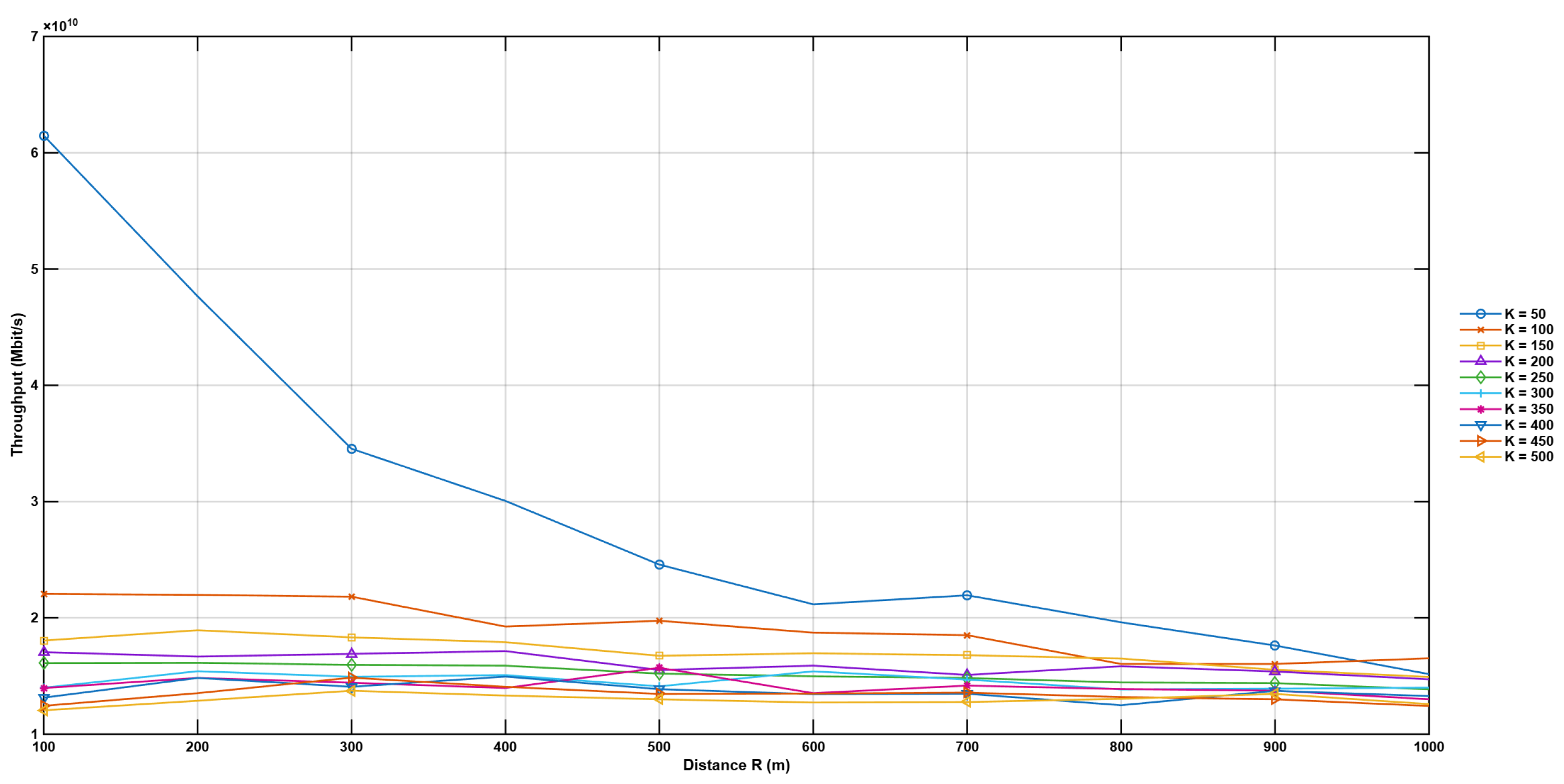
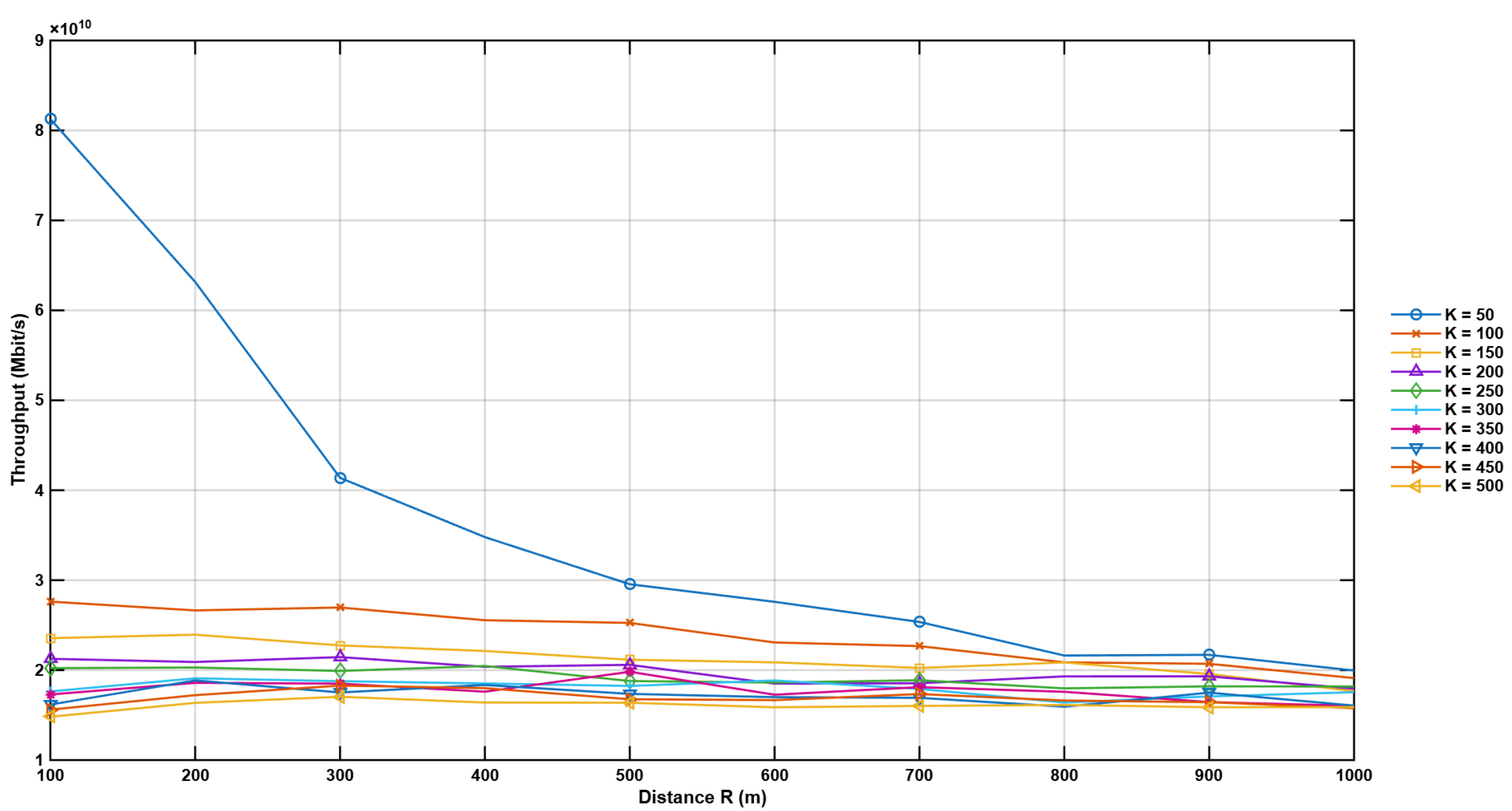
- Aggregate Throughput T (bit/s): sum of instantaneous user rates, averaged over Monte Carlo.
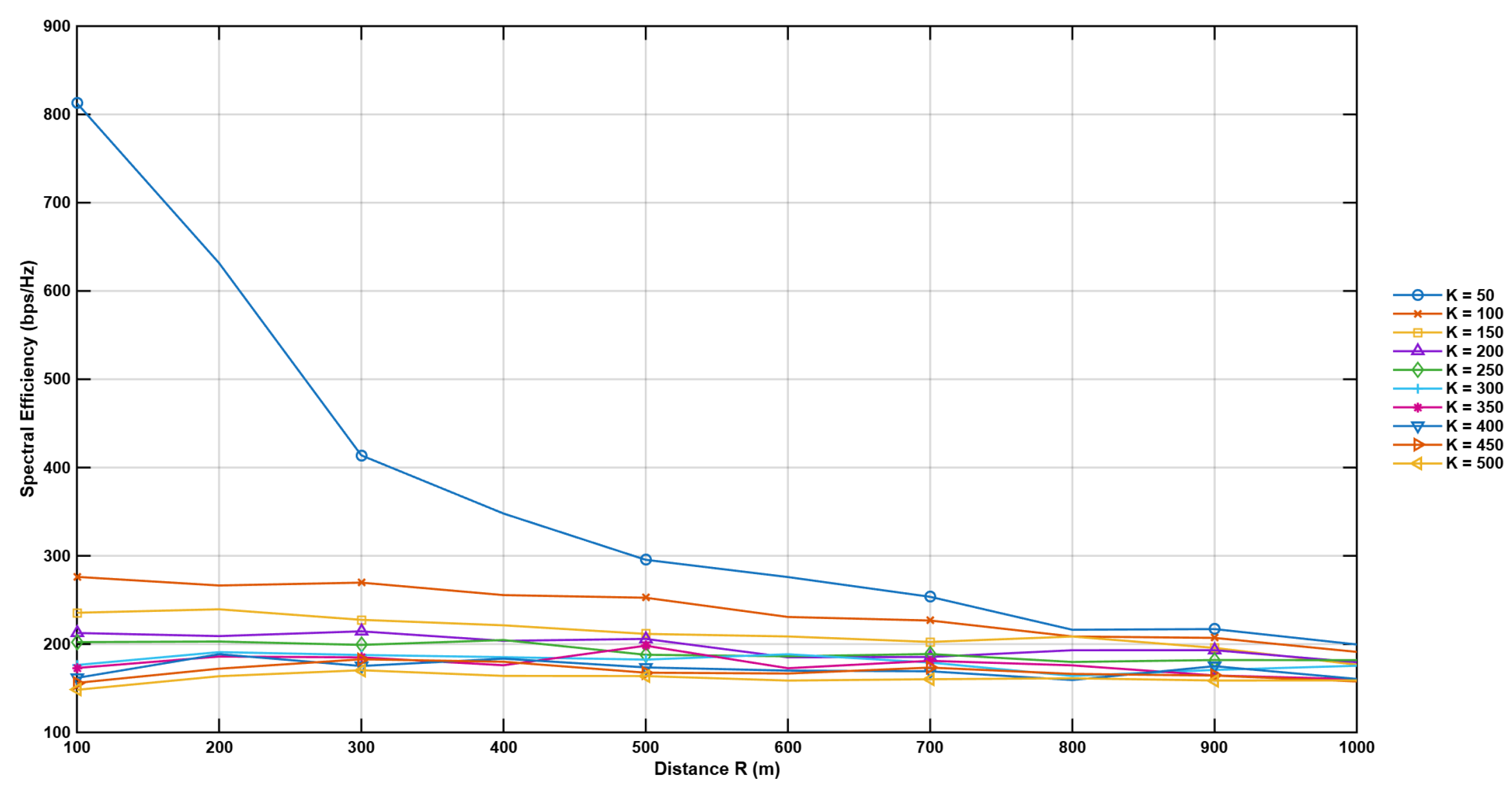
- Spectral efficiency: (bps/Hz): .
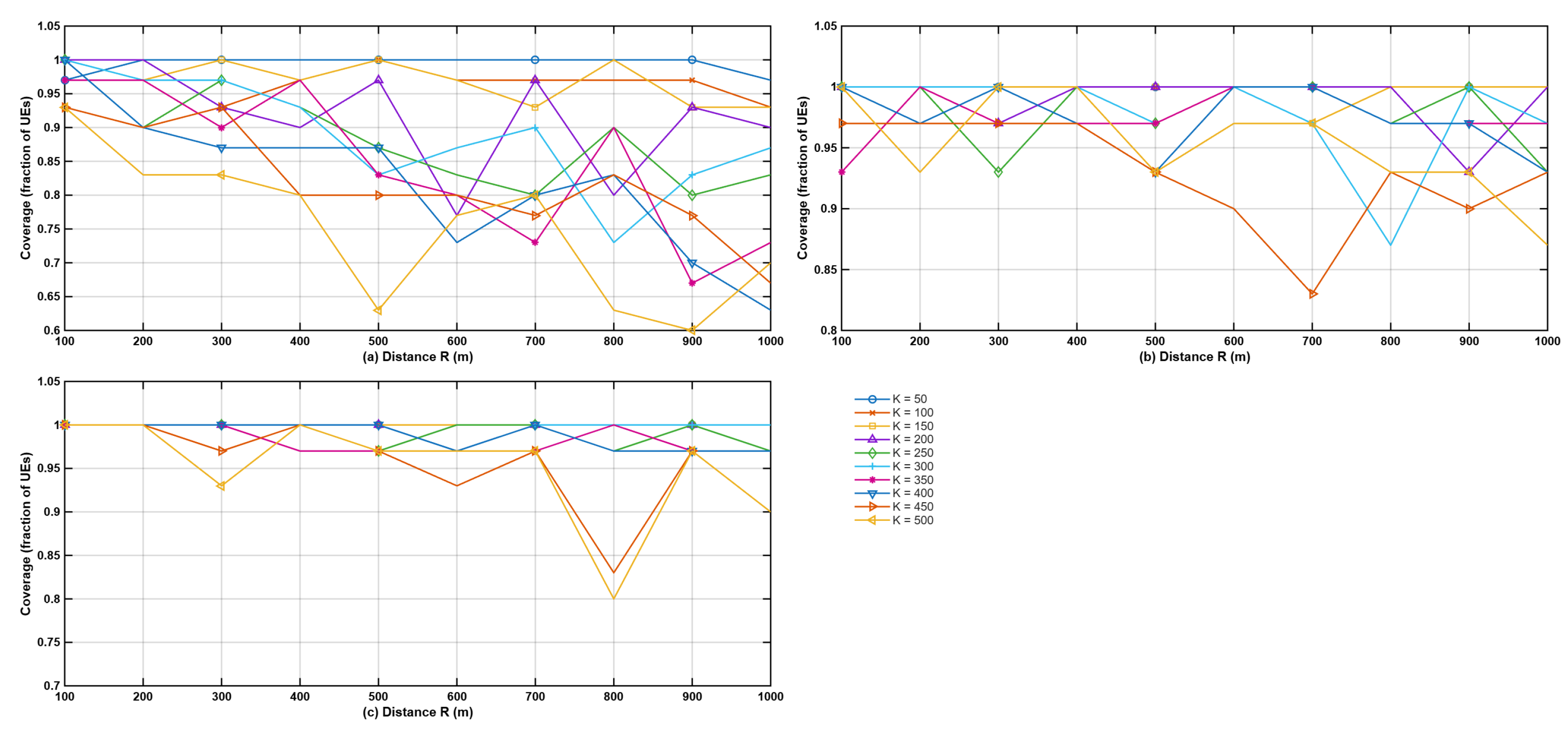
- Coverage: : fraction of users with dBm.
- Interference I (dBm): total undesired received power induced by beams serving other UEs.
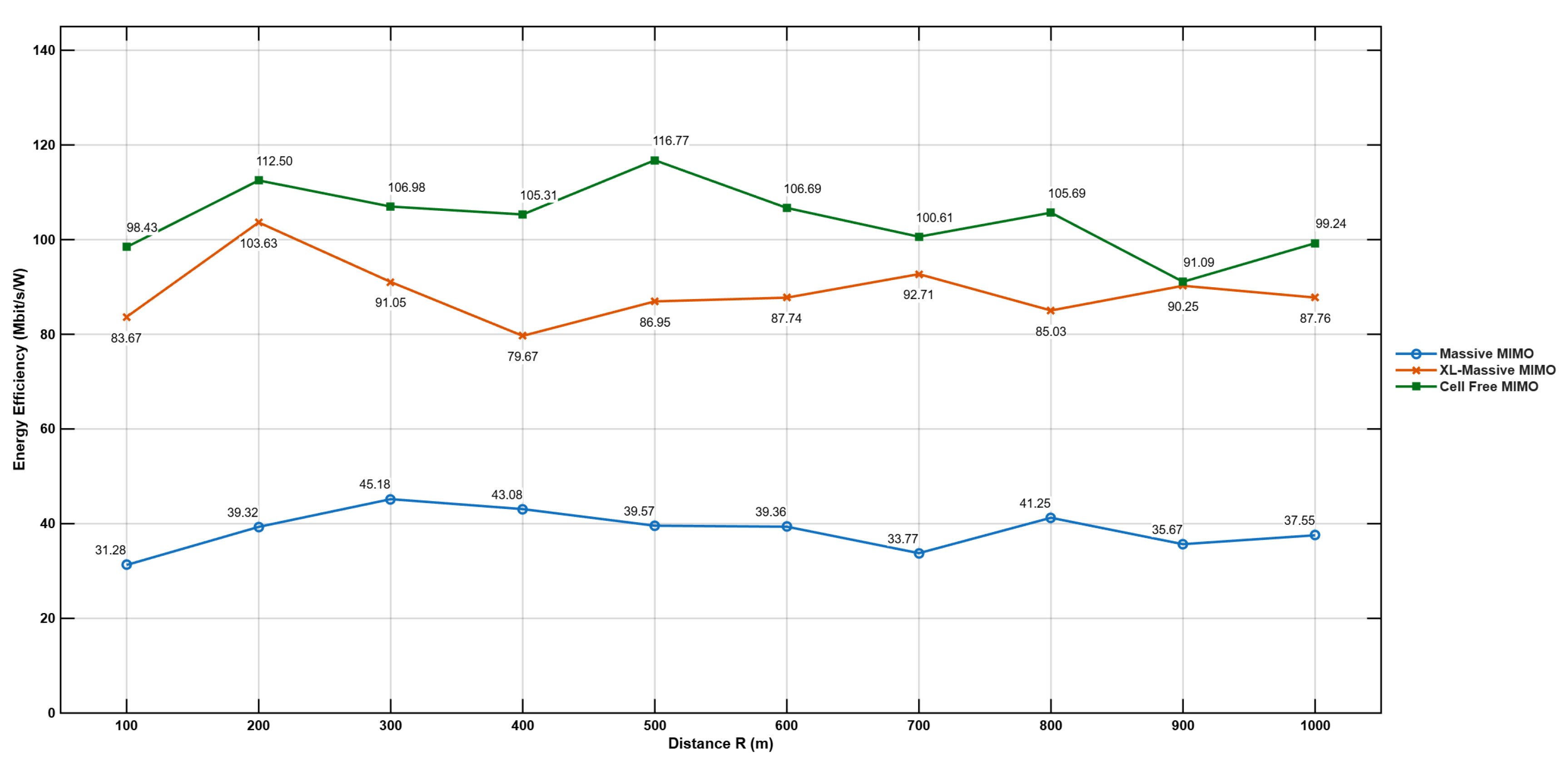
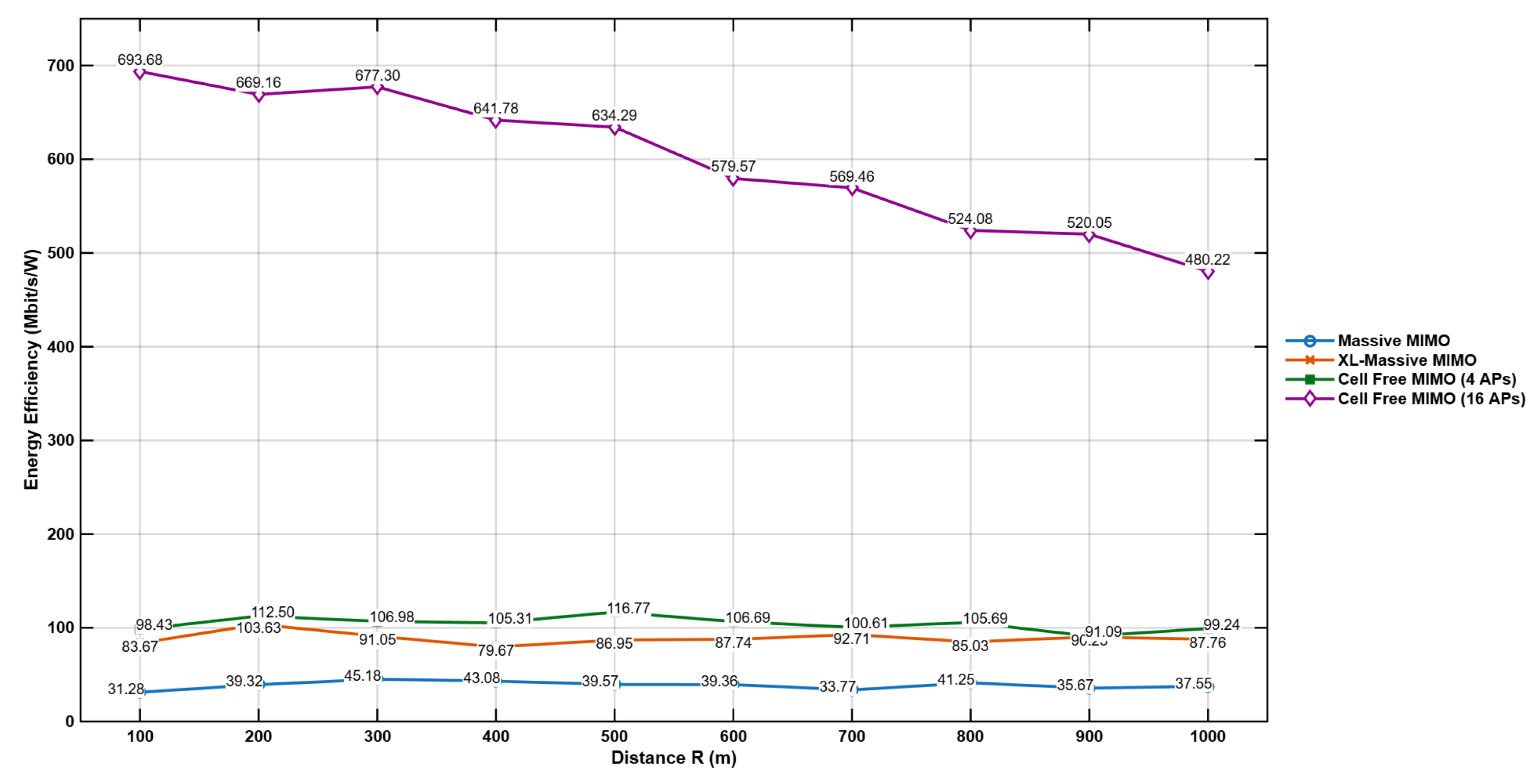
- Energy efficiency (Mbit/s/W): .
5. Results and Discussion
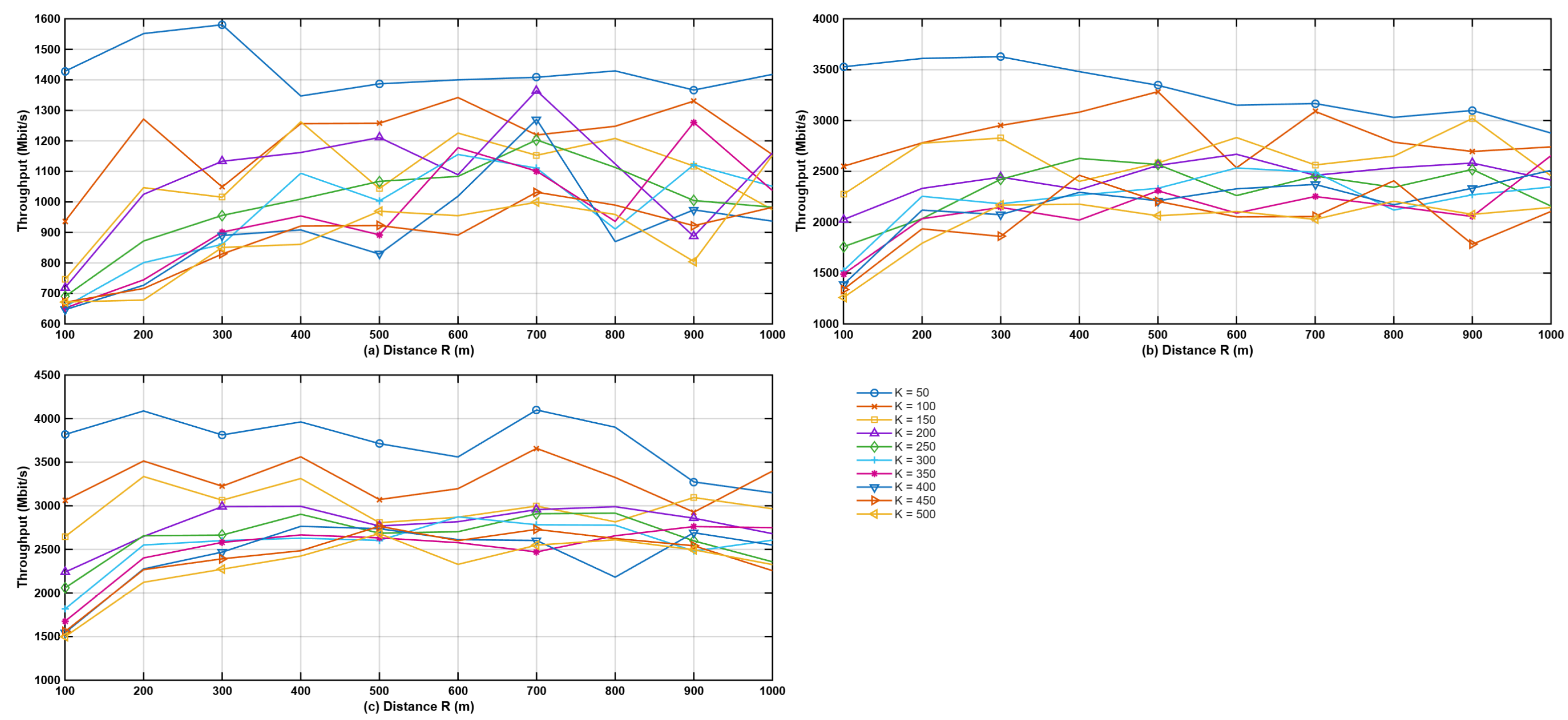
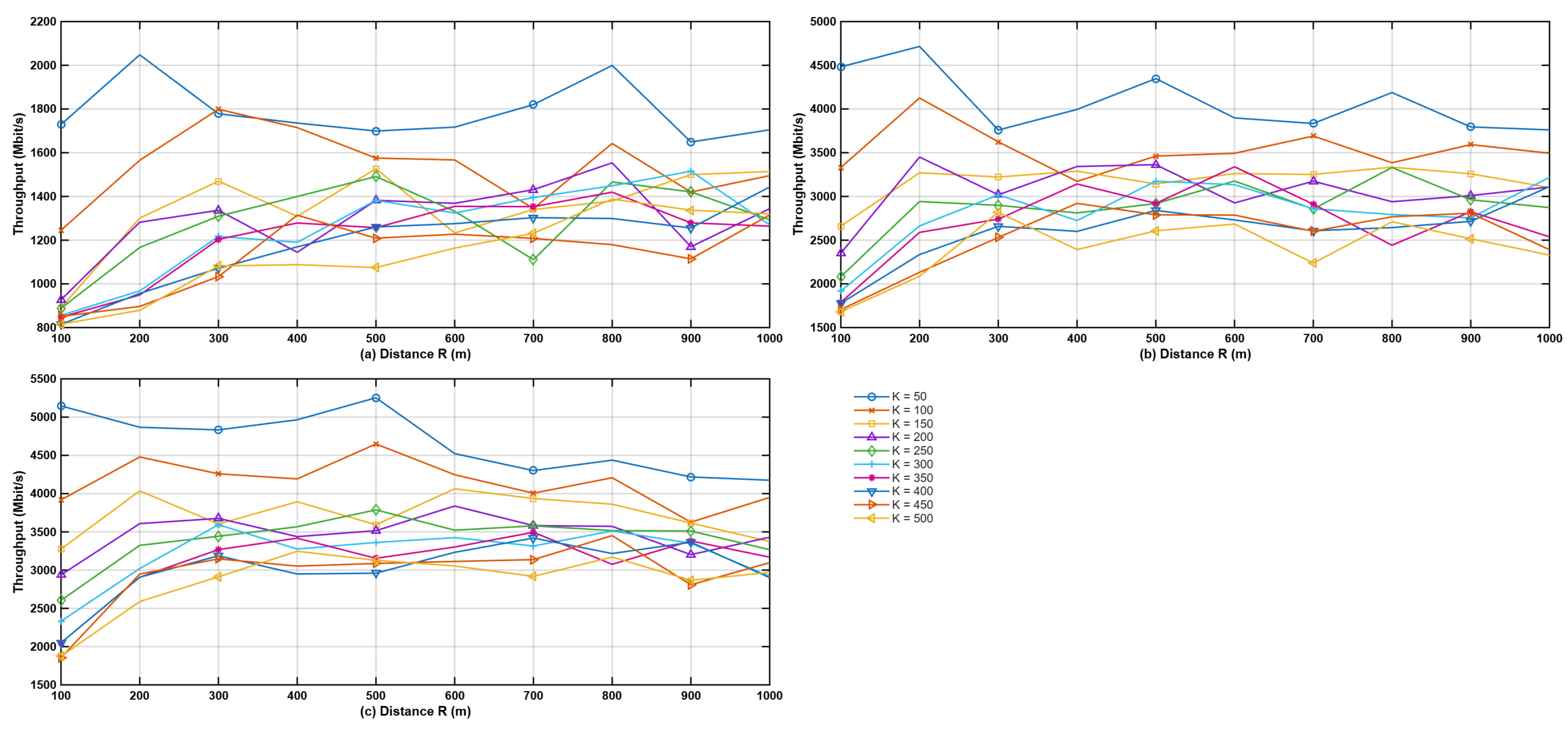
5.1. Throughput Performance
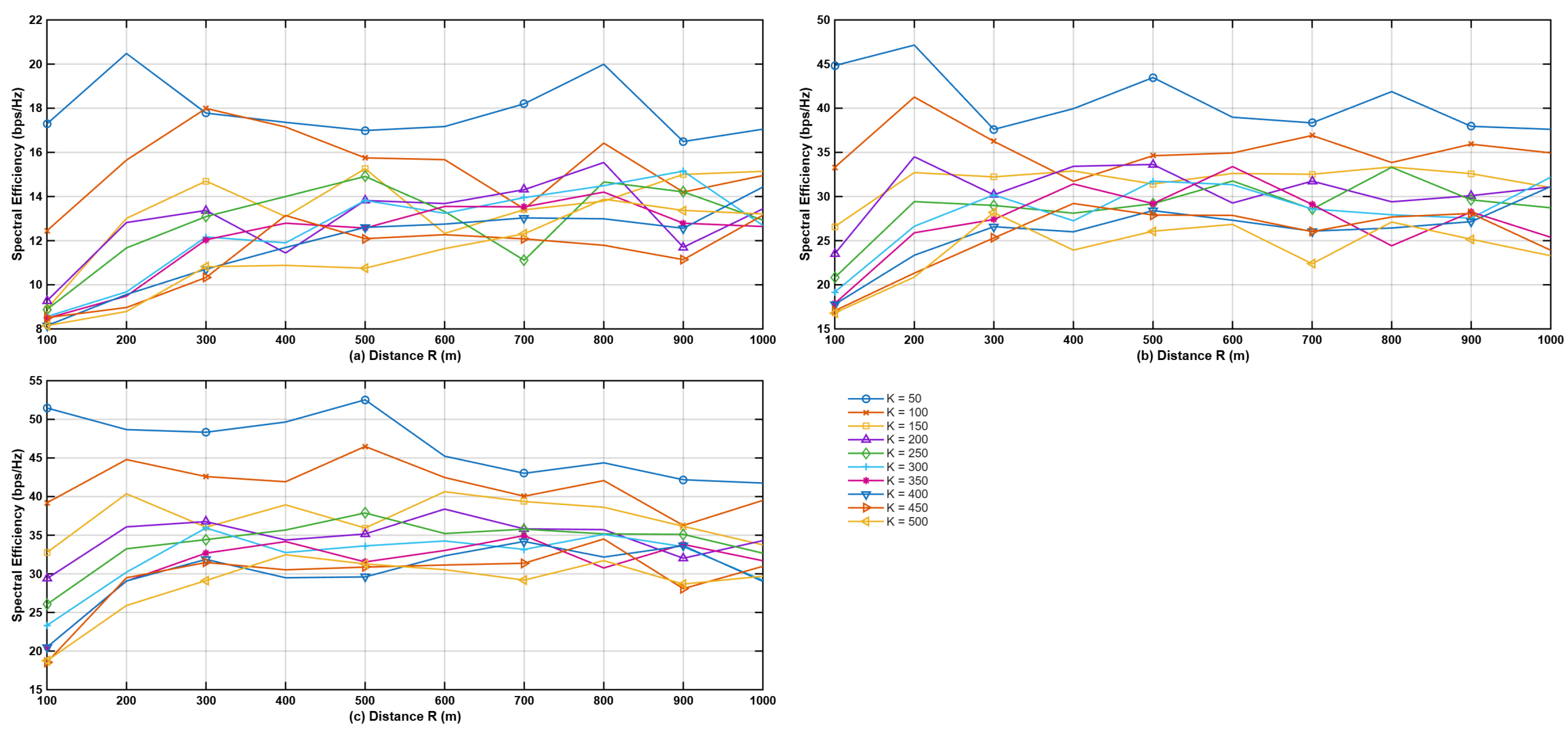
5.2. Spectral Efficiency
5.3. Energy Efficiency
5.4. Coverage Performance
5.5. Impact of the Number of Access Points
6. Design Insights
7. Conclusions and Future Work
Author Contributions
Funding
Data Availability Statement
Conflicts of Interest
Abbreviations
| AP | Access Point |
| BS | Base Station |
| CF-MIMO | Cell-Free Multiple-Input Multiple-Output |
| CSI | Channel State Information |
| EE | Energy Efficiency |
| 5G | Fifth-Generation Mobile Network |
| 6G | Sixth-Generation Mobile Network |
| GHz | Gigahertz |
| MIMO | Multiple-Input Multiple-Output |
| mmWave | Millimeter-Wave |
| SE | Spectral Efficiency |
| SINR | Signal-to-Interference-plus-Noise Ratio |
| UPA | Uniform Planar Array |
| XL-MIMO | Extra-Large Massive MIMO |
References
- Marzetta, T.L. Massive MIMO: An Introduction. Bell Labs Tech. J. 2015, 20, 11–20. [Google Scholar] [CrossRef] [Scilit]
- Larsson, E.G.; Edfors, O.; Tufvesson, F.; Marzetta, T.L. Massive MIMO for Next Generation Wireless Systems. IEEE Commun. Mag. 2014, 52, 186–195. [Google Scholar] [CrossRef] [Scilit]
- David, K.; Berndt, H. 6G Vision and Requirements: Is There Any Need for Beyond 5G? IEEE Veh. Technol. Mag. 2018, 13, 72–80. [Google Scholar] [CrossRef] [Scilit]
- Ngo, H.Q.; Larsson, E.G.; Marzetta, T.L. Energy and Spectral Efficiency of Very Large Multiuser MIMO Systems. IEEE Trans. Commun. 2013, 61, 1436–1449. [Google Scholar] [CrossRef] [Scilit]
- Ngo, H.Q.; Ashikhmin, A.; Yang, H.; Larsson, E.G.; Marzetta, T.L. Cell-Free Massive MIMO versus Small Cells. IEEE Trans. Wirel. Commun. 2017, 16, 1834–1850. [Google Scholar] [CrossRef] [Scilit]
- Buzzi, S.; D’Andrea, C.; Zappone, A. User-Centric 5G Cellular Networks: Resource Allocation and Comparison with the Cell-Free Massive MIMO Approach. IEEE Trans. Wirel. Commun. 2020, 19, 1250–1264. [Google Scholar] [CrossRef] [Scilit]
- Interdonato, G.; Frenger, P.; Larsson, E.G. Scalability Aspects of Cell-Free Massive MIMO. In Proceedings of the IEEE International Conference on Communications (ICC), Shanghai, China, 20–24 May 2019; pp. 1–6. [Google Scholar]
- Gkonis, P.K.; Giannopoulos, A.; Nomikos, N.; Trakadas, P.; Sarakis, L.; Masip-Bruin, X. A Survey on Architectural Approaches for 6G Networks. 6G Netw. 2025, 6, 27. [Google Scholar]
- Akgul, O.U.; Ericson, M.; Burguera, P.G.; Arar, B.; Khorsandi, B.M.; Querio, R.; Varvara, A.; Harkous, H.; Wänstedt, S.; Groshev, M.; et al. Discussion on 6G Architecture Evolution: Challenges and Emerging Technology Trends. In Proceedings of the 2024 Joint European Conference on Networks and Communications & 6G Summit (EuCNC/6G Summit), Antwerp, Belgium, 3–6 June 2024; pp. 664–669. [Google Scholar] [CrossRef] [Scilit]
- Khorsandi, B.M.; Asif Habibi, M.; Avino, G.; Barmpounakis, S.; Bernini, G.; Ericson, M.; Han, B.; Pavón, I.L.; María Jorquera Valero, J.; Lopez, D.R.; et al. Enabling Hexa-X 6G Vision: An End-to-End Architecture. In Proceedings of the 2024 Joint European Conference on Networks and Communications & 6G Summit (EuCNC/6G Summit), Antwerp, Belgium, 3–6 June 2024; pp. 676–681. [Google Scholar] [CrossRef] [Scilit]
- Pivoto, D.G.S.; Rezende, T.T.; Facina, M.S.P.; Moreira, R.; de Oliveira Silva, F.; Cardoso, K.V.; Correa, S.L.; Araujo, A.V.D.; Silva, R.S.E.; Neto, H.S.; et al. A Detailed Relevance Analysis of Enabling Technologies for 6G Architectures. IEEE Access 2023, 11, 89644–89684. [Google Scholar] [CrossRef] [Scilit]
- Jadhav, K. Architectures, Opportunities, and Challenges in Emerging Technologies of 6G. In Proceedings of the 2023 International Conference on Computer and Applications (ICCA), Yangon, Myanmar, 27–28 February 2023; pp. 1–4. [Google Scholar] [CrossRef] [Scilit]
- Hong, H.; Wong, K.K.; Waqar, N.; Zhu, X.; Rao, C.; Zhang, W.; Rostami Ghadi, F.; Murch, R.; Chae, C.B. Fluid Antenna Multiple Access for 6G: A Holistic Review. IEEE Open J. Commun. Soc. 2026, 7, 2607–2633. [Google Scholar] [CrossRef] [Scilit]
- New, W.K.; Wong, K.K.; Wang, C.; Chae, C.B.; Murch, R.; Jafarkhani, H.; Hao, Y. Fluid Antenna Systems: Redefining Reconfigurable Wireless Communications. IEEE J. Sel. Areas Commun. 2026, 44, 1013–1044. [Google Scholar] [CrossRef] [Scilit]
- Zhu, L.; Ma, W.; Mei, W.; Zeng, Y.; Wu, Q.; Ning, B.; Xiao, Z.; Shao, X.; Zhang, J.; Zhang, R. A Tutorial on Movable Antennas for Wireless Networks. IEEE Commun. Surv. Tutor. 2026, 28, 3002–3054. [Google Scholar] [CrossRef] [Scilit]
- Shao, X.; Mei, W.; You, C.; Wu, Q.; Zheng, B.; Wang, C.X.; Li, J.; Zhang, R.; Schober, R.; Zhu, L.; et al. A Tutorial on Six-Dimensional Movable Antenna for 6G Networks: Synergizing Positionable and Rotatable Antennas. IEEE Commun. Surv. Tutor. 2026, 28, 3666–3709. [Google Scholar] [CrossRef] [Scilit]
- Kassam, J.; Castanheira, D.; Silva, A.; Dinis, R.; Gameiro, A. Cell-Free Massive MIMO Technology and Applications in 6G. In Massive MIMO for Future Wireless Communication Systems: Technology and Applications; Wiley: Hoboken, NJ, USA, 2025; pp. 95–122. [Google Scholar] [CrossRef] [Scilit]
- Mohammadi, M.; Mobini, Z.; Quoc Ngo, H.; Matthaiou, M. Next-Generation Multiple Access With Cell-Free Massive MIMO. Proc. IEEE 2024, 112, 1372–1420. [Google Scholar] [CrossRef] [Scilit]
- Zhang, Y.; Hu, Q.; Peng, M.; Liu, Y.; Zhang, G.; Jiang, T. Interdependent Cell-Free and Cellular Networks: Thinking the Role of Cell-Free Architecture for 6G. IEEE Netw. 2024, 38, 247–254. [Google Scholar] [CrossRef] [Scilit]
- Abueida, D.; Albreem, M.A.; Abdallah, S.; Salem, A.A.; Shahabuddin, S.; Alnajjar, K.; Saad, M.; Nguyen, N.T.; Juntti, M. Signal Processing for Cell-Free Massive MIMO: Techniques and Trends in Estimation, Detection, and Precoding. IEEE Open J. Commun. Soc. 2025, 6, 9392–9434. [Google Scholar] [CrossRef] [Scilit]
- Shi, E.; Zhang, J.; Du, H.; Ai, B.; Yuen, C.; Niyato, D.; Letaief, K.B.; Shen, X. RIS-Aided Cell-Free Massive MIMO Systems for 6G: Fundamentals, System Design, and Applications. Proc. IEEE 2024, 112, 331–364. [Google Scholar] [CrossRef] [Scilit]
- Zhang, T.; Xu, D.; Alfarraj, O.; Feng, H.; Al-Dulaimi, A.; Yu, K.; Mumtaz, S. Digital Twin Enabled 6G Cell-Free Multi-Function Reconfigurable Metasurfaces Communications: Concepts, Challenges, and Future Directions. IEEE Netw. 2025, 39, 145–154. [Google Scholar] [CrossRef] [Scilit]
- Demirci, S.; Afeef, L.; Arslan, H. Visibility Region Exploitation for PHY Authentication in XL-MIMO Systems. IEEE Wirel. Commun. Lett. 2025, 14, 43–47. [Google Scholar] [CrossRef] [Scilit]
- Peng, Z.; Liu, R.; Li, Z.; Pan, C.; Wang, J. Deep Learning-Based CSI Feedback for XL-MIMO Systems in the Near-Field Domain. IEEE Wirel. Commun. Lett. 2024, 13, 3613–3617. [Google Scholar] [CrossRef] [Scilit]
- Pisharody, J.N.; Rajoriya, A.; Budhiraja, R. Near-Field Channel Estimation for XL-MIMO Systems Using Variational Bayesian Learning. IEEE Trans. Wirel. Commun. 2024, 23, 10740–10756. [Google Scholar] [CrossRef] [Scilit]
- Tian, J.; Jin, Z.; Chen, X.; Han, Y.; Li, X.; Jin, S.; Wang, W.; Wen, C.K. Multi-Scenario Channel Measurements and Modeling for Subarray-Based Mid-Band XL-MIMO Systems at 7.8-GHz. IEEE Trans. Commun. 2026, 74, 4727–4741. [Google Scholar] [CrossRef] [Scilit]
- Lu, Z.; Han, Y.; Li, X.; Jin, S.; Matthaiou, M. Distributed Near-Field Channel Estimation for U6G XL-MIMO Systems Under Beam Squint. IEEE Trans. Commun. 2026, 74, 1146–1161. [Google Scholar] [CrossRef] [Scilit]
- Wang, H.; Zhang, K.; Fu, Q.; Wen, F.; Li, X. Enhanced Channel Estimation for Hybrid-Field XL-MIMO Systems Using Joint Sparse Bayesian Learning. IEEE Wirel. Commun. Lett. 2025, 14, 3099–3103. [Google Scholar] [CrossRef] [Scilit]
- Wang, Z.; Zhang, J.; Xu, B.; Niyato, D.; Ai, B.; Mao, S.; Han, Z. Low-Complexity Distributed Combining Design for Near-Field Cell-Free XL-MIMO Systems. IEEE Trans. Wirel. Commun. 2026, 25, 11799–11815. [Google Scholar] [CrossRef] [Scilit]
- Musa, A.; Balogun, P.O.; Adebayo, A.O. Applications of Massive MIMO in Wireless Communication Systems. In Massive MIMO for Future Wireless Communication Systems: Technology and Applications; Wiley: Hoboken, NJ, USA, 2025; pp. 59–94. [Google Scholar] [CrossRef] [Scilit]
- Ngo, K.H.; Cuevas, D.; Gil, R.D.M.; Baeza, V.M.; Armada, A.G.; Santamaria, I. Noncoherent MIMO Communications: Theoretical Foundation, Design Approaches, and Future Challenges. IEEE Open J. Veh. Technol. 2026, 7, 381–401. [Google Scholar] [CrossRef] [Scilit]
- Baeza, V.M.; Armada, A.G. Orthogonal versus Non-Orthogonal multiplexing in Non-Coherent Massive MIMO Systems based on DPSK. In Proceedings of the 2021 Joint European Conference on Networks and Communications & 6G Summit (EuCNC/6G Summit), Porto, Portugal, 8–11 June 2021; pp. 101–105. [Google Scholar] [CrossRef] [Scilit]
- Monzon Baeza, V. Incorporating Spatial Modulation for Non-Coherent Massive MIMO With DPSK Schemes. IEEE Wirel. Commun. Lett. 2024, 13, 2527–2530. [Google Scholar] [CrossRef] [Scilit]



| Parameter | Value |
|---|---|
| Carrier frequency () | 3.5 GHz (sub-6), 28 GHz (mmWave) |
| Bandwidth (B) | 80 MHz (3.5 GHz), 100 MHz (28 GHz) |
| Total transmit power () | 40 W |
| Channel model | COST-231 urban macro + Rayleigh fading |
| User distribution | Uniform in circular area |
| Service radius (R) | 100–1000 m (swept) |
| Number of users (K) | Variable (load-dependent) |
| Massive MIMO antennas | 64 (8 × 8 UPA) |
| XL-Massive MIMO antennas | 256 (16 × 16 UPA) |
| Cell-Free APs | 4 APs × 16 antennas each |
| Channel state information | Perfect CSI (ideal case) |
| Monte Carlo realizations | Multiple realizations per operating point |
| Criterion | Massive MIMO | XL-Massive MIMO | Cell-Free MIMO |
|---|---|---|---|
| Architecture type | Centralized | Centralized (Scale-Up) | Distributed (Scale-Out) |
| Aggregate throughput | Medium | High | High |
| Spectral efficiency | Medium | High | High |
| Coverage uniformity | Medium | High | Very High |
| Energy efficiency | Medium | Medium–High | High |
| Scalability with user density | Medium | High | Medium–High |
| Implementation complexity | Medium | High | High |
| Preferred deployment scenario | Urban macro | Dense hotspots | Wide-area/energy-limited |
Disclaimer/Publisher’s Note: The statements, opinions and data contained in all publications are solely those of the individual author(s) and contributor(s) and not of MDPI and/or the editor(s). MDPI and/or the editor(s) disclaim responsibility for any injury to people or property resulting from any ideas, methods, instructions or products referred to in the content. |
© 2026 by the authors. Licensee MDPI, Basel, Switzerland. This article is an open access article distributed under the terms and conditions of the Creative Commons Attribution (CC BY) license.
Share and Cite
Otero Rebolo, S.; Monzon Baeza, V. A Comparative Benchmark of Scale-Up and Scale-Out MIMO Architectures for 5G and Prospective 6G Networks. Telecom 2026, 7, 38. https://doi.org/10.3390/telecom7020038
Otero Rebolo S, Monzon Baeza V. A Comparative Benchmark of Scale-Up and Scale-Out MIMO Architectures for 5G and Prospective 6G Networks. Telecom. 2026; 7(2):38. https://doi.org/10.3390/telecom7020038
Chicago/Turabian StyleOtero Rebolo, Samuel, and Victor Monzon Baeza. 2026. "A Comparative Benchmark of Scale-Up and Scale-Out MIMO Architectures for 5G and Prospective 6G Networks" Telecom 7, no. 2: 38. https://doi.org/10.3390/telecom7020038
APA StyleOtero Rebolo, S., & Monzon Baeza, V. (2026). A Comparative Benchmark of Scale-Up and Scale-Out MIMO Architectures for 5G and Prospective 6G Networks. Telecom, 7(2), 38. https://doi.org/10.3390/telecom7020038