


Abstract
Pawpaw processing generates a seed residue containing an extractable non-food oil. KOH-catalysed methanolysis of pawpaw seed oil was investigated using a four-factor, three-level Taguchi L9 array. Reaction time (45–65 min), temperature (40–60 °C), KOH loading (0.5–2.5 wt.%) and methanol-to-oil molar ratio (6:1–12:1) were evaluated using recovered ester-rich product yield as the response. Screening yields ranged from 80.3 to 98.8 wt.%. Temperature and KOH loading accounted for 46.50% and 42.05% of the corrected L9 variation, respectively, compared with 11.26% for methanol-to-oil ratio and 0.19% for time. The selected condition, 45 min, 60 °C, 2.5 wt.% KOH and a 12:1 ratio, gave 98.10 ± 0.44 wt.% in three independent confirmation runs, 0.70 percentage points below the additive estimate. FTIR bands at 1741.98, 1432.8 and 1195.22 cm−1 showed the expected ester and methyl-associated functional groups. GC-MS showed diagnostic m/z 74 and 87 ions and tentative assignments to several fatty-acid methyl esters. This study demonstrates an efficient screening and confirmation framework for converting discarded pawpaw seeds into an ester-rich renewable-fuel product.
1. Introduction
Biodiesel is produced by converting renewable lipids into fatty-acid alkyl esters with properties that permit partial or complete substitution of petroleum-derived diesel. Its practical value depends on feedstock availability, conversion efficiency, alcohol and catalyst demand, separation requirements and final fuel quality [1,2,3,4]. Non-edible oils and agro-processing residues are therefore of interest because they expand the lipid resource base without direct competition with food uses.
The environmental case for biodiesel is strongest when the lipid source is a residue, the conversion route is technically simple and the recovered co-products and process inputs are properly managed. Cultivation of a dedicated oil crop can transfer environmental burdens to land, fertiliser and irrigation, whereas a seed already generated during fruit processing enters the fuel pathway with much of its upstream production burden assigned to the primary food product. The use of discarded pawpaw seed therefore offers two linked benefits: recovery of a potentially useful oil and reduction of an organic residue that would otherwise require disposal. This perspective places process yield alongside material efficiency, chemical consumption and ease of phase recovery when judging a production condition.
Pawpaw (Carica papaya L.) processing generates seeds that are commonly discarded with wet fruit residues. The seeds contain a substantial lipid fraction and reported papaya seed oils are generally rich in unsaturated fatty acids, particularly oleic acid; however, although cultivar, maturity, location and extraction method influence composition [5,6,7]. Direct methanolysis of papaya seed oil has been demonstrated using homogeneous alkaline catalysts [8,9]. Other investigations have explored waste-derived or nanostructured heterogeneous catalysts and statistically assisted condition selection [10,11]. These studies establish the feedstock’s technical potential, but they do not remove the need for experimentally economical screening strategies that can identify the dominant operating factors with limited oil supply.
The triglyceride composition of papaya seed oil is also relevant to its conversion behaviour. Oils dominated by long-chain unsaturated fatty acids generally remain sufficiently fluid for alcohol-oil contacting under heated conditions, while the ester products retain the molecular features required of a renewable diesel substitute. Nevertheless, the presence of free fatty acids, moisture and minor seed-derived compounds can affect homogeneous alkaline processing. Water encourages hydrolysis and free fatty acids consume alkali through soap formation. Washing and drying are consequently not secondary operations: they determine how much ester-rich phase is ultimately recovered and whether residual catalyst, glycerol and methanol remain in the product.
KOH was selected as a conventional homogeneous alkaline catalyst to provide a straightforward reference process for screening the effects of reaction time, temperature, catalyst loading and methanol-to-oil ratio. This study focused on these operating variables rather than catalyst development or comparison. Heterogeneous catalysts offer potential advantages in catalyst separation and reuse, whereas homogeneous KOH requires downstream washing and is susceptible to soap formation in the presence of free fatty acids and moisture. Accordingly, the present results establish a KOH-based screening and confirmation reference; they do not demonstrate that KOH is economically or environmentally preferable to reusable heterogeneous catalysts.
Temperature, catalyst loading, alcohol-to-oil ratio and reaction time jointly influence alkaline transesterification. Temperature changes viscosity, phase contact and reaction rate; catalyst loading governs methoxide availability but excessive base can promote saponification; and excess methanol shifts equilibrium while complicating phase recovery [2,3,4,12]. A conventional three-level investigation of four factors requires 81 treatment combinations before replication. Orthogonal arrays reduce this burden while preserving balanced representation of each factor level [13,14,15]. Confirmation experiments remain essential because the selected combination may not appear as a treatment in every array and because screening statistics alone do not demonstrate repeatability.
The L9 array provided balanced three-level screening of four process factors. The four factors occupied the eight corrected degrees of freedom, so factor sums of squares and level means were used to rank their relative effects. Independent confirmation runs were then used to determine repeatability at the selected combination.
Previous studies have established the feasibility of producing biodiesel from pawpaw seed oil and applying statistical optimisation to its conversion [8,9,10,11]. The contribution of the present study is a compact screening and confirmation framework for conditions where feedstock availability limits experimental scope. A nine-run Taguchi L9 array provides balanced screening of four operating factors at three levels, followed by three independent experiments to assess repeatability at the selected condition. FTIR and qualitative GC-MS complement gravimetric recovery measurements by examining product identity. This study explicitly distinguishes recovered ester-rich product yield from FAME purity and interprets the factor rankings within the limitations of an unreplicated, saturated screening design. Its contribution therefore concerns experimental economy, confirmation and transparent interpretation rather than a new catalyst or proof of a global optimum.
2. Materials and Methods
2.1. Chemicals and Reagents
n-Hexane (C6H14) was used as the solvent for extracting oil from milled pawpaw seeds. Methanol (CH3OH) was used as the transesterification reagent, and potassium hydroxide (KOH) was used as the homogeneous alkaline catalyst. KOH was dissolved in methanol before contact with the oil. Distilled water (H2O) was used to wash the recovered ester-rich phase.
2.2. Feedstock Preparation and Oil Extraction
Oil extraction employed n-hexane in a Soxhlet apparatus, an approach previously reported for pawpaw seeds [8]. The sample preparation and extraction conditions used in the present study are described below. Pawpaw seeds were collected from fruit vendors in Ogbomoso, Nigeria. Fruit ripeness was not systematically recorded during seed collection, and the samples were not classified by maturity stage. The reported oil recovery of 45.1 wt.% therefore applies to the collected seed batch under the specified extraction conditions. Oil recovery from seeds obtained at intermediate fruit ripeness was not evaluated. Adhering pulp was removed by washing, after which, the seeds were sun-dried and milled to an average particle size of approximately 1.5 mm. A 100 g portion was placed in a muslin thimble and extracted in a 250 mL Soxhlet apparatus with 150 mL n-hexane for 4 h. Solvent was recovered by heating, and the extracted oil was stored in a closed container to limit moisture uptake and oxidation. Oil recovery was calculated on a dry milled-seed mass basis using Equation (1):
where m_oil is the mass of recovered oil after solvent removal (g), and m_seed,dry is the dry mass of milled seed subjected to extraction (g). The measured recovery was 45.1 g oil per 100 g dry milled seed, equivalent to 45.1 wt.%.
Oil recovery (wt.%) = (m_oil/m_seed,dry) × 100
Cleaning removed adhering fruit material that could retain water or introduce soluble impurities into the extract. Milling increased the exposed surface area and shortened the diffusion path for solvent penetration, while the Soxhlet cycle repeatedly contacted the solids with condensed solvent. The 4 h extraction period provided a fixed duration of repeated solvent contact for preparing the oil used in the subsequent methanolysis experiments. Extraction time was not varied in this study; therefore, the reported oil recovery represents recovery under the specified extraction conditions rather than a demonstrated maximum extractable oil content. Oil recovery was reported on the dry milled-seed basis so that it represents the quantity of extractable lipid available for the subsequent reaction rather than the wet mass of the collected residue. The recovered solvent was separated before the oil was weighed and used for methanolysis.
2.3. Methanolysis and Product Recovery
The methanolysis and recovery procedure followed the general sequence of alkaline transesterification, gravity separation and water washing previously described for pawpaw seed oil [8]. The reaction conditions and recovery steps applied in the present study are specified below. Experiments were conducted in a 500 mL three-neck round-bottom flask equipped with a reflux condenser, thermometer, controlled heating source and magnetic stirring. For each treatment, the prescribed KOH quantity was dissolved in methanol before contact with pawpaw seed oil. Reaction time was measured after the mixture reached the specified temperature. At the end of the reaction, the mixture was transferred to a separating funnel and allowed to resolve into an upper ester-rich phase and a lower glycerol-rich phase. The upper phase was separated, washed three times with 50 mL warm distilled water per 100 mL product and heated above 60 °C to remove residual water. The same recovery sequence was applied to the screening and confirmation experiments.
where mp is the mass of washed and dried ester-rich product, and mo is the initial oil mass. The response therefore measures gravimetric product recovery after separation, washing and drying. It is not used as a substitute for chromatographic FAME purity.
Recovered ester-rich product yield (wt.%) = 100 mp/mo,
Recovered ester-rich product yield was used consistently as the gravimetric response. FTIR and GC-MS complemented the mass-based assessment by establishing the characteristic functional groups and methyl-ester species present in the recovered phase.
2.4. Experimental Design
Four controllable factors were studied at three levels using an L9(34) orthogonal array: reaction time of 45, 55 and 65 min; temperature of 40, 50 and 60 °C; KOH loading of 0.5, 1.5 and 2.5 wt.% relative to oil; and methanol-to-oil molar ratios of 6:1, 9:1 and 12:1. Each screening treatment was conducted once. The operating combination selected from the factor-level responses, with the shortest tested reaction time retained because of its small main-effect range, was then evaluated in three independent confirmation experiments. The Taguchi L9(34) experimental matrix was generated using Design-Expert version 13.0.1 (Stat-Ease, Inc., Minneapolis, MN, USA), a commercial package requiring a licence.
The screening domain was consistent with previous investigations of pawpaw seed oil methanolysis, including the use of a 9:1 methanol-to-oil molar ratio by Agunbiade and Adewole [8] and a reaction temperature of 60 °C by Ngige et al. [9]. These studies provide context for the experimental domain rather than the source of the complete set of factor levels used here. Methanol-to-oil molar ratios of 6:1, 9:1 and 12:1 represent progressively greater methanol excess above the theoretical 3:1 requirement for triglyceride transesterification. These levels allowed assessment of whether additional methanol improved recovered product yield. Temperatures of 40, 50 and 60 °C covered heated reaction conditions below the normal boiling point of methanol. KOH loadings of 0.5, 1.5 and 2.5 wt.% relative to oil were selected to examine the response to increasing catalyst dose, including possible losses associated with soap formation. Reaction times of 45, 55 and 65 min were used to assess whether extending reaction duration improved recovery. Three equally spaced levels were assigned to each factor for the L9 screening design. These ranges define the experimental domain investigated and are not presented as universally optimal limits. The nine experimental combinations in the Taguchi L9 array and their corresponding recovered ester-rich product yields are presented in Table 1.
Table 1.
Taguchi L9 design and measured response.
2.5. Taguchi Calculations and Confirmation Statistics
For each factor level, the mean response was calculated from the three runs containing that level. The main-effect range was the difference between the largest and smallest level means. A larger-is-better signal-to-noise ratio was calculated as
where n = 3 for each factor level. The sum of squares assigned to factor j was calculated as
and its descriptive contribution was 100SSj/SSt, where SSt = Σ(yi − ȳ)2. Because the four factors occupy the eight corrected degrees of freedom of the L9 array, the decomposition was used to rank the variation observed in the screening experiment. The additive estimate at the selected levels was calculated as
S/N = −10 log10[(1/n) Σ(1/yi2)],
SSj = 3 Σl(ȳjl − ȳ)2,
ŷopt = ȳA* + ȳB* + ȳC* + ȳD* − 3ȳ.
The confirmation mean, sample standard deviation, coefficient of variation and two-sided 95% t interval were calculated from the three independent confirmation runs. Agreement with the additive estimate was expressed in percentage points.
The larger-is-better signal-to-noise calculation was used as a supplementary ranking measure for the observations associated with each factor level. Because the screening treatments were unreplicated and the three observations at a given level also contain different settings of the remaining factors, the values do not estimate pure experimental error. They were therefore considered together with the level means rather than used for significance testing. The independent confirmation runs supplied the direct estimate of run-to-run repeatability at the selected combination. The confirmation experiments assess repeatability only at the selected condition; they do not provide a residual-error estimate for the L9 screening design. Factor contributions are therefore interpreted descriptively, without significance testing or separate estimation of interaction effects. Likewise, gravimetric recovery and qualitative spectral identification do not establish quantitative FAME purity.
2.6. Product Characterisation
A washed and dried product sample obtained at the selected operating condition was examined by Fourier-transform infrared spectroscopy. The spectrum was assessed for ester carbonyl, C–O stretching, methyl deformation and long-chain aliphatic bands.
GC–MS analysis was performed using an Agilent 7820A (Santa Clara, CA, USA) gas chromatograph coupled to a mass spectrometer. Peak retention times, integrated peak areas, mass spectra and library assignments were used to examine the fatty-acid ester species present in the recovered product. Library-based compound assignments were treated as tentative identifications.
3. Results and Discussion
3.1. Oil Recovery and Screening Response
The seed-oil recovery of 45.1 wt.% confirms that the discarded seed fraction contains a substantial lipid resource. Published values vary with cultivar and extraction procedure, but the measured recovery lies within the broad range reported for solvent-extracted papaya seeds [5,6,7]. This yield supports the use of the seed residue as a non-food feedstock rather than treating it only as fruit-processing waste.
On a dry-seed basis, this recovery corresponds to approximately 451 g of crude extract per kilogram of prepared seed. It therefore provides enough lipid to justify considering the seed as a recoverable co-product of pawpaw processing rather than merely a disposal burden. The value should be understood as laboratory solvent-extractable oil, not the guaranteed recovery of a commercial mechanical press. Even so, it establishes the feedstock basis of this study and explains why experimental economy is important: each biodiesel run depends on an upstream collection, drying, milling and extraction sequence.
Recovered ester-rich product yield ranged from 80.3 to 98.8 wt.% across the L9 treatments, a span of 18.5 percentage points. Run 7, conducted at 45 min, 60 °C, 2.5 wt.% KOH and a 12:1 methanol-to-oil ratio, gave the largest measured response. The highest temperature, KOH loading and methanol-to-oil ratio gave the largest factor-level means and signal-to-noise values. The shortest tested time, 45 min, was retained because time showed only a small main-effect range; the resulting combination was examined in three independent confirmation experiments.
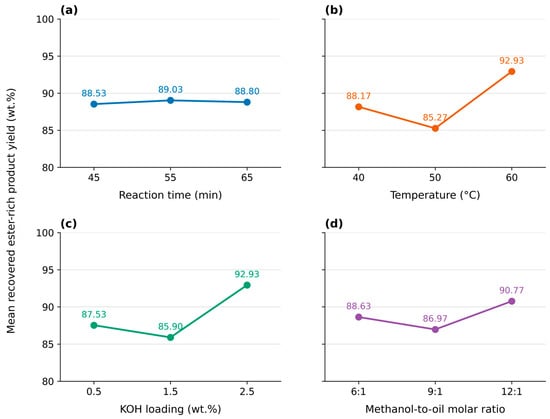
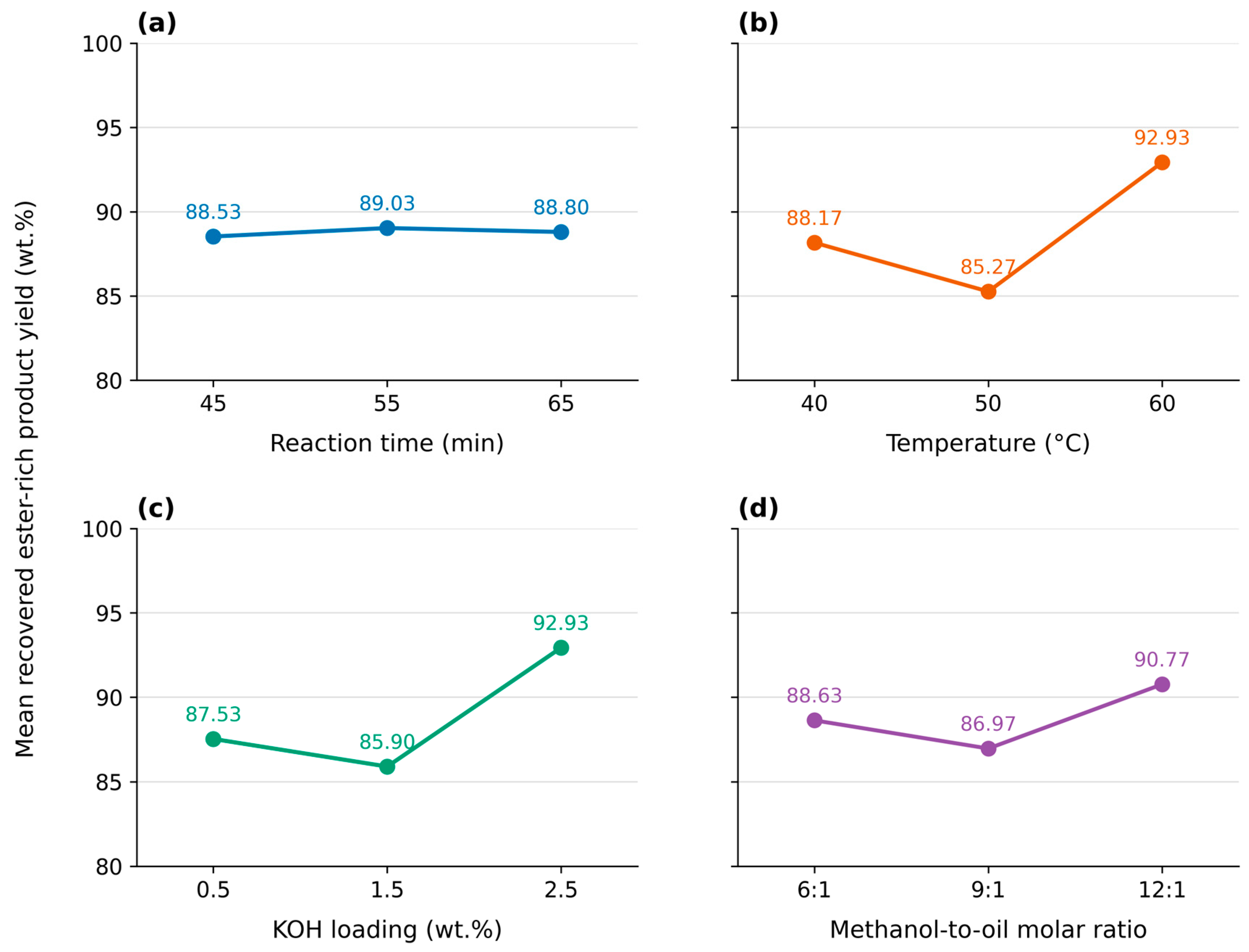
The lowest result, 80.3 wt.%, occurred at 45 min, 50 °C, 1.5 wt.% KOH and a 9:1 ratio. Its contrast with Run 7 shows that the shortest reaction time was not intrinsically responsible for the strongest response. Instead, the higher temperature, catalyst loading and methanol ratio in Run 7 produced a more favourable combination. The design therefore distinguishes a weak time effect from the effects of the other operating variables, an inference that would not be possible from the maximum-yield run alone. Figure 1 presents the main effects of reaction time, temperature, KOH loading and methanol-to-oil molar ratio on mean recovered ester-rich product yield.
Figure 1.
Main effects of (a) reaction time, (b) temperature, (c) KOH loading and (d) methanol-to-oil molar ratio on mean recovered ester-rich product yield. Each point represents the mean of three L9 screening observations at the corresponding factor level, with different settings of the remaining factors.
3.2. Factor-Level Responses and Relative Contributions
Table 2 summarises the factor-level means and signal-to-noise ratios. Temperature produced the largest range, 7.67 percentage points, followed by KOH loading at 7.03, methanol-to-oil ratio at 3.80 and reaction time at 0.50. Temperature and catalyst loading therefore produced the clearest separation in recovered product yield within the investigated ranges.
Table 2.
Factor-level response means and larger-is-better signal-to-noise ratios.
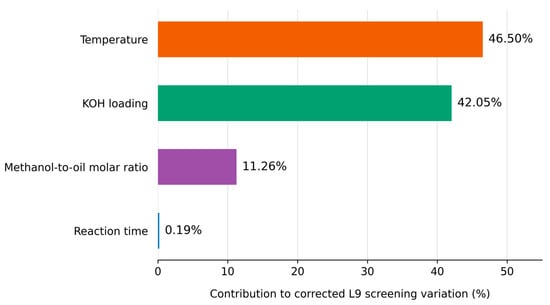
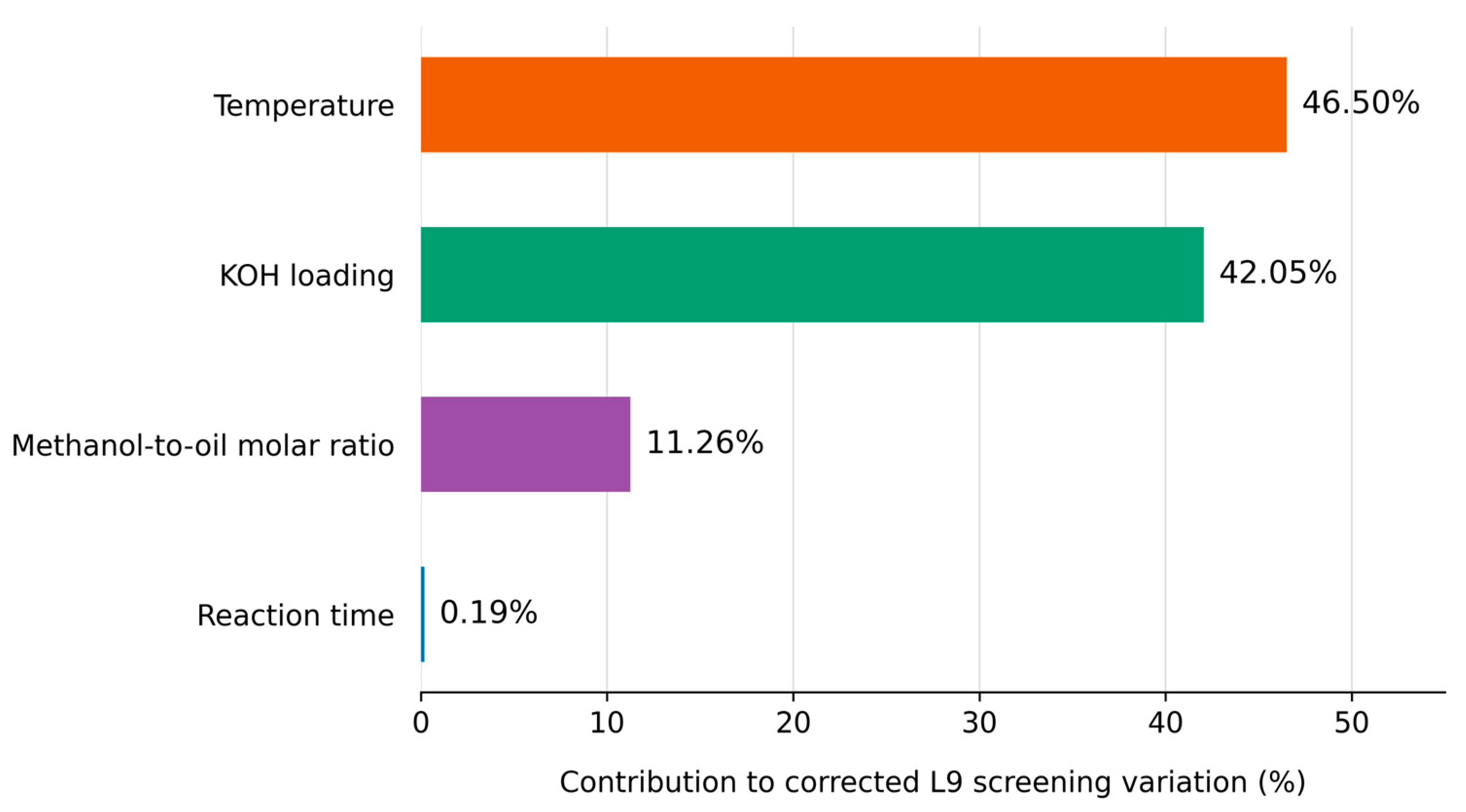
The orthogonal decomposition assigned 46.50% of the corrected L9 variation to temperature and 42.05% to KOH loading. Methanol-to-oil ratio accounted for 11.26%, while reaction time accounted for 0.19%. Temperature and catalyst loading therefore produced the strongest separation among level means. Temperature and catalyst loading can influence reaction and recovery behaviour; the present screening does not separate these mechanisms.
The small contribution assigned to time does not mean that reaction time is chemically unimportant. It shows that, within the tested interval and in the presence of the other selected ranges, differences among 45, 55 and 65 min explained little of the observed variation. The level mean increased from 88.53 wt.% at 45 min to 89.03 wt.% at 55 min and then declined slightly to 88.80 wt.% at 65 min. The narrow 0.50-point range supports the practical selection of 45 min when the other factors are favourable, while recognising that 55 min gave the slightly higher time-level mean. Figure 2 illustrates the relative contributions of the four process factors to the corrected variation in recovered ester-rich product yield.
Figure 2.
Percentage contributions of the four process factors to corrected variation in recovered ester-rich product yield within the Taguchi L9 screening design. Contributions describe the observed variation and do not represent tests of statistical significance.
Mean recovered yield decreased from 87.53 wt.% at 0.5 wt.% KOH to 85.90 wt.% at 1.5 wt.%, before increasing to 92.93 wt.% at 2.5 wt.%. Catalyst loading can influence both transesterification and downstream recovery: additional base can promote reaction, whereas soap formation and emulsification can impede phase separation and washing. These competing processes were not measured separately, so the intermediate decrease cannot be attributed to a specific mechanism. The highest tested KOH loading gave the greatest mean recovery within the investigated experimental domain.
The mean recovered ester-rich product yield decreased from 88.17 wt.% at 40 °C to 85.27 wt.% at 50 °C, before increasing to 92.93 wt.% at 60 °C. These values describe product recovery after methanolysis, separation, washing and drying, rather than seed-oil extraction. Each temperature mean combines three L9 treatments with different settings of the remaining factors. Although the array balances the factor levels, its saturated, unreplicated structure does not permit separate estimation of interactions or experimental error. The intermediate decrease therefore cannot be attributed conclusively to temperature alone. Differences in conversion and phase-recovery behaviour may have contributed, but the present measurements do not distinguish these effects. The results identify 60 °C as the highest-performing temperature level within the investigated domain. At 60 °C, effective reflux control is important for maintaining the intended methanol-to-oil ratio.
Mean recovered yield decreased from 88.63 wt.% at a methanol-to-oil molar ratio of 6:1 to 86.97 wt.% at 9:1, and then it increased to 90.77 wt.% at 12:1. Methanol excess can favour transesterification, while also influencing glycerol partitioning and ester-rich phase recovery. The measured response reflects the combined outcome of reaction, separation, washing and drying. Consequently, increased methanol availability does not necessarily produce a monotonic increase in recovered mass. As with KOH loading, the balanced L9 means describe the observed factor-level response but do not independently resolve interactions or experimental variation. The 12:1 ratio provided the highest mean recovery among the tested levels.
The investigated conditions share features with earlier pawpaw seed oil studies. Agunbiade and Adewole [8] used a methanol-to-oil molar ratio of 9:1 in a two-stage process, whereas the present screening gave the highest mean recovery at 12:1. Ngige et al. [9] reported an optimum temperature of 60 °C for NaOH-catalysed pawpaw seed oil transesterification, agreeing with the highest-performing temperature level in the present KOH-based screening. Their reported catalyst loading and methanol-to-oil ratio were 1.0 wt.% and 3:1, respectively, illustrating that selected operating conditions differ between experimental systems. These comparisons provide context rather than a direct performance ranking because catalyst identity, pretreatment, experimental design and yield determination differ between studies.
3.3. Additive Estimate and Independent Confirmation
Substitution of the selected factor-level means into Equation (5) gave an additive estimate of 98.80 wt.%. The three independent confirmation experiments produced 97.80, 98.60 and 97.90 wt.%, corresponding to a mean of 98.10 wt.% and a standard deviation of 0.44 wt.%. The coefficient of variation was 0.44%, and the two-sided 95% t interval was 97.02–99.18 wt.%. The confirmation mean was only 0.70 percentage points below the additive estimate and remained close to the largest screening response. The individual confirmation yields and their summary statistics are presented in Table 3.
Table 3.
Independent confirmation at the selected factor combination.
Confirmation experiments are used in Taguchi screening studies to examine selected operating settings, as illustrated for soybean oil [14]. Here, the confirmation was obtained without fitting a response-surface model to the nine observations or implying that interactions and curvature had been estimated.
The three confirmation values occupied a narrow interval of 0.80 percentage points. Their 0.44% coefficient of variation indicates that the complete sequence of reaction, phase separation, washing, drying and weighing was reproducible at the selected setting. The 95% interval is necessarily broad relative to the observed standard deviation because it is based on only three independent runs and two degrees of freedom. Its inclusion is still useful because it makes the uncertainty of the reported mean explicit. Importantly, the additive estimate of 98.80 wt.% falls inside this interval, providing quantitative agreement between screening-based prediction and direct confirmation.
3.4. FTIR and GC-MS Characterisation of the Recovered Product
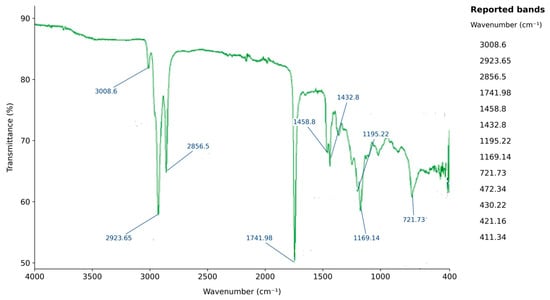
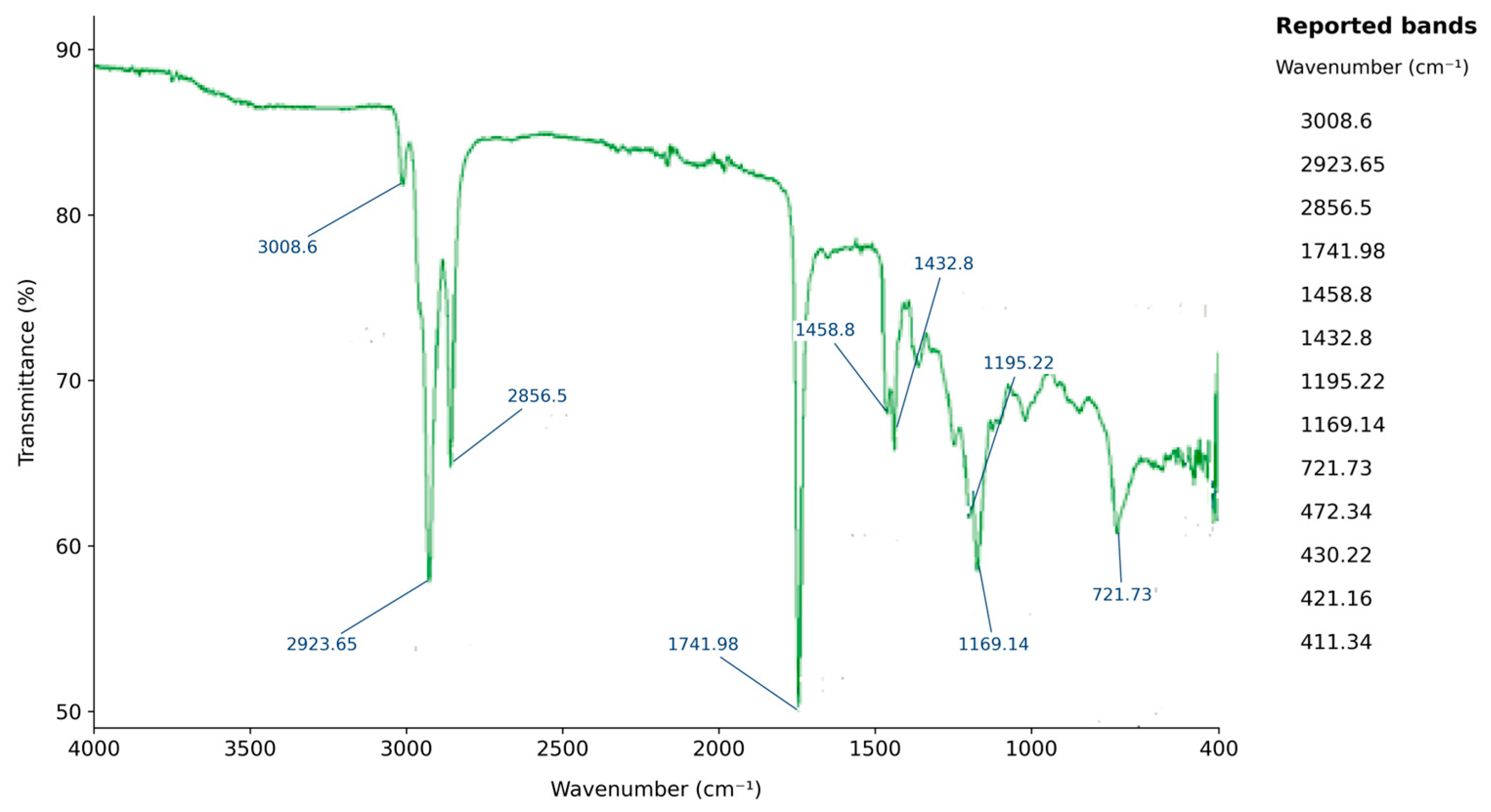
The FTIR spectrum of the recovered product (Figure 3) showed a strong ester carbonyl absorption at 1741.98 cm−1 and bands at 1195.22 and 1169.14 cm−1 in the ester C-O stretching region. Aliphatic C-H stretching bands occurred at 2923.65 and 2856.5 cm−1, while the 1432.8 cm−1 band was assigned to methyl-associated deformation. The combined carbonyl, C-O and methyl-associated features agree with the characteristic spectral pattern reported for fatty-acid methyl esters [16,17].
Figure 3.
FTIR spectrum of the recovered ester-rich product, with coloured annotations identifying ester carbonyl, methyl-associated deformation and ester C–O stretching bands. These features support product characterisation but do not quantify FAME purity.
The principal FTIR absorption bands and their assignments are summarised in Table 4.
Table 4.
Principal FTIR bands and assignments for the recovered product.
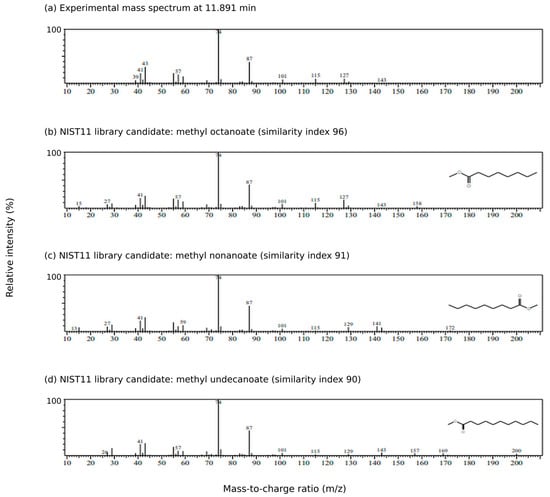
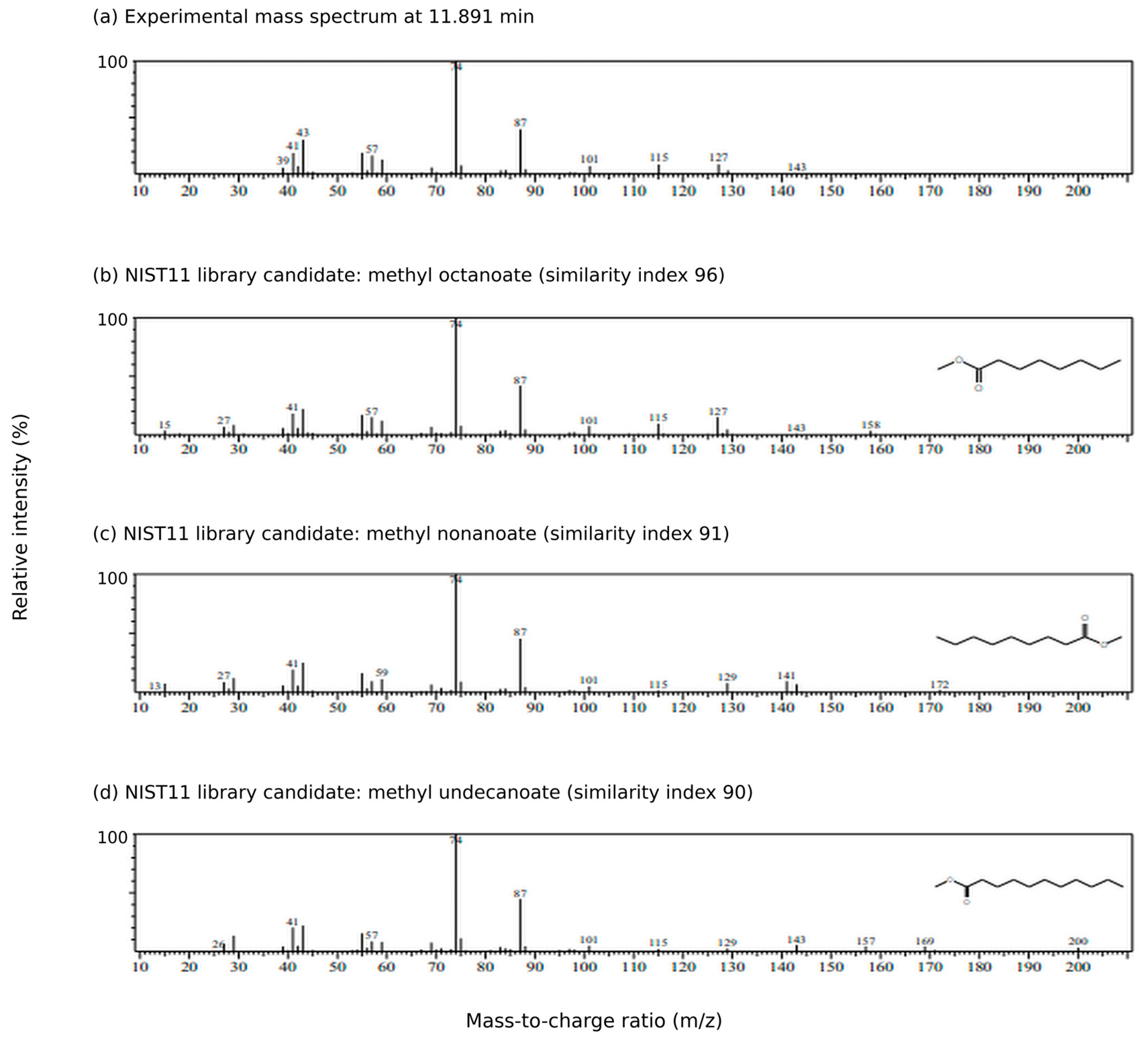
The GC-MS chromatogram contained 11 integrated peaks between 11.891 and 26.426 min. Library searching tentatively assigned peaks to methyl octanoate, methyl dodecanoate, methyl tetradecanoate, methyl stearate, methyl oleate and other long-chain fatty-acid esters. The representative spectrum at 11.891 min showed prominent m/z 74 and 87 ions and close correspondence with library spectra for straight-chain fatty-acid methyl esters (Figure 4). Table 5 lists representative fatty-acid methyl esters tentatively identified in the recovered product, together with their retention times and recorded peak-area shares. Figure 4 illustrates a representative mass spectrum and the corresponding library comparisons.
Figure 4.
Representative GC-MS spectrum at 11.891 min (upper trace) and corresponding library spectra (lower traces).
Table 5.
Representative fatty-acid methyl esters tentatively identified by GC–MS in the recovered ester-rich product.
FTIR and GC-MS provided complementary characterisation of the recovered product. FTIR established the expected ester and long-chain functional groups, while the GC-MS results showed characteristic mass fragments and tentative assignments to several fatty-acid methyl esters. Together, these techniques supported the presence of methyl esters in the recovered product without establishing quantitative ester purity.
3.5. Experimental Economy and Process Relevance
A full three-level factorial study of four factors would require 81 treatment combinations before replication. The L9 array required nine screening treatments, an 88.9% reduction. Including the three independent confirmation experiments gave 12 total runs, still 85.2% fewer than the unreplicated full factorial. This saving is material when the feedstock must first be collected, dried, milled and solvent-extracted and when every reaction consumes methanol, KOH, washing water and heating energy.
This study combines three forms of evidence. The screening response quantifies recovered product mass, the confirmation experiments demonstrate repeatability at the selected setting, and FTIR and GC-MS establish the chemical characteristics of the recovered ester-rich phase. Their agreement provides strong support for the selected processing condition.
The selected setting is practical for laboratory methanolysis within the investigated ranges: 60 °C promotes contact under reflux, 45 min avoids extending a factor that showed little variation across its tested levels and a 12:1 ratio supplies excess methanol for the reversible reaction. The 2.5 wt.% KOH requirement is higher than commonly applied to refined oils, but it gave the strongest recovered-product response for the extracted pawpaw oil under the common recovery protocol. Because the selected temperature, catalyst loading and methanol ratio occur at the upper tested levels, the result defines a confirmed operating combination rather than an unconstrained global optimum.
From a process-integration perspective, the principal inputs beyond the seed residue are extraction solvent, methanol, KOH, thermal energy and washing water. Solvent recovery and methanol containment are therefore central to any practical implementation. The selected short reaction time limits the heated residence period, while the strong temperature effect indicates that heat management and reflux performance deserve greater attention than extending batch duration. The recovered glycerol-rich lower phase and wash water must also be handled as process streams rather than ignored when the route is assessed as a renewable-fuel pathway.
The present study focused on process-factor screening, independent confirmation of recovered ester-rich product yield and qualitative product characterisation. Detailed physicochemical characterisation of the extracted seed oil was beyond the scope of the reported analysis. Complementary measurements of density, viscosity, heating value, acid value and moisture content would further clarify the influence of feedstock properties on reaction behaviour and product recovery. The results provide a basis for this broader evaluation, with the findings applying to the oil batch and operating conditions investigated.
3.6. Positioning Relative to Papaya-Seed Biodiesel Studies
Previous investigations have demonstrated biodiesel production from papaya seed oil using alkaline processing, heterogeneous catalysts and statistically assisted condition selection [8,9,10,11]. The present study advances this work through balanced four-factor screening, independent triplicate confirmation and combined FTIR and GC-MS product characterisation. Table 6 positions the contribution relative to selected papaya-seed biodiesel studies.
Table 6.
Comparison of the present investigation with selected pawpaw seed oil biodiesel studies.
The comparison shows that the present investigation contributes a compact experimental strategy for identifying influential variables and confirming a high-performing process condition. The Supplementary Workbook provides the complete observations, factor calculations, confirmation statistics and spectral assignments used in the analysis.
Future work could evaluate waste-derived heterogeneous catalysts, including CaO prepared from poultry eggshells, mixed-metal oxides and catalysts synthesised through green routes, for pawpaw seed oil methanolysis [18,19,20,21,22]. Recent studies on CuO nanoparticles synthesised using Moringa oleifera pod extract [23] and a corn-cob-derived solid catalyst [24] provide examples of these approaches. Comparisons with the present KOH process should consider ester content, recovered product yield, catalyst separation, reuse, leaching and downstream purification requirements. Catalyst preparation, regeneration and material inputs should also be assessed before drawing conclusions about economic or environmental benefits.
4. Conclusions
Pawpaw seeds yielded 45.1 wt.% solvent-extractable oil and provided a non-food lipid feedstock for KOH-catalysed methanolysis. The Taguchi L9 array reduced the four-factor, three-level screening experiment from 81 possible combinations to nine balanced treatments. Temperature and KOH loading showed the largest contributions to corrected screening variation, at 46.50% and 42.05%, respectively. The selected combination was 45 min, 60 °C, 2.5 wt.% KOH and a 12:1 methanol-to-oil ratio. Three independent experiments gave 98.10 ± 0.44 wt.% recovered ester-rich product, 0.70 percentage points below the additive estimate. FTIR showed the expected ester functional groups, while GC-MS provided tentative assignments to fatty-acid methyl-ester species in the recovered product.
The results identify clear operating priorities for pawpaw seed oil methanolysis. Temperature and catalyst loading produced substantially greater separation among level means than reaction time, while differences among the tested reaction times were small. The narrow spread of the three independent confirmation results supports repeatability at the selected condition, and their mean agrees closely with the additive estimate. The combined process screening, confirmation experiments and chemical characterisation provide a strong basis for converting discarded pawpaw seeds into an ester-rich renewable-fuel product.
Supplementary Materials
The following supporting information can be downloaded at https://www.mdpi.com/article/10.3390/fuels7040085/s1, Supplementary_Experimental_Dataset_MDPI.xlsx, containing the L9 screening observations, factor-level means and signal-to-noise calculations, orthogonal sum-of-squares calculations, confirmation statistics, FTIR assignments and the GC-MS peak record.
Author Contributions
Conceptualisation, S.O.J.; methodology, S.O.J. and A.N.A.; validation, S.O.J. and C.C.E.; formal analysis, S.O.J.; investigation, S.O.J. and A.N.A.; resources, S.O.J., C.C.E. and A.N.A.; data curation, S.O.J. and A.N.A.; writing—original draft preparation, S.O.J. and A.N.A.; writing—review and editing, S.O.J., C.C.E. and A.N.A.; visualisation, C.C.E.; supervision, S.O.J.; project administration, S.O.J. All authors have read and agreed to the published version of the manuscript.
Funding
This research received no external funding.
Institutional Review Board Statement
Not applicable.
Informed Consent Statement
Not applicable.
Data Availability Statement
The data supporting the screening calculations, factor-level analysis, descriptive sum-of-squares decomposition, confirmation statistics, FTIR assignments and qualitative GC-MS peak record are provided in the Accompanying Supplementary Workbook, Supplementary_Experimental_Dataset_MDPI.xlsx.
Acknowledgments
The authors acknowledge the technical support provided by the Power and Machinery Laboratory, Department of Agricultural Engineering, Ladoke Akintola University of Technology, Ogbomoso, Nigeria. During preparation of this manuscript, the authors used ChatGPT v5.0 (OpenAI, San Francisco, CA, USA) to assist with language editing, organisation and formatting. The authors checked the experimental data, calculations, references and scientific interpretations and take full responsibility for the published content.
Conflicts of Interest
The authors declare no conflicts of interest.
References
- Atabani, A.E.; Silitonga, A.S.; Badruddin, I.A.; Mahlia, T.M.I.; Masjuki, H.H.; Mekhilef, S. A comprehensive review on biodiesel as an alternative energy resource and its characteristics. Renew. Sustain. Energy Rev. 2012, 16, 2070–2093. [Google Scholar] [CrossRef] [Scilit]
- Tabatabaei, M.; Aghbashlo, M.; Dehhaghi, M.; Panahi, H.K.S.; Mollahosseini, A.; Hosseini, M.; Soufiyan, M.M. Reactor technologies for biodiesel production and processing: A review. Prog. Energy Combust. Sci. 2019, 74, 239–303. [Google Scholar] [CrossRef] [Scilit]
- Fattah, I.M.R.; Ong, H.C.; Mahlia, T.M.I.; Mofijur, M.; Silitonga, A.S.; Rahman, S.M.A.; Ahmad, A. State of the art of catalysts for biodiesel production. Front. Energy Res. 2020, 8, 101. [Google Scholar] [CrossRef] [Scilit]
- Leung, D.Y.C.; Wu, X.; Leung, M.K.H. A review on biodiesel production using catalysed transesterification. Appl. Energy 2010, 87, 1083–1095. [Google Scholar] [CrossRef] [Scilit]
- Puangsri, T.; Abdulkarim, S.M.; Ghazali, H.M. Properties of Carica papaya L. seed oil following extractions using solvent and aqueous enzymatic methods. J. Food Lipids 2005, 12, 62–76. [Google Scholar] [CrossRef] [Scilit]
- Marfo, E.K.; Oke, O.L.; Afolabi, O.A. Chemical composition of papaya seeds. Food Chem. 1986, 22, 259–266. [Google Scholar] [CrossRef] [Scilit]
- Goriainov, S.; Orlova, S.; Nikitina, E.; Vandishev, V.; Ivlev, V.; Esparza, C.; Vasil’ev, V.; Platonov, E.; Sheremeta, A.; Kalabin, G. Study of the chemical composition of Carica papaya L. seed oils of various geographic origins. Horticulturae 2023, 9, 1227. [Google Scholar] [CrossRef] [Scilit]
- Agunbiade, F.O.; Adewole, T.A. Methanolysis of Carica papaya seed oil for production of biodiesel. J. Fuels 2014, 2014, 904076. [Google Scholar] [CrossRef] [Scilit]
- Ngige, G.A.; Ovuoraye, P.E.; Igwegbe, C.A.; Fetahi, E.; Okeke, J.A.; Yakubu, A.D.; Onyechi, P.C. RSM optimization and yield prediction for biodiesel produced from alkali-catalytic transesterification of pawpaw seed extract. Digit. Chem. Eng. 2023, 6, 100066. [Google Scholar] [CrossRef] [Scilit]
- Nnali-Uroh, E.; Esonye, C.; Onukwuli, D.O.; Menkiti, M.C.; John, S.U.; Yunusa, Y. Hybrid intelligent optimization of biodiesel production from papaya seed oil using waste papaya peel-derived catalyst. Discov. Energy 2026, 6, 86. [Google Scholar] [CrossRef] [Scilit]
- Dheenathayalan, T.; Kandasamy, M.; Vellaiyan, S. Valorization of Carica papaya seed oil into biodiesel using a stable CuO-Al2O3 nanocatalyst under optimized condition. Sustain. Chem. Pharm. 2025, 48, 102207. [Google Scholar] [CrossRef] [Scilit]
- Freedman, B.; Pryde, E.H.; Mounts, T.L. Variables affecting the yields of fatty esters from transesterified vegetable oils. J. Am. Oil Chem. Soc. 1984, 61, 1638–1643. [Google Scholar] [CrossRef] [Scilit]
- Taguchi, G. Introduction to Quality Engineering; Asian Productivity Organization: Tokyo, Japan, 1986. [Google Scholar]
- Mahamuni, N.N.; Adewuyi, Y.G. Application of Taguchi method to investigate the effects of process parameters on the transesterification of soybean oil using high-frequency ultrasound. Energy Fuels 2010, 24, 2120–2126. [Google Scholar] [CrossRef] [Scilit]
- Montgomery, D.C. Design and Analysis of Experiments, 10th ed.; Wiley: Hoboken, NJ, USA, 2019. [Google Scholar]
- Elkady, M.F.; Zaatout, A.; Balbaa, O. Production of biodiesel from waste vegetable oil via KM micromixer. J. Chem. 2015, 2015, 630168. [Google Scholar] [CrossRef] [Scilit]
- Torres, A.; Fuentes, B.; Rodríguez, K.E.; Brito, A.; Díaz, L. Analysis of the content of fatty acid methyl esters in biodiesel by Fourier-transform infrared spectroscopy: Method and comparison with gas chromatography. J. Am. Oil Chem. Soc. 2020, 97, 651–661. [Google Scholar] [CrossRef] [Scilit]
- Betiku, E.; Akintunde, A.M.; Ojumu, T.V. Banana peels as a biobase catalyst for fatty acid methyl esters production using Bauhinia monandra seed oil. Energy 2016, 103, 797–806. [Google Scholar] [CrossRef] [Scilit]
- Oladipo, B.; Betiku, E. Optimization and kinetic studies on conversion of rubber seed oil to methyl esters over a green biowaste catalyst. J. Environ. Manag. 2020, 268, 110705. [Google Scholar] [CrossRef] [Scilit] [PubMed]
- Olatundun, E.A.; Borokini, O.O.; Betiku, E. Cocoa pod husk-plantain peel blend as a novel green heterogeneous catalyst for renewable and sustainable honne oil biodiesel synthesis. Renew. Energy 2021, 166, 163–175. [Google Scholar] [CrossRef] [Scilit]
- Oloyede, C.T.; Jekayinfa, S.O.; Alade, A.O.; Ogunkunle, O.; Laseinde, O.T.; Adebayo, A.O.; Abdulkareem, A.I.; Smaisim, G.F.; Fattah, I.M.R. Synthesis of biobased composite heterogeneous catalyst for biodiesel production using simplex lattice design mixture. Energies 2023, 16, 2197. [Google Scholar] [CrossRef] [Scilit]
- Etim, A.O.; Betiku, E.; Ajala, S.O.; Olaniyi, P.J.; Ojumu, T.V. Potential of ripe plantain fruit peels as an eco-friendly catalyst for biodiesel synthesis. Sustainability 2018, 10, 707. [Google Scholar] [CrossRef] [Scilit]
- Aleman-Ramirez, J.L.; Villamizar C., C.P.; Barragán-Trinidad, M.; Sebastián, P.J.; Okoye, P.U. Eco-engineered copper oxide nanoparticles using Moringa oleifera pod’s aqueous extract for biodiesel synthesis: Green synthesis and process optimization. Biomass Futur. 2026, 2, 100043. [Google Scholar] [CrossRef] [Scilit]
- Aleman-Ramirez, J.L.; Villamizar C., C.P.; Barragán-Trinidad, M.; Sebastian, P.J. A new green heterogeneous solid catalyst from corn cob agricultural residue for biodiesel production. Biomass Convers. Biorefin. 2026, 16, 113. [Google Scholar] [CrossRef] [Scilit]

Disclaimer/Publisher’s Note: The statements, opinions and data contained in all publications are solely those of the individual author(s) and contributor(s) and not of MDPI and/or the editor(s). MDPI and/or the editor(s) disclaim responsibility for any injury to people or property resulting from any ideas, methods, instructions or products referred to in the content. |
© 2026 by the authors. Licensee MDPI, Basel, Switzerland. This article is an open access article distributed under the terms and conditions of the Creative Commons Attribution (CC BY) license.