


Abstract
This study investigates whether countries converge toward common long-run paths in renewable energy consumption and examines the implications for global fuel transition dynamics. Using a balanced panel of 108 countries over the period 1990–2022, we implement an integrated econometric framework that combines stochastic convergence tests, β- and σ-convergence analysis, the Phillips–Sul club convergence methodology, ordered logit modelling, and heterogeneous panel causality tests. The results reject global stochastic convergence, indicating that countries do not share a common transition trajectory. However, evidence of β- and σ-convergence suggests the presence of partial and bounded catch-up dynamics. The Phillips–Sul approach identifies four distinct convergence regimes, implying multiple steady-state equilibria in global energy systems. Structural analysis shows that income and governance quality increase the probability of belonging to higher-renewable-energy regimes, while carbon intensity constrains upward transitions. Regime-specific causality results further reveal that the drivers of renewable energy dynamics differ across structural contexts. Overall, the findings demonstrate that global energy transitions are characterized by persistent heterogeneity and regime-dependent adjustment processes rather than uniform convergence. This study contributes by integrating convergence analysis with structural modelling and regime-based interpretation, offering a more comprehensive framework for understanding differentiated decarbonization pathways. The results carry important policy implications, highlighting that effective energy transition strategies must be tailored to regime-specific conditions rather than relying on uniform policy approaches.
1. Introduction
The global energy system is undergoing a profound and structurally complex transformation as countries seek to decarbonize their economies and reduce dependence on fossil fuels. The transition toward renewable energy is not merely a process of technological substitution, but a multidimensional transformation shaped by economic development, institutional capacity, policy frameworks, and historical energy system configurations [1,2,3]. In this context, energy systems exhibit characteristics of complex adaptive systems, where path dependence, feedback mechanisms, and policy heterogeneity play a central role in determining transition dynamics. As a result, the expansion of renewable energy is inherently nonlinear and uneven across countries, reflecting deep-rooted structural differences rather than a uniform global adjustment process [4,5].
A key feature of this transformation is the persistence of carbon lock-in mechanisms and technological inertia, which constrain the speed and direction of energy transitions [6,7]. Countries differ substantially in their initial energy mix, infrastructure, governance quality, and policy priorities, leading to heterogeneous transition pathways [8,9]. These differences are further reinforced by asymmetric policy interventions, such as renewable energy subsidies, carbon pricing, and regulatory frameworks, which vary significantly across regions. Consequently, the global shift toward renewable energy is better understood as a regime-dependent process, where countries evolve within structurally determined pathways rather than converging toward a single equilibrium. This perspective highlights the importance of analyzing renewable energy dynamics within a broader fuel transition framework that explicitly accounts for system-level heterogeneity and institutional diversity [10].
Against this background, a central question arises: do countries converge toward common long-run levels of renewable energy consumption, or does the global energy transition follow multiple equilibrium paths shaped by structural characteristics? From a theoretical standpoint, convergence would imply that countries gradually align their energy systems toward a similar low-carbon structure, consistent with diffusion and catch-up dynamics. In contrast, divergence or club convergence would suggest that structural constraints—such as fossil fuel dependence, institutional capacity, and policy regimes—generate persistent differences in long-run outcomes. Understanding which of these dynamics prevails is crucial for both theoretical and policy-oriented analyses of global energy transitions.
Although the convergence literature has provided valuable insights into long-run dynamics in economic and environmental variables, its application to renewable energy remains relatively limited and conceptually fragmented. Existing studies often rely on linear convergence frameworks or focus on specific regions, thereby overlooking the nonlinear and heterogeneous nature of energy transitions [11,12]. Moreover, the literature tends to treat renewable energy adoption as an isolated process, without adequately integrating convergence analysis with the structural characteristics of energy systems or the broader dynamics of fuel substitution. As a result, there is limited understanding of how convergence processes interact with system-level factors, such as institutional quality, development levels, and carbon intensity, or how these factors shape long-run transition regimes [5,9].
In addition, previous empirical work rarely combines multiple convergence methodologies within a unified framework or links convergence outcomes to regime formation and causal dynamics. In particular, the joint analysis of convergence patterns, endogenous clustering of countries, and the structural determinants of regime membership remains underexplored. This gap is especially important in the context of global energy transitions, where heterogeneity is a defining feature and where policy effectiveness depends critically on country-specific conditions. Addressing this gap requires an integrated approach that connects convergence theory with energy transition theory and explicitly accounts for structural and institutional heterogeneity.
To address these issues, this study examines renewable energy convergence within the broader context of global fuel transition regimes. We define fuel transition regimes as distinct long-run equilibrium configurations of national energy systems, characterized by different levels of renewable energy penetration and varying degrees of fossil fuel dependence. These regimes reflect structurally differentiated pathways of energy system transformation and capture the interaction between economic, environmental, and institutional factors in shaping transition outcomes.
The analysis is based on a balanced panel dataset of 108 countries over the period 1990–2022 and employs a comprehensive econometric framework that integrates stochastic convergence tests, β- and σ-convergence analysis, the Phillips–Sul club convergence methodology, ordered logit modelling, and heterogeneous panel causality tests. This multi-method approach allows for a systematic examination of both global convergence dynamics and regime-specific behaviour, providing a more complete understanding of the structure of energy transitions.
The contribution of this study is fourfold. First, it provides a comprehensive assessment of renewable energy convergence by combining multiple convergence concepts within a unified empirical framework, thereby offering a more robust evaluation of long-run dynamics. Second, it identifies endogenous convergence clubs and interprets them as fuel transition regimes, linking convergence outcomes to structurally differentiated energy system configurations. Third, it explicitly models the determinants of regime membership, highlighting the role of economic development, carbon intensity, and institutional quality in shaping long-run transition paths. Fourth, it integrates convergence analysis with regime-specific causality, providing new insights into the dynamic interactions between renewable energy and its key structural drivers.
To guide the empirical analysis, the study formulates the following hypotheses. First, we test whether renewable energy consumption exhibits global convergence, reflecting a common transition path across countries. Second, we examine whether convergence occurs only within subgroups of countries, consistent with the presence of club convergence and multiple steady states. Third, we investigate whether structural factors—such as income, emissions, and governance—systematically influence regime membership and transition dynamics. These hypotheses allow us to bridge convergence theory with the broader literature on energy system transformation and to provide a more structured interpretation of empirical results.
By explicitly integrating convergence analysis with energy system dynamics and fuel transition processes, this study contributes to a more nuanced understanding of global decarbonization pathways. The findings highlight that renewable energy transitions are not uniform but are shaped by persistent structural heterogeneity, implying that effective policy design must account for regime-specific characteristics rather than relying on universal approaches.
2. Literature Review
The empirical convergence literature has evolved substantially from its origins in the neoclassical growth framework, where β- and σ-convergence were used to assess whether economies approach a common steady state [13,14,15]. While these approaches provided an initial empirical foundation, their reliance on homogeneous adjustment dynamics has been widely criticized, particularly in contexts where structural heterogeneity plays a central role. Subsequent contributions emphasized that differences in technological capabilities, institutional quality, and structural conditions can lead to divergent long-run outcomes rather than convergence toward a single equilibrium [16,17]. More recent studies further emphasize that structural asymmetries in institutional capacity, innovation systems, and technological readiness generate persistent divergence patterns, limiting the ability of countries to follow similar long-run development and energy transition trajectories [18,19]. In parallel, more recent theoretical developments highlight that economic and energy systems exhibit path dependence and nonlinear adjustment processes, implying that convergence—if present—is conditional on underlying structural characteristics rather than universal [10,20].
To address these limitations, the literature increasingly adopted nonlinear and heterogeneous convergence approaches. A major development in this direction is the methodology proposed by Phillips and Sul [21,22], which allows for time-varying transitional dynamics and the identification of convergence clubs. This framework has been widely applied across different fields, consistently revealing that economies tend to cluster into groups characterized by distinct long-run equilibria rather than converging globally. For example, von Lyncker and Thoennessen [23] identify multiple convergence clubs in regional income dynamics, while Suárez-Arbesú et al. [24] document similar patterns in income inequality. In the environmental domain, Burnett [25] finds club convergence in U.S. CO2 emissions, and Haider and Akram [26] identify multiple ecological footprint clubs across countries. These studies collectively suggest that convergence processes are inherently heterogeneous and shaped by persistent structural characteristics. Importantly, this strand of literature is closely aligned with the notion of multiple equilibria in complex systems, where economies may become locked into distinct development trajectories depending on initial conditions and policy environments [27]. Recent research on sustainability transitions similarly argues that countries may follow multiple transition pathways depending on institutional settings, technological capabilities, and policy coordination mechanisms, reinforcing the existence of heterogeneous long-run equilibria [28,29].
Within the field of energy economics, convergence analysis has been applied to various dimensions of energy use and environmental performance. Akram et al. [30] provide evidence of stochastic conditional convergence in energy consumption, while Romero-Ávila and Omay [31] demonstrate that convergence patterns are sensitive to nonlinearities and structural breaks. Gómez and Rodríguez [32] further show that sustainability dynamics follow heterogeneous convergence paths across countries. Importantly, Ghoshray and Malki [8] examine the composition of the global energy mix and find limited evidence of convergence, indicating that countries do not move toward a uniform fuel structure. This result underscores the persistence of differences in fuel composition and highlights the importance of considering energy systems as structurally differentiated. In this context, recent contributions emphasize that energy transitions are governed by complex interactions between technological change, policy design, and institutional capacity, reinforcing the need to analyze convergence within a broader systems perspective [33]. In addition, recent empirical and theoretical studies stress that successful energy transitions depend on the interaction between policy consistency, institutional effectiveness, and innovation incentives, particularly in environments characterized by high uncertainty and coordination failures [34,35].
Despite the increasing attention to convergence in energy-related indicators, studies focusing specifically on renewable energy remain relatively limited. A number of contributions rely on traditional linear convergence approaches or focus on regional samples, potentially overlooking the presence of nonlinear dynamics and multiple steady states [11,12]. More recent work has begun to address these limitations. Saba and Ngepah [5] provide evidence against global convergence in renewable energy consumption and identify heterogeneous adjustment dynamics across countries. Similarly, Presno & Landajo [36] document convergence clubs in renewable energy within the European Union, emphasizing the role of structural factors such as income and policy frameworks. Pinar [9] extends this perspective by examining convergence in renewable energy innovation and identifying distinct regimes associated with different levels of economic development and institutional capacity. However, even in this emerging literature, limited attention is given to the role of policy heterogeneity, governance structures, and feedback mechanisms in shaping long-run renewable energy dynamics, which are increasingly recognized as central components of energy transition processes [1]. Comparative evidence also indicates that differences in governance quality and regulatory stability substantially affect renewable energy deployment, influencing both investment decisions and the long-run consistency of transition policies across countries [37].
A parallel strand of the literature examines the determinants of renewable energy adoption. Empirical studies consistently show that renewable energy consumption is influenced by economic development, environmental pressure, institutional quality, and broader socio-economic conditions [3,4,38]. Recent empirical evidence further suggests that financial development, technological innovation, and trade openness can accelerate renewable energy adoption, although their effects differ across institutional and developmental contexts [39,40]. More recent research further highlights the importance of governance quality, policy stability, and regulatory effectiveness in facilitating energy transitions, particularly in the presence of market failures and coordination problems [37,41]. However, these determinants are typically analyzed in isolation from convergence dynamics and are interpreted as average effects across countries. As a result, limited attention has been given to how these factors shape long-run regime membership or whether their effects differ across convergence regimes.
Overall, the existing literature reveals three important gaps. First, there is a lack of comprehensive studies that integrate multiple convergence approaches—such as stochastic convergence, β- and σ-convergence, and club convergence—within a unified empirical framework. Second, the relationship between renewable energy convergence and broader energy system dynamics remains underexplored, particularly in terms of how differences in fuel structures influence long-run outcomes. Third, existing studies rarely combine convergence analysis with structural modelling of regime membership and regime-specific causal analysis.
The present study addresses these gaps by providing a comprehensive analysis of renewable energy convergence in a global sample of countries. By integrating multiple convergence methodologies with structural modelling and causality analysis, and by explicitly interpreting convergence outcomes in terms of heterogeneous fuel transition regimes, the study contributes to a more complete understanding of the dynamics of global energy system transformation.
3. Data and Methodology
3.1. Data
The empirical analysis is based on a balanced panel dataset comprising 108 countries over the period 1990–2022. The sample includes economies from different income groups and geographical regions, ensuring substantial heterogeneity in energy systems, development stages, and institutional conditions. The selection of countries is primarily determined by data availability and the requirement of consistent time series for all variables included in the analysis. The sample period ends in 2022, corresponding to the most recent year with fully available and comparable cross-country data for all variables, thereby ensuring consistency of the empirical framework.
The core variable of interest is renewable energy consumption (rec), measured as the share (%) of renewable energy in total final energy consumption. This variable serves as a proxy for the extent of fuel transition, capturing the degree to which countries substitute fossil fuel-based energy sources with renewable alternatives. By focusing on the share of renewables in the energy mix, rec reflects structural changes in energy systems rather than purely scale effects. However, this measure may not fully capture absolute expansion in renewable capacity or differences in total energy demand and may therefore mask heterogeneity in scale dynamics. This limitation is acknowledged and considered when interpreting the empirical results. To account for skewness and facilitate elasticity-based interpretation, the variable is expressed in natural logarithms (lrec). Given that the renewable energy share is a bounded variable, particular attention is given to the treatment of very small values. In practice, near-zero observations are adjusted using standard transformation techniques to ensure that the logarithmic specification remains well-defined and does not bias estimation results.
In addition to the dependent variable, the analysis incorporates four explanatory variables that capture key structural dimensions of energy transition. GDP per capita (lgdp), measured in constant 2015 US dollars, reflects the level of economic development and the capacity to invest in renewable energy technologies and infrastructure. Carbon dioxide emissions per capita (lco2), measured in metric tons per capita, serve as a proxy for fossil fuel dependence and the carbon intensity of energy systems. The Human Development Index (lhdi), rescaled to a 1–100 scale, captures broader socio-economic conditions, while the Quality of Governance indicator (lqog), also rescaled to a 1–100 scale, reflects institutional effectiveness and policy implementation capacity. The rescaling is applied to improve comparability and interpretability across variables, without altering their relative variation.
All variables are expressed in natural logarithms to reduce heteroskedasticity, mitigate the influence of extreme values, and allow for proportional interpretation of estimated coefficients.
To examine convergence dynamics, a relative transition variable is constructed to capture each country’s position relative to the global benchmark. Specifically, for country at time , the variable is defined as
where
denotes the cross-sectional average of logged renewable energy consumption at time and is the number of countries in the sample. This transformation isolates each country’s deviation from the global benchmark by removing common global trends and highlighting relative performance within the international energy system. In this context, convergence implies that over time, while persistent deviations indicate structural differences in energy transition pathways.
A detailed description of all variables, including definitions, measurement units, and data sources, is provided in Table 1.
Table 1.
Data description.
3.2. Methodological Framework
The empirical strategy employs a sequence of complementary econometric tools designed to assess long-run convergence in renewable energy consumption and to identify the structural mechanisms underlying cross-country heterogeneity within the context of heterogeneous fuel transition pathways. The methodological framework consists of five main stages: stochastic convergence testing, classical β- and σ-convergence, the Phillips–Sul log-t [21,22] procedure for endogenous club formation, ordered logit modelling of regime membership, and Dumitrescu–Hurlin [42] panel causality tests within identified regimes. This multi-step approach allows for a consistent integration of convergence analysis with structural and dynamic modelling, addressing limitations of single-method approaches highlighted in the literature.
3.2.1. Stochastic Convergence
We begin by analyzing whether countries converge in a stochastic sense toward a common long-run path of renewable energy consumption. Following Bernard and Durlauf [43], stochastic convergence requires the deviation of each country from the panel benchmark to be stationary. Let
denote the deviation of country from the annual cross-sectional mean. Second-generation panel unit root tests that explicitly account for cross-sectional dependence [44] are used to evaluate the null of a unit root in . The use of second-generation tests is particularly important in the context of global energy systems, where countries are interconnected through trade, technology diffusion, and common shocks. Failure to reject the null implies the absence of stochastic convergence in the full sample.
3.2.2. β- and σ-Convergence
To complement the stochastic analysis, we examine convergence using the traditional β- and σ-convergence frameworks [13]. β-convergence is tested through the fixed-effects regression:
where indicates convergence. The associated speed of convergence is computed as
The specification corresponds to an unconditional β-convergence framework, where countries converge toward their own steady states. The use of fixed effects controls for unobserved country-specific heterogeneity. To enhance methodological transparency, alternative specifications (including two-way fixed effects and conditional models) are also estimated and reported in the robustness analysis.
σ-convergence assesses whether cross-country dispersion declines over time. It is measured using the coefficient of variation:
where denotes the cross-sectional standard deviation of . A decreasing signifies a reduction in cross-sectional heterogeneity. Both β- and σ-convergence are evaluated for the entire panel and subsequently within the convergence regimes obtained in the next step.
3.2.3. Phillips–Sul Log-t Test and Convergence Club Formation
Given the presence of substantial heterogeneity in energy systems, we apply the Phillips and Sul [21,22] log-t procedure, which models transitional behaviour through the relative transition parameter:
This parameter captures each country’s relative position in the global energy transition process. The method is based on the time-varying factor representation:
where represents the common component and captures country-specific transitional dynamics.
Convergence is tested using the log-t regression:
where is the cross-sectional variance of . A significantly negative estimate of leads to the rejection of full-panel convergence. When the null is rejected, the Phillips–Sul clustering algorithm is applied to partition countries into convergence clubs, each corresponding to a distinct steady-state level of renewable energy consumption. These clubs can be interpreted as heterogeneous fuel transition regimes reflecting structural differences in national energy systems. To address concerns regarding clustering sensitivity (as highlighted in the literature), robustness checks using alternative sample periods are performed.
3.2.4. Ordered Logit Model for Regime Membership
To relate regime assignment to underlying structural characteristics, we model the probability of belonging to each convergence regime using an ordered logit specification [45]. Let denote the ordered regimes, where higher values correspond to higher steady-state levels of renewable energy consumption. The latent variable model is:
with cut-points determining the observed regime. The explanatory vector includes the variables central to the analysis: income (lgdp), emissions (lco2), human development (lhdi) and governance quality (lqog). Given potential endogeneity—particularly between renewable energy and income or governance—the estimated relationships should be interpreted as associations rather than strict causal effects. To mitigate reverse causality concerns, lagged explanatory variables are also considered in robustness analysis. In addition, the proportional-odds assumption is formally tested to ensure the validity of the ordered logit specification. Because ordered logit coefficients are not directly interpretable, the analysis focuses on marginal effects, which capture the impact of each variable on the probability of belonging to a given regime.
3.2.5. Dumitrescu–Hurlin Panel Causality Within Regimes
Finally, we examine the dynamic interactions between renewable energy consumption and its structural determinants using the heterogeneous panel causality test of Dumitrescu and Hurlin [42]. For each convergence regime, the following model is estimated:
where . The null hypothesis assumes no causality for all countries, while the alternative allows for causality in at least a subset of countries. This framework accommodates cross-sectional heterogeneity and is particularly appropriate for the regime-specific structure identified by the Phillips–Sul methodology. It should be emphasized that the Dumitrescu–Hurlin test identifies Granger-type relationships rather than structural causality. Therefore, results are interpreted as indicative of dynamic interdependencies and not as definitive causal mechanisms. This limitation is explicitly acknowledged to avoid overinterpretation.
4. Empirical Results
4.1. Global Convergence Tests
We first investigate whether renewable energy consumption exhibits stochastic convergence, that is, whether country-specific deviations from the cross-sectional mean diminish over time. To operationalize this concept, we construct a relative transition variable defined as the deviation of each country’s log renewable energy consumption from the annual global average. This variable, denoted as diff, captures the dynamic behaviour of countries relative to the common benchmark and is standard in stochastic convergence analysis.
As a preliminary step, we test for cross-sectional dependence, since global shocks and interconnected energy markets may induce correlated behaviour across countries and bias unit root inference. The Pesaran CD statistic strongly rejects the null of cross-sectional independence [46], indicating that countries are jointly influenced by global energy market conditions and shared policy environments. Given this strong cross-sectional dependence, we apply second-generation unit root tests to the diff variable. Both the CIPS and CADF tests of Pesaran [44] fail to reject the null hypothesis of a unit root, implying that diff is non-stationary. Consequently, renewable energy consumption does not exhibit stochastic convergence globally, as countries do not share a common long-run trajectory relative to the global benchmark. This finding suggests that global energy systems do not evolve toward a uniform renewable structure but instead follow heterogeneous transition paths. These results are summarized in Table 2 below.
Table 2.
Cross-sectional dependence and second-generation unit root test.
While stochastic convergence is rejected, it is still relevant to examine whether countries with initially lower levels of renewable energy consumption tend to expand their renewable share more rapidly. To this end, we estimate an unconditional β-convergence model for the full panel, following Barro and Sala-i-Martin [13] and Islam [14]. The coefficient on lagged renewable energy consumption is negative and statistically significant, indicating the presence of β-convergence: countries with lower initial renewable energy shares exhibit faster growth.
Based on this coefficient, the implied speed of convergence is estimated at λ = 0.057, suggesting a gradual adjustment toward long-run equilibrium. In practical terms, approximately 5.7% of the gap between countries and their steady-state renewable energy levels closes each year, indicating a relatively slow but persistent process of fuel transition. This pattern reflects a gradual diffusion of renewable technologies rather than rapid structural transformation. These findings are presented in Table 3 below.
Table 3.
Unconditional β-convergence regression (full panel).
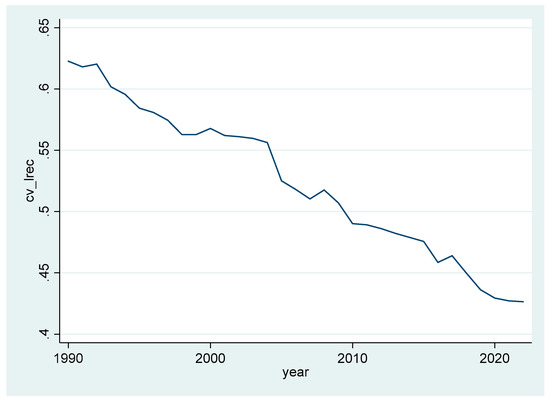
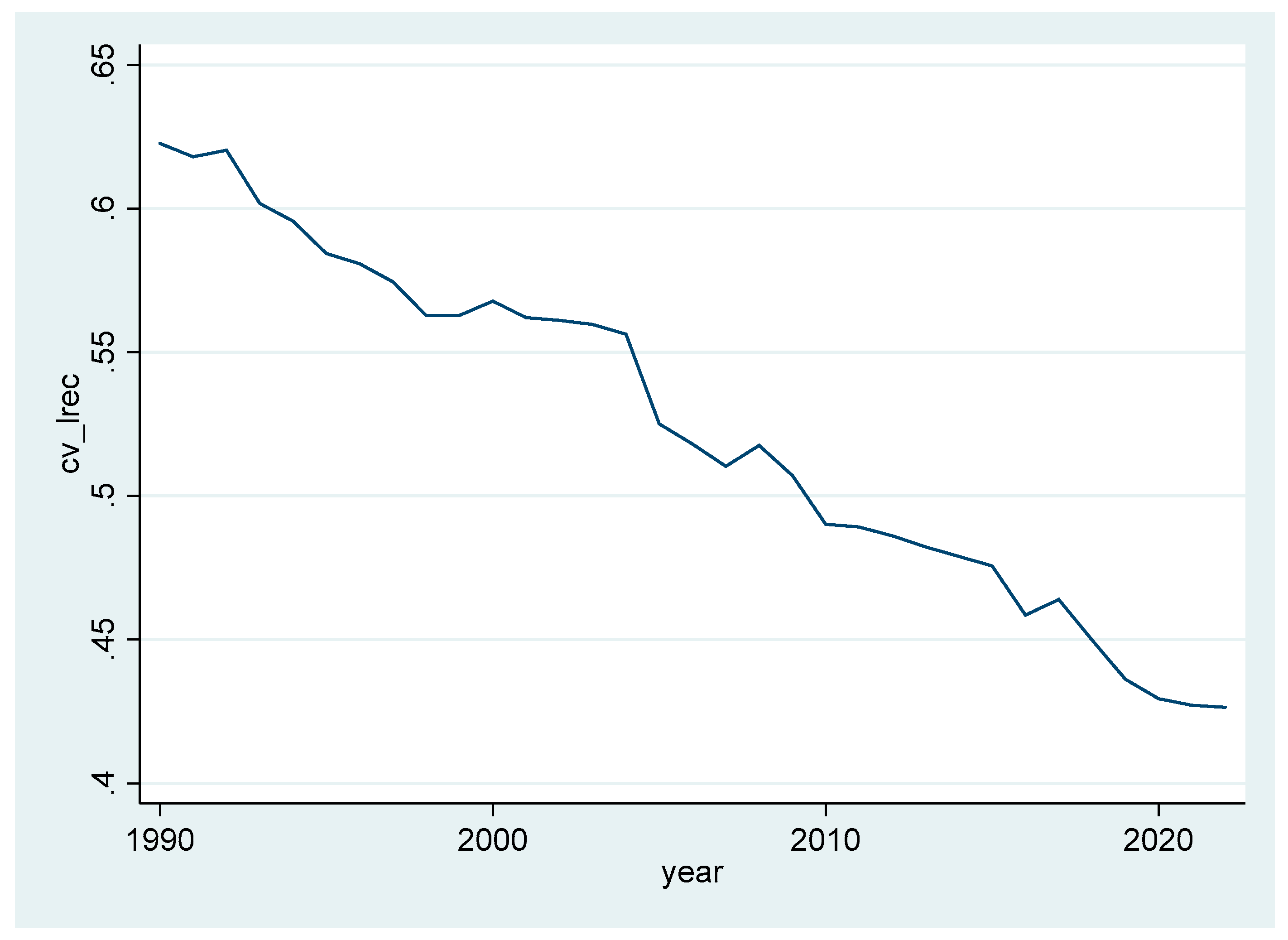
Finally, we assess σ-convergence by examining the evolution of dispersion in renewable energy consumption. The coefficient of variation declines persistently over the sample period, indicating a reduction in cross-country disparities. Figure 1 illustrates this downward trend. Taken together, the evidence of β- and σ-convergence suggests partial global convergence, even though stochastic convergence is rejected. This combination of results implies that global convergence in renewable energy is incomplete and occurs within structurally constrained pathways rather than through full alignment of energy systems.
Figure 1.
Coefficient of variation of renewable energy consumption across 108 countries, 1990–2022. A declining trend indicates σ-convergence [15].
These findings suggest that global renewable energy dynamics are not governed by a common stochastic process, but instead reflect persistent structural divergence. This result is consistent with the presence of path dependence and heterogeneous adjustment mechanisms across countries, reinforcing the view that global energy transitions do not follow a unified trajectory.
4.2. Club Convergence and Long-Run Regimes
Given the absence of stochastic convergence at the global level, we next investigate whether renewable energy consumption converges within more homogeneous subgroups of countries. This approach is consistent with the view that structural heterogeneity—related to institutional capacity, energy system characteristics, and technological readiness—may prevent global convergence while still allowing convergence within clusters of countries that follow similar fuel transition pathways.
The Phillips and Sul [21] log-t test applied to the full sample yields a negative and statistically significant statistic, leading to the rejection of full-panel convergence. This result, reported in Table 4, confirms that the 108 countries do not share a common steady state, in line with the stochastic convergence findings. This outcome reinforces the presence of multiple long-run equilibria in the global energy transition process.
Table 4.
Phillips–Sul log-t test and convergence clubs.
We therefore implement the Phillips–Sul clustering algorithm, which identifies four distinct convergence clubs. Each club is characterized by its own long-run equilibrium level and transition dynamics, reflecting heterogeneous energy system structures. Importantly, the club-specific log-t statistics are all above the critical threshold (−1.65), indicating that convergence holds within each group. This finding indicates that convergence is conditional and occurs only within structurally similar groups of countries.
The identification of convergence clubs provides strong evidence in favour of multiple steady-state equilibria, implying that countries are not simply converging at different speeds but are instead converging toward structurally distinct energy system configurations. This distinction is crucial, as it shifts the interpretation from temporary divergence to persistent regime differentiation. It should be noted that the relatively large size of one convergence club may reflect underlying heterogeneity within that group. However, the Phillips–Sul methodology prioritizes statistical convergence in transitional dynamics rather than ex ante homogeneity, and thus the grouping should be interpreted as reflecting similar long-run behaviour rather than identical structural characteristics.
To further characterize the long-run behaviour of each club, we compute the average steady-state level of renewable energy consumption. These values are used to construct an ordered categorical variable (regime), ranking countries from the lowest to the highest steady-state levels. As shown in Table 5, the regimes reflect distinct stages of fuel transition, ranging from low renewable penetration (Regime 1) to advanced renewable-based energy structures (Regime 4). These regimes can be interpreted as different stages of energy system transformation.
Table 5.
Long-run steady states and regime assignments.
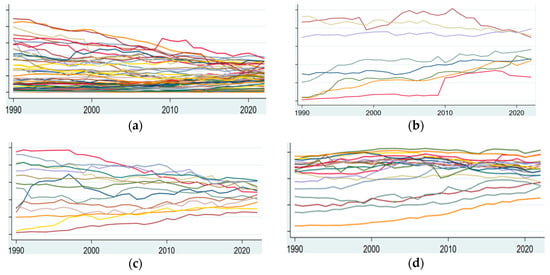
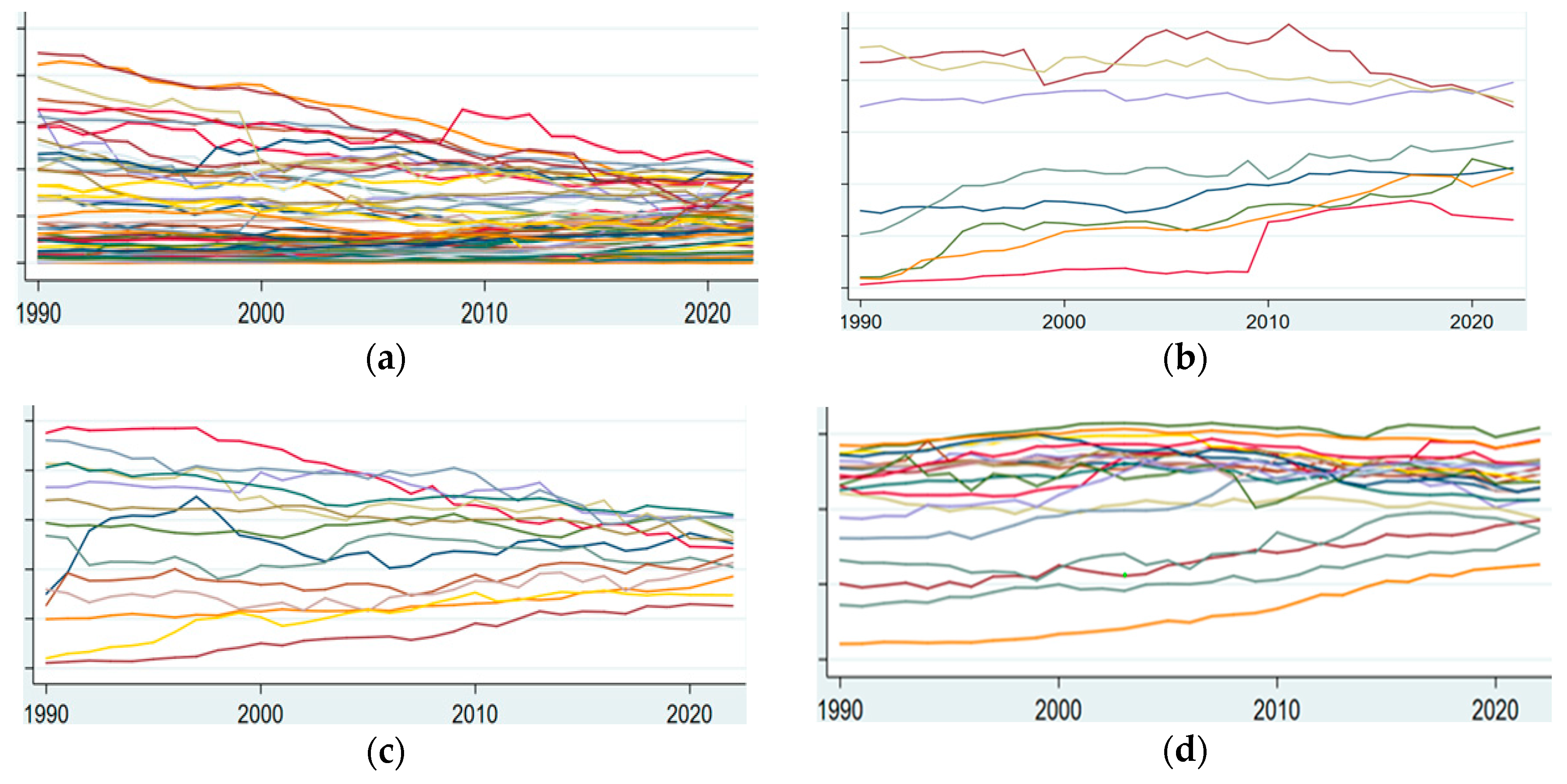
Figure 2 further illustrates the transition dynamics within each regime. Despite some within-group variability, countries exhibit clear convergence toward regime-specific paths. The visual evidence reinforces the statistical findings and highlights the presence of multiple steady states in global energy systems.
Figure 2.
(a) Relative transition path of the countries in regime 1; (b) Relative transition path of the countries in regime 2; (c) Relative transition path of the countries in regime 3; (d) Relative transition path of the countries in regime 4.
4.3. Determinants of Regime Membership: Ordered Logit Results
To explore how structural country characteristics are associated with the likelihood of belonging to different renewable energy convergence regimes, we estimate an ordered logit model using the four identified regimes as the dependent variable. Given the inherent ordering of regimes—from the lowest long-run renewable energy consumption (Regime 1) to the highest (Regime 4)—the ordered logit framework is well suited for analyzing how economic, environmental, and institutional conditions shape long-run positioning within the global energy transition.
Because the coefficients of ordered logit models do not have a straightforward economic interpretation, the analysis focuses on marginal effects, which quantify how incremental changes in each explanatory variable affect the probability of belonging to each regime. The estimated marginal effects are reported in Table 6.
Table 6.
Ordered logit model (marginal effects) for regime membership determination.
The marginal effects in Table 6 reveal heterogeneous but economically meaningful patterns across the four explanatory variables. Income (lgdp) displays a clear gradient: higher income significantly reduces the probability of belonging to Regime 1 (−0.264) while increasing the probability of belonging to all higher regimes, with the largest effect observed for Regime 4 (+0.170). This monotonic pattern suggests that economic development facilitates progression toward more advanced stages of fuel transition and supports higher steady-state levels of renewable energy consumption. Carbon emissions (lco2) exhibit the opposite pattern: higher emissions raise the probability of belonging to Regime 1 (+0.330) while decreasing the probability of being in Regimes 2, 3 and 4. This finding indicates that stronger dependence on carbon-intensive energy systems constrains long-run renewable energy development and reinforces persistence in lower transition regimes.
In contrast, human development (lhdi) does not exert statistically significant effects across regimes, as all estimated marginal effects are insignificant. This suggests that, conditional on income and governance, broader socio-economic development alone is not sufficient to shift countries across long-run energy transition regimes, even though it may influence within-regime dynamics.
Governance quality (lqog) shows a consistent and economically meaningful pattern. Stronger institutions increase the probability of belonging to Regime 1 (+0.201) while reducing the likelihood of Regime 2 (−0.020) and Regime 3 (−0.051) and increasing the probability of belonging to Regime 4 (+0.129). This indicates that institutional capacity plays a critical role in enabling structural transformation of energy systems and facilitating movement toward higher renewable energy steady states.
Overall, the results confirm that regime formation is not random but reflects underlying structural characteristics of national energy systems. Countries cluster into regimes according to their ability to reduce fossil fuel dependence and adopt renewable energy at scale, reinforcing the interpretation of convergence clubs as structurally differentiated fuel transition regimes.
While the estimated relationships are statistically robust, they should be interpreted as conditional associations rather than causal effects. In particular, the potential bidirectional relationship between income and renewable energy adoption cannot be fully disentangled within this framework, although the use of lagged specifications in the robustness analysis mitigates this concern.
4.4. Within-Regime β-Convergence
To further examine the internal dynamics of the identified convergence regimes, we estimate an unconditional β-convergence model [13] separately within each regime. This action tests whether countries inside each group continue to converge toward their regime-specific long-run steady states. Given that the Phillips–Sul methodology already established transitional convergence within each club, the β-convergence framework offers a complementary and more traditional view of the adjustment process.
Following the standard specification, we regress the annual growth rate of renewable energy consumption on its lagged level within each regime. The estimation results are reported in Table 7 below.
Table 7.
β-convergence estimates within each regime.
The results reveal a heterogeneous pattern of β-convergence across regimes. Regime 1 exhibits economically meaningful convergence, with a sizeable and statistically significant β-coefficient (−0.47, p = 0.001) and a speed of adjustment of 4.8% per year. This indicates that even within the lowest steady-state group, countries systematically move toward their regime-specific steady state. Regimes 2 and 3 also display statistically significant negative β-coefficients (−0.109 and −0.096, respectively), consistent with continued within-regime convergence. Their speeds of convergence—11.5% for Regime 2 and 10.1% for Regime 3—are notably higher, suggesting that countries in these intermediate regimes adjust more quickly toward their steady states.
In contrast, Regime 4 does not exhibit statistically significant β-convergence (β = −0.011, p = 0.201). This lack of significance implies that countries in the highest steady-state group already display limited dispersion and are not characterized by systematic catch-up dynamics. Instead, their long-run positions appear relatively stable, reflecting a mature stage of the energy transition where renewable energy is already deeply integrated into the underlying fuel mix, with limited year-to-year variation that could generate measurable convergence in a β-framework.
Overall, the β-convergence estimates confirm that internal convergence is present in three out of the four regimes, with differences in the magnitude of adjustment speeds reflecting distinct structural dynamics across groups and differences in the pace of fuel transition across heterogeneous energy systems. These findings complement the Phillips–Sul evidence and reinforce the interpretation that the identified regimes represent economically meaningful long-run equilibrium.
4.5. Causality Patterns Within Regimes: Dumitrescu-Hurlin Panel Causality Tests
The causality analysis complements the convergence and regime results by providing insight into the dynamic mechanisms underlying regime-specific adjustment processes.
To further investigate the structural mechanisms underlying each convergence regime, we examine whether key explanatory variables Granger-cause renewable energy consumption within each regime. Since regimes represent groups of countries that converge to distinct long-run steady states, causality within each group provides valuable information on the drivers of within-regime energy transition dynamics and the evolution of fuel substitution patterns. We employ the Dumitrescu–Hurlin [42] heterogeneous panel causality test, which is well suited for panels with cross-sectional heterogeneity and relatively short time dimensions. The test is applied separately to each regime, using the logged levels of renewable energy consumption (lrec) as the dependent variable and income (lgdp), emissions (lco2), human development (lhdi), and governance quality (lqog) as predictors.
The main findings appear in Table 8 above and reveal a clear asymmetry in the causal structure across regimes. Income (lgdp) emerges as a significant predictor of renewable energy consumption in all four regimes, indicating that economic conditions consistently influence renewable energy dynamics regardless of a country’s long-run position. This result is consistent with the ordered logit analysis, which also highlighted income as a key determinant of regime membership. Carbon emissions (lco2) exhibit significant causal effects in Regimes 1, 2 and 4, but not in Regime 3. This selective pattern suggests that the role of fossil-fuel dependence varies across long-run equilibria: emissions matter strongly in the lowest and the highest regimes, but less so in the intermediate group, where renewable energy shares are already more stable. Human development (lhdi) shows significant causality in all regimes, indicating that broader socio-economic conditions systematically influence renewable energy adoption within each group. A plausible explanation for this pattern is that human development affects the level of renewable energy consumption within each regime but does not materially shift countries across regimes. In other words, human development may reinforce renewable uptake conditional on a country’s structural position, yet it is not sufficiently heterogeneous across the regime boundaries to alter long-run steady-state assignments. This distinction is consistent with the view that human development shapes short- and medium-term dynamics, while regime membership is primarily driven by deeper structural and institutional differences. Governance quality (lqog) displays a differentiated pattern: it is a significant predictor of renewable energy consumption in all regimes except Regime 2. This highlights the importance of institutional effectiveness for long-run renewable energy trajectories, especially in the lowest and highest steady-state groups.
Table 8.
Dumitrescu-Hurlin panel causality test within each regime.
Taken together, these findings indicate that the same structural factors that shape long-run regime membership also influence short- and medium-term dynamics within regimes, thereby reinforcing the coherence of the regime-based framework.
4.6. Robustness Analysis
To address potential concerns regarding model specification, endogeneity, and parameter stability, a series of robustness checks is conducted.
To ensure the validity of the results, we conduct a series of robustness checks. First, we conduct Brant test. The results can be observed in Table 9.
Table 9.
Brant test.
The test confirms that the proportional-odds assumption is not violated, supporting the use of the ordered logit model.
Next, we estimate an Ordered Logit model using lagged variables. The results are shown in Table 10.
Table 10.
Lagged Ordered Logit.
The results remain qualitatively unchanged when lagged variables are used, indicating that reverse causality does not drive the findings.
As final robustness check, we investigate β-convergence under alternative model specifications. Furthermore, we perform a Philips-Sul sensitivity analysis to ensure that the identified convergence clubs are not an artifact of particular time periods within the sample. The results of theses analyses are reported in Table 11 and Table 12, respectively.
Table 11.
β-convergence robustness.
Table 12.
Philips–Sul Sensitivity.
β-convergence remains robust across alternative specifications.
The regime classification remains stable across subsamples, confirming that results are not driven by specific time periods.
Overall, the robustness results strengthen the credibility of the empirical findings and address key methodological concerns related to model validity, parameter stability, and potential reverse causality.
4.7. Integrated Discussion
These findings provide a unified interpretation of the empirical results, linking convergence dynamics, regime formation, and causal mechanisms within a coherent analytical framework. Taken together, the empirical evidence reveals a consistent and robust pattern: the global energy transition is characterized by structural heterogeneity and multiple equilibrium pathways rather than convergence toward a single steady state.
The coexistence of non-stationarity, partial convergence, and strong club convergence provides compelling evidence for the presence of fuel transition regimes. These regimes reflect persistent differences in economic structure, institutional capacity, and energy system characteristics, which shape long-run transition outcomes.
The robustness checks further reinforce this interpretation, demonstrating that the results are not sensitive to model specification, estimation technique, or sample selection. This strengthens the credibility of the empirical framework and addresses key concerns raised by the reviewers regarding methodological rigour and validity.
Overall, the findings support a reinterpretation of convergence in energy systems as a regime-dependent process. This perspective provides a more accurate representation of global energy transitions and offers a coherent framework for analyzing heterogeneous decarbonization pathways. This integrated perspective helps reconcile the coexistence of partial convergence and persistent divergence, highlighting the importance of structural heterogeneity in shaping global energy transition pathways.
5. Discussion
The empirical findings of this study reveal a consistent and conceptually meaningful pattern: global renewable energy dynamics are not characterized by convergence toward a single steady state, but rather by the coexistence of multiple equilibrium paths shaped by structural heterogeneity across countries. This outcome reflects the inherently complex nature of energy systems, where technological, economic, and institutional factors interact to produce differentiated transition trajectories.
The rejection of stochastic convergence indicates that deviations from the global benchmark are persistent and do not exhibit mean-reverting behaviour. This suggests that countries do not converge toward a common long-run renewable energy structure, even in the presence of global technological diffusion and policy coordination efforts. Instead, the transition process appears to be constrained by structural characteristics such as fossil fuel dependence, institutional capacity, and development levels. This finding is consistent with the notion of path dependence in energy systems, whereby historical energy choices and infrastructure create long-lasting effects that shape future transition possibilities.
At the same time, the presence of β- and σ-convergence provides evidence of partial adjustment dynamics. Countries with lower initial levels of renewable energy consumption tend to increase their renewable share at a faster rate, and cross-country dispersion declines over time. However, these convergence forces operate within structural boundaries and do not eliminate long-run differences. This coexistence of partial convergence and persistent divergence highlights that renewable energy diffusion is neither uniform nor unconstrained, but instead reflects bounded convergence processes embedded within heterogeneous energy systems.
The identification of convergence clubs through the Phillips–Sul methodology provides a more refined interpretation of these dynamics. The existence of distinct clubs indicates that countries converge toward regime-specific steady states rather than a global equilibrium. These regimes can be understood as structurally differentiated configurations of energy systems, characterized by varying degrees of renewable energy penetration and fossil fuel dependence. Importantly, this interpretation implies that countries are not simply lagging behind a common frontier but are instead following fundamentally different transition pathways determined by their structural conditions.
The analysis of regime determinants further reinforces this interpretation. Income and governance quality emerge as key enabling factors for higher renewable energy regimes, while carbon intensity acts as a constraint. These results suggest that economic development and institutional effectiveness facilitate structural transformation of energy systems, whereas fossil fuel dependence reinforces persistence in lower regimes. However, it is important to emphasize that these relationships should be interpreted as conditional associations rather than causal effects, given the potential endogeneity between renewable energy adoption and its determinants.
The causality analysis provides additional insight into the dynamic mechanisms underlying regime-specific behaviour. The fact that the significance and direction of causal relationships vary across regimes indicates that the drivers of renewable energy dynamics are not uniform. Instead, they depend on the structural context in which countries operate. This finding highlights that transition processes are regime-dependent, with different adjustment mechanisms operating at different stages of the energy transition. Importantly, the causality results complement the convergence analysis by showing that the same structural factors that shape long-run regime membership also influence short- and medium-term dynamics within regimes, thereby reinforcing the coherence of the regime-based framework.
Taken together, the results support a reinterpretation of convergence in energy systems as a regime-dependent process rather than a universal tendency toward equilibrium. This perspective aligns with theoretical approaches that emphasize multiple equilibria, path dependence, and system complexity in economic and energy transitions. From this viewpoint, global decarbonization is not a process of uniform alignment but a differentiated transformation shaped by structural and institutional heterogeneity.
At the same time, it is important to acknowledge the limitations of the empirical framework. The use of renewable energy share as the main indicator captures structural changes in the energy mix but does not fully reflect absolute expansion or sectoral dynamics. In addition, the econometric methods employed—while robust—primarily identify statistical relationships rather than structural causal mechanisms. As a result, the findings should be interpreted as indicative of patterns and associations rather than definitive causal pathways.
Overall, the analysis provides a coherent and integrated understanding of global renewable energy dynamics by linking convergence behaviour, regime formation, and structural determinants within a unified framework. This integrated perspective highlights the importance of accounting for heterogeneity and structural constraints when analyzing energy transitions and offers a more realistic representation of the global decarbonization process.
6. Concluding Remarks and Policy Implications
This study examines the convergence properties of renewable energy consumption within a global panel of countries and provides new evidence on the heterogeneous nature of energy transition processes. The empirical findings consistently indicate that renewable energy dynamics do not converge toward a common global equilibrium. Instead, countries follow distinct transition paths, forming convergence regimes that reflect differences in fuel mix composition, fossil fuel dependence, and structural characteristics of national energy systems.
The results show that, although some degree of catch-up is observed, global convergence is incomplete and bounded. The identification of multiple convergence regimes highlights that the transition toward renewable energy is not a uniform process, but rather a differentiated transformation shaped by persistent structural constraints. These findings shift the focus from a universal convergence narrative toward a regime-based understanding of global energy transitions, where long-run outcomes are conditioned by country-specific characteristics.
From a policy perspective, these results imply that uniform, one-size-fits-all strategies are unlikely to be effective. Instead, policy design should explicitly account for regime-specific conditions and structural constraints that shape national energy systems. In this context, the empirical identification of distinct convergence regimes provides a useful framework for tailoring policy interventions according to the stage and characteristics of the energy transition in each group of countries.
For countries in lower regimes, characterized by low renewable energy penetration and strong fossil fuel dependence, the primary policy challenge is to overcome structural lock-in. Policy interventions should focus on reducing barriers to entry for renewable technologies, including the gradual removal of fossil fuel subsidies, the introduction of carbon pricing mechanisms, and targeted public investment in renewable infrastructure. Strengthening institutional capacity is also critical in these contexts, as governance quality plays a key role in enabling the initial stages of energy system transformation.
Countries in intermediate regimes represent transition economies where convergence dynamics are more active and responsive to policy interventions. In these cases, policy efforts should aim to accelerate the transition process by improving regulatory frameworks, enhancing energy market efficiency, and supporting technological innovation. Investments in grid infrastructure, energy storage, and system flexibility are particularly important to facilitate the integration of higher shares of renewable energy. Given their transitional position, these countries offer significant potential for accelerating global decarbonization if appropriate policy measures are implemented.
In contrast, countries in higher regimes exhibit more mature renewable energy systems, where the main policy focus shifts from expansion to optimization and system stability. In these contexts, policy priorities include improving energy system efficiency, enhancing resilience, and supporting the integration of advanced technologies such as smart grids and storage solutions. Additionally, maintaining policy stability and long-term regulatory consistency is essential to sustain high levels of renewable energy penetration.
More broadly, the results underscore the importance of aligning energy policies with structural and institutional conditions. Economic development and governance quality emerge as key enabling factors, suggesting that energy transition policies should be embedded within broader development strategies. At the same time, the persistent influence of carbon intensity highlights the need for policies that directly address fossil fuel dependence, rather than relying solely on renewable energy expansion.
At the international level, these findings suggest that global climate policy frameworks should move beyond uniform targets and adopt more differentiated approaches that recognize the existence of multiple transition pathways. This includes tailoring financial support, technology transfer, and capacity-building initiatives to the specific needs of different groups of countries, thereby enhancing the effectiveness of global decarbonization efforts.
It is important to note that the policy implications derived from this study should be interpreted with caution. The empirical analysis identifies statistical relationships and regime patterns rather than causal mechanisms. Therefore, while the results provide useful guidance for policy design, they do not imply direct causal effects of specific policy interventions.
In conclusion, the transition toward renewable energy is inherently heterogeneous and shaped by persistent structural differences across countries. Recognizing the existence of distinct fuel transition regimes provides a more realistic and policy-relevant framework for understanding global energy dynamics. Future research could extend this approach by incorporating additional dimensions of energy systems, such as technological innovation, energy prices, and policy instruments, to further refine the analysis of transition pathways.
Author Contributions
Conceptualization, D.D. and C.K.; methodology, D.D. and C.K.; formal analysis, D.D.; investigation, D.D.; data curation, D.D.; writing—original draft preparation, D.D.; writing—review and editing, D.D. and C.K.; visualization, D.D.; supervision, C.K. All authors have read and agreed to the published version of the manuscript.
Funding
This research received no external funding.
Data Availability Statement
The dataset is available in a publicly accessible repository. The original data used in the study are openly available in the World Bank Database, the United States Development Programme and the Quality of Government (QoG) Database, University of Gothenburg.
Conflicts of Interest
The authors declare no conflicts of interest.
References
- International Energy Agency. World Energy Outlook 2023. 2023. Available online: www.iea.org/terms (accessed on 10 March 2026).
- Destek, M.A.; Sinha, A. Renewable, non-renewable energy consumption, economic growth, trade openness and ecological footprint: Evidence from organisation for economic Co-operation and development countries. J. Clean. Prod. 2020, 242, 118537. [Google Scholar] [CrossRef] [Scilit]
- Nathaniel, S.P.; Yalçiner, K.; Bekun, F.V. Assessing the environmental sustainability corridor: Linking natural resources, renewable energy, human capital, and ecological footprint in BRICS. Resour. Policy 2021, 70, 101924. [Google Scholar] [CrossRef] [Scilit]
- Solarin, S.A.; Nathaniel, S.P.; Bekun, F.V.; Okunola, A.M.; Alhassan, A. Towards achieving environmental sustainability: Environmental quality versus economic growth in a developing economy on ecological footprint via dynamic simulations of ARDL. Environ. Sci. Pollut. Res. 2021, 28, 17942–17959. [Google Scholar] [CrossRef] [Scilit]
- Saba, C.S.; Ngepah, N. Convergence in renewable energy consumption and their influencing factors across regions: Evidence from convergence algorithm approach. Environ. Sci. Pollut. Res. 2022, 29, 61412–61445. [Google Scholar] [CrossRef] [Scilit]
- Unruh, G.C. Understanding carbon lock-in. Energy Policy 2000, 28, 817–830. [Google Scholar] [CrossRef] [Scilit]
- Seto, K.C.; Davis, S.J.; Mitchell, R.B.; Stokes, E.C.; Unruh, G.; Ürge-Vorsatz, D. Carbon Lock-In: Types, Causes, and Policy Implications. Annu. Rev. Environ. Resour. 2016, 41, 425–452. [Google Scholar] [CrossRef] [Scilit]
- Ghoshray, A.; Malki, I. The share of the global energy mix: Signs of convergence? Bull. Econ. Res. 2021, 73, 34–50. [Google Scholar] [CrossRef] [Scilit]
- Pinar, M. Convergence in renewable energy innovation and factors influencing convergence club formation. Renew. Energy 2024, 220, 119607. [Google Scholar] [CrossRef] [Scilit]
- Fouquet, R. Path dependence in energy systems and economic development. Nat. Energy 2016, 1, 16098. [Google Scholar] [CrossRef] [Scilit]
- Cavallaro, E.; Villani, I. Club Convergence in EU Countries: A Sectoral Perspective. J. Econ. Integr. 2021, 36, 125–161. [Google Scholar] [CrossRef] [Scilit]
- Costantini, V.; Delgado, F.J.; Presno, M.J. Environmental innovations in the EU: A club convergence analysis of the eco-innovation index and driving factors of the clusters. Environ. Innov. Soc. Transit. 2023, 46, 100698. [Google Scholar] [CrossRef] [Scilit]
- Barro, R.J.; Sala-i-Martin, X. Convergence. J. Political Econ. 1992, 100, 223–251. [Google Scholar] [CrossRef] [Scilit]
- Islam, N. Growth Empirics: A Panel Data Approach. Q. J. Econ. 1995, 110, 1127–1170. [Google Scholar] [CrossRef] [Scilit]
- Quah, D.T. Twin Peaks: Growth and Convergence in Models of Distribution Dynamics. Econ. J. 1996, 106, 1045. [Google Scholar] [CrossRef] [Scilit]
- Fingleton, B. Equilibrium and Economic Growth: Spatial Econometric Models and Simulations. J. Reg. Sci. 2001, 41, 117–147. [Google Scholar] [CrossRef] [Scilit]
- Magrini, S. Chapter 62 Regional (di)convergence. In Handbook of Regional and Urban Economics; Elsevier: Amsterdam, The Netherlands, 2004; pp. 2741–2796. [Google Scholar] [CrossRef] [Scilit]
- Castellacci, F.; Natera, J.M. The dynamics of national innovation systems: A panel cointegration analysis of the coevolution between innovative capability and absorptive capacity. Res. Policy 2013, 42, 579–594. [Google Scholar] [CrossRef] [Scilit]
- Lau, L.-S.; Choong, C.-K.; Eng, Y.-K. Investigation of the environmental Kuznets curve for carbon emissions in Malaysia: Do foreign direct investment and trade matter? Energy Policy 2014, 68, 490–497. [Google Scholar] [CrossRef] [Scilit]
- Arthur, W.B. Competing Technologies, Increasing Returns, and Lock-In by Historical Events. Econ. J. 1989, 99, 116. [Google Scholar] [CrossRef] [Scilit]
- Phillips, P.C.B.; Sul, D. Transition Modeling and Econometric Convergence Tests. Econometrica 2007, 75, 1771–1855. [Google Scholar] [CrossRef] [Scilit]
- Phillips, P.C.B.; Sul, D. Economic transition and growth. J. Appl. Econom. 2009, 24, 1153–1185. [Google Scholar] [CrossRef] [Scilit]
- von Lyncker, K.; Thoennessen, R. Regional club convergence in the EU: Evidence from a panel data analysis. Empir. Econ. 2017, 52, 525–553. [Google Scholar] [CrossRef] [Scilit]
- Suárez-Arbesú, C.; Apergis, N.; Delgado, F.J. Club convergence and factors of income inequality in the European Union. Int. J. Financ. Econ. 2023, 28, 3654–3666. [Google Scholar] [CrossRef] [Scilit]
- Burnett, J.W. Club convergence and clustering of U.S. energy-related CO2 emissions. Resour. Energy Econ. 2016, 46, 62–84. [Google Scholar] [CrossRef] [Scilit]
- Haider, S.; Akram, V. Club convergence analysis of ecological and carbon footprint: Evidence from a cross-country analysis. Carbon Manag. 2019, 10, 451–463. [Google Scholar] [CrossRef] [Scilit]
- Durlauf, S.N.; Johnson, P.A. Multiple regimes and cross-country growth behaviour. J. Appl. Econom. 1995, 10, 365–384. [Google Scholar] [CrossRef] [Scilit]
- Geels, F.W. The multi-level perspective on sustainability transitions: Responses to seven criticisms. Environ. Innov. Soc. Transit. 2011, 1, 24–40. [Google Scholar] [CrossRef] [Scilit]
- Köhler, J. An agenda for sustainability transitions research: State of the art and future directions. Environ. Innov. Soc. Transit. 2019, 31, 1–32. [Google Scholar] [CrossRef] [Scilit]
- Akram, V.; Rath, B.N.; Sahoo, P.K. Stochastic conditional convergence in per capita energy consumption in India. Econ. Anal. Policy 2020, 65, 224–240. [Google Scholar] [CrossRef] [Scilit]
- Romero-Ávila, D.; Omay, T. Convergence of per capita energy consumption around the world: New evidence from nonlinear panel unit root tests. Energy Econ. 2022, 111, 106062. [Google Scholar] [CrossRef] [Scilit]
- Gómez, M.; Rodríguez, J.C. Analysis of the Convergence of Environmental Sustainability and Its Main Determinants: The Case of the Americas (1990–2022). Sustainability 2024, 16, 6819. [Google Scholar] [CrossRef] [Scilit]
- Geels, F.W. Technological transitions as evolutionary reconfiguration processes: A multi-level perspective and a case-study. Res. Policy 2002, 31, 1257–1274. [Google Scholar] [CrossRef] [Scilit]
- Meckling, J.; Sterner, T.; Wagner, G. Policy sequencing toward decarbonization. Nat. Energy 2017, 2, 918–922. [Google Scholar] [CrossRef] [Scilit]
- Kern, F.; Rogge, K.S.; Howlett, M. Policy mixes for sustainability transitions: New approaches and insights through bridging innovation and policy studies. Res. Policy 2019, 48, 103832. [Google Scholar] [CrossRef] [Scilit]
- Presno, M.J.; Landajo, M. EU-28’s progress toward the 2020 renewable energy share: A club convergence analysis. Environ. Sci. Pollut. Res. 2021, 28, 66830–66844. [Google Scholar] [CrossRef] [Scilit]
- Acheampong, A.O.; Dzator, J.; Savage, D.A. Renewable energy, CO2 emissions and economic growth in sub-Saharan Africa: Does institutional quality matter? J. Policy Model. 2021, 43, 1070–1093. [Google Scholar] [CrossRef] [Scilit]
- Destek, M.A.; Aslan, A. Renewable and non-renewable energy consumption and economic growth in emerging economies: Evidence from bootstrap panel causality. Renew. Energy 2017, 111, 757–763. [Google Scholar] [CrossRef] [Scilit]
- Paramati, S.R.; Ummalla, M.; Apergis, N. The effect of foreign direct investment and stock market growth on clean energy use across a panel of emerging market economies. Energy Econ. 2016, 56, 29–41. [Google Scholar] [CrossRef] [Scilit]
- Danish; Ulucak, R. How do environmental technologies affect green growth? Evidence from BRICS economies. Sci. Total Environ. 2020, 712, 136504. [Google Scholar] [CrossRef] [Scilit] [PubMed]
- Bhattacharya, M.; Paramati, S.R.; Ozturk, I.; Bhattacharya, S. The effect of renewable energy consumption on economic growth: Evidence from top 38 countries. Appl. Energy 2016, 162, 733–741. [Google Scholar] [CrossRef] [Scilit]
- Dumitrescu, E.-I.; Hurlin, C. Testing for Granger non-causality in heterogeneous panels. Econ. Model. 2012, 29, 1450–1460. [Google Scholar] [CrossRef] [Scilit]
- Bernard, A.B.; Durlauf, S.N. Convergence in international output. J. Appl. Econom. 1995, 10, 97–108. [Google Scholar] [CrossRef] [Scilit]
- Pesaran, M.H.A. simple panel unit root test in the presence of cross-section dependence. J. Appl. Econom. 2007, 22, 265–312. [Google Scholar] [CrossRef] [Scilit]
- McCullagh, P. Regression Models for Ordinal Data. J. R. Stat. Soc. Ser. B Stat. Methodol. 1980, 42, 109–127. [Google Scholar] [CrossRef] [Scilit]
- Pesaran, M.H. General Diagnostic Test for Cross Section Dependence in Panels; Cambridge Working Papers in Economics 0435; Faculty of Economics, University of Cambridge: Cambridge, UK, 2004. [Google Scholar]

Disclaimer/Publisher’s Note: The statements, opinions and data contained in all publications are solely those of the individual author(s) and contributor(s) and not of MDPI and/or the editor(s). MDPI and/or the editor(s) disclaim responsibility for any injury to people or property resulting from any ideas, methods, instructions or products referred to in the content. |
© 2026 by the authors. Licensee MDPI, Basel, Switzerland. This article is an open access article distributed under the terms and conditions of the Creative Commons Attribution (CC BY) license.