
Epidemiological Survey on Water, Sanitation, and Hygiene (WaSH) in Uganda’s Karamoja Sub-Region, Using a KAP Questionnaire Within a One Health Framework

 , ,
, ,
Simple Summary
Abstract
1. Introduction
2. Materials and Methods
2.1. Study Design and Area
2.2. KAP Questionnaire
2.3. Ethical Considerations
2.4. Sampling Method
2.5. Questionnaire Administration
2.6. Data Collection
2.7. Data Analysis
3. Results
3.1. Descriptive Statistics
3.1.1. Demographic Information
3.1.2. Water Supply and Management
3.1.3. Hygiene
3.1.4. Sanitation
3.1.5. Waste Management
3.1.6. Communication and Knowledge of Infectious Diseases
3.1.7. Livestock
3.2. Multivariate Analysis
3.2.1. Sufficient and Good Level of Knowledge
3.2.2. Sufficient and Good Level of Attitudes
3.2.3. Sufficient and Good Level of Practices
4. Discussion
4.1. Water Accessibility and Management
4.2. Hygiene Practices
4.3. Sanitation and Waste Management
4.4. Communication and Knowledge of Infectious Diseases
4.5. Livestock
4.6. Multivariate Analysis
4.7. Limits of the Study
5. Conclusions
Supplementary Materials
Author Contributions
Funding
Institutional Review Board Statement
Informed Consent Statement
Data Availability Statement
Acknowledgments
Conflicts of Interest
References
- Intergovernmental Authority on Development (IGAD). Resilience Context Analysis: Resilience to Food Insecurity and Malnutrition in Karamoja; IGAD: Djibouti City, Djibouti, 2015. [Google Scholar]
- World Food Programme (WFP); United Nations Children’s Fund (UNICEF). Food Security and Nutrition Assessment, Karamoja, Uganda; WFP: Kampala, Uganda, 2016. [Google Scholar]
- Stites, E.; Fries, L.; Akabwai, D. Foraging and Fighting: Community Perspectives on Natural Resources and Conflict in Southern Karamoja; Feinstein International Center: Medford, MA, USA, 2010. [Google Scholar]
- Aklilu, Y. Livestock in Karamoja: A Review of Recent Literature; Karamoja Resilience Support Unit (KRSU), USAID/Uganda: Kampala, Uganda, 2016. [Google Scholar]
- Karamoja Resilience Support Unit (KRSU). Livestock in Karamoja: Improving Markets and Veterinary Services; KRSU: Kampala, Uganda, 2022. [Google Scholar]
- Muhanguzi, D.; Mugenyi, A.; Bigirwa, G.; Kamusiime, M.; Kitibwa, A.; Akurut, G.G.; Ochwo, S.; Amanyire, W.; Okech, S.G.; Hattendorf, J.; et al. African animal trypanosomiasis as a constraint to livestock health and production in Karamoja region: A detailed qualitative and quantitative assessment. BMC Vet. Res. 2017, 13, 355. [Google Scholar] [CrossRef]
- Byaruhanga, C.; Collins, N.E.; Knobel, D.; Kabasa, W.; Oosthuizen, M.C. Endemic status of tick-borne infections and tick species diversity among transhumant Zebu cattle in Karamoja region, Uganda: Support for control approaches. Vet. Parasitol. Reg. Stud. Rep. 2015, 1, 21–30. [Google Scholar] [CrossRef] [PubMed]
- Byaruhanga, C.; Oosthuizen, M.C.; Collins, N.E.; Knobel, D. Using participatory epidemiology to investigate management options and relative importance of tick-borne diseases amongst transhumant Zebu cattle in Karamoja region, Uganda. Prev. Vet. Med. 2015, 122, 287–297. [Google Scholar] [CrossRef] [PubMed]
- Lolli, C.; Marenzoni, L.M.; Strona, P.; Lappo, G.P.; Etiang, P.; Diverio, S. Infections and risk factors for livestock with species of Anaplasma, Babesia and Brucella under semi-nomadic rearing in Karamoja region, Uganda. Trop. Anim. Health Prod. 2016, 48, 603–611. [Google Scholar] [CrossRef] [PubMed]
- Egeru, A.; Wasonga, O.; MacOpiyo, L.; Mburu, J.; Majaliwa, M. Abundance and diversity of native forage species in pastoral Karamoja sub-region, Uganda. Afr. Study Monogr. 2015, 36, 261–296. [Google Scholar]
- Omar, M.A. Health care for nomads too, please. World Health Forum 1992, 13, 307–310. [Google Scholar]
- Loutan, L.; Paillard, S. Measles in West African nomadic community. Bull. World Health Organ. 1992, 70, 741–744. [Google Scholar]
- Stites, E.; Akabwai, D. Changing Roles, Shifting Risks: Livelihood Impacts of Disarmament in Karamoja, Uganda; Feinstein International Center: Medford, MA, USA, 2009. [Google Scholar]
- Stites, E.; Akabwai, D. Life in Town: Migration from Rural Karamoja to Moroto and Mbale; Feinstein International Center: Medford, MA, USA, 2012. [Google Scholar]
- Cummings, M.J.; Wamala, J.F.; Eyura, M.; Malimbo, M.; Omeke, M.E.; Mayer, D.; Lukwago, L. A cholera outbreak among semi-nomadic pastoralists in northeastern Uganda: Epidemiology and interventions. Epidemiol. Infect. 2012, 140, 1376–1385. [Google Scholar] [CrossRef]
- World Food Programme (WFP); United Nations Children’s Fund (UNICEF). Food Security and Nutrition Assessment in Karamoja Sub-Region; WFP: Kampala, Uganda, 2017. [Google Scholar]
- World Health Organization (WHO). Guidelines on Sanitation and Health; WHO: Geneva, Switzerland, 2018; Available online: https://iris.who.int/server/api/core/bitstreams/2f17fb04-1425-4680-bf39-d5bb6da0b7ed/content (accessed on 1 February 2025).
- Berhe, A.A.; Aregay, A.D.; Abreha, A.A.; Aregay, A.B.; Gebretsadik, A.W.; Negash, D.Z.; Gebreegziabher, E.G.; Demoz, K.G.; Fenta, K.A.; Mamo, N.B. Knowledge, attitude, and practices on water, sanitation, and hygiene among rural residents in Tigray Region, Northern Ethiopia. J. Environ. Public Health 2020, 5460168. [Google Scholar] [CrossRef]
- Ngcongo, M.T.; Tekere, M. Evaluating knowledge, attitudes and practices related to water, sanitation and hygiene (WASH): A case study of Durban high schools in South Africa. Int. J. Environ. Res. Public Health 2025, 23, 61. [Google Scholar] [CrossRef]
- Deutsche Gesellschaft für Internationale Zusammenarbeit (GIZ). Integrated Water Resources Management in Karamoja; GIZ: Kampala, Uganda, 2016. [Google Scholar]
- Freeman, M.C.; Stocks, M.E.; Cumming, O.; Jeandron, A.; Higgins, J.P.T.; Wolf, J.; Prüss-Ustün, A.; Bonjour, S.; Hunter, P.R.; Fewtrell, L.; et al. Hygiene and health: Systematic review of handwashing practices worldwide and update of health effects. Trop. Med. Int. Health 2014, 19, 906–916. [Google Scholar] [CrossRef] [PubMed]
- Sorenson, S.B.; Morssink, C.; Campos, P.A. Safe Access to Safe Water in Low Income Countries: Water Fetching in Current Times. Soc. Sci. Med. 2011, 72, 1522–1526. [Google Scholar] [CrossRef] [PubMed]
- Geere, J.A.; Cortobius, M. Who Carries the Weight of Water? Fetching Water in Rural and Urban Areas and the Implications for Water Security. Water Altern. 2017, 10, 513–540. [Google Scholar]
- World Health Organization (WHO). Gender, Climate and Health; WHO: Geneva, Switzerland, 2014; Available online: https://iris.who.int/bitstream/handle/10665/144781/9789241508186_eng.pdf (accessed on 25 August 2025).
- Alebie, A.; Gebreyesus, H.; Gezahegn, T.; Tigabu, A. Household practices related to zoonotic diseases in rural communities of Ethiopia: Association between handwashing after handling live animals and socio-demographic factors. Acta Trop. 2021, 217, 105881. [Google Scholar]
- UNICEF; WHO. Women and Girls Bear the Brunt of Water and Sanitation Crisis—New UNICEF–WHO Report; UNICEF: New York, NY, USA; WHO: Geneva, Switzerland, 2023; Available online: https://www.who.int/news/item/06-07-2023-women-and-girls-bear-brunt-of-water-and-sanitation-crisis---new-unicef-who-report (accessed on 13 August 2025).
- Carrard, N.; Crawford, J.; Halcrow, G.; Rowland, C.; Willetts, J. A framework for exploring gender equality outcomes from WASH programmes. Waterlines 2013, 32, 315–333. [Google Scholar] [CrossRef]
- Magwe, E.A. Attitudes Toward Water, Sanitation and Hygiene (WASH) Among Rural and Urban Students in Iringa Region, Tanzania. AlQalam J. Med. Appl. Sci. 2024, 7, 1447–1455. [Google Scholar] [CrossRef]
- Iacoella, F.; Gassmann, F.; Tirivayi, N. Which communication technology is effective for promoting reproductive health? Television, radio, and mobile phones in sub-Saharan Africa. PLoS ONE 2022, 17, e0272501. [Google Scholar] [CrossRef]
- World Health Organisation (WHO). Open Waste Burning—Sectoral Solutions for Air Pollution and Health: Technical Brief; World Health Organization: Geneva, Switzerland, 2025; Available online: https://iris.who.int/bitstream/handle/10665/381912/B09367-eng.pdf?sequence=1&isAllowed=y (accessed on 25 August 2025).
- Musoke, D.; Namata, C.; Lubega, G.B.; Kitutu, F.E.; Mugisha, L.; Amir, S.; Brandish, C.; Gonza, J.; Ikhile, D.; Niyongabo, F.; et al. Access, Use and Disposal of Antimicrobials among Humans and Animals in Wakiso District, Uganda: A Qualitative Study. J. Pharm. Policy Pract. 2021, 14, 69. [Google Scholar] [CrossRef]
- Wakefield, M.A.; Loken, B.; Hornik, R.C. Use of mass media campaigns to change health behaviour. Lancet 2010, 376, 1261–1271. [Google Scholar] [CrossRef]
- Munyaneza, C.; Bizimana, F.; Mukumbo, F.; Gatesi, S.; Sibomana, E.; Munyampuhwe, S.; Dutuze, M.F. Knowledge, Attitudes, and Practices (KAP) and Risk Factors Toward Zoonotic Diseases among Smallholder Livestock Farmers in Bugesera District of Rwanda. Front. Public Health 2025, 13, 1569682. [Google Scholar] [CrossRef]
- Barimah, A.J.; Ofosua, T.Y.; Addo, H.O.; Agbomadzi, S.K.; David, A.B.; Agyei, S.B.; Eric, A.A. Assessing the Knowledge and Awareness among Selected Tertiary Students in the Accra Metropolis on Zoonotic Infections. Environ. Health Insights 2023, 17, 11786302231214444. [Google Scholar] [CrossRef]
- Blume Dahl, K.K. Paradoxical Health Education at Kenyan Teacher Training Colleges. In Proceedings of the European Conference on Educational Research (ECER), Cádiz, Spain, 18–21 September 2012; European Educational Research Association: Berlin, Germany, 2012; Available online: http://www.eera-ecer.de/ecer-programmes/conference/6/contribution/15744/ (accessed on 14 August 2025).
- Ntunja, A.; Baloyi, W.T.; Teare, J.; Opeoluwa, O.; Melariri, P. Impact of Educational Intervention on Hygiene Knowledge and Practices of Sanitation Workers Globally: A Systematic Review. Scientifica 2025, 2025, 3265559. [Google Scholar] [CrossRef]
- Aubel, J. The Roles of a Grandmother in African Societies—Please Do Not Send Them to Old People’s Homes. J. Glob. Health 2019, 9, 010306. [Google Scholar] [CrossRef]
- Burns, J.; Bekele, G.; Akabwai, D. Livelihood Dynamics in Northern Karamoja: A Participatory Baseline Study for the Growth, Health and Governance Program; Feinstein International Center, Tufts University: Medford, MA, USA, 2013. [Google Scholar]
- Salifu, S.; Asuming-Brempong, S.; Henson, S.; Kerr, W.A. Women’s Empowerment and Livestock Vaccination: Evidence from Peste des Petits Ruminants Vaccination Interventions in Northern Ghana. Animals 2022, 12, 717. [Google Scholar] [CrossRef]
- Banda, L.J.; Tanganyika, J. Livestock Provide More than Food in Smallholder Production Systems of Developing Countries. Anim. Front. 2021, 11, 7–14. [Google Scholar] [CrossRef]
- Stites, E.; Howe, K.; Redda, T.; Akabwai, D. “A Better Balance”: Revitalized Pastoral livelihoods in Karamoja, Uganda; Feinstein International Center, Tufts University: Medford, MA, USA, 2016. [Google Scholar]
- Ayele, M.; Catley, A. Livestock, Wealth and Poverty in Karamoja. In Proceedings of the Pathways to Resilience in the Karamoja Cluster Conference, Moroto, Uganda, 21–23 May 2019. [Google Scholar]
- Vétérinaires Sans Frontières Belgium (VSF-B). Pastoralism Is the Best Way for People to Meet Their Needs in Karamoja. Available online: https://vsf-belgium.org (accessed on 24 May 2025).
- Wolff, C.; Abigaba, S.; Sternberg Lewerin, S. Ugandan Cattle Farmers’ Perceived Needs of Disease Prevention and Strategies to Improve Biosecurity. BMC Vet. Res. 2019, 15, 208. [Google Scholar] [CrossRef]



| Demographic Variable | Women (n = 99) (%) | Men (n = 96) (%) | Total (n = 195) |
|---|---|---|---|
| Age | range: 16–80 years | range: 16–80 years | |
| Location | 74 from villages (46.8) 25 from the city (67.6) | 84 from villages (53.2) 12 from the city (32.4) | 158 from villages 37 from Moroto city |
| Education Level | |||
| No Schooling | 25 (25.3) | 20 (20.8) | 45 |
| Primary School Completed | 35 (35.4) | 32 (33.3) | 67 |
| Secondary School Completed | 30 (30.3) | 39 (40.6) | 69 |
| University Attended | 9 (9.1) | 5 (5.2) | 14 |
| Occupation | |||
| Unemployed | 22 (22.2) | 12 (12.5) | 34 |
| Small-Scale Business | 25 (25.3) | 38 (39.6) | 63 |
| Agriculture | 6 (6.1) | 15 (15.6) | 21 |
| Selling Local Brew | 10 (10.1) | 1 (1.0) | 11 |
| Tailoring | 8 (8.1) | 6 (6.3) | 14 |
| Hairdressing | 6 (6.1) | - | 6 |
| Selling Firewood/Charcoal | 7 (7.1) | 4 (4.2) | 11 |
| Local Administration Work | 2 (2.0) | 5 (5.2) | 7 |
| Stone Breaking | - | 3 (3.1) | 3 |
| Factor | Village (%) | City (%) | p-Value |
|---|---|---|---|
| Use of safe water sources | n = 158 | n = 37 | 0.279 |
| Handpumps/boreholes | 115 (72.8) | 25 (67.6) | |
| Public taps/standpipes | 28 (17.7) | 11 (29.7) | |
| Piped water | 4 (2.5) | 0 (0) | |
| Private boreholes | 3 (1.9) | 0 (0) | |
| Use of unsafe water sources | n = 158 | n = 37 | 1.0 |
| Rivers | 8 (5.1) | 1 (2.7) | |
| Access to secondary water sources | n = 158 | n = 37 | 0.0217 |
| Second borehole | 59 (37.3) | 8 (21.6) | |
| Public tap | 12 (7.6) | 7 (18.9) | |
| Surface water | 11 (7.0) | 1 (2.7) | |
| Private vendors | 0 (0) | 1 (2.7) | |
| No secondary source | 76 (48.1) | 20 (54.1) | |
| Distance travelled to the primary water source | n = 158 | n = 37 | 0.0006 |
| Less than 1 km | 127 (80.4) | 27 (45.9) | |
| 1–1.5 km | 21(13.3) | 11 (29.7) | |
| >1.5–2 km | 2 (1.3) | 6 (16.2) | |
| >2–5 km | 8 (5.1) | 3 (8.1) | |
| Water transportation responsibility (more categories can collect water) | n = 154 | n = 37 | 0.266 |
| Women (mothers) | 123 (79.9) | 25 (67.6) | |
| Women (daughters) | 68 (44.2) | 8 (21.6) | |
| Men (fathers) | 36 (23.4) | 2 (5.4) | |
| Men (sons) | 67 (43.5) | 9 (24.3) | |
| Other | 11 (7.1) | 3 (8.1) | |
| Water treatment methods | n = 154 | n = 37 | 0.496 |
| Do not treat | 91(57.6) | 26 (70.3) | |
| Boil | 54 (34.2) | 10 (27.0) | |
| Boil and use of specific disinfectant products | 5 (3.2) | 0 (0) | |
| Use of specific disinfectant products | 4 (2.5) | 0 (0) | |
| Let stand and settle | 4 (2.5) | 1 (2.7) |
| Hygiene Measure | Village (%) | City (%) | p-Value |
|---|---|---|---|
| Cleaning water containers regularly | n = 158 | n = 37 | 0.136 |
| Every time before filling | 29 (18.4) | 8 (21.6) | |
| Once a day | 24 (15.2) | 2 (5.4) | |
| At least once a week | 92 (58.2) | 19 (51.4) | |
| At least once a month | 10 (6.3) | 7 (18.9) | |
| Only when visibly dirty | 1 (0.01) | 0 (0) | |
| Never clean | 3 (1.9) | 1 (2.7) | |
| Use of soap for handwashing (more kind of materials can be used) | n = 158 | n = 37 | 0.0006 |
| Always use soap | 137 (86.7) | 33 (89.2) | |
| Ashes | 83 (52.5%) | 3 (8.1) | |
| Use only water | 8 (5.1) | 4 (10.8) | |
| Moments of handwashing | n = 158 | n = 37 | 0.128 |
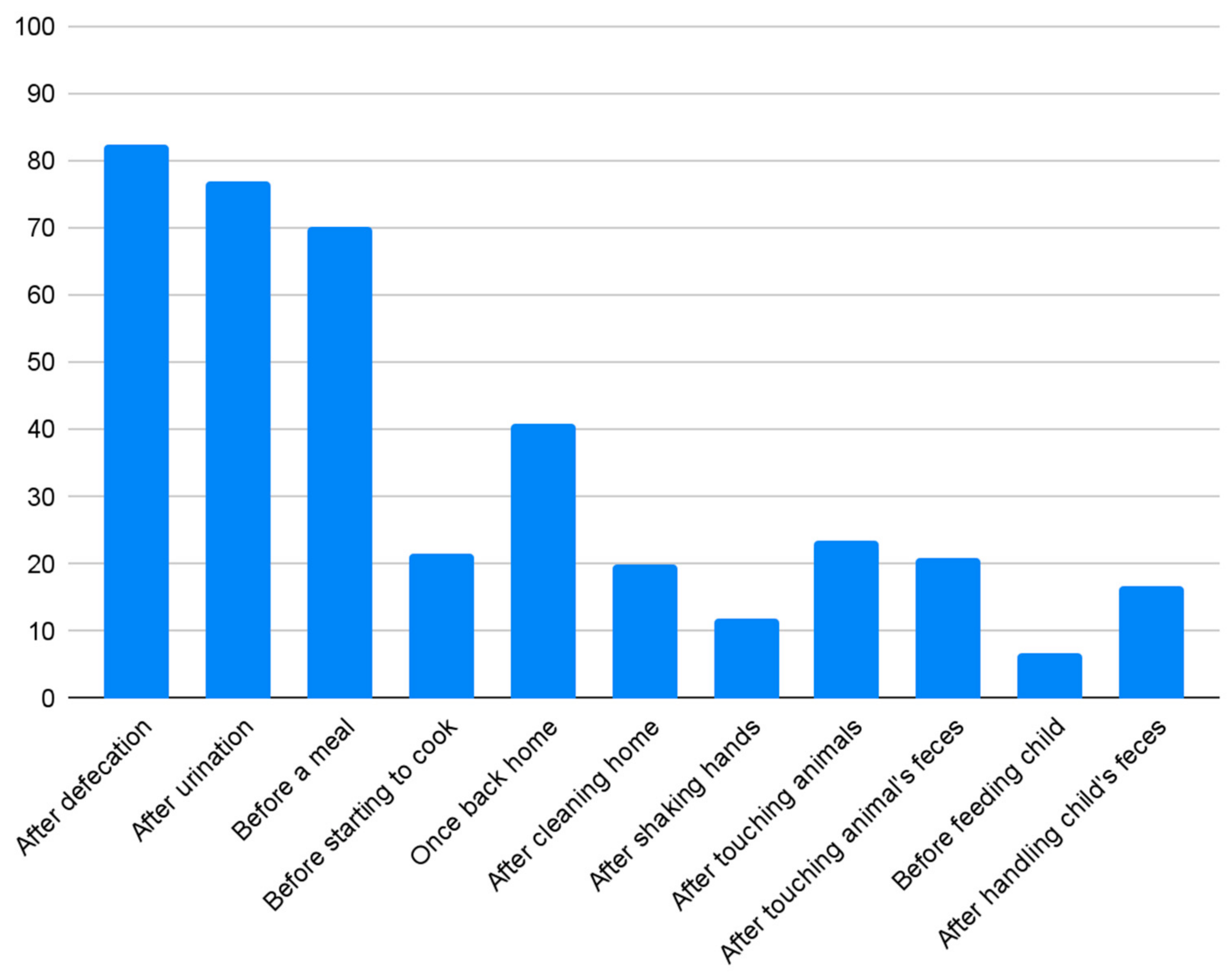
| After defecation | 129 (81.6) | 32 (86.5) | |
| After urination | 118 (74.5) | 32 (86.5) | |
| After cooking | 40 (25.3) | 4 (10.8) | |
| After eating | 111 (70.3) | 26 (70.3) | |
| After giving hand | 21 (13.3) | 2 (5.4) | |
| After cleaning home | 34 (21.5) | 8 (21.6) | |
| Once back home | 64 (40.5) | 16 (43.2) | |
| Other | 65 (41.1) | 5 (13.5) |
| Sanitation Measure | Village (%) | City (%) | p-Value |
|---|---|---|---|
| Excretal disposal | n = 158 | n = 37 | 0.0003 |
| Use of private latrines | 64 (40.5) | 13 (35.1) | |
| Use of public latrines | 48 (30.4) | 22 (59.5) | |
| Practice of open defecation | 53 (33.5) | 2 (5.4) |
| Waste Management | Village (%) | City (%) | p-Value |
|---|---|---|---|
| Waste disposal method | n = 158 | n = 37 | <0.0001 |
| Burning near home | 80 (50.6) | 21 (56.8) | |
| Common pits | 23 (14.6) | 26 (70.3) | |
| Private pits | 42 (26.6) | 6 (16.2) | |
| Designated open areas | 28 (17.7) | 0 (0) | |
| Undesignated open areas | 41 (25.9) | 2 (5.4) | |
| Dumping into rivers | 5 (3.2) | 1 (2.7) |
| Communication/Knowledge Measure | Village (%) | City (%) | p-Value |
|---|---|---|---|
| Individuals with at least primary education | n = 158 | n = 37 | 0.039 |
| Male children | 6 (10.9) | 8 (14.5) | |
| Female children | 1 (1.8) | 0 (0) | |
| Fathers | 26 (47.2) | 4 (7.2) | |
| Mothers | 21 (38.1) | 16 (29.1) | |
| Grandfathers | 0 (0) | 0 (0) | |
| Grandmothers | 1 (1.8) | 0 (0) | |
| Ownership of electronic devices | n = 158 | n = 37 | 0.126 |
| Mobile phones | 127 (80.4) | 37 (100.0) | |
| Radios | 79 (50.0) | 29 (78.4) | |
| Televisions | 18 (11.4) | 11 (29.7) | |
| Preferred communication method | n = 158 | n = 37 | 0.0009 |
| Radio | 90 (57.0) | 20 (54.1) | |
| Community meetings | 83 (52.5) | 5 (13.5) | |
| Home visits | 56 (35.4) | 9 (24.3) | |
| Knowledge of diarrhoea causes (contaminated food) | 135 (85.4) | 12 (32.4) | |
| Knowledge of diarrhoea causes (contaminated water) | 36 (22.8) | 12 (32.4) | |
| Belief that bathing in a river cannot transmit diseases | 20 (12.7) | 4 (10.8) | |
| Belief that drinking directly from a well cannot transmit diseases | 37 (23.4) | 3 (8.1) | |
| Belief that insects cannot transmit diseases | 5 (5.4) | 2 (3.2) | |
| Belief that dogs cannot transmit diseases | 22 (13.9) | 7 (18.9) | |
| Belief that ruminants cannot transmit diseases | 37 (23.4) | 6 (16.2) | |
| Belief that chickens cannot transmit diseases | 48 (30.4) | 10 (27.0) | |
| Belief that drinking directly from a well is safe | 121 (76.6) | 34 (91.9) | |
| Belief that deceased persons cannot transmit diseases | 51 (32.3) | 6 (16.2) | |
| Participation in recent hygiene/disease prevention campaigns | 142 (89.9) | 27 (73.0) |
| Disease | Measure | % | Disease | Measure | % |
|---|---|---|---|---|---|
| Cholera | Ebola | ||||
| Handwashing | 56 | Handwashing | 67 | ||
| Proper cooking | 27 | Physical distance | 64 | ||
| Keeping personal hygiene | 23 | Keeping personal hygiene | 12 | ||
| Treatment of water | 17 | ||||
| Proper conservation of food | 11 | ||||
| COVID-19 | Tuberculosis | ||||
| Handwashing | 62 | Physical distance | 44 | ||
| Physical distance | 62 | Covering mouth and nose | 38 | ||
| Covering mouth and nose | 58 | Handwashing | 36 | ||
| Keeping personal hygiene | 20 | Keeping personal hygiene | 26 | ||
| Vaccination | 6 | ||||
| Avoid handshaking | 3 | ||||
| HIV/sexual transmissible diseases | Malaria | ||||
| Usage of condoms | 20 | Sleeping under a net | 30 | ||
| Be faithful to partner | 16 | Clean environment | 22 |
| Variable | Village (%) | City (%) | p-Value |
|---|---|---|---|
| Percentage of Respondents Owning Animals | 68 (43% of respondents) | 9 (24.3% of respondents) | 0.04 |
| Cattle Ownership (%) | 30 (44.1% of the respondents owning animals) | 5 (55.6% of the respondents owning animals) | 0.43 |
| Average number of Cattle per Owner | 9 | 2.2 | |
| Goat Ownership | 37 (54.4) | 6 (66.7) | 0.34 |
| Average number of Goats per Owner | 9.9 | 3.3 | |
| Sheep Ownership | 7 (10.3) | 2 (22.2) | 0.79 |
| Average number of Sheep per Owner | 9.1 | 4.5 | |
| Chicken Ownership | 45 (66.2) | 2 (22.2) | 0.002 |
| Average number of Chickens per Owner | 10.2 | 5.5 | 0.32 |
| Duck Ownership | 6 (8.8) | 0 (0) | 0.23 |
| Turkey Ownership | 4 (5.9) | 0 (0) | 0.39 |
| Rabbit Ownership | 2 (2.9) | 0 (0) | 0.49 |
| Water Source for Cattle | |||
| -Surface Water | 10 (33.3) | 4 (80.0) | 0.05 |
| -Protected Springs | 11 (36.7) | 0 (0) | 0.1 |
| -Boreholes | 9 (30.0) | 0 (0) | >0.05 |
| -Public Taps | 0 (0) | 1 (20) | 0.13 |
| Water Source for Small Ruminants | |||
| -Boreholes | 16 (23.1) | 0 (0) | 0.39 |
| -Surface Water | 14 (25.4) | 3 (33.3) | 0.69 |
| -Public Taps | 2 (3.6) | 3 (33.3) | 0.02 |
| -Protected Springs | 10 (18.2) | 0 (0) | 0.32 |
| Water Source for Poultry | |||
| -Boreholes | 25 (45.4) | 1 (11.1) | 1 |
| -Surface Water | 8 (25.4) | 1 (33.3) | 0.35 |
| -Public Taps | 7 (12.7) | 0 (0) | 1 |
| -Protected Springs (%) | 5 (9.0) | 0 (0) | 1 |
| Distance from Water Source | |||
| -Boreholes/Public Taps within < 250 m (%) | 31 (45.6) | 3 (33.3) | 0.19 |
| -Protected Springs > 1 km (%) | 3 (5.4) | 0 (0) | 0.54 |
| -Surface Water < 1 km (%) | 3 (5.4) | 1 (11.1) | 0.36 |
| -Surface Water 1–2.5 km (%) | 21 (38.2) | 2 (22.2) | 1 |
| -Surface Water > 2.5 km (%) | 12 (21.8) | 0 (0) | 1 |
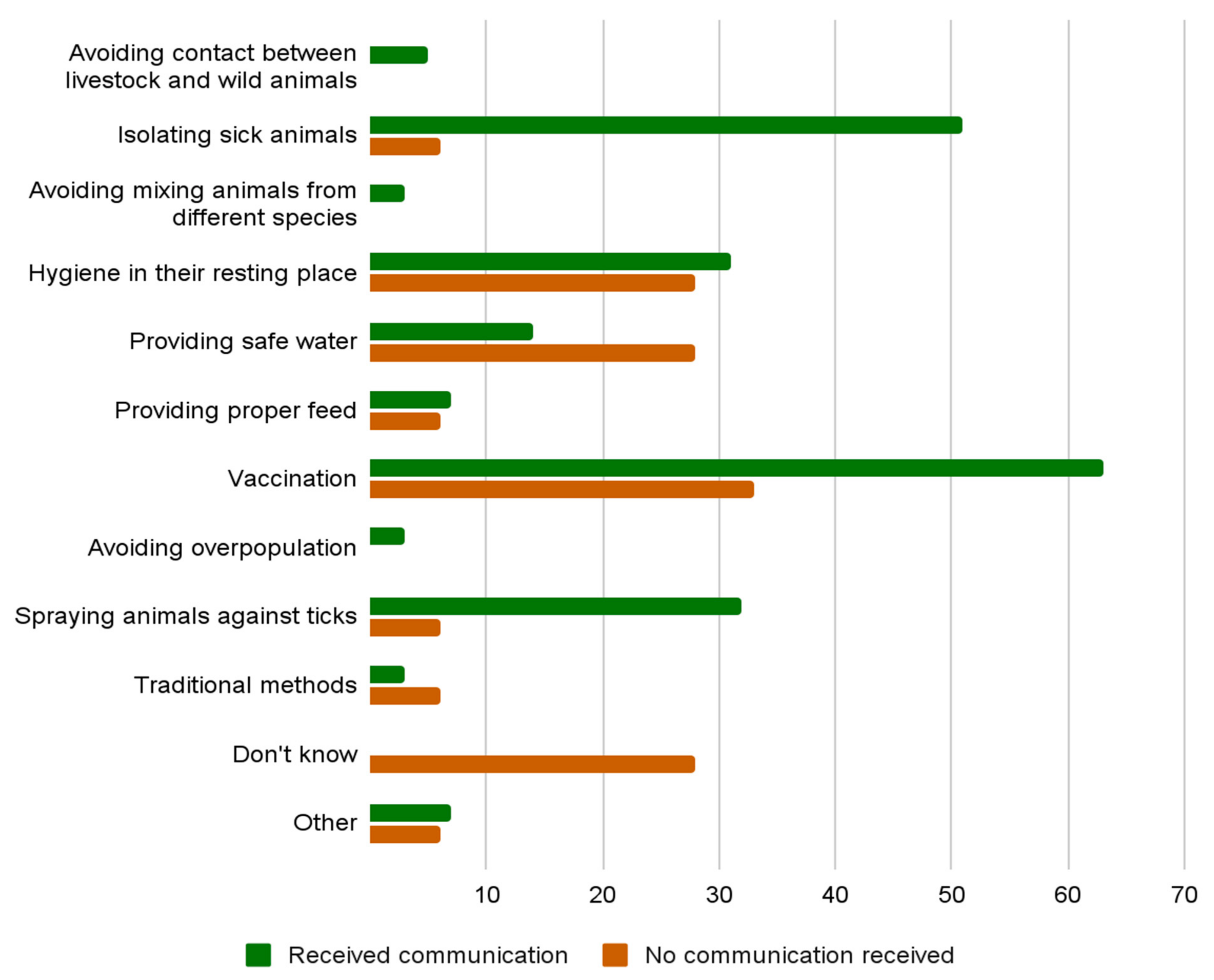
| Communications received from Authorities on Livestock Disease Prevention (%) | 57 (83.8) | 2 (22.2) | <0.001 |
| Outcome: | |||
|---|---|---|---|
| Sufficient Knowledge | |||
| Predictor | OR | 95% CI | p-Value |
| Home visits | 1.96 | 1.06–3.62 | 0.031 |
| Employment | 2.22 | 1.15–4.30 | 0.017 |
| Good Knowledge | |||
| Internet access | 25.04 | 3.17–197.68 | 0.002 |
| Home internet use | 69.80 | 4.28–1138.04 | 0.003 |
| Sheep ownership | 16.89 | 1.54–185.64 | 0.021 |
| Gender (women) | 0.04 | 0.006–0.30 | 0.002 |
| Age (≥30 years) | 20.39 | 2.74–151.83 | 0.003 |
| Higher education | 0.01 | 0.001–0.14 | <0.001 |
| Outcome: | |||
|---|---|---|---|
| Sufficient Attitudes | |||
| Predictor | OR | 95% CI | p-Value |
| Distance to water sources (>1 km) | 3.56 | 1.57–8.11 | 0.002 |
| Awareness of hygiene | 0.32 | 0.13–0.83 | 0.020 |
| Good Attitudes | |||
| Higher education | 6.89 | 3.12–15.20 | <0.001 |
| Owning livestock | 6.96 | 2.90–16.70 | <0.001 |
| Community meetings | 2.34 | 1.12–4.90 | 0.024 |
| Urban residence (Moroto) | 0.10 | 0.03–0.35 | <0.001 |
| Cattle ownership | 0.14 | 0.05–0.43 | <0.001 |
| Outcome: Sufficient Practices | |||
|---|---|---|---|
| Predictor | OR | 95% CI | p-Value |
| Gender (female as reference) | 0.36 | 0.16–0.83 | 0.017 |
| Distance to water sources (>1 km) | 6.10 | 2.72–13.68 | <0.001 |
| Radio ownership | 3.529 | 1.45–8.59 | 0.005 |
| Good Practices | |||
| Gender (women) | 4.49 | 1.43–14.08 | 0.010 |
| Higher education | 4.17 | 1.36–12.75 | 0.012 |
| Poultry ownership | 4.61 | 1.49–14.22 | 0.008 |
| Home visits | 30.78 | 8.07–117.42 | <0.001 |
| Owning a radio | 15.72 | 4.04–61.20 | <0.001 |
| Internet access | 21.30 | 6.07–74.70 | <0.001 |
| Distance to water sources (>1 km) | 0.20 | 0.06–0.70 | 0.011 |
Disclaimer/Publisher’s Note: The statements, opinions and data contained in all publications are solely those of the individual author(s) and contributor(s) and not of MDPI and/or the editor(s). MDPI and/or the editor(s) disclaim responsibility for any injury to people or property resulting from any ideas, methods, instructions or products referred to in the content. |
© 2026 by the authors. Licensee MDPI, Basel, Switzerland. This article is an open access article distributed under the terms and conditions of the Creative Commons Attribution (CC BY) license.
Share and Cite
Ceccarelli, D.; Diverio, S.; Lappo, P.G.; Ruspantini, C.; Losike, S.P.; Pareschi, A.R.; Marenzoni, M.L. Epidemiological Survey on Water, Sanitation, and Hygiene (WaSH) in Uganda’s Karamoja Sub-Region, Using a KAP Questionnaire Within a One Health Framework. Epidemiologia 2026, 7, 52. https://doi.org/10.3390/epidemiologia7020052
Ceccarelli D, Diverio S, Lappo PG, Ruspantini C, Losike SP, Pareschi AR, Marenzoni ML. Epidemiological Survey on Water, Sanitation, and Hygiene (WaSH) in Uganda’s Karamoja Sub-Region, Using a KAP Questionnaire Within a One Health Framework. Epidemiologia. 2026; 7(2):52. https://doi.org/10.3390/epidemiologia7020052
Chicago/Turabian StyleCeccarelli, Davide, Silvana Diverio, Pier Giorgio Lappo, Carlo Ruspantini, Simon Peter Losike, Alma Rosa Pareschi, and Maria Luisa Marenzoni. 2026. "Epidemiological Survey on Water, Sanitation, and Hygiene (WaSH) in Uganda’s Karamoja Sub-Region, Using a KAP Questionnaire Within a One Health Framework" Epidemiologia 7, no. 2: 52. https://doi.org/10.3390/epidemiologia7020052
APA StyleCeccarelli, D., Diverio, S., Lappo, P. G., Ruspantini, C., Losike, S. P., Pareschi, A. R., & Marenzoni, M. L. (2026). Epidemiological Survey on Water, Sanitation, and Hygiene (WaSH) in Uganda’s Karamoja Sub-Region, Using a KAP Questionnaire Within a One Health Framework. Epidemiologia, 7(2), 52. https://doi.org/10.3390/epidemiologia7020052