


Abstract
The large-scale grid integration of offshore wind farm clusters presents significant operational challenges due to the inherent uncertainty of wind power output and the high capital cost of AC/DC hybrid transmission infrastructure. This paper proposes an intensive optimization scheduling strategy for offshore wind farm clusters based on confidence gap decision theory (CGDT). Firstly, the proposed approach employs an equivalent single-unit aggregation model to characterize the collective output of wind farm clusters. Secondly, a multi-objective deterministic dispatching model for AC/DC intensive network configuration is constructed, aiming to maximize wind power accommodation, power supply proportion and intensive utilization of transmission corridors. Furthermore, kernel density estimation is adopted to fit the prediction error distribution of wind power output for describing the uncertainty of offshore wind power output, and an uncertain robust optimization model is developed and solved on the basis of CGDT. Finally, taking an AC/DC system of a certain offshore wind farm cluster as a case study, simulation analysis is conducted on the dispatching performance of the proposed method and the impacts of parameters on dispatching results. The results demonstrate that both the mean values and stability of dispatching indices of the proposed method are superior to those of traditional methods. The balance between dispatching robustness and economy can be achieved by reasonably setting the target significance level. The proposed strategy can provide a theoretical foundation for the intensive optimal AC/DC dispatching of offshore wind farm clusters.
1. Introduction
Driven by the “dual carbon” goals, the large-scale grid integration of renewable energy has emerged as an irreversible trend in the clean and low-carbon transition of power systems [1,2,3]. The installed capacity of renewable energy sources, particularly wind power and photovoltaics, has witnessed sustained year-on-year growth. Notably, offshore wind power stands out as a pivotal pathway for advancing high-renewable penetration, owing to its abundant resource endowment, superior generation efficiency, and minimal land footprint [4,5]. Nevertheless, offshore wind farm clusters are typically located far from onshore load centers, and their power output is highly susceptible to marine meteorological and hydrological conditions. As a result, the efficient accommodation of offshore wind power relies heavily on robust transmission corridors. Basically, AC/DC hybrid transmission systems, which integrate the flexible networking capability of AC grids with the long-distance, large-capacity transmission advantages of DC grids, have become the primary technical solution for the grid integration and delivery of offshore wind power. AC/DC hybrid transmission is also one of the most prominent research focuses in the field.
Currently, extensive research has been conducted on the optimization and scheduling of AC/DC power grids. A hybrid AC/DC electric–hydrogen coupling system architecture in [6] is proposed, which realizes 100% local consumption of renewable energy, and increases annual income by 32.5% with only 6.3% additional cost. Authors in [7] propose a three-stage energy scheduling based on cloud–edge collaborative architecture for AC/DC hybrid distribution systems, which reduces network loss, eliminates renewable curtailment and greatly improves solution efficiency. Wei et al. [8] put forward a wind–solar-load-storage collaborative scheduling framework for AC/DC hybrid distribution network system, which realizes fast real-time decision-making, reduces operation cost and network loss, and maintains strong robustness in extreme scenarios. In the context of offshore wind power, a hierarchical control strategy for offshore hybrid AC/DC system with hybrid energy storage is developed in [9], significantly improving system dynamic stability. Meanwhile, other aspects of offshore AC/DC systems have also attracted scholarly attention, including integrated protection schemes [10] and transient characteristics of hybrid transmission lines [11]. The above studies have laid an important foundation for the operation and control of AC/DC power grids, yet the majority focus on either steady-state dispatch optimization, control strategies, or transient analysis, while the scheduling of AC/DC transmission corridors under uncertainty still deserves further exploration.
Against the backdrop of mounting challenges posed by renewable energy output uncertainty to optimal scheduling of hybrid AC/DC power grids, extensive research has been conducted on uncertainty scheduling methodologies. Specifically, a bi-level robust optimization model based on non-cooperative game theory is established in [12], which coordinates converter stations and energy storage to mitigate uncertainty impacts on power interaction and achieve benefit equilibrium and voltage stability. Furthermore, to address the large-scale offshore wind farm shutdown risk induced by severe storms in hybrid AC/DC transmission grids, a two-stage adaptive robust unit commitment approach is proposed in [13], which improves day-ahead wind power accommodation by 15% at the expense of merely a 3% increase in conventional generation cost, striking a favorable trade-off between system operational resilience and economic efficiency. Despite the substantial progress achieved in existing research on optimal scheduling of hybrid AC/DC power grids and its application to offshore wind power transmission, several critical research gaps remain unaddressed. In terms of uncertainty handling, conventional approaches based on conservative robust optimization or scenario generation techniques are insufficient for capturing the strong stochastic characteristics of offshore wind power. Traditional robust optimization often relies on subjectively defined uncertainty sets, while scenario-based methods cannot guarantee the ergodicity of the full uncertainty space. In terms of scheduling economy, AC/DC transmission corridors involve high construction costs and long project cycles, and the supporting infrastructure for offshore wind power requires massive capital investment. Operational scheduling must therefore pursue maximum transmission efficiency and intensive resource utilization. However, there is still limited research on the intensive and efficient operation of AC/DC transmission lines in the existing literature.
Motivated by the aforementioned research gaps, this paper investigates the intensive AC/DC scheduling problem for offshore wind farm clusters based on confidence gap decision theory (CGDT) [14,15], aiming to achieve efficient intensive AC/DC transmission scheduling while properly handling the inherent uncertainty of offshore wind power. CGDT is a robust decision-making methodology that maximizes the confidence level of satisfying scheduling constraints under uncertainty, thereby offering a systematic approach to balancing robustness and economy. In the context of power system scheduling, Dong et al. [16] have applied CGDT to the robust scheduling of integrated energy systems, demonstrating its effectiveness in reducing conservatism and improving economic performance compared to conventional robust and stochastic optimization methods. Different from the integrated energy system scenario in [16], our work specifically addresses the AC/DC intensive transmission scheduling problem for offshore wind farm clusters, with a focus on coordinating corridor utilization and wind power accommodation under forecast uncertainty. The main contributions of this work are summarized as follows:
(1) A CGDT-based robust optimization framework for AC/DC intensive scheduling of offshore wind farm clusters is proposed. The trade-off between scheduling robustness and economic efficiency is quantitatively controlled by the confidence level, which effectively alleviates the excessive conservatism of conventional robust optimization and avoids the subjectivity of specified uncertainty margins.
(2) A probabilistic characterization approach for offshore wind power prediction errors is developed by integrating kernel density estimation with CGDT. The distribution features of prediction errors are captured without preselecting a fixed analytical form, which overcomes the limitation of the symmetric interval assumption in traditional information gap decision theory and improves the accuracy of uncertainty description.
(3) A multi-objective deterministic dispatching model for AC/DC intensive networking is formulated, which coordinates wind power accommodation, load supply rate, and corridor intensive utilization. On this basis, a computationally tractable convex linear programming solution method is developed, which can efficiently obtain the robust scheduling scheme with verified feasibility under all uncertain scenarios.
2. Deterministic Scheduling Model for Offshore AC/DC Transmission Systems
2.1. Output of Offshore Wind Farm Clusters
Offshore wind farm clusters adopt an intensive collector topology, where all wind turbines are collectively connected to the offshore grid connection point via submarine cables. During cluster operation, the wake effect generated by upstream turbines will attenuate the incoming wind speed of downstream units, thus reducing the overall output level of the cluster. To characterize the collective output of the cluster while accounting for wake attenuation, an equivalent single-unit aggregation model incorporating the Jensen wake effect is adopted. The active power output of a single offshore wind turbine presents a piecewise nonlinear correlation with real-time incoming wind speed:
where Pw,i,t is the active output of the wind turbine i at time t; vi,t is the measured wind speed of the wind turbine i at time t; vci is the cut-in wind speed of the wind turbine; vco is the cut-out wind speed of the wind turbine; vr is the rated wind speed of the wind turbine; is the rated output of the wind turbine; ai and bi are the output fitting coefficients of the wind turbine, which can be obtained by fitting output-wind speed data; ΔPw,i,up is the maximum upward ramp rate of the wind turbine; ΔPw,i,down is the maximum downward ramp rate of the wind turbine.
−ΔPw,i,down ≤ Pw,i,t − Pw,i,t−1≤ΔPw,i,up
On this basis, the Jensen wake model is introduced to correct the wind speed distribution within the cluster, considering the wake diffusion and superposition effects among turbines [17,18]. The equivalent single-unit method is applied for aggregation. The equivalent wind speed parameters (cut-in, rated, cut-out) are derived via capacity-weighted averaging based on individual turbine parameters, and the equivalent rated output equals the total rated capacity of the cluster. The wake-corrected average wind speed of the cluster is calculated by the spatial weighted average method:
where is the average wind speed of the cluster at time t; N is the total number of wind turbines in the cluster; κi is the spatial weight coefficient of turbine i, determined by turbine layout and wake influence range.
Accordingly, the aggregated output model of the wind farm cluster is constructed, which maintains the piecewise output characteristics consistent with a single turbine:
where Powc,t is the actual aggregated output of the offshore wind farm cluster at time t; vci,eq, vr,eq and vco,eq are the cut-in, rated and cut-out wind speeds of the equivalent single unit, respectively; is the rated output of the equivalent single unit, i.e., the total rated capacity of the cluster; aeq and beq are the output fitting coefficients of the equivalent single unit, obtained by fitting historical cluster output and average wind speed data.
2.2. Optimization Objectives of AC/DC Intensive Scheduling
The characteristics of offshore wind power AC/DC intensive networking systems are mainly reflected in two aspects. First, AC and DC corridors share the same transmission infrastructure and jointly undertake outward transmission tasks, i.e., intensive transmission corridors. Second, AC and DC powers are collaboratively allocated to maximize the utilization of shared corridors, i.e., intensive scheduling operation.
Based on this concept, the deterministic scheduling model is formulated under the assumption that wind power output is accurately predicted without random disturbances. Basically, a deterministic scheduling optimization model can be formulated to maximize wind power accommodation rate, load supply rate, and AC/DC corridor intensive utilization rate. The constraints include power balance, transmission capacity and network loss characteristics of the AC/DC system. Here, wind power accommodation is defined as the rate of actually dispatched wind power to the total available wind power output of the offshore cluster. Load supply rate defined as the rate of actual power delivered to AC and DC loads to the corresponding total load demand. AC/DC corridor intensive utilization rate quantifies the comprehensive utilization level of shared AC and DC transmission corridors under collaborative operation. Improving wind power accommodation rate reduces wind curtailment, raising load supply rate enhances load demand fulfillment, and boosting corridor intensive utilization improves transmission efficiency. Accordingly, the following models are constructed respectively:
where F1 is the objective function of maximizing wind power accommodation; T is the total duration of the scheduling period; is the actual consumed power of the cluster at time t; F2 is the objective function of maximizing load supply rate; and are the power supplied by AC and DC subnetworks to the load at time t; and are the load demand power of AC and DC subnetworks at time t. F3 is the objective function of maximizing intensive utilization of AC/DC corridors; is the total intensive utilization rate of AC/DC corridors at time t, which measures the intensive degree of joint operation of AC/DC corridors and comprehensively reflects the effects of shared corridor transmission and collaborative scheduling; and are the actual transmission power of AC and DC transmission corridors at time t, respectively; and are the maximum transmission capacity of AC and DC transmission corridors, respectively.
It should be clarified that the three objectives correspond to three distinct physical dimensions of system operation and do not represent the same physical effect, despite the above synergistic coupling. Wind power accommodation focuses on the generation side, which measures the utilization level of wind energy resources. The load supply rate focuses on the demand side, which reflects the guarantee level of power supply reliability. The AC/DC corridor intensive utilization rate focuses on the transmission link, which quantifies the operation efficiency of transmission infrastructure. The three objectives are not essentially overlapping. For instance, sufficient wind generation does not guarantee a high load supply ratio when load demand is at a low level; conversely, prioritizing load supply reliability may require reducing wind power accommodation during certain peak load periods. Each objective provides an independent evaluation dimension for scheduling performance. After normalized weighting, the following optimization objective is obtained:
where ω1, ω2 and ω3 are the weight coefficients of wind power accommodation, power supply proportion and intensive corridor utilization, respectively.
minF0 = (−ω1F1 − ω2F2 − ω3F3)
2.3. Constraints of AC/DC Intensive Scheduling
The constraints of offshore wind power AC/DC intensive scheduling cover power balance, transmission loss, corridor capacity and load supply.
(1) Power balance constraints
In the AC/DC intensive networking system, the power generated by the offshore wind farm cluster is allocated between the AC and DC subnetworks through interlinking converter stations. In the day-ahead steady-state scheduling scenario, converters operate in stable transmission modes with essentially constant active power transfer efficiency. Since converter losses are relatively small and exhibit limited sensitivity to short-term dispatch variations, they have a negligible impact on the overall power balance and can be reasonably omitted in the dispatch-oriented modeling framework. Accordingly, the intensively collected power of the offshore wind farm cluster shall be fully allocated to AC/DC corridors, and the AC/DC subnetworks shall satisfy their respective power balance constraints, as expressed in models (10)–(12):
where is the total transmission loss of the AC subnetwork at time t and is the total transmission loss of the DC subnetwork at time t, which can be expressed as
where Nac is the total number of transmission lines in the AC subnetwork; Rac,l is the resistance of the AC transmission line l; is the transmission power of the AC line l at time t; Ndc is the total number of transmission lines in the DC subnetwork; Rdc,l is the resistance of the DC transmission line l; is the transmission power of the DC line l at time t. The transmission loss model in (13) and (14) adopts a simplified quadratic formulation that primarily accounts for the resistive losses of transmission lines. While practical offshore AC/DC systems also incur converter station losses, transformer losses, and cable capacitive losses, these components are either largely determined by equipment ratings and exhibit weak sensitivity to short-term dispatch variations, or remain relatively constant under normal voltage operating conditions. Since the primary objective of this study is to evaluate the performance of CGDT-based scheduling strategies under uncertainty, the aforementioned loss components exert limited influence on dispatch and are therefore not explicitly modeled. In addition, for the converter operating modes, such as constant power, constant voltage, or droop control, these control modes determine the steady-state characteristics of the hybrid AC/DC system, but they are typically decoupled from day-ahead scheduling decisions. Therefore, converter control modes are not considered in the modelling process.
(2) Transmission corridor constraints
The actual transmission power of AC/DC transmission corridors shall not exceed the maximum transmission capacity of AC/DC corridors:
(3) Load supply constraints
The actual power supply of AC and DC subnetworks shall not exceed the load demand in the corresponding period and shall not be negative, so as to avoid reverse power flow:
3. CGDT-Based AC/DC Intensive Scheduling Model Under Uncertainty
The output of offshore wind farm clusters is usually affected by marine meteorological conditions, which inevitably leads to random errors between predicted and actual values [19,20,21]. Such errors expose deterministic scheduling to multiple risks in actual operation, including rising wind curtailment rate, insufficient power supply, and unbalanced corridor utilization. Compared with stochastic optimization, traditional robust optimization and other methods, CGDT can make full use of the probability information of historical data, balance the economy and robustness of scheduling schemes through chance constraints, and does not require massive scenario sampling. It features higher computational efficiency and is more suitable for the scheduling requirements of offshore wind power AC/DC intensive networking systems. Taking the optimal value of the deterministic model as the benchmark, this section employs Kernel density estimation (KDE) to fit the distribution of wind power output prediction error [22]. Then, CGDT chance constraints are constructed, and a robust optimization model for AC/DC intensive networking is further established to account for wind power uncertainty.
3.1. Probabilistic Characterization of Offshore Wind Forecast Uncertainty
Given that the probability distribution of offshore wind power output prediction error lacks a fixed analytical form, and that the conventional normal distribution assumption incurs substantial inaccuracy, the KDE method is adopted for non-parametric fitting. This approach does not require a predetermined distribution type. Instead, it extracts the underlying probabilistic characteristics from historical error samples, and the resulting probability information provides the basis for constructing the CGDT chance constraints and performing their deterministic transformation, thereby ensuring the rationality of the proposed uncertainty scheduling model.
The wind power output prediction error is defined as follows:
where ΔPowc,t is the output prediction error of the offshore wind farm cluster at time t, which quantifies the deviation between actual and predicted output; a positive value means the actual output is higher than the predicted output, and vice versa; is the predicted output of the offshore wind farm cluster at time t; f(ΔPowc) is the probability density function of the offshore wind farm cluster output prediction error, which describes the probability distribution intensity of the prediction error in different value intervals; n is the total number of historical samples of wind power output prediction error, and the sample size shall meet the statistical validity of kernel density estimation; k is the index of historical samples; K(⋅) is the Gaussian kernel function, which fits the probability distribution characteristics of historical error samples; ΔPowc,k is the kth historical prediction error sample; ΔPowc is the prediction error variable, covering all possible error values; is the lower confidence limit of the prediction error, i.e., the minimum possible value of the prediction error; is the upper confidence limit of the prediction error, i.e., the maximum possible value of the prediction error. The two together form the CGDT confidence interval of offshore wind farm cluster output at time t, which defines the uncertainty fluctuation range. In the model, howc is the optimal bandwidth of KDE, which controls the smoothness of the probability density curve. In this study, the bandwidth is determined via Silverman’s rule of thumb, a widely adopted adaptive selection criterion for kernel density estimation, which is formulated as:
where is the sample standard deviation; γ is the interquartile range; and is the number of historical samples.
Based on the probability density function, the cumulative distribution function and confidence interval of the prediction error can be obtained:
where Fowc(x) is the cumulative distribution function of wind power output prediction error, representing the probability that the prediction error does not exceed x; x is the prediction error variable; is the inverse function of the cumulative distribution function, i.e., the quantile function; β is the target significance level, which controls the uncertainty risk and usually takes a value less than 1.
3.2. CGDT-Based Robust Optimization Model Formulation
As a robust decision-making methodology tailored for optimization under uncertainty, CGDT introduces probabilistic confidence levels on the basis of information gap decision theory (IGDT) and employs asymmetric probabilistic confidence intervals to characterize the fluctuation of uncertain parameters. This approach effectively remedies the inherent coarseness of IGDT arising from its exclusive use of symmetric intervals for uncertainty description, and circumvents the excessive conservatism of conventional robust optimization as well as the reliance of stochastic optimization on accurate distribution assumptions [23].
Generally, a robust optimization model is formulated with the objective of maximizing the uncertainty confidence level, subject to the condition that the optimization objective function is not inferior to the deterministic optimal value. This formulation ensures that the resulting scheduling scheme possesses the strongest robustness against wind power output fluctuations. The general form of the uncertainty optimization model can be expressed as
where X is the system scheduling decision variable; ξ represents uncertain parameters such as wind power output; F(⋅) is the optimization objective function; H(⋅) and G(⋅) are the sets of equality and inequality constraints, respectively.
Under the CGDT framework, the fluctuation interval of the uncertain parameter ξ around the predicted value can be expressed as a probabilistic confidence interval constrained by the confidence level 1 − α:
where is the fluctuation domain of the uncertain parameter at the confidence level 1 − α; Δξd and Δξs are the lower and upper bounds of the prediction error confidence interval of the uncertain parameter, respectively.
CGDT robust optimization aims at maximizing the confidence level and ensures that the probability of the objective function falling below the deterministic optimal value does not exceed a preset threshold. Its standard model is formulated as follows:
where Pr{⋅} is the probability operator; F0 is the optimal objective value of the deterministic model when the uncertain parameter takes the predicted value.
Given the deterministic optimal value F0 from Section 2 as the benchmark, a CGDT robust optimization model is formulated that integrates offshore wind power output uncertainty into the AC/DC intensive scheduling framework. The decision variables include AC/DC corridor transmission power, load supply power, wind power accommodation power, etc. The objective is to maximize the robust confidence level of the system against wind power uncertainty. The robust optimization model is as follows:
where X is the set of scheduling decision variables for AC/DC intensive networking; is the robust fluctuation interval of wind power output at the confidence level 1 − α.
Considering that model (30) contains probabilistic chance constraints and cannot be solved directly, it is transformed into deterministic algebraic constraints through the cumulative distribution function and its inverse. For the chance constraint in model (30),
Pr{F(X,ΔPowc,t) ≥ F0} ≤ β
Model (31) requires that the probability of the scheduling objective being not better than the deterministic benchmark F0 should not exceed β. Based on the monotonic characteristics of the model, the event of the scheduling objective exceeding the deterministic benchmark occurs if and only if the actual wind power prediction error does not exceed a specific threshold ΔPowc,0. Therefore, the probability in (31) can be expressed using the complementary event as
where ΔPowc,0 represents the corresponding threshold error value such that F(X,ΔPowc,0) = F0 and Fowc(ΔPowc,0) represents the probability that the prediction error does not exceed this threshold. Substituting (32) into (31) yields
Pr{F(X,ΔPowc,t) ≥ F0} = 1 − Pr{ΔPowc,t>ΔPowc,0} = 1 − (1 − Fowc(ΔPowc,0)) = Fowc(ΔPowc,0)
Fowc(ΔPowc,0) ≤ β
Model (33) indicates that the error threshold should not exceed the β. By applying the inverse cumulative distribution function , the following model can be obtained as
Since the scheduling objective F(X,ΔPowc,0) = F0 is monotonous with respect to the forecast error, when the condition in (34) is satisfied, following model can be obtained as
Substituting (35) into F(X,ΔPowc,0) = F0 yields
Model (36) is a deterministic algebraic constraint and can be directly embedded into the AC/DC intensive scheduling model. It ensures that even under the worst-case prediction error within the target significance level β, the scheduling objective will not be worse than the deterministic benchmark F0. Consequently, the original bi-level robust optimization model with probabilistic chance constraints is transformed into a single-level deterministic optimization model. Based on the linearity of the model, the uncertainty set is represented by interval bounds, and all constraints remain linear. Thus, the transformed model is a convex linear programming problem and can be solved efficiently.
As for the mathematical mechanism of the CGDT robust optimization formulation, it can be interpreted as follows. The CGDT robust optimization model in model (30) maximizes the confidence level 1 − α subject to the constraint that the objective function does not fall below the deterministic benchmark F0. The confidence level 1 − α serves as a quantitative measure of the system’s immunity against wind power prediction errors. A higher 1 − α corresponds to a wider probabilistic confidence interval of the prediction error in model (28), which in turn requires the scheduling scheme to reserve more regulation margin to accommodate larger wind power fluctuations. This is why the confidence level and the economic indices exhibit a mutually restrictive relationship. That is, an increase in robustness necessarily sacrifices part of the economic efficiency. The deterministic equivalent transformation in models (31)–(36) further reveals that the CGDT model essentially converts the probabilistic chance constraint into a quantile-based algebraic constraint via the inverse cumulative distribution function , thereby making the problem tractable while preserving the probabilistic interpretation of robustness.
3.3. Solution for the AC/DC Intensive Optimization Model
The proposed CGDT-based robust optimization model for AC/DC intensive networking is converted into a convex linear programming formulation after the deterministic equivalent transformation of chance constraints. The model satisfies the strong duality condition and can be efficiently solved via the CPLEX solver. The overall solution procedure is elaborated as follows:
(1) Parameter initialization and uncertainty distribution characterization
Basic system parameters are input, including AC/DC transmission corridor parameters (transmission capacity, line resistance, etc.), offshore wind farm cluster parameters (equivalent single-unit parameters, predicted output, etc.), load demand parameters, and the preset target significance level β, etc. Meanwhile, the probability density function of wind power output forecasting errors is estimated via KDE based on historical offshore wind power data, from which the cumulative distribution function and inverse cumulative distribution function.
(2) Determination of deterministic benchmark optimal value
Taking the predicted output of the offshore wind farm cluster as the deterministic input, the deterministic optimization model established in Section 2 is solved. The resulting optimal objective value F0 is adopted as the performance benchmark for the CGDT robust optimization.
(3) Solution of the CGDT robust optimization model
The deterministic benchmark value F0 and the inverse cumulative distribution function are substituted into the transformed single-level deterministic robust optimization model. The model is solved to obtain the maximum confidence level 1 − α, the optimal scheduling objective value, and corresponding optimal decision variables including AC/DC corridor transmission power and wind consumption power.
(4) Calculation of wind power robust fluctuation interval
Based on the solved optimal confidence level 1 − α and the probability density function of wind power forecasting errors, the upper and lower bounds of the forecasting error confidence interval (i.e., and ) are calculated. The robust fluctuation interval of the offshore wind farm cluster output is further determined accordingly.
(5) Feasibility verification and scheduling scheme output
To verify the feasibility of the optimal scheme, sufficient random wind power scenarios are generated within the robust fluctuation interval via the Monte Carlo method. All scenarios are substituted into the original system constraints to confirm that power balance, transmission capacity limits and other constraints hold under all uncertain scenarios. After the feasibility is verified, the final robust scheduling scheme is output and the solution procedure is completed.
4. Case Study
4.1. Case Parameter Setting
The case study is conducted on a deep-sea offshore wind farm cluster with an AC/DC intensive networking system. The system topology consists of offshore wind farm clusters, AC transmission corridors, DC transmission corridors, and corresponding onshore AC and DC load subnetworks. The aggregated output of the wind farm cluster is connected to the onshore converter station via the intensive collection system, and then allocated to the AC and DC transmission corridors through the interlinking converter, finally supplying power to the respective load subnetworks.
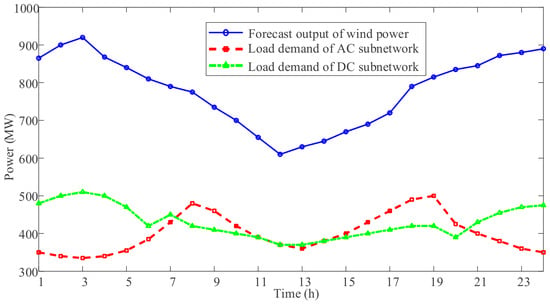
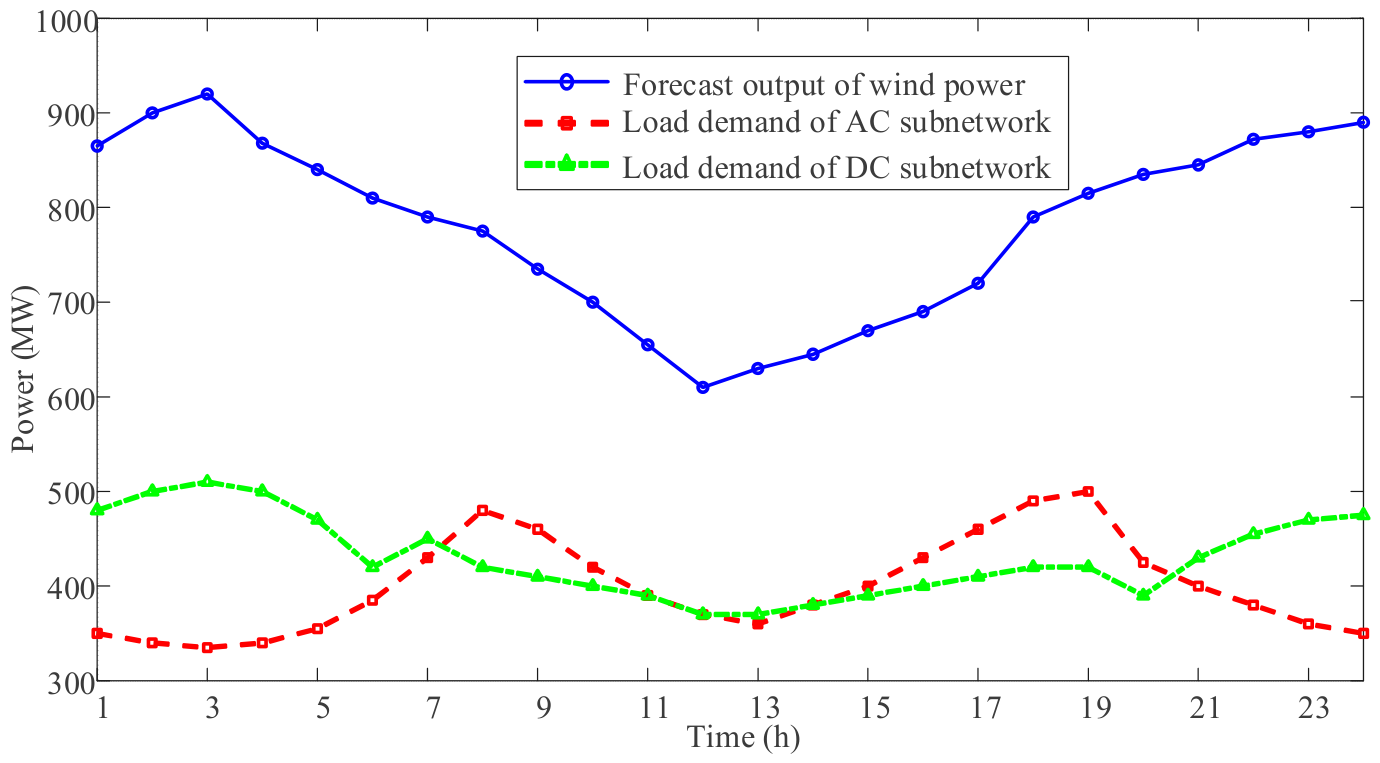
The typical parameter values of the system are shown in Table 1, and the wind power cluster output prediction and AC/DC load subnetwork power demand are shown in Figure 1. The KDE with Gaussian kernel function is adopted for wind power output uncertainty characterization, the bandwidth is adaptively solved by the Silverman criterion, and the number of historical prediction error samples is 1000 groups. The target significance level β of the CGDT model is initially set to 0.10, and the confidence level ranges within 0 ≤ 1 − α ≤ 1. The simulations are conducted in MATLAB R2025b on a Dell desktop computer (manufactured by Dell Inc., Round Rock, TX, USA) with an Intel(R) Core(TM) i5-14500 (2.60 GHz), 16 GB RAM, using the IBM ILOG CPLEX Optimization Studio V22.1.1 solver.
Table 1.
Typical parameters of offshore wind power cluster AC/DC intensive networking system.
Figure 1.
Wind power output prediction and AC/DC load demand.
4.2. Analysis of Robust Scheduling Results Based on CGDT
Based on the predicted wind power output, the deterministic scheduling model is solved, producing the benchmark optimal value F0 = 0.926. With the deterministic optimal value F0 taken as the constraint benchmark and wind power output uncertainty taken into account, the CGDT robust optimization models are solved under different risk control levels. Specifically, the target significance levels are set to β = 0.05, 0.10, 0.15, corresponding to low, medium, and high robustness requirements, respectively. The results are shown in Table 2.
Table 2.
CGDT robust scheduling results under different target significance levels.
As can be observed from Table 2, when β increases from 0.05 to 0.15, the confidence level 1 − α rises significantly from 0.0632 to 0.2924, indicating that the system’s robustness against wind power uncertainty is substantially enhanced. However, this improvement in robustness inevitably compromises economic efficiency. Specifically, the wind power accommodation rate decreases from 97.2% to 94.8%, the load supply rate declines from 91.8% to 88.6%, and the corridor intensive utilization rate drops from 60.6% to 56.8%. This mutually restrictive relationship arises because a higher robustness requirement (i.e., larger β) necessitates reserving more regulation margin to accommodate wind power fluctuations, which in turn reduces the available transmission capacity for power delivery. Conversely, a lower robustness requirement (i.e., smaller β) allows more aggressive power delivery and higher economic efficiency, but exposes the system to a higher risk of constraint violations when wind power deviates from forecasts. Therefore, from the perspective of engineering application, the target significance level β should be selected reasonably to balance system robustness and economy, so that it can cope with conventional wind power fluctuations while ensuring system operation efficiency.
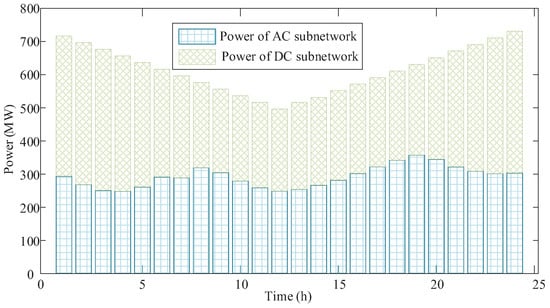
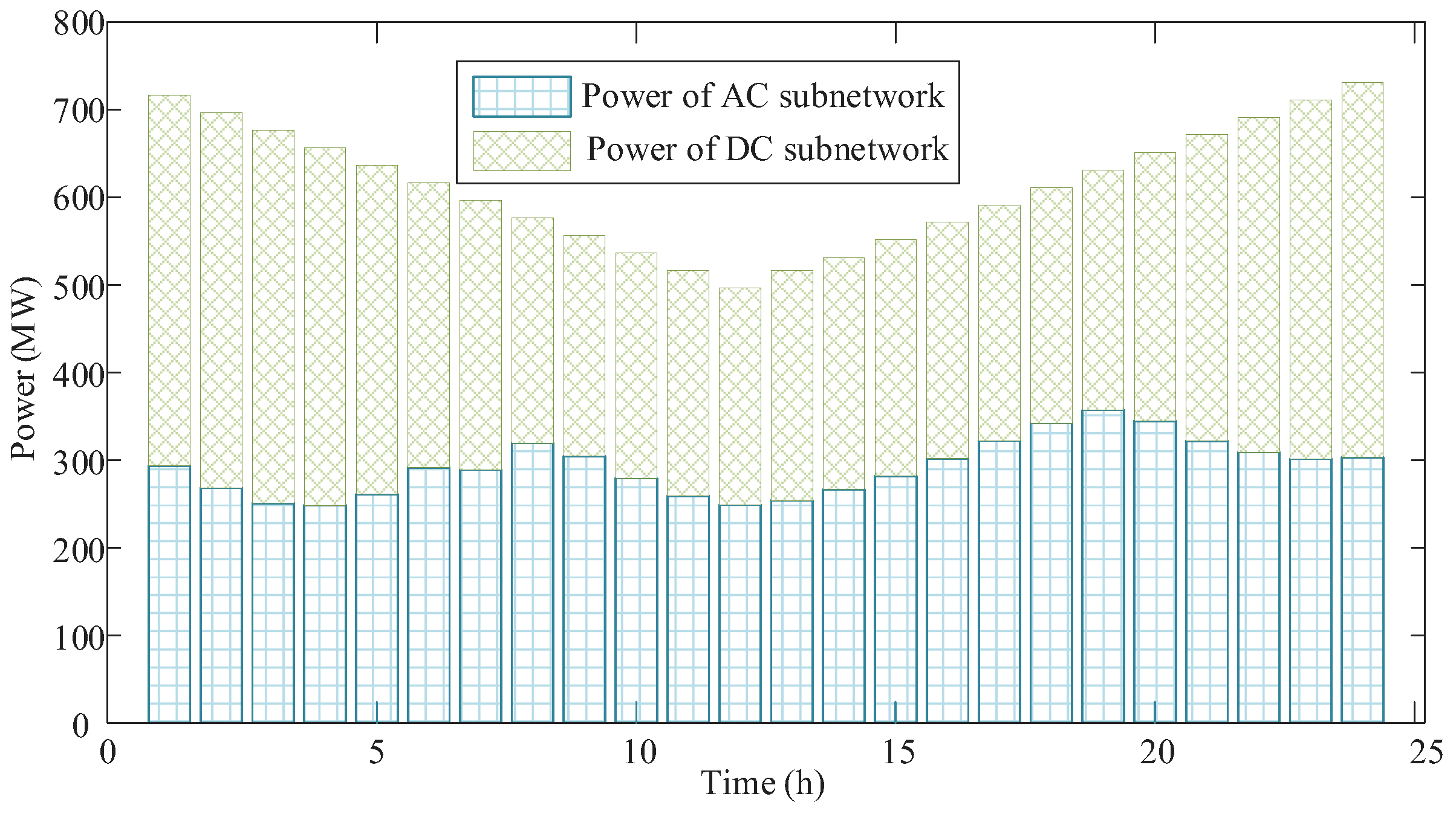
To provide an illustration of the typical power allocation pattern, Figure 2 presents the AC/DC corridor power distribution at the intermediate target significance level β = 0.10 as a representative example. It can be observed that the transmission powers of both AC and DC subnetworks are dynamically adjusted in response to the peak–valley timing of wind power output and load demand. During peak wind power output periods, corridor power utilization is appropriately reduced to reserve regulation margin for wind power fluctuations, thereby enhancing system robustness. During trough wind power output periods, the transmission powers of AC and DC corridors are balanced to reduce network losses, thus improving operational economy. The power allocation patterns under β = 0.05 and β = 0.15 exhibit similar temporal trends, with the primary difference being the overall magnitude of power delivery, and thus are not elaborated here for brevity.
Figure 2.
Robust power distribution of AC/DC corridors at β = 0.10.
4.3. Comparative Analysis of Different Optimization Methods
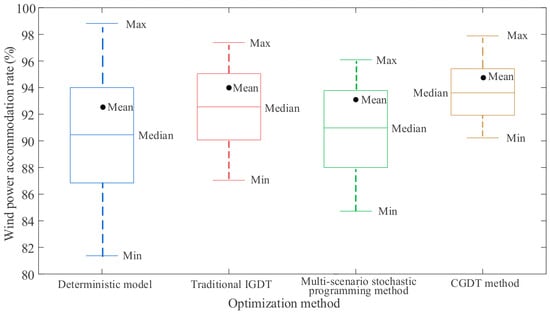
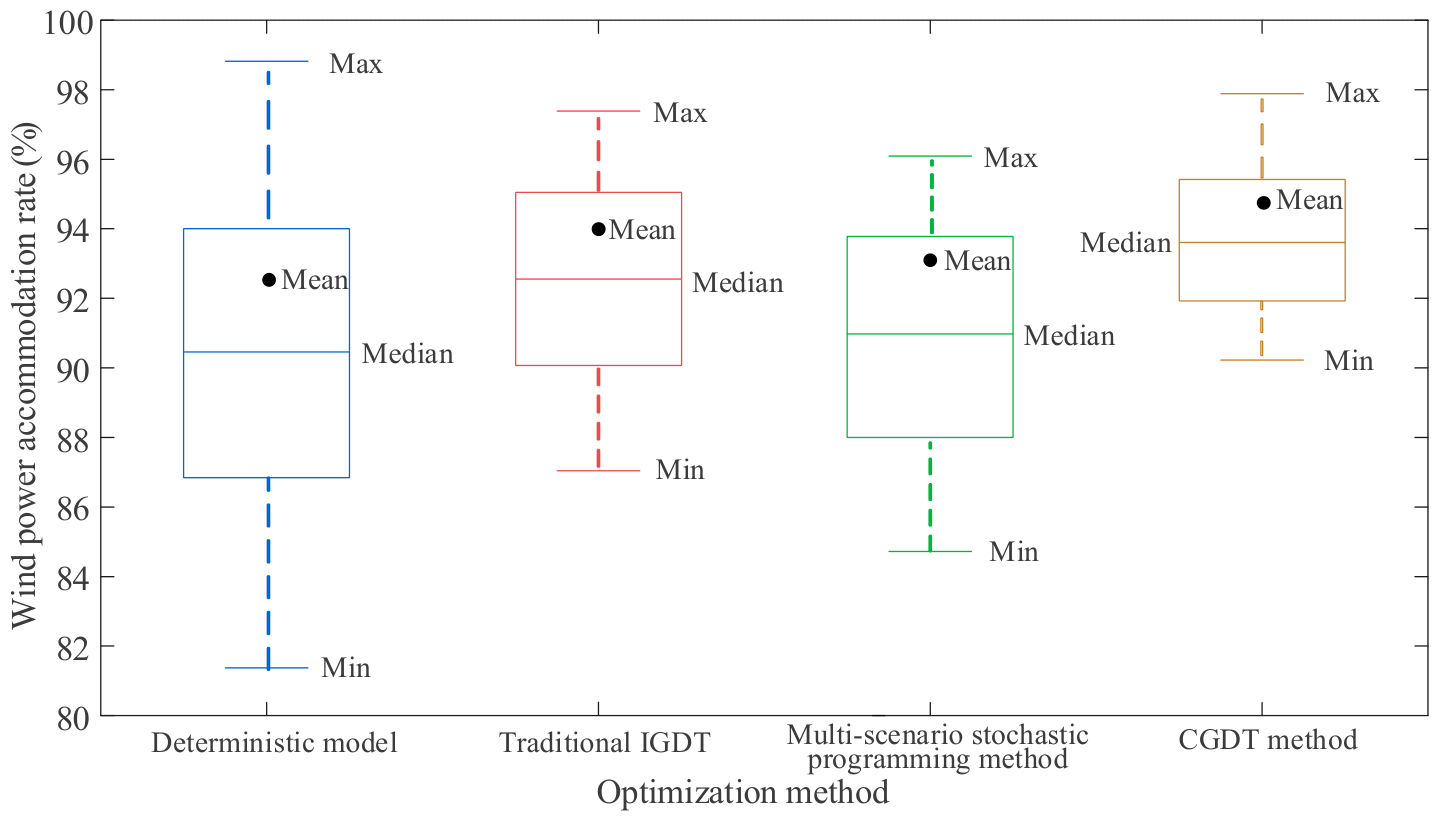
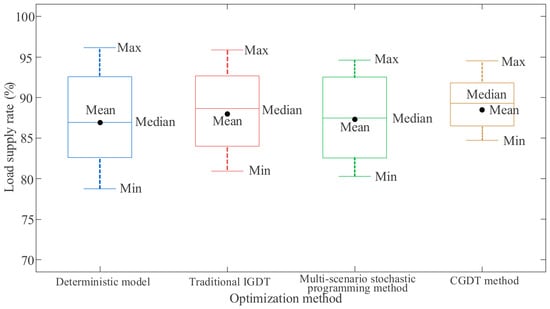
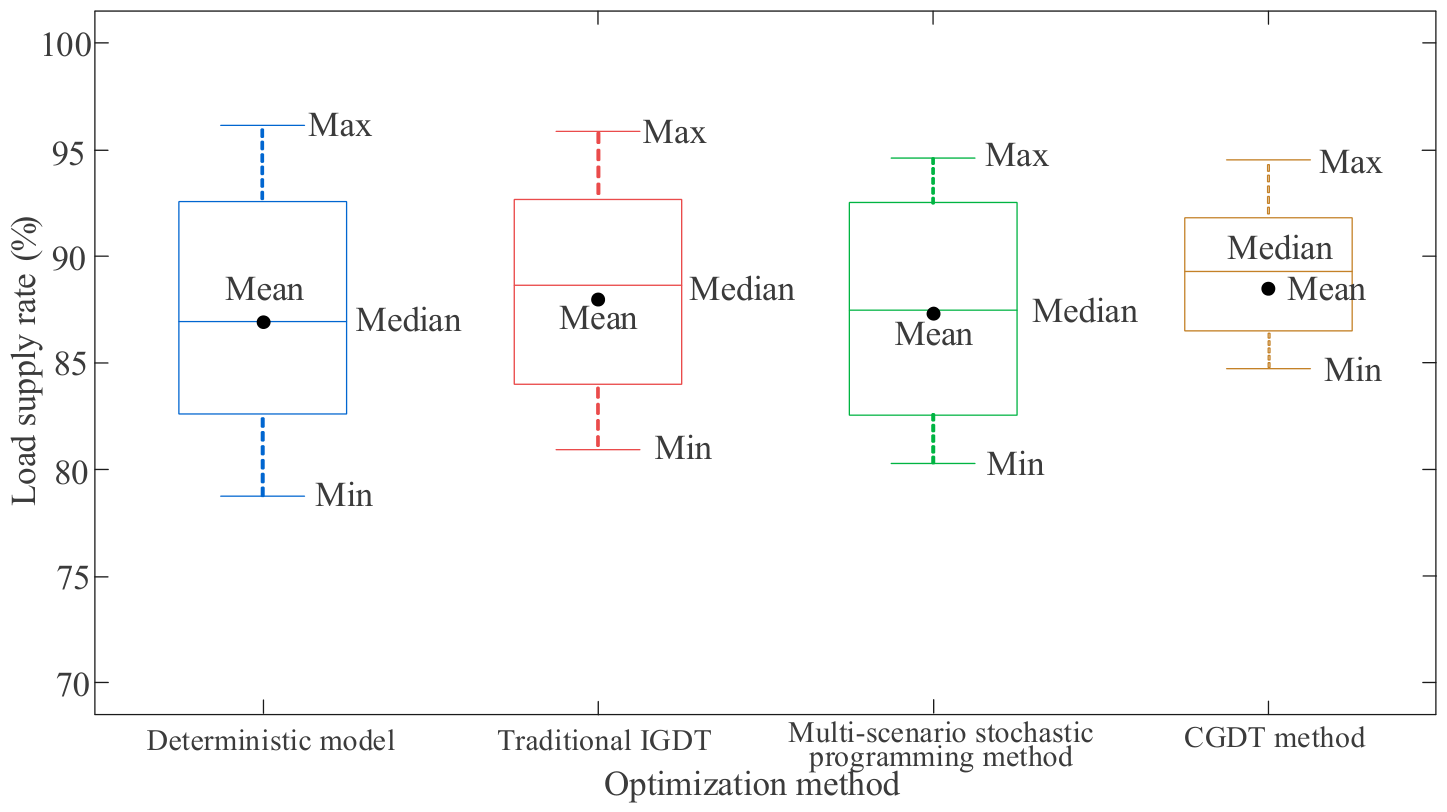
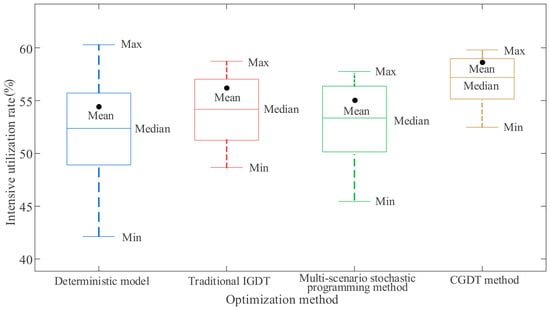
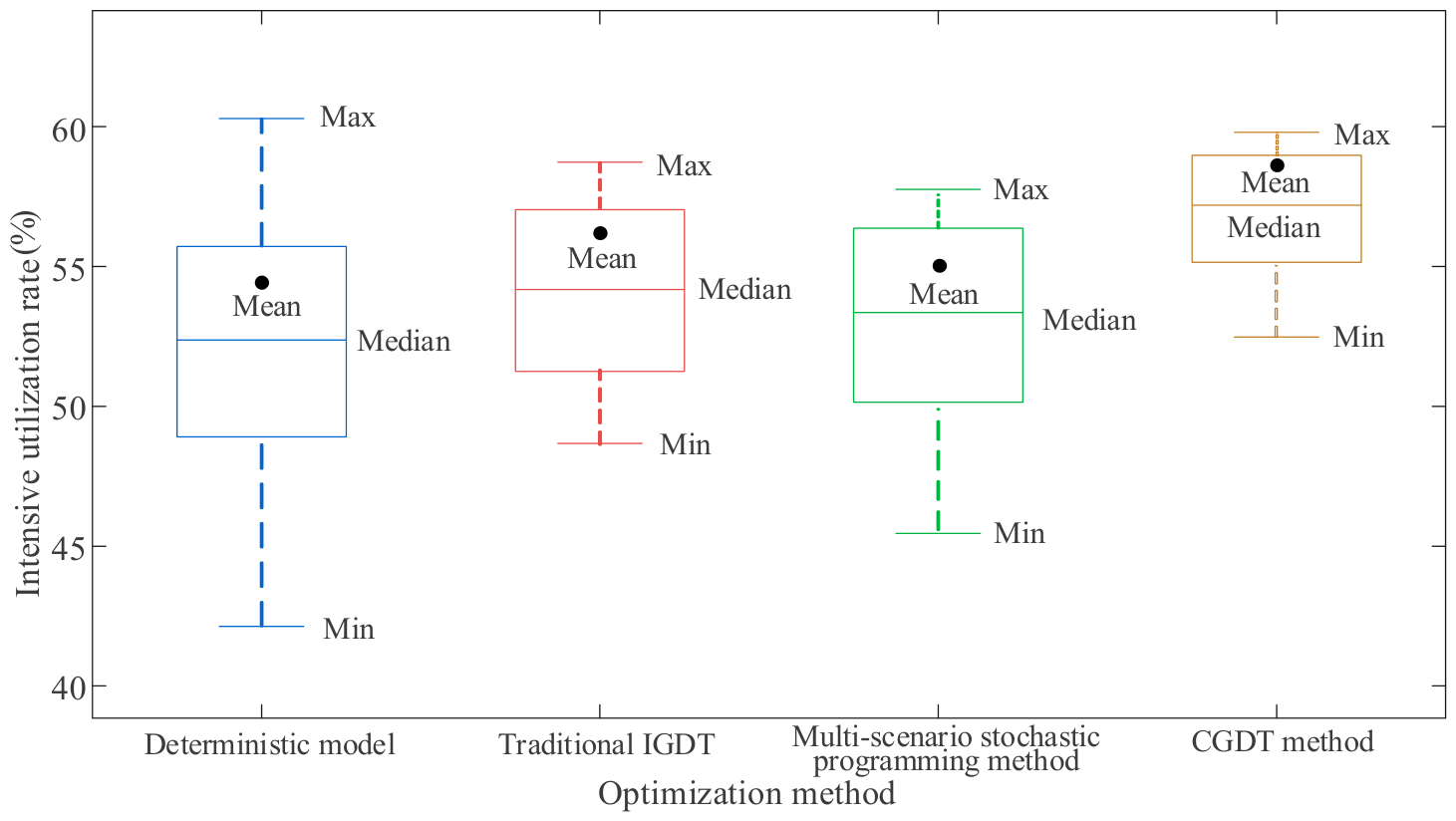
To verify the superiority of the proposed CGDT method in handling offshore wind power uncertainty, the deterministic model, the traditional IGDT method, and the multi-scenario stochastic programming method are selected as benchmarks. Subsequently, Monte Carlo simulation with 1000 random wind power scenarios is performed to evaluate the scheduling indices and computation time of each method. For the multi-scenario stochastic programming method, Latin hypercube sampling is employed to generate 100 initial scenarios based on the KDE-fitted probability distribution of wind power prediction errors, followed by a backward scenario reduction algorithm that retains 20 representative scenarios while preserving the statistical characteristics of the full uncertainty space. The comparative results are presented in Table 3, and the Monte Carlo statistical boxplots of the scheduling indices for each method are shown in Figure 3, Figure 4 and Figure 5.
Table 3.
Comparison of scheduling results of different optimization methods.
Figure 3.
Monte Carlo statistical boxplots of wind power accommodation rate for different optimization methods.
Figure 4.
Monte Carlo statistical boxplots of load supply rate for different optimization methods.
Figure 5.
Monte Carlo statistical boxplots of corridor intensive utilization rate for different optimization methods.
(1) The bottom and top edges of each box correspond to the 25th percentile and 75th percentile of the simulation samples, reflecting the dispersion of the main data cluster.
(2) The horizontal line inside the box denotes the median (50th percentile), representing the central tendency of the results.
(3) The solid black dot inside each box marks the arithmetic mean value of all 1000 Monte Carlo scenarios, which is consistent with the mean data in Table 3.
(4) The lower and upper whiskers extend to the global minimum and maximum values of all simulation samples, reflecting the full fluctuation range of scheduling performance.
As shown in Figure 3, Figure 4 and Figure 5, the CGDT method exhibits the narrowest interquartile range and the smallest full fluctuation range among all methods. Taking wind power accommodation rate as an example, its fluctuation range is only 7.5 percentage points, which is 56.4% narrower than that of the deterministic model, demonstrating the most stable scheduling performance under uncertainty. Among the comparative methods, the deterministic model has the shortest calculation time but ignores wind power uncertainty, resulting in the largest fluctuations and poor robustness. The multi-scenario stochastic programming method suffers from the longest computation time and cannot guarantee full coverage of the uncertainty space. The traditional IGDT method performs better than both, yet its symmetric interval assumption leads to coarse uncertainty characterization, making its stability and scheduling indices inferior to CGDT. In contrast, the proposed CGDT method not only achieves the optimal mean and minimum values for all scheduling indices while maintaining stable performance across different scenarios, but also avoids massive scenario sampling, with computational efficiency significantly higher than the multi-scenario method and only slightly lower than that of the IGDT method.
The superior performance of the CGDT method over deterministic, IGDT, and multi-scenario stochastic programming approaches arises from fundamental differences in their uncertainty characterization mechanisms. The deterministic model relies on a single-point forecast without considering prediction errors. As a result, any deviation between actual and forecasted wind power directly violates the power balance constraint, leading to the largest fluctuations in scheduling indices. The IGDT method uses a symmetric interval to describe uncertainty, assuming equal likelihood of over- and under-estimation while neglecting the skewness of the prediction error distribution. This oversimplification causes either over-committed or under-committed regulation margins, resulting in moderate fluctuations and suboptimal mean performance. The multi-scenario stochastic programming method depends on scenario reduction techniques that cannot guarantee full coverage of the uncertainty space. Increasing the number of scenarios improves accuracy but exponentially expands the problem size, whereas reduction inevitably discards low-probability yet high-impact events. In contrast, the CGDT method incorporates the full probability distribution through KDE into the optimization framework using a chance constraint formulation. The inverse cumulative distribution function probabilistically calibrates the uncertainty interval, ensuring that the interval width at a given confidence level 1 − α precisely reflects tail risk. This mathematical property guarantees that the CGDT method achieves the highest mean performance with the narrowest fluctuation range, as confirmed by the simulation results in Table 3 and Figure 3, Figure 4 and Figure 5.
4.4. Influence Analysis of Target Significance Level
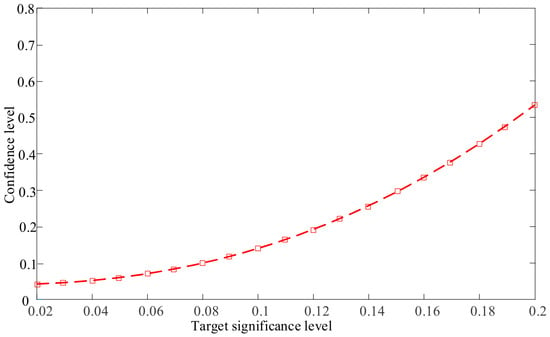
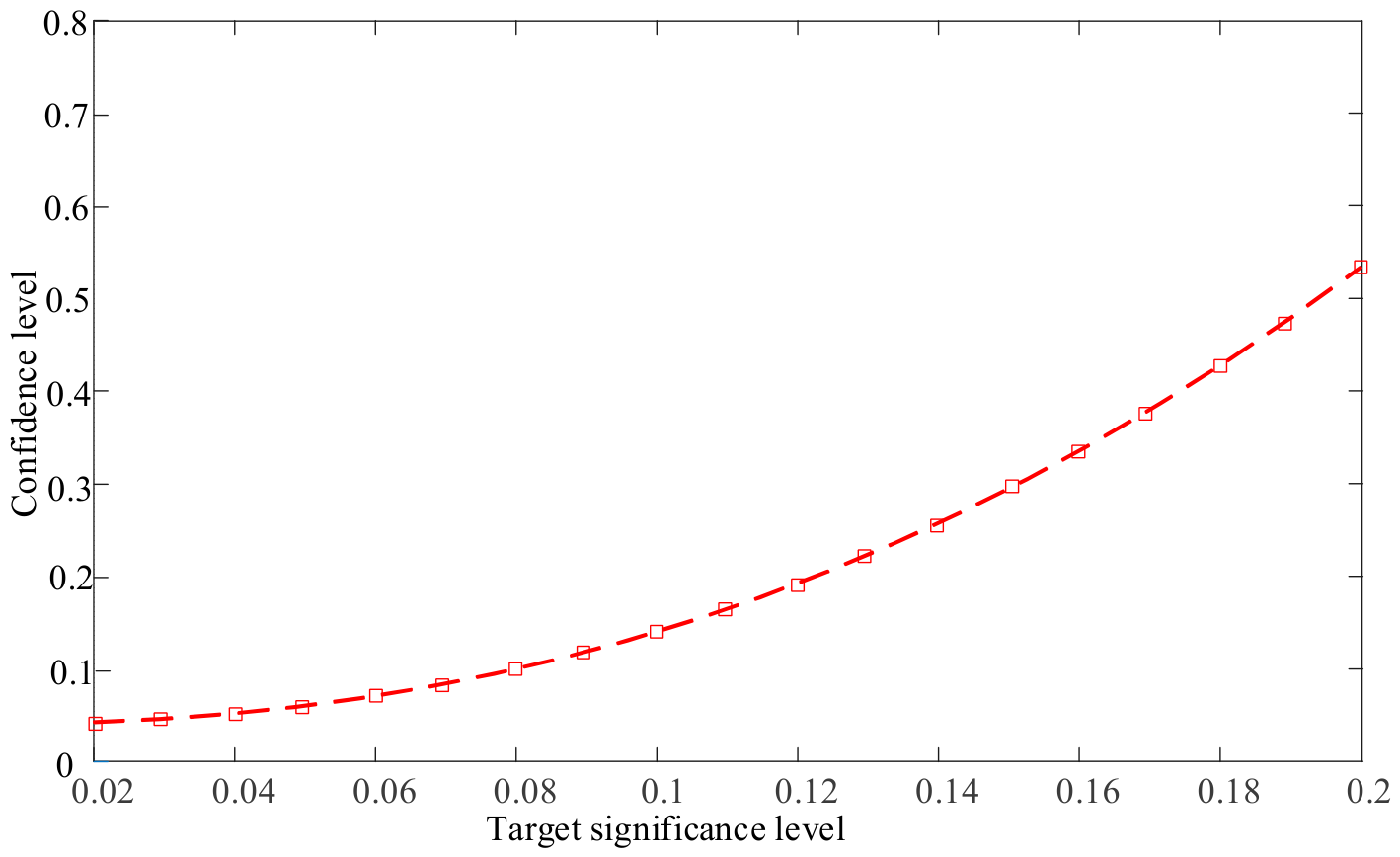
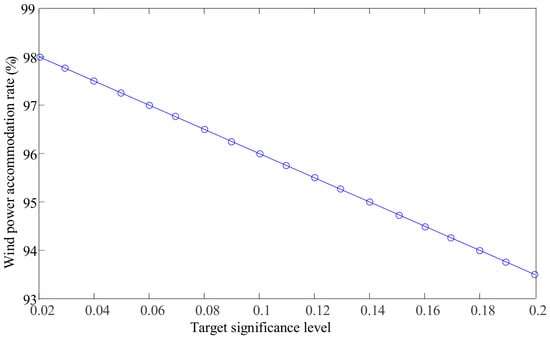
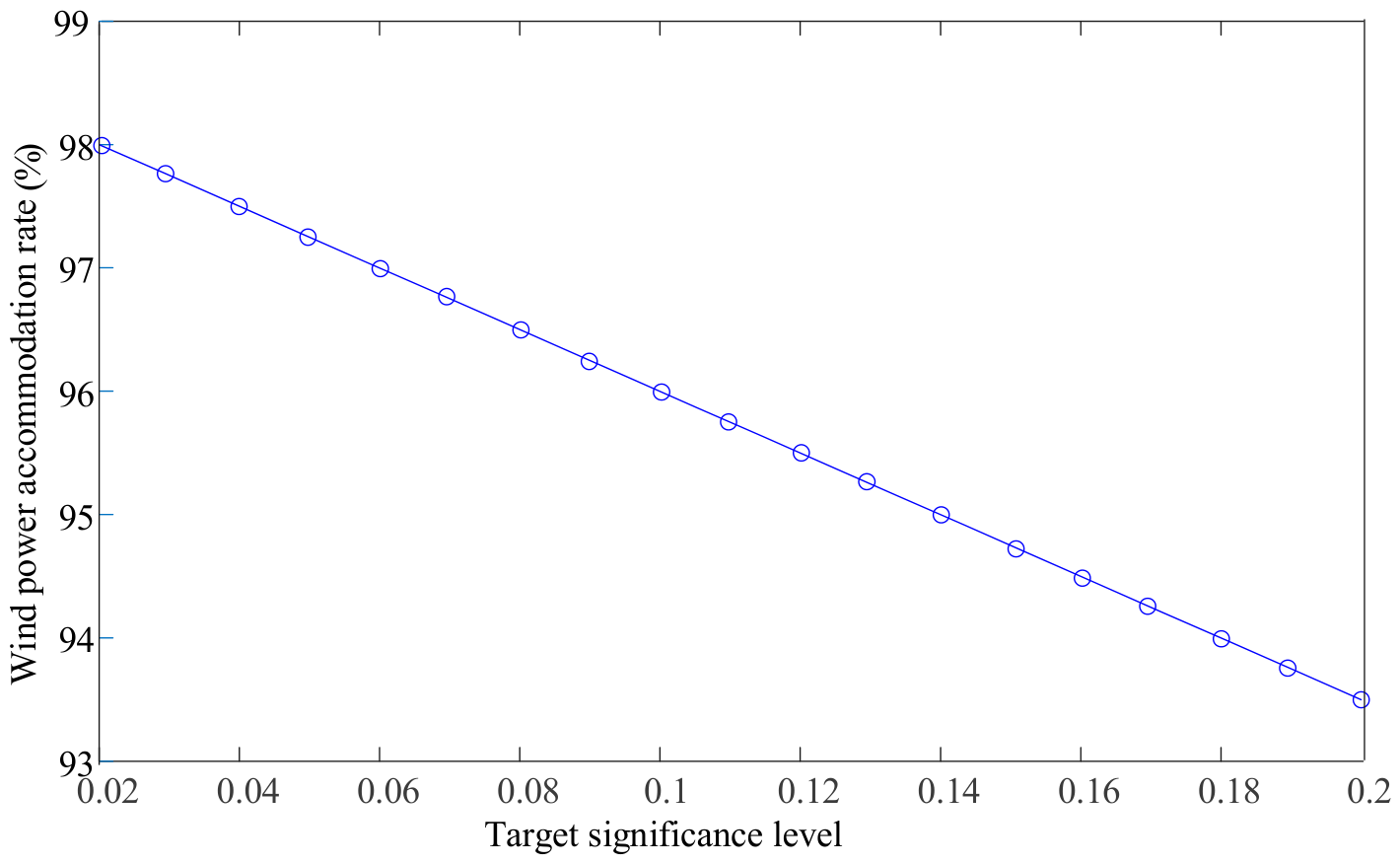
To explore the influence of target significance level β variation on CGDT robust scheduling results, β is varied within a reasonable range while other parameters remain unchanged, and its impacts on wind power accommodation rate and confidence level 1 − α are analyzed. The results are shown in Figure 6 and Figure 7, respectively. When β varies in the range of 0.02 to 0.2, the confidence level 1 − α increases nonlinearly with the increase in β and the growth rate gradually accelerates, while the wind power accommodation rate shows an approximately linear downward trend with the increase in β. When β < 0.05, the confidence level grows slowly and the system tends to economic operation. When 0.05 ≤ β < 0.15, the confidence level grows steadily and the wind power accommodation rate decreases moderately, achieving a balance between robustness and economy. When β ≥ 0.15, the confidence level rises rapidly, the wind power accommodation rate drops below 95%, the system is excessively biased towards robustness, and the operation efficiency decreases significantly.
Figure 6.
Influence of target significance level β on confidence level 1 − α.
Figure 7.
Influence of target significance level β on wind power accommodation rate.
Figure 6 shows the non-linear relationship between the target significance level β and the confidence level 1 − α. It can be explained by the mathematical properties of the inverse cumulative distribution function . Since the prediction error distribution fitted by KDE is non-Gaussian and typically exhibits heavy-tailed characteristics, the quantile function is convex in the tail region. Consequently, as β increases, the confidence interval expands at an accelerating rate. This is why the growth of 1 − α accelerates when β > 0.15. Conversely, the wind power accommodation rate decreases approximately linearly with β because the additional regulation margin required to accommodate the expanded uncertainty interval directly reduces the available transmission capacity for wind power delivery. This linear relationship arises from the fact that the power balance constraint is linear in the decision variables, and the reserve margin is allocated proportionally to the uncertainty interval width. The intersection of these two opposing effects defines the optimal operating region where robustness and economy are balanced.
Moreover, to further investigate the influence of uncertainty on CGDT robust scheduling results, the sensitivity analyses on the wind power prediction error interval is conducted. To obtain different levels of wind power forecast accuracy, a scaling factor kKDE is introduced to adjust the KDE bandwidth, i.e., . The case kKDE = 1 corresponds to the original optimal bandwidth determined from the 1000 historical prediction error samples in the case study, serving as the benchmark. By varying kKDE ∈ [0.6,1.4], different forecast accuracy levels are simulated. The analysis is conducted at the baseline β = 0.10, and the results are presented in Table 4. As shown in Table 4, when kKDE increases from 0.6 to 1.4, the equivalent error standard deviation expands from 0.072 to 0.168, and the confidence level 1 − α rises from 0.1145 to 0.1685. Consequently, the wind power accommodation rate decreases from 96.8% to 94.7%. This is because a larger prediction error dispersion requires the scheduling scheme to reserve more regulation margin to cover wider potential fluctuations, which directly compresses the effective power capacity available for wind delivery and load supply.
Table 4.
Sensitivity of scheduling results to prediction error interval.
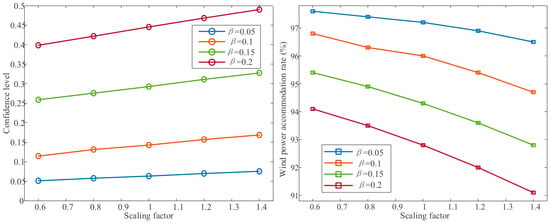
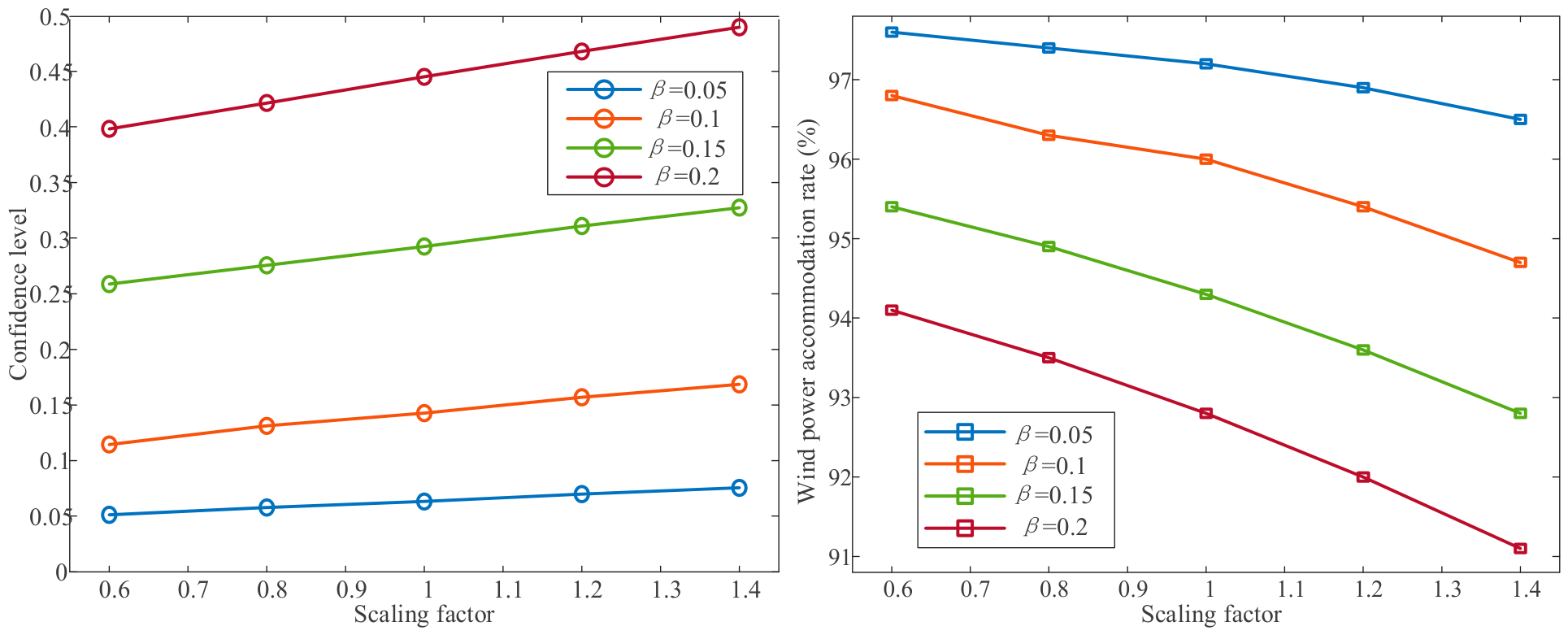
The influence of target significance level and prediction error on confidence level and wind power accommodation rate are presented in Figure 8. When both β and kKDE increase simultaneously, the confidence level 1 − α grows at a significantly higher rate than the sum of their individual effects, which is attributed to the super-linear behavior of the quantile function in the tail region under small β and larger variance. When β = 0.20, increasing kKDE from 0.6 to 1.4 causes the wind accommodation rate to drop by 3.0%, whereas the same increase in kKDE leads to only a 1.1% drop when β = 0.05, indicating that systems with higher robustness requirements are considerably more sensitive to forecast accuracy. Furthermore, when kKDE ≤ 1.2 and β ∈ [0.05,0.15], the wind accommodation rate remains above 94.5%, confirming that the recommended parameter range is robust to moderate prediction error variations.
Figure 8.
Influence of target significance level and prediction error on confidence level and wind power accommodation rate.
4.5. Discussion on System Scale and Applicability
The test system adopted in the case study is an offshore wind farm cluster with an AC/DC intensive transmission system, comprising wind power clusters, AC/DC transmission corridors, and corresponding receiving-end load subnetworks. This case is designed to validate the performance of the proposed CGDT-based robust scheduling method in terms of uncertainty handling and intensive corridor operation.
From a theoretical perspective, the proposed CGDT-based robust optimization framework converts probabilistic chance constraints into deterministic algebraic constraints via the quantile function derived from kernel density estimation, ultimately formulating the problem as a convex linear programming problem. For large-scale hybrid AC/DC transmission grids involving hundreds of buses and multiple converter stations, the proposed CGDT method remains theoretically applicable, provided that the system power flow and operational constraints can be expressed in linear or convex forms.
From a practical engineering perspective, however, large-scale hybrid AC/DC transmission grids are considerably more complex. They typically involve hundreds of buses, multiple converter stations, and intricate network topologies. In addition to transmission capacity constraints, actual operations are subject to various engineering constraints, including node voltage regulation, converter operating mode switching, and multi-infeed interaction effects, which are not fully covered in the current simplified test system. When extending the proposed method to large-scale complex systems, several potential issues merit attention:
(1) As system scale expands substantially and topology becomes more complicated, retaining complete node-level power flow constraints will significantly increase the dimensionality of the model variables. Although the convex linear programming solution framework theoretically supports scale expansion, the corresponding computational time will inevitably increase, and the practical solution efficiency for very large systems requires further verification.
(2) The control coupling characteristics of multi-converter station systems, the nonlinear characteristics of converter station losses, and the interactive effects between AC and DC subnets in practical projects will also put forward higher requirements for the engineering adaptability of the method. Therefore, the conclusions drawn in this study are primarily applicable to the AC/DC intensive transmission scenario for offshore wind farm clusters addressed herein. Extending these findings to hybrid AC/DC systems of arbitrary scales or topological configurations would require further verification and adaptation under real engineering conditions.
5. Conclusions
This paper has developed and validated a CGDT-based robust optimization scheduling strategy for offshore wind farm clusters with AC/DC intensive networking. An equivalent single-unit aggregation model has been established to characterize the collective output of offshore wind farm clusters. A deterministic scheduling framework has been formulated with three synergistic objectives, including wind power accommodation, load supply rate, and AC/DC corridor intensive utilization. To overcome the limitations of conventional robust and stochastic optimization methods in handling offshore wind power uncertainty, the CGDT has been introduced, where the prediction error distribution is fitted by KDE and probabilistic chance constraints are converted into deterministic algebraic constraints, enabling the model to be solved efficiently as a convex linear programming problem. Case study results demonstrate that the proposed CGDT method outperforms deterministic, IGDT, and multi-scenario stochastic programming approaches, achieving the highest mean values of all scheduling indices with the narrowest fluctuation ranges. Future work will further consider the abrupt output characteristics of wind power under extreme marine meteorological conditions, and integrate source-grid-load-storage coordinated regulation with electricity market trading mechanisms. A more practical intensive optimization scheduling model will then be constructed to enhance the comprehensive operational efficiency and anti-interference capability of the system.
Author Contributions
Conceptualization, Y.J. and J.G.; methodology, N.Z.; software, Q.L.; validation, Y.J., S.W. and W.L.; formal analysis, J.G.; investigation, W.L.; resources, N.Z.; data curation, Q.L.; writing—original draft preparation, Y.J.; writing—review and editing, J.G.; visualization, Q.L.; supervision, J.G.; project administration, W.L.; funding acquisition, Y.J. All authors have read and agreed to the published version of the manuscript.
Funding
This research was funded by the Science and Technology Project of State Grid Jiangsu Electric Power Co., Ltd. under Grant J2025JC-08. Project title: Research on Key Technologies for the Construction of Compact AC/DC Systems and Collaborative Support for Efficient Delivery of Onshore and Offshore New Energy (2025–2027)
Data Availability Statement
The data supporting the conclusions of this article will be provided through an open repository.
Conflicts of Interest
Authors Yuqiao Jia, Ningyu Zhang, Siying Wu and Wenbo Li were employed by State Grid Jiangsu Electric Power Research Institute. The remaining authors declare that the research was conducted in the absence of any commercial or financial relationships that could be construed as a potential conflict of interest.
References
- Wang, Y.; Mi, W.; Chen, H.; Adam, N.; Mirziabre, S.; Cy, A. An examination of rhetoric in relation to China’s renewable energy plans in light of the dual-carbon aims. Energy Strategy Rev. 2025, 59, 101706. [Google Scholar] [CrossRef] [Scilit]
- Zhao, S.; Han, Y.; Xu, Q.; Wang, Z.; Shan, Y. Modeling and Simulation of Electric–Hydrogen Coupled Integrated Energy System Considering the Integration of Wind–PV–Diesel–Storage. Modelling 2024, 5, 1936–1960. [Google Scholar] [CrossRef] [Scilit]
- Yin, S.; Zhou, Y.; Bai, C. Impact of renewable energy technological innovation on urban low-carbon transition: Taking the Yangtze River Economic Belt as an example. Energy 2025, 333, 137432. [Google Scholar] [CrossRef] [Scilit]
- Pan, G.; Zhuang, W.; Gu, W.; Gu, Z. Economics of shaping offshore wind power generation via energy storage in China. Energy 2025, 322, 135741. [Google Scholar] [CrossRef] [Scilit]
- Shao, M.; Han, Y.; Sun, J.; Xu, H.; Kong, X.; Wang, H.; Qu, Z. Bi-level multi-objective optimization of configuration and scheduling of offshore wind-solar-storage hybrid power system considering demand response. Ocean Eng. 2026, 352, 124614. [Google Scholar] [CrossRef] [Scilit]
- Liu, Q.; Huo, Q.; Yin, J.; Ni, J.; Zhu, J.; Wei, T. Capacity optimization and allocation of port hybrid AC–DC electric-hydrogen coupling system for reduce carbon emissions. IEEE Trans. Intell. Transp. Syst. 2024, 26, 1149–1162. [Google Scholar] [CrossRef] [Scilit]
- Su, Y.; Teh, J.; Liu, W. Hierarchical and distributed energy management framework for AC/DC hybrid distribution systems with massive dispatchable resources. Electr. Power Syst. Res. 2023, 225, 109856. [Google Scholar] [CrossRef] [Scilit]
- Wei, B.; Yang, C.; Liu, K.; Tang, W.; Zhang, X. Optimal scheduling energy for ‘wind-solar-load-storage’ AC-DC hybrid distribution network system based on multi-agent algorithm. Int. J. Glob. Energy Issues 2026, 48, 24–42. [Google Scholar] [CrossRef] [Scilit]
- Khan, M.Y.A.; Liu, H.; Wang, J.; Zhang, R.; Zhang, Y. Hierarchical control framework for offshore hybrid AC/DC microgrid integrating renewable energy resources and hybrid energy storage system. J. Energy Storage 2026, 152, 120749. [Google Scholar] [CrossRef] [Scilit]
- Liu, Q.; Chu, X.; Fu, L.; Yu, S.; Wang, W. Integrated protection scheme for hybrid AC/DC transmission grids. Int. J. Electr. Power Energy Syst. 2025, 169, 110806. [Google Scholar] [CrossRef] [Scilit]
- Liu, Y.; He, B.; Zhao, Y.; Meng, F.; Wu, S.; Dai, W.; Zhang, D. Study on transient characteristics of secondary arc of AC/DC hybrid transmission lines on the same tower. Electr. Eng. 2025, 107, 53–63. [Google Scholar] [CrossRef] [Scilit]
- Fu, Y.; Zhang, Z.; Li, Z.; Mi, Y. Energy management for hybrid AC/DC distribution system with microgrid clusters using non-cooperative game theory and robust optimization. IEEE Trans. Smart Grid 2019, 11, 1510–1525. [Google Scholar] [CrossRef] [Scilit]
- Damanik, O.; Van Hertem, D.; Ergun, H. Mitigating large-scale offshore wind farm shutdowns during a severe storm using an adaptive robust optimization approach. Sustain. Energy Grids Netw. 2025, 43, 101816. [Google Scholar] [CrossRef] [Scilit]
- Li, Y.; Pan, S.; Gao, B.; Liu, X. Research on inter-regional dispatching for high-proportion renewable energy power system based on confidence gap decision theory. Electr. Eng. 2026, 108, 86. [Google Scholar] [CrossRef] [Scilit]
- Sun, L.; Wei, Y.; Lin, Z.; Yang, X.; Li, M.; Wen, F.; Ding, M. Determining optimal generator start-up sequence in bulk power system restoration considering uncertainties: A confidence gap decision theory based robust optimization approach. Int. J. Electr. Power Energy Syst. 2023, 153, 109365. [Google Scholar] [CrossRef] [Scilit]
- Dong, Y.; Zhang, H.; Wang, C.; Zhou, X. Robust optimal scheduling for integrated energy systems based on multi-objective confidence gap decision theory. Expert Syst. Appl. 2023, 228, 120304. [Google Scholar] [CrossRef] [Scilit]
- Shakoor, R.; Hassan, M.Y.; Raheem, A.; Wu, Y.K. Wake effect modeling: A review of wind farm layout optimization using Jensen’s model. Renew. Sustain. Energy Rev. 2016, 58, 1048–1059. [Google Scholar] [CrossRef] [Scilit]
- Duc, T.; Coupiac, O.; Girard, N.; Giebel, G.; Göçmen, T. Local turbulence parameterization improves the Jensen wake model and its implementation for power optimization of an operating wind farm. Wind Energy Sci. 2019, 4, 287–302. [Google Scholar] [CrossRef] [Scilit]
- Qu, S.; Yu, C.; Zhou, Y.; Hou, Y.; Wang, J.; Li, F. Optimization of collaborative vessel scheduling for offshore wind farm installation under weather uncertainty. J. Mar. Sci. Eng. 2026, 14, 223. [Google Scholar] [CrossRef] [Scilit]
- Caputo, A.C.; Federici, A.; Pelagagge, P.M.; Salini, P. Offshore Wind Farm Economic Evaluation Under Uncertainty and Market Risk Mitigation. Energies 2025, 18, 2362. [Google Scholar] [CrossRef] [Scilit]
- Wang, Y.; Wei, S.; Yang, W.; Chai, Y. Adaptive economic predictive control for offshore wind farm active yaw considering generation uncertainty. Appl. Energy 2023, 351, 121849. [Google Scholar] [CrossRef] [Scilit]
- Ning, J.; Shi, R.; Xuan, S.; Jiang, C.; Jia, L. Assessment of offshore island wind energy potential in typhoon-prone regions with a KDE-based probabilistic modeling approach. Energy 2025, 339, 139092. [Google Scholar] [CrossRef] [Scilit]
- Sun, H.; Zhang, D.; Peng, C.; Zhang, Y.; Gao, B.; Xu, J. Multi-objective confidence gap decision based robust optimal dispatch of integrated energy system using entropy expectation maximization GMM. Int. J. Electr. Power Energy Syst. 2023, 153, 109364. [Google Scholar] [CrossRef] [Scilit]

Disclaimer/Publisher’s Note: The statements, opinions and data contained in all publications are solely those of the individual author(s) and contributor(s) and not of MDPI and/or the editor(s). MDPI and/or the editor(s) disclaim responsibility for any injury to people or property resulting from any ideas, methods, instructions or products referred to in the content. |
© 2026 by the authors. Licensee MDPI, Basel, Switzerland. This article is an open access article distributed under the terms and conditions of the Creative Commons Attribution (CC BY) license.