


Abstract
Diesel generator sets are key frequency-supporting units in islanded microgrids and shipboard power systems, where rapid speed recovery under abrupt load variations is essential for maintaining power quality. However, conventional linear active disturbance rejection control (LADRC) is limited by the disturbance-estimation and noise-amplification trade-off of a single observer, while fixed parameters restrict its adaptability under varying operating conditions. To address these limitations, this paper proposes an RBF neural-network-optimized cascaded LADRC method, termed RBF-CLADRC. A mechanism-based torque balance model is first established, with uncertain mechanical coupling, friction losses, and load variations lumped into the total disturbance. A residual-disturbance cascaded observer is then constructed, in which the first linear extended state observer estimates the total disturbance and the second further reconstructs the residual estimation error. Unlike conventional ML-based ADRC methods that directly tune multiple gains, the proposed RBFNN adjusts only a common controller bandwidth within a prescribed interval, while all observer and feedback gains are generated through predefined analytical relationships. This low-dimensional adaptation preserves coordinated gain variation, reduces online computational complexity, and facilitates real-time implementation. Lyapunov analysis shows that the observer and tracking errors are uniformly ultimately bounded under bounded disturbance rates and converge exponentially for constant disturbances. Finally, comparative simulations in MATLAB/Simulink demonstrate that the proposed method achieves better dynamic response and disturbance-rejection performance than conventional LADRC and other benchmark controllers.
1. Introduction
With the rapid development of distributed generation and the ever-increasing demand for reliable electric power, the diesel generator set has become one of the most widely used power sources for standby supply, islanded microgrids, marine propulsion, and emergency power in remote areas, owing to its high power density, rapid start-up capability, and operational independence from the utility grid [1,2]. In an islanded microgrid or a shipboard power system, the diesel generator set—comprising a diesel engine as the prime mover and a synchronous generator—frequently serves as the principal frequency-supporting unit, in which the speed governor regulates the engine shaft speed and thereby determines the output frequency of the generator [3,4]. Consequently, maintaining a stable rotational speed under load disturbances is of critical importance, since any abrupt variation in the electrical load induces a torque mismatch that gives rise to speed fluctuations and frequency deviations, degrading the power quality and shortening the service life of the unit [1].
Achieving high-performance speed regulation for diesel generator sets is, however, a challenging task. The diesel engine–generator system is inherently highly nonlinear and strongly coupled, while its damping and friction torques are difficult to determine accurately, which renders the establishment of a precise first-principles model intractable [2]. One common remedy is to adopt data-driven and system-identification approaches—such as mean-value models and neural-network-based black-box models—to reproduce the dynamic characteristics of diesel generator sets from measured input–output data [5]. In this work, however, the dominant dynamics of the unit—the torque-balance relation between the engine mechanical torque and the load torque—admit a compact mechanism-based description [6]. Therefore, a low-order first-principles model is adopted, while the residual mechanical coupling and friction losses that are difficult to model are handled by the disturbance-rejection controller rather than being identified explicitly. Even so, the load disturbance acting on the unit remains harsh and unpredictable, varying considerably with the operating condition, so that the controller must contend with both model uncertainty and strong external disturbances.
To regulate the engine speed, the proportional–integral–derivative (PID) controller remains the most prevalent solution in industrial governors because of its simple structure; nevertheless, its parameters have to be retuned whenever the operating point deviates from the calibrated condition, and its disturbance-rejection capability deteriorates in the presence of strong nonlinearity and uncertainty [2]. To improve upon PID, a variety of advanced strategies have been investigated, including sliding-mode control, which suffers from chattering and is therefore frequently combined with an extended state observer to suppress it [7]; fuzzy and other intelligent controllers, whose performance depends heavily on expert experience [4]; backstepping; and model predictive control, whose implementation is computationally demanding [8]. For diesel and marine engines in particular, numerous improved schemes have been reported, such as combined linear–nonlinear control [2], variable-sampling-rate control [9], finite-time control [10], cascade double closed-loop control [11], and comparative linear/nonlinear designs for the variable-geometry-turbocharger exhaust-gas-recirculation subsystem [12]. Fuzzy self-tuning PID controllers have also been investigated for diesel engine speed regulation because they can adapt the PID gains according to the instantaneous speed error and its variation [13,14,15].
Among the control paradigms developed to cope with uncertainties and disturbances, disturbance-observer-based and disturbance-estimation-based methods have received extensive attention, as comprehensively reviewed in the literature [16,17,18]. Within this family, active disturbance rejection control (ADRC), originally proposed by Han [19], is particularly attractive. ADRC inherits the error-driven nature of PID while exploiting the power of the state observer: it lumps the unmodeled internal dynamics together with the external disturbances into a “total disturbance,” which is estimated in real time by an extended state observer (ESO) and actively compensated within the control law, thereby relieving the controller of its dependence on an accurate plant model [20,21]. The convergence and stability of ADRC have also been rigorously established for fairly general classes of nonlinear systems [22].
Despite these merits, the conventional nonlinear ADRC involves a large number of parameters whose tuning relies heavily on trial and error. To alleviate this burden, Gao [23] introduced the concept of bandwidth parameterization and developed the linear ADRC (LADRC), in which the controller and observer gains are parameterized by the controller bandwidth and the observer bandwidth, reducing the tuning task to the configuration of only two bandwidths [24]. Building on this foundation, many variants of the ESO and the control law have been proposed to enhance the estimation accuracy and the range of applicability, including the generalized ESO for mismatched uncertainties [25], enhanced ESO designs [26], the generalized LADRC for linear systems [27], ADRC schemes tailored to time-delay processes [28,29], and linear–nonlinear switching structures that combine the advantages of both [30,31]. Owing to its concise structure and strong robustness, LADRC and its variants have been successfully applied to permanent magnet synchronous motor drives [7,18,31], to secondary frequency regulation and load frequency control in microgrids [3,4], and to the speed control of diesel and automotive engines [1,2,9,10,11,12].
Recent studies have introduced intelligent optimization and machine-learning techniques into ADRC to reduce manual tuning and improve adaptability under varying operating conditions. Deng et al. [32] employed an improved particle swarm optimization algorithm to optimize ADRC parameters, although the resulting gains generally remain fixed during operation. In contrast, RBFNNs possess strong nonlinear-approximation and direct adaptive-control capabilities [33,34], making them suitable for online parameter tuning. Li et al. [35] therefore developed an RBFNN-optimized ADRC for autonomous-vehicle path tracking, in which the RBFNN adaptively adjusts key ESO gains. More recent studies have applied deep reinforcement learning to ADRC parameter optimization [36,37] or used RBFNNs to compensate for observer-estimation errors and approximate unknown disturbances [38,39]. Nevertheless, most existing approaches, including [35], are based on a single-observer ADRC structure and directly adapt one or more observer or controller gains. As the number of coupled adjustable gains increases, maintaining coordinated parameter variation becomes more difficult, while the online optimization burden and the complexity of closed-loop stability analysis also increase.
Recent progress has also been made in cascaded ADRC and multi-observer architectures. The cascade ESO developed in [40] distributes the disturbance-estimation task among successive observer stages, thereby alleviating the trade-off between estimation bandwidth and measurement-noise amplification. This concept has subsequently been extended to quasi-generalized-integrator-based cascade ESOs for the simultaneous attenuation of periodic and aperiodic disturbances [41], cascade-parallel ESOs for power-converter control [42], and cascade estimators combining reduced-order and full-order ESOs to balance estimation accuracy, robustness, and noise sensitivity [43]. Nevertheless, most existing cascaded schemes employ fixed or independently tuned observer parameters and do not address coordinated online adaptation of the complete observer-controller gain set.
Overall, ML-assisted ADRC primarily emphasizes online adaptability, whereas cascaded ADRC improves disturbance-estimation accuracy and noise robustness. These two research directions remain only weakly integrated, particularly for diesel generator speed regulation under wide load variations. More specifically, the approach in [35] employs an RBFNN to directly tune the key gain parameters of a conventional single-ESO ADRC for autonomous-vehicle path tracking. In contrast, the present method employs two cascaded LESOs, in which LESO1 estimates the lumped total disturbance and LESO2 further reconstructs the residual estimation error left by LESO1. Moreover, the RBFNN adjusts only the common controller bandwidth within a prescribed positive interval, while all associated observer and feedback gains are generated according to predefined analytical relationships. Therefore, the proposed method combines cascaded residual-disturbance estimation with low-dimensional neural adaptation, preserves coordinated gain variation, reduces online computational complexity, and provides a tractable basis for the subsequent closed-loop stability analysis.
The main contributions of this study are summarized as follows:
- A residual-disturbance cascaded LESO is developed for diesel generator speed regulation. LESO1 estimates the lumped total disturbance, whereas LESO2 estimates only the residual estimation error left by LESO1. The two observers are jointly parameterized through pole placement rather than being tuned as independent modules, thereby preserving a coordinated observer structure while sharing the disturbance-estimation burden.
- A single-bandwidth neural adaptation mechanism is proposed. Instead of independently generating multiple observer and feedback gains, the RBFNN adjusts only the controller bandwidth, while all associated gains are calculated according to predefined parameter relationships. This design reduces computational complexity, avoids inconsistent gain combinations during adaptation, and facilitates real-time implementation.
- A Lyapunov-based stability analysis is developed for the adaptive closed-loop system, accounting for both the cascaded-LESO estimation errors and the online bandwidth variation. The estimation and tracking errors are shown to be uniformly ultimately bounded under bounded disturbance rates and to converge exponentially under constant disturbances. Comparative simulations further verify the performance improvements provided by the cascaded observer and online bandwidth adaptation.
The remainder of this paper is organized as follows. Section 2 develops a control-oriented model of the diesel generator set based on the torque-balance dynamics. Section 3 presents the proposed RBF-CLADRC method, including the cascaded observer, online bandwidth adaptation, and stability analysis. Section 4 evaluates its dynamic performance and robustness through simulations. Section 5 summarizes the main conclusions and discusses the engineering applicability and limitations of the proposed method.
2. Mechanism-Based Modeling of the Diesel Generator Set
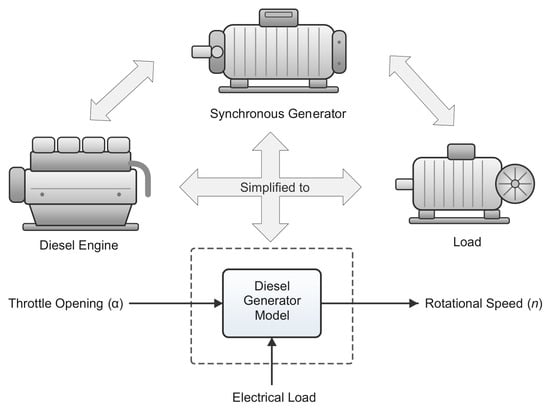
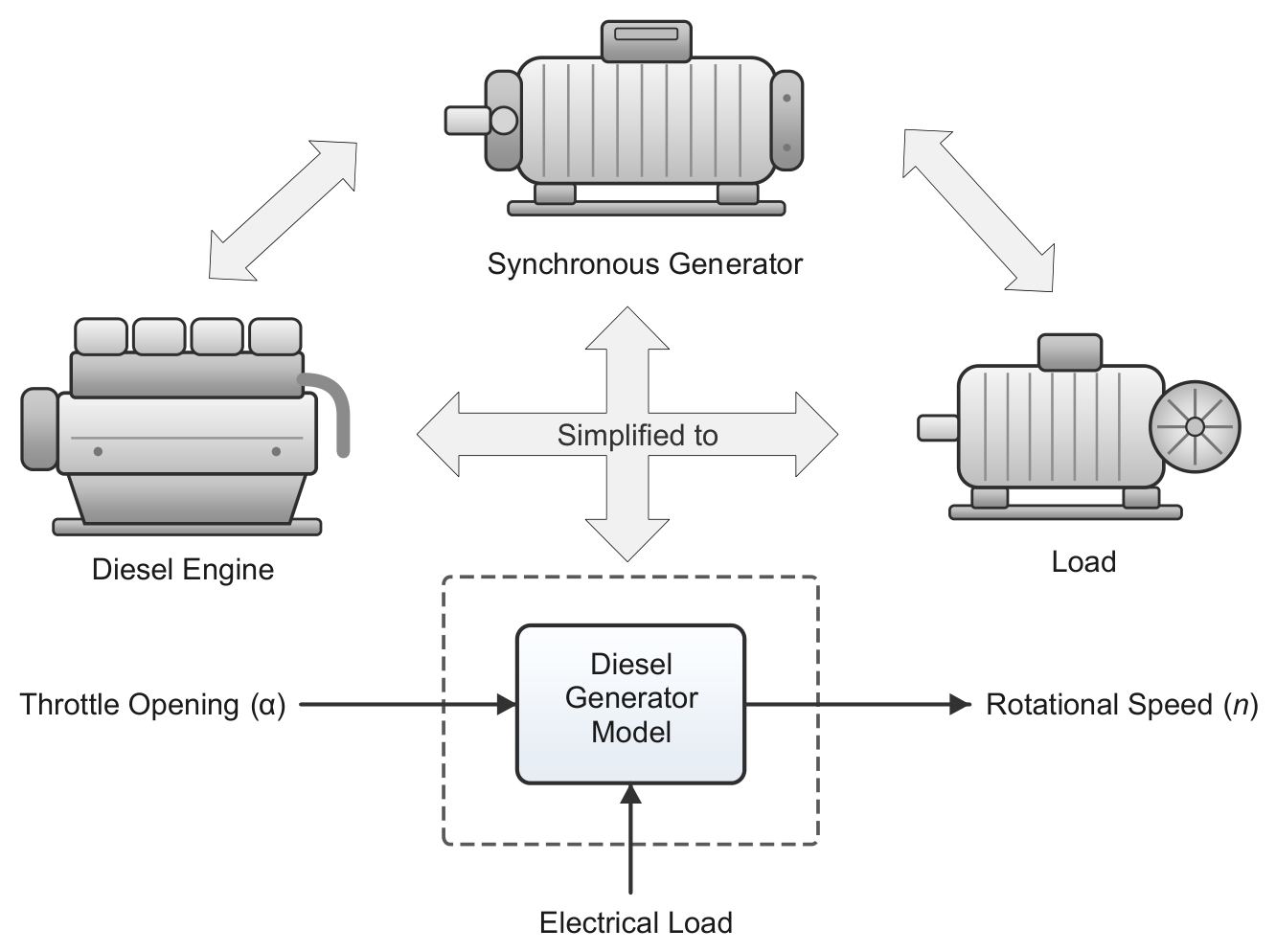
To obtain a tractable model for controller design, the diesel engine and synchronous generator are treated as an integrated rotational system, and a control-oriented model is derived from the shaft torque-balance dynamics [6]. Uncertain mechanical coupling and friction losses are incorporated into the lumped internal disturbance, whereas variations in the electrical load are treated as external disturbances. As illustrated in Figure 1, the throttle opening is taken as the control input and the rotational speed as the system output.
Figure 1.
Diesel generator model structure diagram.
In the equilibrium state, the mechanical torque of the diesel engine balances the load torque, and the rotational speed remains constant. Sudden load variations disturb this torque balance and consequently cause speed fluctuations. Following the shaft torque-balance formulation in [6], the transient speed dynamics can be expressed as follows:
where represents the moment of inertia of the diesel generator and the transmission system; denotes the mechanical output torque of the diesel engine; and is the damping and load torque of the generator.
The term is determined by the external characteristic of the diesel engine, which describes the variation in performance indices (such as the effective power and output torque ) with respect to the rotational speed , provided that the fuel throttle is maintained at the cyclic fuel injection position corresponding to the rated power.
where represents the throttle opening; is the maximum effective power; denotes the power demand function; and is the speed ratio (the ratio of the actual speed to the rated speed). Consequently, based on Equations (1) and (2), the dynamic equation of the diesel generator is derived as follows:
The model described by Equations (1)–(3) is a control-oriented mechanism model derived from the shaft torque-balance relation [6]. The nominal parameters used in the simulations are summarized in Table 1. The normalized power-demand function in Equation (2) is used to describe the steady-state external characteristic of the diesel engine. Therefore, no additional excitation signal or transient parameter-estimation procedure is involved, and conventional black-box fitting indices are not applicable. The physical consistency of the model is checked at the rated operating point: when the engine torque balances the rated load torque, Equation (3) yields , corresponding to the rated steady state. The model is intentionally kept low order for controller design, with unmodeled mechanical coupling, friction, and load variations incorporated into the lumped total disturbance and compensated online by the cascaded LESO. Its suitability for control-performance evaluation is further examined through the load-step and parameter-uncertainty simulations presented in Section 4.
Table 1.
Parameters of the diesel generator set.
3. Design of Speed Control Algorithm
3.1. Mathematical Model of LADRC
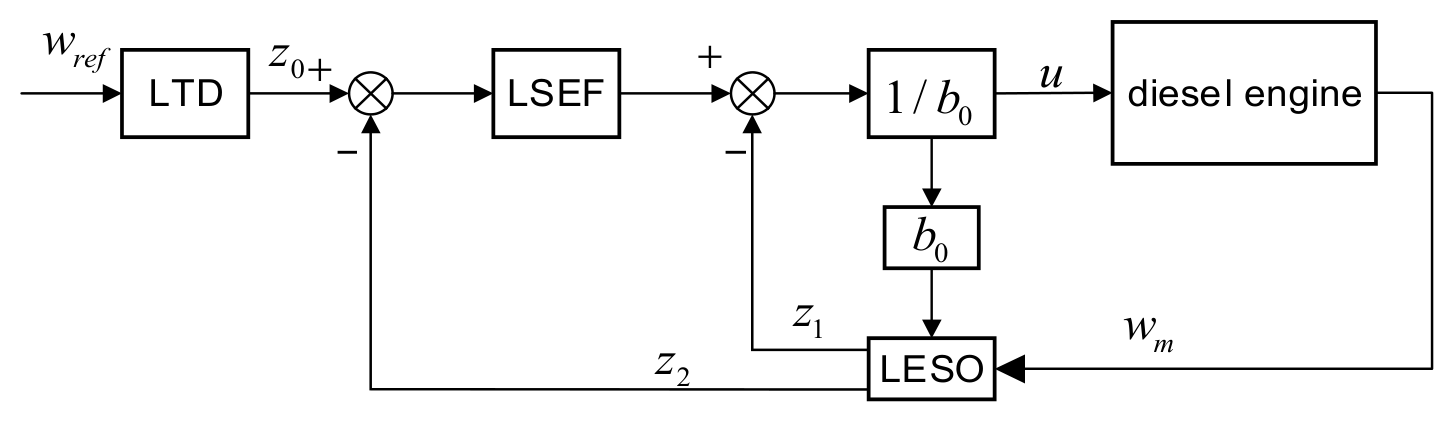
ADRC comprises three core modules: Tracking Differentiator (TD), Extended State Observer (ESO), and Nonlinear State Error Feedback (NLSEF). By approximating the plant as a cascade-integrator model and lumping all unmodeled dynamics together with the external disturbances into a single “total disturbance,” it accomplishes disturbance estimation and compensation without relying on an accurate plant model. To circumvent the laborious parameter tuning of conventional ADRC, Gao [23] developed the linear ADRC (LADRC), in which the controller and observer gains are parameterized by only two quantities, namely the controller bandwidth and the observer bandwidth, thereby reducing the tuning task to the configuration of these two bandwidths. The structure of a conventional first-order LADRC is shown in Figure 2.
Figure 2.
Structure diagram of LADRC.
The Linear Tracking Differentiator (LTD) is described by:
where represents the tracking speed factor; denotes the reference input signal for the rotational speed; is the error signal; and is the tracking signal of .
The Linear Extended State Observer (LESO) is formulated as follows:
where represents the speed error signal; is the observed value of the speed; denotes the control input; is the observed value of the total disturbance; and are the bandwidth gains; and represents the control gain.
The Linear State Error Feedback (LSEF) is given by the following:
where represents the error signal; denotes the output variable; and is the controller parameter.
3.2. Online Observation and Compensation of Total Disturbance
For the crankshaft-speed dynamics, an accurate first-principles model is difficult to obtain owing to the uncertainty in the damping torque. The model-independent nature of LADRC offers a remedy: the damping torque is absorbed into the total disturbance [23], which is then estimated online by a linear extended state observer (LESO) and compensated within the control law. Assuming that the load torque varies at an approximately constant rate during the initial loading phase, the system is augmented as:
where represents an unknown constant.
Because the damping torque in the preceding equation is unknown and mechanical friction is present between the cylinders during operation, these effects are lumped into the total disturbance and assigned to the extended state, which gives the following:
where is defined as the total system disturbance, in which represents unknown disturbances such as mechanical friction; and denotes an unknown constant. Let
from Equations (8) and (9), the following can be obtained:
Therefore, the speed dynamics of the diesel generator set can be represented in the standard first-order LADRC form, enabling the lumped total disturbance to be estimated and compensated by a linear active disturbance rejection controller.
3.3. Design of the Cascaded LADRC Speed Controller
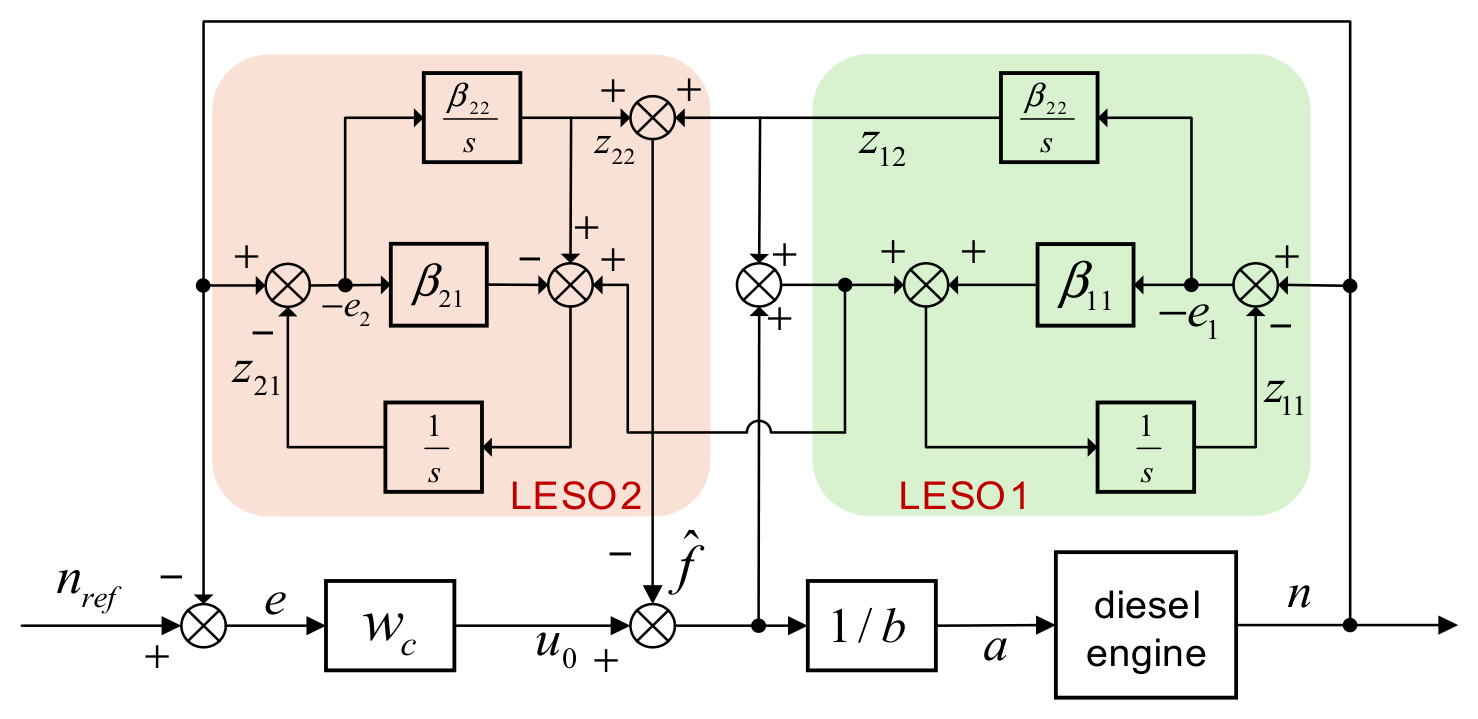
Under disturbances such as sudden load-torque variations, the diesel generator suffers from pronounced speed fluctuations and overshoots that impair its operation and shorten its service life. Since the performance of LADRC is largely dictated by the LESO, this paper introduces a cascaded LADRC in which two LESOs share the disturbance-estimation burden, thereby improving both the observation accuracy and the disturbance-rejection capability of the generator.
Specifically, LESO1 first estimates the total disturbance, and its estimate is passed to LESO2, which further estimates the residual disturbance and feeds the resulting compensation into the control law. In this way, the burden on any single observer is alleviated, and the overall disturbance-observation capability of the system is enhanced.
Defining the rotational speed as the state variable and treating the disturbance as an extended state variable , Equation (11) can be rewritten as follows:
The designed first-order LESO is formulated as follows:
The estimated value , obtained from LESO1, serves as a known input to LESO2. Consequently, the formulation of LESO2 is given by the following:
where and both represent the tracking values of ; and denote the initial estimate of the disturbance and the secondary estimate of the residual disturbance, respectively; , , and are the gains of LESO1 and LESO2, which are the parameters to be tuned and are associated with the observer bandwidth.
By placing the poles of the cascaded LESO at , the observer error gains , , , and are obtained as follows:
where is the observer bandwidth, representing the parameter to be tuned. Therefore, the control signal for the throttle opening is given by the following:
where is the controller bandwidth, acting as a parameter to be tuned; is the estimated value of ; and is the estimated value of .
Under the nominal assumptions that the input gain used in the controller matches the actual plant gain and that the cascaded LESO accurately reconstructs the system state and the lumped total disturbance, the reduced-order reference-to-speed transfer function can be expressed as follows:
In the actual closed-loop system, however, modeling uncertainties and residual disturbance-estimation errors couple the plant dynamics with LESO1 and LESO2, introducing additional observer dynamics and potentially shifting the closed-loop poles and zeros from their nominal locations. Accordingly, and should be regarded as bandwidth-based design parameters, while the boundedness of the resulting observer and tracking errors is analyzed in Section 3.5.
Typically, is set to a multiple of , approximately , and is selected in this paper [23]. Let the controller bandwidth of the diesel generator be and . Thus, the speed controller can be designed as shown in Figure 3.
Figure 3.
Structure diagram of the cascaded LADRC.
In the proposed cascaded structure, LESO1 and LESO2 are designed within a unified parameterization rather than tuned independently. The observer poles and feedback gain are determined through the analytical relationships given in Equations (15) and (16), allowing the complete observer–controller gain set to be coordinated through a single adjustable bandwidth. This formulation simplifies parameter tuning and provides a natural basis for the low-dimensional neural adaptation introduced in the following subsection.
3.4. RBFNN-Based Online Tuning of the Speed Controller
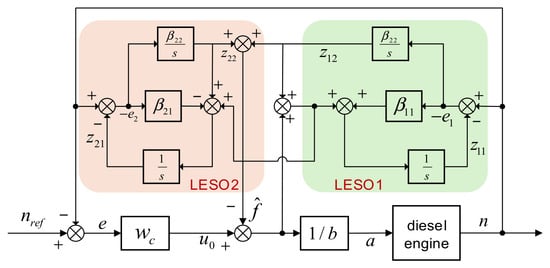
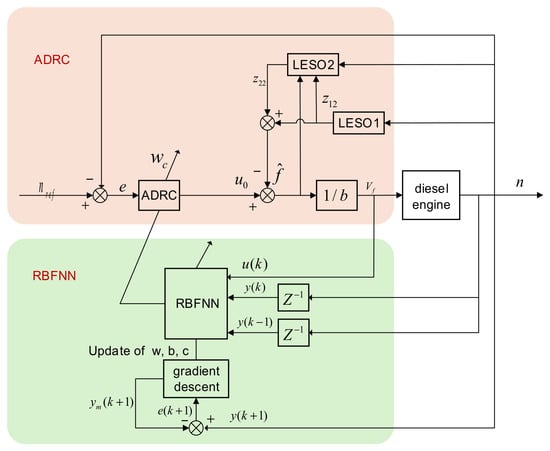
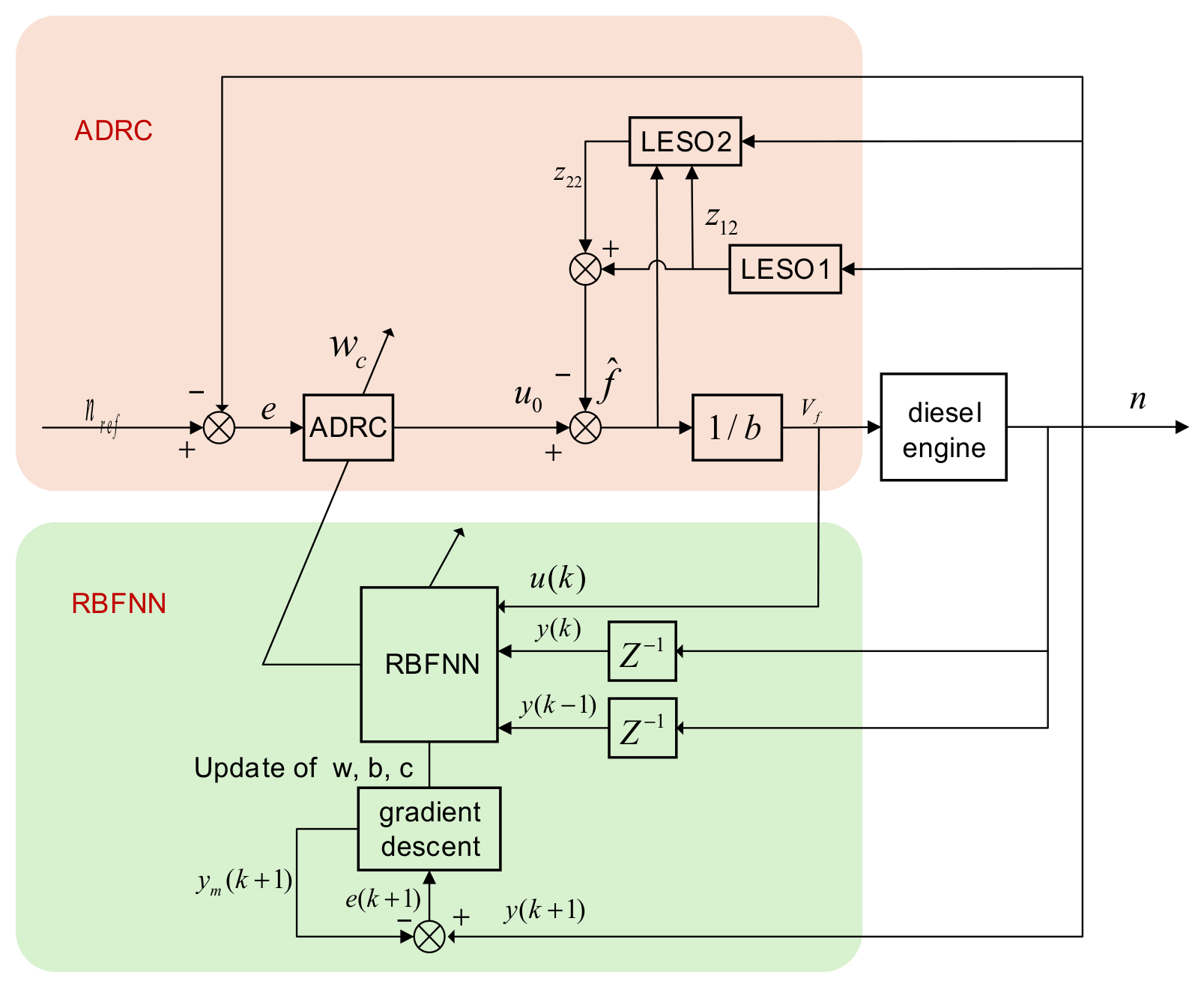
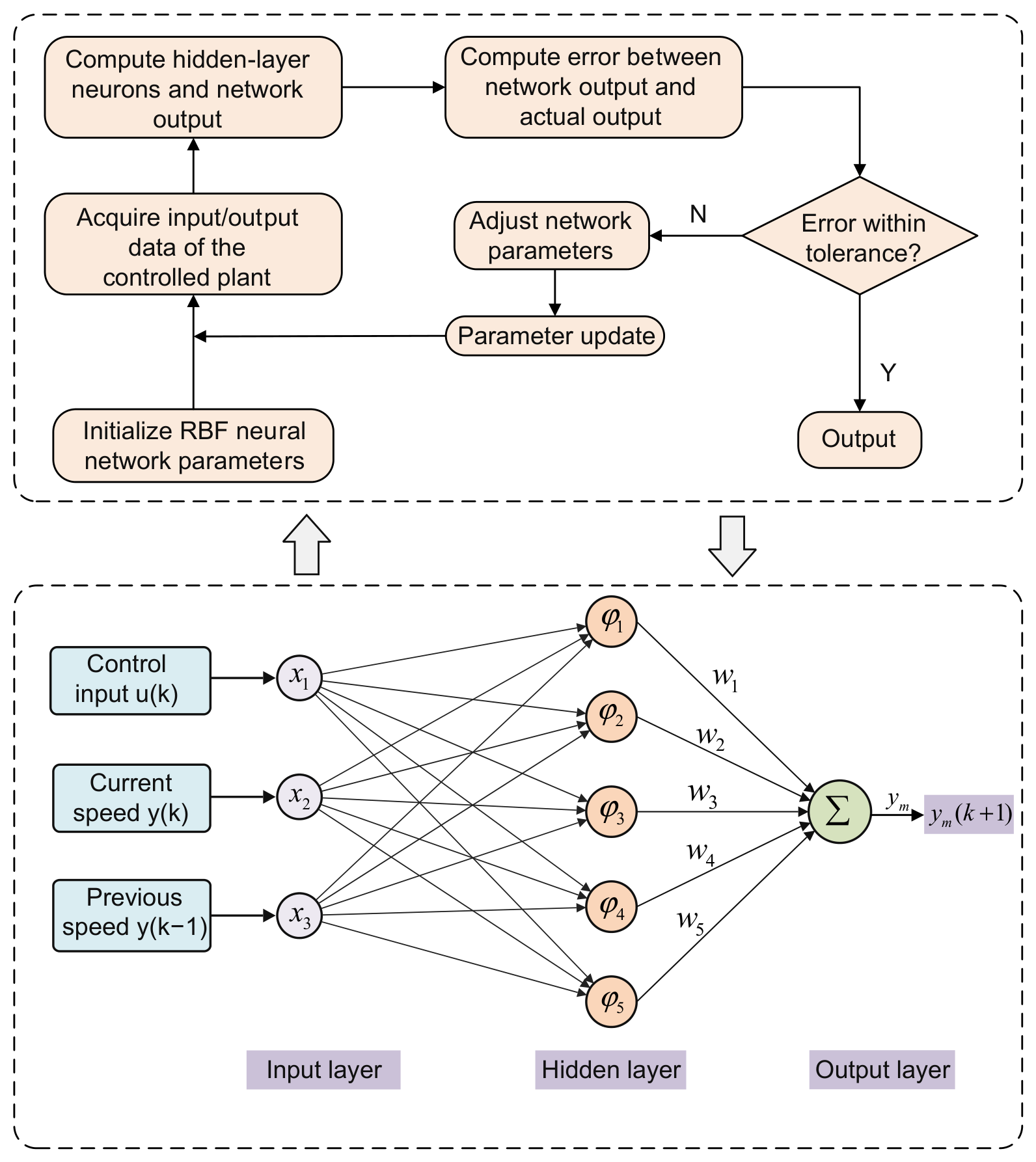
Although the cascaded LADRC contains multiple observers and feedback gains, these gains are determined by the controller bandwidth through the parameter relationships established in Section 3.3. Therefore, is the only parameter that needs to be adjusted online. To achieve adaptive tuning under varying operating conditions, an RBFNN is employed to identify the local input–output dynamics and estimate the plant Jacobian, which is subsequently used to update . The remaining observer and feedback gains are updated algebraically according to the predefined relationships, thereby maintaining coordinated parameter variation and reducing the dimension of online adaptation. The block diagram of the proposed control system is shown in Figure 4.
Figure 4.
Block diagram of the proposed control system.
In the proposed method, the RBFNN is used to adjust the controller bandwidth rather than directly tuning individual observer and feedback gains. The associated gains are then updated according to the predefined parameter relationships, ensuring coordinated variation in the observer and controller parameters. This design reduces the dimension of online adaptation, simplifies the tuning process, and preserves the internal consistency of the cascaded control structure.
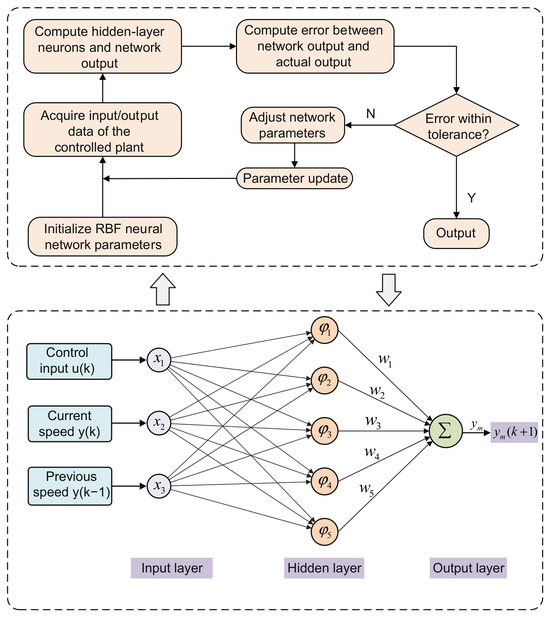
A standard three-layer RBFNN, comprising an input layer, a hidden layer, and an output layer, is employed as an online plant identifier. The network takes the current control input , the current rotational speed , and the previous rotational speed as inputs, and produces the one-step-ahead predicted output . Considering the low-dimensional network input and the requirements of online implementation, five hidden-layer neurons are adopted to provide sufficient nonlinear approximation capability with limited computational burden. Based on the identified model, the local plant Jacobian is estimated and used to update the controller bandwidth . The topology and online identification procedure of the RBFNN are shown in Figure 5.
Figure 5.
Topology and online identification procedure of the RBFNN.
The radial basis functions in the hidden layer of the RBF neural network can take various forms. In this paper, the most commonly used Gaussian function is selected, and its expression is defined as follows:
where denotes the center vector of the Gaussian function for the i-th hidden layer neuron at the k-th sampling instant; represents the width parameter (spread) of the i-th hidden node at the k-th sampling instant; and is the Euclidean vector norm, indicating the distance between the input vector and the center vector. The network output is given by the following:
The model-prediction error used for updating the RBFNN parameters is defined as follows:
where and denote the actual and predicted plant outputs, respectively. The RBFNN parameters, including the center vectors , width parameters , and output weights , are updated online to minimize the model-prediction error. Owing to its simple implementation and low online computational burden, the gradient descent method with a momentum term is adopted, and the corresponding update rules are given by the following:
where is the learning rate, with a range of [0, 1]; and is the momentum factor, with a range of [0, 1].
Once the RBFNN has identified the local plant sensitivity online, it supplies the real-time dynamic information of the system, namely the partial derivative of the output with respect to the control input (i.e., the Jacobian in Equation (22)). In practice, the RBFNN output approximates rather than exactly reproduces the plant output, and the resulting approximation error is assumed to remain bounded for bounded inputs. Since the projection operator constrains the controller bandwidth and all associated gains within the prescribed range, this error mainly affects the transient tuning process while preserving the boundedness conditions required for the subsequent stability analysis. The speed-tracking performance index is defined as . Based on the estimated Jacobian, the controller-bandwidth increment is calculated as follows:
where denotes the learning rate for controller-bandwidth adaptation.
Since the controller bandwidth is updated online by the RBFNN, an unconstrained gradient-based update may produce an excessively small or large value, particularly during abrupt load variations or at the initial stage of online learning. An excessively small bandwidth may weaken the tracking and disturbance-rejection capabilities, whereas an excessively large bandwidth may increase control activity and amplify measurement noise. Therefore, the updated bandwidth is restricted to a predefined admissible interval using a projection operator.
The unconstrained candidate bandwidth is obtained by combining the bandwidth increment with a momentum term:
where is the momentum coefficient, and denotes the unconstrained candidate bandwidth. The bandwidth applied to the controller is then calculated as follows:
where the projection operator is defined by the following:
The lower bound is selected as a strictly positive value to prevent the feedback and observer dynamics from losing the required convergence rate. The upper bound is determined by considering the allowable control effort, the sampling frequency, and the sensitivity to measurement noise. Consequently, the online bandwidth satisfies the following:
Since the observer bandwidth and the associated observer and feedback gains are determined from the controller bandwidth through the predefined parameter relationships, the projection simultaneously keeps the complete observer–controller gain set within an admissible range. Thus, the RBFNN modifies the transient response without producing physically unreasonable or mutually inconsistent gain combinations. The projection constraint also provides the bounded and positive parameter condition required in the subsequent closed-loop stability analysis.
Although the diesel generator model and the cascaded LADRC are formulated in continuous time, the RBFNN is implemented digitally. At each sampling instant , the current control input, current speed, and previous speed are used to update the RBFNN parameters and to estimate the local plant Jacobian. The resulting observer and feedback gains are then held constant over through a zero-order hold. Hence, the overall system can be regarded as a sampled-data system with continuous plant and observer dynamics and discrete parameter adaptation. The sampling period is selected to be sufficiently shorter than the dominant observer and closed-loop time constants, thereby limiting the intersample variation considered in the subsequent stability analysis.
The proposed controller has a relatively low computational burden. The two first-order LESOs require only a fixed number of arithmetic operations, while the computational complexity of the RBFNN is , where is the number of hidden neurons and is the input dimension. Since the network adjusts only one controller bandwidth and the remaining gains are calculated algebraically, multi-parameter online optimization is avoided. For real-time implementation, the sampling interval should be sufficiently shorter than the observer time constant, and speed acquisition, neural-network updating, observer calculation, and control-signal generation must be completed within each sampling period. Measurement filtering, throttle saturation, and bandwidth constraints should also be retained in practical implementation.
3.5. Stability Analysis
The stability analysis considers both the continuous-time plant-observer dynamics and the discrete-time bandwidth adaptation introduced in Section 3.4. It is assumed that the extended-disturbance rate is bounded, i.e., , and that the projected neural adaptation law guarantees . Since , where is the prescribed bandwidth ratio, the observer bandwidth is also positive and bounded. The bandwidth and the associated gains are held constant within each sampling interval by a zero-order hold.
To account explicitly for LESO1 and LESO2, define the observation errors and the augmented error vector as follows:
Here, is the estimation error of the combined extended-state estimate . Subtracting the plant dynamics in Equation (12) from the observer dynamics in Equations (13) and (14) yields the following:
Substituting the bandwidth-parameterized gains in Equation (15), the characteristic polynomial of the complete cascaded observer becomes the following:
Therefore, the augmented observer matrix is Hurwitz for every . This result includes the residual-error dynamics introduced by LESO2 rather than considering LESO1 alone. To establish a bandwidth-uniform bound, define the normalized error vector . Within each sampling interval, its dynamics can be written as follows:
Here, denotes the bounded perturbation associated with discrete bandwidth updates and intersample variation. Let satisfy the Lyapunov equation for the constant Hurwitz matrix , and choose the following:
If , differentiation along the error trajectories gives the following:
Consequently, the cascaded-observer error is uniformly ultimately bounded. When the extended disturbance is constant and the sampling-induced perturbation vanishes, the observer error converges exponentially to zero.
Using the combined extended-state estimate in the control law and defining for a constant reference, the tracking-error dynamics are obtained as follows:
For , its derivative satisfies the following:
Since is uniformly ultimately bounded, the tracking error is also uniformly ultimately bounded. When and the observer and sampling perturbations vanish, and the tracking error converges exponentially to zero.
The RBFNN does not directly generate the stability-critical observer and feedback gains. Instead, it produces a candidate controller bandwidth that is mapped into the admissible interval by the projection operator. Therefore, bounded neural-network approximation errors mainly affect transient bandwidth selection without violating the positive-bandwidth condition required for closed-loop stability. Under bounded bandwidth increments and a sampling period sufficiently shorter than the dominant observer and closed-loop time constants, the sampled-data implementation preserves the uniform ultimate boundedness established above.
The main practical conclusions of the stability analysis are summarized as follows:
- The positive lower bandwidth bound keeps the controller and cascaded-observer poles in the open left-half plane during online adaptation.
- Under a bounded disturbance rate and bounded sampling-induced perturbations, the cascaded-observer and tracking errors remain uniformly ultimately bounded.
- Exponential convergence is recovered for constant disturbances when the observer residual and sampling-induced perturbations vanish.
- Increasing the bandwidth generally reduces the estimation and tracking-error bounds, but excessive bandwidth may increase control activity and sensitivity to measurement noise.
These results provide the theoretical basis for the convergence and disturbance-rejection performance evaluated in Section 4.
4. Simulation Analysis and Results
In the speed-governing system of a diesel generator set, the performance of the speed-control loop directly determines the frequency stability and the quality of the dynamic response. Accordingly, the proposed cascaded LADRC scheme was first verified using MATLAB/Simulink R2024a.
4.1. Disturbance-Observation Performance of the Improved LESO
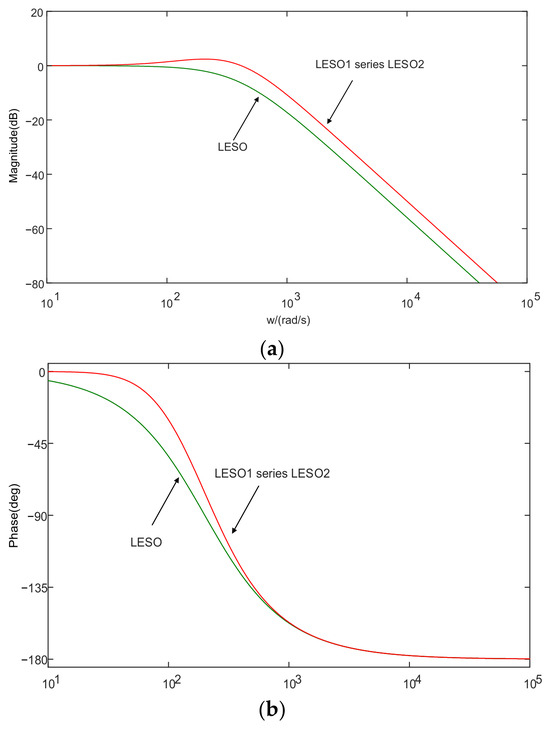
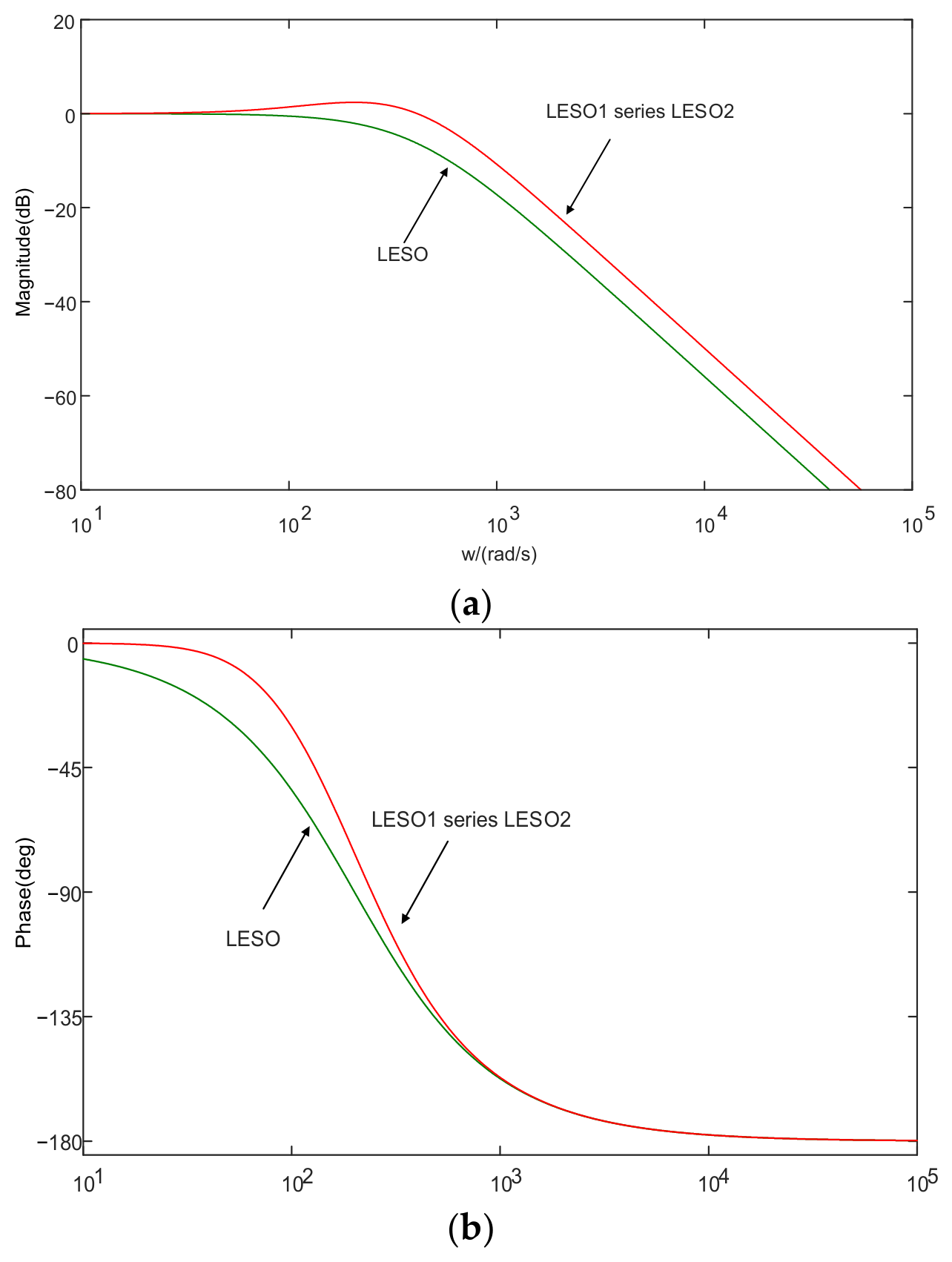
To further illustrate the frequency-domain characteristics of the cascaded observer, Figure 6 compares the magnitude and phase responses of the conventional LESO and the cascaded LESO. The cascaded LESO exhibits a higher −3 dB cutoff frequency and a wider effective observation bandwidth, indicating faster disturbance-estimation dynamics and improved transient response. In the high-frequency region, the two observers show similar attenuation trends.
Figure 6.
Bode diagrams of the conventional and improved LESO: (a) magnitude–frequency response and (b) phase–frequency response.
4.2. Speed Response Under Startup and Load Variation
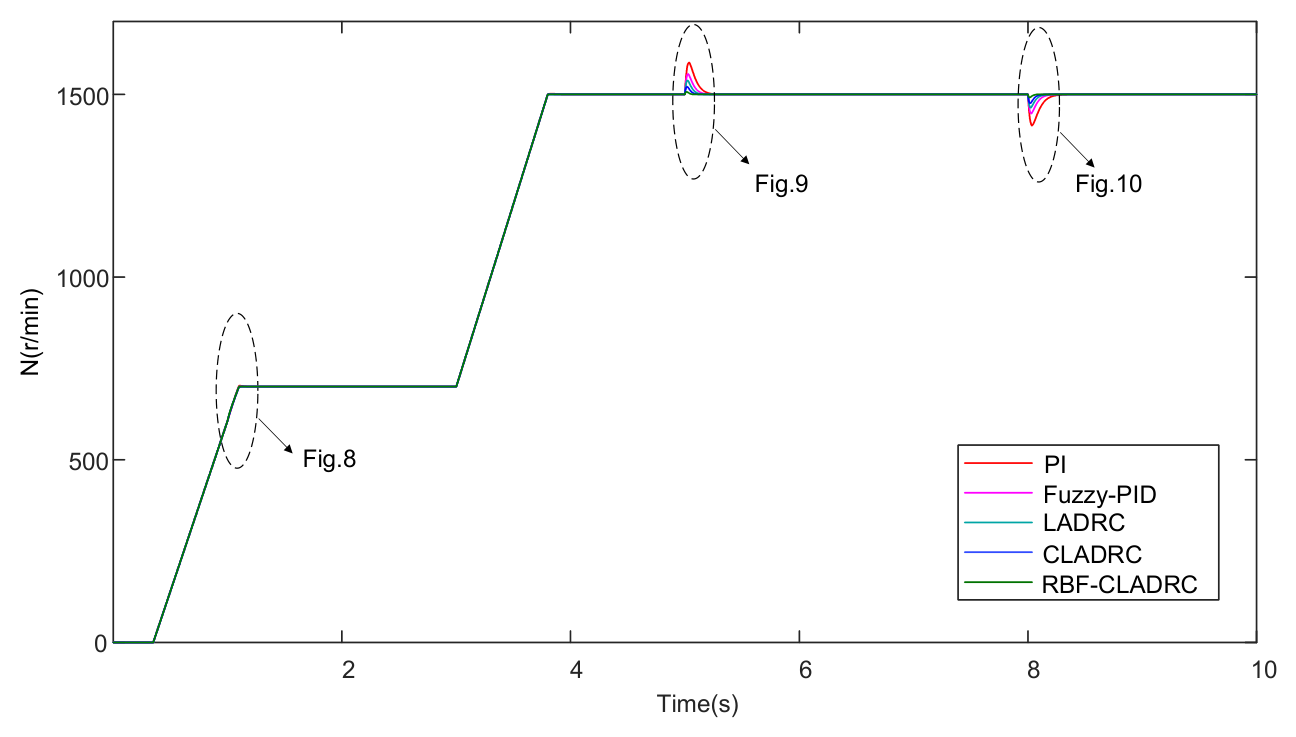
Based on the parameters listed in Table 1, the corresponding system model was built in MATLAB/Simulink. To provide a more comprehensive assessment, five control strategies were analyzed and compared: a conventional PI controller, a fuzzy self-tuning PID controller (Fuzzy-PID), a conventional LADRC with a single linear extended state observer, a standard CLADRC, and the proposed RBF-CLADRC. The conventional LADRC was introduced to isolate the contribution of the cascaded observer structure, whereas Fuzzy-PID was selected as a representative intelligent control method. The simulation scenario was configured as follows: the unit remained at standstill during 0–0.3 s; the speed was ramped to idle during 0.3–1 s; the speed was further ramped to the rated value during 2.5–3.5 s; 50% of the load was suddenly rejected at 5 s; and 50% of the load was suddenly added at 8 s.
The conventional LADRC employed a single LESO to estimate the lumped disturbance. The CLADRC and RBF-CLADRC parameters were configured according to Section 3. Each benchmark controller was tuned independently under the same nominal operating condition before the comparative tests. For the proposed RBF-CLADRC, the bandwidth bounds were selected around the nominal offline-tuned value. The lower bound was chosen to maintain sufficient response speed and disturbance-rejection capability, whereas the upper bound was set to limit excessive control action and noise amplification. The same admissible interval was used in all simulation cases.
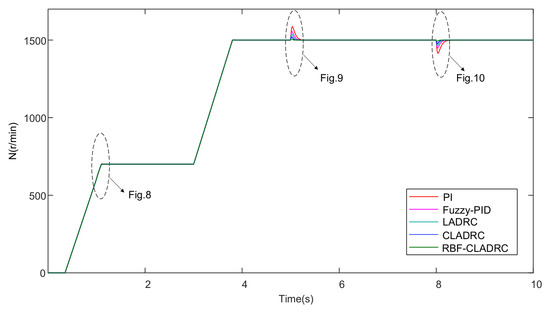
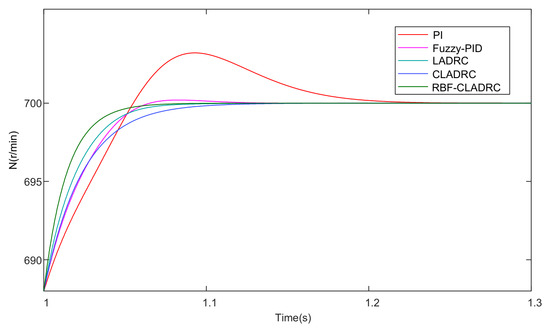
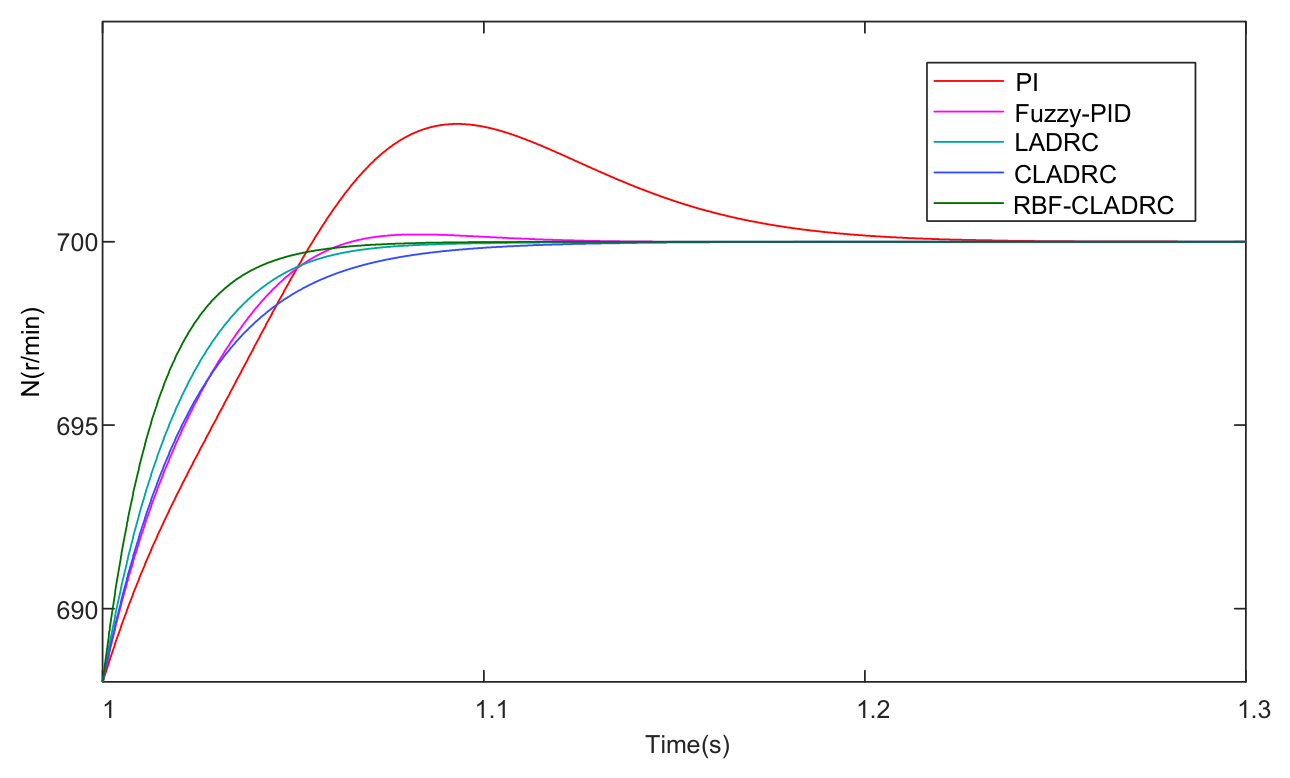
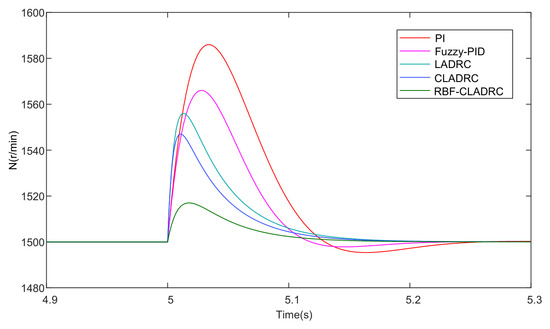
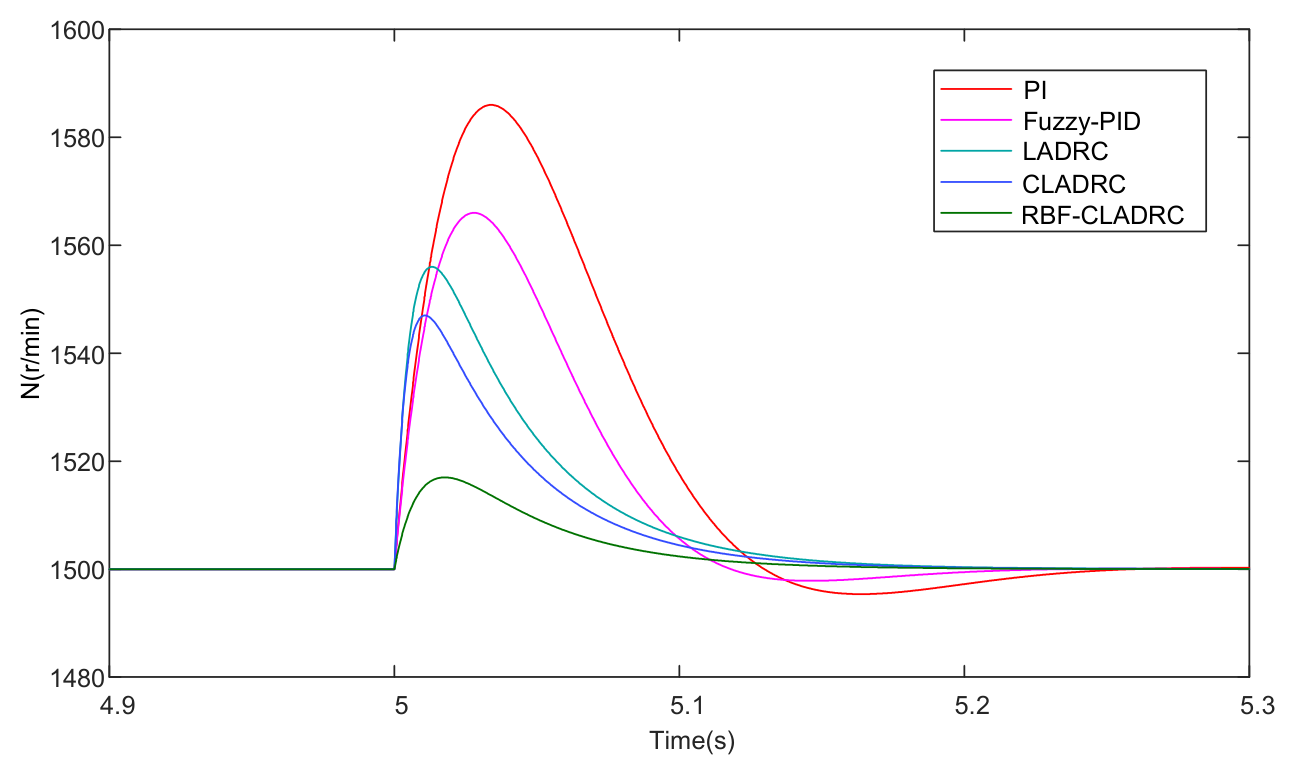
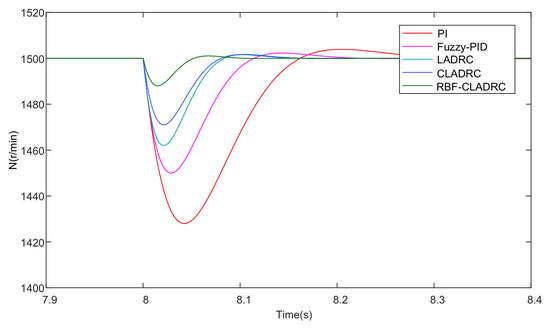
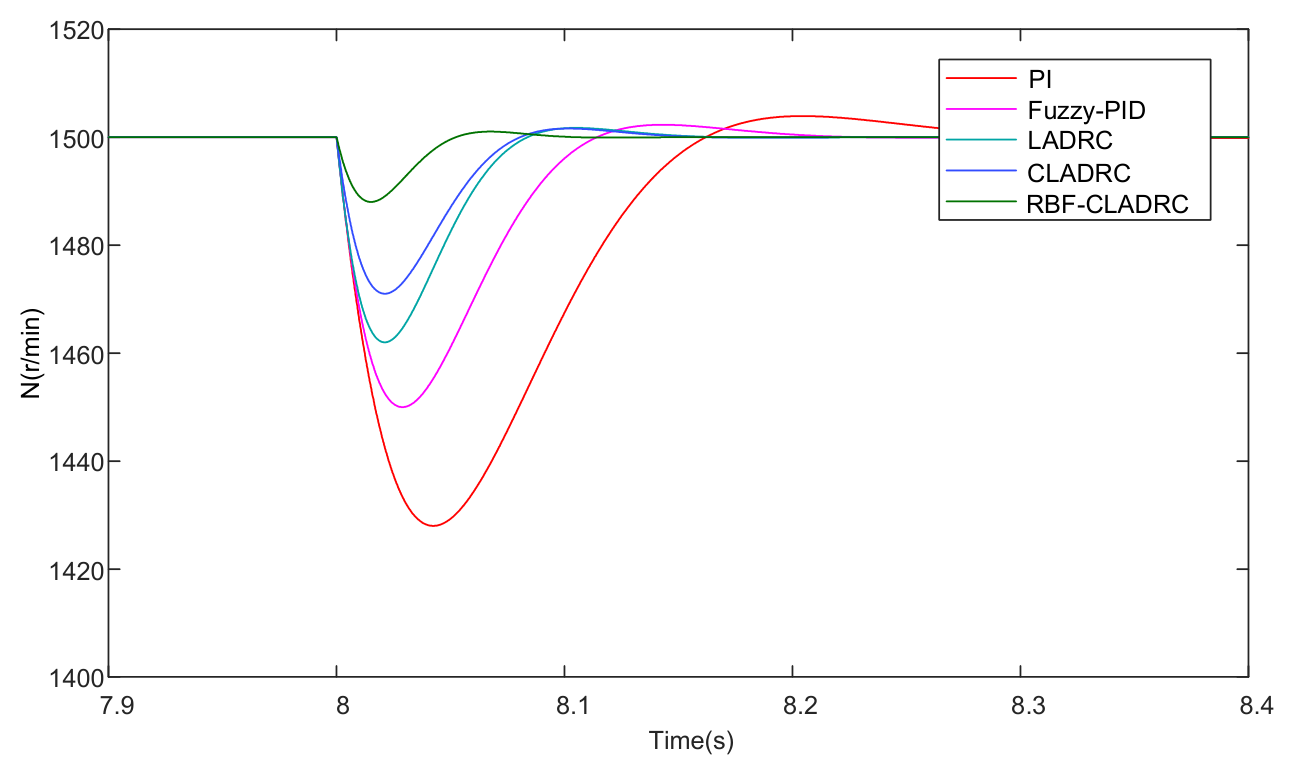
Figure 7 shows the overall speed responses of the five controllers, while Figure 8, Figure 9 and Figure 10 present enlarged views of the startup, load-rejection, and load-addition stages. During startup, the maximum overshoots of PI, Fuzzy-PID, LADRC, CLADRC, and RBF-CLADRC were approximately 3.21, 0.20, 0, 0, and 0 rpm, respectively. As shown in Figure 8, the PI controller exhibits the largest overshoot, with the rotational speed reaching approximately 703.21 rpm, followed by a relatively slow decay toward the reference speed. Fuzzy-PID substantially suppresses the startup overshoot, limiting the peak speed to approximately 700.20 rpm. In comparison, LADRC, CLADRC, and RBF-CLADRC exhibit essentially overshoot-free responses. These results demonstrate that the proposed RBF-CLADRC provides improved startup rapidity while avoiding excessive speed overshoot. As shown in Figure 9, after the sudden load rejection at 5 s, the peak speeds of PI, Fuzzy-PID, LADRC, CLADRC, and RBF-CLADRC were 1587, 1567, 1556, 1547, and 1518 rpm, with recovery times of approximately 0.21, 0.16, 0.14, 0.13, and 0.11 s, respectively. Correspondingly, as shown in Figure 10, after the sudden load addition at 8 s, the corresponding minimum speeds were 1428, 1450, 1462, 1471, and 1488 rpm, with recovery times of approximately 0.26, 0.16, 0.08, 0.07, and 0.04 s. Fuzzy-PID improves the transient response relative to PI, while LADRC provides stronger disturbance rejection through disturbance estimation and compensation. CLADRC further improves the observation accuracy, and RBF-CLADRC achieves the smallest speed deviation and the shortest recovery time through online bandwidth adaptation.
Figure 7.
Speed responses under the five control strategies.
Figure 8.
Speed responses during startup process.
Figure 9.
Speed responses during load rejection.
Figure 10.
Speed responses during load addition.
4.3. Speed-Tracking-Error Comparison
To further evaluate the disturbance-rejection performance of the proposed RBF-CLADRC, the reference-tracking errors between the actual and reference speeds were compared for the five controllers. The simulation scenario was configured as follows: the reference speed was ramped to its rated value of 1500 rpm (1 p.u.) at 4 s under a rated load of 1320 kW; a 50%-rated-load step was removed at 5 s, reducing the load from 1320 kW to 660 kW; and the same step was reapplied at 8 s, restoring the load to 1320 kW. The resulting speed-tracking errors are presented in Figure 11.
As shown in Figure 12, under the 50%-rated-load rejection, the maximum speed-tracking errors of PI, Fuzzy-PID, LADRC, CLADRC, and RBF-CLADRC were approximately 88, 42, 31, 25, and 8 rpm, respectively, with corresponding settling times of 0.26, 0.17, 0.09, 0.09, and 0.05 s. Similarly, under the 50%-rated-load addition shown in Figure 13, the maximum errors were approximately 88, 38, 30, 22, and 8 rpm, with settling times of 0.25, 0.17, 0.10, 0.09, and 0.05 s, respectively.
Figure 11.
Speed-tracking errors under the five control strategies.
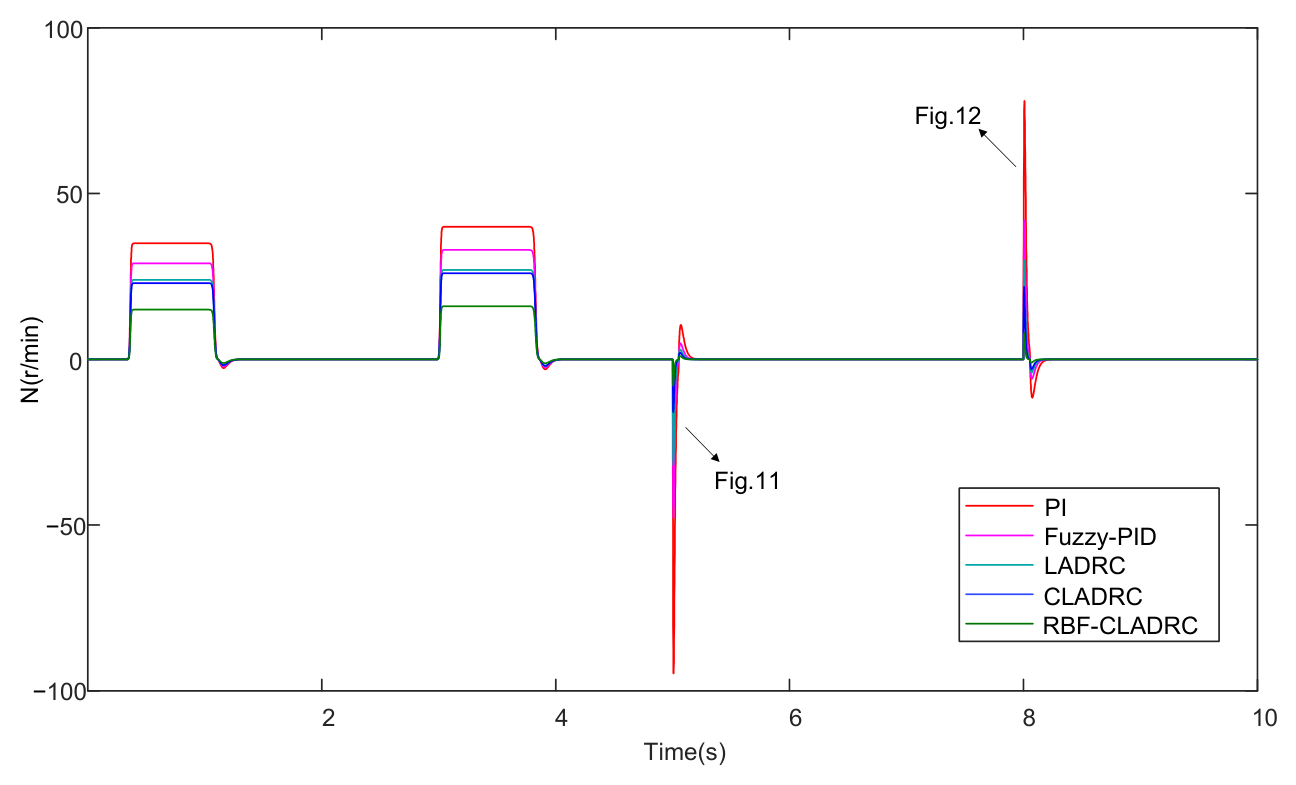
Figure 12.
Speed-tracking errors during load rejection.
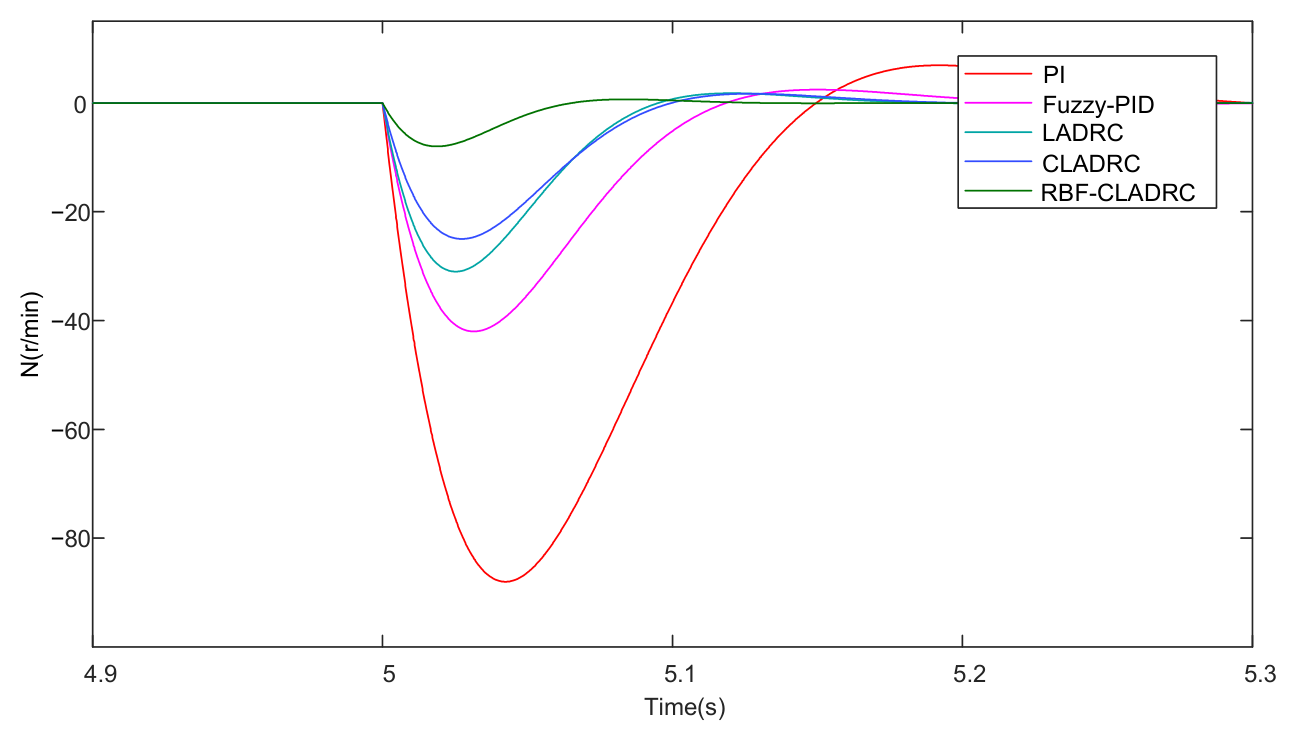
Figure 13.
Speed-tracking errors during load addition.
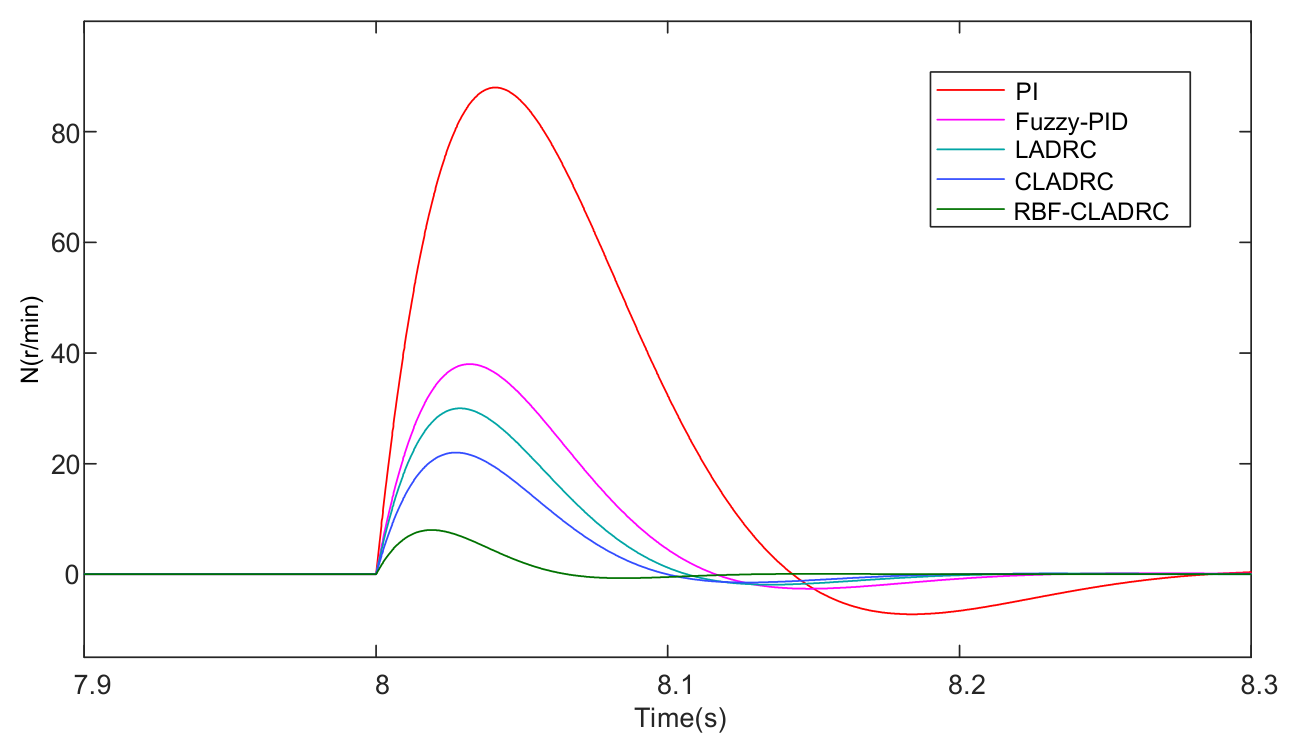
Overall, Fuzzy-PID improves the transient response relative to the fixed-gain PI controller, while LADRC provides stronger disturbance rejection through explicit total-disturbance estimation. The comparison between LADRC and CLADRC confirms the benefit of the cascaded dual-LESO structure, whereas the comparison between CLADRC and RBF-CLADRC demonstrates the additional advantage of online bandwidth adaptation.
To quantify the transient tracking performance shown in Figure 12 and Figure 13, the integral absolute error (IAE) and the integral time-weighted absolute error (ITAE) were calculated as and , where denotes the load-disturbance instant, is the elapsed time after the disturbance, and . Accordingly, the intervals of 5.0–5.3 s and 8.0–8.3 s were used for the load-rejection and load-addition cases, respectively. IAE reflects the accumulated tracking-error magnitude, whereas ITAE places greater emphasis on errors that persist for a longer duration. The resulting indices are summarized in Table 2.
Table 2.
Integral error indices under 50%-rated-load variations.
The numerical results are consistent with the transient waveforms. Under both load changes, the integral indices decrease progressively from PI and Fuzzy-PID to LADRC, CLADRC, and RBF-CLADRC. In particular, RBF-CLADRC yields IAE values of 0.315 and 0.319 rpm·s and ITAE values of 0.010 and 0.010 rpm·s2 under load rejection and load addition, respectively. Compared with PI, these values correspond to IAE reductions of 95.96% and 95.74% and ITAE reductions of 98.15% and 97.95%. Thus, the proposed method reduces both the accumulated speed deviation and the duration of the residual tracking error.
4.4. Online Adaptive Parameter Tuning
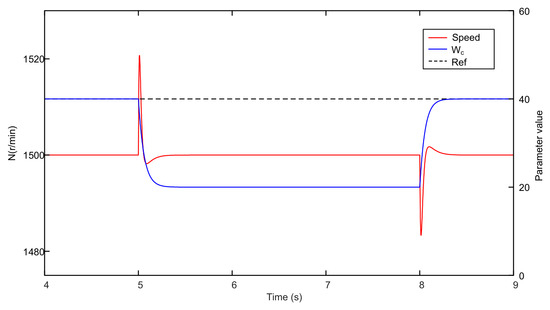
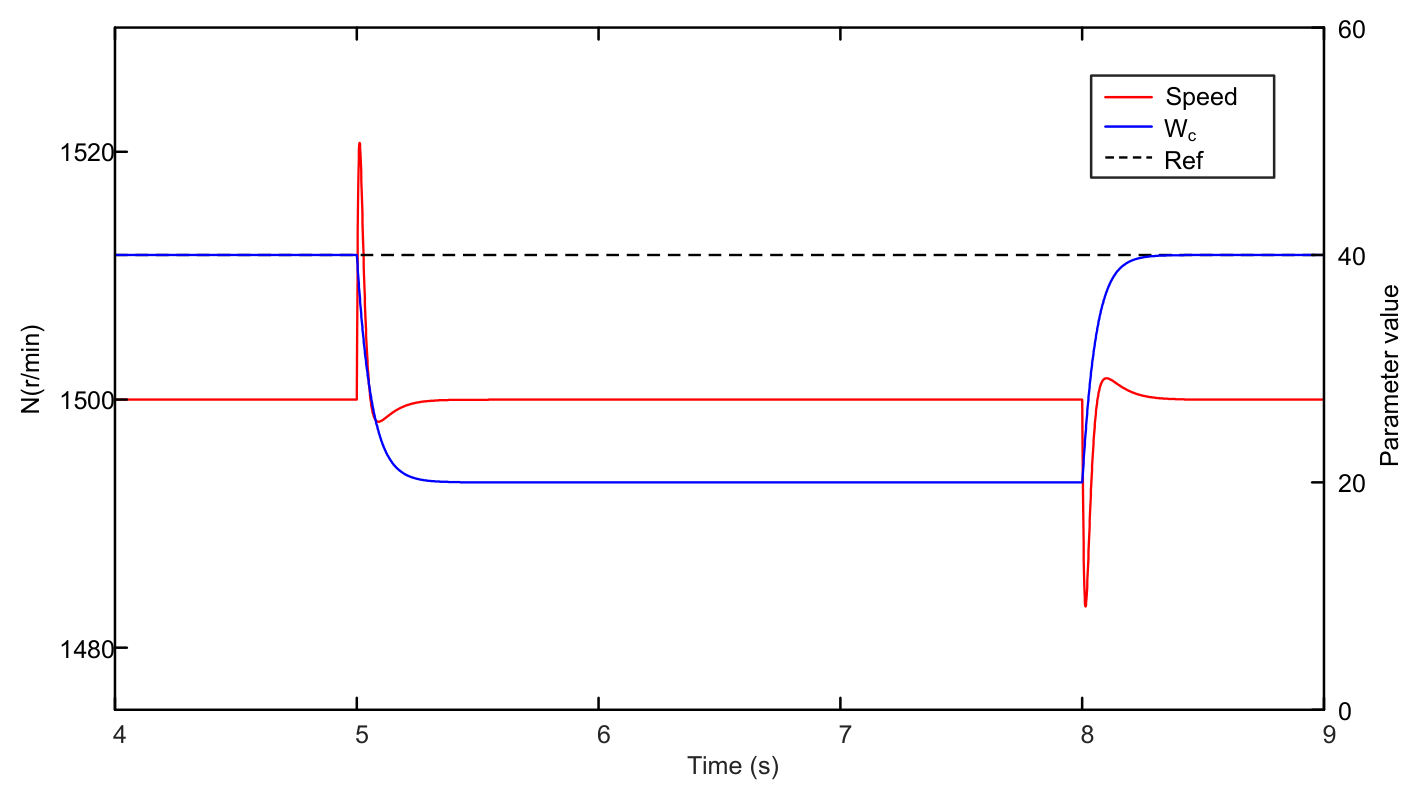
To illustrate the online adaptation process, the 50%-rated-load variation case described in Section 4.3 was selected. Figure 14 presents the speed response and compares the RBFNN-tuned controller bandwidth with the fixed offline-tuned value used by the conventional CLADRC. In the proposed controller, is the only independently adapted parameter, while the observer bandwidth and the associated gains are updated according to the relationships defined in Section 3.3.
Figure 14.
Online adaptive variation in the CLADRC bandwidth under sudden load changes.
As shown in Figure 14, remains bounded and varies mainly following the two load transitions. After the 50%-rated-load rejection at , the speed rises briefly, while decreases from 40 to approximately 20 and remains at this level during the reduced-load interval. When the load is reapplied at , the speed decreases transiently, and increases to 40 as the speed returns to its rated value. Compared with the fixed offline reference, these results show that the RBFNN adjusts the common bandwidth according to the operating condition.
The performance improvement results from the complementary roles of the cascaded LESOs and the adaptive bandwidth. LESO2 compensates for the residual estimation error of LESO1, while the RBFNN adjusts the common bandwidth according to the operating condition. This coordination enhances transient disturbance compensation without maintaining unnecessarily high gains during steady-state operation.
4.5. Robustness Analysis
The preceding results were obtained under nominal conditions. To further assess the robustness of the proposed RBF-CLADRC, two representative stress tests were carried out: (i) a parameter-uncertainty test, in which a key plant parameter—the moment of inertia—deviates from the nominal value used by the controller, evaluated under a 50%-rated-load rejection; (ii) a combined measurement-noise and actuator-saturation test, evaluated on the startup-and-load-step scenario of Section 4.2, that emulates practical sensing and actuation limits. In both tests, the controller parameters were kept identical to the nominal design, so that any performance change is attributable solely to the perturbation and not to re-tuning.
- Parameter uncertainty
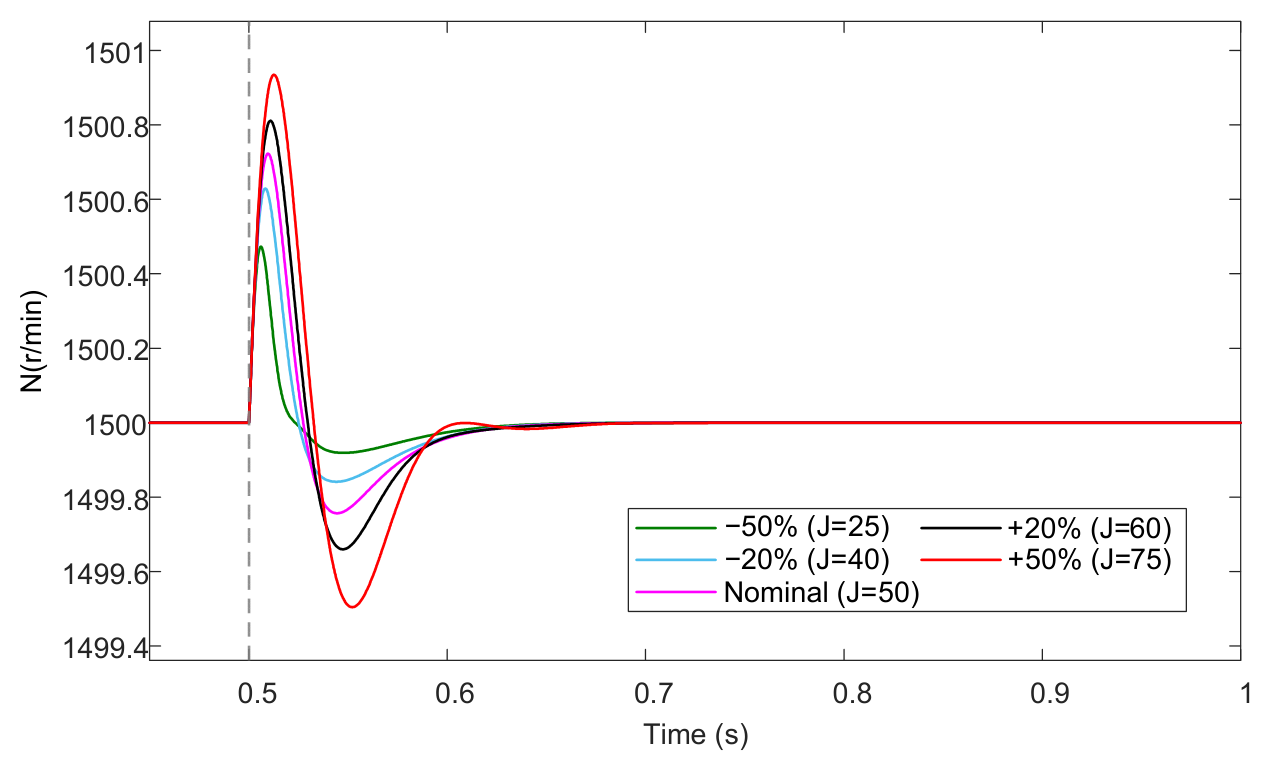
Among the plant parameters, the moment of inertia J is the most difficult to determine accurately and varies most with the engaged mechanical load, so it was selected to probe parameter robustness. Its nominal value is J = 50 kg·m2 (Table 1), to which the cascaded LESO and the controller bandwidth are tuned. To emulate a modeling error, the inertia of the actual plant was varied by ±20% and ±50% (i.e., 25, 40, 60, and 75 kg·m2) while the controller was kept fixed at the nominal tuning; the closed-loop response was then evaluated under a 50%-rated-load rejection applied as a step change in the lumped load torque. Because the controller is never re-tuned, any change in the response is attributable solely to the inertia mismatch.
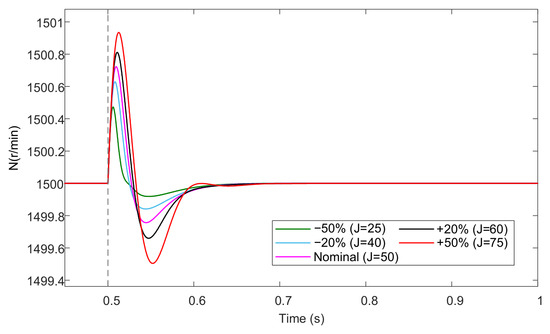
The resulting speed responses are shown in Figure 15. As the inertia is perturbed over the full ±50% range, the peak speed deviation increases monotonically but modestly, from 0.47 rpm at J = 25 kg·m2 to 0.93 rpm at J = 75 kg·m2, against 0.72 rpm at the nominal inertia; the corresponding settling time (±0.05 rpm band) stays within 0.078–0.095 s in all cases. In every case, the response is stable and well-damped, exhibiting neither sustained oscillation nor steady-state offset, and the five trajectories differ only slightly during the transient before converging to the reference. These results show that the cascaded LESO treats the inertia mismatch as part of the total disturbance and compensates it online, so that the closed-loop performance is largely insensitive to a large uncertainty in J—consistent with the disturbance-rejection rationale of the proposed design.
Figure 15.
Speed response of RBF-CLADRC under ±20% and ±50% inertia mismatch.
- Robustness to measurement noise and actuator saturation
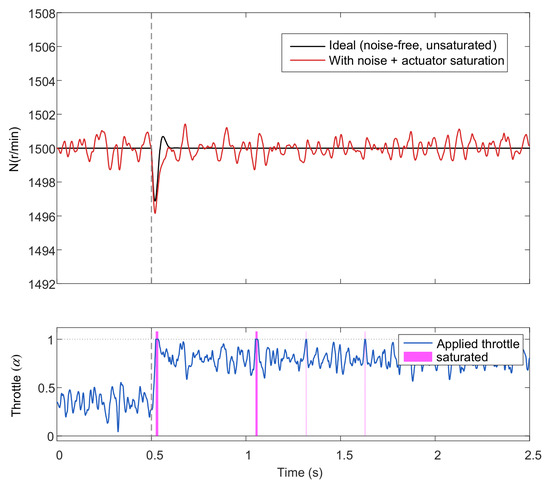
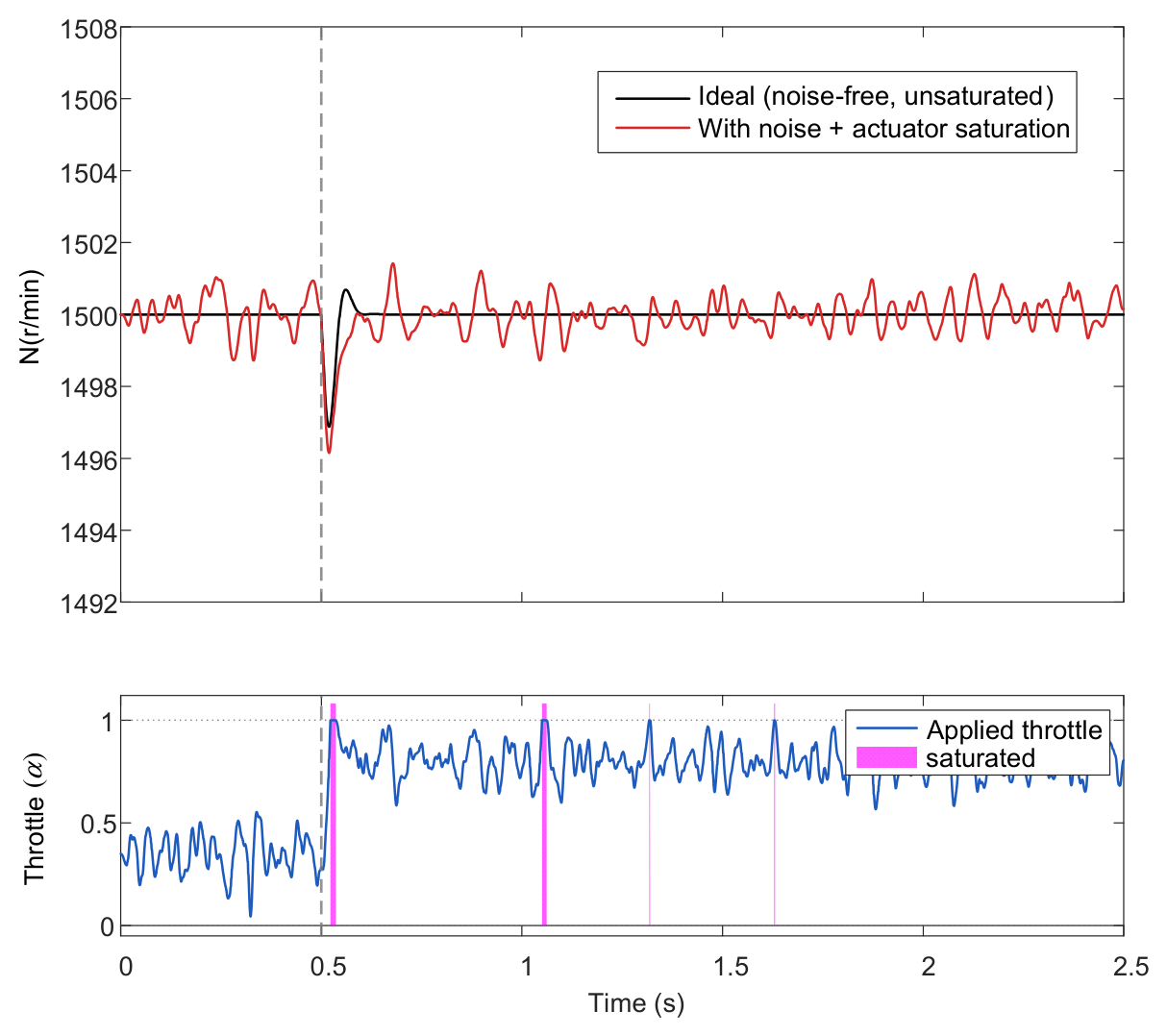
Practical speed governors operate with a noisy speed measurement and a physically limited throttle, and these two non-idealities interact: sensor noise propagates through the observer into the control command, which can drive the actuator into saturation. To reproduce this interaction, band-limited Gaussian noise with a standard deviation of 1.0 rpm (obtained by low-pass filtering white noise) was added to the speed feedback, and a saturation block limiting the throttle command to its physical range was placed at the controller output. Both effects were applied simultaneously, and the startup-and-load-step scenario of Section 4.2 was repeated with the controller kept at its nominal tuning; an ideal, noise-free, unsaturated run is included for reference. The results are shown in Figure 16.
Figure 16.
Speed response of RBF-CLADRC under measurement noise and actuator saturation.
Under simultaneous measurement noise and throttle saturation, the RBF-CLADRC continues to track the reference accurately: the steady-state speed ripple is confined to 1.33 rpm (0.52 rpm standard deviation), and the peak speed deviation at the load transient is 3.65 rpm, only marginally larger than in the ideal case. As shown in the lower panel of Figure 16, the throttle command reaches its upper limit only briefly during the load transient and returns to the linear region as soon as the speed is restored, so the saturation is transient and does not trigger instability or limit-cycle behavior. The speed trajectory tracks the ideal response closely apart from a small noise-induced ripple, confirming that the measurement filtering and the disturbance-rejection action of the cascaded LESO together suppress the noise without excessive actuator activity. These results indicate that the proposed controller retains its dynamic performance and stability under practical sensing noise and actuation limits.
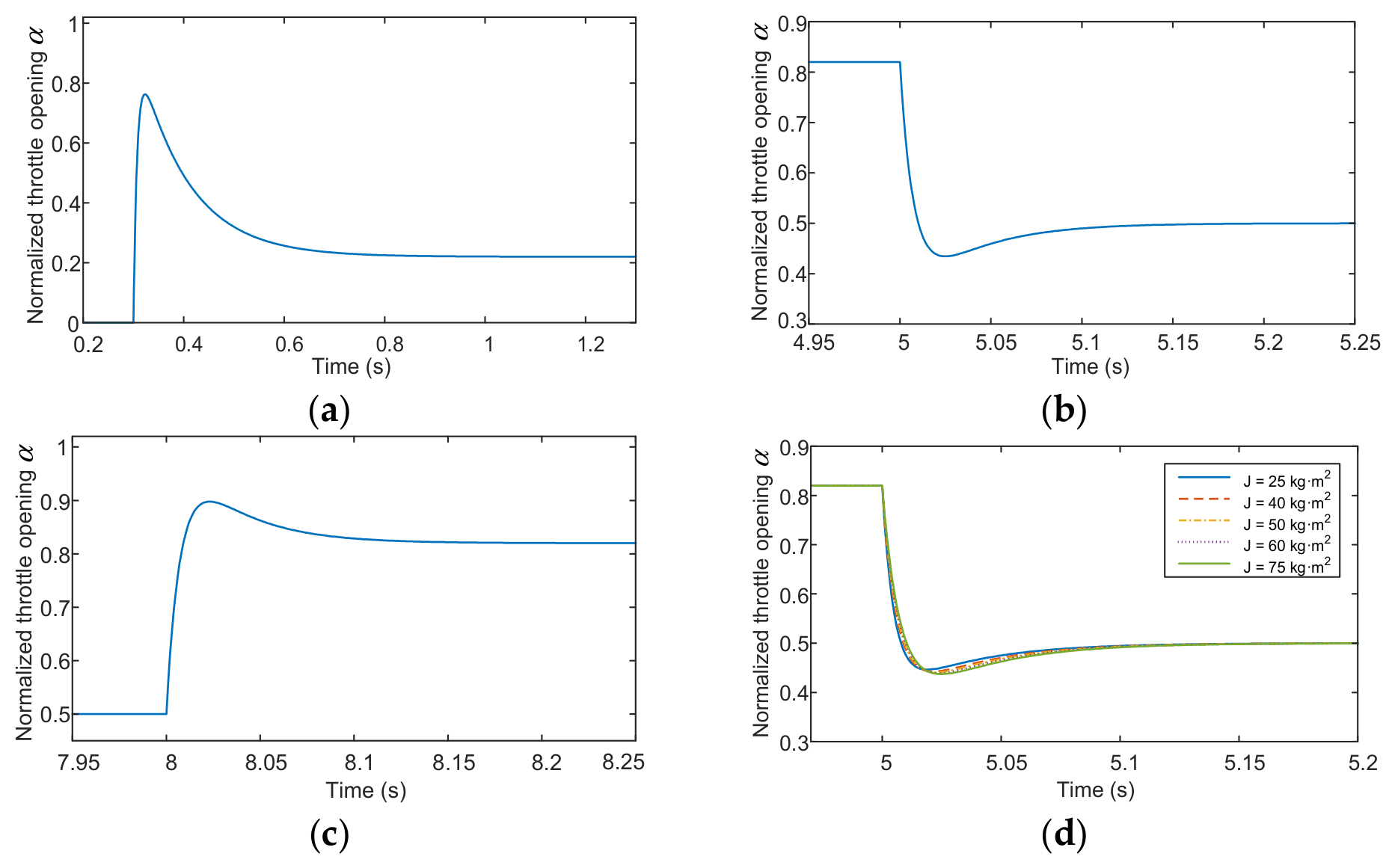
The corresponding normalized throttle-opening commands under startup, load-rejection, load-addition, and moment-of-inertia variation are presented in Figure 17.
Figure 17.
Normalized throttle-opening commands of RBF-CLADRC under different simulation conditions: (a) startup; (b) 50%-rated-load rejection; (c) 50%-rated-load addition; (d) moment-of-inertia uncertainty.
Across all cases, the throttle command responds promptly to operating changes and rapidly settles to the corresponding steady-state level. The control signals remain bounded over the tested inertia range and exhibit no sustained oscillation, indicating that the improved transient and robustness performance is achieved without excessive actuator activity.
In summary, the RBF-CLADRC maintains stable, well-damped operation both under a ±50% mismatch in the moment of inertia and under simultaneous measurement noise and actuator saturation, with the peak speed deviation remaining below 1 rpm in the inertia-mismatch tests and the steady-state ripple confined to about 1.3 rpm in the noise-and-saturation test. These results confirm that the disturbance-rejection action of the cascaded LESO preserves the closed-loop performance under the two perturbations considered, complementing the nominal-condition results reported in Section 4.2, Section 4.3 and Section 4.4.
5. Conclusions
This study developed an RBFNN-assisted cascaded LADRC for diesel-generator speed regulation based on a control-oriented torque-balance model. In the proposed structure, LESO1 estimates the lumped disturbance, while LESO2 reconstructs and compensates for the residual estimation error. The RBFNN adjusts a common controller bandwidth online, and the remaining observer and feedback gains are updated through predefined analytical relationships. The improved performance therefore results from more accurate residual-disturbance estimation and operating-condition-dependent bandwidth adaptation. Lyapunov analysis shows that the observer and tracking errors remain uniformly ultimately bounded under bounded disturbance rates, RBFNN approximation errors, and sampled-data bandwidth variations, while exponential convergence is recovered for constant disturbances when adaptation-related perturbations vanish.
Comparative simulations under startup, load rejection, and load addition verify the effectiveness of the proposed method. Compared with PI, Fuzzy-PID, conventional LADRC, and fixed-bandwidth CLADRC, the RBF-CLADRC achieves smaller speed deviations and faster recovery. Under 50%-rated-load rejection and addition, the maximum tracking error is approximately 8 rpm and the settling time is about 0.05 s. Further tests involving moment-of-inertia uncertainty, measurement noise, and throttle saturation demonstrate stable and well-damped responses under the considered non-ideal conditions. Since only one bandwidth parameter is adjusted online by a small-scale RBFNN, the additional computational burden remains limited, indicating the potential for real-time implementation at an appropriate sampling frequency.
From an engineering perspective, the proposed controller requires only the reference and measured speeds and generates the normalized throttle opening as the control output, without relying on a detailed high-order diesel engine model. Load variations, mechanical friction, and moderate parameter uncertainties are incorporated into the lumped disturbance and compensated online, supporting its application to standby generator sets, islanded microgrids, and shipboard power systems. Nevertheless, practical performance may still be affected by combustion delay, actuator dead zones, communication delays, and long-term parameter drift. The RBFNN parameters and admissible bandwidth range should also be selected according to the rated capacity and actuator characteristics of the specific generator set. Overall, the proposed method improves dynamic response and disturbance rejection while retaining a relatively simple structure and low computational burden.
Author Contributions
Conceptualization, Y.Z. and Y.D.; methodology, Y.D.; software, Y.D.; validation, Y.D.; formal analysis, Y.D.; investigation, Y.D.; resources, Y.D.; data curation, Y.D.; writing—original draft preparation, Y.D.; writing—review and editing, Y.Z.; visualization, Y.Z.; supervision, Y.Z.; project administration, Y.Z.; funding acquisition, Y.Z. All authors have read and agreed to the published version of the manuscript.
Funding
This research received no external funding.
Data Availability Statement
The original contributions presented in this study are included in the article. Further inquiries can be directed to the corresponding author.
Conflicts of Interest
The authors declare no conflicts of interest.
References
- Kang, E.; Hong, S.; Sunwoo, M. Idle speed controller based on active disturbance rejection control in diesel engines. Int. J. Automot. Technol. 2016, 17, 937–945. [Google Scholar] [CrossRef] [Scilit]
- Wang, R.; Li, X.; Zhang, J.; Zhang, J.; Li, W.; Liu, Y.; Fu, W.; Ma, X. Speed control for a marine diesel engine based on the combined linear–nonlinear active disturbance rejection control. Math. Probl. Eng. 2018, 2018, 7641862. [Google Scholar] [CrossRef] [Scilit]
- Liu, K.; He, J.; Luo, Z.; Shen, X.; Liu, X.; Lu, A. Secondary frequency control of isolated microgrid based on LADRC. IEEE Access 2019, 7, 53454–53462. [Google Scholar] [CrossRef] [Scilit]
- Padhy, S.; Panda, S. Application of a simplified Grey Wolf optimization technique for adaptive fuzzy PID controller design for frequency regulation of a distributed power generation system. Prot. Control Mod. Power Syst. 2021, 6, 2. [Google Scholar] [CrossRef] [Scilit]
- Yu, M.; Tang, X.; Lin, Y.; Wang, X. Diesel engine modeling based on recurrent neural networks for a hardware-in-the-loop simulation system of diesel generator sets. Neurocomputing 2018, 283, 9–19. [Google Scholar] [CrossRef] [Scilit]
- Zhang, Y.; Zhang, X.; Qian, T.; Hu, R. Modeling and simulation of a passive variable inertia flywheel for diesel generator. Energy Rep. 2020, 6, 58–68. [Google Scholar] [CrossRef] [Scilit]
- Luo, M.; Yu, Z.; Xiao, Y.; Xiong, L.; Xu, Q.; Ma, L.; Wu, Z. Full-order adaptive sliding mode control with extended state observer for high-speed PMSM speed regulation. Sci. Rep. 2023, 13, 6200. [Google Scholar] [CrossRef] [Scilit] [PubMed]
- Abidin, Z.; Budi, A.S.; Tanesab, J. Simulation-based study of MPC and GA-PID optimization for frequency regulation in a hybrid wind–diesel power system under load variation. Clean. Energy Syst. 2026, 13, 100219. [Google Scholar] [CrossRef] [Scilit]
- Wang, R.; Li, X.; Liu, Y.; Ahmed, Q.; Yang, Y.; Feng, C.; Ma, X. Variable sampling rate based active disturbance control for a marine diesel engine. Electronics 2019, 8, 370. [Google Scholar] [CrossRef] [Scilit]
- Wang, Y.; Zhang, G.; Shi, Z.; Wang, Q.; Su, J.; Qiao, H. Finite-time active disturbance rejection control for marine diesel engine. Appl. Math. Nonlinear Sci. 2020, 5, 35–46. [Google Scholar] [CrossRef] [Scilit]
- Feng, M.; Jiao, X.; Wang, Z. Cascade active disturbance rejection control–based double closed-loop speed tracking control for automotive engine. Int. J. Engine Res. 2020, 21, 1541–1554. [Google Scholar] [CrossRef] [Scilit]
- Zhang, P.; Zhang, J.; Du, X.; Xia, H.; Wu, Y. Comparative study on LADRC and NLADRC of VGT-EGR system in diesel engine. In Proceedings of the 2020 39th Chinese Control Conference (CCC), Shenyang, China, 27–29 July 2020; pp. 5566–5577. [Google Scholar]
- Sun, Q.; Chen, J. Speed governor design based on fuzzy self-tuning PID method for marine diesel engine. In Proceedings of the 5th International Conference on Advanced Design and Manufacturing Engineering, Shenzhen, China, 12–13 September 2015; pp. 1397–1402. [Google Scholar] [CrossRef] [Scilit]
- Farouk, N.; Sheng, L.; Said, L. Speed control system on marine diesel engine based on a self-tuning fuzzy PID controller. Res. J. Appl. Sci. Eng. Technol. 2012, 4, 686–690. [Google Scholar]
- Fu, J.; Gu, S.; Wu, L.; Wang, N.; Lin, L.; Chen, Z. Research on optimization of diesel engine speed control based on UKF-filtered data and PSO fuzzy PID control. Processes 2025, 13, 777. [Google Scholar] [CrossRef] [Scilit]
- Chen, W.-H.; Yang, J.; Guo, L.; Li, S. Disturbance-observer-based control and related methods—An overview. IEEE Trans. Ind. Electron. 2016, 63, 1083–1095. [Google Scholar] [CrossRef] [Scilit]
- Sariyildiz, E.; Oboe, R.; Ohnishi, K. Disturbance observer-based robust control and its applications: 35th anniversary overview. IEEE Trans. Ind. Electron. 2020, 67, 2042–2053. [Google Scholar] [CrossRef] [Scilit]
- Yang, J.; Chen, W.-H.; Li, S.; Guo, L.; Yan, Y. Disturbance/uncertainty estimation and attenuation techniques in PMSM drives—A survey. IEEE Trans. Ind. Electron. 2017, 64, 3273–3285. [Google Scholar] [CrossRef] [Scilit]
- Han, J. From PID to active disturbance rejection control. IEEE Trans. Ind. Electron. 2009, 56, 900–906. [Google Scholar] [CrossRef] [Scilit]
- Gao, Z. Active disturbance rejection control: A paradigm shift in feedback control system design. In Proceedings of the 2006 American Control Conference, Minneapolis, MN, USA, 14–16 June 2006; pp. 2399–2405. [Google Scholar]
- Huang, Y.; Xue, W. Active disturbance rejection control: Methodology and theoretical analysis. ISA Trans. 2014, 53, 963–976. [Google Scholar] [CrossRef] [Scilit] [PubMed]
- Guo, B.-Z.; Zhao, Z.-L. On convergence of the nonlinear active disturbance rejection control for MIMO systems. SIAM J. Control Optim. 2013, 51, 1727–1757. [Google Scholar] [CrossRef] [Scilit]
- Gao, Z. Scaling and bandwidth-parameterization based controller tuning. In Proceedings of the 2003 American Control Conference, Denver, CO, USA, 4–6 June 2003; pp. 4989–4996. [Google Scholar] [CrossRef] [Scilit]
- Herbst, G. A simulative study on active disturbance rejection control (ADRC) as a control tool for practitioners. Electronics 2013, 2, 246–279. [Google Scholar] [CrossRef] [Scilit]
- Li, S.; Yang, J.; Chen, W.-H.; Chen, X. Generalized extended state observer based control for systems with mismatched uncertainties. IEEE Trans. Ind. Electron. 2012, 59, 4792–4802. [Google Scholar] [CrossRef] [Scilit]
- Castillo, A.; García, P.; Sanz, R.; Albertos, P. Enhanced extended state observer-based control for systems with mismatched uncertainties and disturbances. ISA Trans. 2018, 73, 1–10. [Google Scholar] [CrossRef] [Scilit] [PubMed]
- Zhou, R.; Tan, W. A generalized active disturbance rejection control approach for linear systems. In Proceedings of the 2015 IEEE 10th Conference on Industrial Electronics and Applications (ICIEA), Auckland, New Zealand, 15–17 June 2015; pp. 248–255. [Google Scholar]
- Zhao, S.; Gao, Z. Modified active disturbance rejection control for time-delay systems. ISA Trans. 2014, 53, 882–888. [Google Scholar] [CrossRef] [Scilit] [PubMed]
- Zheng, Q.; Gao, Z. Predictive active disturbance rejection control for processes with time delay. ISA Trans. 2014, 53, 873–881. [Google Scholar] [CrossRef] [Scilit] [PubMed]
- Li, J.; Xia, Y.; Qi, X.; Gao, Z. On the necessity, scheme, and basis of the linear–nonlinear switching in active disturbance rejection control. IEEE Trans. Ind. Electron. 2017, 64, 1425–1435. [Google Scholar] [CrossRef] [Scilit]
- Qu, Y.; Zhang, B.; Chu, H.; Yang, X.; Shen, H.; Zhang, J. Linear–nonlinear switching active disturbance rejection speed controller for permanent magnet synchronous motors. Sensors 2022, 22, 9611. [Google Scholar] [CrossRef] [Scilit] [PubMed]
- Deng, Y.; Zhu, J.; Liu, H. The improved particle swarm optimization method: An efficient parameter tuning method with the tuning parameters of a dual-motor active disturbance rejection controller. Sensors 2023, 23, 8605. [Google Scholar] [CrossRef] [Scilit] [PubMed]
- Park, J.; Sandberg, I.W. Universal approximation using radial-basis-function networks. Neural Comput. 1991, 3, 246–257. [Google Scholar] [CrossRef] [Scilit] [PubMed]
- Sanner, R.M.; Slotine, J.-J.E. Gaussian networks for direct adaptive control. IEEE Trans. Neural Netw. 1992, 3, 837–863. [Google Scholar] [CrossRef] [Scilit] [PubMed]
- Li, H.; Li, Y.; Du, P.; Song, C.; Ming, Z. An RBFNN-optimized active disturbance rejection controller for path tracking of autonomous vehicles. Int. J. Automot. Technol. 2026. [Google Scholar] [CrossRef] [Scilit]
- Wang, Y.; Fang, S.; Hu, J. Active disturbance rejection control based on deep reinforcement learning of PMSM for more electric aircraft. IEEE Trans. Power Electron. 2023, 38, 406–416. [Google Scholar] [CrossRef] [Scilit]
- Wang, Y.; Fang, S.; Hu, J.; Huang, D. Multiscenarios parameter optimization method for active disturbance rejection control of PMSM based on deep reinforcement learning. IEEE Trans. Ind. Electron. 2023, 70, 10957–10968. [Google Scholar] [CrossRef] [Scilit]
- Zhou, Q.; Liu, W.; Cang, Y.; Xu, K.; Gong, H.; Zhou, Y. Radial basis function neural network and feedforward active disturbance rejection control of permanent magnet synchronous motor. Appl. Sci. 2024, 14, 7930. [Google Scholar] [CrossRef] [Scilit]
- Guo, X.; Tan, A.; Wang, Q.; Li, G.; Sun, Y.; Yang, Q. Active disturbance rejection control with adaptive RBF neural network for a permanent magnet spherical motor. ISA Trans. 2025, 156, 678–688. [Google Scholar] [CrossRef] [Scilit] [PubMed]
- Łakomy, K.; Madoński, R. Cascade extended state observer for active disturbance rejection control applications under measurement noise. ISA Trans. 2021, 109, 1–10. [Google Scholar] [CrossRef] [Scilit] [PubMed]
- Cao, H.; Deng, Y.; Zuo, Y.; Li, H.; Wang, J.; Liu, X.; Lee, C.H.T. Improved ADRC with a cascade extended state observer based on quasi-generalized integrator for PMSM current disturbances attenuation. IEEE Trans. Transp. Electrif. 2024, 10, 2145–2157. [Google Scholar] [CrossRef] [Scilit]
- Babayomi, O.; Zhang, Z. Model-free predictive control of power converters with cascade-parallel extended state observers. IEEE Trans. Ind. Electron. 2023, 70, 10215–10226. [Google Scholar] [CrossRef] [Scilit]
- Rojas, H.D.; Cortés-Romero, J.; Rojas, H.E. Active disturbance rejection control based on a cascade estimator composed of reduced-order and full-order extended state observers. ISA Trans. 2024, 151, 296–311. [Google Scholar] [CrossRef] [Scilit] [PubMed]

Disclaimer/Publisher’s Note: The statements, opinions and data contained in all publications are solely those of the individual author(s) and contributor(s) and not of MDPI and/or the editor(s). MDPI and/or the editor(s) disclaim responsibility for any injury to people or property resulting from any ideas, methods, instructions or products referred to in the content. |
© 2026 by the authors. Licensee MDPI, Basel, Switzerland. This article is an open access article distributed under the terms and conditions of the Creative Commons Attribution (CC BY) license.