


Abstract
Background/Objectives: Congenital heart disease (CHD) is a major cause of congenital morbidity and mortality, but evidence from public pediatric cardiology services in Brazil remains limited. This study aimed to characterize the clinical and epidemiological profile of children and adolescents referred to a public pediatric cardiology service in Southern Brazil, including referral patterns, diagnostic findings, and healthcare utilization, and to explore factors associated with age-appropriate development. Methods: In this cross-sectional study, medical records of patients aged 0–17 years referred to and evaluated at a public university hospital in Rio Grande, Rio Grande do Sul, were retrospectively reviewed. Demographic, referral, clinical, diagnostic, hospitalization, family history, school performance and developmental data were extracted. Groups were compared using the chi-square or Fisher’s exact test. Poisson regression with robust variance estimated prevalence ratios in an exploratory secondary analysis of age-appropriate development. Sensitivity analyses were performed excluding isolated patent foramen ovale, applied a stricter structural CHD definition, restricted the adjusted analysis to patients who underwent echocardiography, and modeled age using clinical categories. Results: Among 263 referred patients, CHD was confirmed in 128 (48.7%); among these, 84% had acyanotic and 16% had cyanotic CHD. Suspected heart disease was the most frequent reason for referral (64%). Echocardiography was performed in all patients with confirmed CHD compared with 24% of those without CHD, and hospitalization was more frequent among patients with confirmed CHD (52% vs. 21%). In the exploratory adjusted analysis, no statistically significant overall association was detected between CHD category and age-appropriate development (p = 0.122). The estimate for cyanotic CHD suggested a lower prevalence than no CHD, but the confidence interval included the null and the estimate was imprecise (adjusted PR 0.745; 95% CI 0.553–1.002). Age at evaluation showed a small inverse association. Sensitivity analyses yielded estimates in the same direction as the primary model, while the overall CHD-category association was statistically significant only in the analysis restricted to patients who underwent echocardiography. Conclusions: Under the record-based operational definition, CHD was confirmed in nearly half of the referred patients, predominantly acyanotic. These findings characterize the clinical and epidemiological profile and healthcare demands of children reaching specialized pediatric cardiology care in southern Brazil and may support improvements in referral pathways and planning of specialized care for patients with CHD.
1. Introduction
Following the ligation of a patent arterial duct by Robert Gross and John Hubbard in 1938, one of the first major advances in pediatric cardiovascular surgery, the life expectancy of patients with congenital heart disease (CHD) began to improve [1]. Since then, advances in the understanding of the cardiovascular system and its pathologies have paved the way for further improvements in diagnostic, interventional, and surgical techniques, ultimately increasing survival among these patients [2]. However, despite these remarkable advances, CHD remains one of the most common congenital disorders and a leading cause of infant mortality due to birth defects, while its full global burden remains incompletely characterized, particularly across resource-limited settings [3,4].
In this context, although studies provide approximate estimates of CHD occurrence among newborns, its epidemiology remains uncertain. Landmark reviews have reported birth prevalence estimates generally ranging from 5 to 9 cases per 1000 live births [5,6,7]. Even with robust approaches, estimating the true birth prevalence of CHD is complex because definitions, diagnostic methods, case ascertainment, and population characteristics vary across studies [5,6,7]. This heterogeneity also affects estimates for cyanotic and acyanotic CHD, the two broad clinical classifications, with cyanotic defects generally associated with greater early clinical severity [8].
In the mid-20th century, studies began to observe that, because cyanotic CHD directly affects brain oxygenation, this condition may be associated with disadvantages in neurological and physical development [8,9]. However, operative procedures and perioperative and postoperative care continue to improve, and their effects on the developmental outcomes of children with CHD remain under investigation [10,11,12]. Thus, the continued evaluation of contemporary pediatric populations is essential to understand how current approaches and techniques influence everyday functioning and development. Current evidence also indicates that developmental outcomes are influenced not only by oxygenation and cardiac lesion severity, but also by genetic, perioperative, family, and socioeconomic factors [10,12].
In Brazil, studies conducted in different regions have reported a discernible range of CHD occurrence, from approximately 4 to 13 cases per 1000 live births. However, these studies consistently raise the possibility that cases are underestimated in national information systems [13,14,15,16,17,18]. Pinto Júnior et al. [13] observed that the number of CHD cases recorded in a national database represented only 5.3% of the estimated total, raising concern about the true birth prevalence and possible underreporting of CHD in the country. Other Brazilian analyses have also identified discrepancies among birth, hospitalization, and mortality records [14,15,16]. In addition, although evidence remains limited, Brazilian studies evaluating the effects of CHD on child development have reported developmental disadvantages compared with healthy children [19,20,21]. Therefore, as emphasized by Rohit and Shrivastava [8] and recent neurodevelopmental recommendations [10], continuous and in-depth investigation of children with CHD in different populations remains necessary.
The current lack of consensus regarding the epidemiology of CHD in different regions of Brazil and the world, together with possible underreporting and the need to assess the impact of CHD on child development in different populations, demonstrates the importance of studies addressing the clinical and epidemiological profile of patients with these birth defects. Such studies may provide a better overview of the regional, national, and international contexts of these conditions and contribute to the planning of cardiovascular health actions. Therefore, this study aimed to characterize the clinical and epidemiological profile of children and adolescents referred to a public pediatric cardiology service in Southern Brazil, including referral patterns, diagnostic findings, and healthcare utilization, and to explore factors associated with age-appropriate development.
2. Materials and Methods
2.1. Study Design and Setting
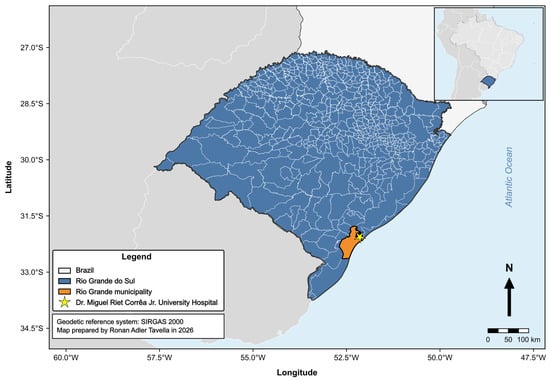
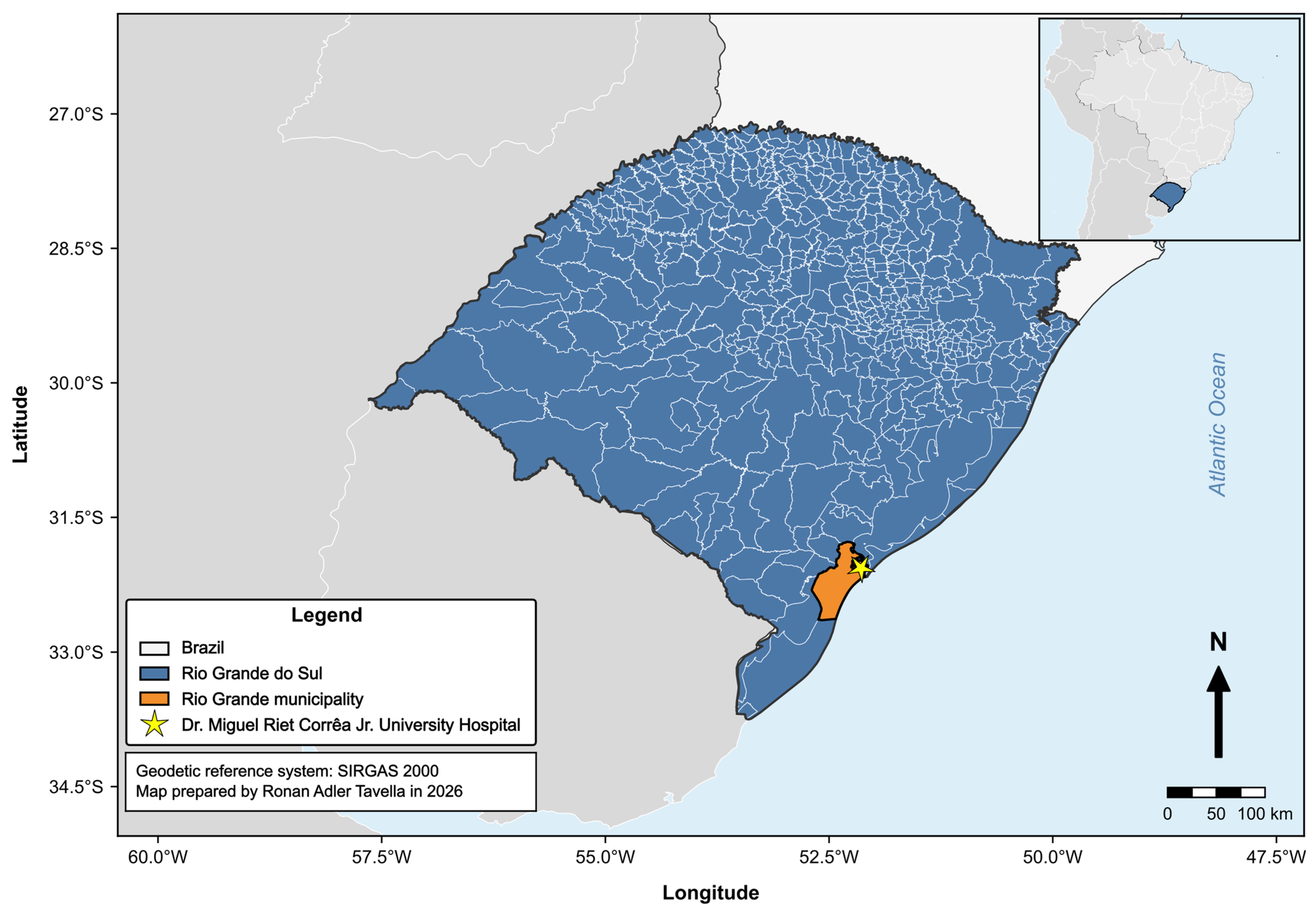
This cross-sectional study was based on a retrospective review of the medical records of patients evaluated by the pediatric cardiology service of Dr. Miguel Riet Corrêa Jr. University Hospital, Universidade Federal do Rio Grande, located in the municipality of Rio Grande, in the southern coastal region of Rio Grande do Sul, Brazil, between December 2017 and December 2018 (Figure 1). The institution is a public teaching hospital that provides healthcare through the Brazilian Unified Health System (Sistema Único de Saúde; SUS). The reporting of this study was guided by the Strengthening the Reporting of Observational Studies in Epidemiology (STROBE) statement [22].
Figure 1.
Geographic location of the municipality of Rio Grande in the state of Rio Grande do Sul, Brazil, and the location of Dr. Miguel Riet Corrêa Jr. University Hospital.
Patients aged 0–17 years who were referred and evaluated by pediatric cardiology service with suspected or previously confirmed congenital heart disease (CHD) during the study period were eligible for inclusion. All eligible medical records identified during the study period were reviewed and included in the analysis. No records were excluded.
2.2. Data Collection and CHD Classification
Data were retrieved from the hospital’s Medical Archive and Statistics Service using a standardized data collection procedure. The variables extracted from the medical records included age, age at referral, sex, primary and secondary reasons for referral, referring healthcare facility, main clinical symptom, performance of echocardiography, need for hospitalization, family history of heart disease, presence of other diseases, treatment received, ongoing clinical follow-up, school performance, age-appropriate development, confirmation of CHD, and classification of CHD as cyanotic or acyanotic. Referring healthcare facilities were categorized as neonatal intensive care unit, maternity unit, pediatric outpatient clinic, primary health care unit, or other. The main symptom was categorized as asymptomatic, fatigue, cyanosis, dyspnea, chest pain, palpitations/tachycardia, or other. The medical records were manually reviewed to identify inconsistencies and incomplete information before statistical analysis.
Confirmed CHD status and classification as cyanotic or acyanotic were determined according to the final diagnosis documented by the pediatric cardiology team in the medical record and supported by the recorded echocardiographic findings. This record-based definition was retained as the primary operational classification because the study aimed to describe the diagnostic profile documented by the service. Patent foramen ovale (PFO) and small atrial or ventricular septal defects were therefore included when retained as the final cardiac diagnosis. Repaired CHD was classified according to the underlying congenital lesion, and mixed lesions were grouped as multiple/combined findings. Mutually exclusive categories were constructed for analysis: no CHD, acyanotic CHD, and cyanotic CHD. For patients categorized as without confirmed CHD, the classification reflected the final pediatric cardiology assessment documented after clinical evaluation and any complementary tests performed; echocardiography was not performed uniformly in this group.
Age-appropriate development was classified as a secondary outcome according to age-specific developmental milestones from the Brazilian Ministry of Health Child Health Booklet (Caderneta de Saúde da Criança) and Adolescent Health Booklet (Caderneta de Saúde do Adolescente) [23,24]. The same researcher (FSV) applied these criteria to the developmental information available for each patient and classified development as appropriate or not appropriate for age (yes or no), so that the same classification procedure was used across the study population. This assessment represented developmental surveillance rather than a formal neuropsychological diagnostic evaluation. School performance was classified as excellent/good, regular, poor, or not reported. The exploratory secondary analysis focused on the association between CHD category and age-appropriate development. Age at evaluation, sex, and family history of heart disease were selected for the adjusted model based on their clinical relevance as baseline covariates and the consistency of their documentation in the medical records. Family history of heart disease included any cardiac condition documented among first- or second-degree relatives, was not restricted to CHD, and was analyzed as no, yes, or unknown.
Because the study population consisted of children and adolescents referred to a specialized pediatric cardiology service rather than a defined population-based cohort, no regional incidence or prevalence estimate was calculated.
2.3. Statistical Analysis
Categorical variables were summarized as absolute and relative frequencies using the number of available observations for each variable as the denominator. Differences between patients with and without confirmed CHD were evaluated using the chi-square test or Fisher’s exact test, as appropriate. Echocardiography rates were reported descriptively because echocardiographic findings contributed to diagnostic confirmation. As an exploratory secondary analysis, factors associated with age-appropriate development were examined using bivariable and multivariable Poisson regression models with robust variance estimation. The results were expressed as prevalence ratios (PRs) with 95% confidence intervals (CIs). CHD was represented by one mutually exclusive categorical variable, with no CHD as the reference category and separate categories for acyanotic and cyanotic CHD. The adjusted model simultaneously included age at evaluation, sex, family history of heart disease, and CHD category. Age at evaluation was entered as a continuous variable in months. Female sex, no family history of heart disease, and no CHD were the reference categories. Multicollinearity between age at evaluation and age at referral was assessed using the Pearson correlation coefficient and variance inflation factors (VIFs).
Four sensitivity analyses were performed. First, patients with isolated PFO were reclassified as having no CHD under a more restrictive PFO-excluded definition because isolated PFO is a frequent incidental finding in children and is generally not hemodynamically significant [25]. Second, the adjusted analysis was restricted to patients who underwent echocardiography. Third, age at evaluation was modeled using four clinically meaningful categories (0–12, 13–24, 25–60, and >60 months), with 0–12 months as the reference category. Fourth, a stricter structural CHD definition was applied, retaining only identifiable congenital structural defects documented in the diagnosis or echocardiographic findings. Isolated PFO and findings without a clearly documented congenital structural defect, including dilated cardiomyopathy and isolated valvular regurgitation, did not qualify. Repaired defects and combined lesions were retained when a qualifying defect was documented. The recorded cyanotic/acyanotic classification was preserved, and patients without a documented qualifying defect formed the reference category. The other covariates and robust-variance Poisson regression specification were retained in all sensitivity models. No CHD was the reference category in the primary, echocardiography-restricted, and alternative age models; no CHD under the PFO-excluded definition was the reference category when isolated PFO was excluded.
Records with missing information for a particular variable were excluded only from the analysis involving that variable, and no missing values were imputed. Crude models used all observations available for each variable, whereas the adjusted model used complete cases for all included covariates. All tests were two-sided, and a p value < 0.05 was considered statistically significant. Statistical analyses were performed using SPSS version 11.0 (SPSS Inc., Chicago, IL, USA).
2.4. Ethical Considerations
The study was conducted in accordance with the Declaration of Helsinki and Brazilian National Health Council Resolution No. 466/2012. The study protocol was approved by the Research Ethics Committee of the Universidade Federal do Rio Grande (CEP/FURG; approval number 3.746.217). All data used in the analyses were handled confidentially and reported without information that could identify individual patients.
3. Results
A total of 263 medical records of patients referred to and evaluated by the pediatric cardiology service during the study period were included. No eligible medical records were excluded, although the number of available observations varied across some variables because of missing information. The clinical and epidemiological profile of the patients is presented in Table 1, with variable-specific denominators.
Table 1.
Demographic, referral, and health characteristics of the study population.
Among the 263 referred patients, 128 (48.7%) had confirmed CHD, of whom 16% had cyanotic CHD and 84% had acyanotic CHD. Suspected heart disease was the most frequent reason for referral (64%), followed by established heart disease (21%) and cardiological opinion (13%). Echocardiography was performed in all patients with confirmed CHD compared with 24% of those without CHD, and hospitalization was more frequent among patients with confirmed CHD than among those without CHD (52% vs. 21%; p < 0.001).
Referral source was available for 262 patients. Pediatric outpatient clinics were the most frequent source (43.5%), followed by maternity units (19.8%), neonatal intensive care units (17.6%), and primary health care units (13.0%). Among patients without confirmed CHD, 76.9% were referred for suspected heart disease and 17.2% for cardiological opinion; 59.3% were asymptomatic, while fatigue (17.8%), chest pain (6.7%), cyanosis (5.9%), and palpitations/tachycardia (5.2%) were the most frequent recorded symptoms. The documented echocardiographic findings among the 128 patients with confirmed CHD are presented in Table 2. Isolated patent foramen ovale was the most frequent finding (37/128; 28.9%), followed by multiple/combined findings (21/128; 16.4%) and isolated atrial septal defect (17/128; 13.3%).
Table 2.
Documented echocardiographic findings among patients with confirmed CHD according to the record-based definition (n = 128).
Table 3 presents the exploratory secondary analysis of factors evaluated in relation to age-appropriate development. Developmental information was available for 256 patients, of whom 39 (15.2%) were classified as not having age-appropriate development Age at referral was strongly correlated with age at evaluation (Pearson r = 0.892) and, when both variables were entered in the initial model, their VIFs were 5.17 and 5.24, respectively. Therefore, age at referral was excluded from the adjusted model. Age at evaluation showed a small inverse association with age-appropriate development in both the crude (p = 0.006) and adjusted analyses (p = 0.014). No statistically significant association was detected between the overall CHD category and age-appropriate development after adjustment (p = 0.122). The estimate for cyanotic CHD suggested a lower prevalence of age-appropriate development than no CHD, but the confidence interval included the null and the estimate was imprecise (adjusted PR 0.745; 95% CI 0.553–1.002). Sex and family history of heart disease were not associated with age-appropriate development in either the crude or adjusted models.
Table 3.
Exploratory Poisson regression analysis to assess factors associated with age-appropriate development.
In the sensitivity analysis, presented in Table 4, excluding isolated PFO, 91 of 263 patients (34.6%) met the more restrictive PFO-excluded CHD definition; 73 (80.2%) were classified as acyanotic and 18 (19.8%) as cyanotic. Hospitalization remained more frequent among patients meeting this definition than among those who did not (48.4% vs. 29.6%; p = 0.003). The adjusted estimate for cyanotic CHD remained in the same direction as the primary analysis (PR 0.708; 95% CI 0.493–1.017), although the estimate remained imprecise. In the echocardiography-restricted analysis, the overall CHD-category association was statistically significant (p = 0.028), and the estimate for cyanotic CHD remained inverse, with a confidence interval excluding the null (PR 0.693; 95% CI 0.506–0.949). Modeling age in categories did not materially change the CHD estimates. Under the stricter structural CHD definition, 75 patients (28.5%) met the criteria, predominantly acyanotic (61/75, 81.3%). Hospitalization remained more frequent among these patients than in the reference group (46.7% vs. 31.9%; p = 0.032). The adjusted developmental estimates remained in the same direction, with no statistically significant overall association (p = 0.175).
Table 4.
Sensitivity analyses of the association between CHD category and age-appropriate development.
4. Discussion
The substantial burden of disease caused by CHD continues to direct efforts toward better understanding this condition and improving the care provided to affected children. In this regard, our main findings characterize both the diagnostic profile and healthcare demands of children reaching specialized pediatric cardiology care. Among 263 referred patients, CHD was confirmed in 48.7%, predominantly acyanotic (84%). Suspected heart disease was the most frequent reason for referral (64%), echocardiography was performed in all patients with confirmed CHD, and hospitalization was substantially more frequent among patients with confirmed CHD than among those without CHD (52% vs. 21%). In the exploratory secondary analysis, no statistically significant association was detected between the overall CHD category and age-appropriate development after adjustment; however, the estimate for cyanotic CHD suggested a lower prevalence of the outcome, but its confidence interval included the null and the estimate was imprecise. Age at evaluation showed a small inverse association with the outcome.
Dissimilarities in the definition of CHD, study methods, diagnostic capacity, and population characteristics have led to a wide range of estimates of CHD occurrence [2,5,6,7]. Hoffman and Kaplan [5], in their landmark review, reported values ranging from 4 to 50 cases per 1000 live births, demonstrating the substantial variability among studies. In 2011, van der Linde et al. [6] performed a systematic review and meta-analysis and estimated a global birth prevalence of 9.1 cases per 1000 live births. This estimate is similar to that reported in the updated global review by Liu et al. [7], which also described an increase in reported birth prevalence over time and considerable differences among world regions. Although these population-based estimates are important for characterizing disease burden, service-based studies provide complementary information on referral patterns, diagnostic confirmation, and healthcare utilization among patients who reach specialized care.
In this sense, studies still do not provide complete consensus regarding the epidemiology of CHD and its cyanotic and acyanotic presentations. In the present service-based study, CHD was confirmed in 48.7% of children and adolescents evaluated at the service under the record-based operational definition, and acyanotic cases were considerably more frequent than cyanotic cases. The predominance of acyanotic CHD is consistent with the broader spectrum and greater frequency of these lesions in pediatric populations [8]. Isolated PFO accounted for 28.9% of the primary CHD category. Because isolated PFO is commonly detected incidentally in otherwise healthy children and generally requires neither treatment nor follow-up [25], the sensitivity analysis reclassified these cases as no CHD under the PFO-excluded definition. The proportion classified as CHD decreased to 34.6% after excluding isolated PFO and to 28.5% under the stricter structural definition. Both analyses retained the predominance of acyanotic lesions and the higher frequency of hospitalization. This difference demonstrates the importance of the operational definition when describing the diagnostic profile of a referred service population. Importantly, these findings that nearly half of referred patients had confirmed CHD highlight the diagnostic role of specialized pediatric cardiology within the referral pathway.
Referral patterns provide additional insight into how the specialized service was used. Suspected heart disease accounted for 64% of referrals, followed by established heart disease (21%) and cardiological opinion (13%), indicating that most patients reached the service before a definitive cardiac diagnosis. Pediatric outpatient clinics were the main referral source, while referrals from neonatal in-tensive care units were more frequent among patients with confirmed CHD. Among patients without confirmed CHD, more than three quarters were referred for suspected heart disease, and most were asymptomatic or had nonspecific symptoms. The importance of specialist assessment after initial clinical suspicion has also been highlighted in Brazilian pediatric cardiology studies [18]. In our sample, echocardiography was performed in all patients with confirmed CHD compared with 24% of those without CHD. Because echocardiography contributed to diagnostic confirmation, this pattern reflects the diagnostic pathway and was not treated as an independent indicator of healthcare utilization. For the remaining patients, the absence of confirmed CHD reflected the final pediatric cardiology assessment rather than uniform echocardiographic exclusion. Consequently, small or clinically silent structural lesions may have been missed among patients who did not undergo echocardiography. The echocardiography-restricted sensitivity analysis produced stronger inverse estimates, including a confidence interval that excluded the null for cyanotic CHD; however, this analysis cannot eliminate concerns regarding differential ascertainment because echocardiography was requested selectively according to the clinical context and the restricted no-CHD subgroup was small. Hospitalization was more frequent among patients with confirmed CHD than among those without CHD (52% vs. 21%), indicating greater healthcare needs in this service population. Brazilian studies have also identified discrepancies across birth, hospitalization, and mortality records [13,14,15,16], while hospital-based investigations have emphasized the influence of diagnostic ascertainment on the identification of CHD [13,17,18]. Pulse oximetry screening can support the early detection of critical CHD [26], and updated recommendations emphasize its integration with prenatal assessment and clinical examination [27]. The implementation of screening policies has also been associated with reductions in early infant cardiac deaths [28]. Together, these strategies may strengthen early detection and timely access to specialized care.
Approximately 36% of patients with available age information were infants aged 12 months or younger, whereas 64% were older than 12 months. Because the service included referred patients from birth through 17 years of age with suspected or established disease, this distribution may reflect both the referral mix and ongoing follow-up rather than delayed diagnosis alone. Prenatal diagnosis, neonatal assessment, and pulse oximetry screening may also influence age at referral, but these variables were not available in the medical records.
CHD is recognized to be associated with adverse neurological, cognitive, motor, and educational outcomes, particularly among children with complex or cyanotic defects [8,9,10,11,12,19,20,21]. In our exploratory secondary analysis, no statistically significant overall association was detected between CHD category and age-appropriate development after adjustment. Compared with patients without CHD, the estimate for cyanotic CHD suggested a lower adjusted prevalence of age-appropriate development (PR 0.745; 95% CI 0.553–1.002). However, the confidence interval included the null, the estimate was imprecise, and only 21 patients were classified as having cyanotic CHD. Sensitivity analyses excluding isolated PFO, applying the stricter structural CHD definition, restricting the sample to patients who underwent echocardiography, and modeling age in categories produced estimates in the same direction, but their precision and magnitude varied. These findings therefore remain exploratory and require confirmation in larger studies with standardized diagnostic and developmental assessment. Age at evaluation showed a small inverse association per month, which may partly reflect differences in the opportunity to recognize and document developmental concerns at different ages rather than a causal age effect. When age was modeled in four categories, the CHD estimates were materially unchanged, reducing concern that the primary result was driven by the linear age specification. This finding should be interpreted in the context of developmental surveillance rather than a formal neuropsychological assessment. Developmental outcomes in children with CHD are multifactorial and may be influenced by lesion complexity, perioperative factors, genetic conditions, nutritional status, quality and timing of medical care, family and social interaction, education, housing conditions, and other socioeconomic determinants [10,12,29]. The absence of a statistically significant overall association in the present study may therefore reflect both the heterogeneity of CHD and the broad nature of the developmental classification used.
Regardless of advances in knowledge and care involving CHD, the continued study of these conditions, including in specific health services, remains important because CHD continues to contribute substantially to childhood morbidity and mortality [30,31]. The information derived from this study may help healthcare professionals and decision-makers understand referral patterns and plan specialized care. However, the study has limitations inherent to its cross-sectional design and retrospective medical record review, and no temporal sequence between the evaluated variables can be established. Because the sample comprised patients referred to a single specialized service, the findings characterize that service population and cannot be used to estimate regional prevalence or incidence. The broad record-based CHD definition and nonuniform echocardiographic verification may have influenced diagnostic classification, but the sensitivity analyses, using more restrictive definitions and restricting the sample to patients who underwent echocardiography yielded developmental estimates in the same direction, although their magnitude and precision varied. Age-appropriate development was classified by the same researcher using age-specific developmental surveillance criteria from the Brazilian Ministry of Health child and adolescent health booklets rather than a formal neuropsychological diagnostic instrument, and only 39 of 256 with available information were classified as not having age-appropriate development. Moreover, the adjusted analysis was restricted to variables documented with sufficient consistency in the medical records. In this sense, genetic diagnoses, lesion complexity, perioperative factors, nutritional status, socioeconomic conditions, education, and family environment were not documented in the medical records. Therefore, residual confounding is possible and the adjusted estimates should be interpreted as exploratory associations rather than causal effects. In addition, the 2017–2018 data provide a pre-pandemic baseline for this public service but may not reflect current referral organization or diagnostic practices Nevertheless, the study provides regional evidence from a public pediatric cardiology service and identifies areas in which referral pathways, diagnostic assessment, and clinical documentation can be strengthened.
5. Conclusions
The clinical and epidemiological profile of children and adolescents referred to the pediatric cardiology service was characterized. Under the record-based operational definition, CHD was confirmed in 48.7% of patients and was predominantly acyanotic. Suspected heart disease was the main reason for referral. Patients with confirmed CHD were more frequently hospitalized, and all had undergone echocardiography. In the exploratory secondary adjusted analysis, no statistically significant association was detected between the overall CHD category and age-appropriate development. The estimate for cyanotic CHD suggested a lower prevalence, but the confidence interval included the null and the estimate was imprecise, based on a small subgroup. These findings characterize the diagnostic and healthcare demands of a public pediatric cardiology service and may support improvements in referral pathways, clinical documentation, and the planning of specialized care for patients with CHD.
Author Contributions
Conceptualization, F.S.V. and F.M.R.d.S.J.; methodology, F.S.V., R.F.F., F.L., P.A., R.A.T. and F.M.R.d.S.J.; validation, F.S.V. and F.M.R.d.S.J.; formal analysis, F.S.V. and R.A.T.; investigation, F.S.V., R.F.F., F.L. and P.A.; resources, F.M.R.d.S.J.; data curation, F.S.V., R.F.F., F.L. and P.A.; writing—original draft preparation, F.S.V., R.A.T. and F.M.R.d.S.J.; writing—review and editing, F.S.V., R.A.T. and F.M.R.d.S.J.; visualization, R.A.T.; supervision, F.M.R.d.S.J.; project administration, F.M.R.d.S.J. All authors have read and agreed to the published version of the manuscript.
Funding
This research received no external funding.
Institutional Review Board Statement
The study was conducted in accordance with the Declaration of Helsinki and Brazilian National Health Council Resolution No. 466/2012 and was approved by the Research Ethics Committee of the Universidade Federal do Rio Grande (CEP/FURG; approval number 3.746.217; date 5 December 2019).
Informed Consent Statement
Patient informed consent was waived by the Research Ethics Committee of the Universidade Federal do Rio Grande because of the retrospective design of the study, which involved the analysis of existing medical records, and because all data were analyzed in anonymized form.
Data Availability Statement
The data presented in this study are available from the corresponding author upon reasonable request.
Acknowledgments
This research was supported by Coordenação de Aperfeiçoamento de Pessoal de Nível Superior—Brasil (CAPES) Finance Code 001 and Conselho Nacional de Desenvolvimento Científico e Tecnológico—Research Productivity Fellowship, grant number 307791/2023-8. During the preparation of this manuscript, the authors used ChatGPT (GPT-5.6; OpenAI, San Francisco, CA, USA) for language polishing. The authors have reviewed and edited the output and take full responsibility for the content of this publication.
Conflicts of Interest
The authors declare no conflicts of interest.
Abbreviations
The following abbreviations are used in this manuscript:
| CHD | Congenital heart disease |
| CI | Confidence interval |
| PR | Prevalence ratio |
| SINASC | Brazilian Live Birth Information System (Sistema de Informações sobre Nascidos Vivos) |
| SPSS | Statistical Package for the Social Sciences |
| SUS | Brazilian Unified Health System (Sistema Único de Saúde) |
References
- Gross, R.E.; Hubbard, J.P. Surgical ligation of a patent ductus arteriosus: Report of first successful case. JAMA 1939, 112, 729–731. [Google Scholar] [CrossRef] [Scilit]
- van der Bom, T.; Zomer, A.C.; Zwinderman, A.H.; Meijboom, F.J.; Bouma, B.J.; Mulder, B.J.M. The changing epidemiology of congenital heart disease. Nat. Rev. Cardiol. 2011, 8, 50–60. [Google Scholar] [CrossRef] [Scilit] [PubMed]
- Roth, G.A.; Mensah, G.A.; Johnson, C.O.; Addolorato, G.; Ammirati, E.; Baddour, L.M.; Barengo, N.C.; Beaton, A.Z.; Benjamin, E.J.; Benziger, C.P.; et al. Global burden of cardiovascular diseases and risk factors, 1990–2019: Update from the GBD 2019 Study. J. Am. Coll. Cardiol. 2020, 76, 2982–3021. [Google Scholar] [CrossRef] [Scilit] [PubMed]
- GBD 2017 Congenital Heart Disease Collaborators. Global, regional, and national burden of congenital heart disease, 1990–2017: A systematic analysis for the Global Burden of Disease Study 2017. Lancet Child Adolesc. Health 2020, 4, 185–200. [Google Scholar] [CrossRef] [Scilit] [PubMed]
- Hoffman, J.I.E.; Kaplan, S. The incidence of congenital heart disease. J. Am. Coll. Cardiol. 2002, 39, 1890–1900. [Google Scholar] [CrossRef] [Scilit] [PubMed]
- van der Linde, D.; Konings, E.E.M.; Slager, M.A.; Witsenburg, M.; Helbing, W.A.; Takkenberg, J.J.M.; Roos-Hesselink, J.W. Birth prevalence of congenital heart disease worldwide: A systematic review and meta-analysis. J. Am. Coll. Cardiol. 2011, 58, 2241–2247. [Google Scholar] [CrossRef] [Scilit] [PubMed]
- Liu, Y.; Chen, S.; Zühlke, L.; Black, G.C.; Choy, M.K.; Li, N.; Keavney, B.D. Global birth prevalence of congenital heart defects 1970–2017: Updated systematic review and meta-analysis of 260 studies. Int. J. Epidemiol. 2019, 48, 455–463. [Google Scholar] [CrossRef] [Scilit] [PubMed]
- Rohit, M.; Shrivastava, S. Acyanotic and cyanotic congenital heart diseases. Indian J. Pediatr. 2018, 85, 454–460. [Google Scholar] [CrossRef] [Scilit] [PubMed]
- Linde, L.M.; Rasof, B.; Dunn, O.J. Mental development in congenital heart disease. J. Pediatr. 1967, 71, 198–203. [Google Scholar] [CrossRef] [Scilit] [PubMed]
- Sood, E.; Newburger, J.W.; Anixt, J.S.; Cassidy, A.R.; Jackson, J.L.; Jonas, R.A.; Lisanti, A.J.; Lopez, K.N.; Peyvandi, S.; Marino, B.S. Neurodevelopmental outcomes for individuals with congenital heart disease: Updates in neuroprotection, risk-stratification, evaluation, and management: A scientific statement from the American Heart Association. Circulation 2024, 149, e997–e1022. [Google Scholar] [CrossRef] [Scilit] [PubMed]
- Spillmann, R.; Polentarutti, S.; Ehrler, M.; Kretschmar, O.; Wehrle, F.M.; Latal, B. Congenital heart disease in school-aged children: Cognition, education, and participation in leisure activities. Pediatr. Res. 2023, 94, 1523–1529. [Google Scholar] [CrossRef] [Scilit] [PubMed]
- Wernovsky, G.; Licht, D.J. Neurodevelopmental outcomes in children with congenital heart disease—What can we impact? Pediatr. Crit. Care Med. 2016, 17, S232–S242. [Google Scholar] [CrossRef] [Scilit] [PubMed]
- Pinto Júnior, V.C.; Branco, K.M.P.C.; Cavalcante, R.C.; Carvalho Junior, W.; Lima, J.R.C.; Freitas, S.M.; Fraga, M.N.O.; Souza, N.M.G. Epidemiology of congenital heart disease in Brazil: Approximation of the official Brazilian data with the literature. Rev. Bras. Cir. Cardiovasc. 2015, 30, 219–224. [Google Scholar] [CrossRef] [Scilit] [PubMed][Green Version]
- Fernandes, P.S.; Magalhães, L.R.; Pezzini, T.R.; de Sousa Santos, E.F.; Calderon, M.G. Congenital heart diseases trends in São Paulo State, Brazil: A national live birth data bank analysis. World J. Pediatr. 2022, 18, 472–481. [Google Scholar] [CrossRef] [Scilit] [PubMed]
- Catarino, C.F.; Gomes, M.A.S.M.; Gomes Junior, S.C.S.; Magluta, C. Registros de cardiopatia congênita em crianças menores de um ano nos sistemas de informações sobre nascimento, internação e óbito do estado do Rio de Janeiro, 2006–2010. Epidemiol. Serv. Saude 2017, 26, 535–543. [Google Scholar] [CrossRef] [Scilit] [PubMed]
- Madruga, I.; Moraes, T.D.; Prado, C.; Baldini, C.E.S.; Braga, A.L.F. Associated factors with congenital heart disease in the most populated state of Brazil between 2010 and 2018. Int. J. Cardiovasc. Sci. 2023, 36, e20210283. [Google Scholar] [CrossRef] [Scilit]
- Rocha, L.A.; Froio, S.C.; Silva, C.C.; Figueira, S.D.A.N.; Guilhen, J.C.S.; Guinsburg, R.; Araujo Júnior, E. Risk factors for mortality in children with congenital heart disease delivered at a Brazilian tertiary center. Braz. J. Cardiovasc. Surg. 2018, 33, 603–607. [Google Scholar] [CrossRef] [Scilit] [PubMed]
- Rivera, I.R.; Silva, M.A.M.; Fernandes, J.M.G.; Thomaz, A.C.P.; Soriano, C.F.R.; Souza, M.G.B. Cardiopatia congênita no recém-nascido: Da solicitação do pediatra à avaliação do cardiologista. Arq. Bras. Cardiol. 2007, 89, 6–10. [Google Scholar] [CrossRef] [Scilit] [PubMed][Green Version]
- Mari, M.A.; Cascudo, M.M.; Alchieri, J.C. Congenital heart disease and impacts on child development. Braz. J. Cardiovasc. Surg. 2016, 31, 31–37. [Google Scholar] [CrossRef] [Scilit] [PubMed]
- Paula, Í.R.; Oliveira, J.C.S.; Batista, A.C.F.; Nascimento, L.C.S.; Araújo, L.B.; Ferreira, M.B.; Gomes, M.B.; Azevedo, V.M.G.O. Influence of congenital heart disease on the neuropsychomotor development of infants. Fisioter. Pesqui. 2020, 27, 41–47. [Google Scholar] [CrossRef] [Scilit]
- Vignol, F.S.; Aikawa, P.; da Silveira, T.B.; Tavella, R.A.; Mahtani-Chugani, V.; Sanz, E.J.; da Silva Júnior, F.M.R. Neurodevelopmental outcomes among Brazilian children with cyanotic congenital heart disease and its associated factors. Medicina 2022, 58, 1669. [Google Scholar] [CrossRef] [Scilit] [PubMed]
- von Elm, E.; Altman, D.G.; Egger, M.; Pocock, S.J.; Gøtzsche, P.C.; Vandenbroucke, J.P.; STROBE Initiative. The Strengthening the Reporting of Observational Studies in Epidemiology (STROBE) statement: Guidelines for reporting observational studies. Lancet 2007, 370, 1453–1457. [Google Scholar] [CrossRef] [Scilit] [PubMed]
- Brasil. Ministério da Saúde. Caderneta da Criança. Available online: https://www.gov.br/saude/pt-br/assuntos/saude-de-a-a-z/s/saude-da-crianca/caderneta (accessed on 7 September 2026).
- Brasil. Ministério da Saúde. Cadernetas e Cartões—Caderneta de Saúde do Adolesecente. Available online: https://www.gov.br/saude/pt-br/composicao/saps/publicacoes/cadernetas-e-cartoes (accessed on 7 September 2026).
- Saharan, S.; Vettukattil, J.; Bhat, A.; Amula, V.; Bansal, M.; Chowdhury, D.; Dyamenahalli, U.; Gupta, S.K.; Das, B.; Kumar, T.K.S.; et al. Patent foramen ovale in children: Unique pediatric challenges and lessons learned from adult literature. Ann. Pediatr. Cardiol. 2022, 15, 44–52. [Google Scholar] [CrossRef] [Scilit] [PubMed]
- Plana, M.N.; Zamora, J.; Suresh, G.; Fernandez-Pineda, L.; Thangaratinam, S.; Ewer, A.K. Pulse oximetry screening for critical congenital heart defects. Cochrane Database Syst. Rev. 2018, 3, CD011912. [Google Scholar] [CrossRef] [Scilit] [PubMed]
- Oster, M.E.; Pinto, N.M.; Pramanik, A.K.; Markowsky, A.; Schwartz, B.N.; Kemper, A.R.; Hom, L.A.; Martin, G.R.; Section on Cardiology and Cardiac Surgery; Section on Hospital Medicine; et al. Newborn screening for critical congenital heart disease: A new algorithm and other updated recommendations: Clinical report. Pediatrics 2025, 155, e2024069667. [Google Scholar] [CrossRef] [Scilit] [PubMed]
- Abouk, R.; Grosse, S.D.; Ailes, E.C.; Oster, M.E. Association of US state implementation of newborn screening policies for critical congenital heart disease with early infant cardiac deaths. JAMA 2017, 318, 2111–2118. [Google Scholar] [CrossRef] [Scilit] [PubMed]
- Davey, B.; Sinha, R.; Lee, J.H.; Gauthier, M.; Flores, G. Social determinants of health and outcomes for children and adults with congenital heart disease: A systematic review. Pediatr. Res. 2021, 89, 275–294. [Google Scholar] [CrossRef] [Scilit] [PubMed]
- Cabral, J.V.B.; Guimarães, A.L.S.; Sobral Filho, D.C.; Santos, A.C.O. Mortality due to congenital heart disease in Pernambuco from 1996 to 2016. Rev. Assoc. Médica Bras. 2020, 66, 931–936. [Google Scholar] [CrossRef] [Scilit] [PubMed]
- Su, Z.; Zou, Z.; Hay, S.I.; Liu, Y.; Li, S.; Chen, H.; Naghavi, M.; Zimmerman, M.S.; Martin, G.R.; Wilner, L.B.; et al. Global, regional, and national time trends in mortality for congenital heart disease, 1990–2019: An age-period-cohort analysis for the Global Burden of Disease 2019 study. EClinicalMedicine 2022, 43, 101249. [Google Scholar] [CrossRef] [Scilit] [PubMed]

Disclaimer/Publisher’s Note: The statements, opinions and data contained in all publications are solely those of the individual author(s) and contributor(s) and not of MDPI and/or the editor(s). MDPI and/or the editor(s) disclaim responsibility for any injury to people or property resulting from any ideas, methods, instructions or products referred to in the content. |
© 2026 by the authors. Licensee MDPI, Basel, Switzerland. This article is an open access article distributed under the terms and conditions of the Creative Commons Attribution (CC BY) license.