


Abstract
This study aimed to optimize the nitriding parameters for Plasma Immersion Ion Implantation (PIII) of stainless steels. UNS S32750 super duplex stainless steel, widely employed in the petrochemical industry, was subjected to PIII under varying nitriding atmospheres (mixtures of H2 and N2) and treatment pressures. The fixed PIII nitriding parameters included a temperature of 300 °C, a duration of 3 h, a bias voltage of approximately −10 kV, a frequency of 500 Hz, and a pulse width of 30 μs. Following the treatments, the phases were characterized by X-ray diffraction (XRD), while the hardness and elastic modulus of the modified surfaces were evaluated via nanoindentation. Regarding the nitriding atmosphere, gas mixtures approaching a 60% N2/40% H2 (vol.) ratio yielded a higher volume fraction of nitrogen-rich expanded phases in solid solution. Furthermore, higher treatment pressures promoted the formation of these expanded phases, consequently enhancing the surface hardness up to 2.7 times the hardness value of the untreated sample. These findings stand in contrast to those found for low-energy plasma nitriding (PN) processes.
1. Introduction
UNS S32750 super duplex steel is used in parts of the wet Christmas tree and in oil extraction pipelines in the pre-salt layer [1,2,3]. The elevated levels of alloying elements, such as Cr, Ni, and Mo, give this material adequate corrosion resistance for extreme environments with high concentrations of Cl−, CO2, and H2S, as well as high pressure and temperature. Compared to carbon steels and martensitic stainless steels—materials often chosen for easily accessible onshore wells with mild corrosion and minimal H2S exposure—super duplex steel exhibits significantly lower mechanical properties, including hardness and wear resistance. A viable approach to enhancing the wear resistance of this material while preserving its excellent corrosion resistance—and thereby prolonging service life and lowering overall extraction costs—is the application of low-temperature plasma nitriding treatment. Furthermore, the modified layer produced by plasma nitriding can also function as an inhibitor for pitting and crevice corrosion, as well as hydrogen corrosion, depending on the phases formed. In this work, the Plasma Immersion Ion Implantation (PIII) nitriding technique was employed, which combines the effect of Plasma Immersion with Ion Implantation and allows the production of uniform modified layers, the possibility of treating samples with complex geometries, and the formation of a highly nitrogen-saturated surface layer [4,5].
Typically, the PIII technique is performed after complete evacuation of the chamber to 10−4 Pa, which then rises to pressures of about 0.1 Pa for treatment in a pure N2 atmosphere [4]. In general, these low pressures are used in PIII treatments so that the mean free path of the ions is as large as possible and there are fewer energy losses when the ion is moving through the plasma. The PIII system applied in this work, whose schematic diagram was presented in a previous report [6], was developed for working pressures on the order of 1 Pa. Such a setup provides reliable control of treatment temperatures up to approximately 450 °C, achieved through energy transfer from plasma ions to the material’s surface—significantly higher than what standard PIII systems can achieve without additional heating sources [7]. Consequently, nitrogen is incorporated during nitriding through a synergistic action of physical mechanisms (like effective implantation and creation of lattice defects) and thermochemical processes (such as ion adsorption and thermal diffusion), leading to thicker layers and a variety of microstructures for a given processing temperature [8]. In contrast to conventional low-energy plasma nitriding (PN), PIII—including the system used here—has the advantage of yielding consistently uniform modified surfaces, with no edge effects [9], in addition to smoother surfaces. For example, the average roughness for PIII-nitrided supermartensitic stainless steel surfaces is in the order of 101 nm [10], compared to 102 nm for PN [11].
Considering the high implantation energies, the competitive effect of residual oxygen could be a limiting factor in the formation of the modified layer. In this PIII experimental setup, with relatively high working pressures, preventing surface oxidation demands the catalytic action of hydrogen in the gas mixture, without this element affecting the nature of the treated surface [12].
In PN processes, such as DC, RF, or pulsed glow discharge, the combined pressure and gas composition exert a profound effect on the material’s surface features. Extensive research demonstrates that N2/H2 plasmas generate thicker and harder modified layers than pure N2 atmospheres. Moreover, N2-poor plasmas (around 50% vol., or even less) result in enhanced nitrogen retention in the near-surface region through physical and chemical adsorption, while pressure alone has less impact [13,14]. With PIII, these trends may vary due to the complexity of the mechanisms involved in layer formation. Therefore, this study makes an original contribution by examining the influence of pressure variation and the proportions of N2 and H2 in the PIII gas mixture on phase formation and mechanical properties of modified surfaces. A super duplex stainless steel, featuring both austenite and ferrite structures, was chosen for its broad application and increasing requirements for robust surface protection. Efficient surface modification remains particularly challenging for nitriding treatments in such materials [15].
2. Materials and Methods
Super duplex UNS S32750 steel samples, with a nominal chemical composition (wt.%) of 25Cr, 7Ni, 4Mo, 1.2Mn, 0.5Cu, 0.8Si, and 0.32N, and minor amounts of C, P, and S, in balance with Fe, were used [1]. The chemical composition was verified by X-ray fluorescence analysis using a Shimadzu EDX 720 spectrometer (Shimadzu, Kyoto, Japan). Samples were extracted from the cross-section of an oil pipeline, measuring 0.2 cm in thickness and at least 1.2 cm2 in area. Subsequently, the specimens underwent mechanical polishing using SiC sandpaper, diamond paste, and colloidal silica with a maximum particle size of 0.25 μm. Following preparation, the samples were subjected to two ultrasonic acetone baths, each lasting 15 min, for cleaning.
The samples were nitrided by PIII in the equipment presented in a previous work [6]. Table 1 presents the treatment parameters used in the nitriding processes. All treatments were performed at 300 °C, with a maximum variation of ±5 °C for 3 h. The pre-vacuum pressure obtained in all treatments was on the order of 0.1 Pa.
Table 1.
Nomenclature and treatment parameters for UNS S32750 super duplex steel samples used in studies with variations in nitriding atmosphere and pressure.
All treatments were conducted with a bias voltage of approximately −10 kV, a frequency of 500 Hz, and a pulse width of 30 μs. These parameters were established based on prior research [16], where the pulse waveform was characterized using an oscilloscope and probes. In that study, the nominal pulse width and source voltage ranged from 10 to 30 µs and from 6 to 10 kV, respectively. It was noted that, within the analyzed range, increasing pulse width and voltage resulted in a reduction in pulse decay time. Furthermore, a voltage of −10 kV was selected for the treatments, as this value is commonly utilized in PIII processing of stainless steels to improve both tribo-mechanical properties and corrosion resistance of treated surfaces [17,18,19,20,21].
The investigation of the nitriding atmosphere involved varying nitrogen (N2) and hydrogen (H2) mixtures, from 20% N2/80% H2 to 100% N2 by volume, with a working pressure of approximately 2 Pa. For the evaluation of treatment pressure effects, exclusively nitrogen was utilized due to its enhanced stability and suitability for broader pressure variation. In this study, pressures ranging from 1 Pa to 6 Pa were employed. Equipment constraints also arise from the composition of the nitriding atmosphere. For pure N2, the gas mixer supports a minimum flow rate of 0.5 sccm, corresponding to a pressure of about 1 Pa; in addition, the maximum stable plasma pressure is 6 Pa. Therefore, for pure N2, the operational pressure range lies between 1 Pa and 6 Pa. To maintain a constant temperature, the voltage was systematically reduced as pressure increased.
Following nitriding, X-ray diffraction (XRD) analysis was conducted using a Rigaku Ultima IV diffractometer. Diffractograms were obtained employing CuKα radiation (λ = 0.15406 nm) in Bragg–Brentano (θ-θ) geometry, with data collected over the 30° to 85° range in continuous mode at a scan rate of 1°/min. The maximum penetration depth of X-rays in this configuration is 2.5 µm, as determined using the “X-ray attenuation length” online software [22], which is based on the research of Henke et al. [23]. For these calculations, the scattered beam intensity was assumed to diminish to 1/e of the incident radiation value. Further analyses were performed in grazing mode, maintaining the angle θ at 2° with a scanning speed of 0.2°/min. Under these conditions, the X-ray penetration depth reaches a maximum of 0.1 µm.
The diffraction peaks were identified using the crystallographic cards from the ICSD (Inorganic Crystal Structure Database) numbers 33-397 (γ-austenite); 6-696 (α-ferrite); 86-231 (γ’-Fe4N); 49-1664, 72-2126 and 73-2103 (ε-Fe2–3N); 76-2494 (CrN) and 35-803 (Cr2N). The expanded austenite and expanded ferrite (γN and αN) phases were identified using literature data [17,18,24,25,26,27,28,29,30,31,32].
The hardness and elastic modulus were evaluated using a Nanoindenter XP instrument (MTS Systems Corporation, Oak Ridge, TN, USA) in accordance with the Oliver and Pharr methodology [33]. The surface roughness was measured with a conical tip on the nanoindenter using a 50 μN load. In these analyses, each indentation underwent eight loading–unloading cycles using a maximum load of 400 mN with a Berkovich-type diamond tip. For data interpretation, the contact stiffness correction method—developed specifically for rough surface analysis [34]—was applied, as the nitriding process leads to increased surface roughness.
The surfaces of the samples were analyzed using a Field Emission Scanning Electron Microscope (Tescan Mira3, Brno, Czech Republic). To measure the phase ratios, chemical etching was performed using Murakami’s reagent, and SEM images were acquired in backscattered electron (BSE) mode at various magnifications across at least three representative regions containing multiple grains. In ImageJ1.54k software [35], the “Threshold” function was applied to highlight one of the phases in the micrographs, allowing the area ratio between austenite and ferrite to be measured. A magnification of 500× was established as the lower limit to ensure a reliable correlation between the area ratios.
3. Results and Discussion
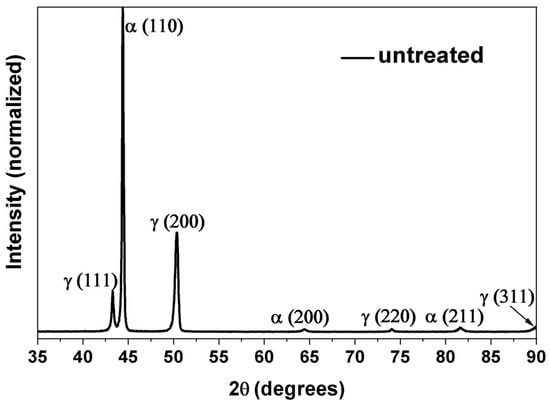
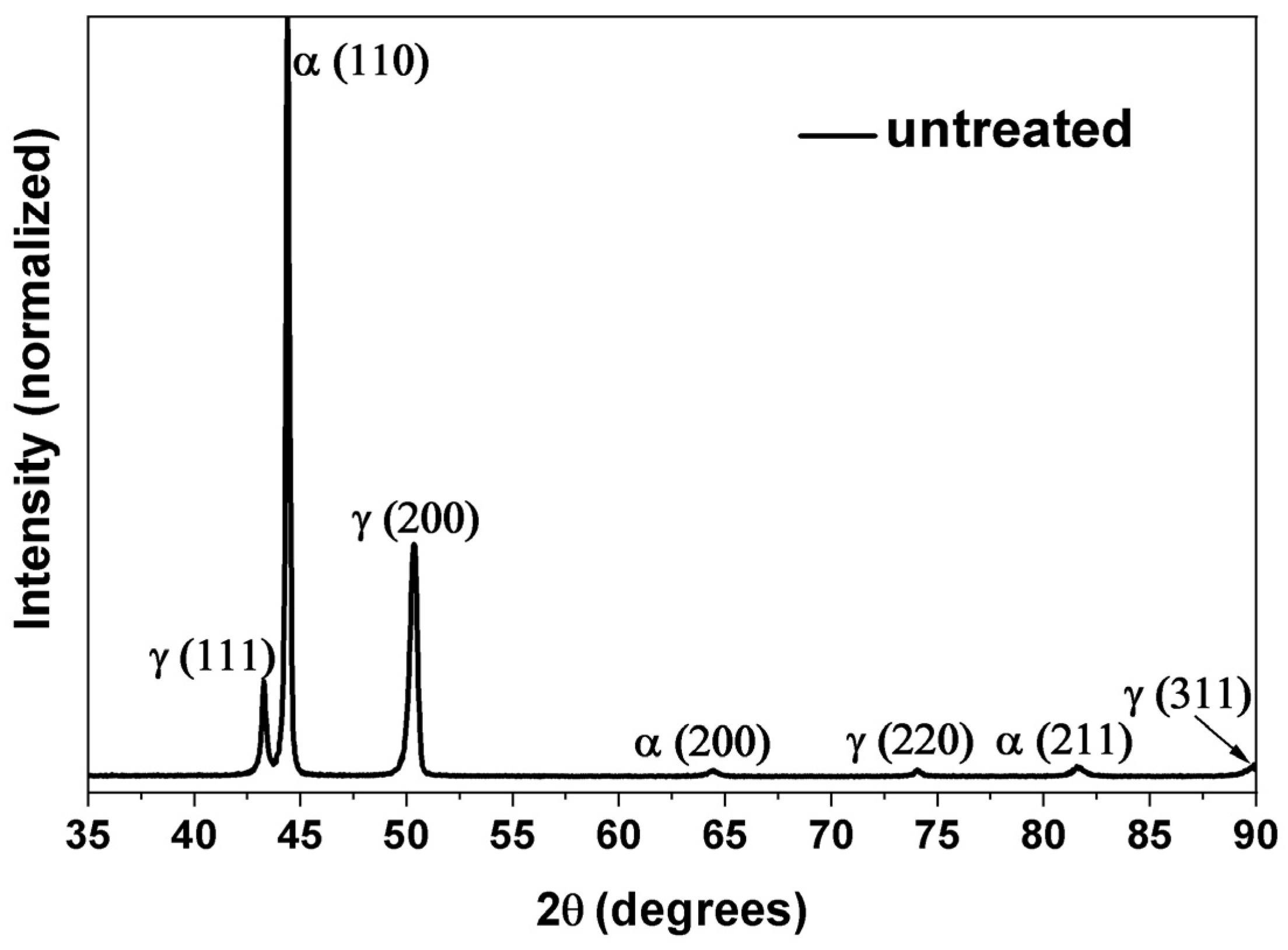
In the X-ray diffractogram of the untreated UNS S32750 steel sample (Figure 1), only the expected austenite (γ) and ferrite (α) phases are observed. The diffraction peaks corresponding to the α phase are significantly more prominent than those of the γ phase. This observation can be attributed to the structural characteristics of the respective crystal lattices and, predominantly, to the material’s texturing effect introduced during the tube manufacturing process from which the samples were extracted [36,37]. The texturing further promotes the development of preferential crystalline orientations for diffraction, resulting in increased intensity of the corresponding peaks [37].
Figure 1.
X-ray diffractogram of the untreated UNS S32750 stainless steel sample.
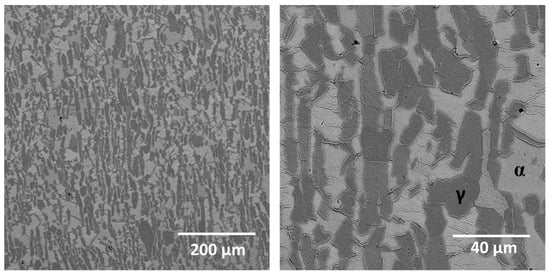
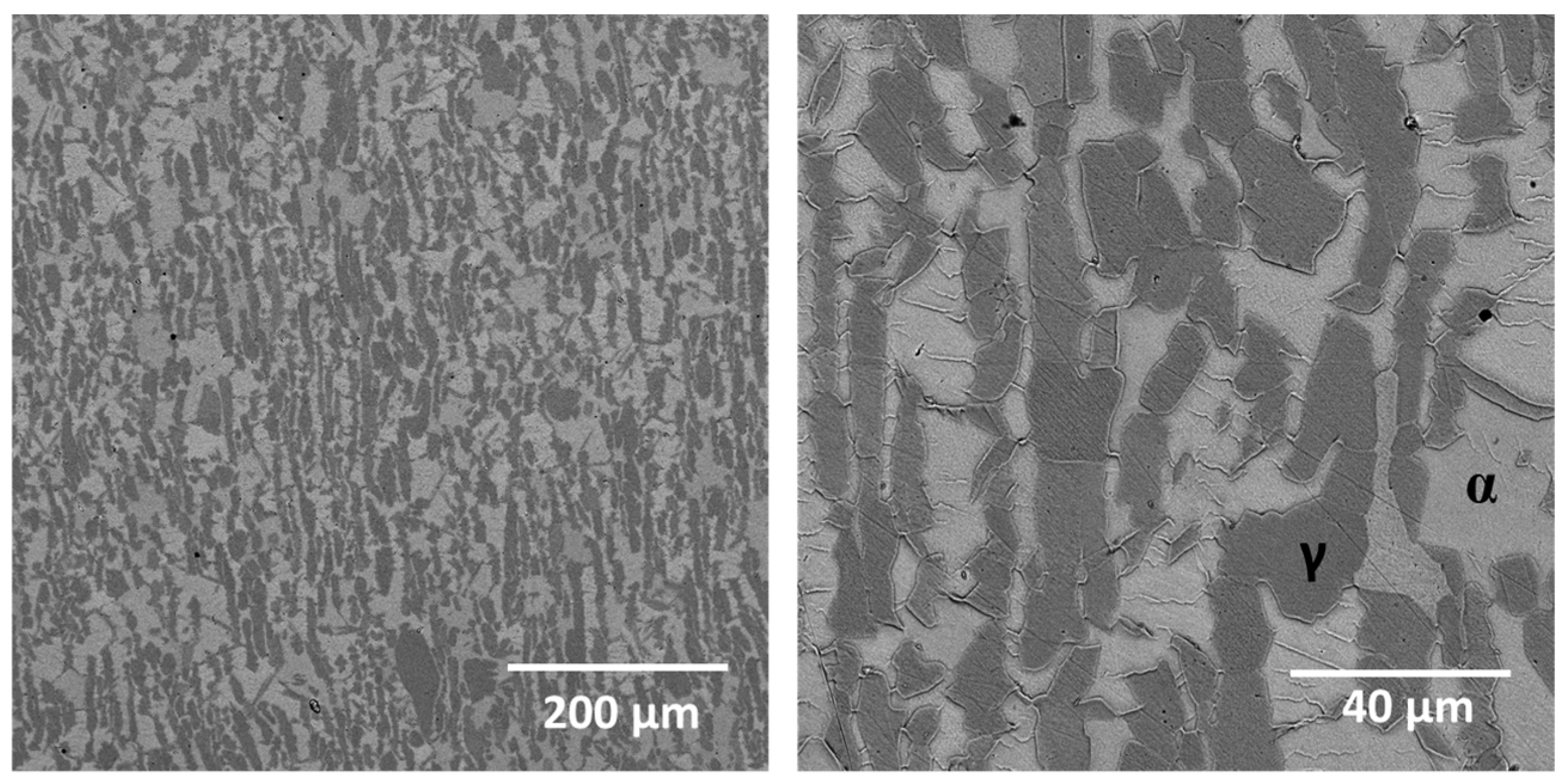
Electron microscopy images obtained in backscattered electron mode on the surfaces of the untreated samples reveal that the area-based phase proportion is 52.2 ± 2.4% austenite and 47.8 ± 2.4% ferrite. The microstructure after chemical etching is shown in Figure 2.
Figure 2.
SEM micrographs (obtained in backscattered electron mode) of the microstructure of the untreated UNS S32750 steel sample after etching with Murakami reagent. Grains of the austenite (γ) and ferrite (α) phases are observed.
3.1. Varying Gas Mixture Under Fixed Pressure
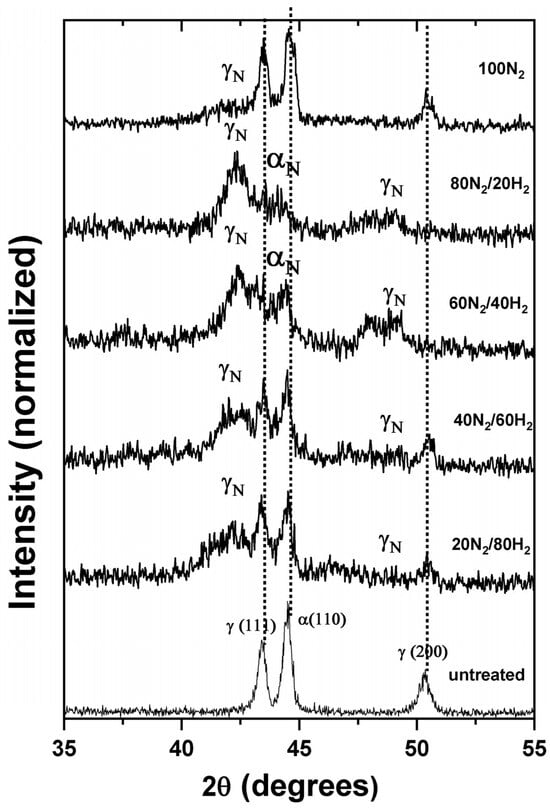
Figure 3 presents the grazing-mode X-ray diffractograms for both untreated samples and those subjected to PIII nitriding under varying atmospheres. The diffractogram corresponding to the untreated sample exhibits only the characteristic peaks of ferrite (α) and austenite (γ). Following treatment, all nitrided samples—regardless of the nitriding atmosphere—demonstrate the presence of the γN phase, also referred to as nitrogen-expanded austenite, or the S-phase. This phase signifies the supersaturation of nitrogen in solid solution within the crystal structure. Although the exact structure of this phase remains insufficiently understood, the incorporation of nitrogen in solid solution induces anisotropic deformations within the crystal lattice. These deformations generate stresses that cause the γN phase peaks to shift toward greater interplanar distances compared to those of austenite. The broadness of the γN peaks results from the superposition of multiple Fe(N) substoichiometries present in the solid nitrogen solution [17,28].
Figure 3.
X-ray diffractograms obtained in grazing geometry with θ fixed at 2 degrees for both untreated samples and those subjected to PIII nitriding under various treatment atmospheres.
It is further noted that, under the 100N2 condition, the γN phase exhibits a reduced presence in the diffractograms compared to other treatment scenarios, which can be ascribed to the absence of H2. The advantageous effect of hydrogen in nitriding is a complex phenomenon. To begin with, the electrical parameters required to maintain low-pressure RF plasma differ somewhat from those necessary for a pure N2 discharge; however, electron density remains unaffected by variations in H2 concentration. Additionally, the ion species generated in the plasma (N+, Nx+, NxHy+, Hx+) exhibit comparable energy distribution profiles [38]. The hydrogen species become accelerated toward the target due to the voltage drop across the sheath, resulting in effects analogous to those produced by nitrogen species: deflection, sputtering, secondary electron emission, thermal spikes, surface damage, and implantation. However, sputtering is influenced by the ion masses; as such, hydrogen contributes less significantly to this phenomenon than nitrogen does [39,40]. Consequently, the suppression of target oxidation through the introduction of hydrogen is primarily a chemical effect, involving the removal of active oxygen from the surrounding atmosphere [12]. Furthermore, secondary electron emission is enhanced in N2-H2 environments, which facilitates improved plasma ionization. NxHy species undergo dissociation within the plasma sheath, resulting in elevated nitrogen concentrations in this area, whereas the hydrogen content at the target remains largely unchanged. The predominant ions present in the N2-H2 RF plasma sheath under the specified pressure conditions are nitrogen species (N+ and N2+) rather than hydrogen [12,41]. Overall, introducing H2 to PIII serves multiple functions: it reacts with oxygen to prevent oxidation, facilitates the implantation of nitrogen species, and enhances nitrogen retention on the material’s surface [42].
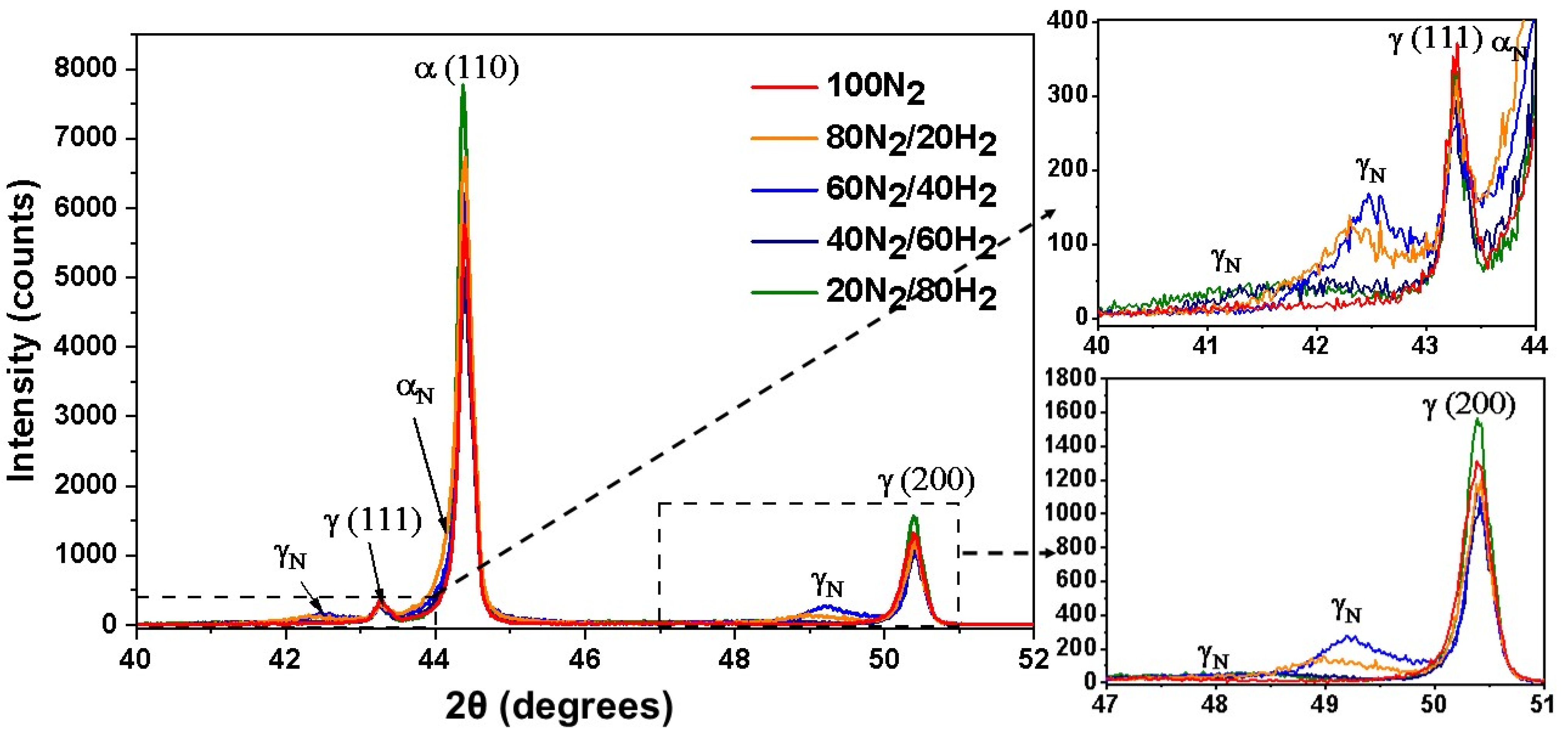
In the context of stainless steels, research indicates that the optimal condition for conventional plasma nitriding (PN) is a gas mixture consisting of 20% N2 and 80% H2 by volume [43]. Figure 2 illustrates that, during PIII treatments, employing mixtures of 60% N2/40% H2 and 80% N2/20% H2 leads to a marked reduction in γ-related peak intensities, accompanied by a significant enhancement in γN-related peak intensities. Furthermore, Figure 4 displays the diffractograms in terms of absolute counts. The γN peaks observed in the 60N2/40H2 sample demonstrate both higher area and intensity compared to those in the other samples. This observation indicates an increased level of nitrogen incorporation into the lattice within the 60N2/40H2 sample, suggesting that this atmospheric composition is more favorable for the PIII nitriding process. This N2/H2 ratio may provide an optimal balance by ensuring sufficient nitrogen in the plasma sheath while also considering the effect of hydrogen partial pressure in the atmosphere.
Figure 4.
X-ray diffractograms obtained in Bragg–Brentano geometry for both untreated samples and those subjected to PIII nitriding under various treatment atmospheres.
In samples 60N2/40H2 and 80N2/20H2, there is also evidence of the existence of the αN phase, which is recognized as nitrogen-expanded ferrite in solid solution [24,32]. Generally, ferrite within duplex steels exhibits limited nitrogen solubility, resulting in minimal structural expansion; consequently, the angular shift in the peaks observed for αN compared to α is less pronounced than that seen for γN relative to γ [15,17,29]. Nitrogen implanted into ferrite exhibits a higher diffusion rate compared to austenite, with accumulation primarily observed in defect regions and along grain boundaries. The peaks of the αN phase are challenging to identify due to its angular proximity to the diffraction peaks associated with the ε-Fe2–3N phase. Nevertheless, the introduction of significant quantities of nitrogen into ferrite can induce transitions from ferrite to austenite or from ferrite to expanded austenite [44,45]. This phenomenon occurs in a straightforward manner due to nitrogen acting as an austenite-stabilizing element.
The possible presence of ε-Fe(2–3)N and γ’-Fe4N nitrides cannot be ruled out; however, Figure 3 and Figure 4 do not reveal distinct evidence of these phases, as the angular positions of their peaks coincide with those of the γN phase [17,28]. The precipitation of nitrides at a relatively low temperature (300 °C)—lower than typical steel treatment temperatures—is in line with the rapid surface saturation achieved via implantation, particularly in ferrite, which exhibits low solubility within its crystalline structure. When considering the summed intensities of the nitride peaks, their overall contribution is minimal compared to the γN phase, further supporting the limited role of these phases observed in the diffractograms.
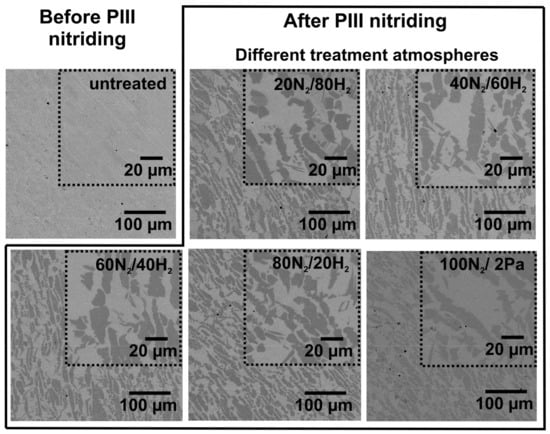
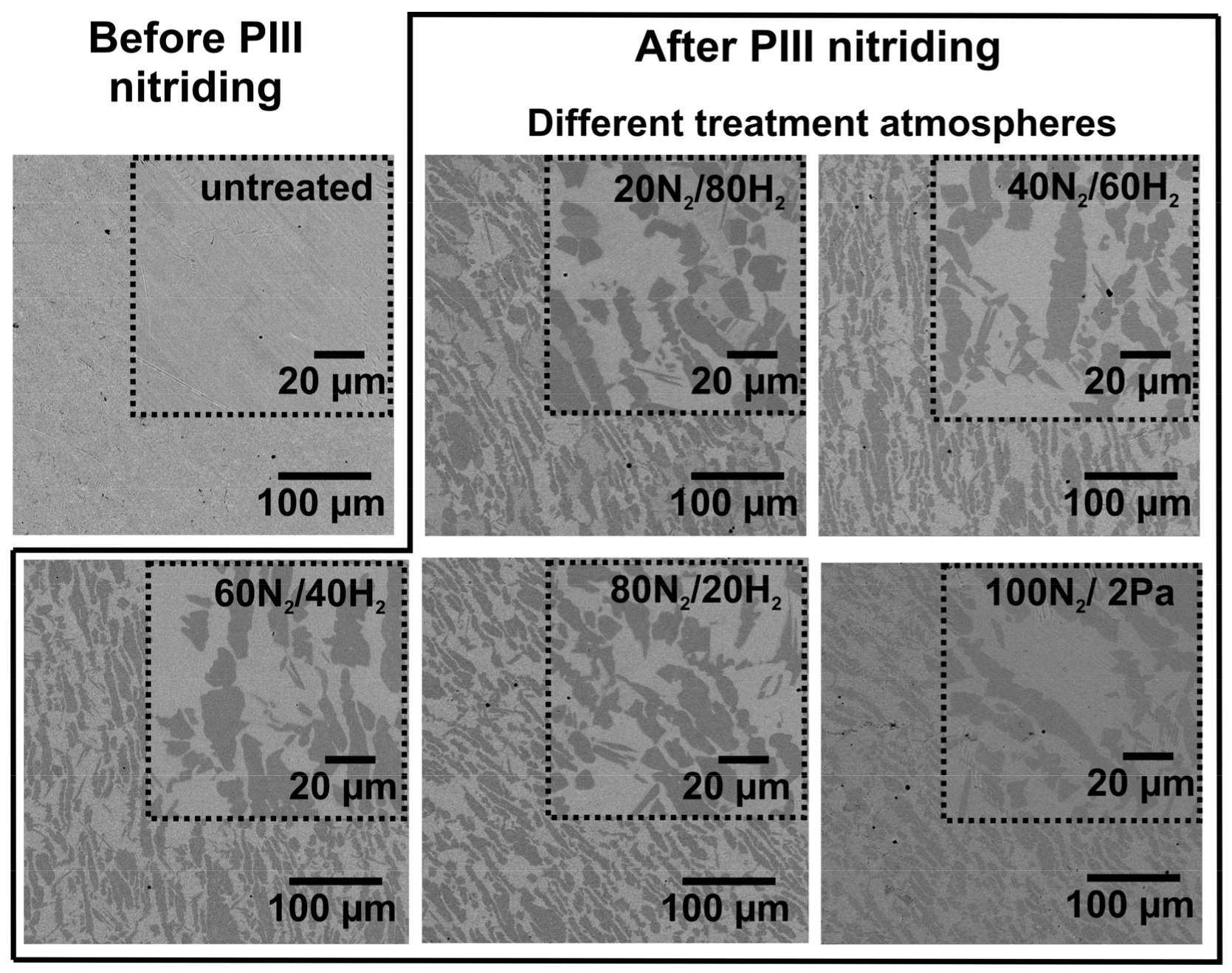
In Figure 5, backscattered SEM images of PIII-nitrided surfaces under different treatment atmospheres are compared with those of an untreated sample. The enhanced contrast in gray tones between the nitrided samples and the untreated reference indicates the presence of distinct phases containing interstitial nitrogen. While this contrast is more pronounced for the gaseous mixtures, it is subtler for the 100% mixture, which exhibits intermediate behavior between the other gaseous mixtures and the untreated sample. The EDS analysis indicates that the dark phase is austenite, which is enriched in Ni, whereas the lighter phase is ferrite, retaining more Cr and Mo. Consistent with the surface images, the surface roughness values Ra (arithmetic mean) and Rq (root mean square) remain close (Table 2).
Figure 5.
Backscattered SEM images of PIII nitrided surfaces under different treatment atmospheres, compared to an untreated sample.
Table 2.
Layer thickness, roughness, and hardness of untreated and nitrided samples.
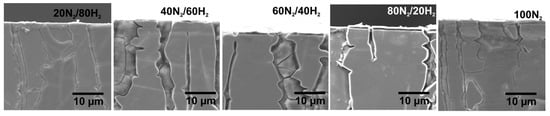
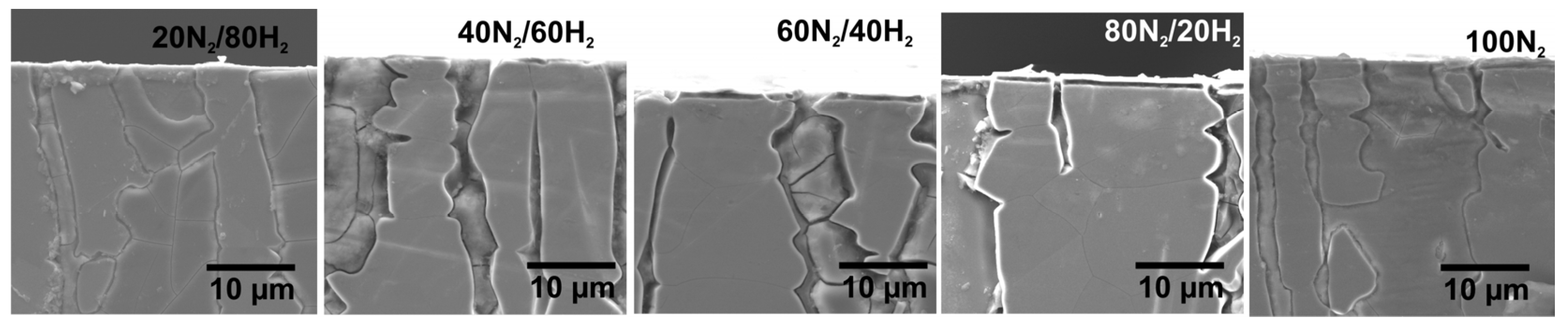
The SEM images of the modified layers formed by PIII nitriding in different treatment atmospheres are shown in Figure 6. Preparing these cross-sections poses a significant challenge due to the thin and fragile nature of the layers. For the 40N2/60H2, 60N2/40H2 and 100 N2 samples, the contrast within the ferrite grains in the modified layer region is poorly defined, hindering thickness measurements under these treatment conditions. The resulting layer thicknesses are presented in Table 2. Considering the dispersion of the data, the thickness values remain similar regardless of the treatment atmosphere.
Figure 6.
SEM images of cross-sectioned samples to visualize the modified layers formed by PIII nitriding in different treatment atmospheres.
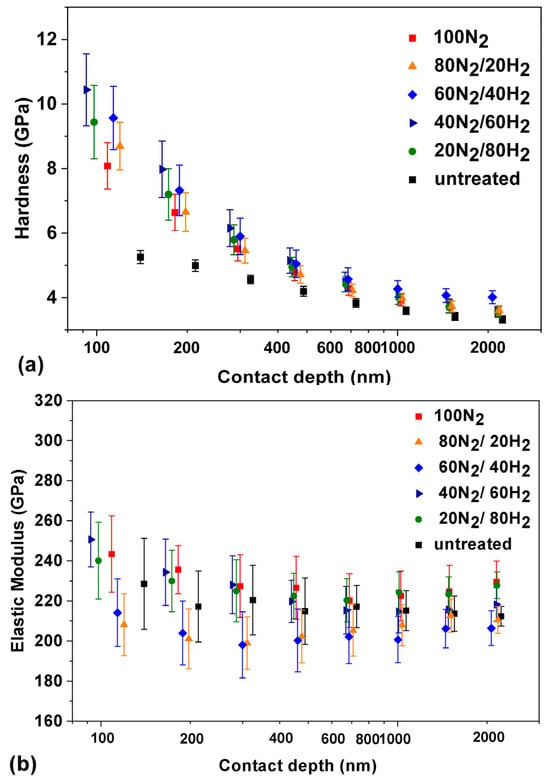
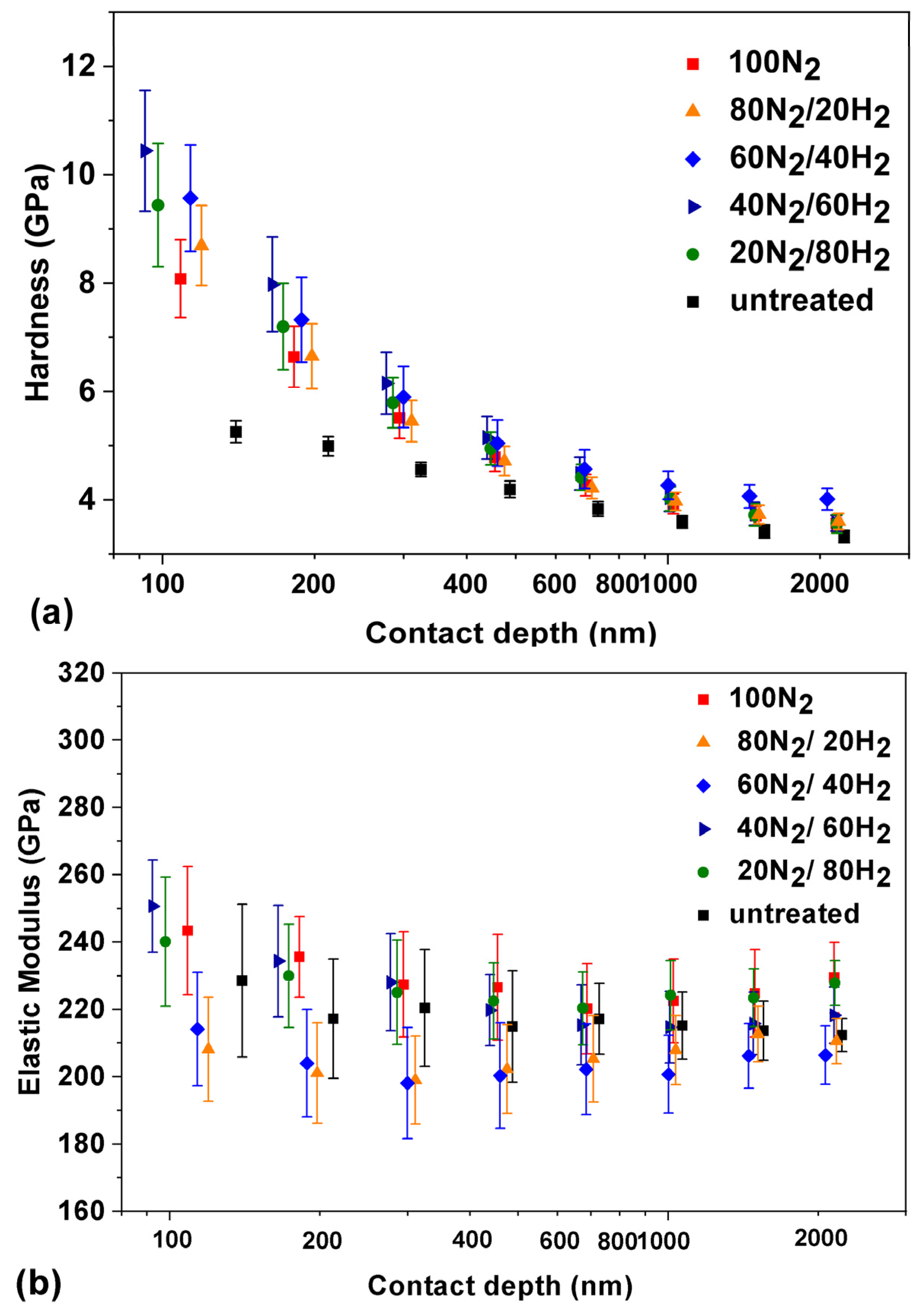
Figure 7a illustrates the hardness profiles of both untreated and nitrided samples subjected to different atmospheric conditions. All nitrided specimens display increased hardness relative to the untreated sample. The formation of γN, ε, and γ’ nitride phases within the nitrided samples, regardless of the treatment parameters, leads to two principal hardening mechanisms. In mechanisms where nitrogen exists in solid solution, the phenomenon known as the “Cottrell atmosphere” may develop, wherein interstitial atoms migrate to dislocation sites. This migration impedes dislocation mobility, thereby increasing the material’s resistance to plastic deformation. Additionally, lattice distortion caused by interstitial solid solutions can reduce the number of active slip systems, further enhancing the obstruction of dislocation motion [46]. In the mechanisms of precipitation and dispersion hardening, fine, hard precipitates such as ε, γ’, and CrN serve as barriers to dislocation motion, thereby enhancing the strength of the material [46].
Figure 7.
(a) Hardness and (b) elastic modulus profiles for the untreated specimen and those subjected to PIII nitriding in atmospheres with various volumetric N2/H2 ratios.
The hardness profile of sample 100N2 is observed to be lower than that of the other samples. This observation aligns with the X-ray diffractogram results, which demonstrate a higher level of nitrogen incorporation in samples treated with H2 relative to the sample processed with pure N2.
The hardness profiles of samples treated in N2/H2 atmospheres do not exhibit significant variations. It is established that hardness measurements are unaffected by the substrate up to approximately 10% of the modified layer’s thickness [47]. Thus, in the absence of a plateau, i.e., constant values in the profiles, the modified layer thickness produced by PIII in these samples is estimated to be ≤1 μm. Such thicknesses are typical for low-temperature PN and PIII nitriding treatments on duplex steels [6,43].
The elastic modulus profiles for both untreated and PIII nitrided samples are presented in Figure 7b. All specimens exhibit similar trends, and, given the observed dispersion, these differences are determined to be statistically insignificant. In contrast to hardness measurements, elastic modulus profiles are affected by the substrate at all penetration depths, owing to the broader range of the elastic strain field relative to the plastic strain field [47]. The elastic modulus determined by instrumented indentation for the nitrided samples is comparable to that of the untreated sample, likely due to the small size and intra-granular formation of rigid ε and γ’ nitride precipitates. Because the elastic modulus reflects the elastic deformation of a material, which is related to the atomic or molecular bonding [48], the observed values for the nitrided surface indicate a substantially greater influence from the matrix than from the nitride precipitates. When assuming the relationship between hardness to elastic modulus ratio (H/E) and wear resistance [49], H and E data for these nitrided surfaces suggest minor variations in tribological performance, mainly influenced by the evolution of hardness across various plasma atmospheres. Experimental validation requires additional studies that are beyond the scope of this work.
3.2. Varying Pressure Under Fixed Gas Mixture
Typical PIII treatment pressures are approximately 10−1 Pa; as a result, most equipment is equipped with auxiliary heating systems to facilitate the diffusion of implanted ions, ensuring that the sample temperature remains independent of plasma variables [4]. In the present study, the PIII setup does not incorporate an additional heating system. Consequently, treatments are conducted at a limiting pressure of roughly 1 Pa to harness thermal energy from the plasma, enabling process temperatures between 300 °C and 450 °C.
Gas pressure significantly influences PIII treatments, as it impacts the dynamic properties of the plasma sheath and the mean free path of ions, thereby modifying their collisional behavior [50,51]. For a constant applied voltage, an increase in gas pressure leads to a decrease in both the plasma sheath width and the ion mean free path, alongside reductions in the ions’ angle of incidence on the target and their impact energy [50,52]. Consequently, minimizing treatment pressure was prioritized, with careful attention paid to maintaining plasma stability and promoting the expansion of modified surface phases.
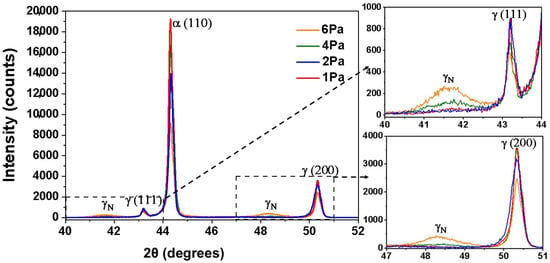
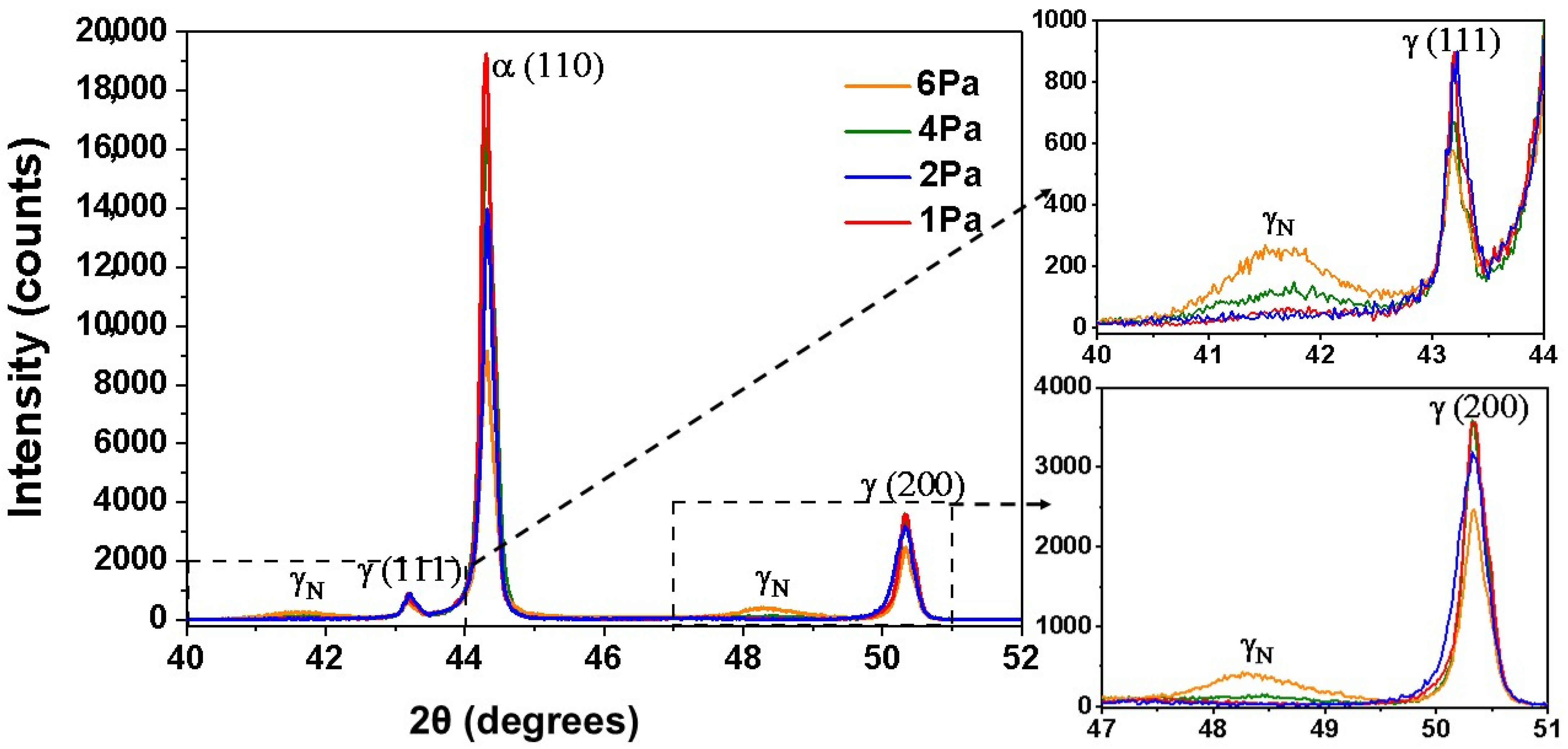
Figure 8 presents the Bragg–Brentano X-ray diffractograms for both untreated samples and samples subjected to PIII nitriding in a pure N2 atmosphere under varying pressures. As the treatment pressure increases, a consistent rise is observed in both the area and intensity of the γN phase peaks, suggesting enhanced nitrogen incorporation into the substrate with higher pressure. The α(110) ferrite peak remains unchanged in width, meaning that αN formation does not occur. These findings indicate that, within the parameters studied, the augmented ion availability surpasses the limiting influence of the reduced mean free path in the evaluated type of PIII equipment.
Figure 8.
X-ray diffractograms obtained in Bragg–Brentano geometry for both untreated samples and those subjected to PIII nitriding in a pure N2 atmosphere at different pressures.
During these experiments, the sample temperature was consistently maintained at 300 °C. The applied voltage was incrementally decreased as the pressure increased (Table 1), leading to a corresponding reduction in the average energy of the ions. This decrease did not adversely affect the formation of the modified layers, as successful ion implantation merely requires sufficient ion energy to enable surface penetration. Once implanted, the subsequent development of the modified layers is governed primarily by diffusion processes [53].
The voltage decrease accompanying the increase in treatment pressure may have additional consequences for the process, such as affecting the cathodic sputtering rate. In this study, the voltages applied ranged between 9 and 10 kV (Table 1). At these voltages, minimal variation in the cathodic sputtering yield (Ys) is expected for ferrous materials, as the maximum for this phenomenon typically occurs in this voltage range [39].
Other effects related to pressure variation—and consequently to ion implantation energy—include defect production and secondary electron emission. (i) Defect production is favored at higher implantation energies. Therefore, defect formation should be greater at lower pressures and higher voltages, which would theoretically increase the nitrogen concentration in the solid solution [54,55]. However, γN production increases with increasing treatment pressure, as shown in Figure 6, indicating that defects have a negligible influence within the analyzed voltage/pressure range. (ii) The secondary electron emission coefficient γSE varies approximately linearly with the square root of the ion energy [50,56]. Consequently, this effect, which decreases the proportion of ionic current supported by the high-voltage source, would be favored in tests performed at lower pressures and higher voltages. Nevertheless, it is considered that the variation in the secondary electron rate is not significant during PIII nitriding in the analyzed range between (9 kV to 10 kV), as the maximum variation in γSE is only ~4% in the treatments [50,56].
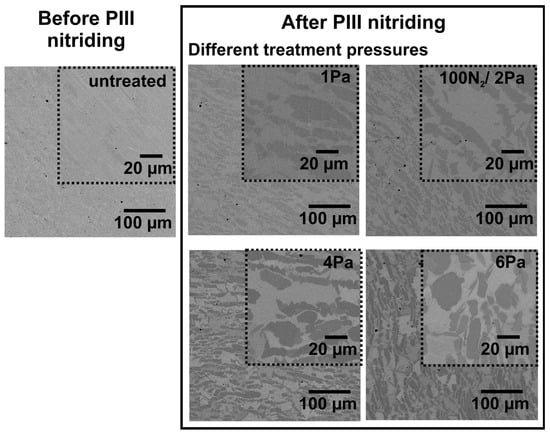
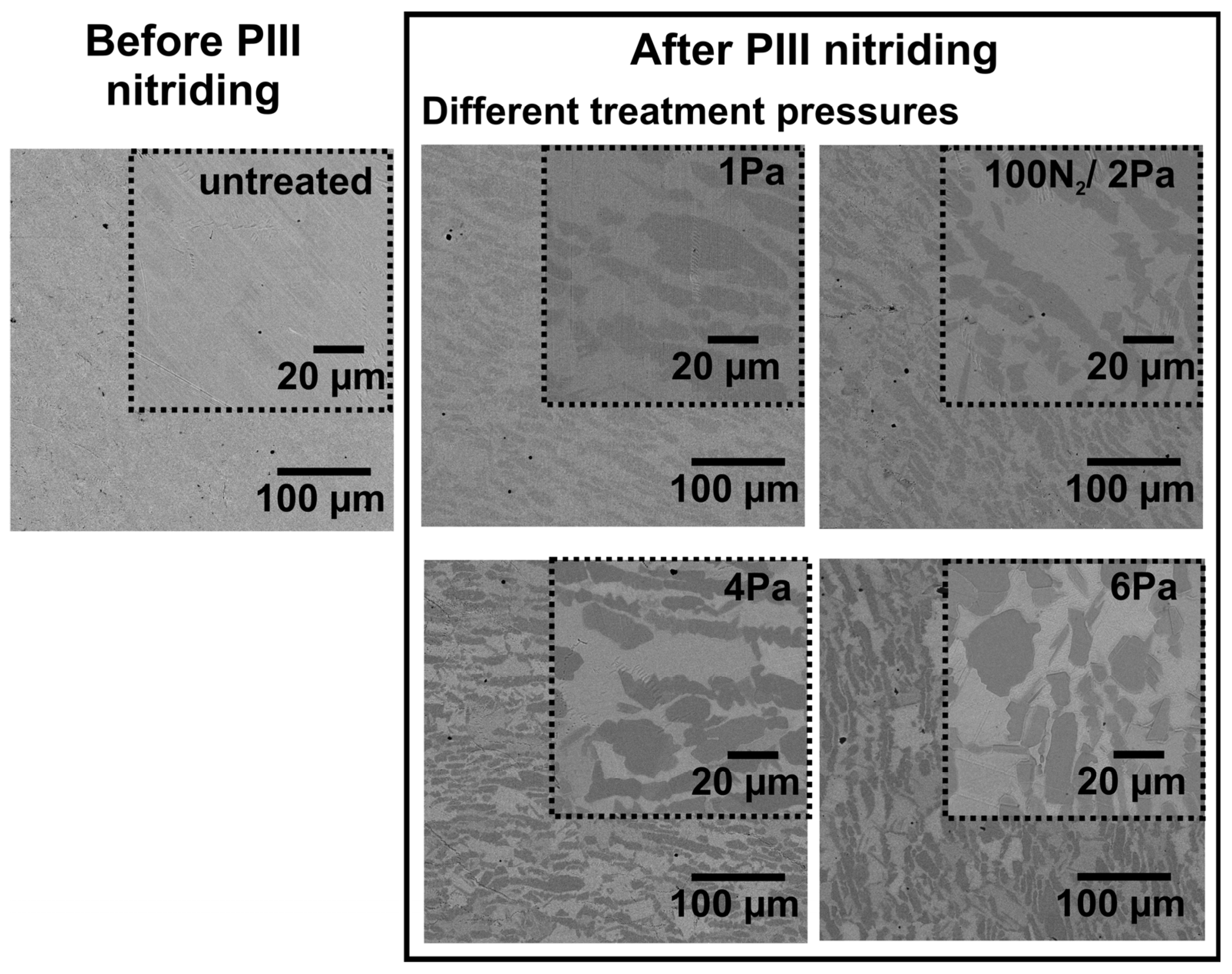
Figure 9 compares the backscattered SEM images of an untreated sample with surfaces subjected to PIII nitriding under different pressures of pure N2 atmosphere. The contrast increases at higher pressures, indicating a larger variation in interstitial nitrogen content between the austenite and ferrite precursor phase grains. In this case, there is an increase in Ra and Rq values with increasing treatment pressure, as seen in Table 2.
Figure 9.
Backscattered SEM images of PIII nitrided surfaces subjected to PIII nitriding in a pure N2 atmosphere at different pressures, compared to an untreated sample.
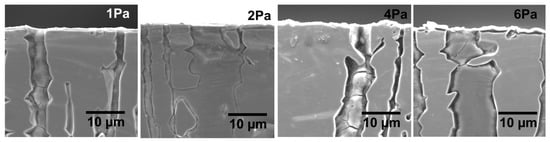
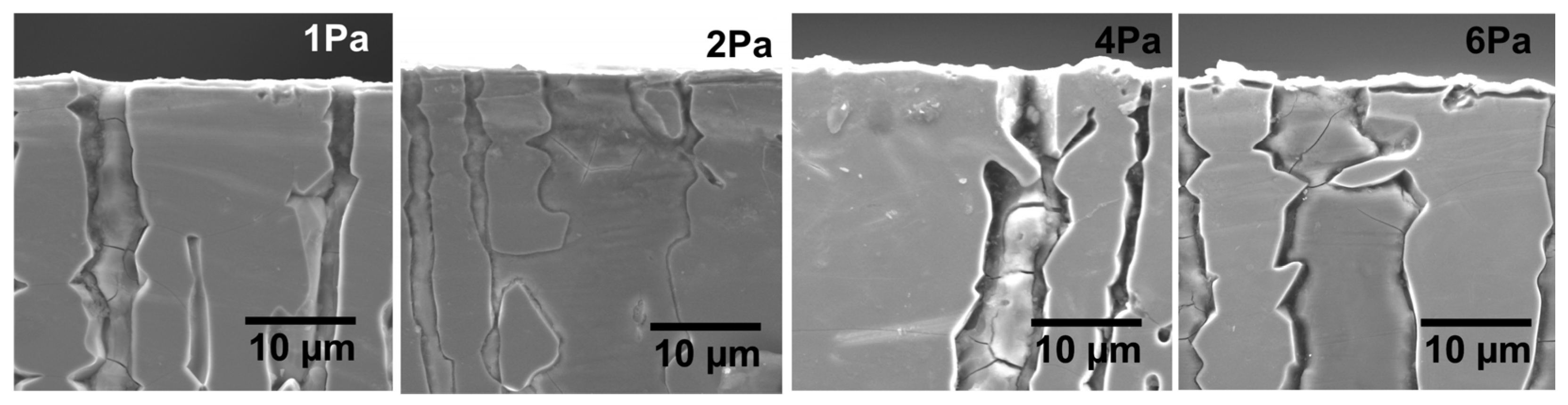
Figure 10 depicts SEM images of cross-sectioned samples to visualize the modified layers formed by PIII nitriding in different treatment atmospheres. As shown in Table 2, the thickness of the modified layers increases with higher treatment pressures. With the increase in pressure, the density of ions and active species within the plasma rises, enhancing the rate of nitrogen transfer to the metal surface and ultimately accelerating nitrogen absorption and diffusion [4].
Figure 10.
SEM images of cross-sectioned samples to visualize the modified layers formed by PIII nitriding in different treatment pressures.
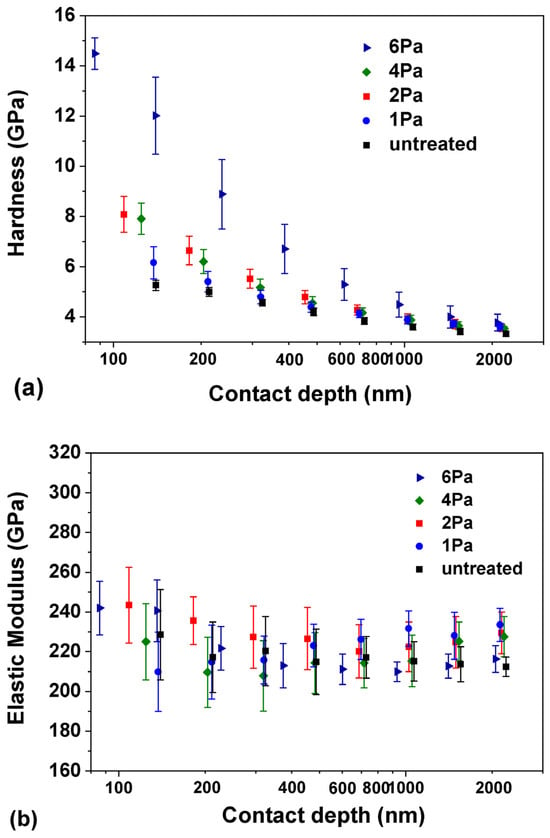
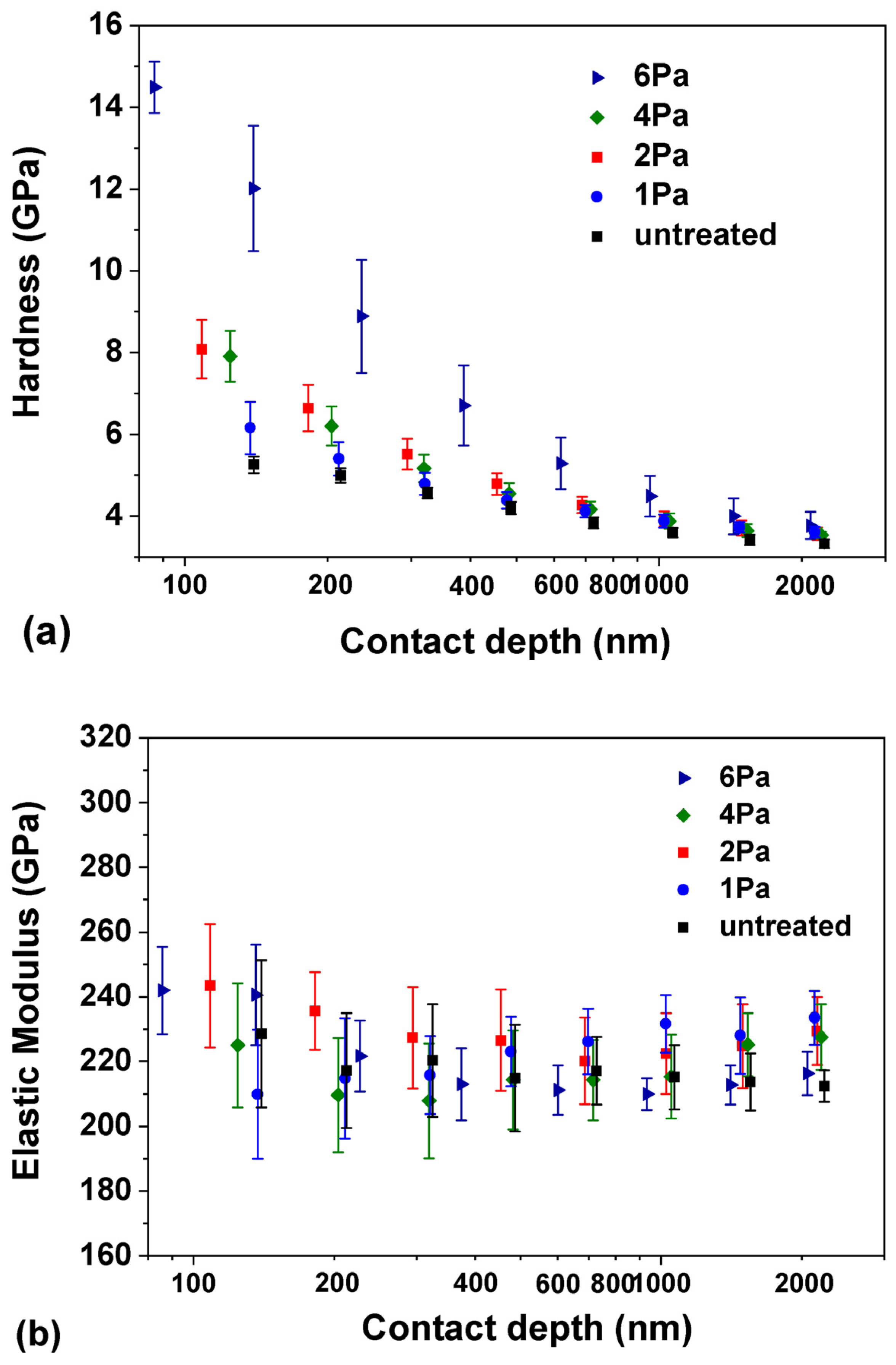
Figure 11a presents the hardness profiles of the untreated sample and the PIII-nitrided samples treated in a pure N2 atmosphere at various pressures. It can be observed that the hardness profiles gradually increase with rising pressure. This result, as discussed in the XRD analysis, is attributed to the enhanced N2 supply in the atmosphere, which increases the concentration of implanted nitrogen. At a pressure of 6 Pa, the hardness profile is higher than the others due to the more significant formation of the γN phase as pressure increases, as shown in Figure 8. In this case, consistent with observations for N2 and H2 atmospheres, the predominant formation of the γN phase promotes hardening mechanisms associated with the presence of nitrogen in solid solution [46]. These findings are in line with previous results for the plasma composition, with the N2-rich ratio 60/40 presenting enhanced conditions for nitrogen retention.
Figure 11.
(a) Hardness and (b) elastic modulus profiles for the untreated sample and those subjected to PIII nitriding in pure N2 atmosphere at different pressures.
Figure 11b presents the elastic modulus profiles for the untreated sample and those subjected to PIII nitriding in pure N2 atmosphere at different pressures. Consistent with the observations for samples treated in different atmospheres (Figure 7b), and considering the statistical dispersion of the data, no significant differences are observed between the profiles. This lack of variation is attributed to the factors previously discussed.
4. Conclusions
Within the PIII system employed, the base pressure (pre-vacuum) of 10−1 Pa necessitated the use of H2-containing atmospheres to mitigate competitive oxidation effects on the surface of the UNS S32750 super duplex stainless steel samples.
Proportions approaching a 60% N2/40% H2 (vol.) maximized the nitriding process, yielding a higher volume fraction of expanded phases.
Regarding the influence of pressure, a direct correlation was observed: higher pressures favored the formation of expanded phases, consequently leading to a gradual increase in hardness up to 2.7 times the hardness value of the untreated sample.
These results show that PIII exhibits trends in plasma composition and pressure that contrast with those seen in low-energy plasma nitriding, emphasizing the complex link between physical and thermochemical processes governing nitrogen uptake.
The results indicate that the PIII technique can be operated at higher pressures than those commonly used, thereby lowering the costs of its industrial implementation.
Author Contributions
Conceptualization, B.C.E.S.K., G.B.d.S. and F.C.S.; methodology, B.C.E.S.K., G.B.d.S. and F.C.S.; investigation, B.C.E.S.K. and G.O.; formal analysis, B.C.E.S.K., G.B.d.S. and F.C.S.; data curation, B.C.E.S.K.; writing—original draft preparation, B.C.E.S.K.; writing—review and editing, B.C.E.S.K., G.B.d.S., F.C.S. and G.O. All authors have read and agreed to the published version of the manuscript.
Funding
This research received no external funding.
Data Availability Statement
The data supporting the findings of this study are available within the article.
Acknowledgments
The authors thank the C-LABMU/UEPG, and Labnano/UFPR for the use of characterization facilities.
Conflicts of Interest
The authors declare that there are no conflicts of interest regarding the publication of this paper.
Abbreviations
The following abbreviations are used in this manuscript:
| PIII | Plasma Immersion Ion Implantation (PIII) |
| XRD | X-ray diffraction |
| PN | plasma nitriding |
| Ys | cathodic sputtering yield |
| γSE | secondary electron emission coefficient |
References
- Lippold, J.; Kotecki, D. Welding Metallurgy and Weldability of Stainless Steels, 1st ed.; John Wiley & Sons: Hoboken, NJ, USA, 2005. [Google Scholar]
- Beltrao, R.L.C.; Sombra, C.L.; Lage, A.C.V.M.; Netto, J.R.F.; Henriques, C.C.D. SS: Pre-Salt Santos Basin—Challenges and New Technologies for the Development of the Pre-Salt Cluster, Santos Basin, Brazil. In Proceedings of the Offshore Technology Conference, Houston, TX, USA, 8 April 2009; p. 11. [Google Scholar]
- Barbosa, C.A. A Contribuição Das LRCs No Revestimento de Poços. Corrosão Proteção 2008, 24, 9–13. [Google Scholar]
- Anders, A. Handbook of Plasma Immersion Ion Implantation and Deposition; John Wiley & Sons: New York, NY, USA, 2000. [Google Scholar]
- Blawert, C.; Mordike, B.L. Industrial Applications of Plasma Immersion Ion Implantation. Surf. Coat. Technol. 1997, 93, 274–279. [Google Scholar] [CrossRef] [Scilit]
- Oliveira, W.; Kurelo, B.C.E.S.; Ditzel, D.G.; Foerster, C.E.; Serbena, F.C.; de Souza, G.B. On the S-Phase Formation and the Balanced Plasma Nitriding of Austenitic-Ferritic Super Duplex Stainless Steel. Appl. Surf. Sci. 2018, 434, 1161–1174. [Google Scholar] [CrossRef] [Scilit]
- Ueda, M.; Gomes, G.F.; Abramof, E.; Reuther, H. In-Line Nitrogen PIII/Ion Nitriding Processing of Metallic Materials. Nucl. Instrum. Methods Phys. Res. Sect. B Beam Interact. Mater. At. 2003, 206, 749–753. [Google Scholar] [CrossRef] [Scilit]
- Blawert, C.; Mordike, B.L.; Collins, G.A.; Short, K.T.; Tendys, J. Influence of Process Parameters on the Nitriding of Steels by Plasma Immersion Ion Implantation. Surf. Coat. Technol. 1998, 104, 240–247. [Google Scholar] [CrossRef] [Scilit]
- Olzon-Dionysio, M.; Campos, M.; Kapp, M.; de Souza, S.; de Souza, S.D. Influences of Plasma Nitriding Edge Effect on Properties of 316L Stainless Steel. Surf. Coat. Technol. 2010, 204, 3623–3628. [Google Scholar] [CrossRef] [Scilit]
- Kurelo, B.C.E.S.; de Oliveira, W.; Serbena, F.; Souza, G.B. de Surface Mechanics and Wear Resistance of Supermartensitic Stainless Steel Nitrided through Plasma Immersion Ion Implantation. Surf. Coat. Technol. 2018, 353, 199–209. [Google Scholar] [CrossRef] [Scilit]
- Kurelo, B.C.E.S.; De Souza, G.B.; Da Silva, S.L.R.; Serbena, F.C.; Foerster, C.E.; Alves, C. Plasma Nitriding of HP13Cr Supermartensitic Stainless Steel. Appl. Surf. Sci. 2015, 349, 403–414. [Google Scholar] [CrossRef] [Scilit]
- Priest, J.M.; Baldwin, M.J.; Fewell, M.P. The Action of Hydrogen in Low-Pressure r.f.-Plasma Nitriding. Surf. Coat. Technol. 2001, 145, 152–163. [Google Scholar] [CrossRef] [Scilit]
- Lepienski, C.M.; Nascimento, F.C.; Foerster, C.E.; da Silva, S.L.R.; de M. Siqueira, C.J.; Alves, C., Jr. Glow Discharge Nitriding in AISI 304 at Different Nitrogen-Hydrogen Atmospheres: Structural, Mechanical and Tribological Properties. Mater. Sci. Eng. A 2008, 489, 201–206. [Google Scholar] [CrossRef] [Scilit]
- Garamoon, A.; Rashed, U.M.; Abouelela, A.; Eissa, M.A.; Saudi, A.H.; El-Zeer, D.M.; El-Hossary, F. Hydrogen Effect on Nitriding Process of 304L Austenitic Stainless Steel. IEEE Trans. Plasma Sci. 2006, 34, 1066–1073. [Google Scholar] [CrossRef] [Scilit]
- Schibicheski Kurelo, B.C.E.; Monteiro, J.F.H.L.; de Souza, G.B.; Serbena, F.C.; Lepienski, C.M.; Cardoso, R.P.; Brunatto, S.F. Thermal Evolution of Expanded Phases Formed by PIII Nitriding in Super Duplex Steel Investigated by In Situ Synchrotron Radiation. Metals 2024, 14, 1396. [Google Scholar] [CrossRef] [Scilit]
- Oliveira, W.R. DE Influência Dos Parâmetros de Implantação Iônica Por Imersão Em Plasma Na Eficiência Da Nitretação Do Aço Inoxidável Super Duplex; UEPG: Paraná, Brazil, 2016. [Google Scholar]
- Manova, D.; Mändl, S.; Neumann, H.; Rauschenbach, B. Formation of Metastable Diffusion Layers in Cr-Containing Iron, Cobalt and Nickel Alloys after Nitrogen Insertion. Surf. Coat. Technol. 2017, 312, 81–90. [Google Scholar] [CrossRef] [Scilit]
- Manova, D.; Thorwarth, G.; Mändl, S.; Neumann, H.; Stritzker, B.; Rauschenbach, B. Variable Lattice Expansion in Martensitic Stainless Steel after Nitrogen Ion Implantation. Nucl. Instrum. Methods Phys. Res. Sect. B Beam Interact. Mater. At. 2006, 242, 285–288. [Google Scholar] [CrossRef] [Scilit]
- Fernandes, B.B.; Mändl, S.; Oliveira, R.M.; Ueda, M. Mechanical Properties of Nitrogen-Rich Surface Layers on SS304 Treated by Plasma Immersion Ion Implantation. Appl. Surf. Sci. 2014, 310, 278–283. [Google Scholar] [CrossRef] [Scilit]
- Manova, D.; Eichentopf, I.-M.; Hirsch, D.; Mandl, S.; Neumann, H.; Rauschenbach, B. Influence of Microstructure on Nitriding Properties of Stainless Steel. IEEE Trans. Plasma Sci. 2006, 34, 1136–1140. [Google Scholar] [CrossRef] [Scilit]
- Ram Mohan Rao, K.; Mukherjee, S.; Roy, S.K.; Richter, E.; Möller, W.; Manna, I. Plasma Immersion Ion Implantation of Nitrogen on Austenitic Stainless Steel at Variable Energy for Enhanced Corrosion Resistance. Surf. Coat. Technol. 2007, 201, 4919–4921. [Google Scholar] [CrossRef] [Scilit]
- Gullikson, E. X-Ray Attenuation Length. Available online: http://henke.lbl.gov/optical_constants/atten2.html (accessed on 17 May 2018).
- Henke, B.L.; Gullikson, E.M.; Davis, J.C. X-Ray Interactions: Photoabsorption, Scattering, Transmission, and Reflection at E = 50-30,000 EV, Z = 1-92. At. Data Nucl. Data Tables 1993, 54, 181–342. [Google Scholar] [CrossRef] [Scilit]
- Li, C.X.; Bell, T. A Comparative Study of Low Temperature Plasma Nitriding, Carburising and Nitrocarburising of AISI 410 Martensitic Stainless Steel. Mater. Sci. Technol. 2007, 23, 355–361. [Google Scholar] [CrossRef] [Scilit]
- Corengia, P.; Ybarra, G.; Moina, C.; Cabo, A.; Broitman, E. Microstructure and Corrosion Behaviour of DC-Pulsed Plasma Nitrided AISI 410 Martensitic Stainless Steel. Surf. Coat. Technol. 2004, 187, 63–69. [Google Scholar] [CrossRef] [Scilit]
- Kim, S.; Yoo, J.; Priest, J.; Fewell, M. Characteristics of Martensitic Stainless Steel Nitrided in a Low-Pressure RF Plasma. Surf. Coat. Technol. 2003, 163, 380–385. [Google Scholar] [CrossRef] [Scilit]
- Dong, H. S-Phase Surface Engineering of Fe-Cr, Co-Cr and Ni-Cr Alloys. Int. Mater. Rev. 2010, 55, 65–98. [Google Scholar] [CrossRef] [Scilit]
- Eduardo, C.; Bernardo, L.; Paulo, A.; Pinedo, C.E.; Varela, L.B.; Tschiptschin, A.P. Low-Temperature Plasma Nitriding of AISI F51 Duplex Stainless Steel. Surf. Coat. Technol. 2013, 232, 839–843. [Google Scholar] [CrossRef] [Scilit]
- Xi, Y.; Liu, D.; Han, D. Improvement of Corrosion and Wear Resistances of AISI 420 Martensitic Stainless Steel Using Plasma Nitriding at Low Temperature. Surf. Coat. Technol. 2008, 202, 2577–2583. [Google Scholar] [CrossRef] [Scilit]
- Dong, H.; Esfandiari, M.; Li, X.Y. On the Microstructure and Phase Identification of Plasma Nitrided 17-4PH Precipitation Hardening Stainless Steel. Surf. Coat. Technol. 2008, 202, 2969–2975. [Google Scholar] [CrossRef] [Scilit]
- Gontijo, L.C.; Machado, R.; Casteletti, L.C.; Kuri, S.E.; Nascente, P.A.P. X-Ray Diffraction Characterisation of Expanded Austenite and Ferrite in Plasma Nitrided Stainless Steels. Surf. Eng. 2010, 26, 265–270. [Google Scholar] [CrossRef] [Scilit]
- Blawert, C.; Mordike, B.L.; Rensch, U.; Schreiber, G.; Oettel, H. Nitriding Response of Chromium Containing Ferritic Steels on Plasma Immersion Ion Implantation at Elevated Temperature. Surf. Eng. 2002, 18, 249–254. [Google Scholar] [CrossRef] [Scilit]
- Oliver, W.C.; Pharr, G.M. An Improved Technique for Determining Hardness and Elastic Modulus Using Load and Displacement Sensing Indentation Experiments. J. Mater. Res. 1992, 7, 1564–1583. [Google Scholar] [CrossRef] [Scilit]
- Souza, G.; Foerster, C.; Silva, S.; Lipienski, C. Nanomechanical Properties of Rough Surfaces. Mater. Res. 2006, 9, 159–163. [Google Scholar] [CrossRef] [Scilit]
- Rasband, W.S. ImageJ, version 1.54k; U. S. National Institutes of Health: Bethesda, MD, USA, 2024.
- Kittel, C. Introduction to Solid State Physics. In Undulators, Wigglers and Their Applications; John Wiley & Sons, Inc.: Hoboken, NJ, USA, 2010; pp. 23–41. ISBN 047141526X. [Google Scholar]
- Cullity, B.D. Elements of DIFFRACTION, 2nd ed.; Cohen, M., Ed.; Addison-Wesley: Boston, MA, USA, 1978; ISBN 0201011743. [Google Scholar]
- Chatain, A.; Jiménez-Redondo, M.; Vettier, L.; Guaitella, O.; Carrasco, N.; Alves, L.L.; Marques, L.; Cernogora, G. N2–H2 Capacitively Coupled Radio-Frequency Discharges at Low Pressure. Part I. Experimental Results: Effect of the H2 Amount on Electrons, Positive Ions and Ammonia Formation. Plasma Sources Sci. Technol. 2020, 29, 085019. [Google Scholar] [CrossRef] [Scilit]
- Möller, W.; Mukherjee, S. Plasma-Based Ion Implantation. Curr. Sci. 2002, 83, 237–253. [Google Scholar]
- Nastasi, M.; Möller, W.; Ensinger, W. Ion Implantation and Thin Film Deposition. In Handbook of Plasma Immersion Ion Implantation and Deposition; Anders, A., Ed.; John Wiley & Sons, Inc.: New York, NY, USA, 2000; pp. 125–240. [Google Scholar]
- Ricard, A. The Production of Active Plasma Species for Surface Treatments. J. Phys. D Appl. Phys. 1997, 30, 2261–2269. [Google Scholar] [CrossRef] [Scilit]
- Zagonel, L.F.; Figueroa, C.A.; Alvarez, F. In Situ Photoemission Electron Spectroscopy Study of Nitrogen Ion Implanted AISI-H13 Steel. Surf. Coat. Technol. 2005, 200, 2566–2570. [Google Scholar] [CrossRef] [Scilit]
- Assmann, A.; Foerster, C.E.; Serbena, F.C.; Lepienski, C.M.; Chinelatto, A.L. Mechanical and Tribological Properties of LDX2101 Duplex Stainless Steel Submitted to Glow Discharge Ion Nitriding. IEEE Trans. Plasma Sci. 2011, 39, 3108–3114. [Google Scholar] [CrossRef] [Scilit]
- Blawert, C.; Mordike, B.L.; Jirásková, Y.; Schneeweiss, O. Structure and Composition of Expanded Austenite Produced by Nitrogen Plasma Immersion Ion Implantation of Stainless Steels X6CrNiTi1810 and X2CrNiMoN2253. Surf. Coat. Technol. 1999, 116–119, 189–198. [Google Scholar] [CrossRef] [Scilit]
- Schibicheski Kurelo, B.C.E.; Lepienski, C.M.; de Oliveira, W.R.; de Souza, G.B.; Serbena, F.C.; Cardoso, R.P.; Neves, J.C.K.; Borges, P.C. Identification of Expanded Austenite in Nitrogen-Implanted Ferritic Steel through In Situ Synchrotron X-Ray Diffraction Analyses. Metals 2023, 13, 1744. [Google Scholar] [CrossRef] [Scilit]
- Meyers, M.; Chawla, K. Mechanical Behavior of Materials, 2nd ed.; Cambridge University Press: New York, NY, USA, 2009; ISBN 9780521866750. [Google Scholar]
- Saha, R.; Nix, W.D. Effects of the Substrate on the Determination of Thin Film Mechanical Properties. Acta Mater. 2002, 50, 23–38. [Google Scholar] [CrossRef] [Scilit]
- Fischer-Cripps, A.C. Introduction to Contact Mechanics, 1st ed.; Springer: New York, NY, USA, 2004; ISBN 9780387263960. [Google Scholar]
- Pintaude, G. Introduction of the Ratio of the Hardness to the Reduced Elastic Modulus for Abrasion. In Tribology—Fundamentals and Advancements; IntechOpen: London, UK, 2013. [Google Scholar]
- Wood, B.P.; Rej, D.J.; Anders, A.; Brown, I.G.; Faehl, R.J.; Malik, S.M.; Munson, C.P. Fundamentals of Plasma Immersion Ion Implantation and Deposition. In Handbook of Plasma Immersion Ion Implantation and Deposition; Anders, A., Ed.; John Wiley & Sons, Inc.: New York, NY, USA, 2000; pp. 243–301. [Google Scholar]
- Vahedi, V.; Lieberman, M.A.; Alves, M.V.; Verboncoeur, J.P.; Birdsall, C.K. A One-Dimensional Collisional Model for Plasma-Immersion Ion Implantation. J. Appl. Phys. 1991, 69, 2–6. [Google Scholar] [CrossRef] [Scilit]
- Khoram, M.; Ghomi, H.; Navab Safa, N. Ion Temperature and Gas Pressure Effects on the Magnetized Sheath Dynamics during Plasma Immersion Ion Implantation. Phys. Plasmas 2016, 23, 033511. [Google Scholar] [CrossRef] [Scilit]
- Chuproski, R.F.; de Oliveira, W.R.; Schibicheski Kurelo, B.C.E.; Ditzel, D.G.; Soares, P.; Serbena, F.C.; de Souza, G.B. Controlling Plasma-Based Surface Modifications of an Austenitic Alloy by Thermochemical and Athermal Diffusions. J. Alloys Compd. 2024, 980, 173634. [Google Scholar] [CrossRef] [Scilit]
- Yanagida, Y.; Oishi, T.; Miyaji, T.; Watanabe, C.; Nitta, N. Nanoporous Structure Formation in GaSb, InSb, and Ge by Ion Beam Irradiation under Controlled Point Defect Creation Conditions. Nanomaterials 2017, 7, 180. [Google Scholar] [CrossRef] [Scilit]
- Sanghera, H.K.; Sullivan, J.L. A Study of Low Energy High Dose Nitrogen Ion Implantation in Iron—Effect of Ion Energy and Current Density. Nucl. Instrum. Methods Phys. Res. Sect. B Beam Interact. Mater. At. 1999, 152, 65–79. [Google Scholar] [CrossRef] [Scilit]
- Shamim, M.M.; Scheuer, J.T.; Fetherston, R.P.; Conrad, J.R. Measurement of Electron Emission Due to Energetic Ion Bombardment in Plasma Source Ion Implantation. J. Appl. Phys. 1991, 70, 4756–4759. [Google Scholar] [CrossRef] [Scilit]

Disclaimer/Publisher’s Note: The statements, opinions and data contained in all publications are solely those of the individual author(s) and contributor(s) and not of MDPI and/or the editor(s). MDPI and/or the editor(s) disclaim responsibility for any injury to people or property resulting from any ideas, methods, instructions or products referred to in the content. |
© 2026 by the authors. Licensee MDPI, Basel, Switzerland. This article is an open access article distributed under the terms and conditions of the Creative Commons Attribution (CC BY) license.