


Abstract
This paper presents an innovative methodology detecting out-of-distribution individuals based on a multimodal contrastive learning approach. The system combines voice and facial image data by projecting them into a shared representation in the embedding space, enable accurate identification of previously unseen individuals. This approach overcomes the limitations of traditional methods by providing more robust and consistent detection in dynamic scenarios, using advanced neural networks and optimized contrastive losses. Specifically, the main contribution of this work is the introduction of a multimodal contrastive framework that performs cross-modal consistency verification between facial and vocal representations, enabling reliable detection of out-of-distribution individuals without the need for identity gallery retrieval. Experimental results on multiple datasets highlight the effectiveness of the system, with accuracy above 90% in detecting in-distribution samples in all evaluated cases. Regarding the identification of out-of-distribution cases, the system maintains outstanding performance, achieving values close to 90% on average, with some datasets exceeding 95%. These results underscore its ability to recognize both known identities and handle unknown data, even under challenging conditions. This approach represents a significant advancement in the multimodal recognition of individuals, with potential applications in critical areas such as security, surveillance, and human–computer interaction.
1. Introduction
Over the past few decades, neural network-based recognition systems have demonstrated remarkable performance in classification and recognition tasks. However, these systems exhibit an inherent limitation when dealing with out-of-distribution (OOD) samples, i.e., categories not seen during training, as their predictions are restricted to the probabilities assigned within the known class space. This issue is particularly relevant in applications where the accurate identification of individuals is critical. As a result, these systems tend to enforce incorrect assignments, compromising their reliability. The problem becomes even more pronounced when the system operates in a unimodal manner as single modality lacks the robustness needed to associate relevant events across domains, such as voice and facial data.
This work proposes an innovative approach based on multimodal contrastive learning to address the problem of OOD person recognition by mapping voice and facial image features into a shared representation in the embedding space. The methodology uses a contrastive model inspired by techniques such as CLIP [1]. This approach ensures that, when an unknown individual appears, the system can detect their OOD condition before proceeding with other tasks. Our solution not only addresses the limitations of traditional neural networks but also introduces a practical methodology for detecting and handling OOD cases in multimodal environments, establishing as a new paradigm for recognition based on the explicit identification of unseen classes. Moreover, this work addresses the challenge of detecting out-of-distribution individuals without relying on identity gallery matching, which is often impractical in real-world settings. It overcomes the limitations of unimodal systems by learning a shared contrastive embedding space for faces and voices, enabling cross-modal consistency verification even when identities are unseen during training. In so doing, it also tackles variability across modalities and improves robustness in more realistic scenarios where appearance or audio alone may be insufficient.
Specifically, the main contribution of this work is the introduction of a multimodal contrastive framework that verifies cross-modal consistency between facial and vocal representations, enabling reliable detection of out-of-distribution individuals without the need for on identity gallery retrieval.
The rest of the paper is structured as follows: First, Section 2 delves into the related literature. The main features of the datasets involved in this work are then explained in Section 3. Subsequently, Section 4 explains our proposal for multimodal recognition of out-of-distribution data, which is validated in the experiments described in Section 5. Finally, conclusions and future work are discussed in Section 6.
2. Related Works
Person recognition through deep learning techniques has advanced significantly in recent years, particularly with the integration of multimodal approaches that combine different data sources, such as images and audio, to improve system accuracy and robustness.
Regarding multimodal approaches, studies have explored people detection using multiple cameras and deep learning. For example, ref. [2] proposed a multi-view people detection method that does not rely on background subtraction, thereby improving detection in crowded scenes. Other works have proposed identity verification systems that combine voice and face information through multimodal deep neural networks as in [3]. These methods aim to enhance verification accuracy within a closed set of known individuals. Other approaches, such as [4], have explored multimodal biometric techniques to improve robustness against presentation attacks, integrating modalities such as audio and video to prevent identity spoofing. In [5], the authors developed discriminative networks that learn the relationships between human voice and face to improve speaker recognition accuracy, while [6] integrated information from multiple views of audio and video to enhance identity verification.
These methodologies only rely on visual data or mainly focus on increasing accuracy within a closed set of individuals and are not designed to recognize or adapt to new OOD identities.
Regarding the detection of out-of-distribution samples, Ref. [7] proposed a Wasserstein distance-based approach for detecting OOD data in classification problems, demonstrating effectiveness on datasets such as MNIST and medical images. Additionally, works such as that proposed by [8] were developed for confidence calibration in object detection, allowing models to assign accurate confidence levels to their predictions. Recently, recognition approaches have shifted to open-set detection, which is not explicitly limited to a set of known categories. This is the case of Grounding Dino, proposed by [9].
Although these techniques improve the reliability of predictions, they neither explore multimodality nor directly address the detection of OOD individuals in person-recognition systems.
As mentioned, our approach is inspired by techniques like CLIP (Contrastive Language–Image Pre-Training), proposed by [1]. This is a neural network trained on a variety of image and text pairs that can be instructed in natural language to predict the most relevant text snippet for a given image, without being directly optimized for the task. The model matches the performance of the original ResNet50 by [10] on ImageNet “zero-shot” without using any of the original labeled examples. Recent multimodal approaches such as CLIP-style contrastive models and audio-visual verification systems have shown strong performance in representation learning; however, they are typically evaluated under closed-set or retrieval settings rather than explicit OOD detection of unseen identities.
Several works have explored the relationship between facial appearance and voice for multimodal biometric recognition. Early research investigated whether identity information could be inferred across modalities by learning joint embeddings that associate faces and voices. For example, Ref. [11] proposed a cross-modal verification framework that studies the robustness of face–voice association across multiple languages, demonstrating the potential of multimodal biometrics for speaker verification tasks. More recent approaches focus on learning shared multimodal representations using deep learning architectures. A contrastive learning approach for multilingual voice–face association was introduced in [12], showing that cross-modal embeddings can improve identity matching under challenging conditions. Similarly, Ref. [13] proposed a multimodal encoder that aligns face and voice embeddings before fusion, achieving improved performance in verification and retrieval tasks. Other studies have explored multimodal biometric authentication systems combining facial embeddings and speech representations, showing that integrating both modalities can improve robustness compared to unimodal approaches [14].
In contrast to these methods, our approach focuses on cross-modal consistency verification for detecting out-of-distribution individuals without relying on identity gallery retrieval, which represents a different formulation of the multimodal identity verification problem. Although several recent works have addressed audio-visual person identification and verification, most are evaluated under closed-set or verification protocols rather than explicit out-of-distribution detection of unseen identities. Therefore, direct comparison with state-of-the-art methods is not straightforward, since the task formulation, decision protocol, and evaluation metrics differ substantially from the OOD setting considered in this work. In this context, we use a strong unimodal baseline under the same protocol to provide a fair reference for the proposed multimodal approach.
3. Datasets
Three main datasets were used to validate the proposal: a custom dataset specifically designed for the proposed methodology, VoxCeleb1 and Lombard Grid. In this section, we describe the main features of the datasets and the methodology for integrating them into our approach.
3.1. Custom Dataset
A custom dataset was specifically created for this work, integrating image and audio data from multiple individuals. It was generated by collecting facial frames extracted from various videos of individuals, with data sourced from both publicly available videos on platforms such as YouTube and real-time recordings of consenting individuals. It was designed to be a multimodal resource, suitable for evaluating similarities between audio and video representations in a controlled environment. The dataset comprises 15 unique individuals, each contributing between 3 and 10 audio clips. The audio clips have an average duration of 4 to 8 s, ensuring a consistent and manageable length for analysis and processing.
Data augmentation techniques were applied to the training set to increase its size, resulting in a total of 40 frames and 40 audio samples per individual. This augmentation process enhanced the diversity of the dataset, ensuring sufficient variability within each class. In the test set, three frames and three audio samples were selected per individual, and the rest were used for training. These samples were carefully chosen from recordings distinct from those used in the training set to maintain a strict separation between training and testing data. This approach ensures reliable evaluation and validation of the models developed in this work.
3.2. VoxCeleb1
The VoxCeleb1 [15] dataset is widely used in speaker recognition and identity verification tasks based on audio. It consists of voice recordings collected from public interviews and videos. The dataset includes a total of 1251 unique individuals and over 100,000 audio clips. The average duration of the recordings is between 3 and 10 s. Additionally, it covers diverse conditions such as background noise, accent variations, and differing microphone qualities. This diversity makes it particularly valuable for assessing the robustness of models in realistic scenarios.
For this work, the dataset was split into training and test sets, ensuring that the samples in the test set came from entirely different videos than those used for training, maintaining strict separation.
To ensure balanced representation, a specific number of samples (frames and audios) were selected for each set. For the test set, two full videos per person were reserved to generate test samples. From each video, exactly two frames and two audio clips were selected per individual. For the training set, we established a target of 20 frames and 20 audio clips per person. Since the number of videos available for training varies per individual, the number of frames and audios extracted per video was calculated using the formula: . This strategy ensured that the training data for each subject was sourced from a balanced distribution of their available videos, promoting greater intra-class variability by avoiding the extraction of all samples from a single source when multiple are available. Additionally, a data augmentation process was applied to duplicate the samples, resulting in a total of 40 frames and 40 audios per person. This approach ensured greater diversity and stability during training. This step was particularly crucial for individuals with few source videos, as it artificially increases the variability of the training data, helping to bridge the domain gap between training samples (often from a single video) and test samples (from entirely different videos) to improve model generalization.
3.3. Lombard Grid
The Lombard Grid [16] dataset is a corpus specifically designed to study the effects of Lombard speech, which refers to how a person modifies their speech patterns in noisy environments. In addition to audio recordings, the dataset includes synchronized video recordings, making it a valuable resource for multimodal studies. It consists of 54 unique speakers, with each speaker contributing over 1000 audio clips. The average duration of these recordings is approximately three seconds. The dataset includes clean audio files as well as simulated versions with varying noise levels, offering flexibility for a wide range of experimental setups. It serves as a resource for developing robust recognition systems capable of functioning effectively under noisy conditions.
For the present study, the dataset was adapted by leveraging both audio recordings and synchronized video frames to create multimodal pairs. In the training set, 20 facial images and 20 audio clips were selected for each individual. The clarity and controlled nature of the dataset eliminated the need for data augmentation. For the test set, we choose 5 frames and 5 audio clips per individual, ensuring these were sourced from recordings distinct from those used in training. This strict separation between training and evaluation data was maintained to provide a reliable benchmark for assessing model performance. This selection aligns with the standardized data preparation protocol used across all datasets to ensure consistency in the experimental setup.
4. Approach to Multimodal Recognition of Out-of-Distribution Individuals
The proposed multimodal contrastive model consists of two main branches designed to process face and audio embeddings separately and project them into a shared embedding space. The normalized representations of both branches are projected into the embedding space, where cosine similarity reflects the similarity between the modalities. The input for the face branch consists of the features extracted by the backbone of FaceNet, while the input for the audio branch consists of the Mel-Frequency Cepstral Coefficients. Both the face branch and audio branch are trained together using a contrastive loss function, which maximizes the similarity between positive pairs and minimizes the similarity between negative pairs. During inference, the trained model generates two embedding vectors in the shared embedding space for a given face–voice pair. The cosine similarity between these vectors is then computed; if this score exceeds a predefined threshold, the pair is considered to be from an in-distribution (known) individual, otherwise it is flagged as out-of-distribution. The components of this approach are explained in depth in this section.
4.1. Facial Image Data
For facial feature extraction, we used FaceNet as proposed by [17], a deep neural network widely recognized in the deep learning community for face classification tasks. FaceNet generates a 512-dimensional differential embedding vector for each facial image, encapsulating the face’s distinctive features in a compact representation space.
FaceNet was chosen for its ability to learn a representation in a metric space, where the distance between embeddings reflects the similarity between faces. This is especially useful in our case, as it facilitates the correspondence between known faces and new individuals in a multimodal context. Moreover, FaceNet has demonstrated outstanding performance in standard facial recognition benchmarks, establishing itself as one of the most robust solutions for this task, as demonstrated by [18].
Thus, each of the images in the face–voice pairs that our proposal takes as input, are fed to FaceNet, which computes the corresponding 512-dimensional feature vector.
4.2. Voice Audio Data
For audio feature extraction, Mel-Frequency Cepstral Coefficients (MFCCs) were used as the principal technique for representing the spectral features of audio. These features are widely used in voice recognition due to their ability to capture the relevant spectral properties of speech. Two configurations were tested during the experiments: MFCCs only, which relies on 80 features that were extracted per audio segment as it provides a compact and lower susceptibility to noise representation. Before extracting any audio feature, the amplitude of the signals was normalized to a target value of 0.03. This step was necessary as spectral features are sensitive to audio volume. In particular, the normalization applied to the audio signals corresponds to a linear gain normalization to a fixed target amplitude, rather than RMS or peak normalization. The goal of this step was to homogenize the overall signal energy across clips such that differences in recording volume would not introduce unwanted variability into the MFCC extraction process. The target value was selected empirically as a conservative operating point. In practice, it provided stable feature extraction while avoiding excessive amplification of low-level background noise, and kept the waveform sufficiently below the clipping threshold.
Thus, for each of the audio recordings in the face–voice pairs that our proposal takes as input, the MFCCs are extracted to compute the corresponding 80-feature vector.
4.3. Architecture for Multimodal Contrastive Learning
The multimodal contrastive model consists of two main branches, designed to separately process face and audio embeddings and project them into a shared embedding space. The normalized representations of both branches () are projected into the embedding space where cosine similarity reflects the similarity between the modalities. The two branches have a similar structure, as detailed in Table 1.
Table 1.
Architecture of the Multimodal Contrastive Model.
Contrastive learning enables the representations of Independent and Identically Distributed (IID) individuals to cluster in compact regions of the shared embedding space, whereas OOD samples are projected into sparse or distant regions. This behavior emerges because the model learns to maximize the similarity between positive pairs while minimizing it with negative data during training.
For OOD detection, the cosine similarity between the face embeddings () and the voice embeddings () generated by the model is evaluated. If the similarity falls below a predefined threshold (), the sample is classified as OOD:
The value of threshold is empirically determined from the similarity distribution observed during training. Specifically, the average similarity of the positive pairs in the training set is used as a reference, and half of this value is adopted as a conservative initial operating point for OOD detection. This threshold is not treated as an optimized model parameter, but as a practical decision criterion for separating matching and non-matching face–voice pairs in the shared embedding space. To avoid relying exclusively on a single heuristic choice, the experimental evaluation in Section 5 analyzes performance over a wide range of similarity thresholds, thereby providing a sensitivity analysis of the proposed method and showing its stability across different operating points.
It is worth noting that an unseen identity does not necessarily produce low face–voice similarity, since the model may generalize to new individuals. Therefore, OOD detection in our approach is not based on identity memorization, but on whether the face and voice form a sufficiently consistent pair in the learned multimodal embedding space.
4.4. Training Procedure
To train the model, we used a contrastive loss function based on InfoNCE (Noise Contrastive Estimation) as proposed by [19], which maximizes the similarity between positive pairs and minimizes the similarity between negative pairs. A pair is composed of a face and the corresponding audio recording. The loss is defined as:
where is the cosine similarity, computed as the dot product of the normalized vectors and ; is a temperature parameter that scales the logits; and N is the batch size.
The purpose of this loss is to enable the network to learn to align in the same hyperspace as the feature vectors provided by the visual branch and the audio branch of the positive pairs, while separating the negative pairs.
The model is trained using data pairs that represent the relationship between facial representations () and audio representations (). These pairs are divided into positive pairs (those in which face and voice representations belong to the same person ()) and negative pairs (those in which face and voice representations belong to different people ( with ).)
Positive pairs are created by pairing all facial images of an individual with their corresponding audio recordings. For a dataset containing n individuals (), the calculations are as follows:
Each individual () is associated with facial images and audio recordings. The total number of positive pairs for a single individual is 1600.
Extending this calculation to the entire dataset, assuming individuals, the total number of positive pairs would be 80,000.
Negative pairs are formed by pairing the facial images of one individual with the audio recordings of other individuals. For a given person (), each combination of a facial image with an audio recording from another person () constitutes a negative pair. The total number of negative pairs for a single individual is calculated as follows: 78,400.
For the entire dataset with individuals, the total number of negative pairs is computed as: 3,920,000.
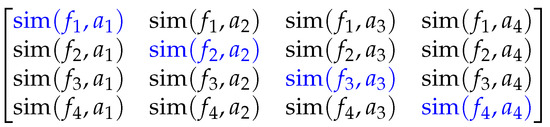
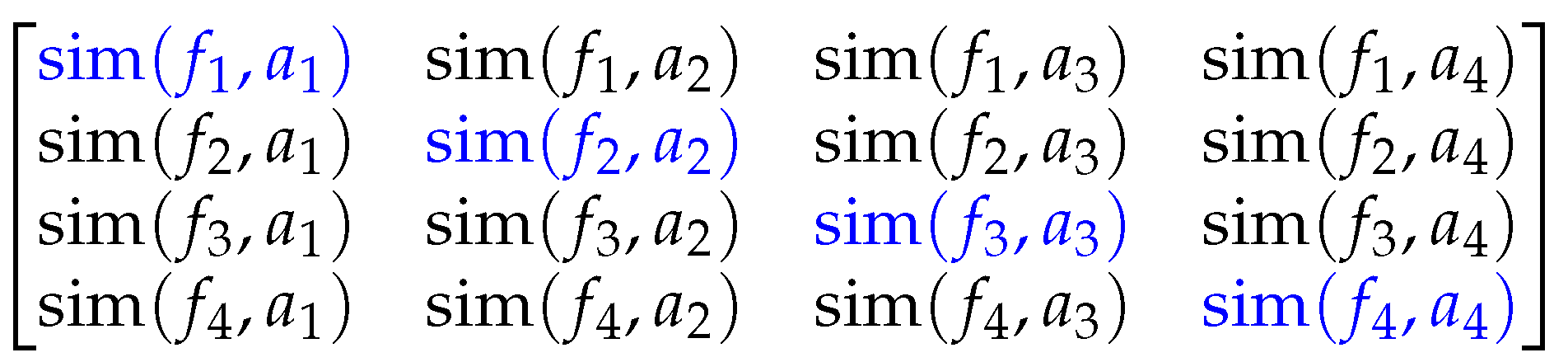
Figure 1 illustrates the similarity matrix that encapsulates the calculated similarity values between facial representations () and audio representations (). The positive pairs () are located along the main diagonal of the matrix. These pairs represent instances where the facial and audio representations belong to the same individual. In contrast, the negative pairs ( with ) are positioned off the main diagonal and correspond to cases where the representations belong to different individuals.
Figure 1.
Visual matrix illustrating the similarities between pairs of face representations () and audio representations ().
5. Experiments
To evaluate our approach, we used three different datasets, as explained in Section 3: a custom dataset, LombardGrid, and VoxCeleb1 (split into a “Mini” and a “Big” version). The experimental evaluation is structured to first demonstrate the effectiveness of our contrastive learning approach in aligning modalities, and then to quantitatively compare its performance against a strong unimodal baseline for the task of OOD detection.
The models were trained for 50 epochs with a batch size equal to the number of classes. During training, each batch is constructed by sampling one instance per identity, ensuring that each class appears only once within the batch. Under this configuration, negative samples are implicitly defined by the remaining elements in the batch, as is standard in contrastive learning frameworks using the InfoNCE loss. Specifically, for each anchor–positive pair across modalities, the other samples in the batch act as negatives. Consequently, each training step provides a large set of negatives, which helps stabilize contrastive optimization and improves representation learning. The learning rate is 0.0005, and the temperature () is 0.05 in the InfoNCE loss function.
The FaceNet baseline serves as a strong unimodal reference and partially approximates classical similarity-based OOD detection approaches, enabling a controlled comparison with the proposed multimodal method.
5.1. Pre-Training Similarity Analysis
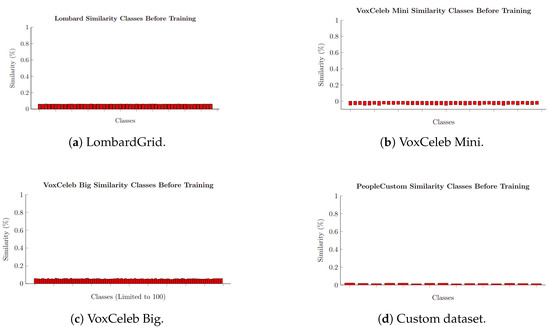
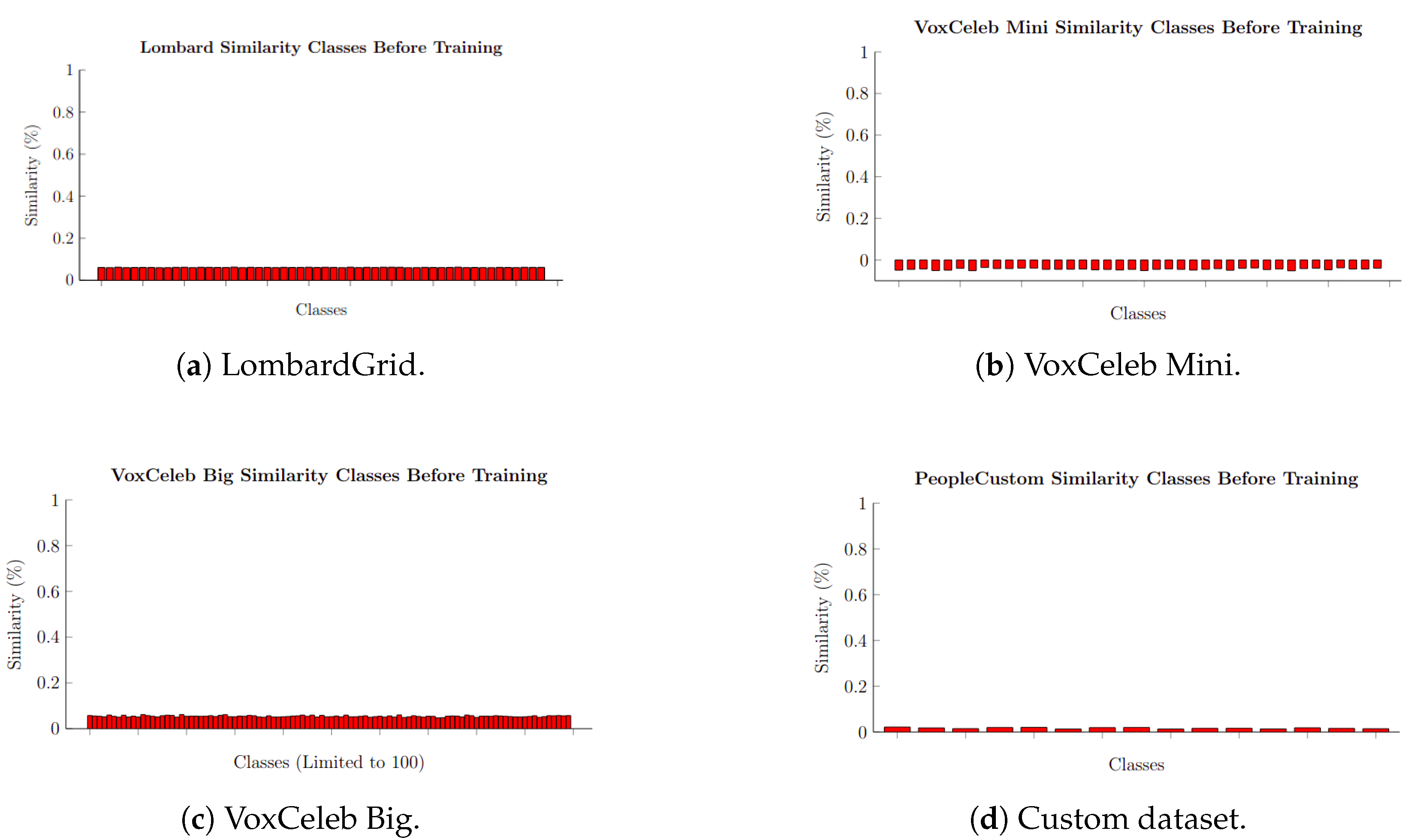
First, to establish a baseline, we analyzed the cosine similarity between the raw face (FaceNet) and voice (MFCC) embeddings before any contrastive training. As shown in Figure 2a–d the similarity values for all pairs—both matching (same person) and non-matching—cluster around zero. This confirms there is no inherent alignment between the two modalities. These results underscore the necessity of a dedicated training process to learn a shared representation in the embedding space where facial and vocal features of the same individual can be correlated.
Figure 2.
Pre-training cosine similarity distributions across all evaluated datasets.
5.2. Post-Training Similarity Analysis
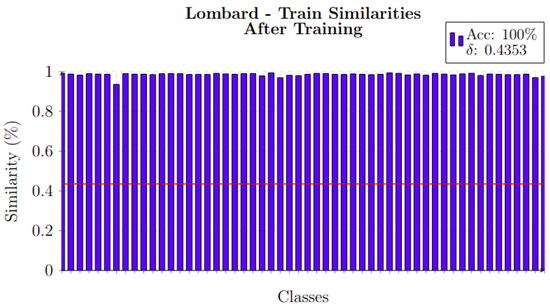
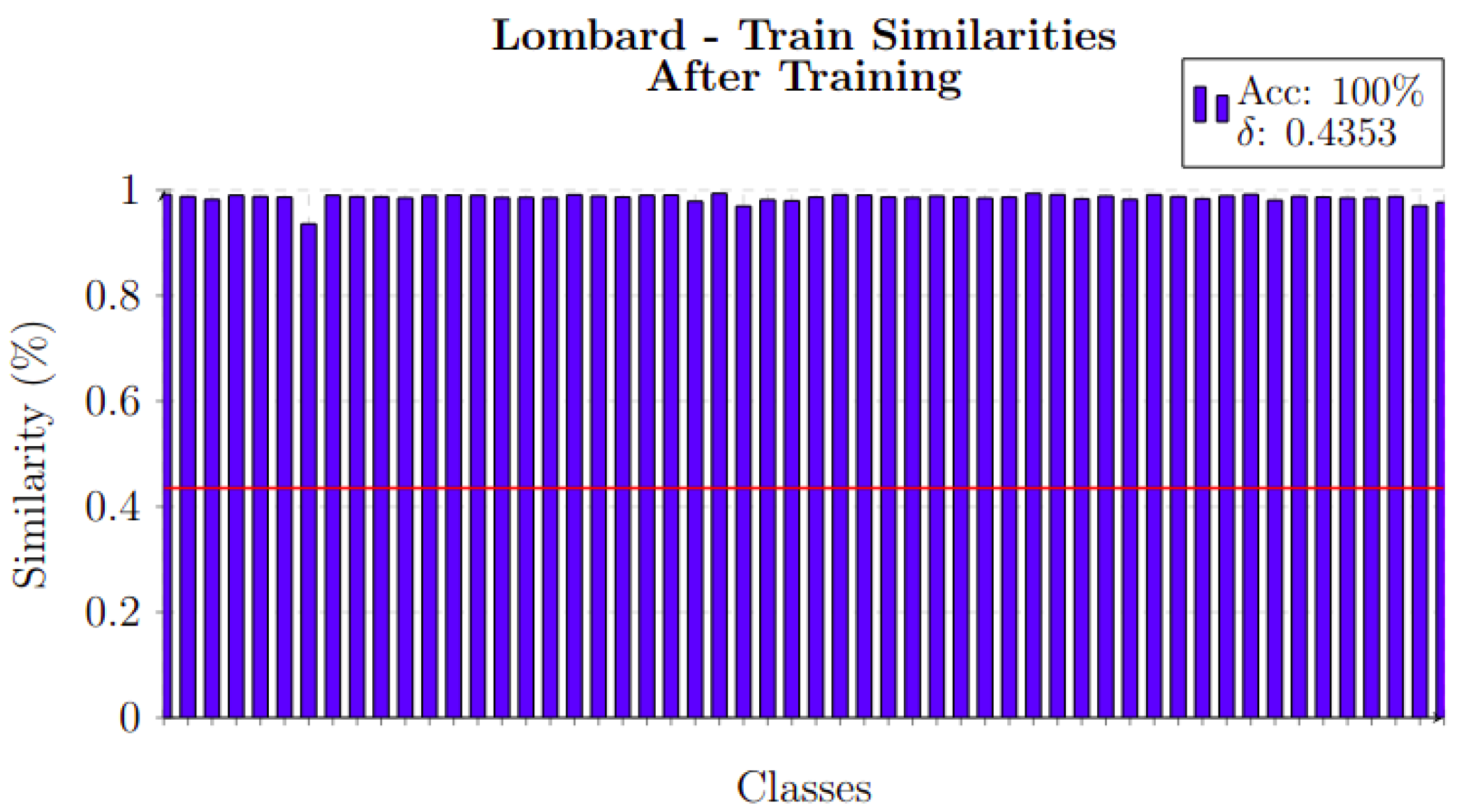
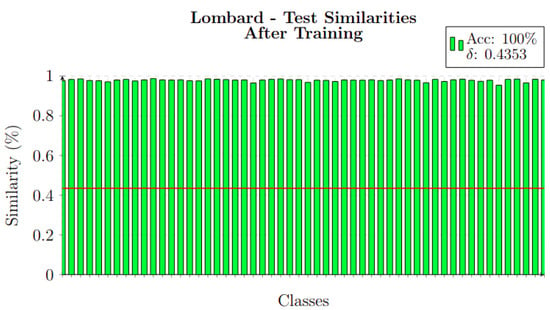
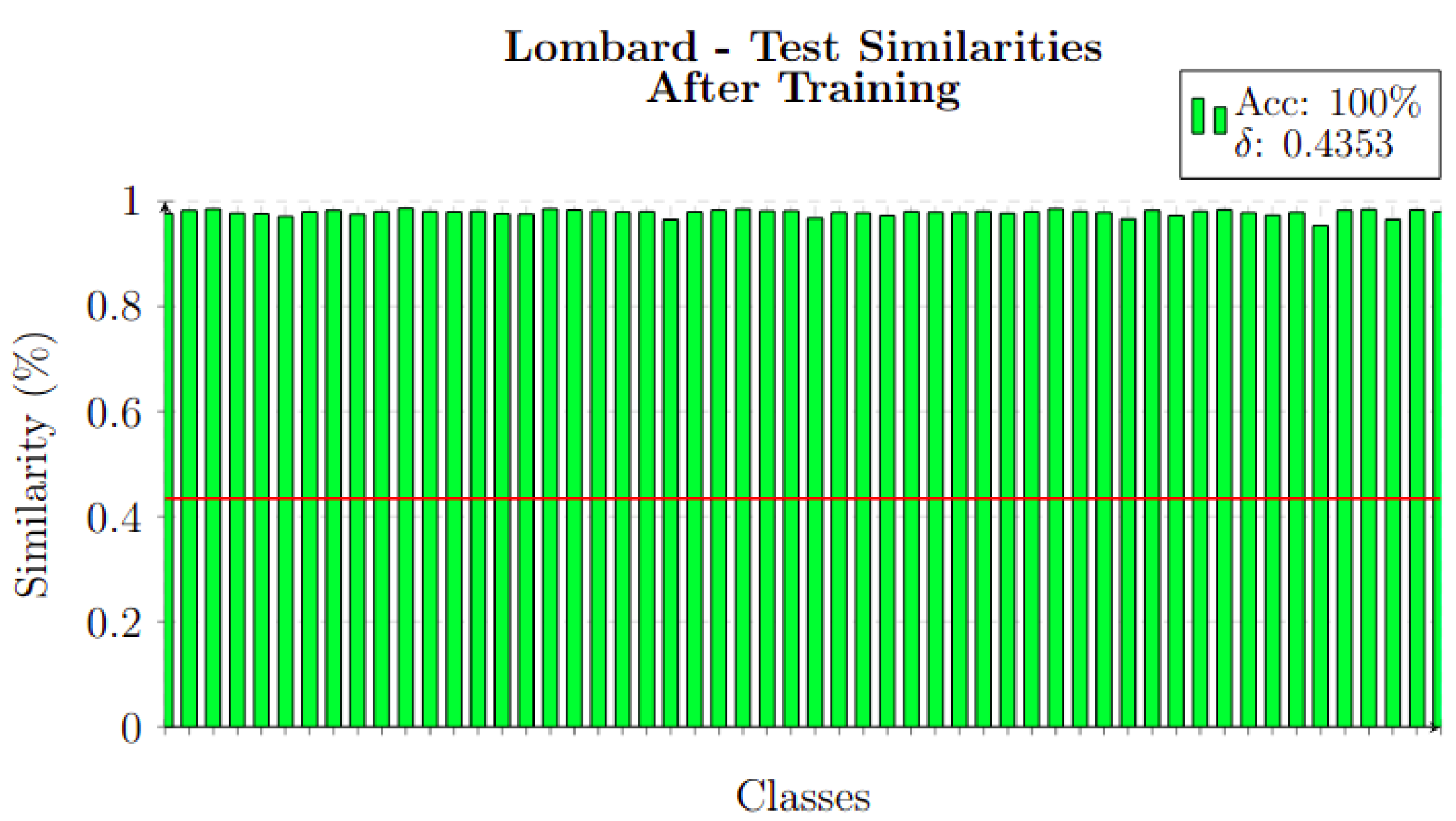
Following the contrastive training, we re-evaluated the similarity distributions. The results, depicted in Figure 3 and Figure 4, show a dramatic shift. For all the datasets, the cosine similarity for positive pairs (matching face and voice) consistently approaches 1.0, both on the training set and, critically, on the held-out test set. This provides strong qualitative evidence that our model successfully learned to project the two modalities into a shared embedding space where true identity correspondences are strongly and robustly aligned.
Figure 3.
LombardGrid: similarity on the training set after training. Red line indicates value.
Figure 4.
LombardGrid: similarity on the test set after training. Red line indicates value.
5.3. Comparative Evaluation for OOD Detection
Finally, we quantitatively evaluated the model’s performance in distinguishing between IID and OOD individuals, comparing it against a FaceNet-only baseline.
5.3.1. Results on the Custom and LombardGrid Datasets
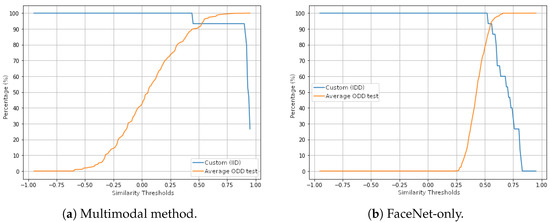
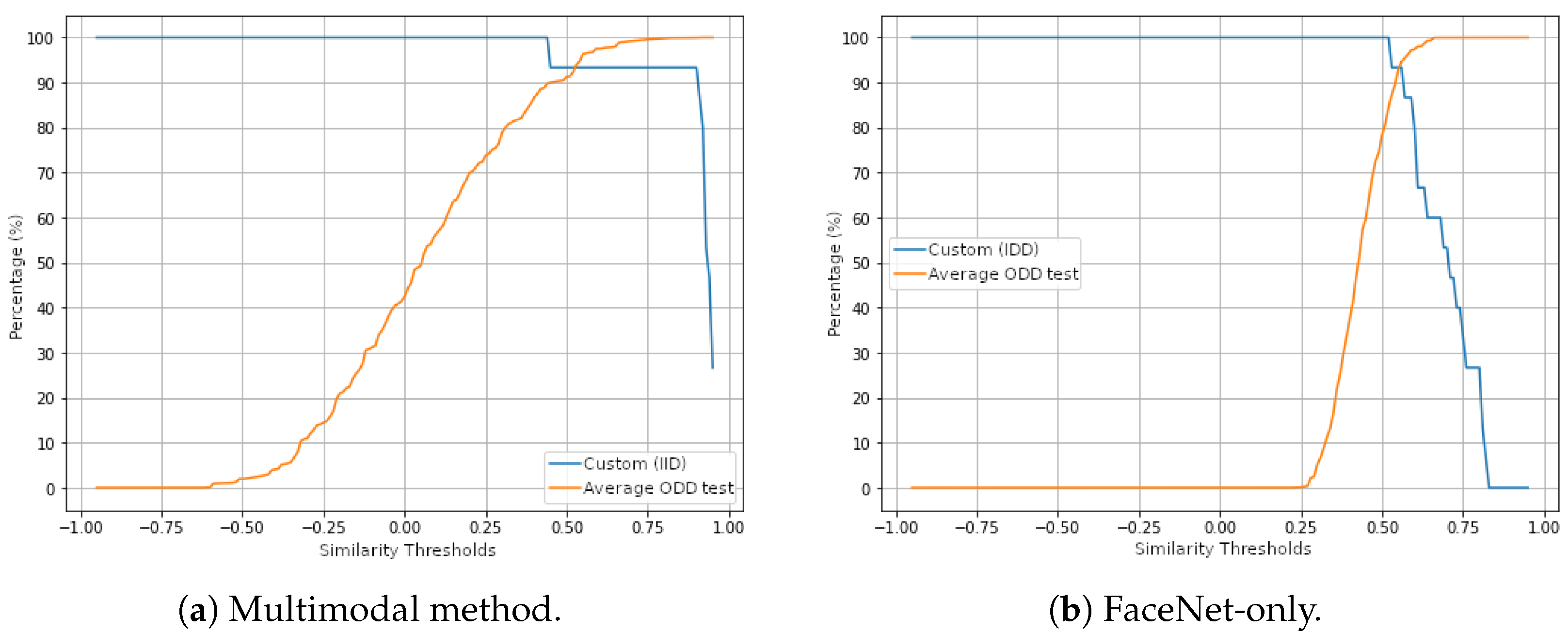
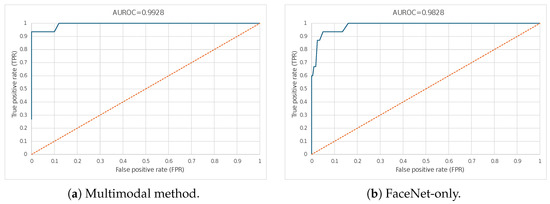
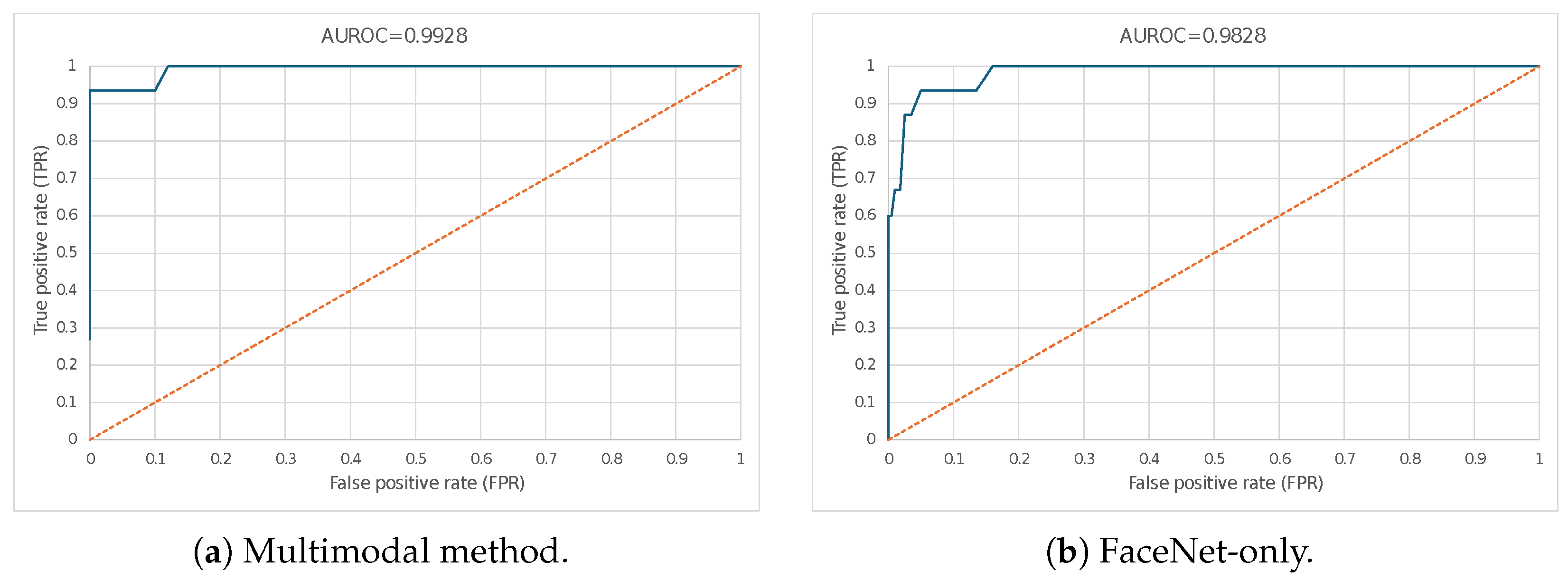
On the custom dataset, with high source variability, our multimodal method (Figure 5a) shows a stable trade-off curve, while the FaceNet baseline (Figure 5b) is highly sensitive to the threshold. The ROC curves further reinforce this observation by highlighting the discriminative capability of this approach. The proposed multimodal method and the FaceNet baseline both achieve near-perfect separation between IID and OOD samples, as shown in Figure 6.
Figure 5.
Custom: IID vs. OOD detection accuracy.
Figure 6.
ROC curve for the Custom dataset.
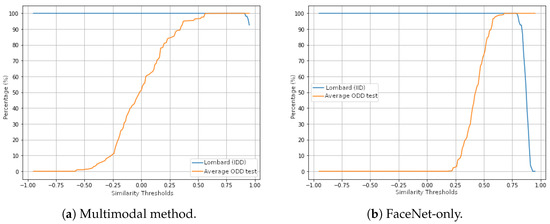
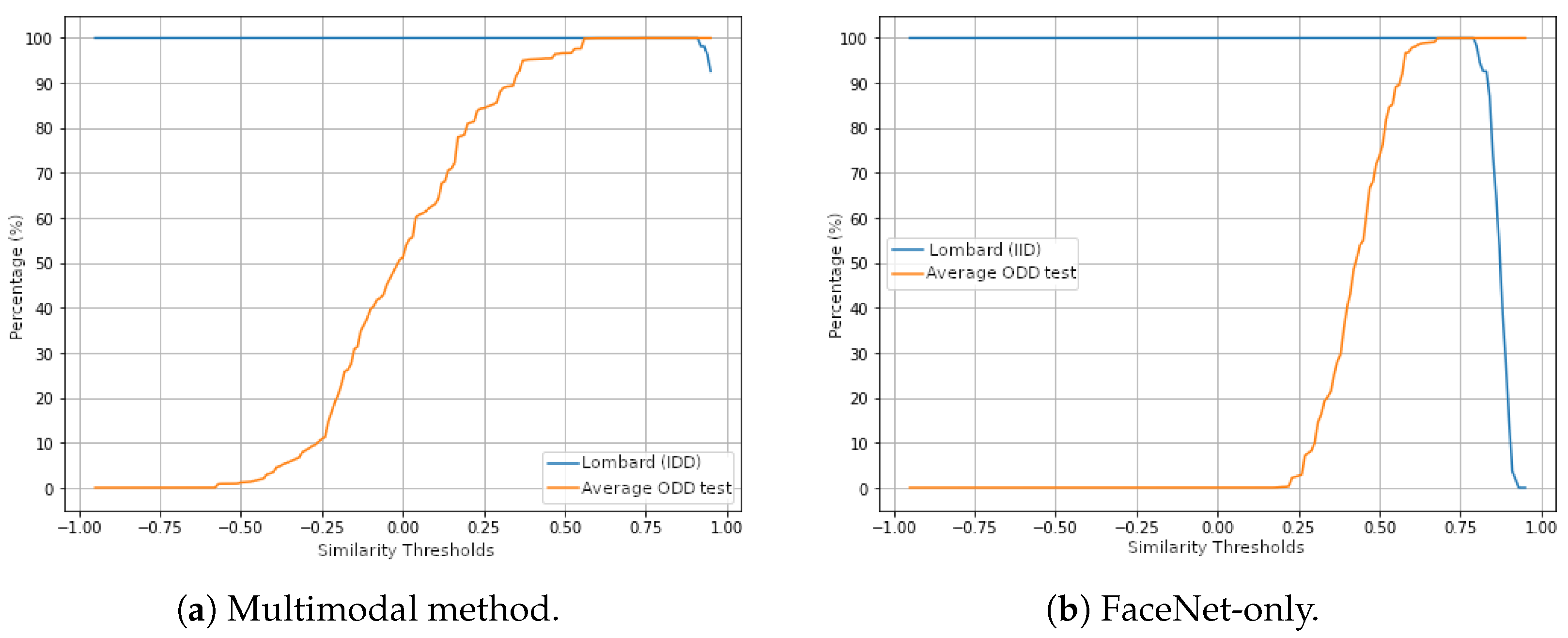
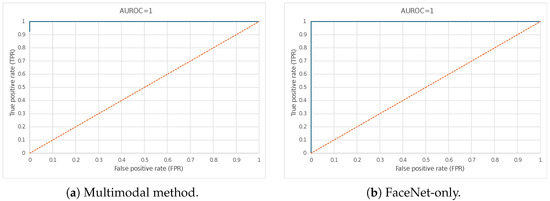
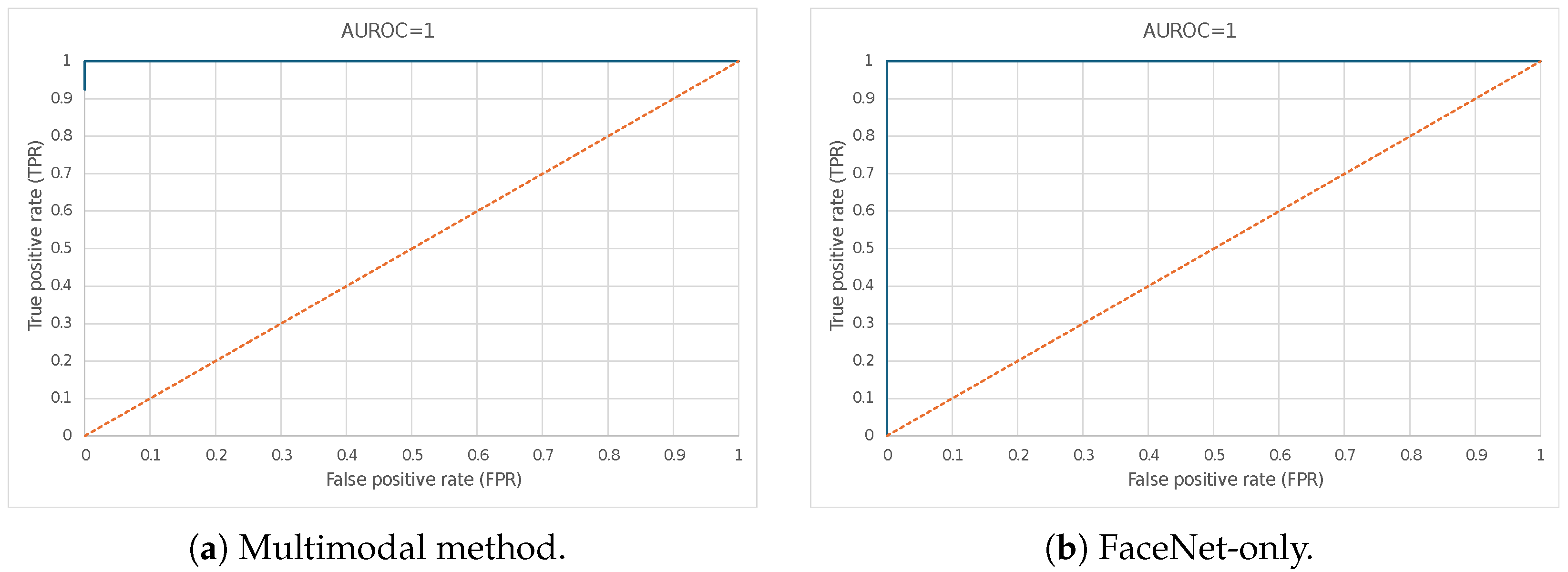
On the controlled LombardGrid dataset, both methods achieve perfect performance; however, our approach (Figure 7a) maintains this performance over a much wider range of thresholds than FaceNet (Figure 7b), indicating superior robustness. Regarding ROC curves (Figure 8), while the curves appear identical, this result should be interpreted alongside the threshold analysis, where the multimodal approach demonstrates greater robustness across a wider range of thresholds. Overall, these results confirm that the proposed method not only achieves high accuracy but also offers improved stability and generalization, particularly in more challenging and heterogeneous scenarios.
Figure 7.
Lombard: IID vs. OOD detection accuracy.
Figure 8.
ROC curve for the Lombard dataset.
5.3.2. Results on the VoxCeleb Dataset
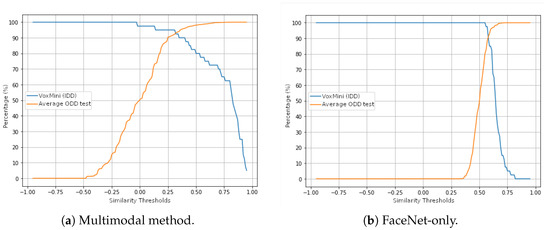
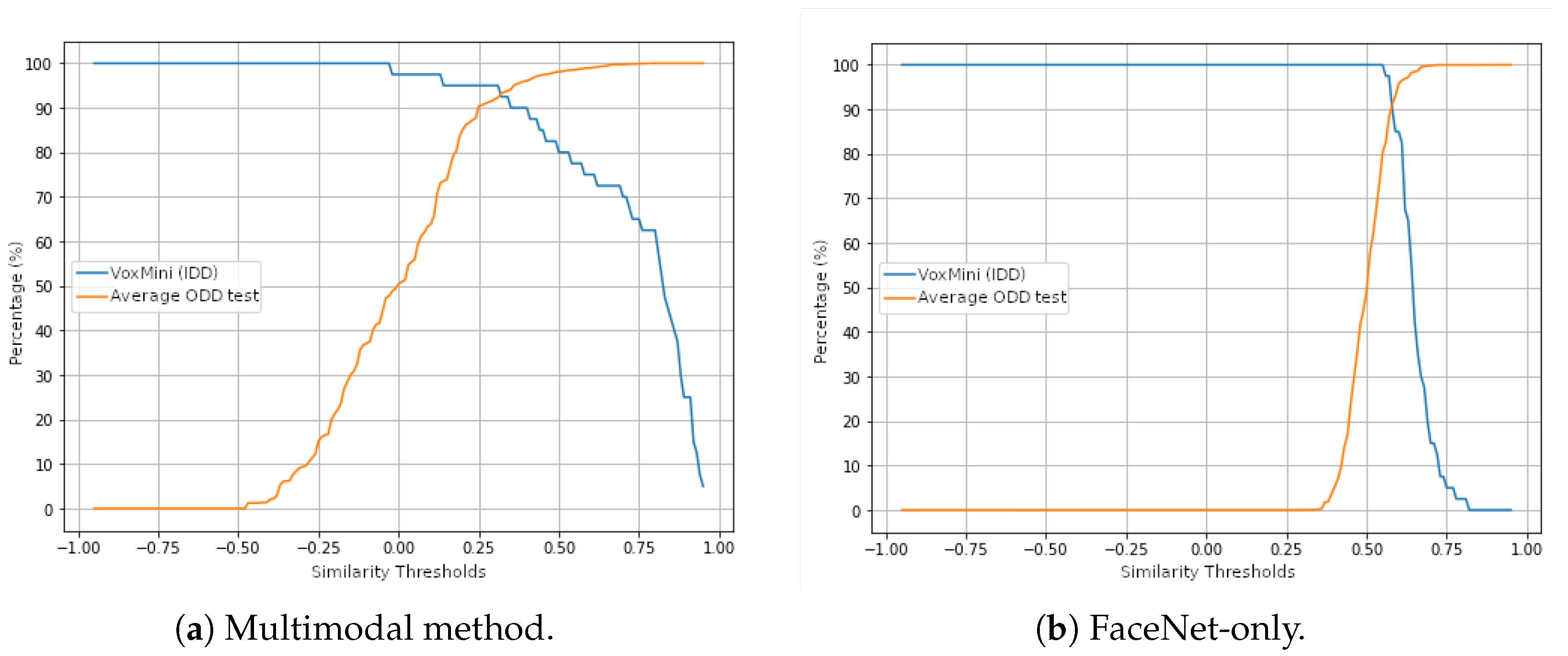
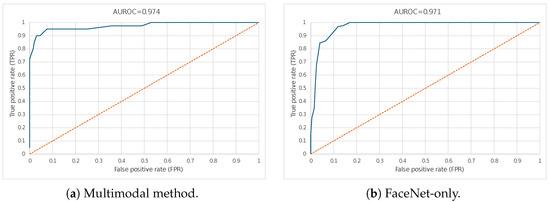
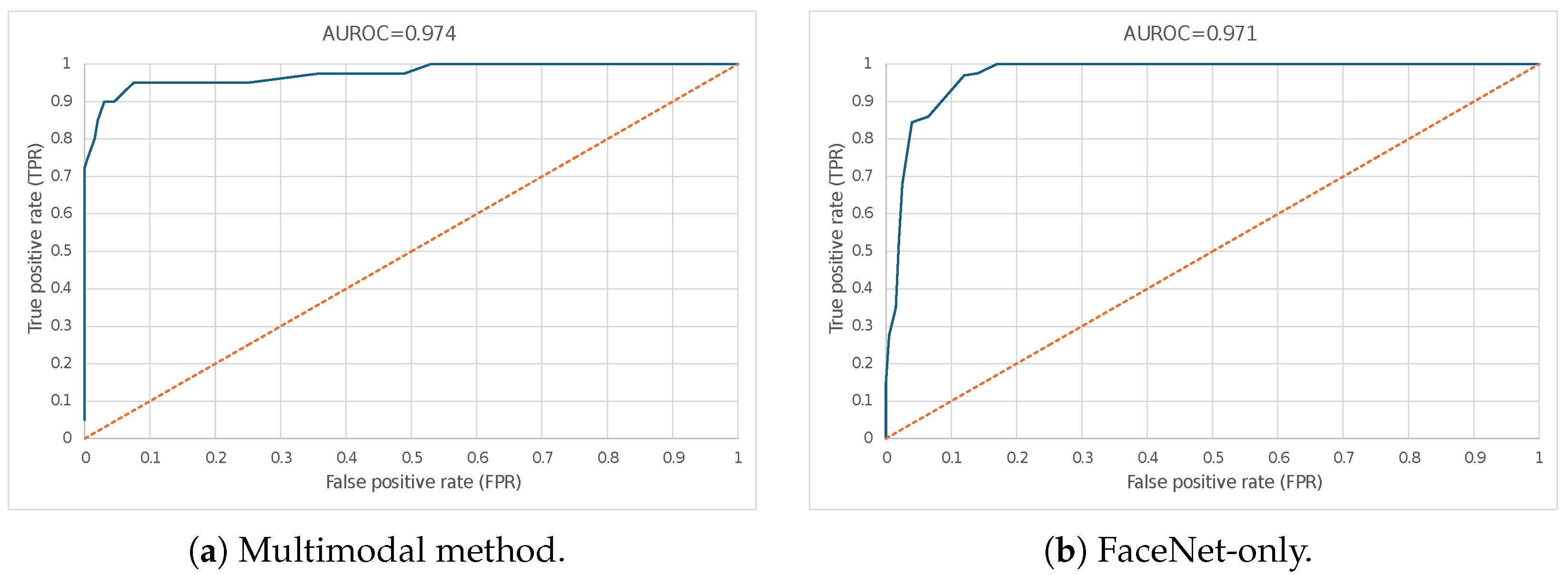
Two subtests were used to test scalability. On VoxCeleb Mini, our method (Figure 9a) maintains high IID accuracy even at strict OOD detection levels, while FaceNet’s performance collapses under the same conditions (Figure 9b), as quantified in Table 2. The ROC curves on this subdataset further highlight the scalability and robustness of the proposed approach under increasing dataset complexity: both methods achieve high performance, with the multimodal model slightly outperforming the FaceNet baseline (AUROC = 0.974 vs. 0.971) (Figure 10).
Figure 9.
VoxCeleb Mini: IID vs. OOD detection accuracy.
Table 2.
VoxCeleb Mini: OOD vs. IID interpolation (90–97% OOD).
Figure 10.
VoxCeleb Mini: ROC curves.
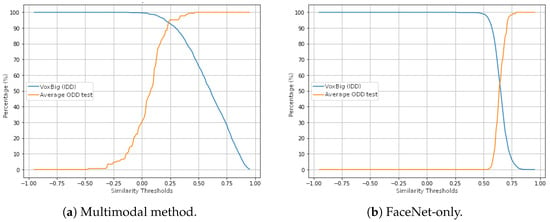
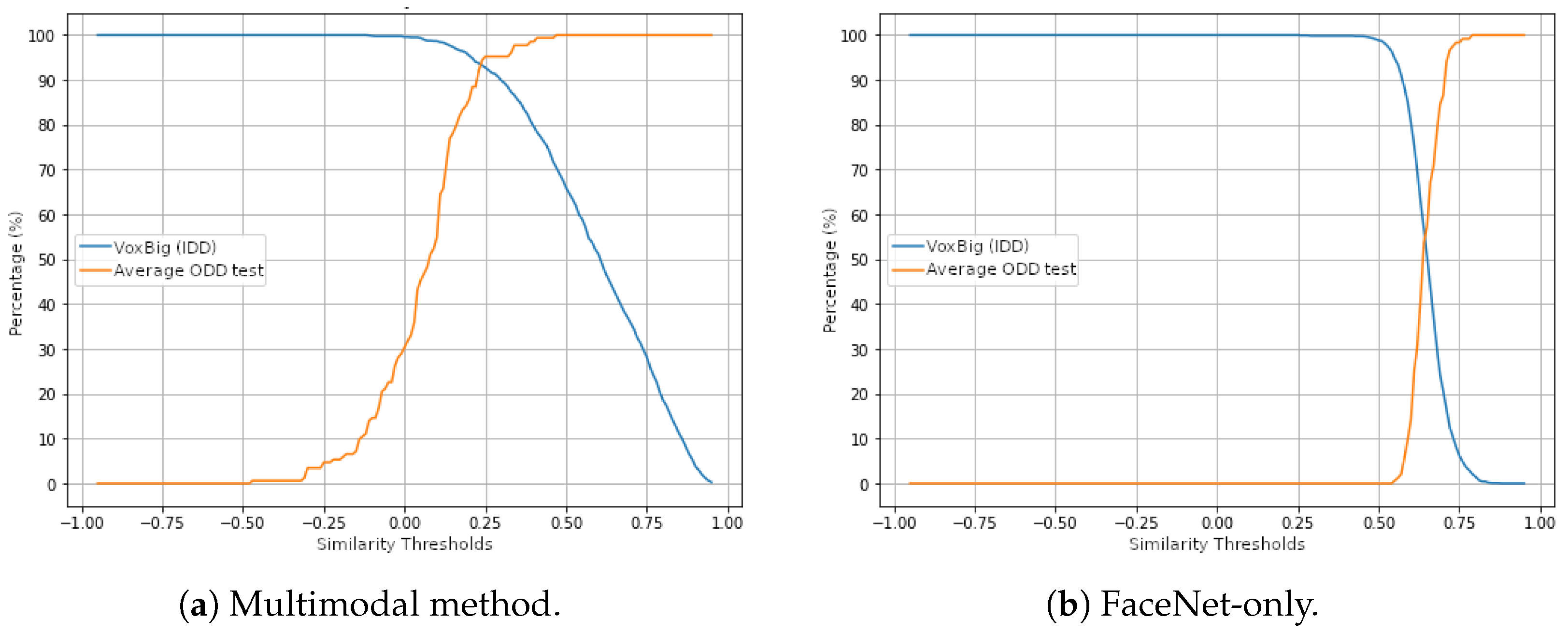
The advantage is even more pronounced on VoxCeleb Big. As the number of identities increases, the FaceNet baseline becomes increasingly sensitive to similarity threshold selection and gallery size. Here, the FaceNet baseline is rendered unusable, with IID accuracy dropping below 20% (Figure 11b). In contrast, our model (Figure 11a) remains highly effective, proving its scalability and suitability for large-scale, real-world applications (Table 3).
Figure 11.
VoxCeleb Big: IID vs. OOD detection accuracy.
Table 3.
VoxCeleb Big: OOD vs. IID interpolation (90–97% OOD).
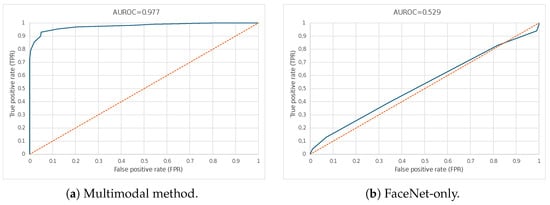
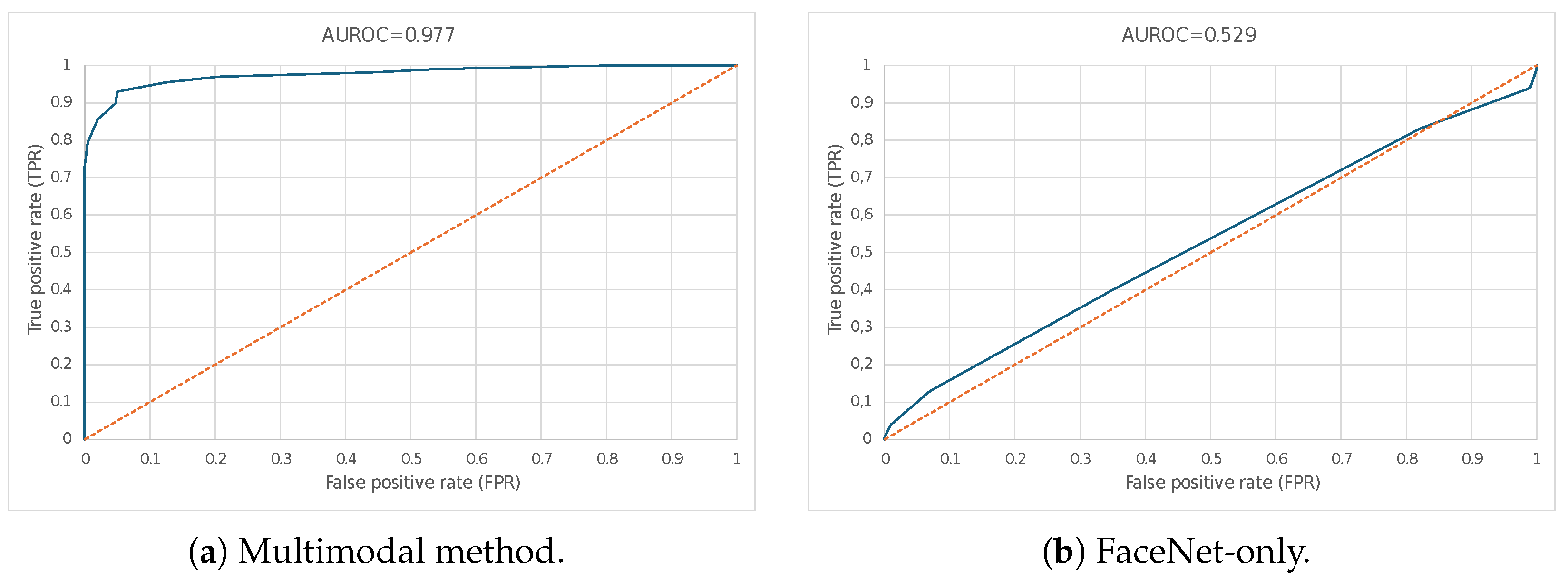
As illustrated in Figure 12, the multimodal method maintains strong discriminative capability (AUROC = 0.977), while the FaceNet baseline collapses to near-random performance (AUROC = 0.529). This drastic degradation confirms that unimodal, gallery-based approaches struggle to maintain reliable decision boundaries as the number of identities increases, whereas the proposed multimodal framework remains stable by leveraging cross-modal consistency. These results demonstrate that the advantage of the proposed method becomes increasingly evident at scale, making it particularly suitable for real-world, large-scale OOD detection scenarios.>
Figure 12.
VoxCeleb Big: ROC curves.
The very low performance of the FaceNet baseline in the VoxCeleb Big setting is mainly explained by the scale of the identity gallery and the open-set evaluation protocol used in this work. In this scenario, FaceNet operates as a unimodal similarity-based identification system, where the query embedding must be compared against a large number of enrolled identities. As the number of identities increases, inter-class similarity distributions tend to overlap, making threshold-based separation between known and unknown identities increasingly unreliable. This effect significantly degrades OOD detection performance in large-scale settings. In contrast, the proposed multimodal method evaluates the cross-modal consistency between face and voice embeddings, avoiding the need for comparisons against a large gallery of identities and thus remaining stable as the number of enrolled individuals grows.
5.4. Computational Efficiency
Beyond accuracy and stability, the proposed method offers a significant advantage in computational cost. Inference requires only two embedding lookups (one for the face, one for the voice) and a single cosine similarity computation, resulting in a constant-time complexity of per verification. It is worth noting that this operation differs from traditional gallery-based face recognition systems, such as FaceNet identification pipelines, which typically operate under a 1:N identification setting. In such systems, a query embedding must be compared against all enrolled identities in a gallery in order to determine the most likely match. Consequently, the number of similarity computations grows with the gallery size. As the number of registered users grows in gallery-based face recognition systems, the linear overhead becomes prohibitive for real-time applications, whereas our approach maintains its efficiency, making it suitable for deployment on resource-constrained platforms.
5.5. Additional Baselines Discussion
To provide additional context with respect to existing approaches, we include a discussion of representative baselines from related areas. Audio-visual verification methods typically focus on closed-set identity matching and do not explicitly address open-set or OOD detection. Classical OOD detection methods, such as threshold-based or energy-based approaches, are generally designed for single-modality classification tasks and are not directly applicable to cross-modal consistency evaluation.
Similarly, CLIP-style models and generic multimodal fusion strategies (e.g., feature concatenation followed by classification) do not explicitly enforce identity-level alignment between modalities. In contrast, the proposed method leverages contrastive learning to directly model cross-modal identity consistency, which is particularly suitable for OOD detection in identity disjoint settings.
While a full experimental comparison with all these approaches is left for future work, the included FaceNet baseline and the consistent improvements observed across datasets provide initial empirical evidence of the effectiveness of the proposed multimodal framework.
Simple multimodal fusion strategies, such as feature concatenation followed by classification, were not considered as primary baselines since they do not explicitly model cross-modal identity consistency, which is the core objective of this work.
6. Conclusions and Future Work
This work introduced a multimodal contrastive learning approach for recognizing out-of-distribution individuals by jointly analyzing facial and vocal features. By projecting both modalities into a shared embedding space, the method effectively distinguished between known and unseen individuals across multiple datasets, achieving accuracies above 90% in both in-distribution and OOD detection. The proposed system also offers high computational efficiency, requiring only two embeddings and a cosine similarity computation, making it suitable for real-time and resource-limited applications.
The results confirm that contrastive alignment between modalities provides a robust foundation for person recognition under variable conditions.
Future work will focus on expanding the multimodal framework with additional modalities, such as gait or depth data. We also propose to integrate temporal modeling to capture dynamic cross-modal cues. Further research will explore self-supervised and few-shot learning strategies to reduce data requirements, as well as large-scale real-world validation to assess scalability and ethical considerations. Additionally, we plan to further extend the experimentation, mainly involving a deeper ablation study to identify and measure the contribution of each modality to the final result.
Author Contributions
Investigation and Conceptualisation, S.G., F.G.-D. and M.C.; methodology, S.G., with supervision from F.G.-D. and M.C.; visualisation, S.G.; writing—original draft preparation, S.G.; writing—review and editing, S.G., F.G.-D. and M.C.; supervision, F.G.-D. and M.C.; All authors have read and agreed to the published version of the manuscript.
Funding
This work has been carried out under the framework of the grant PID2022-138453OB-I00 funded by MICIU/AEI/10.13039/501100011033 and by “ERDF A way of making Europe”.
Institutional Review Board Statement
The study was conducted in accordance with the Declaration of Helsinki, and approved by the Ethics Committee of University of Alicante (protocol code UA-2023-07-31 and July 2023).
Informed Consent Statement
Informed consent was obtained from all subjects involved in the study.
Data Availability Statement
The raw data supporting the conclusions of this article will be made available by the authors on request.
Conflicts of Interest
The authors declare no conflicts of interest.
References
- Radford, A.; Kim, J.W.; Hallacy, C.; Ramesh, A.; Goh, G.; Agarwal, S.; Sastry, G.; Askell, A.; Mishkin, P.; Clark, J.; et al. Learning Transferable Visual Models From Natural Language Supervision. arXiv 2021, arXiv:2103.00020. [Google Scholar] [CrossRef] [Scilit]
- Chavdarova, T.; Fleuret, F. Deep Multi-camera People Detection. arXiv 2017, arXiv:1702.04593. [Google Scholar] [CrossRef] [Scilit]
- Qian, Y.; Chen, Z.; Wang, S. Audio-Visual Deep Neural Network for Robust Person Verification. In IEEE/ACM Transactions on Audio, Speech, and Language Processing; IEEE: New York, NY, USA, 2021; Volume 29, pp. 1079–1092. [Google Scholar] [CrossRef] [Scilit]
- Mandalapu, H.; Reddy, P.N.A.; Ramachandra, R.; Rao, K.S.; Mitra, P.; Prasanna, S.R.M.; Busch, C. Audio-Visual Biometric Recognition and Presentation Attack Detection: A Comprehensive Survey. IEEE Access 2021, 9, 37431–37455. [Google Scholar] [CrossRef] [Scilit]
- Tao, R.; Das, R.K.; Li, H. Audio-visual Speaker Recognition with a Cross-modal Discriminative Network. arXiv 2020, arXiv:2008.03894. [Google Scholar] [CrossRef] [Scilit]
- Sarı, L.; Singh, K.; Zhou, J.; Torresani, L.; Singhal, N.; Saraf, Y. A Multi-View Approach to Audio-Visual Speaker Verification. In Proceedings of the ICASSP 2021—2021 IEEE International Conference on Acoustics, Speech and Signal Processing (ICASSP), Toronto, ON, Canada, 6–11 June 2021; pp. 6194–6198. [Google Scholar] [CrossRef] [Scilit]
- Rabbi, M.S.E.; Rubaiyat, A.H.M.; Zhuang, Y.; Rohde, G.K. A Sliced-Wasserstein Distance-Based Approach for Out-of-Class-Distribution Detection. arXiv 2023, arXiv:2302.01459. [Google Scholar] [CrossRef] [Scilit]
- Berger, C.; Paschali, M.; Glocker, B.; Kamnitsas, K. Confidence-Based Out-of-Distribution Detection: A Comparative Study and Analysis. In Medical Image Computing and Computer-Assisted Intervention—MICCAI 2021; Springer: Cham, Switzerland, 2021; pp. 122–132. [Google Scholar] [CrossRef] [Scilit]
- Liu, S.; Zeng, Z.; Ren, T.; Li, F.; Zhang, H.; Yang, J.; Jiang, Q.; Li, C.; Yang, J.; Su, H.; et al. Grounding DINO: Marrying DINO with Grounded Pre-Training for Open-Set Object Detection. arXiv 2024, arXiv:2303.05499. [Google Scholar] [CrossRef] [Scilit]
- He, K.; Zhang, X.; Ren, S.; Sun, J. Deep Residual Learning for Image Recognition. arXiv 2015, arXiv:1512.03385. [Google Scholar] [CrossRef] [Scilit]
- Saeed, M.S.; Nawaz, S.; Morerio, P.; Mahmood, A.; Gallo, I.; Yousaf, M.H.; Del Bue, A. Cross-modal Speaker Verification and Recognition: A Multilingual Perspective. In Proceedings of the Proceedings of the IEEE/CVF Conference on Computer Vision and Pattern Recognition Workshops, Nashville, TN, USA, 25 June 2021. [Google Scholar]
- Chen, W.; Sun, Y.; Xu, K.; Dou, Y. Contrastive Learning-based Chaining-Cluster for Multilingual Voice-Face Association. arXiv 2024, arXiv:2408.02025. [Google Scholar]
- Peng, C.; He, L.; Su, D. Fuse after Align: Improving Face-Voice Association Learning via Multimodal Encoder. arXiv 2024, arXiv:2404.09509. [Google Scholar] [CrossRef] [Scilit]
- Alharbi, A.; Alshanbari, H. Face-voice based multimodal biometric authentication system. PeerJ Comput. Sci. 2023, 9, e1468. [Google Scholar] [CrossRef] [Scilit] [PubMed]
- Nagrani, A.; Chung, J.S.; Zisserman, A. VoxCeleb: A Large-Scale Speaker Identification Dataset. In Proceedings of the Interspeech 2017, Stockholm, Sweden, 20–24 August 2017; ISCA: Singapore, 2017. [Google Scholar] [CrossRef] [Scilit]
- Alghamdi, N.; Maddock, S.; Marxer, R.; Barker, J.; Brown, G.J. A corpus of audio-visual Lombard speech with frontal and profile views. J. Acoust. Soc. Am. 2018, 143, EL523–EL529. [Google Scholar] [CrossRef] [Scilit] [PubMed]
- Schroff, F.; Kalenichenko, D.; Philbin, J. FaceNet: A Unified Embedding for Face Recognition and Clustering. In Proceedings of the 2015 IEEE Conference on Computer Vision and Pattern Recognition (CVPR), Boston, MA, USA, 7–12 June 2015; pp. 815–823. [Google Scholar] [CrossRef] [Scilit]
- Taigman, Y.; Yang, M.; Ranzato, M.; Wolf, L. DeepFace: Closing the Gap to Human-Level Performance in Face Verification. In Proceedings of the 2014 IEEE Conference on Computer Vision and Pattern Recognition, Boston, MA, USA, 7–12 June 2014; pp. 1701–1708. [Google Scholar] [CrossRef] [Scilit]
- Rusak, E.; Reizinger, P.; Juhos, A.; Bringmann, O.; Zimmermann, R.S.; Brendel, W. InfoNCE: Identifying the Gap Between Theory and Practice. arXiv 2024, arXiv:2407.00143. [Google Scholar] [CrossRef] [Scilit]

Disclaimer/Publisher’s Note: The statements, opinions and data contained in all publications are solely those of the individual author(s) and contributor(s) and not of MDPI and/or the editor(s). MDPI and/or the editor(s) disclaim responsibility for any injury to people or property resulting from any ideas, methods, instructions or products referred to in the content. |
© 2026 by the authors. Licensee MDPI, Basel, Switzerland. This article is an open access article distributed under the terms and conditions of the Creative Commons Attribution (CC BY) license.