


Abstract
The Amazon coastal zone exhibits remarkable habitat diversity and species richness, with nutrient-rich estuaries playing a crucial role in local food webs and supporting fish and other aquatic organisms. To examine the distribution of fish larvae and juveniles in the Taperaçu Estuary and their relationship with environmental variables, monthly sampling was conducted at two fixed stations in 2008. Samples were collected during flood and ebb spring tides using 500 μm mesh nets. In situ measurements of salinity, temperature, and dissolved oxygen were recorded, while pH and turbidity were determined in the laboratory. Abiotic variables did not differ significantly between tides, but salinity and dissolved oxygen were higher during the dry season. A total of 5175 individuals were identified, representing 17 families and 37 species. The ichthyoplankton community was dominated by Rhinosardinia amazonica, Anchovia clupeoides, Stellifer stellifer, and Microgobius meeki. Stations 1 and 2 showed differing abundance ranges, with higher values at station 1 during the rainy season. Preflexion stages were abundant at both stations, indicating the estuary’s importance as a nursery and development area for several fish species. Multivariate analyses revealed spatial and seasonal structuring of larval assemblages along the estuarine gradient, driven primarily by salinity, temperature, and turbidity. Our results emphasize the role of upper estuary sectors of eastern Amazonia as areas of spawning, larval development, and subsequent juvenile settlement, contributing to the dispersal of fish species throughout the estuary and adjacent coastal environments. The present findings also reinforce the ecological value of the studied Extractive Reserve and other protected areas along the Amazon littoral as essential habitats for larval refuge and development. The need for continued monitoring and preservation of these protected zones is evident.
1. Introduction
Estuaries are ecosystems of major ecological importance because the mixing of continental freshwater and marine waters creates high variability in physical, chemical, and biological conditions. These environmental fluctuations directly affect biodiversity and usually follow seasonal patterns [1,2,3,4,5]. Such environments are typically characterized by high concentrations of dissolved nutrients and organic matter that sustain the nutritional needs of various aquatic species, including invertebrates and vertebrates [6,7,8].
A large number of fish species have part of their life cycle associated with estuaries and coastal waters, as these environments offer high productivity and provide protection from predators during early developmental stages [9,10,11]. In general, fish species in these ecosystems can be classified as resident—completing their entire life cycle within the estuary—or migratory, reproducing in the ocean and entering estuaries during their larval or juvenile stages [12,13,14].
The composition of larval fish communities in estuaries is influenced by a range of biotic and abiotic variables [15]. Constant fluctuations in environmental conditions actively influence the abundance and distribution of these organisms [16,17,18]. Local geomorphology and water circulation patterns may also act as mechanisms of concentration or dispersion [19]. Among the biotic variables, predation and food availability [20,21] often exert strong effects on the structure and dynamics of larval fish communities.
Studies on the early life cycle of fishes are essential for determining spawning periods and spawning grounds, making them fundamental for understanding species ecology, since fish community dynamics cannot be fully understood without information on their early stages [22,23]. Understanding the spatiotemporal distribution of fish larvae is also important for monitoring, management, and conservation efforts. Information on these aspects is crucial for establishing protected areas and implementing fishing period regulations [24,25].
In tropical environments, the combination of estuarine systems and other aquatic habitats is one of the main factors influencing fish species diversity [21,26]. Along the Amazon coast—an area known for its high habitat and species diversity—there are still relatively few studies on the composition and distribution of estuarine and marine fish larvae and juveniles [19,27,28,29,30,31,32]. This contrasts with the abundance of research available for freshwater fish larvae in the same region [33,34,35,36,37]. Similar discrepancies are also observed in other sectors of the Brazilian coast, where coastal species have been more thoroughly investigated [38,39,40,41,42,43,44,45,46,47].
In Amazonian estuaries, as commonly observed in freshwater Amazonian environments [48], fishes captured by artisanal fishing (i.e., small-scale, traditional fishing carried out close to shore using low-technology gear and small vessels, mainly for local consumption) represent the basis of the protein diet for local communities and constitute the main source of income for most riparian extractive populations [49]. This explains the strong dependence of traditional communities on fishing activity [50]. Given the ecological and economic importance of fisheries for the region, the present study aimed to address two main questions: (a) How do environmental variables influence the composition, abundance, and spatial and temporal distribution of fish larvae and juveniles, including species of local fishery relevance? and (b) Is there evidence that environmentally protected areas, such as the Caeté Taperaçu Marine Extractive Reserve, play a significant role in spawning, hatching, dispersal, and maturation of fish larvae within estuarine ecosystems of the eastern Amazon?
2. Materials and Methods
2.1. Study Area
The Amazon coastal region comprises the states of Amapá, Pará, and Maranhão, covering about 35% of the Brazilian coastline. It extends for approximately 2500 km, from the Oiapoque River in Amapá to São Marcos Bay in Maranhão [51]. This coastline is highly indented, encompassing extensive natural areas such as estuaries, beaches, and mangroves [52,53], and is considered one of the largest continuous mangrove systems in the world, with an estimated area of 8900 km2 [54].
Within this region lies the Bragantinian Coastal Plain, extending from Maiaú Bay to the mouth of the Caeté River (00°46′00″–01°00′00″ S; 46°36′00″–46°44′00″ W), covering approximately 1570 km2 [55]. Hydrodynamic conditions are strongly influenced by a semidiurnal macrotidal regime, with tidal amplitudes reaching up to 6 m during equinoctial spring tides [53]. The climate is humid and megathermal, with average temperatures above 25 °C and annual rainfall between 2500 and 3000 mm [56], characterized by two marked periods: a rainy season and a dry season, the former accounting for more than 85% of annual precipitation [57,58].
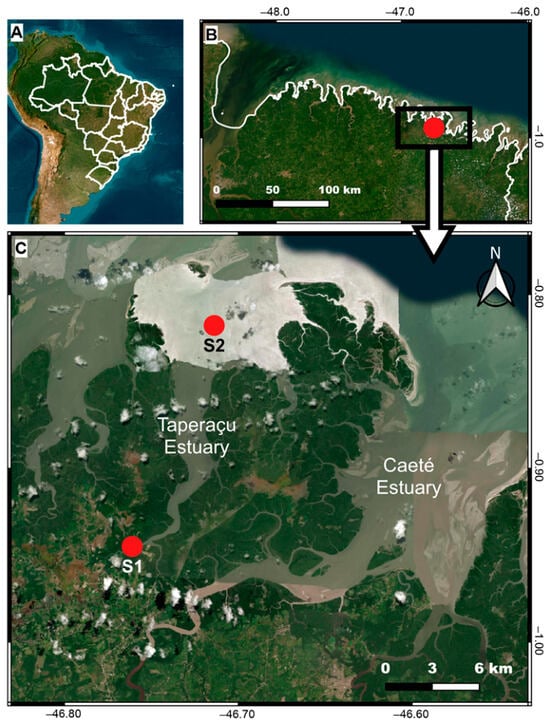
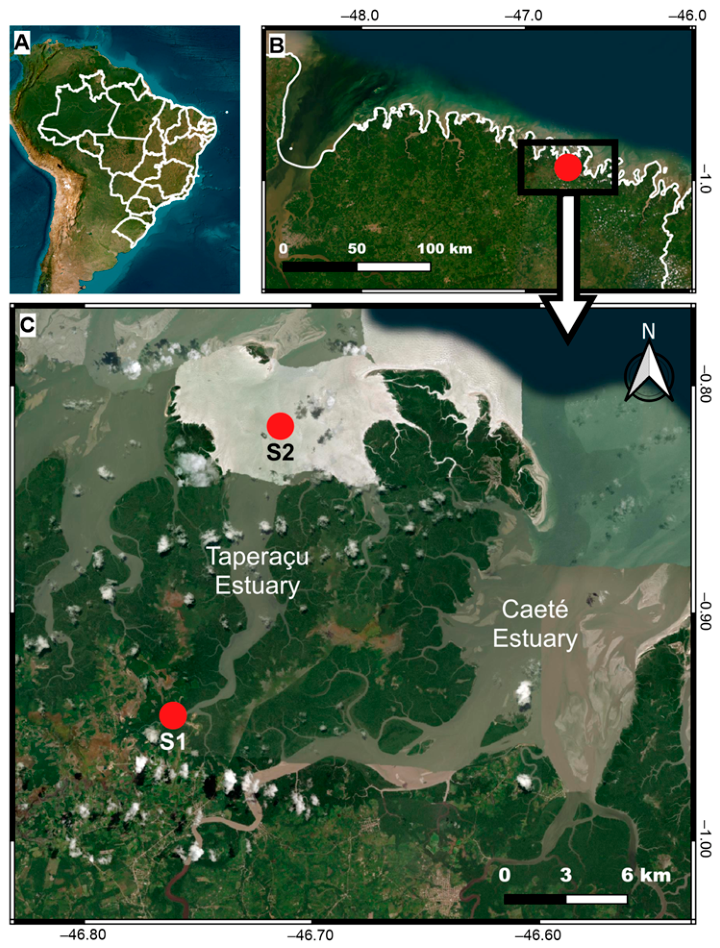
Located within this coastal plain, the Taperaçu Estuary (Figure 1; 00°56′37″ S; 46°44′59″ W) has a surface water area of 21 km2 and a catchment area of 40 km2, with intermittent freshwater inflow and no permanent river discharge [59,60]. It is a shallow (mean depth 4.2 m), permanently open estuary with numerous sandbanks in its intermediate sector and a semidiurnal tidal regime with amplitudes of about 4 m during neap tides and up to 6 m during spring tides [59,61,62]. Tidal currents are strong, reaching 2.04 m/s, and the estuary exhibits high turbidity [30,59]. Local hydrodynamics are driven by tides, winds, and wind-generated waves [62]. Winds follow a seasonal pattern, with stronger velocities during the dry season and more moderate winds during the rainy period [56,63,64]. The estuary is connected to the Caeté Estuary through the Taici tidal channel (Taici Creek), receiving oligohaline waters during flood tides [60,65]. Freshwater input occurs mainly during the rainy season, when floodplains in the upper estuary become inundated [58,62]. These hydrological characteristics generate well-defined ecological contrasts: during the rainy season, increased precipitation results in lower salinity, higher turbidity, and elevated nutrient and chlorophyll-a concentrations [60,62], whereas the dry season is marked by higher salinity, greater water transparency, and reduced nutrient availability due to diminished freshwater influence and stronger marine intrusion [58,59]. Together, these studies [30,58,59,60,62] consistently demonstrate that precipitation is the main driver of hydrological and ecological conditions in the Taperaçu system, producing well-defined contrasts between the wet and dry seasons.
Figure 1.
Study area with the location of the two sampling stations (S1 and S2) in the Taperaçu Estuary, Bragança-Pará. (A): Map of South America showing the Brazilian territory; (B): Geographic position of the Taperaçu estuary along the Amazonian coastline in northern Brazil; (C): Distribution of sampling stations within the estuary.
The study area lies within the Caeté Taperaçu Marine Extractive Reserve, created by federal decree on 20 May 2005. The reserve covers 42,069 hectares (103,950 acres; https://wikivisually.com/wiki/Caeté-Taperaçu_Marine_Extractive_Reserve (accessed on 10 March 2025), where local communities rely primarily on crab harvesting (Ucides cordatus), fishing, and subsistence agriculture [52]. The margins of the Taperaçu Estuary are dominated by mangrove species such as Rhizophora mangle, Avicennia germinans, and Laguncularia racemosa, although salt marshes, grasses, and Cyperaceae also occur [66,67].
2.2. Sampling and Study Design
Samples were collected during spring tides from January to December 2008. Two fixed sampling stations were established along the estuary: Station 1 (S1; 00°56′58.4″ S; 46°46′26.9″ W), located in the innermost sector, and Station 2 (S2; 00°56′37.0″ S; 46°44′59.0″ W), positioned near the estuary mouth (Figure 1). The stations were approximately 15 km apart. Monthly sampling campaigns were conducted during both rainy and dry seasons, with collections performed during flood and ebb tides at each station.
Sampling consisted of 5-min horizontal subsurface hauls using a conical plankton net (500 μm mesh, 60 cm mouth diameter, 1.60 m length) equipped with a mechanical flow meter (General Oceanics 2030R, General Oceanics, Inc., Miami, FL, USA) to quantify filtered water volume. All samples were immediately fixed in neutral formalin (final concentration 4%) and stored in 500 mL plastic flasks.
In situ temperature, dissolved oxygen (DO), and salinity were measured using an oxygen meter (Lutron DO 5510, Lutron Electronic Enterprise Co., Ltd., Taipei, Taiwan) and a refractometer (Atago S/Mill E, Atago Co., LTD., Itabashi, Tokyo, Japan). pH and turbidity were measured in the laboratory using a bench-top pH meter (Labmeter HS 3B PH2, Shanghai Hongyi Instrumentation Co., Ltd., Shanghai, China) and a turbidity meter (Hanna HI 93703, Hanna Instruments, Woonsocket, RI, USA), respectively.
Samples for morphological identification were sorted under a stereoscopic microscope (Zeiss Stemi 2000, Carl Zeiss, Jena and Oberkochen, Germany) and identified to the lowest possible taxonomic level. Larval development stages were classified according to [68], and identifications were based on the available literature [68,69,70,71,72]. Quantitative data were used to calculate abundance (number of individuals per 100 m3 of filtered water), relative abundance (proportion of individuals in relation to the total sample), and frequency of occurrence (percentage of samples in which the species appears).
Species with relative frequencies > 5% were further evaluated. Taxa were categorized according to modified criteria from [73]: ≥70% highly frequent; <70–30% frequent; <30–10% less frequent; and <10% sporadic. The Shannon–Wiener index (H′) [74] and Pielou’s evenness index (J′) [75] were calculated using natural logarithms to ensure consistency in the diversity estimates of the fish larvae assemblages.
2.3. Statistical Analysis
Four independent sampling events were conducted at two stations (S1 and S2) under two tidal conditions (ebb and flood). Each sampling event represented an independent temporal replicate, resulting in four replicates per treatment level. The two sampling stations were located in two pre-defined areas along the estuary, and the exact sampling points within each area were randomly selected. One monthly tow was performed at each station during daylight hours, using a small motorized boat traveling in circular movements around both stations (S1 and S2) at approximately 1.5 knots, resulting in two samples per station (flood and ebb tides) per sampling campaign. A preliminary Lilliefors test was applied to identify skewed variables and guide minimal log transformations (x + 1) when necessary. After fitting the ANOVA models, residuals were examined to confirm that assumptions of normality and homoscedasticity were met. Multifactorial ANOVA was used to assess differences in abiotic variables and biotic metrics (total abundance and the most representative taxa) between stations (S1/S2), tides (ebb/flood), months, and seasons (dry/rainy). Analyses were conducted in STATISTICA 6 (α = 0.05).
A cluster analysis based on species abundance was performed using Bray–Curtis dissimilarity, and group formation was conducted using the UPGMA clustering method (Unweighted Pair Group Method with Arithmetic Mean) [76]. A between-group SIMPER analysis identified species contributing most to dissimilarities among clusters. Analyses were conducted in R version 4.5.2 [77] using the vegan version 2.7-5 [78], stats, and dendextend packages version 1.19.1 [79].
Spearman correlation coefficients were calculated to examine associations between abiotic and biotic variables, providing an exploratory assessment of potential relationships among parameters. To further evaluate the influence of environmental gradients on community structure, we performed a constrained ordination using a Canonical Analysis of Principal Coordinates (CAP) based on Bray–Curtis dissimilarity, with species abundance as the response matrix and environmental variables as constraining predictors. The significance of the constrained model and canonical axes was assessed using permutation tests.
3. Results
Rainfall data [80] confirmed the presence of two seasonal periods throughout the year: a rainy season, which corresponds to the months from January to July, and a dry period, corresponding to the remaining months (August to December). Rainfall values obtained for the study period were 18% higher than those observed for the historical average (1973–2008).
During the study period, there were no significant differences in the abiotic variables between tide periods (ebb and flood). Consequently, monthly averages (±Standard Deviation—SD) for each sampling station were calculated to examine spatial (S1/S2) and temporal variations—monthly and seasonal (dry and wet).
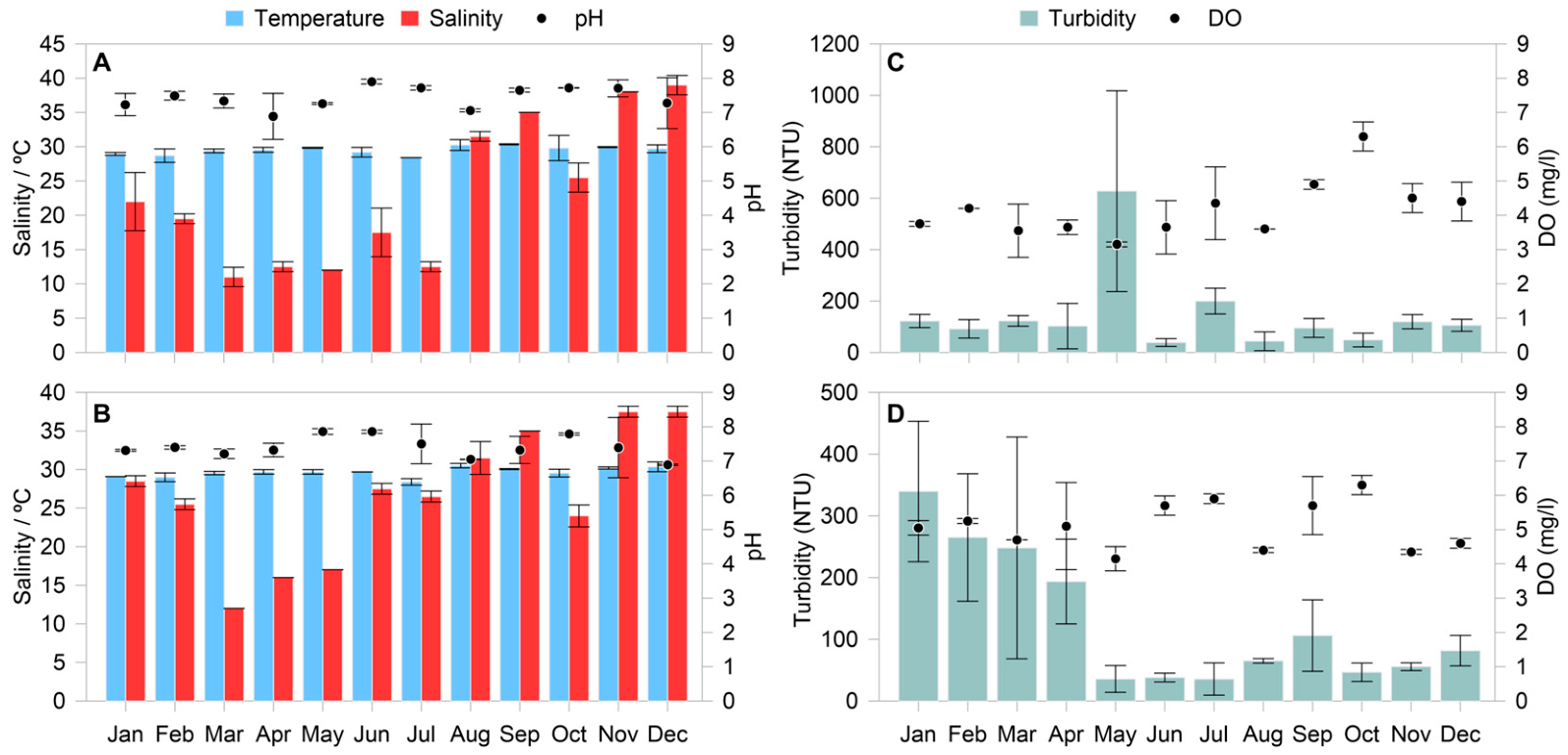
The average water temperature ranged from 28.4 ± 0.0 °C (July) to 30.4 ± 0.1 °C (September) in the innermost portion (S1), whereas at the mouth of the estuary (S2), these values ranged from 28.4 ± 0.4 °C (July) to 30.4 ± 0.6 °C (December), with no significant spatial or seasonal differences (Figure 2A,B).
Figure 2.
Average (±SD) salinity, temperature (°C) and pH (A,B), and turbidity (NTU) and dissolved oxygen (mg/L; (C,D)) at station l (A,C) and at station 2 (B,D) during the study period.
Salinity at station S1 varied from 11.0 ± 1.4 (March) to 39.0 ± 1.4 (December), while at station S2 it ranged from 12.0 ± 0.0 (March) to 37.5 ± 0.7 (November and December). Significantly higher values were observed during the dry season at both stations (F = 5.34; p < 0.05), but there was no significant difference between S1 and S2 (Figure 2A,B).
The pH ranged from slightly acidic to alkaline throughout the study period, ranging between 6.9 ± 0.7 (April) and 7.9 ± 0.1 (June) at station S1, and from 6.9 ± 0.0 (December) to 7.9 ± 0.1 (May and June) at station S2, with no significant spatial, monthly, or seasonal differences (Figure 2A,B).
Turbidity at station S1 ranged from 38.3 ± 14.9 NTU (June) to 627.0 ± 390.3 NTU (May), while at station S2 it varied from 35.5 ± 26.2 NTU (July) to 339.5 ± 113.8 NTU (January), with significantly higher values recorded in May at S1 (F = 3.58; p < 0.05; Figure 2C,D). In Amazonian estuaries, turbidity peaks often lag behind rainfall because freshwater accumulates in upper flooded areas before flowing seaward, and this delay—combined with strong macrotidal dynamics—helps explain why turbidity during the sampling period did not align directly with monthly rainfall patterns.
At station S1, the average concentrations of dissolved oxygen ranged from 3.2 ± 0.0 mg/L (May) to 6.3 ± 0.4 mg/L (October), while at station S2 these values ranged from 4.2 ± 0.1 mg/L (May) to 6.3 ± 0.3 mg/L (October). Significantly higher values were recorded during the dry period at both stations (F = 5.35; p < 0.05; Figure 2C,D). Additional comparisons are provided in Supplementary Figure S1, which include box plots illustrating the distributions of key environmental and ichthyoplankton abundances between stations S1 and S2.
3.1. Composition of the Early Stages of Fish in the Taperaçu Estuary
In the present study, we captured a total of 5200 fish larvae and juveniles (larvae after the post-flexion stage). Of this total, 5175 individuals were identified to the lowest possible taxonomic level (genus and/or species), comprising 17 families and 37 species (Table 1). Specimens of the families Clupeidae, Sciaenidae, and Engraulidae were the quantitatively dominant taxa at both stations. Sciaenidae had the largest number of species (seven), followed by Engraulidae (six) and Gobiidae (five).
Table 1.
Composition, total abundance (TA), relative abundance (RA%) and frequency (F%) of early-life stages of fish in the estuary of Taperaçu during the study period.
The species R. amazonica, S. stellifer, A. clupeoides, S. microps, and G. guavina represented more than 83% of the total larvae at station S1. R. amazonica, A. clupeoides, and Microgobius meeki represented about 82.1% of the total number of larvae at station S2 (Table 1). The flexion stage presented the highest percentages (55% and 66% at stations S1 and S2, respectively) compared to the pre-flexion stage (17% at each sampling point) and the post-flexion stage (27% and 13% at stations S1 and S2, respectively). Juveniles were less representative (1% at station S1 and 4% at station S2), and larvae with yolk sacs were not observed during the study period.
Frequency of occurrence showed that at station S1, only R. amazonica and A. clupeoides were highly frequent species (>70%). G. guavina, S. microps, S. stellifer, M. meeki, Achirus sp., Oligoplites saurus, Elops saurus, and Diapterus rhombeus were considered frequent species. Among the species identified at station S2, only R. amazonica was highly frequent (>70%), while other species, such as A. clupeoides, S. stellifer, M. meeki, and Cetengraulis edentulus, were frequent species (Table 1).
3.2. Total Abundance
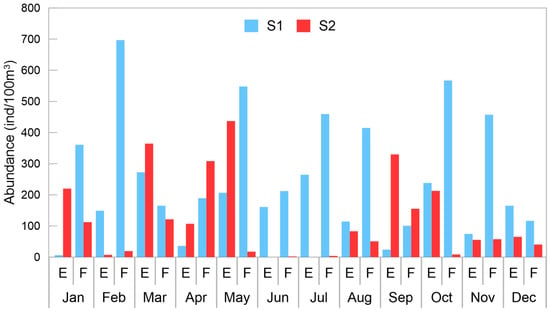
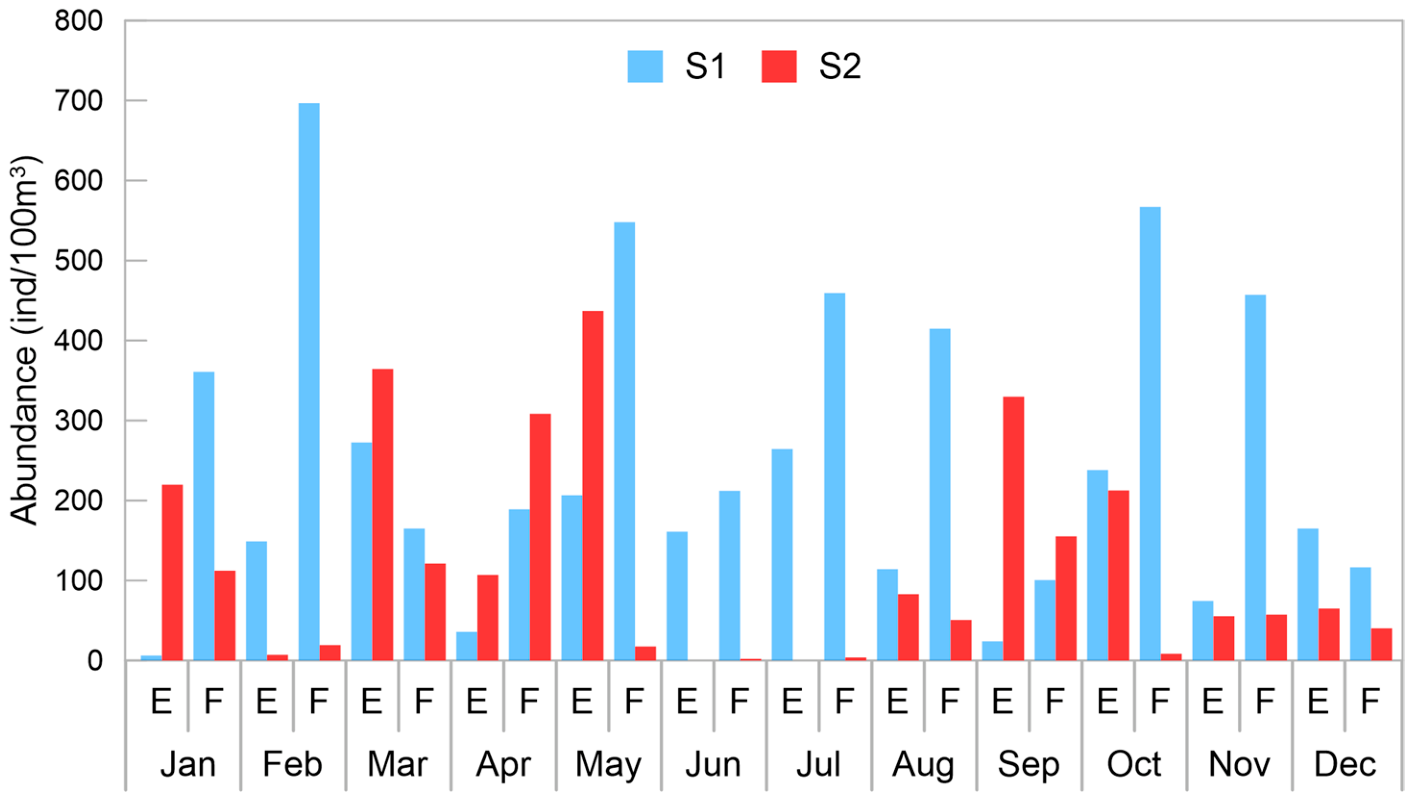
The results showed significant spatial and seasonal differences in larval abundance, as well as variations between tide periods. The total monthly abundance at station S2 ranged from 0.00 ind/100 m3 (June and July) to 436.91 ind/100 m3 (May), whereas at station S1 these values ranged from 6.28 ind/100 m3 (January) to 696.72 ind/100 m3 (February), with significantly higher values at station S1 during flood tide (F = 13.35; p < 0.05) (Figure 3). The highest abundances occurred during the rainy season, especially for members of Sciaenidae at station S1 and Clupeidae at station S2. During the dry season, Engraulidae presented the highest abundances at both sampling stations. Specific diversity at station S1 ranged from 0.00 to 3.07 (both in June), while at station S2, diversity values ranged from 0.00 (February, June, and July) to 2.51 (April). Evenness ranged from 0.00 (June) to 0.91 (September) at station S1, while at station S2, it varied from 0.00 (February, June, and July) to 1.00 (July). Although no significant spatial or temporal differences were detected for either variable, slightly higher values were recorded during high tides.
Figure 3.
Overall abundance (ind/100 m3) of larvae and juvenile fish at stations 1 (S1) and 2 (S2) during the study period (F − E = Flood and Ebb tides, respectively).
Regarding species abundance, R. amazonica presented values ranging from 1.28 to 197.35 ind/100 m3 at station S1 and from 0.00 to 420.15 ind/100 m3 at station S2, with significantly higher values during flood tides at station S1 (F = 5.59; p < 0.05). A. clupeoides was the second most abundant species, with abundances ranging from 0.00 to 293.37 ind/100 m3 at S1 and from 0.00 to 132.37 ind/100 m3 at S2. S. stellifer presented values ranging from 0.00 to 299.37 ind/100 m3 at S1 and from 0.00 to 14.23 ind/100 m3 at S2, with significantly higher values during flood tides at S1 (F = 10.30; p < 0.05). S. microps was also observed in high abundances, with values ranging from 0.00 to 163.29 ind/100 m3 at S1 and from 0.00 to 18.98 ind/100 m3 at S2. G. guavina ranged from 0.00 to 122.55 ind/100 m3 at S1 and from 0.00 to 13.45 ind/100 m3 at S2, while M. meeki ranged from 0.00 to 42.89 ind/100 m3 at S1 and from 0.00 to 75.16 ind/100 m3 at S2.
3.3. Assemblage Structure
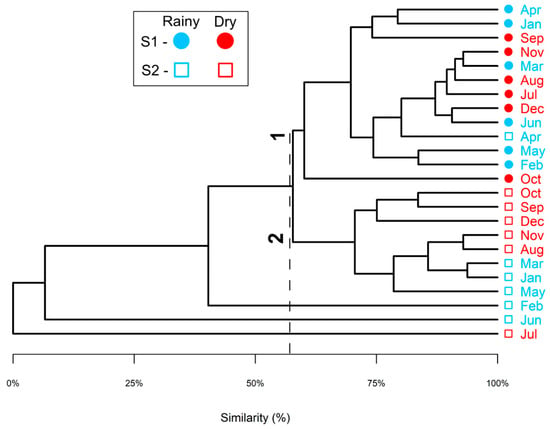
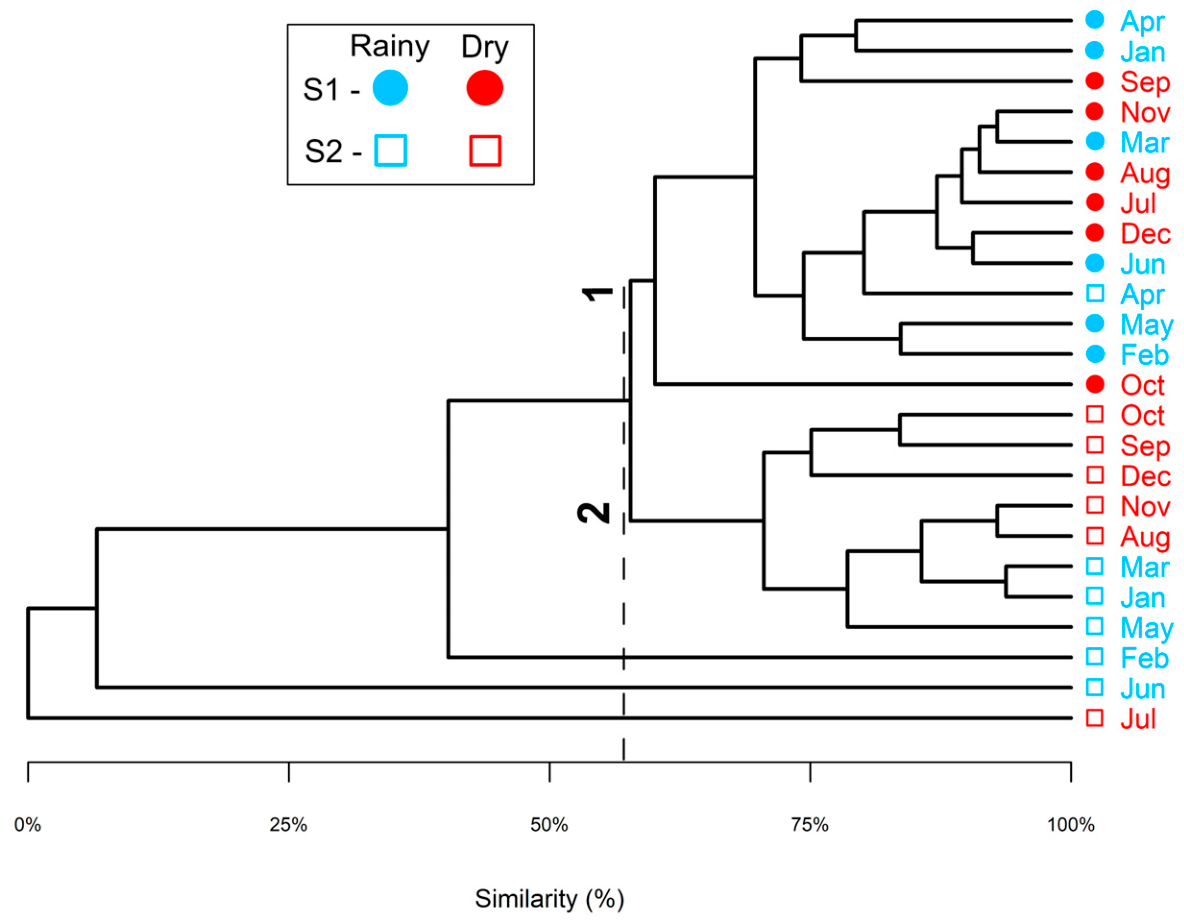
The cluster analysis based on the Bray–Curtis similarity index (64.2%) revealed two major groups of samples. Group 1 was composed primarily of samples from station S1, along with a single sample from station S2, and included observations from both the rainy and dry seasons, indicating strong similarity among most S1 samples regardless of seasonal conditions. Group 2 consisted mainly of samples from station S2 and also included observations from both seasonal periods. Within this second group, a small subset was formed exclusively by dry-season samples, while another subset contained samples from both seasons, with a predominance of rainy-season observations. Overall, the analysis suggests that the separation of samples is driven more by spatial differences between stations than by seasonal variation, although a minor seasonal subdivision is still apparent within Group 2 (Figure 4).
Figure 4.
Dendrogram of Hierarchical Clustering between samples collected at station S1 (circles) and at station S2 (squares) within the Taperaçu Estuary during the study period.
The ANOSIM indicated significant differences between sampling stations and between seasonal periods, with more pronounced differences observed between the sampling stations (R = 0.415; p = 0.001) than between seasonal periods (R = 0.222; p = 0.007). The SIMPER analysis revealed the characteristic species in both stations (S1 and S2), but their contributions (%) varied between stations. At station S1, R. amazonica (24.4%), S. stellifer (18.7%), and A. clupeoides (17.2%) made the greatest contributions. In contrast, at station S2, although R. amazonica (52.4%) remained prominent, A. clupeoides (21.1%) and S. stellifer (11.4%) shifted their positions. Regarding the seasonal periods, R. amazonica (42.8%) contributed the most to the formation of the rainy-season group, followed by S. stellifer (24.4%) and A. clupeoides (12.3%). In the dry-season group, A. clupeoides (32.3%), R. amazonica (28.8%), and M. meeki (18.1%) exhibited the largest contributions.
3.4. Correlation Between Biotic and Abiotic Variables
The Spearman correlation coefficient analysis (Table 2) revealed significant negative correlations (p < 0.05) between total larval abundance and salinity. Conversely, M. meeki and evenness were significantly and positively correlated with salinity (p < 0.001; p < 0.05) and temperature (p < 0.05; p < 0.05). The abundance of R. amazonica and diversity both showed significant positive correlations with turbidity (p < 0.01; p < 0.05). Additionally, the abundances of S. stellifer and diversity displayed significant negative correlations with dissolved oxygen concentrations (p < 0.01; p < 0.05).
Table 2.
Spearman Correlation Coefficients among the four most representative species and abundance, diversity and evenness.
3.5. Canonical Analysis of Principal Coordinates (CAP)
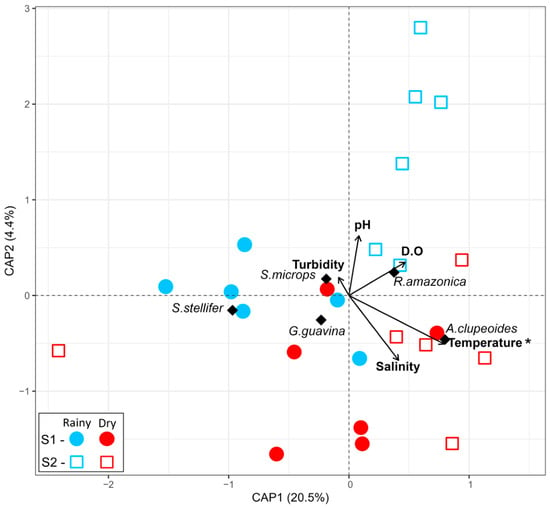
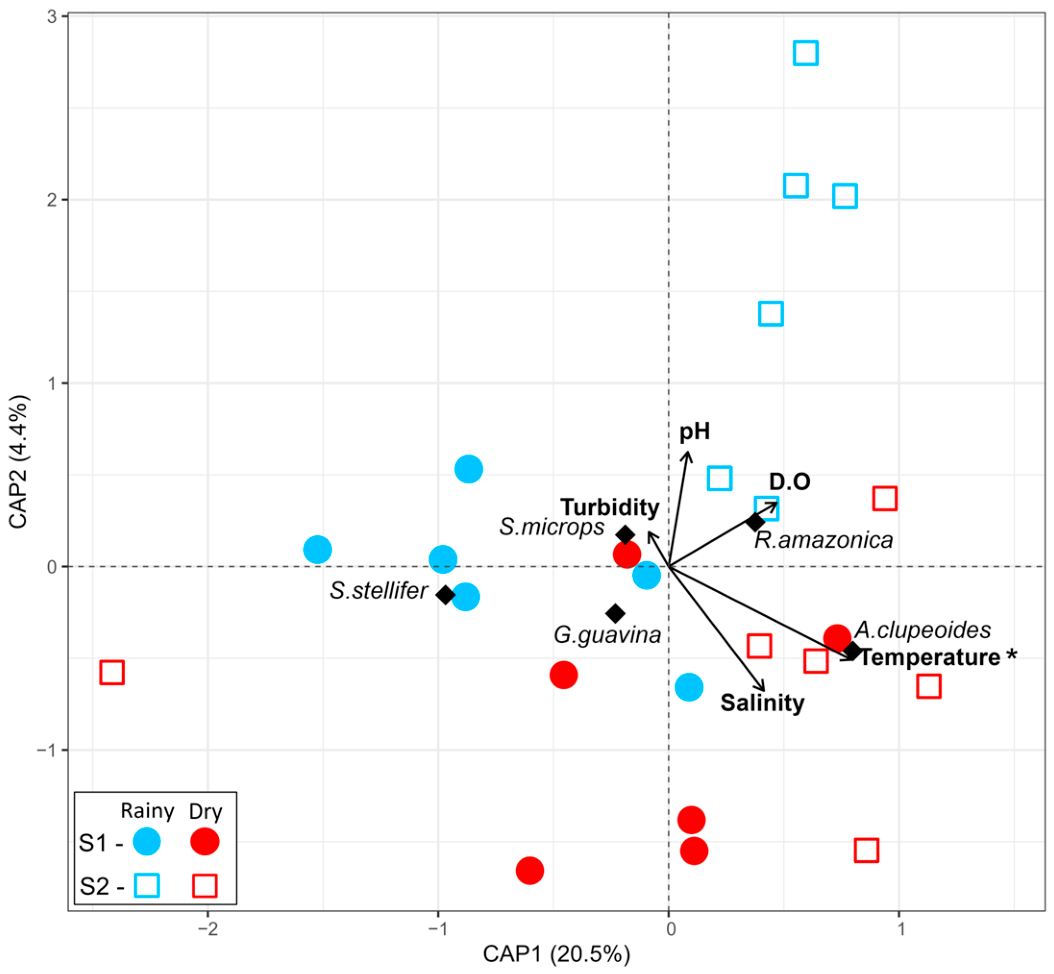
The Canonical Analysis of Principal Coordinates (CAP) revealed a clear separation of samples along both canonical axes. Along CAP1 (20.5%), samples from station S1 were positioned mainly on the left side of the ordination, whereas samples from station S2 clustered on the right. CAP2 (4.4%) distinguished the seasonal periods, with rainy-season samples (blue) occurring predominantly in the upper quadrants and dry-season samples (red) concentrated in the lower quadrants. The species R. amazonica, A. clupeoides, S. stellifer, S. microps, and G. guavina occupied distinct regions of the ordination space, reflecting their association with different sample groups. Environmental vectors indicated that temperature and salinity aligned with the right side of CAP1, while turbidity was oriented toward the left. pH showed a moderate positive association with the upper portion of CAP2. The CAP ordination, therefore, revealed spatial and seasonal differentiation among samples (Figure 5).
Figure 5.
Canonical Analysis of Principal Coordinates (CAP) using Bray–Curtis Dissimilarity with Environmental Predictors. The black squares represent the name of the species; * p < 0.05.
4. Discussion
In the Amazon coastal zone, rainfall variations commonly exert an important influence on abiotic and biotic variables [81,82,83,84]. The oscillations observed in the abiotic variables throughout the year were more pronounced between the different seasonal periods [58,85]. The present study corroborates the observations made by [57], who, based on long-term climate data, identified two well-defined seasonal periods for this region (dry and rainy). Displacements of the Intertropical Convergence Zone (ITCZ), which migrates between hemispheres throughout the year, determine the increase or decrease in rainfall volume, resulting in a rainy period during the first semester and a dry period during the second [85,86,87]. However, during the study period, precipitation values were higher than the historical average for the previous 35 years, consistent with the La Niña event recorded in 2008 [80]. Among the environmental factors, salinity showed the greatest fluctuations between seasons.
Salinity is one of the main environmental drivers determining the composition and diversity of fish larvae communities, as widely documented in estuarine systems [17,20,25,88,89,90,91,92]. In the present study, the number of recorded taxa was higher than that reported by [19] for São Marcos Bay (MA), where salinity remained relatively stable (20.3–21.1). Higher variability in salinity, such as that observed in the Taperaçu Estuary and in the tidal channels of the Curuçá Estuary (8.6–40) [29], tends to promote greater species turnover and, consequently, higher richness, because different taxa are adapted to distinct salinity ranges. In contrast, the salinity regime in the Caeté River Estuary (0–39) [27,92,93] is broader than in our study area, yet methodological differences—particularly the larger sampling effort in those studies—likely contributed to the higher richness reported there. Although salinity plays a central role, other factors such as local geomorphology, environmental productivity [94], and the physiological tolerances of the regional fish fauna [95,96], as well as additional environmental gradients [97], also influence the occurrence and distribution of early-life stages.
Freshwater discharge can be responsible for seasonal variations in ichthyoplankton composition and abundance in estuarine environments, substantially changing the larval and juvenile fish community [98], indicating that river inflow can play an important role in the structure of fish communities in estuaries [25,99]. In the present study, the highest abundances were observed during the rainy season, as previously reported by [100] in the Mucuri River estuary (BA) and by [40] in Guanabara Bay (RJ). Our results suggest that this pattern is directly related to food availability, since the highest concentrations of suspended particulate matter and zooplankton tend to occur during this same period in the study estuary [82], especially small copepod species [61,82,83] commonly consumed by fish larvae. According to [101], synchronization between reproduction and plankton production cycles may be crucial for larval survival. In tropical regions, spawning peaks are not as well defined as in temperate regions. Despite the typically small temperature variation (≈2 °C) throughout the year in tropical estuaries, this factor generally does not have a significant impact on the structure of local larval fish communities [100].
The highest larval abundance recorded in the innermost region of the estuary corroborates findings reported for other Brazilian estuarine regions [27,43,92,102] and for other tropical and subtropical areas worldwide [20,98,103,104,105]. The difference in larval abundance between stations (S1 and S2) in the present study could be a result of the lower current intensities observed at the innermost station (S1). According to [59], in the outer portion (station S2) of the Taperaçu Estuary, the strongest current speeds prevail, while the opposite occurs in the innermost sectors. Differences in current intensity along the estuary can interfere with both the distribution of fish larvae and the efficiency of sampling methods [27], resulting in a higher escape of larvae in sectors where currents are stronger. Conversely, less turbulent waters and the greater structural complexity of mangrove vegetation [29] promote larval retention, as observed at S1.
In the present study, the principal families were Clupeidae, Engraulidae, and Sciaenidae. Species from these families are euryhaline and tend to have a wide distribution along turbid estuarine environments throughout their life cycle [10,27,92]. According to [39], larval fish communities in Brazilian estuaries are commonly structured by Sciaenidae, Engraulidae, Clupeidae, and Gobiidae. In our results, only Gobiidae was not abundant, despite the notable contribution of M. meeki at S2. These three families were also dominant in previous studies along the Brazilian coast [19,27,40,92,106] and in other coastal ecosystems worldwide [14,17,25,107]. This indicates that these families can occur in environments with wide variations in salinity and temperature, depending on the tolerance and/or preference of each species.
The combined results of the cluster and CAP analyses reveal a clear spatial and seasonal organization of larval fish assemblages along the estuarine gradient, consistent with patterns described for tropical and subtropical estuaries [108]. The cluster analysis showed two major groups rather than multiple subdivisions. Group 1 was composed primarily of samples from station S1, including observations from both the rainy and dry seasons, indicating that conditions at the inner, low-salinity station remain relatively stable across seasonal periods. Group 2 consisted mainly of samples from station S2 and also included observations from both seasons. Within this second group, a small subset was formed exclusively by dry-season samples, while another subset contained samples from both periods, with a predominance of rainy-season observations. These patterns indicate that the separation of samples is driven more by spatial differences between stations than by seasonal variation, although a minor seasonal subdivision is still apparent within Group 2. The CAP ordination was consistent with these patterns, separating stations along the salinity–temperature axis, with S2 aligning with higher salinity and temperature and S1 associated with higher turbidity.
Species distributions in the CAP ordination showed contrasting associations with the main environmental gradients. R. amazonica and A. clupeoides were positioned on the right side of the ordination, closely aligned with the salinity and temperature vectors, suggesting an affinity for more saline and warmer conditions, as commonly reported for clupeids and engraulids in tropical estuaries [109,110]. In contrast, S. microps, S. stellifer, and G. guavina occupied the left side of the ordination, in the direction of the turbidity vector, indicating an association with more turbid, river-influenced waters, a pattern consistent with the ecology of sciaenids and estuarine residents in Neotropical systems [21,111]. These spatial arrangements point to a differentiation of species along the salinity gradient and show that larval assemblages respond to fine-scale environmental variation within estuarine habitats [108].
Seasonal dynamics further supported these spatial patterns. During the rainy season, increased freshwater discharge reduced the salinity gradient and brought together rainy season samples from S2 in both analyses, indicating temporary homogenization of environmental conditions across the estuary. Such seasonal compression of environmental gradients is a known driver of larval dispersal and retention in estuarine systems [13,108]. In the dry season, the gradient intensified, and S2 samples split into distinct subgroups associated with higher salinity and stronger marine intrusion, consistent with enhanced penetration of marine waters during periods of reduced river flow [112]. These hydrological shifts were reflected in species-specific seasonal patterns: Clupeidae and Sciaenidae were more abundant during the rainy season, whereas Engraulidae increased during the dry season, reflecting reproductive timing and recruitment pulses described for these families in tropical estuaries rather than strict salinity preferences [21,113].
Together, the multivariate patterns indicate that larval distribution is shaped by the interplay between freshwater inflow, tidal forcing, and the estuarine salinity gradient, which regulate larval retention, transport pathways, and the relative contribution of estuarine resident versus marine-derived species. This set of results emphasizes the dynamic nature of estuarine nursery habitats and shows the importance of hydrological variability in structuring early-life stage fish assemblages.
Species diversity at station S1 was slightly higher during the late rainy season (May–June) and early dry season (July), while at station S2 the highest values were found during the early and mid-rainy season. Previous studies in the neighboring Caeté Estuary [92] showed diversity to be 1.5 times higher in the early rainy season compared to the early dry season, with higher values in the upper estuary, as observed in the present study. According to those authors, salinity oscillations in the lower estuary are responsible for changes in diversity. It is possible that these contrasting results are a consequence of the absence of river inflow in the Taperaçu Estuary [59], which may delay salinity reduction in the upper estuary (S1), a process that usually occurs only after upstream floodplain filling. However, the recruitment of fish larvae in the upper estuary (S1), as proposed by [102] for the Caeté Estuary, also seems to occur in the Taperaçu Estuary. This may result from larval displacement to avoid predation in more saline waters [27,28] and to find suitable settlement areas with high food availability [92].
In previous studies conducted in the Caeté Estuary, evenness increased with rising salinity, independent of the estuarine sector, showing the highest values during the early dry season [92]. In the Taperaçu Estuary, this variable did not show significant differences between sectors or throughout the study period, although positive and significant correlations were found between evenness and temperature and salinity, indicating that these factors influence larval distribution.
Ecological guilds included brackish (E—estuarine species), marine (M—marine), and brackish/marine (E-M—estuarine–marine) species, with no freshwater organisms identified during the surveys and marine species being the most representative. Similar results were found in estuaries dominated by high-salinity waters [8], but contrasting patterns have been reported in other estuarine regions, where greater abundance of estuarine species [114], estuarine–marine species [26,47], or proportional distribution among guilds [25] has been recorded. These results indicate the importance of the Taperaçu Estuary for the recruitment of marine fish larvae, showing that its high salinities throughout the year, both horizontally and vertically, and especially during the dry season [61,65,81,82], favor the development of larvae belonging to this guild. Previous studies have shown that heterogeneous distribution of larval fish guilds is associated with high variation in environmental variables [25], indicating that the spatial and temporal dynamics of the larval fish assemblage are conditioned by such variations, which is consistent with the limited variability observed in our study. Even during the rainy season, salinity remains relatively high in the upper estuary. This results from morphological and morphodynamic characteristics such as the effective absence of fluvial discharge, the small catchment area, shallow depths, and strong tidal currents, which favor constant horizontal and vertical mixing of the water column [59].
The species R. amazonica, A. clupeoides, S. stellifer, and M. meeki were dominant components of the local larval fish community, both in terms of relative abundance and frequency of occurrence. The relative abundance of these species was directly related to their preferential habitat, as they are resident species that complete their entire life cycle within the estuary. The other species recorded in the present study are marine, and their larvae are transported to coastal and estuarine areas through tidal currents [115]. Therefore, it can be inferred that most species recorded in the Taperaçu Estuary can be considered casual (non-resident species), although resident species were the most abundant and represent an important food resource for the riparian extractive population.
The elapsed time between the collection of ichthyoplankton samples and the present analysis inevitably raises questions about the representativeness of the data in relation to current ecological conditions. Ichthyoplankton communities are known to exhibit strong interannual variability driven by hydrological cycles, climatic oscillations, and anthropogenic impacts [116,117]. Long-term studies have demonstrated that fluctuations in river discharge, temperature, and nutrient availability can significantly alter spawning intensity and larval survival, thereby reshaping community composition over time [118]. Recent studies also confirm that climate change and altered hydrological cycles continue to reconfigure ichthyoplankton communities, with estuarine and coastal systems showing marked responses to temperature anomalies and freshwater inflows [119]. Consequently, while our dataset provides a robust snapshot of ichthyoplankton assemblages at the time of collection, it must be interpreted as a historical baseline rather than a direct reflection of present-day dynamics. Moreover, international surveys emphasize that ichthyoplankton remain a key indicator group for assessing recruitment success and ecosystem resilience, particularly in regions where historical data are scarce [120]. This baseline is nonetheless critical, as ichthyoplankton in the study area remain poorly documented, and historical records are indispensable for detecting long-term trends and evaluating the impacts of environmental change. Thus, although ecological shifts may have occurred since the sampling period, the dataset retains high relevance by filling a major knowledge gap and providing a foundation for future comparative analyses.
5. Conclusions
According to our results, the Taperaçu Estuary can be characterized as a dynamic system in which spatial differences between the inner and outer sectors play a primary structuring role, while seasonal variation modulates these patterns, rather than a spatially homogeneous environment—most notably during the dry season, when the absence of direct freshwater inflow enhances the dominance of marine conditions. In this system, fluctuations in abiotic variables, particularly salinity, are closely linked to regional rainfall seasonality and directly influence the occurrence, distribution, and abundance of the local ichthyoplankton community.
Throughout the study period, marked spatial differences in larval abundance were observed between sampling stations, with the highest values consistently recorded in the innermost region (S1). This finding reinforces the importance of upper estuary sectors of eastern Amazonian systems as areas of spawning, colonization, and larval development. These inner estuarine zones likely contribute to the subsequent dispersal of early-life stages of both economically and non-economically important fish species exploited by artisanal fisheries within the estuary and adjacent coastal environments.
The present results also support the ecological relevance of the studied Extractive Reserve (Resex), as well as other protected areas along the Amazonian coast, as critical habitats for the refuge and development of fish larvae. Given the strong influence of hydrological variability on larval dynamics and the predominance of marine-derived larvae in this high-salinity estuary, continued monitoring and conservation of these environments are essential to ensure the maintenance of recruitment processes and the long-term sustainability of local fisheries resources.
Supplementary Materials
The following supporting information can be downloaded at: https://www.mdpi.com/article/10.3390/oceans7030050/s1, Supplementary Material Figure S1: Box plot comparing the distributions of values for environmental variables and abundance between stations 1 and 2, and seasons (rainy and dry periods).
Author Contributions
R.C. and L.P. designed the conception of the study. D.S., E.S., R.C. and L.P. drafted the manuscript. D.S. and A.C. were responsible for the collection and analysis of the zooplankton and the physical–chemical parameters of the water, and conducted data analyses. E.S. was responsible for the new statistical analyses and their interpretation. L.P. was responsible for the supervision of the physical–chemical analyses in the field and laboratory and provided critical comments in all versions of the manuscript. R.C. was responsible for the general supervision of the zooplankton analyses in the field and laboratory and the final revision of the manuscript. All authors have read and agreed to the published version of the manuscript.
Funding
This research was supported by the Coordenação de Aperfeiçoamento de Pessoal de Nível Superior (CAPES, Brazil #001)—Pró-Amazônia 47/2012 and the National Council for Scientific and Technological Development, grants #307535/2025-8 and #305966/2025-1.
Data Availability Statement
The original contributions presented in this study are included in the article/Supplementary Materials. Further inquiries can be directed to the corresponding author.
Acknowledgments
We thank the Instituto de Estudos Costeiros of the Universidade Federal do Pará for providing logistical support during the present study. The author Denise L.K. Sodré is grateful to the Coordenação de Aperfeiçoamento de Pessoal de Nível Superior (CAPES, Brazil) for the concession of a master’s scholarship. Costa RM also acknowledges CAPES for grant #88881.736742/2022-01.
Conflicts of Interest
The authors declare no conflicts of interest.
References
- Underwood, G.J.; Kromkamp, C.J. Primary production by phytoplankton and microphytobenthos in estuaries. Adv. Ecol. Res. 1999, 29, 93–153. [Google Scholar] [CrossRef] [Scilit]
- Little, C. Estuarine ecosystems. In The Biology of Soft Shores and Estuaries: Biology of Habitats; Crawley, M.J., Little, C., Southwood, T.R.E., Ulfstrand, S., Eds.; University Press: Oxford, UK, 2000; pp. 187–198. [Google Scholar]
- McLusky, D.S.; Elliott, M. The Estuarine Ecosystem: Ecology, Threats and Management; OUP: Oxford, UK, 2004; p. 214. [Google Scholar]
- Acha, E.M.; Mianzan, H.; Guerrero, R.; Carreto, J.; Giberto, D.; Montoya, N.; Carignan, M. An overview of physical and ecological processes in the Rio de la Plata estuary. Cont. Shelf Res. 2008, 28, 1579–1588. [Google Scholar] [CrossRef] [Scilit]
- Craig, J.K.; Smith, W.E.; Scharf, F.S.; Monaghan, J.P. Estuarine residency and migration of southern flounder inferred from conventional tag returns at multiple spatial scales. Mar. Coast. Fish. 2015, 7, 450–463. [Google Scholar] [CrossRef] [Scilit]
- Beck, M.W.; Heck, K.L.; Able, K.W.; Childers, D.L.; Eggleston, D.B.; Gillanders, B.M.; Halpern, B.; Hays, C.G.; Hoshino, K.; Minello, T.J.; et al. The identification, conservation, and management of estuarine and marine nurseries for fish and invertebrates. Bioscience 2001, 51, 633–641. [Google Scholar] [CrossRef] [Scilit]
- Vasconcelos, R.P.; Henriques, S.; França, S.; Pasquaud, S.; Cardoso, I.; Laborde, M.; Cabral, H.N. Global patterns and predictors of fish species richness in estuaries. J. Anim. Ecol. 2015, 84, 1331–1341. [Google Scholar] [CrossRef] [Scilit] [PubMed]
- Sloterdijk, H.; Brehmer, P.; Sadio, O.; Müller, H.; Döring, J.; Ekau, W. Composition and structure of the larval fish community related to environmental parameters in a tropical estuary impacted by climate change. Estuar. Coast. Shelf Sci. 2017, 197, 10–26. [Google Scholar] [CrossRef] [Scilit]
- Ray, G.C. Connectivities of estuarine fishes to the coastal realm. Estuar. Coast. Shelf Sci. 2005, 64, 18–32. [Google Scholar] [CrossRef] [Scilit]
- Elliott, M.; Quintino, V. The estuarine quality paradox, environmental homeostasis and the difficulty of detecting anthropogenic stress in naturally stressed areas. Mar. Pollut. Bull. 2007, 54, 640–645. [Google Scholar] [CrossRef] [Scilit] [PubMed]
- Serafy, J.E.; Shideler, G.S.; Araújo, R.J.; Nagelkerken, I. Mangroves enhance reef fish abundance at the Caribbean regional scale. PLoS ONE 2015, 10, e0142022. [Google Scholar] [CrossRef] [Scilit]
- Joyeux, J.C. Spatial and temporal entry patterns of fish larvae into North Carolina estuaries: Comparisons among one pelagic and two demersal species. Estuar. Coast. Shelf Sci. 1998, 47, 731–752. [Google Scholar] [CrossRef] [Scilit]
- Able, K.W. A re-examination of fish estuarine dependence: Evidence for connectivity between estuarine and ocean habitats. Estuar. Coast. Shelf Sci. 2005, 64, 5–17. [Google Scholar] [CrossRef] [Scilit]
- Ramos, S.; Paris, C.B.; Angélico, M.M. Larval fish dispersal along an estuarine–ocean gradient. Can. J. Fish. Aquat. Sci. 2017, 74, 1462–1473. [Google Scholar] [CrossRef] [Scilit]
- Ramos, J.A.A.; Barletta, M.; Dantas, D.V.; Costa, M.F. Seasonal and spatial ontogenetic movement of Gerreidae in a Brazilian tropical estuarine ecocline and its application for nursery habitat conservation. J. Fish Biol. 2016, 89, 696–712. [Google Scholar] [CrossRef] [Scilit]
- Whitfield, K.A. Ichthyofauna assemblages in estuaries: A South African case study. Rev. Fish Biol. Fish. 1999, 9, 151–186. [Google Scholar] [CrossRef] [Scilit]
- Berasategui, A.D.; Acha, E.M.; Fernández Araoz, N.C. Spatial patterns of ichthyoplankton assemblages in the Río de la Plata estuary (Argentina–Uruguay). Estuar. Coast. Shelf Sci. 2004, 60, 599–610. [Google Scholar] [CrossRef] [Scilit]
- Ramos, J.A.A.; Barletta, M.; Costa, M.F. Ingestion of nylon threads by Gerreidae while using a tropical estuary as foraging grounds. Aquat. Biol. 2012, 17, 29–34. [Google Scholar] [CrossRef] [Scilit]
- Bonecker, A.C.T.; Castro, M.S.; Namiki, C.A.P.; Bonecker, F.T.; Barros, F.B.A.G. Larval fish composition of a tropical estuary in northern Brazil (2°18′–2°47′ S/044°20′–044°25′ W) during the dry season. Pan-Am. J. Aquat. Sci. 2007, 2, 235–241. [Google Scholar]
- Faria, A.; Morais, P.; Chícharo, M.A. Ichthyoplankton dynamics in the Guadiana estuary and adjacent coastal área, South-East Portugal. Estuar. Coast. Shelf Sci. 2006, 70, 85–97. [Google Scholar] [CrossRef] [Scilit]
- Strydom, N.A. Patterns in larval fish diversity, abundance, and distribution in temperate South African estuaries. Estuaries Coasts 2015, 38, 268–284. [Google Scholar] [CrossRef] [Scilit]
- Cowen, R.K.; Gawarkiewicz, G.; Pineda, J.; Thorrold, S.R.; Werner, F.E. Population connectivity in marine systems. Oceanography 2007, 20, 14–21. [Google Scholar] [CrossRef] [Scilit]
- Sogard, S.M.; Berkeley, S.A. Patterns of movement, growth, and survival of adult sablefish (Anoplopoma fimbria) at contrasting depths in slope waters off Oregon. Fish. Bull. 2017, 115, 233–251. [Google Scholar] [CrossRef] [Scilit]
- Ren, P.; Hu, H.; Song, Y.Q.; Cheng, F.; Xie, S.G. The spatial pattern of larval fish assemblages in the lower reach of the Yangtze River: Potential influences of river–lake connectivity and tidal intrusion. Hydrobiologia 2016, 769, 105–120. [Google Scholar] [CrossRef] [Scilit]
- Wan, R.; Song, P.; Li, Z.; Long, X.; Wang, D.; Zhai, L. Larval fish spatiotemporal dynamics of different ecological guilds in Yangtze Estuary. J. Mar. Sci. Eng. 2023, 11, 143. [Google Scholar] [CrossRef] [Scilit]
- Blaber, S.J.M. ‘Fish in hot water’: The challenges facing fish and fisheries research in tropical estuaries. J. Fish Biol. 2002, 61, 1–20. [Google Scholar] [CrossRef] [Scilit]
- Barletta-Bergan, A.; Barletta, M.; Saint-Paul, U. Structure and seasonal dynamics of larval fish in the Caeté River estuary in north Brazil. Estuar. Coast. Shelf Sci. 2002, 54, 193–206. [Google Scholar] [CrossRef] [Scilit]
- Barletta-Bergan, A.; Barletta, M.; Saint-Paul, U. Community structure and temporal variability of ichthyoplankton in north Brazilian creeks. J. Fish Biol. 2002, 61, 35–51. [Google Scholar] [CrossRef]
- Sarpedonti, V.; Anunciação, E.M.S.D.; Isaac, V.J.N. Ichthyoplankton variations in two mangrove creeks of the Curuçá estuary, Pará, Brazil. Ecotrópicos 2008, 21, 1–12. [Google Scholar]
- Costa, A.J.G.; Costa, K.G.D.; Pereira, L.C.C.; Sampaio, I.; Costa, R.M.D. Dynamics of hydrological variables and fish larva community in an Amazon estuary (Northern Brazil). J. Coast. Res. 2011, 64, 1960–1964. [Google Scholar]
- Sarpedonti, V.; Anunciação, E.M.S.D.; Bordalo, A.O. Spatio-temporal distribution of fish larvae in relation to ontogeny and water quality in the oligohaline zone of a North Brazilian estuary. Biota Neotrop. 2013, 13, 55–63. [Google Scholar] [CrossRef] [Scilit]
- Pereira, M.E.G.D.S.; Cañete, V.R.; Palheta, M.K.D.S.; Santos, F.J.D.S.; Silva, B.B.D.; Barboza, R.S.L.; Evangelista-Gomes, G. Contribuição dos atores da pesca para a bioecologia do camurim Centropomus undecimalis (Centropomidae–Perciformes) capturado no litoral amazônico brasileiro. Res. Soc. Dev. 2020, 9, e4119108691. [Google Scholar] [CrossRef] [Scilit]
- Araújo-Lima, C.A.R.M.; Goulding, M. Os Frutos do Tambaqui: Ecologia, Conservação e Cultivo na Amazônia; Sociedade Civil Mamirauá/CNPq: Tefe, Brazil; Brasilia, Brazil, 1998; p. 186.
- Leite, R.G.; Silva, J.V.V.D.; Freitas, C.E. Abundância e distribuição das larvas de peixes no Lago Catalão e no encontro dos rios Solimões e Negro, Amazonas, Brasil. Acta Amaz. 2006, 36, 557–562. [Google Scholar] [CrossRef] [Scilit]
- Souza, C.L.; Costa, V.B.; Pereira, S.F.; Silva, D.C.; Sarpedonti, V. Impact of urban life on water quality and fish larvae communities in two creeks of the Brazilian Amazon. Rev. Ambient. Água 2016, 11, 13–23. [Google Scholar] [CrossRef] [Scilit]
- Cajado, R.A.; Oliveira, L.S.; Suzuki, M.P.L.; Zacardi, D.M. Spatial diversity of ichthyoplankton in the lower stretch of the Amazon River, Pará, Brazil. Acta Ichthyol. Piscat. 2020, 50, 127–137. [Google Scholar] [CrossRef] [Scilit]
- Cajado, R.A.; Zacardi, D.M.; Arantes, C.C.; Oliveira, L.S.; Silva, F.K.S.; Andrade, M.C. Seasonal patterns in the structure of the fish larvae assemblages in the lower Amazon River. Freshw. Biol. 2023, 68, 1252–1266. [Google Scholar] [CrossRef] [Scilit]
- Ekau, W.; Westhaus-Ekau, P.; Macêdo, S.J.; Dorrien, C.V. The larval fish fauna of the “Canal de Santa Cruz” estuary in northeast Brazil. Trop. Oceanogr. 2001, 29, 117–128. [Google Scholar] [CrossRef] [Scilit]
- Joyeux, J.C.; Pereira, B.B.; Almeida, H.G. The flood-tide ichthyoplanktonic community at the entrance into a Brazilian tropical estuary. J. Plankton Res. 2004, 2, 1277–1287. [Google Scholar] [CrossRef] [Scilit]
- Castro, M.S.; Bonecker, A.C.T.; Valentin, J.L. Seasonal variation in fish larvae at the entrance of Guanabara Bay, Brazil. Braz. Arch. Biol. Technol. 2005, 48, 121–128. [Google Scholar] [CrossRef] [Scilit]
- Mafalda, P.O., Jr.; Sinque, C.; Muelbert, J.H. Associações de larvas de peixes na costa norte da Bahia. Atlantica 2006, 28, 5–11. [Google Scholar] [CrossRef]
- Coser, L.M.; Pereira, B.B.; Joyeux, J.C. Descrição da comunidade ictioplanctônica e sua distribuição espacial no estuário dos rios Piraquê-Açu e Piraquê-Mirim, Aracruz, ES, Brasil. Interciencia 2007, 2, 233–241. [Google Scholar]
- Costa, M.D.P.; Souza-Conceição, J.M. Composição e abundância de ovos e larvas de peixes na Baía da Babitonga, Santa Catarina, Brasil. Pan-Am. J. Aquat. Sci. 2009, 4, 372–382. [Google Scholar]
- Katsuragawa, M.; Zani-Teixeira, D.L.M.; Gocalo, C.G.; Ohkawara, M.H.; Itagaki, M.K. Ichthyoplankton distribution and abundance in the Northern Todos Os Santos and Camamu Bays, Bahia State—Brazil. Braz. J. Oceanogr. 2011, 59, 97–109. [Google Scholar] [CrossRef] [Scilit]
- Silva-Falcão, E.C.; Severi, W.; De Araújo, M.E. Spatial–temporal variation of Achirus larvae (Actinopterygii: Achiridae) in mangrove, beach and reef habitats in north-eastern Brazil. J. Mar. Biol. Assoc. UK 2013, 93, 381–388. [Google Scholar] [CrossRef] [Scilit]
- Macário, B.S.; Olímpio, M.S.; Sales, N.S.; Pessanha, A.L.M. The effect of habitat structure and the interactions between four juvenile fishes and zooplankton-prey in a tropical estuary. Estuar. Coast. Shelf Sci. 2021, 261, 107528. [Google Scholar] [CrossRef] [Scilit]
- Badú, M.L.A.S.; Lima, C.S.S.; Pessanha, A.L.M. Environmental influences on the ichthyoplankton in hypersaline estuaries located in a Semiarid Northeastern Brazilian coast. Neotrop. Ichthyol. 2022, 20, e210081. [Google Scholar] [CrossRef] [Scilit]
- Zacardi, D.M.; Bittencourt, S.C.S.; Nakayama, L.; Queiroz, H.L. Distribution of economically important fish larvae (Characiformes, Prochilodontidae) in the Central Amazonia, Brazil. Fish. Manag. Ecol. 2017, 24, 283–291. [Google Scholar] [CrossRef] [Scilit]
- Fredou, F.L.; Almeida, O.T.; Rivero, S.L.M.; Mourão, K.R.M.; Barbosa, C.M.; Thompson, R. Aspectos econômicos da pesca industrial no Pará: Entraves e perspectivas. Pap. Do NAEA (UFPA) 2009, 238, 3–28. [Google Scholar] [CrossRef] [Scilit]
- Barthem, R.B.; Fabré, N.N. Biologia e diversidade dos recursos pesqueiros na Amazônia. In A Pesca e os Recursos Pesqueiros na Amazônia Brasileira; Ruffino, M.L., Ed.; Ibama-ProVárzea: Manaus, Brazil, 2004; pp. 17–62. [Google Scholar]
- Isaac, V.J.; Barthem, R.B. Os Recursos Pesqueiros da Amazônia Brasileira. Museu Paraense Emílio Goeldi; PR/MCT/CNPq: Belem, Brazil, 1995; p. 339.
- Krause, G.; Glaser, M. Co-evolving geomorphical and socio-economic dynamics in a coastal fishing village of the Bragança region (Pará, North Brazil). Ocean Coast. Manag. 2003, 46, 859–874. [Google Scholar] [CrossRef] [Scilit]
- Souza Filho, P.W.M.; Sales, M.E.C.; Costa, F.R.; Souza, L.F.M.O.; Cunha, E.R.S.P. Bibliografia da Zona Costeira Amazônica, Brasil; Museu Paraense Emílio Goeldi: Belem, Brazil; UFPA: Belem, Brazil; Petrobrás: Rio de Janeiro, Brazil, 2005; p. 401.
- Kjerfve, B.; Perillo, G.M.E.; Gardner, L.R.; Rine, J.M.; Dias, G.T.M.; Mochel, F.R. Morphodynamics of muddy environments along the Atlantic coasts of North and South America. In Muddy Coasts of the World: Processes, Deposits and Functions; Healy, T.R., Wang, Y., Healy, J.A., Eds.; Elsevier: Amsterdam, The Netherlands, 2002; pp. 479–532. [Google Scholar]
- Souza Filho, P.W.M.; El-Robrini, M.A. As variações do nível do mar e a estratigrafia de sequências da Planície Costeira Bragantina—Nordeste do Pará, Brasil. Bol. Mus. Para. Emílio Goeldi 1998, 10, 45–78. [Google Scholar]
- Martorano, L.G.; Pereira, L.C.; César, E.G.M.; Pereira, I.C.B. Estudos Climáticos do Estado do Pará, Classificação Climática (Köppen) e Deficiência Hídrica (Thornthwhite Mather); SUDAM/EMBRAPA, SNLCS: Belem, Brazil, 1993; p. 53.
- Moraes, B.C.; Costa, J.M.N.; Costa, A.C.L.; Costa, M.H. Variação espacial e temporal da precipitação no Estado do Pará. Acta Amaz. 2005, 35, 207–214. [Google Scholar] [CrossRef] [Scilit]
- Costa, A.K.R.; Pereira, L.C.C.; Jiménez, J.A.; Oliveira, A.R.G.; Flores-Montes, M.J.; Costa, R.M. Effects of extreme climatic events on the hydrological parameters of the estuarine waters of the Amazon coast. Estuaries Coasts 2022, 1, 1517–1533. [Google Scholar] [CrossRef] [Scilit]
- Asp, N.E.; Schettini, C.A.F.; Siegle, E.; Silva, M.S.; Brito, R.N.R. The dynamics of a frictionally-dominated Amazonian Estuary. Braz. J. Oceanogr. 2012, 60, 391–403. [Google Scholar] [CrossRef] [Scilit]
- Araújo, W.P., Jr.; Asp, N.A. Hydrodynamic connectivity between two macrotidal Amazonian estuaries. J. Plankton Res. 2013, 65, 1086–1091. [Google Scholar] [CrossRef] [Scilit]
- Magalhães, A.; Pereira, L.C.C.; Costa, R.M.D. Relationships between copepod community structure, rainfall regimes, and hydrological variables in a tropical mangrove estuary (Amazon coast, Brazil). Helgol. Mar. Res. 2015, 69, 123–136. [Google Scholar] [CrossRef] [Scilit]
- Pereira, L.C.C.; Costa, A.K.R.; Costa, R.M.D.; Magalhães, A.L.P.; Flores Montes, M.; Jiménez, J.A. Influence of a drought event on hydrological characteristics of a small estuary on the Amazon mangrove coast. Estuaries Coasts 2017, 41, 676–689. [Google Scholar] [CrossRef] [Scilit]
- Lara, R.J. Amazonian mangroves—A multidisciplinary case study in Pará State, North Brazil: Introduction. Wetl. Ecol. Manag. 2003, 11, 217–221. [Google Scholar] [CrossRef] [Scilit]
- Pereira, L.C.C.; Oliveira, S.M.O.; Costa, R.M.D.; Costa, K.G.; Vila-Concejo, A. What happens on an equatorial beach on the Amazon coastal when La Niña occurs during the rainy season? Coast. Shelf Sci. 2013, 135, 116–127. [Google Scholar] [CrossRef] [Scilit]
- Oliveira, A.R.G.D.; Odebrecht, C.; Pereira, L.C.C.P.; Costa, R.M.D. Phytoplankton variation in an Amazon estuary with emphasis on the diatoms of the Order Eupodiscales. Ecohydrol. Hydrobiol. 2022, 22, 55–74. [Google Scholar] [CrossRef] [Scilit]
- Krause, G.; Schories, D.; Glaser, M.; Diele, K. Spatial patterns of mangrove ecosystems: The Bragantinian mangroves of North Brazil (Bragança, Pará). Ecotropica 2001, 7, 93–107. [Google Scholar]
- Menezes, M.P.M.; Berger, U.; Mehlig, U. Mangrove vegetation in Amazonia: A review of studies from the coast of Pará and Maranhão States, north Brazil. Acta Amazon. 2008, 38, 403–420. [Google Scholar] [CrossRef] [Scilit]
- Richards, W.J. Early Stages of Atlantic Fishes: An Identification Guide for the Western Central North Atlantic; CRC Press: Boca Raton, FL, USA, 2006; p. 2640. [Google Scholar]
- Fahay, M.P. Guide to the early stages of marine fishes occurring in the Western North Atlantic Ocean, Cape Hatteras to the Southern Scotian Shelf. J. Northwest Atl. Fish. Sci. 1983, 4, 3–423. [Google Scholar] [CrossRef] [Scilit]
- Ré, P. Ictioplâncton Estuarino da Península Ibérica (Guia de Identificação dos ovos e Estados Larvares Planctônicos); Gráfica Europam Lda.: Lisboa, Portugal, 1999; p. 163. [Google Scholar]
- Bonecker, A.C.T.; Castro, M.S.D. Atlas de Larvas de Peixes da Região Central da Zona Econômica Exclusiva Brasileira; Museu Nacional: Rio de Janeiro, Brazil, 2006; p. 214.
- Ré, P.; Meneses, I. Early Stages of Marine Fishes Occurring in the Iberian Peninsula; IPIMAR: Lisboa, Portugal, 2008; p. 282.
- Dajoz, R. Ecologia Geral; Vozes: Petropolis, Brazil, 1978; p. 472. [Google Scholar]
- Shannon, C.E. A mathematical theory of communication. Bell Syst. Tech. J. 1948, 27, 379–423. [Google Scholar] [CrossRef] [Scilit]
- Pielou, E.C. Mathematical Ecology; Wiley: New York, NY, USA, 1977; p. 385. [Google Scholar]
- Legendre, P.; Legendre, L. Numerical Ecology. In Developments in Environmental Modelling, 3rd ed.; Elsevier: Amsterdam, The Netherlands, 2012; Volume 24. [Google Scholar]
- R Core Team. R: A Language and Environment for Statistical Computing; R Foundation for Statistical Computing: Vienna, Austria, 2025; Available online: https://www.R-project.org/ (accessed on 4 May 2026).
- Oksanen, J.; Blanchet, F.G.; Kindt, R.; Legendre, P.; Minchin, P.R.; O’Hara, R.B.; Simpson, G.L.; Solymos, P.; Stevens, M.H.H.; Wagner, H. Vegan: Community Ecology Package. R Package Version 2.3-0. 2015. Available online: https://CRAN.R-project.org/package=vegan (accessed on 4 May 2026).
- Galili, T. Dendextend: An R package for visualizing, adjusting and comparing trees of hierarchical clustering. Bioinformatics 2015, 31, 3718–3720. [Google Scholar] [CrossRef] [Scilit] [PubMed]
- INMET, Instituto Nacional de Meteorologia. Available online: http://www.portal.inmet.gov.br (accessed on 28 March 2015).
- Costa, R.M.D.; Atique, P.; Costa, K.G.D.; Pereira, L.C.C. Seasonal and spatial variation in hydrological parameters and microzooplankton communities in an Amazonian estuary. J. Coast. Res. 2011, 64, 1477–1481. [Google Scholar]
- Magalhães, A.; Nobre, D.S.B.; Bessa, R.S.C.; Pereira, L.C.C.; Costa, R.M.D. Seasonal and short-term variations in the copepod community of a shallow Amazon estuary (Taperaçu, Northern Brazil). J. Coast. Res. 2011, 64, 1520–1524. [Google Scholar]
- Andrade, M.P.; Magalhães, A.; Pereira, L.C.C.; Flores-Montes, M.J.; Pardal, E.C.; Andrade, T.P.; Costa, R.M.D. Effects of a La Niña event on hydrological patterns and copepod community structure in a shallow tropical estuary (Taperaçu, Northern Brazil). J. Mar. Syst. 2016, 164, 128–143. [Google Scholar] [CrossRef] [Scilit]
- Atique, P.; Costa, K.G.; Monteiro, M.C.; Pereira, L.C.C.; Costa, R.M.D. Copepod assemblages in a highly dynamic equatorial estuary on the Brazilian Amazon Coast. Mar. Ecol. 2017, 16, e12385. [Google Scholar] [CrossRef] [Scilit]
- Pamplona, F.C.; Paes, E.T.; Nepomuceno, A. Nutrient fluctuations in the Quatipuru River: A macrotidal estuarine mangrove system in the Brazilian Amazonian basin. Estuar. Coast. Shelf Sci. 2013, 133, 273–284. [Google Scholar] [CrossRef] [Scilit]
- Figueroa, S.N.; Nobre, C.A. Precipitations distribution over Central and Western Tropical South América. Climanálise–Bol. Monit. Análise Climática 1990, 5, 36–45. [Google Scholar]
- Marengo, J.A. Interannual variability of deep convection over the tropical South American sector as deduced from ISCCP C2 data. Int. J. Climatol. 1995, 15, 995–1010. [Google Scholar] [CrossRef] [Scilit]
- Castro, M.S.; Bonecker, A.C.T. Ocorrência de larvas de peixe no sistema estuarino do rio Mucuri. Arq. Biol. Tecnol. 1996, 39, 171–185. [Google Scholar]
- Alemany, F.; Deudero, S.; Morales-Nin, B.; López-Jurado, J.L.; Jansà, J.; Palmer, M.; Palomera, I. Influence of physical environmental factors on the composition and horizontal distribution of summer larval fish assemblages off Mallorca island (Balearic archipelago, western Mediterranean). J. Plankton Res. 2006, 28, 473–487. [Google Scholar] [CrossRef] [Scilit]
- Whitfield, A.K. Why are there so few freshwater fish species in most estuaries? J. Fish Biol. 2015, 86, 1227–1250. [Google Scholar] [CrossRef] [Scilit] [PubMed]
- Souza, C.S.; Mafalda, P.O. Large-scale spatial and temporal variability of larval fish assemblages in the tropical Atlantic Ocean. An. Acad. Bras. Ciênc. 2019, 91, e20170567. [Google Scholar] [CrossRef] [Scilit] [PubMed]
- Lima, R.A.; Ferreira, G.V.B.; Barletta, M. Estuarine ecocline function and essential habitats for fish larvae in tropical South Western Atlantic estuaries. Mar. Environ. Res. 2019, 151, 104786. [Google Scholar] [CrossRef] [Scilit] [PubMed]
- Diele, K.; Simith, D.J.B. Salinity tolerance of northern Brazilian mangrove crab larvae, Ucides cordatus (Ocypodidae): Necessity for larval export? Coast. Shelf Sci. 2006, 68, 600–608. [Google Scholar] [CrossRef] [Scilit]
- Zhang, H.; Xian, W.W.; Liu, S.D. Ichthyoplankton assemblage structure of springs in the Yangtze Estuary revealed by biological and environmental visions. PeerJ 2015, 3, e1186. [Google Scholar] [CrossRef] [Scilit]
- Blaber, S.J.; Barletta, M. A review of estuarine fish research in South America: What has been achieved and what is the future for sustainability and conservation? J. Fish Biol. 2016, 89, 537–568. [Google Scholar] [CrossRef] [Scilit]
- Teodósio, M.A.; Paris, C.B.; Wolanski, E.; Morais, P. Biophysical processes leading to the ingress of temperate fish larvae into estuarine nursery areas: A review. Estuar. Coast. Shelf Sci. 2016, 183, 187–202. [Google Scholar] [CrossRef] [Scilit]
- Miller, B.S.; Kendall, A.W. Development of eggs and larvae. In Early Life History of Marine Fishes; University of California Press: Oakland, CA, USA, 2009; pp. 39–54. [Google Scholar]
- Morais, T.A.; Morais, T.L. The abundance and diversity of larval and juvenile fish in a tropical estuary. Estuaries 1994, 17, 216–225. [Google Scholar] [CrossRef] [Scilit]
- González-Ortegón, E.; Subida, M.D.; Arias, A.M.; Baldó, F.; Cuesta, J.A.; Fernández-Delgado, C.; Vilas, C.; Drake, P. Nekton response to freshwater inputs in a temperate European estuary with regulated riverine inflow. Sci. Total Environ. 2012, 440, 261–271. [Google Scholar] [CrossRef] [Scilit]
- Bonecker, F.T.; Castro, M.S.; Bonecker, A.C.T. Larval fish assemblage in a tropical estuary in relation to tidal cycles, day/night and seasonal variations. Pan-Am. J. Aquat. Sci. 2009, 4, 239–246. [Google Scholar]
- Cushing, D.H. Climate and Fisheries; Academic Press: London, UK, 1982; p. 373. [Google Scholar]
- Barletta, M.; Barletta-Bergan, A.; Saint-Paul, U.; Hubold, G. The role of salinity in structuring the fish assemblages in a tropical estuary. J. Fish Biol. 2005, 66, 45–72. [Google Scholar] [CrossRef] [Scilit]
- Harrison, T.D.; Whitfield, A.K. Composition, distribution and abundance of ichthyoplankton in the Sundays River estuary. S. Afr. J. Zool. 1990, 25, 161–168. [Google Scholar] [CrossRef] [Scilit]
- Neira, F.J.; Potter, I.C.; Bradley, J.S. Seasonal and spatial changes in the larval fish fauna within a large temperate Australian estuary. Mar. Biol. 1992, 112, 1–16. [Google Scholar] [CrossRef] [Scilit]
- Ramos, S.; Cowen, R.K.; Ré, P.; Bordalo, A.A. Temporal and spatial distributions of larval fish assemblages in the Lima estuary (Portugal). Estuar. Coast. Shelf Sci. 2006, 66, 303–314. [Google Scholar] [CrossRef] [Scilit]
- Muelbert, J.H.; Weiss, G. Abundance and distribution of fish larvae in the channel area of the Patos Lagoon Estuary, Brazil. In Larval Fish Recruitment and Research in the Americas. Proceedings of the 13th Annual Fish Conference; Hoyt, R.D., Ed.; NOAA Technical Report NMFS 95; NOAA: Seattle, WA, USA, 1991; pp. 43–54. [Google Scholar]
- Viljoen, A.; Cyrus, D.P. Temporal variation in the recruitment of larval fish into the Mhlathuze Estuary in northern KwaZulu-Natal, South Africa. Mar. Freshw. Res. 2002, 53, 439–445. [Google Scholar] [CrossRef]
- Whitfield, A.K. The role of estuaries in the life cycles of fishes: A review of estuarine dependency. Rev. Fish Biol. Fish. 2017, 27, 1–27. [Google Scholar]
- Barletta, M.; Blaber, S.J.M. Comparison of fish assemblages and guilds in tropical estuaries: A review. Estuar. Coast. Shelf Sci. 2007, 75, 268–280. [Google Scholar]
- Barletta, M.; Lima, A.R.A.; Costa, M.F. Distribution, ecology and conservation of estuarine fishes in Brazil. J. Fish Biol. 2019, 95, 603–642. [Google Scholar]
- Giarrizzo, T.; Krumme, U. Spatial differences and seasonal cyclicity in the intertidal fish fauna from four mangrove creeks in a Brazilian Amazon estuary. Bull. Mar. Sci. 2007, 80, 739–754. [Google Scholar]
- Costa, K.G.D.; Pereira, L.C.C.; Costa, R.M.D. Short and long-term temporal variation of the zooplankton in a tropical estuary (Amazon region, Brazil). Bol. Mus. Para. Emílio Goeldi. Ciênc. Nat. 2008, 3, 127–141. [Google Scholar] [CrossRef] [Scilit]
- Blaber, S.J.M. Fishes and Fisheries in Tropical Estuaries; Wiley-Blackwell: Oxford, UK, 2013. [Google Scholar]
- Primo, A.L.; Azeiteiro, U.M.; Marques, S.C.; Pardal, M.A. Impact of climate variability on ichthyoplankton communities: An example of a small temperate estuary. Estuar. Coast. Shelf Sci. 2011, 91, 484–491. [Google Scholar] [CrossRef] [Scilit]
- Churchill, J.H.; Forward, R.B.; Luettich, R.A.; Hench, J.L.; Hettler, W.F.; Crowder, L.B.; Blanton, J.O. Circulation and larval fish transport within a tidally dominated estuary. Fish. Oceanogr. 1999, 8, 173–189. [Google Scholar] [CrossRef] [Scilit]
- Gogola, T.M.; Daga, V.S.; da Silva, P.R.L.; Sanches, P.V.; Gubiani, É.A.; Baumgartner, G.; Delariva, R.L. Spatial and temporal distribution patterns of ichthyoplankton in a region affected by water regulation by dams. Neotrop. Ichthyol. 2010, 8, 341–349. [Google Scholar]
- Zhang, H.; Li, Y.; Jiang, C. Editorial: Biological and ecological studies on marine ichthyoplankton. Front. Mar. Sci. 2022, 9, 948521. [Google Scholar] [CrossRef] [Scilit]
- Monteiro, M.; Azeiteiro, U.M.; Martinho, F.; Pardal, M.A.; Primo, A.L. Long-term changes of ichthyoplankton communities in an Iberian estuary driven by hydrodynamic conditions. J. Plankton Res. 2021, 43, 33–45. [Google Scholar] [CrossRef] [Scilit]
- Li, S.; He, J.; Lai, Z. Interannual variations of summer ichthyoplankton in the Pearl River Estuary as a response to climate change. J. Mar. Sci. Eng. 2023, 11, 209. [Google Scholar] [CrossRef] [Scilit]
- Rohlf, N.; van Damme, C.J.; Höffle, H.; Holah, H.; Kloppmann, M.H.; Werner, M.; Polte, P.; Huwer, B.; Loots, C.; Giraldo, C.; et al. ICES Working Group on Surveys on Ichthyoplankton in the North Sea and adjacent Seas (WGSINS; outputs from 2020 meeting). ICES Sci. Rep. 2021, 3, 31. [Google Scholar]

Disclaimer/Publisher’s Note: The statements, opinions and data contained in all publications are solely those of the individual author(s) and contributor(s) and not of MDPI and/or the editor(s). MDPI and/or the editor(s) disclaim responsibility for any injury to people or property resulting from any ideas, methods, instructions or products referred to in the content. |
© 2026 by the authors. Licensee MDPI, Basel, Switzerland. This article is an open access article distributed under the terms and conditions of the Creative Commons Attribution (CC BY) license.