


Abstract
Background: Computer-aided design/computer-aided manufacturing (CAD-CAM) technology is becoming a more significant means of providing prosthodontic treatment due to its impact on clinical performance and patient outcomes. It has been integrated into dental education to allow students to experience digital work-flows. Despite these advancements, many dental students still lack sufficient knowledge of CAD-CAM technologies. Methods: A cross-sectional survey was conducted at the College of Dentistry, Imam Abdulrahman Bin Faisal University. Based on previous studies, a validated questionnaire was distributed to undergraduate dental students and interns. The questionnaire assessed their knowledge and attitudes toward CAD-CAM technology in prosthetic dentistry. Statistical analysis software utilized in the study was the Statistical Package for Social Sciences (SPSS). Results: The responses were analyzed using descriptive statistics, and a chi-square test was used to study the association between knowledge and practice and the study year level. A total of 170 students participated in the study, with a mean age of 22.2 (±2.5) years. The proportion of female participants was 65.9% and the proportion of males was 34.1%. Knowledge varied across academic levels, with fourth- and fifth-year students demonstrating greater theoretical knowledge, while sixth-year students and interns showed more practical experience. Only 3 of the 18 knowledge-related questions received a correct response rate above 70%. Most participants (86%) reported acquiring knowledge from undergraduate courses, and 88% expressed interest in further training. Conclusions: CAD-CAM technology was most commonly practiced for fixed prostheses, and intraoral scanning was the most frequently used digital work-flow. The study highlights the need to improve CAD-CAM education. While lower-level students displayed solid theoretical knowledge, advanced students benefitted from more practical exposure. Increasing hands-on experience and access to digital equipment is essential for preparing students to meet the demands of modern digitalized dentistry.
1. Introduction
It is essential to provide suitable education on computer-aided design/computer-aided manufacturing (CAD-CAM) technology due to its growing significance in prosthodontic treatment. Some dental schools have incorporated this CAD-CAM into dental students’ education as a new concept [1]. This incorporation enables students in preclinical programs to evaluate the differences between conventional and digital impressions and experience restoration fabrication utilizing a digital work-flow [1,2].
Tele-dentistry integrates telecommunications and dentistry, facilitating the remote exchange of clinical information and images [3]. With advanced technology, dental education programs are paying more attention to the role of digitalization in most educational programs [4]. In addition, students’ attitudes toward implementing digital technology in dentistry curricula with varied levels of penetration permit these technologies to be applied in dental practice and educational programs [5]. A recent assessment of digitalization in dental education revealed its potential to enhance the preparation of future dentists for their everyday practices [6]. Additionally, emerging interactive and intuitive e-learning options are expected to create an engaging and significant educational experience with improved tools, likely becoming central to the future of dentistry education [6]. Therefore, high-quality user training is essential for successful CAD-CAM technology implementation in patient care [2]. Moreover, digital techniques and work-flows are vital in the education of dental students [7]. Schlenz et al. highlighted that students view the introduction of digital dentistry in the preclinical curriculum positively [7].
Regarding digital learning and assessment resources, mobile devices, teledentistry, and various social media platforms can indicate their knowledge level in the field and the necessity for integrating technology into the current dental education system, benefiting teaching and learning [4]. Moreover, implementing digital education in the curriculum is helpful for instruction in CAD-CAM dental restoration [8]. Wu et al. [9] recommended the digital evaluation system as a part of dental education due to its accessibility, which enriches and enhances the teaching process, introducing new insights for clinical practice and education.
Moreover, integrating CAD-CAM technology in dentistry has significantly enhanced clinical performance and patient care quality [10,11]. By automating the design and fabrication of dental restorations, CAD-CAM systems have greatly improved dental prostheses’ precision, efficiency, and aesthetic quality [10]. The digital work-flow facilitates data acquisition through intraoral scanners, reducing the need for traditional impressions and shortening the turnaround time for restorations [11]. Further, materials such as zirconia, resin composites, and ceramic blocks used in CAD-CAM systems offer superior mechanical properties, enhancing the durability and functionality of restorations [10,11]. These materials have demonstrated consistent clinical performance in prosthetic and restorative applications, contributing to long-term patient stability and comfort [10]. Moreover, CAD-CAM-produced restorations exhibit excellent biocompatibility, strength, and esthetics, making them a highly favorable option in modern dentistry [10,11].
With the widespread use of CAD-CAM technology, it should be incorporated into undergraduate courses, including preclinical and clinical courses, allowing students to practice and gain the necessary knowledge for its application in clinical settings [12]. By recognizing the value of this technology, students will be more likely to adopt it in everyday practice in their future clinical work [12]. This survey aims to detect undergraduate students’ awareness (knowledge and practice) about the application of CAD-CAM technology in prosthodontics.
2. Materials and Methods
The participants were informed about the aims of this study, and their consent for participation was obtained. The study was conducted at the College of Dentistry, Imam Abdulrahman Bin Faisal University, after IRB approval (IRB-2022-02-229). Undergraduate dental students and interns at the College of Dentistry, IAU, were included in this study. The undergraduate students in the clinical years (4th year, 5th year, and 6th year) were invited to participate in the study. Hence, all male and female clinical-year students and interns working at the College of Dentistry were invited to participate in the study; therefore, the sample size was not required to be calculated [13]. A total of 170 students and interns were voluntarily enrolled in the study, and all of them filled out the survey; hence, the response rate was 100%.
A validated questionnaire was prepared based on previous studies [7,13,14]. The questionnaire covered all necessary information regarding three commonly studied categories in digital work-flow for different types of dental prosthesis fabrication, including intraoral scanner for digital impression, as well as complete denture fabrication using the subtractive method (milled denture) and the additive method (3D-printed denture). The designed questionnaire included information regarding the machines, materials, and various techniques. All participants completed the questionnaire, which consisted of three sections. The first section gathered general participant data (age, gender, and level of education). The second section included 24 questions designed to evaluate students’ knowledge of CAD-CAM. The third part was designed to evaluate the students’ attitudes and different practices of CAD-CAM technology.
For validation, additional steps were taken by randomly selecting students and prosthodontic faculty members to review the questionnaire [15]. Based on the feedback from the randomly selected sample and faculty responses, the questionnaire was revised and modified accordingly. After questionnaire modification and validation procedures, the questionnaire was distributed physically by a research team to the attended students of each class level in a classroom and re-collected once they completed the questionnaire.
The responses to the knowledge section questions were collected as “yes, no, and not sure”. However, after the completion of data collection, the correct answer for each question was coded as “good”, and the remaining responses were marked as “poor”. Hence, the responses to each knowledge question were transformed as “good or poor”, as described previously [13].
The statistical analysis software used in the study was Statistical Package for Social Sciences (SPSS v.23, IBM Corp., New York, NY, USA). In the descriptive analysis of the data, means, standard deviations, frequencies, percentages, and bar diagrams were used. For the inferential data analysis, the chi-square test was used to study the association between knowledge and practice questions with the study year level of the participants. All p-values less than 0.05 were considered statistically significant.
3. Results
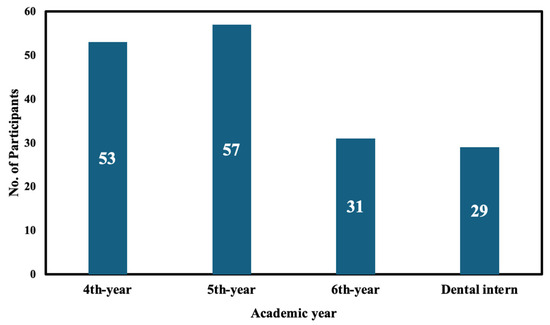
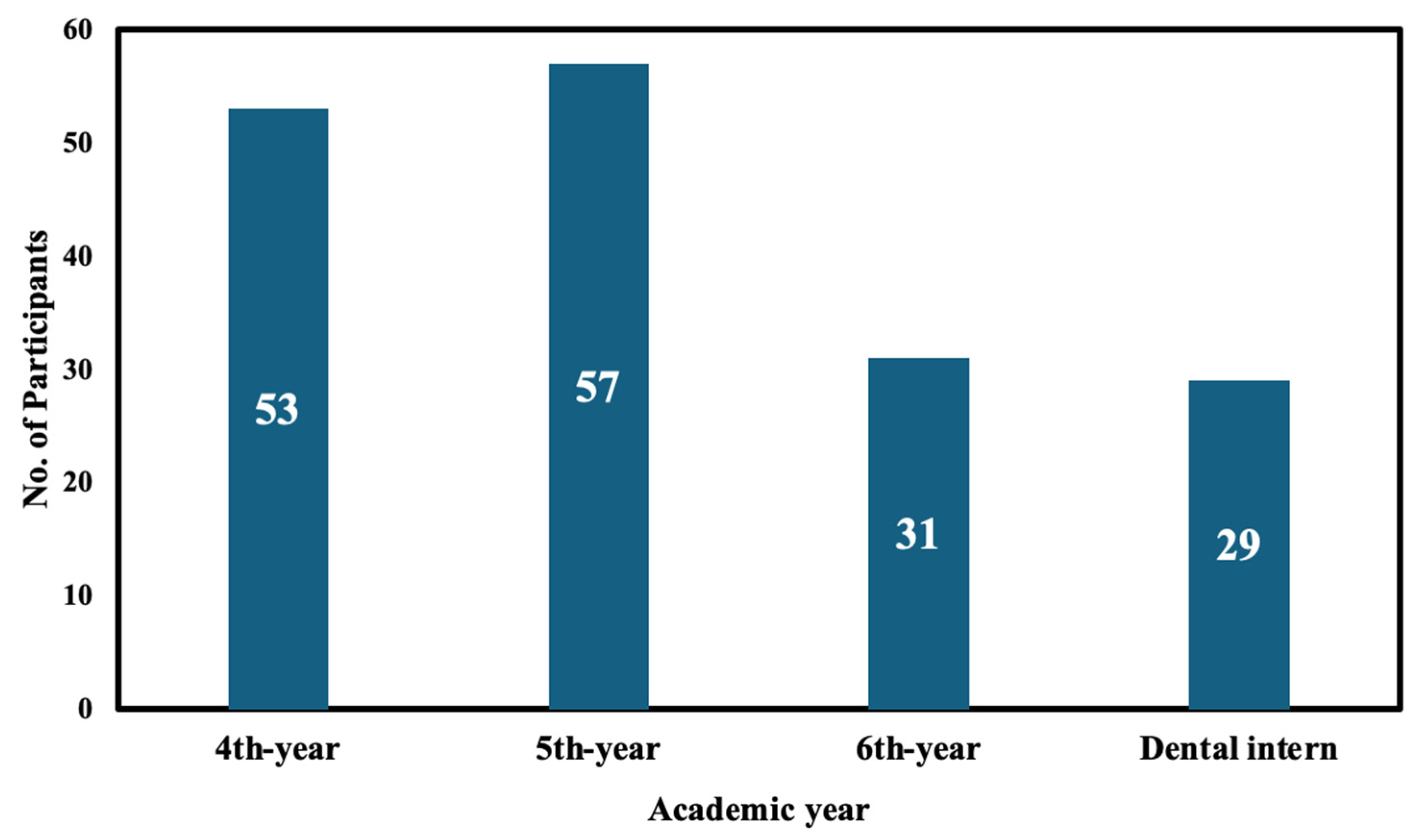
The response rate was 100% as the questionnaire was collected immediately after all invited participants were completed. A total of 170 dental students were included in this study, with a mean age of 22.2 (±2.5) years. The proportion of female participants was higher than male participants, with 112 females (65.9%) and 58 males (34.1%). In terms of academic-year levels, Figure 1 illustrates the distribution of participants across the different academic years.
Figure 1.
Number of participants.
Only 3 of the 18 knowledge-related questions received a correct response rate of 70% or higher. Question 4 received the lowest correct response rate, with only 25 participants (14.8%) out of 170 answering it correctly (Table 1).
Table 1.
Knowledge questions responses.
Table 2 presents a comparison between year-level and knowledge-related questions. It was observed that fourth- and fifth-year students had a higher rate of correct responses for 8 out of 18 questions. In contrast, sixth-year students and interns had a higher rate of correct responses for the remaining ten questions. Additionally, statistical significance was identified in questions 3, 5, and 11. For question 3, a significantly higher proportion (49.1%) of fifth-year students answered the correct answer compared to students of other year levels (p = 0.044). For question 5, sixth-year students had a significantly higher proportion (54.8%) of correct responses than other year levels. Furthermore, in question 11, 57.9% of fifth-year students answered it correctly, with their proportion significantly higher than that of different year levels (p = 0.001).
Table 2.
Comparison of knowledge with study year level.
Table 3 summarizes the CAD-CAM practices of all participants. In total, 86% of participants reported acquiring information from undergraduate courses, 58% gained it theoretically, and 41% received theoretical knowledge and hands-on experience. Most participants (70%) indicated that CAD-CAM teaching and training were beneficial, and 88% expressed interest in receiving further training on CAD-CAM practices. Meanwhile, 79% of participants had not attended any extracurricular training.
Table 3.
Distribution of practice responses.
A small percentage of participants reported practicing CAD-CAM, with the highest frequency of use for fixed dental prostheses compared to removable prostheses and other dental devices. Intraoral digital impressions were the most commonly practiced element of the digital work-flow, with 54% of participants practicing them. Among those utilizing CAD-CAM in clinics, the average of two completed cases was found, with fixed dental prostheses being more prevalent than removable ones.
There was an equal distribution of responses regarding CAD-CAM technologies, materials, and digital work-flows, though many participants selected the “I don’t know” response. However, most participants suggested incorporating CAD-CAM technology into all dental specialties and advocating for additional courses and hands-on training following their initial exposure to CAD-CAM.
A comparison between study year levels and the practice-related questions is summarized in Table 4. Responding to question 5a, a significantly higher proportion of sixth-year students reported receiving theoretical education or training (p < 0.001). Additionally, when students were asked about the usefulness of the education or training (Q5b), a significantly higher proportion of sixth-year students disagreed, stating that it was not useful (p = 0.000). When asked about the previous use of CAD-CAM technology, 69% of interns responded affirmatively, which was significantly higher than other year levels (p = 0.000) (Table 4).
Table 4.
Practice responses in comparison with the study year level.
4. Discussion
CAD-CAM technology has increasingly permeated across all specialties of the dental field, offering high-quality, digitally fabricated prostheses with clinically acceptable performance [2,7,13]. Accordingly, assessing the level of awareness and practical engagement of CAD-CAM technology among undergraduate students is crucial [6,16]. The findings of this questionnaire-based study indicate significant variations in both the awareness and practice of CAD-CAM and digital dentistry across different student levels. While it was expected that higher-level students would possess greater knowledge and practical experience, the results reveal that fourth- and fifth-year students exhibited a higher level of knowledge compared to their senior counterparts. However, practical experience was more prevalent among students at the advanced levels.
The higher level of knowledge observed in lower-level students may be attributed to their ability to effectively memorize the recently acquired information in updated courses that incorporate more digital dentistry implementations. In agreement with a previous study [13], it was reported that “Although undergraduate knowledge of CAD-CAM technology has improved, further education on its clinical applications is crucial to ensure students are fully prepared for the evolving field of digital dentistry” [6,7,17]. In earlier years, due to the emergence of new systems and devices, higher-level students exhibited a lower level of knowledge compared to those enrolled in the last three years. The widespread adoption of digital dentistry, driven by increasing competition among companies, the variety of systems available, and the greater accessibility of information, has provided an opportunity to acquire more knowledge that has since been integrated into the curriculum as a core component of CAD-CAM technologies. A previous study by Gratton et al. [18] investigated students’ knowledge of CAD-CAM technologies related to different levels and found that lower-level students exhibited greater theoretical knowledge due to the recent incorporation of updated digital dentistry content into their courses.
In contrast, higher-level students had more practical experience with CAD-CAM technologies [7]. This distinction reflects the curriculum structure, where lower-level students are exposed to foundational concepts, whereas higher-level students gain hands-on experience in clinical settings. However, despite their practical exposure, the study noted that higher-level students still lacked up-to-date theoretical knowledge, likely due to the rapid advancements in digital technologies and the evolving nature of the field. This gap highlights the importance of continuously updating the curriculum’s theoretical and practical components to ensure students are fully equipped for digital dentistry [7].
The findings of our study showed that participants have “good” knowledge based on their responses to three questions (Q9, Q10, and Q16). CAD-CAM technology was introduced to overcome problems associated with conventional techniques, such as faster processes, saving materials, and design and fabrication using 3D-printed technology [19]. Our findings (scored 70% good or more) support this fact. In contrast, the participants scored “poor” knowledge regarding one question (Q4) related to different types of digital scanners. Additional efforts are needed to familiarize undergraduate students with various digital scanners. Furthermore, most participants demonstrated limited knowledge of the technologies related to other knowledge questions regarding the digital fabrication of prostheses and production technology. There were also noted gaps in the understanding of differences between devices used in the digital work-flow and their applications [7,14]. This highlights the need for greater emphasis on the digital work-flow, from scanning to fabrication, tailored to each dental specialty. A previous study [13] investigated students’ knowledge of CAD-CAM technologies and found that, while awareness had improved, gaps remained in their understanding of practical clinical applications, highlighting the need for enhanced training to equip future dentists for digital dentistry.
In terms of CAD-CAM technology practice, three questions (Q5, Q5b, and Q6) showed high scores (>70% good). These responses reflect the participants’ level of education; hence, digital dentistry was integrated into our curriculum. Additionally, the participants were interested in learning more about CAD-CAM (Q6). However, attending extracurricular activities showed a low score (Q7, 20.2%). This should encourage all dental education levels to implement more extracurricular activities related to CAD-CAM technology [20,21]. The majority of participants demonstrated a good level of practical experience. Most reported receiving information and motivation to practice CAD-CAM through the curriculum, continuous education at the undergraduate level, and participation in various workshops [22]. This highlights the importance of implementing CAD-CAM training and, accordingly, course requirements for digitally fabricated cases [23,24]. Furthermore, the higher levels of practical experience seen among students can be attributed to their exposure to a broader range of clinical cases, as well as their use of digital labs [25]. This is in agreement with studies that emphasize the positive impact of practical experience and clinical exposure on skill development, which reported that practical learning environments accelerate the application of CAD-CAM technology in clinical settings, leading to improved competence among students [13]. However, in disagreement with previous studies, which suggested that the theoretical knowledge gained from lectures alone was sufficient for students to develop CAD-CAM skills, the importance of direct clinical experience and digital lab work was underestimated. The results of this study underscore the need for a balanced approach that combines both theoretical knowledge and practical exposure to prepare students for the demands of digital dentistry fully [6].
Most participants utilized CAD-CAM technology to fabricate various prostheses, particularly fixed ones. However, the number of digitally treated cases per participant was relatively low, likely due to the limited availability of digital equipment. Those who used CAD-CAM for prosthesis fabrication reported positive feedback, higher satisfaction, and more straightforward treatment procedures than conventional methods [11,26]. Participants also noted high levels of patient satisfaction, attributing this to the efficiency of the digital work-flow and the clinical outcomes of digitally fabricated prostheses [27]. Bhaskar et al. concluded that students who are aware of digital denture systems, such as CAD-CAM dentures, reduce both clinical chair time and the number of patient visits [22].
In our study, 54% of participants identified intraoral digital impressions as the most prevalent element of the digital work-flow, and using CAD-CAM technology for creating fixed dental prostheses garnered the highest response rate at 58.1%. This preference may stem from the accessibility and simplicity of the systems and machines designed for fabricating fixed prostheses, often considered superior to removable options. Research by Ishida et al., aimed at assessing the integration of CAD-CAM technology in creating complete and partial dentures among dental students in the US, revealed that complete CAD-CAM dentures are included in the curriculum for 54.2% of undergraduates and 65.2% of postgraduate residents [28]. In contrast, removable CAD-CAM partial dentures are covered in only 37.5% of undergraduate courses and 47.8% of postgraduate curricula, likely due to constraints such as limited funding, resources, time, and faculty availability for teaching CAD-CAM in removable prosthodontics [28].
The drawbacks of additively manufactured prosthetic materials and technologies, including expensive equipment and materials, limited material options, technological limitations, complex design, and lack of practical experience, present obstacles to using CAD-CAM in prosthetics. Addressing these limitations can significantly improve the efficiency, accuracy, and outcomes of prosthetic CAD-CAM applications. Likewise, advancements in material science and post-processing methods can significantly enhance the quality, precision, and durability of additively fabricated prostheses, making them more reliable and accessible [16,25,29]. It was reported in the literature that two technologies are used for prosthesis fabrications: subtractive and additive [28,30,31]. In the present study, the participants practiced both technologies with a limited selection of materials. They used milled ceramic materials for fixed prosthesis fabrication, while other materials such as titanium, titanium alloys, and chrome cobalt alloys were not used. This may be due to the lack of a system for these materials or the machine used for fabrication, as reported in previous studies [10,31]. By addressing these gaps, the implementation of CAD-CAM technology in dental education can be more effective, ensuring that students are prepared for clinical practice in an increasingly digitalized field of dentistry.
With the widespread adoption of digital dentistry, there is a growing demand for updated knowledge and practical experience across different educational levels. According to the findings of this study, while digital dentistry has been incorporated into prosthodontic courses at various undergraduate levels, there remains a need for further updates and the integration of new materials. Furthermore, the positive feedback from participants practicing and treating patients using digital methods emphasizes the clinical significance of this study. Additionally, it would be interesting to match teledentistry with smartphone applications [32] and artificial intelligence [33] to improve data and knowledge on the reliability of teledentistry-based programs in daily clinical practice.
The present study provides essential information regarding dental students’ knowledge and skills in digital dentistry. However, the results cannot be generalized due to the relatively small number of participants and the inclusion of students from a single college of dentistry, which is considered a limitation of the present study. Future studies involving more participants from various colleges of dentistry are needed to allow the study results to be compared and generalized. Another potential limitation is that the effects on students’ awareness and knowledge retention in the intermediate and long term have not yet been explored.
5. Conclusions
Dental students possess a good understanding of digital dentistry in prosthodontics, with lower-level students demonstrating a higher theoretical knowledge and higher-level students exhibiting good practical skills. However, the digital work-flow of prosthesis fabrication, from scanning and designing to the final fabrication process, needs to be further emphasized as a core component of the curriculum for undergraduate students at all levels.
Author Contributions
Conceptualization, M.M.G. and S.S.A.S.; methodology, S.M.F., F.Y.A. and S.Y.A.; software, A.I.A.; validation, M.M.G., S.A. and A.I.A.; formal analysis, S.S.A.S., S.Q.K., H.M.A. and B.O.A.; investigation, N.A., S.A., K.S.A.-A. and M.S.A.; resources, M.M.G. and Y.A.A.-D.; data curation, S.S.A.S. and Y.A.A.-D.; writing—original draft preparation, S.S.A.S., S.Q.K., H.M.A., S.M.F., F.Y.A., S.Y.A. and B.O.A.; writing—review and editing, S.M.F., S.S.A.S., A.I.A., H.M.A., F.Y.A., S.Y.A., B.O.A., N.A., S.A., K.S.A.-A., M.S.A. and Y.A.A.-D.; visualization, F.Y.A. and Y.A.A.-D.; supervision, M.M.G.; project administration, M.M.G., Y.A.A.-D. and S.M.F.; funding acquisition, S.A. and N.A. All authors have read and agreed to the published version of the manuscript.
Funding
This research received no external funding.
Institutional Review Board Statement
The study was conducted in accordance with the Declaration of Helsinki and approved by the Institutional Review Board of Imam Abdulrahman Bin Faisal University (IRB-2022-02-229), approval date is 15 June, 2022.
Informed Consent Statement
Informed consent was obtained from all subjects involved in the study.
Data Availability Statement
Data are contained within the article.
Conflicts of Interest
The authors declare no conflicts of interest.
Correction Statement
This article has been republished with a minor correction to the Institutional Review Board Statement. This change does not affect the scientific content of the article.
References
- Callan, R.S.; Blalock, J.S.; Cooper, J.R.; Coleman, J.F.; Looney, S.W. Reliability of CAD CAM Technology in Assessing Crown Preparations in a Preclinical Dental School Environment. J. Dent. Educ. 2014, 78, 40–50. [Google Scholar] [CrossRef] [Scilit] [PubMed]
- Gratton, D.G.; Kwon, S.R.; Blanchette, D.; Aquilino, S.A. Impact of Digital Tooth Preparation Evaluation Technology on Preclinical Dental Students’ Technical and Self-Evaluation Skills. J. Dent. Educ. 2016, 80, 91–99. [Google Scholar] [CrossRef] [Scilit]
- Boringi, M.; Waghray, S.; Lavanya, R.; Babu, D.B.G.; Badam, R.K.; Harsha, N.; Garlapati, K.; Chavva, S. Knowledge and Awareness of Teledentistry among Dental Professionals—A Cross Sectional Study. J. Clin. Diagn. Res. 2015, 9, ZC41–ZC44. [Google Scholar] [CrossRef] [Scilit]
- Saxena, P.; Gupta, S.K.; Mehrotra, D.; Kamthan, S.; Sabir, H.; Katiyar, P.; Sai Prasad, S.V. Assessment of Digital Literacy and Use of Smart Phones among Central Indian Dental Students. J. Oral Biol. Craniofacial Res. 2018, 8, 40–43. [Google Scholar] [CrossRef] [Scilit]
- Fernandez, M.A.; Nimmo, A.; Behar-Horenstein, L.S. Digital Denture Fabrication in Pre- and Postdoctoral Education: A Survey of U.S. Dental Schools. J. Prosthodont. 2016, 25, 83–90. [Google Scholar] [CrossRef] [Scilit]
- Zitzmann, N.U.; Matthisson, L.; Ohla, H.; Joda, T. Digital Undergraduate Education in Dentistry: A Systematic Review. Int. J. Environ. Res. Public Health 2020, 17, 3269. [Google Scholar] [CrossRef] [Scilit] [PubMed]
- Schlenz, M.A.; Michel, K.; Wegner, K.; Schmidt, A.; Rehmann, P.; Wöstmann, B. Undergraduate Dental Students’ Perspective on the Implementation of Digital Dentistry in the Preclinical Curriculum: A Questionnaire Survey. BMC Oral Health 2020, 20, 78. [Google Scholar] [CrossRef] [Scilit] [PubMed]
- Schwindling, F.S.; Deisenhofer, U.K.; Porsche, M.; Rammelsberg, P.; Kappel, S.; Stober, T. Establishing CAD/CAM in Preclinical Dental Education: Evaluation of a Hands-On Module. J. Dent. Educ. 2015, 79, 1215–1221. [Google Scholar] [CrossRef] [Scilit] [PubMed]
- Wu, Q.J.; Wang, X.; Jin, D.; Zhang, Z.S.; Jiang, F.; Wen, J.; Jiang, X.Q. Validation of Digital Evaluation in Systematic Training on Tooth Preparation in Aesthetic Veneer Rehabilitation. Chin. J. Dent. Res. 2021, 24, 55–60. [Google Scholar]
- Rexhepi, I.; Santilli, M.; D’Addazio, G.; Tafuri, G.; Manciocchi, E.; Caputi, S.; Sinjari, B. Clinical Applications and Mechanical Properties of CAD-CAM Materials in Restorative and Prosthetic Dentistry: A Systematic Review. J. Funct. Biomater. 2023, 14, 431. [Google Scholar] [CrossRef] [Scilit]
- Suganna, M.; Kausher, H.; Ahmed, S.T.; Alharbi, H.S.; Alsubaie, B.F.; Ds, A.; Haleem, S.; Ali, A.B.M.R. Contemporary Evidence of CAD-CAM in Dentistry: A Systematic Review. Cureus 2022, 14, e31687. [Google Scholar] [CrossRef] [Scilit]
- Liu, L.; Li, J.; Yuan, S.; Wang, T.; Chu, F.; Lu, X.; Hu, J.; Wang, C.; Yan, B.; Wang, L. Evaluating the Effectiveness of a Preclinical Practice of Tooth Preparation Using Digital Training System: A Randomised Controlled Trial. Eur. J. Dent. Educ. 2018, 22, e679–e686. [Google Scholar] [CrossRef] [Scilit]
- Palanisamy, S.V.; Hegde, C. Awareness Among Dental Undergraduate Students Regarding CAD/CAM Technology—A Survey Report. J. Health Allied Sci. NU 2019, 09, 57–63. [Google Scholar] [CrossRef] [Scilit]
- Maltar, M.; Miloš, L.; Milardović, S.; Kovačić, I.; Peršić, S.; Juroš, I.; Kranjčić, J. Attitudes of the Students from the School of Dental Medicine in Zagreb towards CAD/CAM. Acta Stomatol. Croat. Int. J. Oral Sci. Dent. Med. 2018, 52, 322–329. [Google Scholar] [CrossRef] [Scilit]
- Khami, M.R.; Baghizadeh Fini, M.; Kim, S.; Razeghi, S.; Sadighpour, L.; Dehghani Tafti, S. Designing a Tool to Assess Professionalism among Dental Students. Front. Dent. 2023, 20, 21. [Google Scholar] [CrossRef] [Scilit] [PubMed]
- Davidowitz, G.; Kotick, P.G. The Use of CAD/CAM in Dentistry. Dent. Clin. 2011, 55, 559–570. [Google Scholar] [CrossRef] [Scilit]
- Murbay, S.; Chang, J.W.W.; Yeung, S.; Neelakantan, P. Evaluation of the Introduction of a Dental Virtual Simulator on the Performance of Undergraduate Dental Students in the Pre-Clinical Operative Dentistry Course. Eur. J. Dent. Educ. 2020, 24, 5–16. [Google Scholar] [CrossRef] [Scilit] [PubMed]
- Gratton, D.G.; Kwon, S.R.; Blanchette, D.R.; Aquilino, S.A. Performance of Two Different Digital Evaluation Systems Used for Assessing Pre-Clinical Dental Students’ Prosthodontic Technical Skills. Eur. J. Dent. Educ. 2017, 21, 252–260. [Google Scholar] [CrossRef] [Scilit] [PubMed]
- Al-Dulaijan, Y.A.; Alsulaimi, L.; Alotaibi, R.; Alboainain, A.; Alalawi, H.; Alshehri, S.; Khan, S.Q.; Alsaloum, M.; AlRumaih, H.S.; Alhumaidan, A.A.; et al. Comparative Evaluation of Surface Roughness and Hardness of 3D Printed Resins. Materials 2022, 15, 6822. [Google Scholar] [CrossRef] [Scilit] [PubMed]
- Lam, W.Y.-H.; Mak, K.C.-K.; Maghami, E.; Molinero-Mourelle, P. Dental Students’ Preference and Perception on Intraoral Scanning and Impression Making. BMC Med. Educ. 2021, 21, 501. [Google Scholar] [CrossRef] [Scilit] [PubMed]
- Ellakany, P.; Fouda, S.M.; Al-Dulaijan, Y.A.; Aly, N.M. Digital Impression Perception among Dental Students in Saudi Arabia: A Cross-Sectional Study. Eur. J. Dent. Educ. 2024, 28, 889–896. [Google Scholar] [CrossRef] [Scilit]
- Bhaskar, H.; Ganapathy, D.; Sivasamy, V. Study of Digital Denture Systems among Dental Students. Drug Invent. Today 2020, 14, 495–497. [Google Scholar]
- Chatham, C.; Spencer, M.H.; Wood, D.J.; Johnson, A. The Introduction of Digital Dental Technology into BDS Curricula. Br. Dent. J. 2014, 217, 639–642. [Google Scholar] [CrossRef] [Scilit] [PubMed]
- Popa, D.; Burde, A.; Constantiniuc, M.; Bordea, R.; Cȃmpian, R. Students’ Attitude towards Dental CAD/CAM Systems: A Questionnaire Study. ASRJETS 2015, 14, 250–254. [Google Scholar]
- Alghazzawi, T.F. Advancements in CAD/CAM Technology: Options for Practical Implementation. J. Prosthodont. Res. 2016, 60, 72–84. [Google Scholar] [CrossRef] [Scilit] [PubMed]
- Infante, L.; Yilmaz, B.; McGlumphy, E.; Finger, I. Fabricating Complete Dentures with CAD/CAM Technology. J. Prosthet. Dent. 2014, 111, 351–355. [Google Scholar] [CrossRef] [Scilit]
- Saponaro, P.C.; Yilmaz, B.; Johnston, W.; Heshmati, R.H.; McGlumphy, E.A. Evaluation of Patient Experience and Satisfaction with CAD-CAM-Fabricated Complete Dentures: A Retrospective Survey Study. J. Prosthet. Dent. 2016, 116, 524–528. [Google Scholar] [CrossRef] [Scilit] [PubMed]
- Ishida, Y.; Kuwajima, Y.; Kobayashi, T.; Yonezawa, Y.; Asack, D.; Nagai, M.; Kondo, H.; Ishikawa-Nagai, S.; Da Silva, J.; Lee, S.J. Current Implementation of Digital Dentistry for Removable Prosthodontics in US Dental Schools. Int. J. Dent. 2022, 2022, 7331185. [Google Scholar] [CrossRef] [Scilit]
- Flores-Mir, C.; Palmer, N.G.; Northcott, H.C.; Khurshed, F.; Major, P.W. Perceptions and Attitudes of Canadian Dentists toward Digital and Electronic Technologies. J. Can. Dent. Assoc. 2006, 72, 243. [Google Scholar]
- San Diego, J. Transforming Education and Learning with Digital Technologies in Dentistry. In Digital Dentistry: A Comprehensive Reference and Preview of the Future; Quintessence Publishing: Berlin, Germany, 2018. [Google Scholar]
- Beuer, F.; Schweiger, J.; Edelhoff, D. Digital Dentistry: An Overview of Recent Developments for CAD/CAM Generated Restorations. Br. Dent. J. 2008, 204, 505–511. [Google Scholar] [CrossRef] [Scilit] [PubMed]
- Pascadopoli, M.; Zampetti, P.; Nardi, M.G.; Pellegrini, M.; Scribante, A. Smartphone Applications in Dentistry: A Scoping Review. Dent. J. 2023, 11, 243. [Google Scholar] [CrossRef] [Scilit] [PubMed]
- Acharya, S.; Godhi, B.S.; Saxena, V.; Assiry, A.A.; Alessa, N.A.; Dawasaz, A.A.; Alqarni, A.; Karobari, M.I. Role of Artificial Intelligence in Behavior Management of Pediatric Dental Patients—A Mini Review. J. Clin. Pediatr. Dent. 2024, 48, 24–30. [Google Scholar]

Disclaimer/Publisher’s Note: The statements, opinions and data contained in all publications are solely those of the individual author(s) and contributor(s) and not of MDPI and/or the editor(s). MDPI and/or the editor(s) disclaim responsibility for any injury to people or property resulting from any ideas, methods, instructions or products referred to in the content. |
© 2025 by the authors. Licensee MDPI, Basel, Switzerland. This article is an open access article distributed under the terms and conditions of the Creative Commons Attribution (CC BY) license (https://creativecommons.org/licenses/by/4.0/).