


Abstract
Quantum machine learning (QML) is advancing rapidly, yet it remains unclear which artificial intelligence (AI) capabilities benefit from quantum approaches, how strong the supporting evidence is, and whether reported gains justify claims of practical quantum advantage. This bounded critical survey introduces the Quantum AI Stack (QAIS), a capability-centered framework covering ten functional areas, and applies it to 107 experimental studies first released from 2024 to 6 August 2026, identified through keyword searches of arXiv, IEEE Xplore and the ACM Digital Library and reported following PRISMA 2020. Each study was appraised on seven weighted criteria, including comparison fairness, statistical practice, reproducibility and hardware realism, and each capability was assigned a level in a five-level maturity model. Within this corpus, quantum feature learning, quantum neural networks, hybrid quantum AI and quantum optimization have the most thoroughly corroborated evidence, much of it establishing parity rather than advantage, and no capability is deployable. Benefits that survive fair classical comparison are narrow and study-specific, including benchmark-specific accuracy gains and improvements in parameter efficiency, robustness, throughput and energy. None establishes practical quantum advantage, and null or negative findings occur at every level of evidence quality. Because inter-rater agreement was limited, the maturity assignments are provisional.
1. Introduction
Quantum machine learning (QML) has moved from theory to experiment, spanning noise-aware simulation, inference on real devices, training on superconducting and photonic hardware, quantum annealing applied to industrial optimization, and resource estimates for fault-tolerant machines, yet this growth has not settled the field’s basic question, so this experimental survey asks two research questions: first, which artificial intelligence (AI) capabilities benefit most from experimentally validated quantum machine learning; and second, how mature is each capability on the strength of the available evidence. Answering them is difficult for two reasons. The first is linguistic: four very different results are routinely called quantum advantage—a small accuracy gain on a simplified benchmark [1,2], a reduction in trainable parameters [3,4], a demonstration that a circuit runs on a physical device [5,6], and a projected speedup at sizes no existing machine can reach [7,8,9]; Section 2 therefore defines the advantage terms used throughout. The second is structural: most existing surveys group work by algorithm family or hardware platform, scattering the evidence bearing on a single AI task across disconnected sections. The Quantum AI Stack (QAIS) inverts that organizing principle, grouping the field by the AI capability a study serves into ten layers: quantum data encoding (QDE), quantum feature learning (QFL), variational quantum circuits (VQCs), hybrid quantum AI (HQA), quantum optimization (QOPT), quantum reinforcement learning (QRL), quantum neural networks (QNNs), quantum generative AI (QGAI), quantum edge AI (QEDGE) and fault-tolerant quantum intelligence (FTQI). A second commitment follows: to assess maturity rather than assert it, evidence quality is scored separately from whether a study reported good news. Tests of whether the quantum component helps can go either way: a matched classical replacement confirmed a quantum contribution in one study [10], whereas a standard classical algorithm decisively outperformed a quantum optimizer run at its default settings in another [11], and removing entanglement barely changed performance in a third [12]. A well-designed negative result counts as strong evidence, and at least four of the nineteen most carefully designed studies here report that quantum methods did not help [5,13]. The contributions are fivefold: a ten-layer capability framework assigning each study to one primary AI task; a transparent two-stage protocol applied uniformly to 107 studies within a bounded corpus, with the full register in Appendix B; a per-capability rather than pooled comparison of evidence quality, hardware use, comparison fairness and reproducibility, summarized in Section 3 and Section 4; the QAIS Maturity Model, a five-level readiness scale with an explicit account of its limits; and a staged roadmap in which every recommendation addresses a measured deficit. Section 8 returns to both research questions and answers them directly.
Existing reviews organize this literature in other ways. Broad reviews introduce QML from the standpoint of conventional machine learning, illustrated with case studies [14]; the systematic literature review of Peral-García et al. classifies 94 articles published from 2017 to 2023 by algorithm family and application [15]; and broad reviews and perspectives discuss trainability and the possible sources of advantage rather than appraising experimental results study by study [16]. Gujju et al. survey supervised and unsupervised QML executed on near-term hardware, together with the encoding, ansatz, error-mitigation and gradient techniques it relies on [17]. Schuld and Killoran question whether quantum advantage is the right goal for the field [18], and Bowles et al. show in a large simulation benchmark that out-of-the-box classical models outperformed popular quantum classifiers on small tasks and that removing entanglement often did not reduce performance [19]. The present survey differs from these in four respects. First, its unit of analysis is the AI capability a study serves, so the evidence bearing on one task is assembled in one place rather than distributed across algorithm or hardware categories. Second, every included study is appraised on seven weighted criteria whose anchors were fixed before scoring and are independent of whether a finding favors quantum methods, so the strength of the evidence is separated from the direction of the result. Third, the study-level appraisal is aggregated into a capability-level maturity model that states what evidence would justify the next level, which turns the synthesis into testable requirements rather than a narrative judgment. Fourth, the evidence register, criterion scores and analysis code are released (Appendix B; Files S1–S3), so the appraisal can be checked or repeated. Unlike benchmark studies such as [19], the survey runs no new experiments; it asks what the published experimental record can support. The reference list contains the 107 included studies, the six reviews and perspectives cited in this paragraph, and the two reporting-guideline sources cited for the review methodology; Appendix B identifies every included study by its reference number.
2. Methodology
This experimental survey follows the applicable Preferred Reporting Items for Systematic Reviews and Meta-Analyses (PRISMA) 2020 reporting items [20] and uses the PRISMA-S search-reporting extension [21], with the completed checklist reproduced as Appendix A (Table A1) and the evidence register as Appendix B (Table A2); the review was not prospectively registered, and no separate formal protocol was prepared or deposited. Candidate studies were discovered by keyword sweeps organized around six capability groups, with two cross-cutting queries, returning records from the arXiv open-access preprint repository (pronounced “archive”), the Institute of Electrical and Electronics Engineers (IEEE) Xplore database, and the Association for Computing Machinery (ACM) Digital Library, supplemented by direct browsing of arXiv subject listings and a targeted sweep of peer-reviewed journals. The forty-nine discovery queries are reproduced verbatim in Appendix C. Searches were conducted from June through 6 August 2026. The sweeps did not give equal coverage to all ten capabilities or to every year of the eligibility window: four capabilities, namely feature learning, optimization, generative AI and fault tolerance, had no dedicated query and were identified through the cross-cutting queries, subject-listing browsing and the journal sweep, and most query strings named 2025 (Appendix C, Table A3). The corpus is therefore a bounded, arXiv-visible evidence set suited to critical appraisal of what it contains rather than an exhaustive census of the field, and comparisons between capabilities describe this corpus rather than the wider literature. Because they were natural-language keyword strings rather than fielded Boolean expressions executed inside each database and per-database hit counts were not retained, the search can be repeated but its historical coverage cannot be reconstructed exactly. Because per-database identification totals were not retained, Figure 1 is a minimum auditable flow rather than a complete database-to-inclusion reconstruction. Recency is defined by first public release: eligible studies were first released from 2024 through the corpus cutoff of 6 August 2026. One journal article cited with a 2027 issue assignment was published online in July 2026 and is therefore treated as a 2026 first release. Stage 1 applied six eligibility gates: release inside the recency window, appearance in an indexed source or a journal identified by the sweep, original quantitative experimental evidence, fit to exactly one primary capability, retrievable full text, and non-duplication. The documented exception is fault-tolerant intelligence, whose object of study is hardware that does not yet exist; quantitative analytical work is admitted there and marked accordingly [7,8,9,22,23]. Stage 1 fixed the corpus at 107 studies. Stage 2 did not alter eligibility: it appraised every included study from 0 to 100 across seven weighted criteria in Table 1 so that evidence strength could be compared independently of whether a result favored quantum methods. Scores map to Strong (80–100), Good (65–79), Moderate (50–64), Weak (35–49), and Very weak (below 35). Each total is the weighted sum of the seven criterion scores. Studies below Moderate do not support capability claims; the three Weak studies are retained only as illustrations: a deployed portfolio pipeline compared against a single fund manager [24], a forecasting analysis of routes to quantum-accelerated deep learning [23], and a hardware benchmark without a quantitative classical baseline (Section 3.3). Each admitted study was extracted into a 46-field record. Twenty stratified studies were appraised a second time independently and blind to the first pass; exact band agreement was 9 of 20, agreement within one band was 17 of 20, unweighted Cohen’s kappa was 0.19, linear-weighted kappa was 0.23, and the mean absolute score difference was 9.8 points. These values are reported without post hoc reconciliation, so individual ratings near a boundary are treated as approximate. Section 7 analyzes where the two passes disagreed, reports a reappraisal of the same 20 studies under the finalized rubric by two independent language-model raters, and tests whether the alternative ratings change any capability conclusion. Criterion-level scores are retained for 105 of 107 studies, and sensitivity analyses are therefore reported for that auditable subset rather than described as a complete 107-study recomputation. By first release, the corpus contains 5 studies from 2024, 60 from 2025, and 42 from 2026. It is preprint-dominant, 40 studies execute at least part of the experiment on real quantum hardware, classification and MNIST-family benchmarks are common, and 31 release code or data. Heterogeneity across tasks, datasets, metrics, comparators and devices rules out a meaningful pooled effect size, so synthesis is descriptive throughout. Appendix B lists all 107 studies; reported outcomes are taken from the source studies, while cross-study aggregation is this review’s interpretation.
Figure 1.
Minimum auditable systematic-review corpus flow. Stage 1 determines eligibility and fixes the 107-study corpus; Stage 2 appraises evidence strength without retroactively excluding eligible studies. Because per-database retrieval totals were not retained, the diagram begins at candidate identification and is not a complete database-to-inclusion reconstruction.
Table 1.
Evidence-appraisal instrument applied after eligibility screening. Seven criteria, weights, and highest/lowest anchors; weights total 100 points and do not determine corpus inclusion.
The student reviewers conducted the systematic review under the methodological guidance and supervision of the faculty research mentor. The mentor monitored the review process, reviewed key methodological decisions, and provided guidance to ensure consistency and rigor.
This supervision strengthened methodological governance but did not substitute for independent duplicate screening of the complete corpus; the limits of the preserved reviewer-by-record history are reported in Section 7.
OpenAI ChatGPT (GPT-5.5 and GPT-5.6 Sol) was used as an artificial-intelligence-assisted research tool for search-term refinement, candidate-discovery support, metadata normalization, and consistency checks. Its outputs were provisional; final eligibility decisions, evidence ratings, synthesis judgments, claims, and manuscript content remained human decisions. During revision, Claude Opus 5.5 (Anthropic) was used to check every criterion score against the finalized decision rules and propose corrections, which the authors reviewed before adopting them, and two independent Claude instances served as automated raters in the reliability reappraisal reported in Section 7; their scores were used only to assess reliability and replace no published score.
The seven-criterion appraisal functions as the study-level risk-of-bias and evidence-quality assessment for this review. It evaluates experimental design, fairness of the classical comparison, statistical practice, reproducibility, task relevance, hardware realism, and reporting completeness. Because the instrument is purpose-built rather than externally validated, its construct validity and inter-rater reliability are treated as limitations rather than assumed away.
Effect measures, heterogeneity, risk of bias due to missing results, and certainty were handled explicitly. Because the included studies report heterogeneous outcomes—including accuracy, area under the receiver operating characteristic curve, error measures, parameter count, runtime, energy, and shot budgets—each result is retained in its source metric and no pooled effect estimate is calculated. Heterogeneity is examined descriptively by capability, hardware status, comparison fairness, evidence band, artifact availability, and outcome direction. Risk of bias due to missing results is assessed qualitatively by retaining every eligible null or negative finding and cross-tabulating outcome direction by evidence band; this tests whether unfavorable findings disappear as evidence quality rises. Funnel plots and small-study-effect tests are not used because the studies do not share a common effect measure, and the review cannot quantify unpublished studies or selectively unreported outcomes. Certainty is assessed at the capability level through the provisional Quantum AI Stack Maturity Model, which combines evidence quality, corroboration, hardware realism, reproducibility, and operational constraints; it is a purpose-built framework and not a substitute for the Grading of Recommendations Assessment, Development and Evaluation approach.
Screening and extraction were conducted from the full text of every admitted record, and fields copied directly from the source—task, dataset, metric, baseline, hardware, qubit count, circuit depth, shots, and artifact availability—were kept conceptually separate from interpretive fields such as capability assignment and evidence-band rationale. That separation is important because a hardware demonstration, a capacity-matched benchmark, and an analytical fault-tolerance estimate answer different questions and cannot be treated as interchangeable evidence. During synthesis, studies were therefore grouped first by capability and then read across recurring dimensions of comparator fairness, statistical practice, hardware realism, reproducibility, and operational cost. Null and negative findings were retained on the same footing as positive findings. No record was promoted, excluded, or down-weighted because its outcome favored or disfavored quantum methods; eligibility, evidential strength, and result direction remained separate throughout the review.
Terminology for advantage claims. Because the same phrase is used for very different results, this survey uses five terms consistently. A comparative advantage is a better result than a specified classical comparator on a specified task and metric and holds only for that comparator and task. A benchmark-specific gain is a comparative advantage that has not been shown to transfer to other datasets, architectures or devices. A resource advantage is comparable task performance obtained with fewer parameters, shots, circuit executions, training time or energy than the classical comparator. A projected advantage is inferred from resource estimates for hardware that does not yet exist. Practical quantum advantage, the strongest claim, requires an independently replicated benefit over the best available classical method on a task of practical relevance, within stated shot, latency, energy and cost budgets; no study in the corpus demonstrates it. Where a source study uses the phrase quantum advantage for one of the weaker claims, its result is reported here under the corresponding term above. Numerical improvements are reported with their metric and comparator and as percentage points when they are absolute differences in a percentage metric or as relative percentages when the source reports a ratio.
Table 1 states the evidence-appraisal instrument in full: seven criteria, the weight attached to each, and what the highest and lowest anchors require. The weights were fixed before scoring and total 100 points. Eligibility and appraisal are deliberately separate: Stage 1 determines whether a study belongs in the corpus, while Stage 2 rates what claims that study can support. A quantum-versus-quantum methods paper can therefore remain eligible yet contribute little to a quantum-advantage claim; a single unreplicated run remains eligible but scores at the lowest statistical-practice anchor; and fault-tolerance resource estimates remain eligible because their claim concerns future hardware rather than present execution [7,8,9,22,23]. No study is retrospectively removed because of its evidence band. The completed PRISMA checklist is Appendix A and the evidence register is Appendix B.
Scoring rules for ambiguous cases. The anchors in Table 1 leave some cases open, and the finalized rubric resolves them with the following decision rules, which were applied to every criterion score in File S1 and in the reappraisal reported in Section 7. Scores reflect what a study reports in its text, supplement or linked repository; a control that was performed but not described is scored as absent, and the omission also lowers reporting completeness. For comparison fairness, a study whose only comparators are other quantum models scores at most 2, because it cannot bear on a quantum–classical claim, and a classical baseline copied from another paper rather than rerun under the same protocol scores at most 2. For statistical practice, which produced the largest share of the disagreement between raters, a result reported with no stated number of runs or seeds and no dispersion is treated as a single run and scores 0; two to four runs stated without dispersion score 1; dispersion for the main results from fewer than five runs, or five or more runs without dispersion, scores 2; five or more seeded runs with mean and standard deviation or confidence intervals score 3; and 4 additionally requires a significance test or interval for every comparative claim. Folds of a cross-validation count as runs, and deterministic analyses without repeated runs score 0 because they report no run-to-run variability. For task relevance, a benchmark reduced to a few features or to two classes of a multiclass problem, or one on which the classical baseline is at or near ceiling, scores at most 2 unless the reduced task is itself the object of study. For hardware realism, main results executed on a real device can reach 4, execution limited to a timing check or a small subset scores at most 3, simulation with a calibrated device noise model scores 2, and noiseless simulation scores 0 or 1; resource estimates for future hardware can reach 4 only if they state error rates, gate times and code distances. Methods-development papers without a classical comparison are scored on the same anchors, so a low score means that the study cannot establish capability maturity, not that it is poor work. Totals are not rounded before banding. Checking every published criterion vector against these rules changed 87 of the 735 criterion scores in 66 studies, 55 of them for statistical practice, and moved 14 studies across a band boundary; each change and its evidence is listed in File S1 (sheet Rule audit), and all totals, bands, tables and figures in this paper use the audited scores.
3. Integration of Quantum Machine Learning Across Artificial Intelligence Capabilities
The framework partitions the field into ten capabilities, six of which attach to a specific point in the pipeline that almost every study follows, in which classical data are encoded into qubits, a circuit runs, the qubits are measured repeatedly and a classical model is fitted to the resulting values, while the remaining four describe the pipeline as a whole: what problem is solved, how the model learns, where the system runs, and what the hardware would have to become. Figure 2 sets out that arrangement, drawing feature learning across the encode, run and measure steps because it treats that sequence as a single transformation of the data and hybrid architectures across the circuit and classical steps because its defining property is that the two are interleaved inside one trained system; encoding sits at the front, so unresolved encoding and trainability problems propagate into every capability downstream of them, which is why the same limitations recur across capabilities that otherwise have little in common. Two patterns run across the techniques, model families, evaluation methods and datasets in use: evaluation is dominated by accuracy-family metrics even where accuracy is not the relevant question, as in edge deployment, which is properly judged on latency and shot budget; and dataset choice is narrow, concentrating on image benchmarks classical models already solve near ceiling. Both constrain what the literature can currently demonstrate. To keep the treatment comparable across capabilities, each subsection follows the same analytical sequence: the capability objective, the strongest positive evidence, the strongest null or negative evidence, the degree of hardware realism, and the unresolved barrier. This prevents research volume from standing in for maturity and keeps evidence quality visible even when task metrics are not directly comparable.
Figure 2.
The Quantum AI Stack placed on the quantum machine learning pipeline. Six capabilities are positioned at the stage they govern, two are drawn as bars because they span several stages, and four describe the pipeline as a whole.
The comparison also distinguishes evidence breadth from evidence depth. A capability with many demonstrations but few fair classical controls is treated differently from a smaller capability with repeated, independently corroborated comparisons. For that reason, the discussion does not rank capabilities by paper count or by headline accuracy alone. It asks whether the reported effect survives stronger baselines, whether it appears on real hardware, whether repeated runs or uncertainty are reported, whether artifacts permit independent checking, and whether any benefit is large enough to matter under a stated resource budget. This common frame makes the ten subsections directly comparable even though their tasks and metrics differ, and it treats each capability as a complete evidence unit rather than a catalog of individual studies.
Table 2 gives the composition of the corpus by capability, the reference point for every claim that follows. Coverage is uneven, ranging from 17 studies in hybrid quantum AI to five in fault-tolerant intelligence, so capability-level statements rest on samples of very different size and on search coverage that differed between capabilities (Appendix C). Hardware execution varies more than fourfold, from 67 percent in optimization to 17 percent in edge intelligence and none in fault tolerance, where the object of study is hardware that does not yet exist. And evidence quality is not uniformly distributed: three capabilities—data encoding, variational circuits and edge intelligence—contain no study rated Strong, although that statement depends on individual ratings near the 80-point boundary (Section 7).
Table 2.
Composition of the corpus by capability, showing the number of included studies, how many reached real quantum hardware and the distribution of evidence bands. Percentages are of the studies in that row. Example studies are representative studies for each capability; the three highest-rated studies per capability are listed with the maturity levels in Section 4.1.
3.1. Quantum Data Encoding
Quantum data encoding maps classical vectors to quantum states, and one point is settled: encoding choice is a first-order design decision. Tudisco et al. measured accuracy gaps of 10 to 30 percentage points between the best and worst encoding under otherwise identical models, reaching 41 percentage points in one configuration [47], and Feng showed the ranking itself inverts with input resolution and noise [1]. There is therefore no default encoding, and any result reported without an encoding ablation is under-specified. Circuit-level gains are substantial: EnQode cut depth 28-fold while holding fidelity above 90 percent [48], TNQE achieved 25-fold reduction and encoded 256 by 256 color images [49], and a learned encoder reached 98.5 percent on binary MNIST against a 99.7 percent classical reference [31]. The most valuable work connects encoding to end-task performance under parameter-matched comparison: a classical network at mean squared error 0.012 with 24 parameters against an amplitude-encoded variant at 0.009 with 28 [50], 0.94 test accuracy on hardware [32], and above 99 percent on MNIST and Fashion-MNIST [33]. Five of eleven studies reach hardware, the second-highest rate in the corpus. Two limitations qualify this. Several depth reductions are demonstrated on encoding fidelity rather than downstream accuracy, so the value of saved depth is inferred rather than measured; and no study is rated Strong because encoding papers frequently compare encodings only against one another rather than against a tuned classical model, which caps the fairness criterion however careful the quantum-side work is. Consistent with that, reuploading models degrade to near-random performance on unseen data [51], one advantage disappears under a change of configuration [52], and the benefit depends on the classical representation feeding it: transformer embeddings enable a relative accuracy improvement of up to 8.02 percent over a classical support vector machine on the same embeddings (0.900 against 0.833 on Fashion-MNIST) while convolutional features remove the effect entirely [53]. The practical implication is that encoding should be evaluated as part of the learning system rather than as a preprocessing detail: a depth reduction is meaningful only when fidelity, downstream performance, and the classical alternative are reported together. Until those links are routine, the capability is experimentally active but evidentially controlled rather than validated.
3.2. Quantum Feature Learning
Quantum feature learning asks whether quantum feature maps capture structure classical kernels cannot. The most rigorous negative result is Kakavand et al.: 29 comparisons across nine tabular datasets against tuned linear, radial basis function and polynomial support vector machines, none reaching significance, dataset identity explaining most of the variation, and quantum kernel training competitive on one dataset only, at roughly 2000 times the cost [2]. Against that sit three of the corpus’s strongest studies. Q-FLAIR builds a feature map adaptively and trained directly on hardware to above 90 percent accuracy on full-resolution binary MNIST within a four-hour budget, robust to de-quantization [54]. An analog feature map run on a quantum annealer reported relative improvements of up to 210 percent in classification metrics, the largest in minority-class recall, over the same classical models trained without the quantum features on clinical and molecular data; the gains were concentrated near the critical point of the quench dynamics [34]. And Kornjača et al. ran the largest hardware experiment in the corpus, a neutral-atom reservoir scaled from 9 to 108 qubits where accuracy rose with array size, the two largest arrays beat a linear support vector machine, and, on a synthetic task built to separate the quantum and classical kernels, a structurally matched classical reservoir was outperformed by 7.1 plus or minus 3.1 percentage points of accuracy [35]. The remaining studies fill in the same picture from both sides, reporting kernels on par with or better than classical algorithms [55,56], competitiveness determined by encoding and depth rather than by the kernel [57], results within 0.3 percentage points of a classical kernel [58] or below their own classical baseline [59], and gains measured only against competing quantum designs [60,61]. The clearest attribution test in the capability shows a structurally matched classical control performing virtually identically to a global kernel, so the improvement must involve the quantum feature map [10]. Together these support one conclusion for this corpus: the effect is real but conditioned on dataset and encoding rather than general. The remaining research question is therefore not whether a quantum feature map can differ from a classical kernel, which several studies here already show, but whether the difference persists across datasets, tuned capacity-matched baselines, and realistic cost accounting. Independent replication of the strongest hardware results would be more informative than another isolated benchmark win.
3.3. Variational Quantum Circuits
Variational quantum circuits are the second-largest capability in the corpus and, measured by evidence quality rather than volume, among the least conclusive: fourteen studies and no study rated Strong. Every matched-budget comparison on a non-toy task returns parity or a classical win—no systematic advantage against a capacity-matched restricted Boltzmann machine [62], at most comparable accuracy for the best models [38], figures favoring the classical side throughout at 0.925 against 0.825 for support vector machines and 0.9812 against 0.950 for networks [63], and a variational classifier and a multilayer perceptron both reaching perfect accuracy, which is parity rather than advantage [64]. Where the capability does produce positive results they come from toy tasks or concern platform and efficiency: better photonic noise tolerance than a superconducting comparator [65], a two-parameter photonic network reaching 100 percent accuracy on the XOR task where a parameter-matched classical network does not [36], a hardware validation rate exceeding the classical configuration at intermediate circuit quantumness [37], and 90 percent average accuracy using eight times fewer circuit executions [66]. The rest is methods work: initialization strategies [67,68], 85.42 percent on PneumoniaMNIST with error mitigation, the most deployment-realistic result though from a study rated Weak [69], no single architecture-search algorithm dominating [70], a more balanced robustness profile at competitive accuracy [71], and correct ordering of topological phases preserved despite device noise [72]—a robustness result rather than an accuracy one. Taken together, these results make VQCs the clearest example of why algorithm prevalence cannot substitute for capability evidence. The unresolved issue is not whether VQCs can fit benchmark data but whether training remains stable as circuit depth, qubit count, noise, and optimizer choice change together. Architecture-search and initialization studies show sensitivity to ansatz and starting conditions [67,68,70], while hardware and robustness studies show that device noise can preserve useful structure without establishing an advantage over a classical model [37,71,72]. A mature VQC result therefore needs a matched classical model, repeated seeded optimization, and an ablation tying any gain to the circuit rather than to the surrounding pipeline.
3.4. Hybrid Quantum Artificial Intelligence
Hybrid quantum artificial intelligence concerns how classical and quantum components divide labor within one pipeline, and in this corpus it is where quantum components most often earn a place, though usually through resource advantages rather than accuracy. When the classical side is taken seriously, hybrids deliver robustness and efficiency more often than better predictions. Park et al. demonstrated ten-class MNIST on hardware, then reported that on-hardware fine-tuning produced no measurable gain and that there was no per-parameter advantage against a matched-capacity classical network, while a multiprogramming scheme delivered four times the throughput at no accuracy cost [4]. Transfer learning proved competitive with lower training time and energy [3], and a hybrid clinical model was competitive with a strong classical suite and more robust to corrupted inputs [73]. Freinberger and Moser tested the pattern directly: best-case hybrids only match their classical equivalents, and most configurations degrade once quantum components are introduced [74]. Where margins are reported they are priced—routing only difficult cases to a quantum branch beat gradient-boosted trees at the cost of 7 to 21 min of added latency [75]. Further applied results include a mean RMSE of 15.46 against 16.37 for a parameter-matched classical network, about 5 percent lower, in simulation [76]; a mean absolute error of 0.0811 for a 114-qubit reservoir in simulation, which rose to 0.1524 on hardware, worse than its classical analogue [77]; 99.44 percent through Q-PhotoNAS [39], a hybrid language model with observable readout on hardware [78], a classical generative baseline beaten on Fréchet inception distance in all but one class [79], larger margins against lighter clinical comparators [80,81], and a hybrid language model in which a circuit replacing one projection matrix converged comparably to its classical baseline in simulation [82]. Two further studies sharpen the attribution question. A topology-aligned molecular comparison uses 64 parameters in both quantum and classical models and reports about 0.89 versus 0.92 AUC on the HOMO–LUMO gap task and near parity around 0.78 on dipole prediction, concluding that the shared topology-aligned inductive bias rather than the quantum substrate drives parameter efficiency [83]. In a separate hybrid quantum knowledge-tracing study, QDKT-R reports AUCs of 0.845, 0.826, and 0.842 on three benchmark datasets [84]. Together with a quantum convolution ablated against a parameter-matched classical alternative [85], these results reinforce the need to attribute gains to the quantum component rather than to the surrounding architecture.
3.5. Quantum Optimization
Quantum optimization has the strongest hardware culture in the corpus, 8 of its 12 studies running on a physical device, and it is also where several of the most carefully constructed studies most directly qualify common advantage claims. Lozano’s operational audit of a commercial hybrid portfolio service is the clearest example: the solver matches the proven classical optimum on all 54 head-to-head instances, but mean processor access is 0.034 s, 0.68 percent of the nominal five-second budget, and a matched-budget classical Tabu search reaches the same objectives. The author notes that this establishes classical achievability rather than an internal ablation of the processor, so the runtime share alone does not show how much the quantum step contributes; what it does show is that the reported result does not require a quantum-sampling advantage [5]. Dolzhkov et al. supply the statistical complement: across 7000 runs fewer than 1 percent exceeded the standard classical guarantee even after 23,000 shots, while the classical algorithm reached its own expectation after three samples [11]. Positive hardware results exist and are carefully bounded: 144 qubits finding the true optimum in three of five instances, warm-started mixers raising the sampling probability by one to two orders of magnitude, though the optima were obtained classically [30]; classical approximation guarantees exceeded on 96-node graphs on trapped-ion hardware, the crossover claim labeled a projection [86]; parameter transfer nearly matching an exhaustive reference [87]; and annealer-based feature selection that came within 0.003 nDCG@10 of the best classical entry while using 13 rather than 21 features [6]. The theory points the other way: the loss variance scales inversely with the exponential of the qubit count for almost all connected graphs, implying barren plateaus [88], while on hardware a linear-chain QAOA variant raised the mean approximation ratio from 0.62 to 0.72 at 100 vertices, on instances the authors note remain classically solvable [89]. The remainder scale to 100 surface elements with polynomial scaling against a classical relaxation [90], find a trade-off rather than a winner between two quantum solvers under noise [91], raise median AUC by about 0.02 for compact feature subsets in simulation, for example, 0.857 against 0.836 [92], and report a deployed portfolio pipeline that beat a fund manager over thirteen months while disclaiming any advantage claim, rated Weak and cited only as an illustration [24]. The hardware wins and the scaling proofs point in opposite directions, and reconciling them is a central open problem for this capability.
3.6. Quantum Reinforcement Learning
Quantum reinforcement learning is a small capability with nine studies but has the strongest reproducibility record in the corpus, releasing code or data in five of nine cases. Meyer et al. set the methodological standard, using a sample-complexity estimator over 100 seeded runs per configuration on a physics-informed 6G environment cross-validated against an independent channel simulator: a 14-qubit hybrid with 437 parameters nearly matched the best classical model at 4611 parameters and clearly beat a similarly sized one, and classical sample complexity saturated while the quantum model kept improving—after which the authors declined to call it a quantum advantage, because classical intractability cannot be guaranteed [25]. Gurgul et al. give the clearest resource advantage on a realistic task: quantum agents holding 60 parameters reached Sharpe ratios of 0.7281 and 0.6537 against 0.7926 and 0.8237 for classical agents holding 160,000, with inference on a 127-qubit device though runtime was dominated by cloud queueing [27]. The negative results are equally disciplined. Hybrid models on Atari games showed no advantage against a classical network with a matched information bottleneck, the contribution being that hybrids can learn competitively in high-dimensional settings at all [40]; with parameter counts matched to the neuron, none of three pure quantum actor–critic variants learned CartPole in any of ten runs, average gradient −0.00056, while hybrids learned at a training cost the authors judged prohibitive [26]; and, in a benchmark without a classical baseline, removing entanglement caused only a minor drop, casting doubt on whether quantum properties do the work [12]. The capability also supplies policy evaluation run entirely on hardware from environment parameters learned from classical data [93]; CartPole solved in 161.6 plus or minus 56.3 episodes against 429.4 plus or minus 117.9 over 50 seeded runs, with direct hardware control reaching more than 40 times the inference rate of the standard software stack [94]; a component-by-component ablation in which data reuploading aids trainability while stronger entanglement can hinder optimization [95]; and a lightweight hybrid agent that infers a hidden bit from as few as two quantum copies [96]. Taken together, the evidence supports parameter efficiency and selected control-speed benefits more strongly than superior return. The next step is independent replication on hardware with matched classical policies and end-to-end timing that includes queueing, training, and inference, because current results are otherwise difficult to translate from controlled demonstrations into operational advantage.
3.7. Quantum Neural Networks
Quantum neural network architectures hold four Strong-rated studies. Chen and Kuo provide one of the corpus’s most informative controls: their quantum adaptive self-attention design beat a full-capacity classical transformer on chaotic time-series signals, after which a classical model with an identical information bottleneck matched the quantum circuit, so the gain is attributed to the bottleneck rather than to quantum processing [13]. It is the clearest demonstration that an apparently quantum effect can be architectural in disguise and a control that architecture-level claims should routinely include. Roeseler et al. reported 96.08 percent on real hardware against 71.74 percent for a Bayesian-optimized classical network under identical training, among the first hardware image results at that margin, though the comparator’s low score invites the question whether it was trained to its own ceiling [41]; circuits matched network performance with fewer trainable parameters at the cost of longer training [42]; and QPSAN outperformed a matched vision transformer in simulation across four datasets, at p below 0.001 on the hardest [97]. The tightest comparisons are near-parity: 87.00 percent for a quantum recurrent network with 5200 parameters against 86.96 for a classical one with 5000 [98], 84.65 plus or minus 7.90 percent under ten-fold cross-validation [99], above 90 percent on a 1024-site model using 100 classical shadows [100], and a clean null at about 0.675 AUC for both models [101]. Gomes de Lima et al. make the protocol itself the object of study, running matched-layer and matched-parameter comparisons that return opposing verdicts, so an apparent advantage under layer-matching disappears under parameter-matching, over 100 seeded runs with released code [102]. The remainder comprise a simulation study of dataset-dependent scaling [103], an adversarial-robustness architecture search confirmed on hardware but compared only against other quantum search methods [104], and simulation-only forecasting at 93 percent for wind power [105] and at competitive accuracy with fewer parameters [106]; none of these is rated Strong. This makes neural networks one of the strongest capabilities in the stack but also one of the clearest warnings against loose attribution. Several of the best results survive only as architectural or parameter-efficiency claims after matching. Advancement therefore depends on independent hardware replication, released artifacts, and explicit ablations showing what disappears when the quantum component is replaced.
3.8. Quantum Generative Artificial Intelligence
Quantum generative modeling is small at eight studies but proportionally well constructed. Liepelt and Baglio report an empirical scaling observation: in noiseless simulation on satellite imagery, the capacity of the classical discriminator and generator needed to match a hybrid quantum generator was well fitted by an exponential function of quantum generator capacity, over a finite range of 720 to 2880 quantum parameters and three seeds [43]. This is a conditional experimental observation rather than a theoretical separation between quantum and classical models, and it has not been tested beyond that range or on hardware. Jin and Merz report that hardware noise used deliberately as a generative prior consistently produced lower Fréchet inception distance than both classical and noiseless priors, a relative reduction of up to 17 percent, so device imperfection becomes the resource rather than the obstacle [44]. The limits are established as carefully: quantum adversarial networks converge to class-average images with quality comparable to a uniform random null model, established analytically since pure-state generators are provably limited on mixed distributions [107], and a classical model was best overall while a seven-qubit hybrid narrowed the gap late in training [108]. Yeter-Aydeniz et al. add external validation rather than another metric: outside assessors graded 86 percent of quantum-model retinal images usable against 69 percent for a classical model, holding against larger models [28]. Sample quality was matched with half the parameters in a data-scarce regime [109], a 190-qubit million-parameter model trained on ribosomal RNA distributions in minutes without overfitting [110], and a fully hybrid generative network with transfer learning remained robust when its training set was halved [111]. The capability therefore establishes a narrower but firmer claim than most: quantum generative models can produce samples outside assessors judge usable, with fewer parameters than a classical equivalent, and, in one simulated construction over a limited capacity range, require classical models whose fitted capacity grows exponentially to keep pace. What it has not shown is that any of this survives at realistic data scale or within a stated operational budget, since only two of eight reach hardware and none reports latency or energy. Its evidence is therefore conceptually interesting but operationally incomplete. The capability has credible signals in sample quality, parameter economy, and scaling structure, yet deployment claims require repeated hardware runs, classical generators matched on capacity and training budget, and explicit reporting of shots, latency, and energy before the present advantages can be called practical.
3.9. Quantum Edge Artificial Intelligence
Quantum edge intelligence asks whether quantum machine learning can operate under the constraints that govern deployment. With six studies, it is the second-smallest capability after fault-tolerant intelligence, with the widest gap between what is demonstrated and what deployment requires. Liu et al. attacked the shot-budget problem directly: a single-shot readout scheme outperformed expectation-based baselines at every shot budget including the single-shot limit, cutting shot requirements by an order of magnitude while remaining robust under depolarizing noise—which matters because shot count most directly determines whether quantum inference can meet a latency target [45]. Ge et al. synthesized a quantum-inspired anomaly detector to a field-programmable gate array meeting collider trigger latency and resource constraints while matching classical state-of-the-art detection quality, with a precision ablation to 18-bit width [29]. Xu et al. contribute the only real-hardware result, a hardware-derived kernel resampled over 20 shot-noise seeds under a fixed acquisition budget [46]. The federated work is weaker in a specific way. It reports 84 percent accuracy comparable to classical federated learning using 77.6 percent fewer parameters across 5 to 60 clients [112], robust aggregation under varying client participation [113], and gains over state-of-the-art quantum federated methods under heterogeneous conditions [114]. All three are simulation-only; two compare against other quantum federated schemes rather than against the classical system a practitioner would replace [113,114], and the third reports accuracy comparable to an uncompressed classical federated model rather than to a compressed classical model of equal size [112]. This establishes which quantum design is better, but not whether any should be deployed, and is why this capability sits at Level 2. Edge intelligence also faces a difficulty the others avoid: deployment constraints are quantitative and unforgiving, so a paper must commit to numbers that are easy to falsify, and only two studies do. That requirement makes edge AI unusually useful as a stress test for the whole field: it forces claims to be expressed in shots, milliseconds, memory, communication cost, and energy rather than accuracy alone. A convincing next-stage study would compare against a compressed classical edge model under the same latency and energy ceiling, execute the quantum path on real hardware, and report whether the end-to-end budget still closes after communication and queueing are included.
3.10. Fault-Tolerant Quantum Intelligence
Fault-tolerant quantum intelligence is the only capability whose central question concerns future rather than current hardware. Adermann et al. estimate that full error correction for a modest 10-qubit, 100-layer variational classifier would require approximately 1.76 million physical qubits, with magic-state distillation dominating the cost, while partial correction reduces overhead by orders of magnitude [9]. Tu et al. locate a possible fault-tolerant advantage for quantum linear-system algorithms only at problem sizes of roughly 233 to 248, requiring on the order of 105 qubits with substantial time and energy budgets [8]. In a forecasting analysis rated Weak, Gundlach et al. examine three routes to accelerating deep learning and find each blocked—by slow logical operation times, by the absence of practical quantum memory, and by the narrowness of the special cases where speedups apply—concluding that quantum methods are unlikely to affect deep learning for a decade or two without architectural breakthroughs [23]. Against this, Kang et al. provide the one encouraging result and the capability’s only Strong rating, showing quantum models remain trainable using error-corrected Clifford operations combined with noisy single-qubit gates, cutting the requirement from millions of physical qubits to a few thousand, and reporting that thermal damping can assist rather than harm training [7]. Adermann et al. supply the intermediate case, a stabilizer code improving converged accuracy over an unencoded noisy circuit but only while ancilla error rates remain below threshold [22]. That separates whether error-corrected computation could in principle run useful learning workloads, to which the answer is yes at a cost, from whether that cost is reachable on any announced roadmap, where the answer divides sharply by regime. Any claim about fault-tolerant machine learning should state which regime it assumes; most do not. The maturity barrier is thus not a shortage of theoretical proposals but the absence of a shared resource regime in which competing claims can be compared. Future studies should report logical and physical qubits, code distance, gate time, error rate, runtime, and energy under the same assumptions; otherwise apparently conflicting conclusions may simply describe different fault-tolerance regimes.
3.11. Comparison with Conventional Approaches
The cross-capability comparison in Table 3 draws the ten capability discussions into a direct comparison between conventional classical approaches and their quantum-augmented counterparts, framed around what changes rather than which is better, because the honest answer to the latter is usually that a well-matched classical model performs comparably. What it makes visible is that where quantum methods offer something distinctive it is more often a different resource profile than higher accuracy: fewer parameters, lower training energy, higher throughput, or robustness to input corruption. Read across the table, three patterns recur. First, the strongest quantum results are usually conditional rather than universal: they appear on selected datasets, under specific encodings, or within a constrained resource regime. Second, the most defensible advantages shift away from raw predictive accuracy toward parameter count, throughput, robustness, energy, or scaling behavior once classical capacity and tuning are matched. Third, every such advantage carries a cost that must be reported in the same unit of analysis—added compute, shots, latency, queue time, or hardware assumptions. This comparison therefore serves as the bridge from the capability evidence in Section 3 to the maturity assignments in Section 4.
Table 3.
Conventional classical approaches and quantum-augmented methods by capability, with the dimension on which they differ and the measured cost of that difference. Note: this table highlights key features only and does not include all details from the referenced works.
4. Capability Maturity Model
Evidence bands and capability maturity answer different questions and are intentionally orthogonal. A study’s band rates how convincingly that particular study is designed, compared, analyzed, reproduced, and reported; a capability’s maturity level classifies the form, corroboration, execution realism, and deployment evidence available across the capability. A high-quality analytical study can therefore be Strong while the capability it informs remains Conceptual, as occurs in fault tolerance. Capability maturity is not a mean study score. Levels are defined by the strongest form of evidence a capability has produced, subject to a corroboration requirement that more than one independent study support advancement where replication is possible. This prevents a single striking result from advancing an entire capability. The corroborated claim may be positive, null or negative: a capability is validated when what it can and cannot do has been established under control and replicated, not only when the result favors quantum methods. Figure 3 sets out the five levels, the evidence each demands, and the capabilities that currently occupy them. The five levels move from conceptual evidence through comparative and controlled studies to independently validated and finally deployable evidence. Advancement is evidential rather than chronological: additional papers alone do not raise a capability, and hardware execution alone does not substitute for matched comparison or independent corroboration. The model is designed to state what evidence would justify the next level, not to predict when quantum hardware will become commercially useful. This distinction also prevents two common category errors: treating one exceptional study as evidence that an entire capability is mature, and treating mere execution on a quantum processor as equivalent to validated advantage. A level is earned only by the strongest corroborated form of evidence the capability has produced, so the model rewards replication and control quality rather than novelty or publication volume.
Figure 3.
The five-level QAIS Maturity Model, showing the evidence each level requires and the capabilities currently at each level. The claim corroborated at Level 4 may be positive, null or negative. No capability reaches Level 5.
4.1. Relevance Compared to Existing Readiness Frameworks
Technology readiness levels are the most widely used maturity scale in adjacent engineering fields, and the two scales differ in a way that matters. Readiness levels describe properties of a technology; the levels used here describe properties of the evidence—how well controlled the comparisons are, whether independent groups corroborate them, and whether dispersion is reported. Two capabilities at the same level may therefore sit at very different stages of physical development, and what they share is only how much can currently be justified. The difference also changes what advancement requires. Readiness levels rise as a technology is built and tested in progressively more realistic settings, so advancement costs engineering effort and funding; the levels here rise as evidence becomes better controlled and independently corroborated, so advancement can be achieved by changing how experiments are designed and reported. That is the more optimistic position, because several capabilities could move up a level with no improvement in hardware at all. Accordingly, QAIS should be read as an evidence-readiness overlay rather than a replacement for engineering readiness scales. A capability can be physically demonstrable yet evidentially weak, or scientifically early yet supported by unusually careful analysis. Keeping those dimensions separate makes the model more useful for deciding what experiment is needed next.
Table 4 sets the two scales side by side. The correspondence is approximate by construction, because a capability can sit at a high readiness level and a low evidential level at once—exactly the position of quantum optimization, which runs on more hardware than any other capability [5,6,30] yet is held at Level 4 by the absence of reported operational budgets rather than by any hardware limitation [5,86].
Table 4.
The five QAIS levels set against technology readiness levels. The QAIS levels describe properties of the evidence, technology readiness levels describe properties of a technology, so the correspondence is approximate. References in the last column are each capability’s three highest-rated studies (all five studies for fault tolerance).
4.2. Validity of Capability Maturity Model
An instrument of this kind is only useful if its limits are stated. Four apply to the maturity model and are set out in full in Section 7: the levels capture evidential readiness rather than scientific importance, so a capability can sit at Level 1 and still contain important work [7,8,9]; the framework assumes a study makes a capability claim, so methods-development papers can score low on criteria that are irrelevant to their narrower purpose; the two-study corroboration threshold is a judgment call, since a single-study threshold would advance generative modeling [28,43,44] to Level 4 and a three-study threshold would demote feature learning [2,34,35] to Level 3; and the levels record only the literature first released through the 6 August 2026 cutoff. A separate question is whether the weights drive the results. Criterion-level records are retained for 105 of the 107 studies, so those 105 were recomputed under three alternatives: equal weight on all seven criteria, comparison fairness reduced from 18 points to 10, and hardware realism increased from 13 to 20. The two studies without retained criterion-level vectors remain part of the corpus but are not represented as reweighted observations.
The capability-level maturity assignments are classified in Table 5: four reach Level 4, four Level 3, one Level 2 and one remains at Level 1, with none reaching Level 5. Two features of the assignment deserve comment. The ordering does not follow research volume, since variational circuits, the second-largest capability at fourteen studies, sit at Level 3 while generative modeling at eight studies sits there too. And the obstacles differ between capabilities: neural networks lack deployment budgets, optimization faces a contradiction between its hardware results and its scaling proofs, feature learning is held back by cost asymmetry and artifact scarcity, and edge intelligence needs execution realism before anything else. Within this corpus, a single field-wide agenda would therefore fit several capabilities poorly, which is the practical case for organizing by capability.
Table 5.
Classification of the ten capabilities under the QAIS maturity model, with supporting evidence and the obstacle to advancement. Evidence bands rate individual studies; maturity levels classify capability-level evidentiary readiness and are not averages of study scores.
Table 6 makes each Level 4 assignment explicit by stating the single controlled claim that is corroborated, the independent groups that report it, the controls they used and the hardware evidence. Two points follow from it. First, the corroborated claims are bounded, and several are claims of parity rather than advantage: maturity measures how firmly a capability-level claim has been established, not whether the claim favors quantum methods. Positive results that no independent group has reproduced, such as the hardware image result in [41] or the simulated attention result in [97], are listed separately and do not support the assignment. Second, the same rule decides the variational-circuit case. Its negative claim, that matched classical models perform at least as well, is corroborated by independent groups in simulation [38,62,63], but the matched comparisons that ran on hardware are toy problems that point the other way [36,37], and the hardware comparison that agrees with the negative claim does not match parameters [64]. No controlled result in either direction is therefore corroborated on hardware, and variational circuits remain at Level 3 for that reason rather than because the evidence is unfavorable.
Table 6.
Corroboration map for the four Level 4 assignments: the controlled claim that is corroborated, the independent author groups that report it, the controls used and the hardware evidence. Uncorroborated positive outliers are listed in the last column and do not support the assignment.
Table 7 reports the reweighting for the 105 studies with retained criterion-level scores. Between 10 and 21 percent of that auditable subset moves one band, almost always by only a few points across a boundary; at most four additional studies fall below the Moderate evidence-use threshold under any single alternative; the mean total moves by at most 1.5 points; and no capability-level maturity assignment changes when the reweighted subset is substituted into the maturity calculation. Hardware realism is the most disruptive reweighting, as expected because hardware use is unevenly distributed across capabilities. The grouping in Table 8 is defined by how the classical comparison was built rather than by the totals, so it does not depend on the weights.
Table 7.
Sensitivity of the appraisal to the weighting scheme for the 105 studies with retained criterion-level scores. The two remaining studies stay in the corpus but are not represented as reweighted observations.
Table 8.
Reported outcome as a function of how the classical comparison was constructed. Across the corpus, more rigorous comparisons tend to report smaller advantages; the association is descriptive. Note: this table highlights key features only and does not include all details from the referenced works.
Evidence profile across the stack. Table 2 gives the distribution. Reporting it per capability rather than pooled is essential, because the variation between capabilities exceeds any field-level average: optimization leads on hardware at 67 percent [5,6,30] while releasing code in a quarter of studies, and reinforcement learning is the reverse at 56 percent artifacts with middling hardware use [25,27,40]. In this corpus, evidence quality does not track research volume, and hardware execution and artifact release show no consistent association across capabilities. Restricting attention to the 19 strongest studies, four propositions survive scrutiny. The four are that, within this corpus, encoding and circuit design materially affect accuracy, depth and robustness [13,34,54,97]; that selected feature methods and network designs can be trained or executed on current hardware and be competitive on constrained tasks [34,35,41,42,54]; that quantum components can deliver resource advantages in parameter count, throughput or energy, often where accuracy is at parity [4,27,43]; and that hardware imperfection is occasionally a resource rather than only a cost [7,44].
What is absent matters as much as what appears. Three studies report accuracy gains over matched classical comparators, two of them rated Strong, but none establishes a broadly transferable practical accuracy advantage. QPSAN outperformed a matched vision transformer across four image benchmarks [97], although the result lacks hardware validation and may reflect an architecture-specific inductive bias. The neutral-atom reservoir exceeded a structurally analogous classical reservoir by 7.1 plus or minus 3.1 percentage points [35], but this comparison used a synthetic task constructed to expose differences between the quantum and classical kernels, and the authors note that the construction can also be reversed to favor the classical kernel. Q-PhotoNAS, rated Good, gained 0.65 to 0.83 percentage points over a parameter-matched classical model on two small, dimension-reduced image benchmarks, in simulation and over three seeds [39]. Thus, the strongest evidence supports benchmark-specific accuracy gains, not an independently replicated advantage that transfers across task families, architectures, and hardware settings.
Thirty-one of one hundred and seven studies report a null or negative result, disclaim an advantage, or attribute a gain elsewhere, and such findings occur in every evidence band, including at least four of the nineteen Strong studies and all three Weak studies. Unfavorable findings therefore occur throughout the evidence hierarchy rather than only among weaker studies. This qualitative missing-results assessment does not indicate that null or negative outcomes are confined to low-quality work, but it cannot reveal unpublished studies or outcomes selectively omitted within included reports. Four failure patterns recur where advantage claims dissolve: capacity confusion, where the gain is reproduced by a classical model given the same information bottleneck so the effect is architectural [13]; attribution error, where the system works but the quantum component is not what makes it work, as when removing entanglement barely changed performance [12], though the same test can return the opposite verdict [10], while a small device-time share alongside a classical solver that reaches the same objectives points the same way without establishing causal contribution [5]; default-setting collapse, where a quantum method used as a black box at its default settings loses decisively to a standard classical algorithm, exceeding the classical guarantee in fewer than 1 percent of 7000 runs [11]; and dataset dominance, where which dataset was used explains more variation than which method was used [2]. A fifth is quieter because it appears in studies reporting an advantage: cost asymmetry, where the advantage is real but priced out of use, as with kernel training competitive at two thousand times the compute [2] or a clinical pipeline bought with 7 to 21 min of added inference [75].
Figure 4 decomposes the same corpus by criterion rather than by total, and it locates the field’s deficit precisely. Two columns are uniformly high: experimental design averages 3.42 of 4 and reporting completeness 3.69, so studies are generally well constructed and clearly written. Three are uniformly low. Statistical practice averages 1.83, the weakest column in the matrix, falling to 1.0 in generative modeling and 1.5 in edge intelligence, where half of the studies report their main result from a single run without dispersion. Hardware realism averages 2.05 and drops to 1.4 in neural networks and 1.5 in generative modeling. Artifact availability averages 2.30 and exceeds 2.5 in only one capability. The pattern is diagnostic rather than descriptive: a field whose weakness lay in experimental design would need better-trained researchers, whereas a field whose weakness lies in seeds, artifacts and device access needs conventions—and conventions can change within a single publication cycle. Two cells run against the pattern. Reinforcement learning reaches 2.9 on artifacts, the highest in the matrix, inheriting an open-source culture from its classical counterpart [25,27,40]. And fault-tolerant intelligence reaches 3.8 on hardware realism despite running on no device at all, because the criterion credits realistic device modeling as well as execution, and resource-estimation studies model error rates, gate times and code distances explicitly [7,8,9,22,23].
Figure 4.
Mean anchor level on each of the seven appraisal criteria, by capability. Darker cells indicate stronger evidence on that criterion. Statistical practice is the weakest column across the whole corpus and hardware realism the second weakest, while experimental design and reporting completeness are strong almost everywhere.
Comparison fairness and reported advantage. The clearest descriptive association in the corpus is between how carefully the classical comparison was constructed and the size of the reported quantum advantage. Sorting studies by the comparison-fairness criterion produces a steady gradient in the opposite direction to claimed advantage: more rigorous comparisons report smaller margins, as Table 8 sets out. Because several capabilities contain few studies, the pattern is described for the corpus as a whole and was not tested within each capability. Two implications follow. A result reported without a stated capacity- or budget-matching procedure should be treated as less informative about quantum advantage, and authors can strengthen a positive claim simply by reporting the matching protocol. Under the most careful comparisons, the reported accuracy advantage often disappears or reverses, although three studies, two of them rated Strong, report benchmark-specific gains under matched comparison [35,39,97]. This is an observational association, not evidence that comparison rigor causes smaller effects, but it identifies comparison design as a major source of uncertainty that can be reduced without new hardware.
5. Challenges
The obstacles facing experimental quantum machine learning are not equally tractable, and grouping them by the kind of intervention each requires is more useful than ranking them by severity, because problems of method can be corrected next year while problems of hardware cannot. This section organizes the challenges into four categories, examines how they interact, then sets out the research directions that follow, grouped by horizon. Table 9 states the whole mapping in compact form. Methodological, hardware and execution, data and task, and reproducibility and reporting challenges are treated separately because each requires a different intervention. The same study can expose more than one category: a small device can require a reduced dataset, a reduced dataset can magnify the effect of an undertuned baseline, and missing artifacts can prevent that interaction from being audited. The subsections therefore emphasize mechanisms, evidence, and remedies rather than presenting a flat list of limitations.
Table 9.
Each challenge measured in this corpus, the research direction that addresses it, when the direction is achievable and the maturity level it would unlock. Nine of the ten responses require no hardware that does not already exist.
The evidence also separates challenges by how quickly they can be acted on. Comparator design, seeded evaluation, attribution testing, artifact release, and reporting standards can change immediately and do not depend on better qubits. Benchmark diversity and cross-vendor replication require more coordination and access but not a fundamental hardware breakthrough. Qubit scale, logical error correction, and practical quantum memory are genuinely hardware-gated. This distinction matters for prioritization: treating all limitations as consequences of immature hardware would postpone corrections that are already available, while treating hardware limits as mere reporting problems would overstate what methodology alone can solve. The review therefore interprets each challenge in terms of both its evidential consequence and its feasible remedy.
A second cross-cutting issue is that the challenges compound rather than simply add. Small devices encourage reduced datasets; reduced datasets can place classical baselines near ceiling or make model capacity mismatches more consequential; single-run evaluations then make small differences look stable; and missing code prevents outsiders from determining which part of the pipeline produced the effect. The result is a field in which an apparently positive experiment may be technically correct yet still fail to establish a quantum-specific, reproducible, or operationally meaningful advantage. The purpose of the subsections is therefore diagnostic: each identifies what kind of evidence is missing and what observation would falsify the stronger claim. The same logic governs the order of remedies: first make the comparison interpretable, then make it reproducible, then test whether it transfers across datasets and devices, and only after those conditions are met ask whether the result closes an operational budget. That sequence turns the challenge section from a list of weaknesses into a set of falsifiable checkpoints for evidence maturity.
5.1. Methodological Challenges
The dominant problem is comparison design rather than measurement. Baseline undermatching is common in this corpus: the corpus’s clearest single result, that a capacity-matched classical bottleneck reproduces an apparent quantum gain [13], comes from a control most studies do not run, and where it is run the margin frequently shrinks or reverses [115]. Framing compounds this, since quantum-versus-quantum comparisons [1,47,70] are internally valid but cannot bear on advantage claims—a distinction often lost between a paper’s results and its abstract. So does statistical practice: seeded runs with reported dispersion remain the exception—28 of the 105 scored studies report their main results from what must be treated as a single run, and 36 report five or more runs with dispersion—and where seed counts were high enough to check, conclusions changed, one study needing 100 runs to characterize its effect [25] and another ten to establish that pure quantum agents failed every time [26], while significance tests or intervals for every comparative claim appear in only nine studies, for example [2,25,62,97]. The subtlest problem is attribution: a hybrid can work without the quantum component being responsible, as shown by entanglement removal barely changing performance [12] and by a gain traced to an architectural bottleneck [13], though the same test can return the opposite verdict [10]. Of the three studies that ran a removal or replacement test, two found less quantum contribution than the surrounding literature would predict [12,13] and one confirmed it [10]; a fourth reported a small device-time share and a matched classical solver reaching the same objectives, which establishes classical achievability but, as its author notes, not causal attribution [5]. The methodological remedy is correspondingly concrete: define the classical comparator before running the quantum experiment, match capacity or information access where possible, prespecify repeated runs and uncertainty reporting, and include a replacement or removal test for the quantum component. These controls do not guarantee a positive result, but they make either a positive or negative result interpretable.
5.2. Hardware and Execution Challenges
Just over a third of the corpus reaches real quantum hardware, and the usage remains shallow. Hardware is used predominantly for inference rather than training, with on-hardware fine-tuning producing no measurable gain in one careful test [4] and full on-device training rare enough that individual demonstrations are notable [93]. Vendor concentration persists, with superconducting devices from a single vendor accounting for most runs [4,32,69]; since noise, gate sets, connectivity and transpiler behavior differ by platform, a result confirmed on one device family has not been shown to transfer. Scale is the third constraint and it propagates, because modest qubit counts force the downsampling that drives the benchmark limits below. Where larger registers are used the results are correspondingly more interesting—144 qubits [30], 190 [110], 114 [77] and 108 [35]—the last clearest, since its central claim is that accuracy kept improving as the array grew, a statement no small-register experiment can make. Device time is also rationed in queues, one study reporting twelve seconds of inference against job durations of twenty-three to forty-three minutes [27], which distorts what gets published because experiments are designed around available device time. None of this criticizes individual studies, since each follows from what current hardware allows.
5.3. Data and Task Challenges
Classification remains the dominant task and the MNIST family the most common dataset group, frequently reduced to four-by-four or eight-by-eight resolution or cut to two classes to fit available qubit counts. This is a measurement problem as much as a realism problem: small classical models already perform near ceiling on these tasks, so a two-point gap where the classical ceiling is 99.7 percent carries very different information from one where it is 75 percent. The finding that dataset identity explained the majority of outcome variance across a set of comparisons [2] establishes benchmark diversity as a precondition for any generalizable claim rather than a presentational nicety, and the capabilities that moved toward realistic data show what this makes possible: fourteen years of asset prices [27], a physics-informed telecommunications environment cross-validated against an independent simulator [25], collider trigger data [29] and externally graded retinal images [28] produce findings a downsampled benchmark could not support, and these studies are disproportionately represented among the corpus’s strongest evidence. Reduction also changes the problem rather than only its size, removing precisely the structure a quantum model was hypothesized to exploit, which is why the ranking of methods changes with input resolution [1].
5.4. Reproducibility and Reporting Challenges
Only 31 of 107 studies release code or data, so roughly 70 percent of the experimental evidence cannot be independently rerun. Besides the observation that all but a handful of the included records are cited as unrefereed preprints, this is the field’s most serious structural weakness: the two safeguards that would ordinarily catch an overstated result, peer review and independent replication, are both largely absent, so a claim’s quality depends almost entirely on the care of the group that produced it. The distribution is instructive. Reinforcement learning [25,27,40] releases artifacts in five of nine studies, the best rate in the corpus, while data encoding and generative modeling release in two of eleven and two of eight; since reinforcement learning inherits a strong open-source culture from its classical counterpart, the contrast suggests that the gap elsewhere may reflect community norms rather than technical difficulty. Reporting gaps compound the problem, because when code is unavailable the paper text is the only record and omissions are unrecoverable. Shot budgets, seed counts, circuit depths and the exact classical baseline configuration are the fields most often missing, and the studies that do report them are the ones whose results can be checked [2,13,25]. Artifact release would not make a weak experiment strong, but it would make claims checkable, which in this literature is the main remaining safeguard against an overstated one.
5.5. Integrated and Critical Discussion of Challenges
Treating these four categories separately understates the problem, because they form a reinforcing sequence rather than an independent inventory: limited qubit counts are associated with reduced benchmarks, reduced benchmarks compress measurable differences, compressed differences make baseline tuning and repeated-run protocols especially consequential, and absent artifacts prevent independent groups from checking those choices. Intervening at any single point therefore yields less than a coordinated remedy, and the ordering of improvements matters. The encouraging feature is that the interventions most likely to strengthen the evidence base are also the least dependent on hardware progress. Releasing code and data, matching baselines on capacity [13], reporting dispersion [25,26] and testing attribution [5,10,12] are immediate and inexpensive; benchmark diversification requires no new devices; and only scale and vendor diversity are genuinely hardware-gated. The presence of null and negative findings in every evidence band is likewise informative: such findings are not confined to weak experiments but appear throughout the literature. One plausible interpretation is that more rigorous designs remove methodological artifacts that can inflate apparent advantages, but the observational synthesis cannot establish that explanation causally. The appropriate response is therefore to apply the available controls and test how many positive results remain reproducible. This ordering also clarifies evaluation priorities. Reproducibility and comparator fairness should be corrected before scaling claims are generalized, because otherwise better hardware can merely reproduce the same ambiguity at larger size. Cross-platform replication and operational budgets become decisive only after the underlying effect is shown to survive those lower-cost controls.
6. Future Directions
Each recommendation below addresses a deficit measured in this corpus, grouped by horizon. Table 9 states each against the challenge it answers and the maturity level it would unlock.
Near-term priorities, 2026 to 2028. The near-term priority is not new results but interpretable ones, and every item here can be adopted next year at little cost beyond changes in practice; each addresses a deficit visible in Figure 4, where statistical practice and artifact availability are among the weakest columns. Capacity-matched classical baselines should become a reporting requirement, with the matching protocol stated explicitly [13]. Attribution testing should be required, so studies report what changes when the quantum component is removed, ablated or replaced by a classical equivalent and report the fraction of runtime a device is active, keeping that operational share separate from causal attribution [5]; of the three studies here that ran a removal or replacement test, two found less quantum contribution than expected [12,13] and one confirmed it [10]. At least five seeded runs with dispersion should be standard, with significance tests for comparative claims [25,26]. Code, circuits and data splits should be released by default, since reinforcement learning already releases code or data in five of its nine studies [25,27,40] without any additional hardware. And methods claims should be separated from capability claims in abstracts, a misreading to which much of the variational-circuit literature [36,37,64] is vulnerable.
Medium-term priorities, 2029 to 2031. The medium-term items require resources rather than only discipline, but none depends on a hardware breakthrough; their common purpose is to establish whether findings that hold in one setting hold generally. Work should move beyond reduced image benchmarks toward realistic-scale domain data on tasks where classical models are not near ceiling, since the studies here using realistic data [25,27,28,29] are disproportionately represented among the strongest evidence. The strongest results should be replicated on at least two hardware families, because compiling a circuit for a device measurably reshapes its training behavior [4,39]; no result in this corpus has been replicated across platforms, so until it is, a result is a result about one device. The field should move from inference to training on hardware and report training-time, energy and throughput budgets, which is where the strongest hybrid studies locate their advantages [3,4]. Operational budgets for shots, latency, energy and cost should be reported alongside accuracy [2]. And shared benchmark suites should be established per capability, extending existing benchmarking work in reinforcement learning [12,25] and optimization [91].
Long-term priorities, 2032 to 2035. The long-term items follow from the fault-tolerance analysis in Section 3.10 and concern which targets are worth pursuing rather than how to measure them. Error-correction effort should concentrate on partial correction and error detection rather than full fault tolerance, since partial approaches reduce the requirement from millions of physical qubits to thousands whereas full correction of even a modest classifier is estimated at roughly 1.76 million [8,9]. Research should target the problem scales where a fault-tolerant advantage is actually located and say clearly when an application falls outside them [8]. The tension in quantum optimization between hardware results exceeding classical approximation guarantees and the scaling proofs predicting they should not extend must be resolved [86,88], because the two bodies of evidence cannot both be complete. And the three blocked routes to accelerating deep learning—logical operation speed, quantum memory and the narrowness of applicable special cases—should be re-examined as hardware matures, since their status is a checkpoint for long-range claims [23]. These items depend on hardware that does not yet exist, so what they recommend is a choice of target rather than an experiment.
Roadmap-to-maturity mapping. The three horizons correspond to the levels of the maturity model, and Table 9 states the correspondence row by row. The near-term items move a capability from Comparative to Controlled, because capacity-matched baselines [13], attribution testing [5,10,12] and reported dispersion [25,26] are precisely the requirements of Level 3. The medium-term items move it from Controlled to Validated, since independent replication on more than one hardware family is what Level 4 requires. The long-term items concern Level 5, which no capability reaches, because Deployable status requires operating within stated shot, latency, energy and cost budgets that today go unreported [2,4]. A single field-wide agenda would fit positions this different poorly, which is the practical argument for organizing by capability. It also makes the survey’s central claim actionable: the question a group should ask is not whether quantum machine learning works but which level its own capability occupies and what single change would raise it. For several capabilities in this corpus, the answer is a control condition rather than new hardware [13,25].
Table 9 draws the challenges and directions together: read across a row it states a problem, the response that addresses it, when the response is achievable and what it would buy in maturity terms. Read down the horizon column it shows the survey’s central practical claim, that five of the ten responses are available now and are limited only by convention, and nine require no hardware that does not already exist.
Capability-specific experiments. The horizons above describe what the field as a whole needs; Table 10 states, for each capability, the single experiment that would most directly justify its next level and the result that would count as success. Each row answers the obstacle given for that capability in Table 5. Across all rows, the minimum reporting set is the same: a classical comparator defined before the quantum experiment is run, with its parameter count and tuning budget reported for both arms; at least five seeded runs with mean and standard deviation or confidence intervals, and a significance test corrected for multiple comparisons; a removal or classical-replacement test of the quantum component; for hardware runs, the backend, qubit count, circuit depth, shots, calibration date and error mitigation, together with wall-clock time including queueing; and release of code, circuits and data splits.
Table 10.
Capability-specific experiments that would justify the next maturity level, with the result that would count as success. Each row addresses the obstacle stated for that capability in Table 5.
7. Threats to Validity
Despite the breadth of the corpus and the explicit appraisal protocol, several threats to validity bound the interpretation and generalizability of the findings. Five categories are considered: the segment of the literature represented by the corpus, the fit of the appraisal instrument, the reliability of the resulting ratings, the design of the review process, and the external validity of the capability framework. These constraints do not invalidate the synthesis, but they define the conditions under which the maturity assignments and cross-capability comparisons should be read.
Selection and corpus validity. The corpus consists of studies meeting the Stage 1 eligibility gates in Section 2; evidence bands are applied afterward and do not determine whether a record remains in the corpus. The resulting sample is therefore a deliberately bounded evidence set rather than an unbiased sample of everything published. Concentration measures—benchmark narrowness, vendor concentration, artifact scarcity, and preprint dominance—describe features of that evidence set, and the association between comparison rigor and reported advantage is descriptive rather than causal. By first public release, the corpus contains five studies from 2024, 60 from 2025, and 42 from 2026 through the 6 August cutoff; one source carries a 2027 issue assignment but was available online in July 2026 and is counted as a 2026 release. The corpus remains preprint-dominant, 31 of 107 studies release code or data, and 40 reach a real device. Hardware runs concentrate on a small number of platforms, and journal coverage was supplemented by a targeted rather than exhaustive journal sweep. Search coverage also differed across capabilities and years (Appendix C, Table A3): four capabilities had no dedicated query, so their composition, and therefore their apparent maturity relative to other capabilities, may partly reflect how they were found. Together these properties bound the conclusions to the recent, arXiv-visible segment captured by the review rather than the field in full, and they are the reason the work is framed as a bounded critical survey: the appraisal within each capability is the primary finding, and comparisons between capabilities are descriptive statements about this corpus rather than estimates for the field.
Appraisal-instrument validity. Scores are judgments applied to what studies reported, not measurements of what studies did, and a study that performed a control without describing it is scored as though it did not—which is why the criterion rewarding explicit reporting is scored separately [2,13,25]. The weights were fixed before scoring but are defensible rather than derived, which Section 4.2 addresses by recomputing every total under three alternative weightings with no capability changing level. Instrument fit is a separate concern: the framework assumes a study makes a capability claim, so methods-development papers that make no classical comparison score low on criteria that do not apply to them, and their ratings mean inability to establish maturity rather than low quality. The two-study corroboration threshold is likewise a judgment, and a consequential one: a single-study threshold would advance generative modeling to Level 4 and a three-study threshold would demote feature learning to Level 3.
Rating reliability. Reliability is the limitation the authors regard as most serious. Twenty stratified studies were appraised a second time independently and blind to the first pass. Exact band agreement was 9 of 20 and agreement within one band 17 of 20, giving an unweighted Cohen’s kappa of 0.19 and a linear-weighted kappa of 0.23, which is slight to fair agreement by conventional interpretation. Two features of the data explain part, though not all, of this result. First, kappa is depressed when ratings concentrate in a few adjacent categories, as these do: 16 of the 20 first-pass ratings are Good or Moderate. Gwet’s AC1, which is less sensitive to that concentration, is 0.29, and the two-way intraclass correlation of the continuous totals, ICC (2,1), is 0.41, so agreement is modest by every measure. Second, disagreement is concentrated in one criterion. Statistical practice reached exact agreement in only 1 of 20 studies, against 8 to 13 of 20 on the other criteria, and accounts for 28 percent of the weighted score difference, the largest share of any criterion. The passes differed mainly on how to score a paper that reports results without stating the number of runs or seeds, which one pass treated as a single run and the other as unreported repetition, and the finalized rule adopts the single-run reading; holding statistical practice at its first-pass value raises exact band agreement to 12 of 20 and unweighted kappa to 0.41. Task relevance, with exact agreement in 8 of 20 studies, also contributes, so the decision rules in Section 2 address both criteria. The disagreement has no consistent direction: the mean second-pass total is 0.7 points below the first, seven studies moved down a band and four moved up. Two checks address whether this uncertainty changes the conclusions. When the second-pass totals are substituted for the published totals of the 20 studies, no capability changes maturity level, because each Level 4 assignment rests on a claim corroborated by several studies (Table 6) rather than on any single rating; one study cited as evidence for data encoding would fall below the Moderate threshold [1], but that assignment is also supported by [47,48,49,50]. Band-level descriptions are more sensitive: feature learning and variational circuits would each gain a Strong study [58,71] and fault-tolerant intelligence would lose its only one [7]. Statements in this paper about which capabilities contain Strong studies are therefore conditional on the published ratings. Finally, the same 20 studies were reappraised under the finalized rubric by two independent instances of a large language model (Claude Opus 5.5, Anthropic), each given only the rubric, the decision rules and the full texts, and blind to both earlier passes and to each other. They agreed on the band of 15 of the 20 studies and were within one band for all 20 (unweighted kappa 0.66; linear-weighted kappa 0.77; Gwet’s AC1 0.69; ICC (2,1) 0.98; mean absolute difference 2.0 points), and they gave identical statistical-practice scores for all 20 studies, which indicates that the finalized rules can be applied consistently. Because both raters are instances of the same model, this agreement is an upper bound on how reproducibly the written rubric can be applied, not a measure of agreement between human experts. Both automated raters were also stricter than the published scores, by 9.5 points on average, mainly on experimental design, reporting completeness and comparison fairness; both placed 11 of the 20 studies in a lower band, and their agreement with the published bands was poor (unweighted kappa 0.08 and 0.02). Substituting either rater’s totals for the published totals of the 20 studies changes no maturity level: under either rater, hybrid quantum AI would hold one Strong study rather than two and fault-tolerant intelligence would lose its only Strong study [7], and two studies cited as evidence for data encoding would fall below the Moderate threshold [1,48], although that assignment is also supported by [47,49,50]. The absolute band counts in this paper should therefore be read as an upper estimate, while the maturity assignments are unaffected. The published scores in File S1 are the first-pass scores after the audit against the finalized decision rules described in Section 2, which changed 87 criterion scores in 66 studies and moved 14 studies across a band boundary without changing any maturity level; the agreement statistics above compare the two original passes, before that audit. Three consequences follow. An individual rating near a band boundary should be treated as approximate. The maturity labels in Table 5 are provisional. And the aggregate patterns are more dependable than any single rating, because the maturity assignments survive the rule audit, the reweighting checks, the substitution of the second-pass ratings and the automated reappraisal.
Review-design validity. Four features of the review’s own design limit it. First, the review was not prospectively registered: the search and scoring plan was written before screening but was not deposited in a public registry, so the disclosed protocol supports replication but does not provide an external timestamp proving that criteria were unchanged after results were seen. Second, the included studies differ in task, dataset, metric, baseline construction, qubit count, and device, so a pooled effect size would be misleading; the synthesis is descriptive and the fairness pattern in Table 8 is an association rather than an effect. Third, candidates were found by keyword queries and targeted retrieval rather than fielded Boolean expressions executed inside each database, and per-database hit counts were not preserved. Appendix C makes the queries repeatable, but a reader cannot reconstruct historical database coverage exactly. Fourth, criterion-level scoring vectors are retained for 105 of 107 studies, so the alternative-weight sensitivity analysis applies to that auditable subset rather than all 107 records. These limitations are reported explicitly because none can be reconstructed reliably after the review is complete.
Framework and external validity. Assigning each study to one primary capability keeps the totals additive but forces a judgment on cross-cutting work, so studies that genuinely span two capabilities are represented in only one. The hardware indicator is deliberately permissive, counting any run that touches a real device, so it overstates the depth of hardware validation: a single inference pass [4] and a full on-device training run [93] score alike. Benchmark concentration limits transfer, since classification and the MNIST family dominate and findings on those benchmarks generalize poorly to harder tasks [1,2]. Capability assessments rest on small samples in places, with five studies in fault tolerance and six in edge intelligence, where one additional paper could change the picture materially [7,22,29,45,46]. And the corpus spans first releases from January 2024 to 6 August 2026, a window of about two years and seven months, so the levels record what could be justified at the cutoff date.
8. Conclusions
This bounded critical survey of 107 experimental studies first released from 2024 to 6 August 2026 supports three findings that follow directly from the evidence register. First, benefits that survive fair classical comparison are narrow and study-specific: three studies, two of them rated Strong, report accuracy gains over matched comparators, each confined to particular benchmarks and none independently replicated [35,39,97], and the remaining credible benefits are resource advantages in parameter count, robustness, throughput or energy. Second, null and negative findings occur in every evidence band, including at least four of the nineteen Strong studies, and studies with more carefully matched classical comparisons tend to report smaller advantages (Table 8). Third, statistical practice, hardware realism and artifact release are the weakest appraisal criteria in almost every capability (Figure 4), so most reported margins are hard to separate from run-to-run variance or to check independently. No included study demonstrates practical quantum advantage as defined in Section 2.
Other conclusions are provisional interpretations. On the present evidence, quantum feature learning, quantum neural networks, hybrid quantum AI and quantum optimization are classified as Validated, meaning that a controlled claim about each, often one of parity rather than advantage, has been corroborated by independent groups (Table 6); quantum data encoding, variational quantum circuits, quantum reinforcement learning and quantum generative AI are Controlled; quantum edge AI is Comparative; fault-tolerant quantum intelligence is Conceptual; and none is Deployable. These levels depend on a purpose-built instrument with limited inter-rater agreement, on a corpus whose search coverage differed between capabilities, and on a literature that is largely unrefereed preprints, so they are the current best classification of this corpus rather than a settled ranking of the field. Table 10 states the experiment that would move each capability to its next level, and QAIS provides a framework for reassessing the levels as replication, matched controls and artifact release accumulate.
Supplementary Materials
The following supporting information can be downloaded at https://www.mdpi.com/article/10.3390/quantum8040123/s1, File S1: Criterion-level evidence-appraisal data, comprising the evidence register, the Stage 2 criterion scores and both reviewers’ scores for the 20 double-appraised studies, the audit of every criterion score against the finalized decision rules, and the scores and justifications from the reappraisal of the same 20 studies under the finalized rubric by two independent language-model raters; File S2: Study-level extraction record; File S3: Analysis notebook, supplied as .ipynb and static .html with a requirements file, which reads Files S1 and S2 and reproduces Table 2, Figure 4, Table 7 and the inter-rater, criterion-level and rating-substitution analyses reported in Section 2 and Section 7.
Author Contributions
Conceptualization, N.A.; methodology, E.R., J.R., L.R. and N.A.; formal analysis, E.R., J.R. and L.R.; investigation, E.R., J.R. and L.R.; data curation, E.R., J.R. and L.R.; visualization, E.R., J.R. and L.R.; writing—original draft preparation, E.R., J.R. and L.R.; writing—review and editing, N.A. and K.D.; supervision, N.A.; project administration, N.A. All authors have read and agreed to the published version of the manuscript.
Funding
This research received no external funding.
Data Availability Statement
The original contributions presented in this study are included in the article/Supplementary Material. Further inquiries can be directed to the corresponding author.
Acknowledgments
During the preparation of this manuscript, the authors used OpenAI ChatGPT (GPT-5.5 and GPT-5.6 Sol) for search-term refinement, candidate-discovery support, metadata normalization, and consistency checks. During revision, the authors used Claude Opus 5.5 (Anthropic) to check criterion scores against the finalized decision rules, to act as two independent automated raters in the reappraisal reported in Section 7, and to assist with drafting and editing the revised text and the response to reviewers. The authors reviewed and edited the output and take full responsibility for the content of this publication.
Conflicts of Interest
The authors declare no conflicts of interest.
Abbreviations
The following abbreviations are used in this manuscript:
| AI | Artificial intelligence |
| arXiv | Open-access preprint repository (pronounced “archive”) |
| AUC | Area under the receiver operating characteristic curve |
| FTQI | Fault-tolerant quantum intelligence |
| HQA | Hybrid quantum artificial intelligence |
| MNIST | Modified National Institute of Standards and Technology handwritten-digit dataset |
| PRISMA | Preferred Reporting Items for Systematic Reviews and Meta-Analyses |
| QAIS | Quantum AI Stack |
| QAOA | Quantum Approximate Optimization Algorithm |
| QDE | Quantum data encoding |
| QEDGE | Quantum edge artificial intelligence |
| QFL | Quantum feature learning |
| QGAI | Quantum generative artificial intelligence |
| QML | Quantum machine learning |
| QNN | Quantum neural network |
| QOPT | Quantum optimization |
| QRL | Quantum reinforcement learning |
| TRL | Technology readiness level |
| VQC | Variational quantum circuit |
Appendix A. PRISMA 2020 Checklist
Table A1.
PRISMA 2020 checklist and reporting status for this review. Items that apply exclusively to meta-analyses of intervention effects are marked as not applicable because heterogeneity across tasks, datasets, metrics, and devices rules out a pooled estimate. Statuses assess reporting completeness, not freedom from bias or methodological quality.
Appendix B. Evidence Register for All 107 Included Studies
Table A2.
Evidence register for all 107 included studies. Each study is identified by its reference number. Capability codes are defined in Section 1; B denotes evidence band (S, Strong; G, Good; M, Moderate; W, Weak), and HW indicates whether any part of the experiment ran on real quantum hardware. References [14,15,16,17,18,19] are prior reviews and perspectives and references [20,21] are PRISMA reporting-guideline sources; none is an included corpus study, so none appears in the register.
Appendix C. Search Queries as Executed
The forty-nine discovery queries below are reproduced exactly as run, grouped by capability sweep. They are keyword strings submitted to a general web search engine rather than fielded Boolean expressions inside a database interface; candidate records were then resolved at arXiv, IEEE Xplore, the ACM Digital Library, or the targeted journal sweep. arXiv was also searched natively once for quantum data encoding, and selected subject listings were browsed directly. Roughly ninety further title/identifier lookups during the provenance audit of 31 July 2026 confirmed metadata for records already held; they are retrieval checks, not discovery searches, and are not listed. Recency throughout the review is based on first public release through 6 August 2026, not on a later journal issue label. Table A3 summarizes coverage by capability and year: six capability groups had dedicated queries, four capabilities had none, and most queries named 2025, so coverage was not uniform across the ten capabilities or the eligibility window.
Data encoding, edge intelligence and federated learning. (1) arXiv 2025 quantum data encoding ablation classical baseline experiment; (2) arXiv 2025 data reuploading quantum classifier classical neural network comparison; (3) arXiv 2025 amplitude encoding versus angle encoding quantum circuit depth experiment real hardware; (4) arXiv 2026 quantum data encoding tensor network learned encoder classical baseline; (5) arXiv 2025 quantum embedding basis encoding classification accuracy versus classical SVM random forest real dataset; (6) arXiv 2025 quantum machine learning IBM hardware image classification encoding comparison classical CNN; (7) arXiv 2025 quantum federated learning edge devices latency experiment; (8) arXiv 2025 2026 quantum federated learning real quantum hardware classical federated learning baseline comparison; (9) arXiv 2026 quantum machine learning shot budget FPGA embedded deployment; (10) arXiv 2025 quantum neural network resource constrained real quantum processor edge inference latency; (11) arXiv 2025 quantum machine learning edge device latency energy measured classical baseline experiment.
Variational quantum circuits. (12) Variational quantum circuit classifier classical baseline comparison 2025 arXiv; (13) barren plateau variational quantum circuit experiment real hardware 2025 arXiv; (14) variational quantum circuit trainability optimizer experiment 2025 arXiv; (15) variational quantum classifier real quantum hardware IBM experiment classical neural network comparison 2025; (16) variational quantum circuit ansatz architecture search experiment 2025 arXiv; (17) variational quantum regressor parameter-matched classical baseline 2025 arXiv; (18) MedMNIST quantum hardware benchmarking variational quantum classifier arXiv; (19) quantum neural network classifier multiple random seeds statistical significance classical baseline 2025 2026 arXiv; (20) variational quantum circuit expressibility entanglement classifier experiment 2026 arXiv; (21) quantum neural networks in practice comparative study classical models arXiv 2024; (22) photonic quantum neural network algorithmic advantage experiment arXiv 2026; (23) variational quantum circuit trapped ion superconducting classifier real device experiment 2025 arXiv classical comparison; (24) variational quantum classifier tabular data random forest SVM classical baseline experiment 2025 2026 arXiv; (25) variational quantum circuit time series forecasting classical LSTM baseline real hardware 2025 2026 arXiv.
Quantum neural networks. (26) Quantum convolutional neural network 2025 arXiv classical baseline generalization experiment; (27) quantum transformer attention arXiv 2025 experimental results; (28) quantum recurrent neural network arXiv 2025 real quantum hardware experiment; (29) quantum graph neural network arXiv 2025 classical baseline comparison; (30) quantum neural network IBM quantum hardware 2025 seeds statistical significance benchmark; (31) quantum CNN vs. classical CNN capacity matched parameters 2025 arXiv.
Hybrid quantum artificial intelligence. (32) Hybrid quantum classical neural network experiment arXiv 2025 quantum hardware; (33) quantum transfer learning classical pretrained model parameterized quantum circuit arXiv 2025; (34) hybrid quantum-classical convolutional neural network IBM quantum hardware experiment 2025 arXiv; (35) quantum machine learning hybrid model real quantum hardware benchmark classical baseline 2025 arXiv; (36) quantum LSTM hybrid time series real quantum processor experiment arXiv 2025; (37) quantum federated learning hybrid classical quantum hardware experiment arXiv 2025; (38) hybrid quantum transformer attention classical model real quantum hardware arXiv 2025 2026; (39) quantum generative adversarial network hybrid classical experiment IBM hardware arXiv 2025.
Quantum reinforcement learning. (40) Quantum reinforcement learning arXiv 2025 parameterized quantum circuit policy experiment; (41) quantum reinforcement learning real quantum hardware IBM 2025 arXiv; (42) quantum actor–critic reinforcement learning 2025 arXiv experiment; (43) quantum reinforcement learning trapped ion superconducting qubit experiment 2025; (44) quantum Q-learning value function variational circuit 2025 arXiv multiple seeds; (45) quantum reinforcement learning robot navigation OR autonomous driving OR traffic 2025 arXiv experiment; (46) quantum reinforcement learning 2026 arXiv new paper policy gradient; (47) quantum SAC humanoid Walker2d.
Cross-cutting. (48) Quantum machine learning variational quantum circuit experiments 2026 qubits benchmark classical baseline; (49) quantum machine learning systematic review survey 2025 arXiv benchmarking empirical evidence.
Table A3.
Search coverage by capability. Dedicated queries are those listed under each capability sweep above; year terms count the dedicated queries naming each year (a query can name more than one). Studies are counted by year of first release.
References
- Feng, X. A Comparative Study of Encoding Strategies for Quantum Convolutional Neural Networks. arXiv 2025, arXiv:2512.12512. [Google Scholar]
- Kakavand, S.; Strohmeyer, C.; Schlotter, M. Benchmarking Quantum Kernel Support Vector Machines Against Classical Baselines on Tabular Data: A Rigorous Empirical Study with Hardware Validation. arXiv 2026, arXiv:2604.18837. [Google Scholar]
- Martín-Pérez, D.; Rodríguez-Díaz, F.; Gutiérrez-Avilés, D.; Troncoso, A.; Martínez-Álvarez, F. Hybrid Classical Quantum Transfer Learning with Noisy Quantum Circuits. arXiv 2026, arXiv:2603.16973. [Google Scholar]
- Park, J.J.; Cha, J.; Park, J.-G.; Yoo, H.; Yu, K. Image Classification on IBM Quantum Computers. arXiv 2026, arXiv:2607.17705. [Google Scholar]
- Lozano, L. Where the Quantum Lives in D-Wave Hybrid Portfolio Optimization: An Operational Decomposition Audit. arXiv 2026, arXiv:2605.17623. [Google Scholar]
- Pomeroy, C.; Pramov, A.; Thakrar, K.; Yendapalli, L. Quantum Annealing for Machine Learning: Applications in Feature Selection, Instance Selection, and Clustering. arXiv 2025, arXiv:2507.15063. [Google Scholar]
- Kang, H.; Kim, Y.; Adermann, E.; Sevior, M.; Usman, M. Almost fault-tolerant quantum machine learning with drastic overhead reduction. arXiv 2025, arXiv:2507.18954. [Google Scholar]
- Tu, Y.; Dubynskyi, M.; Mohammadisiahroudi, M.; Riashchentceva, E.; Cheng, J.; Ryashchentsev, D.; Terlaky, T.; Liu, J. Towards identifying possible fault-tolerant advantage of quantum linear system algorithms in terms of space, time and energy. arXiv 2025, arXiv:2502.11239. [Google Scholar]
- Adermann, E.; Kang, H.; Sevior, M.; Usman, M. Quantum Error Correction and Detection for Quantum Machine Learning. arXiv 2026, arXiv:2601.07223. [Google Scholar]
- Rodriguez-Almazan, A.; Rivas, G.; Plaza, P.; Gonzalez-Arrieta, A.; Alonso, R.S. Mitigating Vanishing Similarity in Quantum Kernels for DDoS Attack Detection. Quantum Mach. Intell. 2026, 8, 73. [Google Scholar] [CrossRef] [Scilit]
- Dolzhkov, E.; Fuchs, F.G.; Theis, D.O. Per-Shot Evaluation of QAOA on Max-Cut: A Black-Box Implementation Comparison with Goemans-Williamson. arXiv 2026, arXiv:2604.08367. [Google Scholar]
- Kruse, G.; Coelho, R.; Rosskopf, A.; Wille, R.; Lorenz, J.-M. Benchmarking Quantum Reinforcement Learning. arXiv 2025, arXiv:2502.04909. [Google Scholar]
- Chen, C.-S.; Kuo, E.-J. Quantum Adaptive Self-Attention for Quantum Transformer Models. arXiv 2025, arXiv:2504.05336. [Google Scholar]
- Zeguendry, A.; Jarir, Z.; Quafafou, M. Quantum Machine Learning: A Review and Case Studies. Entropy 2023, 25, 287. [Google Scholar] [CrossRef] [Scilit] [PubMed]
- Peral-García, D.; Cruz-Benito, J.; García-Peñalvo, F.J. Systematic Literature Review: Quantum Machine Learning and Its Applications. Comput. Sci. Rev. 2024, 51, 100619. [Google Scholar] [CrossRef] [Scilit]
- Cerezo, M.; Verdon, G.; Huang, H.-Y.; Cincio, L.; Coles, P.J. Challenges and Opportunities in Quantum Machine Learning. Nat. Comput. Sci. 2022, 2, 567–576. [Google Scholar] [CrossRef] [Scilit] [PubMed]
- Gujju, Y.; Matsuo, A.; Raymond, R. Quantum Machine Learning on Near-Term Quantum Devices: Current State of Supervised and Unsupervised Techniques for Real-World Applications. arXiv 2023, arXiv:2307.00908. [Google Scholar]
- Schuld, M.; Killoran, N. Is Quantum Advantage the Right Goal for Quantum Machine Learning? PRX Quantum 2022, 3, 030101. [Google Scholar] [CrossRef] [Scilit]
- Bowles, J.; Ahmed, S.; Schuld, M. Better than Classical? The Subtle Art of Benchmarking Quantum Machine Learning Models. arXiv 2024, arXiv:2403.07059. [Google Scholar]
- Page, M.J.; McKenzie, J.E.; Bossuyt, P.M.; Boutron, I.; Hoffmann, T.C.; Mulrow, C.D.; Shamseer, L.; Tetzlaff, J.M.; Akl, E.A.; Brennan, S.E.; et al. The PRISMA 2020 Statement: An Updated Guideline for Reporting Systematic Reviews. BMJ 2021, 372, n71. [Google Scholar] [CrossRef] [Scilit] [PubMed]
- Rethlefsen, M.L.; Kirtley, S.; Waffenschmidt, S.; Ayala, A.P.; Moher, D.; Page, M.J.; Koffel, J.B.; PRISMA-S Group. PRISMA-S: An Extension to the PRISMA Statement for Reporting Literature Searches in Systematic Reviews. Syst. Rev. 2021, 10, 39. [Google Scholar] [CrossRef] [Scilit] [PubMed]
- Adermann, E.; Suzuki, H.; Usman, M. Variational Quantum Machine Learning with Quantum Error Detection. arXiv 2025, arXiv:2504.06775. [Google Scholar]
- Gundlach, H.; Kukina, H.; Lynch, J.; Thompson, N. Quantum Deep Learning Still Needs a Quantum Leap. arXiv 2025, arXiv:2511.01253. [Google Scholar]
- Morapakula, S.N.; Deshpande, S.; Yata, R.; Ubale, R.; Wad, U.; Ikeda, K. End-to-End Portfolio Optimization with Quantum Annealing. arXiv 2025, arXiv:2504.08843. [Google Scholar]
- Meyer, N.; Ufrecht, C.; Yammine, G.; Kontes, G.; Mutschler, C.; Scherer, D.D. Benchmarking Quantum Reinforcement Learning. arXiv 2025, arXiv:2501.15893. [Google Scholar]
- Kölle, M.; Hgog, M.; Ritz, F.; Altmann, P.; Zorn, M.; Stein, J.; Linnhoff-Popien, C. Quantum Advantage Actor-Critic for Reinforcement Learning. arXiv 2024, arXiv:2401.07043. [Google Scholar]
- Gurgul, V.; Chen, Y.; Lessmann, S. Variational Quantum Circuit-Based Reinforcement Learning for Dynamic Portfolio Optimization. arXiv 2026, arXiv:2601.18811. [Google Scholar]
- Yeter-Aydeniz, K.; Bauer, N.; Jain, P.; Masnick, M. Hybrid Quantum-Classical Latent Diffusion Models for Medical Image Generation. arXiv 2025, arXiv:2508.09903. [Google Scholar]
- Ge, I.; Addepalli, S.; Dave, A.; Gonski, J. Classical Hardware Acceleration of Quantum Autoencoders for Real-Time Anomaly Detection in Collider Experiments. arXiv 2026, arXiv:2607.20302. [Google Scholar]
- Bucher, D.; Janetschek, M.; Poppel, M.; Stein, J.; Linnhoff-Popien, C.; Feld, S. Constrained Quantum Optimization via Iterative Warm-Start XY-Mixers. arXiv 2026, arXiv:2604.02083. [Google Scholar]
- Lamarre, A.; Šafránek, D. Tailor Made Embeddings for Quantum Machine Learning. arXiv 2026, arXiv:2606.26312. [Google Scholar]
- Gharibyan, H.; Karapetyan, H.; Sedrakyan, T.; Subasic, P.; Su, V.P.; Tanin, R.H.; Tepanyan, H. Quantum Image Classification: Experiments on Utility-Scale Quantum Computers. arXiv 2025, arXiv:2504.10595. [Google Scholar]
- Cowlessur, H.; Alpcan, T.; Thapa, C.; Camtepe, S.; Kundu, N.K. A Qubit-Efficient Hybrid Quantum Encoding Mechanism for Quantum Machine Learning. arXiv 2025, arXiv:2506.19275. [Google Scholar]
- Simen, A.; Flores-Garrigos, C.; De Oliveira, M.H.; Barrios, G.D.A.; Hernández, J.F.R.; Zhang, Q.; Cadavid, A.G.; Vives-Gilabert, Y.; Martín-Guerrero, J.D.; Solano, E.; et al. Quenched Quantum Feature Maps. arXiv 2025, arXiv:2508.20975. [Google Scholar]
- Kornjača, M.; Hu, H.-Y.; Zhao, C.; Wurtz, J.; Weinberg, P.; Hamdan, M.; Zhdanov, A.; Cantu, S.H.; Zhou, H.; Bravo, R.A.; et al. Large-scale quantum reservoir learning with an analog quantum computer. arXiv 2024, arXiv:2407.02553. [Google Scholar]
- McKiernan, S.; Sapienza, L. Algorithmic Advantage on a Gate-Based Photonic Quantum Neural Network. arXiv 2026, arXiv:2605.10801. [Google Scholar]
- Lakhdar-Hamina, D.; Liu, X.; Barney, R.; Miller, S.H.; Green, A.M.; Linke, N.M.; Galitski, V. Benchmarking a Tunable Quantum Neural Network on Trapped-Ion and Superconducting Hardware. arXiv 2025, arXiv:2507.21222. [Google Scholar]
- Fellner, T.; Kreplin, D.; Tovey, S.; Holm, C. Quantum vs. classical: A comprehensive benchmark study for predicting time series with variational quantum machine learning. arXiv 2025, arXiv:2504.12416. [Google Scholar]
- Elnakhal, F.; Marchisio, A.; Innan, N.; Falcao, G.; Shafique, M. Q-PhotoNAS: Hybrid Quantum Neural Architecture Search Framework on Photonic Devices. arXiv 2026, arXiv:2605.22097. [Google Scholar]
- Freinberger, D.; Lemmel, J.; Grosu, R.; Jerbi, S. A quantum-classical reinforcement learning model to play Atari games. arXiv 2024, arXiv:2412.08725. [Google Scholar]
- Roeseler, P.; Schaudt, O.; Berg, H.; Bauckhage, C.; Koch, M. Efficient Quantum Convolutional Neural Networks for Image Classification: Overcoming Hardware Constraints. arXiv 2025, arXiv:2505.05957. [Google Scholar]
- Kölle, M.; Feist, A.; Stein, J.; Woelckert, S.; Linnhoff-Popien, C. Evaluating Parameter Based Training Performance of Neural Networks and Variational Quantum Circuits. arXiv 2025, arXiv:2504.07273. [Google Scholar]
- Liepelt, M.; Baglio, J. Exponential capacity scaling of classical GANs compared to hybrid latent style-based quantum GANs. arXiv 2026, arXiv:2601.05036. [Google Scholar]
- Jin, H.; Merz, K.M., Jr. Improving GANs by leveraging the quantum noise from real hardware. arXiv 2025, arXiv:2507.01886. [Google Scholar]
- Liu, C.-Y.; Placidi, L.; Chen, K.-C.; Chen, S.Y.-C.; Matos, G. You Only Measure Once: On Designing Single-Shot Quantum Machine Learning Models. arXiv 2025, arXiv:2509.20090. [Google Scholar]
- Xu, J.; Li, C.; Zeng, D.; Paisley, J.; Zhao, Q. AQKA: Active Quantum Kernel Acquisition Under a Shot Budget. arXiv 2026, arXiv:2605.14672. [Google Scholar]
- Tudisco, A.; Marchesin, A.; Zamboni, M.; Graziano, M.; Turvani, G. Evaluating Angle and Amplitude Encoding Strategies for Variational Quantum Machine Learning: Their impact on model’s accuracy. arXiv 2025, arXiv:2508.00768. [Google Scholar]
- Han, J.; DiBrita, N.S.; Cho, Y.; Luo, H.; Patel, T. EnQode: Fast Amplitude Embedding for Quantum Machine Learning Using Classical Data. arXiv 2025, arXiv:2503.14473. [Google Scholar]
- Lin, G.; Tanaka, T.; Zhao, Q. Structured Unitary Tensor Network Representations for Circuit-Efficient Quantum Data Encoding. arXiv 2026, arXiv:2602.16266. [Google Scholar]
- Morgan, J.; Mohammadbagherpoor, H.; Ghysels, E. Improving Quantum Recurrent Neural Networks with Amplitude Encoding. arXiv 2025, arXiv:2508.16784. [Google Scholar]
- Wang, X.; Tao, H.-X.; Wu, R.-B. Predictive Performance of Deep Quantum Data Re-uploading Models. arXiv 2025, arXiv:2505.20337. [Google Scholar]
- Mordacci, M.; Pandey, M.; Santini, P.; Amoretti, M. Triplet Loss Based Quantum Encoding for Class Separability. arXiv 2025, arXiv:2509.15705. [Google Scholar]
- Cajas Ordóñez, S.A.; Torres Torres, L.F.; Bifulco, M.; Durán, C.A.; Bosch, C.; Carbajo, R.S. Embedding-Aware Quantum-Classical SVMs for Scalable Quantum Machine Learning. arXiv 2025, arXiv:2508.00024. [Google Scholar]
- Jäger, J.; Elsässer, P.; Torabian, E. Quantum feature-map learning with reduced resource overhead. arXiv 2025, arXiv:2510.03389. [Google Scholar]
- Singh, U.; Laprade, J.-F.; Goldberg, A.Z.; Heshami, K. A Resource Efficient Quantum Kernel. arXiv 2025, arXiv:2507.03689. [Google Scholar]
- Yuhan, J.; Otten, M. A Versatile Variational Quantum Kernel Framework for Non-Trivial Classification. arXiv 2025, arXiv:2511.10831. [Google Scholar]
- D’Amore, F.; Mariani, L.; Mastroianni, C.; Plastina, F.; Salatino, L.; Settino, J.; Vinci, A. Assessing Projected Quantum Kernels for the Classification of IoT Data. arXiv 2025, arXiv:2505.14593. [Google Scholar]
- Sakka, K.; Mitarai, K.; Fujii, K. Automating quantum feature map design via large language models. arXiv 2025, arXiv:2504.07396. [Google Scholar]
- Chaudhry, A.M.; Haider, A.R.; Khan, H.; Faryad, M. Hardware-Aware Quantum Support Vector Machines. arXiv 2026, arXiv:2604.07856. [Google Scholar]
- Meng, F.; Liu, Y.; Wang, L.; Li, S.; Yu, X.; Zhang, Z. Hardware-Aware Quantum Kernel Design Based on Graph Neural Networks. arXiv 2025, arXiv:2506.21161. [Google Scholar]
- Pinheiro, G.; Slabbert, D.M.; Kowada, L.; Petruccione, F. Quantum kernel and HHL-based support vector machines for multi-class classification. arXiv 2025, arXiv:2509.10190. [Google Scholar]
- Hellstern, G.; Maheshwari, D.; Zaefferer, M.; Braun, M.; Döhler, T. Variational Quantum Conditional Boltzmann Machines for Time-Series Forecasting: Architectures, Symmetric Hyperparameter Evaluation, and a Nonlinear Benchmark. arXiv 2026, arXiv:2607.24065. [Google Scholar]
- Yu, C.; Liu, J.; Ge, Z.; Wu, X.; Zhu, L.; Zhao, P.; Zhao, J. Quantum vs. Classical Machine Learning: A Unified Empirical Comparison. arXiv 2026, arXiv:2607.01197. [Google Scholar]
- Seilkhan, M.; Taizhanov, A. Comparing Classical and Quantum Variational Classifiers on the XOR Problem. arXiv 2026, arXiv:2602.24220. [Google Scholar]
- De Angelis, G.; Leone, N.; Luongo, A.; Montanaro, A.; Sanna, M.; Siagri, R.; Sorianello, V.; Tallone, L.; Tamburini, F.; Venere, M. Design and Benchmarking of a Quantum Photonic Chip. arXiv 2026, arXiv:2607.06488. [Google Scholar]
- Ptacek, P.; Lewandowska, P.; Kukulski, R. Resource-Efficient Variational Quantum Classifier. arXiv 2025, arXiv:2511.09204. [Google Scholar]
- Peng, Y.; Li, X.; Zhang, Z.; Chen, S.Y.-C.; Liang, Z.; Wang, Y. Can Classical Initialization Help Variational Quantum Circuits Escape the Barren Plateau? arXiv 2025, arXiv:2508.18497. [Google Scholar]
- Peng, Y.; Li, X.; Zhang, Z.; Chen, S.Y.-C.; Liang, Z.; Wang, Y. Breaking Through Barren Plateaus: Reinforcement Learning Initializations for Deep Variational Quantum Circuits. arXiv 2025, arXiv:2508.18514. [Google Scholar]
- Singh, G.; Jin, H.; Merz, K.M. Benchmarking MedMNIST dataset on real quantum hardware. arXiv 2025, arXiv:2502.13056. [Google Scholar]
- Ikhtiarudin, A.; Das, A.; Thakkar, P.; Kundu, A. BenchRL-QAS: Benchmarking Reinforcement Learning Algorithms for Quantum Architecture Search. arXiv 2025, arXiv:2507.12189. [Google Scholar]
- Chen, Y.; Giudici, P.; Kolesnikov, V.; Recchia, P. SAFE Quantum Machine Learning with Variational Quantum Classifiers. arXiv 2026, arXiv:2605.16067. [Google Scholar]
- Catala, H.; Valero, E.; Rodrigo, G. Physics-Informed Variational Quantum Classifier for Phase Detection in Strongly Correlated Matter. arXiv 2026, arXiv:2606.14489. [Google Scholar]
- Iele, I.; Caprio, F.; Soda, P.; Tortora, M. Hybrid Quantum Neural Network for Multivariate Clinical Time Series Forecasting. arXiv 2026, arXiv:2603.08072. [Google Scholar]
- Freinberger, D.; Moser, P. The Role of Quantum in Hybrid Quantum-Classical Neural Networks: A Realistic Assessment. arXiv 2026, arXiv:2601.04732. [Google Scholar]
- Chaves, R.; Kumar, K.; Chagas, B.; Linerud, R.; Sorem, B.; Mancilla, J.; Bell, B. A Mixture of-Experts Framework for Practical Hybrid-Quantum Models in Credit Card Fraud Detection. arXiv 2026, arXiv:2603.06473. [Google Scholar]
- Tsurkan, O.; Konstantinova, A.; Sedykh, A.; Zhiganov, D.; Senokosov, A.; Tarpanov, D.; Anoshin, M.; Fedichkin, L. Hybrid Quantum Recurrent Neural Network For Remaining Useful Life Prediction. arXiv 2025, arXiv:2504.20823. [Google Scholar]
- Polché, M.; Puram, V.; Lal, A.; Golletz, W.; Arrow, J.É.; Sahgal, V.; Ghosh, K.; Cortiana, G.; O’Meara, C. Hybrid Quantum-Classical Machine Learning Algorithms for Multi-Output Time-Series Forecasting at Utility Scale. arXiv 2026, arXiv:2605.24252. [Google Scholar]
- Balauca, S.; Balauca, A.-A.; Iftene, A. Practical Hybrid Quantum Language Models with Observable Readout on Real Hardware. arXiv 2025, arXiv:2512.12710. [Google Scholar]
- Jiao, Q.; Zheng, K.; Shi, Y.; Liang, Z. HybridQ: Hybrid Classical-Quantum Generative Adversarial Network for Skin Disease Image Generation. arXiv 2025, arXiv:2506.21015. [Google Scholar]
- Wang, Z.-A.; Wang, Y.J.; Zhang, J.; Xu, Q.; Zhao, Y.; Li, J.; Zhang, Y.; Yang, B.; Gao, X.; Cao, X.; et al. Hybrid Quantum-Classical Neural Networks for Few-Shot Credit Risk Assessment. arXiv 2025, arXiv:2509.13818. [Google Scholar]
- Sodagari, H.S.; Long, T. Leveraging Quantum-Based Architectures for Robust Diagnostics. arXiv 2025, arXiv:2511.12386. [Google Scholar]
- Kong, D.; Cui, X.; Jin, J.; Xu, J.; Wang, D. Hybrid Quantum Transformer for Language Generation. arXiv 2025, arXiv:2511.10653. [Google Scholar]
- Pegg, J.T.; Valencia, H.O.; Wu, R. Implementations of Quantum and Classical Topology-Aligned Architectures for Molecular Property Prediction. arXiv 2026, arXiv:2607.13737. [Google Scholar]
- Wang, H.; Ji, W. Knowledge Tracing Framework Based on the Cognitive State of Quantum Focal Element Uncertainty. Neural Netw. 2027, 205, 109303. [Google Scholar] [CrossRef] [Scilit] [PubMed]
- Fan, F.; Shi, Y.; Guggemos, T.; Zhu, X.X. Multitask Learning for Earth Observation Data Classification with Hybrid Quantum Network. Quantum Mach. Intell. 2026, 8, 72. [Google Scholar] [CrossRef] [Scilit]
- He, Z.; Apte, A.; Augustino, B.; Babakhani, A.; Khan, A.; Omanakuttan, S.; Shaydulin, R. Regularized Warm-Started Quantum Approximate Optimization and Conditions for Surpassing Classical Solvers on the Max-Cut Problem. arXiv 2026, arXiv:2603.10191. [Google Scholar]
- Zeng, S. Block-QAOA-Aware Detection with Parameter Transfer for Large-Scale MIMO. arXiv 2026, arXiv:2603.14042. [Google Scholar]
- Mao, R.; Yuan, P.; Allcock, J.; Zhang, S. QAOA-MaxCut has barren plateaus for almost all graphs. arXiv 2025, arXiv:2512.24577. [Google Scholar]
- Wang, Z.; Mandell, J.; Xu, Y.; Shi, J. A Depth-Independent Linear Chain Ansatz for Large-Scale Quantum Approximate Optimization. arXiv 2025, arXiv:2509.17296. [Google Scholar]
- Paul, S.; Kundu, N.K. Efficient Quantum Algorithm for Phase Optimization of 1-Bit RIS-Assisted MIMO Communication System. arXiv 2026, arXiv:2607.14700. [Google Scholar]
- Shen, R.; Hao, Z.; Lee, C.H. Benchmarking Quantum Solvers in Noisy Digital Simulations for Financial Portfolio Optimization. arXiv 2025, arXiv:2508.21123. [Google Scholar]
- Orquin-Marques, J.J.; Flores-Garrigos, C.; Cadavid, A.G.; Simen, A.; Solano, E.; Hegade, N.N.; Martin-Guerrero, J.D.; Vives-Gilabert, Y. Analog Quantum Feature Selection with Neutral-Atom Quantum Processors. arXiv 2025, arXiv:2510.20798. [Google Scholar]
- Hein, D.; Wiedemann, S.; Baumann, M.; Felbinger, P.; Klein, J.; Schieder, M.; Stein, J.; Schuman, D.; Cope, T.; Udluft, S. From Classical Data to Quantum Advantage—Quantum Policy Evaluation on Quantum Hardware. arXiv 2025, arXiv:2509.07614. [Google Scholar]
- Ngo, N.T.T.; Mehtola, V.; Lenssen, J.; Wang, P.; Cosco, F.; Lu, T.-F.; Quach, J.Q. Towards Real-time Control of a CartPole System on a Quantum Computer. arXiv 2026, arXiv:2605.01716. [Google Scholar]
- Lazaro, J.; Vazquez, J.-I.; Garcia-Bringas, P. Dissecting Quantum Reinforcement Learning: A Systematic Evaluation of Key Components. arXiv 2025, arXiv:2511.17112. [Google Scholar]
- Kaldari, J.; Al-Kuwari, S. Challenge-Response Quantum Reinforcement Learning with Application to Quantum-Assisted Authentication. arXiv 2026, arXiv:2602.12464. [Google Scholar]
- Zhang, W.; Wang, J.; Ye, T. QPSAN: Quantum Parameterized Self-Attention Network for Image Classification. arXiv 2026, arXiv:2605.25365. [Google Scholar]
- Xu, W. Hybrid Quantum-Classical Recurrent Neural Networks. arXiv 2025, arXiv:2510.25557. [Google Scholar]
- Daskin, A. Learnable quantum spectral filters for hybrid graph neural networks. arXiv 2025, arXiv:2507.05640. [Google Scholar]
- Bermejo, P.; Braccia, P.; Rudolph, M.S.; Holmes, Z.; Cincio, L.; Cerezo, M. Quantum Convolutional Neural Networks are (Effectively) Classically Simulable. arXiv 2024, arXiv:2408.12739. [Google Scholar]
- Tesi, A.; Dahale, G.R.; Gleyzer, S.; Kong, K.; Magorsch, T.; Matchev, K.T.; Matcheva, K. Quantum Attention for Vision Transformers in High Energy Physics. arXiv 2024, arXiv:2411.13520. [Google Scholar]
- Gomes de Lima, G.; de S. Farias, T.; Ricardo, A.C.; Villas Bôas, C.J. Assessing the Advantages and Limitations of Quantum Neural Networks in Regression Tasks. Quantum Mach. Intell. 2026, 8, 20. [Google Scholar] [CrossRef] [Scilit]
- Vyskubov, D.; Vyskubov, K.; Innan, N.; Shafique, M. Scaling Laws for Hybrid Quantum Neural Networks: Depth, Width, and Quantum-Centric Diagnostics. arXiv 2026, arXiv:2604.06007. [Google Scholar]
- Afane, M.; Long, Q.; Shen, H.; Mao, Y.; Farooq, J.; Wang, Y.; Chen, J. Differentiable Architecture Search for Adversarially Robust Quantum Computer Vision. arXiv 2026, arXiv:2601.18058. [Google Scholar]
- Hangun, B.; Akpinar, E.; Altun, O.; Eyecioglu, O. Comparative Analysis of QNN Architectures for Wind Power Prediction: Feature Maps and Ansatz Configurations. arXiv 2025, arXiv:2506.14795. [Google Scholar]
- Ranilla-Cortina, S.; Aranda, D.A.; Ballesteros, J.; Bonilla, J.; Monrio, N.; Combarro, E.F.; Ranilla, J. Quantum Neural Network Architectures for Multivariate Time-Series Forecasting. arXiv 2025, arXiv:2510.21168. [Google Scholar]
- Frkatovic, J.; Malemath, A.; Kankeu, I.; Werner, Y.; Tschöpe, M.; Rey, V.F.; Suh, S.; Lukowicz, P.; Palaiodimopoulos, N. On the Generalization Limits of Quantum Generative Adversarial Networks with Pure State Generators. arXiv 2025, arXiv:2508.09844. [Google Scholar]
- Goh, K.M. Quantum-Enhanced Generative Adversarial Networks: Comparative Analysis of Classical and Hybrid Quantum-Classical Generative Adversarial Networks. arXiv 2025, arXiv:2508.09209. [Google Scholar]
- He, R.-Z.; Su, J.-J.; Qin, S.-J.; Jin, Z.-P.; Gao, F. QGAN-based data augmentation for hybrid quantum classical neural networks. arXiv 2025, arXiv:2505.24780. [Google Scholar]
- Huang, A.; Maxwell, W.; Belis, V.; Peters, E.; Pye, J.; Jahangiri, S.; Bowles, J. Spectral Born machines: Classically trainable quantum generative models for discrete data. arXiv 2026, arXiv:2607.06675. [Google Scholar]
- Al-Othni, A.; Al-Kuwari, S.; Fatmehsari, M.M.N.; Zaman, K.; Ardeshir-Larijani, E. Hybrid Quantum-Classical Generative Adversarial Networks with Transfer Learning. arXiv 2025, arXiv:2507.09706. [Google Scholar]
- Abdelghani, S.; Cherkaoui, S. QFed: Parameter-Compact Quantum-Classical Federated Learning. arXiv 2026, arXiv:2601.09809. [Google Scholar]
- Gurung, D.; Pokhrel, S.R. sat-QFL: Secure Quantum Federated Learning for Low Orbit Satellites. arXiv 2025, arXiv:2509.16504. [Google Scholar]
- Rahman, R.; Shaham, S.; Nguyen, D.C. Towards Personalized Quantum Federated Learning for Anomaly Detection. arXiv 2025, arXiv:2511.07471. [Google Scholar]
- Alba Bonilla, D.A.; Yurtseven, K.; Sharma, K.; Chandrasekharan, R.; Khizar, M.; Alipour, A.; Wayo, D.D.K. First-Principles Optical Descriptors and Hybrid Classical-Quantum Classification of Er-Doped CaF2. arXiv 2026, arXiv:2602.00525. [Google Scholar]
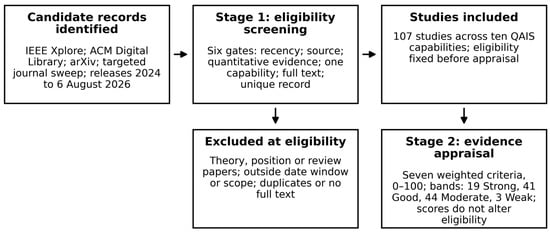
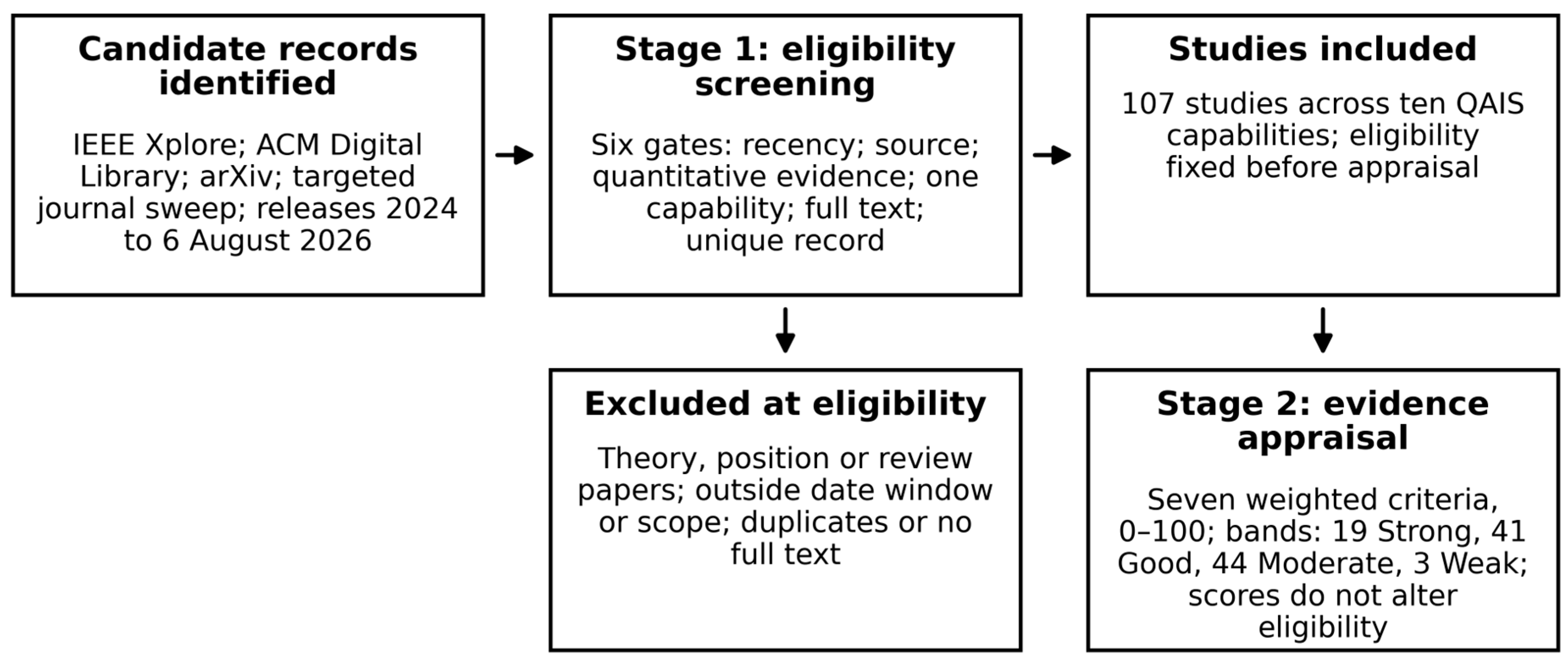
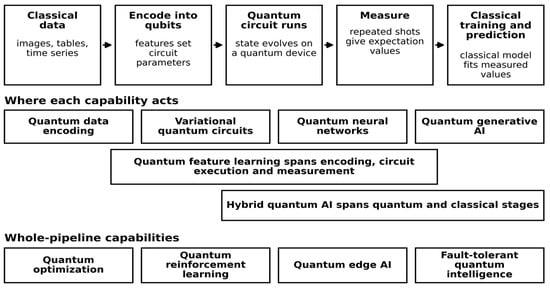
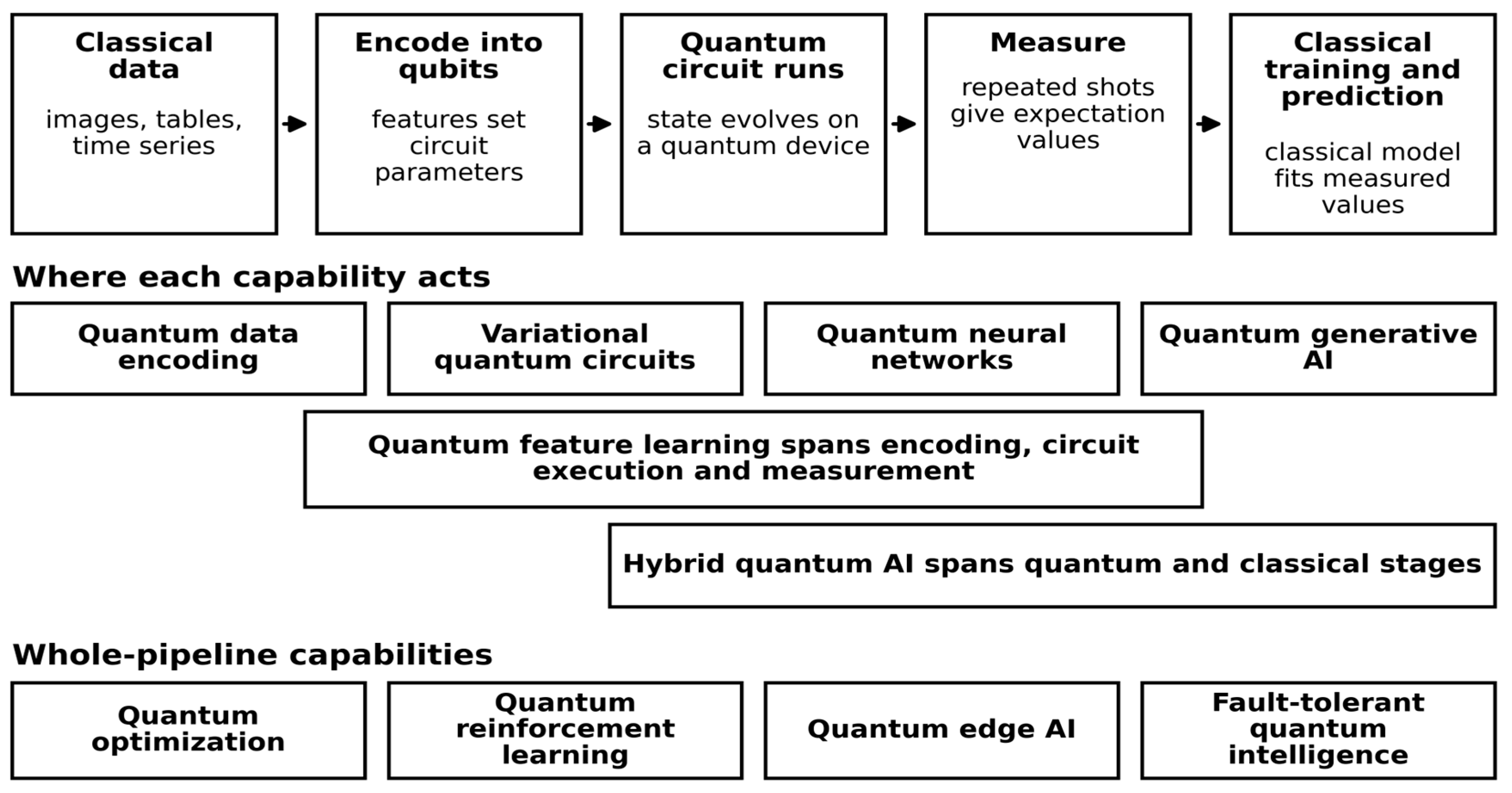
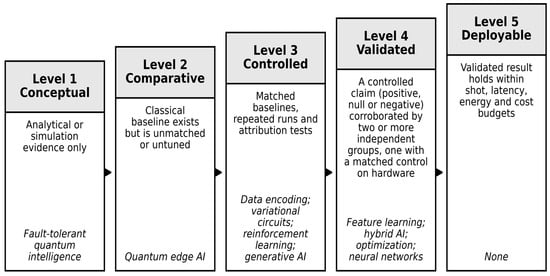
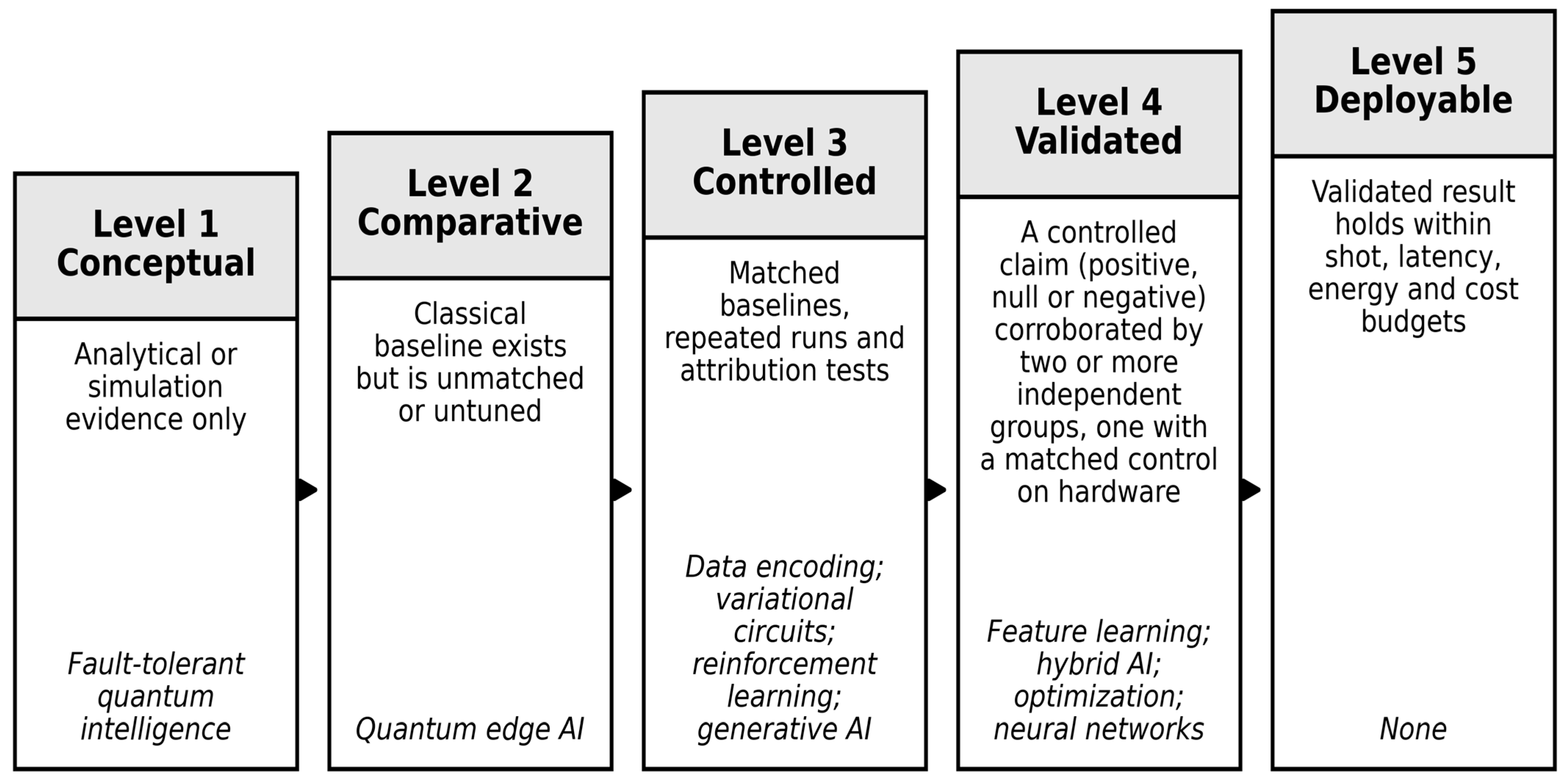
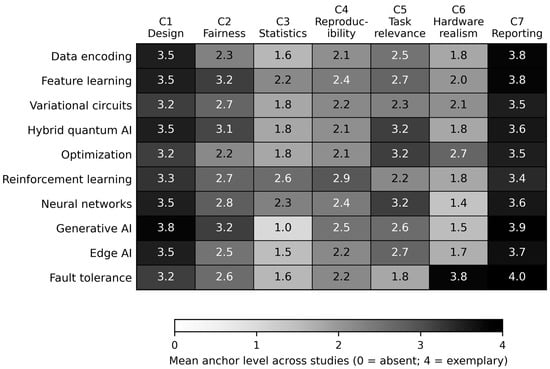
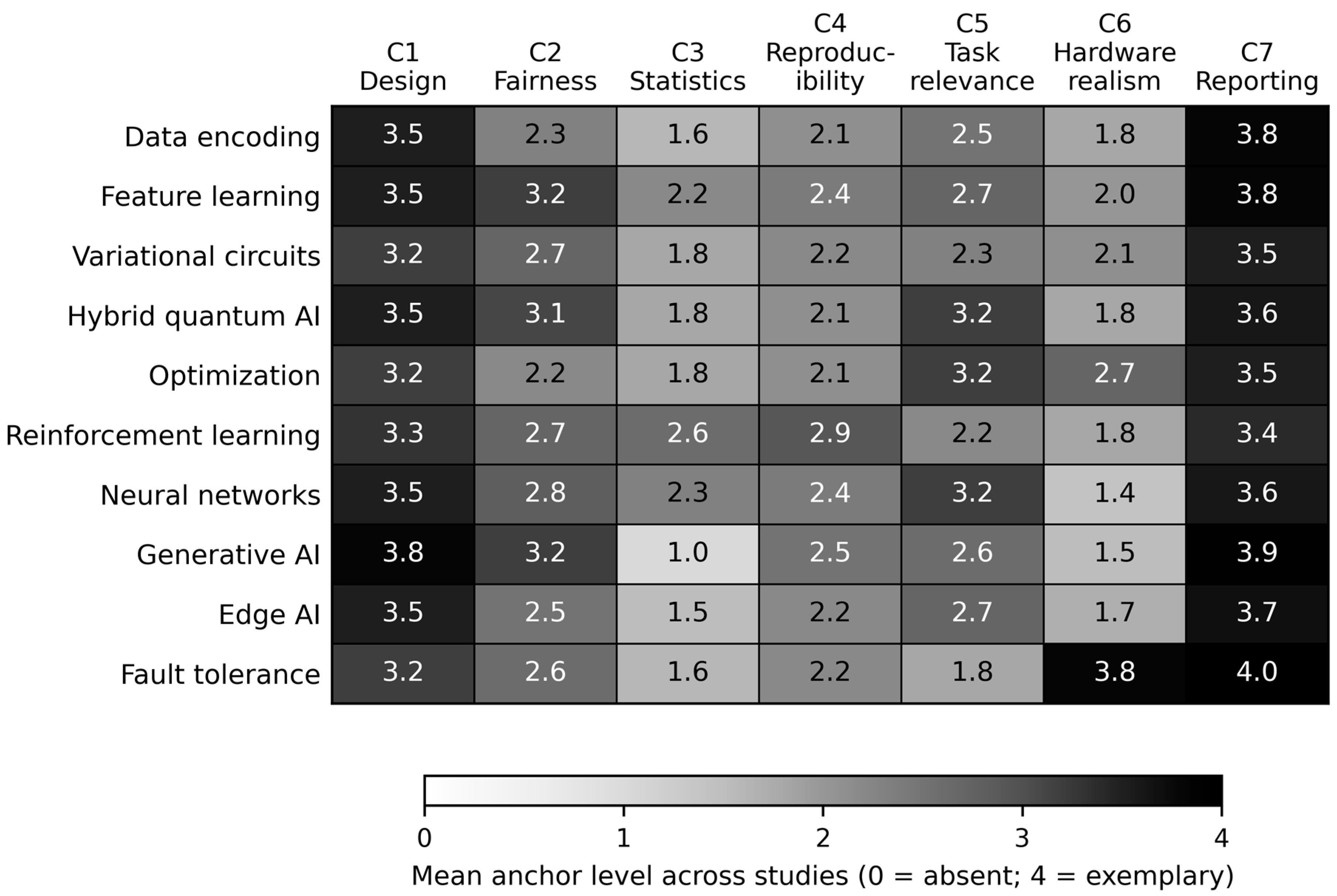

Disclaimer/Publisher’s Note: The statements, opinions and data contained in all publications are solely those of the individual author(s) and contributor(s) and not of MDPI and/or the editor(s). MDPI and/or the editor(s) disclaim responsibility for any injury to people or property resulting from any ideas, methods, instructions or products referred to in the content. |
© 2026 by the authors. Licensee MDPI, Basel, Switzerland. This article is an open access article distributed under the terms and conditions of the Creative Commons Attribution (CC BY) license.