


Abstract
The central charge occupies a unique role in conformal field theory, simultaneously serving as a measure of degrees of freedom, as the determinant of Casimir energy through modular transformations, and as an obstruction to the naive extension of the Witt algebra. The Virasoro central extension itself is rigid: it fixes c as a label of a given conformal field theory. In this work, we propose that higher categorical coherence—the pentagon and hexagon constraints governing fusion and braiding data, one level above the cocycle responsible for the Virasoro extension—supplies an additional, physically controllable handle. We show that controlled deformations of this higher coherence (higher categorical coherence breakdown, HCCB), implemented consistently through anomaly inflow, shift the effective central charge read out by anomaly-sensitive observables in quantized steps, opening the possibility of treating the measured central charge not as a fixed label but as an experimentally addressable piecewise-quantized quantity. We then focus on the fractional quantum Hall effect (FQHE), where the chiral central charge directly governs the quantized thermal Hall conductance. After reviewing the role of edge conformal field theories and current bounds on thermal transport, we propose experimental modifications—such as engineering multi-component edge states, coupling to non-Abelian quasiparticles, or introducing controlled categorical perturbations—that could render higher coherence breakdown detectable as shifts in the effective central charge. Two further elements complete the program. First, we show that within the consistent framework, all route- and bracketing-dependent observables vanish identically (route blindness), so that the pentagon and hexagon interferometers and thermal Y-junction networks we design operate as precision null tests of the modular-functor axioms themselves—the axioms stating that anyonic amplitudes are determined by the topology of a process rather than by the bookkeeping route used to compose it. Second, we show that a quantized remnant of route sensitivity survives in exactly one consistent form: the holonomy of closed cycles of categorical controls, realizing a central-charge pump for which the integer count per cycle is a family invariant beyond any static stacking description. The resulting framework provides both a conceptual reinterpretation of the central charge as a higher obstruction in categorical terms and a concrete experimental route for probing its dynamical behavior. Beyond the quantum Hall setting, these ideas suggest a broader program: anomalies, topological phases, and even string worldsheet central charges may admit reinterpretation through higher coherence. We conclude by outlining a research agenda in which categorical methods yield new experimental observables, potentially transforming the interplay between mathematics, condensed matter physics, and high-energy theory.
1. Introduction
1.1. Motivation
Two-dimensional conformal field theory (2D CFT) supplies a remarkably rigid framework in which universal data control both algebraic structure and measurable physics [1]. Among these data, the central charge c plays a unifying role: it governs the Virasoro algebra that organizes local operators, fixes universal finite-size and finite-temperature contributions to thermodynamics, and in chiral settings it controls thermal Hall transport in topological phases. At the same time, c is not merely a parameter but an obstruction (an anomaly) that signals the impossibility of realizing perfect classical symmetries after quantization [2,3,4].
This paper advances a new mechanism—higher categorical coherence breakdown (HCCB)—that can shift the effective central charge observed in appropriate probes. Very roughly, HCCB means that some of the higher coherence laws in the tensor-categorical data underlying a CFT (associators, braidings, and their higher compatibilities) fail to hold strictly in an effective description, being replaced by controlled, quantized k-cocycle defects (e.g., pentagon/hexagon deviations). Our proposal is operational: these defects feed the same anomaly channels that c inhabits, shifting the vacuum energy on curved backgrounds and the chiral energy current at edges, and thereby producing a measurable change in the effective c inferred from thermodynamics, modular asymptotics, and thermal Hall response.
1.2. The Central Charge as a Unifying Invariant in CFT
The local operator algebra of a 2D CFT carries a projective action of the Witt algebra that lifts uniquely to a central extension, the Virasoro algebra
with scalar central term c [2,3,4]. This central extension classifies a cohomology obstruction ; the coefficient is the central charge [3,4].
A first universal footprint of c is the vacuum (Casimir) energy on a cylinder of circumference L. Under the exponential map , the stress tensor transforms with a Schwarzian derivative, producing the standard shift
where v is the characteristic mode velocity. This universal finite-size amplitude is the content of the Blöte–Cardy–Nightingale–Affleck analysis [5,6].
A second universal footprint is encoded in modular properties. Writing the torus partition function as
and using modular covariance, Cardy’s argument yields the asymptotic density of states and the microcanonical entropy
with the minimal left conformal weight (for unitary CFTs , so ) [7,8]. The full modular/fusion consistency is packaged in the Verlinde and Moore–Seiberg frameworks, where pentagon/hexagon identities enforce OPE associativity and braiding compatibility [9,10]. These are precisely the coherence relations for which we will parameterize the controlled violation (HCCB).
1.3. The Dual Role: Counting Degrees of Freedom vs. Representing Obstructions
On the counting side, Zamolodchikov’s c-theorem identifies c as a monotone counting function along RG flows in 2D QFT, with fixed-point values matching the CFT central charge [11]. Quantum information-theoretic probes offer a complementary view: in a 1+1D critical ground state, the von Neumann entropy of an interval of length ℓ scales as
with UV cutoff a [12,13]. Thus, c controls both thermodynamics and entanglement, justifying the “degrees-of-freedom” interpretation.
On the obstruction side, c measures a trace (Weyl) anomaly: on curved 2D backgrounds,
relating c to a gravitational anomaly and to the central term of Virasoro via Ward identities [14]. In chiral theories, the chiral central charge
controls a protected edge energy current and fixes the quantized thermal Hall conductance
in appropriate low-T regimes [14,15,16,17]. This connects c directly to transport anomalies and bulk–boundary correspondence.
1.4. Higher Categorical Coherence Breakdown (HCCB) as a New Mechanism Capable of Shifting Effective c
Rational CFTs (and many irrational ones at the level of topological defects) carry the structure of a braided tensor category for chiral sectors and of a modular tensor category in gapped topological phases; their consistency is governed by categorical coherence—pentagon and hexagon identities for the associator and braiding [9,10]. From the categorical viewpoint, these identities are the vanishing of certain obstruction classes (e.g., 3-cocycles for associativity) and their higher analogues.
We define HCCB as a situation where, in an effective (e.g., boundary or defect) description, these coherence conditions are deformed by quantized cocycles that cannot be removed by redefinitions, while locality and unitarity are preserved in the physical correlators. Mathematically, HCCB lives in the same anomaly pipeline as the Virasoro/Weyl anomaly: controlled coherence defects backreact on (i) the Schwarzian term responsible for vacuum energy and (ii) the inflow that fixes chiral edge energy currents. Physically, the upshot is a shift
in the values inferred from (i) finite-size/finite-temperature free energy and Cardy asymptotics and (ii) thermal Hall metrology. The mechanism is precise enough to yield testable predictions once one has specified which coherence law is broken and by what quantized amount; the formal definitions are developed in Section 2.3 and consolidated at the structural level in Section 7.3.
1.5. Scope
Conceptual analysis of c as physical and algebraic quantity. We begin with a self-contained derivation of the appearance of c in (a) vacuum (Casimir) energies via the Schwarzian (and its cylinder mapping) and (b) high-temperature asymptotics via modular S-transformations and Cardy’s argument, including the role of in non-unitary or extended settings [5,6,7,8,9,10]. We then recast c categorically as an obstruction class tied to central extensions and anomalies [2,3,4,14].
Application to the fractional quantum Hall effect (FQHE). Next, we focus on chiral edge theories of FQHE states, modeled as chiral Luttinger liquids or more intricate RCFTs [18,19,20]. In this context, directly controls , with the universal law [14,15,16,17]. We review the experimental landscape, including the observation of half-integer thermal Hall conductance at that highlights the metrological sensitivity to chiral central charge [21].
Proposal of experimental modifications to detect HCCB-induced shifts in effective c. Finally, we design modifications of standard thermal Hall and finite-size/finite-temperature protocols on quantum Hall edges that (i) couple selectively to the putative coherence defect (e.g., through engineered domain walls of anyon condensation that alter associators), (ii) separate c-shifts from velocity renormalizations and non-equilibrated modes, and (iii) cross-check via independent Casimir/entanglement probes. The net result is a falsifiable program: a categorical deformation with a quantized defect strength predicts a corresponding step in extracted from , with a matching shift in the Casimir amplitude and in Cardy-like degeneracy growth.
Outlook. The central charge sits at a confluence of algebra and experiment—counting degrees of freedom while encoding an anomaly. By elevating higher coherence to a physical control knob (HCCB), we add a new axis along which c can move in effective descriptions. The remainder of the paper turns this into precise statements, culminating in experimentally testable predictions on FQHE edges.
What is new and operationally distinct. Before proceeding, it is useful to clarify in what precise sense the present work goes beyond a reinterpretation of known anomaly physics. While it is true that a shift of the chiral central charge can be described abstractly as stacking the edge theory with an invertible –dimensional topological phase, our contribution is not the statement of this equivalence but the identification of boundary-level, controllable mechanisms by which such shifts are induced, detected, and disentangled from conventional edge renormalizations.
Concretely, higher categorical coherence breakdown (HCCB) provides a systematic way to generate quantized scalar anomalies in the mapping-class group action of edge conformal blocks through controlled deformations of the coherence data, realized physically by engineered domain walls, anyon-condensate interfaces, and ancillary topological channels. These scalar anomalies propagate uniquely into the Dehn twist, and hence into the effective central charge, without modifying local operator content, edge velocities, or fusion rules. As a result, the predicted shifts in c and are simultaneously visible in three independent channels: modular thermodynamics (Casimir amplitudes), thermal Hall transport, and interference phases in multi-junction geometries.
The contributions of this paper can then be stated as four items. The first two are theorems within the consistent framework; the third converts an axiom into an experimental program; and the fourth identifies the unique consistent survivor of route sensitivity. We state them here at length because together they define what is genuinely new in this work.
(1) The dynamical central charge. Any HCCB deformation consistent with anomaly inflow produces quantized steps of —in units of for spin sectors, 8 for purely bosonic stacking—when a categorical control (a domain wall, an ancilla phase, a trapped topological sector) is toggled. The same shift appears simultaneously in three independent channels (Casimir amplitudes, thermal Hall slope, interference phases), reverses under chirality inversion, and is isolated by difference measurements that cancel equilibration and phonon backgrounds. The central charge thereby becomes an experimentally addressable observable: piecewise rigid, but movable in quantized steps by in situ controls.
(2) Route blindness as a theorem. Within the consistent framework, no observable can depend on the order or bracketing of topologically equivalent edge operations: any two sequences of elementary processes implementing the same topological operation carry identical amplitudes, and every closed rebracketing or reordering loop evaluates to unity (Section 5.1). Intuitively, the fusion and braiding data of an anyon theory are not dynamical quantities that a device could bend slightly; they are part of the definition of the theory, in the same way associativity is part of what one means by addition. The only quantities that survive all consistency conditions are attached to globally non-trivial operations—the Dehn twist (hence ) and, as item (4) explains, non-contractible cycles in control space. Route blindness is thus the categorical counterpart of Mac Lane coherence, promoted here from an algebraic lemma to an experimentally enforceable statement about transport and interference.
(3) Multi-junction geometries as null tests of the modular-functor axioms. The pentagon and hexagon interferometers and the thermal Y-junction networks of Section 5.2 and Section 6.4 realize the elementary coherence diagrams of the categorical framework (sketched diagrammatically in Appendix B) directly in gate-defined hardware. Because of item (2), the consistent framework predicts exact nulls for all of them: , and no bracketing dependence of heat flow. This is not a weakness of the proposal but its sharpest edge: the devices test the modular-functor axioms themselves—the statements that a chiral edge theory assigns well-defined amplitude spaces to anyon configurations, that these compose locally under cutting and sewing, and that amplitudes depend only on the topology of a process and never on the bookkeeping route used to compose it (the axioms are unpacked physically in Section 5.1). These axioms are the formal backbone of the topological interpretation of the fractional quantum Hall effect, of the universality of its quantized responses, and of all schemes for topological quantum computation; to our knowledge, they have never been the direct target of a dedicated laboratory test. A reproducible nonzero outcome—surviving the chirality-reversal, junction-scaling, and disorder diagnostics we specify—would therefore not measure a parameter of the present theory; it would falsify the axioms, with the physical implications spelled out in Section 6.4. Conversely, null results convert existing interferometric and calorimetric precision into the first quantitative laboratory bounds on the pentagon and hexagon identities.
(4) The central-charge pump: route sensitivity regained, in the only consistent form. Route blindness governs closed comparisons at fixed couplings; it does not forbid path dependence along open trajectories in the space of control parameters. Indeed, as a device’s categorical controls are varied, the instantaneous traces a path-dependent profile—which sectors are visited, and in which order, depends on the route taken through control space. What consistency enforces is only that the net effect of a closed cycle is a homotopy invariant: a quantized integer, the winding of the cycle around the loci in control space where the invertible sector changes. This is precisely the logic of parallel transport with a flat connection—local route sensitivity, global holonomy—and it identifies a new observable, the central-charge pump of Section 5.2.10 and Section 7.2: a quantized orientation-odd transfer of gravitational anomaly per control cycle, the Thouless pump of the anomaly coefficient. The pump is route-blind in the only way consistency permits (it depends on the homotopy class of the loop, not its parameterization) and yet is invisible to any description of a single static configuration; in a precise sense, it is the legitimate heir of the route-dependence intuition, relocated from real space to control space.
In this sense, HCCB elevates higher categorical coherence from a consistency requirement to a tunable physical control knob, and promotes the central charge from a fixed label of a conformal field theory to a quantized and experimentally addressable observable.
Reader’s Guide: How the conformal field theory background connects to the quantum Hall application. Because the argument of this paper crosses from algebra to metrology, we state its logical spine here explicitly. Section 2 and Section 3 are a self-contained review with a single purpose: to establish that the central charge is simultaneously (a) the coefficient of the Virasoro 2-cocycle, (b) the coefficient of the Schwarzian/Casimir and Cardy amplitudes, and (c) the coefficient of the Weyl/gravitational anomaly, so that any mechanism that feeds the anomaly channel must show up identically in spectral, thermodynamic, and transport observables. Section 4 then specializes to the one experimental platform where a chiral central charge is directly and routinely measured: quantum Hall edges, for which the low-energy description as chiral conformal field theories underlies the quantized thermal Hall data. We emphasize that the FQHE enters this work only through (i) the measured quantization of and (ii) the edge conformal-field-theory description validated by those measurements; no result below depends on the choice of bulk microscopic theory. Section 5 and Section 6 develop the HCCB mechanism on this platform and derive its observable consequences, separating rigorous (inflow-consistent) predictions from hypotheses to be bounded. Section 7 consolidates the structural definition, the quantization domains, and the extensions beyond the Hall setting.
Relation to companion work. The present paper is the condensed-matter and anomaly-theoretic member of a broader program developing the physics of categorical coherence and its controlled breakdown. In Ref. [22] the breakdown of coherence beyond first order is developed as a general geometric framework for nonlinear extensions of quantum mechanics, with the Uhlmann connection on the purification bundle implementing first-order (commutator-level) structure and higher coherence levels organizing genuinely nonlinear corrections relevant to strongly correlated electrons. Ref. [23] applies the categorical-mechanics viewpoint to bounded molecular systems, where coherence constraints organize the accessible state space of chemical dynamics. Neither companion paper concerns anomalies, modular data, or transport. The distinct contribution of the present work is to identify the regime in which higher coherence connects to a quantized, experimentally measurable observable: the chiral central charge read out by thermal Hall transport, with the two-tier structure (consistent quantized shifts versus bounded coherence failure) developed in Section 2, Section 3, Section 4, Section 5, Section 6 and Section 7. Thus, the three papers share a structural language but address disjoint physical questions with independent results.
2. Conformal Field Theory Background
2.1. The Virasoro Algebra and the Witt Operators
From circle diffeomorphisms to the Witt algebra. Holomorphic reparameterizations of the complex plane (or, more precisely, of the Riemann sphere minus ∞) are generated by vector fields
They satisfy the Lie bracket
which defines the Witt algebra of meromorphic vector fields on the circle (or the punctured plane). Equation (11) is verified by a direct calculation using :
The Witt algebra exponentiates (on suitable domains) to the orientation-preserving diffeomorphism group ; upon quantization; however, only a projective action is typically realized on the Hilbert space, and the group acquires a non-trivial central extension (the Bott–Virasoro group). This central extension differentiates to the Virasoro algebra [24,25].
Stress tensor, modes, and the Noether charge construction. In radial quantization, the holomorphic component of the stress tensor has the Laurent expansion
for any in the punctured plane. Infinitesimal conformal transformations are generated by
so the specific choice gives the Witt generators . The Ward identity/OPE for a primary field of weight h,
yields the expected action of the modes:
which exponentiates to the conformal transformation law of primaries [25,26].
Virasoro from the OPE: detailed derivation. Quantum effects shift the algebra of the Noether charges by a central term. The universal short-distance structure of stress tensor correlators is encoded in the OPE
for which the coefficient c is the central charge. Using the contour representation (12), we compute
We evaluate the z-integral by the standard residue identity
applied to . For the central piece , we obtain
For the operator pieces,
Combining and integrating over w (picking Laurent coefficients by ), we arrive at
the Virasoro algebra [25]. The first term reproduces the Witt algebra (11); the second is a central extension.
Central extension as a 2-cocycle (cohomological viewpoint). Algebraically, (19) corresponds to adjoining a central element K with and a 2-cocycle
The cocycle condition holds (checkable directly on the basis ), and is not a coboundary on the Witt algebra; therefore, the extension is non-trivial and unique up to rescaling of K (absorbed into c). On the group level, this is the Bott central extension of ; see [24] for a detailed construction.
Transformation of T and the Schwarzian derivative. Under a holomorphic change of coordinates , the quantum stress tensor transforms as a projective connection:
where the Schwarzian encodes the same anomaly that appears in the central term of (19). Mapping the plane to the cylinder and using (20) gives the universal Casimir energy (and finite-size corrections) of the vacuum, a standard exercise in radial quantization [25,27].
Free-field realizations and concrete values of c. The OPE (16) can be derived in explicit models, making the central term concrete:
- Free boson with two-point function hasUsing Wick contractions and keeping double contractions in yields the quartic pole with coefficient ; hence [25].
- Majorana fermion with OPE andproduces [25].
- ghost system with weights (arising in bosonic string gauge fixing) has ; the negative value reflects the ghost nature and is required to cancel the D-boson contribution at the critical dimension [27].
Sugawara construction and cosets: further sources of c. When a theory has conserved affine currents at level k for a compact simple Lie algebra , the stress tensor can be built from the currents (Sugawara):
with the dual Coxeter number [28,29]. If a subalgebra is gauged (coset construction), the stress tensor and central charge subtract:
providing a large family of rational CFTs for which the representation theory is governed by Virasoro with specific c (and in many cases additional chiral algebras) [30,31].
Highest-weight representations and minimal models (intuition). A Virasoro highest-weight module is generated from a vector with , by lowering operators (). For certain rational values of , null vectors appear and quotient modules are unitary; this leads to the discrete series (minimal models), for which the critical exponents match two-dimensional lattice universality classes [32]. Although we will not need the explicit Kac table in this subsection, this representation-theoretic control underpins the universal role of c.
Physical intuition and anomaly inflow. Classically, the Witt algebra (11) reflects local conformal symmetry. Quantum mechanically, short-distance regularization (normal ordering) injects a Schwinger term—the central piece in (19). The same coefficient c reappears (i) in the Schwarzian shift (20) (Casimir energy, modular thermodynamics) and (ii) in edge energy currents of chiral systems. This ubiquity is not accidental; it can be traced to anomaly inflow and projective actions of diffeomorphisms. As an illustration beyond 2D matter, the asymptotic symmetry group of gravity contains two commuting Virasoro algebras with classical central charge , showing that c can also have a geometric origin [33].
In summary, the Witt algebra organizes infinitesimal conformal transformations; quantization produces its unique central extension, the Virasoro algebra (19). The coefficient c governs both operator algebra (through (16)) and physics (through (20)), while concrete realizations (free fields, current algebras, cosets) showcase its calculability. These facts will be the starting point for our higher-categorical reinterpretation in later sections.
2.2. Interpretations of the Central Charge
The central charge c organizes universal data in two-dimensional conformal field theory (CFT). In this subsection, we explicate three complementary interpretations: (i) c as an effective count of degrees of freedom, (ii) c as the determinant of Casimir (finite-size and finite-temperature) amplitudes through modular properties, and (iii) c as an obstruction (anomaly) encoded in the projective nature of the diffeomorphism action. We provide complete derivations of the relevant formulas and indicate the minimal assumptions required in each case. Our discussion relies on modular invariance and on the replica construction for entanglement, with consistency constraints summarized by the classification of modular-invariant partition functions [34].
2.2.1. Degrees of Freedom from Modular Asymptotics (Cardy Growth)
Consider a unitary and compact 2D CFT on a circle of length L with Hamiltonian
where v is the characteristic mode velocity (we will set when convenient and reinstate it at the end). The torus partition function at inverse temperature is
Modular invariance states ; in particular, the high-temperature regime (small ) is controlled by the vacuum sector of the S-transformed channel (large ). Keeping only the vacuum contribution after an S transform yields
a statement of universality that descends from modular covariance and the classification of admissible partition functions [34].
To obtain the asymptotic microcanonical density of states, write with E measured relative to the vacuum. A Laplace inversion with the leading term (27) gives the large-E behavior via a saddle point:
where the saddle occurs at . Using (25), the energy above the vacuum for a state with is
Eliminating E in (28) gives the Cardy formula for the microcanonical degeneracy at large conformal weight:
with the minimal left conformal weight of states that contribute to Z (for unitary theories on the plane, so ). Equation (29) demonstrates that c counts the effective degrees of freedom that control the exponential growth of the state density; modular consistency of Z is the only required input [34]. Refinements and rigorous bounds that constrain low-lying operator dimensions in terms of c—further cementing its role as a counting parameter—are provided by modular bootstrap methods [35].
Entanglement perspective. For a single interval of length ℓ in the ground state of a 1+1D CFT, the replica method computes the Rényi entropies by mapping the n-sheeted Riemann surface to the plane. The branch points are twist fields of conformal weight
so the two-point function and
Taking yields the von Neumann entropy
where a is a UV cutoff and is non-universal. Equation (32) provides an independent information-theoretic operational meaning of c as the coefficient of universal entanglement growth at criticality [36,37].
2.2.2. Casimir Energy and Modular Thermodynamics
The same c fixes universal finite-size and thermal amplitudes. On a cylinder of circumference L, the conformal map with gives the Schwarzian derivative
so the stress tensor transforms as a projective connection,
Using and in the vacuum, the Casimir energy is
and the corresponding ground-state momentum is for the vacuum.
At finite temperature, modular invariance of the torus partition function with implies the leading high-temperature asymptotics (27). Since , one finds the universal free-energy density (setting )
and hence a specific heat per unit length . These relations provide a thermodynamic route to measure c from finite-size/finite-temperature data, including in systems with boundaries and defects [38,39].
Modular consistency as the organizing principle. Equations (34) and (35) follow from the same modular covariance that underpins (29). The space of consistent (unitary, modular-invariant) partition functions is highly constrained; e.g., in rational theories, the Cappelli–Itzykson–Zuber (CIZ) classification demonstrates how modular invariants determine the spectrum, and hence the vacuum dominance in the S-channel that leads to (27) [34]. Thus, c controls both spectral growth and thermodynamics by the same structural input.
2.2.3. Obstruction: Central Charge as an Anomaly
Classically, conformal invariance implies a traceless stress tensor; quantum mechanically, regularization induces an anomalous trace. On a general 2D background , the Weyl variation of the generating functional is
where is the Ricci scalar and is the local scale factor (). Equation (36) is equivalent to the appearance of the Schwarzian in the transformation of T and to the central term in the Virasoro algebra; in this sense, c is an obstruction class measuring the failure of the diffeomorphism/Weyl symmetry to be realized non-projectively at the quantum level [40].
For chiral theories (), there is in addition a gravitational (diffeomorphism) anomaly proportional to , which controls the anomalous conservation of the energy current and underlies the protected chiral transport on edges of topological phases. The cohomological classification of such anomalies and their inflow mechanisms was elucidated in the classic work on gravitational anomalies [41]. In particular, anomaly matching ensures that the same coefficient that enters (36) also governs the universal responses obtained by coupling the theory to background geometry; this is the geometric origin of the Casimir and thermal amplitudes in (34) and (35).
2.2.4. Synthesis and Operational Dictionary
We may summarize the three lenses as follows:
These four entries rest, respectively, on modular asymptotics and the modular bootstrap [34,35], on Casimir and thermal universality [38,39], on the Weyl and gravitational anomalies [40,41], and on universal entanglement scaling [36,37]. Each equality identifies an independent measurement channel for c. Later sections will exploit this dictionary in the presence of higher categorical coherence breakdown: coherence defects will enter the anomaly pipeline, and as such appear simultaneously in spectral growth, thermodynamics, and information-theoretic observables.
2.3. Higher Categorical Coherence Breakdown in CFT
In two-dimensional conformal field theory (CFT), the analytic structure of correlation functions is encoded by chiral data: fusion of primary fields, braiding of conformal blocks, and their consistency. This data admit a natural mathematical organization in terms of (braided) tensor categories. In such a category , the tensor product ⊗ is associative only up to a specified natural isomorphism (the associator)
together with unitors and , and if present, a braiding . These isomorphisms are constrained by coherence diagrams, most prominently the triangle (compatibility with the unit) and the pentagon (compatibility of the associator with itself); in the braided case, hexagon diagrams express compatibility of braiding with associativity. Physically, these constraints are the algebraic shadow of OPE associativity and crossing symmetry of four-point functions as well as the consistency of braiding monodromies of conformal blocks [42,43,44].
The goal of this subsection is twofold: (i) to recast OPE associativity and braiding in the language of coherence (triangle, pentagon, hexagon) and make precise how small quantized departures from strict coherence can be parameterized; and (ii) to show how such departures, which we call higher categorical coherence breakdown (HCCB), feed into the same anomaly pipeline as the Virasoro/Weyl anomaly, thereby shifting the effective central charge measured by modular thermodynamics and by chiral transport.
2.3.1. Coherence in Monoidal and Braided Tensor Categories
A (strict) monoidal category is one where and on the nose; general monoidal categories replace these equalities with coherent isomorphisms , , . Mac Lane’s coherence theorem asserts that all diagrams built from commute provided that the triangle and pentagon commute:
as natural transformations between and [42].
In a braided monoidal category , the braiding isomorphisms satisfy the hexagon identities
When is rigid and ribbon, one obtains further structure (duals, twists); under suitable finiteness/non-degeneracy conditions one arrives at a modular tensor category (MTC), which abstracts the chiral data of rational CFT and the anyon content of -dimensional topological phases [44,45,46].
Index notation and F-, R-symbols. Fix a basis of fusion/splitting spaces. The associator is encoded by F-symbols
and the braiding by R-symbols (suppressing multiplicity indices when not essential). Coherence becomes the pentagon equation
and the two hexagon equations
These matrix equalities implement the topological moves on trivalent graphs and encode the change of basis between s-, t-, and u-channel factorizations of four-point blocks.
2.3.2. OPE Associativity and Crossing from Coherence
Let be primary fields labeled by simple objects and consider the four-point correlator on the sphere. Its holomorphic conformal blocks admit different factorizations corresponding to distinct parenthesizations of the OPE:
Crossing symmetry requires that these two bases be related by the F-matrix:
Consistency of five-point blocks and of successive re-associations of the OPE imposes (41), while compatibility with braiding monodromies imposes (42) and (43). In vertex-operator algebra (VOA) language, these statements are the rigorous content of associativity (operator product expansion), commutativity/braiding, and modularity of the tensor category of modules [43]. From the three-dimensional perspective, the same consistency is encoded by the Reshetikhin–Turaev/Turaev–Viro topological field theory, for which the F- and R-moves implement elementary cobordisms and the coherence identities arise from invariance under 3D Pachner moves [44,46,47].
2.3.3. Parameterizing Controlled Departures from Coherence
While a genuine monoidal category must obey the pentagon and triangle identically, quasi-monoidal structures allow a non-trivial associator controlled by a 3-cocycle, as in Drinfeld’s quasi-Hopf algebras [48]. Concretely, let be a normalized -valued 3-cochain on (isomorphism classes of) objects, and deform the associator by
The new associator satisfies the pentagon if and only if is a 3-cocycle, i.e., , so that remains coherent. Two sharply different situations must then be distinguished, and keeping them apart is essential for everything that follows.
(i) Consistent twists (). When is a cocycle with a non-trivial class, the twisted theory is consistent but in general inequivalent to the original one: the twist replaces the chiral data by those of a different topological phase. This is the sector in which all quantitative predictions of this paper live; as made precise in Section 5 and Section 7, it is operationally equivalent to changing the bulk phase or stacking it with a -dimensional invertible phase, and its unique modular imprint is a scalar on the Dehn twist, i.e., a quantized shift of the effective central charge.
(ii) Genuine pentagon defects (). If is a globally defined 3-cochain with , then the pentagon fails by the scalar ; however, this failure is a 4-coboundary, which is cohomologically trivial by construction (): it is removed identically by undoing the twist, and no anomaly (hence, no physical effect) can be associated with it. A genuine non-removable pentagon defect is instead measured by a non-trivial class in , arising when the would-be local trivializations exist only patchwise and cannot be glued, as in the obstruction theory of symmetry-extended (G-crossed) categories [49,50]. By the correspondence between cohomological degree and the dimension of the topological action that integrates it, such a class is the anomaly of a -dimensional theory realizable only on the boundary of a -dimensional invertible bulk—one dimension above the -dimensional inflow that governs the edge anomalies considered in this work. The paradigmatic physical realization is the anomalous surface topological order of three-dimensional symmetry-protected phases [51]. For a planar quantum Hall device, where the three-dimensional environment is topologically trivial, only the trivial class is available and consistency confines HCCB to sector (i). This perspective is compatible with the modern classification of anomalies as invertible field theories in one higher dimension [52,53].
In index notation, (47) induces
so that the pentagon picks up the 4-coboundary and the hexagon similarly acquires phases ensuring compatibility with a twisted braiding. In pointed categories (all simple objects invertible under ⊗), this construction reduces to twisting by group cohomology classes (Dijkgraaf–Witten type), and the deformation is exact at the level of F-symbols [45,46].
Definition (HCCB—two tiers). Tier 1 (inflow-consistent; used throughout this paper). An HCCB deformation of the boundary chiral data is a twist (47) by a cocycle (), supplemented in braided settings by the compatible braiding adjustment discussed below; equivalently, it is the composition of the edge theory with a -dimensional invertible phase. All coherence relations close, and the only modular imprint is a one-dimensional scalar on the mapping-class action, localized in the Dehn twist; the effective central charge shifts by the quantized amount . Operationally, Tier-1 HCCB is the presence of well-defined local correlators with modular phases that are shifted by a bulk topological term, hence affecting precisely those quantities (vacuum energies, modular phases, and chiral energy currents) that are anomaly-sensitive. Tier 2 (beyond inflow; a hypothesis to be bounded, not a prediction). A genuine pentagon defect—a non-trivial class—cannot exist in a standalone planar system; it requires a -dimensional invertible host, as realized by anomalous surface topological orders [51]. In the experimental sections, we treat any putative Tier-2 effect strictly as a null hypothesis: within Tier 1, every route- or bracketing-dependent observable vanishes identically (Section 5.1), so the multi-junction protocols proposed below bound Tier-2 physics rather than measure a parameter of Tier 1.
2.3.4. From Coherence Defects to Effective Central Charge
In a modular tensor category , the topological central charge (or total twist) is encoded by the Gauss sum
where are quantum dimensions and are twists; is the chiral (right-minus-left) central charge, defined modulo 8 for bosonic phases [44,54]. The quantity is multiplicative under Deligne products and invariant under Witt equivalence; it detects the gravitational anomaly carried by the edge [55].
Now, deform the associator by as in (47) and adjust the braiding/twist so as to maintain the ribbon structure. This adjustment is not automatic: in the pointed case, the deformations compatible with the braided structure are exactly those classified by Abelian (Eilenberg–Mac Lane) cohomology (equivalently by additive shifts of the quadratic form), and a bare associator twist generally maps a modular theory outside the modular family [45]. Restricting to consistently adjustable deformations, denote the deformed data by and the resulting category by . Then, one has
that is, the ratio of Gauss sums is a pure phase that measures the shift in the chiral central charge modulo 8. In pointed examples , the data are determined by a quadratic form ; the deformations compatible with the braided (ribbon) structure are classified by Eilenberg–Mac Lane Abelian cohomology, which is canonically the group of quadratic forms on G, and they act by shifting q additively; the Gauss sum (hence, ) then changes according to the Gauss–Milgram signature of the shifted form [45,46].
Example (pointed case). Let be the pointed MTC associated to a finite Abelian group G with quadratic form q. The twist is and . Then,
For and (the semion theory), , so . The braided-compatible twists shift q additively by another quadratic form; shifting by the fermionic form maps the semion to the anti-semion, , so the Gauss sum changes by and . Two cautionary remarks sharpen the example. First, a bare twist by the non-trivial class in , without a compensating braiding adjustment, changes the associator class and maps the semion outside the modular family (onto the boson/fermion pair, whose braiding is degenerate): ribbon structure is not preserved automatically, even in the pointed case. Second, stacking with the phase shifts by 8; therefore, it leaves invariant: the Gauss sum determines only modulo 8, which is precisely the bosonic stacking ambiguity. Both remarks illustrate the content and the resolution of (50) [54,55].
Operational consequences. A change modifies (i) the modular T-matrix by an overall phase , (ii) the vacuum Casimir energy (on a chiral edge) by , and (iii) the low-temperature thermal Hall conductance by
all of which provide experimental/operational readouts of HCCB. The inflow picture identifies with the shift of the gravitational Chern–Simons level in the -dimensional bulk; the corresponding boundary consistent-with-anomaly structure is precisely a controlled failure of coherence [56,57].
2.3.5. Deriving the Drift: A Proof Sketch
We sketch how (50) arises from the deformation (48) in a ribbon fusion category with simple spectrum.
- 1.
- Twisting the associator. Deform by (48). This induces a change of 6j-symbols, and hence of the evaluation of closed trivalent graphs by a phase determined by on 3-simplices of a triangulation.
- 2.
- State-sum/TFT perspective. In the Turaev–Viro/Reshetikhin–Turaev construction, the partition function on a closed 3-manifold M is a state sum built from F-symbols and quantum dimensions. Twisting by multiplies the partition function by the discrete action of an invertible theory classified by the cohomology class of (pointed case: Dijkgraaf–Witten action). On with a boundary torus, this phase appears as an overall phase in the Dehn twist—i.e., in the diagonal entries of the modular T-matrix of the boundary theory [46,47].
- 3.
- From T to . The diagonal of T is . Multiplying T by a scalar phase corresponds to shifting c by (holding conformal weights fixed). The bulk phase computed in step (2) is precisely , which is extracted from the ratio of Gauss sums (the partition function on ) and yields (50) [44,55].
Thus, a controlled deformation of coherence (HCCB) propagates into a shift of modular phases, which in turn implements a well-defined quantized drift of the (chiral) central charge. In subsequent sections, we will match this prediction against edge thermodynamics and propose experimental protocols in the fractional quantum Hall setting to measure .
3. Central Charge as an Obstruction
3.1. Mathematical Aspect: Central Term as a Non-Removable 2-Cocycle
The Virasoro central term arises as a non-trivial class in Lie algebra cohomology. In this subsection we give a precise cohomological formulation, an explicit construction of the Gelfand–Fuchs 2-cocycle on the Witt algebra, two independent proofs of its non-triviality, and a group-level interpretation via the Bott–Thurston 2-cocycle on . We then connect to projective unitary representations and to the geometric (coadjoint orbit) picture, where the central charge appears as an intrinsic obstruction parameter. Our references for the cohomological and geometric facts are [58,59,60,61,62,63,64,65,66].
3.1.1. Cochains, Coboundaries, and Central Extensions
Let be a (complex) Lie algebra and M a trivial -module (here ). The Chevalley–Eilenberg cochains are alternating n-linear maps with differential
A 2-cochain is a 2-cocycle if , i.e.,
A 2-cocycle is trivial (a coboundary) if there exists a linear functional such that , i.e.,
The second cohomology classifies equivalence classes of central extensions
with two extensions equivalent iff their cocycles differ by a coboundary [60,62].
Application to the Witt algebra. Let be the Witt algebra spanned by with brackets
A central extension of is specified by a skew-symmetric bilinear form obeying (53). The Virasoro algebra is the (unique up to scale) non-trivial central extension, with
We now construct explicitly from differential geometry on and show that it is non-trivial.
3.1.2. The Gelfand–Fuchs 2-Cocycle on Vector Fields of the Circle
Identify with smooth -periodic vector fields on the circle, , . Define
Claim 1.
is a 2-cocycle: .
Proof.
Using , one computes
Adding the cyclic permutations and integrating by parts, all terms cancel pairwise. The cancellation uses only periodicity (no boundary terms) and the antisymmetry built into (58). Thus, [58,59]. □
Claim 2.
In the Fourier basis , , one obtains
Proof.
Insert , , so that , and similarly for g. Then, . The integral gives ; combining with the prefactor and using yields after the standard normalization that enforces vanishing on the subalgebra (this normalization fixes the unique -invariant representative in the non-zero cohomology class) [59]. □
Thus, reproduces the Virasoro central term. Any other 2-cocycle differs by a coboundary and an overall multiple of ; the scalar coefficient is the central charge c.
3.1.3. Non-Triviality: No Coboundary Can Remove the Central Term
We present two complementary arguments.
(A) Cohomological argument via -reduction. The adjoint action of the Möbius subalgebra splits into weight spaces. A standard Hochschild–Serre spectral sequence computation shows that
generated by the unique -invariant class. The representative that vanishes when any argument lies in is precisely (58); hence, the class is non-zero [58,60]. If were a coboundary, it would be -invariant as well, but contains no non-zero -invariant elements in this degree, which is a contradiction.
(B) Ratio test on modes (no solution for a coboundary). Assume . Evaluating at gives
For the Virasoro cocycle, . Taking and ,
These ratios cannot agree for any ; hence, is not a coboundary [59]. Therefore, the central term is non-removable.
3.1.4. Group-Level Viewpoint: Bott–Thurston 2-Cocycle
On the group , the obstruction is encoded by the Bott–Thurston 2-cocycle ,
which satisfies the group 2-cocycle condition . The Virasoro–Bott group is the central extension
with multiplication [66]. Differentiating at the identity recovers the Lie algebra cocycle (58). The non-triviality of B in group cohomology mirrors the non-triviality of in Lie algebra cohomology and obstructs the lifting of projective unitary representations of to honest representations without enlarging the group by a central circle [60,61].
3.1.5. Projective Representations and Multipliers
A (ray) representation of on a Hilbert space satisfies
where is a multiplier obeying the group 2-cocycle condition. When is cohomologous to zero, the representation can be rephased to a genuine unitary representation. In CFT, locality and positivity enforce a non-trivial multiplier proportional to (61), with coefficient c; exponentiating the Virasoro–Bott extension yields a unitary representation of for which the generator algebra is Virasoro with central charge c [61,62]. In parallel, determinant line bundles and fermionic anomalies provide a geometric construction of the multiplier (and the central extension) via Quillen curvature and index-theoretic formulas [63].
3.1.6. Coadjoint Orbits and the Geometric Meaning of c
Let denote the Virasoro Lie algebra (central extension of ). Its (continuous) dual consists of pairs with b as a quadratic density and the value on the central element K (identified with up to normalization). The coadjoint action of a vector field is
with the last term proportional to the central charge. The Kirillov–Kostant symplectic form on a coadjoint orbit is
in which the second term is precisely the GF cocycle (58) (up to normalization). Thus, c is the level of the Kirillov–Kostant form, and measures the failure of the naive (non-centrally-extended) moment map to exist: it is the geometric avatar of the obstruction [64,65].
3.1.7. Physical Intuition: Why the Obstruction Cannot Be Removed
In a quantum theory, the stress tensor generators are defined by contour integrals of with normal ordering. The commutator acquires a c-number (Schwinger term) proportional to the short-distance singularity of the OPE; this is intrinsic to the operator product, and cannot be eliminated by redefining because such redefinitions correspond exactly to adding a coboundary to the cocycle; as we have shown, the GF class is non-trivial in cohomology. Equivalently, the projective factor in the representation of is fixed by locality and positivity; non-triviality of the Bott–Thurston class means there is no global phase choice that trivializes it. Therefore, the central charge is an obstruction—a topological invariant of the representation—rather than a removable artifact.
3.1.8. Summary (Dictionary)
- is generated by the Gelfand–Fuchs class ; the Virasoro central term represents [58,59,60].
- The group-level obstruction is the Bott–Thurston cocycle B, yielding the Virasoro–Bott central extension of [61,66].
- Projective unitary representations of lift to honest representations of the centrally extended group; the multiplier is fixed by c [62,63].
- Geometrically, c is the level of the Kirillov–Kostant form on Virasoro coadjoint orbits and produces the term in (64) [64,65].
3.2. Physical Manifestation: Obstruction to Naive Witt Symmetry and Its Relation to Anomalies and Conserved Charges
The central charge c is the physical imprint of a quantum obstruction to realizing the classical Witt symmetry of local conformal transformations as an honest symmetry on the Hilbert space. Classically, the infinitesimal conformal diffeomorphisms of the circle are generated by vector fields , obeying the Witt Lie algebra. Quantum mechanically, the stress tensor modes furnish a projective representation with a Schwinger term. This has three equivalent faces:
- An anomalous commutator of the Noether charges (central term)
- An anomalous transformation law for the stress tensor (Schwarzian term)
- A Weyl/gravitational anomaly in the generating functional, with concomitant edge transport.
- We detail each viewpoint and its implications for conserved charges.
Charge algebra with a central term. Let be the charge generating a reparameterization in radial quantization (here, is the chiral stress tensor on the circle). Using the -OPE and standard contour manipulations, one finds
where the last term is the Gelfand–Fuchs 2-cocycle evaluated on the pair of vector fields (cf. Section 3.1). Equation (66) makes the obstruction manifest: the algebra of quantum charges closes only up to a c-number term, so one obtains a projective (not linear) representation of the Witt algebra. This projective factor exponentiates to the Bott–Thurston group cocycle on , and cannot be removed by rephasing due to the non-triviality of the corresponding cohomology class (see the coadjoint-orbit derivation in [67]).
Anomalous transformation of T (Schwarzian term). Let denote the variation under . The operator-product Ward identity (or equivalently, the Virasoro commutator) implies
The third-derivative term is the local manifestation of the anomaly: T transforms as a tensor of weight 2 only up to the Schwarzian correction. At the level of finite conformal maps , this integrates to
with the Schwarzian derivative . The same term controls the universal Casimir energy and modular phases of the partition function.
Weyl anomaly in the generating functional. In the path-integral (Euclidean) formalism, the quantum effective action on a two-dimensional manifold admits the Polyakov nonlocal functional
for which the Weyl variation gives the trace anomaly
Equations (69) and (70) can be derived either by explicit functional determinants (heat kernel methods) [68,69] or by the Fujikawa method, which identifies the anomaly with the Jacobian of the path-integral measure under Weyl transformations [70,71]. Thus, c is the coefficient of a geometric obstruction in .
From anomalies to transport and conserved charges. Coupling to background (Newton–Cartan) geometry and using Luttinger’s trick (thermal gradients as fictitious gravitational fields) yields the thermal response controlled by the chiral central charge . Denoting by the “gravitational potential” that sources energy density, the energy current follows from , with the gravitomagnetic vector potential; one finds [72,73]
This low-T edge formula matches microscopic computations in chiral phases (e.g., superconductors with ) and provides an operational probe of the obstruction encoded by [74,75]. The same anomaly controls other geometric responses such as Hall viscosity, which ties to the conformal (and gravitational) data of the edge theory [76].
Conserved charges in the covariant phase space. A complementary perspective uses the covariant phase-space formalism. Given a diffeomorphism generated by , the variation of the Hamiltonian charge acquires a boundary term determined by the symplectic current. In anomalous systems the algebra of charges reads
where the central 2-cocycle K is a boundary integral constructed from the symplectic structure and encodes the obstruction to the naive symmetry action. This statement is universal and does not rely on special coordinates; a covariant derivation appears in [77,78]. In 2D CFT, the explicit form of K reduces to the integral in (66).
In sum, the central charge is the single parameter that measures the failure of classical Witt symmetry to survive quantization unscathed. It appears in the algebra of charges, in the local transformation of the stress tensor, and in the geometric (Weyl) anomaly of the generating functional; from there, it propagates into universal transport coefficients such as (71).
3.3. HCCB Perspective: Higher Coherence as a Generalized Obstruction and the Drift of the Effective Central Charge
We now elevate the obstruction viewpoint from Lie algebra cohomology to higher categorical coherence. In categorical models of chiral data, associativity and braiding hold up to specified isomorphisms obeying coherence constraints (pentagon/hexagon). The crucial observation is that in effective boundary descriptions that are compatible with anomaly inflow, small quantized violations of these coherence laws can be consistently organized and behave as higher-order anomalies. We call this mechanism higher categorical coherence breakdown (HCCB).
Beyond the pentagon: Homotopy coherence and higher associativity. Classical coherence theorems insure that the triangle/pentagon/hexagon diagrams suffice for ordinary (braided) monoidal categories. In homotopy-theoretic refinements (e.g., - and -structures), associativity and commutativity constraints are controlled by a hierarchy of homotopies organized by Stasheff polytopes (associahedra) and their higher analogues [79,80,81,82]. In such settings one may consistently introduce secondary and higher coherence data, for which failure is measured by higher cohomology classes. Physically, these control the re-association of OPEs and the compatibility of braidings/monodromies beyond the four-point level; homotopy coherence reflects the fact that field theories compute correlators only up to exact terms and contact terms, and that those may carry quantized information.
HCCB as a higher anomaly. Let encode a (normalized) -valued 3-cochain that deforms the associator as in Section 2.3, and consider further higher cochains which parameterize coherent homotopies at level n. The dimensional bookkeeping of anomaly inflow is rigid here, and worth stating exactly: an anomaly classified by a degree-n class is realized by an invertible topological field theory in n spacetime dimensions, living as the bulk of an -dimensional boundary theory [83,84,85]. A consistent 3-cocycle twist () is degree-3 data: it corresponds to changing (or stacking with) a d invertible bulk. The d edge of this bulk inherits the shifted modular phases; this is the Tier-1 mechanism used throughout. By contrast, a genuine violation of the pentagon is degree-4 data: if a globally defined has , then the failure is an exact coboundary and hence removable, while a non-removable failure defines a class in and signals that the d theory itself is consistent only as the boundary of a d invertible bulk, as in the obstruction theory of symmetry-extended categories and its physical realization by anomalous surface topological orders [49,50,51]. Beyond-pentagon data (secondary associators, higher homotopies) push this pattern one level further still. For the planar devices considered in this paper, only the degree-3, Tier-1 sector is available; the higher tiers enter as null hypotheses and (in their only inflow-consistent planar incarnation) as invariants of families over control-parameter space (Section 5.2.10 and Section 7.2).
Drift of the effective central charge from inflow. The edge theory knows about the bulk through modular phases and geometric responses. If the bulk carries a gravitational Chern–Simons (gCS) term
then the boundary partition function acquires a framing (Dehn twist) phase and the chiral central charge shifts by
Equation (74) is the edge/bulk matching for the gravitational anomaly, and is the precise content of “stacking with an invertible 3D phase” [83,86]. When the coherence is deformed by (or higher ) consistently with a bulk invertible TFT, the Dehn twist on the boundary torus picks up a scalar phase
equivalently shifting the (topological) Gauss sum and the modular data. This is the categorical counterpart of the stress-tensor Schwarzian shift, and leads to a drift of the effective central charge measured by finite-size thermodynamics and chiral transport:
For purely bosonic phases, is quantized so that (period 8), reflecting the index; in spin phases (fermionic systems), the periodicity is refined by the spin structure, but the modular -phase still encodes the shift [86].
Schematic derivation via mapping tori. Let be the mapping torus of the torus under a single Dehn twist. The bulk invertible TFT amplitude on is a pure phase ; by functoriality, this is the scalar by which the boundary acts on the vacuum. In a chiral CFT, acts diagonally as , so a scalar multiplication by shifts . Identifying gives (74), which may be computed (in examples) by evaluating the gCS action on . The same computation can be phrased categorically in terms of how a twist of the associator/braiding modifies the Reshetikhin–Turaev invariant of the mapping torus; this is precisely the beyond-pentagon footprint of the inflow [50,81,82].
Operational dictionary.
- Higher coherence defect (parameterized by ) ⟹ invertible bulk with topological action ⟹ boundary modular phase and Dehn twist shift.
- The phase of controls via .
- Transport and thermodynamics detect through (76), while finite-size Casimir shifts by .
In conclusion, c is an obstruction at the Lie-algebraic level, and HCCB exhibits it as the low-energy shadow of a higher obstruction: a controlled breakdown of coherence that is compensated by anomaly inflow. This mechanism makes the “central charge drift” both quantized and experimentally accessible.
4. Fractional Quantum Hall Effect (FQHE) as a Laboratory
4.1. Overview of the FQHE
The fractional quantum Hall effect (FQHE) is an emergent topological phase of two-dimensional electrons in strong magnetic fields and at low temperatures. It exhibits fractional quantization of the Hall conductance and quasiparticles with fractional charge and anyonic statistics. Discovered experimentally at filling factor [87], it was explained by Laughlin’s variational wavefunction [88] and subsequently generalized by hierarchy and composite-fermion constructions [89,90,91]. This subsection reviews (i) Laughlin states and their topological order (degeneracies, fractional charge/statistics, topological entanglement), (ii) edge states as chiral CFTs, and (iii) the quantization of the Hall conductance from bulk and edge viewpoints. Classic expositions include [92,93,94,95].
4.1.1. Landau Levels and Laughlin Wavefunctions
Electrons (charge ) confined to the -plane in a perpendicular magnetic field have Landau levels with cyclotron frequency . The magnetic length
sets the natural area scale, and each Landau level has degeneracy
equal to the number of flux quanta piercing area A. The filling factor is . Projected to the lowest Landau level (LLL), kinetic energy is quenched; interactions dominate.
Laughlin states. On the plane (symmetric gauge), the LLL single-particle orbitals are holomorphic times a Gaussian. For odd integer , Laughlin proposed the N-electron wavefunction
which is antisymmetric, minimizes short-range repulsion, and yields an incompressible quantum fluid [88]. The Jastrow factor enforces a correlation hole of order m, suppressing the probability of close approach. The plasma analogy maps to a 2D one-component Coulomb plasma at inverse temperature m, making incompressibility intuitive: increasing m strengthens logarithmic repulsion and favors uniform density.
Quasiholes: Fractional charge and statistics. A quasihole at is described by
and a quasiparticle by the (LLL-projected) inverse factor. Adiabatic insertion of one flux quantum through a puncture creates one quasihole; charge conservation then implies the deficit of charge
The anyonic statistics follow from a Berry phase computation: transporting one quasihole around another yields
so the exchange phase is [96]. These are robust topological characteristics of the phase.
Hierarchy and composite fermions. Beyond , the FQH series can be generated by condensing quasiparticles (hierarchy) [89,90] or by binding flux quanta to electrons to form composite fermions that fill effective Landau levels at mean-field level [91]. Both routes reproduce the principal sequences (e.g., ) and encode universal braiding properties compatible with the Chern–Simons (CS) effective theory discussed below.
Theoretical perspectives and what the present work does (and does not) rely on. The microscopic theory of the FQH hierarchy remains an active subject with several coexisting viewpoints: trial-wavefunction and composite-fermion constructions [91], hierarchy condensation [89,90], conformal-block constructions [20], and alternative topological approaches based on braid-group analyses of correlated 2D electrons in magnetic fields [97,98], which question the flux-attachment heuristic and seek the origin of the observed fractions in homotopy invariants. We emphasize that nothing in this paper depends on adjudicating among these bulk microscopic descriptions. Our analysis uses only two ingredients that sit at a more universal level: (i) the experimentally established quantization of electrical and thermal Hall transport, in particular the direct thermal-conductance measurements that extract the chiral central charge [21,99,100]; and (ii) the low-energy description of the gapped bulk’s edge as a chiral conformal field theory, which underlies those measurements and is common to all the approaches above at the level of universal data (anyon content, , and modular structure). Any bulk theory consistent with the measured , , fractional charges, and braiding statistics induces the same edge-level structure used here.
4.1.2. Topological Order: Degeneracies, Modular Data, and Entanglement
FQH phases possess topological order: they cannot be characterized by symmetry breaking and local order parameters. Universal data include ground-state degeneracy on closed manifolds, anyon braiding, and topological entanglement entropy.
CS/K-matrix effective theory. Abelian FQH states are described by a CS action
with integral symmetric and non-degenerate K, integer charge vector t, and background electromagnetic field A [101,102]. Quasiparticles are labeled by integer vectors ; their electric charge, mutual braiding, and topological spin are
On a genus-g surface the ground-state degeneracy is . For Laughlin, , , , giving degeneracy , , and .
Topological entanglement entropy. The von Neumann entanglement entropy of a simply connected region A obeys an area law with a universal negative offset:
where is the total quantum dimension. For Abelian CS with K, for all anyons and . Hence, Laughlin has [103].
Guiding-center algebra (GMP). Within a Landau level, guiding-center density operators satisfy the Girvin–MacDonald–Platzman (GMP) algebra
which encodes the non-commutative geometry of guiding centers and underlies the magneto-roton mode [104]. The algebraic rigidity of (86) supports the stability of topological order against weak perturbations.
4.1.3. Edge States as Chiral Conformal Field Theories
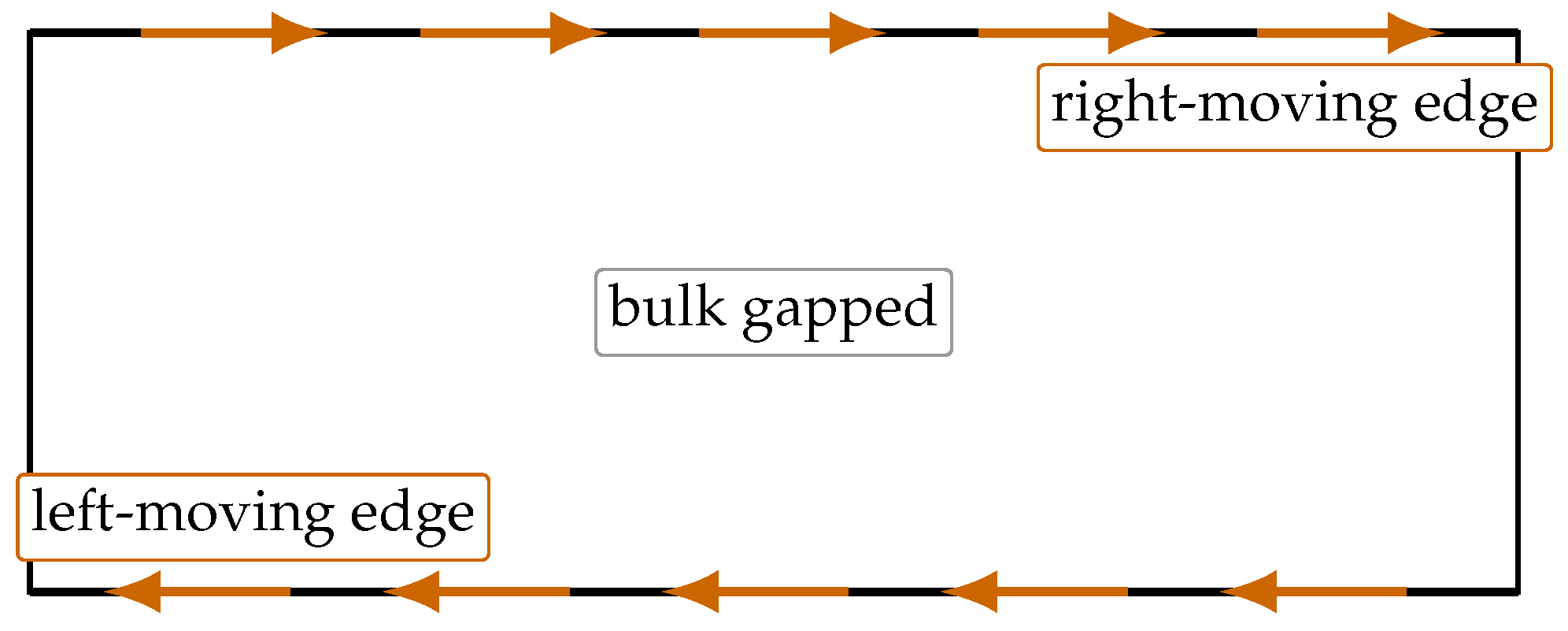
Chiral Luttinger liquids. Bulk CS topological order implies gapless chiral edge modes (Figure 1). For Abelian states, the edge is described by N chiral bosons with action
where V encodes interactions and edge velocities [102,105]. Equal-time commutators read
Electron and quasiparticle operators are vertex operators
carrying the same charges and statistics as (84). The chiral central charge equals the signature of K,
the difference between the numbers of forward and backward moving edge modes (diagonalizing K to by ). For Laughlin states , one has a single chiral boson with .
Figure 1.
Chiral edges of a quantum Hall bar: the bulk is gapped, and heat/charge propagate only along the edges with fixed chirality. Arrows mark the propagation direction of the chiral edge modes.
Non-Abelian edges. Certain FQH states (e.g., at ) support non-Abelian anyons; their edges combine a charged chiral boson and neutral non-Abelian sectors, often described by rational CFTs. A canonical example is the Moore–Read Pfaffian edge with a chiral Majorana fermion (Ising CFT, central charge ) plus a charged boson, giving ; broader overviews appear in [106].
4.1.4. Quantization of Hall Conductance: Bulk and Edge
Laughlin’s gauge argument. Consider electrons on a long annulus with inner and outer edges. Threading a time-dependent magnetic flux through the hole generates an azimuthal electric field . Adiabatically ramping from 0 to one flux quantum transports charge from inner to outer edge. Since the emf is , one finds
independent of microscopic details [88]. This argument is robust, and in interacting systems extends to a topological invariant defined by many-body Berry curvature on the Brillouin torus [107].
Chern–Simons response. Varying the CS action (83) with respect to yields the bulk current
The equations of motion impose , for which solving gives
Therefore, the Hall conductivity is
matching the gauge argument [101,102]; for Laughlin, , .
Edge anomaly and transport. On a manifold with boundary, the bulk CS action is not gauge invariant; its variation is precisely canceled by the anomaly of chiral edge modes. This bulk–boundary correspondence enforces the quantized Hall conductance and the relation between the chiral central charge and thermal Hall response (see Section 3.2). The edge theory also controls tunneling exponents measurable in transport, consistently captured by the chiral Luttinger liquid theory [105].
Summary. The FQHE realizes a gapped topological phase, with the bulk captured by Abelian (and in some cases non-Abelian) CS theories and the gapless edges being chiral CFTs. Laughlin/Jastrow correlations produce fractional charge and statistics, hierarchy and composite fermions generate the observed series, and the Hall conductance quantizes as via both gauge and field-theoretic arguments. These structures provide a natural laboratory in which to search for and quantify mechanisms such as higher categorical coherence breakdown that can shift the effective chiral central charge through anomaly inflow.
4.2. The Chiral Central Charge in Quantum Hall Systems
This subsection develops the definition and physical content of the chiral central charge in quantum Hall phases, derives its relation to the thermal Hall conductance,
and summarizes how present experiments constrain (and extract) . We supply parallel derivations from edge conformal field theory (CFT), from bulk Kubo formulas with the essential energy–magnetization correction, and from bulk effective actions, showing that all routes agree on (95) (the complete derivations are collected in Appendix A) when the system is in a gapped topological phase with well-defined chiral edges [108,109,110].
4.2.1. Definition and Physical Meaning
For a -dimensional topological phase with a chiral boundary theory, the net number of forward minus backward moving gapless modes is captured by , that is, the difference of left- and right-moving Virasoro central charges. Operationally, governs the edge energy current at low temperature and, via anomaly inflow, the bulk thermal Hall conductance. Equation (95) makes this correspondence explicit: in units where , each completely equilibrated chiral channel contributes the universal quantum of thermal conductance , and simply counts these net chiral channels (with fractional contributions possible when the neutral sector is described by nontrivial CFTs).
Edge CFT derivation (Landauer/CFT route). Consider two semi-infinite edge reservoirs at temperatures and , connected by a single chiral 1D channel; in a 1+1D CFT, the thermal expectation of the chiral energy current equals the chiral Stefan–Boltzmann law,
so the net heat current carried between the reservoirs is
To linear order in about , one obtains the conductance with
which is (95). The derivation relies only on (i) chirality, (ii) the CFT thermodynamics of a 1D channel, and (iii) complete intra-edge equilibration of modes into a common local temperature.
Bulk Kubo derivation with energy magnetization. A naive Kubo calculation of is subtle because thermal transport in a magnetic field includes circulating (magnetization) heat currents that do not contribute to transport. The correct linear response requires subtracting the energy magnetization contribution. Let be the retarded heat–heat correlator; then, the transport thermal Hall conductivity is [108]
where B is the magnetic field and is the “gravitomagnetic” magnetization obtained by coupling the system to a fictitious gravitational field. In a gapped topological phase, the Kubo term vanishes in the limit and the magnetization term reduces to a topological invariant that equals , reproducing (95) and making precise the role of the magnetization subtraction [108]. This route gives a bulk proof of (95) that does not rely on any explicit edge modeling.
Bulk effective action and anomaly inflow. An equivalent viewpoint packages the result in a low-energy effective action for the bulk, coupled to background geometry. The parity-odd (topological) part includes a gravitational Chern–Simons (gCS) term with level ,
where is the spin connection. Anomaly inflow fixes in terms of via , so that the Dehn twist phase and the edge thermal Hall response are controlled by the same bulk invariant. A systematic continuum derivation for nonrelativistic topological phases, including torsion couplings and the correct identification of transport coefficients, is given in [109]. Moreover, the topological central charge can be extracted from many-body wavefunctions through Berry curvature constructions on moduli space, providing a computational diagnostic that matches appearing in (95) [110].
4.2.2. How Experiments Access
Quantum of thermal conductance and channel counting. The “quantum of thermal conductance”
has been measured directly in ballistic one-dimensional electronic channels using noise thermometry and controlled heating/cooling, validating the Landauer/CFT prediction at the percent level [99]. In FQH devices, edges typically host multiple downstream and upstream modes; inter-mode equilibration and partial thermalization must be handled carefully in the analysis [111], but when these are controlled the measured scales as an integer or half-integer multiple of , in accordance with the predicted of the edge CFT.
Extracting and bounding errors. Given a measured at stabilized electron temperature T, the estimator
is unbiased for the effective chiral central charge (assuming full equilibration). The dominant systematic uncertainties arise from (i) calibration of the local electron temperature (thermometry), (ii) subtraction of phonon heat leaks and Kapitza boundary resistances, (iii) equilibration lengths and incomplete thermalization among charged and neutral edge modes, and (iv) contact and geometry-dependent losses. Linear error propagation gives
which sets a direct bound on from the metrological uncertainties. In modern devices, statistical errors in can be made sub-quantum, with the limiting factor often the absolute calibration of T and the control of upstream neutral modes.
Status: Integer and fractional states. Experiments have demonstrated quantized heat conductance in integer and fractional quantum Hall edges; in fractional states with both downstream and upstream modes, the net matches the net chirality predicted by edge theory, providing a consistent extraction of across several filling factors [100]. Reports of half-integer thermal Hall conductance in the first excited Landau level support a neutral Ising sector (Majorana mode) with stacked with a charged boson, consistent with non-Abelian order; taken together with the channel-counting benchmarks [99], these measurements bound to lie exponentially close (on the scale of the experimental resolution) to the rational values dictated by the edge CFT in well-equilibrated devices [100].
4.2.3. Synthesis for Our Program
For our purposes, (95) provides a metrological window onto the anomaly inflow coefficient that we have argued is shifted by higher categorical coherence breakdown (HCCB). Any HCCB-induced changes the Dehn-twist phase of the edge CFT and (equivalently, by the derivations above) shifts by
Hence, experimental protocols that (i) maximize edge-mode equilibration, (ii) suppress parasitic heat leaks, and (iii) allow for in situ variation of the coherence defect (as proposed later) can directly measure HCCB as a drift in the effective extracted from thermal transport.
5. Higher Categorical Coherence Breakdown and Quantum Hall Systems
5.1. Conceptual Pathway
Our aim is to make precise how a controlled departure from categorical coherence at the edge—the higher categorical coherence breakdown (HCCB) introduced earlier—propagates into physically measurable drifts of anomaly-controlled observables in quantum Hall (QH) systems. The pathway has two logically distinct stages:
- (I)
- Interference of coherence with conformal blocks. Chiral conformal blocks on a punctured Riemann surface are related by elementary sewing moves (fusion/braiding). These moves are implemented by F- and R-matrices which, in a consistent theory, satisfy the pentagon and hexagon identities and thereby define a (ribbon) tensor-categorical structure on the chiral sectors. A coherent twist of these data (or, more generally, a beyond-pentagon homotopy-coherent deformation) alters the mapping-class-group representation on conformal blocks by a scalar 1-dimensional factor.
- (II)
- From anomalous mapping-class phases to and transport. The anomalous scalar factor modifies the Dehn-twist phase on the torus, hence the modular T-matrix by a scalar . This is equivalent to shifting the chiral central charge by , and consequently the thermal Hall conductance by
We now implement these two stages carefully.
5.1.1. Conformal Blocks, Sewing, and Coherence
Let be the chiral vertex-operator algebra (VOA) of the edge theory and its irreducible modules. Genus-g conformal blocks on a n-punctured surface form a finite-dimensional vector space , functorial under sewing of pairs of pants and under the action of the mapping class group . Two pillars underlie the structure:
- Sewing axioms and modular functor. The family together with the sewing maps and mapping-class action defines a modular functor. Algebraically, bases of associated with the s- and t-channel factorizations are related by the fusion (or F-) matrices; braiding exchanges punctures and is encoded by R-matrices. Coherence of these moves is equivalent to pentagon/hexagon identities [112,113].
- Modular covariance. On the torus, the characters furnish a (projective) representation of with generators and . In a VOA setting, modular invariance of characters constrains and tightly couples the sewing data to the Virasoro anomaly [114].
The modular-functor axioms, stated physically. Because these axioms become, in Section 5.2 and Section 6.4, the direct target of laboratory tests, it is worth stating in plain physical terms what they assert and why they matter. Stripped of formalism, a modular functor encodes three physical principles. (i) Well-defined process amplitudes: to every configuration of anyons on a surface the theory assigns a finite-dimensional space of amplitudes (the conformal blocks), and every physical manipulation—fusing, splitting, exchanging, dragging around a cycle—acts as a definite linear map on that space. (ii) Locality (sewing): the amplitude assigned to a composite process is obtained by composing the amplitudes of its parts; cutting a surface into pairs of pants and reassembling it cannot change physical predictions. (iii) Topological invariance: two manipulations that differ only by a smooth deformation—in particular, two different orders or bracketings of elementary moves implementing the same overall operation—act identically. The pentagon and hexagon identities are nothing but the minimal consistency conditions that make (i)–(iii) mutually compatible; Mac Lane coherence then guarantees that all reorderings agree, not just the generating ones. Physically, these axioms are the formal backbone of everything that makes topological phases useful: the universality of quantized responses (which must not depend on how an experimentalist’s probes happen to compose elementary processes), the very notion of anyonic statistics as a property of worldline topology, and the fault tolerance premise of topological quantum computation, which is precisely the statement that amplitudes depend on braid topology and on nothing else. They are also, in the standard account, assumed rather than tested: transport and interference experiments are interpreted through them. Section 6.4 turns this assumption into a measurement target, and the route-blindness result below identifies exactly which observables must vanish if the axioms hold.
Coherence defects and deformed F/R moves. Let denote the associator (and the braiding) on the tensor category of chiral sectors. A coherent deformation by a normalized -valued 3-cochain modifies the associator by
with an explicit multiplicative matrix factor determined by in a chosen fusion/splitting basis. If , then the pentagon remains exact and defines a genuine monoidal structure—in general, that of a different topological phase, which is the Tier-1 situation of Section 2.3.3; composing the edge theory with a -dimensional invertible phase then endows the modular functor with an extra one-dimensional factor in the mapping-class action. (Physically, the extra factor is the partition function of the invertible bulk TFT on a 3-manifold that fills the mapping torus of the surface diffeomorphism). If instead for a globally defined , the pentagon failure is an exact 4-coboundary and is removable (Section 2.3.3); a genuine, non-removable failure is a non-trivial class and requires a -dimensional invertible host [49,50,51], which is absent for planar devices. Throughout this section we therefore work in the Tier-1 (inflow-consistent) setting.
Beyond-pentagon homotopy-coherent deformations (secondary associators, higher homotopies) may be organized by Stasheff polytopes and higher coherences. Their effect is again to produce anomalous scalar phases in sequences of moves relating different pants decompositions, hence in the representation of [81].
Anomalous mapping-class phases from anyon condensation and walls. A concrete, physically controllable source of such deformations comes from anyon condensation and gapped domain walls. Condensing a bosonic algebra object (a commutative separable Frobenius algebra) in produces a new phase whose fusion data are related to those of by algebraic induction/restriction functors; defects and walls between phases are described by bimodule categories. Composition of walls and defect networks induces F/R-moves that differ by scalar phases determined by the condensate data, and these phases realize the factors in (105) [115,116,117,118]. In particular, passing conformal blocks across a wall multiplies them by a scalar that depends only on the topological type of the move, hence on the mapping-class element.
5.1.2. From Anomalous Phases to : The Dehn Twist
On the torus, the mapping class group is generated by and the Dehn twist . In any chiral CFT,
with conformal weights and a symmetric unitary matrix . If the mapping-class action acquires an overall anomalous phase on (and on ), then
The relations and constrain these scalars: for a genuinely one-dimensional (non-projective) character of they force and (mod 1), so that strictly consistent scalar redefinitions of are quantized in twelfths. More generally, the scalar shifts the projective class of the representation—the framing anomaly—and the values realizable by anomaly inflow are quantized as discussed in Section 7.5 ( for bosonic phases; half-integer steps with a spin structure, for which the relations are themselves refined by the spin cover). Comparing with (106), an overall shift of by is equivalent to
Therefore, the scalar anomalous factor at the level of the mapping-class-group action is the drift of the effective chiral central charge. This observation is robust: it follows purely from modular functor axioms and does not depend on details of microscopic dynamics [112,114,119].
Bulk interpretation via Reshetikhin–Turaev TQFT. Let be the Reshetikhin–Turaev -dimensional TQFT built from the ribbon fusion category underlying the edge data. The anomalous scalar attached to equals the partition function of an invertible topological field theory on the mapping torus ; in the parity-odd sector this is a gravitational Chern–Simons term with level , whence
which is exactly (108). Thus, by producing anomalous phases in sewing and mapping-class actions, HCCB shifts the gravitational anomaly coefficient extracted from on [112,119].
5.1.3. Interference with Conformal Blocks: A Quantitative Picture
Consider a four-point block space on the sphere with external labels and intermediate channels e (in the s-channel) and f (in the t-channel). Fix an orthonormal basis in which the F-move is unitary:
Under an HCCB deformation by , the move becomes
with diagonal in channels, determined by the values of on triples appearing in the fusion trees. Coherence guarantees that any composition of elementary moves corresponding to a trivial mapping-class element returns the identity up to a scalar
where is a word in F/R/B moves representing that element. In a genuine (non-anomalous) modular functor ; with HCCB, can be non-zero but depends only on the mapping-class element, not on the representative. In particular, for the torus Dehn twist this scalar is , which yields (108).
Route blindness (a structural consequence). The statement that depends only on the mapping-class element has a consequence that we will rely on, and enforce, throughout the experimental sections; we record it explicitly. Since is additive under composition and depends only on the class, the identity class must carry ; hence any two sequences of elementary moves implementing the same topological operation carry the same scalar, and any closed rebracketing loop—the pentagon loop itself, the hexagon comparison of braid-then-fuse against fuse-then-braid, or any bracketing of split/recombine operations in a planar edge network—evaluates to unity. In other words, within the inflow-consistent (Tier-1) setting,
and no observable can depend on the order or parenthesization of topologically equivalent edge operations, nor scale with the number of junctions traversed at fixed topology. This is the categorical counterpart of Mac Lane coherence, and it survives the deformation precisely because the deformation is consistent. The only scalars that can be non-zero are attached to non-contractible loops: non-trivial mapping classes (the Dehn twist, hence ) and, as developed in Section 7, non-contractible cycles in control-parameter space (pumps). Conversely, any reproducible route dependence observed in experiment would falsify the modular-functor axioms themselves (Tier 2), rather than measure a parameter of the present framework—which is exactly what makes the multi-junction geometries of Section 5.2 and Section 6.4 sharp null tests.
Two clarifications sharpen the scope of this statement. First, route blindness governs closed comparisons at fixed couplings: two routings compared in the same device configuration. It does not say that the system is insensitive to paths in the space of control parameters: along an open trajectory the instantaneous is genuinely path-dependent—which sectors are visited, and in which order, depends on the route through control space—and only the net scalar around a closed control cycle is constrained, to a quantized homotopy invariant. This is the precise sense in which route sensitivity survives “locally” while being forbidden “globally,” in exact parallel with a flat connection whose parallel transport is locally non-trivial but whose holonomy depends only on the homotopy class of the loop; the experimental realization is the pumping protocol of Section 5.2.10. Second, route blindness is a property of the topological data: it does not preclude mundane, non-topological order dependence (charging hysteresis, junction memory, decoherence), which is exactly why the falsification diagnostics of Section 6.4 (chirality reversal, junction scaling, drive dependence) are designed to separate a genuine axiom violation from device dynamics.
Compatibility with characters and Zhu’s theorem. Characters transform as . The HCCB scalar multiplies all characters by under . Zhu’s modular-invariance theorem for VOA characters ensures that such a scalar is the only allowed global ambiguity in the modular representation; hence, if present, it necessarily shifts c by and no other data (e.g., conformal weights modulo 1) [114]. This provides a VOA-level confirmation of the modular-functor argument.
5.1.4. Drifting and Thermal Transport
Let be the “bare” chiral anomaly coefficient of the undeformed edge, and let be the HCCB-induced shift. The effective anomaly measured by modular thermodynamics and by thermal transport is then
Consequently,
with v the edge mode velocity. In a device hosting domain walls or engineered condensates (see Section 5.2), the wall configuration controls and hence . The drift becomes a tunable, quantized knob. From the categorical side, stacking with an invertible -dimensional phase corresponding to the deformation class of realizes the same shift in ; from the physical side, it appears as a rephasing of and a slope change in .
Constraints from condensation and wall fusion. Not all values of are accessible in a given platform. Anyon condensation selects algebra objects whose category of local modules has modular data related to those of the parent by induction/restriction functors; the possible are constrained by the Witt class of the modular category and by the classification of modular categories themselves [113,120]. Domain-wall fusion rules (tensor product of bimodule categories) enforce additivity of the scalar phases and thus of , as expected from stacking of invertible bulks [116,117].
Summary of the pathway. HCCB modifies the elementary sewing moves of conformal blocks by scalar phases organized by (higher) cohomological data. These phases exponentiate to 1-dimensional factors in the mapping-class-group action; the Dehn twist phase is the unique scalar that shifts c and nothing else. Hence, HCCB produces a well-defined quantized drift that is directly visible in both modular thermodynamics and low-temperature thermal Hall conductance.
5.2. Modifying the Experiment
We outline concrete modifications to the standard thermal Hall bar that turn the chiral central charge into a tunable observable with high signal-to-noise for higher categorical coherence breakdown (HCCB). The strategy is to (i) control the mapping-class scalar that HCCB contributes to the edge modular data (Section 5.1) by engineering moves on conformal blocks and (ii) amplify the corresponding drift of the effective anomaly in thermal transport by manipulating edge composition, equilibration, and ancilla couplings. Throughout, we avoid fragile math in section headers and keep the device model explicitly solvable.
5.2.1. Baseline: Thermal Hall Bar and Metrological Readout
Consider a Hall bar with source contact heated to and a remote cold reservoir at ; side contacts act as thermometers and voltage probes (Figure 2).
Figure 2.
Baseline thermal Hall geometry: a temperature bias injects energy at a contact; heat flows chirally along the edges. The quantized coefficient probes the net chiral central charge . Arrows mark the direction of chiral heat flow along the edges.
In a ballistic chiral edge, the energy current is
so a single downstream channel transports , and for many channels the contributions add with the sign of chirality. In linear response, the thermal Hall conductance is
where is the HCCB-induced drift (Section 5.1). The absolute calibration follows the Landauer/Büttiker picture of edge transport [121] and the universal quantum of thermal conductance established in nanoscale channels [122,123]. The goal of the modifications below is to maximize sensitivity to while suppressing systematic errors.
Error budget and sensitivity. Let be the estimator from a single operating point ; then, for small relative errors,
A slope fit of across multiple temperatures reduces (uncertainty scales as ; quantitative noise-floor and sensitivity estimates are collected in Appendix C) and guards against parasitic phonon conduction that is typically sublinear in T in the relevant range. Equation (114) then turns a difference measurement into a knob for HCCB: switching a control that toggles the coherence defect by produces .
5.2.2. Engineering Multi-Component Edges (Equilibration as a Gain Knob)
Many fractional states (e.g., ) host counter-propagating edge modes. Random tunneling and Coulomb interactions drive the edges to universal, disorder-dominated fixed points with upstream neutral modes [124]. This gives an exceptionally useful gain knob:
- Composition and limits. Suppose an edge supports downstream and upstream chiral channels. In the decoupled limit (no inter-mode energy exchange), the measured heat flow counts the absolute number of channels on the hot boundary, effectively givingIn the fully equilibrated limit (interactions/disorder equilibrate all modes on each boundary), one recovers the anomaly result
- Length–temperature crossover. A simple energy-balance model with local mode temperatures and inter-mode exchange rates yields an equilibration length and an interpolating formwhere L is the path length between heater/thermometer. In the universality class, randomness at the edge is relevant, producing upstream neutral transport and power-law equilibration (with set by the fixed-point exponents) [124,125]. Measuring the crossover (116) while toggling HCCB isolates with enhanced contrast at .
- Implementation. Multi-component edges arise naturally at and higher hierarchy states; they can also be created by edge reconstruction using finger gates. Controlled short-range disorder (narrow gate arrays producing smooth random potentials) accelerates equilibration into the universal regime of Ref. [124], suppressing device-to-device variability and ensuring in the absence of HCCB.
Why this enhances HCCB sensitivity. In the equilibrated regime, , so the entire slope of reflects the HCCB drift. In the unequilibrated regime, parasitic contributions from counter-propagating channels raise the baseline (toward ) and dilute sensitivity. Hence, deliberately engineering fast equilibration is a metrological amplifier for .
5.2.3. Driving with Controlled Disorder and with Non-Abelian Quasiparticles
Controlled disorder. At , the Kane–Fisher–Polchinski (KFP) theory shows that random inter-channel tunneling is RG-relevant and drives the edge to a fixed point with a downstream charged mode and an upstream neutral mode [124]. In practice, one can gate-engineer the random tunneling strength (via lithographically patterned serrated gates) and measure over a set of path lengths L. Fitting to (116) extracts and projects out the universal, anomaly-controlled piece. Because HCCB modifies the mapping-class scalar (hence ) but not the microscopic disorder rates, the difference between equilibrated and unequilibrated data isolates .
Non-Abelian quasiparticles as a coherence probe. Interferometric geometries (Fabry–Pérot or Mach–Zehnder) that change the topological charge enclosed by an edge loop manipulate the braiding/fusion data of conformal blocks [126,127]. While interference primarily probes F/R symbols, the same categorical ingredients enter the anomalous mapping-class phase (the scalar in the Dehn twist) that sets . A practical protocol is:
- Use a quantum point contact (QPC) to form an island that traps a controlled number of localized non-Abelian quasiparticles.
- Interleave interference measurements (to confirm the anyonic sector) with thermal Hall measurements (to read out ).
- Search for correlated changes: when a topological sector switch toggles the categorical defect that implements HCCB, should jump by , while interference phases shift by the corresponding F/R-data update [126].
- This cross-check couples a phase-sensitive probe (interferometry) to a thermodynamic probe (thermal Hall), tying both to the same coherence deformation.
5.2.4. Ancilla Coupling via Moiré Chern Bands and Artificial Gauge Potentials
A powerful way to modulate the mapping-class scalar—and hence —is to stack or side-couple an ancilla topological channel with tunable Chern index and edge content. Graphene/hexagonal-boron-nitride (hBN) moiré superlattices realize Hofstadter minibands and, at high quality, host both integer and fractional Chern insulators (FCIs) with gate-tunable Chern number and gaps [128,129,130,131]. We propose two architectures:
(A) Lateral ancilla edge. An electrostatically defined strip of a moiré Chern phase is formed parallel to the QH edge at separation d. Tunnel couplers (short QPCs) hybridize the two chiral systems. In the strong-coupling regime, the modular data multiply, and the Dehn-phase shifts add; equivalently,
Sweeping the ancilla across a topological transition (e.g., or an FCI plateau) produces step changes in with height , on top of the HCCB drift. Because the ancilla can be tuned in situ, this implements a differential measurement that cancels many systematic errors.
(B) Embedded ancilla junctions. Alternatively, one can carve a short segment of the main edge into a moiré miniband regime (by local gates) so that chiral modes traverse a topological junction. The junction acts as a controlled coherence defect: the fusion/braiding matrices for blocks that cross this segment are conjugated by the ancilla’s categorical data, injecting a scalar into the torus Dehn twist. In transport, this yields a localized contribution to the energy magnetization detectable by comparing configurations with the segment switched on/off.
5.2.5. Putting It Together: A Measurement Protocol
- Device. A Hall bar with one edge engineered to be multi-component ( or ), equipped with (i) serrated gates to tune randomness (KFP regime), (ii) one or two QPCs to form an interferometer/island, and (iii) a lateral moiré ancilla strip with gate-tunable .
- Calibration. Verify channel counting at high field and low temperature in the decoupled regime: . Then increase disorder/interactions to reach the equilibrated regime and confirm within error bars set by (115).
- HCCB toggle. Activate the categorical deformation by (a) changing the trapped topological charge in the interferometer island (non-Abelian case) or (b) toggling the moiré ancilla across a topological transition. Record the difference in at fixed T and the slope change in ; both return .
- Cross-verification. Simultaneously monitor interference fringes to correlate -data changes with the step. Consistency across these orthogonal channels is a stringent check on HCCB.
5.2.6. Remarks on Practicality
(i) Using multi-component edges is not optional but beneficial: it turns equilibration into a controllable amplifier. (ii) Controlled disorder (KFP) is compatible with maintaining well-quantized electrical Hall plateaus; it only affects neutral modes and their thermalization. (iii) Moiré ancillae offer large, gate-tunable Chern bands and demonstrated FCIs, making them ideal, integrable coherence “knobs” [128,129,130,131]. (iv) The Büttiker edge picture supplies a transparent baseline for interpreting the metrology [121], while microscopic theories of dephasing provide guidance on length scales and operating temperatures [125].
How to read the next three geometries (null tests, not Tier-1 observables). The three devices that follow realize, in gate-defined hardware, the elementary coherence comparisons of the categorical framework: re-bracketing (pentagon), braid–fuse ordering (hexagon), and bracketing of energy splits (associator in transport). We state their logical status precisely, in line with the route-blindness result of Section 5.1: in any inflow-consistent realization the compared routes are different representatives of the same topological operation, so the framework itself predicts null outcomes, and , in these geometries at fixed control parameters. Their value is twofold. First, as precision null tests: a reproducible nonzero result, surviving the chirality-reversal and junction-scaling diagnostics below, would falsify the modular-functor axioms for the edge data—a statement far stronger than a parameter measurement, and one that present hardware can bound at the level in phase and at the percent level in . Second, as calibrated platforms for the cyclic protocol of Section 5.2.10, where the same gates are driven around closed loops in control space and a quantized, route-blind pumping response is a Tier-1 prediction.
5.2.7. Pentagon Interferometer: Versus
Design and intuition (Figure 3). A Fabry–Pérot cell is formed by two quantum point contacts; three gate-defined antidots (or trapped island anyons) a, b, c sit inside it. Electrostatic routing gates select the order in which the interfering partial wave associates the localized charges: route A implements the fusion bookkeeping —the amplitude is composed by first associating a with b and then the pair with c—while route B implements . The two routes are deformable into one another without crossing any worldline: they are two bookkeepings of the same topological process, related by exactly the re-association move whose consistency is the pentagon identity. The device therefore measures, directly, the relative phase between the two sides of the pentagon. By route blindness (Section 5.1) the consistent framework predicts strict equality, : this is a precision null test, with sensitivity at the rad level in present Fabry–Pérot technology. Three controls discriminate a genuine coherence phase from instrumentation: (i) the single-antidot configuration, in which no re-association exists and any residual offset is instrumental; (ii) magnetic-field reversal, under which a genuine coherence phase must be odd while charging artifacts are not; (iii) permuting the antidot visit order at fixed enclosed area and charge, which isolates order dependence from Aharonov–Bohm physics. The quantitative protocol, and what a reproducible nonzero outcome would mean physically, are given in Section 6.4.
Figure 3.
Pentagon interferometer. Two topologically equivalent but differently parenthesized paths are realized by gate routing. Within the inflow-consistent framework the two routings carry identical phases (route blindness, Section 5.1), so is the prediction; the device is a precision null test, and a reproducible nonzero offset would signal coherence failure beyond the invertible class. The two coloured paths (orange, route A; teal, route B) trace the parenthesizations and of the same fusion process.
5.2.8. Hexagon Interferometer: Versus
Design and intuition (Figure 4). A third quantum point contact extends the cell so that the partial waves can either first braid around the island pair and then traverse the fusion-defining constriction (the ordering), or first traverse it and then braid (). The compatibility of these two orderings—exchange performed before or after re-association—is precisely the content of the hexagon identities, which tie the braiding data R to the associator F. In any consistent braided theory, and in any Tier-1 deformation of it, the two sequences yield the same phase, ; a stable order-dependent offset would mean that exchange and fusion fail to commute in the manner that the axioms require. The same discriminating controls as in the pentagon device apply, with the single-island configuration as the instrumental null and field reversal as the parity test.
Figure 4.
Hexagon interferometer. Braid-then-fuse vs. fuse-then-braid sequences agree in any exact MTC and in any inflow-consistent deformation thereof, so is the framework prediction; the geometry bounds order-dependent coherence failure beyond the invertible class. The two coloured paths (orange, ; teal, ) trace the two braid/fuse orderings.
5.2.9. Thermal Y-Network: Associator in Transport
A Y-junction is the elementary act of associativity in transport (Figure 5). A gate-defined junction splits one incoming chiral heat current into two descendant branches, or merges two branches into one; with three branches and two junctions in series, there are two physically distinct orders in which the splits and recombinations can be composed—first combine branches 1 and 2 and then bring in 3, or first combine 2 and 3 and then bring in 1. These are the transport realizations of the two bracketings and : the Y-network is the calorimetric counterpart of the pentagon interferometer, with the abstract re-association of fusion channels replaced by the concrete re-association of energy currents. Two properties make it uniquely valuable in the present program. First, it requires no phase coherence: the comparison is between net heat flows, governed only by chirality and energy conservation, so the device survives the dephasing that washes out interferometric fringes and can operate at path lengths and temperatures where no interferometer could. Second, it probes the energy channel directly—the gravitational-anomaly channel in which the chiral central charge itself lives—so that a bracketing dependence of heat flow, if it existed, would be a coherence failure in precisely the observable that this paper is about. Within the consistent framework the two routes are different decompositions of the same topological operation and the difference signal vanishes identically (route blindness, Section 5.1); the network is therefore a phase-insensitive null test of the sewing axioms. The same gate set, driven around a closed cycle in control space rather than compared between two static routings, becomes the hardware of the central-charge pump (Section 5.2.10).
Figure 5.
Thermal Y-network. Two bracketings of split/recombine operations are compared. Within the inflow-consistent framework, the bracketings are equivalent and the difference signal vanishes (route blindness, Section 5.1); therefore, the geometry bounds beyond-framework coherence failure and serves as the platform for the cyclic pumping protocol of Section 5.2.10, the quantized response of which is a Tier-1 prediction. The two coloured paths (orange, route A, ; teal, route B, ) trace the two bracketings; where they share the central branch the colours coincide, which is schematic and does not affect the comparison.
5.2.10. From Route Comparisons to Cycles: A Central-Charge Pumping Protocol
The route-blindness theorem redirects rather than eliminates the search for higher-coherence physics in multi-junction devices: the consistent home for new invariants is not a comparison of two configurations at fixed couplings, but the holonomy of a closed cycle in the space of control parameters. Let collect the categorical controls of the device (wall positions and types, ancilla gate voltages, trapped topological charge) and let , , be a closed loop along which the bulk gap and the edge structure remain intact except at the discrete controlled events where the invertible sector is toggled. Families of gapped theories over a parameter manifold carry quantized invariants of exactly this kind—higher-dimensional generalizations of the Berry phase and, equivalently, anomalies in the space of coupling constants [132,133]—of which the Thouless charge pump is the classic degree-one ancestor [134]. In the present setting the relevant invariant is precisely the integer of Equation (172) (Section 7.2): the net Dehn-twist scalar accumulated around the cycle
which is route-blind (it depends only on the homotopy class of the loop in control space) and yet strictly invisible to any static stacking description of a single configuration. Operationally: (1) calibrate the device in two static configurations , and verify the quantized difference step of Section 5.3; (2) drive the controls around a closed loop passing through and and back, counting the accumulated quantized steps of per cycle, with the interferometric channel monitoring that each step coincides with a topological-sector switch; and (3) reverse the loop orientation, which must reverse the count, and contract the loop to a trivial one, which must return zero. A nonzero, orientation-odd, homotopy-invariant count is then a genuine higher-coherence observable—a “central-charge pump”—realized entirely within the inflow-consistent framework, with the extra cohomological degree supplied by the parameter space rather than by a fourth spacetime dimension.
In what sense route sensitivity survives. It is worth making the geometry of this statement explicit, because it resolves the apparent tension between route blindness and the pump. Route blindness (Section 5.1) forbids dependence on the bookkeeping route of a comparison performed at fixed couplings; it does not constrain open trajectories in control space. Along such a trajectory, the system is genuinely path-sensitive in a local sense: the instantaneous traces a profile that depends on the path—two different routes from to can visit different sectors, in different orders, with the thermometer registering different intermediate step sequences. Consistency constrains only the closed-loop total, and it constrains it to a topological quantity: the categorical data define, in effect, a flat connection on the space of controls, whose flatness is route blindness for contractible comparisons and whose holonomy around non-contractible loops is the pump count. Equivalently, n in Equation (172) counts the signed number of times the cycle winds around the codimension—two loci in control space where the invertible sector changes—which represent the control-space analogues of vortices. Therefore, local route sensitivity with quantized global holonomy is not an exception to route blindness; rather, it is its precise complement, and is the unique form in which the intuition of “route-dependent central charge” survives the consistency analysis—relocated from the routing of currents in real space to the routing of controls in parameter space.
A concrete cycle. In the lateral-ancilla architecture of Section 5.2.4, take to be the ancilla gate voltage and a local field (or displacement field) that together tune the ancilla strip across its transition. The transition is a point (more generally, a codimension-two locus) in the plane. A closed loop that encircles this point once cannot be contracted without crossing it; per cycle it produces exactly one net quantum of pumped anomaly between the ancilla channel and the main edge—registered as one unit appearing and one unit disappearing in at parameter values that differ between the two halves of the loop, with the interferometric channel confirming a sector switch at each step. A loop in the same plane that does not enclose the transition returns a net count of zero, whatever its shape (this is route blindness in control space); reversing the orientation of the enclosing loop reverses the sign of the count, and a loop enclosing the transition k times yields k quanta. These three checks—contractibility null, orientation oddness, and integer winding proportionality—are the experimental fingerprints that distinguish the pump from any adiabatic background, in direct analogy with the corresponding checks for the Thouless charge pump [134].
5.3. Expected Experimental Signatures
We now translate the higher categorical coherence breakdown (HCCB) mechanism into concrete observables for quantum Hall devices. The core prediction is a drift in the anomaly-controlled response coefficients that is quantized in ideal conditions and manifests most cleanly in the thermal Hall conductance. We develop a quantitative scaling theory that (i) isolates the HCCB contribution to the thermal response from edge–equilibration and parasitic channels, (ii) clarifies when nonlinear temperature dependences of are expected, and (iii) prescribes robust difference measurements that return with controlled error bars.
5.3.1. Thermal Hall Conductance with HCCB: Scaling Form
In the equilibrated low-temperature regime of a chiral edge, the thermal Hall conductance obeys
where is a categorical control that turns the coherence deformation on/off (e.g., domain-wall configuration, ancilla phase, trapped topological charge) and is the resulting drift in the (chiral) central charge. The correction includes non-universal but diagnosable effects (finite equilibration length, phonon leakage, contact losses).
Thus, a first parameter-free prediction is the difference signal between two categorical configurations and :
with . If the categorical control does not modify equilibration or leakage channels (a key design principle of Section 5.2), then and the slope of directly returns . We formalize these statements next.
5.3.2. Partial Equilibration and Exponential Approach to the Anomaly
Consider an edge with N co-propagating chiral modes labeled by i with chiralities , velocities , and “central charge weights” (one per chiral CFT channel: 1 for a free chiral boson, for a Majorana, etc.). In linear response with a small temperature bias between source () and drain (), let denote the local mode temperatures. Energy conservation and inter-mode exchange give the coupled first-order equations
with boundary conditions for downstream modes entering from the hot source and for upstream modes entering from the cold drain. The matrix parameterizes inter-mode energy exchange (from disorder and interactions). Diagonalizing the coupling in the co-moving basis reduces (120) to decoupled exponential relaxations with equilibration lengths
where are normalized right-eigenvectors. Integrating along the boundary yields the net heat current, hence
with positive coefficients fixed by boundary conditions and eigenvector overlaps. Equation (122) reproduces the known limiting cases observed experimentally: (i) the decoupled limit measures the sum of absolute chiralities, while (ii) the equilibrated limit measures the anomaly [135].
Crucially, the equilibration lengths are temperature-dependent. For random tunneling processes with scaling dimension , Fermi’s golden rule and RG arguments give , hence
Thus, at fixed L, the deviations from the linear-in-T anomaly law inherit a nonlinear T-dependence through the exponent in (122). This is a benign diagnostic nonlinearity: it disappears as and does not mimic an HCCB-induced slope change.
HCCB in the presence of partial equilibration. Switching a categorical control adds a constant anomalous piece to the square bracket in (122) without changing (by design). Therefore, in the difference channel (119), the exponentials cancel to leading order and
so the temperature derivative provides a null test for residual nonequilibrium.
5.3.3. Nonlinear and How to Interpret It
In addition to partial equilibration, two further mechanisms can bend the T-dependence:
- Topological-sector mixing. If the categorical control involves trapping non-Abelian quasiparticles with a small energy splitting between sectors, thermal occupation leads to a T-dependent mixing weight for the sector carrying the coherence defect. Then,and acquires a smooth crossover instead of a sharp step. Independent interferometry of the island charge (switching between even/odd fusion channels) allows one to calibrate and re-extract the asymptotic from low-T data [136,137].
- Edge–phonon heat leaks. Weak phonon coupling along the mesa edge adds a subleading channel for which the contribution typically scales faster than linear in T, leading toA two-temperature slope fit of removes such analytic backgrounds to first order, while on-chip noise thermometry can verify that the electronic temperature follows the heater calibration [138,139].
In all three cases (partial equilibration, topological-sector mixing, phonons), difference measurements between and combined with an analysis of isolate the HCCB drift as the residual constant offset at low T and large L.
5.3.4. Drift of the Effective Anomaly: Null Tests and Cross-Checks
Define the operational estimator
Three complementary signatures should coincide in a successful experiment:
- Slope test: becomes T-independent as and ; the plateau value is the predicted rational (or integer) .
- Length test: At fixed low T, approaches the same plateau as L increases; this tests the cancellation of partial-equilibration corrections in the difference channel (controlled by (122)).
- Interferometric correlation: In devices with a non-Abelian island, changes in the interference phase (from -symbol updates) correlate one-to-one with steps in , as both derive from the same categorical deformation. This cross-check disambiguates HCCB from conventional changes in edge dispersion [140].
5.3.5. Auxiliary Observables
Two further anomaly–sensitive quantities provide independent confirmation:
- Casimir amplitude on a ring. On a mesoscopic annulus of circumference L, the free-energy density contains ; as in Section 4.2, an HCCB toggle changes the coefficient by . Measuring this small effect requires on-chip calorimetry but is a direct thermodynamic readout of the drift.
- Chiral energy imaging. Local thermometry along the edge (quantum-dot spectroscopy or quantum point-contact thermometry) maps and tests Equation (120), extracting and verifying that HCCB changes the offset but not the shape of profiles [135,138].
Synthesis. The primary HCCB signature is a linear-in-T step in whose slope equals . Nonlinear T-dependences are expected from partial equilibration, sector mixing, and phonon leakage; they are not confounding if one uses difference measurements, length sweeps, and interferometric correlations. The resulting “triple coincidence” of slope, length, and phase tests provides a stringent identification of HCCB in quantum Hall devices. Table 1 summarizes how the HCCB signature is distinguished from every conventional mechanism known to shift the apparent .
Table 1.
Mechanisms affecting the measured thermal-Hall slope and how the HCCB (Tier-1) signal is distinguished from each. “Quantized” refers to steps in units of (spin sectors) or 8 (purely bosonic stacking). The difference channel compares two categorical configurations at otherwise identical operating conditions (Section 5.3.1).
5.3.6. Nonlinearity in Versus Genuine
Finally, it is important to emphasize how to distinguish benign nonlinearities in from a genuine categorical drift of the anomaly coefficient. As discussed above, partial equilibration, phonon heat leaks, or sector mixing can all produce departures from strict linearity in T, often sublinear. In particular, the presence of upstream neutral modes is well known to generate such trends even in otherwise well–calibrated devices.
Our proposal uses a difference channel between two categorical configurations and . Provided that the toggle between and does not itself alter equilibration lengths, these non-universal contributions cancel to leading order, leaving only the categorical offset .
Empirical check. Experimentally, one should verify this cancellation by examining the L–dependence of . If the extracted ratio is flat in L within error bars, then the residual signal can be reliably interpreted as the quantized HCCB-induced shift. If instead there remains a systematic L–dependence, this indicates incomplete cancellation and the need to refine equilibration control before attributing the effect to .
6. Higher Categorical Coherence Breakdown and the Fractional Quantum Hall Effect
The fractional quantum Hall effect (FQHE) is one of the most striking manifestations of topological order and strong correlations in condensed matter physics. Its discovery revealed not only quantized electrical Hall conductance at fractional fillings but also emergent quasiparticles with fractional charge and statistics as well as candidate non-Abelian orders of direct relevance to topological quantum computation. Despite the broad success of the Chern–Simons and conformal field theory descriptions, several experimental puzzles remain unresolved: small but reproducible spreads in thermal Hall conductance, unexpected phase slips in interferometers, geometry-dependent tunneling exponents, and ambiguities between competing candidate orders at even-denominator fillings.
In this section, we propose that these anomalies are not merely experimental imperfections or uncontrolled edge reconstructions but rather signatures of a more fundamental effect, namely, higher categorical coherence breakdown (HCCB). At triangle level, the Virasoro central charge already encodes a well-known obstruction (Witt → Virasoro) and yields the chiral central charge governing thermal Hall quantization. We argue that higher obstructions (3- and 4-cocycles) can appear at the pentagon and hexagon levels, producing tiny but measurable corrections to edge phases, visibilities, and effective central charges in complex edge networks.
We organize the rest of this section as follows: in Section 6.1, we review the integer and fractional QH effects and outline the open puzzles; in Section 6.2, we apply the HCCB framework to QH edge theories and define pentagon/hexagon anomalies; Section 6.3 reinterprets the puzzles through HCCB, while Section 6.4 proposes concrete experimental probes; finally, Section 6.5 synthesizes the implications and emphasizes the broader conceptual and experimental payoff.
In this section, we connect higher categorical coherence breakdown (HCCB) to concrete measurable anomalies in quantum Hall systems. At triangle level, the obstruction class (Virasoro central term) yields the well-known chiral central charge and its transport avatar, the thermal Hall conductance. At higher coherence (pentagon/hexagon), new weaker obstructions appear that can bias effective anomaly readouts in multi-edge networks. To set the stage, we first carefully and quantitatively review the integer/fractional quantum Hall frameworks and spell out the outstanding puzzles where HCCB can act.
6.1. Motivation: From Integer to Fractional QH and the Open Puzzles
6.1.1. Integer QHE: Landau Quantization, Chern Response, and Plateaus
Consider non-interacting electrons of charge and effective mass m confined to two dimensions in a perpendicular magnetic field B. In Landau gauge the single-particle Hamiltonian
has Landau levels (LLs) with energies
Each LL exhibits a macroscopic degeneracy: on an area A, the number of orthogonal states is
so the degeneracy per unit area is . If the electron density is , the filling factor
counts how many LLs are filled (approximately, at and ignoring spin/Zeeman for brevity). When , all LLs below are completely filled, the bulk spectrum has a mobility gap, and the Hall conductivity is quantized,
There are three complementary derivations of this quantization:
- (i)
- Kubo–TKNN/Chern: in a periodic band setting, is the sum of first Chern numbers of filled bands. Each Landau level contributes Chern number , giving in the continuum limit.
- (ii)
- Topological effective action: integrating out gapped electrons yields a Chern–Simons (CS) response for the background electromagnetic field A,which reproduces .
- (iii)
- Edge–bulk correspondence: a confining potential bends LLs at the boundary; each filled LL generates one chiral edge channel carrying charge current . The number of co-propagating channels equals .
Why plateaus? Real samples have disorder that broadens LLs into bands with localized states in the tails and extended states near band centers. As B or vary, the Fermi energy can reside in localized regions over finite parameter intervals; longitudinal transport vanishes () while stays pinned to the topological value of the nearest extended-state manifold. This yields the observed plateaus with robust quantization.
6.1.2. Fractional QHE: Interactions, Anyons, and Topological Order
At fractional fillings (e.g., ), non-interacting LL physics fails: Coulomb repulsion and projection to the lowest LL drive the system into a topologically ordered incompressible quantum fluid. The prototypical Laughlin state at (m odd for electrons) admits a compact universal bulk description by a CS gauge field a:
where A is the physical electromagnetic field. Varying a yields ; substituting into (133) gives
Quasiparticles correspond to flux insertions of a, and as such carry fractional charge (by the coupling) and fractional statistics with exchange phase (from the term).
More general Abelian FQH phases are captured by the K-matrix CS theory
with integer symmetric nondegenerate K, charge vector t, and emergent gauge fields . Universal data follow algebraically:
for quasiparticles labeled by integer vectors . On a closed surface of genus g, the ground-state degeneracy is , a hallmark of topological order.
Edge theory and central charge. Bulk CS theories induce gapless chiral edge modes. For Abelian phases, the edge is a multi-component chiral Luttinger liquid
with compact bosons . The chiral central charge is the net number of right-moving minus left-moving gapless modes
where are the numbers of positive/negative eigenvalues of K. (For purely downstream Abelian edges (positive-definite K), . For non-Abelian phases, receives contributions from both charged bosons and neutral sectors (e.g., Majorana/parafermion CFTs)). Physically, controls the gravitational anomaly and the thermal Hall conductance,
6.1.3. What Is Settled vs. What Remains Puzzling
The core paradigms above are well tested:
- Quantized electrical Hall conductance across many integer and fractional plateaus.
- Fractional charge via shot-noise/Fano-factor measurements at QPCs (e.g., at ).
- Anyonic phases through interferometry (with Coulomb-dominated caveats).
- Thermal Hall measurements that broadly align with predicted in several Abelian states.
- However, notable tensions persist, especially in regimes with neutral modes and suspected non-Abelian order (e.g., even-denominator states):
(A) Thermal Hall at and related even denominators. Several experiments report half-integer quantization with , suggestive of neutral Majorana modes, yet device-to-device spreads and temperature/geometry dependences persist. Interpreting these consistently within a single edge theory is subtle due to edge reconstruction, upstream neutral modes, and equilibration.
(B) Interferometer anomalies (phase slips and route dependence). Fabry–Perot/Mach–Zehnder data sometimes display phase irregularities not fully captured by simple area/charge and Coulomb-dominated models, including apparent dependence on the order in which braids/fusions are implemented in multi-island geometries.
(C) Non-universal tunneling exponents. Point-contact I–V characteristics often deviate from clean Luttinger predictions inferred from the putative edge K and t. Scatter correlates with device layout (number/ordering of junctions), not just with disorder strength.
(D) Neutral mode equilibration puzzles. Measured equilibration lengths of upstream neutral modes vary strongly with temperature and edge routing. Distinguishing intrinsic edge content (fixed by bulk topological order) from extrinsic reconstruction/equilibration remains challenging.
(E) Particle–hole (PH) asymmetry at . Candidate orders (Pfaffian vs. anti-Pfaffian vs. PH-Pfaffian) predict the same but different and neutral content. Some trends appear to favor one orientation or show weak PH breaking in nominally PH-symmetric regimes.
6.1.4. Why Higher Coherence Effects Are Natural Suspects
All puzzles above share a common feature: they are most pronounced in complex edge networks—multiple QPCs, multi-island interferometers, serial Y-junctions—where one composes elementary processes (split, recombine, braid, fuse) in different sequences. The standard topological framework (triangle-level consistency) guarantees that topologically equivalent routes produce the same outcome. If, however, higher categorical coherence very weakly fails at the level of the associator (pentagon) or braiding hexagon, then:
- Topologically equivalent but differently parenthesized compositions can acquire tiny relative phases/attenuations (pentagon angles and non-unitary leaks).
- Braid-then-fuse and fuse-then-braid sequences can differ by small systematic angles (hexagon anomaly).
- In transport, repeated split/recombine events can bias the effective anomaly coefficient read out by a thermal Hall protocol, shifting
Equation (140) does not alter the bulk topological order; it asserts that in multi-junction edge networks the measured anomaly can pick up a routing-dependent correction that vanishes for a single straight edge and flips sign under chirality reversal (magnetic-field inversion). This is precisely the regime where current discrepancies are largest and where targeted experiments can decisively test for higher coherence.
Roadmap. In the next subsections we formalize the HCCB couplings on edge networks (triangle vs. pentagon vs. hexagon), quantify their leading effects on phases, visibilities, and thermal transport, and propose concrete interferometric and thermal Y-network protocols that can bound or reveal , , and within present experimental precision.
6.2. The HCCB Framework Applied to Quantum Hall Edges
6.2.1. Triangle-Level Anomalies and the Virasoro Central Charge
At the most elementary level of coherence (the triangle diagram), the obstruction is a 2-cocycle that prevents the Witt algebra of circle diffeomorphisms from closing linearly on the Hilbert space of edge states. Instead, the algebra closes only after central extension to the Virasoro algebra,
Here, c is the Virasoro central charge, the “residue of regularization” that measures the quantum obstruction.
In the edge theory of a quantum Hall state, this c appears chirally: the system has a net chiral central charge
counting the imbalance of right- versus left-moving degrees of freedom. This imbalance is precisely the gravitational anomaly of the edge, canceled by inflow from the bulk gravitational Chern–Simons term.
Physically, is directly observable through the quantized thermal Hall conductance,
This is the transport manifestation of the triangle-level coherence obstruction.
6.2.2. Pentagon-Level Breakdown: Associator Curvature
Higher categorical structure appears when we consider composition of edge processes. At the pentagon level, the relevant constraint is the associator; composing three processes in different parenthesizations must give the same amplitude. Formally,
If coherence fails very weakly, this equality is modified by a small unitary or non-unitary factor
with a small “pentagon angle” and a possible attenuation factor (if the associator curvature carries a non-unitary component). This breakdown is governed by a 3-cocycle in the categorical cohomology.
Physical meaning. At a quantum Hall edge, split/merge events at Y-junctions or quantum point contacts (QPCs) implement such associative compositions of current channels. In the standard (topologically exact) theory, different routing orders give identical interference patterns. With pentagon breakdown, topologically equivalent routings differ by in phase and by in visibility.
Thus, a putative associator curvature would produce two observable effects:
- Small but systematic phase shifts between interferometer configurations related by re-parenthesization.
- Possible non-unitary leakage channels leading to reduced visibility or effective renormalization of Luttinger exponents in tunneling.
Status within the consistent framework. We stress the logical status of and , in line with Section 2.3.3 and Section 5.1: no inflow-consistent (Tier-1) deformation can produce them, since route blindness forces all re-parenthesization comparisons to close exactly. A nonzero therefore requires Tier-2 physics: either a genuine obstruction, which demands a topologically non-trivial -dimensional host that is absent in planar devices, or non-topological dynamics at the junctions (decoherence, hysteresis, internal junction states), in which case no quantization protects the effect and it must be modeled microscopically. Accordingly, in what follows , , and are treated as bounded hypothesis parameters probed by null tests, not as predictions of the framework.
6.2.3. Hexagon-Level Breakdown: Braiding Anomalies
The next level of coherence is the hexagon diagram, expressing the compatibility of braiding with associativity. In categorical form, exchanging two anyons and then fusing should equal fusing and then exchanging. If the hexagon relation fails, we may write
with a mismatch characterized by a “hexagon anomaly angle” (or more generally, a 4-cocycle class in the braiding cohomology).
Physical meaning. In interferometers with multiple antidots or islands, one can compare braid-then-fuse vs. fuse-then-braid sequences. In standard UMTC physics, these give the same phase. With hexagon breakdown, one expects
which would appear as stable order-dependent phase offsets in interference fringes.
6.2.4. Effective Central Charge Drift from Higher Coherence
Within the consistent (Tier-1) framework, the effective anomaly coefficient extracted from transport shifts as
where is set by the invertible sector realized along the measured edge—by the walls, condensate interfaces, and ancillary channels present in the configuration—and not by the routing or bracketing of operations: it is quantized ( bosonic, with spin structure), it vanishes for a bare single edge with no engineered sectors, it flips sign under magnetic field reversal (since chirality reverses), and it does not accumulate with the number of junctions traversed at fixed topology. What does accumulate quantizedly is the pump count of closed control cycles (Section 5.2.10).
The corresponding thermal Hall conductance then reads
Because the shift is quantized, it cannot by itself produce small continuous spreads; the only Tier-1 route to intermediate apparent values is statistical mixing between topological sectors with a quantized splitting, which carries a characteristic activated temperature dependence (Section 5.3.3). This sharpens rather than weakens the experimental program: quantized steps and activated mixing are Tier-1 physics; anything else in the spreads must be conventional (equilibration, reconstruction, leakage) or Tier-2.
6.3. Explaining Experimental Anomalies with HCCB
In this subsection, we confront the higher categorical coherence breakdown (HCCB) framework with a series of long-standing anomalies in fractional quantum Hall (FQH) physics. We do so with the two-tier logic of Section 2.3.3 and Section 5.1 made explicit in each case: Tier-1 (inflow-consistent) HCCB can contribute only quantized sector effects and their thermal mixtures, while any genuinely route- or order-dependent residue would be Tier-2 physics to be bounded rather than asserted. Therefore, the purpose of the survey is not to claim that HCCB “explains” these anomalies—most have credible conventional explanations in equilibration, edge reconstruction, and electrostatics—but to identify for each the sharply defined component that HCCB could contribute, the signature that would isolate it, and the bound that a null result establishes.
6.3.1. Thermal Hall Conductance Spread at
Experiments at even-denominator filling report thermal Hall conductance values close to half-integer multiples of the thermal conductance quantum , e.g.,
as predicted by non-Abelian Pfaffian/anti-Pfaffian orders. However, device-to-device and geometry-to-geometry variations of order are common, challenging a purely topological interpretation.
What can HCCB say here? A quantized Tier-1 shift
cannot produce continuous spreads, because its steps are no smaller than (spin sector). The honest statement is sharper and still useful: (i) if different devices stabilize different topological sectors along their measured edges (e.g., Pfaffian-type versus anti-Pfaffian-type domains, or Majorana sectors toggled by reconstruction), Tier-1 HCCB describes the resulting half-integer device-to-device differences, with the interferometric channel identifying the sector; (ii) intermediate, temperature-dependent values can arise within Tier 1 only through thermal mixing of quantizedly split sectors, with the activated form of Section 5.3.3 as its fingerprint; (iii) any residual continuous spread that survives equilibration and reconstruction diagnostics, is odd under , and correlates with junction count would fall outside the consistent framework and is precisely what the null tests of Section 6.4 bound.
6.3.2. Interferometer Phase Slips and Route Dependence
Fabry–Perot and Mach–Zehnder interferometers probing anyon braiding often exhibit irregular phase slips not accounted for by simple area/charge relations or Coulomb domination. In standard modular tensor category (MTC) theory, topologically equivalent fusion/braiding routes yield identical phases.
A hypothetical pentagon- or hexagon-level breakdown would add stable phase angles (associator) and (braiding),
appearing as order-dependent offsets when switching between routings related by re-parenthesization or by braid–fuse order. By route blindness these vanish identically in Tier 1; the practical import is methodological: after excluding the conventional sources of slips (area breathing, charging events, quasiparticle traps), the residual, orientation-odd, routing-correlated component of the phase budget is a clean bound on Tier-2 coherence failure—currently the only proposed laboratory bound on the pentagon identity itself.
6.3.3. Non-Universal Tunneling Exponents
In ideal chiral Luttinger liquid edges, current–voltage characteristics at a quantum point contact scale as
with the Luttinger parameter g fixed by the K-matrix. Experimentally, however, often drifts from these universal predictions, and scatter correlates with device geometry.
A Tier-2 associator curvature with a non-unitary component acting where channels recombine would renormalize the local g and make tunneling exponents depend on network parenthesization. We do not assert this mechanism—conventional explanations (edge reconstruction, finite-range interactions, dissipation at the QPC) are well documented and must be excluded first—but it defines a falsifiable residue: a component of the exponent scatter that correlates with bracketing order at fixed disorder and geometry, and reverses with chirality, is not produced by any of the conventional mechanisms nor by Tier-1 HCCB, and would constitute evidence of (non-unitary) coherence failure. Absent such a residue, these data bound .
6.3.4. Neutral Mode Equilibration Puzzles
Upstream neutral modes are observed in many FQH states, but their equilibration lengths vary strongly with temperature, edge layout, and device. Standard topological theory fixes the existence of neutral modes but not their equilibration dynamics.
Here, the two-tier logic cuts cleanly: tier-1 HCCB changes the anomaly bookkeeping of the edge (which sectors are present and their net chirality), but not the microscopic exchange rates; therefore, its imprint on equilibration data is indirect—a change of the asymptotic plateau that the profiles approach—and is removed in the difference channel of Section 5.3.2. Equilibration lengths themselves are non-universal physics (disorder, interactions, temperature) and their device dependence needs no categorical input. Only a routing-dependent, orientation-odd modulation of at fixed microscopics would point to a Tier-2 inelastic channel; the local-thermometry protocol of Section 5.3.5 is the natural instrument to bound it.
6.3.5. Particle–Hole Asymmetry at
Pfaffian and anti-Pfaffian candidate states are related by particle–hole (PH) conjugation, predicting the same electrical Hall conductance but opposite edge orientation and different chiral central charges. Experiments sometimes favor one orientation, suggesting weak PH asymmetry.
The Tier-1 contribution of HCCB to this question is diagnostic rather than explanatory: the candidate orders differ precisely in (and neutral content), so sector-resolved difference measurements—thermal Hall steps correlated with interferometric sector identification, as in Section 5.2—discriminate among Pfaffian, anti-Pfaffian, and PH-Pfaffian more sharply than time-averaged transport. A hypothetical Tier-2 hexagon bias , odd under , could mimic weak PH breaking in finite devices; the same orientation-reversal protocol that identifies it would, in a null outcome, bound it.
Summary. All five anomalies arise in regimes where multiple edge processes are composed in series, which is what motivated examining them through the coherence lens. The outcome of the two-tier analysis is asymmetric by design. Tier-1 HCCB contributes quantized structure: half-integer sector differences between devices, activated sector-mixing crossovers, sector-resolved discrimination of candidate orders, and quantized pump counts over control cycles. The continuous routing-correlated components of the anomalies are not produced by the consistent framework; for those, the geometries of Section 6.4 provide null tests whose current sensitivities already imply bounds at the level in phase and the percent level in . Both halves of this statement are experimentally valuable, and neither overreaches the mathematics.
6.4. Proposed Experimental Probes of HCCB
The two-tier structure makes the experimental logic of multi-edge networks sharp and falsifiable in both directions. For Tier-1 HCCB the framework predicts quantized, route-blind responses: half-integer steps under sector toggles and quantized pump counts over control cycles (Section 5.2 and Section 5.3). For the route- and order-dependent parameters the framework predicts exact nulls, so the geometries below are precision null tests whose nonzero outcome would falsify the modular-functor axioms themselves. In this subsection we specify the device geometries that realize both halves of this program through measurable phase, visibility, and thermal transport signatures.
What a nonzero outcome would mean physically. Since the null tests target axioms rather than parameters, it is worth stating concretely what a reproducible violation—one surviving the chirality-reversal, junction-scaling, and drive-dependence diagnostics below—would imply. The modular-functor axioms (Section 5.1) assert that anyonic amplitudes are well-defined linear maps determined by the topology of a process, composing locally under sewing. A confirmed route dependence would therefore admit only three readings, each of major significance. (a) Hidden non-topological dynamics: the junctions carry internal states (charge hysteresis, trapped quasiparticles, memory effects) so that the two “routes” are secretly different physical processes; this is the mundane reading, and the diagnostics are designed to exclude it—in particular, mundane junction dynamics has no reason to be odd under at fixed gating. (b) Failure of the effective edge description: the low-energy theory of the edge is not a consistent chiral conformal field theory with local sewing—locality or unitarity of the effective description breaks down at the junction scale. This would overturn the standard account of quantum Hall edges while leaving quantum mechanics intact. (c) Genuine coherence breakdown: the compositional structure of quantum amplitudes itself—the associativity of sequential process composition that the pentagon encodes—receives corrections, the direction explored at the level of general quantum dynamics in the companion work [22]. Reading (c) is the most radical, and is constrained by the dimensional analysis of Section 2.3.3: in a strictly planar device it has no inflow-consistent topological realization, so it would have to be non-topological in origin—which is exactly why the magnitude, scaling, and symmetry pattern of any observed violation would immediately discriminate among (a), (b), and (c). In all cases, the measured numbers are informative: null results convert routine interferometric and calorimetric precision into quantitative bounds on the pentagon and hexagon identities, which to our knowledge represents the first direct laboratory bounds on the coherence axioms of the topological description of matter.
6.4.1. Pentagon Interferometer
Design. A Hall bar with two QPCs forming a Fabry–Perot cell and three gate-defined antidots (or island anyons) inside the interferometer. Electrostatic gates allow one to route interfering paths in two different parenthesizations:
Prediction. In standard modular tensor category (MTC) theory—and, by route blindness, in any Tier-1 HCCB deformation—A and B yield identical interference patterns. A Tier-2 coherence failure would instead give
where is a small pentagon anomaly angle and an associator-induced visibility shift. Both vanish for a single antidot interferometer and flip sign under (chirality reversal).
6.4.2. Hexagon Interferometer
Design. Extend the Fabry–Perot with a third QPC, allowing sequences of the form braid then fuse () vs fuse then braid ().
Prediction. In exact MTC theory, and in any Tier-1 deformation, the two sequences agree. A Tier-2 coherence failure would give
a stable order-dependent phase offset. A null result bounds hexagon-level coherence failure; a reproducible nonzero offset surviving the diagnostics below would falsify the braided modular-functor axioms for the edge data.
6.4.3. Thermal Y-Network
Design. Two serial Y-junctions split and recombine a hot edge channel into three branches, with two possible bracketing orders:
Prediction. In topologically exact theory and in any Tier-1 deformation, the net thermal current is independent of bracketing. A Tier-2 failure would give
Such a correction would have to vanish in a single Y, grow with the number of splits/recombinations, and flip sign under chirality reversal—the discriminating pattern used in the falsifiability checklist below. Within Tier 1, the same hardware (driven around closed control cycles) measures the quantized pump count of Section 5.2.10.
6.4.4. Neutral-Mode Floquet Probes
Design. Apply a weak GHz drive to gates coupled primarily to neutral edge modes.
Prediction. If a Tier-2 associator curvature carries a non-unitary component, the bounded parameters and would acquire a controlled drive-amplitude dependence without affecting the quantized ; a drive-independent null at all amplitudes strengthens the corresponding bound.
6.4.5. Scaling and Falsifiability
A genuine Tier-2 coherence failure would have to display a consistent pattern of signatures, which is what makes the null tests sharp:
- (i)
- Vanishing in single straight edges. A single chiral edge without recombination has .
- (ii)
- Chirality flip. All anomaly parameters change sign when the magnetic field is reversed ().
- (iii)
- Network scaling. Corrections grow with the number of junctions and recombinations, not with edge length or area.
- (iv)
- Robustness vs disorder. Signals persist after standard dephasing/phonon corrections are removed, distinguishing HCCB from mundane noise.
Summary. Pentagon interferometers, hexagon interferometers, and thermal Y-networks provide direct laboratory realizations of higher categorical diagrams. Within the consistent framework their route-comparison outcomes are exact nulls, so any reproducible order-of-operations dependence in phase, visibility, or thermal conductance—surviving the chirality-reversal, junction-scaling, and disorder diagnostics above—would falsify the modular-functor axioms for the edge data, a result of fundamental significance. Null results at current sensitivity ( in ; rad in phase) place the first stringent laboratory bounds on , , and route-dependent . The Tier-1 content of the same hardware—quantized sector steps and cyclic pump counts—is measured by the protocols of Section 5.2.5 and Section 5.2.10.
6.5. Implications and Synthesis
The higher categorical coherence breakdown (HCCB) framework provides a unifying perspective on long-standing puzzles of the fractional quantum Hall effect. By elevating the analysis of edge anomalies beyond the triangle-level (Virasoro central extension), one gains access to a hierarchy of potential obstructions: pentagon-level (3-cocycles) associated with associator structure and hexagon-level (4-cocycles) associated with braiding compatibility. The practical consequence is two-sided. Within the consistent (Tier-1) framework, experimental readouts of the central charge remain route-blind topological data, but become addressable: they step quantizedly under sector toggles and pump quantizedly around control cycles. Route-dependent corrections, by contrast, are forbidden by the consistent framework, which converts multi-edge networks into precision null tests of the coherence axioms themselves.
6.5.1. Conceptual Payoff
- The Virasoro central charge c appears as the universal residue of regularization, measuring the obstruction that promotes Witt → Virasoro. Its chiral combination is directly tied to the thermal Hall conductance via gravitational anomaly inflow.
- HCCB extends this picture: consistent 3-cocycle deformations shift in quantized steps (Tier 1), while genuine pentagon/hexagon failure (, ) is an -level obstruction that no planar system can host (Tier 2), and is therefore a target for null tests rather than a tunable parameter.
- The anomalies are hierarchical: triangle-level governs universal quantization; the higher coherence levels govern, on one side, quantized sector and pump responses, and on the other, the strict route-blindness whose violation the proposed geometries bound.
6.5.2. Methodological Payoff
- The framework decomposes the thermal-Hall spreads into a quantized, sector-resolved component (half-integer steps and activated sector mixing, which Tier-1 HCCB describes and the interferometric channel identifies) and a continuous remainder that must be conventional (equilibration, reconstruction) or, if routing-correlated and orientation-odd, Tier-2—and it supplies the protocols that separate the two.
- Interferometer phase slips and geometry-dependent tunneling exponents acquire a disciplined phenomenology: after conventional sources are excluded, their residual routing-correlated components become quantitative bounds on associator and hexagon failure, replacing ad hoc reinterpretation by systematic cohomological bookkeeping.
- Neutral-mode equilibration data are cleanly split into non-universal rate physics (no categorical input) and anomaly bookkeeping (plateau values), with local thermometry bounding any putative Tier-2 inelastic channel.
6.5.3. Experimental Outlook
- Proposed devices—pentagon interferometers, hexagon interferometers, and thermal Y-networks—realize higher categorical diagrams directly in the laboratory.
- Reproducible order-of-operations dependence in phase, visibility, or thermal conductance—surviving chirality-reversal and junction-scaling diagnostics—would falsify the modular-functor axioms for the edge data: not a parameter measurement but a discovery-class result. The Tier-1 counterpart, equally concrete, is the quantized step and pump metrology of Section 5.2.5 and Section 5.2.10.
- Conversely, null results at current experimental sensitivity will yield quantitative bounds:
6.5.4. Broader Implications
The proposed interpretation links categorical physics to condensed matter experiment:
- It demonstrates that the “mysteries” of the FQHE—thermal Hall spreads, interferometer phase slips, non-universal exponents—can be interrogated within a single cohomological bookkeeping that says precisely which components may be topological (quantized, sector-resolved) and which cannot be, rather than leaving them as undifferentiated experimental imperfections.
- It provides a concrete arena where abstract categorical obstructions (cocycles, diagram coherence) meet measurable transport coefficients and interference phases.
- It points toward a more general program: to classify and probe higher-level anomalies in quantum systems, with quantum Hall edges serving as a natural laboratory.
Summary. In summary, HCCB offers a principled bookkeeping for experimental puzzles in the fractional quantum Hall effect. Triangle-level anomalies (Virasoro central charges) account for universal quantization; consistent higher-coherence deformations yield the quantized sector and pump responses that constitute our positive predictions; and the strict route-blindness of the consistent framework converts multi-junction anomalies into falsifiable null tests of the coherence axioms. Thus, the framework addresses open questions in FQHE without overreaching its mathematics, and exemplifies the power of categorical methods in physics: identifying universal obstructions and guiding new routes to experimental discovery on both sides of the theorem/hypothesis divide.
7. Theoretical Outlook
7.1. Linking to Other Physical Systems
The mechanism we have identified—higher categorical coherence breakdown (HCCB) shifting the anomaly coefficient read as an effective chiral central charge—has natural analogues and testbeds beyond semiconductor quantum Hall devices. We highlight three arenas: (i) quantum spin liquids with emergent gauge structure, where neutral edge modes and bulk topological order mirror the Chern–Simons/braided tensor category structure; (ii) ultracold atoms in synthetic gauge fields and topological bands, where clean, tunable platforms can realize fractional conformal edge theories; and (iii) string worldsheet theory, where controlled shifts of central charge occur through background charge and Liouville dressing. In each case we identify the mathematical mechanism, its physical imprint, and how a drift of arises or is constrained.
7.1.1. Spin Liquids with Emergent Gauge Structure
Chiral spin liquids and neutral edge CFTs. Chiral spin liquids (CSLs) provide a paradigmatic magnetic analogue of fractional quantum Hall (FQH) fluids. The Kalmeyer–Laughlin (KL) state is the SU(2)-invariant spin version of the bosonic Laughlin state [141]. Its low-energy topological field theory is a Chern–Simons theory, and the edge is a chiral WZW CFT with chiral central charge . Because the degrees of freedom are neutral, the electrical Hall response vanishes, but the edge energy current and bulk thermal Hall conductance retain their anomaly form,
From the categorical viewpoint, the fusion rules and -symbols of control sewing of conformal blocks, and any coherence deformation consistent with an invertible d bulk would shift the Dehn twist phase by a scalar; hence, by a quantized amount, exactly as in our QH analysis.
U(1) and spin liquids; emergent gauge fields. Beyond CSLs, spin liquids exhibit emergent gauge fields ( or ) and fractionalized spinons/visons [142,143,144]. In a Dirac spin liquid in d, the low-energy theory contains gapless Dirac spinons coupled to an emergent gauge field; absent explicit time-reversal breaking, vanishes but a chiral mass term (e.g., induced by scalar spin chirality) gaps the spectrum and generates a Chern–Simons term with level k for the emergent gauge field, producing a neutral proportional to k. In a spin liquid, chiral order can likewise arise through broken time-reversal, and a modular tensor category of anyons (spinons, visons, their bound states) obtains. In both cases, the topological Gauss sum of the emergent category encodes modulo 8, and consequently constrains any HCCB-induced drift.
Thermal Hall transport of neutral excitations. The thermal Hall effect of neutral bosonic excitations (magnons, Majorana fermions) is well established theoretically and observed experimentally in magnetic insulators. For magnons, a Berry curvature mechanism yields
with the Bose function, the magnon Berry curvature, and [145]. Experiments have observed nonzero in ferromagnetic insulators (magnon Hall effect) [146]. In putative Kitaev spin liquids, reports of half-quantized thermal Hall plateaus suggest Majorana edge modes with [147]. In all such neutral systems, HCCB would manifest as quantized shifts of the low-T slope of when the categorical control (e.g., domain walls of anyon condensation between spin-liquid regions) is toggled, directly paralleling our QH proposal.
Two-dimensional ferromagnets: how would one observe this concretely? It is useful to spell out the observational logic for two-dimensional magnetic insulators, distinguishing two regimes. (i) In a topological magnon regime (gapped magnon bands with Berry curvature, as in the magnon Hall systems above), is the Bose-occupation-weighted curvature integral and is not quantized: it varies continuously with temperature and carries no protected anomaly coefficient. This regime is not a readout channel for , and no HCCB signal should be sought there; it serves as the reference background. (ii) In a fractionalized chiral regime—a gapped spin liquid with chiral order, of which the Kitaev candidate materials are the prime examples—the edge carries a genuine chiral CFT and the low-T slope is anomaly-quantized in units of per Majorana sector. There, the HCCB program translates directly: the categorical controls are the magnetic-field orientation and magnitude (selecting the sign and presence of the chiral mass, i.e., the invertible sector), pressure or strain across phase boundaries, and engineered interfaces between regions stabilized in different sectors; the prediction is that moves between half-integer plateaus in quantized steps, odd under field reversal, with no continuous drift within a sector. Practical caveats are essential in magnets: phonons and phonon–magnon coupling produce large non-quantized backgrounds, and the reported half-quantization in -RuCl3 remains debated, with oscillatory and sample-dependent contributions documented [147,148]. Consequently the difference-channel methodology of Section 5.2 (sector toggling at fixed phonon background, slope fits of , orientation-odd extraction) is not optional but constitutive of any credible claim in this setting. Bilayer-graphene even-denominator platforms [149], where particle–hole-conjugate candidate orders differ precisely in , offer the electronic counterpart in which the same sector-resolved methodology discriminates candidate orders.
Constraints and opportunities. Spin liquids often lack the lithographic control available in semiconductors, but they afford bulk control parameters (pressure, field, chemistry) that can tune between topological sectors. From a field-theoretic standpoint, emergent categorical data (fusion, braiding) are realized dynamically; if an HCCB-like deformation is implementable (e.g., by ordering a condensable boson to nucleate a domain wall), then should drift in steps compatible with the Witt class of the category. The spin sector thereby provides a stringent “all-neutral” test of our mechanism.
7.1.2. Cold Atom Simulations of Fractional CFTs
Synthetic gauge fields and Chern bands. Ultracold atoms in optical lattices realize tight-binding Hamiltonians with synthetic magnetic fields via laser-assisted tunneling, generating Harper–Hofstadter or Haldane-type Chern bands [150,151]. The single-particle Hamiltonian reads
with Peierls phases imprinting a magnetic flux per plaquette. At fractional fillings and sufficiently strong interactions, bosons (or fermions with interactions) are predicted to form fractional Chern insulators (FCIs) [152], which are lattice analogues of FQH states with the same topological order and edge CFTs. Optical flux lattices can reach flatter bands and stronger effective fields, favoring FCIs [153]. While direct observation of fractionalization remains challenging, chiral edge states have been visualized in synthetic Hall ribbons using synthetic dimensions [154,155].
Edge CFTs and energy transport in atomic channels. For a gapped bulk FCI, the edge hosts a chiral Luttinger/WZW CFT. The energy current in a 1D chiral channel remains . Two experimental routes can access this with atoms: (i) mesoscopic channel thermodynamics (create a temperature imbalance between atomic reservoirs connected by a chiral channel and read out heat currents via time-of-flight calorimetry), and (ii) noise thermometry of density fluctuations along the edge. Because atoms are neutral, electrical parasitics are absent; the dominant systematics are atom losses and phonon coupling to the lattice. If a categorical control is engineered (e.g., by locally modifying interactions to nucleate an anyon condensate strip that acts as a domain wall), HCCB predicts a step of the low-T slope of the heat current proportional to , providing a clean and tunable realization of our mechanism.
From microscopic couplings to categorical data. In optical lattices, microscopic knobs (laser phases, detunings, Feshbach-tuned interactions) map to effective K-matrices and fusion rules at low energy in Abelian FCIs. For non-Abelian FCIs (e.g., lattice Moore–Read analogues), engineered three-body interactions or Floquet drives can favor paired states whose edge contains a Majorana sector. In either case, a controlled “twist” of the effective associator (realized by a patterned modulation that implements a categorical domain wall) inserts a scalar in the mapping-class action on edge blocks, hence shifts the Dehn twist and in the same way as in semiconductors.
7.1.3. Analogies in String Worldsheet Central Charge Shifts
Linear dilaton and Liouville: explicit central-charge shifts. Worldsheet CFTs provide a controlled laboratory in which central charge shifts are computable by deforming the stress tensor. For a free scalar with background charge Q (Feigin–Fuchs/linear-dilaton formulation), with the propagator normalization used throughout Section 2, the holomorphic stress tensor
leads to the OPE
so the central charge is (the double contraction of the background-charge term contributes to the coefficient of the quartic pole, i.e., ; in conventions where the background-charge term is with the same propagator, one instead finds ). In Liouville theory one commonly writes with , and the matter+ghost+Liouville anomaly cancellation in noncritical bosonic string theory enforces
whence [156,157,158,159]. Thus, shifting the background charge (or the matter central charge) changes the worldsheet c in a way fixed by anomaly cancellation, exactly mirroring how HCCB shifts the effective c by a scalar phase in the modular T-matrix.
KPZ gravitational dressing as a “categorical” renormalization. Coupling matter CFTs to 2D gravity modifies operator dimensions by the Knizhnik–Polyakov–Zamolodchikov (KPZ) relation: a matter primary of dimension is “gravitationally dressed” to
expressing how the central-charge deficit controls scaling under random geometry [160,161]. Conceptually, HCCB plays a role akin to a higher anomaly: the categorical deformation changes modular phases by a scalar, which (by modular covariance) shifts in all anomaly-sensitive observables. In both settings, a single parameter that lives in an obstruction channel (Weyl anomaly for strings, Dehn twist scalar for edges) renormalizes scaling data in a universal manner.
Mapping-class phases: from worldsheet to edge. On a torus, worldsheet modular transformations act on characters by . In noncritical strings, the Liouville sector contributes a universal shift of this phase through ; in our condensed-matter setting, HCCB contributes a universal scalar to via the bulk invertible TQFT. In both cases the only effect on modular data is an overall -phase, hence a shift in c; all other modular information (e.g., conformal weights modulo one, -matrix) remains intact. This parallelism suggests that mathematical techniques developed for Liouville/KPZ (control of background-charge deformations) may inform constructive models of HCCB in braided tensor categories.
Summary. Spin liquids, ultracold atoms, and worldsheet strings all realize the same pattern: a deformation in an anomaly or coherence channel shifts central-charge data while leaving local operator algebra intact. In magnets and atoms this becomes an experimentally accessible drift of ; in strings, it is enforced by Weyl anomaly cancellation. The ubiquity and computability of these shifts strengthens the theoretical plausibility of HCCB and broadens the scope of experimental probes.
Remark on materials claims. It is worth noting that some reports in the thermal Hall literature, particularly half–quantized plateaus in magnetic insulators or phonon-dominated systems, remain experimentally and theoretically contested; in contrast, quantization in electronic quantum Hall platforms is on the firmest ground. For this reason, our proposal emphasizes electronic realizations as the clearest testbed, while neutral magnets and phononic systems are discussed as intriguing but more tentative extensions.
7.2. Implications for Physics
We close by distilling the broader message of our analysis. The central charge which appears in two-dimensional conformal field theory (CFT) and governs anomaly-sensitive responses (Casimir energy, modular phases, thermal Hall transport) can be understood as the low-energy avatar of a coherence invariant: when the categorical sewing data of conformal blocks are deformed in a way that is compatible with anomaly inflow, the mapping-class representation acquires a scalar phase, and the effective anomaly coefficient—hence, the measured chiral central charge—shifts. This viewpoint reframes anomalies as controlled breakdowns of higher coherence and elevates the “central charge” to a tunable observable that can be pumped, switched, and read out.
7.2.1. Rethinking Anomalies as Coherence Breakdowns
From Wess–Zumino consistency to categorical coherence. Let be the Euclidean generating functional in background gauge field/geometry; an infinitesimal symmetry transformation with parameter induces an anomalous variation
where is obtained by descent from a closed -form (the anomaly polynomial). The Wess–Zumino (WZ) consistency condition
states that the anomaly is a Lie-algebra 2-cocycle (no obstruction beyond the Jacobi identity) [162]. Any two representatives related by addition of a local counterterm differ by a Bardeen–Zumino (BZ) polynomial; physically, this converts a consistent anomaly into a covariant one without changing its cohomology class [163,164].
In our categorical language, the triangle/pentagon/hexagon identities are the “WZ identities” for the sewing moves of conformal blocks; a higher-categorical coherence breakdown (HCCB) modifies these identities by scalar phases that obey the obvious consistency under composition. Algebraically, this is the passage from exact coherence to a projective (one-dimensional) anomaly in the mapping-class representation: the composition of elementary moves that implements a Dehn twist acquires a scalar , and the theory is consistent iff these phases satisfy the analogues of (165). The class of these scalars is the obstruction; the BZ freedom is the categorical coboundary that rephases bases of blocks.
Descent, inflow, and the Dehn twist. For gravitational anomalies in , the anomaly polynomial is
for which the descent gives the gravitational Chern–Simons (gCS) action on a 3-manifold bounding :
with as the spin connection. Gluing along a mapping torus of the torus Dehn twist shows that a scalar phase multiplying corresponds to ; therefore, it shifts the chiral central charge by
Proposition 1
(Scalar -phase and central charge). If the mapping-class group representation of the torus is modified by a scalar on the Dehn twist while is left unchanged, then the effective central charge shifts as
Conversely, any shift with arises from stacking with an invertible -dimensional bulk phase classified by .
Proof.
Characters transform as . Multiplying all characters by under shifts , since the vacuum character () acquires the extra phase . Equivalently, the partition function on the mapping torus of the Dehn twist gains a bulk phase , which is exactly the contribution of an invertible gravitational Chern–Simons term with level . □
Thus, coherence breakdown is the anomaly: the only allowed effect of HCCB on modular data is a one-dimensional -phase, hence a shift of .
Cobordism perspective and constraints. Modern classifications identify (bosonic) symmetry-protected topological (SPT) phases and anomalies with cobordism groups and, for on-site symmetries, with group-cohomology classes [165,166]. In this language, the HCCB scalar lives in the same “invertible” sector as the bulk inflow theory. Quantization of these groups restricts (e.g., to integers modulo 8 in bosonic d systems), explaining why can only jump when a topological obstruction is toggled, and must remain piecewise constant along smooth gapped paths.
7.2.2. “Dynamical Central Charge”: Definition, Pumping, and Hydrodynamics
Operational definition. Let be a categorical control parameter (domain-wall choice, ancilla phase, trapped topological charge). We define the dynamical central charge
where is the Dehn-twist scalar generated by HCCB at control . In equilibrium transport this is the slope of the thermal Hall conductance,
so that the difference measurement between two controls yields
which is precisely the metrological content of our proposal.
Central-charge pump (adiabatic cycles). Consider an adiabatic cyclic variation of the control that returns the microscopic Hamiltonian to itself while the gap remains open. Let be smooth on the cycle except at isolated (allowed) points where the invertible bulk sector changes. Transgression of the gCS functional shows that the net change of over the cycle equals a topological index
in exact analogy with Thouless’ quantized pump for charge transport [134]. Equation (172) identifies a new kind of central-charge pump: a quantized transfer of gravitational anomaly between coupled chiral sectors driven by a cyclic HCCB control. Conceptually, (172) is an instance of the modern theory of quantized invariants of families of gapped systems, consisting of higher-dimensional generalizations of the Berry phase and anomalies in the space of coupling constants [132,133]: the extra cohomological degree that a single static configuration cannot carry (Section 7.3) is supplied consistently by the topology of the control manifold, which is also why the pump count is route-blind (it depends only on the homotopy class of the cycle), yet is not reducible to any single static stacking. The experimental protocol implementing (172) on Hall edges is given in Section 5.2.10.
Hydrodynamic imprint. Anomalies constrain hydrodynamics by fixing otherwise-undetermined transport coefficients. In particular, triangle and gravitational anomalies enter the constitutive relations as non-dissipative terms proportional to the anomaly coefficients, as required by the second law [167]. In dimensions, gravitational anomalies contribute at zeroth order in gradients to the energy current in equilibrium [168]. Therefore, promoting the anomaly coefficient to the control-dependent gives a hydrodynamic theory with a tunable non-dissipative coupling: switching instantaneously changes the hydrostatic transport by the quantized amount dictated by (169).
Piecewise constancy and jump conditions. Within a fixed topological sector (fixed invertible bulk), is rigid; any continuous change would contradict the quantization implied by cobordism. Hence, is piecewise constant and can only jump when the invertible sector changes—precisely when the categorical control crosses a domain wall or when an ancilla passes through a topological transition. This sharp quantized “step” is the hallmark of the dynamical central charge.
7.2.3. Experimental Metrology and Cross-Platform Outlook
A metrological observable. Because the quantum of thermal conductance is universal:
a plateau-to-plateau change is a directly countable change even outside electronic systems, e.g., in phononic channels [169]. In correlated insulators, thermal Hall responses from neutral excitations provide an additional arena; the recent discovery of large in cuprates illustrates the diagnostic power of heat transport even when charge is localized [170]. Thus, the “dynamical central charge” supplies a unifying language and a practical calibration-ready observable across platforms.
From classification to control. Group-cohomology and cobordism approaches to SPT phases and anomalies [165,166] suggest concrete knobs: condensable bosons and domain walls implement categorical deformations, while proximitized ancillae realize invertible bulk stacks that additively shift . In each case, the HCCB scalar is the only degree of freedom that must appear in modular data and hydrodynamics, implying that any successful implementation across materials realizes the same low-energy phenomenology.
Summary and perspective. Anomalies can be reinterpreted as controlled cohomological failures of higher coherence; their coefficients become device-level control parameters. The central charge, read operationally through modular and transport probes, is therefore dynamical in the best sense: piecewise quantized, pumpable, and measurable with metrological precision.
7.3. Defining HCCB at the Minimal Structural Level
Up to this point, we have described higher categorical coherence breakdown (HCCB) in terms of “coherence defects” or “scalar phases” attached to associativity and braiding moves. To avoid ambiguity, we now state one precise minimal model that we adopt throughout this work.
The correct level of structure is a modular functor (or equivalently, the category of representations of a rational conformal field theory) equipped with associators and braidings that satisfy the pentagon and hexagon identities. Algebraically, this is a ribbon fusion category. Consistency requires the data to solve the pentagon and hexagon equations exactly, so that the mapping class group of punctured surfaces acts linearly on spaces of conformal blocks.
Definition (consolidated, two tiers). Tier 1 (the definition adopted in this work). HCCB is the situation in which the associator is twisted by a normalized -valued 3-cocycle ,
supplemented by the braiding/twist adjustment required to preserve the ribbon structure (classified in the pointed case by Eilenberg–Mac Lane Abelian cohomology, i.e., by shifts of the quadratic form; Section 2.3.4). The pentagon and hexagon close exactly; the deformation is equivalent to composing the boundary data with a -dimensional invertible phase. Its entire imprint on the modular functor is a one-dimensional scalar on the mapping-class action—a character of the mapping class group determined by its value on the Dehn twist:
Because a character depends only on the group element, is route-blind, with words of elementary moves representing the same mapping class; in particular all rebracketing and braid/fuse-reordering loops, which represent the identity, carry no scalar (Section 5.1). The equivalence class of the deformation is captured by together with its braiding refinement, and its physically realizable values are quantized as in Section 7.5.
Tier 2 (excluded in planar devices; bounded by null tests). A deformation for which pentagon failure defines a non-trivial class in cannot be trivialized by any redefinition and cannot exist in a standalone -dimensional system; it requires a -dimensional invertible host, as in anomalous surface topological orders [49,50,51]. A globally defined 3-cochain with does not produce such a defect: its pentagon failure is an exact coboundary, and is removable by undoing the twist (Section 2.3.3). Therefore, tier-2 physics enters this paper only as the null hypothesis bounded by the route-comparison experiments.
Minimal stance. For the purposes of this paper, we adopt the Tier-1 ribbon-category/modular–functor definition of HCCB. It isolates the essential content that HCCB is a cohomology class of consistent coherence twists that produces a one-dimensional anomaly factor in the modular representation—nothing more, and nothing route-dependent.
Note. Full higher-category formalisms (e.g., - or -categories and their higher coherence data) generalize this picture to homotopy levels beyond the pentagon/hexagon. Within the consistent framework, genuinely new invariants beyond a single Tier-1 twist arise for families of theories over a control manifold—the higher-Berry/coupling-space anomalies underlying the pumping protocol of Section 5.2.10 and the cycle quantization of Section 7.2 [132,133]. We defer the general homotopy-coherent treatment to future work, since it is not needed for the concrete transport predictions developed here.
7.4. HCCB Versus Stacking Invertible 3D Phases
A natural question raised by our mechanism is whether the observable effect of higher categorical coherence breakdown (HCCB) is genuinely distinct from simply stacking the boundary theory with an invertible three-dimensional topological phase whose bulk anomaly inflow produces the same scalar shift in the Dehn twist.
Our construction makes this equivalence explicit. Recall from Section 5.1 and Section 7.2 that an HCCB deformation multiplies the torus transformation by a scalar , yielding an effective central charge shift
However, this is exactly the transformation produced by stacking with a d invertible phase carrying gravitational Chern–Simons level . In particular, bosonic systems allow only shifts , corresponding to multiples of the state, while spin systems allow half-integer steps (e.g., a single Majorana sector).
Therefore, from the viewpoint of experimental metrology, the two descriptions are operationally equivalent: both predict the same quantized drift in and the same modular scalar in . The advantage of phrasing the effect as HCCB is conceptual; the shift is seen not as the ad hoc addition of a bulk, but as the boundary imprint of a controlled categorical deformation of sewing relations. Practically, engineered domain walls, ancilla Chern bands, or trapped non-Abelian anyons act as toggles that implement such a deformation, and hence realize in situ what is mathematically equivalent to stacking.
In summary, HCCB should be understood as the categorical mechanism by which an effective stacking with an invertible 3D phase is generated and detected at the boundary. This perspective clarifies both the universality of the response and the operational handle by which experiments can probe it. One genuine extension beyond the static stacking picture survives this equivalence: the quantized pump count accumulated around a closed cycle of categorical controls (Section 5.2.10 and Section 7.2) is an invariant of the family of boundary theories over the control manifold, not a property of any single configuration, and as such is not reducible to a statement about one static stack.
7.5. Quantization Domains and Periodicities
A further conceptual point concerns the quantization of the allowed shifts in the effective central charge. Because the scalar multiplying the torus is produced by an invertible d bulk, the value of is not arbitrary but restricted by cobordism classes.
In bosonic topological phases without a spin structure, the only nontrivial invertible bulk is the state. This implies that the chiral central charge is only well defined modulo 8, and any HCCB-induced drift must satisfy
In other words, boundary theories that differ by are experimentally indistinguishable once bosonic invertible stacking is accounted for.
By contrast, in spin systems (fermionic platforms, including topological superconductors), the presence of a spin structure refines this periodicity. A single Majorana mode contributes , and hence half-integer shifts are allowed. In this case, one has
This explains why experiments in quantum Hall devices can in principle observe half-integer multiples of the thermal conductance quantum, while purely bosonic lattice models cannot.
Thus, it is important when interpreting data to specify the background structure: bosonic systems enforce an 8-fold periodicity, while spin systems enforce a -fold periodicity. Any measured drift should be compared against these quantization domains in order to decide whether it represents a genuinely new categorical deformation or a redundancy from stacking with an invertible phase.
In summary, while HCCB shifts are always quantized, the step size depends on the underlying category of the system: 8 for bosonic phases and for spin phases. This clarifies the periodicity structure that constrains dynamical central charge measurements.
7.6. Beyond a Single Central Charge: A Hierarchy of Anomaly Coefficients
This subsection makes explicit what is only implicit in ordinary presentations: once higher coherence is allowed to fail in a controlled and inflow-compatible way beyond the pentagon/hexagon level, the anomaly data no longer compress to a single number; instead, there is a hierarchy of scalar invariants, each attached to a different layer of coherence, that we organize as a vector of “central charges.”
Setup: Modular functor with scalar anomalies. Let be a modular functor assigning to each compact surface (with boundary/punctures and labels suppressed) a finite-dimensional vector space , and to each mapping class a linear map . In a strictly coherent theory, is a genuine representation. Under higher categorical coherence breakdown (HCCB), composition is satisfied only up to a scalar phase,
so that is projective and is a 2-cocycle valued in . Concretely, is built from the scalar failures of coherence (associator, braiding, and their higher homotopies) accumulated along words in the elementary sewing moves corresponding to .
Decomposition by background structure and genus. The scalar anomaly depends on the structure with which surfaces are equipped (orientation only, or spin/pin structure, , etc.) and on the topology (genus g). It is useful to split the anomaly into a continuous (free) part and a torsion (discrete) part:
The free part is generated by the gravitational (framing) anomaly, and is governed by a single real parameter (equivalently the chiral central charge ). The torsion part lives in finite groups determined by the surface structure (e.g., spin-structure dependent or invariants in fermionic settings). Each independent torsion invariant yields an additional, quantized scalar.
Definition (hierarchy of central charges). We encode the anomaly parameters as a vector
with the following meaning:
- is the primary (chiral) central charge, determined by the scalar acquired by the Dehn twist on the torus , i.e., by ; it generates the continuous part and fixes the slope of the thermal Hall conductance.
- are secondary central charges: independent torsion coefficients that govern scalar phases on genus- mapping class relations not reducible to alone (e.g., chain/lantern relations, separating twists), and on surfaces carrying additional background structure (e.g., spin). They do not affect the torus thermal Hall slope but do control spin-structure dependence and genus-two partition-function phases.
- Higher entries (if present) label scalar anomalies tied to higher coherence cells (homotopy associativity/commutativity beyond pentagon/hexagon). They appear only when the modular functor is promoted to include those higher cells (e.g., homotopy-coherent field theories) and, again, are torsion.
Relation to mapping-class cohomology and inflow. For fixed , projective representations are classified by . In the purely bosonic, orientation-only case and for large genus, this group is (essentially) generated by a single free class (the Meyer class), hence only survives as an independent continuous parameter. When additional structures are present (spin/pin, G-bundles for global symmetries), acquires torsion summands. These torsion classes yield the entries , etc., and correspond in the bulk to stacking with distinct invertibled phases carrying purely discrete response (e.g., spin-structure dependent -invariants). Thus
The free component of is exactly , while the torsion components are the higher entries .
Measurement channels. Only couples to the thermal Hall slope:
By contrast, the torsion entries manifest through:
- Spin-structure dependence of partition functions and of edge spectra (e.g., periodic versus antiperiodic boundary conditions for fermions around non-contractible cycles). A change in spin structure multiplies the genus-g partition function by a torsion phase determined by .
- Genus-two modular transformations. Certain relations in (e.g., lantern/chain relations) admit scalar anomalies independent of . Their phases probe combinations of the .
- Interferometric pumps sensitive to discrete inflow. Domain-wall braiding or parity pumps that toggle background structures (e.g., insert a flux of an emergent gauge field, or flip a spin structure along a cycle) read out the torsion entries via quantized phase steps, without affecting .
HCCB as a multi-parameter deformation. With this bookkeeping, a general HCCB deformation acts linearly on the anomaly vector:
where (mod the appropriate periodicity) is the Dehn-twist scalar and are discrete increments fixed by the allowed torsion classes for the chosen background structure. Our proposed experiments directly access the first component () via the slope of ; the remaining components call for spin- and genus-sensitive probes as outlined above.
Consistency and constraints. The entries of are not arbitrary: (i) additivity under stacking/inflow implies linearity of ; (ii) background-structure choice fixes which torsion components exist (bosonic, spin, pin±, G-symmetry); (iii) cobordism periodicities quantize the allowed increments (e.g., bosonic 8-fold periodicity for , spin half-integer granularity, discrete periodicities for torsion components).
Summary. From the perspective of low-temperature heat transport, HCCB behaves like a single knob——because only the Dehn-twist scalar enters . From the categorical and inflow viewpoints, the same HCCB deformation generally shifts a vector of anomaly coefficients : a continuous component (the chiral central charge) and a finite set of discrete components tied to higher coherence and background structure. This hierarchy reconciles the laboratory expectation of a single quantized slope with the deeper mathematical fact that coherence can fail in many, independently quantized ways.
8. Conclusions
Central charge as a unifying invariant. We began by systematizing the threefold meaning of the central charge in two-dimensional conformal field theory (CFT): (i) as an effective count of degrees of freedom, controlling the asymptotic density of states (Cardy growth) and universal entanglement amplitudes; (ii) as the determinant of Casimir/thermal amplitudes, fixing finite-size and finite-temperature coefficients via modular covariance; and (iii) as an obstruction/anomaly, the non-removable 2-cocycle that centrally extends the Witt algebra to Virasoro and generates the Schwarzian shift in stress-tensor transformations. These faces are mathematically equivalent and physically complementary: the same c that counts states also appears as the coefficient of the trace/gravitational anomaly, and this coincidence is why thermodynamic and transport measurements can “read out” a parameter that is defined algebraically.
Categorical reinterpretation and higher coherence. We then recast OPE associativity and braiding in the categorical language of monoidal/braided tensor categories. There, the pentagon/hexagon coherence relations encode crossing and monodromy of conformal blocks, while mapping-class actions on block spaces organize modular data. A controlled quantized deformation of coherence—which we call higher categorical coherence breakdown (HCCB)—multiplies the mapping-class representation by a one-dimensional scalar factor. On the torus, this shows up as a rephasing of the Dehn twist:
Since , this scalar is equivalent to a drift of the effective central charge
with the same statement for the chiral part relevant to parity-odd transport. The upshot is concise: coherence breakdown lives in the same anomaly pipeline as c, so its only allowed modular imprint is a shift of c.
Quantum Hall edges as anomaly meters. Chiral edges of quantum Hall (QH) phases implement 1+1D CFTs coupled to a topological bulk. Their thermal Hall conductance is fixed at low temperature by the chiral central charge,
Because HCCB shifts the -phase by , it necessarily shifts by , and hence the measurable slope of by the universal amount . Modular thermodynamics and Casimir amplitudes respond in lockstep: the free energy density acquires the coefficient on a ring, and difference measurements between categorical configurations return the same .
From principle to protocol. We translate this logic into an experimental program. The standard thermal Hall bar provides the baseline; its metrology is sharpened by three levers:
- Edge composition as a gain knob: Engineering multi-component edges (e.g., ) and driving them into the equilibrated regime suppresses parasitic nonequilibrium contributions so that the measured slope equals .
- Categorical toggles: Non-Abelian islands (via QPC-defined interferometers) and moiré Chern-band ancillae both provide in situ switches of topological sector or invertible bulk stack, changing only the mapping-class scalar and thus .
- Difference metrology: Comparing across two categorical settings cancels device-specific backgrounds and isolates the constant offset in the ratio at low T and large path length L.
- The same categorical switches also move interference phases, tying phase-sensitive (braiding/fusion) probes to thermodynamic (thermal Hall) probes and providing a stringent cross-check that the observed step is anomaly-derived rather than kinematic. Multi-junction route comparisons play a complementary role: within the consistent framework, they are exact nulls (route blindness, Section 5.1), so that they bound coherence failure beyond the invertible class rather than measuring a Tier-1 parameter; driven around closed control cycles, the same hardware realizes the quantized central-charge pump of Section 5.2.10 and Section 7.2.
What would falsify the picture. The HCCB hypothesis is falsifiable. In devices where the categorical control does not affect equilibration rates or phonon leakage, the difference observable must show
with (i) a temperature-independent plateau, (ii) convergence in L (exponential in ), and (iii) one-to-one correlation with interferometric sector changes when present. Failure of any of these three signatures despite successful device calibration and channel counting would disfavor HCCB (or indicate that the control changes non-anomalous parameters such as mode velocities or leakages).
Actionable predictions.
- Step height: Switching a categorical control between two settings generates a linear-in-T step ; for a single neutral Majorana sector toggled on/off, and the step is .
- Length scaling: The approach of to its anomaly limit is exponential in ; the difference channel inherits the same exponent but with vanishing prefactor to leading order, producing faster convergence.
- Casimir echo: The same appears in the coefficient of the free energy on a ring; a small but consistent change in the specific heat per unit length, , provides a thermodynamic echo of the transport step.
Beyond semiconductors: Condensed matter and high energy. The framework extends naturally to neutral platforms (spin liquids with chiral order, phononic/photonic channels) where is unencumbered by charge transport, to topological superconductors (treated explicitly in Appendix D), and to ultracold atoms, where synthetic gauge fields and programmable interactions grant categorical control at the Hamiltonian level. In high-energy theory, the analogy is precise: just as linear-dilaton/Liouville backgrounds shift the worldsheet c by a background charge, HCCB shifts by a modular scalar coming from an invertible -dimensional bulk. The same cobordism constraints that quantize anomaly coefficients quantize the allowed here, explaining the observed step structure and forbidding smooth drifts within a fixed topological sector.
Conceptual moral. Anomalies can be reinterpreted as coherence invariants of the sewing problem for conformal blocks. When coherence is deformed in a way that is globally consistent (via inflow), those invariants can move in a quantized fashion. The central charge, long regarded as a fixed label of a CFT, thus becomes a dynamical—yet still sharply quantized—device-level observable. This reframing does not dilute the rigidity of c; rather, it clarifies the channel through which c can change: not by local perturbations within a phase but by stacking with (or inducing) an invertible topological sector that alters the mapping-class scalar.
Outlook. Three immediate directions stand out. First, classification: systematize the space of categorical deformations that produce nontrivial Dehn scalars, relating them to Witt classes of modular tensor categories and to invertible TQFTs. Second, control: realize tunable low-loss ancillae (moiré Chern bands; atomic flux lattices) to implement repeatable steps and “central-charge pumps” over cycles of a control parameter. Third, diagnostics: integrate interference, calorimetry, and local thermometry to enforce triple coincidence (slope, length scaling, phase) across many platforms. If these programs succeed, then “dynamical central charge” will join quantized conductance as a standard metrological tool, bridging mathematical physics, mesoscopic engineering, and quantum simulation.
In sum, we have traced a direct quantitative path from a higher-categorical deformation of coherence data to a universal and experimentally accessible change in anomaly-controlled observables. Quantum Hall systems provide the cleanest near-term testbed, but the conceptual reach is broader: wherever chiral edges or worldsheet-like CFTs govern low-energy physics, HCCB offers a lever to move the central charge itself in a way that is predictable, quantizable, and measurable.
Funding
This research received no external funding.
Data Availability Statement
No new data were created or analyzed in this study. Data sharing is not applicable to this article.
Conflicts of Interest
Andrei Tudor Patrascu is an employee of FAST Foundation. The paper reflects the views of the scientist and not the company.
Appendix A. Technical Derivation of the Thermal Hall Conductance Formula
This appendix collects complementary derivations of the chiral thermal Hall conductance
valid for a -dimensional gapped topological phase with a chiral edge conformal field theory (CFT). We keep the discussion self-contained and emphasize the role of energy magnetization terms that are essential in Kubo formulas for thermal transport.
Appendix A.1. Edge-CFT (Landauer) Route
Consider a single chiral sector with central charge c on a circle of length L and mode velocity v. In thermal equilibrium at temperature T, the (chiral) energy density is fixed by CFT thermodynamics:
and the energy current equals the momentum density for a chiral theory, yielding
Connecting two semi-infinite edges at temperatures and gives a net heat current
Linearizing for a small temperature bias around ,
which is (A1). This derivation relies only on (i) chiral 1D CFT thermodynamics and (ii) local equilibration along the edge.
Appendix A.2. Kubo Formula with Energy Magnetization
A bulk Kubo formula for must subtract circulating (magnetization) heat currents to isolate the transport response. Let be the (microscopic) heat current density operator obtained from the Hamiltonian density and the continuity equation. (For interacting lattice models, care is required to construct consistently with gauge invariance and to include improvement terms; see [171] for a systematic operator approach.) The naive Kubo conductivity
must be corrected by the energy magnetization through
The thermodynamic quantity is defined so that ∇ reproduces circulating (non-transport) heat currents; microscopically, can be obtained from the grand potential in a fictitious (Luttinger) gravitational potential or from the response to torsionful backgrounds.
In a fully gapped topological phase, the retarded correlator contribution vanishes in the limit, and the entire Hall response comes from the magnetization term (A7). Coupling to background geometry and using anomaly inflow for the parity-odd gravitational sector shows that
reproducing (A1). This computation can be organized either by explicit operator constructions for and [171] or by a field-theoretic derivation using the gravitational Chern–Simons term [14].
Appendix A.3. Effective Action and Anomaly Inflow
A continuum low-energy description couples the gapped bulk to background geometry . The parity-odd piece of the effective action includes the gravitational Chern–Simons term,
Varying the action with respect to the background “gravitoelectromagnetic” fields (the analogues of and ) yields the equilibrium energy current and, via the Středa-like formula for thermal transport, the Hall coefficient (A1). The metric-independence of the coefficient reflects its topological origin in anomaly inflow.
Each route—edge thermodynamics, bulk Kubo with energy magnetization, and geometric effective action—arrives at the same universal result (A1). In our main text, we showed how higher categorical coherence breakdown modifies the modular Dehn phase and hence shifts the anomaly coefficient that controls all three derivations.
Appendix B. Sketch of Categorical Diagrams and Their Breakdown
This appendix provides a compact graphical (string-diagram) view of coherence in monoidal and braided categories and explains how higher categorical coherence breakdown (HCCB) appears as controlled scalar failures of these diagrams. Throughout, objects are wires and morphisms are boxes, tensor product is juxtaposition, and composition is vertical stacking; we follow standard string-diagram and monoidal-category conventions [172,173,174].
Appendix B.1. Triangle and Pentagon (Monoidal Coherence)
Triangle. Unit object with unitors and :
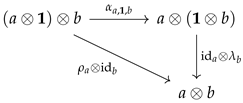
Graphically, the two ways of eliminating the trivial wire agree.
Pentagon. Associator must satisfy the pentagon: all five rebracketings of connected by four s commute.
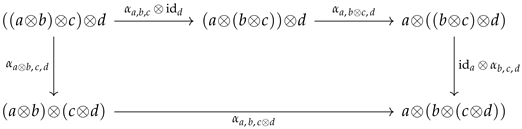 In words: starting from , the “top path”
equals the “bottom path”
This commutativity is the pentagon coherence law.
Appendix B.2. Braiding and the Hexagon
A braiding is a natural isomorphism compatible with the associator . This compatibility is encoded by two hexagon identities. They assert that “sliding a crossing past a fusion” is the same as “rebracket, cross, rebracket back.”
Hexagon (moving a past ).
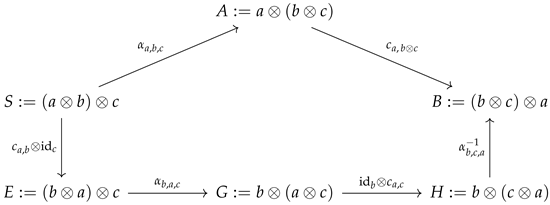 Algebraically,
Hexagon (moving past c).
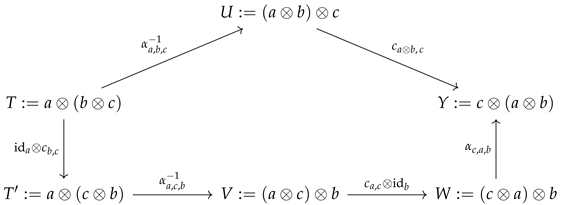 Equivalently,
Appendix B.3. How HCCB Appears
A deformation controlled by a normalized 3-cochain multiplies the associator by a phase:
On four objects, the pentagon picks up the 4-coboundary . If , coherence is preserved and the twist replaces the category by a generally inequivalent consistent one (Tier 1 of the main text); the modular imprint is the Dehn-twist scalar. If for a globally defined , the pentagon closes only up to the scalar , but this failure is an exact coboundary that is removable by undoing the twist, and carries no anomaly; a genuine non-removable failure is a non-trivial class and requires a d invertible host (Section 2.3.3 of the main text). In braided settings, compatible deformations of are classified by Abelian (Eilenberg–Mac Lane) cohomology and shift the quadratic form.
Appendix B.4. Higher Coherence
Beyond the pentagon/hexagon, homotopy-coherent structures (, ) organize associativity/commutativity by higher cells whose indexing polytopes are associahedra () and related complexes [175]. Deforming these higher cells by phases is the “higher” in HCCB; closed loops of higher moves evaluate to scalars that depend only on the underlying mapping-class element. In particular, the Dehn twist on a torus obtains a scalar , shifting the effective central charge by in modular data.
Appendix C. Experimental Data Estimates: Noise Floors and Sensitivity
We collect back-of-the-envelope estimates useful for experiment design. The universal quantum of thermal conductance is
Hence, a single fully equilibrated downstream channel contributes ; an HCCB-induced step with channels contributes .
Appendix C.1. Signal Sizes
At representative millikelvin temperatures,
For a difference measurement toggling (e.g., a single Majorana sector on/off), the expected step of is half the above numbers:
With a small temperature bias between source and drain, the corresponding heat-current step is . Taking at mK gives .
Appendix C.2. Thermal Fluctuation Noise and Bandwidth
For a channel with thermal conductance , the thermal-fluctuation (Johnson–Nyquist) noise of heat flow over bandwidth B obeys
At mK with W/K and Hz,
Comparing with the signal W shows an instantaneous signal-to-noise ratio in the ideal limit set by thermal fluctuations; in practice, calibration errors and parasitic leaks dominate the error budget.
Appendix C.3. Temperature Calibration and Thermometer Noise
Let be the slope estimator. Propagating uncertainties,
To resolve at with mK, one needs
or equivalently, a fractional thermometer calibration error if is dominated by the temperature scale. On-chip noise thermometry and primary mesoscopic thermometers can reach this regime [176].
Appendix C.4. Systematic Effects and Diagnostics
- Phonon leaks: Add analytic () backgrounds. The remedy consists of two-temperature slope fits of and device geometries that minimize phonon conduction.
- Partial equilibration: Produces an exponential approach to the anomaly limit; the difference observable cancels leading corrections if the categorical toggle does not change .
- Contact losses: Verified by channel counting in the decoupled regime and by reciprocity tests.
Appendix D. Generalizations to Topological Superconductors
Topological superconductors (TSCs) furnish a natural extension of our program. Charge conservation is broken at the mean-field level, but energy is conserved and chiral Majorana edge modes carry heat. The quantized thermal Hall effect becomes the primary anomaly probe; HCCB again enters by shifting the modular -phase of the edge CFT.
Appendix D.1. Bulk–Edge Correspondence and Central Charge
In d class-D superconductors—one entry of the tenfold-way classification of topological insulators and superconductors [177,178]—the bulk Bogoliubov–de Gennes (BdG) Hamiltonian has an integer Chern number . The boundary hosts chiral Majorana modes with chiral central charge
Each Majorana contributes ; hence, the low-T thermal Hall response is
This matches the prediction from a gravitational Chern–Simons term with level in the bulk effective action via .
Appendix D.2. Edge Theory and HCCB
The edge is a chiral Majorana CFT (Ising neutral sector). A categorical deformation that multiplies the Dehn twist by shifts by , just as in charged systems. Because the electrical Hall response vanishes in a superconductor, thermal transport and modular thermodynamics provide the cleanest windows into this shift. In particular, (A21) acquires and the heat current changes by under a small bias .
Appendix D.3. Microscopic Derivations and Anomaly Matching
Microscopic derivations of (A21) use either (i) edge CFT thermodynamics for Majorana fermions; (ii) Kubo formulas for BdG quasiparticles with correctly defined heat-current operators (including energy magnetization); or (iii) effective actions with gravitational Chern–Simons terms and anomaly inflow, in the spirit of the topological field theory of time-reversal-invariant insulators and superconductors and of cross-correlated topological responses [179,180]. All three routes agree and reproduce the half-quantized unit per Majorana channel. HCCB modifies only the overall scalar in the mapping-class representation, hence only ; it leaves local operator algebra (and thus scattering) intact.
Appendix D.4. Platforms and Probes
Candidate platforms include chiral superconductors (spinless or effectively spinless via spin–orbit locking) and engineered heterostructures (quantum anomalous Hall insulators proximitized by superconductors). In all cases, the hallmark signature is linear-in-T with half-integer multiples of [181]; an HCCB toggle should shift the slope by integer multiples of .
References
- Belavin, A.A.; Polyakov, A.M.; Zamolodchikov, A.B. Infinite conformal symmetry in two-dimensional quantum field theory. Nucl. Phys. B 1984, 241, 333–380. [Google Scholar] [CrossRef] [Scilit]
- Virasoro, M.A. Subsidiary conditions and ghosts in dual-resonance models. Phys. Rev. D 1970, 1, 2933–2936. [Google Scholar] [CrossRef] [Scilit]
- Fuks, D.B. Cohomology of Infinite-Dimensional Lie Algebras; Consultants Bureau: New York, NY, USA, 1986. [Google Scholar] [CrossRef] [Scilit]
- Kac, V.G. Vertex Algebras for Beginners, 2nd ed.; University Lecture Series; AMS: Providence, RI, USA, 1998; Volume 10. [Google Scholar] [CrossRef] [Scilit]
- Blöte, H.W.J.; Cardy, J.L.; Nightingale, M.P. Conformal invariance, the central charge, and universal finite-size amplitudes at criticality. Phys. Rev. Lett. 1986, 56, 742–745. [Google Scholar] [CrossRef] [Scilit] [PubMed]
- Affleck, I. Universal term in the free energy at a critical point and the conformal anomaly. Phys. Rev. Lett. 1986, 56, 746–748. [Google Scholar] [CrossRef] [Scilit] [PubMed]
- Cardy, J.L. Operator content of two-dimensional conformally invariant theories. Nucl. Phys. B 1986, 270, 186–204. [Google Scholar] [CrossRef] [Scilit]
- Gaberdiel, M.R. An Introduction to Conformal Field Theory. Rept. Prog. Phys. 2000, 63, 607–667. [Google Scholar] [CrossRef] [Scilit]
- Verlinde, E.P. Fusion rules and modular transformations in 2D conformal field theory. Nucl. Phys. B 1988, 300, 360–376. [Google Scholar] [CrossRef] [Scilit]
- Moore, G.; Seiberg, N. Classical and quantum conformal field theory. Commun. Math. Phys. 1989, 123, 177–254. [Google Scholar] [CrossRef] [Scilit]
- Zamolodchikov, A.B. Irreversibility of the renormalization group in a 2D field theory. JETP Lett. 1986, 43, 730–732. [Google Scholar]
- Holzhey, C.; Larsen, F.; Wilczek, F. Geometric and renormalized entropy in conformal field theory. Nucl. Phys. B 1994, 424, 443–467. [Google Scholar] [CrossRef] [Scilit]
- Calabrese, P.; Cardy, J. Entanglement entropy and quantum field theory. J. Stat. Mech. 2004, 2004, P06002. [Google Scholar] [CrossRef] [Scilit]
- Stone, M. Gravitational anomalies and thermal Hall effect in topological insulators. Phys. Rev. B 2012, 85, 184503. [Google Scholar] [CrossRef] [Scilit]
- Kane, C.L.; Fisher, M.P.A. Quantized thermal transport in the fractional quantum Hall effect. Phys. Rev. B 1997, 55, 15832–15837. [Google Scholar] [CrossRef] [Scilit]
- Cappelli, A.; Huerta, M.; Zemba, G.R. Thermal transport in chiral conformal theories and hierarchical quantum Hall states. Nucl. Phys. B 2002, 636, 568–582. [Google Scholar] [CrossRef] [Scilit]
- Kapustin, A.; Spodyneiko, L. Thermal Hall conductance and a relative topological invariant of gapped two-dimensional systems. Phys. Rev. B 2020, 101, 045137. [Google Scholar] [CrossRef] [Scilit]
- Wen, X.-G. Chiral Luttinger liquid and the edge excitations in the fractional quantum Hall states. Phys. Rev. B 1990, 41, 12838–12844. [Google Scholar] [CrossRef] [Scilit] [PubMed]
- Wen, X.-G.; Zee, A. Shift and spin vector: New topological quantum numbers for the Hall fluids. Phys. Rev. Lett. 1992, 69, 953–956. [Google Scholar] [CrossRef] [Scilit] [PubMed]
- Moore, G.; Read, N. Nonabelions in the fractional quantum Hall effect. Nucl. Phys. B 1991, 360, 362–396. [Google Scholar] [CrossRef] [Scilit]
- Banerjee, M.; Heiblum, M.; Umansky, V.; Feldman, D.E.; Oreg, Y.; Stern, A. Observation of half-integer thermal Hall conductance. Nature 2018, 559, 205–210. [Google Scholar] [CrossRef] [Scilit] [PubMed]
- Patrascu, A.T. Higher-order categorical coherence breakdown: A geometric framework for nonlinear quantum mechanics and its applications to strongly correlated electron systems. Eur. Phys. J. B 2025, 98, 210. [Google Scholar] [CrossRef] [Scilit]
- Patrascu, A.T. Categorical mechanics of bounded systems. Chem. Phys. 2026, 609, 113249. [Google Scholar] [CrossRef] [Scilit]
- Pressley, A.; Segal, G. Loop Groups; Oxford University Press: Oxford, UK, 1986. [Google Scholar]
- Francesco, P.D.; Mathieu, P.; Sénéchal, D. Conformal Field Theory; Springer: New York, NY, USA, 1997. [Google Scholar] [CrossRef] [Scilit]
- Ginsparg, P. Applied Conformal Field Theory. In Fields, Strings and Critical Phenomena; Les Houches, Session XLIX; Brézin, E., Zinn-Justin, J., Eds.; North-Holland: Amsterdam, The Netherlands, 1990; Available online: https://arxiv.org/abs/hep-th/9108028 (accessed on 23 June 2026).
- Polchinski, J. String Theory, Vol. I: An Introduction to the Bosonic String; Cambridge University Press: Cambridge, UK, 1998. [Google Scholar] [CrossRef] [Scilit]
- Sugawara, H. A Field Theory of Currents. Phys. Rev. 1968, 170, 1659–1662. [Google Scholar] [CrossRef] [Scilit]
- Witten, E. Non-Abelian Bosonization in Two Dimensions. Commun. Math. Phys. 1984, 92, 455–472. [Google Scholar] [CrossRef] [Scilit]
- Goddard, P.; Kent, A.; Olive, D. Virasoro algebras and coset space models. Phys. Lett. B 1985, 152, 88–92. [Google Scholar] [CrossRef] [Scilit]
- Goddard, P.; Kent, A.; Olive, D. Unitary Representations of the Virasoro and Super-Virasoro Algebras. Commun. Math. Phys. 1986, 103, 105–119. [Google Scholar] [CrossRef] [Scilit]
- Friedan, D.; Qiu, Z.; Shenker, S. Conformal Invariance, Unitarity, and Two-Dimensional Critical Exponents. Phys. Rev. Lett. 1984, 52, 1575–1578. [Google Scholar] [CrossRef] [Scilit]
- Brown, J.D.; Henneaux, M. Central Charges in the Canonical Realization of Asymptotic Symmetries: An Example from Three-Dimensional Gravity. Commun. Math. Phys. 1986, 104, 207–226. [Google Scholar] [CrossRef] [Scilit]
- Cappelli, A.; Itzykson, C.; Zuber, J.-B. Modular Invariant Partition Functions in Two Dimensions. Nucl. Phys. B 1987, 280, 445–465. [Google Scholar] [CrossRef] [Scilit]
- Hellerman, S. A Universal Inequality for CFT and Quantum Gravity. JHEP 2011, 2011, 130. [Google Scholar] [CrossRef] [Scilit]
- Calabrese, P.; Cardy, J. Entanglement entropy and conformal field theory: An overview. J. Phys. A Math. Theor. 2009, 42, 504005. [Google Scholar] [CrossRef] [Scilit]
- Casini, H.; Huerta, M. Entanglement entropy in free quantum field theory. J. Phys. A Math. Theor. 2009, 42, 504007. [Google Scholar] [CrossRef] [Scilit]
- Cardy, J.L. Conformal invariance and surface critical behavior. J. Phys. A Math. Gen. 1984, 17, L385–L387. [Google Scholar] [CrossRef] [Scilit]
- Cardy, J.L.; Peschel, I. Finite-size dependence of the free energy in two-dimensional critical systems. Nucl. Phys. B 1988, 300, 377–392. [Google Scholar] [CrossRef] [Scilit]
- Duff, M.J. Twenty years of the Weyl anomaly. Class. Quant. Grav. 1994, 11, 1387–1404. [Google Scholar] [CrossRef] [Scilit]
- Alvarez-Gaumé, L.; Witten, E. Gravitational Anomalies. Nucl. Phys. B 1984, 234, 269–330. [Google Scholar] [CrossRef] [Scilit]
- Lane, S.M. Categories for the Working Mathematician, 2nd ed.; Graduate Texts in Mathematics; Springer: Berlin/Heidelberg, Germany, 1971; Volume 5. [Google Scholar]
- Huang, Y.-Z. Vertex operator algebras and the Verlinde conjecture. Commun. Contemp. Math. 2008, 10, 103–154. [Google Scholar] [CrossRef] [Scilit]
- Bakalov, B.; Kirillov, A.A., Jr. Lectures on Tensor Categories and Modular Functors; University Lecture Series; American Mathematical Society: Providence, Rhode Island, 2001; Volume 21. [Google Scholar]
- Etingof, P.; Nikshych, D.; Ostrik, V. On fusion categories. Ann. Math. 2005, 162, 581–642. [Google Scholar] [CrossRef] [Scilit]
- Turaev, V.G. Quantum Invariants of Knots and 3-Manifolds; de Gruyter Studies in Mathematics; de Gruyter: Berlin, Germany, 1994; Volume 18. [Google Scholar]
- Fuchs, J.; Runkel, I.; Schweigert, C. TFT construction of RCFT correlators I: Partition functions. Nucl. Phys. B 2002, 646, 353–497. [Google Scholar] [CrossRef] [Scilit]
- Drinfeld, V.G. Quasi-Hopf algebras. Leningr. Math. J. 1990, 1, 1419–1457. [Google Scholar]
- Etingof, P.; Nikshych, D.; Ostrik, V. Fusion categories and homotopy theory. Quantum Topol. 2010, 1, 209–273. [Google Scholar] [CrossRef] [Scilit]
- Barkeshli, M.; Bonderson, P.; Cheng, M.; Wang, Z. Symmetry, Defects, and Gauging of Topological Phases. Phys. Rev. B 2019, 100, 115147. [Google Scholar] [CrossRef] [Scilit]
- Chen, X.; Fidkowski, L.; Vishwanath, A. Symmetry enforced non-Abelian topological order at the surface of a topological insulator. Phys. Rev. B 2014, 89, 165132. [Google Scholar] [CrossRef] [Scilit]
- Freed, D.S. Anomalies and invertible field theories. Proc. Symp. Pure Math. 2014, 88, 25–45. [Google Scholar] [CrossRef] [Scilit]
- Freed, D.S.; Teleman, C. Relative quantum field theory. Commun. Math. Phys. 2014, 326, 459–476. [Google Scholar] [CrossRef] [Scilit]
- Kitaev, A. Anyons in an exactly solved model and beyond. Ann. Phys. 2006, 321, 2–111. [Google Scholar] [CrossRef] [Scilit]
- Davydov, A.; Müger, M.; Nikshych, D.; Ostrik, V. The Witt group of non-degenerate braided fusion categories. J. Für Die Reine Und Angew. Math. 2013, 677, 135–177. [Google Scholar] [CrossRef] [Scilit]
- Witten, E. Quantum field theory and the Jones polynomial. Commun. Math. Phys. 1989, 121, 351–399. [Google Scholar] [CrossRef] [Scilit]
- Gromov, A.; Abanov, A.G. Thermal Hall Effect and Geometry with Torsion. Phys. Rev. Lett. 2015, 114, 016802. [Google Scholar] [CrossRef] [Scilit] [PubMed]
- Gelfand, I.M.; Fuchs, D.B. Cohomologies of the Lie algebra of vector fields on the circle. Funct. Anal. Appl. 1968, 2, 342–343. [Google Scholar] [CrossRef] [Scilit]
- Ovsienko, V.; Tabachnikov, S. Projective Differential Geometry Old and New: From the Schwarzian Derivative to the Cohomology of Diffeomorphism Groups; Cambridge University Press: Cambridge, UK, 2005. [Google Scholar]
- Neeb, K.-H. Central extensions of infinite-dimensional Lie groups. Ann. Inst. Fourier 2002, 52, 1365–1442. [Google Scholar] [CrossRef] [Scilit]
- Segal, G. Unitary representations of some infinite-dimensional groups. In Functional Analysis and Related Topics; Lecture Notes in Math; Springer: Berlin/Heidelberg, Germany, 1982; Volume 948, pp. 159–268. [Google Scholar]
- Kac, V.G.; Raina, A.K. Bombay Lectures on Highest Weight Representations of Infinite Dimensional Lie Algebras; World Scientific: Singapore, 1987. [Google Scholar]
- Mickelsson, J. Kac–Moody groups, topology of the Dirac determinant bundle, and fermion number fractionization. Commun. Math. Phys. 1987, 110, 173–183. [Google Scholar]
- Witten, E. Coadjoint Orbits of the Virasoro Group. Commun. Math. Phys. 1988, 114, 1–53. [Google Scholar] [CrossRef] [Scilit]
- Khesin, B.; Wendt, R. The Geometry of Infinite-Dimensional Groups; Springer: Berlin/Heidelberg, Germany, 2009. [Google Scholar]
- Bott, R. On the characteristic classes of groups of diffeomorphisms. Enseign. Math. 1977, 23, 209–220. [Google Scholar]
- Alekseev, A.; Shatashvili, S. Path Integral Quantization of the Coadjoint Orbits of the Virasoro Group and 2D Gravity. Nucl. Phys. B 1989, 323, 719–733. [Google Scholar]
- Polyakov, A.M. Quantum Geometry of Bosonic Strings. Phys. Lett. B 1981, 103, 207–210. [Google Scholar] [CrossRef] [Scilit]
- Polyakov, A.M. Quantum Geometry of Fermionic Strings. Phys. Lett. B 1981, 103, 211–213. [Google Scholar] [CrossRef] [Scilit]
- Fujikawa, K. Path-Integral Measure for Gauge-Invariant Fermion Theories. Phys. Rev. Lett. 1979, 42, 1195–1198. [Google Scholar]
- Fujikawa, K. Path-Integral for Gauge Theories with Fermions. Phys. Rev. D 1980, 21, 2848–2858. [Google Scholar]
- Luttinger, J.M. Theory of Thermal Transport Coefficients. Phys. Rev. 1964, 135, A1505–A1514. [Google Scholar] [CrossRef] [Scilit]
- Cooper, N.R.; Halperin, B.I.; Ruzin, I.M. Thermoelectric response of an interacting two-dimensional electron gas in a quantizing magnetic field. Phys. Rev. B 1997, 55, 2344–2359. [Google Scholar] [CrossRef] [Scilit]
- Read, N.; Green, D. Paired states of fermions in two dimensions with breaking of parity and time-reversal symmetries and the fractional quantum Hall effect. Phys. Rev. B 2000, 61, 10267–10297. [Google Scholar] [CrossRef] [Scilit]
- Ryu, S.; Hatsugai, Y. Topological Origin of Zero-Energy Edge States in Particle-Hole Symmetric Systems. Phys. Rev. Lett. 2002, 89, 077002. [Google Scholar] [PubMed]
- Read, N. Non-Abelian adiabatic statistics and Hall viscosity in quantum Hall states and px + ipy superconductors. Phys. Rev. B 2009, 79, 045308. [Google Scholar]
- Iyer, V.; Wald, R.M. Some properties of Noether charge and a proposal for dynamical black hole entropy. Phys. Rev. D 1994, 50, 846–864. [Google Scholar] [CrossRef] [Scilit]
- Barnich, G.; Brandt, F. Covariant theory of asymptotic symmetries, conservation laws and central charges. Nucl. Phys. B 2002, 633, 3–82. [Google Scholar] [CrossRef] [Scilit]
- Stasheff, J.D. Homotopy associativity of H-spaces. I. Trans. Am. Math. Soc. 1963, 108, 275–292. [Google Scholar]
- Stasheff, J.D. Homotopy associativity of H-spaces. II. Trans. Am. Math. Soc. 1963, 108, 293–312. [Google Scholar]
- Leinster, T. Higher Operads, Higher Categories; London Mathematical Society Lecture Note Series; Cambridge University Press: Cambridge, UK, 2004; Volume 298. [Google Scholar]
- Joyal, A.; Street, R. Braided tensor categories. Adv. Math. 1993, 102, 20–78. [Google Scholar] [CrossRef] [Scilit]
- Freed, D.S.; Hopkins, M.J. Reflection positivity and invertible topological phases. arXiv 2016, arXiv:1604.06527. Available online: https://arxiv.org/abs/1604.06527 (accessed on 23 June 2026).
- Baez, J.C.; Dolan, J. Higher-Dimensional Algebra and Topological Quantum Field Theory. J. Math. Phys. 1995, 36, 6073–6105. [Google Scholar] [CrossRef] [Scilit]
- Gaiotto, D.; Kapustin, A.; Seiberg, N.; Willett, B. Generalized Global Symmetries. JHEP 2015, 02, 172. [Google Scholar]
- Belov, D.M.; Moore, G.W. Classification of Abelian Spin Chern–Simons Theories. Adv. Theor. Math. Phys. 2007, 11, 1–50. [Google Scholar]
- Tsui, D.C.; Stormer, H.L.; Gossard, A.C. Two-Dimensional Magnetotransport in the Extreme Quantum Limit. Phys. Rev. Lett. 1982, 48, 1559–1562. [Google Scholar] [CrossRef] [Scilit]
- Laughlin, R.B. Anomalous Quantum Hall Effect: An Incompressible Quantum Fluid with Fractionally Charged Excitations. Phys. Rev. Lett. 1983, 50, 1395–1398. [Google Scholar] [CrossRef] [Scilit]
- Haldane, F.D.M. Fractional Quantization of the Hall Effect: A Hierarchy of Incompressible Quantum Fluid States. Phys. Rev. Lett. 1983, 51, 605–608. [Google Scholar] [CrossRef] [Scilit]
- Halperin, B.I. Statistics of Quasiparticles and the Hierarchy of Fractional Quantized Hall States. Phys. Rev. Lett. 1984, 52, 1583–1586. [Google Scholar] [CrossRef] [Scilit]
- Jain, J.K. Composite Fermions; Cambridge University Press: Cambridge, UK, 2007. [Google Scholar]
- Prange, R.E.; Girvin, S.M. (Eds.) The Quantum Hall Effect, 2nd ed.; Springer: Berlin/Heidelberg, Germany, 1990. [Google Scholar]
- Fradkin, E. Field Theories of Condensed Matter Physics, 2nd ed.; Cambridge University Press: Cambridge, UK, 2013. [Google Scholar] [CrossRef] [Scilit]
- Tong, D. Lectures on the Quantum Hall Effect. arXiv 2016, arXiv:1606.06687. Available online: https://arxiv.org/abs/1606.06687 (accessed on 23 June 2026).
- Bernevig, B.A.; Hughes, T.L. Topological Insulators and Topological Superconductors; Princeton University Press: Princeton, NJ, USA, 2013. [Google Scholar]
- Arovas, D.; Schrieffer, J.R.; Wilczek, F. Fractional Statistics and the Quantum Hall Effect. Phys. Rev. Lett. 1984, 53, 722–723. [Google Scholar] [CrossRef] [Scilit]
- Jacak, J.E. Topological approach to electron correlations at fractional quantum Hall effect. Ann. Phys. 2021, 430, 168493. [Google Scholar] [CrossRef] [Scilit]
- Jacak, J.E. Explanation of puzzling FQHE at the filling fraction 3/4 in a band-hole 2D system in GaAs. J. Phys. Condens. Matter 2024, 36, 505601. [Google Scholar] [CrossRef] [Scilit]
- Jezouin, S.; Parmentier, F.D.; Anthore, A.; Gennser, U.; Cavanna, A.; Jin, Y.; Pierre, F. Quantum limit of heat flow across a single electronic channel. Science 2013, 342, 601–604. [Google Scholar] [CrossRef] [Scilit] [PubMed]
- Banerjee, M.; Heiblum, M.; Rosenblatt, A.; Oreg, Y.; Feldman, D.E.; Stern, A.; Umansky, V. Observed quantization of anyonic heat flow. Nature 2017, 545, 75–79. [Google Scholar] [CrossRef] [Scilit] [PubMed]
- Zhang, S.-C.; Hansson, T.H.; Kivelson, S. Effective-Field-Theory Model for the Fractional Quantum Hall Effect. Phys. Rev. Lett. 1989, 62, 82–85. [Google Scholar] [CrossRef] [Scilit] [PubMed]
- Wen, X.-G. Topological orders and edge excitations in fractional quantum Hall states. Adv. Phys. 1995, 44, 405–473. [Google Scholar] [CrossRef] [Scilit]
- Levin, M.; Wen, X.-G. Detecting Topological Order in a Ground State Wave Function. Phys. Rev. Lett. 2006, 96, 110405. [Google Scholar] [CrossRef] [Scilit] [PubMed]
- Girvin, S.M.; MacDonald, A.H.; Platzman, P.M. Magneto-roton theory of collective excitations in the fractional quantum Hall effect. Phys. Rev. B 1986, 33, 2481–2494. [Google Scholar] [CrossRef] [Scilit] [PubMed]
- Chang, A.M. Chiral Luttinger liquids at the fractional quantum Hall edge. Rev. Mod. Phys. 2003, 75, 1449–1505. [Google Scholar] [CrossRef] [Scilit]
- Nayak, C.; Simon, S.H.; Stern, A.; Freedman, M.; Sarma, S.D. Non-Abelian anyons and topological quantum computation. Rev. Mod. Phys. 2008, 80, 1083–1159. [Google Scholar] [CrossRef] [Scilit]
- Niu, Q.; Thouless, D.J.; Wu, Y.-S. Quantized Hall conductance as a topological invariant. Phys. Rev. B 1985, 31, 3372–3377. [Google Scholar] [CrossRef] [Scilit] [PubMed]
- Qin, T.; Niu, Q.; Shi, J. Energy Magnetization and the Thermal Hall Effect. Phys. Rev. Lett. 2011, 107, 236601. [Google Scholar] [CrossRef] [Scilit] [PubMed]
- Bradlyn, B.; Read, N. Low-energy effective theory in the bulk for transport in a topological phase. Phys. Rev. B 2015, 91, 125303. [Google Scholar] [CrossRef] [Scilit]
- Bradlyn, B.; Read, N. Topological central charge from Berry curvature: Gravitational anomalies in trial wave functions for topological phases. Phys. Rev. B 2015, 91, 165306. [Google Scholar] [CrossRef] [Scilit]
- Sivre, E.; Anthore, A.; Parmentier, F.D.; Cavanna, A.; Gennser, U.; Pierre, F. Electronic heat flow and thermal equilibration in quantum Hall edge channels. Nat. Phys. 2018, 14, 145–148. [Google Scholar] [CrossRef] [Scilit]
- Reshetikhin, N.; Turaev, V.G. Invariants of 3-manifolds via link polynomials and quantum groups. Invent. Math. 1991, 103, 547–597. [Google Scholar] [CrossRef] [Scilit]
- Etingof, P.; Gelaki, S.; Nikshych, D.; Ostrik, V. Tensor Categories; Mathematical Surveys and Monographs; American Mathematical Society: Providence, Rhode Island, 2015; Volume 205. [Google Scholar]
- Zhu, Y. Modular invariance of characters of vertex operator algebras. J. Am. Math. Soc. 1996, 9, 237–302. [Google Scholar] [CrossRef] [Scilit]
- Bais, F.A.; Slingerland, J.K. Condensate-induced transitions between topologically ordered phases. Phys. Rev. B 2009, 79, 045316. [Google Scholar] [CrossRef] [Scilit]
- Kong, L. Anyon condensation and tensor categories. Nucl. Phys. B 2014, 886, 436–482. [Google Scholar] [CrossRef] [Scilit]
- Lan, T.; Wang, J.C.; Wen, X.-G. Gapped Domain Walls, Gapped Boundaries, and Topological Degeneracy. Phys. Rev. Lett. 2015, 114, 076402. [Google Scholar] [CrossRef] [Scilit] [PubMed]
- Kapustin, A.; Saulina, N. Topological boundary conditions in Abelian Chern–Simons theory. Nucl. Phys. B 2011, 845, 393–435. [Google Scholar] [CrossRef] [Scilit]
- Kirby, R.; Melvin, P. The 3-manifold invariants of Witten and Reshetikhin–Turaev for sl(2, ). Invent. Math. 1991, 105, 473–545. [Google Scholar] [CrossRef] [Scilit]
- Rowell, E.C.; Stong, R.; Wang, Z. On classification of modular tensor categories. Commun. Math. Phys. 2009, 292, 343–389. [Google Scholar] [CrossRef] [Scilit]
- Büttiker, M. Absence of backscattering in the quantum Hall effect in multiprobe conductors. Phys. Rev. B 1988, 38, 9375–9389. [Google Scholar] [CrossRef] [Scilit] [PubMed]
- Schwab, K.; Henriksen, E.A.; Worlock, J.M.; Roukes, M.L. Measurement of the quantum of thermal conductance. Nature 2000, 404, 974–977. [Google Scholar] [CrossRef] [Scilit] [PubMed]
- Meschke, M.; Guichard, W.; Pekola, J.P. Single-mode heat conduction by photons. Nature 2006, 444, 187–190. [Google Scholar] [CrossRef] [Scilit] [PubMed]
- Kane, C.L.; Fisher, M.P.A.; Polchinski, J. Randomness at the edge: Theory of quantum Hall transport at filling ν = 2/3. Phys. Rev. Lett. 1994, 72, 4129–4132. [Google Scholar] [CrossRef] [Scilit] [PubMed]
- Levkivskyi, I.P.; Sukhorukov, E.V. Dephasing in the electronic Mach–Zehnder interferometer at filling factor 2. Phys. Rev. B 2008, 78, 045322. [Google Scholar] [CrossRef] [Scilit]
- Bonderson, P.; Kitaev, A.; Shtengel, K. Detecting non-Abelian statistics in the ν = 5/2 fractional quantum Hall state. Phys. Rev. Lett. 2006, 96, 016803. [Google Scholar] [CrossRef] [Scilit] [PubMed]
- Bonderson, P.; Shtengel, K.; Slingerland, J.K. Probing Non-Abelian Statistics with Quasiparticle Interferometry. Phys. Rev. Lett. 2006, 97, 016401. [Google Scholar] [CrossRef] [Scilit] [PubMed]
- Dean, C.R.; Wang, L.; Maher, P.; Forsythe, C.; Ghahari, F.; Gao, Y.; Katoch, J.; Ishigami, M.; Moon, P.; Koshino, M.; et al. Hofstadter’s butterfly and the fractal quantum Hall effect in moiré superlattices. Nature 2013, 497, 598–602. [Google Scholar] [CrossRef] [Scilit] [PubMed]
- Ponomarenko, L.A.; Gorbachev, R.V.; Yu, G.L.; Elias, D.C.; Jalil, R.; Patel, A.A.; Mishchenko, A.; Mayorov, A.S.; Woods, C.R.; Wallbank, J.R.; et al. Cloning of Dirac fermions in graphene superlattices. Nature 2013, 497, 594–597. [Google Scholar] [CrossRef] [Scilit] [PubMed]
- Hunt, B.; Sanchez-Yamagishi, J.D.; Young, A.F.; Yankowitz, M.; LeRoy, B.J.; Watanabe, K.; Taniguchi, T.; Moon, P.; Koshino, M.; Jarillo-Herrero, P.; et al. Massive Dirac fermions and Hofstadter butterfly in a van der Waals heterostructure. Science 2013, 340, 1427–1430. [Google Scholar] [CrossRef] [Scilit] [PubMed]
- Spanton, E.M.; Zibrov, A.A.; Zhou, H.; Taniguchi, T.; Watanabe, K.; Zaletel, M.P.; Young, A.F. Observation of fractional Chern insulators in a van der Waals heterostructure. Science 2018, 360, 62–66. [Google Scholar] [CrossRef] [Scilit] [PubMed]
- Kapustin, A.; Spodyneiko, L. Higher-dimensional generalizations of Berry curvature. Phys. Rev. B 2020, 101, 235130. [Google Scholar] [CrossRef] [Scilit]
- Córdova, C.; Freed, D.S.; Lam, H.T.; Seiberg, N. Anomalies in the space of coupling constants and their dynamical applications I. SciPost Phys. 2020, 8, 001. [Google Scholar] [CrossRef] [Scilit]
- Thouless, D.J. Quantization of particle transport. Phys. Rev. B 1983, 27, 6083–6087. [Google Scholar] [CrossRef] [Scilit]
- Granger, G.; Eisenstein, J.P.; Reno, J.L. Observation of Chiral Heat Transport in the Quantum Hall Regime. Phys. Rev. Lett. 2009, 102, 086803. [Google Scholar] [CrossRef] [Scilit] [PubMed]
- Bid, A.; Ofek, N.; Heiblum, M.; Umansky, V.; Mahalu, D. Observation of neutral modes in the fractional quantum Hall regime. Nature 2010, 466, 585–590. [Google Scholar] [CrossRef] [Scilit] [PubMed]
- Bonderson, P.; Nayak, C.; Qi, X.-L. Aging Effects in Interferometry of Non-Abelian Anyons. J. Stat. Mech. Theory Exp. 2012, 2012, P09016. [Google Scholar] [CrossRef] [Scilit]
- Altimiras, C.; le Sueur, H.; Gennser, U.; Cavanna, A.; Mailly, D.; Pierre, F. Non-equilibrium edge-channel spectroscopy in the integer quantum Hall regime. Nat. Phys. 2010, 6, 34–39. [Google Scholar] [CrossRef] [Scilit]
- le Sueur, H.; Altimiras, C.; Gennser, U.; Cavanna, A.; Mailly, D.; Pierre, F. Energy Relaxation in the Integer Quantum Hall Regime. Phys. Rev. Lett. 2010, 105, 056803. [Google Scholar] [CrossRef] [Scilit] [PubMed]
- Venkatachalam, V.; Yacoby, A.; Pfeiffer, L.; West, K. Local thermometry of neutral modes on the quantum Hall edge. Nat. Phys. 2012, 8, 676–681. [Google Scholar] [CrossRef] [Scilit]
- Kalmeyer, V.; Laughlin, R.B. Equivalence of the resonating-valence-bond and fractional quantum Hall states. Phys. Rev. Lett. 1987, 59, 2095–2098. [Google Scholar] [CrossRef] [Scilit] [PubMed]
- Wen, X.-G. Quantum orders and symmetric spin liquids. Phys. Rev. B 2002, 65, 165113. [Google Scholar] [CrossRef] [Scilit]
- Balents, L. Spin liquids in frustrated magnets. Nature 2010, 464, 199–208. [Google Scholar] [CrossRef] [Scilit] [PubMed]
- Savary, L.; Balents, L. Quantum spin liquids: A review. Rep. Prog. Phys. 2017, 80, 016502. [Google Scholar] [CrossRef] [Scilit] [PubMed]
- Katsura, H.; Nagaosa, N.; Lee, P.A. Theory of the thermal Hall effect in quantum magnets. Phys. Rev. Lett. 2010, 104, 066403. [Google Scholar] [CrossRef] [Scilit] [PubMed]
- Onose, Y.; Ideue, T.; Katsura, H.; Shiomi, Y.; Nagaosa, N.; Tokura, Y. Observation of the magnon Hall effect. Science 2010, 329, 297–299. [Google Scholar] [CrossRef] [Scilit] [PubMed]
- Kasahara, Y.; Ohnishi, T.; Mizukami, Y.; Tanaka, O.; Ma, S.; Sugii, K.; Kurita, N.; Tanaka, H.; Nasu, J.; Motome, Y.; et al. Majorana quantization of the thermal Hall effect in a Kitaev spin liquid. Nature 2018, 559, 227–231. [Google Scholar] [CrossRef] [Scilit] [PubMed]
- Czajka, P.; Gao, T.; Hirschberger, M.; Lampen-Kelley, P.; Banerjee, A.; Yan, J.; Mandrus, D.G.; Nagler, S.E.; Ong, N.P. Oscillations of the thermal conductivity in the spin-liquid state of α-RuCl3. Nat. Phys. 2021, 17, 915–919. [Google Scholar] [CrossRef] [Scilit]
- Li, J.I.A.; Tan, C.; Chen, S.; Zeng, Y.; Taniguchi, T.; Watanabe, K.; Hone, J.; Dean, C.R. Even-denominator fractional quantum Hall states in bilayer graphene. Science 2017, 358, 648–652. [Google Scholar] [CrossRef] [Scilit] [PubMed]
- Bloch, I.; Dalibard, J.; Zwerger, W. Many-body physics with ultracold gases. Rev. Mod. Phys. 2008, 80, 885–964. [Google Scholar] [CrossRef] [Scilit]
- Cooper, N.R.; Dalibard, J.; Spielman, I.B. Topological bands for ultracold atoms. Rev. Mod. Phys. 2019, 91, 015005. [Google Scholar] [CrossRef] [Scilit] [PubMed]
- Sørensen, A.S.; Demler, E.; Lukin, M.D. Fractional quantum Hall states of atoms in optical lattices. Phys. Rev. Lett. 2005, 94, 086803. [Google Scholar] [CrossRef] [Scilit] [PubMed]
- Cooper, N.R. Optical flux lattices for ultracold atoms. Phys. Rev. Lett. 2011, 106, 175301. [Google Scholar] [CrossRef] [Scilit] [PubMed]
- Mancini, M.; Pagano, G.; Cappellini, G.; Livi, L.; Rider, M.; Catani, J.; Sias, C.; Zoller, P.; Inguscio, M.; Dalmonte, M.; et al. Observation of chiral edge states with neutral fermions in synthetic Hall ribbons. Science 2015, 349, 1510–1513. [Google Scholar] [CrossRef] [Scilit] [PubMed]
- Stuhl, B.K.; Lu, H.-I.; Aycock, L.M.; Genkina, D.; Spielman, I.B. Visualizing edge states with an atomic Bose gas in the quantum Hall regime. Science 2015, 349, 1514–1518. [Google Scholar] [CrossRef] [Scilit] [PubMed]
- Callan, C.G.; Friedan, D.; Martinec, E.J.; Perry, M.J. Strings in background fields. Nucl. Phys. B 1985, 262, 593–609. [Google Scholar] [CrossRef] [Scilit]
- Distler, J.; Kawai, H. Conformal field theory and 2D quantum gravity, or who’s afraid of Joseph Liouville? Nucl. Phys. B 1989, 321, 509–527. [Google Scholar] [CrossRef] [Scilit]
- Seiberg, N. Notes on quantum Liouville theory and quantum gravity. Prog. Theor. Phys. Suppl. 1990, 102, 319–349. [Google Scholar] [CrossRef] [Scilit]
- Teschner, J. Liouville theory revisited. Class. Quant. Grav. 2001, 18, R153–R222. [Google Scholar] [CrossRef] [Scilit]
- Knizhnik, V.G.; Polyakov, A.M.; Zamolodchikov, A.B. Fractal structure of 2D quantum gravity. Mod. Phys. Lett. A 1988, 3, 819–826. [Google Scholar] [CrossRef] [Scilit]
- David, F. Conformal field theories coupled to 2D gravity in the conformal gauge. Mod. Phys. Lett. A 1988, 3, 1651–1656. [Google Scholar] [CrossRef] [Scilit]
- Wess, J.; Zumino, B. Consequences of anomalous Ward identities. Phys. Lett. B 1971, 37, 95–97. [Google Scholar] [CrossRef] [Scilit]
- Bardeen, W.A.; Zumino, B. Consistent and covariant anomalies in gauge theories. Nucl. Phys. B 1984, 244, 421–453. [Google Scholar] [CrossRef] [Scilit]
- Bertlmann, R.A. Anomalies in Quantum Field Theory; International Series of Monographs on Physics; Oxford University Press: Clarendon/Oxford, UK, 1996; rev. ed. 2001. [Google Scholar]
- Kapustin, A. Symmetry Protected Topological Phases, Anomalies, and Cobordisms: Beyond Group Cohomology. arXiv 2014, arXiv:1403.1467. [Google Scholar]
- Chen, X.; Gu, Z.-C.; Liu, Z.-X.; Wen, X.-G. Symmetry protected topological orders and the group cohomology of their symmetry group. Phys. Rev. B 2013, 87, 155114. [Google Scholar] [CrossRef] [Scilit]
- Son, D.T.; Surówka, P. Hydrodynamics with Triangle Anomalies. Phys. Rev. Lett. 2009, 103, 191601. [Google Scholar] [CrossRef] [Scilit] [PubMed]
- Jensen, K.; Loganayagam, R.; Yarom, A. Thermodynamics, gravitational anomalies and cones. JHEP 2013, 02, 088. [Google Scholar] [CrossRef] [Scilit]
- Rego, L.G.C.; Kirczenow, G. Quantized Thermal Conductance of Dielectric Quantum Wires. Phys. Rev. Lett. 1998, 81, 232–235. [Google Scholar] [CrossRef] [Scilit]
- Grissonnanche, G.; Legros, A.; Badoux, S.; Lefrançois, E.; Zatko, V.; Lizaire, M.; Laliberté, F.; Gourgout, A.; Zhou, J.S.; Pyon, S.; et al. Giant thermal Hall conductivity in the pseudogap phase of cuprate superconductors. Nature 2019, 571, 376–380. [Google Scholar] [CrossRef] [Scilit] [PubMed]
- Shitade, A. Heat current operator, magnetization, and thermal transport with interactions. Phys. Rev. B 2014, 90, 134201. [Google Scholar] [CrossRef] [Scilit]
- Selinger, P. A survey of graphical languages for monoidal categories. In New Structures for Physics; Lecture Notes in Physics; Springer: Berlin/Heidelberg, Germany, 2010; Volume 813, pp. 289–355. [Google Scholar]
- Coecke, B.; Kissinger, A. Picturing Quantum Processes: A First Course in Quantum Theory and Diagrammatic Reasoning; Cambridge University Press: Cambridge, UK, 2017. [Google Scholar]
- Kelly, G.M. Basic Concepts of Enriched Category Theory; London Mathematical Society Lecture Note Series; Cambridge University Press: Cambridge, UK, 1982; Volume 64. [Google Scholar]
- Boardman, J.M.; Vogt, R.M. Homotopy Invariant Algebraic Structures on Topological Spaces; Springer Lecture Notes in Mathematics; Springer: Berlin/Heidelberg, Germany, 1973; Volume 347. [Google Scholar]
- Giazotto, F.; Heikkilä, T.T.; Luukanen, A.; Savin, A.M.; Pekola, J.P. Opportunities for mesoscopics in thermometry and refrigeration: Physics and applications. Rev. Mod. Phys. 2006, 78, 217–274. [Google Scholar] [CrossRef] [Scilit]
- Schnyder, A.P.; Ryu, S.; Furusaki, A.; Ludwig, A.W.W. Classification of topological insulators and superconductors in three spatial dimensions. Phys. Rev. B 2008, 78, 195125. [Google Scholar] [CrossRef] [Scilit]
- Kitaev, A. Periodic table for topological insulators and superconductors. AIP Conf. Proc. 2009, 1134, 22–30. [Google Scholar] [CrossRef] [Scilit]
- Qi, X.-L.; Hughes, T.L.; Zhang, S.-C. Topological field theory of time-reversal invariant insulators and superconductors. Phys. Rev. B 2008, 78, 195424. [Google Scholar] [CrossRef] [Scilit]
- Nomura, K.; Ryu, S.; Furusaki, A.; Nagaosa, N. Cross-Correlated Responses of Topological Superconductors and Superfluids. Phys. Rev. Lett. 2012, 108, 026802. [Google Scholar] [CrossRef] [Scilit] [PubMed]
- Sumiyoshi, H.; Fujimoto, S. Quantum thermal Hall effect in a time-reversal-symmetry-broken topological superconductor in two dimensions. J. Phys. Soc. Jpn. 2013, 82, 023602. [Google Scholar] [CrossRef] [Scilit]
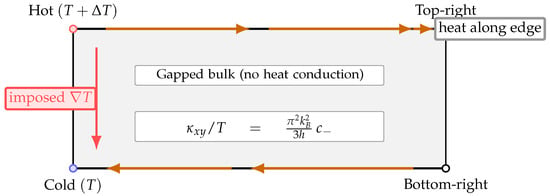
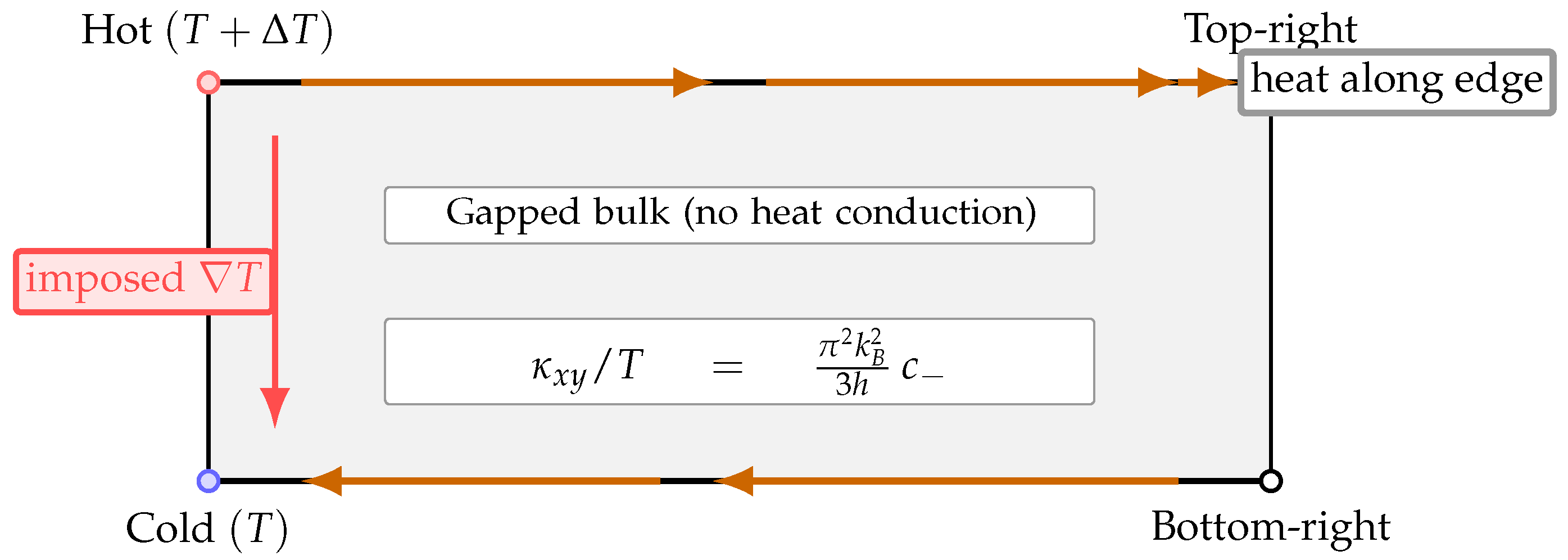
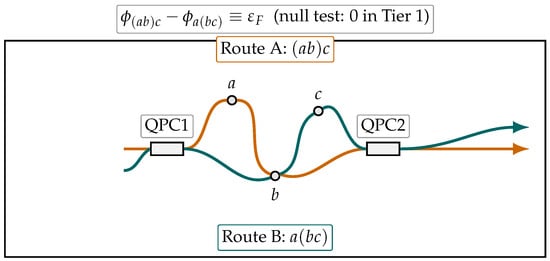
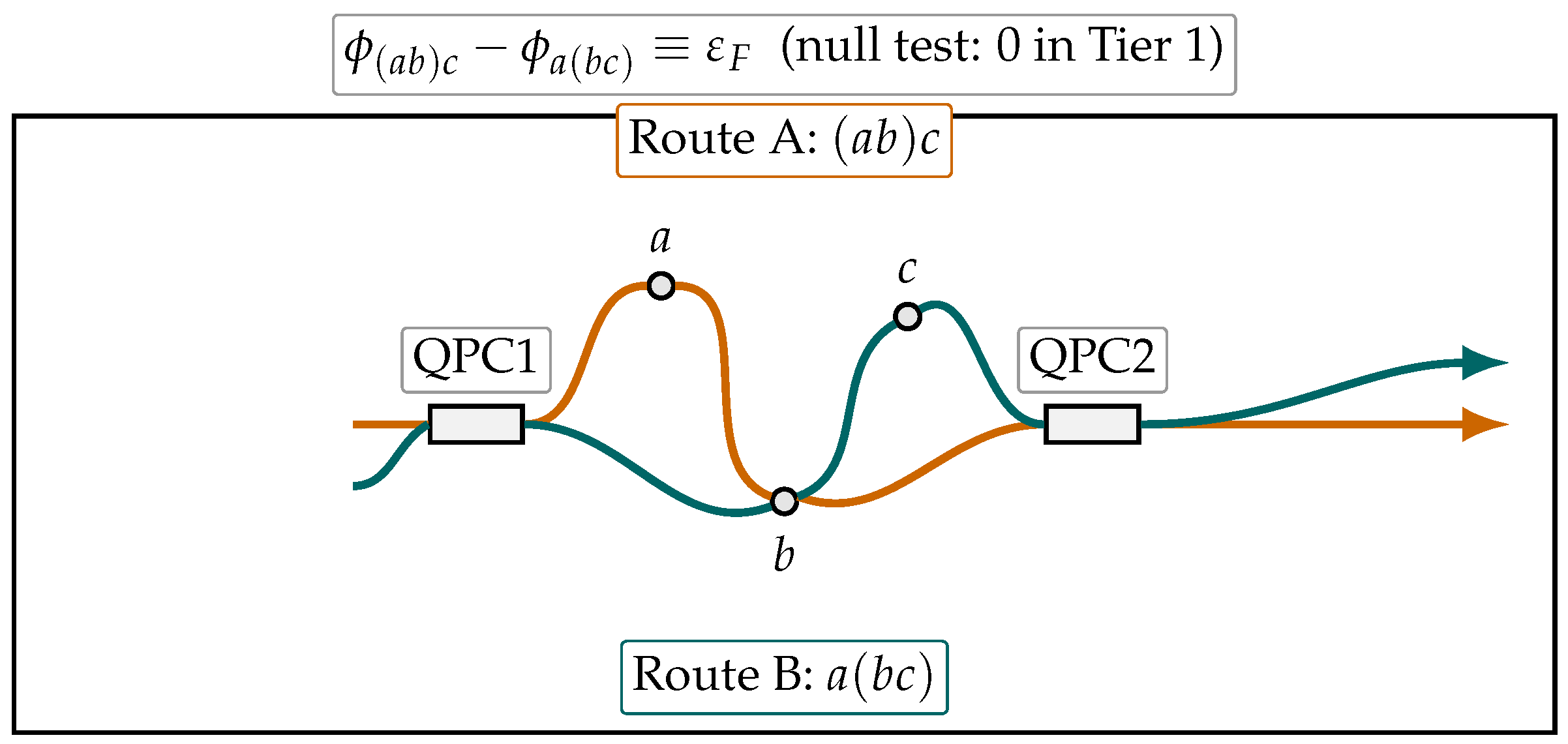
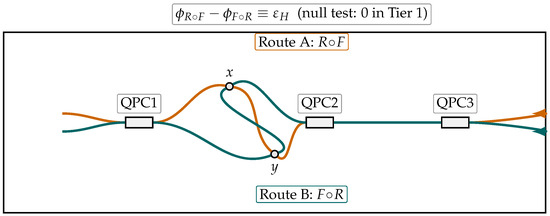
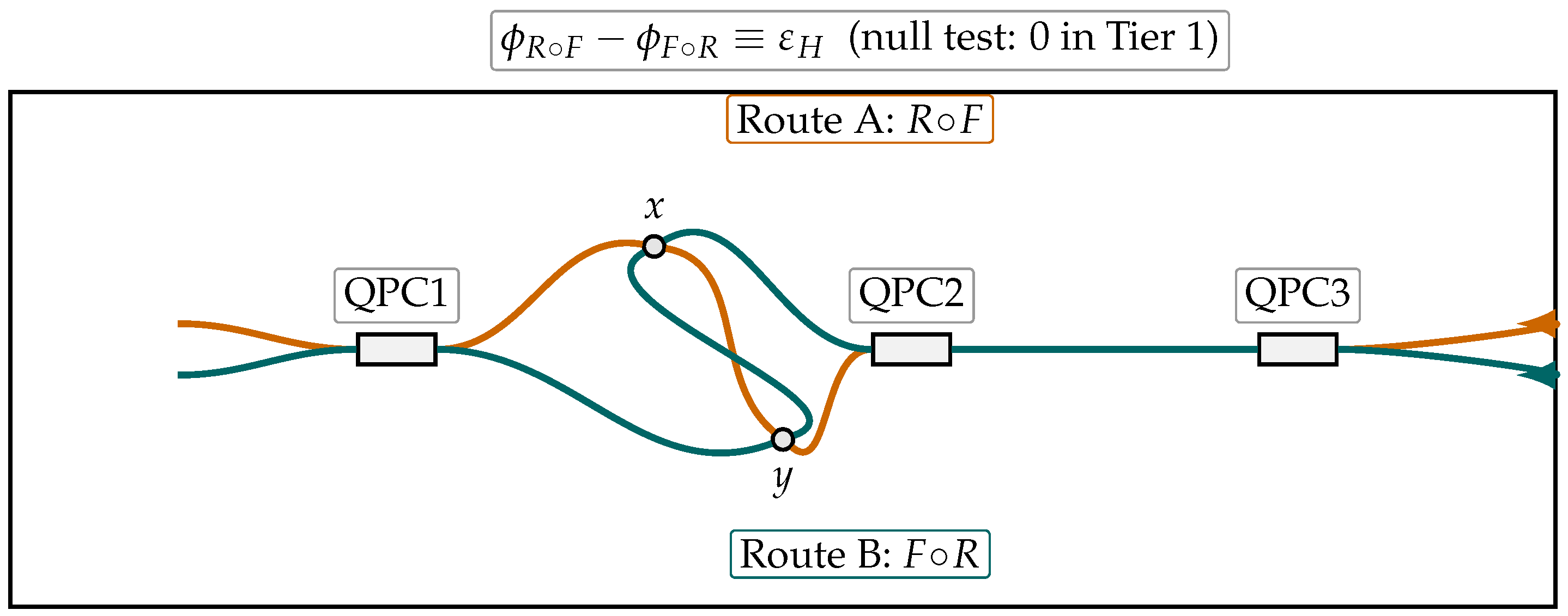
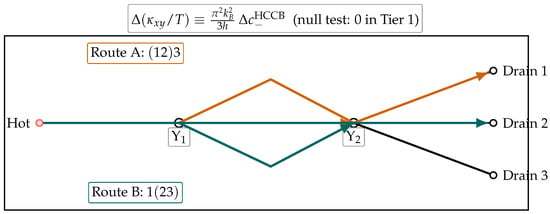
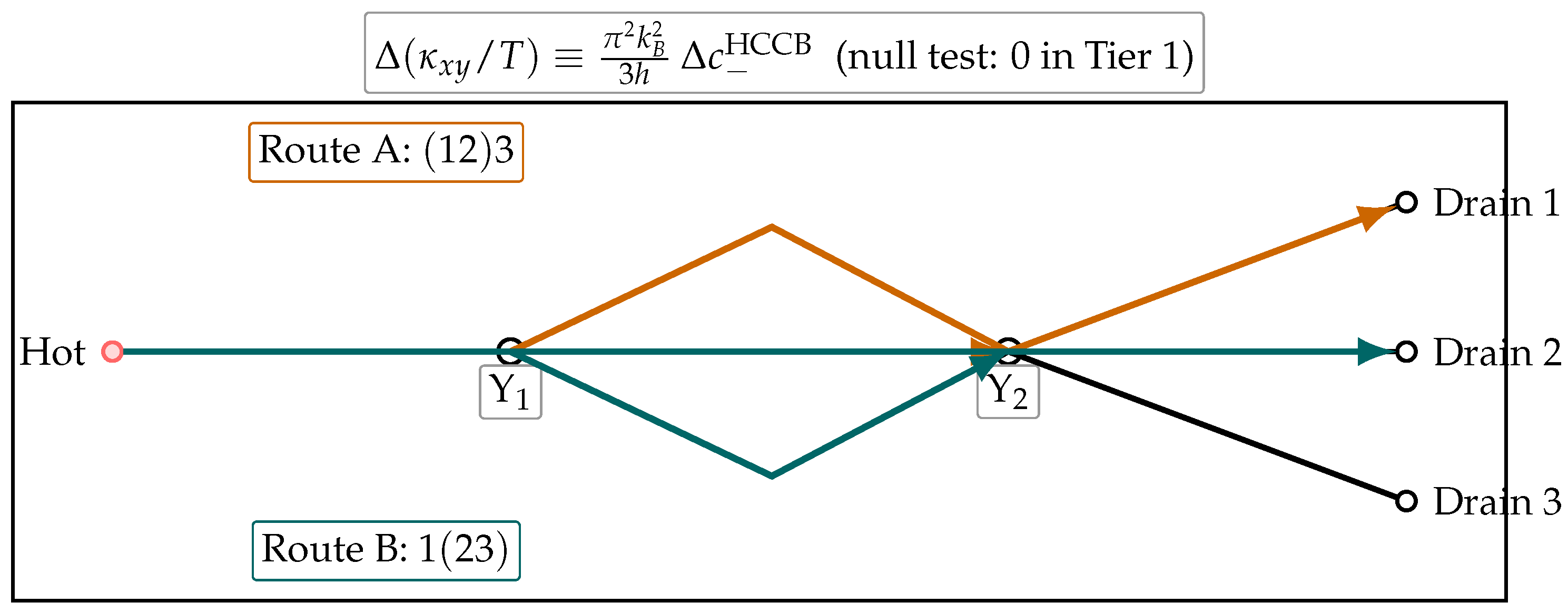

Disclaimer/Publisher’s Note: The statements, opinions and data contained in all publications are solely those of the individual author(s) and contributor(s) and not of MDPI and/or the editor(s). MDPI and/or the editor(s) disclaim responsibility for any injury to people or property resulting from any ideas, methods, instructions or products referred to in the content. |
© 2026 by the author. Licensee MDPI, Basel, Switzerland. This article is an open access article distributed under the terms and conditions of the Creative Commons Attribution (CC BY) license.