1. Introduction
Electromagnetic force is one of the drivers of molecular recognition and stability at the biomolecular scale, where its effects arise from the unequal sharing of electron density. Linus Pauling’s electronegativity (EN) scale provides a quantitative measure of this asymmetry (
Table 1) [
1]. In nucleic acids, EN patterns generate a reproducible electrostatic architecture: a highly polarized, high-EN phosphodiester backbone contrasted with the sequence-specific electron density distributions of the nucleobases.
Although EN is fundamentally an empirical, atom-centered descriptor rather than a literal spatial field, this Perspective applies Pauling values at atomic resolution across DNA and RNA to examine how these patterns may contribute to structured, anisotropic electrostatic environments. Classical EN gradients and backbone anisotropy are considered to have potential influences on vibrational dynamics, including short-timescale quantum effects such as non-adiabatic vibronic coupling. Extending this framework to chemical modifications such as N
1-methylpseudouridine (m
1Ψ) provides a physical basis for understanding how targeted perturbations in electron distribution may influence mRNA stability and ribosomal decoding fidelity [
2].
The broader literature informs the study of nucleic acid dynamics beyond electronegativity alone. Experimental and theoretical investigations have examined vibrational coupling in nucleobases [
3,
4], charge-transport mechanisms [
5,
6,
7,
8], hydration-shell structuring and counterion effects [
9,
10], and backbone-mediated conformational dynamics [
11]. Collectively, these studies reveal that nucleic acids exhibit rich, multiscale behavior shaped by both classical electrostatics and ultrafast quantum-influenced interactions. The present work builds on this foundation by highlighting electronegativity as a complementary, atom-resolved descriptor within this broader landscape.
Hypothesis: DNA and RNA encode a conserved electromagnetic blueprint in which Pauling EN patterns may translate atomic-scale forces into higher-order biophysical behaviors. This conceptual framework may help explain the structural longevity of DNA, the transient adaptability of mRNA, and the functional outcomes of nucleoside modifications. It may also illuminate how viral genomes exploit electrostatic structure and how synthetic mRNA can be engineered for improved stability and fidelity. This Perspective aligns with emerging views on molecular anisotropy as a determinant of vaccine immunogenicity and fidelity [
12].
2. The Phosphodiester (PO4) Backbone as a Consistent Electrostatic Scaffold
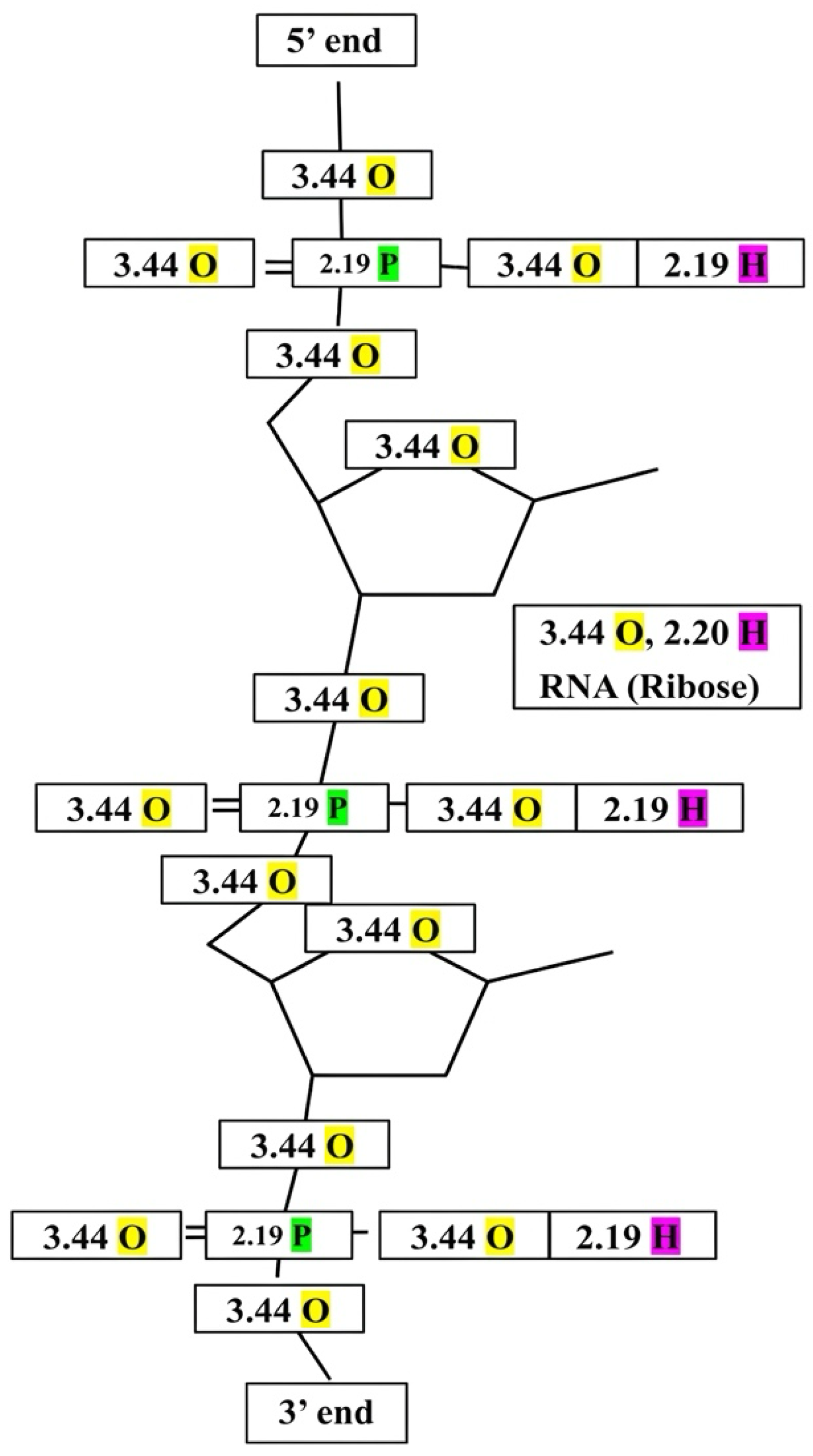
The phosphodiester backbone provides the primary structural and electrostatic framework of nucleic acids. Each repeating unit contains a phosphate group linked to the 3′ and 5′ carbons of neighboring sugars, forming a continuous covalent chain. Oxygen atoms (Pauling EN 3.44) dominate the local electronegativity landscape, drawing electron density away from phosphorus (EN 2.19) and maintaining the phosphate group’s stable negative charge at physiological pH [
1]. Collectively, these features create a largely uniform, high-EN “electrostatic backbone” that extends the length of the polymer, providing a relatively consistent electrostatic background that is largely independent of nucleobase sequence (
Figure 1).
It is important to emphasize that Pauling electronegativity is an empirical, atom-centered scale derived from bond energies rather than a literal spatial field descriptor [
13]. In this Perspective, electronegativity is used heuristically, as a coarse mapping of electron-withdrawing tendencies across the nucleic acid architecture, rather than as a quantitative electrostatic potential. The high-EN backbone concept therefore refers to a conceptual electrostatic scaffold arising from the consistent contribution of phosphate-associated oxygen atoms, not to a continuous physical field. While EN cannot serve as a substitute for full electrostatic calculations, it provides a simple, chemically intuitive organizing principle that highlights stable versus variable features of nucleic acid structure. More rigorous electrostatic descriptors, such as electrostatic-potential (ESP) maps, polarizable force fields, and QM/MM charge distributions, would be required for quantitative modeling [
14]. The present framework is intended as a qualitative, hypothesis-generating interpretation consistent with the scope of a Perspective, integrating classical EN patterns with known structural and dynamical features of nucleic acids.
Figure 1.
Electronegativity in the sugar–phosphate backbone. Color-coded Pauling values highlight the invariant high-electronegativity oxygen scaffold that dominates the electrostatic profile relative to the less electronegative core atoms: oxygen (3.44) > nitrogen (3.04) > carbon (2.55) > hydrogen (2.20) > phosphate (2.19) [
1]. This periodic distribution may be consistent with the structured-bath interpretation proposed in this framework (
Section 4) [
14]. Model rendered on MolView v2.4. Geometry shown for illustration.
Figure 1.
Electronegativity in the sugar–phosphate backbone. Color-coded Pauling values highlight the invariant high-electronegativity oxygen scaffold that dominates the electrostatic profile relative to the less electronegative core atoms: oxygen (3.44) > nitrogen (3.04) > carbon (2.55) > hydrogen (2.20) > phosphate (2.19) [
1]. This periodic distribution may be consistent with the structured-bath interpretation proposed in this framework (
Section 4) [
14]. Model rendered on MolView v2.4. Geometry shown for illustration.
Quantum-chemical and simulation studies consistently show that the sugar–phosphate backbone plays a central role in the structural and dynamic behavior of DNA and RNA, influencing conformation, flexibility, hydration, and counterion organization in ways that extend beyond simple charge considerations [
14]. In DNA, the absence of a 2′-OH group restricts backbone flexibility, favoring the extended B-form helix and supporting more uniform directional coherence. In RNA, the presence of 2′-OH introduces a polar feature that shifts local electron density, alters hydration shells, and biases the helix toward the more compact A form. Although each phosphate carries approximately the same −1 charge in both molecules, these sugar-based differences subtly modulate how the backbone functions as a directional electrostatic system.
Processive enzymes, polymerases, helicases, ribosomes, and repair complexes tend to remain closely associated with the phosphate groups as they move along the strand. The high-EN backbone provides a stable negative potential that enzymes follow with notable fidelity, sensing upcoming bases or codons through localized field variations. From this perspective, the backbone acts as a sequence-independent electrostatic guide, while the bases contribute the sequence-dependent informational cues. This complementary arrangement supports the remarkable accuracy and efficiency observed in replication, transcription, and translation.
3. Electron Density Rearrangements upon N-Glycosidic Linkage
3.1. Classical vs. Electromagnetic Descriptions of Decoding
Classical descriptions of ribosomal decoding often rely on a lock-and-key analogy, with the mRNA codon serving as the lock and the tRNA anticodon as the matching key. Although this captures the elegance of Watson–Crick pairing, it leaves the underlying physical forces that guide navigation and support fidelity only lightly addressed.
3.2. Base Attachment and Local Electron Density Shifts
The electromagnetic blueprint proposed here offers a complementary layer of explanation through a dual-system model:
The largely invariant PO4 electrostatic scaffold provides a dependable track for molecular addressing;
The nucleobases contribute tunable, sequence-specific electrostatic fields that shape recognition.
Each nucleobase attaches to the C1′ carbon of the sugar through an N-glycosidic bond. The bases contain high-EN atoms, namely nitrogen (3.04) within the heterocycles and oxygen (3.44) in carbonyl groups, that act as localized electron-withdrawing centers. Upon attachment, these atoms introduce inductive and resonance effects that extend into the deoxyribose or ribose ring and, to a lesser degree, into neighboring phosphodiester groups. Electron density shifts subtly toward the base without altering intrinsic Pauling EN values, thereby gently modifying the nucleotide’s dipole moment, hydrogen-bonding tendencies, and base-stacking interactions.
3.3. Sequence-Specific Electromagnetic Signatures
The result is a sequence-specific electromagnetic signature layered atop the constant electrostatic backbone scaffold. Each base (A, U/T, G, C) produces its own characteristic perturbation pattern, one that enzymes, particularly the ribosomal decoding center, may sense through groove interactions while remaining anchored to the PO4 backbone.
3.4. Distinct Perturbation Profiles of the Four Bases
This dual electromagnetic system may offer a complementary physical perspective on the long-recognized specificity of genetic decoding and illustrates how classical atomic forces can be organized into functional information processing at the molecular scale.
The framework presented here does not treat all nucleobases as equivalent; rather, it assumes that each base contributes a distinct pattern of electron density distribution and local field perturbation. Differences in heteroatom composition, hydrogen-bonding capacity (two bonds for A–U/T versus three for G–C), intrinsic dipole moments, and ring-current effects all influence the magnitude and orientation of local electrostatic gradients. These features, together with variations in glycosidic bond geometry and stacking interactions, generate base-specific perturbation profiles that are superimposed on the invariant phosphate-backbone scaffold [
10,
15,
16,
17]. Thus, the model inherently incorporates the differing numbers and types of atomic connections present in each nucleobase.
3.5. Relationship with Existing Models of Nucleic Acid Dynamics
These structured, sequence-dependent perturbations, superimposed on the invariant high-EN scaffold, create a patterned electrostatic environment that may influence not only classical interactions but also short-timescale quantum–biophysical processes.
Section 4 develops this possibility by examining how electronegativity gradients, vibrational modes, and weak vibronic coupling may interact to produce “quantum overlays” and anisotropic amplification effects relevant to decoding fidelity and mRNA behavior.
This Perspective focuses on electronegativity-driven electrostatic structure as one possible contributor to nucleic acid dynamics, but it is not the only framework proposed for structured media in DNA and RNA. Alternative models include polaron-based descriptions of charge transport [
6,
7], excitonic coupling frameworks for base-stack interactions [
4], hydration-shell and counterion-condensation models that emphasize solvent structure [
9,
10], and non-Markovian bath formulations used in open-quantum-systems treatments of biomolecules [
11,
18]. In polaron-based charge-transport models, electronic motion couples to local lattice distortions, producing quasiparticle-like behavior that propagates along the nucleic acid stack. While the present EN-based framework does not model lattice deformation explicitly, both approaches emphasize how local structural and electrostatic environments modulate charge mobility. In this sense, the EN-driven perturbation landscape may be viewed as complementary to polaronic descriptions, offering an atom-resolved classical scaffold that could bias or interact with polaron formation and migration. The present EN-based approach is intended to complement rather than replace these models by highlighting a classical, atom-resolved pattern that may interact with or bias the mechanisms described in these other frameworks. A more comprehensive integration of these perspectives represents an important direction for future work.
4. Quantum Overlays, Vibronic Coupling, and Anisotropic Amplification
4.1. Defining Quantum Overlays in a Modest Sense
The term ‘quantum overlay’ is used here in a deliberately modest sense. No claim is made that nucleic acids sustain long-lived quantum coherence or non-classical information processing. Instead, the concept refers to short-timescale vibronic interactions, in the order of hundreds of femtoseconds to a few picoseconds, documented in ultrafast 2D IR spectroscopy of nucleobases [
3,
4]. These interactions occur well within the decoherence window at physiological temperature and are fully compatible with an open-quantum-systems description in which environmental noise rapidly suppresses coherence [
18].
In this Perspective, electronegativity patterns are proposed only as potential biases on these ultrafast relaxation pathways, not as generators of coherent quantum states. This framing aligns with established work on non-adiabatic coupling, anharmonic vibrational mixing, and structured-bath effects [
10,
11,
18], and is intended as a hypothesis-generating interpretation rather than a claim of quantum advantage or long-range coherence.
4.2. Vibronic Interactions on Ultrafast Timescales
Anharmonic coupling and partially delocalized vibrational modes in nucleic acid bases, as revealed by 2D IR spectroscopy, demonstrate that patterned electron distributions can support collective vibrational responses on ultrafast timescales. These short-lived, non-adiabatic interactions constitute the type of vibronic mixing that motivates the modest quantum overlay concept proposed here [
3]. The question is not whether coherence persists, but whether structured electrostatic environments can bias relaxation pathways during the brief interval in which vibronic coupling is active.
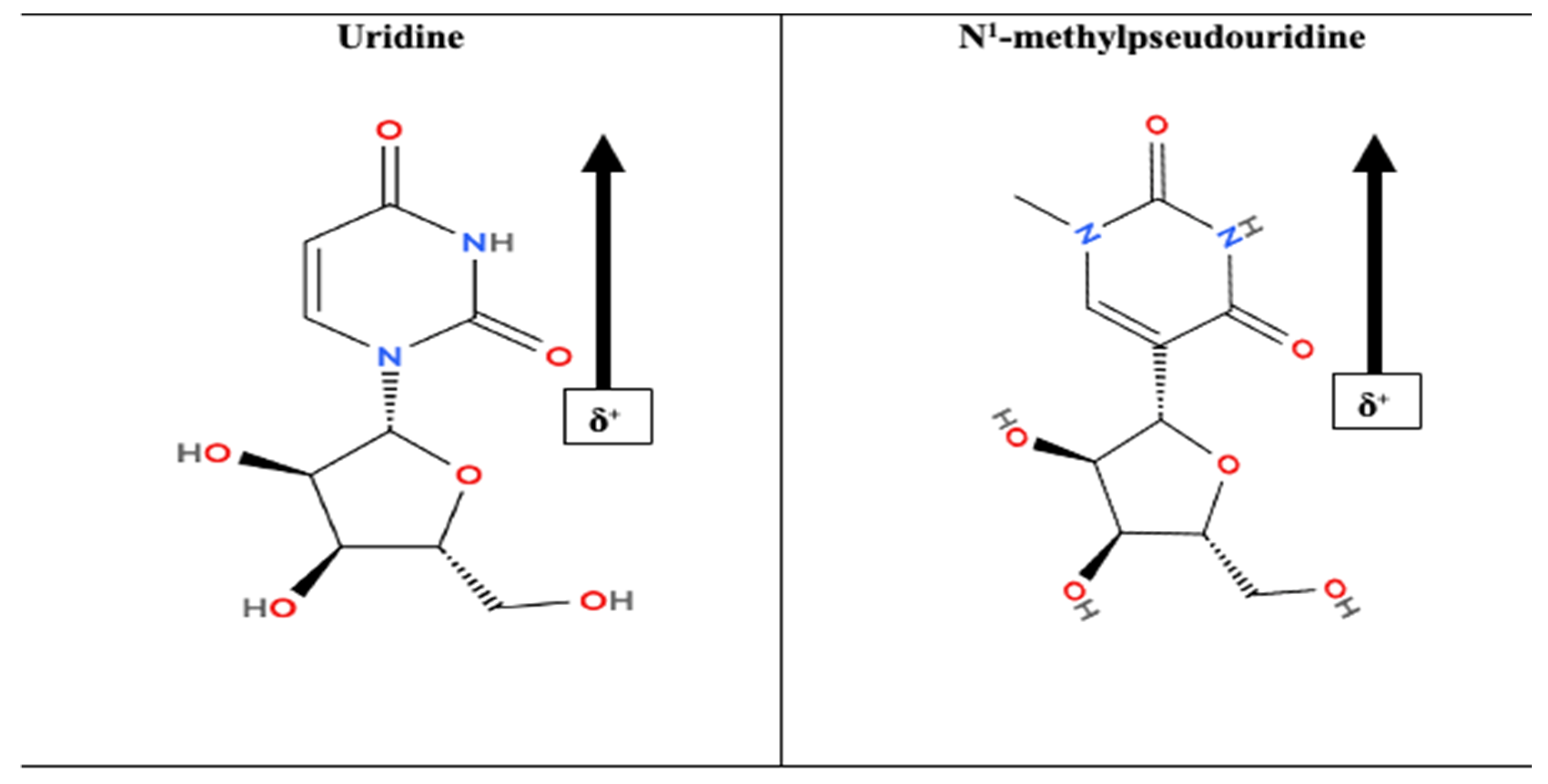
In DNA’s B form, the deoxyribose scaffold tends to support more uniform directional coherence, whereas in RNA’s A form, 2′-OH introduces a polar feature that softens specific vibrational modes and generates a more anisotropic energy landscape. Against this polarized backbone environment, each nucleobase contributes its own intrinsic dipole moment, which varies in both magnitude and orientation. Uridine and N1-methylpseudouridine illustrate this contrast clearly. The altered heteroatom placement and C-glycosidic linkage in N1-methylpseudouridine reorient the dominant base dipole relative to the ribose, changing how the base couples to the backbone’s electrostatic field. These base-specific differences do not replace the backbone contribution but modulate it, producing distinct local perturbation profiles that may influence stacking and hydration, and could plausibly contribute to decoding behavior.
4.3. Backbone Dipole Asymmetry and the Anisotropic Scaffold
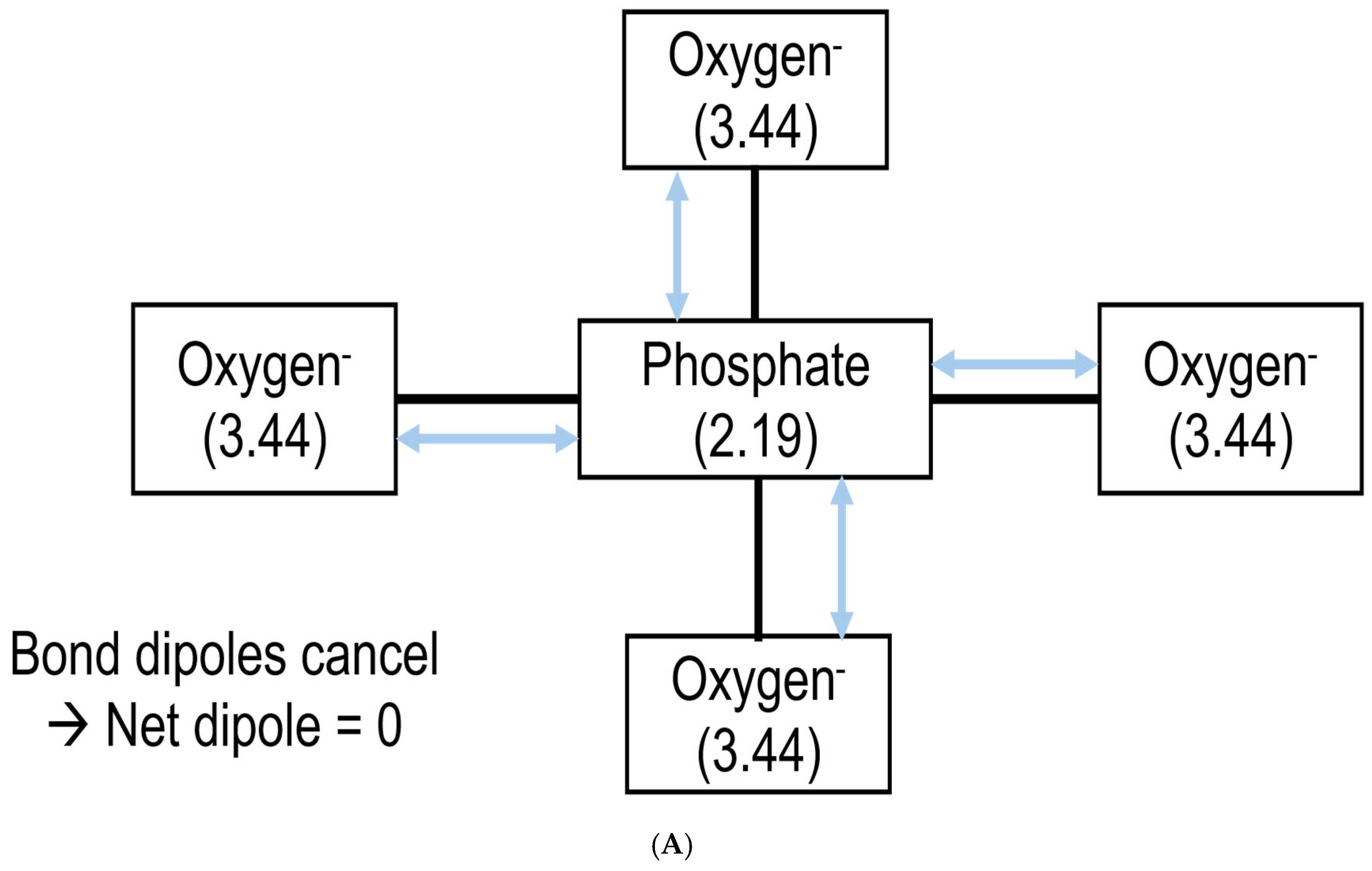
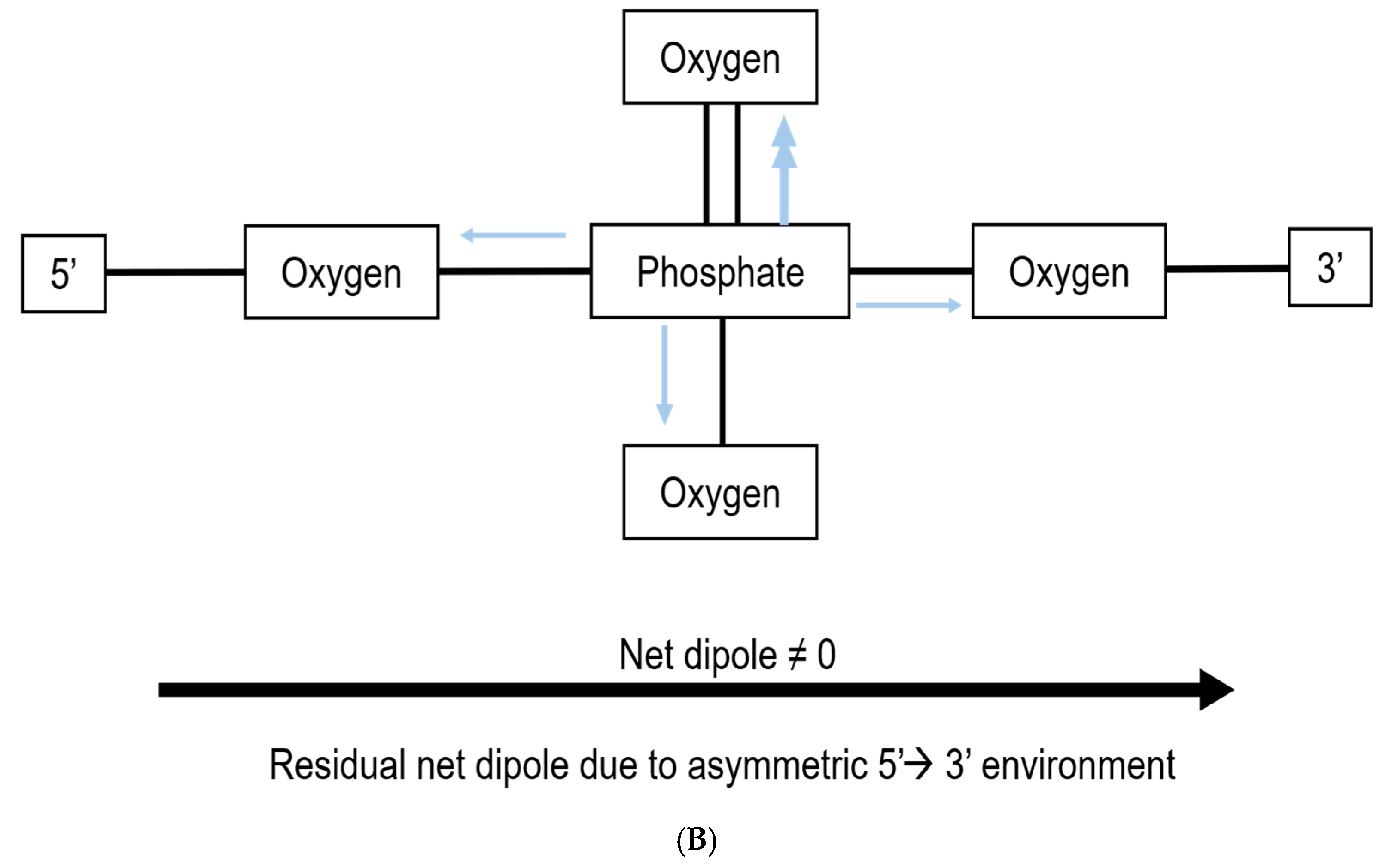
A useful starting point is the geometry of the phosphate group. A free PO
43− ion exhibits tetrahedral symmetry, causing its four P–O bond dipoles to cancel (
Figure 2A). In nucleic acids, however, phosphodiester formation breaks this symmetry: two oxygens form ester linkages to the ribose, while the remaining non-bridging oxygens retain higher electronegativity. This asymmetry prevents full dipole cancelation and produces a net dipole moment for each phosphate (
Figure 2B; see caption for details). The repeating orientation of these phosphate dipoles forms a polarized electrostatic “scaffold” along the backbone, establishing the anisotropic environment in which vibronic interactions occur. This may provide a complementary perspective on possible functional implications [
19].
4.4. Vibronic Coupling and the System-Bath Framework
From an open-quantum-systems perspective, the PO4 backbone can be viewed not as a featureless thermal bath but as a structured electrostatic environment. The periodic electronegativity gradient across the backbone creates a quasi-regular potential landscape that may impart subtle directionality or anisotropy to vibrational relaxation. From this point of view, the backbone provides a stable electrostatic scaffold, while nucleobase-specific electron density rearrangements introduce tunable local perturbations.
To formalize this idea, a minimal system–bath Hamiltonian can be written as:
where
This framework does not assert a dominant quantum contribution; rather, it provides a tractable way to evaluate whether EN-driven electrostatic structure can measurably bias pathways. While intentionally qualitative, it establishes a physically consistent scaffold that could be expanded using polarizable force fields, QM/MM approaches, or explicit solvent models [
9,
10].
Consequently, the degree of anisotropic amplification may scale proportionally with the local electronegativity gradient, consistent with the dependence of the vibronic coupling term:
Pauling electronegativity is used here only as a qualitative, atom-resolved heuristic to highlight patterns in electron-withdrawing tendency, not as a literal spatial electrostatic field.
4.5. Dipole Reorientation and Local Electrostatic Effects
The overall dipole moments of uridine monophosphate (UMP) and N
1-methylpseudouridine monophosphate (m
1Ψ-MP) may be influenced by the highly polarized phosphate group. However, the two nucleotides differ in how the base contributes to the total molecular polarity. In UMP, the uracil ring’s intrinsic dipole, arising primarily from the C2=O and C4=O carbonyls, aligns in a relatively canonical orientation relative to the ribose–phosphate axis. In m
1Ψ-MP, the C-glycosidic linkage and the N1-methyl substituent reorient this base dipole and redistribute electron density within the ring. As a result, the magnitude of the total dipole is expected to remain phosphate-dominated, while the direction of the base-contributed dipole vector is expected to shift in a way that is computationally and experimentally detectable. A qualitative comparison of these dipole vectors is shown in
Figure 3 [
2].
This reorientation modifies the local electrostatic field, perturbs the preferred orientation of nearby water molecules, and may subtly influence base-stacking interactions and hydration patterns in larger RNA contexts. These mechanistic effects are consistent with the functional outcomes reported by Rozman et al. (2026) and Ho et al. (2024) [
20,
21]. A qualitative comparison of the dipole vectors (
Figure 3) illustrates how this small architectural change can produce anisotropic effects even though the global polarity remains phosphate-dominated. Such dipole reorientation provides a plausible mechanism by which m
1Ψ can influence interactions with the ribosomal decoding center and surrounding solvent, contributing to the observed changes in translational fidelity [
2,
12].
Experimental observations of charge transport along short, base-stacked single-stranded RNA molecules support the view that nucleic acids can sustain localized or directional electronic effects on short length scales [
5]. Related behavior is established in DNA, where long-distance hopping mechanisms have been characterized extensively [
6]. These findings suggest that small perturbations may follow “softer”, directionally biased energetic pathways rather than dissipating uniformly across the structure.
4.6. The Magic Methyl Effect
Although m
1Ψ adds only approximately 14 Da per substitution, the incorporation of a methyl group is well known in medicinal chemistry to produce disproportionately large functional effects, known as the “magic methyl” phenomenon [
22,
23,
24,
25]. This principle is consistent with reports of altered local electronic structure and translation dynamics following m
1Ψ incorporation; these observations motivate the hypothesis that methylation-driven dipole reorientation may contribute to changes in ribosomal processivity [
2,
12,
20,
21].
The decisive variable is not the added mass but the
location and electronic character of the modification. N
1-methylpseudouridine (m
1Ψ) introduces a C-methyl substituent and a C-glycosidic linkage that redistribute electron density within the base, reorient the dominant dipole, and alter stacking interactions [
26]. Its ~40% reduced absorbance at 260 nm relative to uridine reflects differences in the molar extinction coefficient and π-stacking behavior, which are strongly sequence-dependent and require specialized correction (e.g., mRNACalc) for accurate quantification [
27].
These architectural changes could shift vibrational frequencies and energetic thresholds that might be relevant to ribosomal stepping, potentially contributing to outcomes such as increased +1 frameshifting [
2,
28]. In this sense, m
1Ψ exemplifies how small, localized modifications can produce anisotropic perturbations within RNA’s polarized electrostatic environment.
4.7. Viral Frameshifting and Synthetic mRNA Parallels
Viral phenotypes may often reflect interactions among sequence, structure, and physicochemical features, including those extending beyond simple replication [
29]. Programmed ribosomal frameshifting is a common strategy used by many viruses to expand coding capacity from compact genomes, and its efficiency is highly sensitive to local RNA structure and sequence context [
30].
Because the same phosphodiester backbone principles and electronegativity gradients govern both natural viral RNAs and synthetic mRNA constructs, localized modifications such as m
1Ψ may generate analogous anisotropic perturbations in designed systems. This raises testable questions regarding translational fidelity and proteomic outcomes in mRNA platforms, as outlined in
Table 2 [
28].
By contrast, DNA’s more rigid scaffold may dampen such amplification, helping preserve its long-range stability. This distinction highlights how RNA’s more flexible, polarized architecture can amplify small perturbations in ways DNA does not.
5. Experimentation and Future Directions
Several experimentally accessible strategies may help evaluate the electromagnetic blueprint proposed here and the potential quantum overlays associated with it. Density functional theory (DFT) simulations could quantify how Pauling-scale EN patterns influence orbital overlaps, partial charges, and vibronic features. Comparative DFT analyses of unmodified and m1Ψ-substituted sequences may clarify how N1-methylation redistributes electron density, alters dipole moments, and adjusts activation barriers relevant to vibrational relaxation and charge-transfer pathways.
5.1. Spectroscopy and Single-Molecule Approaches
Two-dimensional infrared (2D IR) spectroscopy provides a promising avenue. By tracking changes in anharmonic coupling, coherence lifetimes, and delocalized vibrational modes, this technique can directly probe the anisotropic vibrational landscapes predicted for DNA and modified mRNA helices. Because the relevant vibrational modes fall within the femtosecond–picosecond decoherence window, 2D IR is well suited to test whether structured electrostatic environments bias relaxation pathways in a manner consistent with the quantum overlay framework.
At the mesoscale, single-molecule approaches, such as electrostatic force microscopy, nanopore conductance assays, or DNA/RNA nanowire measurements, could assess field perturbations and charge-transfer behavior along the backbone. Likewise, single-molecule fluorescence or optical-tweezer studies of ribosomes translating native versus m1Ψ-containing mRNAs may reveal differences in pausing kinetics or frameshift tendencies that relate to anisotropic amplification.
5.2. Computational and Informational Applications
Future work may also explore synthetic nucleic acids designed with tailored EN profiles, including halogenated or methylated bases, to more directly test the functional roles of the dual-system framework and to gauge the extent of any quantum overlay contributions. Such experiments would help distinguish classical electrostatic effects from potential vibronic or structured-bath influences and could guide the rational design of therapeutic mRNAs that maintain natural dynamical behavior while achieving the desired stability.
Beyond experimental validation, the electronegativity-based framework may offer new opportunities in computational biology and information science. Because EN patterns generate reproducible, atom-resolved electrostatic signatures, they could be incorporated into bioinformatic pipelines for sequence classification, secondary-structure prediction, or the identification of regions with atypical electronic environments. EN-derived descriptors may also complement emerging machine-learning approaches that integrate quantum-mechanical or geometric features into nucleic acid modeling [
31,
32]. Recent advances in neural-network-based prediction of DNA electron densities further illustrate how physicochemical descriptors can be embedded into data-driven architectures [
33,
34]. In principle, the structured and sequence-dependent EN landscape could support applications in DNA or RNA cryptography, where tunable electrostatic patterns provide an additional encoding layer beyond canonical base identity [
35]. These possibilities remain speculative but illustrate how the proposed framework may intersect with emerging computational and information-theoretic approaches.
6. Discussion and Conclusions
This Perspective has outlined an electromagnetic framework for nucleic acid behavior grounded in classical Pauling electronegativity patterns. The analysis reveals a coherent architectural logic: a largely invariant, high-EN phosphodiester backbone that serves as a stable electrostatic scaffold, overlaid with sequence-specific electron density perturbations from the nucleobases that create tunable recognition fields.
A central implication of this framework is the concept of anisotropic amplification. Within RNA’s inherently polarized electrostatic environment, even small architectural modifications, such as the ~14 Da increment introduced by N1-methylpseudouridine, may produce measurable effects on dipole orientation, vibrational relaxation, and ribosomal processivity. These outcomes arise less from changes in bulk mass than from how localized perturbations interact with the anisotropic energy landscape of the backbone.
The proposed framework is deliberately modest in scope. It does not claim long-lived quantum coherence or non-classical information processing. Instead, it suggests that short-timescale vibronic interactions, occurring within the femtosecond-to-picosecond decoherence window, may be subtly and potentially biased by structured electrostatic environments. This interpretation remains fully compatible with open-quantum-systems descriptions and known physical constraints, and aligns with broader integrative, non-reductive frameworks in biophysics [
36].
Several limitations should be acknowledged. Pauling electronegativity is a static, empirical scale derived from simple molecules. In the dynamic, aqueous, and ion-rich cellular environment, effective electrostatic and vibrational behaviors are further shaped by molecular polarizability, solvent screening, counterion condensation, and conformational fluctuations. More advanced computational approaches, including polarizable force fields, QM/MM hybrids, and explicit-solvent models, will be needed to capture these dynamic contributions quantitatively.
Looking ahead, the proposed framework points toward several experimentally testable directions. These include ultrafast 2D IR spectroscopy to probe sequence-dependent vibrational relaxation, single-molecule studies of ribosomal kinetics on modified versus unmodified mRNAs, and computational modeling of how EN gradients influence vibronic coupling. Such work may help illuminate factors contributing to the differing stabilities of DNA and RNA, the functional consequences of nucleoside modifications, and design principles relevant to next-generation therapeutic nucleic acids.
In summary, this Perspective highlights an under-explored electromagnetic dimension of nucleic acid architecture. By integrating classical electronegativity patterns with short-timescale quantum-influenced dynamics, it offers a complementary lens through which to examine both natural and synthetic nucleic acid systems.
Funding
This research received no external funding.
Data Availability Statement
No new data were created or analyzed in this study. Data sharing is not applicable to this article.
Acknowledgments
The author used Microsoft Copilot (April 2026) solely for reference formatting and citation verification. All original ideas, analyses, interpretations, and textual content were conceived and written by the author.
Conflicts of Interest
The author declares no conflicts of interest. I declare that I am an unpaid Associate Editor for the International Journal of Vaccine Theory, Practice, and Research. I have no financial ties, consultancy roles, stock ownership, or paid advisory positions related to the content of this manuscript and declare no other competing interests.
References
- Pauling, L.C. The nature of the chemical bond. IV. The energy of single bonds and the relative electronegativity of atoms. J. Am. Chem. Soc. 1932, 54, 3570–3582. [Google Scholar] [CrossRef]
- Santiago, D. Quantum energetics in the differential dynamics of transient mRNA versus stable DNA. Int. J. Innov. Res. Med. Sci. 2025, 10, 338–351. [Google Scholar] [CrossRef]
- Peng, C.S.; Jones, K.C.; Tokmakoff, A. Anharmonic vibrational modes of nucleic acid bases revealed by 2D IR spectroscopy. J. Am. Chem. Soc. 2011, 133, 15650–15660. [Google Scholar] [CrossRef] [PubMed]
- Crespo-Hernández, C.E.; Cohen, B.; Hare, P.M.; Kohler, B. Ultrafast excited-state dynamics in nucleic acids. Chem. Rev. 2004, 104, 1977–2019. [Google Scholar] [CrossRef] [PubMed]
- Chandra, S.; Williams, A.; Maksudov, F.; Kliuchnikov, E.; Arachchillage, K.G.G.P.; Piscitelli, P.; Castillo, A.; Marx, K.A.; Barsegov, V.; Vivancos, J.M.A. Charge transport in individual short base-stacked single-stranded RNA molecules. Sci. Rep. 2023, 13, 19858. [Google Scholar] [CrossRef] [PubMed]
- Giese, B. Long-distance charge transport in DNA: The hopping mechanism. Acc. Chem. Res. 2000, 33, 631–636. [Google Scholar] [CrossRef] [PubMed]
- Scherer, P.O.J.; Fischer, S.F. Charge Transfer in DNA. In Theoretical Molecular Biophysics; Biological and Medical Physics, Biomedical Engineering; Springer: Berlin/Heidelberg, Germany, 2017. [Google Scholar] [CrossRef]
- Voityuk, A.A. Electronic coupling for charge transfer in donor-bridge-acceptor systems. Performance of the two-state FCD model. Phys. Chem. Chem. Phys. 2012, 14, 13789–13793. [Google Scholar] [CrossRef] [PubMed]
- Zgarbová, M.; Otyepka, M.; Šponer, J.; Mládek, A.; Banáš, P.; Cheatham, T.E.; Jurečka, P. Refinement of the Cornell et al. nucleic acids force field based on reference quantum chemical calculations of glycosidic torsion profiles. J. Chem. Theory Comput. 2017, 13, 5723–5736. [Google Scholar] [CrossRef] [PubMed]
- Šponer, J.; Krepl, M.; Banáš, P.; Kührová, P.; Zgarbová, M.; Jurečka, P.; Havrila, M.; Otyepka, M. How to understand atomistic molecular dynamics simulations of RNA and protein–RNA complexes? WIREs RNA 2017, 8, e1405. [Google Scholar] [CrossRef]
- Zgarbová, M.; Luque, F.J.; Sponer, J.; Cheatham, T.E.; Otyepka, M.; Jurečka, P. Toward Improved Description of DNA Backbone: Revisiting Epsilon and Zeta Torsion Force Field Parameters. J. Chem. Theory Comput. 2013, 9, 2339–2354. [Google Scholar] [CrossRef] [PubMed]
- Santiago, D. Antigen anisotropy: The overlooked geometric determinant of vaccine immunogenicity and fidelity. Hum. Vaccines Immunother. 2026, 22, 2638640. [Google Scholar] [CrossRef] [PubMed]
- Ghosh, D.C. A new scale of electronegativity based on absolute radii of atoms. J. Theor. Comput. Chem. 2005, 4, 21–33. [Google Scholar] [CrossRef]
- Šponer, J.; Mládek, A.; Šponer, J.E.; Svozil, D.; Zgarbová, M.; Banáš, P.; Jurečka, P.; Otyepka, M. The DNA and RNA sugar–phosphate backbone emerges as the key player. Phys. Chem. Chem. Phys. 2012, 14, 15257–15277. [Google Scholar] [CrossRef] [PubMed]
- Fedeles, B.I.; Li, D.; Singh, V. Structural insights into tautomeric dynamics in nucleic acids and antiviral nucleoside analogs. Front. Mol. Biosci. 2022, 8, 823253. [Google Scholar] [CrossRef] [PubMed]
- Lu, X.-J.; Olson, W.K. 3DNA: A software package for the analysis, rebuilding and visualization of three-dimensional nucleic acid structures. Nucleic Acids Res. 2003, 31, 5108–5121. [Google Scholar] [CrossRef] [PubMed]
- Ghosh, A.; Bansal, M. A glossary of DNA structures from A to Z. Acta Crystallogr. Sect. D Biol. Crystallogr. 2003, 59, 620–626. [Google Scholar] [CrossRef] [PubMed]
- Ishizaki, A.; Fleming, G.R. Theoretical examination of quantum coherence in photosynthetic light harvesting. J. Chem. Phys. 2009, 130, 234111. [Google Scholar] [CrossRef] [PubMed]
- Ramesh, V.; Krishnan, J. Symmetry breaking meets multisite modification. eLife 2021, 10, e65358. [Google Scholar] [CrossRef] [PubMed]
- Rozman, B.; Broennimann, K.; Rajan, K.S.; Nachshon, A.; Saha, C.; Arazi, T.; Mohan, V.; Geiger, T.; Wollner, C.J.; Richner, J.M.; et al. N1-methylpseudouridine directly modulates translation dynamics. Nature 2026, 651, 533–541. [Google Scholar] [CrossRef] [PubMed]
- Ho, L.L.Y.; Schiess, G.H.A.; Miranda, P.; Weber, G.; Astakhova, K. Pseudouridine and N1-methylpseudouridine as potent nucleotide analogues. RSC Chem. Biol. 2024, 5, 418–425. [Google Scholar] [CrossRef] [PubMed]
- Schönherr, H.; Cernak, T. Profound methyl effects in drug discovery. Angew. Chem. Int. Ed. 2013, 52, 12256–12260. [Google Scholar] [CrossRef] [PubMed]
- Barreiro, E.J.; Kümmerle, A.E.; Fraga, C.A. The methylation effect in medicinal chemistry. Chem. Rev. 2011, 111, 5215–5246. [Google Scholar] [CrossRef] [PubMed]
- Nippa, D.F.; Hohler, R.; Stepan, A.F.; Grether, U.; Konrad, D.B.; Martin, R.E. Late-stage functionalization and its impact on modern drug discovery. Chimia 2022, 76, 258–260. [Google Scholar] [CrossRef]
- Nance, K.D.; Meier, J.L. Modifications in an emergency: The role of N1-methylpseudouridine in COVID-19 vaccines. ACS Cent. Sci. 2021, 7, 748–756. [Google Scholar] [CrossRef] [PubMed]
- Dutta, N.; Deb, I.; Sarzynska, J.; Lahiri, A. Structural and thermodynamic consequences of base pairs containing pseudouridine and N1-methylpseudouridine. ChemistrySelect 2025, 10, e202400006. [Google Scholar] [CrossRef]
- Finol, E.; Krul, S.E.; Hoehn, S.J.; Lyu, X.; Crespo-Hernández, C.E. The mRNACalc webserver. Mol. Ther.–Nucleic Acids 2024, 35, 102171. [Google Scholar] [CrossRef] [PubMed]
- Mulroney, T.E.; Pöyry, T.; Yam-Puc, J.C.; Rust, M.; Harvey, R.F.; Kalmar, L.; Horner, E.; Booth, L.; Ferreira, A.P.; Stoneley, M.; et al. N1-methylpseudouridylation of mRNA causes +1 ribosomal frameshifting. Nature 2024, 625, 189–194. [Google Scholar] [CrossRef] [PubMed]
- DeLong, J.P.; Al-Sammak, M.A.; Al-Ameeli, Z.T.; Dunigan, D.D.; Edwards, K.F.; Fuhrmann, J.J.; Gleghorn, J.P.; Li, H.; Haramoto, K.; Harrison, A.O.; et al. Towards an integrative view of virus phenotypes. Nat. Rev. Microbiol. 2022, 20, 83–94. [Google Scholar] [CrossRef] [PubMed]
- Hill, C.H.; Brierley, I. Structural and functional insights into viral programmed ribosomal frameshifting. Annu. Rev. Virol. 2023, 10, 217–242. [Google Scholar] [CrossRef] [PubMed]
- Masuda, K.; Abdullah, A.A.; Pflughaupt, P.; Sahakyan, A.B. Quantum mechanical electronic and geometric parameters for DNA k-mers. Sci. Data 2024, 11, 911. [Google Scholar] [CrossRef] [PubMed]
- Shi, Q.; Lv, H.; Wang, F.; Fan, C.; Li, M. Machine learning-driven molecular engineering of nucleic acids. Chem. Soc. Rev. 2026, 55, 3810–3833. [Google Scholar] [CrossRef] [PubMed]
- Lee, A.J.; Rackers, J.A.; Bricker, W.P. Predicting accurate ab initio DNA electron densities with equivariant neural networks. Biophys. J. 2022, 121, 3883–3895. [Google Scholar] [CrossRef] [PubMed]
- Lee, A.J.; Rackers, J.A.; Pathak, S.; Bricker, W.P. Building an ab initio solvated DNA model using Euclidean neural networks. PLoS ONE 2024, 19, e0297502. [Google Scholar] [CrossRef] [PubMed]
- Akhtar, M.N.; Awan, J.H.; Asad, A.M.S.; Kim, M.Y. Integrating molecular biology and cryptography. Int. J. Mol. Sci. 2026, 27, 4522. [Google Scholar] [CrossRef] [PubMed]
- Seifert, V.A. An alternative approach to unifying chemistry with quantum mechanics. Found. Chem. 2017, 19, 209–222. [Google Scholar] [CrossRef]
| Disclaimer/Publisher’s Note: The statements, opinions and data contained in all publications are solely those of the individual author(s) and contributor(s) and not of MDPI and/or the editor(s). MDPI and/or the editor(s) disclaim responsibility for any injury to people or property resulting from any ideas, methods, instructions or products referred to in the content. |