


Abstract
Violations of Bell inequalities are commonly interpreted as evidence for nonlocal influences or as constraints on realist descriptions. We show that the failure of Bell-type factorizability arises naturally when observable outcomes are obtained through a non-injective mapping from an underlying configuration space. In this setting, the standard factorization assumption can be viewed as an implicit requirement that observable variables admit a jointly factorizable completion at the underlying level. We demonstrate that this requirement need not hold when the mapping from underlying configurations to observables is many-to-one. The resulting breakdown of probabilistic factorization does not rely on superluminal dynamics or hidden causal influences, but follows from information loss under projection. Observable outcomes correspond to equivalence classes of underlying configurations, preventing the assignment of independent local variables. We illustrate this mechanism with an explicit toy model producing Bell–CHSH violations while preserving operational no-signalling and statistical independence of measurement settings. The model is not intended to reproduce quantum correlations quantitatively, and may exceed the Tsirelson bound; its role is to isolate the structural origin of the violation. This analysis does not contradict Bell’s theorem, but identifies a class of effective descriptions for which its factorizability assumption does not apply. The framework preserves locality at the underlying level, introduces no additional hidden-variable dynamics, and does not modify quantum mechanics. It clarifies how classical factorization is recovered in regimes where the effective mapping becomes approximately injective. In the operator language of quantum theory, the same mechanism admits a natural reformulation in terms of reduction to an effective observable subalgebra by a noncommutative conditional expectation.
1. Introduction
The experimental violation of Bell inequalities stands as one of the most robust and conceptually challenging features of quantum theory. Repeated tests have confirmed that correlations observed between spacelike separated measurement outcomes cannot be reproduced by any local hidden-variable model satisfying statistical factorization. This empirical fact is commonly interpreted as requiring either nonlocal dynamics, the abandonment of realism, or more radical departures from classical causal intuition.
Despite these conclusions, it is important to recall that Bell inequalities do not constrain physical dynamics directly. They constrain the logical and probabilistic structure of effective descriptions, specifically the assumption that joint outcome probabilities factorize into independent local contributions conditioned on a complete specification of relevant variables. In modern terms, this assumption can be analyzed through decompositions of locality conditions into parameter and outcome independence, as emphasized in foundational discussions of Bell’s theorem. The failure of Bell inequalities therefore indicates a breakdown of effective factorization, but does not, by itself, mandate superluminal influences or causal nonlocality.
Although the present paper is formulated in a classical measure-theoretic language for maximal transparency, the mechanism studied here is not restricted to commutative probability. A noncommutative reformulation in terms of conditional expectations onto observable subalgebras [1] will be made explicit in Section 5.
In this work, we explore a general and minimal mechanism by which Bell-type correlations may arise without invoking nonlocal dynamics, retrocausality, or hidden variables. The central observation is that effective physical descriptions typically arise through many-to-one mappings from underlying configurations to observable outcomes. When this mapping is non-injective, distinct underlying configurations correspond to the same observable description, leading generically to a loss of factorization at the level of observable probabilities.
This mechanism can be viewed as a structural refinement of the assumptions entering Bell-type factorizability. It is closely related in spirit to contextuality-based approaches, in which observable statistics arise from coarse-grained descriptions of a richer underlying state space, and to general analyses of probabilistic representations in which observable variables do not admit a jointly factorizable completion [2,3,4]. As noted by Shimony and elaborated in the probabilistic framework of Dzhafarov and Kujala [2], violations of Bell inequalities demonstrate the presence of contextuality rather than nonlocality per se; Sulis has further shown that such violations require at least one joint probability to be non-factorisable, establishing non-factorisability as a necessary condition for violation [5].
The present work shares this structural perspective but differs in a crucial respect. In contextuality-based approaches, non-factorisability is typically introduced at the level of probabilistic descriptions and may apply to any system, quantum or classical, that admits a contextual probabilistic model—including systems arising in psychology or economics [5,6]. Here, by contrast, non-factorisability is derived as a structural consequence of a specific physical constraint: the non-injective character of the projection from an underlying configuration space to the effective observable description. This projection is not postulated for modelling purposes, but arises naturally in relational frameworks where observable descriptions emerge from a higher-dimensional configuration space admitting a non-injective projection onto observable descriptions [7]. The result is that non-injectivity provides a sufficient structural condition for the failure of Bell factorizability, complementing the necessary-condition results established in the contextuality literature.
We further argue that such non-injectivity is not an arbitrary feature, but the natural consequence of a finite descriptive capacity of effective observables. Observable states correspond not to individual microscopic configurations, but to equivalence classes whose multiplicity reflects a bounded resolution of the effective description. In this sense, non-injectivity can be understood as the manifestation of a finite projective capacity, which limits the amount of distinguishable information that can be encoded in observable variables.
Within this framework, joint probabilities arise from averaging over entire classes of underlying configurations. Even if the underlying dynamics is local and deterministic, the induced probability structure at the observable level does not admit a factorized representation. The violation of Bell inequalities is thus traced to a structural property of the descriptive mapping itself, rather than to any dynamical nonlocality.
The effective loss of information associated with this projection is not arbitrary. In physical realizations, it is controlled by a finite resolution scale, set in quantum theory by Planck’s constant h, which determines the minimal distinguishability of underlying configurations. Quantum states therefore correspond to finite-capacity equivalence classes rather than sharply defined microscopic states. The breakdown of factorization reflects this irreducible coarse-graining, not an epistemic lack of knowledge.
This perspective also provides a natural characterization of the quantum-to-classical transition. In regimes where the effective descriptive capacity is large compared to the occupied state space, the mapping becomes approximately injective. In this low-occupancy regime, observable probabilities recover an approximately factorized form and Bell violations are suppressed. Classical statistical independence thus appears as a limiting case of effective injectivity, rather than as a fundamental principle.
The scope of the present work is deliberately restricted. We do not propose a modification of quantum dynamics, introduce additional physical degrees of freedom, or advance a specific underlying dynamical model. Our analysis is structural in nature and concerns the logical conditions under which Bell-type inequalities apply to effective descriptions. By isolating non-injective projection, understood as a finite-capacity effect, as a sufficient mechanism for the failure of factorization, we aim to clarify the conceptual origin of quantum correlations while preserving both operational locality and the empirical content of quantum theory. The present work does not introduce new physical predictions. Its aim is to identify structural constraints on the class of effective descriptions to which Bell-type inequalities apply.
The non-injective projection considered here is not introduced ad hoc, but arises naturally in relational frameworks in which observable descriptions emerge as projections of a higher-dimensional configuration space, as discussed in [7].
2. Non-Injective Projection and the Failure of Bell Factorization
We consider a minimal abstract setting in which observable descriptions arise from an underlying configuration space through a generally many-to-one mapping. Let denote the space of underlying configurations. This space represents a structural configuration space underlying the effective description, rather than a physical state space evolving in spacetime. Observable outcomes are defined through a projection
where is the space of observable states or measurement outcomes. Crucially, is assumed to be non-injective so that multiple distinct elements of correspond to the same observable description.
Such non-injective mappings arise generically when observable descriptions have a finite descriptive capacity. In this case, the effective space cannot encode all distinctions present in , and observable states correspond to equivalence classes of underlying configurations rather than to individual elements.
Here denotes an underlying configuration space from which effective observables arise through projection. Such configuration spaces appear in various approaches where observable descriptions are obtained through coarse-graining of a more detailed state space. Examples arise in relational or spectral reconstruction approaches [7]. This configuration space should not be interpreted as a hidden physical state space or as an ontological completion of quantum mechanics. It does not provide additional outcome-defining variables accessible at the effective level. Rather, it is introduced as a structural space of admissible configurations underlying the effective description, whose projection properties determine the observable statistics.
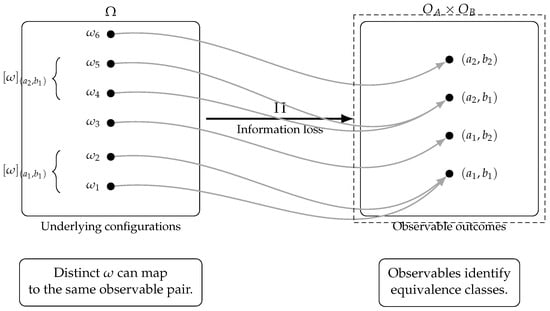
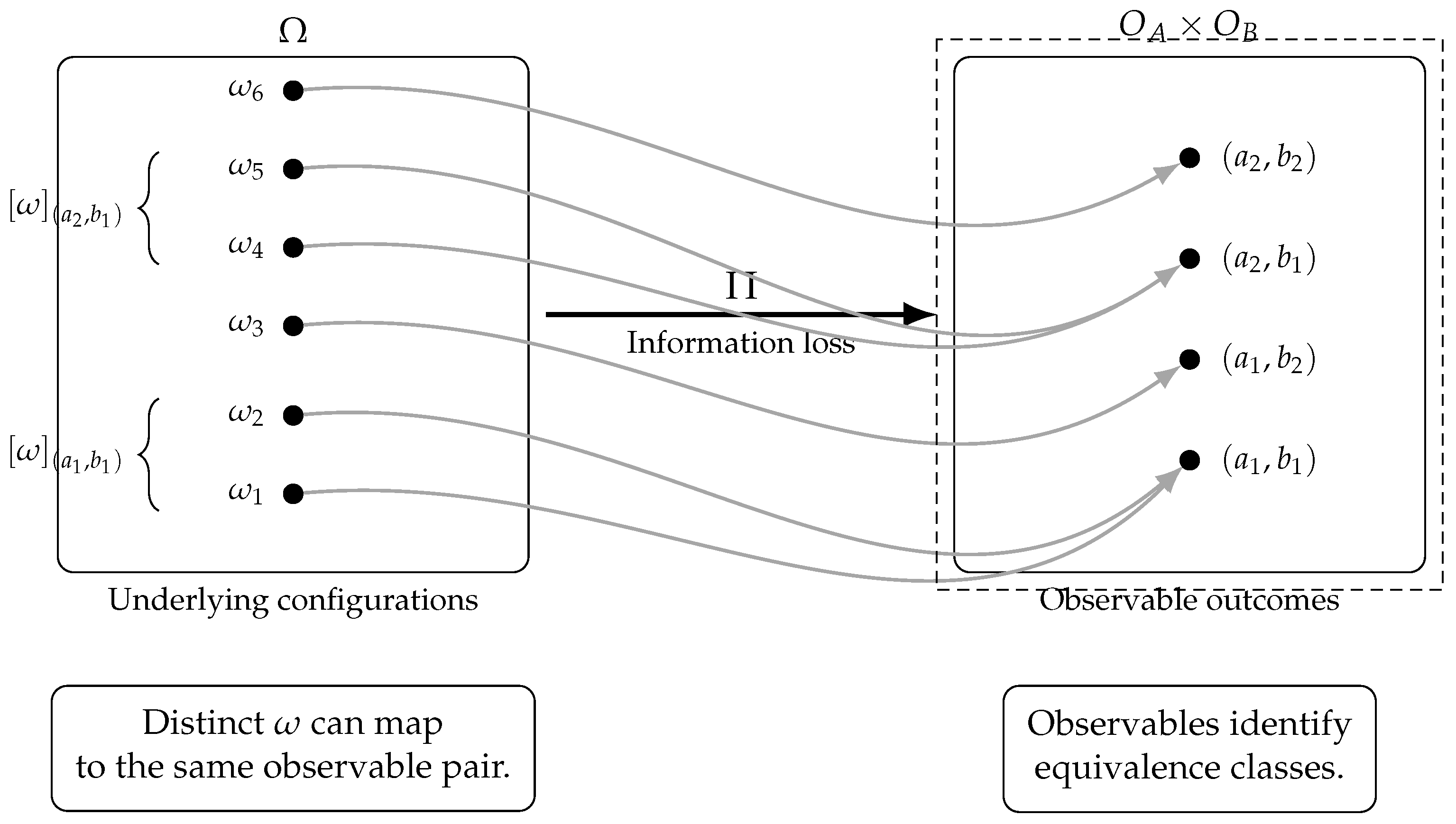
Figure 1 provides a schematic illustration of this many-to-one projection mechanism. A concrete toy model making this structure explicit is presented in Appendix B.
Figure 1.
Schematic non-injective projection from the underlying configuration space to the observable outcome space . Multiple underlying configurations correspond to the same observable pair , defining equivalence classes. This many-to-one identification induces a generic failure of probabilistic factorization at the observable level without requiring nonlocal dynamics.
Let A and B denote two spacelike separated measurement settings, with corresponding observable outcomes and . In standard local hidden-variable models, one assumes the existence of a variable such that the joint probability distribution factorizes as
Bell inequalities follow from this factorization together with statistical independence assumptions on .
In the present framework, no such factorization is generically available. Because the observable outcomes are obtained through the projection , the probability distribution accessible at the effective level is given by
where is a probability measure on , and denotes the set of underlying configurations compatible with the joint observable outcome .
When is non-injective, the preimage does not decompose into independent subsets associated with A and B. The same underlying configuration may therefore contribute simultaneously to the preimages of several observable outcome pairs, preventing the introduction of response functions and whose joint statistics reproduce through a factorizable form. As a result, the joint probability does not admit a representation as a product of marginal probabilities conditioned on any set of effective variables. The failure of factorization arises from the structure of the projection itself, not from any dynamical interaction between the measurement regions.
Importantly, locality at the underlying level is preserved. The measure may be defined over configurations with strictly local causal structure, and no superluminal influence or signal exchange is required. The violation of Bell inequalities therefore reflects a mismatch between the factorizable structure assumed in Bell-type derivations and the actual structure of effective descriptions induced by non-injective mappings.
This observation identifies non-injectivity as a sufficient condition for the failure of Bell factorization. In particular, it shows that the existence of a local and deterministic underlying description is not in contradiction with Bell-type violations, provided that the effective mapping from configurations to observables is non-injective. Bell inequalities constrain only those effective models in which the mapping from underlying configurations to observables is injective or admits an equivalent factorizable representation. When this condition fails, Bell-type correlations may arise without violating local causality at the underlying level.
2.1. Remark on Factorisability
The formal proof that non-injectivity is sufficient to obstruct any factorisable representation is given in Appendix A. The logical chain rests entirely on the projection geometry. Non-injectivity implies that distinct underlying states satisfy , so any candidate hidden variable constructed from observable data must be constant on each equivalence class . Such a cannot distinguish elements within the same fibre, so conditioning on it does not isolate the independent contributions of A and B; the joint probability conditioned on still sums over an entire fibre and generically fails to decompose into independent marginals. No refinement of within the observable algebra can resolve this obstruction: any such refinement leaves the fibre structure—and hence the impossibility of factorisation—intact. No such can therefore reproduce a factorisable representation. The failure of Bell factorisability is therefore a structural consequence of non-injectivity, independent of any assumption about the dynamics or the information loss mechanism, as proved formally in Appendix A.
2.2. Non-Injectivity as a Finite-Capacity Effect
The non-injective character of the projection should not be interpreted as an abstract or ad hoc assumption. It arises naturally when the effective description has a finite capacity to encode distinctions present in the underlying configuration space .
In such regimes, multiple distinct configurations become indistinguishable within the effective description, leading to an objective loss of injectivity of the projection. This loss is structural rather than epistemic: it reflects a limitation of the effective representation itself, not an incomplete specification of underlying variables. Such limitations are familiar in effective physical theories, where coarse-graining, finite resolution, or renormalization procedures reduce the amount of accessible information and lead to emergent descriptions that do not retain full microscopic distinctions.
The multiplicity of pre-images for a given observable outcome naturally defines a structural entropy associated with the projection
where denotes the measure on induced by the underlying dynamics. This projection entropy quantifies the degree of non-injectivity of the effective description and is independent of any notion of epistemic ignorance.
From this perspective, the breakdown of probabilistic factorization can be understood as a consequence of operating in a regime where the effective capacity is not large compared to the set of accessible configurations. In such finite-capacity regimes, distinct underlying configurations necessarily overlap at the level of observables, and factorization fails.
Conversely, when the effective capacity is large compared to the occupied portion of configuration space, the mapping becomes approximately injective and standard factorizable descriptions are recovered.
Violations of Bell-type inequalities thus correspond to the minimal regime in which finite-capacity effects become operationally observable. They can be interpreted as the weakest observable signature of a non-zero projection entropy , without invoking nonlocal dynamics, retrocausal influences, or hidden-variable completions. This suggests that the magnitude of Bell-type violations may be quantitatively controlled by the projection entropy .
2.3. Structural Versus Arbitrary Information Loss
The information loss associated with non-injective projection is not arbitrary. It is entirely determined by the geometric structure of the fibres , which encode the finite projective capacity of the effective description. As a consequence, the resulting ambiguity is not a source of randomness in the usual sense, but a manifestation of structured equivalence classes in the underlying configuration space. The same fibre structure that prevents a factorised hidden-variable description also imposes global consistency constraints on admissible configurations. The observed correlations are therefore not accidental effects of information loss, but necessary consequences of this constrained geometry: they arise from the fact that distinct underlying configurations, although indistinguishable at the observable level, remain jointly constrained within the same fibre structure. In this sense, the apparent tension between the “unpredictability” of information loss and the “controlled” character of quantum correlations is resolved: both are consequences of the same underlying fibre geometry.
2.4. Quantitative Bounds from Projection Entropy
The structural analysis developed above identifies non-injectivity as a sufficient condition for the failure of Bell factorizability. We now refine this result by proposing a minimal quantitative relation between projection entropy and the strength of Bell–CHSH violations.
Let
denote the projection entropy associated with the mapping , where .
We introduce a normalized projection entropy
where is the maximal entropy compatible with the given observable structure.
We propose that the CHSH parameter
is constrained by a monotonic function of of the form
where satisfies
This relation is phenomenological; its boundary conditions are exact consequences of the framework, while the functional form of for intermediate is not determined at the present level of analysis.
This formulation interpolates between three regimes:
- : injective regime, (classical bound);
- : partial overlap, intermediate non-factorizable regime;
- : maximal overlap, (algebraic bound).
The two boundary conditions on are exact consequences of the framework: the classical bound is recovered when is injective (), and the algebraic bound is attained when the projection is maximally non-injective (), as illustrated by the PR-box construction of Appendix B. The specific functional form of for intermediate values is not determined at the present level of analysis and should be regarded as a phenomenological interpolation. Additional structural constraints—in particular the admissibility conditions that select the quantum correlation set within the space of non-factorisable models, as developed in companion work [8]—are needed to fix analytically. operator-algebraic structure of quantum theory. The mechanism it identifies—non-injective projection as the structural origin of Bell-type factorisation failure—is independent of any quantum postulate and operates at a more primitive descriptive level. Accordingly, the toy model of Appendix B does not reproduce the quantum correlation set exactly and may exceed the Tsirelson bound [9]. Its role is solely to show that non-injective projection is a sufficient structural condition for the failure of Bell-type factorisability.
The Tsirelson bound is not an additional assumption within the present programme. When the admissibility structure of the non-injective projection is taken into account, the singlet correlator is derived within the same framework as a structural consequence of the SU(2) geometry of the admissible fibre, without invoking any quantum postulate; the Tsirelson bound then follows as a corollary [8]. The present paper isolates the more primitive structural ingredient; the companion work [8] provides the full quantum realisation. This two-level architecture is deliberate: non-injectivity explains why Bell factorisation fails; operator admissibility selects the quantum correlation set within the space of non-factorisable models [10].
A minimal realization consistent with this constraint is obtained by requiring that saturates at an intermediate value such that
This suggests that quantum correlations correspond to a constrained finite-capacity regime in which projection entropy is non-zero but does not reach its maximal value. The Tsirelson bound then appears as a structural limitation on admissible non-injective projections rather than as a purely dynamical constraint.
The relation (7) therefore provides a minimal quantitative bridge between projection entropy and observable Bell violations, and defines a testable prediction of the present framework: the strength of correlations is controlled by the degree of non-injectivity of the effective description. This relation reflects the loss of factorisable structure under projection-induced information compression: as increases, more underlying distinctions are collapsed at the observable level, deepening the obstruction to any factorised hidden-variable representation.
3. Bell Inequalities Revisited: Structural vs. Dynamical Assumptions
Bell’s theorem is commonly presented as a no-go result for local realist theories. More precisely, it establishes that no model satisfying a specific set of probabilistic assumptions can reproduce all quantum correlations. It is therefore essential to distinguish carefully between the assumptions entering the derivation of Bell inequalities and the physical principles they are often taken to represent.
The derivation of Bell inequalities relies on three key assumptions. First, outcome probabilities are assumed to be well-defined and conditioned on a complete specification of relevant variables. Second, joint probabilities are assumed to factorize for spacelike separated measurements, reflecting the absence of direct causal influence between distant measurement settings. Third, the conditioning variables are assumed to be statistically independent of the measurement choices. Violations of Bell inequalities imply that at least one of these assumptions fails.
In many discussions, the failure of Bell inequalities is interpreted as evidence for a breakdown of locality [11]. However, locality in Bell’s sense is a condition on the factorization of effective probabilities, not a direct statement about the causal structure of the underlying theory. Bell inequalities constrain models in which observable outcomes can be represented as functions of local settings and a shared set of variables that fully determine those outcomes. They do not directly constrain the existence or absence of superluminal interactions. They instead constrain the class of effective descriptions in which observable outcomes can be represented as independently specifiable local variables.
Within the framework considered here, the failure of Bell inequalities originates from the breakdown of effective factorization. As shown in the previous section, non-injective mappings between underlying configurations and observable outcomes generically arise when the effective description has a finite capacity to encode underlying distinctions. In such regimes, no complete set of outcome-defining variables exists at the observable level. Although the underlying description may be local and deterministic, the observable description does not admit a factorized probabilistic representation.
Such non-injective projections need not be regarded as purely abstract constructions. They may arise when the effective observable space is obtained by projecting a higher-dimensional configuration space onto a lower-dimensional description. Geometric realizations, for instance based on fibered structures such as Hopf-type projections, provide concrete examples in which loss of injectivity is controlled by structural invariants associated with the projection.
This distinction clarifies the sense in which Bell’s theorem applies. Bell inequalities are valid only for effective descriptions in which observable outcomes can be parameterized by a set of variables that renders the projection from underlying configurations injective, or at least approximately injective, and therefore factorizable. When this condition is not met, the assumptions required for the derivation of Bell inequalities are violated independently of any consideration of causal nonlocality.
From this perspective, violations of Bell inequalities do not compel the introduction of nonlocal dynamics or retrocausal mechanisms. They instead signal a structural limitation of effective descriptions in which observable outcomes are treated as independently specifiable local properties. Nonlocal correlations arise because joint outcomes must be globally consistent with a single non-factorizable effective description, not because information propagates between distant regions.
The present analysis therefore reframes Bell’s theorem as a constraint on a class of descriptive models rather than as a direct statement about the ontology or dynamics of physical reality. Bell inequalities test the compatibility of observed correlations with injective and factorizable effective descriptions. When non-injective projections are involved, especially in finite-capacity regimes, Bell-type correlations may arise while preserving locality at the underlying level.
4. Measurement, Decoherence, and the Emergence of Classicality
The structural origin of Bell-type correlations identified above naturally raises the question of their apparent absence in classical macroscopic phenomena. Everyday physical systems exhibit effectively local and statistically independent behavior, despite being ultimately composed of quantum constituents. Any satisfactory account of Bell violations must therefore explain not only their existence but also their suppression in the classical limit.
Within the present framework, this transition is understood as a change in the effective properties of the projection from underlying configurations to observable descriptions. While the projection is generally non-injective at microscopic scales, the effective descriptive capacity associated with observable states becomes large compared to the set of configurations that are actually explored. In this regime, the mapping becomes approximately injective.
Decoherence plays an important but secondary role in this process. Through continuous interaction with uncontrolled environmental degrees of freedom, the system is dynamically driven toward states that are stable under coarse-grained observation. This evolution effectively reduces the overlap between distinct underlying configurations contributing to the same observable outcome, thereby pushing the system toward a regime in which the projection behaves as approximately one-to-one [12]. In this regime, the multiplicity of pre-images associated with each observable outcome becomes negligible, and the projection entropy effectively vanishes.
From the perspective of observable descriptions, this corresponds to a regime in which the effective capacity of the description exceeds the occupied portion of configuration space. Global consistency constraints associated with non-injective projections become negligible, and observable outcomes can be treated as effectively independent.
In this regime, joint probabilities admit an approximate decomposition of the form
up to corrections that are exponentially small in the strength of environmental coupling or the degree of coarse-graining. Bell inequalities are therefore not violated in practice, not because the underlying structure has changed, but because the effective description operates in an approximately injective regime.
Importantly, this recovery of classical behavior does not require the introduction of additional collapse postulates or modifications of quantum dynamics. It follows from the same structural mechanism responsible for Bell violations, applied in a regime where the effective descriptive capacity is large compared to the occupied state space. Classicality thus corresponds to a limit in which observable descriptions admit an approximately complete specification, rendering joint probabilities effectively factorizable.
From this viewpoint, the quantum-to-classical transition reflects a change in descriptive accessibility rather than a change in fundamental physical laws. Bell-type correlations are suppressed when finite-capacity effects become negligible in the relevant regime. The classical world emerges as a limit in which effective injectivity is restored, and with it, the validity of classical notions of separability and locality.
5. Discussion and Conceptual Positioning
The analysis presented in this work proposes a structural reinterpretation of Bell inequality violations that avoids introducing nonlocal dynamics, hidden variables, or modifications of quantum mechanics. It is therefore important to clarify how this approach relates to existing interpretations and foundational proposals addressing quantum nonlocality.
Unlike local hidden-variable models, the present framework does not assume the existence of a set of accessible variables that fully determine observable outcomes [13]. No completion of the quantum state is postulated, and no additional degrees of freedom are introduced. The failure of Bell inequalities arises not from incomplete knowledge of underlying variables, but from the non-injective nature of the mapping between underlying configurations and observable descriptions.
The present approach is also distinct from superdeterministic models [14]. While superdeterminism denies statistical independence between measurement settings and underlying variables, no such assumption is required here. Measurement choices remain free and uncorrelated with the underlying configuration space. Bell violations arise solely from the structural properties of effective descriptions, not from conspiratorial correlations between settings and states.
Retrocausal interpretations similarly invoke influences propagating backward in time to account for nonlocal correlations. By contrast, the mechanism discussed here is entirely atemporal at the descriptive level. No causal influence, forward or backward, is required between distant measurement events. Correlations emerge from the global consistency constraints imposed by non-factorizable effective descriptions, rather than from dynamical signaling.
The present framework is compatible with standard accounts of quantum contextuality [15], but shifts the emphasis from contextual measurement dependence to descriptive non-injectivity. Rather than attributing Bell violations to context-dependent properties of observables, we identify a more general structural origin: the impossibility of assigning independent local outcomes within a single effective description when the underlying mapping is many-to-one.
Finally, we stress that the present work does not advocate a specific ontological interpretation of quantum mechanics. It neither endorses nor rejects realism, operationalism, or informational approaches. Our aim is more modest: to isolate a minimal and sufficient structural condition under which Bell-type inequalities fail. This condition is independent of any particular ontological commitment and applies to any framework in which observable descriptions arise through non-injective mappings. Non-injective projection, understood as a finite-capacity effect, provides such a condition, clarifying how quantum correlations can arise without abandoning locality at the underlying level.
In physical realizations, this non-injectivity can be understood as a consequence of finite descriptive capacity. In particular, Planck’s constant h sets a fundamental bound on the distinguishability of underlying configurations, thereby controlling the effective size of the equivalence classes that define observable outcomes.
In this sense, Bell inequality violations may be viewed not as evidence for exotic dynamics, but as indicators of intrinsic limitations of finite-capacity effective descriptions [16]. They reveal the boundaries of applicability of classical probabilistic reasoning, rather than the presence of nonlocal causal mechanisms.
5.1. Relation to Local Hidden-Variable Models
Violations of Bell inequalities are commonly interpreted as ruling out local hidden-variable models. More precisely, Bell’s theorem constrains a class of effective descriptions in which measurement outcomes are assumed to be determined by a set of underlying variables that renders joint probabilities factorizable for spacelike separated measurements.
The analysis presented here clarifies that Bell inequalities do not directly constrain underlying physical dynamics. They constrain the logical structure of effective probabilistic descriptions. When observable outcomes admit an injective or effectively factorizable representation in terms of underlying variables, Bell-type inequalities apply. When this condition fails, Bell-type correlations may arise even if the underlying description is local, deterministic, and causally well behaved.
Within the framework considered here, the failure of Bell inequalities originates from the non-injective nature of the mapping between underlying configurations and observable outcomes. Such non-injectivity arises generically when the effective description has a finite capacity to encode distinctions present at the underlying level. Because multiple underlying configurations correspond to the same effective description, no set of outcome-determining variables exists at the observable level that would allow joint probabilities to be decomposed into independent local contributions.
Bell inequalities are therefore violated not because of nonlocal dynamics, but because the assumptions required for probabilistic factorization are not satisfied in finite-capacity effective descriptions.
5.2. Non-Injective Projection Versus Superdeterminism and Free Choice
A frequent objection to any violation of statistical independence in Bell-type analyses is that it implicitly relies on superdeterministic assumptions, namely, correlations between measurement settings and underlying physical states. In such scenarios, the apparent violation of Bell inequalities is attributed to a conspiratorial coordination between experimental choices and microscopic conditions.
The mechanism discussed here is fundamentally different. No correlation is postulated between measurement settings and underlying configurations, and no restriction is imposed on the freedom of experimental choices at the level of observable descriptions. Measurement settings are assumed to be freely and independently chosen within the effective description, in full accordance with standard experimental practice.
The loss of statistical independence arises instead from the non-injective structure of the mapping from underlying configurations to observable outcomes. Such non-injectivity arises generically in regimes where the effective description has a finite capacity to encode distinctions present at the underlying level. Because distinct underlying configurations are identified at the effective level, conditioning on observable variables does not isolate independent subsystems. The resulting failure of probabilistic factorization is therefore structural and geometric in origin, rather than causal or conspiratorial.
In this sense, the present framework preserves operational free choice while violating the assumptions required for Bell-type factorizations. The breakdown of statistical independence reflects intrinsic limitations of finite-capacity effective descriptions, not a fine-tuned coordination of initial conditions.
5.3. Measurement, Contextuality, and Effective Descriptions
Recent work in quantum foundations has emphasized that nonlocal and contextual correlations may be understood as obstructions to constructing globally consistent probabilistic models from local measurement contexts [3]. Within ontological-model frameworks, observable statistics are likewise interpreted as coarse-grained descriptions of an underlying ontic state space [16]. These approaches identify contextuality as a fundamental feature of quantum theory, reflecting the impossibility of assigning outcome values independently of the measurement context.
The mechanism discussed here is complementary in spirit, but identifies a more primitive structural origin for the failure of Bell factorizability. In this framework, contextuality is not taken as a primitive property of the probabilistic model, but arises as a structural consequence of the non-injectivity of , without excluding other possible mechanisms in different settings. Rather than attributing contextuality to context-dependent properties of observables, we trace it to the non-injective mapping between underlying configurations and observable descriptions. When the effective description has a finite capacity to encode distinctions present at the underlying level, distinct configurations are necessarily identified, and no globally consistent assignment of independent local outcomes is possible.
From this perspective, contextuality appears as a manifestation of descriptive non-injectivity. In particular, the impossibility of assigning non-contextual value assignments can be traced to the fact that observable variables do not separate equivalence classes of underlying configurations. The impossibility of constructing non-contextual models reflects the fact that observable variables do not provide a complete specification of the underlying configuration. Bell-type correlations and contextuality therefore share a common structural origin in the finite-capacity nature of effective descriptions.
In regimes where the effective descriptive capacity is large compared to the explored configuration space, the mapping becomes approximately injective. In this limit, contextuality effects are suppressed, and observable outcomes may be treated as effectively independent. Classical statistical behavior thus emerges as a regime of approximate injectivity, rather than as a fundamentally distinct domain.
The present work does not propose a modification of quantum mechanics or a new ontological framework. Its contribution is to isolate a minimal and sufficient structural condition for the failure of Bell inequalities and the emergence of contextual correlations. Non-injective projection, understood as a finite-capacity effect, provides such a condition while preserving both operational locality and empirical adequacy.
We conclude that Bell inequality violations and contextuality need not be interpreted as evidence for fundamental nonlocality, but may instead reflect intrinsic limitations of finite-capacity effective descriptions in which observable outcomes are treated as independently specifiable local properties.
5.4. Relation to the Contextuality Literature
A substantial body of work has examined Bell-inequality violations within probabilistic frameworks that invoke contextuality rather than nonlocality. Dzhafarov and Kujala [2] have developed a rigorous probabilistic theory of contextuality applicable to any system for which joint distributions across measurement contexts are well defined, including systems arising in psychology and decision making [5]. Abramsky and Brandenburger [3] have characterised contextuality as an obstruction to globally consistent probability models in sheaf-theoretic terms, and Amaral and Cunha [4] have analysed the graph-theoretic structure of contextuality scenarios. Khrennikov and collaborators have explored probabilistic models of Bell violations beyond quantum mechanics [6]. Sulis has shown that the violation of a Bell-type inequality—more precisely a Dzhafarov inequality for a four-cycle scenario—requires that at least one joint probability be non-factorisable [5]: non-factorisability is therefore a necessary condition for violation.
The present work complements this literature by identifying a sufficient structural condition for non-factorisability. The key distinction is the following. In contextuality-based approaches, non-factorisability is a feature of the probabilistic model and may be introduced for any system that admits a contextual description, whether quantum, classical, or outside of physics entirely. Here, non-factorisability is instead derived as a consequence of a structural constraint on the effective description: the non-injective character of the projection from an underlying configuration space to the observable space. This projection is not postulated as a modelling device, but arises naturally in physical frameworks where observable descriptions emerge from a higher-dimensional relational configuration space admitting a non-injective projection onto observable descriptions [7].
As a consequence, the present approach has a different explanatory direction. Contextuality-based results establish when factorisability fails. The present result establishes why: the fibre geometry of the effective description makes a factorised hidden-variable representation impossible. In this sense, the non-injective projection mechanism provides a structural underpinning for the contextuality phenomena identified in the probabilistic literature, rather than a competing account.
Finally, we note that Bell-type inequality violations are not exclusive to quantum systems and arise in classical contextual settings including decision making [5] and social science [6]. The present mechanism applies equally in principle to any system whose effective description arises through a non-injective projection. However, the companion programme [8] shows that when the admissibility constraints of the physical framework are imposed, the mechanism selects specifically quantum-mechanical structures—the singlet correlator, the Born rule, and the Tsirelson bound—without additional postulates. This distinguishes the physical realisation from the broader class of contextual probabilistic models.
5.5. Relation to Quantum Operator Frameworks
The analysis developed in this paper is formulated in a measure-theoretic language, with a non-injective map from an underlying configuration space to an effective observable description. This choice is deliberate: the aim is to isolate the minimal structural mechanism responsible for the failure of Bell-type factorisation, independently of any prior quantum postulate.
However, the same structural content admits a natural translation into the standard operator framework of quantum theory [17]. In that language, the relevant object is not an ordinary set-theoretic projection, but a conditional expectation from a larger noncommutative algebra of descriptions to a reduced observable algebra [1]. More precisely, one may view the passage from the full description to the effective one as a map
where denotes the ambient operator algebra and the algebra of accessible observables. In the sense of noncommutative probability [1], plays the role of a conditional expectation: it preserves the effective observable content while discarding distinctions that are not representable at the reduced level.
From this perspective, the non-injectivity of corresponds structurally to the fact that the reduction has a non-trivial kernel. Distinct elements of the larger descriptive algebra become indistinguishable after restriction to the effective algebra. The resulting loss of distinguishability is the operator-theoretic analogue of the equivalence classes appearing in the classical presentation.
This translation clarifies the relation between the present framework and standard quantum information theory [17]. The map should not be identified with a specific microscopic quantum channel introduced as a new dynamical law. Rather, it provides the operator-language counterpart of the same structural fact: effective descriptions retain only a subalgebra of the distinctions available in the underlying description. In this sense, the present non-injective projection picture is compatible with the noncommutative framework of conditional expectations and with the general logic of information-degrading quantum channels [10], while remaining more primitive than either.
The projection entropy introduced in Section 2 is likewise not identical to a von Neumann conditional entropy, but plays an analogous structural role. Both quantities measure the loss of distinguishability induced by passage to a reduced description [17]. Accordingly, may be regarded as the commutative analogue of the entropy loss associated with restriction to an observable subalgebra.
This operator reformulation does not alter the main claim of the paper. The failure of Bell factorisation still originates from the fact that the effective description does not preserve the full distinguishability structure of the underlying one. What changes is only the language: the many-to-one projection becomes, in the quantum operator setting, a noncommutative conditional expectation onto an accessible observable algebra.
6. Conclusions
In conclusion, we have shown that violations of Bell inequalities do not require dynamical nonlocality, nor the abandonment of realism, but can instead be understood as a generic consequence of non-injective projection in finite-capacity effective descriptions. Within this framework, Bell-type correlations arise not from superluminal influences or hidden causal mechanisms, but from structural features of observable descriptions in which multiple underlying configurations correspond to the same outcomes.
This analysis is purely structural and does not rely on any modification of quantum dynamics or on the introduction of additional hidden variables. The failure of Bell-type factorizability is traced to the descriptive level itself, and reflects the impossibility of assigning independent local outcomes within a single effective representation when the underlying mapping is non-injective.
This perspective is naturally embedded in relational approaches in which spacetime and observables are not taken as fundamental, but emerge as effective descriptions from an underlying configuration space. In particular, the non-injective projection considered here arises generically in relational and spectral frameworks where spacetime geometry itself is reconstructed from more primitive relational structures [7]. Concrete realizations may involve configuration spaces with non-trivial fiber structure, such as Hopf-type projections from onto effective observable spaces, where the loss of injectivity is controlled by geometric invariants of the projection.
Quantum correlations then cease to appear as instances of mysterious “action at a distance” and instead reflect global consistency constraints imposed by the non-injective mapping between underlying configurations and the domain of localized measurements.
From this viewpoint, the empirical success of relativistic locality and quantum statistics is preserved at the effective level, while their apparent tension is resolved by recognizing the intrinsic limitations of finite-capacity effective descriptions. Classical locality and probabilistic independence emerge as limiting cases in which the effective mapping becomes approximately injective, corresponding to regimes where the available descriptive capacity exceeds the occupied configuration space. The present result should therefore be understood as a constraint on effective descriptions rather than as a modification of underlying physical laws. Bell-type correlations may therefore be interpreted as the minimal observable signature of a non-zero projection entropy associated with the non-injective character of the effective description.
Funding
This research received no external funding.
Data Availability Statement
No new data were created or analyzed in this study. Data sharing is not applicable to this article.
Acknowledgments
The author acknowledges the use of large language models as a supportive tool for refining language, structure, and internal consistency during the development of this manuscript. All conceptual contributions, theoretical choices, and interpretations remain the sole responsibility of the author.
Conflicts of Interest
The author declares no conflicts of interest.
Appendix A. Formal Conditions for the Failure of Probabilistic Factorization
This Appendix provides a formal clarification of the structural conditions under which probabilistic factorization fails in the presence of non-injective projections. The purpose is not to introduce new physical assumptions, but to make explicit the logical content underlying the arguments presented in the main text.
Let be a probability space describing underlying configurations , equipped with a normalized measure . Observable outcomes are obtained through a measurable mapping
where denotes the space of observable descriptions. We assume that is non-injective so that there exist distinct such that . Such non-injectivity arises generically when the effective description has a finite capacity to encode distinctions present in .
Let A and B denote two spacelike separated measurement settings, and let and denote the corresponding observable outcomes. The joint probability distribution accessible at the effective level is given by
Suppose that a factorizable representation of the joint distribution exists. Then there must exist a measurable variable and a probability density such that
This representation implicitly assumes that provides a complete and non-redundant parameterization of the relevant underlying configurations for the observable outcomes.
However, when is non-injective, no such variable can generically exist at the effective level. Any candidate constructed from observable data must identify entire equivalence classes
rather than individual underlying configurations. As a result, conditioning on does not isolate independent contributions associated with A and B.
More formally, if is a measurable function of , then is constant over each equivalence class . The joint probability conditioned on therefore takes the form
which does not decompose into a product of independent marginal terms unless additional constraints are imposed that effectively restore injectivity. In generic finite-capacity regimes, such constraints are absent, and factorization fails.
This establishes that non-injectivity of the mapping from underlying configurations to observable descriptions is sufficient to obstruct any representation of the form Equation (A3). Non-injectivity is therefore a sufficient, but not necessary, condition for the failure of probabilistic factorization. The failure of Bell-type factorization thus follows from a purely structural property of the descriptive mapping, independently of any assumptions about dynamical nonlocality, retrocausality, or hidden variables.
The result emphasizes that Bell inequalities apply only to effective descriptions admitting an injective or equivalently factorizable representation. When observable outcomes arise through non-injective projections, violations of Bell inequalities are a natural and generic consequence of finite-capacity effective descriptions.
Appendix B. A Toy Model Illustrating Non-Injective Projection
We present a simple toy model intended to illustrate how Bell-type correlations may arise from non-injective projection without invoking nonlocal dynamics, hidden variables, or superdeterministic assumptions. The model is deliberately minimal and does not aim to reproduce the full structure of quantum theory. Its purpose is solely to make explicit the logical mechanism underlying the failure of probabilistic factorization.
In particular, the model illustrates how such non-injectivity arises when the effective description has a finite capacity to encode distinctions present at the underlying level, and how this leads generically to non-factorizable observable statistics.
Appendix B.1. Underlying Configuration Space
Let denote a finite set of underlying configurations. Each configuration represents a complete specification of a relational structure. No spatiotemporal interpretation is assumed at this level, and no notion of subsystem decomposition is imposed.
We consider a situation in which two measurement regions, denoted A and B, are identified only at the level of observable descriptions. At the level of , the configurations need not decompose into independent components associated with A and B, reflecting the fact that the effective description may have a finite capacity to encode such distinctions.
Appendix B.2. Non-Injective Projection
Observable outcomes are defined through a projection
where and denote the sets of possible outcomes for measurements performed in regions A and B, respectively.
The projection is assumed to be non-injective. Distinct underlying configurations may therefore correspond to the same pair of observable outcomes . Such non-injectivity arises naturally when the effective description has a finite capacity to encode distinctions present in .
Observable states are thus identified with equivalence classes
Appendix B.3. Emergence of Correlations
Let be a probability distribution defined on . The joint probability distribution accessible at the observable level is given by
Because the preimage does not generically decompose into independent subsets associated with A and B, the joint probability does not admit a factorized representation of the form or for any effective variable .
This non-factorizability arises because conditioning on observable outcomes does not isolate independent subsets of underlying configurations. Distinct configurations contributing to a given outcome pair may also contribute to other outcome pairs, preventing a decomposition into independent response functions associated with A and B.
The resulting correlations therefore arise not from any interaction or information exchange between A and B, but from the structure of the non-injective mapping itself. In particular, they reflect the fact that the effective description has a finite capacity to encode distinctions present in , so that multiple configurations are necessarily identified at the observable level.
From the perspective of the effective description, the two outcomes appear correlated even when the corresponding measurements are spacelike separated.
Appendix B.4. Free Choice and Absence of Superdeterminism
Measurement settings at A and B are assumed to be freely and independently chosen within the effective description. Formally, this is expressed by the statistical independence condition
for all and all choices of settings .
No correlation between measurement settings and underlying configurations is required or assumed. In particular, the underlying probability measure is defined independently of any experimental choices.
The violation of statistical independence at the observable level arises solely from the non-injective nature of the projection . Because observable outcomes do not provide access to the full underlying configuration, conditioning on observable variables does not isolate independent degrees of freedom. The effective description therefore fails to admit a factorized representation, even though measurement settings remain statistically independent of the underlying state.
The resulting breakdown of probabilistic factorization is thus structural rather than conspiratorial. It reflects the loss of injectivity of the descriptive mapping, not any fine-tuned correlation between experimental choices and underlying configurations.
Appendix B.5. Explicit CHSH Violation from Non-Injective Projection
We make the Bell–CHSH violation explicit by exhibiting an observable probability model generated by a non-injective projected description.
Let measurement settings be at A and at B, and outcomes be . Consider the no-signalling correlations defined by
for which the marginals are uniform: .
The correlators are therefore
and the CHSH expression is
Realization as a Projected Description
Define an underlying finite configuration space equipped with a normalized measure supported only on the subset satisfying the global constraint
This constraint encodes a non-factorizable relational structure at the level of , consistent with the absence of subsystem decomposition assumed in Appendix B.1, Appendix B.2 and Appendix B.3.
Observable pairs are obtained through a projection
This formulation makes explicit that the underlying configuration is independent of the measurement settings, which merely select which components are read out. The dependence on therefore does not introduce contextual hidden variables, but reflects the operational definition of observables.
For fixed , the induced mapping is generally non-injective. Many distinct underlying configurations correspond to the same observable pair so that the observable probabilities take the projected form
For a symmetric choice of on the constrained subset Equation (A9), this reproduces exactly the distribution Equation (A6).
This construction shows explicitly that a maximal CHSH violation can arise from a non-injective projection applied to an underlying configuration space with global constraints, without requiring any superluminal influence. The use of maximal correlations is for illustrative purposes only and does not imply that such correlations are physically realizable within quantum theory. The violation reflects the incompatibility between Bell-type factorizability and projected descriptions in which observable outcomes are defined only up to equivalence classes of underlying configurations.
Appendix B.6. Interpretation
This toy model illustrates how correlations between observables may arise when they correspond to different projections of a single underlying configuration. In this setting, joint outcomes are not independently specifiable, but must satisfy global consistency constraints inherited from the underlying structure.
Bell-type correlations can therefore be understood as a manifestation of non-factorizability at the level of effective descriptions, rather than as evidence for nonlocal causal influences. The apparent nonlocality reflects the fact that observable outcomes are defined only up to equivalence classes of underlying configurations, and cannot be assigned independently within a single effective representation.
The role of the toy model is not to reproduce quantum theory in detail, but to isolate a minimal structural mechanism sufficient to generate Bell–CHSH violations. In particular, the use of PR-box correlations highlights that the strength of the violation is not tied to any specific dynamics, but to the failure of injectivity in the mapping from underlying configurations to observables.
More realistic realizations may impose additional constraints that restrict the set of admissible correlations (for instance to the quantum Tsirelson bound), but the structural origin of the correlations remains the same: a non-injective projection from an underlying configuration space that does not admit a subsystem factorization. These constraints may arise from dynamical, geometric, or information-theoretic considerations that effectively bound the accessible projection entropy , and therefore, limit the strength of Bell–CHSH violations.
References
- Accardi, L.; Cecchini, C. Conditional expectations in von Neumann algebras and a theorem of Takesaki. J. Funct. Anal. 1982, 45, 245–273. [Google Scholar] [CrossRef] [Scilit]
- Dzhafarov, E.N.; Kujala, J.V. Probabilistic foundations of contextuality. Fortschritte Phys. 2017, 65, 1600040. [Google Scholar] [CrossRef] [Scilit]
- Abramsky, S.; Brandenburger, A. The Sheaf-Theoretic Structure of Non-Locality and Contextuality. New J. Phys. 2011, 13, 113036. [Google Scholar] [CrossRef] [Scilit]
- Amaral, B.; Cunha, M.T. On Graph Approaches to Contextuality and Their Role in Quantum Theory; Springer: Cham, Switzerland, 2018. [Google Scholar] [CrossRef] [Scilit]
- Sulis, W. Transitivity, Contextuality, and Decision Making. Philos. Trans. R. Soc. A 2025, 383, 20240373. [Google Scholar] [CrossRef] [Scilit] [PubMed]
- Haven, E.; Khrennikov, A. Quantum Social Science; Cambridge University Press: Cambridge, UK, 2014. [Google Scholar] [CrossRef] [Scilit]
- Beau, J. Relational Reconstruction of Spacetime Geometry from Graph Laplacians. Zenodo 2026. [Google Scholar] [CrossRef]
- Beau, J. From Admissibility to Quantum Structure: Phase Coherence and Correlations from Non-Injective Projection. Zenodo 2026. [Google Scholar] [CrossRef]
- Tsirelson, B.S. Quantum generalizations of Bell’s inequality. Lett. Math. Phys. 1980, 4, 93–100. [Google Scholar] [CrossRef] [Scilit]
- Brunner, N.; Cavalcanti, D.; Pironio, S.; Scarani, V.; Wehner, S. Bell nonlocality. Rev. Mod. Phys. 2014, 86, 419–478. [Google Scholar] [CrossRef] [Scilit]
- Bell, J.S. On the Einstein Podolsky Rosen paradox. Phys. Phys. Fiz. 1964, 1, 195–200. [Google Scholar] [CrossRef] [Scilit]
- Zurek, W.H. Decoherence, einselection, and the quantum origins of the classical. Rev. Mod. Phys. 2003, 75, 715–775. [Google Scholar] [CrossRef] [Scilit]
- ’t Hooft, G. The Cellular Automaton Interpretation of Quantum Mechanics; Fundamental Theories of Physics; Springer: Cham, Switzerland, 2016; Volume 185. [Google Scholar] [CrossRef] [Scilit]
- Hall, M.J.W. Local deterministic model of singlet state correlations based on relaxing measurement independence. Phys. Rev. Lett. 2010, 105, 250404. [Google Scholar] [CrossRef] [Scilit] [PubMed]
- Kochen, S.; Specker, E.P. The problem of hidden variables in quantum mechanics. J. Math. Mech. 1967, 17, 59–87. [Google Scholar] [CrossRef]
- Spekkens, R.W. Evidence for the Epistemic View of Quantum States: A Toy Theory. Phys. Rev. A 2007, 75, 032110. [Google Scholar] [CrossRef] [Scilit]
- Nielsen, M.A.; Chuang, I.L. Quantum Computation and Quantum Information; Cambridge University Press: Cambridge, UK, 2000. [Google Scholar] [CrossRef] [Scilit]
Disclaimer/Publisher’s Note: The statements, opinions and data contained in all publications are solely those of the individual author(s) and contributor(s) and not of MDPI and/or the editor(s). MDPI and/or the editor(s) disclaim responsibility for any injury to people or property resulting from any ideas, methods, instructions or products referred to in the content. |
© 2026 by the author. Licensee MDPI, Basel, Switzerland. This article is an open access article distributed under the terms and conditions of the Creative Commons Attribution (CC BY) license.