


Abstract
UAV visual tracking remains challenging because aerial imagery frequently contains small targets, visually similar distractors, camera motion, occlusion, and rapid appearance variation. To improve target representation and template–search matching under these conditions, we propose SiamDC, an anchor-free Siamese tracker built upon SiamCAR. SiamDC introduces a Dual-channel Collaborative Enhancement (DCE) module that jointly models spatial dependencies and inter-channel relationships within the template and search branches and further transfers branch-specific channel relationships reciprocally between them. In addition, a Cross-Correlation Feature Fusion (CFF) module is developed to perform a cascaded matching process: pixel-wise correlation first preserves fine-grained spatial correspondence, after which the correlation responses are fused with the search representation and further processed by channel-preserving depth-wise cross-correlation. Experiments on DTB70, UAV123, and UAV20L show consistent improvements over the SiamCAR baseline and competitive performance against the evaluated trackers while retaining real-time tracking capability. Under the standardized efficiency evaluation protocol, SiamDC requires 55.80 M parameters and 26.90 GFLOPs and achieves a network-forward speed of 44.1 FPS on an NVIDIA RTX 3080.
1. Introduction
UAV visual tracking has emerged as a key research direction in the field of computer vision. With the rapid advancements in unmanned aerial vehicle technology and computer vision, UAV tracking has been widely applied in urban management, geological survey, military operations, and other domains [1,2,3]. As a result, UAV-based visual tracking methods have become a research hotspot, attracting significant attention from the academic community. Compared with ground-based platforms, aerial tracking encounters unique challenges such as occlusion, interference from visually similar objects, and fast motion [4,5]. Therefore, developing accurate and robust UAV visual tracking methods is of paramount importance.
From a broader UAV-system perspective, reliable target-related operation also involves coordination and state tracking under asynchronous interactions and communication delays. Recent studies have investigated multiagent consensus tracking under asynchronous cooperation–competition networks [6] and consensus convergence under communication delays [7]. Although these control-oriented studies address a different type of tracking problem from image-based visual object tracking, they highlight the broader importance of robust state estimation, information interaction, and coordination in dynamic UAV systems.
Siamese network-based approaches have been extensively employed in the field of UAV target tracking, owing to their outstanding tracking efficiency. Existing Siamese network-based tracking algorithms [8,9,10] can be broadly categorized into two paradigms: anchor-based and anchor-free. Generally, Siamese trackers can be described using three main stages: feature extraction, template–search feature matching, and target-state prediction, where the prediction stage commonly contains classification and bounding-box regression branches [10]. Beyond Siamese tracking, Gao et al. [11] introduced an online multi-scale classification and global feature modulation framework to improve feature representation and tracking robustness under complex appearance variations. However, these algorithms exhibit certain limitations in their design. Taking SiamCAR [12] as an example, in the feature extraction stage, it fails to adequately capture discriminative target representations from both the template and search images. It primarily relies on simple concatenation and dimensionality reduction of multi-level features for fusion. Such a straightforward strategy overlooks deeper inter-layer semantic relationships and neglects richer target-specific semantic information, ultimately leading to inefficient feature utilization. In the feature-matching stage, SiamCAR mainly relies on depth-wise cross-correlation. Although depth-wise correlation efficiently preserves channel-specific matching responses, each template channel is correlated using its complete spatial extent. Consequently, fine-grained location-specific correspondence between individual template regions and the search representation is not explicitly modeled, which may reduce discrimination when the target is surrounded by visually similar background regions.
To address the aforementioned limitations, researchers worldwide have proposed various improvement strategies, particularly focusing on the integration of attention mechanisms and fine-grained feature modeling [13]. Notably, significant progress has been achieved in these directions. In 2020, SiamAttn [14] introduced a deformable dual attention module, which substantially improved tracking performance under challenging conditions such as target deformation, occlusion, and scale variations, especially in complex backgrounds. AutoTrack [15] incorporated an adaptive attention mechanism that dynamically adjusts attention weights according to variations in the target and background, thereby enhancing robustness and accuracy. SiamGAT [16] combined graph attention mechanisms with the Siamese framework to capture graph-structured relationships between the target and its surrounding background, enabling more precise tracking. The emergence of ViT [17] has further advanced the development of visual tracking algorithms. STARK [18] leveraged key elements of the Transformer, particularly spatio-temporal information from video sequences, to extract contextual features and capture global dependencies. Similarly, TrTr [19] employed self-attention for feature extraction and tracking, effectively modeling long-range dependencies and global information to strengthen tracking performance. Recent research in broader UAV perception tasks has further demonstrated the ability of self-attention to model global spatial information in complex aerial environments. Liu et al. [20] incorporated self-attention into multiagent deep reinforcement learning for UAV target search in obstacle-dense environments, further demonstrating the value of global dependency modeling in complex UAV environments. Although their task differs from image-based visual object tracking, this study provides additional motivation for introducing global contextual modeling into UAV perception.
Existing attention mechanisms and pixel-wise correlation operations have already demonstrated the value of global-context modeling and fine-grained matching in visual tracking. Therefore, the contribution of SiamDC does not lie in introducing spatial attention, channel attention, or pixel-wise correlation as standalone operations. Instead, our objective is to organize these established operations into a task-oriented template–search interaction framework. Specifically, DCE performs spatial and channel dependency modeling within both Siamese branches and additionally transfers branch-specific channel relationships reciprocally between the template and search representations. This differs from independently applying an attention block to each branch or applying attention only after feature fusion. CFF further adopts a cascaded correlation architecture in which pixel-wise correlation first establishes fine-grained spatial correspondence, the resulting responses are combined with the original search representation, and depth-wise cross-correlation subsequently performs channel-preserving template matching. The two modules therefore address complementary aspects of the tracking problem: DCE improves feature discrimination before matching, whereas CFF refines correspondence during feature matching:
- A collaborative dual-branch enhancement mechanism is introduced for Siamese UAV tracking. DCE jointly models spatial and channel dependencies within each branch and transfers branch-specific channel relationships reciprocally between the template and search representations, thereby combining intra-branch enhancement and inter-branch interaction in a unified feature-extraction stage.
- A cascaded Cross-Correlation Feature Fusion (CFF) strategy is developed for template–search matching. CFF first performs pixel-wise correlation to preserve location-specific correspondence, fuses the resulting responses with the original search feature through concatenation and projection, and subsequently applies depth-wise cross-correlation to retain channel-specific matching information.
- Extensive experimental validation. We evaluate the proposed method, named SiamDC, on three widely used UAV tracking benchmarks: DTB70 [21], UAV123 [22], and UAV20L [22]. Experimental results demonstrate that SiamDC effectively handles challenging scenarios such as distractor interference and fast motion, while maintaining strong real-time performance.
2. Related Work
2.1. Discriminative Correlation Filters-Based Methods
Current mainstream UAV visual tracking methods can be broadly categorized into two groups: discriminative correlation filters (DCF) and deep learning-based approaches. Correlation filter-based methods transform convolution operations from the time domain to the frequency domain for dot-product computation, achieving high computational efficiency and thus being widely adopted in UAV tracking. However, their reliance on complex optimization procedures and hand-crafted appearance features limits stability and generalization in challenging tracking scenarios. Huang et al. [23] proposed ARCF, which suppresses distortions and anomalies in the correlation response map, thereby enabling more accurate target localization. Li et al. [15] introduced AutoTrack, which dynamically adjusts spatial and temporal weights to enhance tracking stability. Lukežič et al. [24] proposed the CSR-DCF tracker, which incorporates channel and spatial reliability into discriminative correlation filtering to suppress unreliable feature channels and spatial regions during target localization. Although DCF-based methods leverage convolutional features to boost performance, this often comes at the expense of computational efficiency.
2.2. Deep Learning-Based Methods
With the rapid progress of convolutional neural networks (CNNs), deep learning-based trackers have achieved significant improvements in both accuracy and speed, becoming the dominant trend in visual tracking. Bertinetto et al. [25] proposed SiamFC, a fully convolutional Siamese network that performs tracking by efficiently computing similarity scores between a template frame and subsequent search frames. Li et al. [26] further extended this framework by integrating the Region Proposal Network (RPN) from Faster R-CNN into SiamFC, thereby achieving more precise bounding box regression. SiamRPN++ [27] advanced SiamRPN by replacing AlexNet with a deeper ResNet-50 backbone and adopting a spatially aware sampling strategy to alleviate translation variance. These trackers employ multiple anchor boxes of different scales for bounding box regression. Despite their strong performance, their dependence on multi-scale search and predefined anchors limits their robustness when handling drastic changes in target shape and scale. Inspired by anchor-free object detectors, Chen et al. [28] proposed SiamBAN, a simple yet effective fully convolutional tracking framework that formulates visual tracking as a joint classification and regression problem. SiamBAN directly distinguishes foreground from background and performs bounding box regression in a unified FCN manner. Building on this work, SiamCAR [12] introduced an additional centerness branch to improve the localization of target centers. In addition to improvements in tracking heads, recent studies have explored fine-grained correlation mechanisms and attention-based feature enhancement for more precise template–search matching. Yan et al. [29] proposed Alpha-Refine, which employs pixel-wise correlation to preserve detailed spatial correspondence between template and search representations for precise bounding-box refinement. More closely related to UAV tracking, Huang et al. [30] proposed SiamDPL, which combines pixel-wise correlation-based dense feature fusion with spatial and channel attention to improve target representation and matching in aerial scenes.
Different from these methods, SiamDC focuses on the collaborative organization of feature enhancement and correlation matching. Specifically, the proposed DCE module performs spatial and channel dependency modeling within both Siamese branches and further transfers branch-specific channel relationships reciprocally between the template and search representations before correlation matching. Furthermore, the proposed CFF module adopts a cascaded matching process consisting of pixel-wise correlation, feature reuse with 1 × 1 projection, and subsequent depth-wise cross-correlation. Therefore, the distinction of SiamDC lies in the combination of reciprocal pre-matching branch interaction and cascaded pixel-wise-to-depth-wise correlation rather than in introducing attention or pixel-wise correlation as standalone operations.
As summarized in Table 1, SiamDC differs from the closely related trackers primarily in the reciprocal template–search interaction before matching and the cascaded pixel-wise-to-depth-wise correlation process.
Table 1.
Architectural comparison between SiamDC and closely related trackers.
3. Proposed Method
3.1. Overall Architecture
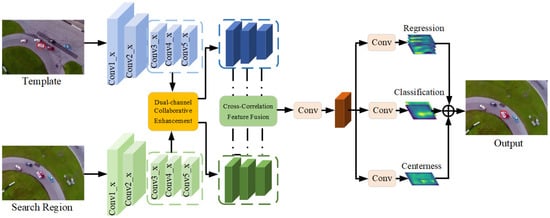
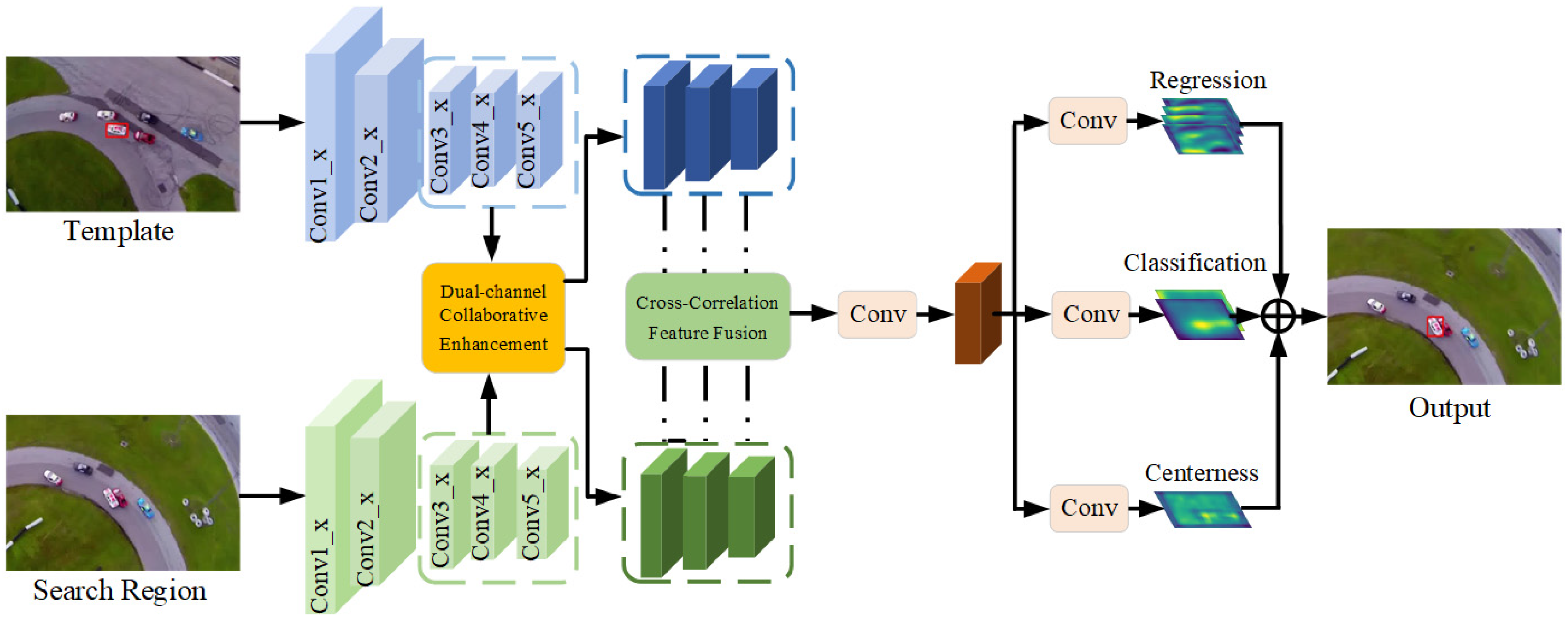
The overall architecture of SiamDC is illustrated in Figure 1. Template and search images are first processed by the shared ResNet-50 backbone. DCE is embedded into the feature-extraction stage to perform spatial dependency modeling, channel dependency modeling, and reciprocal cross-branch interaction. Specifically, channel relationships estimated from the template branch are transferred to modulate the search representation, while the corresponding relationships from the search branch are transferred in the opposite direction. The enhanced template and search representations are subsequently fed into the Cross-Correlation Feature Fusion (CFF) module. CFF first performs pixel-wise correlation, combines the resulting responses with the original search representation through feature concatenation and 1 × 1 projection, and finally performs depth-wise cross-correlation before the prediction head.
Figure 1.
Overall architecture of SiamDC. Red boxes mark the tracked targets in the template, search, and output images. Dashed outlines group the selected multi-level feature maps, while dotted lines indicate their connections to the subsequent feature-fusion stage. The DCE module enhances the template and search representations through spatial attention, channel attention, and reciprocal cross-branch interaction. The CFF module performs cascaded pixel-wise and depth-wise cross-correlation before target-state prediction.
3.2. Dual-Channel Collaborative Enhancement Module
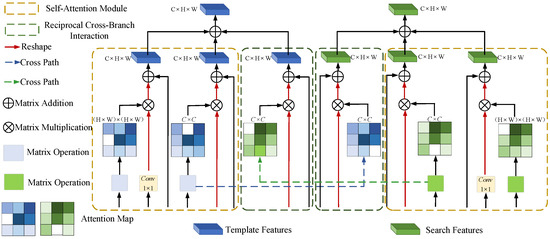
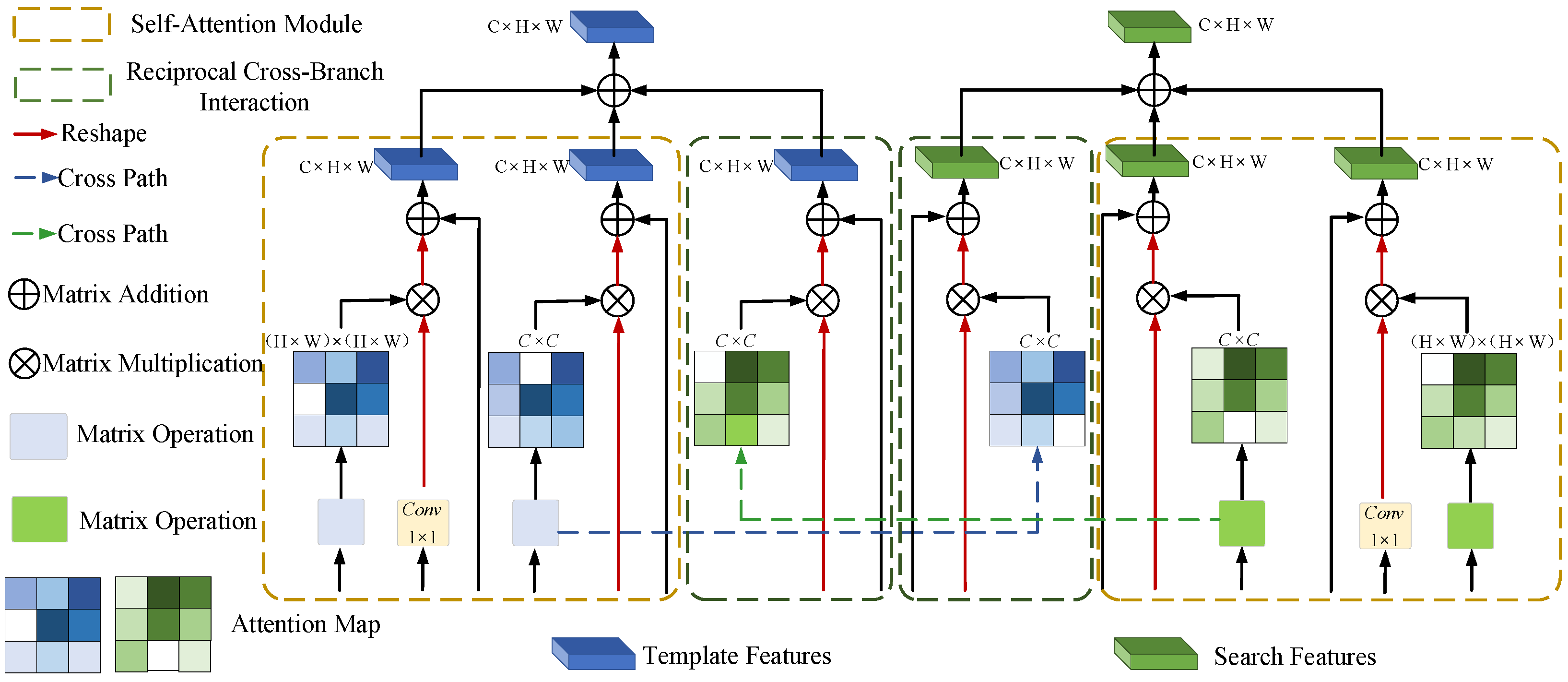
This section provides a detailed description of the Dual-channel Collaborative Enhancement module, which is designed to comprehensively strengthen the complementary information between the template and search images. As illustrated in Figure 2, DCE consists of three complementary components: spatial self-attention, channel self-attention, and reciprocal cross-branch interaction. Spatial self-attention captures long-range dependencies among different spatial positions, channel self-attention models inter-channel dependencies, and reciprocal cross-branch interaction transfers branch-specific channel relationships between the template and search representations.
Figure 2.
Computational flow of the Dual-channel Collaborative Enhancement module, including spatial self-attention, channel self-attention, and reciprocal cross-branch interaction between the template and search branches.
Let the template and search features entering the DCE module be denoted by , , where C denotes the number of channels, and denote the corresponding spatial dimensions. The numbers of spatial positions are defined as , . For simplicity, , where , is used below to denote either the template or search feature.
For each branch, two independent convolutional projections are first applied to to generate the query and key features, , . After flattening the spatial dimensions, the query and key representations become . The value representation is explicitly defined as the reshaped input feature, . The spatial attention matrix is calculated as
The spatially enhanced feature is then obtained as
where is a learnable scalar coefficient controlling the contribution of spatial contextual information.
To model inter-channel dependencies, the input feature is first reshaped into . The channel attention matrix is calculated as
The channel-enhanced feature is expressed as
where is a learnable scalar coefficient. Since , the resulting representation can be directly reshaped to without an additional resizing or projection operation.
In addition to intra-branch attention, DCE introduces reciprocal information interaction between the template and search branches. Different from conventional Transformer-style cross-attention, the proposed mechanism does not construct a new query–key attention matrix across the two branches. Instead, the channel affinity matrices obtained from the channel self-attention branches are further reused for reciprocal cross-branch interaction. Specifically, the template-derived channel affinity is applied to the search feature, while the search-derived channel affinity is applied to the template feature.
For the template-to-search direction, the search representation is enhanced as
where is the channel affinity matrix obtained from the template branch, and is a learnable scalar controlling the transferred information.
Conversely, the search-derived channel affinity is transferred to the template branch as
where is obtained from the search branch. Because the transferred affinity matrices operate only along the channel dimension, reciprocal interaction can be performed even when the template and search features have different spatial resolutions.
Finally, the three enhancement components are collaboratively integrated to obtain the final DCE representations. To avoid ambiguity regarding the learnable scaling coefficients, we explicitly define the unscaled residual enhancement terms before the final aggregation. For the search and template branches, the spatial-context residuals are defined as , and the channel-dependency residuals are , . Similarly, the reciprocal cross-branch residuals are defined as , . These residual terms do not include the learnable scaling coefficients. Therefore, the final search representation is expressed as
while the template branch is updated as
Here, and control the contributions of spatial and channel dependency enhancement, respectively, while and control the strengths of reciprocal information transfer in the two directions. Since the residual terms are defined without the corresponding scaling coefficients, each learnable coefficient is applied only once during the final aggregation. Through this collaborative design, DCE combines intra-branch spatial and channel dependency modeling with explicit inter-branch information transfer before template–search matching.
3.3. Cross-Correlation Feature Fusion Module
This section provides a detailed description of the Cross-Correlation Feature Fusion module, which is designed to comprehensively strengthen the matching and integration between the template and search features. By performing feature matching after backbone processing, the module effectively enhances the ability of the tracker to capture targets, enabling more precise discrimination between the target and the surrounding background. In complex scenarios, this module not only improves the robustness of the model but also mitigates accuracy degradation caused by challenges such as cluttered backgrounds and fast target motion. As a result, the proposed fusion strategy contributes to more accurate and stable tracking performance.
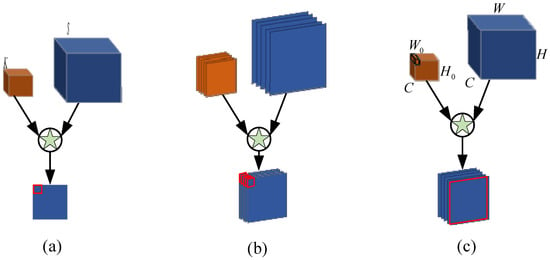
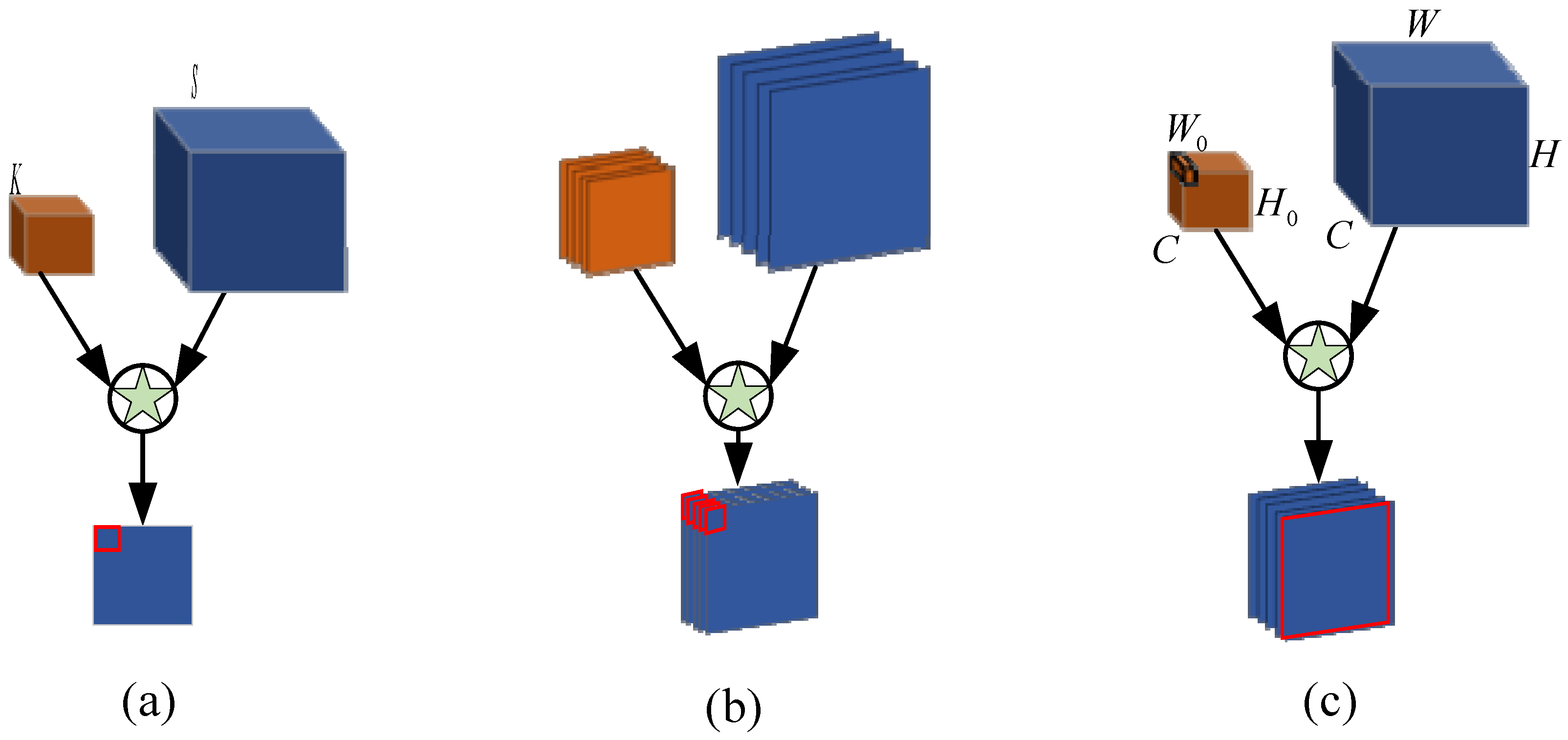
Traditional Siamese networks primarily formulate the visual tracking task as a similarity matching problem. The original Siamese tracker performs naive cross-correlation by treating the template features as convolutional kernels and convolving them with the search features, ultimately producing a single-channel response map. As illustrated in Figure 3a, the brown bounding boxes denote the template features extracted from the template image via the backbone network, while the blue bounding boxes denote the search features extracted from the search image. The template features are convolved over the spatial positions of the search features, with the corresponding convolutional results represented by red bounding boxes in the output response map. However, this feature combination strategy lacks effective utilization of channel-wise information, thereby limiting the expressiveness and discriminative power of the tracker.
Figure 3.
Illustration of (a) naive cross-correlation, (b) depth-wise cross-correlation, and (c) pixel-wise cross-correlation. Red boxes highlight the corresponding correlation response regions, and the five-pointed star denotes the cross-correlation operation.
To address this limitation, SiamRPN++ [27] employs depth-wise cross-correlation (DW-XCorr) to preserve channel-specific template–search matching information. Specifically, each channel of the template feature is independently correlated with the corresponding channel of the search feature. Let , . For the c-th channel, depth-wise cross-correlation is defined as
where denotes the cross-correlation operation. The channel-wise correlation responses are retained and stacked as
where . Unlike naive cross-correlation, depth-wise cross-correlation preserves independent correlation responses for different channels rather than summing all channel responses into a single map.
Although depth-wise cross-correlation preserves channel-specific matching information, it correlates the complete spatial extent of each template channel with the corresponding search channel. Therefore, location-specific correspondence between individual template positions and search locations is not explicitly represented. To preserve finer spatial correspondence, pixel-wise cross-correlation is introduced.
Let the template feature contain spatial positions. The template feature can therefore be represented as , where each represents the C-dimensional template feature vector at spatial position . Each template vector is treated as a 1 × 1 correlation kernel and independently matched with every spatial position of the search feature. The response generated by the m-th template position is defined as
By stacking the responses generated from all template positions, the pixel-wise correlation representation is obtained as
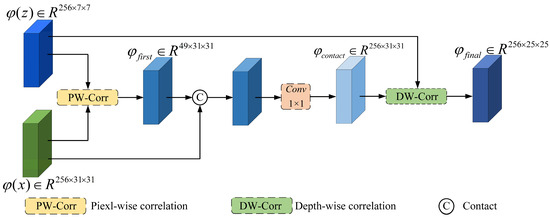
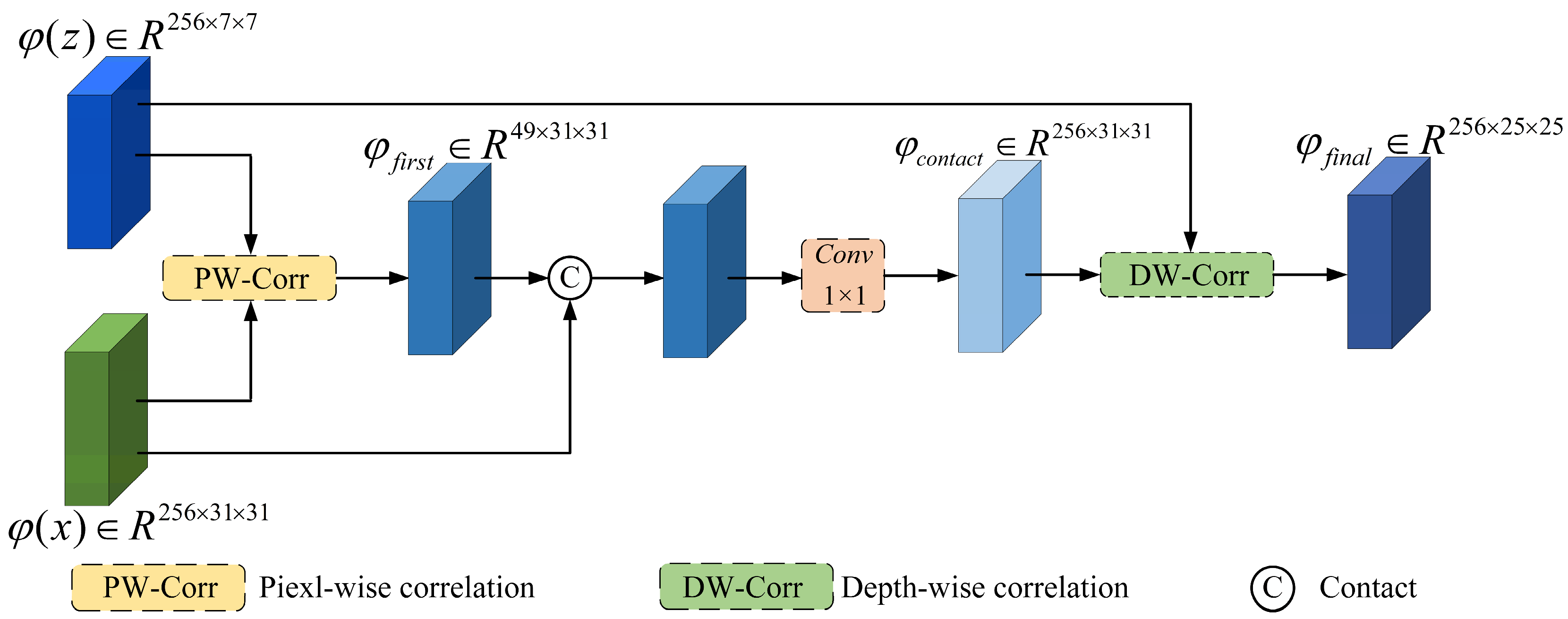
For the feature dimensions illustrated in Figure 4, , . Therefore, , and the resulting pixel-wise correlation feature has the dimension .
Figure 4.
Computational flow and tensor dimensions of the proposed Cross-Correlation Feature Fusion (CFF) module. CFF sequentially performs pixel-wise correlation, feature concatenation and 1 × 1 projection, followed by depth-wise cross-correlation.
Based on the pixel-wise responses, the proposed CFF module further reuses the original search representation to prevent the correlation operation from discarding the original semantic information. Specifically, the pixel-wise correlation feature is concatenated with the search feature along the channel dimension:
where .
A 1 × 1 convolution is subsequently employed to aggregate the original search representation and the pixel-wise matching responses and to restore the feature dimension to C channels:
where .
According to the dimensions shown in Figure 4, and . Therefore, the concatenated feature is , which is subsequently projected to .
After incorporating both the original search representation and the fine-grained pixel-wise correspondence, the aggregated feature is further matched with the template feature using depth-wise cross-correlation. For each channel , the final correlation response is calculated as
The channel-wise outputs are stacked to form the final CFF representation:
For the dimensions illustrated in Figure 4, and . Therefore, the output feature has the dimension , because . Consequently, the complete CFF module follows a clearly defined cascaded matching process: pixel-wise correlation → feature reuse and channel projection → depth-wise cross-correlation. The first stage preserves fine-grained location-specific correspondence, whereas the second correlation stage retains channel-specific template–search matching information.
4. Experiments
4.1. Implementation Details
SiamDC was implemented under Ubuntu 18.04 using PyTorch 1.8.1 and CUDA 11.1. All training and efficiency experiments were conducted on an NVIDIA RTX 3080 GPU with 10 GB memory, an Intel Xeon Gold 6148 CPU, and 30 GB of system memory. The ResNet-50 backbone was initialized using ImageNet-pretrained weights. Training samples were collected from DET, VID, YouTube-BB, COCO, and GOT-10k. The tracker was trained for 20 epochs with a batch size of 32. The backbone parameters were frozen during epochs 1–10. During epochs 11–20, layers 2–4 of ResNet-50 were fine-tuned using a learning-rate multiplier of 0.1 relative to the remaining trainable layers.
SGD was adopted as the optimizer with a momentum of 0.9 and a weight decay of 1 × 10⁻⁴. The learning rate was warmed up from 0.001 to 0.005 during epochs 1–5 and then logarithmically decayed from 0.005 to 0.0005 during epochs 6–20. The template and search images were resized to 127 × 127 and 255 × 255, respectively. The features entering the CFF module contained 256 channels, with spatial sizes of 7 × 7 for the template branch and 31 × 31 for the search branch.
During training, the template branch used a translation shift of 4 pixels, a scale jitter of 0.05, and color augmentation, while the search branch used a translation shift of 64 pixels, a scale jitter of 0.18, blur augmentation with a probability of 0.2, and color augmentation. The optimization objective consisted of a classification cross-entropy loss, an IoU-based bounding-box regression loss, and a binary cross-entropy centerness loss. Their loss weights were set to , respectively. Locations inside the ground-truth bounding box were treated as positive samples, whereas locations outside the box were treated as negative samples.
The learnable scalar coefficients , , and in DCE were initialized to zero. For the repeated experiments, the random seeds were set to 0, 1, and 2. Model checkpoints were selected according to the lowest total loss on a held-out validation split rather than benchmark test performance. During inference, the tracking parameters were set to penalty_k = 0.04, window_influence = 0.44, learning_rate = 0.33, context_amount = 0.5, and stride = 8, with a tracking batch size of 1.
For efficiency measurements, all methods used the same template/search input pair and batch size of 1. Parameters were calculated from the model weights, FLOPs were evaluated using identical input resolutions, and peak GPU memory was measured using the maximum allocated CUDA memory. Before timing, 100 warm-up iterations were performed, followed by 1000 timed forward passes with CUDA synchronization immediately before and after measurement.
4.2. Quantitative Analysis
SiamDC and the SiamCAR baseline were evaluated using the same implementation environment and evaluation toolkit. For other trackers, the results were obtained from the corresponding original publications or publicly released benchmark results unless otherwise stated. Therefore, accuracy comparisons follow the same benchmark protocol, while computational efficiency is compared only for models evaluated under our unified hardware and timing settings.
To further evaluate the effectiveness of the proposed algorithm, we conduct comparisons with representative tracking methods across multiple UAV tracking benchmarks, including DTB70 [21], UAV123 [22], and UAV20L [22].
To strengthen the comparison with recent UAV trackers, we additionally consider the published results of Ta-BFTrans [3], a recent aerial tracking method evaluated on the same three benchmarks. Ta-BFTrans [3] reports success/precision scores of 0.644/0.831 on DTB70 [21], 0.647/0.847 on UAV123 [22], and 0.638/0.825 on UAV20L [22]. Since these results are taken directly from the original publication rather than reproduced under our hardware and implementation environment, they are used only as benchmark-accuracy references and are not included in the unified computational-efficiency comparison. This additional comparison provides a recent reference point while avoiding an implication of universal state-of-the-art superiority.
4.2.1. DTB70 Dataset
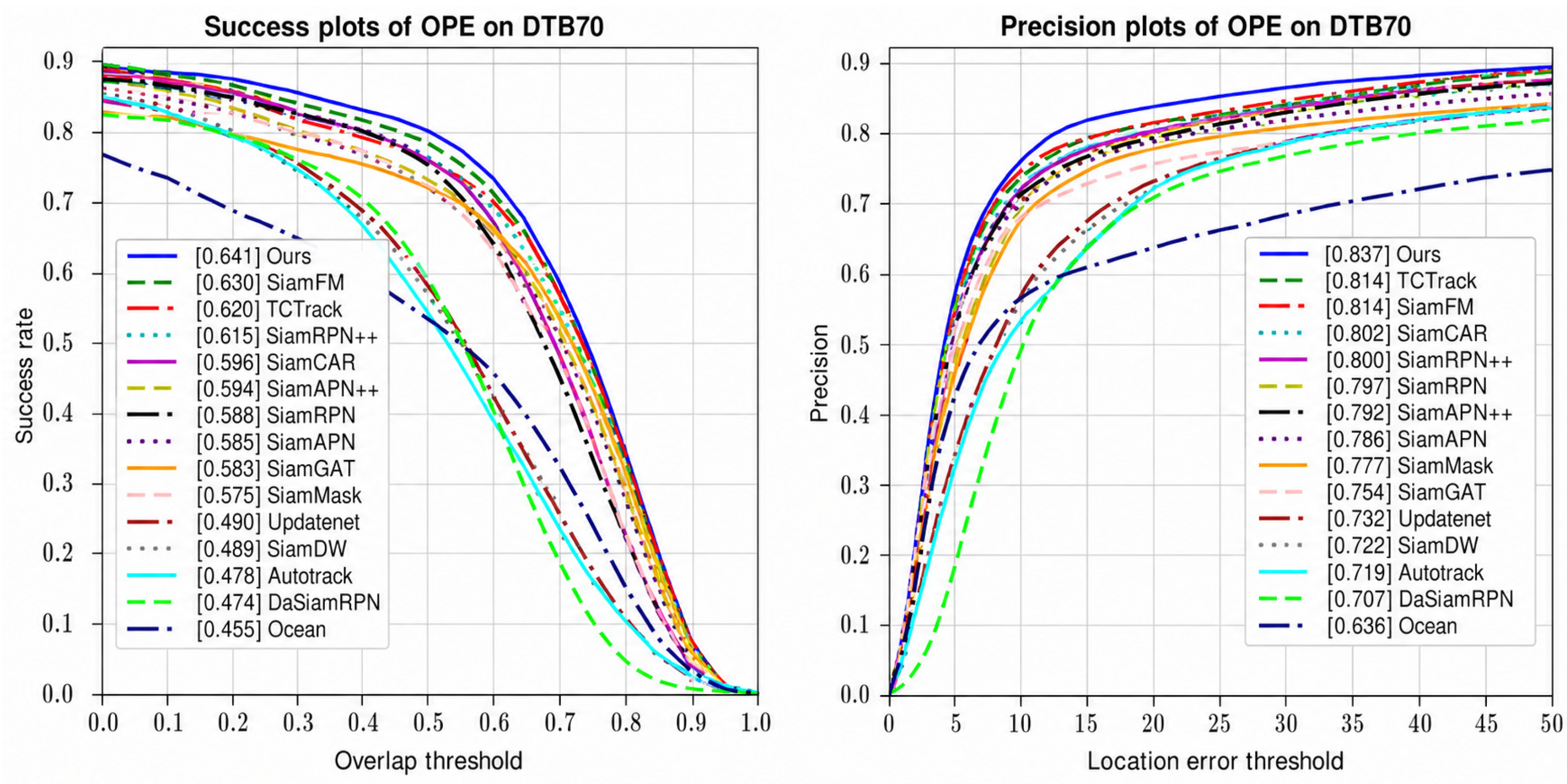
DTB70 is a standard UAV visual tracking benchmark containing 70 video sequences that cover a wide range of environments and scenarios. Under the standard DTB70 evaluation protocol, the proposed method was compared with several representative trackers, including SiamCAR [12], AutoTrack [15], SiamGAT [16], SiamRPN [26], SiamRPN++ [27], DaSiamRPN [31], SiamDW [32], SiamMask [33], SiamAPN [34], Ocean [35], SiamAPN++ [36], UpdateNet [37], TCTrack [38], and SiamFM [39]. The experimental results are presented in Figure 5. Compared with SiamCAR, SiamDC improves the success score from 0.596 to 0.641 and the precision score from 0.802 to 0.838, corresponding to absolute improvements of 4.5 and 3.6 percentage points, respectively.
Figure 5.
Evaluation results on the DTB70 dataset.
To further evaluate whether the performance improvement is stable across different training runs, we repeated the training of SiamCAR and SiamDC using three independent random seeds. As shown in Table 2, SiamCAR obtains an average success score of 0.596 ± 0.002 and an average precision score of 0.802 ± 0.003, whereas SiamDC achieves 0.641 ± 0.002 and 0.838 ± 0.002, respectively. The relatively small standard deviations indicate that the performance gains of SiamDC are consistent across the evaluated training runs rather than being caused by a particular random initialization.
Table 2.
Multi-run stability comparison between SiamCAR and SiamDC on DTB70.
Table 3 presents the success rates of all compared trackers on 11 different challenging attributes in the DTB70 dataset. The top-ranked tracker for each attribute is highlighted in red, while the second and third best results are marked in blue and green, respectively. The table demonstrates that SiamDC achieves particularly strong results on Similar Object Interference (SOA), Scale Variation (SV), Motion Blur (MB), In-Plane Rotation (IPR), Fast Camera Motion (FCM), and Background Clutter (BC). However, it is not the highest-performing tracker for every attribute: other methods obtain higher scores on OPR, OV, OCC, DEF, and ARV. These results indicate that the principal advantages of SiamDC are concentrated in scenarios involving similar-object interference, motion-related appearance changes, and background clutter rather than uniform dominance across all attributes.
Table 3.
Success rates of different advanced trackers on 11 challenge attributes in the DTB70 dataset. The top-ranked tracker for each attribute is highlighted in red, while the second and third best results are marked in blue and green, respectively.
The results indicate that the proposed method effectively leverages the Dual-channel Collaborative Enhancement mechanism, enabling the search frame to learn more target-specific information from the template frame. This reduces the likelihood of tracking failure caused by rapid UAV motion. In challenging scenarios involving Fast Camera Motion (FCM) and Background Clutter (BC), SiamDC improves the success scores by 3.5 and 0.9 percentage points, respectively, compared with SiamCAR. Moreover, for Similar Object Interference (SOA), SiamDC achieves an improvement of 4.9 percentage points over the baseline.
4.2.2. UAV123 Dataset
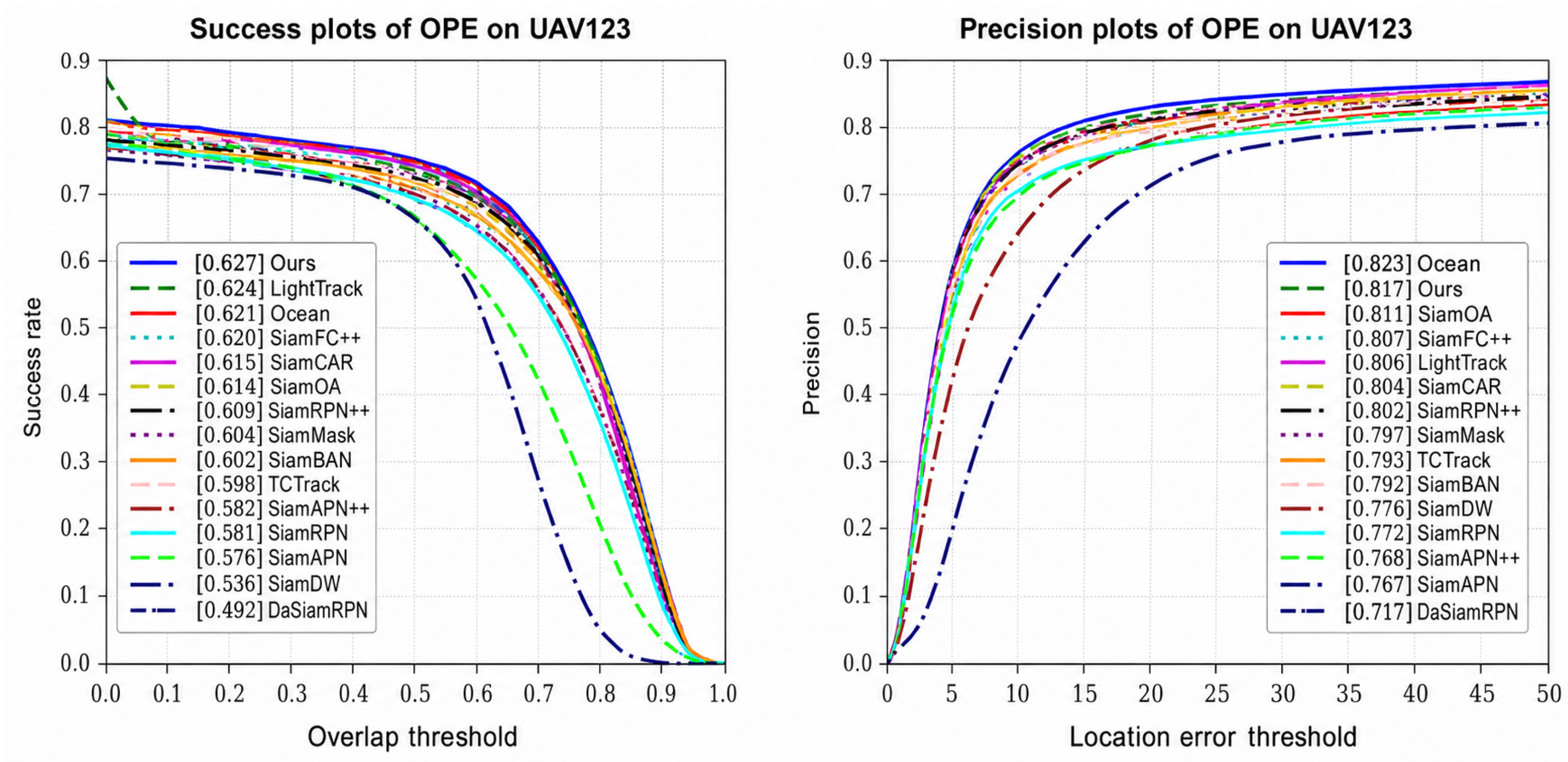
The UAV123 dataset is a key benchmark for UAV tracking, comprising 123 high-resolution video sequences that cover a wide range of targets in diverse environments, including urban areas, rural landscapes, and forests. Figure 6 presents the success and precision curves of the proposed method compared with several representative trackers on the UAV123 dataset. The compared trackers include SiamCAR [12], SiamRPN [26], SiamRPN++ [27], SiamBAN [28], DaSiamRPN [31], SiamDW [32], SiamMask [33], SiamAPN [34], Ocean [35], SiamAPN++ [36], TCTrack [38], LightTrack [40], SiamFC++ [41], and SiamOA [42]. Compared with the baseline tracker SiamCAR, the proposed method achieves absolute improvements of 1.2 percentage points in success score and 1.3 percentage points in precision score, demonstrating its competitive performance across diverse UAV tracking scenarios.
Figure 6.
Evaluation results on the UAV123 dataset.
The above experiments demonstrate that the performance improvement of the proposed algorithm primarily stems from the effective combination of the Dual-channel Collaborative Enhancement module and the Cross-Correlation Feature Fusion module. The DCE module processes the template and search frames in parallel across two channels, independently and collaboratively optimizing feature extraction in different dimensions. Through inter-branch information exchange, it further strengthens the connection between the two branches. This module enables the tracker to better capture dynamic target variations and effectively reduces tracking failures caused by challenges such as similar object interference, rapid motion, and occlusion. Meanwhile, the Cross-Correlation Feature Fusion module further improves template–search correspondence by combining location-specific pixel-wise matching with subsequent channel-preserving depth-wise correlation. This significantly improves the tracker’s ability to recognize and localize targets in complex scenarios, contributing to both higher accuracy and robustness.
4.2.3. UAV20L Dataset
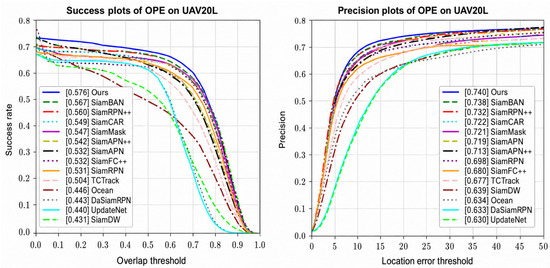
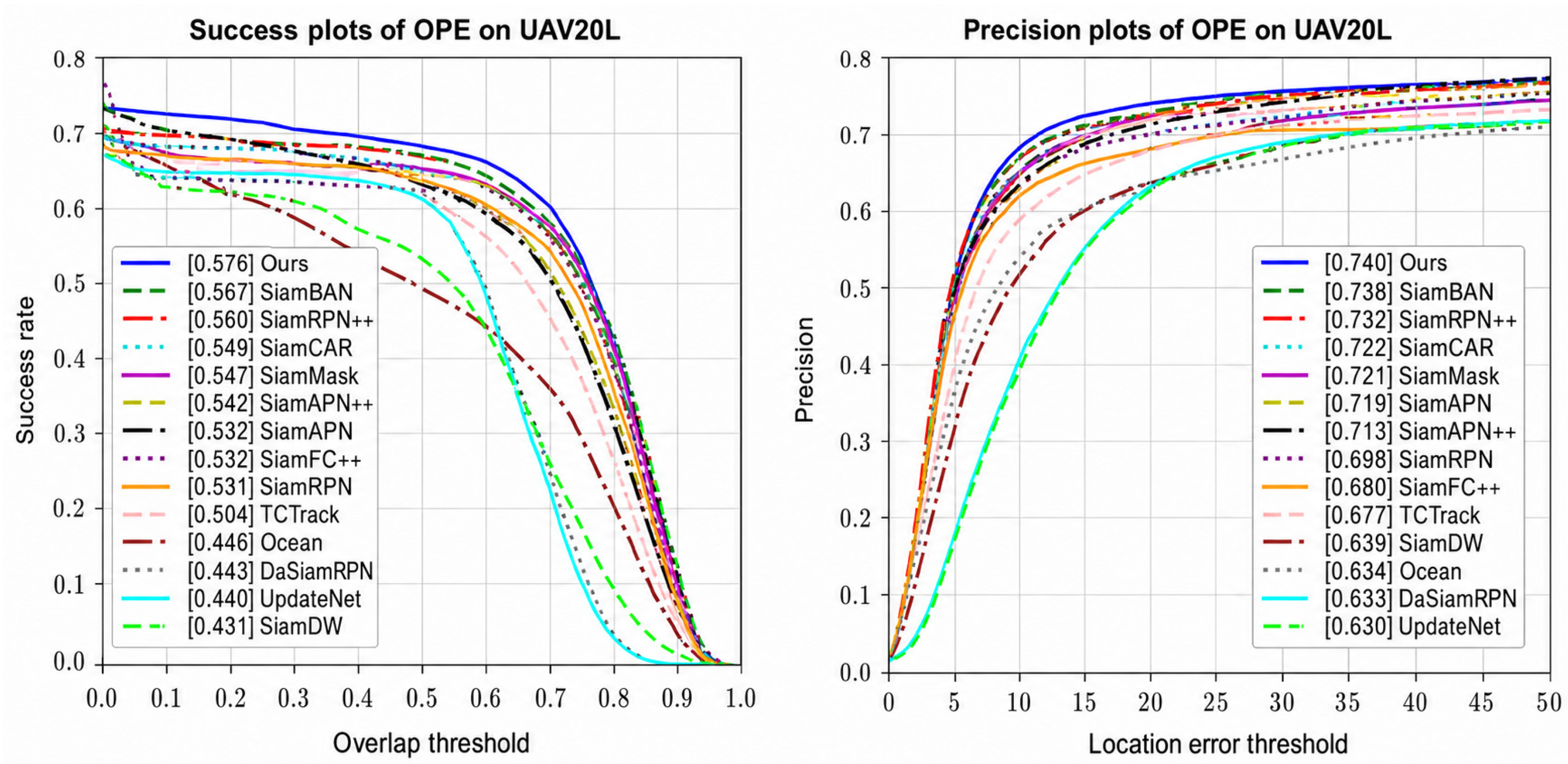
UAV20L is a UAV-specific visual tracking dataset, comprising 20 challenging long video sequences, each containing over 1000 frames. The dataset also includes scenarios where the target disappears, such as complete occlusion or leaving the field of view. Figure 7 presents a comparative study of the proposed method against several representative trackers, including SiamCAR [12], SiamRPN [26], SiamRPN++ [27], SiamBAN [28], DaSiamRPN [31], SiamDW [32], SiamMask [33], SiamAPN [34], Ocean [35], SiamAPN++ [36], UpdateNet [37], TCTrack [38], and SiamFC++ [41]. The experimental results demonstrate a further improvement in tracking accuracy, with SiamDC achieving absolute improvements of 2.7 percentage points in success score and 1.8 percentage points in precision score compared with SiamCAR, highlighting its effectiveness in handling long-term and occlusion-challenging UAV tracking scenarios.
Figure 7.
Evaluation results on the UAV20L dataset.
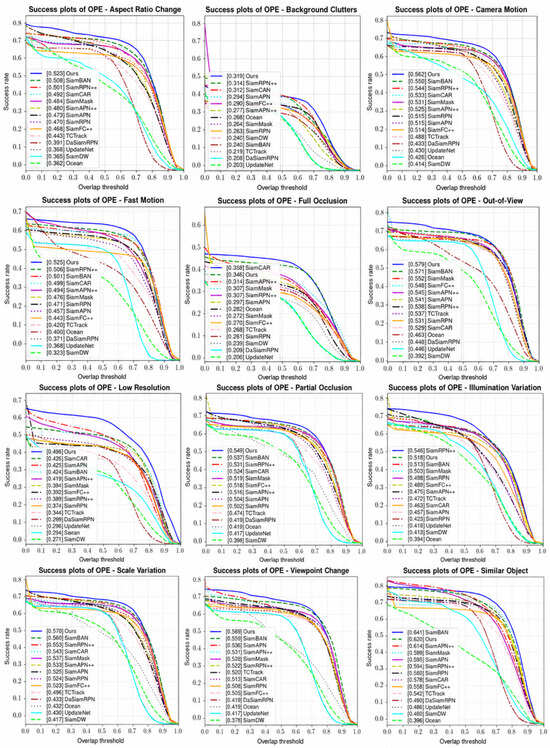
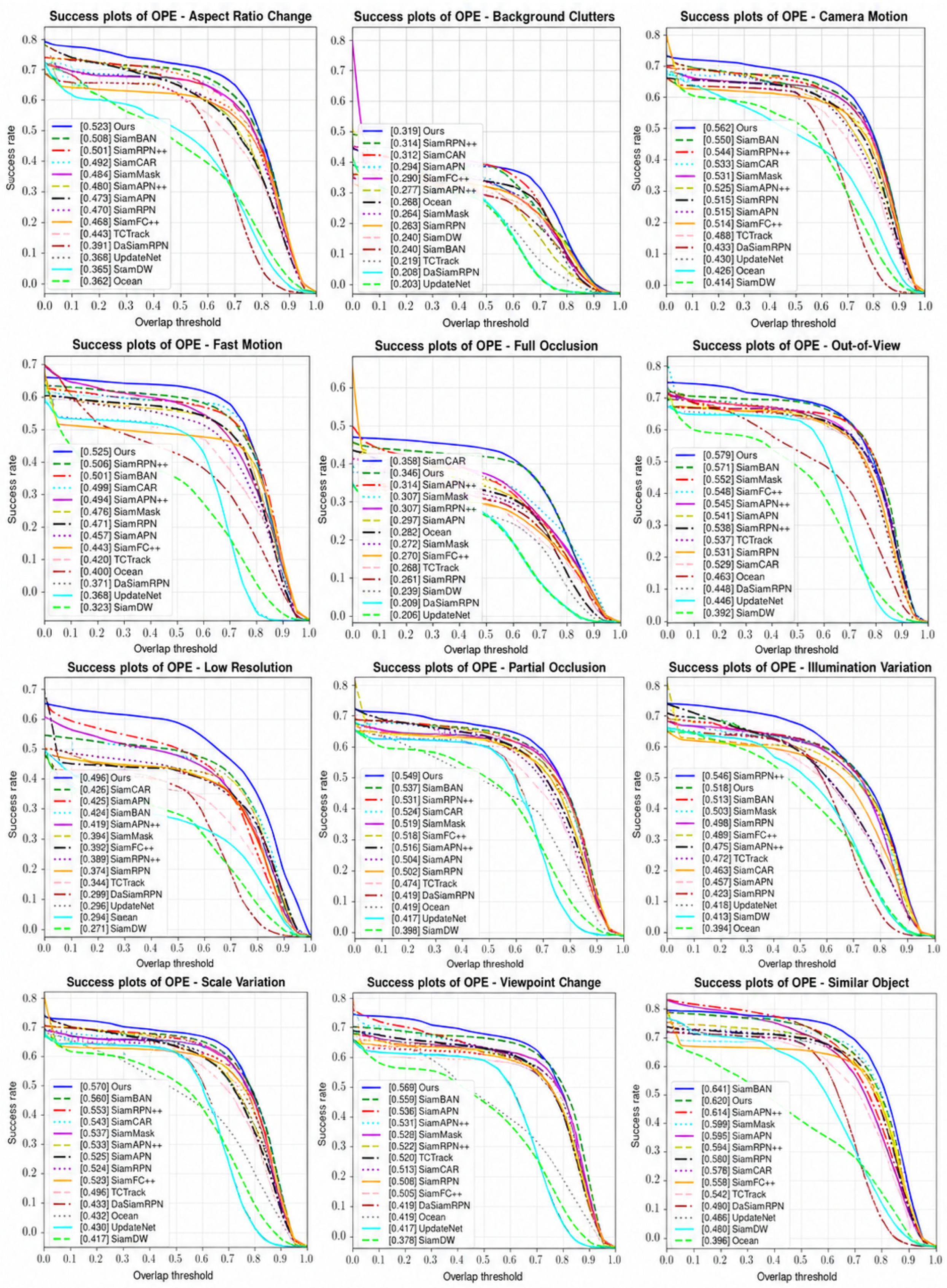
Furthermore, Figure 8 presents the success plots of representative trackers under 12 challenge attributes on the UAV20L dataset. To facilitate exact numerical comparison and improve result transparency, Table 4 summarizes the corresponding attribute-level success scores of SiamDC and three principal competing trackers.
Figure 8.
Success plots of representative trackers on 12 challenge attributes of the UAV20L dataset.
Table 4.
Attribute-level success scores of SiamDC and representative competing trackers on UAV20L.
SiamDC achieves the highest success score among the compared methods on 9 of the 12 attributes, including Aspect Ratio Change (ARC), Background Clutter (BC), Camera Motion (CM), Fast Motion (FM), Low Resolution (LR), Out-of-View (OV), Partial Occlusion (PO), Scale Variation (SV), and Viewpoint Change (VC). In contrast, SiamCAR performs better under Full Occlusion (FO), SiamRPN++ obtains the highest score under Illumination Variation (IV), and SiamBAN performs best under Similar Object (SO). These results indicate that DCE is particularly beneficial for target representation under motion, scale, low-resolution, and out-of-view challenges, while CFF improves fine-grained template–search correspondence in cluttered and dynamically changing scenes. At the same time, the remaining performance gaps under prolonged full occlusion, illumination variation, and severe similar-object interference are consistent with the limitations discussed in Section 5.
4.2.4. Computational Efficiency Analysis
To evaluate the computational cost introduced by the proposed modules, we compare the parameter count, FLOPs, model size, peak GPU memory, preprocessing time, network inference time, and forward-pass FPS of SiamCAR and its enhanced variants. All measurements were conducted on an NVIDIA RTX 3080 using FP32 precision, batch size 1, and template/search input sizes of 127 × 127 and 255 × 255, respectively. The same measurement protocol was applied to all configurations.
As shown in Table 5, the baseline SiamCAR contains 54.00 M parameters and requires 24.20 GFLOPs, achieving a network-forward speed of 51.0 FPS. Introducing DCE increases the parameter count to 55.12 M and FLOPs to 25.00 G, while the network-forward speed remains 47.8 FPS. CFF requires 54.68 M parameters and 26.10 GFLOPs and achieves 46.3 FPS. The complete SiamDC contains 55.80 M parameters and requires 26.90 GFLOPs, with a peak GPU memory consumption of 3000 MB and a network inference time of 22.7 ms, corresponding to 44.1 FPS.
Table 5.
Computational efficiency comparison.
These results show that the proposed feature-enhancement and correlation-fusion modules introduce additional computational overhead compared with SiamCAR. Nevertheless, the complete tracker retains real-time network inference performance on the evaluated GPU. Therefore, the accuracy gains of SiamDC are achieved at the cost of a moderate increase in parameters, FLOPs, and memory usage rather than through a reduction in computational complexity.
4.3. Qualitative Analysis
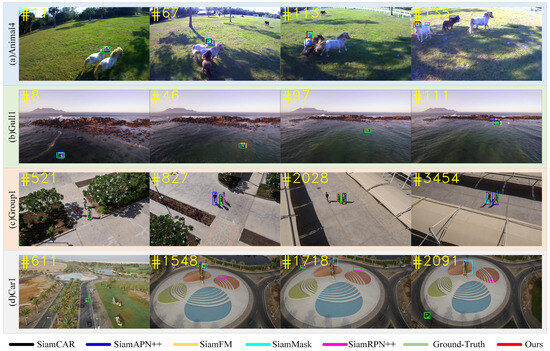
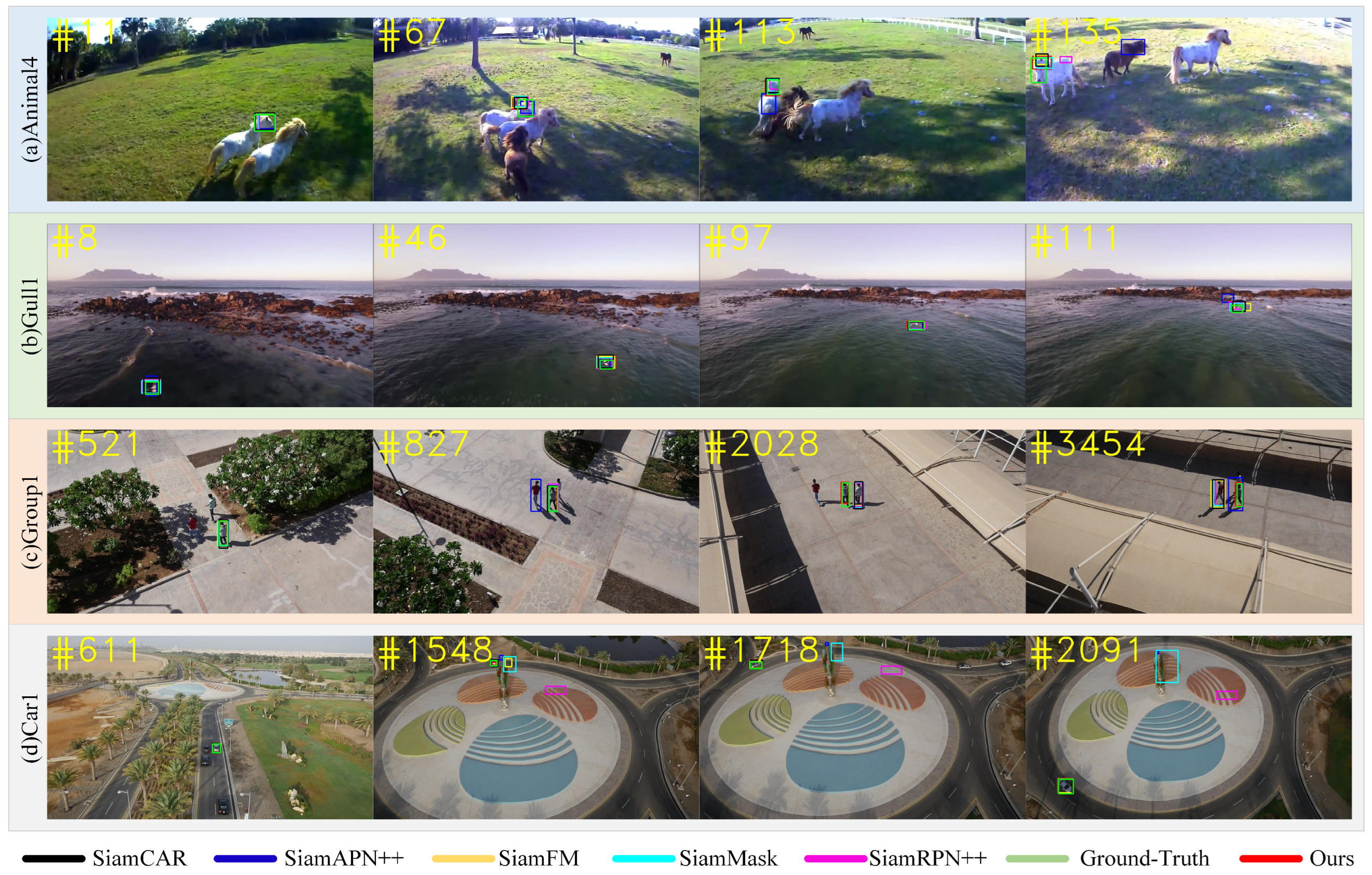
To qualitatively evaluate the effectiveness of the proposed method, four representative video sequences were selected from the DTB70 and UAV20L datasets for visualization. The tracking performance of the proposed algorithm was compared with five representative trackers: SiamCAR, SiamAPN++, SiamFM, SiamMask, and SiamRPN++. Figure 9 illustrates the qualitative evaluation results of the different algorithms across the four selected video sequences.
Figure 9.
Qualitative analysis of multiple trackers.
As shown in Figure 9a, when multiple similar targets are clustered together, several trackers exhibit bounding box drift. In particular, SiamRPN++ and SiamAPN++ mistakenly track similar horses, failing to maintain accurate tracking in subsequent frames. In contrast, the proposed SiamDC demonstrates improved adaptability in complex environments, reliably maintaining the correct target despite interference from similar objects. In Figure 9b, the rapid flight of a seabird causes SiamRPN++ to lose the target, resulting in interrupted tracking. By comparison, SiamDC maintains robust performance under fast motion and background blur, accurately capturing the target while other methods struggle to estimate its state. Figure 9c illustrates that during long-term UAV tracking, the presence of multiple similar targets often leads to tracking drift. Trackers such as SiamAPN++, SiamCAR, and SiamFM repeatedly follow similar distractors rather than the true target. SiamDC, however, consistently distinguishes the deformed target from similar objects, achieving precise tracking. Finally, Figure 9d shows that under scenarios with rapid target motion, SiamFM and SiamAPN++ fail to maintain tracking. By incorporating the Cross-Correlation Feature Fusion module, SiamDC effectively integrates template and search features, enhancing the capture of target details and improving adaptability to background changes.
The qualitative analysis of UAV tracking demonstrates that the proposed SiamDC algorithm effectively leverages the Dual-channel Collaborative Enhancement module to extract deeper target features while simultaneously attending to multiple key aspects of the target. This enables better integration of local and global information, resulting in more accurate target recognition and localization and enhanced feature representation in scenarios with similar object interference. Furthermore, by incorporating the Cross-Correlation Feature Fusion module, the algorithm effectively integrates features from both the template and search images. This not only improves the tracker’s ability to capture fine-grained target details but also enhances its adaptability to background variations. Consequently, SiamDC maintains stable and precise tracking even under rapid target motion.
4.4. Ablation Experiment
Table 6 summarizes the module-level ablation results on DTB70. Adding DCE alone improves the success and precision scores from 0.596/0.802 to 0.634/0.819, while CFF alone achieves 0.623/0.817. Combining the two modules further improves the performance to 0.641/0.838, indicating that DCE and CFF provide complementary contributions at the feature-enhancement and feature-matching stages.
Table 6.
Ablation study results.
4.4.1. Discussion on the Dual-Channel Collaborative Enhancement Module
To further investigate the contribution of each component within DCE, we conduct a fine-grained ablation analysis by progressively introducing spatial attention, channel attention, and reciprocal cross-branch interaction. As shown in Table 7, the SiamCAR baseline achieves a success score of 0.596 and a precision score of 0.802. Introducing spatial attention alone improves the two metrics to 0.615 and 0.809, while channel attention alone obtains 0.619 and 0.812, respectively. Combining spatial and channel attention further increases the scores to 0.627 and 0.816. Finally, incorporating reciprocal cross-branch interaction produces the complete DCE configuration, achieving 0.634 in success and 0.819 in precision.
Table 7.
Internal ablation analysis of DCE on DTB70.
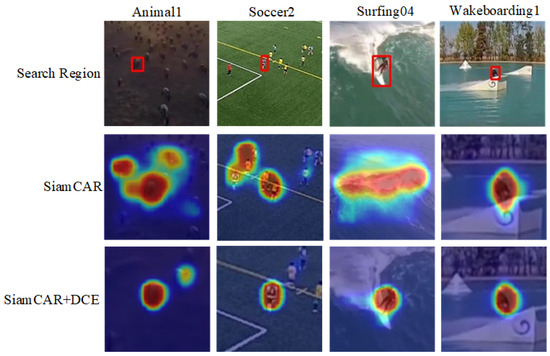
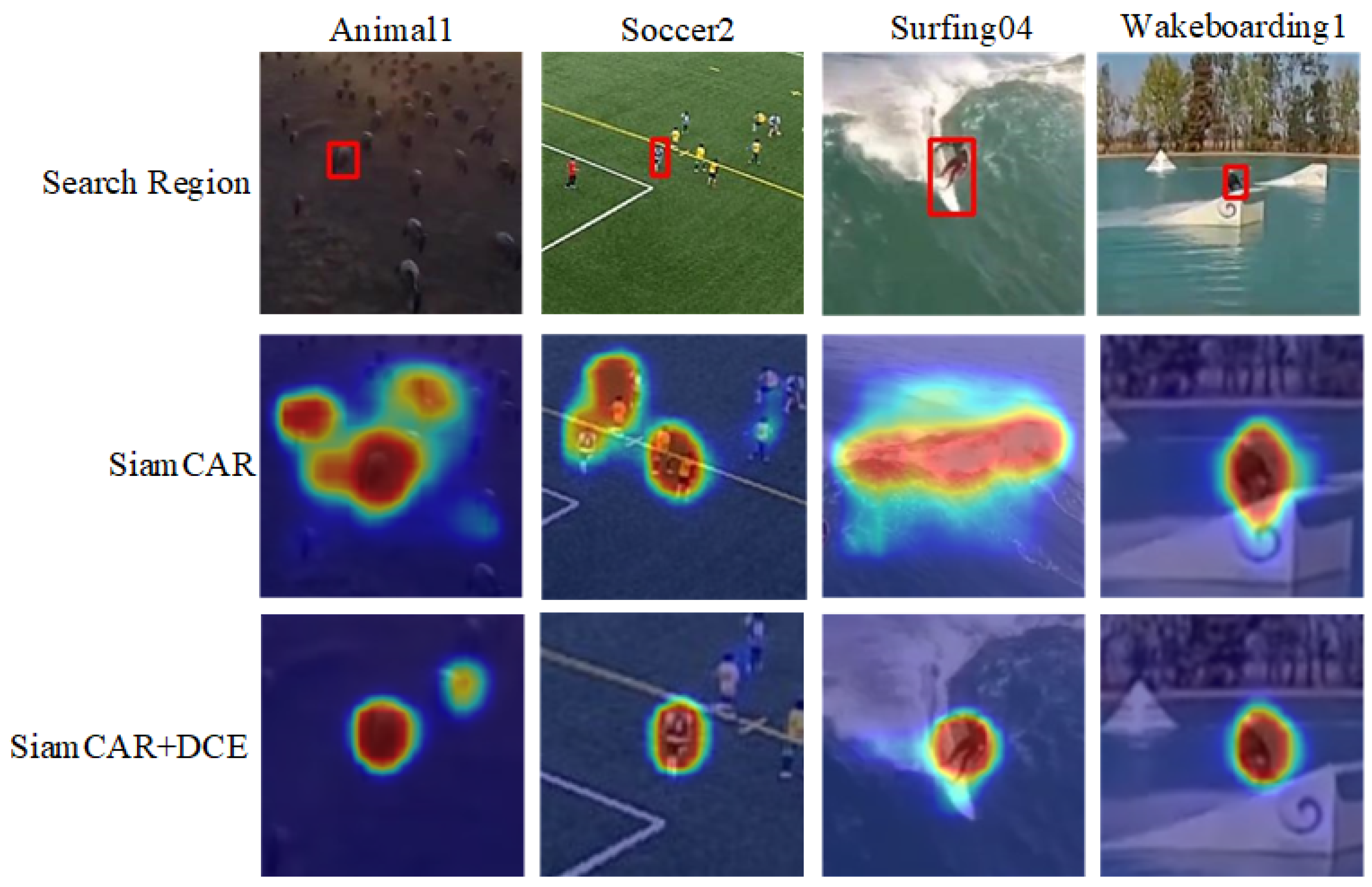
These results indicate that both spatial and channel dependency modeling contribute to feature enhancement, while their combination provides complementary benefits. The additional improvement from 0.627/0.816 to 0.634/0.819 further suggests that reciprocal information transfer between the template and search branches contributes beyond independent intra-branch attention. Figure 10 provides a visual comparison of feature-response maps generated by the baseline backbone and the backbone equipped with DCE, where the enhanced model exhibits more concentrated responses around the target regions.
Figure 10.
Comparison between SiamCAR and SiamCAR + DCE. Red boxes indicate the target locations in the search regions. In the response maps, warmer colors (red/yellow) represent stronger activation responses, whereas cooler colors (blue) represent weaker responses.
4.4.2. Discussion on the Cross-Correlation Feature Fusion Module
To clarify the contribution of the individual operations within CFF, we further evaluate pixel-wise correlation, feature reuse with 1 × 1 projection, and the final depth-wise cross-correlation in a progressive manner. As shown in Table 8, introducing pixel-wise correlation alone improves the baseline success and precision scores from 0.596/0.802 to 0.612/0.810. Incorporating the original search representation through concatenation and 1 × 1 feature projection further increases the scores to 0.618/0.814. Finally, adding depth-wise cross-correlation yields the complete CFF module, achieving 0.623 in success and 0.817 in precision.
Table 8.
Internal ablation analysis of CFF on DTB70.
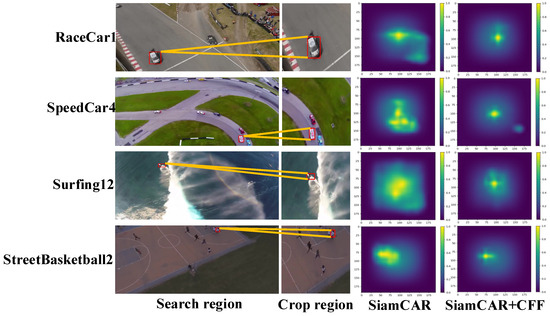
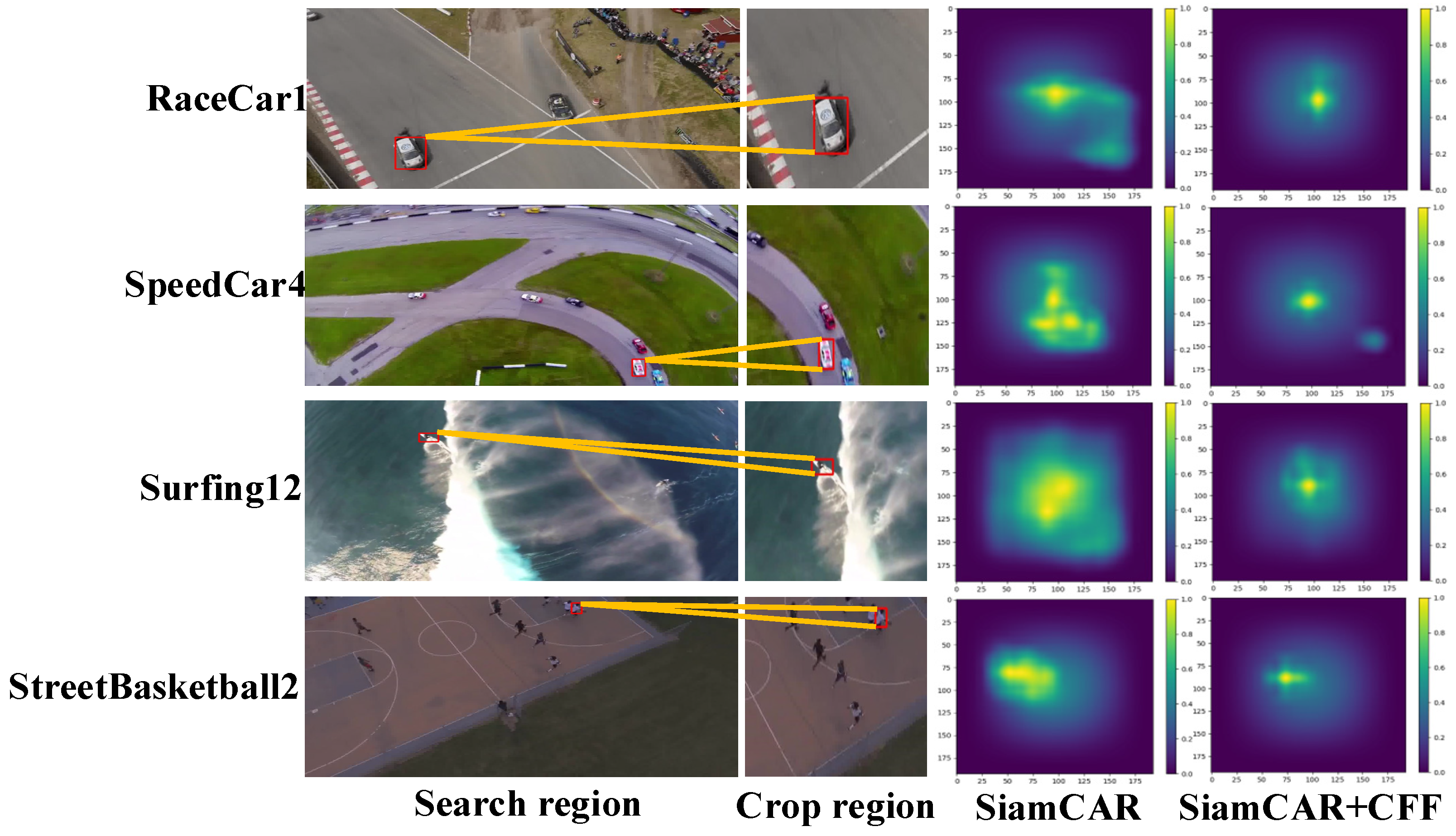
The results demonstrate that pixel-wise correlation provides the largest initial gain by introducing location-specific template–search correspondence. Reusing the original search representation further supplements semantic information that may be weakened by correlation alone, while the subsequent depth-wise cross-correlation provides additional channel-specific matching refinement. Therefore, the performance gain of CFF results from the progressive collaboration of its three operations rather than from an unspecified multi-round fusion process. Figure 11 further illustrates that the complete CFF produces more concentrated correlation responses in challenging scenes involving similar objects and fast motion.
Figure 11.
Comparison of tracking response maps generated by SiamCAR and SiamCAR + CFF. Red boxes indicate the target regions, while yellow lines connect the corresponding target areas between the search region and the cropped region. Warmer colors in the response maps indicate stronger responses.
4.4.3. Cross-Benchmark Validation of DCE and CFF
To examine whether the module-level improvements observed on DTB70 generalize to another UAV tracking benchmark, we further evaluate the baseline SiamCAR, SiamCAR + DCE, SiamCAR + CFF, and the complete SiamDC on UAV123 under the standard OPE protocol. Unlike the fine-grained component-level analysis on DTB70, this experiment focuses on compact module-level validation and therefore does not repeat every internal DCE/CFF configuration. The results are summarized in Table 9.
Table 9.
Cross-benchmark module-level ablation on UAV123.
Both DCE and CFF independently improve the baseline performance on UAV123, while their combination achieves the best overall result among the four configurations. This trend is consistent with that observed on DTB70, indicating that the complementary contributions of the two modules are not restricted to a single benchmark.
4.4.4. Summary of Experiments
The module-level and component-level ablation studies jointly verify the contributions of DCE and CFF. Within DCE, spatial and channel attention independently improve tracking performance, while their combination provides complementary gains. Reciprocal cross-branch interaction further improves feature discrimination through explicit template–search information transfer. Within CFF, pixel-wise correlation contributes fine-grained spatial correspondence, feature reuse preserves the original search semantics, and the final depth-wise cross-correlation provides additional channel-specific refinement. These results demonstrate that DCE and CFF provide complementary improvements at the feature-enhancement and feature-matching stages, respectively.
5. Conclusions
This paper presents SiamDC, a Siamese UAV tracking framework that combines collaborative dual-branch feature enhancement with cascaded cross-correlation fusion. DCE jointly models spatial and channel dependencies within the Siamese branches and introduces reciprocal channel-relation transfer between the template and search representations. CFF subsequently performs pixel-wise spatial matching, feature reuse and channel projection, followed by depth-wise cross-correlation. Experiments on DTB70, UAV123, and UAV20L demonstrate consistent improvements over the SiamCAR baseline and competitive performance against the evaluated trackers while retaining real-time tracking capability. Fine-grained ablations and robustness analyses further clarify the contribution of the individual components.
Several limitations remain. First, the evaluation primarily relies on established UAV benchmarks, and further experiments on newer and unseen UAV domains are required to assess cross-domain generalization. Second, SiamDC currently uses a fixed target template and does not explicitly perform online template updating. Consequently, prolonged full occlusion, complete target disappearance, or substantial post-occlusion appearance changes may still lead to tracking drift or failed re-detection. Third, although SiamDC retains real-time performance, the additional attention and correlation operations introduce computational and memory overhead relative to the original baseline. Future work will therefore investigate lightweight branch interaction, adaptive template updating, long-term re-detection, and broader cross-domain evaluation.
Author Contributions
Conceptualization, M.Y., S.H., X.G., X.W., Y.Q. and H.L.; methodology, M.Y., S.H., X.G., X.W., Y.Q. and H.L.; software, M.Y., S.H. and X.G.; formal analysis, M.Y., S.H. and X.G.; investigation, M.Y., S.H., X.G., X.W., Y.Q. and H.L.; resources, M.Y., S.H., X.G., X.W., Y.Q. and H.L.; writing—original draft preparation, M.Y., S.H. and X.W.; writing—review and editing, M.Y., S.H., X.G., X.W., Y.Q. and H.L.; visualization, X.W., Y.Q. and H.L.; supervision, M.Y., S.H. and Y.Q.; project administration, M.Y. and S.H.; funding acquisition, M.Y. and S.H. All authors have read and agreed to the published version of the manuscript.
Funding
This work was supported by the National Natural Science Foundation of China (No. 62103192), the Natural Science Research Program for Higher Education Institutions in the Jiangsu Province (20KJB520015), the Changzhou Applied Basic Research Program Project (medium subsidy) (CJ20200039), and Postgraduate Research and Practice Innovation Program of Jiangsu Province (SJCX25_1584).
Institutional Review Board Statement
Not applicable.
Informed Consent Statement
Not applicable.
Data Availability Statement
The data that support the findings of this study are openly available at the following URL/DOI: DTB70: https://doi.org/10.1609/aaai.v31i1.11205; UAV123 and UAV20L: https://doi.org/10.1007/978-3-319-46448-0_27. The source code and trained models associated with this study will be made publicly available upon publication to facilitate the reproducibility of the proposed method.
Conflicts of Interest
The authors declare no conflicts of interest.
References
- Wang, Q.; Zhou, L.; Xu, C.; Shang, Y.; Jin, P.; Cao, C.; Shen, T. Progress and perspectives on UAV visual object tracking. IEEE J. Sel. Top. Appl. Earth Obs. Remote Sens. 2025, 18, 20214–20239. [Google Scholar] [CrossRef] [Scilit]
- Kim, J.; Kim, Y.; Kim, S.; Cho, H.; Jung, D. Vision-based geolocation of moving ground targets using Kalman filtering with a gimbal camera on board a UAV. Aerospace 2025, 12, 1065. [Google Scholar] [CrossRef] [Scilit]
- Sun, X.; Sun, H.; Liu, B.; Jiang, S.; Wang, J.; Li, D. Target-aware bidirectional fusion transformer for aerial object tracking. IEEE J. Sel. Top. Appl. Earth Obs. Remote Sens. 2025, 18, 29071–29082. [Google Scholar] [CrossRef] [Scilit]
- Gao, Q.; Yin, M.; Ni, Y.; Bo, Y.; Bei, S. Learning multidimensional spatial attention for robust nighttime visual tracking. IEEE Signal Process. Lett. 2024, 31, 2910–2914. [Google Scholar] [CrossRef] [Scilit]
- Du, M.; Zou, H.; Wang, T.; Zhu, K. A cooperative target localization method based on UAV aerial images. Aerospace 2023, 10, 943. [Google Scholar] [CrossRef] [Scilit]
- Li, W.; Yan, S.; Shi, L.; Yue, J.; Shi, M.; Lin, B.; Qin, K. Multiagent consensus tracking control over asynchronous cooperation–competition networks. IEEE Trans. Cybern. 2025, 55, 4347–4360. [Google Scholar] [CrossRef] [Scilit] [PubMed]
- Shi, L.; Yan, S.; Li, W. Consensus and products of substochastic matrices: Convergence rate with communication delays. IEEE Trans. Syst. Man Cybern. Syst. 2025, 55, 4752–4761. [Google Scholar] [CrossRef] [Scilit]
- Deng, J.; Chi, Z.; Yun, G. Feature-perception-enhanced Siamese tracking. Comput. Eng. Appl. 2025, 61, 186–195. [Google Scholar] [CrossRef]
- Wang, P.; Deng, Y.; Duan, H.; Sun, Y. Siamese tracking algorithm for UAVs based on biological eagle-eye vision mechanism. IEEE Trans. Cogn. Dev. Syst. 2026, 18, 239–250. [Google Scholar] [CrossRef] [Scilit]
- Sun, L.; Chang, J.; Zhang, J.; Fan, B.; He, Z. Adaptive image dehazing and object tracking in UAV videos based on the template updating Siamese network. IEEE Sens. J. 2023, 23, 12320–12333. [Google Scholar] [CrossRef] [Scilit]
- Gao, Q.; Yin, M.; Wu, X.; Liu, D.; Bo, Y. Online multi-scale classification and global feature modulation for robust visual tracking. IEEE Trans. Circuits Syst. Video Technol. 2024, 34, 5321–5334. [Google Scholar] [CrossRef] [Scilit]
- Guo, D.; Wang, J.; Cui, Y.; Wang, Z.; Chen, S. SiamCAR: Siamese fully convolutional classification and regression for visual tracking. In Proceedings of the 2020 IEEE/CVF Conference on Computer Vision and Pattern Recognition (CVPR), Seattle, WA, USA, 13–19 June 2020; pp. 6268–6276. [Google Scholar] [CrossRef] [Scilit]
- Zhang, Y.; Yin, M.; Gao, Q.; Wu, X.; Bo, Y.; Bei, S. Learning progressive spatial enhancement and scene adaptive alignment for robust RGBE tracking. IEEE Sens. J. 2025, 25, 41558–41568. [Google Scholar] [CrossRef] [Scilit]
- Yu, Y.; Xiong, Y.; Huang, W.; Scott, M.R. Deformable Siamese attention networks for visual object tracking. In Proceedings of the 2020 IEEE/CVF Conference on Computer Vision and Pattern Recognition (CVPR), Seattle, WA, USA, 13–19 June 2020; pp. 6727–6736. [Google Scholar] [CrossRef] [Scilit]
- Li, Y.; Fu, C.; Ding, F.; Huang, Z.; Lu, G. AutoTrack: Towards high-performance visual tracking for UAV with automatic spatio-temporal regularization. In Proceedings of the 2020 IEEE/CVF Conference on Computer Vision and Pattern Recognition (CVPR), Seattle, WA, USA, 13–19 June 2020; pp. 11920–11929. [Google Scholar] [CrossRef] [Scilit]
- Guo, D.; Shao, Y.; Cui, Y.; Wang, Z.; Zhang, L.; Shen, C. Graph attention tracking. In Proceedings of the 2021 IEEE/CVF Conference on Computer Vision and Pattern Recognition (CVPR), Nashville, TN, USA, 20–25 June 2021; pp. 9538–9547. [Google Scholar] [CrossRef] [Scilit]
- Dosovitskiy, A.; Beyer, L.; Kolesnikov, A.; Weissenborn, D.; Zhai, X.; Unterthiner, T.; Dehghani, M.; Minderer, M.; Heigold, G.; Gelly, S.; et al. An image is worth 16 × 16 words: Transformers for image recognition at scale. arXiv 2020, arXiv:2010.11929. [Google Scholar] [CrossRef] [Scilit]
- Yan, B.; Peng, H.; Fu, J.; Wang, D.; Lu, H. Learning spatio-temporal transformer for visual tracking. In Proceedings of the 2021 IEEE/CVF International Conference on Computer Vision (ICCV), Montreal, QC, Canada, 10–17 October 2021; pp. 10428–10437. [Google Scholar] [CrossRef] [Scilit]
- Zhao, M.; Okada, K.; Inaba, M. TrTr: Visual tracking with transformer. arXiv 2021, arXiv:2105.03817. [Google Scholar] [CrossRef] [Scilit]
- Liu, M.; Xie, L.; Xiao, L.; Guo, S. Self-attention-enhanced multi-agent deep reinforcement learning for UAVs target search in obstacle-dense environments. IEEE Trans. Aerosp. Electron. Syst. 2026, 62, 7533–7545. [Google Scholar] [CrossRef] [Scilit]
- Li, S.; Yeung, D.Y. Visual object tracking for unmanned aerial vehicles: A benchmark and new motion models. In Proceedings of the Thirty-First AAAI Conference on Artificial Intelligence, San Francisco, CA, USA, 4–9 February 2017; Volume 31. [Google Scholar] [CrossRef] [Scilit]
- Mueller, M.; Smith, N.; Ghanem, B. A benchmark and simulator for UAV tracking. In Computer Vision—ECCV 2016; Leibe, B., Matas, J., Sebe, N., Welling, M., Eds.; Springer: Cham, Switzerland, 2016; Volume 9905. [Google Scholar] [CrossRef] [Scilit]
- Huang, Z.; Fu, C.; Li, Y.; Lin, F.; Lu, P. Learning aberrance repressed correlation filters for real-time UAV tracking. In Proceedings of the 2019 IEEE/CVF International Conference on Computer Vision (ICCV), Seoul, Republic of Korea, 27 October–2 November 2019; pp. 2891–2900. [Google Scholar] [CrossRef] [Scilit]
- Lukežič, A.; Vojíř, T.; Čehovin Zajc, L.; Matas, J.; Kristan, M. Discriminative correlation filter with channel and spatial reliability. In Proceedings of the 2017 IEEE Conference on Computer Vision and Pattern Recognition (CVPR), Honolulu, HI, USA, 21–26 July 2017; pp. 6309–6318. [Google Scholar] [CrossRef] [Scilit]
- Bertinetto, L.; Valmadre, J.; Henriques, J.F.; Vedaldi, A.; Torr, P.H.S. Fully-convolutional Siamese networks for object tracking. In Computer Vision—ECCV 2016 Workshops; Springer International Publishing: Cham, Switzerland, 2016; Volume 9914, pp. 850–865. [Google Scholar] [CrossRef] [Scilit]
- Li, B.; Yan, J.; Wu, W.; Zhu, Z.; Hu, X. High performance visual tracking with Siamese region proposal network. In Proceedings of the 2018 IEEE/CVF Conference on Computer Vision and Pattern Recognition (CVPR), Salt Lake City, UT, USA, 18–23 June 2018; pp. 8971–8980. [Google Scholar] [CrossRef] [Scilit]
- Li, B.; Wu, W.; Wang, Q.; Zhang, F.; Xing, J.; Yan, J. SiamRPN++: Evolution of Siamese visual tracking with very deep networks. In Proceedings of the 2019 IEEE/CVF Conference on Computer Vision and Pattern Recognition (CVPR), Long Beach, CA, USA, 15–20 June 2019; pp. 4277–4286. [Google Scholar] [CrossRef] [Scilit]
- Chen, Z.; Zhong, B.; Li, G.; Zhang, S.; Ji, R.; Tang, Z.; Li, X. SiamBAN: Target-aware tracking with Siamese box adaptive network. IEEE Trans. Pattern Anal. Mach. Intell. 2023, 45, 5158–5173. [Google Scholar] [CrossRef] [PubMed]
- Yan, B.; Zhang, X.; Wang, D.; Lu, H.; Yang, X. Alpha-Refine: Boosting tracking performance by precise bounding box estimation. In Proceedings of the 2021 IEEE/CVF Conference on Computer Vision and Pattern Recognition (CVPR), Nashville, TN, USA, 20–25 June 2021; pp. 5289–5298. [Google Scholar] [CrossRef] [Scilit]
- Huang, Z.; Li, G.; Sun, X.; Chen, Y.; Sun, J.; Ni, Z.; Yang, Y. Siamese dense pixel-level fusion network for real-time UAV tracking. Comput. Mater. Contin. 2023, 76, 3219–3238. [Google Scholar] [CrossRef] [Scilit]
- Zhu, Z.; Wang, Q.; Li, B.; Wu, W.; Yan, J.; Hu, W. Distractor-aware Siamese networks for visual object tracking. In Proceedings of the European Conference on Computer Vision (ECCV), Munich, Germany, 8–14 September 2018; pp. 101–117. [Google Scholar] [CrossRef] [Scilit]
- Zhang, Z.; Peng, H. Deeper and wider Siamese networks for real-time visual tracking. In Proceedings of the 2019 IEEE/CVF Conference on Computer Vision and Pattern Recognition (CVPR), Long Beach, CA, USA, 15–20 June 2019; pp. 4591–4600. [Google Scholar] [CrossRef] [Scilit]
- Hu, W.; Wang, Q.; Zhang, L.; Bertinetto, L.; Torr, P.H.S. SiamMask: A framework for fast online object tracking and segmentation. IEEE Trans. Pattern Anal. Mach. Intell. 2023, 45, 3072–3089. [Google Scholar] [CrossRef] [Scilit] [PubMed]
- Fu, C.; Cao, Z.; Li, Y.; Ye, J.; Feng, C. Siamese anchor proposal network for high-speed aerial tracking. In Proceedings of the 2021 IEEE International Conference on Robotics and Automation (ICRA), Xi’an, China, 30 May–5 June 2021; pp. 510–516. [Google Scholar] [CrossRef] [Scilit]
- Zhang, Z.; Peng, H.; Fu, J.; Li, B.; Hu, W. Ocean: Object-aware anchor-free tracking. In Proceedings of the European Conference on Computer Vision (ECCV), Glasgow, UK, 23–28 August 2020; pp. 771–787. [Google Scholar] [CrossRef] [Scilit]
- Cao, Z.; Fu, C.; Ye, J.; Li, B.; Li, Y. SiamAPN++: Siamese attentional aggregation network for real-time UAV tracking. In Proceedings of the 2021 IEEE/RSJ International Conference on Intelligent Robots and Systems (IROS), Prague, Czech Republic, 27 September–1 October 2021; pp. 3086–3092. [Google Scholar] [CrossRef] [Scilit]
- Zhang, L.; Gonzalez-Garcia, A.; van de Weijer, J.; Danelljan, M.; Khan, F.S. Learning the model update for Siamese trackers. In Proceedings of the 2019 IEEE/CVF International Conference on Computer Vision (ICCV), Seoul, Republic of Korea, 27 October–2 November 2019; pp. 4009–4018. [Google Scholar] [CrossRef] [Scilit]
- Cao, Z.; Huang, Z.; Pan, L.; Zhang, S.; Liu, Z.; Fu, C. TCTrack: Temporal contexts for aerial tracking. In Proceedings of the 2022 IEEE/CVF Conference on Computer Vision and Pattern Recognition (CVPR), New Orleans, LA, USA, 18–24 June 2022; pp. 14798–14808. [Google Scholar] [CrossRef] [Scilit]
- Lin, Y.; Yin, M.; Zhang, Y.; Guo, X. Robust UAV tracking via information synergy fusion and multi-dimensional spatial perception. IEEE Access 2025, 13, 39886–39900. [Google Scholar] [CrossRef] [Scilit]
- Yan, B.; Peng, H.; Wu, K.; Wang, D.; Fu, J.; Lu, H. LightTrack: Finding lightweight neural networks for object tracking via one-shot architecture search. In Proceedings of the 2021 IEEE/CVF Conference on Computer Vision and Pattern Recognition (CVPR), Nashville, TN, USA, 20–25 June 2021; pp. 15175–15184. [Google Scholar] [CrossRef] [Scilit]
- Xu, Y.; Wang, Z.; Li, Z.; Yuan, Y.; Yu, G. SiamFC++: Towards robust and accurate visual tracking with target estimation guidelines. In Proceedings of the Thirty-Fourth AAAI Conference on Artificial Intelligence, New York, NY, USA, 7–12 February 2020; pp. 12549–12556. [Google Scholar] [CrossRef] [Scilit]
- Zhang, J.; Xie, X.; Zheng, Z.; Kuang, L.-D.; Zhang, Y. SiamOA: Siamese offset-aware object tracking. Neural Comput. Appl. 2022, 34, 22223–22239. [Google Scholar] [CrossRef] [Scilit]

Disclaimer/Publisher’s Note: The statements, opinions and data contained in all publications are solely those of the individual author(s) and contributor(s) and not of MDPI and/or the editor(s). MDPI and/or the editor(s) disclaim responsibility for any injury to people or property resulting from any ideas, methods, instructions or products referred to in the content. |
© 2026 by the authors. Licensee MDPI, Basel, Switzerland. This article is an open access article distributed under the terms and conditions of the Creative Commons Attribution (CC BY) license.