


Abstract
Overlapping bus–rail corridors between conventional bus lines and urban rail transit are common in integrated public transportation systems. When existing bus routes highly overlap with newly operated rail transit lines, redundant services may reduce resource utilization and increase operating pressure, while inappropriate route adjustment may negatively affect the travel experience of original bus passengers. To address this problem, this paper proposes a constrained passenger-time-oriented optimization model for conventional bus route adjustment under rail transit operation. The model evaluates passenger travel cost while jointly considering passenger flow demand, service continuity, route compactness, and the accessibility requirements of original bus passengers. Based on the proposed model, a bus line generation algorithm is designed to obtain feasible and compact adjustment schemes for co-linear bus segments. The methodological applicability of the proposed method is evaluated through a simulation experiment, and its practical applicability is illustrated through a real-world case study of Xiamen Bus Line 27. The results indicate that the proposed method can reduce passenger travel cost and alleviate redundant competition between conventional bus and rail transit services, while maintaining acceptable service continuity for existing passengers.
1. Introduction
Urban rail transit has been rapidly developed in many large cities to provide high-capacity, reliable, and efficient transportation services. Due to its advantages in speed, punctuality, and carrying capacity, rail transit is generally regarded as the backbone of urban public transportation systems and primarily serves medium- and long-distance travel demands [1]. In contrast, conventional bus systems offer greater flexibility in route design and station coverage, making them more suitable for short- and medium-distance accessibility services [2,3]. Therefore, an efficient urban transit system should ensure effective coordination between rail transit and conventional bus services rather than allowing these two modes to operate independently.
However, the coordination between newly deployed rail transit systems and existing bus networks is often insufficient during practical planning and operation [4]. As a result, conventional bus lines may overlap with rail transit corridors and create overlapping bus–rail corridors, where both modes provide redundant services along the same corridor instead of forming complementary transportation services. Such competition not only leads to inefficient utilization of transportation resources and increased operational pressure for transit operators, but may also reduce the attractiveness of public transportation systems for passengers [5]. For example, after the operation of Xiamen Metro Line 1, many existing bus routes remained highly overlapped with the metro corridor, significantly weakening the expected coordination benefits between rail transit and conventional bus services [6].
To improve public transportation efficiency, extensive studies have investigated transit network optimization problems, including bus route design, transit network layout optimization, and timetable scheduling [7,8,9]. For example, Zhao et al. [7] investigated bus network optimization through route restructuring to improve operational efficiency, while Chu et al. [8] formulated the transit network design problem as a mixed-integer optimization model that jointly considered route configuration and service frequency. Zhao et al. [9] further incorporated timetable coordination into transit planning to improve service reliability. Although these studies have significantly advanced conventional public transport planning, they mainly focus on optimizing single-mode transportation systems and do not explicitly consider the interaction between conventional bus services and urban rail transit.
With the increasing prevalence of multimodal transportation systems, researchers have further explored the coordination between bus systems and rail transit. Existing studies can be broadly divided into two categories. The first category focuses on multimodal transit network optimization, where bus and rail systems are jointly optimized to improve overall transportation efficiency [10,11]. Representative studies have investigated integrated bus–rail optimization from different perspectives. Sun et al. [10] proposed a multimodal network optimization framework for improving overall system performance, Kang et al. [12] emphasized the coordination between bus services and rail transit to enhance passenger accessibility, and Sun et al. [13] developed a joint optimization model for multimodal transit planning. These studies primarily aim to improve network-level efficiency through coordinated multimodal planning, but they generally redesign transit systems from a global perspective rather than addressing the practical adjustment of existing bus routes operating in overlapping bus–rail corridors. The second category investigates feeder bus network design, which aims to connect surrounding bus stations with nearby metro stations to address first-mile and last-mile accessibility issues [14,15].
Despite these efforts, existing studies still have an important limitation. Most prior works primarily optimize transit systems from the perspective of global passenger demand or system efficiency, while largely ignoring the service continuity of existing bus passengers during route adjustment. In practice, directly modifying an existing bus route may significantly affect original passengers by increasing travel time, introducing additional transfers, or reducing accessibility. Therefore, reducing bus–rail competition while minimizing the negative impact on existing passengers remains an important yet underexplored problem.
The methodological novelty of this study lies in the integrated formulation of the route adjustment problem for overlapping bus–rail corridors. Specifically, the objective function explicitly distinguishes passengers retained on the adjusted bus route from those served through alternative post-adjustment travel options. The constraint formulation further combines route compactness, overlap control, accessibility preservation, and allowable travel-time increase to protect the service continuity of existing bus passengers. The solution strategy is designed as a greedy constructive heuristic for corridor-level route adjustment, aiming to obtain compact and feasible adjustment schemes without full path enumeration. Therefore, the contribution of this work lies in the combination of a passenger-time-oriented objective, service-continuity constraints, and a practical route generation strategy for existing bus route adjustment.
To address this issue, this paper investigates the co-linear adjustment problem between conventional bus lines and rail transit systems. We develop a constrained passenger-time-oriented optimization framework that reduces passenger travel cost under practical route adjustment constraints, including route compactness, overlap control, accessibility preservation, and allowable travel-time increase. The main contributions of this paper are summarized as follows:
- We investigate the optimization problem of conventional bus routes in overlapping bus–rail corridors and formulate a bus route adjustment problem that explicitly considers passenger travel demand, service continuity, and accessibility requirements.
- We develop a constrained passenger-time-oriented optimization model that distinguishes retained bus-service travel time from alternative post-adjustment travel time, and incorporates route compactness, overlap control, accessibility preservation, and allowable travel-time increase into a unified formulation.
- We propose a greedy constructive bus line generation algorithm that incrementally selects candidate stations under practical route adjustment constraints, avoiding full enumeration of all feasible station permutations for corridor-level planning scenarios.
- We evaluate the practical applicability of the proposed method through both simulation experiments and a real-world case study based on Xiamen Bus Line 27.
The remainder of this paper is organized as follows. Section 2 reviews related studies on bus network optimization. Section 3 presents the proposed optimization model and solution algorithm. Section 4 reports numerical experiments and real-world case studies. Section 5 discusses the results and limitations, and Section 6 concludes the paper.
2. Related Works
Existing studies on bus–rail coordination can be broadly categorized into two research directions: feeder bus network design and optimization of existing public transport networks.
2.1. Feeder Bus Network Design
Feeder bus network design aims to improve the connectivity between conventional bus services and rail transit systems by efficiently linking surrounding demand areas with metro stations. Early studies mainly focused on analytical models that optimize feeder route locations and service frequencies under simplified network structures [16,17,18].
Kuah et al. [16] proposed one of the earliest analytical formulations for feeder bus network design, aiming to minimize the combined costs of operators and passengers. Martins et al. [17] developed a search-based optimization framework for feeder route planning under simplified network assumptions, while Chien et al. [18] further optimized feeder route locations and service frequencies to improve the efficiency of bus–rail coordination. These pioneering studies established the theoretical foundation of feeder bus planning, but they generally relied on simplified network structures and primarily focused on the design of new feeder services.
To better capture realistic urban transportation networks, subsequent studies adopted network-based optimization approaches, where actual transit networks are modeled explicitly and optimized under various objectives, such as minimizing passenger travel costs, reducing transfer frequency, shortening route length, and maximizing service coverage. Shrivastava et al. [19] incorporated realistic transit network structures into feeder service planning to improve passenger accessibility. Liu et al. [20] investigated feeder network optimization with the objective of reducing passenger travel costs, whereas Szeto et al. [21] simultaneously optimized feeder routes and service frequencies to enhance system performance. Lin et al. [22] further considered service coverage and operational efficiency in practical feeder bus planning. More recently, Lai et al. [23] proposed a collaborative optimization model that jointly determines feeder bus routes and operational strategies for urban metro systems. Cai et al. [24] further optimized feeder bus routes and service frequencies by considering the influence of shared motorcycles, while Gao et al. [25] developed a three-dimensional multi-objective optimization framework that simultaneously optimizes feeder routes, service frequencies, and transit timetables. Chen et al. [26] investigated coordinated optimization of microcirculation bus routes and schedules considering the impact of shared bicycles, and Liu et al. [27] integrated continuous approximation with GIS techniques to improve feeder bus network design along rail corridors. These studies significantly improved first-mile and last-mile accessibility and strengthened the integration between bus services and rail transit. However, they mainly focus on designing new feeder bus routes to complement rail transit, rather than adjusting existing bus routes that already overlap and compete with rail transit corridors after metro deployment.
2.2. Optimization of Existing Public Transport Networks
Another important research direction focuses on optimizing existing bus networks after the deployment of new rail transit systems. Prior studies have evaluated bus network performance and adjusted existing routes to improve coordination between different transportation modes.
For example, Jia et al. [28] proposed a quantitative framework for evaluating urban bus network performance to identify inefficient routes requiring adjustment. Roháčová [29] employed data envelopment analysis (DEA) to assess the operational efficiency of existing bus networks and provide decision support for route optimization. Zhang et al. [30] further developed a comprehensive evaluation approach by considering multiple operational performance indicators to improve bus network coordination after rail transit deployment. These studies provide valuable tools for diagnosing inefficient transit services; however, they mainly focus on network performance evaluation rather than explicitly optimizing route adjustment strategies.
Meanwhile, some studies have incorporated operational uncertainties, such as stochastic travel times and uncertain passenger demand, into bus network optimization models to improve system robustness under dynamic traffic environments [31,32,33,34]. Long et al. [31] incorporated stochastic passenger demand into transit optimization to improve service reliability, while Hu et al. [32] investigated trip-based optimization under uncertain operational conditions. Lou et al. [33] proposed a robust optimization framework to address travel-time uncertainty, and Liang et al. [34] further enhanced bus network resilience by considering dynamic traffic conditions. More recently, Wang et al. [35] jointly optimized bus bridging service design and passenger assignment for urban rail transit disruptions. Li et al. [36] proposed a reinforcement learning and spatiotemporal clustering based multiline customized bus planning framework, while Jiang et al. [37] integrated vehicle scheduling and passenger assignment for demand-responsive transit and conventional buses under rail transit disruptions. Li et al. [38] further developed an efficient multi-agent reinforcement learning framework to optimize customized bus routes under multi-source uncertainties. These studies significantly improve system robustness and operational efficiency by incorporating intelligent optimization, demand-responsive operation, and reinforcement learning techniques. However, they primarily optimize customized transit systems, emergency transit services, or network-wide operational efficiency, and rarely consider the practical adjustment of existing conventional bus routes that overlap with newly deployed rail transit corridors while explicitly preserving the service continuity of existing passengers.
Despite these efforts, an important research gap still exists. Existing studies largely focus on improving overall network efficiency, expanding service coverage, or designing feeder services, while insufficient attention has been paid to the overlapping bus–rail corridors problem between conventional bus lines and rail transit. More importantly, existing route adjustment approaches rarely consider the travel impacts on original bus passengers after route modifications. In practice, directly adjusting existing bus routes may increase passengers’ travel times, introduce additional transfers, or reduce accessibility.
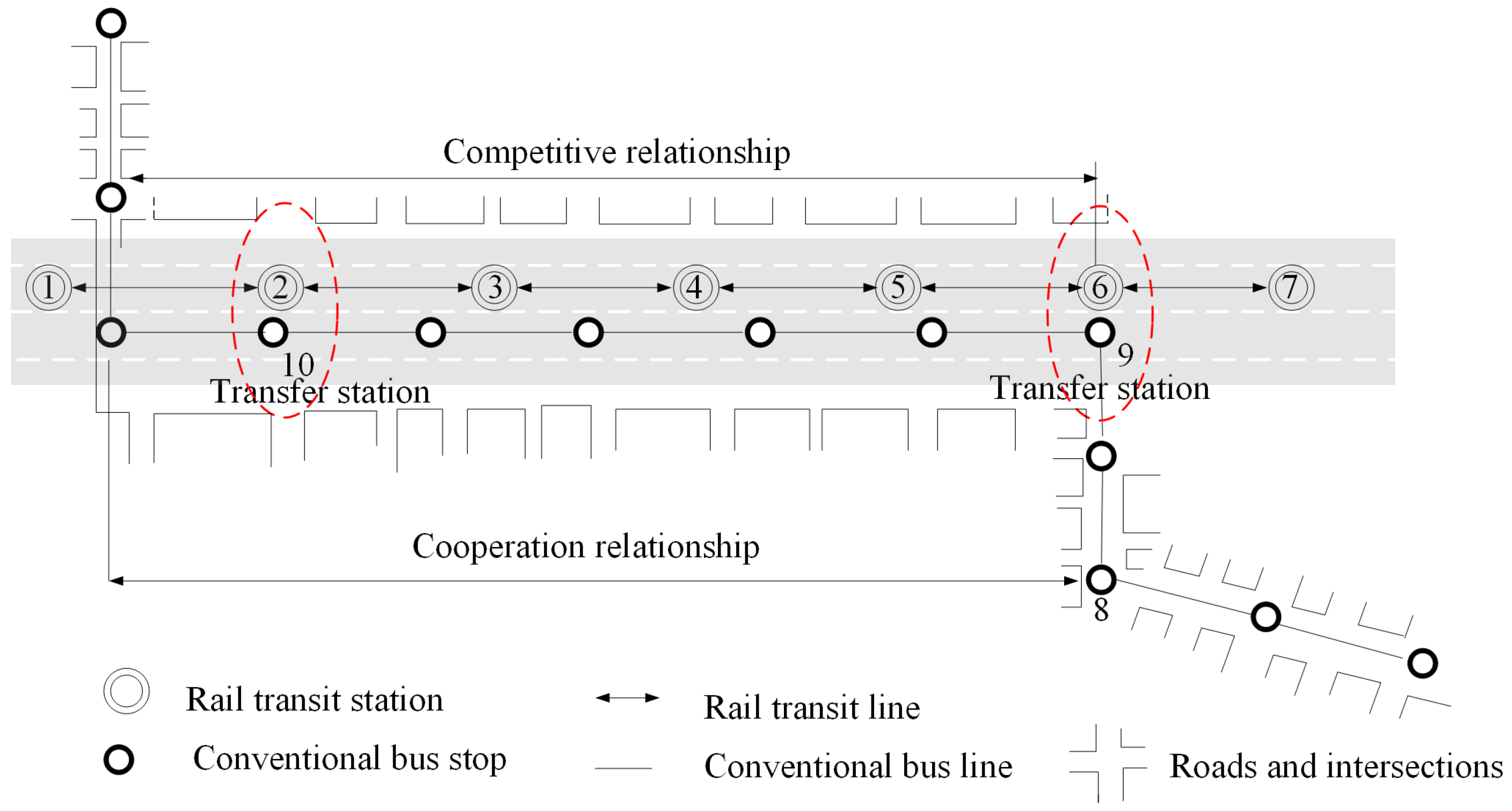
Motivated by these limitations, this paper investigates the co-linear adjustment problem between conventional bus lines and rail transit and develops a constrained passenger-time-oriented optimization framework that reduces redundant competition while preserving route compactness and the service continuity of original bus passengers. The cooperative and competitive relationships between rail transit and a conventional bus line are illustrated in Figure 1.
Figure 1.
An example of competition and cooperation between rail transit and a conventional bus line. Labels 1–7 denote rail transit stations, labels 8–10 denote conventional bus stops, and rail stations 2 and 6 form transfer connections with bus stops 10 and 9, respectively.
3. Optimization Model for Bus Route Adjustment
3.1. Principles of Bus Line Optimization
The main objective of conventional bus line optimization is to improve the coordination between rail transit and conventional bus services, thereby reducing redundant competition and avoiding inefficient resource allocation. In this paper, the adjustment of co-linear bus lines follows the principles below.
- Reducing excessive overlapping bus–rail corridors. For rail transit corridors, a certain number of bus routes should be retained to supplement rail services, especially in sections with local passenger-flow oversaturation. However, the overlapping length between conventional bus lines and rail transit should be controlled within an acceptable threshold. In practical route planning, long consecutive overlaps between bus and rail services are usually regarded as an indicator of redundant service provision. In this study, an overlap of more than four stations is used as an empirical threshold to identify potentially strong bus–rail competition in the considered corridor. This threshold is not intended as a universal standard and can be adjusted according to local planning guidelines and operational conditions.
- Maintaining passenger accessibility. The adjustment of existing bus lines should not simply remove overlapping services. Instead, it should ensure that passengers served by the original bus line still have feasible travel alternatives after adjustment. In particular, the origin–destination accessibility of existing passengers should be preserved as much as possible.
- Improving bus–rail complementarity. The rail transit route is regarded as fixed, while the conventional bus line is adjusted to better support rail transit. The adjusted bus route is expected to intersect with or connect to the rail line, rather than remain highly parallel to it.
- Controlling additional travel time. Since route adjustment may increase the travel time of some passengers, especially those traveling between the two ends of the original co-linear segment, the additional travel time should be restricted within a reasonable threshold compared with the original bus service.
- Maintaining route compactness. The adjusted bus route should not introduce excessive detours merely to cover more candidate stations or reduce the passenger-time cost of some OD pairs. A compact route is more consistent with practical bus operation and helps prevent the adjusted bus line from becoming an inefficient detour service.
Based on the above principles, the bus line adjustment problem in this paper is not formulated as an unrestricted shortest-path problem or a pure passenger-time minimization problem. Instead, it is formulated as a constrained passenger-time-oriented route adjustment problem, in which passenger travel cost is optimized under practical constraints related to overlapping bus–rail corridors, service continuity, additional travel time, and route compactness.
3.2. Problem Statement
The interaction between rail transit and conventional bus lines can generally be classified into two types: cooperative relationship and competitive relationship. In a cooperative relationship, conventional bus lines connect surrounding bus stations with nearby metro stations, allowing passengers to complete their trips through bus–rail transfer. In this case, conventional bus services function as feeder or complementary services to the rail transit system. In contrast, a competitive relationship usually occurs when a conventional bus line runs parallel to a rail transit line. In this case, the bus line and the rail line serve similar origin–destination demands within the same corridor, which may reduce the load factor of the conventional bus line and lead to inefficient use of public transport resources.
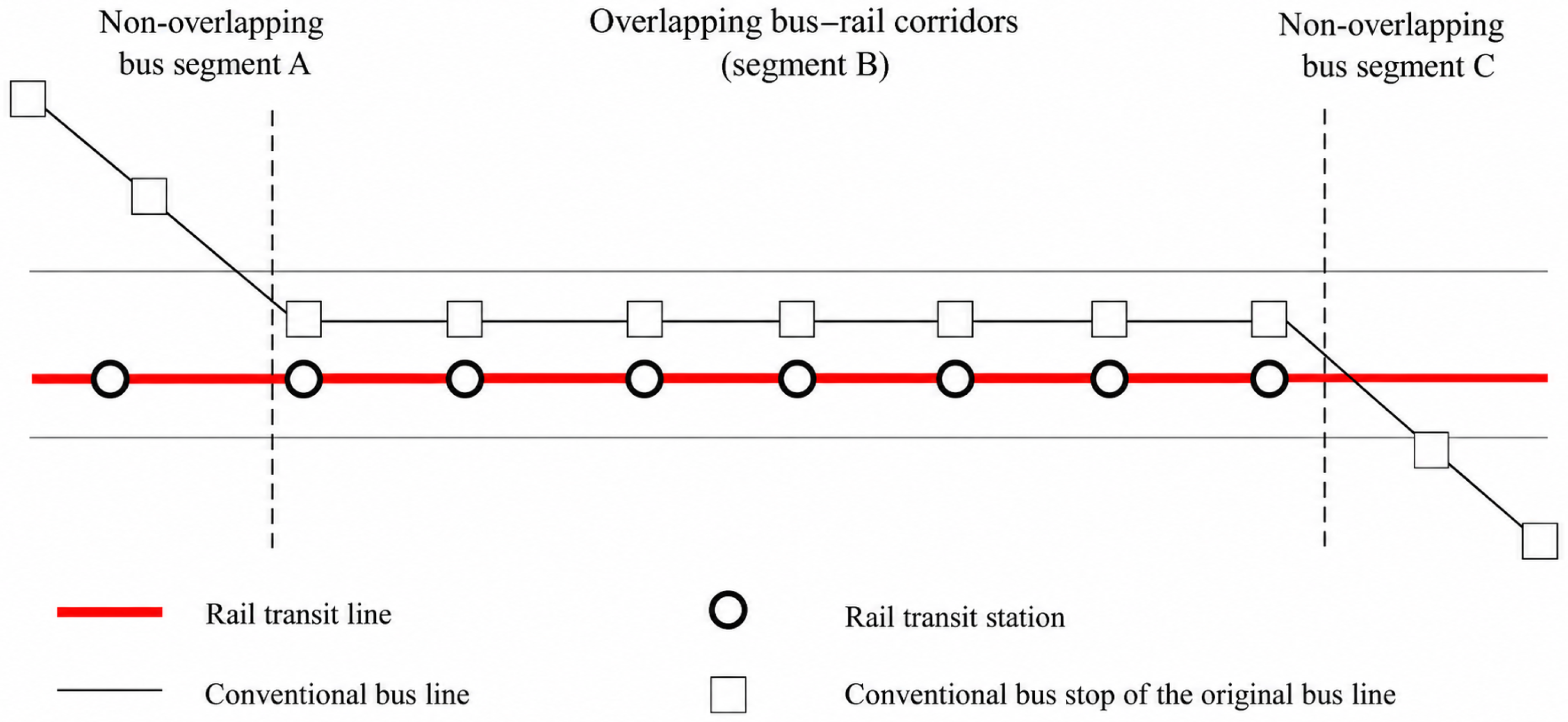
This paper focuses on the adjustment of one existing conventional bus line that has a high degree of overlap with an urban rail transit line. The rail transit line is regarded as fixed, while the conventional bus line can be partially adjusted. The original bus line is divided into three parts: two non-co-linear segments, denoted as segments A and C, and one co-linear segment, denoted as segment B. The two metro stations located at the ends of segment B are regarded as transfer stations between the bus line and the rail transit line. The adjustment is only performed on segment B, while segments A and C remain unchanged. The overlapping bus–rail corridor and the three bus-route segments considered in this study are illustrated in Figure 2.
Figure 2.
An example of an overlapping bus–rail corridor, including non-overlapping segments A and C and overlapping segment B.
Let denote the set of feasible candidate bus stations around the co-linear segment B. These candidate stations can be selected to reconstruct the adjusted bus route. Let denote the set of bus stations in the non-co-linear segments A and C. The two metro stations located at the ends of the co-linear segment are denoted as and . The adjusted bus segment is represented by an ordered route
where are the selected candidate stations.
The binary decision variable is used to indicate whether candidate station is included in the adjusted route:
The purpose of the route adjustment is not simply to select the path with the minimum passenger-time value among all possible connected paths. In practical bus route adjustment, a route with a lower passenger-time value may require a longer detour or excessive station coverage, which may increase operating distance and weaken the intended reduction of bus–rail competition. Therefore, the final adjustment scheme should jointly consider passenger travel cost, route compactness, overlap reduction, accessibility preservation, and allowable travel-time increase.
Accordingly, the problem studied in this paper can be stated as follows. Given an existing bus line, a fixed rail transit line, candidate stations around the co-linear segment, passenger flow demand, road connectivity, and travel-time information, determine an adjusted route for the co-linear segment such that the passenger-time cost is reduced while the adjusted route satisfies practical constraints on road connectivity, route length, bus–rail overlap, passenger accessibility, and additional travel time.
3.3. Model Formulation
The objective of the proposed model is to minimize the passenger-time cost under practical route adjustment constraints. The passenger-time cost consists of two parts, and for each origin station, the travel cost is determined according to whether the station is retained in the adjusted route or served through an alternative post-adjustment travel option. The first part is the travel cost between candidate stations in the co-linear segment and bus stations in the non-co-linear segments. The second part is the travel cost between candidate stations and the metro stations at the two ends of the co-linear segment.
Let denote the potential passenger flow from candidate station to station . Let and denote the potential passenger flows from candidate station to metro stations and , respectively. Let denote the travel time from to after route adjustment, and let denote the corresponding travel time before route adjustment. Similarly, and denote the travel times from to the two metro stations after route adjustment, while and denote the corresponding travel times before route adjustment.
For an unselected station , the original bus service may no longer be available after route adjustment. Therefore, let denote the minimum feasible post-adjustment travel time from to through available alternatives, such as walking to a retained bus stop, transferring to rail transit, or using other bus services. Similarly, and denote the corresponding minimum feasible post-adjustment travel times from to the two terminal metro stations. The alternative travel time is calculated as the minimum travel time among all feasible post-adjustment travel options. The main parameters and variables used in the proposed model are summarized in Table 1.
Table 1.
List of parameters and variables.
The total passenger-time cost is formulated as
where represents the passenger-time cost between candidate stations in the co-linear segment and stations in the non-co-linear segments:
The term represents the passenger-time cost between candidate stations and the metro stations at the two ends of the co-linear segment:
The above objective function evaluates the passenger-time cost associated with the adjusted route. However, since route adjustment must satisfy practical operational requirements, the optimization is subject to the following constraints.
First, the adjusted route should be physically feasible in the road network. Let if stations and are directly connected by an available road segment, and otherwise. For any two consecutive stations in , the following connectivity constraint should hold:
where and .
Second, to avoid generating an excessively long detour route, the length of the adjusted co-linear segment should be controlled by a route compactness constraint:
where denotes the length of the adjusted route in segment B, and is the maximum allowable route length. This constraint ensures that the model does not select an over-extended route merely to reduce the passenger-time cost of some OD pairs.
Third, the adjusted route should reduce excessive overlapping bus–rail corridors with rail transit. Let denote the overlap degree between the adjusted bus segment and the rail transit corridor. The overlap degree can be measured by the overlapping length, the number of overlapping stations, or the number of consecutive overlapping sections. The overlap control constraint is given by
where is the maximum allowable overlap degree. This constraint reflects the planning requirement that the adjusted bus line should provide complementary service rather than remain highly parallel to the rail transit line.
Fourth, route adjustment should not impose an excessive additional travel-time burden on original bus passengers. For passengers traveling between stations in the non-co-linear segments, the increased travel time after adjustment should satisfy
where and denote the adjusted and original travel times between stations i and j, respectively, and is the maximum allowable increase in travel time. In this study, represents the passenger tolerance threshold for additional travel time caused by route adjustment. A smaller imposes a stricter requirement on service continuity, while a larger value allows more flexible route modification.
Fifth, the adjusted route should preserve the basic accessibility of original bus passengers. Since only the co-linear segment is adjusted, the accessibility evaluation focuses on OD pairs between candidate stations and stations in the non-co-linear segments, which are directly affected by the adjustment of the co-linear bus segment. Accessibility to metro stations is incorporated through the passenger-time cost term rather than the accessibility constraint.
Let denote the set of feasible post-adjustment travel paths between and . In this study, a post-adjustment travel path is considered feasible if the corresponding OD pair can still be served by at least one available travel alternative after route adjustment. Specifically, the feasible alternatives include: (i) direct service by the adjusted bus route, (ii) bus–rail transfer through one of the terminal transfer stations, and (iii) walking to a nearby retained bus stop followed by bus or bus–rail travel. The walking and transfer costs associated with these alternatives are included in the corresponding post-adjustment travel time. If none of these alternatives is available, the corresponding OD pair is regarded as inaccessible after route adjustment. The accessibility indicator is defined as
Accordingly, the passenger-flow-weighted accessibility ratio is defined as
The accessibility preservation constraint is formulated as
Here, is a user-specified parameter representing the minimum service accessibility requirement determined by transit planners according to practical planning objectives. In particular, corresponds to the strictest setting, requiring all OD pairs considered in the accessibility evaluation to remain reachable after route adjustment. This constraint prevents the adjusted route from sacrificing the service continuity of a large number of original bus passengers.
Finally, the station-selection decision variable is binary:
For compact presentation, let denote the passenger-flow-weighted accessibility ratio defined in Equation (11). Therefore, the proposed model can be summarized as follows:
Under this formulation, the selected route is the route that minimizes passenger-time cost within the feasible region defined by road connectivity, route compactness, overlap control, accessibility preservation, and travel-time increase constraints. Therefore, the selected route is not necessarily the path with the lowest passenger-time value among all unrestricted candidate paths. This formulation is more consistent with practical bus route adjustment, where operational feasibility and service continuity are as important as passenger-time reduction.
3.4. Bus Line Generation Algorithm
To avoid full enumeration of all possible station permutations, the proposed algorithm adopts a greedy station-generation strategy. Instead of enumerating all feasible paths, it incrementally adds the candidate station that yields the largest reduction in the passenger-time objective while satisfying the practical route adjustment constraints. Therefore, the algorithm is intended to provide a computationally tractable route adjustment scheme for corridor-level planning scenarios with a moderate number of candidate stations. The emphasis of this study is on the optimization model and its practical route adjustment constraints, while the greedy algorithm is adopted as an efficient solution procedure for solving the resulting optimization problem.
Starting from the two transfer stations at the ends of the co-linear segment, the algorithm iteratively evaluates candidate stations that have not yet been selected. In each iteration, a candidate station is temporarily added to the current selected station set, and a candidate route is generated according to road connectivity and station ordering rules. The passenger-time cost of the resulting route is then calculated. The candidate route is accepted only if it satisfies the connectivity, route compactness, overlap control, accessibility, and travel-time increase constraints. Among all feasible candidate routes, the station that leads to the largest reduction in the objective value is selected. The iteration terminates when no remaining candidate station can further improve the objective value under the constraints.
Algorithm 1 summarizes the proposed bus line generation algorithm.
In the algorithm, each candidate route is evaluated by the passenger-time objective function and filtered by the practical route adjustment constraints. Therefore, the generated route is a compact and feasible adjustment scheme rather than an unrestricted minimum-time path. This design is consistent with the purpose of bus route adjustment in overlapping bus–rail corridors: reducing redundant competition with rail transit while maintaining acceptable service continuity for original bus passengers. It should be noted that the proposed algorithm is a greedy constructive heuristic rather than a full path-enumeration method. At each iteration, only one candidate station is added to the current route, and infeasible candidate routes are discarded immediately according to the connectivity, route length, overlap, accessibility, and travel-time constraints. This design reduces the search burden compared with exhaustive enumeration.
The computational complexity of the proposed greedy algorithm mainly depends on the number of candidate stations and the cost of evaluating each candidate route. In each iteration, at most N candidate stations are examined, and the algorithm runs for at most N iterations. Therefore, the number of candidate evaluations is . Since each evaluation involves the calculation of the passenger-time cost and the verification of multiple practical constraints, the overall complexity can be written as , where H denotes the computational cost of evaluating a candidate route.
Compared with exhaustive enumeration, whose search space grows combinatorially with the number of candidate stations due to different station combinations and route orders, the proposed greedy algorithm provides a more tractable way to obtain a feasible route adjustment scheme. Nevertheless, the proposed algorithm is mainly suitable for corridor-level bus route adjustment with a limited number of candidate stations. For larger-scale network redesign problems, more scalable optimization methods with pruning, bounding, or metaheuristic search strategies, such as genetic algorithms or simulated annealing, should be further investigated.
| Algorithm 1 Bus Line Generation Algorithm | |
| Require: Candidate station set ; station set in the non-co-linear segments; terminal metro stations and ; road connectivity ; distance between stations; passenger flows , , and ; original travel times , , and ; thresholds , , , and . | |
| Ensure: Adjusted bus route for the co-linear segment. | |
| 1: | Initialize the selected station set . |
| 2: | Initialize the route and calculate its objective value . |
| 3: | Set . |
| 4: | while do |
| 5: | Set and . |
| 6: | for each candidate station do |
| 7: | Generate a candidate selected station set . |
| 8: | Construct a candidate route based on , road connectivity, and station ordering rules. |
| 9: | Check the road connectivity of . |
| 10: | Compute the route length , overlap degree , accessibility ratio, and travel-time increases. |
| 11: | if satisfies all constraints then |
| 12: | Calculate the passenger-time cost . |
| 13: | if then |
| 14: | Set and . |
| 15: | end if |
| 16: | end if |
| 17: | end for |
| 18: | if then |
| 19: | Add station into J. |
| 20: | Update according to the selected station set J. |
| 21: | Set and . |
| 22: | else |
| 23: | Terminate the iteration. |
| 24: | end if |
| 25: | end while |
| 26: | return adjusted bus route . |
The proposed greedy algorithm is intended as an efficient solution procedure for the proposed optimization model rather than a new general-purpose optimization algorithm. Its primary objective is to generate feasible route adjustment schemes that satisfy multiple practical planning constraints with low computational complexity. Although metaheuristic methods, such as genetic algorithms and simulated annealing, may provide alternative solution strategies for the same optimization model, a comprehensive comparison among different optimization algorithms is beyond the scope of the present study and will be considered in future work.
4. Numerical Experiments
4.1. Simulation Experiment
To evaluate the proposed bus line adjustment model, we first conduct a simulation experiment on a simplified co-linear transit corridor. In this example, metro stations A and C are located at the two ends of the co-linear segment. Along the rail transit corridor, nine surrounding conventional bus stations are considered and numbered from 1 to 9. In this simplified simulation, the passenger demand considered in the optimization consists of OD flows between the nine candidate bus stations and the two terminal stations A and C.
The distance and passenger-flow inputs are reported in Table 2 and Table 3, respectively, with the complete matrices provided in Supplementary Tables S1 and S2. The existing-route travel times are reported in Table 4, while the complete travel-time inputs used to generate and evaluate candidate routes are provided in Supplementary Table S3. The original bus service is represented by the existing station sequence from to before route adjustment, and the adjusted route is generated by replacing the co-linear segment while keeping the two terminal metro stations fixed. The travel times of buses in the uplink and downlink directions are assumed to be the same for each road segment. In the simulation, we adopt a conservative service-continuity setting with min and . This means that the adjusted route should not increase the travel time of affected OD pairs by more than 5 min, and all OD pairs considered in the accessibility evaluation should remain reachable after route adjustment. Since accessibility is enforced as a hard feasibility constraint in the route-generation process, each reported feasible scheme must satisfy . Under the conservative setting , the selected adjustment scheme achieves , indicating that 100% of the OD pairs considered in the accessibility evaluation remain reachable after route adjustment.
Table 2.
Distance between connected stations (meter).
Table 3.
Passenger flow between bus stations and metro stations.
Table 4.
Passenger travel time under the existing bus line (minute).
To make the simulation setting more realistic, two stations are regarded as directly connected only when their distance is no less than 400 m and no greater than 1800 m. Otherwise, the two stations are considered unreachable. The distance data between connected stations are shown in Table 2. Blank entries in Table 2 indicate that no direct connection is allowed between the corresponding stations under the above connectivity rule, rather than missing distance data. The complete distance matrix used in the simulation is also provided in Supplementary Table S1. Given an average bus speed of 20 km/h, the travel time between stations can be calculated accordingly. The passenger flows between bus stations and metro stations are presented in Table 3, and the passenger travel times under the existing bus line are shown in Table 4. For this simplified simulation, Table 3 represents the complete OD passenger-flow matrix used in the experiment, and Table 4 represents the complete existing travel-time matrix between the two terminal stations and the nine candidate stations. The travel times reported in Table 4 describe the travel times from the two terminal metro stations to each candidate station under the existing bus line. For adjusted candidate routes, travel times are calculated according to the connected road segments in Table 2 and the assumed average bus speed.
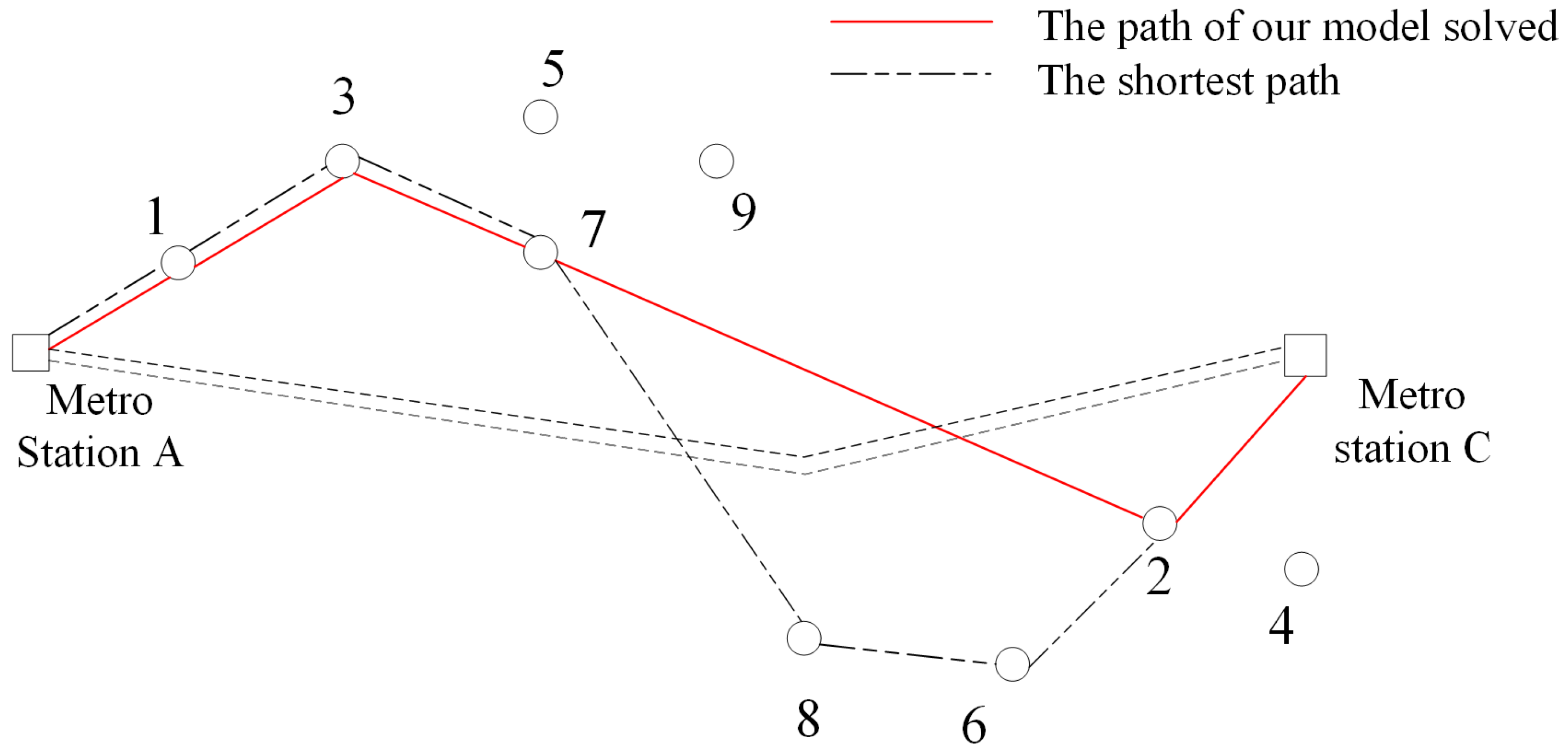
Based on the proposed bus line generation algorithm, the selected adjustment scheme is obtained as the path 1-3-7-2, with a passenger-time cost of 3224.99 min and a route length of 3715 m. The selected route and the shortest-path benchmark are illustrated in Figure 3. To further analyze the generated solution, we compare it with the route adjustment schemes obtained by exhaustive enumeration under the same candidate station set. The 29 candidate schemes in Table 5 are generated by enumerating feasible station sequences under the same connectivity, route length, accessibility, and travel-time constraints, rather than being manually selected. The complete list of candidate schemes used in the simulation, together with their passenger-time costs, route lengths, and passenger-flow coverage, is provided in Supplementary Table S4 to support independent verification of the reported numerical results. Since different schemes may retain different bus stops and cover different passenger flows, the total passenger-time values should be interpreted together with the passenger-flow coverage shown in Table 5, rather than as normalized performance measures. In addition, all candidate schemes reported in Table 5 satisfy the accessibility constraint; therefore, accessibility is used as a feasibility condition rather than as an independent ranking indicator in the comparison. The comparison results are shown in Table 5.
Figure 3.
Selected route adjustment result in the simulation experiment. Numbers 1–9 denote the candidate bus stations; the solid line denotes the route selected by the proposed model, and the dashed line denotes the shortest path.
Table 5.
Comparison of candidate route adjustment schemes.
As shown in Table 5, different candidate schemes show different trade-offs among passenger-time cost, route length, and passenger-flow coverage. Scheme 1 and Scheme 2 obtain smaller passenger-time values than Scheme 3. However, they require longer adjusted routes, with route lengths of 4405 m and 4805 m, respectively, and involve a wider range of station coverage. These results indicate that a lower passenger-time value can be achieved by extending the adjusted route and covering more candidate stations, but this may also introduce additional detours and weaken the compactness of the adjusted bus segment.
Under the proposed constrained passenger-time-oriented model, the final route is selected not only according to the passenger-time indicator, but also according to practical route adjustment requirements, including route compactness, accessibility preservation, and reduction of redundant bus–rail overlap. Therefore, Scheme 3 is selected as the effective adjustment scheme because it provides a balanced solution with a relatively low passenger-time cost and a shorter route length of 3715 m. This result is consistent with the objective of this study, which is to obtain a compact and service-continuity-preserving adjustment scheme rather than simply extending the bus route to minimize a single travel-time indicator.
The comparison further shows that a longer adjusted bus route does not necessarily lead to better overall performance. For example, Scheme 22 and Scheme 29 cover more stations and passenger flows, but their total travel times increase to 4619.26 min and 5508.03 min, respectively. This is mainly because excessive station inclusion increases detour distance and weakens the benefit of reducing bus–rail competition. In contrast, Scheme 3 avoids unnecessary extension of the co-linear bus segment and retains key stations that contribute to passenger accessibility and route compactness.
Compared with the original bus service without adjustment, the selected scheme reduces the total passenger travel time by 48.69% for the passenger demand considered in the model. Specifically, the passenger-time cost of the original bus route is min, while the passenger-time cost of the selected adjustment scheme is min. Therefore, the reduction ratio is calculated as
The corresponding calculation is also provided in Supplementary Table S5. This reduction is calculated with respect to the original bus route using the total passenger-time cost defined in Equation (3), and should be interpreted as the improvement for the passenger demand represented in the optimization model rather than as a system-wide reduction for all passengers affected by the route adjustment. For passengers originating from stations not retained in the adjusted route, the post-adjustment travel costs are evaluated using the alternative travel-time terms introduced in Equations (4) and (5), which represent feasible travel alternatives, such as walking to a retained bus stop, transferring to rail transit, or using other bus services. This result demonstrates that the proposed constrained passenger-time-oriented model can improve travel efficiency in a co-linear bus–rail corridor while avoiding excessive route extension. More importantly, the selected scheme does not simply shorten or extend the bus route, but reconstructs the co-linear segment according to passenger demand, transfer accessibility, and route compactness. Therefore, the proposed method can reduce redundant competition with rail transit while maintaining necessary bus service for passengers who still rely on conventional bus routes.
4.2. Real-World Case Study
To further evaluate the applicability of the proposed model, we select Xiamen Bus Line 27 as a real-world case. The total length of Bus Line 27 is 19.7 km, and its co-linear length with Xiamen Metro Line 1 is 9.1 km, accounting for approximately 46% of the whole bus route. Such a high overlap ratio indicates that Bus Line 27 has a strong competitive relationship with the rail transit line. The case-study data include the station sequence of Xiamen Bus Line 27, the spatial relationship between Bus Line 27 and Xiamen Metro Line 1, passenger travel-time records before adjustment, and estimated post-adjustment travel-time changes derived from feasible travel alternatives. These data are used to identify the overlapping segment, determine the two terminal transfer stations, and evaluate the passenger travel-time impact of the adjusted route. Specifically, the case-study evaluation is based on aggregated passenger travel-time records, bus route information, and bus–rail spatial connectivity information. These data are used to examine whether the proposed framework can generate a practically feasible route adjustment scheme under real bus–rail corridor conditions, rather than to conduct a post-implementation behavioral validation based on long-term observed passenger responses.
In this case, Dianqian Station and Hubin East Road Station are selected as the two transfer stations. Accordingly, Bus Line 27 is divided into three segments: non-co-linear segment A, from Xiangyuwujinjidiancheng Station to Malong Station; co-linear segment B, from Malonghuojuyuan Station to Hudong Station; and non-co-linear segment C, from Lianbanbei Station to Wucun Station. The proposed model is applied to adjust the route of segment B while preserving the accessibility of the original bus passengers.
According to the proposed constrained passenger-time-oriented model, the selected co-linear segment is adjusted as Nanhugongyuandongmen → Rencaizhongxin → Huligongyuandongmen → Xinhuahuayuan → Yuehualukou → Dianqian. The adjusted route reduces the overlap with Metro Line 1 and guides the conventional bus service to play a more complementary role in the integrated public transport system. After route adjustment, the overlapping segment between Bus Line 27 and Metro Line 1 is reduced to 1.4 km, corresponding to an 84.6% reduction compared with the original overlapping length of 9.1 km. For the passenger demand considered in the case study, the adjusted route also reduces the total passenger travel time by 8.73%. These quantitative results are reported as case-study performance indicators for the specific Xiamen application scenario. They describe the outcome of the generated adjustment scheme in terms of overlap reduction and passenger-time cost, but should not be interpreted as statistical validation or post-implementation behavioral validation of the proposed method.
To analyze the impact of route adjustment on passenger travel time, we further consider the uncertainty of actual bus operation. In practice, the travel time of the same OD pair is affected by road congestion, emergencies, departure delays, and peak-hour traffic conditions. Therefore, directly comparing the average travel time before and after adjustment may not accurately reflect the real influence on passengers. To address this issue, a density-based clustering method is adopted to classify the travel-time records of the same OD pair. If the travel time after adjustment falls into the same cluster as the original travel-time distribution, the passenger travel time is regarded as not significantly affected. In addition, passengers are also regarded as unaffected if they still have other direct travel alternatives after adjustment. Therefore, the case-study evaluation focuses on whether the adjusted route can reduce bus–rail overlap while keeping the travel-time increase of affected passengers within an acceptable range. This evaluation is based on passenger travel-time changes and the availability of direct travel alternatives after route adjustment. For the accessibility evaluation in the real-world case study, an affected OD pair is regarded as accessible if passengers can still complete the trip through the adjusted bus route, a direct alternative bus service, or a bus–rail transfer path after route adjustment. The case-study evaluation therefore checks not only the change in passenger travel time, but also whether feasible post-adjustment travel alternatives remain available for affected passengers.
However, the current real-world case study does not provide a full OD-level numerical accessibility validation. The available Xiamen case-study data support an accessibility-preservation check based on feasible post-adjustment travel alternatives, but the complete OD-level passenger records and detailed alternative-path statistics cannot be publicly released due to passenger privacy and operational restrictions. Therefore, we do not report the exact accessibility ratio, the percentage of passengers remaining accessible, the number of inaccessible OD pairs, or a complete before-and-after accessibility matrix for the real-world case. The accessibility assessment in the Xiamen case should be interpreted as an aggregated accessibility-preservation check for the specific application scenario, rather than as a fully reproducible quantitative accessibility validation.
The real-world results indicate that the proposed adjustment scheme can help control the negative impact on existing passengers. Overall, the increased travel time is mainly concentrated within 5 min, involving 37,045 passengers and accounting for 13.74% of the total passenger volume. This indicates that only a limited proportion of passengers experience a slight increase in travel time after route adjustment. For passengers whose travel time increases by 5 to 10 min, the main reason is that some OD pairs require an additional transfer after the bus route is adjusted. However, this increase is acceptable from the perspective of system-level coordination, because the adjusted route reduces redundant bus–rail competition and improves the functional division between conventional bus and rail transit.
Meanwhile, the route adjustment also brings travel-time savings for some passengers. After adjustment, some passengers who previously needed a “walking + transfer” mode can directly reach the connecting station by bus. The reduction in walking distance and transfer inconvenience improves the accessibility of these passengers. This result indicates that the proposed model does not merely reduce the overlap between bus and rail services, but also reorganizes the bus route according to passenger travel demand and transfer convenience.
It should be noted that the Xiamen case study is intended to illustrate the practical applicability of the proposed framework rather than to serve as a rigorous post-implementation validation. The reported overlap reduction, passenger-time reduction, and accessibility-preservation check are performance indicators of this specific case-study application, rather than statistical validation or behavioral validation of the proposed method. The case study evaluates whether the proposed model can generate a feasible route adjustment scheme under real bus–rail corridor conditions, but it does not include sensitivity analysis, statistical validation over multiple cases, or behavioral validation based on observed passenger responses after actual implementation. These aspects require additional operational data, repeated scenarios, and long-term field observations, and are therefore beyond the scope of the present study.
In summary, the simulation experiment demonstrates the methodological applicability of the proposed model, while the real-world case study illustrates its practical applicability in an actual bus–rail corridor. The simulation results show that the proposed algorithm can generate a compact and feasible adjustment scheme under practical route adjustment constraints, while reducing passenger travel cost compared with the original bus service. The comparison among candidate schemes further indicates that passenger-time cost, route length, and passenger-flow coverage should be jointly considered in bus route adjustment in overlapping bus–rail corridors. The real-world case further suggests that the proposed method can reduce redundant overlap between conventional bus and rail transit, control the adverse impact on existing passengers, and improve the overall coordination efficiency of the integrated public transport system.
5. Discussion
The numerical and real-world results indicate that the proposed constrained passenger-time-oriented model can reduce redundant bus–rail overlap while maintaining basic service continuity for affected passengers. Different from unrestricted shortest-path adjustment, the proposed method jointly considers passenger-time cost, route compactness, overlap control, accessibility preservation, and allowable travel-time increase, thereby better reflecting practical bus route adjustment requirements.
The proposed bus line generation algorithm is designed for corridor-level route adjustment, where the number of candidate stations is usually moderate. The greedy constructive strategy avoids full enumeration of all possible station permutations and provides a tractable feasible solution. However, for larger-scale bus network redesign problems involving many candidate stations or multiple overlapping bus lines, the search space may increase substantially. In such cases, pruning strategies, bounding techniques, or metaheuristic methods such as genetic algorithms and simulated annealing may be required to improve scalability.
This study also has several limitations. First, the current model focuses on the adjustment of a single bus line overlapping with a fixed rail transit corridor. Second, passenger demand is treated as deterministic based on available passenger-flow records. Third, several planning parameters, such as the maximum overlap, route length limit, allowable travel-time increase, and accessibility threshold, are specified according to practical route planning requirements and operational considerations. Although representative parameter settings are adopted in this study, a systematic sensitivity analysis would provide further insights into the robustness of the proposed model. Future work will extend the model to multi-line adjustment scenarios and incorporate stochastic passenger demand, comprehensive sensitivity analyses of planning parameters, and more scalable solution algorithms. Due to privacy and operational restrictions, the complete passenger travel records and detailed OD-level data of Xiamen Bus Line 27 cannot be publicly released. Therefore, the real-world case study is intended to illustrate the practical applicability of the proposed framework rather than to provide a fully reproducible benchmark dataset. Accordingly, full OD-level accessibility indicators for the real-world case, including the accessibility ratio, the percentage of passengers remaining accessible, the number of inaccessible OD pairs, and the before-and-after accessibility comparison, are not reported in the current study. These indicators require complete OD-level passenger records and detailed post-adjustment alternative-path statistics, and should be further examined in future studies when such data are available. Another limitation concerns the validation scope of the real-world case study. Although the Xiamen case study illustrates the applicability of the proposed framework to a real bus–rail corridor, it should be interpreted as an illustrative application rather than a rigorous post-implementation validation. In particular, the overlap reduction, passenger-time reduction, and accessibility-preservation results reported for the Xiamen case should be regarded as performance indicators of the specific case-study application, not as rigorous statistical validation of the proposed method. A more comprehensive validation would require sensitivity analysis under different planning parameters, statistical testing over multiple real-world corridors or repeated operational scenarios, full OD-level accessibility indicators, and passenger behavior data collected after actual route implementation. These requirements involve additional long-term operational data and field observations, which are beyond the scope of the present study and will be investigated in future work. Future work will also investigate alternative optimization algorithms, including metaheuristic and exact optimization methods, to further evaluate the solution quality and computational efficiency of different approaches.
6. Conclusions
This paper investigated the overlapping bus–rail corridors problem between conventional bus lines and rail transit in integrated public transportation systems. To address this issue, a constrained passenger-time-oriented optimization model was developed to adjust existing bus routes by jointly considering passenger travel demand, route compactness, overlap control, accessibility preservation, and allowable travel-time increase. A bus line generation algorithm was further proposed to obtain compact and feasible route adjustment schemes. The methodological applicability of the proposed method was evaluated through simulation experiments, and its practical applicability was illustrated through a real-world case study of Xiamen Bus Line 27. The results indicate that the proposed approach can reduce redundant competition between conventional bus and rail transit while maintaining acceptable service accessibility for existing passengers. In particular, the selected scheme reduced passenger travel cost compared with the original bus service and improved the coordination efficiency of the integrated public transportation system.
Future work will extend the proposed framework to multi-line adjustment scenarios with stochastic passenger demand and more comprehensive operational constraints.
Supplementary Materials
The following supporting information can be downloaded at: https://www.mdpi.com/article/10.3390/vehicles8070164/s1, Table S1: Complete distance matrix used in the simulation; Table S2: Complete passenger-flow matrix used in the simulation; Table S3: Complete travel-time matrix used to generate and evaluate candidate routes; Table S4: Complete list of candidate route adjustment schemes with passenger-time costs, route lengths, and passenger-flow coverage; Table S5: Calculation of the passenger-time reduction ratio.
Author Contributions
Conceptualization, D.H., Y.L. and H.H.; methodology, D.H. and H.H.; software, D.H.; validation, Y.L., X.F. and H.H.; formal analysis, D.H., Y.L., X.F. and H.H.; investigation, D.H. and Y.L.; resources, D.H., Y.L. and H.H.; data curation, D.H.; writing—original draft preparation, D.H. and Y.L.; writing—review and editing, D.H., Y.L., X.F. and H.H.; visualization, D.H.; supervision, H.H.; project administration, H.H.; funding acquisition, D.H. All authors have read and agreed to the published version of the manuscript.
Funding
This research was funded by Henan Provincial Science and Technology Research Project, grant number 262102110369. Open Research Projects of Henan Big Data Industrial Integration Innovation Center of Intelligent Transportation (Yugongxin Data [2024] No. 266). Henan Provincial Department of Education’s 2025 Private University Characteristic Development Project (Jiao Ban Zheng Fa [2024] No. 333)—Zhengzhou University of Industrial Technology, Data Science and Big Data Technology.
Institutional Review Board Statement
Not applicable.
Informed Consent Statement
Not applicable.
Data Availability Statement
The aggregated input data used in the simulation experiment are provided in the Supplementary Material. The raw passenger smart-card records and bus GPS operational data used in the real-world case study are not publicly available due to passenger privacy and operational restrictions.
Conflicts of Interest
The authors declare no conflicts of interest.
References
- Liang, Y.; Yin, M.; Wang, W.; Liu, Q.; Wang, L.; Zheng, X.; Wang, T. Collaborative Edge Server Placement for Maximizing QoS with Distributed Data Cleaning. IEEE Trans. Serv. Comput. 2025, 18, 1321–1335. [Google Scholar] [CrossRef] [Scilit]
- Li, J. Analysis of Characteristics of Road Bus Service Based on Urban Rail Transit Network. In Proceedings of the 2018 IEEE 4th International Conference on Control Science and Systems Engineering (ICCSSE), Wuhan, China, 21–23 August 2018; IEEE: New York, NY, USA, 2018; pp. 407–411. [Google Scholar]
- Yang, S.; Wu, Y.; Zhao, M. An Integer Linear Programming Model for the Crew Re-Scheduling Problem Under Crew Unavailability in Urban Rail Transit. Vehicles 2026, 8, 104. [Google Scholar] [CrossRef] [Scilit]
- Zhou, X.; Wang, Y.; Ji, X.; Cottrill, C. Coordinated Control Strategy for Multi-Line Bus Bunching in Common Corridors. Sustainability 2019, 11, 6221. [Google Scholar] [CrossRef] [Scilit]
- Liang, Y.; Xu, C.; Mei, Y.; Zou, H.; Guo, J.; Fan, X.; Wang, T.; Huang, H. A Comprehensive Survey on Large Language Model Compression for Artificial Intelligence Applications in Edge Systems. IEEE Internet Things J. 2026, 13, 20583–20599. [Google Scholar] [CrossRef] [Scilit]
- Moradi, N.; Mafakheri, F.; Wang, C. A systematic review of sustainable ground-based last-mile delivery of parcels: Insights from operations research. Vehicles 2025, 7, 121. [Google Scholar] [CrossRef] [Scilit]
- Zhao, F.; Zeng, X. Optimization of transit network layout and headway with a combined genetic algorithm and simulated annealing method. Eng. Optim. 2006, 38, 701–722. [Google Scholar] [CrossRef] [Scilit]
- Chu, J.C. Mixed-integer programming model and branch-and-price-and-cut algorithm for urban bus network design and timetabling. Transp. Res. Part B Methodol. 2018, 108, 188–216. [Google Scholar] [CrossRef] [Scilit]
- Zhao, C.L.; Huang, H.J. Modeling the equilibrium bus line choice behavior and transit system design with oblivious users. Discret. Dyn. Nat. Soc. 2014, 2014, 173876. [Google Scholar] [CrossRef] [Scilit]
- Sun, Y.; Sun, X.; Kong, Q.; Song, R.; He, S. Methodology of bus network optimization and adjustment under operation of new urban rail transit line. J. China Railw. Soc. 2014, 36, 1–8. [Google Scholar] [CrossRef] [Scilit]
- Liang, Y.; Yin, M.; Zhang, Y.; Wang, W.; Jia, W.; Wang, T. Grouping reduces energy cost in directionally rechargeable wireless vehicular and sensor networks. IEEE Trans. Veh. Technol. 2023, 72, 10840–10851. [Google Scholar] [CrossRef] [Scilit]
- Kang, L.; Zhu, X.; Sun, H.; Wu, J.; Gao, Z.; Hu, B. Last train timetabling optimization and bus bridging service management in urban railway transit networks. Omega 2019, 84, 31–44. [Google Scholar] [CrossRef] [Scilit]
- Sun, Y.; Sun, X.; Li, B.; Gao, D. Joint optimization of a rail transit route and bus routes in a transit corridor. Procedia-Soc. Behav. Sci. 2013, 96, 1218–1226. [Google Scholar] [CrossRef] [Scilit]
- Almasi, M. Modelling and Optimization of a Transit Services with Feeder Bus and Rail System. Ph.D. Thesis, University of Malaya, Kuala Lumpur, Malaysia, 2015. [Google Scholar]
- Kuah, G.K.; Perl, J. Optimization of feeder bus routes and bus-stop spacing. J. Transp. Eng. 1988, 114, 341–354. [Google Scholar] [CrossRef] [Scilit]
- Kuah, G.K.; Perl, J. The feeder-bus network-design problem. J. Oper. Res. Soc. 1989, 40, 751–767. [Google Scholar] [CrossRef]
- Martins, C.L.; Pato, M.V. Search strategies for the feeder bus network design problem. Eur. J. Oper. Res. 1998, 106, 425–440. [Google Scholar] [CrossRef] [Scilit]
- Chien, S.; Yang, Z. Optimal feeder bus routes on irregular street networks. J. Adv. Transp. 2000, 34, 213–248. [Google Scholar] [CrossRef] [Scilit]
- Shrivastava, P.; O’Mahony, M. Use of a hybrid algorithm for modeling coordinated feeder bus route network at suburban railway station. J. Transp. Eng. 2009, 135, 1–8. [Google Scholar] [CrossRef] [Scilit]
- Liu, H.; Zhao, S.; Zhu, Y.; Li, X. Feeder bus network design model based on effective path. J. Jilin Univ. 2015, 45, 371–378. [Google Scholar]
- Szeto, W.Y.; Wu, Y. A simultaneous bus route design and frequency setting problem for Tin Shui Wai, Hong Kong. Eur. J. Oper. Res. 2011, 209, 141–155. [Google Scholar] [CrossRef] [Scilit]
- Lin, J.J.; Wong, H.I. Optimization of a feeder-bus route design by using a multiobjective programming approach. Transp. Plan. Technol. 2014, 37, 430–449. [Google Scholar] [CrossRef] [Scilit]
- Lai, Y.; Chen, Y. Collaborative optimization model for the design and operation of feeder bus routes based on urban metro. J. Adv. Transp. 2023, 2023, 6987787. [Google Scholar] [CrossRef] [Scilit]
- Cai, J.; Li, Z.; Long, S. Integrated Optimization of Route and Frequency for Rail Transit Feeder Buses under the Influence of Shared Motorcycles. Systems 2024, 12, 263. [Google Scholar] [CrossRef] [Scilit]
- Gao, X.; Liu, S.; Jiang, S.; Yu, D.; Peng, Y.; Ma, X.; Lin, W. Optimizing the three-dimensional multi-objective of feeder bus routes considering the timetable. Mathematics 2024, 12, 930. [Google Scholar] [CrossRef] [Scilit]
- Chen, Y.; Lai, Y.; Easa, S.M.; Wang, S. Microcirculation bus routes design and coordinated schedules considering the impact of shared bicycles. J. Transp. Eng. Part A Syst. 2024, 150, 04024058. [Google Scholar] [CrossRef] [Scilit]
- Liu, J.; Song, R. Continuous approximation and GIS-enhanced design optimization of feeder bus networks along rail corridors. PLoS ONE 2025, 20, e0318616. [Google Scholar] [CrossRef] [Scilit] [PubMed]
- Jia, G.L.; Ma, R.G.; Hu, Z.H. Urban transit network properties evaluation and optimization based on complex network theory. Sustainability 2019, 11, 2007. [Google Scholar] [CrossRef] [Scilit]
- Roháčová, V. A DEA based approach for optimization of urban public transport system. Cent. Eur. J. Oper. Res. 2015, 23, 215–233. [Google Scholar]
- Zhang, N.; Huang, Z. Evaluation and optimization of bus route network in Wuhan China. In Proceedings of the 7th Advanced Forum on Transportation of China (AFTC 2011), Beijing, China, 22 October 2011; IET: Stevenage, UK, 2011; pp. 140–148. [Google Scholar]
- Long, J.; Tan, W.; Szeto, W.; Li, Y. Ride-sharing with travel time uncertainty. Transp. Res. Part B Methodol. 2018, 118, 143–171. [Google Scholar] [CrossRef] [Scilit]
- Hu, P.; Yang, X. Trip scheme optimization based on generalized trip cost. Syst. Eng. Theory Pract. 2017, 37, 982–989. [Google Scholar]
- Lou, Y.; Yin, Y.; Lawphongpanich, S. Robust approach to discrete network designs with demand uncertainty. Transp. Res. Rec. 2009, 2090, 86–94. [Google Scholar] [CrossRef] [Scilit]
- Liang, J.; Wu, J.; Gao, Z.; Sun, H.; Yang, X.; Lo, H.K. Bus transit network design with uncertainties on the basis of a metro network: A two-step model framework. Transp. Res. Part B Methodol. 2019, 126, 115–138. [Google Scholar] [CrossRef] [Scilit]
- Wang, Y.; Zhou, Y.; Yang, H.; Yan, X. Integrated optimization of bus bridging service design and passenger assignment in response to urban rail transit disruptions. Transp. Res. Part C Emerg. Technol. 2023, 150, 104098. [Google Scholar] [CrossRef] [Scilit]
- Li, W.; Zheng, L.; Liao, L.; Yang, X.; Sun, D.; Liu, W. A multiline customized bus planning method based on reinforcement learning and spatiotemporal clustering algorithm. IEEE Trans. Comput. Soc. Syst. 2023, 11, 3691–3705. [Google Scholar] [CrossRef] [Scilit]
- Jiang, X.; Long, S.; Liu, Y.; Meng, F.; Luan, X. Integrated Optimization of Vehicle Scheduling and Passenger Assignment of Demand-Responsive Transit and Conventional Buses under Urban Rail Transit Disruptions. J. Transp. Eng. Part A Syst. 2025, 151, 04025037. [Google Scholar] [CrossRef] [Scilit]
- Li, W.; Zheng, L.; Wu, X.; Tang, Y.; Liu, W.; Sun, D. EAMR: An Efficient and Adaptive Multi-Agent Reinforcement Learning Method for Customized Bus Route Optimization Under Multi-Source Uncertainties. IEEE Trans. Intell. Transp. Syst. 2026; early access.

Disclaimer/Publisher’s Note: The statements, opinions and data contained in all publications are solely those of the individual author(s) and contributor(s) and not of MDPI and/or the editor(s). MDPI and/or the editor(s) disclaim responsibility for any injury to people or property resulting from any ideas, methods, instructions or products referred to in the content. |
© 2026 by the authors. Licensee MDPI, Basel, Switzerland. This article is an open access article distributed under the terms and conditions of the Creative Commons Attribution (CC BY) license.