
Physics-Informed Predictive Energy Management Strategy for HEVs Using Kalman-Enhanced Transformer


Abstract
1. Introduction
- (1)
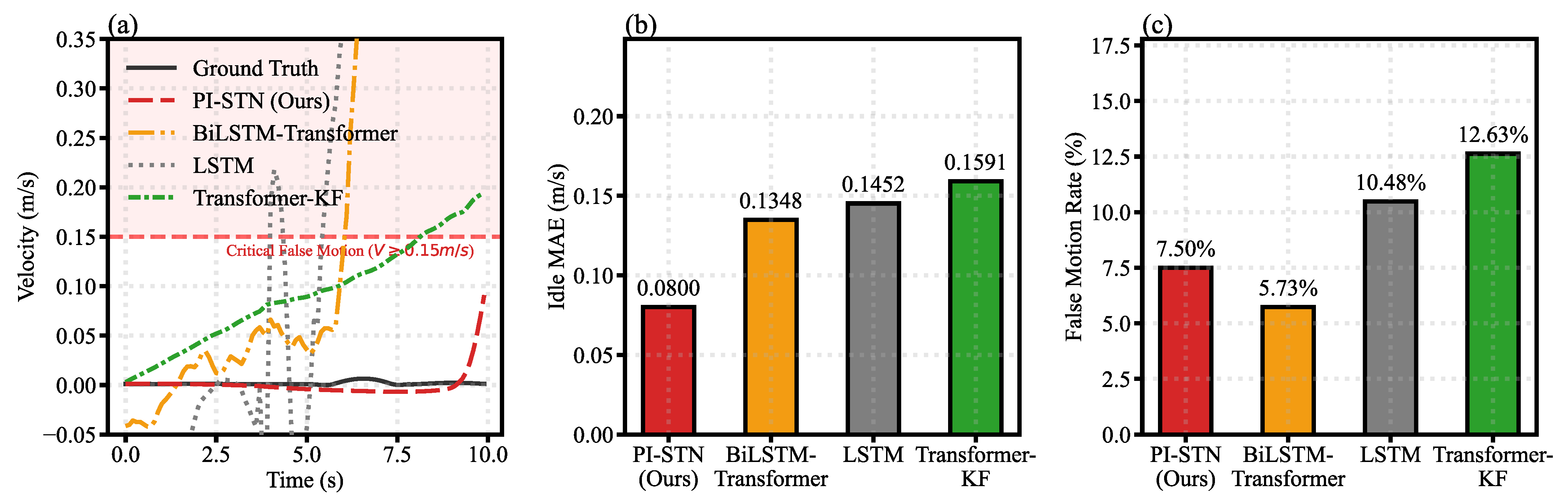
- To mitigate idling pseudo-motion and energy consumption misjudgment in zero-speed scenarios, a global zero-speed gating mechanism is developed to suppress non-physical motion cues during vehicle standstill.
- (2)
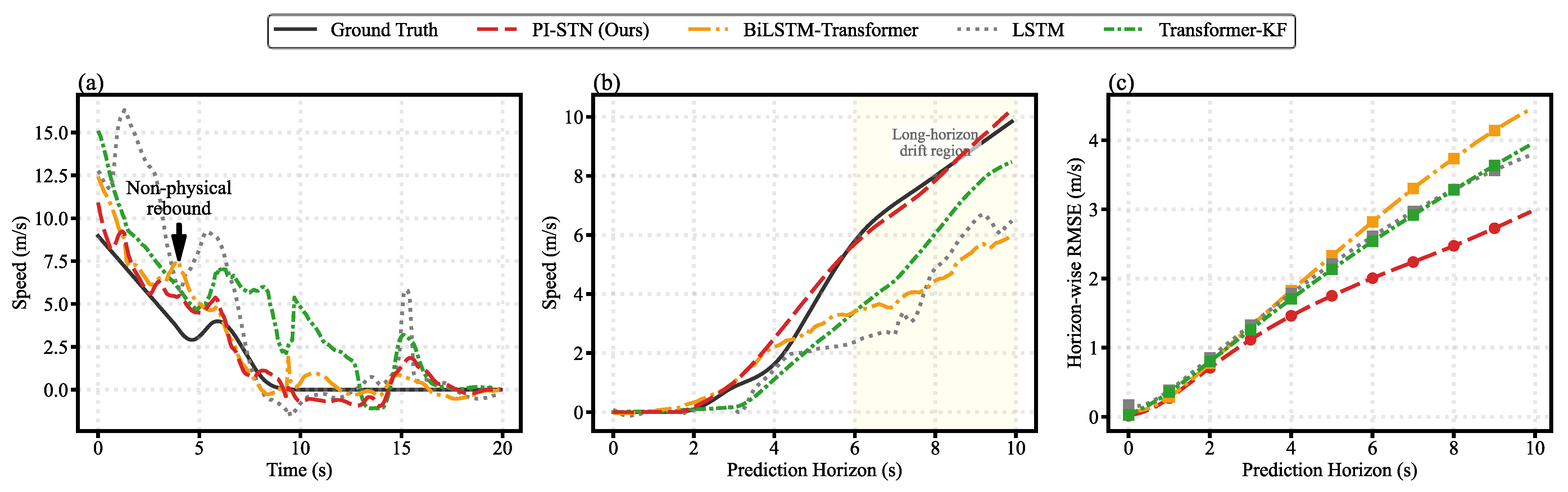
- To alleviate spatial distortion in predicted trajectories, a physical causal constraint mechanism is introduced. By incorporating physical causal penalties based on decoupled parameters into the PI-STN structure, the proposed method helps suppress abnormal mappings that violate vehicle physical limits and improves the physical plausibility of the predicted sequence.
- (3)
- To mitigate temporal phase lag in the prediction sequence, a DKF architecture is developed. An end-to-end differentiable recursive mechanism is designed to enable online adaptive filtering of deep data features and physical priors, thereby reducing error accumulation caused by long-horizon autoregression and improving phase alignment.
2. Modeling and Methodology
2.1. HEV Powertrain Modeling and Kinematic Constraints
2.1.1. Drivetrain System and Power Demand Modeling
2.1.2. Multivariable Physical and Transient Boundary Constraints
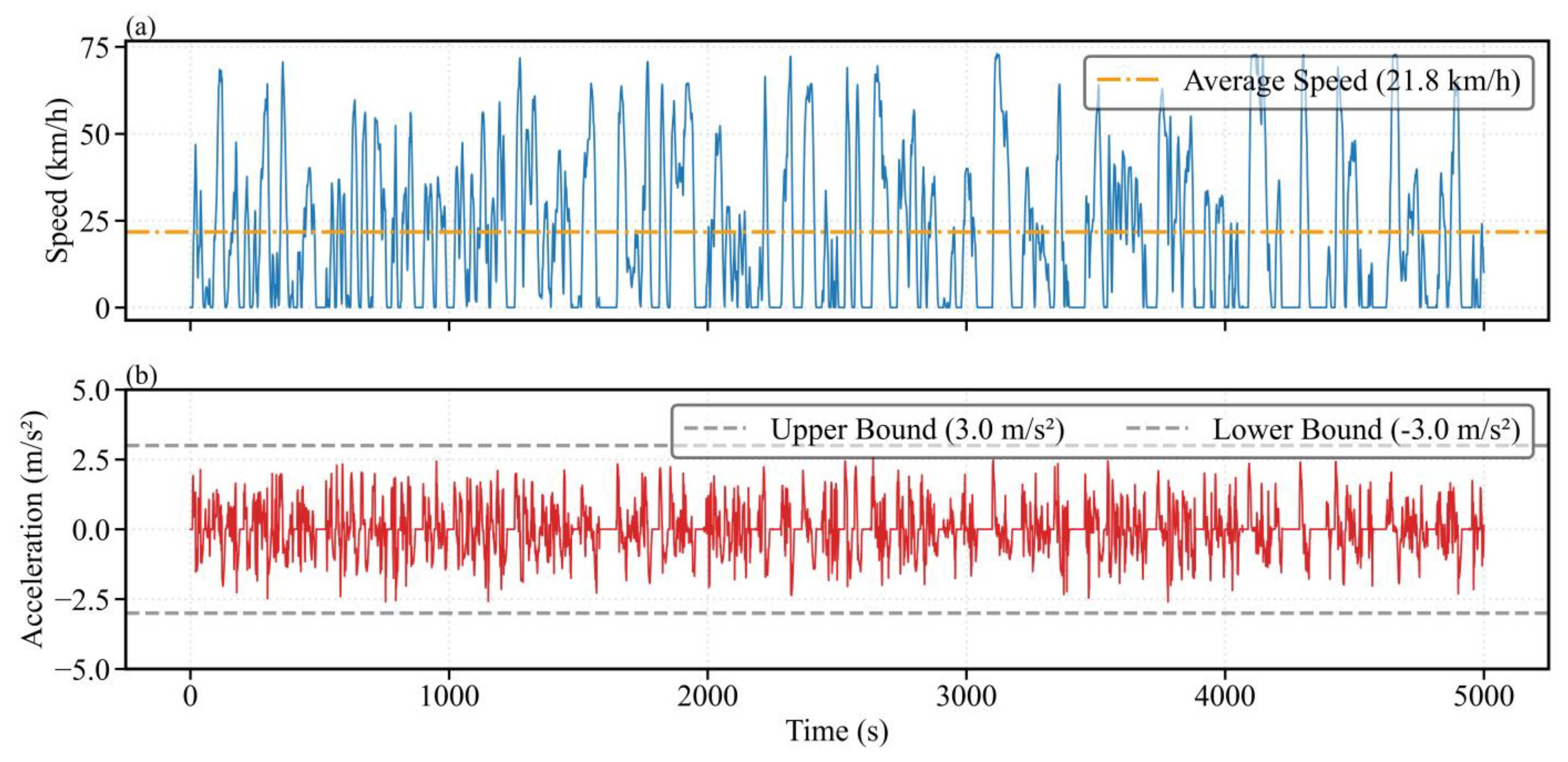
2.2. Data Acquisition and Predictive Problem Formulation
2.2.1. High-Fidelity Continuous Trajectory Reconstruction
2.2.2. State-Space Formulation of the Prediction Problem
2.2.3. Robustness Enhancement and Dataset Partition
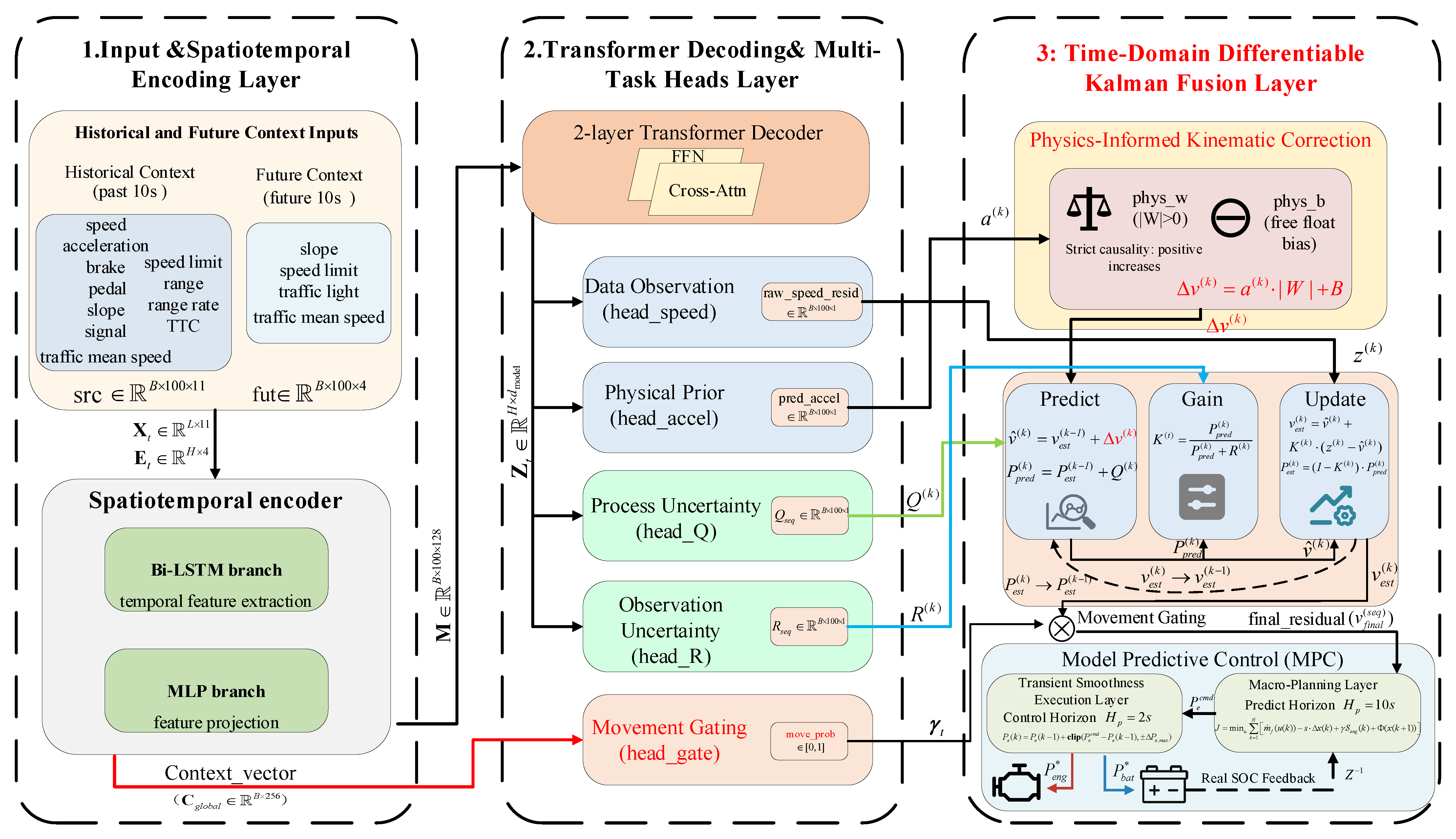
2.3. Physics-Informed Spatio-Temporal Network (PI-STN) Architecture
2.3.1. Spatiotemporal Encoding and Future Alignment
2.3.2. Future Intent Decoding via Cross-Attention
2.3.3. Differentiable Kalman Filter (DKF)
2.3.4. Global Zero-Speed Gating
2.4. Physics-Aware Multi-Task Loss Formulation
2.5. MPC-Based Predictive Energy Management Strategy
2.5.1. Energy Mapping and Cost Function Formulation
2.5.2. Receding Horizon Optimization and Constraint Solving
3. Results
3.1. Experiment Setup and Evaluation Metrics
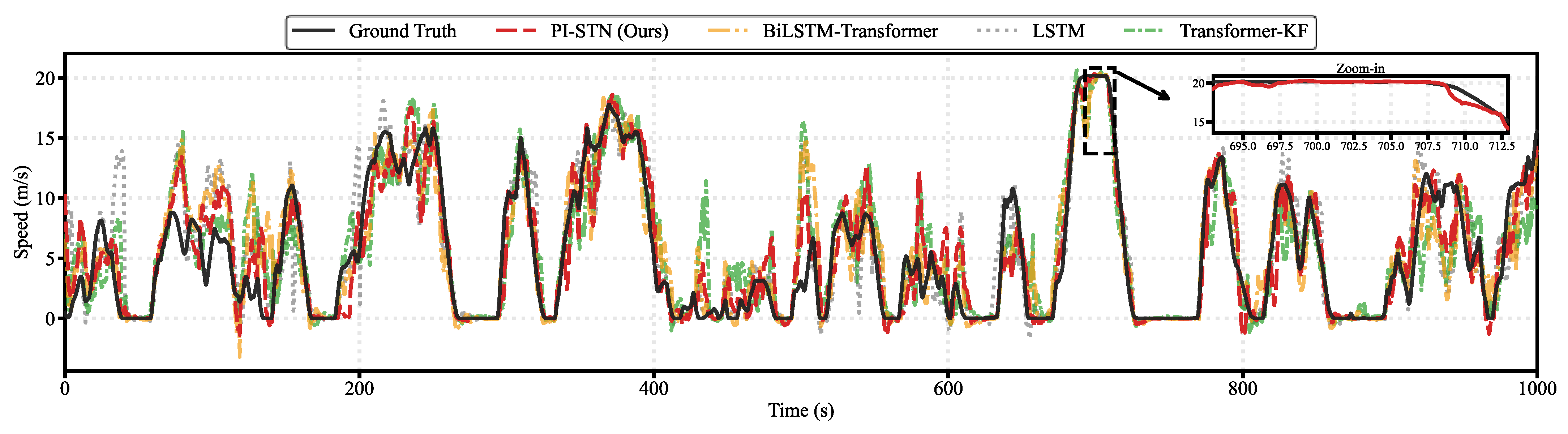
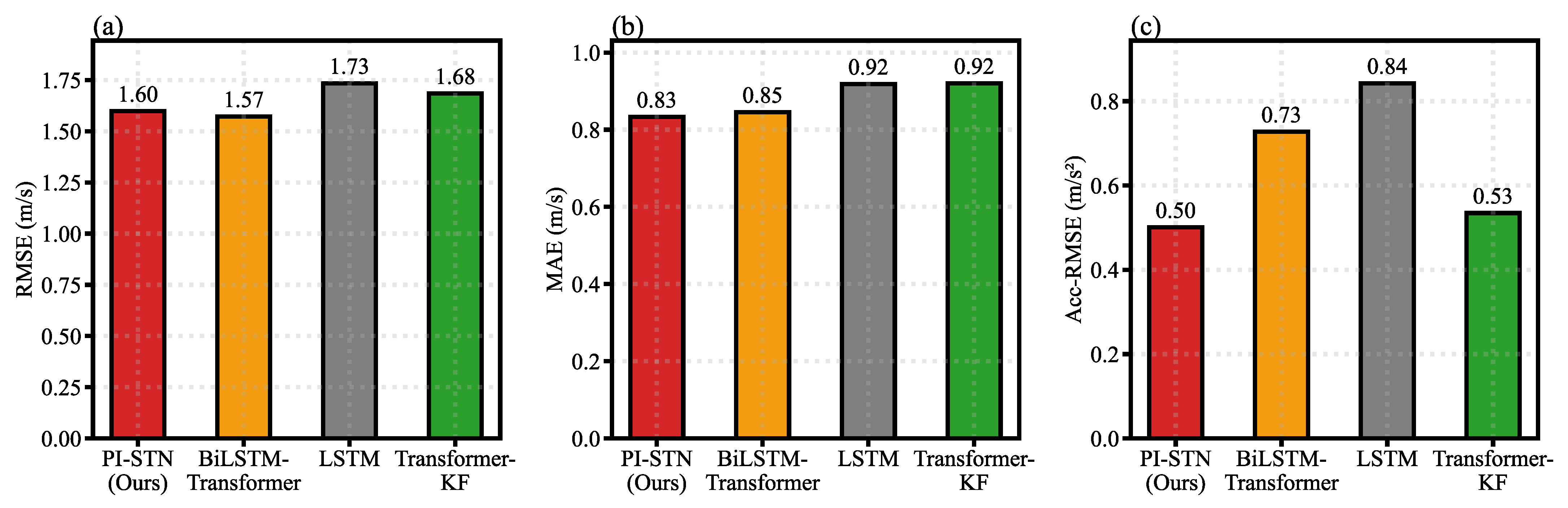
3.2. Microscopic Prediction Performance
3.2.1. Overall Prediction Accuracy Analysis
3.2.2. Physical Causality and Temporal Stability
- 1.
- Braking violation: The actual vehicle is in a distinct deceleration state (true acceleration ), but the model exhibits irrational acceleration (predicted acceleration );
- 2.
- Acceleration violation: The actual vehicle is in a distinct acceleration state (true acceleration ), but the model exhibits abnormal deceleration (predicted acceleration ).
3.2.3. Dynamic Robustness Under Stationary Scenarios
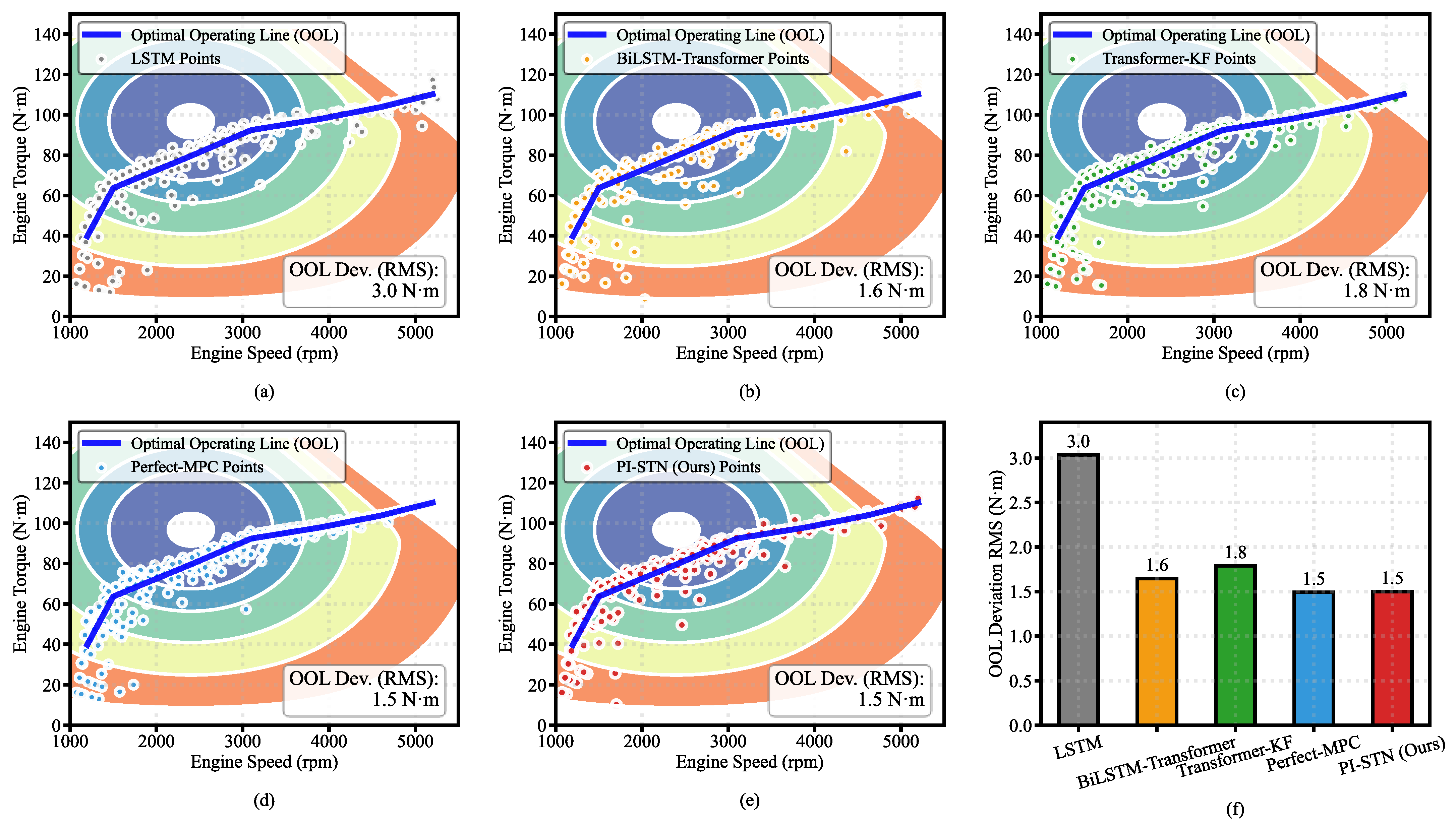
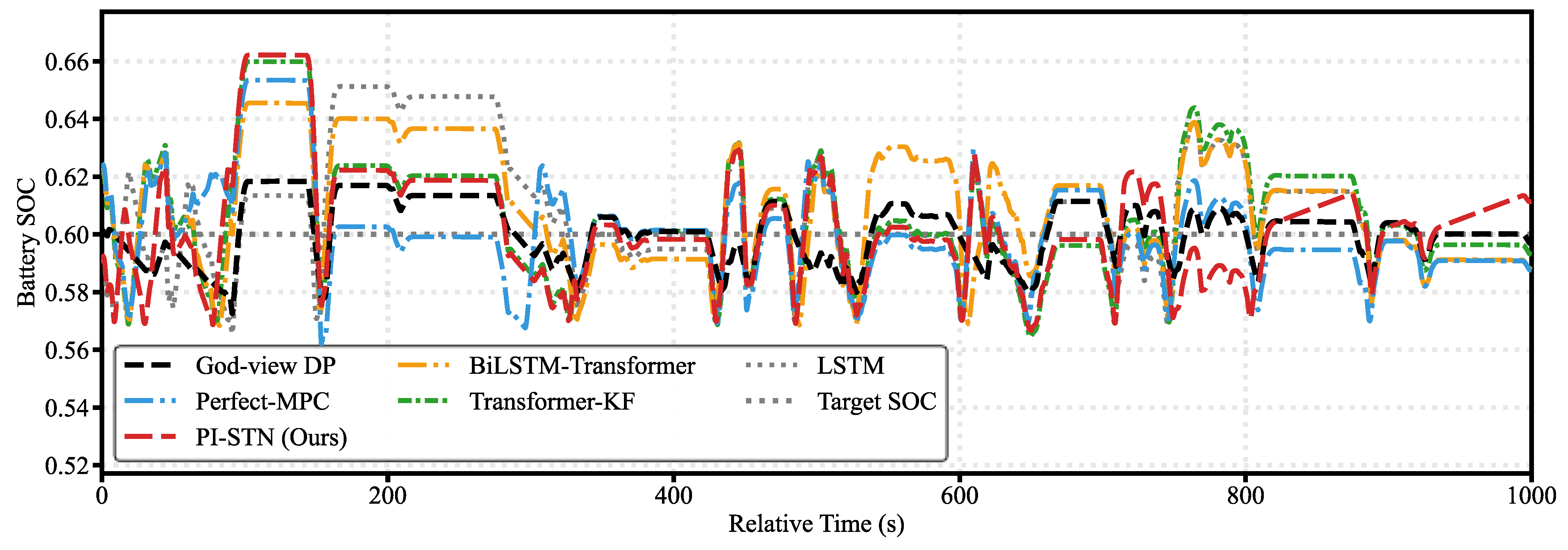
3.3. Predictive Energy Management Strategy Performance
4. Discussion and Conclusions
Author Contributions
Funding
Data Availability Statement
Conflicts of Interest
Abbreviations
| HEVs | Hybrid Electric Vehicles |
| EMS | Energy Management Strategy |
| ECMS | Equivalent Consumption Minimization Strategy |
| V2X | Vehicle-to-Everything |
| MPC | Model Predictive Control |
| PI-STN | Physics-Informed Spatio-Temporal Network |
| DKF | Differentiable Kalman Filter |
| OOL | Optimal Operating Line |
| SOC | State of Charge |
| TTC | Time-To-Collision |
| DTW | Dynamic Time Warping |
| EFC | Equivalent Fuel Consumption |
| Bi-LSTM | Bidirectional Long Short-Term Memory network |
Appendix A
| Symbol | Description | Unit |
| Vehicle speed | m/s | |
| Longitudinal acceleration | m/s2 | |
| Vehicle mass | kg | |
| Gravitational acceleration | m/s2 | |
| Rolling resistance coefficient | - | |
| Air density | kg/m3 | |
| Aerodynamic drag coefficient | - | |
| Frontal area | m2 | |
| Rotational mass conversion coefficient | - | |
| Drivetrain efficiency | - | |
| SOC(t) | Battery state of charge | - |
| Required mechanical power | kW | |
| Engine output power | kW | |
| Motor output power | kW | |
| Battery terminal power | kW | |
| Mechanical rotational speed | rad/s |
Appendix B
| Model | Parameters (M) | Model Size (MB) | Inference Time per 10 s Horizon (ms) | Peak GPU Memory (MB) |
| LSTM | 0.346 | 1.32 | 0.974 ± 0.086 | 27.50 |
| BiLSTM-Transformer | 2.560 | 9.76 | 4.045 ± 0.574 | 57.76 |
| Transformer-KF | 3.768 | 14.37 | 17.287 ± 1.044 | 40.60 |
| PI-STN (Ours) | 2.610 | 9.95 | 33.283 ± 13.181 | 87.86 |
References
- Zhang, Y.; Fan, P.; Lu, H.; Song, G. Fuel consumption of hybrid electric vehicles under real-world road and temperature conditions. Transp. Res. Part D Transp. Environ. 2025, 142, 104691. [Google Scholar] [CrossRef] [Scilit]
- Zhu, Y.; Li, X.; Liu, Q.; Li, S.; Xu, Y. Review article: A comprehensive review of energy management strategies for hybrid electric vehicles. Mech. Sci. 2022, 13, 147–188. [Google Scholar] [CrossRef] [Scilit]
- Azim Mohseni, N.; Bayati, N.; Ebel, T. Energy management strategies of hybrid electric vehicles: A comparative review. IET Smart Grid 2024, 7, 191–220. [Google Scholar] [CrossRef] [Scilit]
- Lü, X.; Li, S.; He, X.; Xie, C.; He, S.; Xu, Y.; Fang, J.; Zhang, M.; Yang, X. Hybrid electric vehicles: A review of energy management strategies based on model predictive control. J. Energy Storage 2022, 56, 106112. [Google Scholar] [CrossRef] [Scilit]
- Saifuddin, M.R.; Naayagi, R.T.; Tong, W.P.Q. Design and control of a DC collection system for modular-based direct electromechanical drive turbines in high voltage direct current transmission. Electronics 2020, 9, 493. [Google Scholar] [CrossRef] [Scilit]
- Poh, W.Q.T.; Naayagi, R.T. Modelling and integration of a piezoelectric cantilever beam with quasi-Z-source inverter for self-powered dynamic system application. In Proceedings of the 2020 IEEE Power & Energy Society General Meeting (PESGM), Montreal, QC, Canada, 2–6 August 2020; IEEE: Piscataway, NJ, USA, 2020; pp. 1–5. [Google Scholar]
- He, H.; Wang, Y.; Han, R.; Han, M.; Bai, Y.; Liu, Q. An improved MPC-based energy management strategy for hybrid vehicles using V2V and V2I communications. Energy 2021, 225, 120273. [Google Scholar]
- Yang, H.; Hu, Y.; Gong, X.; Cao, R.; Guo, L.; Chen, H. Energy management strategy for fuel cell hybrid electric vehicles considering the inaccuracy of predicted vehicle speed. IEEE Trans. Transp. Electrif. 2024, 10, 8246–8262. [Google Scholar] [CrossRef] [Scilit]
- East, S.; Cannon, M. Scenario model predictive control for data-based energy management in plug-in hybrid electric vehicles. IEEE Trans. Control Syst. Technol. 2022, 30, 2522–2533. [Google Scholar]
- Hou, S.; Chen, H.; Yin, H.; Zhao, J.; Xu, F.; Gao, J. Energy Management Based on Mixed-Integer Nonlinear Model Predictive Control for Hybrid Electric Vehicles. IEEE Trans. Intell. Transp. Syst. 2024, 25, 17432–17451. [Google Scholar] [CrossRef] [Scilit]
- Amini, M.R.; Hu, Q.; Wiese, A.; Kolmanovsky, I.; Buckland Seeds, J.; Sun, J. A data-driven spatio-temporal speed prediction framework for energy management of connected vehicles. IEEE Trans. Intell. Transp. Syst. 2023, 24, 291–303. [Google Scholar] [CrossRef] [Scilit]
- Ma, M.; Hu, J.; Xiao, R. Energy management strategy with model prediction for fuel cell hybrid trucks considering vehicle mass and road slope. Energy Convers. Manag. 2025, 333, 119791. [Google Scholar] [CrossRef] [Scilit]
- Kong, Y.; Xu, N.; Liu, Q.; Sui, Y.; Jia, Y. Variable horizon-based predictive energy management strategy for plug-in hybrid electric vehicles and determination of a suitable predictive horizon. Energy 2024, 294, 130809. [Google Scholar] [CrossRef] [Scilit]
- Lefèvre, S.; Sun, C.; Bajcsy, R.; Moura, S. Comparison of parametric and non-parametric approaches for vehicle speed prediction. In Proceedings of the 2014 American Control Conference, Portland, OR, USA, 4–6 June 2014; IEEE: Piscataway, NJ, USA, 2014; pp. 3494–3499. [Google Scholar]
- Li, T.; Cui, W.; Cui, N. Real-time multiobjective EMS for fuel cell vehicle considering energy source health awareness under unknown real-world conditions. IEEE Trans. Transp. Electrif. 2025, 11, 8936–8947. [Google Scholar] [CrossRef] [Scilit]
- Shen, H.; Wang, Z.; Zhou, X.; Lamantia, M.; Yang, K.; Chen, P.; Wang, J. Electric vehicle velocity and energy consumption predictions using Transformer and Markov-chain Monte Carlo. IEEE Trans. Transp. Electrif. 2022, 8, 3836–3847. [Google Scholar] [CrossRef] [Scilit]
- Wu, J.; Huang, Z.; Lv, C. Transformer-based traffic-aware predictive energy management of a fuel cell electric vehicle. IEEE Trans. Veh. Technol. 2024, 73, 4659–4670. [Google Scholar] [CrossRef] [Scilit]
- Li, Z.; Sun, H.; Xiao, D.; Xie, H. Hybrid Kalman recurrent neural network for vehicle trajectory prediction. IEEE Trans. Instrum. Meas. 2024, 73, 2519814. [Google Scholar] [CrossRef] [Scilit]
- Buggaveeti, S.; Batra, M.; McPhee, J.; Azad, N. Longitudinal vehicle dynamics modeling and parameter estimation for plug-in hybrid electric vehicle. SAE Int. J. Veh. Dyn. Stab. NVH 2017, 1, 289–297. [Google Scholar] [CrossRef] [Scilit]
- Geng, M.; Li, J.; Xia, Y.; Chen, X. A physics-informed Transformer model for vehicle trajectory prediction on highways. Transp. Res. Part C Emerg. Technol. 2023, 154, 104272. [Google Scholar] [CrossRef] [Scilit]
- Lu, D.; Hu, D.; Wang, J.; Wei, W.; Zhang, X. A data-driven vehicle speed prediction transfer learning method with improved adaptability across working conditions for intelligent fuel cell vehicle. IEEE Trans. Intell. Transp. Syst. 2025, 26, 10881–10891. [Google Scholar] [CrossRef] [Scilit]
- Feng, Z.; Zhang, J.; Jiang, H.; Yao, X.; Qian, Y.; Zhang, H. Energy consumption prediction strategy for electric vehicle based on LSTM-transformer framework. Energy 2024, 302, 131780. [Google Scholar] [CrossRef] [Scilit]
- Pulvirenti, L.; Rolando, L.; Millo, F. Energy management system optimization based on an LSTM deep learning model using vehicle speed prediction. Transp. Eng. 2023, 11, 100160. [Google Scholar] [CrossRef] [Scilit]
- Karniadakis, G.E.; Kevrekidis, I.G.; Lu, L.; Perdikaris, P. Physics-informed machine learning. Nat. Rev. Phys. 2021, 3, 422–440. [Google Scholar] [CrossRef] [Scilit]
- Chen, C.; Lu, C.X.; Wang, B.; Trigoni, N.; Markham, A. DynaNet: Neural Kalman dynamical model for motion estimation and prediction. IEEE Trans. Neural Netw. Learn. Syst. 2021, 32, 5479–5491. [Google Scholar] [CrossRef] [Scilit] [PubMed]
- Tang, X.; Hou, Y.; Qin, Y. Economical thermal energy management for hybrid electric vehicles based on multiple agents deep reinforcement learning. IEEE Trans. Transp. Electrif. 2026, 12, 3307–3318. [Google Scholar] [CrossRef] [Scilit]
- Raissi, M.; Perdikaris, P.; Karniadakis, G.E. Physics-informed neural networks: A deep learning framework for solving forward and inverse problems involving nonlinear partial differential equations. J. Comput. Phys. 2019, 378, 686–707. [Google Scholar] [CrossRef] [Scilit]
- Pisu, P.; Rizzoni, G. A comparative study of supervisory control strategies for hybrid electric vehicles. IEEE Trans. Control Syst. Technol. 2007, 15, 506–518. [Google Scholar] [CrossRef] [Scilit]
- Lian, R.; Peng, J.; Wu, Y.; Tan, H.; Zhang, H. Rule-interposing deep reinforcement learning based energy management strategy for power-split hybrid electric vehicle. Energy 2020, 197, 117297. [Google Scholar] [CrossRef] [Scilit]
- Shi, D.; Xu, H.; Wang, S.; Hu, J.; Chen, L.; Yin, C. Deep reinforcement learning based adaptive energy management for plug-in hybrid electric vehicle with double deep Q-network. Energy 2024, 305, 132402. [Google Scholar] [CrossRef] [Scilit]
- Chaudhary, R.; Sharma, N.K.; Kala, R.; Singh, S.N. Deep reinforcement learning-based speed predictor for distributionally robust eco-driving. IEEE Access 2025, 13, 13904–13918. [Google Scholar] [CrossRef] [Scilit]
- Zhang, L.; Liu, W.; Qi, B. Energy optimization of multi-mode coupling drive plug-in hybrid electric vehicles based on speed prediction. Energy 2020, 206, 118126. [Google Scholar]





| Model | RMSE (m/s) | MAE (m/s) | Acc-RMSE (m/s2) | DTW |
|---|---|---|---|---|
| LSTM | 1.7345 | 0.9183 | 0.8426 | 59.5269 |
| BiLSTM-Transformer | 1.5715 | 0.8454 | 0.7274 | 55.4733 |
| Transformer-KF | 1.6845 | 0.9204 | 0.5347 | 61.2457 |
| PI-STN (Ours) | 1.5978 | 0.8330 | 0.5005 | 54.5072 |
| Model | LSTM | BiLSTM-Transformer | Transformer-KF | PI-STN (Ours) |
| 9.81% | 7.27% | 6.25% | 5.26% |
| Model | EFC (g) | P_eng RMS (W) | Final SOC (%) |
|---|---|---|---|
| LSTM | 324.08 | 564.08 | 61.87% |
| BiLSTM-Transformer | 331.46 | 572.46 | 61.47% |
| Transformer-KF | 334.16 | 548.28 | 61.09% |
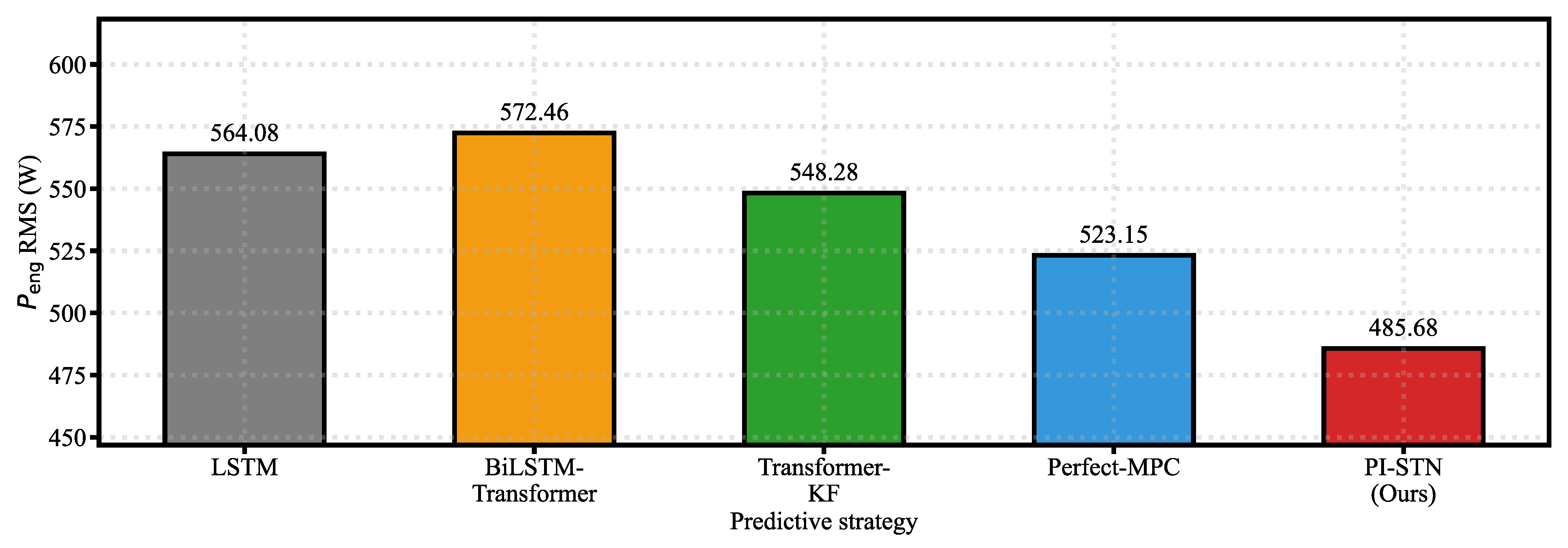
| PI-STN (Ours) | 323.74 | 485.68 | 60.53% |
| MPC-Perfect | 327.08 | 523.15 | 61.09% |
| DP | 239.53 | N/A | 57.98% |
Disclaimer/Publisher’s Note: The statements, opinions and data contained in all publications are solely those of the individual author(s) and contributor(s) and not of MDPI and/or the editor(s). MDPI and/or the editor(s) disclaim responsibility for any injury to people or property resulting from any ideas, methods, instructions or products referred to in the content. |
© 2026 by the authors. Licensee MDPI, Basel, Switzerland. This article is an open access article distributed under the terms and conditions of the Creative Commons Attribution (CC BY) license.
Share and Cite
Kong, H.; Peng, Z.; Yang, L.; Yang, C.; Wang, M.; Zhuang, M. Physics-Informed Predictive Energy Management Strategy for HEVs Using Kalman-Enhanced Transformer. Vehicles 2026, 8, 126. https://doi.org/10.3390/vehicles8060126
Kong H, Peng Z, Yang L, Yang C, Wang M, Zhuang M. Physics-Informed Predictive Energy Management Strategy for HEVs Using Kalman-Enhanced Transformer. Vehicles. 2026; 8(6):126. https://doi.org/10.3390/vehicles8060126
Chicago/Turabian StyleKong, Hao, Zengxiong Peng, Liuquan Yang, Chao Yang, Muyao Wang, and Ming Zhuang. 2026. "Physics-Informed Predictive Energy Management Strategy for HEVs Using Kalman-Enhanced Transformer" Vehicles 8, no. 6: 126. https://doi.org/10.3390/vehicles8060126
APA StyleKong, H., Peng, Z., Yang, L., Yang, C., Wang, M., & Zhuang, M. (2026). Physics-Informed Predictive Energy Management Strategy for HEVs Using Kalman-Enhanced Transformer. Vehicles, 8(6), 126. https://doi.org/10.3390/vehicles8060126