


Abstract
Induction motor (IM) drives are considered one of the important technologies in modern industry. Several industrial applications, such as material handling and food and beverage applications, are driven and operated by modern AC drives. Moreover, modern electric transportation systems such as EVs and e-trucks are based on AC drives. Recently, high-efficiency IM drive systems have been studied as a major opportunity to reduce energy and fuel consumption. This article addresses the recent trends and advancement in high-efficiency IM drives during a particular period (2017–2024), including the development of high-efficiency motors, the utilization of efficient wide bandgap (WBG) semiconductor devices for inverter topology, and commonly used control strategies to achieve high-performance drives. Moreover, the article addresses several manufacturers of industrial IM drives and the corresponding adopted control techniques in their products. A comparison of these control techniques, including their pros and cons, has been conducted as well.
Keywords:
electric drives; AC drives; induction motor; electric vehicles; EV; efficiency; energy saving; energy efficiency; power electronics; wide bandgap semiconductors; electric motors; field-oriented control; direct torque control; model predictive control; industrial automation; regenerative braking; SDG; sustainable development goals; united nations 1. Introduction
1.1. Market Size of Electrical Drives
The demand for electric drives (EDs) across various industrial sectors and applications is growing. Owing to the latest published reports [1], the global market size for EDs is estimated at USD 25.51 billion in 2024, and is expected to reach USD 32.70 billion by 2029, growing at a compound annual growth rate (CAGR) of 5.10% during the period of 2024 to 2029 [1].
Meanwhile, the global market size of AC drives accounts for an estimated value of USD 17.9 billion in 2022, and is projected to reach USD 25 billion by 2028 at a compound annual growth of 5.7% [2]. Figure 1 and Figure 2 indicate the global market size of electrical drives and AC drives, respectively.
Figure 1.
Estimated global market size of electrical drives.
Figure 2.
Estimated global market size of AC drives.
1.2. Electric Drives and UN-SDGs
During the last decade, the demand for efficient electric drives (ED) has increased significantly to reduce energy consumption and enhance environmental conservation in accordance with the sustainable development goals (SDGs) of United Nations (UN), and directly linked to SDGs 7, 9, 12, and 13, which are related to energy efficiency, sustainable and clean industries, and climate action to reduce greenhouse gas emissions, respectively. Owing to the latest published reports [3,4], significant acceleration is still needed to meet the target (see Appendix A to recognize the SDGs goals).
Therefore, high-efficiency AC drives play a considerable role in tackling some of the world’s greatest challenges and achieving a sustainable and equitable future. The high-efficiency drives are characterized by minimal energy consumption and significant energy savings, resulting in less fuel consumption and a significant reduction in carbon emissions. These positive consequences support the transition to more sustainable energy use, aligning with the UN-SDGs. The wide spread of these high-efficiency drives promotes the development of more eco-friendly technologies, enhancing energy efficiency across various sectors. As mentioned before, the utilization of high-efficiency electric drives helps mitigate greenhouse gas emissions, contributing to global efforts to limit global warming [5,6].
1.3. Main Contribution
This paper presents a literature summary of the state-of-the art advancements in high-efficiency induction motor drives during a particular period (2017–2024), including high-efficiency electric motors, low power losses power semiconductor devices, and advanced control techniques that essentially contribute to improving the overall AC drive efficiency in accordance with energy efficiency guidelines and standards. In addition, the paper provides a literature summary of recent regenerative braking methods and energy saving algorithms incorporated with the induction motor control system. Moreover, the article provides a list of well-known industrial IM drives produced by several manufacturers, including their adopted control techniques. A comparison has been made between these control techniques, highlighting their pros and cons.
1.4. Elements of a Typical EDS
The generalized block diagram of a typical electric drive system (EDS) is illustrated in Figure 3. A typical EDS is composed of the following elements: mechanical load, electric motor, power source, power electronic converter (power conditioner), control unit, and measuring devices (sensors and transducers).
Figure 3.
Block diagram of a typical electric drive system.
Simply, the main objective of an EDS is to drive a mechanical load at any desired speed/position and torque requirements using an electric motor that is fed from a power source through a proper power electronic converter. The high-performance EDS operates in closed-loop mode, such that the motor can run at the desired speed apart from the load variation or any transient variations in the input voltage that feeds the EDS [7].
Practically, the block diagram of the high-efficiency EDS is like the conventional EDS. The major differences between both systems are considered in the following points:
- Efficiency classes of the electric motor, where high efficiency and premium efficiency classes are employed;
- Types of the power semiconductor devices that form the power electronic converter, where a high-efficiency converter that offers minimum power losses is utilized;
- Control techniques, which can involve energy saving algorithms or guarantee operation at optimum flux level for a wide range of motor speeds.
1.5. Factors Affecting Efficiency of IM Drives
The key factors that affect directly the overall efficiency of the IM drives are related mainly to motor design, operating conditions, environmental conditions, periodic checkup rate, and maintenance status. The breakdown of these factors is summarized in Table 1.
Table 1.
Key factors affecting overall efficiency of IM drives.
1.6. Power Losses in IM Drives
The previously mentioned factors of Table 1 can be optimized to achieve a high-efficiency AC drive. Practically, the corresponding items of Table 1 contribute to various power losses across the elements of the AC drive, which altogether affects the overall efficiency of the IM drive. Accordingly, the main types of power losses in IM drives can be summarized in the following points:
- Copper losses across the motor windings;
- Magnetic (iron) losses of the magnetic circuit;
- Losses in rotor windings (in wound rotor) or cage losses (in case of squirrel cage);
- Iron losses or core losses including hysteresis and eddy currents losses;
- Mechanical and bearing losses due to friction;
- Stray losses due to leakage flux, magnetic imperfections;
- Switching power losses of the inverter;
- Conduction power losses of the inverter;
- Cooling system losses due to fans (forced air), liquid cooling and heat sink thermal resistance;
- Inverter driving circuits power losses;
- Snubber circuits and passive filters power losses.
Thus, minimization of all these types of losses by optimum design of the AC motors, utilizing efficient power semiconductor devices, optimizing the drive cooling, and adopting proper control strategy permits considerable energy saving and enhances the overall efficiency of the electric drive system.
1.7. Advancement Directions in IM Drives
The advancement in IM drives has many directions. The major trends include:
- Replacement of conventional IM motors by high-efficiency and premium-grade counterparts [8,9];
- Utilization of wide bandgap (WBG) semiconductors [10,11];
- Implementation of modern control techniques such as: direct torque control (DTC) proposed by authors of [12], model predictive control (MPC) [13], and incorporation of regenerative braking and energy saving algorithms to reduce energy consumption [14,15];
- Utilization of efficient high-speed digital signal processors (DSP) as core processors [16], and involvement of hardware in the loop (HIL) data acquisition cards for rapid prototyping and testing purposes [17,18].
Discussions of such directions are presented in Section 2, Section 3, Section 4 and Section 5 as follows: Section 2 provides an overview of the state-of-the-art advancement in high-efficiency induction motors that are commonly used in IM drives. In fact, induction motors are only considered in this article to limit the study and the article length. Section 3 addresses the major trend in high-efficiency power electronic converters based on (WBG) semiconductor devices. Section 4 presents an overview of the advanced control techniques utilized to achieve high-performance IM drives. Section 5 highlights key manufacturers of induction motor drives and the employed control techniques. In addition, some applications of IM drives are addressed in Section 6.
2. High-Efficiency Induction Motors
In general, motor design plays an important role in achieving higher efficiency [19,20]. Several types of AC motors are commonly used and employed in modern electric drive systems. Thus, obtaining high-efficiency AC drives depends on utilization of high-efficiency AC motors. Induction motors (IMs) are considered the most important rotating machines that remain widely used in the modern industry due to their simplicity and reliability.
2.1. Main Features of High-Efficiency IMs
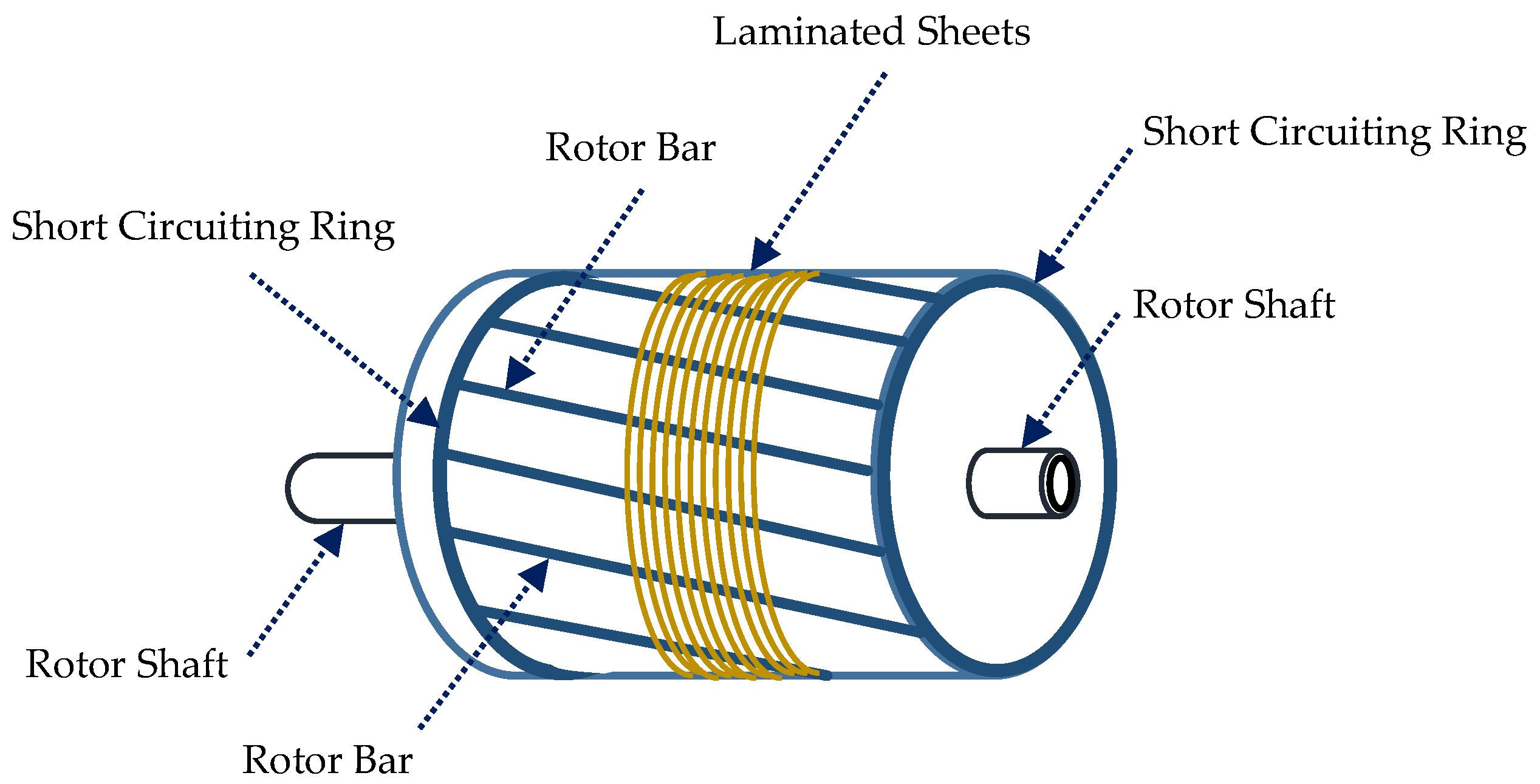
Compared with the standard types of 3-Φ induction motors, whose cross section of their stator is illustrated in Figure 4, and the rotor of squirrel case types, depicted in Figure 5, the high-efficiency counterparts have the following features:
- Longer core (motor) length;
- Thinner core lamination;
- High grade core material such as grain-oriented silicon steel;
- Wider stator slots with optimized shapes (based on finite element design and analysis);
- Thicker stator windings (larger winding cross section area);
- High temperature electrical insulation class;
- Larger rotor diameter;
- Lower resistance rotor bars such as die cast copper rotor;
- Narrower air gap between the stator and rotor;
- Larger fan size with optimized aerodynamic;
- Larger cooling fins and increase cooling surface area;
- Small bearing size with lower friction losses;
- Anti-corrosion coating for the motor body.
Figure 4.
Cross section of stator of a 3-Φ induction motor.
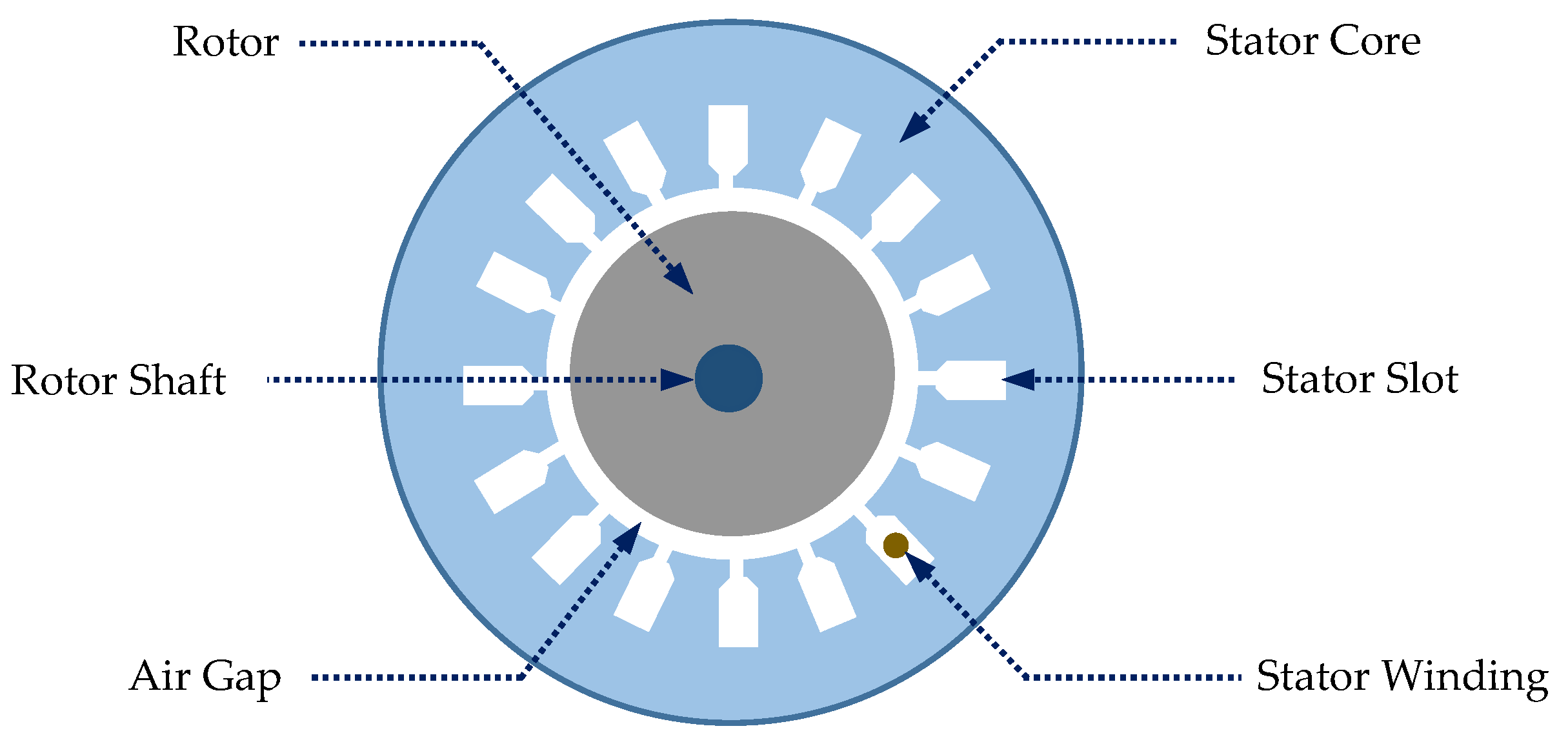
Figure 5.
Rotor of a squirrel cage of a 3-Φ induction motor.
Due to the importance of the topic, several research efforts have been exerted during this decade to improve the performance of IMs in terms of minimizing power losses, improving the starting characteristics, or adopting new approaches for design optimization, such as development of bearingless motors for high-speed applications. Recent improvements in rotor designs and stator winding configurations have led to significant efficiency gains [21,22,23].
2.2. Research Contributions Related to High-Efficiency IMs
A summary of the major research contributions in high-efficiency IMs during the period of 2017–2024 are presented in Table 2, Table 3, Table 4, Table 5 and Table 6. The survey of core contributions includes the following main areas:
- Design and manufacturing of high- and premium-efficiency induction motors (Table 2);
- Optimization techniques and algorithms for high efficiency motor design (Table 3);
- Efforts in bearingless IMs (Table 4);
- Modeling, loss analysis, and computational tools (Table 5);
- Thermal analysis and cooling systems (Table 6).
Table 2.
Research contributions related to design and manufacturing of high-efficiency IMs.
Table 3.
Research contributions related to optimization techniques for high-efficiency IMs.
Table 4.
Research contributions related to development of bearingless IMs.
Table 5.
Research contributions related to modeling, analysis, and computational tools for high-efficiency IMs.
Table 6.
Research contributions related to thermal analysis and cooling systems for high-efficiency IMs.
Moreover, the efficiency ranges of typical premium efficiency IMs, fabricated by key manufacturers for different power ratings, are presented in Table 7.
Table 7.
Technical data and efficiency ranges of typical high-efficiency induction motors.
Table 7 summarizes the corresponding efficiency ranges of typical premium efficiency IMs fabricated by different manufacturers [103,104,105,106,107]. For a power rating between 0.75 kW and 22 kW, the corresponding efficiencies are between 82.5% and 93.6%, while for a higher power rating between 30 kW and 110 kW, the corresponding efficiencies are between 93.6% and 95.8%.
3. Wide Bandgap (WBG) Power Semiconductor Devices
The transition from silicon (Si)-based semiconductor devices to wide bandgap (WBG) semiconductors devices is considered one of the most significant advancements in improving the overall efficiency of the power electronic converters [108,109]. Basically, the bandgap is defined as the minimum energy required to excite electrons, transferring the electrons from the valence band to the conduction band.
3.1. Characteristics of WBG Semiconductors
Compared to the conventional Si-based semiconductors, the WBG semiconductors have a larger (wider) bandgap, approximately three times wider. As illustrated in Figure 6, WBG semiconductors (SiC and GaN) have a bandgap between 3.3 eV and 3.4 eV, allowing the WBG power devices to withstand higher voltages (high breakdown voltage) due to the direct correlation between the bandgap and the critical breakdown (electric) field of a semiconductor. As a typical value, the critical electric field of WBGs semiconductors is approximately ten times greater than that of Si semiconductors (0.3 MV/cm in Si, 3.5 MV/cm in SiC, and 3.3 MV/cm in GaN). Consequently, the breakdown voltage in WBG devices is higher than that of conventional Si devices.
Figure 6.
Simplified energy diagram and bandgap energy of Si, WBG, and insulators.
However, there are some main differences in several characteristics of SiC and GaN that make each type more convenient and adequate for certain applications over the other; e.g., GaN has higher electron mobility compared with SiC (GaN:1500 cm2/Vs, Sic: 900 cm2/Vs). This means GaN devices are characterized by high switching frequencies, which makes them more suitable for high frequency applications.
Meanwhile, the greater thermal conductivity of SiC devices (5 W/cmK) compared with that of than GaN (1.3 W/cmK) makes SiC devices transfer heat more efficiently, enabling operation at higher temperatures and allowing higher power densities as well. Thus, the distinct characteristics of each type of WBG devices make GaN suitable for low-power and high-frequency applications, while they make SiC suitable for high-power and high-voltage applications [110,111]. Compared to traditional Si-based devices, WBG devices offer superior performance in terms of higher switching frequencies, lower power losses, and high temperature capability. These advantages have permitted their utilization in various applications such as high-performance industrial drives [112,113], electric vehicles (EVs) [114,115], aircraft propulsion [116], and renewable energy applications [117,118]. The utilization of SiC power devices in motor drives can reduce the overall cost of the drive by decreasing the size of passive components [119,120].
3.2. Main Challenges and Design Issues
Compared with the Si power devices, the WBG power devices face some obstacles and challenges that limit their industrial utilization and delay achieving commercial acceptance and full satisfaction. Some of these challenges are:
- Higher fabrication and manufacturing cost;
- Complex fabrication processes to have the final product with good quality;
- Reliability issue for GaN devices at high temperature;
- Cooling system design and analysis;
- Requirement of proper packaging to alleviate electromagnetic interference (EMI).
Fortunately, the fabrication costs of SiC devices are expected to decline as companies move toward the technology of six-inch wafers [120].
Several design issues are taken into consideration during design and testing of WBG-based power electronic converters to achieve successful and reliable operation [121,122,123,124,125]. The main important design issues that are related directly to the successful and reliable operation of the WBG-based power electronic converter are:
- Gate driving signals (voltage levels), which are different from the well-known and commonly used values of Si devices;
- The effect of parasitic inductance at operation of high switching frequencies, which requires compact and optimized PCB designs;
- EMI and electromagnetic compatibility (EMC) concerns due to high dv/dt and di/dt.
3.3. Research Contributions Related to WBG-Based Converters and AC Drives
A summary of the major research contributions is presented in Table 8, Table 9, Table 10 and Table 11. The survey of core contributions includes the following main areas:
Table 8.
Research contributions related to performance analysis of WBG devices and systems.
Table 9.
Research contributions related to system design of WBG-based systems.
Table 10.
Research contributions related to cooling systems of WBG-based systems.
Table 11.
Research contributions related to key challenges and solutions of WBG-based systems.
Moreover, state-of-the-art ratings and main manufacturers of SiC-Base MOSFET power transistors, as one of the WBG power semiconductor devices, are summarized in Table 12.
Table 12.
Typical ratings and some manufacturers of SiC power MOSFETs.
Owing to Ref. [204], typical state-of-the-art ratings and main manufacturers of SiC power transistors, as one of the WBG power semiconductor devices, are summarized in Table 12.
4. Main Control Techniques of IM Drives
4.1. Introduction
The most used control techniques applied in industrial IM drives are field-oriented control (FOC) and direct torque control (DTC). FOC, originated by Blaschke in [205], is utilized in IM drives when a precise speed and a high dynamic response are required [206,207,208,209,210,211,212,213,214,215,216,217,218,219,220,221,222,223].
A few decades after inventing FOC, the direct torque control (DTC) technique was proposed by the authors of [12] to provide fast dynamic response and good control of both motor flux and electromagnetic torque [224,225,226,227,228,229,230,231,232,233,234,235,236,237,238,239]. The first industrial DTC-based IM drive was designed and fabricated by ABB in 1996, introduced in [240].
On the other hand, many research activities have been conducted recently aiming to employ the finite control set model predictive control (FCS-MPC) approach to regulate motor speed, torque, and flux based on the dynamic model of the IM.
Moreover, for high-efficiency IM drives, the core control algorithms can involve efficiency optimization task/subroutine (function) to minimize the energy consumption by operating at optimum levels of flux and minimizing the reactive component of the current drawn from the AC supply. Also, adopting regenerative braking approach enhances the overall efficiency of the AC drive by returning to the grid the mechanical energy stored in the motor shaft during braking instants.
4.2. Field-Oriented Control
The commonly used and well-known scalar control methods of IMs provide satisfactory steady performance for economic general purpose AC drives. However, they are neither able to provide high transient response, nor are they suitable for precise operation and applications at low and very low speeds. In addition, scalar methods fail to achieve position control of IMs as servo drives. The field-oriented control, or vector control (VC), technique for IM drives was developed to overcome the main limitations of the scalar control methods
The FOC, or VC, technique aims to emulate the decoupled control features of a conventional separately excited DC motor by decomposing the stator current vector into two orthogonal components: direct component Id and quadrature component Iq. The direct component Id is responsible for air gap flux production, while the quadrature component Iq is responsible for electromagnetic torque production, as illustrated in Figure 7. This way, the FOC emulates the behavior of the DC motor, which results in high dynamic performance and good transient response under sudden load variations, provided that the machine parameters are identified on-line during the motor operation.
Figure 7.
Phasor diagram of stator current components with FOC.
The block diagram of the basic scheme of FOC of IM drives is presented in Figure 8.
Figure 8.
Block diagram of the basic scheme of FOC of IM drives.
In the VC or FOC system of 3-Φ IM, the reference electromagnetic torque is computed as the output of the PI-speed controller. The reference stator flux is a function of the reference speed, involving the operation in the field weakening mode for motor operation at speeds above the rated value, as illustrated in the lower part of Figure 8.
Meanwhile, the reference stator currents and in the d-q coordinates are generated with the aid of IM parameters owing to the model equations given below:
These equations are based on the following assumptions:
- 1.
- The stator flux linkage is typically aligned along the d-axis, and the q-axis flux component is zero. Accordingly: ; ;
- 2.
- The reference stator current in the d-axis is directly related to the stator flux linkage;
- 3.
- The rotor is short circuited, where: .
The electromagnetic torque is computed using the following equation:
The slip speed is determined using the following relation:
where is the reference electromagnetic torque (Nm); Tem is the instantaneous electromagnetic torque (Nm); and are the stator flux components in d-q synchronous reference frame (Wb); iSd and iSq are the stator current components of stator current in d-q synchronous frame (A); is the synchronous speed (rad/s); is the slip speed (rad/s); is the motor mechanical speed (rad/s); P is the number of poles; Ls is the stator self-inductance (H); Lr is the rotor self-inductance (H); Rr is the rotor resistance (W); and Lr is the rotor self-inductance (H).
Although the FOC provides good transient performance of the IM, it suffers from several drawbacks. Firstly, the successful operation depends on the accuracy of estimation (computation) of slip speed () and the angle (q), which depend on the rotor time constant (Lr/Rr) that varies with the temperature and level of saturation.
In fact, considerable research efforts have been done in VC and FOC of IM during the period of 1992–2008, with the advancement in DPS and microcontroller technologies. However, the main observed research contributions of FOC of IM drives during the period of 2017 to 2024 are summarized and presented in Table 13.
Table 13.
Research contributions in FOC of induction motor drives.
4.3. Direct Torque Control
DTC strategy of IM drives controls directly both stator flux and electromagnetic torque by applying instantaneously the optimum inverter switching state which satisfy both torque and flux requirements. Owing to Figure 9, the DTC scheme of 3-Φ IM is composed of the following blocks:
- Motor transient model to calculate the instantaneous value of the stator flux vector and electromagnetic torque.
- Two hysteresis ON/OFF controllers: one for the stator flux and the other for the torque.
- Optimum switching table whose output is the instantaneous values of the inverter switching state, such that the flux and torque track the set points (reference values).
Figure 9.
Block diagram of a conventional DTC system of an IM drive.
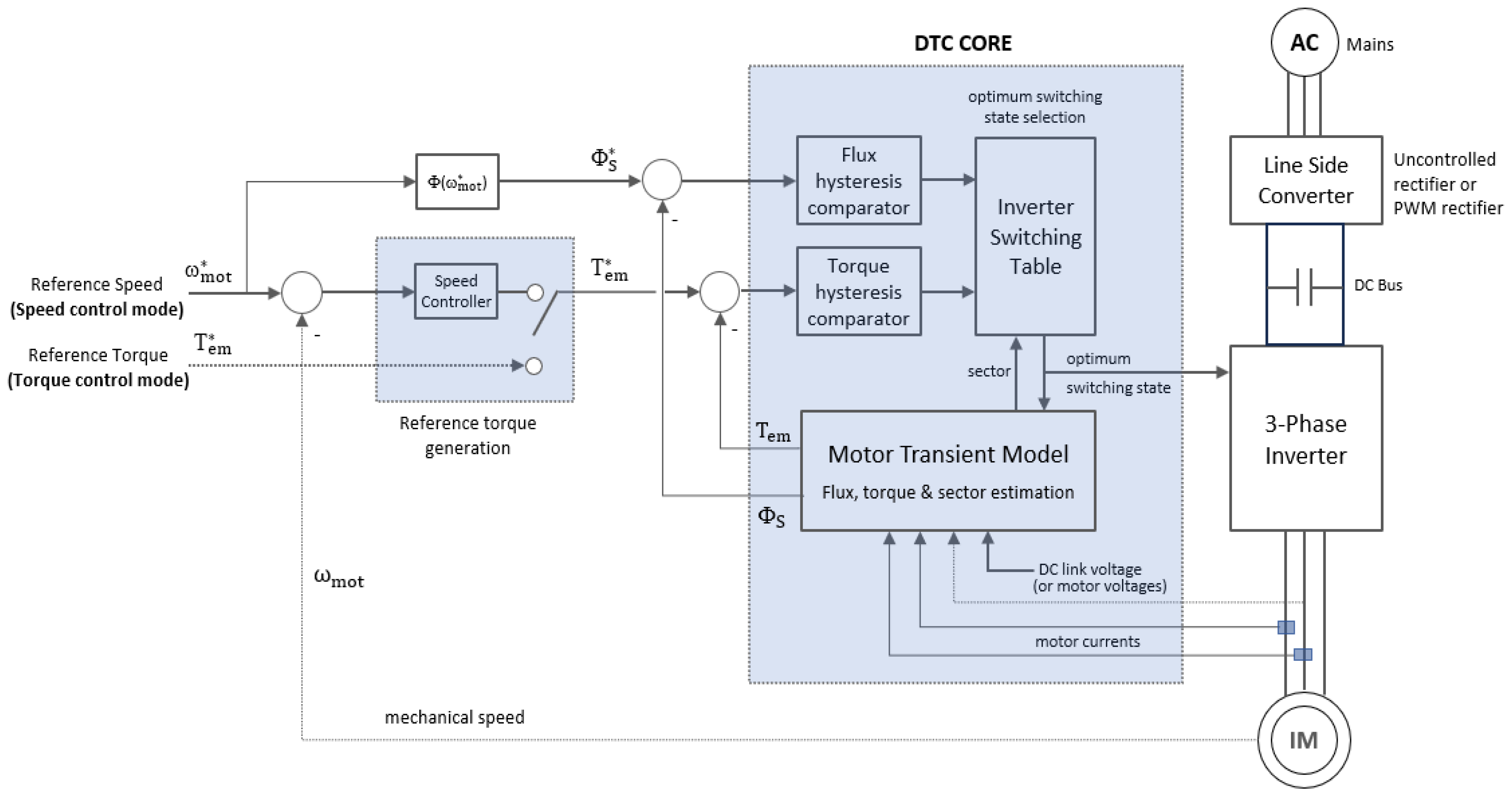
The DTC strategy of IM drive can have two modes of operation: torque control mode and speed control mode. In torque control mode, the desired electromagnetic torque is the reference signal. In speed control mode, the reference torque is the output of speed controller. The reference flux signal is a function of the motor reference speed. For speeds greater than the rated value, the reference stator flux is reduced, running the motor in field weakening mode. The flux and torque control under DTC can be explained with the aid of Figure 10 and Figure 11, respectively, where the stator flux vector initially lies in sector number one. Each discrete inverter switching state and the corresponding voltage vector has its effect on both electromagnetic torque and stator flux; e.g., if the voltage vector V1 is applied during the sampling period, the magnitude of the stator flux will increase. At the same time, the angle between stator and rotor flux vectors will decrease, which results in a reduction in the instantaneous value of the electromagnetic torque. From the principles of electric machines, the magnitude of the electromagnetic torque is directly proportional to the SINE value of the angle between stator and rotor flux vectors.
Figure 10.
Stator flux vector lies in Sector 1.
Figure 11.
Control of motor stator flux and torque in Sector 1.
Applying vector V4 instead of V1 results in a reduction in magnitude of stator flux, as illustrated in Figure 10. At the same time, the angle between stator and rotor flux vectors will increase, which results in an increment in the instantaneous value of the electromagnetic torque. From these observations, an optimum switching table is obtained to control simultaneously both stator flux and electromagnetic torque.
Figure 12 summarizes the effects of all inverter voltage vectors on both torque and flux in Sector 1.
Figure 12.
Effects of inverter discrete voltage vectors on stator flux and torque in Sector 1.
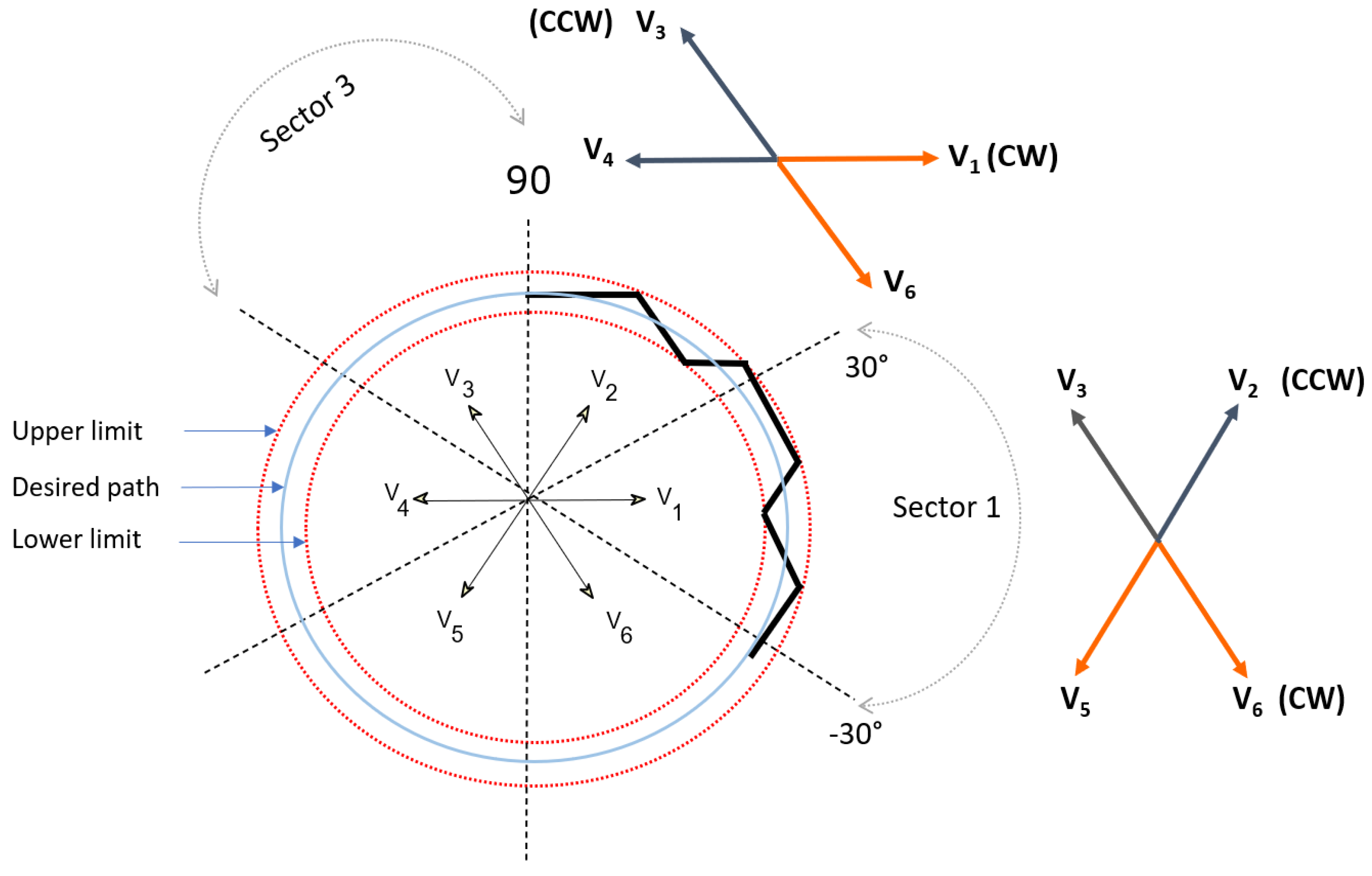
The ideal trajectory of the stator flux vector is a circular path. Under DTC strategy, the actual path is formed by applying instantaneously the optimum inverter voltage vectors. Such optimum vectors depend on both the current location of the stator flux vector (Sector number 1:6) and the direction of rotation as well.
Figure 13 clarifies and indicates the selection method of the optimum inverter vectors in Sectors ONE and TWO, where:
For CCW rotation in Sector ONE, vectors V2 and V3 are to be mutually applied to follow the desired flux trajectory; while in Sector TWO, vectors V3 and V4 are to be mutually applied to follow up the required stator flux trajectory.
For CW rotation in Sector ONE, vectors V5 and V6 are to be mutually applied to keep track of the desired flux locus; while in Sector TWO, vectors V1 and V6 are to be mutually applied in Sector TWO.
Figure 13.
Trajectory of stator flux vector under DTC with conventional two-level VSI.
The stator flux components in the (α–β) stationary reference frame are computed using the following equations:
where TS is the sampling period of the DTC algorithm in digital implementation.
The magnitude and the location of the stator flux vector are computed by Equations (9) and (10), respectively. They are inputs to the DTC blocks (hysteresis flux controller and the inverter switching table), as shown in Figure 9.
The electromagnetic torque produced by the IM is calculated using Equations (11) and (12):
where P is the number of magnetic poles of the AC motor.
The stator current components in the (α–β) stationary reference frame are determined using Equations (14) and (15):
The major advantages of DTC are the quick response of both torque and flux, as well as dependency of the DTC algorithm on a machine model with a moderate degree of complexity, unlike FOC, which is based on a sophisticated machine mode.
However, the main drawbacks of the DTC are the requirement of online identification of stator resistance to achieve high performance at low speeds, and the conventional scheme is not applicable for position control and servo applications.
In fact, considerable research activities in DTC drives have been carried out during the period of 1997–2017. The main observed research contributions of DTC for IM drives during the period of 2017 to 2024 are summarized and presented in Table 14.
Table 14.
Research contributions in DTC technique of induction motor drives.
4.4. Model Predictive Control
Recently, finite control set model predictive control (FCS-MPC) has been applied in IM drives as an advanced control approach [241,242,243,244,245,246,247,248,249,250,251,252,253,254,255,256,257] to minimize the torque and flux ripples and achieve other goals, such as minimization of switching frequency.
In the FCS-MPC technique, the future behaviors of the controlled variables (stator flux and electromagnetic torque in case of IM drives) are predicted for a finite time frame of one or more sampling period. Accordingly, the optimum future control action is applied to the motor to satisfy a customized goal function, where the FCS-MPC algorithm repeatedly checks the future behavior at every sampling period. Therefore, in addition to the main speed control (regulation) task, other goals can be achieved, such as minimization of flux and torque ripples, minimization of inverter switching frequency, minimization of stator current ripples, or minimization of active and reactive power ripples. Accordingly, the cost function can accommodate all these terms and more, owing to the performance requirement of the IM drive as demonstrated in Equations (16)–(19):
The absolute value functions of the previous equations can be replaced by square functions for minimizing the terms of the formulated cost functions.
Moreover, each term can have a weight factor (wp and wq) to prioritize some term(s) during operation, as given by Equation (20):
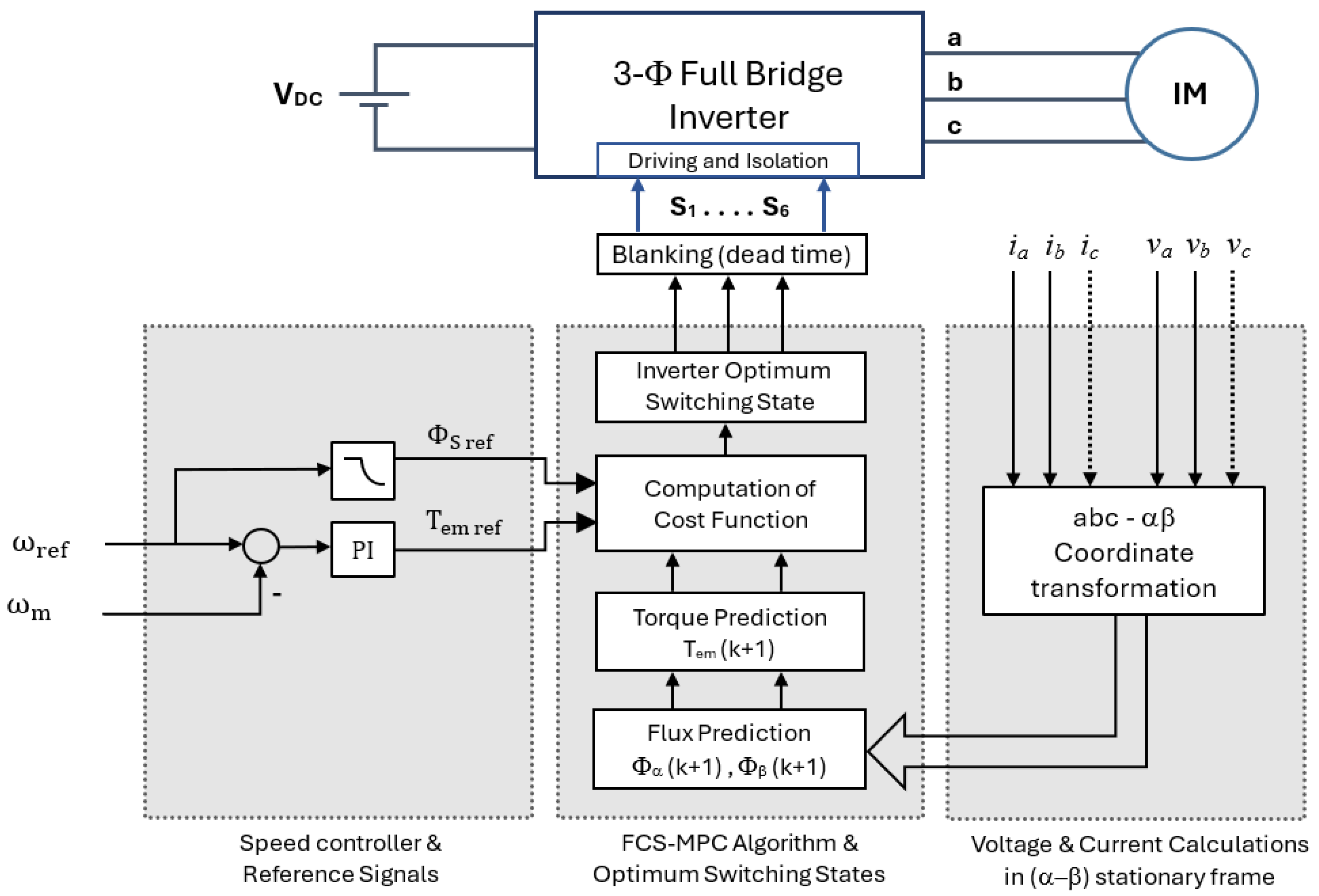
The block diagram of FCS-MPC of IM drives is shown in Figure 14. The control system has three main parts:
- Speed control loop and reference signals generation of torque and flux. The output of the PI speed controller represents the desired electromagnetic torque, while the reference stator flux is kept constant at the rated value for the entire range of speed from zero to the rated value. Above the rated value, the flux is reduced inversely to verify field weakening mode.
- Computation of stator currents and stator voltages components in the (α–β) stationary reference frame.
- FCS-MPC algorithm, which is composed of several blocks and functions, such as prediction of stator currents and stator flux components in the stationary reference frame (α–β) one sample ahead, and prediction of electromagnetic torque one sample ahead as well. Finally, in FCS-MPC, the customized cost function is calculated and checked for all inverter switching states. Then, the optimum inverter switching state that instantaneously provide minimum cost function is chosen and applied to the IM.
Figure 14.
Block diagram of FCS-MPC system of IM drive.
The FCS-MPC approach requires a high-speed DSP unit to implement the several functions and subroutines related to the sophisticated algorithm. The accuracy of stator flux and electromagnetic torque prediction depends on the machine parameters plugged into the model. Thus, any deviation from the real values, which are affected by temperature and saturation level of the machine, negatively affects the performance of the IM drive, and maybe the stability as well.
Recently, several research efforts have been exerted in applying and investigating the IM drive under the FCS-MPC approach. The summary of main research contributions during the period of 2017 to 2024 is presented in Table 15.
Table 15.
Research contributions of MPC technique of induction motor drives.
In addition, a comparison between these control techniques, including advantages and disadvantages has been made. Table 16 summarizes the pros and cons of these control techniques. Each technique has its own advantages and suffers from some limitations. Therefore, each technique is more convenient in specific applications; e.g., scalar control (SC) is adopted in scalar drives for general purpose applications such as pumping and ventilation purposes, while FOC is utilized in servo applications and high-performance AC drives. DTC is preferred when the industrial process considers the torque as a controlled variable rather than the motor speed. An example of this application is the tension control of wires and paper rolling. Such required operation can be met by using the DTC drive in torque control mode instead of the speed control mode.
Table 16.
A comparison between control techniques of IM drives.
Regarding the MPC, the industrial adoption is limited due to the requirement of high computational speeds and the processing capability of the digital control unit. Also, MPC needs an accurate model and is sensitive to motor parameter variations.
4.5. Regenerative Braking and Energy Saving
Applying regenerative braking is one of the important strategies that are employed in industrial AC drives and EVs, because it is an effective and efficient energy recovery technique that minimizes the overall energy consumption and provides quick stopping of the electric machine [258,259,260,261,262,263,264,265,266,267,268,269,270].
In the case of EVs, this energy is utilized to charge the battery, increasing the distance range of the EV. In medium- and high-power ranges, AC drives apply the regenerative braking technique to return the shaft kinetic energy to the electric grid during braking instants, as in electric trains [14,15].
Research contributions in regenerative braking and energy saving of IM drives during the period 2017 to 2024 are presented and summarized in Table 17.
Table 17.
Research contributions in regenerative braking and energy saving of IM drives.
5. Manufacturers of Industrial IM Drives
A summary of the well-known industrial AC drive manufacturers (ordered alphabetically) and the employed control techniques in their products are summarized in Table 18. Most manufacturers produce scalar V/F drives and vector control (VC) drives (with position/speed encoder or sensorless drive), while few players adopt DTC technology.
Table 18.
Industrial AC drive manufacturers.
The major observation is that MPC has not yet gained industrial acceptance. However, the PowerFlex® 750 AC drive series, with totalFORCE® technology from Allen-Bradely provides adaptive control of position, velocity, and torque for AC motors [290,291].
6. Modern Applications of IM Drives
Induction motor drives have been employed in many industrial applications for a long time. Recently, they are utilized in modern applications such as:
- Industrial automation and robotics arms;
- Electric vehicles, trucks, and buses;
- High-speed electric trains;
- Energy saving HVAC systems and inverter-based home air conditions;
- Drilling rigs in oil and gas industry;
- Flywheel energy storage systems;
- Electric propulsion systems in marine applications;
- Multi-motor conveyor systems;
- Hoist and crane control to achieve a safe and high-performance operation in terms of anti-sway, including the possibility of regenerative braking to provide quick stopping.
7. Conclusions
Various modern industries depend on induction motor drives, retaining their importance despite the utilization of synchronous motor drives and other types. This article aims to provide a literature summary of the recent trends in high-efficiency induction motor drives during the period of 2017–2024. In addition, the article addresses recent regenerative braking methods and energy saving algorithms incorporated into the induction motor control system. The article is considered as a review guide to junior researchers whose area of interest are AC drives in general, and induction motor drives in specific. Also, the article can help researchers who are interested in power electronics to recognize the recent advancement in WBG-based converters applied in AC motor control. Accordingly, the paper introduces the state-of-the-art publications related to the topic. The novelty of the paper is considered in the topic itself (high-efficiency IM drives), introducing and addressing the recent core contributions related to the topic.
The selected period is narrowed to only the last seven years to include the state-of-the art research activities that have been carried out. However, considerable respectable research publications covering the same topics have been published during the previous two decades, and the pioneer contributions during the last three decades cannot be ignored and have been addressed through the correspondingly covered topics in the article.
The main conclusions and findings are summarized in the following points:
- Development and adoption of high-efficiency AC drives, especially IM drives, is an important opportunity in the modern industry to reduce energy consumption in different sectors, in accordance with energy efficiency standards and restrictions.
- Design and implementation of high-efficiency and premium-efficiency IMs have commercial acceptance, as many manufacturers fabricate considerable products covering a wide power range serving multiple applications.
- Design of high-efficiency IMs using evolutionary optimization techniques and modern analysis tools such as finite element design has received great interest from academia and industry.
- Many recent research papers are interested in studying and investigating thermal equivalent circuits of IMs to optimize and enhance motor cooling system and increase their efficiency.
- WBG power semiconductor devices are gradually being incorporated into the development of commercial IM drives due to salient advantages; e.g., SiC devices are suitable for high power applications, while GaN is convenient for low voltage/low power application/very high frequency applications.
- Some fabrication challenges of WBG power devices still exist; however, considerable research efforts are tackling these obstacles and finding solutions to most of them. Thus, the prices of WBG devices are decreasing with the time to get commercial acceptance.
- The industrial IM drives still depend on scalar control techniques for general purpose application. Meanwhile, vector control IM drives are used when high-performance drives are required.
- Until now, few industrial drive manufacturers have adopted or fabricated DTC-based drives since the development of the first drive by ABB in 1996.
- MPC have not received commercial or industrial acceptance until recently. However, considerable research papers have adopted and recommended the utilization of FCS-MPC in high-performance IM drives.
- Modern IM drives have the option of regenerative braking to provide quick stopping and motor braking. Moreover, regenerative braking participates in a reduction in the overall energy consumption of AC drives. In EVs and electric transportation systems, regenerative braking extends the distance range of the vehicle battery by trickle charging during EV speed reductions and stopping.
Funding
This research received no external funding.
Conflicts of Interest
The author declares no conflicts of interest.
Abbreviations
| ASIC | Application specific integrated circuit |
| BLDC | Brushless DC motor |
| CAGR | Compound annual growth rate |
| CCW | Counterclockwise |
| CW | Clockwise |
| DAQ | Data acquisition system |
| DSP | Digital signal processor |
| DTC | Direct torque control |
| ED | Electric drives |
| EDS | Electric drive system |
| EMC | Electromagnetic compatibility |
| EMI | Electromagnetic interference |
| EV | Electric vehicle |
| FCS-MPC | Finite control set model predictive control |
| FO | Field orientation |
| FOC | Field-oriented control |
| FPGA | Field programmable gate array |
| GaN | Gallium nitride |
| HIL | Hardware in the loop |
| IM | Induction motor |
| MPC | Model predictive control |
| PM | Permanent magnet |
| PWM | Pulse width modulation |
| PE | Power electronics |
| RISC | Reduced instruction set computer |
| SC | Scalar control |
| SDGs | Sustainable development goals |
| SRM | Switched reluctance motor |
| SVM | Space vector modulation |
| SiC | Silicon carbide |
| SRM | Switched reluctance motor |
| THD | Total harmonic distortion |
| WBG | Wide bandgap |
| UN | United nations |
| VC | Vector control |
| VSI | Voltage source inverter |
Appendix A
Appendix A.1. Sustainable Development Goals of the United Nations
Goal 1: End poverty in all its forms everywhere.
Goal 2: End hunger, achieve food security and improved nutrition, and promote sustainable agriculture.
Goal 3: Ensure healthy lives and promote well-being for all at all ages.
Goal 4: Ensure inclusive and equitable quality education and promote lifelong learning opportunities for all.
Goal 5: Achieve gender equality and empower all women and girls.
Goal 6: Ensure availability and sustainable management of water and sanitation for all.
Goal 7: Ensure access to affordable, reliable, sustainable, and modern energy for all.
Goal 8: Promote sustained, inclusive, and sustainable economic growth, full and productive employment, and decent work for all.
Goal 9: Build resilient infrastructure, promote inclusive and sustainable industrialization, and foster innovation.
Goal 10: Reduce inequality within and among countries.
Goal 11: Make cities and human settlements inclusive, safe, resilient, and sustainable.
Goal 12: Ensure sustainable consumption and production patterns.
Goal 13: Take urgent action to combat climate change and its impacts.
Goal 14: Conserve and sustainably use the oceans, seas, and marine resources for sustainable development.
Goal 15: Protect, restore, and promote sustainable use of terrestrial ecosystems, sustainably manage forests, combat desertification, halt and reverse land degradation, and halt biodiversity loss.
Goal 16: Promote peaceful and inclusive societies for sustainable development, provide access to justice for all, and build effective, accountable, and inclusive institutions at all levels.
Goal 17: Strengthen the means of implementation and revitalize the Global Partnership for Sustainable Development.
Appendix A.2. Summary of Sustainable Development Goals of the United Nations
- No Poverty.
- Zero Hunger.
- Good Health and Well-Being.
- Quality Education.
- Gender Equality.
- Clean Water and Sanitation.
- Affordable and Clean Energy.
- Decent Work and Economic Growth.
- Industry, Innovation and Infrastructure.
- Reduce Inequality.
- Sustainable Cities and Communities.
- Responsible Consumption and Production.
- Climate Action.
- Life Below Water.
- Life on Land.
- Peace, Justice and Strong Institutions.
- Partnerships for the Goals
References
- Electric Drives Market Analysis Report. Available online: https://www.mordorintelligence.com/industry-reports/electric-drives-market (accessed on 15 December 2024).
- Global AC Drives Industry Research Report. Growth Trends and Competitive Analysis 2022–2028. Available online: https://www.360researchreports.com/global-ac-drives-industry-21727719 (accessed on 15 December 2024).
- UN-SDGs. Report 2024. Available online: https://unstats.un.org/sdgs/files/report/2024/SG-SDG-Progress-Report-2024-advanced-unedited-version.pdf (accessed on 15 December 2024).
- UN-SDGs. Report 2023. Available online: https://unstats.un.org/sdgs/report/2023/The-Sustainable-Development-Goals-Report-2023.pdf (accessed on 15 December 2024).
- Zhao, J.; Xi, X.; Na, Q.; Wang, S.; Kadry, S.N.; Kumar, P.M. The technological innovation of hybrid and plug-in electric vehicles for environment carbon pollution control. Environ. Impact Assess. Rev. 2021, 86, 106506. [Google Scholar] [CrossRef] [Scilit]
- Fuinhas, J.A.; Koengkan, M.; Leitão, N.C.; Nwani, C.; Uzuner, G.; Dehdar, F.; Relva, S.; Peyerl, D. Effect of Battery Electric Vehicles on Greenhouse Gas Emissions in 29 European Union Countries. Sustainability 2021, 13, 13611. [Google Scholar] [CrossRef] [Scilit]
- Azab, M. Low-Cost DTC Drive Using Four-Switch Inverter for Low Power Ranges. Vehicles 2024, 6, 895–919. [Google Scholar] [CrossRef] [Scilit]
- Parv, A.L.; Daicu, R.; Dragoi, M.V.; Rusu, M.; Oancea, G. A Method to Design Assembling Lines for Super Premium Efficiency Motors. Processes 2023, 11, 215. [Google Scholar] [CrossRef] [Scilit]
- Dems, M.; Komeza, K. Designing an Energy-Saving Induction Motor Operating in a Wide Frequency Range. IEEE Trans. Ind. Electron. 2022, 69, 4387–4397. [Google Scholar] [CrossRef] [Scilit]
- Chen, Z.; Huang, A.Q. Extreme high efficiency enabled by silicon carbide (SiC) power devices. Mater. Sci. Semicond. Process. 2024, 172, 108052. [Google Scholar] [CrossRef] [Scilit]
- Xu, Y.; Yuan, X.; Ye, F.; Wang, Z.; Zhang, Y.; Diab, M.; Zhou, W. Impact of High Switching Speed and High Switching Frequency of Wide-Bandgap Motor Drives on Electric Machines. IEEE Access 2021, 9, 82866–82880. [Google Scholar] [CrossRef] [Scilit]
- Takahashi, I.; Noguchi, T. A new quick-response and high-efficiency control strategy of an induction motor. IEEE Trans. Indus. App. 1986, 22, 820–827. [Google Scholar] [CrossRef] [Scilit]
- Mirzaeva, G.; Mo, Y. Model Predictive Control for Industrial Drive Applications. IEEE Trans. Ind. Appl. 2023, 59, 7897–7907. [Google Scholar] [CrossRef] [Scilit]
- Karatzaferis, I.; Tatakis, E.C.; Papanikolaou, N. Investigation of Energy Savings on Industrial Motor Drives Using Bidirectional Converters. IEEE Access 2017, 5, 17952–17961. [Google Scholar] [CrossRef] [Scilit]
- Farhani, F.; Zaafouri, A.; Chaari, A. Real time induction motor efficiency optimization. J. Frankl. Inst. 2017, 354, 3289–3304. [Google Scholar] [CrossRef] [Scilit]
- Available online: https://www.ti.com/lit/pdf/sprabq0 (accessed on 15 December 2024).
- Available online: https://www.typhoon-hil.com/solutions/power-electronics/electric-motor-drives/ (accessed on 15 December 2024).
- Wu, Z.; Xie, B.; Li, Z.; Mitsuoka, M.; Inoue, E.; Okayasu, T.; Hirai, Y. DSPACE based Hardware in the loop Testing Platform for Powertrain Management Unit of Electric Tractor. J. Fac. Agric. Kyushu Univ. 2019, 64, 309–317. [Google Scholar] [CrossRef] [Scilit]
- Kim, H.-J.; Lee, C.-S. Shape Parameters Design for Improving Energy Efficiency of IPM Traction Motor for EV. IEEE Trans. Veh. Technol. 2021, 70, 6662–6673. [Google Scholar] [CrossRef] [Scilit]
- Lu, S.-M. A review of high-efficiency motors: Specification, policy, and technology. Renew. Sustain. Energy Rev. 2016, 59, 1–12. [Google Scholar] [CrossRef] [Scilit]
- Nardo, M.D.; Marfoli, A.; Degano, M.; Gerada, C. Rotor Slot Design of Squirrel Cage Induction Motors with Improved Rated Efficiency and Starting Capability. IEEE Trans. Ind. Appl. 2022, 58, 3383–3393. [Google Scholar] [CrossRef] [Scilit]
- Marfoli, A.; Nardo, M.D.; Degano, M.; Gerada, C.; Chen, W. Rotor Design Optimization of Squirrel Cage Induction Motor-Part I: Problem Statement. IEEE Trans. Energy Convers. 2021, 36, 1271–1279. [Google Scholar] [CrossRef] [Scilit]
- Zhang, J.; Cui, R.; Wei, Y.; Yu, D.; Xie, S.; Fang, S.; Shen, J. Optimization and Experimental Validation of Amorphous Alloy High-Speed Asynchronous Motor for Simultaneous Reduction on Core and Copper Losses. IEEE Access 2023, 11, 101112–101122. [Google Scholar] [CrossRef] [Scilit]
- Popescu, M.; Di Leonardo, L.; Fabri, G.; Volpe, G.; Riviere, N.; Villani, M. Design of Induction Motors with Flat Wires and Copper Rotor for E-Vehicles Traction System. IEEE Trans. Ind. Appl. 2023, 59, 3889–3900. [Google Scholar] [CrossRef] [Scilit]
- Mei, J.; Lee, C.H.T.; Kirtley, J.L. Design of Axial Flux Induction Motor with Reduced Back Iron for Electric Vehicles. IEEE Trans. Veh. Technol. 2020, 69, 293–301. [Google Scholar] [CrossRef] [Scilit]
- Tran, T.-V.; Nègre, E.; Mikati, K.; Pellerey, P.; Assaad, B. Optimal Design of TEFC Induction Machine and Experimental Prototype Testing for City Battery Electric Vehicle. IEEE Trans. Ind. Appl. 2020, 56, 635–643. [Google Scholar] [CrossRef] [Scilit]
- Ion, C.P.; Peter, I. Manufacturing of induction motors with Super Premium Efficiency. In Proceedings of the 2022 International Conference and Exposition on Electrical and Power Engineering (EPE), Iasi, Romania, 20–22 October 2022; pp. 47–50. [Google Scholar] [CrossRef] [Scilit]
- Kim, M.-S.; Park, J.-H.; Lee, K.-S.; Lee, S.-H.; Choi, J.-Y. Performance Characteristics of the Rotor Conductor of an IE4 Class Induction Motor with Varying Al-Cu Ratio. IEEE Trans. Magn. 2022, 58, 1–6. [Google Scholar] [CrossRef] [Scilit]
- Gundogdu, T.; Suli, S. Role of End-Ring Configuration in Shaping IE4 Induction Motor Performance. CES Trans. Electr. Mach. Syst. 2024, 8, 245–254. [Google Scholar] [CrossRef] [Scilit]
- Aishwarya, M.; Brisilla, R.M. Design of Energy-Efficient Induction motor using ANSYS software. Results Eng. 2022, 16, 100616. [Google Scholar] [CrossRef] [Scilit]
- Alberti, L.; Troncon, D. Design of Electric Motors and Power Drive Systems According to Efficiency Standards. IEEE Trans. Ind. Electron. 2021, 68, 9287–9296. [Google Scholar] [CrossRef] [Scilit]
- Marfoli, A.; DiNardo, M.; Degano, M.; Gerada, C.; Jara, W. Squirrel Cage Induction Motor: A Design-Based Comparison between Aluminium and Copper Cages. IEEE Open J. Ind. Appl. 2021, 2, 110–120. [Google Scholar] [CrossRef] [Scilit]
- Cavagnino, A.; Vaschetto, S.; Ferraris, L.; Gmyrek, Z.; Agamloh, E.B.; Bramerdorfer, G. Striving for the Highest Efficiency Class with Minimal Impact for Induction Motor Manufacturers. IEEE Trans. Ind. Appl. 2020, 56, 194–204. [Google Scholar] [CrossRef] [Scilit]
- Usha, S.; Subramani, C.; Raman, A.; Bhaduri, M.; Doss, M.A.N.; Puri, R. Efficiency Improvement of Induction Motor Through Altered Design. Int. J. Recent Technol. Eng. 2019, 8, 3429–3435. [Google Scholar]
- Khan, K.; Shukla, S.; Sing, B. Design and Development of High Efficiency Induction Motor for PV Array Fed Water Pumping. In Proceedings of the 2018 IEEE International Conference on Power Electronics, Drives and Energy Systems (PEDES), Chennai, India, 18–21 December 2018; pp. 1–6. [Google Scholar] [CrossRef] [Scilit]
- Tig, I.; Imeryuz, M.; Akcomak, M.; Polat, A. Design of High Efficient 1.1 kW 8 Pole Induction Motor for Industrial Application. In Proceedings of the 2023 14th International Conference on Electrical and Electronics Engineering (ELECO), Bursa, Türkiye, 30 November–2 December 2023; pp. 1–5. [Google Scholar] [CrossRef] [Scilit]
- Asgharpour-Alamdari, H.; Alinejad-Beromi, Y.; Yaghobi, H. Improvement of induction motor operation using a new winding scheme for reduction of the magnetomotive force distortion. IET Electr. Power Appl. 2018, 12, 323–331. [Google Scholar] [CrossRef] [Scilit]
- Kim, H.M.; Lee, K.W.; Kim, D.G.; Park, J.H.; Park, G.S. Design of Cryogenic Induction Motor Submerged in Liquefied Natural Gas. IEEE Trans. Magn. 2018, 54, 1–4. [Google Scholar] [CrossRef] [Scilit]
- Verucchi, C.; Ruschetti, C.; Giraldo, E.; Bossio, G.; Bossio, J. Efficiency optimization in small induction motors using magnetic slot wedges. Electr. Power Syst. Res. 2017, 152, 1–8. [Google Scholar] [CrossRef] [Scilit]
- Shao, L.; Karci, A.E.H.; Tavernini, D.; Sorniotti, A.; Cheng, M. Design Approaches and Control Strategies for Energy-Efficient Electric Machines for Electric Vehicles—A Review. IEEE Access 2020, 8, 116900–116913. [Google Scholar] [CrossRef] [Scilit]
- Dems, M.; Komeza, K.; Szulakowski, J.; Kubiak, W. Increase the Efficiency of an Induction Motor Feed from Inverter for Low Frequencies by Combining Design and Control Improvements. Energies 2022, 15, 530. [Google Scholar] [CrossRef] [Scilit]
- Sharma, U.; Singh, B. Design and Development of Energy Efficient Single Phase Induction Motor for Ceiling Fan Using Taguchi’s Orthogonal Arrays. IEEE Trans. Ind. Appl. 2021, 57, 3562–3572. [Google Scholar] [CrossRef] [Scilit]
- Zhao, N.; Schofield, N. An Induction Machine Design with Parameter Optimization for a 120-kW Electric Vehicle. IEEE Trans. Transp. Electrif. 2020, 6, 592–601. [Google Scholar] [CrossRef] [Scilit]
- Silva, A.M.; Ferreira, F.J.T.E.; Cistelecan, M.V.; Antunes, C.H. Multiobjective Design Optimization of Generalized Multilayer Multiphase AC Winding. IEEE Trans. Energy Convers. 2019, 34, 2158–2167. [Google Scholar] [CrossRef] [Scilit]
- Aishwarya, M.; Brisilla, R.M. Design and Fault Diagnosis of Induction Motor Using ML-Based Algorithms for EV Application. IEEE Access 2023, 11, 34186–34197. [Google Scholar] [CrossRef] [Scilit]
- Xu, W.; Xiao, X.; Du, G.; Hu, D.; Zou, J. Comprehensive Efficiency Optimization of Linear Induction Motors for Urban Transit. IEEE Trans. Veh. Technol. 2020, 69, 131–139. [Google Scholar] [CrossRef] [Scilit]
- Mahmouditabar, F.; Baker, N.J. Design Optimization of Induction Motors with Different Stator Slot Rotor Bar Combinations Considering Drive Cycle. Energies 2023, 17, 154. [Google Scholar] [CrossRef] [Scilit]
- Lei, A.; Song, C.-X.; Lei, Y.-L.; Fu, Y. Design optimization of vehicle asynchronous motors based on fractional harmonic response analysis. Mech. Sci. 2021, 12, 689–700. [Google Scholar] [CrossRef] [Scilit]
- Bortoni, E.C.; Bernardes, J.V.; da Silva, P.V.; Faria, V.A.; Vieira, P.A. Evaluation of manufacturers strategies to obtain high-efficient induction motors. Sustain. Energy Technol. Assess. 2019, 31, 221–227. [Google Scholar] [CrossRef] [Scilit]
- Kabir, M.A.; Jaffar, M.Z.M.; Wan, Z.; Husain, I. Design, Optimization, and Experimental Evaluation of Multilayer AC Winding for Induction Machine. IEEE Trans. Ind. Appl. 2019, 55, 3630–3639. [Google Scholar] [CrossRef] [Scilit]
- Bianchini, C.; Vogni, M.; Torreggiani, A.; Nuzzo, S.; Barater, D.; Franceschini, G. Slot Design Optimization for Copper Losses Reduction in Electric Machines for High Speed Applications. Appl. Sci. 2020, 10, 7425. [Google Scholar] [CrossRef] [Scilit]
- Akhtar, M.J.; Behera, R.K. Optimal design of stator and rotor slot of induction motor for electric vehicle applications. IET Electr. Syst. Transp. 2019, 9, 35–43. [Google Scholar] [CrossRef] [Scilit]
- Mallik, S.; Mallik, K.; Barman, A.; Maiti, D.; Biswas, S.K.; Deb, N.K.; Basu, S. Efficiency and Cost Optimized Design of an Induction Motor Using Genetic Algorithm. IEEE Trans. Ind. Electron. 2017, 64, 9854–9863. [Google Scholar] [CrossRef] [Scilit]
- Kim, M.-S.; Kim, C.-E. Multi-Objective Optimum Design of Premium High Efficiency Induction Motor Using Parameter Learning. Trans. Korean Inst. Electr. Eng. KIEE 2021, 70, 991–998. [Google Scholar] [CrossRef] [Scilit]
- Laouar, I.; Boukadoum, A. Design Optimization of a Three-Phase Squirrel-Cage Induction Motor by Algorithm Harmony Search. In Proceedings of the 2022 IEEE International Conference on Electrical Sciences and Technologies in Maghreb (CISTEM), Tunis, Tunisia, 26–28 October 2022; pp. 1–6. [Google Scholar] [CrossRef] [Scilit]
- Srimathi, R.; Ponmurugan, P.; Iqbal, A.; Kamatchi, K.V.; Lakshmanan, M.; Nadin, E.S. A More Efficient Induction Machine based on Hill Climbing Local Search Optimization. In Proceedings of the 2022 International Virtual Conference on Power Engineering Computing and Control: Developments in Electric Vehicles and Energy Sector for Sustainable Future (PECCON), Chennai, India, 5–6 May 2022; pp. 1–6. [Google Scholar] [CrossRef] [Scilit]
- Bian, Y.; Yang, Z.; Sun, X.; Wang, X. Speed Sensorless Control of a Bearingless Induction Motor Based on Modified Robust Kalman Filter. J. Electr. Eng. Technol. 2024, 19, 1179–1190. [Google Scholar] [CrossRef] [Scilit]
- Su, Y.; Yang, Z.; Sun, X.; Shen, Z. Direct torque control of bearingless induction motor based on super-twisting sliding mode control. J. Control. Decis. 2024, 1–11. [Google Scholar] [CrossRef] [Scilit]
- Ye, X.; Tang, X.; Xing, K.; Wang, H.; Yao, J.; Zhang, T. Repetitive Control for Vibration Suppression of Bearingless Induction Motor. IEEE Access 2024, 12, 60532–60540. [Google Scholar] [CrossRef] [Scilit]
- Su, Y.; Yang, Z.; Sun, X.; Ding, Q. Backstepping control of a bearingless induction motor based on a linear extended state observer. Electr Eng 2023, 105, 4569–4579. [Google Scholar] [CrossRef] [Scilit]
- Yang, Z.; Jia, J.; Sun, X.; Xu, T. A Fuzzy-ELADRC Method for a Bearingless Induction Motor. IEEE Trans. Power Electron. 2022, 37, 11803–11813. [Google Scholar] [CrossRef] [Scilit]
- Chen, J.; Fujii, Y.; Johnson, M.W.; Farhan, A.; Severson, E.L. Optimal Design of the Bearingless Induction Motor. IEEE Trans. Ind. Appl. 2021, 57, 1375–1388. [Google Scholar] [CrossRef] [Scilit]
- Chen, J.; Severson, E.L. Design and Modeling of the Bearingless Induction Motor. In Proceedings of the 2019 IEEE International Electric Machines & Drives Conference (IEMDC), San Diego, CA, USA, 12–15 May 2019; pp. 343–350. [Google Scholar] [CrossRef] [Scilit]
- Sinervo, A.; Arkkio, A. Rotor Radial Position Control and its Effect on the Total Efficiency of a Bearingless Induction Motor with a Cage Rotor. IEEE Trans. Magn. 2014, 50, 1–9. [Google Scholar] [CrossRef] [Scilit]
- Chen, J.; Zhu, J.; Severson, E.L. Review of Bearingless Motor Technology for Significant Power Applications. IEEE Trans. Ind. Appl. 2020, 56, 1377–1388. [Google Scholar] [CrossRef] [Scilit]
- Severson, E.L.; Nilssen, R.; Undeland, T.; Mohan, N. Design of Dual Purpose No-Voltage Combined Windings for Bearingless Motors. IEEE Trans. Ind. Appl. 2017, 53, 4368–4379. [Google Scholar] [CrossRef] [Scilit]
- Chen, J.; Johnson, M.W.; Farhan, A.; Wang, Z.; Fujii, Y.; Severson, E.L. Reduced Axial Length Pole-Specific Rotor for Bearingless Induction Machines. IEEE Trans. Energy Convers. 2022, 37, 2285–2297. [Google Scholar] [CrossRef] [Scilit]
- Yang, Z.; Ding, Q.; Sun, X.; Lu, C. Design and Analysis of a Three-Speed Wound Bearingless Induction Motor. IEEE Trans. Ind. Electron. 2022, 69, 12529–12539. [Google Scholar] [CrossRef] [Scilit]
- Fang, W.; Yang, Z.; Sun, X.; Wang, G.; Xu, T. Speed Sensorless Control of Bearingless Induction Motors Based on Adaptive Flux Observer. J. Electr. Eng. Technol. 2022, 17, 1803–1813. [Google Scholar] [CrossRef] [Scilit]
- Carvalho Souza, F.E.; Silva, W.; Ortiz Salazar, A.; Paiva, J.; Moura, D.; Villarreal, E.R.L. A Novel Driving Scheme for Three-Phase Bearingless Induction Machine with Split Winding. Energies 2021, 14, 4930. [Google Scholar] [CrossRef] [Scilit]
- Ye, X.; Yang, Z. Development of bearingless induction motors and key technologies. IEEE Access 2019, 7, 121055–121066. [Google Scholar] [CrossRef] [Scilit]
- Lu, J.; Yang, Z.; Sun, X.; Bao, C.; Chen, X. Direct Levitation Force Control for a Bearingless Induction Motor Based on Model Prediction. IEEE Access 2019, 7, 65368–65378. [Google Scholar] [CrossRef] [Scilit]
- Chen, J.; Severson, E.L. Optimal Design of the Bearingless Induction Motor for Industrial Applications. In Proceedings of the 2019 IEEE Energy Conversion Congress and Exposition (ECCE), Baltimore, MD, USA, 29 September–3 October 2019; pp. 5265–5272. [Google Scholar] [CrossRef] [Scilit]
- Nunes, E.A.D.F.; Salazar, A.O.; Villarreal, E.R.L.; Souza, F.E.C.; Dos Santos Júnior, L.P.; Lopes, J.S.B.; Luque, J.C.C. Proposal of a fuzzy controller for radial position in a bearingless induction motor. IEEE Access 2019, 7, 114808–114816. [Google Scholar] [CrossRef] [Scilit]
- Asama, J.; Oi, T.; Oiwa, T.; Chiba, A. Simple Driving Method for a 2-DOF Controlled Bearingless Motor Using One Three-Phase Inverter. IEEE Trans. Ind. Appl. 2018, 54, 4365–4376. [Google Scholar] [CrossRef] [Scilit]
- Yang, Z.; Chen, L.; Sun, X.; Sun, W.; Zhang, D. A Bearingless Induction Motor Direct Torque Control and Suspension Force Control Based on Sliding Mode Variable Structure. Math. Probl. Eng. 2017, 2409179, 11. [Google Scholar] [CrossRef] [Scilit]
- Han, P.-W.; Seo, U.-J.; Paul, S.; Chang, J. Computationally Efficient Stator AC Winding Loss Analysis Model for Traction Motors Used in High-Speed Railway Electric Multiple Unit. IEEE Access 2022, 10, 28725–28738. [Google Scholar] [CrossRef] [Scilit]
- Tabora, J.M.; Tostes, M.E.D.L.; Bezerra, U.H.; De Matos, E.O.; Filho, C.L.P.; Soares, T.M.; Rodrigues, C.E.M. Assessing Energy Efficiency and Power Quality Impacts Due to High-Efficiency Motors Operating Under Nonideal Energy Supply. IEEE Access 2021, 9, 121871–121882. [Google Scholar] [CrossRef] [Scilit]
- Gómez, J.R.; Sousa, V.; Eras, J.J.C.; Gutiérrez, A.S.; Viego, P.R.; Quispe, E.C.; de León, G. Assessment criteria of the feasibility of replacement standard efficiency electric motors with high-efficiency motors. Energy 2022, 239, 121877. [Google Scholar] [CrossRef] [Scilit]
- Yang, Z.; Sun, C.; Sun, X.; Sun, Y. An improved dynamic model for bearingless induction motor considering rotor eccentricity and load change. IEEE Trans. Ind. Electron. 2021, 69, 3439–3448. [Google Scholar] [CrossRef] [Scilit]
- Mei, J.; Zuo, Y.; Lee, C.H.T.; Kirtley, J.L. Modeling and Optimizing Method for Axial Flux Induction Motor of Electric Vehicles. IEEE Trans. Veh. Technol. 2020, 69, 12822–12831. [Google Scholar] [CrossRef] [Scilit]
- Ali, M.Z.; Shabbir, M.N.S.K.; Liang, X.; Zhang, Y.; Hu, T. Machine learning-based fault diagnosis for single- and multi-faults in induction motors using measured stator currents and vibration signals. IEEE Trans. Ind. Appl. 2019, 55, 2378–2391. [Google Scholar] [CrossRef] [Scilit]
- Wang, K.; Huai, R.; Yu, Z.; Zhang, X.; Li, F.; Zhang, L. Comparison Study of Induction Motor Models Considering Iron Loss for Electric Drives. Energies 2019, 12, 503. [Google Scholar] [CrossRef] [Scilit]
- Liu, Y.; Bazzi, A.M. A General Analytical Three-Phase Induction Machine Core Loss Model in the Arbitrary Reference Frame. IEEE Trans. Ind. Appl. 2017, 53, 4210–4220. [Google Scholar] [CrossRef] [Scilit]
- Konda, Y.R.; Ponnaganti, V.K.; Reddy, P.V.S.; Singh, R.R.; Mercorelli, P.; Gundabattini, E.; Solomon, D.G. Thermal Analysis and Cooling Strategies of High-Efficiency Three-Phase Squirrel-Cage Induction Motors—A Review. Computation 2024, 12, 6. [Google Scholar] [CrossRef] [Scilit]
- Madhavan, S.; P B, R.D.; Gundabattini, E.; Mystkowski, A. Thermal Analysis and Heat Management Strategies for an Induction Motor, a Review. Energies 2022, 15, 8127. [Google Scholar] [CrossRef] [Scilit]
- Assaad, B.; Mikati, K.; Tran, T.V.; Negre, E. Experimental Study of Oil Cooled Induction Motor for Hybrid and Electric Vehicles. In Proceedings of the 2018 XIII International Conference on Electrical Machines (ICEM), Alexandroupoli, Greece, 3–6 September 2018; pp. 1195–1200. [Google Scholar] [CrossRef] [Scilit]
- Gundabattini, E.; Kuppan, R.; Solomon, D.G.; Kalam, A.; Kothari, D.; Abu Bakar, R. A review on methods of finding losses and cooling methods to increase the efficiency of electric machines. Ain Shams Eng. J. 2021, 12, 497–505. [Google Scholar] [CrossRef] [Scilit]
- Cabral, P.; Adouni, A. Induction Motor Thermal Analysis Based on Lumped Parameter Thermal Network. KnE Eng. 2020, 5, 451–464. [Google Scholar] [CrossRef] [Scilit]
- Zhong, S.; Tschida, C.; Bednarowski, D. Thermal Analysis of Water-Cooled Totally Enclosed Non-Ventilated Induction Motor. In Proceedings of the SoutheastCon 2024, Atlanta, GA, USA, 15–24 March 2024; pp. 793–798. [Google Scholar] [CrossRef] [Scilit]
- Madhavan, S.; P B, R.D.; Konda, Y.R.; Gundabattini, E.; Mystkowski, A.; Palka, R.; Wardach, M.; Prajzendanc, P. Thermal management analyses of induction motor through the combination of air-cooling and an integrated water-cooling system. Sci. Rep. 2023, 13, 10125. [Google Scholar] [CrossRef] [Scilit]
- Bucho, L.F.D.; Fernandes, J.F.P.; Biasion, M.; Vaschetto, S.; Cavagnino, A. Experimental Assessment of Cryogenic Cooling Impact on Induction Motors. IEEE Trans. Energy Convers. 2022, 37, 2629–2636. [Google Scholar] [CrossRef] [Scilit]
- Deriszadeh, A.; de Monte, F. On heat transfer performance of cooling systems using nanofluid for electric motor applications. Entropy 2020, 22, 99. [Google Scholar] [CrossRef] [Scilit]
- Abdullah, A.T.; Ali, A.M. Thermal analysis of a three-phase induction motor based on motor-CAD, flux2D, and Matlab. Indones. J. Electr. Eng. Comput. Sci. 2019, 15, 48–55. [Google Scholar] [CrossRef] [Scilit]
- Adouni, A.; Marques Cardoso, A.J. Thermal analysis of low-power three-phase induction motors operating under voltage unbalance and inter-turn short circuit faults. Machines 2020, 9, 2. [Google Scholar] [CrossRef] [Scilit]
- Appadurai, M.; Raj, E.F.I.; Venkadeshwaran, K. Finite element design and thermal analysis of an induction motor used for a hydraulic pumping system. Mater. Today Proc. 2021, 45, 7100–7106. [Google Scholar] [CrossRef] [Scilit]
- Putra, N.; Ariantara, B. Electric motor thermal management system using L-shaped flat heat pipes. Appl. Therm. Eng. 2017, 126, 1156–1163. [Google Scholar] [CrossRef] [Scilit]
- Ahmed, F.; Kar, N.C. Analysis of End-Winding Thermal Effects in an Enclosed Fan-Cooled Induction Motor with a Die-Cast Copper Rotor. IEEE Trans. Ind. Appl. 2017, 53, 3098–3109. [Google Scholar] [CrossRef] [Scilit]
- Towhidi, M.; Ahmed, F.; Mollaeian, A.; Kar, N.C. Thermal Modelling of an Induction Motor with Liquid Cooling Optimization for Different EV Drive Cycles. In Proceedings of the 2020 10th International Electric Drives Production Conference (EDPC), Ludwigsburg, Germany, 8–9 December 2020; pp. 1–6. [Google Scholar] [CrossRef] [Scilit]
- Kim, M.-S.; Park, J.-H.; Lee, K.-S.; Lee, S.-H.; Choi, J.-Y. Optimum Design of Cooling Fan considering Experimental Method for Three-Phase Induction Motor. In Proceedings of the 2020 23rd International Conference on Electrical Machines and Systems (ICEMS), Hamamatsu, Japan, 24–27 November 2020; pp. 1220–1224. [Google Scholar] [CrossRef] [Scilit]
- Boglietti, A.; Nategh, S.; Carpaneto, E.; Boscaglia, L.; Scema, C. An optimization method for cooling system design of traction motors. In Proceedings of the 2019 IEEE International Electric Machines and Drives Conference (IEMDC), San Diego, CA, USA, 12–15 May 2019; pp. 1210–1215. [Google Scholar]
- Satrústegui, M.; Martinez-Iturralde, M.; Ramos, J.C.; Gonzalez, P.; Astarbe, G.; Elosegui, I. Design criteria for water cooled systems of induction machines. Appl. Therm. Eng. 2017, 5, 1018–1028. [Google Scholar] [CrossRef] [Scilit]
- Available online: https://library.e.abb.com/public/e35d57ce4df3160285257d6d00720f51/9AKK106369_SuperE_1014_WEB.pdf (accessed on 15 December 2024).
- Available online: https://www.lafertaust.com.au/wp-content/uploads/2019/02/Lafert-Catalogue-AC-motors-2018.pdf (accessed on 15 December 2024).
- Available online: https://static.weg.net/medias/downloadcenter/hae/hdc/US100-Standard-Catalog-Super-Premium-and-Explosion-Proof-Sections.pdf (accessed on 15 December 2024).
- Available online: https://www.leadgomotor.com/ye3%EF%BC%88ie3%EF%BC%89series-premium-efficiency-three-phase-asynchronous-motor/ (accessed on 15 December 2024).
- Available online: https://apsrewinds.com.au/wp-content/uploads/specs_attach/Catalogue%20Toshiba%20LVM%20Premium%20Efficiency%20A4%201209.pdf (accessed on 15 December 2024).
- Ning, P.; Hui, X.; Li, D.; Kang, Y.; Yang, J.; Liu, C. Review of Thermal Design of SiC Power Module for Motor Drive in Electrical Vehicle Application. CES Trans. Electr. Mach. Syst. 2024, 8, 332–346. [Google Scholar] [CrossRef] [Scilit]
- Liu, C.; Zhuang, K.; Pei, Z.; Zhu, D.; Li, X.; Yu, Q.; Xin, H. Hybrid SiC-Si DC–AC Topology: SHEPWM Si-IGBT Master Unit Handling High Power Integrated with Partial-Power SiC-MOSFET Slave Unit Improving Performance. IEEE Trans. Power Electron. 2022, 37, 3085–3098. [Google Scholar] [CrossRef] [Scilit]
- Baek, S.; Cho, Y.; Cho, B.-G.; Hong, C. Performance Comparison Between Two-Level and Three-Level SiC-Based VFD Applications with Output Filters. IEEE Trans. Ind. Appl. 2019, 55, 4770–4779. [Google Scholar] [CrossRef] [Scilit]
- Morya, A.K.; Gardner, M.C.; Anvari, B.; Liu, L.; Yepes, A.G.; Doval-Gandoy, J.; Toliyat, H.A. Wide Bandgap Devices in AC Electric Drives: Opportunities and Challenges. IEEE Trans. Transp. Electrif. 2019, 5, 3–20. [Google Scholar] [CrossRef] [Scilit]
- Schroedermeier, A.; Ludois, D.C. Integration of Inductors, Capacitors, and Damping Into Bus Bars for Silicon Carbide Inverter dv/dt Filters. IEEE Trans. Ind. Appl. 2019, 55, 5045–5054. [Google Scholar] [CrossRef] [Scilit]
- Loncarski, J.; Monopoli, V.G.; Leuzzi, R.; Ristic, L.; Cupertino, F. Analytical and Simulation Fair Comparison of Three Level Si IGBT Based NPC Topologies and Two Level SiC MOSFET Based Topology for High Speed Drives. Energies 2019, 12, 4571. [Google Scholar] [CrossRef] [Scilit]
- Taniguchi, H.; Kondo, K.; Koiwa, K.; Natori, K.; Fujimoto, K.; Makishima, S. Analysis of Energy-Saving Effect for Applying a SiC Switching Device to Inverters for Railway Vehicles Drives. IEEJ J. Ind. Appl. 2024, 13, 105–112. [Google Scholar] [CrossRef] [Scilit]
- Cittanti, D.; Vico, E.; Bojoi, I.R. New FOM-Based Performance Evaluation of 600/650 V SiC and GaN Semiconductors for Next-Generation EV Drives. IEEE Access 2022, 10, 51693–51707. [Google Scholar] [CrossRef] [Scilit]
- Fard, M.T.; Abarzadeh, M.; Noghani, K.A.; He, J.; Al-Haddad, K. Si/SiC hybrid 5-level active NPC inverter for electric aircraft propulsion drive applications. Chin. J. Electr. Eng. 2020, 6, 63–76. [Google Scholar] [CrossRef] [Scilit]
- Fujishima, N. Technical Trends of SiC Power Semiconductor Devices and Their Applications in Power Electronics. IEEJ J. Ind. Appl. 2024, 13, 372–378. [Google Scholar] [CrossRef] [Scilit]
- Yao, W.; Lu, J.; Taghizadeh, F.; Bai, F.; Seagar, A. Integration of SiC Devices and High-Frequency Transformer for High-Power Renewable Energy Applications. Energies 2023, 16, 1538. [Google Scholar] [CrossRef] [Scilit]
- Li, Q.; Zhang, X.; Yuan, C.; Ma, J.; Jiang, D. Variable Switching Frequency DPWM for ZVS in AC Motor Drive Fed by Two Paralleled SiC Inverters with Coupled Inductors. IEEE Trans. Power Electron. 2024, 39, 1308–1318. [Google Scholar] [CrossRef] [Scilit]
- Horowitz, K.; Reese, S.; Remo, T. Research Highlight. In Manufacturing: SiC Power Electronics for Variable Frequency Motor Drives. Research Highlight in Manufaturing Analysis; NREL/BR-6A20-68103; National Renewable Energy Laboratory: Applewood, CO, USA, 2017. Available online: https://www.nrel.gov/docs/fy17osti/68103.pdf (accessed on 15 December 2024).
- Zhou, W.; Diab, M.; Yuan, X.; Wei, C. Mitigation of Motor Overvoltage in SiC-Based Drives Using Soft-Switching Voltage Slew-Rate (dv/dt) Profiling. IEEE Trans. Power Electron. 2022, 37, 9612–9628. [Google Scholar] [CrossRef] [Scilit]
- Sundeep, S.; Wang, J.; Griffo, A.; Alvarez-Gonzalez, F. Antiresonance Phenomenon and Peak Voltage Stress Within PWM Inverter Fed Stator Winding. IEEE Trans. Ind. Electron. 2021, 68, 11826–11836. [Google Scholar] [CrossRef] [Scilit]
- Li, Y.; Zhang, Y.; Yuan, X.; Zhang, L.; Song, Z.; Wu, M.; Ye, F.; Li, Z.; Li, Y.; Xu, Y.; et al. 500 kW Forced Air-Cooled Silicon Carbide (SiC) Three-Phase DC/AC Converter with a Power Density of 1.246 MW/m3 and Efficiency >98.5%. IEEE Trans. Ind. Appl. 2021, 57, 5013–5027. [Google Scholar] [CrossRef] [Scilit]
- Kawamura, A.; Tsuruta, Y.; Obara, H. Over 99.7% Efficiency at 100 kW DC-DC Power Conversion using a 3.3 kV SiC Device and Discussion on Device dv/dt Estimation. IEEJ J. Ind. Applications 2024, 13, 426–436. [Google Scholar] [CrossRef] [Scilit]
- Woldegiorgis, D.; Hossain, M.M.; Saadatizadeh, Z.; Wei, Y.; Mantooth, H.A. Hybrid Si/SiC Switches: A Review of Control Objectives, Gate Driving Approaches and Packaging Solutions. IEEE J. Emerg. Sel. Top. Power Electron. 2023, 11, 1737–1753. [Google Scholar] [CrossRef] [Scilit]
- Baliga, B.J. Silicon Carbide Power Devices: Progress and Future Outlook. IEEE J. Emerg. Sel. Top. Power Electron. 2023, 11, 2400–2411. [Google Scholar] [CrossRef] [Scilit]
- Zhang, B.Y.; Wang, S.; Lai, Y.; Yang, Y. Modeling and Prediction of Low-frequency Radiated EMI for a SiC Motor Drive System. IEEE Trans. Ind. Electron. 2023, 71, 10210–10220. [Google Scholar] [CrossRef] [Scilit]
- DeBoi, B.T.; Lemmon, A.N.; McPherson, B.; Passmore, B. Improved Methodology for Parasitic Analysis of High-Performance Silicon Carbide Power Modules. IEEE Trans. Power Electron. 2022, 37, 12415–12425. [Google Scholar] [CrossRef] [Scilit]
- Zhang, L.; Yuan, X.; Wu, X.; Shi, C.; Zhang, J.; Zhang, Y. Performance Evaluation of High-Power SiC MOSFET Modules in Comparison to Si IGBT Modules. IEEE Trans. Power Electron. 2019, 34, 1181–1196. [Google Scholar] [CrossRef] [Scilit]
- Li, X.; Jiang, J.; Huang, A.Q.; Guo, S.; Deng, X.; Zhang, B.; She, X. A SiC Power MOSFET Loss Model Suitable for High-Frequency Applications. IEEE Trans. Ind. Electron. 2017, 64, 8268–8276. [Google Scholar] [CrossRef] [Scilit]
- Stefanik, J.; Zygmanowski, M. Power Loss Analysis of Advanced-Neutral-Point-Clamped Converter with SiC MOSFETs and Si IGBTs. In Proceedings of the 2021 IEEE 19th International Power Electronics and Motion Control Conference (PEMC), Gliwice, Poland, 25–29 April 2021; pp. 161–166. [Google Scholar]
- Abdelrahman, A.; Erdem, Z.; Attia, Y.; Youssef, M. Performance of Wide Band Gap Devices in Electric Vehicles Converters: A Case Study Evaluation. In Proceedings of the 2018 20th European Conference on Power Electronics and Applications (EPE’18 ECCE Europe), Riga, Latvia, 17–21 September 2018; pp. 1–9. [Google Scholar]
- Yu, S.; Wang, J.; Zhang, X.; Liu, Y.; Jiang, N.; Wang, W. The potential impact of using traction inverters with SiC MOSFETs for electric buses. IEEE Access 2021, 9, 51561–51572. [Google Scholar] [CrossRef] [Scilit]
- Nisch, A.; Heller, M.; Wondrak, W.; Bucher, A.; Hasenohr, C.; Kefer, K.; Lunz, B.; Pawellek, A.; Smit, A.; Gärtner, M.; et al. Simulation and Measurement-Based Analysis of Efficiency Improvement of SiC MOSFETs in a Series-Production Ready 300 KW/400 V Automotive Traction Inverter. In Proceedings of the 2020 22nd European Conference on Power Electronics and Applications (EPE’20 ECCE Europe), Lyon, France, 7–11 September 2020; pp. 1–10. [Google Scholar]
- Ding, X.; Du, M.; Duan, C.; Guo, H.; Xiong, R.; Xu, J.; Cheng, J.; Luk, P.C.K. Analytical and Experimental Evaluation of SiC-Inverter Nonlinearities for Traction Drives Used in Electric Vehicles. IEEE Trans. Veh. Technol. 2018, 67, 146–159. [Google Scholar] [CrossRef] [Scilit]
- Halder, S.; Bhuvir, K.; Bhattacharjee, S.; Nakka, J.; Panda, A.; Ghosh, M. Performance Analysis of WBG Inverter Fed Electric Traction Drive System for EV Application. In Proceedings of the 2023 IEEE IAS Global Conference on Renewable Energy and Hydrogen Technologies (GlobConHT), Male, Maldives, 11–12 March 2023; pp. 1–6. [Google Scholar] [CrossRef] [Scilit]
- Amirpour, S.; Thiringer, T.; Hagstedt, D. Energy Loss Analysis in a SiC/IGBT Propulsion Inverter over Drive Cycles Considering Blanking time MOSFET’s Reverse Conduction and the Effect of Thermal Feedback. In Proceedings of the 2020 IEEE Energy Conversion Congress and Exposition (ECCE), Detroit, MI, USA, 11–15 October 2020; pp. 1505–1511. [Google Scholar]
- Li, L.; Tang, J.; Zhang, J.Q.; Zhang, J.; Zhu, Y.; Zhang, G.; Liu, P. Overview of Finite-Element Analysis in Simulation of SiC Power Device Packaging. In Proceedings of the 2021 18th China International Forum on Solid State Lighting & 2021 7th International Forum on Wide Bandgap Semiconductors (SSLChina: IFWS), Shenzhen, China, 6–8 December 2021; pp. 53–57. [Google Scholar] [CrossRef] [Scilit]
- Li, L.; Ning, P.; Wen, X.; Bian, Y.; Zhang, D. Gate Drive Design for a Hybrid Si IGBT/SiC MOSFET Module. In Proceedings of the 2018 1st Workshop on Wide Bandgap Power Devices and Applications in Asia (WiPDA Asia), Xi’an, China, 16–18 May 2018; pp. 34–41. [Google Scholar] [CrossRef] [Scilit]
- Diab, M.S.; Yuan, X. A Quasi-Three-Level PWM Scheme to Combat Motor Overvoltage in SiC-Based Single-Phase Drives. IEEE Trans. Power Electron. 2020, 35, 12639–12645. [Google Scholar] [CrossRef] [Scilit]
- Chen, Z.; Huang, A.Q. High Performance SiC Power Module Based on Repackaging of Discrete SiC Devices. IEEE Trans. Power Electron. 2023, 38, 9306–9310. [Google Scholar] [CrossRef] [Scilit]
- Zhang, Y.; Chen, C.; Liu, T.; Peng, H. A high efficiency dynamic inverter dead-time adjustment method based on an improved GaN HEMTs switching model. IEEE Trans. Power Electron. 2022, 37, 2667–2683. [Google Scholar] [CrossRef] [Scilit]
- Nguyen, H.V.; Dong-Choon, L.; Blaabjerg, F.A. A novel SiC-based multifunctional onboard battery charger for plug-in electric vehicles. IEEE Trans. Power Electron. 2021, 36, 5635–5646. [Google Scholar] [CrossRef] [Scilit]
- Ruffo, R.; Guglielmi, P.; Armando, E. Inverter Side RL Filter Precise Design for Motor Overvoltage Mitigation in SiC-Based Drives. IEEE Trans. Ind. Electron. 2020, 67, 863–873. [Google Scholar] [CrossRef] [Scilit]
- DiMarino, C.M.; Mouawad, B.; Johnson, C.M.; Boroyevich, D.; Burgos, R. 10-kV SiC MOSFET Power Module with Reduced Common-Mode Noise and Electric Field. IEEE Trans. Power Electron. 2020, 35, 6050–6060. [Google Scholar] [CrossRef] [Scilit]
- Li, X.; Li, X.; Liu, P.; Guo, S.; Zhang, L.; Huang, A.Q.; Deng, X.; Zhang, B. Achieving Zero Switching Loss in Silicon Carbide MOSFET. IEEE Trans. Power Electron. 2019, 34, 12193–12199. [Google Scholar] [CrossRef] [Scilit]
- Laird, I.; Yuan, X.B.; Scoltock, J.; Forsyth, A.J. A Design Optimization Tool for Maximizing the Power Density of 3-phase DC–AC Converters Using Silicon Carbide (SiC) Devices. IEEE Trans. Power Electron. 2018, 33, 2913–2932. [Google Scholar] [CrossRef] [Scilit]
- Castellazzi, A.; Gurpinar, E.; Wang, Z.; Suliman Hussein, A.; Garcia Fernandez, P. Impact of Wide-Bandgap Technology on Renewable Energy and Smart-Grid Power Conversion Applications Including Storage. Energies 2019, 12, 4462. [Google Scholar] [CrossRef] [Scilit]
- Zaman, H.; Wu, X.; Zheng, X.; Khan, S.; Ali, H. Suppression of Switching Crosstalk and Voltage Oscillations in a SiC MOSFET Based Half-Bridge Converter. Energies 2018, 11, 3111. [Google Scholar] [CrossRef] [Scilit]
- Chen, Z.; Chen, C.; Huang, Q.; Huang, A.Q. Design of High Power Converter with Single Low Ron Discrete SiC Device. In Proceedings of the 2022 IEEE 9th Workshop on Wide Bandgap Power Devices & Applications (WiPDA), Redondo Beach, CA, USA, 7–9 November 2022; pp. 209–214. [Google Scholar]
- Kumar, A.; Losito, M.; Moradpour, M.; Gatto, G. Current Source Gate Driver for SiC MOSFETs in Power Electronics Applications. In Proceedings of the 2022 International Symposium on Power Electronics, Electrical Drives, Automation and Motion (SPEEDAM), Sorrento, Italy, 22–24 June 2022; pp. 523–527. [Google Scholar]
- Velander, E.; Bohlin, G.; Sandberg, Å.; Wiik, T.; Botling, F.; Lindahl, M.; Zanuso, G.; Nee, H.P. An Ultra Low Loss Inductorless dv/dt Filter Concept for Medium-Power Voltage Source Motor Drive Converters with SiC Devices. IEEE Trans. Power Electron. 2018, 33, 6072–6081. [Google Scholar] [CrossRef] [Scilit]
- He, J.; Li, C.; Jassal, A.; Thiagarajan, N.; Zhang, Y.; Prabhakaran, S.; Feliz, C.; Graham, J.E.; Kang, X. Multi-Domain Design Optimization of dv/dt Filter for SiC-Based Three-Phase Inverters in High-Frequency Motor-Drive Applications. IEEE Trans. Ind. Appl. 2019, 55, 5214–5222. [Google Scholar] [CrossRef] [Scilit]
- Kolar, J.W.; Anderson, J.A.; Mirić, S.; Haider, M.; Guacci, M.; Antivachis, M.; Zulauf, G.; Menzi, D.; Niklaus, P.S.; Miniböck, J.; et al. Application of WBG power devices in future 3-F variable speed drive inverter systems how to handle a double-edged sword. In Proceedings of the 2020 IEEE International Electron Devices Meeting (IEDM), San Francisco, CA, USA, 12–16 December 2020; pp. 27.7.1–27.7.4. [Google Scholar]
- Liu, Z.; Li, B.; Lee, F.C.; Li, Q. High-Efficiency High-Density Critical Mode Rectifier/Inverter for WBG-Device-Based On-Board Charger. IEEE Trans. Ind. Electron. 2017, 64, 9114–9123. [Google Scholar] [CrossRef] [Scilit]
- Sun, M.; Zhang, Y.; Gao, X.; Palacios, T. High-Performance GaN Vertical Fin Power Transistors on Bulk GaN Substrates. IEEE Electron Device Lett. 2017, 38, 509–512. [Google Scholar] [CrossRef] [Scilit]
- Hussein, A.; Castellazzi, A. Variable Frequency Control and Filter Design for Optimum Energy Extraction from a SiC Wind Inverter. In Proceedings of the International Power Electronics Conference (IPEC-Niigata 2018–ECCE Asia), Niigata, Japan, 20–24 May 2018. [Google Scholar]
- Kogure, H.; Ishikawa, K.; Kohno, Y.; Sakai, T.; Ishigaki, T. Development of low loss inverter system adopted lower harmonic losses technology and ultra compact inverters adopted high power density sic module. In Proceedings of the 2018 20th European Conference on Power Electronics and Applications (EPE’18 ECCE Europe), Riga, Latvia, 17–21 September 2018; pp. P.1–P.7. [Google Scholar]
- Torres, R.A.; Dai, H.; Lee, W.; Sarlioglu, B.; Jahns, T. Current-Source Inverter Integrated Motor Drives Using Dual-Gate Four-Quadrant Wide-Bandgap Power Switches. IEEE Trans. Ind. Appl. 2021, 57, 5183–5198. [Google Scholar] [CrossRef] [Scilit]
- Stella, F.; Savio, S.; Vico, E.; Bojoi, R.; Armando, E. Cost Effective 3D Printed Heatsink for Fast Prototyping of WBG Power Converters. In Proceedings of the 2024 IEEE Applied Power Electronics Conference and Exposition (APEC), Long Beach, CA, USA, 25–29 February 2024; pp. 2562–2567. [Google Scholar] [CrossRef] [Scilit]
- Osman, A.; Moreno, G.; Myers, S.; Major, J.; Feng, X.; Narumanchi, S.V.; Joshi, Y. Automotive Silicon Carbide Power Module Cooling with a Novel Modular Manifold and Embedded Heat Sink. J. Electron. Packag. 2024, 146, 021007. [Google Scholar] [CrossRef] [Scilit]
- Zachariae, J.; Tiesler, M.; Singh, R.; Benning, T.-A.; Schweikert, C. Silicon Carbide Based Traction Inverter Cooling in Electric Vehicle Using Heat Pipes. Therm. Sci. Eng. Progress. 2023, 46, 102155. [Google Scholar] [CrossRef] [Scilit]
- Torres, R.A.; Dai, H.; Lee, W.; Saviers, K.; Jahns, T.M.; Sarlioglu, B. Investigation of Cooling Techniques and Enclosure Types for Integrated Motor Drives. In Proceedings of the 2022 IEEE Energy Conversion Congress and Exposition (ECCE), Detroit, MI, USA, 9–13 October 2022; pp. 1–8. [Google Scholar] [CrossRef] [Scilit]
- Torres, R.A.; Dai, H.; Jahns, T.M.; Sarlioglu, B.; Lee, W. Thermal Analysis of Housing-Cooled Integrated Motor Drives. In Proceedings of the 2021 IEEE Transportation Electrification Conference & Expo (ITEC), Chicago, IL, USA, 21–25 June 2021; pp. 1–6. [Google Scholar] [CrossRef] [Scilit]
- Mademlis, G.; Orbay, R.; Liu, Y.; Sharma, N.; Arvidsson, R.; Thiringer, T. Multidisciplinary Cooling Design Tool for Electric Vehicle SiC Inverters Utilizing Transient 3D-CFD Computations. eTransportation 2021, 7, 100092. [Google Scholar] [CrossRef] [Scilit]
- Abramushkina, E.; Zhaksylyk, A.; Geury, T.; El Baghdadi, M.; Hegazy, O. A Thorough Review of Cooling Concepts and Thermal Management Techniques for Automotive WBG Inverters: Topology, Technology and Integration Level. Energies 2021, 14, 4981. [Google Scholar] [CrossRef] [Scilit]
- Zeng, Z.; Zhang, X.; Blaabjerg, F.; Chen, H.; Sun, T. Stepwise Design Methodology and Heterogeneous Integration Routine of Air-Cooled SiC Inverter for Electric Vehicle. IEEE Trans. Power Electron. 2020, 35, 3973–3988. [Google Scholar] [CrossRef] [Scilit]
- Alizadeh, M.; Rodriguez, R.; Bauman, J.; Emadi, A. Optimal Design of Integrated Heat Pipe Air-cooled System Using TLBO algorithm for SiC MOSFET Converters. IEEE Open J. Power Electron. 2020, 1, 103–112. [Google Scholar] [CrossRef] [Scilit]
- Wu, T.; Wang, Z.; Ozpineci, B.; Chinthavali, M.; Campbell, S. Automated Heatsink Optimization for Air-cooled Power Semiconductor Modules. IEEE Trans. Power Electron. 2019, 34, 5027–5031. [Google Scholar] [CrossRef] [Scilit]
- Michalak, A.; Zaman, M.S.; Tayyara, O.; Nasr, M.; Da Silva, C.; Mills, J.K.; Trescases, O.; Amon, C.H. A Thermal Management Design Methodology for Advanced Power Electronics Utilizing Genetic Optimization and Additive Manufacturing Techniques. In Proceedings of the 2020 19th IEEE Intersociety Conference on Thermal and Thermomechanical Phenomena in Electronic Systems (ITherm), Orlando, FL, USA, 21–23 July 2020; pp. 547–557. [Google Scholar]
- Gurpinar, E.; Sahu, R.; Ozpineci, B. Heat Sink Design for WBG Power Modules Based on Fourier Series and Evolutionary Multi-Objective Multi-Physics Optimization. IEEE Open J. Power Electron. 2021, 2, 559–569. [Google Scholar] [CrossRef] [Scilit]
- Yao, R.; Zhu, Z.; Li, H.; Lai, W.; Chen, X.; Iannuzzo, F.; Liu, R.; Luo, X. A Double-Sided Cooling Approach of Discrete SiC MOSFET Device Based on Press-Pack Package. IEEE Open J. Power Electron. 2024, 5, 1629–1640. [Google Scholar] [CrossRef] [Scilit]
- Chen, R.; Wang, F.F. SiC and GaN Devices with Cryogenic Cooling. IEEE Open J. Power Electron. 2021, 2, 315–326. [Google Scholar] [CrossRef] [Scilit]
- Pahinkar, D.G.; Boteler, L.; Ibitayo, D.; Narumanchi, S.; Paret, P.; DeVoto, D.; Major, J.; Graham, S. Liquid-cooled Aluminum Silicon Carbide Heat Sinks for Reliable Power Electronics Packages. J. Electron. Packag. 2019, 141, 041001. [Google Scholar] [CrossRef] [Scilit]
- Tang, G.; Wai, L.C.; Boon Lim, S.; Lau, B.L.; Kazunori, Y.; Zhang, X.W. Thermal Analysis, Characterization and Material Selection for SiC Device Based Intelligent Power Module (IPM). In Proceedings of the 2020 IEEE 70th Electronic Components and Technology Conference (ECTC), Orlando, FL, USA, 3–30 June 2020; pp. 2078–2085. [Google Scholar]
- Mademlis, G.; Orbay, R.; Liu, Y.; Sharma, N. Designing Thermally Uniform Heatsink with Rectangular Pins for High-Power Automotive SiC Inverters. In Proceedings of the IECON 2020 The 46th Annual Conference of the IEEE Industrial Electronics Society, Singapore, 18–21 October 2020; pp. 1317–1322. [Google Scholar]
- Becker, N.; Bulovic, S.; Bittner, R.; Herzer, R. Thermal Simulation for Power Density Optimization of SiC-MOSFET Automotive Inverter. In Proceedings of the CIPS 2020 11th International Conference on Integrated Power Electronics Systems, Berlin, Germany, 24–26 March 2020; pp. 1–6. [Google Scholar]
- Catalano, A.P.; Scognamillo, C.; Castellazzi, A.; d’Alessandro, V. Optimum Thermal Design of High-Voltage Double-Sided Cooled Multi-Chip SiC Power Modules. In Proceedings of the 2019 25th International Workshop on Thermal Investigations of ICs and Systems (THERMINIC), Lecco, Italy, 25–27 September 2019; pp. 1–4. [Google Scholar]
- McPherson, B.; McGee, B.; Simco, D.; Olejniczak, K.; Passmore, B. Direct Liquid Cooling of High Performance Silicon Carbide (SiC) Power Modules. In Proceedings of the 2017 IEEE Int. Workshop on Integrated Power Packaging (IWIPP), Delft, The Netherlands, 5–7 April 2017; pp. 1–5. [Google Scholar]
- Acharya, S.; Anurag, A.; Bhattacharya, S.; Pellicone, D. Performance Evaluation of a Loop Thermosyphon-Based Heatsink for High-Power SiC-Based Converter Applications. IEEE Trans. Compon. Packag. Manuf. Technol. 2020, 10, 99–110. [Google Scholar] [CrossRef] [Scilit]
- Lee, W.; Torres, R.A.; Dai, H.; Jahns, T.M.; Sarlioglu, B. Integration and Cooling Strategies for WBG-based Current-Source Inverters-Based Motor Drives. In Proceedings of the 2021 IEEE Energy Conversion Congress and Exposition (ECCE), Vancouver, BC, Canada, 10–14 October 2021; pp. 5225–5232. [Google Scholar] [CrossRef] [Scilit]
- Han, S.-G.; Lee, W.-H.; Hwang, D.-Y.; Park, S.-M.; Choi, J.-H.; Joo, D.-M. Thermal Design and Development of a Inverter Considering the Switch Characteristics of Wide Band Gap Power semiconductor. In Proceedings of the 2021 24th International Conference on Electrical Machines and Systems (ICEMS), Gyeongju, Republic of Korea, 31 October–3 November 2021; pp. 2138–2144. [Google Scholar] [CrossRef] [Scilit]
- Emon, A.I.; Mustafeez-ul-Hassan; Mirza, A.B.; Kaplun, J.; Vala, S.S.; Luo, F. A Review of High-Speed GaN Power Modules: State of the Art, Challenges, and Solutions. IEEE J. Emerg. Sel. Top. Power Electron. 2023, 11, 2707–2729. [Google Scholar] [CrossRef] [Scilit]
- Singh, S.; Chaudhary, T.; Khanna, G. Recent Advancements in Wide Band Semiconductors (SiC and GaN) Technology for Future Devices. Silicon 2022, 14, 5793–5800. [Google Scholar] [CrossRef] [Scilit]
- Kumar, A.; Moradpour, M.; Losito, M.; Franke, W.-T.; Ramasamy, S.; Baccoli, R.; Gatto, G. Wide Band Gap Devices and Their Application in Power Electronics. Energies 2022, 15, 9172. [Google Scholar] [CrossRef] [Scilit]
- Rafin, S.M.S.H.; Ahmed, R.; Mohammed, O.A. Wide Band Gap Semiconductor Devices for Power Electronic Converters. In Proceedings of the 2023 Fourth International Symposium on 3D Power Electronics Integration and Manufacturing (3D-PEIM), Miami, FL, USA, 1–3 February 2023; pp. 1–8. [Google Scholar] [CrossRef] [Scilit]
- Bérubé, Y.; Ghazanfari, A.; Blanchette, H.F.; Perreault, C.; Zaghib, K. Recent Advances in Wide Bandgap Devices for Automotive Industry. In Proceedings of the IECON 2020 The 46th Annual Conference of the IEEE Industrial Electronics Society, Singapore, 18–21 October 2020; pp. 2557–2564. [Google Scholar] [CrossRef] [Scilit]
- Setera, B.; Christou, A. Challenges of Overcoming Defects in Wide Bandgap Semiconductor Power Electronics. Electronics 2022, 11, 10. [Google Scholar] [CrossRef] [Scilit]
- Wang, Y.; Ding, Y.; Yin, Y. Reliability of Wide Band Gap Power Electronic Semiconductor and Packaging: A Review. Energies 2022, 15, 6670. [Google Scholar] [CrossRef] [Scilit]
- Iannaccone, G.; Sbrana, C.; Morelli, I.; Strangio, S. Power Electronics Based on Wide-Bandgap Semiconductors: Opportunities and Challenges. IEEE Access 2021, 9, 139446–139456. [Google Scholar] [CrossRef] [Scilit]
- Lee, H.; Smet, V.; Tummala, R. A Review of SiC Power Module Packaging Technologies: Challenges, Advances, and Emerging Issues. IEEE J. Emerg. Sel. Top. Power Electron. 2020, 8, 239–255. [Google Scholar] [CrossRef] [Scilit]
- Chen, J.; Du, X.; Luo, Q.; Zhang, X.; Sun, P.; Zhou, L. A Review of Switching Oscillations of Wide Bandgap Semiconductor Devices. IEEE Trans. Power Electron. 2020, 35, 13182–13199. [Google Scholar] [CrossRef] [Scilit]
- Bader, S.J.; Lee, H.; Chaudhuri, R.; Huang, S.; Hickman, A.; Molnar, A.; Xing, H.G.; Jena, D.; Then, H.W.; Chowdhury, N.; et al. Prospects for Wide Bandgap and Ultrawide Bandgap CMOS Devices. IEEE Trans. Electron Devices 2020, 67, 4010–4020. [Google Scholar] [CrossRef] [Scilit]
- Ferreira, J.A.; Wilson, P. Impact ITRW: How Can WBG Power Semicond. Break Through? IEEE Open J. Power Electron. 2021, 2, 327–335. [Google Scholar] [CrossRef] [Scilit]
- Kizilyalli, I.C.; Xu, Y.A.; Carlson, E.; Manser, J.; Cunningham, D.W. Current and future directions in power electronic devices and circuits based on wide band-gap semiconductors. In Proceedings of the 2017 IEEE 5th Workshop on Wide Bandgap Power Devices and Applications (WiPDA), Albuquerque, NM, USA, 30 October–1 November 2017; p. 417. [Google Scholar] [CrossRef] [Scilit]
- Yuan, X.; Laird, I.; Walder, S. Opportunities, Challenges, and Potential Solutions in the Application of Fast-Switching SiC Power Devices and Converters. IEEE Trans. Power Electron. 2021, 36, 3925–3945. [Google Scholar] [CrossRef] [Scilit]
- Matallana, A.; Ibarra, E.; López, I.; Andreu, J.; Garate, J.I.; Jordà, X.; Rebollo, J. Power Module Electronics in HEV/EV Applications: New Trends in Wide-Bandgap Semiconductor Technologies and Design Aspects. Renew. Sustain. Energy Rev. 2019, 113, 109264. [Google Scholar] [CrossRef] [Scilit]
- Qi, F.; Wang, M.; Xu, L. Investigation and Review of Challenges in a High-Temperature 30-KVA Three-Phase Inverter Using SiC MOSFETs. IEEE Trans. Ind. Appl. 2018, 54, 2483–2491. [Google Scholar] [CrossRef] [Scilit]
- Kizilyalli, I.C.; Carlson, E.P.; Cunningham, D.W. Barriers to the Adoption of Wide-Bandgap Semiconductors for Power Electronics. In Proceedings of the 2018 IEEE International Electron Devices Meeting (IEDM), San Francisco, CA, USA, 1–5 December 2018; pp. 19.6.1–19.6.4. [Google Scholar] [CrossRef] [Scilit]
- Yuan, X. Application of silicon carbide (SiC) power devices: Opportunities, challenges and potential solutions. In Proceedings of the IECON 2017-43rd Annual Conference of the IEEE Industrial Electronics Society, Beijing, China, 29 October–1 November 2017; pp. 893–900. [Google Scholar] [CrossRef] [Scilit]
- Zhang, Z.; Hu, Y.; Chen, X.; Jewell, G.W.; Li, H. A Review on Conductive Common-Mode EMI Suppression Methods in Inverter Fed Motor Drives. IEEE Access 2021, 9, 18345–18360. [Google Scholar] [CrossRef] [Scilit]
- Weiss, P.; Bauer, C.; Jung, R.; Berberich, K. Double Side Cooled Modules Enable Future Generation of SiC-Traction-Inverters, PCIM Europe digital days 2021. In Proceedings of the International Exhibition and Conference for Power Electronics, Intelligent Motion, Renewable Energy and Energy Management, Online, 3–7 May 2021; pp. 1–6. [Google Scholar]
- Jones, E.A.; Wang, F.F.; Costinett, D. Review of commercial GaN power devices and GaN-based converter design challenges. IEEE J. Emerg. Sel. Top. Power Electron. 2016, 4, 707–719. [Google Scholar] [CrossRef] [Scilit]
- Available online: https://us.metoree.com/categories/sic-mosfet/ (accessed on 15 December 2024).
- Blaschke, F. The principle of field-orientation as applied to the new transvector closed-loop system for rotating-field machines. Siemens Rev. 1972, 34, 217–220. [Google Scholar]
- Carbone, L.; Cosso, S.; Kumar, K.; Marchesoni, M.; Passalacqua, M.; Vaccaro, L. Induction Motor Field-Oriented Sensorless Control with Filter and Long Cable. Energies 2022, 15, 1484. [Google Scholar] [CrossRef] [Scilit]
- Domínguez, J.R.; Dueñas, I.; Ortega-Cisneros, S. Discrete-Time Modeling and Control Based on Field Orientation for Induction Motors. IEEE Trans. Power Electron. 2020, 35, 8779–8793. [Google Scholar] [CrossRef] [Scilit]
- Akhtar, M.J.; Behera, R.K. Space Vector Modulation for Distributed Inverter-Fed Induction Motor Drive for Electric Vehicle Application. IEEE J. Emerg. Sel. Top. Power Electron. 2021, 9, 379–389. [Google Scholar] [CrossRef] [Scilit]
- Jo, G.-J.; Choi, J.-W. Gopinath Model-Based Voltage Model Flux Observer Design for Field-Oriented Control of Induction Motor. IEEE Trans. Power Electron. 2019, 34, 4581–4592. [Google Scholar] [CrossRef] [Scilit]
- Mehedi, I.M.; Saad, N.; Magzoub, M.A.; Al-Saggaf, U.M.; Milyani, A.H. Simulation Analysis and Experimental Evaluation of Improved Field-Oriented Controlled Induction Motors Incorporating Intelligent Controllers. IEEE Access 2022, 10, 18380–18394. [Google Scholar] [CrossRef] [Scilit]
- Cheerangal, M.J.; Jain, A.K.; Das, A. Multiple Fault Tolerant Control Strategy for Rotor Field Oriented Induction Motor Drive Fed from CHB Converter with Redundant Cells. IEEE Trans. Power Electron. 2023, 38, 852–861. [Google Scholar] [CrossRef] [Scilit]
- Abbasi, H.; Ghanbari, M.; Ebrahimi, R.; Jannati, M. IRFOC of Induction Motor Drives Under Open-Phase Fault Using Balanced and Unbalanced Transformation Matrices. IEEE Trans. Ind. Electron. 2021, 68, 9160–9173. [Google Scholar] [CrossRef] [Scilit]
- Devanshu, A.; Singh, M.; Kumar, N. An Improved Nonlinear Flux Observer Based Sensorless FOC IM Drive with Adaptive Predictive Current Control. IEEE Trans. Power Electron. 2020, 35, 652–666. [Google Scholar] [CrossRef] [Scilit]
- Shabandokht-Zarami, M.; Ghanbari, M.; Alibeiki, E.; Jannati, M. A Modified FOC Strategy with Optimal Rotor Flux for FTC of Star-Connected TPIMDs Against Single-Phase Open Fault. IEEE Can. J. Electr. Comput. Eng. 2021, 44, 83–93. [Google Scholar] [CrossRef] [Scilit]
- Prieto, I.G.; Duran, M.J.; Garcia-Entrambasaguas, P.; Bermudez, M. Field-Oriented Control of Multiphase Drives with Passive Fault Tolerance. IEEE Trans. Ind. Electron. 2020, 67, 7228–7238. [Google Scholar] [CrossRef] [Scilit]
- Available online: https://www.st.com/en/applications/industrial-motor-control/3-phase-field-oriented-control-foc (accessed on 15 December 2024).
- Białoń, T.; Niestrój, R.; Michalak, J.; Pasko, M. Induction Motor PI Observer with Reduced-Order Integrating Unit. Energies 2021, 14, 4906. [Google Scholar] [CrossRef] [Scilit]
- Wang, F.; Zhang, Z.; Mei, X.; Rodríguez, J.; Kennel, R. Advanced Control Strategies of Induction Machine: Field Oriented Control, Direct Torque Control and Model Predictive Control. Energies 2018, 11, 120. [Google Scholar] [CrossRef] [Scilit]
- Fnaiech, M.A.; Guzinski, J.; Trabelsi, M.; Kouzou, A.; Benbouzid, M.; Luksza, K. MRAS-Based Switching Linear Feedback Strategy for Sensorless Speed Control of Induction Motor Drives. Energies 2021, 14, 3083. [Google Scholar] [CrossRef] [Scilit]
- Pal, A.; Das, S.; Chattopadhyay, A. An improved rotor flux space vector based MRAS for field-oriented control of induction motor drives. IEEE Trans. Power Electron. 2018, 33, 5131–5141. [Google Scholar] [CrossRef] [Scilit]
- Dehghan-Azad, E.; Gadoue, S.; Atkinson, D.; Slater, H.; Barrass, P.; Blaabjerg, F. Sensorless control of im based on stator-voltage mras for limp-home ev applications. IEEE Trans. Power Electron. 2018, 33, 1911–1921. [Google Scholar] [CrossRef] [Scilit]
- Khadar, S.; Abu-Rub, H.; Kouzou, A. Sensorless Field-Oriented Control for Open-End Winding Five-Phase Induction Motor with Parameters Estimation. IEEE Open J. Ind. Electron. Soc. 2021, 2, 266–279. [Google Scholar] [CrossRef] [Scilit]
- Hamdi, E.; Ramzi, T.; Atif, I.; Mohamed, M.F. Real time implementation of indirect rotor flux oriented control of a five-phase induction motor with novel rotor resistance adaption using sliding mode observer. J. Frankl. Inst. 2018, 355, 2112–2141. [Google Scholar]
- Prabhakar, K.K.; Reddy, C.U.; Kumar, P.; Singh, A.K. A New Reference Flux Linkage Selection Technique for Efficiency Improvement of Direct Torque Controlled IM Drive. IEEE J. Emerg. Sel. Top. Power Electron. 2020, 8, 3751–3762. [Google Scholar] [CrossRef] [Scilit]
- Savarapu, S.; Qutubuddin, M.; Narri, Y. Modified Brain Emotional Controller-Based Ripple Minimization for SVM-DTC of Sensorless Induction Motor Drive. IEEE Access 2022, 10, 40872–40887. [Google Scholar] [CrossRef] [Scilit]
- Alsofyani, I.M.; Bak, Y.; Lee, K.-B. Fast Torque Control and Minimized Sector-Flux Droop for Constant Frequency Torque Controller Based DTC of Induction Machines. IEEE Trans. Power Electron. 2019, 34, 12141–12153. [Google Scholar] [CrossRef] [Scilit]
- Alsofyani, I.M.; Idris, N.R.N.; Lee, K.-B. Dynamic Hysteresis Torque Band for Improving the Performance of Lookup-Table-Based DTC of Induction Machines. IEEE Trans. Power Electron. 2018, 33, 7959–7970. [Google Scholar] [CrossRef] [Scilit]
- Holakooie, M.H.; Ojaghi, M.; Taheri, A. Direct Torque Control of Six-Phase Induction Motor with a Novel MRAS-Based Stator Resistance Estimator. IEEE Trans. Ind. Electron. 2018, 65, 7685–7696. [Google Scholar] [CrossRef] [Scilit]
- Kumar, R.H.; Iqbal, A.; Lenin, N.C. Review of recent advancements of direct torque control in induction motor drives–a decade of progress. IET Power Electron. 2018, 11, 1–15. [Google Scholar] [CrossRef] [Scilit]
- El Ouanjli, N.; Derouich, A.; El Ghzizal, A.; Motahhir, S.; Chebabhi, A.; El Mourabit, Y.; Taoussi, M. Modern improvement techniques of direct torque control for induction motor drives-a review. Prot. Control Mod. Power Syst. 2019, 4, 1–12. [Google Scholar] [CrossRef] [Scilit]
- Peter, A.K.; Mathew, J.; Gopakumar, K. A simplified DTC-SVPWM scheme for induction motor drives using a single PI controller. IEEE Trans. Power Electron. 2023, 38, 750–761. [Google Scholar] [CrossRef] [Scilit]
- Benevieri, A.; Maragliano, G.; Marchesoni, M.; Passalacqua, M.; Vaccaro, L. Induction Motor Direct Torque Control with Synchronous PWM. Energies 2021, 14, 5025. [Google Scholar] [CrossRef] [Scilit]
- Naganathan, P.; Srinivas, S. MTPA Associated DTC Methodologies for Enhanced Performance and Energy Savings in Electric Vehicle Mobility with Induction Motor Drive. IEEE Trans. Transp. Electrif. 2022, 8, 1853–1862. [Google Scholar] [CrossRef] [Scilit]
- Pimkumwong, N.; Wang, M.S. Full-order observer for direct torque control of induction motor based on constant V/F control technique. ISA Trans. 2018, 73, 189–200. [Google Scholar] [CrossRef] [Scilit]
- Ammar, A.; Bourek, A.; Benakcha, A. Robust SVM-direct torque control of induction motor based on sliding mode controller and sliding mode observer. Front. Energy 2020, 14, 836–849. [Google Scholar] [CrossRef] [Scilit]
- Hamdi, E.; Ramzi, T.; Atif, I.; Mohamed, M.F. Adaptive direct torque control using Luenberger-sliding mode observer for online stator resistance estimation for five-phase induction motor drives. Elect. Eng. 2018, 100, 1639–1649. [Google Scholar]
- Abdelkarim, A.; Aissa, K.; Brahim, M.; Tarek, A.; Younes, A. Feedback linearization based sensorless direct torque control using stator flux MRAS-sliding mode observer for induction motor drive. ISA Trans. 2020, 98, 382–392. [Google Scholar]
- Chagam, V.S.R.; Devabhaktuni, S. Enhanced Low-Speed Characteristics with Constant Switching Torque-Controller-Based DTC Technique of Five-Phase Induction Motor Drive with FOPI Control. IEEE Trans. Ind. Electron. 2023, 70, 10789–10799. [Google Scholar] [CrossRef] [Scilit]
- Wu, X.; Huang, W.; Lin, X.; Jiang, W.; Zhao, Y.; Zhu, S. Direct Torque Control for Induction Motors Based on Minimum Voltage Vector Error. IEEE Trans. Ind. Electron. 2021, 68, 3794–3804. [Google Scholar] [CrossRef] [Scilit]
- Tiitinen, P.; Surandra, M. The next generation motor control method, DTC direct torque control. In Proceedings of the International Conference on Power Electronics, Drives and Energy Systems for Industrial Growth, New Delhi, India, 8–11 January 1996; Volume 1, pp. 37–43. [Google Scholar]
- Çavuş, B.; Aktaş, M. MPC-Based Flux Weakening Control for Induction Motor Drive with DTC for Electric Vehicles. IEEE Trans. Power Electron. 2023, 38, 4430–4439. [Google Scholar] [CrossRef] [Scilit]
- Rodriguez, J.; Garcia, C.; Mora, A.; Flores-Bahamonde, F.; Acuna, P.; Novak, M.; Zhang, Y.; Tarisciotti, L.; Davari, S.A.; Zhang, Z.; et al. Latest Advances of Model Predictive Control in Electrical Drives—Part I: Basic Concepts and Advanced Strategies. IEEE Trans. Power Electron. 2022, 37, 3927–3942. [Google Scholar] [CrossRef] [Scilit]
- Arshad, M.H.; Abido, M.A.; Salem, A.; Elsayed, A.H. Weighting Factors Optimization of Model Predictive Torque Control of Induction Motor Using NSGA-II with TOPSIS Decision Making. IEEE Access 2019, 7, 177595–177606. [Google Scholar] [CrossRef] [Scilit]
- Aziz, A.G.M.A.; Rez, H.; Diab, A.A.Z. Robust Sensorless Model-Predictive Torque Flux Control for High-Performance Induction Motor Drives. Mathematics 2021, 9, 403. [Google Scholar] [CrossRef] [Scilit]
- Gonzalez-Prieto, I.; Duran, M.; Aciego, J.; Martin, C.; Barrero, F. Model predictive control of six-phase induction motor drives using virtual voltage vectors. IEEE Trans. Ind. Electron. 2018, 65, 27–37. [Google Scholar] [CrossRef] [Scilit]
- Zhou, Y.; Chen, G. Predictive DTC Strategy with Fault-Tolerant Function for Six-Phase and Three-Phase PMSM Series-Connected Drive System. IEEE Trans. Ind. Electron. 2018, 65, 9101–9112. [Google Scholar] [CrossRef] [Scilit]
- Chebaani, M.; Ebeed, M.; Abdellatif, W.S.E.; Elbarbary, Z.M.S.; Nouraldin, N.A. Design and Implementation of an Improved Finite-State Predictive Direct Torque Control for Induction Motor with New Weighting Factor Elimination. IEEE Access 2023, 11, 58169–58187. [Google Scholar] [CrossRef] [Scilit]
- Yang, A.; Lu, Z. Multiscalar Model-Based Predictive Torque Control Without Weighting Factors and Current Sensors for Induction Motor Drives. IEEE J. Emerg. Sel. Top. Power Electron. 2022, 10, 5785–5797. [Google Scholar] [CrossRef] [Scilit]
- Wang, T.; Wang, Y.; Zhang, Z.; Li, Z.; Hu, C.; Wang, F. Comparison and analysis of predictive control of induction motor without weighting factors. Energy Rep. 2023, 9, 558–568. [Google Scholar] [CrossRef] [Scilit]
- Wróbel, K.; Serkies, P.; Szabat, K. Model Predictive Base Direct Speed Control of Induction Motor Drive—Continuous and Finite Set Approaches. Energies 2020, 13, 1193. [Google Scholar] [CrossRef] [Scilit]
- Novak, M.; Xie, H.T.; Dragicevic, T.; Wang, F.X.; Rodríguez, J.; Blaabjerg, F. Optimal Cost Function Parameter Design in Predictive Torque Control (PTC) Using Artificial Neural Networks (ANN). IEEE Trans. Ind. Electron. 2021, 68, 7309–7319. [Google Scholar] [CrossRef] [Scilit]
- Muddineni, V.P.; Bonala, A.K.; Sandepudi, S.R. Grey Relational Analysis-Based Objective Function Optimization for Predictive Torque Control of Induction Machine. IEEE Trans. Ind. Appl. 2021, 57, 835–844. [Google Scholar] [CrossRef] [Scilit]
- Zhang, Y.; Yin, Z.; Li, W.; Liu, J.; Zhang, Y. Adaptive Sliding-Mode-Based Speed Control in Finite Control Set Model Predictive Torque Control for Induction Motors. IEEE Trans. Power Electron. 2021, 36, 8076–8087. [Google Scholar] [CrossRef] [Scilit]
- Norambuena, M.; Rodríguez, J.; Zhang, Z.B.; Wang, F.X.; Garcia, C.; Kennel, R. A Very Simple Strategy for High-Quality Performance of AC Machines Using Model Predictive Control. IEEE Trans. Power Electron. 2019, 34, 794–800. [Google Scholar] [CrossRef] [Scilit]
- Mamdouh, M.; Abido, M.A. Efficient Predictive Torque Control for Induction Motor Drive. IEEE Trans. Ind. Electron. 2019, 66, 6757–6767. [Google Scholar] [CrossRef] [Scilit]
- Geyer, T. Algebraic tuning guidelines for model predictive torque and flux control. IEEE Trans. Ind. Appl. 2018, 51, 4464–4475. [Google Scholar] [CrossRef] [Scilit]
- Azab, M. Comparative Study of BLDC Motor Drive with Different Approaches: FCS-Model Predictive Control and Hysteresis Current Control. World Electric. Vehicle. J. 2022, 13, 112. [Google Scholar] [CrossRef] [Scilit]
- Wang, X.; Zhang, H.; Sun, S.; Gao, Y.; Jin, B. Energy Recovery and Utilization Efficiency Improvement for Motor-Driven System Using Dynamic Energy Distribution Method. IEEE Trans. Veh. Technol. 2022, 71, 10327–10336. [Google Scholar] [CrossRef] [Scilit]
- Zhang, Y.; Yuan, W.; Fu, R.; Wang, C. Design of an Energy-Saving Driving Strategy for Electric Buses. IEEE Access 2019, 7, 157693–157706. [Google Scholar] [CrossRef] [Scilit]
- Zhang, Y.; Zhang, Y.; Ai, Z.; Murphey, Y.L.; Zhang, J. Energy Optimal Control of Motor Drive System for Extending Ranges of Electric Vehicles. IEEE Trans. Ind. Electron. 2021, 68, 1728–1738. [Google Scholar] [CrossRef] [Scilit]
- Wang, S.; Zhang, Q.; Kang, G.; Fan, X.; Zhang, S.; Bao, J. An Optimization Method for Improving Efficiency of Electric Propulsion System of Electric Seaplane. IEEE Access 2023, 11, 31052–31061. [Google Scholar] [CrossRef] [Scilit]
- Almani, M.N.; Hussain, G.A.; Zaher, A.A. An Improved Technique for Energy-Efficient Starting and Operating Control of Single Phase Induction Motors. IEEE Access 2021, 9, 12446–12462. [Google Scholar] [CrossRef] [Scilit]
- Babu, V.R.; Maity, T.; Ramesh, G. Speed Control and Optimum Efficiency of Induction Motor Driven Ventilation Fan in Mines. In Proceedings of the 2019 IEEE International Conference on Electrical, Computer and Communication Technologies (ICECCT), Coimbatore, India, 20–22 February 2019; pp. 1–4. [Google Scholar] [CrossRef] [Scilit]
- Golsorkhi, M.S.; Binandeh, H.; Savaghebi, M. Online Efficiency Optimization and Speed Sensorless Control of Single-Phase Induction Motors. Appl. Sci. 2021, 11, 8863. [Google Scholar] [CrossRef] [Scilit]
- Nassiri, S.; Labbadi, M.; Chatri, C.; Cherkaoui, M. Optimal Efficiency Controller Design of Pumping Systems. In Proceedings of the 2024 American Control Conference (ACC), Toronto, ON, Canada, 8–12 July 2024; pp. 4493–4498. [Google Scholar] [CrossRef] [Scilit]
- Shukla, N.K.; Srivastava, R.; Mirjalili, S. A hybrid dragonfly algorithm for efficiency optimization of induction motors. Sensors 2022, 22, 2594. [Google Scholar] [CrossRef] [Scilit]
- Ma, Z.; Sun, D. Energy Recovery Strategy Based on Ideal Braking Force Distribution for Regenerative Braking System of a Four-Wheel Drive Electric Vehicle. IEEE Access 2020, 8, 136234–136242. [Google Scholar] [CrossRef] [Scilit]
- Xu, Q.; Wang, F.; Zhang, X.; Cui, S. Research on the Efficiency Optimization Control of the Regenerative Braking System of Hybrid Electrical Vehicle Based on Electrical Variable Transmission. IEEE Access 2019, 7, 116823–116834. [Google Scholar] [CrossRef] [Scilit]
- Dabral, S.; Basak, S.; Chakraborty, C. Regenerative Braking Efficiency Enhancement Using Pole-Changing Induction Motor. IEEE Trans. Transp. Electrif. 2024, 10, 7580–7590. [Google Scholar] [CrossRef] [Scilit]
- Ahamad, N.B.B.; Su, C.-L.; Zhaoxia, X.; Vasquez, J.C.; Guerrero, J.M.; Liao, C.-H. Energy Harvesting from Harbor Cranes with Flywheel Energy Storage Systems. IEEE Trans. Ind. Appl. 2019, 55, 3354–3364. [Google Scholar] [CrossRef] [Scilit]
- Becker, M.; Stender, M.; Wallscheid, O. Nonlinear Efficiency-Optimal Model Predictive Torque Control of Induction Machines. IEEE J. Emerg. Sel. Top. Power Electron. 2024, 12, 4740–4753. [Google Scholar] [CrossRef] [Scilit]
- Available online: https://new.abb.com/drives/dtc (accessed on 15 December 2024).
- Available online: https://www.danfoss.com/en/about-danfoss/our-businesses/drives/ (accessed on 15 December 2024).
- Available online: https://www.deltaww.com/en-US/products/AC-Motor-Drives/ALL/ (accessed on 15 December 2024).
- Available online: https://www.eaton.com/us/en-us/products/controls-drives-automation-sensors/variable-frequency-drives.html (accessed on 15 December 2024).
- Available online: https://www.emotron.com/products/variable-frequency-drives-vdf/ (accessed on 15 December 2024).
- Available online: https://www.fujielectric.com/products/drives_inverters/ac_drives_lv/index.html (accessed on 15 December 2024).
- Available online: https://hitachiacdrive.com/ (accessed on 15 December 2024).
- Available online: https://www.inomaxtechnology.com/product-category/motion-control/variable-frequency-drives/ (accessed on 15 December 2024).
- Available online: https://www.invertekdrives.com/ (accessed on 15 December 2024).
- Available online: https://emea.mitsubishielectric.com/fa/products/drv/inv (accessed on 15 December 2024).
- Available online: https://acim.nidec.com/en/drives/control-techniques/Products (accessed on 15 December 2024).
- Available online: https://industrial.omron.eu/en/products/variable-speed-drives (accessed on 15 December 2024).
- Available online: https://www.rockwellautomation.com/en-gb/products/hardware/allen-bradley/vfd.html (accessed on 15 December 2024).
- Available online: https://www.se.com/us/en/product-category/2900-variable-speed-drives/ (accessed on 15 December 2024).
- Available online: https://www.siemens.com/us/en/products/drives/sinamics-electric-drives.html (accessed on 15 December 2024).
- Available online: https://www.toshiba.com/tic/motors-drives (accessed on 15 December 2024).
- Available online: https://www.weg.net/catalog/weg/US/en/Drives/Variable-Speed-Drives/c/GLOBAL_WDC_DRV_IF (accessed on 15 December 2024).
- Available online: https://www.yaskawa.com/products/drives/industrial-ac-drives (accessed on 15 December 2024).
- Available online: https://literature.rockwellautomation.com/idc/groups/literature/documents/td/750-td100_-en-p.pdf (accessed on 15 December 2024).
- Available online: https://literature.rockwellautomation.com/idc/groups/literature/documents/wp/drives-wp002_-en-p.pdf (accessed on 15 December 2024).

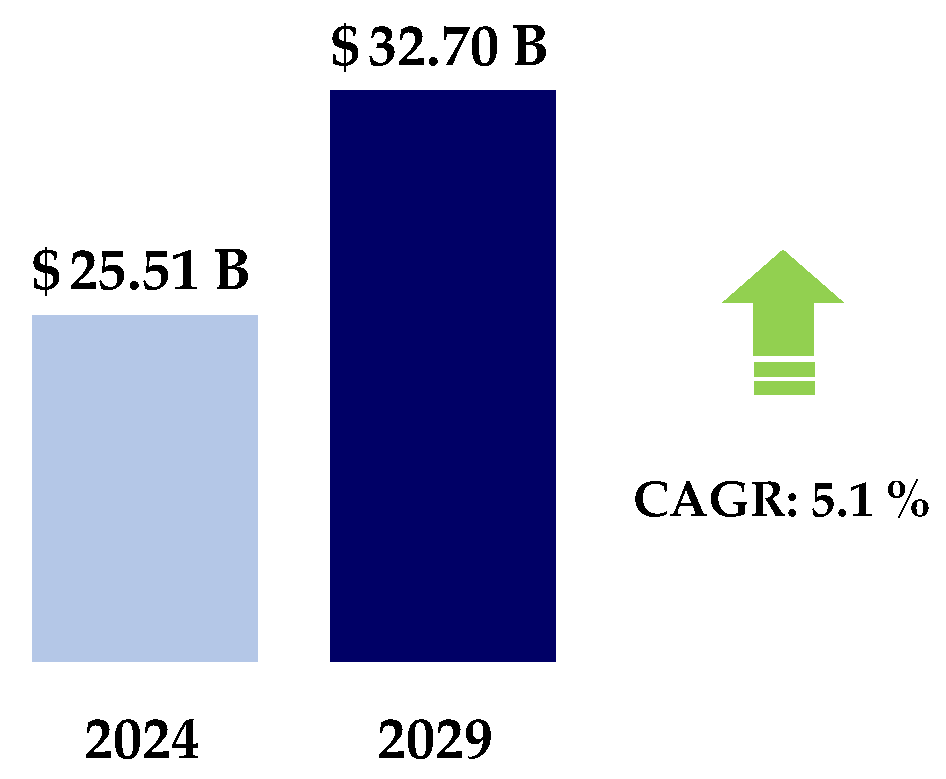
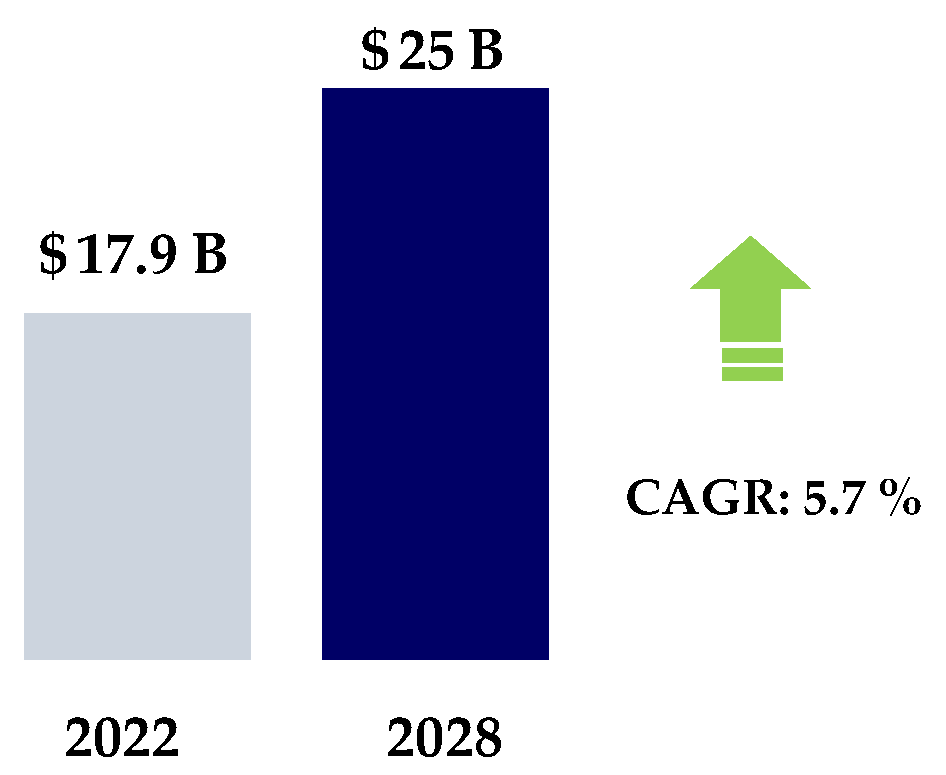

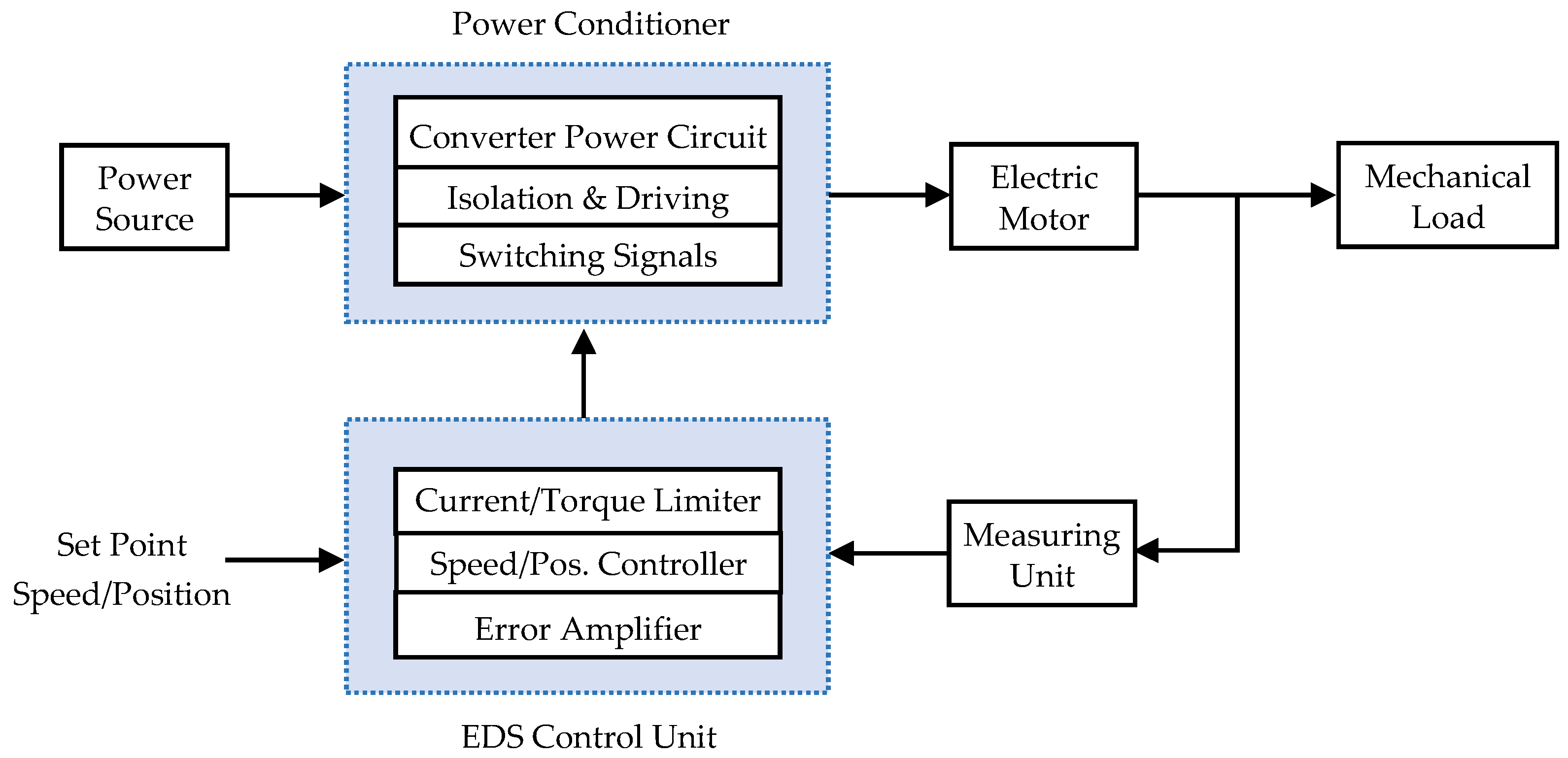

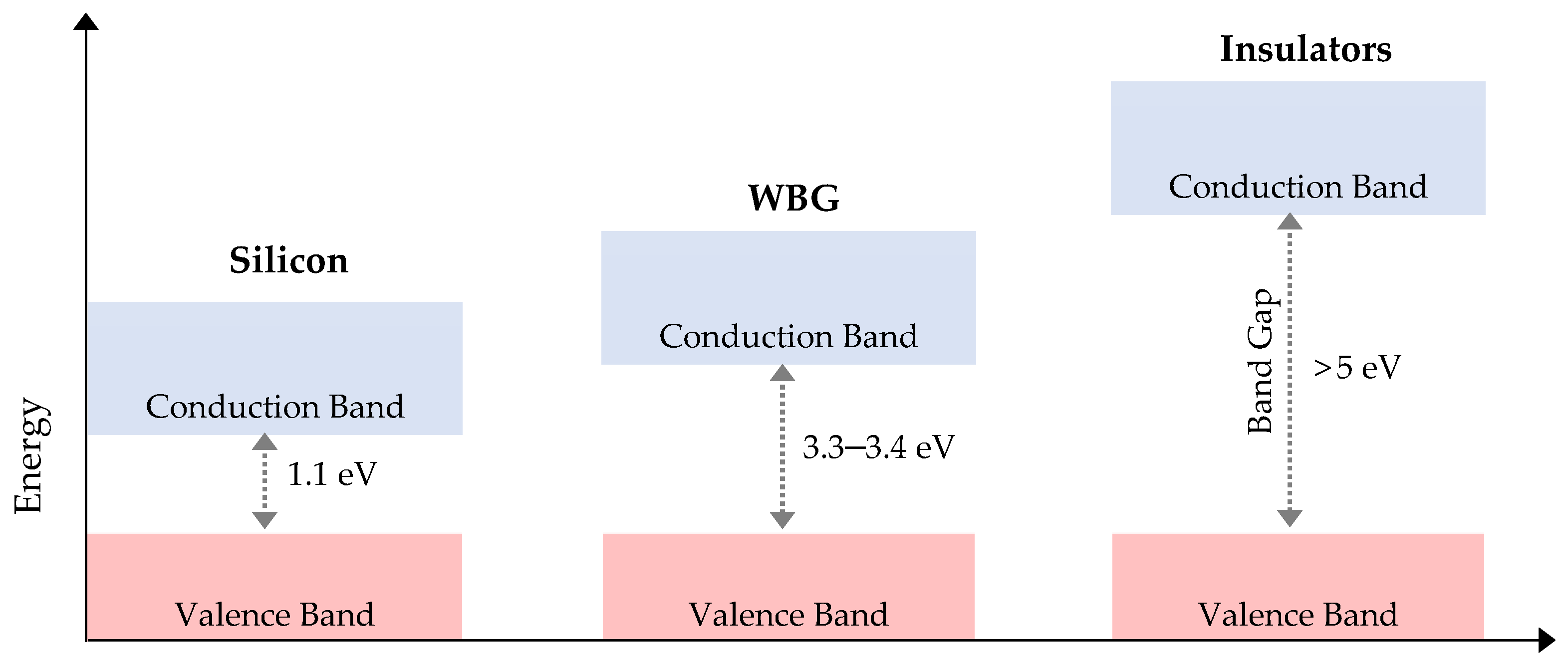

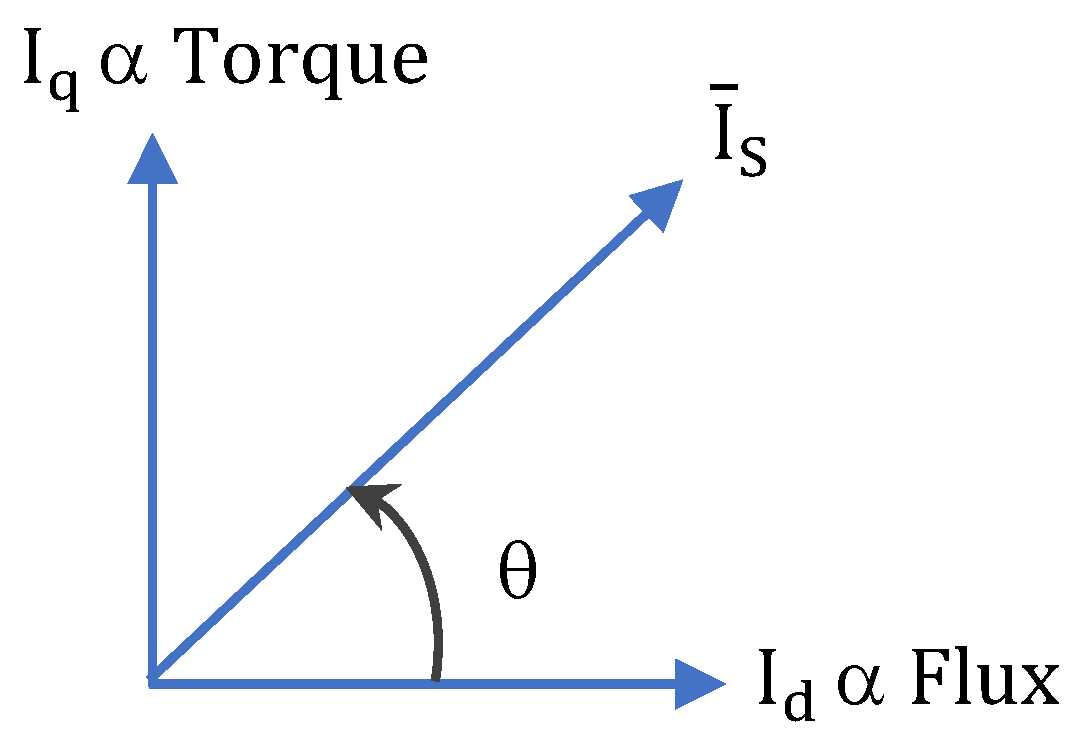

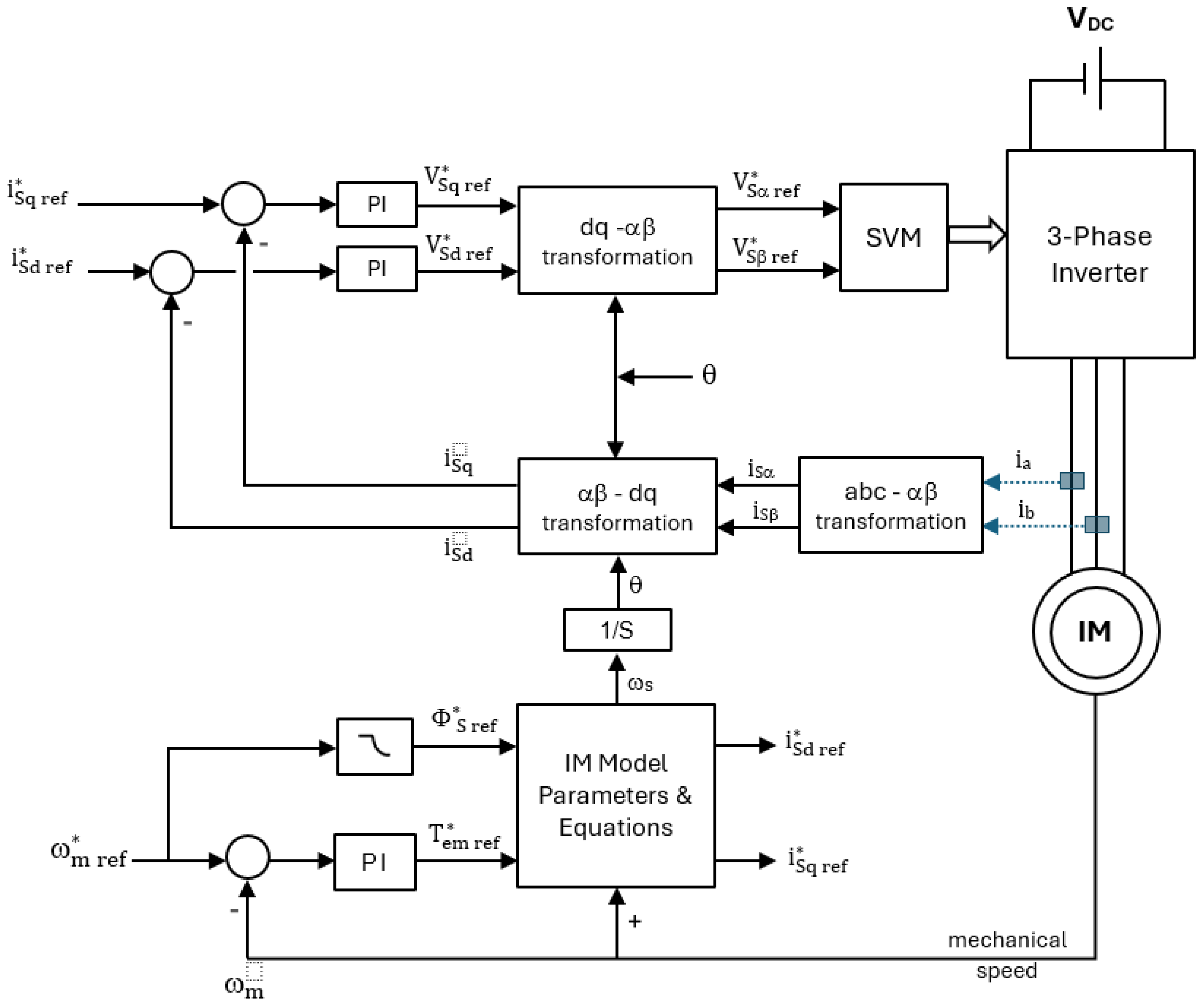
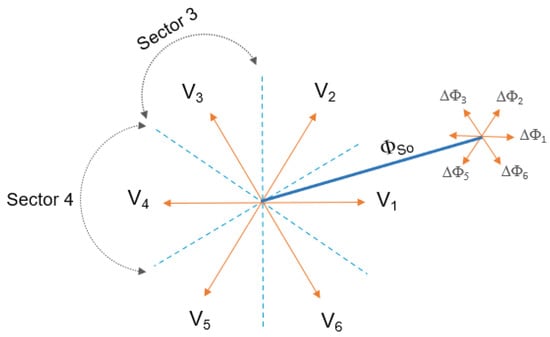
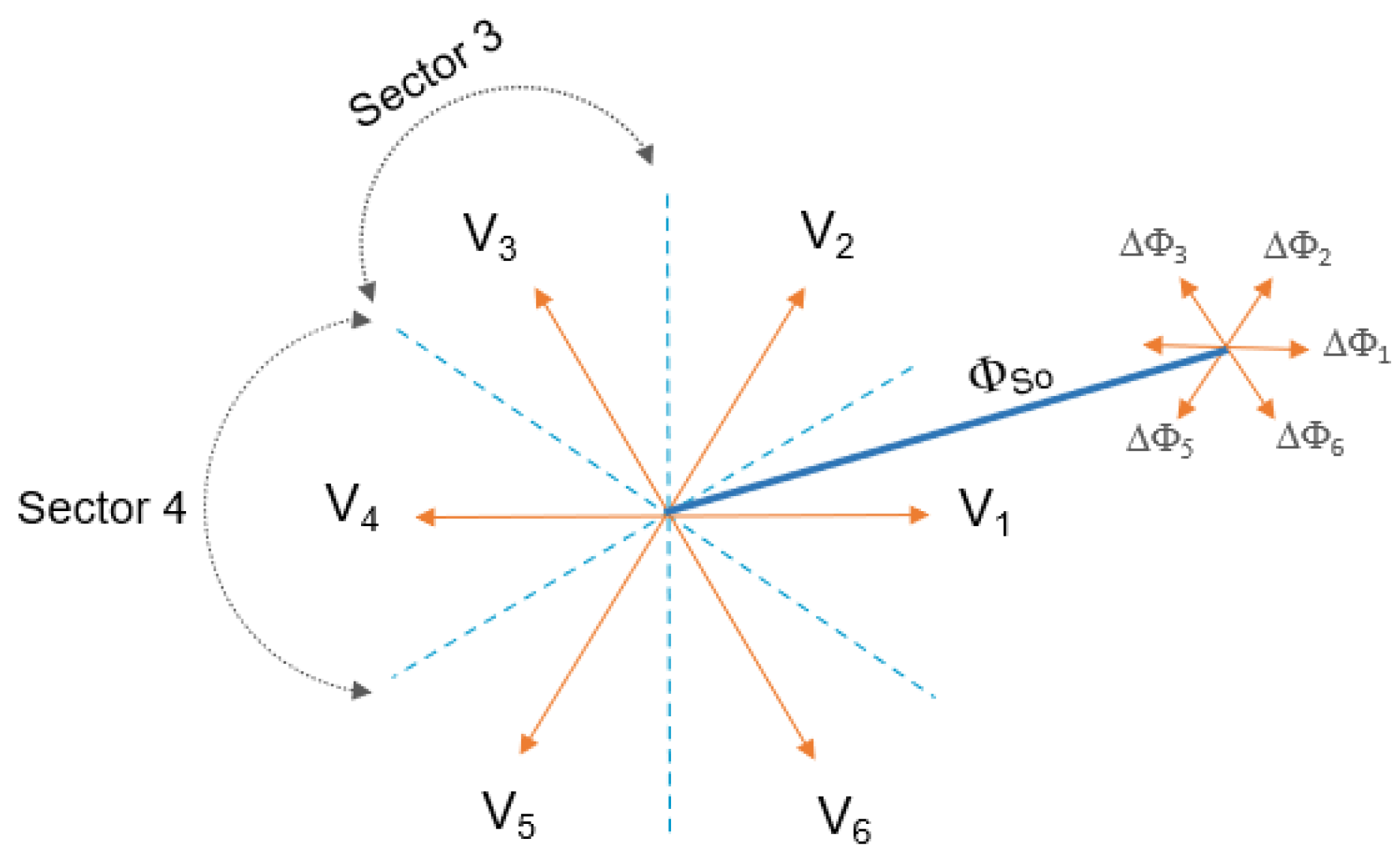
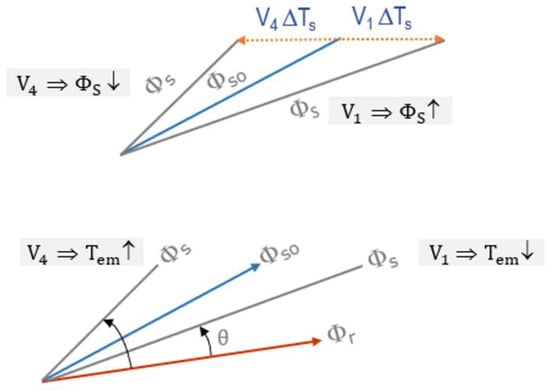
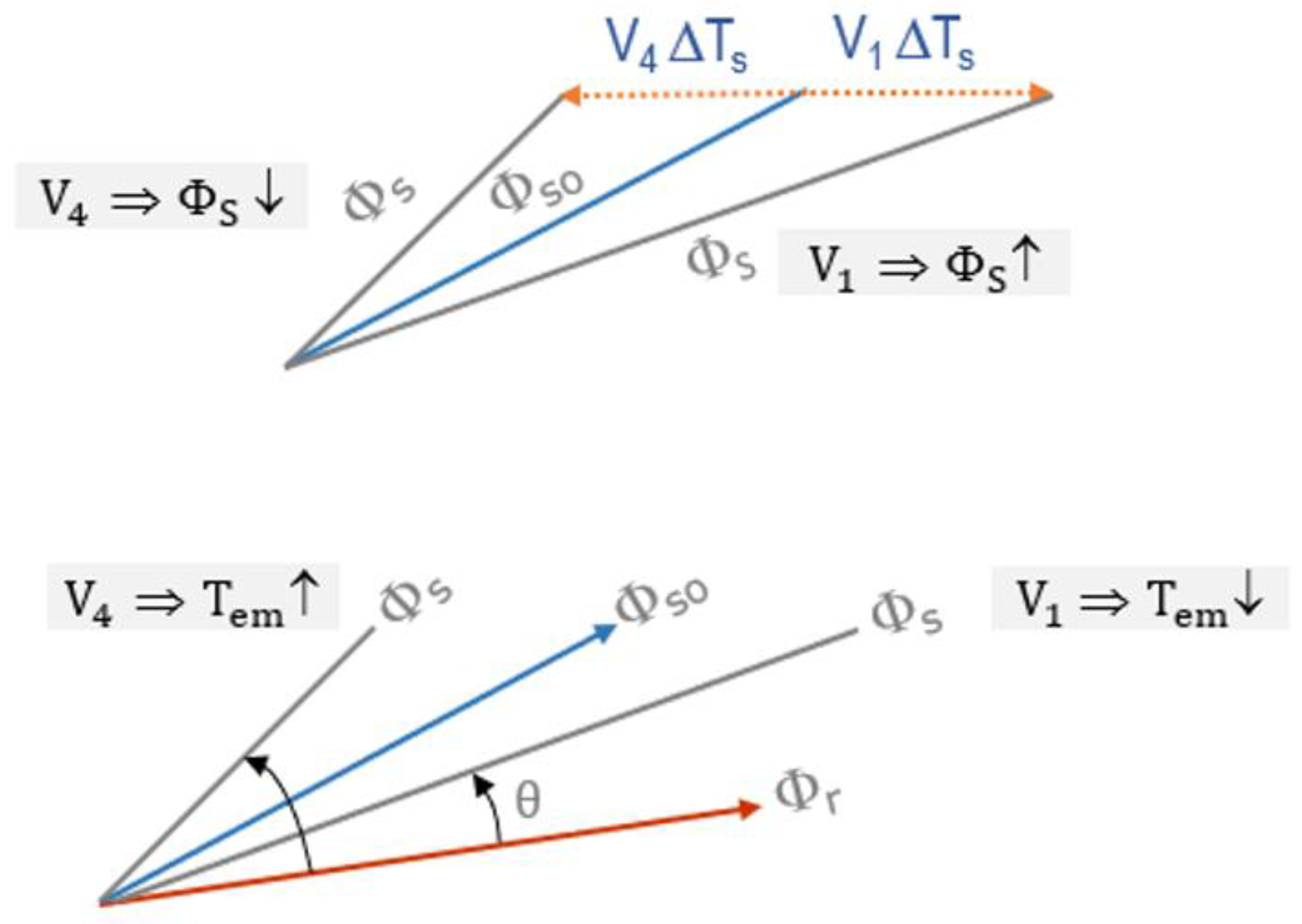
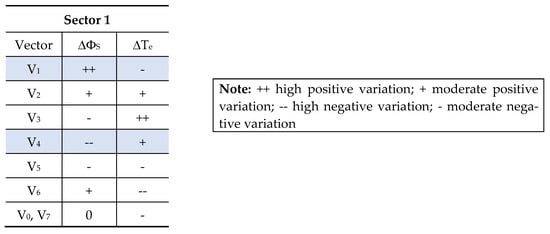
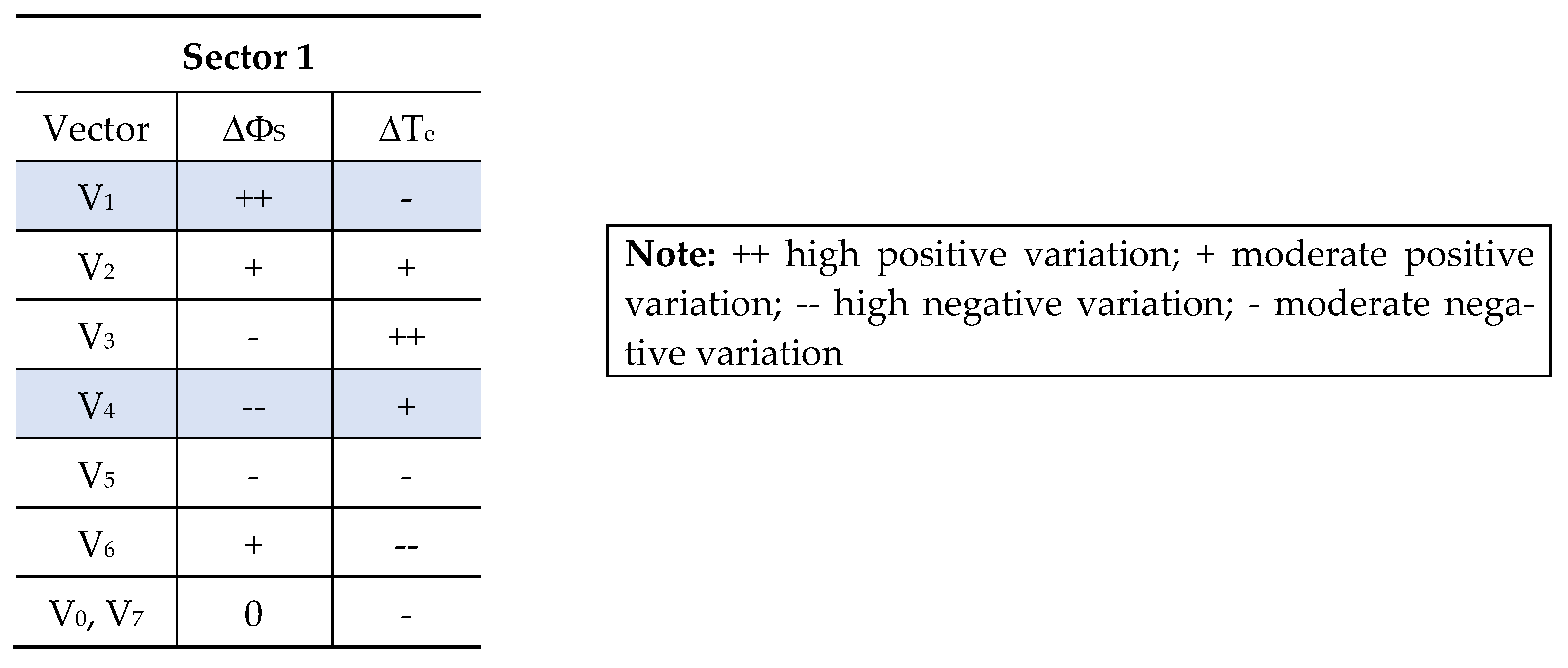

Disclaimer/Publisher’s Note: The statements, opinions and data contained in all publications are solely those of the individual author(s) and contributor(s) and not of MDPI and/or the editor(s). MDPI and/or the editor(s) disclaim responsibility for any injury to people or property resulting from any ideas, methods, instructions or products referred to in the content. |
© 2025 by the author. Licensee MDPI, Basel, Switzerland. This article is an open access article distributed under the terms and conditions of the Creative Commons Attribution (CC BY) license (https://creativecommons.org/licenses/by/4.0/).