


Abstract
This study represents the second phase of a longitudinal experiment evaluating the long-term cumulative effects of feeding strategies initiated at birth on the body development, metabolic profile, and feed efficiency of Gir dairy heifers during the rearing period. Thirty-four Gir dairy heifers participated in this study, which took place over a period of 133 days (21 days of adaptation and 112 days of data collection). A randomized block design was used with two treatments applied at birth: a conventional feeding plan (CF), offering 4% of body weight (BW) as dry matter (DM), and an optimized feeding plan (OF), offering 5% of BW as DM. Growth, feed efficiency, metabolic profile, and vulvar and teat morphometry were evaluated. Data were analyzed using linear and generalized mixed models. Average DM intake was 2.51% and 2.46% of BW for OF and CF, respectively. Heifers on OF showed a greater average chest circumference than those on CF. No differences were observed between treatments for residual feed intake, feed efficiency and feed conversion, teat and vulvar morphometry, or blood parameters. Our findings indicate that the growth differences established under the feeding plan initiated at birth were maintained throughout the rearing period, with no effects on feed efficiency, metabolic profile, or mammary gland development.
1. Introduction
The pre-weaning phase of dairy calves has received considerable attention in scientific studies, as this is the period with the highest mortality rates [1]. Management practices adopted during this period have both short- and long-term effects on animal health, welfare, and productivity [2,3]. Among the management practices adopted during early life, nutritional strategies play a key role in shaping long-term body development and subsequent growth performance throughout the rearing period [3]. Replacement heifers represent one of the largest investments in dairy production systems and determine the future productivity, longevity, and profitability of the herd, optimizing growth during the rearing period is of major biological and economic importance. During the post-weaning period, commonly referred to as the rearing period, research efforts typically focus on body development to ensure that first calving occurs between 22 and 24 months of age [4]. However, the available literature on the rearing period of dairy heifers primarily centers on recommendations for European breeds [5,6], which limits the applicability of these findings to tropically adapted breeds such as Gir cattle, which differ from European breeds in growth dynamics, thermoregulatory responses, feed utilization efficiency, and nutrient partitioning under tropical production systems. Although European breeds dominate dairy production worldwide, Bos indicus cattle and their crossbreeds represent more than 80% of the Brazilian herd due to their superior adaptation to tropical environments [7,8].
A widely adopted nutritional model for dairy cattle is the Nutrient Requirements of Dairy Cattle, originally published by the NRC—2001 [9] and recently updated by the NASEM—2021 [10]. Although the updated system includes important advances in predicting energy and protein requirements, its equations were developed predominantly from Holstein cattle managed under temperate conditions [11]. As a result, predictions of dry matter intake, maintenance energy requirements, growth performance, and nutrient utilization efficiency may be less accurate for Bos indicus breeds and Holstein × Gir crossbreds raised under tropical conditions, which differ physiologically and metabolically from Holstein cattle [12].
Understanding nutritional requirements is essential for developing feeding strategies that meet the nutritional demands of growing dairy heifers while improving nutrient utilization efficiency [13,14]. Nutritional imbalances may alter blood metabolite concentrations, providing early indications of inadequate nutrient supply before changes in body growth become evident [15]. Biomarkers such as glucose, blood urea nitrogen, non-esterified fatty acids (NEFAs), total protein, albumin, and insulin-like growth factor-1 (IGF-1) are commonly used to evaluate energy and protein status, nutrient utilization, metabolic adaptation, and growth efficiency in developing dairy heifers [16,17]. Consequently, metabolic profiling complements body development measurements by providing physiological information that facilitates the identification of nutritional inadequacies and improves the interpretation of animal performance [16,17].
For Holstein and Jersey heifers, recommended average daily gains (ADGs) range between 0.8 and 0.9 kg/day to ensure early puberty without impairing future productivity [4,18,19,20]. However, no specific values have been established in the literature for Gir heifers to define optimal growth rates that support mammary development and future productivity. Excessive prepubertal weight gain has been associated in some studies with increased adipose deposition in the mammary gland, potentially affecting mammary development [21]. Nutritional management during the prepubertal period may also influence reproductive development and mammary growth. Adequate nutrient supply supports normal body development and the onset of puberty, whereas excessive energy intake has been associated with alterations in mammary tissue development in some breeds. Therefore, evaluating mammary and reproductive-related morphometric traits together with growth and metabolic responses provides a more comprehensive assessment of the biological consequences of different feeding plans during the rearing period.
Despite the importance of Gir cattle in tropical dairy systems, quantitative information regarding the effects of different long-term nutritional plans on growth, feed efficiency, metabolic status, and mammary development during the rearing period remains limited. Previous studies with Gir heifers have primarily focused on productive performance, whereas the integrated evaluation of body development, feed-efficiency phenotypes, metabolic profiles, and reproductive-related morphometric traits across different feeding plans has received little attention. In addition, few studies have evaluated feeding strategies initiated at birth and maintained throughout the rearing period, allowing the long-term effects of feeding management on heifer development to be assessed. Therefore, the objective of the present study was to evaluate the effects of two feeding plans, differing in dry matter allowance (4% vs. 5% of body weight), on body development, metabolic profile, feed-efficiency phenotypes, and mammary and vulvar morphometry in Gir dairy heifers during the rearing period. We hypothesized that the higher feeding allowance would improve dry matter intake, growth performance and body development without impairing feed efficiency, metabolic health, or mammary development.
2. Materials and Methods
This study was approved by the Animal Use Ethics Committee of the Instituto de Zootecnia (protocol number 339-2021).
2.1. Location
The experiment was conducted at the Getúlio Vargas Experimental Field of the Agricultural Research Corporation of Minas Gerais (EPAMIG), located in the municipality of Uberaba, Minas Gerais, Brazil (coordinates: 19°45′1″ S, 47°55′57″ W; altitude: 752 m).
The regional climate is classified as subtropical, with hot and rainy summers and dry winters, according to the Köppen classification [22]. The experiment was conducted between May and September 2022, covering the autumn and winter seasons in the Southern Hemisphere. During this period, the mean monthly air temperature was 21.2 °C (range: 19.1–24.5 °C), the mean monthly relative humidity was 54.6% (range: 48.2–64.2%), and the mean monthly precipitation was 25.2 mm (range: 0.07–69.9 mm).
2.2. Animals and Treatments
This study represents the second phase of a longitudinal experiment. Animals were assigned to one of two feeding plans at birth and remained in the same treatment throughout both experimental phases. Phase 1 evaluated calves from birth to 120 days of age [23], whereas the present study (Phase 2) evaluated the same animals from 160 to 293 days of age. Therefore, treatment effects should be interpreted as the cumulative response to the feeding plans throughout the rearing period.
A total of 34 Gir dairy heifers participated in this study (phase 2), with an average initial age of 160 ± 26 days and an average body weight of 110 ± 22 kg. The sample size was not determined by an a priori power analysis. Instead, because this study represents the second phase of a longitudinal experiment, all heifers enrolled in Phase 1 and available for follow-up during the rearing phase were included in the present study. The heifers were housed in individual pens (8 m × 4 m) with earthen floors, each equipped with a shade cloth (1.5 m wide) positioned above the feed trough. Each pen contained a concrete feed trough and a drinking trough. The experimental period lasted 133 days, comprising 21 days of adaptation followed by 112 days of data collection.
The heifers were assigned to treatments according to the feeding plan received from birth to 120 days of age (Phase 1), as described by El Faro et al. [23]. Briefly, calvings occurred in two birth blocks due to natural variation in conception success and gestation length. Within each birth block, calves were sequentially allocated to treatment groups using a balanced allocation procedure to ensure an even distribution across treatments, and the allocation sequence was reversed in the second birth block to minimize potential systematic bias. Calves were assigned to either a conventional feeding plan (CF) or an optimized feeding plan (OF). Both groups suckled one teat from their dam during the two daily milkings until 90 days of age. In addition, OF calves received milk supplementation via a teat bottle immediately after each milking (4 L/day from birth to 60 days of age and 2 L/day from 61 to 90 days of age) and 50% more solid feed from 30 days of age onward than CF calves. During the present study, heifers remained in their original treatment groups and received diets formulated to provide daily dry matter allowances equivalent to 4% (CF) or 5% (OF) of body weight. The dry matter allowances of 4% and 5% of body weight were chosen to represent two feeding plans during the rearing period and to evaluate the effects of increased feeding supply on growth, metabolic status, and body development. During the experimental period, two heifers assigned to the optimized feeding plan developed health conditions unrelated to the experimental treatments and were withdrawn from the study. Consequently, the final sample sizes for analyses conducted after their withdrawal were 17 heifers in the conventional feeding plan and 15 in the optimized feeding plan. Body weight at the beginning of Phase 2 differ (p < 0.05) between feeding plans. Details of heifers’ body weight, age and dam parity by feeding plan are presented at Table 1.
Table 1.
Mean, standard deviation (SD), minimum, and maximum values of body weight (BW) at birth, weaning and entrance at phase, age at entrance of phase 2 and dam parity by feeding plan (conventional (CF) or optimized (OF)).
The total mixed ration (TMR) was provided individually twice daily (07:30 h and 15:00 h) and manually mixed in the feed troughs at a 68% corn silage:32% concentrate ratio. Both treatment groups received the same TMR, which contained, on average, 115.35 g/kg DM of crude protein and 2.63 Mcal/kg DM of metabolizable energy, with the complete chemical composition presented in Table 2. Therefore, the experimental treatments differed in feed amount rather than in dietary nutrient concentration or forage-to-concentrate ratio. The conventional feeding plan (CF) provided a daily DM allowance equivalent to 4% of body weight, whereas the optimized feeding plan (OF) provided 5%. The higher allowance in the OF treatment was intended to increase potential nutrient availability and to evaluate whether a greater nutritional plane would promote additional growth and body development. Because both treatments received the same TMR, differences in potential energy and protein supply resulted from the amount of feed offered rather than from differences in dietary nutrient density. The amount offered to each heifer was weighed using a digital scale, and orts were collected and weighed daily before the morning feeding to calculate individual dry matter intake (DMI). Orts were not separated by individual TMR ingredients; therefore, DMI was calculated based on the total amount of feed offered and refused, and feed sorting behavior was not assessed. Feed allowances were adjusted every 14 days based on the heifers’ individual body weights.
Table 2.
Chemical composition of corn silage, ground maize, soybean meal, and the total mixed ration offered during the experimental period. Dry matter (DM) is expressed as g/kg on an as-fed basis, whereas nutrient concentrations are expressed as g/kg of DM and energy values as Mcal/kg of DM.
Samples of the offered feeds and orts were collected every 15 days to form a monthly pooled sample and were subjected to chemical composition analysis (Table 1). The samples were weighed and dried in a forced-air oven at 65 °C for 72 h. Subsequently, the samples were ground in a knife mill equipped with a 1 mm screen and divided into subsamples for the determination of dry matter (DM; method No. 930.15), crude protein (CP; method No. 984.13), ether extract (EE; method No. 920.39), and ash (ASH, method 942.05), according to the methods of the Association of Official Analytical Chemists [24]. Neutral detergent fiber (NDF) and acid detergent fiber (ADF) were determined according to the method of Van Soest et al. [25].
2.3. Data Collection
During the experimental period, we measured body weight, body morphometric measurements (wither height, body length, chest circumference, and rump width), teat measurements (height, width, parenchyma thickness, and teat cistern diameter), vulvar morphometric measurements (vulvar length and width), and blood metabolites (glucose, albumin, total protein, urea nitrogen, β-hydroxybutyrate [BHB], and non-esterified fatty acids [NEFA]). Although body morphometric measurements and ultrasound image acquisition and interpretation followed standardized protocols and were performed by trained people, the absence of blinding may have introduced measurement bias and should be considered when interpreting the results. Details of the sampling time points and measurement procedures are described below.
2.3.1. Body Weight and Morphometric Measurements
Body weight and growth assessments were performed by weighing and measuring the heifers every 14 days throughout the experimental period, resulting in nine measurements per heifer. The heifers were weighed using a digital scale attached to a squeeze chute in the handling corral. Measurements of wither height were taken using a hipometer, while body length (dorso-lumbar) and chest circumference were measured with a commercial measuring tape. For chest circumference, the tape was positioned behind the scapula and around the entire body of the heifer. For body length, the tape was placed from behind the neck to the tail insertion. The wither height was measured by positioning the base of the hipometer on a flat surface up to the withers, and hip width was measured as the distance between the right and left tuber coxae.
2.3.2. Performance and Feed Efficiency
Growth performance and feed efficiency were evaluated by calculating average daily gain (ADG), dry matter intake (DMI), metabolic body weight (MBW), residual feed intake (RFI), feed conversion ratio (FCR), and feed efficiency (FE) [26,27]. The average daily gain (ADG, kg/day) was estimated as the linear regression coefficient of body weight on test days (TD, days), over a total of 112 days:
where yi is the body weight of animal i at each observation, α is the intercept representing the initial weight, β is the linear regression coefficient representing ADG, and ei is the random error.
yi = α + β × TDi + ei
The metabolic body weight (MBW, kg) was obtained using the equation:
where α is the intercept, TDi is the number of test days for each animal i, and ADGi is the predicted daily gain for animal i.
MBW = [α + (TDi/2 × ADGi)] 0.75
Residual feed intake was calculated using a single multiple linear regression fitted across all animals, irrespective of treatment assignment [28]. The regression included average daily gain (ADG) and metabolic body weight (MBW) as predictor variables of dry matter intake (DMI), and the residual for each animal was defined as its RFI value. Subsequently, RFI was analyzed as the dependent variable in the statistical model to evaluate the effect of the feeding plan.
where DMIi is the predicted dry matter intake for animal i; ADGi is the average daily gain; MBWi is the metabolic body weight; β0 is the intercept; β1 and β2 are the partial regression coefficients for ADG and MBW, respectively; and εi is the residual term representing the residual feed intake.
DMIi = β0 + β1(ADGi) + β2(MBWi) + εi
Observed dry matter intake was defined as the individual daily dry matter intake measured for each heifer. Predicted dry matter intake was estimated using the regression equation described above. Residual feed intake (RFI) was calculated as the difference between observed and predicted dry matter intake (RFI = observed DMI − predicted DMI), with negative values indicating greater feed efficiency and positive values indicating lower feed efficiency.
The feed conversion ratio (FCR, kg) was calculated as the ratio between DMI and ADG (DMI/ADG) [29], and the feed efficiency (FE, kg) was calculated as the inverse ratio (ADG/DMI) [30].
2.3.3. Teat Height, Width, and Ultrasonography (US) Measurements
Measurements of teat height and width (anterior and posterior) were performed at three time points, when the heifers were on average 186, 239, and 291 days of age. All measurements were taken on both anterior and posterior teats of each heifer using a caliper (Digimess). The same trained evaluator performed all measurements.
To measure parenchyma thickness and teat cistern diameter, ultrasonographic evaluations were performed on one teat (right posterior) of each heifer at three time points, when the animals were on average 186, 239, and 291 days of age. Ultrasonographic images were obtained using a real-time ultrasound device (SonoScape S2 V, Shenzhen, Guangdong, China) equipped with a 6.5 MHz microconvex transducer, and a single operator performed all examinations. Heifers were restrained in a standing position, and no sedatives or limb restraints were used. The lubricated microconvex transducer was applied at the base of each teat, previously covered with commercial ultrasound gel, at a 45° angle in a caudal-to-cranial direction. This procedure was adapted from Nishimura et al. [31] and Albino et al. [32].
Only the right posterior teat was evaluated in all heifers to standardize the ultrasonographic procedure, reduce examination time, and minimize animal handling during repeated measurements. Images were analyzed offline by the same trained evaluator following image acquisition.
The captured images were visually inspected for technical quality, and the image selected for morphometric measurements was the one showing the clearest visualization of the teat contour and internal structures, without visible compression artifacts caused by teat handling or image blurring. Images showing distortion due to excessive teat compression during image acquisition were not used for analysis.
2.3.4. Vulvar Morphometric Measurements
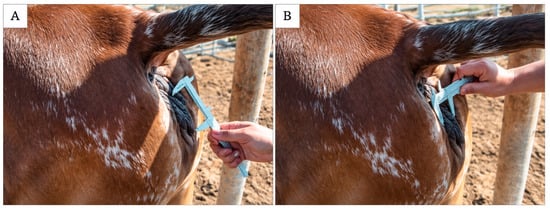
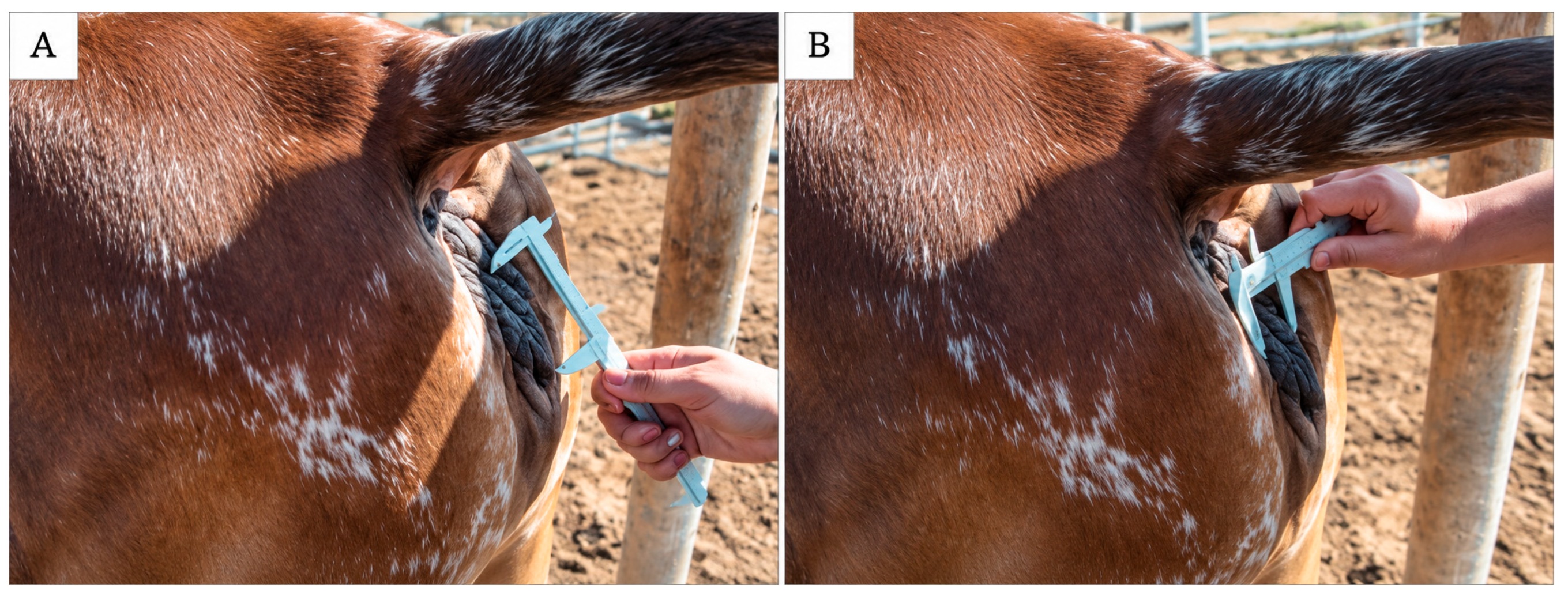
Vulvar morphometric measurements were performed every 15 days, starting from the 9th experimental week (average age 239 ± 29 days) and continuing until the end of the data collection period (average age 291 ± 29 days), totaling 5 measurements per heifer. The vulvar length (A) and width (B) were measured using a caliper (Digimess; Figure 1), as described by Maculan et al. [33]. The same previously trained evaluator carried out all evaluations.
Figure 1.
Vulvar regions measured using a caliper, where (A) represents vulvar length, and (B) represents vulvar width.
2.3.5. Blood Metabolites
Blood samples were collected at three time points, when the heifers were on average 181, 237, and 286 days of age, to evaluate the concentrations of glucose, albumin, total protein, urea nitrogen, β-hydroxybutyrate (BHB), and non-esterified fatty acids (NEFAs). Sampling was performed via jugular venipuncture using commercial vacuum collection tubes (Vacutainer, 10 mL; Becton Dickinson, Franklin Lakes, NJ, USA). Blood samples were collected approximately 1.5 to 2 h after the morning feeding. Animals were not fasted prior to sampling, and all collections were performed at the same interval after feed delivery to standardize the postprandial metabolic state across animals and sampling days.
For total protein analysis, blood was collected in tubes without anticoagulant to obtain serum. For β-hydroxybutyrate, urea nitrogen, glucose, and NEFA analyses, blood was collected in vacuum tubes containing fluoride and EDTA to obtain plasma. All samples were collected at 10:00 a.m., with animals not fasted prior to sampling. Samples were refrigerated and centrifuged at 3000 rpm for 15 min at 4 °C to separate plasma or serum. Aliquots were labeled with the date and animal ID, transferred to Eppendorf tubes, and stored frozen until analysis.
Blood samples were collected by jugular venipuncture into heparinized tubes. Immediately after collection, samples were centrifuged at 2000 rpm for 15 min, and the plasma was harvested into microtubes and stored at −20 °C until the metabolite concentrations were analyzed. Concentrations of glucose, total protein, albumin, and urea were determined by enzymatic colorimetric assays using commercial kits from Labtest (Lagoa Santa, MG, Brazil). Non-esterified fatty acids (NEFAs) and β-hydroxybutyrate (BHB) were determined by enzymatic colorimetric assays using commercial kits (Randox Laboratories, Crumlin, UK). All analyses were performed according to the manufacturers’ instructions. The intra- and inter-assay coefficients of variation for all metabolites were below 8.2%.
2.4. Statistical Analysis
2.4.1. Body Weight, Morphometric Measurements, Performance and Feed Efficiency
To select the most appropriate residual (co)variance structure for each trait analyzed using the MIXED procedure, Schwarz’s Bayesian Information Criterion (BIC) was used to compare alternative covariance structures. Different covariance structures were evaluated, including Variance Components (VCs), Compound Symmetry (CS), First-order Autoregressive [AR(1)], Toeplitz (TOEP), and Unstructured (UN). The covariance structure that best fitted each response variable was selected based on the lowest Akaike Information Criterion (AIC) and Bayesian Information Criterion (BIC) values. Least squares means were compared across all ANOVA models using Tukey’s test at a significance level of 5% (p < 0.05).
Body weight and body morphometric measurements (wither height, body length, chest circumference, and rump width) were obtained every 14 days and analyzed using linear mixed models with the MIXED procedure (SAS, version 9.4). The models included the fixed effects of feeding plan (conventional or optimized), age at measurement as a continuous linear covariate, and the feeding plan × age interaction. Age was included to account for expected developmental changes throughout the rearing period and to estimate treatment effects independently of chronological age. For body weight, body weight at the beginning of Phase 2 was also included as a linear covariate. The feeding plan × age interaction was initially evaluated for each variable and was removed from the final model when not significant (p > 0.05). Repeated measurements within each animal were accounted for in the model.
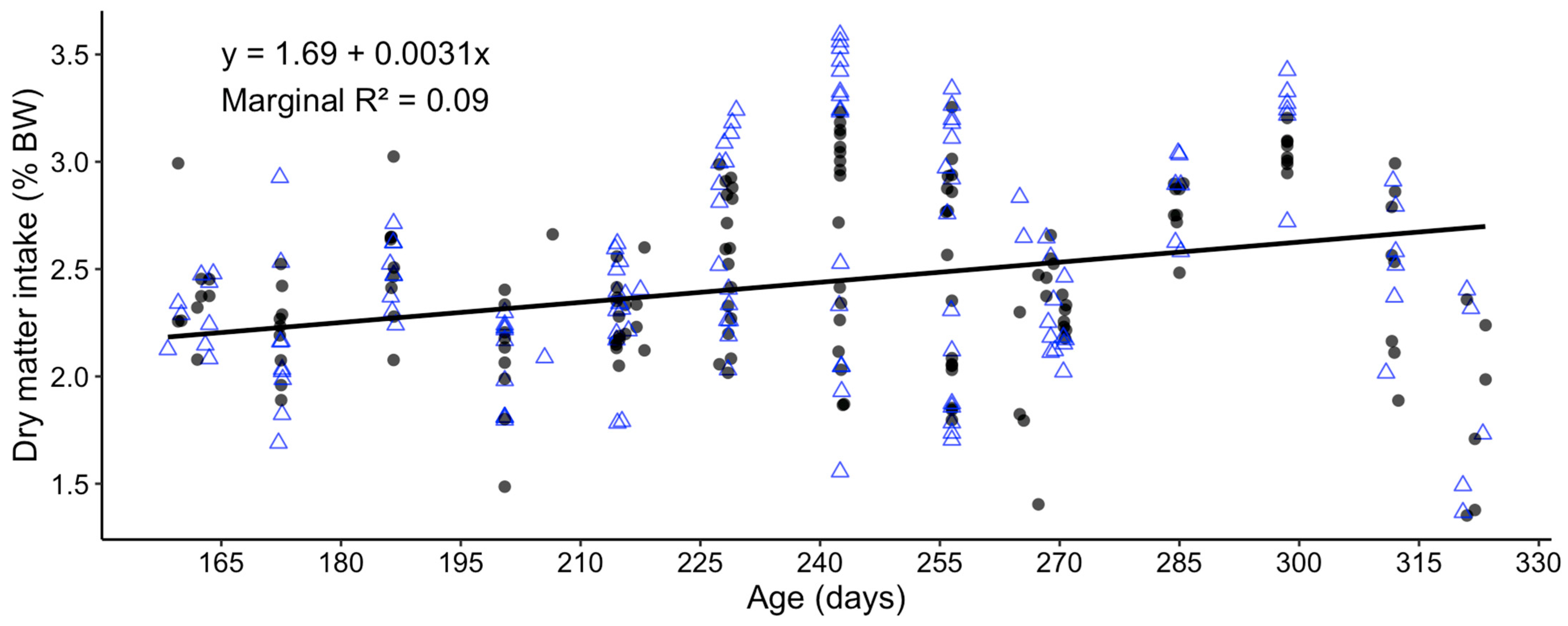
Dry matter intake expressed as a percentage of body weight (DMI/BW) was calculated as the individual daily dry matter intake divided by the corresponding body weight and multiplied by 100. DMI/BW was analyzed using a linear mixed model (LMER procedure; lmerTest package [34]) in RStudio (version 4.3.0; R Core Team), including feeding plan (conventional or optimized) as a fixed effect, age as a linear covariate to account for changes in intake during growth, and the repeated measures for each heifer as a random effect. For graphical presentation, daily DMI/BW values were averaged for each heifer within consecutive 14-day intervals. The regression line, equation, and marginal R2 shown in the figure were obtained from the final linear mixed-effects model.
Residual feed intake (RFI), metabolic body weight (MBW), feed efficiency (FE), feed conversion ratio (FCR), and final body weights were analyzed using a linear model with the GLM procedure (SAS, version 9.4; SAS Institute Inc., Cary, NC, USA). The model for each variable included feeding plan (conventional or optimized) as fixed effect and initial age as a linear covariate.
2.4.2. Teat and Vulvar Morphometric Measurements
To evaluate the effect of feeding plan on teat and vulvar morphometric measurements (teat height and width, parenchyma thickness, teat cistern diameter, vulvar length, and width) generalized linear mixed models (GLMER procedure; lme4 package; [35]) using RStudio (version 4.3.0; R Core Team) were conducted. The Gamma distribution was found to be the best fit for the data. The model for each variable included the fixed effect of feeding plan, age as a linear covariate, and the repeated measure for each animal as a random effect. Age was included because teat and vulvar morphometric traits undergo substantial developmental changes during the prepubertal period. Thus, the inclusion of age as a covariate accounted for normal developmental differences among heifers, allowing the effects of feeding plan to be evaluated independently of age-related variation. Additionally, Spearman’s correlation coefficients were estimated between teat and vulvar morphometric measurements and body morphometric traits at three time points (186, 239, and 292 days of age).
2.4.3. Blood Metabolites
For blood metabolite variables (NEFA, β-hydroxybutyrate, glucose, albumin, total protein, and urea), linear mixed models were fitted using the LMER procedure (lmerTest package [34]) in RStudio (version 4.3.0; R Core Team), including feeding plan (conventional or optimized), sampling time (181, 237, and 286 days of age), and age as a linear covariate to account for developmental changes in metabolism during growth. The repeated measure of each animal was included as a random effect.
3. Results
3.1. Body Weight and Morphometric Measurements
Body weight was positively associated with body weight at the beginning of Phase 2 (β = 0.5425 ± 0.07527; p < 0.001) and increased with age (β = 0.6490 ± 0.01044 kg/day; p < 0.001). No effect of feeding plan was observed on body weight (p = 0.204). Feeding plan affected chest circumference (p = 0.039), with adjusted means of 127.64 ± 0.71 and 128.89 ± 0.72 cm for heifers fed the conventional and optimized feeding plans, respectively. Withers height increased with age (β = 0.1059 ± 0.00561 cm/day; p < 0.001), but was not affected by feeding plan (p = 0.723). Rump width also increased with age (β = 0.03363 ± 0.00283 cm/day; p < 0.001), while feeding plan had no effect (p = 0.882). Body length increased with age and showed a significant feeding plan × age interaction (p = 0.043). The estimated rate of increase was 0.09876 ± 0.00314 cm/day for the optimized feeding plan and 0.10836 ± 0.00552 cm/day for the conventional feeding plan, indicating a greater rate of increase in body length for heifers fed the conventional feeding plan.
3.2. Feed Intake, Performance, and Feed Efficiency
Although the feeding plans during the experimental period aimed to offer at 4% and 5% of dry matter relative to body weight (DMI/BW), heifers consumed, on average, approximately 2.5% DMI/BW, corresponding to 2.51% for the optimized feeding plan and 2.46% for the conventional plan. These values were lower than the amounts offered in both feeding plans.
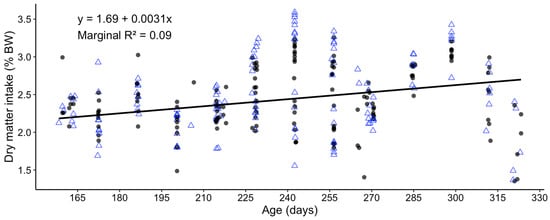
Descriptively, individual DMI showed a wide range of intake, varying from 0.08% to 4.0% DMI/BW throughout the experimental period. Only 65% of the heifers consumed more than 3.5% DMI/BW at any time during the study. Dry matter intake expressed as a percentage of body weight (DMI/BW) increased linearly with age (p < 0.001; Figure 2). No effect of feeding plan on DMI/BW was observed (p = 0.465), indicating that both feeding plans showed similar intake patterns relative to body weight throughout the experimental period.
Figure 2.
Relationship between age (days) and dry matter intake expressed as a percentage of body weight (DMI, %BW/day) in Gir dairy heifers fed a conventional (CF; n = 17) or optimized (OF; n = 15) feeding plan throughout the experimental period. Each circle and triangle represents a daily observation for an individual heifer. Black circles represent heifers fed the conventional feeding plan and blue triangles represent heifers fed the optimized feeding plan. The solid line represents the fitted relationship estimated from the final linear mixed-effects model. Regression equations and marginal R2 values correspond to the fixed effects of the fitted model.
Heifers fed the optimized feeding plan gaining on average 91.05 kg and reaching a greater final body weight (p = 0.04), as well as a higher metabolic body weight (p = 0.03; Table 3). Heifers under the optimized feeding plan also showed higher average daily gain and greater dry matter intake than those under the conventional plan (p = 0.050 and p = 0.002, respectively). Feeding plans did not affect residual feed intake (p = 0.08), feed efficiency (p = 0.27), or feed conversion ratio (p = 0.26).
Table 3.
Least squares means, and standard error of the mean (SEM) of initial weight, final weight, and feed efficiency traits of Gir dairy heifers fed a conventional (CF; n = 17) or optimized (OF; n = 15) feeding plan during the experimental period.
3.3. Teat Morphometric Measurements
The feeding plan did not affect the height (p = 0.78) or width (p = 0.75) of the front teats, nor the height (p = 0.69) or width (p = 0.63) of the rear teats. Descriptively, front teats had a mean height of 2.04 cm (range: 0.8–3.2 cm) and a mean width of 1.01 cm (range: 0.6–1.6 cm). Rear teats showed a mean height of 1.91 cm (range: 1.0–3.0 cm) and a mean width of 0.94 cm (range: 0.4–1.6 cm).
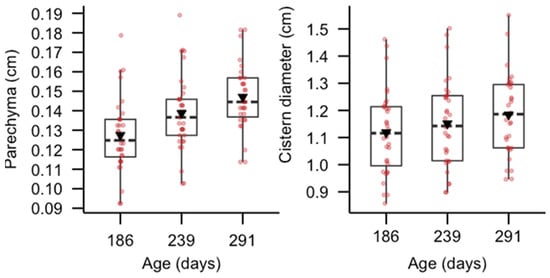
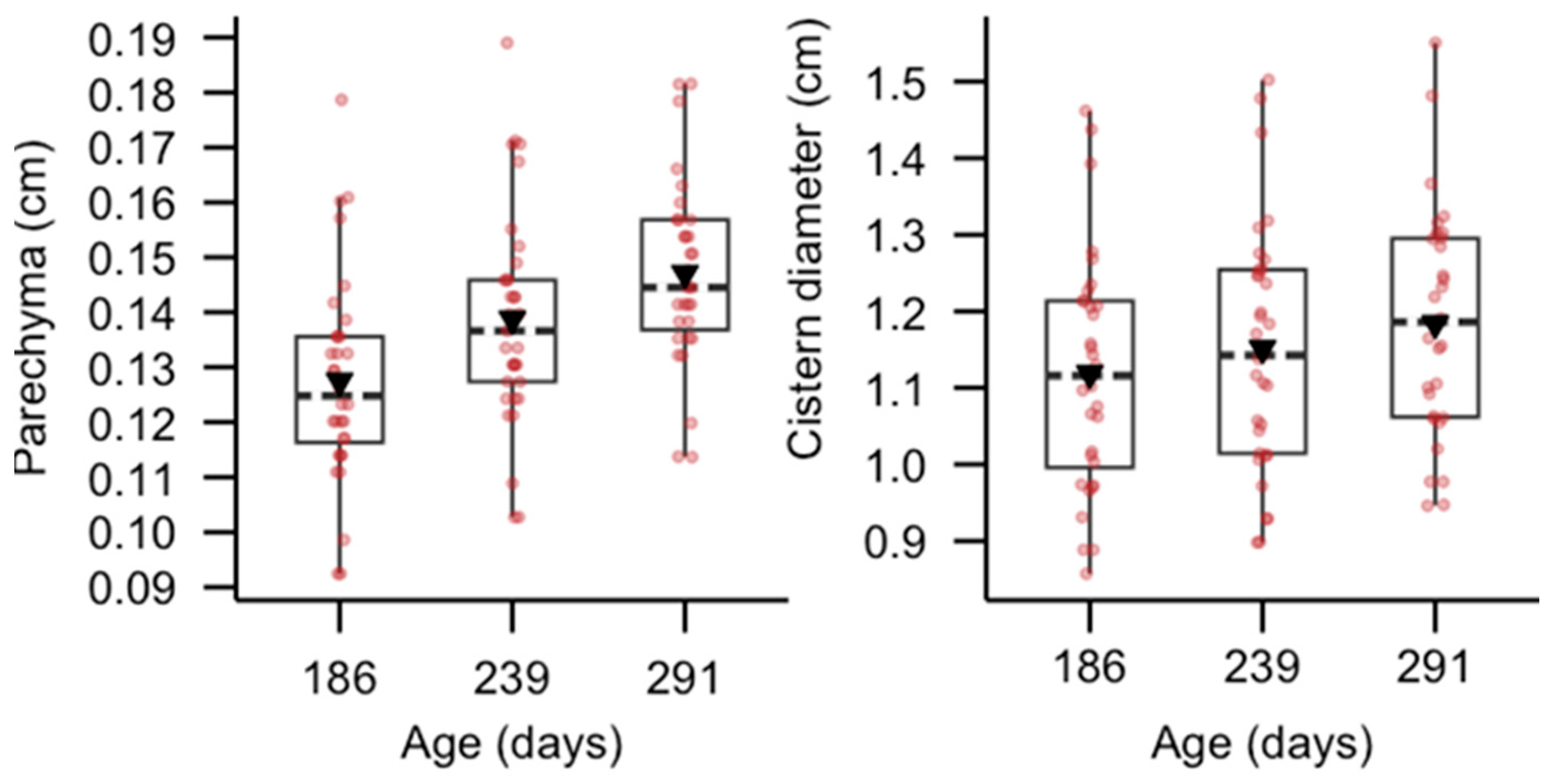
No effect of feeding plan was observed on teat parenchyma thickness (p = 0.54) or teat cistern diameter (p = 0.29). Mean parenchyma thickness was 0.14 cm (range: 0.10–0.22 cm) and mean teat cistern diameter was 1.15 cm (range: 0.61–1.58 cm). Positive correlations were observed between body weight and both parenchyma thickness (r = 0.35, p < 0.05) and teat cistern diameter (r = 0.42, p < 0.05). Figure 3 illustrates the increase in parenchyma thickness and teat cistern diameter with advancing age of the heifers.
Figure 3.
Predicted values of teat parenchyma thickness and teat cistern diameter (cm) at three time points when Gir dairy heifers (n = 32) had mean ages of 186, 239, and 291 days. Triangles represent the mean and dashed lines represent the median at each sampling point. Red points were jittered using the geom_jitter function (ggplot2 package; [36]) in RStudio (version 4.3.0; R Core Team).
3.4. Vulvar Morphometric Measurements
The feeding plan did not affect vulvar length (p = 0.43) or vulvar width (p = 0.77). Descriptively, mean vulvar length was 7.05 cm (range: 5.0–9.7 cm), and mean vulvar width was 2.40 cm (range: 2.2–5.3 cm). Positive correlations (p < 0.05) were observed between vulvar length and body weight, thoracic perimeter, body length, withers height, and rump width (Table 4). In contrast, vulvar width was not significantly correlated with any of the measurements of the heifers.
Table 4.
Spearman correlation coefficients (r) between vulvar measurements (cm) and body traits of Gir dairy heifers at 186, 239, and 292 days of age (n = 32).
3.5. Blood Metabolites
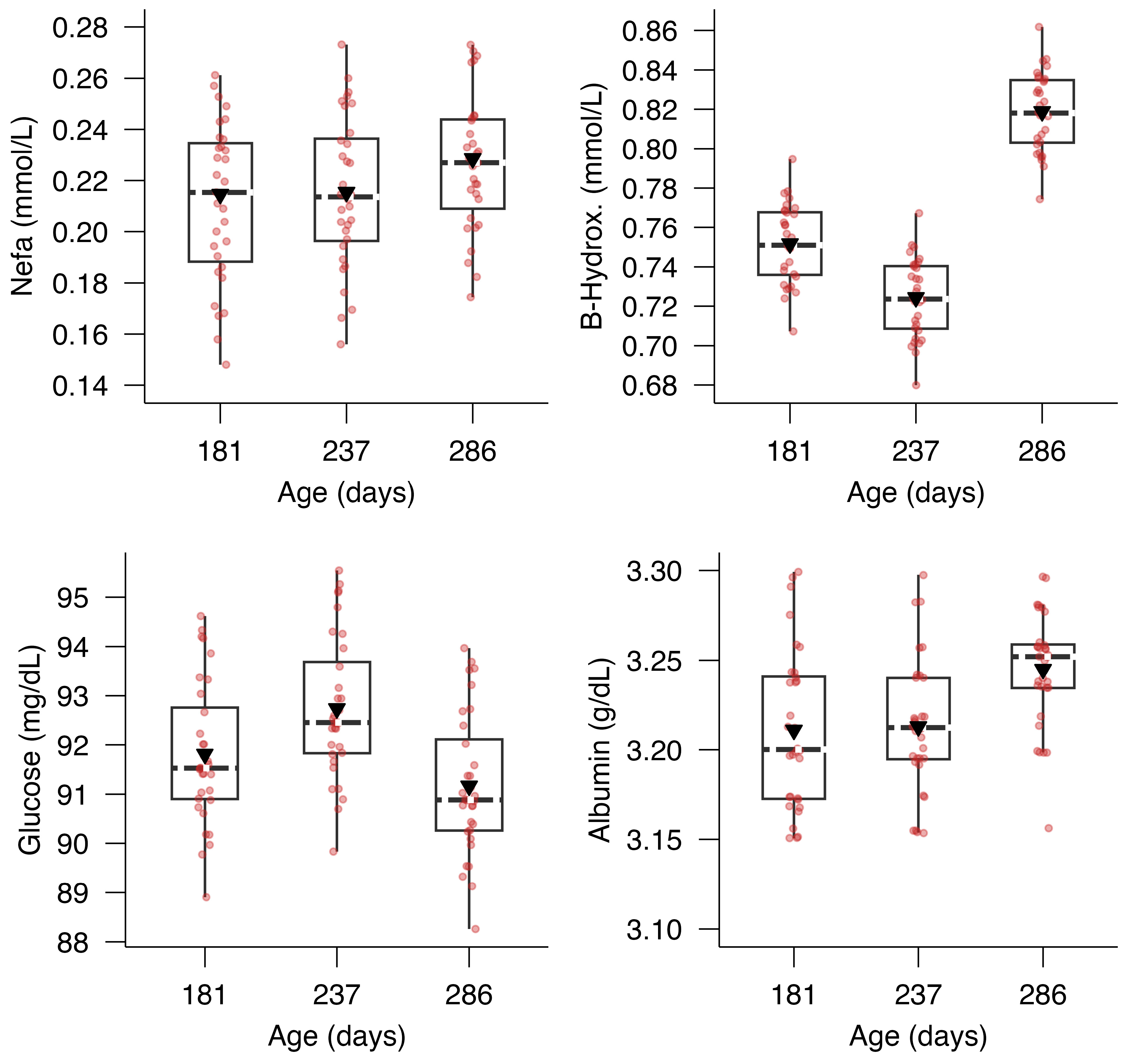
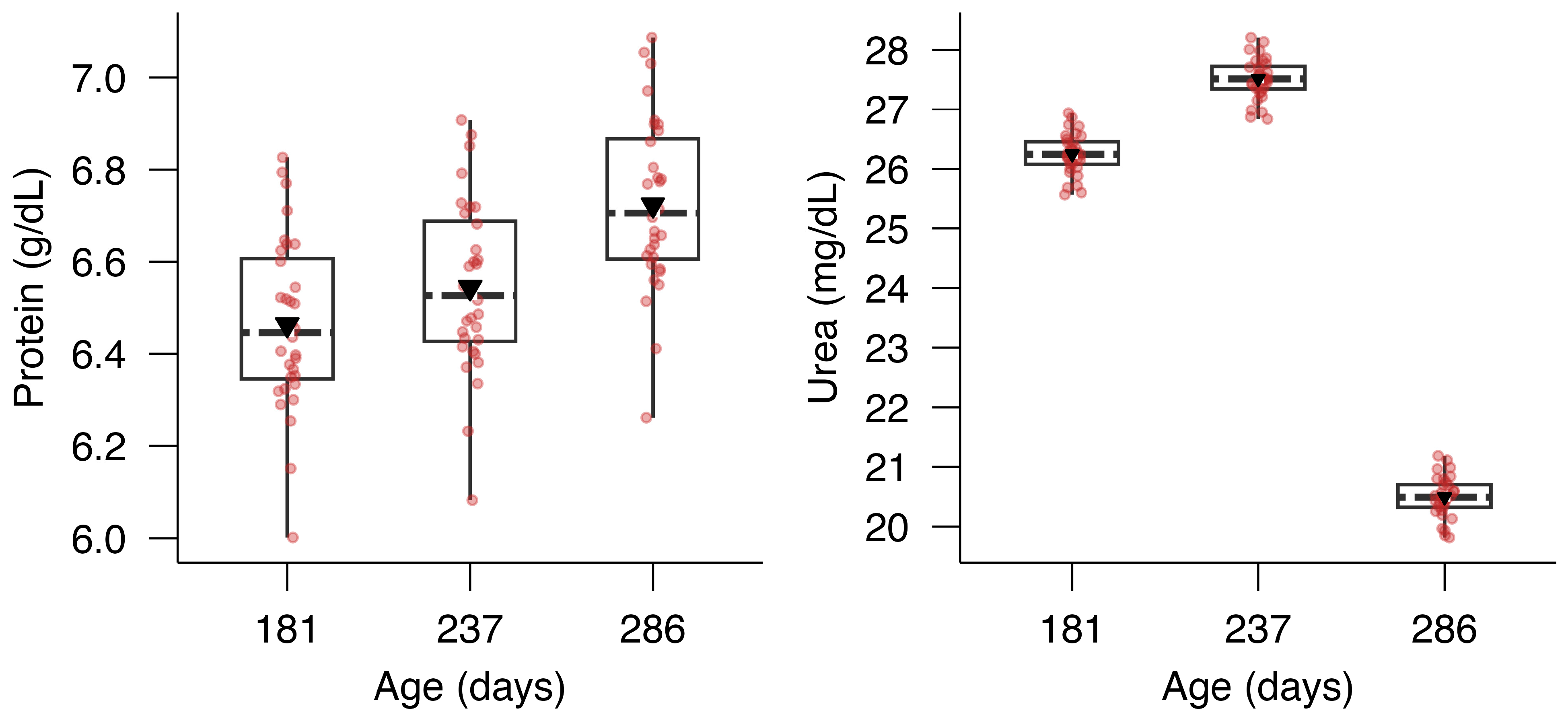
Feeding plans did not affect blood concentrations of NEFA (p = 0.759), β-hydroxybutyrate (p = 0.896), glucose (p = 0.146), albumin (p = 0.828), total protein (p = 0.422), or urea (p = 0.615) during the experimental period (Table 5).
Table 5.
Least squares means, and standard error of the mean (SEM) of serum metabolites of Gir dairy heifers fed a conventional (CF; n = 17) or optimized (OF; n = 15) feeding plan during the experimental period.
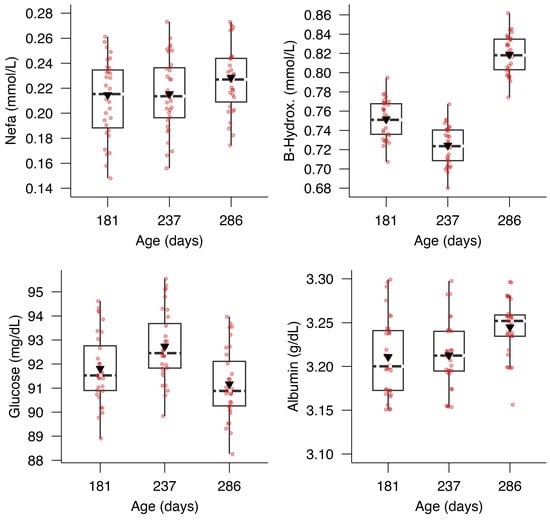
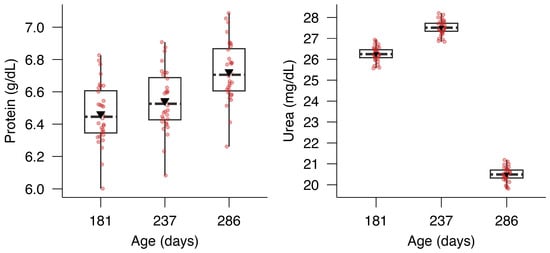
A significant effect of age was observed for these variables (p < 0.05; Table 5). Serum concentrations of NEFA (p = 0.004), β-hydroxybutyrate (p = 0.002), and total protein (p = 0.0002) increased over the experimental period, whereas serum urea concentrations decreased (p = 0.004), as illustrated in Figure 4.
Figure 4.
Least squares means of blood metabolites at three time points when heifers had mean ages of 181, 237, and 286 days. Triangles represent the mean and dashed lines represent the median at each sampling point. Red points were jittered using the geom_jitter function (ggplot2 package; [36]) in RStudio (version 4.3.0; R Core Team).
4. Discussion
The feeding plans adopted in this study, with different feed allowances (4 or 5% of dry matter relative to body weight; DMI/BW), were designed to characterize intake and, consequently, the performance of Gir heifers during the rearing period. As the second phase of a longitudinal experiment, this study provides an opportunity to evaluate the long-term cumulative effects of feeding strategies initiated at birth on body development, metabolic profile, and feed efficiency during the rearing period. Under the conditions of the present study, Gir heifers consumed, on average, approximately 2.5% of their body weight as dry matter. Information on the actual intake requirements of Gir dairy heifers remains scarce in the literature, particularly during the rearing period, reinforcing the importance of studies such as this to expand knowledge and support more precise and efficient management practices in production systems. Inácio et al. [37] evaluated sugarcane bagasse as the sole forage source for Gir dairy heifers receiving 40 to 70% concentrate in the diet, with initial and final body weights of 198 and 238 kg, respectively. They reported dry matter intakes ranging from 2.7 to 4.2% BW. The dry matter allowance levels used in the present study were based on available literature and practical intake measurements obtained from the EPAMIG Gir herd, where the experiment was conducted. The conventional feeding plan reflected routine management, whereas the optimized plan provided a higher feed allowance to challenge intake capacity and allow ad libitum consumption.
Although heifers did not consume the total amount of feed offered, those under the optimized feeding plan consumed approximately 8% more dry matter per day than those under the conventional plan. This greater dry matter intake was accompanied by numerically greater body weight, although feeding plan did not significantly affect body weight when baseline body weight and age were considered. Notably, body weight at the beginning of Phase 2 was positively associated with subsequent body weight, suggesting that differences in growth established during Phase 1 of the longitudinal experiment [23] contributed to the subsequent body development observed during Phase 2. Silvestre et al. [11], evaluating two feeding levels targeting average daily gains (ADGs) of 400 and 800 g/day in heifers from three genetic groups (Holstein, Gir, and Holstein × Gir), found no effects of feeding level or breed group on feed intake; however, Gir and Holstein × Gir heifers receiving the higher feeding level showed greater feed efficiency than Holsteins. Feed intake is one of the leading indicators of animal health and performance [38]. It is influenced by multiple factors, including body weight, body composition, nutritional requirements, dietary energy density, climatic conditions, and physiological status [39,40]. The fact that heifers in the present study did not consume all the feed offered may be related to the inclusion levels of concentrate and the neutral detergent fiber (NDF) and acid detergent fiber (ADF) contents. High NDF levels can reduce voluntary intake by affecting rumen fill, passage rate, and ingestion capacity [41,42]. Diets with higher fiber content require longer digestion and fermentation times, which may lead animals to reach satiety earlier and reduce intake [41,42].
Heifers fed the optimized feeding plan maintained greater chest circumference throughout the experimental period. These traits are positively correlated, and chest circumference is commonly used as an indirect measure of body weight [43,44,45]. Heifers receiving the optimized feeding plan also exhibited a numerically greater ADG (approximately 60 g/day. Although this difference was modest and should be interpreted with caution, it was consistent with the numerically greater body weight maintained throughout the rearing period. Moreover, the greater daily dry matter intake observed in the optimized group primarily reflected their body weight, as dry matter intake expressed as a percentage of body weight did not differ between feeding plans. Hayes et al. [46] reported a quadratic relationship between prepubertal growth rate and first-lactation milk yield, with gains up to 0.82 kg/day associated with maximal milk production. Although the difference in ADG observed in the present study was smaller than the optimum growth rate reported by Hayes et al. [46], maintaining adequate growth throughout the rearing period is important to ensure that replacement heifers achieve appropriate developmental targets without compromising future productive performance.
During the rearing period, when growth rates remain accelerated, defining optimal feed efficiency targets without compromising reproductive tract development and body composition is challenging. Fonseca et al. [47] evaluated residual feed intake (RFI) as a criterion for sexual precocity in Holstein × Gir heifers and suggested that selection for greater feed efficiency may delay puberty due to increased maintenance requirements, although no negative effects on reproductive performance up to first pregnancy were observed. The use of RFI as a measure of feed efficiency in dairy cattle is relatively recent [48,49,50] and requires further investigation in large populations of growing heifers and lactating cows using robust models to estimate expected intake [51,52]. In the present study, feeding plans did not affect residual feed intake, feed efficiency, or feed conversion ratio. The absence of differences in RFI, feed efficiency, and feed conversion ratio suggests that the greater nutrient supply provided by the optimized feeding plan primarily supported proportional body growth rather than improving the biological efficiency with which nutrients were converted into body tissue. Heifers receiving the optimized feeding plan consumed more dry matter and achieved greater average daily gain, but they also exhibited greater metabolic body weight, indicating higher maintenance requirements associated with increased body size. Consequently, the additional nutrient intake appeared to meet the demands of sustaining a larger, faster-growing animal rather than reducing the feed required per unit of weight gain. These findings suggest that the optimized feeding plan enhanced growth performance without substantially altering the biological efficiency of nutrient utilization during the rearing period.
As expected, all evaluated body traits showed linear increases with advancing age. Growth curves are useful tools for monitoring and assessing growth targets in dairy production systems [53]. Although body weight is the most commonly used indicator of heifer growth, comprehensive information, including linear body measurements, remains limited [54,55]. Some studies highlight the importance of evaluating stature alongside body weight to ensure adequate development [56], as body weight alone may fluctuate over time. Proper body development is directly related to future milk production, and puberty reflects physiological maturity rather than chronological age [57]. Therefore, additional research focusing on zebu dairy breeds is needed to better associate growth patterns with sexual precocity, given their later maturity.
The age-related changes observed in circulating metabolites likely reflect the normal physiological adaptations that occur during the rearing period. As heifers mature, progressive ruminal development and changes in nutrient metabolism contribute to the metabolic adjustments expected during growth, which may explain the increase in β-hydroxybutyrate concentrations over time. Likewise, the slight increase in NEFA concentrations, despite the positive growth rates observed, likely reflects normal developmental adaptations in lipid metabolism associated with tissue growth and increasing metabolic activity. The reduction in serum urea concentrations may indicate improved nitrogen utilization as the digestive system matures and protein metabolism becomes more efficient. Because blood samples were collected approximately 1.5 to 2 h after feeding, metabolite concentrations may also have been influenced by the postprandial metabolic state. However, all animals were sampled under the same conditions, minimizing the likelihood of bias in treatment comparisons.
No effect of feeding plan was observed on blood metabolite concentrations; however, age significantly affected NEFA, total protein, and β-hydroxybutyrate levels. Metabolic parameters are valuable tools for diagnosing nutritional status, metabolic disorders, animal welfare, and performance [58]. NEFA and β-hydroxybutyrate are indicators of lipid mobilization under negative energy balance [59]. Although NEFA concentrations increased throughout the experimental period, values remained below those reported in the literature [59,60]. Similarly, β-hydroxybutyrate levels remained below reference values for animals of similar age [61], indicating that energy reserves were not mobilized to sustain growth. The observed increase in β-hydroxybutyrate may be attributed to ruminal butyrate conversion within the rumen epithelium as intake increased with growth [62].
Feeding plans did not affect teat or vulvar morphometry. Despite differences in body weight gain between treatments, heifers had not yet reached puberty, which may explain the lack of differentiation in reproductive-related traits. Vulvar development reflects reproductive maturity and is associated with body growth, follicular dynamics, estrogen levels, and proximity to puberty [33,63]. Nutritional management after weaning plays a crucial role in determining age at puberty, particularly when applied early in postnatal life [64,65]. Positive correlations between body weight and teat parenchyma thickness and cistern diameter were consistent with overall body development and align with findings from Geiger et al. [66]. Excessive post-weaning growth may promote fat deposition in the mammary gland [67]; however, this was not observed in the present study. Nevertheless, further research is needed to clarify the long-term effects of accelerated growth on mammary physiology and milk production [3].
Overall, the optimized feeding plan promoted greater dry matter intake and chest circumference without compromising metabolic balance, feed efficiency, or early mammary and reproductive development. Although heifers did not consume the entire feed allowance, the higher intake level was sufficient to enhance performance, which may positively influence future milk production. Given the limited information available for Gir heifers, this study contributes to understanding intake patterns, growth, and development during the rearing period. It highlights the importance of nutritional strategies that enhance intake capacity and performance without physiological impairments.
This study has some limitations that should be considered when interpreting the results. First, ultrasonographic measurements were obtained from only one teat (right rear) per heifer. Although this approach standardized the ultrasonographic procedure, reduced examination time, and minimized animal handling during repeated evaluations, the bovine mammary gland is composed of four anatomically distinct quarters that may differ in their morphological development. Consequently, measurements obtained from a single teat may not fully represent the morphology of the entire mammary gland, and future studies should evaluate multiple teats to confirm the consistency of these findings. In addition, blood samples were collected under standardized postprandial rather than fasting conditions, approximately 1.5 to 2 h after the morning feeding. Although all animals were sampled at the same interval after feed delivery, thereby minimizing variation associated with sampling time, recent feed intake may have influenced circulating concentrations of metabolites such as glucose, urea, and NEFA. Therefore, these metabolite concentrations should be interpreted as reflecting a standardized postprandial metabolic status rather than basal fasting values. Also, the relatively small sample size, which was determined by the number of animals available from the longitudinal experiment, may have limited the statistical power to detect moderate differences in some outcomes, such as metabolic profile, feed efficiency, and mammary gland development. Therefore, the absence of significant differences for these variables should be interpreted with caution and confirmed in future studies with larger sample sizes.
5. Conclusions
Under the conditions of the present study, Gir heifers consumed, on average, approximately 2.5% of their body weight as dry matter, despite being offered diets equivalent to 4% or 5% of body weight. These findings suggest that increasing the offered dry matter above 4% of body weight did not result in greater dry matter intake during the evaluated rearing period. In addition, heifers receiving the optimized long-term feeding strategy initiated at birth exhibited greater growth without adversely affecting the teat and mammary morphometric traits evaluated in this study. Further studies are needed to determine the nutritional requirements of Gir dairy heifers under different dietary, environmental, and management conditions and to establish more precise feeding recommendations.
Author Contributions
M.S.V.S.: Writing—review and editing, Writing—original draft, Visualization, Validation, Supervision, Resources, Project administration, Methodology, Investigation, Conceptualization. M.I.P.—Methodology, Investigation, Data curation. E.A.S.—Validation, Supervision, Resources, Project administration, Methodology, Investigation, Conceptualization. R.C.C.—Methodology, Investigation, Data curation. F.F.—Validation, Supervision, Resources, Project administration, Methodology, Investigation, Conceptualization. J.A.N.—Methodology, Formal analysis. K.T.D.-S.—Writing—original draft, Visualization, Validation, Formal analysis. L.E.F.—Writing—review and editing, Visualization, Validation, Supervision, Resources, Project administration, Methodology, Investigation, Conceptualization, Funding acquisition. All authors have read and agreed to the published version of the manuscript.
Funding
This research was funded by Sao Paulo Research Foundation (FAPESP), grant number 2021-06446-7. We also thank the financial support from “Fundação de Amparo à Pesquisa do Estado de Minas Gerais” (Fapemig, APQ-03954-15), “Financiadora de Estudos e Projetos”(Finep; 1334/13) and “Instituto Nacional de Ciência e Tecnologia em Ciência Animal” (INCT-CA; Fapemig-APQ - 03611/1; CNPq - 465377/2014-9).
Data Availability Statement
The original contributions presented in this study are included in the article. Further inquiries can be directed to the corresponding author.
Acknowledgments
We thank the staff of the Empresa de Pesquisa Agropecuária de Minas Gerais (EPAMIG), Uberaba, Minas Gerais, Brazil, as well as all students who contributed to data collection and animal care.
Conflicts of Interest
The authors declare no conflicts of interest.
References
- Hordofa, D.; Abunna, F.; Megersa, B.; Abebe, R. Incidence of Morbidity and Mortality in Calves from Birth to Six Months of Age and Associated Risk Factors on Dairy Farms in Hawassa City, Southern Ethiopia. Heliyon 2021, 7, e08546. [Google Scholar] [CrossRef] [Scilit] [PubMed]
- Carulla, P.; Villagrá, A.; Estellés, F.; Blanco-Penedo, I. Welfare Implications on Management Strategies for Rearing Dairy Calves: A Systematic Review. Part 1–Feeding Management. Front. Vet. Sci. 2023, 10, 1148823. [Google Scholar] [CrossRef] [Scilit] [PubMed]
- Rosadiuk, J.P.; Bruinjé, T.C.; Moslemipur, F.; Fischer-Tlustos, A.J.; Renaud, D.L.; Ambrose, D.J.; Steele, M.A. Differing Planes of Pre- and Postweaning Phase Nutrition in Holstein Heifers: I. Effects on Feed Intake, Growth Efficiency, and Metabolic and Development Indicators. J. Dairy Sci. 2021, 104, 1136–1152. [Google Scholar] [CrossRef] [Scilit] [PubMed]
- Akins, M.S. Dairy Heifer Development and Nutrition Management. Vet. Clin. N. Am. Food Anim. Pract. 2016, 32, 303–317. [Google Scholar] [CrossRef] [Scilit] [PubMed]
- Heinrichs, A.J.; Jones, C.M.; Gray, S.M.; Heinrichs, P.A.; Cornelisse, S.A.; Goodling, R.C. Identifying Efficient Dairy Heifer Producers Using Production Costs and Data Envelopment Analysis. J. Dairy Sci. 2013, 96, 7355–7362. [Google Scholar] [CrossRef] [Scilit] [PubMed]
- Erickson, P.S.; Anderson, J.L.; Kalscheur, K.F.; Lascano, G.J.; Akins, M.S.; Heinrichs, A.J. Symposium Review: Strategies to Improve the Efficiency and Profitability of Heifer Raising. J. Dairy Sci. 2020, 103, 5700–5708. [Google Scholar] [CrossRef] [Scilit] [PubMed]
- Milanesi, M.; Obrien, A.M.P.; Utsunomiya, A.T.; Feres, L.F.; Sonstegard, T.S.; Garcia, J.F. Genomic Breed Composition of Pure Registered Brazilian Gir. Trop. Anim. Health Prod. 2022, 54, 310. [Google Scholar] [CrossRef] [Scilit] [PubMed]
- Embrapa. Anuário Leite 2021: Saúde Única e Total; Embrapa—Gado de Leite: Juiz de Fora, Brazil, 2021; pp. 1–102. [Google Scholar]
- National Research Council. Nutrient Requirements of Dairy Cattle: Seventh Revised Edition, 2001; The National Academies Press: Washington, DC, USA, 2001. [CrossRef] [Scilit] [PubMed]
- National Academies of Sciences, Engineering, and Medicine. Nutrient Requirements of Dairy Cattle: Eighth Revised Edition; The National Academies Press: Washington, DC, USA, 2021. [Google Scholar] [CrossRef] [Scilit] [PubMed]
- Silvestre, T.; Lima, M.A.; Santos, G.B.D.; Pereira, L.G.R.; Machado, F.S.; Tomich, T.R.; Campos, M.M.; Jonker, A.; Rodrigues, P.H.M.; Brandao, V.L.N.; et al. Effects of Feeding Level and Breed Composition on Intake, Digestibility, and Methane Emissions of Dairy Heifers. Animals 2021, 11, 586. [Google Scholar] [CrossRef] [Scilit] [PubMed]
- Cyriac, J.; Rius, A.G.; McGilliard, M.L.; Pearson, R.E.; Bequette, B.J.; Hanigan, M.D. Lactation Performance of Mid-Lactation Dairy Cows Fed Ruminally Degradable Protein at Concentrations Lower Than National Research Council Recommendations. J. Dairy Sci. 2008, 91, 4704–4713. [Google Scholar] [CrossRef] [Scilit] [PubMed]
- Silva, R.M.O.; Boligon, A.A.; Fernandes, A.R.; Vercesi Filho, A.E.; El Faro, L.; Tonhati, H.; Albuquerque, L.G.; Fraga, A.B. Estimates of Genetic Parameters for Stayability and Their Associations with Traits of Economic Interest in Gir Dairy Cows. Genet. Mol. Res. 2016, 15, gmr.15016958. [Google Scholar] [CrossRef] [Scilit] [PubMed]
- Sacramento, J.P.; Oliveira, A.S.; Leao, A.E.; Fonseca, A.P.; Coelho, S.G.; Tomich, T.R.; Machado, F.S.; Ferreira, A.L.; Campos, M.M.; Silvi, R.R.; et al. Energy Requirement for Primiparous Holstein × Gyr Crossbred Dairy Cows. J. Dairy Sci. 2024, 107, 6686–6695. [Google Scholar] [CrossRef] [Scilit] [PubMed]
- Fonseca, A.A.D.; Zanine, A.D.M.; Ribeiro, M.D.; Leonel, F.D.P.; Ferreira, D.D.J.; Souza, A.L.D.; Silva, F.G.D.; Correa, R.A.; Corrêa Neto, C.R. Desempenho Produtivo e Parâmetros Sanguíneos de Vacas Leiteiras Em Pastejo Suplementadas Com Resíduos de Feijão. Pesqui. Agropecu. Bras. 2016, 51, 76–85. [Google Scholar] [CrossRef] [Scilit]
- Van Saun, R.J. Metabolic Profiling in Ruminant Diagnostics. Vet. Clin. N. Am. Food Anim. Pract. 2023, 39, 49–71. [Google Scholar] [CrossRef] [Scilit] [PubMed]
- Kang, D.; Lungu, S.E.; Danso, F.; Dzou, C.F.; Chen, Y.; Zheng, X.; Nie, F.; Lin, H.; Chen, J.; Zhou, G.; et al. Animal Health and Nutrition: Metabolic Disorders in Cattle and Improvement Strategies. Front. Vet. Sci. 2025, 12, 1470391. [Google Scholar] [CrossRef] [Scilit] [PubMed]
- Zanton, G.I.; Heinrichs, A.J. Review: Limit-Feeding with Altered Forage-to-Concentrate Levels in Dairy Heifer Diets. Prof. Anim. Sci. 2009, 25, 393–403. [Google Scholar] [CrossRef] [Scilit]
- Drackley, J.K. Calf Nutrition from Birth to Breeding. Vet. Clin. N. Am. Food Anim. Pract. 2008, 24, 55–86. [Google Scholar] [CrossRef] [Scilit] [PubMed]
- Brickell, J.S.; Bourne, N.; McGowan, M.M.; Wathes, D.C. Effect of Growth and Development during the Rearing Period on the Subsequent Fertility of Nulliparous Holstein-Friesian Heifers. Theriogenology 2009, 72, 408–416. [Google Scholar] [CrossRef] [Scilit] [PubMed]
- Lohakare, J.D.; S체dekum, K.-H.; Pattanaik, A.K. Nutrition-Induced Changes of Growth from Birth to First Calving and Its Impact on Mammary Development and First-Lactation Milk Yield in Dairy Heifers: A Review. Asian-Australas. J. Anim. Sci. 2012, 25, 1338–1350. [Google Scholar] [CrossRef] [Scilit] [PubMed]
- Alvares, C.A.; Stape, J.L.; Sentelhas, P.C.; Gonçalves, J.L.M.; Sparovek, G. Köppen’s Climate Classification Map for Brazil. Meteorol. Z. 2013, 22, 711–728. [Google Scholar] [CrossRef] [Scilit] [PubMed]
- El Faro, L.; Castanheira, R.C.; De-Sousa, K.T.; Borges, G.H.C.; de Paiva, M.I.; da Silva, E.A.; Negrão, J.A.; Salles, M.S.V. Production and Composition of Colostrum and Milk of Gir Cows and Their Calves’ Responses to Tactile Stimulation and Feeding Plan. J. Dairy Res. 2026, 1–11. [Google Scholar] [CrossRef] [Scilit] [PubMed]
- Association of Official Analytical Chemists (AOAC). Official Methods of Analysis, 15th ed.; Association of Official Analytical Chemists (AOAC): Arlington, VA, USA, 1995. [Google Scholar]
- Van Soest, P.J.; Robertson, J.B.; Lewis, B.A. Methods for Dietary Fiber, Neutral Detergent Fiber, and Nonstarch Polysaccharides in Relation to Animal Nutrition. J. Dairy Sci. 1991, 74, 3583–3597. [Google Scholar] [CrossRef] [Scilit] [PubMed]
- Grion, A.L.; Mercadante, M.E.Z.; Cyrillo, J.N.S.G.; Bonilha, S.F.M.; Magnani, E.; Branco, R.H. Selection for Feed Efficiency Traits and Correlated Genetic Responses in Feed Intake and Weight Gain of Nellore Cattle1. J. Anim. Sci. 2014, 92, 955–965. [Google Scholar] [CrossRef] [Scilit] [PubMed]
- Ceacero, T.M.; Mercadante, M.E.Z.; Cyrillo, J.N.D.S.G.; Canesin, R.C.; Bonilha, S.F.M.; De Albuquerque, L.G. Phenotypic and Genetic Correlations of Feed Efficiency Traits with Growth and Carcass Traits in Nellore Cattle Selected for Postweaning Weight. PLoS ONE 2016, 11, e0161366. [Google Scholar] [CrossRef] [Scilit] [PubMed]
- Koch, R.M.; Swiger, L.A.; Chambers, D.; Gregory, K.E. Efficiency of Feed Use in Beef Cattle. J. Anim. Sci. 1963, 22, 486–494. [Google Scholar] [CrossRef] [Scilit]
- Brody, S. Bioenergetics and Growth: With Special Reference to the Efficiency Complex in Domestic Animals; A Publication of the Herman Frasch Foundation; Hafner: New York, NY, USA, 1945. [Google Scholar]
- Schenkel, F.S.; Miller, S.P.; Wilton, J.W. Genetic Parameters and Breed Differences for Feed Efficiency, Growth, and Body Composition Traits of Young Beef Bulls. Can. J. Anim. Sci. 2004, 84, 177–185. [Google Scholar] [CrossRef] [Scilit]
- Nishimura, M.; Yoshida, T.; El-Khodery, S.; Miyoshi, M.; Furuoka, H.; Yasuda, J.; Miyahara, K. Ultrasound Imaging of Mammary Glands in Dairy Heifers at Different Stages of Growth. J. Vet. Med. Sci. 2011, 73, 19–24. [Google Scholar] [CrossRef] [Scilit] [PubMed]
- Albino, R.L.; Marcondes, M.I.; Akers, R.M.; Detmann, E.; Carvalho, B.C.; Silva, T.E. Mammary Gland Development of Dairy Heifers Fed Diets Containing Increasing Levels of Metabolisable Protein: Metabolisable Energy. J. Dairy Res. 2015, 82, 113–120. [Google Scholar] [CrossRef] [Scilit] [PubMed][Green Version]
- Maculan, R.; Pinto, T.L.C.; Moreira, G.M.; Vasconcelos, G.L.D.; Sanches, J.A.; Rosa, R.G.; Bonfim, R.R.; Gonçalves, T.D.M.; Souza, J.C.D. Anti-Müllerian Hormone (AMH), Antral Follicle Count (AFC), External Morphometrics and Fertility in Tabapuã Cows. Anim. Reprod. Sci. 2018, 189, 84–92. [Google Scholar] [CrossRef] [Scilit] [PubMed]
- Kuznetsova, A.; Brockhoff, P.B.; Christensen, R.H.B. lmerTest Package: Tests in Linear Mixed Effects Models. J. Stat. Softw. 2017, 82, 1–26. [Google Scholar] [CrossRef] [Scilit]
- Bates, D.; Mächler, M.; Bolker, B.; Walker, S. Fitting Linear Mixed-Effects Models Using lme4. J. Stat. Softw. 2015, 67, 1–48. [Google Scholar] [CrossRef] [Scilit]
- Wickham, H. ggplot2: Elegant Graphics for Data Analysis; Springer-Verlag: New York, NY, USA, 2016. [Google Scholar]
- Inácio, J.G.; Ferreira, M.A.; Silva, R.C.; Silva, J.L.; Oliveira, J.C.V.; Santos, D.C.; Soares, L.F.P.; Campos, J.M.S. Sugarcane Bagasse as Exclusive Roughage for Dairy Heifers. Rev. Bras. Zootec. 2017, 46, 80–84. [Google Scholar] [CrossRef] [Scilit]
- Bareille, N.; Beaudeau, F.; Billon, S.; Robert, A.; Faverdin, P. Effects of Health Disorders on Feed Intake and Milk Production in Dairy Cows. Livest. Prod. Sci. 2003, 83, 53–62. [Google Scholar] [CrossRef] [Scilit]
- Hoffman, P.C.; Weigel, K.A.; Wernberg, R.M. Evaluation of Equations to Predict Dry Matter Intake of Dairy Heifers. J. Dairy Sci. 2008, 91, 3699–3709. [Google Scholar] [CrossRef] [Scilit] [PubMed]
- Oliveira, A.S.; Ferreira, V.B. Prediction of Intake in Growing Dairy Heifers under Tropical Conditions. J. Dairy Sci. 2016, 99, 1103–1110. [Google Scholar] [CrossRef] [Scilit] [PubMed]
- Shi, R.; Dong, S.; Mao, J.; Wang, J.; Cao, Z.; Wang, Y.; Li, S.; Zhao, G. Dietary Neutral Detergent Fiber Levels Impacting Dairy Cows’ Feeding Behavior, Rumen Fermentation, and Production Performance during the Period of Peak-Lactation. Animals 2023, 13, 2876. [Google Scholar] [CrossRef] [Scilit] [PubMed]
- Allen, M.S. Effects of Diet on Short-Term Regulation of Feed Intake by Lactating Dairy Cattle. J. Dairy Sci. 2000, 83, 1598–1624. [Google Scholar] [CrossRef] [Scilit] [PubMed]
- Reis, G.L.; Albuquerque, F.H.M.A.R.; Valente, B.D.; Martins, G.A.; Teodoro, R.L.; Ferreira, M.B.D.; Monteiro, J.B.N.; Silva, M.D.A.E.; Madalena, F.E. Predição Do Peso Vivo a Partir de Medidas Corporais Em Animais Mestiços Holandês/Gir. Cienc. Rural 2008, 38, 778–783. [Google Scholar] [CrossRef] [Scilit]
- Silva, F.G.; Carreira, E.; Ramalho, J.M.; Correia, T.; Meira, M.; Conceição, C.; Silva, S.R.; Pereira, A.M.F.; Cerqueira, J.L. Predicting Body Weight in Pre-Weaned Holstein–Friesian Calves Using Morphometric Measurements. Animals 2024, 14, 2129. [Google Scholar] [CrossRef] [Scilit] [PubMed]
- Oliveira, F.M.; Ferraz, P.F.P.; Ferraz, G.A.S.; Cecchin, D.; Stopatto, A.F.S.; Becciolini, V.; Barbari, M. Evaluation of Chest Circumference in 3D Lateral Images of Dairy Cattle Farming for Body Mass Prediction. Agron. Res. 2025, 23, 164–179. [Google Scholar] [CrossRef]
- Hayes, C.J.; McAloon, C.G.; Kelly, E.T.; Carty, C.I.; Ryan, E.G.; Mee, J.F.; O’Grady, L. The Effect of Dairy Heifer Pre-Breeding Growth Rate on First Lactation Milk Yield in Spring-Calving, Pasture-Based Herds. Animal 2021, 15, 100169. [Google Scholar] [CrossRef] [Scilit] [PubMed]
- Fonseca, A.P.; Alves, B.R.C.; Campos, M.M.; Costa, R.M.; Machado, F.S.; Pereira, L.G.R.; Tomich, T.R.; Brandão, F.Z.; Borges, Á.M. Idade à Puberdade e Características Reprodutivas de Novilhas Mestiças F1 Holandês x Gir Com Fenótipos Divergentes Para Consumo Alimentar Residual. Arq. Bras. Med. Vet. Zootec. 2020, 72, 1093–1101. [Google Scholar] [CrossRef] [Scilit]
- Connor, E.E.; Hutchison, J.L.; Norman, H.D.; Olson, K.M.; Van Tassell, C.P.; Leith, J.M.; Baldwin, R.L. Use of Residual Feed Intake in Holsteins during Early Lactation Shows Potential to Improve Feed Efficiency through Genetic Selection1. J. Anim. Sci. 2013, 91, 3978–3988. [Google Scholar] [CrossRef] [Scilit] [PubMed]
- Green, T.C.; Jago, J.G.; Macdonald, K.A.; Waghorn, G.C. Relationships between Residual Feed Intake, Average Daily Gain, and Feeding Behavior in Growing Dairy Heifers. J. Dairy Sci. 2013, 96, 3098–3107. [Google Scholar] [CrossRef] [Scilit] [PubMed]
- Macdonald, K.A.; Pryce, J.E.; Spelman, R.J.; Davis, S.R.; Wales, W.J.; Waghorn, G.C.; Williams, Y.J.; Marett, L.C.; Hayes, B.J. Holstein-Friesian Calves Selected for Divergence in Residual Feed Intake during Growth Exhibited Significant but Reduced Residual Feed Intake Divergence in Their First Lactation. J. Dairy Sci. 2014, 97, 1427–1435. [Google Scholar] [CrossRef] [Scilit] [PubMed]
- Connor, E.E. Invited Review: Improving Feed Efficiency in Dairy Production: Challenges and Possibilities. Animal 2015, 9, 395–408. [Google Scholar] [CrossRef] [Scilit] [PubMed]
- Pryce, J.E.; Gonzalez-Recio, O.; Nieuwhof, G.; Wales, W.J.; Coffey, M.P.; Hayes, B.J.; Goddard, M.E. Hot Topic: Definition and Implementation of a Breeding Value for Feed Efficiency in Dairy Cows. J. Dairy Sci. 2015, 98, 7340–7350. [Google Scholar] [CrossRef] [Scilit] [PubMed]
- Busanello, M.; Sousa, D.G.; Poczynek, M.; De Almeida, R.; Bittar, C.M.M.; Mendonça, F.A.C.; Lanna, D.P.D. Body Growth of Replacement Dairy Heifers from 3 Distinct Genetic Groups from Commercial Brazilian Dairy Herds. J. Dairy Sci. 2022, 105, 3222–3233. [Google Scholar] [CrossRef] [Scilit] [PubMed]
- Cue, R.I.; Pietersma, D.; Lefebvre, D.; Lacroix, R.; Wade, K.; Pellerin, D.; De Passillé, A.-M.; Rushen, J. Growth Modeling of Dairy Heifers in Québec Based on Random Regression. Can. J. Anim. Sci. 2012, 92, 33–47. [Google Scholar] [CrossRef] [Scilit]
- Bazeley, K.J.; Barrett, D.C.; Williams, P.D.; Reyher, K.K. Measuring the Growth Rate of UK Dairy Heifers to Improve Future Productivity. Vet. J. 2016, 212, 9–14. [Google Scholar] [CrossRef] [Scilit] [PubMed][Green Version]
- Krpálková, L.; Cabrera, V.E.; Kvapilík, J.; Burdych, J.; Crump, P. Associations between Age at First Calving, Rearing Average Daily Weight Gain, Herd Milk Yield and Dairy Herd Production, Reproduction, and Profitability. J. Dairy Sci. 2014, 97, 6573–6582. [Google Scholar] [CrossRef] [Scilit] [PubMed]
- Nogueira, G.P. Puberty in South American Bos Indicus (Zebu) Cattle. Anim. Reprod. Sci. 2004, 82–83, 361–372. [Google Scholar] [CrossRef] [Scilit] [PubMed]
- Marcato, F.; Van Den Brand, H.; Kemp, B.; Engel, B.; Wolthuis-Fillerup, M.; Van Reenen, K. Effects of Pretransport Diet, Transport Duration, and Type of Vehicle on Physiological Status of Young Veal Calves. J. Dairy Sci. 2020, 103, 3505–3520. [Google Scholar] [CrossRef] [Scilit] [PubMed]
- Zhang, Z.; Guo, S.; Yang, J.; Hou, X.; Zhang, X.; Liu, H.; Liu, T.; Jin, Y. Early-Onset Negative Energy Balance in Transition Dairy Cows Increases the Incidence of Retained Fetal Membranes. Animals 2026, 16, 229. [Google Scholar] [CrossRef] [Scilit] [PubMed]
- Ospina, P.A.; Nydam, D.V.; Stokol, T.; Overton, T.R. Association between the Proportion of Sampled Transition Cows with Increased Nonesterified Fatty Acids and β-Hydroxybutyrate and Disease Incidence, Pregnancy Rate, and Milk Production at the Herd Level. J. Dairy Sci. 2010, 93, 3595–3601. [Google Scholar] [CrossRef] [Scilit] [PubMed]
- Kaneko, J.J.; Harvey, J.W.; Bruss, M. Clinical Biochemistry of Domestic Animals, 6th ed.; Academic Press: Boston, MA, USA; Elsevier: Amsterdam, The Netherlands, 2008; ISBN 978-0-12-370491-7. [Google Scholar]
- Steele, M.A.; Vandervoort, G.; AlZahal, O.; Hook, S.E.; Matthews, J.C.; McBride, B.W. Rumen Epithelial Adaptation to High-Grain Diets Involves the Coordinated Regulation of Genes Involved in Cholesterol Homeostasis. Physiol. Genom. 2011, 43, 308–316. [Google Scholar] [CrossRef] [Scilit] [PubMed]
- Mesquita, N.F.; Maculan, R.; Maciel, L.F.S.; Alves, N.; De Carvalho, R.R.; Moreira, G.M.; De Souza, J.C. Vulvar Width and Rima Length as Predictors of the Ovarian Follicular Reserve in Bovine Females. J. Reprod. Dev. 2016, 62, 587–590. [Google Scholar] [CrossRef] [Scilit] [PubMed]
- Kenny, D.A.; Heslin, J.; Byrne, C.J. Early Onset of Puberty in Cattle: Implications for Gamete Quality and Embryo Survival. Reprod. Fertil. Dev. 2017, 30, 101–117. [Google Scholar] [CrossRef] [Scilit] [PubMed]
- Gasser, C.L. JOINT ALPHARMA-BEEF SPECIES SYMPOSIUM: Considerations on Puberty in Replacement Beef Heifers1. J. Anim. Sci. 2013, 91, 1336–1340. [Google Scholar] [CrossRef] [Scilit] [PubMed]
- Geiger, A.J.; Parsons, C.L.M.; Akers, R.M. Feeding a Higher Plane of Nutrition and Providing Exogenous Estrogen Increases Mammary Gland Development in Holstein Heifer Calves. J. Dairy Sci. 2016, 99, 7642–7653. [Google Scholar] [CrossRef] [Scilit] [PubMed]
- Brown, E.G.; VandeHaar, M.J.; Daniels, K.M.; Liesman, J.S.; Chapin, L.T.; Forrest, J.W.; Akers, R.M.; Pearson, R.E.; Nielsen, M.S.W. Effect of Increasing Energy and Protein Intake on Mammary Development in Heifer Calves. J. Dairy Sci. 2005, 88, 595–603. [Google Scholar] [CrossRef] [Scilit] [PubMed]

Disclaimer/Publisher’s Note: The statements, opinions and data contained in all publications are solely those of the individual author(s) and contributor(s) and not of MDPI and/or the editor(s). MDPI and/or the editor(s) disclaim responsibility for any injury to people or property resulting from any ideas, methods, instructions or products referred to in the content. |
© 2026 by the authors. Licensee MDPI, Basel, Switzerland. This article is an open access article distributed under the terms and conditions of the Creative Commons Attribution (CC BY) license.