


Abstract
This study aimed to evaluate the effects of different average daily gains (ADGs) in dairy heifers during gestation on the subsequent performance of their female calves. Sixteen 3/4 Holstein × 1/4 Gyr female calves, originating from two maternal nutritional treatments, were used: moderate feeding to achieve an ADG of 0.37 kg/day (MOD) and high feeding to achieve an ADG of 0.72 kg/day (HIG). Calves received colostrum within the first 4 h after birth, equivalent to 15% of their body weight. They were then fed 6 L of transition milk daily until 2 days of age, followed by 6 L of whole milk daily until weaning at 90 days of age. Feed intake and refusals were monitored throughout the study. Morphometric measurements, body weight, and blood samples for hormone and serum metabolite analyses were collected on days 1, 31, 61, and 91. Calves from the HIG group tended to have greater birth body weight (p = 0.09) and body length (p = 0.09) than calves from the MOD group. However, MOD calves had greater ADG (p < 0.01) and feed efficiency during the preweaning period, resulting in similar body weight at weaning between treatments. HIG calves also had greater rump height (p = 0.04) and tended to have greater withers height (p = 0.08), whereas differences in body length were observed primarily at birth and did not persist throughout the preweaning period. Blood metabolite concentrations were influenced primarily by calf age. Treatment effects were observed for triglycerides (p = 0.02) and globulin (p = 0.04), and a treatment × days interaction was detected for total cholesterol (p = 0.03), whereas BHB, IGF-1, and glucose concentrations changed with calf age (p < 0.001, p < 0.01, and p = 0.01, respectively). These findings indicate that, although maternal nutrition influenced prenatal growth, differences observed at birth did not persist throughout the preweaning period.
1. Introduction
In tropical regions, dairy heifers are typically raised in extensive grazing systems and remain on pasture until close to calving [1]. This strategy aims to reduce production costs; however, during the period of rapid fetal growth, it may result in nutritional conditions associated with low or moderate average daily gain (ADG), leading to body weight (BW) below the recommended level at calving, approximately 91% of mature BW [2].
For Holstein heifers to reach the recommended BW at calving, an ADG of approximately 0.70 kg/day is required [3]. Pregnant primiparous heifers have specific nutritional requirements because they are still undergoing maternal growth while simultaneously supporting fetal and placental development. Consequently, nutrient intake during gestation must meet the requirements for maintenance, continued maternal growth, and conceptus development [2]. For crossbred dairy heifers, a moderate ADG during gestation appears sufficient to sustain lactation performance under tropical conditions; however, specific recommendations for these animals are still limited and require further refinement [4].
Previous studies have shown that calves born to dams with low ADG during gestation face multiple challenges, some of which may be irreversible, limiting their genetic potential and leading to economic losses for dairy producers [5,6]. Adequate maternal nutrition is essential in any production system to ensure the birth of healthy calves [7].
Previous studies have shown that maternal nutrition during gestation can influence placental development, fetal nutrient supply, and offspring birth weight [8]. However, it is less clear whether differences established during fetal development persist throughout the preweaning period and affect subsequent growth, feed intake, metabolic responses, and health. This knowledge gap is particularly relevant for Holstein × Gyr cattle raised under tropical conditions, for which information on the consequences of maternal nutritional management for offspring development remains limited. In addition, pregnant dairy heifers must partition nutrients between their own continued growth and fetal development, which may influence the responses of both the dam and offspring to different nutritional strategies. Therefore, further investigation is needed to determine whether differences in maternal growth during gestation result primarily in differences at birth or have persistent effects on calf performance and health during the preweaning period.
Inadequate maternal nutrition may impair placental function, reduce uterine blood flow, and limit nutrient transfer to the fetus [8]. These conditions often result in lower birth weight, an important indicator of fetal development [9]. Holstein cows and heifers with greater BW and body condition score at conception generally give birth to heavier calves [10].
Because dairy calves represent the future of the herd, appropriate management and nutrition throughout fetal development are essential for the sustainability and profitability of dairy production systems [1,11]. Therefore, the objective of this study was to evaluate the effects of maternal nutritional management during gestation, resulting in average daily gains of 0.37 or 0.72 kg/day, on the subsequent growth and development of their calves. We hypothesized that calves born to dams with a higher gestational ADG (0.72 kg/day) would exhibit improved growth performance and health outcomes compared with calves born to dams with a moderate gestational ADG (0.37 kg/day).
2. Materials and Methods
The experiment was conducted at the Dairy Research Facility of the Animal Science Department at the Federal University of Viçosa, in Viçosa, Minas Gerais, Brazil, from 16 May 2022 to 12 December 2023. The regional climate is classified as Cwa according to the Köppen climate classification, characterized by a dry winter and a hot, rainy summer [12]. All procedures were approved by the Animal Use Ethics Committee of the Animal Science Department at the Federal University of Viçosa, Minas Gerais, Brazil (protocol 015/2022).
2.1. Experimental Design, Animals, and Diet
Sixteen recipient heifers were crossbred (5/8 Holstein × 3/8 Gyr), with a mean age of 18 ± 1.1 months. At the beginning of the experiment, body weight was similar between treatments (476.4 kg for MOD and 477.8 kg for HIG; p = 0.48), as was body condition score (2.89 and 2.84, respectively; p = 0.67). Heifers entered the experimental period at approximately 70 days of gestation and were assigned to one of two dietary treatments designed to achieve different ADGs during gestation: moderate (MOD; 0.37 kg/day) or high (HIG; 0.72 kg/day). The embryos originated from four donor females, with offspring from each donor equally distributed between the maternal nutritional treatments (two calves in MOD and two calves in HIG per donor). All embryos were sired by the same bull (Mosaic-ET, No. 003141559764). The actual ADG achieved during gestation was 0.37 and 0.72 kg/day for MOD and HIG heifers, respectively (SEM = 0.044; p < 0.01), as previously reported by Neto et al. [4].
Briefly, MOD heifers received a total mixed ration equivalent to 1.05% of BW daily, and HIG heifers received 1.50% of BW daily. The same total mixed ration (TMR) was provided to both maternal treatment groups and consisted of 71.9% corn silage, 24.6% soybean meal, 2.3% dicalcium phosphate, and 1.2% mineral mix. On a DM basis, the diet contained 43.0% neutral detergent fiber, 17.0% crude protein, 25.8% starch, and 2.7% ether extract. Feed allowance was controlled throughout gestation, and no refusals were observed. Average dry matter intake during gestation was 5.37 kg/day for MOD heifers and 7.65 kg/day for HIG heifers. Individual feed allowances were adjusted according to BW throughout gestation to maintain the targeted ADG. Detailed information regarding maternal feed intake and nutrient digestibility has been previously reported [4].
At 70 days of gestation, the heifers were housed individually in 9 m2 pens (3 × 3 m), each equipped with mattresses, feed bunks, and waterers providing free access to fresh water. Individual feed allowances were adjusted weekly based on each heifer’s BW to achieve the target ADG. The diet, formulated according to NASEM [2] recommendations for heifers, was offered twice daily (08:00 and 16:00 h).
Immediately after birth, calves were separated from their dams, weighed, identified, and their umbilical cords were disinfected. They were then individually housed in 3 × 3 m pens, where colostrum was fed and calf vitality was assessed using criteria adapted from Murray et al. [12] and modified by von Konigslow et al. [13]. The evaluated parameters included the presence of meconium, head and tongue appearance, calf movement, suckling reflex (thumb), head movements in response to nasal stimulation, tongue movement, ocular reflex to touch, mucous membrane color, heart rate, and respiratory rate. Most parameters were scored from 0 to 3 (3 = excellent, 0 = poor), except ocular reflex, heart rate, and respiratory rate, which were scored from 0 to 2. Heart rate was determined by cardiac auscultation using a Littmann stethoscope (3M Littmann, St. Paul, MN, USA) and scored as 2 for 90–160 beats/min, 1 for >160 beats/min, and 0 for <90 beats/min. Respiratory rate was determined by visually counting thoracic movements and scored as 2 for 40–70 breaths/min, 1 for <40 breaths/min, and 0 for >70 breaths/min. The scores for all parameters were summed to obtain a total vitality score, with a maximum of 27 points; calves were classified as excellent (26–27), very good (23–25), good (21–22), marginal (18–20), or poor (<17).
After the vitality assessment, each calf’s umbilical cord was treated with a 10% iodine tincture (Laboratório Pinus, Jundiaí, SP, Brazil), and birth weight was recorded. Calves received standardized colostrum at 25% Brix, totaling 15% of birth BW. This volume was divided into two feedings: the first (10% of BW) within 2 h of birth and the second (5% of BW) between 2 and 4 h postpartum. The colostrum was sourced from a colostrum bank (UEPE Dairy Cattle, UFV, Viçosa, MG, Brazil).
Passive transfer of immunity was assessed 7 days after colostrum administration using serum Brix percentage. Blood samples were collected via jugular venipuncture and centrifuged (SPINPLUS-3; Spinlab, Ribeirão Preto, SP, Brazil) to obtain serum. Serum Brix percentage was then determined using an optical Brix refractometer (RHB0-50ATC, MEGABRIX, Araucária, PR, Brazil). According to Lombard et al. [14], passive transfer of immunity was considered adequate when serum Brix values were ≥8.1%.
From day 1 to day 2 postpartum, calves received 6 L per day of transition milk, divided equally into two feedings at 09:00 and 16:00 h. From day 3 until weaning, calves received 6 L per day of whole milk (total solids 12.2%, lactose 4.9%, fat 3.4%, protein 3.3%), again divided into two equal feedings at 09:00 and 16:00 h. No refusals were recorded during the experiment. The whole milk offered to the calves was obtained from the bulk cooling tank of the dairy unit rather than from individual cows. Representative samples of bulk tank milk were collected for compositional analysis using a MilkoScan™ FT3 milk analyzer (FOSS, Hillerød, Denmark).
The fixed milk allowance followed the standard calf-rearing protocol used at the research facility and was intended to standardize postnatal nutritional management across experimental groups while promoting early solid-feed intake and progression toward weaning.
Calves had ad libitum access to a starter concentrate composed of ground corn, soybean meal, wheat bran, mineral premix, calcium carbonate, dicalcium phosphate, vitamin premix, and salt (Table 1). The concentrate was initially offered at 50 g/day and adjusted daily based on calf intake. From day 40 onward, Tifton hay (Cynodon dactylon) was provided ad libitum, starting at 50 g/day and adjusted daily according to intake. Feed refusals of both concentrate and hay were collected and weighed individually for each calf to determine feed intake.
Table 1.
Ingredients and chemical composition of the starter offered to calves during the lactation period.
Fecal consistency was evaluated daily at 08:00 h using a standardized scoring system: 0 = normal; 1 = semi-formed, pasty; 2 = fluid but consistent; 3 = watery. Diarrhea was defined as a fecal score greater than 2 [15]. All evaluations were performed by a single evaluator throughout the experimental period, following the criteria described in Lesmeister et al. [16]. When diarrhea was detected, calves were treated with enrofloxacin (Enro 10, 10% enrofloxacin; JA Saúde Animal, Patrocínio Paulista, SP, Brazil) at 2.5 mg/kg BW for 3 days and received hydration therapy twice daily for 3 days (2 L per administration). The hydration solution contained 10 g NaCl, 2 g KCl, 8 g NaHCO3, 40 g maltodextrin, and 2 L of water.
Calf health was assessed twice daily throughout the experimental period. Health monitoring included evaluations for diarrhea and respiratory disease. Diarrhea was assessed according to the fecal scoring criteria described above. Respiratory health was evaluated based on clinical signs, including changes in respiratory pattern and the presence of nasal discharge. Consecutive days with diarrhea were considered part of the same episode, and the duration of each episode was recorded in days. No cases of pneumonia were observed during the experimental period; therefore, diarrhea was the only morbidity outcome included in the statistical analysis.
2.2. Animal Measurements, Sampling, and Laboratory Analysis
Throughout the experimental period, daily management included collecting and analyzing representative samples of the starter concentrate and hay offered, as well as refusals. Refusals were weighed daily to estimate dry matter (DM) intake by the calves. Samples of the starter concentrate and hay (both offered feed and refusals) were dried in a forced-air oven (Solab Equipamentos para Laboratórios Ltda., Piracicaba, SP, Brazil) at 55 °C for 72 h, ground in a knife mill (R-TE-650/1, Tecnal Equipamentos Científicos, Piracicaba, SP, Brazil) with a 1-mm screen, and stored for subsequent analyses. The DM content of these samples was determined using method 934.01, following the methodology described by Helrich [17], enabling accurate calculation of daily DM intake.
Calves remained in the study from birth until weaning (days 1 to 91 of life). Data were collected on days 1, 31, 61, and 91 and included the following measurements Body measurements were obtained using a hippometer (Code 512; Walmur Instrumentos Veterinários Ltda., Porto Alegre, RS, Brazil): BW, withers height (WH), rump height (RH), body length (BL), and heart girth (HG). These measurements were taken with calves standing calmly on a flat surface, using a measuring stick, following the methodology described in Helrich [18].
Blood samples were collected at 08:00 h via jugular venipuncture before the morning milk feeding, using sterile vacuum tubes containing clot activator and separator gel (Vacutainer®, Becton Dickinson, Franklin Lakes, NJ, USA). Samples were centrifuged (SPINPLUS-3; Spinlab, Ribeirão Preto, SP, Brazil) to obtain serum. Serum albumin concentrations were analyzed using the bromocresol green method [19], and globulin concentrations were calculated as the difference between total protein and albumin. Glucose levels were determined using the enzymatic method described in Doumas et al. [20]. Insulin-like growth factor 1 (IGF-1) concentrations were measured by chemiluminescence [21]. Beta-hydroxybutyrate concentrations were determined using an enzymatic method by SYNLAB (Vespasiano, MG, Brazil) concentrations were determined enzymatically by oxidation of D-3-hydroxybutyrate to acetoacetate using a commercial kit (Randox Laboratories Ltd., Crumlin, County Antrim, UK). Serum triglycerides and total cholesterol were analyzed using Triglycerides FS reagent (DiaSys Diagnostic Systems GmbH & Co. KG, Holzheim, Germany) and cholesterol reagent (BioSystems S.A., Barcelona, Spain), respectively, on a Spectrum Spectrum CCX II analyzer (Abbott Diagnostics, Abbott Park, IL, USA) analyzer (Abbott Diagnostics, Abbott Park, IL, USA). Calibration was performed with the CCX Multicalibrator (Abbott Diagnostics, Abbott Park, IL, USA) using three-point calibration curves. Serum urea concentrations were determined using the Berthelot enzymatic method (Labtest, Lagoa Santa, MG, Brazil).
2.3. Statistical Analyses
The performance data were analyzed using the MIXED procedure of MIXED procedure of SAS software (version 9.2; SAS Institute Inc., Cary, NC, USA), according to the following statistical model:
where Yij represents the obtained response, μ represents the overall mean, Di is the effect of diet “D” in experimental unit i, Pj is the fixed effect of calving period (three blocks were formed using the calving date of each heifer as the blocking criterion) in experimental unit j, and εij represents the associated unobserved random error.
Yij = μ+ Di + Pj + εij,
Blood metabolites, body morphometry, dry matter intake, feed efficiency, ADG, and diarrhea duration were analyzed as repeated measures using the MIXED procedure in SAS. Diarrhea duration was expressed as the number of days with diarrhea within each evaluation period. The normality of residuals for continuous variables was assessed using the Shapiro–Wilk test.
where Yijk represents the response variable, μ is the overall mean, Di is the fixed effect of treatment, Tj is the fixed effect of time (days of life), (D × T)ij is the interaction between treatment and time, Pk is the fixed effect of calving period, δijk is the random animal effect associated with repeated measurements, and εijk is the residual error. Following the initial allocation of heifers to the experimental treatments, animals calved during three distinct temporal periods over the course of the experiment: the first from October to November 2022, the second in January 2023, and the third from September to October 2023. These calving periods were incorporated into the statistical model as blocks to account for potential temporal and environmental heterogeneity associated with the calving date. Because calving period was not a treatment factor of biological interest and was only included to account for uncontrolled temporal variation, each block was modeled as a random effect.
Yijk = μ+ Di + Tj + (D × T)ij + Pk + δijk + εijk,
Covariance structures evaluated included compound symmetry, heterogeneous compound symmetry, heterogeneous first-order autoregressive, and unstructured matrices. The best-fitting covariance structure was selected based on the lowest corrected Akaike information criterion (AICc), resulting in the choice of the heterogeneous compound symmetry structure. The denominator degrees of freedom were adjusted using the Kenward–Roger method. Outliers were identified using studentized residuals greater than |2.5|. When significant treatment effects were detected, means were compared using Tukey’s test. Statistical significance was declared at p ≤ 0.05, and trends were recognized when 0.05 < p ≤ 0.10.
An a priori sample size calculation was performed before the start of the experiment, using ADG as the primary outcome. The calculation assumed a coefficient of variation of 7%, an expected difference of 13% between treatments, a significance level (α) of 0.05, and a statistical power of 95%. Based on these assumptions, a minimum of eight animals per treatment were required. To account for potential animal losses during the experimental period, ten heifers per treatment were initially planned.
3. Results
3.1. Animal Performance and Morphometry
A tendency for interaction (p = 0.09) was observed between maternal ADG treatments and days of life for BW (Table 2). Although calves in the HIG group tended to be heavier at birth (35.5 kg) than those in the MOD group (32.5 kg), MOD calves had higher ADG throughout the experimental period (p < 0.01), resulting in no difference in BW at weaning (101.3 vs. 100.3 kg; Table 2). Feed efficiency was higher in the MOD group than in the HIG group (p = 0.02), with a progressive decline from day 31 to 91 in both treatments (p < 0.01).
Table 2.
Performance and morphometry of calves from dams subjected to different average daily gains during gestation.
Morphometric measurements indicated that rump height (RH) differed between treatments (p = 0.04), with HIG calves being consistently taller. In addition, HIG calves tended (p = 0.08) to have greater withers height (WH). An interaction (p < 0.01) between treatments and days of life was observed for body length (BL), with the highest value recorded on day 1 of life for HIG calves and no differences between treatments on days 31, 61, and 91 (Table 2).
A trend (p = 0.06) for an interaction between treatments and days of life was detected for heart girth (HG), suggesting that HIG calves had greater values at birth and over time (p < 0.01; Table 2). Diarrhea duration was not affected by maternal treatment (p = 0.91), but it decreased with calf age (p < 0.01), with no treatment × days interaction (p = 0.62). During the experimental period, 6 calves in each treatment group experienced at least one episode of diarrhea. Most cases occurred during the first 30 days of life, with a marked reduction in diarrhea occurrence thereafter. The duration of diarrhea decreased with calf age (Table 2). Serum Brix values used to assess passive transfer of immunity did not differ between treatments at 7 days of age (MOD = 11.4% vs. HIG = 10.7%; p = 0.10).
3.2. Feed Intake
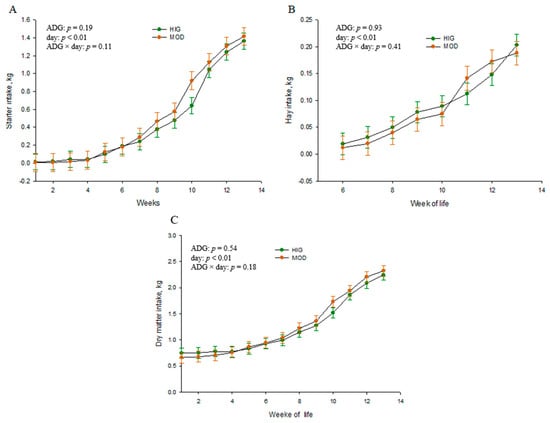
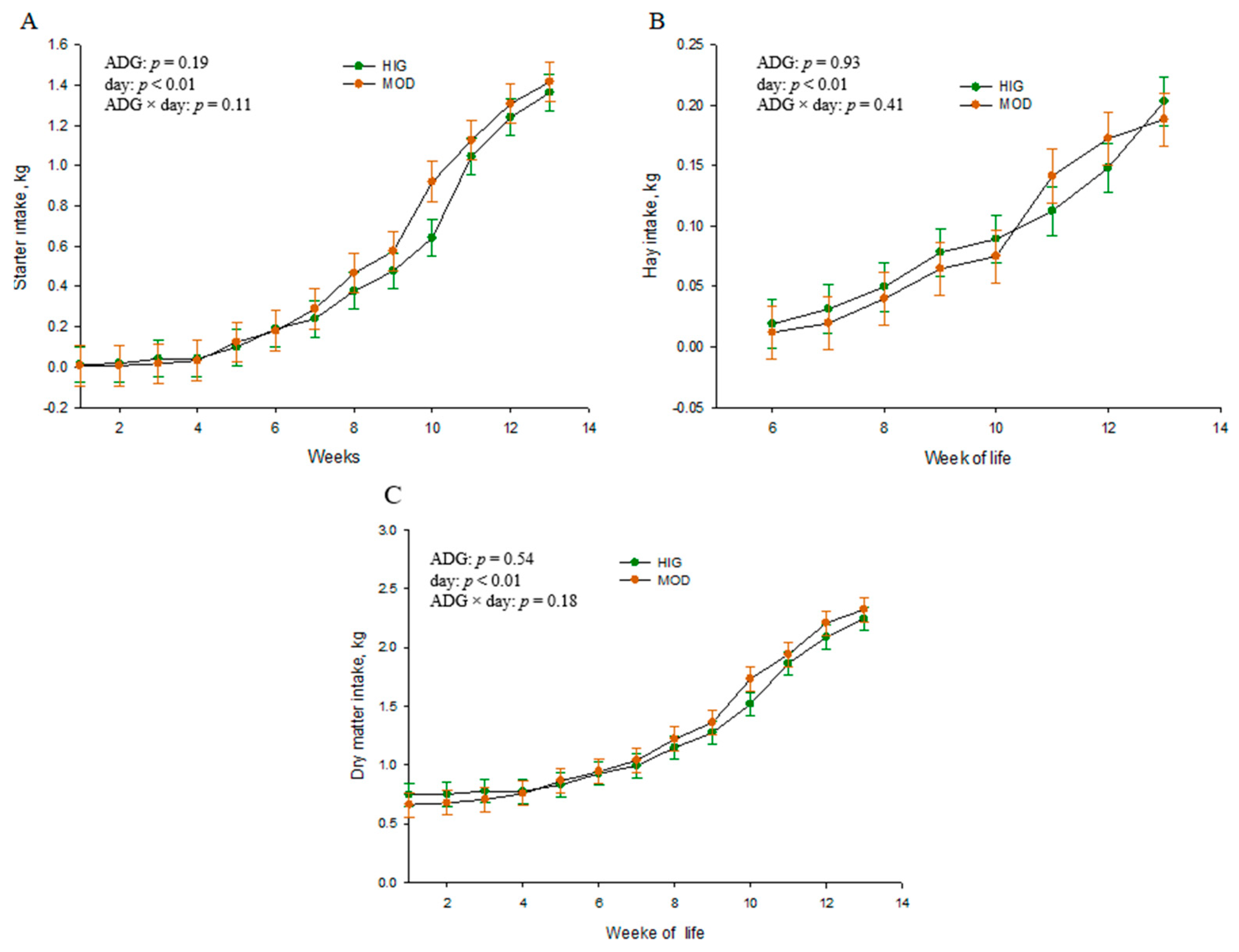
No interactions were observed between maternal treatments and calf age for starter concentrate intake, hay intake, or total DM intake up to weaning (p = 0.11; Figure 1). However, intake increased significantly as calves aged (p < 0.01), reaching approximately 1.4 kg/day of concentrate at weaning. At weaning, the total cumulative concentrate intake was 30.5 ± 2.40 kg DM for HIG calves and 36.0 ± 2.40 kg DM for MOD calves.
Figure 1.
Mean and standard error of the mean for average daily intake of starter feed (A), hay (B), and total dry matter (C) of calves from birth to weaning, born to 5/8 Holstein × 3/8 Gyr heifers fed to achieve either moderate (MOD—0.37 kg/d) or high (HIG—0.72 kg/d) average daily gain throughout gestation.
3.3. Blood Metabolites
Blood metabolite concentrations were influenced primarily by calf age, although treatment effects were observed for some metabolites (Table 3). BHB concentrations increased with days of life (p < 0.001), with no effect of treatment (p = 0.27) or treatment × days interaction (p = 0.85). Triglyceride concentrations were affected by treatment (p = 0.02) and days of life (p = 0.002), with higher concentrations in MOD calves, and no treatment × days interaction was observed (p = 0.63). Total cholesterol was affected by days of life (p = 0.01) and showed a treatment × days interaction (p = 0.03), with a tendency for a treatment effect (p = 0.08).
Table 3.
Hormones and metabolites in serum of calves subjected to different gestational nutrition plans.
Albumin concentrations decreased with days of life (p < 0.001), with no treatment or treatment × days effects (p > 0.10). Globulin concentrations were affected by treatment (p = 0.04) and days of life (p = 0.02), with higher concentrations in MOD calves, and no treatment × days interaction (p = 0.99). Total protein and urea concentrations were affected by days of life (p < 0.001), but not by treatment or the treatment × days interaction (p > 0.10). IGF-1 concentrations increased with calf age (p < 0.01), reaching the highest concentrations on day 91, whereas glucose concentrations decreased from birth to day 31 and subsequently remained relatively stable (p = 0.01). No treatment or treatment × days effects were observed for IGF-1 or glucose (p > 0.10).
4. Discussion
In general, increased maternal nutrition during gestation—reflected by higher ADG and greater energy and protein intake—is associated with enhanced fetal growth and increased birth weight [22]. Calves born to HIG dams tended to be heavier at birth; however, these differences did not persist until weaning, as MOD calves exhibited greater postnatal ADG and reached similar body weight and morphometric development by 91 days of age. The greater feed efficiency observed in MOD calves is consistent with previous findings indicating that lighter calves at birth have lower maintenance requirements, which favor accelerated postnatal growth [23]. These results reinforce that postnatal performance is determined not only by prenatal nutrition but also by its interaction with postnatal management and feeding strategies [22].
The standardized milk-feeding protocol used in the present study should be considered as a potential influence on postnatal growth responses. Although the fixed allowance of 6 L/day followed the standard calf-rearing management adopted at the research facility and allowed postnatal nutritional management to be standardized across treatments, it provided a proportionally lower milk supply relative to birth BW for calves from HIG heifers, which tended to be heavier at birth. Therefore, the possibility that the milk allowance limited the expression of their greater prenatal growth potential cannot be excluded and should be considered when interpreting the convergence in BW between treatments during the preweaning period.
The tendency for higher vitality scores in calves from HIG dams may be associated with differences in calving difficulty, as dystocia remains a key factor affecting neonatal vitality and survival [8,24]. However, calving difficulty was not evaluated in the present study; therefore, this proposed association is speculative and should be interpreted with caution. In heifers, dystocia is often linked to a disproportion between calf size and maternal body weight, underscoring the importance of maternal growth and development during gestation.
Passive transfer of immunity was adequate in both groups, with total protein concentrations exceeding the recommended threshold [25], indicating effective colostrum management. Rapid absorption of immunoglobulins shortly after birth is critical for calf health and subsequent performance [26,27], reinforcing that colostrum quality and feeding protocols may override potential prenatal differences.
Fetal programming studies emphasize that maternal nutrition during gestation influences placental development and nutrient transfer capacity [28,29]. Recent evidence further indicates that both the level and timing of maternal nutrient supply can affect fetal development and subsequent offspring responses [30]. However, the effects of maternal nutritional management on calf performance are not always consistent, and factors such as parity, sex, and genotype may substantially contribute to postnatal growth responses [31]. Although nutrient demand increases in late gestation, inadequate nutrition earlier in pregnancy may impair placental efficiency [8]. The greater ADG observed in HIG heifers may reflect a higher nutrient supply during gestation [4], which could be particularly relevant given the decline in dry matter intake typically observed as parturition approaches [32].
The decrease in diarrhea incidence over time in both groups likely reflects immune system maturation and gastrointestinal development rather than maternal nutritional effects alone [33], indicating that postnatal management played a primary role in the calves’ health.
Blood metabolite profiles were influenced predominantly by calf age, although treatment effects were observed for some metabolites. The increase in BHB concentrations with age may be associated with the progressive increase in solid feed intake and rumen development during the preweaning period [34]. Similarly, the increase in IGF-1 concentrations up to weaning is consistent with the progressive growth and development of calves. Triglyceride concentrations were higher in MOD calves, suggesting that gestational nutritional management may have influenced postnatal lipid metabolism. Previous studies in cattle have demonstrated that maternal nutritional status and rate of gain during gestation can alter fetal hepatic lipid metabolism and the expression of genes involved in energy and lipid metabolic pathways [35]. Total cholesterol also showed a treatment × days interaction and a tendency for a treatment effect, further suggesting differences in lipid metabolism between groups. Globulin concentrations were higher in MOD calves; however, the biological mechanisms underlying this response remain unclear. Nevertheless, the absence of treatment effects on BHB, albumin, total protein, urea, IGF-1, and glucose indicates that most of the evaluated metabolic indicators were influenced primarily by postnatal age rather than gestational nutritional treatment.
Although cumulative concentrate intake did not differ statistically between maternal treatments, MOD calves consumed 5.5 kg more concentrate DM than HIG calves up to weaning (36.0 vs. 30.5 kg DM, respectively). This numerical difference should be considered when evaluating the potential economic implications of the maternal feeding strategies, as greater postnatal concentrate consumption may partially offset savings associated with reduced maternal feed inputs. Therefore, future studies should include a comprehensive economic assessment that considers both maternal feeding costs and offspring rearing costs to determine the overall economic efficiency of these nutritional strategies.
Overall, although higher maternal ADG increased birth weight, these differences did not persist throughout the preweaning period. The similar performance observed at weaning suggests that postnatal growth dynamics and/or maternal and fetal adaptive mechanisms may have contributed to reducing the initial differences between groups. However, compensatory growth and mechanisms related to placental efficiency were not directly evaluated in the present study; therefore, these potential mechanisms should be considered hypotheses that warrant further investigation. These findings indicate that, under the conditions evaluated in this study, moderate-ADG maternal treatment during gestation did not compromise calf performance up to weaning.
An important limitation of the present study is the relatively small sample size and the specific genetic composition of the experimental population. Although the sample size met the requirements of the power analysis conducted for the study, the use of 16 crossbred heifer calves (3/4 Holstein × 1/4 Gyr) restricts broader generalization of these findings. Therefore, the results should be interpreted within the specific genetic, nutritional, and management conditions evaluated herein, and further studies involving larger populations, additional dairy breeds, and diverse production systems are warranted.
5. Conclusions
High-ADG maternal treatment during gestation resulted in calves that tended to have higher birth weights and larger morphometric measurements at birth; however, these differences did not persist in weaning. Despite their lower birth weights, calves born to MOD dams showed greater postnatal ADG and feed efficiency and achieved similar performance at weaning. Thus, under the conditions evaluated in this study, moderate maternal ADG during gestation did not compromise calf growth performance through weaning. However, the physiological mechanisms underlying the observed postnatal responses, including potential compensatory growth was not directly evaluated and require further investigation.
These findings suggest that moderate-ADG maternal treatment may be an adequate nutritional strategy under the conditions evaluated, without compromising the postnatal growth and development of the offspring. However, given the limited sample size and the specific crossbred population studied, these results should be interpreted with caution and not generalized beyond the experimental conditions of the present study.
Author Contributions
Conceptualization, A.P.O.N., K.R.d.O., J.V.C.R., W.P.F.A., S.E.F.G., L.H.R.S. and P.P.R.; methodology, A.P.O.N., K.R.d.O., J.V.C.R., W.P.F.A., S.E.F.G. and P.P.R.; software, A.L.d.S.; validation, A.L.d.S. and P.P.R.; formal analysis, A.P.O.N., K.R.d.O., L.H.R.S., J.V.C.R., W.P.F.A., S.E.F.G. and A.L.d.S.; investigation, A.P.O.N., L.H.R.S., K.R.d.O., J.V.C.R., W.P.F.A., S.E.F.G. and T.B.d.P.e.S.; resources, A.L.d.S. and P.P.R.; data curation, T.B.d.P.e.S., A.L.d.S. and P.P.R.; writing—original draft preparation, A.P.O.N., T.B.d.P.e.S., A.L.d.S. and P.P.R.; writing—review and editing, T.B.d.P.e.S., W.P.F.A., A.L.d.S. and P.P.R.; visualization, A.L.d.S. and P.P.R.; supervision, P.P.R.; project administration, A.P.O.N., T.B.d.P.e.S., A.L.d.S. and P.P.R.; funding acquisition, P.P.R. All authors have read and agreed to the published version of the manuscript.
Funding
Coordenação de Aperfeiçoamento de Pessoal de Nível Superior (CAPES PROEX 88887.844747/2023-00; Brasilia, DF, Brazil), Conselho Nacional de Desenvolvimento Científico e Tecnológico (CNPq; Brasilia, DF, Brazil), Associação Brasileira dos Criadores de Girolando (GIROLANDO, Uberaba, MG, Brazil), Fazenda Santa Luzia (Passos, MG, Brazil), Fundação de Amparo à Pesquisa do Estado de Minas Gerais (FAPEMIG APQ-02324-23; Belo Horizonte, MG, Brazil), and Instituto de Ciência e Tecnologia de Ciência Animal (INCT-CA; Viçosa, MG, Brazil).
Institutional Review Board Statement
The animal study protocol was approved by the Comissão de Ética no Uso de Animais de Produção, Universidade Federal de Viçosa (CEUAP/UFV), Brazil (Protocol No. 015/2022, approved on 11 May 2022), and was conducted in accordance with the institutional guidelines for the care and use of animals. No study protocol was prospectively registered before the beginning of the experiment.
Data Availability Statement
The raw data supporting the conclusions of this article will be made available by the authors on request.
Acknowledgments
The Article Processing Charge for the publication of this research was funded by the Coordenação de Aperfeiçoamento de Pessoal de Nível Superior—CAPES (ROR identifier: 00x0ma614). For open access purposes, the authors have applied a Creative Commons CC BY license to the accepted version of this article.
Conflicts of Interest
The authors declare no conflicts of interest.
References
- Silva, L.H.R.; Silva, A.L.; Marcondes, M.I.; Bittencourt, C.S.; Rodrigues, J.V.C.; Amorim, W.P.F.; Netto, E.P.L.; Silva, T.E.; Costa, J.H.C.; Rotta, P.P. A Comparative Analysis of Dairy Production Systems: Milk Production Tiers and Their Impact on Dairy Calf and Heifer Cost of Production in Brazil. J. Dairy Sci. 2025, 108, 13439–13454. [Google Scholar] [CrossRef] [Scilit] [PubMed]
- National Academies of Sciences, Engineering, and Medicine; Division on Earth and Life Studies; Board on Agriculture and Natural Resources; Committee on Nutrient Requirements of Dairy Cattle. Nutrient Requirements of Dairy Cattle: Eighth Revised Edition; National Academies Press (US): Washington, DC, USA, 2021.
- Quirino, D.F.; Marcondes, M.I.; Rennó, L.N.; Correa, P.V.F.; Morais, V.C.L.; Cunha, C.S.; Silva, T.D.A.; da Silva, A.L.; Miller-Cushon, E.; Rotta, P.P. Intake, Performance, and Feeding Behavior of Holstein and Holstein × Gyr Heifers Grazing Intensively Managed Tropical Grasses during the Rainy Season. Animal 2022, 16, 100613. [Google Scholar] [CrossRef] [Scilit] [PubMed]
- Neto, A.P.d.O.; Silva, T.B.d.P.e.; Oliveira, K.R.; Silva, L.H.R.; Salgado, P.T.R.; Guimarães, S.E.F.; Silva, A.L.; Rotta, P.P. Differential Average Daily Gain of Pregnant Holstein × Gyr Heifers: Effects on Future Milk Production. Dairy 2026, 7, 17. [Google Scholar] [CrossRef] [Scilit]
- Wilson, R.L.; Bionaz, M.; MacAdam, J.W.; Beauchemin, K.A.; Naumann, H.D.; Ates, S. Milk Production, Nitrogen Utilization, and Methane Emissions of Dairy Cows Grazing Grass, Forb, and Legume-Based Pastures. J. Anim. Sci. 2020, 98, skaa220. [Google Scholar] [CrossRef] [Scilit] [PubMed]
- Magan, J.B.; O′Callaghan, T.F.; Kelly, A.L.; McCarthy, N.A. Compositional and Functional Properties of Milk and Dairy Products Derived from Cows Fed Pasture or Concentrate-Based Diets. Compr. Rev. Food Sci. Food Saf. 2021, 20, 2769–2800. [Google Scholar] [CrossRef] [Scilit] [PubMed]
- Zhu, M.J.; Du, M.; Ford, S.P. CELL BIOLOGY SYMPOSIUM: Impacts of Maternal Obesity on Placental and Gut Inflammation and Health. J. Anim. Sci. 2014, 92, 1840–1849. [Google Scholar] [CrossRef] [Scilit] [PubMed]
- Oliveira, K.R.; Neto, A.P.O.; Diamantino, C.A.; Eiterer, I.O.; Araújo, R.D.; Sancler-Silva, Y.F.R.; Silva, A.L.; Duarte, M.S.; Rotta, P.P. Differential Average Daily Gain of Pregnant Holstein × Gyr Dairy Heifers Causes Placental Adaptations to Support Fetal Growth and Development. J. Dairy Sci. 2023, 106, 6938–6950. [Google Scholar] [CrossRef] [Scilit] [PubMed]
- Vonnahme, K.A.; Zhu, M.J.; Borowicz, P.P.; Geary, T.W.; Hess, B.W.; Reynolds, L.P.; Caton, J.S.; Means, W.J.; Ford, S.P. Effect of Early Gestational Undernutrition on Angiogenic Factor Expression and Vascularity in the Bovine Placentome. J. Anim. Sci. 2007, 85, 2464–2472. [Google Scholar] [CrossRef] [Scilit] [PubMed]
- Bahashwan, S.; Alrawas, A.S.; Alfadli, S. Growth Traits and Estimated Heritability by Variance Component for Dhofari Calf Breed. Int. J. Sci. Res. Agric. Sci. 2015, 2, 39–44. [Google Scholar] [CrossRef] [Scilit]
- Heinrichs, A.J.; Heinrichs, B.S. A Prospective Study of Calf Factors Affecting First-Lactation and Lifetime Milk Production and Age of Cows When Removed from the Herd1. J. Dairy Sci. 2011, 94, 336–341. [Google Scholar] [CrossRef] [Scilit] [PubMed]
- Alvares, C.A.; Stape, J.L.; Sentelhas, P.C.; Gonçalves, J.L.M.; Sparovek, G. Köppen’s climate classification map for Brazil. Meteorol. Z. 2013, 22, 711–728. [Google Scholar] [CrossRef] [Scilit] [PubMed]
- Murray, C.F.; Haley, D.B.; Duffield, T.F.; Pearl, D.L.; Deelen, S.M.; Leslie, K.E. Field Study to Evaluate the Effects of Meloxicam NSAID Therapy and Calving Assistance on Newborn Calf Vigor, Improvement of Health and Growth in Pre-Weaned Holstein Calves. Bov. Pract. 2015, 49, 1–12. [Google Scholar] [CrossRef] [Scilit]
- von Konigslow, T.E.; Duffield, T.F.; Beattie, K.; Winder, C.B.; Renaud, D.L.; Kelton, D.F. Navel Healing in Male and Female Holstein Calves over the First 14 Days of Life: A Longitudinal Cohort Study. J. Dairy Sci. 2022, 105, 7654–7667. [Google Scholar] [CrossRef] [Scilit] [PubMed]
- Lombard, J.; Urie, N.; Garry, F.; Godden, S.; Quigley, J.; Earleywine, T.; McGuirk, S.; Moore, D.; Branan, M.; Chamorro, M.; et al. Consensus Recommendations on Calf- and Herd-Level Passive Immunity in Dairy Calves in the United States. J. Dairy Sci. 2020, 103, 7611–7624. [Google Scholar] [CrossRef] [Scilit] [PubMed]
- Lesmeister, K.E.; Heinrichs, A.J.; Gabler, M.T. Effects of Supplemental Yeast (Saccharomyces cerevisiae) Culture on Rumen Development, Growth Characteristics, and Blood Parameters in Neonatal Dairy Calves. J. Dairy Sci. 2004, 87, 1832–1839. [Google Scholar] [CrossRef] [Scilit] [PubMed]
- Renaud, D.L.; Kelton, D.F.; LeBlanc, S.J.; Haley, D.B.; Duffield, T.F. Calf Management Risk Factors on Dairy Farms Associated with Male Calf Mortality on Veal Farms. J. Dairy Sci. 2018, 101, 1785–1794. [Google Scholar] [CrossRef] [Scilit] [PubMed]
- Helrich, K. Official Methods of Analysis of the Association of Official Analytical Chemists, 15th ed.; Association of Official Analytical Chemists: Arlington, VA, USA, 1990. [Google Scholar]
- Menezes, G.L.; Bresolin, T.; Halfman, W.; Sterry, R.; Cauffman, A.; Stuttgen, S.; Schlesser, H.; Nelson, M.A.; Bjurstrom, A.; Rosa, G.J.M.; et al. Exploring Associations among Morphometric Measurements, Genetic Group of Sire, and Performance of Beef on Dairy Calves. Trans. Anim. Sci. 2023, 7, txad064. [Google Scholar] [CrossRef] [Scilit] [PubMed]
- Doumas, B.T.; Ard Watson, W.; Biggs, H.G. Albumin Standards and the Measurement of Serum Albumin with Bromcresol Green. Clin. Chim. Acta 1971, 31, 87–96. [Google Scholar] [CrossRef] [Scilit] [PubMed]
- Raabo, B.E.; Terkildsen, T.C. On the Enzymatic Determination of Blood Glucose. Scand. J. Clin. Lab. Investig. 1960, 12, 402–407. [Google Scholar] [CrossRef] [Scilit] [PubMed]
- Ferreira, E.C.; Rossi, A.V. A quimiluminescência como ferramenta analítica: Do mecanismo a aplicações da reação do luminol em métodos cinéticos de análise. Quím. Nova 2002, 25, 1003–1011. [Google Scholar] [CrossRef] [Scilit]
- Barcelos, S.d.S.; Nascimento, K.B.; Silva, T.E.d.; Mezzomo, R.; Alves, K.S.; de Souza Duarte, M.; Gionbelli, M.P. The Effects of Prenatal Diet on Calf Performance and Perspectives for Fetal Programming Studies: A Meta-Analytical Investigation. Animals 2022, 12, 2145. [Google Scholar] [CrossRef] [Scilit] [PubMed]
- Silva, F.F.d.; Valadares Filho, S.d.C.; Ítavo, L.C.V.; Veloso, C.M.; Valadares, R.F.D.; Cecon, P.R.; Paulino, P.V.R.; Moraes, E.B.K. de Composição Corporal e Requisitos Energéticos e Protéicos de Bovinos Nelore, Não-Castrados, Alimentados com Rações Contendo Diferentes Níveis de Concentrado e Proteína. R. Bras. Zootec. 2002, 31, 503–513. [Google Scholar] [CrossRef] [Scilit]
- Kovács, L.; Kézér, F.L.; Szenci, O. Effect of Calving Process on the Outcomes of Delivery and Postpartum Health of Dairy Cows with Unassisted and Assisted Calvings. J. Dairy Sci. 2016, 99, 7568–7573. [Google Scholar] [CrossRef] [Scilit] [PubMed]
- Godden, S.M.; Lombard, J.E.; Woolums, A.R. Colostrum Management for Dairy Calves. Vet. Clin. N. Am. Food Anim. Pract. 2019, 35, 535–556. [Google Scholar] [CrossRef] [Scilit] [PubMed]
- Weaver, D.M.; Tyler, J.W.; VanMetre, D.C.; Hostetler, D.E.; Barrington, G.M. Passive Transfer of Colostral Immunoglobulins in Calves. J. Vet. Intern. Med. 2000, 14, 569–577. [Google Scholar] [CrossRef]
- Long, J.M.; Trubenbach, L.A.; Pryor, J.H.; Long, C.R.; Wickersham, T.A.; Sawyer, J.E.; Satterfield, M.C. Maternal Nutrient Restriction Alters Endocrine Pancreas Development in Fetal Heifers. Domest. Anim. Endocrinol. 2021, 74, 106580. [Google Scholar] [CrossRef] [Scilit] [PubMed]
- Rotta, P.P.; Filho, S.C.V.; Gionbelli, T.R.S.; Silva, L.F.C.e.; Engle, T.E.; Marcondes, M.I.; Guimarães, S.E.F.; Nascimento, C.S.; Carvalho, B.C.; Silva, F.a.S.; et al. Effects of Day of Gestation and Feeding Regimen in Holstein × Gyr Cows: III. Placental Adaptations and Placentome Gene Expression. J. Dairy Sci. 2015, 98, 3224–3235. [Google Scholar] [CrossRef] [Scilit] [PubMed]
- Yang, M.; Zou, Y.; Wu, Z.H.; Li, S.L.; Cao, Z.J. Colostrum Quality Affects Immune System Establishment and Intestinal Development of Neonatal Calves. J. Dairy Sci. 2015, 98, 7153–7163. [Google Scholar] [CrossRef] [Scilit] [PubMed]
- Suarez-Mena, F.X.; Hu, W.; Dennis, T.S.; Hill, T.M.; Schlotterbeck, R.L. β-Hydroxybutyrate (BHB) and Glucose Concentrations in the Blood of Dairy Calves as Influenced by Age, Vaccination Stress, Weaning, and Starter Intake Including Evaluation of BHB and Glucose Markers of Starter Intake. J. Dairy Sci. 2017, 100, 2614–2624. [Google Scholar] [CrossRef] [Scilit] [PubMed]
- Shokrollahi, B.; Park, M.; Jang, G.-S.; Jin, S.; Moon, S.-J.; Um, K.-H.; Jang, S.-S.; Baek, Y.-C. Maternal Overnutrition in Beef Cattle: Effects on Fetal Programming, Metabolic Health, and Postnatal Outcomes. Biology 2025, 14, 645. [Google Scholar] [CrossRef] [Scilit] [PubMed]
- Park, M.; Shokrollahi, B.; Jang, G.S.; Jin, S.; Moon, S.J.; Um, K.H.; Jang, S.S.; Baek, Y.C. Impact of Mid-to-Late Gestational Overfeeding on Maternal Performance and Calf Outcomes in Hanwoo Cattle: A Machine Learning Approach. Animals 2026, 16, 1902. [Google Scholar] [CrossRef] [Scilit] [PubMed]
- Hayirli, A.; Grummer, R.R.; Nordheim, E.V.; Crump, P.M. Animal and Dietary Factors Affecting Feed Intake During the Prefresh Transition Period in Holsteins. J. Dairy Sci. 2002, 85, 3430–3443. [Google Scholar] [CrossRef] [Scilit] [PubMed]
- Menezes, A.C.B.; Dahlen, C.R.; McCarthy, K.L.; Kassetas, C.J.; Baumgaertner, F.; Kirsch, J.D.; Dorsam, S.T.; Neville, T.L.; Ward, A.K.; Borowicz, P.P.; et al. Fetal Hepatic Lipidome Is More Greatly Affected by Maternal Rate of Gain Compared with Vitamin and Mineral Supplementation at Day 83 of Gestation. Metabolites 2023, 13, 175. [Google Scholar] [CrossRef] [Scilit] [PubMed]

Disclaimer/Publisher’s Note: The statements, opinions and data contained in all publications are solely those of the individual author(s) and contributor(s) and not of MDPI and/or the editor(s). MDPI and/or the editor(s) disclaim responsibility for any injury to people or property resulting from any ideas, methods, instructions or products referred to in the content. |
© 2026 by the authors. Licensee MDPI, Basel, Switzerland. This article is an open access article distributed under the terms and conditions of the Creative Commons Attribution (CC BY) license.