


Highlights
What are the main findings?
- Assessing vaginal discharge scores (VDS) on a 10-point scale during the early postpartum period is an effective method to estimate associations with the days open, pregnancy rate, and the number of services per pregnancy in dairy cows.
- Moderate (scores 3–4) and high (scores 5–9; indicative of metritis) VDS are associated with poorer fertility outcomes compared with normal VDS (score 0–2).
What is the implication of the main finding?
- Moderate VDS may warrant additional reproductive monitoring and management on dairy herds to optimize days open, pregnancy rate, and the number of services per pregnancy.
Abstract
Uterine health indicators are essential tools for managing reproduction in dairy herds. This study evaluated the associations between vaginal discharge scores (VDS) assessed during the first 21 days postpartum and subsequent days open and pregnancy rate (PR) across 14 commercial dairy herds comprising 2860 calvings (2023–2025). VDS were evaluated on a 10-point scale and classified as normal (0–2; clear/bloody), moderate (3–4; presence of pus), or high (5–9; purulent and foul-smelling). Concurrently, parity, metabolic (body condition score and acetonuria), and digestive (fecal consistency) indicators were recorded. Two independent multivariate models, Cox proportional-hazards regression and binary logit generalized linear mixed model (GLMM), were used. VDS was the most significant and consistent factor associated with prolonged days open and reduced PR. A higher hazard ratio (HR) for pregnancy failure was observed in cows with moderate (HR = 1.45; 95% CI: 1.20–1.65) and high (HR = 1.59; 95% CI: 1.25–2.01) VDS compared with those with normal VDS (p < 0.0001), thereby extending the days open at the first artificial insemination. The odds ratio (OR) for becoming pregnant at the first artificial insemination was lower (p < 0.01) in cows with moderate (OR = 0.5; adjusted 95% CI: 0.4–0.8) and high (OR = 0.4; adjusted 95% CI: 0.3–0.8) VDS than in those with normal VDS. This likelihood was also lower for multiparous cows compared with primiparous cows (p < 0.001). No other factors were significantly associated with PR (p > 0.05) in the GLMM. In conclusion, scoring vaginal discharge in the early postpartum period was a relevant health indicator associated with days open and PR. Implementing specific reproductive management protocols for cows presenting moderate VDS is suggested to improve overall herd reproductive performance.
1. Introduction
Several assessment procedures and health indicators have been incorporated into reproductive herd health management programs in dairy herds. Typically, a reproductive and health evaluation is performed during the first month postpartum to proactively prepare cows for a successful subsequent pregnancy [1]. Metabolic (body condition score, BCS; ketone status), digestive (fecal consistency), and uterine health (vaginal discharge scores, VDS) parameters are routinely evaluated [2].
A routine examination of the reproductive tract is critical for diagnosing uterine diseases, such as metritis (severe uterine inflammation affecting all uterine layers) and endometritis (superficial uterine inflammation restricted to the endometrium), and for monitoring uterine involution. Even when treated, uterine disorders may have a substantial negative impact on subsequent fertility [3,4]. VDS and transrectal examinations of the uterus (e.g., size, shape, and luminal content) are usually performed during the early postpartum period.
For the past few decades, uterine scoring systems based on vaginal discharge characteristics (amount, color, and odor) have been used in dairy cows to evaluate the presence and severity of endometritis [4,5] and metritis [6,7]. Evaluating vaginal discharge is an easy and inexpensive method for determining the presence of metritis. The presence of metritis (or endometritis) is defined by the highest VDS, which includes purulent content and a fetid odor, using a 3- or 5-point scale [4,5,6,7,8]. More recently, He et al. [9] observed differences in uterine bacterial composition according to VDS, highlighting the interaction between microbiota, VDS, and metritis. These findings reinforce the validity and consistency of vaginal discharge scoring.
A Danish vaginal discharge scoring system based on a 10-point scale was developed, and metritis was formally defined as a score of ≥5 [10,11]. This large-scale approach enables the evaluation of how lower VDS, which may be associated with low-to-moderate inflammation of the uterine wall and abnormal uterine secretions, affects subsequent fertility. Schmitt et al. [12] reported a moderate correlation (rs = 0.48, p < 0.001) between VDS and haptoglobin. Moreover, moderate VDS has been associated with altered uterine microbiota [9] and pregnancy failure [13]. Although many cases of metritis can recover without treatment and without impaired reproductive performance [14], there is little evidence regarding whether moderate VDS [10] in the early postpartum period can negatively affect fertility at the herd level.
To the best of our knowledge, this gap has not yet been fully addressed regarding its predictive value for pregnancy rate (PR) and days open. Furthermore, given the multifactorial nature of infertility [15], evaluating indicators from various body systems and cow parity simultaneously could provide a more practical, field-based approach. Recognizing the relevance of moderate VDS can allow for more accurate management of reproductive performance on dairy farms.
The primary objective of this study was to evaluate the associations between moderate or high VDS and both days open and PR in dairy cows. We hypothesized that moderate VDS evaluated in the early postpartum period would serve as the most consistent indicator of poor fertility outcomes. The secondary objective was to integrate and evaluate reproductive and non-reproductive indicators. This approach can highlight the relative relevance of the studied factors, thereby improving the prediction of these reproductive outcomes.
2. Materials and Methods
This study was conducted as part of a reproductive health program for dairy cattle herds and was approved by the institutional review board (Scientific Committee) under protocol number 39316NON/UTAD (7 July 2025) for a Master’s thesis. This was a retrospective observational study based on routine clinical records collected as part of the contracted herd-health service. No additional procedures were performed on the animals for research purposes.
2.1. Farming and Animals
This retrospective cohort study was carried out within the context of veterinary services provided by a Danish veterinary clinic (Vestjyske Dyrlæger ApS; Nørre Nebel, western Denmark). Records from 14 conventional dairy herds in this region were retrieved from the clinic database between December 2023 and July 2025. The average farm size was 694 ± 84.7 (±SE) cows, with a culling and replacement rate of 20–25%. All herds used a free-stall housing system, and cows were fed a total mixed ration consisting of corn or grass silage, concentrates, and minerals. The average milk yield (energy-corrected milk) per year was 12,439 ± 175 kg.
A comprehensive herd health management plan [16,17] was implemented in agreement with producers and the veterinary clinic. According to the scheduled veterinary visits, an early postpartum reproductive evaluation was made in all cows. Four veterinarians provided veterinary services to these farms. The rotation of veterinarians across farms and written protocols were implemented to mitigate discrepancies in diagnosis and treatment. All the studied factors, including health problems, were recorded at this time. Treatments were implemented when appropriate, such as for all cases of clinical metritis that developed fever (treatments based on antimicrobial and anti-inflammatory drugs, as is standard for other bacterial diseases). Voluntary or involuntary culling, including death and euthanasia, was carried out according to production purposes and health status. The standard voluntary waiting period was 40 days as the norm. Estrus detection was performed visually (twice daily) and by using automated activity devices. Farm personnel performed the artificial insemination (AI) following natural or induced estrus. Ovsynch and progesterone-based protocols were used. An ultrasonographic pregnancy diagnosis was performed approximately 30 days after AI to identify pregnant and non-pregnant cows, and to determine the days open and PR. A second pregnancy diagnosis was made at least two months later for pregnancy loss diagnosis. The last successful pregnancy was considered.
2.2. Study Design, Indicators, and Outcomes
Sample size was calculated to detect a two-tailed 10% difference (P1 = 0.3, P2 = 0.4; common PRs at first AI in dairy herds: 40% as the reference group) between two proportions of PR, with a 95% confidence level (Zα/2 = 1.96), power = 0.8 (Zβ = 0.84), and a sample size ratio (n2/n1) = 3 (expected average proportions according to the groups). A minimum of 1016 animals were required according to the Epitools Epidemiological Calculator [18].
The inclusion criteria were: (1) cows that calved during the study period; (2) submission to a reproductive examination within the first 21 days postpartum; (3) at least one AI within the first six months after calving; and (4) follow-up until confirmed pregnancy or removal from the herd (study period; last AI at 515 days postpartum). A total of 2860 calvings from 2034 cows (up to two calvings per cow) were first assessed. The mean number of calvings per farm was 204 (95% CI: 112–256). However, only 2600 calvings (1821 cows) were used for inferential analysis, as 260 cows were removed due to culling, death, or euthanasia before the first AI. The overall removal (culling) rate during the study period (before and after the first AI) was 18.5% (529/2860). At the end of the study, 2331 successful pregnancies were recorded.
Most of the cows were evaluated during farm visits scheduled between days 4 and 19 postpartum. All evaluations were performed during the same reproductive examination between day 0 and day 21 postpartum.
2.2.1. Day of Evaluation
The day of evaluation was considered an independent variable and categorized as: class D0–4 (the first five days postpartum, characterized by a predominance of placenta and lochia; n = 336) and class D5–21 (the period of major morphological uterine involution [19]; n = 2524). The threshold of day 21 was established according to postpartum uterine dynamics [20].
2.2.2. Vaginal Discharge Scores
VDS were assessed by inserting a gloved hand into the vaginal fornix to collect uterine secretions, as described by Lopes and Simões [21]. Transrectal palpation was also performed to confirm the size of the uterus and its contents as a complementary evaluation.
Vaginal discharge was scored on a 10-point scale based on quantity (from none/very small to large amounts), color (clear, bloody, grayish, gray–yellowish, red–brownish, brown–yellowish, or brown), odor (absent or foul), and the presence of pus or placenta/lochia. The scale was adapted from the system described by Elkjær et al. [10].
The VDS were then grouped into three categories as follows [21]:
- Normal (scores 0–2)—Clear/bloody; no metritis. This score was considered the reference group and represented natural bacterial contamination (90.6%; n = 2591).
- Moderate (scores 3–4)—Yellow/gray/presence of some pus (6.4%; n = 183)
- High (scores 5–9)—Purulent and foul-smelling; moderate to severe metritis (3.0%; n = 86). This score was considered a positive control.
This 10-point scale was not validated for microbiota and inflammation degree. However, some studies reported significant relationships between these factors and VDS (using a 5-point scale) [6,9,13,22].
2.2.3. Parity at Calving
Parity at calving ranged from 1 to 10 and was considered typical for dairy herds [16]. Cows were grouped into class 1 (primiparous; 24.9%; n = 713), class 2–4 (64.6%; n = 1848), and class 5+ (10.5%; n = 299). These thresholds were set considering fertility dynamics across cow parity [23] and productive life in dairy herds.
2.2.4. Body Condition Score
BCS was evaluated after calving using a 1–5 scale in 0.25-point increments [24]. The cows were grouped into 1–2.75 (lean; 10.3%; n = 294), 3–3.75 (adequate; 83.0%; n = 2373), and ≥4 (obese; 6.7%; n = 193).
2.2.5. Ketonuria
Urinary acetoacetate concentration (Ketostix; Bayer Corporation, Elkhart, IN, USA) was evaluated on a 6-point scale [25]. Two groups were formed: scores 1–2 (normal; 91.5%; n = 2612) and scores ≥ 3 (ketosis; ≥15 mg/dL acetoacetate; 8.5%; n = 244) [26]. Urinary acetoacetate is a screening indicator rather than a definitive diagnosis of ketosis.
2.2.6. Fecal Consistency Score
Fecal consistency was evaluated and grouped into three categories: class 1 (too firm/dry; 4.0%; n = 113), class 2 (normal; 65.4%; n = 1871), and class 3 (too loose/liquid; 30.6%; n = 876) [21].
2.2.7. Calving-to-First AI Interval
The calving-to-first AI interval (days) was defined as the difference between the dates of calving and first AI. This interval (days) was also categorized using classical thresholds: ≤60, 61 to 90, 91 to 120, and >120 days.
The outcome variables were the calving-to-first AI interval (days), calving-to-last AI interval (days; up to pregnancy or cow removal); days open (calving-to-conception interval for first AI and for all cumulative pregnancies; days open = day of conception − day of calving), PR (pregnant/inseminated cows) at first AI, overall PR (total pregnancies/total calving inseminated during the study period), and the number of services per pregnancy (total number of inseminations/total number of pregnancies).
2.3. Statistical Analysis
Multicollinearity among variables was tested. The variance inflation factors remained lower than 1.8, indicating the absence of multicollinearity issues.
A Cox proportional hazards regression model was used to evaluate the association of postpartum indicators with pregnancy at the first AI and overall at the end of the study period. The proportional hazards assumption was verified using Schoenfeld residuals, confirming that the relationships of the six covariates remained constant over time (all p-values > 0.05). To account for the non-independence of repeated measures within the same animal, cow identification (ID) was included as a random clustering variable. In this model, pregnancy failure was defined as the event of interest, and cows that became pregnant or were removed from the herd before the end of the follow-up period were right-censored. The hazard ratio (HR) was calculated and evaluated using the Wald test. The HR described herein reflects the hazard of remaining non-pregnant (i.e., the inverse of the conception hazard) to clarify the interpretation of pregnancy delay.
A generalized linear mixed model (GLMM) with a binomial distribution and a logit link function was used according to the following equation:
where
logit(P(PR = 1)) = β0 + Xβ + u_herd(animal)
- : The logit link function defined as , where represents the probability of pregnancy () at the first AI.
- : The overall intercept of the model.
- : The linear combination of the fixed independent variables and their corresponding coefficients:
- Day of evaluation (class D0–4 vs. D5–21)
- Vaginal discharge score (VDS) (normal, moderate, high)
- Body condition score (BCS) (lean, adequate, obese)
- Ketonuria (normal vs. ketosis)
- Fecal consistency score (too firm/dry, normal, too loose/liquid)
- Parity at calving (class 1, class 2–4, class 5+)
- Calving-to-first AI interval (≤60, 61–90, 91–120, >120 days)
- u_herd(animal): The random intercept for the herd, nested within animal ID.
The Tukey–Kramer test was used to compare categories within each group. Odds ratios (OR) were calculated accordingly, with normal categories as the reference. A similar model was intended to estimate the overall PR, but it remained unstable.
The Kruskal–Wallis test and Wilcoxon pair comparisons were used to evaluate associations of independent factors with the number of services per pregnancy. A contingency analysis (Pearson chi-square test) was used to compare VDS across evaluation day classes.
The significance level was set at α = 0.05. All analyses were performed using SAS 9.4 procedures, primarily with JMP® version 19 (SAS Institute Inc., Cary, NC, USA). Results are presented as mean ± SE and/or 95% confidence intervals (CI).
3. Results
The average time of reproductive evaluation was 10.6 ± 0.1 days (binomial 95% CI: 10.4–10.8). 96.9% (2596/2860) of evaluations occurred between days 4 and 19 postpartum. The proportion of moderate (scores 3–4) and high (scores 5–9) was 4.8% (16/336) and 5.7% (19/336) for class D0–4, and 6.6% (167/2524) and 2.7% (67/2524) for class D5–21, respectively.
3.1. Calving-to-First AI Interval and Days Open
The average calving-to-first AI interval was 73.7 ± 0.6 days (95% CI: 72.7–74.8; median time = 66 days, 95% CI: 64–67; n = 2600). The number of days open for the first AI (conception at first AI) was 73.8 ± 0.9 days (95% CI: 72.1–75.5; median time = 66 days, 95% CI: 64–68); n = 1078).
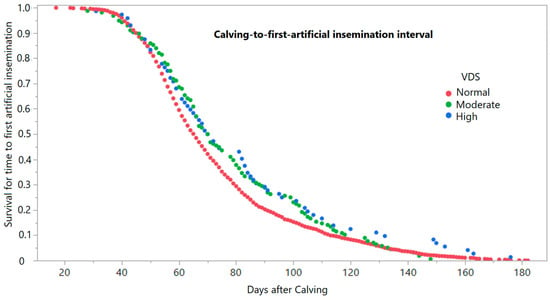
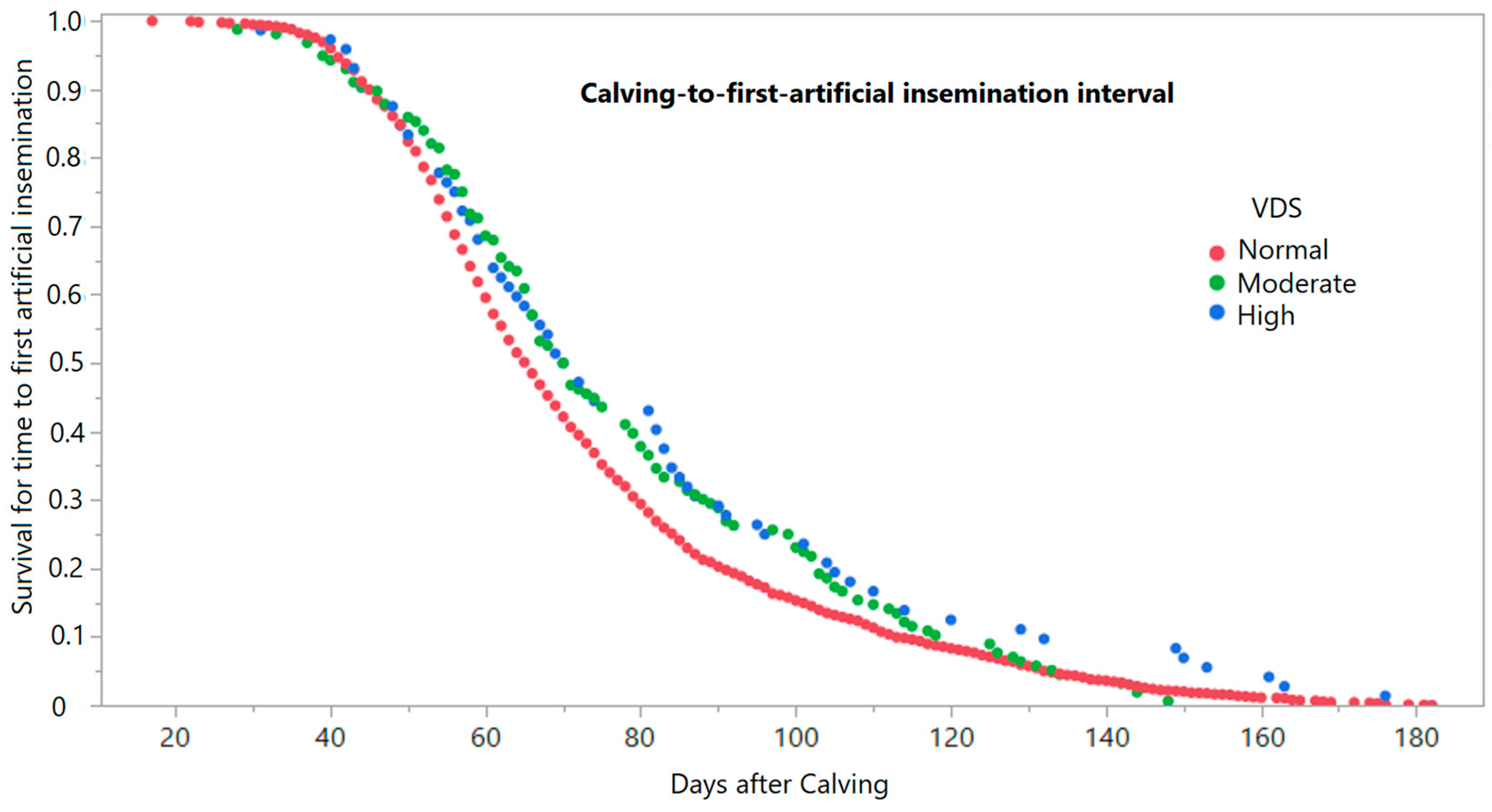
VDS and parity were the most significant factors (p < 0.0001), followed by evaluation day (p < 0.01) and ketonuria (p < 0.05). BCS (p = 0.89) and fecal consistency (p = 0.11) were not significant (Figure 1; hazard of time to first AI).
Figure 1.
Cox proportional hazards regression survival curve for time to first AI in 1821 cows (number of calvings = 2600) for the first artificial insemination (up to 180 days postpartum), by normal, moderate, and high vaginal discharge scores (VDS). Whole model test: Sum of weights = 2600; number of events (pregnancy failure) = 1522; −Log Likelihood: 45.00; Chi-square: 90.00; DF: 10; p < 0.0001; AICc: 46,973.0; BIC: 47,031.6. Covariates included in the model: day of evaluation, vaginal discharge score, body condition scores, ketonuria, fecal consistency score, calving-to-first AI interval.
Cows with moderate or high VDS had 41% and 59% higher rates of remaining non-pregnant than the normal VDS group, respectively, resulting in longer days open. Primiparous cows had an approximately 20% lower hazard of remaining non-pregnant than cows in parities 2 to 4 (HR = 0.82; p < 0.0001) but showed a similar hazard to the oldest animals (parity 5+). In addition, ketonuria and reproductive evaluations performed at days 0–4 were associated with an increased risk of delayed conception. HRs are presented in Table 1.
Table 1.
Hazard ratio of remaining non-pregnant (n = 1522) and median time to become pregnant (n = 1078) at the first artificial insemination (1st AI) according to the Cox proportional hazards model, considering 2600 calvings from 1821 cows.
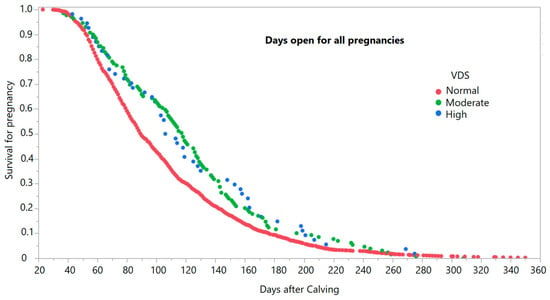
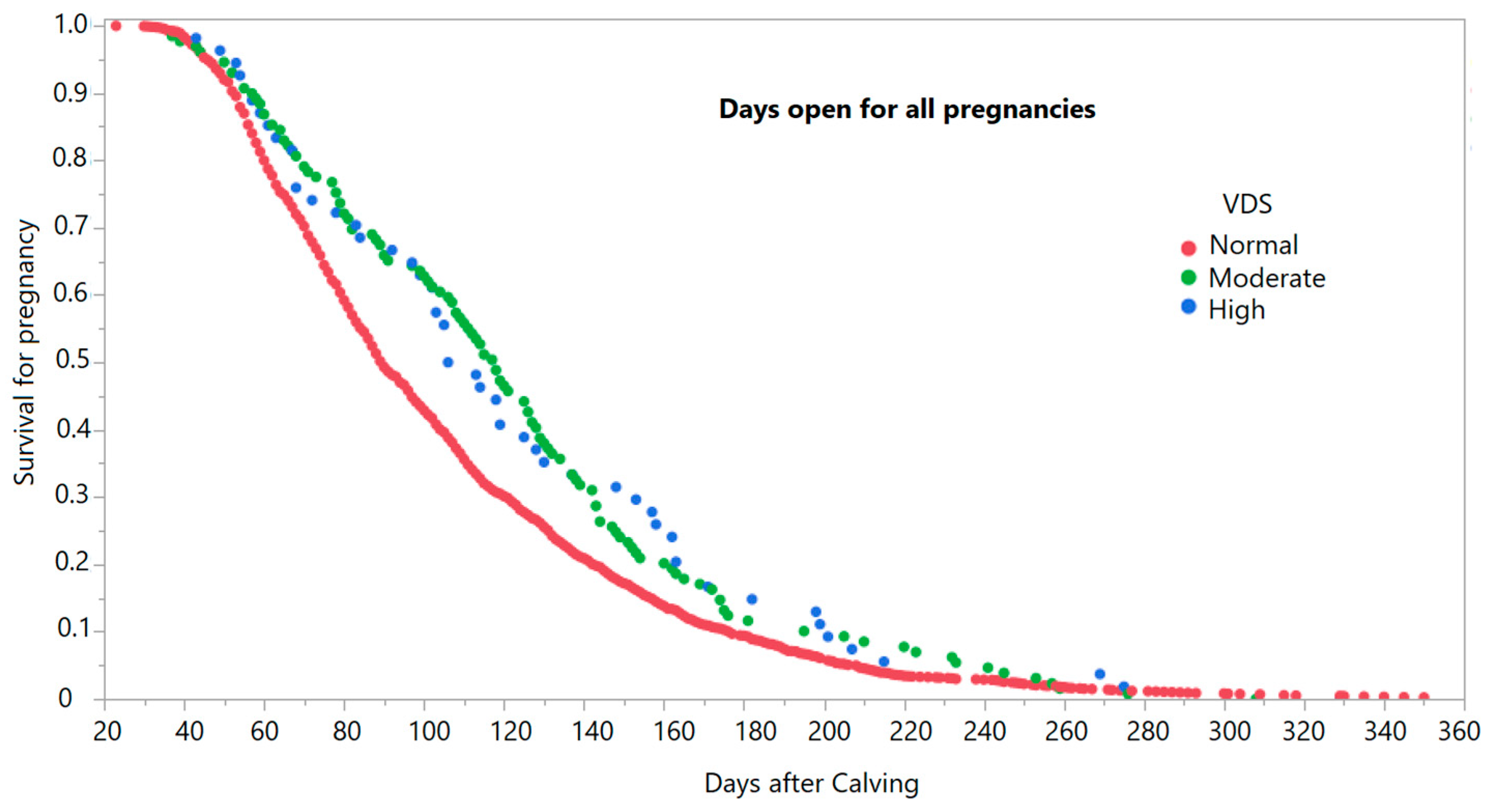
For all successful pregnancies, the average days open was 106.5 ± 1.1 days (95% CI: 104.3–108.7; median time = 92 days, 95% CI: 89–96; n = 2331). VDS (p < 0.0001) and evaluation day (p < 0.01) remained significant, whereas BCS (p = 0.06), fecal consistency (p = 0.63), ketonuria (p = 0.11), and parity (p = 0.24) remained non-significant factors (Figure 2).
Figure 2.
Cox proportional hazards regression survival curve of pregnancy (days open for total pregnancies) for a total of 1821 cows inseminated (number of calvings = 2600) during the study period (last artificial insemination: 515 days after calving), according to normal, moderate, and high vaginal discharge scores (VDS). Whole model test: Sum of weights = 2600; number of events (pregnancy failure) = 269; −2 Log Likelihood: 21.0; Chi-square: 41.9; DF: 10; p < 0.0001; AICc: 46,123.4; BIC: 46,180.9. Covariates included in the model: day of evaluation, vaginal discharge scores, body condition scores, ketonuria, fecal consistency score, calving-to-first AI interval.
Only cows with moderate VDS had a significantly higher HR (HR = 1.39; 95% CI: 1.18–1.62; p < 0.0001; 39% increase) of remaining non-pregnant compared with the normal VDS group. This risk was not statistically significant for high VDS (HR = 1.23; 95% CI: 0.97–1.96; p = 0.09). The median time to become pregnant was 90 days (95% CI: 88–93), 118 days (95% CI: 107–127), and 109.5 days (95% CI: 99–128) for normal, moderate, and high VDS, respectively.
The HR for reproductive evaluation performed at days 5–21 was lower (HR = 0.86; 95% CI: 0.77–0.96; p < 0.01) than for days 0–4. The median time to become pregnant was 90 days (95% CI: 88–94) and 99 days (95% CI: 91–106) for D5–21 and D0–4, respectively.
3.2. Pregnancy Rate
The average PR at first AI and overall PR were 41.5% (5% CI: 39.5–43.3) and 89.7% (95% CI: 88.5–90.8%), respectively. The final multivariable logistic GLMM estimating the likelihood of becoming pregnant at first AI retained only VDS (p < 0.001) and parity (p < 0.001). Day of evaluation (p = 0.29), BCS (p = 0.09), ketonuria (p = 0.99), calving-to-first AI interval (p = 0.43), and fecal consistency score (p = 0.60) failed to reach significance. Moderate (OR = 0.5; adjusted 95% CI: 0.4–0.8) and high (OR = 0.4; adjusted 95% CI: 0.3–0.8) VDS were both associated with a significantly lower likelihood of pregnancy than the normal group (Table 2). No significant differences (p > 0.05) in OR were observed between moderate and high VDS.
Table 2.
Odds ratios (OR) of the main factors for cows (n = 1821; calving number = 2600) becoming pregnant (n = 1078) at the first artificial insemination, according to the multivariable GLMM.
Primiparous cows had a significantly higher PR at first AI and overall PR than multiparous cows (p < 0.001; Table 2).
A significant random effect of herd on PR at first AI was observed (p = 0.03).
On average, there were 2.03 ± 0.03 (95% CI: 1.97–2.08) services per pregnancy. Significantly lower values (p < 0.001) were observed in cows with normal VDS (2.00) and in primiparous cows (1.85; Table 3).
Table 3.
Associations of the vaginal discharge scores (p < 0.0001) and parity (p < 0.0001) with the number of services per pregnancy (means ± SE) in the studied population (2331 pregnancies).
4. Discussion
In dairy production, the conventional target intervals from calving to first AI and from calving to conception are approximately 60 and 90 days, respectively. Prolonging these intervals frequently leads to calving intervals surpassing 365 days, a challenge particularly prevalent in high-producing herds. In many herds, voluntary waiting periods are lengthened to manage peak milk production or to mitigate postpartum metabolic and reproductive disorders [27,28,29]. In our study, both intervals were only approximately 15 days longer than these targets for average days (6 and 2 days for median time, respectively), likely due to a relatively short voluntary waiting period (approximately 40 days) and the implementation of systematic reproductive management, which can provide prompt evaluation and intervention.
VDS and parity emerged as the most significant and consistent factors affecting fertility.
The VDS category was significantly associated with the length of the days open for the first AI or all subsequent successful AIs. According to the Cox proportional hazards regression, cows with moderate or high VDS had a 41% to 59% higher hazard of remaining non-pregnant than those with normal VDS. These findings align with those of Elkjær et al. [10], who observed that cows with scores of 0–3 (on a 10-point scale) were inseminated for the first time 8 to 33% earlier than those with higher scores. In that study, the HR decreased progressively with increasing score, ranging from 0.88 (score 4) to 0.67 (score 9). Our study expands these findings by demonstrating that even a moderate score of 3–4 exerts a clear detrimental association with the days open.
VDS may represent a practical and cost-effective indicator of association with fertility outcomes. Furthermore, the findings regarding moderate VDS supported our hypothesis. Previous studies have defined [11] or treated [10] scores of ≥5 as clinical metritis. A similar therapeutic approach was applied in the herds enrolled in the present study. We hypothesize that scores 3–4 represent an initial abnormal inflammatory status. However, this describes a biological hypothesis supported by previous literature rather than a direct finding demonstrated in the current study, as inflammatory biomarkers were not measured. Elevated serum haptoglobin concentrations, a key acute-phase protein and biomarker of systemic inflammation, have been documented in cows presenting the highest VDS (scores 4 and 5 on a 5-point scale) [6,22], confirming the severity of metritis. Furthermore, Barragan et al. [22] observed a significant linear correlation (r = 0.37; p = 0.01) between VDS and serum haptoglobin levels. Though weak to moderate, this correlation suggests an escalating inflammatory response corresponding to VDS severity. This evidence is consistent with our findings, although direct measurement of local and systemic inflammatory biomarkers in cows with moderate VDS warrants further investigation.
In the present study, an approximately 20% hazard of pregnancy failure was observed when reproductive evaluations were performed on days 0–4 postpartum. This finding likely reflects potential classification bias, as physiological lochial discharge and bacterial uterine contamination are prominent during the immediate peripartum period, potentially confounding the scoring. In addition, prompt antimicrobial and anti-inflammatory therapy administered for clinical metritis diagnosed during this early window may have influenced subsequent reproductive recovery, as discussed by Machado et al. [14] regarding the timing of diagnosis in the early puerperium.
In our study, cows with normal VDS had significantly higher conception at first AI than cows with moderate or high scores. Importantly, the adverse association of moderate VDS persisted across total days open and overall PR. Figueiredo et al. [30] reported that metritis diagnosed up to 21 days postpartum exerted a lasting negative impact on first AI pregnancy rates despite apparent clinical cure. In their study, vaginal discharge was evaluated using a Metricheck device and scored on a 5-point scale. Elkjær et al. [10] also described a progressive decline in 56-day non-return rates after first AI with increasing VDS on a 10-point scale. In our study, pregnancy was diagnosed by ultrasonography at approximately day 30 post-AI, which improves the accuracy of classifying cows as pregnant or non-pregnant when compared to non-return to estrus [31]. This is particularly critical for identifying non-pregnant cows for prompt re-insemination. Unfortunately, while secondary pregnancy checks were performed at 60+ days in our herds, systematic records on late embryonic/fetal loss were not available for comprehensive loss analysis.
Interestingly, no significant differences in OR were observed between moderate and high VDS groups. This finding underscores the clinical relevance of moderate discharge as a valid indicator of compromised fertility. This lack of difference may partially stem from the fact that cows with high VDS (clinical metritis) received targeted veterinary treatment, which mitigated the full detrimental potential of severe disease [29], whereas cows with moderate VDS remained largely untreated under routine herd management. This represents a biological hypothesis; on the other hand, spontaneous recovery was expected for moderate VDS that remained untreated. Although spontaneous clinical recovery commonly occurs in bovine endometritis [32], subclinical histological inflammation and sustained bacterial perturbation can persist and impair endometrial receptivity. A similar pattern may be possible for moderate VDS but requires further investigation.
No other diseases or peripartum abnormalities were evaluated in our study, which could be confounders. Although other periparturient disorders (e.g., dystocia, retained placenta, clinical hypocalcemia, ketosis, and displaced abomasum) were not included as separate covariates in our multivariable models, their negative impact on first-service conception rate is well recognized [33]. Consequently, although the multivariable analyses provide robust evidence of an association between VDS and fertility, they cannot establish that the observed relationship is entirely independent of all relevant periparturient health disorders. Barański et al. [3] reported a trend (p = 0.06) toward a 17-day longer calving-to-conception interval in dairy cows with subclinical endometritis diagnosed between days 21 and 28 postpartum, without significant differences in first-service conception rate (22.7% vs. 28.3%; p > 0.40). However, they did not detect a difference in the conception rate at first AI between healthy animals and those with the condition (22.7% vs. 28.3%; p > 0.40). Collectively, these observations emphasize the complex, multifaceted interplay between postpartum uterine secretions, inflammation, and fertility. Recent high-throughput sequencing studies confirm that dysbiosis of the uterine microbiome is strongly linked to fertility failure at first AI [34], likely mediated by persistent local immune dysregulation and chronic endometrial inflammation [35].
In our study, primiparous cows demonstrated significantly higher PR at first AI and higher overall pregnancy rates than multiparous cows (Classes 2–4 and 5+). Grimard et al. [36] similarly reported a 12% difference in PR at 80–100 days after AI between primiparous (50.3%) and multiparous cows (38.3% for cows with ≥4 parities; p < 0.01). Likewise, Sasaki et al. [37] observed a progressive decrease in the HR for conception as parity increased (from 1.75 in primiparous cows to 1.00 in cows with parity ≥ 5) for cumulative pregnancies up to 360 days in milk. Potential differences in the immune response to pregnancy, which could contribute to embryonic loss, have been suggested between heifers and cows [38]. Parity-related divergence in immune function, metabolic demands, and pregnancy recognition mechanisms may explain higher pregnancy success in younger animals [38,39]. However, parity is also intimately tied to milk yield, culling decisions, and cumulative disease burden, which can serve as confounders.
The overall average number of services per pregnancy in our cohort (2.03 ± 0.03) reflects acceptable reproductive management, but cows with moderate VDS required significantly more inseminations (2.40 ± 0.13) than healthy cows (2.00 ± 0.03; Table 3). This benchmark is consistent with recent European multi-herd survey data (e.g., 2.2 services per pregnancy reported in Polish Holstein-Friesian herds) [40].
The relationship between elevated ketone bodies in the early postpartum period and compromised dairy cow fertility is well established [41,42], supporting the increased hazard of pregnancy failure (HR = 1.22; p < 0.05) observed in cows with ketonuria (scores 2–6) in our univariable/survival analysis.
Several limitations of the present study should be noted. First, cows were evaluated across a range of postpartum days, although 96.9% of the records were obtained between days 4 and 19 postpartum. Because this window coincides with rapid morphological uterine involution and metabolic adaptation, the presentation of vaginal discharge and ketonuria naturally fluctuates. Standardizing evaluations to fixed postpartum milestones (e.g., day 7, 14, and 21) would enhance precision. The association between evaluation day and fertility observed in the Cox regression can reflect this issue. Only factors with the strongest association with days open and PR were retained in our models. Furthermore, non-reproductive factors can primarily affect VDS and become less significant over time. A larger sample size is required to express their effects on fertility.
Second, the VD assessment can also introduce some bias, particularly when only a small amount of uterine secretion is present. According to Pleticha et al. [5], vaginoscopy, manual assessment with a gloved hand, and the Metricheck vaginal device are interchangeable methodologies. The Metricheck is a diagnostic tool that is currently used under field conditions [30] to facilitate the collection of uterine secretions from the vaginal fornix. However, all of these methods depend on the amount of uterine secretions present in the vagina. In some cases, only a small amount of vaginal discharge is present. However, the transrectal palpation procedure may express a larger volume of uterine contents into the vagina by retracting the uterine horns. This procedure can complement the evaluation of uterine health. Nevertheless, our study also demonstrated the effectiveness of using a gloved hand for scoring VD.
Other limitations can include repeated observations from the same cows, farm-level clustering, retrospective data collection, possible examiner variation, treatment heterogeneity, and selection caused by the inclusion criteria.
Finally, herd-level clustering, retrospective record retrieval, and management variations (e.g., health status, nutrition, reproduction, culling objectives, milk yield, among others) across the 14 commercial farms contributed to residual variance, as reflected in the significant random effect of farm (p = 0.03).
5. Conclusions
Scoring vaginal discharge on a 10-point scale during the first 21 days postpartum is a practical and highly informative clinical indicator of uterine health and subsequent fertility in dairy cattle. Moderate vaginal discharge (VDS 3–4), characterized by soft mucopurulent or yellowish/gray secretions, was associated with significantly prolonged days open, reduced pregnancy rates at the first AI, and an increased number of services per pregnancy. Incorporating systematic postpartum VDS screening into routine herd health programs can enable the early identification of at-risk animals. It also supports enhanced reproductive monitoring and the further exploration of suitable management practices for cows with moderate vaginal discharge, ultimately optimizing reproductive efficiency in commercial dairy herds.
Author Contributions
Conceptualization, J.S. and P.L.; methodology, J.S. and P.L.; validation, J.S. and P.L.; formal analysis, J.S. and P.L.; investigation, P.L. and J.S.; resources, P.L. and J.S.; data curation, J.S.; writing—original draft preparation, P.L. and J.S.; writing—review and editing, J.S. and P.L.; visualization, J.S.; supervision, J.S.; project administration, J.S. and P.L.; funding acquisition, J.S. All authors have read and agreed to the published version of the manuscript.
Funding
This research was funded by national funds through FCT—Portuguese Foundation for Science and Technology, I.P., under the projects UIDB/00772/2020 (CECAV) and LA/P/0059/2020 (AL4AnimalS).
Institutional Review Board Statement
The study was approved by the Institutional Review Board of UTAD (protocol code: 39316NON/UTAD on 24 July 2025).
Informed Consent Statement
Not applicable.
Data Availability Statement
The raw data supporting the conclusions of this article will be made available by the authors on request.
Acknowledgments
This work is derived from the first author’s (P.L.) M.Sc. thesis in Veterinary Medicine at the University of Trás-os-Montes and Alto Douro (UTAD), Vila Real, Portugal. The authors gratefully acknowledge Katrine Lawaetz and the veterinary staff of the Vestjyske Dyrlæger clinic for their invaluable technical assistance and access to herd health records.
Conflicts of Interest
The authors declare no conflicts of interest. The funders had no role in the design of the study; in the collection, analyses, or interpretation of data; in the writing of the manuscript; or in the decision to publish the results.
Abbreviations
The following abbreviations are used in this manuscript:
| AI | Artificial Insemination |
| BCS | Body Condition Score |
| HR | Hazard Ratio |
| OR | Odds Ratio |
| PR | Pregnancy Rate |
| VDS | Vaginal Discharge Scores |
References
- Howard, P.; Laven, L.J.; Laven, R.A. A pilot monitoring strategy for post-partum disease in an Australian dairy herd. N. Z. Vet. J. 2022, 70, 149–158. [Google Scholar] [CrossRef] [Scilit] [PubMed]
- Dubuc, J.; Denis-Robichaud, J. A dairy herd-level study of postpartum diseases and their association with reproductive performance and culling. J. Dairy Sci. 2017, 100, 3068–3078. [Google Scholar] [CrossRef] [Scilit] [PubMed]
- Barański, W.; Zduńczyk, S.; Tobolski, D.; Krupa, M. Fertility outcomes in cows with subclinical endometritis after clinical cure of clinical endometritis. Ir. Vet. J. 2024, 77, 20. [Google Scholar] [CrossRef] [Scilit] [PubMed]
- Giuliodori, M.J.; Magnasco, R.P.; Becu-Villalobos, D.; Lacau-Mengido, I.M.; Risco, C.A.; de la Sota, R.L. Metritis in dairy cows: Risk factors and reproductive performance. J. Dairy Sci. 2013, 96, 3621–3631. [Google Scholar] [CrossRef] [Scilit] [PubMed]
- Pleticha, S.; Drillich, M.; Heuwieser, W. Evaluation of the Metricheck device and the gloved hand for the diagnosis of clinical endometritis in dairy cows. J. Dairy Sci. 2009, 92, 5429–5435. [Google Scholar] [CrossRef] [Scilit] [PubMed]
- Hamilton, J.; Jimenez, E.; Zarei, P.; Lection, J.; Sorto, R.; Hovingh, E.; Martinez, M.; Bas, S.; Barragan, A.A. Exploring vaginal discharge scoring to assess clinical metritis severity: Comparison between intrauterine dextrose and systemic antibiotics treatments. Vet. J. 2024, 304, 106103. [Google Scholar] [CrossRef] [Scilit] [PubMed]
- Wang, H.; Yan, Z.; Wu, X.; Zhang, Y.; Wei, Y.; Zhao, X. Using vaginal discharge score (VDS) grading system to evaluate the effect of clinical endometritis on reproductive performance of dairy cows in China. Anim. Reprod. 2021, 18, e20200228. [Google Scholar] [CrossRef] [Scilit] [PubMed]
- Williams, E.J.; Fischer, D.P.; Pfeiffer, D.U.; England, G.C.W.; Noakes, D.E.; Dobson, H.; Sheldon, I.M. Clinical evaluation of postpartum vaginal mucus reflects uterine bacterial infection and the immune response in cattle. Theriogenology 2005, 63, 102–117. [Google Scholar] [CrossRef] [Scilit] [PubMed]
- He, X.; Wang, J.; Jiang, L.; Wang, X.; Wang, Y.; Liu, Y.; Cheng, Y.; Xu, F.; Li, X. Uterine microbiota composition in dairy cows with different vaginal discharge scores: Suggesting Caviibacter as a potential pathogen in mild purulent metritis. Microorganisms 2025, 13, 1728. [Google Scholar] [CrossRef] [Scilit] [PubMed]
- Elkjær, K.; Labouriau, R.; Ancker, M.L.; Gustafsson, H.; Callesen, H. Practical use of a uterine score system for predicting effects on interval from calving to first insemination and non-return rate 56 in Danish dairy herds. Vet. J. 2013, 198, 644–648. [Google Scholar] [CrossRef] [Scilit] [PubMed]
- Elkjær, K.; Labouriau, R.; Ancker, M.L.; Gustafsson, H.; Callesen, H. Short communication: Large-scale study on effects of metritis on reproduction in Danish Holstein cows. J. Dairy Sci. 2013, 96, 372–377. [Google Scholar] [CrossRef] [Scilit] [PubMed]
- Schmitt, R.; Pieper, L.; Gonzalez-Grajales, L.A.; Swinkels, J.; Gelfert, C.C.; Staufenbiel, R. Evaluation of different acute-phase proteins for herd health diagnostics in early postpartum Holstein Friesian dairy cows. J. Dairy Res. 2021, 88, 33–37. [Google Scholar] [CrossRef] [Scilit] [PubMed]
- Ryan, N.J.; Meade, K.G.; Williams, E.J.; O’Farrelly, C.; Grant, J.; Evans, A.C.O.; Beltman, M.E. Purulent vaginal discharge diagnosed in pasture-based Holstein-Friesian cows at 21 days postpartum is influenced by previous lactation milk yield and results in diminished fertility. J. Dairy Sci. 2020, 103, 666–675. [Google Scholar] [CrossRef] [Scilit] [PubMed]
- Machado, V.S.; Celestino, M.L.; Oliveira, E.B.; Lima, F.S.; Ballou, M.A.; Galvão, K.N. The association of cow-related factors assessed at metritis diagnosis with metritis cure risk, reproductive performance, milk yield, and culling for untreated and ceftiofur-treated dairy cows. J. Dairy Sci. 2020, 103, 9261–9276. [Google Scholar] [CrossRef] [Scilit] [PubMed]
- Villar, S.L.; Pérez-Marín, C.C.; Álvarez, J.; Acción, A.; Barrionuevo, R.; Becerra, J.J.; Peña, A.I.; Herradón, P.G.; Quintela, L.A.; Yáñez, U. A prospective study of the prevalence and predictive risk factors of repeat breeder syndrome in dairy cattle in the north of Spain. Animals 2025, 15, 266. [Google Scholar] [CrossRef] [Scilit] [PubMed]
- Krogh, M.A.; Enevoldsen, C. Evaluation of effects of metritis management in a complex dairy herd health management program. J. Dairy Sci. 2014, 97, 552–561. [Google Scholar] [CrossRef] [Scilit] [PubMed]
- Medeiros, I.; Fernandez-Novo, A.; Astiz, S.; Simões, J. Historical evolution of cattle management and herd health of dairy farms in OECD countries. Vet. Sci. 2022, 9, 125. [Google Scholar] [CrossRef] [Scilit] [PubMed]
- Sergeant, E.S.G. Epitools Epidemiological Calculators; Ausvet: Canberra, Australia, 2018; Available online: http://epitools.ausvet.com.au (accessed on 3 February 2026).
- Dai, T.; Ma, Z.; Guo, X.; Wei, S.; Ding, B.; Ma, Y.; Dan, X. Study on the pattern of postpartum uterine involution in dairy cows. Animals 2023, 13, 3693. [Google Scholar] [CrossRef] [Scilit] [PubMed]
- Várhidi, Z.; Csikó, G.; Bajcsy, Á.C.; Jurkovich, V. Uterine disease in dairy cows: A comprehensive review highlighting new research areas. Vet. Sci. 2024, 11, 66. [Google Scholar] [CrossRef] [Scilit] [PubMed]
- Lopes, P.; Simões, J. Associations of vulvovaginal lacerations, fecal consistency, ketosis, body condition, and parity with vaginal discharge in early postpartum of dairy cows. Ruminants 2026, 6, 68. [Google Scholar] [CrossRef] [Scilit]
- Barragan, A.A.; Lakritz, J.; Carman, M.K.; Bas, S.; Hovingh, E.; Schuenemann, G.M. Short communication: Assessment of biomarkers of inflammation in the vaginal discharge of postpartum dairy cows diagnosed with clinical metritis. J. Dairy Sci. 2019, 102, 7469–7475. [Google Scholar] [CrossRef] [Scilit] [PubMed]
- Lean, I.J.; Golder, H.M.; LeBlanc, S.J. Increased parity is negatively associated with survival and reproduction in different production systems. J. Dairy Sci. 2023, 106, 476–499. [Google Scholar] [CrossRef] [Scilit] [PubMed]
- Ferguson, J.D.; Galligan, D.T.; Thomsen, N. Principal descriptors of body condition score in Holstein cows. J. Dairy Sci. 1994, 77, 2695–2703. [Google Scholar] [CrossRef] [Scilit] [PubMed]
- Tatone, E.H.; Gordon, J.L.; Hubbs, J.; LeBlanc, S.J.; DeVries, T.J.; Duffield, T.F. A systematic review and meta-analysis of the diagnostic accuracy of point-of-care tests for the detection of hyperketonemia in dairy cows. Prev. Vet. Med. 2016, 130, 18–32. [Google Scholar] [CrossRef] [Scilit] [PubMed]
- Serrenho, R.C.; Williamson, M.; Berke, O.; LeBlanc, S.J.; DeVries, T.J.; McBride, B.W.; Duffield, T.F. An investigation of blood, milk, and urine test patterns for the diagnosis of ketosis in dairy cows in early lactation. J. Dairy Sci. 2022, 105, 7719–7727. [Google Scholar] [CrossRef] [Scilit] [PubMed]
- Stelwagen, K.; Pinxterhuis, I.J.B.; Lacy-Hulbert, S.J.; Phyn, C.V.C. A review of extended lactation in dairy cows managed in high-input and pasture-based farming systems. Anim. Prod. Sci. 2024, 64, AN24167. [Google Scholar] [CrossRef] [Scilit]
- van Knegsel, A.T.M.; Burgers, E.E.A.; Edvardsson Rasmussen, A. Extended lactations in dairy cows and the effects on fertility and production. Reprod. Domest. Anim. 2024, 59, e14690. [Google Scholar] [CrossRef] [Scilit] [PubMed]
- Burgers, E.E.A.; Goselink, R.M.A.; Bruckmaier, R.M.; Gross, J.J.; Jorritsma, R.; Kemp, B.; Kok, A.; van Knegsel, A.T. Effect of voluntary waiting period on metabolism of dairy cows during different phases of the lactation. J. Anim. Sci. 2023, 101, skad194. [Google Scholar] [CrossRef] [Scilit] [PubMed]
- Figueiredo, C.C.; Merenda, V.R.; de Oliveira, E.B.; Lima, F.S.; Chebel, R.C.; Galvão, K.N.; Santos, J.E.P.; Bisinotto, R.S. Failure of clinical cure in dairy cows treated for metritis is associated with reduced productive and reproductive performance. J. Dairy Sci. 2021, 104, 7056–7070. [Google Scholar] [CrossRef] [Scilit] [PubMed]
- Nation, D.P.; Malmo, J.; Davis, G.M.; Macmillan, K.L. Accuracy of bovine pregnancy detection using transrectal ultrasonography at 28 to 35 days after insemination. Aust. Vet. J. 2003, 81, 63–65. [Google Scholar] [CrossRef] [Scilit] [PubMed]
- Gautam, G.; Nakao, T.; Koike, K.; Long, S.T.; Yusuf, M.; Ranasinghe, R.M.; Hayashi, A. Spontaneous recovery or persistence of postpartum endometritis and risk factors for its persistence in Holstein cows. Theriogenology 2010, 73, 168–179. [Google Scholar] [CrossRef] [Scilit] [PubMed]
- Kim, I.H.; Jeong, J.K. Risk factors limiting first service conception rate in dairy cows and their economic impact. Asian-Australas. J. Anim. Sci. 2019, 32, 519–526. [Google Scholar] [CrossRef] [Scilit] [PubMed]
- Figueiredo, C.C.; Monteiro, H.F.; Cunha, F.; Bisinotto, D.Z.; Ruiz, A.R.; Duarte, G.A.; Ge, Y.; Lima, F.S.; Mohamadzadeh, M.; Galvão, K.N.; et al. Shifts in uterine microbiome associated with pregnancy outcomes at first insemination and clinical cure in dairy cows with metritis. Sci. Rep. 2024, 14, 11864. [Google Scholar] [CrossRef] [Scilit] [PubMed]
- LeBlanc, S.J. Relationship of peripartum inflammation with reproductive health in dairy cows. JDS Commun. 2023, 4, 230–234. [Google Scholar] [CrossRef] [Scilit] [PubMed]
- Grimard, B.; Freret, S.; Chevallier, A.; Pinto, A.; Ponsart, C.; Humblot, P. Genetic and environmental factors influencing first service conception rate and late embryonic/foetal mortality in low fertility dairy herds. Anim. Reprod. Sci. 2006, 91, 31–44. [Google Scholar] [CrossRef] [Scilit] [PubMed]
- Sasaki, Y.; Kaneda, S.; Minamino, T.; Honkawa, K.; Horii, Y. Effects of parity, calving season, and previous lactation’s milk yield on fertility of dairy cows on a commercial farm. Anim. Sci. J. 2024, 95, e13998. [Google Scholar] [CrossRef] [Scilit] [PubMed]
- da Silva, M.I.; Oli, N.; Gambonini, F.; Ott, T. Effects of parity and early pregnancy on peripheral blood leukocytes in dairy cattle. J. Dairy Sci. 2024, 107, 11728–11743. [Google Scholar] [CrossRef] [Scilit] [PubMed]
- Reese, S.T.; Franco, G.A.; Poole, R.K.; Hood, R.; Fernandez Montero, L.; Oliveira Filho, R.V.; Cooke, R.F.; Pohler, K.G. Pregnancy loss in beef cattle: A meta-analysis. Anim. Reprod. Sci. 2020, 212, 106251. [Google Scholar] [CrossRef] [Scilit] [PubMed]
- Barański, W.; Zduńczyk, S.; Zielińska, M.; Rudowska, M. Trend in fertility outcomes of dairy cows in north-eastern Poland over the past 20 years. Pol. J. Vet. Sci. 2025, 28, 673–677. [Google Scholar] [CrossRef] [Scilit] [PubMed]
- Walsh, R.B.; Walton, J.S.; Kelton, D.F.; LeBlanc, S.J.; Leslie, K.E.; Duffield, T.F. The effect of subclinical ketosis in early lactation on reproductive performance of postpartum dairy cows. J. Dairy Sci. 2007, 90, 2788–2796. [Google Scholar] [CrossRef] [Scilit] [PubMed]
- Koller, A.; Reist, M.; Blum, J.W.; Küpfer, U. Time empty and ketone body status in the early postpartum period of dairy cows. Reprod. Domest. Anim. 2003, 38, 41–49. [Google Scholar] [CrossRef] [Scilit] [PubMed]

Disclaimer/Publisher’s Note: The statements, opinions and data contained in all publications are solely those of the individual author(s) and contributor(s) and not of MDPI and/or the editor(s). MDPI and/or the editor(s) disclaim responsibility for any injury to people or property resulting from any ideas, methods, instructions or products referred to in the content. |
© 2026 by the authors. Licensee MDPI, Basel, Switzerland. This article is an open access article distributed under the terms and conditions of the Creative Commons Attribution (CC BY) license.