


Abstract
Chemical contamination of milk represents a relevant food safety concern, particularly in countries where systematic monitoring programs are still limited. In Algeria, information on human exposure to aflatoxin M1 (AFM1) and per- and polyfluoroalkyl substance (PFAS) contamination remains fragmented or lacking. This study assessed the occurrence of AFM1 and 17 PFAS in cow and goat milk and explored farm-level management practices potentially influencing contamination. Bulk-tank milk samples were collected from 26 dairy cattle and 11 dairy goat farms. Farm characteristics, including feeding strategies, water sources, grazing practices, and herd size, were recorded using structured questionnaires to characterize farm-level practices and explore their potential association with contamination patterns. AFM1 was detected in all samples. In cow milk, 96.1% exceeded the EU limit (0.05 µg/kg), with concentrations ranging from 0.048 to 0.410 µg/kg (mean: 0.102 µg/kg), although none exceeded the Codex Alimentarius limit (0.50 µg/kg). Goat milk showed a lower prevalence of samples above the EU limit (36.4%), but higher concentrations were observed (range 0.030–0.578 µg/kg; mean 0.193 µg/kg), with two samples (18.2%) exceeding the Codex limit. PFAS contamination was generally low: 73.0% of cow and 64.0% of goat samples were below detection limits, with only PFBS (cow milk) and PFDA (goat milk) quantified above LOQ. Because of the limited number of farms and the single sampling period, no robust associations could be established between farm-level variables and contaminant concentrations. This preliminary study provides an exploratory overview of AFM1 and PFAS occurrence in bovine and goat bulk milk from the sampled Algerian farms. These findings reveal widespread AFM1 contamination within the investigated farms, consistent with possible feed-borne AFB1 exposure, whereas PFAS occurrence appeared sporadic and generally low.
1. Introduction
Ensuring the chemical safety of milk remains a major public health and environmental challenge in Algeria, where monitoring capacity and regulatory enforcement are still developing [1].
Although the legislative framework, most notably Law No. 09-03 on Consumer Protection and Fraud Control and Law No. 18-11 on Health, establishes the national principles governing food quality and safety, their implementation across the agri-food sector remains inconsistent [2]. This weakness is particularly evident in the dairy sector, where chemical contamination remains a pressing issue, partly driven by the extensive use of pesticides in agriculture. Limited awareness among farmers further exacerbates these risks, heightening concerns for both human and animal health within a One Health perspective [3]. Contaminants in raw milk often originate from poor-quality feed, inadequate farm practices, non-standardized operating procedures, and suboptimal processing conditions, collectively compounding food safety vulnerabilities [4]. Strengthening producer and consumer knowledge, together with improving national monitoring and control systems, is therefore essential for enhancing milk safety and public health protection in Algeria [5].
Among feed-related contaminants, AFM1 is particularly relevant for milk safety because it derives from the hepatic metabolism of AFB1 ingested through contaminated feed. This is of particular concern because AFB1 is classified by the International Agency for Research on Cancer as carcinogenic to humans, while AFM1 is classified as possibly carcinogenic to humans [6]. Its occurrence in milk is strongly influenced by feed quality, storage conditions, climatic factors, and farm management. This makes AFM1 a useful indicator of feed-related contamination in dairy systems, especially in regions where feed control and storage practices may be inconsistent.
Regulatory limits for AFM1 remain highly heterogeneous worldwide. The European Union (EU) enforces one of the strictest maximum levels (0.05 µg/kg; Regulation (EU) 2023/915) [7], whereas Algeria applies the Codex Alimentarius standard (0.50 µg/kg), which is ten times higher [8]. These discrepancies complicate the harmonization of control strategies, especially in regions where climatic and storage conditions favor aflatoxin production.
PFAS represent an additional emerging concern for dairy safety and public health, as livestock may be exposed through contaminated water, soil, forage, feed, or farm environments [9,10]. Their relevance for milk safety is further supported by their ability to bind to milk proteins, including serum albumin and β-lactoglobulin, which may facilitate their transfer into milk and dairy products [11,12]. While Regulation (EU) 2023/915 sets maximum levels for certain PFAS in food, milk is not currently included [7]. Instead, Commission Recommendation 2022/1431 provides indicative levels for selected PFAS to support monitoring programs in animal-derived food products, including milk [13].
Despite increasing global attention, data on PFAS contamination in milk remain scarce in developing countries and are currently unavailable for Algeria. Likewise, information on AFM1 contamination in Algerian milk is limited and fragmented. From a One Health perspective, AFM1 and PFAS represent complementary indicators of feed-related and environmental contamination, respectively, and both may contribute to potential human exposure through animal-derived foods. Consequently, significant knowledge gaps persist, hindering risk assessment and the development of targeted, evidence-based interventions.
To address these gaps, the present study aimed to: (i) describe the management practices adopted in Algerian dairy cattle and goat farms; (ii) determine AFM1 and PFAS occurrence in bovine and goat bulk milk samples collected from commercial farms; and (iii) explore, at a descriptive level, whether farm-level practices might be associated with contaminant occurrence. This exploratory study was designed to generate preliminary evidence that may inform future interventions and support the strengthening of national dairy safety monitoring.
2. Materials and Methods
2.1. Data Collection and Milk Sampling
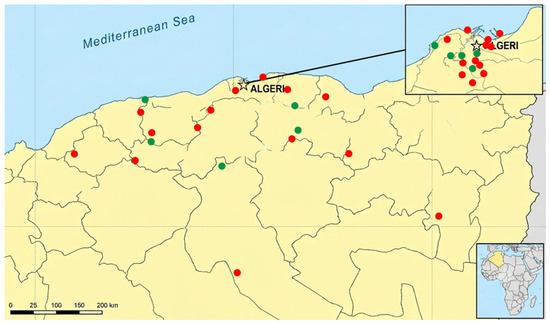
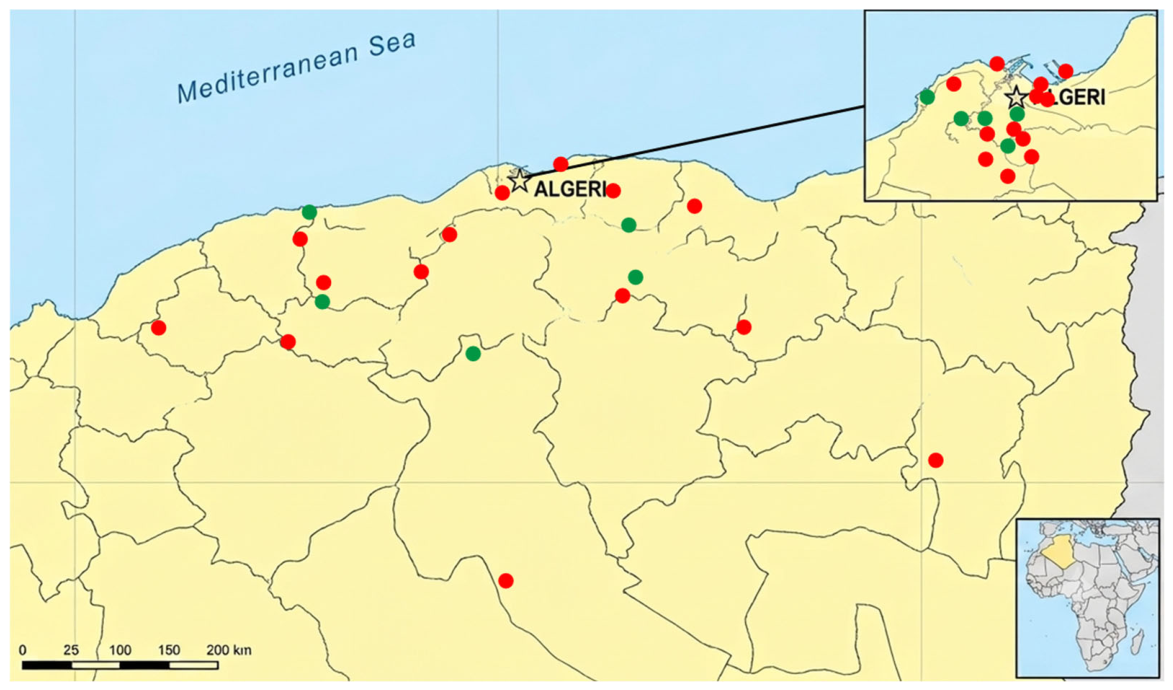
A cross-sectional survey was conducted between August and October 2024 on 37 dairy farms located in different areas of Algeria, including 26 dairy cattle farms and 11 dairy goat farms (Figure 1). To minimize misinterpretations and ensure data consistency, the questionnaire (Supplementary File S1) was administered in person by a trained operator during the on-farm visit.
Figure 1.
Geographic distribution of cow (red) and goat (green) dairy farms included in the study, and an enlarged view of the Algiers metropolitan area and neighboring provinces. Locations were mapped using the coordinates corresponding to the municipality or district centroid.
Information collected included farm location, herd size, feed type and origin (produced or purchased), water source (public supply, well, or mixed), grazing practices, and milking procedures. Additional data captured the proximity of farms to potential environmental contamination sources, including industrial sites, landfills, and wastewater treatment plants. Farmers also reported the primary use of the produced milk, i.e., direct sale to cooperatives or companies, household consumption, or processing into dairy products. Survey data were initially recorded manually, then digitized and translated into English. Participation was on a voluntary basis, and all farmers provided informed consent prior to data collection. Survey responses were anonymized before dataset creation and analysis, and no personally identifiable information was recorded or reported.
Each farm was visited once, and a representative bulk-tank milk sample was collected after thorough homogenization. Samples (30 mL) were transferred into sterile polypropylene tubes, transported under refrigerated conditions (4 °C), and stored at −20 °C until analysis.
This study did not involve interaction with animals, including direct experimentation, invasive procedures, or interventions beyond routine farm management practices. Milk samples were collected by the farmer from bulk tanks during normal farm operations following the study instructions, and no additional handling or discomfort was imposed upon the animals.
2.2. Analysis Method for AFM1
The concentrations of AFM1 were determined using a competitive ELISA kit (E-TO-E018; Elabscience, Houston, TX, USA) following the manufacturer’s instructions. The method provides a detection limit for milk of 0.010 µg/kg and a quantitative working range of 0.010–0.405 µg/kg, which is suitable for verifying compliance with the European regulatory limit. Prior to analysis, the kit was stored at 2–8 °C and equilibrated to room temperature for 30 min. All reagents and frozen milk samples were brought to 25 °C and mixed gently to ensure homogeneity.
Standards and samples were dispensed in duplicate (40 µL per well) into the microplate, followed by the addition of 80 µL of horseradish peroxidase (HRP) conjugate. Plates were incubated for 40 min at 25 °C in the dark to prevent photodegradation of reagents. After incubation, wells were washed four times with the supplied wash buffer to remove unbound components. Subsequently, 100 µL of freshly prepared chromogenic substrate solution was added to each well and the plate was incubated for an additional 15–20 min at 25 °C in the dark. The enzymatic reaction was halted by adding 50 µL of stop solution.
Absorbance was measured within 5 min at 450 nm, using 630 nm as the reference wavelength, with a Tecan Infinite F50 microplate reader (Tecan Group Ltd., Männedorf, Switzerland). Concentrations of AFM1 in samples were calculated from the generated standard curve.
According to the manufacturer, the ELISA kit provides a recovery rate of 100 ± 30%, and limited (<1%) cross-reactivity toward AFM2. The assay is intended as a rapid screening method for milk and dairy products. Samples yielding concentrations above the upper calibration level were diluted 1:2 and reanalyzed. Final AFM1 concentrations were calculated by applying the corresponding dilution factor, thereby allowing quantification of samples exceeding the original analytical range of the kit.
2.3. Analysis Method for PFAS
2.3.1. Reagents and Materials
Analytical standards for PFAS (EPA-537PDSL-R1) and isotopically labeled internal standards (M2-PFOA, d3-N-MeFOSAA, M-PFOS; EPA-537IS) were purchased from Wellington Laboratories (Guelph, ON, Canada; Supplementary Table S1). Acetonitrile, methanol, formic acid, ammonium hydroxide, and zinc sulfate (ZnSO4) were obtained from Merck (Milan, Italy). Oasis WAX solid-phase extraction (SPE) cartridges (6 cc/150 mg) were acquired from Waters (Milford, MA, USA). Nylon syringe filters (0.22 µm) were sourced from FAVS (Bologna, Italy). Solvents for LC-MS/MS (ammonium acetate, methanol, ultrapure water) were purchased from Sigma-Aldrich (St. Louis, MO, USA).
2.3.2. Sample Extraction and Clean-Up
Sample extraction followed Zheng et al. [14], while clean-up was adapted from Rawn et al. [15], with modifications. Three milliliters of thawed milk were transferred to 15 mL polypropylene tubes, spiked with 150 µL of internal standard solution (0.50–2.00 µg/L), and mixed with 68 µL of 2 M ZnSO4 and 6 mL of acetonitrile. Samples were vortexed, sonicated for 15 min, and centrifuged (3000 rpm, 5 min, 4 °C). The extraction was repeated twice, and the combined supernatants were evaporated under nitrogen at 45 °C to approximately 3 mL, then diluted with 4 mL of 0.1% formic acid in water.
Clean-up used Oasis WAX cartridges conditioned with 10 mL of 0.1% ammonia in methanol followed by 12 mL of water. Samples (7 mL) were loaded onto the cartridges, which were sequentially washed with: (i) 3 mL of 20 mM ammonium acetate:methanol (80:20, pH 4), (ii) 6 mL of methanol:water (50:50), and (iii) 2 mL of methanol.
Analytes were eluted with 6 mL of 2% ammonia in methanol, evaporated under nitrogen at 45 °C, and reconstituted in 400 µL of methanol:water (50:50). Final extracts were filtered (0.22 µm) before LC-MS/MS injection.
2.3.3. LC-MS/MS Analysis
Analyses were performed using a Waters Acquity UPLC® (Milford, CT, USA) equipped with a BEH Shield C18 column (50 × 2.1 mm, 1.7 µm; 35 °C). The mobile phase consisted of 5 mM ammonium acetate (A) and methanol (B), with a linear gradient from 50%A/50%B to 10%A/90%B over 8 min at 0.3 mL/min. Detection was performed using a Waters Xevo® TQ-S micro mass triple-quadrupole spectrometer (Milford, CT, USA) operating in negative electrospray ionization mode (ESI−), with multiple reaction monitoring (MRM). Two transitions were monitored for each analyte and one transition for each internal standard. The selected MRM transitions and their corresponding cone voltages and collision energies are reported in Supplementary Table S1.
The ionization parameters included a capillary voltage of −0.50 kV, a source temperature of 150 °C, and a desolvation temperature of 500 °C. The desolvation gas flow was set to 900 L/h, with a cone gas flow of 50 L/h. The collision energy was maintained at 15 eV, while the extractor voltage was 1 V, and the RF lens voltage was 0.2 V. Data were processed using MassLynx 4.2 software.
2.3.4. Method Performance Assessment
The method was validated following the guidelines outlined by the EURL POPs for PFAS determination in food and feed [16] as mandated by Commission Implementing Regulation (EU) 2022/1428 [17]. Method validation included evaluation of linearity, trueness (apparent recovery), precision (within-laboratory reproducibility), LOQ (limit of quantification), LOD (limit of detection), identification criteria, and procedural blanks. Isotope-labeled internal standards were added prior to extraction to compensate for analyte losses and matrix effects. For analytes lacking a specific isotope-labeled analog, quantification was performed using the most appropriate isotope-labeled PFAS according to EURL recommendations. Calibration curves (six levels: 0, 0.01, 0.02, 0.05, 0.10, 0.20 µg/kg) were prepared daily using matrix-matched standards. Quality-control samples (0.01, 0.05, 0.10 µg/kg) were analyzed in triplicate over three days for validation purposes and were also included in each analytical session.
The LOD was estimated as the lowest concentration providing a signal-to-noise ratio of at least 3 in matrix-matched samples processed through the entire analytical procedure. The LOQ was defined as the lowest validated concentration level fulfilling the method performance criteria for identification, trueness, and precision.
According to Commission Implementing Regulation (EU) 2022/1428, the limit of quantification (LOQ) for analytical methods for PFAS in milk should be at or below 0.010 μg/kg for PFOS, 0.010 μg/kg for PFOA, 0.020 μg/kg for PFNA, and 0.040 μg/kg for PFHxS [17].
2.4. Data Analysis
R software v. 4.4.1 (R core team, 2024) was used for data handling and inspection and for statistical analyses aimed at evaluating the association between the contaminants and the farm characteristics.
Given the high proportion of left-censored PFAS results, PFAS occurrence data were summarized descriptively by censoring class and compound. Results below the LOD were reported as non-detects, results between the LOD and LOQ as trace detections, and results equal to or above the LOQ as quantifiable detections. Because only a limited number of samples showed quantifiable PFAS concentrations, no inferential statistical analysis was performed for PFAS, as the dataset did not support robust comparisons across farm-level variables. No numerical substitution or imputation procedure was applied. Accordingly, PFAS data are reported descriptively to summarize their distribution and (co-)occurrence pattern.
As regards AFM1, analysis of variance (ANOVA) was conducted separately for cattle and goat samples to test the fixed effects of farm management and structural characteristics. For cattle farms, herd size was reclassified into three classes based on the number of lactating animals present: small, medium, and large when the number was less than or equal to 20, between 21 and 60, and greater than 60, respectively. This classification was not applied to goat farms, which showed limited variability in herd size, with all farms having 20 lactating animals or less. The following linear model was used:
where yijkl represents the dependent variable (concentration in bulk milk), μ is the overall intercept of the model, Hi is the fixed effect of the herd size class (included only for cattle: i = 1, 2, and 3, corresponding to small, medium, and large herds), Sj is the fixed effect of silage use (j = 1 and 2, corresponding to yes or no, respectively), Rk is the fixed effect of the k-th region, Gl is the fixed effect of grazing practice (l = 1 or 2, corresponding to grazing or no grazing, respectively), and eijkl is the random residual error of the model.
yijkl = μ + Hi + Sj + Rk +Gl + eijkl,
The non-parametric Kruskal–Wallis test was also adopted for comparison purposes, and the Pearson correlation coefficient was calculated between the herd size and the AFM1 concentration. Significance was set at p ≤ 0.05.
3. Results
3.1. Farm Distribution and Characteristics
Overall, 57.70% of cattle farms were located in rural areas, and 42.30% in urban areas (Table 1). Urban farms were characterized by small herd sizes, with the majority of them hosting nine lactating cows or less. In contrast, rural farms showed much greater variability in herd size, with small herds being relatively uncommon in these areas (1 out of 15 farms).
Table 1.
Distribution of dairy cattle and goat farms by herd size class and production area.
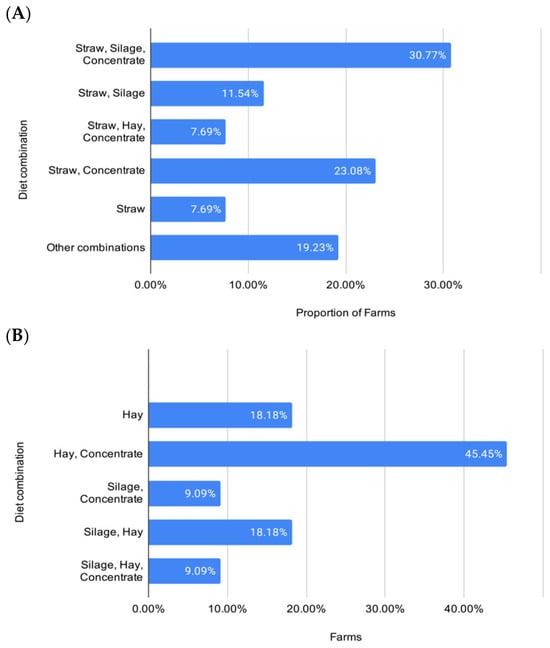
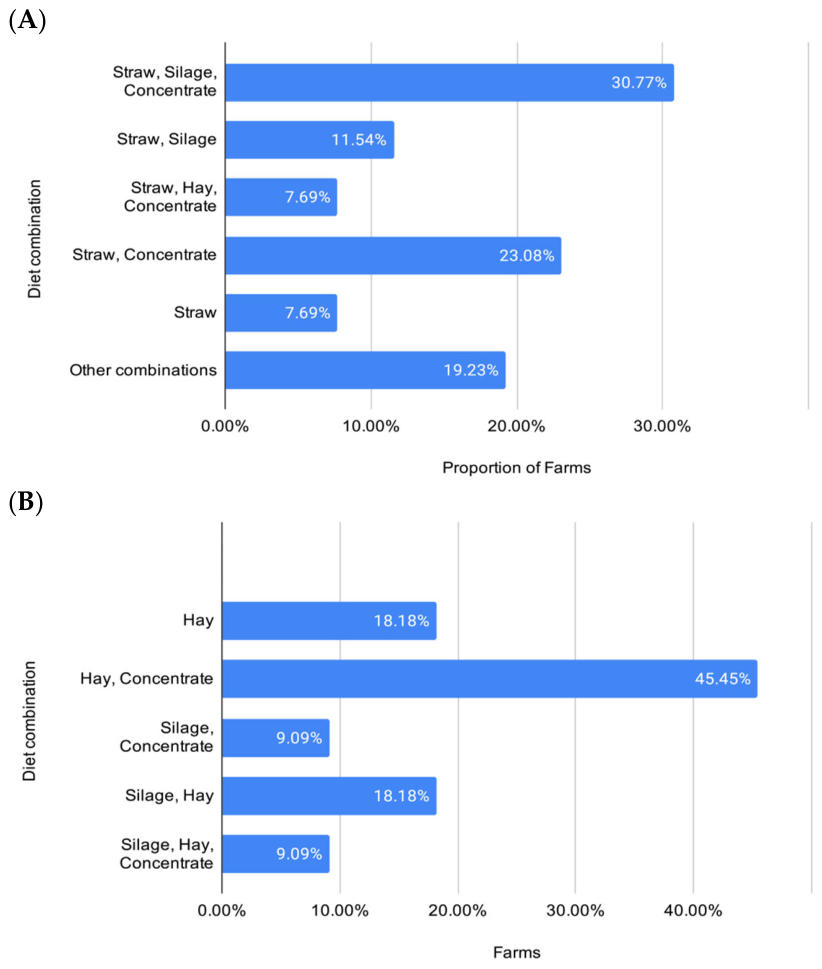
In cattle, the two large herds (>100 cows) were located in rural areas. For goats, six farms were in rural areas and five in urban areas, but all were considered as small (Table 1). Based on the information provided by farmers during the survey interview, it was observed that feeding practices differed in the two species. In particular, while silage and straw were commonly reported in cattle farms, they were scarcely used or not used at all in goat farms (Figure 2).
Figure 2.
Rations administered to (A) cows and (B) goats in the investigated farms.
In cattle, the most common ration consisted of a combination of straw, silage, and concentrate, followed by a ration based on straw and concentrate (23.08%), distributed equally between urban and rural areas. Other combinations, such as straw plus silage or silage with additional components such as alfalfa, showed variation in their adoption, with silage being regularly incorporated into the rations of 14 farms (Figure 2).
In the goat farm cohort, the most common feeding practice was a combination of hay and concentrate (45.45%; Figure 2), and only four farmers declared that they incorporated silage into the ration.
In terms of water sources, the vast majority of farmers—88.46% for cattle and 72.73% for goats—reported relying on the public water supply, with remaining water sources, namely well water, rivers, or lake water, and a combination of well water and public water, accounting for only a minor proportion.
Grazing was one of the aspects investigated within the survey. The responses indicated that 65.40% of cattle farmers and 72.70% of goat farmers allowed animals to graze outdoors, mostly because of the possibility to use part of the land available. Regarding feed sources, the data showed that the dairy farms surveyed relied predominantly on local feed suppliers, whereas total feed self-production was reported by only 10% or less of the farmers. Farmers were also asked to report whether their farms were located near potential contamination sources, namely industrial areas, landfills, and wastewater treatment plants. Among cattle farms, 50.00% were reported as being far from such facilities, 38.50% as being in close proximity, and 11.50% as having unknown proximity. Within the farms perceived as close to potential contamination sources, six also reported outdoor grazing practices. Similarly, most goat farms were reported as relatively far from polluted areas, whereas four farms (36.4%) were perceived as being in close proximity. Notably, approximately 27.70% of these allowed outdoor grazing.
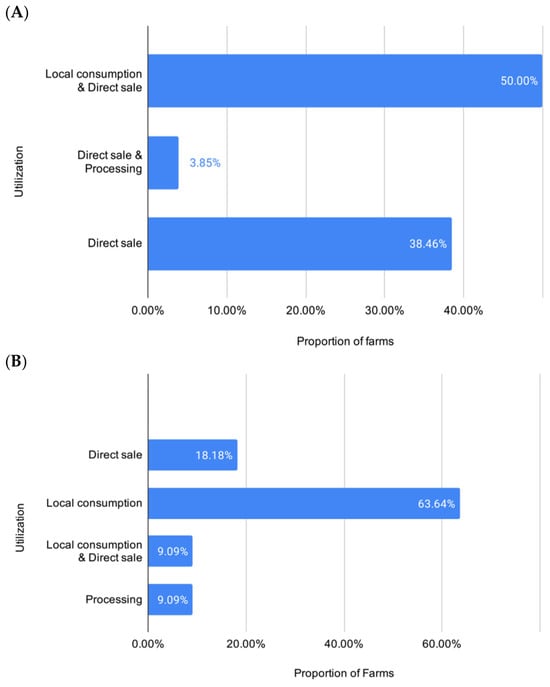
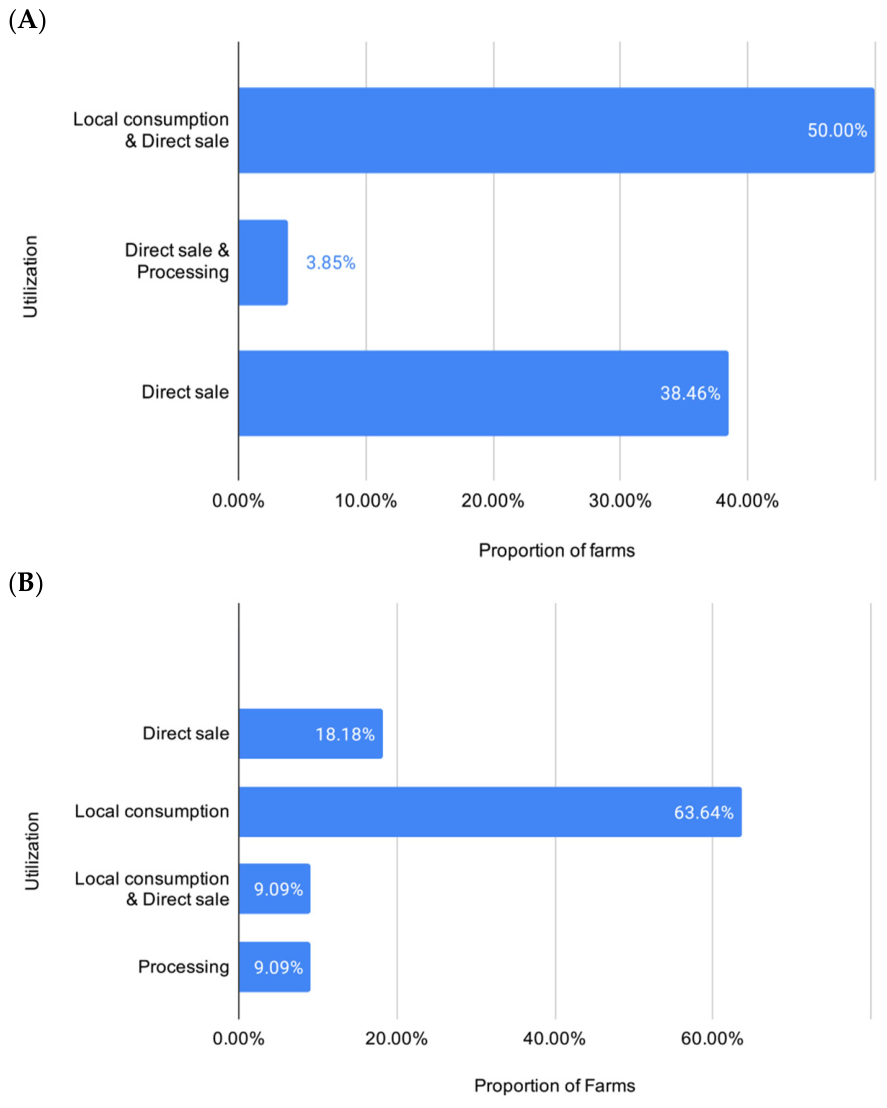
Regarding milk use, different destinations were declared by the farmers interviewed (Figure 3). In 50.00% of cases, bovine milk was intended for both direct sale and local consumption, but direct sale alone accounted for 38.46% of cases. A smaller share, 3.85%, was utilized for both direct sale and processing into derivatives such as cheese and yogurt. The predominant destination of goat milk was the local market, accounting for 63.64% of the total milk produced (Figure 3).
Figure 3.
Main uses of (A) cow and (B) goat milk.
3.2. AFM1 Analysis
All raw milk samples analyzed contained quantifiable AFM1. Summary statistics for cow and goat milk, including concentration ranges, means, medians, and the proportion of samples exceeding the European Union regulatory maximum level of 0.05 µg/kg and the Codex Alimentarius maximum level of 0.5 µg/kg, are reported in Table 2.
Table 2.
AFM1 concentration range and frequency of non-compliance with EU and Codex regulatory limits in raw cow and goat milk samples.
In cow milk, AFM1 concentrations ranged from 0.048 to 0.410 µg/kg, with a mean of 0.102 µg/kg and a median of 0.079 µg/kg. A total of 25 of 26 samples (96.1%) exceeded the EU maximum level, whereas none exceeded the Codex Alimentarius maximum level of 0.5 µg/kg.
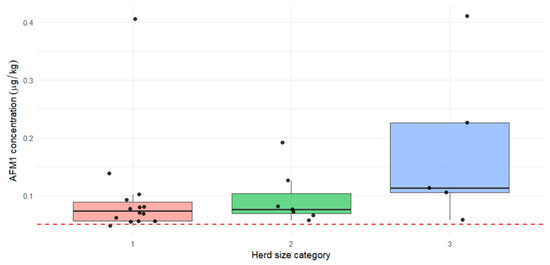
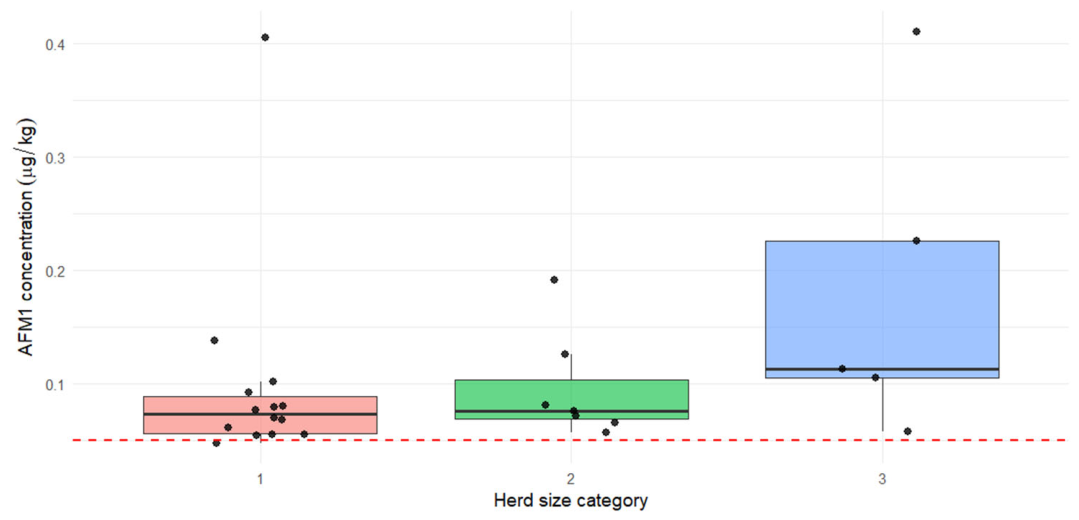
The association between AFM1 concentration and the farm characteristics considered in this study was assessed using ANOVA. Although a numerical trend was observed for the herd size, based on visual inspection of boxplots (Figure 4), the effect was not statistically significant (F = 0.176, p = 0.679). Similarly, the effects of geographical zone (F = 2.380, p = 0.138), silage use (F = 0.509, p = 0.484), and grazing practice (F = 0.018, p = 0.895) were not significant. Supporting this, the Pearson correlation coefficient between herd size and AFM1 concentration was weak (r = 0.045).
Figure 4.
Distribution of AFM1 concentration according to herd size category in dairy cattle farms (1 = small, 2 = medium, and 3 = large, as described in Table 1). Red dashed line represents the x-axis.
However, after excluding the sample with the highest AFM1 concentration, a nominal effect of herd size was observed (F = 4.50, p = 0.045). This finding should be interpreted with caution, as the non-parametric Kruskal–Wallis test did not show statistically significant differences across the herd size categories.
In goat milk, AFM1 concentrations ranged from 0.030 to 0.578 µg/kg, with a mean of 0.193 µg/kg and a median of 0.036 µg/kg. Four of 11 samples (36.4%) exceeded the EU maximum level, and two samples (18.2%) also exceeded the Codex Alimentarius maximum level of 0.5 µg/kg. The mean concentration was higher than that observed in cow milk; however, this value was strongly influenced by a limited number of high-concentration samples. Therefore, the median concentration and the proportion of samples exceeding regulatory limits provide a more robust description of AFM1 occurrence in goat milk.
The ANOVA revealed that the farm characteristics considered in this study did not significantly explain the AFM1 variability in goat milk. As observed for cow milk, the Shapiro–Wilk test of the residuals confirmed a significant deviation from normality (W = 0.782, p = 0.005). The non-parametric Kruskal–Wallis tests confirmed that none of the variables had a significant role, i.e., region (p = 0.711), grazing practices (p = 0.604), or silage use (p = 0.924).
3.3. PFAS Analysis
The analytical method applied for PFAS determination demonstrated satisfactory performance across all validation criteria, in accordance with the requirements for PFAS analysis in food matrices established by Commission Implementing Regulation (EU) 2022/1428 and the EURL POPs guidance documents. Linearity was considered acceptable when back-calculated concentrations (BCCs) deviated by no more than ±20% from nominal values; this criterion was fulfilled across the validated calibration range. Trueness, assessed as apparent recovery, was evaluated against an acceptance criterion of ±35% bias, while within-laboratory reproducibility was required to be ≤25%. Quality-control samples analyzed under both intra- and inter-day conditions met these criteria, with trueness remaining within ±20% and precision within 17%. Peak identification was considered reliable when analyte retention times were within 1% of the corresponding calibration standards and ion ratios were within ±30% of the average calibration values; these identification criteria were consistently satisfied for the target analytes. Specificity was confirmed by the absence of interfering peaks in both blank matrix and solvent injections, and no carry-over was observed during the analytical sessions. The limit of detection (LOD) was established at 0.003 µg/kg, and the limit of quantification (LOQ) at 0.010 µg/kg for all PFAS investigated, thus meeting the performance requirements established by Commission Implementing Regulation (EU) 2022/1428 for PFAS analytical methods in milk. These limits were used to classify results as non-detects, traces, or quantifiable detections.
Table 3 summarizes the distribution of left-censored and quantifiable PFAS results obtained from cow and goat milk samples. Across all PFAS analytes, the majority of measurements were below the LOD or between the LOD and LOQ, indicating a generally low level of PFAS contamination in the sampled farms. A total of 73% of cow milk samples were below the LOD, 19% were within the trace range (LOD < x < LOQ), and only 8% contained quantifiable levels above the LOQ. A comparable pattern was observed in goat milk, where 64% of samples were below the LOD, 18% were in the trace range, and another 18% exceeded the LOQ.
Table 3.
Descriptive distribution of PFAS results in cow and goat milk according to censoring class 1.
Contamination patterns for individual PFAS are reported in Table 4, which details quantifiable concentrations and trace detections across farms. Among the 17 PFAS included in the panel, only four were detected at trace levels, and two exceeded the LOQ.
Table 4.
Measured contamination levels of different PFAS in cow and goat milk samples.
Given the predominance of left-censored observations and the very limited number of quantifiable results, PFAS data were not subjected to formal inferential statistical analysis. No numerical replacement of results below the LOD or between the LOD and the LOQ was performed. Therefore, Table 3 is presented solely to describe the distribution of PFAS results across censoring classes, whereas Table 4 reports the occurrence of individual compounds at trace and quantifiable levels.
In cow milk, PFBS was the only compound quantified above the LOQ in two samples, whereas PFOS was detected only at trace levels in four samples and PFNA in one sample. No cow milk sample showed co-occurrence of more than one detectable PFAS compound. Because most concentrations were left censored, statistical testing of associations with grazing, herd size, or silage use was not appropriate. However, detection of PFOS and PFBS occurred exclusively in grazing farms, although this pattern cannot be statistically supported due to the small sample size.
In goat milk, PFDA was quantified in two samples and detected at trace levels in two additional samples. The two goat milk samples with quantifiable PFDA also showed trace PFNA and PFOS, indicating descriptive co-occurrence in these individual samples. Because most samples were below the LOQ, relationships with farm-related characteristics could not be investigated using ANOVA or Kruskal–Wallis tests.
4. Discussion
This preliminary study simultaneously investigated AFM1 and PFAS in bovine and goat bulk milk from Algerian dairy farms. The integrated assessment of a feed-related contaminant and environmentally persistent contaminants provides useful exploratory information within a One Health perspective. However, because the study included a limited number of farms and a single sampling period, the findings should be interpreted as screening-level evidence and not as a national prevalence estimate.
4.1. Algerian Farming Systems and Farm Characteristics
The surveyed farms reflect the predominance of small-scale dairy systems in Algeria, particularly for goats, consistent with previous reports on ruminant feeding systems, goat value chains, and Algerian goat farming, which is often based on small-scale and extensive systems and may be undervalued despite its socio-economic relevance [18,19,20]. This structure is relevant for contaminant control because small farms may face greater challenges in implementing standardized feed storage, systematic monitoring, and traceability procedures. The questionnaire captured farm-level factors relevant to feed-borne and environmental contamination, providing useful contextual information for discussing the AFM1 and PFAS findings considering local management practices, while not supporting causal inference. Moreover, the uneven number of cattle and goat farms limits direct comparisons between species. Although the goat farms included in this study were single-species farms, goats in Algeria are frequently reared in mixed flocks with sheep [21].
For the purpose of this study, information on potential environmental risk factors contributing to milk contamination was recorded through the survey. Specifically, aspects related to feeding practices and the origin of feed and water were investigated, because AFM1 contamination is mainly linked to the ingestion of AFB1-contaminated forage, whereas PFAS exposure may occur through contaminated water, forage, soil, or other environmental sources. Regarding feeding practices, the data showed that goat systems, in particular, relied on a limited range of basal forages supplemented with concentrates, providing useful context for interpreting possible exposure pathways rather than evidence of direct associations with contaminant levels. Overall, 63.60% of goat farms and 46.20% of cattle farms did not include silage in the ration for lactating animals. Overall, 88.46% of cattle farms and 72.73% of goat farms use public water on a regular basis, reflecting widespread access to a centralized water source, ensuring consistent water availability for most farms. In some areas, however, public water is not available, with consequent limited information regarding the quality of water administered to animals [22].
Most farms provided animals with access to outdoor grazing, a management practice consistent with previous studies in Algeria [23]. Grazing may contribute to animals’ nutritional requirements and reduce feeding costs [24]. However, outdoor grazing may also increase contact with soil, forage, and nearby environmental sources, making it relevant for PFAS exposure assessment. Conversely, the absence of outdoor grazing in some farms may reflect management or land availability constraints, particularly in urban or peri-urban contexts.
Data on feed origin revealed a general dependence on external sources, consistent with previous observations in North Algerian dairy farms [25]. This pattern may be partly explained by limited irrigation infrastructure and restricted land availability for feed production, which reduce farmers’ capacity to produce sufficient on-farm feed [18].
More broadly, the Algerian dairy sector faces major constraints related to forage production, including insufficient rainfall and limited allocation of irrigated land to feed crops [26]. Algeria allocates only 2.6% of its total agricultural land to forage production, with cultivated forage accounting for just 2% [27]. Across most dairy operations, animals are fed predominantly dried roughage, such as hay and straw, because fodder supplies are both limited and often of substandard quality. As a result, dairy producers often rely on purchased roughage and concentrate supplements [28]. The reliance on externally sourced feed, together with national constraints in forage production, may complicate feed quality control and increase vulnerability to batch-specific contamination. This is particularly relevant for AFM1, whose occurrence depends on AFB1 contamination in feed and storage conditions.
Limited technical support, inconsistent herd management, and gaps in traceability may further hinder the identification and control of contamination sources in the dairy sector [29,30]. Although recent institutional initiatives, such as “Innov-Agro”, aim to modernize agricultural practices and strengthen innovation in the agri-food sector, the current management context still suggests challenges in professionalization and risk-based contaminant control [31].
Differences in milk utilization also have food safety implications. Cow milk was more frequently integrated into commercial channels, a pattern consistent with institutional initiatives promoting the delivery of higher-quality milk to industrial buyers [32]. In contrast, goat milk was mainly used for local or household consumption, in line with previous descriptions of goat farming as a system often oriented toward subsistence and family nutrition [19,21]. These differences suggest that surveillance strategies should consider both formal and informal distribution pathways.
However, the absence of contaminant-specific surveillance and enforcement measures in the dairy sector may limit the early detection and control of contamination sources, potentially increasing exposure risks for animals and consumers.
4.2. AFM1 Contamination
The AFM1 results indicate a widespread and concerning level of contamination in the analyzed raw milk samples from both species. All samples contained quantifiable AFM1, suggesting ongoing exposure of dairy animals to AFB1 through contaminated feed, even if the magnitude and distribution of contamination differed markedly between cow and goat milk. However, there was no strong evidence of possible associations with farm characteristics and management practices, although the sensitivity analysis showed a significant effect of herd size after excluding the most contaminated bovine milk sample.
Although the study design was not intended to capture the entire seasonal variability, the results provide useful exploratory evidence to guide future, seasonally structured investigations. AFM1 contamination was widespread in cow milk, with most samples exceeding the EU maximum level but remaining below the Codex Alimentarius threshold. This contrast highlights how the interpretation of milk safety may vary substantially depending on the regulatory benchmark applied [7,8].
In goat milk, AFM1 occurrence appeared less widespread but more uneven, with a few high-concentration samples driving the mean value. This pattern suggests that targeted investigation of individual farms or feed batches may be particularly relevant in goat systems. Previous studies from Algeria reported variable AFM1 occurrence in milk. Using ELISA, Jedidi et al. (2023) [33] detected AFM1 in 14.63% of milk samples from the Algerian supply chain; although powder milk was the most contaminated category, all samples complied with the EU limit. Conversely, Mohammedi-Ameur et al. (2020) [34] reported a high prevalence (46.43%) of AFM1 in raw cow milk, with mean concentrations (0.070 ± 0.028 µg/kg) frequently exceeding the EU limit and showing marked seasonal and regional variation.
The contrasting patterns observed between cow and goat milk (moderate-to-high contamination in cows versus sporadic but severe contamination in goats) highlight the need for species-specific surveillance strategies. Species-specific carry-over rates of AFB1 to AFM1 should also be considered. According to Zentai et al. (2023) [35], the carry-over rate in dairy cows generally ranges from 1% to 6%, with an average close to 3%, whereas lower values, around 0.5%, have been reported in goats [36,37,38]. The European Food Safety Authority (EFSA) has also emphasized that AFM1 levels in milk depend not only on dietary intake alone, but also on species-specific physiology, metabolic rate, and productive level [39]. In particular, these factors can markedly influence the resulting concentration of AFM1 in milk, even when animals are exposed to similar dietary levels of AFB1. This highlights the importance of accounting for species- and breed-dependent carry-over when evaluating exposure and associated risks [40].
Overall, AFM1 contamination in this cohort could not be fully explained by the structural farm characteristics considered. The absence of repeated seasonal sampling and direct feed analysis limits the interpretation of AFM1 drivers. Future studies should integrate feed composition, storage conditions, and local climatic data to clarify the determinants of contamination [41,42,43].
From a risk management perspective, interventions in cow farms should prioritize continuous feed quality monitoring and improved storage practices, given the widespread exceedances of the EU limit. In goat farms, more targeted control measures may be needed to identify and mitigate isolated but severe contamination events, potentially arising from batch-specific feed contamination or localized storage deficiencies.
4.3. PFAS Contamination
The analytical method applied in this study proved reliable and met the EURL POPs (2024) performance criteria [16], confirming its suitability for trace-level PFAS determination in raw milk.
PFAS occurrence was generally low and sporadic, with quantifiable detections limited to PFBS in cow milk and PFDA in goat milk. Importantly, the four PFAS prioritized under Commission Recommendation (EU) 2022/1431 were not quantified, suggesting low background contamination in the sampled farms [13].
Because PFAS detections were infrequent and mostly left-censored, the farm-level variables collected in this study could only be used for descriptive interpretation. Therefore, the lack of observed associations should not be interpreted as evidence of the absence of farm-related effects.
Overall, the concentrations observed in this study are consistent with the broad variability in PFAS concentrations reported worldwide. A recent survey in Poland found that goat and sheep milk contained higher PFAS concentrations than cow milk, with mean ∑4PFAS levels of 0.0046–0.0055 µg/kg compared with 0.0008 µg/kg in cow milk [44]. In Italy, low background contamination of PFAS in bovine milk has been reported, with concentrations up to approximately 0.067 µg/kg for PFOS and 0.032 µg/kg for PFOA, indicating generally limited exposure in commercial milk samples [45]. Consistent with these findings, a more recent study confirmed the presence of PFAS at similarly low levels in raw bovine milk; however, slightly higher mean concentrations and notably higher maximum values were observed (e.g., mean PFOS ≈ 0.022 µg/kg, with enrichment in the cream fraction), likely reflecting the analysis of milk from individual animals rather than pooled commercial samples [11]. In Asia, higher concentrations have occasionally been documented: in China, PFOA was the dominant compound in raw milk at approximately 0.080 µg/kg, representing more than half of total PFAS measured [46]. Surveys in Taiwan showed even wider PFCA ranges in milk products, from 0.030 to 1.440 µg/kg [47]. Together, these studies demonstrate that PFAS contamination in milk is geographically heterogeneous and strongly influenced by regional environmental conditions and PFAS usage patterns.
Overall, PFAS levels in raw cow and goat milk were low, with occasional detections; notably, none of the samples contained quantifiable amounts of PFOS, PFOA, PFNA, or PFHxS as prioritized under Commission Recommendation (EU) 2022/1431 [13].
The quantifiable PFBS and PFDA detections should be interpreted as indicators of possible exposure pathways rather than evidence of specific contamination sources, because feed, water, soil, and other environmental matrices were not analyzed.
Although the dataset does not allow for a formal risk assessment, a Relative Potency Factor (RPF)-based screening calculation was used to contextualize the toxicological relevance of detected PFAS. The RPF approach [48,49] expresses the relative hepatotoxic potency of individual PFAS compared with PFOA (RPF = 1). PFBS has a very low potency (RPF = 0.001), whereas PFDA is considerably more potent (RPF = 4–10). Applying these factors to the concentrations measured in this study, PFBS detected in cow milk (0.066–0.085 µg/kg) corresponds to only 0.000066–0.000085 µg PFOA-equivalents/kg. In contrast, PFDA detected in goat milk (0.011–0.012 µg/kg) corresponds to approximately 0.11–0.12 µg PFOA-equivalents/kg when the upper RPF estimate of 10 is applied. These calculations suggest that PFBS would make a negligible contribution to the overall PFAS hepatotoxic burden, whereas PFDA may represent the most relevant contributor among the compounds detected. Nevertheless, because the dataset was small, only two samples contained quantifiable PFDA, and no health-based guidance values are currently available for PFOA-equivalents in milk, these estimates should only be regarded as a screening-level toxicological contextualization, rather than as a formal dietary exposure or risk assessment.
5. Conclusions
This study provides a preliminary assessment of AFM1 and PFAS occurrence in bovine and goat bulk milk from a limited number of Algerian dairy farms. The results indicate frequent AFM1 detection in the sampled farms, with several samples exceeding international regulatory thresholds, whereas PFAS occurrence was low and sporadic. The detection of PFBS and PFDA suggests that potential exposure pathways may exist, but these findings require confirmation through larger and more representative studies.
Because the study was based on a limited number of farms and a single sampling period, the results should not be interpreted as a national prevalence estimate for Algerian dairy systems.
Future investigations should include larger and regionally structured sampling designs, repeated sampling across seasons, and parallel analysis of milk, feed, water, soil, and other environmental matrices to better identify the determinants of contaminant occurrence. Such an approach, coupled with integration of detailed local climatic and environmental data, would clarify exposure pathways and better characterize spatial and seasonal variability.
Beyond the occurrence observed at the farm level, these findings highlight the need to strengthen national feed quality control, promote improved storage and handling practices, and implement systematic surveillance for both AFM1 and PFAS. Expanded environmental monitoring, combined with farmer training and risk-based inspection programs, would support early detection and mitigation of contamination sources. Overall, enhancing dairy sector resilience in the One Health framework will require integrated interventions across feed supply chains, farm management, and environmental policy to reduce chemical exposure and safeguard milk safety in Algeria.
Supplementary Materials
The following supporting information can be downloaded at: https://www.mdpi.com/article/10.3390/dairy7040054/s1, File S1: Questionnaire on Feeding Practices for Cattle and Goats Farms in Algeria; Table S1: MS/MS Detection parameters and their corresponding internal standards.
Author Contributions
Conceptualization, A.C., C.B., G.P., N.F. and T.G.; methodology, A.C., C.B., G.P., M.B., T.G. and V.D.; software, A.C., G.P., M.B. and M.M.; validation, A.C., G.D., G.P., G.R., N.F. and T.G.; formal analysis, E.Z., G.D., G.P., G.R., M.B. and T.G.; investigation, A.C., C.B., E.Z., G.P., T.G. and V.D.; resources, A.C., C.B., G.P. and T.G.; data curation, A.C., G.P., M.B. and M.M.; writing—original draft preparation, A.C., C.B., E.Z., G.P., M.B. and T.G.; writing—review and editing, A.C., C.B., G.D., G.P., G.R., M.B., N.F., T.G. and V.D.; visualization, A.C., C.B., G.D., G.P., G.R. and T.G.; supervision, A.C., G.P. and T.G.; project administration, A.C. and G.P.; funding acquisition, A.C., C.B., G.P. and T.G. All authors have read and agreed to the published version of the manuscript.
Funding
This research received no external funding.
Institutional Review Board Statement
Ethical approval was not required because the study was observational in nature and did not involve animal experimentation, invasive procedures, or interventions beyond routine farm management practices. Milk samples were collected from bulk tanks during normal farm operations.
Informed Consent Statement
Informed consent was obtained from all farmers involved in the study.
Data Availability Statement
The original contributions presented in this study are included in the article/Supplementary Material. Further inquiries can be directed to the corresponding authors.
Acknowledgments
The authors sincerely acknowledge the Department of Veterinary Medical Sciences, University of Bologna, for providing the laboratory consumables and experimental materials necessary for this research. Their valuable support contributed significantly to the completion of the study. The authors used an artificial intelligence (AI)-assisted image generation tool to support the preparation of the graphical abstract. The authors reviewed, edited, and validated all visual content and take full responsibility for the accuracy and scientific integrity of the final figure.
Conflicts of Interest
The authors declare no conflicts of interest.
Abbreviations
The following abbreviations are used in this manuscript:
| PFAS | Per- and Polyfluoroalkyl Substances |
| AFM1 | Aflatoxin M1 |
References
- Rabehi, F.; Kermia, N. The Reality and Challenges of Achieving Food Security in Algeria during the Period 2018–2023. J. Al-Mayadine Al-Iktissadia 2024, 6, 521–539. [Google Scholar]
- Souna, M.; Tefiani, C. An Overview of Algerian Food Quality Legislation, Regulation and Control Authorities. Biol. Life Sci. Forum 2023, 26, 23. [Google Scholar] [CrossRef] [Scilit]
- Soudani, N.; Belhamra, M.; Ugya, A.Y.; Patel, N.; Carretta, L.; Cardinali, A.; Toumi, K. Environmental Risk Assessment of Pesticide Use in Algerian Agriculture. J. Appl. Biol. Biotechnol. 2020, 8, 36–47. [Google Scholar] [CrossRef] [Scilit]
- Boudebbouz, A.; Boudalia, S.; Bousbia, A.; Gueroui, Y.; Boussadia, M.I.; Chelaghmia, M.L.; Zebsa, R.; Affoune, A.M.; Symeon, G.K. Determination of Heavy Metal Levels and Health Risk Assessment of Raw Cow Milk in Guelma Region, Algeria. Biol. Trace Elem. Res. 2023, 201, 1704–1716. [Google Scholar] [CrossRef] [Scilit] [PubMed]
- Bouziane, F.; Laallam, A.; Oussedik, M.I.; Ouassaf, S.; Khababa, N. Food Security in Algeria: An Analytical Study. J. Ecohum. 2024, 3, 2647–2660. [Google Scholar] [CrossRef] [Scilit]
- IARC Working Group on the Evaluation of Carcinogenic Risks to Humans. Chemical Agents and Related Occupations; IARC Monographs on the Evaluation of Carcinogenic Risks to Humans Series Number; International Agency for Research on Cancer: Lyon, France, 2012; Volume 100F, ISBN 978-92-832-1323-9. [Google Scholar]
- European Commission. COMMISSION REGULATION (EU) 2023/915 of 25 April 2023 on Maximum Levels for Certain Contaminants in Food and Repealing Regulation (EC) No 1881/2006 (Text with EEA Relevance); European Commission: Brussels, Belgium, 2023; Volume 119. [Google Scholar]
- Codex Alimentarius. Codex Alimentarius Commission Procedural Manual; FAO: Rome, Italy; WHO: Geneva, Switzerland, 2025. [Google Scholar]
- Bayode, A.A.; Emmanuel, S.S.; Akinyemi, A.O.; Ore, O.T.; Akpotu, S.O.; Koko, D.T.; Momodu, D.E.; López-Maldonado, E.A. Innovative Techniques for Combating a Common Enemy Forever Chemicals: A Comprehensive Approach to Mitigating per- and Polyfluoroalkyl Substances (PFAS) Contamination. Environ. Res. 2024, 261, 119719. [Google Scholar] [CrossRef] [Scilit] [PubMed]
- Bline, A.P.; DeWitt, J.C.; Kwiatkowski, C.F.; Pelch, K.E.; Reade, A.; Varshavsky, J.R. Public Health Risks of PFAS-Related Immunotoxicity Are Real. Curr. Environ. Health Rep. 2024, 11, 118–127. [Google Scholar] [CrossRef] [Scilit] [PubMed]
- Draghi, S.; Pavlovic, R.; Pellegrini, A.; Fidani, M.; Riva, F.; Brecchia, G.; Agradi, S.; Arioli, F.; Vigo, D.; Di Cesare, F.; et al. First Investigation of the Physiological Distribution of Legacy and Emerging Perfluoroalkyl Substances in Raw Bovine Milk According to the Component Fraction. Foods 2023, 12, 2449. [Google Scholar] [CrossRef] [Scilit] [PubMed]
- Hill, N.I.; Becanova, J.; Lohmann, R. A Sensitive Method for the Detection of Legacy and Emerging Per- and Polyfluorinated Alkyl Substances (PFAS) in Dairy Milk. Anal. Bioanal. Chem. 2022, 414, 1235–1243. [Google Scholar] [CrossRef] [Scilit] [PubMed]
- European Commission. Commission Recommendation (EU) 2022/1431 of 24 August 2022 on the Monitoring of Perfluoroalkyl Substances in Food; European Commission: Brussels, Belgium, 2022; Volume 221. [Google Scholar]
- Zheng, N.; Min, L.; Li, D.; Tan, S.; Gao, Y.; Wang, J. Occurrence of Aflatoxin M1 in Cow, Goat, Buffalo, Camel, and Yak Milk in China in 2016. Toxins 2022, 14, 870. [Google Scholar] [CrossRef] [Scilit] [PubMed]
- Rawn, D.F.K.; Dufresne, G.; Clément, G.; Fraser, W.D.; Arbuckle, T.E. Perfluorinated Alkyl Substances in Canadian Human Milk as Part of the Maternal-Infant Research on Environmental Chemicals (MIREC) Study. Sci. Total Environ. 2022, 831, 154888. [Google Scholar] [CrossRef] [Scilit] [PubMed]
- EURL for halogenated POPs in Feed and Food. Guidance Document on Analytical Parameters for the Determination of Per- and Polyfluoroalkyl; Version 2.0; European Union Reference Laboratory for Halogenated POPs in Feed and Food: Freiburg, Germany, 2024. [Google Scholar]
- European Commission. Commission Implementing Regulation (EU) 2022/1428 of 24 August 2022 Laying down Methods of Sampling and Analysis for the Control of Perfluoroalkyl Substances in Certain Foodstuffs; European Commission: Brussels, Belgium, 2022; Volume 221, pp. 66–90. [Google Scholar]
- Abdeldjelil, M.C.; Agabou, A.; Boudebza, A.; Messai, A.; Aimeur, F.; Bensegueni, A.; Benazzouz, H. Analysis of Ruminant’s Feeding Systems in Some Algerian Farms: Obstacle to Achieve Autonomy. In Feeding and Management Strategies to Improve Livestock Productivity, Welfare and Product Quality Under Climate Change; CIHEAM: Paris, France, 2013. [Google Scholar]
- Sahraoui, H.; Mamine, F. Chaines de valeur caprines en Algérie. In Innovation for Sustainability in Sheep and Goats; CIHEAM: Paris, France, 2019. [Google Scholar]
- Ouchene-Khelifi, N.A.; Ouchene, N.; Lafri, M. Characterization and Typology of Goat Production Systems in Algeria Based on Producers Survey. Bull. Natl. Res. Cent. 2021, 45, 22. [Google Scholar] [CrossRef] [Scilit]
- Laouadi, M.; Tennah, S.; Kafidi, N.; Antoine-Moussiaux, N.; Moula, N. A Basic Characterization of Small-Holders’ Goat Production Systems in Laghouat Area, Algeria. Pastoralism 2018, 8, 24. [Google Scholar] [CrossRef] [Scilit]
- Kadri, S.; Chaker-Houd, K.; Samar, M.; Boudechiche, L. Qualitative Diagnostic of Drinking Sources of Dairy Cows in the Wilaya of El Tarf (Algeria). Tech. Sci. Methodes 2022, 117, 65–74. [Google Scholar]
- Sahi, S.; Houssou, H.; Ouanes, H. Characteristics of Dairy Cattle Farms in The Regions Ofmila and Sétif. Int. J. Hum. Settl. 2021, 5, 179–186. [Google Scholar]
- Mouhous, A.; Kadi, S.A.; Djellal, F.; Berchiche, M. Mountain Pasture Management by Goat Farmers: Case of the Kabylia Region (Algeria). In Innovation for Sustainability in Sheep and Goats; CIHEAM: Paris, France, 2019. [Google Scholar]
- Meskini, Z.; Dahou, A.; Radja, D.S.; Yerou, H.; Homrani, A. Survey of Herd Management on Conventional Dairy Farms in North Algeria. Selcuk. J. Agric. Food Sci. 2023, 37, 95–108. [Google Scholar] [CrossRef] [Scilit]
- Kacimi El Hassani, S.; Belmahdi, T. Dairy Policies in Algeria in Search of Sustainability and Autonomy: Reforms, Challenges and Results. Le Manag. 2025, 12, 299–330. [Google Scholar]
- Semara, L.; Mouffok, C.; Belkasmi, F. Forage Crops Status, Determinants and Constraints: Current Status of Improved Forage Crops, Determinants and Constraints on Smallholders Mixed Crop-Livestock Farms in the Semi-Arid Region of Algeria. J. Agric. Environ. Int. Dev. (JAEID) 2025, 119, 65–84. [Google Scholar] [CrossRef] [Scilit]
- Boukhechem, S.; Moula, N.; Lakhdara, N.; Kaidi, R. Feeding Practices of Dairy Cows in Algeria: Characterization, Typology, and Impact on Milk Production and Fertility. J. Adv. Vet. Anim. Res. 2019, 6, 567–574. [Google Scholar] [CrossRef] [Scilit] [PubMed]
- Chemma, N.; Kerzabi, A. La Dépendance Laitière: Où En Est l’Algérie ? REMFO Rev. Étud. Manag. Financ. Organ. 2017, 5, 1–19. [Google Scholar]
- Ghoribi, L.; Bensari, C.; Djerrou, Z.; Djaaleb, H.; Riachi, F.; Djaaleb, I.; Chibat, M.E.-H. Analyse Du Mode de Conduite Des Élevages Bovins Laitiers Dans Le Nord-Est Algérien. Livest. Res. Rural Dev. 2015, 27, 11. [Google Scholar]
- Coopération Algérie-Allemagne: La GIZ Lance sa Campagne «Agri-Innovation Pathway» Depuis L’Université de Tizi Ouzou. Available online: https://www.lejourdalgerie.com/cooperation-algerie-allemagne-la-giz-lance-sa-campagne-agri-innovation-pathway-depuis-luniversite-de-tizi-ouzou/ (accessed on 2 April 2026).
- Mamine, F.; Fares, M.; Duteurtre, G.; Madani, T. Régulation du secteur laitier en Algérie entre sécurité alimentaire et développement d’une production locale: Synthèse. Rev. Elev. Med. Vet. Pays Trop. 2021, 74, 73–81. [Google Scholar] [CrossRef] [Scilit]
- Jedidi, I.; Messaï, A.; Redouane-Salah, S.; Mebrek, S. Assessment of Aflatoxin M1 Levels in Raw Camel Milk, Cow Milk and Powdered Milk in Algeria. Int. J. Environ. Stud. 2023, 80, 1843–1852. [Google Scholar] [CrossRef] [Scilit]
- Mohammedi-Ameur, S.; Dahmane, M.; Brera, C.; Kardjadj, M.; Ben-Mahdi, M.H. Occurrence and Seasonal Variation of Aflatoxin M1 in Raw Cow Milk Collected from Different Regions of Algeria. Vet. World 2020, 13, 433–439. [Google Scholar] [CrossRef] [Scilit] [PubMed]
- Zentai, A.; Jóźwiak, Á.; Süth, M.; Farkas, Z. Carry-Over of Aflatoxin B1 from Feed to Cow Milk—A Review. Toxins 2023, 15, 195. [Google Scholar] [CrossRef] [Scilit] [PubMed]
- Aazami, M.H.; Fathi Nasri, M.H.; Mojtahedi, M.; Battacone, G. Effect of Yeast Cell Wall and (1→3)-β-d-Glucan on Transfer of Aflatoxin from Feed to Milk in Saanen Dairy Goats. Anim. Feed Sci. Technol. 2019, 254, 114191. [Google Scholar] [CrossRef] [Scilit]
- Battacone, G.; Nudda, A.; Rassu, S.P.G.; Decandia, M.; Pulina, G. Excretion Pattern of Aflatoxin M1 in Milk of Goats Fed a Single Dose of Aflatoxin B1. J. Dairy Sci. 2012, 95, 2656–2661. [Google Scholar] [CrossRef] [Scilit] [PubMed]
- Mazzette, A.; Decandia, M.; Acciaro, M.; Fenu, A.; Dias Francesconi, A.H.; Battacone, G. Excretion of Aflatoxin M1 in Milk of Goats Fed Diet Contaminated by Aflatoxin B1. Ital. J. Anim. Sci. 2009, 8, 631–633. [Google Scholar] [CrossRef] [Scilit]
- EFSA Panel on Contaminants in the Food Chain. Opinion of the Scientific Panel on contaminants in the food chain [CONTAM] related to Aflatoxin B1 as undesirable substance in animal feed. EFSA J. 2004, 2, 39. [CrossRef] [Scilit]
- Bodas, R.; Giráldez, F.J.; Olmedo, S.; Herrera, M.; Lorán, S.; Ariño, A.; López, S.; Benito, A.; Juan, T. The Effects of Aflatoxin B1 Intake in Assaf Dairy Ewes on Aflatoxin M1 Excretion, Milk Yield, Haematology and Biochemical Profile. Animals 2023, 13, 436. [Google Scholar] [CrossRef] [Scilit] [PubMed]
- Admasu, F.T.; Melak, A.; Demissie, B.; Yenew, C.; Habtie, M.L.; Bekele, T.T.; Feyesa, T.O.; Chanie, E.S.; G/Medhin, M.T.; Malik, T.; et al. Occurrence and Associated Factors of Aflatoxin M1 in Raw Cow Milk in South Gondar Zone, North West Ethiopia, 2020. Food Sci. Nutr. 2021, 9, 6286–6293. [Google Scholar] [CrossRef] [Scilit] [PubMed]
- Heidari, E.; Nematollahi, A. Key Factors Influencing Aflatoxin M1 Concentration in Dairy Products: A Comprehensive Review. Environ. Sci. Pollut. Res. Int. 2025, 32, 25471–25494. [Google Scholar] [CrossRef] [Scilit] [PubMed]
- Tefera, W.; Vegarud, G.E.; Taye, M.; Taye, T. Aflatoxin Contamination in Dairy Feed during Wet and Dry Seasons in Selected Rural Areas of Sidama Zone in Southern Ethiopia. Int. J. Agric. Sci. Food Technol. 2022, 8, 078–082. [Google Scholar] [CrossRef] [Scilit]
- Mikołajczyk, S.; Warenik-Bany, M.; Pajurek, M. Occurrence of Perfluoroalkyl Substances in Cow’s, Goat’s and Sheep’s Milk—Dietary Intake and Risk Assessment. J. Vet. Res. 2023, 67, 593–602. [Google Scholar] [CrossRef] [Scilit] [PubMed]
- Barbarossa, A.; Gazzotti, T.; Zironi, E.; Serraino, A.; Pagliuca, G. Short Communication: Monitoring the Presence of Perfluoroalkyl Substances in Italian Cow Milk. J. Dairy Sci. 2014, 97, 3339–3343. [Google Scholar] [CrossRef] [Scilit] [PubMed]
- Xiao, Y.; Li, Q.; Yang, Y.; Zhang, Y.; Shen, Y.; Liu, J.; Lei, N.; Zhang, W.; Wang, Q. Unravelling the Mechanisms of PFAS Toxicity to Submerged Macrophytes and Epiphytic Biofilms at Metabolic and Molecular Levels. Sci. Total Environ. 2024, 952, 175726. [Google Scholar] [CrossRef] [Scilit] [PubMed]
- Chen, W.-L.; Bai, F.-Y.; Chang, Y.-C.; Chen, P.-C.; Chen, C.-Y. Concentrations of Perfluoroalkyl Substances in Foods and the Dietary Exposure among Taiwan General Population and Pregnant Women. J. Food Drug Anal. 2018, 26, 994–1004. [Google Scholar] [CrossRef] [Scilit] [PubMed]
- Bil, W.; Zeilmaker, M.; Fragki, S.; Lijzen, J.; Verbruggen, E.; Bokkers, B. Risk Assessment of Per- and Polyfluoroalkyl Substance Mixtures: A Relative Potency Factor Approach. Environ. Toxicol. Chem. 2021, 40, 859–870. [Google Scholar] [CrossRef] [Scilit] [PubMed]
- Rampazzo, G.; Arioli, F.; Pagliuca, G.; Depau, G.; Zironi, E.; Gazzotti, T. Cumulative Exposure and Health Risk Assessment of PFAS in Animal-Derived Foods Using the Relative Potency Factor Approach. Toxics 2025, 13, 931. [Google Scholar] [CrossRef] [Scilit] [PubMed]

Disclaimer/Publisher’s Note: The statements, opinions and data contained in all publications are solely those of the individual author(s) and contributor(s) and not of MDPI and/or the editor(s). MDPI and/or the editor(s) disclaim responsibility for any injury to people or property resulting from any ideas, methods, instructions or products referred to in the content. |
© 2026 by the authors. Licensee MDPI, Basel, Switzerland. This article is an open access article distributed under the terms and conditions of the Creative Commons Attribution (CC BY) license.