


Abstract
The objectives of this study were to evaluate the effects of different dietary omega-6 to omega-3 (n-6:n-3) fatty acid ratios during timed artificial insemination (TAI) on reproductive responses, luteal development, and offspring characteristics in lactating dairy cows. Holstein cows (n = 60) averaging 109 ± 10 days in milk (DIM) were randomly assigned to receive either a greater n-6:n-3 diet or a lower n-6:n-3 diet for 42 days. All cows were synchronized using a modified Ovsynch protocol. Although synchronized ovulation rates and pregnancy outcomes were not significantly affected by treatment, cows fed the lower n-6:n-3 ratio exhibited significantly greater corpus luteum (CL) volume and cross-sectional area on days 11 and 14 post-TAI, indicating enhanced luteal development. Pregnancy rates following the first AI and cumulative AI, as well as the number of services per conception, did not differ between treatments. However, cows fed the lower n-6:n-3 ratio tended to produce a greater proportion of female offspring (66.67% vs. 42.90%; p = 0.09). In addition, calves born to cows receiving the lower n-6:n-3 ratio had greater birth weights than calves born to cows fed the greater n-6:n-3 ratio diet. Additionally, the lower n-6:n-3 diet tended to increase milk yield and significantly increased lactose and solids-not-fat yields. In conclusion, a lower dietary n-6:n-3 ratio during a TAI program enhanced luteal development, tended to increase the proportion of female offspring and increased calf birth weight. These findings suggest that reducing the dietary n-6:n-3 ratio during the breeding period may enhance luteal development and may influence offspring sex ratio and calf birth weight in lactating dairy cows.
1. Introduction
Reproductive efficiency is a central determinant of sustainability and profitability in dairy production systems, as it directly influences herd replacement rate, genetic progress, and lifetime productivity of dairy cows. Infertility remains a major cause of involuntary culling in dairy herds worldwide, often exceeding 35% of total removals [1]. Impaired reproductive performance is commonly associated with postpartum disorders, such as retained placenta and uterine infections, as well as prolonged negative energy balance (NEB) during early lactation. NEB disrupts endocrine homeostasis by reducing circulating concentrations of luteinizing hormone (LH), glucose, insulin, and insulin-like growth factor I (IGF-I), while increasing non-esterified fatty acids (NEFAs), thereby impairing ovarian steroidogenesis and compromising fertility [2]. These metabolic and physiological disturbances contribute to early embryonic loss, particularly within the first 28 days of pregnancy, resulting in reduced conception rates and extended calving intervals [3,4,5].
Nutritional strategies, particularly dietary fatty acid (FA) manipulation, have received increasing attention due to their roles in metabolic regulation, hormone synthesis, and reproductive physiology [6]. Beyond their energy contribution, specific fatty acids can modulate endocrine and immune functions and reproductive processes [7,8,9]. Polyunsaturated fatty acids (PUFAs), especially omega-6 and omega-3, are of particular interest due to their involvement in prostaglandin synthesis and steroidogenesis [10]. Omega-6 PUFAs, such as linoleic acid (LA) and arachidonic acid (AA), serve as precursors of prostaglandin F2α (PGF2α), whereas omega-3 PUFAs, including α-linolenic acid (ALA), eicosapentaenoic acid (EPA), and docosahexaenoic acid (DHA), may suppress PGF2α production, potentially prolonging corpus luteum lifespan and supporting progesterone secretion [11,12,13]. These mechanisms suggest that dietary manipulation of the n-6:n-3 ratio may influence luteal function and early pregnancy maintenance. In tropical dairy systems, including Thailand, diets are typically based on locally available feedstuffs such as soybean meal, rice bran, and palm oil by-products, which are rich in n-6 PUFA, resulting in a high dietary n-6:n-3 ratio [13]. Such imbalance may promote pro-inflammatory pathways, whereas a more balanced ratio has been associated with improved ovarian function, follicular development, and reduced pregnancy loss [14,15]. Supplementation with n-3 and n-6 PUFAs during the period of maternal recognition of pregnancy has been reported to optimize uterine–conceptus interactions, enhance early embryo development [16] and elongation [17] first-service conception in primiparous and multiparous dairy cows [18], and reduce embryonic mortality [6,14,19].
In addition to fertility traits, offspring sex ratio is an emerging parameter of interest for herd sustainability, as female calves are essential for replacement. Under natural conditions, the calf sex ratio remains close to 1:1 [20]. Although sexed semen technology can increase the proportion of female offspring, it is costly and may reduce conception rates [21]. Some evidence suggests that n-3 supplementation during the breeding period may influence offspring sex ratio toward females, although the results remain limited and inconsistent [22]. Therefore, the objective of this study was to evaluate the effects of dietary n-6:n-3 ratio supplementation on luteal development, reproductive performance, and offspring characteristics in lactating dairy cows. We hypothesized that reducing the dietary n-6:n-3 ratio through n-3 enrichment would influence luteal development and selected offspring characteristics. This study may contribute to a better understanding of the relationship between dietary fatty acid ratios, luteal development, and offspring-associated traits in dairy cows.
2. Materials and Methods
2.1. Animal Ethics, Farm Management, and Experimental Design
All procedures were conducted in accordance with the guidelines approved by the Institutional Animal Care and Use Committee of Khon Kaen University, based on the Ethics of Animal Experimentation of the National Research Council of Thailand (IACUC-KKU-141/67). The study was carried out on dairy farms located in Ban-Kho Subdistrict, Mueang District, Khon Kaen Province, Thailand.
The study was conducted on four smallholder dairy farms that are members of the Khon Kaen Dairy Cooperative, located within a 5 km radius in Khon Kaen Province, Thailand. All farms operated under comparable housing, feeding, and reproductive management systems in accordance with cooperative training programs. Cows were housed in individual pens (3 m × 4 m) in free-stall barns with open-sided, natural ventilation and concrete floors. To ensure animal comfort, each pen was bedded with sand and provided with adequate space for free movement. All cows were offered the same forage sources across all farms, consisting of corn silage and rice straw (57% moisture) provided ad libitum. Free access to clean drinking water and mineralized salt blocks was ensured within each pen. Milking was performed twice daily in herringbone parlors at 06:00 and 16:00 h. Concentrate was individually offered during milking based on milk yield at a ratio of 1 kg concentrate per 2 kg of milk produced. Routine veterinary services were provided through the cooperative, and herd health records confirmed a low prevalence of mastitis, metritis, and metabolic disorders during the study period. Prior to the experiment, participating farmers received training in feeding and milking management. Health monitoring was conducted throughout the experimental period to ensure consistency in management practices across farms. These standardized conditions were intended to minimize potential environmental and managerial variation among farms. Although the experiment was conducted under a multi-farm design, farm effects were evaluated in preliminary statistical analyses by including farm as a random effect and testing farm × treatment interactions. No significant farm or interaction effects were detected (p > 0.05). Therefore, farm was excluded from the final statistical model. These results suggest that under the standardized cooperative management system, between-farm variability was negligible. However, residual farm-related variability that was not explicitly captured in the model may still exist and should be considered when interpreting the results.
A total of 60 lactating Holstein cows (109 ± 10 DIM) were enrolled in the trial. This DIM range corresponds to the period after the voluntary waiting period (VWP), when cows are eligible for breeding and metabolic status is relatively stable, making it suitable for evaluating reproductive responses. A randomized complete block design (RCBD) was used in this study. Randomization was applied to minimize variability arising from nuisance factors that could affect the measured responses [23]. Cows were blocked according to lactation number into two groups: Block 1 (lactation numbers 1–2; n = 41) and Block 2 (lactation numbers 3–4; n = 19). Within each block, cows were randomly assigned to one of two dietary treatments using a computer-generated random number allocation procedure. The cows received either a greater n-6:n-3 diet (n = 30; 21 cows from Block 1 and 9 cows from Block 2) or a lower n-6:n-3 diet (n = 30; 20 cows from Block 1 and 10 cows from Block 2) for 42 days (6 weeks), covering the breeding period. However, one cow from the lower n-6:n-3 diet group was excluded due to health issues unrelated to the treatment, leaving 29 cows in the n-3 group for final analysis. Diets were formulated to meet NRC recommendations [9]. The dietary n-6:n-3 ratios were selected based on the fatty acid composition of commonly used feed ingredients in dairy concentrate formulations. Conventional concentrate ingredients, including corn, rice bran, full-fat soybean meal, and palm kernel meal, are naturally rich in linoleic acid (n-6), resulting in a typical dietary n-6:n-3 ratio of approximately 16–18:1 under practical feeding conditions. Therefore, the greater n-6:n-3 ratio diet was formulated to represent a conventional feeding system commonly used in tropical dairy production. The lower n-6 ratio diet was achieved by supplementing HI-FLAX (NOREL, S.A., Madrid, Spain), distributed by Natural Nutrients Co., Ltd, Bangkok, Thailand, a flaxseed-based source rich in α-linolenic acid (n-3), while reducing the inclusion of ingredients high in n-6 fatty acids. The fatty acid profiles of the experimental diets were subsequently confirmed by gas chromatographic analysis according to AOAC procedures [24]. Total dietary fat content was maintained within the recommended range for dairy cows (approximately 4–6% of DM) to minimize potential adverse effects on rumen fermentation and feed intake [9]. In contrast, the control diet reflected typical on-farm feeding practices and was based on locally available feed ingredients high in n-6:n-3 ratio.
The fatty acid compositions of the experimental diets were analyzed by gas chromatography at the Central Laboratory (Thailand) Co., Ltd., Bangkok, Thailand. The greater n-6:n-3 diet contained 7.99 g/kg n-6 and 0.48 g/kg n-3 fatty acids (16.7:1 n-6:n-3 ratio), whereas the lower n-6:n-3 diet contained 6.45 g/kg n-6 and 1.35 g/kg n-3 fatty acids (4.8:1 n-6:n-3 ratio). The chemical compositions of the experimental diets are presented in Table 1.
Table 1.
Chemical composition and fatty acid profiles of the experimental diets.
2.2. Reproductive Management
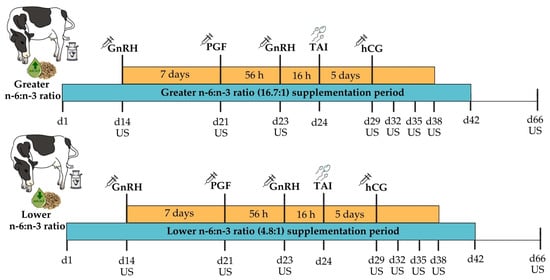
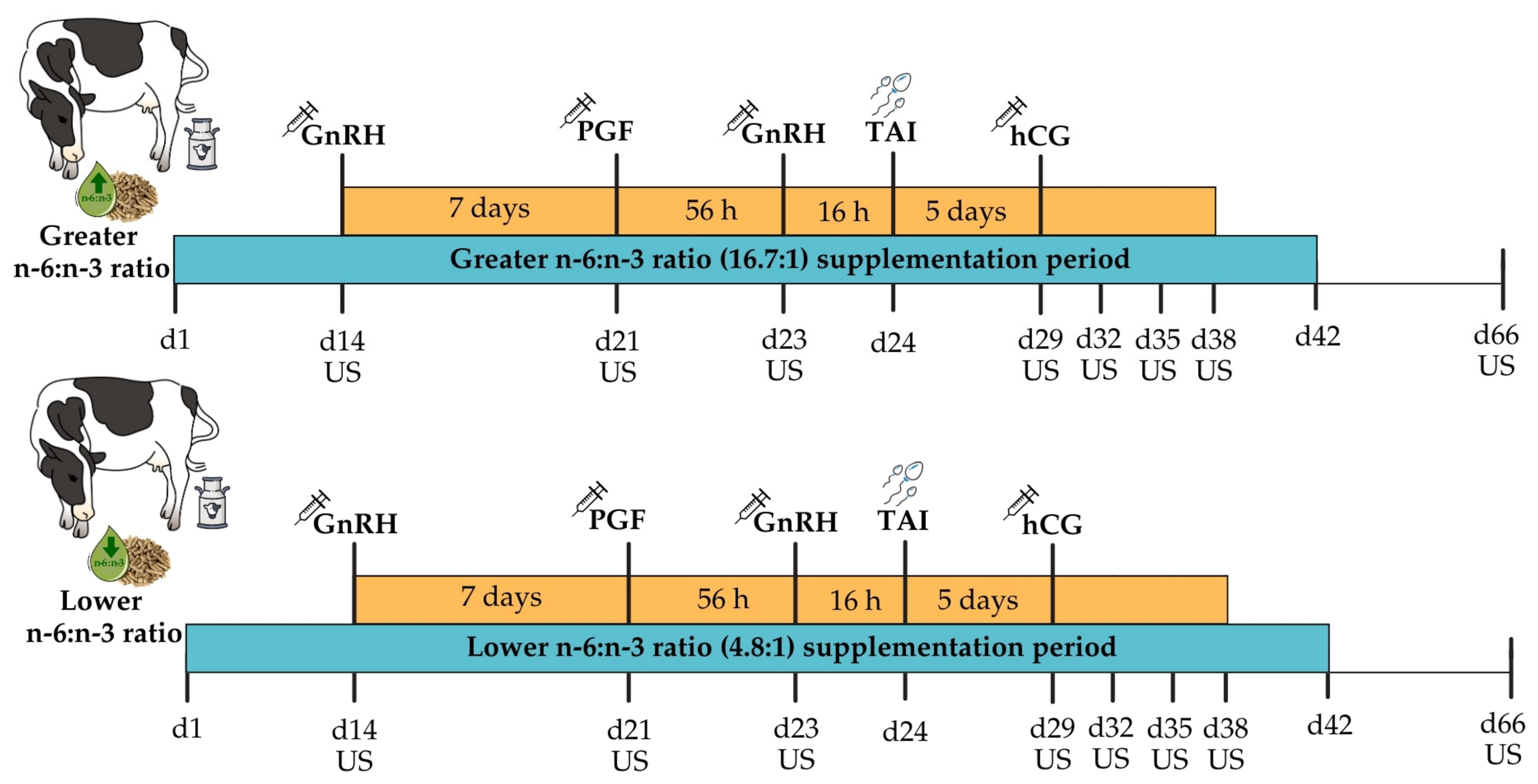
The reproductive synchronization and monitoring schedule are illustrated in Figure 1. On approximately day 14 of the experimental period, all cows commenced a modified Ovsynch protocol. This protocol began with an intramuscular injection of 10 µg of GnRH agonist (Buserelin; Receptal®, Intervet, Wellington, New Zealand). Seven days later (day 21), luteolysis was induced with 25 mg of PGF2α (Lutalyse®, Pfizer, New York, NY, USA). A second GnRH dose (10 µg) was administered 56 h after the PGF2α treatment (day 23), followed by timed artificial insemination (TAI) 16 h thereafter (day 24). To support the subsequent luteal phase and potential pregnancy, all cows received 1500 IU of hCG (Choluron®, Pfizer, New York, NY, USA) on day 29 (day 5 post-TAI) [10].
Figure 1.
Description of the experiment design indicating dietary treatments, modified Ovsynch protocol with TAI, and ultrasonographic evaluation schedule. US = ultrasonography; GnRH = gonadotropin releasing hormone (Receptal®); PGF = prostaglandin F2α (Lutalyse®); hCG = human chorionic gonadotropin (Chorulon®).
2.3. Data and Sample Collection
Feed intake was measured daily using the weigh-back method by recording the feed offered and refusals to calculate dry matter intake (DMI). Body weight (BW) and body condition score (BCS) were recorded weekly throughout the 42-day experimental period. BW was estimated using a heart-girth measuring tape after the morning milking, while BCS was assessed by a trained evaluator using a 5-point scale with 0.25-unit increments [25]. For a comprehensive metabolic assessment, DMI was also expressed as a percentage of BW and relative to metabolic body weight (g/kg BW0.75). Individual milk yield was recorded daily by weighing the milk collected during both morning and afternoon milking. Milk composition, including fat, protein, lactose, and somatic cell counts (SCC), was analyzed biweekly at the Veterinary Research and Development Center (Upper Northeastern Region), Khon Kaen, Thailand, using MilkoScan 7 RM (Foss Analytical A/S, Hillerod, Denmark). Fat-corrected milk (FCM) with 3.5% fat content was calculated as 0.4324 × milk yield (kg) + 16.218 × fat yield (kg). Energy-corrected milk (ECM) was calculated using the equation: ECM (kg/day) = Milk yield × (0.124 × fat% + 0.073 × protein% + 0.256), as recommended by NRC [9].
Ovarian activity was assessed using real-time B-mode ultrasonography with a 7.4 MHz transrectal probe (DUS 60 Vet, Edan, Shenzhen, China). Ovulation was confirmed by the disappearance of the dominant follicle and the subsequent formation of the corpus luteum (CL) following GnRH administration. CL diameter was measured using the internal calipers of the ultrasound machine from averaged longitudinal and transverse measurements. The CL cross-sectional area was calculated as previously described by Miura et al. [26] using the following formula: CL area = π/4 × (mean CL diameter)2. In cases where a cavity was present, the area was adjusted using the formula: CL area = π/4 × (mean CL diameter)2 − π/4 × (mean CL cavity diameter)2, where π = 3.1416. Corpus luteum volume was determined according to the methods described by Tortorella et al. [27] using the formula: CL volume = (4/3) × π × r3, where r represents the CL radius. Corpus luteum diameter was recorded in millimeters (mm), whereas CL area and volume were expressed in square centimeters (cm2) and cubic centimeters (cm3), respectively. Reproductive parameters, including ovulation, follicle size, luteolysis, and CL development, were evaluated on days 14, 21, and 23 of the experimental periods, and days 5, 8, 11, and 14 post-TAI (days 29, 32, 35, and 38 of the study). Conception was diagnosed on day 42 after TAI (day 66 of the study) via transrectal ultrasonography. Offspring sex and birth weight were recorded at parturition.
2.4. Statistical Analysis
All data were analyzed using SAS statistical software (version 9.0; SAS Institute Inc., Cary, NC, USA). For variables measured repeatedly over time, including DMI, BW, BCS, milk yield, milk composition, follicular size and CL measurements, data were analyzed using the MIXED procedure with repeated measures. The statistical model included treatment, time, the treatment × time interaction, and lactation block (1–2 vs. 3–4) as fixed effects, whereas cow nested within treatment was included as a random effect. The model used was the following:
where Yijkl is the observed value of the dependent variable, μ is the overall mean, Ti is the fixed effect of dietary treatment (i = 1 or 2), Lj is the fixed effect of lactation block (j = 1–2 or 3–4), Timek is the fixed effect of sampling time, (T × Time)ik is the treatment × time interaction, C(T)il is the random effect of cow nested within treatment, and εijkl is the random error term. Residuals from all models were examined graphically to verify assumptions of normality and homogeneity of variance. For repeated-measures analyses, several covariance structures were evaluated, and the structure with the lowest Akaike information criterion (AIC) was selected to account for within-cow correlations over time.
Yijkl = μ + Ti + Lj + Timek + (T × Time)ik + C(T)il + εijkl
Binary reproductive outcomes, including synchronized ovulation rate, luteolysis, pregnancy rate, and offspring sex ratio, were analyzed using the GLIMMIX procedure with a binomial distribution and logit link function, including treatment and lactation blocks as fixed effects. Continuous variables measured once were analyzed using the MIXED procedure of SAS described by Steel et al. [28]. A preliminary evaluation of farm effects was conducted by including farm and the farm × treatment interaction as random effects in the model. Because farm-related variance was minimal and non-significant (p > 0.05), the farm effect was thus excluded from the statistical model. This supports the assumption that, under the standardized cooperative management system, between-farm variation was minimal and did not contribute significantly to outcome variability. The results are presented as least squares means (LSMeans) ± standard error of the mean (SEM). Differences among treatments were evaluated using Tukey’s honestly significant difference adjustment via the PDIFF option of SAS to control for Type I error due to multiple comparisons. Statistical significance was declared at p < 0.05, whereas tendencies were discussed at 0.05 ≤ p < 0.10.
3. Results
3.1. Feed Intake, Body Weight, and Body Condition Score
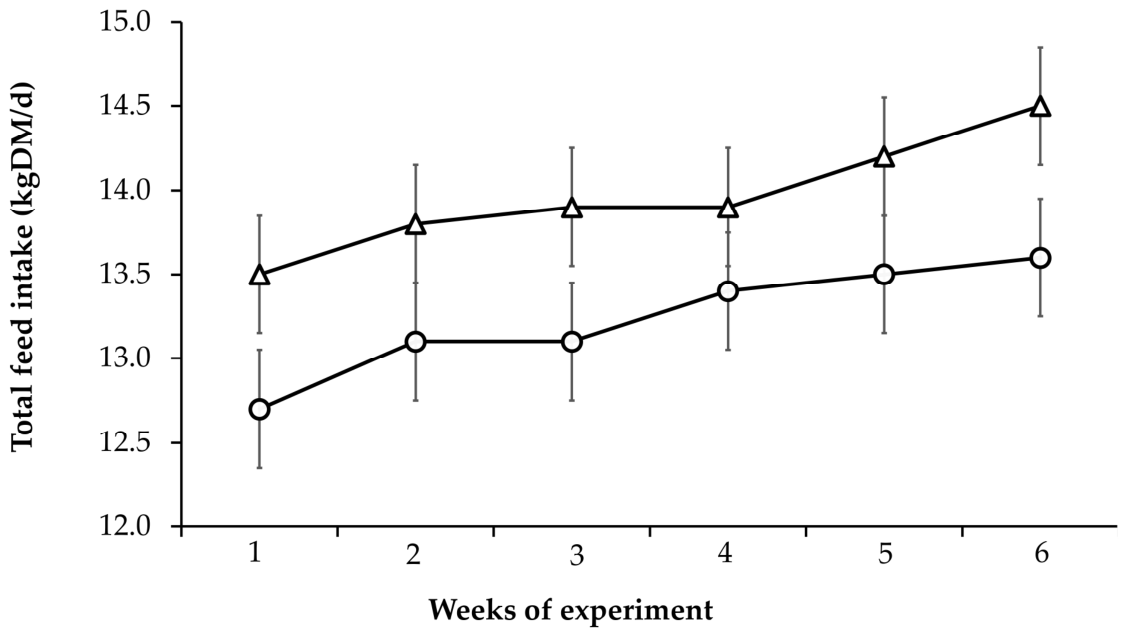
The effects of different dietary n-6:n-3 ratio during timed AI on DMI, BW, and BCS are presented in Table 2 and Figure 2. Overall, the average DMI of concentrate, roughage, and total intake did not differ significantly between greater n-6:n-3 and lower n-6:n-3 groups when expressed as absolute intake (kg/d), percentage of BW (% BW), or relative to metabolic body weight (g/kg BW0.75) (p ≥ 0.13; Table 2).
Table 2.
Effect of greater and lower dietary n-6:n-3 ratios on dry matter intake, body weight, and body condition score in lactating dairy cows.
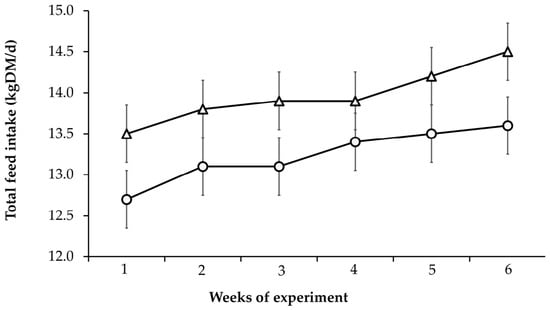
Figure 2.
Total feed intake in dairy cows supplemented with greater dietary n-6:n-3 ratio (16.7:1) (∆) or lower dietary n-6:n-3 ratio (4.8:1) (⃝). Week had a significant effect (p < 0.0001). Treatment tended to affect DMI (p = 0.0989), whereas the treatment × week interaction was not significant (p > 0.05). The error bars represent SEM.
However, longitudinal analysis of weekly total DMI revealed a tendency for a treatment effect (p = 0.09; Figure 2), with cows in the lower n-6:n-3 group consistently maintaining numerically higher intake levels throughout the 6-week experimental period compared to the greater n-6:n-3 group. A significant effect of week was observed for total DMI (p < 0.0001), reflecting a progressive increase in feed consumption over time in both groups. However, no significant treatment x week interaction was detected (p > 0.05), indicating that the pattern of DMI increase over time was similar across both dietary treatments. For the actual intake of fatty acids, we evaluated based on only concentrate intake; for example, cows in the greater n-6:n-3 group consumed 7.82 kg of concentrate, and the actual intake of fatty acids (n-3 and n-6) was 66.2 g/day, whereas cows in group II consumed 8.30 kg of concentrate, with an actual intake of fatty acids (n-3 and n-6) of 64.7 g/day.
Body weight and BCS were not affected by dietary treatment, indicating that both diets similarly maintained body reserves during the breeding period.
3.2. Milk Yield and Composition
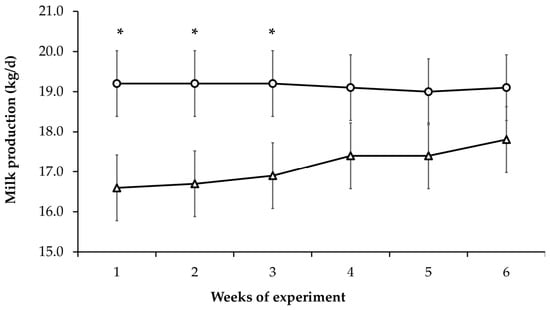
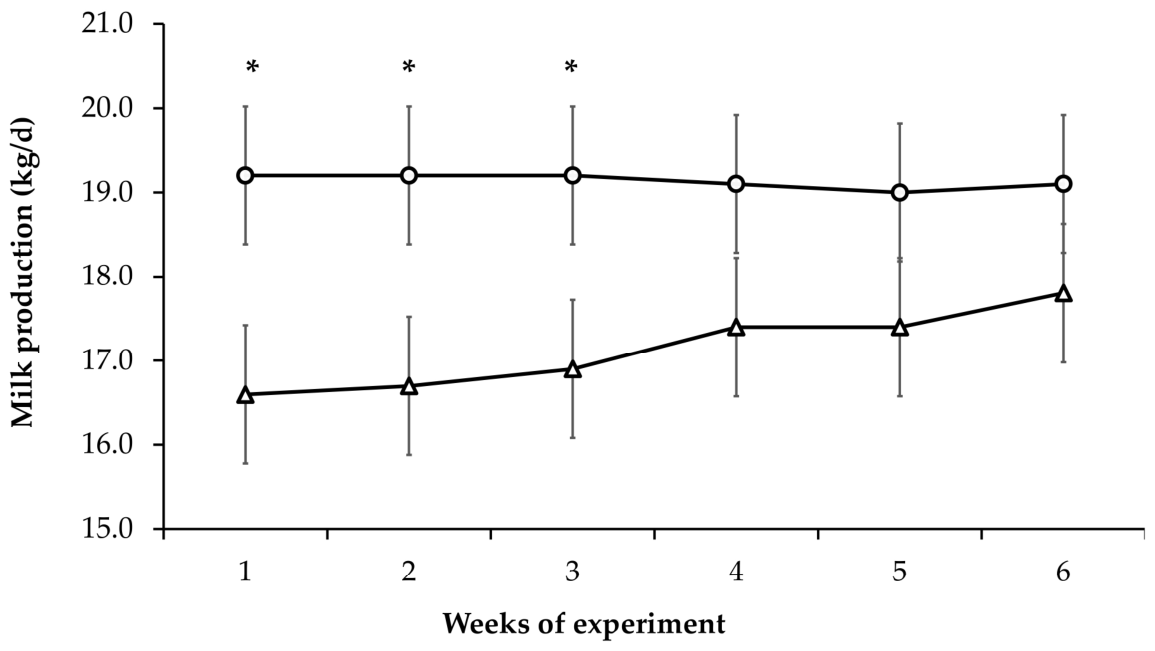
The effects of dietary n-6:n-3 ratio on milk yield and composition are summarized in Table 3 and Figure 3. Cows supplemented with a lower n-6:n-3 diet showed a tendency toward a higher daily milk yield compared to the greater n-6:n-3 group (+1.90 kg/d; approximately 11%; p = 0.08). Weekly analysis demonstrated a significant treatment × week interaction (p = 0.03), with greater milk production observed in the lower n-6:n-3 group during the first three weeks of supplementation (p < 0.05; Figure 3).
Table 3.
Effects of greater and lower dietary n-6:n-3 ratios on milk yield and composition in lactating dairy cows.
Figure 3.
Milk yield in dairy cows supplemented with greater dietary n-6:n-3 ratio (16.7:1) (∆) or lower dietary n-6:n-3 ratio (4.8:1) (⃝). A significant treatment × week interaction was observed (p = 0.03). Asterisks (*) indicate weeks in which milk production differed between treatments (p < 0.05). The error bars represent SEM.
Milk fat, protein, lactose, solids-not-fat (SNF), total solids, and SCC were not affected by treatment (p ≥ 0.48). However, cows receiving the lower n-6:n-3 diet produced a greater lactose yield (+17%; p = 0.03) and SNF yield (+15%; p = 0.05), with a tendency toward a higher protein yield (+13%; p = 0.10). These responses were primarily associated with increased milk production rather than changes in milk composition percentages.
3.3. Ovarian Dynamics, Reproductive Performance, and Offspring Characteristics
The effects of dietary n-6:n-3 ratios on ovarian dynamics, pregnancy outcomes, and offspring characteristics are summarized in Table 4 and Table 5. Dietary treatment did not affect synchronized ovulation rate, luteolysis, pre-ovulatory follicle diameter, or the amount of CL during the post-TAI period (p > 0.05; Table 4). Similarly, CL diameter was largely unaffected, although cows receiving the lower n-6:n-3 diet tended to exhibit larger CL diameter on days 11 (p = 0.05) and 14 (p = 0.10) post-TAI.
Table 4.
Effect of treatment on fertility parameters of dairy cows.
Table 5.
Reproductive performance, pregnancy rate per AI, offspring sex ratio and birth weight of offspring from cows supplemented with greater and lower dietary n-6:n-3 ratio.
In contrast, luteal morphometric parameters during the late luteal phase were enhanced in cows fed the lower n-6:n-3 diet. Compared with the greater n-6:n-3 group, cows receiving the lower ratio diet exhibited approximately 22% greater CL cross-sectional area on day 11 and 18% greater area on day 14 post-TAI. Likewise, CL volume increased by approximately 33% on day 11 and 30% on day 14 (p ≤ 0.03), indicating enhanced luteal development in response to the lower dietary n-6:n-3 ratio.
These findings suggest enhanced luteal development in cows fed the lower dietary n-6:n-3 ratio. However, CL morphometric responses should be interpreted as indicators of luteal development rather than direct evidence of improved fertility, as pregnancy outcomes and number of services per conception were not significantly different between treatments.
Pregnancy outcomes, including pregnancy rate at first AI, cumulative pregnancy rate, and number of services per conception, were not significantly affected by dietary n-6:n-3 ratio (p ≥ 0.37; Table 5). However, dietary treatment was associated with differences in certain offspring characteristics. The proportion of female offspring was numerically greater in cows receiving the lower dietary n-6:n-3 ratio diet (66.67%; 18/27) than in cows receiving the greater dietary n-6:n-3 ratio diet (42.90%; 12/28), although this response represented only a statistical tendency (p = 0.09). In addition, offspring birth weight was significantly greater in cows supplemented with the lower dietary n-6:n-3 ratio diet compared with the greater dietary n-6:n-3 ratio diet (+1.58 kg; approximately 5%; p = 0.02).
4. Discussion
The present study demonstrated that reducing the dietary n-6:n-3 ratio to 4.8:1 through rumen-protected n-3 supplementation was associated with differences in milk production and luteal morphometric characteristics in dairy cows. In addition, cows receiving the lower dietary n-6:n-3 ratio exhibited a tendency toward a greater proportion of female offspring and significantly greater offspring birth weight.
4.1. Feed Intake and Lactation Performance
Our results indicate that the lower dietary n-6:n-3 ratio did not adversely affect total DMI, suggesting that supplementation with rumen-protected (bypass) fat was well tolerated under the conditions of the present study. Previous studies have reported inconsistent effects of unsaturated fatty acid supplementation on DMI [29,30]. However, our findings are consistent with Huang et al. [31], who observed no effect of flaxseed supplementation on DMI. Similarly, a meta-analysis by Leduc et al. [32] and studies by Do Prado et al. [33] and Isenberg et al. [34] suggested that the effects of fatty acid supplementation on feed intake may depend on the source, form, and inclusion level of dietary fat. In the present study, the dietary fat inclusion level was likely insufficient to negatively affect feed intake or rumen function.
Longitudinal analysis revealed a tendency for cows receiving the lower n-6:n-3 ratio diet to maintain greater total DMI throughout the experimental period. Previous studies have suggested that n-3 PUFA supplementation may influence nutrient metabolism and feeding responses [35]. In that study, improved DMI was associated with alterations in rumen microbiota abundance and hepatic gene expression related to nutrient metabolism and taste transduction pathways. However, these physiological and molecular mechanisms were not directly evaluated in the present study. Moreover, previous reports by Petit et al. [36] and Zachut et al. [37] also noted that cows fed diets rich in unsaturated fatty acids (FA) showed higher DMI and milk yield compared to those fed saturated FA. However, the effect of n-3 PUFA on intake remains variable across the literature; for instance, Chilliard et al. [38] reported a decrease in DMI with high levels of extruded flaxseed in late lactation. These inconsistencies likely stem from differences in supplement concentration, the lactation stage of the cows, or interactions between dietary supplements and other components [35,38].
Regarding lactation performance, cows supplemented with the lower n-6:n-3 ratio diet also exhibited an approximately 11% greater milk yield compared with cows receiving the greater n-6:n-3 ratio group. This production boost corroborates the dramatic increase in milk production reported by Sun et al. [35] and findings by Moallem et al. [39]. While Huang et al. [31] observed no significant effect on milk yield in their specific dietary setup, they noted that the high energy content of flaxseed oil can often balance dietary energy, but this effect is highly dependent on the basal diet type. In contrast, our study found a significant elevation in lactose yield and SNF yield in the lower n-6:n-3 ratio group.
Physiologically, lactose serves as the primary osmotic regulator of milk volume by drawing water into the mammary alveolar lumen through osmotic pressure. Consequently, the greater lactose yield observed in cows receiving the lower dietary n-6:n-3 ratio may partially explain the increased milk yield observed in this group. Previous studies have suggested that n-3 PUFAs may influence nutrient partitioning and mammary metabolic activity during lactation [13]; however, the underlying physiological mechanisms were not directly evaluated in the present study. Furthermore, the increase in milk production occurred without marked differences in BW and final BCS between treatments, suggesting that cows supplemented with the lower dietary n-6:n-3 ratio maintained lactational performance without apparent negative effects on body reserves. Collectively, these findings suggest that dietary fatty acid composition may contribute to differences in lactational responses in dairy cows.
4.2. Ovarian Dynamics and Corpus Luteum Development
Dietary treatment did not affect synchronized ovulation rate, luteolysis, pre-ovulatory follicle diameter, or the number of CL during the post-TAI period. Likewise, no differences in CL morphometry were observed during the early luteal phase (days 5 to 8 post-TAI). However, cows receiving the lower dietary n-6:n-3 ratio exhibited greater CL cross-sectional area and volume during the mid-to-late luteal phase (days 11 to 14 post-TAI), indicating enhanced luteal development.
Compared with cows receiving the greater dietary n-6:n-3 ratio, cows fed the lower dietary n-6:n-3 ratio showed approximately 22% greater CL cross-sectional area on day 11 and 18% greater area on day 14 post-TAI. Similarly, CL volume increased by approximately 33% on day 11 and 30% on day 14. Previous studies have suggested that n-3 PUFAs may influence luteal function through alterations in prostaglandin synthesis and progesterone secretion [11,40]. However, circulating progesterone concentrations were not measured in the present study; therefore, the observed changes in CL morphometry should be interpreted as indicators of altered luteal development rather than direct evidence of enhanced luteal function or fertility. Although CL size and volume measured on days 5 to 14 post-TAI do not directly assess luteal function and therefore cannot fully predict fertility outcomes, these parameters are widely recognized as important indicators of luteal development and reproductive performance in lactating dairy cows [41,42]. Previous studies have also suggested that n-3 fatty acids may alter prostaglandin synthesis pathways through competitive interactions with arachidonic acid, potentially contributing to CL maintenance during the luteal phase [43,44]. However, because hormonal and inflammatory biomarkers were not evaluated in the present study, these mechanisms remain speculative.
Although cows receiving the lower dietary n-6:n-3 ratio exhibited greater CL cross-sectional area and volume during the luteal phase, these responses did not translate into significant differences in pregnancy outcomes in the present study. The absence of significant differences in conception rates may have been influenced by factors such as the duration of supplementation or sample size, as some previous studies reporting reproductive benefits used longer supplementation periods [45]. Nevertheless, offspring birth weight was greater in cows receiving the lower dietary n-6:n-3 ratio diet, suggesting that maternal fatty acid composition may influence certain aspects of offspring development. However, because circulating P4 concentrations, PGF2α secretion, inflammatory responses, and metabolic biomarkers were not directly evaluated in the present study, the biological mechanisms underlying these responses remain unclear. Future studies incorporating endocrine, inflammatory, and molecular assessments are warranted to better characterize the mechanistic effects of dietary n-6:n-3 fatty acid ratios on luteal function and reproductive physiology in dairy cows.
4.3. Maternal Nutrition and Offspring Sex Ratio
Maternal dietary fatty acid composition was associated with differences in certain offspring characteristics in the present study. Cows receiving the lower dietary n-6:n-3 ratio produced offspring with significantly greater birth weight compared with cows receiving the greater dietary n-6:n-3 ratio. In addition, the proportion of female offspring was numerically greater in cows receiving the lower n-6:n-3 ratio, although this response represented only a statistical tendency (p = 0.09).
Previous studies have suggested that maternal nutritional and physiological status may influence offspring sex ratio, as proposed by the Trivers–Willard hypothesis [46]. The numerically greater proportion of female offspring observed in cows receiving the lower dietary n-6:n-3 ratio is consistent with previous reports suggesting that dietary fatty acid composition may contribute to variation in offspring sex ratio [22]. However, because the observed response did not reach statistical significance and the sample size was relatively limited, these findings should be interpreted with caution.
Dietary fatty acid composition may influence the reproductive environment and potentially contribute to variation in offspring sex ratio [47]. In addition, embryonic developmental responses may differ according to sex and sensitivity to the maternal environment [43]. Potential mechanisms may involve alterations in prostaglandin metabolism and inflammatory responses during early embryonic development. However, as oxidative stress markers, embryonic development, and molecular pathways were not directly evaluated in this study, these proposed mechanisms remain unclear.
Furthermore, the greater offspring birth weight observed in cows receiving the lower dietary n-6:n-3 ratio may indicate potential effects of maternal nutrition on fetal growth and development. Previous studies have suggested that long-chain PUFAs, including DHA and EPA, contribute to fetal tissue development and may influence placental function and nutrient transfer during gestation [7,48,49,50]. However, placental function, gene expression, and metabolic biomarkers were not evaluated in the present study; therefore, the biological mechanisms underlying these responses remain unclear.
Overall, the present findings suggest that supplementation with a lower dietary n-6:n-3 ratio was associated with differences in milk production, luteal morphometry, and offspring birth weight in dairy cows. Although enhanced CL development was observed during the mid-to-late luteal phase, pregnancy outcomes were not significantly different between treatments. In addition, cows receiving the lower dietary n-6:n-3 ratio produced offspring with greater birth weight and a numerically greater proportion of female offspring, although the latter response represented only a statistical tendency. Further studies with larger sample sizes and direct evaluation of endocrine, inflammatory, and developmental mechanisms are warranted to clarify the biological significance of these findings.
5. Conclusions
We have demonstrated that reducing the dietary n-6:n-3 ratio from 16.7:1 to 4.8:1 during a timed AI program (42 days) was associated with enhanced luteal growth during the mid-to-late luteal phase in lactating dairy cows. Cows receiving the lower n-6:n-3 ratio diet exhibited greater CL volume and cross-sectional area on days 11 and 14 post-TAI, tended to produce a greater proportion of female offspring, and produced calves with greater birth weights compared with cows receiving the greater n-6:n-3 ratio diet. The dietary fatty acids may modulate sex determination and early fetal programming. However, the underlying physiological mechanisms remain unclear. In summary, these findings indicate that a significance of PUFA (lower n-6:n-3 ratio) plays important roles in both metabolic and utero-ovarian functions. An optimal fatty acid ratio or requirement may be taken into account for a precise feeding pattern of PUFA for specific physiological stages. Further research is required to clarify the underlying physiological mechanisms associated with altered luteal development and offspring characteristics.
Author Contributions
Conceptualization, J.N., P.N., T.N., J.P., and C.N.; methodology, J.N., S.N., P.N., T.N., J.P., N.L., and C.N.; software, J.N. and C.N.; validation, J.N. and C.N.; formal analysis, J.N. and C.N.; investigation, J.N., S.N., N.L., and C.N.; resources, J.N. and C.N.; data curation, C.N. and J.N.; writing—original draft preparation, J.N.; writing—review and editing, J.N. and C.N.; visualization, J.N. and C.N.; supervision, C.N.; project administration, J.N. and C.N.; funding acquisition, C.N. All authors have read and agreed to the published version of the manuscript.
Funding
This research was funded by the Fundamental Fund (funding no. 2023) of Khon Kaen University, supported by the National Science, Research and Innovation Fund (NSRF). Juthamas Nabthonglang received a scholarship from the National Research Council of Thailand (NRCT) through the Royal Golden Jubilee Ph.D. Program (Grant No. N41A661105). Betagro Public Company Limited, Thailand, provided in-kind support in the form of the concentrate diet used in the experiment.
Institutional Review Board Statement
The study was reviewed and approved by the Institutional Animal Care and Use Committee (IACUC) of Khon Kaen University, in accordance with the Ethics of Animal Experimentation guidelines established by the National Research Council of Thailand. Approval record no. IACUC-KKU-141/67; reference no. 660201.2.31/10 (146); Approval date: 21 November 2024.
Informed Consent Statement
Not applicable.
Data Availability Statement
The data presented in this study are available from the corresponding author upon reasonable request. Due to institutional regulations related to the author’s doctoral thesis, the dataset will not be publicly available until the thesis evaluation process is completed. It may be made publicly available thereafter.
Acknowledgments
The authors would like to express our sincere gratitude to the dairy farm owners for providing the dairy cows in this study. We deeply appreciate the Department of Animal Science, Faculty of Agriculture, Khon Kaen University, for providing research facilities and technical support. We are also grateful to Betagro Public Company Limited, Thailand, for providing the concentrate diet used in the experiment. This manuscript was edited for clarity and style with the assistance of ChatGPT 5 (OpenAI, San Francisco, CA, USA), which was used solely to improve grammar and readability. The authors reviewed and approved all content.
Conflicts of Interest
The authors declare that this study received in-kind support from Betagro Public Company Limited, Thailand. The funder had no role in the design of the study; in the collection, analysis, or interpretation of data; in the writing of the manuscript; or in the decision to publish the results.
References
- Diniso, Y.S.; Jaja, I.F. A Retrospective Survey of the Factors Responsible for Culling and Mortality in Dairy Farms in the Eastern Cape Province, South Africa. Sci. Afr. 2021, 12, e00838. [Google Scholar] [CrossRef] [Scilit]
- Sheldon, I.M.; Cronin, J.G.; Bromfield, J.J. Tolerance and Innate Immunity Shape the Development of Postpartum Uterine Disease and the Impact of Endometritis in Dairy Cattle. Annu. Rev. Anim. Biosci. 2019, 7, 361–384. [Google Scholar] [CrossRef] [Scilit]
- Wiltbank, M.C.; Baez, G.M.; Garcia-Guerra, A.; Toledo, M.Z.; Monteiro, P.L.; Melo, L.F.; Ochoa, J.C.; Santos, J.E.; Sartori, R. Pivotal Periods for Pregnancy Loss during the First Trimester of Gestation in Lactating Dairy Cows. Theriogenology 2016, 86, 239–253. [Google Scholar] [CrossRef] [Scilit] [PubMed]
- Crouse, M.S.; Greseth, N.P.; McLean, K.J.; Crosswhite, M.R.; Pereira, N.N.; Ward, A.K.; Reynolds, L.P.; Dahlen, C.R.; Neville, B.W.; Borowicz, P.P. Maternal Nutrition and Stage of Early Pregnancy in Beef Heifers: Impacts on Hexose and AA Concentrations in Maternal and Fetal Fluids. J. Anim. Sci. 2019, 97, 1296–1316. [Google Scholar] [CrossRef] [Scilit] [PubMed]
- Mekuriaw, Y. Negative Energy Balance and Its Implication on Productive and Reproductive Performance of Early Lactating Dairy Cows: Review Paper. J. Appl. Anim. Res. 2023, 51, 220–228. [Google Scholar] [CrossRef] [Scilit]
- Fabjanowska, J.; Kowalczuk-Vasilev, E.; Klebaniuk, R.; Milewski, S.; Gümüş, H. N-3 Polyunsaturated Fatty Acids as a Nutritional Support of the Reproductive and Immune System of Cattle—A Review. Animals 2023, 13, 3589. [Google Scholar] [CrossRef] [Scilit] [PubMed]
- Zeng, X.; Li, S.; Liu, L.; Cai, S.; Ye, Q.; Xue, B.; Wang, X.; Zhang, S.; Chen, F.; Cai, C.; et al. Role of Functional Fatty Acids in Modulation of Reproductive Potential in Livestock. J. Anim. Sci. Biotechnol. 2023, 14, 24. [Google Scholar] [CrossRef] [Scilit] [PubMed]
- Bionaz, M.; Vargas-Bello-Pérez, E.; Busato, S. Advances in Fatty Acids Nutrition in Dairy Cows: From Gut to Cells and Effects on Performance. J. Anim. Sci. Biotechnol. 2020, 11, 110. [Google Scholar] [CrossRef] [Scilit] [PubMed]
- Thatcher, W.; Santos, J.E.P.; Staples, C.R. Dietary Manipulations to Improve Embryonic Survival in Cattle. Theriogenology 2011, 76, 1619–1631. [Google Scholar] [CrossRef] [Scilit] [PubMed]
- Schmitz, G.; Ecker, J. The Opposing Effects of n − 3 and n − 6 Fatty Acids. Prog. Lipid Res. 2008, 47, 147–155. [Google Scholar] [CrossRef] [Scilit] [PubMed]
- Santos, J.; Bilby, T.; Thatcher, W.; Staples, C.; Silvestre, F. Long Chain Fatty Acids of Diet as Factors Influencing Reproduction in Cattle. Reprod. Domest. Anim. 2008, 43, 23–30. [Google Scholar] [CrossRef] [Scilit] [PubMed]
- Domingues, R.R.; Andrade, J.P.N.; Cunha, T.O.; Madureira, G.; Moallem, U.; Gomez-Leon, V.; Martins, J.P.N.; Wiltbank, M.C. Is Pregnancy Loss Initiated by Embryonic Death or Luteal Regression? Profiles of Pregnancy-Associated Glycoproteins during Elevated Progesterone and Pregnancy Loss. JDS Commun. 2023, 4, 149–154. [Google Scholar] [CrossRef] [Scilit] [PubMed]
- Moallem, U. Invited Review: Roles of Dietary n-3 Fatty Acids in Performance, Milk Fat Composition, and Reproductive and Immune Systems in Dairy Cattle. J. Dairy Sci. 2018, 101, 8641–8661. [Google Scholar] [CrossRef] [Scilit] [PubMed]
- Silvestre, F.T.; Carvalho, T.S.M.; Crawford, P.C.; Santos, J.E.P.; Staples, C.R.; Jenkins, T.; Thatcher, W.W. Effects of Differential Supplementation of Fatty Acids during the Peripartum and Breeding Periods of Holstein Cows: II. Neutrophil Fatty Acids and Function, and Acute Phase Proteins. J. Dairy Sci. 2011, 94, 2285–2301. [Google Scholar] [CrossRef] [Scilit] [PubMed]
- Calder, P.C. Long-Chain Fatty Acids and Inflammation. Proc. Nutr. Soc. 2012, 71, 284–289. [Google Scholar] [CrossRef] [Scilit] [PubMed]
- Thangavelu, G.; Colazo, M.G.; Ambrose, D.J.; Oba, M.; Okine, E.K.; Dyck, M.K. Diets Enriched in Unsaturated Fatty Acids Enhance Early Embryonic Development in Lactating Holstein Cows. Theriogenology 2007, 68, 949–957. [Google Scholar] [CrossRef] [Scilit] [PubMed]
- Giller, K.; Drews, B.; Berard, J.; Kienberger, H.; Schmicke, M.; Frank, J.; Spanier, B.; Daniel, H.; Geisslinger, G.; Ulbrich, S.E. Bovine Embryo Elongation Is Altered Due to Maternal Fatty Acid Supplementation. Biol. Reprod. 2018, 99, 600–610. [Google Scholar] [CrossRef] [Scilit] [PubMed]
- Sinedino, L.D.P.; Honda, P.; Souza, L.; Lock, A.; Boland, M.; Staples, C.; Thatcher, W.; Santos, J. Effects of Supplementation with Docosahexaenoic Acid on Reproduction of Dairy Cows. Reproduction 2017, 153, 707–723. [Google Scholar] [CrossRef] [Scilit] [PubMed]
- Ambrose, D.J.; Kastelic, J.P.; Corbett, R.; Pitney, P.A.; Petit, H.V.; Small, J.A.; Zalkovic, P. Lower Pregnancy Losses in Lactating Dairy Cows Fed a Diet Enriched in α-Linolenic Acid. J. Dairy Sci. 2006, 89, 3066–3074. [Google Scholar] [CrossRef] [Scilit] [PubMed]
- Iwata, H. Factors Affecting the Primary Sex Ratio in Cows. J. Mamm. Ova Res. 2012, 29, 96–102. [Google Scholar] [CrossRef] [Scilit]
- Seidel, G.E.; Schenk, J.L. Pregnancy Rates in Cattle with Cryopreserved Sexed Sperm: Effects of Sperm Numbers per Inseminate and Site of Sperm Deposition. Anim. Reprod. Sci. 2008, 105, 129–138. [Google Scholar] [CrossRef] [Scilit] [PubMed]
- Marei, W.F.A.; Khalil, W.A.; Pushpakumara, A.P.G.; El-Harairy, M.A.; Abo El-Atta, A.M.A.; Wathes, D.C.; Fouladi-Nashta, A. Polyunsaturated Fatty Acids Influence Offspring Sex Ratio in Cows. Int. J. Vet. Sci. Med. 2018, 6, S36–S40. [Google Scholar] [CrossRef] [Scilit] [PubMed]
- Montgomery, D.C. Design and Analysis of Experiments, 9th ed.; John Wiley & Sons, Inc.: New York, NY, USA, 2017. [Google Scholar]
- AOAC. Official Methods of Analysis, 16th ed.; Association of Official Analytical Chemists: Washington, DC, USA, 1995. [Google Scholar]
- Jones, C.; Heinrichs, J. Learn To Score Body Condition. Available online: https://extension.psu.edu/learn-to-score-body-condition (accessed on 16 March 2022).
- Miura, R.; Haneda, S.; Matsui, M. Ovulation of the Preovulatory Follicle Originating from the First-Wave Dominant Follicle Leads to Formation of an Active Corpus Luteum. J. Reprod. Dev. 2015, 61, 317–323. [Google Scholar] [CrossRef] [Scilit] [PubMed]
- Dorneles Tortorella, R.; Ferreira, R.; Tonellotto dos Santos, J.; Silveira de Andrade Neto, O.; Barreta, M.H.; Oliveira, J.F.; Gonçalves, P.B.; Pereira Neves, J. The Effect of Equine Chorionic Gonadotropin on Follicular Size, Luteal Volume, Circulating Progesterone Concentrations, and Pregnancy Rates in Anestrous Beef Cows Treated with a Novel Fixed-Time Artificial Insemination Protocol. Theriogenology 2013, 79, 1204–1209. [Google Scholar] [CrossRef] [Scilit] [PubMed]
- Steel, R.G.D.; Torrie, J.H.; Dicky, D.A. Principles and Procedures of Statistics, A Biometrical Approach, 3rd ed.; McGraw Hill, Inc. Book Co.: New York, NY, USA, 1997. [Google Scholar]
- Allred, S.L.; Dhiman, T.R.; Brennand, C.P.; Khanal, R.C.; McMahon, D.J.; Luchini, N.D. Milk and Cheese from Cows Fed Calcium Salts of Palm and Fish Oil Alone or in Combination with Soybean Products. J. Dairy Sci. 2006, 89, 234–248. [Google Scholar] [CrossRef] [Scilit] [PubMed]
- National Research Council (NRC). Nutrient Requirements of Dairy Cattle, 7th ed.; The National Academies Press: Washington, DC, USA, 2001. [Google Scholar]
- Huang, G.; Wang, J.; Liu, K.; Wang, F.; Zheng, N.; Zhao, S.; Qu, X.; Yu, J.; Zhang, Y.; Wang, J. Effect of Flaxseed Supplementation on Milk and Plasma Fatty Acid Composition and Plasma Parameters of Holstein Dairy Cows. Animals 2022, 12, 1898. [Google Scholar] [CrossRef] [Scilit] [PubMed]
- Leduc, M.; Létourneau-Montminy, M.-P.; Gervais, R.; Chouinard, P.Y. Effect of Dietary Flax Seed and Oil on Milk Yield, Gross Composition, and Fatty Acid Profile in Dairy Cows: A Meta-Analysis and Meta-Regression. J. Dairy Sci. 2017, 100, 8906–8927. [Google Scholar] [CrossRef] [Scilit] [PubMed]
- Do Prado, R.M.; Palin, M.F.; Do Prado, I.N.; Dos Santos, G.T.; Benchaar, C.; Petit, H.V. Milk Yield, Milk Composition, and Hepatic Lipid Metabolism in Transition Dairy Cows Fed Flaxseed or Linola. J. Dairy Sci. 2016, 99, 8831–8846. [Google Scholar] [CrossRef] [Scilit] [PubMed]
- Isenberg, B.J.; Soder, K.J.; Pereira, A.B.D.; Standish, R.; Brito, A.F. Production, Milk Fatty Acid Profile, and Nutrient Utilization in Grazing Dairy Cows Supplemented with Ground Flaxseed. J. Dairy Sci. 2019, 102, 1294–1311. [Google Scholar] [CrossRef] [Scilit] [PubMed]
- Sun, X.; Guo, C.; Wang, Q.; Zhang, Y.; Wang, Z.; Cao, Z.; Wang, W.; Li, S. Dietary N-3 Polyunsaturated Fatty Acids Enhance Dry Matter Intake in Transition Cows by Regulating Taste Transduction Gene Expression in the Liver Associated with Rumen Microbial Alteration. Anim. Nutr. 2025, 22, 502–513. [Google Scholar] [CrossRef] [Scilit] [PubMed]
- Petit, H.V.; Palin, M.F.; Doepel, L. Hepatic Lipid Metabolism in Transition Dairy Cows Fed Flaxseed. J. Dairy Sci. 2007, 90, 4780–4792. [Google Scholar] [CrossRef] [Scilit] [PubMed]
- Zachut, M.; Arieli, A.; Lehrer, H.; Livshitz, L.; Yakoby, S.; Moallem, U. Effects of Increased Supplementation of N-3 Fatty Acids to Transition Dairy Cows on Performance and Fatty Acid Profile in Plasma, Adipose Tissue, and Milk Fat. J. Dairy Sci. 2010, 93, 5877–5889. [Google Scholar] [CrossRef] [Scilit] [PubMed]
- Chilliard, Y.; Martin, C.; Rouel, J.; Doreau, M. Milk Fatty Acids in Dairy Cows Fed Whole Crude Linseed, Extruded Linseed, or Linseed Oil, and Their Relationship with Methane Output. J. Dairy Sci. 2009, 92, 5199–5211. [Google Scholar] [CrossRef] [Scilit] [PubMed]
- Moallem, U.; Lehrer, H.; Livshits, L.; Zachut, M. The Effects of Omega-3 α-Linolenic Acid from Flaxseed Oil Supplemented to High-Yielding Dairy Cows on Production, Health, and Fertility. Livest. Sci. 2020, 242, 104302. [Google Scholar] [CrossRef] [Scilit]
- Dirandeh, E.; Towhidi, A.; Ansari Pirsaraei, Z.; Adib Hashemi, F.; Ganjkhanlou, M.; Zeinoaldini, S.; Rezaei Roodbari, A.; Saberifar, T.; Petit, H.V. Plasma Concentrations of PGFM and Uterine and Ovarian Responses in Early Lactation Dairy Cows Fed Omega-3 and Omega-6 Fatty Acids. Theriogenology 2013, 80, 131–137. [Google Scholar] [CrossRef] [Scilit] [PubMed]
- Martins, J.P.N.; Wang, D.; Mu, N.; Rossi, G.F.; Martini, A.P.; Martins, V.R.; Pursley, J.R. Level of Circulating Concentrations of Progesterone during Ovulatory Follicle Development Affects Timing of Pregnancy Loss in Lactating Dairy Cows. J. Dairy Sci. 2018, 101, 10505–10525. [Google Scholar] [CrossRef] [Scilit] [PubMed]
- Choi, W.; Ro, Y.; Choe, E.; Hong, L.; Lee, W.; Kim, D. Evaluation of Corpus Luteum and Plasma Progesterone the Day before Embryo Transfer as an Index for Recipient Selection in Dairy Cows. Vet. Sci. 2023, 10, 262. [Google Scholar] [CrossRef] [Scilit] [PubMed]
- Doyle, D.N.; Lonergan, P.; Diskin, M.G.; Pierce, K.M.; Kelly, A.K.; Stanton, C.; Waters, S.M.; Parr, M.H.; Kenny, D.A. Effect of Dietary N-3 Polyunsaturated Fatty Acid Supplementation and Post-Insemination Plane of Nutrition on Systemic Concentrations of Metabolic Analytes, Progesterone, Hepatic Gene Expression and Embryo Development and Survival in Beef Heifers. Theriogenology 2019, 127, 102–113. [Google Scholar] [CrossRef] [Scilit] [PubMed]
- Jaśkowski, B.M.; Opałka, A.; Gehrke, M.; Herudzińska, M.; Czeladko, J.; Baumgartner, W.; Jaśkowski, J.M. A Critical Overview on Prostaglandin Inhibitors and Their Influence on Pregnancy Results after Insemination and Embryo Transfer in Cows. Animals 2021, 11, 3368. [Google Scholar] [CrossRef] [Scilit] [PubMed]
- Staples, C.R.; Burke, J.M.; Thatcher, W.W. Influence of Supplemental Fats on Reproductive Tissues and Performance of Lactating Cows. J. Dairy Sci. 1998, 81, 856–871. [Google Scholar] [CrossRef] [Scilit] [PubMed]
- Trivers, R.L.; Willard, D.E. Natural Selection of Parental Ability to Vary the Sex Ratio of Offspring. Science 1973, 179, 90–92. [Google Scholar] [CrossRef] [Scilit] [PubMed]
- Wathes, D.C.; Abayasekara, D.R.E.; Aitken, R.J. Polyunsaturated Fatty Acids in Male and Female Reproduction1. Biol. Reprod. 2007, 77, 190–201. [Google Scholar] [CrossRef] [Scilit] [PubMed]
- Rosenfeld, C.S. Sex-Specific Placental Responses in Fetal Development. Endocrinology 2015, 156, 3422–3434. [Google Scholar] [CrossRef] [Scilit] [PubMed]
- Wang, Y.; Fu, X.; Li, H. Mechanisms of Oxidative Stress-Induced Sperm Dysfunction. Front. Endocrinol. 2025, 16, 1520835. [Google Scholar] [CrossRef] [Scilit] [PubMed]
- Roque-Jiménez, J.A.; Rosa-Velázquez, M.; Pinos-Rodríguez, J.M.; Vicente-Martínez, J.G.; Mendoza-Cervantes, G.; Flores-Primo, A.; Lee-Rangel, H.A.; Relling, A.E. Role of Long Chain Fatty Acids in Developmental Programming in Ruminants. Animals 2021, 11, 762. [Google Scholar] [CrossRef] [Scilit] [PubMed]

Disclaimer/Publisher’s Note: The statements, opinions and data contained in all publications are solely those of the individual author(s) and contributor(s) and not of MDPI and/or the editor(s). MDPI and/or the editor(s) disclaim responsibility for any injury to people or property resulting from any ideas, methods, instructions or products referred to in the content. |
© 2026 by the authors. Licensee MDPI, Basel, Switzerland. This article is an open access article distributed under the terms and conditions of the Creative Commons Attribution (CC BY) license.