


Abstract
Apple juice is one of the world’s most widely consumed fruit juices and is therefore a common target for economically motivated adulteration (EMA). Such adulteration may involve dilution with water, substitution with other juices, or the addition of exogenous sugars, each requiring robust analytical methods for detection. In this study, we present an improved analytical method for identifying exogenous C4-type sugars in apple juice which utilizes the naturally occurring sorbitol as an endogenous isotopic reference marker. The method uses liquid chromatography coupled to isotope ratio mass spectrometry (LC-IRMS) to determine the δ13C values of the major endogenous sugars in apple juice. The study shows that the δ13C value of sorbitol can be measured in the same analytical run as the other major sugar components and remains unaffected by the addition of exogenous C4-type sugars to the apple juice. This method offers significant advantages over existing approaches, notably by eliminating the need for extensive sample preparation and multiple analytical methods thereby improving both analytical throughput and ease of use.
Keywords:
apple juice; sorbitol; carbon-13; adulteration; LC-IRMS; exogenous sugar; EMA; reference marker 1. Introduction
Apple juice is a fruit juice which is globally consumed all over the world and, when consumed moderately, is thought to confer certain physiological benefits such as improved cardiovascular health [1,2,3,4,5]. However, increasing market demand for apple juice, particularly those that are marketed to consumers as being “pure” or “natural”, may potentially increase the motivation for fraud. Economically motivated adulteration (EMA), also known as food fraud, is the intentional adulteration of food for financial advantage [6] and is deemed illegal under the US Federal Food, Drug and Cosmetic Act, Section 402 (b) [7]. Since pure fruit juice is relatively expensive to produce, there can be a clear advantage from even minor fraudulent efforts to dilute or enhance the juice to gain a market advantage. In a 2013 review of EMA, Everstine et al. found that fruit juice was third in the list of food categories where EMA had been uncovered, demonstrating the high degree of prevalence of fruit juice fraud [6]. Moreover, analyses of scholarly literature from 1980 to 2010 ranked apple juice as the seventh most vulnerable product to food fraud and adulteration. This emphasizes the pressing need in reliable and fast techniques to detect adulteration and food fraud [8].
There are several processes that could be used to fraudulently modify apple juice and apple juice concentrate. The most common of these is the addition of sugar and/or water to the apple juice, but other processes such as juice-in-juice substitution and labeling of reconstituted juices as freshly squeezed are equally damaging to consumers [9,10,11,12]. Concerning exogenous sugar addition, the main driver for this type of EMA relates to the use of the Brix value as a measure of the soluble solids content of the juice. When producing apple juice concentrate, water is removed via evaporation and the resulting concentrate is commercially valued by its Brix value, with higher Brix values commanding higher prices when traded. Therefore, adding exogenous sugars to the concentrated juice increases the commercial value whilst diluting the apple-derived soluble solids. This, in turn, may result in the EMA of the concentrated juice.
Apple juice is traded mostly as concentrate because it is significantly more efficient to transport and store than single-strength juice. Global concentrated apple juice production is dominated by a small number of countries, particularly China, Poland and the United States, with increasing contributions from emerging producers such as Turkey, Ukraine and Moldova [13]. When these increasingly complex global supply chains are combined with rising consumer demand and production pressures caused by poor harvests the opportunity for sugar addition during processing increases. This creates potential risks for both businesses and consumers. Notably, cheaper apple juices might be fraudulently added to more expensive juices, such as pomegranate juice, to reduce economic costs [14].
The efficacy of stable isotope ratio analysis (SIRA) for assessing food fraud has been known for many years [15,16] and has been commonly used as a targeted technique to assess fruit juice authenticity [9,16,17,18]. SIRA exploits the fact that plants can be broadly classified into two groups based on their δ13C values: C3 and C4 [18,19]. Sugars derived from plants such as beet and rice are typically C3-type, whereas sugars from cane and corn are characteristic of C4 plants. Since apples are a common C3-type plant, it is expected that all the endogenous components of the apple fruit juice would carry the common C3-type δ13C isotopic signature [20]. Common adulterants used in EMA are typically C4-type and so SIRA can distinguish between these endogenous and exogenous sugars [21].
The use of SIRA is recommended for use by the International Fruit and Vegetable Juice Association (IFU) [22], in particular for the detection of exogenous C4-type sugars in orange juice which uses the insoluble orange pulp as an endogenous isotopic reference marker. Here, the isotopic value of the pulp is compared to that of the whole juice and therefore exogenous sugar addition can be detected. Unfortunately, the same method of using pulp as an endogenous reference marker cannot be applied to apple juice since the juice is typically clarified during production to remove insoluble matter thereby removing the ability to isolate the insoluble material for use as an endogenous marker. An alternative approach has been presented by Jamin et al. who demonstrated that malic acid in apple juice could be used as an endogenous isotopic reference marker for the detection of exogenous sugars [23]. A major limitation of this method is the extensive sample preparation, including the isolation of malic acid and sugars from apple juice by reversed-phase LC. Furthermore, two separate EA-IRMS measurements are necessary to determine the δ13C differences between those two components, further complicating the detection of suspicious samples adulterated with exogenous sugars. Another isotopic approach for detecting sugar syrups added to apple juice uses GC-IRMS to analyze δ13C and δ2H of hexamethylenetetramine prepared from the fructose in the apple juice. However, this method involves a significant amount of sample preparation and sample concentration to generate reliable results making the method less attractive to use as a high-throughput technique [24,25]. Several other studies have presented analytical techniques for the detection of exogenous sugars in apple juice. These methods primarily combine spectroscopic analysis with chemometrics [24,26,27,28]. Whilst these methods are attractive as a screening approach, they depend on comprehensive databases of authentic samples to be constructed, validated and maintained for them to work. This requires significant resources and has possible limitations for suspicious sample types which do not have comprehensively characterized authentic analogs in the database [29,30,31]. Spectroscopic techniques may also suffer from interferences from overlapping bands or noise signals, as well as from limited sensitivity when detecting low compound concentrations. Additionally, some of the methods might be affected by light scattering processes, the lack of mathematical corrections, susceptibility to environmental conditions, and time-consuming analysis time (e.g., NMR) [32,33]. Moreover, chemometric methods require careful optimization in terms of validation and classification to avoid wrong conclusions [34,35,36].
In this study, we present an alternative approach for the detection of exogenous sugars in apple juice which uses sorbitol as an endogenous isotopic reference marker. Apples utilize sorbitol as a carbohydrate transport mechanism from the leaf to the fruit [37], which is therefore naturally found in the apple juice. Sorbitol has previously been presented as a marker to indicate the presence of apple juice in grape juice (juice-in-juice EMA) by using HPLC to reveal sorbitol as a persistent compound inherent to apple juice [38]. Since its δ13C value should closely match the δ13C value of the endogenous sugars in apple juice, sorbitol is a strong candidate for use as an endogenous isotopic reference marker.
As an alternative to the method proposed by Jamin et al. [23], the technique presented here utilizes liquid chromatography coupled to IRMS (LC-IRMS) to measure the δ13C value of the major sugars and sorbitol of the apple juice. LC-IRMS has been demonstrated as a powerful analytical tool for many scientific questions in the field of food authenticity, particularly for honey and lemon juice as well as biogeochemistry [39,40,41,42,43]. However, the use of LC-IRMS is typically constrained by the requirement to use pure water as the mobile phase since the online oxidative conversion of organic carbon to CO2 performed during the analysis will convert any oxidizable carbon originating from organic solvents used in the HPLC separation to CO2, severely hindering the isotopic analysis of the analyte carbon [43]. Therefore, achieving complete peak separation of the analyte compounds using only pure water requires careful selection of the properties of the LC separation column.
As well as the chromatographic constraints of LC-IRMS, the use of the technique has been considered operationally complex. Perini and Bontempo [43] discussed several constraints in their review of the LC-IRMS technique, particularly related to the use of strong oxidizing agents. These oxidants can cause significant problems for the various components of the device such as pumps and capillaries which clog easily and require regular replacement. Consequently, operational maintenance demands and overall costs are substantially increased [43]. Additionally, chemical oxidation techniques, such as wet chemical oxidation, are subject to the risk of isotopic fractionation due to incomplete oxidation and concentration underestimation [44,45].
Instead of wet chemical oxidation, this work employed an LC-IRMS technique based on high-temperature combustion which overcomes many of the aforementioned limitations. This leads to reduced maintenance requirements, significantly improved ease of use, and may help to minimize potential detection bias [44,45]. Collectively, these benefits make the method suitable for high-throughput analysis, a key requirement for analytical laboratories. With the expected growing EMA, the employed LC-IRMS high-temperature combustion method offers a rapid and high-throughput approach for detecting sugar adulteration. This paper demonstrates this method’s efficacy through a conceptual study of a set of commercially available apple juices. Moreover, the method under discussion offers ease of use for the user by minimizing the use of hazardous substances and maintenance requirements. Summarizing the key benefits, the primary advantage lies in the ease of use of the method and instrumentation, which enable improved throughput and a simplified analytical workflow, particularly with regard to sample preparation, while delivering an equal analytical performance comparable to other methods [44,46]. These benefits will be especially relevant for users or companies which analyze a high number of samples per day, e.g., contract laboratories, governmental institutions, and compliance institutions.
Here, we explicitly demonstrate for a limited set of apple juices that it is possible to separate the fructose, glucose, disaccharide, and sorbitol fractions in apple juice, making it possible to detect exogenous sugar addition using SIRA.
2. Materials and Methods
2.1. Chemicals
Helium (grade 5.0, Air Liquide S.A., Paris, France), oxygen (grade 4.5, Air Liquide S.A., Paris, France) and carbon dioxide (grade 4.8, Air Liquide S.A., Paris, France) were used as the carrier, combustion, and monitoring gases, respectively. Ultrapure water was prepared with an OmniaPure xs system (Stakpure GmbH, Niederahr, Germany). Sugar standards α-D-glucose, D(+)-maltose, and D-sorbitol were purchased from Sigma-Aldrich (Sigma-Aldrich, Inc., St. Louis, MO, USA) and D(-)-fructose was purchased from Merck (Merck KGaA, Darmstadt, Germany). Adulterants Isosweet and cane sugar were provided by GfL (GfL Gesellschaft für Lebensmittel-Forschung mbH, Berlin, Germany).
2.2. Samples and Preparation
Nine different apple juices (three from concentrate (FC) juices, six not from concentrate (NFC) juices, labeled as direct juices, Table S1) were purchased in a local supermarket. Samples were diluted with ultrapure water to a total sugar content of 2.5 mg mL−1 and filtered through a 0.22 µm PTFE membrane filter before being transferred into crimp-top sealed HPLC vials ready for analysis.
2.3. Instrumentation and Procedure
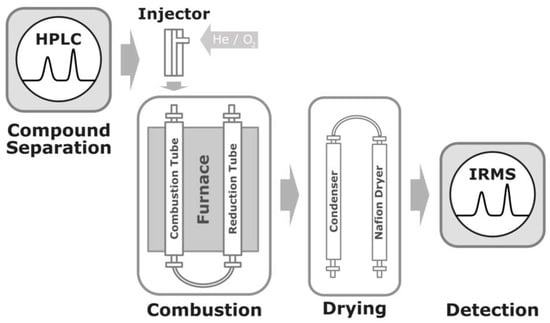
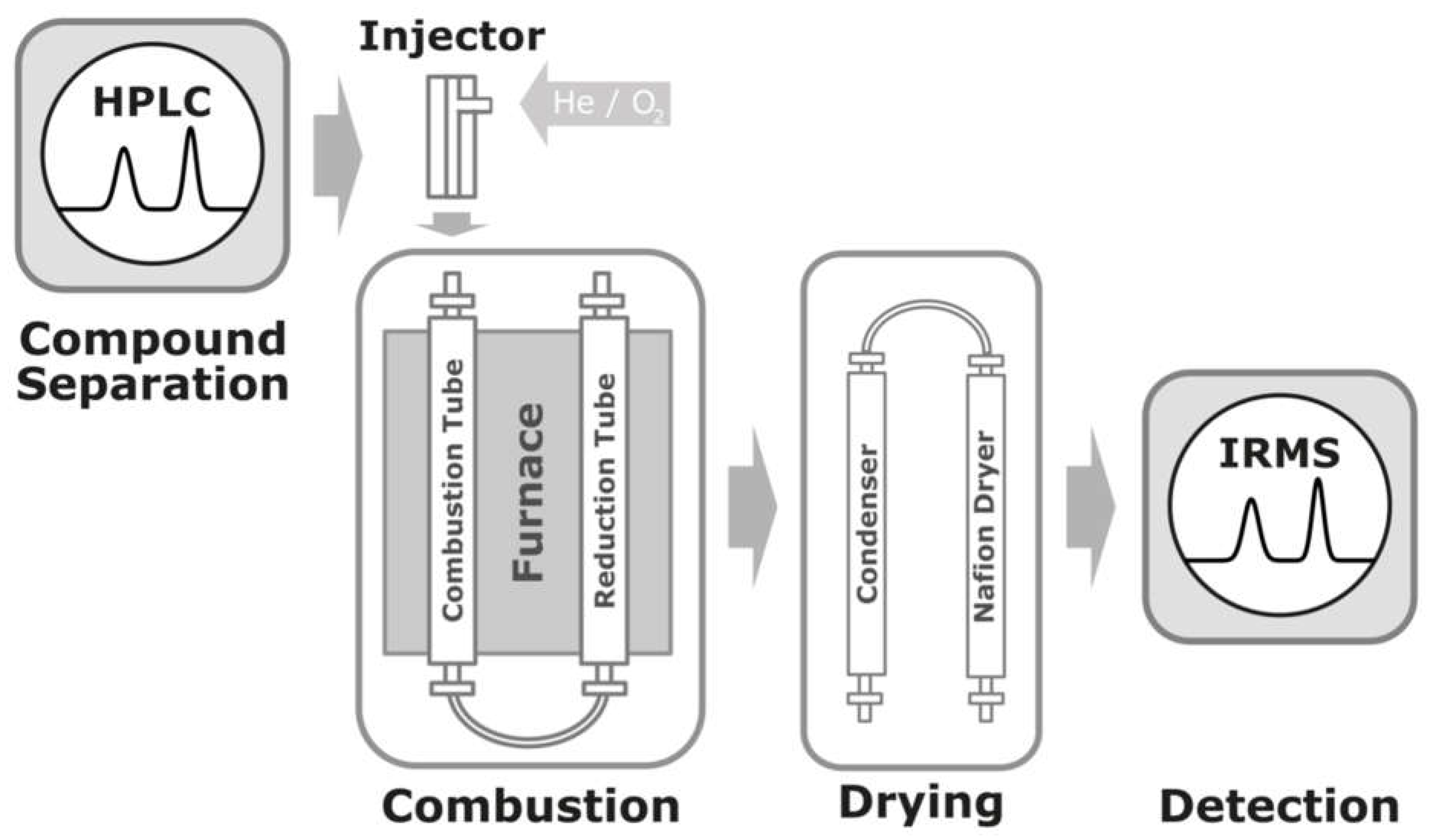
The HPLC-IRMS system consists of an Agilent 1260 Infinity II HPLC (Agilent Technologies, Inc., Santa Clara, CA, USA) coupled to an iso CHROM LC high temperature combustion interface (Elementar Analysensysteme GmbH, Langenselbold, Germany) which in turn was coupled to an isoprime visION isotope-ratio mass spectrometer (Elementar Analysensysteme GmbH, Langenselbold, Germany), see Figure 1. All three instruments were controlled and operated by the lyticOS Software Suite (version 5) (Elementar Analysensysteme GmbH, Langenselbold, Germany) which also performed post-analysis isotopic calibration and data evaluation.
Figure 1.
Scheme of the HPLC–iso CHROM LC–IRMS setup for compound-specific isotope analysis. Samples are separated by HPLC, combusted in the iso CHROM LC interface, and analyzed by IRMS.
HPLC analysis was conducted with an RCM-monosaccharide Ca2+ column (300 × 0.78 mm, 8 µm) by Phenomenex (Phenomenex, Inc., Torrance, CA, USA) at 55 °C. The injection volume was 10 µL and samples were analyzed with an ultrapure water mobile phase flow rate of 0.3 mL min−1. The separated fractions were combusted in the iso CHROM LC with the combustion tube at 925 °C and the reduction tube at 550 °C under a combined helium and oxygen flow rate of 20 mL min−1 and 2 mL min−1, respectively. Typical analysis time was 40 min for sugar standards and 60 min for apple juice samples. In the IRMS, three monitoring gas pulses were introduced at the beginning of each measurement. Mass-to-charge ratios m/z = 44, m/z = 45, and m/z = 46 were recorded to give the isotope ratio δ expressed in per mil against the international standard Vienna-Pee-Dee Belemnite (VPDB) according to the equation ]. Here, and are the δ13C ratios of the sample and the standard, respectively. For isotopic calibration, an in-house sugar mix standard consisting of maltose, glucose, and fructose (0.6–1.2 mg mL−1 each), which in turn were calibrated against IAEA standards regularly, was included in each measurement sequence.
All pure apple juice samples and spiked apple juice samples were measured in triplicate. Adulteration experiments were carried out with two different C4 adulterants: Isosweet (a mixture of fructose and glucose with concentrations of 427 mg mL−1 and 301 mg mL−1 respectively and a total sugar content of ~80%) and cane sugar (a disaccharide) which were added to two different NFC apple juices. Based on the overall sugar content declared on each apple juice container, the adulterants were added at the following concentrations: 2%, 5%, 10%, 20%, 30%, 40%, and 50% (w/v related to the apple juice sugar content as declared on the label of the apple juice).
3. Result
In this study, we evaluated the feasibility of using sorbitol as an internal marker for detecting sugar adulteration in apple juices by applying a combustion-based LC-IRMS technique.
3.1. Chromatographic Separation of Sorbitol
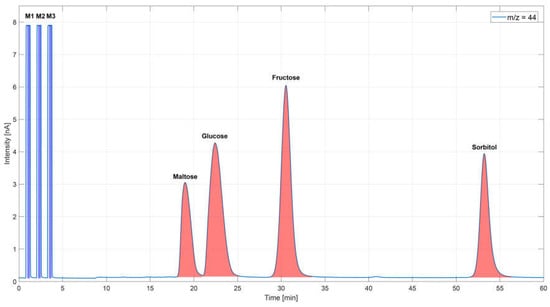
The initial requirement for this work was to ensure that sorbitol could be chromatographically separated and identified from the endogenous sugars with sufficient analytical precision. To achieve this, a mixture of synthetic maltose, fructose, glucose, and sorbitol standards was dissolved in water in concentrations ranging from 0.6 to 1.2 mg mL−1 each and analyzed using the LC-IRMS system as described in Section 4. The decision to use maltose in the sugar mixture rather than sucrose (as would be expected in a typical apple juice) was due to the in-house maltose material having a well characterized isotopic value, enabling more reliable assessment of instrument performance. Figure 2 shows the achieved chromatographic separation of the synthetic standards, demonstrating that the sorbitol peak is cleanly resolved from the sugar compounds, with a typical retention time of approximately 53 min. This retention time was subsequently used to confidently identify the sorbitol peak in natural apple juice samples, as discussed in Section 3.2.
Figure 2.
LC-IRMS chromatogram of the m/z 44 ion of CO2, showing the separation of synthetic sugar standards and sorbitol (red peaks). Peaks labeled M1–M3 correspond to the monitoring gas signals (blue peaks).
Optimization of chromatographic performance was done to improve the analytical performance of the sorbitol peak using the RCM-monosaccharide Ca2+ column. This optimization focused on establishing an optimal balance between the injection volume, LC column temperature and mobile phase flow rate to achieve the optimum retention time and peak shape for sorbitol. Importantly these conditions did not compromise the isotopic analysis or the chromatographic separation of the sugars, particularly the separation of the disaccharide sugars (maltose) from the glucose. In this study, the optimum column temperature was found to be 55 °C for an injection volume of 10 µL and a mobile phase flow rate of 0.3 mL min−1. These parameters were applied throughout the complete study.
Furthermore, replicate injections of the standard mixture were carried out to assess the isotopic precision of the separated compounds. The resulting precisions for each compound are summarized in Table 1. The δ13C value of the maltose, glucose and fructose standards had previously been measured using EA-IRMS and calibrated to the international V-PDB scale using primary reference materials. Applying these values, the δ13C vs. V-PDB value of the sorbitol peak was subsequently determined by using the secondary sugar standards analyzed at the same time as the sorbitol standard. Notably, the consistently high precision obtained across all analytes demonstrates the robustness of the LC-IRMS analytical method for the isotopic measurement of sorbitol.
Table 1.
Typical isotopic precisions achieved for replicate injections of the individual synthetic standard mixture (n = 3).
3.2. Evaluating the Presence of Sorbitol in Apple Juice
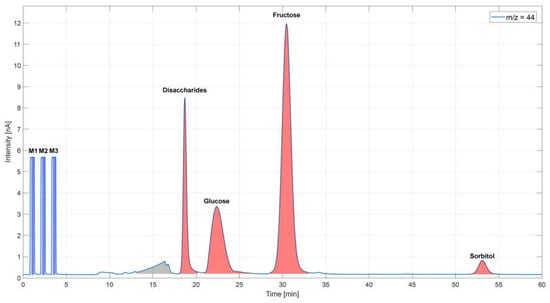
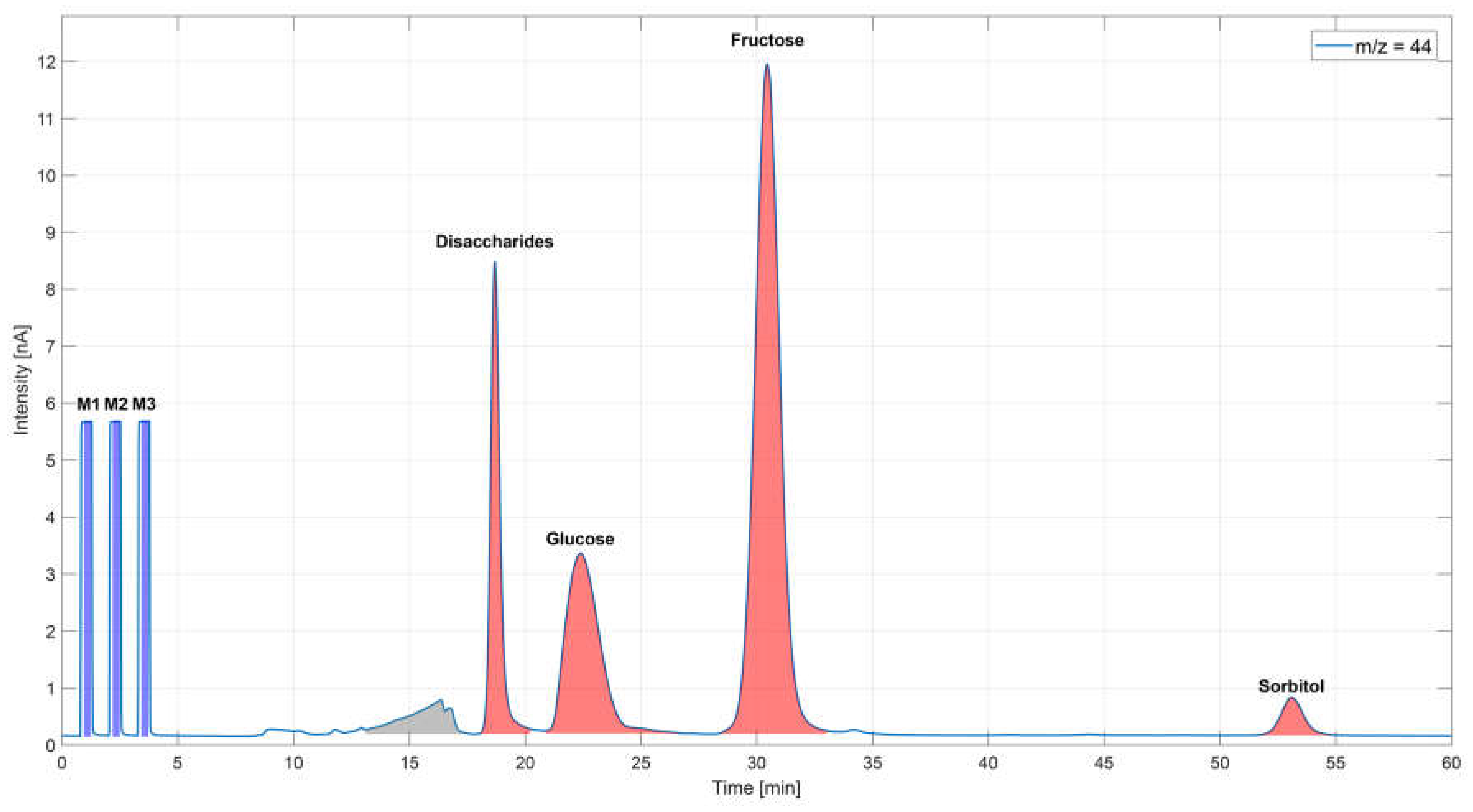
Once the LC-IRMS method was established as a reliable approach for separation and analysis of sorbitol it was necessary to determine the prevalence of the endogenous sorbitol in a representative set of different apple juices. To this end, several apple juices from the local supermarket were prepared and analyzed. Of the selected juices, three were from concentrate (FC) and six were not from concentrate (NFC), labeled as “direct” apple juices (see Table S1). While this sample set was chosen to reflect commonly available products it represents only a limited set and may not fully capture the variability across all apple juices. Sorbitol was detected in all analyzed apple juices at concentrations suitable for isotopic analysis via LC-IRMS. Figure 3 demonstrates the typical chromatography of the sorbitol peak in one of the tested apple juices.
Figure 3.
Representative LC-IRMS chromatogram of the CO2 ion (m/z 44) from an apple juice sample. The sorbitol peak is resolved at a retention time of approximately 53 min.
The typical δ13C vs. V-PDB values and precisions achieved for the set of apple juices analyzed are shown in Table 2. Since water as the mobile phase limits the ability to achieve sufficient chromatographic separation of the individual disaccharide sugars in our setup, only the δ13C value of the total disaccharide fraction (δ13CDS) is reported.
Table 2.
Typical isotopic precisions achieved for the NFC (n = 6) and FC apple juice (n = 3) samples analyzed. The internal SD corresponds to the average precision achieved for three replicate injections of a single apple juice. The external SD corresponds to the standard deviation across all tested apple juices.
The primary focus of this work was to evaluate sorbitol as an endogenous isotopic reference marker for detecting the addition of C4-type sugars. As the δ13C value of sorbitol (δ13CSorbitol) is expected to remain unaffected by the addition of C4-type sugars, δ13C pair-differences (defined in Table 2) were used to quantify the effect of C4-sugar addition relative to sorbitol. Table 2 also presents the typical δ13C pair-difference values observed across the analyzed set of apple juices. These values reflect the natural isotopic variability of the presumed authentic samples and thereby provide an indicative range for apple juice.
The isotopic precision of the sorbitol peak in the apple juice samples is noticeably lower compared to that of the synthetic sugar mixture because its abundance is significantly lower in the apple juices. Sorbitol typically accounts for less than 10% of the total sugar content [47], resulting in IRMS peak heights of approximately 0.5–1.0 nA in the employed setup. The average standard deviation of the sorbitol δ13C values across replicate analyses of the same apple juice sample was approximately 0.4‰, compared with 0.03‰ for the synthetic mixture. As sorbitol is used as an endogenous isotopic reference marker, the reduced isotopic precision directly affects the ability to detect exogenous sugars by lowering discrimination confidence and increases the limit of detection for sugar addition.
3.3. Controlled Adulteration of Apple Juice
After confirming the presence of sorbitol in all tested apple juices, two NFC samples were spiked with different concentrations of C4-type sugars to simulate sugar adulteration. Briefly, two aliquots of each NFC juice were prepared; one was spiked with cane sugar, and the other was spiked with “Isosweet”, a mixture of fructose and glucose. The δ13C values for the adulterants used to spike the tested apple juices are shown in Table 3.
Table 3.
The δ13C values of the sugar adulterants used to spike the test apple juices (n = 3).
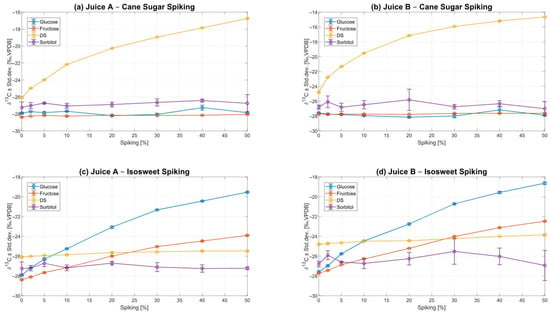
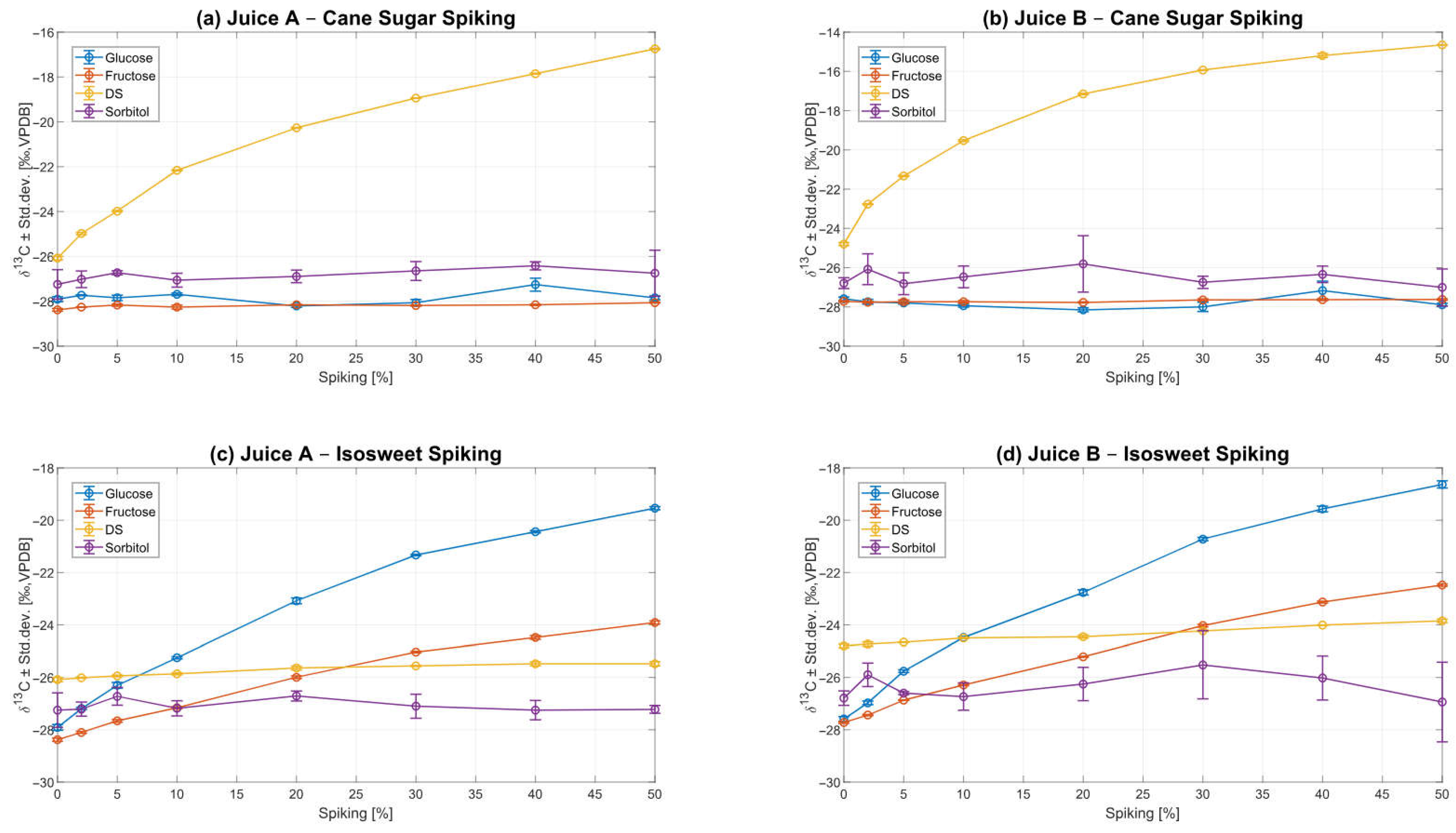
Following sample preparation, the two adulterated apple juices were analyzed by the developed LC-IRMS method. The resulting δ13C values of the main components across the adulteration range are shown in Figure 4 as a function of the added sugar concentration. As depicted by Figure 4a,b, the δ13CDS values become progressively more isotopically enriched with increasing additions of cane sugar for both apple juices, whereas the δ13CFructose, δ13CGlucose, and particularly, the δ13CSorbitol values remain constant. Similarly, Figure 4c,d show that δ13CFructose and δ13CGlucose values become increasingly isotopically enriched with increasing additions of the Isosweet mixture whilst the δ13CDS and the δ13CSorbitol values remain constant. This clearly demonstrates that the δ13CSorbitol is independent of exogenous sugar addition, for both cane sugar and Isosweet, and underlines its potential as an endogenous isotopic reference marker compound.
Figure 4.
The δ13C values of apple juice for different spiking concentrations. Panels (a,b) show cane sugar spiking for two commercial apple juices, with δ13C values of glucose, fructose, disaccharides, and sorbitol plotted against spiking concentration. Panels (c,d) show spiking with Isosweet for the same two apple juices.
Furthermore, Figure 4c,d show that the isotopic enrichment of the glucose and fructose compounds exhibits different rates upon the addition of the Isosweet solution. This effect can be attributed to the mass balance effect between the added Isosweet solution and the initial concentration as well as the δ13C value of the endogenous fructose and glucose. In the unadulterated apple juice dataset analyzed, the fructose is typically three times higher in concentration compared to the glucose. Therefore, when adding increasing amounts of Isosweet, the δ13CGlucose value will be proportionally affected to a greater extent compared to the δ13CFructose value. This implies that the sensitivity of the method to detect adulteration depends on the type of sugar added, being inherently more sensitive to added glucose than to added fructose due to the initial concentration differences in the apple juice. Consequently, the detection of adulterants such as high-fructose corn syrup (HFCS) may be more challenging, resulting in reduced sensitivity and a higher limit of detection. However, it should be stated that this possible limitation, while affecting the sensitivity to other adulterants, does not compromise the overall validity of the approach for C4-adulterants.
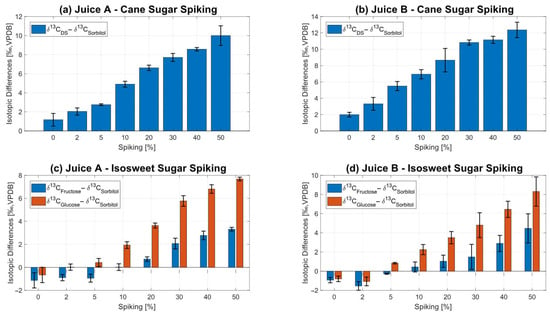
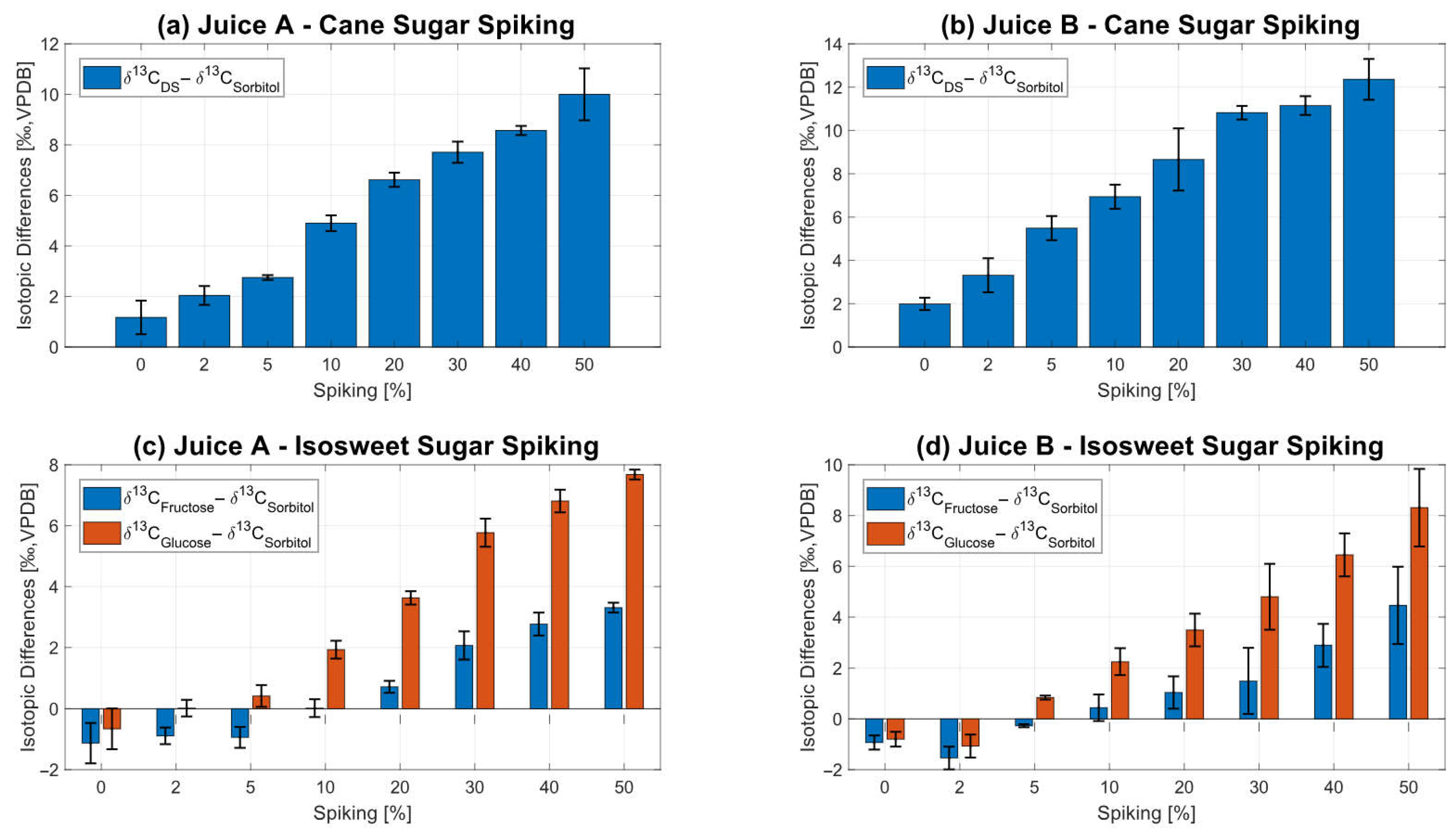
Figure 5 shows the δ13C pair-difference values of the two adulterated apple juices as a function of spiking concentration. The δ13C pair-difference values compare the δ13C values of the individual sugar compounds to the reference sorbitol allowing clear identification of exogenous sugar addition to the apple juices. By analyzing the variation in the δ13C pair-difference values within a population of authentic apple juices threshold limits (under these experimental conditions) can be defined which indicate the addition of exogenous sugars. Moreover, Figure 5a,b indicate that the presence of a C4-type disaccharide becomes detectable (for the two investigated samples using the experimental setup) at a spiking level of 5%, where the δ13C pair-difference becomes significantly different from the δ13C pair-difference in the non-adulterated apple juice. As discussed earlier, the ability to detect exogenous fructose and/or glucose addition might be more challenging. Figure 5c,d show the δ13C pair-differences for the two juices and indicate that the addition of glucose becomes preliminarily detectable at the 5% spiking level, while fructose addition is only evident at a 10% spiking level. Notably, for different sample types and instrumental configurations the level of detectable spiking might be higher for both fructose and glucose spiking.
Figure 5.
The δ13C pair-difference values of the two apple juices as a function of spiking concentration. Panels (a,b) show the δ13CDS-δ13CSorbitol pair-difference values between disaccharides and sorbitol. Panels (c,d) present the δ13CFructose-δ13CSorbitol pair-difference values of the fructose-sorbitol (blue) and δ13CGlucose-δ13CSorbitol pair-difference values for glucose-sorbitol (orange) as a function of spiking concentration.
4. Discussion
The present study demonstrates that sorbitol can be reliably detected in the tested apple juices (in both FC and NFC juices) under the chromatographic constraints of LC-IRMS systems and that its δ13C value can be determined in the same analytical run as the apple juice’s sugar compounds. Importantly, the δ13CSorbitol value remained unaffected by the addition of exogenous C4-type sugars to the apple juice. Therefore, sorbitol is potentially an ideal endogenous isotopic reference marker compound for detecting the addition of exogenous sugars to apple juice in the context of EMA. Compared to other published methods that use other isotopic endogenous reference marker compounds (see Table 4), the use of sorbitol significantly reduces both sample preparation and analytical demands. This is because sorbitol can be measured using the same method as the sugars, without any additional preparation. As a result, the proposed approach is more cost-effective and could improve the detection of fraudulent activity in the global apple juice supply chain.
Table 4.
A comparison of the different isotopic endogenous reference marker compounds used to detect exogenous sugars in apple juice.
While this work demonstrates the viability of using sorbitol as an endogenous isotopic reference marker, further research is required to ensure the concept can be robustly applied in real-world settings. In particular, a substantially broader survey of authentic apple juices is needed to better characterize the normal distribution of sorbitol abundance and δ13C variability, which underpins the identification of abnormal δ13C pair-difference values. The supermarket samples used in this study were assumed to be authentic and representative of apple juice in general. Whilst sufficient for assessing sorbitol prevalence in a limited range of apple juices, this assumption must be more rigorously tested in future studies evaluating the technique’s ability to detect EMA of apple juice. Furthermore, future method validation should use certified reference substances to further confirm the natural isotope range.
In addition to a broader evaluation of the natural variation in sorbitol abundance and δ13C values, an important step in demonstrating that this method is sufficiently robust for front-line fraud detection would be to conduct a round-robin (proficiency testing) study. This would involve multiple laboratories analyzing a set of supplied standards to assess the method’s intra- and inter-laboratory repeatability and reproducibility.
By undertaking a controlled adulteration experiment, it was demonstrated that the addition of exogenous C4-type sugars to apple juice can be detected at relatively low levels of adulteration (approximately 5–10%; see Figure 4). This conclusion is supported by the observation that the isotopic signatures of non-spiked samples no longer overlap with those of samples spiked at 5–10%, indicating clear differentiation between authentic and adulterated juices within this range. Nonetheless, this conclusion is limited by the specific instrumental parameters, the spiking component, the type of spiking used and the apple juice matrix. Consequently, the reported detection limits should be considered method- and matrix-specific and require further validation using a broader range of samples and adulterants. For example, HFCS, a commonly used sweetener, may present different detection challenges. Although the δ13C value of sorbitol is not expected to be directly affected by the addition of HFCS, the suitability of the method might be less in samples with a high initial concentration of natural sugar analogs. This leads to the conclusion that depending on the sample types and amount of adulteration the detection limit may vary. In such cases, improved analytical precision or a certain amount of sample preparation might be additionally required, possibly sacrificing the simplicity of the method.
Furthermore, it is known from other cases such as honey adulteration that it is also possible to adulterate foods with C3-type sugars such as beet or rice syrup, or sugars derived from fruits [41]. The method presented here has not examined the addition of C3-type sugars to apple juices. Further studies are needed to determine the extent to which this approach can reliably resolve isotopic differences between endogenous sorbitol and exogenous C3-type syrups which have similar sugar profiles to apple juice and therefore cannot be detected by common HPLC-RID techniques.
Although apple juice is one of the most widely consumed fruit juices and so the need to detect fraud associated with apple juice is important [48], the use of sorbitol as an endogenous isotopic reference marker compound may also be a suitable technique for detecting EMA of other juices produced from the fruits of plants which use sorbitol as a carbohydrate transport mechanism to deliver sugars from the leaf to the fruit [37]. Therefore, this method may also be applicable to juices or purees of pear, cherry, peach and apricot, though the prevalence of adulteration in these juices is less well known. Another possible extension of this method would be to pomegranate juice since natural pomegranate juice has relatively high levels of mannitol, a similar sugar alcohol to sorbitol. It would be expected that mannitol can also be detected using the same LC-IRMS method thereby allowing mannitol to also be utilized as an isotopic endogenous reference marker compound for detecting EMA in pomegranate juice. Nevertheless, future studies should evaluate the transferability of the employed instrumentation and method to other juices and marker compounds. They should include, for example, C4 syrups, mixed syrups, fruit-derived sweeteners, and C3 adulterants. For example, detection of C3-type sugar adulteration is expected to be more complex because the exogenous sugar δ13C values are expected to be close to those of the endogenous sugars in apple juice. In this case, a future possible solution could be based on analyzing a larger population of authentic apple juices to elucidate the normal distribution of the δ13C values of the sugar and sorbitol components and their associated pair-differences. This same method has been used to determine suitable criteria to detect the presence of exogenous C3-type sugars in honey, and the same strategy may well be viable for apple juice [41].
In summary, the simplicity and ease of use of the presented method make LC-IRMS a potentially high-throughput and robust technique for detecting exogenous sugars in apple juices that naturally contain sorbitol. This is mainly attributed to the measurement of sorbitol and sugars within a single analytical run, facilitated by the operational simplicity of the high-temperature combustion method. Moreover, sample preparation is straightforward, requiring only dilution and filtration. In addition, the use of high-temperature combustion in the LC-IRMS interface, rather than wet chemical oxidation, provides significant analytical workflow improvements. Together, these features offer a promising new approach for routine apple juice authenticity testing.
Supplementary Materials
The following supporting information can be downloaded at: https://www.mdpi.com/article/10.3390/chemistry8060071/s1, Table S1: Sugar content of the nine analyzed apple juices.
Author Contributions
Conceptualization, M.H. and M.S. (Mike Seed); methodology, M.S. (Mike Seed), P.I.S. and M.S. (Marco Schmidt); formal analysis, P.I.S. and H.A.; investigation, M.S. (Mike Seed) and M.S. (Marco Schmidt); data curation, P.I.S. and M.S. (Marco Schmidt); writing—original draft preparation, M.S. (Mike Seed), M.S. (Marco Schmidt) and P.I.S.; writing—review and editing, M.S. (Marco Schmidt), P.I.S., S.K., M.H. and M.S. (Mike Seed); visualization, M.S. (Marco Schmidt); supervision, M.S. (Mike Seed); project administration, M.S. (Mike Seed) and J.H. All authors have read and agreed to the published version of the manuscript.
Funding
This research received no external funding.
Data Availability Statement
The datasets generated and analyzed during the current study are available from the corresponding author on reasonable request.
Acknowledgments
During the preparation of this manuscript/study, the author(s) used ChatGPT (OpenAI, version GPT-5.3) for the purposes of refining and improving readability. The authors have reviewed and edited the output and take full responsibility for the content of this publication.
Conflicts of Interest
Author M.S. (Mike Seed) was employed by the company Elementar UK Ltd. Authors P.I.S., M.S. (Marco Schmidt), H.A. and J.H. were employed by the company Elementar Analysensysteme GmbH. Author M.H. was employed by the company GfL Gesellschaft für Lebensmittel-Forschung mbH. Author S.K. was employed by the company Fera Science Limited. The funding sponsors had no role in the design of the study; in the collection, analyses, or interpretation of data; in the writing of the manuscript; or in the decision to publish the results. The authors declare no conflicts of interest.
Abbreviations
The following abbreviations are used in this manuscript:
| DS | Disaccharides |
| EA-IRMS | Elemental analyzer coupled to isotope ratio mass spectrometer |
| EMA | Economically motivated adulteration |
| FC | From concentrate |
| GC-IRMS | Gas chromatography coupled to isotope ratio mass spectrometer |
| HFCS | High fructose corn syrup |
| HPLC | High pressure liquid chromatography |
| HPLC-RID | High pressure liquid chromatography coupled with refractive index detector |
| IRMS | Isotope ratio mass spectrometry |
| LC-IRMS | Liquid chromatography coupled to isotope ratio mass spectrometer |
| NFC | Not from concentrate |
| SIRA | Stable isotope ratio analysis |
| SD | Standard deviation |
References
- Vallée Marcotte, B.; Verheyde, M.; Pomerleau, S.; Doyen, A.; Couillard, C. Health Benefits of Apple Juice Consumption: A Review of Interventional Trials on Humans. Nutrients 2022, 14, 821. [Google Scholar] [CrossRef] [Scilit]
- Pandey, K.B.; Rizvi, S.I. Plant polyphenols as dietary antioxidants in human health and disease. Oxid. Med. Cell. Longev. 2009, 2, 270–278. [Google Scholar] [CrossRef] [Scilit]
- Cory, H.; Passarelli, S.; Szeto, J.; Tamez, M.; Mattei, J. The Role of Polyphenols in Human Health and Food Systems: A Mini-Review. Front. Nutr. 2018, 5, 87. [Google Scholar] [CrossRef] [Scilit]
- Boyer, J.; Liu, R.H. Apple phytochemicals and their health benefits. Nutr. J. 2004, 3, 5. [Google Scholar] [CrossRef] [Scilit]
- Hyson, D.A. A comprehensive review of apples and apple components and their relationship to human health. Adv. Nutr. 2011, 2, 408–420. [Google Scholar] [CrossRef] [Scilit]
- Everstine, K.; Spink, J.; Kennedy, S. Economically Motivated Adulteration (EMA) of Food: Common Characteristics of EMA Incidents. J. Food Prot. 2013, 76, 723–735. [Google Scholar] [CrossRef] [Scilit]
- US Food and Drug Administration. US FDA Definition of EMA. Available online: https://www.fda.gov/food/compliance-enforcement-food/economically-motivated-adulteration-food-fraud (accessed on 23 February 2026).
- Moore, J.C.; Spink, J.; Lipp, M. Development and application of a database of food ingredient fraud and economically motivated adulteration from 1980 to 2010. J. Food Sci. 2012, 77, R118–R126. [Google Scholar] [CrossRef] [Scilit] [PubMed]
- Dasenaki, M.E.; Thomaidis, N.S. Quality and authenticity control of fruit juices—A review. Molecules 2019, 24, 1014. [Google Scholar] [CrossRef] [Scilit]
- Ogrinc, N.; Bat, K.; Kosir, I.J.; Golob, T.; Kokkinofta, R. Characterization of commercial slovenian and cypriot fruit juices using stable isotopes. J. Agric. Food Chem. 2009, 57, 6764–6769. [Google Scholar] [CrossRef] [Scilit] [PubMed]
- Primrose, S.; Woolfe, M.; Rollinson, S. Food forensics: Methods for determining the authenticity of foodstuffs. Trends Food Sci. Technol. 2010, 21, 582–590. [Google Scholar] [CrossRef] [Scilit]
- Thomas, F.; Jamin, E.; Hammond, D. 18O Internal Referencing Method to Detect Water Addition in Wines and Fruit Juices: Interlaboratory Study. J. AOAC Int. 2013, 96, 615–624. [Google Scholar] [CrossRef] [Scilit]
- Kraciński, P.; Stolarczyk, P.; Zaremba, Ł. Competitiveness of the Largest Global Exporters of Concentrated Apple Juice. Agriculture 2025, 15, 1197. [Google Scholar] [CrossRef] [Scilit]
- Johnson, R. Food Fraud and “Economically Motivated Adulteration” of Food and Food Ingredients; Library of Congress. Congressional Research Service: Washington, DC, USA, 2014.
- Rossmann, A. Determination of stable isotope ratio in food analysis. Food Rev. Int. 2001, 17, 347–381. [Google Scholar] [CrossRef] [Scilit]
- Sharma, D.; Bharadwaj, A.; Porasar, P.; Sahani, S.; Ishtiyak, S.T.; Gogoi, R.; Hazarika, D.; Lamichhane, S.; Dutta, K.N. Isotopic Ratio Analysis for Tracing Food Origin and Quality. In Novel Food Analysis; Sarkar, T., Ed.; Springer: New York, NY, USA, 2026; pp. 59–76. ISBN 978-1-0716-4786-8. [Google Scholar]
- Xu, L.; Xu, Z.; Liao, X. A review of fruit juice authenticity assessments: Targeted and untargeted analyses. Crit. Rev. Food Sci. Nutr. 2022, 62, 6081–6102. [Google Scholar] [CrossRef] [Scilit]
- González-Pérez, J.A.; Jiménez-Morillo, N.T.; de La Rosa, J.M.; Almendros, G.; González-Vila, F.J. Compound-specific stable carbon isotopic signature of carbohydrate pyrolysis products from C3 and C4 plants. J. Sci. Food Agric. 2016, 96, 948–953. [Google Scholar] [CrossRef] [Scilit] [PubMed]
- Smith, B.N.; Epstein, S. Two categories of C13/C12 ratios for higher plants. Plant Physiol. 1971, 47, 380–384. [Google Scholar] [CrossRef] [Scilit]
- Doner, L.W.; Krueger, H.W.; Reesman, R.H. Isotopic composition of carbon in apple juice. J. Agric. Food Chem. 1980, 28, 362–364. [Google Scholar] [CrossRef] [Scilit]
- Wu, L.; Du, B.; Vander Heyden, Y.; Chen, L.; Zhao, L.; Wang, M.; Xue, X. Recent advancements in detecting sugar-based adulterants in honey—A challenge. Trends Anal. Chem. 2017, 86, 25–38. [Google Scholar] [CrossRef] [Scilit]
- International Fruit and Vegetable Juice Association. IFU Recommendation R03—Use of Isotopic Procedures. Available online: https://ifu-fruitjuice.com/page/ListofIFUMethods (accessed on 26 January 2026).
- Jamin, E.; Gonzalez, J.; Remaud, G.; Naulet, N.; Martin, G.G.; Weber, D.; Rossmann, A.; Schmidt, H.L. Improved detection of sugar addition to apple juices and concentrates using internal standard 13C IRMS. Anal. Chim. Acta 1997, 347, 359–368. [Google Scholar] [CrossRef] [Scilit]
- Dhaulaniya, A.S.; Balan, B.; Yadav, A.; Jamwal, R.; Kelly, S.; Cannavan, A.; Singh, D.K. Development of an FTIR based chemometric model for the qualitative and quantitative evaluation of cane sugar as an added sugar adulterant in apple fruit juices. Food Addit. Contam. Part A Chem. Anal. Control Expo. Risk Assess. 2020, 37, 539–551. [Google Scholar] [CrossRef] [Scilit] [PubMed]
- Kelly, S.D.; Rhodes, C.; Lofthouse, J.H.; Anderson, D.; Burwood, C.E.; Dennis, M.J.; Brereton, P. Detection of sugar syrups in apple juice by delta(2)H per thousand and delta(13)C per thousand analysis of hexamethylenetetramine prepared from fructose. J. Agric. Food Chem. 2003, 51, 1801–1806. [Google Scholar] [CrossRef] [Scilit]
- Kelly, J.F.D.; Downey, G. Detection of Sugar Adulterants in Apple Juice Using Fourier Transform Infrared Spectroscopy and Chemometrics. J. Agric. Food Chem. 2005, 53, 3281–3286. [Google Scholar] [CrossRef] [Scilit]
- León, L.; Kelly, J.D.; Downey, G. Detection of apple juice adulteration using near-infrared transflectance spectroscopy. Appl. Spectrosc. 2005, 59, 593–599. [Google Scholar] [CrossRef] [Scilit]
- Yeganeh-Zare, S.; Farhadi, K.; Amiri, S. Rapid detection of apple juice concentrate adulteration with date concentrate, fructose and glucose syrup using HPLC-RID incorporated with chemometric tools. Food Chem. 2022, 370, 131015. [Google Scholar] [CrossRef] [Scilit]
- Cozzolino, D. The role of vibrational spectroscopy as a tool to assess economically motivated fraud and counterfeit issues in agricultural products and foods. Anal. Methods 2015, 7, 9390–9400. [Google Scholar] [CrossRef] [Scilit]
- Weesepoel, Y.; Alewijn, M.; Wijtten, M.; Müller-Maatsch, J. Detecting Food Fraud in Extra Virgin Olive Oil Using a Prototype Portable Hyphenated Photonics Sensor. J. AOAC Int. 2021, 104, 7–15. [Google Scholar] [CrossRef] [Scilit] [PubMed]
- Liu, S.; Zhang, Y.; Feng, J.; Gao, W.; Li, T.; Liu, Y. Atmospheric carbon concentration scenario classification based on the fusion of spectral and acoustic modalities. Opt. Lett. 2026, 51, 949–952. [Google Scholar] [CrossRef] [Scilit] [PubMed]
- Pereira, A.G.; Otero, P.; Fraga-Corral, M.; Garcia-Oliveira, P.; Carpena, M.; Prieto, M.A.; Simal-Gandara, J. State-of-the-Art of Analytical Techniques to Determine Food Fraud in Olive Oils. Foods 2021, 10, 484. [Google Scholar] [CrossRef] [Scilit]
- Li, X.; Zhang, L.; Zhang, Y.; Wang, D.; Wang, X.; Yu, L.; Zhang, W.; Li, P. Review of NIR spectroscopy methods for nondestructive quality analysis of oilseeds and edible oils. Trends Food Sci. Technol. 2020, 101, 172–181. [Google Scholar] [CrossRef] [Scilit]
- Kjeldahl, K.; Bro, R. Some common misunderstandings in chemometrics. J. Chemom. 2010, 24, 558–564. [Google Scholar] [CrossRef] [Scilit]
- Karoui, R.; de Baerdemaeker, J. A review of the analytical methods coupled with chemometric tools for the determination of the quality and identity of dairy products. Food Chem. 2007, 102, 621–640. [Google Scholar] [CrossRef] [Scilit]
- Laursen, K.H.; Schjoerring, J.K.; Kelly, S.D.; Husted, S. Authentication of organically grown plants—Advantages and limitations of atomic spectroscopy for multi-element and stable isotope analysis. Trends Anal. Chem. 2014, 59, 73–82. [Google Scholar] [CrossRef] [Scilit]
- Fang, T.; Cai, Y.; Yang, Q.; Ogutu, C.O.; Liao, L.; Han, Y. Analysis of sorbitol content variation in wild and cultivated apples. J. Sci. Food Agric. 2020, 100, 139–144. [Google Scholar] [CrossRef] [Scilit]
- Spinelli, F.R.; Dutra, S.V.; Carnieli, G.; Leonardelli, S.; Drehmer, A.P.; Vanderlinde, R. Detection of addition of apple juice in purple grape juice. Food Control 2016, 69, 1–4. [Google Scholar] [CrossRef] [Scilit]
- Cabañero, A.I.; Recio, J.L.; Rupérez, M. Liquid chromatography coupled to isotope ratio mass spectrometry: A new perspective on honey adulteration detection. J. Agric. Food Chem. 2006, 54, 9719–9727. [Google Scholar] [CrossRef] [Scilit]
- Association of Official Analytical Collaboration. AOAC 998.12. Available online: https://www.aoacofficialmethod.org/index.php?main_page=product_info&products_id=49 (accessed on 26 January 2026).
- Elflein, L.; Raezke, K.-P. Improved detection of honey adulteration by measuring differences between 13 C/12 C stable carbon isotope ratios of protein and sugar compounds with a combination of elemental analyzer—Isotope ratio mass spectrometry and liquid chromatography—Isotope ratio mass spectrometry (δ 13 C—EA/LC-IRMS). Apidologie 2008, 39, 574–587. [Google Scholar] [CrossRef] [Scilit]
- Guyon, F.; Auberger, P.; Gaillard, L.; Loublanches, C.; Viateau, M.; Sabathié, N.; Salagoïty, M.-H.; Médina, B. 13C/12C isotope ratios of organic acids, glucose and fructose determined by HPLC-co-IRMS for lemon juices authenticity. Food Chem. 2014, 146, 36–40. [Google Scholar] [CrossRef] [Scilit] [PubMed]
- Perini, M.; Bontempo, L. Liquid Chromatography coupled to Isotope Ratio Mass Spectrometry (LC-IRMS): A review. Trends Anal. Chem. 2022, 147, 116515. [Google Scholar] [CrossRef] [Scilit]
- Federherr, E.; Willach, S.; Roos, N.; Lange, L.; Molt, K.; Schmidt, T.C. A novel high-temperature combustion interface for compound-specific stable isotope analysis of carbon and nitrogen via high-performance liquid chromatography/isotope ratio mass spectrometry. Rapid Commun. Mass Spectrom. 2016, 30, 944–952. [Google Scholar] [CrossRef] [Scilit]
- Zhang, L.; Kujawinski, D.M.; Federherr, E.; Schmidt, T.C.; Jochmann, M.A. Caffeine in your drink: Natural or synthetic? Anal. Chem. 2012, 84, 2805–2810. [Google Scholar] [CrossRef] [Scilit] [PubMed]
- Federherr, E.; Cerli, C.; Kirkels, F.M.S.A.; Kalbitz, K.; Kupka, H.J.; Dunsbach, R.; Lange, L.; Schmidt, T.C. A novel high-temperature combustion based system for stable isotope analysis of dissolved organic carbon in aqueous samples. I: Development and validation. Rapid Commun. Mass Spectrom. 2014, 28, 2559–2573. [Google Scholar] [CrossRef] [Scilit] [PubMed]
- Aprea, E.; Charles, M.; Endrizzi, I.; Laura Corollaro, M.; Betta, E.; Biasioli, F.; Gasperi, F. Sweet taste in apple: The role of sorbitol, individual sugars, organic acids and volatile compounds. Sci. Rep. 2017, 7, 44950. [Google Scholar] [CrossRef] [Scilit] [PubMed]
- Neves, M.F.; Trombin, V.G.; Marques, V.N.; Martinez, L.F. Global orange juice market: A 16-year summary and opportunities for creating value. Trop. Plant Pathol. 2020, 45, 166–174. [Google Scholar] [CrossRef] [Scilit]

Disclaimer/Publisher’s Note: The statements, opinions and data contained in all publications are solely those of the individual author(s) and contributor(s) and not of MDPI and/or the editor(s). MDPI and/or the editor(s) disclaim responsibility for any injury to people or property resulting from any ideas, methods, instructions or products referred to in the content. |
© 2026 by the authors. Licensee MDPI, Basel, Switzerland. This article is an open access article distributed under the terms and conditions of the Creative Commons Attribution (CC BY) license.