


Abstract
As a photocatalyst, silver phosphate (Ag3PO4) features high quantum yield and strong photocatalytic ability, demonstrating great potential in water splitting and the treatment of water pollutants. However, its own photo-corrosion and low solubility in water limit its application. To address these issues, the combination of Ag3PO4 with other semiconductor materials to form composite photocatalysts can enhance its catalytic activity and structural stability, facilitating the photocatalytic degradation of organic pollutants in wastewater. In this work, Ag3PO4/g-C3N4/C composite photocatalytic materials were successfully prepared using biochar (C), g-C3N4, AgNO3, and Na2HPO4·12H2O as raw materials through a co-precipitation method. The Ag3PO4/g-C3N4/C (mass ratio 4:1:0.1) composite photocatalyst exhibited excellent degradation performance for MB and RhB and maintained good stability. During the degradation of MB and RhB, the main active species were h+ (holes), •O2− and •OH. The MB removal efficiency reached 97% in 40 mL of 10 mg/L MB aqueous solution within 60 min of visible light irradiation, and the removal efficiency of RhB reached 96% in 40 mL of 10 mg/L RhB aqueous solution within 80 min of visible light irradiation. After three cycles of reuse, the removal efficiencies of MB and RhB photocatalyzed by Ag3PO4/g-C3N4/C (4:1:0.1) still reached 79% and 74%, respectively. The Ag3PO4/g-C3N4/C composite photocatalyst can be applied to the degradation of organic pigment in the environment dye wastewater, contributing to environmental remediation and the green development of the ecological environment.
1. Introduction
Dyes in wastewater from industries such as printing and dyeing and chemical engineering contain various refractory organic pollutants, which are highly colored and toxic. Seeking efficient dye wastewater treatment technologies has become one of the current global environmental governance focuses. Methylene blue (MB) is a phenothiazine salt: its chemical structure is stable and does not easily decompose under natural conditions, persisting in the environment for a long time. MB is widely used in chemical indicators, dyes, biological staining agents, drugs, etc., and its aqueous solution is alkaline and toxic. Although short-term exposure to low concentrations of MB is safe, as a widely used thiazine-based basic blue dye, high-concentration MB aqueous solutions cause the water body to take on a strong blue color, reduce transparency, consume dissolved oxygen, and significantly inhibit the reproduction of plankton, and its persistence in the environment can cause various health problems such as breathing difficulties, blindness, and abdominal diseases [1,2,3]. Rhodamine B (RhB) is an artificially synthesized industrial rose-Bengal dye with definite toxicity and health risks, such as toxicity to the liver, kidneys, heart, and respiratory and digestive systems, as well as carcinogenicity. RhB is one of the most toxic dyes in textile wastewater and the extensive use of RhB is toxic upon inhalation and ingestion and causes liver and thyroid damage, as well as being an eye and skin irritant [4]. Therefore, effective and feasible methods for treating MB and RhB wastewater are needed. Advanced oxidation processes (AOPs), as an efficient chemical treatment method, are currently recognized as an innovative and effective technology for treating water-soluble organ pollutants. Currently, common advanced oxidation processes mainly include photocatalysis, ozone oxidation, microwave catalytic oxidation, persulfate catalytic oxidation, Fenton and Fenton-like technologies, etc. [5]. Among them, photocatalytic technology is highly regarded as a “green method” due to its fast reaction, high mineralization efficiency, no secondary pollution, environmental friendliness, and low cost [6,7,8,9,10], and is accordingly considered the best choice for degrading organic dye in wastewater [11,12]. However, traditional photocatalysts have many drawbacks and are difficult to apply in practice. Therefore, finding a stable and efficient semiconductor photocatalyst remains a current research focus.
Ag3PO4 has broad development prospects due to its low toxicity and strong catalytic activity and has been widely applied in the field of photocatalysis in recent years. It is even considered an ideal catalyst for the photocatalytic degradation of water-soluble organic compounds. However, Ag3PO4 is slightly soluble in water, and under light conditions, a small amount of Ag+ is easily reduced to nano-sized Ag particles covering the catalyst surface, named photo-corrosion, reducing the active sites on the catalyst surface and thus lowering its photocatalytic activity [13]. To slow down the photo-corrosion of Ag3PO4, it can be combined with other semiconductor materials to improve the catalytic activity and structural stability of silver phosphate.
G-C3N4 is a visible light-responsive N-type semiconductor photocatalyst with a non-metallic layered structure similar to graphene. Due to its advantages, such as low-cost raw materials, a simple preparation method, non-toxicity, acid and alkali resistance, and unique electronic structure, it has been widely investigated in many fields, such as continuous hydrogen energy production, organic pollutant degradation, and CO2 photoreduction [14,15,16,17]. Due to its relatively low band gap energy (about 2.7 eV), it has high chemical stability and strong visible light response performance and has been regarded as a promising photocatalytic material for solving energy crises and environmental restoration [18]. However, due to its low photo-generated carrier separation efficiency and small specific surface area, it cannot achieve ideal practical application effects at present. Researchers have attempted various modification methods for g-C3N4. Among them, based on the unique ribbon-like narrow band gap structure of g-C3N4, coupling it with a wide band gap semiconductor to form a heterojunction composite material can improve the charge separation efficiency and broaden the light absorption range. For example, Yan et al. [19] effectively increased the rate of light-induced H2 production and the separation efficiency of photo-generated electron-hole pairs by coupling it with anatase TiO2. Similarly, Jasminder et al. [20] synthesized coral-like WO3/g-C3N4 composite materials using a wet chemical method; these materials not only have a high specific surface area but also significantly improved the charge separation efficiency and light absorption capacity, effectively enhancing the photocatalytic performance of g-C3N4.
Biochar is a stable, low-cost, non-toxic, and sustainable carbon-containing product that can be used as an excellent carrier for loading photocatalysts. Due to the rich surface functional groups of biochar, it can immobilize organic pollutants through hydrophobic interactions, making it very suitable for removing pollutants in water media [21]. In addition, biochar has conductive properties [22,23,24,25,26], which can promote the transfer of photogenerated electrons and reduce the recombination of photogenerated electron-hole pairs, thereby achieving the purpose of enhancing photocatalytic efficiency.
In this work, eucalyptus wood powder was used as the raw material, and after pyrolysis and strong acid treatment, biochar with rich surface functional groups was formed. An Ag3PO4/g-C3N4/biochar composite photocatalytic material was fabricated using a co-precipitation method and binder polyvinylpyrrolidone to simultaneously composite biochar and g-C3N4 with Ag3PO4, which was used for the photocatalytic degradation of organic dyes (MB and RhB), and its photocatalytic performance, structural stability and the photocatalytic degradation mechanism of MB were investigated.
2. Materials and Methods
2.1. Experimental Reagents and Instruments
The main reagents used are listed in Table S1, and the main instruments and equipment used are shown in Table S2 in the Supplementary Materials.
2.2. Preparation of Ag3PO4/g-C3N4/C Composite Materials
- (1)
- Preparation of biochar (C)
An amount of 50.0 g of 80-mesh eucalyptus wood powder was weighed and put into an alumina boat, which was then put into a tube furnace and heated to 600 °C; the eucalyptus wood powder was calcinated for 2 h under a nitrogen atmosphere to form biochar. After heating in the tube furnace, the product was allowed to naturally air-cool to room temperature, combined with about 40 mL of a mixed solution of sulfuric acid and nitric acid (with a volume ratio of 98% sulfuric acid to 65% nitric acid; 3:1), and kept in a water bath at 80 °C for 12 h. It was then centrifuged, the sediment was washed, and then it was dried in a vacuum drying oven at 70 °C to obtain biochar (C).
- (2)
- Synthesis of g-C3N4
An amount of 15.0 g of melamine was weighed and put into an alumina boat, then put into a tube furnace and heated at a rate of 5 °C/min to 550 °C; it was kept at this temperature for 4 h under nitrogen atmosphere at a flow rate of 0.6 L/min as a protective gas and then cooled to room temperature. Then, it was transferred to a muffle furnace and heated at a rate of 5 °C/min to 550 °C; it was kept at this temperature for 4 h to make the g-C3N4 nanosheets peel off. It was then ground to obtain about 4 g of g-C3N4.
- (3)
- Synthesis of Ag3PO4/g-C3N4/C
Ag3PO4, biochar and g-C3N4 were compounded using an in situ coprecipitation method. An amount of 40 mg of the as-prepared biochar seen in step (1) and 0.4 g of the as-synthesizedg-C3N4 seen in step (2) were added into a beaker containing 60 mL of deionized water and ultrasonicated for 30 min. Then, 1.948 g of AgNO3 and 4.0 g of polyvinylpyrrolidone were added into the above solution and ultrasonicated for 1 h. Then, 1.3689 g of Na2HPO4 was dissolved and added dropwise into the above solution. The mixture was magnetically stirred for 1 h, centrifuged, washed, dried and ground to obtain the Ag3PO4/g-C3N4/C (mass ratio 4:1:0.1) composite material. The Ag3PO4/g-C3N4/C composite materials with mass ratios of 3:1:0.1 (1.461 g of AgNO3, 3.0 g of polyvinylpyrrolidone and 1.0267 g of Na2HPO4) and 5:1:0.1 (2.435 g of AgNO3, 5.0 g of polyvinylpyrrolidone and 1.7112 g of Na2HPO4) were prepared using the same method but with a different proportion of the reagents added, marked as Ag3PO4/g-C3N4/C (3:1:0.1) and (5:1:0.1), respectively.
Ag3PO4 was prepared without biochar and g-C3N4, Ag3PO4/g-C3N4 (4:1) was prepared without biochar, and Ag3PO4/C (4:0.1) was prepared without g-C3N4.
2.3. Characterization of Photocatalytic Materials
2.3.1. X-Ray Diffraction (XRD)
The crystal structure of the sample was determined by using the SMARTLAB3KW in situ X-ray diffractometer from Rigaku Corporation, Tokyo, Japan. Cu kα was used as the diffraction source, with an acceleration voltage of 40 kV. Scanning was carried out at a speed of 8°/min in the range of 2θ = 5–80°. The obtained patterns were analyzed by MDI Jade 6.5 and compared with the standard cards.
2.3.2. X-Ray Photoelectron Spectroscopy (XPS)
The surface composition and elemental valence states of the material were analyzed by using the ESCALAB 250Xi photoelectron spectrometer from Thermo, Waltham, MA, USA. Al Kα radiation (1486.6 eV) was used for excitation, and all the binding energies were calibrated to the C 1s peak at 284.8 eV.
2.3.3. Fourier Transform Infrared Spectroscopy (FT-IR)
The surface chemical properties of different materials were characterized by Nicolet iS 50 Fourier transform infrared spectrometer (FTIR) from Thermo, Waltham, MA, USA. Samples were prepared using the KBr pellet method. An appropriate amount of the sample and KBr were ground and mixed in an agate mortar and then pressed into pellets. Scans were conducted in the range of 4000–400 cm−1.
2.3.4. Scanning Electron Microscope (SEM), Transmission Electron Microscopy (TEM) and High-Resolution Transmission Electron Microscopy (HRTEM)
The surface morphology and the microstructure of the samples were examined using a Hitachi SU8010 high-resolution scanning electron microscope (SEM) from Hitachi, Ltd. Tokyo, Japan and a Talos F200s Field emission transmission electron microscope from Thermo, Waltham, MA, USA. The testing conditions were as follows: a small amount of the sample was placed on a conductive adhesive, followed by gold sputtering treatment, and then the test was conducted at a voltage of 20 kV.
2.3.5. Ultraviolet Diffuse Reflectance Spectroscopy (UV-DRS)
The absorption spectra of g-C3N4, Ag3PO4 and Ag3PO4/g-C3N4/C were measured with the UV-2600 type ultraviolet-visible diffuse reflectance spectrometer produced by Shimadzu Instruments (Suzhou, China) Co., Ltd. to investigate the light response range and intensity of different materials. Barium sulfate was used as the reference substance, with a wavelength range of 200-800 nm and a slit width of 2 nm. The band gap energy of different materials was calculated according to the Kubelka–Munk Equation (1) [27]:
α(hv) = A(hv − Eg)n/2
Here, α is the optical absorption coefficient; h is Planck’s constant, 6.626 × 10⁻³⁴ J·s; v is the frequency of light, Hz; n = 1; A is the proportionality constant; Eg is the band gap width, eV. Plotting hv as the abscissa and Ahv as the ordinate, the band gap width values of g-C3N4, Ag3PO4 and Ag3PO4/g-C3N4/C (4:1:0.1) composite material are estimated.
2.3.6. Fluorescence Spectroscopy (PL)
The PL spectra of the samples were obtained via a LS55 fluorescence spectrometer (PerkinElmer, Waltham, MA, USA) with an excitation wavelength of 380 nm.
2.3.7. Electrochemical Impedance Spectroscopy (EIS) and Mott–Schottky Tests
The EIS was measured on a CHI 760E electrochemical workstation (Chen Hua, Shanghai, China). The test used a 0.1 M KCl solution containing 2.5 mM K3[Fe(CN)6] as the electrolyte, a saturated calomel electrode as the reference electrode and a glass electrode as the working electrode; the frequency range was 0.1–100 kHz, and the scanning speed was 50 mV/s. Mott–Schottky analyses were performed using a three-electrode system. Prepared catalysts were used as a working electrode, the platinum electrode was used as a counter electrode, Ag/AgCl was used as a reference electrode, and 10X phosphate-buffered saline (PBS) was used as an electrolyte. The linear variation of 1/C2 (space charge capacitance) concerning the applied potential can be expressed to examine conduction band values. The positive slope of the M–S curves confirms the n-type semiconducting behavior of the material [28,29].
2.4. Photocatalytic Degradation Activity Experiments of MB and RhB
2.4.1. Performance Test of Photocatalytic Degradation of MB and RhB
MB and RhB were selected as target pollutants to evaluate the performance of the Ag3PO4/g-C3N4/C composite photocatalyst through the photodegradation effect under the simulated visible-light irradiation. An amount of 40 mL of aqueous solutions of 10 mg/L MB and RhB were prepared, and 20 mg of photocatalysts Ag3PO4, g-C3N4, Ag3PO4/g-C3N4/C (3:1:0.1), Ag3PO4/g-C3N4/C (4:1:0.1), and Ag3PO4/g-C3N4/C (5:1:0.1) were added, respectively. After stirring for 30 min in the dark to reach adsorption–desorption equilibrium, the photocatalytic process in the MB and RhB reaction systems was performed using a photocatalytic reaction box (CEL-LB70) with a 300 W xenon lamp equipped with a UV filter (λ > 420 nm, irradiance of 80~120 mW/cm2), which served as the light source for 60 min and 80 min, respectively. Then, 3 mL of the reaction aqueous solution was taken out at regular intervals, filtered through a 0.22 μm filter membrane, and the absorbance of the filtrate was detected and analyzed at 664 nm (MB) and 554 nm (RhB) using a UV–vis 2602 PC spectrophotometer. The degradation efficiency of MB and RhB was calculated using Equation (2) [30]:
η1 = (1 − ρ/ρ0) × 100%
Here, η1 represents the degradation efficiency of MB or RhB; ρ0 is the initial concentration, mg/L; ρ is the residual concentration at a certain time, mg/L.
The TOC analyzer (Analytic Jena, Multi N/C 3100, Analytik Jena AG, Jena, Germany) was utilized to test the total organic carbon (TOC) of the samples. The total organic carbon (TOC) removal efficiency was calculated using Equation (3).
η2 = (1 − TOCt/TOC0) × 100%
Here, η2 represents the total TOC removal efficiency of MB or RhB, TOCt is the TOC of the MB or RhB solution at time t, and TOC0 is the TOC of the initial MB or RhB solution.
2.4.2. Stability Test of Photocatalytic Materials
After the reaction was completed, the recovered catalyst was dried in a vacuum drying oven at 60 °C. When conducting repeated experiments, the experimental conditions were the same as above. The catalyst was used continuously three times, and the results of each experiment were recorded to investigate the stability of the Ag3PO4/g-C3N4/C (4:1:0.1) catalyst.
2.4.3. Free Radical Scavenging Experiment
In the free radical scavenging experiment, 2 mmol/L of free radical scavengers, namely disodium ethylenediaminetetraacetate (scavenging holes, h+), isopropanol (scavenging hydroxyl radicals, •OH), and p-benzoquinone (scavenging superoxide radicals, •O2−), were added to 40 mL of 10 mg/L MB and RhB solutions, respectively. The photocatalytic degradation performance of 20 mg of the Ag3PO4/g-C3N4/C (4:1:0.1) composite towards MB and RhB was investigated.
3. Results and Discussion
3.1. Characterization Results and Analysis
3.1.1. XRD
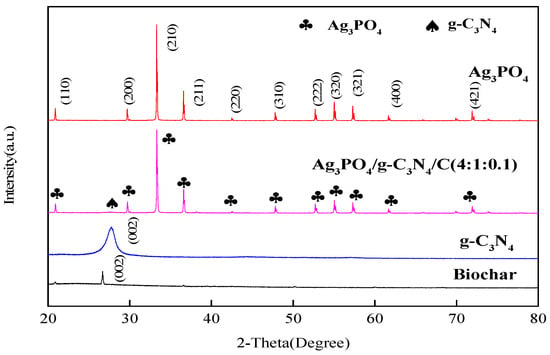
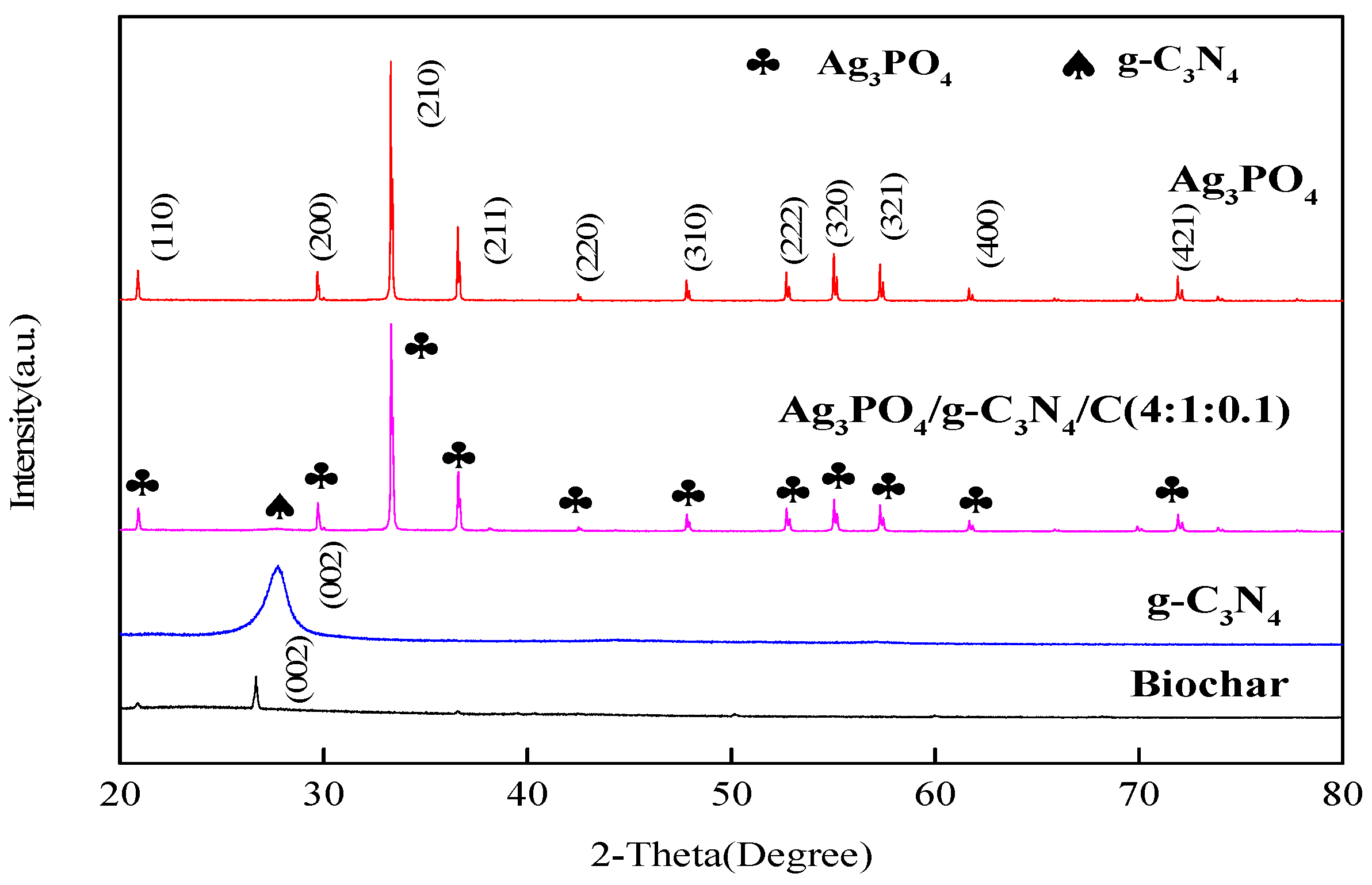
The XRD patterns of biochar, Ag3PO4, g-C3N4 and Ag3PO4/g-C3N4/C (4:1:0.1) samples are shown in Figure 1. For biochar, there is only a relatively broad amorphous carbon characteristic peak near 2θ = 26.6°, corresponding to the (002) crystal plane of the graphite microcrystals of carbonized materials [31,32]. Compared to the cubic shape Ag3PO4 standard card (JCPDS Card No. 06-0505), the characteristic diffraction peaks at 2θ = 20.9°, 29.7°, 33.3°, 36.6°, 42.5°, 47.8°, 52.6°, 55.0°, 57.2°, 61.7°, and 71.8° correspond to the crystal planes (110), (200), (210), (211), (220), (310), (222), (320), (321), (400), and (421) of Ag3PO4, respectively [33]. The Ag3PO4 crystal has a preferred crystal growth plane. The crystal growth exhibits significant crystal plane selectivity, and this characteristic is closely related to the crystal structure and growth conditions. Silver phosphate crystals typically preferentially expose three crystal planes, (100), (110), and (111), corresponding to the three types of typical morphologies: cubic, rhombohedral dodecahedron, and tetrahedral [34,35,36,37]. According to the prepared conditions, the synthesized Ag3PO4 tends to expose the (100) crystal plane with a cubic shape, and this is consistent with the results observed by SEM. According to the standard card of g-C3N4 (JCPDS Card No. 87-1526), the characteristic diffraction peak at 2θ = 27.4° corresponds to the (002) crystal plane of g-C3N4 [38]. As observed from Figure 1, due to the low content and poor crystallinity of g-C3N4 and biochar compared to Ag3PO4 in the composite material [33], it is difficult to observe their distinct diffraction peaks in the Ag3PO4/g-C3N4/C (4:1:0.1) composite material.
Figure 1.
XRD patterns of different samples.
3.1.2. XPS
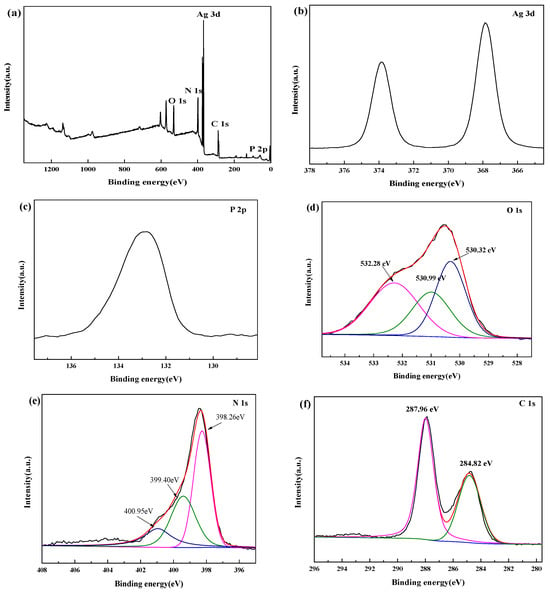
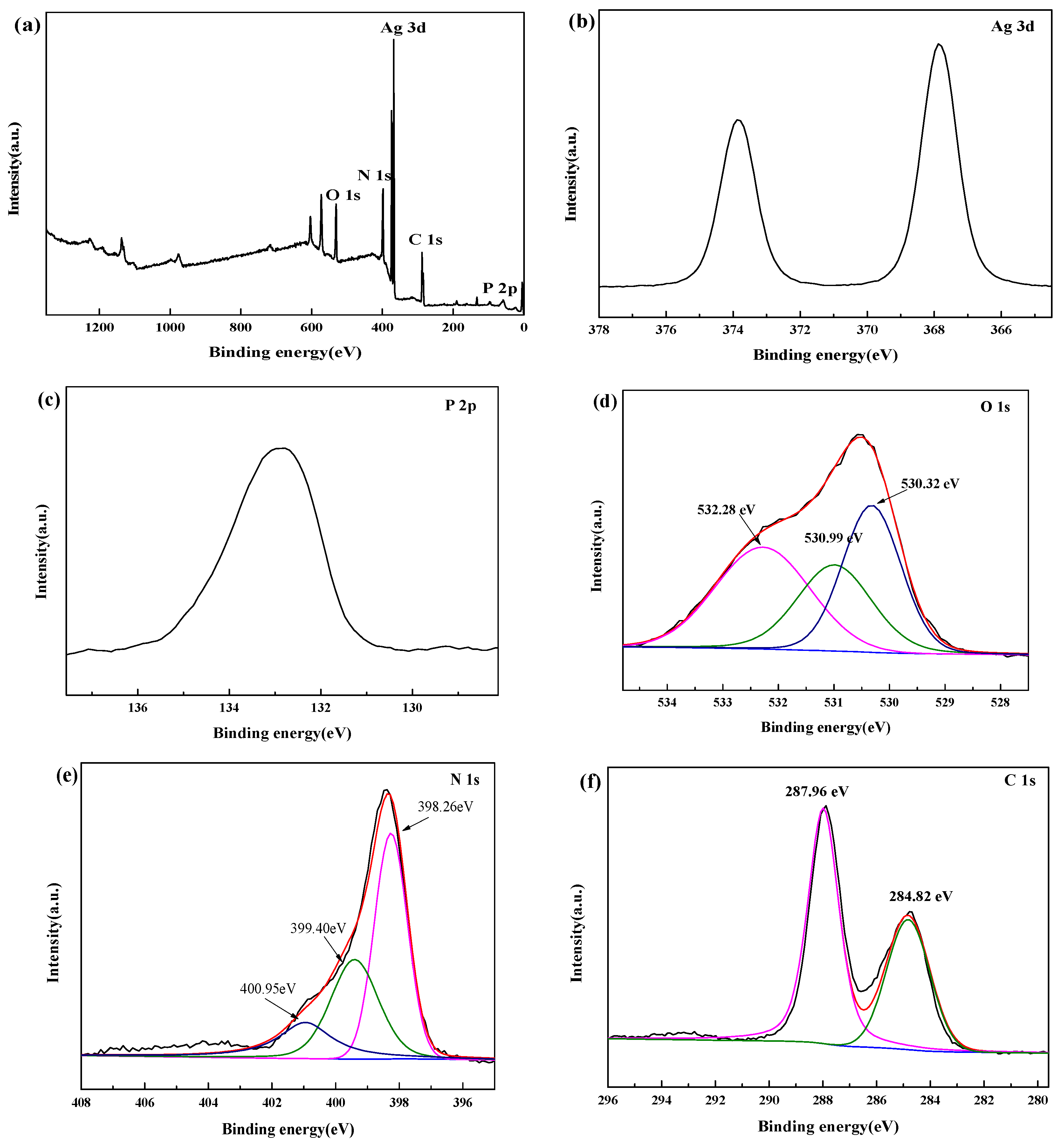
Through XPS analysis, the elemental composition and elemental forms on the surface of the Ag3PO4/g-C3N4/C (4:1:0.1) composite material were further studied. As shown in Figure 2a, the Ag3PO4/g-C3N4/C (4:1:0.1) sample was found to contain Ag, P, O, N and C elements. Figure 2b–f shows the XPS spectra of Ag, P, O, N and C elements, respectively. In Figure 2b, there are two characteristic peaks of Ag 3d, with binding energies of 367.96 eV (Ag 3d5/2) and 373.90 eV (Ag 3d3/2), indicating the presence of Ag+ in the sample [39]. In Figure 2c, there is only one characteristic peak of P 2p, with a binding energy of 133.20 eV, which corresponds to the presence of P5+ within PO43− in Ag3PO4 [39]. In Figure 2d, there are three characteristic peaks in the O 1s spectrum, with binding energies of 532.28, 530.99, and 530.32 eV. The peaks at 530.99 and 530.32 eV in the O 1s binding energy are consistent with O2− in Ag3PO4, while the characteristic peak at 532.28 eV may be attributed to the -OH groups or water molecules on the surface of the catalyst [40]. In Figure 2e, there are three characteristic peaks of N 1s, with binding energies of 398.26, 399.40 and 400.95 eV, respectively. The strong peak at 398.26 eV corresponds to sp2 hybridized carbon C=N–C, while the two weaker peaks at 399.40 and 400.95 eV are attributed to N-(C)3 and amino functional groups with hydrogen atoms (C–N–H), respectively [41]. In Figure 2f, there are two peaks in the C 1s spectrum. The characteristic peak at 284.82 eV is attributed to the carbon atoms (C–C) in the graphitized or amorphous carbon of the prepared sample, while the peak at 287.96 eV is attributed to the C–N in the g-C3N4 lattice [42].
Figure 2.
XPS spectra of Ag3PO4/g-C3N4/C (4:1:0.1) composite (a) survey, (b) Ag 3d, (c) P 2p, (d) O 1s, (e) N 1s, (f) C 1s.
3.1.3. FT-IR
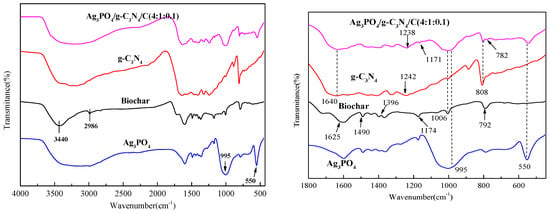
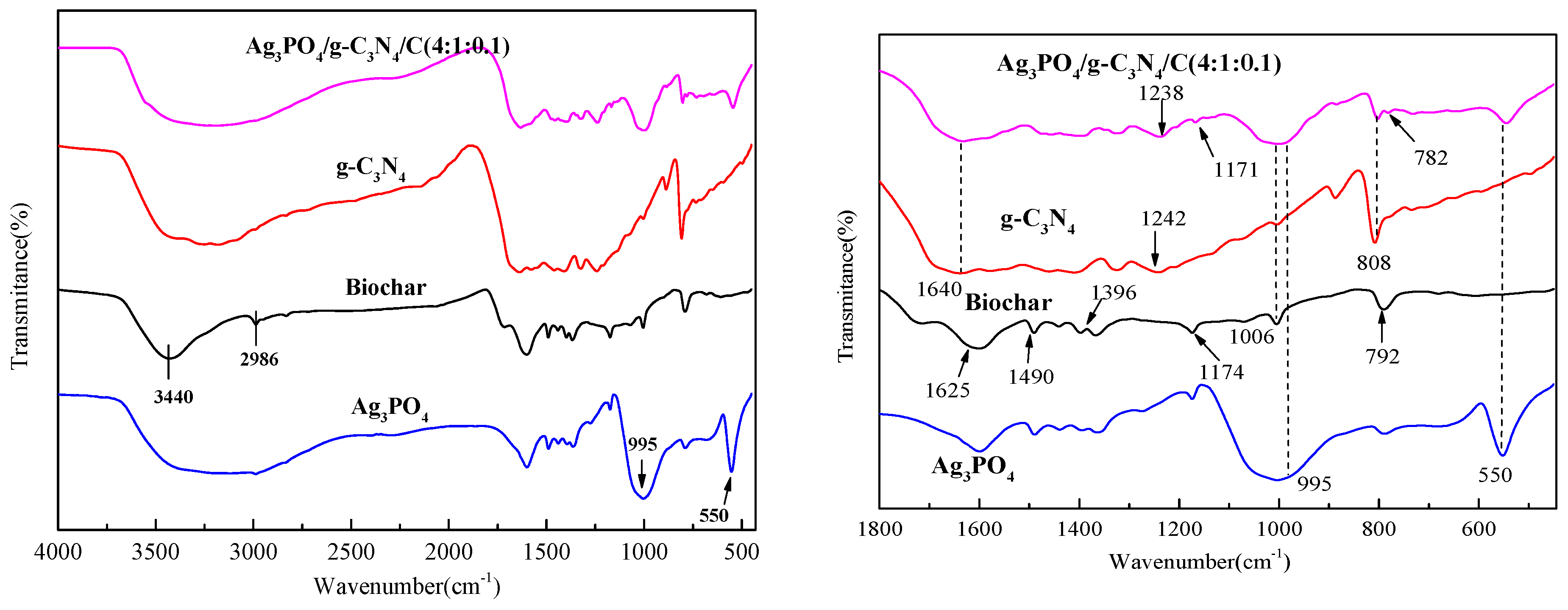
Figure 3 shows the FT-IR spectra of biochar, Ag3PO4, g-C3N4 and Ag3PO4/g-C3N4/C (4:1:0.1) composite. For biochar, the peak at 3440 cm−1 is the characteristic absorption peak of –OH [43]; the peak at 1625 cm−1 is due to stretching vibration C=O or C=C [44]; the peak at 2986 cm−1 is the saturated C–H stretching vibrations, mainly coming from methyl (–CH3) or methylene (–CH2) [32], the peak at 1490 cm−1 is benzene ring skeleton vibration or C–H bending of alkanes [45], the peak at 1396 cm−1 is the stretching vibration of –COO [44]; the peaks at 1006 cm−1 and 1174 cm−1 are the stretching vibration of C–O/C–O–C [32,45,46]; the peaks at 792 cm−1 are the stretching vibration of –COOH [47]. As for Ag3PO4 and g-C3N4, the strong peaks at 995 and 550 cm−1 are the characteristic peaks of PO43− [48], and the peaks in the range of 1200-1680 cm−1 are caused by the stretching vibration of C–N bonds in hexatomic heterocyclic compounds, while the strong peak at 808 cm−1 is the characteristic absorption peak of the triazine ring structure [43]. Compared with biochar, g-C3N4 and Ag3PO4, the main characteristic peaks related to biochar, Ag3PO4 and g-C3N4 can both be observed in the Ag3PO4/g-C3N4/C (4:1:0.1) composite. The characteristic peaks of biochar at 2986 cm−1, 1625 cm−1, 1490 cm−1 and 1396 cm−1 do not appear in the Ag3PO4/g-C3N4/C (4:1:0.1) composite, which may be due to the low content of biochar in the composite and the weak intensity of the corresponding characteristic peaks, and they are not reflected in the Ag3PO4/g-C3N4/C (4:1:0.1) composite. The characteristic peak at 782 cm−1 may be caused by the weakening and blue shift of the characteristic peak at 792 cm−1 corresponding to -COOH after the three are combined.
Figure 3.
FT-IR spectra of different samples.
3.1.4. SEM
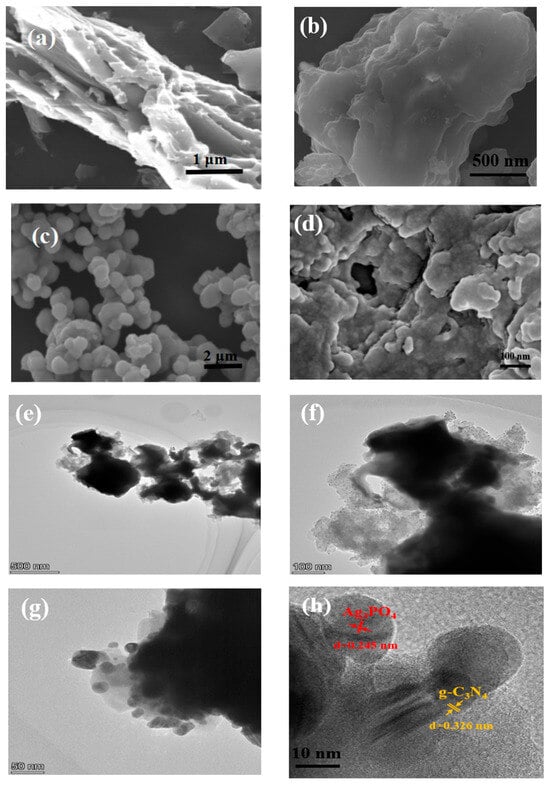
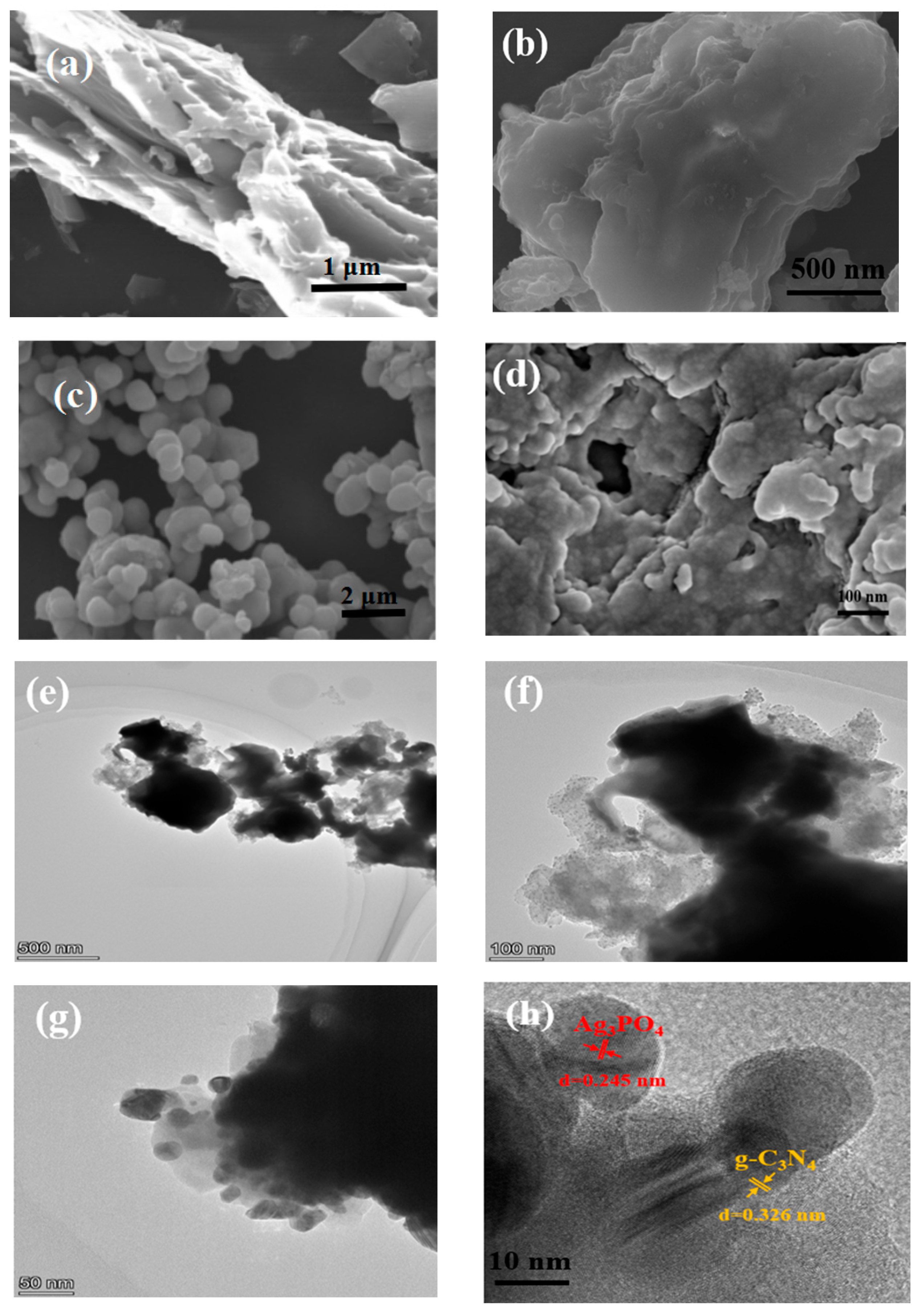
The surface morphology of the prepared samples was observed with scanning electron microscopy (SEM). Figure 4a–d shows the SEM images of biochar, g-C3N4, Ag3PO4 and Ag3PO4/g-C3N4/C (4:1:0.1), respectively. As shown in Figure 4a, the surface of biochar presents a rough carbon fiber-like structure, and the open pore structure on it can be observed. According to Figure 4b, the morphology of g-C3N4 is composed of layered stacked powder and the aggregated nanosheets, with thin layers and abundant pore structures. The formation of these pore structures may be attributed to the large amount of gas escaping during the high-temperature calcination of melamine. As shown in Figure 4c, the formed Ag3PO4 is in a regular small cubic shape, and some aggregation occurs among them. Figure 4d is the SEM image of the Ag3PO4/g-C3N4/C (4:1:0.1) composite material, and the cubic-shaped Ag3PO4 is deposited on the surface of g-C3N4 and the biochar, enveloping them. As shown in Figure 4e–h the TEM images demonstrated that the composite consists of nanosheets decorated with numerous small nanoparticles and interstitial voids. The TEM imaging confirmed that the Ag3PO4 successfully grew on the g-C3N4/C substrate and corroborated our SEM results. HRTEM analysis (Figure 4h) revealed distinct lattice fringes with spacings at 0.326 and 0.245 nm that corresponded to the (200) plane of g-C3N4 and the (211) plane of Ag3PO4, respectively. In conclusion, SEM and TEM images indicate that the microstructure information of the Ag3PO4/g-C3N4/C 4:1:0.1) composite—the intimate contact interface among Ag3PO4, g-C3N4, and biochar—ensured that the heterojunction was constructed through random deposition of Ag3PO4 particles on the g-C3N4/C substrate. It was beneficial for photogenerated electron hole pair transfers at the heterojunction.
Figure 4.
SEM diagram of (a) biochar, (b) g-C3N4, (c) silver phosphate, (d) Ag3PO4/g-C3N4/C (4:1:0.1) composite, and (e–h) TEM of the Ag3PO4/g-C3N4/C (4:1:0.1) composite.
3.2. Photocatalytic Activity
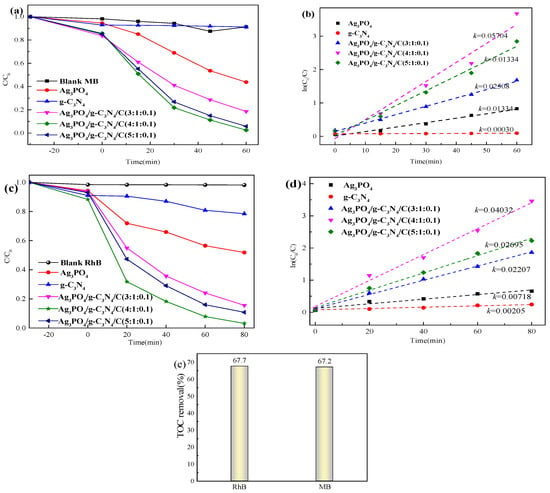
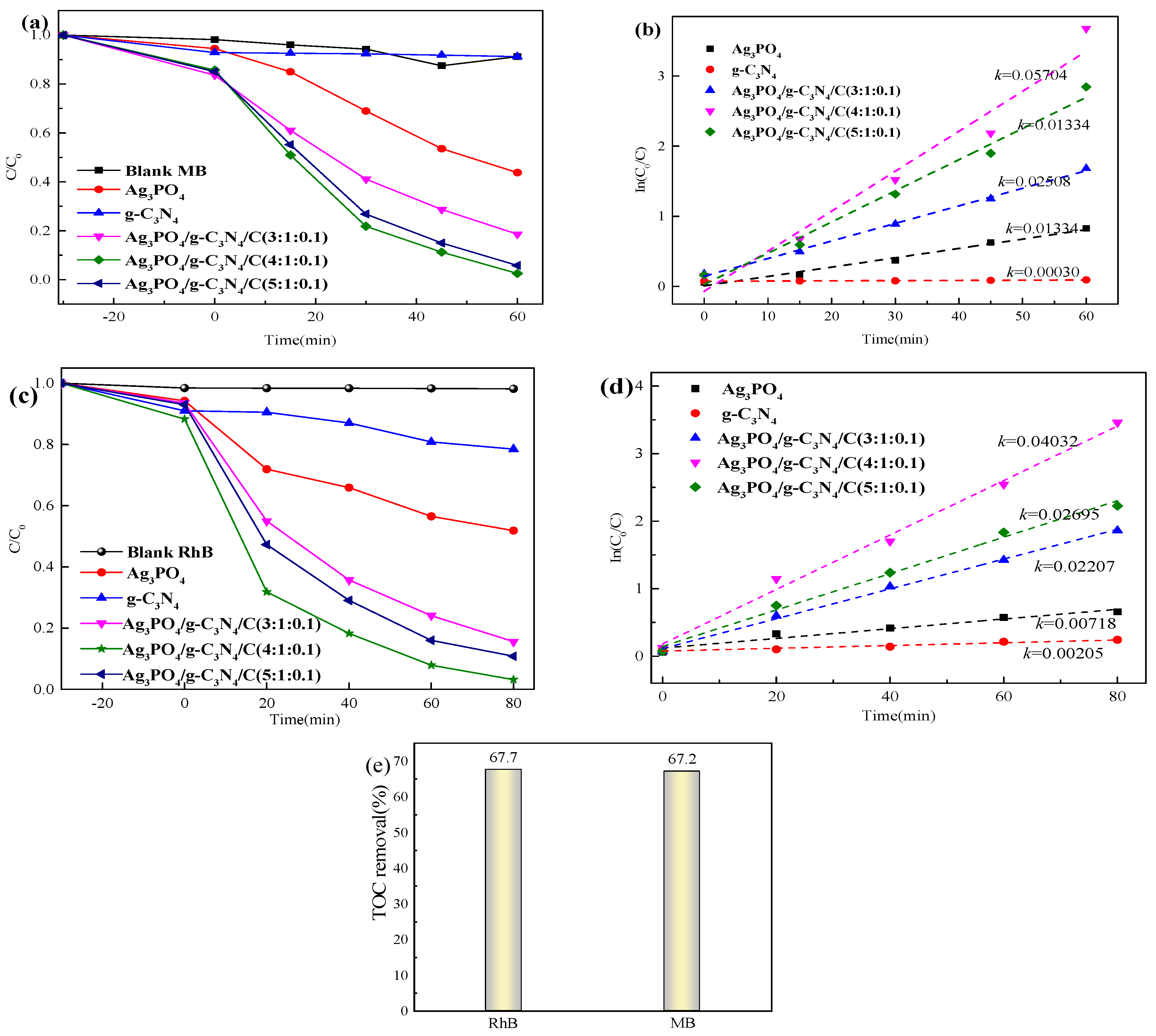
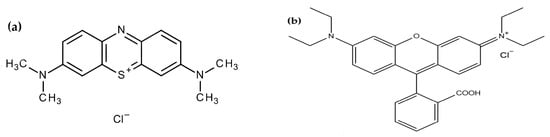
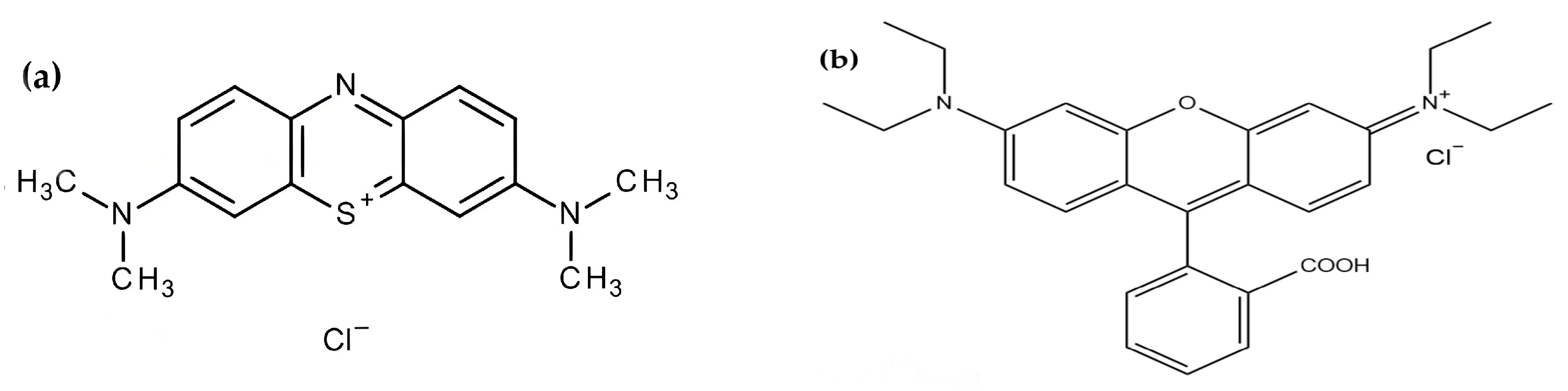
The photodegradation efficiencies of MB and RhB catalyzed by the prepared materials are shown in Figure 5. The molecular structures of MB and RhB are presented in Figure 6. Firstly, without adding any catalyst in the reaction system, the degradation efficiencies of MB and RhB in the aqueous solutions can be ignored. The degradation effects of different catalysts on MB are shown in Figure 5a. Compared with pure Ag3PO4, the introduction of biochar improves the removal performance of the composite material for MB, while the introduction of g-C3N4 can effectively enhance the degradation effect of the composite material on MB in the aqueous solution. Figure 5b shows the reaction kinetics fitting the diagram of the photocatalytic degradation of MB, where (lnC0/C) has a linear relationship with the reaction time t. According to the calculation of ln(C0/C) = kt [49], the reaction rate constants in different catalytic systems have the following relationship: k(Ag3PO4/g-C3N4/C (4:1:0.1)) > k(Ag3PO4/g-C3N4/C (5:1:0.1)) > k(Ag3PO4/g-C3N4/C (3:1:0.1)) > k(Ag3PO4) > k(g-C3N4), and Ag3PO4/g-C3N4/C (4:1:0.1) shows the best photocatalytic effect on MB, achieving a removal rate of 97% within 60 min of illumination. As shown in Figure 5c, the degradation curve of RhB indicates that Ag3PO4/g-C3N4/C (4:1:0.1) has the best photocatalytic effect on RhB, with a removal rate of 96% within 80 min of illumination. As seen from the reaction kinetics of the photocatalytic degradation of RhB in Figure 5d, the degradation rates of different samples for RhB vary with time. The k value at 0.0403 min−1 of Ag3PO4/g-C3N4/C (4:1:0.1) is the largest, indicating the fastest photocatalytic rate. Figure 5e presents the TOC removal efficiencies of MB and RhB photocatalyzed by Ag3PO4/g-C3N4/C composite material: 67.2% of MB within 60 min and 67.7% of RhB within 80 min. The removal of TOC confirms the degradation of MB and RhB into intermediate small molecule products, even the mineralization products of CO2 and H2O.
Figure 5.
Photocatalytic degradation of (a) MB and (c) RhB and the kinetic fit of (b) MB, (d) RhB, and (e) TOC removal efficiency by the Ag3PO4/g-C3N4/C composite material (10 mg/L MB, 10 mg/L RhB, 20 mg catalysts).
Figure 6.
Molecular structures of (a) MB and (b) RhB.
3.3. Photocatalytic Stability
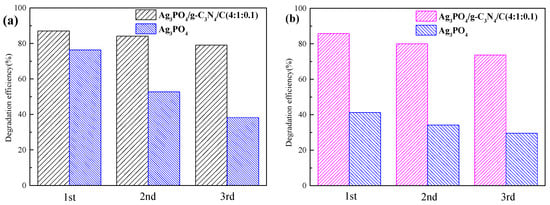
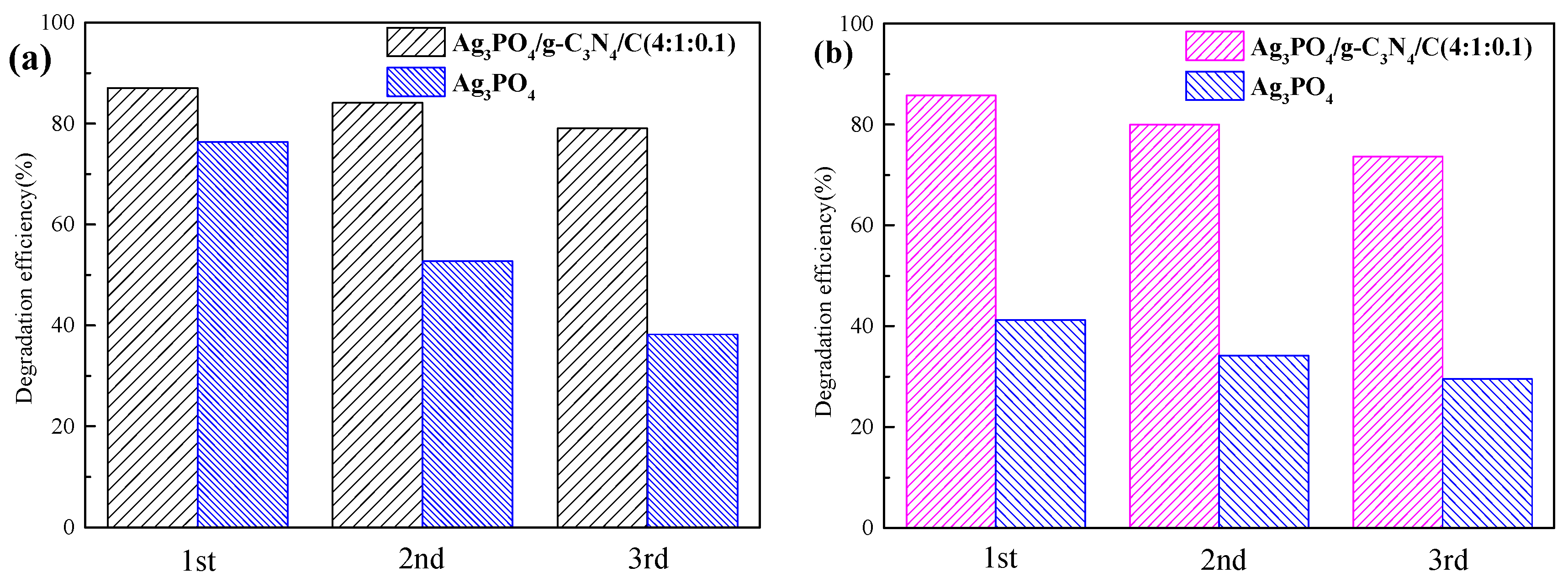
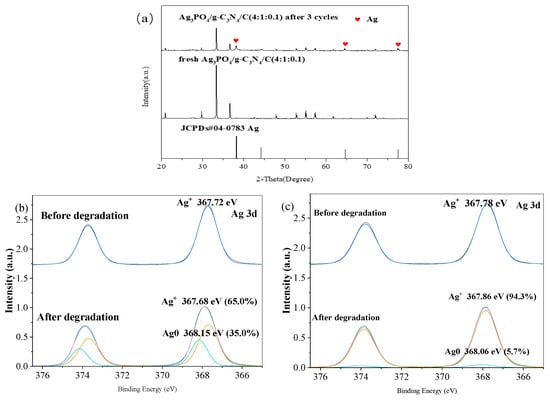
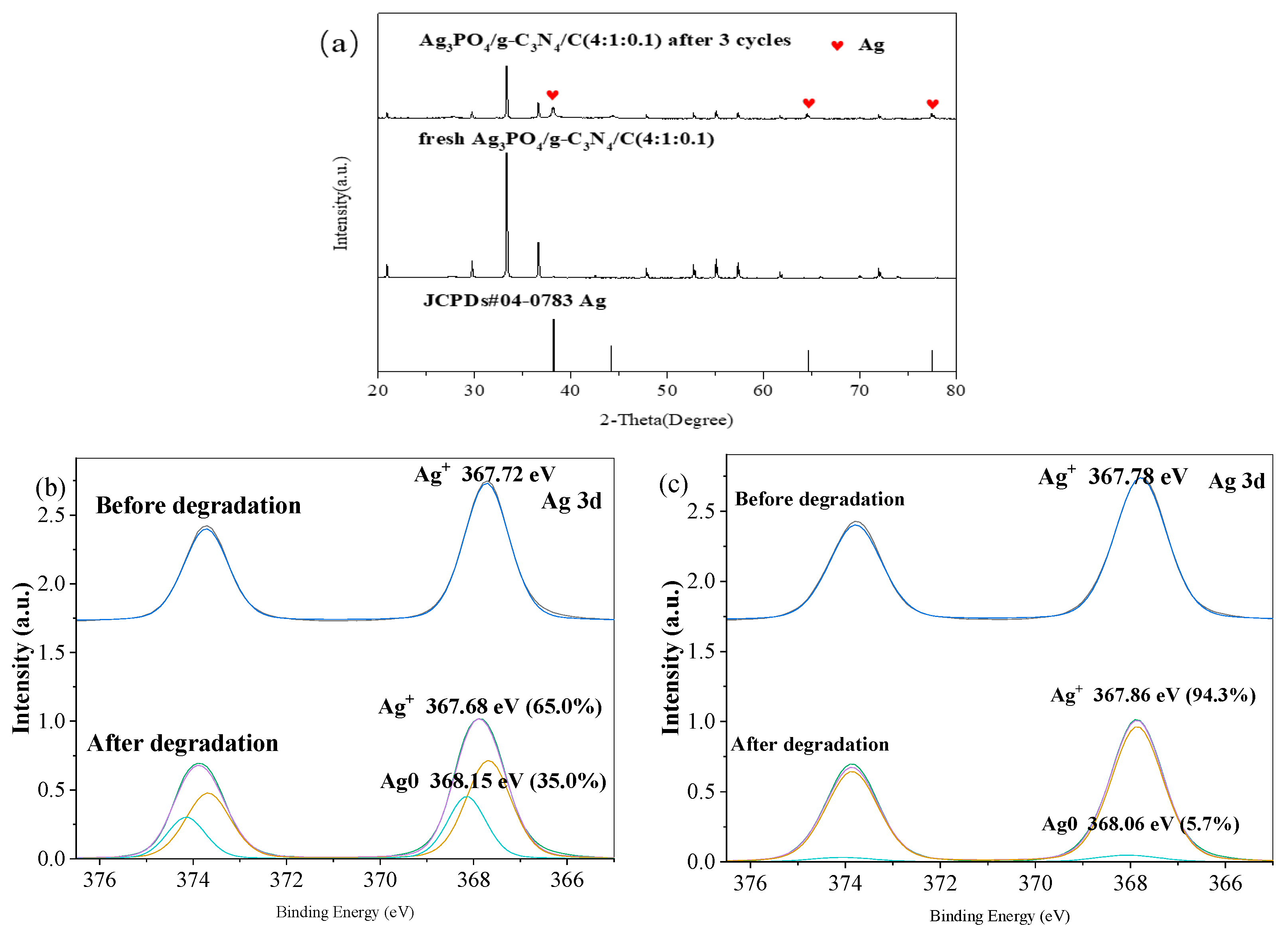
The cyclic stability of the Ag3PO4/g-C3N4/C (4:1:0.1) composite photocatalyst was investigated, and the results are shown in Figure 7. In the third cycle of the catalytic degradation experiment, the degradation efficiency of MB by Ag3PO4/g-C3N4/C (4:1:0.1) was 79%, while that by Ag3PO4 was 38%; the degradation efficiency of RhB by Ag3PO4/g-C3N4/C (4:1:0.1) was 74%, while that by Ag3PO4 was 30%. This indicates that compared with the single Ag3PO4 photocatalyst, the Ag3PO4/g-C3N4/C (4:1:0.1) composite photocatalyst has good catalytic cyclic stability. The Ag3PO4/g-C3N4/C (4:1:0.1) catalyst after three cycles was collected, and the XRD pattern was compared with the unreacted sample, as shown in Figure 8a. There were no significant changes in other peak types, except for the XRD pattern of the catalyst after three cycles existing as a diffraction peak of Ag, indicating that during the photocatalytic degradation of MB and RhB, little Ag+ on the surface of the catalyst was reduced to Ag0, causing the photo-corrosion of Ag3PO4 [50], which led to a decrease in the photocatalytic degradation efficiency of MB and RhB by Ag3PO4/g-C3N4/C (4:1:0.1). However, compared to photocatalytic degradation by Ag3PO4, the decrease in the photocatalytic degradation efficiency of MB and RhB by Ag3PO4/g-C3N4/C (4:1:0.1) is insignificant. This further demonstrates that the construction of Ag3PO4/g-C3N4/C (4:1:0.1) composite materials can slow down the photo-corrosion of Ag3PO4 and enhance its catalytic stability.
Figure 7.
Ag3PO4/g-C3N4/C (4:1:0.1) composites degraded (a) MB and (b) RhB in three cycles.
Figure 8.
XRD patterns of Ag3PO4/g-C3N4/C (4:1:0.1) before and after use (a); Ag3d XPS spectra of Ag3PO4 (b) and Ag3PO4/g-C3N4/C (4:1:0.1) (c) before and after use.
To prove that the photo-corrosion of Ag3PO4 is alleviated after the composite formation, XPS analysis of Ag3d was conducted on the samples before and after the three cycles underwent a photocatalytic reaction of Ag3PO4 and the Ag3PO4/g-C3N4/C (4:1:0.1) composite material; the results are shown in Figure 8b,c. In the Ag3d spectrum of bare Ag3PO4 (Figure 8b), the two peaks at 367.72 and 373.7 eV correspond to Ag3d5/2 and Ag3d3/2, respectively, with a spacing of 6.0 eV, which are the characteristic double peaks of Ag+ [51,52,53]; after the reaction, the two peaks moved to 367.68 and 373.7 eV, and a new peak appeared at 368.15 eV, falling within the binding energy range of the metal state Ag0 [51,52,53], accounting for 35.0% of the total Ag3d area; approximately one-third of the silver was transformed from Ag+ to metal Ag0. The conduction band position of Ag3PO4 is more positive than that of hydrogen, and the photogenerated electrons are difficult to quickly transfer to other substances, easily reducing the Ag+ in the lattice to Ag0 [51,52,53]. The newly emerging peak at 368.15 eV after the three cycles of photocatalytic reaction catalyzed by Ag3PO4 is attributed to the reduction of Ag+ in the lattice by the photogenerated electrons. In the Ag3d spectrum of the Ag3PO4/g-C3N4/C (4:1:0.1) composite (Figure 8c), the two peaks at 367.78 and 373.8 eV also correspond to the characteristic double peaks of Ag+ [51,52,53]; after the reaction, the two peaks moved to 367.86 and 373.8 eV, and a new peak appeared at 368.06 eV, falling within the binding energy range of the metal state Ag0 [51,52,53], accounting for 5.7% of the total Ag3d area. After the reaction, Ag0 accounted for 35.0% in bare Ag3PO4, while the composite only accounted for 5.7%. The composite alleviated the photo-corrosion of Ag3PO4. The photogenerated electrons in the composite were transferred to g-C3N4 and biochar, reducing the opportunities for lattice Ag+ to be reduced. The same phenomenon was observed in Pt nanowire-modified Ag3PO4 in the literature [54]: the photogenerated electrons were effectively used for O2 reduction, avoiding the photo-corrosion of Ag3PO4, and after the reaction, its Ag3d peak and XRD pattern were almost unchanged, and Ag+ was not reduced to Ag0. The XPS analysis of Ag3d further confirms that the introduction of g-C3N4 and biochar alleviated the photo-corrosion of Ag3PO4.
3.4. Active Species in Photocatalytic Degradation Systems
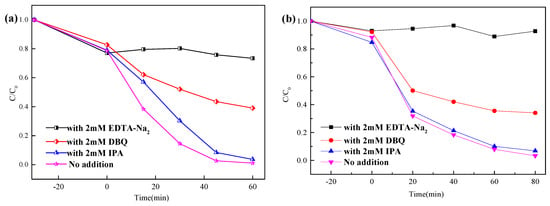
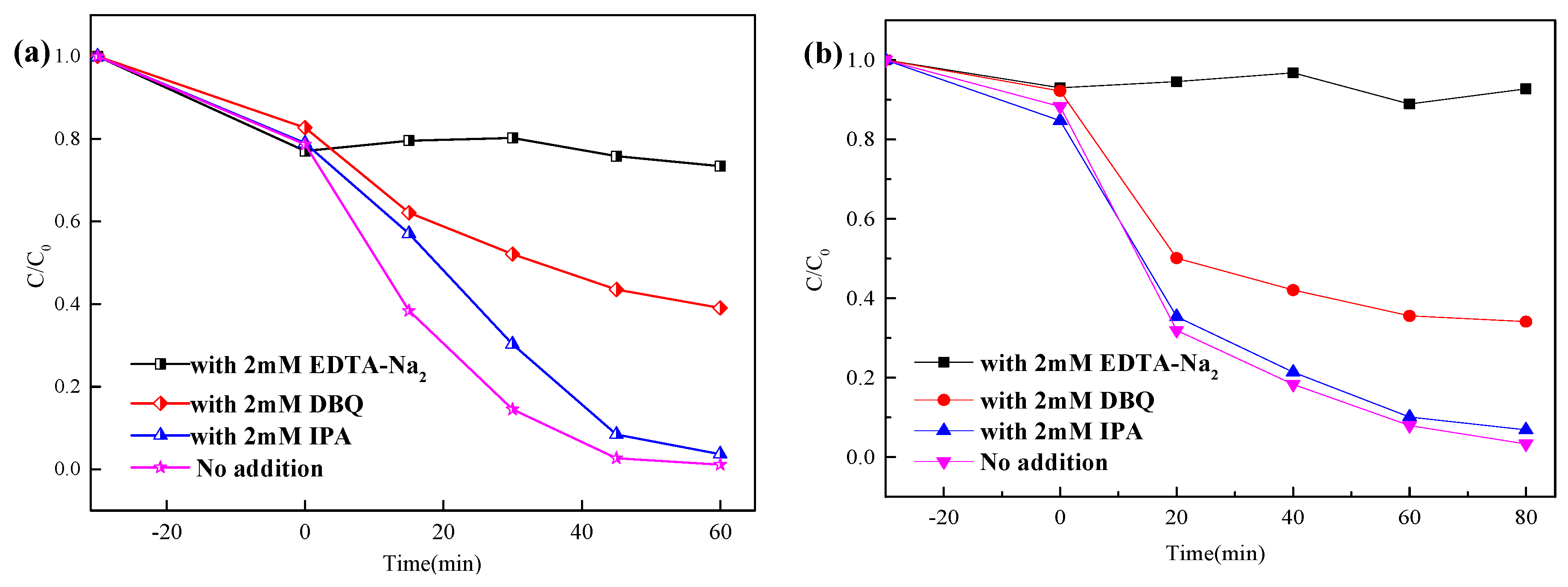
The main active species of the Ag3PO4/g-C3N4/C (4:1:0.1) composite photocatalyst in the photocatalytic degradation of MB and RhB systems were investigated by adding different radical scavengers. Isopropanol (IPA), p-benzoquinone (DBQ), and ethylenediamine tetra acetic acid disodium (EDTA-Na2) were used as scavengers for •OH (hydroxyl radical), •O2− (superoxide radical), and h+ (hole), respectively [55,56]. The degradation efficiencies of MB and RhB by the Ag3PO4/g-C3N4/C (4:1:0.1) composite photocatalyst after adding the capture agent are shown in Figure 9. As observed from Figure 9, under the same conditions, the degradation efficiencies of MB and RhB by the catalyst are significantly decreased when EDTA-Na2 and DBQ are added, while the addition of IPA has little effect on the reaction. This indicates that h+ and •O2− are the main active species and play a major role, •OH is also involved in the catalytic degradation process of MB and RhB, and the contributions of h+, •O2− and •OH follow the order h+ > •O2− > •OH. The result is consistent with the research findings of Chen et al. [57].
Figure 9.
Photocatalytic degradation of (a) MB and (b) RhB by Ag3PO4/g-C3N4/C (4:1:0.1) absent or present of radical scavengers’ isopropyl alcohol, p-benzoquinone and ethylenediamine tetra-acetic acid disodium.
3.5. Photocatalytic Mechanism
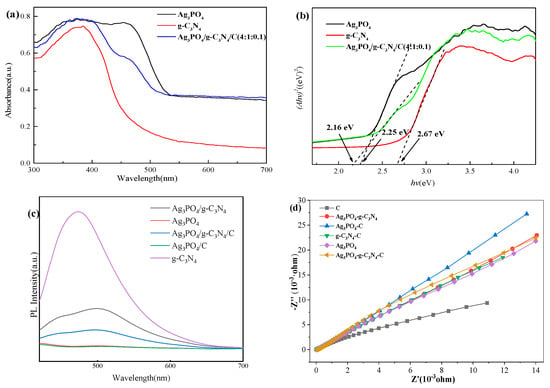
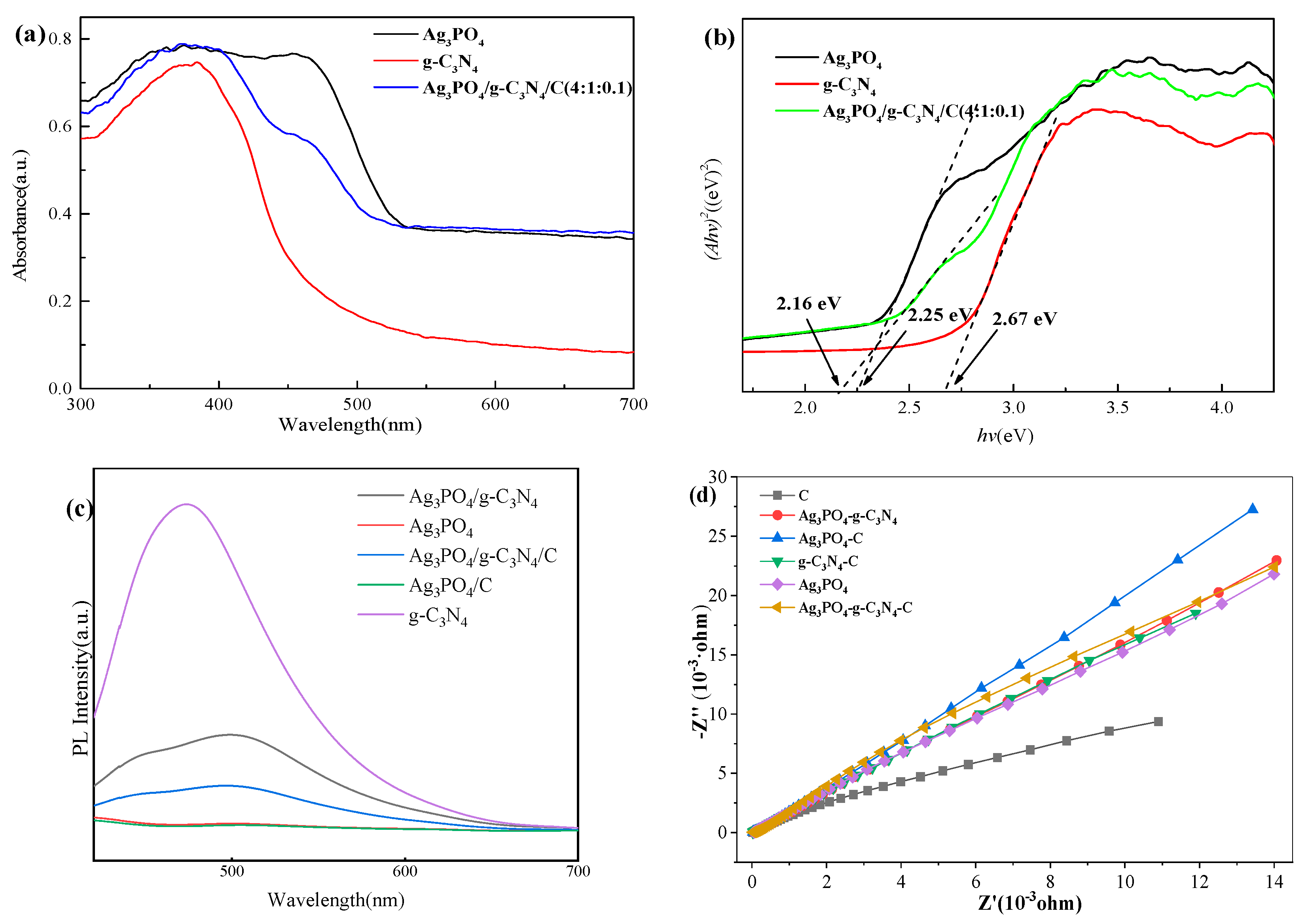
Figure 10a shows the UV-DRS spectra of the Ag3PO4, g-C3N4 and Ag3PO4/g-C3N4/C (4:1:0.1) composite photocatalysts. The edge of the light absorption band of g-C3N4 is approximately 460 nm. Due to the combination with Ag3PO4 (a bandgap width of Eg = 2.25 eV, shown in Figure 10b) and biochar, the light absorption range of the composite material is broadened, resulting in a significant redshift and increase in the light absorption band edge of Ag3PO4/g-C3N4/C (4:1:0.1), which is also conducive to improving the absorption and utilization efficiency of the visible light. Further analysis by plotting photon energy (hv) against (Ahv)2 reveals that the bandgap widths Eg of Ag3PO4, g-C3N4 and Ag3PO4/g-C3N4/C (4:1:0.1) are estimated to be 2.25 eV, 2.67 eV and 2.16 eV, respectively, as shown in Figure 10b. Generally, the photo-induced carrier recombination of the heterostructure materials could be evaluated by photoluminescence (PL) measurements, and lower PL intensity corresponded to higher e−-h+ separation efficiency, which promoted photocatalytic performance. As shown in Figure 10c, the g-C3N4 presented the maximum PL intensity, and Ag3PO4/g-C3N4 presented the second PL intensity, which were due to the rapid recombination of e−-h+, and resulted in their weak photocatalytic activity. However, the PL intensity of Ag3PO4/g-C3N4/C (4:1:0.1) was significantly lower than those of single g-C3N4 and Ag3PO4/g-C3N4 composites, suggesting that the synergistic effect among Ag3PO4, g-C3N4 and biochar effectively suppressed the recombination of photogenerated carriers. The interfacial charge-transfer behavior of the material was analyzed by electrochemical impedance spectroscopy (EIS), and the Nyquist plots are shown in Figure 10d. The high-frequency intercept on the real axis (X axis), which reflects the series resistance (Rs) of the electrode/electrolyte system, was 48.9 and 45.6 Ω for Ag3PO4 and Ag3PO4/g-C3N4, respectively, whereas the Rs of biochar (C) was only 16.6 Ω, suggesting its excellent electrical conductivity. While the materials were composted with C, their Rs decreased markedly to 19.3, 18.8 and 19.6 Ω for g-C3N4/C, Ag3PO4/C and Ag3PO4/g-C3N4/C (4:1:0.1), respectively. This indicates that the introduction of biochar significantly reduced the charge-transfer resistance and improved the electrical conductivity of the composite. Moreover, the impedance of Ag3PO4/g-C3N4/C (4:1:0.1) remained smaller than that of Ag3PO4/g-C3N4 over the whole measured frequency range (e.g., |Z| = 19.6 vs. 45.6 Ω at 100 kHz and 1124 vs. 1459 Ω at 1 Hz). It should be noted that the Nyquist arcs are not fully closed within the measured frequency window (0.01 Hz–100 kHz) owing to the large interfacial resistance and the non-ideal capacitive behavior of the powder-coated electrodes; the comparison was therefore based on the same frequency and on the high-frequency intercept rather than on extrapolating the arc radius. It implied that the close interfacial contact between Ag3PO4, g-C3N4 and biochar could efficiently facilitate the separation and migration of e−-h+, showing excellent photocatalytic performance.
Figure 10.
UV–vis DRS spectra (a), band gap energy values of estimated Kubelka–Munk plots (b), PL emission spectra (c), and electrochemical impedance spectra (d) of the prepared samples.
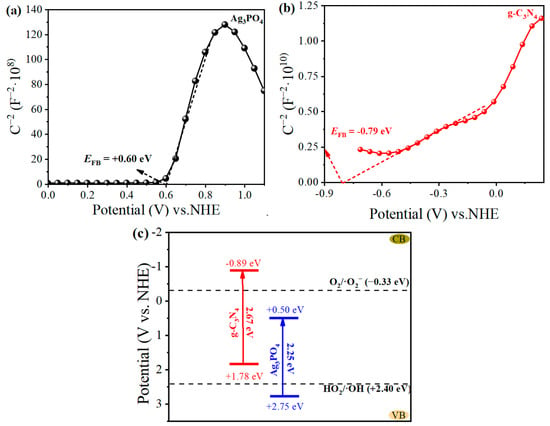
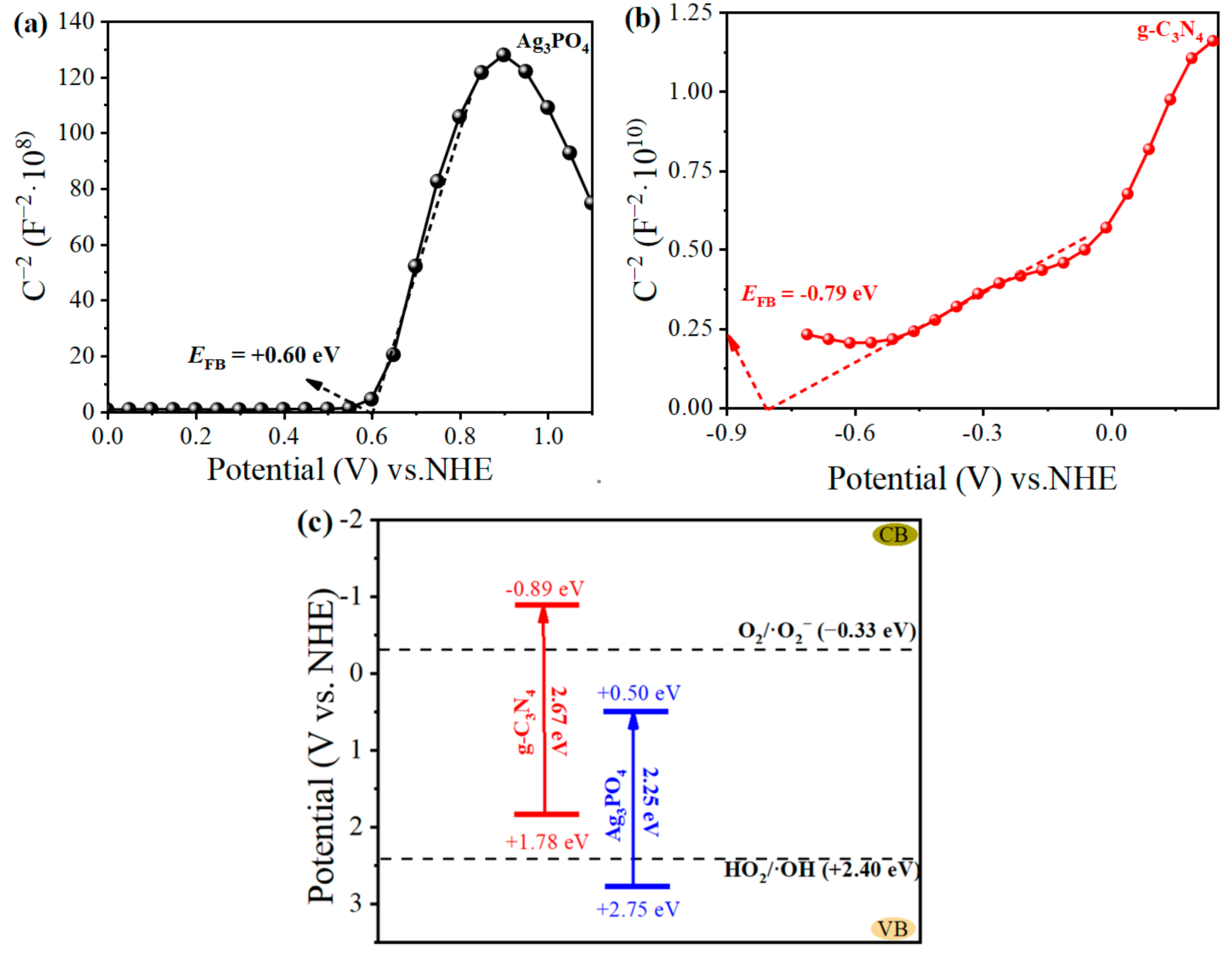
The redox ability of semiconductors mainly depends on the relative positions of the conduction band bottom (CBM) and valence band top (VBM) energy levels in relation to the redox potential of the reactants. Thus, the energy level structures of semiconductors should be determined. The flat band potential (EFB) of semiconductors can be estimated by the Mott–Schottky curves [28,58,59]. Figure 11a,b shows the Mott–Schottky curves of the prepared materials. The EFB value was determined by extrapolating the linear portion of the Mott–Schottky curve to the intercept of the horizontal axis, as well as the obtained EFB of Ag3PO4 and g-C3N4, which are +0.60 V vs. the normal hydrogen electrode (NHE) and −0.79 V vs. NHE, respectively. The positive slopes of the Ag3PO4 and g-C3N4 curves indicate that they are both n-type semiconductors [60]. In the case of an n-type semiconductor, the conduction band potential (ECB) is typically 0.1 V more negative than the EFB derived from the Mott–Schottky curve [61]. Accordingly, the ECB of Ag3PO4 and g-C3N4 are +0.50 V vs. NHE and −0.89 V vs. NHE, respectively. EVB can be further calculated according to the formula EVB = ECB + Eg, and the EVB of Ag3PO4 and g-C3N4 are +2.75 V vs. NHE and +1.78 V vs. NHE, respectively. Since the ECB of g-C3N4 (−0.89 V vs. NHE) is more negative than that of the normal redox potential of O2/•O2− (−0.33 vs. NHE) [55,62]), the electrons on the conduction band (CB) of g-C3N4 can reduce the dissolved O2 to •O2−, whereas the electrons on CB of Ag3PO4 (+0.50 V vs. NHE) cannot reduce the dissolved O2 to •O2− due to its ECB of + 0.50 V vs. NHE, which is not more negative than O2/•O2− (−0.33 vs. NHE). Meanwhile, the EVB of Ag3PO4 (+2.75 vs. NHE) is more positive than the normal redox potential of OH−/•OH (2.27 V vs. NHE) [55] and H2O/•OH (2.40 V vs. NHE) [17,57], and the holes on the valence band (VB) of Ag3PO4 can oxidize OH− and H2O in the aqueous system to •OH. More importantly, the holes (+2.75V vs. NHE) generated on the VB of Ag3PO4 have almost the same oxidizing properties as that of •OH (+2.8V vs. NHE) [63]. A large number of holes due to a higher concentration in the system can be more liable to oxidize dye molecules. That is, a small number of photogenerated holes react with OH− or H2O to generate ⋅OH, while most of the photogenerated holes in the VB of Ag3PO4 directly oxidize MB and RhB molecules. This also explains why the addition of isopropanol in the previous radical trapping experiments has little impact on the photocatalytic degradation efficiencies of MB and RhB by the catalyst. Moreover, the electrons on the CB of g-C3N4 do not migrate to CB of Ag3PO4; otherwise, •O2− would not contribute so much to the degradation of MB and RhB in the system. Similarly, the holes on VB of Ag3PO4 do not migrate to the VB of g-C3N4; otherwise, the holes would not contribute most, and •OH would not contribute to the degradation of MB and RhB in the system. Therefore, according to the photogenerated carrier transfer model in reference [57], the presence of a type II heterojunction is basically excluded.
Figure 11.
Mott–Schottky plots of g-C3N4 (a) and Ag3PO4 (b) and schematic illustration of the band structures (c) of the prepared samples.
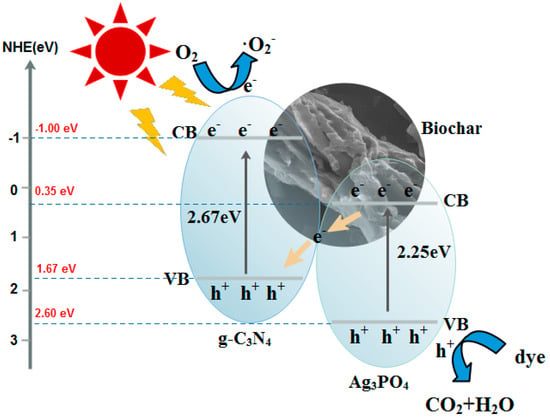
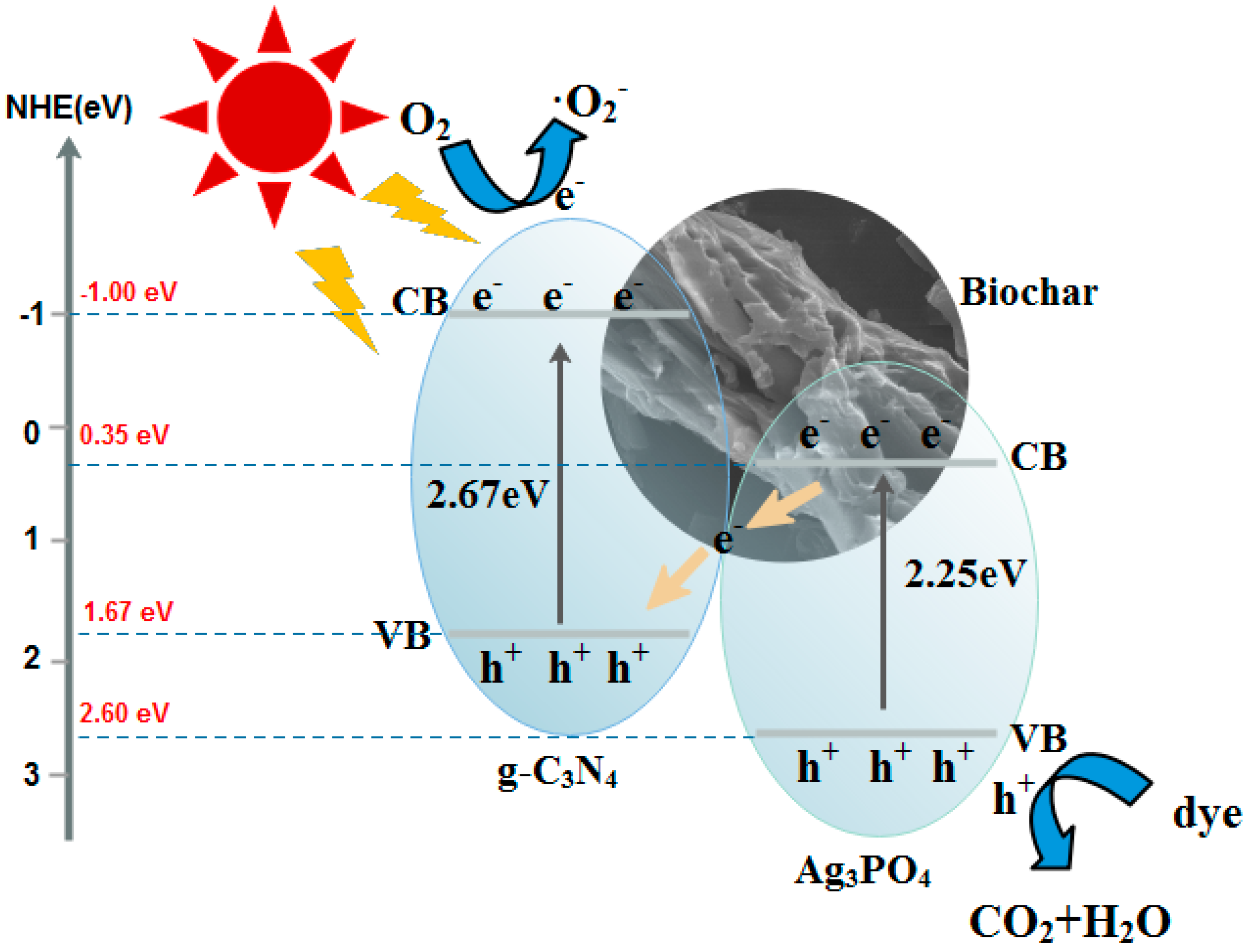
Based on the above-mentioned results and analysis, the mechanism of dye (MB and RhB) photocatalytic degradation by the Ag3PO4/g-C3N4/C (4:1:0.1) composite photocatalyst is proposed, as shown in Figure 12. Under visible light irradiation, Ag3PO4 and g-C3N4 absorb light energy, and carriers (electrons and holes) are generated, that is, the electrons (e−) on VB are excited to CB, and the positively charged holes (h+) are left on VB. Without the introduction of g-C3N4, the photogenerated carriers (e− and h+) produced by Ag3PO4 are apt to recombine, resulting in low photocatalytic performance. After Ag3PO4 and g-C3N4 couple to form a Z-scheme heterojunction, due to the effect of the built-in electric field, the directional migration of photogenerated electrons inhibits the recombination of photogenerated carriers in their own bulk phase, thereby achieving the effect of improving photocatalytic performance [64]. Biochar has excellent electrical conductivity [22,23,24,25,26], which can promptly transfer photogenerated electrons on the CB of Ag3PO4 to the VB of g-C3N4 and then recombined, and the photogenerated electrons on the CB of g-C3N4 and the photogenerated holes on the VB of Ag3PO4 will be retained. Accordingly, this will reduce the recombination of photogenerated electron-hole pairs of each Ag3PO4 and g-C3N4 and effectively enhance the photocatalytic stability of Ag3PO4 and the photocatalytic performance of Ag3PO4/g-C3N4/C (4:1:0.1). The electrons on the CB of g-C3N4 reduce the dissolved O2 molecules in water into •O2−, and then •O2− oxidizes and degrades the dye molecules. Meanwhile, a small number of photogenerated holes in the VB of Ag3PO4 oxidize OH− or H2O in the aqueous system to produce •OH, and •OH also oxidizes and degrades the dye molecules. More importantly, most of the highly oxidative holes, due to a higher concentration in the system, are more liable to react directly with the dyes, oxidizing and degrading them into small molecules until CO2, H2O, etc., are produced.
Figure 12.
Schematic diagram of photocatalytic mechanism of Ag3PO4/g-C3N4/C (4:1:0.1) photocatalyst.
4. Conclusions
The biochar from eucalyptus wood powder obtained by the pyrolysis and strong acid treatment was used as a carrier to support g-C3N4 and Ag3PO4 to obtain the Ag3PO4/g-C3N4/C composite photocatalyst. Through the degradation of the simulated dye wastewater (MB, RhB) by the composite photocatalyst, it was found that the Ag3PO4/g-C3N4/C (4:1:0.1) composite photocatalyst had the best degradation effect on MB and RhB. The photocatalytic degradation efficiency and TOC removal efficiency of MB in 40 mL 10 mg/L MB aqueous solution reached 97% and 67.2% within 60 min of visible light irradiation; the photocatalytic degradation efficiency and TOC removal efficiency of RhB in 40 mL 10 mg/L RhB aqueous solution reached 96% and 67.7% within 80 min of visible light irradiation. The main active species in the photocatalytic degradation of MB and RhB systems are h+, •O2− and •OH. After three cycles, the photocatalytic degradation efficiencies of MB and RhB by the Ag3PO4/g-C3N4/C (4:1:0.1) composite photocatalyst could still reach 79% and 74%, respectively. In contrast, after three cycles, the photocatalytic degradation efficiencies of MB and MBRhB by Ag3PO4 alone were only 38% and 30%, respectively. The Ag3PO4/g-C3N4/C (4:1:0.1) composite photocatalyst had good stability. In conclusion, the Ag3PO4/g-C3N4/C composite photocatalyst can be used for the degradation of dye in wastewater in the environment, achieving environmental remediation and the green development of the ecological environment.
Supplementary Materials
The following supporting information can be downloaded at: https://www.mdpi.com/article/10.3390/chemistry8100143/s1, Table S1: Experimental materials, Table S2: Experimental apparatus.
Author Contributions
C.H.: Investigation, Methodology, Validation. X.B.: Conceptualization, Data curation, Formal analysis, Investigation, Methodology, Writing—original draft. B.W.: Investigation, Software. S.W.: Investigation, Methodology. R.Q.: Conceptualization, Data curation. Q.W.: Investigation, Software. C.C.: Funding acquisition, Conceptualization, Methodology, Project administration, Resources, Supervision, Writing—review and editing. All authors have read and agreed to the published version of the manuscript.
Funding
This research was funded by the National Natural Science Foundation of China (31660183), Guangxi Natural Science Foundation (2025GXNSFAA069247), and the Dean/Opening Project of Guangxi Key Laboratory of Petrochemical Resource Processing and Process Intensification Technology (2024K002).
Data Availability Statement
The raw data supporting the conclusions of this article will be made available by the authors on request.
Conflicts of Interest
The authors declare no conflicts of interest.
References
- Mashkoor, F.; Nasar, A. Magsorbents: Potential candidates in wastewater treatment technology—A review on the removal of methylene blue dye. J. Magn. Magn. Mater. 2020, 500, 166408. [Google Scholar] [CrossRef] [Scilit]
- Karadayı, M.; Güllüce, E.; Gülşahin, Y.; Çolak, L.; Dahir Khalif, H.; Karadayı, G.; Güllüce, M. Molecular docking-assisted insights into methylene blue ecotoxicity and its detoxification by a biosorbent from Acer negundo. Int. J. Phytoremediat. 2025, 28, 238–254. [Google Scholar] [CrossRef] [Scilit]
- Khan, I.; Saeed, K.; Zekker, I.; Zhang, B.; Hendi, A.H.; Ahmad, A.; Ahmad, S.; Zada, N.; Ahmad, H.; Shah, L.A.; et al. Review on Methylene Blue: Its Properties, Uses, Toxicity and Photodegradation. Water 2022, 14, 242. [Google Scholar] [CrossRef] [Scilit]
- Al-Gheethi, A.A.; Azhar, Q.M.; Kumar, P.S.; Yusuf, A.A.; Al-Buriahi, A.K.; Radin Mohamed, R.M.S.; Al-shaibani, M.M. Sustainable approaches for removing Rhodamine B dye using agricultural waste adsorbents: A review. Chemosphere 2022, 287, 132080. [Google Scholar] [CrossRef] [Scilit]
- Priyadarshini, M.; Das, I.; Ghangrekar, M.M.; Blaney, L. Advanced oxidation processes: Performance, advantages, and scale-up of emerging technologies. J. Environ. Manag. 2022, 316, 115295. [Google Scholar] [CrossRef] [Scilit]
- Hai, H.T.N.; Hidalgo-Jiménez, J.; Edalati, K. Boosting hydrogen and methane formation on a high-entropy photocatalyst by integrating atomic d0/d10 electronic junctions and microscopic P/N heterojunctions. Int. J. Hydrogen Energy 2025, 162, 150762. [Google Scholar] [CrossRef] [Scilit]
- Hidalgo-Jiménez, J.; Akbay, T.; Watanabe, M.; Saito, K.; Guo, Q.; Ishihara, T.; Edalati, K. Entropy-stabilized oxides with d10 and s0p0 cations as heterostructured photocatalysts with high work function: Experiments and first-principles calculations. J. Energy Chem. 2025, 111, 954–968. [Google Scholar] [CrossRef] [Scilit]
- Nguyen, T.T.; Edalati, K. High-pressure phase and dual sulfur-oxygen vacancy induction in CdS-TiO2 heterojunctions for multifunctional photocatalytic applications. Acta Mater. 2025, 301, 121555. [Google Scholar] [CrossRef] [Scilit]
- Wang, H.; Zhang, L.; Chen, Z.; Hu, J.; Li, S.; Wang, Z.; Liu, J.; Wang, X.; Wang, A.J.L.A.Z. Semiconductor heterojunction photocatalysts: Design, construction, and photocatalytic performances. Chem. Soc. Rev. 2014, 43, 5234–5244. [Google Scholar] [CrossRef] [Scilit]
- Moniz, S.J.A.; Shevlin, S.A.; Martin, D.J.; Guo, Z.; Tang, J. Visible-light driven heterojunction photocatalysts for water splitting—A critical review. Energy Environ. Sci. 2015, 8, 731–759. [Google Scholar] [CrossRef] [Scilit]
- Liu, L.; Wang, J.; Zhao, T.; Du, X.; Zhang, J.; Lin, Z. Advancements, challenges, and future directions of photocatalytic advanced oxidation processes in environmental pollution remediation and energy conversion applications. Surf. Interfaces 2025, 74, 107731. [Google Scholar] [CrossRef] [Scilit]
- Che, L.; Pan, J.; Cai, K.; Cong, Y.; Lv, S. The construction of p-n heterojunction for enhancing photocatalytic performance in environmental application: A review. Sep. Purif. Technol. 2023, 315, 123708. [Google Scholar] [CrossRef] [Scilit]
- Beyecha, W.L.; Asefa, M.T.; Feyisa, G.B. Study on Challenges and Solutions for Enhancing Photocatalytic Activities of Ag3PO4 Nanoparticles for Degradation of Organic Dyes from Wastewater. J. Nanomater. 2022, 2022, 5564667. [Google Scholar] [CrossRef] [Scilit]
- Ismael, M. A review on graphitic carbon nitride (g-C3N4) based nanocomposites: Synthesis, categories, and their application in photocatalysis. J. Alloys Compd. 2020, 846, 156446. [Google Scholar] [CrossRef] [Scilit]
- Hasija, V.; Nguyen, V.; Kumar, A.; Raizada, P.; Krishnan, V.; Khan, A.A.P.; Singh, P.; Lichtfouse, E.; Wang, C.; Thi Huong, P. Advanced activation of persulfate by polymeric g-C3N4 based photocatalysts for environmental remediation: A review. J. Hazard. Mater. 2021, 413, 125324. [Google Scholar] [CrossRef] [Scilit]
- Nguyen, T.T.; Edalati, K. Synergistic interface and oxygen/nitrogen vacancy engineering in g-C3N4/Cu2O under high pressure for efficient CO2 photoreduction. J. Colloid Interf. Sci. 2026, 702, 138951. [Google Scholar] [CrossRef] [Scilit]
- Tan, C.; Chen, C.; Danni, W.; Zhao, X.; Zhou, L.; Lu, X.; Liang, J.; Wang, W. A novel LaFeO3/g-C3N4/Ag3PO4 dual Z-scheme heterojunction with enhanced light absorption, charge carrier separation and transfer capacity for photodegradation of antibiotics. J. Alloys Compd. 2024, 1002, 175211. [Google Scholar] [CrossRef] [Scilit]
- Ong, W.; Tan, L.; Ng, Y.H.; Yong, S.; Chai, S. Graphitic Carbon Nitride (g-C3N4)-Based Photocatalysts for Artificial Photosynthesis and Environmental Remediation: Are We a Step Closer To Achieving Sustainability? Chem. Rev. 2016, 116, 7159–7329. [Google Scholar] [CrossRef] [Scilit]
- Yan, H.; Yang, H. TiO2–g-C3N4 composite materials for photocatalytic H2 evolution under visible light irradiation. J. Alloys Compd. 2011, 509, L26–L29. [Google Scholar] [CrossRef] [Scilit]
- Singh, J.; Arora, A.; Basu, S. Synthesis of coral like WO3/g-C3N4 nanocomposites for the removal of hazardous dyes under visible light. J. Alloys Compd. 2019, 808, 151734. [Google Scholar] [CrossRef] [Scilit]
- Zhang, Y.; Zhang, X.; Zhou, Z.; Liu, G.; Wang, C. A review of the conversion of wood biomass into high-performance bulk biochar: Pretreatment, modification, characterization, and wastewater application. Sep. Purif. Technol. 2025, 361, 131448. [Google Scholar] [CrossRef] [Scilit]
- Zhang, J.; Wang, Y.; Feng, L.; Zhang, J.; Tian, X.; Huang, S.; Yuan, Y.; Wang, N. Biochar decorated 2D/2D heterojunction with enhanced photocatalytic activity for uranium extraction. Sep. Purif. Technol. 2025, 360, 131026. [Google Scholar] [CrossRef] [Scilit]
- Khan, I.; Sadiq, S.; Wu, P.; Humayun, M.; Ullah, S.; Yaseen, W.; Khan, S.; Khan, A.; Abumousa, R.A.; Bououdina, M. Synergizing black gold and light: A comprehensive analysis of biochar-photocatalysis integration for green remediation. Carbon Capture Sci. Technol. 2024, 13, 100315. [Google Scholar] [CrossRef] [Scilit]
- Wang, T.; Liu, S.; Mao, W.; Bai, Y.; Chiang, K.; Shah, K.; Paz-Ferreiro, J. Novel Bi2WO6 loaded N-biochar composites with enhanced photocatalytic degradation of rhodamine B and Cr(VI). J. Hazard. Mater. 2020, 389, 121827. [Google Scholar] [CrossRef] [Scilit]
- Cheng, L.; Zhang, Y.; Fan, W.; Ji, Y. Synergistic adsorption-photocatalysis for dyes removal by a novel biochar–based Z-scheme heterojunction BC/2ZIS/WO3: Mechanistic investigation and degradation pathways. Chem. Eng. J. 2022, 445, 136677. [Google Scholar] [CrossRef] [Scilit]
- Yu, X.; Yu, L.; Wang, H.; Duan, Y.; Li, X.; Zhao, X.; Wei, H. Upcycling Waste Biomass to Biochar: Feedstocks, Catalytic Mechanisms, and Applications in Advanced Oxidation for Wastewater Decontamination. Langmuir 2025, 41, 6–26. [Google Scholar] [CrossRef] [Scilit]
- Li, Y.; Wang, X.; Wang, C.; Fu, H.; Liu, Y.; Wang, P.; Zhao, C. S-TiO2/UiO-66-NH2 composite for boosted photocatalytic Cr(VI) reduction and bisphenol A degradation under LED visible light. J. Hazard. Mater. 2020, 399, 123085. [Google Scholar] [CrossRef] [Scilit]
- Jenifer, A.; Sriram, S. Enhanced photocatalytic organic dye degradation activities of pristine and Zn-doped V2O5 nanoparticles. Appl. Surf. Sci. 2023, 611, 155629. [Google Scholar] [CrossRef] [Scilit]
- Han, G.; Xu, F.; Cheng, B.; Li, Y.; Yu, J.; Zhang, L. Enhanced Photocatalytic H2O2 Production over Inverse Opal ZnO@ Polydopamine S-scheme Heterojunctions. Acta Phys.-Chim. Sin. 2022, 38, 2112037. [Google Scholar] [CrossRef] [Scilit]
- Zhang, C.; Wang, L.; Yuan, F.; Meng, R.; Chen, J.; Hou, W.; Zhu, H. Construction of p-n type Ag3PO4/CdWO4 heterojunction photocatalyst for visible-light-induced dye degradation. Appl. Surf. Sci. 2020, 534, 147544. [Google Scholar] [CrossRef] [Scilit]
- Qin, Q.; Zhong, F.; Song, T.; Yang, Z.; Zhang, P.; Cao, H.; Niu, W.; Yao, Z. Optimization of multiscale structure and electrochemical properties of bamboo-based porous activated biochar by coordinated regulation of activation and air oxidation. Chem. Eng. J. 2023, 477, 146763. [Google Scholar] [CrossRef] [Scilit]
- Perumal, R.S.; Muralidharan, B. Activated biochar derived from Ricinus communis outer shell: Influence of KOH impregnation ratio on physicochemical properties and EMI shielding effectiveness. Results Eng. 2025, 25, 104362. [Google Scholar] [CrossRef] [Scilit]
- Yin, H.; Cao, Y.; Fan, T.; Zhang, M.; Yao, J.; Li, P.; Chen, S.; Liu, X. In situ synthesis of Ag3PO4/C3N5 Z-scheme heterojunctions with enhanced visible-light-responsive photocatalytic performance for antibiotics removal. Sci. Total Environ. 2021, 754, 141926. [Google Scholar] [CrossRef] [Scilit]
- Amirulsyafiee, A.; Khan, M.M.; Harunsani, M.H. Ag3PO4 and Ag3PO4–based visible light active photocatalysts: Recent progress, synthesis, and photocatalytic applications. Catal. Commun. 2022, 172, 106556. [Google Scholar] [CrossRef] [Scilit]
- Martin, D.J.; Umezawa, N.; Chen, X.; Ye, J.; Tang, J. Facet engineered Ag3PO4 for efficient water photooxidation. Energ. Environ. Sci. 2013, 6, 3380. [Google Scholar] [CrossRef] [Scilit]
- Ma, X.; Cheng, H. Facet-dependent photocatalytic H2O2 production of single phase Ag3PO4 and Z-scheme Ag/ZnFe2O4-Ag-Ag3PO4 composites. Chem. Eng. J. 2022, 429, 132373. [Google Scholar] [CrossRef] [Scilit]
- Zwara, J.; Grabowska, E.; Klimczuk, T.; Lisowski, W.; Zaleska-Medynska, A. Shape-dependent enhanced photocatalytic effect under visible light of Ag3PO4 particles. J. Photochem. Photobiol. A Chem. 2018, 367, 240–252. [Google Scholar] [CrossRef] [Scilit]
- Thomas, A.; Fischer, A.; Goettmann, F.; Antonietti, M.; Müller, J.; Schlögl, R.; Carlsson, J.M. Graphitic carbon nitride materials: Variation of structure and morphology and their use as metal-free catalysts. J. Mater. Chem. 2008, 18, 4893. [Google Scholar] [CrossRef] [Scilit]
- Bian, Z.; Feng, Y.; Li, H.; Zhan, J. Fabrication of Ag3PO4/TiO2@molecular sieve (MS) ternary composites with remarkably enhanced visible light-responded photocatalytic activity and mechanism insight. Environ. Res. 2020, 190, 109984. [Google Scholar] [CrossRef] [Scilit]
- Shen, Y.; Zhu, Z.; Wang, X.; Khan, A.; Gong, J.; Zhang, Y. Synthesis of Z-scheme g-C3N4/Ag/Ag3PO4 composite for enhanced photocatalytic degradation of phenol and selective oxidation of gaseous isopropanol. Mater. Res. Bull. 2018, 107, 407–415. [Google Scholar] [CrossRef] [Scilit]
- Zhang, H.; Tang, G.; Wan, X.; Xu, J.; Tang, H. High-efficiency all-solid-state Z-scheme Ag3PO4/g-C3N4/MoSe2 photocatalyst with boosted visible-light photocatalytic performance for antibiotic elimination. Appl. Surf. Sci. 2020, 530, 147234. [Google Scholar] [CrossRef] [Scilit]
- Liu, Z.; Tian, J.; Yu, C.; Fan, Q.; Liu, X.; Yang, K.; Zeng, J.; Ji, H. Ultrasonic fabrication of SO42− doped g-C3N4/Ag3PO4 composite applied for effective removal of dyestuffs and antibiotics. Mater. Chem. Phys. 2020, 240, 122206. [Google Scholar] [CrossRef] [Scilit]
- Sun, J.; Lin, X.; Xie, J.; Zhang, Y.; Wang, Q.; Ying, Z. Facile synthesis of novel ternary g-C3N4/ferrite/biochar hybrid photocatalyst for efficient degradation of methylene blue under visible-light irradiation. Colloid. Surface. A 2020, 606, 125556. [Google Scholar] [CrossRef] [Scilit]
- Gonçalves, M.G.; Da Silva Veiga, P.A.; Fornari, M.R.; Peralta-Zamora, P.; Mangrich, A.S.; Silvestri, S. Relationship of the physicochemical properties of novel ZnO/biochar composites to their efficiencies in the degradation of sulfamethoxazole and methyl orange. Sci. Total Environ. 2020, 748, 141381. [Google Scholar] [CrossRef] [Scilit]
- Sun, Y.; Yu, I.K.M.; Tsang, D.C.W.; Cao, X.; Lin, D.; Wang, L.; Graham, N.J.D.; Alessi, D.S.; Komárek, M.; Ok, Y.S.; et al. Multifunctional iron-biochar composites for the removal of potentially toxic elements, inherent cations, and hetero-chloride from hydraulic fracturing wastewater. Environ. Int. 2019, 124, 521–532. [Google Scholar] [CrossRef] [Scilit]
- Geng, A.; Xu, L.; Gan, L.; Mei, C.; Wang, L.; Fang, X.; Li, M.; Pan, M.; Han, S.; Cui, J. Using wood flour waste to produce biochar as the support to enhance the visible-light photocatalytic performance of BiOBr for organic and inorganic contaminants removal. Chemosphere 2020, 250, 126291. [Google Scholar] [CrossRef] [Scilit]
- Fu, Y.; Shen, Y.; Zhang, Z.; Ge, X.; Chen, M. Activated bio-chars derived from rice husk via one- and two-step KOH-catalyzed pyrolysis for phenol adsorption. Sci. Total Environ. 2019, 646, 1567–1577. [Google Scholar] [CrossRef] [Scilit]
- Hou, G.; Li, Y.; An, W.; Gao, S.; Zhang, W.; Cui, W. Fabrication and photocatalytic activity of floating type Ag3PO4/ZnFe2O4/FACs photocatalyst. Mater. Res. Bull. 2017, 94, 263–271. [Google Scholar] [CrossRef] [Scilit]
- Abroshan, E.; Farhadi, S.; Zabardasti, A. Novel magnetically separable Ag3PO4/MnFe2O4 nanocomposite and its high photocatalytic degradation performance for organic dyes under solar-light irradiation. Sol. Energy Mater. Sol. Cells 2018, 178, 154–163. [Google Scholar] [CrossRef] [Scilit]
- Liu, C.; Xu, J.; Niu, J.; Chen, M.; Zhou, Y. Direct Z-scheme Ag3PO4/Bi4Ti3O12 heterojunction with enhanced photocatalytic performance for sulfamethoxazole degradation. Sep. Purif. Technol. 2020, 241, 116622. [Google Scholar] [CrossRef] [Scilit]
- Liu, Q.; Li, N.; Qiao, Z.; Li, W.; Wang, L.; Zhu, S.; Jing, Z.; Yan, T. The Multiple Promotion Effects of Ammonium Phosphate-Modified Ag3PO4 on Photocatalytic Performance. Front Chem. 2019, 7, 866. [Google Scholar] [CrossRef] [Scilit]
- Sulaeman, U.; Ramadhanti, S.F.; Diastuti, H.; Iswanto, P.; Isnaeni, I.; Yin, S. The enhanced photo-stability of defective Ag3PO4 tetrahedron prepared using tripolyphosphate. Arab. J. Chem. 2023, 16, 104409. [Google Scholar] [CrossRef] [Scilit]
- Huan, H.; Jile, H.; Tang, Y.; Li, X.; Yi, Z.; Gao, X.; Chen, X.; Chen, J.; Wu, P. Fabrication of ZnO@Ag@Ag3PO4 Ternary Heterojunction: Superhydrophilic Properties, Antireflection and Photocatalytic Properties. Micromachines 2020, 11, 309. [Google Scholar] [CrossRef] [Scilit]
- Zhu, H.; Ji, Y.; Chen, L.; Bian, W.; Wang, J. Pt Nanowire-Anchored Dodecahedral Ag3PO4{110} Constructed for Significant Enhancement of Photocatalytic Activity and Anti-Photocorrosion Properties: Spatial Separation of Charge Carriers and Photogenerated Electron Utilization. Catalysts 2020, 10, 206. [Google Scholar] [CrossRef] [Scilit]
- Bu, X.; Chen, C.; Zhao, X.; Huang, Q.; Liao, X.; Fan, H.; Wang, P.; Hu, H.; Zhang, Y.; Huang, Z. Fabrication of novel Z-scheme LaCoO3/activated biochar/Ag3PO4 heterojunctions for intensifying visible-light-catalytic degradation of bisphenol A. Appl. Surf. Sci. 2022, 588, 152887. [Google Scholar] [CrossRef] [Scilit]
- Huang, Q.; Chen, C.; Zhao, X.; Bu, X.; Liao, X.; Fan, H.; Gao, W.; Hu, H.; Zhang, Y.; Huang, Z. Malachite green degradation by persulfate activation with CuFe2O4@biochar composite: Efficiency, stability and mechanism. J. Environ. Chem. Eng. 2021, 9, 105800. [Google Scholar] [CrossRef] [Scilit]
- Chen, R.; Ding, S.; Fu, N.; Ren, X. Preparation of a g-C3N4/Ag3PO4 composite Z-type photocatalyst and photocatalytic degradation of Ofloxacin: Degradation performance, reaction mechanism, degradation pathway and toxicity evaluation. J. Environ. Chem. Eng. 2023, 11, 109440. [Google Scholar] [CrossRef] [Scilit]
- Yu, X.; Wang, R.; Liu, Z.; Wei, Y.; Wang, K.; Zhang, J.; Niu, J. Construction of ZnMoO4/Cu2O with Z-type heterojunction and its photocatalytic degradation performance. Ceram. Int. 2025, 51, 7883–7896. [Google Scholar] [CrossRef] [Scilit]
- Verger, M.; Dusailly, O.; Sevin, E.; Gosselet, F.; Fenart, L.; Saint-Pol, J.; Mathieu, C.; Blach, J.; Saitzek, S. Photocatalytic properties of La2Ti2O7 synthesized by glycine-assisted sol-gel method and its impact on intestinal and blood-brain barriers. J. Photochem. Photobiol. A Chem. 2026, 470, 116642. [Google Scholar] [CrossRef] [Scilit]
- Chowdhury, A.P.; Anantharaju, K.S.; Keshavamurthy, K.; Kumar, B.S.; Chinnam, S.; Das, S.; Rokhum, S.L. Ag3PO4 anchored SnWO4 Z-scheme heterojunction for reactive blue 21 degradation: Performance analysis and mechanism insights. Results Surf. Interfaces 2024, 17, 100334. [Google Scholar] [CrossRef] [Scilit]
- Pang, Q.; Wu, Y.; Yang, Y.; Wu, J.; Lu, J.; Xie, Y. Vacancy defect regulation of the spatial local electronic states and energy band structure of CoNi2S4/VsCdS Schottky junction for improved photocatalytic hydrogen evolution. Chem. Eng. J. 2025, 525, 170098. [Google Scholar] [CrossRef] [Scilit]
- Lu, J.; Wang, Y.; Liu, F.; Zhang, L.; Chai, S. Fabrication of a direct Z-scheme type WO3/Ag3PO4 composite photocatalyst with enhanced visible-light photocatalytic performances. Appl. Surf. Sci. 2017, 393, 180–190. [Google Scholar] [CrossRef] [Scilit]
- Wu, M.; Guo, X.; Cao, Y.; Yu, H.; Hu, Z.; Yang, Y.; Yao, T.; Wu, J. Cascading H2O2 photosynthesis and Fenton reaction for self-sufficient photo-Fenton reactions: A review of recent advances. Chem. Eng. J. 2024, 489, 151091. [Google Scholar] [CrossRef] [Scilit]
- Liu, L.; Ding, L.; Liu, Y.; An, W.; Lin, S.; Liang, Y.; Cui, W. A stable Ag3PO4@PANI core@shell hybrid: Enrichment photocatalytic degradation with π-π conjugation. App. Catal. B Environ. 2017, 201, 92–104. [Google Scholar] [CrossRef] [Scilit]
Disclaimer/Publisher’s Note: The statements, opinions and data contained in all publications are solely those of the individual author(s) and contributor(s) and not of MDPI and/or the editor(s). MDPI and/or the editor(s) disclaim responsibility for any injury to people or property resulting from any ideas, methods, instructions or products referred to in the content. |
© 2026 by the authors. Licensee MDPI, Basel, Switzerland. This article is an open access article distributed under the terms and conditions of the Creative Commons Attribution (CC BY) license.