


Abstract
Azide-containing compounds, organic azides, showcases a variety of reactivities, making them highly convenient and chameleonic intermediates. An indoline derivative has been proven to be of great significance in drug discovery due to its sp3-rich property. In this context, it is interesting to perform such vigorous azidation on medicinal-relevant indoles/indolines, resulting in the production of sp3-rich azidoindolines. The potential biological activity, in combination with the sp3-rich indoline bearing the azido moiety, makes azidoindolines an attractive synthetic target for medicinal and synthetic chemists. This review describes recent advances in the synthesis and application of azidoindolines: (1) iodine-mediated azidations, (2) metal-catalyzed azidations, (3) electrochemical azidations, (4) photochemical azidations, (5) azidation using a combination of an oxidant and an azide source, and (6) nucleophilic azidation.
1. Introduction
Indoles and indolines are privileged structures that are found in natural products and pharmaceutical agents, exhibiting significant biological activities [1,2,3,4,5,6]. In particular, one indoline derivative has been proven to be of great significance in drug discovery due to its sp3-rich property [7,8,9]. The construction of the sp3-rich framework needs regio- and stereoselective methodologies, which are difficult to realize. Therefore, efficient and divergent syntheses of added-value indolines are a pivotal challenge for medicinal and organic chemists [10,11,12].
Azide-containing compounds, organic azides, showcases a variety of reactivities, such as the Staudinger reaction [13], the aza-Wittig reaction [14], the click reaction [15], and C–H amination [16], making them highly convenient and chameleonic intermediates. Along with the recognition of azide radicals as a versatile species and the bloom of catalytic reactions, many protocols and precursors for azide radicals generated from NaN3, XN3, TMSN3, and azidoiodinane have been developed [17,18,19].
In this context, it is interesting to perform a vigorous azidation on medicinal-relevant indoles/indolines, resulting in the production of sp3-rich azidoindolines. The potential biological activity, in combination with the sp3-rich indoline bearing the azido moiety, makes azidoindolines an attractive synthetic target for medicinal and synthetic chemists. This review describes recent advances in the synthesis and application of azidoindolines: (1) iodine-mediated azidations, (2) metal-catalyzed azidations, (3) electrochemical azidations, (4) photochemical azidations, (5) azidation using a combination of an oxidant and an azide source, and (6) nucleophilic azidation.
2. Azidation of Indoles Using Iodine Reagents
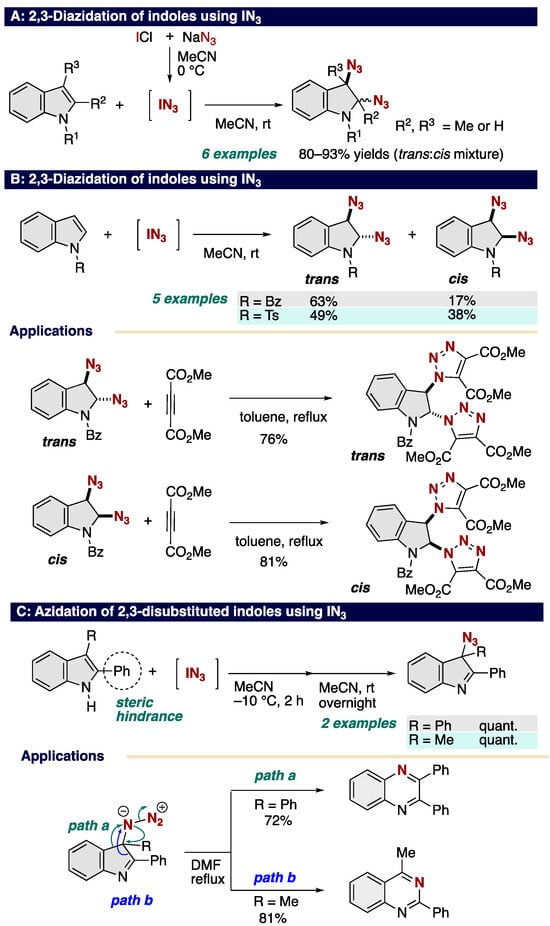
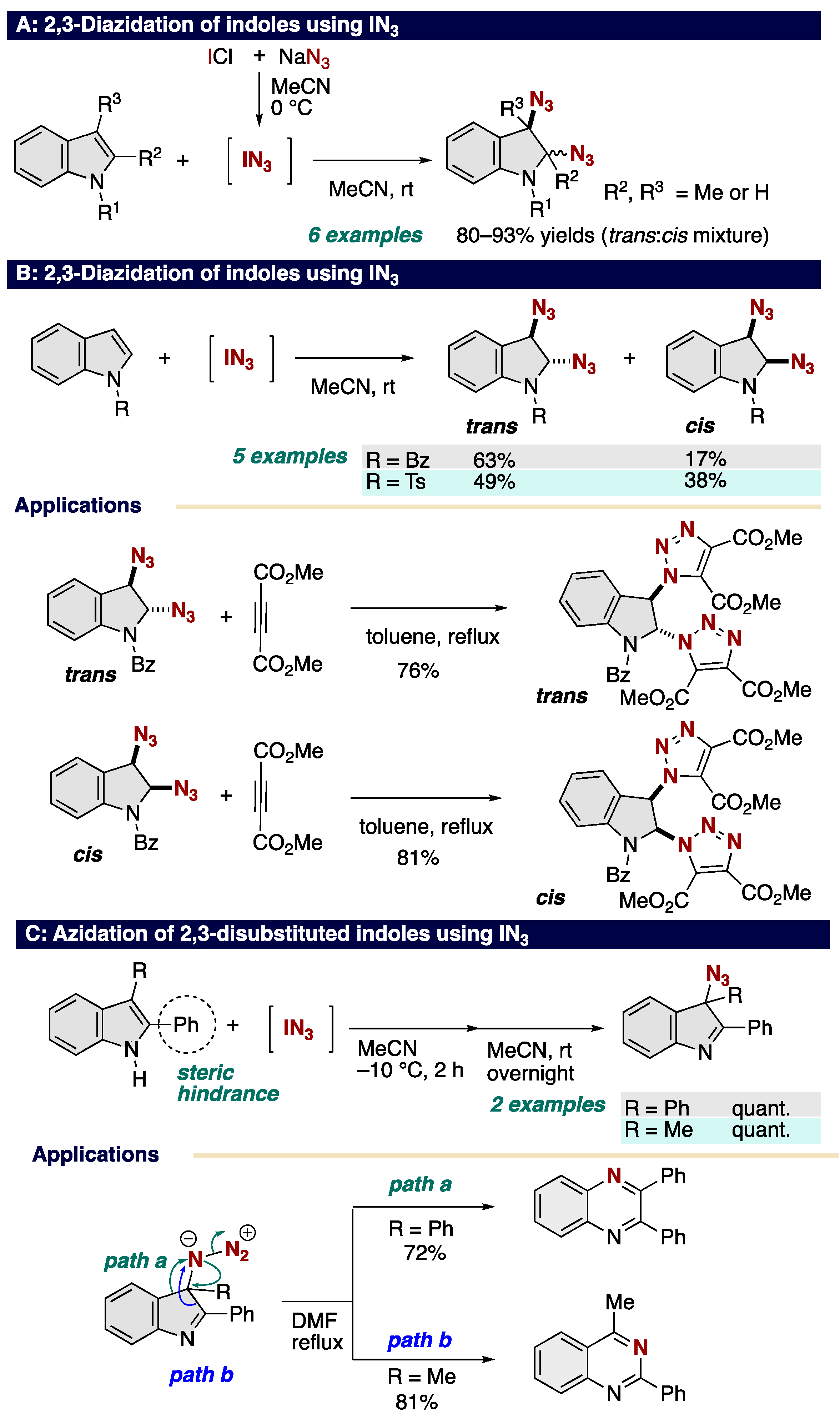
In the past decades, diverse methodologies for the dearomatization of indoles have been developed. However, azides have rarely participated in the dearomatization of indoles [20,21]. Pioneering work on an azidoindoline synthesis was achieved by Ikeda’s group in 1975 (Scheme 1A) [22]. By taking advantage of a homolytic cleavage of the iodine–nitrogen bond, the dearomatized azidation of indoles was accomplished.
Scheme 1.
Early report on direct azidations of indoles using IN3.
In 1978, the [3 + 2] cycloaddition reaction of trans- or cis-diazidoindolines with acetylene dicarboxylate was reported by the same group (Scheme 1B) [23]. The two examples of sp3-rich triazoles construction can be obtained by this protocol.
In 1976, the Ikeda’s group also found that 3-azidoindolenine participated in the switchable synthesis of a quinoxaline and a quinazoline in DMF under reflux conditions (Scheme 1C) [24]. The bulky phenyl group may contribute to the formation of 3-azidoindolenine through monoazidation at the C3 position of 2-phenylindoles. This IN3 was quite unstable and explosive, and it must be used in situ. Thus, a mild protocol is necessary for expanding the scope of azidation of indoles via azide radical generation.
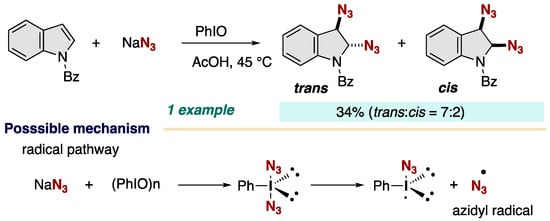
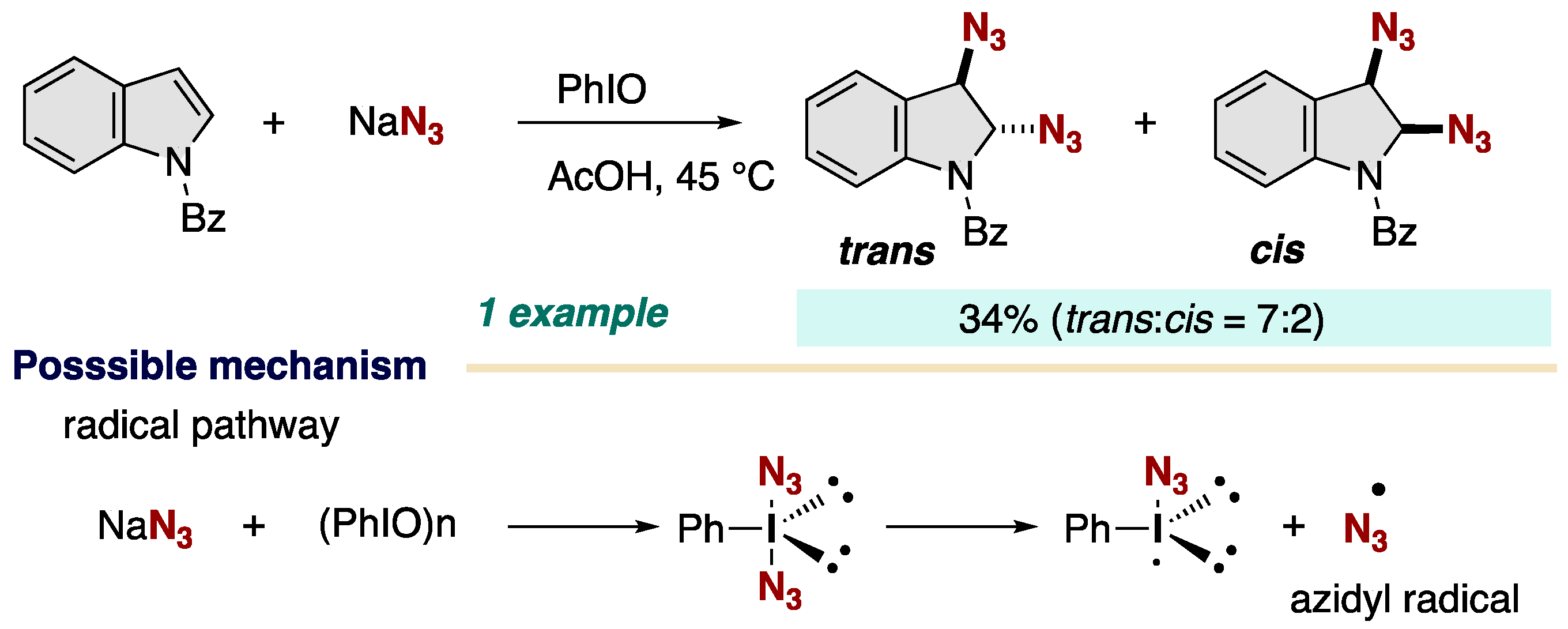
In 1986, Moriarty et al., reported the direct diazidation of indoles using a combination of PhIO and NaN3 (Scheme 2) [25]. The homolytic cleavage of the iodine–nitrogen bond of hypervalent iodine PhI(N3)2 gives an azidyl radical and PhIN3• radical, which undergo abstractions of hydrogen bonding and azidation. In general, PhI(N3)2 generated from PhIO, PhI(OAc)2/NaN3, or TMSN3 is highly reactive and unstable [26]. Thus, optimization of the reaction conditions may occasionally result in an insufficient outcome.
Scheme 2.
Diazidations of indoles using NaN3 and PhIO.
Over the past decade, hypervalent iodine reagents have been shown to be useful reagents to achieve umpolung disconnections [27]. Various nucleophiles can be changed into electrophiles by these iodine reagents. The introduction of reactive yet stable indolyl iodonium salts has led to the development of broadly applicable reactions.
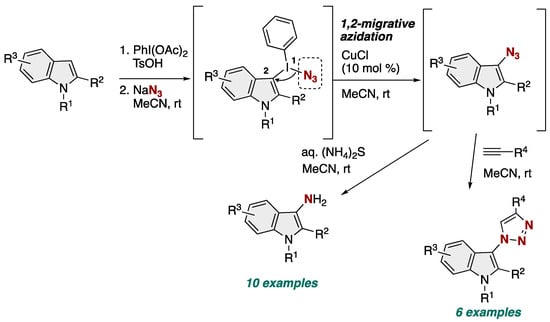
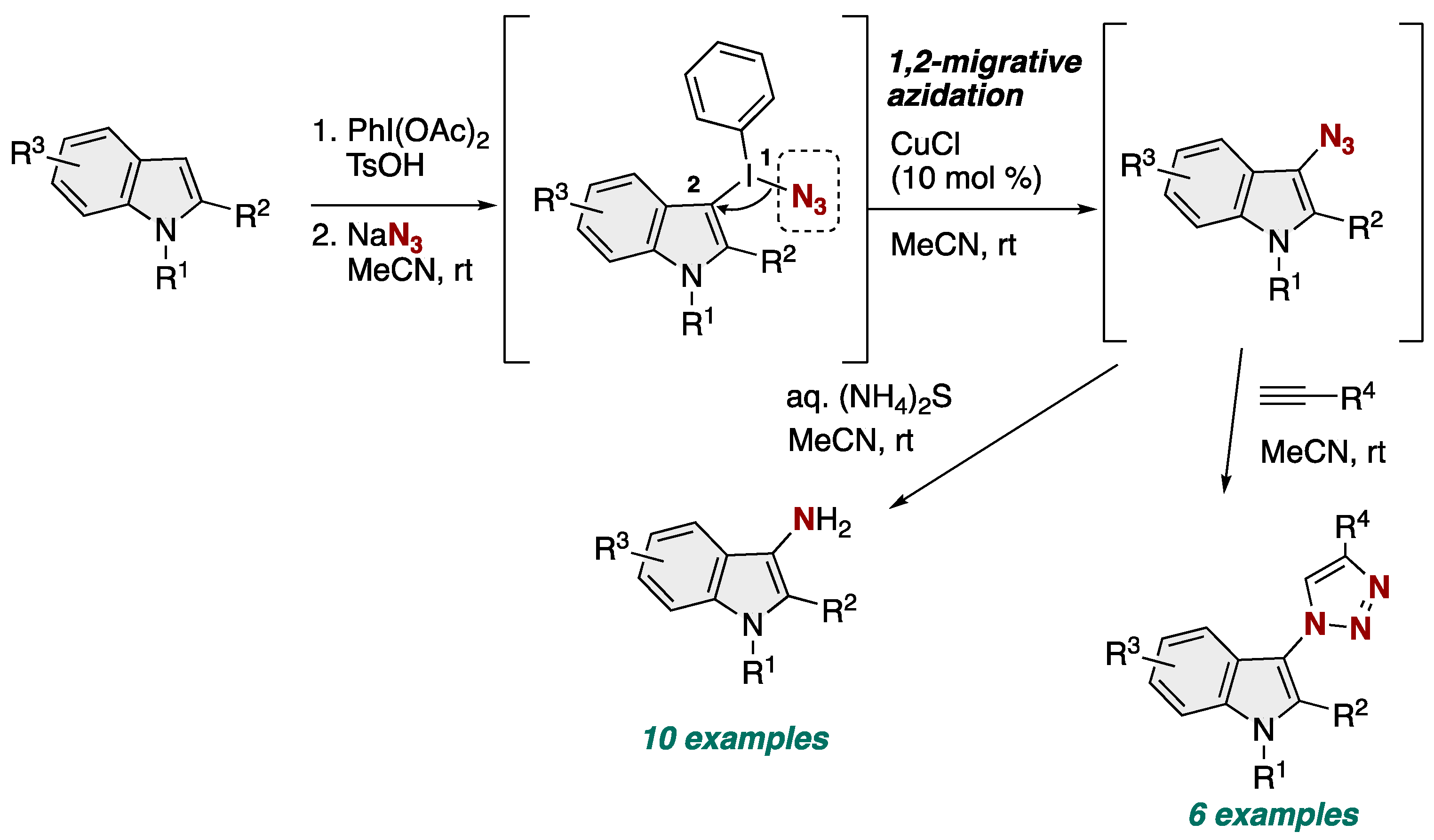
In 2011, applications of more stable indole-based iodonium reagents were introduced by Suna and co-workers (Scheme 3) [28]. The azide acted as not only as a group transfer reagent but also as a stabilizer against the iodonium reagents. However, the indolylazides are also unstable and the reaction should be performed on site and in situ. Consequently, a Cu(I)-catalyzed azidation/reduction and azidation/1,3-cycloadition have been conducted in a one-pot operation.
Scheme 3.
Direct azidation of indoles through the in situ formation of indole-based iodonium intermediates.
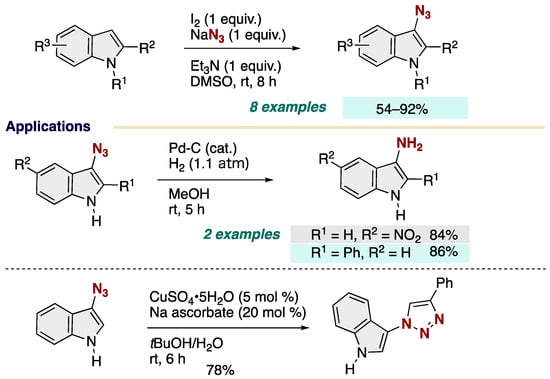
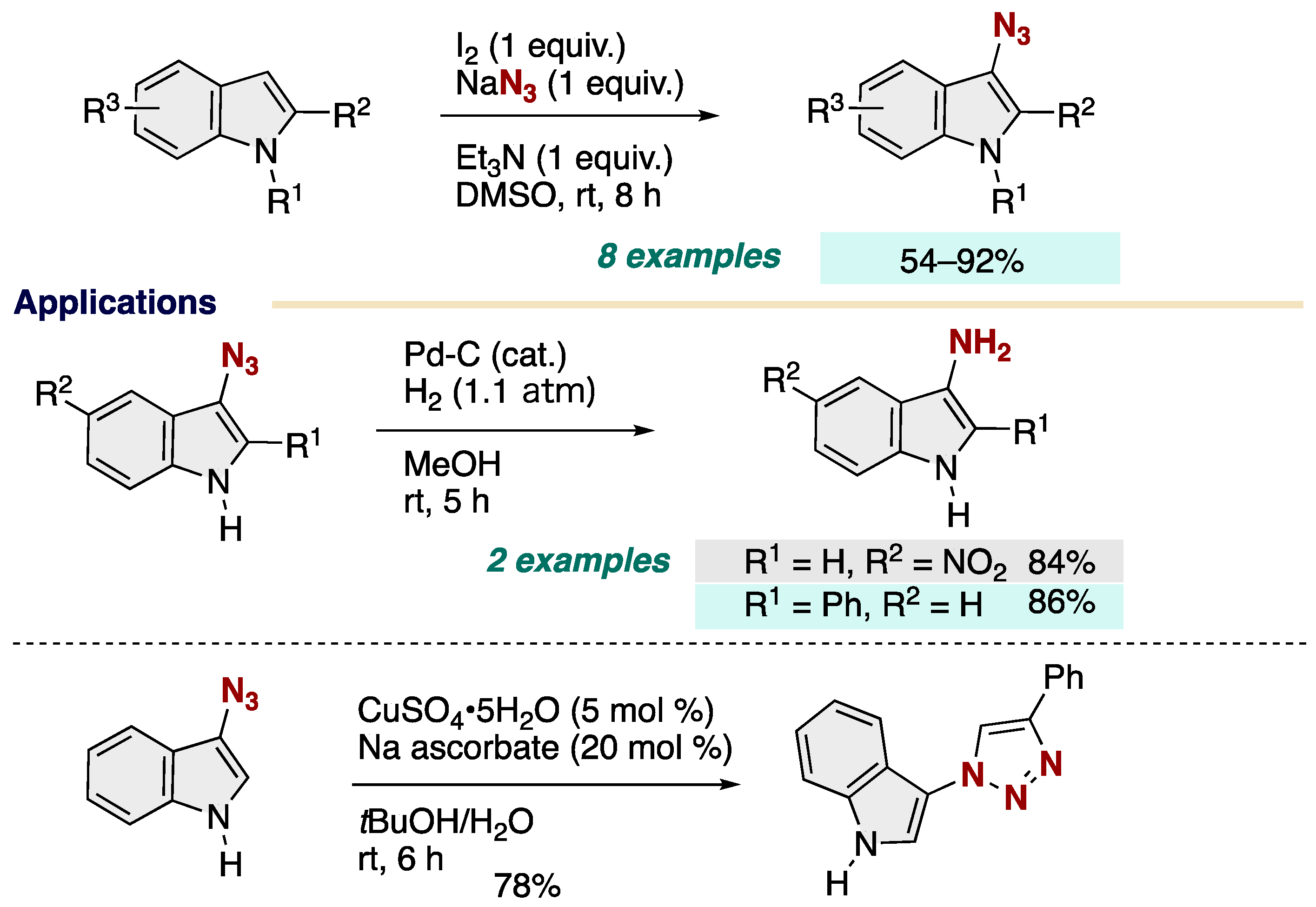
In 2016, Sudalai found that a simple combination of molecular iodine and NaN3 could be used for the direct umpolung azidation of indoles, affording 3-azidoindoles (Scheme 4) [29]. Reduction and 1,3-dipolar cycloaddition have been conducted.
Scheme 4.
Umpolung direct azidation of indoles using I2 and NaN3.
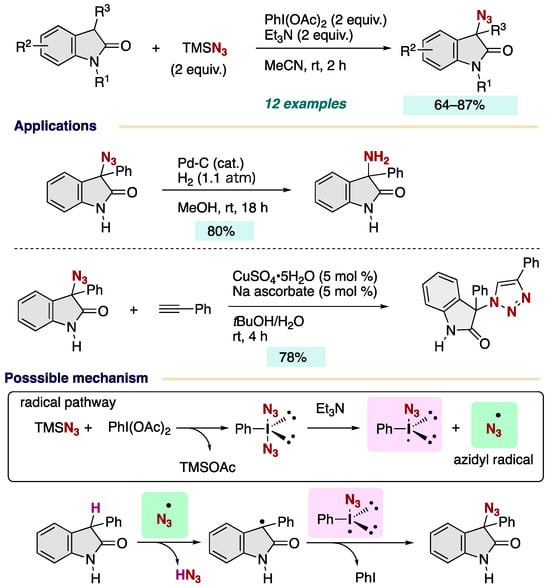
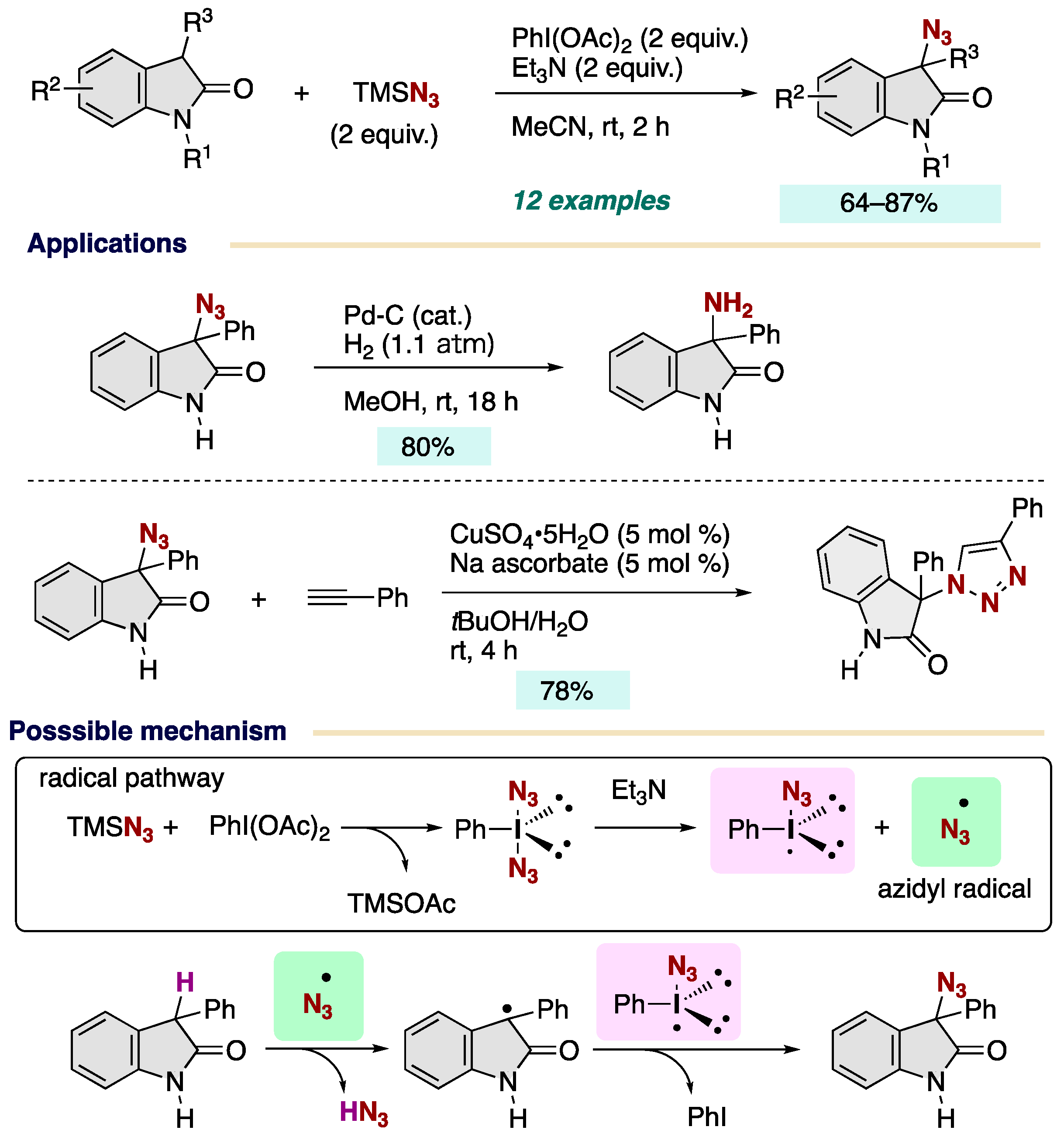
In the system of TMSN3, PhI(OAc)2, and Et3N, radical coupling of 3-substituted 2-oxindoles with an azidyl radical takes place in the absence of a transition metal catalyst (Scheme 5) [30]. To promote this transformation, the C3-aryl group plays an important role. It is proposed that the azidyl radical generates through a cleavage of the iodine–nitrogen bond of diazidoiodine(III) [PhI(N3)2], generated in situ. 3-substituted 3-azido-2-oxindoles participated in the H2/Pd-C reduction and Cu-catalyzed 1,3-dipolar cycloaddition.
Scheme 5.
Direct azidation of indoles using TMSN3. PhI(OAc)2 and Et3N.
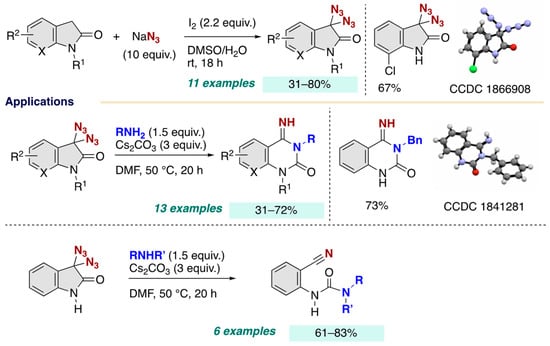
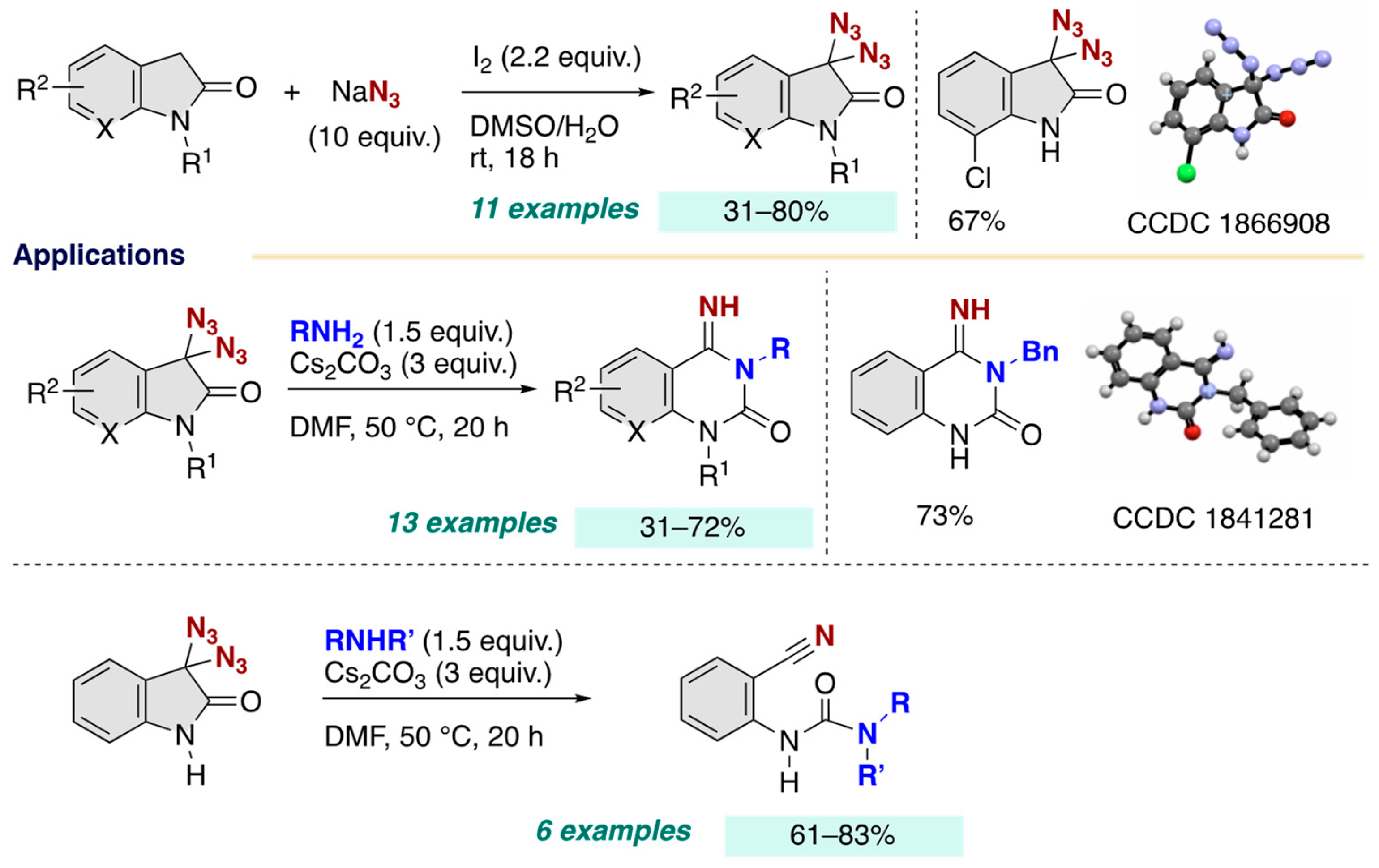
In the system of NaN3 and I2, the radical coupling of 2-oxindoles with an azide radical takes place in the absence of a transition metal catalyst (Scheme 6) [31]. The 3,3-diazido-2-oxindoles showed new reactivities against amine nucleophiles, with a release of N2, affording quinazolinone derivatives and cyanophenylureas. The structure of a quinazolinone derivative was determined by using X-ray crystallography (CCDC 1841281).
Scheme 6.
Metal-free direct azidation of 2-oxindoles using NaN3 and I2.
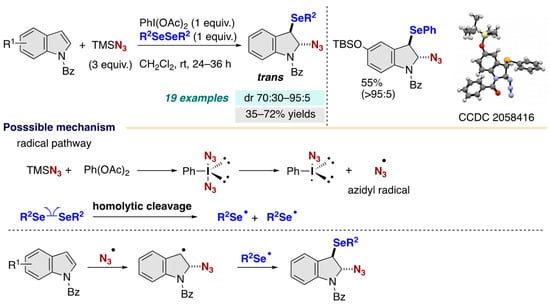
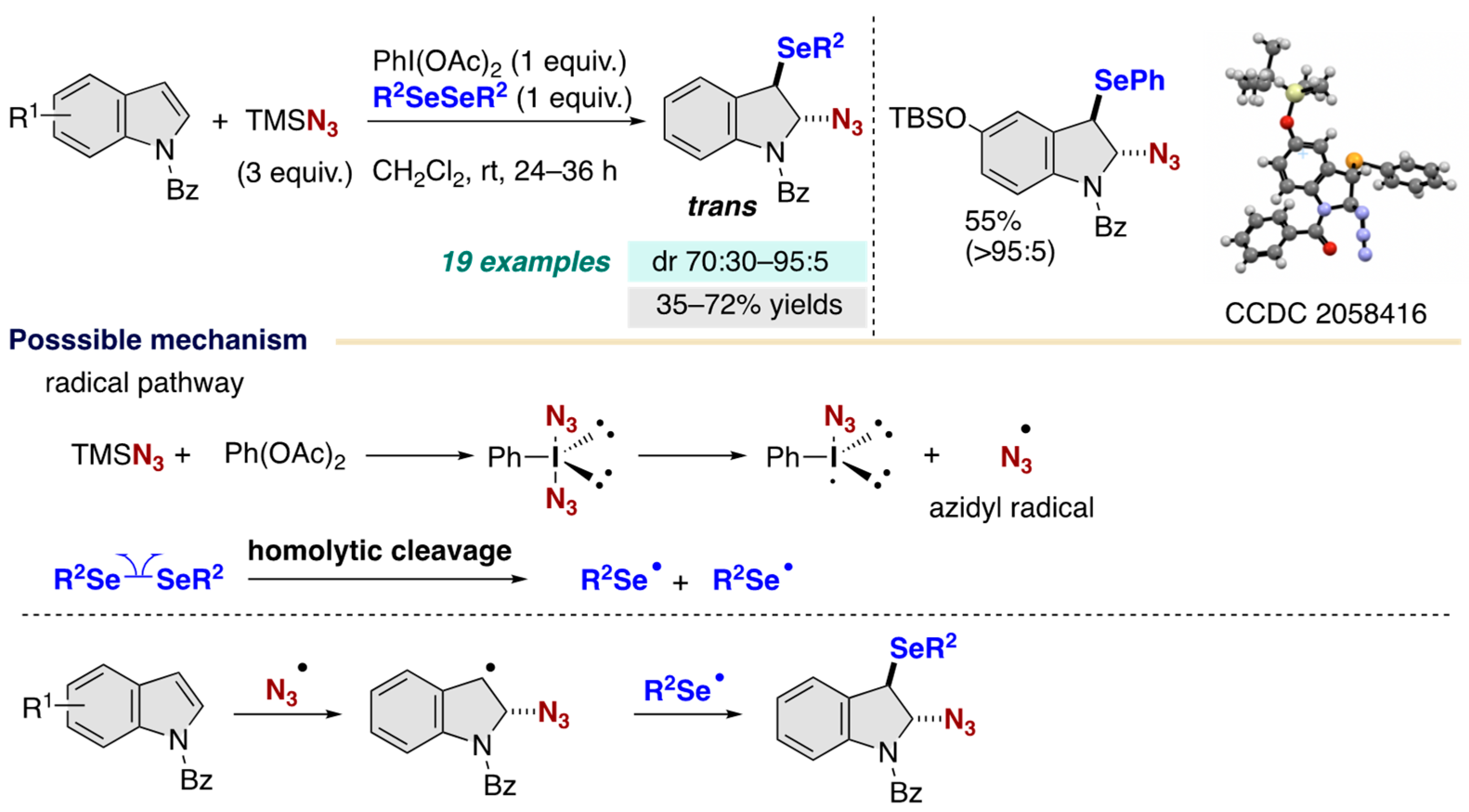
In 2023, a metal-free radical coupling of indoles with an azidyl radical and a selenyl radical was reported (Scheme 7) [32]. 3-alkyl- and aryl selenyl indolines bearing the azide moieties can be obtained by this protocol. The structure of aryl selenyl indoline was determined by using X-ray crystallography (CCDC 2058416).
Scheme 7.
Metal-free selenyl azidation of indoles using TMSN3 and PhI(OAc)2.
A possible reaction mechanism was also proposed. First, an azidyl radical is generated from TMSN3 and PhI(OAc)2. Then, azidyl radical addition at the C2 position of the indoles occurs, generating a C3 radical. The C3 radical intermediates simultaneously are captured by the selenyl radical (generated by homolytic cleavage of RSe-SeR) to afford 2-azido-3-selenylindolines with high diastereoselectivity.
3. Metal-Catalyzed Azidation of Indoles
Transition metals such as Mn, Fe, and Cu have a pivotal role in the radical azidation process by generating the azide radical or metal–azide species [33,34,35,36,37].
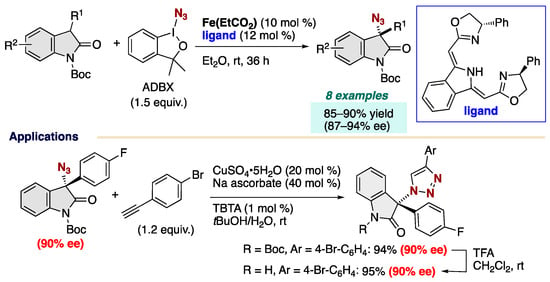
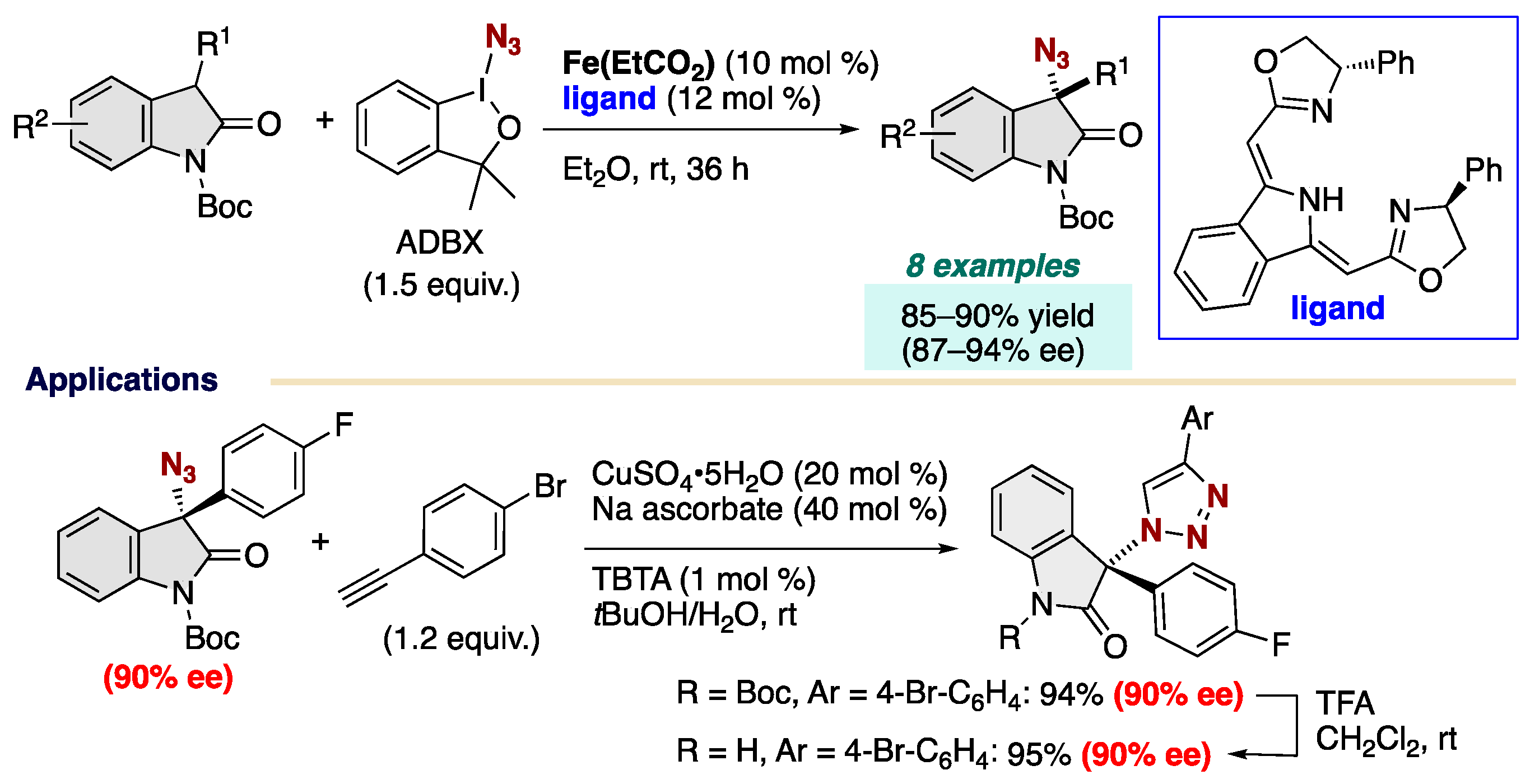
In 2013, the Gade group reported the (EtCO2)2Fe-catalyzed enantioselective azidation of β-ketoesters and oxindoles using azidobenziodate ABDX as an azide transfer reagent (Scheme 8) [38]. A combination of iron propionate/chiral pincer-type tridentate ligand/azidobenziodate gave a high isolated yield with high enantioselectivity. By subjecting the Cu-catalyzed azide-alkyne 1,3-dipolar cycloaddition (click reaction), 3-azido-2-oxindoles (90% ee) gave a 94% triazole yield, with 90% ee. Subsequently, the Boc group was removed by TFA in CH2Cl2, resulting in the isolation of N-H-triazole in a 95% yield with 90% ee.
Scheme 8.
Iron-catalyzed enantioselective azidation of indoles.
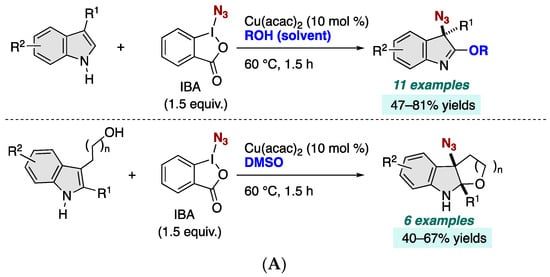
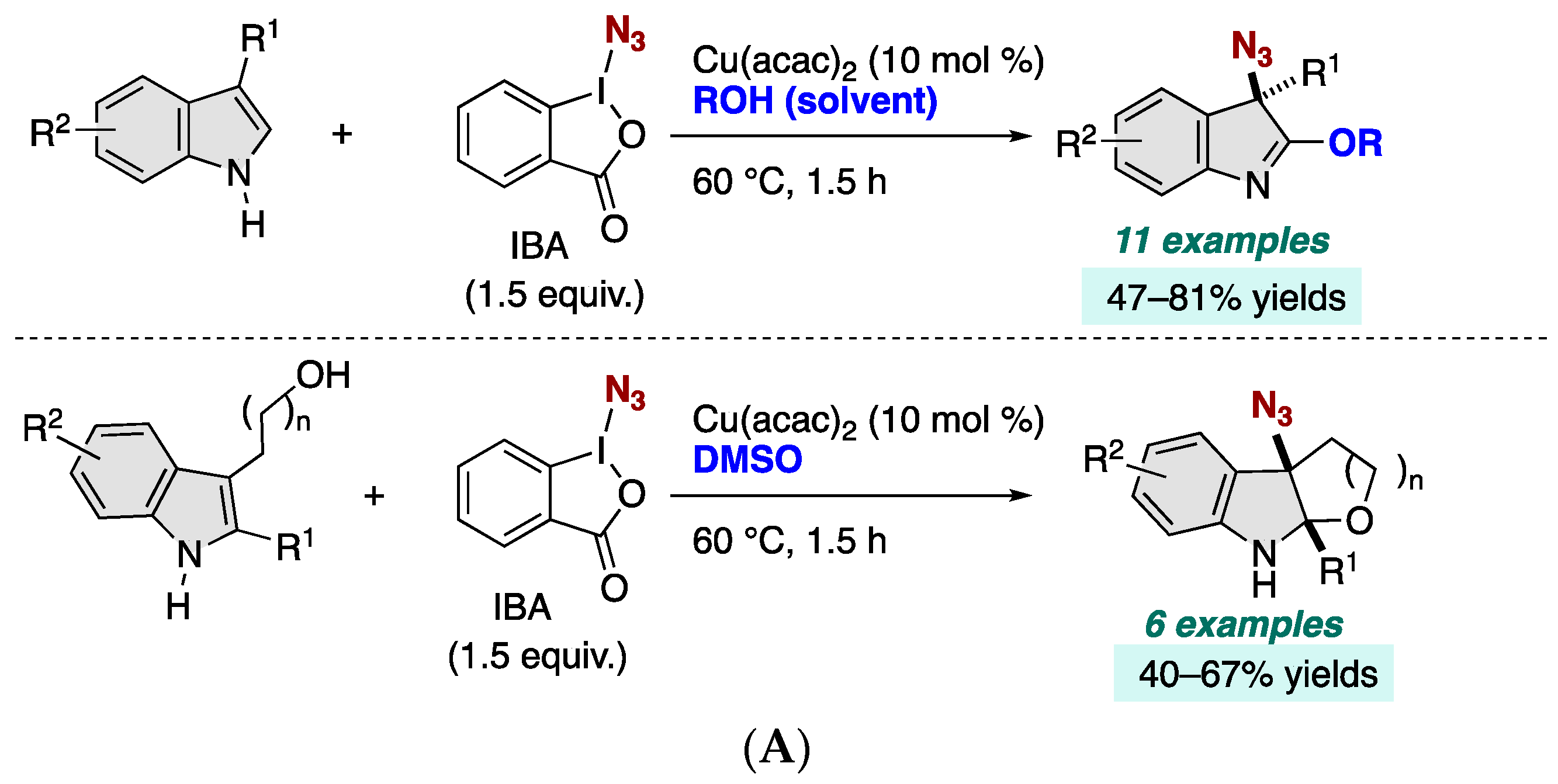
In 2014, Jiao found that a merge of stable hypervalent cyclic iodine reagents (IBA-N3, Zhdankin reagents) and Cu(acac)2 can be used as a source of azide radicals for the direct azidation of indoles (Scheme 9A) [39]. This protocol afforded 3-azidoindolenine and 3-azido-2-oxiindoles under mild conditions.
Scheme 9.
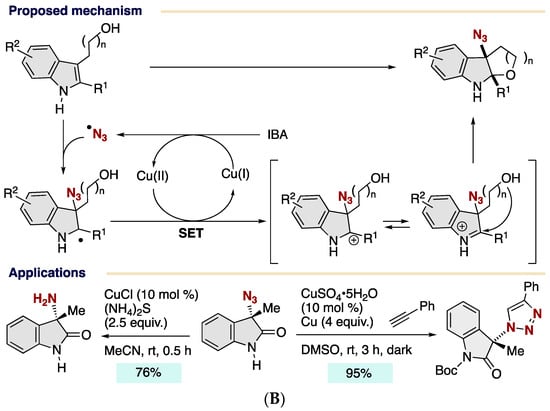
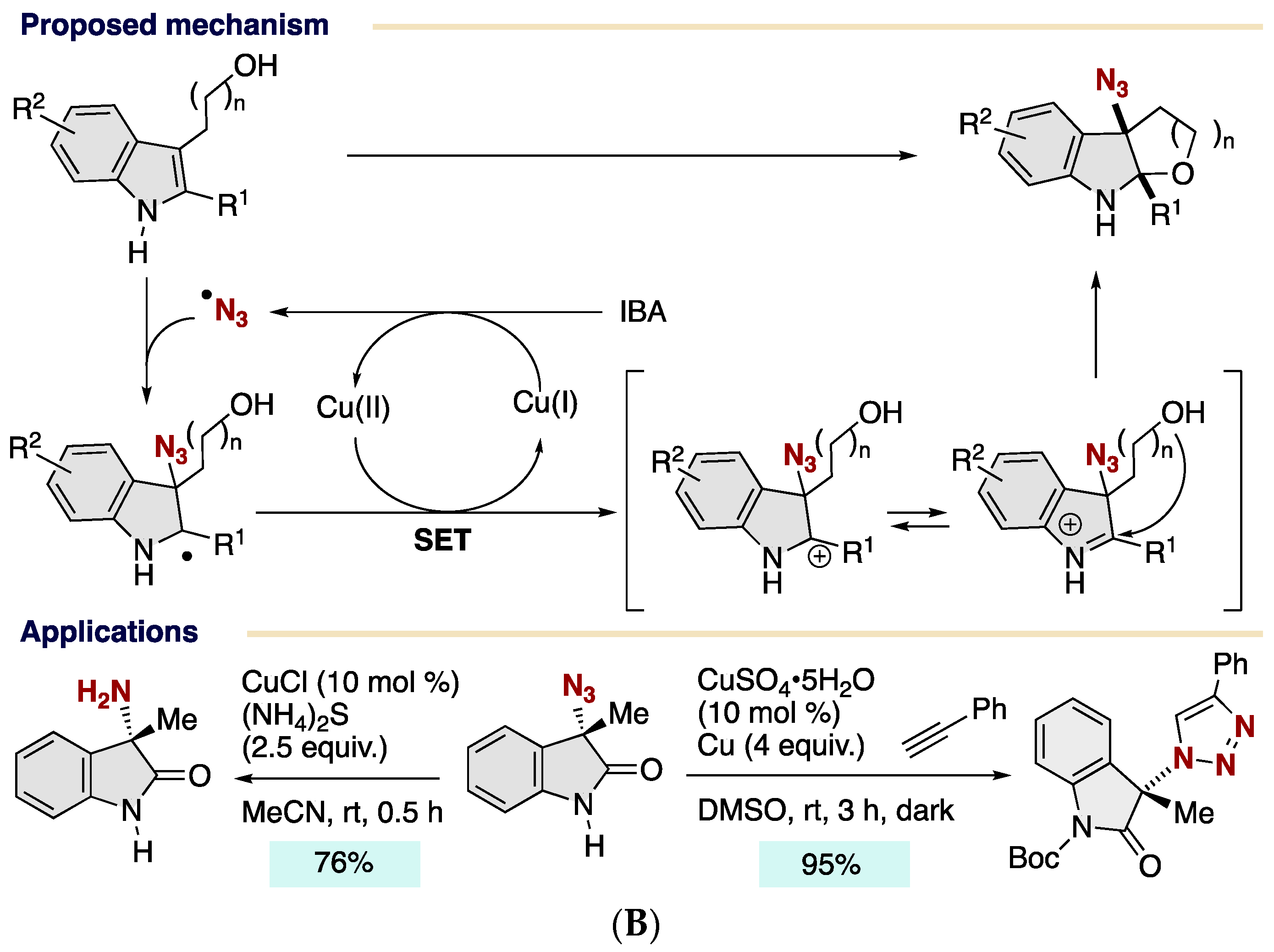
(A) Copper-catalyzed oxyazidation of indoles. (B) Possible mechanism for the copper-catalyzed oxyazidation of indoles.
The radical mechanism involving the redox system between Zhdankin reagents and Cu(acac)2 was also proposed (Scheme 9B). By subjecting the reaction of the obtained 3-azidoindolines to phenylacetylene, triazole can obtain in a 95% yield.
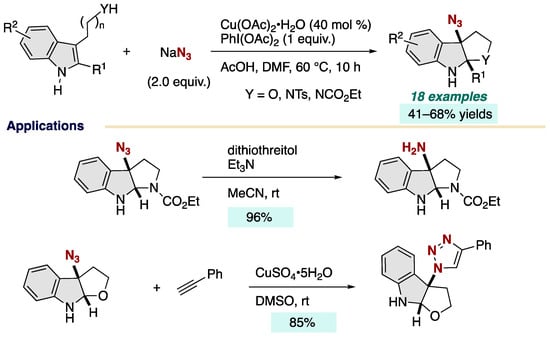
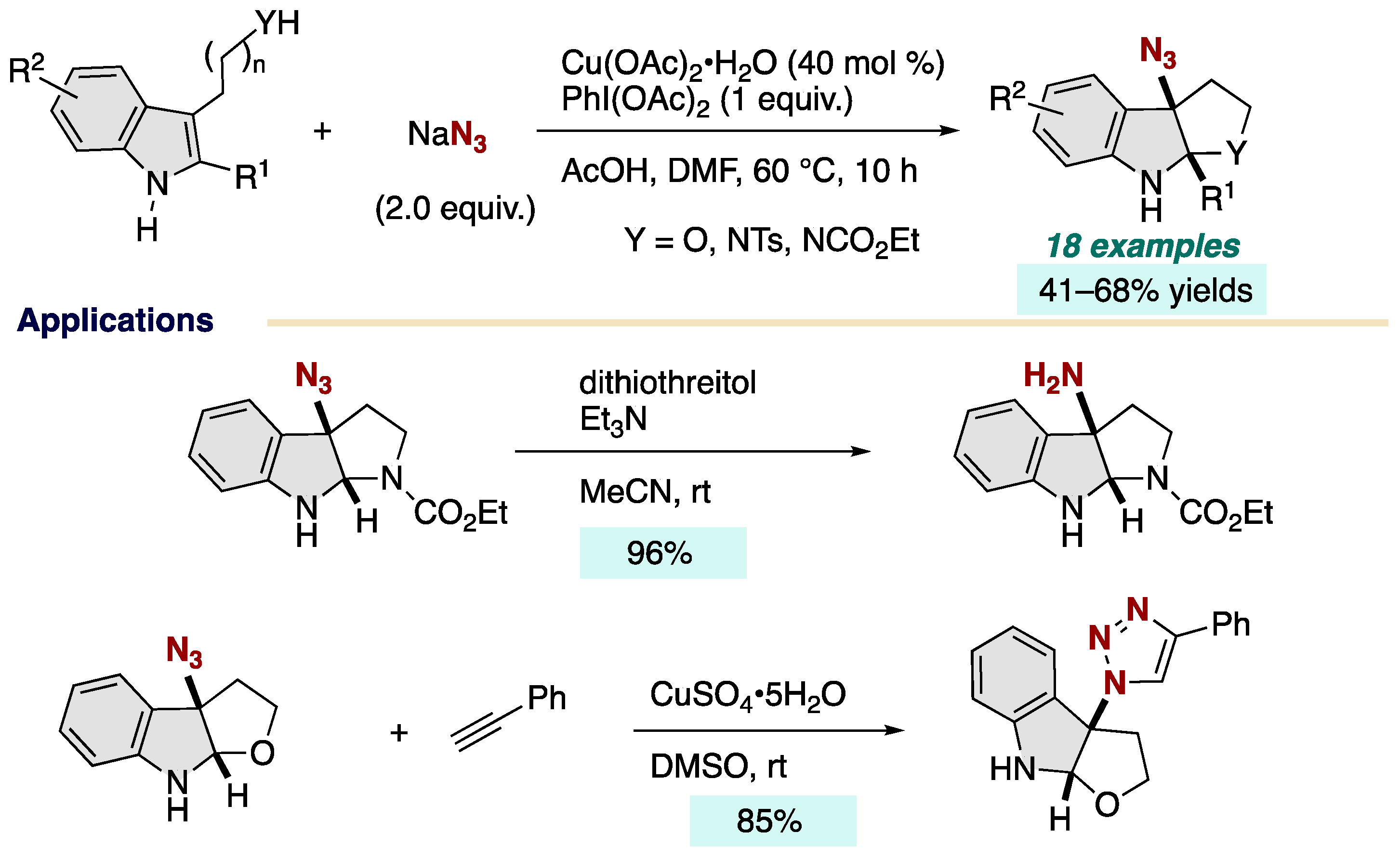
Based on the above precedent, an alternative protocol using PhI(OAc)2-NaN3 instead of Zhdankin reagents was reported by Hong, Wang, and co-workers (Scheme 10) [40]. The reaction mechanism is similar to that proposed in Scheme 8. The obtained 3-azidopyrroloindoline was converted to an amine derivative. In addition, the click reaction of 3-azidofuroindoline with phenylacetylene provided the triazole-containing furoindoline in an 85% yield.
Scheme 10.
Copper-catalyzed oxyazidation of indoles using PhI(OAc)2 and NaN3.
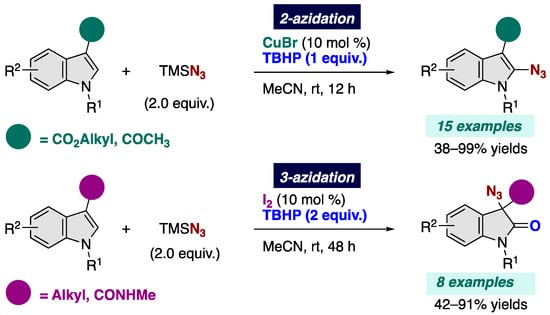
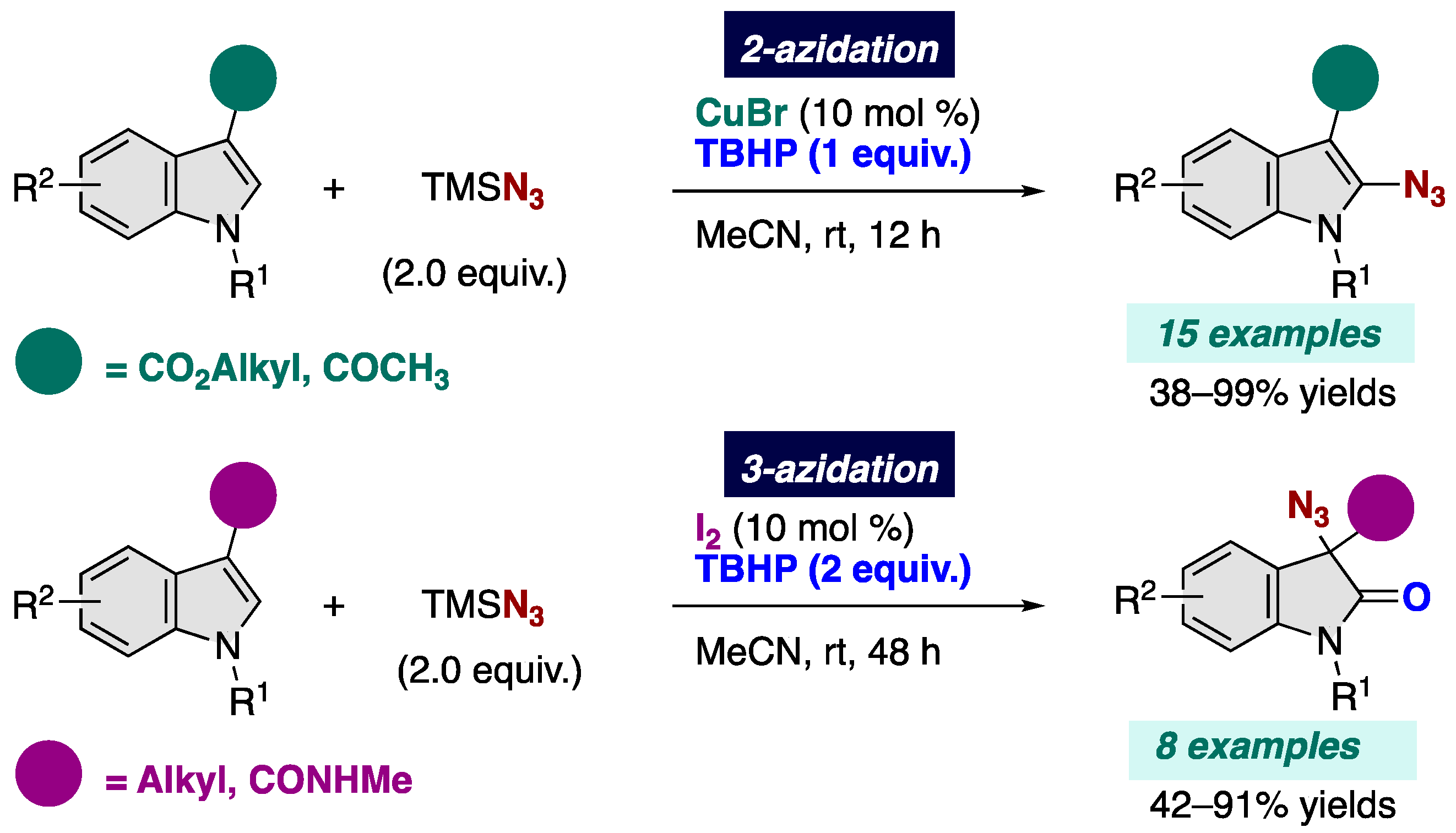
The radical azidation involving the redox system can also participate in a switchable synthesis of 3-azidoindoles and 2-azidoindoles (Scheme 11) [41]. A radical less-stabilizing group, such as an alkyl or amide at the C3 position of indoles, results in C3 azidation through a C2 radical intermediate, while an ester or ketone at the C3 position of indoles leads to 2-azidoindoles through the C3 radical intermediate. All of the obtained products possess the pharmaceutically important pharmacophore, which may lead to drug discovery.
Scheme 11.
Switchable synthesis of 3-azido- or 2-azidoindoles.
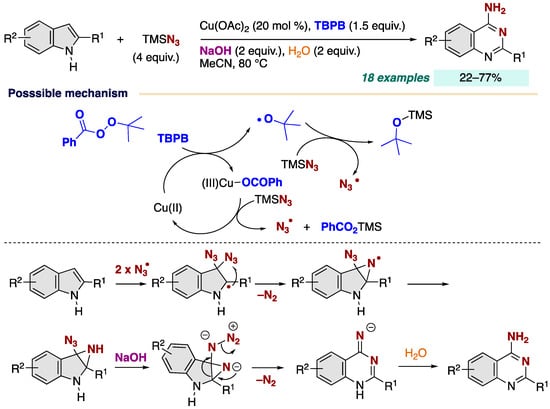
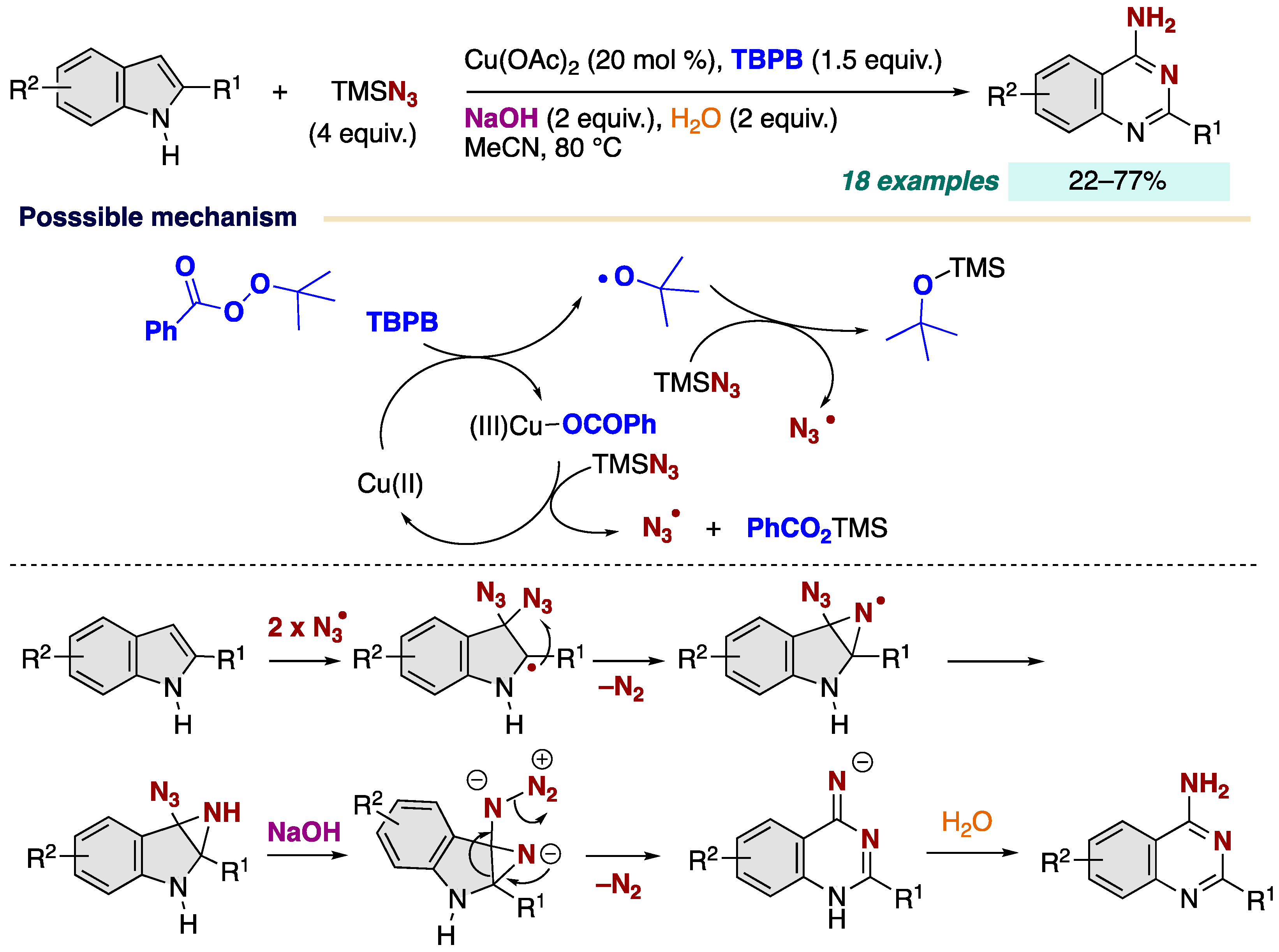
In 2018, Ji and co-workers reported the efficient synthesis of 2-arylquinazolin-4-amines through ring expansion triggered by the 3,3-diazidation of indoles (Scheme 12) [42]. TBPB (tert-butyl peroxybenzoate) plays an important role in generating the tert-buthoxy radical. The novel ring rearrangements can be explained, as the cascade process involves C3-selective diazidation, cyclization, and ring expansion.
Scheme 12.
Copper-catalyzed 3,3-diazidation, cyclization, and ring expansion sequence.
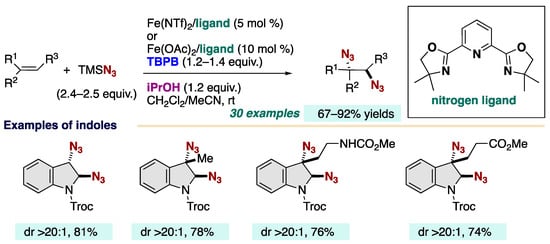
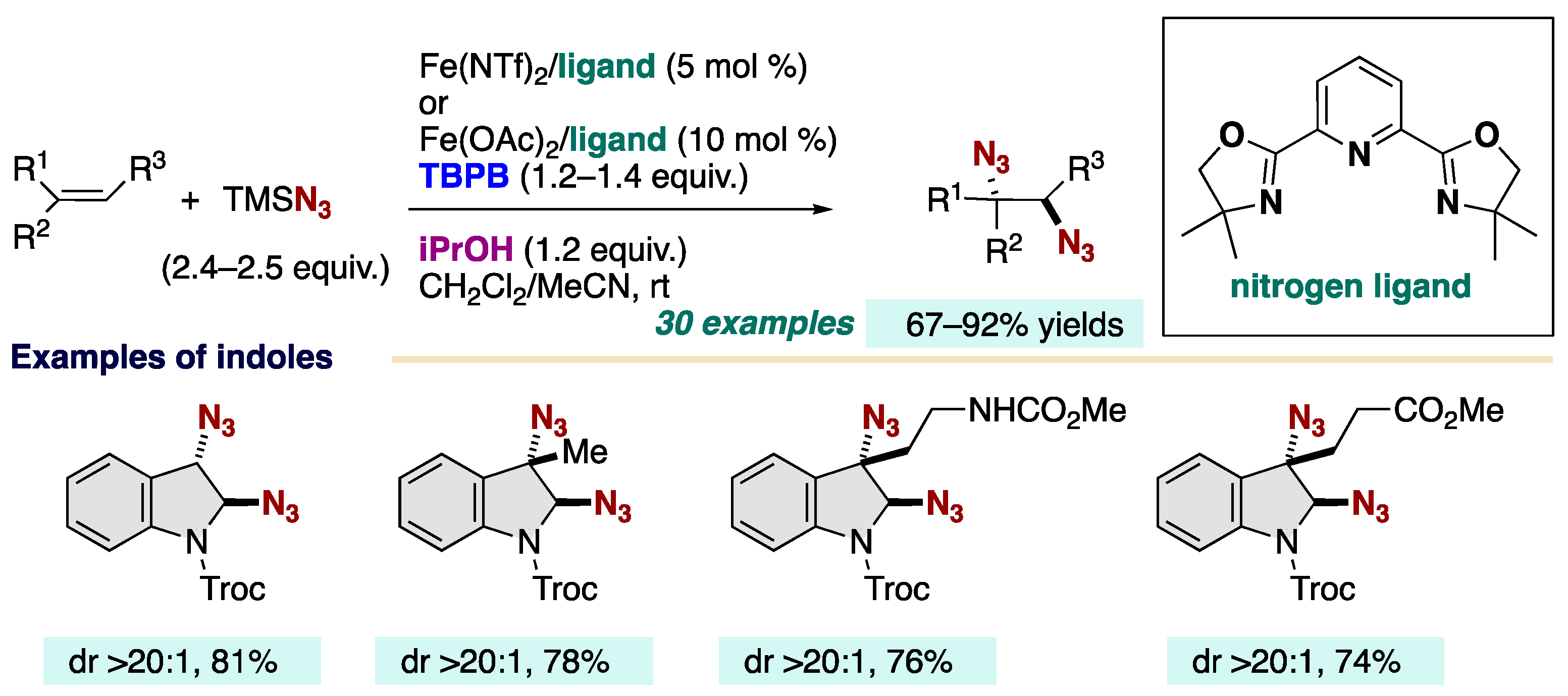
In 2018, Xu and co-workers reported a new iron-catalyzed diazidation of indoles via the tridentate nitrogen–ligand-promoted activation of peroxyester TBPB as a tert-butoxy radical source (Scheme 13) [43]. This work revealed that the combination of TMSN3 and an iron catalyst suppressed the non-productive oxidant decomposition pathway, unlike the cyclic hypervalent iodine reagent method. iPrOH can promote the generation of an azidyl radical from TMSN3 by the tert-butoxy radical.
Scheme 13.
Iron-catalyzed 2,3-diazidation of indoles.
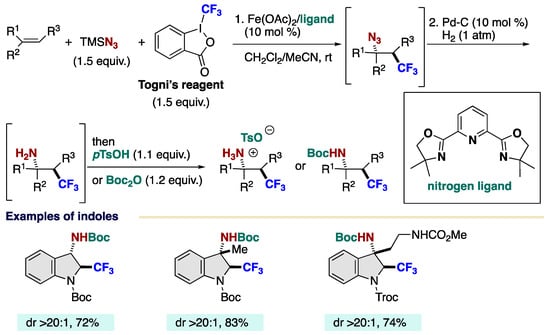
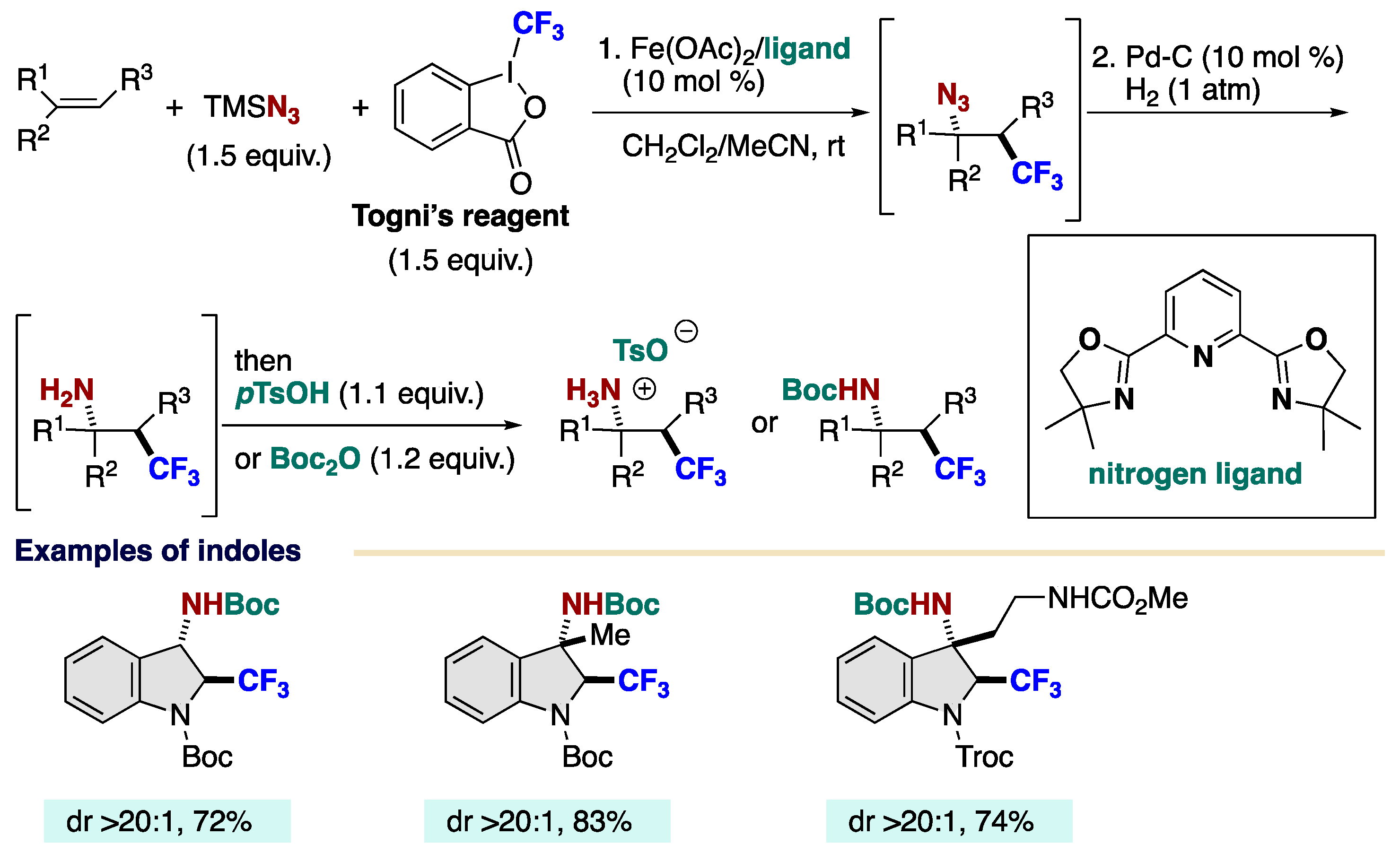
In order to extend their iron–azide chemistry, an iron-catalyzed azidotrifluoromethylation of indoles was developed by Xu and co-workers in 2018 (Scheme 14) [44]. The iron-catalyst plays a dual role in the generation of an azido radical from TMSN3 and a trifluoromethyl radical from Togni’s reagent. This work also revealed that TMSN3 is necessary for iron catalyst regeneration through TMSN3-mediated anion metathesis.
Scheme 14.
Iron-catalyzed azidotrifluoromethylation of indoles.
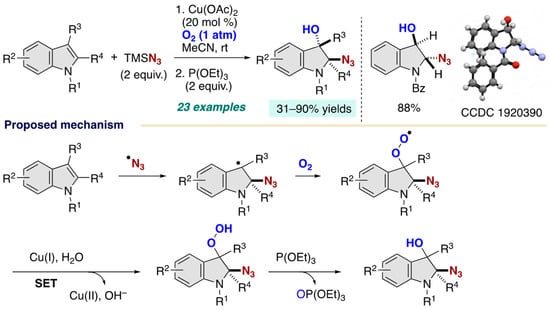
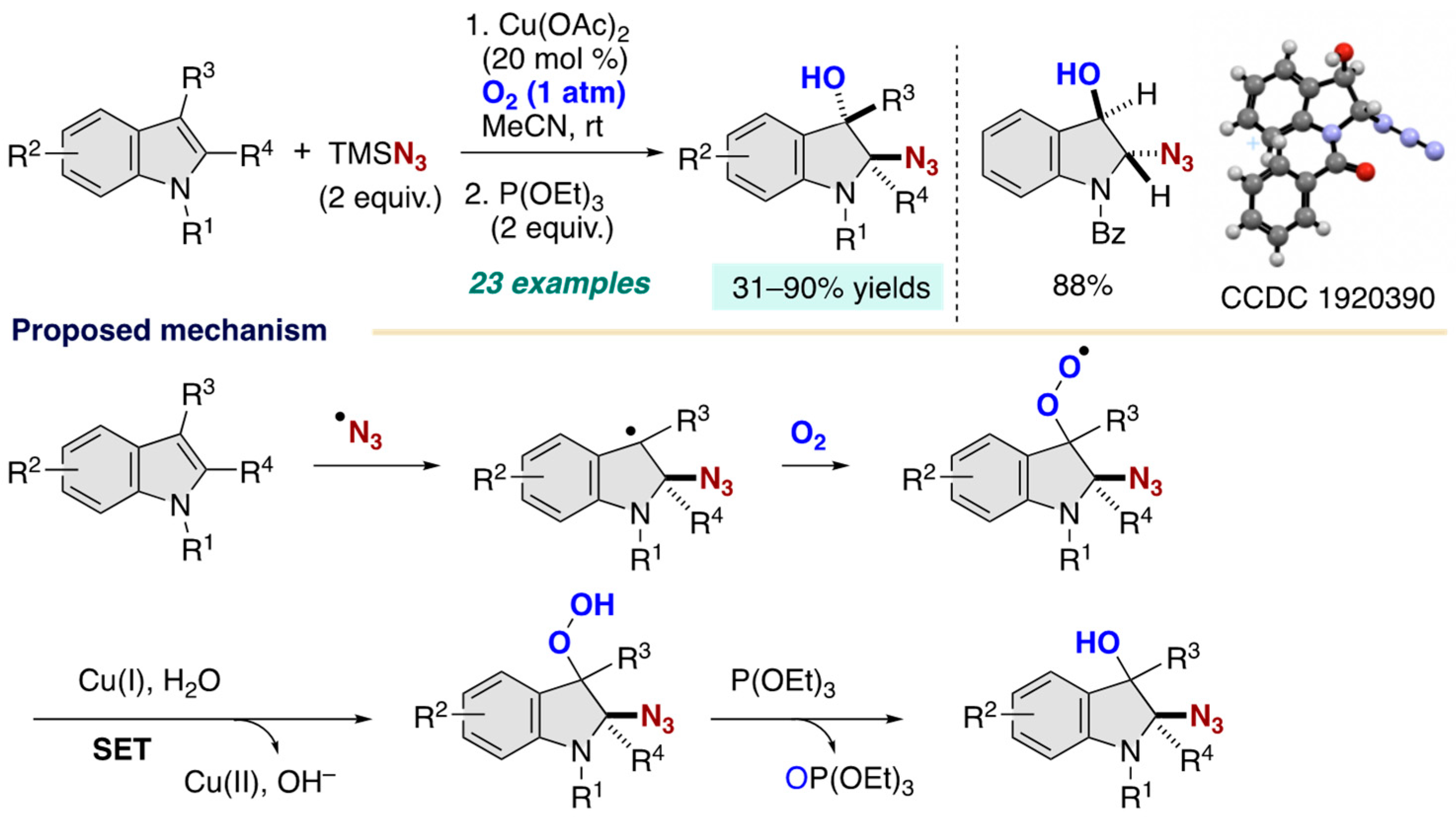
In 2019, Ji and co-workers reported the copper-catalyzed oxidative hydroxyazidation of indoles (Scheme 15) [45]. The reaction was initiated by the addition of an azidyl radical at the C2 position, and subsequent O2-trapping to afford a peroxyradical. Then, the peroxyradical underwent SET by Cu(I) and protonation by H2O to yield a hydroxyperoxy intermediate. Finally, the reduction of the hydroxyperoxy intermediate by triethyl phosphite P(OEt)3 afforded the 3-hydroxy-2-azidoindolines. The origin of the high trans-selectivity is unknown, although this reaction features a broad substrate scope with quite high regio- and diastereoselectivities.
Scheme 15.
Copper-catalyzed oxidative hydroxyazidation of indoles under O2.
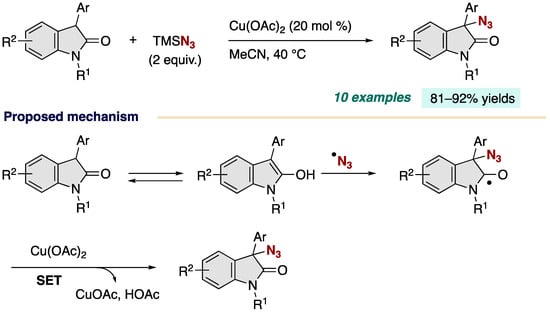
In 2019, Wei, Liu, and co-workers reported the C(sp3)-H azidation of 2-oxindoles catalyzed by Cu(OAc)2 with TMSN3 in MeCN at 40 °C (Scheme 16) [46]. Interestingly, the reaction pathway involves the addition of an azido radical to the enol tautomer. This protocol is convenient because of the mild reaction conditions, with a short reaction time and broad substrate scope that includes biologically important products.
Scheme 16.
Copper-catalyzed azidation of 2-oxindoles.
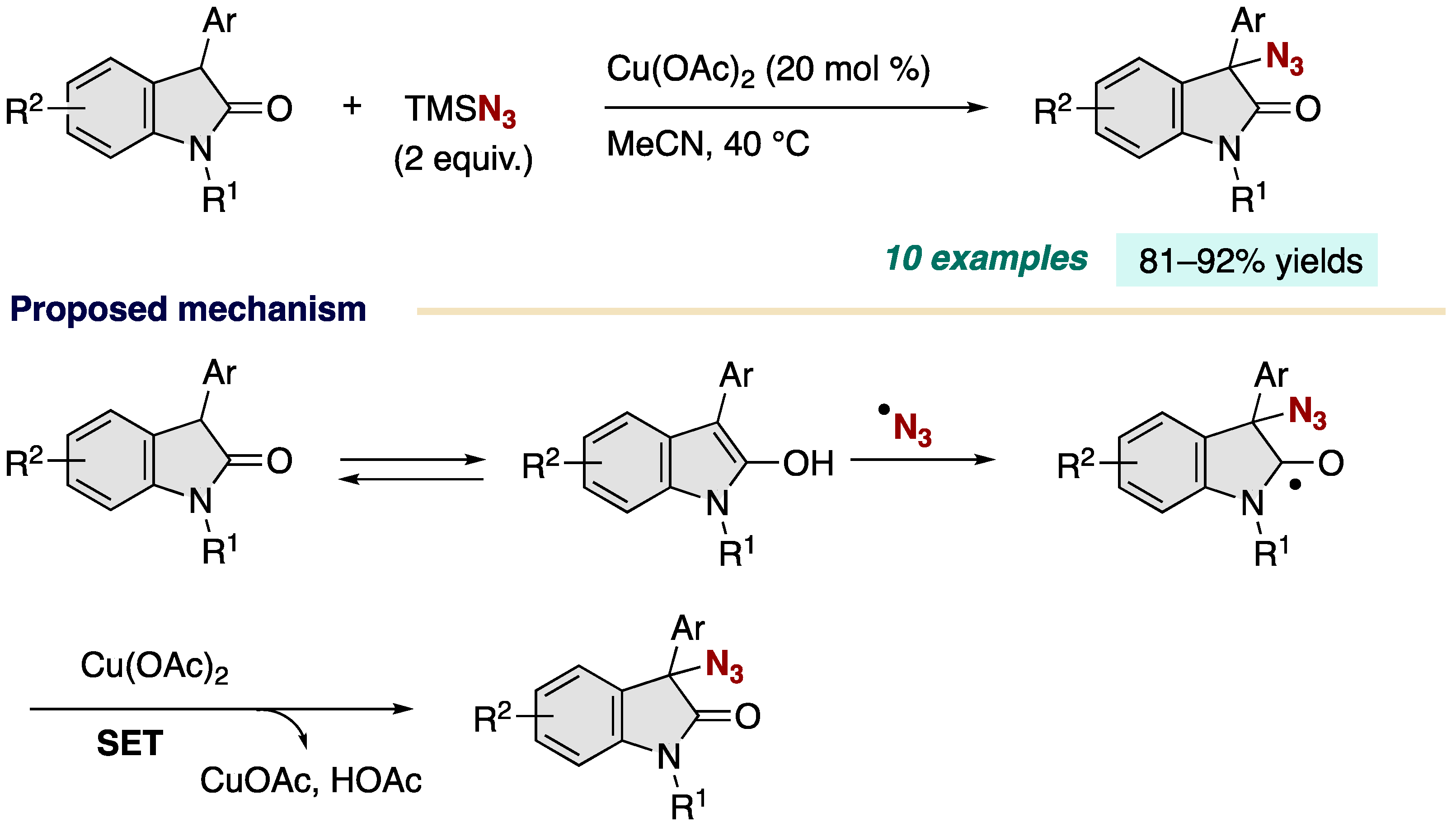
In 2020, Zhu and co-workers reported the copper-catalyzed 2,3-diazidation of indoles with the assistance of N1-directing groups (Scheme 17A) [47]. This protocol exhibits wide functional group compatibility and enables the further synthesis of vicinal diamines, triazoles, and benzotriazoles (Scheme 17B). The directing group can be removed by sodium ethoxide in DMSO after the reaction.
Scheme 17.
(A) Copper-catalyzed 2,3-diazidation of indoles with the assistance of directing groups. (B) Follow-up chemistry of the copper-catalyzed 2,3-diazidation of indoles with the assistance of directing groups.
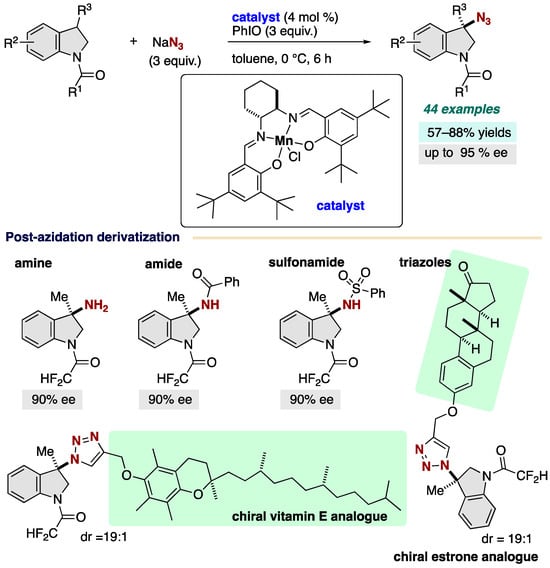
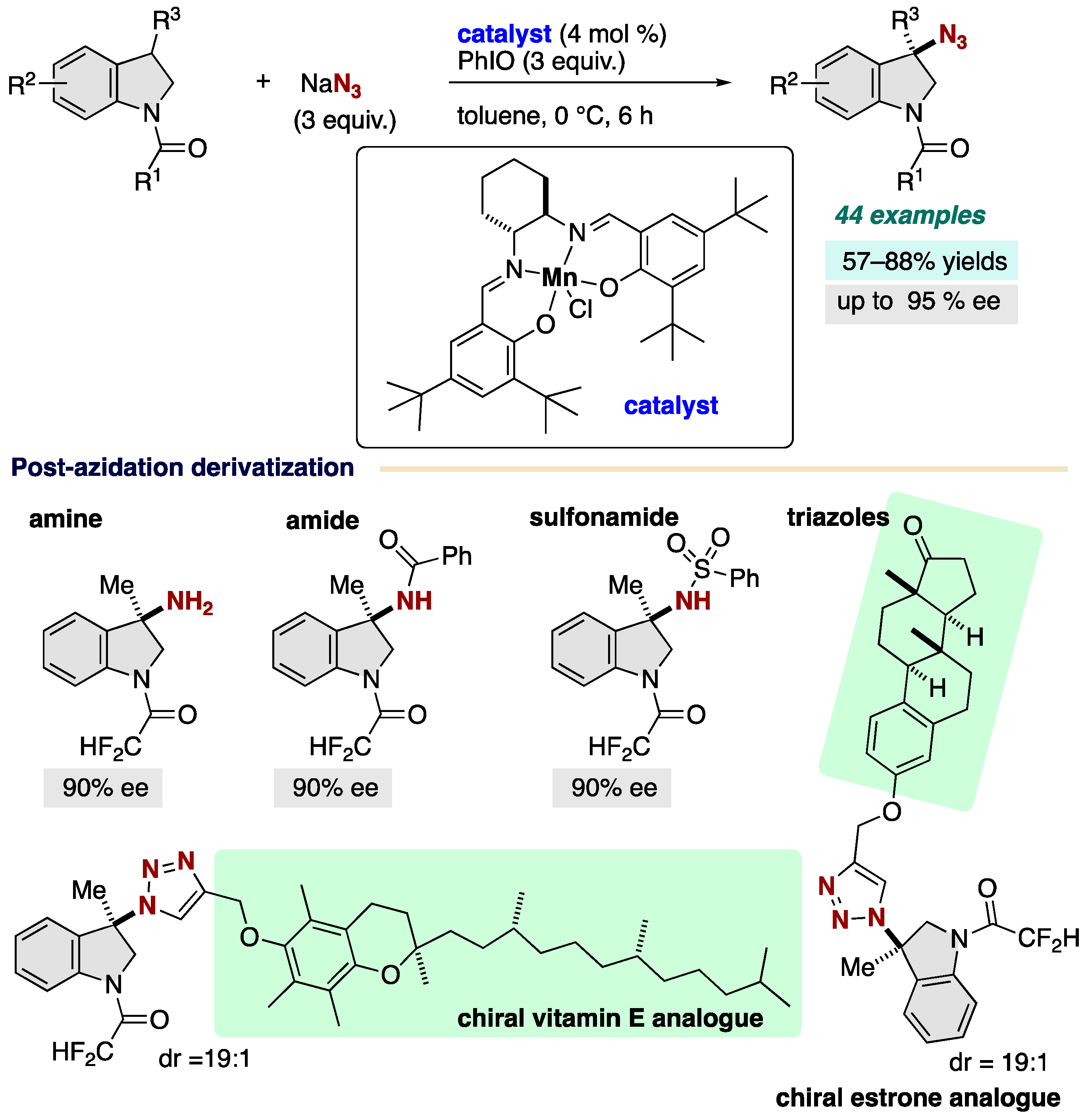
In 2022, Liu and co-workers reported the first manganese-catalyzed site- and enantioselective C(sp3)-H azidation of indolines (Scheme 18) [48]. The obtained optically pure azidoindolines allows for the installation of a variety of nitrogen-based functional groups, including pharmaceutically relevant scaffolds.
Scheme 18.
Manganese-catalyzed C(sp3)-H azidation of indolines.
4. Electrochemical Azidation of Indoles
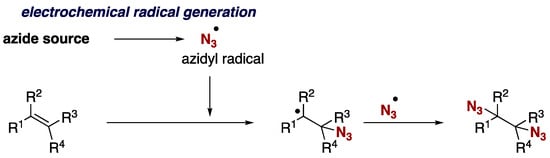
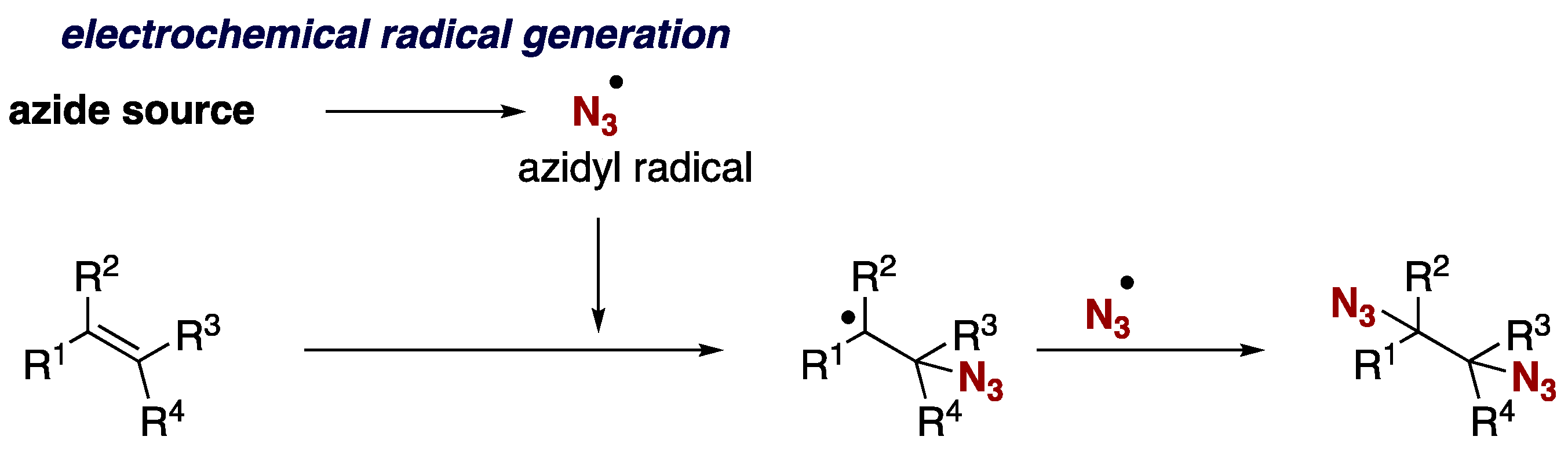
The old and new electrochemistry mechanisms are compatible with redox transformations [49,50]. They offer the use of electrons instead of toxic oxidants and reductants, and also allow for chemo-selective reactions by changing the electrochemical conditions. These merits make them attractive and sustainable protocols to substitute for traditional azidations (Scheme 19). Electrochemical radical generation does not require the use of oxidants.
Scheme 19.
Concept of radical azidation in electrochemistry.
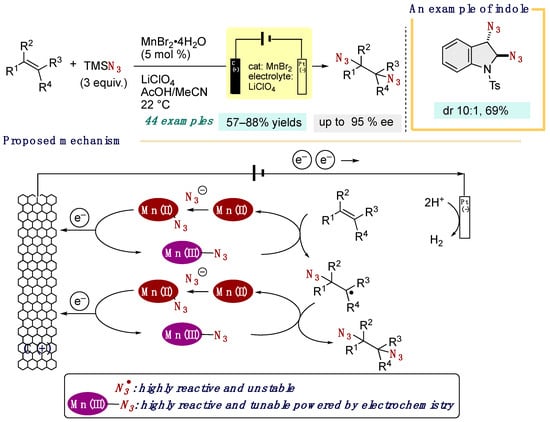
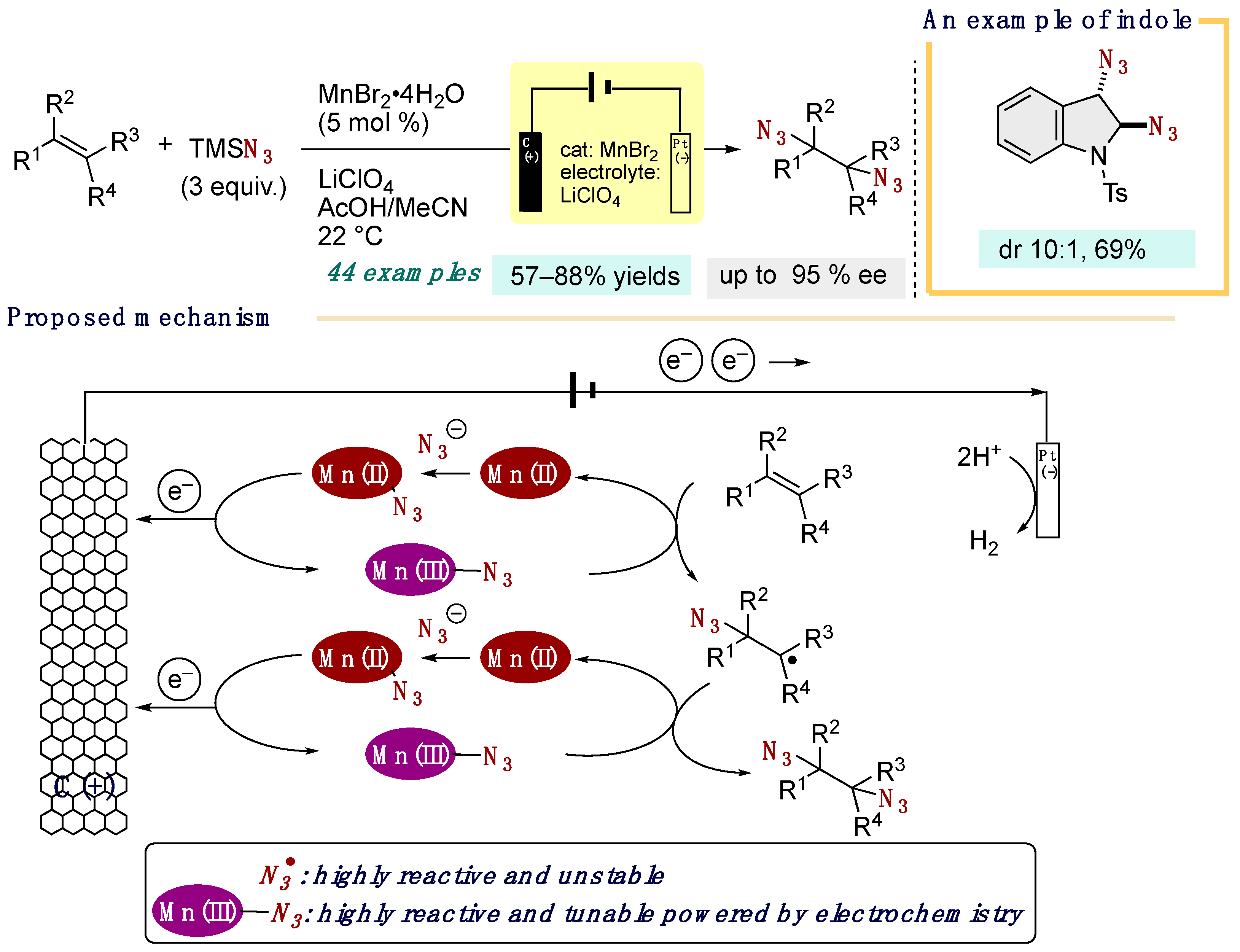
In 2017, the Lin group reported the Earth-abundant manganese-catalyzed electrochemical diazidation of alkenes using NaN3 as an azide transfer reagent (Scheme 20) [51]. Among various substrates, they reported one example of the reaction with N-Ts indole, affording 2,3-diazidoindoline at a 69% yield, with a high diastereomeric ratio. The mechanistic experiments revealed that the metal-mediated azidyl radical transfer enabled a dual-azidation reaction. In general, an inorganic azide radical is highly reactive and unstable, while the reactivity of the metal–azide complexes can be controlled by the reaction conditions.
Scheme 20.
Manganese-catalyzed electrochemical diazidation of unactivated alkenes.
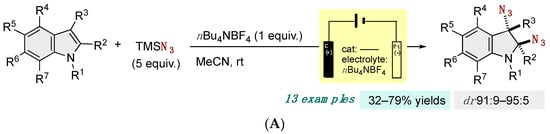
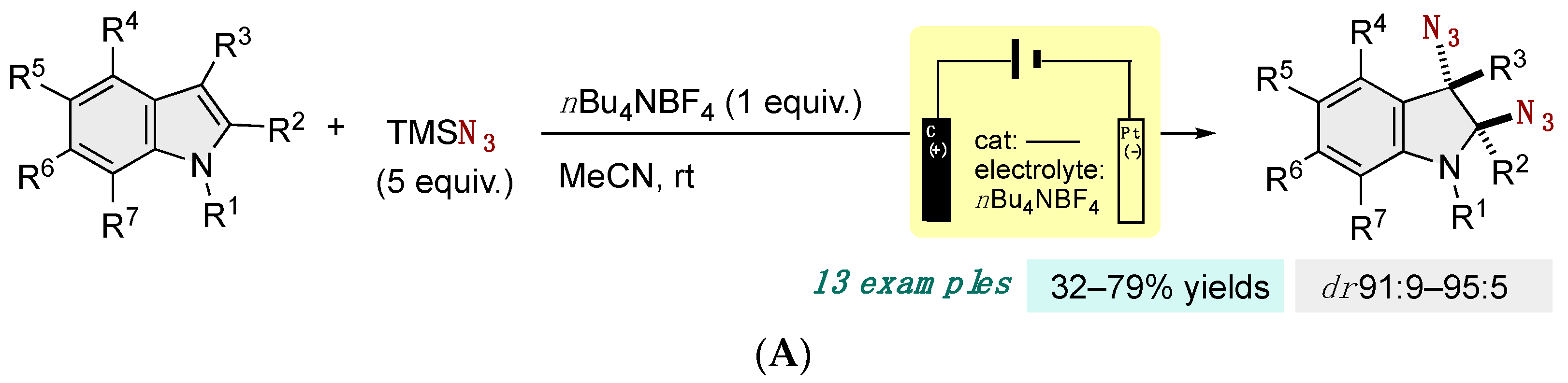
In 2019, a direct anodic oxidation method of N-substituted indoles was reported by Vincent and co-workers (Scheme 21A) [52].
Scheme 21.
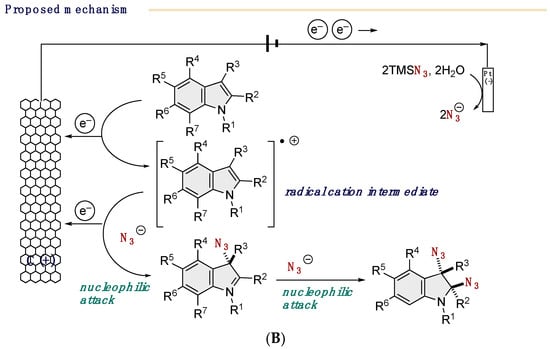
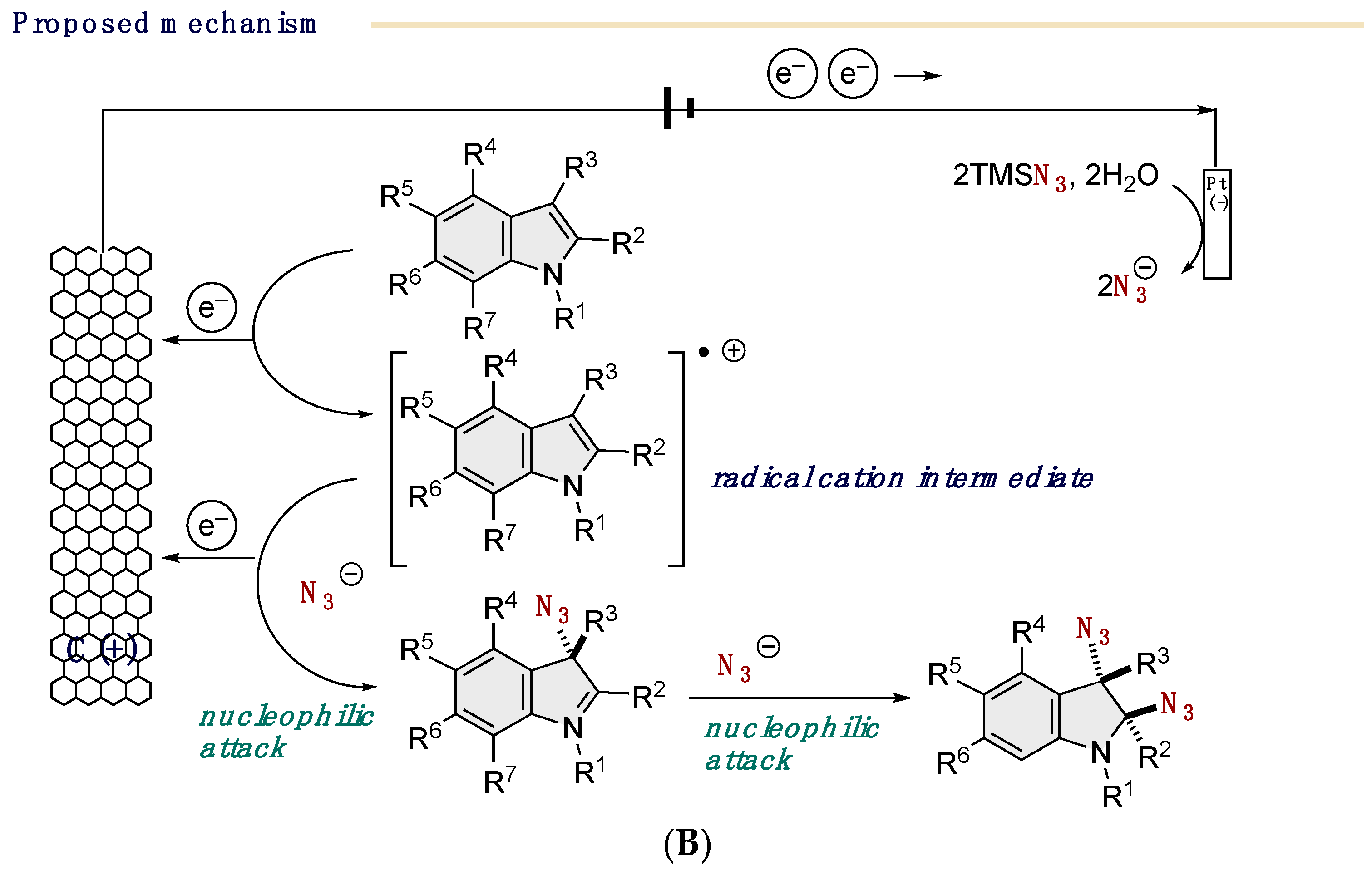
(A) Direct electrochemical diazidation of indoles. (B) Mechanism for the direct electrochemical diazidation of indoles through radical cation intermediates.
The reaction proceeds through the anodic oxidation of indoles into a radical cation (Scheme 21B). The radical cation undergoes nucleophilic attack by N3−, yielding the 2,3-diazidoindoles. This protocol does not rely on stoichiometric oxidants and proceeds smoothly under environmentally benign conditions.
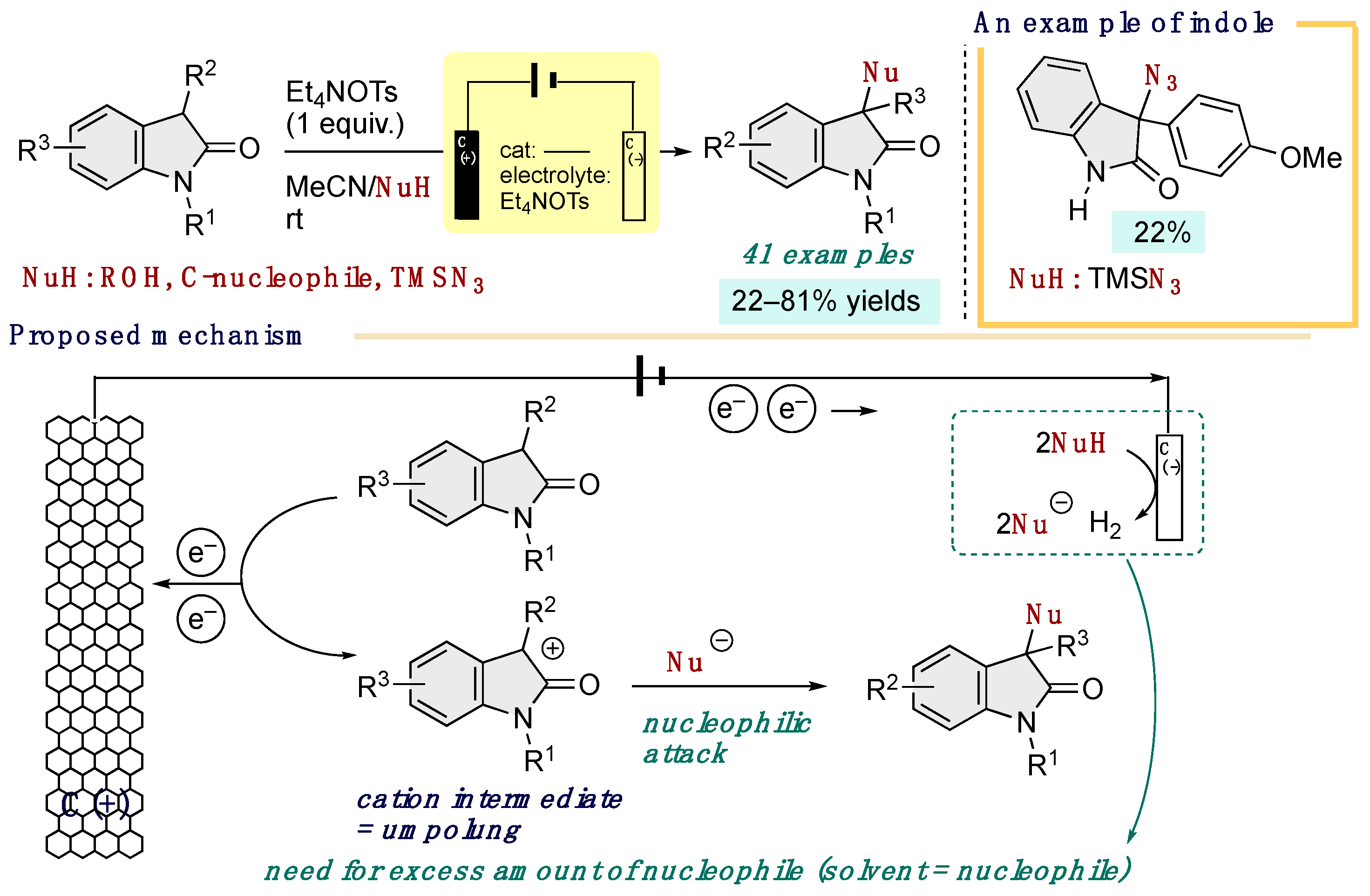
In 2022, a direct anodic oxidation method of the 2-oxindoles was reported by Maulide and co-workers (Scheme 22) [53]. In similar to Vincent’s work, the reaction proceeds through the anodic oxidation of 2-oxindoles into a radical cation, which undergoes nucleophilic attack by nucleophiles, yielding the 3-alkoxy-2-oxindoles and 3-diazido-2-oxindoles. This protocol requires 5 equivalents of TMSN3 as azide transfer reagents.
Scheme 22.
Electrochemical umpolung C–H functionalization of 2-oxindoles in the absence of a metal catalyst.
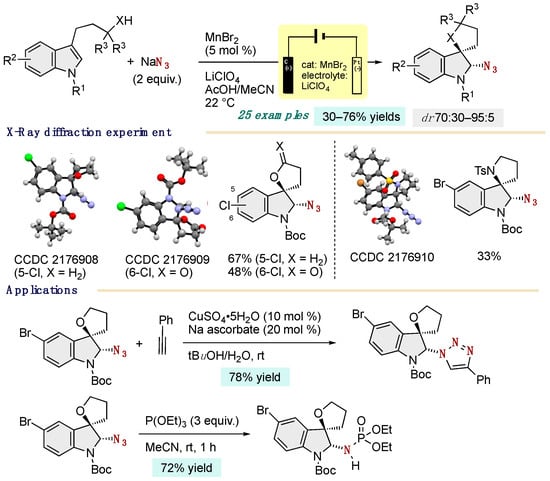
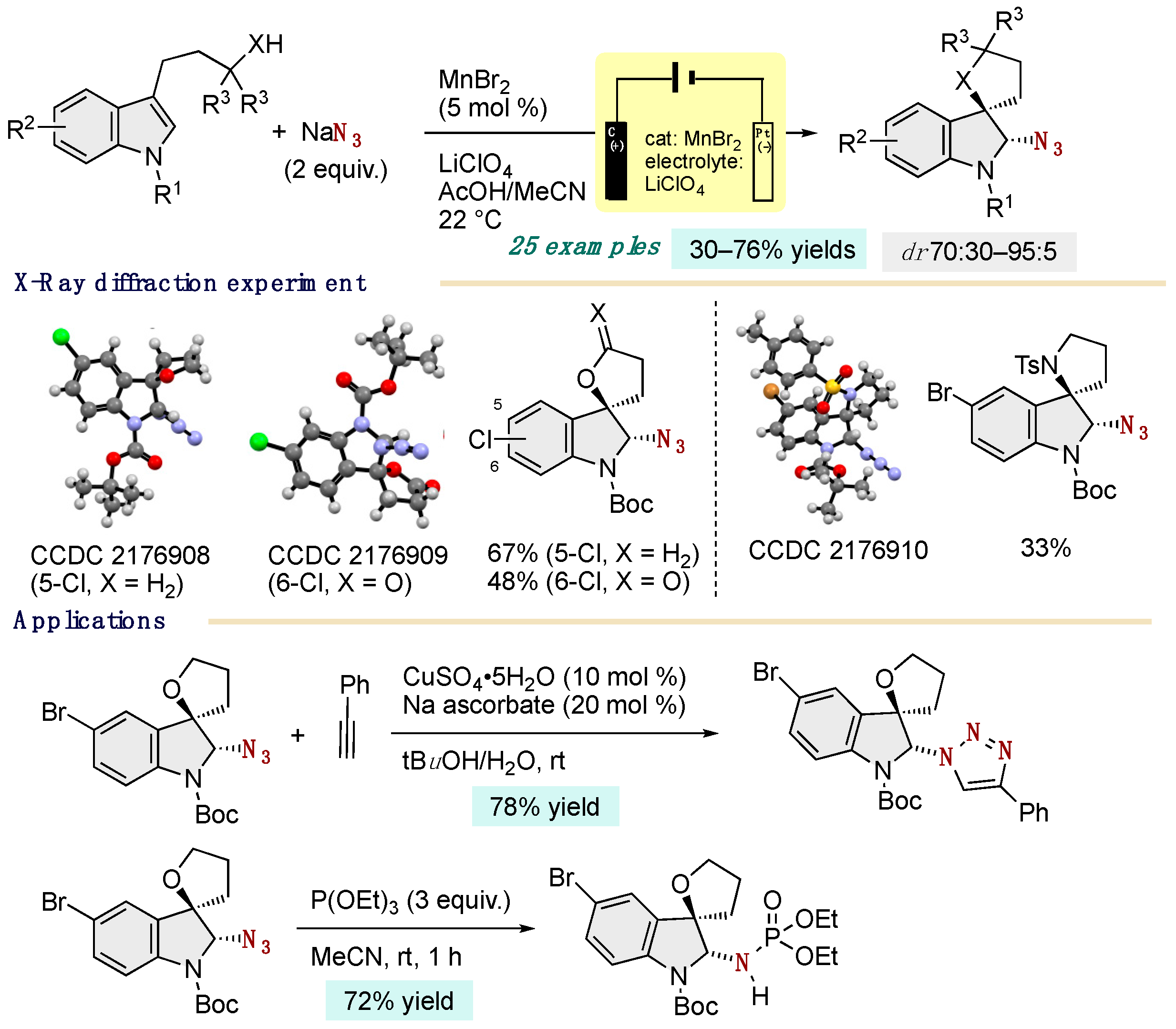
In 2022, Wu and co-workers developed a manganese-mediated electrochemical approach to access 2-azido-spirocyclic indolines (Scheme 23) [54]. An azide-bound Mn(III) complex promotes the azidative dearomatization of indoles. A redox-active MnBr2 can tune the reactivity of the azidyl radical species. Synthetic application of the spirocyclic indolines was performed to demonstrate the synthetic utilities. The click reaction of the spirocyclic indoline afforded the corresponding 1,2,3-triazole. The azido group was converted into a phosphoramidate-containing spirocyclic indoline in the presence of triethyl phosphite.
Scheme 23.
Manganese-mediated electrochemical azidation of indoles to afford azide-containing spirocyclic indolines.
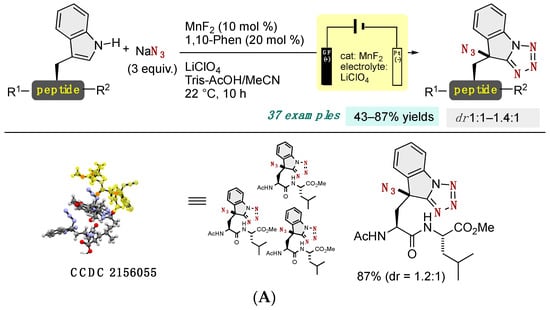
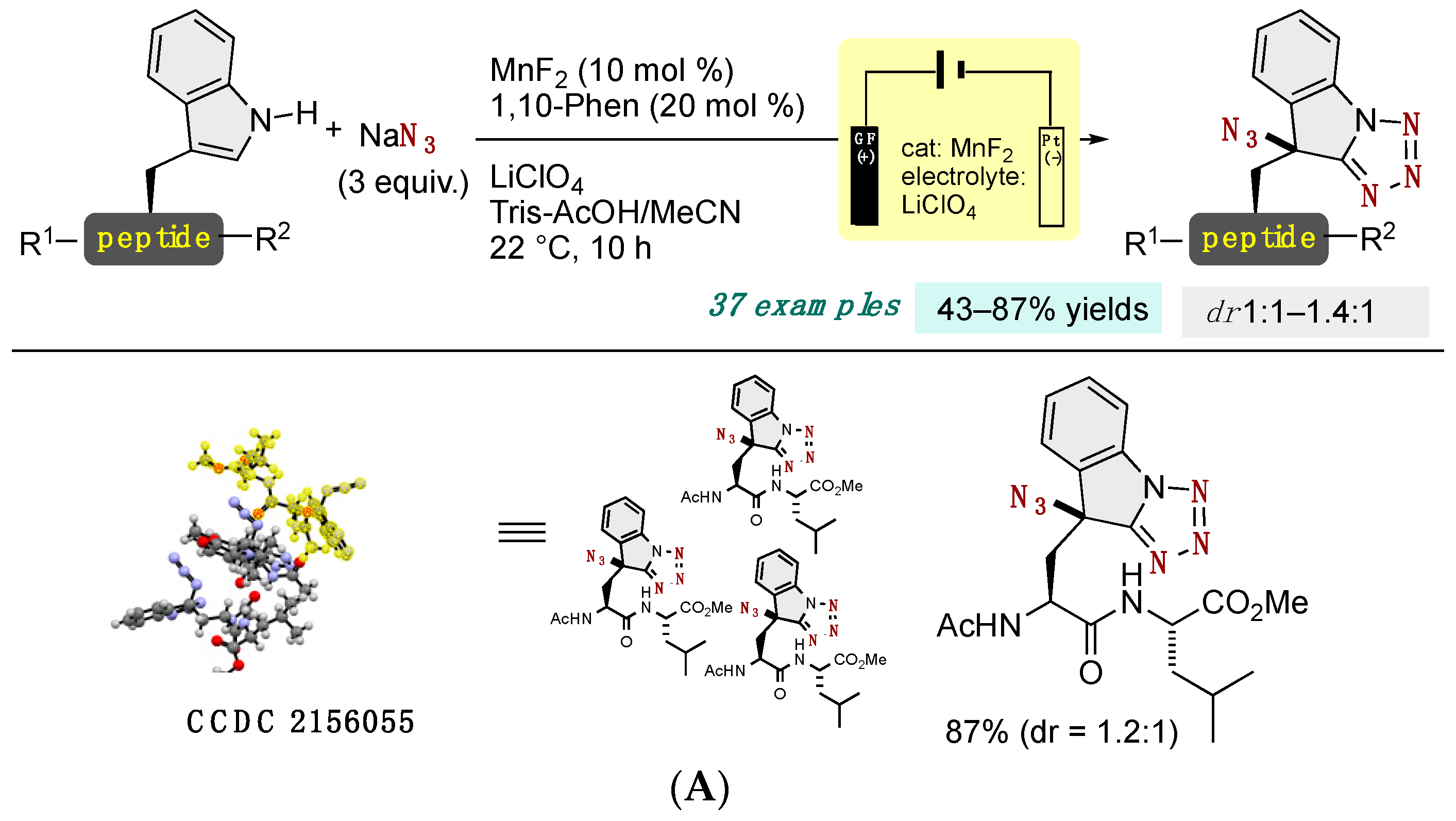
In 2022, Weng and co-workers reported a late-stage functionalization of Trp-containing peptides by manganese-catalyzed diazidation/cyclization in aqueous buffer solution (Tris-AcOH) (Scheme 24A) [55]. This methodology provides access to C3-azide-containing tetrazolo[1,5-a]indole peptides with broad functional group tolerance. Mechanistic experiments revealed that the diazidation/heterocyclization of Trp-containing peptides proceeds through a radical pathway rather than the previously known radical cation pathway.
Scheme 24.
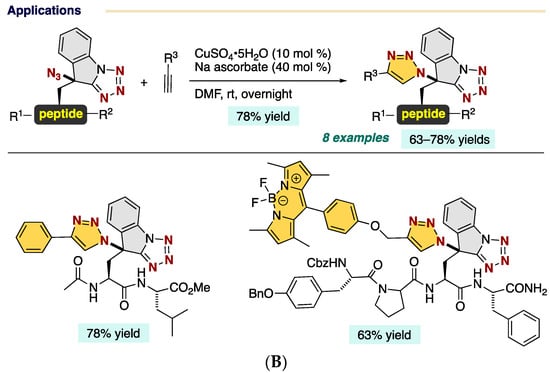
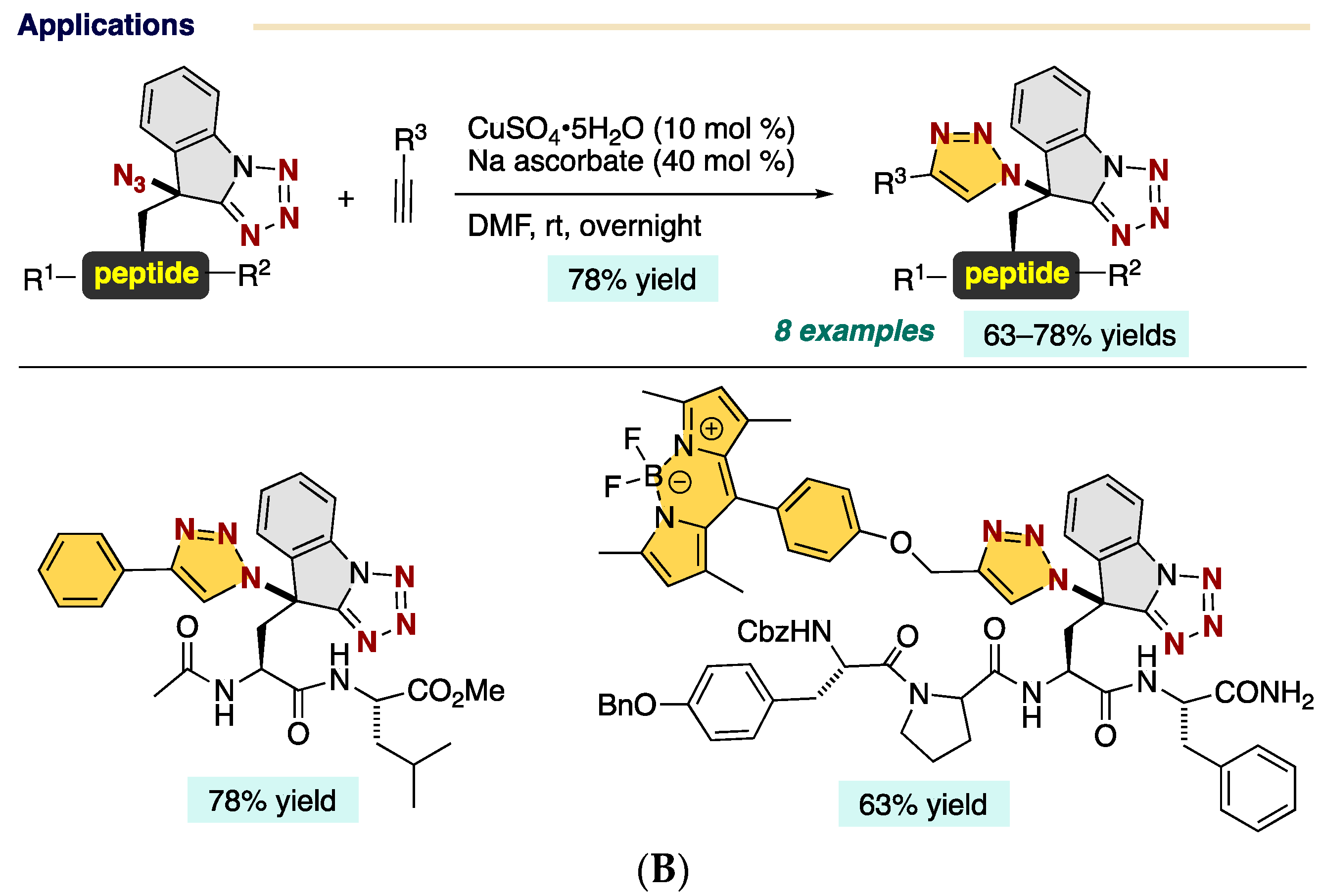
(A) Manganese-catalyzed electrochemical diazidation/cyclization of tryptophan-containing peptides. (B) Follow-up chemistry of the C3-azide-containing tetrazolo[1,5-a]indole peptides.
Trp-containing peptides with C3-azide and tetrazole moieties were derivatized to a series of 1,2,3-triazole peptides by a click reaction of alkynes with azides (Scheme 24B). BODIPY-derived alkyne was also applicable for the click reaction of C3-azide-containing tetrazolo[1,5-a]indole peptides.
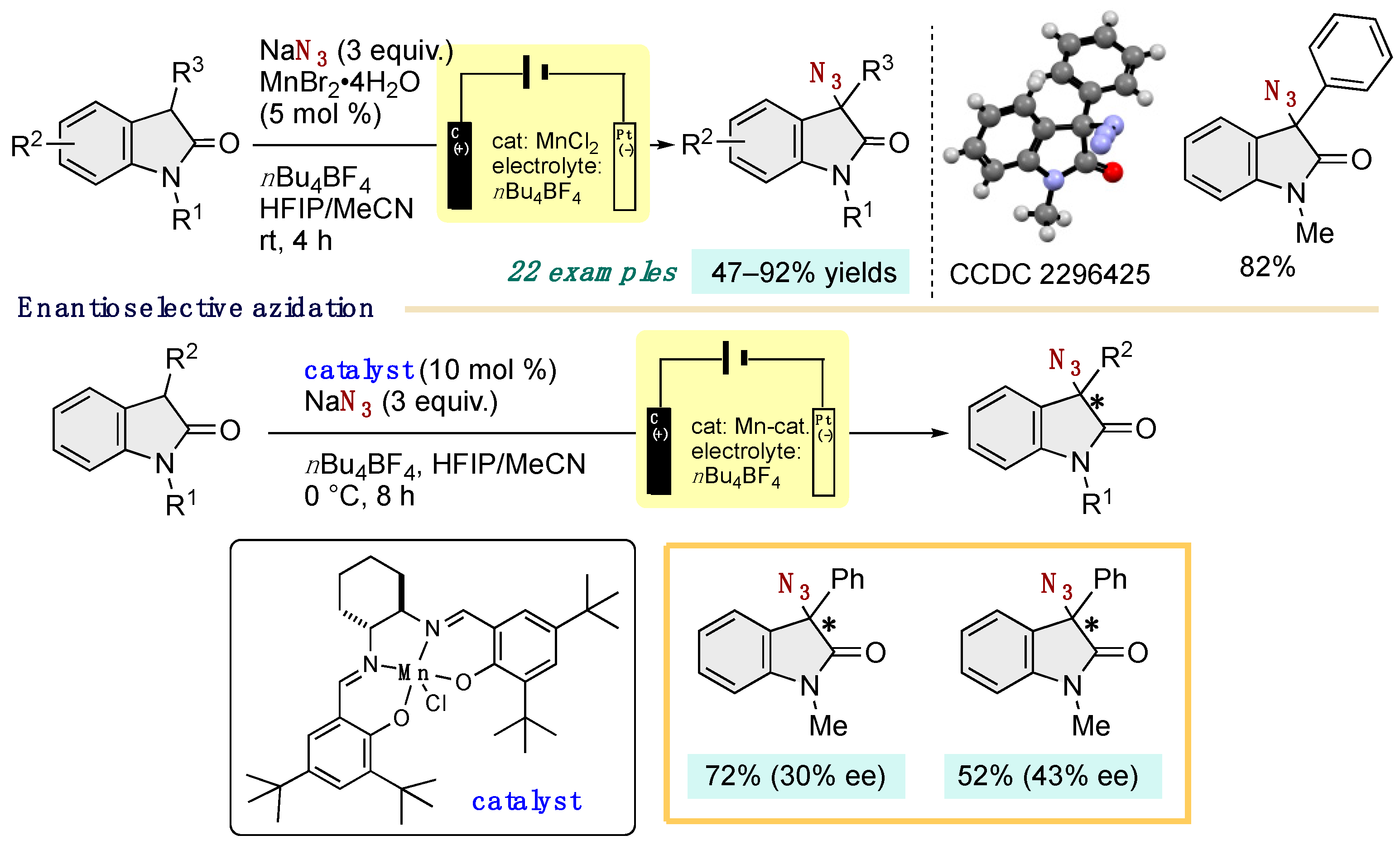
In 2024, Ren and co-workers reported a C–H functionalization of 2-oxindoles by manganese-catalyzed azidation in CH3CN/HFIP (Scheme 25) [56]. The cyclic voltammetry experiments exclude the possibility of the direct oxidation of N3− into an azide radical. The azidyl radical Mn(III)-N3 species generated in situ seems to be an azide transfer reagent. Enantioselective azidation using a Jacobsen-(R,R)-Mn(salen) catalyst was also discovered, although the enantioselectivities were low (30% ee and 43% ee).
Scheme 25.
Manganese-catalyzed electrochemical C–H azidation of 2-oxindoles. Asterisk (*) indicates stereocenter.
5. Photochemical Azidation of Indoles
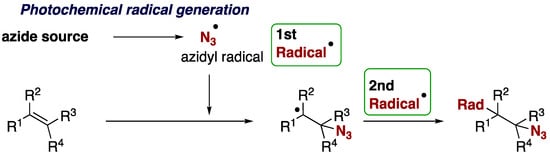
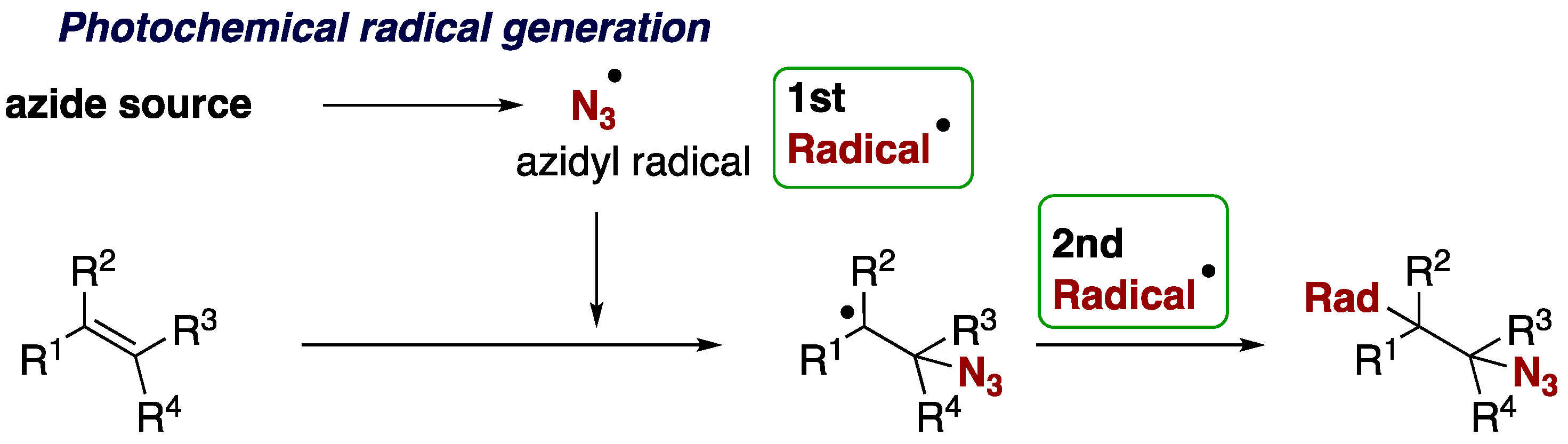
The photochemical approach is also old and less-explored due to its complex nature. However, photocatalysis, light-emitting diodes (LEDs), and photoreactors make it a privileged field. Photochemistry can play a role in the sustainable and environmentally benign process, with reduced chemical waste. Thus, the photochemical approach has gained much attention [57,58]. In this section, a direct bifunctionalization of alkenes using photochemistry is introduced (Scheme 26). The key feature is an efficient generation of an azidyl radical under visible-light irradiation in the presence or absence of a photocatalyst. Due to the mild reaction conditions, successive 2nd radical additions by another radical species can be undertaken.
Scheme 26.
Concept of radical azidation in photochemistry.
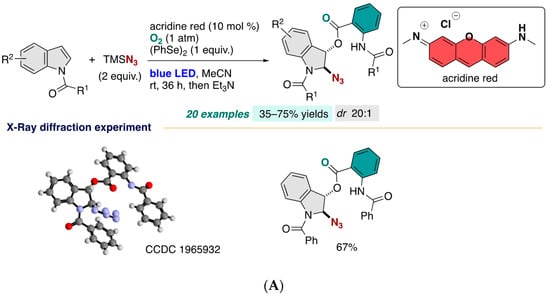
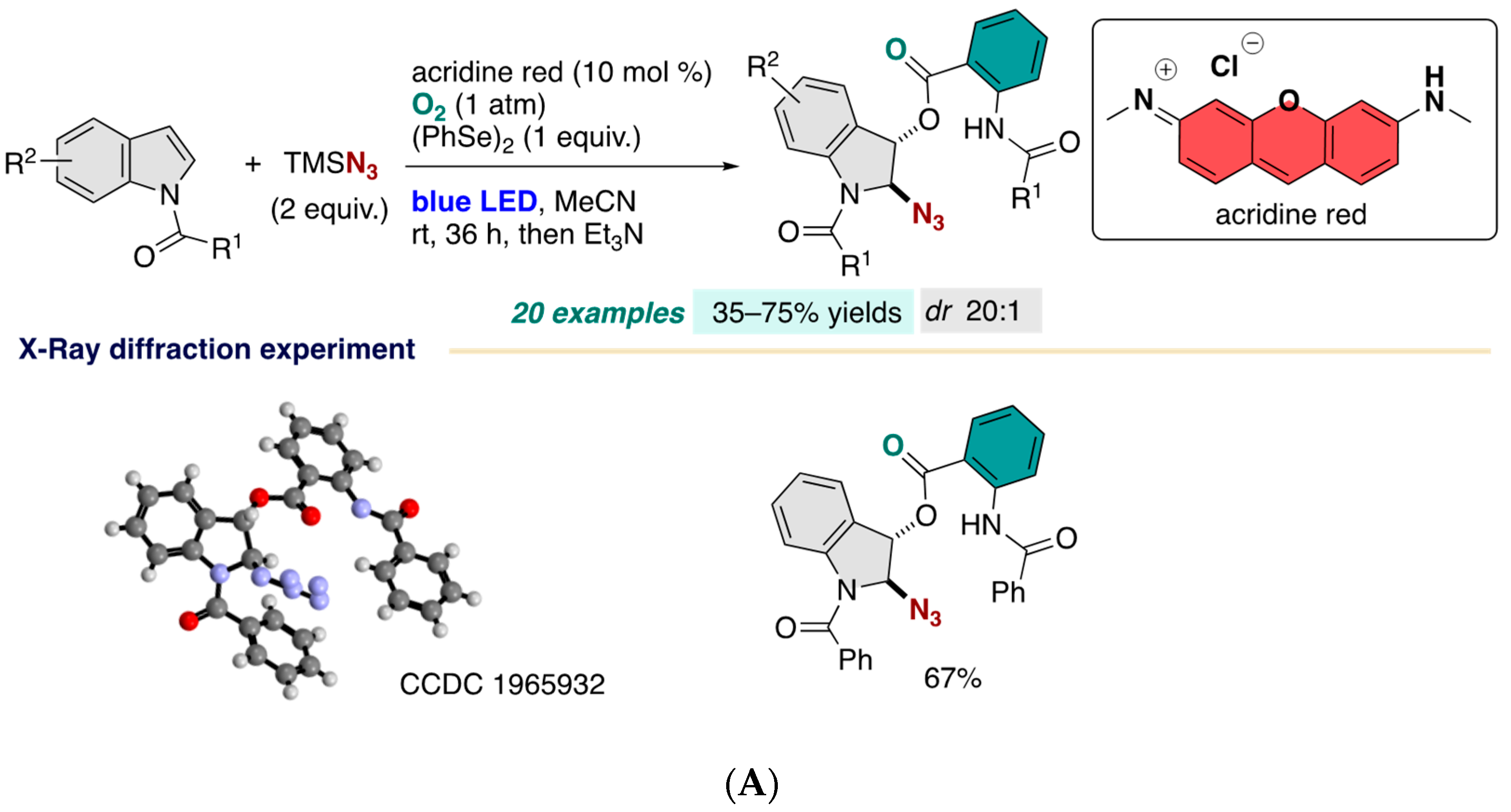
In 2020, Xu, Ji, and co-workers reported a visible-light/acridine red-enabled multicomponent cascade from indoles to 2-azidoindolin-3-yl 2-aminobenzoates using TMSN3 as an azide-transferring reagent (Scheme 27A) [59]. This protocol can merge multiple components into one pot to produce sp3-rich, complicated indolines. Interestingly, two types of reactions, such as azido-3-hydroxylation/ring-opening, proceed in one pot under visible-light irradiation. An interesting structure was determined by using X-ray crystallography (CCDC 1965932).
Scheme 27.
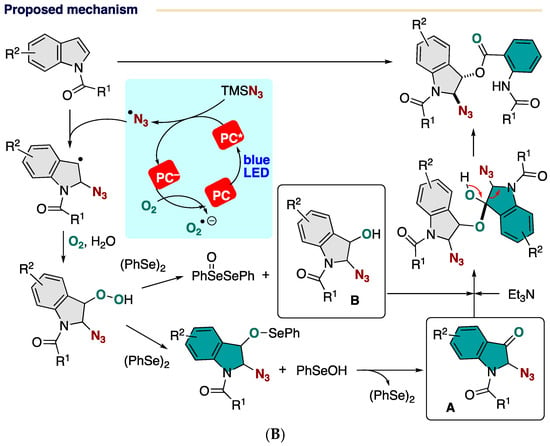
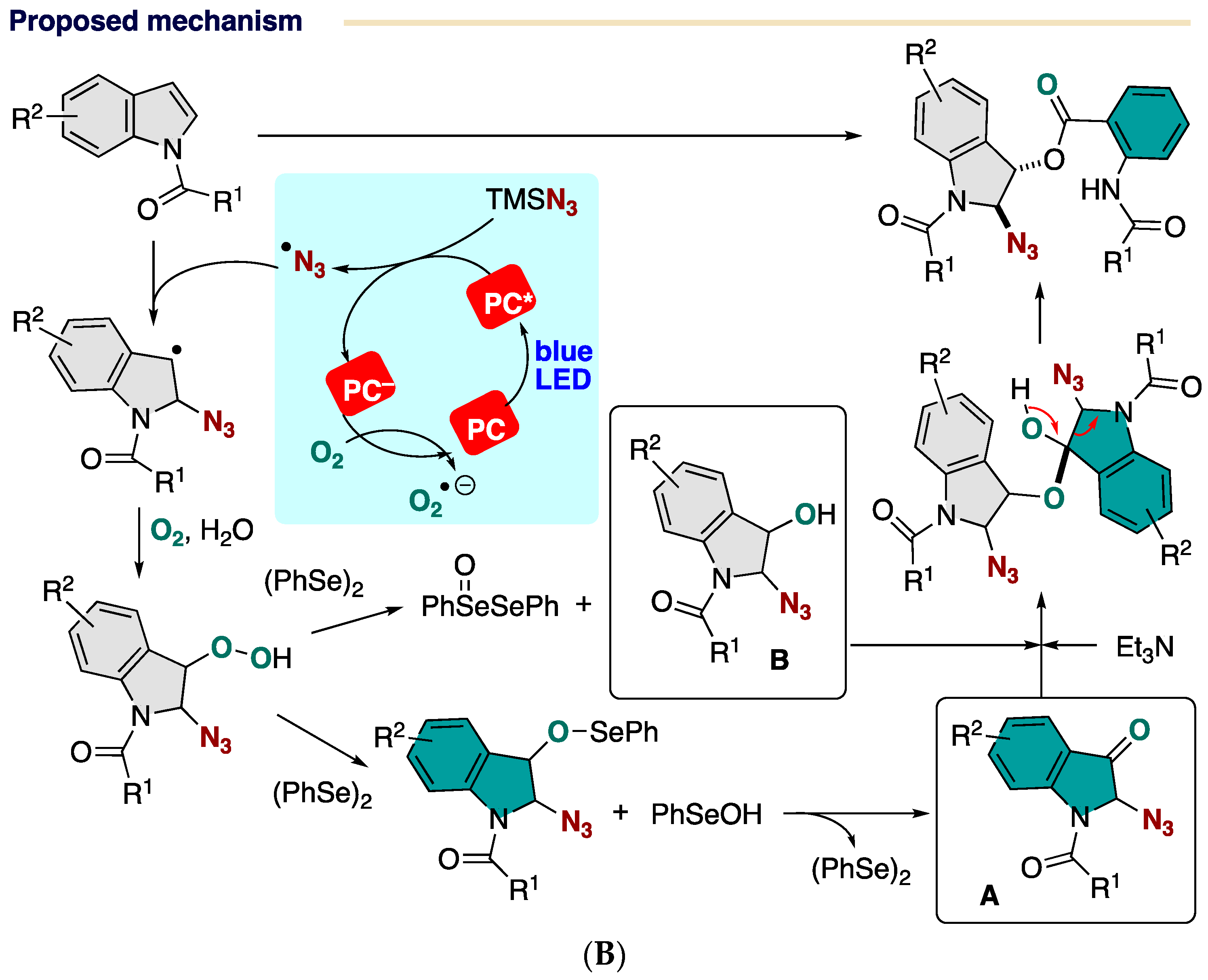
(A) Organocatalyst-enabled multicomponent cascade of indoles with TMSN3 under LED irradiation. (B) Mechanism for multicomponent cascade of indoles with TMSN3 under LED irradiation.
The mechanism of the formation of the products was proposed (Scheme 27B). First, the 2-azido-3-hydroperoxyindolines are converted into 2-azido-3-oxindoles A with the assistance of PhSeSePh as a reductant. Next, the 2-azido-3-hydroperoxyindolines are reduced to 2-azido-3-hydroxyindolines B by PhSeSePh, which can attack the carbonyl group of the intermediate A with the help of Et3N. Finally, the ring opening takes place to afford 2-azido-indolin-3-yl 2-benzamide derivatives, with a release of HCHO and HN3.
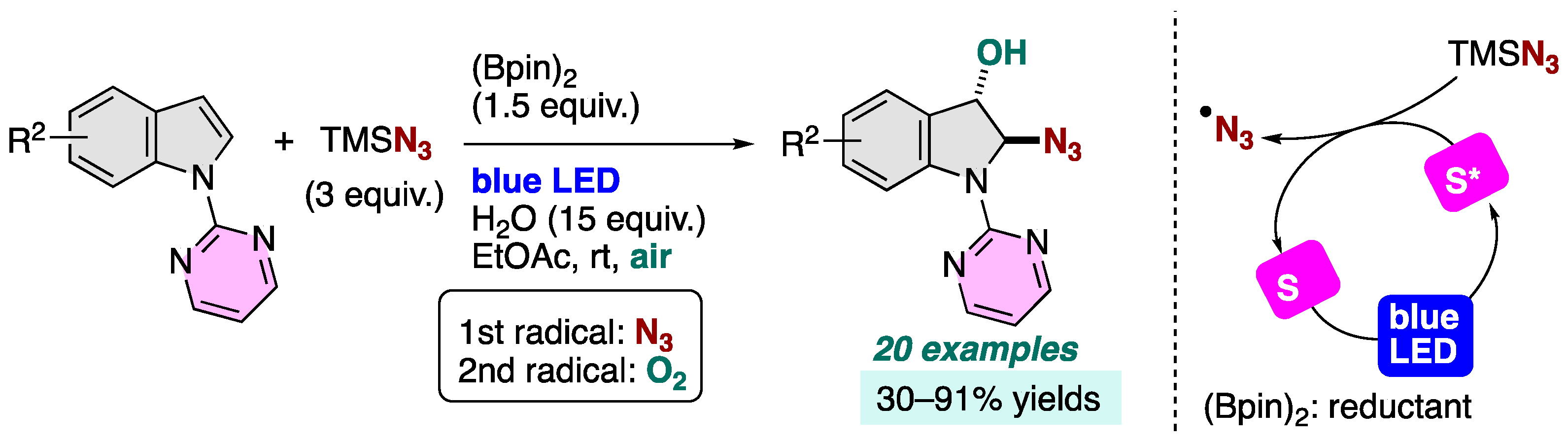
In 2021, Lu, Wang, and co-workers reported a visible-light-enabled hydroxyazidation of indoles using TMSN3 as an azide-transferring reagent and bis(pinacolato)diboron as a reductant (Scheme 28) [60]. Surprisingly, the N-pyrimidyl indole substrates can act as a self-photocatalyst through excitation by LED irradiation. The excited substrate S* can undergo energy transfers withTMSN3 to generate an azidyl radical.
Scheme 28.
Photocatalyst-free hydroxyazidation of indoles with TMSN3 under LED irradiation.
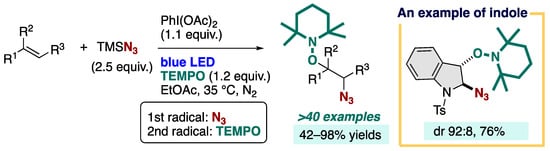
In 2021, Kashyap and co-workers reported a visible-light-enabled azido-oxygenation of alkenes using in situ-generated PhI(N3)2 from PhI(OAc)2/TMSN3 as an azide-transferring reagent and TEMPO as another radical (Scheme 29) [61]. The LED irradiation enables a homolytic cleavage of the iodine–nitrogen bond to generate an azide radical. Thus, this transformation does not require a photocatalyst. In this work, one example of indoles as a substrate is presented.
Scheme 29.
Photocatalyst-free azido-oxygenation of indoles with in situ-generated PhI(N3)2 under LED irradiation.
6. Azidation of Indoles Using a Combination of an Oxidant and an Azide Source
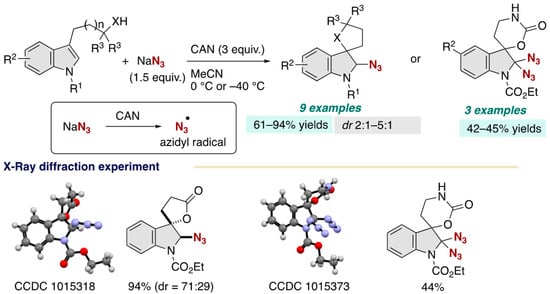
In 2014, Shi and co-workers demonstrated that ceric ammonium nitrate (CAN) can generate an azide radical from NaN3 in the azidative spirocyclization of 3-substituted indoles (Scheme 30) [62]. Diazidation at the C2 position of an indole ring was also achieved in the case of a reaction with N-Boc tether-substituted substrates. The indicated stereochemistry was determined by using X-ray analysis (CCDC 1015318). Furthermore, the structure of the diazide spirocycle was also confirmed by the X-ray analysis (CCDC 1015373).
Scheme 30.
Azidation of indoles with CAN and NaN3.
7. Nucleophilic Azidation of Indoles
One of the most reliable methods to access alkyl azide is a Finkelstein-type (SN2-type) nucleophilic substitution of alkyl halide with the highly nucleophilic NaN3 [17]. However, their application to indoline halides has not been reported due to the possibilities of competition with the elimination reaction powered by the aromatization of indolines.
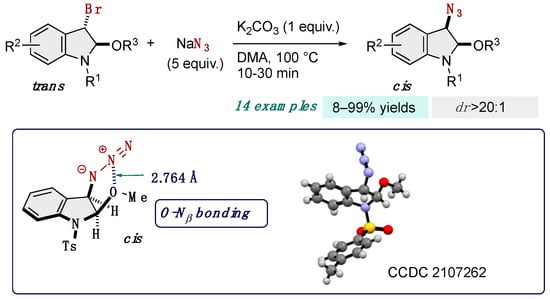
In 2021, Abe and co-workers reported a concise synthesis of 2-alkoxy-3-azidoindolines (AZINs) from 2-RO-3-bromoindolines and NaN3 in DMF (Scheme 31) [63]. With the help of an O–Nβ bonding stabilization (X-ray analysis: CCDC 2107262), an unprecedented production of cis-2-alkoxy-3-azidoindolines was dominant. The AZINs are a stable and versatile synthon for the synthesis of 2-monosubstituted 3-oxindoles through a formal umpolung process [64] and of 2-alkoxy-3-(quinazolin2,4-dione)idolines through the aza-Wittig reaction/cyclization [65].
Scheme 31.
Nucleophilic substitution of bromoindolines with NaN3.
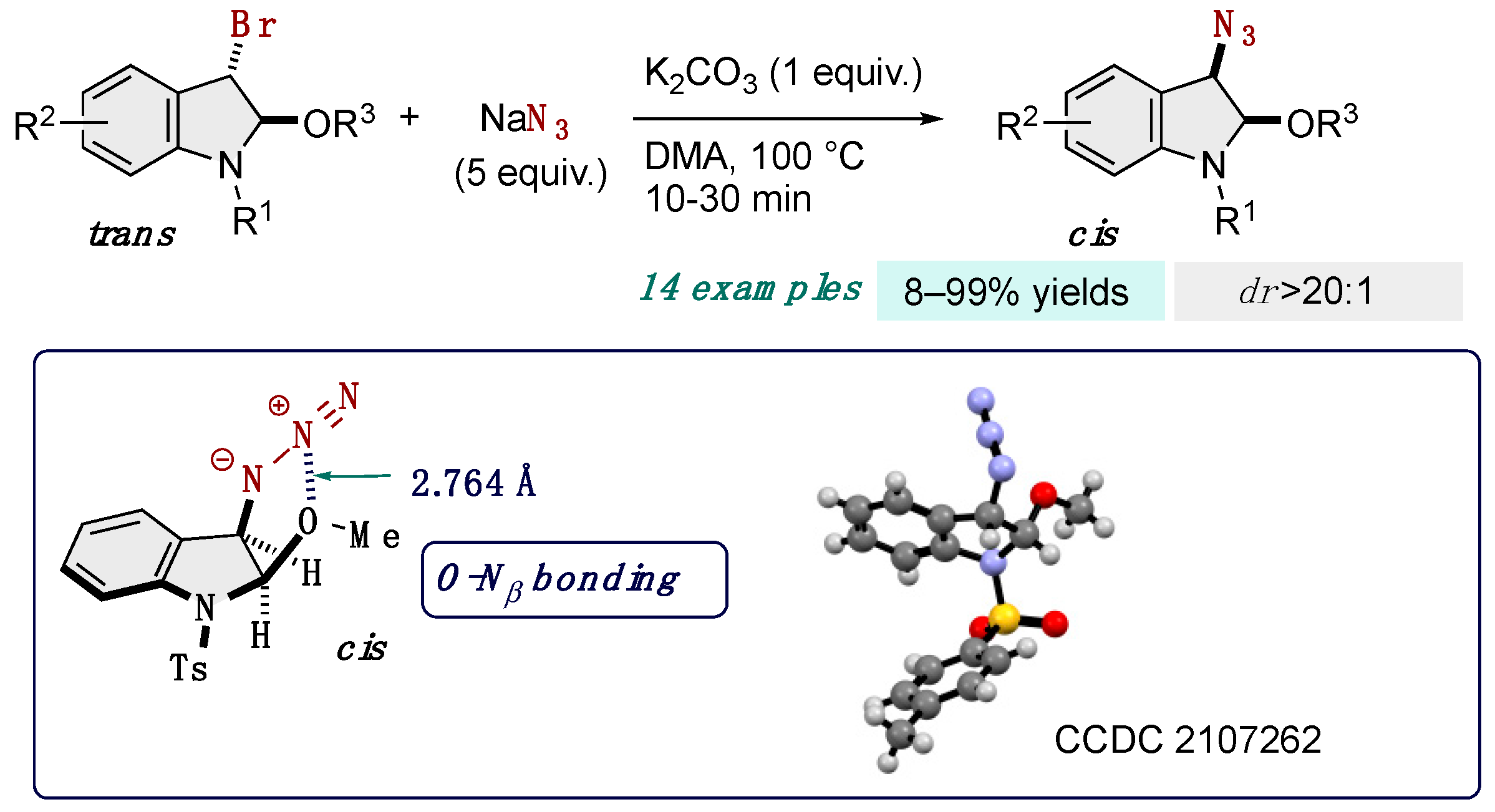
In 2023, Li and co-workers reported the first hydroazidation of phenacylideneoxindoles using n-tetrabutylammonium fluoride (TBAF) and TMSN3 (Scheme 32) [66]. In this transformation, TMSN3 is activated by TBAF, generating n-tetrabutylammonium azide (BNN3) and TMSF [67]. This BNN can attack the carbonyl group of phenacylideneoxindoles, affording the silyl enol ether with the pendant of an azide group. Then, Claisen ([3.3]-sigamtropic) rearrangement of the allylic azide vinyl silyl ethers results in hydrolysis to afford 3-azido-2-oxindoles.
Scheme 32.
Addition/Claisen-type rearrangement of phenacylideneoxindoles with TMSN3 and TBAF.
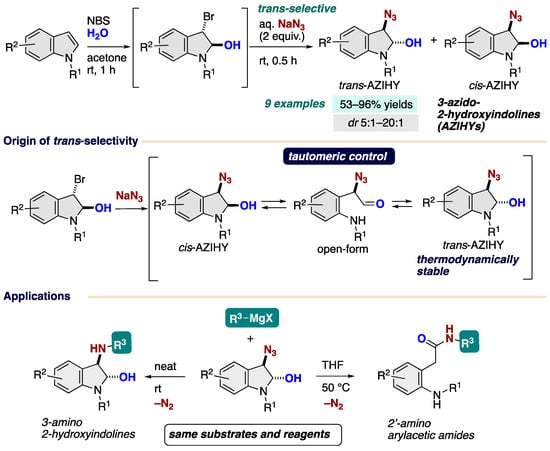
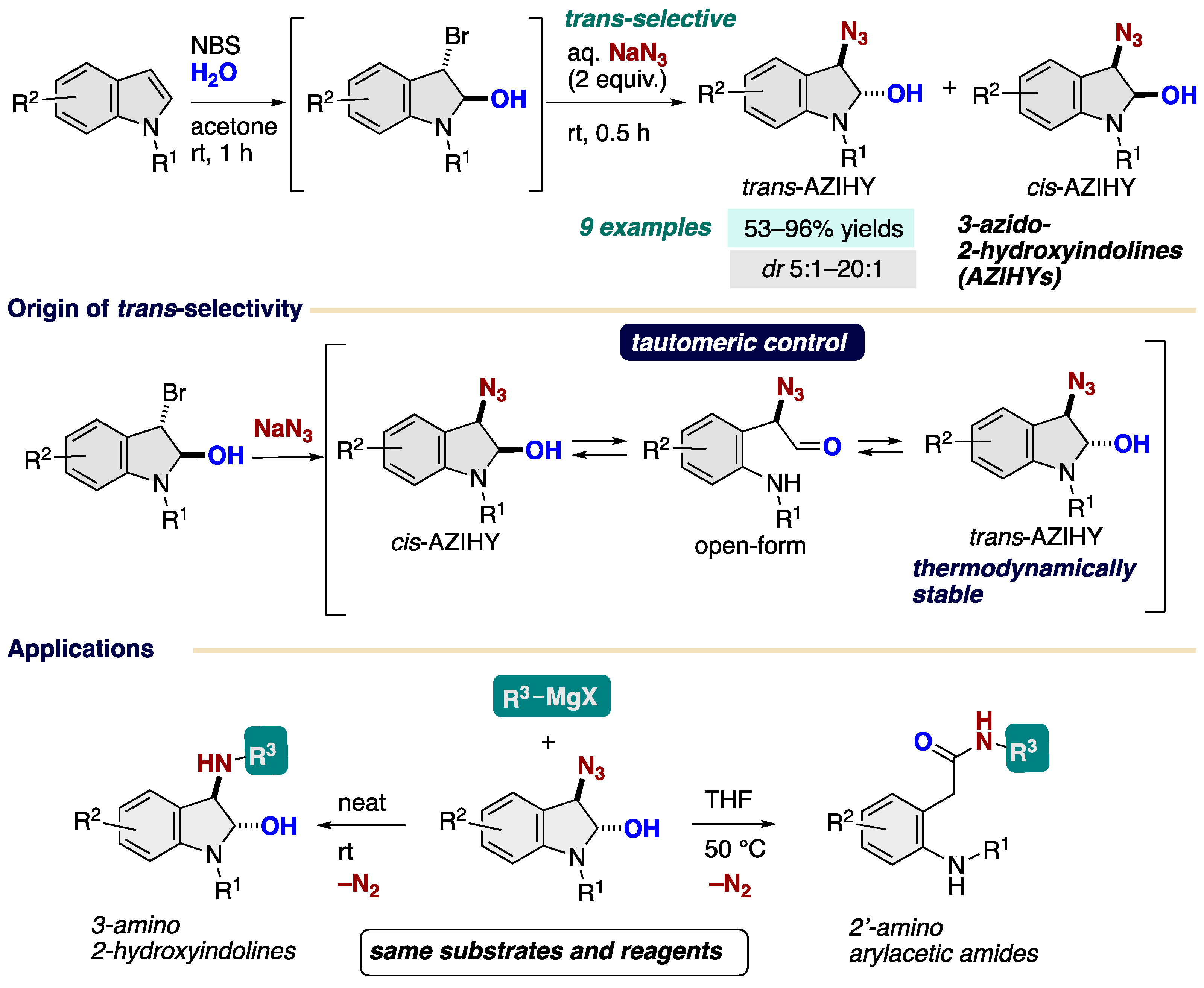
Very recently, Abe and co-workers reported a switchable synthesis of two different medicinally relevant backbones with the merge of Grignard reagents and AZIHY (3-azido-2-hydroxyindolines) (Scheme 33) [68]. The newly designed AZIHY, bearing both indoline hemiaminal and an azide functional group, can be harnessed as a novel denitrogenative cascade. This property enabled the switchable synthesis under a tautomeric control of hemiaminals.
Scheme 33.
Synthesis of 3-azido-2-hydroxyindolines.
8. Conclusions
Both organic azides and indole/indolines are privileged motifs in organic and medicinal chemistry. This review focused on advances and applications made with the azidation of indolines and indoles. Recent developments have demonstrated that the azidation of indoles/indolines have predominantly been discovered under radical technologies, including hypervalent iodine, electro-, and photochemistry. There are some drawbacks to hypervalent iodine: one is the high cost of manufacturing due to its multi-step production process. After the reaction, iodosobenzene is also produced as a byproduct. The advantages of methodologies using hypervalent iodine are environmentally friendly chemistry due to its low toxicity. In this line, the protocols utilizing electro- and photochemistry are also employ green chemistry as there is no need for any extra oxidants and the simple set-ups/work-ups.
Surprisingly, traditional approaches such as the SN2 reaction by N3− and alkyl halides are quite scarce. Nucleophilic substitution is a straightforward reaction due to the intrinsic polar match, while the electro- and photochemistry processes require umpolung reactivities. Thus, they are suitable for the control of stereochemistry depending on the choice of starting material. Among the control of stereochemistry, the cis-selective synthesis of azidoindolines is rather limited. It is expected that a stereoselective synthesis will develop through a novel reaction pathway to expand the unexplored chemical space, leading to unique sp3-rich heterocycles [69,70].
Although many synthetic applications of azidoindolines are found, most of them are related to the reaction of alkyl azides, such as the click reaction and amine synthesis. There have been a few examples of the bio-orthogonal azidation of tryptophans reported to date [71,72]. I expect that a variety of bio-orthogonal applications of azidoindolines will appear in the future.
Funding
This work was partly supported by JSPS KAKENHI (22K06503).
Institution Review Board Statement
Not applicable.
Data Availability Statement
Not applicable.
Conflicts of Interest
The author declares no conflicts of interest.
Abbreviations
| MeCN | acetonitrile |
| Bz | benzoyl |
| DMF | N,N-dimethylformamide |
| TMS | trimethylsilyl |
| Ts | p-toluenesulfonyl |
| DMSO | dimethyl sulfoxide |
| TBS | tert-butyldimethylsilyl |
| ADBX | azidodimethylbenziodoxole |
| IBA | 2-iodosobenzoic acid |
| TFA | trifluoroacetic acid |
| acac | acetylacetonate |
| TBTA | tris(benzyltriazolyl)methylamine |
| SET | single electron transfer |
| TBHP | tert-butyl hydroperoxide |
| TBPB | tert-butyl peroxibenzoate |
| Boc | tert-butoxycarbonyl |
| Troc | 2,2,2-trichloroethoxycarbonyl |
| DG | directing group |
| 1,10-phen | 1,10-phenanthroline |
| Cbz | benzyloxycarbonyl |
| LED | light emitting diode |
| PC | photocatalyst |
| HFIP | 1,1,1,3,3,3-hexafluoropropan-2-ol |
| CAN | ceric ammonium nitrate |
| TEMPO | 2,2,6,6-tetramethylpiperidine 1-oxyl |
| DMA | N,N-dimethylacetamide |
| AZIN | 2-alkoxy-3-azidoindoline |
| TBAF | n-tetrabutylammonium fluoride |
| BNN3 | n-tetrabutylammonium azide |
| AZIHY | 3-azido-2-hydroxyindoline |
| CCDC | Cambridge crystallographic data centre |
References
- Ishikura, M.; Yamada, K.; Abe, T. Simple indole alkaloids and those with a nonrearranged monoterpenoid unit. Nat. Prod. Rep. 2010, 27, 1630–1680. [Google Scholar] [CrossRef] [Scilit]
- Ishikura, M.; Abe, T.; Choshi, T.; Hibino, S. Simple indole alkaloids and those with a nonrearranged monoterpenoid unit. Nat. Prod. Rep. 2013, 30, 694–752. [Google Scholar] [CrossRef] [Scilit]
- Ishikura, M.; Abe, T.; Choshi, T.; Hibino, S. Simple indole alkaloids and those with a nonrearranged monoterpenoid unit. Nat. Prod. Rep. 2015, 32, 1389–1471. [Google Scholar] [CrossRef] [Scilit]
- Kumari, A.; Singh, R.K. Medicinal chemistry of indole derivatives: Current to future therapeutic prospectives. Bioorg. Chem. 2019, 89, 103021. [Google Scholar] [CrossRef] [Scilit]
- Umer, S.M.; Solangi, M.; Khan, K.M.; Saleem, R.S.Z. Indole-Containing Natural Products 2019–2022: Isolations, Reappraisals, Syntheses, and Biological Activities. Molecules 2022, 27, 7586. [Google Scholar] [CrossRef] [Scilit] [PubMed]
- Aldrich, L.N.; Burdette, J.E.; de Blanco, E.C.; Coss, C.C.; Eustaquio, A.S.; Fuchs, J.R.; Kinghorn, A.D.; MacFarlane, A.; Mize, B.K.; Oberlies, N.H.; et al. Discovery of Anticancer Agents of Diverse Natural origin. Nat. Prod. 2022, 85, 702–719. [Google Scholar] [CrossRef] [Scilit] [PubMed]
- Lovering, F.; Bikker, J.; Humblet, C. Escape from Flatland: Increasing Saturation as an Approach to Improving Clinical Success. J. Med. Chem. 2009, 52, 6752–6756. [Google Scholar] [CrossRef] [Scilit]
- Nicholls, A.; McGaughey, G.B.; Sheridan, R.P.; Good, A.C.; Warren, G.; Mathieu, M.; Muchmore, S.W.; Brown, S.P.; Grant, J.A.; Haigh, J.A.; et al. Molecular Shape and Medicinal Chemistry: A Perspective. J. Med. Chem. 2010, 53, 3862–3886. [Google Scholar] [CrossRef] [Scilit] [PubMed]
- Talele, T.T. Opportunities for Tapping into Three-Dimensioned Chemical Space through a Quaternary Carbon. J. Med. Chem. 2020, 63, 13291–13315. [Google Scholar] [CrossRef] [Scilit]
- Roche, S.P.; Porco, J.A. Dearomatization Strategies in the Synthesis of Complex Natural Products. Angew. Chem. Int. Ed. 2011, 50, 4068–4093. [Google Scholar] [CrossRef] [Scilit]
- Zhuo, C.-X.; Zhang, W.; You, S.-L. Catalytic Asymmmetric Dearomatization Reactions. Angew. Chem. Int. Ed. 2012, 51, 12662–12686. [Google Scholar] [CrossRef] [Scilit] [PubMed]
- Roche, S.P.; Youte Tendoung, J.-J.; Tréguier, B. Advances in Dearomatization Strategies of Indoles. Tetrahedron 2015, 71, 3549–3591. [Google Scholar] [CrossRef] [Scilit]
- Schilling, C.I.; Jung, N.; Biskup, M.; Schepers, U.; Bräse, S. Bioconjugation via azide-Staudinger ligation: An overview. Chem. Soc. Rev. 2011, 40, 4840–4871. [Google Scholar] [CrossRef] [Scilit] [PubMed]
- Palacios, F.; Alonso, C.; Aparicio, D.; Rubiales, G.; de los Santos, J.M. The aza-Wittig reaction: An efficient tool for the construction of carbon-nitrogen double bonds. Tetrahedron 2007, 63, 523–575. [Google Scholar] [CrossRef] [Scilit]
- Kolb, H.C.; Finn, M.G.; Sharpless, K.B. Click Chemistry: Diverse Chemical Function from a Few Good Reaction. Angew. Chem. Int. Ed. 2001, 40, 2004–2021. [Google Scholar] [CrossRef]
- Henessy, E.T.; Betley, T.A. Complex N-Heterocycles Synthesis via Iron-Catalyzed, Direct C–H Bond Amination. Science 2013, 340, 591–595. [Google Scholar] [CrossRef] [Scilit] [PubMed]
- Brase, S.; Gil, C.; Knepper, K.; Zimmermann, V. Organic azides: An exploding diversity of a unique class of compounds. Angew. Chem. Int. Ed. 2005, 44, 5188–5240. [Google Scholar] [CrossRef] [Scilit] [PubMed]
- Tanimoto, H.; Kakiuchi, K. Recent Applications and Developments of Organic Azides in Total Synthesis of Natural Products. Nat. Prod. Commun. 2013, 8, 1021–1034. [Google Scholar] [CrossRef] [Scilit] [PubMed]
- Patterson, D.M.; Nazarova, L.A.; Presher, J.A. Finding the Right (Bioorthogonal) Chemistry. Acc. Chem. Biol. 2014, 9, 592–605. [Google Scholar] [CrossRef] [Scilit]
- Sivaguru, P.; Ning, Y.; Bi, X. New Strategies for the Synthesis of Aliphatic Azides. Chem. Rev. 2021, 121, 4253–4307. [Google Scholar] [CrossRef] [Scilit]
- Sala, R.; Loro, C.; Foschi, F.; Broggini, G. Transition Metal Catalyzed Azidation Reactions. Catalysts 2020, 10, 1173. [Google Scholar] [CrossRef] [Scilit]
- Tamura, Y.; Kwon, S.; Tabusa, F.; Ikeda, M. Reaction of iodine azide with 1-acylindoles: Formation of 1-acyl-cis- and trans-2,3-diazidoindolines. Tetrahedron Lett. 1975, 16, 3291–3294. [Google Scholar] [CrossRef] [Scilit]
- Tamura, Y.; Chun, M.W.; Kwon, S.; Bayomi, S.M.; Okada, T.; Ikeda, M. Reaction of Benzo[b]furan and 1-Acylindoles with Iodine Azide. Chem. Pharm. Bull. 1978, 26, 3515–3520. [Google Scholar] [CrossRef] [Scilit]
- Ikeda, M.; Tabusa, F.; Nishimura, Y.; Kwon, S.; Tamura, Y. The reactions of some indoles with iodine azide: Synthesis of 3-azidoindolenines, 2-azidomethylindoles, and 3a-azido-furo- and pyrrolo-[2,3-b]indoles. Tetrahedron Lett. 1976, 27, 2347–2350. [Google Scholar] [CrossRef] [Scilit]
- Moriarty, R.M.; Khosrowshahi, J.S. A Versatile synthesis of vicinal diazides using hypervalent iodine. Tetrahedron Lett. 1986, 27, 2809–2812. [Google Scholar] [CrossRef] [Scilit]
- Pedersen, C.M.; Marinescu, L.G.; Bols, M. Substitution with Azide: TMSN3–PhI(OAc)2 as a Substitute of IN3. Org. Biomol. Chem. 2005, 3, 816–822. [Google Scholar] [CrossRef] [Scilit]
- Yoshimura, A.; Zhdankin, V.V. Advances in Synthetic Applications of Hypervalent Iodine Compounds. Chem. Rev. 2016, 116, 3328–3435. [Google Scholar] [CrossRef] [Scilit]
- Lubriks, D.; Sokolovs, I.; Suna, E. Indirect C–H Azidation of Heterocycles via Copper-Catalyzed Regioselective Fragmentation on Unsymmetrical λ3-Iodanes. J. Am. Chem. Soc. 2012, 134, 15436–15442. [Google Scholar] [CrossRef] [Scilit]
- Prasad, P.K.; Kalshetti, R.G.; Reddi, R.N.; Kamble, S.P.; Sudalai, A. I2-mediated regioselective C-3 azidation of indoles. Org. Biomol. Chem. 2016, 14, 3027–3030. [Google Scholar] [CrossRef] [Scilit]
- Chen, W.-T.; Gao, L.-H.; Bao, W.-H.; Wei, W.-T. Metal-Free C(sp3)-H Azidation in a Radical Strategy for the Synthesis of 3-Azido-2-oxindoles at Room Temperature. J. Org. Chem. 2018, 83, 11074–11079. [Google Scholar] [CrossRef] [Scilit]
- Holzschneider, K.; Mohr, F.; Kirsch, S.F. Metal-free Synthesis and Reactivity of 3,3-Diazidooxindoles. Org. Lett. 2018, 20, 7066–7070. [Google Scholar] [CrossRef] [Scilit] [PubMed]
- Pal, P.; Goud, G.K.; Sridhar, B.; Mainkar, P.S.; Nayani, K.; Chandrasekhar, S. Metal-free dearomatization 2,3-difunctionalization of indoles via radical cascade. Tetrahedron Lett. 2023, 121, 154478. [Google Scholar] [CrossRef] [Scilit]
- Ge, L.; Chiou, M.-F.; Li, Y.; Bao, H. Radical azidation as a means of constructing C(sp3)-N3 bonds. Green Synth. Catal. 2020, 1, 86–120. [Google Scholar] [CrossRef] [Scilit]
- Liu, Y.; Ebadi, A.G.; Youseftabar-Miri, L.; Hassanpour, A.; Vessally, E. Methods for direct C(sp2)-H bonds azidation. RSC Adv. 2019, 9, 25199–25215. [Google Scholar] [CrossRef] [Scilit] [PubMed]
- Mironova, I.A.; Kirsch, S.F.; Zhdankin, V.V.; Yoshimura, A.; Yusubov, M.S. Hypervalent Iodine-Mediated Azidation Reactions. Eur. J. Org. Chem. 2022, 2022, e202200754. [Google Scholar] [CrossRef] [Scilit]
- Shee, M.; Singh, N.D.P. Chemical versatility of azide radical: Journey from a transient species to synthetic accessibility in organic transformations. Chem. Soc. Rev. 2022, 51, 255–2312. [Google Scholar] [CrossRef] [Scilit] [PubMed]
- Goswami, M.; de Bruin, B. Metal-Catalysed Azidation of Organic Molecules. Eur. J. Org. Chem. 2017, 2017, 1152–1176. [Google Scholar] [CrossRef] [Scilit] [PubMed]
- Deng, Q.-H.; Bleith, T.; Wadepohl, H.; Gade, L.H. Enantioselective Iron-Catalyzed Azidation of β-Keto Esters and Oxindoles. J. Am. Chem. Soc. 2013, 135, 5356–5359. [Google Scholar] [CrossRef] [Scilit] [PubMed]
- Yin, H.; Wang, T.; Jiao, N. Copper-Catalyzed Oxoazidation and Alkoxyazidation of Indoles. Org. Lett. 2014, 16, 2302–2305. [Google Scholar] [CrossRef] [Scilit]
- Zhang, P.; Sun, W.; Li, G.; Hong, L.; Wang, R. Copper-catalyzed cascade azidation-cyclization of tryptophols and tryptamines. Chem. Commun. 2015, 51, 12293–12296. [Google Scholar] [CrossRef] [Scilit]
- Dhineshkumar, J.; Gadde, K.; Prabhu, K.R. Substituent-Directed Regioselective Azidation: Copper-Catalyzed C–H Azidation and Iodine-Catalyzed Dearomatizative Azidation of Indole. J. Org. Chem. 2018, 83, 228–235. [Google Scholar] [CrossRef] [Scilit] [PubMed]
- Xu, M.-M.; Cao, W.-B.; Xu, X.-P.; Ji, S.-J. Efficient synthesis of 2-arylquinazolin-4-amines via a copper-catalyzed diazidation and ring expansion cascade of 2-arylindoles. Chem. Commun. 2018, 54, 12602–12605. [Google Scholar] [CrossRef] [Scilit] [PubMed]
- Shen, S.-J.; Zhu, C.-L.; Lu, D.-F.; Xu, H. Iron-Catalyzed Direct Olefin Diazidation via Peroxyester Activation Promoted by Nitrogen-Based Ligands. ACS Catal. 2018, 8, 4473–4482. [Google Scholar] [CrossRef] [Scilit] [PubMed]
- Zhu, C.-L.; Wang, C.; Qin, Q.-X.; Yruegas, S.; Martin, C.D.; Xu, H. Iron(II)-Catalyzed Azidotrifluoromethylation for Expedient Vicinal Trifluoromethyl Amine Synthesis. ACS Catal. 2018, 8, 5032–5037. [Google Scholar] [CrossRef] [Scilit] [PubMed]
- Xu, M.-M.; Cao, W.-B.; Ding, R.; Li, H.-Y.; Xu, X.-P.; Ji, S.-J. Dearomatization of Indoles via Azido Radical Addition and Dioxygen Trapping to Access 2-Azidoindolin-3-ols. Org. Lett. 2019, 21, 6217–6220. [Google Scholar] [CrossRef] [Scilit] [PubMed]
- Bao, W.-H.; Gao, L.-H.; Ying, W.-W.; Chen, W.-T.; Chen, G.-P.; Wei, W.-T.; Liu, Y.-Y.; Li, Q. Copper-Catalyzed C(sp3)–H Azidation of 1,3-Dihydro-2H-indol-2-ones Under Mild Conditions. Synlett 2019, 30, 109–113. [Google Scholar]
- Liu, J.; Fang, Z.; Liu, X.; Dou, Y.; Jiang, J.; Zhang, F.; Qu, J.; Zhu, Q. Diastereoselective 2,3-diazidation of indoles via copper(II)-catalyzed dearomatization. Chin. Chem. Lett. 2020, 31, 1332–1336. [Google Scholar] [CrossRef] [Scilit]
- Cao, M.; Wang, H.; Ma, Y.; Tung, C.-H.; Liu, L. Site- and Enantioselective Manganese-Catalyzed Benzylic C–H Azidation of Indolines. J. Am. Chem. Soc. 2022, 144, 15383–15390. [Google Scholar] [CrossRef] [Scilit]
- Yoshida, J.; Kataoka, K.; Horcajada, R.; Nagaki, A. Modern Strategies in Electroorganic Synthesis. Chem. Rev. 2008, 108, 2265–2299. [Google Scholar] [CrossRef] [Scilit]
- Horn, E.J.; Rosen, B.R.; Baran, P.S. Synthetic Organic Electrochemistry: An Enabling and Innately Sustainable Method. ACS Cent. Sci. 2016, 5, 302–308. [Google Scholar] [CrossRef] [Scilit]
- Fu, N.; Sauer, G.S.; Saha, A.; Loo, A.; Lin, S. Metal-catalyzed electrochemical diazidation of alkenes. Sciences 2017, 357, 575–579. [Google Scholar] [CrossRef] [Scilit] [PubMed]
- Wu, J.; Dou, Y.; Guillot, R.; Kouklovsky, C.; Vincent, G. Electrochemical Dearomative 2,3-Difunctionalization of Indoles. J. Am. Chem. Soc. 2019, 141, 2832–2837. [Google Scholar] [CrossRef] [Scilit] [PubMed]
- Pator, M.; Vayer, M.; Weinstabl, H.; Maulide, N. Electrochemical Umpolung C–H Functionalization of Oxindoles. J. Org. Chem. 2022, 87, 606–612. [Google Scholar] [CrossRef] [Scilit] [PubMed]
- Mo, K.; Zhou, X.; Wu, J.; Zhao, Y.J. Manganese-Mediated Electrochemical Dearomatization of Indoles To Access 2-Azido Spirocyclic Indolines. Org. Chem. 2022, 87, 16106–16110. [Google Scholar] [CrossRef] [Scilit] [PubMed]
- Weng, Y.; Xu, X.; Chen, H.; Zhang, Y.; Zhuo, X. Tandem Electrochemical Oxidative Azidation/Heterocyclization of Tryptophan-Containing Peptides under Buffer Conditions. Angew. Chem. Int. Ed. 2022, 61, e202206308. [Google Scholar] [CrossRef] [Scilit] [PubMed]
- Fan, S.; Ma, R.; Yang, A.; Jia, H.; Dong, Y.; Guo, C.; Ren, J. Mn-electrocatalytic oxidative C(sp3)-H azidation of 2-oxindoles and β-ketoesters and azidation-cyclization of tryptamines. Org. Chem. Front. 2024, 11, 336–342. [Google Scholar] [CrossRef] [Scilit]
- Buglioni, L.; Raymenants, F.; Slattery, A.; Zondag, S.D.A.; Noël, T. Technological Innovations in Photochemistry for Organic Synthesis: Flow Chemistry, High-Throughput Experimentation, Scale-up, and Photoelectrochemistry. Chem. Rev. 2022, 122, 2752–2906. [Google Scholar] [CrossRef] [Scilit] [PubMed]
- Zhou, Q.-Q.; Zou, Y.-Q.; Lu, L.-Q.; Xiao, W.-J. Visible-Light-Induced Organic Photochemical Reactions through Energy-Transfer Pathways. Angew. Chem. Int. Ed. 2019, 58, 1586–1604. [Google Scholar] [CrossRef] [Scilit] [PubMed]
- Zhang, L.-L.; Xu, M.-M.; Cao, W.-B.; Xu, X.-P.; Ji, S.-J. Visible-Light-Enabled Multicomponent Cascade Transformation from Indoles to 2-Azidoindolin-3-yl 2-Aminobenzoates. Adv. Synth. Catal. 2020, 362, 1–7. [Google Scholar] [CrossRef] [Scilit]
- Qiao, L.; Zhang, K.; Wang, Z.; Li, H.; Lu, P.; Wang, Y. Visible-Light-Induced Photocatalyst-Free Aerobic Hydroxyazidations of Indoles: A Highly Regioselective and Stereoselective Synthesis of trans-2-Azidoindolin-3-ols. J. Org. Chem. 2021, 86, 7955–7962. [Google Scholar] [CrossRef] [Scilit]
- Gurawa, A.; Kumar, M.; Kashyap, S. Selective Azidooxygenation of Alkenes Enabled by Photo-induced Radical Transfer Using Aryl-λ3-azidoiodinane Species. ACS Omega 2021, 6, 26623–26639. [Google Scholar] [CrossRef] [Scilit] [PubMed]
- Li, J.; Liu, M.; Tian, H.; Shi, Y. A facile approach to spirocyclic 2-azidoindolines via azidation of indoles with ceric ammonium nitrate. Org. Biomol. Chem. 2014, 12, 9769–9772. [Google Scholar] [CrossRef] [Scilit] [PubMed]
- Yamashiro, T.; Abe, T.; Tanioka, M.; Kamino, S.; Sawada, D. cis-3-Azido-2-methoxyindolines as safe and stable precursors to overcome the stability of fleeting 3-azidoindoles. Chem. Commun. 2021, 57, 13381–13384. [Google Scholar] [CrossRef] [Scilit] [PubMed]
- Yamashiro, T.; Abe, T.; Sawada, D. Synthesis of 2-monosubstituted indolin-2-3-ones by cine-substitution of 3-azido-2-methoxyindolines. Org. Chem. Front. 2022, 9, 1897–1903. [Google Scholar] [CrossRef] [Scilit]
- Yamashiro, T.; Tokushige, K.; Abe, T. One-Pot Synthesis of Core Structure of Shewanalline C Using an Azidoindoline. J. Org. Chem. 2023, 88, 3992–3997. [Google Scholar] [CrossRef] [Scilit] [PubMed]
- Aisikaer, A.; Ma, J.; Li, J.; Li, X. Hydroazidation of phenacylideneoxindoles: Synthesis of 3-substituted 3-azido-1,3-dihydro-2H-indol-2-ones via anti-electro addition. Tetrahedron Lett. 2023, 120, 154447. [Google Scholar] [CrossRef] [Scilit]
- Wang, C.-G.; Chong, A.M.L.; Lu, Y.; Liu, X.; Goto, A. Metal-Free Fast Azidation by Using Tetrabutylaamonium Azide: Effective Synthesis of Alkyl Azides and Well-Defined Azido-End Polymethacrylates. Chem. Eur. J. 2019, 25, 13025–13029. [Google Scholar] [CrossRef] [Scilit] [PubMed]
- Yamashiro, T.; Abe, T. Switchable synthesis of 3-aminoindolines and 2′-aminoarylacetic acids using Grignard reagents and 3-azido-2-hydroxyindolines. Chem. Commun. 2024, 60, 6615–6618. [Google Scholar] [CrossRef] [Scilit]
- Mortensen, K.T.; Wong, D.S.Y.; King, T.A.; Sore, H.F.; Spring, D.R. Synthesis of sp3-rich heterocyclic frameworks by a divergent synthesis strategy. Org. Biomol. Chem. 2023, 21, 4591–4595. [Google Scholar] [CrossRef] [Scilit]
- Gruber, F.; McDonagh, A.W.; Rose, V.; Hunter, J.; Guasch, L.; Martin, R.E.; Geigle, S.N.; Britton, R. sp3-Rich Heterocycle Synthesis on DNA: Application to DNA-Encoded Library Production. Angew. Chem. Int. Ed. 2024, 63, e202319836. [Google Scholar] [CrossRef] [Scilit]
- Agard, N.J.; Baskin, J.M.; Prescher, J.A.; Lo, A.; Bertozzi, C.R. A Comparative Study of Bioorthogonal Reactions with Azides. ACS Chem. Biol. 2006, 1, 644–648. [Google Scholar] [CrossRef] [Scilit] [PubMed]
- Mitry, M.M.A.; Greco, F.; Osborn, H.M.I. In Vivo Applications of Bioorthogonal Reactions: Chemistry and Targeting Mechanisms. Chem. Eur. J. 2023, 29, e202203942. [Google Scholar] [CrossRef] [Scilit] [PubMed]
Disclaimer/Publisher’s Note: The statements, opinions and data contained in all publications are solely those of the individual author(s) and contributor(s) and not of MDPI and/or the editor(s). MDPI and/or the editor(s) disclaim responsibility for any injury to people or property resulting from any ideas, methods, instructions or products referred to in the content. |
© 2024 by the author. Licensee MDPI, Basel, Switzerland. This article is an open access article distributed under the terms and conditions of the Creative Commons Attribution (CC BY) license (https://creativecommons.org/licenses/by/4.0/).