


Figure 5 Legend
In the original publication [1], there was an error in the legend for Figure 5. Mechanism of AgNPs as excellent antibacterial agents. The figure legend was not described in detail. The correct legend appears below. The authors state that the scientific conclusions are unaffected. This correction was approved by the Academic Editor. The original publication has also been updated.
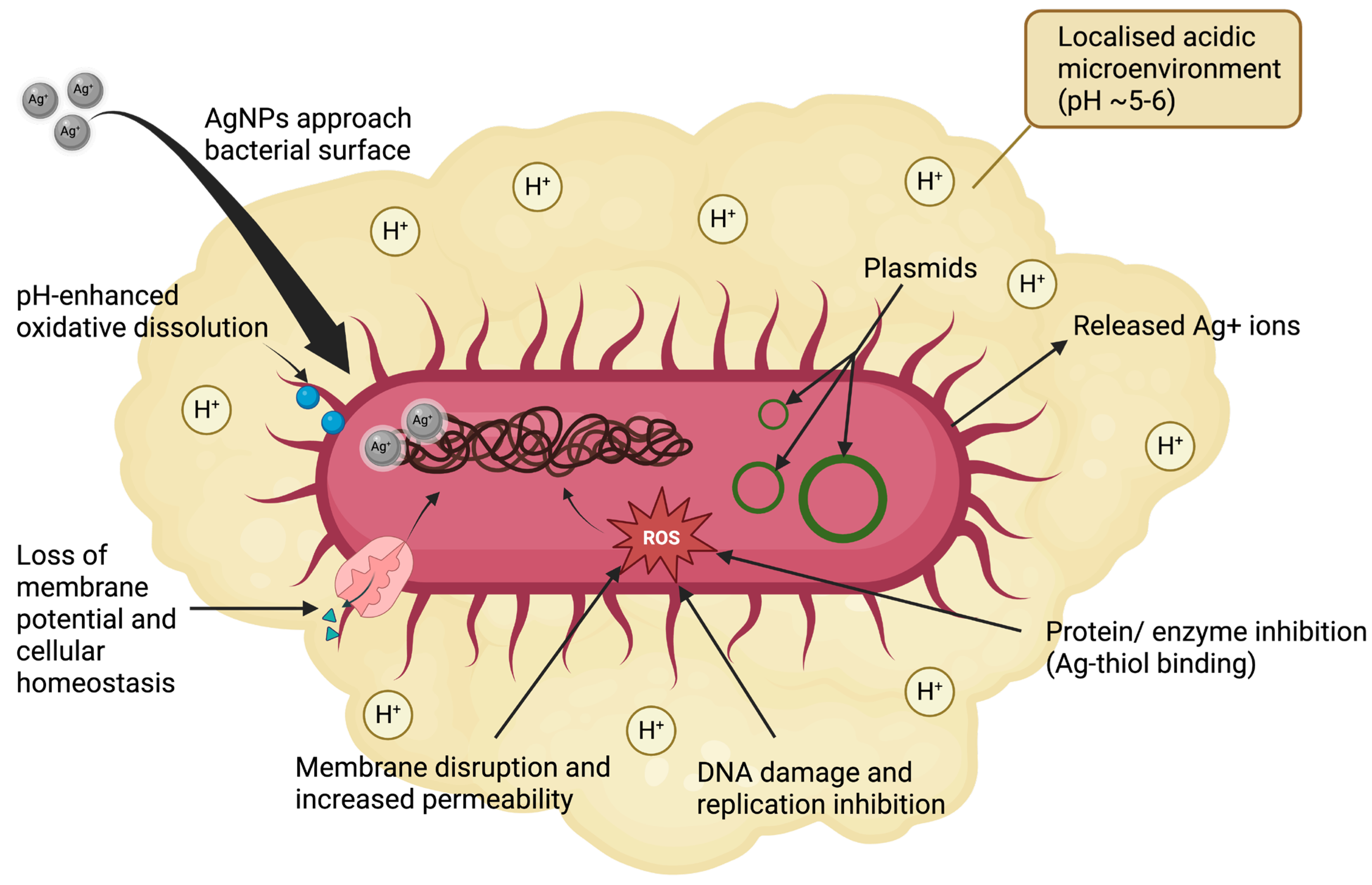
Figure 5. Schematic representation of antibacterial mechanisms of silver nanoparticles (AgNPs). Silver nanoparticles undergo enhanced oxidative dissolution under localized acidic microenvironments (pH ~5–6), such as those present in bacterial biofilms or infection niches, resulting in increased release of Ag+ ions. Released silver ions interact with bacterial membranes, increase permeability, and penetrate the cytoplasm to induce oxidative stress, inhibit enzyme activity via thiol binding, and disrupt DNA replication and transcription. As bacteria are prokaryotes, the acidic microenvironment depicted is extracellular or surface-associated.
Error in Figure 5
In the original publication [1], there was an error in Figure 5. Mechanism of AgNPs as excellent antibacterial agents as published: Ag+ ions in AgNPs bombard the bacterial mitochondria’s electron transport chain resulting in cell death. The corrected AgNP-induced disruption of membrane-associated respiratory processes rather than mitochondrial pathways appears below. The authors state that the scientific conclusions are unaffected. This correction was approved by the Academic Editor. The original publication has also been updated.
Error in Table 1
In the original publication [1], there was an error in Table 1. Nanoparticle applications and mechanisms of action in orthopaedics as published. Ag+ ions in AgNPs bombard the bacterial mitochondria’s electron transport chain, resulting in cell death. The corrected Ag+ ions released from AgNPs disrupt bacterial respiration, impairing energy metabolism and leading to cell death appears below. The authors state that the scientific conclusions are unaffected. This correction was approved by the Academic Editor. The original publication has also been updated.
| Implant-related Infections | Silver NPs (AgNPs) |
| [48–53] |
Text Correction
In the original publication [1], there was an error in 2. Nanotechnology Applications, 2.3. Nanoparticle Applications in Implant-Related Infections, Paragraph 1. “Multi-drug-resistant (MDR) … (c) Ag+ ions in AgNPs bombard the bacterial mitochondria’s electron transport chain, resulting in cell death [52].” A correction has been made to:
Multi-drug-resistant (MDR) … (c) Ag+ ions released from AgNPs interact with components of the bacterial respiratory chain located on the plasma membrane, disrupting electron transport and energy metabolism and leading to cell death [52].
The authors state that the scientific conclusions are unaffected. This correction was approved by the Academic Editor. The original publication has also been updated.
Reference
- Pang, A.S.-R.; Liau, Z.Q.G.; Oh, J.Y.-L.; Srinivasan, D.K. Nanotechnology-Enhanced Orthopaedic Surgery. J. Nanotheranostics 2024, 5, 167–187. [Google Scholar] [CrossRef] [Scilit]
Disclaimer/Publisher’s Note: The statements, opinions and data contained in all publications are solely those of the individual author(s) and contributor(s) and not of MDPI and/or the editor(s). MDPI and/or the editor(s) disclaim responsibility for any injury to people or property resulting from any ideas, methods, instructions or products referred to in the content. |
© 2026 by the authors. Licensee MDPI, Basel, Switzerland. This article is an open access article distributed under the terms and conditions of the Creative Commons Attribution (CC BY) license.