Review

Nano-Enabled CRISPR-Cas Gene Editing for Cancer Therapeutics

1
School of Pharmaceutical Sciences, Capital Medical University, Beijing 100169, China
2
School of Basic Medical Sciences, Capital Medical University, Beijing 100169, China
3
School of Beijing, Beihang University, Beijing 100191, China
*
Author to whom correspondence should be addressed.
J. Nanotheranostics 2026, 7(1), 6; https://doi.org/10.3390/jnt7010006
Submission received: 20 August 2025 / Revised: 18 February 2026 / Accepted: 25 February 2026 / Published: 9 March 2026
(This article belongs to the Special Issue Feature Review Papers in Nanotheranostics)

Abstract

While CRISPR-Cas9 enables precise targeting of cancer-driving genetic aberrations, its clinical application is impeded by instability, delivery inefficiencies, and immunogenicity. Nanotechnology addresses these challenges by engineering nanocarriers that facilitate enhanced cellular uptake, promote efficient endosomal escape, and ensure targeted delivery. This review summarizes current progress in nano-integrated CRISPR-Cas systems for cancer therapeutics, highlighting recent advancements in stimuli-responsive nanoplatforms for precise genome editing and their prospects for clinical application.

1. Introduction

The advent of CRISPR-based genome-editing has marked the beginning of a new era in genetic engineering and therapeutic development, offering tools to directly target oncogenic vulnerabilities at the molecular level [1]. By enabling precise disruption of oncogenes (e.g., KRAS, MYC), restoration of tumor suppressor functions (e.g., TP53), or modulation of immune checkpoints (e.g., PD-1, CTLA-4), CRISPR-Cas9 systems hold transformative potential to overcome the limitations of conventional therapies [2,3]. This paradigm shift toward gene-centric therapeutics promises to address the root causes of malignancy rather than merely mitigating symptoms. The versatility of this platform stems from its bipartite architecture, which combines a programmable nucleic acid recognition module (guide RNA) with a diverse set of effector nucleases [4]. The archetypal Cas9 system is a prime example of this model, where RNA-directed DNA recognition triggers site-specific double-strand breaks adjacent to NGG protospacer adjacent motif (PAM) sequences [5]. These breaks activate endogenous repair pathways—either generating stochastic insertions and deletions (indels) via non-homologous end joining (NHEJ) [6] or enabling precise sequence modifications through homology-directed repair (HDR) when donor templates are available [7]. The CRISPR toolbox has undergone remarkable expansion through protein engineering and the discovery of natural variants, significantly enhancing the scope and precision of genome editing technologies [8]. CRISPR platforms offer versatile and multifaceted intervention strategies to combat cancer progression, including: (1) direct inactivation of oncogenes such as disruption of MYC, EGFR; (2) correction of oncogenic mutations, such as those in BRAC1 or TP53; (3) restoration of tumor suppressor genes such as PTEN; (4) engineering of immune checkpoints by blocking the PD-1/PD-L1 pathway to achieve effective tumor immunotherapy; and (5) Epigenomic editing by fusing a catalytically dead form of Cas9 (dCas9) with epigenetic effector proteins, such as methyltransferase or demethylase.
Despite its revolutionary potential, translation of CRISPR-Cas9 into oncological therapeutics faces significant delivery challenges [9]. The CRISPR-Cas technology can be implemented in various forms, including plasmid DNA encoding both the Cas9 protein and sgRNA, CRISPR mRNA paired with sgRNA, or as a ribonucleoprotein (RNP) complex consisting of the Cas9 protein and sgRNA. All three forms possess a negatively charged nature, which impedes cellular uptake and effective biodistribution, resulting in extremely low cellular delivery efficiency [10]. Therefore, developing efficient and safe delivery strategies is the theme for application of CRISPR/Cas technology. So far, the delivery method of the CRISPR/Cas system can be categorized into viral and non-viral approaches. Viral systems, such as adeno-associated viruses (AAVs), lentiviruses, and adenoviruses exhibit higher transfection efficiency, while they are constrained by immunogenicity, restricted cargo capacity (e.g., AAVs: ~4.7 kb), and concerns over insertional mutagenesis as well as increased off-target effects [11]. Non-viral delivery platforms, particularly nanoparticles provide exceptional advantages in tunability, biocompatibility, barrier penetration and multifunctional engineering, holding promise to overcome these limitations [12]. Nevertheless, like other nanoparticles, nanotechnology-based approaches for delivering Cas9 RNP encounter extracellular obstacles, such as undesirable interactions with serum proteins, rapid enzymatic degradation, constrained diffusion through extracellular environments and insufficient cell-targeting capabilities [13,14,15,16]. The tumor microenvironment (TME), with its dense extracellular matrix (ECM), elevated interstitial pressure, and irregular vascularization, significantly hinders nanoparticle diffusion [17]. It also encounters intracellular barriers characterized mainly by inefficient endosomal escape, inadequate in vivo stability in endo/lysosomes [18]. Furthermore, scalable manufacturing and long-term biosafety continue to pose critical barriers for clinical adoption [19].
To address the challenges of efficient, safe delivery and targeted genome editing, current nanocarriers incorporate key design principles such as: (1) introducing surface modifications (e.g., RGD peptides, ligands or antibodies) to enhance cellular uptake, endosomal escape and targeted delivery for CRISPR/Cas system; (2) controlled payload release at target sites to minimize off-target effects and enhance the therapeutic efficiency; (3) optimizing in vivo stability to protect CRISPR/Cas components from degradation in biological fluids and maintain structural integrity during circulation; and (4) leveraging combinatorial synergy by co-delivering CRISPR machinery with chemotherapeutics or immune modulators to amplify antitumor efficacy [20]. In this review, we aim to highlight the latest progress in nano-enabled delivery systems, with a focus on formulation optimization strategies for efficient, targeted, and safe CRISPR/Cas9 delivery. We spotlight smart nanoparticles equipped with stimuli-responsive features that can sense and respond to cellular cues and external stimuli. Additionally, their biomedical applications in cancer therapy, along with the associated challenges and prospects in this field are discussed.

2. Nanoparticle-Based CRISPR/Cas Delivery

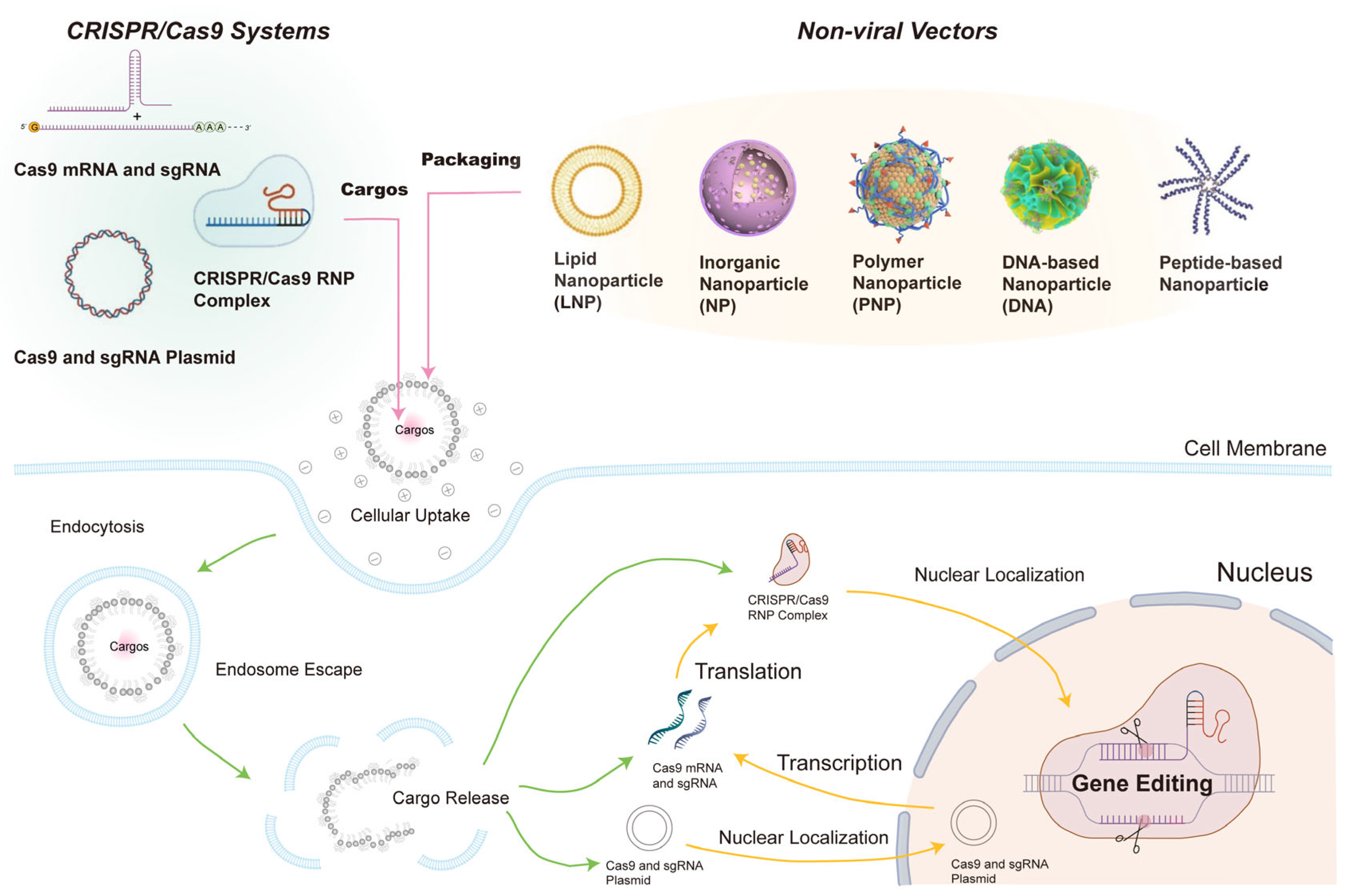
Engineered nanoplatforms have emerged as indispensable delivery systems for CRISPR/Cas delivery, offering a versatile alternative to viral vectors with reduced immunogenicity and enhanced scalability. Owing to their nanoscale dimensions and programmable architectures, these carriers can effectively navigate physiological barriers, protect the labile genetic cargo (DNA, mRNA, or RNP) from enzymatic degradation, and facilitate targeted cellular internalization. At present, four major categories dominate the development landscape: lipid nanoparticles (LNPs), polymeric nanoparticles (PNPs), inorganic nanoparticles (NPs), and peptide/DNA-based nanocarriers. As depicted in Figure 1, these non-viral vectors are designed to not only encapsulate the diverse CRISPR payloads but also orchestrate their intracellular trafficking—specifically, promoting endosomal escape and directing nuclear localization for RNPs/plasmids or cytoplasmic translation for mRNA. By finely tuning physicochemical properties such as surface chemistry and size, nanotechnology-based strategies aim to overcome these critical biological hurdles to maximize genome editing efficiency and safety.

2.1. Lipid Nanoparticles

LNPs stand out as one of the most widely used nonviral delivery platforms for the CRISPR/Cas9 system. They offer several advantages, including high cargo payload capacity, simplified fabrication processes, enhanced biocompatibility and reduced immunogenicity etc. Typically, the modular architecture of LNPs comprises four primary components: (1) ionizable lipids, including cationic phospholipids, are capable of complexing with and condensing negatively charged nucleic acid molecules and RNPs. These lipids acquire a positive charge at low pH, which facilitates eventual endosomal escape into the cytoplasm; (2) Polyethylene glycol lipids (PEGylated lipids), which integrate into the LNP bilayer and form a PEG coating that minimizes LNP aggregation and prevents nonspecific endocytosis by immune cells; (3) zwitterionic phospholipids, which strengthen the LNP bilayer structure and assist in endosomal escape; (4) cholesterol, which improves LNP stability and supports membrane fusion. These four unique components of LNPs allow for precise control through optimization of lipid composition, charge modulation and size adjustments, facilitating systemic delivery of diverse CRISPR payloads, such as sgRNA, Cas9 mRNA, and RNP complexes. Details regarding the composition and fabrication of LNPs for nucleic acid delivery are well established [26,27,28,29] and will not be discussed in detail.

2.2. Polymer-Based Nanoparticles

Polymeric nanoparticles are composed of synthetic or natural polymers, including polyethylenimine (PEI), poly(lactic-co-glycolic acid) (PLGA), polyethylene glycol (PEG), chitosan, dendrimers, and protamine. They form core–shell structures or micelles to deliver Cas9/sgRNA through electrostatic complexation or physical entrapment. Unlike LNPs, cationic polymer carriers exhibit chemical diversity and functional versatility, offering greater design flexibility in size and structure. These nanoparticles protect the payload from physiological degradation and facilitate endosomal escape to the cytosol. Hydrophilic cationic PEI is a standard carrier in which high density of positively charged amine groups condenses negatively charged DNA, RNA, or RNP. PEI, due to its abundant amino groups, can absorb protons in the acidic endosomal environment. This phenomenon, known as the “proton sponge effect” induces osmotic swelling and membrane rupture, facilitating endo/lysosomal escape of the Cas9/sgRNA complexes into the cytosol. However, high molecular weight PEI (e.g., 25 kDa) can induce cytotoxicity and membrane disruption. In contrast, natural derivatives such as chitosan, alginate, and hyaluronic acid show greater promise for clinical translation due to their biocompatibility and minimized immunogenicity [30,31]. Coating the surface of nanoparticles with PEG improves their ability to evade the immune system and extends their circulation time, thereby enhancing stability in vivo [32]. Moreover, biodegradable polymers like polylactic acid (PLA), polyglycolic acid (PGA), and their copolymer PLGA naturally break down within the body, minimizing toxicity and preventing accumulation in vivo, thus ensuring both safety and efficacy.

2.3. Inorganic Nanoparticles

Inorganic nanoparticles, including gold nanoparticles (AuNPs), mesoporous silica nanoparticles (MSNs) and metal–organic frameworks (MOFs), etc., have been widely utilized to enhance the delivery of the CRISPR/Cas9 system. These materials offer unique properties that make them highly suitable for gene editing applications. AuNPs are chemically inert, exhibit high delivery efficiency, and possess low toxicity. Their structure can be easily tailored into ideal forms—such as Au nanooctopus, Au nanoclusters, and gold nanorods—by adjusting the ratio of cationic surfactants. Due to the inherent positive charge of gold, AuNPs are often designed as the core of nanoplatforms, incorporating materials like lipopolymers, protamine, or poly-(amidoamine) dendrimers for enhanced functionality. Additionally, AuNPs are accompanied by excellent biocompatibility, and remarkable photothermal conversion capacity, making them highly suitable for advanced therapeutic applications.
MSNs are distinguished by their large internal surface area, which provides a high cargo loading capacity. This characteristic makes them highly promising for delivering CRISPR/Cas9 systems, as demonstrated in various studies. Furthermore, silica nanoparticles can be conjugated with lipids and polymers to enhance the encapsulation and stability of CRISPR/Cas9 components. Notably, their degradation byproducts are biocompatible, significantly reducing the risk of accumulation in the body and ensuring safer therapeutic applications.
MOFs are materials that are assembled from metal ions (zeolitic imidazolate, norbornene-modified imidazole, UiO-66-NH2) or organic linkers. Particularly, zeolitic imidazolate frameworks (ZIF-8 and ZIF-C), a biomimetic metal–organic framework, have demonstrated significant potential in CRISPR-Cas9 delivery, allowing for cell-specific targeting through surface modifications [33]. Both frameworks protect CRISPR payloads from enzymatic degradation, and the design of ZIF-8 enables pH-sensitive release in multiple cancers exploit photothermal responsiveness, high payload capacity, and stimuli-responsive gene activation [34].

2.4. Peptide-Based Nanoparticles

Peptide-based delivery systems represent a versatile and biocompatible frontier for CRISPR/Cas RNP or RNA delivery. Unlike viral vectors or synthetic polymers, peptide NPs leverage the intrinsic properties of amino acids—such as amphiphilicity, specific non-covalent interactions, and metal coordination—to drive self-assembly into discrete nanocomplexes. This “self-assembly” capability allows cationic peptides to electrostatically condense with anionic CRISPR payloads (Cas9 protein or sgRNA) via a simple mixing process, while minimizing immune or cytotoxic responses, significantly reducing formulation complexity compared to lipid-based systems. While early strategies relied heavily on Cell-Penetrating Peptides (CPPs) for non-specific membrane translocation, recent advancements have shifted towards multifunctional, “bioactive” peptide designs to overcome historical bottlenecks like low transfection efficiency and lack of specificity [18,35]. For instance, novel peptide platforms (e.g., ADGN) have been engineered to target tumor-specific surface markers, such as the laminin receptor (LAMR), which is overexpressed in various cancer cells. These next-generation peptide NPs not only facilitate efficient endosomal escape but also provide a protective shield for fragile RNA payloads against nuclease degradation in the bloodstream. Notably, such targeted strategies have demonstrated high gene-editing efficiencies (up to 60% in vitro) while minimizing off-target toxicity. Despite these advances, the clinical translation of peptide NPs still faces hurdles, particularly regarding proteolytic stability in serum and the challenges of chemistry, manufacturing, and controls (CMC) requirements for industrial production.

2.5. DNA-Based Nanoparticles

DNA-based nanoparticles have emerged as a highly sophisticated platform for CRISPR/Cas9 delivery, distinguished by their intrinsic programmability and structural precision. Unlike statistical polymerization used in synthetic carriers, DNA nanotechnology leverages strict Watson–Crick base pairing to construct defined architectures with atomic-level accuracy. This allows for the precise spatial organization of CRISPR components, enabling researchers to control the exact stoichiometry of Cas9 proteins and sgRNAs within a single nanocomplex, thereby maximizing assembly efficiency and editing fidelity. Dynamic interactions within these nanocarriers, through controlled assembly and disassembly mechanisms, further facilitate precise therapeutic cargo encapsulation and release.
Current strategies generally fall into three primary categories: (1) DNA Nanoclews and Branched Structures: Synthesized via rolling circle amplification (RCA) DNA nanoclews are yarn-like structures capable of “sponging up” Cas9/sgRNA complexes [36]. To overcome the inherent negative charge of DNA which hinders cellular uptake, nanoclews are often coated with cationic polymers (e.g., PEI) to induce endosomal escape [36]. Additionally, branched DNA platforms have been optimized for co-delivering sgRNA alongside Cas9 and antisense oligonucleotides, enhancing editing versatility [37]. These architectures demonstrate superior spatial control compared to conventional carriers, with nanoclew scaffolds exhibiting enhanced tumor penetration through multivalent ligand presentation. (2) DNA Origami: Watson–Crick base pairing and Hoogsteen interactions enable precise construction of origami structures, such as nanocages, and nanotubules that hold immense potential for CRISPR delivery by providing customizable platforms for encapsulating and delivering CRISPR components via sequence-specific anchoring [30]. These structures serve as “molecular cages” that shield the payload from nuclease degradation. To overcome the limited cellular uptake of naked DNA nanostructures, Tang et al. developed a programmable DNA origami system (L-DOPAMRC) that utilizes PAM-guided assembly to efficiently recruit Cas9/sgRNA complexes into a PAM-rich region. This structure is compacted and locked via disulfide bonds and surface-functionalized with DNA aptamers and HA peptides to facilitate tumor targeting and endosomal escape. Upon internalization, the high intracellular concentration of glutathione (GSH) triggers the unfolding of the origami, followed by RNase H-mediated cleavage to release the active payload [38]. (3) DNA Hydrogels: DNA hydrogels formed by cross-linked DNA networks offer a solution for localized cancer therapy, providing sustained release of gene-editing agents within the tumor microenvironment [39].
Despite these advantages, naked DNA structures are susceptible to rapid degradation by serum nucleases. Consequently, recent trends focus on hybrid systems—such as frame guided assembly (FGA) leading to lipid-encapsulated DNA structures—which combine the structural precision of DNA with the stability and transfection efficiency of lipid nanoparticles [39]. These approaches combine the structural precision of DNA with the stability and transfection efficiency of lipid nanoparticles, addressing the limitations of stability while retaining the programmability of DNA nanotechnology.
In summary, each material class—from established lipid nanoparticles to emerging DNA nanostructures—possesses unique physicochemical attributes that dictate its therapeutic potential. A detailed breakdown of the advantages and disadvantages for each nanocarrier category is presented in Table 1.

3. Strategies for Enhanced Nano-Enabled CRISPR/Cas Delivery

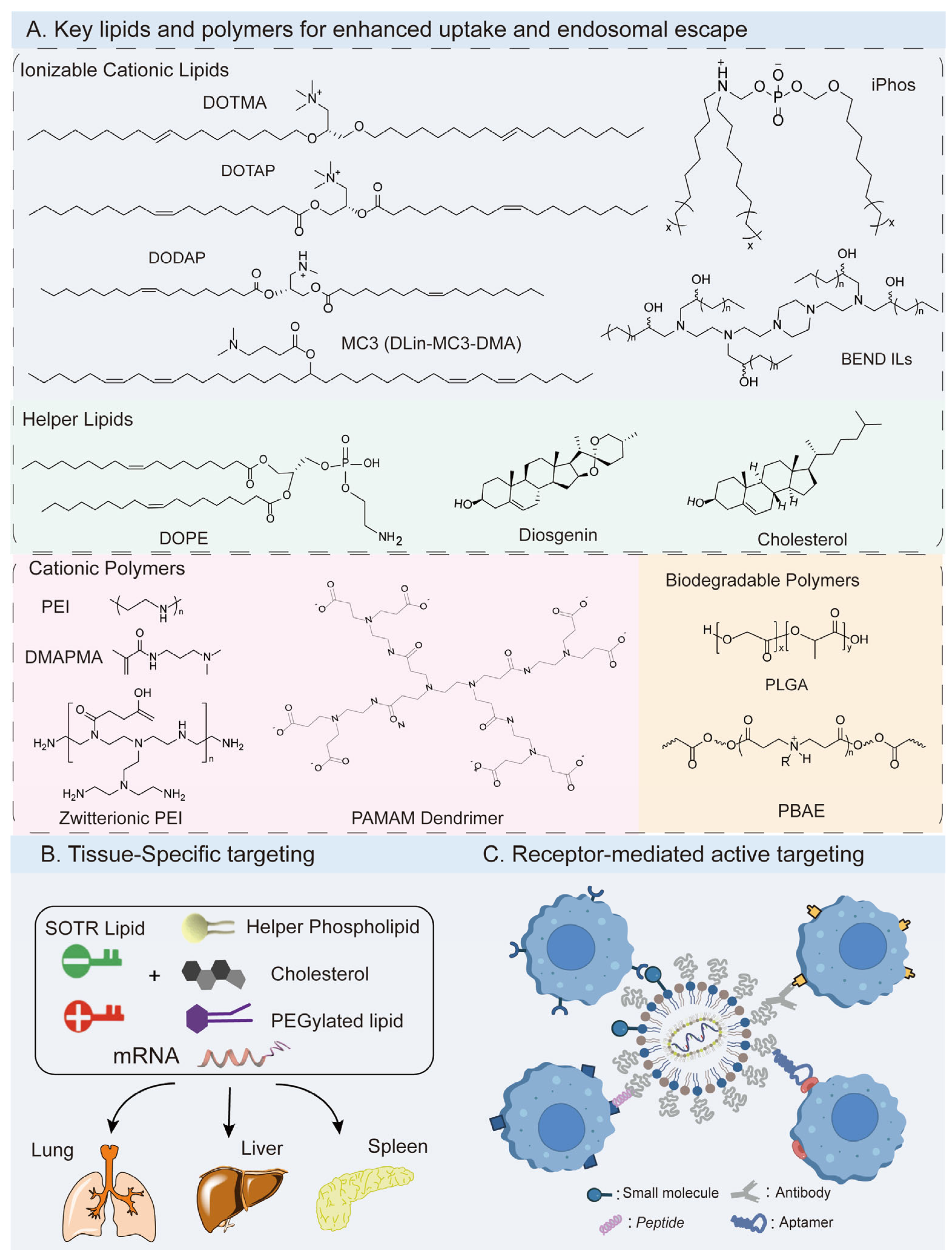
CRISPR/Cas delivery often faces challenges such as poor cellular uptake, rapid degradation, and off-target effects. Current nanotechnology focuses on overcoming these sequential biological barriers—from cellular internalization to targeted gene editing—by optimizing physicochemical properties such as size, surface charge, or by incorporating new functional moieties to promote internalization, endosomal escape, and targeted delivery. In this section, the current progress in enhanced CRISPR/Cas delivery is summarized (Figure 2).

3.1. Enhance Cellular Uptake Efficiency

Efficient cellular uptake is a prerequisite for CRISPR/Cas gene editing, as the anionic nature of nucleic acids hinders passive diffusion across the lipophilic cell membrane. Nanocarriers overcome this barrier primarily through endocytosis or direct membrane fusion with internalization efficiency governed by physicochemical properties such as size, shape, and surface charge.
The geometric and dimensional properties of nanocarriers significantly influence their interaction with cell membranes. Anisotropic shapes, such as nanorods, often exhibit superior uptake kinetics compared to spherical counterparts due to more favorable membrane wrapping dynamics [40,41]. Regarding size, ultra-small carriers can leverage passive diffusion to breach biological barriers. For instance, carbon quantum dots (CQDs) surface-passivated with PEI and PEG (CQDs-PP) possess an ultra-small hydrodynamic diameter (<10 nm). This specific size allows them to pass through nuclear pore complexes (NPCs) without additional active transport signals, demonstrating that extreme miniaturization can facilitate direct nuclear targeting [42].
Beyond physical dimensions, modulating surface charge remains a dominant strategy. Nanoparticle shells composed of cationic polymers or lipids such as DOTAP, DOPE, and cholesterol, facilitate adsorption onto anionic cell membranes via electrostatic interactions (Figure 2A) [43]. Recent studies indicate that the type and composition of ionizable lipids in the LNP formulation can affect the cellular uptake and of endosomal escape of LNPs. For example, Zhang et al. created a ternary complex with Cas9/sgRNA plasmid DNA, chondroitin sulfate, and protamine, coated with a positively charged PLNP shell, which significantly increased transfection rates in melanoma cell line A375 [44]. Similarly, Ren et al. developed a type of LNPs composed of cationic and ionizable lipids, capable of efficiently delivering the CRISPR system both in vitro and in vivo. By carefully adjusting the ratio of cationic to ionizable lipids in the LNPs, they addressed the imbalance between protein binding, endosomal escape, and intracellular release. The optimized LNPs (with DOTMA/MC3/DOPE ratios ranging from 30:20:10 to 10:30:20) maintain the protein-binding capacity of cationic lipids while significantly improving cellular internalization [45].
The architecture of cationic polymers is equally critical. Gao and colleagues introduced a nanocarrier using hyperbranched copolymers (hPPCs) composed of PBAE (poly (beta-amino ester)) for condensation and PAMAM (poly(amide-amine)) for branching (Figure 2A). The hyperbranched structure exhibited superior plasmid encapsulation and transfection efficiency compared to linear analogs [46]. While positive charge aids uptake, it can lead to serum instability and toxicity [47]. To address this “charge dilemma”, Liu et al. designed multistage delivery nanoparticles with a negatively charged shell using DMMA-modified PEG-polylysine. This shell remains stable in the blood but hydrolyzes in the tumor’s acidic microenvironment to expose a positively charged core, thereby selectively enhancing by cancer cells [48].
Biological functionalization strategies further augment cellular internalization. For instance, diosgenin-substituted cholesterol in cationic liposomes enhances uptake through clathrin-mediated endocytosis. Lohchania et al. screened steroidal sapogenins as an alternative co-lipid to cholesterol in cationic liposomal formulations and found that liposomes with diosgenin further improved nucleic acid delivery efficacy, in particular, delivering Cas9 pDNA and mRNA for efficient genome editing [49]. Recent work has focused on hybridizing LNPs with spherical nucleic acid (SNA) architectures. By modifying LNPs with a dense shell of DNA, researchers created CRISPR LNP–SNAs that exhibit enhanced cellular uptake and biocompatibility. This unique surface structure significantly improved editing performance, achieving a 1.5- to 3-fold increase in both indel formation and homology-directed repair (HDR) efficiency compared to standard LNPs [50]. Additionally, Seijo et al. report a supramolecular strategy for the direct delivery of Cas9 using an amphiphilic penetrating peptide. This peptide is prepared through hydrazone bond formation between a cationic peptide scaffold and a hydrophobic aldehyde tail, resulting in peptide/protein non-covalent nanoparticles. These peptide amphiphilic vectors can deliver Cas9/gRNA-EFHD1 in a single incubation step, with good efficiency and low toxicity [51].
As an emerging alternative to traditional endocytosis-dependent pathways, direct membrane penetration enables nanoparticles to bypass the endosomal barrier, facilitating rapid and efficient delivery of CRISPR/Cas9 components directly into the cytosol. This approach mitigates common challenges such as endosomal entrapment, degradation, and low cytosolic release rates associated with endocytosis, potentially improving genome editing efficiency. Recent studies highlight innovations using a specific class of liposomes, known as fusogenic liposomes, which deliver their cargo via fusion with the plasma membrane, enabling direct cytosolic delivery while maintaining targeting capacity [52]. Building on this, Chen’s team developed a gemini amphiphile (GA) featuring two identical amphiphilic units with ionizable heads and saturated alkyl tails (18–20 carbon atoms) that interact with lipid rafts to trigger membrane fusion. This mechanism enables the direct translocation of Cas9 RNPs into the cytosol, effectively avoiding lysosomal degradation and maximizing editing precision [53].

3.2. Enhance the Endosomal Escape

Endosomal escape is a critical challenge in the delivery of CRISPR/Cas9 systems using nanoparticles. After cellular uptake via endocytosis, NPs are often trapped within endosomes, which can lead to degradation of the therapeutic cargo in lysosomes if not released into the cytosol. Efficient endosomal escape is essential to ensure that CRISPR components reach the nucleus for effective genome editing. Studies emphasize that only a small fraction of internalized NPs successfully escape the endosome, highlighting the need for innovative strategies to enhance this process.
One established endosomal escape strategy includes the proton sponge effect, and another effective approach involves the use of pH-responsive materials in NP formulations. These materials undergo structural changes in the acidic environment of the endosome (pH ~5.5–6.5), destabilizing the endosomal membrane. For instance, lipids or polymers that become fusogenic or degrade at low pH can facilitate the release of CRISPR/Cas9 components. Innovative materials such as nanoscale ZIF [54] and LNPs incorporating ionizable cationic lipids (e.g., ALC-0315) [55] intrinsically exhibit high endosomal escape efficiency across cell types. For instance, DMAPMA-modified BP20/BSA nanoparticles leverage tertiary amines to exploit the proton sponge effect, significantly augmenting endosomal escape (Figure 2A) [56]. The proton-activatable ionizable phospholipids (iPhos) nanoparticles developed by Liu et al. leverage the protonation of tertiary amines within iPhos to enable the integration of small zwitterionic head groups into the endosomal membrane (Figure 2A). This process induces a structural transition from lamellar to hexagonal endosomal membranes, ultimately facilitating endosomal escape through mechanisms of membrane fusion and destabilization [57]. Similarly, PEI derivatives facilitate endosomal escape through proton buffering in acidic environments, while hydrophobic moieties (e.g., C14 alkyl chains) promote membrane destabilization via lipid interactions. Notably, C14-PEI nanoparticles incorporating PEG-PLE demonstrate increased hydrophobicity and pH responsiveness, resulting in superior endosomal escape and enhanced Cas9 gene editing efficacy [58]. Inspired by the fact that branched groups at the termini of lipid chains can greatly enhance mRNA transfection, Padilla et al. developed a platform for synthesizing a class of branched ionic lipids (ILs) named BEND, incorporating branched hydrophobic tails and fusogenic lipids (DOPE) (Figure 2A). This BEND platform promotes endosomal membrane penetration, achieving 70–80% T-cell transfection. Compared to non-branched lipids, nanoparticles decorated with terminally branched lipids increase hepatic mRNA and ribonucleoprotein complex delivery and boost gene editing efficiency [59].

3.3. Targeted Delivery Strategies

Current nanoparticle formulations, particularly LNPs, exhibit a strong tendency to accumulate in the liver. Research indicates that approximately 90% of standard LNPs localize to the liver within just one hour following intravenous (IV) administration [60]. While this natural tropism can be advantageous for liver-targeted therapies, it poses a significant challenge for delivering therapeutic agents like the CRISPR/Cas system to other specific cells or tissues. Over recent decades, multiple strategies for developing targeted carriers have been explored, including optimizing ionizable lipids, substituting constituent lipids, and incorporating targeting moieties such as proteins, peptides, aptamers, or antibodies that interact with specific receptors or antigens overexpressed on tumor cell surfaces. Here, we delve into several newly developed targeted delivery strategies for CRISPR/Cas systems, broadly classified into the optimization of passive targeting and ligand-mediated active targeting.

3.3.1. Passive Targeting: Leveraging Physicochemical Properties

Passive targeting primarily relies on the Enhanced Permeability and Retention (EPR) effect and the interaction of nanoparticles with the surrounding biological environment, including the formation of a protein corona. It involves tuning the physicochemical characteristics of NPs, such as particle size, surface charge, and lipophilicity, to achieve preferential accumulation in specific tissues or organs, mitigating off-target toxicity. A notable advancement in this domain is the optimization of ionizable lipids, which has revealed dose-dependent tissue targeting capabilities. For instance, Uddin et al. developed a series of zwitterion-like polyethylenimine derivatives (zPEIs) by the succinylation of 2–11.5% of PEI amines, marking a significant advancement in gene delivery technology. Remarkably, succinylation of just 2% of PEI amines led to transgene expression levels 260- to 480-fold higher than those achieved with unmodified PEI. This minimal modification dramatically enhanced CRISPR/Cas9-mediated gene knock-in efficiency compared to unmodified PEI, showcasing the potential of zPEIs as highly effective vectors for precise gene editing applications in complex biological settings [61].
Beyond simple surface modifications, the selective organ targeting (SORT) strategy represents a paradigm shift in manipulating physicochemical properties for tissue specificity (Figure 2B). Developed by the Siegwart lab, SORT involves adding a supplemental molecule (e.g., DOTAP, 18PA, or DODAP) to the LNP formulation to alter its internal charge balance and surface chemistry. By incorporating a fifth component—whether a permanent cationic, anionic, or ionizable lipid—researchers can predictably redirect LNP accumulation to the lung, spleen, or liver [62]. Crucially, the mechanism underlying this organotropism relies on the formation of a distinct protein corona. Rather than direct receptor binding, the specific surface chemistry recruits endogenous plasma proteins that act as ‘secondary ligands.’ For instance, cationic SORT lipids (e.g., DOTA) recruit vitronectin to target lung tissue, whereas anionic lipids (e.g., 18PA) attract β-2-glycoprotein I for splenic uptake. This versatile approach allows, for example, the encapsulation of Cas9 RNPs in neutral buffers using DOTAP, preserving protein functionality while achieving selective gene editing in the lungs of mice. This versatile approach is compatible with multiple LNP classes, including dendrimer lipid nanoparticles (DLNPs), stable nucleic acid lipid particles (SNALPs) and lipid-like nanoparticles (LLNPs) [63]. Furthermore, the team developed second-generation lung-specific SORT LNPs by fine-tuning the internal molar ratio of the key components—5A2-SC8, DOPE, cholesterol, and PEG-DMG—to achieve an optimal formulation of 36/20/40/4, respectively. This resulted in the generation of mDLNP-2 to correct mutations in the cystic fibrosis transmembrane conductance regulator (CFTR) gene within lung basal cells [64]. Expanding on the concept of structure-driven organotropism, the Siegwart team further demonstrated that adjusting the alkyl chain length of iPhos lipids adjacent to the phosphate group enables tissue-selective mRNA delivery of CRISPR-Cas9 gene editing in the spleen, liver, and lungs, respectively, enabling precise organ selectivity without additional SORT molecules. Short-chain variants (C9–C12) were found to favor hepatic receptor engagement and promote mRNA translation in the liver, whereas long-chain variants (C13–C16) exhibited splenic preference driven by hydrophobicity-mediated immune cell recognition [57].
Beyond optimizing carbon-based lipid tails, recent breakthroughs in material science have introduced heteroatom-modified lipids to overcome intracellular barriers. In a landmark 2025 study, Xue et al. developed a combinatorial library of siloxane-incorporated lipidoids (SiLNPs), demonstrating that the integration of siloxane moieties into the lipid architecture significantly augments intracellular processing. Mechanistically, the larger atomic radius of silicon compared to carbon results in looser lipid packing and increased membrane fluidity. This structural distinctiveness facilitates superior endosomal escape—a critical bottleneck in T-cell engineering—thereby enhancing mRNA delivery efficacy by up to 6-fold compared to the gold-standard D-Lin-MC3-DMA. Furthermore, the modular design of SiLNPs allows for precise tuning of organotropism and cellular uptake pathways, offering a versatile platform that could be adapted to maximize the ex vivo transfection yields of Cas9 gene-editing machinery for universal CAR-T production [65].

3.3.2. Active Targeting: Precision Through Specificity

To further improve tissue specificity and cellular uptake, active targeting strategies involving surface modification have been widely explored (Figure 2C). This approach focuses on receptors that are overexpressed on target cells compared to normal cells, ensuring precise delivery to diseased tissues. Targeting ligands—such as antibodies, peptides, aptamers, and small molecules like folic acid and hyaluronic acid—are typically conjugated to the outer surface of PEGylated lipids or other polymeric lipids in nanoparticle formulations (Figure 2C). This strategic placement ensures that the ligands are prominently exposed to the nanoparticle surface, enabling effective binding to specific receptors or antigens on the intended cells or tissues. By exploiting these interactions, active targeting minimizes off-target effects and maximizes therapeutic efficacy, making it a cornerstone of modern gene-editing delivery systems.
Peptide-Based Targeting
Employing peptides as targeting ligands in non-viral delivery systems is a compelling choice due to their straightforward integration into delivery systems and their ability to target cancer-specific receptors (Figure 2C). For example, the RGD peptide (Arg-Gly-Asp) is a short oligopeptide that exhibits a strong affinity for the transmembrane αvβ3 integrin which is overexpressed in most cancer cells while being downregulated in most healthy cells. Qin et al. created RGD-based hybrid LNPs that demonstrated superior encapsulation and targeted mRNA delivery, offering a promising platform for protein replacement and gene editing with enhanced targeted mRNA uptake [66]. Gonzalez and colleagues introduced a novel class of peptide-based nanoparticles (PBN) called “ADGN peptides,” incorporating the laminin receptor-targeting sequence YIGSR ((Tyr–Ile–Gly–Ser–Arg). These peptides form stable nanoparticles with long mRNA and CRISPR components, significantly boosting mRNA expression and gene editing both in vitro and in vivo. Results highlight the immense potential of ADGN peptides as cellular carriers for the CRISPR-Cas9 system, enabling effective gene editing in mouse models [67]. Angiopep-2 exhibits high affinity to low-density lipoprotein receptor-related protein-1 (LRP-1) which is highly expressed in glioblastoma cells. Zou et al. developed a targeted delivery platform to bypass the blood–brain barrier (BBB). The polymeric outer shell is adorned with angiopep-2 peptide, which binds to LRP-1, overexpressed on BBB endothelial and glioblastoma (GBM) cells. Angiopep-2 functionalization exploits low-density LRP-1-mediated transcytosis, efficiently penetrating the BBB through receptor-ligand affinity optimization [68,69]. This shell encases Cas9 ribonucleoprotein/sgRNA complexes in small (~30 nm), nearly neutral nanocapsules, safeguarding the cargo from RNase degradation and improving blood stability for noninvasive BBB penetration [70]. Octreotide (OCT) is a cyclic octapeptide with two D-amino acids, showing high binding affinity for somatostatin receptors 2 (SSTR2) that are highly expressed on hepatocellular carcinoma (HCC) cells. Zhang et al. synthesized a novel SSTR-targeted polymeric material by reacting OCT with linoleic acid-functionalized polyethylene glycol (LNA-PEG-NHS) to yield LNA-PEG-OCT. This amphiphilic compound, combined with PEI-OA, enhances encapsulation efficiency, drug loading, and tumor targeting of RNP in HCC cells [71].
Aptamer-Mediated Targeting
Aptamers have been widely integrated into delivery systems due to their remarkable ability to selectively bind to a diverse array of molecules including cell surface receptors, enzymes, and various other biomolecules (Figure 2C). This specificity makes aptamers valuable tools for enhancing the targeting precision of therapeutic agents, including nucleic acid-based therapies like CRISPR/Cas9, by facilitating directed interactions with specific cellular or molecular targets. Aptamers, such as AS1411 or transferrin receptor-targeting aptamers (e.g., HG1-9), act as ligands that bind specifically to overexpressed receptors on cancer cell surfaces (e.g., nucleolin or transferrin receptors). This binding triggers receptor-mediated endocytosis to form endosomes that internalize the aptamer-conjugated cargo like Cas9 RNP-loaded nanoparticles. Song et al. grafted aptamer AS1411 onto the DNA nanoframework (NF), enabling targeted cellular uptake and efficient Cas9 RNP delivery into PANC-1 cells [72]. DNA origami structures conjugated with transferrin receptor-targeting aptamers (HGs) exploit receptor-mediated endocytosis [73]. Zhuang et al. engineered valency-controlled tetrahedral DNA nanostructures (TDNs) linked to cancer cell-specific DNA aptamers (TLS11a aptamer). These structures were anchored to the surface of extracellular vesicles using cholesterol for targeted cell delivery [74]. Sarkar et al. developed aptamer-decorated LNPs for delivery of CRISPR/Cas9 that specifically target the surface EpCAM protein, a type-I trans-membrane glycoprotein, overexpressed in many cancerous epithelial cells. This system significantly enhances internalization efficiency in EpCAM-overexpressed tumor cells, thereby improving the desired knockdown of EPCAM gene [14].
Antibody-Mediated Targeting
Antibody-mediated delivery of CRISPR/Cas9 systems has gained attention recently for its potential to achieve high selectivity toward cell surface-exposed species (Figure 2C). Rosenblum and coworkers engineered a modular strategy using a specific linker system termed ASSET (Anchored Secondary scFv Enabling Targeting). This system allows LNPs to be coated with EGFR antibodies through a lipid-anchored single-chain antibody linker that binds to the Fc region of rat immunoglobulin G2a (IgG2A). This modular approach enables the LNPs to target specific cell subsets without chemically modifying the antibody itself [75]. Prostate stem cell antigen (PSCA) is a prostate-specific glycosylphosphatidylinositol-anchored protein that is minimally expressed in normal prostatic tissue but is significantly upregulated in most prostate cancers (PCs). Fieni et al. synthesized a nonimmunogenic, biocompatible cationic lipid nanocomplex coated with PEG (NxP) and conjugated with anti-PSCA antibodies (Abs). These antibody-conjugated NxPs enable the targeted delivery of the Cas9/gRNA-IL30 complex to human-derived PSCA+IL30+ prostate cancer xenografts, effectively inhibiting IL30 signaling pathways in tumors. This research serves as a proof of concept that immunoliposome-based delivery of the Cas9/gRNA-IL30 complex to human-derived PSCA+IL30+ prostate cancer xenografts, effectively inhibiting IL30 signaling pathways [76]. Recently, the integration of unnatural amino acids into CRISPR/Cas proteins offers flexibility in their modification through bioorthogonal chemistry, allowing for multi-functionalization and minimizing by-product formation. Building on this, Yang and colleagues modified the Cas9 protein by incorporating azidohomoalanine (AHA) in a residue-specific manner and bioorthogonally conjugated it to a monoclonal antibody targeting the HER2 receptor, which is overexpressed in HER2-positive breast and ovarian cancers. With the support of a carrier polymer, nanocomplexes of the anti-HER2 antibody-conjugated CRISPR system can be effectively delivered into HER2-positive ovarian cancer cells with high specificity. These nanocomplexes disrupt the polo-like kinase 1 (PLK1) gene, inducing apoptosis in the targeted cells [77].
Small Molecular Ligands for Targeting
The folate receptor and transferrin receptor stand out as some of the extensively researched targets in the field of drug targeting (Figure 2C). Folic acid and its derivatives exhibit a strong affinity for folate receptors (FRs) and can be incorporated into nanoparticles to enhance their transfection efficiency. Lin et al. demonstrated a novel approach by mixing Cas9/sgRNA RNP complexes with oligomer #1445 to form a nanocarrier core, which was subsequently functionalized using click chemistry with folic acid (FolA)-PEG24-DBCO to create FolA-PEG-modified gene-editing systems. Their findings revealed that FolA-PEG-modified RNP nanocarriers exhibited significantly enhanced cellular uptake and transfection efficiency compared to unmodified and PEG-modified nanocarriers in FRα-positive cancer cell lines [78]. Likewise, HA, a negatively charged glycosaminoglycan, is widely acknowledged for its ability to bind to cellular surface receptors such as CD44 and CD168, rendering it a promising candidate for targeted delivery applications. Ma et al. incorporated dexamethasone (DEX) onto PDA nanoparticles to serve as a nuclear localization signal (NLS) for targeted nuclear delivery. Subsequently, HA was utilized as a surface coating on PDA/DEX-PEI through electrostatic adsorption, yielding multifunctional PDA/DEX-PEI@HA nanoparticles (PDPH). This HA modification was shown to enhance tumor-targeting efficiency, whereas the uptake of these nanocarriers was markedly decreased upon blocking CD44 receptors on HeLa cell surfaces [79]. Phenylboronic acid (PBA) serves as an analog of sialic acid, allowing it to bind specifically to sialic acid receptors. Sialic acid is typically found on cell membranes and shows a positive correlation with tumor growth. Yoshinaga and coworkers pioneered the first CRISPR oral delivery nanoparticles using PBA-functionalized chitosan-polyethylenimine (CS-PEI) nanoparticles. The PBA functionalization facilitated smooth transport of NPs across the mucus layer, and enabled efficient endosomal escape and cytosolic unpackaging of CRISPR/Cas9 within cells [80].
In summary, ligand-based active targeting can be accomplished either by directly linking the CRISPR/Cas proteins or mRNAs to the targeting ligand through biological or chemical conjugation methods, or most commonly indirectly via a carrier that encapsulates the CRISPR/Cas and presents the targeting ligand on its surface. Active targeting holds immense potential as a strategy to improve the therapeutic outcomes of clinical treatments by enhancing the site-specificity and safe delivery of the CRISPR/Cas system. Despite significant progress, numerous challenges remain, including the multitude of variables influencing delivery system design, the lack of uniformity and inherent complexity of the biological environment, and the still limited understanding of the factors governing these systems. These issues have hindered the translation of precise gene editing systems into clinical applications.

4. Stimuli-Responsive Nanoplatforms for CRISPR/Cas9 Gene Editing

To overcome extracellular and intracellular barriers, researchers are exploring stimuli-responsive nanoplatforms. These “smart” nanoparticles leverage diverse chemical bonds and biological molecules to release cargos precisely for efficient and accurate genome editing in response to internal stimuli including pH, redox potential, metabolites and enzymes, or external stimuli such as light, heat, and ultrasound. It is important to note that the maturity of these technologies varies significantly: while some complex designs (e.g., DNA origami, logic gates) are currently at the in vitro proof-of-concept stage, others (e.g., lipid-based systems) have demonstrated robust therapeutic efficacy in preclinical animal models.

4.1. pH-Responsive Nanoplatforms

Tumor growth creates a unique acidic TME (pH 6.0–6.5) distinct from physiological pH (~7.4) and the even more acidic endolysosomal compartments (pH 4.5–6.0). This pH gradient provides a precise biochemical cue for designing stimuli-responsive nanocarriers. These platforms typically utilize protonatable groups (e.g., tertiary amines, peptides) or acid-sensitive bonds (e.g., hydrazones, amides) to maintain stability during circulation. Upon encountering acidic conditions, they undergo critical physicochemical changes such as charge reversal, hydrophobic-to-hydrophilic transitions, or structural disassembly to trigger cargo release.
To address the primary intracellular barrier of endosomal entrapment, several strategies have focused on optimizing material responses to acidic pH. Xu et al. developed a PAMAM dendrimer incorporating N,N-dialkylaminoethyl moieties, which enhance protein binding to the polymer under physiological conditions. Following efficient cellular internalization, the tertiary amine structure undergoes a hydrophobic-to-hydrophilic transition at acidic endosomal pH, thereby weakening hydrophobic interactions and promoting RNP release [81]. Similarly, to enhance membrane destabilization, Wang et al. developed solid lipid nanoparticles incorporating a pH-sensitive ‘H-peptide’. In acidic endosomes, the imidazole groups of the peptide became protonated, driving a hydrophobic-to-hydrophilic conformational shift that exposed membrane-active domains to facilitate cytosolic release [82]. In lipid design, proton-activatable iPhos were engineered with pH-switchable zwitterionic heads. Under acidic conditions, the amine headgroups protonate to form a cone-shaped geometry, destabilizing the endosomal membrane to promote the efficient cytosolic entry of Cas9 mRNA [58].
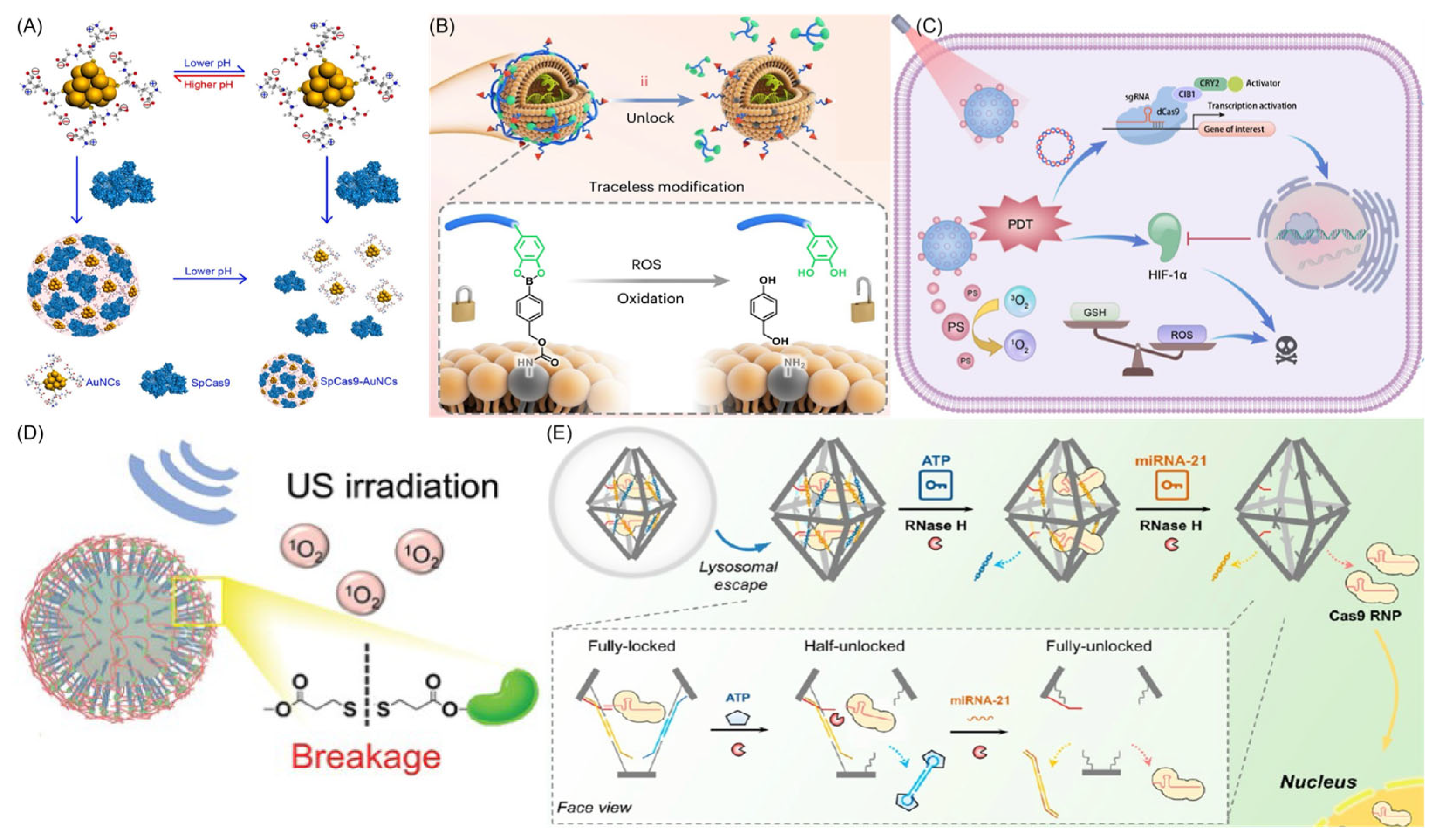
Building on these mechanistic principles, advanced platforms have demonstrated robust therapeutic efficacy in preclinical tumor models. Ju et al. demonstrated a distinct pH-responsive strategy utilizing the dynamic assembly–disassembly behavior of gold nanoclusters (AuNCs). They engineered positively charged AuNCs that spontaneously self-assembled with the negatively charged Cas9 protein under physiological conditions via electrostatic interactions. Upon internalization into the acidic endolysosomal compartments, the protonation of the protein surface residues weakened these electrostatic attractions, causing the complex to disassemble and triggering the rapid release of the Cas9 cargo. This pH-mediated delivery system was successfully applied to target the HPV18 E6 oncogene in cervical cancer cells. The disruption of the E6 gene restored the function of the p53 tumor suppressor, effectively inducing apoptosis in cancer cells while sparing normal cells (Figure 3A) [83]. Beyond intracellular escape, the slightly acidic extracellular environment of solid tumors provides a selective filter to enhance accumulation and uptake. Tu et al. engineered a tumor-acidity-responsive nanovehicle to orchestrate a “cold-to-hot” tumor transition. They constructed a core–shell nanoparticle comprising a cationic PEI-PLGA core and a PEG shell, linked via an acid-cleavable amide bond (derived from carboxydimethylmaleic anhydride). In the weakly acidic TME (pH ~6.5), the PEG corona is rapidly deshielded, exposing the cationic core to facilitate cellular uptake and lysosomal escape. This “smart” platform co-delivered paclitaxel (PTX) and a CRISPR/Cas9 plasmid targeting CDK5. The knockout of CDK5 disrupted IFN-γ signaling, thereby attenuating PD-L1 expression on tumor cells to release immune brakes [20]. While these studies highlight the potential of pH-responsive systems, clinical translation will require further validation of stability and efficacy in heterogeneous human tumor environments.

4.2. Redox-Responsive Nanoplatforms

Reactive oxygen species (ROS) are essential for cellular signaling and maintaining homeostasis, yet their imbalance, often marked by increased production, is associated with numerous pathological states, including cancer. Elevated ROS levels resulting from accelerated cell growth and metabolic irregularities in tumors can serve as critical biochemical signals for tumor-targeted cargo release systems. Strategies targeting ROS have primarily focused on incorporating oxidation-sensitive linkages, such as thioketal or boronic ester bonds, to trigger material degradation or charge reversal. In a mechanistic study focusing on polymer design, Tan et al. introduced an innovative approach to create H2O2-responsive, biodegradable polypeptides for intracellular Cas9 delivery. These polypeptides are modified with boronate moieties linked by a p-hydroxybenzylcarbamate spacer, which stabilizes polymer/protein complexes through nitrogen-boronate coordination with lysine and histidine residues on proteins or peptides. Importantly, the spacer is designed to break down when the boronate groups are oxidized by ROS, such as hydrogen peroxide, present at millimolar concentrations in tumor cells. As a result, nanoparticles made from boronated poly-L-lysine (PLL) and cargo proteins can effectively release their payload in response to intracellular ROS following uptake, demonstrating significant potential for precise delivery in environments with elevated oxidative stress [87]. Similarly, pursuing charge-reversal mechanisms, the cationic branched polymer (CRP) with phenylboronic acid branches was developed. When oxidized by tumor-associated ROS (>50 μM), the CRP converts to electroneutral zwitterionic polymers through boronated-to-boric acid transformation, releasing Cas9 RNPs precisely where metabolic hyperactivity occurs [69]. Translating these ROS-responsive designs to therapeutic applications, particularly for difficult-to-treat cancers like GBM, requires overcoming additional physiological barriers. Due to the elevated ROS levels in GBM tissues, Zhao and coworkers developed a specialized fusogenic liposome called Plofsome with dual targeting of angiopep-2 ligands and ROS-cleavable thioketal linkers. This was achieved by anchoring four-arm polyethylene glycol-ortho-diphenol (4-arm PEG-oDP) onto the surface of an Angiopep-2-modified liposome. Angiopep-2 ligands mediate BBB penetration via LRP1 receptor transcytosis, while thioketal linkers remain stable during circulation (<5 μM ROS). The overexpressed ROS, specifically hydrogen peroxide (H2O2), in GBM tissues triggers the detachment of the 4-arm PEG-oDPs, transforming the Plofsomes into a fusogenic state. Consequently, the Plofsomes selectively fuse with target cells and release their cargoes. This system effectively delivered CRISPR payloads in vivo, validating the therapeutic potential of ROS-triggered delivery in orthotopic models (Figure 3B) [21].
Parallel to ROS strategies, the high concentration of intracellular GSH has been exploited to trigger the cleavage of disulfide bonds or thiol-sensitive linkers. Several platforms have been established to optimize the intracellular release kinetics of CRISPR payloads. Liu et al. developed a GSH-responsive lipid nanoparticle, BAMEA-O16B, for the delivery of Cas9 mRNA and its sgRNA. This lipid, featuring disulfide bond-containing hydrophobic tails, encapsulates RNA through electrostatic interactions, allowing for efficient release of the RNAs in the GSH-rich intracellular environment [88]. Wang et al. described GSH-responsive silica nanoparticles (SNP) for RNP delivery. Disulfide bond-integrated SNP, enabling rapid release of Cas9 RNP in the cell cytosol under high GSH concentrations [89]. Further advancing this concept, Liu et al. presented a virus-like nanoparticle (VLN) to co-deliver CRISPR/Cas9 RNP targeting PD-L1 and axitinib, a small molecule tyrosine kinase inhibitor. They first loaded axitinib into the pores of surface-thiolated mesoporous silica nanoparticles (MSN-SH), then sealing the pores by conjugating RNP via disulfide bonds. The release of Cas9/sgRNA was triggered by the reductive microenvironment intracellularly in cancer cells resulting in the synergistic suppression against malignant tumors [90]. Taking a targeted approach, Zou et al. developed an angiopep-2-modified, disulfide-cross-linked nanocapsule ANCSS(Cas9/sgPLK1). The inclusion of disulfide bonds crosslinked within the nanocapsule shell, serving two vital roles: shielding the Cas9/sgRNA complex from enzymatic degradation in the bloodstream and enabling swift release of Cas9/sgRNA in the high intracellular reducing environment of tumor cells, where elevated GSH levels cleave the disulfide bonds, leading to nanocapsule biodegradation. Similarly, Cas9 RNP, paired with sgRNA targeted to GDF15 were incorporated into angiopep-2-modified GSH-responsive NPs (ANPSS-Cas9/sgGDF15) as a noninvasive brain delivery system [68]. Harnessing the elevated GSH levels in the TME, Shao et al. developed phenylboronic acid-functionalized polyaminoglycosides that dissociate in high-GSH conditions, facilitating Survivin-targeted CRISPR delivery in lung cancer models [91]. Expanding on multifaceted delivery strategies, the Gong team used a mixture of cationic and anionic monomers to form a coating around RNPs through electrostatic interactions. Additionally, components such as an imidazole-containing monomer, a GSH-degradable crosslinker, and PEG variants with ligands are integrated via hydrogen bonding and van der Waals interactions. Through in situ free-radical polymerization, a GSH-cleavable nanocapsule (NC) is formed around the RNP. The imidazole monomer aids in endosomal escape through the proton sponge effect, while the GSH-cleavable linker, N,N′-bis(acryloyl) cystamine (BACA), degrades in the GSH-rich cytosol (2–10 mM) to facilitate RNP release [92].
Despite their advantages in specific targeting and minimizing off-target effect, the clinical translation of redox-responsive systems faces significant hurdles. The heterogeneity of ROS and GSH levels across different tumor types and even within the same tumor mass can lead to inconsistent release profiles. Moreover, maintaining carrier stability during systemic circulation remains a challenge, as premature degradation or insufficient responsiveness can compromise delivery efficiency. The calibration of activation thresholds to differentiate between tumor and normal tissue redox environments is complex, often requiring intricate design and testing. For cytosolic targets like CRISPR, a spatial mismatch often occurs: nanocarriers are trapped in endosomes (where redox triggers may be inactive) while the high-GSH environment required for release is located in the cytosol, necessitating efficient endosomal escape mechanisms prior to payload release. Additionally, the high physiological GSH levels in clearance organs, such as the liver and kidneys, pose a risk of off-target toxicity. To overcome these limitations, future research must move beyond proof-of-concept designs to develop ‘smart’ materials with tunable sensitivity thresholds, potentially integrating multi-stimuli responsive logic gates (e.g., pH/Redox dual-response) to enhance precision and safety.

4.3. Adenosine Triphosphate-Responsive Nanoplatforms

Adenosine triphosphate (ATP) serves as a promising physiological trigger for enabling precision-triggered therapeutic delivery. The elevated intracellular ATP concentration (typically 1–10 mM inside cells) creates a sharp gradient compared to the extracellular environment (around 10–100 μM), positioning ATP as a reliable signal to promote enhanced intracellular delivery in diseased tissues, such as tumors, where ATP levels are further amplified due to metabolic reprogramming. To exploit this biochemical gradient, researchers have developed competitive displacement strategies utilizing ATP-binding motifs. Focusing on polymer design, Zhao and coworkers designed a di-block copolymer featuring a protein-binding block with PBA as pendant groups responsible for protein loading. Leveraging high-affinity binding of PBA with ATP’s diol groups, protein release is achieved through the high ATP concentrations in the cytosol, which bind strongly to PBA and thereby detach the protein cargo. The other block consists of PEG, serving as a protective shell that enhances stability and circulation time for effective in vivo protein delivery [56]. Beyond simple cargo release, ATP-responsiveness has been integrated into multifunctional platforms to enable synergistic cancer therapy. Zhang et al. developed a “Ce6-Mn-Cas9” platform utilizing Pluronic F127 micelles encapsulated with the photosensitizer chlorin e6 (Ce6). In this design, Mn2+ ions act as a coordination bridge, anchoring His-tagged Cas9 to the micelles via metal-ligand chelation. This structure remains stable in the bloodstream but undergoes disassembly in the TME: the acidic pH aids endosomal escape, while the high intracellular ATP concentration sequesters the Mn2+ ions, triggering the spatiotemporal release of the Cas9 RNP. This dual-stimuli responsive mechanism effectively couples gene editing with photodynamic therapy for enhanced anti-tumor efficacy [93]. By harnessing ATP as both a chemical fuel and a molecular recognition element, these platforms achieve precise CRISPR/Cas9 activation that correlates directly with tumor metabolic activity, thereby minimizing off-target effects in metabolically quiescent healthy tissues.

4.4. Enzymatic Responsive Nanoplatforms

Enzymes serve as highly specific biocatalysts that regulate cellular function. In the TME, the expression levels of certain enzymes—such as hyaluronidase (HAase), RNase H, and matrix metalloproteinases—are often significantly upregulated compared to normal tissues. This differential enzymatic profile provides a robust biological rationale for designing “biocatalytically unlocked” delivery systems that achieve high selectivity. To overcome the initial barrier of cellular uptake, strategies have focused on enzymes that degrade the extracellular matrix or surface coatings. Wang et al. developed a core–shell nanoparticle consisting of an amphiphilic polymer core and a crosslinked hyaluronic acid (HA) shell. The upregulated HAase in the TME can dissociate the HA shell that encapsulates therapeutic cargoes. This HAase-mediated HA dissociation exposes cationic charges on the nanocarrier surface, thereby enhancing cellular uptake and transfection efficiency through electrostatic interactions with negatively charged cell membranes. This dual-enzyme-responsive system—combining RNase H-triggered RNP release and HAase-driven charge reversal—minimizes off-target leakage in non-tumor tissues [94]. Once internalized, intracellular enzymes can be utilized to trigger the precise disassembly of the carrier and release the payload. Tang et al. prepared a gold nanorod-based Cas9/sgRNA-DNA hybrid nanocarrier designed for RNase H-responsive genome editing. The gold nanorods were functionalized with a customized DNA linker capable of complementary binding to the 3′-terminal-extended sgRNA within the RNP complex. Following cellular internalization, intracellular RNase H selectively digested the RNA component in the RNA-DNA hybrids, facilitating the release of the Cas9/sgRNA RNP [95]. Furthermore, a dual-stimuli-responsive DNA nanoframework (NF) was designed for the controlled co-delivery of molecular beacon (MB) and Cas9 RNP, enabling specific detection and efficient gene therapy in pancreatic cancer. Following aptamer AS1411-mediated internalization into cancer cells, overexpressed enzymes such as apurinic/apyrimidinic endonuclease 1 (APE1) and RNase H cleave the apurinic/apyrimidinic site (AP site) and RNA component of the DNA–RNA hybrid duplex, respectively. This cleavage restores fluorescence in the MB and releases Cas9 RNP for gene editing. Due to the differential expression of APE1 and RNase H in cancerous versus normal cells, this nanoframework achieves effective gene therapy in cancer cells [72].

4.5. Light/Thermal-Triggered Responsive Nanoplatform

External stimuli, particularly light and heat, offer a non-invasive, spatiotemporal solution for controlling CRISPR-based therapies. Unlike endogenous triggers (pH, enzymes), light allows clinicians to precisely define the “when and where” of payload release. These strategies generally rely on two mechanisms: photochemical activation (utilizing photosensitizers to generate reactive species or cleave bonds) or photothermal conversion (generating localized heat to destabilize carriers).
To achieve deep tissue penetration, near-infrared (NIR) light is preferred over UV or visible light. Lyu and coworkers developed the first generic nanotransducer for CRISPR/Cas9 delivery; they synthesized a photolabile semiconducting polymer nanotransducer (pSPN) using a thioketal moiety to link semiconducting polymer nanomaterials with PEI. CRISPR-Cas9 plasmids were attached onto the cationic pSPN surface. Under 680 nm NIR irradiation, the semiconducting polymer core generated ROS, which cleaved the thioketal bonds to release PEI and the CRISPR-Cas9 plasmids [96]. However, many photocleavable groups respond only to UV light, which has poor tissue penetration. To overcome this, Lanthanide-doped upconverting nanoparticles (UCNPs) have been employed to convert deep-penetrating NIR light into local high-energy emissions. Utilizing this “remote control” capability for direct uncaging, Pan et al. utilized UV-photocleavable molecules (4-(hydroxymethyl)-3-nitrobenzoic acid) to assemble the UCNP–CRISPR-Cas9 complexes, which were then coated with PEI to assist endosomal escape. Upon NIR excitation, the UCNPs emit local UV light, triggering the cleavage of the photocaged linkers. Consequently, Cas9 is released from the surface of the UCNPs and can proceed to the nucleus for targeted gene editing [97]. Moving towards synergistic therapy, Zeng et al. utilized UCNPs to develop an NIR-light-activated nanophotonic system (UCPP) for spatially controlled gene editing and precise photodynamic therapy (PDT). The system employs UCNPs as carriers to encapsulate the photosensitizer Ce6 and light-controlled CRISPR/dCas9 plasmids. Upon 980 nm excitation, the UCNPs produce upconversion luminescence at 450 nm and 650 nm. The 650 nm emission activates Ce6, leading to singlet oxygen generation for PDT. Meanwhile, the 450 nm emission enables gene editing via the light-controlled CRISPR/dCas9 system, providing precise spatial and temporal control over the expression of the target gene, HIF1A, which responds to hypoxia and alleviates tumor hypoxic conditions enhancing the efficacy of PDT [84].
Distinct from photochemical mechanisms, photothermal strategies leverage the heat generated by materials like AuNPs to physically disrupt the carrier. Wang et al. designed a Lipid-encapsulated AuNP-Condensed Plasmid (LACP) system. This hybrid carrier utilizes the localized surface plasmon resonance (LSPR) of AuNPs to convert 514 nm laser irradiation into heat. The localized heat physically disrupts the lipid shell and endosomal membranes through thermal destabilization, while TAT peptides on the AuNPs facilitate subsequent nuclear localization of the bulky Cas9 plasmid [44]. Optimization of laser exposure to 20 min minimizes cellular damage while ensuring efficient plasmid release. Collectively, these strategies exemplify how light-responsive nanomaterials and rational engineering synergize to overcome biological barriers, enhancing therapeutic precision in CRISPR-based tumor therapy.
Despite the spatiotemporal precision offered by light and thermal triggers, significant barriers to clinical translation remain. A primary limitation is the tissue penetration depth of light sources; even NIR wavelengths are subject to attenuation by tissue scattering and absorption, making the non-invasive treatment of deep-seated tumors (e.g., pancreatic or liver cancer) challenging without the aid of invasive optical fibers. Furthermore, safety concerns regarding the biocompatibility and clearance of inorganic carriers—such as lanthanide-doped UCNPs and gold nanostructures—require rigorous long-term evaluation, as the potential accumulation of heavy metals poses a risk of chronic toxicity. Finally, precise thermal management is critical; achieving the temperature threshold for payload release while strictly avoiding collateral heat damage to healthy surrounding tissues demands highly sophisticated real-time monitoring systems. Future research must address these engineering and safety hurdles to transform these “smart” prototypes into viable clinical solutions

4.6. Ultrasound-Responsive Nanoplatforms

Compared to optical triggers (NIR/UV), ultrasound (US) offers a distinct advantage: deep tissue penetration. While light is rapidly attenuated by tissue scattering, acoustic waves can propagate deep into the body, making US a powerful tool for non-invasive, deep-seated tumor therapy. The primary mechanisms driving US-responsive delivery are acoustic cavitation (the formation and collapse of bubbles) and sonoporation (the transient permeabilization of cell membranes), which collectively enhance the extravasation and cellular uptake of therapeutic payloads [98]. The most established application of US-mediated delivery is overcoming biological barriers, particularly the BBB. By combining focused ultrasound (FUS) with microbubbles (MBs), researchers can induce stable oscillation or inertial collapse of the bubbles, mechanically disrupting tight junctions. For instance, FUS (1.84 W, intensity for 3–5 min) has been successfully employed to facilitate BBB penetration of microbubble-loaded Cas9 plasmids (MBs-LPHNs-cRGD), demonstrating its precision in targeted gene editing in brain tissue [99]. Beyond conventional microbubbles, anti-bubbles—double emulsion templates stabilized by silica nanoparticles (<10 µm)—exhibit distinct cavitation behaviors. Unlike microbubbles that undergo inertial collapse, anti-bubbles produce stable cavitation through asymmetric oscillations, leading to controlled dissolution and enhanced drug release efficiency [100].
The therapeutic scope of ultrasound extends to tumor microenvironment modulation. By mechanically disrupting abnormal stromal matrices in solid tumors, ultrasound enables precise targeting of therapeutic agents [101]. Focused ultrasound applications have shown dual functionality: physical fragmentation of tumor cells and subsequent induction of tumor immunity factors, thereby synergizing with immunotherapy strategies [102]. Furthermore, ultrasound-triggered sonodynamic therapy (SDT) leverages ROS (including •O2 and •OH) generated through sonosensitizer activation under low-intensity irradiation. This mechanism has been harnessed to design smart nanocarriers with ROS-sensitive linkers such as thioketal (TK) and disulfide bonds [85] [103]. A notable example includes TK-linked nanoscale metal–organic frameworks (nMOFs) that release Cas9/sgMTH1 ribonucleoproteins upon ultrasound-induced ROS generation, effectively disrupting tumor cell self-defense mechanisms (Figure 3E) [85]. Similarly, piezoelectric quantum dots conjugated via NH2-TK-NH2 linkages demonstrate controlled release of CD73 inhibitors (e.g., APCP) under ultrasonic stimulation, showcasing the versatility of ROS-responsive systems [104].
Innovative applications in nanoparticle encapsulation highlight ultrasound’s unique advantages in bioengineering. Low-power focused ultrasound generates transient negative pressure gradients across lipid membranes, enabling efficient phase transitions and membrane fusion processes [105]. This principle has been applied to encapsulate FeS/CRISPR/Cas9 complexes within erythrocyte membrane-derived vesicles (FCRM nanoparticles) through a 10-min ultrasonic protocol using optimized membrane ratios [106]. Such advancements in ultrasound-mediated drug delivery systems are further enhanced by their biocompatibility profile, as evidenced by preserved viability of human umbilical vein endothelial cells under therapeutic ultrasound conditions [107]. The technology’s precision is exemplified in microbubble-based platforms where pyridine disulfide bond cleavage triggers site-specific release of Cas9 RNP-loaded nanoliposomes, achieving 90% hair regeneration rates with minimal off-target effects [103]. These developments collectively position ultrasound as a multimodal platform bridging physical energy delivery, biochemical responsiveness, and cellular engineering in next-generation therapeutic strategies.
Despite the promise of “deep penetration,” clinical translation of ultrasound-responsive nanomedicine remains distant. First, the high-intensity acoustic energy required for inertial cavitation can cause unpredictable collateral damage, such as tissue hemorrhage or irreversible membrane disruption, particularly in organs like the brain. Second, microbubbles typically have a very short half-life in circulation and are too large to extravasate into tumor tissue effectively, limiting their use primarily to vascular targets. While nanobubbles and phase-change droplets offer alternatives, their acoustic response is often weaker. Finally, hitting only the tumor without damaging healthy tissue requires complex, image-guided equipment that is currently too expensive and difficult for routine clinical use.

4.7. Multistage-Responsive Nanoplatforms

While recent years have witnessed promising results for stimuli-responsive CRISPR-Cas9 nanoparticles, several critical challenges remain, particularly in achieving optimal precision for selective gene editing in disease treatment. To address these limitations, the combination of both internal and external stimuli, along with active cell/tissue targeting, could be considered. Therefore, Multistage-responsive nanoplatforms that can respond to two or more signal combinations have been designed to overcome sequential biological barriers and further enhance the performance of controlled release of CRISPR/Cas system.
Liu et al. developed the pH/ROS-dual responsive Au-CSTDs (cysteine-stabilized tetrahedral DNA nanostructures) containing phenylborate ester bonds that undergo cleavage under TME conditions (pH 5.5–6.5 + 100 μM H2O2), enabling spatially controlled release of Cas9-PD-L1 complexes to simultaneously disrupt immune checkpoints and edit tumor genes [108]. Xu et al. introduce dual-chain-locked DNA origami nanocages (DL-DONCs) designed to encapsulate CRISPR/Cas9 RNPs. By incorporating ATP- or miRNA-21-responsive double-stranded DNAs as chain locks on the nanocages, the system finely controls the permeability of the nanocages and the accessibility of the enclosed Cas9 RNPs, preventing deactivation during transport. This mechanism allows the locks to disengage in response to intracellular elevated levels of ATP and miRNA-21 after uptake into tumor cells, thereby enabling the RNPs to escape and perform gene editing. Overall, DL-DONCs offer a customizable platform for precise Cas9 RNP manipulation, with potential applications in on-demand gene editing for personalized therapies responsive to various disease-related biomolecules [86] (Figure 3D). Yang et al. report InCasApt, an integrated nano CRISPR Cas13a/RNA aptamer theragnostic platform that combines biomarker detection with biomarker-driven gene editing through an AND logic gate mechanism. The system involves co-loading a Cas13a/crRNA complex, a hairpin reporter (HR), a dinitroaniline-caged Ce6 photosensitizer (Ce6-DN), and a DNA-binding RNA aptamer precursor (DNBApt) onto dendritic mesoporous silicon nanoparticles (DMSN) in a controlled manner. In normal cells, the nano InCasApt device remains inert, ensuring minimal off-target activity. However, in tumor cells, elevated miRNA-155 activates the nuclease activity of Cas13a to cleave HR; meanwhile, elevated miRNA-21 replaces the transducer sequence (TS) in HR, inducing fluorescence recovery for diagnostic purposes. The released TS then folds and activates DNBApt, restoring the photosensitizing ability of the bound Ce6-DN for precise PDT. The logic-gated activation leads to the upregulation of the antioncogene BRG1 and the inhibition of tumor migration. As a result, InCasApt shows potential for intelligent diagnostics and therapeutics to suppress tumor cell growth through endogenous miRNA AND logic gate-activated combined gene therapy and PDT, representing a programmable nanotechnology for biomarker-driven precision medicine [109].
In summary, stimulus-responsive strategies have significantly advanced CRISPR delivery, and their clinical maturity varies widely. Endogenous triggers like pH and redox (GSH) are the most translationally viable, supported by robust in vivo efficacy and simpler manufacturing requirements. External stimuli (Light, Ultrasound) offer superior precision but are currently limited by tissue penetration depth and the need for complex hardware. Multistage and logic-gated systems, despite their engineering elegance, remain largely speculative. Their intricate designs pose significant challenges for large-scale production and quality control. Future research must balance this high-level “intelligence” with the simplicity required for reproducible clinical application.

5. Therapeutic Applications in Cancer

Nanoparticle-based delivery systems have revolutionized CRISPR-Cas9 applications in cancer therapy by enabling precise gene editing with enhanced specificity and reduced off-target effects. These nanocarriers facilitate targeted delivery of CRISPR components to tumor sites, addressing key challenges such as oncogene suppression, tumor immunity reprogramming, drug resistance, and universal side effects from chemical drugs.

5.1. Nanotechnology-Enabled Gene Editing in Hematologic Malignancies

Hematologic malignancies, including leukemias, lymphomas, and myelomas, represent a primary frontier for clinical translation of genome editing due to the relative accessibility of blood cells compared to solid tumors. He et al. developed a targeted delivery strategy using poly(ethylene glycol)-b-poly(lactic acid-co-glycolic acid) (PEG-PLGA)-based cationic lipid-assisted polymeric nanoparticles (CLANs). By encapsulating a CRISPR/Cas9 plasmid expressing guide RNA specifically designed to recognize the unique fusion junction of the BCR-ABL gene, the CLANs achieved precise disruption of the oncogenic fusion while sparing the wild-type BCR and ABL genes in normal cells. Following intravenous administration, these nanoparticles effectively knocked out the BCR-ABL fusion gene in chronic myeloid leukemia (CML) cells, leading to significant inhibition of leukemia progression and improved survival in a murine CML model [110]. Beyond circulating blasts, eradicating leukemia stem cells (LSCs) residing in the protective bone marrow niche is essential to prevent relapse. Ho et al. developed an innovative “trap-and-treat” strategy for acute myeloid leukemia (AML). They utilized a bone marrow-mimicking scaffold composed of mesenchymal stem cell membrane-coated nanofibrils (MSCM-NF) loaded with the chemokine CXCL12α. This scaffold effectively recruited LSCs in vivo and locally delivered LNPs encapsulating Cas9/sgRNA RNPs to knockout the IL1RAP gene. This scaffold-mediated delivery system significantly reduced the leukemic burden and colony-forming capacity of LSCs in patient-derived xenograft models, demonstrating that manipulating the tumor microenvironment can enhance the precision of CRISPR-based gene editing in hematologic malignancies [111].
Complementing these in vivo approaches, nanotechnology is also revolutionizing the ex vivo manufacturing of cellular immunotherapies. Chimeric Antigen Receptor T-cell (CAR-T) therapy has transformed the treatment landscape for hematologic malignancies such as B-cell acute lymphoblastic leukemia and lymphomas. However, the production of “Universal” CAR-T (UCAR-T) cells—which requires CRISPR-mediated knockout of TRAC (to prevent GvHD) and PDCD1 (to mitigate exhaustion)—is currently hampered by the toxicity of electroporation and the complexity of viral vectors. Nanoparticle platforms offer a superior, non-viral alternative for this precise engineering. A pivotal advancement was established by Billingsley et al., who designed ionizable LNPs specifically optimized for human T cells [112]. They demonstrated that LNP-mediated mRNA delivery could achieve high-efficiency CAR expression while preserving T-cell viability and memory phenotypes, overcoming the toxicity limitations of electroporation [112]. Building on this foundation, Wang et al. developed a versatile LNP platform for the co-delivery of multiple RNA species to facilitate simultaneous CAR expression and gene editing. By encapsulating CD19-CAR mRNA alongside Cas9 mRNA and sgRNA targeting PDCD1, they generated exhaustion-resistant CAR-T cells with superior transfection efficiency compared to electroporation and lipofectamine controls. These engineered cells demonstrated potent specific cytotoxicity against Nalm-6 tumor cells in vitro and significant tumor growth inhibition in vivo. Furthermore, the platform demonstrated a high capacity for multiplex engineering: a formulation targeting PDCD1, TRAC, and B2M achieved triple-knockout efficiencies exceeding 75%, highlighting the potential for manufacturing universal CAR-T therapies [113].

5.2. Nanocarrier-Mediated Genome Editing in Solid Tumors

While the application of nanomedicine in hematologic malignancies has shown remarkable promise due to the relative accessibility of circulating tumor cells and bone marrow niches, translating these successes to solid tumors presents a distinct set of challenges. Unlike “liquid” cancers, solid tumors possess formidable physical and physiological barriers, including a dense ECM, elevated interstitial fluid pressure, and chaotic vasculature, which collectively impede the deep penetration and cellular uptake of gene-editing payloads. Furthermore, the immunosuppressive and hypoxic TME often compromises therapeutic efficacy. Consequently, the design of nanocarriers for solid tumors must evolve beyond simple encapsulation to incorporate advanced capabilities such as enhanced tissue penetration, stimuli-responsiveness, and the ability to navigate biological barriers like the BBB.

5.2.1. Targeting Oncogenic Drivers and Metastatic Regulators

The primary application of CRISPR/Cas9 in solid tumors focuses on disrupting key oncogenic drivers that are historically difficult to target with small molecules. KRAS, one of the most frequently mutated oncogenes in lung and colorectal cancers, has been successfully targeted using non-viral platforms. For instance, anionic di-block copolymer (PEG-PLE) and HA-decorated supramolecular polymer have been utilized to deliver Cas9 ribonucleoproteins or plasmids, effectively inhibiting the activated KRAS pathway and suppressing tumor growth [35,58,114]. Beyond KRAS, transcription factors that govern stemness and survival are also prime targets. The SOX2 gene, which drives uncontrolled proliferation in head and neck squamous cell carcinoma (HNSCC), was effectively silenced using LNP-mediated delivery. Masarwy et al. recently applied EGFR-targeted LNPs to treat HNSCC by knocking out SOX2 [115]. The researchers utilized a “dual-targeting” strategy: intratumoral injection to maximize local concentration, combined with anti-EGFR antibody coating to ensure specific uptake by tumor cells. This approach achieved ~17% SOX2 editing in vivo but resulted in a disproportionately high therapeutic impact: 90% tumor growth inhibition and a 90% increase in survival (>84 days), with tumors completely disappearing in 50% of treated mice. This study highlights that even moderate editing efficiencies can yield profound therapeutic outcomes when targeting essential dependency genes like SOX2 in accessible solid tumors. Expanding the scope of targetable transcription factors, FOXM1—a key regulator of cell cycle and metastasis—was addressed using a natural polymer-based strategy. To overcome the lack of specificity, a dual-targeting core–shell nanocarrier (Apt-HA-CS) was engineered. This system utilizes a chitosan (CS) core to condense the CRISPR plasmid, coated with a HA shell decorated with AS1411 aptamers. This design exploits a dual-entry mechanism: HA targets CD44 receptors, while AS1411 binds to nucleolin, facilitating rapid internalization and nuclear translocation. In multiple solid tumor models (MCF-7, HeLa), this platform efficiently knocked out FOXM1, leading to significant tumor growth inhibition without the immunogenicity concerns often associated with viral vectors [116]. Similarly, PLK1, a pivotal regulator of mitosis frequently overexpressed in various tumor types, has emerged as a potent target for gene editing. Li et al. demonstrated the therapeutic potential of this target using a novel ionizable lipid nanoparticle (iLP181) derived from the iLY1809 lipid series. The iLP181 formulation, characterized by an optimized pKa of 6.43, efficiently encapsulated large plasmids encoding Cas9 and sgRNA targeting PLK1. In hepatocellular carcinoma (HepG2) models, this system achieved robust tumor accumulation via the EPR effect and facilitated over 30% gene editing efficiency in vitro. Crucially, the treatment significantly suppressed tumor growth in vivo without inducing liver or kidney toxicity, highlighting that optimizing the ionizable lipid component alone can render CRISPR plasmids effective against solid tumors [117]. Utilizing the ASSET-based antibody-targeting strategy described in Section Antibody-Mediated Targeting, Rosenblum et al. applied EGFR-targeted LNPs to treat disseminated ovarian cancer. Following intraperitoneal injection, these LNPs specifically accumulated in metastatic tumors, achieving ~80% PLK1 gene editing in vivo. This robust editing translated into significant tumor growth inhibition and an 80% increase in overall survival, demonstrating the efficacy of actively targeted LNPs for metastatic disease [75]. Similarly, the anti-HER2 nanocomplexes developed by Yang et al. effectively disrupted the PLK1 gene in HER2-positive ovarian cancer cells, inducing targeted apoptosis [77]. Recent efforts have expanded to suppressing metastatic dissemination by silencing invasion-associated enzymes. Wang et al. developed a LNP system to co-deliver Cas9 mRNA and optimized gRNA-LGMN into breast cancer cells. The results demonstrated that knocking out LGMN significantly impaired lysosomal and autophagic degradation functions. Crucially, in an experimental lung metastasis model, this treatment effectively repressed the migration and invasion capacity of MDA-MB-231 breast cancer cells, significantly reducing metastatic nodules in the lungs [118].

5.2.2. Modulating the Tumor Microenvironment

Beyond directly killing tumor cells, a powerful strategy involves remodeling the hostile TME to sensitize tumors to conventional therapies. The hypoxic nature of solid tumors, driven by HIF-1α (Hypoxia-inducible factor-1α), is a major cause of metastasis and chemotherapy resistance. Addressing this, Li et al. developed a multifunctional liposomal system modified with the R8-dGR peptide (targeting integrins and neuropilin-1) to co-deliver CRISPR/Cas9 plasmids targeting HIF1A and the chemotherapeutic agent PTX to pancreatic cancer. This “chemo-gene” combination strategy achieved deep tumor penetration and successfully downregulated HIF1A and its downstream metastatic effectors (VEGF, MMP-9). Crucially, the CRISPR-mediated disruption of the hypoxic response significantly enhanced the cytotoxicity of PTX, suppressing pancreatic tumor metastasis and prolonging survival [119].

5.2.3. Overcoming Physiological Barriers: BBB and Metastasis

Advanced nanocarriers are also being engineered to negotiate difficult physiological barriers, such as the BBB and disseminated metastases. For GBM, Zou et al. employed the Angiopep-2-modified nanocapsules (see Section 4.2) to target the LRP-1 receptor on GBM cells. By delivering Cas9 RNPs targeting PLK1, this strategy achieved a high gene editing efficiency of ~38.1% in orthotopic GBM models [70]. The treatment significantly extended median survival from 24 to 68 days. In a parallel study, the same group targeted GDF15 using a similar GSH-responsive system, which markedly modified the immune microenvironment and inhibited growth across multiple GBM models [68].

5.2.4. Stimuli-Responsive and Synergistic Modalities

To enhance specificity and reduce off-target effects, researchers are developing “smart” nanocarriers that respond to the unique chemistry of the solid tumor microenvironment or external stimuli. In cervical cancer, where HPV oncoproteins E6 and E7 drive tumorigenesis, a GSH- and pH-sensitive protamine-AuNC system was designed. This platform triggers the release of Cas9/sgRNA RNPs specifically within the acidic and reductive environment of cancer cells, restoring p53 expression and inducing apoptosis [83]. Wang et al. developed a LACP photothermal system (Lipid-encapsulated AuNP-Condensed Plasmids), which integrates AuNPs with a lipid shell to deliver Cas9 plasmids targeting PLK1. Mechanistically, upon laser irradiation, the localized heat triggers the rupture of the lipid shell and endosomes, releasing the payload into the cytosol. Subsequently, the plasmids condensed with TAT peptides—which act as nuclear localization signals—guide the bulky Cas9 plasmid into the nucleus. In melanoma models, this laser-controlled, dual-mechanism strategy effectively knocked out PLK1, resulting in significant tumor inhibition both in vitro and in vivo, thereby validating the synergy between photothermal therapy and gene editing [44].
These nano-based CRISPR/Cas therapies targeting single genes often face significant shortcomings, particularly in cancers driven by complex genetic networks, where multiple genes contribute to tumor immortality, resistance mechanisms, and metastasis, resulting in suboptimal therapeutic efficiency and potential relapse. For instance, single-gene editing may fail to address compensatory pathways, leading to incomplete tumor suppression and limited long-term outcomes in heterogeneous malignancies like lung or colorectal cancers. To overcome these limitations, multi-gene targeting strategies have emerged as a superior approach, enabling simultaneous editing of several oncogenes to enhance overall efficacy and reduce resistance. In cases of abnormal gene fusions, such as BCR-ABL in chronic myeloid leukemia or CIC-DUX in sarcoma, dual-gene editing ensures the effective reduction in these fused oncogenes, providing better therapeutic effects than single-target interventions and highlighting the potential of multiplexed nano-CRISPR platforms for personalized cancer treatment [110,120]. Another notable example involves cationic polymer-encapsulated systems that facilitate the editing of four key genes—RB1, RBL1, PTEN, and TP53—in small cell lung carcinoma, leading to more comprehensive disruption of tumor growth pathways [121].

5.3. Nanotechnology-Potentiated Cancer Immunotherapy

The versatility of nanocarriers opens new avenues for combination therapies, particularly with immune checkpoint inhibitors (ICIs). Rather than relying solely on gene editing as a monotherapy, nanoplatforms can be engineered for the co-delivery of CRISPR/Cas9 targeting checkpoint (e.g., PD-L1, CTLA-4, LAG-3) alongside chemotherapeutic agents or immunomodulators. This strategy aims to overcome the biological barriers that currently limit the universal application of immunotherapy.
PD-L1 is highly overexpressed in various malignancies, serving as a universal immunosuppressive brake. While antibody-based inhibitors (e.g., atezolizumab) have revolutionized treatment, nanoparticle-based CRISPR delivery offers a more permanent disruption of the pathway. Platforms such as LNPs, AuNPs, and dendrimer-lipid nanoparticles have successfully disrupted PD-L1 expression, resulting in enhanced T-cell infiltration and dendritic cell (DC) maturation in preclinical models [20,71,108,122,123,124,125]. However, precise delivery of the CRISPR/Cas system to immune cells (such as dendritic cells) remains challenging. Recent advances indicate that LNPs with optimized cholesterol density and cationic dendritic peptide-conjugated copolymers can effectively transfect DCs and macrophages, though delivery to primary DCs requires further optimization [123,126].
Single-gene editing of PD-L1 in certain cancers may not achieve significant therapeutic efficacy, as it often fails to address tumor heterogeneity, redundant immunosuppressive pathways, and adaptive resistance mechanisms that allow cancer cells to evade immune surveillance through alternative checkpoints. To overcome this, the Cas9-mediated gene editing of CD47 (cluster of differentiation 47, a signal of “do not eat me”) and CDK5 (Cyclin-dependent kinase 5) has been applied to enhance tumor-targeted immunity [20,122]. Furthermore, metabolic reprogramming of the TME has shown promise. Lactate dehydrogenase A (LDHA) drives lactate accumulation, which inhibits T-cell function. In triple-negative breast cancer, nanoparticle-mediated disruption of LDHA reduced lactate levels, transforming the TME into an immunocompetent state. This approach synergized with L-arginine-decorated nanoparticles that release nitric oxide (NO), further alleviating hypoxia and amplifying anti-tumor immunity [127]. Similarly, targeting GDF15 using Angiopep-2-decorated, GSH-responsive nanoparticles significantly remodeled the immune microenvironment and boosted CD8+ T-cell infiltration in glioblastoma models [68]. A sophisticated strategy to reignite “cold” tumors involves activating the cGAS-STING pathway to stimulate type I interferon (IFN) production. In a representative “dual-lock” strategy, a hollow manganese dioxide (H-MnO2) nanoplatform was employed. The H-MnO2 shell degrades in the TME to release Mn2+, which acts as a potent agonist to activate the cGAS-STING pathway and boost innate immunity. Simultaneously, the platform facilitates the metabolic labeling of tumor cells, enabling DBCO-modified Cas9 liposomes to precisely accumulate in the tumor tissue via in vivo bioorthogonal click chemistry. Crucially, this system targeted protein tyrosine phosphatase N2 (PTPN2), a negative regulator of IFN signaling. By knocking out PTPN2, the treatment sensitized tumor cells to the IFNs produced by Mn2+ stimulation, thereby generating a potent antitumor response through the synergy of innate and adaptive immunity [23].

5.4. Synergistic Therapies: Nano-CRISPR/Cas Systems Combined with Monotherapies

Synergistic strategies have been applied to further improve the anti-tumor efficiency, including the combination of multiple gene editing, traditional chemotherapy, and physical therapy. Traditional chemical compounds have long been used in cancer therapy. Co-delivered Cas9 gene editing system reduces the side effects and enlarges the therapeutic efficiency of traditional chemical medicines. Specific chemical moieties enable some chemical drugs to be loaded on and then released from diverse nanoplatforms. Currently, nanoparticle-enabled Cas9 systems have been co-delivered with PTX [20,119,128,129], Sorafenib [129,130], Temozolomide (TMZ) [21,91,99,131], doxorubicin (DOX) [94,101], platinum [132,133], and lenvatinib [134]. For instance, as a hydrophobic drug, PTX, accompanied by DOTAP and cholesterol, was inserted into liposome with high encapsulation efficiency, and then loaded Cas9 plasmid for HIF1A editing on pancreatic cancer [119]. Similarly, PTX also co-delivered with Cas9 system with the encapsulation of PEI-PLGA copolymeric nanoparticle [20], or octreotide-modified polymeric nanoplatform [71] on colorectal cancer, non-small-cell lung cancer, or hepatocellular carcinoma. Accompanied by gene editing of CRISPR Cas9 system, the hypoxic tumor microenvironment (Cas9-HIF1A) was remodeled, and the anti-tumor immunity (Cas9-PDL1, Cas9-CDK5) was enhanced, which further improved the anti-tumor activity of PTX. To reduce drug resistance of TMZ, several genes (MGMT, Survivin or MDK) were edited by lipid-polymer hybrid microtubes, fluorinated acid-labile branched hydroxyl-rich nanosystems, or polymer-locking fusogenic liposome delivered Cas9 system, respectively [21,99,131]. Another strategy to reverse diverse drug resistance is to utilize NO by multiple pathways. The hybrid membrane-protected redox-activatable nanoparticles were designed to sequentially release Cas9-LDHA system, release NO by nanoparticle-loaded L-arginine and then release anticancer agent CPI-Z2 in tumor, simultaneously remodeling TME, blocking tumor TCA cycle, and stimulating anti-tumor immunity. The synergistic treatment offers an efficient strategy for triple-negative breast cancer therapy [127].
In summary, the therapeutic landscape reviewed in this section highlights a distinct evolutionary trajectory for nano-enabled CRISPR systems. A comprehensive summary of these nanoparticle-mediated CRISPR/Cas9 delivery systems, categorized by their material composition and functional properties, is provided in Table 2. While ex vivo editing and applications in hematologic malignancies have achieved a degree of clinical validation due to the relative accessibility of target cells, the systemic treatment of solid tumors remains largely in the preclinical verification phase. Current studies have successfully established robust proof-of-concept in animal models, demonstrating that nanocarriers can effectively navigate physiological barriers to disrupt oncogenic drivers, modulate the immunosuppressive microenvironment, and synergize with conventional therapies. However, these findings primarily represent biological feasibility rather than immediate clinical utility. The disparity between potent efficacy in murine models and the complexity of human tumor biology suggests that while the scientific rationale for nano-CRISPR therapeutics is sound, the technology is currently at a pivotal stage of validating safety and efficiency before it can be broadly translated into clinical practice.

6. Conclusions

The unprecedented clinical success of LNP-based mRNA vaccines (e.g., Comirnaty® and Spikevax®) has marked a paradigm shift in nanomedicine, validating the safety and efficacy of lipid carriers on a global scale. This breakthrough offers a compelling blueprint for the next frontier: CRISPR/Cas9-mediated cancer therapy. However, transitioning from transient mRNA vaccination to precise genomic editing necessitates a fundamental evolution in carrier design. While vaccine platforms benefit from cytosolic delivery and mild immune activation, CRISPR therapeutics demand a “stealthier” and more precise approach. The “dual-barrier” challenge—requiring both endosomal escape and nuclear entry—along with the substantial molecular bulk of RNP complexes, imposes stricter engineering constraints than those for mRNA vaccines. Currently, the clinical maturity of LNP technology is best exemplified in non-oncological fields, particularly in hepatic metabolic diseases. A landmark study recently demonstrated the efficacy of a customized, LNP-encapsulated base editing therapy for severe carbamoyl phosphate synthetase 1 (CPS1) deficiency. In this case, a systemic infusion successfully corrected the pathogenic variant in a newborn, preventing toxic ammonia accumulation [135]. His success underscores the maturity of LNP platforms for hepatic targets, leveraging the liver’s natural ability to sequester nanoparticles (ApoE-mediated uptake). However, translating this success to cancer therapy remains a formidable challenge due to the fundamental differences in disease biology. Unlike metabolic diseases, where correcting a fraction of hepatocytes can restore physiological function through metabolic compensation, cancer therapy requires high-efficiency editing to eradicate malignant cells completely. Any surviving unedited cells can lead to clonal expansion and relapse. Furthermore, solid tumors present a far more complex biological environment than the liver, characterized by dense stromal barriers, high interstitial fluid pressure, and chaotic vascularization, all of which severely limit the penetration and uniform distribution of therapeutic agents.
As the field moves toward clinical application, several critical hurdles must be addressed to satisfy strict regulatory standards. Foremost among these is immunogenicity. Since the most used Cas9 nucleases are derived from bacteria (S. pyogenes or S. aureus), they are prone to recognition by the host immune system. Pre-existing immunity in the human population, as well as the potential for acute innate immune responses (e.g., cytokine storms), can compromise therapeutic efficacy and pose severe safety risks. Future strategies must prioritize epitope engineering to “humanize” Cas9 proteins and the development of “stealth” delivery systems that effectively shield the cargo from immune surveillance. Simultaneously, biosafety regarding off-target effects remains paramount. It is essential to achieve “hit-and-run” kinetics by ensuring that the editor remains active solely for the time required to modify the target before rapid degradation, thereby minimizing the window for off-target editing. Moreover, strict biodistribution profiling is required to ensure that nanoparticles do not accumulate in reproductive organs, thereby preventing inadvertent germline modifications, which is a non-negotiable ethical and regulatory prerequisite. Finally, scalability and GMP compliance present significant barriers. Many “smart” nanocarriers reported in academia involve complex, multi-step chemical syntheses that are difficult to reproduce at an industrial scale. Achieving batch-to-batch consistency, ensuring long-term stability, and simplifying formulation processes are essential steps to transition these technologies from laboratory benchtops to pharmaceutical manufacturing lines.

7. Future Perspectives

To bridge the gap between preclinical innovation and clinical reality, the next generation of CRISPR nanomedicine must pivot from increasing structural complexity to ensuring clinical feasibility, leveraging interdisciplinary advancements in Artificial Intelligence (AI), material science, and immunology. AI offers groundbreaking potential in revolutionizing nanoparticle design for CRISPR-Cas delivery in cancer therapeutics, encompassing both LNP formulation design and delivery efficiency prediction. Harnessing advanced deep learning architectures, such as deep neural networks (DNNs), AI can accurately forecast the impact of physicochemical properties like Zeta potential and core material on NP stability and tumor uptake, thereby ensuring effective delivery of CRISPR-Cas components. These DNNs, typically developed using powerful frameworks like TensorFlow or PyTorch in Python, facilitate in-depth analysis of extensive datasets, uncovering intricate patterns in NP behavior across varied tumor microenvironments. On the formulation front, AI-powered platforms such as the AI-Guided Ionizable Lipid Engineering (AGILE) enable rapid screening of expansive libraries of ionizable lipids—ranging from 12,000 to 40,000 compounds—to pinpoint high-performing candidates customized for specific cell types or delivery methods, including intramuscular injection or macrophage targeting. Diverse machine learning models, such as Support Vector Machines (SVM), Random Forest, XGBoost, LightGBM, and Graph Neural Networks (GNNs) like the Graph Isomorphism Network (GIN), have demonstrated remarkable precision in predicting transfection efficiency and LNP potency. Trained via supervised learning on labeled datasets and refined with loss functions like Mean Squared Error (MSE) or Root Mean Squared Error (RMSE), these models can even anticipate the performance of novel ionizable lipids absent from their training data. Research has highlighted key determinants such as tail length, headgroup structure, and LNP dosage, which significantly affect mRNA transfection and gene silencing outcomes both in vitro and in vivo. These insights provide actionable blueprints for designing LNPs with superior delivery efficiency and minimized off-target effects compared to established standards like MC3 or SM-102. From a delivery efficiency perspective, AI can be seamlessly integrated with physiologically based pharmacokinetic (PBPK) modeling to simulate delivery dynamics, substantially reducing reliance on extensive preclinical trials by predicting biodistribution and identifying potential obstacles such as rapid clearance. Utilizing supervised learning techniques on platforms like R, with packages such as ‘h2o’ for multilayer feedforward neural networks, AI models enable meticulous hyperparameter tuning and precise delivery efficiency predictions. This synergistic AI-PBPK framework, as evidenced by recent research, lays the foundation for personalized, precision nanomedicine in gene-editing therapies. It accelerates the creation of customized CRISPR-Cas delivery systems for cancer treatment by optimizing NP design and ensuring effective tumor targeting, ultimately advancing the frontier of therapeutic innovation.
Beyond AI, three specific technological directions hold the most promise for overcoming current limitations. First, the development of SORT LNPs represents a major breakthrough. By precisely adjusting the internal charge of the nanoparticle using specific supplemental lipids, SORT technology allows for targeted delivery to extra-hepatic organs—such as the lungs, spleen, or bone marrow—without relying on complex surface ligand conjugation, thus simplifying manufacturing while expanding the therapeutic window for metastatic cancers. Second, a shift towards delivering pre-assembled RNP complexes rather than DNA plasmids is anticipated. Unlike plasmids, which require nuclear entry and carry the risk of permanent genomic integration, RNPs function immediately upon cytosolic release and have a short half-life. This significantly reduces the risk of off-target editing and insertional mutagenesis, addressing a key FDA safety concern. Third, multiplex editing capabilities will be critical for the next phase of cancer therapy. Nanocarriers capable of co-delivering multiple gRNAs allow for the simultaneous disruption of redundant oncogenic pathways (e.g., co-targeting KRAS and P53) or the engineering of “off-the-shelf” CAR-T cells (e.g., knocking out TRAC and PDCD1 simultaneously). This approach is essential to address tumor heterogeneity and prevent the emergence of resistance mechanisms.
CRISPR delivery nanoplatforms represent a transformative approach to cancer therapy. By leveraging interdisciplinary innovations in nanotechnology, genomics, and immunology—facilitated by AI—these nanoplatforms can enhance the specificity and efficacy of delivering CRISPR/Cas systems, offering high targetability, improved safety, and greater gene editing efficiency. Realistically, the clinical translation of these technologies is expected to unfold in a stepwise manner. While ex vivo engineered cell therapies have already established a clinical foothold, the widespread adoption of systemic in vivo CRISPR nanotherapeutics for solid tumors represents the subsequent frontier of clinical development. The initial wave of clinical investigation is anticipated to prioritize simpler, scalable LNP formulations targeting accessible tumors or well-defined monogenic drivers before advancing to complex systemic applications. Success in this domain will depend not only on editing efficiency but also on rigorous safety profiling regarding immunotoxicity and long-term genotoxicity. Ultimately, by converging advanced material science with rigorous safety assessments, the field can overcome these translational bottlenecks, ensuring that nano-enabled CRISPR-Cas gene editing evolves from a promising biotechnology into a cornerstone of precision cancer therapeutics.

Author Contributions

Writing—original draft preparation, Z.H., L.L. and P.S.; figures, T.Z. (Tianyi Zhang); resources, Z.Z. and T.Z. (Tianle Zhang); writing—review and editing, Z.H. All authors have read and agreed to the published version of the manuscript.

Funding

This research received no external funding.

Data Availability Statement

No new data were created or analyzed in this study. Data sharing is not applicable to this article.

Acknowledgments

The authors gratefully acknowledge the support from the undergraduate student long-term academic program of Capital Medical University. During the preparation of this manuscript, the authors used DeepSeek R1 for the purposes of language enhancement. The authors have reviewed and edited the output and take full responsibility for the content of this publication.

Conflicts of Interest

The authors declare no conflicts of interest.

References

  1. Barrangou, R.; Fremaux, C.; Deveau, H.; Richards, M.; Boyaval, P.; Moineau, S.; Romero, D.A.; Horvath, P. CRISPR Provides Acquired Resistance Against Viruses in Prokaryotes. Science 2007, 315, 1709–1712. [Google Scholar] [CrossRef]
  2. Hassin, O.; Oren, M. Drugging p53 in cancer: One protein, many targets. Nat. Rev. Drug Discov. 2023, 22, 127–144. [Google Scholar] [CrossRef]
  3. Ager, C.R.; Boda, A.; Rajapakshe, K.; Lea, S.T.; Di Francesco, M.E.; Jayaprakash, P.; Slay, R.B.; Morrow, B.; Prasad, R.; Dean, A.M.; et al. High potency STING agonists engage unique myeloid pathways to reverse pancreatic cancer immune privilege. J. Immunother. Cancer 2021, 9, e003246. [Google Scholar] [CrossRef] [PubMed]
  4. Jinek, M.; Chylinski, K.; Fonfara, I.; Hauer, M.; Doudna, J.A.; Charpentier, E. A Programmable dual-RNA-guided DNA endonuclease in adaptive bacterial immunity. Science 2012, 337, 816–821. [Google Scholar] [CrossRef] [PubMed]
  5. Cong, L.; Ran, F.A.; Cox, D.; Lin, S.; Barretto, R.; Habib, N.; Hsu, P.D.; Wu, X.; Jiang, W.; Marraffini, L.A.; et al. Multiplex Genome Engineering Using CRISPR/Cas Systems. Science 2013, 339, 819–823. [Google Scholar] [CrossRef] [PubMed]
  6. Mali, P.; Yang, L.; Esvelt, K.M.; Aach, J.; Guell, M.; DiCarlo, J.E.; Norville, J.E.; Church, G.M. RNA-Guided Human Genome Engineering via Cas9. Science 2013, 339, 823–826. [Google Scholar] [CrossRef]
  7. Yang, H.; Wang, H.; Shivalila, C.S.; Cheng, A.W.; Shi, L.; Jaenisch, R. One-Step Generation of Mice Carrying Reporter and Conditional Alleles by CRISPR/Cas-Mediated Genome Engineering. Cell 2013, 154, 1370–1379. [Google Scholar] [CrossRef]
  8. Komor, A.C.; Kim, Y.B.; Packer, M.S.; Zuris, J.A.; Liu, D.R. Programmable editing of a target base in genomic DNA without double-stranded DNA cleavage. Nature 2016, 533, 420–424. [Google Scholar] [CrossRef]
  9. Yin, H.; Xue, W.; Anderson, D.G. CRISPR–Cas: A tool for cancer research and therapeutics. Nat. Rev. Clin. Oncol. 2019, 16, 281–295. [Google Scholar] [CrossRef]
  10. Haghighi, E.; Abolmaali, S.S.; Dehshahri, A.; Shaegh, S.A.M.; Azarpira, N.; Tamaddon, A.M. Navigating the intricate in-vivo journey of lipid nanoparticles tailored for the targeted delivery of RNA therapeutics: A quality-by-design approach. J. Nanobiotechnology 2024, 22, 710. [Google Scholar] [CrossRef]
  11. Wang, Y.; Jiang, H.; Li, M.; Xu, Z.; Xu, H.; Chen, Y.; Chen, K.; Zheng, W.; Lin, W.; Liu, Z.; et al. Delivery of CRISPR/Cas9 system by AAV as vectors for gene therapy. Gene 2024, 927, 148733. [Google Scholar] [CrossRef] [PubMed]
  12. Balaraman, A.K.; Babu, M.; Moglad, E.; Mandaliya, V.; Rekha, M.; Gupta, S.; Prasad, G.S.; Kumari, M.; Chauhan, A.S.; Ali, H.; et al. Exosome-mediated delivery of CRISPR-Cas9: A revolutionary approach to cancer gene editing. Pathol. Res. Pract. 2025, 266, 155785. [Google Scholar] [CrossRef] [PubMed]
  13. Mitchell, M.J.; Billingsley, M.M.; Haley, R.M.; Wechsler, M.E.; Peppas, N.A.; Langer, R. Engineering precision nanoparticles for drug delivery. Nat. Rev. Drug Discov. 2021, 20, 101–124. [Google Scholar] [CrossRef] [PubMed]
  14. Sarkar, S.; Moitra, P.; Duan, W.; Bhattacharya, S. A Multifunctional Aptamer Decorated Lipid Nanoparticles for the Delivery of EpCAM-targeted CRISPR/Cas9 Plasmid for Efficacious In Vivo Tumor Regression. Adv. Healthc. Mater. 2024, 13, e2402259. [Google Scholar] [CrossRef]
  15. Gilleron, J.; Querbes, W.; Zeigerer, A.; Borodovsky, A.; Marsico, G.; Schubert, U.; Manygoats, K.; Seifert, S.; Andree, C.; Stöter, M.; et al. Image-based analysis of lipid nanoparticle–mediated siRNA delivery, intracellular trafficking and endosomal escape. Nat. Biotechnol. 2013, 31, 638–646. [Google Scholar] [CrossRef]
  16. Mout, R.; Ray, M.; Tonga, G.Y.; Lee, Y.-W.; Tay, T.; Sasaki, K.; Rotello, V.M. Direct Cytosolic Delivery of CRISPR/Cas9-Ribonucleoprotein for Efficient Gene Editing. ACS Nano 2017, 11, 2452–2458. [Google Scholar] [CrossRef]
  17. Wang, X.; Zhang, H.; Chen, X.; Wu, C.; Ding, K.; Sun, G.; Luo, Y.; Xiang, D. Overcoming tumor microenvironment obstacles: Current approaches for boosting nanodrug delivery. Acta Biomater. 2023, 166, 42–68. [Google Scholar] [CrossRef]
  18. Hołubowicz, R.; Du, S.W.; Felgner, J.; Smidak, R.; Choi, E.H.; Palczewska, G.; Menezes, C.R.; Dong, Z.; Gao, F.; Medani, O.; et al. Safer and efficient base editing and prime editing via ribonucleoproteins delivered through optimized lipid-nanoparticle formulations. Nat. Biomed. Eng. 2025, 9, 57–78. [Google Scholar] [CrossRef]
  19. Chen, C.; Ma, Y.; Du, S.; Wu, Y.; Shen, P.; Yan, T.; Li, X.; Song, Y.; Zha, Z.; Han, X. Controlled CRISPR-Cas9 Ribonucleoprotein Delivery for Sensitized Photothermal Therapy. Small 2021, 17, 2101155. [Google Scholar] [CrossRef]
  20. Tu, K.; Deng, H.; Kong, L.; Wang, Y.; Yang, T.; Hu, Q.; Hu, M.; Yang, C.; Zhang, Z. Reshaping Tumor Immune Microenvironment through Acidity-Responsive Nanoparticles Featured with CRISPR/Cas9-Mediated Programmed Death-Ligand 1 Attenuation and Chemotherapeutics-Induced Immunogenic Cell Death. ACS Appl. Mater. Interfaces 2020, 12, 16018–16030. [Google Scholar] [CrossRef]
  21. Zhao, Y.; Qin, J.; Yu, D.; Liu, Y.; Song, D.; Tian, K.; Chen, H.; Ye, Q.; Wang, X.; Xu, T.; et al. Polymer-locking fusogenic liposomes for glioblastoma-targeted siRNA delivery and CRISPR–Cas gene editing. Nat. Nanotechnol. 2024, 19, 1869–1879. [Google Scholar] [CrossRef]
  22. Chauhan, A.S.; Chand, P.; Parashar, T. Lipid-based Nanoparticles: Strategy for Targeted Cancer Therapy. BIO Integr. 2025, 6, 994. [Google Scholar] [CrossRef]
  23. Yang, J.; Yang, K.; Du, S.; Luo, W.; Wang, C.; Liu, H.; Liu, K.; Zhang, Z.; Gao, Y.; Han, X.; et al. Bioorthogonal Reaction-Mediated Tumor-Selective Delivery of CRISPR/Cas9 System for Dual-Targeted Cancer Immunotherapy. Angew. Chem. Int. Ed. Engl. 2023, 62, e202306863. [Google Scholar] [CrossRef] [PubMed]
  24. Shi, J.; Yang, X.; Li, Y.; Wang, D.; Liu, W.; Zhang, Z.; Liu, J.; Zhang, K. MicroRNA-responsive release of Cas9/sgRNA from DNA nanoflower for cytosolic protein delivery and enhanced genome editing. Biomaterials 2020, 256, 120221. [Google Scholar] [CrossRef]
  25. Mirza, A.Z.; Siddiqui, F.A. Nanomedicine and drug delivery: A mini review. Int. Nano Lett. 2014, 4, 94. [Google Scholar] [CrossRef]
  26. Wang, S.; Zhu, Y.; Du, S.; Zheng, Y. Preclinical Advances in LNP-CRISPR Therapeutics for Solid Tumor Treatment. Cells 2024, 13, 568. [Google Scholar] [CrossRef]
  27. Kazemian, P.; Yu, S.-Y.; Thomson, S.B.; Birkenshaw, A.; Leavitt, B.R.; Ross, C.J.D. Lipid-Nanoparticle-Based Delivery of CRISPR/Cas9 Genome-Editing Components. Mol. Pharm. 2022, 19, 1669–1686. [Google Scholar] [CrossRef]
  28. Xu, S.; Hu, Z.; Song, F.; Xu, Y.; Han, X. Lipid nanoparticles: Composition, formulation, and application. Mol. Ther. Methods Clin. Dev. 2025, 33. [Google Scholar] [CrossRef]
  29. Hou, X.; Zaks, T.; Langer, R.; Dong, Y. Lipid nanoparticles for mRNA delivery. Nat. Rev. Mater. 2021, 6, 1078–1094. [Google Scholar] [CrossRef]
  30. Lin, M.; Wang, X. Natural Biopolymer-Based Delivery of CRISPR/Cas9 for Cancer Treatment. Pharmaceutics 2023, 16, 62. [Google Scholar] [CrossRef]
  31. Li, J.; Ahmed, H.H.; Hussein, A.M.; Kaur, M.; Jameel, M.K.; Kaur, H.; Tillaeva, U.; Al-Hussainy, A.F.; Sameer, H.N.; Hameed, H.G.; et al. Advances in polysaccharide-based materials for biomedical and pharmaceutical applications: A comprehensive review. Arch. Der Pharm. 2025, 358, e2400854. [Google Scholar] [CrossRef]
  32. Suk, J.S.; Xu, Q.; Kim, N.; Hanes, J.; Ensign, L.M. PEGylation as a strategy for improving nanoparticle-based drug and gene delivery. Adv. Drug Deliv. Rev. 2016, 99, 28–51. [Google Scholar] [CrossRef] [PubMed]
  33. Rabiee, N.; Rabiee, M. Engineered Metal–Organic Frameworks for Targeted CRISPR/Cas9 Gene Editing. ACS Pharmacol. Transl. Sci. 2025, 8, 1028–1049. [Google Scholar] [CrossRef] [PubMed]
  34. Liu, C.; Xu, X.; Koivisto, O.; Zhou, W.; Jacquemet, G.; Rosenholm, J.M.; Zhang, H. Improving the knock-in efficiency of the MOF-encapsulated CRISPR/Cas9 system through controllable embedding structures. Nanoscale 2021, 13, 16525–16532. [Google Scholar] [CrossRef] [PubMed]
  35. Kim, S.M.; Shin, S.C.; Kim, E.E.; Kim, S.-H.; Park, K.; Oh, S.J.; Jang, M. Simple in Vivo Gene Editing via Direct Self-Assembly of Cas9 Ribonucleoprotein Complexes for Cancer Treatment. ACS Nano 2018, 12, 7750–7760. [Google Scholar] [CrossRef]
  36. Sun, W.; Ji, W.; Hall, J.M.; Hu, Q.; Wang, C.; Beisel, C.L.; Gu, Z. Self-assembled DNA nanoclews for the efficient delivery of CRISPR-Cas9 for genome editing. Angew. Chem. Int. Ed. Engl. 2015, 54, 12029–12033. [Google Scholar] [CrossRef]
  37. Liu, J.; Wu, T.; Lu, X.; Wu, X.; Liu, S.; Zhao, S.; Xu, X.; Ding, B. A Self-Assembled Platform Based on Branched DNA for sgRNA/Cas9/Antisense Delivery. J. Am. Chem. Soc. 2019, 141, 19032–19037. [Google Scholar] [CrossRef]
  38. Tang, W.; Tong, T.; Wang, H.; Lu, X.; Yang, C.; Wu, Y.; Wang, Y.; Liu, J.; Ding, B. A DNA Origami-Based Gene Editing System for Efficient Gene Therapy in Vivo. Angew. Chem. Int. Ed. Engl. 2023, 62, e202315093. [Google Scholar] [CrossRef]
  39. Wu, Y.; Luo, L.; Hao, Z.; Liu, D. DNA-based nanostructures for RNA delivery. Med Rev. 2024, 4, 207–224. [Google Scholar] [CrossRef]
  40. Xue, J.; Guan, Z.; Zhu, X.; Lin, J.; Cai, C.; Jin, X.; Li, Y.; Ye, Z.; Zhang, W.; Jiang, X. Cellular internalization of polypeptide-based nanoparticles: Effects of size, shape and surface morphology. Biomater. Sci. 2018, 6, 3251–3261. [Google Scholar] [CrossRef]
  41. Öztürk, K.; Kaplan, M.; Çalış, S. Effects of nanoparticle size, shape, and zeta potential on drug delivery. Int. J. Pharm. 2024, 666, 124799. [Google Scholar] [CrossRef]
  42. Zhai, L.-M.; Zhao, Y.; Xiao, R.-L.; Zhang, S.-Q.; Tian, B.-H.; Li, X.-X.; Zhang, R.; Ma, R.-S.; Liang, H.-X. Nuclear-targeted carbon quantum dot mediated CRISPR/Cas9 delivery for fluorescence visualization and efficient editing. Nanoscale 2022, 14, 14645–14660. [Google Scholar] [CrossRef]
  43. Sun, M.; Dang, U.J.; Yuan, Y.; Psaras, A.M.; Osipitan, O.; Brooks, T.A.; Lu, F.; Di Pasqua, A.J. Optimization of DOTAP/chol Cationic Lipid Nanoparticles for mRNA, pDNA, and Oligonucleotide Delivery. Aaps Pharmscitech 2022, 23, 135. [Google Scholar] [CrossRef] [PubMed]
  44. Wang, P.; Zhang, L.; Zheng, W.; Cong, L.; Guo, Z.; Xie, Y.; Wang, L.; Tang, R.; Feng, Q.; Hamada, Y.; et al. Thermo-triggered Release of CRISPR-Cas9 System by Lipid-Encapsulated Gold Nanoparticles for Tumor Therapy. Angew. Chem. Int. Ed. Engl. 2018, 57, 1491–1496. [Google Scholar] [CrossRef] [PubMed]
  45. Ren, L.; Zhao, Z.; Chao, Y.; Yu, P.; Mei, Z.; Du, B.; Cheng, Y. Optimization of Lipid Nanoparticles with Robust Efficiency for the Delivery of Protein Therapeutics to Augment Cancer Immunotherapy. Adv. Sci. 2025, 12, e2500844. [Google Scholar] [CrossRef]
  46. Gao, X.; Jin, Z.; Tan, X.; Zhang, C.; Zou, C.; Zhang, W.; Ding, J.; Das, B.C.; Severinov, K.; Hitzeroth, I.I.; et al. Hyperbranched poly(β-amino ester) based polyplex nanopaticles for delivery of CRISPR/Cas9 system and treatment of HPV infection associated cervical cancer. J. Control. Release 2020, 321, 654–668. [Google Scholar] [CrossRef] [PubMed]
  47. Zhang, L.; Wang, P.; Feng, Q.; Wang, N.; Chen, Z.; Huang, Y.; Zheng, W.; Jiang, X. Lipid nanoparticle-mediated efficient delivery of CRISPR/Cas9 for tumor therapy. NPG Asia Mater. 2017, 9, e441. [Google Scholar] [CrossRef]
  48. Liu, Q.; Zhao, K.; Wang, C.; Zhang, Z.; Zheng, C.; Zhao, Y.; Zheng, Y.; Liu, C.; An, Y.; Shi, L.; et al. Multistage Delivery Nanoparticle Facilitates Efficient CRISPR/dCas9 Activation and Tumor Growth Suppression In Vivo. Adv. Sci. 2019, 6, 1801423. [Google Scholar] [CrossRef]
  49. Lohchania, B.; Christopher, A.C.; Arjunan, P.; Mahalingam, G.; Kathirvelu, D.; Prasannan, A.; Venkatesan, V.; Taneja, P.; Km, M.K.; Thangavel, S.; et al. Diosgenin enhances liposome-enabled nucleic acid delivery and CRISPR/Cas9-mediated gene editing by modulating endocytic pathways. Front. Bioeng. Biotechnol. 2023, 10, 1031049. [Google Scholar] [CrossRef]
  50. Han, Z.; Huang, C.; Luo, T.; Mirkin, C.A. A general genome editing strategy using CRISPR lipid nanoparticle spherical nucleic acids. Proc. Natl. Acad. Sci. USA 2025, 122. [Google Scholar] [CrossRef]
  51. Lostalé-Seijo, I.; Louzao, I.; Juanes, M.; Montenegro, J. Peptide/Cas9 nanostructures for ribonucleoprotein cell membrane transport and gene edition. Chem. Sci. 2017, 8, 7923–7931. [Google Scholar] [CrossRef] [PubMed]
  52. Kube, S.; Hersch, N.; Naumovska, E.; Gensch, T.; Hendriks, J.; Franzen, A.; Landvogt, L.; Siebrasse, J.-P.; Kubitscheck, U.; Hoffmann, B.; et al. Fusogenic Liposomes as Nanocarriers for the Delivery of Intracellular Proteins. Langmuir 2017, 33, 1051–1059. [Google Scholar] [CrossRef] [PubMed]
  53. Le, Z.; Pan, Q.; He, Z.; Liu, H.; Shi, Y.; Liu, L.; Liu, Z.; Ping, Y.; Chen, Y. Direct Cytosolic Delivery of Proteins and CRISPR-Cas9 Genome Editing by Gemini Amphiphiles via Non-Endocytic Translocation Pathways. ACS Central Sci. 2023, 9, 1313–1326. [Google Scholar] [CrossRef] [PubMed]
  54. Pyreddy, S.; Poddar, A.; Carraro, F.; Polash, S.A.; Dekiwadia, C.; Murdoch, B.; Nasa, Z.; Reddy, T.S.; Falcaro, P.; Shukla, R. Targeting telomerase utilizing zeolitic imidazole frameworks as non-viral gene delivery agents across different cancer cell types. Mater. Sci. Eng. C 2023, 149, 213420. [Google Scholar] [CrossRef]
  55. Li, L.; Luo, M.; Zhou, L.; Wang, Y.; Jiao, Y.; Wang, C.; Gong, C.; Cen, X.; Yao, S. Glucocorticoid pre-administration improves LNP-mRNA mediated protein replacement and genome editing therapies. Int. J. Pharm. 2025, 672, 125282. [Google Scholar] [CrossRef]
  56. Zhao, H.; Zhang, C.; Tian, C.; Li, L.; Wu, B.; Stuart, M.A.C.; Wang, M.; Zhou, X.; Wang, J. Rational design of diblock copolymer enables efficient cytosolic protein delivery. J. Colloid Interface Sci. 2024, 673, 722–734. [Google Scholar] [CrossRef]
  57. Liu, S.; Cheng, Q.; Wei, T.; Yu, X.; Johnson, L.T.; Farbiak, L.; Siegwart, D.J. Membrane-destabilizing ionizable phospholipids for organ-selective mRNA delivery and CRISPR–Cas gene editing. Nat. Mater. 2021, 20, 701–710. [Google Scholar] [CrossRef]
  58. Chen, S.; Carneiro, S.P.; Merkel, O.M. Anionic polymer coating for enhanced delivery of Cas9 mRNA and sgRNA nanoplexes. Biomater. Sci. 2025, 13, 659–676. [Google Scholar] [CrossRef]
  59. Padilla, M.S.; Mrksich, K.; Wang, Y.; Haley, R.M.; Li, J.J.; Han, E.L.; El-Mayta, R.; Kim, E.H.; Dias, S.; Gong, N.; et al. Branched endosomal disruptor (BEND) lipids mediate delivery of mRNA and CRISPR-Cas9 ribonucleoprotein complex for hepatic gene editing and T cell engineering. Nat. Commun. 2025, 16, 996. [Google Scholar] [CrossRef]
  60. Cheng, M.H.Y.; Zhang, Y.; Fox, K.; Leung, J.; Strong, C.; Kang, E.; Chen, Y.; Tong, M.; Bommadevara, H.; Jan, E.; et al. Liposomal lipid nanoparticles for extrahepatic delivery of mRNA. Nat. Commun. 2025, 16, 4135. [Google Scholar] [CrossRef]
  61. Uddin, N.; Warriner, L.W.; Pack, D.W.; DeRouchey, J.E. Enhanced Gene Delivery and CRISPR/Cas9 Homology-Directed Repair in Serum by Minimally Succinylated Polyethylenimine. Mol. Pharm. 2021, 18, 3452–3463. [Google Scholar] [CrossRef]
  62. Cheng, Q.; Wei, T.; Farbiak, L.; Johnson, L.T.; Dilliard, S.A.; Siegwart, D.J. Selective organ targeting (SORT) nanoparticles for tissue-specific mRNA delivery and CRISPR–Cas gene editing. Nat. Nanotechnol. 2020, 15, 313–320. [Google Scholar] [CrossRef]
  63. Wei, T.; Cheng, Q.; Min, Y.-L.; Olson, E.N.; Siegwart, D.J. Systemic nanoparticle delivery of CRISPR-Cas9 ribonucleoproteins for effective tissue specific genome editing. Nat. Commun. 2020, 11, 3232. [Google Scholar] [CrossRef]
  64. Wei, T.; Sun, Y.; Cheng, Q.; Chatterjee, S.; Traylor, Z.; Johnson, L.T.; Coquelin, M.L.; Wang, J.; Torres, M.J.; Lian, X.; et al. Lung SORT LNPs enable precise homology-directed repair mediated CRISPR/Cas genome correction in cystic fibrosis models. Nat. Commun. 2023, 14, 7322. [Google Scholar] [CrossRef]
  65. Xue, L.; Zhao, G.; Gong, N.; Han, X.; Shepherd, S.J.; Xiong, X.; Xiao, Z.; Palanki, R.; Xu, J.; Swingle, K.L.; et al. Combinatorial design of siloxane-incorporated lipid nanoparticles augments intracellular processing for tissue-specific mRNA therapeutic delivery. Nat. Nanotechnol. 2025, 20, 132–143. [Google Scholar] [CrossRef]
  66. Qin, J.; Xue, L.; Gong, N.; Zhang, H.; Shepherd, S.J.; Haley, R.M.; Swingle, K.L.; Mitchell, M.J. RGD peptide-based lipids for targeted mRNA delivery and gene editing applications. RSC Adv. 2022, 12, 25397–25404. [Google Scholar] [CrossRef]
  67. Gonzalez, V.G.; Grunenberger, A.; Nicoud, O.; Czuba, E.; Vollaire, J.; Josserand, V.; Le Guével, X.; Desai, N.; Coll, J.-L.; Divita, G.; et al. Enhanced CRISPR-Cas9 RNA system delivery using cell penetrating peptides-based nanoparticles for efficient in vitro and in vivo applications. J. Control. Release 2024, 376, 1160–1175. [Google Scholar] [CrossRef] [PubMed]
  68. Zou, C.; Liu, X.; Wang, W.; He, L.; Yin, A.; Cao, Z.; Zhu, M.; Wu, Y.; Liu, X.; Ma, J.; et al. Targeting GDF15 to enhance immunotherapy efficacy in glioblastoma through tumor microenvironment-responsive CRISPR-Cas9 nanoparticles. J. Nanobiotechnol. 2025, 23, 126. [Google Scholar] [CrossRef] [PubMed]
  69. Zhang, H.; Jiang, W.; Song, T.; Song, M.; Liu, S.; Zhou, J.; Cheng, H.; Ding, Y. Lipid-Polymer Nanoparticles Mediate Compartmentalized Delivery of Cas9 and sgRNA for Glioblastoma Vasculature and Immune Reprogramming. Adv. Sci. 2024, 11, e2309314. [Google Scholar] [CrossRef] [PubMed]
  70. Zou, Y.; Sun, X.; Yang, Q.; Zheng, M.; Shimoni, O.; Ruan, W.; Wang, Y.; Zhang, D.; Yin, J.; Huang, X.; et al. Blood-brain barrier–penetrating single CRISPR-Cas9 nanocapsules for effective and safe glioblastoma gene therapy. Sci. Adv. 2022, 8, eabm8011. [Google Scholar] [CrossRef]
  71. Zhang, S.; Li, M.; Zeng, J.; Zhou, S.; Yue, F.; Chen, Z.; Ma, L.; Wang, Y.; Wang, F.; Luo, J. Somatostatin receptor-targeted polymeric nanoplatform for efficient CRISPR/Cas9 gene editing to enhance synergistic hepatocellular carcinoma therapy. J. Nanobiotechnol. 2025, 23, 127. [Google Scholar] [CrossRef]
  72. Song, N.; Tao, R.; Li, H.; Zhang, R.; Huang, Y.; Zhang, L.; Liu, Y.; Yang, D.; Yao, C. Spatially Controlled Co-Delivery of Diagnostic and Therapeutic Agents Using DNA Nanoframeworks for Pancreatic Cancer Precision Therapy. Angew. Chem. Int. Ed. Engl. 2025, 64, e202500566. [Google Scholar] [CrossRef]
  73. Yang, J.; Xu, X.; Yang, L.; Tian, Y.; Wang, J.; Han, D. Dynamic Genomic Imaging and Tracking in Living Cells by a DNA Origami-Based CRISPR-dCas9 System. Small Methods 2025, 9, e2401559. [Google Scholar] [CrossRef]
  74. Zhuang, J.; Tan, J.; Wu, C.; Zhang, J.; Liu, T.; Fan, C.; Li, J.; Zhang, Y. Extracellular vesicles engineered with valency-controlled DNA nanostructures deliver CRISPR/Cas9 system for gene therapy. Nucleic Acids Res. 2020, 48, 8870–8882. [Google Scholar] [CrossRef] [PubMed]
  75. Rosenblum, D.; Gutkin, A.; Kedmi, R.; Ramishetti, S.; Veiga, N.; Jacobi, A.M.; Schubert, M.S.; Friedmann-Morvinski, D.; Cohen, Z.R.; Behlke, M.A.; et al. CRISPR-Cas9 genome editing using targeted lipid nanoparticles for cancer therapy. Sci. Adv. 2020, 6, eabc9450. [Google Scholar] [CrossRef]
  76. Fieni, C.; Sorrentino, C.; Ciummo, S.L.; Fontana, A.; Lotti, L.V.; Scialis, S.; Garcia, D.C.; Caulo, M.; Di Carlo, E. Immunoliposome-based targeted delivery of the CRISPR/Cas9gRNA-IL30 complex inhibits prostate cancer and prolongs survival. Exp. Mol. Med. 2024, 56, 2033–2051. [Google Scholar] [CrossRef] [PubMed]
  77. Yang, S.; Im, S.H.; Chung, J.Y.; Lee, J.; Lee, K.; Kang, Y.K.; Chung, H.J. An Antibody-CRISPR/Cas Conjugate Platform for Target-Specific Delivery and Gene Editing in Cancer. Adv. Sci. 2024, 11, e2308763. [Google Scholar] [CrossRef]
  78. Lin, Y.; Wilk, U.; Pöhmerer, J.; Hörterer, E.; Höhn, M.; Luo, X.; Mai, H.; Wagner, E.; Lächelt, U. Folate Receptor-Mediated Delivery of Cas9 RNP for Enhanced Immune Checkpoint Disruption in Cancer Cells. Small 2023, 19, e2205318. [Google Scholar] [CrossRef] [PubMed]
  79. Ma, K.; Li, W.; Zhu, G.; Sun, S.; Chi, H.; Yin, Y.; Diao, H.; Xing, X.-J.; Guo, Z.; Wang, L.; et al. Functionalized PDA/DEX-PEI@HA nanoparticles combined with sleeping-beauty transposons for multistage targeted delivery of CRISPR/Cas9 gene. Biomed. Pharmacother. 2021, 142, 112061. [Google Scholar] [CrossRef] [PubMed]
  80. Yoshinaga, N.; Zhou, J.K.; Xu, C.; Quek, C.H.; Zhu, Y.; Tang, D.; Hung, L.Y.; Najjar, S.A.; Shiu, C.Y.A.; Margolis, K.G.; et al. Phenylboronic Acid-Functionalized Polyplexes Tailored to Oral CRISPR Delivery. Nano Lett. 2023, 23, 757–764. [Google Scholar] [CrossRef]
  81. Xu, W.; Luo, F.-Q.; Tong, Q.-S.; Li, J.-X.; Miao, W.-M.; Zhang, Y.; Xu, C.-F.; Du, J.-Z.; Wang, J. An Intracellular pH-Actuated Polymer for Robust Cytosolic Protein Delivery. CCS Chem. 2021, 3, 431–442. [Google Scholar] [CrossRef]
  82. Wang, C.-S.; Chang, C.-H.; Tzeng, T.-Y.; Lin, A.M.-Y.; Lo, Y.-L. Gene-editing by CRISPR–Cas9 in combination with anthracycline therapy via tumor microenvironment-switchable, EGFR-targeted, and nucleus-directed nanoparticles for head and neck cancer suppression. Nanoscale Horizons 2021, 6, 729–743. [Google Scholar] [CrossRef] [PubMed]
  83. Ju, E.; Li, T.; da Silva, S.R.; Gao, S.-J. Gold Nanocluster-Mediated Efficient Delivery of Cas9 Protein through pH-Induced Assembly-Disassembly for Inactivation of Virus Oncogenes. ACS Appl. Mater. Interfaces 2019, 11, 34717–34724. [Google Scholar] [CrossRef] [PubMed]
  84. Zeng, J.; Huang, X.; Yang, Y.; Wang, J.; Shi, Y.; Li, H.; Hu, N.; Yu, B.; Mu, J. Near-Infrared Optogenetic Nanosystem for Spatiotemporal Control of CRISPR-Cas9 Gene Editing and Synergistic Photodynamic Therapy. ACS Appl. Mater. Interfaces 2025, 17, 701–710. [Google Scholar] [CrossRef]
  85. Pu, Y.; Yin, H.; Dong, C.; Xiang, H.; Wu, W.; Zhou, B.; Du, D.; Chen, Y.; Xu, H. Sono-Controllable and ROS-Sensitive CRISPR-Cas9 Genome Editing for Augmented/Synergistic Ultrasound Tumor Nanotherapy. Adv. Mater. 2021, 33, 2104641. [Google Scholar] [CrossRef]
  86. Xu, Z.; Dong, Y.; Ma, N.; Zhu, X.; Zhang, X.; Yin, H.; Chen, S.; Zhu, J.-J.; Tian, Y.; Min, Q. Confinement in Dual-Chain-Locked DNA Origami Nanocages Programs Marker-Responsive Delivery of CRISPR/Cas9 Ribonucleoproteins. J. Am. Chem. Soc. 2023, 145, 26557–26568. [Google Scholar] [CrossRef]
  87. Tan, E.; Wan, T.; Pan, Q.; Duan, J.; Zhang, S.; Wang, R.; Gao, P.; Lv, J.; Wang, H.; Li, D.; et al. Dual-responsive nanocarriers for efficient cytosolic protein delivery and CRISPR-Cas9 gene therapy of inflammatory skin disorders. Sci. Adv. 2024, 10, eadl4336. [Google Scholar] [CrossRef]
  88. Liu, J.; Chang, J.; Jiang, Y.; Meng, X.; Sun, T.; Mao, L.; Xu, Q.; Wang, M. Fast and Efficient CRISPR/Cas9 Genome Editing In Vivo Enabled by Bioreducible Lipid and Messenger RNA Nanoparticles. Adv. Mater. 2019, 31, e1902575. [Google Scholar] [CrossRef]
  89. Wang, Y.; Shahi, P.K.; Wang, X.; Xie, R.; Zhao, Y.; Wu, M.; Roge, S.; Pattnaik, B.R.; Gong, S. In vivo targeted delivery of nucleic acids and CRISPR genome editors enabled by GSH-responsive silica nanoparticles. J. Control. Release 2021, 336, 296–309. [Google Scholar] [CrossRef]
  90. Liu, Q.; Wang, C.; Zheng, Y.; Zhao, Y.; Wang, Y.; Hao, J.; Zhao, X.; Yi, K.; Shi, L.; Kang, C.; et al. Virus-like nanoparticle as a co-delivery system to enhance efficacy of CRISPR/Cas9-based cancer immunotherapy. Biomaterials 2020, 258, 120275. [Google Scholar] [CrossRef]
  91. Shao, M.; Qi, Y.; Sui, D.; Xu, F.-J. Phenylboronic acid-functionalized polyaminoglycoside as an effective CRISPR/Cas9 delivery system. Biomater. Sci. 2021, 9, 7104–7114. [Google Scholar] [CrossRef]
  92. Chen, G.; Abdeen, A.A.; Wang, Y.; Shahi, P.K.; Robertson, S.; Xie, R.; Suzuki, M.; Pattnaik, B.R.; Saha, K.; Gong, S. A biodegradable nanocapsule delivers a Cas9 ribonucleoprotein complex for in vivo genome editing. Nat. Nanotechnol. 2019, 14, 974–980. [Google Scholar] [CrossRef] [PubMed]
  93. Zhang, C.; Wang, X.; Liu, G.; Ren, H.; Li, J.; Jiang, Z.; Liu, J.; Lovell, J.F.; Zhang, Y. Metal coordination micelles for anti-cancer treatment by gene-editing and phototherapy. J. Control. Release 2023, 357, 210–221. [Google Scholar] [CrossRef] [PubMed]
  94. Wang, T.; Chen, T.; Li, D.; Hang, X.; Zhang, S.; Yi, H.; Jiang, T.; Ding, D.; Zhang, X. Core-shell vector-mediated co-delivery of CRISPR/Cas9 system and hydrophobic drugs against triple-negative breast cancer stem cells. J. Control. Release 2025, 378, 1080–1091. [Google Scholar] [CrossRef]
  95. Tang, W.; Han, L.; Lu, X.; Wang, Z.; Liu, F.; Li, Y.; Liu, S.; Liu, S.; Tian, R.; Liu, J.; et al. A Nucleic Acid/Gold Nanorod-Based Nanoplatform for Targeted Gene Editing and Combined Tumor Therapy. ACS Appl. Mater. Interfaces 2021, 13, 20974–20981. [Google Scholar] [CrossRef] [PubMed]
  96. Lyu, Y.; He, S.; Li, J.; Jiang, Y.; Sun, H.; Miao, Y.; Pu, K. A Photolabile Semiconducting Polymer Nanotransducer for Near-Infrared Regulation of CRISPR/Cas9 Gene Editing. Angew. Chem. Int. Ed. Engl. 2019, 58, 18197–18201. [Google Scholar] [CrossRef]
  97. Pan, Y.; Yang, J.; Luan, X.; Liu, X.; Li, X.; Yang, J.; Huang, T.; Sun, L.; Wang, Y.; Lin, Y.; et al. Near-infrared upconversion–activated CRISPR-Cas9 system: A remote-controlled gene editing platform. Sci. Adv. 2019, 5, eaav7199. [Google Scholar] [CrossRef]
  98. Fan, C.-H.; Ho, Y.-J.; Lin, C.-W.; Wu, N.; Chiang, P.-H.; Yeh, C.-K. State-of-the-art of ultrasound-triggered drug delivery from ultrasound-responsive drug carriers. Expert Opin. Drug Deliv. 2022, 19, 997–1009. [Google Scholar] [CrossRef]
  99. Yang, Q.; Zhou, Y.; Chen, J.; Huang, N.; Wang, Z.; Cheng, Y. Gene Therapy for Drug-Resistant Glioblastoma via Lipid-Polymer Hybrid Nanoparticles Combined with Focused Ultrasound. Int. J. Nanomed. 2021, 16, 185–199. [Google Scholar] [CrossRef]
  100. Kotopoulis, S.; Lam, C.; Haugse, R.; Snipstad, S.; Murvold, E.; Jouleh, T.; Berg, S.; Hansen, R.; Popa, M.; Mc Cormack, E.; et al. Formulation and characterisation of drug-loaded antibubbles for image-guided and ultrasound-triggered drug delivery. Ultrason. Sonochemistry 2022, 85, 105986. [Google Scholar] [CrossRef]
  101. Chen, K.-W.; Hsu, P.-H.; Huang, H.-L.; Liu, H.-L.; Lin, Y.-T.; Hsu, C.-Y.; Lin, J.-H.; Lin, Y.-H. Targeting nanoparticle-conjugated microbubbles combined with ultrasound-mediated microbubble destruction for enhanced tumor therapy. Pharmacol. Res. 2022, 186, 106532. [Google Scholar] [CrossRef]
  102. Singh, A.; Chandrasekar, S.V.; Valappil, V.T.; Scaria, J.; Ranjan, A. Tumor immunomodulation by nanoparticle and focused ultrasound alters gut microbiome in a sexually dimorphic manner. Theranostics 2025, 15, 216–232. [Google Scholar] [CrossRef]
  103. Ryu, J.-Y.; Won, E.-J.; Lee, H.A.R.; Kim, J.H.; Hui, E.; Kim, H.P.; Yoon, T.-J. Ultrasound-activated particles as CRISPR/Cas9 delivery system for androgenic alopecia therapy. Biomaterials 2020, 232, 119736. [Google Scholar] [CrossRef] [PubMed]
  104. Guo, J.; Lin, W.-P.; Tang, T.; Liu, F.; Tan, F.; Qin, L.; Xu, W.; Li, H.; Sun, Z.-J.; Cui, R.; et al. Ultrasound-Activatable Nanoprobes for Imaging-Guided Inhibition of Immunosuppressor Production in Tumor Microenvironment. ACS Appl. Nano Mater. 2025, 8, 10033–10043. [Google Scholar] [CrossRef]
  105. Wang, Z.; Chen, J.; Wang, J.; Xu, M.; Yang, H.; Yang, H.; Zhao, C.; Sun, P.; Ji, H.; Liu, J.; et al. MSCs biomimetic ultrasonic phase change nanoparticles promotes cardiac functional recovery after acute myocardial infarction. Biomaterials 2025, 313, 122775. [Google Scholar] [CrossRef]
  106. Liu, H.; Yang, Y.; Zhang, N.; Hou, Y.; Zhang, Z.; Yu, X.; Huang, Y.; Yan, B.; Zhou, H.; Mu, M.; et al. Overcoming Photothermal Resistance of Gastric Cancer by Bionic 2D Iron-Based Nanoplatforms with Precise CRISPR/Cas9 Delivery. ACS Nano 2025, 19, 18188–18202. [Google Scholar] [CrossRef] [PubMed]
  107. Shi, R.; Lv, R.; Dong, Z.; Cao, Q.; Wu, R.; Liu, S.; Ren, Y.; Liu, Z.; van der Mei, H.C.; Liu, J.; et al. Magnetically-targetable outer-membrane vesicles for sonodynamic eradication of antibiotic-tolerant bacteria in bacterial meningitis. Biomaterials 2023, 302, 122320. [Google Scholar] [CrossRef]
  108. Liu, J.; Li, G.; Guo, H.; Ni, C.; Gao, Y.; Cao, X.; Xia, J.; Shi, X.; Guo, R. Dual-Responsive Core–Shell Tecto Dendrimers Enable Efficient Gene Editing of Cancer Cells to Boost Immune Checkpoint Blockade Therapy. ACS Appl. Mater. Interfaces 2023, 15, 12809–12821. [Google Scholar] [CrossRef]
  109. Yang, Q.; Dong, M.-J.; Xu, J.; Xing, Y.; Wang, Y.; Yang, J.; Meng, X.; Xie, T.; Li, Y.; Dong, H. CRISPR/RNA Aptamer System Activated by an AND Logic Gate for Biomarker-Driven Theranostics. J. Am. Chem. Soc. 2025, 147, 169–180. [Google Scholar] [CrossRef]
  110. Liu, Y.; Zhao, G.; Xu, C.-F.; Luo, Y.-L.; Lu, Z.-D.; Wang, J. Systemic delivery of CRISPR/Cas9 with PEG-PLGA nanoparticles for chronic myeloid leukemia targeted therapy. Biomater. Sci. 2018, 6, 1592–1603. [Google Scholar] [CrossRef]
  111. Ho, T.-C.; Kim, H.S.; Chen, Y.; Li, Y.; LaMere, M.W.; Chen, C.; Wang, H.; Gong, J.; Palumbo, C.D.; Ashton, J.M.; et al. Scaffold-mediated CRISPR-Cas9 delivery system for acute myeloid leukemia therapy. Sci. Adv. 2021, 7, eabg3217. [Google Scholar] [CrossRef] [PubMed]
  112. Billingsley, M.M.; Singh, N.; Ravikumar, P.; Zhang, R.; June, C.H.; Mitchell, M.J. Ionizable Lipid Nanoparticle-Mediated mRNA Delivery for Human CAR T Cell Engineering. Nano Lett. 2020, 20, 1578–1589. [Google Scholar] [CrossRef] [PubMed]
  113. Wang, M.; Liao, Q.; Bai, S.; Liu, X.; Peng, Y.; Liu, P.; Lu, H.; Zhu, J.; Zeng, C. Co-Delivery of Multiple RNAs via Lipid Nanoparticles Enables Precise Gene Editing of CAR-T Cells. Adv. Healthc. Mater. 2026, 15, e01475. [Google Scholar] [CrossRef]
  114. Wan, T.; Chen, Y.; Pan, Q.; Xu, X.; Kang, Y.; Gao, X.; Huang, F.; Wu, C.; Ping, Y. Genome editing of mutant KRAS through supramolecular polymer-mediated delivery of Cas9 ribonucleoprotein for colorectal cancer therapy. J. Control. Release 2020, 322, 236–247. [Google Scholar] [CrossRef]
  115. Masarwy, R.; Breier, D.; Stotsky-Oterin, L.; Ad-El, N.; Qassem, S.; Naidu, G.S.; Aitha, A.; Ezra, A.; Goldsmith, M.; Hazan-Halevy, I.; et al. Targeted CRISPR/Cas9 Lipid Nanoparticles Elicits Therapeutic Genome Editing in Head and Neck Cancer. Adv. Sci. 2025, 12, e2411032. [Google Scholar] [CrossRef] [PubMed]
  116. Khademi, Z.; Ramezani, M.; Alibolandi, M.; Zirak, M.R.; Salmasi, Z.; Abnous, K.; Taghdisi, S.M. A novel dual-targeting delivery system for specific delivery of CRISPR/Cas9 using hyaluronic acid, chitosan and AS1411. Carbohydr. Polym. 2022, 292, 119691. [Google Scholar] [CrossRef]
  117. Li, C.; Yang, T.; Weng, Y.; Zhang, M.; Zhao, D.; Guo, S.; Hu, B.; Shao, W.; Wang, X.; Hussain, A.; et al. Ionizable lipid-assisted efficient hepatic delivery of gene editing elements for oncotherapy. Bioact. Mater. 2022, 9, 590–601. [Google Scholar] [CrossRef]
  118. Wang, Y.; Peng, Y.; Zi, G.; Chen, J.; Peng, B. Co-delivery of Cas9 mRNA and guide RNAs for editing of LGMN gene represses breast cancer cell metastasis. Sci. Rep. 2024, 14, 8095. [Google Scholar] [CrossRef]
  119. Li, M.; Xie, H.; Liu, Y.; Xia, C.; Cun, X.; Long, Y.; Chen, X.; Deng, M.; Guo, R.; Zhang, Z.; et al. Knockdown of hypoxia-inducible factor-1 alpha by tumor targeted delivery of CRISPR/Cas9 system suppressed the metastasis of pancreatic cancer. J. Control. Release 2019, 304, 204–215. [Google Scholar] [CrossRef]
  120. Ponce, R.K.M.; Luck, C.; Okimoto, R.A. Molecular and therapeutic advancements in Capicua (CIC)-rearranged sarcoma. Front. Cell Dev. Biol. 2024, 12, 1416697. [Google Scholar] [CrossRef]
  121. Lara-Sáez, I.; Mencía, Á.; Recuero, E.; Li, Y.; García, M.; Oteo, M.; Gallego, M.I.; Enguita, A.B.; de Prado-Verdún, D.; A, S.; et al. Nonviral CRISPR/Cas9 mutagenesis for streamlined generation of mouse lung cancer models. Proc. Natl. Acad. Sci. USA 2024, 121. [Google Scholar] [CrossRef] [PubMed]
  122. Rouatbi, N.; Walters, A.A.; Zam, A.; Lim, Y.M.; Marrocu, A.; Liam-Or, R.; Anstee, J.E.; Arnold, J.N.; Wang, J.T.; Pollard, S.M.; et al. CD47 Knock-Out Using CRISPR-Cas9 RNA Lipid Nanocarriers Results in Reduced Mesenchymal Glioblastoma Growth In Vivo. Adv. Sci. 2025, 12, e2407262. [Google Scholar] [CrossRef]
  123. Mao, K.; Tan, H.; Cong, X.; Liu, J.; Xin, Y.; Wang, J.; Guan, M.; Li, J.; Zhu, G.; Meng, X.; et al. Optimized lipid nanoparticles enable effective CRISPR/Cas9-mediated gene editing in dendritic cells for enhanced immunotherapy. Acta Pharm. Sin. B 2025, 15, 642–656. [Google Scholar] [CrossRef] [PubMed]
  124. Zhang, D.; Wang, G.; Yu, X.; Wei, T.; Farbiak, L.; Johnson, L.T.; Taylor, A.M.; Xu, J.; Hong, Y.; Zhu, H.; et al. Enhancing CRISPR/Cas gene editing through modulating cellular mechanical properties for cancer therapy. Nat. Nanotechnol. 2022, 17, 777–787. [Google Scholar] [CrossRef] [PubMed]
  125. Tang, H.; Xu, X.; Chen, Y.; Xin, H.; Wan, T.; Li, B.; Pan, H.; Li, D.; Ping, Y. Reprogramming the Tumor Microenvironment through Second-Near-Infrared-Window Photothermal Genome Editing of PD-L1 Mediated by Supramolecular Gold Nanorods for Enhanced Cancer Immunotherapy. Adv. Mater. 2021, 33, 2006003. [Google Scholar] [CrossRef]
  126. Yi, S.; Kim, S.-Y.; Vincent, M.P.; Yuk, S.A.; Bobbala, S.; Du, F.; Scott, E.A. Dendritic peptide-conjugated polymeric nanovectors for non-toxic delivery of plasmid DNA and enhanced non-viral transfection of immune cells. iScience 2022, 25, 104555. [Google Scholar] [CrossRef]
  127. She, W.; Li, H.; Wang, Z.; Liu, T.; Zhao, D.; Guo, Z.; Liu, Y.; Liu, Y. Site-specific controlled-release nanoparticles for immune reprogramming via dual metabolic inhibition against triple-negative breast cancer. J. Control. Release 2024, 366, 204–220. [Google Scholar] [CrossRef]
  128. Qiao, L.; Gao, M.; Yi, X.; Peng, H.; Zhang, R.; Yao, W.; Sun, G.; He, X. Biomimetic gene editing system for precise tumor cell reprogramming and augmented tumor therapy. J. Control. Release 2023, 356, 663–677. [Google Scholar] [CrossRef]
  129. Zhang, B.-C.; Luo, B.-Y.; Zou, J.-J.; Wu, P.-Y.; Jiang, J.-L.; Le, J.-Q.; Zhao, R.-R.; Chen, L.; Shao, J.-W. Co-delivery of Sorafenib and CRISPR/Cas9 Based on Targeted Core–Shell Hollow Mesoporous Organosilica Nanoparticles for Synergistic HCC Therapy. ACS Appl. Mater. Interfaces 2020, 12, 57362–57372. [Google Scholar] [CrossRef]
  130. Nie, J.-J.; Liu, Y.; Qi, Y.; Zhang, N.; Yu, B.; Chen, D.-F.; Yang, M.; Xu, F.-J. Charge-reversal nanocomolexes-based CRISPR/Cas9 delivery system for loss-of-function oncogene editing in hepatocellular carcinoma. J. Control. Release 2021, 333, 362–373. [Google Scholar] [CrossRef]
  131. Qi, Y.; Song, H.; Xiao, H.; Cheng, G.; Yu, B.; Xu, F. Fluorinated Acid-Labile Branched Hydroxyl-Rich Nanosystems for Flexible and Robust Delivery of Plasmids. Small 2018, 14, e1803061. [Google Scholar] [CrossRef]
  132. Jiang, Y.; Li, Y.; Zheng, D.; Du, X.; Yang, H.; Wang, C.; Zhao, M.; Xiao, H.; Zhang, L.; Li, X.; et al. Nano-polymeric platinum activates PAR2 gene editing to suppress tumor metastasis. Biomaterials 2025, 317, 123090. [Google Scholar] [CrossRef]
  133. Lu, H.; Zhang, Q.; He, S.; Liu, S.; Xie, Z.; Li, X.; Huang, Y. Reduction-Sensitive Fluorinated-Pt(IV) Universal Transfection Nanoplatform Facilitating CT45-Targeted CRISPR/dCas9 Activation for Synergistic and Individualized Treatment of Ovarian Cancer. Small 2021, 17, 2102494. [Google Scholar] [CrossRef]
  134. Yi, K.; Kong, H.; Zheng, C.; Zhuo, C.; Jin, Y.; Zhong, Q.; Mintz, R.L.; Ju, E.; Wang, H.; Lv, S.; et al. A LIGHTFUL nanomedicine overcomes EGFR-mediated drug resistance for enhanced tyrosine-kinase-inhibitor-based hepatocellular carcinoma therapy. Biomaterials 2023, 302, 122349. [Google Scholar] [CrossRef]
  135. Musunuru, K.; Grandinette, S.A.; Wang, X.; Hudson, T.R.; Briseno, K.; Berry, A.M.; Hacker, J.L.; Hsu, A.; Silverstein, R.A.; Hille, L.T.; et al. Patient-Specific In Vivo Gene Editing to Treat a Rare Genetic Disease. N. Engl. J. Med. 2025, 392, 2235–2243. [Google Scholar] [CrossRef]
Figure 1. Schematic illustration of non-viral nanoparticle-mediated delivery of CRISPR/Cas9 systems for cancer therapies. Various CRISPR/Cas9 cargos (mRNA/sgRNA, RNP complexes, and plasmids) are packaged into non-viral vectors, including lipid, inorganic, polymer, DNA-based, and peptide-based nanoparticles. The intracellular delivery process involves cellular uptake via endocytosis, endosomal escape, cargo release, and subsequent nuclear localization or translation/transcription to execute gene editing within the nucleus. (This figure was regenerated with permission from refs. [21,22,23,24,25]).
Jnt 07 00006 g001
Figure 2. Schematic illustration of key chemical components and targeting strategies for enhanced CRISPR/Cas9 delivery. (A) Chemical structures of functional lipids and polymers are engineered to overcome cellular barriers. Ionizable cationic and helper lipids facilitate membrane fusion and uptake, while cationic polymers ensure nucleic acid condensation and promote endosomal escape via pH-responsive mechanisms or the proton sponge effect. (B) Tissue-specific targeting via the Selective Organ Targeting (SORT) strategy. The incorporation of supplemental SORT molecules modulates the internal charge and surface chemistry of LNPs, allowing for the predictable redirection of CRISPR payloads from the liver to specific tissues like the lung and spleen. (C) Nanocarriers are surface functionalized with targeting moieties including small molecular ligands, antibodies, peptides, and aptamers. These ligands specifically bind to overexpressed receptors on cancer cells, facilitating receptor-mediated endocytosis.
Jnt 07 00006 g002
Figure 3. Stimuli response nanoplatforms for CRISPR system. (A) Positively charged AuNCs self-assemble with Cas9 at physiological pH via electrostatic interactions. Upon endocytosis, the acidic endosomal environment triggers complex disassembly and cargo release [83], Copyright 2019, American Chemical Society: Danvers, MA, USA; (B) 4-armPEG-oDPs linker on Plofsome release Cas9 at high ROS concentration GBM tissues [21], Copyright 2024, Springer Nature: Berlin/Heidelberg, Germany; (C) Photosensitizer on UCPP convert 980 nm NIR into 650 nm light to activate dCas9 gene editing [84], Copyright 2025, American Chemical Society: Danvers, MA, USA; (D) Ultrasound-induced 1O2 cleaves thioketal on MOF to release Cas9 RNP [85], Copyright 2021, Wiley: Hoboken, NJ, USA; (E) ATP, miRNA and RNase H control the release of Cas9 RNP from DNA origami nanocages [86], Copyright 2023, American Chemical Society: Danvers, MA, USA.
Jnt 07 00006 g003
Table 1. Comparative analysis of the key advantages and limitations of various non-viral delivery platforms for CRISPR/Cas9.
PlatformsKey AdvantagesKey Limitations
Cationic Lipid-Based LNPHigh Transfection Efficiency: Strong electrostatic interaction with negatively charged nucleic acids.
Versatility: Easy to function with targeting ligands.
Manufacturing Ease
Potential cytotoxicity: Permanently cationic lipids can induce cell membrane disruption and inflammation.
Lysosomal Entrapment: Prone to degradation within endo/ lysosomes.
Serum Instability
Fusogenic LiposomesEfficient Endosomal Escape: Fuses directly with the endosomal/plasma membrane, bypassing lysosomal acidification.
Cytosolic Bioavailability
Non-Specific Fusion: Risk of off-target fusion with healthy cells or blood components.
Storage Instability: Tendency to fuse or aggregate
PEGylated LiposomesPassive Targeting: Enhances accumulation in tumor tissues via EPR effect.
Prolonged Circulation: “Stealth” Effect reduces opsonization and phagocytosis.
Steric hindrance: Reduced cellular uptake and endosomal escape.
Anti-PEG Immunity: Repeated administration may trigger antibody production.
SORT LiposomesOrgan-Selective Delivery: Achieves precise lung, spleen, or liver targeting by adjusting internal charge ratios.
High Therapeutic Efficacy: Demonstrated robust editing in specific organs in vivo.
No External Ligands: Avoids complex surface conjugation chemistry.
Complex Formulation & Manufacturing:
Precise mechanism of action is still under investigation; slight ratio changes can drastically alter biodistribution.
Potential Toxicity: High doses of cationic components may cause systemic toxicity.
Polyethylenimine (PEI)High Efficiency: Excellent endosomal escape via “proton sponge effect”.
Versatility: High chemical diversity and design flexibility.
High Loading Efficiency: Strong condensation of nucleic acids.
High Cytotoxicity: Causes membrane disruption and cell death.
Non-Biodegradable: Risk of long-term accumulation.
Agglomeration: Tendency to aggregate in the bloodstream.
Biodegradable Polymers (PLGA/PLA)Biosafety: Degrades into non-toxic byproducts; prevents in vivo accumulation.
Controlled Release: Tunable degradation rates for sustained delivery.
Low Encapsulation Efficiency: difficult to encapsulate large hydrophilic macromolecules like Cas9 RNP.
Acidic Byproducts: Degradation may locally lower pH.
Natural Polymers (Chitosan, Alginate)Biocompatibility: Derived from nature; minimal immunogenicity.
Biodegradable: Enzymatically degradable. Clinical Safety: Better safety profile for translation.
Lower Transfection Efficiency: less effective than synthetic cationic polymers.
Batch Variability: Natural sources lead to variations in molecular weight and purity.
DendrimersPrecise Structure: Monodisperse size with controlled surface functionality.
High Loading Capacity: Multivalent surface allows high density of payload or ligand attachment.
Rapid Clearance: Accumulates in kidneys and RES organs, reducing efficacy.
Cationic Toxicity: High-generation cationic dendrimers can be cytotoxic and hemolytic.
Gold NPs (AuNPs)Photothermal Effect: Enables combined gene editing and photothermal therapy (PTT).
Tunable Structure: Shape/size easily adjusted for uptake.
Inert Core: Chemically stable and easy to functionalize.
Non-Biodegradable: Long-term retention in liver/spleen raises safety concerns.
Low Loading: Surface-only loading limits payload capacity compared to porous carriers.
Endosomal Entrapment: Often requires helper agents for escape.
Mesoporous Silica (MSNs)High Capacity: Large porous surface area allows massive cargo loading.
Biodegradable: Degrades into non-toxic silicic acid, ensuring biosafety.
Tunable Pore Size: Can be adjusted to fit different Cas9 formats
Leakage Risk: Porous structure requires capping to prevent premature release.
Hemolysis: Bare silica surfaces can damage red blood cells.
Scale-up Challenges: Difficult to manufacture consistently at large scales.
Metal–Organic Frameworks (MOFs)pH-Responsive: Structure collapses in acidic endosomes, releasing cargo.
Ultra-High Porosity: Maximizes encapsulation of large CRISPR complexes.
Protection: Rigid shell shields payload from enzymatic degradation.
Metal Toxicity: Release of metal ions (e.g., Zn2+) may cause cytotoxicity.
Colloidal Instability: Some formulations are unstable in serum or phosphate buffers.
Peptide
Based NPs
High Biocompatibility: Mimics natural proteins; low immunogenicity.
Intrinsic Functionality: Can include sequences for targeting (RGD) or membrane penetration (CPP).
Tumor Penetration: Certain peptides enhance tissue penetration.
Proteolytic Instability: susceptible to rapid degradation by proteases in the blood
Endosomal Entrapment: Often requires fusogenic sequences to escape endosomes.
Scalability & Manufacturing: Peptide synthesis is expensive for large-scale applications.
DNA-based NPsPrecise Programmability: Spatial control over size, shape, and ligand placement.
Excellent Biocompatibility: Composed of natural nucleotides.
Versatile Functionalization: Easy to modify with aptamers or stimuli-responsive linkers.
Diverse Architectures: Nanoclews for high loading, Origami for precision, and Hydrogels for sustained local release.
Nuclease Degradation: Highly susceptible to degradation by serum nucleases.
Poor Cellular Uptake: Highly negatively charged, making it difficult to cross cell membrane without cationic distinct agents or lipid coatings.
High Cost & Complexity: Expensive to produce in large quantities.
Table 2. Summary of Nanoparticle-Mediated CRISPR/Cas9 Delivery Systems for Cancer Therapy.
Delivery SystemComposition of NPPayload FormatTarget GeneCancer ModelKey Therapeutic Outcome/EfficiencyRef.
Ionizable LNPIonizable lipids (C14-4)
optimized for T cells
Cas9 mRNA + CAR mRNAPDCD1, TRAC, B2MLymphoma (Nalm-6)>75% triple-knockout efficiency; generated exhaustion-resistant CAR-T cells[113]
iLP181 (LNP)Ionizable lipid
(iLY1809 series)
Cas9 PlasmidPLK1HCC (HepG2)>30% editing in vitro; robust tumor accumulation; no toxicity[117]
LNPLipid NanoparticleCas9 mRNA + gRNALGMNBreast
(Metastatic)
Repressed migration & invasion; significantly reduced lung metastatic nodules[118]
EGFR-targeted LNPLipids + Anti-EGFR
antibody coating
CRISPR/Cas9SOX2HNSCC~17% editing in vivo; 90% tumor inhibition; 50% complete remission[115]
ASSET-LNPLipids + ASSET adapter
+ Anti-EGFR antibody
Cas9 mRNAPLK1Ovarian
(Metastatic)
~80% gene editing in vivo; prolonged overall survival[75]
Scaffold + LNPMSC membrane-coated nanofibrils + Lipid NanoparticlesCas9 RNPIL1RAPAML“Trap-and-treat” strategy; recruited & eradicated leukemic stem cells; ~53% editing in vitro[111]
CLANsPEG-PLGA-based cationic lipid-assisted polymersCas9 PlasmidBCR-ABLCMLInhibited leukemia progression, >15% knockout efficiency; <1% off-target rate[110]
Supramolecular PolymerAnionic di-block copolymer (PEG-PLE) + Hyaluronic Acid (HA)Cas9 RNP/PlasmidKRASLung / ColorectalInhibited activated KRAS pathway; suppressed tumor growth[58,114]
Apt-HA-CSChitosan (core) + HA shell + AS1411 aptamersCas9 PlasmidFOXM1MCF-7, HeLaDual-targeting (CD44 & Nucleolin); significant growth inhibition[116]
Angiopep-2 NanocapsulesNanocapsules +
Angiopep-2
Cas9 RNPPLK1GBMCrossed BBB; ~38.1% editing efficiency; < 0.5% off-target rate[70]
NanocomplexesAnti-HER2 modified
complex
CRISPRPLK1HER2+
Ovarian
~77.0% targeted apoptosis in HER2+ cells[77]
Protamine-AuNCProtamine + Gold Nanoclusters (AuNC)Cas9 RNPHPV E6/E7Cervical
Cancer
pH/GSH-responsive; restored p53 expression; induced apoptosis (~13.81%) and necrosis (~19.3)[83]
GSH-responsive SystemAngiopep-2 modified
complex
Cas9 RNPGD15GBMGSH-responsive; >50% editing in vivo; < 0.5% off-target rate, remodeled immune microenvironment [68]
LACP (Photothermal)Gold Nanoparticles (AuNPs) + Lipid shell + TAT peptidesCas9 PlasmidPLK1MelanomaSynergistic photothermal & gene editing therapy, reduced ~85% tumor volume under laser irradiation[44]
Redox-activatable NPHybrid membrane +
L-arginine (NO donor)
Cas9 System + CPI-Z2LDHATNBC
(Breast)
NO-release; reduced lactate; alleviated hypoxia; amplified immunity, ~90% tumor suppression[131]
H-MnO2 Dual-lockHollow MnO2 shell + DBCO-modified LiposomesCas9 LiposomesPTPN2“Cold” TumorsTME-responsive; boosting innate and adaptive antitumor immunity; >75% tumor growth attenuation; sensitized cells to IFN[23]
Disclaimer/Publisher’s Note: The statements, opinions and data contained in all publications are solely those of the individual author(s) and contributor(s) and not of MDPI and/or the editor(s). MDPI and/or the editor(s) disclaim responsibility for any injury to people or property resulting from any ideas, methods, instructions or products referred to in the content.